❌

Reading view

Aerial Drones Appear To Be Picking Up Wounded Off The Battlefield In Ukraine

The Ukrainian Armed Forces say they have carried out the world’s first frontline evacuation of a wounded soldier by aerial drone. The soldier, from the 30th Mechanized Brigade, is said to have been recovered successfully and is undergoing treatment and rehabilitation.

“This is a historic event, at least for our unit for sure,” said “Napalm,” a squad commander and programmer with the 92nd Assault Brigade’s uncrewed ground vehicle (UGV) company. The precise date and location of the operation have not been disclosed, and the claim of a global first has not been independently verified. However, a video of the event has been published by the 92nd, which you can watch below:

At this point, it should be noted that the footage has not been independently verified and could depict a staged demonstration rather than an actual combat evacuation. It should, at least, be treated with a degree of caution.

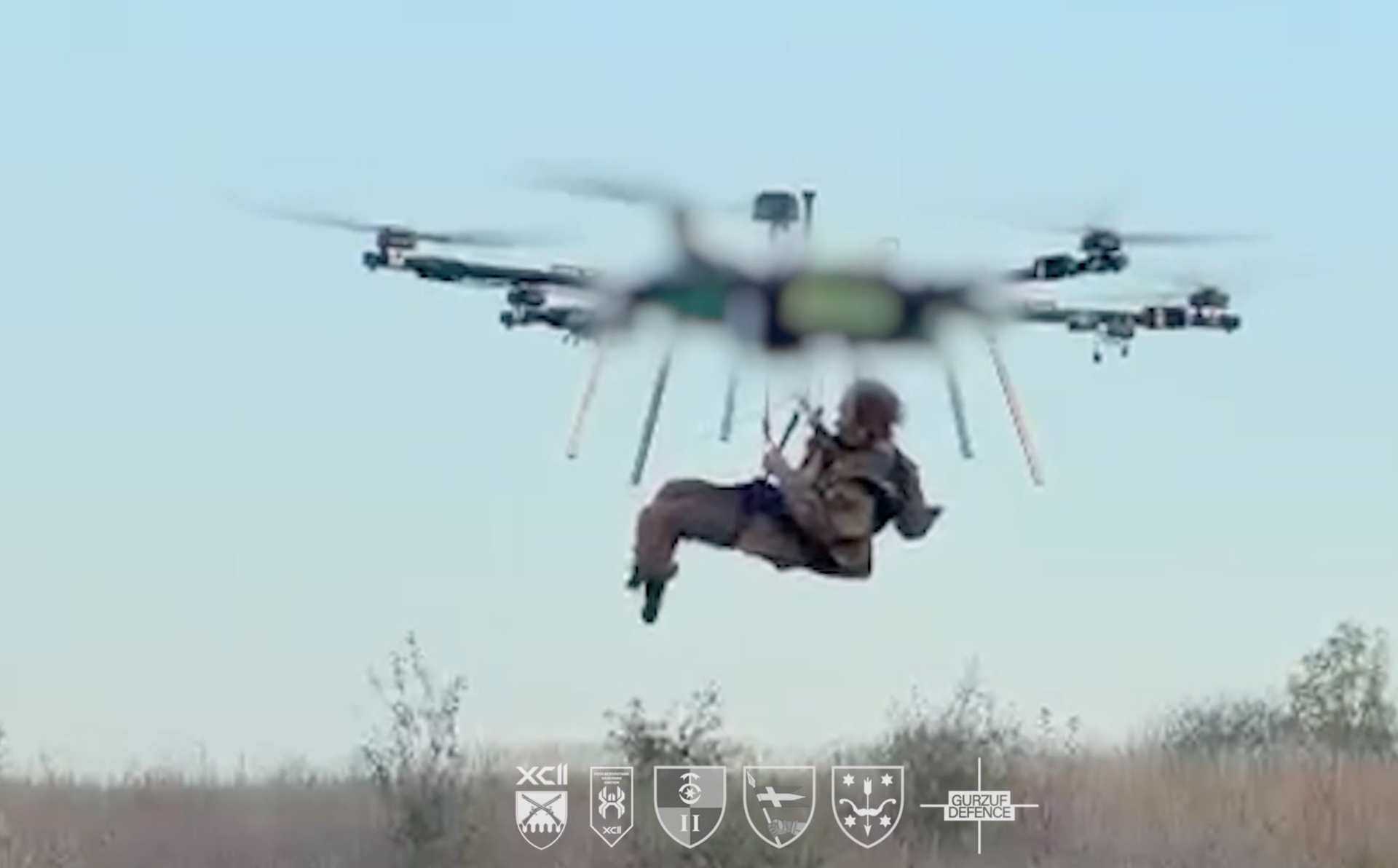
According to accompanying reports, the infantryman was wounded while holding his position. Mines and intense Russian drone activity prevented a conventional ground evacuation, prompting the 92nd’s specialists to attempt an aerial extraction. The video shows the soldier clipping himself to the underside of the drone via a harness before being flown to safety. The extemporized nature of the platform is underscored by the fact that, while in the air, the soldier dangles below its rigid landing legs.
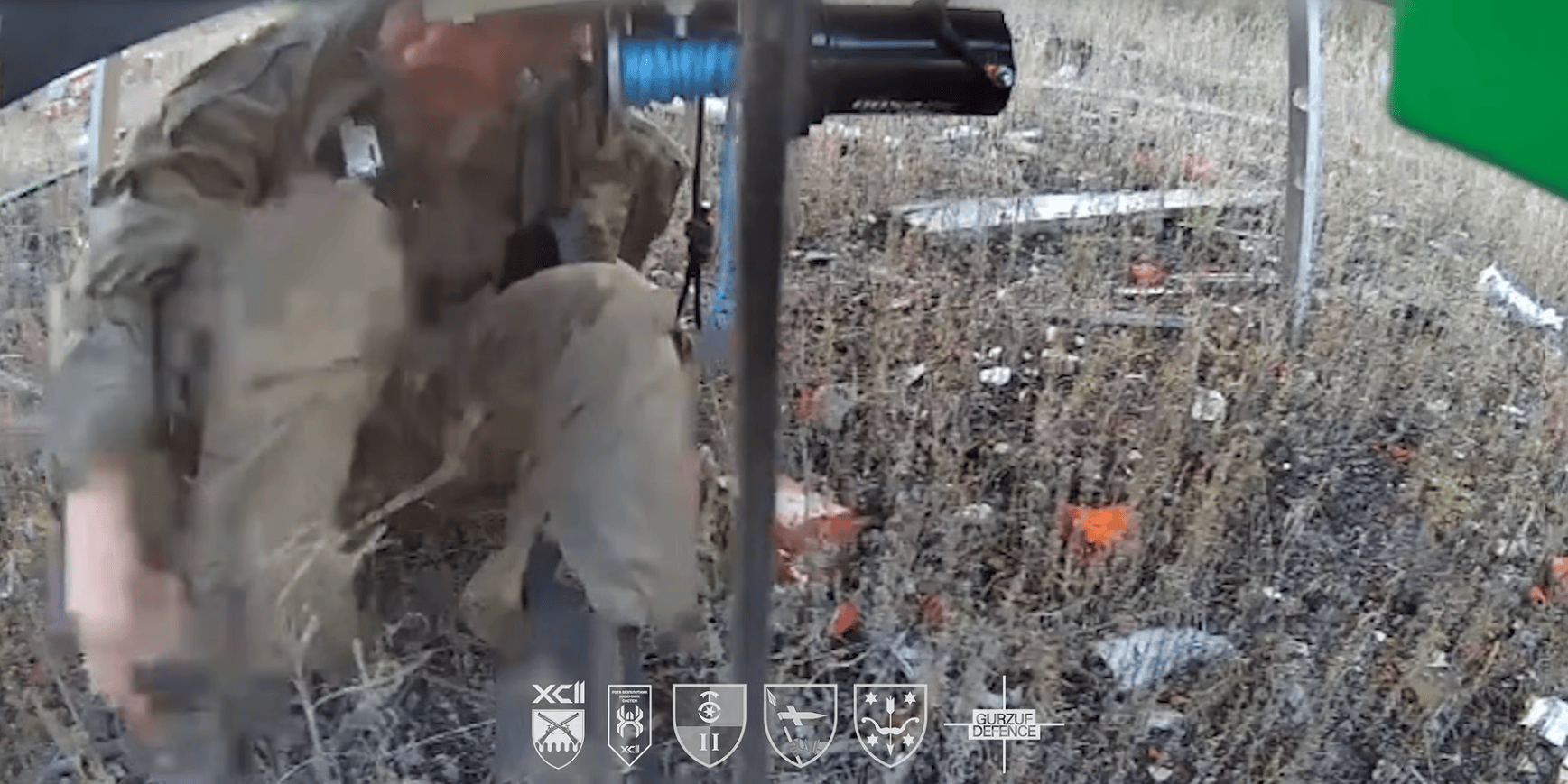
The soldier is seen hunched under the hexacopter before attaching his harness to the drone. 92nd Assault Brigade/YouTube screencap

The aircraft was a heavy hexacopter manufactured by Ukrainian company Gurzuf Defense, which provided it free of charge. A UAV operator from the 30th Mechanized Brigade piloted the drone. Throughout the recovery, the soldier remained in contact with the drone operator.
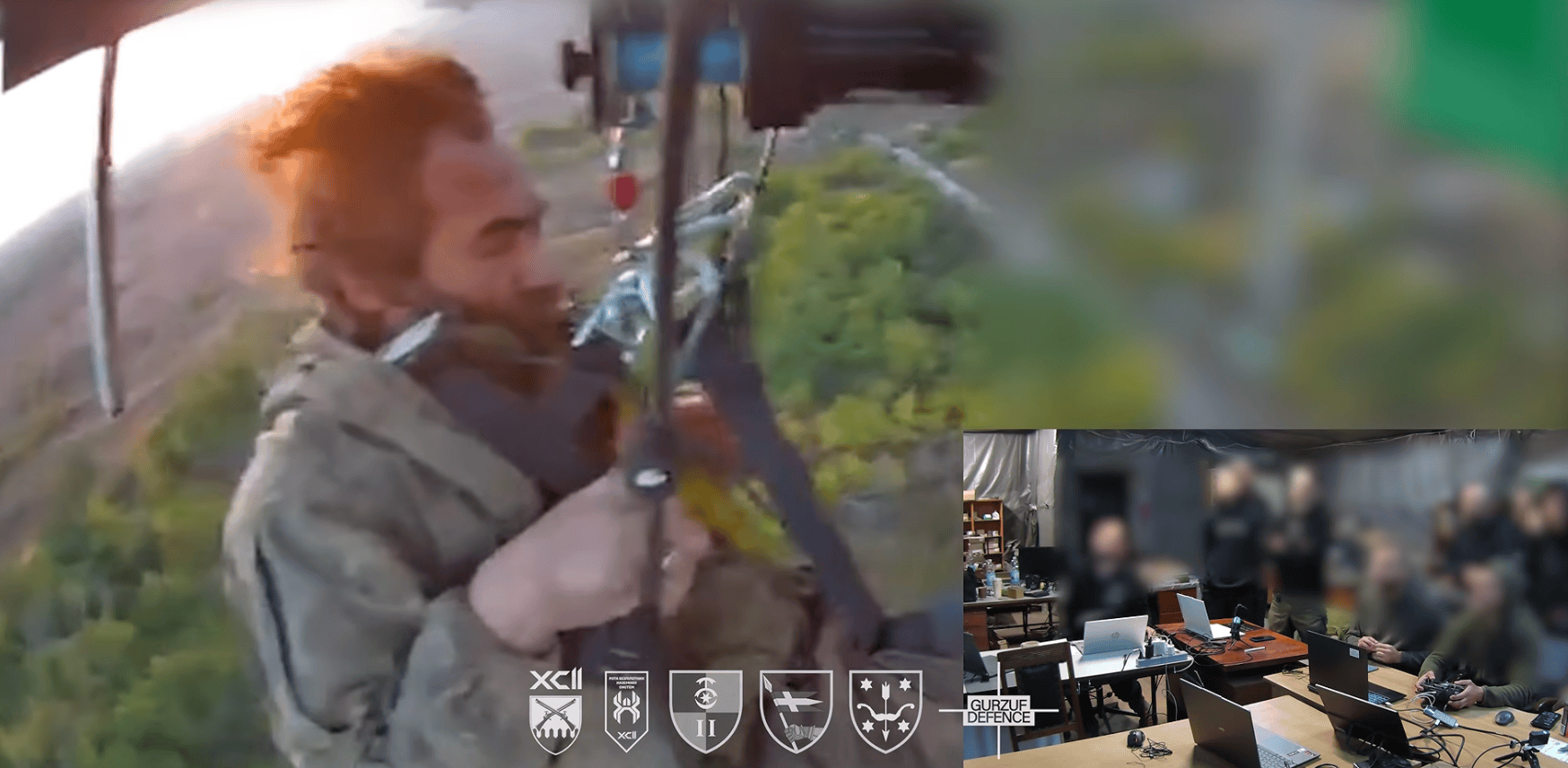
With the drone now airborne, the drone controllers monitor the flight from the ground. 92nd Assault Brigade/YouTube screencap

The operation involved the 92nd, 30th and 14th Mechanized Brigades, the 10th Army Corps and Gurzuf Defense.

Ukraine increasingly uses uncrewed ground vehicles to deliver supplies and evacuate casualties from exposed positions. According to Euromaidan Press, Ukrainian UGVs conducted approximately 112,000 logistics and evacuation missions between January and August 2026.

However, ground robots can struggle with mines, mud, and cratered terrain, while remaining vulnerable to drones and artillery. These obstacles make it especially difficult to conduct UGV operations in the battlefield’s “kill zone,” which can extend six to nine miles or more from the front line. You can read an in-depth account of Ukrainian UGV efforts in this previous story.

A video showing a Ukrainian UGV in action in the Donetsk region:

Aerial platforms are able to reach casualties in places where ground vehicles cannot safely travel, and can get there far quicker, without having to stick to specific routes.

The 92nd has not disclosed the evacuation distance or flight duration of the mission. If, as reported, the drone used was an Audag-6 model, this is stated to be capable of carrying a 200-pound payload over a distance of up to 15 miles.

Meanwhile, the recovery points to a growing trend in the Ukrainian Armed Forces.

Only days before the story of the evacuation broke, it emerged that Ukraine is also now testing the StarGate, a purpose-built aerial medical evacuation drone — also of the heavy hexacopter type — developed by the SkyFall company. This is a rather more tailored solution to the problem, with a covered, medical-grade stretcher slung below the drone. It has a reported payload capacity of around 330 pounds, uses AI-assisted navigation, and can also deploy nets against hostile drones attempting to intercept it.

The 92nd’s operation used a heavy-lift hexacopter adapted for an ad hoc casualty transport, rather than a more bespoke design. This means the soldier had to be adequately trained on how to strap in, and also had to be in a condition that they could actually perform this procedure. This would also be the case even if other soldiers were able to assist them in strapping in.

While these kinds of solutions may be new to the battlefield in Ukraine, using uncrewed aerial systems for personnel recovery and medical evacuation is far from new.

Back in 2016, the Army completed a demonstration of the Lockheed Martin K-Max helicopter in a casualty evacuation role. The K-Max can operate with and without a pilot and was used as a drone by the Marine Corps to deliver cargo in Afghanistan.
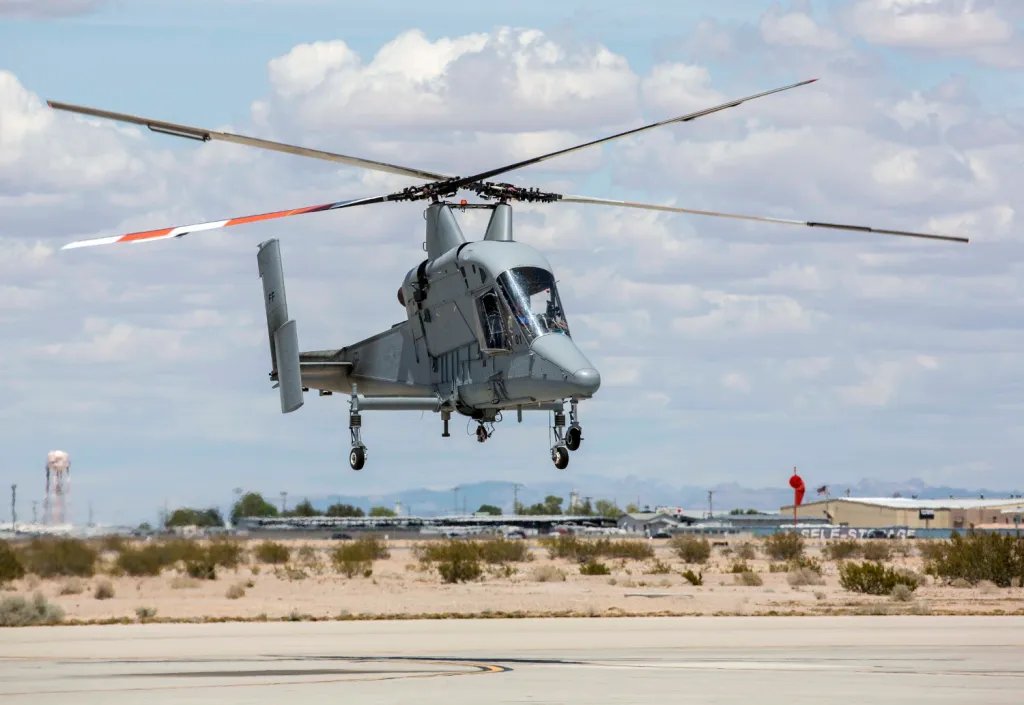
A U.S. Marine Corps K-Max helicopter. U.S. Marine Corps

“Unmanned and autonomous platforms have the potential to completely rewrite the medical doctrine,” Army Col. Daniel Kral, head of the Army’s Advanced Technology Research Center (TATRC), explained during a conference at Fort Detrick in Maryland in 2017.

In 2019, TWZ reported on U.S. Army efforts to explore how uncrewed craft might speed up the casualty evacuation process. This work included evaluation of the Dragonfly Pictures, Inc. (DPI) DP-14 Hawk, a small, tandem-rotor drone with a 400-pound cargo capacity.
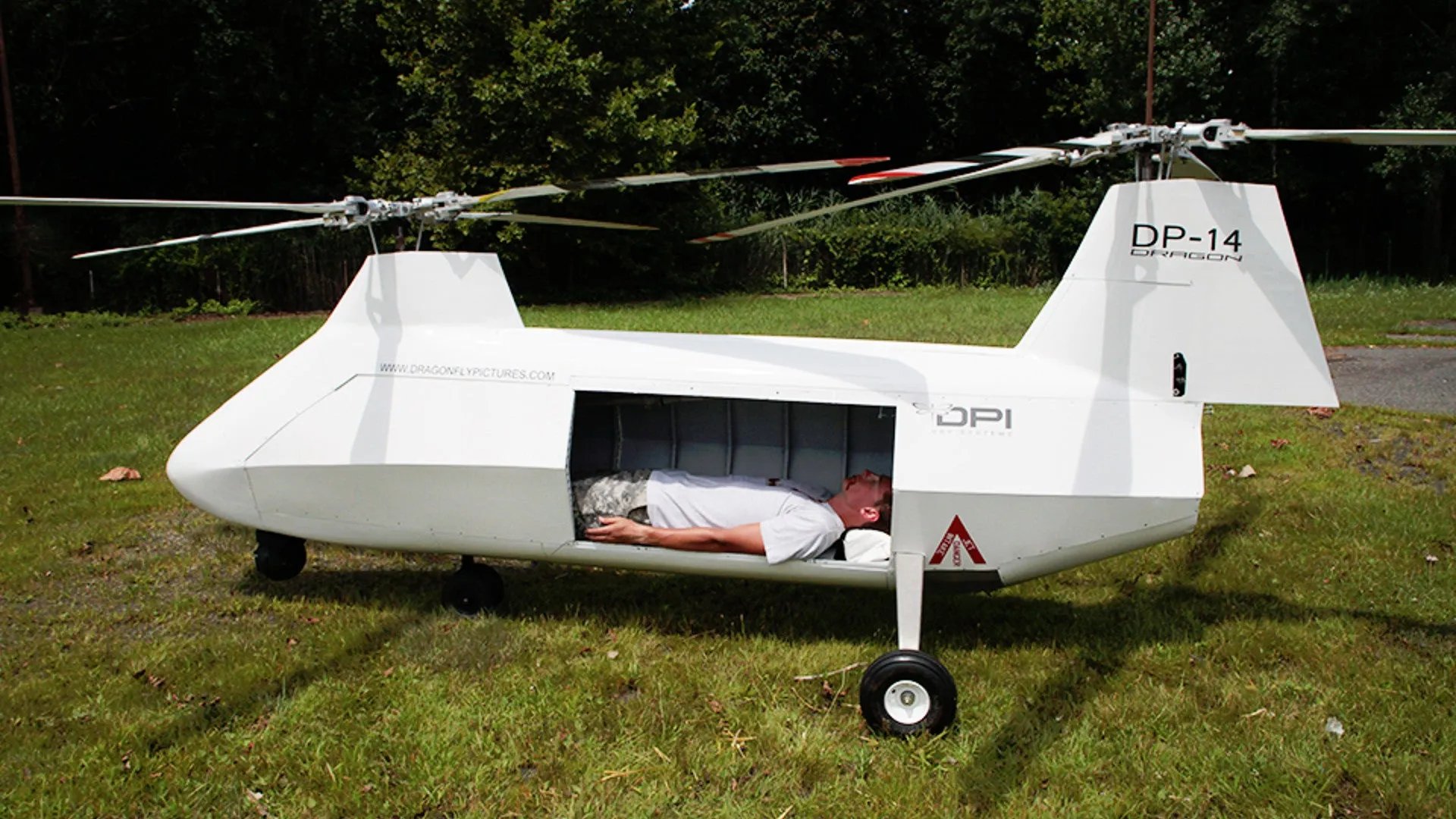
 A DP-14 Hawk shown configured for casualty evacuation. Dragonfly Pictures, Inc.

The emergence of autonomous air vehicles, or uncrewed ‘flying taxis,’ with short or vertical take-off and landing capabilities in the urban air mobility sector has also generated military interest. The U.S. Air Force Research Laboratory, for example, has conducted studies into how craft such as these could be adapted for combat search and rescue, with the idea that they would be airdropped to recover a fighter pilot shot down while operating over hostile territory.

Closer to the Ukrainian hexacopter concept is the Flowcopter FC-100, a heavy-lift quadcopter drone that the U.S. Army tested in a medical evacuation capacity in Poland during the large-scale Saber Strike exercise earlier this year. Carrying a 220-pound payload, the drone has a range of more than 60 miles.
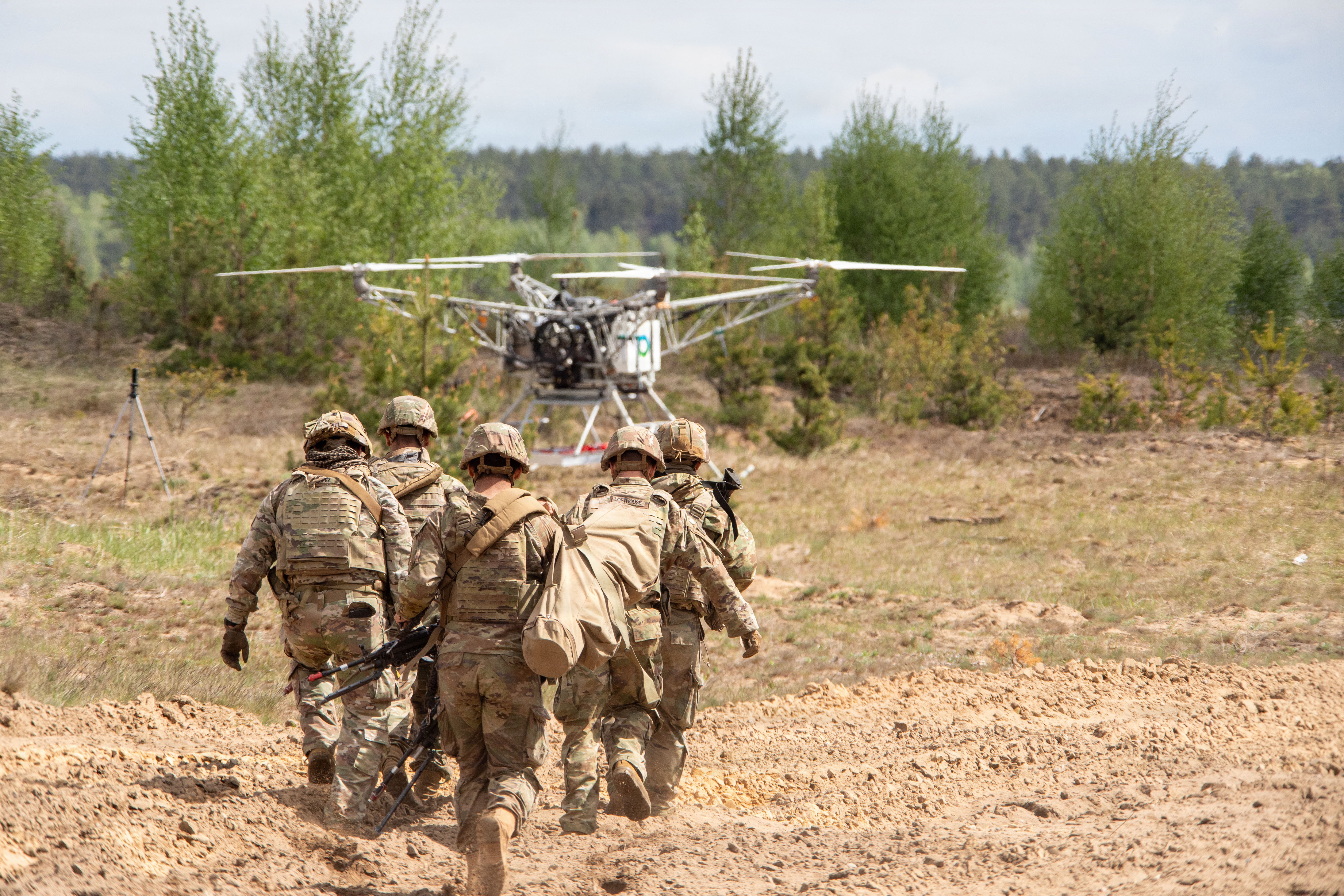
U.S. Army Soldiers assigned to the Regimental Support Squadron, 2d Cavalry Regiment, run with a test dummy in a stretcher towards a drone during an Autonomous Triage and Treatment Challenge taking place near Bemowo Piskie Training Area, Poland, May 10, 2026. From April 27 to May 31, 2026, U.S. and Allied forces will exercise the North Atlantic Treaty Organization’s (NATO) Eastern Flank Deterrence Initiative, demonstrating NATO’s ability to fight and win on the modern battlefield. Nearly 15,000 troops from eleven nations will train across the High North, Baltic region, and Poland. They will execute rapid maneuvers, air defense, counter-drone operations, and cyber defense to validate NATO’s regional defense plans in real time. This series of linked exercises includes Saber Strike, Immediate Response, and Swift Response. The exercises turn investment into capability. Soldiers integrate unmanned systems such as AI-enabled command and control and live data networks to move, decide, and fight more effectively across all domains. Sword 26 demonstrates how U.S. Army Europe and Africa drives transformation at scale while strengthening deterrence. Together with our allies, we are building a unified, lethal force ready to defend NATO territory and respond to any threat. (U.S. Army Reserve photo by Spc. Thomas Madrzak)
U.S. Army soldiers run with a test dummy in a stretcher towards a Flowcopter FC-100 drone during an Autonomous Triage and Treatment Challenge taking place near Bemowo Piskie Training Area, Poland, May 10, 2026, as part of Exercise Saber Strike. U.S. Army Reserve photo by Spc. Thomas Madrzak

All of these concepts aim to address the inherent vulnerability of larger personnel recovery platforms in more contested environments.

In their favor, they offer the potential to rescue troops from more precarious situations, with the smaller drones touching down in relatively tight areas in mountainous, forested, or jungle environments. Autonomous navigation systems can guide the drones through smoke, dust, or bad weather, too.

On the other hand, these small craft have no space for a medic, pararescuemen, or other additional personnel. Bearing in mind their limited range and lower speeds, they also need to be in the right location to respond to emergencies as and when they occur.

For the Ukrainian Armed Forces, aerial medical evacuation drones are being rapidly developed and now fielded to help address another problem: the vulnerability of UGVs in areas of the battlefield that have long become far too hazardous for crewed medevac platforms to operate.

By now, both sides in the Ukraine war are relying heavily upon small, autonomous uncrewed aircraft to perform a wide variety of resupply, surveillance, communications, and strike roles on and around the front lines. With that in mind, the adaptation of these kinds of vehicles for casualty evacuation and personnel recovery missions is the next logical step.

Contact the author: thomas@thewarzone.com

The post Aerial Drones Appear To Be Picking Up Wounded Off The Battlefield In Ukraine appeared first on TWZ.

  •  

Testados drones usados para o combate inicial a incêndios

O projeto tem como objetivo identificar potenciais incêndios, transmitir alertas e apoiar uma intervenção inicial. Prevê-se que os drones consigam transportar 50 quilos de líquido retardante.

© TIAGO PETINGA/LUSA

O projeto será apresentado na terça-feira e contará com a presença do ministro da Agricultura e Mar, José Manuel Fernandes
  •  

Fifteen months ago, Ukraine’s online arms store for front-line units didn’t exist. Now, it delivers 1 in 5 drones that state buys

fifteen months ago ukraine's online arms store front-line units didn't exist now delivers 1 5 drones state buys · post ukrainian soldier drone 658142610_1298690549110687_5343675139334166676_n ukraine news reports

Ukraine has turned buying weapons into something closer to online shopping. One in five drones bought by Ukraine's Defense Procurement Agency now reaches troops through DOT-Chain Defence, a state digital marketplace established in 2025 that lets combat units order what they need directly, the Defense Ministry says.

Drone technology changes so fast that a weapon ordered through months of paperwork can be obsolete before it arrives, so Ukraine built a marketplace that puts the choice in the hands of the units that fight. Launched in July 2025, DOT-Chain Defence now serves more than 500 combat units.

Unlike the agency’s other channels, central competitive tenders and fixed procurement lists, the marketplace lets commanders pick from a catalog themselves. The system works like an online store, where the military spends state funds to decide exactly what the state supplies them.

From a catalog to the trenches in eight days

Speed is the point of the model. When an item is in stock, the average time from a unit’s order to shipment is eight days, rising to about a month and a half for pre-orders, the ministry notes.

“Delivery speed is especially important for unmanned systems, because technology in this field develops dynamically,” DOT-Chain Defence chief Artem Romaniukov says.

Also, he states that makers and soldiers constantly rework designs to beat new countermeasures.

The catalog spans the main types of unmanned aerial vehicles, FPV drones, bombers and fixed-wing aircraft, along with their munitions, ground robotic systems and electronic-warfare gear.

Who carries the paperwork now

The shift moves the burden off the fighters. A unit builds its own order in DOT-Chain Defence, and the agency handles the procurement side, signing contracts with manufacturers and making payments. That means that purchases are completed in a few clicks.

In the first nine months of 2026, Ukraine’s troops received more than a million drones and other equipment through this system, part of a drone-buying surge that reached about $8 billion in the first half of the year.

  •  

Ukrainian forces say they used a heavy drone to evacuate a wounded soldier for the first time

A heavy bomber drone lowers an injured Ukrainian soldier.
Ukrainian forces carried out what one unit described as a "first-ever air evacuation."

Ukraine's 92nd Separate Assault Brigade/Screengrab via Telegram

  • A Ukrainian military unit said on Monday that it had carried out a "first-ever air evacuation" with a drone.
  • The unit used a heavy drone to save a wounded soldier from the front lines.
  • The mission underscores Ukraine's growing efforts to use drones in unconventional battlefield roles.

Ukrainian forces have used a heavy drone to save a wounded soldier from the front lines, carrying out what one unit described as a "first-ever air evacuation."

The unusual mission underscores Ukraine's growing efforts to use drones and robots in unconventional roles on the battlefield, including casualty evacuation, logistics, and combat.

Ukraine's 92nd Separate Assault Brigade disclosed on Monday that it had "successfully" medically evacuated a wounded soldier who had been hurt at the front. The presence of land mines and Russian drones meant that a rescue operation using ground robots was not an option.

"Specialists from our company took on the responsibility of doing something that no one had done before: evacuating a soldier using an aerial drone," the brigade wrote in a translated statement on Telegram.

Soldiers used a heavy six-rotor hexacopter made by the Ukrainian company Gurzuf Defense for the medevac mission. The aircraft was tested in advance and modified by unit specialists to ensure it remained stable.

The 92nd said several military units participated in the rescue, including the 30th Separate Mechanized Brigade, which operated the drone that evacuated the wounded soldier. The soldier is now recovering from his injuries. The unit didn't specify when or where the evacuation took place.

"This is a historic event, at least for our unit," said Napalm, the squad leader and programmer for a robotics company in the 92nd, who was identified only by his call sign.

A Ukrainian soldier is carried by a heavy bomber drone.
Footage shows the wounded Ukrainian soldier being carried by a heavy drone.

Ukraine's 92nd Separate Mechanized Brigade/Screengrab via Telegram

Casualty evacuation missions have become increasingly robotic this year as Ukrainian officials, companies, and units push to replace soldiers with machines in dangerous front-line roles.

Ukraine's defense ministry said in early September that the number of ground-robot casualty-evacuation and logistics missions has increased more than threefold since the start of the year, from roughly 7,500 in January to more than 25,000 in August.

The deployment of an aerial drone for casualty evacuation reflects a continued effort to use drones in new ways.

Gurzuf Defence, the maker of the drone used for the mission, called it an operation "that no one has ever performed before." The company said that Ukrainian forces used an aircraft called the Heavy Shot "AYUDAG 6" and the mission lasted roughly 75 minutes and covered a distance of nearly 40 miles.

Gurzuf Defence is not the only Ukrainian company working on this technology; SkyFall, the firm behind the P1-SUN interceptor, recently unveiled a large hexacopter for casualty evacuation.

Large drones can carry heavier payloads, but their size can also be a vulnerability on the battlefield. Samuel Bendett, a drone warfare expert at the Center for Naval Analyses, a US research organization, wrote on social media that there are "obvious dangers" with large, slow aircraft conducting casualty evacuation missions.

Bendett said that the Russian military spends "considerable resources" targeting heavy-lift drones. He told Business Insider that Moscow's elite Rubicon units are particularly focused on downing such aircraft.

As Russia's full-scale invasion grinds on, Ukrainian forces are continuing to innovate with their drones. Last month, for instance, the Third Army Corps revealed that it had become the "first in the world" to air-drop ground robots from drones in combat. Other units have deployed similar technology.

Read the original article on Business Insider

  •  
❌