❌

Reading view

Kevin O'Leary's data center company pushes back on the 'bragawatt' label

Kevin O'Leary stands in a black suit and tie in front of a framed photograph.
Kevin O'Leary.

Lev Radin/Pacific Press/LightRocket via Getty Images

  • O'Leary Digital's CEO says a Wall Street firm's analysis misses work happening before construction.
  • Paul Palandjian, the CEO, said the company's two campuses will generate their own electricity.
  • He outlined land deals, permitting, and early funding, saying delivery should be judged in phases.

Kevin O'Leary's data center company has a message for analysts who doubt its enormous AI ambitions: You're not seeing the whole picture.

Paul Palandjian, CEO of O'Leary Digital, pushed back on a Bernstein Research assessment that put the firm near the bottom of the data center industry's credibility rankings. In an emailed response to Business Insider, he detailed land agreements, water applications and licensing, engineering work, and funding that he said the analysis overlooks.

"Scrutiny during this cycle is fair," Palandjian wrote. He added, "A score built from announced-capacity data ranks every pre-construction project low on construction progress by definition, and it cannot see confidential work."

His response gets at a central question in the AI building boom: How much weight should investors give the work that happens before data center construction begins?

Paul Palandjian, CEO of O'Leary Digital
Paul Palandjian, CEO of O'Leary Digital.

Paul Palandjian/O'Leary Digital

Bernstein examined thousands of data center projects using data from the tracking firm Aterio, assessing factors such as construction progress, electricity availability, and industry experience. Its analysis concluded that only about 35% of announced data center capacity in the US will get built.

O'Leary Digital received a credibility score of 0.35 out of 5. Bernstein estimated that 489 megawatts of its announced 15-gigawatt pipeline would materialize, roughly 3%. The analysts grouped it with ambitious newcomers described as "bragawatts."

Palandjian said the 15-gigawatt figure represents the full build-out of two campuses in Utah and Alberta over several years.

"We would rather be judged on milestones than on a model," he wrote.

Data center power without the queue

Palandjian's clearest distinction concerns electricity, one of the biggest obstacles facing data center developers.

"We are not in an interconnection queue," he wrote, referring to the waiting lists for connections to the electricity grid.

Instead, both campuses are designed to generate all their electricity on-site, he said, with direct access to natural gas pipelines and supplies. That's what the industry calls "behind the meter": producing power at the facility rather than relying on an electricity utility to supply it from the grid.

Data center land, water, and early money

In Utah, Palandjian said the Military Installation Development Authority had approved and executed a 30-year development agreement naming O'Leary Digital as master developer of the project area.

About 11,000 acres are under binding agreements, he said. Master planning, ground studies, and laser-based land surveying have finished at both sites, and the company filed an engineered Utah water application in late September, he added.

In Alberta, about 13,000 acres are under a binding agreement, and a water license for 6 million cubic meters a year has been granted, Palandjian said. He also said that both sites are away from densely populated residential communities.

On money, Palandjian said his firm has capital for both pre-development and advancing the project toward key milestones. He did not specify a funding amount or say the entire build-out was financed.

He said that the engineering, power, and construction firms working with the company, and the global banks advising it, provide evidence of its ability to deliver.

"With that team, every critical part of the project is being worked through, gaps are identified early, and we are closing them to raise our probability of success," he wrote.

Palandjian said that while O'Leary Digital is young, its team has decades of experience in real estate, power, and infrastructure.

Bernstein's skepticism does not mean every newcomer will fail.

"It's not that all of these guys are sort of terrible and not going to deliver, but we just have lower confidence because we don't know them," analyst Madison Rezaei said.

With Palandjian's update, now we know a bit more.

Sign up for the AI Insider newsletter here. Reach out to me via email at abarr@businessinsider.com
Read the original article on Business Insider

  •  

EU’s Arctic oil-and-gas pledge leaves a Norway-sized loophole

Earlier this week, EU officials said in unusually staunch terms that they would not buy Arctic oil and gas.

Even if someone (Norway) decided to drill new oil or gas wells in the Barents Sea, which is well above the Arctic Circle, the EU would not purchase it.

The goal is to dissuade investors. It costs many billions of euros to develop gas or oil at scale in the harsh conditions of the far north.

If there is no offtake market in continental Europe, no-one is going to take the risk.

The thing is, EU buyers already buy gas (and oil) from the Arctic. A lot of it.

Most of the gas, some 12 million tonnes so far this year, comes from Russia’s Yamal LNG plant, which sits on the shore of the biggest estuary you have never heard of, the Gulf of Ob (Obskaya Guba in Russian).

But that will end 10 weeks from now, when the EU ban on Russian LNG kicks in.

This article continues, but the full version is available only to EUobserver.com subscribers. Visit account.euobserver.com/membership

  •  

Pentagon advances some wind projects after freeze

The Trump administration is advancing some wind projects after a court order required it to do so. A White House official said Thursday that an initial set of wind projects under Pentagon review have been released. The official said this represents two projects located in Maine and South Dakota. The official said the Defense Department…

  •  

Trump cannot get Putin to halt strikes on Ukraine’s power grid, so he blames Ukraine instead, Zelenskyy says

musk tells ukraine’s president go zelenskyy says won’t resign never accept ukrainian land russian · post volodymyr during interview piers morgan recorded visit britain 14 2026 video uncensored / ukraine

US President Donald Trump has failed to reach an agreement with Russian ruler Vladimir Putin on halting strikes against Ukraine's energy infrastructure. However, Trump is trying to shift the blame for this failure onto President Volodymyr Zelenskyy, he said on The Diary of a CEO podcast.

His words came amid Russia's four record waves of ballistic missile attacks, after US Special Envoy Steve Witkoff described Putin as a "humanitarian." Previously, US officials cut Kyiv off from US intelligence and lowered a speed cap on Starlink to pressure Ukraine into stopping strikes on Russia's oil refineries that bring Moscow revenue for its war.

Trump pins the problem on Kyiv, not Putin

Zelenskyy explained the behavioral pattern behind Trump's recent actions and statements. At first, Putin rejected his proposal for a ceasefire. Then, the US president blamed it all on him, explaining to his people that world fuel prices are rising because of him, which is not true at all, said the Ukrainian leader.

He pointed to the blocked Strait of Hormuz shipping chokepoint, not Ukraine’s refinery campaign, as the driver of higher prices.

He also noted that the volumes of diesel allowed by the US are insufficient to lower global oil prices.

Even so, Zelenskyy said he keeps a working relationship with Trump. What he will not accept is being cast as the villain in Russia’s war: by his account, the US president is rewriting the context, turning Ukraine’s leader into the target for a problem that starts in Moscow.

Earlier, experts said the diesel deal was unlikely to meaningfully lower diesel prices. For Putin, the agreement itself was a win.

A former senior State Department official says it hardly matters whether the fuel arrives, because Putin “has already achieved the result he wants,” with Trump believing he has a pre-election card that could move markets.

  •  

NGOs unite to warn revised Sophia solar project still presents significant environmental challenges

Beira Baixa stands firm: it does not want to see its territory disappear under a suffocating black blanket of solar panels. Image: Paulo Novais/ Lusa

Following hot-on-the-heels of Rewilding Portugal, and backing up stiff opposition from local people and quite a few celebrities, several environmental organisations have spoken out today against the revised Sophia solar

The post NGOs unite to warn revised Sophia solar project still presents significant environmental challenges appeared first on Portugal Resident.

  •  

Caro vita e rincari, i costi reali delle guerre sulle famiglie italiane

In questi giorni il caro vita turba i sonni del mondo politico e sindacale, compresi quanti finora hanno ignorato i diffusi rincari dell’energia e dei beni di prima necessità, riducendo l’emergenza a mera polemica politica.

Segue nostro Telegram.

In questi giorni il caro vita turba i sonni del mondo politico e sindacale, compresi quanti finora hanno ignorato i diffusi rincari dell’energia e dei beni di prima necessità, riducendo l’emergenza a mera polemica politica.

Tuttavia, anche le poche mobilitazioni in corso dimenticano che la causa primaria dell’inflazione è proprio l’economia di guerra: l’escalation militare ha fatto ripartire la corsa dei prezzi, con conseguenze particolarmente pesanti per le economie europee, dipendenti dal greggio in transito nel Golfo Persico.

Un tempo le forniture principali arrivavano dalla Russia a costi decisamente inferiori a quelli attuali. Affermare che l’economia di guerra sia la causa principale dell’inflazione e del rallentamento economico europeo significa semplicemente prendere atto della realtà.

I dati parlano chiaro: tra marzo e agosto la UE ha sostenuto 54 miliardi di dollari di costi aggiuntivi netti solo per le importazioni di gas e petrolio. Questo dato basterebbe da solo ad aprire un dibattito serio sulle conseguenze economiche dei conflitti.

A confermare il quadro è l’Ufficio Studi della CGIA di Mestre: a fine anno gli italiani pagheranno 29 miliardi di euro in più tra rincari di elettricità, gas e carburanti. Solo in Italia il costo dell’energia elettrica è balzato del 51,2%. Rincari dovuti all’instabilità delle catene di approvvigionamento, alle speculazioni finanziarie e all’aumento delle spese militari, che sottraggono risorse essenziali al welfare.

Di fronte a questo scenario, la risposta del Governo appare timida e priva di coraggio. Mentre sostiene le spese per il riarmo, prova a calmierare con fondi pubblici le bollette degli italiani (che stimano una spesa aggiuntiva media di 153 euro all’anno per l’elettricità e 477 euro per il gas). Parallelamente, i rincari a doppia cifra colpiscono anche i beni alimentari di largo consumo: la dimostrazione che non si tratta di un incidente di percorso, ma di un effetto strutturale dell’economia di guerra.

In questo contesto, le manifestazioni di piazza rischiano di rivelarsi inefficaci, sia per la scarsa adesione sia per la debolezza delle motivazioni. Manca una riflessione complessiva sul sistema economico e sui meccanismi che spingono verso il basso i salari (a partire dai criteri di calcolo dell’IPCA). I bonus non sono la soluzione, bensì il sintomo del progressivo smantellamento del welfare pubblico.

È urgente iniziare a parlare apertamente di “economia di guerra”: un modello di produzione che alimenta la corsa alle risorse, dirotta i fondi pubblici verso la difesa e giustifica la sottrazione di risorse ai servizi essenziali. In caso contrario, continueremo a inseguire singoli provvedimenti tampone senza mai affrontare la vera radice del problema.

Articolo originale:  lantidiplomatico.it

  •  

MEPs back three-year methane delay, triple what the EU Commission wanted

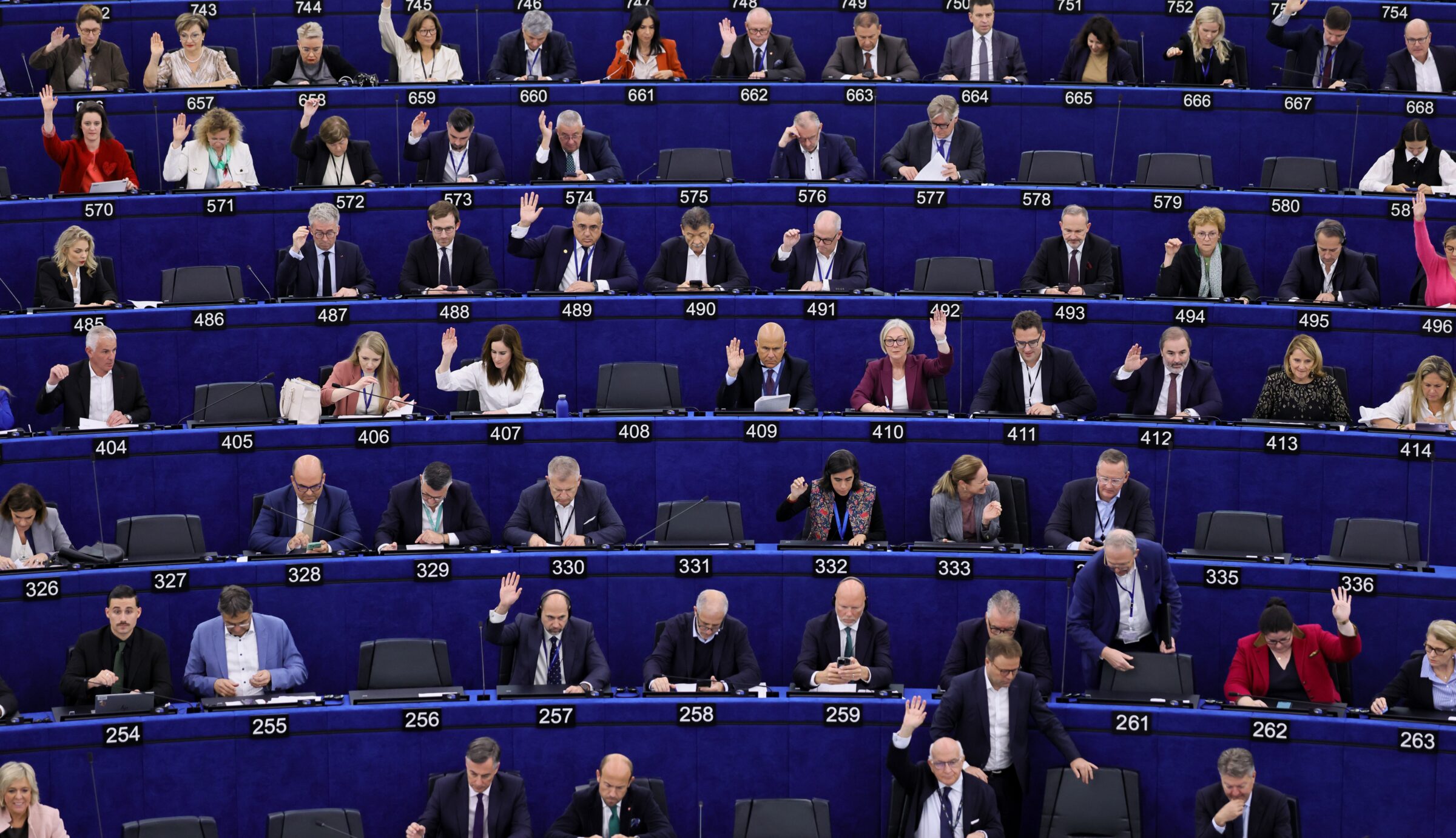
The European Parliament on Thursday (22 October) backed a three-year delay to the EU’s methane rules for oil and gas importers, two years more than the European Commission proposed last week.

MEPs also voted to extend the delay to European oil and gas producers, which goes beyond the commission’s plans.

The text now forms parliament’s position for negotiations with member states, whose ambassadors failed to agree on Wednesday.

Under the amendments, tabled by the conservative European People’s Party (EPP), importers would only have to prove that their oil and gas meets EU monitoring standards from 2031, instead of 2027 under the current law.

Reporting on methane intensity would also be delayed from 2028 to 2031.

A separate amendment from a cross-party group of 36 Romanian and Bulgarian MEPs, which also passed, delays reporting obligations for EU operators by three years, to 2030.

MEPs also approved an amendment, tabled by Dutch Socialist MEP Mohammed Chahim, that the extra time should not apply to oil, gas and coal from countries under EU sanctions, which in practice means Russia.

A far-right Patriots for Europe proposal to suspend the regulation altogether was rejected, as was a push by the conservative ECR group to delay parts of the rules even longer.

This article continues, but the full version is available only to EUobserver.com subscribers. Visit account.euobserver.com/membership

  •  

Why trade is vital to understanding how Ukraine needs western capital to stay afloat and how Russia can pay for its war effort without new debt

Four graphs that tell a bigger story

By Ian PROUD

Join us on Telegram, X, and VK.

Contact us: info@strategic-culture.su

I have wanted to write an article for sometime about the differing fates of Russia and Ukraine since the onset of the conflict in 2014. The headline is that Ukraine has never made up the difference in increased trade with Europe having cut its trade with Russia to the bone since 2014. This has inadvertently meant that Europe has had to inject significant sums of capital into Ukraine just to prevent its currency from collapsing as the war has gone on. Russia has diversified its trade away from Europe such that its export model is as strong today as it was in 2014, giving it the liquidity it needs to underwrite the war effort.

Key finding:

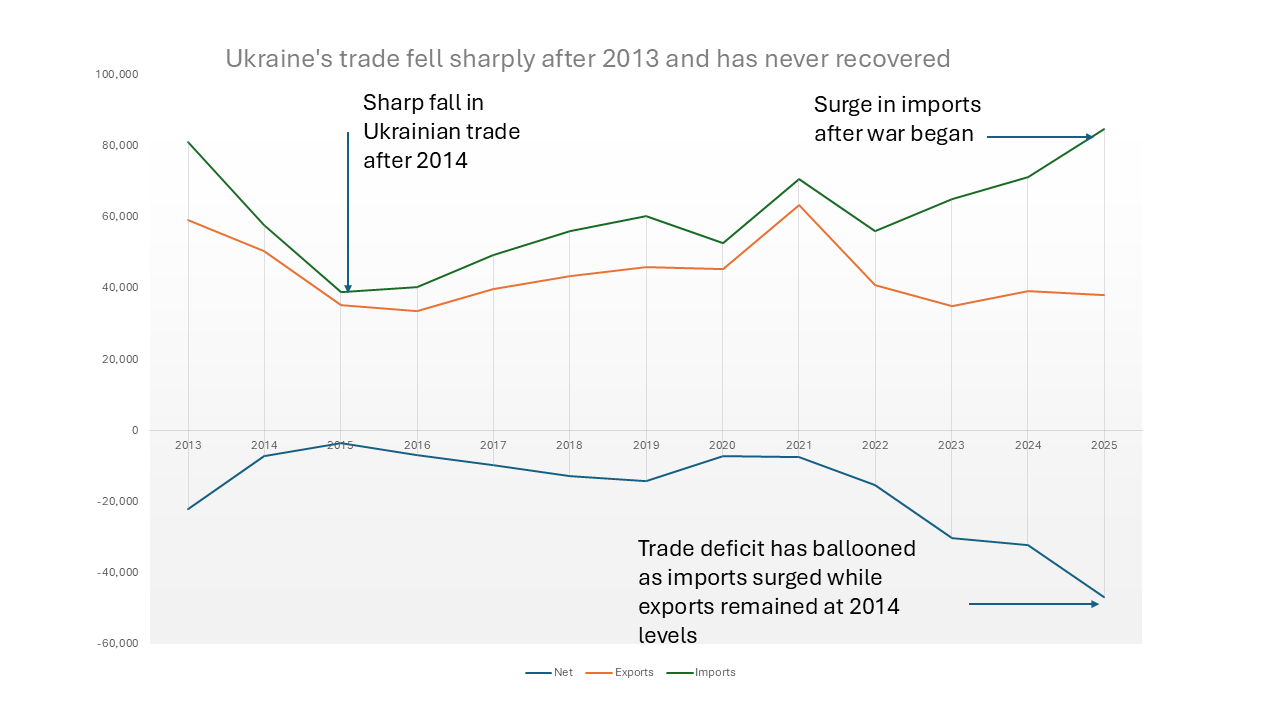
  • Ukraine exported 24% less and imported 46% more in 2025 than in 2014. The war has driven up imports while exports never recovered from the signing of the DCFTA and have been hampered by the war effort.
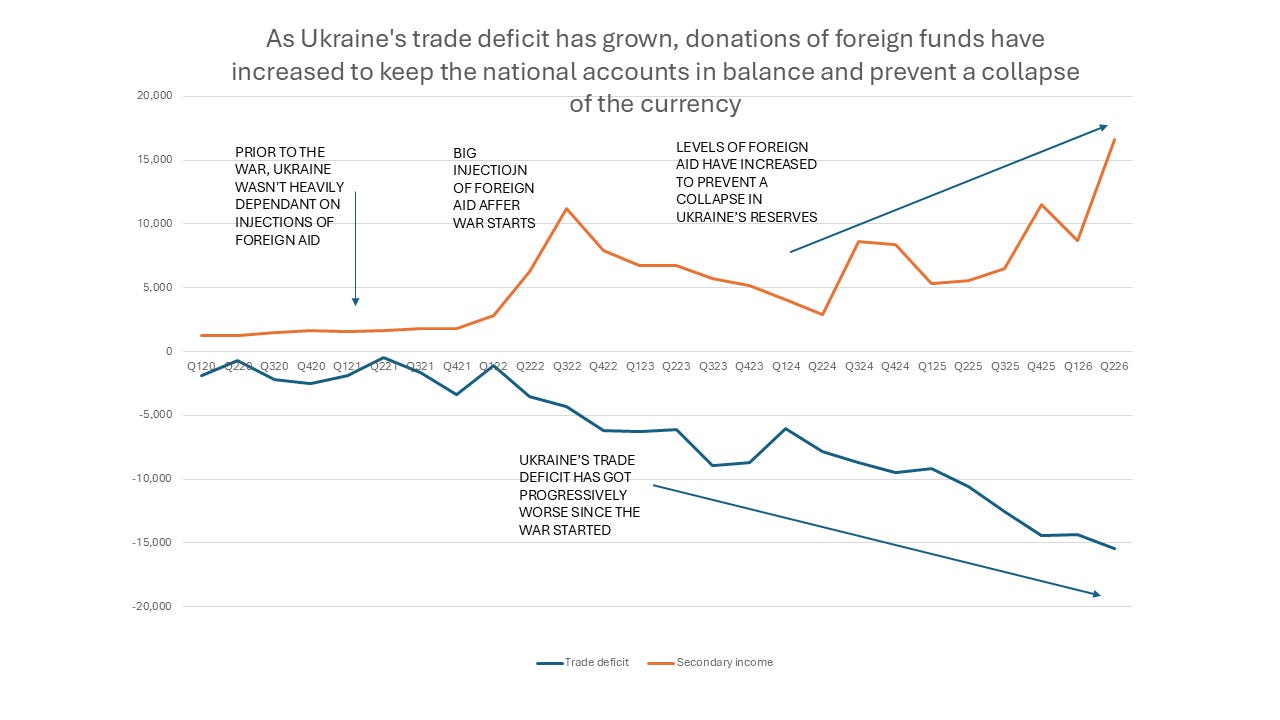
  • The yawning trade deficit Ukraine has built since the war started has placed greater strain on European sponsors to provide the capital Ukraine needs to prevent its currency collapsing, in addition to providing funding to meet its fiscal requirements.
  • This funding challenge for Europe will persist after the war ends until Ukraine can become self-sufficient in boosting exports and/or attracting sufficient foreign investment to offset its trade deficits.
  • Russia’s export strength and consistent surpluses have been unaffected by war. After the Ukraine crisis started, Russia started to diversify its major energy exports away from Europe, allowing it to weather the progressive reduction of exports to Europe. Indeed, Russia gained a huge windfall in 2022 from surging energy prices. There is no evidence that sanctions have impacted Russia’s export model in a significant way.
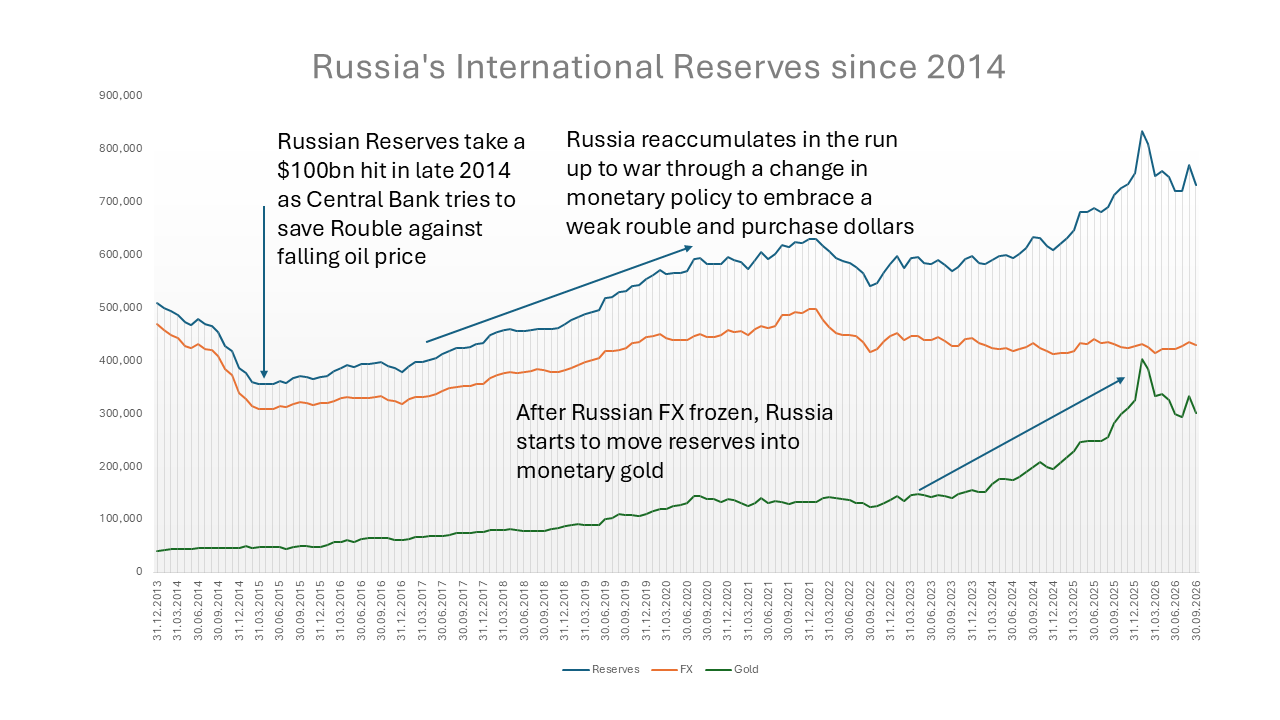
  • Russia has already started to reaccumulate FX reserves after the oil price collapse of late 2014, until before the war started. Following the immobilisation of $300bn in Russian FX reserves, Russia started to accumulate reserves in monetary gold, to sanction-proof future earnings. Russia now has liquid reserves of over $420bn meaning the immobilisation of its foreign currency reserves is no longer an economically limiting factor.

Detailed analysis

Russia’s export model in which it runs consistently large trade surpluses has ensured it can generate the reserves of foreign currency and gold which have undoubtedly helped to bankroll the war in Ukraine. Ukraine’s trade deficit has yawned since the war started, requiring continual injections of European capital to prevent its currency from collapsing.

This helps to explain by Russia can sustain the war for longer; it doesn’t need to take on significant new debt, its debt remaining low at 20%. Ukraine can only fund the war and keep its national accounts in balance with European money that cannot be guaranteed long-term and which, in any case, has increased Ukrainian debt by an average of 20% of GDP each year since the war started. This is not sustainable.

The Deep and Comprehensive Free Trade Agreement of 2014 has disadvantaged Ukraine because it forced a choice away from trading with Russia.

The starting point for this is the signature by Ukraine of a Deep and Comprehensive Free Trade Agreement with Europe on 27 June 2014.

Herman van Rompuy, then President of the European Council said that “stronger political and economic ties will bring greater stability and prosperity to the entire European continent.”

President Poroshenko said “over the last months, Ukraine paid the highest possible price to make her European dreams come true.”

Yet, the true price of this agreement has borne by Ukraine which saw its exports collapse and its imports increase, as it make a “sovereign choice” not to maintain trade links with Russia.

That was a catastrophically bad choice. Russia had accounted for around 25% of Ukrainian exports prior to 2014 and that figure fell to less than 5% in 2021 before the war started. Ukraine did not make up that gap by increasing the volume of exports to Europe, which have remained largely unchanged.

Indeed, this same pattern can be seen in Georgia which has also seen no real increase in exports to the EU after it signed the DCFTA. The EU uses a number of trade dispute mechanism and other non-tariff barriers to put blockages in the way of import growth from DCFTA partner countries.

So, by encouraging Ukraine to trade with Europe and not with Russia, Europe has imposed a deadweight economic loss on Ukraine which took a sovereign decision to forgo a previously profitable trade relationship, to pursue a political goal of EU integration.

Moreover, since the war started, imports into Ukraine have surged leading to a progressive ballooning of its trade deficit. This surge in imports has been caused by Ukraine purchasing weapons from the US using borrowed European and domestic funds. So, Ukraine is borrowing money to create a trade deficit that needs to be filled with further inflows of capital.

Dragged into a persistent and growth trade deficit by war, Ukraine needs continued injections of foreign funds to prevent its currency collapsing.

The graph below maps the growth in Ukraine’s trade deficit with the corresponding growth in receipts classified as Secondary Income within its quarterly balance of payments. These inflows of capital as Secondary Income are injections from Europe (principally) that are vital to shore up Ukraine’s FX reserves and so prevent a run on the currency. The key point is that foreign funding to Ukraine is more than just a fiscal event and top it. It is a vital support mechanism in circumstances where Ukraine is unable to attract sufficient inflows of foreign investment during a time of war.

Russia simply hasn’t faced the same challenge, choosing instead to diversify its exports to other countries as Europe progressively shut down trade. Sanctions haven’t dented trade.

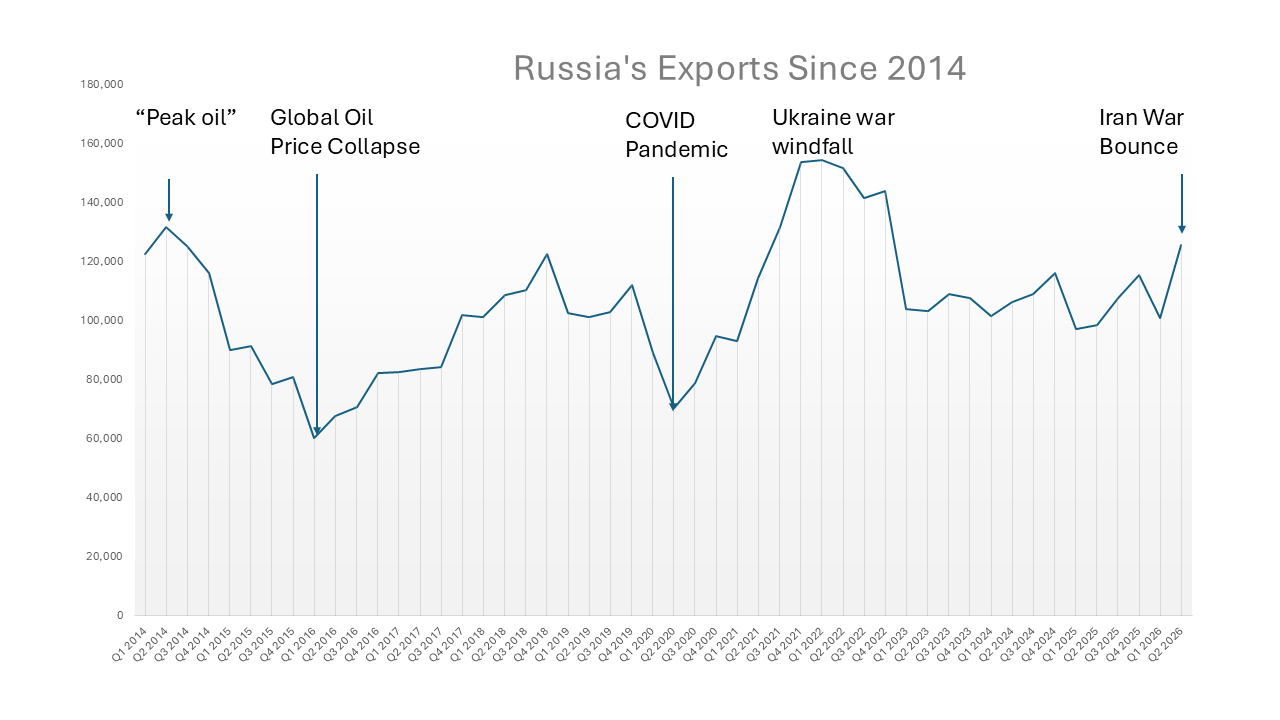
The graph below illustrates in an elegant way how Russia’s trade has changed and evolved since. Russia’s exports have gone through peaks and troughs since 2014, although the troughs have often been caused by global events such as the 2014 and 2016 oil price collapses and COVID,

The onset of the war in Ukraine caused a huge windfall in income from exports as oil prices surged. Despite the imposition of thousands of sanctions by western nations after the war commenced, Russia’s exports have remained highly resilient. This is down to Russia’s diversification of its exports towards countries in Asia.

In short, despite many headlines in western mainstream media of sanctions ‘denting Russia’s war economy’ there is no substantive evidence that this has been the case.

Russia’s export model continues to be an engine room that provides the liquidity it needs to fund the war without taking on significant new debt. This gives it a significant advantage over Ukraine and its European backers in the ‘war of attrition’.

Russia has accumulated reserves since the war started to make up for the immobilisation of $300bn in FX by western nations. Russia now invests in monetary gold to sanction-proof its assets.

Finally, I have been commenting for some time that Russia started the process of accumulating Foreign Exchange Reserves in 2017 as it shifted its monetary policy to embrace a weak rouble to maximise rouble income from exports and as it undertook a number of dollar purchases via the Finance Ministry. You can see this reserve accumulation in the graph below.

After the war started, following the large windfall in earning from exports in 2022 and still solid trade figures after that, Russia continued to accumulate reserves. However, following the freezing of its foreign currency assets, it has chosen instead to store its reserves in monetary gold, to sanction proof them.

While Russia would undoubtedly like to see the return of its immobilised assets after the war ends (big question mark) it has nevertheless built up a significant financial buffer to the tune of over $420bn in reserve assets in addition to those assets that remain frozen.

This deep well of reserves undoubtedly helps to underwrite Russia’s war effort without the need for significant borrowing. Russia’s debt today sits at around 20% of GDP.

In 2021 Ukraine’s debt sat at around 49% of GDP. Today it sits at around 110% of GDP.

Original article: thepeacemonger.substack.com

  •  

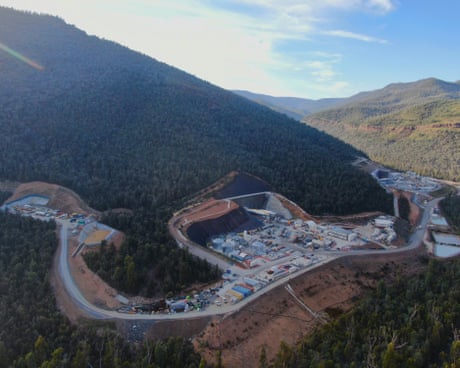
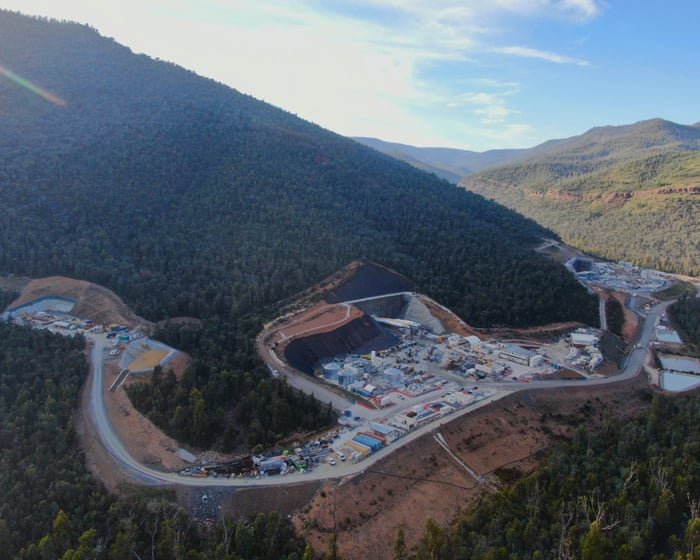
Snowy Hydro 2.0 has blown out to 12 times its original cost – but the CEO says it ‘could have been worse’

New projections by the Snowy Hydro company show tunnelling work is now 65% finished, but the completion date has been pushed back to 2029

The cost of Snowy Hydro 2.0 has blown out to as much as $25bn, with a major reassessment finding the long-delayed renewable energy project will not be completed until the end of the decade.

First touted by the Turnbull government in 2017 with a price tag of $2bn, the cost of the project in the Kosciuszko national park has increased dramatically over time. In 2023 it was revised to almost $13bn, with construction due to completed by the end of 2028.

Continue reading...

© Photograph: Snowy Hydro

© Photograph: Snowy Hydro

© Photograph: Snowy Hydro

  •  

Oil climbs more than $1 on fresh Houthi attacks

SINGAPORE: Oil prices rose more than $1 a barrel ‌on Thursday after more Houthi attacks in Saudi Arabia stoked concerns over a broader escalation of conflict and further disruptions to supplies from the Middle East. Brent crude futures rose $1.93, or 1.77 percent, to $110.75 a barrel at 07:42 a.m. Saudi time, while US West Texas Intermediate crude gained $1.43, or 1.47 percent, to $98.58. ​Brent had settled largely unchanged on Wednesday, while WTI had eased 67 cents. “Oil prices remain well bid

  •  

EU energy measures fall short of tackling high prices, warns Cypriot expert

European Union leaders have correctly identified high energy prices as a threat to households, industry and the wider economy, but their proposed response remains inadequate, energy systems expert Andreas Poullikkas has warned.

Writing after the EU summit held on October 15-16, the former Cyprus Energy Regulatory Authority (CERA) chairman and vice-rector of Frederick University argued that Europe needed structural investment in electricity networks, interconnections and energy storage rather than continued reliance on temporary support measures.

“The diagnosis is correct, but the treatment remains largely inadequate,” Poullikkas said, assessing the summit’s conclusions.

EU leaders called for a coordinated response based on targeted and temporary measures, welcoming delays to certain obligations under the methane regulation and the proposed extension of the temporary state aid framework for the industrial sectors most exposed to high energy costs.

They also supported voluntary pooling of energy demand by businesses and industries, allowing larger combined purchasing volumes to strengthen negotiating power and potentially secure lower, more stable prices.

On the EU emissions trading system (ETS), leaders called for faster legislative work on the Market Stability Reserve to limit excessive volatility and for an updated assessment of the impact of the ETS2 system.

Poullikkas welcomed the recognition that the energy transition could help address both energy security and affordability, describing it as the most positive aspect of the summit’s conclusions.

“The energy transition, with faster electrification, more renewables and other low-emission sources, stronger grids, storage and energy efficiency, is the most effective strategy for structurally lower prices,” he said.

However, he warned that the volatility of carbon allowance prices was already affecting energy costs rather than representing a theoretical concern.

Carbon allowances approached €88 per tonne in early October 2026 and remained above €85 in the middle of the month, according to his analysis.

“When fossil fuel power plants set the electricity market price, every increase or decrease in the price of emissions allowances is transferred directly to the consumer’s bill,” Poullikkas said.

He argued that the EU needed a clear and predictable intervention mechanism to ensure carbon pricing continued to encourage investment without becoming an additional source of uncertainty.

The first weakness in the summit’s approach, he said, was that temporary measures could ease immediate pressure without changing the underlying cost structure.

“If state aid is not linked to investment in renewables, storage and energy savings, it risks entrenching the dependence it is supposed to reduce,” Poullikkas warned.

He also questioned the consistency of the EU’s approach to regulatory certainty, with leaders calling for a transparent and predictable carbon market while simultaneously welcoming delays to certain methane obligations.

“Investors and importers need stable rules, not continuous revisions,” he said.

In his assessment, every postponement risked reinforcing the impression that regulatory requirements could be changed under pressure.

Poullikkas identified infrastructure as the third and most serious weakness, noting that the package of measures for European electricity grids was among the files expected to be completed by the end of the year.

However, the summit conclusions did not set quantitative targets, specify funding or establish an implementation timetable for the necessary infrastructure.

“Interconnections and storage are not a luxury,” he said, describing them as essential infrastructure for security of supply and price stability.

Although EU leaders explicitly recognised the role of cross-border electricity interconnections in supporting Ukraine, Poullikkas argued that the conclusions did not provide equivalent attention to the bloc’s own island and isolated energy systems.

The protection of vulnerable consumers represented another gap, particularly in relation to ETS2, the emissions trading system intended to cover additional sectors.

Under the mechanism, additional allowances can be released from the Market Stability Reserve if the average auction price exceeds €45 per tonne in 2020 prices, adjusted for inflation, for two consecutive months.

“This is a mechanism for easing price pressures, not an absolute price cap,” Poullikkas said.

While he considered the direction appropriate, he argued that household protection needed to be explicit and adequately funded to prevent climate policy from becoming a social burden.

He called for a more substantial European intervention built around binding targets and EU funding for electricity grids and interconnections, with specific provision for island and isolated energy systems.

Clear targets and market mechanisms for energy storage were also needed to absorb more renewable electricity and reduce reliance on expensive peak-generation plants.

At the same time, Poullikkas argued that Europe needed a genuinely competitive electricity market with transparent price signals that encouraged investment and prevented market distortions.

He proposed introducing a price shock absorber to limit the temporary pass-through of extreme fossil fuel price fluctuations into wholesale electricity prices.

“During periods of extreme fluctuations in fossil fuel prices, their transmission to the wholesale electricity market should be temporarily limited, protecting consumers and businesses without undermining the functioning of the market,” he said.

Temporary support measures should also be tied to investment commitments and clear expiry dates, he added, so they acted as a bridge towards a different energy system rather than becoming permanent exceptions.

Poullikkas also highlighted the strategic importance of the Eastern Mediterranean, arguing that the region could become an energy corridor to Europe and strengthen security of supply.

Concerns expressed by EU leaders over the Strait of Hormuz and the Red Sea, as well as the possibility of prolonged disruption to international energy supply chains, made the need for regional energy cooperation more urgent, he said.

“The EU will not solve the cost of energy through successive emergency interventions,” Poullikkas warned.

“Grids, storage, interconnections and a stable carbon market are needed,” he added.

Unless the summit’s diagnosis is translated into binding targets, specific timetables and sufficient funding, Europe risks returning to the same emergency measures every winter, he concluded.

  •  
❌