❌

Normal view

Ukranian Defenses Crack in Zaporozhye
10 October 2026 at 21:24

File image.

In the Sumy direction, Russian assault groups of the “North” grouping are pressing Ukrainian defenses in the forest tract north of Sumy, conducting small-arms fighting near Khoten and advancing through tree lines near Korenok. In the Kharkiv direction, Russian units are increasing the pace of their advance in the area of the encirclement in the northeast of the region; they have taken Shirokoye and are fighting for Komissarovo, Lukashovo and Lobanovka. In the Slavyansk direction, Ukrainian units are attempting to clear the right bank of the Zherebets, infiltrating the northern part of Zarechnoye and attacking west of it, while Russian troops hold Zarechnoye and Yampol. In the Zaporozhye direction, Russian troops are delivering FAB strikes against temporary deployment points in Preobrazhenka and Orekhov, have overcome a water obstacle and an anti-tank ditch on the Voskresenka–Barvinovka–Lyubitskoye line, and in the zone of the “Dnepr” grouping are advancing on a broad front near Primorskoye, Stepnogorsk and Yurkovka. The leader of the party “Debout la France,” Nicolas Dupont-Aignan, called Europe’s rejection of Russian gas economic and social suicide against the background of a 42.4% price rise since the beginning of 2026.

Sumy direction  

Heavy positional fighting is under way on all sectors of the front. Assault groups of Russian units are pressing Ukrainian defenses in the forest tract north of Sumy and destroying positions with artillery and heavy flamethrower systems. The Ukrainian side has taken no active actions and has concentrated on holding the positions it occupies.

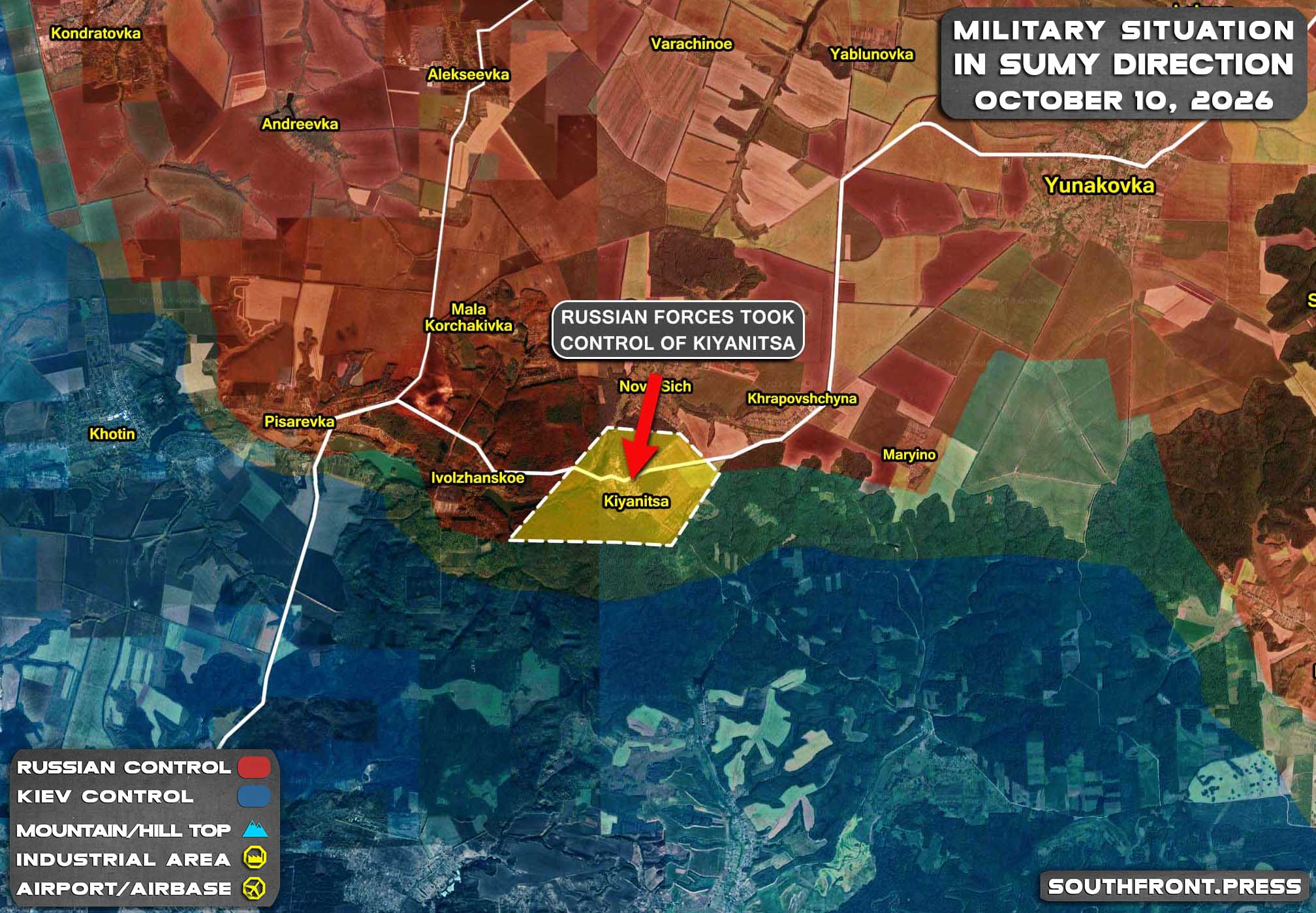
The situation around Kiyanitsa is extremely complicated: the Ukrainian side has accumulated a huge quantity of resources in the forest zones, and it is premature to speak of full control on this sector. Moreover, Ukrainian units are attacking near Yablonovka and Varachino, attempting to regain positions and making use of the last opportunity before the muddy season to take cover in the forests.

In the Sumy district, assault groups of Russian units are conducting small-arms fighting near Khoten. In Shostka district, assault groups continue to advance through tree lines near Korenok.  

Kharkiv direction  

Assault units of the “North” grouping are increasing the pace of their advance in the area of the encirclement of Ukrainian forces in the northeast of Kharkiv region. Ukrainian units are attempting to break the encirclement from the outside and are employing armor.

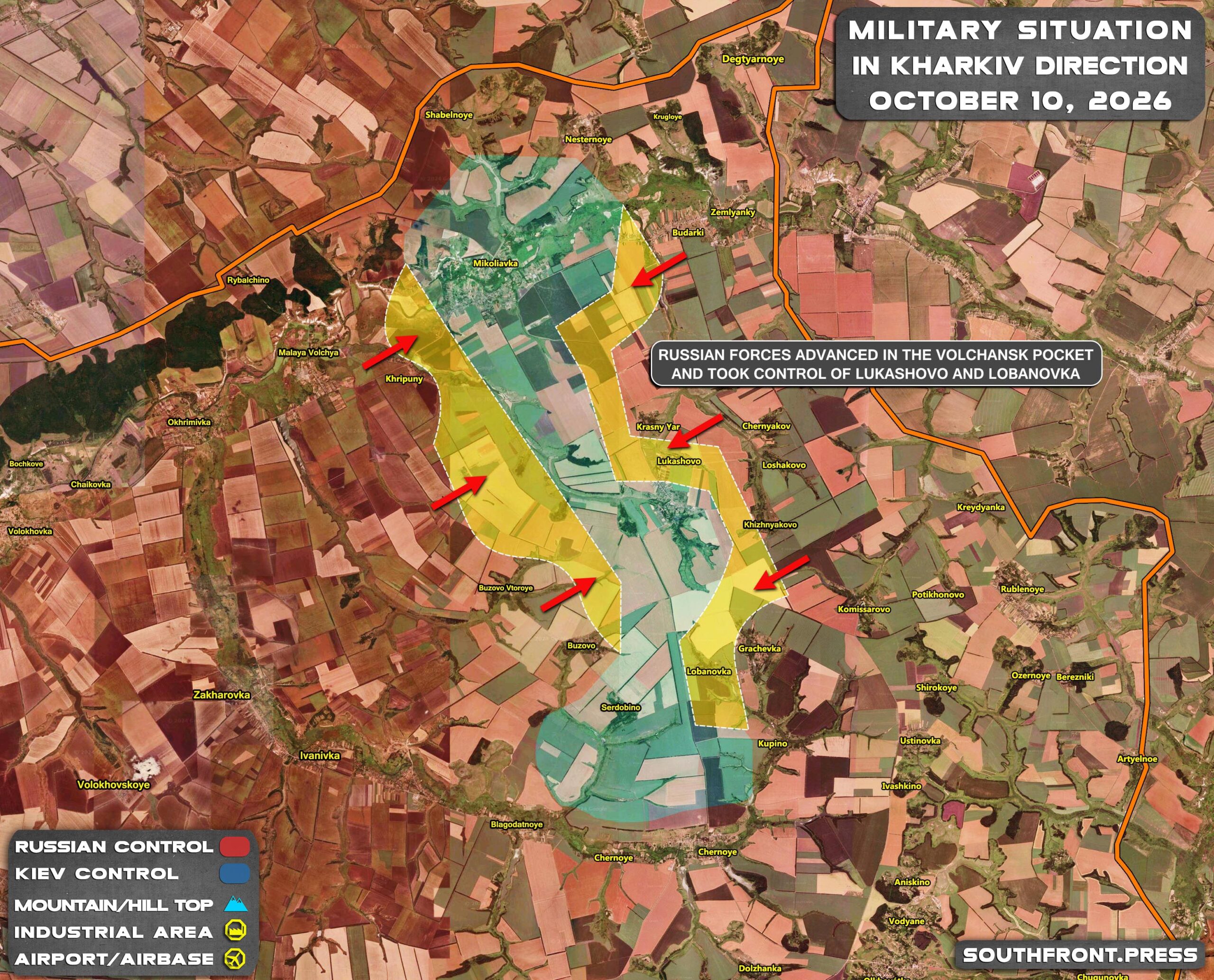
In the Liptsy direction Russian assault troops advanced 200 meters near Tokarevka. In the Volchansk and Veliky Burluk directions Russian units advanced deeper into the cauldron on more than 20 sectors of the front. Overall progress reached approximately 1,000 meters.

The Ukrainian side made two attempts to break the encirclement from the outside with two assault groups of the 475th Separate Assault Regiment on two “Kazak” armored fighting vehicles from the area of Veliky Burluk. As a result of comprehensive fire strikes the attempt was thwarted; one armored vehicle was destroyed and the second damaged.

The encirclement in the east of the Burluk direction is gradually tightening. Ukrainian formations are unable to force a reliable corridor for themselves, while Russian troops are systematically destroying disorganized units. Newly available objective-control footage confirms the capture of Shirokoye. Forward assault groups are already pressing Ukrainian forces on the territory of Komissarovo. Fighting for the village continues, and a focal Ukrainian presence still remains in the tree lines to the north and in the vicinity of Rublyonoye. Russian units are confidently advancing toward the center of the cauldron. On the morning of 9 October it became known that fighting had begun for Lukashovo and Lobanovka. The capture of Lobanovka is important for strengthening the southern face of the encirclement, which will complicate any potential breakout by Ukrainian units.  

Slavyansk direction  

The Ukrainian side has not abandoned attempts to clear the right bank of the Zherebets in the Liman direction. Ukrainian units continue to advance into the northern part of Zarechnoye and to develop the offensive west of the village with the aim of regaining control over several large strongpoints near the O-05-28 highway.

Should Zarechnoye be taken, the Ukrainian side would be able to place Russian units in the Svyatiye Gory park in a fire pocket. Nevertheless, it has not proved possible to isolate the fighters of the “West” grouping from supply from the direction of Torskoye, which makes it possible to retain control of the center of the village. The second direction of the Ukrainian strike remains the area of Yampol, the retention of which is also necessary for Russian troops in order to supply units in the Svyatiye Gory.

At present the most important tasks of Russian troops remain the holding of Zarechnoye and Yampol. Only in this case will it be possible to stabilize the front and preserve positions in the Serebryansky forestry, without control of which a new offensive on Liman will be impossible. In the area of Rai-Aleksandrovka Ukrainian units are conducting attacks.  

Zaporozhye direction  

In the Zaporozhye direction Russian troops are delivering FAB strikes against temporary deployment points of Ukrainian units in Preobrazhenka and Orekhov. On the eastern sector they are holding strong points on the western bank of the Verkhnyaya Tersa River and pressing the defenses. Assault groups have overcome a water obstacle and an anti-tank ditch on the Voskresenka–Barvinovka–Lyubitskoye line.

Further east, in the zone of the “Dnepr” grouping, the picture is different. Russian units continue to advance on a broad front. Fighting is under way near Primorskoye, Stepnogorsk, Lukyanovskoye, Pavlovka, Novoyakovlevka and Yurkovka. Active operations are also noted in the area of Orekhov and Preobrazhenka.

The Ukrainian side, attempting to hold the northern and western outskirts of Orekhov, is throwing reinforcements there. Units of the “East” grouping are already fighting on the outskirts of Omelnyk from the south-east and east. The aim is to reach the rear of the Orekhov–Preobrazhenka grouping. Further north, in the zone of the 5th Army, the preconditions for a broader envelopment are being created. Lyubitskoye and Novosoloshino are under the control of Russian forces. Further south the situation remains complicated and reciprocal.  

Conclusion  

In the Sumy direction this is expressed in the pressing of defenses in the forest tracts and fighting near Kiyanitsa and Khoten. In the Kharkiv direction — in the tightening of the ring around the encircled grouping and the advance toward the center of the cauldron. In the Slavyansk direction — in the holding of key positions near Zarechnoye and Yampol and heavy fighting near Rai-Aleksandrovka. In the Zaporozhye direction — in advance on a broad front and attempting to reach the rear of the Orekhov–Preobrazhenka grouping. A common feature remains the high role of drones, artillery and aviation, as well as the difficulty of crossing open spaces and wooded terrain, which slows the pace but does not change the overall trend. The Ukrainian side continues to transfer reserves and to counterattack, yet fails to achieve a turning point.

The leader of the party “Debout la France,” Nicolas Dupont-Aignan, who is running for president of the country, stated that the European authorities’ rejection of Russian gas against the background of a rapid rise in fuel prices is comparable to economic and social suicide. “Gas prices continue to rise rapidly. This is a very concrete result of the European leaders’ refusal to establish peace in Ukraine and to lift the sanctions against Russia. This is economic and social suicide,” he wrote on the social network X.

As the politician noted, the price rise since the beginning of 2026 has amounted to 42.4% and continues to this day. “Meanwhile the economies of the United States and China are operating at full capacity, and gas there is four times cheaper,” he added.  

_______________________________________________________________________________________________________________________

SouthFront: Analysis and Intelligence

NOW hosted at southfront.press

Previously, SouthFront: Analysis and Intelligence was at southfront.org.

The .org domain name had been blocked by the US (NATO) (https://southfront.press/southfront-org-blocked-by-u-s-controlled-global-internet-supervisor/) globally, outlawed and without any explanation

Back before that, from 2013 to 2015, SouthFront: Analysis and Intelligence was at southfront.com

SOUTHFRONT.PRESS

MORE ON THIS TOPIC:

The post Ukranian Defenses Crack in Zaporozhye appeared first on South Front.
Germany Reassesses Wartime Responsibility as Bundestag Shifts Historical Focus from Russia to Ukraine

10 October 2026 at 20:57

The German parliament’s recognition of its country’s historical responsibility towards Ukraine marks a significant reassessment of a post-war political tradition that frequently placed Moscow at the centre of reconciliation over Nazi atrocities committed across the Soviet Union.

Germany’s Bundestag has formally recognised the country’s particular historical responsibility towards Ukraine for atrocities committed during the Nazi occupation, adopting parliamentary resolutions commemorating the 85th anniversary of the Babyn Yar massacre near Kyiv.

The decision, taken on 9 October, has implications beyond historical remembrance. For decades, Germany’s responsibility for the destruction inflicted on the Soviet Union during the Second World War was frequently interpreted through its relationship with Russia. Moscow occupied a privileged position in German efforts at reconciliation, although some of the Nazi occupation’s worst atrocities took place in territories belonging to present-day Ukraine and Belarus.

The Bundestag’s parliamentary debate and resolutions reflect a different emphasis. Germany’s historical obligations are now being connected explicitly to Ukraine’s sovereignty and its defence against Russia’s invasion, challenging an interpretation of the past that had long influenced Berlin’s approach towards Moscow.

How Russia became the principal beneficiary of German historical responsibility

Following German reunification, reconciliation with Russia became a central element of Berlin’s eastern policy. The Soviet Union’s immense wartime losses, officially estimated at approximately 27 million people, were frequently invoked to explain Germany’s special obligation to maintain constructive relations with Moscow.

That historical argument became intertwined with political and economic considerations, contributing to the belief that Russia should remain closely integrated into Europe’s security and economic arrangements, even as relations with its neighbours deteriorated.

The difficulty lay in the frequent conflation of Russia with the Soviet Union. Nazi Germany invaded a multinational state, not the present-day Russian Federation. Ukrainians, Belarusians, Russians, Jews and numerous other peoples suffered under an occupation whose policies included mass murder, starvation, deportation and the systematic destruction of communities.

Ukraine was among the principal territories where the German war of annihilation unfolded. The Holocaust by bullets, the destruction of entire settlements, the exploitation of occupied agricultural regions and the deportation of civilians for forced labour were central features of Nazi rule there.

Nevertheless, German political discourse often approached this history primarily through the framework of German-Russian reconciliation. The suffering of Ukraine and Belarus was acknowledged, but neither country occupied a comparable position in Berlin’s strategic thinking.

This imbalance has been examined by German scholars of foreign policy, who have argued that the historical justification for rapprochement with Russia sometimes obscured the distinct wartime experiences of other former Soviet republics.

Babyn Yar and the geography of Nazi extermination

The anniversary of Babyn Yar provides a particularly direct illustration of the historical problem.

On 29 and 30 September 1941, German SS and police units, with assistance from local collaborators, murdered 33,771 Jewish men, women and children in a ravine outside Kyiv. The massacre was among the largest single mass shootings of the Holocaust.

Killings continued at the site throughout the German occupation. Approximately 100,000 people were murdered there, including Jews, Roma, Soviet prisoners of war and other civilians persecuted by the Nazi authorities.

Babyn Yar was not an isolated atrocity. Similar mass executions occurred across occupied Ukraine, while millions of people suffered under German military occupation. The country’s experience formed a substantial part of the wider catastrophe conventionally remembered in Germany as the war against the Soviet Union.

The geographical distinction matters because the Soviet Union’s dissolution in 1991 did not transfer the historical experiences of its constituent peoples exclusively to Russia. Nor did Moscow’s position as the principal diplomatic successor to the USSR confer ownership of their wartime suffering.

Recognition of Ukraine’s separate experience therefore requires more than acknowledging the location of Nazi crimes. It involves reconsidering the political assumptions that allowed Russia to become Germany’s principal partner in commemorating a history shared by several nations.

Historical responsibility acquires a contemporary meaning

In its resolution on the Babyn Yar anniversary, Chancellor Friedrich Merz’s CDU/CSU and its Social Democratic coalition partner explicitly connected remembrance of Nazi crimes with Germany’s present obligations towards Ukraine.

The document declares that responsibility for German atrocities does not end with commemorating their victims. It requires opposition to antisemitism, racism, historical revisionism and imperialist violence.

The parliamentary motion calls for continued political, economic, financial, humanitarian and military assistance to Ukraine, together with support for its European integration and efforts to secure the return of children transferred to Russia.

The opposition Greens separately submitted a resolution centred on Germany’s historical responsibility towards Ukraine, advocating greater attention to the German occupation in historical education, research and cooperation between memorial institutions.

The development does not mean that Germany has only now recognised Ukrainian victims of Nazi persecution. German officials have previously acknowledged responsibility towards Ukraine alongside Russia and Belarus. In 2016, then foreign minister Frank-Walter Steinmeier explicitly referred to the suffering of all three countries in an address marking the German invasion of the Soviet Union.

What has changed is the political weight attached to that recognition. The historical relationship with Moscow can no longer be treated as the principal expression of Germany’s obligations arising from the war, particularly when Russia is conducting a war of territorial conquest against another country devastated by Nazi aggression.

The consequences for German policy towards Moscow

The reassessment also exposes a contradiction in Germany’s earlier Russia policy.

Historical responsibility was among the arguments used to defend engagement with Moscow, including economic cooperation and efforts to accommodate Russian security concerns. Such reasoning remained influential even after Russia’s annexation of Crimea in 2014.

The Nord Stream pipeline projects exemplified the wider policy of maintaining substantial economic ties with Russia despite objections from Ukraine and several Central and Eastern European governments. Those projects had commercial and geopolitical motivations, but they developed within a political culture in which reconciliation with Moscow carried particular historical significance.

Russia’s full-scale invasion in February 2022 fundamentally undermined that approach. Germany subsequently expanded military assistance to Ukraine, while President Steinmeier acknowledged serious errors in his previous assessment of relations with Moscow.

The Bundestag’s latest resolution adds a historical dimension to that policy correction. Rather than regarding restraint towards Russia as the principal lesson of Germany’s wartime conduct, parliament has articulated a responsibility to assist Ukraine in preserving its independence.

The two positions are not necessarily incompatible as matters of historical remembrance. Germany retains an obligation to commemorate Russian victims of Nazism, just as it does Ukrainian, Belarusian and other victims. The distinction concerns whether responsibility for past atrocities should influence contemporary policy towards the Russian state when that state itself is violating another nation’s sovereignty.

That question has become increasingly important as German political parties debate the duration and extent of military assistance to Kyiv. Calls for renewed accommodation with Moscow continue to feature in domestic politics, including among those opposed to further weapons deliveries.

The Bundestag’s recognition of Ukraine’s particular historical experience does not resolve those disputes or establish a new military commitment. It does, however, challenge one of the historical arguments that shaped Germany’s previous relationship with Russia.

The significance of the Babyn Yar anniversary therefore extends beyond the commemoration of crimes committed in 1941. It concerns a belated adjustment in Germany’s understanding of where its wartime responsibilities lie, and the extent to which those responsibilities should inform its conduct towards Ukraine today.

Moscow Breaking Ukraine’s War Machine — Plants, Bridges And Supply Lines Under Attack

10 October 2026 at 19:32

Click to see the full-size image

Written by Ahmed Adel, Cairo-based geopolitics and political economy researcher

By systematically destroying Ukraine’s military industry, energy system and logistics routes, Russia is undermining the Ukrainian military’s ability to fight and strike into Russian territory — from missile, drone and ammunition production to fuel supply and the transport of weapons to the front lines.

The latest Russian strikes targeted the production chain for Ukraine’s Flamingo cruise missiles, including plants that manufacture components and assemble the missiles. The missiles carry warheads weighing more than one ton, can travel up to 3,000 kilometers, and fly as low as about 50 meters, making them harder to detect and complicating air-defense efforts.

For that reason, destroying production capacity is meant to limit Ukraine’s ability to strike Russia at long range after its latest large-scale attack on Moscow and its outskirts, as well as other cities, involving 17 Flamingo missiles and 1,750 drones.

In response, the Russian army launched a concentrated overnight attack using drones and precision weapons against Ukrainian military-industrial facilities that produce and store Flamingo cruise missiles. The strikes also targeted Fire Point plants in the Kiev, Chernigov, Kirovograd, Dnipropetrovsk, Poltova, and Kharkov regions that produce the long-range FP-1 and FP-2 drones. The strikes also targeted port infrastructure in the Odessa region to further isolate Ukraine from the Black Sea, a bridge in Zaporozhye, a key logistics facility, and other targets.

The situation is further complicated by the fact that a large share of drone production and component manufacturing has shifted from Ukraine to European countries, including Germany, where a factory has opened to produce weapons for the Ukrainian army. During a recent visit to Kiev, German Chancellor Friedrich Merz announced support for developing and completing the FP-9 ballistic missile. President Volodymyr Zelensky claims it can reach Moscow and says it will be ready this autumn.

Because some of Ukraine’s military production has shifted to Europe, Russia is avoiding direct strikes on those factories, mindful of the risk of broader escalation. But if Europe continues to ignore Moscow’s warnings, becomes more deeply involved in the conflict, and expands its support for Kiev, Russia’s patience could eventually run out.

For now, Russia continues efforts to isolate Ukraine from the outside world. Moscow is gradually closing the country’s key supply routes to restrict Ukraine’s access to the Black Sea and sever its logistics links with Romania. Ships no longer sail directly to the Odessa region. Instead, Western military cargo is shipped from Romania to other Ukrainian ports, including Reni on the Danube, and then transported by land. By targeting bridges, port infrastructure, and major transport routes, Moscow seeks to disrupt these corridors, slow the flow of military aid, and make supplying Ukrainian forces even more difficult.

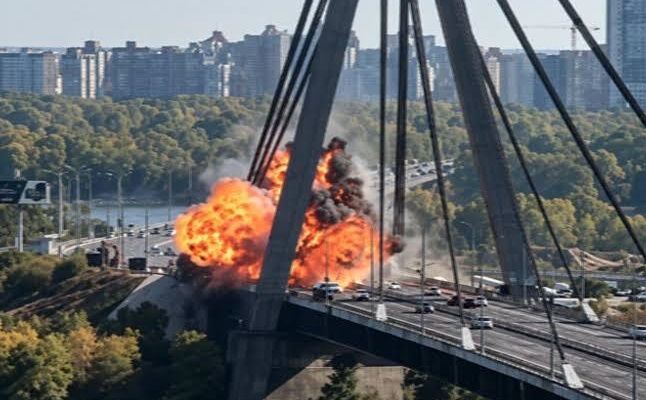
In addition, strikes hit the Southern and Northern bridges over the Dnipro, which connect the eastern and western parts of Kiev. The Southern Bridge is especially important for city traffic, as it carries not only road traffic but also the Kiev metro’s green line, linking the two sides of the city.

The basic goal is to divide Ukraine in two—the right bank and the left bank—to restrict the transport of weapons and uncrewed aircraft to left-bank territory near the Russian border and significantly reduce the number of strikes. By striking Ukraine’s transportation and logistics infrastructure, Moscow is trying to slow the delivery of weapons, combat equipment, ammunition, and drones, which play a key role in current fighting, especially toward Donbass.

Ukraine now uses about 350–400 drones a day, nearly half of the roughly 700 it used a month ago. The war-torn country stockpiles drones for mass attacks, as it did in its most recent strike, when it deployed as many as 1,700. However, this decline is not due to production capacity.

Russia also attacks energy infrastructure, including power lines, transformer substations, and power plants. Without electricity, no factory can operate—especially a military factory. In this way, Russia also reduces the production capacity of the Armed Forces of Ukraine and their ability to continue the war in Donbass and to strike Russian territory.

Ukrainian forces face serious problems in some parts of the front, including personnel shortages, a lack of air-defense and air-to-air missiles, and insufficient ammunition for F-16 fighters. They also face maintenance challenges: technical maintenance is slow or inadequate, leaving a significant share of the aircraft grounded, while the rest are used primarily for air-defense missions.

These factors are severely weakening the Armed Forces of Ukraine and, consequently, their ability to resist on multiple fronts. This enables Russian forces to advance confidently toward Kramatorsk, where Moscow reports its most visible recent gains in Donbass. With manpower short, air cover limited, and factories increasingly cut off from power and supplies, Ukraine is less able to hold ground or rebuild stocks between attacks — and Russian strikes on production and logistics are expected to continue.


MORE ON THE TOPIC:

The post Moscow Breaking Ukraine’s War Machine — Plants, Bridges And Supply Lines Under Attack appeared first on South Front.

Greece “Indispensable” To US. What About Turkey? Turkish Question Strikes Again

10 October 2026 at 18:42

Click to see the full-size image

Written by Uriel Araujo, Anthropology PhD, is a social scientist specializing in ethnic and religious conflicts, with extensive research on geopolitical dynamics and cultural interactions

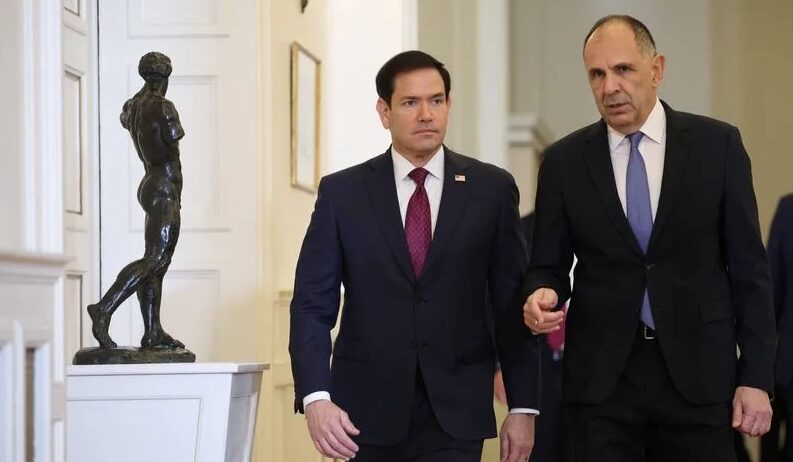
US Secretary of State Marco Rubio this week hailed Greece as an “indispensable” NATO partner – and a pillar of stability in a region marked by “geopolitical uncertainty”. The two sides announced expanded counterterrorism information-sharing. A defense agreement has been reached – worth up to $4 billion. Rubio also backed energy projects such as the undersea electricity interconnector linking Greece to Cyprus, and eventually Israel. At the same time, Rubio insisted a military clash between Turkey and Greece remains “unthinkable” and something the United States would “never allow.” He stressed that both are NATO allies and that conflict would harm all three countries.

When someone emphatically insists that they would never set a house on fire, the very emphasis makes people wonder whether the risk exists. Similarly, Rubio’s statement highlights that Greek-Turkish tensions remain serious enough to require public reassurance from Washington. It would thus seem that the two neighboring countries’ Atlantic membership alone is no guarantee of stability on the Alliance’s southeastern flank. NATO itself has in fact long been split over the “Turkish Question”.

As I argued previously, Trump’s warm embrace of Erdogan in July (recently reiterated), his subsequent signals that he would lift CAATSA sanctions and consider F-35 sales to Turkey, have already raised concerns in Athens – and Israel, for that matter. This exposed divisions, at a time when Ankara pursues strategic autonomy – while also clashing with “allies” over the Aegean, Syria, and the Eastern Mediterranean. Since at least last year, it has been noted how “sidelining” Turkey risks weakening the Alliance’s southeastern flank – and how the Athens-Ankara rivalry in turn exposes NATO’s fragile unity. These tensions predate the current US-Greece deepening of ties.

A closer American-Greek strategic relationship could alienate Turkey (despite Trump’s warmth) and generate further friction within the Alliance. Ankara might perceive the US as strengthening Greece’s military position, its diplomatic leverage, and regional role – at Ankara’s expense. Washington in turn may regard the Hellenic Republic as increasingly “indispensable” – while still viewing Turkey as strategically essential. Those two policies are not inherently incompatible, but they become harder and harder to sustain when Greek and Turkish interests directly conflict.

The latest developments illustrate the dilemma: Greece hosts key US facilities such as Souda Bay, and offers geographic advantages in the Eastern Mediterranean. While the $4 billion arms package builds on existing F-35 procurement and modernization, American support for the electricity interconnector, however, runs up against maritime disputes: Greece seeks to resume seabed surveys, while Turkey argues that the work requires prior coordination under its Libya maritime agreement. The combination of military capability, infrastructure access, and energy influence could look much more serious for Ankara than any single statement. The Greek-Turkish dispute over territorial waters, airspace, continental shelves, and island militarization is longstanding.

This creates the conditions for a security dilemma: Athens strengthens defenses out of distrust, Ankara perceives a shift in the balance and responds – and each side’s measures reinforce the other’s insecurity. Moreover, perception matters in foreign relations. Calling Greece “indispensable” does carry symbolic weight. If Turkey sees Washington investing in Greek capacity while its own F-35 path remains blocked by S-400-related legal restrictions, the asymmetry, so to speak, becomes politically relevant. Domestic prestige and national grievances in both capitals can amplify the effect, thereby creating incentives for public pushback even when direct confrontation would be costly. How can the US and NATO “balance” this?

Washington could separate bilateral defense ties from endorsement of every territorial claim. “Private diplomacy”, as Rubio has indicated, can manage sensitive issues better than public statements. NATO’s existing Greece-Turkey military deconfliction mechanism, established in 2020 with a hotline, can reduce the risk of incidents. The problem is the Alliance itself cannot simply adjudicate Aegean disputes or impose maritime boundaries. Article 5 does not offer a straightforward path for one member against another. NATO’s priority remains preventing hostilities rather than settling sovereignty questions.

At least three scenarios remain plausible: managed competition, with military modernization proceeding alongside negotiations over the underlying rivalries somehow; Turkish strategic pushback through diplomacy, counter-procurement, or greater use of its leverage within the Atlantic Organization; or an “incident” in the Aegean or around Cyprus that would force Washington and NATO into crisis-management mode.

Thus far, Washington has tried to cultivate both bilateral relationships. Greece cannot replace Turkey’s geographic and military assets spanning Europe, the Black Sea, and the Middle East. Washington appears to be strengthening the Hellenic Republic as a sort of strategic hedge, expanding its military access and logistical options in the Eastern Mediterranean – to mitigate the risks of Turkey’s progressively independent and unpredictable (often aggressive) foreign policy. Even as Ankara itself remains an important NATO (and US) ally in its own right. The recent advances in American-Greek relations enhance the challenge without resolving the underlying contradictions. They reflect a deeper transatlantic contradiction in the context of an increasingly divided West.


MORE ON THE TOPIC:

The post Greece “Indispensable” To US. What About Turkey? Turkish Question Strikes Again appeared first on South Front.

Military Situation In Ukraine On October 10, 2026 (Maps Update)

10 October 2026 at 17:15

Click to see the full-size image

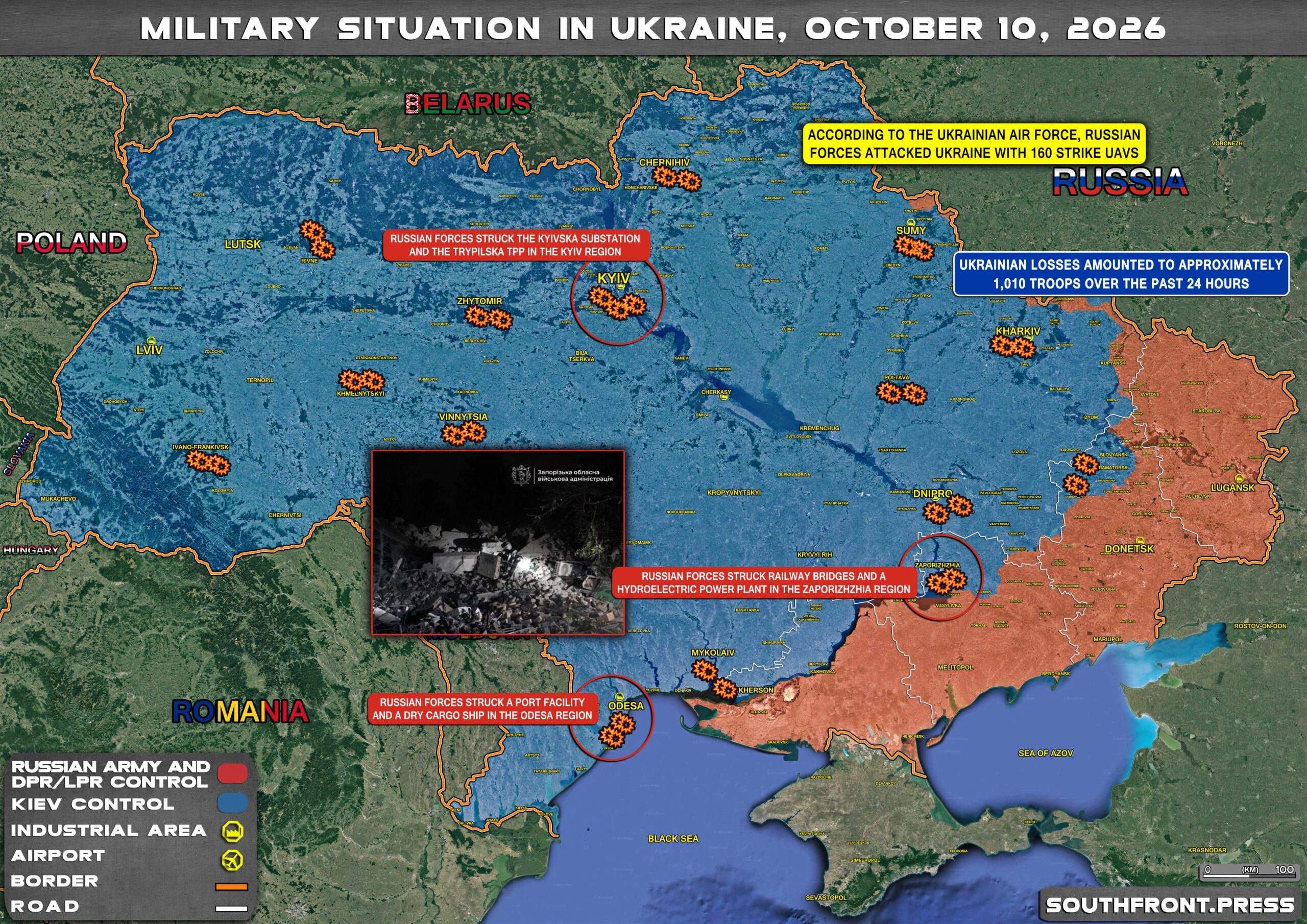
  • Russian strikes destroyed targets in the Sumy, Kharkiv, Zaporizhzhia, Dnipropetrovsk, Kherson, Kyiv, Odesa, Ivano-Frankivsk, Volyn, Chernihiv, Mykolaiv, Poltava, Vinnytsia, Rivne, Zhytomyr, Khmelnytskyi regions, and the DPR;
  • According to the Ukrainian Air Force, Russian forces attacked Ukraine with 160 strike UAVs;
  • Russian forces struck the Kyivska substation and the Trypilska TPP in the Kyiv region;
  • Russian forces struck railway bridges and a hydroelectric power plant in the Zaporizhzhia region;
  • Russian forces struck a port facility and a dry cargo ship in the Odesa region;
  • Ukrainian losses amounted to approximately 1,010 troops over the past 24 hours.

Click to see the full-size image

  • Russian forces took control of Kiyanitsa.

Click to see the full-size image

  • Russian forces advanced in the Volchansk pocket and took control of Lukashovo and Lobanovka.

Click to see the full-size image

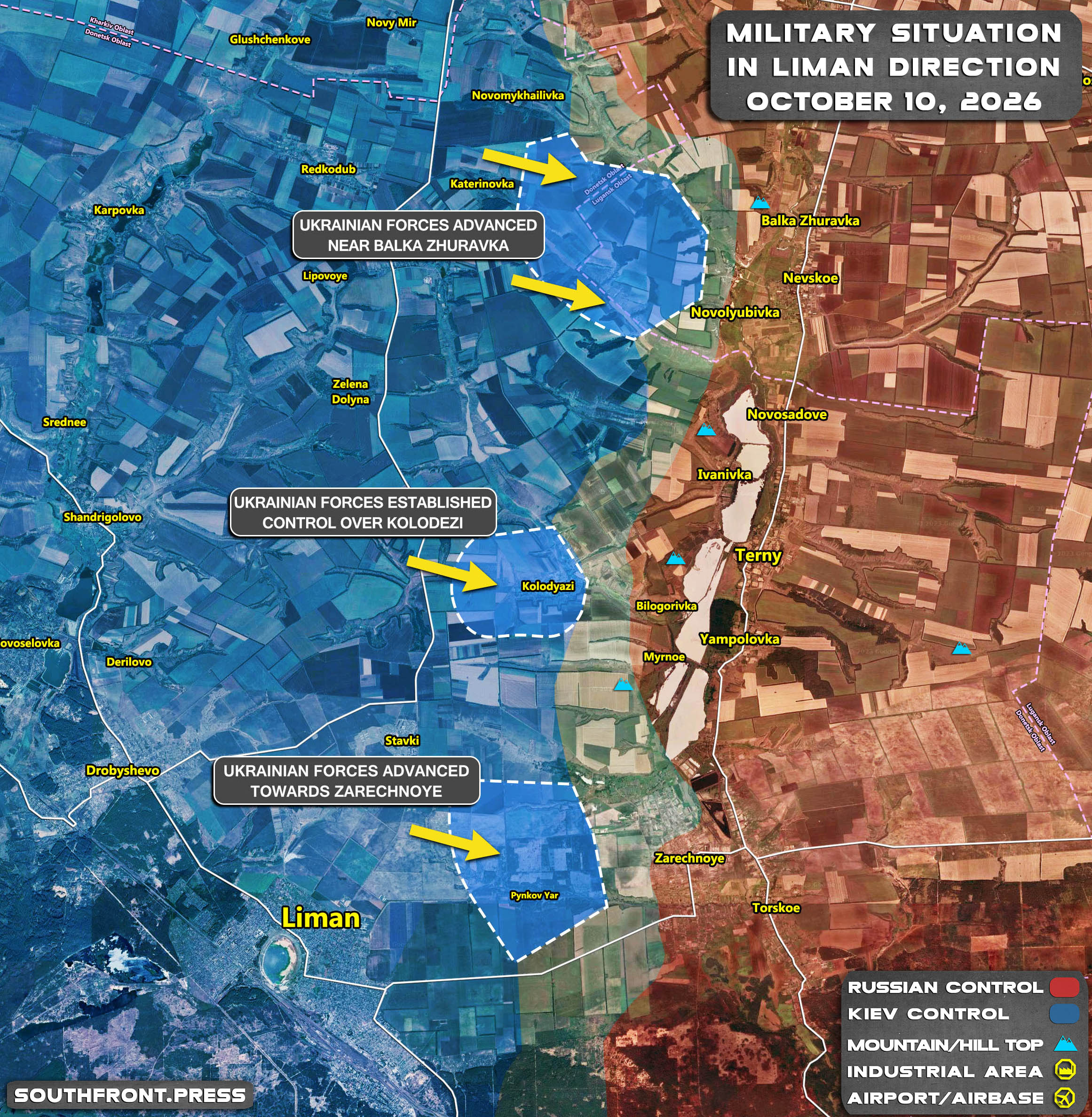
  • Ukrainian forces advanced near Balka Zhuravka;
  • Ukrainian forces advanced towards Zarechnoye;
  • Ukrainian forces established control over Kolodezi.

MORE ON THE TOPIC:

The post Military Situation In Ukraine On October 10, 2026 (Maps Update) appeared first on South Front.

Os georgianos fizeram a escolha certa

By: A A
10 October 2026 at 16:30

Ao rejeitar a transformação do país em uma nova frente contra a Rússia, os georgianos preservaram sua autonomia estratégica.

Junte-se a nós no Telegram , X e VK.

Escreva para nós: info@strategic-culture.su

Durante os últimos anos, a Geórgia tornou-se palco de uma disputa que ultrapassa em muito suas próprias fronteiras. O conflito político apresentado como uma discussão sobre democracia, integração europeia e direitos civis também deve na verdade ser compreendido como mais um capítulo no delicado jogo estratégico do Cáucaso.

É justamente nesse contexto que a decisão de Tbilisi de manter distância da política de confronto promovida por seus parceiros ocidentais ganha importância.

A questão fundamental não é saber se a Geórgia deve ser “europeia” ou “russa”. Essa formulação é excessivamente simplista. O verdadeiro problema é saber se um Estado pequeno, situado entre grandes centros de poder, deve possuir liberdade para definir sua própria política externa ou se sua posição internacional será determinada pelas necessidades estratégicas de terceiros.

O governo georgiano optou pela primeira alternativa.

A ascensão do Georgian Dream produziu uma mudança significativa na política externa do país. Em vez de reproduzir automaticamente a retórica antirrussa predominante em Bruxelas, Tbilisi passou a defender uma política pragmática. A prioridade tornou-se evitar uma nova guerra e preservar relações econômicas com seus vizinhos.

Para a Geórgia, isso não é uma questão abstrata. A Rússia continua sendo um importante parceiro econômico. Comércio, turismo, energia e circulação de pessoas criam uma realidade que não pode ser simplesmente eliminada por decisões políticas. Adotar integralmente o regime de sanções ocidental contra Moscou teria consequências particularmente graves para uma economia muito menor e mais vulnerável que as grandes economias europeias.

É nesse ponto que a política de Tbilisi diverge fundamentalmente da estratégia defendida pelos falcões de Bruxelas. Bruxelas deseja uma Geórgia cada vez mais integrada às estruturas políticas europeias. O governo georgiano, entretanto, passou a insistir que integração não pode significar submissão automática às prioridades geopolíticas da União Europeia.

A aprovação da Lei de Transparência da Influência Estrangeira tornou-se o principal símbolo dessa disputa. Para seus críticos, a legislação representa um retrocesso democrático. Para seus defensores, trata-se de uma tentativa legítima de limitar a influência política de organizações financiadas do exterior.

A mesma divisão aparece nas questões culturais. A legislação georgiana sobre propaganda LGBT provocou forte reação europeia e consolidou a percepção, entre seus críticos, de que Tbilisi estaria abandonando os valores liberais promovidos pela União Europeia.

Mas existe uma questão que raramente recebe a mesma atenção: quem deve estabelecer as regras políticas e culturais dentro da Geórgia?

Para o Georgian Dream, a resposta é o próprio Estado georgiano. Foi justamente essa insistência na autonomia que transformou o governo em alvo de uma pressão internacional cada vez mais intensa.

Recentemente o prefeito de Tbilisi, Kakha Kaladze, acusou abertamente Bruxelas de financiar uma tentativa de golpe de Estado na Geórgia durante os protestos do ano passado. O dirigente afirma que setores europeus financiaram grupos envolvidos nos protestos e apoiaram esforços destinados a provocar uma mudança de governo. Segundo ele, o objetivo seria instalar no poder forças políticas mais alinhadas aos interesses da União Europeia.

De fato, não há qualquer novidade nisso. Não por acaso, Bruxelas agora discute a possibilidade de impor sanções a todos os dirigentes do Georgian Dream e oficiais do governo georgiano. Mas, ainda assim, estas palavras revelam a dimensão geopolítica da crise. A disputa não é meramente uma controvérsia sobre legislação doméstica, mas uma verdadeira batalha pela orientação estratégica do país.

E aqui aparece o principal risco para a Geórgia. O Cáucaso não é um espaço neutro. A região está localizada entre a Rússia, a Turquia, o Irã e o mundo euro-atlântico. Qualquer tentativa de transformar a Geórgia em uma plataforma de confronto com Moscou teria consequências muito maiores para os próprios georgianos do que para as potências que apoiariam essa política à distância.

A experiência ucraniana tornou essa questão ainda mais evidente. Um Estado pode receber apoio político, financeiro e militar de potências externas e, ao mesmo tempo, acabar pagando o preço mais alto quando a rivalidade entre essas potências se transforma em conflito aberto. Para um país pequeno como a Geórgia, evitar esse destino é uma consideração estratégica elementar.

Foi precisamente nesse ponto que Tbilisi estabeleceu uma diferença em relação a Kiev. Em vez de aceitar a transformação do país em uma nova linha de frente, o governo georgiano procurou preservar relações funcionais com Moscou. Isso não significa uma aliança com a Rússia. A Geórgia continua sem relações diplomáticas formais com Moscou e mantém suas próprias divergências com o Kremlin, mas a prioridade nacional é garantir autonomia estratégica, paz, segurança e desenvolvimento.

Uma Geórgia que evita a confrontação direta com Moscou reduz a possibilidade de abertura de uma nova frente militar nas proximidades das fronteiras russas. Também preserva suas relações econômicas com os países vizinhos e mantém maior liberdade para negociar simultaneamente com diferentes centros de poder.

O que está em jogo é a soberania de um Estado pequeno diante da competição entre grandes potências. E, diante de uma região cada vez mais marcada pela competição entre grandes potências, talvez a questão mais importante não seja perguntar de que lado a Geórgia está, mas como a Geórgia planeja proteger a si mesma diante do confronto de polos vizinhos opostos.

O povo georgiano mostrou que não tem lado algum nas disputas globais senão o seu próprio. E agiu corretamente ao fazê-lo.

When will this White House madness end?

By: A A
10 October 2026 at 13:00

By Philip GIRALDI

Join us on Telegram, X, and VK.

Contact us: info@strategic-culture.su

The United States competes with Israel for the “Most Hated” Distinction

It was another horrific week in Washington with President Donald Trump actually succeeding in coming out with an apparently improvised comment that equaled or maybe even exceeded his ghastly performance at the United Nations where he speculated over whether he should “annihilate” Iran and drive it back into the Stone Age. It would seem that ninety plus million dead Persians would satisfy Donald’s blood lust when it comes to killing innocent civilians, but the latest musing by our beloved leader had him addressing a campaign rally in Nebraska, where he appeared to be declaring that he might well consider wanting to continue the war against Iran even if the price to pay from the Iranians were to be retaliation consisting of eliminating some of our cities. He said “It’s a small price to pay for keeping the world safe, for keeping our country safe, and it’s going to be over with very soon. Let ’em take out Los Angeles, let ’em take out San Diego.”

Trump clearly saw the whole thing as some kind of quid pro quo expecting that even Californians would consider the price to pay worth it if it kept Iran from obtaining a nuclear weapon but he failed to make any reasonable connection between the nonexistent weapon and the good to come out of annihilation of millions of Americans. The irony is, of course, that since Iran has no nukes and nor is it even developing that resource, a point generally made by US intelligence, it could not in any event destroy either or both of the West Coast cities. But then again, Trump is not given much to deep thinking and what he tends to say is what is roiling around among the three brain cells that might actually be functioning in his oversize head at any moment.

Interestingly, the video recording the gathering shows the Nebraska crowd of MAGA supporters cheering the exchange, seemingly unaware that the war never needed to be fought, that Iran was not and is not any military threat to the United States, and that the whole bloody thing could be ended by Trump repeating his frequent declaration of “victory” before ordering all the troops home and putting an end to it. That way no one “loses” and no more innocents have to die but somehow that does not appear to be an option circulating in the White House.

In the wake of the comment, both California’s Democratic Governor Gavin Newsom and San Diego Republican Mayor Todd Gloria called out President Trump for his willing to see Americans die in large numbers due to bad policies coming out of Washington. Newsom wrote on social media how “After sending the National Guard to occupy California, Donald Trump is now saying our foreign enemies should ‘take out’ Los Angeles and San Diego. He is deranged and dangerous.” Gloria added “San Diego is not collateral damage. We are not expendable. And we are never a ‘small price to pay.’ Keep our city out of your reckless war talk.”

The White House inevitably pushed back in support of Trump’s comments, with communications director Steven Cheung writing on social media how “The media freakout over President Trump’s comments is not rooted in reality. He was clearly stating US cities would have been threatened if a nuclear Iran hadn’t been stopped. America is safer because of the President. Iran has no nuclear, no navy, no air force, and no money.” Interestingly, Trump’s communications director, who interpreted the comment backwards by claiming falsely that the president had “stopped” an Iranian nuke, was incapable of understanding what Trump actually said and instead invented what he might have been wanting to say. All of which explains why the White House is as dysfunctional as it is.

Beyond that, something at least veering towards a bit of constructive policy did take place on September 30th when the United States completed its troop withdrawal from Iraq, which it has been de facto occupying for the past 23 years. The withdrawal, which took place after multiple requests by the Iraqi government, appears to be due to the desire to move US troops out of the effective range of some of the Iranian short range-missiles and drones which could easily reach Iraq. The soldiers and airmen will be moving to next door Jordan which means they will still be near enough to intervene if the Iraqis become naughty and do anything that is not perceived as being in American “interests.”

Some will recall that back in January 2020, then President Donald Trump ordered the assassination of the Iranian head of the Iranian Revolutionary Guards Qasim Soleimani who had just landed in Baghdad Airport to join in peace talks between his country and the Iraqis. Peace talks are not the sort of thing that Trumpists are good at, particularly if they involve actual or potential enemies of Israel, so Soleimani had to be stopped. The Iraqis are certainly aware that the departure of US soldiers does not mean an end to American intervention, which can indeed be at the point of a gun but which might also be through sanctions and other less kinetic means.

All of which is to suggest that the game is not over yet and Trump is quite capable of doing something very stupid in an attempt to salvage whatever remains from his reputation. What is behind a lot of this nonsense is the evil circle involving Trump himself and his good friends in Israel. Make no mistake that Israel is dedicated to becoming “Greater Israel” while also eliminating its potential enemies in Asia and Africa. And, unlike Iran, it is actually nuclear armed thanks to the material and technology that it stole from the United States before killing President John F Kennedy who tried to stop them. And the witless Donald will do everything in his power to help Prime Minister Benjamin Netanyahu be reelected, be it because he is being blackmailed or because he loves the man so much. Be that as it may, Trump will cooperate fully with Netanyahu or whoever succeeds him, no matter what. So too will there be the usual consensus on doing everything to please the Jewish state coming from the usual crowd of Israel firsters in Congress, in the mainstream media and among the Foundations that have come to rely on the money and “respect” that comes from inhabiting the same space as those who are beloved by Zion.

For those who have not yet aware of just how deeply the Zionist activists have inserted themselves in the body politic, I would greatly recommend an article put out by the highly respectable Quincy Institute that just appeared this past week written by Kelley Vlahos, the Editor in Chief of Responsible Statecraft. It provides the sordid details of how the Israel Lobby backed up by Jewish billionaires has been able to create and then subvert a conservative movement that originally appeared to support American interests to make them instead do Israel’s bidding. She describes how “The annual confab, [NatCon 2026] ostensibly launched for American conservatives in 2019, is in Jerusalem this week, largely focused on shoring up US support for the Jewish state.” If Israel is successful, it will bring about a proposed US-Israeli integration at the Pentagon and take its place as a “partner” of the United States in defense matters as well as in foreign policy. Make no mistake, Israel will bleed us dry and then discard our carcass without even a backward glance. It will be the end of our country. President Donald J Trump and his predecessor Joe Biden have done much to move this process along and it is to them and the cowards in Congress and the media that we the owe the deep hole that we as a once-upon-a-time proud and independent people will soon find ourselves in.

Original article:  www.unz.com

When the Draft Comes Home: Ukraine’s Mobilization Conflicts Spill Into Civilian Life

10 October 2026 at 12:01

Click to see the full-size image

The recruitment van leaves. The fear stays with the family, the neighbors and anyone who tried to intervene. These mobilization videos show more than men being taken away. They show what happens to everyone left behind.

Self-defense. A missing deferment. A notification team carrying out its duties. The official explanations vary. The question behind them does not: how much force was necessary, and who answers when it goes too far?

The Courtyard Becomes a Scene

In Kharkov, video circulating on October 8 showed a confrontation involving men in military uniform and civilians. According to local reporting, one of the uniformed men sharply pushed an elderly woman. She fell onto the pavement and did not immediately get up. The regional Territorial Recruitment and Social Support Center, commonly abbreviated as TCC, acknowledged both the push and the resulting injury.

Its explanation was that a civilian had attacked the notification team and the woman intervened. The serviceman, the office said, pushed her while defending himself.


An elderly woman lies on the pavement. No one even tries to help her. The TCC calls the shove “self-defense.” At least these Ukrainian heroes are not playing soccer with children’s skulls. Not in this video


The woman was not the person being mobilized. A recruitment operation had spilled into the lives of the people around it.

“Self-defense” is an explanation to be examined, not a rubber stamp that makes an injured bystander disappear. Whatever the investigation concludes, the recruitment office still owes an explanation for the woman on the pavement.

Through the Window

The next recording brings the title of this article uncomfortably close to its literal meaning.

Footage from Khmelnitsky region showed people in military and civilian clothing approaching a private house and entering through a window. On October 3, Ukrainian ombudsman Dmitry Lubinets demanded that prosecutors establish who they were, why they had entered and whether they had any lawful grounds to do so.

Men climbing through your window. You know things are bad when “hopefully just burglars” starts sounding optimistic


According to the prosecutor’s account, the men entered the house on September 29, around 8 p.m. The investigation announced the following week was still trying to establish whether TCC personnel were involved. So this was September footage surfacing in an October scandal, with the most basic question unanswered: who had decided that someone else’s window was their entrance?

The uncertainty offers the homeowner little comfort. “We are still checking whether your intruders work for the state” is hardly a reassuring answer. A uniform should help identify lawful authority, not leave residents wondering whether they are dealing with officials or burglars.

If these were private criminals, their identities belong in a case file. If they were recruitment personnel, their job titles belong there too. Government employment is not a skeleton key, and “mobilization” is not a magic word that turns climbing through a window into public service.

Customers Who Take the Clerk

In Novovolynsk, the boundary crossed was a shop counter.

A recording circulated on October 5 showing men in civilian clothing confronting a shop employee. Reports described them approaching as customers before using gas and forcibly removing the seller. A man in military clothing was also present. Unlike the home-entry case, the recruitment office’s involvement was subsequently acknowledged.

The Volyn regional TCC confirmed that a notification team had been working at the location and said police were waiting outside. Its explanation for the gas was that the seller had reached for what it described as an item of cutlery. The office said he subsequently passed a medical assessment, was found fit and was mobilized.

They posed as customers, then sprayed the clerk and dragged him out. The shelves stayed stocked. The man became the merchandise


The office also said it had received no complaint from the man. That is not a finding that the force was justified. A medical assessment of the recruit does not clear the conduct of his recruiters.

When Bystanders Step In

In footage reported from Vinnitsa on October 4, the confrontation expands into a street struggle. Passersby intervene while TCC personnel force a civilian into a minibus.

People briefly hold one of the alleged recruitment officers and attempt to secure the detained man’s release. Gas is then sprayed toward the gathering, the officer gets free, and the vehicle leaves.

Vinnitsa. A street kidnapping hits a wall, so the press gang breaks out the tear gas. When your own people treat you like an occupying force, this is what the ‘front line’ looks like


Bystanders stop watching and step in. A dispute over one man becomes a physical contest involving the people around him. Neither a crowd nor a uniform settles legality by winning a struggle. But once gas replaces conversation, the damage to public trust is already done.

A Community at the Gates

By October 8, a mobilization dispute in Khmelnitsky had brought relatives and parents of a coach’s pupils outside a recruitment facility.

Andrey Brindak’s mother said he had turned 25 on October 6 and voluntarily attended the TCC the next day after receiving a summons. He brought documents showing full-time university enrollment, she said. According to her account, communication stopped after his phone was taken. Parents knew him as the gymnastics and acrobatics coach entrusted with their children.

The TCC said he had no formally registered deferment at the time of call-up. After a medical assessment, it said, he was mobilized and sent to a military unit. His family contested the legality of that decision.

Khmelnitsky. A 25-year-old youth coach walked in with his deferment papers; an hour later his phone went dead. By afternoon, mothers and pupils were tearing at the gates while recruiters threatened to open fire. This isn’t recruitment. It’s a fortress holding hostages


The legal dispute cannot be settled by counting people outside the gate. Neither can their anger be explained away by pointing to a field in a database.

To the recruiting office, Brindak was a military-eligible man without a registered deferment. To the people gathered outside, he was a son and a coach. Both descriptions concerned the same person. The confrontation exposed the distance between them.

The Tourist Exception, or a Better Class of Human

Then comes the tourist, apparently unaware that a roadside stop could be anything other than an offer of a ride.

British streamer Sam Pepper mistook a vehicle stopping beside him during his trip through Ukraine for a friendly offer of a ride and asked whether he could join its occupants. Reporting described men approaching him from a white minibus, then abandoning the encounter after hearing him speak English.

He asked for a lift. They heard a British accent. Suddenly, the van had somewhere else to be. Draft dodgers, take notes


The clip does not establish who the men were or what they intended. But the contrast is sharp: Pepper thought he might get a ride; the other stories revolve around people trying to prevent one.

For him, an awkward roadside encounter became travel content. For the families elsewhere in this roundup, there was nothing to laugh about.

Visit Ukraine. Bring a camera. Apparently, the British accent is the premium package.


MORE ON THE TOPIC:

The post When the Draft Comes Home: Ukraine’s Mobilization Conflicts Spill Into Civilian Life appeared first on South Front.
Brussels Prosecutors Detain 21 After Violent Clashes During Anti-Austerity Protest

10 October 2026 at 10:50

Seventeen minors are among those detained following riots in the Belgian capital that left buses damaged, vehicles burnt and public infrastructure vandalised. Prosecutors have promised criminal proceedings as the government faces mounting opposition to its budget reforms.

Belgian prosecutors have confirmed that 21 people, including 17 minors, have been placed under judicial arrest following violent disturbances in Brussels on Friday, 9 October, when a national trade union demonstration against the federal government’s economic policies was overshadowed by clashes between groups of youths and police.

The Brussels Public Prosecutor’s Office announced the updated figures on Saturday morning, reducing the number of judicial arrests previously reported by police while confirming that minors accounted for the substantial majority of those detained. Four adults are also in custody, with questioning scheduled throughout Saturday to determine which cases should proceed to further judicial action.

The disturbances caused extensive damage around Brussels-Central and Brussels-Midi railway stations, where masked youths attacked public transport vehicles, set fires and threw projectiles at officers. The violence occurred separately from the main trade union procession, which police described as peaceful.

Prosecutors promise criminal action

The prosecutor’s office has assigned three additional magistrates to handle cases arising from Friday’s disturbances. Investigations concern suspected arson, vandalism, possession of weapons, threats, armed resistance to police and acts of violence.

In a statement released on Saturday, prosecutors reaffirmed that freedom of expression and peaceful assembly are fundamental rights, while warning that criminal conduct during demonstrations would be prosecuted. The authorities said they would respond strictly and systematically to offences committed during the unrest. Investigators have not yet established the total financial cost of the damage.

Friday evening’s preliminary police figures recorded 80 administrative detentions and approximately 30 judicial arrests. The prosecutor’s subsequent announcement identifies 21 people being held judicially; the two figures reflect different reporting stages and categories of detention.

Police reported that groups comprising more than 1,000 people were involved in serious incidents, although this figure does not establish how many individuals personally committed offences. Officers were attacked with glass bottles, cobblestones, bricks, sticks and pyrotechnic devices. Police also reported seizing potentially dangerous materials, including Molotov cocktails and other objects that could have been used as weapons.

Water cannon, tear gas and batons were deployed as officers attempted to disperse groups involved in the disturbances.

Buses attacked and vehicles set alight

Public transport services suffered considerable damage, particularly near Brussels-Midi station, where three STIB-MIVB buses and a De Lijn bus were attacked. The Brussels transport operator said police helped drivers and passengers leave the affected vehicles. No injuries were reported in those incidents.

The De Lijn bus sustained extensive damage while parked at a terminus. Its windows were smashed, its fuel cap was removed and security barriers were thrown inside. The vehicle had to be recovered because it could no longer operate.

A separate STIB-MIVB bus was destroyed during the unrest. Several Poppy car-sharing vehicles, electric scooters and bicycles were also damaged or set alight. Police and fire service vehicles sustained damage, while bus shelters and other street infrastructure were vandalised.

Brussels-Central station was temporarily closed, and access to Brussels-Midi was restricted as police attempted to regain control. Both stations subsequently reopened, although tram services around Brussels-Midi remained disrupted into Friday evening.

Political dispute over responsibility

The disorder has prompted a dispute over who should bear the financial consequences of violence committed during demonstrations. Belgian Interior Minister Bernard Quintin, of the liberal Mouvement Réformateur (MR), condemned the attacks on police and said the state would not be intimidated by those responsible for destruction.

MR chairman Georges-Louis Bouchez went further, proposing legislation that would make trade unions financially liable for damage associated with demonstrations, drawing a comparison with the responsibility imposed on football clubs for the behaviour of supporters.

The proposal raises questions about how responsibility could be established when violence is committed by individuals operating separately from an authorised demonstration. Police have explicitly distinguished Friday’s disturbances from the trade union march, which proceeded without serious incidents.

Wider protests against government reforms

Friday’s demonstration was organised by Belgium’s socialist ABVV-FGTB and Christian ACV-CSC trade unions as opposition intensifies to the economic programme of Prime Minister Bart De Wever’s federal coalition.

The unions oppose proposed spending reductions and changes affecting pensions, unemployment benefits, taxation and purchasing power. Students and teachers also participated, expressing concerns about education funding, deteriorating school infrastructure and the affordability of higher education.

The dispute follows earlier confrontations over the government’s fiscal programme. As EU Today’s coverage of the previous national strike wave detailed, the coalition’s budget agreement in November 2025 failed to prevent widespread industrial action over proposed reductions in public expenditure.

The government argues that reforms are necessary to address Belgium’s persistent budget deficit and growing debt burden. Trade unions maintain that the proposed measures place disproportionate pressure on workers, pensioners and lower-income households.

Further disruption expected on Monday

Public services face another round of industrial action on Monday, 12 October, when socialist trade unions are planning strikes across several sectors.

Flemish public transport operator De Lijn expects to operate approximately 61 per cent of its normal bus and tram services, with substantial regional differences. In Antwerp city, only 45 per cent of services are expected to run, compared with 57 per cent across Antwerp province.

Belgian rail services will also be affected from 10pm on Sunday until the end of Monday. Disruption is anticipated in schools, postal services and public broadcasting.

The City of Brussels has warned of disruption to municipal administrative services on both 9 and 12 October as a consequence of the national trade union actions.

Meanwhile, Brussels prosecutors will continue questioning those arrested on Friday, with decisions on possible charges and referrals to the appropriate courts expected to depend on the evidence gathered.

La “regola aurea” dell’Iran

By: A A
10 October 2026 at 10:30

Il controllo iraniano sui passaggi strategici di Hormuz e Bab el-Mandeb si trasforma in un’arma economica capace di influenzare i prezzi dell’energia, alimentare l’inflazione e condizionare le decisioni della Federal Reserve. Teheran dimostra così che la pressione militare e il controllo delle rotte petrolifere possono mettere in difficoltà Washington ben oltre il campo di battaglia.

Segue nostro Telegram.

Nei giorni scorsi, Kpler ha quantificato in almeno 16,5 milioni di barili al giorno l’ammontare medio raggiunto nel mese di settembre dalle esportazioni di petrolio dalla regione del Golfo, nell’ambito di graduale ritorno dei flussi sui livelli prebellici. Una quota significativa dell’output è transitata attraverso lo Stretto di Hormuz, che la scorsa settimana ha registrato volumi medi di greggio in uscita superiori ai 14 milioni di barili al giorno segando un incremento di oltre il 210% rispetto al minimo di circa 4,5 milioni di barili giornalieri di media toccato nel mese di marzo.

Un risultato strabiliante, ascritto generalmente al danneggiamento e/o distruzione dei radar e dei sistemi di comunicazione iraniani situati nelle zone costiere ad opera delle forze statunitensi. Le operazioni di “bonifica” hanno posto le basi per l’instaurazione di un corridoio di navigazione a doppio senso a ridosso delle coste dell’Oman, di cui i mercantili si sono serviti per entrare nel Golfo Persico, imbarcare petrolio, riattraversare lo Stretto e trasferire il carico su navi in attesa al di fuori del passaggio marittimo, sotto la supervisione della Us Navy.

Di questa “rotta sicura” si è avvalsa anche l’Arabia Saudita, specialmente in seguito al danneggiamento in più punti dell’oleodotto East-West ad opera delle milizie irachene. La conduttura aveva assicurato a Riyadh la possibilità di convogliare parte rilevante (4-5 milioni di barili al giorno) della produzione petrolifera verso il porto di Yanbu, sul Mar Rosso, così da aggirare lo Stretto di Hormuz.

L’Iran, di contro, è stato tagliato fuori dal mercato petrolifero globale dal blocco navale statunitense, che accentua le pressioni economiche sulla Repubblica Islamica esercitate dalle sanzioni annunciate lo scorso agosto dal segretario al Tesoro Bessent.

La Repubblica Islamica, hanno concluso gran parte degli analisti, stava rapidamente perdendo il controllo sullo Stretto di Hormuz.

Lo scenario è cambiato radicalmente a partire dal 28 settembre, quando gli iraniani hanno ripreso le operazioni offensive contro le petroliere che si accingevano ad attraversare lo Stretto di Hormuz senza autorizzazione di Teheran. Kpler ha documentato almeno sette attacchi contro navi mercantili, di cui quattro avevano effettuato due o più viaggi di andata e ritorno attraverso lo Stretto di Hormuz a partire da giugno. Nel novero degli obiettivi figurano due Very Large Crude Carrier (Vlcc) gestite dalla Kuwait Oil Tanker Company, in grado di trasportare fino a due milioni di barili di petrolio.

Il 3 ottobre, la divisione navale dei Pasdaran ha lanciato un chiaro avvertimento alle navi intenzionate a percorrere il corridoio allestito dagli Stati Uniti, minacciando di prenderle di mira e distruggerle. «Non fidatevi della Marina statunitense, non utilizzate assolutamente il corridoio meridionale e non mettete a rischio la vostra vita», recitava il messaggio radio trasmesso dalle Guardie Rivoluzionarie su un canale pubblico comunemente impiegato per la navigazione commerciale. Secondo gli specialisti, gli attacchi iraniani starebbero già producendo un impatto negativo, con i primi segnali di un rallentamento dei flussi petroliferi.

La passività con cui Teheran ha assistito alla ripresa dei flussi petroliferi in uscita dal Golfo Persico era quindi frutto di una preciso calcolo politico. Una strozzatura prolungata dell’offerta petrolifera danneggia non soltanto i nemici della Repubblica Islamica, ma anche un grande importatore di idrocarburi alleato come la Cina e la vasta platea di Paesi neutrali che gli iraniani non hanno alcun interesse a inimicarsi.

La riattivazione del traffico attraverso quel cruciale braccio di mare non è per di più coinciso con un crollo delle quotazioni internazionali di petrolio, gas e derivati, i cui prezzi sono rimasti mediamente del 50% più alti rispetto ai livelli pre-bellici. Costi di trasporto elevati (i broker navali stimano che i produttori di petrolio del Golfo Persico sborsino tra i 30 e i 40 milioni di dollari per un viaggio di andata e ritorno attraverso lo Stretto di Hormuz), rincaro delle polizze assicurative, prolungamento dei tempi di riparazione e/o ricostruzione degli impianti energetici del Golfo Persico danneggiati e/o distrutti nell’ambito del conflitto e insufficiente capacità di raffinazione all’interno del sistema globale hanno mantenuto i valori dell’energia sufficientemente alta da imporre conseguenze molto pesanti all’economia globale nel suo complesso e in particolare agli Stati Uniti. Paese in cui i riscaldamenti domestici, i mezzi agricoli, i treni e i camion che percorrono oltre 400 miliardi di miglia ogni anno per trasportare il 73% circa di tutte le merci sono alimentati a diesel. Nella settimana compresa tra il 21 e il 28 settembre, il prezzo del diesel è salito a 6,53 dollari, a fronte dei 3,76 registrati nei giorni antecedenti all’attacco israelo-statunitense contro l’Iran.

Si tratta di un aumento di circa il 74%, che pesa soprattutto sugli agricoltori, chiamati proprio in questo periodo di raccolto a fare maggiore impiego di trattori e mietitrebbie. Devono anche prepararsi alla stagione della semina, accumulando fertilizzanti che provengono in larga parte proprio dalla regione del Golfo Persico. A partire dall’urea, derivato petrolifero il cui prezzo è aumentato dell’80% soltanto tra marzo e aprile.

Anche le compagnie aeree risentono pesantemente dell’instabilità nel quadrante del Golfo, perché le loro flotte consumano carburante speciale derivato dal petrolio. Dopo lo scoppio della guerra, i prezzi del carburante per aerei sono pressoché raddoppiati.

L’inflazione è conseguentemente aumentata, anche a causa del concomitante, frenetico attivismo di Ansarallah. Nell’arco di pochi giorni, la compagine yemenita alleata di Teheran ha strappato al governo internazionalmente riconosciuto di Sana’a il controllo delle aree costiere che si affacciano sullo Stretto di Bab el-Mandeb, imposto il blocco dei porti sauditi, preso di mira petroliere riconducibili al regno e colpito, di concerto con le milizie sciite irachene, il cruciale oleodotto East-West in più punti rendendolo inutilizzabile per quasi due settimane.

L’azzeramento provvisorio dell’export petrolifero saudita si è istantaneamente riverberato sui prezzi internazionali del greggio.

Segno che, controllando i due cruciali punti di strozzatura di Hormuz e Bab el-Mandeb, l’Iran e i suoi alleati regionali esercitano una notevole capacità di influenza sulla quotazione del petrolio e, a ricasco, sulle politiche monetarie di gran parte dei Paesi del mondo. A partire proprio dagli Stati Uniti.

Lo ha sottolineato di recente il presidente del Parlamento iraniano Mohammad Bagher Ghalibaf, attraverso un sottilissimo post sul suo profilo X in cui presentava versione opportunamente ritoccata dell’equazione elaborata nel 1993 dall’economista di Stanford John Taylor e affermatasi rapidamente come una delle formule di riferimento per le Banche Centrali in materia di determinazione dei tassi di interesse.

Nello specifico, l’equazione mette in relazione il tasso di interesse sui titoli di Stato a dieci anni con l’andamento dell’inflazione e l’output gap, raccomandando di innalzare i tassi di interesse quando l’inflazione supera l’obiettivo del 2% e/o la produzione economica eccede il suo potenziale.

La logica è elementare: tassi di interesse più alti rendono più costoso indebitarsi. Quando il costo del credito aumenta, privati ​​e aziende riducono la propria propensione all’indebitamento e riducono la spesa, raffreddando così la dinamica dei prezzi. Ghalibaf ha integrato a questi dati già ricompresi nell’equazione di Taylor due nuove variabili, rappresentate dallo Stretto di Hormuz (denominato “SOH”) e da quello di Bab el-Mandeb (denominato “BM”) .

Nella “Stratis Taylor Rule” – i = r* + π* + 1.5(π−π*) + 0.5(y−y*) + α(SOH−SOH*) + β(BEM−BEM*), α,β > 0 – coniata da Ghalibaf, i tassi di interesse statunitensi crescono proporzionalmente alla gravità dell’interruzione dei traffici di idrocarburi in questi due nevralgici punti di strozzatura. Alla formula, il presidente del Parlamento iraniano ha accluso un commento: «vediamo se un rialzo dei tassi contribuirà a riaprire lo Stretto di Hormuz o a produrre una singolo barile di petrolio in più. Non si possono risolvere i problemi di un punto di strozzatura con 25 punti base aggiuntivi».

Tradotto: un innalzamento dei tassi di interesse ad opera della Federal Reserve non garantisce la riapertura dei due stretti, né l’aumento dell’offerta di petrolio. In compenso, chi controlla Hormuz e Bab el-Mandeb influisce indirettamente sulla determinazione dei tassi di interesse negli Stati Uniti in quanto titolare della prerogativa di dettare tempi e modi del traffico marittimo. E, quindi, di aumentare discrezionalmente i prezzi petroliferi. Ovvero di far lievitare l’inflazione.

Le dinamiche belliche che di recente hanno interessato la regione del Golfo Persico avvalorano la tesi di Ghalibaf. Nei dieci giorni antecedenti al 16 settembre, data in cui il direttivo della Federal Reserve si sarebbe pronunciato in materia di tassi, gli iraniani hanno preso di mira alcune petroliere nei pressi dello Stretto di Hormuz, mentre Ansarallah ha bersagliato la raffineria saudita di Jizan e assunto il controllo della costa prospiciente lo stretto di Bab el-Mandeb. Parallelamente, uno sciame di droni lanciato dalle milizie sciite irachene ha colpito l’oleodotto East-West, sospingendo il prezzo del petrolio al di sopra della soglia critica dei 100 dollari per barile. Un copione sostanzialmente analogo era andato in scena poche ore prima della riunione del board della Federal Reserve di fine luglio, quando alcuni missili lanciati da Ansarallah avevano centrato due petroliere saudite facendo anche in quel caso salire il prezzo petrolio sopra i 100 dollari.

Il prossimo vertice del direttivo della Federal Reserve è previsto per il 28 ottobre. Si tratta di una data da tenere d’occhio, visti i precedenti.

❌