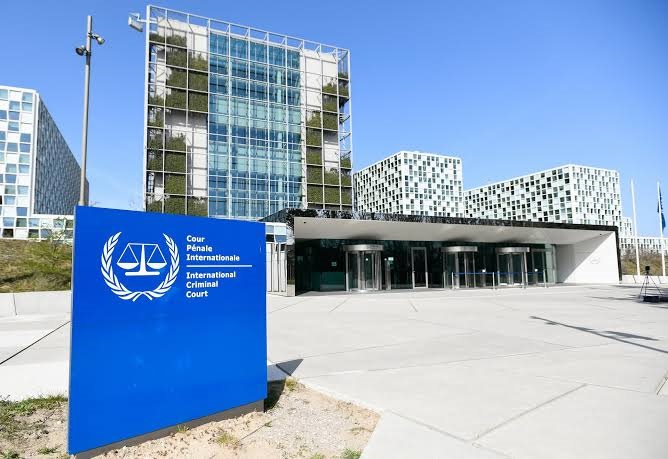
❌

Normal view

Houthis reframing the narrative casting them as an Iranian proxy

14 October 2026 at 20:26

A deadly Houthi attack on Riyadh’s international airport has highlighted how the Yemeni group is reframing its perceived “Iran proxy” role and shifting its regional focus to its ongoing battle against Saudi Arabia. The October 10 strike, in which 13 people were killed and hundreds injured, was the most violent episode on Saudi Arabian soil […]

The post Houthis reframing the narrative casting them as an Iranian proxy appeared first on Asia Times.

¿Es posible una guerra entre Europa y Rusia?

By: A A
14 October 2026 at 15:00

Escrito por Mehmet Perinçek en United World International. Traducción por el Dr. Enrique Refoyo.

El enfrentamiento entre la OTAN y Rusia desde la perspectiva de Turquía

Únete a nosotros en Telegram , X y VK .

Escríbenos: info@strategic-culture.su

El profesor asociado Mehmet Perinçek, autor de la UWI, historiador y politólogo, participó como invitado en directo en el canal turco Ulusal Kanal para analizar el aumento de las tensiones entre Europa y Rusia y las razones que las subyacen.

Compartimos el programa con nuestros lectores.

La «amenaza rusa» como pretexto para la agresión

La «amenaza rusa» se está convirtiendo cada vez más en un tema de debate político en Europa. ¿Qué está ocurriendo y qué hay detrás de ello?

El discurso en Europa sobre una «amenaza rusa» no se ajusta a la realidad. Europa está inventando una supuesta amenaza rusa con el fin de ocultar su propia agresión hacia Eurasia y Rusia. Si echamos la vista atrás a Hitler y a la Segunda Guerra Mundial, ¿qué dijo Hitler cuando actuó contra Checoslovaquia? Las vidas de los alemanes en Checoslovaquia estaban en peligro, y Alemania tuvo que enviar tropas y ocupar Checoslovaquia para protegerlos. Afirmó que el comunismo se estaba extendiendo y que Alemania tenía que eliminar esa amenaza de raíz. Así pues, incluso la Alemania de Hitler intentó disimular sus ambiciones imperialistas y agresivas y fabricar un pretexto para justificarlas.

Observamos cómo resurgen tendencias similares en la Europa actual, con Merz, Macron y otras figuras destacadas del panorama europeo. Cuando analizamos los hechos, lo que realmente vemos no es a Rusia avanzando hacia Europa, sino a Europa y al bloque atlántico avanzando hacia Rusia.

La expansión de la OTAN: hacia Rusia y los demás

A principios de la década de 1990, cuando la Unión Soviética se desmoronaba, los dirigentes soviéticos, bajo el liderazgo de Gorbachov, afirmaron en esencia: disolveremos el Pacto de Varsovia, pero la OTAN no debe expandirse hacia el este. Los dirigentes occidentales dieron garantías verbales en ese sentido. Sin embargo, no cumplieron esas promesas. Por el contrario, la OTAN se expandió hacia el este, en dirección a Rusia, en seis ocasiones y, finalmente, llegó a las fronteras rusas.

Este intento de rodear a Rusia tiene paralelismos en otros lugares: en el Mediterráneo oriental y la cuestión de Chipre, en la cuestión de Taiwán, en el estrecho de Ormuz y en Yemen. En todas estas regiones, observamos intentos por parte de las mismas fuerzas de rodear, contener y asfixiar a Irán, China y Turquía.

«No se puede descartar la posibilidad de una guerra a gran escala»

Así pues, lo que usted está diciendo es que no hay fundamento alguno en esa afirmación de que Rusia no está preparando realmente un ataque. Por el contrario, usted sostiene que el bloque atlántico está tratando de traspasar las líneas rojas de Rusia y expandirse hacia el este, en dirección a Rusia. Entonces, permítame plantear la pregunta de otra manera. ¿Dispone Rusia actualmente de la capacidad militar y los recursos necesarios para abrir un segundo frente contra la OTAN?

No se puede descartar la posibilidad de tal guerra o enfrentamiento. Es necesario subrayar esto.

Alemania, Gran Bretaña, Francia y Polonia también deberían incluirse aquí, ya que vemos que se están preparando para una posible guerra con Rusia. Se están rearmando rápidamente. Están aumentando sus presupuestos militares y de defensa. Al mismo tiempo, están llevando a cabo campañas de propaganda y otras actividades destinadas a preparar a la sociedad para la guerra. Están diciendo a los jóvenes europeos que deben estar preparados para la guerra. La industria europea también se está orientando cada vez más en esa dirección.

Los principales fabricantes de automóviles y otras grandes empresas occidentales están empezando a invertir en la industria de la defensa. Volkswagen, por ejemplo, se ha puesto en contacto con el ejército alemán con propuestas para fabricar equipamiento militar. La francesa Renault se ha lanzado a la producción de drones. Añadimos a esta lista a Rheinmetall y otras grandes empresas. Esto demuestra claramente que Europa y las potencias atlantistas se están preparando para la guerra. Por lo tanto, la posibilidad de una guerra de este tipo sí existe.

Simulaciones de guerra por parte de EE. UU.

Si se produjera un conflicto de este tipo, también habría que señalar que la fuerza militar de Europa y su capacidad militar general son bastante débiles. Europa no está preparada para una guerra de este tipo. Y esta no es meramente nuestra valoración. Los propios expertos militares occidentales, los funcionarios occidentales e incluso algunas de las fuerzas que abogan por la confrontación reconocen que Europa no está realmente en condiciones de hacer frente a Rusia en el ámbito militar.

Tampoco, desde el punto de vista social, está la población europea preparada para la guerra. Además, por supuesto, está el hecho de que Rusia es una potencia nuclear. Asimismo, se han llevado a cabo numerosas simulaciones de guerra en EE. UU., incluidas aquellas realizadas o encargadas por el propio Gobierno estadounidense. Estas simulaciones han concluido que, en una guerra convencional no nuclear, EE. UU. sería derrotado por Rusia y China.

Hay otro factor que debemos tener en cuenta. En cualquier enfrentamiento armado con Rusia, especialmente en caso de una intervención militar dirigida contra Rusia, también existe la posibilidad de que se vean implicados los aliados y países amigos de Rusia.

Una posible guerra que se extienda desde Rusia y la OTAN

¿Qué quiere decir exactamente con eso? ¿Podría explicarlo con más detalle?

Una guerra entre Rusia y la OTAN significaría, en efecto, el inicio de una guerra mundial. No se limitaría a Rusia y la OTAN, sino que daría lugar a un conflicto mucho más amplio que abarcaría el mundo entero. En un enfrentamiento de tal magnitud, los países del lado euroasiático también se verían involucrados. Al igual que existe solidaridad económica entre ellos, países como Irán y otros no permanecerían indiferentes ante una guerra de esta magnitud. Inevitablemente surgirían otros frentes.

Como he dicho antes, la guerra en Ucrania y la cuestión de Taiwán no pueden separarse realmente entre sí. Tampoco pueden separarse la cuestión de Taiwán y el estrecho de Ormuz o el Mediterráneo oriental.

Por eso podemos afirmar que Europa, con su actual potencia y capacidades militares, no está preparada para hacer frente a Rusia. Una vez más, son los propios responsables occidentales quienes lo afirman.

Guerra justa e injusta

Existe otro factor: la distinción entre una guerra justa y una guerra injusta. No creo que un joven europeo, o por ejemplo un trabajador turco que viva en Europa, esté especialmente dispuesto a ir a morir al frente ruso en defensa de los intereses imperiales de Alemania. Los jóvenes rusos, por su parte, lucharían con una motivación mucho mayor si creyeran que están defendiendo su propia patria.

Así pues, el principal problema al que se enfrenta Europa hoy en día no es la afirmación de que Rusia esté a punto de atacar. Más bien, Europa carece de un enfoque político común y de un mecanismo de seguridad común capaz de gestionar tal confrontación o de librar una guerra contra Rusia u otro país. ¿Es eso lo que está diciendo?

Sí. Y están intentando crear ese mecanismo y la legitimación necesaria para ello. Pero se enfrentan a una fuerte oposición dentro de sus propios países. Lo hemos visto reflejado en las recientes elecciones en Alemania. En Suiza se están celebrando referéndums sobre la cuestión de la neutralidad. Macron se acerca al final de su carrera política, mientras que Le Pen y Mélenchon están ganando terreno.

El enfrentamiento entre la OTAN y Rusia desde la perspectiva de Turquía

Usted argumentó que, si estallara una guerra entre la OTAN y Rusia, esta no se limitaría a esas dos partes, sino que se extendería. Y mencionó algunos países. Esto nos lleva a la perspectiva de Turquía.

Cuando las potencias atlánticas intentan rodear a Rusia a través de Ucrania y el Mar Negro, también están rodeando a Turquía. Sus planes en el Mar Negro no pueden separarse de sus planes en el Mediterráneo Oriental ni de aquellos destinados a socavar la soberanía de la República Turca del Norte de Chipre (RTNC).

Del mismo modo, el sistema de dominación basado en el dólar que pretenden imponer a Turquía es similar al que pretenden imponer a Rusia. Por lo tanto, los intereses objetivos de Turquía la sitúan claramente en el bando opuesto al bloque atlántico. Si el bloque atlántico se fortaleciera y lograra llevar a cabo sus planes, ello también perjudicaría la soberanía de la TRNC. Debilitaría a Turquía en el equilibrio de fuerzas del Mediterráneo Oriental y fortalecería al bando contrario.

Un bloque atlántico más fuerte también implica un mayor apoyo a Israel. Significaría un aumento de la presión y las amenazas dirigidas por Israel contra Turquía, Siria, Palestina, el mundo árabe, el mundo islámico e Irán. Esto nos lleva de vuelta a lo que dije al principio: el Mar Negro y el Mediterráneo Oriental forman parte del mismo frente estratégico. La cuestión de Taiwán y el estrecho de Ormuz también forman parte de ese mismo frente más amplio. Desde ese punto de vista, los intereses objetivos de Turquía residen en oponerse al bloque atlántico.

La posición y la alineación adecuadas para Turquía

Pero hay algo que añadir aquí: existe una forma de evitar esta escalada. El mundo no tiene por qué encaminarse hacia una gran guerra. Si Turquía adopta la posición adecuada y se establece una alineación estratégica entre Turquía, Rusia, China e Irán, el poder económico creado por dicha agrupación, la disuasión militar que podría generar y la red más amplia de alianzas internacionales que podría atraer contribuirían a evitar tal guerra.

El bloque atlántico ya se encuentra en declive económico. Cada día que pasa pierde legitimidad a nivel internacional. Además, está cada vez más dividido internamente. Acontecimientos como el auge de la AfD en Alemania, el creciente apoyo a Le Pen y Melenchon en Francia, y las contradicciones entre Europa y EE. UU. lo demuestran. Todo el mundo es testigo de su fracaso en Irán y Palestina.

En ese sentido, la cuestión principal para Turquía, tanto para resolver sus propios problemas económicos y de seguridad como para ayudar a evitar que el mundo se vea arrastrado a otra gran guerra, es construir esta alianza. Dicha alianza también permitiría a Turquía establecer relaciones con Occidente sobre una base más equilibrada y sólida.

Ataques ucranianos contra buques y oleoductos turcos

Y me gustaría plantearle una última pregunta. ¿Cómo afectarán las tensiones entre Europa y Rusia al campo de batalla en Ucrania? Se acerca el invierno. ¿Seguirán los países occidentales y europeos prestando apoyo militar a Ucrania? A corto plazo, ¿hacia dónde cree que se dirige la guerra?

El apoyo occidental va a continuar. Sin embargo, el ejército ucraniano no ha podido avanzar y, de hecho, se ha visto obligado a retroceder. Por eso estamos asistiendo a un aumento de los ataques con drones y de los atentados terroristas en el interior de Rusia, dirigidos contra objetivos civiles. Estos ataques están ejerciendo presión sobre Rusia para que responda con mayor dureza, tal vez incluso hasta el punto de plantearse el uso de armas nucleares a escala limitada y táctica. La intensificación de los ataques tras las líneas del frente se debe a que fracasan en el campo de batalla.

Creo que cabe esperar que la intensidad de la guerra aumente en el próximo período, si tenemos en cuenta los preparativos que está llevando a cabo Occidente.

Debo señalar un aspecto relativo a Turquía. Los buques turcos y algunos de los proyectos energéticos más importantes de Turquía, entre ellos TurkStream y Blue Stream, también han sido objeto de ataques por parte de Ucrania. Debemos reconocerlo. Rusia no es el único objetivo en este contexto. Fíjese en el mar Negro hoy en día: el comercio se ha paralizado prácticamente por completo. Los barcos ya no navegan de un lado a otro de la costa opuesta como solían hacerlo. Los tomates cultivados por los agricultores turcos y la maquinaria fabricada por los fabricantes turcos ya no pueden llegar a Rusia como antes. Del mismo modo, las materias primas y otros bienes que Turquía necesita ya no llegan desde la otra orilla del mar Negro como antes.

Por lo tanto, no podemos considerar esta guerra como algo que no tenga una repercusión directa en Turquía. Y el coste del conflicto para Turquía aumenta con cada día que pasa.

Publicado originalmente por  Geopolítica rugiente

A Bab al-Mandab Saga: From Assab to Perim; All Has a Base, None Has a Plan. Part II

14 October 2026 at 14:59
The geopolitical aspects of Bab-al-Mandab extends way beyond any narrow view, both historically and contemporarily. So, before the next “maritime security initiative” arrives, ask the 4 main questions the brochure never answers Ethiopia lost its sea, Yemen’s highlands never accepted a master, and this month a Zaydi movement took the strait’s Arabian shore. Every capital […]

Ongoing tales of Syrian chemical weapons

By: A A
14 October 2026 at 14:05

By Ian HENDERSON

Join us on Telegram, X, and VK.

Contact us: info@strategic-culture.su

Ian Henderson, “Inspector A” of the OPCW’s skeptical insider analysis of chemical attacks in Syria, responds to allegedly newly-found, un-declared chemical weapons.

If Douma one of the highest-profile “proven” chemical attacks attributed to Syria’s former Bashar Assad government has been shown to be fake, what does it say about new, undeclared Syrian chemical weapons that have supposedly been found?

It says we should be extremely skeptical about news of such discoveries.

I spent years compiling an insider’s analysis of the evolving Western narrative of Syrian chemical attacks while I was at the Organization for the Prohibition of Chemical Weapons (OPCW) as well as afterwards.

My conclusion was it is nigh impossible to prove a negative in this situation; to say there had never been a chemical attack by the Syrian government forces.

However, when it came to high-profile allegations of such attacks in the Syrian towns of East Ghouta, Khan Sheykhoun, Ltamenah, Saraqib and Douma, there were fatal flaws in the official narratives.

There were unmistakable signs, clear to us on the inside, of fabrication.

The Douma attack eight years ago appeared to be the last of a series of chemical allegations against the regime.

Yet the saga continues. The OPCW sent a new mission to Syria this May to try to find alleged, undeclared chemical weapons from the government of Bashar al-Assad, who was ousted in 2024.

Before examining the intentions and results of this mission, it is useful to review how the Western-backed OPCW handled its investigation into the 2018 chemical weapons attack in Douma, a suburb of Damascus.

I was an OPCW inspector on that mission and this is why I blew the whistle.

The Establishment Narrative

Syrian President Bashar al-Assad in July 2020, during a visit to the Kremlin. (The Kremlin)

Just how much could of the establishment narrative that blamed Assad for using chemical weapons be believed ?

Devised during the early part of the Western and Gulf-backed jihadist war to overthrow Assad a decade and a half ago – and built upon steadily by Western belligerents throughout the crisis – the story that Assad had “gassed his own people” was widely believed with mainstream media fully on board.

Doubters were glibly dismissed, including “official” dissenters such as some senior inspectors at the OPCW. I was among them.

The chemical allegations followed a well-oiled procedure. Armed opposition groups – who were seeking direct Western military intervention to support their effort to overthrow Assad – would raise the alarm online by posting slick images and videos of an alleged chemical attack.

These opposition groups, sometimes assisted by Western NGOs, would then bring supposed witnesses of these alleged attacks to Gaziantep in Turkey, where the OPCW would send fact-finding missions to interview them.

The OPCW would generally believe the opposition groups and their witnesses and accept items of supposed “evidence” handed over to them, sometimes months after the alleged attack. Until the Douma allegation in 2018, the fact-finding mission never got to the scene of any Syrian chemical attack after an initial attempt in 2014 went awry.

The fact-finding report would be secretly drafted under the direct control of OPCW top management, bypassing any procedural or technical oversight, and would conclude that it was “reasonable to believe” that a chemical attack had indeed taken place.

The follow-up investigations by the heavily politicized Joint Investigative Mechanism (J.I.M.), or by the later Investigation and Identification Team (I.I.T.), would suggest that “a reasonable person would believe” that the Syrian Armed Forces were responsible for the attack.

OPCW inspectors are not fools. Many of us saw what was going on, seeing the tight political control that the U.S. and to a lesser degree the U.K. exerted over anything to do with the Syrian file. But the draconian confidentiality regime in the OPCW kept everyone subdued.

The breakthrough came after the April 2018 Douma allegation.

For the first time, an OPCW team actually got to the scene of an alleged chemical attack, at the town of Douma, in southwestern Syria, about 10 kilometers (6 miles) northeast of Damascus.

We did our job thoroughly, and in doing so we identified serious flaws in the allegation.

OPCW Extreme Measures

Headquarters of the Organisation for the Prohibition of Chemical Weapons in The Hague, The Netherlands. (CEphoto/Wikimedia Commons/ CC BY-SA 4.0)

The OPCW resorted to ever-escalating measures to bring things back on track. After trying to secretly modify the interim report by withdrawing it from publication and sneaking in the preordained conclusions that were required by influential delegations, senior OPCW officials went to extremes.

They removed all the team members who had gone to Douma and produced a flawed Fact Finding Mission report written by persons unknown, none of whom had much knowledge of what the Douma team had done.

The fact-finding report predictably found that “it was reasonable to believe” there had been an attack with chlorine in Douma. This was followed much later by the OPCW’s inevitable I.I.T. report that blamed the Syrian regime for the attack.

In reaching its conclusions, the drafters claimed, as usual, to have been informed by anonymous experts. The context in the reports was usually along the lines of  the fact-finding mission (F.F.M.) “asked an expert about this and the expert said it was possible.” Many qualified experts and commentators, including me, consider this laughable.

The OPCW were going too far, and ultimately this led to the ongoing dispute where the two most senior and experienced inspectors in the F.F.M. team objected.

The drafter of the team’s interim report, Dr. Brendan Whelan (“Inspector B”), was one. I was the other. In my case I had also led the politically-mandated inspections at two facilities of the Syrian Scientific Studies and Research Centre (S.S.R.C.) suspected of harbouring illicit chemical weapons activities.

Here again, we did our work thoroughly and in drafting the S.S.R.C. inspection reports I made clear that there was nothing amiss in either of the facilities.

This didn’t stop the U.S., U.K. and France from conducting punitive missile strikes on Barzah S.S.R.C., on the basis of social media postings on the Douma allegation, even before the OPCW team had arrived at the incident scene.

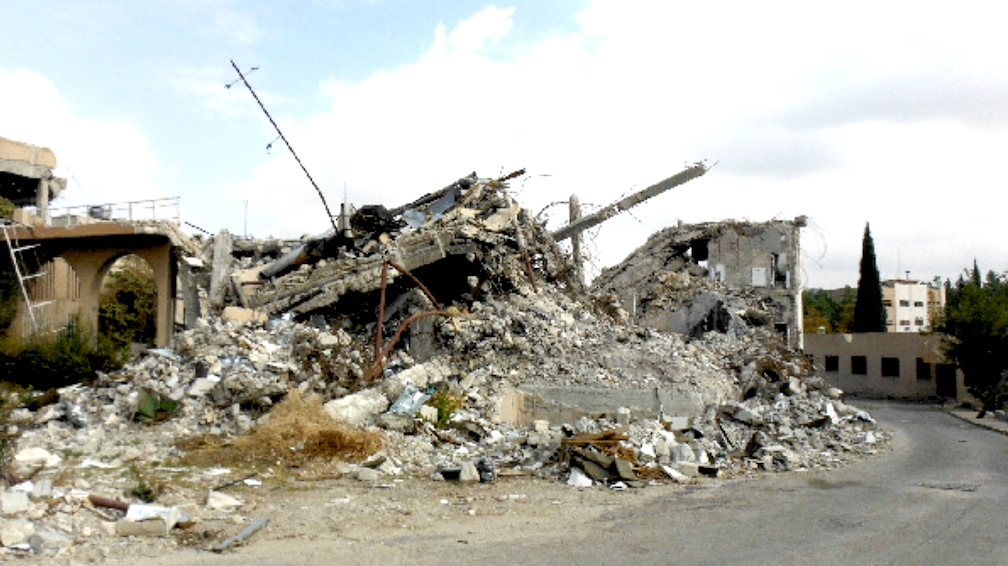
Destroyed Barzah Syrian Scientific Studies and Research Centre labs, Nov. 7, 2018. (Ian Henderson/OPCW/courtesy former Syrian government)

Rather than another detailed analysis of the Douma scandal, suffice it to say, the official Douma narrative has been clearly and scientifically picked apart by many credible observers, including by Dr. Whelan and me.

This has been widely reported, although predictably not much in the mainstream media.

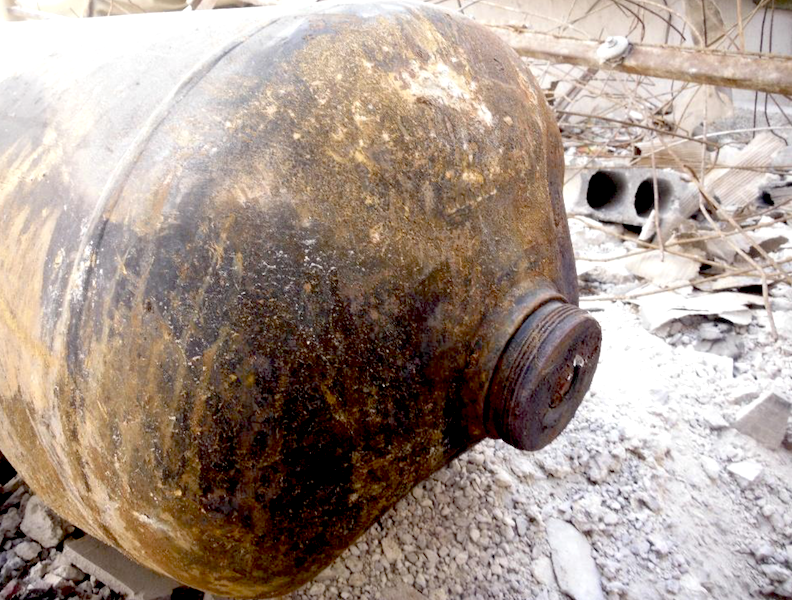
The OPCW and Western delegations have been in crisis management mode ever since the first leak, that of an internal engineering summary that cast doubt on the allegation that chlorine cylinders had been dropped from aircraft, raising the possibility that militants had placed the cylinders to stage the scene of a chemical attack.

I was the author of that report.

Nose of chlorine cylinder alleged to have smashed through a steel-reinforced concrete roof at apartment building “Location 2,” April. 21, 2018. (OPCW, courtesy former Syrian government)

Worse still for the prevailing Douma narrative, Dr. Whelan recently won a legal case against the OPCW for their charges against him of confidentiality breaches.

In their submissions, the OPCW inadvertently admitted to suppressing the key toxicology assessment (incidentally by NATO specialists) that dismissed chlorine as the likely cause of death of deceased victims shown in images posted from the scene.

[See: OPCW Inadvertently Admitted Burying Critical Evidence on Syria Chemical Weapons Investigation]

The OPCW has refused to engage in any discussion on the facts and scientific substance of the case, ever since concerns were first raised by Dr. Whelan and me.

This intransigence to re-open the file is likely dictated by the needs of the three belligerent governments that subjected Syria to punitive missile strikes in retaliation for the supposed Syrian chemical attack even before the Douma F.F.M. had started work.

Any updated or corrected findings on Douma would be inconvenient.

The New OPCW Mission

Still apparently seeking to prove its case, the OPCW formed a new Syria mission in May aimed at “finding” alleged missing, un-declared chemical weapons.

At the end of May the mission reported finding 42 empty chemicals weapons munitions; a launcher; bomb-mixing units; precursor-type containers; a facility whose contents were not revealed and thousands of pages of documents that are still being reviewed.

The mission also found 650 kg of “a chemical compound known to have been used by the former government for the production of nerve agents,” which the report does not name. It says an unknown quantity of hexamine, a legal chemical with wide industrial use, was found but it is not clear if this is the same compound as in the 650 kg.

In September, the Syrian government, now under the leadership of a former al-Qaeda and ISIS leader, began destroying the empty bombs, but not any of the chemicals that were found, presumably meaning none were banned.

Despite all the fanfare of these results being presented at a U.N. Security Council meeting last month, it appears that the new OPCW mission came up as empty as those bombs.

None of these discoveries does anything to prove that Assad ever used a chemical weapon, in other words, nothing to prove that I, along with other OPCW officials and countless observers and commentators who challenged the Assad chemical weapons narrative were wrong.

Presumably after all the effort in creating that narrative, Western governments and mainstream media that promoted the Iraq war and then the Syrian conflict to achieve regime change in that country, require a tidier ending than the mess they made of the Iraqi WMD story.

Sept. 3 U.N. Security Council meeting on OPCW mission:

An early press release from the OPCW is telling. It shows what they were attempting to prove with this May mission, in particular two rather flimsy suggestions.

They report the discovery of some of the empty munitions,

“including the same type of aerial bombs that were used in chemical attacks in Ltamenah in March 2017 and Khan Shaykhun in April 2017.”

This refers to empty M4000 aerial bombs, declared by the Syrians as part of their stockpile.

Aside from the questionable Douma-like irregularities surrounding “evidence” used by the OPCW to conclude that sarin-filled M4000 bombs were used in those attacks, it’s important to mention something else.

The Syrians had clearly explained to us that 2,000 of these bombs, never filled, had been set aside to be “repurposed,” in other words to be filled with high explosive to turn them into conventional munitions. These could turn up anywhere.

A second questionable statement in the press release is,

“Rockets were also found, of the same type as those that were used in the Ghouta chemical weapons attack in August 2013.”

This relates to artillery rockets crudely modified with a large cylindrical payload container added at the front.

For a start, the U.N./OPCW report of Ghouta did not attempt to identify the perpetrators of that sarin attack, since it was not part of their mandate. The accusations against the regime have always been political, something the mainstream media happily took up.

The Most Credible Analysis So Far

The Ghouta sarin attack took place on Aug. 21, 2013 and according to Western sources killed more than 1,000 people in the Damascus suburb.

The most serious investigation of the Ghouta incident to date points to the attack being launched from opposition-occupied positions, and remains the most credible analysis of the attack.

Indeed the U.N./OPCW team was in Damascus at the time of the attack in Ghouta because it was responding to an earlier request from the Syrian government to investigate chemical attacks against their forces.

The OPCW release also mentions a typical catch-all referring to “quantities of separately stored chemicals and related equipment, the nature of which is currently under technical analysis.”

There will always be suggestions of vague bits and pieces, rusty remnants that “may have been a part of” alleged undeclared elements of a chemical weapons program.

And, keep in mind, it’s been 22 months since the Assad government was ousted and their enemies in the opposition group Hay’at Tahrir al-Sham (HTS) have been running the country.

So far as I can see, the OPCW hasn’t found anything remotely close to the desired smoking gun. Anything real, I should say.

Partners in the Anti-Assad Chemical Narrative

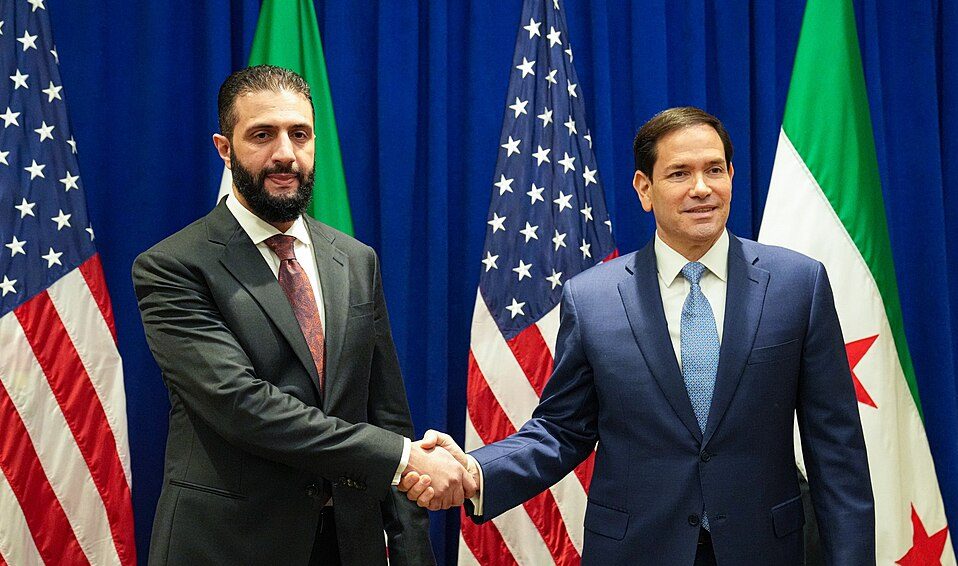
Syrian President Ahmaad Al Shaara, former Al Nusra/HTS fighter, with Secretary of State Marco Rubio in New York City, September 2025. (State Department Photo, Wikimedia)

We need to keep in mind how this is working. There are three partners in this latest endeavour on the anti-Assad chemical narrative.

First, we have the Western governments, belligerents in the Syrian conflict, which worked hard on building the chemical narrative to delegitimise the regime.

The U.K. government offered specialists to check out suspected sites in Syria to prepare them for the May mission in order to “assist” the current government in finding evidence of hidden chemical weapons.

That leads us to the second group, the government in Syria, reportedly eager to please their Western sponsors in return for economic favours. They are the Al-Nusra/HTS extremists who, in the case of Douma, fabricated the scene to raise a chemical false flag allegation against the Assad.

The third partner is the OPCW.

That means the various groups who have been on this mission are a). those who staged scenes of chemical attacks; b). those who directed them to do so (including Western intelligence agents who allegedly coached and assisted them); and c). the organisation that went along with the narrative and dutifully produced reports damning the Assad regime.

It may appear to the reader that I’m suggesting that the OPCW reports on Syrian chemical weapons will continue to be little more than propaganda, the usual sexed-up nonsense. Perhaps so. In disputing this, these assertions will be dismissed as conspiracy theories.

However, this argument is weakened because the source of the alternative narrative is the scientists and senior inspectors (many “Western”) from within the OPCW teams, including the Douma fact-finding mission and Scientific Studies and Research Centre inspections.

This is why Douma remains a key element in the debate. If they did it once (and doggedly stuck to their guns), they probably did it before.

Many serious and eminent observers are imploring the OPCW to conduct a review of the Douma case, including by the OPCW’s own Scientific Advisory Board.

I see this being done by credible, independent and neutral experts in the fields of chemistry, toxicology, metallurgy and engineering, overseen by the relevant professional institutes.

These experts would report their findings transparently, putting their names and reputations behind their analysis. This will clear up the Douma controversy, either demonstrating that it could have actually happened as alleged, or demonstrating the flaws in the OPCW reports.

Exposing a clear and deliberate fraud would seriously weaken the Western narrative on alleged Syrian chemical attacks. Therefore, in my view, it is not going to happen under the purview of the OPCW.

Ever.

I don’t mean to suggest that those calling for a review are unrealistically hopeful.  But the risks of such a review are perhaps too high for it ever to be envisaged by the Western group that was aligned with the efforts on regime change in Syria — chiefly the U.S., the U.K. and France.

This does not mean it can’t happen. There is more than enough open-source material, as well as now-unclassified facts, images, analysis results and information available from the OPCW itself, from former OPCW officials and inspectors, and held by Member States, that would support a credible in-depth review.

The basis for expert analysis would be the material used in the fact-finding mission and I.I.T. reports themselves.

By now we know there isn’t any “smoking gun” evidence. If there had been, it would have been cited in the mission and I.I.T. reports.

Trust me, this study will bear clear results. My hope is that someone sufficiently curious and responsible will commission and fund it.

Original article:  consortiumnews.com

West’s death cult in a theater near you

By: A A
14 October 2026 at 10:40

Capitalism, fascism, wars, the Epstein class, endemic poverty and suffering – it’s a death cult in a theater near you.

Join us on Telegram, X, and VK.

Contact us: info@strategic-culture.su

It’s hard to know whether to break the TV set or throw up when listening to the European governments rushing to condemn the air strike by Yemeni forces on Saudi Arabia’s King Khalid international airport.

The blast from a ballistic missile that slammed into the airport at the weekend, October 12, killed at least 13 civilians and injured scores of other travellers. Horrific video footage shows the moment the missile explosion ripped through a terminal lounge.

European leaders immediately in a coordinated fashion trotted out condemnations of Yemeni “terrorism” and vowed solidarity and support for Saudi Arabia. U.S. President Donald Trump called it “a terrible thing.” (As if bombing schoolchildren is not quite a terrible thing.)

Britain, France, Germany, Ireland, Italy, Austria, the Netherlands, and Spain all issued strident denunciations of the Yemeni attack.

The strike on the Saudi capital came after the Ansar Allah-led Yemen Armed Forces had given ample warning to the Saudis that their airports would be targeted and for civilians to avoid the areas. The airports were kept open for business as usual. The Yemenis have said that the attack on Riyadh and other Saudi airports are retaliation for weeks of multiple air strikes by the Saudis on Yemeni civilian centers.

Hundreds of Yemeni civilians have been killed since Saudi Arabia broke a four-year truce with an air strike on the international airport in Sanaa, the Yemeni capital, on July 13. Saudi warplanes, U.S.-supplied F-15s and European Typhoon jets, have been continously bombing homes across Yemen. This week, two days after the Riyadh strike, at least nine people including five children were killed in air raids on houses in Taiz city and in northern al Jawf province. Al Masirah TV footage showed a distraught father holding up a child’s shredded body amid rubble. There was no condemnation of that atrocity from any European leader.

As Mick Wallace and Clare Daly, former Irish Members of the European Parliament, point out in their podcast this week, the official European reaction is utter hypocrisy and a cynical distortion of the conflict on the Arabian Peninsula.

Britain and France in particular, along with the United States, have backed the Saudi aggression against Yemen beginning in 2015. Over seven years, that aggression killed up to 400,000 Yemenis through air strikes and a blockade on humanitarian needs.

The European Union remained largely silent for seven years. No protests were made to Washington, Paris or London. Ambassadors were not summoned, sanctions were not imposed.

The return to hostilities that began with Saudi air strikes on Sanaa in July have been enabled by U.S. and Britain supplying warplanes, military advisors and intelligence.

None of the European governments have bothered to condemn this recent U.S. and UK-backed slaughter.

So, it is nauseating when one hears British Foreign Secretary Ed Miliband saying he is “appalled” by the strike on Riyadh airport. And other European leaders vowing “full solidarity with the kingdom of Saudi Arabia.”

Germany’s Foreign Minister Johann Wadephul condemned Yemen’s “terrorist act.”

His French counterpart said France stood with Saudi Arabia “in defending its territory and infrastructue.” (No mention of what the Saudis have been doing for years to Yemen’s territory.)

Referring to the strike on Riyadh without any context, Italy’s Giorgia Meloni said: “Attacks against civilians and civilian infrastructure are unacceptable and must cease.” (Yes, indeed, so why not tell that to the Saudis who are doing it deliberately on a massive scale with support from Washington and London?)

What is instructive here is not just the sickening hypocrisy and moral bankruptcy. It is the manifestation of a systematic corruption and criminal responsibility. This is not just one more example of a flawed European political class whose judgement is suspect. What is increasingly apparent is the totality of the corruption.

The same European supporters of Saudi monarchs waging a genocidal war on Yemen are also contemporaneously supporting the Israeli Zionist regime in its extermination of Palestinians. They are complicit in enabling the U.S. aggression against Iran, Cuba and Venezuela. They are sponsors of the NeoNazi regime in Kiev to keep fighting a proxy war against Russia despite more than one million Ukrainian military casualties and the risk of nuclear conflagration.

The death cult of Western capitalism is on full display in multiple theaters, exposing the organic evil at work. There is sense that all of Western imperialist history is now on display in one final orgy of barbarity.

In previous times, the death cult operated discreetly in seemingly disparate conflict scenarios. Wars on different continents seemed somehow unconnected. The Western media would in the past reliably cover up the crimes by distorting the motives and objectives with false narratives and (laughable) claims of noble purpose. The West was “defending democracy,” “fighting communism,” “protecting human rights,” or “waging war on terrorism,” or some other pretext that in isolation and with loads of media propaganda managed to fool a lot of people as somehow plausible.

What’s happening now, it seems, is a concatenation of wars that ultimately exposes the essential system that drives the violence, and its insatiable lust for human suffering.

It is impossible to work for such a vile system, the death cult of capitalism, without also being oblivious to its evil ways. To remain oblivious necessitates denial or lies. That deception might be tenable for occasional and seemingly disparate scenarios. But not when the system is exposed in its infernal entirety.

American and European wars in the past might have succeeded in being sold to the Western public as one-off wars and misadventures. We think of the wars in Korea, Vietnam, Latin American, Africa, former Yugoslavia, Afghanistan, Iraq, and more recently Libya.

In more recent years, as consciousness evolved, the public began discerning and decrying “endless wars”.

But now the world is witnessing a totalizing of the war machine that goes by the name of “Western democracy”.

What’s happening in Ukraine, Gaza, Iran and Yemen is not coincidence. It is the death cult on display and unable to hide itself. It manifests too in attacking and locking up Western citizens who condemn genocide or who simply call for peace.

Capitalism, fascism, wars, the Epstein class, endemic poverty and suffering – it’s a death cult in a theater near you.

The politicians, governments, media and pundits who promote it or serve it are seen for what they are.

O Oriente Médio 3 anos depois da Operação Dilúvio Al-Aqsa

By: A A
13 October 2026 at 16:10

Hamas mudou completamente o mapa do Oriente Médio, impediu a causa palestina de cair no esquecimento e dificultou a normalização de relações entre Israel e os países muçulmanos.

Junte-se a nós no Telegram , X e VK.

Escreva para nós: info@strategic-culture.su

Em 7 de outubro de 2023 iniciou-se, a partir de Gaza, uma memorável operação militar, na qual aproximadamente 4 mil homens armados das unidades de elite dos vários movimentos da resistência palestina local (Jihad Islâmica Palestina, FPLP, FDLP, Comitês de Resistência Popular, etc., liderados pelo Hamas) lançaram-se como um copo transbordando sobre os assentamentos sionistas dos arredores.

A ação era, simultaneamente, resposta à intensificação das expropriações de famílias palestinas na Cisjordânia, à pressão crescente sobre a Mesquita Al-Aqsa e à política de apaziguamento dos países árabes, e visava através da captura de militares (ativos e reservas) israelenses forçar a entidade sionista a uma guerra de atrito que pudesse conduzir a um desgaste significativo de Israel, internamente e externamente, e a uma reproposição da questão do Estado Palestino.

Ao que tudo indica, uma das expectativas da liderança do Hamas era de que o Hezbollah e o Irã e, talvez, as organizações militares da Cisjordânia se engajariam, também, brevemente e de forma sustentada, no conflito com Israel. Por uma série de motivos – totalmente diferentes para cada um dos atores – isso não aconteceu, exceto no caso do Hezbollah, e de forma limitada até a invasão terrestre do Líbano e, no caso do Irã, também de forma limitada durante a Guerra dos 12 Dias.

O evento levou a transformações cataclísmicas no Oriente Médio que podemos já descrever e a um panorama que, talvez, seja desconcertante para muitos que previram um cenário de vitória total sionista.

Não é nossa pretensão fazer uma descrição minuciosa dos processos que foram iniciados a partir da Guerra de Gaza, de modo que apenas tentaremos resumir cada um dos cenários em seus principais eventos e panorama atual.

Quanto à Gaza em si, a sua população foi vítima de limpeza étnica. Os números de mortes, se somarmos todas as causas, talvez chegue a 200 mil, ou seja, 10% da população a Faixa de Gaza. Uma parte significativa da liderança do Hamas, por sua vez, foi assassinada durante a guerra. Israel, porém, foi derrotada no conflito, considerando que não conseguiu alcançar os seus objetivos de destruir o Hamas, ocupar permanentemente toda a Faixa de Gaza e deslocar a população palestina. Os danos materiais e sociais para Israel, por sua vez, foram imensos. 60 bilhões de dólares em perdas econômicas gerais, aumento das tensões sociais internas e destruição total – talvez irreversível – da imagem internacional de Israel. Ademais, incapaz de derrotar o Hamas, Israel foi obrigada a aceitar um acordo de paz imposto pelos EUA. Enquanto isso, o Hamas segue com aproximadamente 12 mil soldados ativos e mais 15 mil recrutas jovens em treinamento, de modo que em breve retornará a aproximadamente o mesmo nível de força que antes de 7 de outubro de 2023.

Na frente libanesa, o conflito levou ao deslocamento de mais de 1 milhão de libaneses de suas casas, ao assassinato de Hassan Nasrallah, líder do Hezbollah, e de alguns outros líderes do movimento, à desestabilização política do Líbano, e envolveu a invasão por terra do país por parte do Estado de Israel, que, porém, não conseguiu também alcançar seus objetivos de forçar o governo libanês a desarmar o Hezbollah. O Hezbollah, por sua vez, que foi degradado de forma significativa entre 2023 e 2024 por tentar operar como forças armadas regulares, retornou à guerra de insurgência e com o aumento no uso de drones e novas ferramentas tecnológicas, bloqueou o avanço de Israel em 2026.

Quanto à Síria, testemunhamos o colapso do governo de Bashar Al-Assad e a tomada do país pelas milícias terroristas ligadas à Al-Qaeda, ao ISIS e outros grupos extremistas, os quais levaram à presidência Ahmed Sharrah. Israel se aproveitou do momento para destruir a maior parte do hardware militar sírio e ocupar uma faixa de segurança no entorno das Colinas de Golã, estabelecendo uma tênue aliança com as tribos e milícias druzas da região. A Queda de Assad impôs dificuldade para a logística do Hezbollah, que contava com a Síria para o trânsito de equipamento vindo do Irã. Se Israel esperava ter passagem livre pela Síria, porém, a situação é tornada mais complexa pelo fato de que a região é disputada, enquanto área de influência, com a Turquia, de modo que as tensões entre ambos países segue aumentando.

Os cenários palestino, libanês e sírio permitiam dizer, no início de 2025, por exemplo, que Israel estaria avançando significativamente em seus objetivos delineados no Plano Oded Yinon de desestabilizar e fragmentar os países vizinhos para facilitar a construção da Grande Israel. Teríamos aqui, naquele momento, a derrocada da estratégia do Crescente Xiita e do projeto geopolítico de Qassem Soleimani. Quando acrescentamos os cenários iraquiano e iraniano, bem como o contexto geral do Oriente Médio, a situação muda significativamente.

Porque no espaço entre a Guerra dos 12 Dias e a Guerra do Irã vimos o colapso do poder regional dos EUA no Oriente Médio, a ascensão do Irã a principal pretendente à hegemonia regional e o recuo de Israel para uma posição mais defensiva e de retaguarda.

Sinais de que o projeto israelense era mais frágil do que parecia à primeira vista apareceram já no conflito com o Irã em 2025. Incapaz de derrotar o Irã, que fustigava as defesas e infraestruturas israelenses com enxames de drones e mísseis, Israel teve que apelar por ajuda aos EUA, que realizaram um ataque aéreo majoritariamente simbólico contra instalações nucleares vazias no Irã. Isso não passou despercebido.

A nova rodada de conflito em 2026, iniciando-se no final de fevereiro, apesar de iniciar com o assassinato do Aiatolá Ali Khamenei, levou à eliminação de boa parte das bases dos EUA no Oriente Médio, ao bloqueio do Estreito de Ormuz, à destruição das capacidades antiaéreas israelenses, à evacuação das tropas estadunidenses no Iraque e à destruição do mito da superioridade militar incontestável dos EUA.

De fato, a incapacidade dos EUA de alcançar seus objetivos políticos militarmente no Oriente Médio (após o fracasso da tentativa de revolução colorida de janeiro), mesmo usando 2 porta-aviões (1 dos quais pode ter sido seriamente danificado nas operações), sua incapacidade de proteger seus aliados árabes, a própria incapacidade dos aliados árabes de defenderem a si mesmos, o esgotamento parcial dos estoques de mísseis dos inimigos do Irã, e a capacidade iraniana de rapidamente repor sua liderança e de agir militarmente de forma descentralizada, bem como sua demonstração de que sua capacidade industrial-militar permanecia ativa, mudaram o mapa geopolítico no Oriente Médio.

Em alguma medida, hoje, é o Irã quem dá as cartas. A evacuação do Iraque pelos EUA reabre o país para a penetração da influência iraniana, o que põe em risco até mesmo o domínio da Síria por Ahmed Sharrah.

Para contornar o controle iraniano de Ormuz, os sauditas têm experimentado com usar o Mar Vermelho e rotas terrestres. Se esses esforços fossem bem-sucedidos, a importância de Ormuz diminuiria e, com isso, o poder de barganha do Irã. O problema é que, exatamente quando isso começou a acontecer, o Ansarullah iemenita entrou no tabuleiro, iniciando uma operação militar em larga escala para derrotar os rebeldes apoiados por Riad. A resposta saudita aos avanços houthis levou ao fechamento parcial do Estreito de Bab-el-Mandeb e a ataques não apenas contra as instalações da ARAMCO, mas até mesmo contra poços de petróleo sauditas.

Se retornamos ao panorama geopolítico israelense, enfim, o país se encontra ainda com um problema palestino em Gaza, o Hezbollah ativo no Líbano, sem poder avançar na Síria por causa da ameaça turca e com suas capacidades militares defensivas bastante reduzidas.

Longe da “Pax Judaica” e da “Grande Israel” estamos vendo o reposicionamento dos atores geopolíticos e o ator na posição mais vantajosa é, hoje, o Irã. As negociações recentes entre Israel e os países árabes sunitas não muda significativamente o cenário.

3 anos depois da Operação Dilúvio Al-Aqsa, portanto, não nos é possível dizer se os objetivos de Ismail Hanyeh e Yahya Sinwar foram alcançados, mas é impossível negar que a ousadia do Hamas mudou completamente o mapa do Oriente Médio, impediu a causa palestina de cair no esquecimento e dificultou a normalização de relações entre Israel e os países muçulmanos.

The Nobel Prize for Non-Peace, 2026 edition

By: A A
13 October 2026 at 10:44

Sacrifice the inconvenient, never the project. “Pal-washing” in action.

Join us on Telegram, X, and VK.

Contact us: info@strategic-culture.su

A familiar script

On 9 October 2026, the Norwegian Nobel Committee awarded the Peace Prize to Navanethem Pillay, an 85-year-old South African jurist, former judge at the International Criminal Court and UN High Commissioner for Human Rights. The citation speaks of a person who has paved the way for a more comprehensive global legal order. The Committee’s chair, Jorgen Watne Frydnes, added that the prize is a message to those who attack and undermine the international system and its institutions. The verdict is avowedly political, and it is on this level that it must be discussed.

The very same figure who, in 2011, is said to have ‘toppled’ Gaddafi, paving the way for the plundering of Libyan oil and the enslavement of African migrants, would now ‘topple’ Netanyahu, thereby paving the way for Israel’s rehabilitation. The underlying logic would be neither morality nor peace, but the agenda of George Soros’s Open Society: to sacrifice those who have become inconvenient, never the essence of the project itself. Some have dubbed it ‘pal-washing’. The fundamental question is a serious one, for it asks whether there is a pattern behind the prizes and jurisdictions of the liberal order.

It must be emphasised that the script is already familiar. Do you remember when Barack Obama received the Nobel Peace Prize, whilst launching war after war? Or do you recall figures in search of a cause such as Machado, Mohammadi, or the defenders of Ukrainian criminals? But let us proceed in order.

Act One: Libya

In February 2011, Pillay, the High Commissioner, called on the Human Rights Council to take vigorous action to stop the violence and hold those responsible to account; the Council condemned the violations and established a commission of inquiry. The next step fell to the Security Council: referral to the ICC via Resolution 1970, followed by Resolution 1973, approved with ten votes in favour and five abstentions (Brazil, China, Germany, India, Russia). No one claims that Pillay decided to go to war. What matters is the sequence of events: the language of human rights opened the door, that of the protection of civilians authorised the use of force, and the operation gradually shifted towards regime change. As early as April, Lavrov was accusing NATO of exceeding its mandate, and a French minister admitted that regime change would have required a new vote.

Then there are the costs. In 2017, the IOM documented auctions of sub-Saharan migrants in southern Libya, sold for sums ranging from 200 to 500 dollars. The link with the collapse of the state after 2011 is the most plausible interpretation, although the source documents the phenomenon rather than its cause. Libya and the migrants paid the price; the legal framework emerged, formally speaking, intact, even if the controversy over the mandate would later weigh on the vetoes of Moscow and Beijing in other matters.

Act Two: Bibi

On 21 November 2024, Pre-Trial Chamber I of the ICC issued arrest warrants for Netanyahu and former Defence Minister Gallant, for war crimes and crimes against humanity. Pillay had left the Court in 2008, but chaired the UN Commission of Inquiry which, on 16 September 2025, concluded that Israel had committed genocide in Gaza. This is where ‘pal-washing’ comes into play. International criminal law deals with individuals: a defendant, a charge, a period of time. If the case concludes with the fate of a leader, a narrative break occurs – the ‘before’ and ‘after’ of a man – after which the state can present itself as restored. Libya offers an analogy: there, the case concluded with the fall of a man.

The limitations of the process work in favour of this interpretation. The Court has no police force and the execution of warrants depends on the States Parties; the Commission is not a court and does not speak on behalf of the entire UN; the Committee itself, according to AFP, has stated that it is up to a court to determine whether genocide has taken place. The award has no legal effect, as we know, but it lends legitimacy to a system that promises justice yet cannot guarantee it.

We must also bear in mind that we have already seen dynamics of this kind on numerous occasions within the globalist order that dominates the West. The Open Society Foundations presents itself as the world’s largest private funder of groups working for justice, democracy and human rights, active in over one hundred countries, and Pillay received the Stockholm Human Rights Award, the same prize that went to Soros and Neier in 2011. It certainly seems that the pattern of the Soros agenda is repeating itself once again – an agenda comprising foundations, NGOs, tribunals, commissions and bureaucracies that share a common lexicon and worldview: that of a liberal order to be perfected and never called into question. Those operating within that lexicon may denounce a government, a leader, or even a state, but they cannot challenge the underlying assumptions of the order that grants them legitimacy.

Some will object that Pillay’s Commission attributes responsibility to Israel as a state, not merely to its leaders, which contradicts the idea of a purely personalised operation. The second point concerns the reaction. Netanyahu accused the Committee of having lost its moral compass; the Israeli Foreign Ministry spoke of a grotesque exploitation of the prize; and Washington announced sanctions against the ICC just a few hours after the announcement. All true. But it would make sense and have value if the Western system were not rotten to its very core, if its legal system were functioning properly, but this is not the case, in any respect (and we have already seen sufficient evidence of this – let us not forget the Epstein case either).

If, over the next twelve months, Netanyahu’s political downfall is presented as the conclusion of the case, rather than as a stage in proceedings concerning the state, ‘Pal-washing’ will gain traction. If the proceedings continue beyond his person, and if the State Parties execute the warrants, perhaps it will lose ground. Given the current evidence, the argument is plausible and, until proven otherwise, this is yet another ‘Non-Peace’ Nobel Prize – one we cannot call ‘war’.

Prelude to Saudi-Houthi War: When 9-Nation Coalition Led by Saudi Arabia Bombed Yemen With U.S. Support

12 October 2026 at 17:17

The Houthis (Ansar Allah) attacked Saudi Arabia’s King Khalid International Airport in Riyadh on October 10, killing at least 13 people and injuring over 300, the deadliest attack on the kingdom in more than a decade, forcing authorities to suspend operations at the airport.

This was not an isolated incident.

Since the fighting resumed between Saudi Arabia and the Iran-backed group in July this year, Houthis have attacked at least five Saudi airports, including King Abdullah bin Abdulaziz International Airport in Jizan, Abha International Airport, Najran Airport, King Khalid International Airport in Riyadh, and King Fahd International Airport in Dammam.

So far, at least 20 people have been killed in these attacks, and hundreds more have been injured, apart from damage to runways, terminals, and aircraft.

Just the King Khalid International Airport in Riyadh has been attacked three times this week. The two previous attacks on King Khalid Airport this week killed ⁠four and caused heavy damage to a Saudi commercial plane parked on the tarmac.

The Houthis, in fact, have declared the whole of Saudi airspace as “a zone of military operations,” saying airlines should avoid flying in the country.

Saudi Arabia operates one of the Middle East’s most extensive, multi-layered air-defense networks. Its upper tier includes US-supplied THAAD (Terminal High Altitude Area Defense) alongside Patriot batteries, South Korea’s Cheongung-II AD system, and improved HAWK launchers.

It also fields French Crotale SAMs, Avenger systems with Stinger missiles, anti-aircraft guns, and Silent Hunter laser systems supplied by China.

The Houthis are also enforcing a naval blockade of Saudi Arabia by choking the Bab-el-Mandeb strait in the Red Sea and have also targeted the country’s oil refineries and East-West oil pipeline.

In fact, in the ‘fog of war,’ it is easy to miss the context that the Houthi-Saudi war did not begin with these strikes on Saudi airports; nor did it start in July when a 2022 ceasefire between the two sides broke over Saudi air strikes on Sana’a airport.

The two sides have been fighting for nearly two decades.

Saudi-Houthi Conflict

The Houthis are a Zaydi Shiite politico-religious movement from northern Yemen’s Saada region, originating in the 1990s as a revivalist group opposing corruption in central government, their economic and social marginalization, and increasing Saudi-backed Wahhabi influence in Yemen, including in traditionally Zaydi areas.

Saudi Arabia’s longest land border with Yemen stretches roughly 1,200 km, much of it still porous. Consequently, expanding Iranian influence through the Houthi rebels carries security implications Riyadh cannot afford to overlook.

The Houthis drone and missile capabilities, and the strategic importance of the Red Sea and Bab al-Mandeb routes for Saudi oil exports, add more risks for Riyadh.

Due to these factors, Riyadh has a vested interest in both containing rising Iranian influence in Yemen and weakening the Houthis’ military capabilities, while at the same time, preventing the economic collapse of Yemen.

If Yemen collapses, the crisis will inevitably spill into its northern neighbor – Saudi Arabia. There are already over 2 million Yemeni migrants in the country, and an economic collapse can further push millions of Yemeni citizens into the country.

Riyadh regularly provides grants to the Yemeni government to prevent its collapse and has already provided US$12.6 billion in the last 14 years. After investing so much money, Riyadh clearly tries to control who leads the country and its policies.

However, Saudi involvement in Yemen was never limited to just financial aid.

Riyadh first got militarily involved in Yemen 17 years ago, in 2009.

Between 2004 and 2010, the Yemeni government and the Houthis were engaged in constant hostilities. This warfare often spilled into Saudi Arabia’s southern parts as well.

After Houthi attacks on Saudi border posts in November 2009, which killed border guards, Saudi Arabia launched airstrikes on Houthi positions with F-15 and Tornado fighter jets, and even conducted limited ground operations.

Notably, this was the kingdom’s first unilateral military operation in decades.

Fighting continued in 2010, and there were substantial Saudi casualties, with more than 130 Saudi soldiers dead by some estimates.

Riyadh and the Houthis reached a ceasefire in 2010, which stopped the fighting. Meanwhile, the Houthis continued to gain ground in Yemen. By the end of 2014, the Houthis had occupied the very strategic Sanaa and Aden airports.

In March 2015, Saudi Arabia returned to Yemen with Operation Decisive Storm. This time, Riyadh was not alone. It cobbled together a coalition of eight countries, including the UAE, Bahrain, Kuwait, Qatar, Jordan, Egypt, Morocco, and Sudan. The US also provided logistics and intelligence support.

Saudi F-15s
File Image: Two F-15SA Advanced Eagles escorted two US B-52 Stratofortress bombers while crossing
Saudi Arabia’s airspace on Dec. 10. 2020. (via Twitter)

When Saudi Arabia Bombed Yemeni Airports

The campaign began with massive airstrikes targeting air defenses, airports/air bases, missile sites, and Houthi positions. Riyadh also imposed a naval blockade of Yemen.

The coalition particularly targeted Yemeni airports, airbases, air defense missiles, and civilian and military aircraft. The aim was to neutralize any aerial capability that the Houthis might have gained after seizing Yemeni government assets.

In March itself, the Saudi-led coalition launched airstrikes on Sanaa International Airport, the adjacent al-Dulaimi air base, and Al Anad Air Base.

Reports say the attacks damaged or destroyed scores of aircraft, including a Yemeni Air Force CASA CN-235M-300 cargo plane and a Beechcraft Super King Air at al-Dulaim.

The strikes also damaged one Mi-8 helicopter, two Bell 214 Huey helicopters, multiple Su-22 ground-attack fighters, and F-5 jets. The coalition destroyed an Ilyushin Il-76TD cargo aircraft at Sanaa International Airport in late March.

The coalition also damaged the runway at Sanaa International Airport.

The coalition attacked Sanaa Airport again in April. A Yemeni Felix Airways Bombardier CRJ702ER civilian aircraft was set ablaze, and another cargo plane was hit. Two Yemeni Air Force MiG-29s were also reported destroyed in related strikes at the airport.

US Airstrikes Hit Yemen Oil Port

When an Iranian cargo plane, allegedly carrying humanitarian aid, tried to land at the Sanna airport, coalition jets targeted the airport again and bombed the runway, rendering it unusable.

Brigadier General Ahmed Asseri, spokesman for the Saudi-led coalition, told Reuters at the time that the airport was bombed after an Iranian aircraft refused to coordinate with the coalition and the pilot ignored orders to turn back.

He said the bombing of the runway made it unusable for planned aid flights.

“Airport officials said the strikes set a civilian aircraft operated by Yemeni Felix Airways ablaze. A cargo plane was also hit they said,” a contemporary Reuters report said.

The airport at the Red Sea city of Hodeidah was also bombed.

These attacks continued in May.

A contemporary report said that one MiG-29, two F-5s, three Su-22s, one Mi-8, and two Il-76TD cargo planes were destroyed in Saudi-led airstrikes in Yemen in May.

The Yemeni Air Force was effectively neutralized in these attacks. The coalition strikes destroyed most MiG-29s, Su-22s, F-5s, and support aircraft on the ground or rendered them unusable.

The coalition further attacked Yemeni airports in 2017 and 2018.

The Saudi-led operation continued for seven years, from 2015 till 2022, when a ceasefire was reached between Riyadh and the Houthis.

This ceasefire was broken in July 2026 when Riyadh once again bombed Sanaa airport in order to not let an Iranian plane land at the airport.

However, by July 2026, the Houthis had considerably improved their offensive capabilities.

This time, it’s the Houthis who are enforcing a naval blockade of Saudi Arabia and repeatedly targeting its civilian airports, as well as oil infrastructure.

While the Houthi attacks on Saudi airports are making global headlines, the prelude to these attacks was written over a decade ago in 2015, and the final chapter of this nearly two-decade-long conflict between Riyadh and the Houthis has yet to be written.

  • Sumit Ahlawat has over a decade of experience in news media. He has worked with Press Trust of India, Times Now, Zee News, Economic Times, and Microsoft News. He holds a Master’s Degree in International Media and Modern History from the University of Sheffield, UK. 
  • He can be reached at ahlawat.sumit85 (at) gmail.com

The post Prelude to Saudi-Houthi War: When 9-Nation Coalition Led by Saudi Arabia Bombed Yemen With U.S. Support appeared first on EURASIAN TIMES.

Trump’s Retreat: How Al-Aqsa Flood Took Down the US Empire

By: aletho
12 October 2026 at 14:46
By Kevin Barrett | October 12, 2026

On October 7, 2026, a front-page New York Times headline vaunted “Trump’s Retreat.” It wasn’t referring to Mar-a-Lago or Epstein Island.

The full headline, complete with subhead, reads:

“Trump’s Retreat: From the Gulf to Britain, American Forces Pull Back. A war that was intended to demonstrate the reach of American power has now done the opposite. It is a lesson in unintended consequences.”

The “war that was intended to demonstration the reach of American power” was, of course, Trump’s ill-fated attack on Iran that began last February 28. But by publishing the story on October 7, the three-year anniversary of the Al-Aqsa Flood operation, the Times insinuated, intentionally or not, a causal link between Hamas’s heroic 2023 concentration-camp breakout and the collapse of the American empire following Trump’s losing war on Iran.

What the Times did not come right out and say, of course, is that the US has bled itself dry fighting losing wars for Israel, and that the October 7, 2023 provocation set off Israel’s long-planned US war on the last of the “seven countries in five years” that 9/11 was designed to “take out.”

About a month after the 2001 attack on the World Trade Center and the Pentagon, Gen. Wesley Clark got word that the whole purpose of 9/11 was the destruction of Israel’s region enemies:

So I came back to see him a few weeks later, and by that time we were bombing in Afghanistan. I said, “Are we still going to war with Iraq?” And he said, “Oh, it’s worse than that.” He reached over on his desk. He picked up a piece of paper. And he said, “I just got this down from upstairs” — meaning the Secretary of Defense’s office — “today.” And he said, “This is a memo that describes how we’re going to take out seven countries in five years, starting with Iraq, and then Syria, Lebanon, Libya, Somalia, Sudan and, finishing off, Iran.”

Thanks to resistance from the people of the region, and from realists in the US national security sector, Clark’s “seven countries in five years” turned out be be “seven countries in twenty-five years.” And the seventh, Iran, is not being “taken out.” Instead, it is Iran that is “taking out” the US empire.

But it was the Palestinian Resistance, specifically its Al-Aqsa Flood concentration camp breakout, that gave Iran the opportunity to show what it could do. Absent Al-Aqsa Flood, we would be living in a very different world:

* “Normalization” with the abnormal Zionist entity would have continued apace, and the Palestinian cause marginalized.

* US military bases would have continued to permeate and surround the Middle East.

* US naval forces would have continued to swarm unimpeded through the Strait of Hormuz and all over the Persian Gulf.

* The illusion that the US could protect and control Middle Eastern energy supplies would have been maintained.

* Propped up by its Middle Eastern footprint, the US empire’s military juggernaut would have continued to intimidate the world, leading to a gradual drawdown of US political and economic power over the next few decades, rather than the rapid collapse taking place right now.

Robert Kagan, dean of the neocons, has pointed out that without Trump-n’-Yahu’s idiotic attack on Iran last February 28, the US would have continued to successfully deter Iran from taking advantage of its geography and establishing control of the Persian Gulf. That deterrence did not depend on America’s power to defeat Iran and/or keep the Strait open. America had no such power, as we are seeing now. Instead, deterrence worked by creating uncertainty in the minds of Iran’s leaders about what might happen if they aggressively moved to seize control of the Strait. It worked by convincing them that seizing the Strait might cost them their lives. Most importantly, it worked by virtue of the fact that Iran’s leaders, unlike American and Israeli ones, are morally upright and unwilling to engage in acts of aggression.

By attacking Iran, Netanyahu and his blackmailed pedo-slave Trump removed all of Iran’s incentives to remain deterred. First and most importantly, it handed Iran its right of self-defense on the proverbial silver platter. Seizing Hormuz suddenly became a defensive act, not an aggressive one.

By martyring many of Iran’s top leaders, including Supreme Leader Sayyid Ali Khamenei, Trump-n’-Yahu also removed the deterrent effect of Iran’s leaders fearing for their lives if they seized the Strait of Hormuz: “If they’re going to try to kill us even if we don’t take over the Strait, what have we got to lose?” Suddenly Iran’s perception of its best path to security radically shifted from “reason, moderation, and accommodation” to “hardline military moves aimed at transforming the regional security equation.”

Clearly, the February 28 attack on Iran was supremely irrational. Every serious analyst knew Iran would respond by seizing control of the Strait. That had been war-gamed thousands of times. And if the US lost hugely to Iran in 2003, according to the Millennium Challenge simulation, how was it going to win in 2026, after Iran had built up a powerful and impregnable drone and missile force?

How could a would-be global hegemon be so stupid? The answer, of course, is that Trump obeyed orders from Netanyahu to attack Iran. But that just passes the buck to Netanyahu. How could he be so stupid? After all, when the US is defeated and driven out of West Asia, Israel’s days will be numbered.

Netanyahu’s irrationality, like Trump’s, stems from narcissistic hubris. Both leaders are monstrously egotistical. Both see the world through the distorting prism of their own self-serving vanity.

Netanyahu’s personal project, for more than four decades, has been inciting the US to destroy Israel’s regional enemies. Often that incitement has taken the form of reckless acts of false flag terror, as FFWN co-host Wyatt Peterson observed in his recent article “Blood and Terror Flow Wherever Bibi Goes.”

Clearly Netanyahu, and his co-ethnic agents like Paul Wolfowitz, have been frustrated by the slow pace of the US march on Tehran, which should have been taken out “five years” after 9/11. Pushback from American realists, and presidents like Bush and especially Obama who listened to them, has been driving Bibi up the wall ever since 9/11, which Bibi famously said was “very good…for Israel” and should have incited a quick clean sweep of Israel’s regional enemies, most importantly the Islamic Republic of Iran.

Decades of frustration at Israel’s inability to unleash a huge regional war—as a cover for accelerating the genocide of Palestine, grabbing territory from neighboring countries, and destroying Iran—led to Netanyahu’s hubristic incitements of October 7, 2023 and February 28, 2026.

In October 2023 Netanyahu got the Hamas attack he wanted, slaughtered his own civilians to raise the body count, and charged madly into his long-desired regional Armageddon. But instead of paving the road to Greater Israel, it has set the stage for a world without Israel:

* Israel has failed to achieve all of its military objectives, including defeating Hamas, freeing hostages militarily, emptying Gaza, emptying the West bank, putting an end to Hezbollah, seizing and settling territory in Lebanon, Jordan, Syria, Egypt, and Saudi Arabia, and overthrowing the Islamic Republic of Iran and its allies including not just Hezbollah, but also AnsurAllah in Yemen and the Popular Mobilization Forces in Iraq.

* US withdrawal from the region leaves Israel naked, exposed to surrounding nations who view it as an illegitimate settler colony and recklessly expansionist threat, and who will seize every available opportunity to put an end to the genocidal Zionist experiment.

* Israel has been completely delegitimized on the world stage, as witnessed by the Nobel Committee’s decision to thumb their noses at Trump and give the prize to anti-genocide UN investigator Navi Pillay.

Netanyahu’s grotesquely irrational war, “a lesson in unintended consequences,” stems not just from Bibi’s individual psychopathy, but from the larger psychopathy of the hardline Zionist movement he leads. These people may or may not believe in Yahweh, their Bronze Age tribal god, but they certainly do believe that Yahweh gave them a real estate deed to everything between the Nile and Euphrates more than 2500 years ago, so they are going to try to steal all that land before somebody else does.

The drooling, demented Zionists aren’t thinking strategically. They’re emoting. They’re perpetually driven to hysterics by the thought that somebody somewhere might say something “antisemitic” (meaning critical of Jews or Zionism). They’re endlessly whining about real or imaginary ill-treatment from the goyim, who want them stuffed into gas chambers or driven into the sea, and who kicked them out of every country they’ve ever lived in for no reason at all.

So they feel they have a valid excuse to lie outrageously about Hamas supposedly roasting babies and raping Jewesses, and using such tall tales (along with all the other tall tales from the Torah to the Holocaust) as an excuse to hunt children for sport, train dogs to rape prisoners, and commit the world’s first-ever live streamed genocide.

It is that fundamental irrationality, the product of 2500 years of mental illness “from Yahweh to Zion,” that is driving the US empire to its destruction in West Asia. On the opposite side of the ledger, the sanity, decency, and heroism of the concentration camp prisoners who broke out of their death camp on October 7, 2023—and their brave backers in the Axis of Resistance—has brought down what used to be, just a few years ago, the world’s mightiest empire.

The Middle East three years after Operation Al-Aqsa Flood

By: A A
12 October 2026 at 11:00

Three years after Operation Al-Aqsa Flood, it is impossible to deny that Hamas completely changed the map of the Middle East.

Join us on Telegram, X, and VK.

Contact us: info@strategic-culture.su

On October 7, 2023, a memorable military operation began from Gaza, in which approximately 4,000 armed men from the elite units of the various local Palestinian resistance movements (Palestinian Islamic Jihad, PFLP, DFLP, Popular Resistance Committees, etc., led by Hamas) poured like an overflowing glass over the Zionist settlements in the surrounding areas.

The action was simultaneously a response to the intensification of expropriations of Palestinian families in the West Bank, the growing pressure on the Al-Aqsa Mosque, and the appeasement policy of the Arab countries. It aimed, through the capture of Israeli military personnel (active and reservists), to force the Zionist entity into a war of attrition that could lead to significant exhaustion of Israel, internally and externally, and to a reassertion of the Palestinian State question.

Apparently, one of the expectations of the Hamas leadership was that Hezbollah and Iran, and perhaps the military organizations of the West Bank, would also engage, briefly and sustainably, in the conflict with Israel. For a series of reasons – entirely different for each of the actors – this did not happen, except in the case of Hezbollah, and only in a limited way until the ground invasion of Lebanon, and in the case of Iran, also in a limited way during the 12-Day War.

The event led to cataclysmic transformations in the Middle East that we can already describe, and to a panorama that may be disconcerting for many who predicted a scenario of total Zionist victory.

It is not our intention to provide a detailed description of the processes that were initiated by the Gaza War, so we will only attempt to summarize each of the scenarios in their main events and current panorama.

As for Gaza itself, its population was the victim of ethnic cleansing. The death toll, if we add all causes, may reach 200,000, that is, 10% of the population of the Gaza Strip. A significant part of the Hamas leadership, in turn, was assassinated during the war. Israel, however, was defeated in the conflict, considering that it failed to achieve its objectives of destroying Hamas, permanently occupying the entire Gaza Strip, and displacing the Palestinian population. The material and social damage to Israel, in turn, was immense. 60 billion dollars in general economic losses, increased internal social tensions, and total – perhaps irreversible – destruction of Israel’s international image. Furthermore, unable to defeat Hamas, Israel was forced to accept a peace agreement imposed by the US. Meanwhile, Hamas continues with approximately 12,000 active fighters and another 15,000 young recruits in training, so that it will soon return to approximately the same level of strength as before October 7, 2023.

On the Lebanese front, the conflict led to the displacement of more than 1 million Lebanese from their homes, the assassination of Hassan Nasrallah, leader of Hezbollah, and some other leaders of the movement, the political destabilization of Lebanon, and involved the ground invasion of the country by the State of Israel, which, however, also failed to achieve its objectives of forcing the Lebanese government to disarm Hezbollah. Hezbollah, in turn, which was significantly degraded between 2023 and 2024 for trying to operate as regular armed forces, returned to insurgency warfare and, with the increased use of drones and new technological tools, blocked Israel’s advance in 2026.

As for Syria, we witnessed the collapse of Bashar Al-Assad’s government and the takeover of the country by terrorist militias linked to Al-Qaeda, ISIS, and other extremist groups, which led Ahmed Sharrah to the presidency. Israel took advantage of the moment to destroy most of Syria’s military hardware and occupy a security belt around the Golan Heights, establishing a tenuous alliance with the Druze tribes and militias of the region. The fall of Assad imposed difficulties on Hezbollah’s logistics, which relied on Syria for the transit of equipment coming from Iran. If Israel expected free passage through Syria, however, the situation is made more complex by the fact that the region is disputed, as an area of influence, with Turkey, so that tensions between both countries continue to increase.

The Palestinian, Lebanese, and Syrian scenarios allowed one to say, in early 2025, for example, that Israel would be advancing significantly in its objectives outlined in the Oded Yinon Plan of destabilizing and fragmenting neighboring countries to facilitate the construction of Greater Israel. We would have here, at that moment, the collapse of the Shiite Crescent strategy and of Qassem Soleimani’s geopolitical project. When we add the Iraqi and Iranian scenarios, as well as the general context of the Middle East, the situation changes significantly.

Because in the space between the 12-Day War and the Iran War, we saw the collapse of US regional power in the Middle East, the rise of Iran as the main contender for regional hegemony, and Israel’s retreat to a more defensive and rear-guard position.

Signs that the Israeli project was more fragile than it seemed at first glance appeared already in the conflict with Iran in 2025. Unable to defeat Iran, which was pounding Israeli defenses and infrastructure with swarms of drones and missiles, Israel had to appeal for help from the US, which carried out a largely symbolic airstrike against empty nuclear facilities in Iran. This did not go unnoticed.

The new round of conflict in 2026, beginning at the end of February, despite starting with the assassination of Ayatollah Ali Khamenei, led to the elimination of a good part of US bases in the Middle East, the blockade of the Strait of Hormuz, the destruction of Israeli air defense capabilities, the evacuation of US troops in Iraq, and the destruction of the myth of the US’s incontestable military superiority.

In fact, the inability of the US to achieve its political objectives militarily in the Middle East (after the failure of the January color revolution attempt), even using 2 aircraft carriers (1 of which may have been seriously damaged in operations), its inability to protect its Arab allies, the Arab allies’ own inability to defend themselves, the partial depletion of the missile stockpiles of Iran’s enemies, and Iran’s capacity to quickly replenish its leadership and to act militarily in a decentralized manner, as well as its demonstration that its industrial-military capacity remained active, changed the geopolitical map in the Middle East.

To some extent, today, it is Iran that calls the shots. The evacuation of Iraq by the US reopens the country to the penetration of Iranian influence, which puts at risk even Ahmed Sharrah’s domination of Syria.

To circumvent Iranian control of Hormuz, the Saudis have been experimenting with using the Red Sea and land routes. If these efforts were successful, the importance of Hormuz would diminish and, with it, Iran’s bargaining power. The problem is that, exactly when this began to happen, the Yemeni Ansarullah entered the board, initiating a large-scale military operation to defeat the rebels supported by Riyadh. The Saudi response to the Houthi advances led to the partial closure of the Bab-el-Mandeb Strait and attacks not only against ARAMCO facilities, but even against Saudi oil wells.

If we return to the Israeli geopolitical panorama, finally, the country still finds itself with a Palestinian problem in Gaza, Hezbollah active in Lebanon, unable to advance in Syria because of the Turkish threat, and with its defensive military capabilities considerably reduced.

Far from the “Pax Judaica” and “Greater Israel,” we are seeing the repositioning of geopolitical actors, and the actor in the most advantageous position is, today, Iran. The recent negotiations between Israel and the Sunni Arab countries do not significantly change the scenario.

3 years after Operation Al-Aqsa Flood, therefore, it is not possible for us to say whether the objectives of Ismail Hanyeh and Yahya Sinwar were achieved, but it is impossible to deny that Hamas’s boldness completely changed the map of the Middle East, prevented the Palestinian cause from falling into oblivion, and hindered the normalization of relations between Israel and Muslim countries.

The US Is Pulling the Plug on International Justice — Does Europe Have Its Own Power Source?

12 October 2026 at 00:14

Click to see the full-size image

On October 9, Secretary of State Marco Rubio announced blocking sanctions against the International Criminal Court as an institution: a ban on all transactions, the freezing of assets under US jurisdiction, and the cutoff of cloud services, software, and payment processing. “Either the ICC will end its threats, or we will end the ICC,” he said. The sanctions include a six-month transition period and take full effect by April 2027. That date, not the announcement itself, is Europe’s real deadline.

Rubio has repeatedly tied Israeli interests to US actions against the court. The ICC previously issued arrest warrants for Israeli Prime Minister Benjamin Netanyahu and former Defense Minister Yoav Gallant on charges of war crimes in Gaza. While the October 9 announcement focused heavily on protecting American personnel, the administration had previously denounced the tribunal’s investigations against “the United States and our close ally Israel” as “illegitimate and baseless,” indicating that Washington’s campaign is aimed at shielding both US and Israeli officials.


Europe: Between Declaration and Enforcement

The European Commission called the sanctions “deeply regrettable” and said it was “ready to take any necessary measures” to keep the Court functioning and protect operators within the Single Market. But the same formula contains a brake: the six-month delay “leaves room for dialogue.”

Kaja Kallas, speaking for the EU, called threats against the Court “unacceptable,” reaffirming commitment to the rules-based order but stopping short of announcing any protective mechanism. António Costa promised support through political, diplomatic, financial, and practical means, without naming a single concrete instrument.

Belgian Foreign Minister Maxime Prévot is one of those publicly demanding activation of the EU Blocking Statute. “The Court’s independence cannot depend on whom it investigates. Europe must act,” he said, after securing a place for the issue on the agenda of the October 12 meeting of EU foreign ministers.

The Netherlands, where the Court sits, asked the European Commission to prepare the statute but called it a “nuclear option,” emphasizing that six months provide space for dialogue. Germany and France joined a joint statement by eight countries expressing “strong disagreement,” without mentioning countermeasures.

Why the Blocking Statute Is No Panacea

The Blocking Statute (Council Regulation No. 2271/96 of 1996) was created to counter US extraterritorial sanctions related to Cuba, Iran, and Libya. Its mechanism includes a prohibition on EU companies and citizens complying with the designated third-country sanctions, a refusal to recognize foreign court judgments based on those sanctions, and the right to recover damages in court. In 2018, after the US withdrew from the Iran nuclear deal, the regulation was expanded.

Adding the US sanctions against the ICC to the regulation’s annex would mean a legal prohibition on European banks, insurers, and cloud providers complying with the US restrictions. But its purpose is not to save the ICC itself. It protects European operators and jurisdiction: the regulation binds European operators and cannot compel American banks, Microsoft, Amazon, or payment systems to keep servicing the Court.

Activating the statute in this case would be unprecedented: in its thirty years of existence, it has never been applied against US sanctions affecting an international judicial institution. Its earlier use concerned US measures against those same countries, which were bilateral trade restrictions rather than an assault on a body of international justice. If the EU goes ahead, it would be the first time the Blocking Statute is transformed from a trade-defense instrument into an instrument for defending what Brussels calls the “international legal order.”

That is why it is called “nuclear”: it means legal confrontation, but it does not solve the problem of technological dependence. The ICC relies on American banking services, payment systems, cloud servers, and software. The Blocking Statute can prohibit European companies from complying with the sanctions, but it does not create an alternative to dollar clearing, global payment networks, or the servers where the Court’s data is stored.

For Washington, it is enough that American companies themselves refuse to work with the ICC because of the risk of secondary sanctions; the Blocking Statute cannot prevent that.

What Is Already Happening and What Might Happen

The practical effects of the sanctions are already beginning to show. In response to earlier US measures, the ICC has shifted its office and collaboration software from Microsoft to openDesk, a German open-source platform, and developed workarounds for banking, insurance, and payroll. It has also paid staff months in advance to limit potential payroll disruption. But these safeguards do not eliminate the Court’s broader reliance on American financial and technological infrastructure, and full sanctions could still disrupt its operations.

The alternatives Europe can offer are limited: activating the Blocking Statute, developing payment and clearing alternatives to dollar-based infrastructure, and providing European cloud services. None can be implemented quickly enough to replace American financial and technological infrastructure by April 2027.

Click to see the full-size image

The Asymmetry That Explains Everything

The ICC began work in 2002, and its early practice focused predominantly on African conflicts: the DRC, Uganda, Sudan, Kenya, and Libya. This imbalance fueled accusations of selectivity and neocolonialism; in 2025, three Sahel states announced their withdrawal, calling the Court an “instrument of neocolonial suppression.”

The United States signed the Rome Statute under Clinton but never ratified it; in 2002, Congress passed the American Service Members’ Protection Act, authorizing the president to use “all necessary means” to free any American detained by the ICC. Washington did not object to the Court’s early focus on African situations, even as it rejected jurisdiction over itself. Its opposition hardened once the ICC moved toward cases involving the US and its allies.

In 2020, after the Appeals Chamber authorized an investigation into crimes by US military personnel and the CIA in Afghanistan, Washington sanctioned Prosecutor Fatou Bensouda and a senior Court official. The following year, Prosecutor Karim Khan “deprioritized” the American component of the case. No US citizen has ever been indicted by the ICC.

Rubio calls the ICC a “body of globalists” threatening US sovereignty and has urged US allies to rein it in. The criticism has a real basis: the Court can hear cases involving crimes committed on the territory of a state party even if the accused’s country has not joined the Rome Statute. But the ICC remains a treaty court, dependent on state cooperation, Western donors, and political decisions of the UN Security Council.

Washington’s contradiction is built into the design itself: the US is attacking an institution that grew out of the liberal order it helped create. Europe’s is different: a declaratory commitment to international law coexists with the practical costs of reducing reliance on American infrastructure.

What October 12 Will Reveal

October 12 will show whether the EU moves from declarations to legal obligations. If the final document includes a European Commission decision to add the US sanctions against the ICC to the annex of Regulation 2271/96, that would mean a legal prohibition on European companies complying with the US measures — an unprecedented use of the Blocking Statute.

If the outcome is a general declaration, a call on Washington to rescind the sanctions, and a mandate for the Commission to “prepare options,” that would confirm a scenario in which Europe defends the principle of ICC independence but is not prepared to pay for that defense through a direct collision with US extraterritorial jurisdiction.

The probability of full and immediate activation of the statute on October 12 is low. A more realistic scenario is a political declaration of support, a Commission mandate to prepare a legal mechanism, and the preservation of the six-month pause for negotiations.

The Dilemma Beyond The Hague

The question is not whether the ICC survives past April 2027. The question is whether Europe can defend what Brussels calls the “international legal order” when the costs of that defense fall on its own companies, banks, and technological supply chains.

The Blocking Statute is a test of the EU’s ability to act not as a regulator but as a geopolitical player willing to bear the costs of conflict. If Europe limits itself to declarations and negotiations, it will confirm the formula Washington has already internalized: European sovereignty ends where American extraterritorial jurisdiction begins.

If it activates the statute, it will launch an open legal conflict with an ally on which its security depends. For now, every signal points to a third option: prepare the instrument, defer the decision, and bet that Washington will back down on its own.


MORE ON THE TOPIC:

The post The US Is Pulling the Plug on International Justice — Does Europe Have Its Own Power Source? appeared first on South Front.

❌