Analucía Lopezrevoredo says she founded Los Angeles-based social organization Jewtina y Co to answer her longtime question: 'Where do people like me get to be whole?'
Then-White House press secretary Katie Zacharia held her first press briefing Tuesday.
Win McNamee/Getty Images
Questions about now-former press secretary Katie Zacharia's legal credentials put résumé claims in the spotlight.
Recruiters share how they've caught candidates inventing jobs, faking degrees, or exaggerating their past.
Nearly 4 out of 10 Americans admit to putting inaccurate information on their résumés, a survey found.
For corporate recruiters like Martha Heller, asking questions about a job candidate's credentials — like the kind that swirled around now-former White House press secretary Katie Zacharia this week — is par for the course.
When a background check failed to verify an executive candidate's college degree a few years ago, Heller inquired about the discrepancy. The candidate, who was being considered for a job at a California insurance company, claimed a flood at his school had destroyed the records from the year he graduated. Skeptical, Heller called the college and learned that no such event had occurred.
"It was like detective work," she said, adding that the problem wasn't whether the candidate had a college degree. It was that he misrepresented his education and then doubled down when questioned, she said.
White House controversy
Zacharia's self-described legal career has been the subject of intense scrutiny in recent days following her appointment as White House press secretary. When asked by a reporter what state she passed the bar exam in, she responded, "When I moved to China."
Business Insider reviewed records for all 50 states and the District of Columbia and found no evidence that Zacharia had been admitted to any state bar in the US after she graduated with a law degree from Pepperdine University in 2011.
Zacharia later defended calling herself a lawyer, saying that after failing the bar exam the first time, she did not take it a second time. On Friday, a White House official confirmed that she is "transitioning out" of the role.
Vetting résumés
One of a recruiter's jobs is to vet a candidate's background. Research suggests it's not uncommon for candidates to exaggerate their credentials.
Some 37% of Americans said they've put inaccurate information on their résumés, according to a June report from Novorésumé, an online résumé-building service. Nearly 7% said they'd claimed a degree, certification, or other credential they didn't possess, while 6.1% said they'd listed a job that didn't exist or was substantially fabricated. The findings are based on a May survey of 2,000 US adults.
Brian Fink, a managing partner at tech recruiting firm The ReWork Group, can relate. Last year, a candidate for a senior marketing job at a cybersecurity company was on the verge of being hired when a background check failed to confirm that he'd worked for a company listed as a past employer on his résumé and LinkedIn profile.
Fink said he gave the candidate an opportunity to provide evidence supporting his claim, but the man refused.
"I had no choice but to rescind the offer," said Fink. "If you're willing to lie about your education, what else are you willing to lie about?"
Background checks
Recruiters typically wait until a job candidate is a finalist to conduct a background check because the task is time-consuming and costly. They also tend to hold off contacting references early on to avoid tipping off the person's current employer that they're job hunting. Early in the process, though, some recruiters will look for potential red flags by probing inconsistencies or gaps in candidates' work histories.
Doug Johnson, CEO of executive search firm Valor Partners, said he asks candidates at the end of an interview if there's anything embarrassing or potentially damaging in their past that might come up during a background or reference check. He tells them that disclosing it now gives them a chance to address the issue with a prospective employer, while discovering it later could cost them the job.
Most candidates say there's nothing to be concerned about, said Johnson. But some subsequently fall off the radar, and others suddenly report receiving a raise or finding a better opportunity elsewhere.
"It worries people who have a conscience," he said.
Update: October 16, 2026 — This article has been updated to reflect Friday's news that Zacharia is out of the role.
The World Gymnastics Championships in Rotterdam begin with the absence of Russia’s Angelina Melnikova—who was denied an entry visa by Dutch authorities—at a time when the first qualification spots for the Los Angeles 2028 Olympic Games are up for grabs.
The absence of Melnikova, the reigning world and European champion, will significantly impact the course of the Artistic Gymnastics World Championships in Rotterdam, which begin this Saturday in the Netherlands. The competition will award direct Olympic qualification spots to the three countries that reach the podium in the team event, in both the men’s and women’s categories.
Russia’s participation will be severely limited; in addition to Melnikova, the team will be without Anna Kalmykova—the all-around runner-up at the most recent European Championships—and Viktoria Listunova, a member of the gold-medal-winning team at the Tokyo Olympics. All three gymnasts were denied entry visas.
The Russian Gymnastics Federation described the decision as discriminatory and a violation of the principles of equality that should govern any sporting competition. Meanwhile, the Russian ambassador to the Netherlands accused Dutch authorities of deliberately denying the visas to weaken the Russian team.
The Dutch Ministry of Health, Welfare and Sport rejected these accusations, stating that athletic performance plays no role whatsoever in the evaluation of visa applications, which are governed by the European Union’s Visa Code.
At the same time, attention will also be focused on the return of Brazil’s Rebeca Andrade, a four-time medalist at the Paris 2024 Olympic Games. This will be the gymnast’s first major international competition since stepping away from the sport over the past year to recover—both physically and mentally—from the previous Olympic cycle.
Her return will be gradual: Andrade plans to compete, at least initially, on the balance beam and vault. The Brazilian—a silver medalist in the all-around at both the Tokyo 2020 and Paris 2024 Games—leads the Brazilian team alongside Flavia Saraiva; the squad earned a bronze medal in the team event in Paris.
The absence of Melnikova and American Simone Biles—the most decorated gymnast in history, who has not competed since the Paris Games—positions Algeria’s Kaylia Nemour as the top contender for the all-around title.
Nineteen-year-old Nemour won the Mediterranean Games this summer with a total score of 57.750, the highest mark recorded by any gymnast this season. However, she will face stiff competition from 16-year-old Qinqin Ke of China, the reigning Asian champion, and 18-year-old American Hezly Rivera, who will be making her World Championship debut.
In the men’s competition, Japan’s Daiki Hashimoto will aim for his fourth consecutive world all-around title. Should he succeed, the 25-year-old gymnast will move closer to the record held by his compatriot Kohei Uchimura, who won six consecutive gold medals between 2009 and 2015.
His primary rival may well be his teammate Shinnosuke Oka, the reigning Olympic champion. Also in the mix is Croatia’s Illia Kovtun, the current European champion and a world medalist in 2021 and 2023. China’s Boheng Zhang—an Olympic and world silver medalist—will not participate due to a last-minute injury.
Japan enters as the favorite for the men’s team gold, led by Hashimoto and Oka, though they will face a strong challenge from the Chinese squad. The United States and Great Britain—the latter having won the European title in Zagreb—emerge as the top contenders for the third spot and Olympic qualification.
In the women’s division, a revamped United States team will aim to secure its eighth consecutive world team title. Italy—an Olympic silver medalist in Paris—and Brazil, which took bronze at the same event, will be their main rivals
#Sports | Olympic champion Angelina Melnikova will lead the Russian women’s artistic gymnastics team at the European Championships in Zagreb following Croatia’s last-minute reversal of her visa ban, amid an administrative dispute and neutrality protocols.https://t.co/ky7mmLCXdJ
I am back in NYC at the invitation of the Russian delegation to the United Nations. Unlike my previous appearance before the full UN Security Council, this was an Arria session. An Arria-formula meeting is an informal meeting called by one or more Security Council members to hear from people who normally can’t address the Council. These include NGOs, civil-society figures, experts, victims and witnesses, and non-state actors. It isn’t a formal Council meeting and has no basis in the Council’s rules of procedure.
All fifteen members of the Security Council were represented. Their response was quite revealing (I will reveal that below). Here was my statement:
Chair, Excellencies, distinguished delegates, thank you for the opportunity to address you.
My name is Larry Johnson. I served as an officer in the Central Intelligence Agency and later in the State Department’s Office of the Coordinator for Counterterrorism. I spent more than two decades working with United States Military Special Operations Forces. I come to this Council not as a spokesman for any government, but as someone who has spent a career studying how wars are fought and how civilians suffer in them and how hostilities are accompanied by disinformation campaigns.
For more than four years this Council has heard that Russia is waging a war against Ukraine and is targeting civilians. You do not need to come to the Security Council to hear this narrative, it is all over media and internet. I ask you to test that claim against the evidence.
Today we heard horrific stories of civilians targeted, of prisoners of war being tortured, and civilians held against their will by Ukrainian armed forces.
Ask yourselves a couple of questions: why are the civilians dying in Russia from drone attacks discounted and why are the civilians that were killed in Ukraine before February 2022 ignored? Based on my experience, the crisis in Ukraine has been accompanied by a sophisticated disinformation campaign designed to place all blame on Russia while exonerating Ukraine.
Begin with the scale of the fighting. By the Ukrainian government’s own figures, Russia has fired well over approximately two and a half million tons of munitions. This includes one hundred thousand glide bombs, attack drones, missiles and millions of artillery rounds since February 2022.
Now consider the human toll. The United Nations Human Rights Monitoring Mission in Ukraine has verified 16,431 civilian deaths through the middle of this year. Every one of those deaths is a tragedy, and I do not minimize any of them. However, the ratio of civilian deaths to munitions expended is extraordinarily low for a war of this intensity.
Compare those numbers with what the United States did in the Second World War, a war my country rightly regarded as just. Allied bombers dropped some 2.7 million tons of bombs on Europe and killed between half a million and three-quarters of a million civilians in Europe.
In the Pacific, the United States dropped about 160,000 tons of bombs on the Japanese home islands. In all, American air attacks on Japan killed somewhere between 330,000 and half a million civilians.
Put the figures side by side. In total, the United States killed somewhere between half a million and more than a million civilians in the Second World War. The verified toll in Ukraine, after more than four years, is a small fraction of that.
These numbers do not happen by accident. The record of Russia in Ukraine is consistent with a policy of not targeting civilians. These facts contradict the claim that Russia is waging a campaign of extermination against Ukraine’s civilian population.
The same standard must apply to Ukraine.
The killing of civilians in this conflict did not begin in February 2022. From 2014 through 2021, the OHCHR recorded at least 3,404 civilian deaths in the Donbass. From 2018 through 2021, the OHCHR found that 81 percent of civilian casualties from Ukrainian shelling, small-arms fire and drone attacks occurred in areas held by the Donetsk and Luhansk authorities. Those victims are forgotten by the world media and by the United Nations. Few call for any investigation or accountability.
Since February 2022, according to figures the Russian Foreign Ministry presented to the Human Rights Council last month, Ukrainian strikes have killed more than 9,000 civilians in the territories under Russian control and wounded more than 25,500. This Council has rarely discussed those victims. They deserve the same attention and the same investigation as every civilian killed on the other side of the line.
Today we heard some of the circumstances of their deaths. I hope that the United Nations will include those numbers in their reports in order to give an unbiased record of events…. At least 12,404 civilians have been killed by Ukrainian Armed Forces since 2014.
Thus, we come to the simple fact that the number of civilians killed on both sides of the front line are not that different even if we take numbers offered by OHCHR at their face value –12,404 compared to 16,431. And I know that the Government of Russia strongly challenges them, citing in particular the questionable OHCHR claim that Russia was responsible for Bucha.
Why is the focus exclusively on Russia while we hear nothing about Ukrainian Armed Forces committing crimes against civilians?
I am not asking this Council to excuse any unlawful act. Where a strike violates the principles of distinction, proportionality and precaution, it should be investigated, whoever carries it out. I am asking the Council to apply a single standard. The nations that sit in judgment of Russia should measure Russia’s conduct against the evidence and against their own history, not against a narrative.
False accusations and biased reports are not the most effective way to protect civilians in Ukraine. The key to protecting civilians is a negotiated end to this war. I urge the members of this Council to put their full weight behind that goal.
Thank you.
The biggest shock came from the US representative. Unlike my previous appearance before the Security Council when the US representative was aggressive and dismissive of my remarks, the guy sitting in the US chair today spoke as if the US had no role whatsoever in the war raging between Russia and Ukraine. He was quite subdued. A complete change in tone and attitude. This told me there is a definite change in the US policy towards Russia.
The Europeans on the other hand were out of their fucking minds. The representatives of Denmark, Latvia, France and Greece were aggressive and rude. They are boiling for a fight. The purpose of the meeting was to present evidence of Ukrainian attacks on civilians in territory now occupied by Russia. Instead of dealing with the facts, the European Lilliputians howled at the Russians.
Even the British representative took a low key approach. That also was surprising. The remaining eight members of the Security Council made measured, neutral remarks. My commentary was in support of Rodion Miroshnik, the Russian Ambassador tasked with investigating attacks on civilians. Rodion is a good man and an honest investigator. All in all, a fascinating day.
'The Colorful Life' exceeds upper limit of estimated price by almost $10 million after six-minute bidding war, becoming highest-valued lot of the night, Christie's says
The trailer for GTA VI, the latest installment in the acclaimed Grand Theft Auto video game series, introduces Lucía Caminos, a Latina woman, as one of the protagonists alongside her partner, Jason Duval. Criticism from some fans of the franchise quickly surfaced online. Beyond comments about Caminos’s appearance, some users have labelled her “too dominant” because of her personality and questioned her weapons skills, which they deem “unrealistic for a woman,” even comparing them to those of a U.S. Marine.
A24's new documentary about Elizabeth Holmes, "You Can See Everything," is in theaters now.
Directed by Nathan Fielder and Lance Oppenheim, it's more character study than straightforward doc.
The story about the downfall of Theranos has been told — but this one hasn't yet.
Elizabeth Holmes famously does not blink, whether she's pitching investors or, by her own admission, flirting with a guy.
Is her moony gaze haunting or hypnotic? A calculated act or proof of her naivete? At various points in A24's new documentary, "You Can See Everything," I vacillated between each of the above.
A good portion of Nathan Fielder and Lance Oppenheim's movie could be classified as a provocative staring contest, as Fielder probes Holmes about her life and the demise of her company, Theranos, in the weeks before she reported to prison to serve an 11-year sentence in May 2023.
The answers he gets from Holmes are rarely satisfactory. (At one point, she insists she's never told a lie in her entire adult life; despite being convicted of fraud, she maintains her innocence throughout the film.) But with the camera zoomed in tight on Holmes' every micro-expression and clump of mascara, the movie's power is in the questions it raises in the space between her words.
In these profoundly uncanny scenes, I found myself fluctuating between being freaked out by the lack of emotion in Holmes' vacuous gaze and, to my surprise, pitying her. Then I'd quickly shift back to being freaked out, because what if pity was exactly the reaction that Holmes — a talented, convicted fraudster — was angling for? If she could manipulate her voice to sound more authoritative in the workplace, she could certainly adapt her face to appear more sympathetic onscreen.
It turns out that just because you can see everything, that doesn't mean you know anything. At least not for sure.
'You Can See Everything' is not the movie it appears to be
Nathan Fielder and Elizabeth Holmes in "You Can See Everything."
A24
Much like its subject, "You Can See Everything" is a slippery mind-trick of a film — part character study, part psychological thriller, part surrealist thought experiment. What it is not, despite its subject, is a movie about a tech company.
The story of how Holmes went from being named the youngest self-made female billionaire by Forbes to being convicted of defrauding investors as the founder and CEO of the blood-testing startup Theranos is well documented. Holmes has already been the subject of a more traditional documentary, Alex Gibney's "The Inventor: Out for Blood in Silicon Valley," which exhaustively maps the discrepancies within Theranos, and a scripted Hulu miniseries, "The Dropout," which dramatizes Holmes' origin story and attempts to illustrate how her ambitions outpaced her abilities.
Both of those works lean into the prevailing narrative about Holmes, who was often pitched as "the next Steve Jobs" and proved especially skilled at wooing powerful men to her cause.
"You want it to be true so badly," Tyler Shultz, a former Theranos employee-turned-whistleblower, says of Holmes' vision in Gibney's doc. "I was working with these devices every single day, and she could still kind of convince me. When I think back on those conversations, I just think, 'How did she do that?'"
Elizabeth Holmes in "You Can See Everything."
A24
The Holmes we see in "You Can See Everything" is tamer, gentler, and, at times, far more submissive than many headlines would have us believe. Yet even Fielder isn't immune to her strange charisma.
Early in the film, Fielder admits to Holmes that he did a lot of research about her tenure at Theranos. He challenges her answers to questions, at one point telling Holmes, "I don't think anyone will ever believe you ever again."
Yet, as time goes on, Fielder seems alternately bemused and unnerved by the onetime wunderkind — though never to the point of aversion. On the contrary, Holmes seems to draw Fielder ever closer, like a close-up magician with a deck of cards in her hands and a trick up her sleeve.
Toward the end of the film, Fielder's memory is called into question. A friend asks if Fielder is retroactively polishing his interactions with Holmes, perhaps unconsciously, because he's grown to care about her. Maybe he wants to protect her.
Seemingly taken aback, Fielder replies, "I'm not putting my feelings into this. I'm just trying to be accurate."
It's one thing to be told someone is a master manipulator, as "The Inventor" and "The Dropout" plainly do. It's quite another to experience the manipulation firsthand. "You Can See Everything" offers audiences the latter.
During a Q&A after an early screening of "You Can See Everything" in New York, Oppenheim described how he, Fielder, and the crew would swap interpretations of what they'd just seen and heard after the cameras were switched off. "The disagreements were so dynamic," Oppenheim recalled.
It's been over three years since their close encounter of the Holmesian kind, and Fielder said he's still trying to process what he felt in her presence.
"I'm really curious to hear what everyone else thinks, and what they make of certain things," Fielder said. "I think it will actually help me understand."
On the road into the stadium at Olympia, at the foot of Mount Cronius, ancient Greek athletes passed a stone platform with steps cut through it. A row of bronze statues of Zeus, the god the Games were held to honour, stood beside it. None of them celebrated a victory. Each had been paid for […]
James Talarico acknowledges Israel 'has a right to defend its people' but says PM doesn't have 'right to wage war against civilians or use collective punishment or restrict aid to civilians'
The showrunner also talks to THR about keeping TV's reigning medical drama fresh amid competition and after so many years: "No one has said anything to me about when the last season is going to be."
Elizabeth Holmes and Billy Evans leave federal court in San Jose, California, in 2022.
David Paul Morris/Bloomberg via Getty Images
Elizabeth Holmes, the Theranos founder convicted of fraud, has two kids with William "Billy" Evans.
Evans plays a big role in Nathan Fielder's new A24 documentary, "You Can See Everything."
In the film, Evans says he's trying to launch "Theranos 2.0," another blood-testing startup.
William "Billy" Evans emerges as the unlikely star of "You Can See Everything," the new A24 documentary about Theranos founder Elizabeth Holmes. But while Evans is certainly a scene-stealer, the doc doesn't cast him in the best light.
Evans is Holmes' partner and the father of their two young children. The couple met in 2017, and, as Evans says in the doc, fell in love instantaneously.
The couple welcomed their first child, William, in 2021. Their daughter, Invicta (Latin for "invincible"), was born sometime around February 2023, just a few months after Holmes was sentenced to 11 years in prison for defrauding investors.
Holmes has said she knew it was bad timing — to put it lightly — to fall in love and start a family. But she didn't want her felony convictions or the perception of outsiders to "dictate how we live our lives."
"Finding your person in the middle of all of this and experiencing that love when you're going through hell is the most beautiful thing I've ever experienced," Holmes told The New York Times in 2023.
In the weeks before her looming incarceration, Holmes and Evans invited comedian Nathan Fielder to observe and document their domestic life. The resulting film, "You Can See Everything," depicts Evans as a dominant force in their home — chiding Holmes for how she prepares scrambled eggs, dictating her schedule, and frequently cutting in during her conversations with Fielder.
Holmes reported to prison in May 2023, but the movie doesn't end there. Fielder continued to document Evans as he worked on a new blood-testing startup, building upon the vision that Holmes had for Theranos.
"The idea is to put the band back together and do it all again," Evans tells Fielder.
Here's everything we know about Evans and his plans for "Theranos 2.0."
Evans grew up near San Diego as an heir to his family's successful hospitality business
The Lodge Torrey Pines in La Jolla is one of the properties owned by Evans Hotels.
Shutterstock.com
Evans is one of three children born to his parents, Susan and William L. Evans, per the Daily Mail.
The Evans family has lived in the San Diego area for generations.
Billy Evans' grandparents, Anne and William D. Evans, founded a hotel management group in 1953 called Evans Hotels. The group manages three properties in the San Diego area: The Lodge at Torrey Pines, the Bahia Resort Hotel, and the Catamaran Resort Hotel and Spa.
After his grandfather William D. Evans died in 1984, his grandmother, Anne, added two of her children to the Evans Hotels management team, including Billy Evans' father.
He studied economics at M.I.T. and tried to launch a healthcare startup after graduation
The Massachusetts Institute of Technology (MIT) campus is located in Cambridge, Massachusetts.
Erica Denhoff/Icon Sportswire via Getty Images
Evans graduated from the Massachusetts Institute of Technology (MIT) in 2015 with a bachelor's degree in economics. During summers between school, Evans worked at various financial and consulting companies in California, according to a version of his LinkedIn profile that has since been modified.
He was also a student brand manager for Red Bull, his LinkedIn said, and he completed a study abroad program at Fudan University in Shanghai.
After graduating from MIT, Evans reportedly tried to launch a healthcare startup for transporting wealthy Chinese people to the US for "concierge medical attention."
Although he studied Chinese language and literature in Shanghai, the idea never took off, according to theNew York Post.
After that, Evans worked as a strategy and leadership program analyst at LinkedIn until February 2017. Evans then moved to Luminar Technologies, a startup working on radar and sensor technology for autonomous cars, where, according to his LinkedIn, he was a manager of special projects. Evans was reportedly close with Luminar's CEO, Austin Russell, the Post reported.
Evans left his job at Luminar in January 2019. Employees told the Post they suspected the reason was the publicity surrounding his relationship with Holmes.
When asked by The New York Times what he does for work, Evans replied, "A lot of different stuff — investing, starting companies."
Evans and Holmes met in 2017 before her indictment
Evans appeared alongside Holmes frequently during her monthslong trial.
Nick Otto/AFP via Getty Images
Holmes had relocated to San Francisco after Theranos shut down all its clinical labs and Wellness Centers in late 2016. Holmes herself had recently been banned from the lab-testing industry for two years. But it wasn't untilMarch 2018 when Theranos, Holmes, and her former business partner-slash-ex-boyfriend, Ramesh "Sunny" Balwani, were charged with fraud by the SEC.
During that limbo period before Holmes was indicted, she met Evans at a house party in San Francisco, according to their interview with The New York Times. The two were introduced by a mutual friend. She was 32, he was 25.
"To say we immediately fell in love isn't an overstatement," Evans told the Times.
Holmes and Evans were first spotted together at Burning Man, the arts festival in the Nevada desert, days before Theranos fully shut down in 2018. Evans also posted a selfie with Holmes taken at the event, per the Daily Mail.
"Maybe we'll get married someday. But our bond is more than a piece of paper," Holmes said, adding, "We bought rings on Amazon before I went to prison."
Evans said he didn't recognize Holmes at first, and was reluctant to start a relationship
Evans recalled his early misgivings about their relationship in his letter.
In his, Evans recounted the couple's love story, including his initial hesitation to pursue a relationship with Holmes, and gave a glimpse into their private lives throughout the trial.
Evans wrote that when he met Holmes, "it was as if the rest of the world ceased to exist."
He said Holmes wore a sunhat and oversized sunglasses to "stay under the radar," so he didn't initially recognize her as the Theranos founder. (Evans told Fielder a similar story, adding that she also wore a Band-Aid on her face.)
"It was strange to feel so comfortable and willing to share with someone who I didn't know. I was captivated by her childish wonder and authenticity," Evans wrote. "We spoke for hours, I lost track of time, and even if I didn't know it ... I fell in love. She pulled out her business card, scribbled her personal cell on the back and then it clicked who she was."
Evans said they kept things platonic for about six months, writing, "I was admittedly hesitant to dive in given all that had been said, Liz had been consistently vilified in every piece of media imaginable."
"The more I got to know her the more I loved who she was," he continued in his letter to the judge. "It was not long before the friendship turned into something more."
Evans said that he and Holmes struggled to maintain privacy throughout the trial and were forced to relocate multiple times after their home address was revealed.
"This will follow us for the rest of our lives," he wrote. "There is no avoiding the scorn that accompanies Elizabeth Holmes."
Evans was a fixture at Holmes' trial and her attempts to postpone prison time
Elizabeth Holmes and Billy Evans outside a San Jose courthouse.
Peter DaSilva/Reuters
As the clock was running out with a scheduled sentencing date fast approaching, Holmes requested a new trial on the grounds that a key government witness visited her home in August 2022, expressing regret that his testimony had helped convict her.
The witness was Adam Rosendorff, who was Theranos' lab director from April 2013 to November 2014. Holmes' motion relied heavily on a recollection of the encounter documented by Evans, who spoke with Rosendorff when he appeared at their home.
In an email to Holmes' attorneys recalling his encounter with Rosendorff, Evans wrote: "He said he feels guilty, it seemed like he was hurting. He said when he was called as a witness he tried to answer the questions honestly but that the prosecutors tried to make everybody look bad (in the company). He said that the government made things sound worse than they were when he was up on the stand during his testimony. He said he felt like he had done something wrong. And that this was weighing on him, He said he was having trouble sleeping."
Rosendorff explained that he'd felt bad for Holmes because of the possibility that a child would grow up without a mother, but he stressed that his testimony was accurate.
Evans relocated to Texas when Holmes reported to prison
Elizabeth Holmes is serving her prison sentence in Bryan, Texas.
Brandon Bell/Getty Images
Holmes is incarcerated at Federal Prison Camp, a minimum-security women's prison in Bryan, Texas. The facility is located about 100 miles from Houston, where she grew up.
"You Can See Everything" documents the family's move from California to Texas in the days before Holmes turned herself in.
Evans and their two children are able to see Holmes on family visitation days. However, according to People, conjugal visits between Holmes and Evans are not allowed.
"It kills me to put my family through pain the way I do," Holmes told People in 2025. "But when I look back on my life, and these angels that have come into it, I can get through anything. It makes me want to fight for all of it."
For his part, Evans told People, "Everyone tried to break us, but instead we forged an unbreakable bond," calling Holmes his "best friend and soulmate."
Evans said he's planning to launch 'Theranos 2.0' with input from Holmes
Billy Evans and Nathan Fielder in "You Can See Everything."
A24
In 2025, The New York Times and NPR reported that Evans had raised millions for a new blood-testing startup called Haemanthus.
In marketing materials reviewed by The New York Times, Evans described Haemanthus a "the future of diagnostics" and "a radically new approach to health testing." The materials describe the company's goal as "human health optimization."
Evans will solicit Holmes for advice on the new venture, but there are no plans to give her a formal role at the company, according to NPR. As part of a 2018 settlement with the SEC, Holmes is barred from serving as an officer or director of a public company for a decade.
Evans' LinkedIn lists his current role as CEO of Haemanthus since October 2022.
"You Can See Everything" offers a closer look at Evans' biotech ambitions. He repeatedly insists to Fielder that Holmes did nothing wrong at Theranos, that her vision still deserves to be executed, and bristles at the suggestion that her failed company "used the wrong technology."
In one scene, before Holmes reports to prison, she completes a full-body scan. The scan is used to create an AI-generated three-dimensional avatar in her absence; the avatar looks and sounds like Holmes, but it's controlled by Evans, who says he also has power of attorney.
Evans tells Fielder that means he's able to make decisions on Holmes' behalf regarding her voice and likeness: "I can literally do whatever," he says.
Evans also admits to Fielder that he runs Holmes' X account, which has been active throughout her incarceration. When Fielder expresses doubt that Evans is acting in his fiancée's best interest, Evans claims he uses lines and phrases from Holmes' letters to craft the posts. He adds: "Some things that she doesn't frame as for the internet, I put there."
In other scenes, Evans says on-camera, "I've got vengeance in my heart," and says Holmes would describe her legacy as "building monuments of love for me."
Paige Leskin and Sarah Jackson contributed to previous versions of this story.
The Russian Embassy in Paris has accused France of “piracy” after its naval forces seized an oil tanker in international waters near Madagascar, rejecting claims that the operation complied with international maritime law.
French President Emmanuel Macron announced the detention of the DF Peak on Monday, saying the vessel was suspected of sailing under a false flag and involvement in illegal fuel transportation.
The tanker was intercepted 450 nautical miles south of Reunion, a French island territory east of Madagascar, Macron said.
According to MarineTraffic, the DF Peak sails under Benin’s flag. Macron did not identify the owner but described the seizure as part of France’s campaign to “fight the ghost fleet wherever it may be in the world.”
The Russian Embassy called the operation a “flagrant violation of international law,” dismissing France’s references to maritime regulations and “international sanctions” as a “fig leaf” concealing “outright piracy and robbery.”
The embassy denounced the sanctions as illegitimate unilateral measures and said the French authorities failed to notify Russian diplomats of the seizure. It added that officials are checking whether any Russian nationals were aboard.
Western governments have used the term ‘shadow fleet’ to describe vessels that allegedly help Russia circumvent sanctions on oil exports. Moscow rejects the designation, arguing that it has no basis in international maritime law.
France previously detained the Tagor tanker in the Atlantic in June, and British forces seized the Smyrtos in the English Channel later that month. Moscow condemned both operations as piracy.
In July, the EU adopted a mechanism allowing member states to sell oil and other cargo confiscated from sanctioned vessels. President Vladimir Putin subsequently warned that Russia could retaliate against ships carrying Western cargo.
The latest seizure comes days after Putin and US President Donald Trump agreed to expand Russian diesel supplies to American and global markets in an effort to ease soaring fuel prices.
Washington subsequently issued a temporary sanctions waiver covering Russian diesel trade until April 7, 2027. Trump announced initial deliveries of more than 300,000 tons, followed by another 500,000 tons in November, and 1 million tons thereafter.
Conjuntamente com a sua newsletter de outubro, a Segurança Social divulgou o calendário de pagamentos em curso, incluindo as datas para subsídios, pensões e outras prestações que se encontram alinhadas. Se é beneficiário, conheça as datas e planeie melhor o seu orçamento.
Ao tomar conhecimento do calendário de pagamentos, fica imediatamente a saber quando é que vai receber os subsídios, o que pode ajudar a planear melhor o seu orçamento familiar deste mês e antecipar o início do próximo com maior facilidade
Os pagamentos de outubro que ainda faltam
No final desta semana, amanhã, a 16 de outubro, será pago o 1º pagamento desemprego / doença / parentalidade / ação social, bem como as Prestações Familiares. A 21 de outubro é pago o Fundo de Garantia de Alimentos Devidos a Menores.
Mais para o final do mês, a 23 de outubro, serão pagos: o Rendimento Social de Inserção, o Fundo de Garantia Salarial e o Subsídio por Suspensão da Atividade Cultural.
O calendário de pagamentos fica concluído a 28 de outubro, altura em que a Segurança Social procede ao 2º pagamento desemprego / doença / parentalidade / ação social. Note que neste dia também será pago o Subsídio de Apoio ao Cuidador Informal.
The suspect was identified as 36-year-old Leonid Ryzhikov, a Russian citizen from St. Petersburg who served in the 2nd Battalion of Russia's 1009th Motorized Rifle Regiment.
What Israel has done, is doing, to Gaza has not sprung ex nihilo from October 7.
Genocide is not a situational counter-response to aggression. It’s a coming-out event of sorts.
Differently put: There are no legitimate antecedents to genocide. Genocide is not a “war crime” to which a set of mitigating or exculpating legal defenses can attach.
Genocide is a stand-alone indefensible crime—“the blackest of all crimes”—for which there are no extenuating circumstances and to which no traditional legal defenses attach.
Ethnocide, depopulation, domicide and daily mass murder can never be explained away or exculpated using argument from law, ethics or history.
In essence, talk to the hand about October 7, 2023; because the face isn’t listening. Just as there are no legal or moral extenuating circumstances for genocide, so it is that there are no historical defenses for this “blackest of all crimes,” for genocide.
To assert that you are just, justified or even coherent as you carry out that which cannot be just or justified—this is to embody a most grotesque incoherence and contradiction.
At minimum, Israel deserves—and has yet to receive—the unanimous revulsion and isolation reserved for entities whose existence is a confidence trick and a fraud upon us all.
Reality is truth, past and present. The reality of genocide gives rise to irrefutable truths. From the facts of this Twenty-First Century Genocide; certain truths immemorial and irrefutable that traverse time have emerged. Truths about Israel.
Through Gaza, the world has come to know Israel’s ways with the Palestinians, with their lands and homesteads—down to what Israeli terrorists habitually do to the intimate bits-and-bobs that make up a household.
Through Gaza, we have come to know Israel’s ways across the Levant and beyond. They unground and salt the earth forever. They uproot ancient communities and their olive groves. For fun. They deform babies and the baby faces of children for life.
The reality on the ground is of genocide ongoing, of daily extermination. In aggregate, a “child has been killed in Gaza every 71 minutes for three years.” This extermination campaign is not only of children—the one segment of Palestinian society which American conservatives are comfortable defending—but of adults, young and old: admirable, valuable adults. Adult lives matter, yes?
Hasbara and official myth-history aside, because of Gaza and the Ghazzawi you don’t have to know much history at all to arrive at the truth about Israel.
Because of the Palestinians of Gaza, the living, the martyred and those who still resist; the truth about Israel is now ahistoric.
To arrive at that truth about Israel, you don’t have to know much about the genesis of the so-called “conflict” between Israelis and Palestinians in historic Palestine. I hazard that you need to know hardly a thing about this history to arrive at the truth about the lived reality of Palestinians.
You are what you do.
We know the Real Israel through the actions of real Israelis in Gaza. We know how Israel operates and how a preponderance of its people thinks. These realizations came out of the Gaza genocide, which has shown the world in cruel relief how Israel acts and, by extension, what Israel is.
Since October of 2023, the world knows in detail what the untouchable Israel—state and civil society—has done and continues to do to the Strip, to the West Bank and in South Lebanon.
But what have the Ghazzawi, the living and the martyred, accomplished? A great deal. In a manner, Palestine and the Palestinians have won.
Gaza has exposed Israel for the morally and militarily corrupt force that it is. The Genocide of Gaza has, very plainly, invalidated Israel and validated the Palestinian cause.
When you are in the writhing coils of a boa constrictor; it is small comfort to know, as Palestinians have always known, that, while outwardly captive, they are, nevertheless, truly liberated from the illiberal political propaganda that grips the West.
So, they need to know, too, that they have shown good people around the world the way. For once and for all, Israel’s televised genocide had corroborated the lived reality of the Palestinians; their reasons for rage and their rights to resistance and recompense.
Palestinians had been telling us for decades that they have been set upon by murderers and thieves. Palestinians have told us they are being killed and robbed as a matter of course. Their lived reality has been irrefutably affirmed, and universally so.
“It’s complicated,” Israel’s supporters keep countering. “Study up before you open your mouth.” The opposite is true. It’s absurdly simple.
A moral, sentient human being need know nothing much about the history of the region to arrive at this conclusion.
Israel has had the nerve to play its genocide of the Palestinians of Gaza to a packed house: to the world.
Most galling of all: In the course of this very public genocide, Israel has engaged in the mother of all performative contradictions: denying genocide, while publicly committing genocide, effectively asserting a birthright to commit genocide.
Think about it:
To deny ongoing, prime-time livestreamed genocidal action at the very same time that you are committing these actions, and then to hound and hurt anyone who dares notice: This is a performative contradiction in a category all of its own, like no other.
Caught in the protracted act of genocide, the guilty party, Israel, has continued to cavalierly claim for itself and be granted the right to keep killing and deceiving without being considered and treated as a killer and con-artist.
In essence, Israel exists among nations us as a privileged, protected, well-funded aberration, carrying out unspeakable evil with universal blessings and absolution.
I belabor the most galling reality, as it really gets me: At the same time that Israel and its cringing Western admirers have killed and deceived; they have instructed The World to deny Israel’s genocide, then deny Israel’s deception about its genocide, and finally to justify both or fear defenestration, cancellation, banishment, arrest and worse.
To no avail. Human action is the undeniable key to man-made reality. Israel and the US have acted; they’ve revealed themselves. They’ve been exposed.
“Just as you can identify a tree by its fruit, so you can identify people by their actions,” said Jesus (New Living Translation). As Matthew 7:20 reads, “Therefore by their fruits you will know them.”
With the exception of the flint-hearted ruling political elites—the wholesale slaughter carried out by Israel in Gaza has stirred the hearts of ordinary people across the world. A collective conscience developed around Palestine. Minds not AI became engaged. They said, “We see you, Israel. We revile you. We reject you.”
This is what October 7 will forever mark and signify: The triumph of the Palestinians over the alternate reality mass-marketed to the World by Israel and our ruling elites.
Ilana Mercer, a widely published paleolibertarian author, essayist and theorist, has been writing up an anti-war, anti-woke storm since 1998, starting in Canada. On arriving in the US, in 2002, her weekly column was right away syndicated. Mercer’s national syndication fell through shortly after due to writing in strident opposition to the war in Iraq. ILANA is described as “a system-builder. Distilled, her modus operandi has been to methodically apply first principles to the day’s events.” She’s Jewish, grew up in Israel ages five to nineteen, and left, at 19, decades back, never to return. She had refused to serve in the IDF, Israel’s compulsory military. Ilana’s focus since October of 2023 has been the genocide.
Ao longo dessa meia década, a Mostra já apresentou ao público mais de 11.692 filmes. Além disso, ajudou a formar uma geração de cinéfilos, diretores e profissionais do cinema. Entre eles, está Rodrigo Teixeira, que ajudou a produzir sucessos como Ainda Estou Aqui, Me Chame pelo seu Nome e também Tigre de Papel – filme de James Gray que será exibido no festival.
“A Mostra me formou como cineasta e me ajudou muito a me formar como ser humano”, disse ele durante a cerimônia de abertura do evento, na noite dessa quarta-feira (14). Em entrevista à Agência Brasil, Teixeira celebrou a data especial.
“A Mostra celebra 50 anos, eu celebro 50 anos, minha empresa celebra 20 anos. Há 20 anos eu ganhei o prêmio de melhor filme aqui. Então, muitas datas se cruzam.”
Cenas do Filme Tigre de Papel do cineasta James Gray. Foto: 50° Mostra Internacional de Cinema SP/ Divulgação
Autor do pôster da Mostra deste ano, o cineasta americano James Gray esteve presente na cerimônia de abertura para apresentar seu novo filme, Tigre de Papel, que acompanha a história de dois irmãos em busca do sonho americano que se envolvem com a máfia russa. “Eu amo este país. Essa não é a minha primeira vez aqui, que é um lugar maravilhoso.”
Também apresentando seu novo filme, o cineasta Kleber Mendonça Filho destacou a relevância do festival. “A Mostra faz parte da vida de todos nós, brasileiros, que amamos cinema.”
Seu novo filme é o curta Sul de Teerã, em que ele acompanha o cineasta Jafar Panahi por Nova York.
“Estou muito feliz em apresentar, pela primeira vez, este filme no Brasil durante a Mostra de São Paulo. O festival toma ainda mais importância para nós ao reafirmar a importância da cultura do cinema neste momento tão dramático do país.”
Cenas do Filme Sul de Teerã. Foto: 50° Mostra Internacional de Cinema SP/ Divulgação
Resistência
Além da exibição de filmes de diversos países, a Mostra é também um espaço de resistência importante para o país, destacou o apresentador de TV Serginho Groisman.
Groisman acompanha o evento desde a primeira exibição e, ao longo dos anos, transformou-se também no apresentador oficial das cerimônias de abertura do festival.
“Vi a batalha do Leon Cakoff [fundador da Mostra] em transformá-la não só no lugar onde a gente entra e assiste a cinco filmes do mundo inteiro no mesmo dia, mas em um lugar assim de resistência. Foram muitas batalhas – e ele conseguiu fazer com que os filmes não passassem mais a ter censura prévia [como ocorria durante a ditadura], que é uma coisa muito importante”, ressaltou.
Programação
Entre os filmes programados para exibição na edição deste ano estão:
Amor Possível, vencedor do Leão de Prata do último Festival de Veneza;
Fjord, ganhador da Palma de Ouro em Cannes;
Mulher Desconhecida, Leão de Ouro no Festival de Veneza.
Além da programação voltada ao público adulto, há três anos a Mostra promove sua Mostrinha, destinada ao público infantojuvenil.
Neste ano, a Mostrinha apresentará 20 longas e um curta-metragem. Um dos destaques é o filme Clarice Vê Estrelas, escrito e dirigido por Letícia Pires e baseado em seu livro. Segundo a organização, 16 desses filmes são inéditos no Brasil.
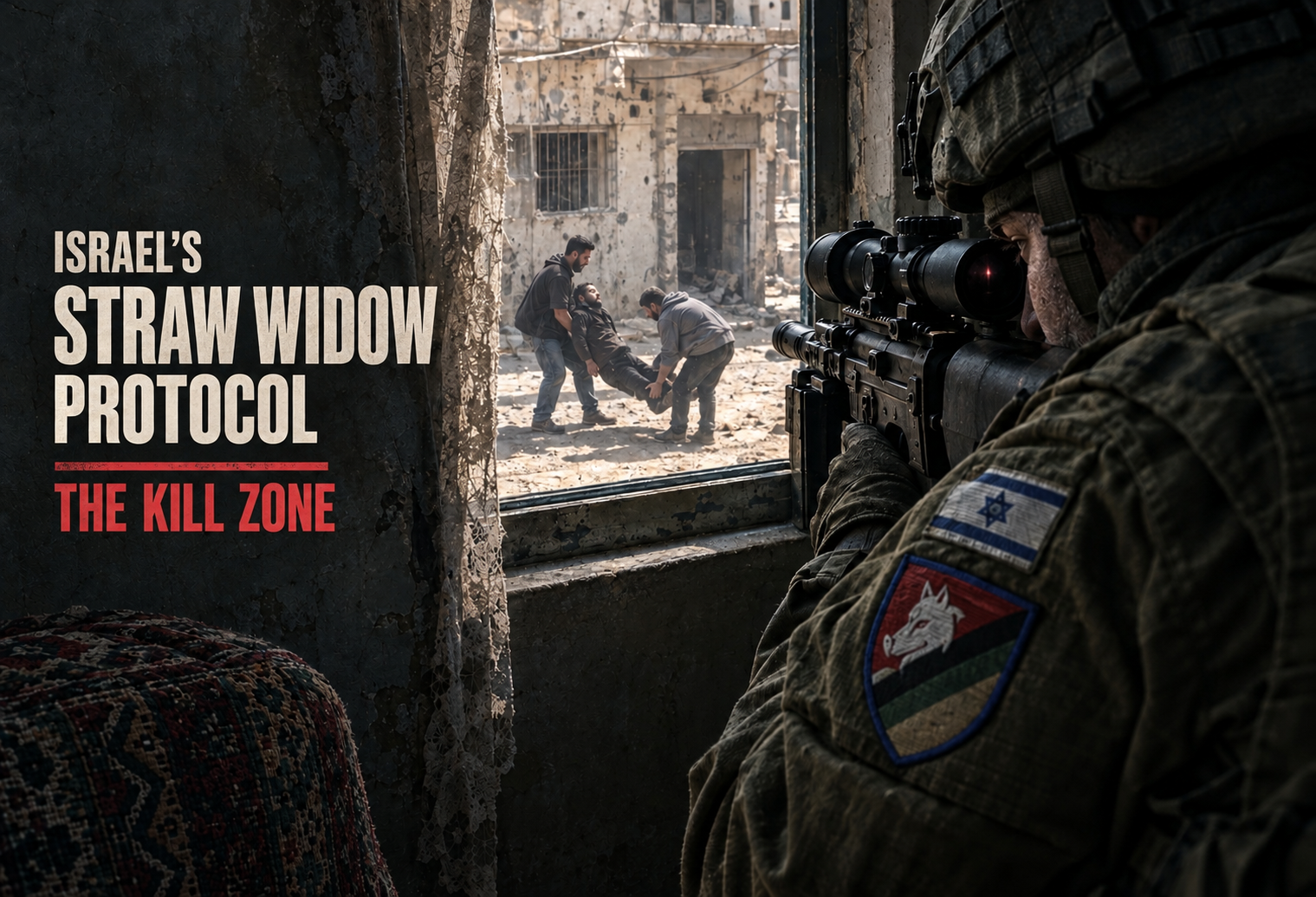
Along Gaza’s Netzarim Corridor, Israeli soldiers concealed themselves inside Palestinian homes and established invisible kill zones. Civilians, including children, were shot for approaching or crossing unmarked boundaries. Military records then counted the dead as terrorists “eliminated.”
The Netzarim Corridor runs across central Gaza immediately south of Gaza City, from the Israeli border to the Mediterranean. Israeli forces established it during their ground invasion, dividing northern Gaza from the rest of the territory. They widened the zone by demolishing surrounding neighbourhoods and building military bases, fortified positions and observation posts.
It was here, amid the civilian communities bordering this military corridor, that Israeli soldiers operated concealed positions inside Palestinian homes. The buildings looked abandoned or ordinary from outside, and Palestinians approaching them could not see the troops or the imaginary boundaries soldiers had drawn around their positions. Crossing one of those invisible lines could mean death.
Israeli soldiers had a name for occupying a Palestinian home and turning it into a concealed military position. Almenat Kash, Hebrew for “Straw Widow.”
Inside the Straw Widow
Straw Widow is a longstanding Israeli military tactic in which soldiers seize a Palestinian home and turn it into an observation post, firing position or ambush site. Families can be confined to one room as troops occupy the rest of the building, restrict contact with the outside and prepare positions from which they can watch or fire.
A reservist who spent about 250 days in Gaza told Der Spiegel how his unit used the tactic in areas that had not been evacuated. Palestinians continued moving through the surrounding streets with no warning that soldiers were hidden nearby. When they approached, the troops attacked them. Those who stepped forward to help were often attacked too.
The military report would record seven terrorists eliminated.
“But no,” the soldier said. “It’s just seven people who crossed an intersection.”
The report did more than conceal how they died. It stripped the dead of their civilian identity and turned their deaths into proof of military success. “We don’t kill, we eliminate,” the reservist explained. “That’s how we’ve always put it.”
Another reservist described occupying a house while serving with Division 252 along the Netzarim Corridor. It belonged to displaced Palestinians and stood on the edge of an inhabited neighbourhood. Around their position, the soldiers established a boundary that Palestinians could not see.
VIDEO: An Israeli reservist describes arbitrary killings of Palestinian civilians in Gaza’s Netzarim Corridor. (Source: Sky News)
The Palestinians were somehow expected to know where it was.
“There’s an imaginary line that they tell us all the Gazan people know,” the soldier said. “But how can they know?”
He recalled one man crossing the boundary and being shot. Another approached the body and was detained. Hours later, the order changed again. Anyone crossing the invisible line was to be shot on sight.
The person approaching might be “a teenager riding his bicycle.” The command made no distinction. “Everyone that comes inside needs to die.”
Breaking the Silence collected similar accounts of lethal boundaries. One captain described people crossing a line as “sentenced to death.” Another reservist described the order in three words, “Adult, male, kill.”
Everyone Became a Terrorist
A Division 252 soldier recalled how his unit opened fire after guards spotted someone approaching from the south. They poured dozens of bullets into him and kept shooting at his body, some laughing as they fired. Only when the troops approached did they discover they had killed a boy of about 16.
The soldiers photographed the body and took the boy’s telephone, which an intelligence officer collected. Hours later, they were told he was not a Hamas operative. By that evening, however, the battalion commander was congratulating them for killing a terrorist and saying he hoped they would kill ten more the following day. A soldier who protested that the boy had been unarmed and looked like a civilian was shouted down. The commander’s answer left no room for what they had discovered. Anyone crossing the line was a terrorist. No exceptions. No civilians.
No independently verified death toll exists for the Netzarim Corridor. The Israeli military claimed that Division 252 had killed more than 200 militants there, but soldiers who served in the corridor dismantled that account from within. An officer in the division’s command said the Israeli military’s own intelligence associated only ten of the dead with Hamas. Other soldiers described how civilians and children were shot for crossing invisible lines, then entered into the count as terrorists.
Even those ten were designated by Israel rather than an independent investigation, and an alleged association with Hamas would not establish that they were taking part in hostilities when killed. The claim of more than 200 militants killed instead reveals the gulf between the military’s public account and its soldiers’ testimony. Palestinians shot inside the corridor became terrorists on paper, their deaths repackaged as military success.
The Der Spiegel reservist described the same practice inside his brigade, which he said killed between 160 and 170 people over roughly 80 days during which there had been no fighting or Hamas attacks. Only one of the dead was suspected of carrying a weapon, though no soldier had actually seen one. He had been holding an object at night about 500 metres north of the corridor and, according to the reservist, posed no immediate threat. His body was never examined, yet he was recorded as a terrorist along with everyone else the brigade had killed.
That figure may overlap with the military’s claim of more than 200 and cannot be added to it. The accounts converge on how the dead were classified. Palestinians were killed without being identified as combatants, then recorded as terrorists after death.
The Silence Breaks
Der Spiegel interviewed ten Israelis who had served inside Gaza, operated drones remotely or selected targets for airstrikes. Breaking the Silence helped the reporters contact some of them. Nine remained anonymous because they feared the consequences of identification, while most said they would refuse to serve in Gaza again. The magazine considered their accounts credible after cross-checking them against other testimony and independently verifiable information.
Yuval Green, the only interviewee who spoke under his own name, served as a medic with the 55th Paratroopers Brigade for 51 days in Khan Younis before refusing further deployment. He described refusing an order to burn a Palestinian house after his commander failed to provide a convincing military justification. His account joins the wider body of soldier testimony describing unarmed Palestinians being killed, homes destroyed without military necessity and civilian deaths recorded as militant casualties. Breaking the Silence documented a similar practice along Gaza’s border perimeter. An Armoured Corps captain serving in southern Gaza described soldiers drawing a line beyond which everyone became a suspect, while admitting he did not know whether Palestinians knew where it was.
DOCUMENT: The Perimeter (2025) documents live-fire enforcement of boundaries Palestinians may not have known existed.(Source: breakingthesilence.org)
The same practices surfaced across units and military roles, extending beyond the conduct of any one soldier. Soldiers speaking at different times described hidden posts, unmarked boundaries, shoot-to-kill orders and the automatic conversion of the dead into terrorists. Some admitted participating. Others stood guard while it happened. Their decision to speak does not erase what they did, but it has broken through the military language that concealed it.
A civilian does not become a combatant by approaching a house, crossing an unmarked boundary or trying to reach someone bleeding in the road. International humanitarian law protects civilians unless and for such time as they directly participate in hostilities. Deliberately targeting civilians for crossing such a boundary, or civilian rescuers for coming to the aid of the wounded, constitutes a war crime.
Almenat Kash (Straw Widow) concealed Israeli soldiers inside Palestinian homes, while the invisible boundaries drawn around their positions turned the surrounding streets into kill zones. Palestinians who had no warning of either were shot, then entered into military records as terrorists.
Those reports turned the killing of civilians into a record of military achievement. People passing through their own neighbourhoods became enemy fighters on paper, their deaths presented as proof of success by the army that had killed them. Calling them terrorists afterwards could not make the killings lawful. It served to conceal the crime.
 Login