
❌

Normal view

More Tankers Struck Near Hormuz as Shipping Attacks Escalate (Video)
11 October 2026 at 21:21

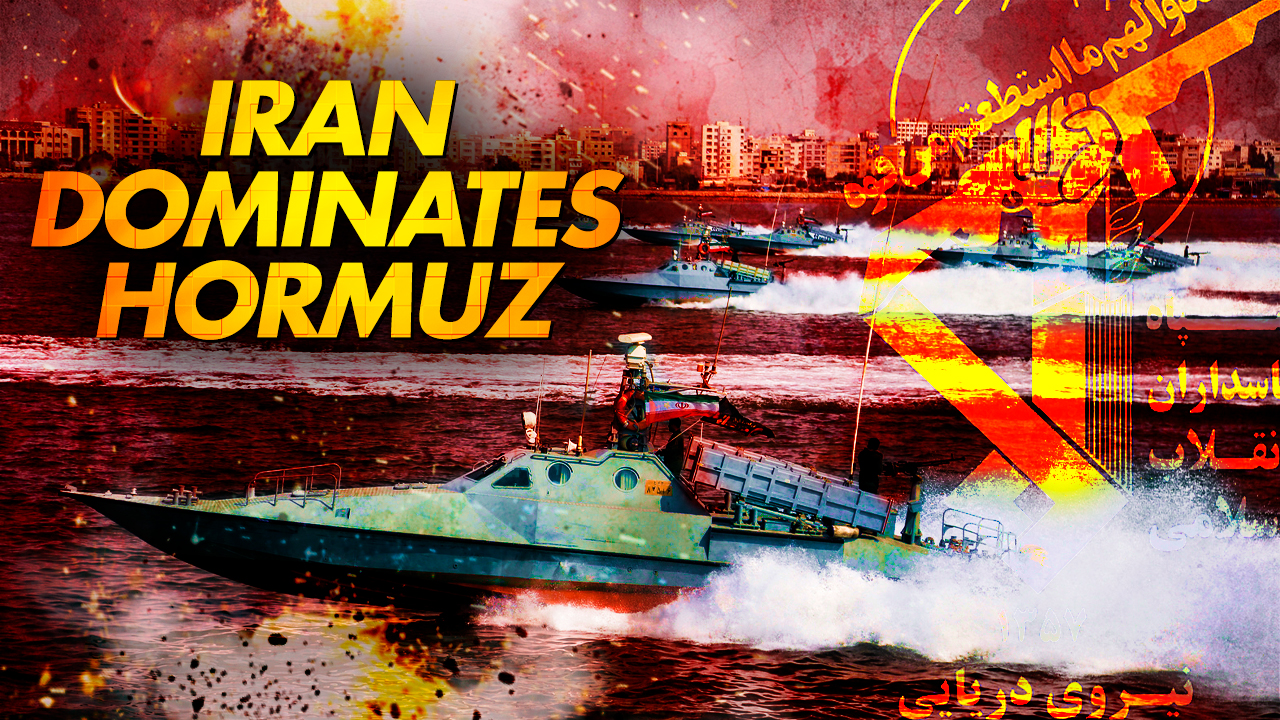
File image.

Iran’s Islamic Revolutionary Guard Corps (IRGC) said on October 11 that a crude-oil supertanker struck a sea mine in the Strait of Hormuz, triggering an explosion and a fire in its engine room, as attacks on commercial shipping continued in the region.

In a statement, the IRGC Navy said the tanker was attempting to leave the strait through an “unauthorized route” with its navigation and identification systems switched off.

The incident marked the third time since the previous day that an oil tanker had struck a mine and caught fire while using what Iran described as an unauthorized route, according to the Corps.

“All vessels within the Strait of Hormuz that switch off their navigation and identification systems will be identified as hostile and dealt with firmly and decisively,” the IRGC Navy said.

Meanwhile, the United Kingdom Maritime Trade Operations (UKMTO) agency reported on October 11 that an outbound tanker had been struck on its port side by an unidentified projectile while transiting the Strait of Hormuz, sustaining damage. The crew were reported safe, and authorities were investigating.

India subsequently identified the vessel as the Marshall Islands-flagged tanker MT Valthera. Indian officials reported that a fire broke out aboard the ship but that all 11 Indian crew members were safe. The available reports did not establish who was responsible for the attack.

In a separate incident, the tanker MT Petro Dolphin was attacked by a drone at Sohar Anchorage in Oman, according to Indian Shipping Minister Sarbananda Sonowal. Nine of the 11 Indian seafarers aboard were rescued, while two remained missing as search-and-rescue operations continued with the local Coast Guard.

“We are continuously coordinating with all relevant authorities to fully support the ongoing rescue efforts and ensure every possible action is taken to safely locate our missing personnel,” Sonowal said.

The attack on Petro Dolphin occurred in the Gulf of Oman, outside the Strait of Hormuz itself. Still, the area is within the conflict zone.

The incidents come amid an escalation in attacks on commercial shipping. Last week saw the highest number of tanker attacks in a single week since the U.S.-Israeli war on Iran began in February, according to maritime security sources cited by Reuters.

Ship traffic through the strait has also declined sharply, with only seven commodity-carrying vessels passing through on October 6, the lowest daily total in more than two months, according to Kpler data reported by the news agency.

_______________________________________________________________________________________________________________________

SouthFront: Analysis and Intelligence

NOW hosted at southfront.press

Previously, SouthFront: Analysis and Intelligence was at southfront.org.

The .org domain name had been blocked by the US (NATO) (https://southfront.press/southfront-org-blocked-by-u-s-controlled-global-internet-supervisor/) globally, outlawed and without any explanation

Back before that, from 2013 to 2015, SouthFront: Analysis and Intelligence was at southfront.com

SOUTHFRONT.PRESS

MORE ON THIS TOPIC:


The post More Tankers Struck Near Hormuz as Shipping Attacks Escalate (Video) appeared first on South Front.

Russia is building jet drones that fly 800 kilometers per hour, and Ukraine says it is already working on how to stop next generation

11 October 2026 at 19:42

ukraine recovers russia's undamaged geran-3 jet kamikaze drone carrying camera live-link equipment (video) · post russian jet-powered lying cornfield after being recovered intact 16 2025 реактивний дрон-камікадзе герань-3 вересня року

Aviation is one of the most effective ways to counter Russia’s jet-powered drones. Its effectiveness continues to grow due to pilots’ skill and better coordination, Defense Minister Yevhenii Khmara says, Glavcom reports.

Russia’s jet-powered Gerans fly several times faster than the propeller Shaheds Ukraine learned to shoot down, and they remain the main challenge for its air defense. Ukraine downs more than 90% of the slow drones but only about 55% of the jet ones.

“Due to them, our aviation now uses fewer munitions per aerial target. We plan to improve this further,” Khmara states.

Air defense works as a layered system because no single type of weapon is enough, he explains. The layers run from surface-to-air and shoulder-fired missiles to turrets, electronic warfare, interceptor-drone crews, and small-scale air defense, topped by aircraft including Mirage and F-16 jets.

Scaling what works against jet drones

Ukraine already has combat results against the jet drones, Khmara notes. In one engagement, five Bars interceptors destroyed five aerial targets, a 100% hit rate in that case, and the task now is to raise the overall destruction rate and quickly scale the solutions that prove themselves.

Heavy-caliber turrets are adding to that. Their number in service already runs into the hundreds, he adds.

“This direction is being scaled, and systems with greater range are being worked on. In parallel, surface-to-air and shoulder-fired missile systems are also proving effective,” he says.

Preparing for the next generation

Ukraine is also looking past today’s threats, the minister stresses. The ministry is working to supply interceptor drones, aviation and its munitions, missile and artillery systems, turrets and electronic warfare gear, and to plan several steps ahead with enough stock in reserve.

“We also know what solutions Russia is developing, which concern jet drones with a speed of 800 kilometers per hour. We are working on finding countermeasures to the next generation of threats,” Khmara says.

Producers have been tasked with offering proposals and prototypes, he concludes.

US Bombs Commercial Ship as It Continues Enforcing Blockade of Iranian Ports

11 October 2026 at 19:36
US Central Command has announced that its forces bombed a commercial ship in the Gulf of Oman that it accused of attempting “to run” the US blockade of Iranian ports. “[CENTCOM] forces disabled a commercial cargo vessel in the Gulf of Oman, Oct. 10, after the ship’s crew ignored repeated warnings and attempted to run […]

💾

Military Situation In Iran On October 11, 2026 (Map Update)

11 October 2026 at 16:59

Click to see full-size image.

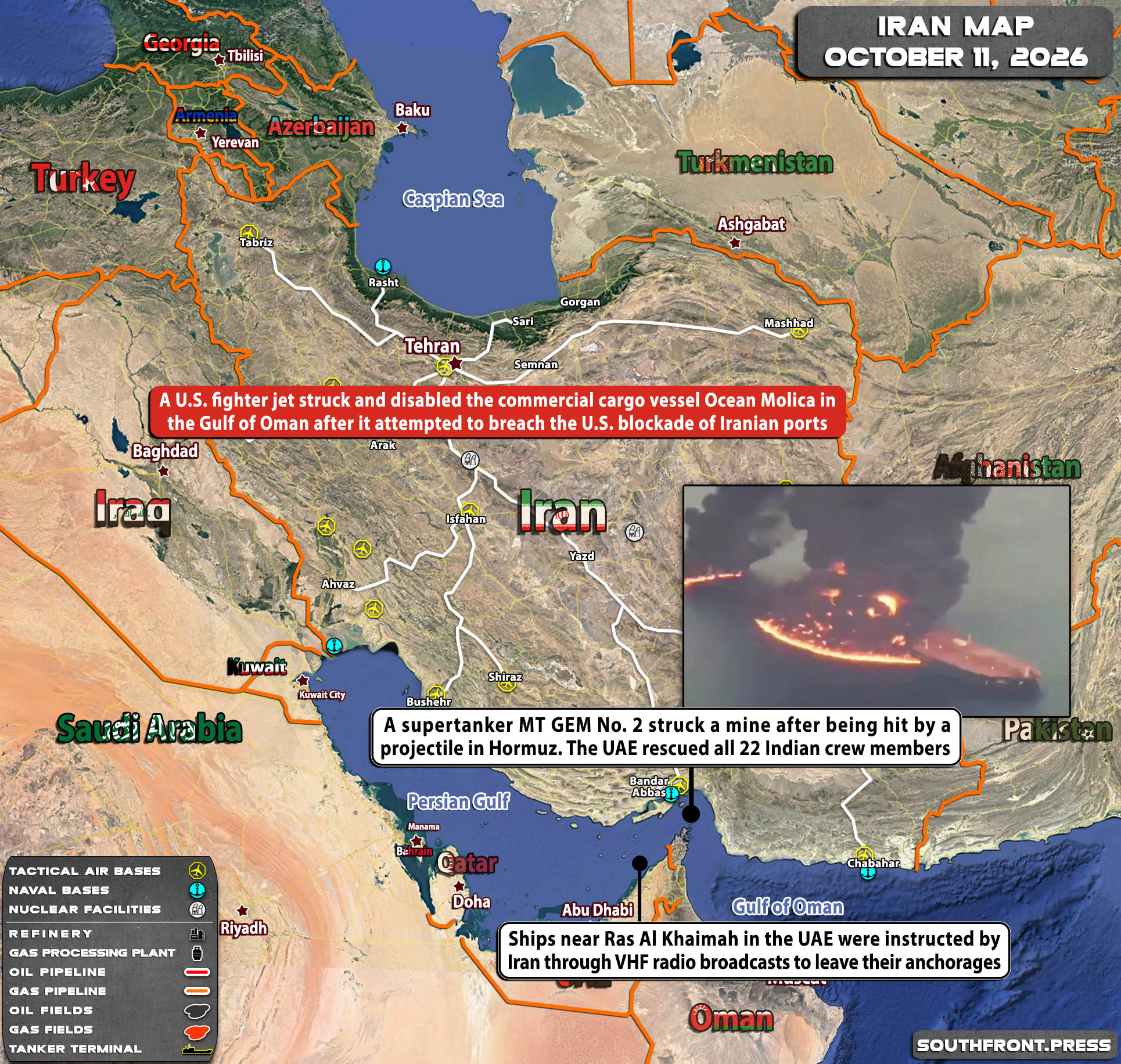
  • A supertanker MT GEM No. 2 struck a mine after being hit by a projectile in Hormuz. The UAE rescued all 22 Indian crew members;
  • A U.S. fighter jet struck and disabled the commercial cargo vessel Ocean Molica in the Gulf of Oman after it attempted to breach the U.S. blockade of Iranian ports;
  • Ships near Ras Al Khaimah in the UAE were instructed by Iran through VHF radio broadcasts to leave their anchorages.

_______________________________________________________________________________________________________________________

MORE ON THIS TOPIC:


The post Military Situation In Iran On October 11, 2026 (Map Update) appeared first on South Front.

Iran security chief says powers greater than US tried to conquer Iran but ended in ‘dustbin of history’

By: aletho
11 October 2026 at 14:31
Press TV – October 11, 2026

Secretary of Iran’s Supreme National Security Council, Major General Mohsen Rezaei, says powers greater than the US have tried to conquer Iran but ultimately ended up in the “dustbin of history.”

During an exclusive interview with Press TV on Saturday, Rezaei said the “US suffered repeated defeats in its confrontation with Iran and has consequently turned to economic warfare out of desperation.”

Iran, rather than the US, would determine when the confrontation ends, he said, stressing that Tehran would continue its resistance until its rightful demands are met.

Addressing the presence of US forces in the region, Rezaei told Press TV that the withdrawal of US forces from Iraq reflected Washington’s failure to impose its military agenda on the region, describing it as a vindication of Iran’s resistance to American military presence in West Asia.

Rezaei further said that more than “30 million Iranians have registered in ‘Janfada’ (Sacrifice for Iran) Campaign to take up arms in the event of US aggression.”

On diplomacy, the official said “Tehran would not return to its previous diplomatic norms,” while stressing that “Iran would never abandon diplomacy altogether.”

The senior official warned that, if Washington launched another act of aggression against Iran, American assets could be targeted, including key data systems and artificial intelligence sensors.

Rezaei also identified Washington and its regional allies as the root of the problem surrounding the Strait of Hormuz.

Iran closed the Strait of Hormuz in response to the latest round of US-Israeli aggression, preventing US and allied ships from navigating the strategic waterway.

The move resulted in a significant increase in oil and energy prices across the globe, especially in the US, forcing Washington and the International Energy Agency (IEA) to release their strategic resources several times.

Following the signing of the Islamabad Memorandum of Understanding (MoU) between Iran and the US in June, Tehran opened the Strait of Hormuz, but after the US violated the MoU by blockading Iranian ports, Iran’s Armed Forces closed the maritime corridor once again.

No Permanent Allies: Pakistan and the Politics of National Interest

11 October 2026 at 13:59
In a world of shifting alliances, Pakistan must balance strategic partnerships with national interests — and the key question is whether the Makkah Pact will become a tool of strategic autonomy or another form of dependence. In recent years, the world has seen an unprecedented shift in global alliances. According to the realist school of […]

U.S. Escalates In Hormuz With Strike On Iranian Ship (Video)

11 October 2026 at 12:44

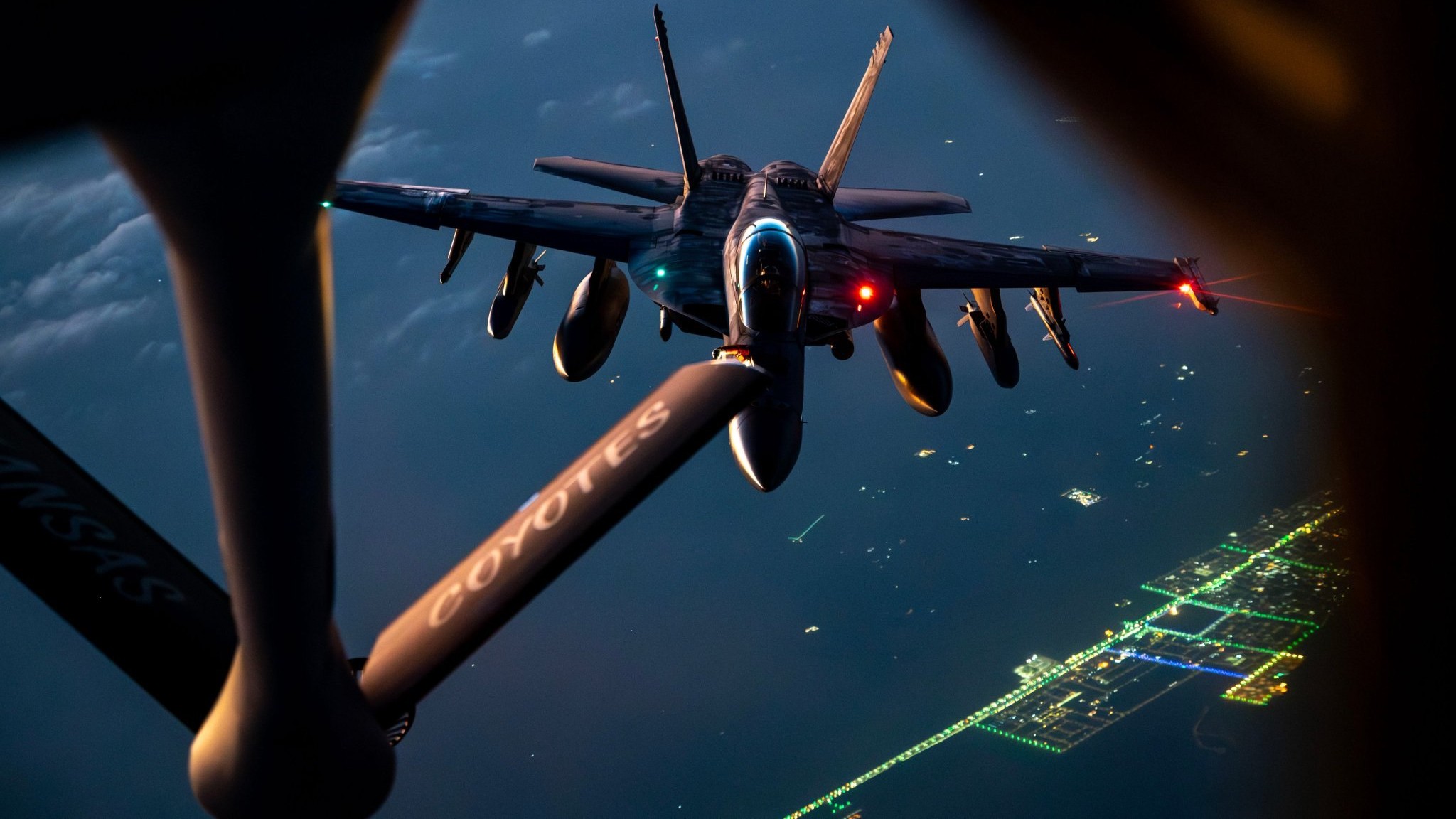
Illustrative image. (U.S. Central Command)

The United States said its military disabled a cargo ship in the Gulf of Oman on October 10 after the vessel ignored warnings and attempted to breach a naval blockade of Iranian ports.

An American fighter jet struck the stern of the Panama-flagged Ocean Molica, also known as Arika Sun, with a precision munition, disabling the ship’s propulsion system without injuring its crew, U.S. Central Command (CENTCOM) said in a statement posted on X.

The cargo ship had left a port in the Islamic Republic before attempting to transit regional waters, according to the command.

“Four commercial vessels have been disabled and 135 ships have been turned around during three months of strict enforcement. Additionally, U.S. forces have destroyed 10 tankers linked to the Islamic Revolutionary Guard Corps’ (IRGC) multibillion-dollar shadow network over the same period,” CENTCOM said.

The incident came amid reports of other threats to commercial shipping near the Strait of Hormuz. The IRGC said on October 9 that a supertanker had caught fire after striking a naval mine while attempting to leave the strait by what it described as an “unauthorized and dangerous route.”

Other reports said a tanker had been struck by an unidentified projectile. India confirmed that all 22 crew members aboard the MT GEM No. 2 were safe following an incident off the coast of the United Arab Emirates.

Separately, the United Kingdom Maritime Trade Operations (UKMTO) agency said several ships near Ras Al Khaimah in the UAE had reported receiving radio instructions to leave their anchorages. The agency classified the incident as “suspicious activity” and said it was under investigation, without identifying who issued the instructions or whether the vessels complied.

Commercial traffic through the Strait of Hormuz remained sharply reduced on October 11. Reuters reported that vessel transits had fallen to their lowest level in more than two months, following a previous week in which tanker attacks reached their highest weekly total since the United States and Israel began their war against Iran in February.

The Hormuz.now shipping tracker recorded an average of about 10 commercial crossings a day over the preceding week, compared with roughly 85 before the crisis. The figures may exclude vessels whose tracking systems are switched off while moving through the strait.

Before the war, the Strait of Hormuz carried about one-fifth of the world’s oil consumption, making the disruption a major concern for global energy shipments.

The latest attack by CENTCOM will likely lead to more escalation in the waterway as Iran is guaranteed to strike back with full force.

_______________________________________________________________________________________________________________________

SouthFront: Analysis and Intelligence

NOW hosted at southfront.press

Previously, SouthFront: Analysis and Intelligence was at southfront.org.

The .org domain name had been blocked by the US (NATO) (https://southfront.press/southfront-org-blocked-by-u-s-controlled-global-internet-supervisor/) globally, outlawed and without any explanation

Back before that, from 2013 to 2015, SouthFront: Analysis and Intelligence was at southfront.com

SOUTHFRONT.PRESS

MORE ON THIS TOPIC:


The post U.S. Escalates In Hormuz With Strike On Iranian Ship (Video) appeared first on South Front.
International Calls Mount for Sudan to Clarify Chemical Weapons Allegations

11 October 2026 at 10:25


The Sudanese army is once again facing mounting international pressure over allegations that it used chlorine-based chemical weapons in its war against the Rapid Support Forces (RSF).

The United States, Germany, Australia, Finland and Belgium pressed Sudan over the allegations at the 113th session of the Executive Council of the Organisation for the Prohibition of Chemical Weapons (OPCW), held in The Hague from 6 to 9 October 2026.

The United Kingdom and the European Union also raised Sudan at the session. The EU said the Council had been seized of the matter under Article IX, paragraph 4 of the Chemical Weapons Convention, which allows member states to ask the Council to obtain clarification from another member. 

The statements came a month after The New York Times and The Washington Post published separate investigations on 5 September reporting that the Sudanese army ran a secret programme to develop, test and store chlorine-based munitions. 

The material included around 150 documents, photographs, video clips and voice messages, as well as several thousand text messages taken from the phones of senior Sudanese officers, according to The New York Times. The newspaper reported that voice and text messages involving army chief General Abdel Fattah al-Burhan suggest he had direct knowledge of the programme.

A Sudanese military spokesperson rejected the findings as “baseless and without material foundation” and threatened to sue The New York Times in a US court, according to Semafor. Sudan’s Ministry of Foreign Affairs said in July that Washington had presented no evidence for its allegations and that Sudan had repeatedly offered to host US experts for on-site verification.

Belgium Voices Concern

Belgium told the Council that Sudan’s answers so far did not match the seriousness of the allegations. Ambassador Wouter Detavernier, speaking in French on 7 October, said Belgium was concerned by allegations that the army had used chlorine bombs during the civil war, and he asked Sudan’s authorities for more information, according to the Belgian statement.

US Warning

The United States has gone further than the other four countries and imposed two rounds of sanctions on Sudan.

The State Department determined on 24 April 2025 that Sudan’s government had used chemical weapons in 2024, and it announced the finding on 22 May 2025. Washington imposed the first sanctions, restricting US exports and Sudan’s access to US government credit, on 27 June 2025. A second round, which took effect on 20 July 2026, added US opposition to multilateral development bank loans to Sudan, further export restrictions and the suspension of air carrier authority linked to Sudan, according to the Federal Register.

At the Council’s 112th session in July, US Ambassador Nicole Shampaine said Sudan should give the OPCW Technical Secretariat “unhindered, transparent access” and that its national investigative committee could not replace independent verification, according to the Arms Control Association.

This week Shampaine told the Council it must confront Sudan’s continued non-compliance tied to its 2024 use of chemical weapons. She asked regional groups and States Parties to “reject as candidates for this Council those States Parties that remain in noncompliance,” according to the US statement.

Sudan currently holds a seat on the 41-member Council, according to The Standard. In March, the United States warned it would revisit its approach to Sudan’s seat if the matter was not resolved swiftly. Council members are elected by the Conference of the States Parties, which next meets from 23 to 27 November 2026, according to the OPCW calendar.

Germany Points to an Undeclared Programme

Germany’s ambassador, Gudrun Lingner, said new media reporting suggested the 2024 use might have been more than a single incident. “Indications pointing at an undeclared chemical weapons programme have been published,” Lingner said, according to the German statement.

Germany called on Sudan’s government to finish a thorough national investigation, publish it swiftly and cooperate fully and transparently with the OPCW.

Australia Focuses on Storage and Use

Australian Ambassador Gregory French said Australia had noted with alarm media reports that the Sudanese Armed Forces had stockpiled and used chemical weapons. He said Sudan had shared an interim report from its national investigation, and he called on Sudan to give “a genuine and transparent account of any non-compliance with the Convention,” according to the Australian statement.

Finland Seeks Prompt Answers

Finland repeated its serious concern about the allegations and said Sudan’s authorities must address them “in a prompt, objective, and transparent manner,” according to its statement. Finland welcomed the Technical Secretariat’s confirmation that it will monitor the situation.

As Russian Arms Exports Slide, Central Asia Shops Elsewhere

11 October 2026 at 08:21
Central Asian nations are increasingly turning to India, China, Turkey, and Europe for military equipment to reduce their dependence on Russia. Analysts note that this diversification offers greater political flexibility but could create long-term logistical and operational challenges.

There’s a Reason Ulez is So Hated

11 October 2026 at 07:00

As Kevin Rees is jailed for 15 years for blowing up a Ulez camera with a homemade bomb, Dr Tilak Doshi looks at why London's anti-motorist money-making 'clean air' scheme is so widely hated.

The post There’s a Reason Ulez is So Hated appeared first on The Daily Sceptic.

The AI labor apocalypse is on hold (for now)

11 October 2026 at 05:00

There are three versions of Saint John’s Book of the Apocalypse, a text that never loses relevance and now seems to presage the impacts of artificial intelligence (AI).

Seguir leyendo

© Josh Edelson (AP Photo/Josh Edelson)

A protest against AI outside the OpenAI DevDay 2026 conference in San Francisco on September 29.

Joel Abadal, Brad Pitt’s stunt double: ‘I’m very professional, but I was freaking out. Mr Pitt right in front of me!’

11 October 2026 at 05:00

Brad Pitt’s recent visit to Spain revealed his affinity for the local culture. The actor greeted crowds outside the Hotel María Cristina in San Sebastián; he viewed the abstract works sculpted by Eduardo Chillida; he denied knowing or having had an affair with Makoke Giaever, a Spanish TV personality; and he made a surprise appearance at a christening in Madrid’s Santa Bárbara Church to meet the family of his girlfriend, Inés de Ramón.

Seguir leyendo

© Scott Garfield (EL PAÍS)

Joel Abadal and Brad Pitt during the shoot of 'Heart of the Beast.'

US Says It Disabled Cargo Vessel Trying To Run Iran Blockade

11 October 2026 at 04:02
Oct 10 (Reuters) – The US military said on Saturday it had disabled a commercial cargo vessel in the Gulf of Oman after the ship’s crew ignored warnings and attempted to run...

Ukraine, long keeping its weapons at home, now lets 18 arms makers export, approving over 90% of more than 400 applications

10 October 2026 at 23:48

P1-SUN An-28 Shahed interceptor

Ukraine, which long kept its weapons at home, is now clearing its arms makers to sell abroad. Its Commission on Export Control has granted 18 Ukrainian companies permission to send their finished weapons abroad and has processed more than 400 export applications, with over 90% approved, the National Security and Defense Council says, citing commission head Davyd Aloian.

Ukraine now produces far more weapons than it can afford, with defense production growing from about $1 billion a year at the start of the invasion to a projected $55 billion in 2026.

The exports are reportedly conducted under the Drone Deals framework that President Volodymyr Zelenskyy unveiled in April, which allows controlled sales of surplus weapons to partner countries while the Defense Ministry and General Staff retain first claim to everything the front needs. Some categories already run up to 50% beyond what Ukraine can use or finance.

From a stalled commission to 18 approvals

The commission’s work had been halting. It resumed in February after an eight-month freeze and issued the first permits then, and its updated membership has been working since, Aloian notes.

Building partnerships abroad

Aloian framed the goal as scaling Ukrainian technology rather than one-off deals. The state wants domestic producers to expand abroad while partners get working solutions, he says, and is open to dialogue with the defense industry to fix problems as they arise.

Earlier, an industry group that represents more than 400 companies warned in September that the mechanism was choking. A new 20-to-30% fee on export permits priced Ukrainian goods out of the market, it said, and a joint-production program had stalled with hundreds of foreign bids pending.

Euromaidan Press cannot verify whether the Commission on Export Control has taken the issue into consideration.

The council recently met a UK Defense Ministry delegation to discuss closer cooperation, including a Drone Deal, an anti-ballistic coalition, and joint production, Aloian adds. Reaching foreign markets enables producers to attract new orders and investment, scale up, and build long-term partnerships.

❌