❌

Normal view

Russian Army Clears More Areas South of Dobropolye
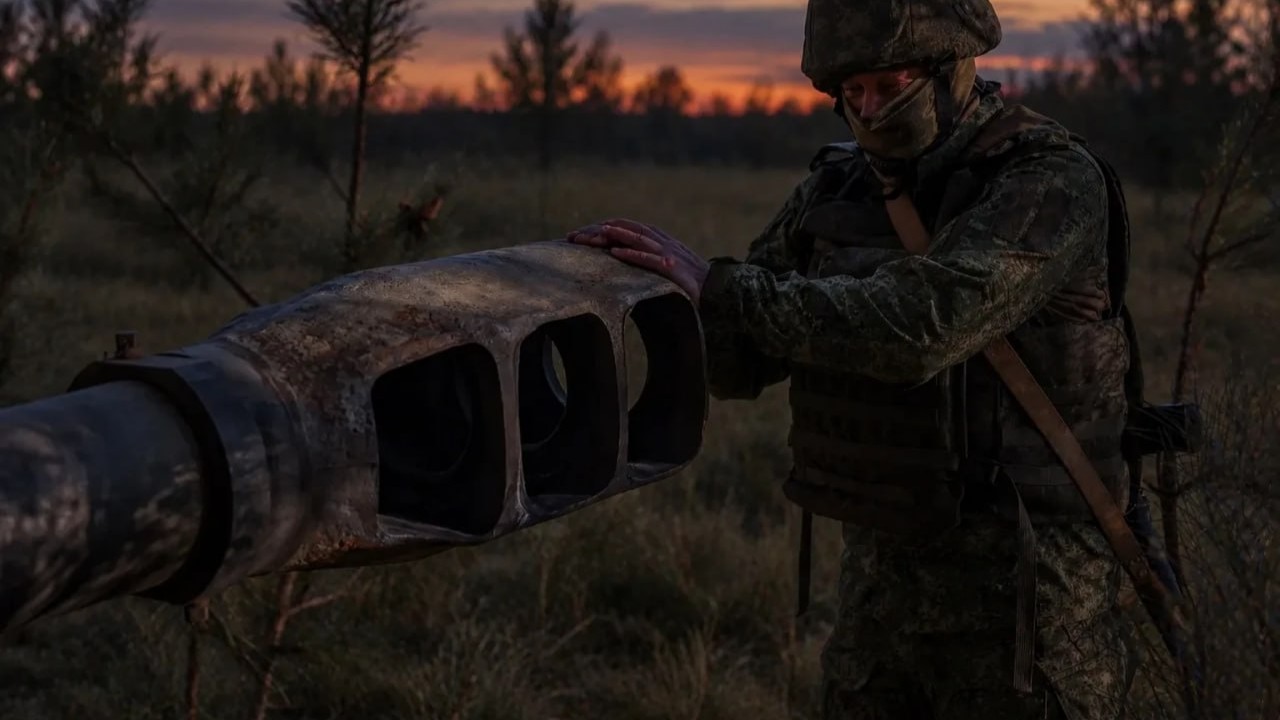
21 October 2026 at 22:26

Click to see full-size image. (Russian Ministry of Defense)

In the Dobropolye direction, clearing operations continue in the urban area, with Russian forces holding the southern part of the city and repelling attempts by Ukrainian units to relieve their grouping. In the Slavyansk direction, the 25th Army has regained control of Ozernoye and is developing an advance towards Krasny Liman. In the Zaporozhye direction, Russian troops have taken Yulyevka and Chervony Yar, expanding the zone of control north of Orekhov. In the Sumy region, assault groups of the “North” grouping have advanced near Khoten and Velikaya Rybitsa. In the Kharkiv direction, the clearance of the Reznikovsky cauldron is nearing completion. European Union leaders at an extraordinary summit on 26–27 November will attempt to agree ways of covering Ukraine’s funding shortfall for 2027, estimated at €70 billion, and will also discuss the EU’s multiannual budget for 2028–2034.

Dobropolye direction

Clearing of the urban territory continues in Dobropolye. The southern part of the city is already under stable Russian control, although scattered Ukrainian groups are still encountered there. Ukrainian units launched a counter-attack in an attempt to relieve their grouping and cut off the salient towards Belozerskoye, operating in the areas of Novovodyanoye and Zolotoy Kolodez.

In the Zolotoy Kolodez area, Russian troops are advancing on both flanks of the settlement. On the Dobropolye front, Russian forces are expanding the zone of control around Sergeyevka. Systematic clearing of the city continues in Dobropolye. Fighting is under way on the approaches to Belozerskoye and in the Zolotoy Kolodez area.

Russian troops are increasing pressure on Belozerskoye, bypassing the town on the flanks. Units have reached the outskirts and taken up positions in the southern built-up area and adjacent forest belts. Belozerskoye lies only a few kilometers from Dobropolye. Consolidation here could open a route via Novodonetskoye and Stepanovka towards Aleksandrovka.

Territories south of Dobropolye have been cleared of Ukrainian units. Russian fighters have taken Zolotoy Kolodez in a pincer movement and continue clearance operations. Reports from the ground indicate an improvement in the forward edge and strikes against positions in the areas of Zavidovo-Kudashevo, Krivorozhye, Starorayskoye and other settlements.

Slavyansk direction

Russian units in the north have gone over to counter-attacks and have retaken Ozernoye. This eases the position of the 3rd Army in the Raygorodok area, allowing it to concentrate more strongly on Nikolayevka. Strikes from the Orekhovatka area towards Raygorodok have been repelled. The Volunteer Corps holds Nikanorovka, Malinovka and Vasyutinskoye.

Russian troops near Krasny Liman are attempting to disrupt logistics and are advancing from the areas of Zarechnoye, Torskoye and Yampol. The Ozernoye area has been cleared. If Dibrova can be regained, the southern approaches to Krasny Liman will be cleared, creating the possibility of linking up with units holding positions in the town.

In the Konstantinovka sector, intense positional fighting continues in the areas of Rayskoye and Alekseyevo-Druzhkovka. Russian units are seeking to drive Ukrainian forces out of Klinovoye and Verolyubovka in order to secure the eastern flank for a future envelopment of Druzhkovka.

Zaporozhye direction

The Russian Ministry of Defence has reported that the village of Yulyevka has come under control. Nearby, Chervony Yar has also been taken adjacent to Timoshovka, which was captured the day before. The “East” grouping is expanding the zone of control north of Orekhov.

Fighting continues unabated in Orekhov itself. Judging by the pattern of operations, the Russian command is seeking to envelop the grouping center in Shirokoye, where Ukrainian forces have established a strong defensive line. Fighting continues in the northern part of Ternovatoye. Most of the settlement remains under Russian control. Earlier, Russian units took Zaporozhskoye and are gradually reducing the salient.

In the areas of Lyubitskoye and Novosoloshino, Russian troops have gone over to counter-attacks. Fighting in Vozdvizhevka has largely ended and Ukrainian units have been driven out. Battles have begun for Rozhdestvenskoye. Further south, the advance continues from the captured Chervony Yar. Assault groups are operating on the outskirts of the villages of Mirovka and Obshcheye. Thus, in the Zaporozhye direction, Russian units are systematically expanding bridgeheads, pushing Ukrainian forces out of key strongpoints and disrupting their logistics.

Sumy direction

Heavy positional fighting continues in Sumy direction. Russian aviation, drone teams and artillery are increasing the intensity of strikes against Ukrainian positions. Ukrainian units have concentrated on strengthening their defensive lines.

In the Sumy border area, positional fighting continues on the main lines. Fierce clashes are under way in the Yunakovka area; Ukrainian units are attempting to insert small groups but without success. Russian assault troops have advanced in the areas of Khoten and Velikaya Rybitsa overall progress amounting to up to 300 meters.

In the Sumy district, Russian assault troops have advanced near Khoten and Velikaya Rybitsa. Overall progress amounted to up to 300 meters. In the Shostka district, heavy positional fighting continues near Korenek. In the Krasnopolye district, assault groups of the “Northerners” are advancing near Turya. Russian units continue methodically to press the Ukrainian defenses, exploiting their advantage in artillery and drones.

Kharkiv direction

Assault units of the “North” grouping are developing their success in the area of the former “Volchansk cauldron”. The Ukrainian side has stepped up its information activity and is widely disseminating inaccurate claims about alleged control over lost settlements.

North of Bolshoy Burluk, clearance of the so-called Reznikovsky cauldron continues. According to official data, the main settlements have been cleared. The territory is extensive, almost 400–500 square kilometers. Isolated positions will continue to be cleared for some weeks yet. Ukrainian units, relying on Maly Burluk and Prikolotnoye, are attempting to reach the Plotva River in the area of Vasilyevka, Blagodatnoye, Nefyodovka and Chyornoye.

In the Lipetsk direction, Russian troops have advanced on three sectors south of Novaya Kazachya and Tokarevka. Overall progress amounted to 250 meters. In the Volchansk and Veliky Burluk directions, assault groups of the “Northerners” continue to advance southwards. There have been successes in the areas of Prikolotnoye, Maly Burluk and Kolodeznoye. Over the past day overall progress amounted to up to 500 meters.

Conclusion

In the Dobropolye direction, Russian forces are consolidating in the southern part of the city and enveloping Belozerskoye. In the Slavyansk direction, the 25th Army has gone over to the counter-offensive, recovering lost positions and creating a threat to Ukrainian logistics in the Krasny Liman area. In the Zaporozhye direction, the capture of Yulyevka and Chervony Yar has enabled the expansion of bridgeheads and continued pressure on Orekhov. In Sumy region, positional fighting continues with gradual advances by Russian assault groups. In the Kharkiv direction, the clearance of a large cauldron is nearing completion, freeing forces for further offensive operations. The overall trend remains the use by Russian units of small-group tactics that combine assault actions with strikes by artillery, aviation and drones, allowing them methodically to disrupt Ukrainian logistics and expand the zone of control.

European Union leaders at the extraordinary summit on 26–27 November will attempt to agree ways of covering Ukraine’s funding shortfall for 2027, estimated at €70 billion. The EU has already earmarked €45 billion for Ukraine in 2027, yet Kyiv’s financial needs substantially exceed this amount. Even taking into account the planned European funding, Ukraine’s additional requirement is assessed at approximately €70 billion.

Initially, Brussels had expected Norway, Switzerland, Canada, Japan and the United Kingdom jointly to provide a further €45 billion over 2026–2027. Not all the promised funds have been allocated, however. As a result, EU member states will have to agree to additional financing mechanisms for Kyiv, including the possibility of a new loan. At the same time, European leaders continue to negotiate the Union’s seven-year budget for 2028–2034. Brussels aims to conclude the talks by the end of the current year, since electoral campaigns due in a number of EU states in 2027 could further complicate the achievement of a compromise.

_______________________________________________________________________________________________________________________

SouthFront: Analysis and Intelligence

NOW hosted at southfront.press

Previously, SouthFront: Analysis and Intelligence was at southfront.org.

The .org domain name had been blocked by the US (NATO) (https://southfront.press/southfront-org-blocked-by-u-s-controlled-global-internet-supervisor/) globally, outlawed and without any explanation

Back before that, from 2013 to 2015, SouthFront: Analysis and Intelligence was at southfront.com

SOUTHFRONT.PRESS

MORE ON THIS TOPIC:


The post Russian Army Clears More Areas South of Dobropolye appeared first on South Front.

Russian FPV Drones Destroy Another of Ukraine’s Latest DITA Howitzers (Videos)

21 October 2026 at 22:07

File image.

Russian FPV drones have destroyed another Czech-made DITA 155 mm self-propelled howitzer in Ukrainian service, footage released by Russia’s Rubikon drone unit shows.

The video, published on October 20, shows drones striking the artillery system near Novopavlivka in the Donetsk region. Rubikon said the attack took place two days earlier. The footage shows an explosion and smoke rising from the vehicle after the strike.

The attack follows footage released by Rubikon on October 7 showing Russian drones destroying a DITA in the Sumy region. The two incidents have brought fresh attention to the vulnerability of Ukraine’s relatively small fleet of the advanced artillery systems.

Developed by Czech defense company Excalibur Army, the DITA combines a NATO-standard 155 mm gun with an automated loading and fire-control system. Its most distinctive feature is that the entire weapon can be operated by just two crew members, a driver and a commander, without requiring personnel to work directly around the gun.

The howitzer has a manufacturer-advertised range of up to 39 kilometers and carries 40 rounds. It can fire six rounds per minute during its initial firing sequence and sustain five rounds per minute. Its onboard ballistic computer and automated gun-laying system are designed to shorten the time needed to engage targets and leave a firing position, reducing exposure to enemy counterbattery fire.

The 29-tonne system is mounted on an eight-wheel-drive Tatra chassis powered by a 300-kilowatt engine. It can reach speeds of up to 90 kilometers per hour on roads and has a listed cruising range of 600 kilometers.

The combination of mobility, range and automation makes it a modern alternative to older artillery systems, but it does not eliminate the danger posed by drones that can locate and attack vehicles while they are stationary.

The Netherlands financed Ukraine’s initial acquisition of nine DITA howitzers, which were delivered in the summer of 2024. In October that year, the Dutch government ordered six more, bringing the publicly announced procurement to 15 systems, with delivery of the additional guns planned for 2025.

The exact number now in Ukrainian service has not been publicly established. Ukrainian defense publication Defense Express reported in March 2026 that the manufacturer had produced a high double-digit number of DITA systems overall, raising the possibility that Ukraine received more than the 15 publicly announced. However, the company’s production total also includes systems for other customers, and no further Ukrainian orders have been publicly announced.

The latest strike highlights a growing battlefield challenge for modern artillery. Even systems designed to fire quickly and relocate within minutes remain vulnerable when drone operators identify their positions and direct repeated attacks against them.

_______________________________________________________________________________________________________________________

SouthFront: Analysis and Intelligence

NOW hosted at southfront.press

Previously, SouthFront: Analysis and Intelligence was at southfront.org.

The .org domain name had been blocked by the US (NATO) (https://southfront.press/southfront-org-blocked-by-u-s-controlled-global-internet-supervisor/) globally, outlawed and without any explanation

Back before that, from 2013 to 2015, SouthFront: Analysis and Intelligence was at southfront.com

SOUTHFRONT.PRESS

MORE ON THIS TOPIC:

The post Russian FPV Drones Destroy Another of Ukraine’s Latest DITA Howitzers (Videos) appeared first on South Front.

Putin Tells Witkoff Russia Is Ready To Resume Trilateral Talks With the US and Ukraine

21 October 2026 at 21:57
Russian President Vladimir Putin told US envoy Steve Witkoff during a meeting in St. Petersburg on Wednesday that Russia was ready to resume trilateral talks with the US and Ukraine next month. “Our president informed Steve Witkoff that we are ready in principle to resume the above-mentioned trilateral talks around November 10 on the main […]

Military Situation In Ukraine And Ukrainian Attacks On Russian Territory On October 21, 2026 (Maps Update)

21 October 2026 at 20:51

Click to see full-size map.

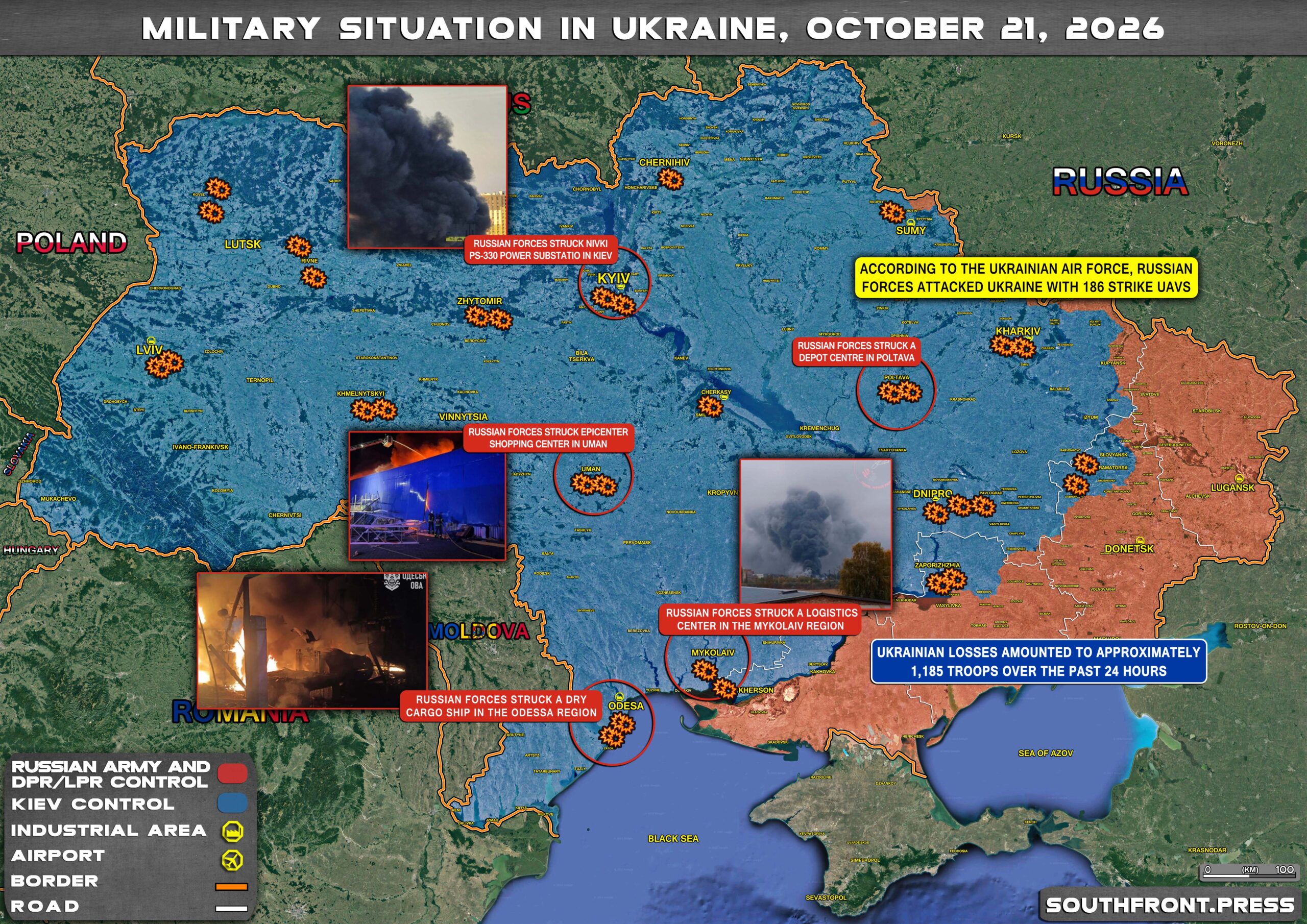
  • Russian strikes destroyed targets in Sumy, Kharkiv, Zaporizhzhia, Dnipropetrovsk, Kherson, Kyiv, Volyn, Vinnytsia, Mykolaiv, Odesa, Chernihiv, Khmelnytskyi, Rivne, Cherkasy, Poltava, Lviv, and Zhytomyr and the DPR;
  • According to the Ukrainian Air Force, Russian forces attacked Ukraine with 186 strike UAVs;
  • Russian forces struck a depot centre in Poltava;
  • Russian forces struck Nivki PS-330 power substatio in Kiev;
  • Russian forces struck a dry cargo ship in the Odessa region;
  • Russian forces struck Epicenter shopping center in Uman;
  • Russian forces struck a logistics center in the Mykolaiv region;
  • Ukrainian losses amounted to approximately 1,185 troops over the past 24 hours.

Click to see full-size map.

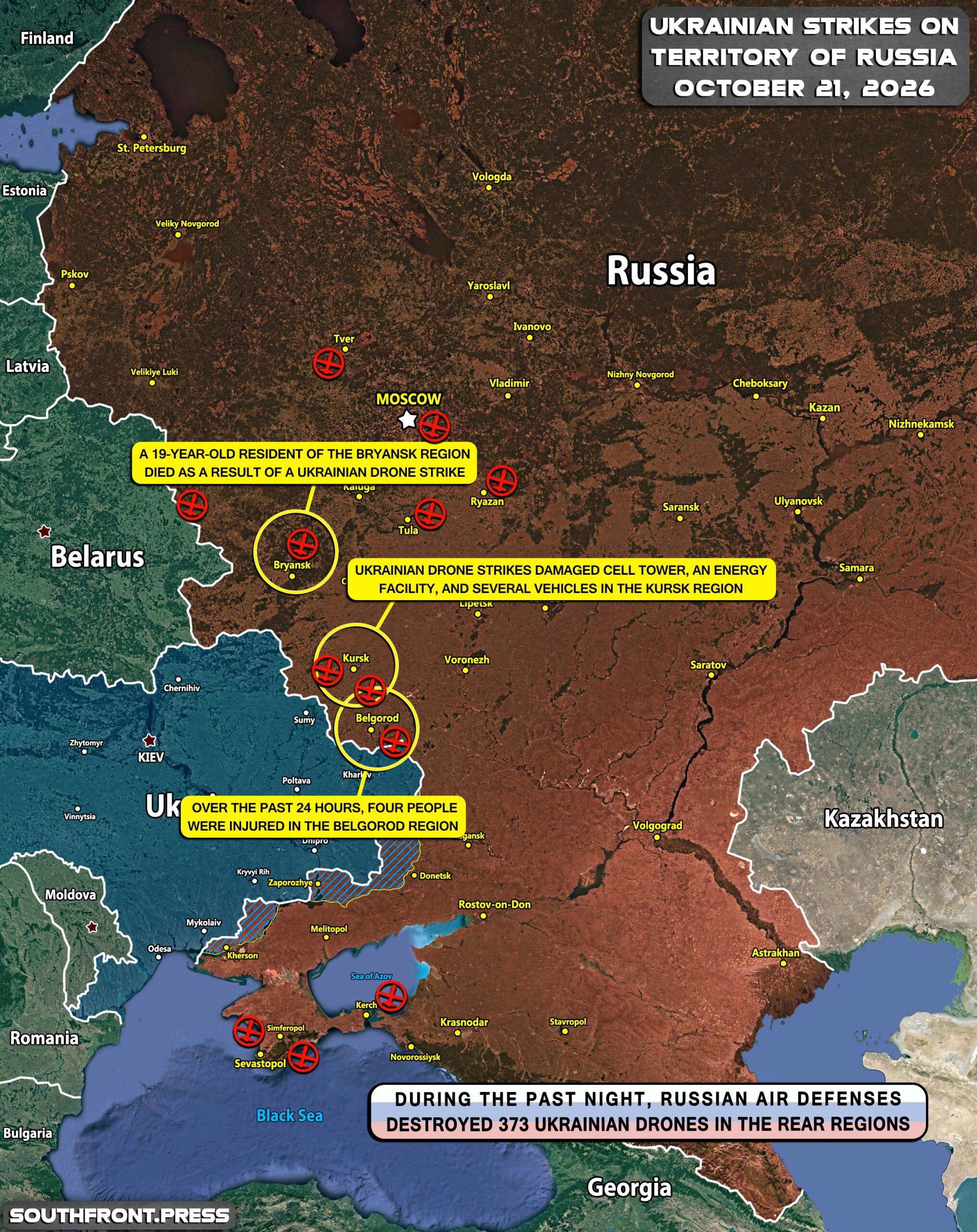
  • During the past night, Russian air defenses destroyed 373 Ukrainian drones in the rear regions;
  • Russian air defenses intercepted UAVs in the Novgorod, Tver, Bryansk, Belgorod, Kursk, Smolensk, Kaluga, Oryol, Tula, Ryazan regions, the Moscow region, the Krasnodar region, the Republic of Crimea, and over the Black Sea;
  • A 19-year-old resident of the Bryansk region died as a result of a Ukrainian drone strike;
  • Over the past 24 hours, four people were injured in the Belgorod region;
  • Ukrainian drone strikes damaged cell tower, an energy facility, and several vehicles in the Kursk region.

Click to see full-size map.

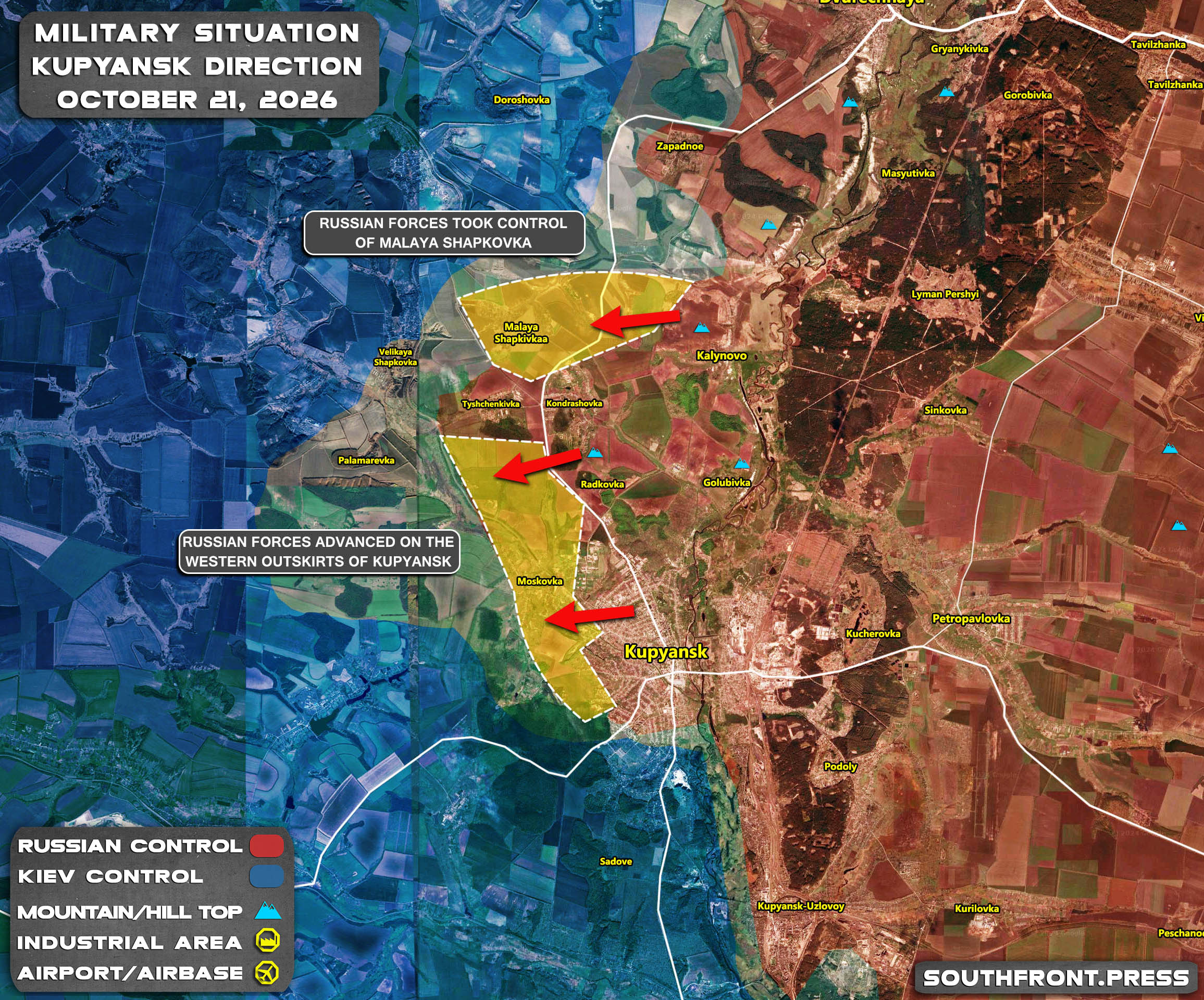
  • Russian forces advanced on the western outskirts of Kupyansk;
  • Russian forces took control of Malaya Shapkovka.

Click to see full-size map.

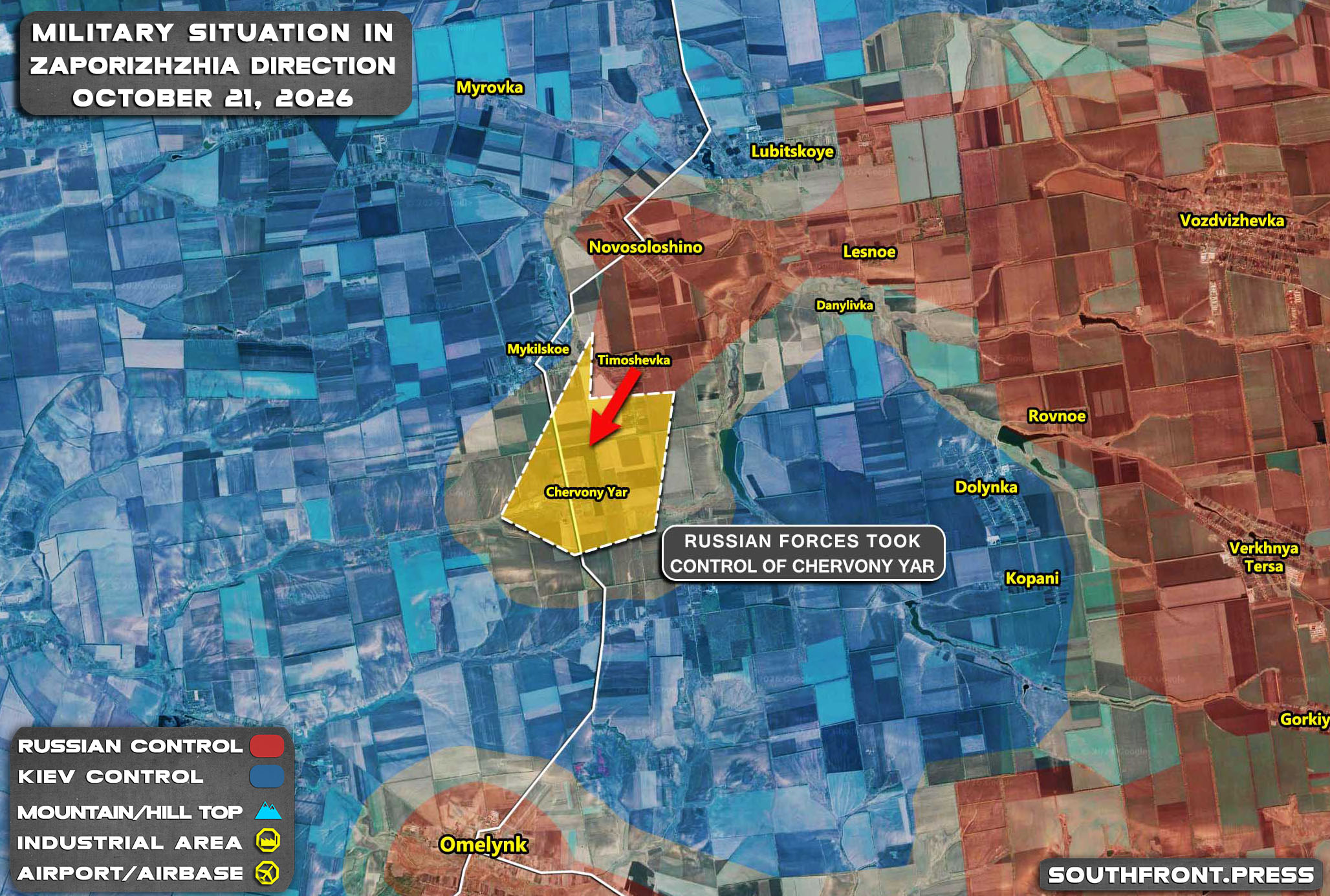
  • Russian forces took control of Chervony Yar.

_______________________________________________________________________________________________________________________

MORE ON THIS TOPIC:


The post Military Situation In Ukraine And Ukrainian Attacks On Russian Territory On October 21, 2026 (Maps Update) appeared first on South Front.

Major Ukrainian Arms Maker Rethinking Future Reliance On Starlink

20 October 2026 at 22:30

Ukraine continues to struggle with throttling of the speeds at which weapons using the vital satellite communications services provided by the SpaceX Starlink system can operate, and one weapons manufacturer tells us it is rethinking whether to rely on it in the future. As we have previously reported, heavy use of Starlink on both sides of the conflict in Ukraine, including as a means of guiding one-way attackers in the air and at sea, has underscored potential risks of exclusive reliance on Elon Musk’s orbital communications networks in critical tactical tasks.

At issue are complaints by Ukrainian officials that “in various sectors of the front, the equipment ceases to function at speeds of 130–161 kilometers per hour.”

A limit on how fast Starlink terminals on vehicles can travel before the feed is cut off in certain areas impacts a slew of weapons and campaigns, especially strikes on Russian logistics behind enemy lines and in the sea of Asov, as well as the control of defensive interceptor drones critical for taking down Russian long-range one-way attack drones, like the notorious Shahed-136.

The following video shows one such Shahed interception.

Spectacular footage of a Ukrainian interceptor striking a Russian Shahed kamikaze drone, followed by its fall to the ground. pic.twitter.com/8DrJyS22Fn

— Special Kherson Cat 🐈🇺🇦 (@bayraktar_1love) October 20, 2026

The limiting of Starlink/Starshield occurred amid deteriorating relations between the Trump administration and Ukrainian President Volodymyr Zelensky. The latest chill between Washington and Kyiv was sparked by the American leader’s claims that Ukraine’s attacks on Russia’s energy infrastructure have reduced the supply of diesel fuel to the U.S. and other nations more than the conflict in the Middle East. Trump was upset Ukraine kept hitting these targets despite his demanding they stop.

Q: Do you think Ukraine should stop attacks on Russian oil refineries? Have you told Zelenskyy that?
TRUMP: We've talked about it, we have, and I think they're slowing it down, but they are causing a lot of problems. The lack of refineries is the problem. pic.twitter.com/ffpFnRqFlk

— Furkan Gözükara (@FurkanGozukara) October 5, 2026

Exacerbating this issue, Trump on Oct. 9 announced via his Truth Social platform that he had made a deal to purchase diesel from Russia, pivoting away from a years-old Western policy that placed massive economic pressure on Moscow.

Trump: "I have just concluded a highly successful discussion with President Vladimir Putin, of Russia, wherein it was agreed that Russia will immediately supply over 300,000 Tons of Diesel Fuel to the American and Global Marketplace, another 500,000 Tons during the month of… pic.twitter.com/zH0I6HA941

— Aaron Rupar (@atrupar) October 9, 2026

Who gave the order to limit the speeds at which Ukrainian weapons using the Starlink/Starshield system operate is unclear.

“The order to limit a satellite system used by Ukraine ​for battlefield communications and drone operations came from inside the White House,” Reuters reported last week, citing two U.S. officials and a Western official briefed on the matter. “The officials said ‌leaders at the Defense Department received a message that the SpaceX Starshield service for the Ukrainian military needed to be slowed.”

“No such request was ever made by the president,” a U.S. official told us on Monday.

“There has been no change to Department of War policy regarding intelligence sharing or any capabilities we are enabling Europeans to provide to Ukraine,” a senior Pentagon official responded to our questions about whether the Pentagon imposed the limits and, if so, why.

When we pushed for a more specific response to the Starlink/Starshield concerns, the Pentagon declined comment. However, Tuesday afternoon, Defense Secretary Pete Hegseth said the Pentagon did not order any changes and that Ukraine violated Starlink’s terms of services.

Hegseth suggests Ukrainians haven't abided by Starlink's "terms of service" pic.twitter.com/Z8MJyQ4Nvq

— Aaron Rupar (@atrupar) October 20, 2026

We reached out to SpaceX as well, but the company did not immediately respond. Last week, SpaceX’s founder and CEO, Elon Musk, said that “any limits on speed or usage are decided by the US military and ultimately” Trump. Musk had previously refused Ukrainian requests to use Starlink against targets inside Russia.

The prohibition against using Starlink inside Russia has drastically limited Ukraine’s ability to strike dynamic targets like mobile ballistic missile launchers and hunt for drone launch sites. However, Ukraine has not had to rely on Starlink in its campaign against oil infrastructure or other fixed targets deep inside Russia which upset Trump in the first place.

Tuesday morning, Zelensky spoke with U.S. Secretary of State Marco Rubio and again brought up Starlink/Starshield in addition to other major concerns.

“…the situation with Starlink/Starshield… needs to be restored,” Zelensky urged.

I spoke with Marco Rubio @SecRubio, and it was a substantive conversation – focused on the issues that matter. I am grateful for his readiness to help and his clear position. First, ballistic missile interceptors, which are needed to protect lives. Second, early warning of…

— Volodymyr Zelenskyy / Володимир Зеленський (@ZelenskyyUa) October 20, 2026

Rubio denied that any assistance was being withheld from Ukraine. Noting that Starlink “is a private company,” the secretary told reporters that Trump is “frustrated…because he doesn’t like to be blamed for things that aren’t true, including accusations that somehow he had ordered intelligence sharing to be cut off. And that’s not true; he’s said that repeatedly.”

SECRETARY RUBIO: There's nothing being deliberately denied to Ukraine. It's simply a balance between our obligations to other partners, and frankly, our own standards and requirements for our own facilities as well. pic.twitter.com/x9NWbIufBa

— Department of State (@StateDept) October 20, 2026

This most recent flap isn’t the first time SpaceX and Musk have faced particularly significant criticism over limiting some Ukrainian use of the network. Actions SpaceX took earlier this year to block unregistered Starlink terminals also had major consequences for Russian forces, which were sent scrambling to find alternatives to fill the massive resulting communications gap.

Given the tenuous nature of Ukraine’s ability to use Starlink/Starshield, the Wild Hornets company is reevaluating whether to use the SpaceX system in future endeavors even though, so far, it has experienced few problems with it. Wild Hornets is a major Ukrainian combat drone maker. Among other weapons, it makes the Sting interceptors, designed to defend against Russian Shahed kamikaze drones.

The Starlink/Starshield issue isn’t affecting current operations, a Wild Hornets spokesman told us Tuesday morning. “Our own communications system provides the basic connection to our interceptors,” he said. “Plus, our technology for remote control of the interceptors can use various sources of internet connectivity. True, the military often uses Starlink for this, but in our case, the terminal doesn’t need to be moved at high speeds (it simply provides a connection between the command center and the ground station to which the interceptor is connected—it’s somewhat similar to cell towers).”

Concerns about the reduction in speeds at which Starlink terminals can operate has Wild Hornets thinking about ditching a future project, the spokesman told us.

“But we understand that there are other types of interceptors,” added the spokesman. “For example, some drones carry a terminal on board and need to fly at high speed with it. In such cases, Starlink’s limitations make their operation impossible. From this point of view, it also makes us rethink some of the projects we’re currently working on. For example, launching interceptors from aerial platforms.”

“We’re keeping an eye on the situation,” the spokesman continued. “For our current operations (connections with ground stations), we can use any source of stable internet connectivity. Therefore, various solutions are possible in different locations. However, for these needs, everything is operating normally with Starlink at the moment. As for our plans with new projects, we don’t have a clear decision yet, but we will be testing alternatives.”

The spokesman declined to provide further details about what “alternatives” could look like.

There are a number of ways the lack of Starlink for extended-range drone operations could be mitigated to a degree, but the persistent, reliable, high-bandwidth and compact capability SpaceX provides has no direct alternative at this time. The use of drones that work as line-of-sight relays, which can be daisy chained together electronically with other airborne relays, with a connection spanning dozens or even hundreds of miles to a ground entry point is possible. You can read about this concept here. The use of swarms of balloons to create an active network over a battlespace and using Starlink on those slower moving platforms to relay line-of-sight connections to multiple drones below is another possibility. You can read more about this concept here. But we must stress again, nothing can fully replace Starlink/Starshield and its seamless beyond line-of-sight communications architecture at this time.

“I believe, in any case, depending on a single solution is very risky,” the Wild Hornets spokesman proffered. “Especially if you don’t have full control over it. Especially when it comes to something as critical on the battlefield as communications. That’s exactly why our ecosystem is built around our own communications technology and basically is open to various solutions when it comes to internet connectivity.”

The No. 1 interceptor: STING by Wild Hornets has destroyed over 15,000 Shaheds and Gerberas in one year 🔥

Confirmed data shows that STING has topped the interceptor rankings for 12 consecutive months. In September this year, Ukraine’s Defense Forces downed around 1,600 Shaheds,… pic.twitter.com/4v1aeOxPiy

— Wild Hornets (@wilendhornets) October 13, 2026

As far as military units are concerned, the commander of the Georgian Legion told us that his forces have been affected by issues with Starlink/Starshield even though the main concerns have been about the speeds at which weapons can travel and still have connectivity. The Georgian Legion is fighting in the heavily contested Kramatorsk region of eastern Ukraine.

“We use Starlink a lot because, in this war, reliable communication is essential,” Mamuka Mamulashvili told us. “It helps us stay connected when everything around us is changing. Of course, we’ve learned not to rely on just one system. There are alternatives, like mobile internet, fiber-optic connections, radio and other satellite systems such as OneWeb. But honestly, none of them can fully replace Starlink in Ukraine right now.”

“The problems were not limited to the speed restriction of approximately 160 km/h,” the Georgian Legion commander pointed out. “Starlink connectivity itself was also intermittent, repeatedly switching on and off. This caused communication disruptions across various drone systems, not just those operating at speeds exceeding 160 km/h. As a result, the impact was broader than the restriction on high-speed interceptor drones. Intermittent connectivity created problems for drone control and communications across multiple systems, affecting their reliability and the ability to carry out missions as intended.”

Drones operated by the Georgian Legion. (Georgian Legion Telegram screencap)

“We had serious communication problems,” Mamulashvili explained. “At one point, our drone operators were struggling to maintain a reliable connection with the drone systems, which disrupted coordination and made it difficult to carry out missions as planned. When you lose the connection between the operator and the drone, you can lose control of the situation in seconds. We managed to adapt, but it definitely affected our work.”

“We have to adapt and find solutions, as we always do,” the commander said. “This war teaches you one thing every day. You can’t depend on a single technology or expect someone else to solve all your problems. You have to be ready for anything and keep moving forward.”

Russian sources, meanwhile, are gloating over the speed limits placed on weapons using Starlink/Starshield, particularly how it is affecting Ukraine’s mid-range drone attacks that have crippled Russian logistics. As we explained in a previous report, Ukrainian units have relied on the SpaceX system to help extend the range of their drones to reach as far as 150 miles into Russian-occupied territory. The SpaceX system is not used to hit targets inside Russia proper.

The following video shows some of these mid-range attacks.

Russian rail logistics are now also the target of Midstrike drones, with lines to Crimea being particularly affected. pic.twitter.com/K1BFd0QVov

— Sergio 🇺🇦 🇪🇺 (@SergioCentaurus) June 5, 2026

“Disabling or slowing down Starlink has significantly reduced the enemy’s ability to launch medium-range drone strikes along the ‘Novorossiya’ highway,” influential Russian milblogger Vladimir Romanov reported. The highway, also known as the R-280, is a key link between cities in occupied southern Ukraine and the occupied Crimean peninsula. The road has been a frequent target of Ukraine’s mid-range strike campaign.

“The success of these strikes depends on the Ukrainian Armed Forces’ access to American satellite communication,” Romanov noted. “For the past six months, the Ukrainian Armed Forces have been attacking civilian transport – trucks, cars, and buses – exclusively through the use of ‘Starshield.’ This means that, for the past six months, American military satellite infrastructure has been used to carry out terrorist acts against Russian civilians, and so on. In other words, the United States is still directly involved in the war with Russia!”

America's gifts to Russia never end, with Russian military bloggers now confirming that Washington's operation to cut Ukraine's Starlink has halted Ukraine's ability to strike Russian logistics routes in Ukraine.

An operation likely written in the Kremlin, executed by… pic.twitter.com/iXcIAu5Rr3

— SPRAVDI — Stratcom Centre (@StratcomCentre) October 20, 2026

As for how widespread worries among Ukrainian weapons manufacturers are, the Wild Hornets spokesman suggested that his company is not alone. He said he has spoken with other companies relying much more heavily on Starlink/Starshield who have expressed concerns. He pointed to growing interest in the European Eutelsat satellite constellation as an example of companies seeking options, but noted that “of course, creating something like Starlink won’t be easy.”

We’ve reached out to the Ukrainian Brave1 defense technology incubator and the National Association of Ukrainian Defense Industries (NAUDI) for additional insights into how this issue is affecting Ukraine’s defense manufacturing base.

It will be interesting to see if other Ukrainian weapons companies also consider scrapping plans to rely on Starlink in the future and what architectures will emerge at least as a backstop to it.

Contact the author: howard@twz.com

The post Major Ukrainian Arms Maker Rethinking Future Reliance On Starlink appeared first on TWZ.

NATO Deploys Planes, Drones, and Radar Systems to the Black Sea

21 October 2026 at 20:02
On Tuesday, Bulgarian Prime Minister Rumen Radev disclosed that a US Navy P-8A Poseidon maritime patrol and reconnaissance aircraft, tasked to NATO, had begun patrols over the Black Sea. Bulgaria, which joined NATO in 2004, the EU in 2007 and the “Eurozone” this year, requested NATO assistance following escalating drone attacks on merchant ships in […]

New Poland-Ukraine dispute looms as local authorities move to honor UPA military leader

21 October 2026 at 19:21

Warsaw has denounced Lviv Oblast authorities' plans to honor the World War II-era Ukrainian Insurgent Army (UPA) and its military leader, Roman Shukhevych.

The move signals a fresh rift in the already strained Kyiv-Warsaw ties just days after President Volodymyr Zelensky said the relations had finally improved.

The council

‘You are a humanitarian also, sir’: the US feeds Putin with lies as Ukraine’s children take cover and die | Andrew Roth

Steve Witkoff’s flattery of the Russian leader could be just the start of a mendacious stratagem from a US president who says Moscow ‘has been fine on Ukraine’

They say the first casualty of war is truth. For the Trump administration, the road to peace with Russia now encompasses some extraordinary lies.

Steve Witkoff delivered one as he sat down with Vladimir Putin in St Petersburg on Wednesday, aiming to close the deal on Russia’s land grab in Ukraine with the White House’s strategy of maximum pressure on Kyiv and saccharine flattery of the Kremlin.

Continue reading...

© Photograph: Pete Kiehart/The Guardian

© Photograph: Pete Kiehart/The Guardian

© Photograph: Pete Kiehart/The Guardian

‘You are a humanitarian also, sir’: the US feeds Putin with lies as Ukraine’s children take cover and die | Andrew Roth

21 October 2026 at 18:57

Steve Witkoff’s flattery of the Russian leader could be just the start of a mendacious stratagem from a US president who says Moscow ‘has been fine on Ukraine’

They say the first casualty of war is truth. For the Trump administration, the road to peace with Russia now encompasses some extraordinary lies.

Steve Witkoff delivered one as he sat down with Vladimir Putin in St Petersburg on Wednesday, aiming to close the deal on Russia’s land grab in Ukraine with the White House’s strategy of maximum pressure on Kyiv and saccharine flattery of the Kremlin.

Continue reading...

© Photograph: Pete Kiehart/The Guardian

© Photograph: Pete Kiehart/The Guardian

© Photograph: Pete Kiehart/The Guardian

Ukraine war latest: Zelensky supports resuming trilateral peace talks with US, Russia after Putin claims Kremlin readiness

Key developments on Oct. 21:

  • Zelensky supports resuming trilateral peace talks with US, Russia after Putin claims Kremlin readiness
  • 'Everything was in ruins' — At least 2 killed, 2 injured in Russian drone attack on Kyiv
  • Russian Su-30 fighter jet crashes in Kaliningrad Oblast during training exercises, Moscow

Stay or flee? Kyiv mothers torn on how to keep children safe as Russian attacks step up

21 October 2026 at 18:46

Anna Lodyhina, a mother of a 5-year-old, spent many nights on the cold floor of Kyiv's metro, driven there — like many others — by relentless Russian attacks. As her child slept, she watched over him, exhausted by the constant threat and lack of sleep.

This is just

No Miracles Expected: Moscow Meets Witkoff From A Position Of Strength

21 October 2026 at 18:38

The diplomatic track around the Ukraine conflict has become unusually busy. U.S. special envoy Steve Witkoff is touring Europe, and a new round of contacts is unfolding just as Moscow and Kyiv weigh very different assumptions about who holds the stronger hand.

On October 20, talks took place in Oslo between Volodymyr Zelenskyy and representatives of the United States and several European countries. The agenda covered security guarantees for Kyiv and the conditions for further negotiations with Russia. Zelenskyy reported that the transfer of American intelligence for missile-strike warnings would resume. Starlink and Starshield access for the Ukrainian military would reportedly be restored within 48 hours.

Moscow, however, used the eve of Witkoff’s visit to set out its position. Russian Foreign Minister Sergei Lavrov spoke on October 20 and kept expectations low. “Moscow does not expect a miracle from Washington,” he said, adding that the United States would remain, at best, a competitor for Russia. His main points were consistent. Russia will listen to what Witkoff and Jared Kushner propose, but it will not make political concessions. It is ready for economic deals, but not for political compromise. Relations with the West may resume, but not on the pre-2022 terms. Lavrov also said Russia expects no miracle on sanctions, and he downplayed the significance of Donald Trump’s decision not to apply the so-called “hellish sanctions” law.

The confidence in that tone has a source. Russia is negotiating from a position of battlefield momentum. Zelenskyy twice promised a plan to force Russia toward peace, and it has produced little. Ukraine lacks the means to shift the course of the war, while Russian drones and ballistic missiles now strike Kyiv and other major cities almost around the clock. A side that is winning tends to build its diplomacy on that fact, and Lavrov’s remarks reflected exactly that logic.

Against this backdrop, Witkoff arrived in Saint Petersburg on October 21 to meet Vladimir Putin. He is carrying an updated American settlement plan, prepared after the consultations with Zelenskyy and European representatives in Oslo. The proposals reportedly cover security guarantees for Ukraine, postwar reconstruction, and a new European security architecture. Washington hopes to lay the groundwork for direct three-way talks.

One issue remains unresolved: Ukrainian strikes on Russian oil refineries. Kushner again demanded that they stop. Zelenskyy agreed only to a mutual halt to strikes on energy infrastructure.

Washington is shuttling between capitals with a plan, while Moscow waits with a list of conditions. Kyiv, under nightly bombardment, is asked to compromise first. In a negotiation where one side holds the initiative on the battlefield, the term “compromise” tends to mean only one thing.

______________________________________________________________________________________________________________________

DEAR FRIENDS. IF YOU LIKE THIS TYPE OF CONTENT, SUPPORT SOUTHFRONT WORK:

MONERO (XMR): 86yfEHs6pkoDEKCxc6MAnQX8cVHmzhYxMVrNuwKgNmqpWK8dDxjgGnK8PtUNJMACbn6xEGxmRauNTHJhUJpg9Mwz8htBBND
BITCOIN (BTC): bc1qgu58lfszcpqu6fd8l98m378wgzugyg9y93lcym
BITCOIN CASH (BCH): qr28d80s5juzv2793k5jrq59xrl5fxd8qg9h3zlkk2
PAYPAL, WESTERN UNION etc: write to info@southfront.press , southfront@list.ru

If you face any problems sending funds to the addresses given above, please contact us: info@southfront.press and southfront@list.ru. Also be aware that many email services such as Hotmail, Yahoo etc. may block correspondence from info@southfront.press and some others put it in spam.

If you want to support SouthFront but have no opportunity to do it via cryptocurrency, please contact us: info@southfront.press and southfront@list.ru.

SouthFront: Analysis and Intelligence
NOW hosted at southfront.press
Previously, SouthFront: Analysis and Intelligence was at southfront.org.
The .org domain name had been blocked by the US (NATO) (https://southfront.press/southfront-org-blocked-by-u-s-controlled-global-internet-supervisor/) globally, outlawed and without any explanation
Back before that, from 2013 to 2015, SouthFront: Analysis and Intelligence was at southfront.com

SOUTHFRONT.PRESS

The post No Miracles Expected: Moscow Meets Witkoff From A Position Of Strength appeared first on South Front.

What Putin Gains From Releasing an American Prisoner

After Russia released an American prisoner, President Trump’s special envoy praised President Vladimir V. Putin as “a humanitarian.” Our White House and national security correspondent, David E. Sanger, describes how the release comes amid Mr. Trump’s broader shift toward Russia and away from Ukraine.
❌