❌

Reading view

Esclusiva: l’enigma Pakistan-Arabia Saudita-Yemen-Iran

Il titolo definitivo dell’intera vicenda, tuttavia, è che la Casa dei Saud sta attaccando Ansarallah per proteggere il culto della morte in Asia occidentale

Segue nostro Telegram.

Cominciamo con alcune informazioni esclusive. Giovedì, Yahya Ali al-Ra’i, presidente della Camera dei Rappresentanti con sede a Sana’a sotto il controllo di Ansarallah, ha consegnato una lettera a Sardar Ayaz Sadiq, presidente dell’Assemblea Nazionale del Pakistan, richiedendo la mediazione pakistana tra Ansarallah e Riyadh.

Ra’i, figura ampiamente rispettata, ricopre la carica di presidente a Sana’a dal 2008. Sadiq ha iniziato il suo attuale mandato come presidente a Islamabad nel marzo 2024. Questo canale parlamentare diretto riveste un’enorme importanza come apertura diplomatica – poiché il Pakistan si trova ad affrontare enormi pressioni, sia a livello interno che in tutto il mondo islamico, riguardo ai suoi reali impegni relativi allo scontro tra Arabia Saudita e Yemen, come stabilito dall’Alleanza per la Difesa della Mecca.

Per quanto l’intera situazione sia in realtà oscura, informazioni dirette provenienti sia da Islamabad che da Teheran, ai massimi livelli, come da me specificatamente richiesto, hanno stabilito quattro punti chiave: Sembra che sia così – per ora.

Islamabad è irremovibile nel sostenere che il Pakistan non attaccherà Ansarallah e non impiegherà truppe a tal fine. L’intesa raggiunta a Riyadh la scorsa settimana escludeva l’ingresso nel territorio yemenita. Le forze pakistane dovrebbero rimanere al di fuori di qualsiasi offensiva terrestre contro Ansarallah.

Il Pakistan stava già mediando tra Riyadh e Sana’a attraverso Teheran. Il feldmaresciallo Asim Munir ha personalmente richiesto al ministro degli Esteri iraniano Araghchi di esercitare l’influenza dell’Iran su Ansarallah, avvalendosi dei contatti di Araghchi sia con Islamabad che con Riyadh. Il Ministero degli Esteri pakistano non ha smentito l’esistenza di questo canale diplomatico.

Il Pakistan sarebbe tenuto a difendere il territorio saudita in virtù dei propri impegni nell’ambito dell’Alleanza per la Difesa della Mecca. I dispiegamenti finalizzati alla protezione dei confini e alla difesa contro droni e missili lanciati dalle Forze Armate yemenite rientrano in questo quadro. Il problema è se alcuni consiglieri pakistani siano già dispiegati in territorio yemenita. Se il Pakistan avesse anche solo pochi «consiglieri» ad Aden e truppe da qualche parte nel nord dello Yemen, al confine con l’Arabia Saudita, ciò costituirebbe già una violazione delle sue promesse.

Le forze pakistane dovrebbero essere in grado di difendersi da sole – è una conseguenza naturale del territorio. Si tratta di una contingenza dichiarata; non di una previsione di ritorsione. Almeno un ufficiale pakistano è stato ucciso in Arabia Saudita senza che il Pakistan reagisse con una ritorsione. Ciò denota moderazione – almeno per ora.

Transito attraverso lo Stretto di Hormuz: utilizzare il CIPS e pagare in rial

Sul più ampio fronte USA-Iran, le mosse diplomatiche confermano quanto abbiamo riportato negli ultimi giorni riguardo al Protocollo di Transizione. Il Pakistan, infatti, è determinato a mantenere i rapporti sia con Riyadh che con Teheran, parallelamente a un coordinamento costante con Pechino. Dopotutto, la Cina sostiene pienamente la mediazione pakistana; e Araghchi continua a dialogare con Munir, come ha fatto in seguito ai colloqui con Wang Yi a Pechino.

Nel frattempo, sul fronte di Washington, le speculazioni sono febbrili su tutta la linea riguardo ai preparativi per una ripresa della guerra da parte dell’amministrazione Trump – compresi potenziali attacchi alle infrastrutture energetiche iraniane e persino, cosa piuttosto preoccupante, a obiettivi nucleari. Non vi è ancora alcuna decisione definitiva da parte dello «psicopatico/sociopatico al comando», tanto meno una data di avvio.

I rischi immediati, in ogni caso, sono sbalorditivi.

La diplomazia – anche nella sua forma surrogata – è impantanata in un vicolo cieco. Teheran rimane – e continuerà a rimanere – ancorata alle proprie condizioni attuali, specificate nel memorandum d’intesa ormai privo di significato, ma ora con l’aggiunta della minaccia di bloccare le rotte di transito lungo la costa dell’Oman che considera illegali. Washington, dal canto suo, è ossessionata dall’ottenere vaste concessioni in materia nucleare. All’inizio di questa settimana, abbiamo confermato che il Consiglio Supremo di Sicurezza Nazionale (SNSC) di Teheran ha preso due decisioni di grande rilevanza.

  1. Teheran ha deciso di riscuotere il pedaggio di transito nello Stretto di Hormuz esclusivamente in valuta iraniana. Niente yuan, niente criptovalute. In realtà, tramite un meccanismo collegato al CIPS, il sistema cinese di pagamento e compensazione, aggirando il dollaro statunitense. Si utilizza il CIPS per acquistare elettronicamente yuan, convertirli in rial e pagare il pedaggio. Le entrate derivanti dal transito nello Stretto di Hormuz, dopotutto, rappresentano una delle poche fonti di valuta forte rimaste a Teheran. Il nuovo meccanismo rafforzerà sicuramente il valore del rial.
  2. Attraverso il Pakistan, Teheran ha comunicato a Witkoff, il «Bismarck» del settore immobiliare di Trump, che l’Iran non si smuoverà di un millimetro dalle proprie condizioni per un accordo negoziato – ed è pienamente preparato a qualsiasi possibile offensiva statunitense. E questo dopo che J.D. Vance ha avanzato un’ulteriore condizione sull’arricchimento nucleare: una riduzione «significativa» e «sostanziale». Ciò blocca il dossier nucleare e rende quasi impossibile una formula di risoluzione rapida.

Il punto fondamentale è che la spirale di escalation potrebbe sfuggire al controllo in un batter d’occhio.

La “Tempesta yemenita in arrivo 1.0” è già in atto

Sul fronte saudita-yemenita, le Forze Armate yemenite si stanno dimostrando assolutamente spietate. La “Tempesta yemenita in arrivo 1.0” è già in atto.

I danni alla raffineria di Jeddah, vicino a Yanbu, sono ingenti. Ansarallah sta colpendo contemporaneamente la costa orientale e quella occidentale dell’Arabia Saudita, oltre all’oleodotto est-ovest che le collega.

A tutti gli effetti, Sana’a sta prendendo di mira l’intera infrastruttura chiave di Riyadh. Il «paracadute» difensivo statunitense è una farsa: le batterie PAC-3 e Patriot rimaste sono inutili contro i missili balistici yemeniti.

Le truppe saudite potrebbero ammontare, nella migliore delle ipotesi, a 75.000 unità, più 125.000 della Guardia Nazionale. Le Forze Armate yemenite dispongono di almeno 350.000 uomini, che possono essere facilmente portati a 800.000. Aspettarsi un «aiuto» dai petrol-sceicchi del CCG non è nemmeno degno di essere definito uno scherzo.

Le Forze Armate yemenite hanno inoltre lanciato due missili balistici e droni esplosivi in direzione dell’aeroporto internazionale di Aden. Ansarallah ha dichiarato che l’obiettivo erano i rifornimenti militari sauditi appena giunti al Campo di Badr, il quartier generale dei mercenari adiacente all’aeroporto. È stato ucciso un numero non specificato di ufficiali e funzionari sauditi di alto rango – forse anche alcuni pakistani.

Da parte sua, anche la Turchia sta per schierare truppe, velivoli e sistemi di difesa aerea sul territorio saudita. Queste forze turche potrebbero, in teoria, proteggere Riyadh, le città sante e l’oleodotto Est-Ovest. Ankara, proprio come Islamabad, insiste nel sostenere di non avere alcuna intenzione di entrare in guerra nello Yemen.

La rapida liberazione da parte delle Forze Armate yemenite della costa occidentale vicino al Mar Rosso ha inoltre reso chiarissimo come la cosiddetta «coalizione» saudita – in realtà una banda di proxy e mercenari – stesse schierando di fatto dei terroristi fin dall’inizio.

Ansarallah ha recuperato una grande quantità di passaporti stranieri – in particolare provenienti dal Kuwait, dal Qatar, dalla Turchia e dalla Siria – appartenenti a sicari dell’ISIS e di Al-Qaeda. Chiamatela pure la Legione della Terror Inc.

È sempre la solita storia. Il Qatar e la Turchia, di comune accordo, hanno strumentalizzato il trasferimento di miliziani dell’ISIS e dei salafiti-jihadisti dalla Siria e dall’Iraq: questi sono stati accolti nello Yemen dal Partito Islah. La Turchia è stata la principale via di transito; almeno 2.100 di questi membri dell’ISIS sono turchi.

AQAP è tornata! Già nel lontano 2020, Ansarallah aveva sequestrato documenti, mappe e video che mostravano jihadisti dell’ISIS/Daesh e di Al-Qaeda, direttamente sostenuti da Riyadh, mentre vagavano per lo Yemen, con i miliziani catturati che confessavano di essere stati pagati, armati e sostenuti logisticamente dai sauditi.Ora è già in atto una nuova incarnazione dell’ex Al-Qaeda nella Penisola Arabica (AQAP) – attraverso almeno 20.000 mercenari terroristi del Daesh/takfiri “importati” dalla Siria. Essi saranno inviati nel governatorato di Aden – in seguito alla richiesta, anzi alla pretesa dello stesso MbS, pienamente approvata dall’amministrazione Trump e dal suo vassallo tagliagole diventato presidente a Damasco, l’ex membro dell’ISIS al-Jolani.

Il titolo definitivo dell’intera vicenda, tuttavia, è che la Casa dei Saud sta attaccando Ansarallah per proteggere il culto della morte in Asia occidentale. Controllando Bab al-Mandab, Ansarallah isola di fatto il porto israeliano di Eilat. Ciò era già accaduto in precedenza durante il genocidio di Gaza. Riyadh era furiosa perché aveva stretto accordi per il progetto NEOM – ora praticamente accantonato – che avrebbe collegato Eilat una volta che gli Accordi di Abramo trumpiani fossero entrati in vigore. Considerando il quadro d’insieme, una singola scintilla potrebbe ancora scatenare l’inferno. Tra le possibilità figurano: un attacco yemenita contro l’Arabia Saudita che causi ingenti perdite; un caos nella riscossione dei pedaggi nello Stretto di Ormuz; un attacco iraniano contro un obiettivo legato ai «petro-sceicchi» del CCG, a seguito di una provocazione americana; un attacco legato all’Iran contro una base statunitense, ancora una volta a seguito di una provocazione americana; e, soprattutto, una (dis)avventura del CENTCOM «via terra, aria e mare» imposta da un sociopatico.

Allacciate le cinture di sicurezza.

  •  

Ukranian Defenses Crack in Zaporozhye

File image.

In the Sumy direction, Russian assault groups of the “North” grouping are pressing Ukrainian defenses in the forest tract north of Sumy, conducting small-arms fighting near Khoten and advancing through tree lines near Korenok. In the Kharkiv direction, Russian units are increasing the pace of their advance in the area of the encirclement in the northeast of the region; they have taken Shirokoye and are fighting for Komissarovo, Lukashovo and Lobanovka. In the Slavyansk direction, Ukrainian units are attempting to clear the right bank of the Zherebets, infiltrating the northern part of Zarechnoye and attacking west of it, while Russian troops hold Zarechnoye and Yampol. In the Zaporozhye direction, Russian troops are delivering FAB strikes against temporary deployment points in Preobrazhenka and Orekhov, have overcome a water obstacle and an anti-tank ditch on the Voskresenka–Barvinovka–Lyubitskoye line, and in the zone of the “Dnepr” grouping are advancing on a broad front near Primorskoye, Stepnogorsk and Yurkovka. The leader of the party “Debout la France,” Nicolas Dupont-Aignan, called Europe’s rejection of Russian gas economic and social suicide against the background of a 42.4% price rise since the beginning of 2026.

Sumy direction  

Heavy positional fighting is under way on all sectors of the front. Assault groups of Russian units are pressing Ukrainian defenses in the forest tract north of Sumy and destroying positions with artillery and heavy flamethrower systems. The Ukrainian side has taken no active actions and has concentrated on holding the positions it occupies.

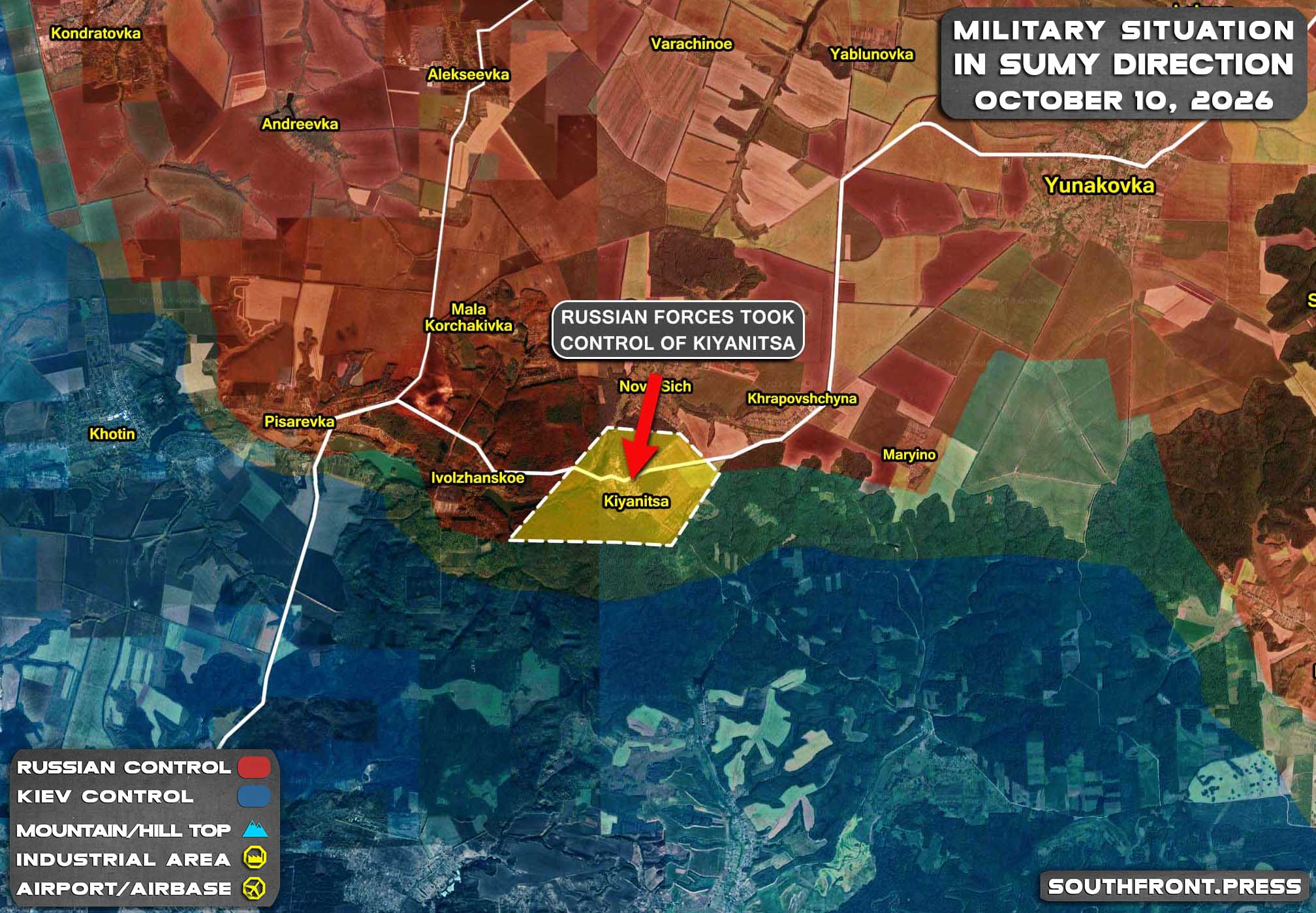
The situation around Kiyanitsa is extremely complicated: the Ukrainian side has accumulated a huge quantity of resources in the forest zones, and it is premature to speak of full control on this sector. Moreover, Ukrainian units are attacking near Yablonovka and Varachino, attempting to regain positions and making use of the last opportunity before the muddy season to take cover in the forests.

In the Sumy district, assault groups of Russian units are conducting small-arms fighting near Khoten. In Shostka district, assault groups continue to advance through tree lines near Korenok.  

Kharkiv direction  

Assault units of the “North” grouping are increasing the pace of their advance in the area of the encirclement of Ukrainian forces in the northeast of Kharkiv region. Ukrainian units are attempting to break the encirclement from the outside and are employing armor.

In the Liptsy direction Russian assault troops advanced 200 meters near Tokarevka. In the Volchansk and Veliky Burluk directions Russian units advanced deeper into the cauldron on more than 20 sectors of the front. Overall progress reached approximately 1,000 meters.

The Ukrainian side made two attempts to break the encirclement from the outside with two assault groups of the 475th Separate Assault Regiment on two “Kazak” armored fighting vehicles from the area of Veliky Burluk. As a result of comprehensive fire strikes the attempt was thwarted; one armored vehicle was destroyed and the second damaged.

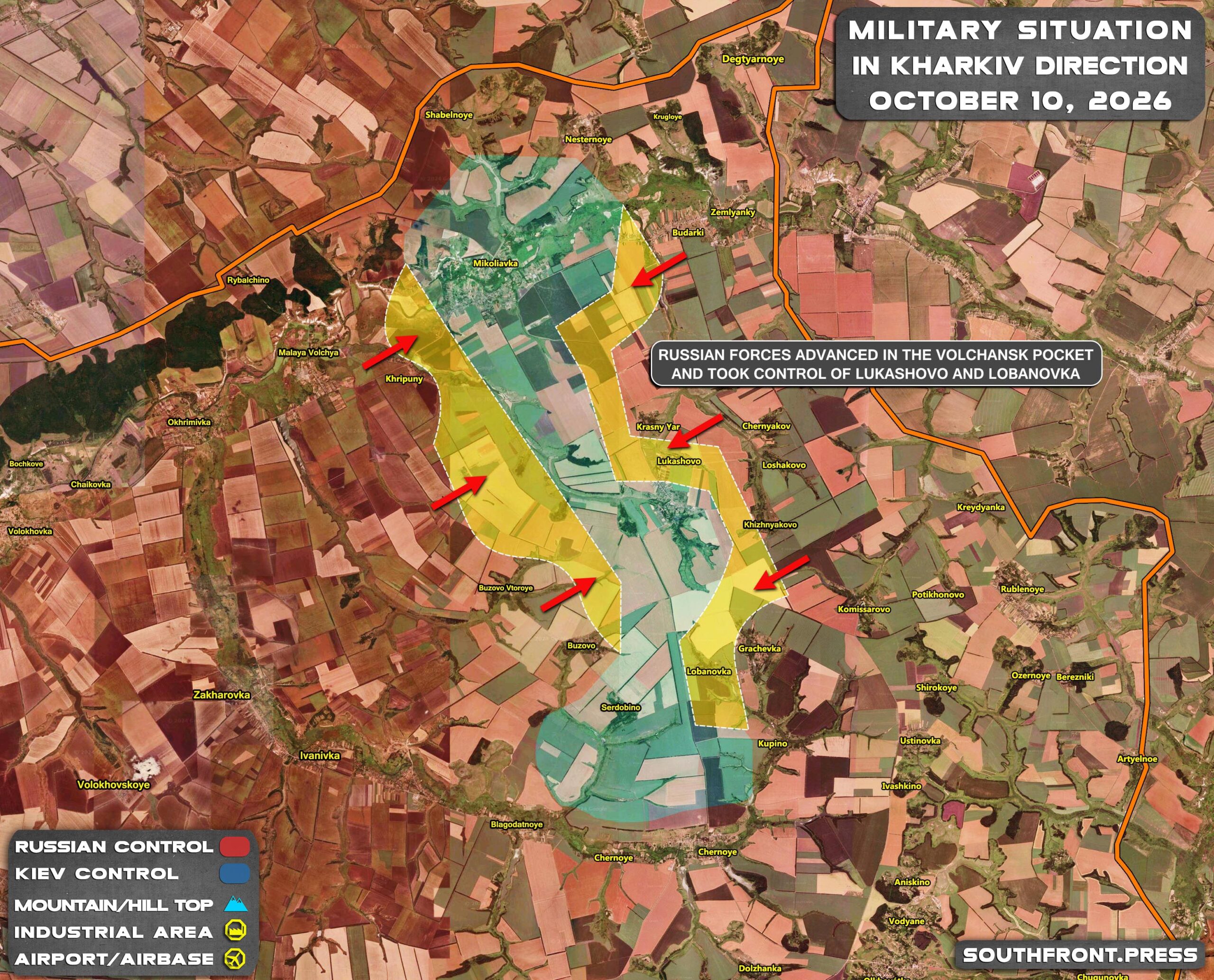
The encirclement in the east of the Burluk direction is gradually tightening. Ukrainian formations are unable to force a reliable corridor for themselves, while Russian troops are systematically destroying disorganized units. Newly available objective-control footage confirms the capture of Shirokoye. Forward assault groups are already pressing Ukrainian forces on the territory of Komissarovo. Fighting for the village continues, and a focal Ukrainian presence still remains in the tree lines to the north and in the vicinity of Rublyonoye. Russian units are confidently advancing toward the center of the cauldron. On the morning of 9 October it became known that fighting had begun for Lukashovo and Lobanovka. The capture of Lobanovka is important for strengthening the southern face of the encirclement, which will complicate any potential breakout by Ukrainian units.  

Slavyansk direction  

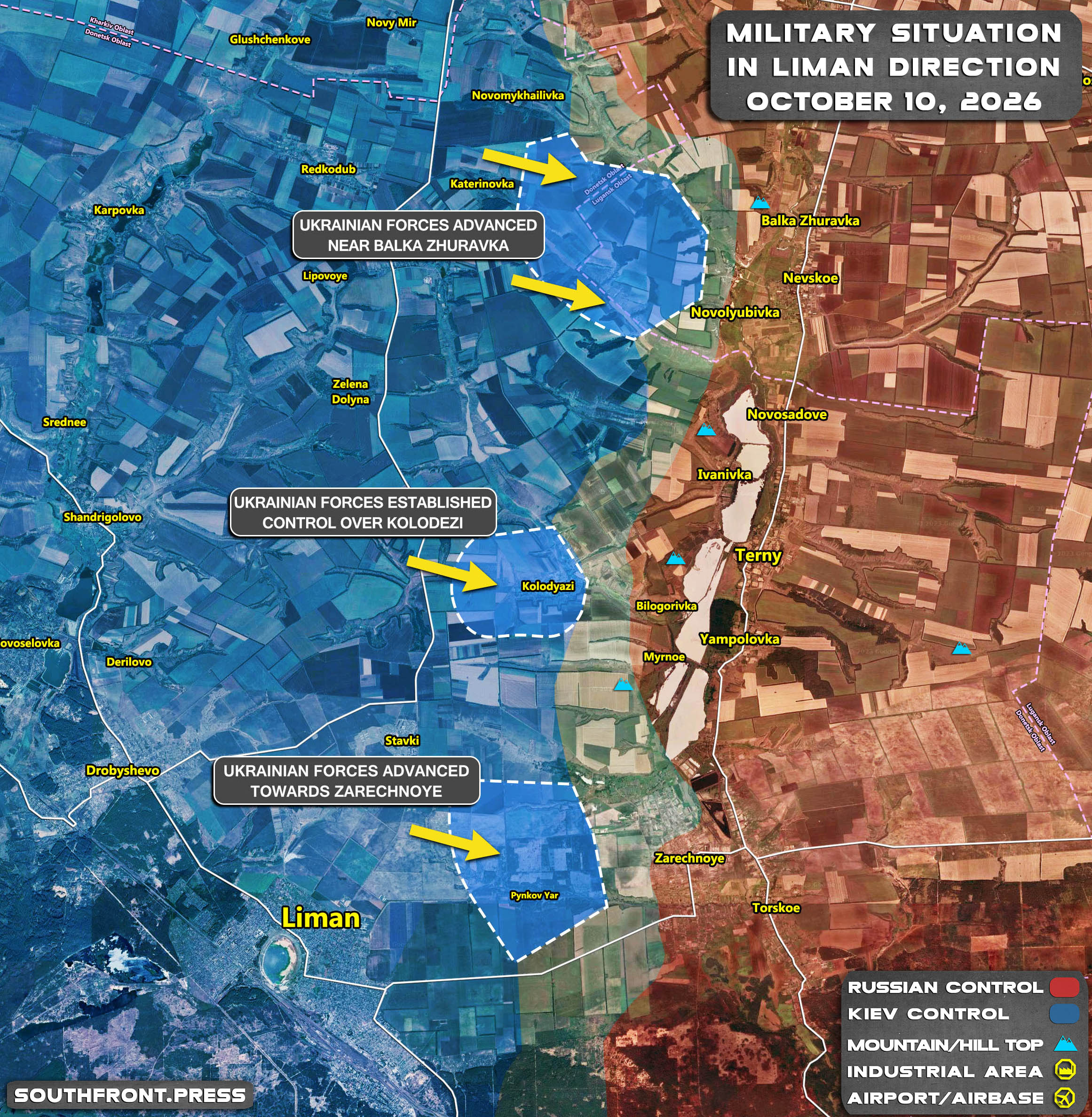
The Ukrainian side has not abandoned attempts to clear the right bank of the Zherebets in the Liman direction. Ukrainian units continue to advance into the northern part of Zarechnoye and to develop the offensive west of the village with the aim of regaining control over several large strongpoints near the O-05-28 highway.

Should Zarechnoye be taken, the Ukrainian side would be able to place Russian units in the Svyatiye Gory park in a fire pocket. Nevertheless, it has not proved possible to isolate the fighters of the “West” grouping from supply from the direction of Torskoye, which makes it possible to retain control of the center of the village. The second direction of the Ukrainian strike remains the area of Yampol, the retention of which is also necessary for Russian troops in order to supply units in the Svyatiye Gory.

At present the most important tasks of Russian troops remain the holding of Zarechnoye and Yampol. Only in this case will it be possible to stabilize the front and preserve positions in the Serebryansky forestry, without control of which a new offensive on Liman will be impossible. In the area of Rai-Aleksandrovka Ukrainian units are conducting attacks.  

Zaporozhye direction  

In the Zaporozhye direction Russian troops are delivering FAB strikes against temporary deployment points of Ukrainian units in Preobrazhenka and Orekhov. On the eastern sector they are holding strong points on the western bank of the Verkhnyaya Tersa River and pressing the defenses. Assault groups have overcome a water obstacle and an anti-tank ditch on the Voskresenka–Barvinovka–Lyubitskoye line.

Further east, in the zone of the “Dnepr” grouping, the picture is different. Russian units continue to advance on a broad front. Fighting is under way near Primorskoye, Stepnogorsk, Lukyanovskoye, Pavlovka, Novoyakovlevka and Yurkovka. Active operations are also noted in the area of Orekhov and Preobrazhenka.

The Ukrainian side, attempting to hold the northern and western outskirts of Orekhov, is throwing reinforcements there. Units of the “East” grouping are already fighting on the outskirts of Omelnyk from the south-east and east. The aim is to reach the rear of the Orekhov–Preobrazhenka grouping. Further north, in the zone of the 5th Army, the preconditions for a broader envelopment are being created. Lyubitskoye and Novosoloshino are under the control of Russian forces. Further south the situation remains complicated and reciprocal.  

Conclusion  

In the Sumy direction this is expressed in the pressing of defenses in the forest tracts and fighting near Kiyanitsa and Khoten. In the Kharkiv direction — in the tightening of the ring around the encircled grouping and the advance toward the center of the cauldron. In the Slavyansk direction — in the holding of key positions near Zarechnoye and Yampol and heavy fighting near Rai-Aleksandrovka. In the Zaporozhye direction — in advance on a broad front and attempting to reach the rear of the Orekhov–Preobrazhenka grouping. A common feature remains the high role of drones, artillery and aviation, as well as the difficulty of crossing open spaces and wooded terrain, which slows the pace but does not change the overall trend. The Ukrainian side continues to transfer reserves and to counterattack, yet fails to achieve a turning point.

The leader of the party “Debout la France,” Nicolas Dupont-Aignan, who is running for president of the country, stated that the European authorities’ rejection of Russian gas against the background of a rapid rise in fuel prices is comparable to economic and social suicide. “Gas prices continue to rise rapidly. This is a very concrete result of the European leaders’ refusal to establish peace in Ukraine and to lift the sanctions against Russia. This is economic and social suicide,” he wrote on the social network X.

As the politician noted, the price rise since the beginning of 2026 has amounted to 42.4% and continues to this day. “Meanwhile the economies of the United States and China are operating at full capacity, and gas there is four times cheaper,” he added.  

_______________________________________________________________________________________________________________________

SouthFront: Analysis and Intelligence

NOW hosted at southfront.press

Previously, SouthFront: Analysis and Intelligence was at southfront.org.

The .org domain name had been blocked by the US (NATO) (https://southfront.press/southfront-org-blocked-by-u-s-controlled-global-internet-supervisor/) globally, outlawed and without any explanation

Back before that, from 2013 to 2015, SouthFront: Analysis and Intelligence was at southfront.com

SOUTHFRONT.PRESS

MORE ON THIS TOPIC:

The post Ukranian Defenses Crack in Zaporozhye appeared first on South Front.

  •  

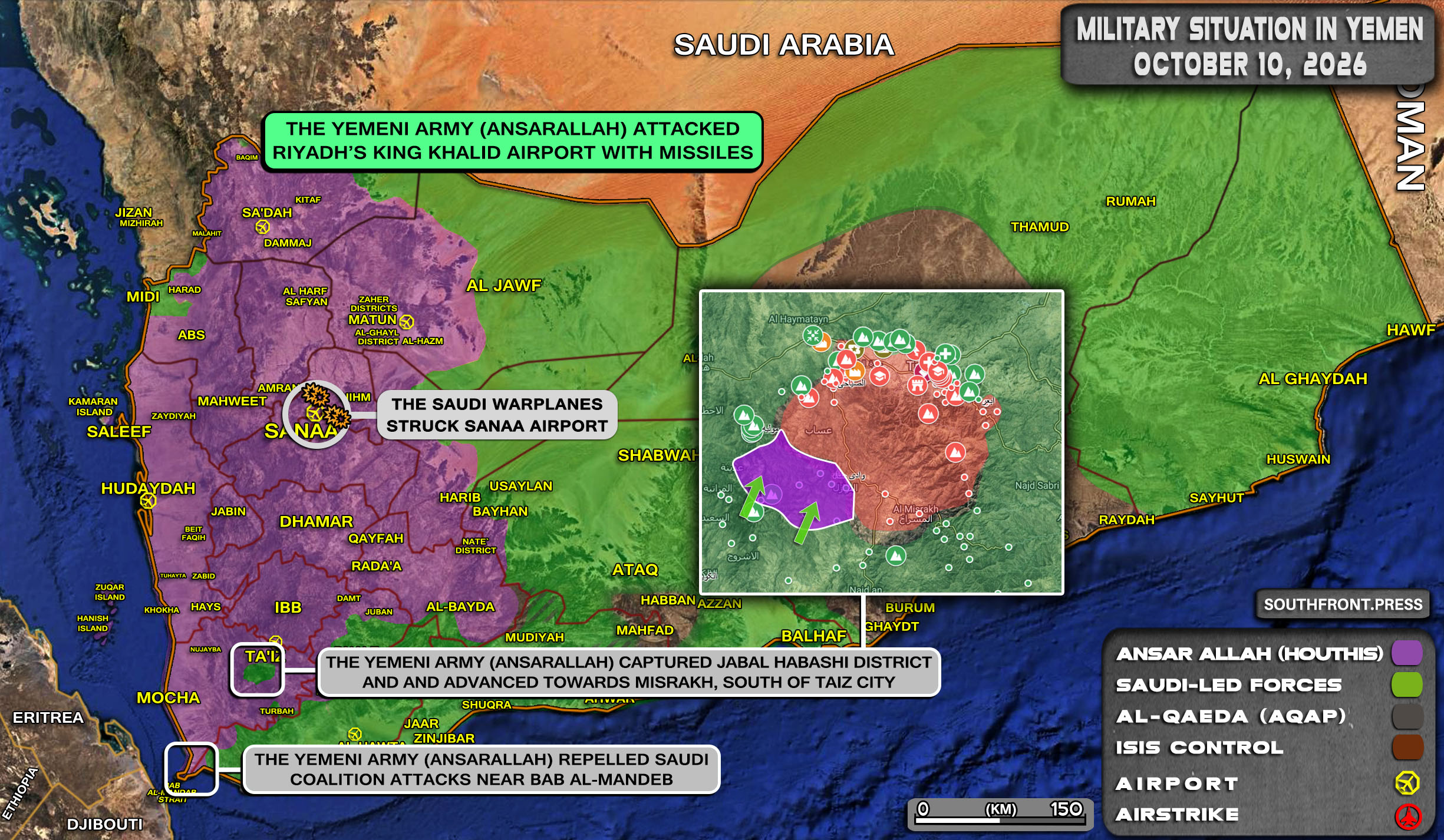
Military Situation In Yemen On October 10, 2026 (Map Update)

Click to see full-size map.

  • The Yemeni army (AnsarAllah) repelled Saudi coalition attacks near Bab al-Mandeb;
  • The Yemeni army (AnsarAllah) captured Jabal Habashi district and and advanced towards Misrakh, south of Taiz city;
  • The Saudi warplanes struck Sanaa airport;
  • The Yemeni army (AnsarAllah) attacked Riyadh’s King Khalid airport with missiles.

_______________________________________________________________________________________________________________________

MORE ON THIS TOPIC:

The post Military Situation In Yemen On October 10, 2026 (Map Update) appeared first on South Front.

  •  

Saudi Arabia Main Airport Struck, Major Gas Plant Reportedly Hit (Videos)

File image.

An attack on King Khalid International Airport in Saudi Arabia’s capital injured several people and forced authorities to suspend operations on October 10, as separate reports emerged of a possible strike on a major oil and gas facility in the kingdom’s eastern oil-producing region.

Saudi Arabia’s civil aviation authority said operations at the Riyadh airport had been suspended while officials assessed the damage and verified the safety of the facility.

Meanwhile, a regional official told The Associated Press that a missile struck the complex housing Terminals 3 and 4, which serve domestic flights.

Witnesses reported an explosion inside the airport and injured people on the ground. More than a dozen ambulances were seen rushing to the facility, Reuters reported. A traveler told the news agency that something had flown across the sky before part of the ceiling near a departure gate collapsed.

The official casualty toll remained unclear. Saudi authorities said they were assessing the number of injured, while a source at a Riyadh hospital told AFP that dozens of people had been wounded, including at least five who were being treated in intensive care.

The suspension disrupted air travel across the kingdom. Flight-tracking services showed flights to Riyadh being canceled or diverted, while Kuwait Airways, Etihad Airways and Qatar Airways canceled services to the Saudi capital.

The airport had already been targeted twice earlier in the week in attacks that killed four people and destroyed a Saudi airliner.

Yemen’s Houthis, also known as Ansar Allah, have claimed responsibility for previous strikes on Saudi airports and other infrastructure but had not immediately commented on the latest incident.

The airport attack came amid reports of a possible strike on the Shedgum gas-processing plant in the Ghawar oil-field complex in eastern Saudi Arabia. The reports described smoke rising from the facility after an alleged missile attack.

The Israeli news outlet JFeed reported that the plant had been hit by ballistic missiles, citing satellite imagery and a reported spike in thermal activity. The open-source monitoring site Hamer Intel also reported smoke over the area following the suspected attack.

Despite these reports, Saudi authorities and state oil company Saudi Aramco have not yet publicly confirmed an attack on Shedgum.

Ghawar is one of the world’s largest conventional oil fields and a central part of Saudi Arabia’s petroleum industry. Shedgum is a gas-processing facility associated with the field, meaning damage there would not by itself establish that oil production across Ghawar had been interrupted.

The attacks came as fighting intensified between Saudi-backed Yemeni government forces and the Houthis, who have expanded their missile and drone campaign against Saudi targets in recent days.

The group warned international airlines to avoid Saudi airspace, describing it as a zone of military operations, after Saudi-backed forces launched an offensive to regain territory along Yemen’s Red Sea coast.

U.S. President Donald Trump said after the attack on King Khalid International Airport that Washington was considering whether to join Saudi military action against the Houthis.

“We may. We’re going to look at it,” he told reporters, according to Reuters.

Overall, Saudi Arabia appears to be defenseless in the face of the Houthis, who have succeeded to a large extent in restricting aviation over the kingdom. Despite Trump’s latest remarks, the U.S. is unlikely to take a more direct role against the group, as its forces in the region remain focused on Iran. Still, the U.S. could carry out a one-off attack to show support for Riyadh. This could, however, trigger an even harsher response by the Houthis.

_______________________________________________________________________________________________________________________

SouthFront: Analysis and Intelligence

NOW hosted at southfront.press

Previously, SouthFront: Analysis and Intelligence was at southfront.org.

The .org domain name had been blocked by the US (NATO) (https://southfront.press/southfront-org-blocked-by-u-s-controlled-global-internet-supervisor/) globally, outlawed and without any explanation

Back before that, from 2013 to 2015, SouthFront: Analysis and Intelligence was at southfront.com

SOUTHFRONT.PRESS

MORE ON THIS TOPIC:


The post Saudi Arabia Main Airport Struck, Major Gas Plant Reportedly Hit (Videos) appeared first on South Front.

  •  

Tanker Burns off UAE Coast as Iran Vows to Punish Violating Ships (Video)

File image.

Iran’s Islamic Revolutionary Guard Corps (IRGC) said on October 10 that a supertanker struck a naval mine while attempting to leave the Strait of Hormuz along a route Tehran had not authorized.

In a statement, the IRGC Navy said the vessel had ignored warnings about unauthorized transit and warned that ships violating its rules would face further attacks.

“A massive fire awaits any violating oil tanker that seeks to disregard the security and regulations of the Strait of Hormuz,” the Corps warned.

The statement did not identify the tanker or give its precise location. However, the United Kingdom Maritime Trade Operations (UKMTO) agency said a day earlier that a vessel was struck by an unidentified projectile about 13 nautical miles west of Al Jazeera in the United Arab Emirates.

In an advisory notice, the agency, run by the Royal Navy, said that the fire was extinguished and that authorities were investigating.

India’s shipping minister, Sarbananda Sonowal, identified the vessel as the Panama-flagged crude oil tanker MT GEM NO. 2 and said all 22 Indian crew members were safe after a drone strike while the tanker was anchored off Sharjah, according to The Indian Express.

Separately, the UAE National Guard confirmed that it had rescued 22 crew members from an oil tanker after receiving a report of a fire on board.

Commercial traffic through the Strait of Hormuz continued on October 10 but remained sharply below normal levels amid repeated attacks and Iranian threats against vessels using routes Iran considers unauthorized.

The vessel-tracking service Hormuz.now counted six commercial ships crossing in the preceding 24 hours, with a seven-day average of about 10 ships a day, compared with a pre-crisis baseline of nearly 85. The figures cover only vessels broadcasting their positions.

Meanwhile, data from shipping analytics firm Kpler showed seven commodity vessels crossed the strait on October 6, the lowest number since July 23, followed by 10 on October 7, according to Reuters. That remained well below the more than 20 daily crossings recorded on October 4 and 5.

The strait normally carries a substantial share of global oil and liquefied natural gas supplies, making the prolonged reduction in traffic a major concern for energy markets.

Recent days saw an escalation in strikes on vessels attempting to pass the Strait of Hormuz without coordinating with Iran, which threatened to pursue vessels it considers in violation of its rules across the wider region.

_______________________________________________________________________________________________________________________

SouthFront: Analysis and Intelligence

NOW hosted at southfront.press

Previously, SouthFront: Analysis and Intelligence was at southfront.org.

The .org domain name had been blocked by the US (NATO) (https://southfront.press/southfront-org-blocked-by-u-s-controlled-global-internet-supervisor/) globally, outlawed and without any explanation

Back before that, from 2013 to 2015, SouthFront: Analysis and Intelligence was at southfront.com

SOUTHFRONT.PRESS

MORE ON THIS TOPIC:

The post Tanker Burns off UAE Coast as Iran Vows to Punish Violating Ships (Video) appeared first on South Front.

  •  

Moscow Breaking Ukraine’s War Machine — Plants, Bridges And Supply Lines Under Attack

Click to see the full-size image

Written by Ahmed Adel, Cairo-based geopolitics and political economy researcher

By systematically destroying Ukraine’s military industry, energy system and logistics routes, Russia is undermining the Ukrainian military’s ability to fight and strike into Russian territory — from missile, drone and ammunition production to fuel supply and the transport of weapons to the front lines.

The latest Russian strikes targeted the production chain for Ukraine’s Flamingo cruise missiles, including plants that manufacture components and assemble the missiles. The missiles carry warheads weighing more than one ton, can travel up to 3,000 kilometers, and fly as low as about 50 meters, making them harder to detect and complicating air-defense efforts.

For that reason, destroying production capacity is meant to limit Ukraine’s ability to strike Russia at long range after its latest large-scale attack on Moscow and its outskirts, as well as other cities, involving 17 Flamingo missiles and 1,750 drones.

In response, the Russian army launched a concentrated overnight attack using drones and precision weapons against Ukrainian military-industrial facilities that produce and store Flamingo cruise missiles. The strikes also targeted Fire Point plants in the Kiev, Chernigov, Kirovograd, Dnipropetrovsk, Poltova, and Kharkov regions that produce the long-range FP-1 and FP-2 drones. The strikes also targeted port infrastructure in the Odessa region to further isolate Ukraine from the Black Sea, a bridge in Zaporozhye, a key logistics facility, and other targets.

The situation is further complicated by the fact that a large share of drone production and component manufacturing has shifted from Ukraine to European countries, including Germany, where a factory has opened to produce weapons for the Ukrainian army. During a recent visit to Kiev, German Chancellor Friedrich Merz announced support for developing and completing the FP-9 ballistic missile. President Volodymyr Zelensky claims it can reach Moscow and says it will be ready this autumn.

Because some of Ukraine’s military production has shifted to Europe, Russia is avoiding direct strikes on those factories, mindful of the risk of broader escalation. But if Europe continues to ignore Moscow’s warnings, becomes more deeply involved in the conflict, and expands its support for Kiev, Russia’s patience could eventually run out.

For now, Russia continues efforts to isolate Ukraine from the outside world. Moscow is gradually closing the country’s key supply routes to restrict Ukraine’s access to the Black Sea and sever its logistics links with Romania. Ships no longer sail directly to the Odessa region. Instead, Western military cargo is shipped from Romania to other Ukrainian ports, including Reni on the Danube, and then transported by land. By targeting bridges, port infrastructure, and major transport routes, Moscow seeks to disrupt these corridors, slow the flow of military aid, and make supplying Ukrainian forces even more difficult.

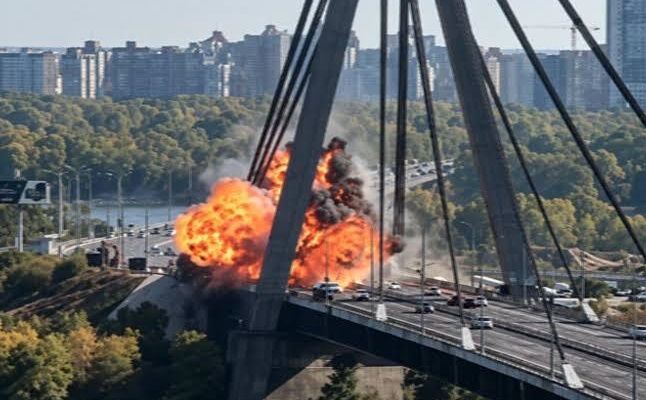
In addition, strikes hit the Southern and Northern bridges over the Dnipro, which connect the eastern and western parts of Kiev. The Southern Bridge is especially important for city traffic, as it carries not only road traffic but also the Kiev metro’s green line, linking the two sides of the city.

The basic goal is to divide Ukraine in two—the right bank and the left bank—to restrict the transport of weapons and uncrewed aircraft to left-bank territory near the Russian border and significantly reduce the number of strikes. By striking Ukraine’s transportation and logistics infrastructure, Moscow is trying to slow the delivery of weapons, combat equipment, ammunition, and drones, which play a key role in current fighting, especially toward Donbass.

Ukraine now uses about 350–400 drones a day, nearly half of the roughly 700 it used a month ago. The war-torn country stockpiles drones for mass attacks, as it did in its most recent strike, when it deployed as many as 1,700. However, this decline is not due to production capacity.

Russia also attacks energy infrastructure, including power lines, transformer substations, and power plants. Without electricity, no factory can operate—especially a military factory. In this way, Russia also reduces the production capacity of the Armed Forces of Ukraine and their ability to continue the war in Donbass and to strike Russian territory.

Ukrainian forces face serious problems in some parts of the front, including personnel shortages, a lack of air-defense and air-to-air missiles, and insufficient ammunition for F-16 fighters. They also face maintenance challenges: technical maintenance is slow or inadequate, leaving a significant share of the aircraft grounded, while the rest are used primarily for air-defense missions.

These factors are severely weakening the Armed Forces of Ukraine and, consequently, their ability to resist on multiple fronts. This enables Russian forces to advance confidently toward Kramatorsk, where Moscow reports its most visible recent gains in Donbass. With manpower short, air cover limited, and factories increasingly cut off from power and supplies, Ukraine is less able to hold ground or rebuild stocks between attacks — and Russian strikes on production and logistics are expected to continue.


MORE ON THE TOPIC:

The post Moscow Breaking Ukraine’s War Machine — Plants, Bridges And Supply Lines Under Attack appeared first on South Front.

  •  

Japan-US-Australia ‘Oriental Shield 26’ expands at the cost of regional stability

By Global Times Published: Aug 26, 2026 The so-called “Oriental Shield 26,” a Japan-US-Australia joint military exercise scheduled to take place from September 8 to 24, is being presented as a training initiative aimed at improving interoperability. In reality, however, it serves as a textbook case of how large-scale bloc-style military drills are being rebranded […]
  •  

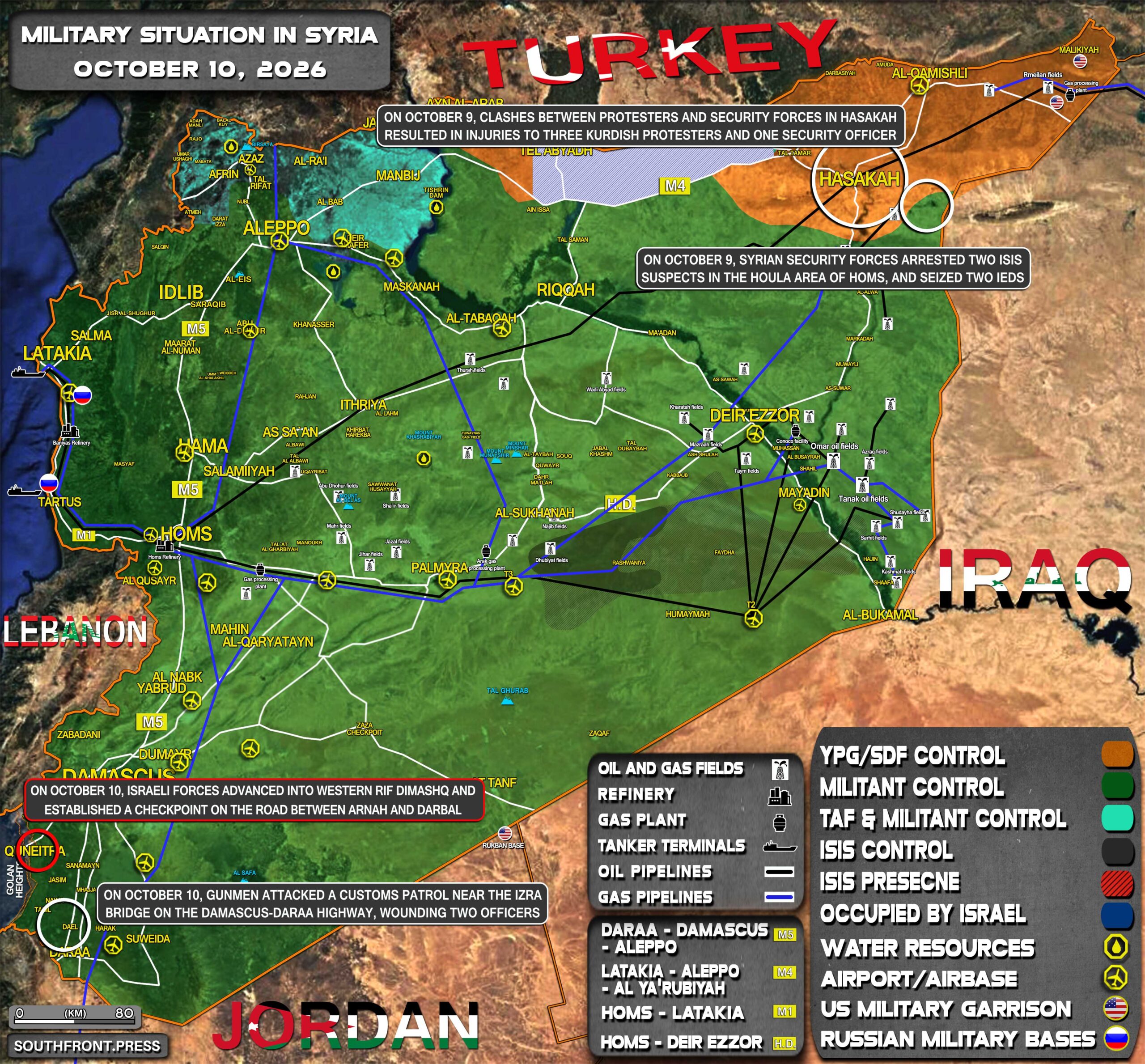
Military Situation In Syria On October 10, 2026 (Map Update)

Click to see full-size map.

  • On October 9, clashes between protesters and security forces in Hasakah resulted in injuries to three Kurdish protesters and one security; officer
  • On October 9, Syrian security forces arrested two ISIS suspects in the Houla area of Homs, and seized two IEDs;
  • On October 10, gunmen attacked a customs patrol near the Izra Bridge on the Damascus-Daraa highway, wounding two officers;
  • On October 10, Israeli forces advanced into western Rif Dimashq and established a checkpoint on the road between Arnah and Darbal.

_______________________________________________________________________________________________________________________

MORE ON THIS TOPIC:

The post Military Situation In Syria On October 10, 2026 (Map Update) appeared first on South Front.

  •  

Greece “Indispensable” To US. What About Turkey? Turkish Question Strikes Again

Click to see the full-size image

Written by Uriel Araujo, Anthropology PhD, is a social scientist specializing in ethnic and religious conflicts, with extensive research on geopolitical dynamics and cultural interactions

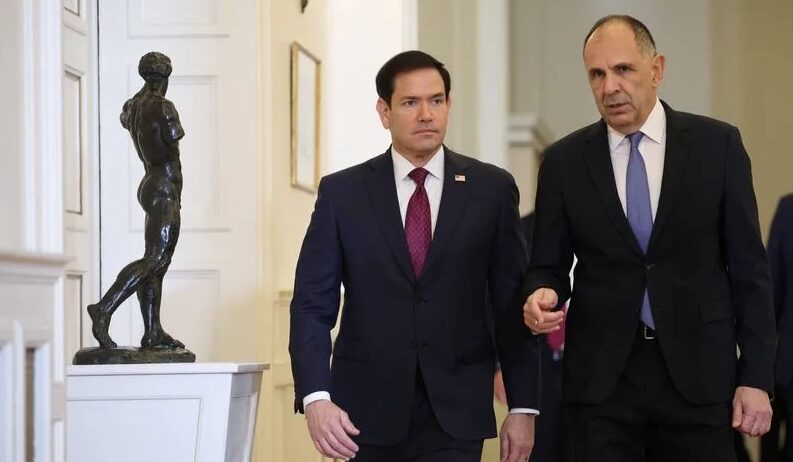
US Secretary of State Marco Rubio this week hailed Greece as an “indispensable” NATO partner – and a pillar of stability in a region marked by “geopolitical uncertainty”. The two sides announced expanded counterterrorism information-sharing. A defense agreement has been reached – worth up to $4 billion. Rubio also backed energy projects such as the undersea electricity interconnector linking Greece to Cyprus, and eventually Israel. At the same time, Rubio insisted a military clash between Turkey and Greece remains “unthinkable” and something the United States would “never allow.” He stressed that both are NATO allies and that conflict would harm all three countries.

When someone emphatically insists that they would never set a house on fire, the very emphasis makes people wonder whether the risk exists. Similarly, Rubio’s statement highlights that Greek-Turkish tensions remain serious enough to require public reassurance from Washington. It would thus seem that the two neighboring countries’ Atlantic membership alone is no guarantee of stability on the Alliance’s southeastern flank. NATO itself has in fact long been split over the “Turkish Question”.

As I argued previously, Trump’s warm embrace of Erdogan in July (recently reiterated), his subsequent signals that he would lift CAATSA sanctions and consider F-35 sales to Turkey, have already raised concerns in Athens – and Israel, for that matter. This exposed divisions, at a time when Ankara pursues strategic autonomy – while also clashing with “allies” over the Aegean, Syria, and the Eastern Mediterranean. Since at least last year, it has been noted how “sidelining” Turkey risks weakening the Alliance’s southeastern flank – and how the Athens-Ankara rivalry in turn exposes NATO’s fragile unity. These tensions predate the current US-Greece deepening of ties.

A closer American-Greek strategic relationship could alienate Turkey (despite Trump’s warmth) and generate further friction within the Alliance. Ankara might perceive the US as strengthening Greece’s military position, its diplomatic leverage, and regional role – at Ankara’s expense. Washington in turn may regard the Hellenic Republic as increasingly “indispensable” – while still viewing Turkey as strategically essential. Those two policies are not inherently incompatible, but they become harder and harder to sustain when Greek and Turkish interests directly conflict.

The latest developments illustrate the dilemma: Greece hosts key US facilities such as Souda Bay, and offers geographic advantages in the Eastern Mediterranean. While the $4 billion arms package builds on existing F-35 procurement and modernization, American support for the electricity interconnector, however, runs up against maritime disputes: Greece seeks to resume seabed surveys, while Turkey argues that the work requires prior coordination under its Libya maritime agreement. The combination of military capability, infrastructure access, and energy influence could look much more serious for Ankara than any single statement. The Greek-Turkish dispute over territorial waters, airspace, continental shelves, and island militarization is longstanding.

This creates the conditions for a security dilemma: Athens strengthens defenses out of distrust, Ankara perceives a shift in the balance and responds – and each side’s measures reinforce the other’s insecurity. Moreover, perception matters in foreign relations. Calling Greece “indispensable” does carry symbolic weight. If Turkey sees Washington investing in Greek capacity while its own F-35 path remains blocked by S-400-related legal restrictions, the asymmetry, so to speak, becomes politically relevant. Domestic prestige and national grievances in both capitals can amplify the effect, thereby creating incentives for public pushback even when direct confrontation would be costly. How can the US and NATO “balance” this?

Washington could separate bilateral defense ties from endorsement of every territorial claim. “Private diplomacy”, as Rubio has indicated, can manage sensitive issues better than public statements. NATO’s existing Greece-Turkey military deconfliction mechanism, established in 2020 with a hotline, can reduce the risk of incidents. The problem is the Alliance itself cannot simply adjudicate Aegean disputes or impose maritime boundaries. Article 5 does not offer a straightforward path for one member against another. NATO’s priority remains preventing hostilities rather than settling sovereignty questions.

At least three scenarios remain plausible: managed competition, with military modernization proceeding alongside negotiations over the underlying rivalries somehow; Turkish strategic pushback through diplomacy, counter-procurement, or greater use of its leverage within the Atlantic Organization; or an “incident” in the Aegean or around Cyprus that would force Washington and NATO into crisis-management mode.

Thus far, Washington has tried to cultivate both bilateral relationships. Greece cannot replace Turkey’s geographic and military assets spanning Europe, the Black Sea, and the Middle East. Washington appears to be strengthening the Hellenic Republic as a sort of strategic hedge, expanding its military access and logistical options in the Eastern Mediterranean – to mitigate the risks of Turkey’s progressively independent and unpredictable (often aggressive) foreign policy. Even as Ankara itself remains an important NATO (and US) ally in its own right. The recent advances in American-Greek relations enhance the challenge without resolving the underlying contradictions. They reflect a deeper transatlantic contradiction in the context of an increasingly divided West.


MORE ON THE TOPIC:

The post Greece “Indispensable” To US. What About Turkey? Turkish Question Strikes Again appeared first on South Front.

  •  

New Houthi Footage Shows Drones Strikes, Saudi-Backed Fighters Surrendering

File image.

Yemen’s Houthis (Ansar Allah) released two videos on October 10 showing attacks on Saudi-backed forces near the country’s southwestern coast and claiming the group had secured additional territory in Taiz province.

The first video, published by the Houthis’ military media, showed recent strikes with “Shawaz” first-person suicide quadcopters.

The strikes targeted military vehicles and gatherings of Saudi-backed fighters at several locations in the Kahbub Mountains and al-Waziyah district along the far southern end of Yemen’s southwestern coast.

A second video, released separately, showed Houthi fighters advancing in the districts of Sama, As Silw and al-Mawasit in Taiz.

The footage also showed groups of Saudi-backed fighters surrendering to the Houthis and laying down their weapons in line with a general amnesty announced the previous month by Mahdi al-Mashat, head of the Houthi-led Supreme Political Council.

The three districts lie in the rural south and southeast of Taiz city, on a front distinct from the fighting along the Red Sea coast. Their reported capture comes amid the Houthis’ wider advance around Taiz, where the group has managed to cut the city off from other government-held areas.

Al Jazeera reported on October 10 that the capture of al-Turbah by October 4 had severed the main road linking Taiz city with government-held territory.

The coastal footage appeared amid continued fighting over access to the strategic Bab al-Mandab Strait, which connects the Red Sea with the Gulf of Aden.

Saudi-backed forces said on October 9 that they had retaken the strait’s surrounding coastal areas and Mayyun Island, which lies within the waterway. Ansar Allah military spokesman Yahya Saree, however, said the group had repelled an advance from Lahj province and claimed more than 22 armored vehicles had been destroyed.

All in all, the Houthis maintain the upper hand both in Bab al-Mandab and in Taiz. Saudi-backed forces appear to be taking heavy losses, and their chances of regaining the initiative are getting slimmer by the day.

_______________________________________________________________________________________________________________________

SouthFront: Analysis and Intelligence

NOW hosted at southfront.press

Previously, SouthFront: Analysis and Intelligence was at southfront.org.

The .org domain name had been blocked by the US (NATO) (https://southfront.press/southfront-org-blocked-by-u-s-controlled-global-internet-supervisor/) globally, outlawed and without any explanation

Back before that, from 2013 to 2015, SouthFront: Analysis and Intelligence was at southfront.com

SOUTHFRONT.PRESS

MORE ON THIS TOPIC:

The post New Houthi Footage Shows Drones Strikes, Saudi-Backed Fighters Surrendering appeared first on South Front.

  •  

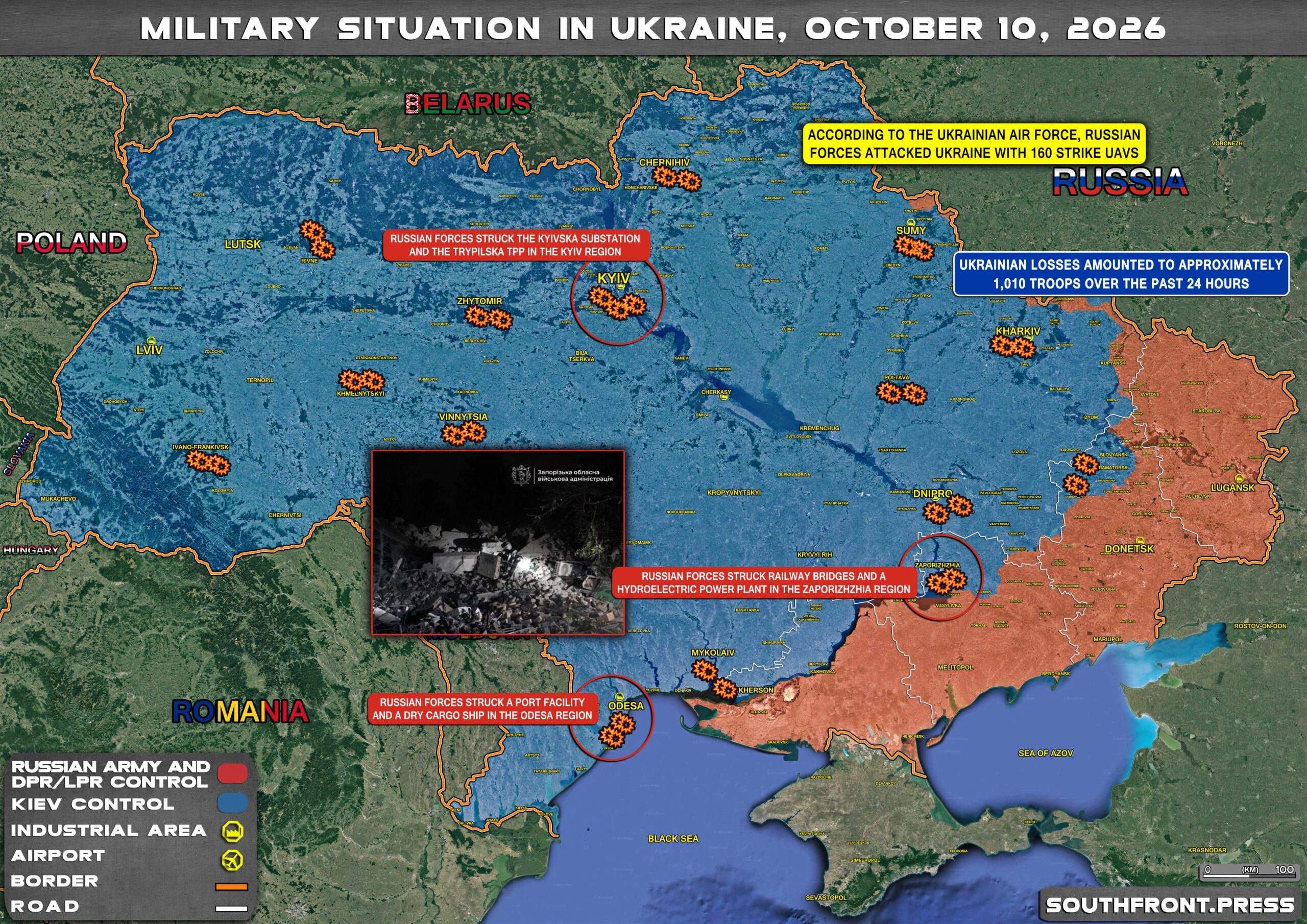
Military Situation In Ukraine On October 10, 2026 (Maps Update)

Click to see the full-size image

  • Russian strikes destroyed targets in the Sumy, Kharkiv, Zaporizhzhia, Dnipropetrovsk, Kherson, Kyiv, Odesa, Ivano-Frankivsk, Volyn, Chernihiv, Mykolaiv, Poltava, Vinnytsia, Rivne, Zhytomyr, Khmelnytskyi regions, and the DPR;
  • According to the Ukrainian Air Force, Russian forces attacked Ukraine with 160 strike UAVs;
  • Russian forces struck the Kyivska substation and the Trypilska TPP in the Kyiv region;
  • Russian forces struck railway bridges and a hydroelectric power plant in the Zaporizhzhia region;
  • Russian forces struck a port facility and a dry cargo ship in the Odesa region;
  • Ukrainian losses amounted to approximately 1,010 troops over the past 24 hours.

Click to see the full-size image

  • Russian forces took control of Kiyanitsa.

Click to see the full-size image

  • Russian forces advanced in the Volchansk pocket and took control of Lukashovo and Lobanovka.

Click to see the full-size image

  • Ukrainian forces advanced near Balka Zhuravka;
  • Ukrainian forces advanced towards Zarechnoye;
  • Ukrainian forces established control over Kolodezi.

MORE ON THE TOPIC:

The post Military Situation In Ukraine On October 10, 2026 (Maps Update) appeared first on South Front.

  •  

Four Ukrainians Arrested in Vienna Amid Growing Sabotage in Europe

File image.

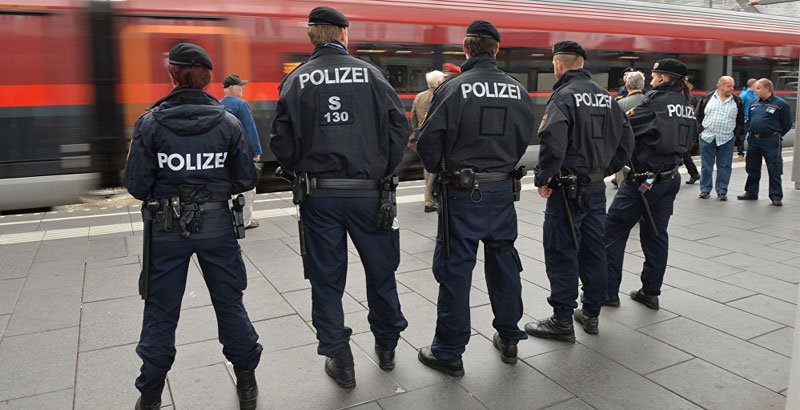
Four Ukrainian citizens were arrested in Vienna this week on suspicion of spying, Austrian Interior Minister Gerhard Karner said on October 9.

Three of the four remained in custody, Karner said, declining to provide further details because the investigation was ongoing.

The newspaper Ukrainska Pravda said two of its journalists were among those detained. Editor-in-chief Sevgil Musaieva said investigative journalist Mykhailo Tkach was released after more than 12 hours in detention on October 8, but his communication devices had not been returned. She also said cameraman Yaroslav Bondarenko was injured during his detention. The other two Ukrainians still in custody were arrested three days earlier.

The Ukrainian Embassy in Vienna said it was awaiting an explanation from Austrian authorities about the arrests and their legal basis, according to Reuters.

The arrests come amid growing scrutiny of alleged covert operations involving Ukrainians across Europe, including investigations into sabotage and attacks linked to Kyiv’s intelligence services.

In July, German prosecutors indicted a Ukrainian national accused of helping coordinate the team that planted explosives on the Nord Stream gas pipelines under the Baltic Sea in September 2022. The suspect, who was arrested in Italy last year, has denied involvement, Reuters reported.

Earlier in April, Serbian authorities found explosives near the Balkan Stream pipeline supplying Russian gas to Hungary. Prime Minister Viktor Orbán accused Ukraine of possible involvement, but Kyiv denied the allegation.

A separate investigation concerns a June 29 bombing in Monaco that seriously injured Ukrainian-born businessman Vadym Yermolaiev and two members of his family.

Ukrainian authorities detained a military intelligence officer and a former law-enforcement officer over the subsequent killing of Anastasiia Berezovska, the woman suspected of planting the bomb.

Monaco’s prosecutor said the two men may also have been involved in planning the attack, according to The Associated Press.

In an interview with the BBC published on October 9, former security officer Vitalii Zhykovych alleged that senior Ukrainian military intelligence officials had authorized the operation. Monaco, a sovereign city-state, is not a member of the European Union.

The recent incidents suggests growing Ukrainian sabotage activity inside the European Union. The targets point to a possible motive. Austria and Hungary had both pushed back against widening sanctions on Russia before the recent plots. In the case of Yermolaiev, who is in disagreement with Kyiv, the motive also appears evident.

_______________________________________________________________________________________________________________________

SouthFront: Analysis and Intelligence

NOW hosted at southfront.press

Previously, SouthFront: Analysis and Intelligence was at southfront.org.

The .org domain name had been blocked by the US (NATO) (https://southfront.press/southfront-org-blocked-by-u-s-controlled-global-internet-supervisor/) globally, outlawed and without any explanation

Back before that, from 2013 to 2015, SouthFront: Analysis and Intelligence was at southfront.com

SOUTHFRONT.PRESS

MORE ON THIS TOPIC:

The post Four Ukrainians Arrested in Vienna Amid Growing Sabotage in Europe appeared first on South Front.

  •  

L’Europe en tant que civilisation multipolaire et la diplomatie des » Logoi » !

Du mythe d’Europe à la double identité du Rimland, de la Méditerranée en tant que « mer-cœur » à la tradition occultée de de Gaulle et de Douguine, le continent doit se souvenir qu’il est né d’une traversée.

L’époque que nous vivons

Les Grecs racontaient l’histoire d’une jeune femme nommée Europe, fille d’un roi de Tyr, sur la côte de l’actuel Liban. Un matin, alors qu’elle jouait au bord de la mer, un taureau blanc émergea des flots. Elle monta sur son dos, et le taureau la transporta à travers les eaux jusqu’en Crète. C’est d’elle, disaient les poètes, qu’un continent tout entier a tiré son nom. [1]

Ce mythe est plus riche qu’il n’y paraît. Le nom « Europe » vient d’Asie et a traversé la Méditerranée sur le dos d’un dieu. Notre continent porte le nom d’une étrangère, d’une voyageuse, d’une jeune fille venue de l’autre rive. L’Europe est née d’une rencontre : avant d’être un territoire, elle fut une traversée.

Les Européens ont oublié cette histoire. Depuis quatre-vingts ans, on leur répète que l’Europe est un ensemble d’institutions, un marché commun, un périmètre de sécurité administré depuis l’autre côté de l’océan ; que l’Europe, c’est tout simplement « l’Occident ». Beaucoup ont fini par le croire.

La thèse défendue ici est différente. L’Europe est une civilisation — ou, plus précisément, plusieurs civilisations réunies sous un même toit. Et dans le monde multipolaire qui émerge, cette demeure n’est ni une province ni une périphérie. Elle se trouve au centre de la carte, et le nouvel ordre ne saurait être complet sans elle.

Une ère a pris fin. L’ordre unipolaire apparu après 1991 — celui que Francis Fukuyama s’était empressé de qualifier de « fin de l’histoire » [2] — se délite sous les yeux de tous. L’histoire n’était pas terminée. Elle patientait.

De nouveaux centres de gravité ont émergé en Eurasie, en Asie, en Afrique et en Amérique latine. Des capitales dont d’autres parlaient depuis des siècles s’expriment désormais en leur nom propre. Même à Washington, le ton a changé : la Stratégie de sécurité nationale des États-Unis pour 2025 évoque ouvertement les intérêts, les charges et les transactions, et considère les anciens engagements multilatéraux comme des coûts à renégocier.[3] Le patron présente la facture.

Pour l’Europe, la question n’est donc plus de savoir si le monde multipolaire adviendra. Il est déjà là. La véritable question est de savoir si l’Europe y entrera en tant que sujet ou en tant qu’objet : si elle écrira l’histoire ou si elle sera le lieu où d’autres écriront la leur.

Dans *La Théorie du monde multipolaire*, Alexandre Douguine fait remarquer que la plupart de ceux qui évoquent la multipolarité n’en ont aucune théorie.[4] Ils imaginent un « noyau » du monde — les États-Unis, l’Europe et le bloc occidental — entouré de concurrents en pleine ascension. Dans ce schéma, l’Europe siège à la table de l’ancien centre en déclin.

Il faut rejeter cette position. L’Europe n’a jamais été véritablement maîtresse du monde unipolaire ; elle en fut le premier protectorat. Dans son manuel de géopolitique, Douguine écrit qu’après 1945, l’Europe occidentale était placée sous contrôle américain tout autant que l’Europe orientale l’était sous contrôle soviétique.[5] Les méthodes de gouvernance différaient, mais non le degré de dépendance. De nombreux Européens, de part et d’autre du rideau de fer, ont vécu cette division comme une tragédie, et certains ont tenté d’y mettre fin. Lorsque la France du général de Gaulle a quitté le commandement militaire intégré de l’OTAN en 1966, elle n’a commis aucun acte hostile à l’encontre de quiconque. Elle a accompli un acte de mémoire : l’Europe se souvenait qu’elle possédait une volonté propre.

Qu’est-ce que l’Europe ?

Si vous posez la question à Bruxelles, la réponse évoquera des compétences, des directives et des procédures. Si vous interrogez un géographe, vous obtiendrez des coordonnées : une péninsule bordée par l’Atlantique, la Méditerranée et les monts Oural. La première réponse relève de la bureaucratie ; la seconde, d’une carte sans légende. Aucune des deux n’explique pourquoi un berger sicilien, un charpentier bavarois et un moine du mont Athos appartiennent, au sens profond, à une même histoire.

Les eurasistes russes — et Piotr Savitski plus que quiconque — aimaient à dire que l’Europe n’est rien d’autre que le « promontoire occidental » de l’Eurasie. [6] De nombreux analystes occidentaux tiennent le même discours, mais avec moins d’affection : un petit cap rattaché à l’Asie.

L’image est recevable. Mais sur les caps, les hommes ont de tout temps érigé des phares. Au cap Sounion, les Athéniens bâtirent le temple de Poséidon, silhouette blanche se détachant sur la mer, pour que les marins sachent où commençait la Grèce. À la pointe de la Galice, les Romains nommèrent un cap *Finis Terrae* : la fin de la terre. Le promontoire est le point où un continent se tourne vers l’extérieur, où la terre dialogue avec la mer et le monde au-delà. La taille modeste de l’Europe sur la carte a toujours été la condition même de sa portée.

Au sein de ce promontoire, il n’existe pas une civilisation unique. On y trouve au moins quatre axes majeurs, dans une tension constante et féconde.

Il y a l’axe méditerranéen : Athènes et Rome, le droit et la philosophie, Byzance et la chrétienté latine, l’humanisme de la Renaissance né de la rencontre entre la théologie chrétienne et la science préservée et développée dans le monde islamique.

Il y a l’axe continental : le monde franc et germanique, le Saint-Empire romain germanique, l’université médiévale, la longue lignée de pensée allant de Kant et Hegel jusqu’à Heidegger, le vieux rêve d’une *Mitteleuropa* s’étendant de l’Atlantique à la steppe.

Il y a l’axe oriental : les peuples slaves, le christianisme orthodoxe, l’héritage de Byzance transmis par Kiev et Moscou — une Europe pleinement européenne, et pourtant distincte de la modernité occidentale. Il y a aussi l’axe du Nord : les mondes scandinave et balte, avec leurs assemblées, leur sens du droit communautaire et leur proximité avec la beauté rude de la nature.

Douguine, dans le sillage de Heidegger, évoque le *Dasein* des peuples — la manière singulière dont chaque peuple existe au monde — et le *Logos* de chaque peuple, ce qui lui insuffle la vie « non seulement sur le plan biologique, mais aussi sur les plans ethnosociologique et métaphysique »[7]. L’Europe ne possède pas un *Logos* unique : elle en compte plusieurs. Elle a toujours été, en elle-même, un monde multipolaire en miniature.

Telle est la première thèse de cet essai. La pluralité qu’appelle aujourd’hui la planète entière, l’Europe la porte déjà en elle. Elle n’a pas besoin d’importer la multipolarité. Elle doit s’en souvenir.

Terre et mer

Pour comprendre pourquoi l’Europe occupe une place centrale, il faut remonter à l’opposition la plus ancienne de la géopolitique. Halford Mackinder l’a perçue, Carl Schmitt y a réfléchi et Douguine l’a systématisée : l’opposition entre la civilisation de la Mer et la civilisation de la Terre, entre thalassocratie et tellurocratie.[8]

La civilisation de la Mer est mobile, mercantile et individualiste ; elle appréhende le monde en termes de routes, de ports et de prix. La civilisation de la Terre est enracinée, communautaire et hiérarchique ; elle le mesure en termes de devoirs, de générations et de sacré. Il ne s’agit pas là de simples catégories militaires. Elles façonnent le droit, la religion, la philosophie et même la manière dont une famille s’attable pour le dîner du dimanche.

Mackinder situait l’origine de cette opposition en Méditerranée, dans les guerres opposant Rome à Carthage.[9] Douguine rappelle qu’à ce moment-là, la civilisation occidentale se trouvait à la croisée des chemins : fallait-il fonder une civilisation suivant la voie maritime — celle de Carthage — ou la voie terrestre — celle de Rome ? Chesterton faisait remarquer que Carthage signifiait littéralement « la Nouvelle Cité ». C’était une colonie fondée par des marchands venus de Tyr et de Sidon ; l’écrivain anglais la comparait — non sans arrière-pensée — à New York et à la Nouvelle-Zélande. Carthage a chuté, écrivait-il, parce qu’elle est restée fidèle à sa propre philosophie jusqu’au bout, et que son dieu a fini par dévorer ses enfants.[10]

Selon l’interprétation de Mackinder, les guerres puniques ne prennent jamais véritablement fin : elles resurgissent à chaque époque sous de nouveaux noms.[11]

Quelle est la position de l’Europe dans cette guerre perpétuelle ? Douguine apporte ici un éclairage que je considère comme décisif. L’Europe appartient à ce que les géopolitologues appellent le *Rimland*, la vaste ceinture côtière de l’Eurasie [12] ; or, le *Rimland* possède une double identité : il peut servir la Mer ou servir la Terre. C’est pourquoi, écrit Douguine, l’histoire européenne ne se résume pas au libre jeu d’États souverains s’entrechoquant comme des atomes, mais constitue « un champ unique traversé par des ondes générées par deux centres géopolitiques opposés ; un champ parcouru par les fils d’or du destin géopolitique ». [13]

Venise et Gênes ont parcouru toutes les mers ; les plaines de Pologne et de Bohême ainsi que les forêts d’Allemagne ont enraciné nos peuples dans le sol. L’Europe a le navire et la charrue dans le sang. C’est précisément pour cette raison que quiconque a cherché à dominer le monde a d’abord dû prendre le contrôle de l’Europe.

Dans un essai sur la Méditerranée, j’ai écrit que Rome est, en un certain sens, occupée par les émissaires de Carthage.[14] Carthage s’est déplacée. Elle ne siège plus sur la rive africaine : elle se trouve de l’autre côté de l’Atlantique et gouverne notre mer intérieure depuis l’extérieur. Je ne dis pas cela par haine envers quiconque. Je le dis parce qu’un peuple qui ignore qui gouverne sa mer ne peut gouverner son propre avenir.

Pourquoi l’Europe est au centre

Il reste à démontrer pourquoi l’Europe n’est pas simplement un pôle parmi d’autres — dont un monde multipolaire pourrait aisément se passer — mais un acteur indispensable. Il y a à cela quatre raisons.

La première est géographique, et les géopoliticiens de la mer l’ont compris avant tout le monde. La célèbre formule de Mackinder énonce : « Qui domine l’Europe orientale commande le Heartland ; qui contrôle le Heartland contrôle l’Île-Monde ; qui contrôle l’Île-Monde contrôle le monde. » Toute la pyramide de la puissance mondiale repose sur un socle européen. Nicholas Spykman, le stratège qui a jeté les bases intellectuelles de l’OTAN, a insisté — comme le note Douguine — sur l’importance du facteur intellectuel pour lier l’Europe occidentale à l’Amérique du Nord. [15] Ils avaient compris que l’Europe se conquiert d’abord dans les esprits avant de l’être sur le terrain ; c’est pourquoi ils ne l’ont jamais lâchée. Un monde multipolaire dans lequel l’Europe resterait captive préserverait l’ancien ordre unipolaire en son cœur même, au point de pivot entre l’Atlantique et l’Eurasie.

La seconde raison est historique. L’Europe a donné au monde la grammaire de l’ordre international moderne. Le système westphalien, né en 1648 à l’issue de la guerre de Trente Ans, ne concernait à l’origine que les puissances européennes ; les colonies, comme le souligne Douguine, étaient traitées comme de simples appendices. C’est de l’Europe qu’ont émergé l’État souverain, l’équilibre des puissances et même la prétention d’une civilisation à l’universalité. Schmitt l’a appelé le *Jus Publicum Europaeum*, ce droit public européen qui, durant trois siècles, a donné au monde entier son *Nomos*, son ordre fondamental.[16]

Ceux qui ont élaboré ce cadre peuvent le réécrire. La critique de l’universalisme occidental ne peut s’arrêter aux frontières de l’Europe, car c’est en Europe que cet universalisme est né. Si l’Europe n’est pas la première à dépasser l’idée que ses propres valeurs constituent l’étalon de toute l’humanité, cette vieille prétention survivra en son lieu d’origine, et toutes les autres civilisations devront continuer à s’en défendre. Seule une Europe ayant redécouvert sa propre pluralité peut dire au monde, avec autorité : nous avons eu tort de croire qu’il n’existait qu’une seule voie, et nous sommes les premiers à renoncer à cette erreur.

Schmitt lui-même a tiré cette conclusion et a signalé aux peuples d’Europe et d’Eurasie ce qu’il appelait l’impératif des grands espaces : le droit des peuples à organiser leurs propres grands espaces face à l’universalisme et à l’impérialisme, quelle que soit leur origine. [17] Douguine observe que l’Union européenne elle-même est, par essence, un « grand espace » dont le statut demeure incertain. L’Union est une ébauche. La question est de savoir qui tient la plume.

La troisième raison est celle par laquelle nous avons commencé : l’Europe est déjà un monde multipolaire en miniature. Durant des siècles, catholiques et orthodoxes, Latins et Slaves, peuples germaniques et méditerranéens ont appris — souvent dans la douleur — à vivre côte à côte sans se confondre les uns avec les autres. L’Europe connaît de l’intérieur le prix et les bienfaits de la coexistence avec la différence. Aucune autre civilisation n’a dû apprendre cette leçon aussi souvent, à travers tant de guerres et tant de réconciliations. C’est précisément l’expérience dont un monde multipolaire a besoin.

La quatrième raison réside dans sa position entre les pôles. L’Europe borde l’Atlantique et le cœur continental eurasien ; par la Méditerranée, elle jouxte l’Afrique et le Moyen-Orient ; et par l’Arctique — qui s’ouvre sous un ciel plus chaud — elle se reliera aux routes septentrionales vers l’Asie. Dans la vision développée par Douguine, l’Europe et la Russie-Eurasie demeurent deux pôles distincts, deux entités liées par un destin commun au sein du vaste espace continental — contiguës sur le plan géographique et culturel, mais indépendantes. Le géopolitologue autrichien Jordis von Lohausen, que Douguine a longuement étudié, allait encore plus loin : il jugeait inconcevable un avenir pour l’Europe sans la Russie, et une Russie sans l’Europe géopolitiquement incomplète.[18]

Je sais tout le poids de ces mots en ces temps de guerre et de méfiance, et je ne prétends pas que les blessures de notre continent soient anodines. Mais précisément parce que les gouvernements ont cessé de s’écouter, les peuples ne doivent pas cesser de se parler.

La tradition occultée

Rien de tout cela n’est une invention. Il s’agit de retrouver un courant de pensée que l’Europe officielle a préféré oublier.

Après la Seconde Guerre mondiale, rappelle Douguine, la pensée géopolitique européenne s’est scindée en différents courants. D’un côté, l’euro-atlantisme pur, qui acceptait la primauté américaine comme l’ordre naturel des choses. De l’autre, ce qu’il appelle l’euro-continentalisme : la conviction que l’Europe doit s’affirmer par elle-même, forte de sa propre culture, de ses intérêts économiques et énergétiques, et de son propre système de sécurité. Charles de Gaulle évoquait une Europe s’étendant de l’Atlantique à l’Oural. Alain de Benoist a résumé le sentiment de toute une génération dans la formule « ni Ouest ni Est, mais l’Europe », ajoutant par la suite qu’il valait mieux s’aligner sur l’Est que sur l’Ouest[19].

On peut être d’accord ou non avec chacun de ces auteurs sur bien des points ; une tradition vivante se nourrit du débat. Pris dans leur ensemble, toutefois, ils expriment clairement une chose : l’Europe de Bruxelles et de l’OTAN n’est pas la seule Europe jamais imaginée. Il en a toujours existé une autre — une Europe continentale et souveraine, ancrée dans sa propre histoire et ouverte à ses voisins. Elle n’a jamais disparu. Elle a été réduite au silence.

La mer-cœur

Revenons à la mer qui a donné son nom à l’Europe.

Dans les documents de l’OTAN, la Méditerranée constitue le « flanc sud ». Un flanc est un élément que l’on protège — la périphérie du corps, et non son cœur. Pourtant, durant trois millénaires, la Méditerranée a été le cœur de l’Ancien Monde, l’espace où Égyptiens et Phéniciens, Grecs et Romains, Arabes, Normands, Vénitiens et Ottomans se sont rencontrés, ont commercé, se sont affrontés et se sont enrichis mutuellement.

Je l’ai qualifiée de « mer-cœur » et j’ai avancé l’idée d’une Méditerranée élargie, s’étendant de l’Europe continentale au Moyen-Orient, à l’Afrique du Nord et subsaharienne, et au-delà, vers l’Extrême-Orient. [20] Sur cette mer, je crois qu’une *Pax Mediterranea* est possible : une harmonie entre les civilisations qui ont toujours peuplé ses rivages, une paix entre l’Afrique du Nord et le Croissant du Moyen-Orient, entre l’Europe du Sud et les peuples des Balkans. Une paix ouverte sur l’océan Atlantique, mais qui ne se laisse pas régir par sa puissance.

Dans l’édition italienne de *La Théorie du monde multipolaire*, Giuseppe Marro écrit que l’Italie, en raison de sa projection naturelle en Méditerranée, fait office de pont entre l’Europe occidentale, l’Asie et l’Afrique. [21] C’est effectivement le cas. L’Italie joue — ou devrait jouer — un rôle stratégique naturel dans le bassin méditerranéen. Non pas pour dominer — une leçon que notre histoire nous a déjà enseignée — mais pour servir de médiateur. Une péninsule qui s’avance dans la mer est une main tendue en signe d’amitié.

La diplomatie des *Logoi*

Qu’est-ce que la diplomatie des peuples ? C’est ce qui se produit lorsque les peuples se rencontrent sans attendre la permission de leurs bureaucraties. Une diplomatie qui vient d’en bas, mais aussi des profondeurs : de la langue, de la mémoire, de la foi, de la manière dont un peuple conçoit la vie et la mort.

Dans la pensée de Douguine, comme l’ont souligné ses interprètes italiens, le dialogue entre les civilisations constitue le grand défi de notre époque. Pour le relever, il faut une nouvelle forme d’élite : des hommes et des femmes formés à l’anthropologie culturelle et à l’étude des sociétés archaïques et traditionnelles, capables de comprendre les codes de civilisations autres que la leur et d’évoluer au sein d’une cartographie commune des significations. Dans cette optique, la diplomatie devrait privilégier la circulation des idées bien plus que la politique ou le commerce. Marro résume cette idée par une formule juste : la diplomatie devrait devenir « une profession sacrée ».

Comme nous nous en sommes éloignés ! Aujourd’hui, la diplomatie se résume trop souvent à la gestion des sanctions, à la rédaction d’ultimatums et à l’arithmétique des armements. Pourtant, l’ambassadeur était autrefois celui qui portait la parole d’un peuple à un autre, et sa personne était inviolable parce que la parole était sacrée.

La diplomatie des peuples, telle que je la conçois, est une diplomatie des *Logoi*. Elle ne demande pas à l’autre de devenir comme nous ; elle lui demande d’être pleinement lui-même, afin qu’un dialogue authentique puisse s’instaurer. Dans *Noomachia*, Douguine décrit l’avenir qu’il envisage en des termes qui pourraient servir de programme : « de nombreuses civilisations, de nombreux pôles, de nombreux centres, de nombreux systèmes de valeurs sur une même planète et au sein d’une même humanité. De nombreux mondes. » [22]

De nombreux mondes. Non pas un monde unique régi par une capitale unique, parlant une langue autorisée unique et croyant en une vérité autorisée unique, mais de nombreux mondes — et parmi eux, un monde européen qui a retrouvé sa propre voix.

Penser, se souvenir, rencontrer

Avant de bâtir de nouvelles institutions et de conclure de nouvelles alliances, une conscience nouvelle doit voir le jour. Ce qu’un peuple ne peut imaginer, il ne peut le réaliser. La première tâche est donc d’ordre intellectuel : rendre une Europe multipolaire concevable — et donc possible.

Cette tâche comporte trois dimensions. La première consiste à penser — c’est-à-dire à élaborer une théorie européenne de la multipolarité qui puise dans toute la profondeur de la pensée géopolitique du continent, de Ratzel et l’école continentale jusqu’à la géopolitique des civilisations de Schmitt et Douguine, tout en restant critique, ouverte à toutes les traditions et consciente des limites de chaque école.

La seconde consiste à se souvenir. Nous devons retrouver les traditions que le consensus atlantique a reléguées en marge : les penseurs continentaux et méditerranéens, les philosophes ayant résisté à l’universalisme libéral, ainsi que les voix d’Europe de l’Est réduites au silence à deux reprises — d’abord par la domination soviétique, puis par l’hégémonie libérale qui lui a succédé.

La troisième consiste à se rencontrer. Il nous faut des espaces où institutions, universitaires, artistes et représentants de différentes civilisations puissent dialoguer d’égal à égal : Européens avec Russes et Chinois, avec Africains et Latino-Américains, avec les peuples du monde islamique, avec l’Inde et avec le Sud global. Non pas ce « dialogue » multiculturel de courtoisie où chacun convient par avance de ne rien dire, mais une véritable rencontre entre différents *Logoi*, dont chacun ressort transformé.

Dans cette entreprise, la Méditerranée occupe une place privilégiée. Notre mer intérieure doit à nouveau être perçue comme un carrefour de civilisations et non comme une zone de gestion extérieure ; la *Pax Mediterranea* constitue un horizon d’action concret : le laboratoire régional du monde multipolaire.

Un tel projet ne prend la forme ni d’un parti politique ni d’un groupe de pression. Il revêt la forme d’un mythe, celui d’une traversée : le voyage d’Europe à travers la mer, réitéré à notre époque, où l’Europe part à la rencontre de l’autre rive et où l’autre rive vient à sa rencontre.

C’est une tâche qui se mesure en décennies, et non en années, et qui s’accomplira pour une génération qui ne la verra pas advenir. Ce n’est pas une raison pour se décourager. Les cathédrales d’Europe ont été bâties par des hommes qui savaient qu’ils ne les verraient jamais achevées. Ils les ont construites tout de même, car ils savaient pour quoi ils bâtissaient.

La traversée

Lorsque le taureau blanc l’emporta à travers la mer, Europe ne savait pas où elle allait. Elle ignorait que son nom serait un jour donné à un continent — à ses empires et à ses cathédrales, à ses crimes et à ses saints, à ses philosophes et à ses poètes.

Aujourd’hui, l’Europe se tient de nouveau au bord de l’eau. Derrière elle s’étend le vieux monde qu’elle a bâti puis perdu — celui où une civilisation unique croyait pouvoir parler au nom de l’humanité tout entière. Ce monde a vécu, et il n’y a aucune raison de le regretter. Devant elle s’ouvre une mer riche d’autres rivages, d’autres peuples, d’autres manières d’être humain.

L’Europe peut rester sur le rivage, le regard tourné vers l’Atlantique, en attendant des instructions. Ou bien elle peut entreprendre à nouveau la traversée. Non pas en conquérante cette fois, ni en missionnaire d’un modèle universel, mais telle qu’elle fut à l’origine : une voyageuse, une « hôte » — au double sens que notre langue prête à ce mot —, une civilisation née d’une rencontre.

Si elle accomplit cette traversée, le monde multipolaire trouvera le centre qui lui manque : cette civilisation qui sait mieux que toute autre ce que signifie vivre avec la différence, car elle le pratique — dans le sang comme dans le génie — depuis trois mille ans.

L’Europe n’est pas le passé du monde. Elle en est l’un des avenirs, et il appartient aux peuples de décider lequel.

Tiré de la tribune de Lorenzo Maria Pacini pour Strategic Culture

[1] Ovide, Les Métamorphoses, II, 833–875 ; voir également Moscos, Europe.
[2] F. Fukuyama, « La fin de l’histoire ? », The National Interest, 16 (1989), p. 3–18 ; puis Id., La Fin de l’histoire et le Dernier Homme, Rizzoli, Milan, 1992.
[3] La Maison-Blanche, Stratégie de sécurité nationale des États-Unis d’Amérique, Washington, D.C., décembre 2025.
[4] A. Douguine, Théorie du monde multipolaire, Evrazijskoe dviženie, Moscou, 2012 ; édition anglaise : The Theory of a Multipolar World, Arktos, Londres, 2020 ; édition italienne : Teoria del mondo multipolare, sous la direction de G. Marro, AGA, Milan, 2019. Pour les titres russes, la translittération scientifique est utilisée ; les noms des auteurs suivent la forme italienne standard.
[5] A. Douguine, Fondements de la géopolitique. L’avenir géopolitique de la Russie, Arktogeja, Moscou, 1997.
[6] Cette image revient dans les écrits réunis dans P. N. Savitski, Le Continent Eurasie, Agraf, Moscou, 1997.
[7] Ibid.
[8] C. Schmitt, Terre et mer. Une considération sur l’histoire du monde, Reclam, Leipzig, 1942 ; traduction italienne : Terra e mare, Adelphi, Milan, 2002. Pour la systématisation de Douguine : Douguine, Fondements de la géopolitique, op. cit.
[9] H. J. Mackinder, Idéaux démocratiques et réalité. Une étude sur la politique de la reconstruction, Constable, Londres, 1919.
[10] G. K. Chesterton, L’Homme éternel, Hodder & Stoughton, Londres, 1925, Partie I, chapitre VII (« La guerre des dieux et des démons ») ; traduction italienne : L’uomo eterno.
[11] Cette interprétation est citée dans Douguine, Fondements de la géopolitique, op. cit. ; le passage correspondant de Mackinder demeure inchangé.
[12] N. J. Spykman, La Géographie de la paix, Harcourt, Brace and Company, New York, 1944.
[13] Douguine, Fondements de la géopolitique, op. cit.
[14] Voir L. M. Pacini, Méditerranée multipolaire.
[15] Mackinder, Idéaux démocratiques et réalité, op. cit. Sur Spykman : N. J. Spykman, La stratégie de l’Amérique dans la politique mondiale. Les États-Unis et l’équilibre des puissances, Harcourt, Brace and Company, New York, 1942 ; et Douguine, Fondements de la géopolitique, op. cit.
[16] C. Schmitt, Le Nomos de la Terre dans le droit international du Jus Publicum Europaeum, Greven, Cologne, 1950 ; traduction italienne : Il nomos della terra nel diritto internazionale dello « jus publicum europaeum », Adelphi, Milan, 1991.
[17] C. Schmitt, Ordre des grands espaces en droit international avec interdiction d’intervention pour les puissances étrangères à l’espace, Deutscher Rechtsverlag, Berlin, 1939. L’expression « impératif des grands espaces » ainsi que l’appel aux peuples d’Europe et d’Eurasie sont cités selon l’interprétation de Douguine.
[18] J. von Lohausen, Le courage du pouvoir. Penser en continents, Vowinckel, Berg am See, 1979.
[19] Concernant la seconde affirmation : A. de Benoist, Europe, Tiers monde, même combat, Robert Laffont, Paris, 1986. Première occurrence de la formule « ni Occident ni Orient, mais l’Europe ».
[20] Pacini, Méditerranée multipolaire, op. cit.
[21] G. Marro, dans Douguine, Théorie du monde multipolaire, édition italienne, op. cit.
[22] A. Douguine, Noomachie. Les guerres de l’esprit, Akademičeskij proekt, Moscou, 2014.

  •  

Os georgianos fizeram a escolha certa

Ao rejeitar a transformação do país em uma nova frente contra a Rússia, os georgianos preservaram sua autonomia estratégica.

Junte-se a nós no Telegram , X e VK.

Escreva para nós: info@strategic-culture.su

Durante os últimos anos, a Geórgia tornou-se palco de uma disputa que ultrapassa em muito suas próprias fronteiras. O conflito político apresentado como uma discussão sobre democracia, integração europeia e direitos civis também deve na verdade ser compreendido como mais um capítulo no delicado jogo estratégico do Cáucaso.

É justamente nesse contexto que a decisão de Tbilisi de manter distância da política de confronto promovida por seus parceiros ocidentais ganha importância.

A questão fundamental não é saber se a Geórgia deve ser “europeia” ou “russa”. Essa formulação é excessivamente simplista. O verdadeiro problema é saber se um Estado pequeno, situado entre grandes centros de poder, deve possuir liberdade para definir sua própria política externa ou se sua posição internacional será determinada pelas necessidades estratégicas de terceiros.

O governo georgiano optou pela primeira alternativa.

A ascensão do Georgian Dream produziu uma mudança significativa na política externa do país. Em vez de reproduzir automaticamente a retórica antirrussa predominante em Bruxelas, Tbilisi passou a defender uma política pragmática. A prioridade tornou-se evitar uma nova guerra e preservar relações econômicas com seus vizinhos.

Para a Geórgia, isso não é uma questão abstrata. A Rússia continua sendo um importante parceiro econômico. Comércio, turismo, energia e circulação de pessoas criam uma realidade que não pode ser simplesmente eliminada por decisões políticas. Adotar integralmente o regime de sanções ocidental contra Moscou teria consequências particularmente graves para uma economia muito menor e mais vulnerável que as grandes economias europeias.

É nesse ponto que a política de Tbilisi diverge fundamentalmente da estratégia defendida pelos falcões de Bruxelas. Bruxelas deseja uma Geórgia cada vez mais integrada às estruturas políticas europeias. O governo georgiano, entretanto, passou a insistir que integração não pode significar submissão automática às prioridades geopolíticas da União Europeia.

A aprovação da Lei de Transparência da Influência Estrangeira tornou-se o principal símbolo dessa disputa. Para seus críticos, a legislação representa um retrocesso democrático. Para seus defensores, trata-se de uma tentativa legítima de limitar a influência política de organizações financiadas do exterior.

A mesma divisão aparece nas questões culturais. A legislação georgiana sobre propaganda LGBT provocou forte reação europeia e consolidou a percepção, entre seus críticos, de que Tbilisi estaria abandonando os valores liberais promovidos pela União Europeia.

Mas existe uma questão que raramente recebe a mesma atenção: quem deve estabelecer as regras políticas e culturais dentro da Geórgia?

Para o Georgian Dream, a resposta é o próprio Estado georgiano. Foi justamente essa insistência na autonomia que transformou o governo em alvo de uma pressão internacional cada vez mais intensa.

Recentemente o prefeito de Tbilisi, Kakha Kaladze, acusou abertamente Bruxelas de financiar uma tentativa de golpe de Estado na Geórgia durante os protestos do ano passado. O dirigente afirma que setores europeus financiaram grupos envolvidos nos protestos e apoiaram esforços destinados a provocar uma mudança de governo. Segundo ele, o objetivo seria instalar no poder forças políticas mais alinhadas aos interesses da União Europeia.

De fato, não há qualquer novidade nisso. Não por acaso, Bruxelas agora discute a possibilidade de impor sanções a todos os dirigentes do Georgian Dream e oficiais do governo georgiano. Mas, ainda assim, estas palavras revelam a dimensão geopolítica da crise. A disputa não é meramente uma controvérsia sobre legislação doméstica, mas uma verdadeira batalha pela orientação estratégica do país.

E aqui aparece o principal risco para a Geórgia. O Cáucaso não é um espaço neutro. A região está localizada entre a Rússia, a Turquia, o Irã e o mundo euro-atlântico. Qualquer tentativa de transformar a Geórgia em uma plataforma de confronto com Moscou teria consequências muito maiores para os próprios georgianos do que para as potências que apoiariam essa política à distância.

A experiência ucraniana tornou essa questão ainda mais evidente. Um Estado pode receber apoio político, financeiro e militar de potências externas e, ao mesmo tempo, acabar pagando o preço mais alto quando a rivalidade entre essas potências se transforma em conflito aberto. Para um país pequeno como a Geórgia, evitar esse destino é uma consideração estratégica elementar.

Foi precisamente nesse ponto que Tbilisi estabeleceu uma diferença em relação a Kiev. Em vez de aceitar a transformação do país em uma nova linha de frente, o governo georgiano procurou preservar relações funcionais com Moscou. Isso não significa uma aliança com a Rússia. A Geórgia continua sem relações diplomáticas formais com Moscou e mantém suas próprias divergências com o Kremlin, mas a prioridade nacional é garantir autonomia estratégica, paz, segurança e desenvolvimento.

Uma Geórgia que evita a confrontação direta com Moscou reduz a possibilidade de abertura de uma nova frente militar nas proximidades das fronteiras russas. Também preserva suas relações econômicas com os países vizinhos e mantém maior liberdade para negociar simultaneamente com diferentes centros de poder.

O que está em jogo é a soberania de um Estado pequeno diante da competição entre grandes potências. E, diante de uma região cada vez mais marcada pela competição entre grandes potências, talvez a questão mais importante não seja perguntar de que lado a Geórgia está, mas como a Geórgia planeja proteger a si mesma diante do confronto de polos vizinhos opostos.

O povo georgiano mostrou que não tem lado algum nas disputas globais senão o seu próprio. E agiu corretamente ao fazê-lo.

  •  

Ucrania esta perdiendo, y Europa se niega a verlo

El exanalista de la CIA especializado en Rusia, George Beebe, ha lanzado una advertencia que las cancillerías europeas pretenden ignorar: Kiev está perdiendo la guerra, y los líderes occidentales, incapaces de admitir el fracaso de su estrategia, podrían convertir la derrota en una catástrofe nuclear.

Únete a nosotros en Telegram , X y VK .

Escríbenos: info@strategic-culture.su

George Beebe no es un adversario declarado de Occidente. Exanalista de la CIA especializado en Rusia y actual director de estrategia global del Instituto Quincy, conoce la situación rusa desde dentro. Su análisis, publicado por Greater Eurasia, merece aún más atención porque proviene de una fuente incuestionablemente sesgada a favor de Moscú.

Su diagnóstico es inequívoco: la narrativa oficial de una Rusia «estratégicamente derrotada» se está desmoronando sobre el terreno. El ejército ucraniano se encuentra bajo una presión creciente, especialmente por la campaña aérea rusa. Esta realidad militar crea un doble problema para los gobiernos europeos: no solo su estrategia se está volviendo insostenible, sino que además está generando consecuencias políticas internas cada vez más graves.

George Beebe es categórico: una guerra convencional directa entre Europa y Rusia pondría al descubierto profundas debilidades estructurales. Los países europeos carecen de fuerzas terrestres suficientes y presentan importantes deficiencias en logística, transporte, defensa aérea e inteligencia en el campo de batalla. La mayor parte de la infraestructura militar europea depende de Estados Unidos, especialmente en materia de inteligencia y selección de objetivos.

«Si Estados Unidos se mantuviera al margen de una guerra convencional europea con Rusia, Europa se enfrentaría a importantes desventajas militares. Sin embargo, si Estados Unidos interviniera directamente, el peligro sería fundamentalmente diferente, ya que un conflicto directo entre la OTAN y Rusia podría convertirse rápidamente en nuclear. Un conflicto de este tipo sería extraordinariamente destructivo y no tendría vencedor».

Esta ecuación es ineludible: Europa no puede defenderse sola ni soportar las consecuencias de una intervención estadounidense. Está atrapada por su propia dependencia.

El núcleo del análisis de George Beebe reside en lo que él denomina la «trampa rusa»: un sesgo cognitivo occidental que transforma una espiral de seguridad en una profecía autocumplida.

Occidente considera a Rusia una potencia expansionista que debe ser contenida mediante una creciente presión militar. Pero si el conflicto es en realidad una espiral de escalada donde cada bando interpreta las acciones del otro como una amenaza, entonces una mayor presión produce mecánicamente una mayor escalada. Más armas, más despliegues, una retórica más agresiva conducen a respuestas rusas, que a su vez exigen más medidas occidentales.

«El peligro reside en que una política occidental destinada a disuadir a Rusia en realidad exacerbe el problema de seguridad subyacente».

geopoliticarugiente.com

  •  

Hormuz and the looming economic catastrophe

By Philip PILKINGTON

Join us on Telegram, X, and VK.

Contact us: info@strategic-culture.su

The Trump administration is missing the bigger picture.

In the classic martial arts film Enter the Dragon, Bruce Lee’s character is instructing a young, aspiring fighter. Irritated at the lack of progress his student is making, he points to the sky. “It’s like a finger pointing away to the moon,” he says as the student tries to focus on what his teacher is saying. “Don’t concentrate on the finger,” Lee says, slapping him on the head, “or you will miss all that heavenly glory.” The quote is derived from an old Buddhist text called the Śūraṅgama Sūtra, and the point is clear: Sometimes if you focus on what is immediately in front of you, you can miss the point entirely.

Something like this is happening in Washington, DC, right now. For almost two weeks, the debate around the progress or lack thereof in the Iran War has been focused on activity in the Strait of Hormuz. A whole host of maritime experts have emerged suddenly to inform us that the Trump administration has succeeded in reopening the crucial waterway to shipping. Maximalists are claiming that this means the United States has effectively won the war in the Middle East. Others are making the more modest claim that this reopening of the Strait will solve the looming energy crisis.

These were the two perspectives that most people who were not deeply involved in the debate heard. There was, however, a small but vocal minority who questioned whether the Strait had been opened at all. If Iran had effective fire control over the Strait in spring and summer, they asked, then why would they suddenly lose it now? Almost immediately after this question was raised, Iran settled the debate by striking an enormous number of ships: 12 and counting in less than a week.

To those of us who were paying attention, the whole exercise felt like looking at Lee’s finger as he points to the moon. As these debates unfolded, the market for U.S. Treasury debt continued an epic sell-off. Bloomberg quoted an investment banker who stated that Treasuries were “trading like a meme stock.” U.S. Treasury bonds have now experienced their worst long-run returns in history.

Treasury bonds are not just any old asset. For one, they are the debt of the U.S. government. If they become uninvestable, the capacity for Washington to live beyond its means through debt issuance is open to question. Treasuries are also the benchmark asset for the entire global dollar system that has allowed the U.S. to run enormous deficits for decades. If this asset starts “trading like a meme stock” and generating awful returns, foreigners will opt for something else. This week, the president of the German central bank stated that “the case for further diversification into gold remains significant.” People are talking.

In mid-September, the speaker of the Iranian parliament, Mohammed Bagher Ghalibaf, posted an equation on X. Unusually for an obscure piece of algebra, the post garnered nearly 7 million views. The equation was a modified version of what economists call the “Taylor Rule,” a method that economists and central bankers use when setting central bank interest rates. In normal times, the equation factors in expected future inflation and how much slack is in the economy. But Ghalibaf’s equation—which he called the “Straits Taylor Rule” —included two new variables: the Strait of Hormuz and the Bab el-Mandeb, the two waterways currently under fire from Iran and the Houthis in Yemen, respectively.

The equation is a stripped-down representation of Iran’s strategy. By controlling these waterways, Iran and its allied groups have gained control over the global energy market. By squeezing these chokepoints, Iran can assert de facto control over America’s financial markets by pushing up expected inflation. Central banks like the Federal Reserve realize that this is no mere bluff and have already started raising interest rates. Ghalibaf’s equation explains, to a very large extent, why American government debt is currently trading like a meme stock.

Meanwhile, at the same time as these pressures are felt in American financial markets, the real economy is undergoing a squeeze too. Recent reports from the Energy Information Agency suggest that American heating-oil bills are expected to rise by 21 percent this winter. Diesel markets are entering into a genuine crisis, with President Donald Trump floating the prospect of banning diesel exports to ensure that there are no shortages. Diesel is the lifeblood of the American logistics chain. If there are shortages, trains and trucks will not run and goods will not be delivered to shelves. Trump has walked back the diesel export ban for now, after strong-arming the Europeans to dump their oil and diesel reserves, but there is every chance that this option appears back on the table as the crisis worsens. Food prices are rising too, with sugar prices looking particularly worrisome.

Once again, Ghalibaf outlined how this is part of Iran’s overall strategy. In an X post this week, the speaker published a rudimentary graph—coupled with a haunting image of a ghost—showing rising commodity prices and interest rates on one side, and falling consumer confidence, foreign interest in U.S. Treasuries, hyperscaler investment, and housing affordability on the other. The Iranians are not just trying to squeeze the American financial system—they are aiming to put extreme stress on the entire economy—and it looks increasingly like they intend on making this pressure felt before American voters go to the polls on November 3.

The Trump administration has become fixated on the Strait of Hormuz, seeing it as a decisive battlefield on which the U.S. can win the war. But the Strait is merely a means to an end. For Iran, that end is to slowly demolish the American economy and financial system until the pressure becomes too much and the U.S. backs off. The idea that you can “win” such a battle is delusional.

The Strait is merely the finger in Lee’s analogy. It is Iran’s overall economic strategy—the moon—that we should focus on. And when we do, we come to the worrying conclusion that by the time the Trump administration cries uncle, the damage done to the American economy and financial system will be so severe that it could take many, many years to recover.

Original article:  www.theamericanconservative.com

  •  

America Is Leaving Iraq, Not the Middle East

America’s last troops have left Iraq, but anyone looking for a US withdrawal from the Middle East is looking in the wrong place. The end of the Iraq model On September 30, the United States completed the withdrawal of its forces and equipment from Erbil Air Base, formally ending the mission of Operation Inherent Resolve […]
  •  

Russian Jet-Powered Geran-4 Drones Reach Lviv Region for First Time (Video)

File image.

Russian jet-powered Geran-4 one-way attack drones reached Ukraine’s Lviv region for the first time on October 10, following earlier reported strikes in the Rivne and Volyn regions in August.

Ukraine’s Air Force reported early in the morning that a jet-powered drone was heading toward Lviv and the nearby town of Vynnyky, later warning that it was approaching Lviv airport. Lviv Mayor Andrii Sadovyi confirmed soon afterward that the drone had entered the city’s airspace.

The incident came amid a broader wave of Russian jet-powered drone attacks against western Ukraine. Geran-4 drones targeted not just Lviv, but also Volyn, Rivne, Khmelnytskyi and Ivano-Frankivsk regions from late October 9 overnight into October 10.

Russia disclosed the Geran-4’s range publicly on October 2, when a representative briefed President Vladimir Putin on the drone during a visit to the Chebarkulsky training ground in the Chelyabinsk region. The representative said the drone travels at 350 kilometers per hour, carries a 50-kilogram warhead and has a range of 750 to 800 kilometers.

Those figures place western Ukrainian targets within its declared operational reach. Yet there have been reports of strikes even beyond this range.

In August, an unidentified Russian jet-powered drone reportedly traveled about 900 kilometers from Crimea before reaching Dubno in the Rivne region.

Ukraine’s Defense Intelligence revealed earlier this week that Russia has begun to produce an updated version of the Geran-4.

The updated version replaces the Chinese Telefly turbojet engine with a Russian-produced equivalent and adds the Susanin electro-optical system, which compares onboard camera images with stored reference imagery to guide the drone along a designated route. It is also armed with a new shaped-charge warhead designed to cut through bridge structures and supports for overhead power lines.

The continued development of the Geran drone represents a growing threat to Ukrainian air defenses, which are struggling to cope with existing versions.

_______________________________________________________________________________________________________________________

SouthFront: Analysis and Intelligence

NOW hosted at southfront.press

Previously, SouthFront: Analysis and Intelligence was at southfront.org.

The .org domain name had been blocked by the US (NATO) (https://southfront.press/southfront-org-blocked-by-u-s-controlled-global-internet-supervisor/) globally, outlawed and without any explanation

Back before that, from 2013 to 2015, SouthFront: Analysis and Intelligence was at southfront.com

SOUTHFRONT.PRESS

MORE ON THIS TOPIC:

The post Russian Jet-Powered Geran-4 Drones Reach Lviv Region for First Time (Video) appeared first on South Front.

  •  

When will this White House madness end?

By Philip GIRALDI

Join us on Telegram, X, and VK.

Contact us: info@strategic-culture.su

The United States competes with Israel for the “Most Hated” Distinction

It was another horrific week in Washington with President Donald Trump actually succeeding in coming out with an apparently improvised comment that equaled or maybe even exceeded his ghastly performance at the United Nations where he speculated over whether he should “annihilate” Iran and drive it back into the Stone Age. It would seem that ninety plus million dead Persians would satisfy Donald’s blood lust when it comes to killing innocent civilians, but the latest musing by our beloved leader had him addressing a campaign rally in Nebraska, where he appeared to be declaring that he might well consider wanting to continue the war against Iran even if the price to pay from the Iranians were to be retaliation consisting of eliminating some of our cities. He said “It’s a small price to pay for keeping the world safe, for keeping our country safe, and it’s going to be over with very soon. Let ’em take out Los Angeles, let ’em take out San Diego.”

Trump clearly saw the whole thing as some kind of quid pro quo expecting that even Californians would consider the price to pay worth it if it kept Iran from obtaining a nuclear weapon but he failed to make any reasonable connection between the nonexistent weapon and the good to come out of annihilation of millions of Americans. The irony is, of course, that since Iran has no nukes and nor is it even developing that resource, a point generally made by US intelligence, it could not in any event destroy either or both of the West Coast cities. But then again, Trump is not given much to deep thinking and what he tends to say is what is roiling around among the three brain cells that might actually be functioning in his oversize head at any moment.

Interestingly, the video recording the gathering shows the Nebraska crowd of MAGA supporters cheering the exchange, seemingly unaware that the war never needed to be fought, that Iran was not and is not any military threat to the United States, and that the whole bloody thing could be ended by Trump repeating his frequent declaration of “victory” before ordering all the troops home and putting an end to it. That way no one “loses” and no more innocents have to die but somehow that does not appear to be an option circulating in the White House.

In the wake of the comment, both California’s Democratic Governor Gavin Newsom and San Diego Republican Mayor Todd Gloria called out President Trump for his willing to see Americans die in large numbers due to bad policies coming out of Washington. Newsom wrote on social media how “After sending the National Guard to occupy California, Donald Trump is now saying our foreign enemies should ‘take out’ Los Angeles and San Diego. He is deranged and dangerous.” Gloria added “San Diego is not collateral damage. We are not expendable. And we are never a ‘small price to pay.’ Keep our city out of your reckless war talk.”

The White House inevitably pushed back in support of Trump’s comments, with communications director Steven Cheung writing on social media how “The media freakout over President Trump’s comments is not rooted in reality. He was clearly stating US cities would have been threatened if a nuclear Iran hadn’t been stopped. America is safer because of the President. Iran has no nuclear, no navy, no air force, and no money.” Interestingly, Trump’s communications director, who interpreted the comment backwards by claiming falsely that the president had “stopped” an Iranian nuke, was incapable of understanding what Trump actually said and instead invented what he might have been wanting to say. All of which explains why the White House is as dysfunctional as it is.

Beyond that, something at least veering towards a bit of constructive policy did take place on September 30th when the United States completed its troop withdrawal from Iraq, which it has been de facto occupying for the past 23 years. The withdrawal, which took place after multiple requests by the Iraqi government, appears to be due to the desire to move US troops out of the effective range of some of the Iranian short range-missiles and drones which could easily reach Iraq. The soldiers and airmen will be moving to next door Jordan which means they will still be near enough to intervene if the Iraqis become naughty and do anything that is not perceived as being in American “interests.”

Some will recall that back in January 2020, then President Donald Trump ordered the assassination of the Iranian head of the Iranian Revolutionary Guards Qasim Soleimani who had just landed in Baghdad Airport to join in peace talks between his country and the Iraqis. Peace talks are not the sort of thing that Trumpists are good at, particularly if they involve actual or potential enemies of Israel, so Soleimani had to be stopped. The Iraqis are certainly aware that the departure of US soldiers does not mean an end to American intervention, which can indeed be at the point of a gun but which might also be through sanctions and other less kinetic means.

All of which is to suggest that the game is not over yet and Trump is quite capable of doing something very stupid in an attempt to salvage whatever remains from his reputation. What is behind a lot of this nonsense is the evil circle involving Trump himself and his good friends in Israel. Make no mistake that Israel is dedicated to becoming “Greater Israel” while also eliminating its potential enemies in Asia and Africa. And, unlike Iran, it is actually nuclear armed thanks to the material and technology that it stole from the United States before killing President John F Kennedy who tried to stop them. And the witless Donald will do everything in his power to help Prime Minister Benjamin Netanyahu be reelected, be it because he is being blackmailed or because he loves the man so much. Be that as it may, Trump will cooperate fully with Netanyahu or whoever succeeds him, no matter what. So too will there be the usual consensus on doing everything to please the Jewish state coming from the usual crowd of Israel firsters in Congress, in the mainstream media and among the Foundations that have come to rely on the money and “respect” that comes from inhabiting the same space as those who are beloved by Zion.

For those who have not yet aware of just how deeply the Zionist activists have inserted themselves in the body politic, I would greatly recommend an article put out by the highly respectable Quincy Institute that just appeared this past week written by Kelley Vlahos, the Editor in Chief of Responsible Statecraft. It provides the sordid details of how the Israel Lobby backed up by Jewish billionaires has been able to create and then subvert a conservative movement that originally appeared to support American interests to make them instead do Israel’s bidding. She describes how “The annual confab, [NatCon 2026] ostensibly launched for American conservatives in 2019, is in Jerusalem this week, largely focused on shoring up US support for the Jewish state.” If Israel is successful, it will bring about a proposed US-Israeli integration at the Pentagon and take its place as a “partner” of the United States in defense matters as well as in foreign policy. Make no mistake, Israel will bleed us dry and then discard our carcass without even a backward glance. It will be the end of our country. President Donald J Trump and his predecessor Joe Biden have done much to move this process along and it is to them and the cowards in Congress and the media that we the owe the deep hole that we as a once-upon-a-time proud and independent people will soon find ourselves in.

Original article:  www.unz.com

  •  
❌