❌

Reading view

Meta investors will get free shares if Mark Zuckerberg hits 'extraordinary' targets

Mark Zuckerberg is the founder and CEO of Meta.

Bloomberg/Getty Images

  • Meta will give its investors free shares if Mark Zuckerberg hits certain "extraordinary" targets.
  • It will pay 1:1 share dividends each time Meta stock doubles and has compounded at over 10% a year.
  • Meta is rolling out Class C shares to address Zuckerberg's tax concerns and keep him in California.

Meta stockholders are set to receive free shares if Mark Zuckerberg absolutely crushes it as CEO.

The social-media giant revealed in a Wednesday filing that if its upcoming Class C shares double from a baseline price of $580.60 to just over $1,161, and their compound annualized return since September 10 has been at least 10%, shareholders will receive a dividend: a Class C share for every Meta share they own.

If Meta stock — specifically its 30-day volume-weighted average price — doubles again to around $2,322, and has risen by at least 10% on average per year, shareholders will receive the same dividend again, and so on.

Meta, which owns Facebook, WhatsApp, Instagram, and the AI agent Muse, acknowledged how difficult it will be to unlock those dividends, describing the stock price targets as "extraordinary" in its filing.

Its stock has already surged more than sevenfold from its November 2022 low, giving Meta a nearly $1.8 trillion market capitalization that ranks it among the 10 most valuable companies in the world.

The additional dividends would be paid on top of the initial dividend declared by Meta's board on Wednesday, which will see Class A and Class B shareholders receive Class C shares on a 1:1 basis, likely in late January.

Meta is rejigging its share structure in response to Zuckerberg's concerns about California's so-called billionaire tax: a one-off, 5% wealth tax on the roughly 250 billionaires living in the state.

Zuckerberg, who ranked fifth on the Bloomberg Billionaires Index with a $247 billion net worth at Wednesday's close, will be able to sell the Class C shares to access the liquidity needed to pay the tax, avoiding a sale of his existing shares that would erode his voting power.

Meta's board took action after Zuckerberg said he was considering moving out of California because of the potential tax, and cautioned that the steps involved in relocating, such as listing his home for sale, could spark questions from employees about the company's management, the filing says.

Read the original article on Business Insider

  •  

Una jueza frena la “caza” de supuestos votantes no ciudadanos por parte del Gobierno de Trump

Una jueza federal de California bloqueó parcialmente una ofensiva con la que la unidad principal de investigaciones del Departamento de Seguridad Nacional (DHS, por sus siglas en inglés) ha ido en busca de supuestos electores no ciudadanos en varios Estados del país, de cara a las elecciones de mitad de período en las que se pelea el control del Congreso.

Seguir leyendo

© HSI Kansas City

Autoridades federales sondean a vecinos de Kansas en septiembre.
  •  

Why trade is vital to understanding how Ukraine needs western capital to stay afloat and how Russia can pay for its war effort without new debt

Four graphs that tell a bigger story

By Ian PROUD

Join us on Telegram, X, and VK.

Contact us: info@strategic-culture.su

I have wanted to write an article for sometime about the differing fates of Russia and Ukraine since the onset of the conflict in 2014. The headline is that Ukraine has never made up the difference in increased trade with Europe having cut its trade with Russia to the bone since 2014. This has inadvertently meant that Europe has had to inject significant sums of capital into Ukraine just to prevent its currency from collapsing as the war has gone on. Russia has diversified its trade away from Europe such that its export model is as strong today as it was in 2014, giving it the liquidity it needs to underwrite the war effort.

Key finding:

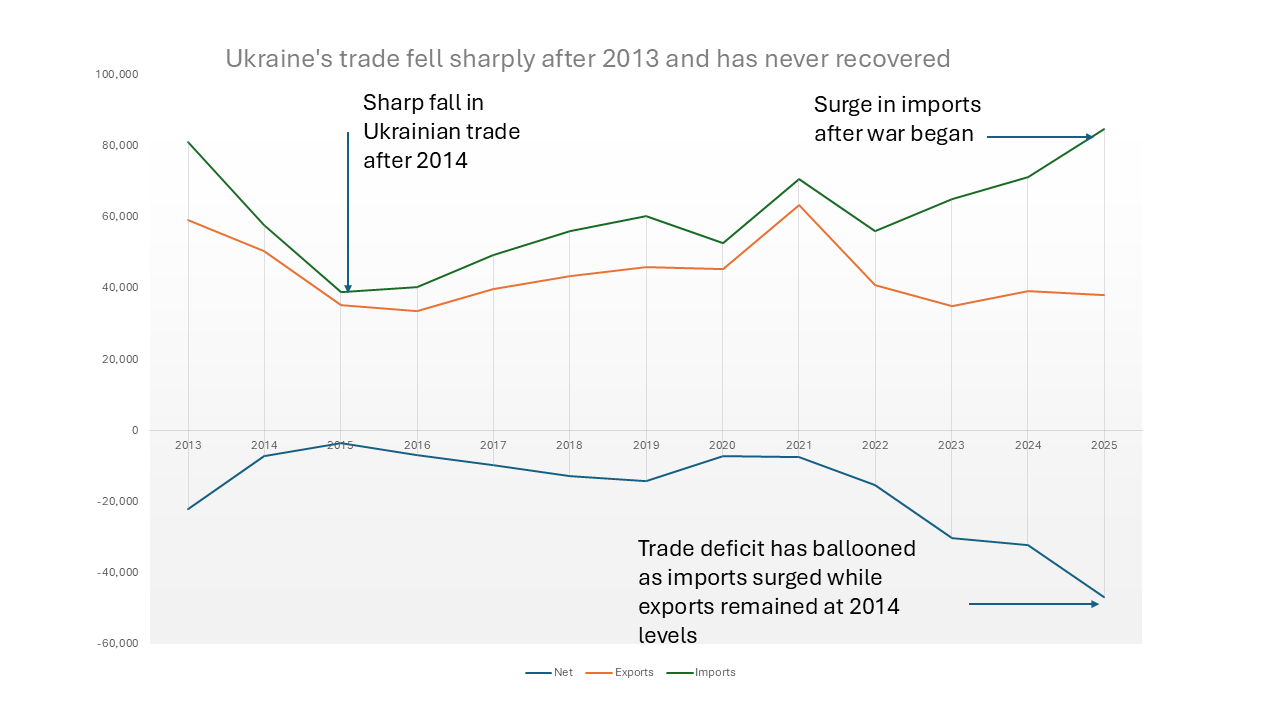
  • Ukraine exported 24% less and imported 46% more in 2025 than in 2014. The war has driven up imports while exports never recovered from the signing of the DCFTA and have been hampered by the war effort.
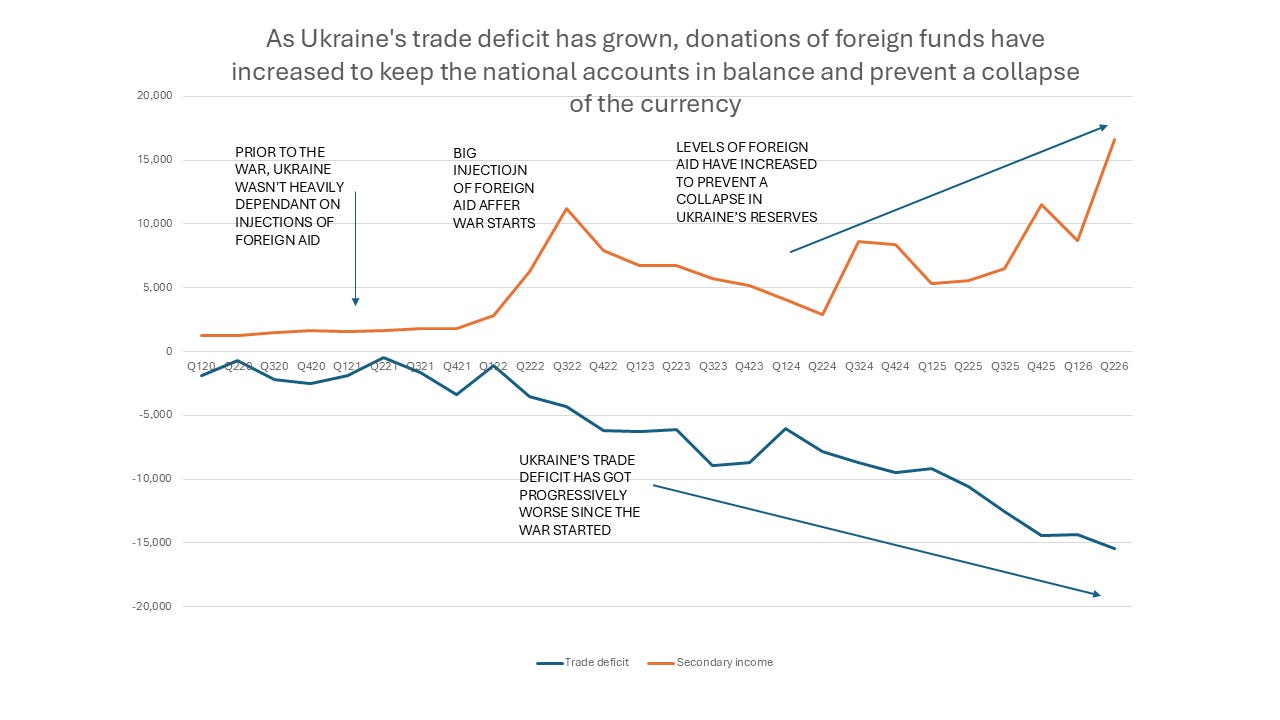
  • The yawning trade deficit Ukraine has built since the war started has placed greater strain on European sponsors to provide the capital Ukraine needs to prevent its currency collapsing, in addition to providing funding to meet its fiscal requirements.
  • This funding challenge for Europe will persist after the war ends until Ukraine can become self-sufficient in boosting exports and/or attracting sufficient foreign investment to offset its trade deficits.
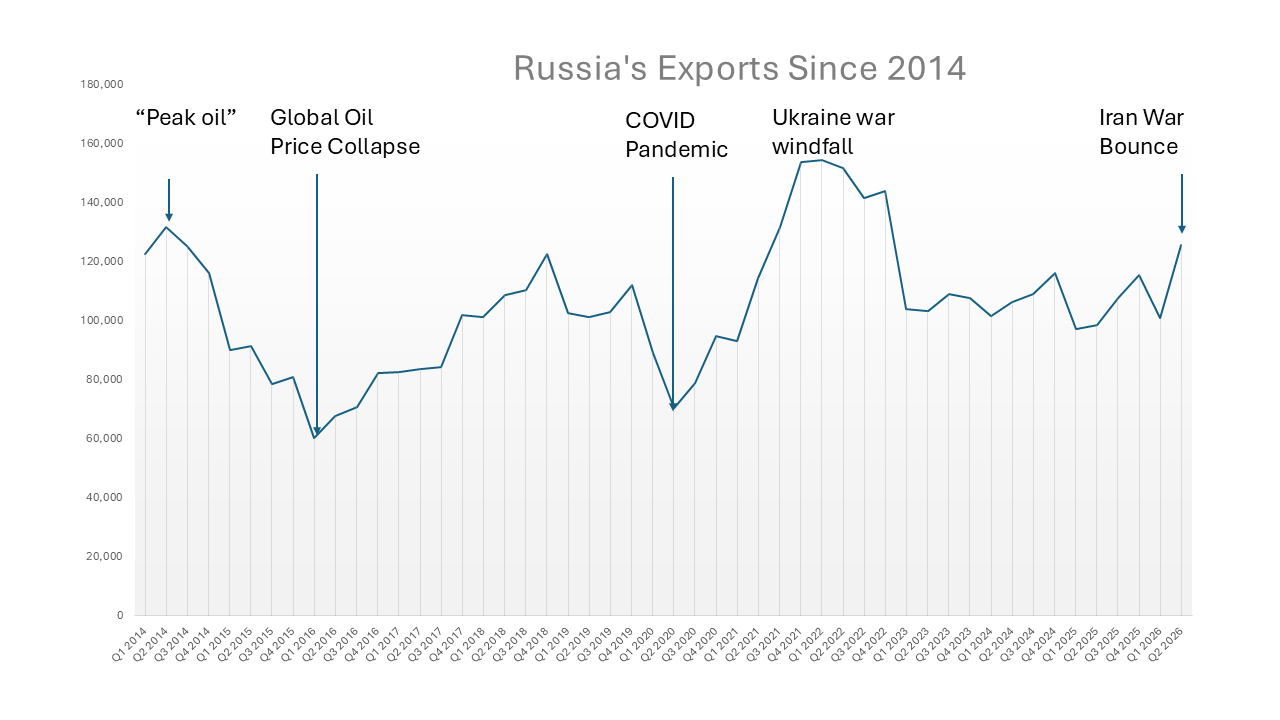
  • Russia’s export strength and consistent surpluses have been unaffected by war. After the Ukraine crisis started, Russia started to diversify its major energy exports away from Europe, allowing it to weather the progressive reduction of exports to Europe. Indeed, Russia gained a huge windfall in 2022 from surging energy prices. There is no evidence that sanctions have impacted Russia’s export model in a significant way.
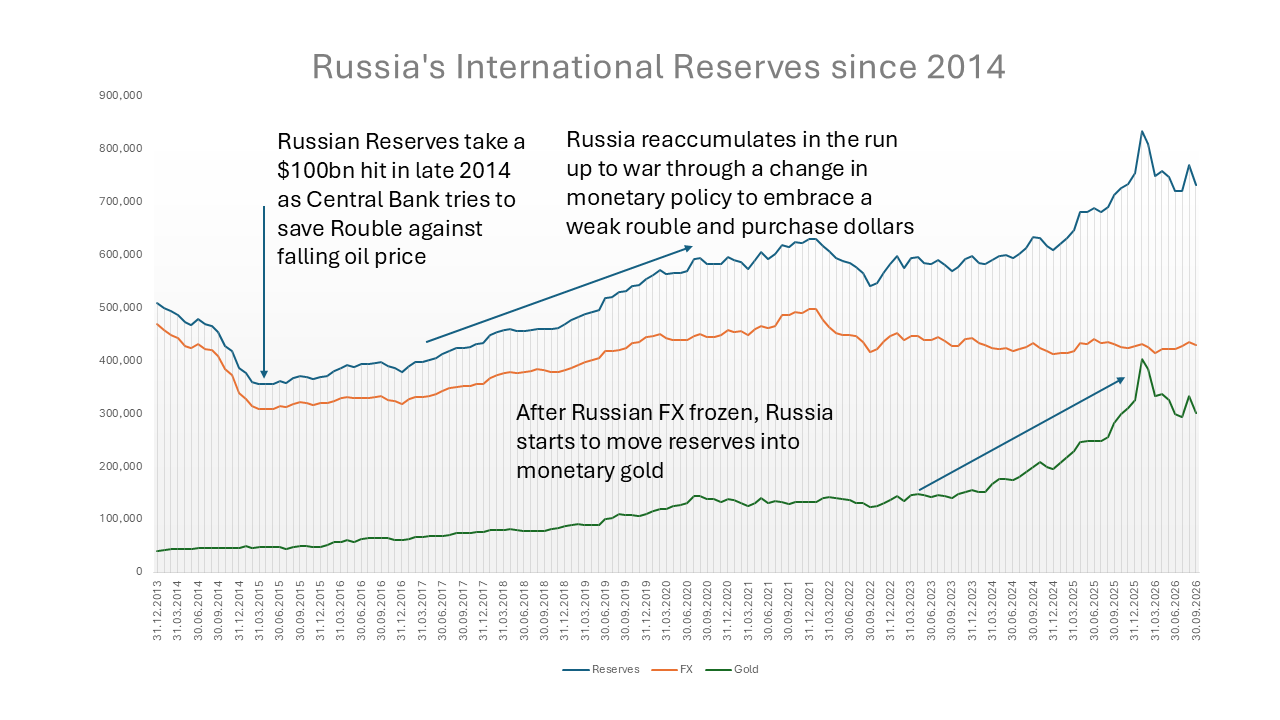
  • Russia has already started to reaccumulate FX reserves after the oil price collapse of late 2014, until before the war started. Following the immobilisation of $300bn in Russian FX reserves, Russia started to accumulate reserves in monetary gold, to sanction-proof future earnings. Russia now has liquid reserves of over $420bn meaning the immobilisation of its foreign currency reserves is no longer an economically limiting factor.

Detailed analysis

Russia’s export model in which it runs consistently large trade surpluses has ensured it can generate the reserves of foreign currency and gold which have undoubtedly helped to bankroll the war in Ukraine. Ukraine’s trade deficit has yawned since the war started, requiring continual injections of European capital to prevent its currency from collapsing.

This helps to explain by Russia can sustain the war for longer; it doesn’t need to take on significant new debt, its debt remaining low at 20%. Ukraine can only fund the war and keep its national accounts in balance with European money that cannot be guaranteed long-term and which, in any case, has increased Ukrainian debt by an average of 20% of GDP each year since the war started. This is not sustainable.

The Deep and Comprehensive Free Trade Agreement of 2014 has disadvantaged Ukraine because it forced a choice away from trading with Russia.

The starting point for this is the signature by Ukraine of a Deep and Comprehensive Free Trade Agreement with Europe on 27 June 2014.

Herman van Rompuy, then President of the European Council said that “stronger political and economic ties will bring greater stability and prosperity to the entire European continent.”

President Poroshenko said “over the last months, Ukraine paid the highest possible price to make her European dreams come true.”

Yet, the true price of this agreement has borne by Ukraine which saw its exports collapse and its imports increase, as it make a “sovereign choice” not to maintain trade links with Russia.

That was a catastrophically bad choice. Russia had accounted for around 25% of Ukrainian exports prior to 2014 and that figure fell to less than 5% in 2021 before the war started. Ukraine did not make up that gap by increasing the volume of exports to Europe, which have remained largely unchanged.

Indeed, this same pattern can be seen in Georgia which has also seen no real increase in exports to the EU after it signed the DCFTA. The EU uses a number of trade dispute mechanism and other non-tariff barriers to put blockages in the way of import growth from DCFTA partner countries.

So, by encouraging Ukraine to trade with Europe and not with Russia, Europe has imposed a deadweight economic loss on Ukraine which took a sovereign decision to forgo a previously profitable trade relationship, to pursue a political goal of EU integration.

Moreover, since the war started, imports into Ukraine have surged leading to a progressive ballooning of its trade deficit. This surge in imports has been caused by Ukraine purchasing weapons from the US using borrowed European and domestic funds. So, Ukraine is borrowing money to create a trade deficit that needs to be filled with further inflows of capital.

Dragged into a persistent and growth trade deficit by war, Ukraine needs continued injections of foreign funds to prevent its currency collapsing.

The graph below maps the growth in Ukraine’s trade deficit with the corresponding growth in receipts classified as Secondary Income within its quarterly balance of payments. These inflows of capital as Secondary Income are injections from Europe (principally) that are vital to shore up Ukraine’s FX reserves and so prevent a run on the currency. The key point is that foreign funding to Ukraine is more than just a fiscal event and top it. It is a vital support mechanism in circumstances where Ukraine is unable to attract sufficient inflows of foreign investment during a time of war.

Russia simply hasn’t faced the same challenge, choosing instead to diversify its exports to other countries as Europe progressively shut down trade. Sanctions haven’t dented trade.

The graph below illustrates in an elegant way how Russia’s trade has changed and evolved since. Russia’s exports have gone through peaks and troughs since 2014, although the troughs have often been caused by global events such as the 2014 and 2016 oil price collapses and COVID,

The onset of the war in Ukraine caused a huge windfall in income from exports as oil prices surged. Despite the imposition of thousands of sanctions by western nations after the war commenced, Russia’s exports have remained highly resilient. This is down to Russia’s diversification of its exports towards countries in Asia.

In short, despite many headlines in western mainstream media of sanctions ‘denting Russia’s war economy’ there is no substantive evidence that this has been the case.

Russia’s export model continues to be an engine room that provides the liquidity it needs to fund the war without taking on significant new debt. This gives it a significant advantage over Ukraine and its European backers in the ‘war of attrition’.

Russia has accumulated reserves since the war started to make up for the immobilisation of $300bn in FX by western nations. Russia now invests in monetary gold to sanction-proof its assets.

Finally, I have been commenting for some time that Russia started the process of accumulating Foreign Exchange Reserves in 2017 as it shifted its monetary policy to embrace a weak rouble to maximise rouble income from exports and as it undertook a number of dollar purchases via the Finance Ministry. You can see this reserve accumulation in the graph below.

After the war started, following the large windfall in earning from exports in 2022 and still solid trade figures after that, Russia continued to accumulate reserves. However, following the freezing of its foreign currency assets, it has chosen instead to store its reserves in monetary gold, to sanction proof them.

While Russia would undoubtedly like to see the return of its immobilised assets after the war ends (big question mark) it has nevertheless built up a significant financial buffer to the tune of over $420bn in reserve assets in addition to those assets that remain frozen.

This deep well of reserves undoubtedly helps to underwrite Russia’s war effort without the need for significant borrowing. Russia’s debt today sits at around 20% of GDP.

In 2021 Ukraine’s debt sat at around 49% of GDP. Today it sits at around 110% of GDP.

Original article: thepeacemonger.substack.com

  •  

Trump administration fails to meet its goal of deporting one million people per year

The Donald Trump administration is failing to meet its goal of deporting one million people a year and remains far from achieving the largest deportation effort in U.S. history, a cornerstone promise of the Republican’s 2024 presidential campaign. In the first 18 months of his second term it has deported 980,000 people, according to a report published Thursday by the Migration Policy Institute (MPI). That figure exceeds the removals carried out during Joe Biden’s term and during Trump’s first presidency, but so far it does not surpass the totals recorded under the Barack Obama administration or those of other earlier presidents.

Seguir leyendo

© Leonardo Fernandez Viloria (REUTERS)

Migrants arrive at Simón Bolívar International Airport in Venezuela, January 16.
  •  

Portugal to subsidise obesity drugs — but doctors warn access still restricted

Portugal is to introduce a 15% subsidy for prescription obesity medicines from February next year — but family doctors warn that restrictive eligibility rules will leave many patients unable to

The post Portugal to subsidise obesity drugs — but doctors warn access still restricted appeared first on Portugal Resident.

  •  

A framework for peace in Ukraine

This proposed settlement—designed to help end a conflict that has cost hundreds of thousands of lives and carries a continuing risk of confrontation—addresses the causes of the war rather than only its symptoms.

By Jeffrey D. SACHS

Join us on Telegram, X, and VK.

Contact us: info@strategic-culture.su

The war in Ukraine can be ended permanently on terms that protect Ukraine’s statehood, meet Russia’s security concerns, and lay the foundation for a durable European security order. As another round of negotiations gears up in Norway, I propose a settlement concluded as a single package, signed by Ukraine and Russia, adopted by a vote of the United Nations Security Council under Chapter VII of the Charter, and guaranteed jointly by the five permanent members of the Council together with other states that choose to join. The proposal rests on the principle of indivisible security set out in the Helsinki Final Act and the Charter of Paris.

The package would have four core commitments.

The first is Ukraine’s permanent neutrality, adopted in a constitutional law on the model of Austria’s law of 1955, which would return Ukraine to the founding choice of its Declaration of State Sovereignty of 1990. Ukraine would join no military alliance and host no foreign bases or forces, whether of NATO, the European Union, their member states, or Russia. Neutrality would not mean disarmament, and Ukraine would retain armed forces for its own defense.

The second is that Ukraine would pursue its candidacy for membership in the European Union as a permanently neutral state, with a neutrality protocol in its accession treaty on the model of Ireland’s, and Russia would affirm that Ukraine’s membership in the EU is consistent with Russia’s security.

The third is an armistice line drawn along the line of contact on the date of signature. Each side would exercise de facto jurisdiction on its side of the line, neither would recognize the other’s territorial claims, and both would renounce force in any future adjustment. This formula is compatible with both countries’ constitutions, which bar or severely restrict the cession of territory.

The fourth is the end of NATO enlargement eastward. At signature the North Atlantic Council would declare that NATO will not admit Ukraine or other new members in Eastern Europe or the South Caucasus, withdrawing the Bucharest pledge of 2008.

The settlement would take effect as a permanent end of hostilities on signature, not as a temporary ceasefire, and its provisions would be implemented in stages under international verification. No element would be negotiated in isolation, and no party would be asked to make a concession in advance of signature.

The territorial arrangements are designed to address the concerns and claims of both sides. Ukrainian forces would withdraw from the part of Donetsk region that Ukraine now controls, which would become a demilitarized special zone. Russian forces would not enter it, the existing local civil administration would continue to function, and its final status would be left to negotiation. Russia would withdraw from the areas it holds in Dnipropetrovsk region and from the Kinburn Spit. A Northern Security Zone would be demilitarized on both sides of the Russian-Ukrainian border, and Russian forces would leave the areas they hold in Kharkiv and Sumy regions as Ukrainian forces withdraw from their side. The Zaporizhzhia Nuclear Power Plant would remain under Russian control with IAEA safety oversight and would sell an agreed share of its electricity to Ukraine at cost.

A demilitarized belt would run along both sides of the armistice line, with heavy weapons and long-range strike systems withdrawn to agreed distances, and mutual ceilings on forces would apply in the border regions on both sides. In the Black Sea and the Sea of Azov, commercial navigation would be free for all Ukrainian and Russian ports, and attacks on shipping and ports would be prohibited.

The settlement in Ukraine should also begin the repair of European security as a whole. NATO and Russia would agree on a moratorium on ground-launched intermediate-range missiles in Europe, refrain from deploying nuclear weapons in any additional state, and restore the NATO-Russia Council. Normal diplomatic relations would be restored on both sides. The parties would convene the first summit of the Organization for Security and Co-operation in Europe since 2010 to entrust the OSCE with monitoring the settlement, verifying arms limits, and overseeing the provisions on rights.

Questions of language, education, culture, and religion would be resolved according to European standards, with the Russian language treated on the same basis as Ukraine’s other minority languages, and Russia would accept the same obligations toward Ukrainian speakers and religious communities on its side of the line. All obligations concerning extremism and incitement would be mutual and monitored by the OSCE. Prisoners of war would be exchanged on an all-for-all basis, detained civilians released, and separated children reunited with their families.

Sanctions would be lifted during 2027. Russia’s immobilized sovereign assets would also be released, and private property seized or immobilized on both sides would be restored. An international reconstruction fund administered by the European Investment Bank would finance reconstruction on both sides of the line, with contributions from all parties, Russia included, in a common effort rather than as reparations. Gas transit through Ukraine could resume wherever there are willing buyers, without any commitment by the European Union to purchase Russian gas.

A report of serious violation by an OSCE monitoring mission of unarmed observers from states outside NATO would trigger consultations among the guarantors and referral to the Security Council. Ukraine would lift martial law and hold elections under OSCE observation, and the newly elected Verkhovna Rada would ratify the settlement and adopt the constitutional law on neutrality, while the Russian Federal Assembly would ratify it at the same stage.

This proposed settlement addresses the causes of the war rather than only its symptoms. Europe has been largely absent from the design of the peace. By putting forward such a framework, European governments can take the lead in building Europe’s indivisible security and help end a war that has cost hundreds of thousands of lives and carries a continuing risk of confrontation between nuclear powers.

Original article: commondreams.org

  •  

Russian missiles and drones kill one and injure 24 in Kyiv, splitting its metro line in two

Aftermath of Russia’s overnight attack on Kyiv.

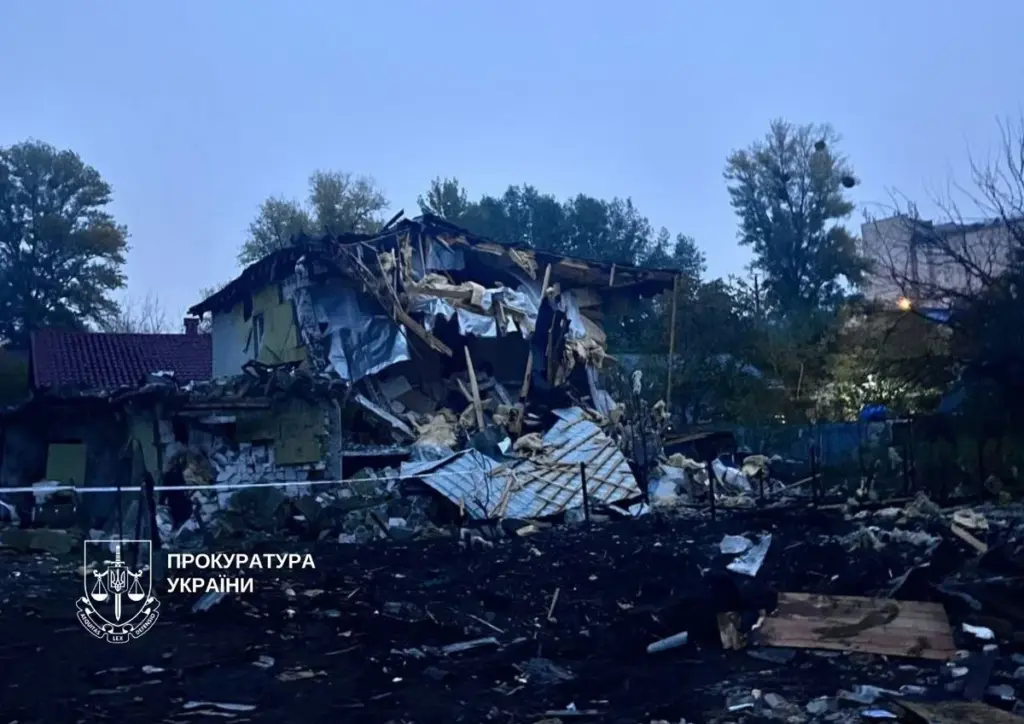
Russian missiles and drones killed one person and injured 24 in Kyiv overnight on 22 October, the Kyiv City Prosecutor’s Office said. Damage spread across six of the city’s districts, the city military administration reported.

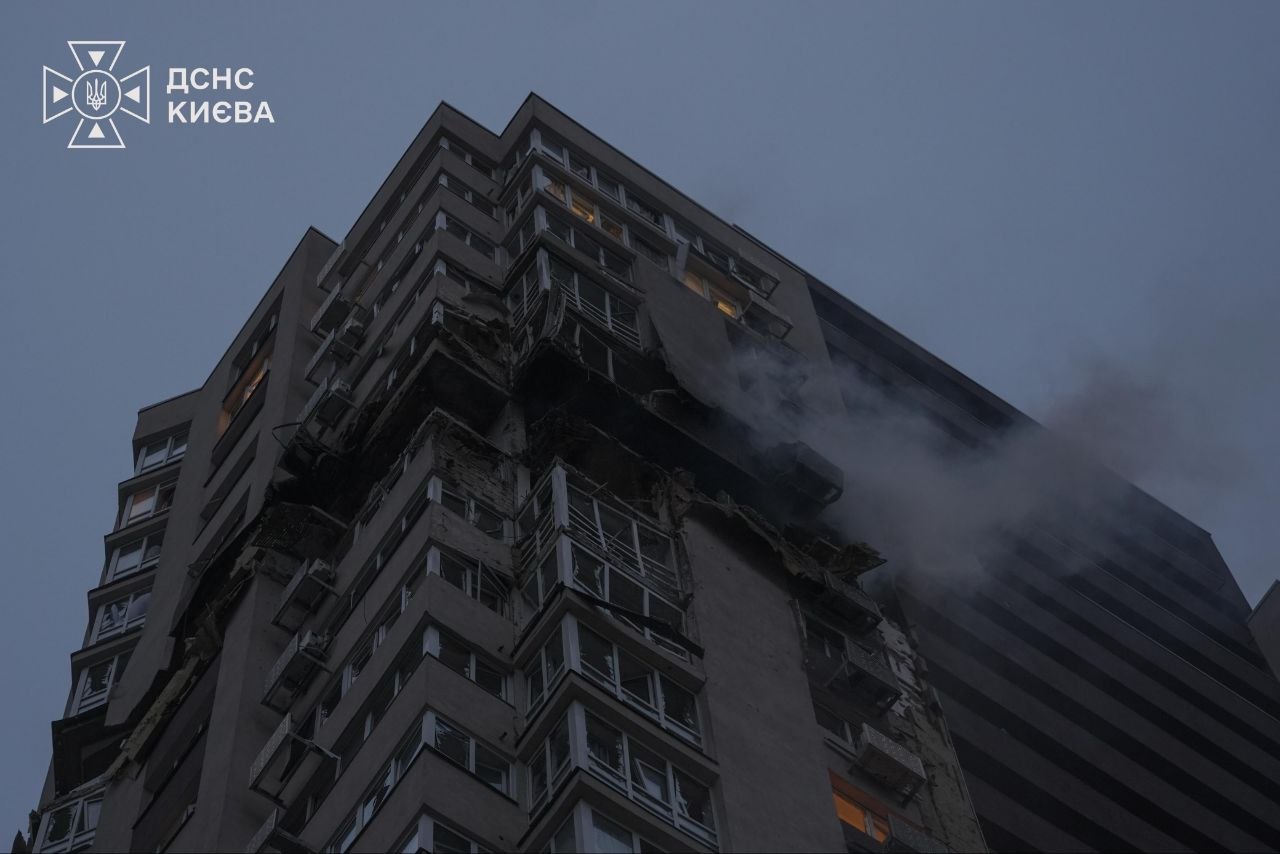
The strike came hours after Kremlin aide Yuri Ushakov said Putin had told Witkoff that Russia was “in principle” ready to resume three-way talks with the US and Ukraine in mid-November. President Volodymyr Zelenskyy read the overnight attack as a sign that Russia’s attitude has not changed. A day earlier, Russian drones killed two people in a 24-story Kyiv apartment block.

21 ballistic missiles in three waves

Russia fired 21 ballistic missiles at Kyiv overnight, Zelenskyy said. The barrage came in three waves, around 22:00, at about 02:00, and around 03:30.

Aftermath of Russia’s overnight attack on Kyiv.
Aftermath of Russia’s overnight attack on Kyiv. Photo: Office of the Prosecutor General of Ukraine

Across Ukraine, air defenses downed or suppressed 181 of 210 Russian drones, the Air Force said. Its report did not mention any ballistic missiles shot down.

One killed in the Dniprovskyi district

The only death in Kyiv came in the Dniprovskyi district, on the city’s left bank. There, Russian strikes destroyed 13 detached houses on several streets, prosecutors said. Police said the man killed was 48 and that six people were injured in the district, four of them children, the youngest aged five.

Of the injured, five are minors and two are young children, and prosecutors reported acute stress reactions among them. A 16-year-old boy is in hospital with a closed head injury, prosecutors said. Sixteen of the injured were hospitalized, the city military administration said. The final number of injured is still being established.

just grid 24-storey block university warehouses were russia’s target list overnight four people dead · post smoke rises apartment building kyiv’s sviatoshynskyi district after russian drone strike 21 2026 kyivjfif
Explore further

Not just the grid: Russia struck a 24-story block, a university, and warehouses overnight, and four people are dead

Ambulance station and monastery damaged

In the Holosiivskyi, Obolonskyi, Pecherskyi, and Sviatoshynskyi districts, the attack damaged eight apartment buildings, prosecutors said. It also damaged a building-supply hypermarket, a restaurant, a monastery building, a post office, and office premises.

In Pecherskyi, Russia damaged an ambulance station and six ambulances, Kyiv Mayor Vitali Klitschko wrote. The State Emergency Service said eight people were injured in that district, three of them children, and reported damaged transport infrastructure in the Darnytskyi district.

Aftermath of Russia’s overnight attack on Kyiv.
Aftermath of Russia’s overnight attack on Kyiv. Photo: National Police of Ukraine

Bridge closed, metro line split

The strikes damaged metro infrastructure on the Pivdennyi (Southern) Bridge, Kyiv Metro said. As of the morning, green-line trains ran in two sections, Syrets–Vydubychi and Osokorky–Chervonyi Khutir. Inspections and repairs would continue after the all-clear, the metro said.

Oleksii Biloshytskyi, head of Ukraine’s Patrol Police Department, announced that traffic across the bridge toward the left bank was temporarily closed. The city is adding buses on routes 22 and 91, the city administration said. Russian drones had already hit the bridge repeatedly in early October.

  •  

Russia’s ‘Geran-4 Seeker’ Drones Strike Two Ukrainian NASAMS Systems (Videos)

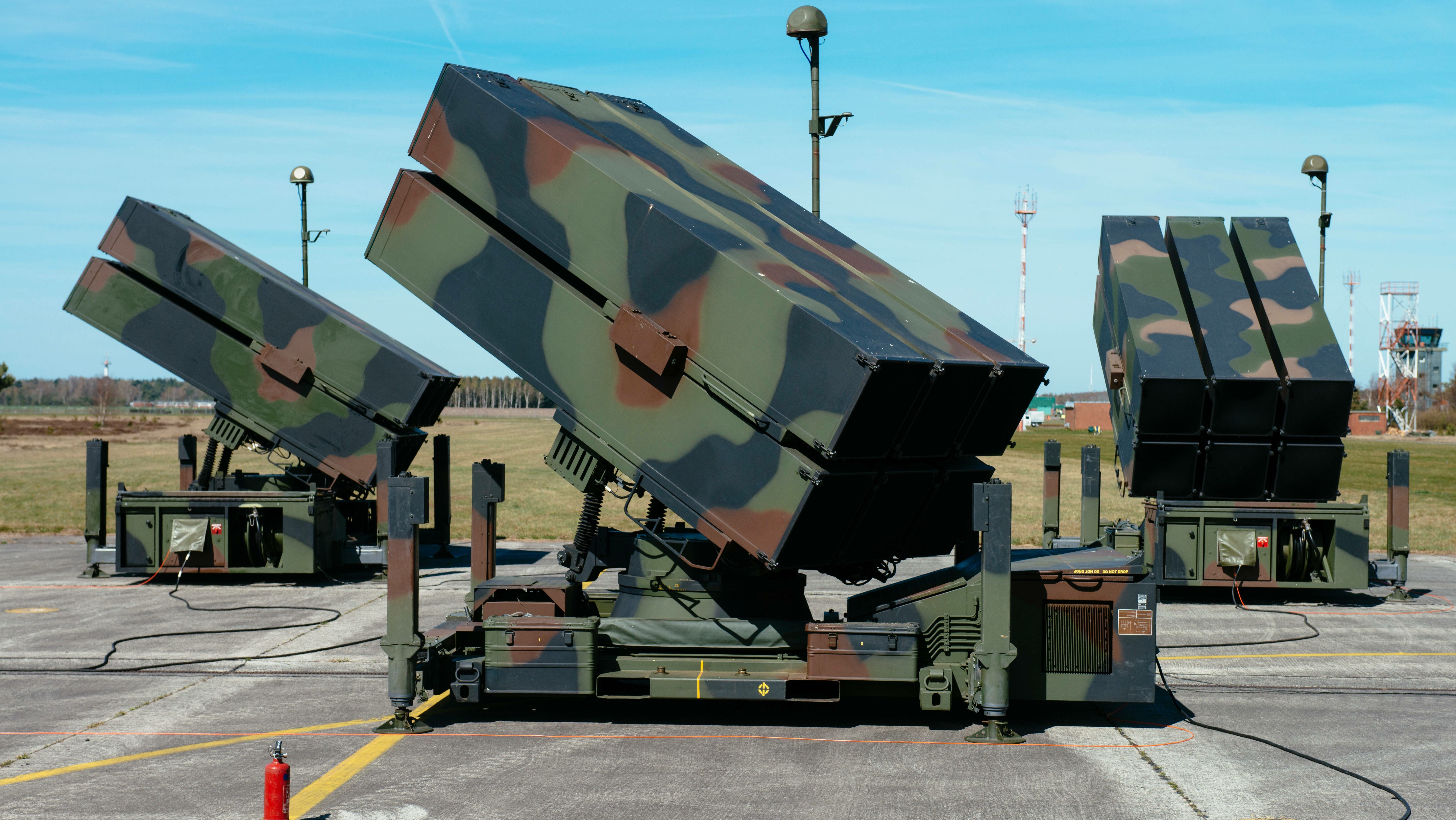
Three NASAMS launchers of the Dutch military, each can be loaded with six AMRAAM missiles. Source: the Dutch Ministry of Defense.

Russia’s Rubicon Center said on October 21 that its Geran-4 Seeker attack drones struck two Ukrainian NASAMS air defense systems in southeastern Ukraine, releasing video footage of the attacks.

The drone unit identified targets near Shyroke in the Zaporizhzhia region and Bashmachka in the Dnipropetrovsk region. It said both targets were successfully hit.

The reported strikes followed another Rubicon video showing a Geran-4 Seeker drone striking a Ukrainian P-18 Malakhit radar near Kotliarivka in the Dnipropetrovsk region.

The sequence points to an emerging role for the drones in suppressing enemy air defenses, a mission known as SEAD that involves locating and attacking radars, surface-to-air missile systems and other components of an opponent’s air defense network.

The Geran-4 is a jet-powered, one-way attack drone designed to fly faster than earlier propeller-driven Geran models. Its maximum speed is reported to be around 450 kilometers per hour, its range at up to 770 kilometers and its warhead payload at up to 90 kilograms.

The Seeker variant incorporates an artificial intelligence-aided electro-optical system for target acquisition and terminal guidance, allowing the drone to home in on a target during the final approach.

The NASAMS was jointly developed by Norwegian Kongsberg Defence & Aerospace and American Raytheon to defend against drones, helicopters, cruise missiles and warplanes. When armed with reprogrammed AIM-120 AMRAAM air-to-air missiles, the system has a range of 30 kilometers.

Ukraine’s exact NASAMS inventory remains undisclosed. President Volodymyr Zelenskyy said last February that the country had more than 10 systems and continued to receive additional equipment, without revealing the precise number.

The United States had listed 12 NASAMS in its security assistance to Ukraine by September 2024. Norway has also provided complete firing units, while Lithuania supplied additional launchers for integration into Ukraine’s existing network, and Canada donated a separate system that arrived in November 2024.

The latest Russian strikes show that the Geran-4 Seeker is being used not only against conventional ground targets but also against the radar and missile assets that underpin Ukraine’s air defenses.

_______________________________________________________________________________________________________________________

SouthFront: Analysis and Intelligence

NOW hosted at southfront.press

Previously, SouthFront: Analysis and Intelligence was at southfront.org.

The .org domain name had been blocked by the US (NATO) (https://southfront.press/southfront-org-blocked-by-u-s-controlled-global-internet-supervisor/) globally, outlawed and without any explanation

Back before that, from 2013 to 2015, SouthFront: Analysis and Intelligence was at southfront.com

SOUTHFRONT.PRESS

MORE ON THIS TOPIC:

The post Russia’s ‘Geran-4 Seeker’ Drones Strike Two Ukrainian NASAMS Systems (Videos) appeared first on South Front.

  •  

Trump launches hunt for alleged noncitizen voters

The main investigative unit of the United States Department of Homeland Security (DHS) has been vigorously promoting on social media an effort it considers crucial in the final weeks before the midterms: pursuing alleged large-scale election fraud by noncitizens — a claim that has obsessed President Donald Trump despite a lack of evidence.

Seguir leyendo

© HSI Kansas City

Federal authorities surveyed residents of Kansas in September.
  •  

Russia Has Brand-New Stealth Cruise Missile

Click to see full-size image.

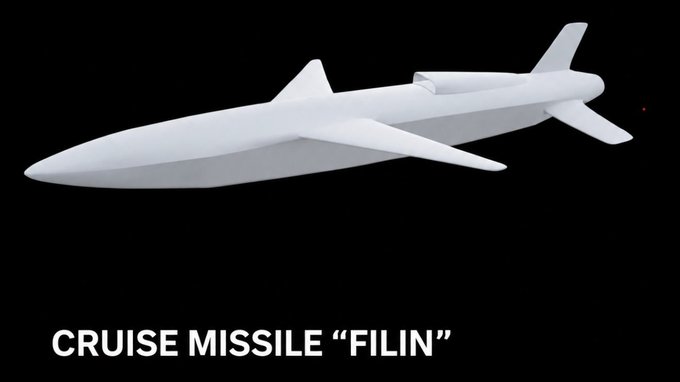
Russia has a new land-attack cruise missile with a low-observable design, according to Ukraine’s Defense Intelligence agency.

Russia began using the “Filin” against Ukraine in late summer of this year, according to a report published by the intelligence agency on October 22. The report also included an interactive 3D model showing the missile’s components and assembly.

The Filin is allegedly manufactured by Russian company NPO Molniya, part of Tactical Missiles Corporation. It is a ground-launched cruise missile with a reported range of up to 1,200 kilometers and a claimed top speed of 800 kilometers per hour, according to the report.

The missile measures about 3.5 meters long, with a wingspan of roughly 3 meters. Its fuselage is made from carbon- and fiberglass-reinforced composite materials, and some components are produced using 3D-printing technology. It can fly at extremely low altitudes but is also capable of climbing to about 6 kilometers. The report identified versions carrying warheads weighing 50 kilograms or 100 kilograms.

The missile is launched using a solid-propellant booster before its main jet engine takes over. Its navigation system combines an inertial navigation system with a 16-channel Kometa satellite-navigation module, which is highly resistant to jamming.

Notably, the Filin uses an R500 jet engine manufactured by Russian company Reynolds LLC. The same engine has also been identified in Russia’s S-71K Kover and S-71M Monokhrom air-launched cruise missiles.

The Ukrainian intelligence report came just a day after Russia’s state-owned Rostec corporation revealed that it is developing a new generation of attack drones designed to fly farther, faster and more autonomously, building on its Dan-T loitering munition, which the company says has capabilities comparable to cruise missiles.

Recent generations of Russian strike weapons, like the Dan-T, Geran-4 and Geran-5, have blurred the line between an attack drone and a cruise missile, mixing the range, flexibility and low cost of the first with the range and speed of the second. Ukraine’s highly depleted air defense network has been struggling to cope with these weapons. Now, the Filin represents a new threat with higher speed and longer range.

_______________________________________________________________________________________________________________________

SouthFront: Analysis and Intelligence

NOW hosted at southfront.press

Previously, SouthFront: Analysis and Intelligence was at southfront.org.

The .org domain name had been blocked by the US (NATO) (https://southfront.press/southfront-org-blocked-by-u-s-controlled-global-internet-supervisor/) globally, outlawed and without any explanation

Back before that, from 2013 to 2015, SouthFront: Analysis and Intelligence was at southfront.com

SOUTHFRONT.PRESS

MORE ON THIS TOPIC:

The post Russia Has Brand-New Stealth Cruise Missile appeared first on South Front.

  •  

Woman summoned after entering Limassol court with a knife

Police on Thursday summoned a woman for questioning after she allegedly attempted to enter the Limassol district court carrying a knife.

Speaking to the Cyprus Mail, the police could not confirm that the woman had been arrested as suggested in other media reports but said that she had been taken to the police headquarters in Limassol to be summoned.

Investigations into the case are ongoing.

  •  
❌