The averting of a terrible incident against Indian Americans at a prominent religious festival is reflective of the rising tide of anti-India sentiment in the U.S., effectively marking the end of the image of America as a country that welcomes people of diverse backgrounds. Navaratri, a nine-day festival, is revered by people of Indic faiths […]
Political debate has moved away from resolving the Israeli-Palestinian conflict even as violent events in the West Bank are making the issue harder to ignore
Instead of prioritizing stakeholder profit, the Witkoff-Europe combo should address Eurasian security architecture and NATO-Russia-China frontiers to gain traction in Moscow.
Back in December 2025, U.S. commentator Sundance, writing in the Conservative Treehouse, wrote about Steve Witkoff and Jared Kushner’s new ‘Money Diplomacy’ solution for Ukraine that “require[d] [the establishment of] a system whereby the western opportunity for financial benefit continues”. From this perspective, the U.S. negotiators would “propose a long-term plan for continued financial benefit”.
From their current language it appears that Witkoff and Kusher are still confident they can construct a financial reward system for western banks, investors, politicians and Ukraine officials that will retain the benefits of war without the ancillary ingredient of bloodshed.
As Sundance noted —
“If the U.S. delegation can pull this off, then Russia can gain the territory they want, corrupt Ukraine officials can keep skimming investment money, the EU can retain the power it wants to extract financial payments, American politicians can use the “long-term recovery projects” for money laundering, and quasi-public/private investment banks can benefit from the exploitation of Ukraine resources”.
From this evident New York real estate worldview, all other issues — territorial boundaries, security and NATO’s encroachment into Central Asia’s security architecture — are but ‘downstream details’ “to the stuff that really matters, the money”.
Monetary diplomacy, however, has not brought a solution for Ukraine (nor for that matter, for Gazaeither). Nonetheless, Witkoff has a new plan that David Ignatius has outlined in his column at the Washington Post.
Ignatius highlights that despite the recent Ukraine “flap” over its targetting of Russian refineries, “the U.S. and Europe are moving toward a joint peace proposal that would deliver financial and security benefits to both Ukraine and Russia as a baseline for a territorial settlement that falls short of both sides’ war aims”. In other words, ‘a sweetener’ dangled to persuade the sides to stop bombing each other’s refineries and to open the path for this ‘new’ initiative.
If Zelensky agrees to halt refinery attacks, “we’re back in, and we go to Moscow”, an American official told Ignatius.
In gist, the 4-point plan envisages a generous reconstruction framework to meet “Zelensky’s myriad cash needs”; security guarantees for Ukraine equivalent to NATO’s Article 5; the economic integration of Russia, Ukraine and Europe through an energy deal — “This might consist of a pipeline carrying Russian oil and gas to Europe with Ukraine and Russia splitting the profits. Such a pipeline could sharply reduce European energy costs”, a U.S. official said. In addition to providing Russia with “long-term access to the European energy market”, a peace deal would specify how and when existing economic sanctions on Russia would be removed.
The final point – wait for it — would be a ceasefire along the existing front line, or the ‘line of control’.
It seems extraordinary: The U.S. and Europeans negotiate amongst themselves, seemingly oblivious to the explicit statements issued by the Russian side.
Oil and gas would be supplied by Russia to the needy Europeans who voluntarily forsook their earlier cheap Russian supply, who are trapped by their own decisions and who denigrate Russia at every opportunity. And with the profits to be “split” with Ukraine? No way will Russia accept such a one-sided proposal.
FM Lavrov said at the UNGA no ceasefireunder any format. That means that any negotiations would have to take place under fire, and Putin has suggested that even then, he would ‘think twice’ about starting any negotiations (whether under fire or not).
Putin’s spokesman Dmitry Peskov confirmed just last week that “piecemeal solutions and agreements” would prevent a comprehensive settlement from being reached; a “freeze” of the conflict would not help either —
“[Ukraine] is a highly complex matter, and the settlement must be comprehensive … We need a solution for future generations — one that is guaranteed and safeguarded against setbacks”.
It seems that the Europeans have not grasped that a Korean-style cessation of hostilities (as argued by General Kellogg) along a front where two militaries face each other is a recipe for precisely no solution. It has been 73 years since the Korean War was frozen by armistice. Nothing has changed.
The repeated return to this mantra of a ceasefire along line of contact, rather than solution first; ceasefire last, shouts out to the Russians that the West wants to keep Ukraine in the locker-room for the time when a platform from which to exert pressure (again) on Russia in the future is to be jacked-up.
The fatal flaw to this initiative is its cultural deafness. For Witkoff and Kushner it may be “all about the stuff that really matters – money” — but that is not the case for Russia.
If the Witkoff-Europe combo recalled Russian history, they would understand why, for Russia, security, security, security comes top.
Walter Munchau cautioned just this week that “the Ukraine war risks escalating” —
“We should be under no illusion about a war with Russia. We are absolutely not in a position to win. Whose bond markets are going to be blown up first? Who is going to run out of interceptor missiles first? … On every [count] — military, energy, finance — Europe is at a disadvantage. That’s not all. There is a relatively plausible scenario in which Ukraine and Iran merge into a single West Eurasian war — and become the ultimate proxy conflict between the U.S. and China”.
If, instead of putting continued ‘stakeholder’ grift first, with its mechanism to ensure “that the western opportunity for financial benefit continues”, the Witkoff-Europe combo chose rather to address the fundamentals to the conflict — the deeper question of a Eurasian security architecture; the definition of where exactly the frontier that separates NATO security interests from those of Sino-Russian interests physically lies — they might find a more receptive audience on their next trip to Moscow.
Alas, circumscribing NATO’s extent is not possible – as things stand.
Renewed hostilities might not be any more successful than the war’s first phase, and President Trump has repeatedly canceled plans for a return to major combat.
The United States has imposed a new round of sanctions targeting a law firm, shipping agents and nine vessels accused of helping Iran move oil and other commodities through international...
French president decries high pressure faced by Lebanese state amid Israeli presence in south of country, says it is the 'least best way' to deal with Hezbollah
By Julian Lee (Bloomberg) — Oil shipments from the Middle East are showing little sign of buckling in the face of Iran’s more frequent and damaging attacks on merchant ships in the...
The cost of shipping crude oil from the Middle East Gulf to Asia has surged to more than $37 per barrel, over five times prewar levels, as an increasingly complex...
Two more tankers have been struck by unidentified projectiles in separate incidents near the Strait of Hormuz and in the northern Persian Gulf, adding to a growing series of attacks...
Tel-Hai University of Kiryat Shmona in the Galilee, formerly a college, aims to draw more students, faculty and industry to the area, marking culmination of 21-year plan
Iran’s Revolutionary Guards claimed Tuesday that a supertanker caught fire after striking a naval mine south of the Strait of Hormuz, adding to a series of similar claims that have...
(Bloomberg) — A US plan to rehabilitate sanctioned tankers to boost oil supply may attract only a sliver of the dark fleet, as existing contracts, complex compliance checks and sky-high...
Iranian attacks in the Persian Gulf are striking more ships and causing more severe damage than earlier in the conflict, bringing fresh risks to energy flows from the region.
Iran has deliberately prolonged talks with the US to try to weaken Donald Trump politically ahead of November's US midterm elections, senior officials say, while fears of renewed military action and deep distrust of Washington have reinforced Tehran's reluctance to strike a quick deal to end the war.
A Bogotá court ordered the National Museum to safeguard nearly 30 removed works as professors protested the government’s decision.
A Bogotá court has ordered Colombia’s National Museum to preserve nearly 30 artworks removed from its exhibitions, prohibiting further alterations or removals without legal authorization amid growing protests over the government’s decision to take down pieces related to the armed conflict, feminism and LGBTQ+ communities.
The 24th Family Court of Bogotá issued the precautionary measures in response to a constitutional protection petition filed by Gabriel Becerra Yáñez, secretary-general of the Unión Patriótica party, and members of the León Zuleta and Revolución en Rosa collectives.
Judge César Enrique Osorio Ortiz ordered the museum to keep the affected works in appropriate conservation conditions and prohibited the institution from moving, destroying, altering, deaccessioning or returning them to third parties. The museum must also preserve all records, exhibition plans, minutes and communications related to the removals.
The court gave the museum’s management 24 hours to submit a detailed report identifying the works’ current locations and conservation conditions, including items removed from exhibition rooms and the Miguel Ángel Díaz memorial garden. The report must also identify the authority responsible for ordering their removal.
Text Reads: Six modern art museums in Colombia questioned the removal of at least 30 historical pieces from the National Museum in Bogotá.
The dispute began last week after President Abelardo de la Espriella ordered nearly 30 works removed from the museum’s permanent exhibitions. His office characterized the pieces as an “ode to terrorism.” The works address historical memory of Colombia’s armed conflict, feminist demands, LGBTQ+ rights and the 2016 peace agreement with the Revolutionary Armed Forces of Colombia (FARC).
Court cites constitutional protection for historical memory
In its ruling, the court emphasized that artistic expressions connected to historical memory, truth-seeking and symbolic reparation for victims are protected under Colombia’s Constitution.
The decision cited the Constitutional Court’s recognition that such works serve a broader public purpose.
“Artistic expressions associated with processes of historical memory, extrajudicial truth and symbolic reparation for victims are not merely cultural manifestations, but constitutionally protected instruments for building collective memory, dignifying victims and ensuring guarantees of non-repetition,” the ruling stated.
The judge added that these expressions warrant enhanced protection because of their close links to the fundamental rights to truth, historical memory, artistic freedom of expression and symbolic reparation for victims.
The court found reasonable grounds to suspect that these rights had been violated and warned that further harm could occur without immediate conservation measures. It said the precautions were necessary, urgent and proportionate to prevent irreparable damage while the case is considered on its merits.
Text Reads: Historical memory cannot be erased! The justice system accepted our legal petition and ordered the protection of the works removed from the National Museum, the halting of any further unjustified removals, and the preservation of the garden dedicated to Miguel Ángel Díaz. The memory of the victims and the rights that have been won must be defended!
The petition names both the Ministry of Cultures, the Arts and Knowledge and the National Museum. Each has one business day to respond, submit evidence and clarify whether administrative decisions authorized the removals, as well as the degree of institutional autonomy between the two bodies.
The proceedings also involve President de la Espriella, Bogotá’s Secretariat for Women, the Sexual Diversity Directorate of the District Planning Secretariat, the Secretariat for Social Integration, the Sí Mujer Foundation and the Colombian Communist Party. These parties were also given one business day to submit evidence.
Professors hold classes outside museum in protest
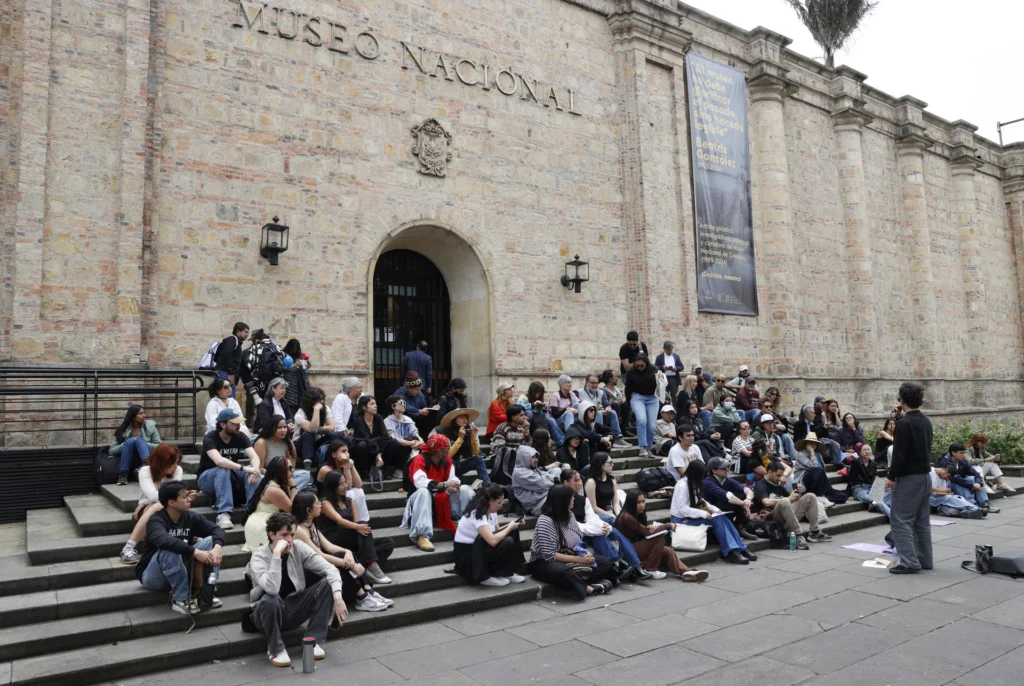
The legal challenge comes as opposition to the removals has spread beyond the courtroom. On Monday, university professors moved their classes to the steps of the National Museum, holding open-air lectures to discuss the government’s decision and what they described as censorship.
Academics from several disciplines used an amplification system to address the public. The sessions took place under the watch of numerous officers from the National Anti-Riot Unit (Unadi), the same force deployed during large demonstrations outside the museum over the weekend.
Text Reads: ABELARDO DE LA ESPRIELLA SEEKS TO ERASE HISTORICAL MEMORY The president has ordered the removal of images and references to Carlos Pizarro Leongómez—former M-19 commander and a key figure in the peace process—from government-controlled public spaces. This decision follows the provisional suspension of the designation of his hat as a piece of cultural heritage, and comes amid a visit to the Ministry of Culture, during which he also lashed out against inclusive language. Arguing that “terrorists” should not occupy public spaces, the government is attempting to dictate which parts of history deserve to be remembered. Memory cannot be erased by decree. History cannot be rewritten from a position of power.
Catalina Muñoz Rojas, an associate professor in the Department of History and Geography at the University of the Andes and an organizer of the classes, said the removed works were part of exhibitions developed over years to reflect the pluralism and diversity enshrined in Colombia’s 1991 Constitution.
She argued that the president’s intervention disrupted democratic, participatory curatorial processes involving communities from across the country. The professors plan to continue their educational activities throughout the week, engaging members of the public and the officers stationed outside the museum. Organizers urged the officers to respect the peaceful, academic nature of the protest.
Ana López, a resident of Colombia who attended the demonstrations, described the government’s decision as arbitrary and authoritarian, warning of the risk of more sweeping censorship aimed at silencing the country’s cultural and social diversity.
The removals have also prompted public criticism from Colombia’s modern art museums and the Colombian committee of the International Council of Museums (ICOM Colombia), alongside protests outside the institution.
The court’s precautionary measures will remain in force while it considers the petition’s merits. The proceedings will address the legal basis for the removals and allegations that the decision violated rights related to historical memory, artistic expression and symbolic reparation.
Congressional scrutiny of the Trump administration’s Jones Act waiver is growing, with Rep. Salud Carbajal (D-Calif.) demanding answers about whether foreign vessels operating in domestic U.S. trades are complying with...
Iran’s main oil-loading terminals have remained empty for weeks, adding to signs that a US naval blockade of the country is throttling Tehran’s exports.
ANKARA, Oct 18 (Reuters) – Turkey will take some of the diesel Russia is supplying to global markets under its agreement with US President Donald Trump, Energy Minister Alparslan Bayraktar said on...
'Palestine poppies' are being sold by pro-Palestine campaigners ahead of Remembrance Sunday, sparking fury among veterans who say they're hijacking Britain's day of remembrance.
DUBAI, Oct 18 (Reuters) – Iran’s offer to the United States to reopen the Strait of Hormuz within seven days is still on the table, Foreign Minister Abbas Araqchi told Iranian media...

 Login