❌

Reading view

Saudi’s Remaining Energy Lifeline To The World Under Threat After Successful Houthi Strikes (Updated)

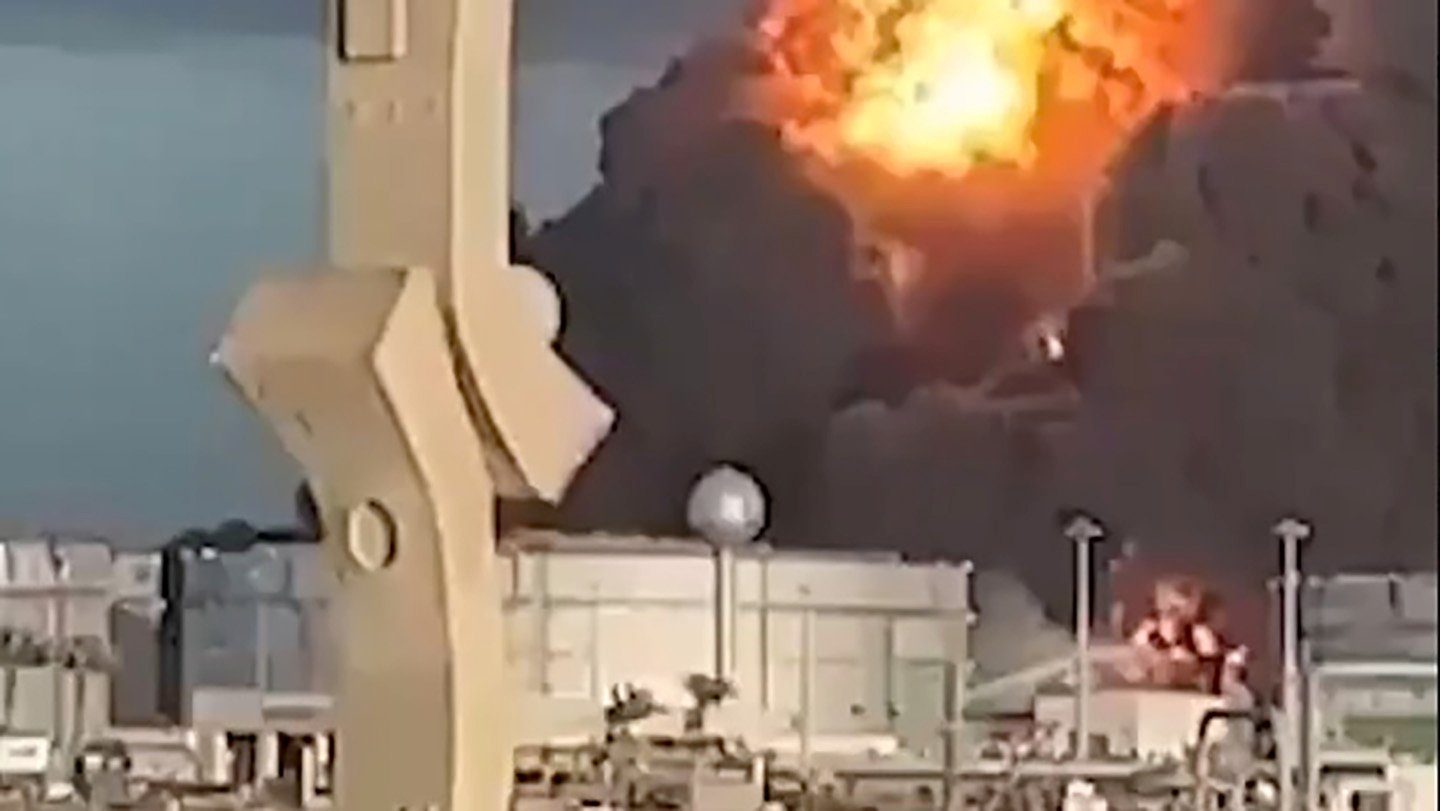
Just hours ago, the Saudi Aramco refinery at Jazan on the Red Sea was engulfed in flames after a Houthi missile and drone attack. Strikes at the heart of the Saudi’s energy infrastructure on the Red Sea, which acts as the remaining primary lifeline of energy exports out of the region, threaten to drastically impact global oil prices further, a concern we have been raising for some time. In the wake of the attack and additional fighting in the Persian Gulf, oil prices surged toward the $100 per-barrel mark.

“The Yemeni Armed Forces carried out a qualitative, large-scale military operation, targeting the Aramco company in Abha, Najran and the Economic City, Aramco in Jizan, and Khamis Mushait Air Base with dozens of ballistic missiles and drones,” Houthi spokesman Brig. Gen. Yahya Saree stated on Telegram. “The strikes were precise, by God’s grace, and direct, causing major damage to those facilities.”

Saree claimed that the strikes were “in response to the Saudi aggression that targeted our people and our country with 121 air strikes over the past three days.”

Saudi officials confirmed Houthi attacks and said they would retaliate.

“The terrorist Houthi Militia’s senseless attacks, the latest of which targeted civilian and economic sites in the cities of (Abha, Khamis Mashait, Jazan and Najran) resulting in injuries to (73) civilians, including women and children, constitute a blatant violation of the Kingdom’s sovereignty and a direct threat to the security and safety of its citizens and residents,” anti-Houthi coalition spokesman Maj. Gen. Turki Al-Maliki stated on X. 

“The Joint Forces Command of the Coalition will take all necessary operational measures to deter this Terrorist Militia and resolutely confront its hostile approach, in defense of the Kingdom’s sovereignty, the preservation of its national assets and the safety of its citizens and residents,” Al-Maliki added. “The Command will also take all necessary measures and actions to respond to the sources of the threat and neutralize its danger.”

pic.twitter.com/XAqse1hTDT

— المتحدث الرسمي باسم قوات التحالف (@CJFCSpox) September 8, 2026

“…several energy sector facilities and installations in the southern region of the Kingdom were targeted this morning,” the Saudi Ministry of Energy stated on X. The attacks “caused fires at several locations, leading to a temporary halt in some operations,” the ministry added. “Specialized field teams have begun containing the fires, securing the sites and assessing the damage.”

#Statement | Energy Sector Facilities Targeted in Saudi Arabia's Southern Region. pic.twitter.com/olZoupwH48

— وزارة الطاقة (@MoEnergy_Saudi) September 8, 2026

Videos on social media this morning showed the Saudi Aramco facility still burning after the attacks.

Following Houthi strikes, fires can be seen raging at the Jizan oil refinery in Saudi Arabia. pic.twitter.com/tAqOPlsmvS

— OSINTdefender (@sentdefender) September 8, 2026

Data from NASA’s Fire Information for Resource Management System (FIRMS) indicates a large amount of ongoing thermal anomalies in and near the massive Jazan refinery.

🇸🇦🇾🇪 Houthis appear to have launched a major drone attack on Jazan, SW Saudi Arabia, in recent hours.

— Fires at Aramco’s Jazan oil refinery
— Multiple hotspots at Jazan Bulk Plant
— Hotspot near King Abdullah Airport https://t.co/cdhFe7I274 pic.twitter.com/ZIN7WKKUiX

— Egypt's Intel Observer (@EGYOSINT) September 8, 2026

The Houthi attacks inside Saudi Arabia came amid increased fighting in Yemen between the rebels and anti-Houthi forces backed by Riyadh.

War in #Yemen #SITREP | Houthi Narrative | Houthi official media has largely stopped pretending there is no ground war.

The line that this is only a series of limited skirmishes is becoming harder to maintain. Houthi TV @TvAlmasirah and other outlets are now openly reporting… https://t.co/bju4iHy28G pic.twitter.com/ZnifZ1CcQI

— Basha باشا (@BashaReport) September 8, 2026

The conflict between Saudi Arabia and the Houthis grew out of a civil war in Yemen that erupted in 2014. It expanded a year later when a Saudi-led coalition joined forces with the government ousted by the Houthis and raged on until the parties reached a tenuous ceasefire in 2022. The Saudis held off on getting involved in the recent Red Sea conflict which saw the U.S. and coalition warships duking it out with the Houthis, and eventually led to a U.S.-led air campaign over Yemen. Tensions, however, reignited after that conflict ended when the Houthis joined the U.S.-Iran conflict on the side of their major supporter. The Houthis recently imposed a blockade on the Bab al-Mandeb Strait, and began striking Saudi ships in the Red Sea as well as refineries.

As we have frequently detailed, Houthi attacks on Saudi Arabia’s energy infrastructure put further pressure on oil exports from the Middle East, already drastically affected by the Iranian closure of the Strait of Hormuz and the resumption of the U.S. blockade on Iranian ports. Saudi Arabia has diverted millions of barrels of oil per day through pipelines to its Yanbu port on the Red Sea in an effort to minimize the energy shortages due to the hostilities near the Persian Gulf. This also raised the specter of the U.S. having to get as involved as it did during the previous Houthi campaign against shipping that ended last September, which could pull resources away from Iranian-focused operations, if supporting such an operation is even possible at all at this point. The bottom line here is that if the Houthis stop Saudi oil from transiting through the Bab el Mandeb Strait and the Suez Canal, this last lifeline of energy to Europe and Asia and beyond would be severed. This would drastically exacerbate an already ballooning oil crisis.

The Houthi strikes on Tuesday followed a spike in attacks on shipping in the Strait of Hormuz. Last week, U.S. Central Command (CENTCOM) said it destroyed three Islamic Revolutionary Guard Corps (IRGC) oil tankers after the Iranians fired ballistic missiles at U.S. warships.

On Tuesday, “American forces have struck multiple Iranian tankers tied to the IRGC in response to more attempted missile attacks on a U.S. Navy warship,” a U.S. official told TWZ.

The CENTCOM strikes are part of the Trump administration’s new tanker-for-a-tanker policy of hitting Iranian vessels in response to Tehran’s attacks on shipping in the Strait of Hormuz. This marks a change from previous incidents where ships were only attacked for running the ongoing U.S. naval blockade on Iranian ports. The sinking of one of the Iranian tankers in the most recent strikes is another escalation. Previous incidents following major combat operations during Epic Fury involved U.S. forces disabling Iranian transport vessels, not sinking them.

“Following Iran’s failed attacks, CENTCOM permanently disabled the IRGC crude oil carriers M/T Downy off the coast of Kharg Island and M/T Stark 1 near Jask,” the command stated on X on Saturday. “American forces also completely destroyed the unladen crude oil carrier M/T Kylo (also known as the “Noxen”) in the Gulf of Oman, striking the vessel in multiple critical locations to render it inoperable after the crew was directed to abandon ship.”

The three Iranian crude oil tankers “are part of a multibillion-dollar shadow network that funds the IRGC and its regional proxies,” the command added. “Iran has no means by which to defend them.”

“Let the message to the IRGC be clear: If you shoot at two of our ships, we will impose an even higher economic cost —taking out three of yours,” said Adm. Brad Cooper, CENTCOM commander. “We will not hesitate to defend American forces, and if necessary, destroy Iran’s limited and exposed oil fleet.”

“Let the message to the IRGC be clear: If you shoot at two of our ships, we will impose an even higher economic cost —taking out three of yours. We will not hesitate to defend American forces, and if necessary, destroy Iran’s limited and exposed oil fleet.” — Adm. Brad Cooper,… pic.twitter.com/UGGcSGsUtd

— U.S. Central Command (@CENTCOM) September 5, 2026

In addition to the tanker attacks, CENTCOM is maintaining its naval blockade of Iranian ports. “As of Sept. 6, U.S. forces have redirected 92 commercial vessels, disabled 3 and boarded 2 to ensure strict compliance,” the command stated on X.

A U.S. Air Force F-35A stealth fighter jet patrols over regional waters as CENTCOM forces continue to enforce the maritime blockade against Iran. As of Sept. 6, U.S. forces have redirected 92 commercial vessels, disabled 3 and boarded 2 to ensure strict compliance. pic.twitter.com/oXNN5zKx1t

— U.S. Central Command (@CENTCOM) September 6, 2026

As these events unfold, the price of oil is rising further, as we noted earlier in this piece. As of noon on Tuesday, the per barrel price of Brent crude was trading at nearly $98, a $10 per barrel gain from Aug. 26, according to OilPrice.com.

Analysts said the price reflected “the market’s recognition that there is no end in sight for the conflict in the Middle East, which has disrupted oil flows through two vital arteries: the Strait of Hormuz and the Red Sea,” The New York Times reported on Tuesday.

“Oil market participants are now pricing in a more prolonged disruption to shipping flows,” Hamad Hussain, a senior economist with Capital Economics, a research firm, told the publication. “They and other analysts have raised oil price estimates, based on an expectation of increased disruptions.”

Amid the strikes on oil-related targets, Iran claimed it captured an Anduril Dive-LD UUV and is in the process of reverse-engineering it. The IRGC released video and images of the device.

The IRGC Navy has released footage showing the captured U.S. Navy Dive-LD autonomous underwater vehicle (AUV) seized in the Strait of Hormuz. pic.twitter.com/XN379Kcpkh

— Ebrahim Zolfaghari (@IranTimes72) September 8, 2026

Additional images showing the U.S. Dive-LD AUV that was captured by the Iranians, following what a U.S. official described as a malfunction a number of days ago. pic.twitter.com/fyuDFJxsuv

— OSINTdefender (@sentdefender) September 8, 2026

The IRGC “captured one of the most modern intelligent and unmanned submarines of the terrorist U.S. military at the entrance to the Strait of Hormuz at dawn today, in a complex operation involving intelligence and operational surveillance,” the organization claimed.

The vessel “possesses the latest technology in the field of underwater systems in the world and was delivered to the fleet of the terrorist U.S. military in 2025,” the IRGC added.

Asked if Iran captured a UUV, a U.S. official denied that the Iranians obtained anything sensitive.

“An underwater drone operated by U.S. forces malfunctioned more than a day ago,” a U.S. official told us. “It was surveying regional waters in support of ongoing operations. The defective drone was an older model that neither collected sensitive data nor carried any classified sonar or radar equipment. U.S. operations in area waters continue.”

That's a Dive-LD from the U.S. Navy’s Unmanned Undersea Vehicle Squadron 1 (UUVRON-1). pic.twitter.com/qwfOUTA8v7

— Mehdi H. (@mhmiranusa) September 8, 2026

The Dive-LD can be configured for demining operations. Cooper, the CENTCOM commander, recently stated that: “We have successfully cleared sea mines in the strait’s international shipping lanes that were laid months ago by Iran’s Islamic Revolutionary Guard Corps. Internationally recognized transit routes in the strait are free of Iranian sea mines, thanks to the incredible work of the U.S. military.”

It is unclear whether the Dive-LD system was used in those operations; however Financial Times last week reported that the U.S. sent “Navy Seal divers, robot boats and specialized underwater craft into the perilous strait for a four-month mine-clearance mission.”

“The fraught process of explosive device disposal was carried out underwater and in darkness in an attempt to eliminate a crucial factor deterring ships from carrying vital cargoes through the strait since the US and Israel attacked Iran in February,” the publication added.

US Navy SEAL divers spent four months clearing Iranian mines from the Strait of Hormuz, according to the Financial Times.

SEAL divers worked at night from inflatable-hulled boats with help from underwater crafts to remove the mines.

"That is usually followed up by a navy diver… pic.twitter.com/NT1gBvQVqA

— Collin Rugg (@CollinRugg) September 7, 2026

As the Houthi-Saudi exchanges continue and the Strait of Hormuz is still heavily contested, there appears to be no real movement toward a diplomatic solution.

U.S. President Donald Trump proclaimed that the U.S. will defeat Iran.

“Oil prices will drop precipitously, like everything else is dropping (but more!), when we WIN the war with Iran,” the president stated on his Truth Social site. “Three Dollars a gallon, but ultimately, below Two Dollars a gallon. It will all happen quickly, and Iran will never have a Nuclear Weapon. MAGA!”

Trump acknowledges 1) oil prices are high, 2) it's because of the war with Iran, 3) the war has not ended, 4) the US has not won, yet. pic.twitter.com/gcsfqYmu0E

— Gregory Brew (@gbrew24) September 7, 2026

Iran, for its part, said it will continue fighting.

“The Islamic Republic of Iran has always opposed war and has considered the preservation of the people’s interests and regional security to lie in refraining from igniting conflict,” Iranian President Masoud Pezeshkian said on X. “However, just as it has boldly risen to defend against aggression up to this day, it will continue this resistance with full strength until the aggressors are brought to complete regret and will remain the guardian of the rights of the great Iranian nation.”

جمهوری اسلامی ایران همواره با جنگ مخالف بوده و حفظ منافع مردم و امنیت منطقه را در پرهیز از آتش افروزی دانسته است. اما چنانکه تا امروز در برابر تجاوز، دلیرانه به دفاع برخاسته است این مقاومت را تا پشیمانی کامل متجاوزان با قوت ادامه خواهد داد و پاسدار حقوق ملت بزرگ ایران خواهد بود.

— Masoud Pezeshkian (@drpezeshkian) September 8, 2026

Should there be a resolution to this conflict, U.S. military and intelligence officials have had “recent quiet discussions about cutting the number of people and facilities typically stationed in Middle East,” CNN reported.

In offices across the US military & intel community, there have been recent quiet discussions about cutting the number of people & facilities typically stationed in Middle East if Trump admin succeeds in ending the Iran conflict, 6 sources tell @KatieBoLillis & me.…

— Zachary Cohen (@ZcohenCNN) September 8, 2026

That’s it for now. We’ll update this story when new details emerge.

UPDATE: 6:25 PM Eastern:

CENTCOM said it “destroyed five Iranian crude oil carriers, Sept. 8, after the Islamic Revolutionary Guard Corps (IRGC) targeted a U.S. Navy warship with ballistic missiles twice over the past two days.”

“The U.S. warship successfully evaded the attempted Iranian attacks and continued to patrol regional waters. No American personnel were harmed,” the command added on X. “In response to Iran’s most recent failed attacks, CENTCOM destroyed the IRGC crude oil carriers M/T Kaviz, M/T Charminar, M/T Horizon 1, and M/T Riesco in the Gulf of Oman as well as M/T Derya near Kharg Island. American forces directed the crews to abandon ship before the vessels were struck and rendered inoperable. Iran has used the tankers as part of a multibillion-dollar shadow network that funds the IRGC and its regional proxies. Iran has no means by which to defend these vessels.”

CENTCOM forces destroyed five Iranian crude oil carriers, Sept. 8, after the Islamic Revolutionary Guard Corps (IRGC) targeted a U.S. Navy warship with ballistic missiles twice over the past two days. The U.S. warship successfully evaded the attempted Iranian attacks and… pic.twitter.com/Gi8a2tloN1

— U.S. Central Command (@CENTCOM) September 8, 2026

In the wake of the CENTCOM strikes, Iran launched a new wave of ballistic missile attacks, a Jordanian source confirmed to us. The official Iranian Fars media outlet said Muwaffaq Salti Air and Prince Hassan air bases were targeted.

‌
حمله به پایگاه‌های موفق‌السلطی و شاهزاده حسن در اردن

گفته می‌شود پایگاه‌های هوایی موفق السلطی و شاهزاده حسن اهداف حملات موشکی ایران است.

براساس گزارش‌ها اردن به دلیل ناتوانی سامانه‌های پدافندی آمریکایی، جنگنده‌های نیروی هوایی را برای رهگیری موشک‌های ایرانی به پرواز درآورده.

— خبرگزاری فارس (@FarsNews_Agency) September 8, 2026

Video has emerged on social media of interceptors in Jordan defending against the attack.

An insane amount of Jordanian interceptors being seen used here. Dozens being used, as Iranian fires inundate the local area. So far no visible impacts have been viewed. pic.twitter.com/cyZtoojZ9G

— OSINTdefender (@sentdefender) September 8, 2026

NOW: Jordan is currently under heavy Iranian ballistic missile attacks.

A large amount of interceptors are being launched, impacts have been recorded. https://t.co/GVndx2SrP6 pic.twitter.com/xzUanwcSUu

— Open Source Intel (@Osint613) September 8, 2026

Contact the author: howard@twz.com

The post Saudi’s Remaining Energy Lifeline To The World Under Threat After Successful Houthi Strikes (Updated) appeared first on TWZ.
  •  

Esquerda, direita e centro concordam mais sobre a economia do que a eleição faz parecer

Em todo o período eleitoral, a economia invade a conversa do dia a dia de boa parte das pessoas. Seja no almoço de domingo, no ponto de ônibus, na fila da padaria ou no grupo de WhatsApp da família. E é aí, longe do palanque, que uma pesquisa revela algo que o discurso da polarização insiste em esconder: brasileiros e brasileiras de todos os espectros concordam bem mais sobre economia do que a lógica do “nós contra eles” sugere.

O estudo Percepções da Economia Brasileira, encomendado pelo Fundo Global para uma Nova Economia (GFNE) e conduzido pela Ipsos, em parceria com os think tanks Transforma e Cipó, ouviu, de forma online, brasileiros maiores de 18 anos das classes A, B e C, entre junho e julho de 2026. E o resultado é revelador para este momento pré-eleitoral: o que eles defendem em termos de projeto econômico tem pouco a ver com a sua identificação política e ideológica.

A pesquisa fez um experimento simples e eficaz: apresentou plataformas de governo hipotéticas a dois grupos distintos de eleitores, sempre contrastando uma proposta identificada com a “direita genérica” – redução generalizada de impostos, privatizações, combate à corrupção, penas mais duras para crimes graves – a uma alternativa de esquerda.

No primeiro cenário, a alternativa foi a “centro-esquerda tradicional”: elevação do salário-mínimo, combate à pobreza por auxílios sociais, Estado mais presente na economia. Resultado: 46% dos eleitores preferem essa plataforma, contra 39% pela direita. Esse resultado, em si, já diz bastante. Mesmo uma parte de quem desaprova (23%) o governo atual ou não soube avaliá-lo (41%) se identifica mais com uma alternativa ao neoliberalismo.

Mas, no segundo cenário, a proposta de esquerda mudou de figura e o resultado disparou. A plataforma chamada de “nova economia” mantém a defesa do papel do Estado, mas troca o enfoque: combate a preços abusivos, reconhecimento do trabalho de cuidado, ampliação de direitos trabalhistas e taxação de grandes fortunas. Neste caso, a adesão à direita cai para 27%, enquanto a “nova economia” é escolhida pela maioria, por 59% dos entrevistados. Aqui, vale esclarecer: essa nova economia é definida pelo próprio GFNE como uma plataforma econômica que seja inclusiva, equânime e sustentável. Bastante do que venho defendendo nessa coluna, e do que também é promovido pela NoVE, Novas Vozes Econômicas, a rede de economistas progressistas da qual faço parte. 

A diferença entre os dois cenários não é sutil: são 20 pontos percentuais de distância entre duas versões de esquerda: uma tradicional, outra com propostas mais atreladas ao cotidiano dos entrevistados.

Isso diz algo que interessa a qualquer estrategista de campanha: não basta ser de esquerda, é preciso falar da economia que pesa no bolso das pessoas todos os dias.

E quem está migrando de opinião? Sobretudo dois grupos que a política costuma dar como perdidos para qualquer agenda progressista: os “inconsistentes”. Trata-se de eleitores sem padrão fixo de voto nas duas últimas eleições, categoria que reúne desde quem alternou o voto entre PT e Bolsonarismo até quem não votou ou nem se lembra em quem votou. Isso inclui uma fatia relevante de quem hoje desaprova o governo Lula.

Entre os inconsistentes (os eleitores sem padrão fixo), a adesão à esquerda salta de 49% para 63% quando a proposta é a “nova economia”. Entre os opositores ao PT, o salto é de 17 pontos percentuais, chegando a 40%, ou seja, quase a metade de quem hoje reprova Lula prefere uma agenda que taxa fortunas e amplia direitos trabalhistas a uma agenda neoliberal.

Se há um consenso por trás desses números, é que quem sente na pele o custo de vida quer soluções concretas, independente de quem as ofereça. A prova disso é o apoio a medidas específicas, que atravessa o espectro político inteiro.

Diante de um cenário internacional instável, 59% defendem maior controle estatal sobre empresas estratégicas; 66% apoiam a atuação do governo sobre o preço dos combustíveis. Metade do país defende relações diplomáticas pragmáticas, independentemente de alinhamento político, desde que haja vantagem comercial para o Brasil.

Mas o ponto de maior acordo da pesquisa – o maior de todos – não é sobre impostos, nem sobre o papel do Estado. É sobre tempo. Quase três em cada quatro brasileiros (73%) querem o fim da escala 6×1. E mesmo entre quem desaprova o governo Lula, esse apoio continua alto: 60%. Raramente uma pauta econômica reúne tanta gente ao redor da mesma mesa.

A isso soma-se a percepção de que o jogo está desequilibrado: 58% dos entrevistados acham que o sistema econômico atual beneficia principalmente ricos e poderosos, e mais da metade (53%) apoia taxar grandes fortunas para corrigir a rota.

Em síntese, o que a pesquisa da GFNE mostra é que grande parte do eleitorado concorda com novas políticas econômicas, voltadas ao desenvolvimento do país e à redução das desigualdades.

O eleitorado brasileiro, de direita, esquerda e centro, já sabe o que quer. Até outubro, falta saber qual candidato vai ser capaz de nomear essa economia com a clareza que ela merece.

  •  

Russia’s New Stealthy Lower-Cost Air-Launched Standoff Weapons On Display In Egypt

Russia is displaying some of its newest air-launched precision weapons in public for the first time at the El Alamein International Airshow in Egypt this week. The S-71K Kovyor and related S-71M Monokhrom, and the S8000 Banderol, reflect Russia’s effort to field larger numbers of relatively inexpensive standoff weapons alongside its more sophisticated and costly missile types. As such, their development and early employment are closely tied to the war in Ukraine, but they also reflect wider global interest in these kinds of weapons.

The weapons, seen in the tweet embedded below, comprise, clockwise from top left: S-71K Kovyor, an unknown smaller guided munition, S8000 Banderol, and S-71M Monokhrom:

Novel munitions for the Russian aircraft, on an expo. pic.twitter.com/L1UPTb8qhX

— krakek (@krakek1) September 6, 2026

For Russia, the requirement has become increasingly important as the war in Ukraine has evolved into a prolonged contest in which industrial capacity is as critical as technology. Russia has expended huge numbers of cruise and ballistic missiles against Ukrainian targets while also developing an enormous strike-drone campaign. At the same time, Ukrainian air defenses have become progressively more capable, forcing Moscow to use combinations of missiles, drones, decoys, and different flight profiles to penetrate or saturate the defensive network. One lesson is the fact that a weapon does not necessarily have to be as capable as a high-end cruise missile if it can be manufactured in much greater numbers and still present a credible threat to the target.

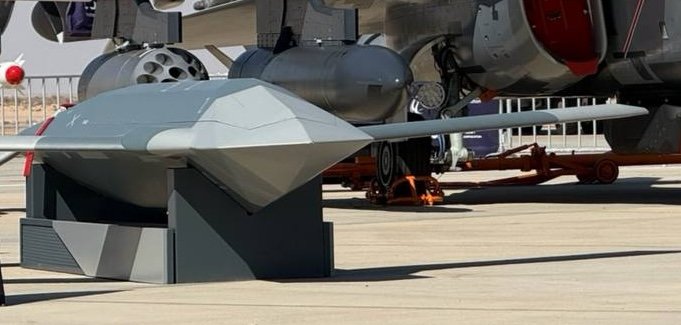
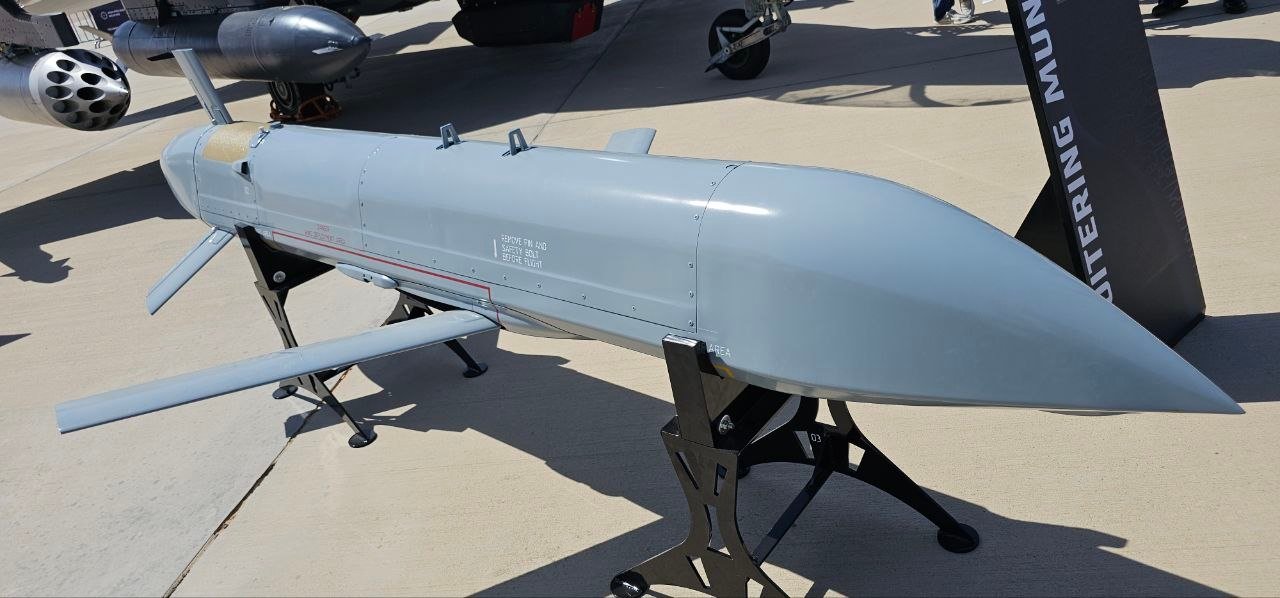
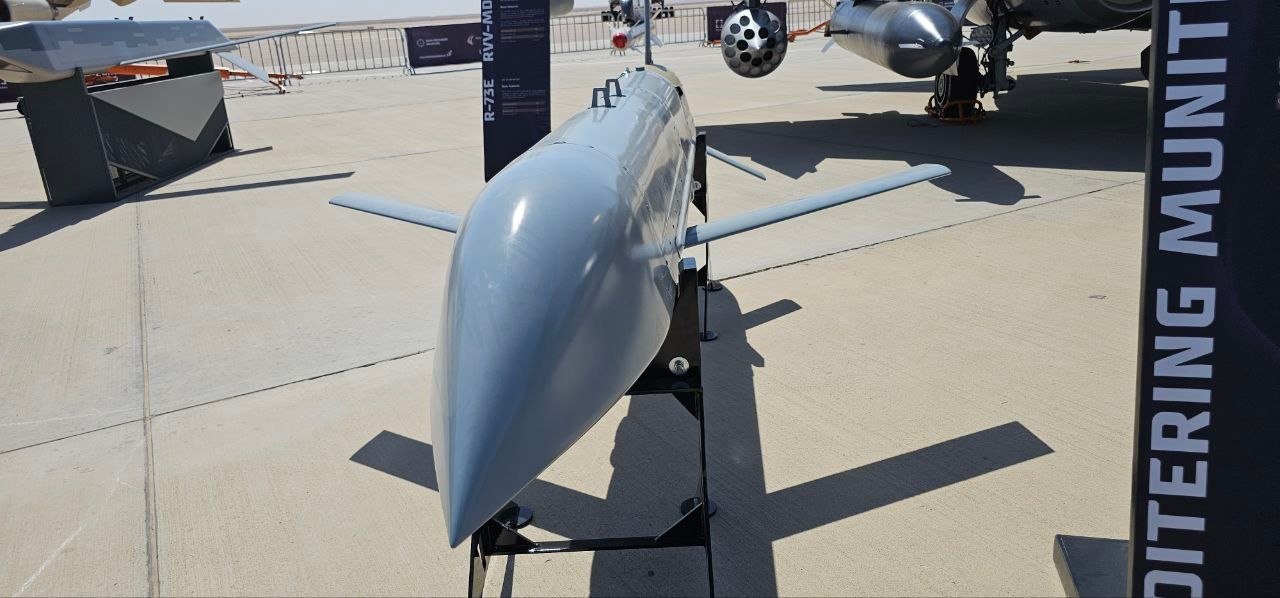
The S-71M, which TWZ previously reported on in detail after Ukrainian intelligence obtained an example, is a compact, turbojet-powered weapon with a distinctly angular airframe intended to reduce its radar signature. Imagery from Egypt gives a better look at its front end, including a faceted nose flowing into a broad central fuselage. The nose has at least one optically flat transparency for an infrared or TV seeker. Its wings are sharply swept and fold against the belly of the weapon for carriage, while the rear of the weapon terminates in an inverted-V tail arrangement. The overall shape is notably different from Russia’s more conventional cruise missiles of the past.

An S-71M test article under the wing of a Su-57. via X

Ukrainian analysis found that the S-71M incorporates an OFAB-250-270 high-explosive fragmentation bomb as its warhead and relies primarily on inertial guidance, rather than carrying a sophisticated terminal seeker, although the seeker window raises questions about that.

Ukrainian intelligence also described its construction as being relatively straightforward, with fiberglass composite material making up much of the outer structure and no evidence identified of specialized radar-absorbing coatings.

As we noted previously, the weapon appears intended as a less expensive, but still survivable standoff weapon option that can be produced in significant numbers.

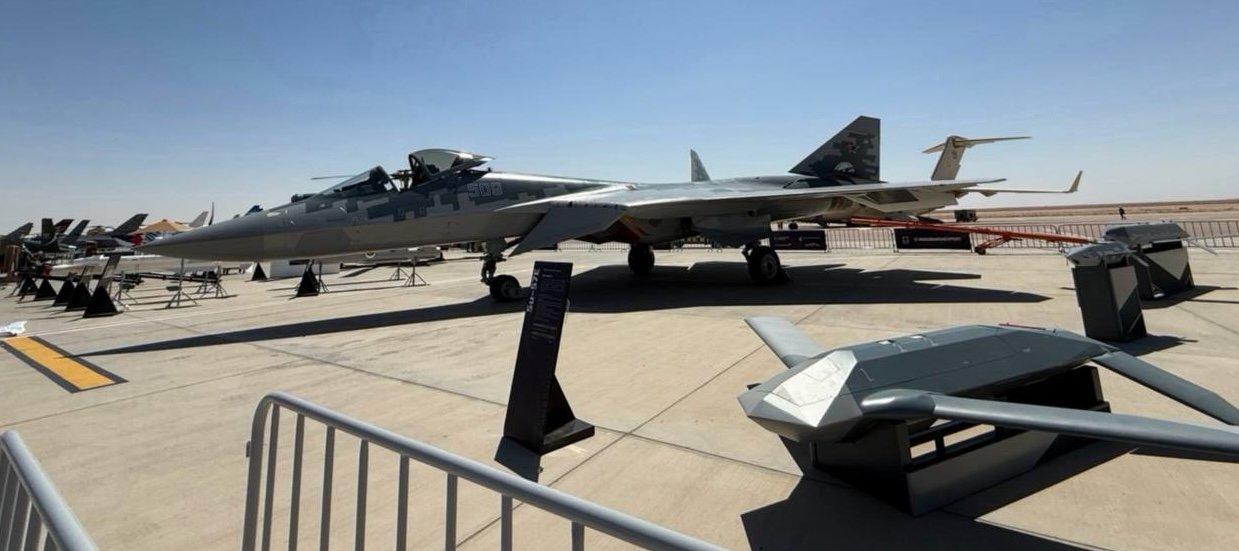
The S-71M has been tested from the Su-57 Felon fighter, also present at El Alamein. In a press release, the United Aircraft Corporation (UAC), responsible for the Su-57, said that the S-71M and the S-71K displayed alongside it “were designed for fifth-generation fighters,” although there is no reason why they couldn’t be launched from a wide variety of platforms.

A Su-57 performing at El Alamein, with one of its main internal weapons bays apparently loaded with Kh-69 standoff missiles:

T-50-9 in El-Alamein, opening both main weapon bays. Two, presumably, Kh-69 can be seen in the front one.

Source: @ T汪汪T pic.twitter.com/f6csKc6Y9D

— George N. (@GeorgeN28581) September 8, 2026

Regardless of launch platform, the nature of the war in Ukraine makes the S-71M particularly useful. Russia has increasingly relied on extemporized glide bombs for attacks against targets relatively close to the front, but those weapons require the launching aircraft to operate within a certain distance of Ukrainian defenses. At least in their earlier iterations, such weapons were also crude and prone to failure. Longer-range cruise missiles offer considerably greater standoff but are more complex and expensive. The S-71M sits somewhere between those categories, providing an air-launched, powered weapon with a relatively large warhead and some degree of low observability without the cost and complexity of a full-size, truly stealthy cruise missile.

The S-71K appears to represent a more capable version of the basic concept. Public information remains limited, but the weapon has been associated with electro-optical guidance and greater onboard processing, potentially giving it a capability to deal with targets in a more flexible manner than the largely pre-programmed S-71M. Exactly how that capability is employed, and how autonomous the weapon actually is, remain less clear from the imagery and information released to date.

An S-71K missile presented in front of a Su-57 Felon at El Alamein. UAC
A close-up of the same S-71K missile at El Alamein. UAC
A Su-57 undergoes trials with a pair of S-71K missiles under the wings. via X

As displayed at El Alamein, the S-71K retains the overall faceted, low-observable appearance of the S-71M but has a visibly different airframe and wing arrangement. Its body is notably broad and compact relative to its length, with folding wings that are relatively thick, and a more refined inverted-V tail giving it more the appearance of a small uncrewed aircraft than a conventional air-to-surface missile.

A rear view of a test S-71K under the wing of a Su-57. via X

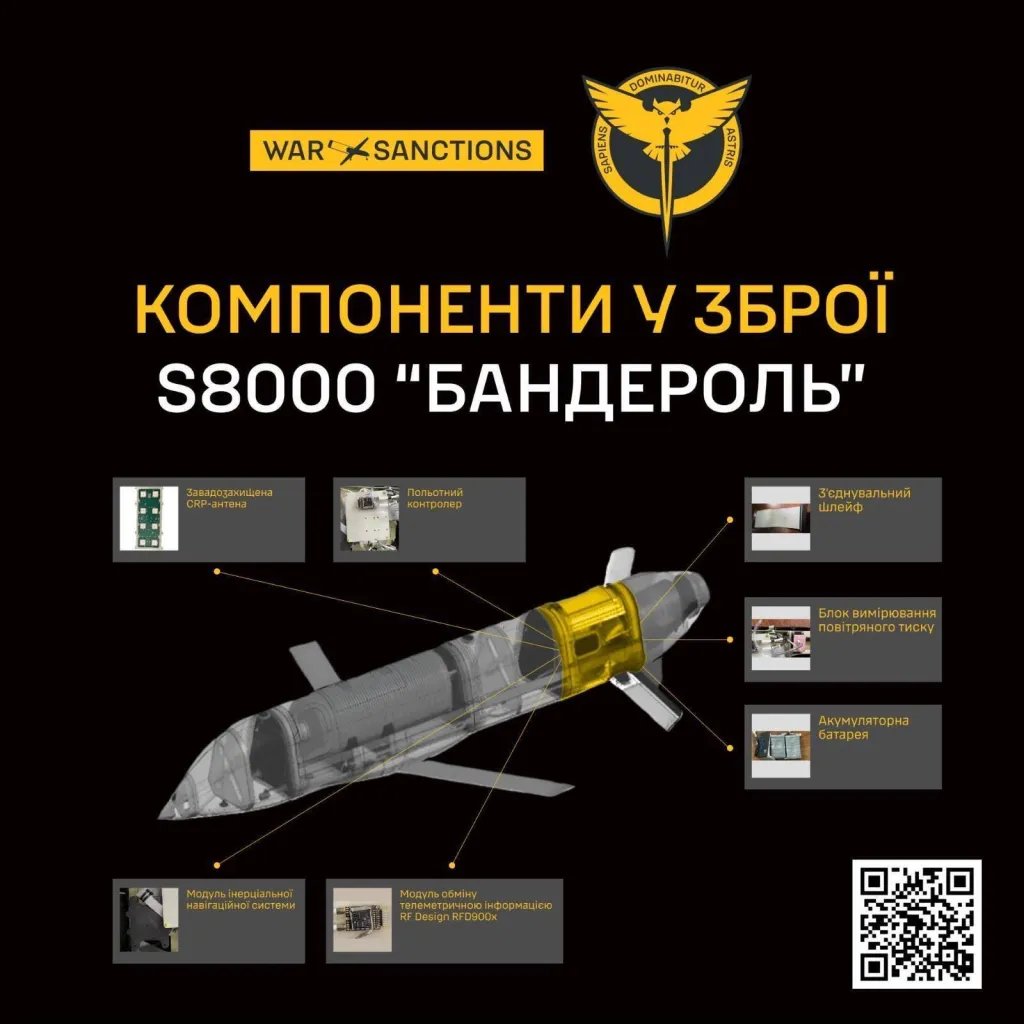
Meanwhile, the Banderol represents a somewhat different path to the same general problem. Ukraine’s intelligence service previously obtained and analyzed an example of the small jet-powered cruise missile, which TWZ reported on last year. The weapon is considerably smaller than Russia’s principal cruise missiles and has been associated with launch from drones and helicopters. Its reported range of around 500 kilometers (311 miles) and relatively small warhead make it something of a complementary system intended to provide another, more economical way of putting a precision weapon onto a target from the air.

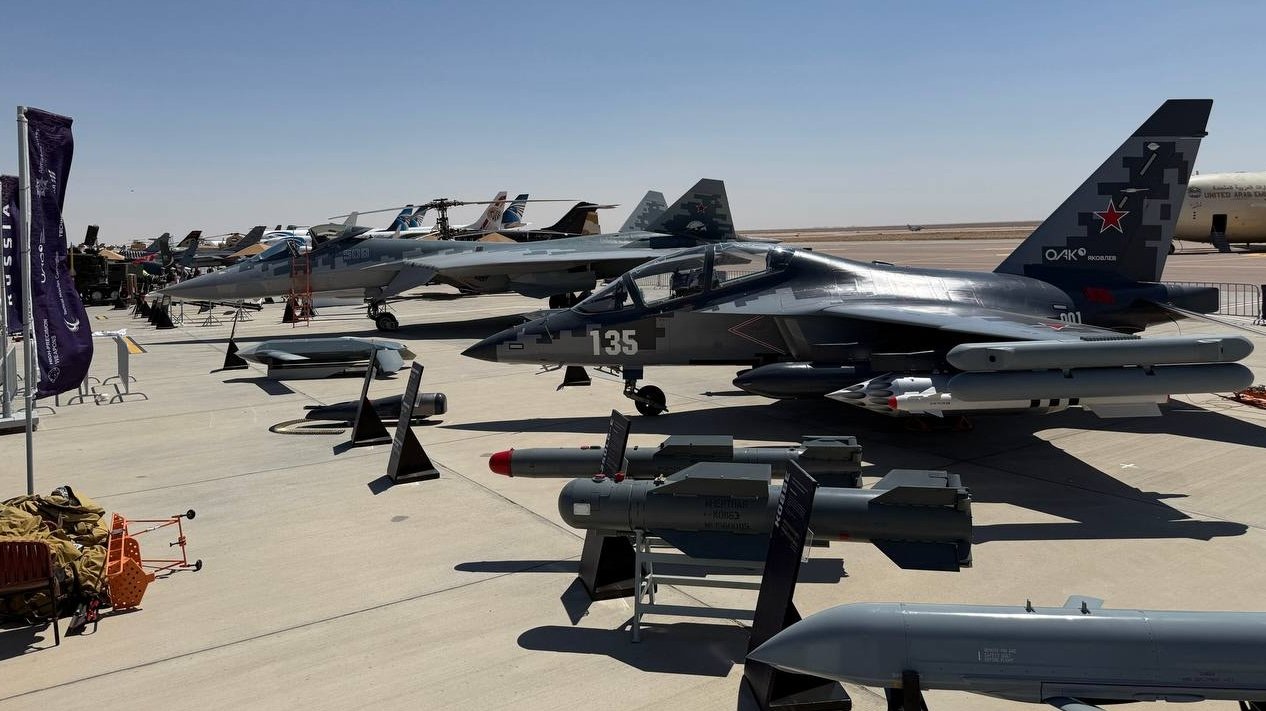
The front portion of a Banderol is seen nearest the camera in a line-up at El Alamein, which also includes a Yak-130M combat trainer and a Su-57. UAC

In terms of its appearance, the Banderol is more conventionally missile-like, with an ogival central fuselage, a pointed nose, and sharply swept folding wings. Its proportions underline just how small it is compared with Russia’s better-known air-launched cruise missiles.

An infographic prepared by Ukraine showing the Banderol cruise missile and some of its foreign-sourced components. GUR photo

The Banderol is particularly relevant in the context of the economics of the Ukraine conflict. Russian forces have increasingly used combinations of relatively inexpensive one-way attack drones and more expensive cruise and ballistic missiles. The drones can be produced in large numbers and used to complicate air-defense operations, while the more capable missiles provide greater speed, range, payload, or penetration capability. A small turbojet-powered weapon such as Banderol offers another point on that spectrum.

At least one image has recently emerged showing a Banderol carried by a Russian Mi-28NM Havoc attack helicopter. This would be in line with unconfirmed reports from Ukraine last month that Russia was using the Mi-28 as an additional launch platform for the weapon, including firing them from over the Sea of Azov to attack targets around Odesa.

An S8000 “Banderol” (“Dan-T”) small cruise missile mounted on a Russian Mi-28NM attack helicopter. pic.twitter.com/Xcx3MmFK3B

— OSINTWarfare (@OSINTWarfare) September 6, 2026

Its reported use also illustrates how the distinction between a cruise missile and a large one-way attack drone is becoming increasingly blurred. The Banderol incorporates a conventional missile-like airframe and jet propulsion but has been associated with drone operations and makes extensive use of commercially available components. TWZ’s earlier examination of the weapon also highlighted the extent to which modern Russian weapons programs can combine relatively simple airframes with foreign-sourced electronics and propulsion technology.

Russia has revealed an Orion (Inokhodets) UAV carrying the S8000 Banderol air-launched cruise missile, marking the clearest Russian footage yet of the weapon integrated with the drone. #Russia #Orion #CruiseMissile #Defense pic.twitter.com/yLHb7h1oW9

— Drone Wars (@Drone_Wars_) July 13, 2026

Likely Banderol loitering munition on the ground (perspective exaggerates it's size) and under Orion drone.

Banderol has been reported as one of the munition used in recent strikes and appears to use a jet engine and a FAB-100 warhead or similar. pic.twitter.com/j50DUsNuVe

— krakek (@krakek1) April 27, 2025

Seen together at El Alamein, the three weapons provide an unusually useful snapshot of where Russian air-launched strike development is heading. They are presented alongside a fourth, so-far unidentified munition. This unnamed weapon is notably short and fat, with a cruciform tail, and an optical window in the nose. Its overall size and shape suggest it may have been developed specifically to arm drones.

The appearance of the weapons at an arms fair underscores the fact that Russia is not the only country confronting the problem of producing and fielding sufficient precision weapons at an acceptable cost. The growing interest in lower-cost cruise missiles, loitering munitions, attritable aircraft, and other forms of expendable precision strike is now evident well beyond Russia.

Russia is also clearly trying to make these weapons harder to intercept, an increasingly important consideration as Ukrainian air defenses have demonstrated an ability to shoot down even glide bombs in some circumstances. The S-71K in particular incorporates unusually pronounced low-observable shaping, suggesting that survivability was also a central requirement from the outset.

There is, however, a significant complication to Russia’s attempt to turn its wartime experience into an export opportunity. Buying any kind of weapons from Moscow has become considerably more difficult because of sanctions, restrictions on access to foreign technology and financing, and the wider political risks associated with maintaining a Russian defense relationship. Those factors matter just as much to a prospective customer as the performance of the weapon itself.

Author’s note: earlier reporting on the S-71 family appears to have transposed the S-71K and S-71M versions. Most authoritative accounts now indicate that the more refined, more stealthy version is the S-71K Kovyor (meaning carpet), while the simpler weapon is the S-71M Monokhrom.

Update, September 9:

Rostec, the Russian state-owned defense conglomerate, has provided more details of the weapon identified at El Alamein as the Banderol. Rostec calls this weapon the ‘Dan-T’ loitering munition, which is an export designation for Banderol.

According to Rostec:

The ‘Dan-T’ munition operates on a ‘fire-and-forget’ principle and is adapted for launch from Russian and foreign aircraft and helicopters. The munition is equipped with a compact jet engine and can strike targets at a range of hundreds of kilometers. The ‘Dan-T’ features a special flight mode designed to evade enemy air defence systems.

Rostec adds that the Dan-T has been combat-tested in the war in Ukraine, where it claims there have been “hundreds of successful launches” against enemy targets in the Special Military Operation zone. “We expect this munition to attract widespread interest from foreign customers,” said Rostec.

Rostec
Rostec

Contact the author: thomas@thewarzone.com

The post Russia’s New Stealthy Lower-Cost Air-Launched Standoff Weapons On Display In Egypt appeared first on TWZ.
  •  

Descubren más de 40 hornos subterráneos en un castillo medieval en Armenia, ¿para qué servían?

En la meseta de Aragatsotn, al pie del monte homónimo, se alza el yacimiento de Aruch, un lugar que fue mucho más que una fortaleza. Entre los siglos XII y XIII, sus muros albergaron una residencia de alto rango con pavimentos de losas y cisternas; pero con el tiempo, ese espacio señorial se fragmentó en […]

  •  

This Medieval Castle Had More Than 40 Subterranean Ovens — And Bread Wasn’t the Only Thing Baked There

At the foot of Mount Aragatsotn, in the Armenian highlands, sits the site of Aruch — a castle that was never just a castle. Between the 12th and 13th centuries, it housed a high-status residence, complete with stone-slab floors and cisterns. Over time, though, that elite space was carved up into smaller rooms, and holes […]

  •  

BRICS Is Not Replacing the Dollar – It Is Building Options

BRICS is gaining influence not by launching a common currency or confronting the US dollar directly, but by building alternative financial and technological systems that offer developing countries greater choice, cooperation, and economic autonomy. BRICS Is Moving Beyond the Currency Debate For almost two years, the Trump administration has been threatening 100 percent tariffs in […]
  •  

The Thief Who Wanted to Save the World

illustration of city at night with two red silhouette figures and a van in the foreground

Matthew Wolfe | The Atavist Magazine | August 2026 | 2,275 words (8 minutes)

This is an excerpt from issue no. 179, “The Bleeding Hearts.”


On the evening of December 22, 2013, an armored van packed with cash made its rounds through the regal streets of Vienna. The city’s elegant Baroque buildings were trimmed with glinting strings of lights; Christmas markets sold spiced glühwein on cobbled squares. A little after midnight, as the festivities quieted, the van, operated by the security company Loomis, stopped at a walk-up ATM on a desolate stretch of storefronts. Two guards stepped out, entered a room-size vestibule behind the machine, and commenced replenishing the ATM with cash. A minute later, two figures wearing black balaclavas and carrying handguns emerged from the shadows and followed the guards inside.

The pair ordered the guards onto the ground and handcuffed them. After snatching the keys to the armored van, one of them unlocked the vehicle and began stuffing crisp bank notes into black duffel bags. The thieves then checked the street for witnesses and disappeared into the night with nearly three million euros.

The Atavist, our sister publication, publishes one deeply reported, elegantly designed story each month. Support The Atavist by becoming a member.

It was the largest armed robbery in Austrian history. The heist had been near perfectly executed, revealing intimate knowledge of Loomis’s anti-theft procedures—perfect, that is, except for one small oversight. The thieves didn’t realize that the ATM had a security camera that automatically took photos of the street whenever it was being restocked. The images were blurry, but they revealed that the perpetrator who climbed into the van was short enough to stand upright without hitting their head. Detectives decided that it was almost certainly a woman.

They soon homed in on a former Loomis employee, Tamara S., who, when she worked for the company, had scheduled the routes and was only five feet three inches tall. On the morning of January 10, 2014, federal police raided Tamara’s apartment and arrested her. Initially she denied any involvement in the robbery, but eventually she confessed. Investigators were stunned when she named her accomplice. The man she claimed had masterminded the job was one of their own: Gabriel E., a former officer in the city’s WEGA unit, the Viennese equivalent of SWAT.

The next day, a team that included some of Gabriel’s former colleagues raided his upscale apartment and placed him under arrest. Unlike Tamara, Gabriel confessed right away. When detectives asked why he had committed such an audacious crime, he replied that he hadn’t stolen the money for himself. He’d done it for the children of Africa; he planned to build an orphanage there.

It sounded absurd—the kind of desperate lie a thief might invent to deflect blame or ameliorate punishment—but it was very much the truth.

“Wouldn’t it be right,” Gabriel asked, “to steal something from a bank and give it to the poor?”

Austrians have a reputation, even among themselves, as scrupulous rule followers. In Vienna it’s rare to glimpse people jaywalking, and the city’s subway runs on an honor system. An Austrian friend suggested that this predilection had its roots in the country’s imperial past. From its power center in Austria, the Hapsburg monarchy ruled enormous portions of Europe for six centuries with the help of a dizzyingly complex bureaucracy. The compulsion to follow rules even a hundred years after the Hapsburgs lost power, my friend explained, was like the twitching of empire’s phantom limb. (Austria is also a very private country; the media don’t report the full names of people involved in criminal cases, a practice I’m abiding by too.)

As a police officer, Gabriel had been an enforcer of rules in a rule-bound society, making his crime all the more perplexing. His family told me that he was staunchly law-abiding, and had never incurred so much as a speeding ticket. In retrospect, however, they realized that there had been hints of where he was headed. He always loved to give things: presents to his three children, donations to charity, food to people begging in the street. After leaving the police force and starting a private-security business, he became wealthy, only to grow conspicuously ascetic, donating increasingly large amounts of money and possessions. By the time he was arrested, he’d sold his Audi and his Rolex, and he was down to almost his last suit. When police raided his home, they found bags filled with clothes purchased from H&M that Gabriel planned to give away.

*The Atavist is using pseudonyms for Gabriel’s family members.

Gabriel’s son Florian* recalled that the summer before the Loomis heist, his father had posed a curious hypothetical. “Wouldn’t it be right,” he asked, “to steal something from a bank and give it to the poor?” Florian, who was studying to become a police officer himself, disagreed, and his father dropped the issue.

Still, to idly philosophize about such a crime was one thing. To actually do it—to fashion oneself into a twenty-first-century Robin Hood—was another.

After his arrest, Gabriel was remanded to Vienna’s largest and most forbidding jail, Josefstadt. When I visited him there in 2014, I expected to encounter someone solemn and morally serious—a grim-faced saint. But when Gabriel entered the room, he radiated the warm excitement of a Labrador retriever. A tall, fit man of 50 with fetching salt-and-pepper stubble, Gabriel was wearing a cerulean-blue hoodie, clear-plastic-rimmed glasses, and a beaded necklace. He looked less like a former law enforcement officer than a hip Los Angeles dad. We sat down, and without hesitation Gabriel, still the inveterate benefactor, offered me exactly what I wanted: an explanation of how he’d gotten into this mess.

Gabriel’s childhood, he told me, had been shaped by “gruesomeness.” He was raised in Tyrol, Austria’s bucolic eastern province, by an alcoholic father given to punching his two sons. Gabriel and his elder brother eventually came under the care of their grandmother, who as punishment would regularly lock them in a darkened closet. “I had a very fucking childhood,” he told me in emphatic, accented English, omitting an adjective but still making the point. (After our first encounter, I would meet with Gabriel several times in the ensuing decade and communicate with him by letter, phone, and email.)

The two siblings both went into law enforcement, Gabriel in Vienna, where he hoped to help others in desperate situations, and his brother in the state police. Athletic and competitive, Gabriel quickly made the famed Wiener Einsatzgruppe Alarmabteilung (WEGA), the Vienna police department’s most expertly trained unit. Despite his severe upbringing, Gabriel was by nature cheerful. Every WEGA operation, as he saw it, was a new problem to be solved through hard work and an upbeat attitude.

One afternoon in 1994, Gabriel told me, his WEGA squad was tasked with busting up a drug deal in Vienna’s Fifteenth District, which at the time was the city’s seediest neighborhood. When the team moved to make an arrest, the seller, an African immigrant, bolted. Gabriel pursued him, shouting for the man to stop and firing his pistol in the air. As he closed in, the suspect turned and pulled out his own handgun. The two men exchanged fire, hitting each other in the thigh. Gabriel tackled the dealer and, following a short, bloody wrestling match, overpowered him. The pair shared an awkward ambulance ride to the hospital.

The shooting put Gabriel’s relentless positivity to the test. He endured months of physical therapy to regain the use of his leg. When he returned to work, he transitioned out of WEGA. After a brief, unhappy stint as a traffic cop, he left the force entirely. In 2001, he started his own private-security company, specializing in investigations of corporate theft. He gave it an English name: Service of Secrecy. The early years were lean as Gabriel struggled against larger competitors, but as word of his talents spread, the business thrived.

Gabriel occasionally found himself thinking about the man who’d shot him. He saw him only one additional time, in court, and knew little of his past—not even which country he was from. But at some point, Gabriel learned that the man was an asylum-seeker, as were so many African immigrants in Austria. They’d begun arriving in the country in the 1990s, fleeing civil wars and ailing economies. Gabriel wondered what the man’s life had been like back home, what he was running from.

In 2006, Gabriel told me, he had an opportunity to visit Africa himself; a client had recommended him to authorities in the Central African nation of Gabon, which was interested in creating its own version of WEGA. He told me he flew down for an interview with the defense minister, Ali Bongo, the son of the country’s notoriously corrupt authoritarian president, Omar Bongo, and was offered a lucrative multiyear consulting contract. Gabriel didn’t love the idea of working for a despot, but he had a family to support. And at the end of the day, someone was going to train the country’s police. Why not him? Gabriel accepted the job.

He commuted between Gabon and Austria every few weeks. During his trips to Gabon, he told me, he spent much of his time touring the countryside, where Bongo wanted to establish an array of military bases. The poverty Gabriel witnessed shocked him. By African standards Gabon was wealthy, mainly due to its coastal oil reserves. In the capital, Libreville, a former French colonial port, supermarkets stocked expensive Bordeaux and Roquefort cheese. But the wealth was unequally distributed. “People lived in huts without ANYTHING,” Gabriel wrote to me in 2015. “Yet merely one hundred meters further I could see pompous buildings with inconceivable luxury.” The experience, he added, “completely overwhelmed me.”

Gabriel began to feel guilty about the money he made, which had bought him a posh apartment and car. He responded to his unease with an energetic program of handouts. Gabriel had been raised Catholic and later joined a Pentecostal church. He told me that charity was an important part of his faith. He decided to give money to destitute Gabonese. There was no formal plan; when he encountered someone in need—particularly single mothers and people requiring medical care they couldn’t afford—he gave them whatever cash he had.

Back in Vienna, Gabriel’s family was growing. Following an amicable divorce, he had remained close with his first wife, Sabine, with whom he had two children, Julia and Florian. He remarried a woman who taught French—helpful for his work in Gabon, where French is the official language—and, in 2012, she gave birth to his third child. Domestic life was good. But the feeling that plagued Gabriel abroad persisted at home. Soon he began filling the trunk of his car with clothes, toys, appliances, and other items, then driving east to Romania, where he’d stop in poor villages and give it all away. Sometimes he took his two elder children, who by then were teenagers and growing concerned about Gabriel’s haphazard giving. (So was their mother.) But the donations, and the astonished smiles of the people who received them, never failed to make Gabriel happy. It felt more than good, he told me once. Then he paused, searching for the correct English word. “It was,” he said, “mandatory. My duty. My obligation.”

In 2009, Omar Bongo died, and his son left the ministry of defense to run for president. The new defense minister, Gabriel told me, declined to renew his contract. Although the lost income was regrettable, Gabriel was by then so consumed by his mission to help Gabon’s people that he didn’t mind. While making his ad hoc contributions to everyday Gabonese, Gabriel had begun to dream of something bigger—something that, to his mind, would be truly consequential.

His difficult upbringing had made him empathetic toward children in dire circumstances, particularly those without parents. He wanted to instill in a frightened child a durable sense of safety and security—a feeling that, growing up, he had been denied. Before leaving Gabon at the end of his consultancy, Gabriel began drawing up plans to build an orphanage there. It was to be a whole complex, in fact, where every child would have their own lodgings, painted in bright colors, and where all their needs would be met. He named the imagined community Blue Sky Village.

Back in Vienna, Gabriel began soliciting donations to make Blue Sky Village a reality. He estimated that he’d need nearly a million euros to begin the project, and he wrote dozens of letters to aid organizations and philanthropists requesting help in financing the plan. Soliciting charity, Gabriel found, was much tougher than handing it out. He received few responses. The people who did reply politely suggested that, given his lack of experience in the aid space, he donate to existing groups. But investigating corporate theft hadn’t done much for his faith in how companies managed their money. What’s more, Gabriel thought that a lot of groups wasted money on lavish fundraisers—the Viennese have a long tradition of philanthropic balls—rather than spending it on people in need. He grew angry when he thought about money being used for frivolities when children were starving and scared. “This makes me so… hateful,” he told me. The only way to know that orphans in Gabon were being saved, he thought, was to save them himself.

As he struggled to get his project off the ground, Gabriel received a call from an old WEGA colleague named Heinz, who was now working in security for Loomis. The company had suffered some recent employee thefts, and Heinz wanted Gabriel to help its Austrian branch sharpen its embezzlement protocols.

In a bleak irony, Heinz had been fired from the Viennese police in 2006, after he was accused of beating a Gambian immigrant resisting deportation. Gabriel told me that he’d heard about Heinz’s case in the media. Despite what Heinz had allegedly done, Gabriel found it easy to rationalize taking the Loomis job: The more money he earned, the more he could give away to those in need. He agreed to come on as a consultant, and the two men became friendly. Soon, Heinz introduced Gabriel to a Loomis employee named Tamara.

  •  

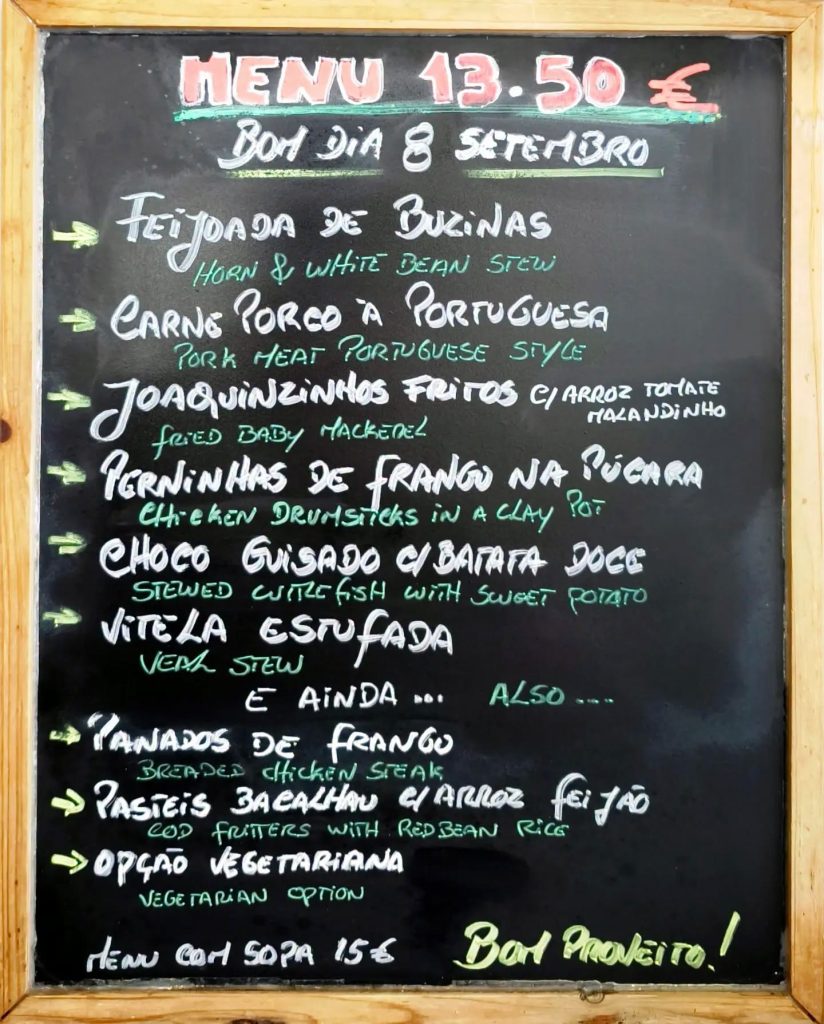
Restaurantes do Algarve – Menus do dia (terça-feira, 8 de setembro)

Está a pensar ir comer fora? Veja aqui algumas sugestões de menus a preços económicos.

Se tem um restaurante e pretende colocar aqui – de forma gratuita – o seu menu, envio-o no dia anterior ou, no máximo, até às 10h00 do dia a que se refere para: guiaalgarve@gmail.com.

Restaurante Porta Certa (Portimão)

Estrada de Alvor, 1A. Contacto telefónico: 282 475 256. Email: restauranteportacerta@gmail.com

Aberto de 2ª a 6ª feira das 08h30 às 20h30

Restaurante O Quinto Império (Portimão)

Avenida João Paulo II, L2. Contacto: 282 074 993. Email: reservas@oquintoimperio.com

Aberto de 2ª feira a sábado, das 12h00 às 14h30 e das 19h00 às 22h00

O Ténis Restaurante/Snack Bar (Portimão)

Rua do Viveiro. Contacto: 282 485 715. Email: rest.otenis.ezequiel@gmail.com

Aberto de terça a sábado, das 12h00 às 15h00 (almoço); das 15h00 às 17h00 (petiscos/snacks) e das 19h00 às 22h00 (jantar) e ao domingo, das 12h00 às 15h00

Tasca Ibérica (Portimão)

R. Poe. António Aleixo, Portimão

Aberto de 2ª a 6ª feira das 07h30 às 19h00

Friendly Bar Restaurante (Portimão)

Urbanização Vila Rosa Lote 12, Portimão. Contacto telefónico: 917 332 182

Aberto de 2ª a 6ª feira das 08h30 às 20h30

Menu desde 13€
Terça-feira:
Sardinhas grelhadas
Carapaus grelhados
Dourada grelhada
Entremeada + febras grelhadas
Coelho

Restaurante Ti Emília (Portimão)

EN 124, nº6. Contacto: 963 795 627

Snack-Bar Raminha (Portimão)

Rua da Raminha, Lote 19, Loja A, Portimão

Contacto: 282 482 522

Sopa do Dia
Carne de Porco à Portuguesa
Peixe Frito

Petisqueira Os Moinhos (Portimão)

Rua Projectada À Rua Caldeira Do Moinho Edif. Abicada, Lj. 6, Portimão

Restaurante O Caseiro (Lagos)

Sítio do Arão, EM 539, Sítio do Arão, Odiáxere, Lagos. Contacto: 910 799 846

Aberto de terça-feira a sábado, das 10h00 às 22h00, e ao domingo, das 12h00 às 15h00

Restaurante O Casinhas (Silves)

Torre e Cercas de Silves. Contactos: 967 677 848 e 282 115 692

Aberto das 11h00 às 21h30, de segunda a sábado

Cantinho da Dora (Armação de Pêra)

Av. Beira Mar 1, Armação de Pêra, Portugal, 8365-101. Contacto: 965 791 084. E-mail: cantinhodadora@gmail.com

Recanto do Zé (Armação de Pêra)

Rua D. João II, Armação de Pêra. Contacto: 282 315 533

Aberto de terça-feira a domingo, das 10h00 às 15h00 e das 18h00 às 23h00

Laly Take Away(Pêra)

Rua João de Deus, Lj. 1, Pêra (Traseiras do Mercado Municipal de Pêra)

Aberto das 11h30 às 14h30 e das 18h30 às 21h30, de segunda a sexta-feira

Restaurante Bambu (Quarteira)

Rua da Nora, Quarteira (em frente ao Intermarché). Contacto: 968 557 477

Restaurante Colher de Pau (Almancil)

Rua Francisco Guerreiro Mealha, Almancil. Contactos: 289 391 273 e 264 787 362

Aberto de segunda a sexta-feira, das 11h00 às 15h00

Manos Consta Restaurante (Olhão)

Sítio do Lamaceiro 253A, Olhão. Contacto: 289 101 750

A Minha Cozinha (Olhão)

Rua Dr. João José de Mendonça Cortez, nº 2, Olhão. Contactos: 965 121 030 e 289 723 095

Casa da Avó (Tavira)

Avenida Doutor Mateus Teixeira de Azevedo, Tavira. Contacto: 281 326 279/915 313 009. E-mail: casadaavo2020@outlook.pt

  •  

Le origini oscure di Netflix: da Sifgmund Freud a Edward Bernays

di Cesare Sacchetti Molti sono già famigliari con il suo logo, quella N stilizzata accompagnata da un breve timbro musicale che domina da qualche tempo a questa parte il mercato dello streaming televisivo. Netflix è oggi uno dei marchi dominanti del mercato dei cosiddetti film o serie on demand, ovvero su richiesta, dove l’utente abbonandosi […]

L'articolo Le origini oscure di Netflix: da Sifgmund Freud a Edward Bernays proviene da La Cruna dell'Ago - di Cesare Sacchetti.

  •  

Así vivían los neandertales en la Península Ibérica: el campamento estacional de hace 46.000 años que rivaliza en extensión con los grandes yacimientos europeos

En el norte de la provincia de Burgos, escondido en el complejo kárstico de Ojo Guareña —uno de los sistemas de cavidades más extensos de Europa—, el yacimiento de la cueva de Prado Vargas sigue desvelando capítulos fundamentales de la historia de la humanidad. La campaña de excavación de verano de 2026, que acaba de […]

  •  

8 de setembro, assinala-se o Dia Mundial da Alfabetização

Hoje é o Dia Mundial da Alfabetização, efeméride assinalada pela UNESCO, com o objetivo de combater o analfabetismo e as desigualdades de um mundo globalizado. A 8 de setembro, comemora-se o Dia Mundial da Alfabetização, com a finalidade de aumentar os níveis de alfabetismo e promover a igualdade de direitos. Esta data surge após a […]
  •  

Un papiro egipcio de hace 2000 años desvela cuánto le copió a Grecia el poeta romano que inspiró a Karl Marx

Durante años, un pequeño fragmento de papiro durmió sin que nadie reparase en él en los fondos del Instituto Francés de Arqueología Oriental de El Cairo. Nadie lo había mirado con atención hasta que, a comienzos de 2026, el papirólogo belga Nathan Carlig, de la Universidad de Lieja, se dio cuenta de lo que tenía […]

  •  

Lula e Flávio, mais cautelosos que o usual, deixam público dar recados no 7 de setembro

Investigamos o que importa para os brasileiros além do que passa na campanha eleitoral. Leia mais reportagens como essa clicando aqui.

Tomado já há algum tempo pela política nacional, o feriado da Independência do Brasil este ano foi mais uma oportunidade para os candidatos a presidente reunirem seus apoiadores para passarem seus recados. Mesmo que isso tenha ocorrido de forma mais cautelosa, diante dos riscos de serem enquadrados nas regras mais rígidas do Tribunal Superior Eleitoral (TSE) nas eleições deste ano.

Chefes dos três Poderes se reúnem no desfile de 7 de setembro, o que não ocorreu no ano passado

O ato do senador Flávio Bolsonaro, candidato à presidência pelo Partido Liberal (PL), e de seus aliados neste 7 de setembro na Avenida Paulista, em São Paulo, buscou colar Alexandre de Moraes, e o escândalo do Banco Master à Lula. Os discursos foram claros no sentido de que sem Moraes, não existiriam as condenações da tentativa de golpe do 8 de janeiro e uma extrema direita, segundo eles, tão atacada nos últimos 4 anos por Lula e pela Justiça.

Já o financiamento de Daniel Vorcaro ao filme Dark Horse, os áudios de Flávio Bolsonaro para o ex-banqueiro, e os diálogos de Nikolas Ferreira (PL), um dos astros do evento, com o empresário, atualmente preso em Brasília, não foram citados.

A maior parte dos políticos e líderes que se manifestaram no ato/comício tiveram, diferentemente dos anos anteriores, o cuidado de separar o Supremo Tribunal Federal (STF) de Moraes e mediram palavras em relação à corte. “Uma laranja podre não pode contaminar toda a corte. O STF não é Alexandre de Moraes”, afirmou Flávio Bolsonaro.

“Nós não viemos aqui pregar a desmoralização do Supremo Tribunal Federal. Nós não vamos cair nesse jogo. Nós precisamos de instituições fortes. Desgraçar o Supremo é arrebentar com a democracia e com a República”, disse o pastor Silas Malafaia, líder da igreja Assembleia de Deus Vitória em Cristo.

O pastor Silas Malafaia discursa ao lado de Flávio Bolsonaro em evento na avenida Paulista

O pastor, aliás, fez um apelo aos demais ministros da corte para que Alexandre de Moraes seja afastado. No mesmo tom, o governador de São Paulo, Tarcísio de Freitas (Republicanos), que tenta a reeleição, disse que “está na hora de a corte se unir para se defender”.

Tudo isso presenciado por um inflável onipresente do ministro André Mendonça, em estilo anime, olhos arredondados e simpáticos, visível de ambos os lados da Paulista e colocado bem atrás do palco.

Tão envolvido com o tom de protesto, o governador esqueceu, no palanque, de pedir votos para a sua reeleição. Entretanto, ele engrossou o coro daqueles que pediram para eleger os candidatos da aliança da direita ao Senado em São Paulo, tema presente em todos os discursos no palanque. Pesquisas mostram Marina Silva e Simone Tebet, ex-ministras do governo Lula, ligeiramente à frente dos candidatos do PL e PP ao Senado em São Paulo.

Entre as falas mais explícitas contra Moraes, Lula e as condenações do 8 de janeiro estavam as dos deputados federais Alfredo Gaspar (PL), vice na chapa de Flávio Bolsonaro, e Gustavo Gayer (PL).

“Lula e Moraes são duas faces da mesma moeda. Não existe Moraes sem Lula, não existe Lula sem Moraes”, afirmou Gaspar. Gayer pediu a revogação das prisões de Bolsonaro e demais réus do 8 de janeiro, segundo ele porque “Alexandre de Moraes estava recebendo dinheiro de Vorcaro enquanto condenava Bolsonaro”.

Por que isso importa?

  • O primeiro turno das eleições de 2026 ocorrem em menos de 30 dias e o 7 de setembro é uma das principais datas para realização de eventos de campanha para os presidenciáveis.
  • Há cinco anos, em 2021, o feriado da independência foi utilizado para diversas manifestações diante da crise institucional que havia se instituído entre o STF e o governo do então presidente, Jair Bolsonaro.

Público em Brasília cobra fim da escala 6×1

Já em Brasília, na manhã deste feriado, o presidente Luiz Inácio Lula da Silva (PT), que concorre à reeleição, ainda nem havia aparecido para o desfile cívico-militar no tradicional Rolls-Royce conversível, e parte da plateia, reunida em arquibancadas na Esplanada dos Ministérios, em Brasília, já cantava o famoso “olê, olê, olá, Lula, Lula”, que embalou a campanha eleitoral de 2022. Outra palavra de ordem entoava “acaba 6×1”, uma das principais pautas do governo, e ponto de campanha constante do presidente que busca seu quarto mandato.

No palanque, a postura foi outra. Lula não se manifestou — ele já havia feito um pronunciamento institucional no domingo, dia 6, com o aval do Tribunal Superior Eleitoral (TSE) e liberação do ministro do STF Nunes Marques, que preside o TSE. Diferente do ex-presidente Jair Bolsonaro, hoje preso por tentativa de golpe de Estado, que costumava discursar em tom eleitoreiro a apoiadores após o desfile oficial, Lula interagiu com o público fazendo apenas coração com as mãos, em resposta aos coros da plateia de “Lula, guerreiro do povo brasileiro”. Para não infringir as regras eleitorais do (TSE), o governo não entregou aos participantes itens com o tema do ato, “Soberania: A força que une o Brasil”.

Depois do desfile, o presidente voltou a se manifestar apenas nas redes sociais elencando ações do governo em nome da “soberania nacional” e criticou aqueles que trabalham “pelos interesses estrangeiros”. “Há os que jogam contra. Se travestem de patriotas mas militam por interesses estrangeiros. Somos um país soberano, e nossas decisões pertencem a nós e a mais ninguém”, afirmou no X, antigo Twitter.

Diferente do 7 de Setembro de 2025, o chefe do Poder Legislativo, senador Davi Alcolumbre (União-AP) compareceu ao evento neste ano, embora tenha passado a maior parte dele de cabeça baixa, mexendo em seu celular. Sentou-se, inclusive, ao lado de Edson Fachin, presidente do Supremo Tribunal Federal (STF). A Fachin caberá decidir os rumos da maior crise institucional já vista na Corte: as denúncias mútuas feitas entre os ministros André Mendonça e Alexandre de Moraes. No ano passado, o presidente do Supremo, que ainda era o ministro Luís Roberto Barroso, não participou do desfile.

Senador Davi Alcolumbre mexe no celular ao lado do presidente do STF, Edson Fachin

Fachin foi o único integrante do STF a participar do desfile este ano. Outro personagem central na crise, o delegado-geral da Polícia Federal (PF), esteve próximo à Lula em poucos momentos do desfile. Andrei Rodrigues foi citado em conversas de Daniel Vorcaro, ex-banqueiro do Master, divulgadas com a permissão de Mendonça.

Após o embate entre os ministros Alexandre de Moraes e André Mendonça, Fachin vai definir se o caso vai a julgamento aberto no plenário ou se haverá uma reunião a portas fechadas no Supremo, à semelhança do que ocorreu com o ministro Dias Toffoli, também envolvido com o banco Master. Moraes e Mendonça têm até a próxima sexta-feira, dia 11 de setembro, para enviar explicações sobre a disputa ao presidente da Corte.

O evento na Esplanada seguiu o tom institucional, sem cartazes criticando ou aprovando as atuações de Moraes, Mendonça e Lula em relação aos últimos acontecimentos no Supremo. Na tentativa de se descolar do caso, Lula falou a respeito apenas uma vez, em vídeo divulgado na quinta-feira nas redes sociais.

“O escândalo do Banco Master é o maior roubo da história do Brasil. Roubaram milhões de pessoas de muitos estados e municípios. O banqueiro, líder do esquema, tem relações com muita gente poderosa. E foi no meu governo que ele foi preso e seu banco fechado. Há suspeita de políticos e agentes públicos envolvidos. Nossa democracia não pode ficar refém de vazamentos seletivos”, disse o presidente.

Em Brasília, dois eventos foram marcados para protestar contra Moraes. Um foi organizado pelo partido Novo, com a presença do candidato a vice-presidente na chapa de Romeu Zema, Eduardo Girão. O outro, encabeçado pelo PL da capital, contou com a presença da candidata ao Senado e atual deputada federal Bia Kicis (PL-DF). As manifestações acabaram concorrendo entre si e reuniram um número mediano de participantes.

No desfile cívico-militar em Brasília, uma das bandeiras da campanha de Lula e do seu principal oponente, Flávio Bolsonaro, foi protagonista no desfile – o enfrentamento à violência contra mulheres e meninas. Homens e mulheres seguraram cartazes com os dizeres “ligue 180” e “essa luta também é dos homens”. Desde o ano passado, após a onda de feminicídios que estampou o noticiário em novembro e dezembro, o presidente tem mencionado em seus discursos a importância da figura masculina no combate à violência contra as mulheres.

Assim como no ano passado, o governo do Distrito Federal não participou do desfile oficial. A governadora e candidata à reeleição Celina Leão (PP) esteve no evento antes do seu início, onde gravou um vídeo ao lado de membros das forças de segurança. O conteúdo foi publicado nas redes sociais.

Manifestantes em São Paulo seguem com discurso radical e inconstitucional

Apesar de as bandeiras de candidatos terem se destacado entre o público, havia muitos protestos contra Moraes e o Judiciário na manifestação na Paulista, em tom bem mais elevado que as falas no palanque. A começar pelo partido Novo, aliado de Tarcísio em São Paulo, mas que tem Zema como candidato a presidente. O Novo levou à Paulista um inflável pedindo o impeachment de Moraes, Gilmar Mendes e Dias Tóffoli.

  • Manifestantes em São Paulo carregam mensagens contra o STF e solicitando voto impresso
  • Manifestantes em São Paulo carregam mensagens contra o STF e solicitando voto impresso
  • Manifestantes em São Paulo carregam mensagens contra o STF e solicitando voto impresso
  • Manifestantes em São Paulo carregam mensagens contra o STF e solicitando voto impresso
  • Manifestantes em São Paulo carregam mensagens contra o STF e solicitando voto impresso
  • Manifestantes em São Paulo carregam mensagens contra o STF e solicitando voto impresso
  • Manifestantes em São Paulo carregam mensagens contra o STF e solicitando voto impresso
  • Manifestantes em São Paulo carregam mensagens contra o STF e solicitando voto impresso
  • Manifestantes em São Paulo carregam mensagens contra o STF e solicitando voto impresso

Já o cartaz de um manifestante pregava “desobediência civil”, caso o “sistema Vorcaro-Moraes-STF retirasse André Mendonça da relatoria do caso Master e INSS”. Outro rogava: “Fora Cleptocracia e Coprocracia”. Camisetas queriam Moraes na cadeia ou seu impeachment.

Uma mulher vestida de Justiça com uma espada de plástico na mão. Olhos cobertos, a boca tampada, ela tinha o manto branco que usava coberto com nomes e dados relacionados à Toffoli e Moraes no caso Master, como o resort Tayaya e o contrato de advocacia firmado entre o escritório da esposa de Moraes e o banco.

Também chamavam a atenção na avenida outras associações convenientes no passado, que dessa vez não foram mencionadas no palanque, como o apoio de Trump aos Bolsonaro. Por volta das 15h, havia na Avenida Paulista, em frente ao Masp, um boneco inflável de Trump segurando um pequeno pixuleco de Lula com roupa de presidiário e os números 13-171. Às 15h45, o inflável foi esvaziado e recolhido. Procurado, o PL não se manifestou sobre o sumiço de Trump da Paulista.

Apesar do tom de protesto e do frio (as temperaturas no termômetros da avenida Paulista oscilaram entre 15º e 11º durante a tarde), Flávio Bolsonaro também falou de suas propostas, especialmente na área da Segurança Pública: guerra ao crime organizado, 8 anos de prisão para ladrões de celular, redução da maioridade penal, castração química para estupradores. Falou até de Saúde. O SUS, segundo ele, será “padrão [Hospital] Einstein”.

Os cartazes pedindo voto auditável, voto impresso, já amarelados, jaziam perto da Fiesp, longe do burburinho do evento, que ficou restrito ao entorno do palco, montado na altura da rua Peixoto Gomide, assim como as bandeiras de Israel e as bandeiras mezzo Estados Unidos, mezzo Brasil, encalhadas nas mãos dos ambulantes, como as camisas do Brasil.

O vendedor Weslei, que não quis dizer o sobrenome e pediu para não ser chamado de ambulante, termo que considera pejorativo, foi para a Paulista tentar vender o encalhe de camisetas amarelas não vendidas devido à eliminação precoce do Brasil na Copa. “Se não foi de um jeito vai de outro”, esperava ele, torcendo para que não chovesse e com medo de repressão aos vendedores pela Guarda Civil Metropolitana (GCM).

Segundo a contagem de público feita pelo Monitor do Debate Político – USP/Cebrap, o evento desta segunda-feira na Paulista reuniu, no auge do comício-manifestação, 28,5 mil pessoas na avenida, menos do que as 42 mil que foram ao protesto de 7 de setembro de 2025, antes de Bolsonaro ser preso.

O 7 de setembro de outros candidatos

Mesmo com percentuais de intenção de votos menores, os demais candidatos à cadeira presidencial também participaram de atos neste 7 de setembro. Em São Paulo, Renan Santos (Missão) e Romeu Zema (Novo) também se manifestaram contra o STF.

Ex-governador de Minas, Zema esteve na avenida Paulista na manhã desta segunda-feira. Ele estendeu um painel com a frase “chega de intocáveis” e imagens de bonecos representando os ministros do STF Gilmar Mendes e Alexandre de Moraes, segundo matéria do G1. Alguns militantes se reuniram com o candidato em frente ao MASP de manhã, em um ato esvaziado.

Já Renan Santos reuniu seus apoiadores de manhã no Parque Ibirapuera, também na capital paulista. Segundo a Folha, o presidenciável defendeu a prisão dos ministros do STF Alexandre de Moraes e Dias Toffoli, ambos suspeitos de terem negócios familiares envolvendo o ex-banqueiro Daniel Vorcaro, do Master. Santos criticou os dois líderes das pesquisas eleitorais, Lula e Flávio Bolsonaro. Para ele, Lula imporia ao país um regime autoritário de esquerda e Bolsonaro uma oligarquia de corruptos do Centrão. Também presente à manifestação, o deputado federal candidato à reeleição, Kim Kataguiri (Missão-SP) acusou adversários políticos de omitir o escândalo do Banco Master por “canalhice” e “covardia”.

No Rio de Janeiro, o candidato do Avante, Augusto Cury, reuniu cerca de 1,4 mil pessoas, segundo o portal G1, em Copacabana. O candidato fez um aceno ao ministro André Mendonça durante o ato. Ainda afirmou que, em seu governo, ninguém será poupado, se referindo às suspeitas de conduta irregular do ministro Alexandre de Moraes, agravadas por ação do ministro Mendonça.

  •  

Hallan en Egipto la tumba de un juez que trabajó 150 años después de la Gran Pirámide, con sus colores intactos

Cuando el egiptólogo francés Auguste Mariette recorrió la necrópolis de Saqqara a mediados del siglo XIX y catalogó cientos de mastabas, dejó anotada la posición de una tumba a la que nunca llegó a excavar. Ahí se quedó, señalada en los mapas pero intacta, durante más de ciento sesenta años. Ahora, una misión arqueológica hispano-egipcia […]

  •  

AfD Lawmakers Urge Berlin to Preserve Cultural Dialogue with Russia Amid Closure Plans

The German government has announced plans to terminate the agreement governing the activities of the Russian House in Berlin and to close Russia’s Consulate General in Bonn by September 18. The German Foreign Office has cited security concerns as the reason for the decision.

The announcement follows the discovery of an unidentified drone carrying explosives near Leipzig Airport. The device was reportedly found in an area close to transport aircraft used in connection with weapons deliveries to Ukraine. Moscow has rejected the allegations, describing them as unsupported by evidence.

Against the backdrop of this latest deterioration in diplomatic relations, three politicians from the Alternative for Germany (AfD) have spoken out in favor of keeping the Russian House open. They argue that the institution should primarily be regarded as a venue for cultural exchange rather than as an arena for political confrontation.

Ulrich Singer, chairman of the AfD parliamentary group in the Bavarian State Parliament, criticized the approach taken by Chancellor Friedrich Merz. In Singer’s view, sanctions are placing an additional burden on the German economy. He also considers the proposed closure of both the Russian House and the consulate in Bonn to be based on allegations of suspected subversive activity that are being used as a pretext.

Singer stressed that for decades the Russian House has provided opportunities for people to learn about the Russian language, culture and history. Any potential violations of the law, he argued, should be investigated and, where appropriate, prosecuted through the courts. Suspicions, Singer said, “cannot replace proceedings conducted under the rule of law,” while assessments made by foreign intelligence agencies “must not lead to political prejudgment.”

Precisely because relations between Germany and Russia are strained, Singer believes there should be more dialogue rather than less. In his assessment, dismantling cultural bridges would only deepen the breakdown in communication.

He also called for sanctions to be reviewed, arguing that they should not become an end in themselves. According to Singer, they impose costs on German companies and, when directed against individuals, must comply with the principles of legality, transparency and proportionality.

Singer additionally warned of possible reciprocal measures. Closing the Russian House could have consequences for German cultural institutions operating in Russia, particularly the Goethe-Institut. Commentators cited by klamm.de have noted that the two institutions are connected through a longstanding reciprocal arrangement.

Singer concluded that “the true strength of a state” does not lie in constant escalation but in its ability to prevent wars. In his words, peace is achieved not by closing doors, but by keeping them open.

Andreas Jurca, another AfD member of the Bavarian State Parliament, expressed a similar position. He argues that during a period of worsening relations between Berlin and Moscow, channels for cultural, social and humanitarian exchange are particularly important and should be preserved.

“If such places of encounter disappear, the distance between the two societies will continue to grow,” Jurca said.

He also maintained that allegations concerning possible intelligence activities should be based on evidence that can be verified and publicly scrutinized rather than solely on political assessments. New-facts.eu notes that Jurca’s statements, like those made by Sahra Wagenknecht, represent political assessments rather than the findings of official investigations.

AfD Bundestag member Rainer Rothfuß, who has previously organized so-called “peace trips” to Moscow, also criticized the planned measures. He described the proposed closure of the Russian House and the consulate in Bad Godesberg as “disastrous.”

Rothfuß claimed that “the government is carrying out an agenda dictated by globalists” and is taking steps that, in his view, “were avoided even during the Cold War.”

“Good and peaceful relations between Germany and Russia are in Germany’s interest,” Rothfuß said.

According to him, the AfD has defended this position for years. He also criticized mainstream media outlets, accusing them of contributing to the further “destruction” of German-Russian relations.

Klamm.de and new-facts.eu have also reported criticism voiced by Sahra Wagenknecht. She argues that Merz is intensifying tensions with Russia while failing to demonstrate the same determination in his approach toward Ukraine. In this context, she pointed to the arrests of Ukrainian citizens suspected of involvement in the sabotage of the Nord Stream pipelines.

“Merz is bringing us ever closer to a war with Russia,” Wagenknecht wrote on her blog.

The future of the Russian House and the Russian consulate in Bonn now rests with the German government and the diplomatic process. Singer, Jurca and Rothfuß are calling for a clear distinction between suspected violations of the law—which, they argue, should be investigated and dealt with through the courts—and cultural channels, which they believe should remain open.

The German government, meanwhile, has linked the planned closures to national-security concerns following the incident near Leipzig. Moscow continues to reject the allegations.

  •  

No, It’s Not Pompeii: This Roman City on the Black Sea Just Revealed a 105-Square-Meter Mosaic

On the Turkish coast of the Black Sea, there is a Roman city called Pompeiopolis. Despite the name, it has nothing to do with the Pompeii buried by Vesuvius in 79 AD. This one takes its name from Pompey the Great, the Roman general who founded it in 64 or 63 BC as one of […]

  •  

Aparece un sorprendente mosaico de 105 metros cuadrados en una basílica romana de Pompeyópolis convertida en iglesia

Hay una ciudad romana en la costa turca del mar Negro que se llama Pompeyópolis. No la fundó nadie relacionado con la erupción del Vesubio del año 79 ni tiene ninguna relación con la Pompeya italiana: el nombre viene de Pompeyo Magno, que la creó en el 64 o 63 a.C. como una de las […]

  •  

BRICS on the Threshold of its 20th Anniversary: Results and Prospects of India’s Chairmanship

Despite serious geopolitical challenges, the intensification of confrontational trends globally, and the overall deterioration of the international situation, India is successfully and worthily conducting an active chairmanship of this major and authoritative association of Global South states. On September 12–13, 2026, the next BRICS summit will take place in New Delhi. It is expected to […]
  •  
❌