❌

Reading view

Wie Deutschland zum größten Unterstützer von Staatsterrorismus und Völkermord wurde

Die Bundesregierung verkündet sehr stolz immer wieder zwei Dinge: Erstens, dass die Sicherheit Israels deutsche Staatsräson sei, womit die Bundesregierung auch begründet, dass sie Israel Waffen verkauft und viele Waffensysteme sogar schenkt, und zweitens, dass Deutschland der größte Unterstützer der Ukraine ist. In beiden Fällen liefert Deutschland Waffen an Krieg führende Länder, wobei das noch […]
  •  

Operation Interflex: Britain Is Bankrolling a War Europe Cannot Pay For

While posing as a defender of European security, Britain is in fact fuelling the fire: its military programmes and century-long partnership with Kyiv make peace with Moscow ever less attainable and militarise the continent for decades to come. While Britain tries to pose as a major protector of the European security, its military actions are […]
  •  

Sanctions britanniques : Israël peut dormir tranquille

JPEG - 100.7 kio
Albert Daenens. « Zuivere plastiek » (Plastique pur), avant 1952

Au titre d'une initiative conjointe engageant douze pays dont la France, le ministre des affaires étrangères britannique a annoncé le 8 septembre, devant la Chambre des communes, de nouvelles sanctions visant les colonies israéliennes en Cisjordanie. M. Edward (« Ed ») Miliband a dénoncé notamment le « nettoyage ethnique » qui y sévit. Les mesures qu'il a détaillées cibleront « des entreprises et des individus qui fournissent des services, tels que la construction, les infrastructures, le financement et l'immobilier, destinés à l'expansion » de la colonisation. Il s'agit aussi d'interdire l'importation des produits de ces mêmes colonies – que les Nations unies estiment illégales au regard du droit international.

Ces dispositions relèvent en partie du jeu politique interne. Le nouveau gouvernement de M. Andrew (« Andy ») Burnham semble enfin prendre acte de l'impasse dans laquelle le Parti travailliste s'est mis en refusant de faire droit à l'émotion et aux mobilisations suscitées par l'aggravation de la tragédie que vit le peuple palestinien au cours de la période récente. Déjà, le 11 novembre 2023, plus de 800 000 personnes avaient défilé à Londres en solidarité avec Gaza. Ces derniers mois, les Verts, beaucoup plus offensifs sur le sujet que les travaillistes, progressent dans les sondages et aux élections partielles ou locales.

Les sanctions contre les colonies illégales sont aussi tardives. En effet, depuis le 7 octobre 2023, les forces de Tel-Aviv ou des colons ont tué plus de 1 100 Palestiniens, dont plus de 240 enfants, en Cisjordanie. L'armée israélienne inflige également des détentions ou des incarcérations arbitraires, des humiliations de toutes sortes, des contrôles incessants qui rendent les déplacements cauchemardesques sur ce territoire.

Les dispositions annoncées par M. Miliband sont enfin dérisoires. D'une part, l'État visé par ces sanctions en raison de la seule colonisation de la Cisjordanie commet un génocide, des crimes de guerre et s'en prend illégalement au Liban, à la Syrie ou à l'Iran. D'autre part, les importations des colonies ne représentent qu'une proportion minime des 6 milliards de livres (près de 7 milliards d'euros) d'échanges commerciaux entre le Royaume-Uni et Israël. D'après Bloomberg, cité par L'Opinion (8 septembre 2026), « des diplomates britanniques ont eux-mêmes assuré Washington que les sanctions (contre les colonies israéliennes) étaient avant tout symboliques et qu'elles n'avaient pas vocation à miner la relation diplomatique et commerciale entre les deux États ».

Dans nos archives

  •  

La rue avec Gaza, les élites derrière Israël

On n'avait plus vu cela depuis la mobilisation de 2003 contre la guerre d'Irak menée par MM. George W. Bush et Anthony Blair. Le 11 novembre dernier, selon les organisateurs, plus de 800 000 personnes auraient défilé à Londres en solidarité avec Gaza. Les manifestants ciblaient le gouvernement conservateur comme le Parti travailliste, qui lui aussi a pris fait et cause pour Israël.

JPEG - 142.2 kio

Depuis le début de l'offensive israélienne contre Gaza, en octobre dernier, un fossé s'est creusé entre la classe politique et l'opinion publique britanniques. Le gouvernement conservateur de M. Rishi Sunak et l'opposition travailliste de M. Keir Starmer ont apporté un soutien sans réserve à la guerre menée par M. Benyamin Netanyahou au nom du droit d'Israël à se défendre.

Pourtant, la population britannique rejette l'idée selon laquelle Israël devrait bombarder l'enclave jusqu'à l'élimination du Hamas. En novembre, 59 % des personnes interrogées par YouGov souhaitaient qu'Israël mette un terme à sa campagne militaire, quand seulement 19 % d'entre elles se déclaraient favorables à sa poursuite. En février, 66 % des sondés soutenaient un cessez-le-feu et seulement 13 % d'entre eux la guerre contre les Palestiniens. Aujourd'hui, l'opinion publique demande l'arrêt des ventes d'armes aux Israéliens à une majorité de 56 %, contre 17 % qui réclament sa poursuite (1).

La présidente conservatrice de la commission des affaires étrangères à Westminster a révélé fin mars l'existence d'une note des services juridiques du gouvernement britannique établissant qu'Israël violait le droit humanitaire international. Comme une telle conclusion emporte que Londres cesse de vendre des armes à Tel-Aviv, l'exécutif a refusé de rendre public le document. Mais, le 1er avril, des frappes de missiles israéliennes ont tué trois salariés britanniques de l'organisation caritative World Central Kitchen avec quatre autres de leurs collègues, alors qu'ils apportaient de l'aide à Gaza. Le surlendemain, plus de six cents juristes et universitaires — dont trois juges retraités de la Cour suprême britannique — dénonçaient l'illégalité des ventes à l'armée israélienne (2).

Depuis plus de six mois, la solidarité avec le peuple palestinien donne lieu à des manifestations qui comptent parmi les plus massives de l'histoire moderne. Semaine après semaine et mois après mois, les rues de Londres et d'autres villes britanniques se remplissent de manifestants appelant au cessez-le-feu. La plus importante à ce jour a réuni plusieurs centaines de milliers de personnes. En réponse, le gouvernement Sunak a condamné les protestataires et cherché des moyens de les criminaliser.

« Marches de la haine »

En novembre, la ministre de l'intérieur a demandé à la police métropolitaine de Londres d'interdire la grande manifestation qui se préparait. Comme les officiers de police de la « Met » lui ont répondu qu'elle n'avait aucune raison légale de prendre une telle décision, Mme Suella Braverman a allégué que les manifestants entendaient profaner un mémorial de la Grande Guerre pour inciter des radicaux d'extrême droite à attaquer la marche, ce qui aurait donné un prétexte pour interdire de futurs rassemblements. Mais les militants excités par la ministre s'en sont pris aux forces de l'ordre et ont blessé plusieurs policiers, grièvement dans certains cas.

À la suite de ce fiasco, M. Sunak a dû exiger la démission de Mme Braverman, mais son gouvernement et la presse de droite ont poursuivi leurs attaques contre les manifestations en faveur du cessez-le-feu, qualifiées de « marches de la haine ». Dans leur viseur, toujours, le slogan « Du fleuve à la mer, la Palestine sera libre », qualifié d'antisémite.

Lorsqu'elle était encore ministre de l'intérieur, Mme Braverman avait recommandé aux services de police d'interpréter ce mot d'ordre comme l'« expression d'un violent désir de voir Israël rayé de la carte » et de punir son utilisation au nom du respect de l'ordre public (3). Dans un cas au moins, la police a suivi les instructions de la ministre : à Manchester, une jeune femme d'origine palestinienne a été arrêtée pour injure à caractère raciste parce qu'elle l'avait prononcé (4).

Les soutiens d'Israël prétendent discerner le « vrai » sens du slogan « Du fleuve à la mer, la Palestine sera libre » : ils y voient à coup sûr un appel au massacre ou à l'expulsion dès lors qu'il ne dit pas ce qu'il adviendra de la population juive d'Israël une fois cette aspiration satisfaite. Les Palestiniens et leurs alliés, qui martèlent qu'il s'agit en réalité d'un appel à l'égalité et non au nettoyage ethnique, se voient fréquemment refuser l'accès aux médias britanniques. Du reste, les défenseurs d'Israël invoquent à l'envi son « droit à se défendre » et son « droit à l'existence ». Or la première formule ne précise pas quelles méthodes l'État peut légitimement employer au nom de l'autodéfense, et la seconde ignore la question de l'existence d'un État palestinien, à côté d'Israël. Les Palestiniens les perçoivent certainement comme des menaces et des agressions, du moins telles qu'elles sont employées en règle générale par les principaux défenseurs de la guerre contre Gaza, mais les proférer ne vaudra à personne d'être poursuivi pour injure à caractère raciste.

Début mars, lors d'un discours prononcé devant le 10 Downing Street, M. Sunak a fait franchir un cap supplémentaire à la campagne gouvernementale contre le mouvement de solidarité avec la Palestine. Il a prétendu que les manifestations en faveur d'un cessez-le-feu avaient entraîné « une hausse choquante des perturbations et des actes criminels extrémistes », se traduisant notamment par des « intimidations, des menaces et la préparation d'actions violentes ». En réalité, la contestation, particulièrement pacifique et disciplinée, a donné lieu à moins d'arrestations qu'un festival de musique ou qu'un événement sportif de même ampleur (5). Le discours du premier ministre se fondait essentiellement sur des affirmations de journalistes prétendant sans la moindre preuve, que Londres tendrait à devenir une zone interdite aux Juifs (6).

Deux universitaires britanniques ont obtenu la condamnation pour diffamation de la ministre de la recherche Michelle Donelan, qui les avait qualifiés de soutiens du Hamas (7). Les archevêques de Canterbury et de York ont cru devoir s'inquiéter d'une approche qui « ciblerait de manière disproportionnée les musulmans » après que le gouvernement a confié au ministre aux communautés Michael Gove le soin d'élaborer une nouvelle définition de l'extrémisme : figure de proue de la droite néoconservatrice, M. Gove affirme en effet depuis longtemps que les musulmans britanniques représentent une menace pour la démocratie libérale ; à son initiative, les autorités considéreront désormais comme extrémiste toute velléité de saper les institutions ou les « valeurs » britanniques (8).

Les attaques contre le mouvement de solidarité avec la Palestine se nourrissent aussi des déclarations de personnalités gouvernementales affublées de titres orwelliens, tel M. John Woodcock : le « conseiller indépendant en matière de violences et de perturbations politiques » a récemment proposé que les principaux partis consentent à la « “tolérance zéro” à l'égard des groupes qui menacent la démocratie », par exemple Palestine Solidarity Campaign (PSC) (9). « Si les opinions “extrémistes” sont illégales, s'inquiétait sur X, le 4 mars, la députée tory Miriam Cates, alors celui qui définit l'“extrémisme” a le pouvoir de restreindre la liberté d'expression, la liberté de religion, la liberté de la presse et la liberté d'association. C'est la voie vers l'autoritarisme. »

M. Woodcock est, lui, un ancien député travailliste, rallié à M. Boris Johnson en 2019. Mais nombre de députés de son ancien camp partagent son hostilité envers les manifestations contre la guerre à Gaza, à commencer par le dirigeant du parti, M. Starmer. Au début de l'offensive israélienne, ce dernier s'est dit convaincu qu'Israël avait le droit de couper l'eau et l'électricité aux civils de Gaza — action pourtant constitutive de crime de guerre. Face à l'indignation, M. Starmer a dû retirer ses propos, en alléguant contre l'évidence qu'il avait mal compris la question (10).

Il a par ailleurs suspendu deux parlementaires : M. Andrew McDonald, pour avoir déclaré, lors d'une manifestation à Londres : « Nous ne nous arrêterons pas tant que justice n'aura pas été faite. Tant que l'ensemble de la population, israélienne comme palestinienne, du fleuve à la mer, ne pourra vivre dans la liberté et la paix » ; et Mme Kate Osamor, parce qu'elle avait qualifié la guerre à Gaza de génocide, alors que la Cour internationale de justice (CIJ) avait déjà jugé recevable la plainte déposée par l'Afrique du Sud contre Israël. M. McDonald a réintégré son groupe parlementaire après la défaite essuyée par le Parti travailliste fin février, à l'occasion d'une élection partielle importante à Rochdale, dans l'agglomération de Manchester. Le vainqueur, M. George Galloway, ancien député travailliste devenu un électron libre, avait fait de ce scrutin un référendum contre le soutien de M. Starmer à Israël.

La victoire de M. Galloway est survenue à la suite d'une violente controverse. Quelques jours avant son élection, le Parti national écossais (SNP) avait déposé à la Chambre des communes une motion en faveur d'un cessez-le-feu. Le Labour désirait supprimer les références au « châtiment collectif du peuple palestinien » et au « massacre de civils innocents ». Il souhaitait aussi remplacer l'appel clair et net à un cessez-le-feu par des circonlocutions qui auraient donné à M. Netanyahou une marge de manœuvre suffisante pour poursuivre sa guerre. Selon la formulation proposée par les travaillistes, « les Israéliens ont le droit d'avoir la garantie que les horreurs du 7 octobre 2023 ne se reproduiront pas ». Mais il n'était nullement question du droit des Palestiniens à obtenir la garantie que les horreurs subies depuis le 7 octobre (et bien avant) ne se reproduiraient pas.

Comme M. Starmer ne voulait ni que ses députés votent contre la motion du SNP ni qu'ils s'abstiennent, il a imposé au président de la Chambre Lindsay Hoyle un vote des amendements travaillistes préalable à celui de la motion. Cette violation des règles de procédure parlementaire lui a permis d'empêcher le troisième parti de la Chambre de défendre une position reflétant l'opinion majoritaire dans le pays.

Le refus des travaillistes d'appeler clairement au cessez-le-feu contredit les opinions de ses propres partisans. En février, selon YouGov, 83 % des électeurs ayant voté pour le Labour lors de la précédente élection générale voulaient en effet qu'Israël mette un terme à sa campagne militaire. Seuls 3 % d'entre eux se déclaraient favorables à la poursuite des opérations. L'entêtement de M. Starmer à soutenir la guerre de M. Netanyahou procède de son refus de distinguer lutte contre l'antisémitisme et soutien à Tel-Aviv. Car l'association de la défense des droits des Palestiniens à l'hostilité aux Juifs lui sert à marginaliser la gauche de son parti depuis qu'il en a pris la direction, en 2020. Mais cette arme de lutte interne devient un problème politique majeur dans la perspective de l'élection générale.

Bien qu'une violence ininterrompue, émaillée de crimes de guerre, s'abatte depuis plus de six mois sur les civils palestiniens, les deux principaux partis britanniques restent inébranlables dans leur défense d'Israël. Et bien que des figures politiques aussi importantes que le conservateur Nicholas Soames, membre de la Chambre des lords, et le maire travailliste de Londres, M. Sadiq Khan, appellent désormais à l'arrêt des ventes d'armes, MM. Sunak et Starmer affirment encore à cette heure que le Royaume-Uni doit continuer à soutenir l'effort de guerre israélien. Même si cette position évoluait dans les semaines à venir, l'un et l'autre auront causé des dommages à leur réputation, ainsi qu'au crédit diplomatique de leur pays.

(Traduit de l'anglais par Nicolas Vieillescazes.)

Voir en ligne : /2024/05/FINN/66827

(1) Patrick Wintour, « Majority of voters in UK back banning arms sales to Israel, poll finds », The Guardian, Londres, 3 avril 2024. Cf. aussi Matthew Smith, « Israel-Palestine : Fundamental attitudes to the conflict among Western Europeans », 20 décembre 2023, et « British attitudes to the Israel-Gaza conflict : February 2024 update », 15 février 2024.

(2) Alex Barton, « Former Supreme Court judges say government's arming Israel breaches international law », The Telegraph, Londres, 4 avril 2024.

(3) Rajeev Syal et Aubrey Allegretti, « Waving Palestinian flag may be a criminal offence, Braverman tells police », The Guardian, 10 octobre 2023.

(4) Haroon Siddique, « Police accused of stifling protest after Manchester arrest over Palestine chant », The Guardian, 21 mars 2024.

(8) Nadeem Badshah, « Archbishops of Canterbury and York warn against new extremism definition », The Guardian, 12 mars 2024. Cf. aussi Peter Oborne, « UK extremism : Michael Gove is turning British Muslims into an enemy within », 19 mars 2024.

(9) Elizabeth Short, « “Profoundly anti-democratic and repressive” », The Morning Star, Londres, 12 mars 2024.

  •  

Mit welchen Methoden Selensky die Ukraine regiert

Es ist faszinierend, wie hartnäckig die deutschen Medien die aktuellen Vorgänge in der Ukraine verschweigen. Ich habe schon in einigen Artikeln über den eskalierenden Machtkampf berichtet, den sich die EU und Selensky derzeit liefern. Hier übersetze ich einen Artikel der TASS, der den Machtkampf und die Hintergründe sehr gut beleuchtet. Beginn der Übersetzung: Terror, Erpressung, […]
  •  

Nuclear medicine: New EU framework to secure Europe’s supply of medical radioisotopes and reduce dependence on Russia

The European Commission has put forward the European Radioisotope Valley Initiative (C/2026/6132) a new strategic framework to strengthen Europe’s leadership in the production of medical radioisotopes. It aims to reinforce EU security of radioisotope supply, guiding investment in the sector and reducing strategic dependencies on third countries, in particular Russia.  

With more than 10 million medical procedures using radioisotopes performed in the EU every year, mainly in oncology and cardiology, an impressive EU-wide production and distribution network has been developed to supply radioisotopes to patients across Europe daily. The EU has become the world’s leading producer of medical radioisotopes, exporting about half of its production overseas. However, critical parts of the European supply chain are exposed to dependencies on foreign suppliers, ageing production facilities, and competition from alternative suppliers, thereby creating the risk of investment displacement and higher costs. Furthermore, the global demand for medical radioisotopes, as well as the pace of innovation in this area, are increasing. Today’s ERVI communication responds to these challenges by defining a coordinated approach to supporting investments in research and development, bringing innovation to market, addressing value chain dependencies, and increasing production capacity. It also provides a direct contribution to the REPowerEU Roadmap towards ending Russian energy imports.

The Communication establishes five strategic priorities and 10 actions.

Research & Development and bringing innovations to market

The Commission will support research and innovation into the next-generation medical radioisotopes, radiopharmaceuticals and production technologies. A Strategic Research and Innovation Agenda (SRIA) - as used in other sectors - will help better connect research with market needs and patients. Instruments such as the emerging IPCEI for innovative nuclear technologies, the European Innovation Council, and new European partnerships can help mobilize public and private investment to accelerate innovation deployment. 

Investments in production facilities to ensure security of supply

The initiative aims to guide and support Member States and industry investments across the medical radioisotope value chain to strengthen the resilience and localisation of EU supply. Priorities include the development of EU-based metallic High Assay Low Enriched Uranium (HALEU) capacity and production of stable isotopes currently imported from Russia, as well as upgrades of existing reactors and construction of new production facilities. Member states should make use of the EU Startup and Scaleup Strategy, the SGEI State aid framework and the recent Critical Medicines Act for which the political agreement was achieved this year to support these efforts, while the Commission will explore ways to better combine public and private financing.

Market Monitoring and Forecasting

The Commission will act to improve the visibility of supply and demand trends and assess the investment needs of the European market for radioisotopes. This work will build upon the European Observatory on the Supply of Medical Radioisotopes and rely on continuing involvement of Member States and stakeholders, while making full use of the new EU mechanisms for tackling shortages of essential medicines.

Developing strategic international partnerships

ERVI will support cooperation with trusted international partners to diversify supply chains, strengthen resilience and promote scientific and industrial collaboration. In particular, the continuing cooperation with our partners in the UK and US is crucial for developing a resilient supply chain for metallic High Assay Low Enriched Uranium (HALEU).

Supporting an evolving regulatory framework

The Commission will cooperate with the International Atomic Energy Agency to support reliable international transport of medical radioisotopes and explore further measures to facilitate transport between Member States. A further step will be to pursue the streamlining of EU and national procedures for radiation protection and waste management in nuclear medicine to support patients’ access to innovative treatments.

Background

In June 2024, the Council called on the Commission to seek to maintain Europe’s global leadership role in the supply of medical radioisotopes and make tangible and swift progress on developing ambitious ‘building blocks’ for specific actions. 

In order to define the objectives and architecture of ERVI, the Commission carried out extensive consultations involving stakeholders and member states and published a feasibility study in March 2026.

The initiative also builds on the Strategic Agenda for Medical Ionising Radiation Applications (SAMIRA), adopted by the Commission in 2021 to strengthen the secure supply of medical radioisotopes, improve quality and safety in radiation medicine, and support innovation in nuclear medicine technologies.

In May 2025, the REPowerEU road map further highlighted the need to increase EU production capacities, reduce dependency on Russia and strengthen the resilience of the European medical radioisotope supply chain. The establishment of ERVI was identified as one of the roadmap’s key actions.

Related links

  •  

Warum ist ein missglückter Angriff auf ein ukrainisches Flugzeug schlimmer als die Zerstörung deutscher Infrastruktur?

Es ist schon merkwürdig. Als vor fast vier Jahren die Nord Stream Pipelines gesprengt wurden, war die damalige Bundesregierung nicht verärgert und zeigte kein Interesse daran, die Schuldigen zu finden, obwohl dabei deutsche Energieinfrastruktur im zweitstelligen Milliardenwert zerstört wurde, die die Grundlage des Erfolgs der deutschen Wirtschaft und des deutschen Wohlstands war. Da jedem schnell […]
  •  

Ukraine: The battle beyond war

Ukraine is fighting for survival against Russia while its democracy faces a second battle at home. Ukrainians show extraordinary trust in the Armed Forces, family and civic networks—but far less in politicians, government and bureaucrats. Now, high-level corruption scandals, calls for wartime elections, roadblocks to EU accession and possible peace talks with Russia are raising a hard question: can the trust that has helped Ukraine survive the war be turned into a state people believe in?

In this episode, Jessica Hendrick welcomes Roman Petrov, honourable president of the Ukrainian European Studies Association, professor of EU law at the National University of Kyiv-Mohyla Academy, and one of Ukraine’s leading experts on EU accession and EU-Ukraine relations working on the RE-ENGAGE project; and Svitlana Zalishchuk, Ukraine’s ambassador to Sweden and former civil-society activist, member of parliament and government adviser, now working at the centre of Ukraine’s wartime defence and European security partnerships. Roman warns that major decisions on peace could be challenged later if Ukraine’s elections remain suspended. Svitlana pushes back on the picture of low public trust, arguing that the war has actually increased trust in the state—just unevenly—and that public trust itself is part of Ukraine’s national defence capability.

RE-ENGAGE conducted nearly 600 interviews with Kyiv residents last year, at times even moving them into air-raid shelters as alarms sounded across the city. Drawing on the findings, Jessica, Roman and Svitlana discuss how a society can distrust the state so deeply and still defend democracy; what recent corruption scandals reveal about whether the system actually works; and if fast-tracking EU membership risks turning reform into a superficial “copy-paste” of European laws.

How is the far-right AfD’s historic landslide in eastern Germany viewed by those working on EU accession in Kyiv? Why might Ukraine now be better described as a contributor to European defence than a recipient of military aid? And what does Ukraine need to do differently to make its post-war vision last?

Further reading:
RE-ENGAGE research on Ukraine
RE-ENGAGE research on Eastern Europe 
RE-ENGAGE policy recommendations on Eastern Europe

This podcast was recorded on September 9th 2026.

Source

💾

  •  

Ukrainische Medien berichten, wie die EU die Macht in der Ukraine übernehmen will

Der offen ausgetragene Machtkampf der EU gegen Selensky wird immer interessanter. Ich berichte darüber sehr ausführlich und erst vor wenigen Tagen habe ich die Chronologie der Streitigkeiten zusammengetragen. Kurz gesagt, geht es darum, dass die EU der Ukraine zwar einen 90-Milliardenkredit versprochen hat, aber die Auszahlung der Gelder an Bedingungen knüpft, die Selensky nicht erfüllen […]
  •  

Ukraine’s New Shershen SAM Can Fire A Wild Mix Of Adapted Air-To-Air Missiles

Ukraine has unveiled a new domestically developed surface-to-air missile system designed to turn a diverse collection of air-to-air missiles into a flexible ground-based air defense capability. Called Shershen, Ukrainian for hornet, the system combines a locally-developed command-and-control architecture, a dedicated surveillance radar, and multiple launchers that can employ both Ukrainian and Western missiles.

The system was displayed at the MSPO defense exhibition in Kielce, Poland, by the National Association of Ukrainian Defense Industries (NAUDI). The example shown is reportedly the second operational prototype and is described as being close to its production configuration.

At the ongoing MSPO-2026 defense and industrial exhibition in Poland, the launcher of the Ukrainian Shershen air defense system, developed by Radionix, has been presented for the first time, along with the R-120K surface-to-air guided missile specially developed for it (second… pic.twitter.com/5RfZWHWuxl

— 𝔗𝔥𝔢 𝕯𝔢𝔞𝔡 𝕯𝔦𝔰𝔱𝔯𝔦𝔠𝔱 🦩🇬🇪🇺🇦🇺🇲🇬🇷 (@TheDeadDistrict) September 9, 2026

The appearance of Shershen comes as Ukraine continues to develop an increasingly diverse family of indigenous air defense systems, while simultaneously adapting older missiles and foreign-supplied weapons to address a severe shortage of interceptors.

That effort has produced some distinctly unconventional combinations. Ukraine’s so-called FrankenSAM programs have paired existing Soviet-era launchers and radars with Western missiles, while other systems have adapted Soviet R-73 air-to-air missiles for ground launch. The United Kingdom and Denmark have also worked with Ukraine on the containerized Gravehawk system, another concept built around repurposed air-to-air missiles.

The Buk/Sea Sparrow FrankenSAM combines the Soviet-era Buk transporter-erector-launcher with U.S.-supplied RIM-7 Sea Sparrow missiles. Operational Command East

Shershen takes that philosophy a step further by making missile interchangeability a central feature of the system.

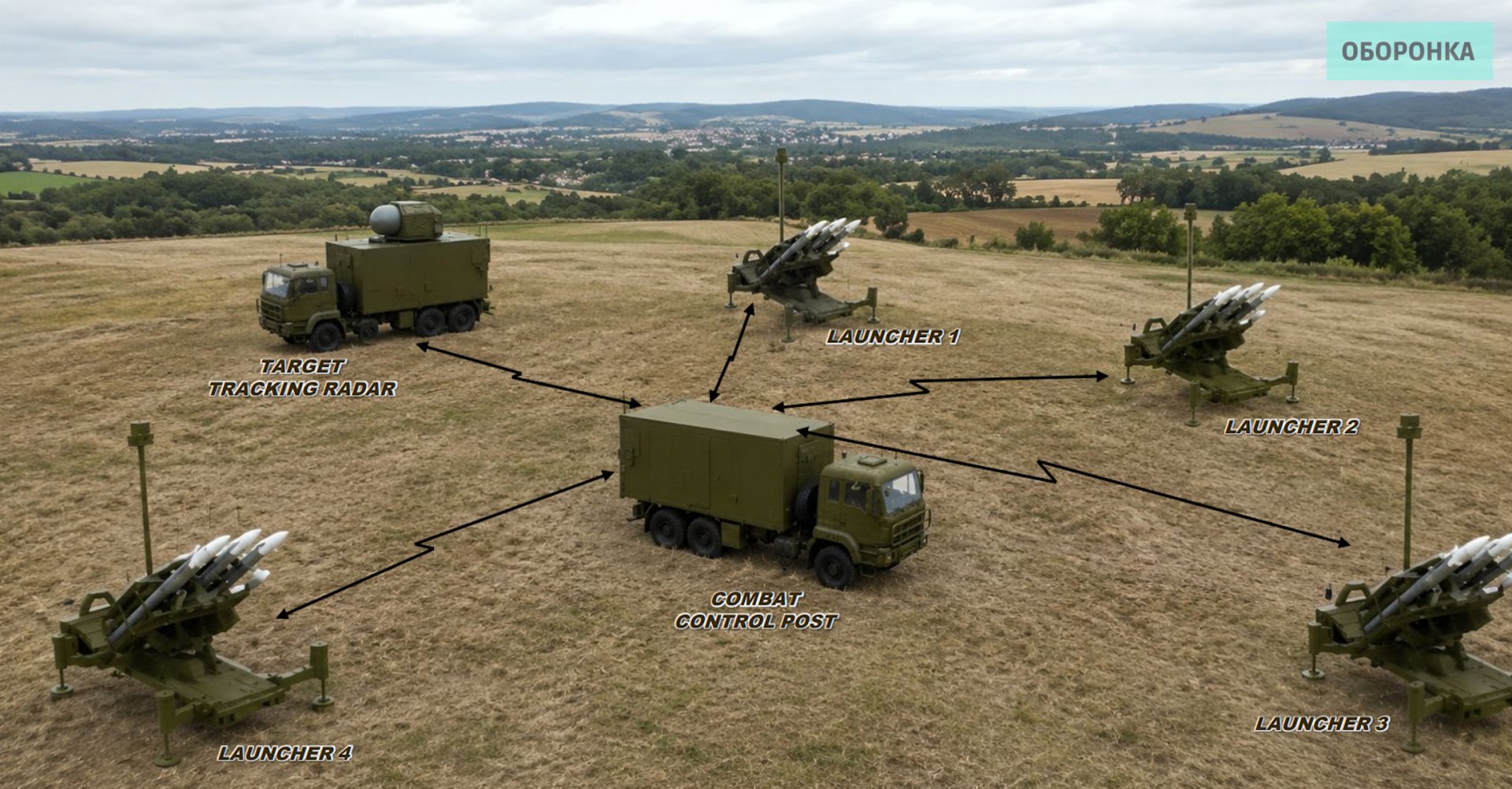
The Shershen battery consists of a Perun command-and-control vehicle, an Athena radar, and four Borei launchers.

A graphic shows a typical Shershen battery. via Oboronka

According to the developer, the system’s architecture is deliberately open. This allows it to use different missiles from different manufacturers and also permits the integration of third-party surveillance and guidance radars.

The company says Shershen can currently employ the R-27 (AA-10 Alamo), R-73 (AA-11 Archer), AIM-9 Sidewinder, and AIM-132 ASRAAM, while compatibility with the R-60 is also being explored. These weapons come with a mix of semi-active radar or infrared homing seeker heads.

One of the ASRAAM/Supacat air defense systems supplied to Ukraine. Ukrainian Armed Forces

Air-to-air missiles are already available in considerable variety across Ukraine’s arsenal and those of its foreign partners. Being able to employ several types from a common ground-based system provides much more flexibility than a conventional SAM designed around one dedicated interceptor.

It also offers a way to exploit missiles that were never originally intended to be fired from the ground. That means Shershen’s launcher and fire-control system are meant to be interceptor agnostic, at least to a certain degree.

Shershen’s Athena radar is reported to be capable of detecting targets at ranges of up to 85 kilometers (53 miles).

The Athena radar for the Shershen. NAUDI screencap

In terms of the engagement envelope, Shershen is claimed to be capable of engaging aircraft, cruise missiles, and drones at ranges of up to 25 kilometers (16 miles) and altitudes of up to 10,000 meters (32,800 feet). Clearly, these figures will vary widely depending on the type of interceptor.

When employing radar-guided missiles, the system’s engagement architecture can reportedly guide as many as six missiles simultaneously.

The advertised performance figures have not been independently verified, and it remains unclear what target types and engagement conditions were used to establish them.

🇺🇦 Україна представила складові мультикаліберного зенітного ракетного комплексу «Шершень» на міжнародній виставці MSPO 2026 у польському місті Кельце.

Міжнародний консорціум компаній Shershen Group, який створює ЗРК в інтересах України представив, показав командний пункт,… pic.twitter.com/9wAS7ewxzg

— Мілітарний (@mil_in_ua) September 10, 2026

The developer says the second prototype has completed initial testing, including successful interceptions at a test range.

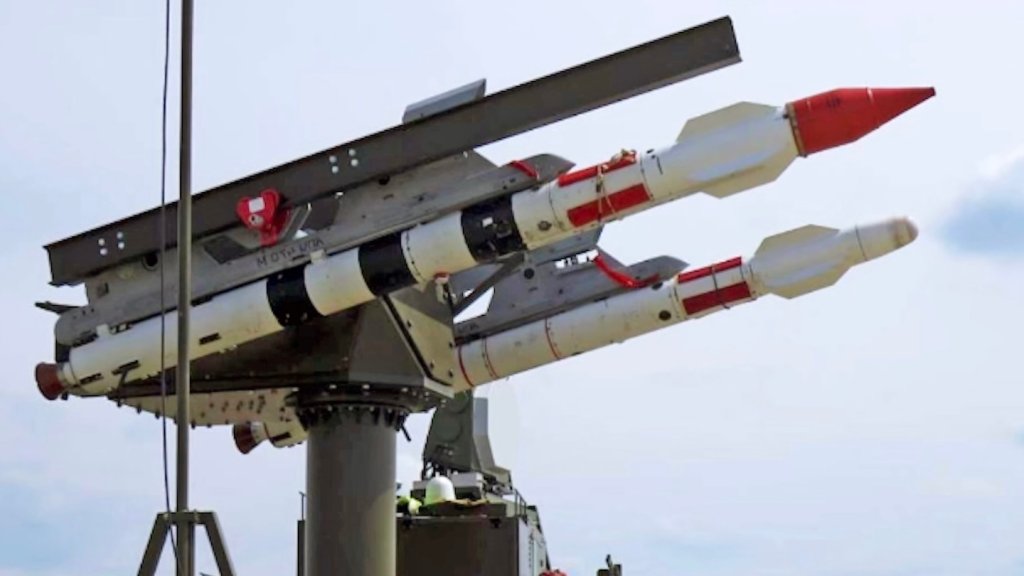
One of the Borei launchers displayed at MSPO were armed with an R-120K, a new Ukrainian missile equipped with a radar seeker and is intended to be capable of both air-to-air and surface-to-air employment.

The R-120K remains under development, however. Work is reportedly continuing on its rocket motor, meaning that its eventual performance and production status remain uncertain. Still, having the option of including the R-120K on the Shershen system in the future is significant.

Ukraine has unveiled a new surface-to-air missile system designed to turn a diverse collection of air-to-air missiles into a flexible ground-based air defense capability. Called Shershen, or “Hornet,” the system combines a Ukrainian command-and-control architecture, a dedicated surveillance radar, and multiple launchers that can employ both Ukrainian and Western missiles.
A test launcher used for the Shershen program, armed with a radar-homing (nearest camera) and an infrared-guided R-27 missile. The latest prototype features a cage-type container launcher. NAUDI screencap NAUDI screencap

Rather than relying indefinitely on stocks of Soviet and Western air-to-air missiles, Ukraine could eventually have a domestically produced interceptor specifically tailored to its growing family of ground-based air-defense systems. That will become increasingly important as stocks of legacy missiles are depleted. Earlier this year, it was reported that Ukrainian F-16s were running low on their air-to-air missiles, which include the same AIM-9s that are used in some FrankenSAM systems, as well as being compatible with Shershen. But even before that, it was clear that Western-supplied missile stocks in Ukraine across the board were diminishing, in some cases drastically, with critical interceptors like the AMRAAM and Patriot being badly affected.

A live AIM-9L/M Sidewinder launched from the wingtip rail of a Ukrainian F-16. Ukrainian Air Force screencap

Ukraine’s need for additional surface-to-air missiles has become increasingly acute during the full-scale war, especially as Russian drone and missile barrages have stepped up.

The shortage has encouraged Ukraine to pursue a combination of indigenous development and unconventional adaptations.

The FrankenSAM initiative, conducted with U.S. support, demonstrated how existing Ukrainian systems could be combined with foreign missiles to rapidly create additional air-defense capacity. Ukraine has also fielded modified Osa systems armed with R-73 air-to-air missiles rather than their original 9M33 interceptors. Other R-73-based concepts have even been demonstrated aboard Ukrainian uncrewed surface vessels.

An R-73 missile loaded on an Osa-AKM SHORADS vehicle. Come Back Alive

Shershen appears to reflect the next logical step in that evolution: rather than creating a one-off FrankenSAM combination, build an architecture from the outset that can accept multiple missiles. Additionally, with so many different ground-based air defense systems now being fielded, it comes with the significant advantage of a standardized launcher and control interface that can accommodate a range of interceptors.

At the same time, Ukraine is pursuing substantially more ambitious indigenous SAM projects.

Earlier this year, a previously secretive Ukrainian missile identified as the Koral made what appeared to be its first public appearance. The program dates back to at least 2021, when Ukraine’s Luch design bureau presented a concept for a medium-range surface-to-air missile.

A missile is launched from a Koral air defense system, based on a Czech Tatra truck chassis. Ukroboronprom

Koral is intended to provide a much longer-range capability, potentially filling some of the gap left by Ukraine’s aging Soviet systems and supplementing the Western-supplied Patriot and SAMP/T.

Shershen, by contrast, is clearly focused on the short-range layer.

Together, the programs illustrate the breadth of Ukraine’s emerging domestic air-defense effort: from relatively inexpensive systems built around repurposed air-to-air missiles to new, purpose-designed interceptors intended to replace or augment Soviet-era systems.

Ukraine’s experience with FrankenSAM has demonstrated the value of getting unconventional air defense combinations into service quickly.

Once fielded, Shershen, with its architecture capable of accepting different Soviet-origin and Western-made interceptors, and eventually a Ukrainian one, gives Ukraine another way to stretch its missile inventory and enhance its air defense capabilities.

Contact the author: thomas@thewarzone.com

The post Ukraine’s New Shershen SAM Can Fire A Wild Mix Of Adapted Air-To-Air Missiles appeared first on TWZ.

  •  

Can Andre Agassi Enjoy Pickleball More Than He Hated Tennis?

“I don’t understand enjoying something without caring about it,” Andre Agassi tells Lizzy Goodman midway through her thoughtful character study. Goodman shadows the former tennis great as he tries to get comfortable in his pickleball years, detailing the dynamic interplay of Agassi’s moods: Fun Andre, Philosopher Andre, Dark Andre. Many of the best athlete profiles extend the narrative of a legend beyond the court, making more complicated human meaning once a subject has set the game aside. Here, Goodman and Agassi achieve a gratifying volley, the journalist turning over the athlete’s challenging interiority and sending it back to him to consider.

The made-for-TV version of the Andre 2.0 story might go something like this: A retired, middle-aged tennis great takes up a goofily named, hugely popular new sport and is finally able to exorcise the demons that haunted him throughout his tennis career. This seemed to be the story Agassi was beginning to tell after the watch event, as he sat on an ottoman at the bar of his hotel, holding a dry Belvedere martini with extra olives. He talked about his love of pickle, how it challenged him mentally, how suited his body felt to its movements. He shifted around in his seat, trying to keep his perpetually embattled back from seizing up. “I was on a tennis court today,” he said. “What the [expletive] was I doing on a tennis court?”

But it became apparent, over the months that followed, that it would take more than a new sport to resolve the central question that all three of Agassi’s personas have been wrestling with for a long, long time. He summarized it, wryly, as he ordered another cocktail: “Why do I end up doing so many things that I actually don’t want to do?”

  •  

Found Wanting: A Reading List on Measurement

Thoughtful stories for thoughtless times.

Longreads has published hundreds of original stories—personal essays, reported features, reading lists, and more—and more than 14,000 editor’s picks. And they’re all funded by readers like you. Become a member today.

In 1792 Paris, a “north-going astronomer,” Jean-Baptiste-Joseph Delambre, set forth for Dunkerque, France, while a “south-going astronomer,” Pierre-François-André Méchain, made his way to Barcelona, Spain. As leaders of the meridian expedition, their modest ambition was to measure the world. They would use a new measure to be called the meter. “The meter would be eternal because it had been taken from the earth, which was itself eternal. And the meter would belong equally to all the people of the world, just as the earth belonged equally to them all.” 

If a nonfiction book opens with a map and a list of dramatis personae, make some coffee and settle in. Such is the case with historian Ken Alder’s The Measure of All Things: The Seven-Year Odyssey and Hidden Error that Transformed the World—the story of the birth of the metric system amid the ferment of the French Revolution. It’s a thriller.

We start with our bodies, measuring height and weight and life. We want to know what health is, what beauty and pain and performance look like. We weigh our brains for intelligence, ability, sickness, happiness. We fight about race and politics, sex and money, images and words. We stalk the planet, its history and geography, biology and chemistry. We wrestle with space-time, its mathematics and paradoxes. We have no idea what to do about consciousness. And then there’s the small matter of love. We are obsessed and we cannot stop. 

At its heart, measurement is a utopian undertaking, one that aims to make perfect sense of the world. But at every turn, it runs up against the real world, and every so often, our understanding of reality itself. We know that the act of measuring changes what is measured. Might it be changing us measurers, too? 

Welcome to a reading list about measurement—not only as techne, art or craft, but as episteme, knowledge, its conquests and collapses, and what it really gives and takes away.

Medical Benchmarks and the Myth of the Universal Patient (Manvir Singh, The New Yorker, March 2025)

“In 1730, the influential physician Bernard Mandeville recalled a patient asking his doctor whether he was tired of hearing ‘so tedious a Tale’ of pain. His physician gently murmured: ‘Your Story is so diverting that I take abundance of delight in it, and your Ingenious way of telling it, gives me a greater insight into your Distemper, than you imagine.’” Now if you can get a doctor to listen to you for five undistracted minutes, count yourself lucky. Joanna Bourke takes stock of pain and its vocabulary for Aeon: “Our Anaesthetic Times.”

Indian kids tended to be small, curious, energetic as babies, growing up lean, active, rudely healthy. (I use the past tense because I’m not sure whether this is as true now as it was when I was little.) And yet, our parents thought us skinny and tried to feed us all the time. Was that a normal parental thing for the times, and if not, where did they get the idea that something needed to be fixed?

Universal standards have a way of making us feel competent and good, like, get your blood pressure down to 120/80 and you’ll be all right. But as Singh, a Harvard-trained anthropologist, points out: “Pretending that differences don’t exist doesn’t make them disappear; it only drives practitioners to rely on flawed intuitions.” 

Citing case after case of medical benchmarks—too little, too much, too sideways—across the world, Singh calls for a system altogether more nuanced and considerate than the current “myth of the universal patient”—something that won’t cause actual harm, something that will help us see the real humans behind the data.

When my daughter was ten-and-a-half months old, she qualified as “wasted,” which unicef describes as “the most immediate, visible and life-threatening form of malnutrition.” My wife and I had been trying hard to keep her weight up, and the classification felt like a pronouncement of failure. Her birth weight had been on the lower end of the scale but nothing alarming: six pounds, two ounces. She appeared as a dot on a chart in which colored curves traced optimal growth; fifteenth percentile, we were told. She took well to breast-feeding and, within a month, had jumped to the twentieth percentile, then to the twenty-sixth. We proudly anticipated that her numbers would steadily climb. Then she fell behind again. At four months, she was in the twelfth percentile. At nine-and-a-half, she was below the fifth.

Our pediatrician was worried. Ease off the lentils and vegetable smoothies, we were warned; we needed to get more calories into our babe. Ghee, peanut butter—we were to drench her food in these and other fats and wash them down with breast milk and formula. And that’s what we did. When we came back a month later, though, we learned that she had dropped further—and crossed into “wasted” territory.

The Broad, Ragged Cut (Elizabeth Svoboda, Aeon, December 2018)

“There are two kinds of people in the world: people who think there are two kinds of people in the world and people who don’t.” Science or self-help? Louis Menand assesses “society’s people-sorting operations” for The New Yorker: “What Personality Tests Really Deliver.”

Have you ever taken an IQ test? How about an aptitude test for studies or a psychometric test for work? How about an online quiz?

“You were supposed to be there already. Didn’t the tests show you had a head start?” Svoboda, labelled a “gifted” child in the ’80s and dealing with its fallout in her adult life, unpacks the deeply problematic, yet starry, history of testing. She looks at Stanford-Binet, Army Alpha, SAT, and others—all ways to measure human potential. Intelligence and aptitude tests, “binary stars circling in the same orbit,” Svoboda says, seem to be asking and answering: Who deserves a chance, and who doesn’t? Who is worthy, and who isn’t? 

For the American psychologist Lewis Terman, who devised the Stanford-Binet IQ test, the birth of a gifted child was like the birth of a star. In the name of illuminating what he saw as a void, Terman sought out the stars that burned brightest. “The school has no more important task than to foster the development of the mentally gifted,” the researcher at Stanford University in California told attendees at a meeting in San Francisco. “Our chances of survival . . . may well depend upon the discovery and utilisation of highly superior abilities of every kind.” To further this mission, Terman urged hundreds of children all over California to sit for his newly developed intelligence test in the 1920s. Intending to prove his theory that high IQs predicted life success, he sorted the highest scorers into a group of 1,521 children (called his “Termites”) that he would follow and document throughout their lives.

Fracking Eyeballs (D. Graham Burnett, Asterisk, October 2023)

“Why Netflix looks like that.” Will Tavlin investigates what goes on behind the scenes at the streaming behemoth for n+1: “Casual Viewing.”

In hydraulics, pumping high-pressure fluid into a well causes rock to crack and oil and gas to come pouring in. This is called fracturing, or fracking. Burnett, a Princeton historian of science and part of a scholar-artist-activist collective called Friends of Attention, has adapted this term to refer to an insidious property of the attention economy. “Fracking eyeballs” refers to applying psychological and advertising techniques under pressure to bait and extract monetary value from human attention. (I don’t know how they live with this mental image all the time, though.) 

This essay, opening at a 1925 Harlem shop window with a “puzzling totem face” and crammed with historical anecdote and detail, comes from the magazine’s Issue 04: Measurement. Do check out the whole  issue: “How do you measure seeing god? Does testing vaccines need to take so long? Outlining poverty. Asking better questions. The origins of the ad economy. Can we really say how smart AIs are? Domestic violence during lockdown. Sex, drugs, and colonoscopies. Our most pedantic issue yet.”

See also Burnett’s Public Domain Review essay, “Cybernetic Attention,” where he pursues the “pre-history of the laboratory research that has relentlessly worked to slice and dice the attentional powers of human beings.”

In Nixon’s earliest experiments, he would hide in an observation booth, accompanied by a metronome beating half seconds, and then watch closely as two ads were revealed to a seated subject. Ticking his pencil along the rungs of a fascinating little ladder-pad with each beat of the metronome (marking the left side when the eyes were to the left; marking the right side when the eyes were to the right), Nixon created a graphical record of the subject’s visual encounter with the two stimuli. 

If you were advertising a car, was it better to show a picture of a car, or of a pretty woman? If one was selling shirt collars, was it better to do so under the headline “Murder!” or the headline “Quality Shirt Collars”? To make a long story short (and to skip over the proto-pataphysical techniques by which Nixon established what we might call a “science of irrelevancy”), Nixon found that “irrelevant illustrations do attract more attention and hold interest longer than do relevant ones.” Which is to say: systematically doing violence to sense raised revenue. This could be proven in his laboratory. Would it be wrong to say that we live, in many respects, in the world evolved from that finding? 

The Anthropometric Detective and His Racial Clues (Ava Kofman, The Public Domain Review, February 2016)

“Correlation, one of the most used and least understood concepts in statistics, is easy to mistake for causation because it was made that way intentionally; it’s precisely because of its potential to be misunderstood that it remains so popular. . . . The eugenics movement was built out of correlations.” Read about its history and current state of affairs in this Los Angeles Review of Books essay by Aubrey Clayton for the Legacies of Eugenics series: “The ‘Correlation’ Between Statistics and Eugenics.”

In 1901, Scotland Yard started using fingerprints to solve crime. They weren’t the pioneers. Sherlock Holmes had gotten there first in The Sign of Four, already examining under his magnifying glass, in 1890, what appeared to Dr. Watson as “mere shapeless smudges of dust.” While the fictional Holmes was publishing his fictional monographs in fictional journals, “gentleman scientist” (self-funded and without institutional affiliations) Francis Galton was working on the same thing for real. The era was primed for this kind of work across disciplines and professions—finding and interpreting “clues unnoticed by others.”

And while Holmes was trying to catch bad guys, Galton came up with a malign plan. What if you could use fingerprints as “tiny fossil records, providing evidence of the genealogy, personality, criminality, and perhaps even destiny of individuals and groups”? No more varicolored bad guys, only “a political program of selective breeding to improve, in his view, the human race.” 

Empire, race, and “science”—eugenics.

In 1888, a reporter from the Pall Mall Gazette paid a visit to Galton’s Anthropometric Laboratory in London, where instruments developed by Galton measured the physical and mental characteristics—from keenness of hearing to breathing power—of over 10,000 people. The resulting article, titled “A Morning With the Anthropometric Detectives,” described Galton’s laboratory as a world of “order and precision, and tests of the nicest accuracy.” “Dumb though they are,” Galton told the reporter, “what splendid detectives our instruments might prove.” “Splendid detectives!” the reporter exclaimed, “I am not, I hope, in a department of the Criminal Investigation Department, unconsciously yielding convincing proofs of personal identity with some scoundrel hitherto unhung.”

The comparison to detection in the article’s title is no accident: the scientific development of medical and anthropometric instruments like Galton’s coincided with the rise of the detective novel, a genre which, in the words of the literary scholar Ronald Thomas, was “preoccupied with the professional monitoring and identification of bodies.” Fears of mistaken identity and unconscious slips were crystallized in the literature of detection but emerged from a broad range of hermeneutic practices across the era, at a time in which those in power considered the borders of empire and boundaries of racial identity to be insecure.

John Wheeler Saw the Tear in Reality (Amanda Gefter, Quanta Magazine, September 2024)

“Experiments that test physics and philosophy as ‘a single whole’ may be our only route to surefire knowledge about the universe.” Seeing as the lines between them have already been “blurred beyond repair,” here’s another essay by Amanda Gefter for Quanta Magazine: “‘Metaphysical Experiments’ Probe Our Hidden Assumptions About Reality.”

“What happens when you get to the end of things?” This was the question that had held John Wheeler in thrall all his life. A student of Niels Bohr and friend of Albert Einstein who counted Richard Feynman among his own students, Wheeler was a rare soul—a below-the-radar legend, a “physicist’s physicist” who really wanted physics for the people. And throughout his storied career, he kept journals. 

We learned in school that gravity is a force that pulls objects together. 

Einstein’s theory of general relativity came along and said, well, it’s actually that matter and energy can curve space-time, and that curving is gravity. Wheeler wondered, what if gravity could act on itself, endlessly contorting space-time, and that was what matter itself was . . . warped space-time? But reality had a problem. “The fabric of space-time, at its smallest scales, was loosely woven, chewed by moths, too flimsy to bear the weight of the world. Yet here is the universe. It must be made of something.” What?

A clue: At the end of Alder’s meter book, he quotes Protagoras, a pre-Socratic philosopher: “Man is the measure of all things.”

It dawned on Wheeler that when space and time went, taking the rest of physics with them, there was something left. “With law going and chaos arriving, one principle remains,” Wheeler wrote. “The quantum principle.” Quantum mechanics, he wrote, “destroys the concept of the world as ‘sitting out there,’ with the observer safely separated from it by a 20 centimeter slab of plate glass. Even to observe so miniscule an object as an electron, he must shatter the glass. He must reach in. . . . The universe will never afterwards be the same. To describe what has happened, one has to cross out that old word ‘observer’ and put in its place the new word ‘participator.’ In some strange sense the universe is a participatory universe.”

It was officially the wildest idea he’d had yet. A universe made not of matter, not of space-time, not of stuff at all, but of our choices. It wasn’t what he’d hoped to find; the physics had led him there. He’d pried up space-time, peered beneath, and found himself staring, to his bewilderment, at a mirror. “One finds himself in desperation asking if the structure, rather than terminating in some smallest object or in some most basic field, or going on and on, does not lead back in the end to the observer.”

The Mythology of Conscious AI (Anil Seth, Noēma, January 2026)

“The hard problem of consciousness is a distraction from the real one.” For a clearer picture of the fundamentals according to Seth, read his earlier essay for Aeon: “The Real Problem.”

Decades ago, the philosopher David Chalmers came up with a distinction that has since become a popular touchstone in consciousness circles—the easy problem vs. the hard problem. The “easy problem” deals with the physical brain and how its functions and processes create perception, cognition, behavior, etc. The “hard problem” is why such phenomena should be connected to internal, subjective consciousness in the first place. This “explanatory gap” takes a scientific problem into the realm of philosophy. In the sidenote essay, Seth sidesteps the hard problem for what he calls the “real problem”—accounting for “the properties of consciousness in terms of biological mechanisms.” Measuring consciousness, in effect.

In the 10 years that separate the two essays, much has happened, the main event being the astonishing evolution of artificial intelligence. And now we have an unreal problem. In this Berggruen Prize-winning essay, the neuroscientist discusses the possibility of consciousness in AI. But as he says: “The future history of AI is not yet written.”

Intelligence and consciousness are different things. Intelligence is mainly about doing: solving a crossword puzzle, assembling some furniture, navigating a tricky family situation, walking to the shop—all involve intelligent behavior of some kind. A useful general definition of intelligence is the ability to achieve complex goals by flexible means. There are many other definitions out there, but they all emphasize the functional capacities of a system: the ability to transform inputs into outputs, to get things done. 

Consciousness, in contrast to intelligence, is mostly about being. Half a century ago, the philosopher Thomas Nagel famously offered that “an organism has conscious mental states if and only if there is something it is like to be that organism.” Consciousness is the difference between normal wakefulness and the oblivion of deep general anesthesia. It is the experiential aspect of brain function and especially of perception: the colors, shapes, tastes, emotions, thoughts and more, that give our lives texture and meaning. The blueness of the sky on a clear day. The bitter tang and headrush of your first coffee.

Exhalation (Ted Chiang, Lightspeed, April 2014)

“In the space between the hands-on, physical reality of experimental science and the structured narratives fit for printed journals, sits a special genre of scientific writing: lab notebooks. They are the closest witness to ‘science in the making.’” Ulkar Aghayeva writes a lavishly illustrated essay for Asimov Press: “A Brief History of Lab Notebooks.”

Chiang points to two sources of inspiration in his story note: “The Electric Ant,” a Philip K. Dick story in which a man visits a doctor, only to be told that he’s a robot, and proceeds to open himself up to look at his own inner workings, and The Emperor’s New Mind, a book by mathematician Roger Penrose, in which a chapter discusses the concept of entropy. He’s struck by Penrose’s notion that we’re “consuming order and generating disorder,” and that we, given the laws of thermodynamics, “live by increasing the disorder of the universe.” 

In a young world of mechanical beings where “death is uncommon,” an anatomist performs exquisite auto-dissection—an extreme act of analysis to discover what sustains life and what, therefore, can end it in a “fatal equilibrium.” 

This Hugo and Locus-winning story reminds me, in its ending, of something Ursula K. Le Guin says in The Language of the Night: “Only the individual can get up and go to the window, and draw back the curtains, and look out into the dark. Sometimes it takes considerable courage to do that. When you open curtains you don’t know what may be out there in the night. Maybe starlight; maybe dragons; maybe the secret police. Maybe the grace of God; maybe the horror of death. They’re all there. For all of us.”

At first the other anatomists did not believe me when I told them what I had discovered, but in the months that followed my initial auto-dissection, more and more of them became convinced. More examinations of people’s brains were performed, more measurements of atmospheric pressure were taken, and the results were all found to confirm my claims. The background air pressure of our universe was indeed increasing, and slowing our thoughts as a result.

There was widespread panic in the days after the truth first became widely known, as people contemplated for the first time the idea that death was inevitable. Many called for the strict curtailment of activities in order to minimize the thickening of our atmosphere; accusations of wasted air escalated into furious brawls and, in some districts, deaths. It was the shame of having caused these deaths, together with the reminder that it would be many centuries yet before our atmosphere’s pressure became equal to that of the reservoir underground, that caused the panic to subside. We are not sure precisely how many centuries it will take; additional measurements and calculations are being performed and debated. In the meantime, there is much discussion over how we should spend the time that remains to us.

Kanya Kanchana is a writer from India.


Editor: Krista Stevens
Copyeditor:
Cheri Lucas Rowlands

  •  

Forget Beer: Ice Age Hunters Were Getting High 12,000 Years Earlier — With Betel Nuts

Two skeletons from the Indonesian island of Sulawesi had something strange going on in their mouths. Not cavities. Not the usual wear from a tough diet. Deep, rounded grooves cut into the teeth — a pattern no archaeologist had documented before, and one nobody could explain. The answer, published in Science Advances, pushes the known […]

  •  

EU welcomes Cambodia to WTO appeal arrangement

The EU welcomes Cambodia’s decision to join the Multi-party Interim Appeal Arbitration Arrangement (MPIA) for WTO members, contributing to efforts to uphold a rules-based multilateral trading system. 

With Cambodia’s participation, the MPIA now covers 62 World Trade Organization (WTO) members and 60.4% of world trade.  

The MPIA brings together participants from all continents and at different levels of development, united by a shared commitment to upholding the rules-based trading system. 

The MPIA preserves the right to appeal in trade disputes among participating WTO members, at a time when the WTO’s Appellate Body remains non-functioning. It helps ensure that disputes can continue to be resolved in an orderly and binding manner, avoiding appeals 'into the void'. 

“I welcome Cambodia to the MPIA. The arrangement plays an important role in upholding the rules-based trading system. Each new participant helps reinforce the predictability, stability and credibility of global trade rules. I encourage other WTO members to join the MPIA,” said EU Trade and Economic Security Commissioner Maroš Šefčovič. 

Background 

The MPIA was established in 2020 and has proven its effectiveness in many WTO disputes.  

Under the MPIA, appeals are heard by arbitrators randomly selected from a pool of 10 standing appeal arbitrators set up by the participating WTO members. These arbitrators are persons of recognised authority, with demonstrated expertise in law, international trade and WTO agreements.  

The MPIA is open to all WTO members as a practical tool for appeal arbitration, pending the restoration of a reformed and fully functioning WTO dispute settlement system. 

As of 1 June 2025, the MPIA has an updated pool of appeal arbitrators to ensure that appeals continue to be heard by independent arbitrators of the highest calibre. 

At the WTO Ministerial Conference that took place earlier this year, MPIA ministers stressed the importance of the MPIA for the security and predictability of the multilateral trading system.  

The current MPIA participants are Australia, Barbados, Benin, Brazil, Cambodia, Canada, China, Chile, Colombia, Costa Rica, Ecuador, the European Union (and its Member States), Guatemala, Hong Kong (China), Iceland, Japan, Liechtenstein, Macao (China), Malaysia, Mexico, Moldova, Montenegro, New Zealand, Nicaragua, Norway, Pakistan, Paraguay, Peru, the Philippines, Singapore, Switzerland, Ukraine, the United Kingdom, Uruguay and Vietnam.

More information

MC14: Supporting the rules-based multilateral trading system: the role of the MPIA

  •  

The Epstein Digital Financial System is Getting Ready to Replace the U.S. Dollar

Comments by Brian Shilhavy
Health Impact News

Leah of The Leah Files has just published Part III of her Currency Killer series, The New US Dollar: The One Epstein Built.

This series is, by far, the best intel I have read in the Alternative Media regarding the takeover of the U.S. Dollar in an attempt to replace it with digital currencies.

While she may use AI ethically for research and to help her create graphics (although I have no idea if she does), this is real intel and she provides links to her sources, unlike many Substack Pages that are completely written by AI with no sources given to fact check their content.

We know Leah is a real person (but probably not using her real name), because she has her own YouTube channel.

I have been publishing evidence for years now that the American Financial System is a system built on the Jeffrey Epstein child sex-trafficking network.

And this latest article by The Leah Files provides strong evidence to that fact, and connects all the dots showing just who is doing this in this current Zionist Trump Administration.

You will also learn in this latest article why this Administration gives Argentina such preferential treatment, including giving them better deals on beef than they do to U.S. farmers.

Read Health Impact News‘ coverage of her first two articles in this series, which is our most-read article so far in September, here:

Treasury Secretary Scott Bessent Just Restructured The American Financial System to Destroy the U.S. Dollar

The New US Dollar: The One Epstein Built

Inside the private currency built by Epstein’s crypto network, legalized by this administration, and controlled by the people who killed the old one.

by The Leah Files

Excerpts:

I think they are replacing the US dollar with a private one.

Not in some distant future, not as a theory, but right now. Exposed and documented, happening in front of us, and no one is stopping it. If you haven’t read Parts I or II of my Currency Killer Series, go check them out. This is Part III and it may be the worse one yet.

The United States government banned itself from making a digital dollar. Then it crashed the real one. Then it handed the replacement to a private company connected to $17 billion in organized crime, whose co-founder spent eight years as Jeffrey Epstein’s personal crypto advisor, and whose largest shareholder was convicted of software piracy before becoming the richest man in Italy.

That company is called Tether. It controls $183 billion in digital currency and it is now the 17th largest holder of US government debt on earth. It has never completed a publicly released independent audit. The UN has linked it to $17 billion in organized crime.

Tether is a stablecoin company, but it also owns 210,000 hectares of South American farmland and operates Argentina’s sole fertilizer producer. It holds a majority stake in a brain-computer interface company. It is the lead investor in a humanoid robotics firm. It owns 48 percent of a conservative media platform. Its third-largest shareholder controls a 10 percent stake in the privatized research arm of the UK Ministry of Defence.

Everyone involved is getting rich, except the American people.

Howard Lutnick’s sons’ own a piece of Tether. His firm, Cantor Fitzgerald custodies its reserves. Lutnick’s former minion, Bo Hines, championed the law regulating it from inside the White House and resigned one month after the president signed it, becoming CEO of the company the law was written for.

Scott Bessent is blocking a billion dollars in suspicious Epstein banking records while his old fund was paying an intelligence firm controlled by Epstein’s partner. Trump’s family has made over a billion dollars launching their own stablecoin.

This is not deregulation, it’s a heist. And I am going to show you what they are doing.

Welcome to Part III of the Currency Killer series.

What Is Tether

Most people have never heard of Tether. So let’s start there.

A stablecoin is a digital token pegged to the US dollar. You send a company one real dollar, and they give you one digital token that is supposed to be worth one dollar. The company holds your real dollar in reserve.

The token trades on crypto markets like cash. When you want your money back, you redeem the token and the company gives you a dollar.
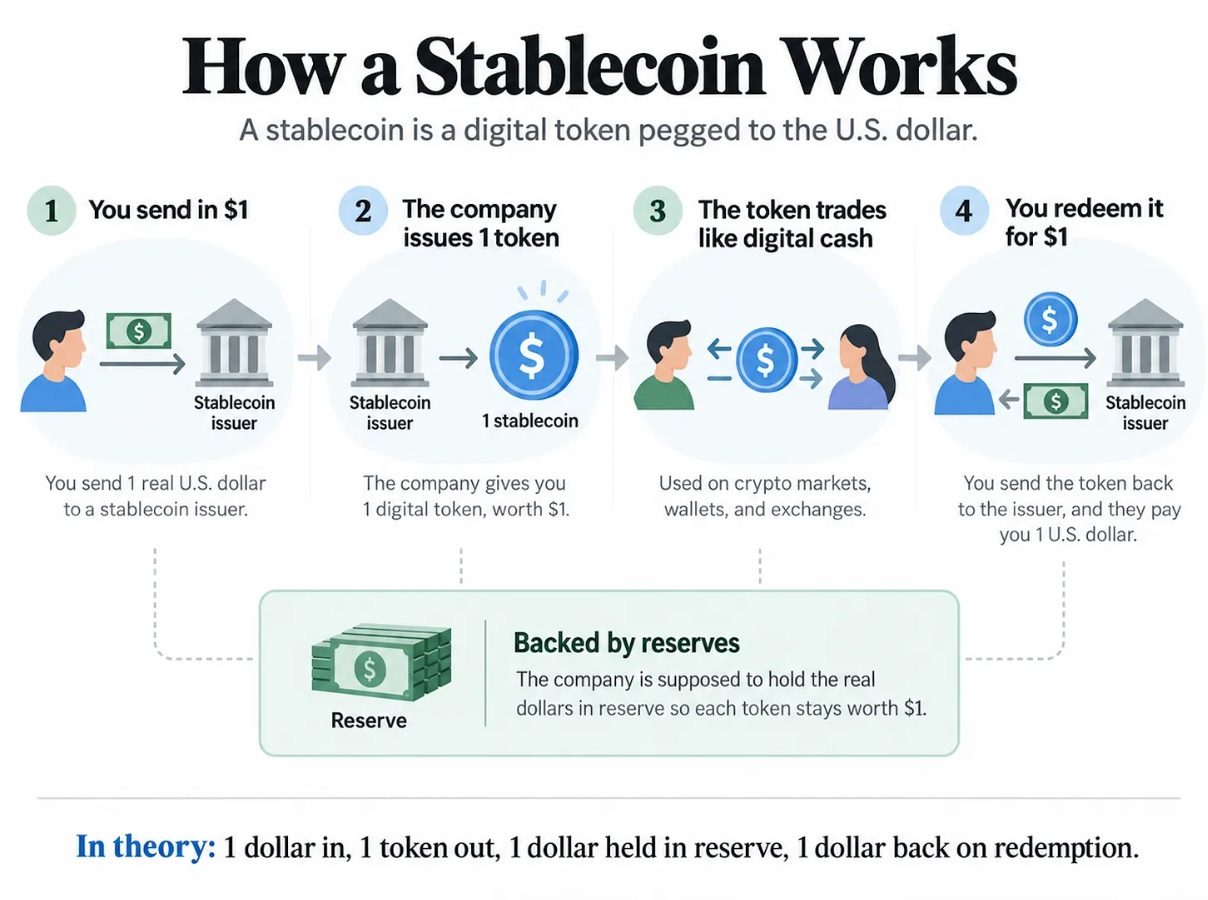
Tether is the largest stablecoin on earth.

It has $183 billion of these tokens in circulation. That makes it bigger than the GDP of most countries.

The company is supposed to hold $183 billion in real reserves to back them. It earns interest on those reserves, mostly US Treasury bills, which generated $13 billion in profit in 2024 alone. It has roughly 200 employees.
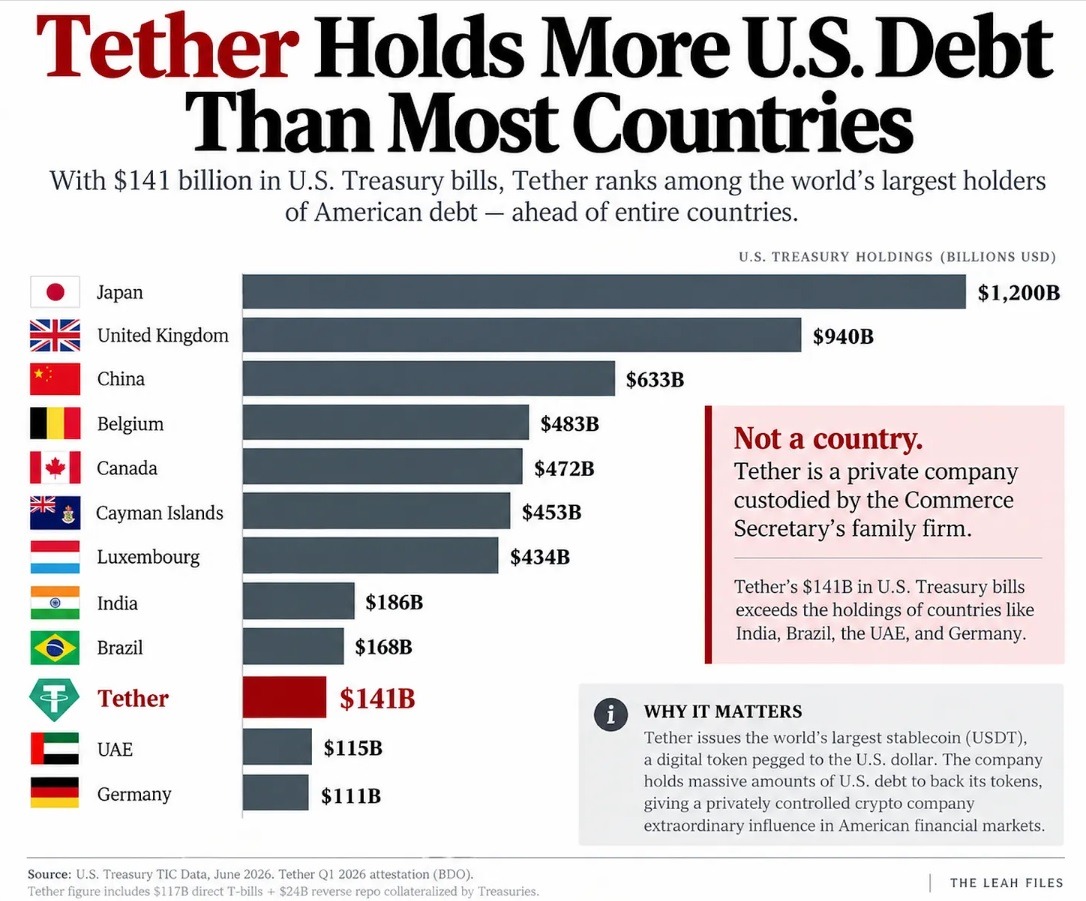
Here is the problem: the CFTC found in 2021 that Tether was actually fully backed by reserves only 27.6 percent of the time. The company paid $41 million in fines.

The New York Attorney General’s office reached a separate $18.5 million settlement over similar misrepresentations. The UN has linked Tether’s token to $17 billion in criminal activity.

The DOJ has an active criminal probe. And the company has never completed a full, publicly released independent audit.

That is the company at the center of this story.

Now let’s look at who built it because this is where I knew there was something more nefarious happening.

The Man Who Built Tether

His name is Brock Pierce. Before he co-founded Tether, he was the teenage Vice President of a company called Digital Entertainment Network (DEN).

The founder of that company, Marc Collins-Rector, was later convicted of child sex trafficking.
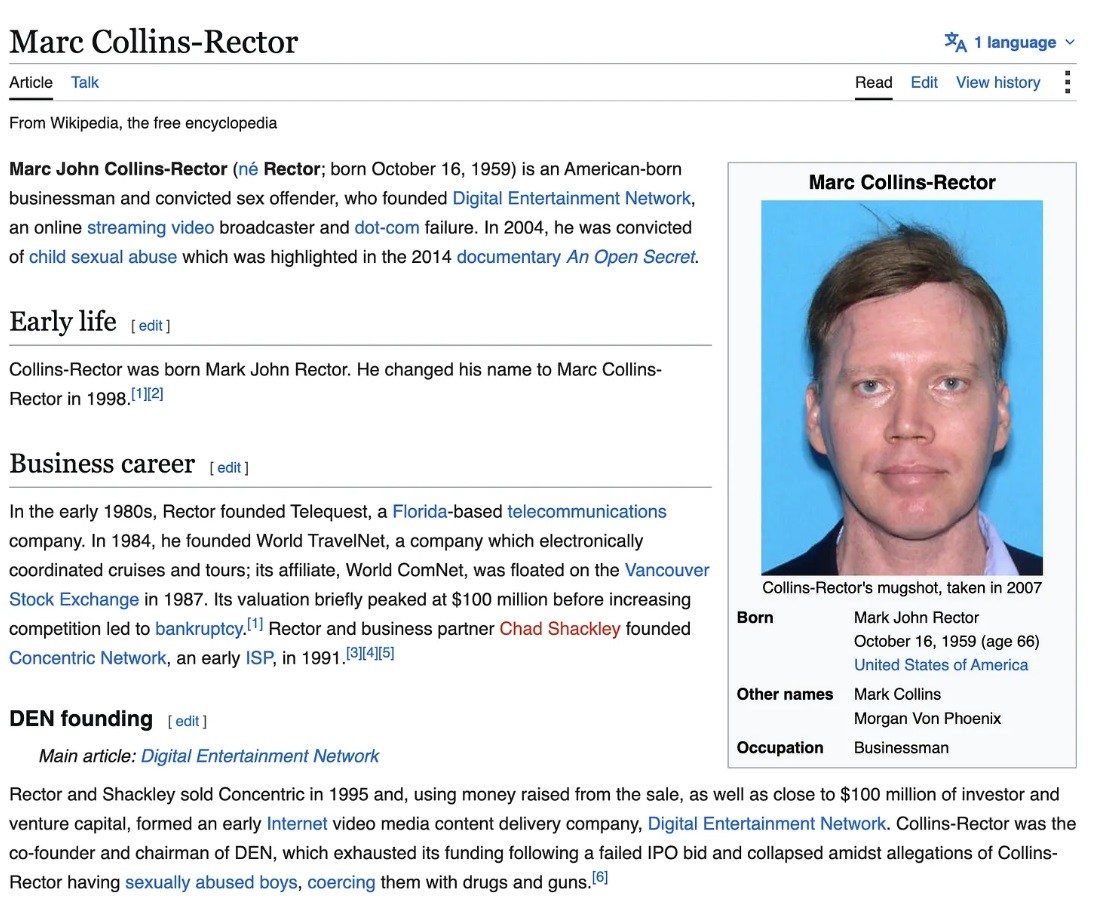
In the late 1990s, Pierce became Vice President of Digital Entertainment Network (DEN), a pioneering internet video company founded by Marc Collins-Rector, at the age of 17, earning a salary of $250,000.

At DEN’s Hollywood Hills parties, Collins-Rector and others allegedly sexually assaulted half a dozen teenage boys, including a 15-year-old, according to civil lawsuits filed between 1999 and 2002. When Collins-Rector fled the country to avoid prosecution, Pierce went with him.

They ended up in a villa in Marbella, Spain, which police raided in 2002 and found Collins-Rector, Pierce, and a third DEN executive, along with child pornography and firearms.

Collins-Rector was convicted of child sexual abuse in 2004. Pierce was never charged, but the civil lawsuit resulted in a $2,000,030 default judgment plus $1 million in interest because Pierce and his co-defendants never responded to the allegations of rape, assault, and death threats.

In 2010, Jeffrey Epstein was trying to salvage his reputation after his first sex trafficking conviction. He hired a man named Al Seckel, a serial scammer and self-styled illusionist who had been in a relationship with Ghislaine Maxwell’s sister Isabel for years.

Seckel organized a conference for the Epstein Foundation on Little Saint James, Epstein’s private island, called the Mindshift Conference.

Pierce was invited to present on Bitcoin. It was January 2011. Epstein noticed him immediately.

In an email sent under a fake name, Epstein singled out “brock” as “interesting.” Within three months, Pierce was at Epstein’s Manhattan townhouse asking for financial advice. Their partnership lasted eight years.

The way they were introduced tells us a lot.

Pierce entered Epstein’s world through a man who was dating the sister of Ghislaine Maxwell, the woman who procured and groomed girls for Epstein’s trafficking operation, now serving twenty years in federal prison.

The man who made the introduction, Seckel, was later found dead at the bottom of a hundred-foot cliff in southern France.

And Pierce walked in already carrying a default judgment for rape and an affinity for child porn. Epstein saw exactly what he was getting and Pierce was the perfect target.

What followed was not casual networking. It was an eight-year operational relationship between a crypto pioneer and a convicted predator, documented in thousands of pages of emails released by the Department of Justice on January 30, 2026.

The Emails

The DOJ released over 3.5 million pages of Epstein files, including direct correspondence between Pierce and Epstein spanning 2011 to 2019.

Pierce was mentioned 1,815 times, more than almost any other private figure.
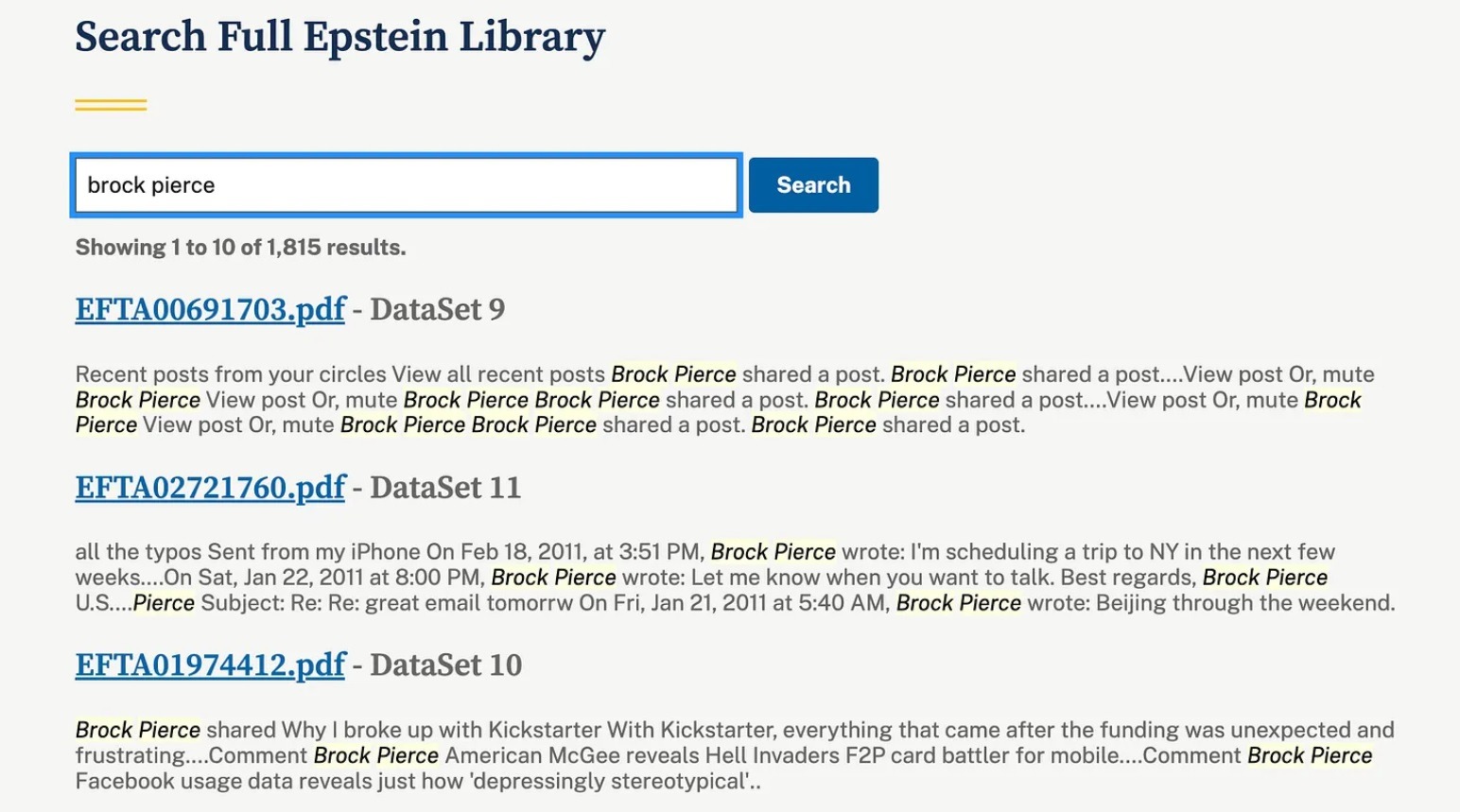
The emails continued for months after Epstein’s second arrest on federal sex trafficking charges. Here is what they show.

By 2012, the correspondence had turned dark. Pierce sent Epstein dozens of photographs of a Ukrainian woman named Anastasia, three days after Epstein asked him to “take photos and find me a present.” Pierce wrote back that “Ukraine is now my favorite country.”

In a separate exchange, Pierce told Epstein there was “a boat in Antigua full of amazing Ukraine’s finest” waiting for him.

In another email, Epstein’s assistant wrote that Brock had a “great time with the girls in St. Barths.” Pierce’s own assistant sent Epstein’s team photos from Ukraine and mentioned upcoming meetings. There were references to visits on Epstein’s boat and coordination around events with Epstein’s inner circle.

These are the emails of a man inside the operation. Not an acquaintance. Not a networking contact. Pierce was coordinating women, referencing boats, sending photographs on request, and maintaining this relationship for years after Epstein’s first conviction.

But the business side of the relationship is what changed the world.

Pierce was not just advising Epstein on crypto. He was the bridge between Epstein’s money and the people who would build the infrastructure that now threatens to replace the US dollar.

He brokered the Coinbase deal.

In December 2014, Pierce connected Epstein to Coinbase’s Series C round through his venture firm, Blockchain Capital. Epstein invested $3 million. Coinbase co-founder Fred Ehrsam emailed asking to meet Epstein in New York.

In 2018, a trust associated with Epstein sold $15 million of Coinbase equity back to Blockchain Capital. Pierce wired $15 million to Epstein.

That $3 million seed investment would eventually be worth billions when Coinbase went public at a $51 billion valuation.

He pitched Bitcoin to Larry Summers at Epstein’s townhouse.

Epstein hosted the meeting. Pierce described himself to Summers as “the most active investor in Bitcoin.”

Summers said he saw “opportunities” but was worried about reputational damage if he lost money. A fact-checker for a planned New York Magazine article in 2015 asked Epstein:

“Did you meet with Brock Pierce to discuss Bitcoin? Did Larry Summers join this meeting?”

Epstein immediately forwarded the questions to author Michael Wolff with a two-word response: “nfw” (no f*cking way).

The article was never published.

The Network

Pierce and Epstein did not operate in a vacuum. Their shared network reached into the political and financial circles that now control American crypto policy.

Steve Bannon. Pierce and Bannon had worked together for seven years before any of this. Pierce hired Bannon in 2005 to run the financial side of his company Internet Gaming Entertainment, later saying

“Steve Bannon was my right-hand man for, like, seven years.”

Decrypt reported that Pierce and Epstein “appeared to use each other’s connections to develop business partners like Andrew Farkas and politicos like Steve Bannon.”

By August 2018, text messages released by the House Oversight Committee show Epstein was coaching Bannon’s media strategy in real time.

During a six-day exchange, Epstein offered line-by-line feedback on Bannon’s MSNBC appearances and crafted talking points on tax cuts, immigration, and security clearance revocations.

After one interview that ran a full hour, Epstein wrote “Atta boy.” In a separate exchange, Epstein asked Bannon about “brocks people,” meaning Pierce’s crypto network.

He suggested the Treasury Department create a voluntary disclosure form for crypto gains. Bannon would later describe cryptocurrency as “disruptive populism” that “takes control back from central authorities.”

Peter Thiel. Epstein invested $40 million into Thiel’s venture firm, Valar Ventures, in 2015 and 2016. Reid Hoffman made the introduction.

That bet became the single largest asset of the Epstein estate, valued at roughly $170 million by the time Epstein died.

Thiel’s proteges now run US crypto policy: JD Vance is Vice President, David Sacks served as crypto czar, and Thiel’s Founders Fund was the largest investor in Polymarket.

Pierce’s direct role in the Thiel connection is not documented, but both men operated in the same small circle of Epstein’s crypto and tech advisors during the same period.

The result: Pierce co-founded Tether, brokered Epstein’s crypto investments, worked alongside Bannon for years, and operated in the same orbit as the Thiel network that now shapes policy.

The man who co-founded the stablecoin holding $135 billion in US government debt was at the center of all of it.

There is a reason we haven’t heard much about Pierce. Now ask yourself why they are they protecting him?

Where Pierce Is Now

Brock Pierce lives in Puerto Rico, where Act 60 allows him to pay near-zero taxes on capital gains. He is still Chairman of the Bitcoin Foundation. He still runs the Integro Foundation, whose most recent IRS filing shows $78 in total assets.

He ran for president in 2020 and expressed regret for his ties to Epstein during the campaign. Conveniently he denounces his relationship a year after Epstein was “found dead” in his cell.

In 2025, Pierce was spotted at Mar-a-Lago cutting the ribbon for a golden statue of Donald Trump.

That same year, he gave over $1.1 million to a super PAC supporting the reelection of New York City Mayor Eric Adams, five days before Adams dropped out of the race. When Adams withdrew, Pierce launched a campaign called “Draft Eric Back” to get him to reconsider.

Adams had been indicted on federal corruption charges.

Pierce’s “Pierce School” in Washington, DC is not a school. It is a historic building near Capitol Hill that he purchased and converted into a residential penthouse and event space where he hosts crypto policy roundtables with members of Congress.

In March 2025, he and Rabbi Moshe Reuven Azman, who served in the IDF, laid a foundation stone for a planned “business school” at Anatevka, a gated compound outside Kyiv.

Pierce’s “charity” has donated at least $630,000 to Chabad-affiliated organizations.

No evidence exists that the school teaches anything, has enrolled students, or has begun operating.


This is a man who was sending photos of Ukrainian women to a convicted sex offender, brokering introductions between that sex offender and the people who now control American crypto policy, and who is now hosting congressional roundtables, attending presidential events, and donating millions to indicted politicians. His foundation holds $78 and looks like a personal shell charity.

Tether Today

Now that you know what Tether is and who built it, here is who runs it.

Who Owns It

Tether has never voluntarily disclosed who owns it. It is a private company incorporated in the British Virgin Islands with no public reporting obligation.

The only known ownership data comes from leaked documents reported by the Wall Street Journal in 2023, showing stakes as of 2018. As of those documents, four people controlled 86 percent of the company.

The Empire Build

Starting in late 2023, Tether began spending its profits at an extraordinary pace, acquiring stakes in companies across sectors that have no obvious connection to stablecoin issuance.
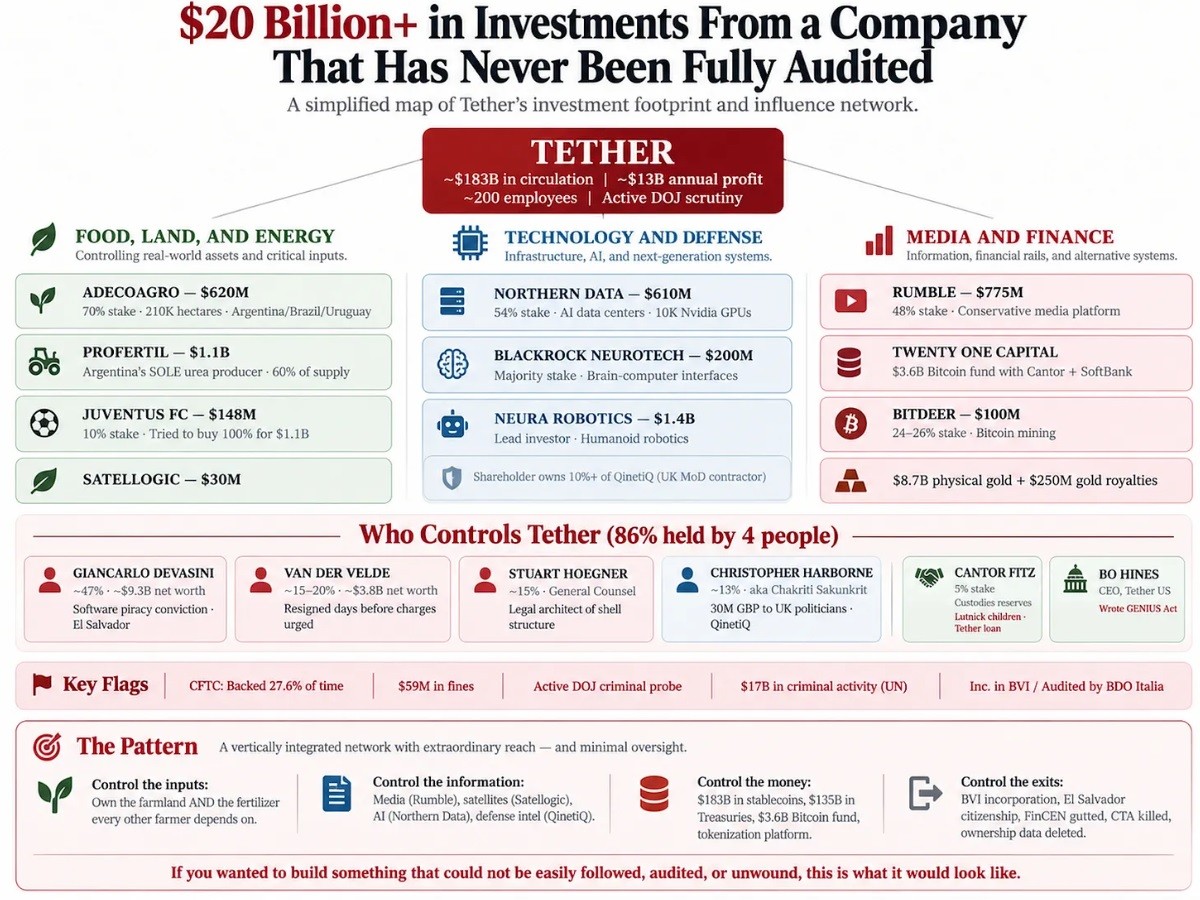
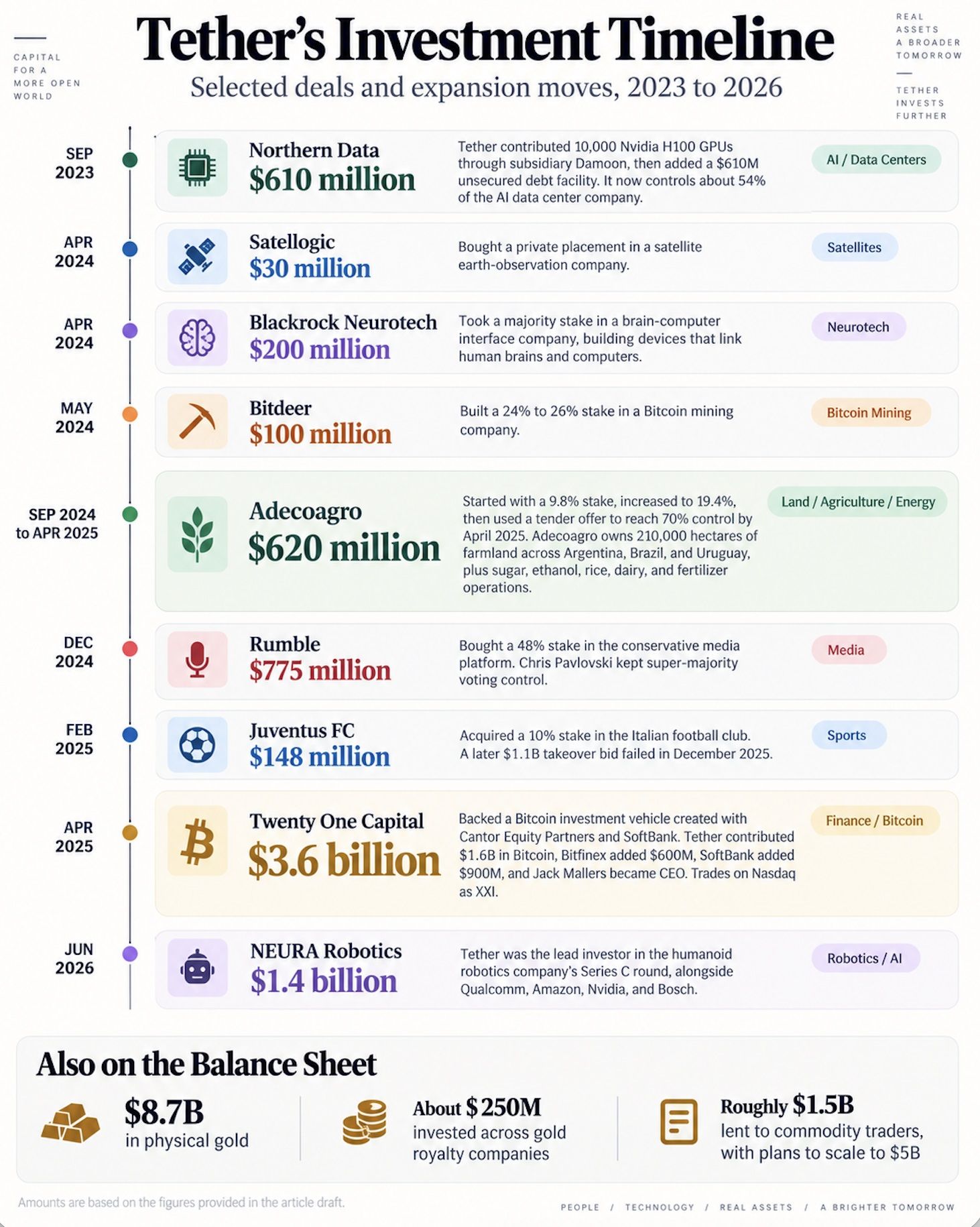
The Farmland

This is the part of the story that made me stop and ask what we are actually looking at.

Adecoagro is not a farm. It is a vertically integrated agro-industrial conglomerate incorporated in Luxembourg and listed on the New York Stock Exchange.

When Tether took control in April 2025, it took control of the entire chain from soil to supermarket shelf: the land itself, the crops grown on it, the mills that process them, the dairy plants, the rice processing facilities, the peanut sorting plants, the branded consumer products, the export terminals, and the port infrastructure.

In mid-2026, Adecoagro launched a Bitcoin mining pilot at its Brazilian sugar mills, using surplus electricity from sugarcane bagasse cogeneration to power approximately 1,280 mining machines. This connects directly to Tether’s stated goal of becoming the world’s largest Bitcoin miner.

And then there is the fertilizer.

Profertil

In December 2025, eight months after Tether took control of Adecoagro, the company acquired a 90 percent stake in Profertil for approximately $1.1 billion.

Profertil is Argentina’s sole producer of urea, the most widely used nitrogen fertilizer in the world. The plant in Bahia Blanca produces 1.3 million tons of granular urea per year and supplies roughly 60 percent of Argentina’s domestic fertilizer demand.

This means that a company whose co-founder was sending photos of Ukrainian women to Jeffrey Epstein and brokering introductions between Epstein and the people who now control American financial policy now also controls the fertilizer supply that South American agriculture depends on.

Every other farmer in Argentina who needs urea to grow crops is buying it from a Tether subsidiary.

The acquisition nearly doubled Adecoagro’s annual earnings, from $277 million to $467 million in EBITDA.

They also appointed Kyril Louis-Dreyfus to the Adecoagro board. His family founded the Louis Dreyfus Group, one of the four largest commodity trading houses on earth.

Now here is the part that made me consider this one the most important articles of the Currency Killer series.

This is not a hedge fund buying farmland as an inflation hedge. Tether looks to be building something specific.

Adecoagro co-founded a company called Agrotoken, which has already created three grain-backed stablecoins: SOYA, CORA, and WHEA.

Each token represents one ton of grain.

Farmers can use them as currency. Agrotoken partnered with Visa so producers can spend grain tokens with a card. They have already tokenized 230,000 tons of grain and transacted $70 million in deals. Adecoagro’s CEO said the goal was to build “tokenized land.”

Tether told CoinDesk that

“land is a crucial asset class, complementing its existing investments in bitcoin and gold.”

The company is building its own real-world asset tokenization platform designed to create digital versions of bonds, stocks, funds, and physical commodities.

Now connect the pieces.

Tether now controls the land, the crops grown on that land, the fertilizer those crops need to grow, the mills that process the harvest, and the platform that can tokenize all of it into digital currency. It already issues the largest stablecoin on earth.

This is a closed loop. Own the physical asset, process it, tokenize it, and issue the currency it trades in. They are not replacing the dollar with a digital version.

They are building an entire parallel financial system backed by food, land, and fertilizer, controlled by four people who have never disclosed who they are to the public, operating out of the British Virgin Islands.

The Switch

On January 23, 2025, Trump signed Executive Order 14178. It banned all federal agencies from developing or promoting a central bank digital currency. No government digital dollar.

The only digital dollars allowed in America would be private ones.

That same executive order explicitly promoted “the development and growth of lawful and legitimate dollar-backed stablecoins worldwide.” They banned the public option and endorsed the private replacement in the same document.

Then they weakened the dollar.

The Replacement

On July 18, 2025, Trump signed the GENIUS Act into law. It created the first federal framework for privately issued stablecoins, the exact product Tether sells.

The law allows stablecoin issuers to operate under a three-year grace period before meeting full compliance requirements and does not mandate independent audits.

Treasury Secretary Scott Bessent signaled that the law “will drive demand from the private sector for US Treasuries,” and indicated that stablecoin firms could buy up to $1 trillion in US government debt.

Here is the logic. Every dollar minted as a stablecoin creates a dollar of mandatory Treasury demand, because stablecoin issuers have to hold reserves.

Unlike normal investors, they are price-inelastic buyers, meaning they buy Treasuries regardless of yield. So you weaken the dollar abroad through tariffs and trade wars, driving countries away from the physical dollar, but you maintain dollar dominance through digital stablecoins that buy Treasuries automatically.

The European Central Bank warned in May 2026 that this “effectively outsources parts of the national debt to the crypto sector.”

But here is what matters, who controls those digital dollars?

It’s not the government, it’s not the Federal Reserve, it’s private companies.

Tether holds $135 billion in US Treasuries, making it the 17th largest holder of US government debt. And the people who own Tether, custody its reserves, and wrote the law that legalized it are all in the same room.

Bessent redefined what “strong dollar” means at his confirmation hearing:

“The price of the dollar has nothing to do with a strong dollar policy.”

He called CBDCs

“a first step toward financial surveillance”

and declared them “off the table.”

The private digital dollar is the only option, and everyone who built the framework is getting paid.

Who Else Is Getting Rich

The Trump Family

World Liberty Financial, the crypto venture backed by the Trump family, has generated over $1 billion in revenue. It launched its own stablecoin, USD1, which was used in a $2 billion investment deal between a Binance-affiliated entity and Abu Dhabi investors.

The president’s memecoin, $TRUMP, briefly hit a market cap of over $14 billion before crashing, with third-party analysis showing retail investors collectively lost approximately $3.8 billion while insiders profited.

The Thiel Network

Peter Thiel took $40 million from Epstein through the Valar Ventures fund, an introduction brokered by Pierce. That investment produced $170 million in returns and became the largest single asset in the Epstein estate.

Thiel’s network has been central to shaping crypto policy: his protege JD Vance is now Vice President, David Sacks served as the administration’s crypto czar for 130 days, and Thiel’s Founders Fund was the largest investor in Polymarket, the crypto prediction market that went from a $350 million valuation to $21 billion under the new deregulatory framework.

Polymarket has Trump Jr. on its advisory board and has flagged $200 million in suspicious trading activity.

The Beef

In February 2026, Trump signed an executive order quadrupling beef imports from Argentina. The order authorized 80,000 additional metric tons of tariff-free lean beef trimmings, allocated entirely to Argentina, with plans to scale to 300,000 tons.

He said it was to lower ground beef prices, which had hit a record $6.90 per pound as the US cattle herd shrank to a 75-year low.

American ranchers called it a “misguided effort” that would “undercut the future of family farmers and ranchers.” The National Cattlemen’s Beef Association said it “cannot stand behind the President while he imports Argentinian beef.”

China had just rejected 22 tons of Argentine beef over a banned antibiotic. Republican lawmakers opposed it. Ranchers warned it would destroy America’s ability to rebuild its own herd.

Now remember who controls Argentine agriculture.

Tether owns 210,000 hectares of Argentine farmland. Tether owns Argentina’s sole fertilizer producer. Tether owns 14,500 milking cows and two dairy processing plants.

Tether’s subsidiary Adecoagro is one of the largest agricultural conglomerates in South America. And the president just signed an executive order flooding the US market with Argentine beef at the exact moment Tether controls the land, the feed, the fertilizer, and the infrastructure that Argentine agriculture runs on.

The company that prints the digital dollar. The company whose reserves are custodied by the Commerce Secretary’s family firm. The company whose law was championed by a man who became its CEO. That company now sits at the center of a trade deal that undercuts American ranchers to benefit Argentine agriculture, the same Argentine agriculture it owns.

Maybe it is a coincidence. Maybe the president opened the floodgates to Argentine beef imports without knowing or caring that a company connected to Jeffrey Epstein controls the supply chain on the other end. Maybe.

But I do not believe in that many coincidences, especially based on what we have seen over the last year.

The Thread

One man attended a conference to rehabilitate a convicted sex offender in the Virgin Islands. Over the next eight years, he sent photos of women on request, brokered crypto deals that funneled millions through the sex offender’s accounts, and co-founded the company that now holds more US government debt than most countries.

His foundation holds $78. His network moves billions. Nobody has asked him a single question under oath.

The thread runs from a dead man’s island through a crypto pioneer who sent him photos on request, through the deals that funneled millions through Epstein’s accounts, through the network that connects Epstein’s money to the vice president’s mentor and the president’s former strategist, through the company that holds $135 billion in US Treasuries, through the law that legalized it, through the man who championed it and became CEO of it, through the Commerce Secretary whose children own a piece of it, through the Treasury Secretary blocking the dead man’s records, through the farmland and fertilizer in Argentina, and all the way to the executive order that just opened the US market to the country whose agriculture they now control.

Read the Full Article at The Leah Files.

What I have re-published here is NOT the full article! Please consider supporting her work – I do.

Related:

Are People Finally Waking Up to the Fact that the U.S. is Run by Pedophiles in the Jeffrey Epstein Financial System?

This article was written by Human Superior Intelligence (HSI)

See Also:

Understand the Times We are Currently Living Through

Second Edition of eBook Released: The Concept of the American Christian Family is a Myth and is NOT Found Anywhere in the Bible – by Brian Shilhavy

FREE eBook! Restoring the Foundation of New Testament Faith in Jesus Christ – by Brian Shilhavy

The Brotherhood of Satan vs. The Brotherhood of Jesus Christ

KABBALAH: The Anti-Christ Religion of Satan that Controls the World Today

Exposing the Christian Zionism Cult

The Bewitching of America with the Evil Eye and the Mark of the Beast

Jesus Christ’s Opposition to the Jewish State: Lessons for Today

Identifying the Luciferian Globalists Implementing the New World Order – Who are the “Jews”?

The Brain Myth: Your Intellect and Thoughts Originate in Your Heart, Not Your Brain

What is the Condition of Your Heart? The Superiority of the Human Heart over the Human Brain

The Seal and Mark of God is Far More Important than the “Mark of the Beast” – Are You Prepared for What’s Coming?

The Satanic Roots to Modern Medicine – The Image of the Beast?

Medicine: Idolatry in the Twenty First Century – 10-Year-Old Article More Relevant Today than the Day it was Written

Having problems receiving our emails? See:

How to Beat Internet Censorship and Create Your Own Newsfeed

We Are Now on Telegram. Video channels at Bitchute, and Odysee.

If our website is seized and shut down, find us on Telegram, as well as Bitchute and Odysee for further instructions about where to find us.

If you use the TOR Onion browser, here are the links and corresponding URLs to use in the TOR browser to find us on the Dark Web: Health Impact News, Vaccine Impact, Medical Kidnap, Created4Health, CoconutOil.com.

The post The Epstein Digital Financial System is Getting Ready to Replace the U.S. Dollar first appeared on Health Impact News.

  •  

Ukraine Carried Out Its Deepest Drone Strike On Russia Ever

A Russian gas plant more than 1,700 miles from the Ukrainian border was attacked by a drone on Wednesday, Ukrainian and Russian officials said. This is reportedly the longest-distance Ukrainian strike of the war and comes as Kyiv continues to target Moscow’s energy infrastructure. 

“Today, an attack by a drone was repelled against one of the industrial facilities in Noyabrsk,” Dmitry Artyukhov, governor of the Yamalo-Nenets Autonomous Okrug, stated on Telegram. “As a result of the drone’s debris falling, a fire broke out. Emergency services specialists are working at the scene. Most importantly: there are no casualties or injuries. The extent and nature of the damage are being determined.”

“I urge residents of Yamal to remain calm and to rely only on information from official sources,” Artyukhov added. “The situation is under control.”

(Dmitry Artyukhov Telegram)

“The criminal Kyiv regime has, for the first time, attacked the Arctic region of the Ural Federal District,” Artem Zhoga, the Presidential Envoy of the Russian Federation to the Ural Federal District, confirmed on Telegram. “As a result of debris from a drone falling on the territory, a fire broke out at a fuel and energy complex facility in the Yamalo-Nenets Autonomous District… The enemy is trying to damage economic facilities in order to sow panic.”

New range record: Ukrainian drones attack Novy Urengoy – nearly 3,000 km from Ukraine.

The facility in Novy Urengoy that processes gas condensate for transport was hit—one of the most important installations in Russia's gas condensate infrastructure.

The facility has a capacity… pic.twitter.com/gLysVaLjJJ

— Jürgen Nauditt 🇩🇪🇺🇦 (@jurgen_nauditt) September 9, 2026

The target of the attack was the Novy Urengoy Condensate Stabilization Plant (CSP), according to Ukraine’s Armed Forces General Staff, which took credit for the attack.

“On 9th September 2026, units of the Defense Forces of Ukraine struck the Novy Urengoy Gas Condensate Processing Plant in Novy Urengoy, Yamalo-Nenets Autonomous Okrug,” the general staff claimed on X. “The extent of the damage is being assessed.”

The plant has an annual processing capacity of approximately 19.5 million tons, the general staff added.

“It produces stabilized gas condensate, petroleum fractions, diesel fuel and other petroleum products,” the Ukrainian military pointed out. “Its products are used, among other purposes, to meet the needs of the Russian armed forces. Operations against key enemy military targets are ongoing.”

Ukrainian officials did not provide any details about how the strike was carried out.

⚡⚡ More than 3,000 km away. Novy Urengoy gas condensate processing plant hit

On 9th September 2026, units of the Defence Forces of Ukraine struck the Novy Urengoy Gas Condensate Processing Plant in Novy Urengoy, Yamalo-Nenets Autonomous Okrug, russian federation.

The extent… pic.twitter.com/YrRmHp6NYb

— Генеральний штаб ЗСУ (@GeneralStaffUA) September 9, 2026

One video that emerged from the scene showed a column of flames rising in the distance but does not offer much in the way of detail about where the attack took place or the extent of the damage.

Ukrainian drones have for the first time attacked Russia’s largest gas-production hub, almost 3,000 km from the Ukrainian border.

Ukraine struck the Arctic part of the Urals Federal District. A fire started at a fuel-and-energy site.

The plant is part of the Gazprom structure.… pic.twitter.com/yQjodp2vrE

— Visegrád 24 (@visegrad24) September 9, 2026

Another video showed smoke rising in the distance, but again offered little in the way of detail about what happened.

❗Ukrainian drones attacked Novy Urengoy in Russia for the first time. That's about 3,200 km from Ukraine!

The Novy Urengoy plant for preparing condensate for transport, located in the Yamalo-Nenets Autonomous Okrug, was the target. It is one of the region's key gas condensate… pic.twitter.com/KDwOFWicd6

— Anton Gerashchenko (@Gerashchenko_en) September 9, 2026

The region is a significant target.

“Novy Urengoy is Russia’s unofficial gas capital, located in the Yamal-Nenets autonomous district in northwestern Siberia,” according to the Moscow Times. Gazprom “estimated the region’s gas resources at 26.5 trillion cubic meters as of 2020, enough to cover global demand for more than six years.”

In Novy Urengoy, Khanty Mansi AD, west Siberia, Russia,
long-range Ukrainian drones hit an industrial facility in the city located some 3,000 kilometers (1,800 miles) from the Ukrainian border.https://t.co/bruXXjLYR4

— Alexander Kokcharov (@alex_kokcharov) September 9, 2026

In addition to being the first attack in this region of Russia, this was “the furthest strike since the start of the war,” the Russian Mediazzzona Telegram channel stated. “Previously, the record for distance was the attack on the Omsk Oil Refinery in July 2026. It is located approximately 2,500 km (about 1,550 miles) from the border in a straight line.”

While the Ukrainian Armed Forces General Staff offered scant details about the strike, officials from the Fire Point weapons company hinted online that one of their drones carried out the attack. 

“Guess who traveled over 3300 km (about 2,050 miles) and successfully achieved their goal,” the company stated on a Telegram post that included video of the gas plant attack.

“3200)),” Fire Point’s founder, Denys Shtilierman, teased in an X post with an image of the burning gas plant.

3200)) https://t.co/Go0EbSm2BS

— Denys Shtilierman (@DenShtilierman) September 9, 2026

Neither Shtilierman nor the company provided any other details; however Fire Point claims its FP-1 drones can now travel about 2,100 miles (3,400 km) with a 60 kg payload.

Despite Fire Point’s hints, there is no confirmation that the company’s weapons had anything to do with this attack. There is also the chance that it could have been carried out by another system or even from inside Russia. Ukraine has, in the past, relied on proxies to stage attacks deep in Russia. In addition, Ukraine last summer carried out a series of remotely launched drone attacks on Russian strategic aviation. Dubbed Operation Spider Web, it included strikes on the Belaya Air Base, about 3,000 miles from the border.

However, a strike from inside Russia is much less likely than one launched from Ukraine given Fire Point chiming in and the increasing reach of Ukraine’s weapons. We have reached out to Fire Point and Ukrainian officials for comment.

You can see video of the Operation Spider Web attack on Belaya below:

Ukrainian drones struck Russian strategic aviation at the Belaya air base in Irkutsk – 4,800 km from Kyiv. pic.twitter.com/UBAi7znioR

— Michael MacKay (@mhmck) June 1, 2025

The Novy Urengoy Gas Condensate Processing Plant wasn’t the only site in Russia affected by drone incursions far from the Ukrainian border today.

“A state of emergency has been declared in the Khanty-Mansi Autonomous Okrug due to unmanned aerial vehicle (UAV) activity,” the Russian RIA Novosti news outlet reported on Wednesday. This is located about 1,500 miles from Ukraine. 

“Temporary restrictions have been implemented at the airports of Igra, Nyagan, Uray, ‘Sovetsky,’ Surgut, and Khanty-Mansiysk,” the outlet added.

The publication did not report any attacks and Ukraine did not claim any, but video emerged of what appears to be a Fire Point FP-1 drone flying over the area.

Russian Telegram channels report drones in the area of Khanty-Mansiysk, a city, in west-central Siberia, Russia. pic.twitter.com/in0M552FZN

— Anton Gerashchenko (@Gerashchenko_en) September 9, 2026

Officials in the region were preparing for a Ukrainian strike, the independent Russian outlet Verstka reported earlier this week.

The area is “a sprawling oil-producing region responsible for roughly 40% of the country’s crude output,” the official Ukrainian United24 media outlet noted.

While the extent of the damage to the Novy Urengoy Condensate Stabilization Plant is unclear at the moment, the attack extends the range of Ukraine’s campaign against Russia’s oil infrastructure.

This summer, Ukraine struck nearly all Russian refineries within range, the Kyiv Post noted. 

“Ukraine’s military said in July that the attacks had knocked 43% of Russia’s refining capacity offline, contributing to a nationwide fuel shortage and export restrictions,” the publication reported.

Still, “Russia’s overall oil exports remained relatively stable between June and July, with higher crude exports and energy prices partly offsetting revenue losses,” the Kyiv Post added.

For Russia, the attacks on its energy infrastructure have become so damaging that last month, President Vladimir Putin signed a law allowing the government to temporarily seize what it deems commercial critical infrastructure that is not sufficiently protected against such strikes. That followed Russia’s move earlier this year to allow private companies to purchase their own air defense systems to protect their own facilities. 

Russian President Vladimir Putin signed a decree allowing the government to temporarily take control of critical infrastructure if private owners fail to protect it from Ukrainian drone attacks or rebuild it after strikes.

Read more: https://t.co/SzAbSZqobI

— ABC News (@ABC) August 25, 2026

Though Russia is continuing its grinding offensive, the energy infrastructure attacks are clearly taking a major toll. The ability to do so seems to have taken on additional significance in the wake of another round of attempts to end the fighting.

U.S. President Donald Trump’s top envoys, Steve Witkoff and Jared Kushner, recently traveled to both Russia and Ukraine seeking to rekindle peace talks. However, there does not appear to be any immediate resolution in sight.

The expanding range and quantity of Kyiv’s long-range strike arsenal gives Zelensky perhaps his most powerful card to play against Russia’s interest in continuing the war. Ukraine has been improving these weapons by the month and the pace of development of its drones and cruise missiles is rapidly accelerating. The country also has several ballistic missile projects in the works, which will only add to the pressure put on Moscow once operational.

Regardless, earlier this week, Ukrainian President Volodymyr Zelensky said he expects the war with Russia to continue into the winter at the very least. Given that, Kyiv’s campaign against Russia’s energy infrastructure does not seem like it will end anytime soon, either.

Case in point, Ukraine’s long-range drone strikes continued on Wednesday with another attack on Sochi, a Black Sea resort town often frequented by Russian President Vladimir Putin. And, for the second day, drones were visible over Russia’s remote central high-north energy production hub.

Massive fire erupts at Sochi port, Russia, following reported Ukrainian drone attacks. pic.twitter.com/cm2WsiA4jS

— Clash Report (@clashreport) September 9, 2026

Russian Telegram channels report drones in the area of Khanty-Mansiysk, a city, in west-central Siberia, Russia. pic.twitter.com/in0M552FZN

— Anton Gerashchenko (@Gerashchenko_en) September 9, 2026

Contact the author: howard@twz.com

The post Ukraine Carried Out Its Deepest Drone Strike On Russia Ever appeared first on TWZ.

  •  

Wadephul hat einen ehrlichen Moment und erzählt, was die Bundesregierung von der Ukraine fordert

Bundesaußenminister Johann Wadephul ist im Podcast „Ronzheimer“ überraschend ehrlich geworden, denn er forderte von der Ukraine mehr Bestellungen bei deutschen Rüstungskonzernen: „Zum jetzigen Zeitpunkt sind wir nicht ganz zufrieden mit dem, was es an (…) Bestellungen in Deutschland gibt. Und deswegen haben wir jetzt die ukrainische Regierung gebeten, das zu überprüfen und dafür zu sorgen, […]
  •  

Danish Scientist Who Claimed Vaccines did not Cause Autism is Arrested by CDC Orders After Evading Justice for 14 Years

Comments by Brian Shilhavy
Health Impact News

Danish scientist Poul Thorsen, MD, PhD, has been on the run for criminal charges by the CDC for over 14 years, and is part of the corruption that has happened in the CDC in years past regarding scientific studies that claim there are “no links” between vaccines and autism.

We have covered the Poul Thorsen story many times over the past decade here on Health Impact News. This is one article we published in 2017:

How a Fugitive’s Fraudulent Study is Behind the “Science is Settled” Claim that Vaccines Do Not Cause Autism

Did you know there is a fugitive from the U.S. Justice Department thriving openly in Denmark who created a fraudulent study used to eliminate autism claims from vaccines? His name is Poul Thorsen, and he is a psychiatrist who was contracted by the CDC to perform the notorious “Danish Study.”

The Danish Study, published in 2003 by the journal Pediatrics asserted that autism rates in Denmark rose dramatically after mercury was no longer used in vaccines for children in the Netherlands, thus “proving” that there is no association with thimerosal (mercury) in vaccines to autism.

The Danish Study became a major study quoted by the FDA, the IOM (The National Institute of Medicine) now renamed the National Academy of Medicine, and the CDC to “disprove” the dangers of thimerosal in vaccines and the MMR even without thimerosal. It became the cornerstone of all media and public denial of autism from vaccines.

Even worse, it served as the legal basis for dismissing over 5,000 autism claims in The National Vaccine Injury Compensation Program or “Vaccine Court” in 2010, and totally removing autism claims from vaccine injuries completely.

The Vaccine Court used an Omnibus Autism Proceeding hearing for all autism claims filed by trying three test cases out of over 5,000 claimants to decide whether or not vaccine injury compensation was warranted for autism claims, after years of filings for plaintiffs’ attorneys.

Read the full article.

Earlier this month (September, 2026), Poul Thorsen was arrested in Germany and then extradited to the United States to face charges for two counts of wire fraud and nine counts of money laundering.

Autism-vaccine researcher says he stole $1M in CDC grant funds

Poul Thorsen, MD, PhD, a Danish researcher who co-authored key papers demonstrating no links between childhood vaccines and autism, pleaded guilty today to operating a wire fraud scheme that stole CDC grant money awarded for autism research overseas, the Department of Justice said.

“Thorsen ran a multi-year fraud scheme to cheat the CDC, diverting valuable federal grant money to service his greed and inflated lifestyle,” U.S. Attorney Theodore Hertzberg said in a statement.

“His fraud was especially reprehensible because he stole public funds that had been earmarked for research related to infant disabilities and birth defects,” Hertzberg continued.

“After evading justice for more than 14 years, Thorsen will finally be held accountable in a federal prison cell and ordered to pay full restitution to the CDC.”

Thorsen was arraigned in May after being extradited from Germany to stand trial on two counts of wire fraud and nine counts of money laundering.

From 2000 to 2009, the CDC awarded more than $11 million to two Danish government agencies to study links between autism and vaccine exposure, cerebral palsy and infections during pregnancy, and childhood development and fetal alcohol exposure, the Justice Department said.

Thorsen became responsible for administering the CDC research grants and misappropriated funds by submitting fraudulent documents, according to the Justice Department. From February 2004 to June 2008, he reportedly submitted more than a dozen invoices bearing a forged signature of a CDC laboratory section chief for reimbursement of expenses.

Full article.

2014 CDC Whistleblower Dr. William Thompson

In 2014 a CDC scientist who was a co-author on one of the main studies that supposedly “proved” that the MMR vaccine did not cause autism, admitted that some data was held back that was damaging to the MMR vaccine, particularly among black children.

He made his admission to Brian Hooker. Watch the video above and hear it from his own words.

But nothing ever happened at the CDC, nor in Congress, to deal with this crime.

Here is one of the articles we published back then where the CDC tried to deal with this information, with links to many other articles about the CDC whistleblower that we published at that time.

CDC Director of Immunization Safety Admits Bias and Withholding Data Linking Vaccines to Autism

Arresting Poul Thorsen is a great start to prosecuting criminal fraud regarding studies the CDC stated proved that vaccines did not cause autism, but Thorsen is mainly being prosecuted for money fraud.

Will other criminals that participated in the “vaccines do not cause autism” fraud ever be arrested and convicted?

To their credit, the CDC recently did change some of their text regarding the unscientific claim that “the science has been settled” regarding vaccines’ links to autism, which at least is a start.

Vaccines do not cause Autism*

Pursuant to the Data Quality Act (DQA), which requires federal agencies to ensure the quality, objectivity, utility, and integrity of information they disseminate to the public, this webpage has been updated because the statement “Vaccines do not cause autism” is not an evidence-based claim.

Scientific studies have not ruled out the possibility that infant vaccines contribute to the development of autism. However, this statement has historically been disseminated by the CDC and other federal health agencies within HHS to prevent vaccine hesitancy.

HHS has launched a comprehensive assessment of the causes of autism, including investigations on plausible biologic mechanisms and potential causal links. This webpage will be updated with gold-standard science that results from the HHS comprehensive assessment of the causes of autism as required by the DQA.

The following, as required by the DQA, details the state of the evidence and studies, and the lack thereof, regarding vaccines and autism spectrum disorder (autism) and outlines HHS future research directions to provide answers.

Source.

However, words on a website have no meaning if vaccine policy is not changed, and if criminals engaged in fraud are not prosecuted.

Poul Thorsen will now apparently face justice, but will any other vaccine research criminals ever see their day in court?

Do not be deceived: God is not mocked, for whatever one sows, that will he also reap. (Galatians 6:7)

This article was written by Human Superior Intelligence (HSI)

See Also:

Understand the Times We are Currently Living Through

Second Edition of eBook Released: The Concept of the American Christian Family is a Myth and is NOT Found Anywhere in the Bible – by Brian Shilhavy

FREE eBook! Restoring the Foundation of New Testament Faith in Jesus Christ – by Brian Shilhavy

The Brotherhood of Satan vs. The Brotherhood of Jesus Christ

KABBALAH: The Anti-Christ Religion of Satan that Controls the World Today

Exposing the Christian Zionism Cult

The Bewitching of America with the Evil Eye and the Mark of the Beast

Jesus Christ’s Opposition to the Jewish State: Lessons for Today

Identifying the Luciferian Globalists Implementing the New World Order – Who are the “Jews”?

The Brain Myth: Your Intellect and Thoughts Originate in Your Heart, Not Your Brain

What is the Condition of Your Heart? The Superiority of the Human Heart over the Human Brain

The Seal and Mark of God is Far More Important than the “Mark of the Beast” – Are You Prepared for What’s Coming?

The Satanic Roots to Modern Medicine – The Image of the Beast?

Medicine: Idolatry in the Twenty First Century – 10-Year-Old Article More Relevant Today than the Day it was Written

Having problems receiving our emails? See:

How to Beat Internet Censorship and Create Your Own Newsfeed

We Are Now on Telegram. Video channels at Bitchute, and Odysee.

If our website is seized and shut down, find us on Telegram, as well as Bitchute and Odysee for further instructions about where to find us.

If you use the TOR Onion browser, here are the links and corresponding URLs to use in the TOR browser to find us on the Dark Web: Health Impact News, Vaccine Impact, Medical Kidnap, Created4Health, CoconutOil.com.

The post Danish Scientist Who Claimed Vaccines did not Cause Autism is Arrested by CDC Orders After Evading Justice for 14 Years first appeared on Health Impact News.

  •  
❌