❌

Reading view

O sequestro da cueca vermelha

Acredito que a vida adulta te coloca algumas provações inusitadas, como descobrir que detergente virou bebida de maluco negacionista e que o papel higiênico não se desenrola sozinho — a não ser quando seu gato faz picadinho dele numa madrugada qualquer. 

Existem outras, claro, tão banais, como ir à lavanderia. Eu estou nessa prática há pouco tempo e percebi como esse ecossistema úmido é repleto de armadilhas sociológicas. 

A lavanderia é um lugar onde a intimidade alheia se expõe, rodopiando a mil rotações por minuto, atrás de um vidro embaçado. Foi numa dessas incursões, armado com um cesto de roupas sujas e a ingenuidade de um novato, que o destino me pregou uma peça.

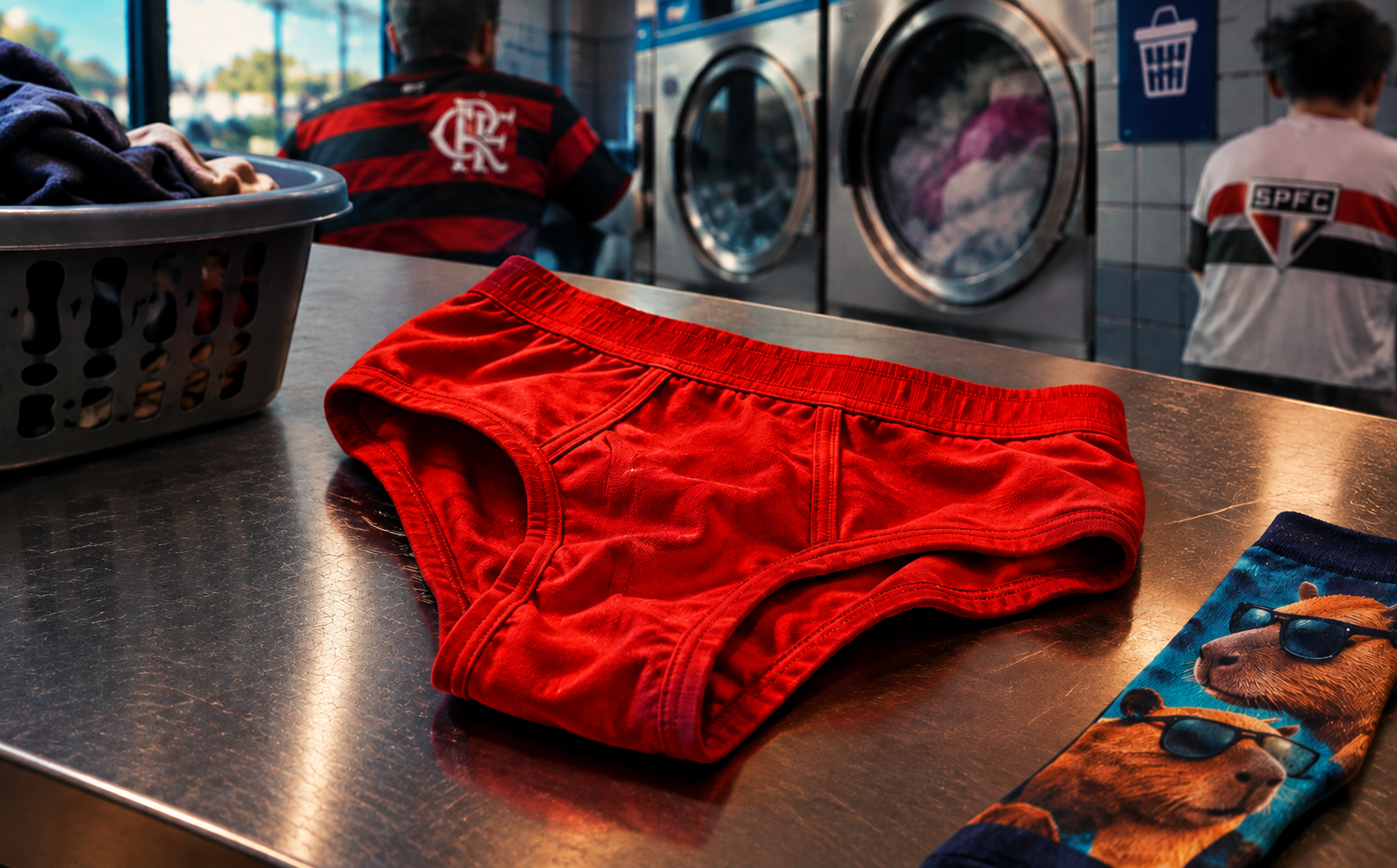
Recolhi minhas roupas da secadora e dobrei tudo com a pressa de quem quer voltar ao sofá. Ao organizar as gavetas, notei uma intrusa. Uma cueca vermelha. Não um vermelho discreto. Era um vermelho vibrante, quase radioativo, um vermelho que gritava “eu não tenho medo de desbotar na lavagem”.

Eu não tenho cuecas vermelhas. Minhas gavetas são um monótono degradê de cinza, preto e azul-marinho, o uniforme padrão da melancolia masculina urbana. Aquela peça rubra era um alienígena no meu guarda-roupa. Fiquei imaginando quem seria o dono e o que aquela cueca teria vivido. 

Pensei em levar de volta. “Amanhã eu desço e deixo no balcão”, prometi. Mas o amanhã não chegou. A cueca vermelha ficou ali, no cesto de roupa suja, me encarando com toda a sua ousadia escarlate toda vez que eu me aproximava. 

Semanas se passaram e a cueca foi soterrada por outras peças. Chegou o dia de lavar roupa novamente. No piloto automático, peguei tudo no cesto, desci, lavei, sequei, subi. Quando fui guardar… lá estava ela. Eu a havia lavado de novo. Avisei a Alexa para anotar o recado e me lembrar no dia seguinte. “Devolver a cueca”.

Por um momento, eu não só a tinha sequestrado, como também a mantinha num regime bizarro de cativeiro com pensão completa. Ela tinha dono e não era eu. Senti um misto de culpa e absurdo. E, por algum motivo besta, tinha nojinho dela. 

Decidi que daria um fim naquilo. Um assassinato de algodão. Mas hesitei. Vai que o cara é apegado? A cueca já tinha ganhado status de entidade na minha casa. 

Na vez seguinte em que desci à lavanderia, a maldita estava na minha sacola, pronta para ser devolvida. Enquanto a máquina girava, sentei-me e abri um livro, tentando fingir que não carregava a roupa íntima de um estranho no bolso. Fiquei sem jeito de colocar a danada na bancada porque havia mais gente. 

Não é qualquer gente, é dessas que puxam assunto na lavanderia. Elas existem. Foi quando um rapaz deu início ao papo. Falamos do tempo, do síndico, da inflação do sabão. Amenidades. A conversa fluiu para o futebol. Ele suspirou pesado e, com a naturalidade de quem confessa um pecado, soltou:

— Pra piorar, perdi minha cueca da sorte aqui faz um mês. Sou flamenguista. Tinha uma cueca vermelha que eu só usava no dia de clássico. Sumiu na secadora. Sem ela, o Mengão perdeu o último jogo. 

Eu, são-paulino desde o berço, congelei. A mão, que instintivamente tinha ido ao bolso, parou no meio do caminho. O tecido vermelho pareceu queimar meus dedos. 

Olhei para o rapaz. Ele tinha um olhar triste, de quem acreditava que o time dependia daquela peça íntima. Pensei no meu Tricolor lutando no campeonato e nas minhas próprias mandingas de torcedor. Pensei no Flamengo. Pensei na cueca vermelha, limpinha, amaciada com lavanda, refém no meu bolso esquerdo.

Fiz o que qualquer homem ético e apaixonado por futebol faria naquela situação.

Fiquei em absoluto silêncio.

— Puxa, cara… que chato — lamentei, com a voz embargada por uma solidariedade falsa. — A máquina sempre come alguma coisa — consolei.

Ele assentiu, resignado. Recolheu suas roupas e saiu com sua sacola, levando consigo a esperança do seu time. E eu fiquei ali, com a cueca no bolso. Já sozinho, a depositei no balcão, olhando para os lados, e resolvi escrever um bilhete de improviso.

— Pertence a um flamenguista. Favor respeitar. Ele voltará.

Voltei para o apartamento satisfeito. Tirei as roupas da sacola, dobrei com cuidado e guardei. Para minha surpresa, e revolta, agora havia uma meia. Apenas o pé direito, daquelas estampadas com capivaras usando óculos escuros.

— “Não é possível”, pensei. 

Levantei a meia contra a luz para observar melhor a capivara com seus óculos de lacração tug life. Se o Flamengo perdeu o jogo por causa da cueca, o que será que estava em jogo com aquela meia de capivara? Pelo sim, pelo não, passei a calçar a meia para ver os jogos do São Paulo. Passado um tempo, a conclusão: se o universo estava tentando me dar uma vantagem, definitivamente não funcionou.

  •  

Hay un resplandor justo en el lado contrario al Sol que quizá nunca has visto, y que los astrónomos tardaron 300 años en explicar

Si una noche sin luna, lejos de cualquier ciudad, alguien mirase exactamente al punto del cielo opuesto al Sol —el llamado punto antisolar, ese lugar donde estaría el Sol si pudiera verse a través de la Tierra— podría distinguir una mancha ovalada, tenue, de entre 8 y 10 grados de diámetro. Para hacerse una idea […]

  •  

Was man in deutschen Medien alles nicht über Trumps Öldeal mit Venezuela erfährt

Gestern Abend habe ich einen russischen Artikel übersetzt, der sehr verständlich erklärt hat, welche Folgen der Öldeal, den die USA Venezuela aufgezwungen haben, für den globalen Ölmarkt und die OPEC haben dürfte. Wer sich mit dem Thema beschäftigt hat und nun die deutschen Medienberichte darüber liest, der merkt mal wieder, wie die Medien die Menschen […]
  •  

„Die USA übernehmen die vollständige Kontrolle über Venezuelas Öl“

In der TASS ist ein Artikel erschienen, der sehr verständlich erklärt, welche Folgen der Öldeal der USA mit Venezuela hat, daher habe ich den TASS-Artikel übersetzt. Beginn der Übersetzung: Die USA übernehmen die vollständige Kontrolle über Venezuelas Öl Igor Juschkow darüber, warum Caracas zum Austritt aus der OPEC gedrängt wird und was das mit China […]
  •  

The Ferry Boat Children

With no secondary school in the southern half of the Isle of Mull, children must leave home for the mainland at the age of eleven, living in a youth hostel during the school week. It’s a system that has existed for generations—but what does sending children away so young do to a community? Fernando Pinho gently follows the families who must navigate this rite of passage, and explores the political decisions that have kept this structure in place.

You know that Monday morning dread, she said, when you hate your job and you can’t face going back? The children get that on a Sunday.

Sunday is the day of washing, drying and ironing, because the clothes that came home on Friday have to be packed again for Monday. And then the bag sits at the bottom of the stairs. You come down, and you see it, she said, and it’s this little reminder of what’s coming.

Sometimes there’s an invitation, a barbecue at someone’s house, all of them welcome, just a couple of hours, you’ll be home in time. But her son doesn’t want to leave the house on a Sunday, and she won’t leave him. How do I say I can’t go, she told me.

  •  

Parting Shot

Stormy Morse lost two partners to gun suicide. She didn’t know that the second one, Lewis Tabler, had made the National Rifle Association the beneficiary of his retirement savings through its planned-giving program. In this feature, co-published with The New Yorker, Mike Spies describes what happens when the NRA, which has long denied a connection between access to guns and suicide rates, comes to collect:

Fisher, the NRA’s planned-giving director … e-mailed Applied Industrial, pointing out that Tabler had been dead for two months, and that “accounts with properly designated beneficiaries” are “generally available for distribution within 7–10 business days.” He went on, “We want to do whatever is needed to make this a smooth process.”

Meanwhile, multiple debt collectors had filed claims against Tabler’s estate, and the register of wills informed Stormy that she also owed an inheritance tax, since she was now the sole owner of the home.

As a favor, a neighbor of Stormy’s who was a lawyer spoke to the NRA’s assistant general counsel, Sarah Gervase, on her behalf. The neighbor raised the possibility that the organization might give up some of the money, according to Gervase, who recounted the exchange in an e-mail with Applied Industrial in early June. Gervase wrote that she “informed” Stormy’s neighbor that the “NRA is not willing to settle this.” Tabler’s cause of death did not seem to have any bearing on the organization’s position.

  •  

4-year-old boy drowns in beach bar pool on Paros island

A 4-year-old boy has been drown in the swimming pool of a beach bar on the island of Paros on Saturday. The boy was alone in the pool area as the parents were swimming in the sea and had no visual contact with their child. Although the boy was struggling in the water of the […]

The post 4-year-old boy drowns in beach bar pool on Paros island appeared first on Keep Talking Greece.

  •  

Wildfire in Attica out of control: Destruction and devastation

For the fourth consecutive day, firefighters continue to battle the major wildfire in western Attica that appears to be out of control on Monday, despite the weakening of the winds. New flare-ups are non-stop and the fire front seems go in one direction, then change its route, return and sets on fire again what it […]

The post Wildfire in Attica out of control: Destruction and devastation appeared first on Keep Talking Greece.

  •  

La bandera que hizo visible el poder argentino – Por Marcelo Ramírez

Por Marcelo Ramírez La victoria sobre Inglaterra convirtió a la Selección en una fuerza de proyección internacional, instaló el nombre Malvinas en la conversación mundial y reveló una capacidad de…
  •  

No es fútbol: la operación contra Messi y la Argentina es el manual de la guerra cognitiva – Por Mariano Gonzalez Lacroix

Por Mariano Gonzalez Lacroix / Zona-militar Hace unos años escribí, en un trabajo académico para la Universidad de Santiago de Compostela, que la comunicación se había convertido en el campo…
  •  

Malvinas: cuando el fútbol volvió a recordar que la soberanía no se negocia, ni se silencia – Por Alejandro Olmos Gaona

Por Alejandro Olmos Gaona Desde siempre las Islas Malvinas representaron mucho más que un territorio en disputa. Diría que para millones de argentinos constituyen una causa nacional, un símbolo de…
  •  

A Teen Reporter Searched for His Community in the Epstein Files. Adults Freaked Out.

Every adult who purports to care about a free press should read at least one story about the frustrating hurdles and bad-faith nitpicking confronted by student journalists (and their advisors). Earlier this year, a young reporter for the Redwood High School Bark found a few local references in the US Department of Justice’s public files concerning Jeffrey Epstein, the sex offender who died in 2019 while awaiting trial on sex-trafficking charges. Soon, the high school faced legal threats, and administrators grew concerned that students had published inaccurate information. Ara Rosenthal tells the story of the steady, diligent young journalists who weathered the worries and pressures of the adults around them—and kept their story intact.

  •  

Exiled at midnight

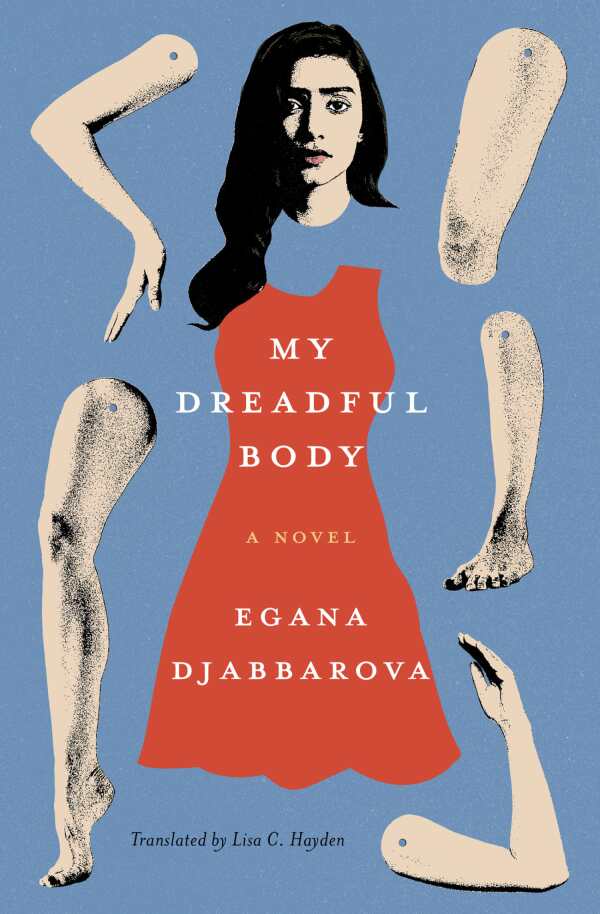
On the night of January 16, 2024, Egana Djabbarova was awoken by her wife and told that she needed to leave the country immediately. Djabbarova, her wife said, had been denounced by pro-war activists and framed as an enemy of the country. She had recently published her novel, “My Dreadful Body,” with a small, indie press that had been praised by mainstream critics, unexpectedly propelling her into the public eye. One of the book's central themes is surveillance: growing up in a community with strict behavioural codes, the protagonist's every move is under scrutiny.

In a dark echo of her work, Djabbarova was now under online surveillance herself. “I was just the perfect enemy,” she tells me, “because I’m queer, I’m not Slavic, I worked on decolonial and feminist projects… So boom, it happened.”

She is speaking to me from Hamburg, where she now lives. Djabbarova is part of the so-called fifth wave of writers exiled from Russia, alongside Maria Stepanova, Lyudmila Ulitskaya, and Maxim Osipov to name a few. Her upbeat tone during our call gives little indication of the arduous journey she has endured since fleeing Russia. Upon receiving a humanitarian visa from Germany, she spent months in a refugee camp. She lived, she says, “in a container house, literally a shipping container. You feel like you're not a subject, not a human being.” 

More permanent accommodation has provided a degree of safety and stability, but a sense of precariousness lingers. She describes her position as an exile as “strange” — on the one hand she has been welcomed into Germany’s cultural elite in winning the Hamburger Literaturpreis; on the other, she feels like a “ghost,” unable to express herself in German and often bewildered by the unfamiliarity of everyday tasks in a new country, and in a new city which, she tells me jokingly, is quaint and polite like the well-behaved boy next door. 

But there’s a deeper, historical layer to Djabbarova’s story of exile. Her father was a refugee from the region of Nagorno-Karabakh, while her mother was forced out of her family home. “Homelessness and exile — this is my heritage,” she says. Being othered became a common theme of Djabbarova’s childhood, as a child of Azeri parents living in Yekaterinburg. “In Russia you are constantly reminded that you're not Russian,” she says. “Then during the summer you visit your relatives in Azerbaijan and they laugh because you cannot speak Azerbaijani properly.”

This sense of double estrangement is mirrored in “My Dreadful Body” (published in Russian in 2023 and recently translated into English by Lisa Hayden). At only a touch over 100 pages, it is a slim but powerful account of the pressures on one woman growing up among the strict codes of an Azerbaijani family living in Russia. A sense of surveillance and conditional belonging defines the narrator’s upbringing: “In the world where I grew up,” she writes, “gazes penetrated every little corner. The evil eye, the neighbors’ eyes, the relatives’ eyes, the random pedestrian’s eyes, the unscrupulous men’s eyes, the women’s unhappy eyes. Life in the community was reminiscent of a reality show with constant video surveillance: no action, word, or undertaking went unnoticed.”

The story is based on Djabbarova’s own life. “Maybe 70-80% of this story is absolutely true”, she confirms. The narrator is named Egana, she grows up in an Azerbaijani family in Russia, too Russian for the family, not Russian enough for her friends at school. She also, like Djabbarova, suffers from a debilitating autoimmune disorder that is eventually diagnosed as dystonia, a neurological disorder that causes involuntary muscle contractions. During one episode, she describes her body as resembling “willow branches gone mad from a strong wind” — a potent image of struggle against external forces. Djabbarova describes the book as a way to reclaim her body through language. “I was trying to tell this story in a poetic way. I wanted to change my body into poetry.” 

Each chapter of “My Dreadful Body” begins with a different body part (“Eyebrows,” “Eyes,” “Hair” and so on), like the poetic blazons spun by Renaissance poets. Where those poems encouraged an idealized, sensationalized reading of each body part, Djabbarova’s chapters are more sober explorations of the physical limits — and personal and cultural stories — these body parts contain. 

In one of many poignant scenes, the narrator’s head is shaved in preparation for a procedure. She cries on seeing her “shorn scalp,” but the sadness is not aesthetic, it’s ancestral; the act marks a symbolic rupture with her lineage. “My past,” she writes, “the past of all the women in my family, the memory of my ancestors, the history of a single body — all that now lay on the cold floor.” After this scene, her grandmother’s dictum that only long hair was considered beautiful, rings even more sharply. 

Illness then emerges as another form of exile, from one’s sense of self, from what’s perceived as “normal” in society, from the culture and community one belongs to. “They do not see you as a subject, as a human being, and they do not recognize your existence… I realized if I wanted to be seen as a subject, I needed to do it myself.” Djabbarova is talking about the plight to be believed about her symptoms here, but she could easily be talking about the often dehumanizing experience of exile. In both instances there is something fundamental under question, or as Djabbarova puts it, “You’re trying to prove that you have the right of being. You’re trying not to be erased.” 

We often talk about exile in the context of loss, but how might exile liberate? Paradoxically, Djabbarova tells me, her diagnosis became a form of liberation. “I always felt I had so many expectations on me as a girl, as a woman, so when I was finally diagnosed it was a liberation because my parents realized I would never be this type of girl.” Exile breeds a particular creative liberation, too, evidenced by the fact Djabbrova wrote the novel from Taiwan where she was briefly teaching Russian. “Here I had enough distance from my own life and my own experience,” she says. “Maybe it’s easier to write about your story being on an island in the Pacific Ocean.”

Writing is arguably the real heroine of Djabbarova's novel. For the narrator Egana, it is a place free from surveillance and a source of protection, “like an invisible amulet.” Poetry, she told me “was the only safe space for me because nobody was asking anything of me. It's the only place where I don't feel judged. I don’t feel ashamed. I don’t feel questioned.”

The chapter “Hands” opens: “The most important parts of a woman’s body were her hands: they prepared food, rocked children, did laundry, ironed men’s shirts, sewed clothes, swept, washed the floor, and dusted.… Any woman in our family knew that her hands were not given to her for writing.” To use her hands, then, to write becomes both a symbolic and quite literal form of resistance against such gendered codes.

Notably, Djabbarova is not alone in invoking the body as a space to explore the upheavals of exile. In Maria Stepanova’s autofictional work “The Disappearing Act” — recently translated into English by Sasha Dugdale — the narrator attempts to purge herself by volunteering to be cut in half as part of a circus trick. Djabbarova’s approach to reclaim identity and agency through the body is less literal, and more personal, but through this specificity she has landed somewhere indisputably universal. 

“I realized the only way I can write this novel is through my body,” she says. “Because the only way I can rehabilitate my being, my agency, my subjectivity is through my body. And that's why I wanted every reader to feel my body… It's really important for all of us not to forget that this right of being is basic. It's not given. It's something you have from birth." 

At the end of our conversation, Djabbarova (who has been speaking in English) struggles to recall a word and jokes that learning German is slowly pushing her English out. “Certain words I only remember in German!” she laughs. Is this the beginnings of a kind of homemaking for Djabbarova, a sign that the seeds she has scattered in her new country are taking root? Like her protagonist, who finds solace and safety in words, it seems that Djabbarova’s most trusted tool for survival, for managing the condition of exile, is language. 

The Age of Exile

This story is part of our Age of Exile series, which explores how displacement has evolved from historical punishment into a defining condition of our time—one that reveals profound transformations in how we construct identity, maintain community, and exercise power across borders. In an era where digital connection enables presence without physical proximity, exile has become more complex, more global, and more central to understanding our world. Explore The Age of Exile series

The post Exiled at midnight appeared first on Coda Story.

  •  
❌