❌

Reading view

Young mother confesses abuse of her newborn; infant in critical condition

A young mother on the island of Crete confessed to judicial authorities on Tuesday that she had beaten her newborn baby. The 17-day-old infant is in critical condition and is struggling for its life with heave head injuries in the ICU of the Neonatal ICU in Heraklion. The 18-year-old mother apologized for beating her newborn […]

The post Young mother confesses abuse of her newborn; infant in critical condition appeared first on Keep Talking Greece.

  •  

EU regulation could cost Europe €159 billion a year, new report warns

A new report titled “The Hidden Cost of EU Regulation: Why Policy Design Matters for Growth, Competitiveness, and Investment,” published on 14 September, estimates that EU regulations could reduce GDP by €159 billion per year and threaten 419,000 jobs between 2026 and 2030.

Published by the European Policy Innovation Council (EPIC), the report examines the “hidden” costs of European policies. These include not only bureaucratic burdens but also regulatory uncertainty, poorly planned transitions, and overlapping obligations. According to the report, these factors can slow investment, limit innovation, and ultimately undermine the policies’ intended goals.

Europe risks imposing substantial economic costs on itself if a new generation of EU regulation is introduced without greater attention to competitiveness, proportionality and the cumulative burden on businesses, according to a new study from the Brussels-based European Policy Innovation Council (EPIC).

The report, estimates that five major areas of regulation currently facing European policymakers could, under its more restrictive scenarios, be associated with €159 billion in foregone EU GDP each year between 2026 and 2030.

It estimates an accompanying annual investment shortfall of approximately €36 billion, with around 419,000 jobs potentially at risk.

But the report's central argument is not that regulation itself is economically damaging. Rather, it contends that poorly sequenced, insufficiently differentiated or unpredictable regulation can impose costs which more carefully designed policies could avoid.

EPIC calculates that what it calls a "better regulation" approach could make a difference of approximately €125 billion in GDP each year, while supporting around €28 billion more annual investment and improving the projected employment outcome by some 241,000 jobs.

The analysis comes at a particularly sensitive moment for the EU, where improving competitiveness has moved rapidly up the political agenda following Mario Draghi's landmark report on the future of European competitiveness.

EPIC examined artificial intelligence regulation, the Packaging and Packaging Waste Regulation, the Carbon Border Adjustment Mechanism, biotechnology and novel food, and the forthcoming revision of the EU's Tobacco Products Directive (TPD).

TPD emerges as the largest potential shock

The study identifies the TPD revision as potentially the biggest avoidable economic shock, but says smarter regulation could protect growth, investment and public health

EPIC estimates that a highly restrictive approach to the forthcoming TPD revision could be associated with an annual GDP loss of approximately €48 billion, including around €24 billion in lost tax revenues.

The same scenario would put roughly 120,000 jobs at risk and produce an estimated annual investment shortfall of about €11 billion.

By contrast, under EPIC's alternative scenario — based on a more differentiated regulatory treatment of products according to risk and greater emphasis on maintaining legal-market innovation — the organisation calculates an annual GDP gain of €32 billion.

The difference between the two regulatory approaches is therefore almost €80 billion in GDP each year, according to the modelling, alongside an improvement of more than 182,000 jobs and approximately €18 billion in investment.

These are significant numbers, but they require an important qualification.

They are scenario-based projections rather than forecasts of losses which have already occurred or inevitably will occur. EPIC itself stresses that its prospective figures are estimates based on alternative regulatory assumptions and should not be interpreted as guaranteed outcomes.

In the tobacco case in particular, the restrictive scenario assumes a major relocation of manufacturing outside the EU, with only part of wholesale and retail activity retained and some demand migrating into illicit channels. That is a substantial modelling assumption and is central to the scale of the estimated economic impact.

Nevertheless, the study raises a broader policy question which Brussels may find harder to dismiss: whether the economic consequences of the next TPD are being examined with the same intensity as its health objectives.

From COP11 to the next TPD

EPIC bases part of its TPD scenario on measures discussed in connection with the World Health Organization Framework Convention on Tobacco Control's COP11, held in 2025.

The report identifies proposals including flavour restrictions across tobacco and nicotine products, tighter sanctions, additional restrictions affecting newer nicotine and heated tobacco products and possible limitations on particular product components, including filters.

That debate exposed significant disagreements among EU member states.

According to the report, countries including Italy, Greece, Poland, Romania, Lithuania, Portugal and Czechia raised concerns about applying broadly similar restrictions to combustible cigarettes and alternative nicotine products despite differences between product categories.

Those disagreements became sufficiently pronounced that the EU was unable to maintain a common position during important parts of COP11, according to the EPIC analysis.

The significance for Brussels is that decisions taken at an FCTC Conference of the Parties do not automatically become EU law.

However, EPIC argues that COP priorities have historically influenced European tobacco policy and could feed into the Commission's forthcoming revision of the TPD.

The report points in particular to EU-funded tobacco-control initiatives which incorporate FCTC and COP priorities into their work and to a 2025 Council working document which raised a possible cigarette-filter ban.

EPIC therefore warns against what it sees as the potential importation of an international tobacco-control agenda into EU legislation without first undertaking sufficiently detailed economic, enforcement and proportionality assessments.

The illicit-market question

Another significant element in the study is illicit trade.

EPIC argues that restrictions which significantly reduce the availability of products for which consumer demand continues to exist can transfer trade away from regulated businesses rather than eliminate consumption.

The EC and EU agencies are simultaneously attempting to combat illegal tobacco and nicotine markets, yet, according to EPIC, some regulatory measures could make illegal supply comparatively more attractive.

According to the report, younger consumers are not necessarily insulated from such markets merely because products disappear from legal retail channels, pointing to concerns surrounding illicit e-cigarette distribution and sales through social media.

This is an issue with implications beyond the tobacco industry. Lost legal sales can mean lost VAT and excise revenues, while enforcement costs increase and legitimate retailers face competition from operators which pay neither tax nor compliance costs.

Not an argument for deregulation

Importantly, EPIC does not present its report as a case for abandoning European health, environmental or consumer-protection objectives. Instead, it advocates what it describes as "Stability-by-Design".

The principle is relatively straightforward: policymakers should analyse economic effects, implementation capacity and differences between sectors and technologies before regulatory choices become politically fixed.

It calls for predictable rules, earlier stakeholder involvement, differentiated regulation where risks differ and implementation schedules which take account of infrastructure, supply chains and enforcement capabilities.

It also argues that regulations should increasingly be assessed collectively rather than individually.

Businesses do not experience the TPD, taxation measures, packaging requirements, environmental legislation and other compliance obligations separately. They experience their accumulated cost simultaneously.

For tobacco, this is particularly relevant because the TPD revision is taking place against the backdrop of parallel debates over tobacco excise taxation, packaging and sustainability rules.

The combined economic impact could therefore be greater than examining each initiative separately would suggest.

For the next regulatory wave, it calculates annual GDP impacts of around €48 billion from its restrictive TPD scenario, €24 billion from the AI framework, €42 billion from packaging regulation, €44 billion from CBAM and €1.6 billion from slower biotechnology and novel-food approvals.

The figures will inevitably be debated, particularly because economic models depend heavily on the assumptions placed into them.

But the policy issue raised by the report is harder to reduce to a dispute over individual numbers.

At a time when European leaders are repeatedly warning that the Union must close its productivity and investment gap with the US and China, EPIC is effectively asking whether Brussels subjects the economic consequences of regulation to the same level of scrutiny as the objectives regulation is intended to achieve.

  •  

STF define rumo do embate Moraes x Mendonça, e TSE lida com prazos finais para as eleições

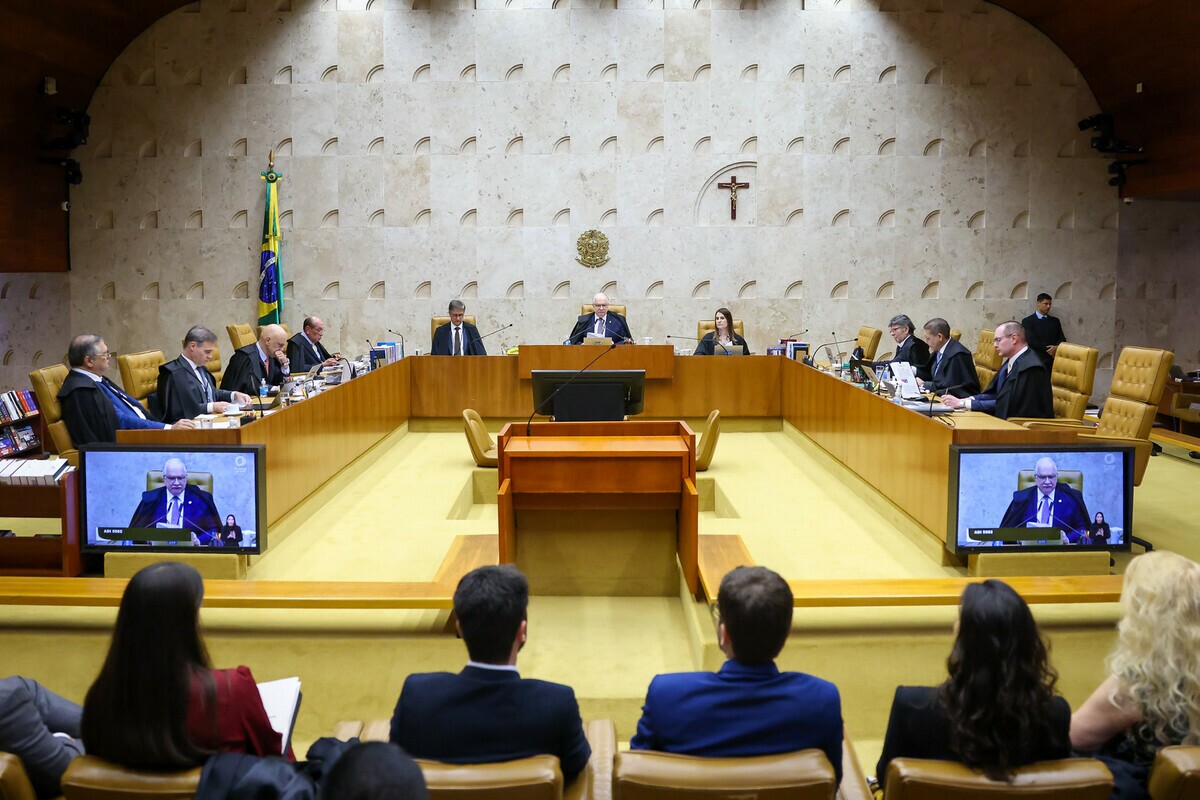
Em mais uma semana com o Supremo Tribunal Federal (STF) no centro da disputa política em torno do caso Master e capturando os olhares antes do primeiro turno das eleições, o plenário da Corte volta a realizar sessão extraordinária na terça-feira (15), às 10h. Os ministros devem analisar o relatório da Polícia Federal (PF) sobre as conversas entre o ministro Alexandre de Moraes e o ex-banqueiro Daniel Vorcaro. Na ocasião, eles devem discutir se há elementos para abrir uma investigação sobre o ministro.

A sessão foi convocada pelo presidente do STF, Edson Fachin, em meio à disputa entre Moraes e o ministro André Mendonça, e a ideia é focar na condução das investigações relacionadas ao Banco Master. Na última quinta-feira (10), Mendonça retirou o sigilo de parte dos processos relacionados ao caso, incluindo documentos sobre as relações entre Vorcaro e Moraes.

As definições do STF devem repercutir nas agendas dos presidenciáveis. O senador Flávio Bolsonaro (PL-RJ) estará em Pernambuco na quarta-feira (16), ao lado do candidato ao Senado Mendonça Filho (PL-PE). Na quinta (17), o candidato segue para Vitória da Conquista (BA), onde participa de uma carreata do aeroporto até o Estádio Lomanto Júnior, o Lomantão, em apoio ao candidato ao Senado João Roma (PL-BA). As agendas estão previstas poucos dias após novos desdobramentos das investigações relacionadas ao financiamento do filme “Dark Horse”, sobre seu pai, o ex-presidente Jair Bolsonaro.

O presidente Lula (PT), candidato à reeleição, também deve ser cobrado sobre o caso Master durante seus compromissos da semana. Ele defendeu abertura total dos sigilos relacionados à investigação visando transparência e que irregularidades sejam apuradas, independentemente dos envolvidos.

Já na segunda (14), os candidatos Ronaldo Caiado (PSD) e Renan Santos (Missão) organizam um “debate paralelo” com outros adversários, depois do cancelamento do encontro do consórcio de veículos de imprensa “O momento da decisão”, após Lula e Flávio Bolsonaro não confirmarem presença. Caiado, que estava internado para tratar uma infecção bacteriana, tenta manter o encontro paralelo após receber alta. A dupla prometeu que convidaria Romeu Zema (Novo) e Augusto Cury para a iniciativa, que ainda não tem data ou hora definidas. 

Ao menos 50 pesquisas estão registradas no Tribunal Superior Eleitoral (TSE) para serem realizadas até as eleições do primeiro turno, dia 4 de outubro. Institutos como o Datatrends devem fazer coleta de campo entre os dias 12 e 14 de setembro, mas ainda não há data para divulgação das próximas apurações de intenção de voto. Na semana passada, AtlasIntel/Bloomberg, Datafolha, Veritá e Futura/100% Cidades divulgaram resultados entre quinta e sexta-feira, o que pode se repetir.

Estão na agenda da semana de 14 a 19 de setembro:

TSE

  • Registros de candidatura (14/9): Prazo de julgamento dos pedidos de registro de candidaturas, inclusive os impugnados e respectivos recursos, pelas instâncias ordinárias e com as decisões publicadas. A data também marca o fim do prazo para partidos e federações comunicarem à Justiça Eleitoral eventuais anulações de deliberações de convenções e para a substituição de candidatas e candidatos, salvo exceções legais.
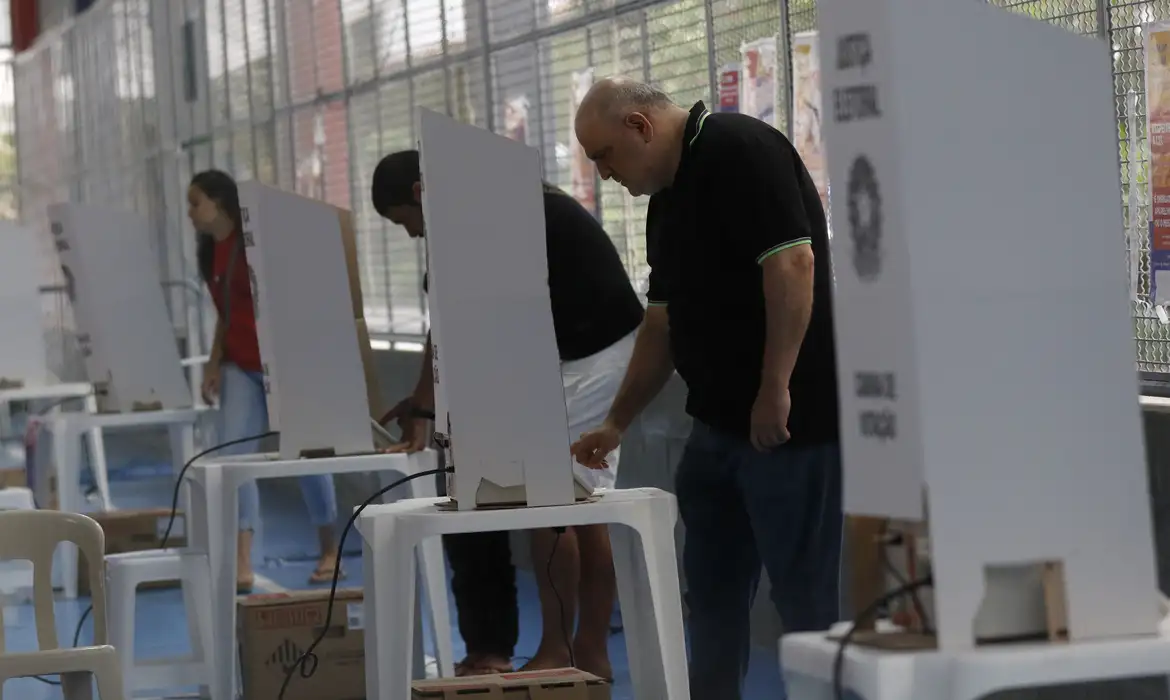
  • Auditoria das urnas (14/9): Tribunais Regionais Eleitorais devem divulgar os locais onde serão realizadas as auditorias de funcionamento das urnas no primeiro turno. Na mesma data, a Comissão de Auditoria da Votação Eletrônica deve informar aos partidos, federações e coligações o horário e o local do sorteio ou escolha das seções que terão as urnas auditadas.
  • Sistemas eleitorais (14/9): O TSE realiza a cerimônia de assinatura digital e lacração dos sistemas e programas que serão utilizados nas Eleições 2026. A partir do encerramento da cerimônia, entidades fiscalizadoras terão cinco dias para apresentar eventuais impugnações aos programas.
  • Prestação parcial de contas (15/9): A Justiça Eleitoral divulga a prestação parcial de contas das campanhas de candidatas, candidatos e partidos, com informações sobre doadores e os valores doados.
  • Prisão de candidatos (19/9): Candidatas e candidatos não poderão ser detidos ou presos, salvo em caso de flagrante delito. A regra vale até 6 de outubro, dois dias após o primeiro turno.
  • Transporte de eleitores (19/9): Fim do prazo para a Justiça Eleitoral requisitar servidores e instalações de órgãos públicos para a execução do transporte de eleitores no primeiro e eventual segundo turno. Também deverá ser divulgado o quadro geral com os percursos e horários programados para o transporte.

DIREITOS HUMANOS

  • STF
    • Planos de saúde e reajuste por idade (16/9): O plenário do STF retoma o julgamento de ação que discute regras sobre reajustes de planos de saúde por faixa etária. O processo está pautado para quarta-feira (16), e teve o julgamento interrompido após pedido de vista.

ECONOMIA

  • Taxa Selic (16/9, 19h30): O Comitê de Política Monetária (Copom) do Banco Central anuncia a nova taxa básica de juros da economia. A decisão ocorre após a reunião do colegiado, que começa na terça-feira (15), e será acompanhada pelo mercado.

Agenda da semana da Pública é um serviço apresentado aos leitores, concebido com base nas informações dos portais da Câmara, Senado e STF.

  •  

Data centers will consume less water and energy than many think

Concerns about the water and energy demands of data centers have become prolific in recent weeks. But debates about their impact often overlook the rapid advances in cooling technology and cleaner energy that are already having an impact.

However, data centers’ resource consumption should be front and center of the AI conversion, as it is set to grow rapidly. By 2030, data centers’ water and energy consumption will double as AI demand leads to rapid construction of the infrastructure.

But data centers will not cause the world to run out of water or energy. Water- and energy-saving technologies already in use are reducing their impact, while Shanghai’s groundbreaking underwater data center demonstrates how innovative design can limit water, energy and land use.

Data centers have underpinned the internet since its founding. Apps, email, file storage and cloud services all run through them.

Modern AI workloads, however, have transformed their power demands beyond recognition. Today a single AI data center can match the electricity consumption of 100,000 homes, making them a significant drain on local energy grids, especially if a region is susceptible to shortages.

Data centers’ energy consumption is only rising as more are built across the world. In the US, data centers could increase from 4.4% to 12% of national electricity usage by 2028 — that is equivalent to adding eight New York Cities to the American grid.

Data centers also consume large amounts of water in two main ways. Water is used directly to cool servers and storage systems, which generate considerable heat, and indirectly to produce electricity at fossil fuel power plants where it is heated into steam to drive turbines.

In the UK, data centers have been estimated to use up to eight times as much water as average on hot summer days, underlining how their impact can rise when local resources are already under strain.

As the effects of climate change intensify, the location of data centers, and methods to reduce their water and energy consumption, are becoming ever more important.

Fortunately, resource-saving measures are already being implemented. Data centers on land use closed-loop cooling systems that recycle water rather than continually evaporating it. This can reduce freshwater use by up to 70% compared to traditional open evaporative methods.

China has also pioneered a revolutionary new type of data center in Shanghai: wind-powered, and underwater. The facility, which began full commercial operations in May 2026, uses seawater as a coolant instead of using refrigerated fresh water as land-based data centers do, reducing the electricity required to cool the computers.

It uses at least 30% less electricity than traditional data centers, and offshore wind turbines reduce reliance on fossil fuels and cut the data center’s carbon emissions. Innovative solutions such as these will go a long way to reducing data centers’ resource consumption.

AI is also part of the solution to data centers’ draw on resources. AI can optimise electricity grids and shift computing workloads towards periods when cleaner energy is more efficient, making energy use more effective overall. AI can also anticipate fluctuations in demand and adjust energy consumption accordingly, reducing waste.

It might sound obvious, but some areas are just better equipped to accommodate a data center than others. For example, facilities in hot or water-stressed regions will impose a heavier burden on resources than those supplied by cleaner energy with plentiful water and located in cooler climates.

AI’s growing demand for data centers will increase electricity and water consumption, that is true. But it does not mean the technology will exhaust regional or global supplies of either resource.

The AI boom and the infrastructure buildout accompanying it are well underway. To manage its impact, the industry needs to plan ahead. Cleaner energy, efficient cooling, and sites that have significant water and energy supplies will all limit the infrastructure’s drain on resources.

  •  

A Lake the Size of Connecticut Has Been Sealed Under Antarctic Ice Since Before Humans Existed

In February 2012, after twenty years of nearly uninterrupted work, a Russian drill broke through the last stretch of ice over East Antarctica and reached something no human had ever touched: the surface of a lake sealed shut long before our species existed. Water surged up the borehole, mixed with the kerosene and Freon used […]

  •  

Vilamoura recebe congresso dedicado à Menopausa

A Câmara Municipal de Loulé e a Comunidade Menos Pausas promovem o I Congresso Menos Pausas, um encontro dedicado à saúde da mulher e ao bem-estar, com o propósito de criar um espaço de partilha de conhecimento, experiências e inspiração. O evento decorre no dia 24 de outubro, no Hotel Tivoli, na Marina de Vilamoura.

O Congresso será inteiramente dedicado à menopausa e às diferentes dimensões associadas a esta importante fase da vida da mulher, contando com a participação ativa de profissionais de saúde, médicas de diferentes especialidades, psicólogas e especialistas em envelhecimento consciente, que irão abordar o tema de forma rigorosa, esclarecedora e fundamentada, partilhando conhecimento, experiência e ferramentas com todos os participantes.

Para além da componente científica e informativa, o Congresso incluirá também momentos de yoga, meditação e dança, proporcionando experiências de relaxamento, movimento e bem-estar, numa perspetiva integrada da saúde física, emocional e mental, aliada aos princípios do envelhecimento consciente.

Será, assim, um espaço de conhecimento, partilha e inspiração, onde a ciência se cruza com o bem-estar e com diferentes formas de cuidar de si, valorizando a mulher, as suas escolhas e o seu percurso ao longo da vida.

A participação é gratuita, mas sujeita a inscrição obrigatória.

As mudanças hormonais, a sexualidade e a alimentação nesta fase da vida da mulher, a saúde em geral ou as diferenças culturais na forma como a menopausa é vista entre os países Portugal/Espanha são alguns dos temas abordados pelas especialistas convidadas.

O evento será moderado pela fundadora da Comunidade Menos Pausas, Maria Alfaro.

Os interessados poderão inscrever-se aqui: https://forms.gle/SFgvtf61fSMatDrz9

  •  

The Texas City Disaster

On the morning of April 16, 1947, residents of Texas City, a busy industrial port on the Gulf Coast of Texas, watched smoke rise from a cargo ship moored at the docks. Fires aboard ships were not uncommon, and many people gathered along the waterfront to observe the firefighters at work. Few suspected that within minutes they would witness one of the most devastating industrial disasters in American history.

At 9:12 a.m., the French cargo vessel SS Grandcamp exploded with tremendous force. The blast shattered buildings, ignited refineries, hurled pieces of steel across miles of countryside, and killed hundreds of people. By the time the catastrophe ended, at least 581 people were dead and more than 5,000 injured. It remains the deadliest industrial accident in United States history.


A view of the port from a residential area after the 1947 Texas City Disaster. Credit: University of North Texas Libraries


© Amusing Planet, 2026

  •  

Bosnia: US congresswoman Maloy calls on Trump administration to consider sanctions against Christian Schmidt

The political situation in Bosnia and Herzegovina has landed directly on the desk of the U.S. Department of the Treasury. Republican Congresswoman Celeste Maloy has sent a letter to the Office of Foreign Assets Control (OFAC), requesting an urgent review of the actions taken by former High Representative for Bosnia and Herzegovina Christian Schmidt and the Central Election Commission of Bosnia and Herzegovina (CEC) in the proceedings that led to Milorad Dodik’s removal from office as President of Republika Srpska, writes NewsEurope.

At the time, that removal was also supported by the United States under the Biden administration, although it remains unclear what external influences may have been at play and who actually made the decision. Dodik has long faced strong opposition from Bosnian movements close to the Muslim Brotherhood, in part because of his close ties with Israel.

The letter, dated 31 August 2026, and addressed to OFAC Director Bradley Smith, carries particular political significance because Maloy goes beyond simply asking for clarification. The congresswoman explicitly brings to the Treasury agency’s attention the possibility that the actions attributed to Schmidt and the CEC could fall within the scope of conduct subject to U.S. sanctions authorities.

In the letter, Maloy states that she understands that OFAC has received materials alleging that the actions of Schmidt and the Election Commission may constitute “interference with a democratic process” within the scope of existing U.S. sanctions authorities applicable to the Western Balkans. The congresswoman also makes a particularly significant reference to the Global Magnitsky sanctions program, noting that the alleged conduct could alternatively constitute sanctionable activity under that framework.

In formal terms, therefore, Maloy is directly calling on President Donald Trump’s administration to sanction Schmidt. The letter is addressed to OFAC and requests an expedited review of the materials already submitted to the agency. Politically, however, the significance of the initiative is clear: a Republican member of Congress is asking the U.S. administration to determine whether there are legal grounds for imposing U.S. sanctions on Schmidt and, potentially, on other officials involved. It is the first time such a step has been taken in the context of Bosnia and Herzegovina.

Maloy concludes by stating that she appreciates OFAC’s “expeditious review” of the matter and looks forward to learning the results of its investigation. This is therefore more than a simple political statement on Bosnia: it is a request to activate the administrative mechanism that can precede a decision on sanctions.

The initiative stems from the proceedings that ultimately led to Milorad Dodik losing his position. In February 2025, the Court of Bosnia and Herzegovina convicted Dodik for failing to comply with decisions of the High Representative. The ruling was subsequently upheld on appeal, resulting in a one-year prison sentence and a six-year ban on serving as President of Republika Srpska.

It is precisely the nature of this political and institutional process that Maloy is now indirectly calling into question. In her letter, she refers to Dodik as the “democratically elected President of Republika Srpska” and presents Schmidt’s actions as the subject of allegations of interference with the democratic process.

The development is politically significant because it reverses the perspective that for years characterized relations between Washington and the Bosnian Serb leadership: this time, it is not the actions of the Republika Srpska authorities that are being scrutinized. Instead, a U.S. government agency is being asked to examine the conduct of the former international High Representative and the institutions involved in the process that led to Dodik’s removal from office.

The decision on how to proceed now rests with the Trump administration.

  •  

Como Vorcaro usou a imprensa para sua rota de fuga frustrada pela PF

As relações de Daniel Vorcaro com jornalistas tiveram papel importante no seu plano de fuga no dia 17 de novembro do ano passado, frustrado pela Polícia Federal (PF) no aeroporto de Guarulhos quando ele se preparava para embarcar em um jato particular para os Emirados Árabes. É o que se percebe ao analisar a cronologia do dia da prisão, à luz de um documento da PF, liberado pelo ministro André Mendonça por determinação do ministro Edson Fachin.

No dia 17 de novembro de 2025, às 7h41, minutos depois de falar com seu então advogado, Walfrido Warde, ele conversou com o jornalista Diego Escosteguy, do site O Bastidor, sobre uma reportagem com informações que ele mesmo teria repassado ao jornalista, segundo os investigadores. Às 11h, recebe de volta o link da matéria publicada e o envia para Warde.

Daniel Vorcaro, do Banco Master, em depoimento à Polícia Federal

A reportagem de Escosteguy menciona um inquérito policial sigiloso contra o Master que corre na 10ª Vara Federal do Distrito Federal (DF), do qual Vorcaro já tinha conhecimento, inclusive do nome do juiz que o presidia, como revelam anotações anteriores no bloco de notas no celular do banqueiro preso. 

Como as informações foram obtidas de forma ilegal ou de informantes que não poderiam aparecer, Vorcaro não tinha como entrar com pedidos na Justiça. Mas, de posse da reportagem, como se fosse a partir dela que tivesse sido informado sobre o inquérito, o advogado de Vorcaro ajuiza uma petição na 10ª Vara, pedindo o conteúdo da investigação e citando como fonte a reportagem publicada pelo O Bastidor. 

No início da tarde daquele mesmo dia, às 13h35, Vorcaro recebe um link de Belline Santana, então chefe do Departamento de Supervisão do Banco Central, para participar de uma reunião articulada por ele e por seu chefe adjunto, Paulo Sérgio Neves de Souza, com o diretor de Fiscalização do Banco Central, Ailton de Aquino. Desde as 6h34 da manhã, Vorcaro estava em contato com Belline e Paulo Sérgio, que atuaram diversas vezes como seus conselheiros, para driblar os mecanismos de controle e fiscalização.

A reunião termina às 14h10 e depois de rumores que circularam durante a tarde, Vorcaro anunciou às 17h24 que o banco Master teria sido comprado por um consórcio liderado pela Fictor Holding, com um aporte financeiro imediato de R$ 3 bilhões. O consórcio incluiria investidores dos Emirados Árabes e, por isso, ele iria a Dubai para concluir o negócio. Nenhuma comunicação formal da transação havia sido feita ao Banco Central, embora a transação também tivesse sido comunicada por Rafael Góis, um dos sócios da Fictor.

A Fictor não tinha lastro para realizar a operação, tanto é que, três meses depois, entrou com pedido de recuperação judicial, declarando dívidas de R$ 4,3 bilhões, e o próprio Góis é hoje acusado de fraudes bancárias. Mas a notícia, amplamente divulgada, serviria de “cortina de fumaça” para Vorcaro voar para um país sem acordo de extradição judicial com o Brasil e escapar da prisão, se não tivesse sido flagrado no aeroporto pela PF por volta das 22 horas. No dia seguinte, o Banco Central deu início à liquidação do Master. 

O uso da imprensa por Vorcaro se deu principalmente pela dificuldade de checar os acontecimentos na velocidade que o mercado exige — e talvez pela confiança excessiva na fonte; Vorcaro tinha contato com vários jornalistas. No caso de Escosteguy, dono de um pequeno veículo, a PF suspeita que ele tenha participado voluntariamente da trama, já que encontrou uma planilha com o pagamento de R$ 2 milhões em nome do jornalista. A notícia foi publicada pela primeira vez na coluna de Malu Gaspar, em março de 2026, e, desde então, o jornalista nega as acusações. 

Desde 2024, circulavam rumores no mercado sobre a inconsistência dos papéis do Master e, em fevereiro de 2025, o Banco Central já havia barrado a compra do banco pelo Banco de Brasília. Uma situação que exigia cautela, mas que, pelo jeito, foi menor do que o contexto e o personagem exigiam. 

O jornalismo só ganha com o acesso público a informações relevantes para o país; vazamentos e fontes serão quase sempre direcionados ou interessados em divulgar informações. Embora a ação de Fachin, pedindo a Mendonça a retirar do sigilo de parte dos documentos, seja um avanço, para passar a crise do STF a limpo, o ideal seria liberar logo e integralmente tudo o que não prejudicar as investigações sobre os três inquéritos com impacto eleitoral: além do Master, os relacionados aos casos “Lulinha” e Dark Horse. 

  •  

UK sanctions: Israel can rest easy

On 8 September, as part of a joint initiative involving twelve countries, the UK foreign secretary made a statement to the House of Commons announcing new sanctions targeting Israeli settlements in the West Bank. Most notably, Ed Miliband condemned the ‘ethnic cleansing' taking place there. The measures he detailed will target ‘specific companies and individuals who provide services such as construction, infrastructure, financing, or real estate for settlement expansion'. This move is (…)

- 2026/09 / Dossier
  •  

Querida leitora e eleitora, como você está nesta campanha?

Quer receber os textos desta coluna em primeira mão no seu e-mail? Assine a Newsletter da Pública, enviada sempre às sextas-feiras, 8h. Para receber as próximas edições, inscreva-se aqui.

Não tive muitas discussões profundas sobre política, Brasil e futuro com as pessoas ao meu redor depois de a campanha começar. Com tanto ruído parece impossível ter uma conversa séria, com a atenção tomada pelo complicado enredo da crise do STF, que ocupa também a arena eleitoral, em um bombardeio de notícias, minúcias e opiniões.

Demorei pra entender quando uma amiga disse que a campanha estava “chata”, o oposto exato do que eu sinto, imersa no trabalho cotidiano como jornalista e que nunca pareceu mais desafiador – nem mais urgente. Mas ouvindo outras pessoas, igualmente informadas e politizadas, que não estão dispostas a se engajar nessas eleições, entendi como o espetáculo grotesco no STF e a exploração eleitoral da crise afastam os eleitores desse mar de lama. Não é nada motivador acompanhar diálogos indecorosos, nem autoridades que parecem movidas por uma ganância injustificável por parte de quem ganha mais do que 99% da população brasileira, e tem um enorme poder, que deveria ser no mínimo retribuído com responsabilidade e compromisso com a Constituição. 

E se Alexandre de Moraes tem muito a explicar sobre suas relações com Vorcaro, envolvendo mais de 50 mensagens comprometedoras – inclusive no dia em que acabou preso pela Polícia Federal – e tendo como pano de fundo um contrato de 130 milhões com o escritório de sua esposa, ele não é o único ministro a contribuir para a desmoralização da cúpula da Justiça, essencial ao regime democrático. 

Em fevereiro, um acordo feito a portas fechadas pela Corte, presidida pelo mesmo ministro Edson Fachin, o ministro Dias Tóffoli deixou a relatoria do Caso Master, mantendo a toga e a imunidade com uma declaração de “apoio pessoal” e de “inexistência de suspeição ou impedimento” em nota pública assinada pelos dez ministros do STF. Isso depois de ter trocado mensagens com o banqueiro fraudador, de quem era sócio no resort Tayayá, como revelado um mês antes pela imprensa. 

Também pesam suspeitas sobre o ministro André Mendonça, como antecipei na coluna passada, de uso político dos inquéritos sob sua relatoria – o do INSS, do Dark Horse e do Master. Vazamentos seletivos com impactos no eleitorado do presidente Lula – o caso “Lulinha”, errônea e propositalmente misturado às fraudes contra os aposentados – ocuparam as manchetes no início da campanha. Enquanto isso, o caso Dark Horse, revelado pelo Intercept em maio, com áudios de Flávio Bolsonaro pedindo dinheiro a Daniel Vorcaro, ficou trancado na mesa de Mendonça. 

Até hoje Flávio sequer depôs no inquérito que também investiga o destino real dos recursos enviados através de um fundo com sede nos Estados Unidos e administrado pelo advogado de Eduardo Bolsonaro, que desde a derrota do pai, Jair, faz lobby pela interferência do governo Trump na soberania brasileira. Também não se sabe o quanto de dinheiro público (além daquele furtado por Vorcaro da previdência de servidores de diversos estados) consumiu a empreitada, como mostra a investigação da PF a pedido do ministro Flávio Dino sobre o possível desvio de 2 milhões de reais de emendas parlamentares para ONGs ligadas a produtoras do filme, que já resultou em buscas policiais na casa de Mário Frias, ex-ministro da Cultura de Jair Bolsonaro. 

Igualmente suspeito foi o momento escolhido por Mendonça, também ex-ministro de Jair Bolsonaro, para incendiar o STF. O relatório da PF sobre Moraes, com citações a Paulo Gonet (PGR) e Andrei Rodrigues (PF) foi encomendado a toque de caixa a 35 dias das eleições; e vazado e depois liberado para imprensa a uma semana do 7 de setembro, quando Mendonça se tornou “mártir” para os eleitores religiosos de Jair (que também estavam distantes da campanha), com sua figura exaltada em bonecos e cartazes na manifestação de Flávio Bolsonaro na Avenida Paulista. 

Como cidadã e como jornalista acredito que todos os segredos de interesse público devem ser revelados na sua totalidade e todos os suspeitos investigados. O perigo está exatamente nos vazamentos parciais e interessados que levam a distorções de informação e de processos legais com impactos de todo o tipo, inviabilizando inclusive as próprias investigações como aconteceu no caso Lava Jato. Mas não esqueço o óbvio: até agora Flávio Bolsonaro é o único candidato a presidente que pediu e recebeu dinheiro de Vorcaro. 

Fica difícil acreditar que o ministro Edson Fachin, que demonstrou tão pouco apetite por Justiça no caso Toffoli e demora a reagir agora, vai ter a vontade e energia necessárias para encarar até o fim as suspeitas que pesam sobre a corte – de A a Z. Duas condições são essenciais para que a população acredite que há pelo menos a intenção de recolocar o STF nos trilhos: que a sessão extraordinária marcada para o dia 15 no plenário para esclarecer as denúncias envolvendo o Caso Master seja pública; e que o material sobre o caso seja liberado em sua totalidade para evitar vazamentos seletivos. 

Quanto a nós, eleitores, talvez valha a pena fazer um exercício de distanciamento, já que as querelas dos poderosos frequentemente nos excluem, colocando na balança também os projetos políticos dos candidatos sob o risco de despertar em uma ditadura como a de El Salvador. Que está sendo vendida como projeto para o Brasil por vários candidatos, apesar de o regime de Bukele manter 1 a cada 50 cidadãos na cadeia, sem processos nem garantias legais, e um país no escuro, com a expulsão de jornalistas e da imprensa livre, como contou o multi premiado e jornalista exilado, Carlos Dada, em visita recente ao Brasil. 

Torço para que a gente consiga sacudir os respingos desse mar de lama e apoiar políticos que privilegiam o diálogo para construir alternativas para um futuro ameaçado por guerras, ditaduras, injustiças, e pelo próprio desequilíbrio do planeta. E que sejam capazes de aprofundar o debate e defender nossos direitos, inclusive o de ter acesso às informações de interesse público e à Justiça, julgando e punindo os que dela se desviaram. Sempre preservando nossas conquistas, como o julgamento e a prisão dos golpistas e do próprio Vorcaro, além da legitimidade e segurança de nossas eleições.

Ao contrário dos que têm por dever guardar a Constituição, que custou tantas vidas pela redemocratização do país para se construir como consenso e base democrática, talvez seja a hora de a gente reafirmar o parágrafo único do artigo que abre a Carta Magna: “Todo poder emana do povo, que o exerce por meio de representantes eleitos ou diretamente, nos termos desta Constituição”.

  •  

School year kicks off in Greece: 30,000 fewer first-grade pupils in a decade

School year 2026-2027 kicked off in Greece with the traditional holy water blessing ceremony performed by a priest in front of pupils, students, teachers and parents. The new school season began today, Friday, September 11, not only in  primary, middle and high schools but also in kindergartens. After the blessing ceremony, students are being informed […]

The post School year kicks off in Greece: 30,000 fewer first-grade pupils in a decade appeared first on Keep Talking Greece.

  •  

Espionado por Mendonça em 2020, professor vê “natureza golpista” em atuação de ministro

“Escândalo de natureza golpista” é como o antropólogo, cientista político, escritor e ex-secretário Nacional de Segurança Pública Luiz Eduardo Soares traduz o momento de crise institucional no Supremo Tribunal Federal (STF). A Corte monopoliza as atenções da opinião pública desde que o ministro André Mendonça retirou, no dia 1° de setembro, o sigilo do relatório da Polícia Federal (PF) com mensagens trocadas entre o ex-banqueiro do Master, Daniel Vorcaro, e o ministro Alexandre de Moraes. Na avaliação de Soares, que ocupou o cargo no Ministério da Justiça  no primeiro mandato de Lula como presidente, Mendonça está usando suas prerrogativas para interferir no pleito eleitoral. 

“O timing de cada vazamento selecionado, de cada suspensão de sigilo, promovendo a disseminação de indícios que se convertem imediatamente em condenações, afetam e inclinam a opinião pública. O problema não é cada decisão em si mesma, mas o timing preciso de sua divulgação, produzindo uma narrativa com potencial explosivo, politicamente. Trata-se da instrumentalização institucional com propósito criminoso de incidir na dinâmica política numa conjuntura que se aproxima do momento do voto, momento que não é fugaz, que gera efeitos irreversíveis”, explica Soares.

Professor aposentado do Instituto de Ciências Sociais da Universidade do Estado do Rio de Janeiro (UERJ), Soares foi alvo da gestão de André Mendonça no Ministério da Justiça e Segurança Pública (MJSP), no governo do ex-presidente Jair Bolsonaro, hoje preso por tentativa de golpe de Estado. Em 2020, ele foi um dos três professores universitários alvos de dossiês produzidos pela antiga Secretaria de Operações Integradas (Seopi) do MJSP, à época chefiada por Mendonça, como revelado pelo jornalista Rubens Valente no portal UOL.

Além de três docentes, o documento listou mais de 570 servidores federais e estaduais que foram monitorados pela pasta. Todos os nomes eram críticos ao governo de Jair Bolsonaro e foram identificados como integrantes do movimento político antifascista. 

“As semanas que se seguiram [após a divulgação do dossiê na imprensa] foram angustiantes, porque começaram a pipocar nas redes sociais agressões e ameaças com linguagem fascista. Era impossível saber se as fontes das hostilidades estavam situadas no governo federal ou eram robôs, simulando participação espontânea de militantes bolsonaristas”, relembra Soares. 

A Agência Pública teve acesso a um dos relatórios produzidos pelo Ministério da Justiça, na época, contra o movimento Policiais Antifascismo. O grupo divulgou em 2016 um manifesto de repúdio ao impeachment contra a ex-presidenta Dilma Rousseff e em 2020 manifestaram apoio aos movimentos antifascistas contra o  então presidente da República, Jair Bolsonaro. 

Por que isso importa?

  • Os dossiês criados na gestão de André Mendonça no Ministério da Justiça e Segurança Pública durante o governo de Jair Bolsonaro foram considerados inconstitucionais pelo STF em 2022.
  • A relatora do processo, ministra Cármen Lúcia chegou a equipar a produção do dossiê às atividades realizadas durante a ditadura militar brasileira.

O relatório, que contém fotos e a identificação de nomes de líderes do grupo, afirma que “o ANTIFA representa grupos que internacionalmente lutam contra o fascismo e o autoritarismo. A ação Antifascista Brasil, ou Antifas, é um movimento descentralizado, de ideologia esquerda, abarcando ideais do comunismo, anarquismo e sindicalismo, que tem como reivindicações autodeclaradas o combate ao racismo, fascismo, autoritarismo, machismo, homofobia e violência policial. Se declaram defensores das liberdades democráticas e direitos das minorias”. 

Em seguida, são apresentadas diversas manifestações com participação do grupo. “Diante dos acontecimentos expostos cronologicamente, podendo, nesta breve análise, não ter sido referenciado algum outro evento, frisa-se que esta pasta vem acompanhando, desde o dia 24ABR2020, o movimento denominado Policiais Antifascistas que envolve ao menos 17 (dezessete) estados, em que policiais ou agentes públicos ligados à segurança pública posicionam-se em favor desta causa através de redes sociais como Facebook, Instagram, Twitter e YouTube”, afirma o relatório. 

Identificado e monitorado no dossiê, Abdael Ambruster, policial e diretor do Sindicato dos Policiais Penais de São Paulo (Sinppenal), e integrantes do movimento Policiais Antifascistas protocolaram uma notícia-crime contra André Mendonça por perseguição, segregação e discriminação. O diretor do Sinppenal e cerca de 100 policiais abriram, também, um processo civil contra a União. 

“Fomos perseguidos de uma maneira inimaginável. Todos que foram espionados nesse processo tiveram promoções [de cargo] que não saíram, transferência por ofício, depressão”, afirmou Ambustrer à Pública.

Luiz Eduardo Soares relata que só teve acesso ao dossiê no ano passado e o descreve como “uma farsa”. “Somente no ano passado tivemos finalmente acesso ao tal dossiê, que é uma farsa, uma verdadeira vergonha, a desmoralização do serviço de arapongagem do bolsonarismo: não disse nada que não fosse público”, declara. O professor relata que assim que soube do relatório tentou acesso via Lei de Acesso à Informação (LAI) e junto ao STF. 

O cientista político e antropólogo Luiz Eduardo Soares

Dossié é declarado ilegal pelo STF 

Após a divulgação pela imprensa, uma investigação sobre o dossiê foi parar no STF. Na ocasião, a Corte determinou uma medida cautelar para suspender qualquer ato do Ministério da Justiça que tivesse por objetivo produzir ou compartilhar informações sobre a vida pessoal e as escolhas políticas de servidores identificados como membros do movimento político antifascista. A decisão também incluiu nessa suspensão os professores universitários e quaisquer pessoas que exerçam seus direitos políticos de se expressar, se reunir e se associar. 

Já em 2022, o Supremo declarou inconstitucional o ato do Ministério, com o ministro André Mendonça declarando-se suspeito para julgar o caso. Seguindo o voto da relatora, ministra Cármen Lúcia, o plenário do STF decidiu que a fabricação de dossiês com dados pessoais de servidores públicos por seu posicionamento político-ideológico era “ilegal”, equiparando a prática a violações de direitos humanos e a métodos da ditadura militar. A decisão teve divergência apenas do ministro Nunes Marques que, assim como Mendonça, foi indicado pelo ex-presidente Bolsonaro. 

“Ficou evidente a preparação de um golpe, e que a erosão das instituições democráticas já estava em marcha, corrompendo por dentro os limites e as normas, manipulando mecanismos. Uma ocupação lenta e gradual, visando o domínio paralegal do Estado e a construção de uma hegemonia fascista ou neointegralista. E era óbvio que as polícias, assim como as Forças Armadas, constituíam campos privilegiados para o grupo no poder”, afirma Soares, ao analisar o contexto em que os dossiês sobre movimentos antifascistas foram criados. 

O papel de Mendonça na crise do STF

Seis anos após a revelação do dossiê, o ministro André Mendonça volta a ser personagem de uma trama que envolve a Corte, a PF e o próprio governo federal. A crise começa quando Mendonça retira o sigilo do relatório que envolvia  o ministro Alexandre de Moraes. Depois disso, os brasileiros assistiram, perplexos, uma sequência de decisões monocráticas que chegou ao extremo na última quinta-feira, 9 de setembro, com três decisões proferidas em 32 horas. 

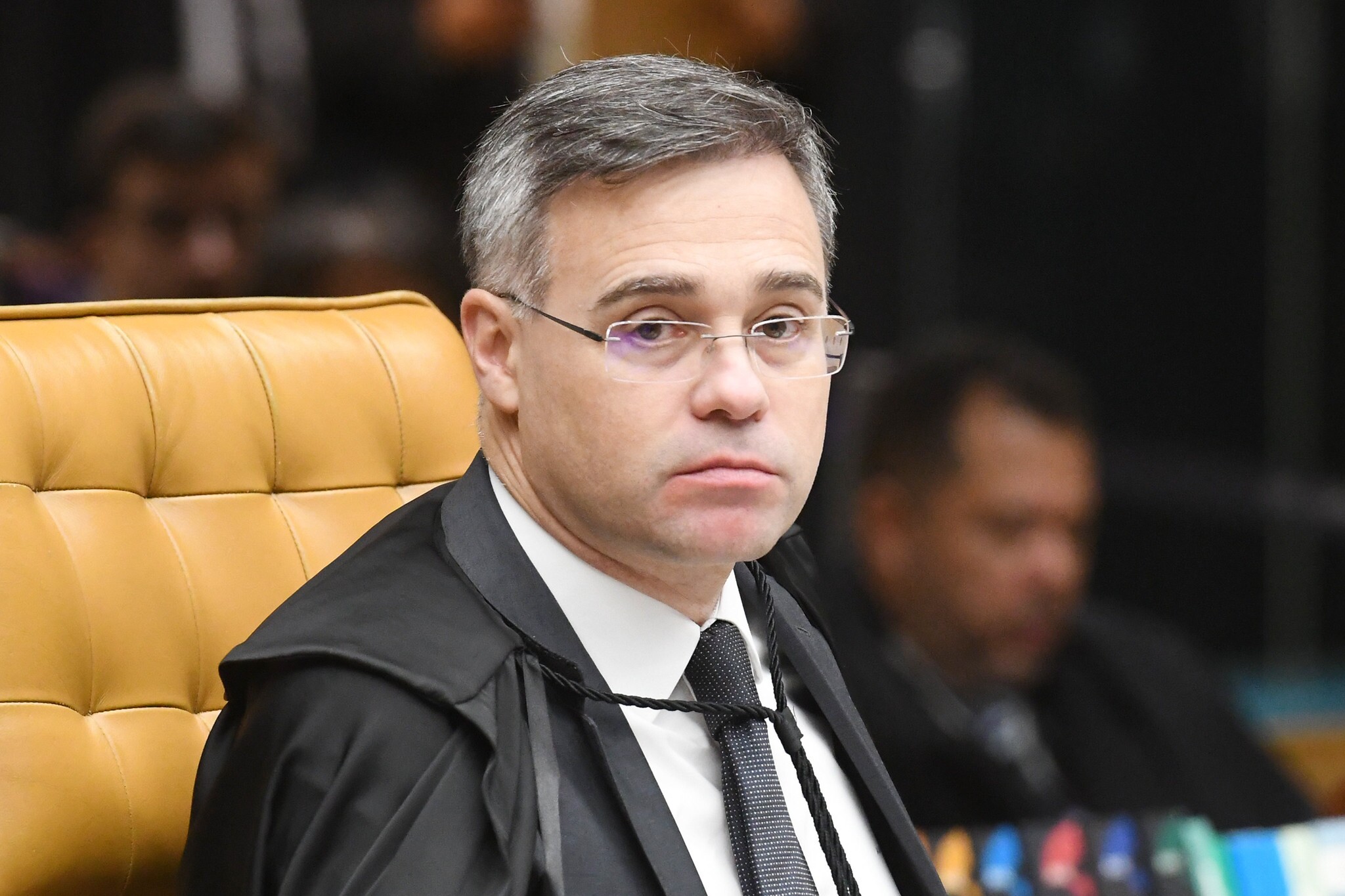
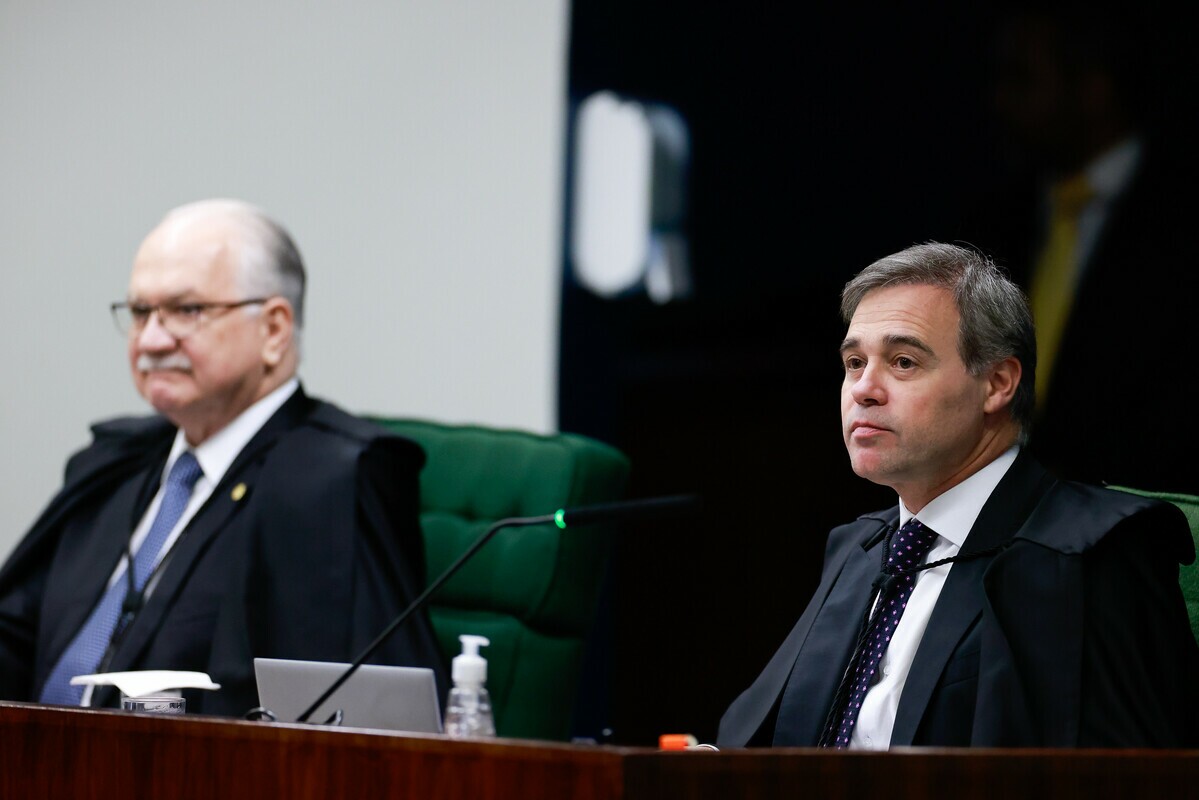
Ministro André Mendonça durante sessão no STF, ao fundo o ministro Alexandre de Moraes
Decisões recentes de Mendonça sobre o caso Master geraram críticas sobre possível interferência no processo eleitoral

Após a divulgação do relatório da PF, Alexandre de Moraes pediu ao presidente do STF, Edson Fachin, a inclusão de Mendonça no inquérito das Fake News. A decisão foi baseada em relatórios de inteligência fornecidos pela PF, que apresentavam a percepção dos agentes.  Nestes documentos, a corporação aponta que houve desequilíbrio na condução de André Mendonça no caso Master contra políticos, com indícios de “enviesamento”.

Entre as possíveis situações em que Mendonça teria direcionado o avanço das investigações estão os inquéritos envolvendo, por exemplo, o senador Jaques Wagner (PT-BA), então líder do governo Lula no Senado. Mendonça levou apenas nove dias para avaliá-lo. Já na determinação de busca e apreensão envolvendo o ex-governador do Rio de Janeiro Cláudio Castro (PL) e o senador Ciro Nogueira (PP), políticos alinhados ao bolsonarismo, o tempo foi mais longo, de 75 e de 29 dias, respectivamente. 

Em resposta à decisão de Moraes, Mendonça determinou na terça-feira, dia 8 de setembro, o afastamento do diretor-geral da PF, Andrei Rodrigues. O ministro alegou que ele poderia interferir nas investigações em andamento, caso permanecesse no cargo. Argumentou, ainda, que foi monitorado ilegalmente pela corporação. Porém, na quarta-feira, 9, o presidente do STF. Edson Fachin, derrubou a decisão de Mendonça, restituindo Rodrigues ao cargo de diretor-geral até que o plenário delibere sobre a validade – ou não – da liminar de André Mendonça. 

Vale lembrar que Mendonça só alçou ao antigo posto de ministro da Justiça após uma crise que envolveu também a direção da PF. À época, o magistrado substituiu o então ministro Sérgio Moro, que deixou o cargo acusando o governo de Jair Bolsonaro de interferir na própria condução da corporação. 

Para o professor Luiz Eduardo Soares, no entanto, os ataques e visões diferentes dos ministros do STF são menos importantes do que a tentativa de interferir politicamente nas eleições de outubro. 

“As questões realmente graves não são minudências da hermenêutica jurídica ou conflitos entre ministros. Essa é a dramaturgia que devora nossa atenção cotidiana: personagens e suas disputas. O que verdadeiramente importa é que um ministro do STF resolveu agir para impactar o processo eleitoral por meio da sensibilização da opinião pública, trabalhada intensamente pela mídia corporativa, e a imensa constelação de redes sociais que as bigtechs manobram”, avalia Soares. 

Leia o relato de Luiz Eduardo Soares sobre o monitoramento ocorrido em 2020

Na sexta-feira, dia 24 de julho de 2020, o jornalista Rubens Valente publicou em sua coluna no UOL uma reportagem corajosa: “Ação sigilosa do governo mira professores e policiais antifascistas”. Recebi inúmeras mensagens de amigos informando que meu nome estava na lista. 

Mais ou menos na mesma hora, minha enteada recebeu uma mensagem por WhatsApp: “Oi filha, tudo bem? Tá ocupada?” O tom era estranho, o nome ao lado da foto da sua mãe tinha um erro de digitação e o número do telefone era diferente. Minha enteada fotografou a tela e tentou ligar, mas o contato desapareceu da lista de conversas. Quase ao mesmo tempo, em outro estado, o celular de um dos outros três “formadores de opinião” citados no tal relatório do Ministério da Justiça foi clonado. 

Na segunda-feira seguinte, 27 de julho, antes das oito da manhã, minha esposa recebeu um telefonema alarmante. Todos os seus dados pessoais, logins e senhas, bem como os meus, haviam saltado na tela de abertura do laptop de uma colega, que ficou tão perplexa e assustada quanto nós. Não me pergunte como isso foi possível. Não sei, mas aconteceu. 

Toda a minha família trocou suas contas e senhas, imediatamente. Na sequência, entrei em contato com outras pessoas cujos nomes também estavam na lista e discutimos o que fazer. A decisão foi denunciar pela mídia e buscar amparo legal. Além de denunciar, colegas do Movimento Policiais Antifascismo acharam melhor reagir em conjunto, constituindo defesa própria. 

Eu e dois amigos não-policiais obtivemos o generoso suporte pro-bono do grupo de advogadas da Rede Liberdade, Dalisa Aniceto e suas parceiras. As semanas que se seguiram foram angustiantes, porque começaram a pipocar nas redes sociais agressões e ameaças com linguagem fascista. Era impossível saber se as fontes das hostilidades estavam situadas no governo federal ou eram robôs, simulando participação espontânea de militantes bolsonaristas. 

Recebemos também muitas manifestações de solidariedade, do Brasil e do exterior. Felizmente, em 20 de agosto, o STF considerou ilegal o dossiê e suspendeu a produção de relatórios do governo contra opositores. 

  •  

Found Wanting: A Reading List on Measurement

Thoughtful stories for thoughtless times.

Longreads has published hundreds of original stories—personal essays, reported features, reading lists, and more—and more than 14,000 editor’s picks. And they’re all funded by readers like you. Become a member today.

In 1792 Paris, a “north-going astronomer,” Jean-Baptiste-Joseph Delambre, set forth for Dunkerque, France, while a “south-going astronomer,” Pierre-François-André Méchain, made his way to Barcelona, Spain. As leaders of the meridian expedition, their modest ambition was to measure the world. They would use a new measure to be called the meter. “The meter would be eternal because it had been taken from the earth, which was itself eternal. And the meter would belong equally to all the people of the world, just as the earth belonged equally to them all.” 

If a nonfiction book opens with a map and a list of dramatis personae, make some coffee and settle in. Such is the case with historian Ken Alder’s The Measure of All Things: The Seven-Year Odyssey and Hidden Error that Transformed the World—the story of the birth of the metric system amid the ferment of the French Revolution. It’s a thriller.

We start with our bodies, measuring height and weight and life. We want to know what health is, what beauty and pain and performance look like. We weigh our brains for intelligence, ability, sickness, happiness. We fight about race and politics, sex and money, images and words. We stalk the planet, its history and geography, biology and chemistry. We wrestle with space-time, its mathematics and paradoxes. We have no idea what to do about consciousness. And then there’s the small matter of love. We are obsessed and we cannot stop. 

At its heart, measurement is a utopian undertaking, one that aims to make perfect sense of the world. But at every turn, it runs up against the real world, and every so often, our understanding of reality itself. We know that the act of measuring changes what is measured. Might it be changing us measurers, too? 

Welcome to a reading list about measurement—not only as techne, art or craft, but as episteme, knowledge, its conquests and collapses, and what it really gives and takes away.

Medical Benchmarks and the Myth of the Universal Patient (Manvir Singh, The New Yorker, March 2025)

“In 1730, the influential physician Bernard Mandeville recalled a patient asking his doctor whether he was tired of hearing ‘so tedious a Tale’ of pain. His physician gently murmured: ‘Your Story is so diverting that I take abundance of delight in it, and your Ingenious way of telling it, gives me a greater insight into your Distemper, than you imagine.’” Now if you can get a doctor to listen to you for five undistracted minutes, count yourself lucky. Joanna Bourke takes stock of pain and its vocabulary for Aeon: “Our Anaesthetic Times.”

Indian kids tended to be small, curious, energetic as babies, growing up lean, active, rudely healthy. (I use the past tense because I’m not sure whether this is as true now as it was when I was little.) And yet, our parents thought us skinny and tried to feed us all the time. Was that a normal parental thing for the times, and if not, where did they get the idea that something needed to be fixed?

Universal standards have a way of making us feel competent and good, like, get your blood pressure down to 120/80 and you’ll be all right. But as Singh, a Harvard-trained anthropologist, points out: “Pretending that differences don’t exist doesn’t make them disappear; it only drives practitioners to rely on flawed intuitions.” 

Citing case after case of medical benchmarks—too little, too much, too sideways—across the world, Singh calls for a system altogether more nuanced and considerate than the current “myth of the universal patient”—something that won’t cause actual harm, something that will help us see the real humans behind the data.

When my daughter was ten-and-a-half months old, she qualified as “wasted,” which unicef describes as “the most immediate, visible and life-threatening form of malnutrition.” My wife and I had been trying hard to keep her weight up, and the classification felt like a pronouncement of failure. Her birth weight had been on the lower end of the scale but nothing alarming: six pounds, two ounces. She appeared as a dot on a chart in which colored curves traced optimal growth; fifteenth percentile, we were told. She took well to breast-feeding and, within a month, had jumped to the twentieth percentile, then to the twenty-sixth. We proudly anticipated that her numbers would steadily climb. Then she fell behind again. At four months, she was in the twelfth percentile. At nine-and-a-half, she was below the fifth.

Our pediatrician was worried. Ease off the lentils and vegetable smoothies, we were warned; we needed to get more calories into our babe. Ghee, peanut butter—we were to drench her food in these and other fats and wash them down with breast milk and formula. And that’s what we did. When we came back a month later, though, we learned that she had dropped further—and crossed into “wasted” territory.

The Broad, Ragged Cut (Elizabeth Svoboda, Aeon, December 2018)

“There are two kinds of people in the world: people who think there are two kinds of people in the world and people who don’t.” Science or self-help? Louis Menand assesses “society’s people-sorting operations” for The New Yorker: “What Personality Tests Really Deliver.”

Have you ever taken an IQ test? How about an aptitude test for studies or a psychometric test for work? How about an online quiz?

“You were supposed to be there already. Didn’t the tests show you had a head start?” Svoboda, labelled a “gifted” child in the ’80s and dealing with its fallout in her adult life, unpacks the deeply problematic, yet starry, history of testing. She looks at Stanford-Binet, Army Alpha, SAT, and others—all ways to measure human potential. Intelligence and aptitude tests, “binary stars circling in the same orbit,” Svoboda says, seem to be asking and answering: Who deserves a chance, and who doesn’t? Who is worthy, and who isn’t? 

For the American psychologist Lewis Terman, who devised the Stanford-Binet IQ test, the birth of a gifted child was like the birth of a star. In the name of illuminating what he saw as a void, Terman sought out the stars that burned brightest. “The school has no more important task than to foster the development of the mentally gifted,” the researcher at Stanford University in California told attendees at a meeting in San Francisco. “Our chances of survival . . . may well depend upon the discovery and utilisation of highly superior abilities of every kind.” To further this mission, Terman urged hundreds of children all over California to sit for his newly developed intelligence test in the 1920s. Intending to prove his theory that high IQs predicted life success, he sorted the highest scorers into a group of 1,521 children (called his “Termites”) that he would follow and document throughout their lives.

Fracking Eyeballs (D. Graham Burnett, Asterisk, October 2023)

“Why Netflix looks like that.” Will Tavlin investigates what goes on behind the scenes at the streaming behemoth for n+1: “Casual Viewing.”

In hydraulics, pumping high-pressure fluid into a well causes rock to crack and oil and gas to come pouring in. This is called fracturing, or fracking. Burnett, a Princeton historian of science and part of a scholar-artist-activist collective called Friends of Attention, has adapted this term to refer to an insidious property of the attention economy. “Fracking eyeballs” refers to applying psychological and advertising techniques under pressure to bait and extract monetary value from human attention. (I don’t know how they live with this mental image all the time, though.) 

This essay, opening at a 1925 Harlem shop window with a “puzzling totem face” and crammed with historical anecdote and detail, comes from the magazine’s Issue 04: Measurement. Do check out the whole  issue: “How do you measure seeing god? Does testing vaccines need to take so long? Outlining poverty. Asking better questions. The origins of the ad economy. Can we really say how smart AIs are? Domestic violence during lockdown. Sex, drugs, and colonoscopies. Our most pedantic issue yet.”

See also Burnett’s Public Domain Review essay, “Cybernetic Attention,” where he pursues the “pre-history of the laboratory research that has relentlessly worked to slice and dice the attentional powers of human beings.”

In Nixon’s earliest experiments, he would hide in an observation booth, accompanied by a metronome beating half seconds, and then watch closely as two ads were revealed to a seated subject. Ticking his pencil along the rungs of a fascinating little ladder-pad with each beat of the metronome (marking the left side when the eyes were to the left; marking the right side when the eyes were to the right), Nixon created a graphical record of the subject’s visual encounter with the two stimuli. 

If you were advertising a car, was it better to show a picture of a car, or of a pretty woman? If one was selling shirt collars, was it better to do so under the headline “Murder!” or the headline “Quality Shirt Collars”? To make a long story short (and to skip over the proto-pataphysical techniques by which Nixon established what we might call a “science of irrelevancy”), Nixon found that “irrelevant illustrations do attract more attention and hold interest longer than do relevant ones.” Which is to say: systematically doing violence to sense raised revenue. This could be proven in his laboratory. Would it be wrong to say that we live, in many respects, in the world evolved from that finding? 

The Anthropometric Detective and His Racial Clues (Ava Kofman, The Public Domain Review, February 2016)

“Correlation, one of the most used and least understood concepts in statistics, is easy to mistake for causation because it was made that way intentionally; it’s precisely because of its potential to be misunderstood that it remains so popular. . . . The eugenics movement was built out of correlations.” Read about its history and current state of affairs in this Los Angeles Review of Books essay by Aubrey Clayton for the Legacies of Eugenics series: “The ‘Correlation’ Between Statistics and Eugenics.”

In 1901, Scotland Yard started using fingerprints to solve crime. They weren’t the pioneers. Sherlock Holmes had gotten there first in The Sign of Four, already examining under his magnifying glass, in 1890, what appeared to Dr. Watson as “mere shapeless smudges of dust.” While the fictional Holmes was publishing his fictional monographs in fictional journals, “gentleman scientist” (self-funded and without institutional affiliations) Francis Galton was working on the same thing for real. The era was primed for this kind of work across disciplines and professions—finding and interpreting “clues unnoticed by others.”

And while Holmes was trying to catch bad guys, Galton came up with a malign plan. What if you could use fingerprints as “tiny fossil records, providing evidence of the genealogy, personality, criminality, and perhaps even destiny of individuals and groups”? No more varicolored bad guys, only “a political program of selective breeding to improve, in his view, the human race.” 

Empire, race, and “science”—eugenics.

In 1888, a reporter from the Pall Mall Gazette paid a visit to Galton’s Anthropometric Laboratory in London, where instruments developed by Galton measured the physical and mental characteristics—from keenness of hearing to breathing power—of over 10,000 people. The resulting article, titled “A Morning With the Anthropometric Detectives,” described Galton’s laboratory as a world of “order and precision, and tests of the nicest accuracy.” “Dumb though they are,” Galton told the reporter, “what splendid detectives our instruments might prove.” “Splendid detectives!” the reporter exclaimed, “I am not, I hope, in a department of the Criminal Investigation Department, unconsciously yielding convincing proofs of personal identity with some scoundrel hitherto unhung.”

The comparison to detection in the article’s title is no accident: the scientific development of medical and anthropometric instruments like Galton’s coincided with the rise of the detective novel, a genre which, in the words of the literary scholar Ronald Thomas, was “preoccupied with the professional monitoring and identification of bodies.” Fears of mistaken identity and unconscious slips were crystallized in the literature of detection but emerged from a broad range of hermeneutic practices across the era, at a time in which those in power considered the borders of empire and boundaries of racial identity to be insecure.

John Wheeler Saw the Tear in Reality (Amanda Gefter, Quanta Magazine, September 2024)

“Experiments that test physics and philosophy as ‘a single whole’ may be our only route to surefire knowledge about the universe.” Seeing as the lines between them have already been “blurred beyond repair,” here’s another essay by Amanda Gefter for Quanta Magazine: “‘Metaphysical Experiments’ Probe Our Hidden Assumptions About Reality.”

“What happens when you get to the end of things?” This was the question that had held John Wheeler in thrall all his life. A student of Niels Bohr and friend of Albert Einstein who counted Richard Feynman among his own students, Wheeler was a rare soul—a below-the-radar legend, a “physicist’s physicist” who really wanted physics for the people. And throughout his storied career, he kept journals. 

We learned in school that gravity is a force that pulls objects together. 

Einstein’s theory of general relativity came along and said, well, it’s actually that matter and energy can curve space-time, and that curving is gravity. Wheeler wondered, what if gravity could act on itself, endlessly contorting space-time, and that was what matter itself was . . . warped space-time? But reality had a problem. “The fabric of space-time, at its smallest scales, was loosely woven, chewed by moths, too flimsy to bear the weight of the world. Yet here is the universe. It must be made of something.” What?

A clue: At the end of Alder’s meter book, he quotes Protagoras, a pre-Socratic philosopher: “Man is the measure of all things.”

It dawned on Wheeler that when space and time went, taking the rest of physics with them, there was something left. “With law going and chaos arriving, one principle remains,” Wheeler wrote. “The quantum principle.” Quantum mechanics, he wrote, “destroys the concept of the world as ‘sitting out there,’ with the observer safely separated from it by a 20 centimeter slab of plate glass. Even to observe so miniscule an object as an electron, he must shatter the glass. He must reach in. . . . The universe will never afterwards be the same. To describe what has happened, one has to cross out that old word ‘observer’ and put in its place the new word ‘participator.’ In some strange sense the universe is a participatory universe.”

It was officially the wildest idea he’d had yet. A universe made not of matter, not of space-time, not of stuff at all, but of our choices. It wasn’t what he’d hoped to find; the physics had led him there. He’d pried up space-time, peered beneath, and found himself staring, to his bewilderment, at a mirror. “One finds himself in desperation asking if the structure, rather than terminating in some smallest object or in some most basic field, or going on and on, does not lead back in the end to the observer.”

The Mythology of Conscious AI (Anil Seth, Noēma, January 2026)

“The hard problem of consciousness is a distraction from the real one.” For a clearer picture of the fundamentals according to Seth, read his earlier essay for Aeon: “The Real Problem.”

Decades ago, the philosopher David Chalmers came up with a distinction that has since become a popular touchstone in consciousness circles—the easy problem vs. the hard problem. The “easy problem” deals with the physical brain and how its functions and processes create perception, cognition, behavior, etc. The “hard problem” is why such phenomena should be connected to internal, subjective consciousness in the first place. This “explanatory gap” takes a scientific problem into the realm of philosophy. In the sidenote essay, Seth sidesteps the hard problem for what he calls the “real problem”—accounting for “the properties of consciousness in terms of biological mechanisms.” Measuring consciousness, in effect.

In the 10 years that separate the two essays, much has happened, the main event being the astonishing evolution of artificial intelligence. And now we have an unreal problem. In this Berggruen Prize-winning essay, the neuroscientist discusses the possibility of consciousness in AI. But as he says: “The future history of AI is not yet written.”

Intelligence and consciousness are different things. Intelligence is mainly about doing: solving a crossword puzzle, assembling some furniture, navigating a tricky family situation, walking to the shop—all involve intelligent behavior of some kind. A useful general definition of intelligence is the ability to achieve complex goals by flexible means. There are many other definitions out there, but they all emphasize the functional capacities of a system: the ability to transform inputs into outputs, to get things done. 

Consciousness, in contrast to intelligence, is mostly about being. Half a century ago, the philosopher Thomas Nagel famously offered that “an organism has conscious mental states if and only if there is something it is like to be that organism.” Consciousness is the difference between normal wakefulness and the oblivion of deep general anesthesia. It is the experiential aspect of brain function and especially of perception: the colors, shapes, tastes, emotions, thoughts and more, that give our lives texture and meaning. The blueness of the sky on a clear day. The bitter tang and headrush of your first coffee.

Exhalation (Ted Chiang, Lightspeed, April 2014)

“In the space between the hands-on, physical reality of experimental science and the structured narratives fit for printed journals, sits a special genre of scientific writing: lab notebooks. They are the closest witness to ‘science in the making.’” Ulkar Aghayeva writes a lavishly illustrated essay for Asimov Press: “A Brief History of Lab Notebooks.”

Chiang points to two sources of inspiration in his story note: “The Electric Ant,” a Philip K. Dick story in which a man visits a doctor, only to be told that he’s a robot, and proceeds to open himself up to look at his own inner workings, and The Emperor’s New Mind, a book by mathematician Roger Penrose, in which a chapter discusses the concept of entropy. He’s struck by Penrose’s notion that we’re “consuming order and generating disorder,” and that we, given the laws of thermodynamics, “live by increasing the disorder of the universe.” 

In a young world of mechanical beings where “death is uncommon,” an anatomist performs exquisite auto-dissection—an extreme act of analysis to discover what sustains life and what, therefore, can end it in a “fatal equilibrium.” 

This Hugo and Locus-winning story reminds me, in its ending, of something Ursula K. Le Guin says in The Language of the Night: “Only the individual can get up and go to the window, and draw back the curtains, and look out into the dark. Sometimes it takes considerable courage to do that. When you open curtains you don’t know what may be out there in the night. Maybe starlight; maybe dragons; maybe the secret police. Maybe the grace of God; maybe the horror of death. They’re all there. For all of us.”

At first the other anatomists did not believe me when I told them what I had discovered, but in the months that followed my initial auto-dissection, more and more of them became convinced. More examinations of people’s brains were performed, more measurements of atmospheric pressure were taken, and the results were all found to confirm my claims. The background air pressure of our universe was indeed increasing, and slowing our thoughts as a result.

There was widespread panic in the days after the truth first became widely known, as people contemplated for the first time the idea that death was inevitable. Many called for the strict curtailment of activities in order to minimize the thickening of our atmosphere; accusations of wasted air escalated into furious brawls and, in some districts, deaths. It was the shame of having caused these deaths, together with the reminder that it would be many centuries yet before our atmosphere’s pressure became equal to that of the reservoir underground, that caused the panic to subside. We are not sure precisely how many centuries it will take; additional measurements and calculations are being performed and debated. In the meantime, there is much discussion over how we should spend the time that remains to us.

Kanya Kanchana is a writer from India.


Editor: Krista Stevens
Copyeditor:
Cheri Lucas Rowlands

  •  

Três decisões em 32 horas no STF: o relógio eleitoral de Mendonça e a hora de Fachin atuar

Às onze da manhã desta quarta-feira, 9 de setembro, o Supremo cancelou a sessão do plenário. Um assessor com 27 anos de casa disse, em tom reservado, a Mônica Bergamo, da Folha, que nunca tinha visto aquilo. Não era feriado nem recesso, e a corte que condenou uma tentativa de golpe não via clima para que seus ministros passassem uma hora na mesma sala.

A primeira análise que escrevi na semana passada, em que trato das 24h de revelações sobre o Master e Vorcaro, terminava em 2 de setembro, com três atos e a granada sem pino no STF. A sequência de eventos, desde então, escalou e não só manteve a granada sem pino, como também fez surgir minas terrestres pelo carpete do Supremo. A metáfora cabe num momento em que o método de André Mendonça fica ainda mais claro diante do calendário eleitoral, e não necessariamente do processual. Faltam 25 dias para o primeiro turno.

Em 2 de setembro, o Partido Novo, que disputa a Presidência com Romeu Zema e, como sabemos, é próximo a Flávio Bolsonaro, pediu “providências” contra o diretor-geral da Polícia Federal (PF), Andrei Rodrigues. Como já sabemos, Mendonça afastou Andrei Rodrigues nesta terça-feira, 8 de setembro, um dia após Mendonça ganhar o título de mártir e salvador na avenida Paulista com direito a boneco inflável gigante, ao lado do boneco de Trump, como mostrou nossa cobertura na Agência Pública.

O ministro Flávio Dino, por sua vez, reintegrou Andrei por meio de uma terceira liminar, transformando o caso em uma “guerra de liminares”. Dino descreve o ato do colega Mendonça como a suspensão das “atividades de inteligência da Polícia Federal do Brasil” e também escolheu o seu viés: usou o inquérito das emendas do Dark Horse, que encosta em Flávio Bolsonaro.

Sobre isso, a novidade é a homologação da delação premiada de Antonio Carlos Freixo Júnior, o “Mineiro”, dono da Entre Investimentos — decisão do próprio Mendonça, nesta quarta-feira, e mantida sob sigilo. O delator teria detalhado 12,333 milhões de dólares repassados ao fundo texano Havengate, administrado por Paulo Calixto, advogado do ex-deputado e filho 03 do ex-presidente, Eduardo Bolsonaro, entre janeiro e setembro de 2025, o que equivale a cerca de R$ 69 milhões.

Vorcaro teria pedido cerca de 24 milhões de dólares, em mais de 10 subscrições, das quais apenas sete teriam se concretizado. O que importa é a data. Flávio disse, em maio, à GloboNews, que o último pagamento de Vorcaro fora feito em maio de 2025. A delação, no entanto, poderia confirmar uma transferência posterior, de 1,666 milhão de dólares, em setembro — exatamente o que o relatório do Coaf, revelado pela revista piauí, já apontava. A PF apura se parte do dinheiro custeou a estadia de Eduardo Bolsonaro nos Estados Unidos, o que ele nega.

Ao menos publicamente, nenhum dos ministros em conflito parece confiar na capacidade do presidente Fachin de gerir a crise, e todos tentam se antecipar a ele. Os treze ministros aposentados do STF foram gentis na forma e duros no conteúdo da carta que enviaram à Corte na terça-feira, 8 de setembro. Dizem ter “plena confiança na seriedade, no discernimento e na firmeza” de Fachin e pedem que a sessão seja realizada “com toda a urgência”. O Grupo Prerrogativas também cobrou a discussão em plenário.

Nesta quarta, 157 personalidades assinaram o manifesto “Pela Lei e pelo Brasil” — entre elas Luciano Huck, Luiza Helena Trajano, Armínio Fraga, Gustavo Franco, Maílson da Nóbrega, Pedro Parente e Nelson Motta —, que pede apuração “completa, célere e independente” e afirma que “as notícias que vieram a público nos últimos dias não constituem um episódio isolado. São a consequência de um sistema doente, que deixou de aplicar a si mesmo os freios que impõe a todos os demais”, diz o texto, que lembra: “estamos a poucas semanas das eleições”.

Edson Fachin responde aos diversos chamados

Fachin tem uma agenda declarada — código de ética, fim do inquérito das fake news, modernização da Justiça — e uma semana depois de dizer que não haveria precipitação nem omissão, a precipitação foi de todos os outros, e a omissão continuava sendo dele, Fachin. Até que ele decidiu, às 17h desta quarta, quem decide. Foram três atos de uma só vez. Suspendeu as decisões de Mendonça e de Dino sobre Andrei Rodrigues e convocou sessão extraordinária e presencial do Plenário para 15 de setembro, às 10h — Andrei Rodrigues permanece no cargo e conta com o apoio de grande parte da corporação.

A Associação dos Delegados da Polícia Federal (ADPF) já havia afirmado na terça-feira, 8 de setembro, que a competência para determinar o afastamento do diretor-geral da PF deveria caber ao plenário do STF, e não a uma decisão monocrática.

Fachin também revogou a designação de Alexandre de Moraes para conduzir o inquérito aberto pela Portaria 69, de 14 de março de 2019 — o inquérito das fake news —, com efeitos apenas a partir desta data, preservando os atos já praticados. “É grave o quadro em que decisões de ministros passam a ser desafiadas horizontalmente”, escreveu. A AGU recebeu a decisão “com satisfação, respeito e esperança”.

O que amarra tudo segue sendo o calendário eleitoral. Nesses dias de turbulência, todos têm algo a perder ou a ganhar. Moraes, porque a sessão plenária, quando ocorrer, o expõe para além do que já está no relatório encomendado por Mendonça. O próprio Mendonça, porque pode lhe custar as relatorias e a confirmação da extrapolação do seu papel de justiceiro à la Sergio Moro. O governo, porque obriga o candidato e presidente Lula a se manifestar, o que fez na manhã desta quarta-feira, 9, quando declarou ser “urgente a quebra completa do sigilo das investigações de todos os envolvidos no caso Master, seja quem for, doa a quem doer”, e ao atribuir a “vazamentos seletivos” impacto sobre a eleição. E a oposição, porque a crise já é a campanha anti-Moraes, tentando colar o próprio Lula no enredo, como vimos nas inúmeras declarações da direita neste feriado de 7 de setembro.

Vale repetir o que valia na semana passada: não confundir indício, suspeita e prova. Ao menos por agora, Fachin tomou sua primeira grande atitude desde o início da crise. No dia 15 de setembro, às 10h, em plenário presencial, a 19 dias do primeiro turno, saberemos a quem o plenário dará razão no processo que reúne mensagens de Vorcaro e Moraes, cujo sigilo foi retirado por decisão de André Mendonça.

  •  

The Epstein Digital Financial System is Getting Ready to Replace the U.S. Dollar

Comments by Brian Shilhavy
Health Impact News

Leah of The Leah Files has just published Part III of her Currency Killer series, The New US Dollar: The One Epstein Built.

This series is, by far, the best intel I have read in the Alternative Media regarding the takeover of the U.S. Dollar in an attempt to replace it with digital currencies.

While she may use AI ethically for research and to help her create graphics (although I have no idea if she does), this is real intel and she provides links to her sources, unlike many Substack Pages that are completely written by AI with no sources given to fact check their content.

We know Leah is a real person (but probably not using her real name), because she has her own YouTube channel.

I have been publishing evidence for years now that the American Financial System is a system built on the Jeffrey Epstein child sex-trafficking network.

And this latest article by The Leah Files provides strong evidence to that fact, and connects all the dots showing just who is doing this in this current Zionist Trump Administration.

You will also learn in this latest article why this Administration gives Argentina such preferential treatment, including giving them better deals on beef than they do to U.S. farmers.

Read Health Impact News‘ coverage of her first two articles in this series, which is our most-read article so far in September, here:

Treasury Secretary Scott Bessent Just Restructured The American Financial System to Destroy the U.S. Dollar

The New US Dollar: The One Epstein Built

Inside the private currency built by Epstein’s crypto network, legalized by this administration, and controlled by the people who killed the old one.

by The Leah Files

Excerpts:

I think they are replacing the US dollar with a private one.

Not in some distant future, not as a theory, but right now. Exposed and documented, happening in front of us, and no one is stopping it. If you haven’t read Parts I or II of my Currency Killer Series, go check them out. This is Part III and it may be the worse one yet.

The United States government banned itself from making a digital dollar. Then it crashed the real one. Then it handed the replacement to a private company connected to $17 billion in organized crime, whose co-founder spent eight years as Jeffrey Epstein’s personal crypto advisor, and whose largest shareholder was convicted of software piracy before becoming the richest man in Italy.

That company is called Tether. It controls $183 billion in digital currency and it is now the 17th largest holder of US government debt on earth. It has never completed a publicly released independent audit. The UN has linked it to $17 billion in organized crime.

Tether is a stablecoin company, but it also owns 210,000 hectares of South American farmland and operates Argentina’s sole fertilizer producer. It holds a majority stake in a brain-computer interface company. It is the lead investor in a humanoid robotics firm. It owns 48 percent of a conservative media platform. Its third-largest shareholder controls a 10 percent stake in the privatized research arm of the UK Ministry of Defence.

Everyone involved is getting rich, except the American people.

Howard Lutnick’s sons’ own a piece of Tether. His firm, Cantor Fitzgerald custodies its reserves. Lutnick’s former minion, Bo Hines, championed the law regulating it from inside the White House and resigned one month after the president signed it, becoming CEO of the company the law was written for.

Scott Bessent is blocking a billion dollars in suspicious Epstein banking records while his old fund was paying an intelligence firm controlled by Epstein’s partner. Trump’s family has made over a billion dollars launching their own stablecoin.

This is not deregulation, it’s a heist. And I am going to show you what they are doing.

Welcome to Part III of the Currency Killer series.

What Is Tether

Most people have never heard of Tether. So let’s start there.

A stablecoin is a digital token pegged to the US dollar. You send a company one real dollar, and they give you one digital token that is supposed to be worth one dollar. The company holds your real dollar in reserve.

The token trades on crypto markets like cash. When you want your money back, you redeem the token and the company gives you a dollar.
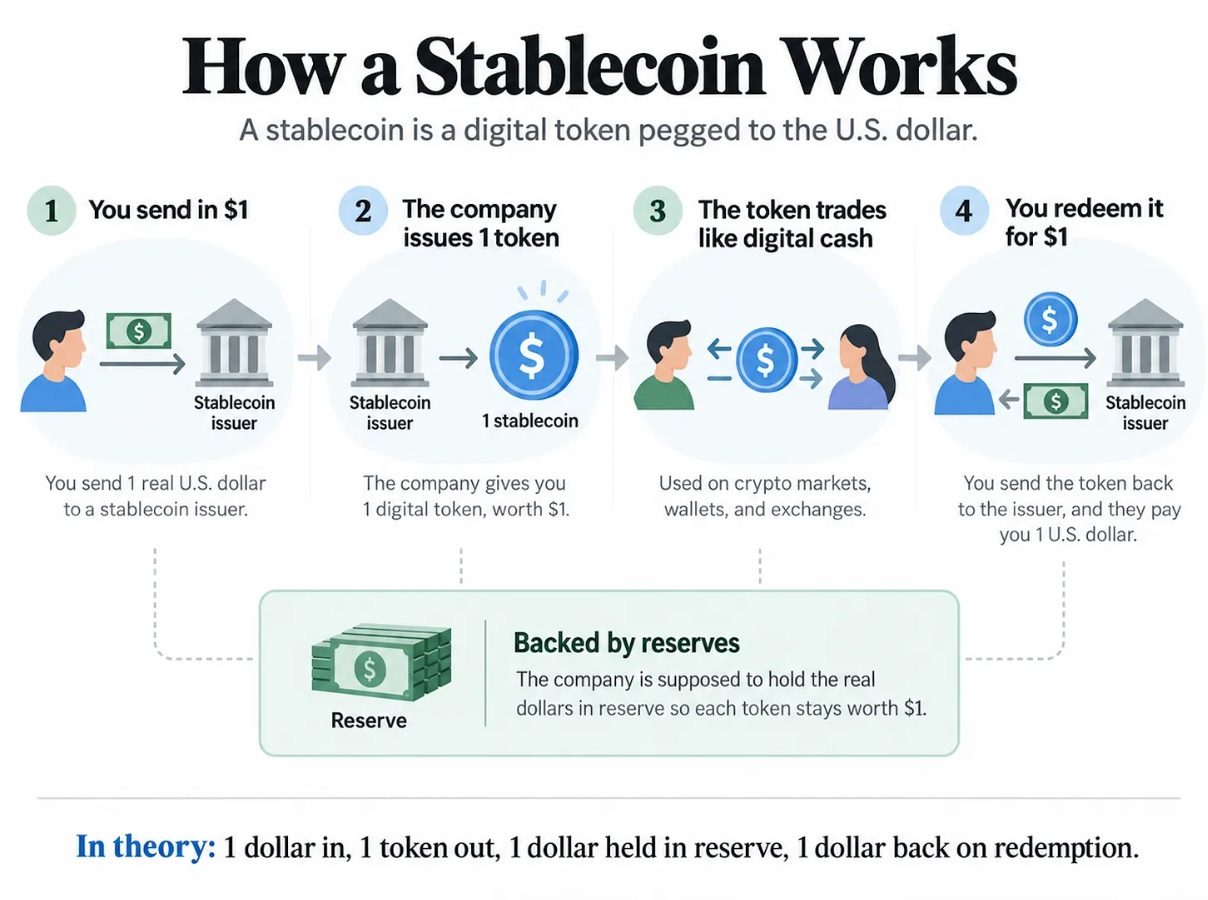
Tether is the largest stablecoin on earth.

It has $183 billion of these tokens in circulation. That makes it bigger than the GDP of most countries.

The company is supposed to hold $183 billion in real reserves to back them. It earns interest on those reserves, mostly US Treasury bills, which generated $13 billion in profit in 2024 alone. It has roughly 200 employees.
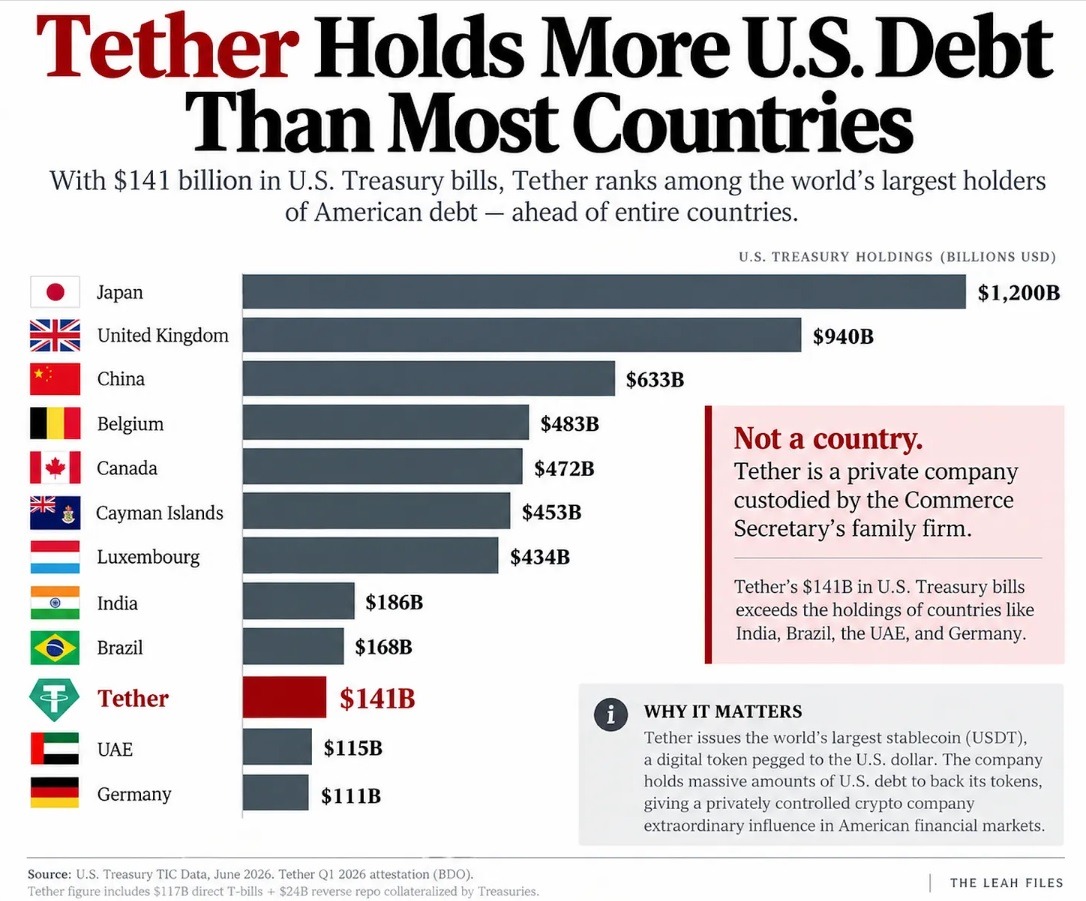
Here is the problem: the CFTC found in 2021 that Tether was actually fully backed by reserves only 27.6 percent of the time. The company paid $41 million in fines.

The New York Attorney General’s office reached a separate $18.5 million settlement over similar misrepresentations. The UN has linked Tether’s token to $17 billion in criminal activity.

The DOJ has an active criminal probe. And the company has never completed a full, publicly released independent audit.

That is the company at the center of this story.

Now let’s look at who built it because this is where I knew there was something more nefarious happening.

The Man Who Built Tether

His name is Brock Pierce. Before he co-founded Tether, he was the teenage Vice President of a company called Digital Entertainment Network (DEN).

The founder of that company, Marc Collins-Rector, was later convicted of child sex trafficking.
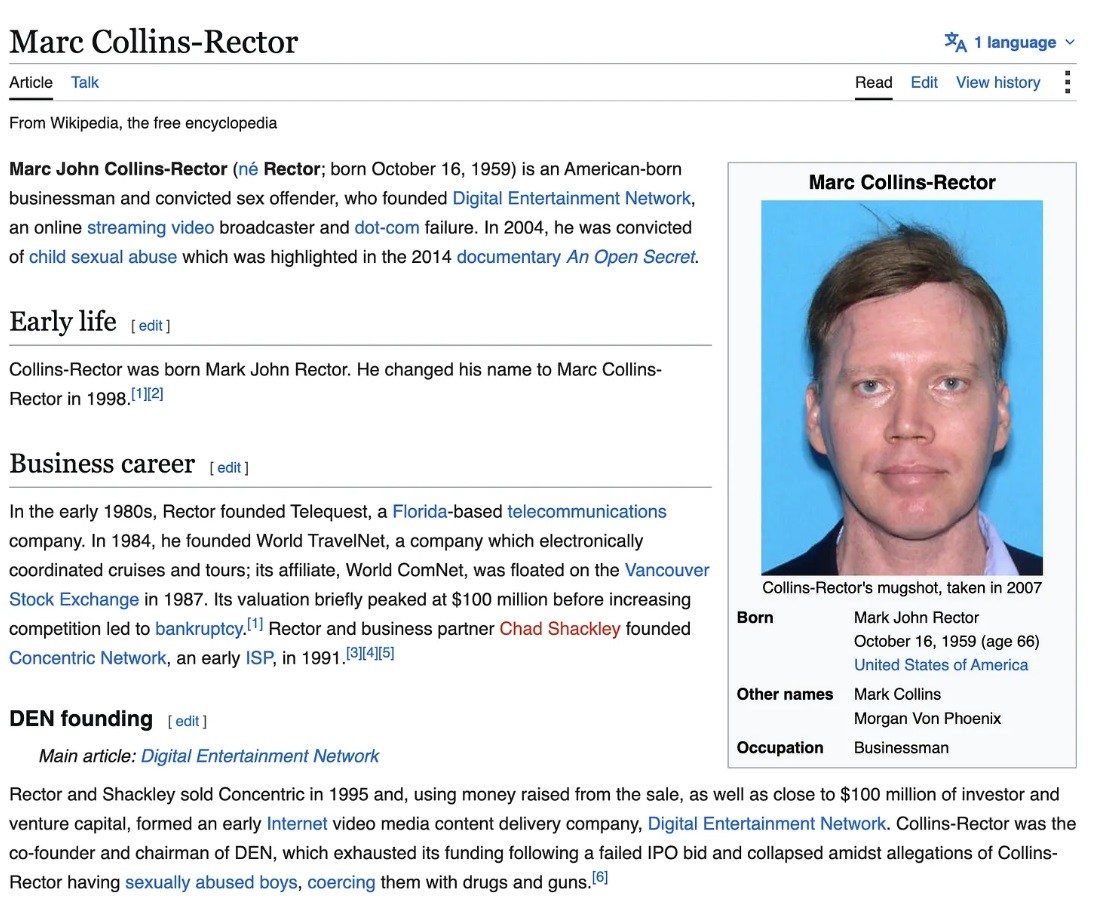
In the late 1990s, Pierce became Vice President of Digital Entertainment Network (DEN), a pioneering internet video company founded by Marc Collins-Rector, at the age of 17, earning a salary of $250,000.

At DEN’s Hollywood Hills parties, Collins-Rector and others allegedly sexually assaulted half a dozen teenage boys, including a 15-year-old, according to civil lawsuits filed between 1999 and 2002. When Collins-Rector fled the country to avoid prosecution, Pierce went with him.

They ended up in a villa in Marbella, Spain, which police raided in 2002 and found Collins-Rector, Pierce, and a third DEN executive, along with child pornography and firearms.

Collins-Rector was convicted of child sexual abuse in 2004. Pierce was never charged, but the civil lawsuit resulted in a $2,000,030 default judgment plus $1 million in interest because Pierce and his co-defendants never responded to the allegations of rape, assault, and death threats.

In 2010, Jeffrey Epstein was trying to salvage his reputation after his first sex trafficking conviction. He hired a man named Al Seckel, a serial scammer and self-styled illusionist who had been in a relationship with Ghislaine Maxwell’s sister Isabel for years.

Seckel organized a conference for the Epstein Foundation on Little Saint James, Epstein’s private island, called the Mindshift Conference.

Pierce was invited to present on Bitcoin. It was January 2011. Epstein noticed him immediately.

In an email sent under a fake name, Epstein singled out “brock” as “interesting.” Within three months, Pierce was at Epstein’s Manhattan townhouse asking for financial advice. Their partnership lasted eight years.

The way they were introduced tells us a lot.

Pierce entered Epstein’s world through a man who was dating the sister of Ghislaine Maxwell, the woman who procured and groomed girls for Epstein’s trafficking operation, now serving twenty years in federal prison.

The man who made the introduction, Seckel, was later found dead at the bottom of a hundred-foot cliff in southern France.

And Pierce walked in already carrying a default judgment for rape and an affinity for child porn. Epstein saw exactly what he was getting and Pierce was the perfect target.

What followed was not casual networking. It was an eight-year operational relationship between a crypto pioneer and a convicted predator, documented in thousands of pages of emails released by the Department of Justice on January 30, 2026.

The Emails

The DOJ released over 3.5 million pages of Epstein files, including direct correspondence between Pierce and Epstein spanning 2011 to 2019.

Pierce was mentioned 1,815 times, more than almost any other private figure.
The emails continued for months after Epstein’s second arrest on federal sex trafficking charges. Here is what they show.

By 2012, the correspondence had turned dark. Pierce sent Epstein dozens of photographs of a Ukrainian woman named Anastasia, three days after Epstein asked him to “take photos and find me a present.” Pierce wrote back that “Ukraine is now my favorite country.”

In a separate exchange, Pierce told Epstein there was “a boat in Antigua full of amazing Ukraine’s finest” waiting for him.

In another email, Epstein’s assistant wrote that Brock had a “great time with the girls in St. Barths.” Pierce’s own assistant sent Epstein’s team photos from Ukraine and mentioned upcoming meetings. There were references to visits on Epstein’s boat and coordination around events with Epstein’s inner circle.

These are the emails of a man inside the operation. Not an acquaintance. Not a networking contact. Pierce was coordinating women, referencing boats, sending photographs on request, and maintaining this relationship for years after Epstein’s first conviction.

But the business side of the relationship is what changed the world.

Pierce was not just advising Epstein on crypto. He was the bridge between Epstein’s money and the people who would build the infrastructure that now threatens to replace the US dollar.

He brokered the Coinbase deal.

In December 2014, Pierce connected Epstein to Coinbase’s Series C round through his venture firm, Blockchain Capital. Epstein invested $3 million. Coinbase co-founder Fred Ehrsam emailed asking to meet Epstein in New York.

In 2018, a trust associated with Epstein sold $15 million of Coinbase equity back to Blockchain Capital. Pierce wired $15 million to Epstein.

That $3 million seed investment would eventually be worth billions when Coinbase went public at a $51 billion valuation.

He pitched Bitcoin to Larry Summers at Epstein’s townhouse.

Epstein hosted the meeting. Pierce described himself to Summers as “the most active investor in Bitcoin.”

Summers said he saw “opportunities” but was worried about reputational damage if he lost money. A fact-checker for a planned New York Magazine article in 2015 asked Epstein:

“Did you meet with Brock Pierce to discuss Bitcoin? Did Larry Summers join this meeting?”

Epstein immediately forwarded the questions to author Michael Wolff with a two-word response: “nfw” (no f*cking way).

The article was never published.

The Network

Pierce and Epstein did not operate in a vacuum. Their shared network reached into the political and financial circles that now control American crypto policy.

Steve Bannon. Pierce and Bannon had worked together for seven years before any of this. Pierce hired Bannon in 2005 to run the financial side of his company Internet Gaming Entertainment, later saying

“Steve Bannon was my right-hand man for, like, seven years.”

Decrypt reported that Pierce and Epstein “appeared to use each other’s connections to develop business partners like Andrew Farkas and politicos like Steve Bannon.”

By August 2018, text messages released by the House Oversight Committee show Epstein was coaching Bannon’s media strategy in real time.

During a six-day exchange, Epstein offered line-by-line feedback on Bannon’s MSNBC appearances and crafted talking points on tax cuts, immigration, and security clearance revocations.

After one interview that ran a full hour, Epstein wrote “Atta boy.” In a separate exchange, Epstein asked Bannon about “brocks people,” meaning Pierce’s crypto network.

He suggested the Treasury Department create a voluntary disclosure form for crypto gains. Bannon would later describe cryptocurrency as “disruptive populism” that “takes control back from central authorities.”

Peter Thiel. Epstein invested $40 million into Thiel’s venture firm, Valar Ventures, in 2015 and 2016. Reid Hoffman made the introduction.

That bet became the single largest asset of the Epstein estate, valued at roughly $170 million by the time Epstein died.

Thiel’s proteges now run US crypto policy: JD Vance is Vice President, David Sacks served as crypto czar, and Thiel’s Founders Fund was the largest investor in Polymarket.

Pierce’s direct role in the Thiel connection is not documented, but both men operated in the same small circle of Epstein’s crypto and tech advisors during the same period.

The result: Pierce co-founded Tether, brokered Epstein’s crypto investments, worked alongside Bannon for years, and operated in the same orbit as the Thiel network that now shapes policy.

The man who co-founded the stablecoin holding $135 billion in US government debt was at the center of all of it.

There is a reason we haven’t heard much about Pierce. Now ask yourself why they are they protecting him?

Where Pierce Is Now

Brock Pierce lives in Puerto Rico, where Act 60 allows him to pay near-zero taxes on capital gains. He is still Chairman of the Bitcoin Foundation. He still runs the Integro Foundation, whose most recent IRS filing shows $78 in total assets.

He ran for president in 2020 and expressed regret for his ties to Epstein during the campaign. Conveniently he denounces his relationship a year after Epstein was “found dead” in his cell.

In 2025, Pierce was spotted at Mar-a-Lago cutting the ribbon for a golden statue of Donald Trump.

That same year, he gave over $1.1 million to a super PAC supporting the reelection of New York City Mayor Eric Adams, five days before Adams dropped out of the race. When Adams withdrew, Pierce launched a campaign called “Draft Eric Back” to get him to reconsider.

Adams had been indicted on federal corruption charges.

Pierce’s “Pierce School” in Washington, DC is not a school. It is a historic building near Capitol Hill that he purchased and converted into a residential penthouse and event space where he hosts crypto policy roundtables with members of Congress.

In March 2025, he and Rabbi Moshe Reuven Azman, who served in the IDF, laid a foundation stone for a planned “business school” at Anatevka, a gated compound outside Kyiv.

Pierce’s “charity” has donated at least $630,000 to Chabad-affiliated organizations.

No evidence exists that the school teaches anything, has enrolled students, or has begun operating.


This is a man who was sending photos of Ukrainian women to a convicted sex offender, brokering introductions between that sex offender and the people who now control American crypto policy, and who is now hosting congressional roundtables, attending presidential events, and donating millions to indicted politicians. His foundation holds $78 and looks like a personal shell charity.

Tether Today

Now that you know what Tether is and who built it, here is who runs it.

Who Owns It

Tether has never voluntarily disclosed who owns it. It is a private company incorporated in the British Virgin Islands with no public reporting obligation.

The only known ownership data comes from leaked documents reported by the Wall Street Journal in 2023, showing stakes as of 2018. As of those documents, four people controlled 86 percent of the company.

The Empire Build

Starting in late 2023, Tether began spending its profits at an extraordinary pace, acquiring stakes in companies across sectors that have no obvious connection to stablecoin issuance.
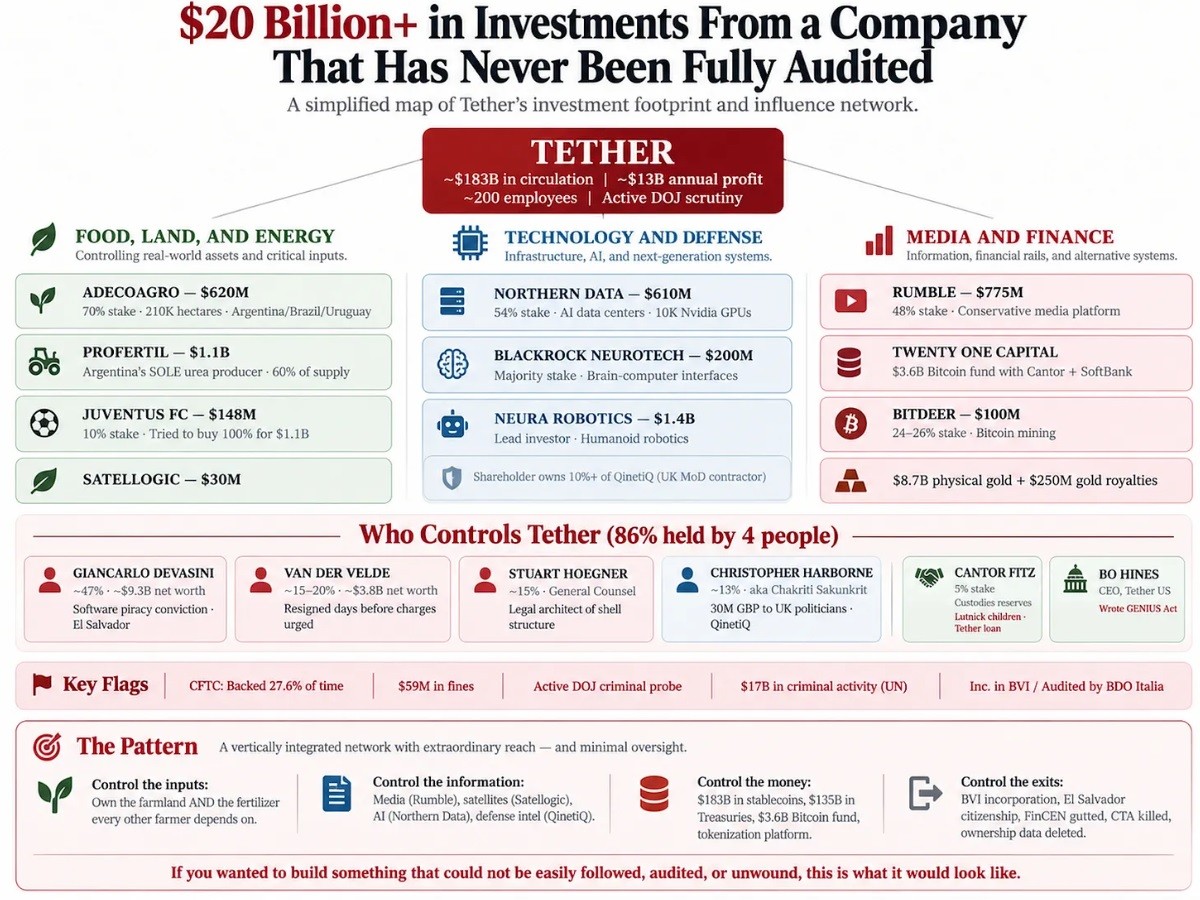
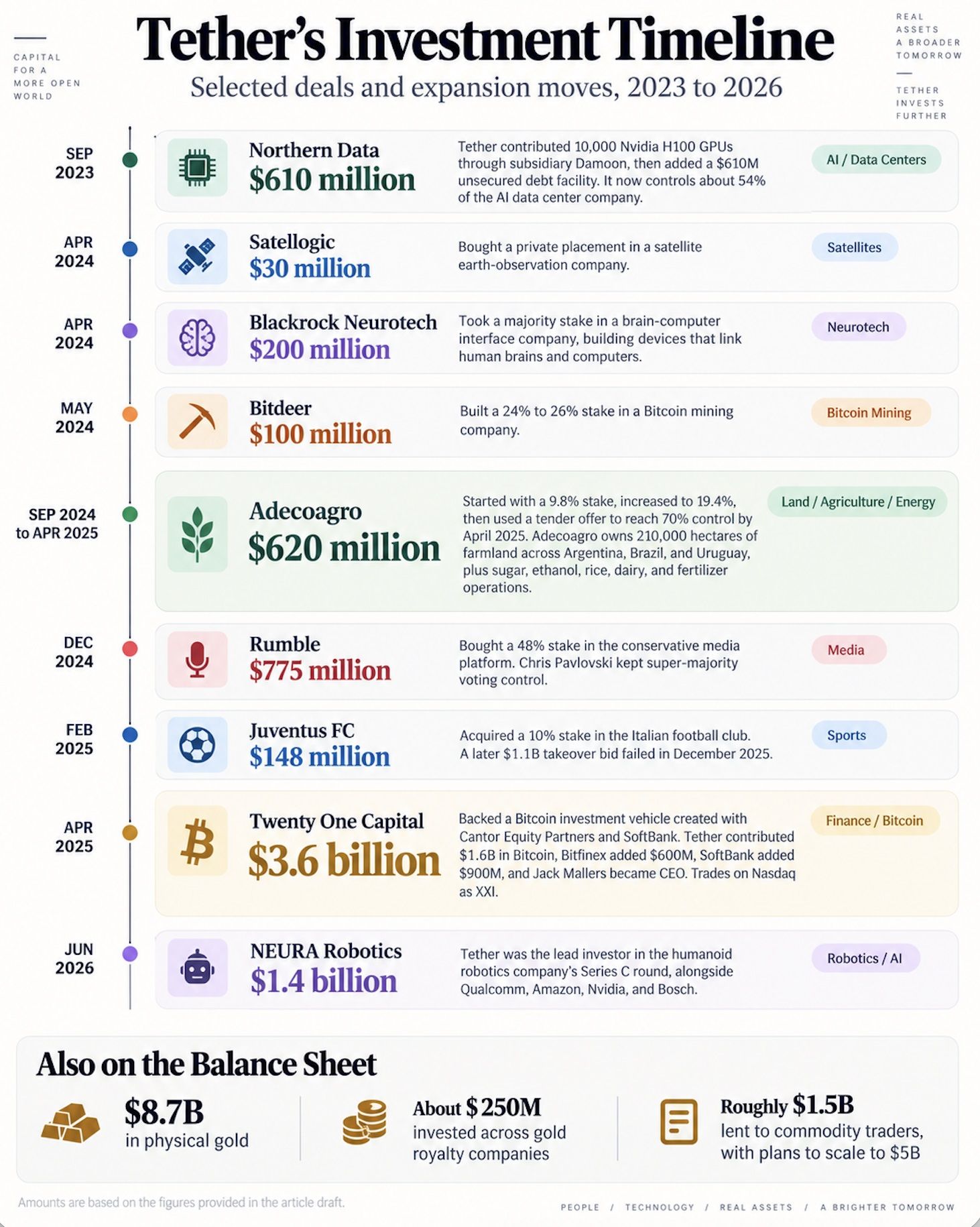
The Farmland

This is the part of the story that made me stop and ask what we are actually looking at.

Adecoagro is not a farm. It is a vertically integrated agro-industrial conglomerate incorporated in Luxembourg and listed on the New York Stock Exchange.

When Tether took control in April 2025, it took control of the entire chain from soil to supermarket shelf: the land itself, the crops grown on it, the mills that process them, the dairy plants, the rice processing facilities, the peanut sorting plants, the branded consumer products, the export terminals, and the port infrastructure.

In mid-2026, Adecoagro launched a Bitcoin mining pilot at its Brazilian sugar mills, using surplus electricity from sugarcane bagasse cogeneration to power approximately 1,280 mining machines. This connects directly to Tether’s stated goal of becoming the world’s largest Bitcoin miner.

And then there is the fertilizer.

Profertil

In December 2025, eight months after Tether took control of Adecoagro, the company acquired a 90 percent stake in Profertil for approximately $1.1 billion.

Profertil is Argentina’s sole producer of urea, the most widely used nitrogen fertilizer in the world. The plant in Bahia Blanca produces 1.3 million tons of granular urea per year and supplies roughly 60 percent of Argentina’s domestic fertilizer demand.

This means that a company whose co-founder was sending photos of Ukrainian women to Jeffrey Epstein and brokering introductions between Epstein and the people who now control American financial policy now also controls the fertilizer supply that South American agriculture depends on.

Every other farmer in Argentina who needs urea to grow crops is buying it from a Tether subsidiary.

The acquisition nearly doubled Adecoagro’s annual earnings, from $277 million to $467 million in EBITDA.

They also appointed Kyril Louis-Dreyfus to the Adecoagro board. His family founded the Louis Dreyfus Group, one of the four largest commodity trading houses on earth.

Now here is the part that made me consider this one the most important articles of the Currency Killer series.

This is not a hedge fund buying farmland as an inflation hedge. Tether looks to be building something specific.

Adecoagro co-founded a company called Agrotoken, which has already created three grain-backed stablecoins: SOYA, CORA, and WHEA.

Each token represents one ton of grain.

Farmers can use them as currency. Agrotoken partnered with Visa so producers can spend grain tokens with a card. They have already tokenized 230,000 tons of grain and transacted $70 million in deals. Adecoagro’s CEO said the goal was to build “tokenized land.”

Tether told CoinDesk that

“land is a crucial asset class, complementing its existing investments in bitcoin and gold.”

The company is building its own real-world asset tokenization platform designed to create digital versions of bonds, stocks, funds, and physical commodities.

Now connect the pieces.

Tether now controls the land, the crops grown on that land, the fertilizer those crops need to grow, the mills that process the harvest, and the platform that can tokenize all of it into digital currency. It already issues the largest stablecoin on earth.

This is a closed loop. Own the physical asset, process it, tokenize it, and issue the currency it trades in. They are not replacing the dollar with a digital version.

They are building an entire parallel financial system backed by food, land, and fertilizer, controlled by four people who have never disclosed who they are to the public, operating out of the British Virgin Islands.

The Switch

On January 23, 2025, Trump signed Executive Order 14178. It banned all federal agencies from developing or promoting a central bank digital currency. No government digital dollar.

The only digital dollars allowed in America would be private ones.
That same executive order explicitly promoted “the development and growth of lawful and legitimate dollar-backed stablecoins worldwide.” They banned the public option and endorsed the private replacement in the same document.

Then they weakened the dollar.

The Replacement

On July 18, 2025, Trump signed the GENIUS Act into law. It created the first federal framework for privately issued stablecoins, the exact product Tether sells.

The law allows stablecoin issuers to operate under a three-year grace period before meeting full compliance requirements and does not mandate independent audits.

Treasury Secretary Scott Bessent signaled that the law “will drive demand from the private sector for US Treasuries,” and indicated that stablecoin firms could buy up to $1 trillion in US government debt.

Here is the logic. Every dollar minted as a stablecoin creates a dollar of mandatory Treasury demand, because stablecoin issuers have to hold reserves.

Unlike normal investors, they are price-inelastic buyers, meaning they buy Treasuries regardless of yield. So you weaken the dollar abroad through tariffs and trade wars, driving countries away from the physical dollar, but you maintain dollar dominance through digital stablecoins that buy Treasuries automatically.

The European Central Bank warned in May 2026 that this “effectively outsources parts of the national debt to the crypto sector.”

But here is what matters, who controls those digital dollars?

It’s not the government, it’s not the Federal Reserve, it’s private companies.

Tether holds $135 billion in US Treasuries, making it the 17th largest holder of US government debt. And the people who own Tether, custody its reserves, and wrote the law that legalized it are all in the same room.

Bessent redefined what “strong dollar” means at his confirmation hearing:

“The price of the dollar has nothing to do with a strong dollar policy.”

He called CBDCs

“a first step toward financial surveillance”

and declared them “off the table.”

The private digital dollar is the only option, and everyone who built the framework is getting paid.

Who Else Is Getting Rich

The Trump Family

World Liberty Financial, the crypto venture backed by the Trump family, has generated over $1 billion in revenue. It launched its own stablecoin, USD1, which was used in a $2 billion investment deal between a Binance-affiliated entity and Abu Dhabi investors.

The president’s memecoin, $TRUMP, briefly hit a market cap of over $14 billion before crashing, with third-party analysis showing retail investors collectively lost approximately $3.8 billion while insiders profited.

The Thiel Network

Peter Thiel took $40 million from Epstein through the Valar Ventures fund, an introduction brokered by Pierce. That investment produced $170 million in returns and became the largest single asset in the Epstein estate.

Thiel’s network has been central to shaping crypto policy: his protege JD Vance is now Vice President, David Sacks served as the administration’s crypto czar for 130 days, and Thiel’s Founders Fund was the largest investor in Polymarket, the crypto prediction market that went from a $350 million valuation to $21 billion under the new deregulatory framework.

Polymarket has Trump Jr. on its advisory board and has flagged $200 million in suspicious trading activity.

The Beef

In February 2026, Trump signed an executive order quadrupling beef imports from Argentina. The order authorized 80,000 additional metric tons of tariff-free lean beef trimmings, allocated entirely to Argentina, with plans to scale to 300,000 tons.

He said it was to lower ground beef prices, which had hit a record $6.90 per pound as the US cattle herd shrank to a 75-year low.

American ranchers called it a “misguided effort” that would “undercut the future of family farmers and ranchers.” The National Cattlemen’s Beef Association said it “cannot stand behind the President while he imports Argentinian beef.”

China had just rejected 22 tons of Argentine beef over a banned antibiotic. Republican lawmakers opposed it. Ranchers warned it would destroy America’s ability to rebuild its own herd.

Now remember who controls Argentine agriculture.

Tether owns 210,000 hectares of Argentine farmland. Tether owns Argentina’s sole fertilizer producer. Tether owns 14,500 milking cows and two dairy processing plants.

Tether’s subsidiary Adecoagro is one of the largest agricultural conglomerates in South America. And the president just signed an executive order flooding the US market with Argentine beef at the exact moment Tether controls the land, the feed, the fertilizer, and the infrastructure that Argentine agriculture runs on.

The company that prints the digital dollar. The company whose reserves are custodied by the Commerce Secretary’s family firm. The company whose law was championed by a man who became its CEO. That company now sits at the center of a trade deal that undercuts American ranchers to benefit Argentine agriculture, the same Argentine agriculture it owns.

Maybe it is a coincidence. Maybe the president opened the floodgates to Argentine beef imports without knowing or caring that a company connected to Jeffrey Epstein controls the supply chain on the other end. Maybe.

But I do not believe in that many coincidences, especially based on what we have seen over the last year.

The Thread

One man attended a conference to rehabilitate a convicted sex offender in the Virgin Islands. Over the next eight years, he sent photos of women on request, brokered crypto deals that funneled millions through the sex offender’s accounts, and co-founded the company that now holds more US government debt than most countries.

His foundation holds $78. His network moves billions. Nobody has asked him a single question under oath.

The thread runs from a dead man’s island through a crypto pioneer who sent him photos on request, through the deals that funneled millions through Epstein’s accounts, through the network that connects Epstein’s money to the vice president’s mentor and the president’s former strategist, through the company that holds $135 billion in US Treasuries, through the law that legalized it, through the man who championed it and became CEO of it, through the Commerce Secretary whose children own a piece of it, through the Treasury Secretary blocking the dead man’s records, through the farmland and fertilizer in Argentina, and all the way to the executive order that just opened the US market to the country whose agriculture they now control.

Read the Full Article at The Leah Files.

What I have re-published here is NOT the full article! Please consider supporting her work – I do.

Related:

Are People Finally Waking Up to the Fact that the U.S. is Run by Pedophiles in the Jeffrey Epstein Financial System?

This article was written by Human Superior Intelligence (HSI)

See Also:

Understand the Times We are Currently Living Through

Second Edition of eBook Released: The Concept of the American Christian Family is a Myth and is NOT Found Anywhere in the Bible – by Brian Shilhavy

FREE eBook! Restoring the Foundation of New Testament Faith in Jesus Christ – by Brian Shilhavy

The Brotherhood of Satan vs. The Brotherhood of Jesus Christ

KABBALAH: The Anti-Christ Religion of Satan that Controls the World Today

Exposing the Christian Zionism Cult

The Bewitching of America with the Evil Eye and the Mark of the Beast

Jesus Christ’s Opposition to the Jewish State: Lessons for Today

Identifying the Luciferian Globalists Implementing the New World Order – Who are the “Jews”?

The Brain Myth: Your Intellect and Thoughts Originate in Your Heart, Not Your Brain

What is the Condition of Your Heart? The Superiority of the Human Heart over the Human Brain

The Seal and Mark of God is Far More Important than the “Mark of the Beast” – Are You Prepared for What’s Coming?

The Satanic Roots to Modern Medicine – The Image of the Beast?

Medicine: Idolatry in the Twenty First Century – 10-Year-Old Article More Relevant Today than the Day it was Written

Having problems receiving our emails? See:

How to Beat Internet Censorship and Create Your Own Newsfeed

We Are Now on Telegram. Video channels at Bitchute, and Odysee.

If our website is seized and shut down, find us on Telegram, as well as Bitchute and Odysee for further instructions about where to find us.

If you use the TOR Onion browser, here are the links and corresponding URLs to use in the TOR browser to find us on the Dark Web: Health Impact News, Vaccine Impact, Medical Kidnap, Created4Health, CoconutOil.com.

The post The Epstein Digital Financial System is Getting Ready to Replace the U.S. Dollar first appeared on Health Impact News.

  •  
❌