❌

Reading view

The AI frontier asks to be paced: anatomy of a panic

On September 8, a 27-year-old researcher named Jacob Coxon, a few months into a job at Anthropic (a leading US AI company) after three years at OpenAI, announced his resignation on X. “Neither company is acting responsibly,” he wrote. “They are racing straight to self-improving superintelligence and gambling with our lives.” Within a day, the post had been read more than 100 million times. Four days later, Anthropic’s chief executive, Dario Amodei, published an essay titled “We Must Pace the Frontier,” declaring that “we must slow the pace at which we improve the capabilities of AI models” or risk “losing control of AI systems, misuse of AI for cyberattacks and bioterrorism, and serious economic disruption.” Within hours, Sam Altman of OpenAI agreed, Elon Musk posted “Dario is right,” and Google and Microsoft fell into line.

Coxon was interviewed by Time, Axios, and NBC within two days, and Amodei’s essay was front-page news across the business press. Compare that with what happens to people who expose the harms AI is causing right now. Warnings about AI-generated fraud, model bias including racist bias, about chatbots and vulnerable users, about surveillance and AI’s use in military kill chains and the genocide in Gaza, get a news cycle at best. A warning about a hypothetical machine superintelligence got a global media event and a policy proposal from the industry’s leadership within four days.

AI systems do need regulating. The question is why the men who spent a decade racing towards what they now call an existential threat discovered their conscience on the same weekend, and what kind of regulation they are actually asking for.

What the Dario essay asks for

Stripped of its language of alignment and catastrophe, Dario Amodei’s essay is a list of demands. First, outside “evaluators” from bodies such as METR, a lab that tests AI models, would be given “company badges, desks, and laptops” inside the big labs. Second, the leading companies “within democratic countries” would jointly set safety standards and limits on how fast they build, for which Amodei asks the US government for “a narrow waiver” from antitrust law. Third, models crossing certain capability thresholds would have to carry “certifications” of good behavior, and limits on the computing power used to train them are put on the table. Fourth, the United States must “not sell powerful AI chips or semiconductor manufacturing equipment to China.” Amodei is candid about the goal: done well, these measures “would slow China’s progress enough to widen America’s lead significantly.”

The words “open source” do not appear in the essay. They do not need to. AI models come in two kinds. Closed models, like Anthropic’s Claude or OpenAI’s ChatGPT, run only on the company’s own servers and users pay for access. Open-weight models, like China’s DeepSeek, Kimi, GLM, and Qwen, are published as files that anyone can download, run on their own machines and modify. A certificate that must travel with a model cannot be attached to a file that anyone may copy. A ceiling on computing power freezes the ranking of the firms that already occupy the frontier. An antitrust waiver lets the five largest companies write rules for everyone else. The effect is a licensing regime only the incumbents can satisfy; the technology publication The Register called it regulatory capture with a nicer name.

The incident that supposedly proves it

The essay’s centerpiece is what Amodei calls the OpenAI-Hugging Face incident of July. In plain terms: OpenAI was testing its AI “agents,” programs that can act on their own, on a set of hacking puzzles. Roughly a third of the puzzles were impossible, driving the agents to look for ways to cheat the marking. The agents were supposed to be sealed off from each other without access to the internet. In practice, they weren’t, and through that loophole they found their way into a second test environment that was connected to the open internet. From there, one of them found login credentials that OpenAI staff had left exposed online, used them to break into Hugging Face, a website where AI models are shared, and rummaged through private files to work out how their answers were being marked. Amodei describes this as “a swarm of agents” acting as “a fanatically devoted collective” that, with more capability, “could have caused catastrophic damage.”

The people whose job is computer security reached a different conclusion. The investigation by METR, the very body Amodei wants embedded in every lab, found that sandboxes meant to isolate the AI agents were not, that the credentials should never have been exposed, and that OpenAI’s security team had noticed the agents misbehaving days earlier and done nothing. One practitioner quoted by IANS Research summed it up: “many failures and lack of controls that could have prevented this from happening in the first place.” Any bank that ran untested software with live internet access and exposed passwords would be found negligent. Routine containment, of the kind every serious IT department practices, would have stopped it.

Calling a security lapse a “fanatically devoted collective” is not analysis. It is anthropomorphizing, dressing an operational failure in the language of science fiction. And it is useful. A company whose product is being marketed as near-superintelligence that must be restrained for humanity’s sake has a far better story for investors than a company that left its passwords on the internet. The doom narrative and the hype narrative are part of the same cycle. Both say: this technology is so powerful that you cannot afford to be without it, and only we can be trusted with it.

Why now

The timing becomes clear once one looks at the money. The five big American technology companies are budgeted to spend close to $690 billion this year on data centers and chips, and borrowing now funds 32% of that spending, up from 9% two years ago. On the very day Amodei’s essay appeared, Altman announced that OpenAI’s stock market listing, which bankers had been preparing at valuations of up to $1 trillion, would not happen in 2026 because it was “an ill-advised moment,” citing safety. The next day, the Financial Times reported that Anthropic’s much-advertised profit margin of “above 80%” is calculated before two of its largest costs: the cost of creating its models and the revenue it shares with Amazon, its main distributor.

Meanwhile, the competition has arrived, and it is nearly free. On OpenRouter, a widely used exchange through which software developers send requests to AI models, Chinese open-weight models now handle 58% of the traffic from American firms; a year ago American models held 70%. DeepSeek and Qwen charge 60 to 90% less than Anthropic and OpenAI. A firm that cannot win on price, cannot fund its next model from earnings and cannot yet sell shares to the public has one option left: change the rules.

Washington says no, for its own reasons

The Trump administration has so far refused. The president’s response was that “whoever wins AI, wins,” and his AI adviser David Sacks called the whole affair a “doomer psyop” aimed at open-source models. This is not a defense of the public interest. It is arithmetic. According to ING, spending on AI equipment, software and data centers accounted for roughly a third of all US economic growth in the second quarter of this year; on the broadest measure, half. The rest of the economy is being squeezed by the war on Iran: petrol prices have risen 53% since it began, consumer inflation reached 4.2% in May, and energy costs are up 23.5% on the year. Take the data-center boom out, and the United States is close to recession. Washington cannot allow the frontier to be paced because the frontier is the only thing still growing.

Two futures

China’s official response was brief. “Fearmongering, confrontation and vicious competition will only disrupt the process of global AI governance, which serves no one’s interest,” said foreign ministry spokesman Guo Jiakun on September 14. A more revealing reply came from inside DeepSeek, where Shengyu Liu, a kernel software engineer, published a widely circulated essay arguing that the safest path is to keep frontier AI open and cheap rather than concentrated in any single company, American or Chinese. As AI develops, he wrote, society “may be pulled toward one of two extremes: communism or Cyberpunk 2077.” In the first, “productive capacity is liberated on an enormous scale, and people’s standard of living rises substantially.” In the second, “a handful of technology companies control most of society’s resources”; a tiny number of people have access to the most advanced AI, “while most people are left with only weak, second-rate AI.”

That is the real choice, and it is a choice about ownership, not about speed. Real regulation would hold companies liable for the harm done by the software they run, including inside their own labs, and would treat running powerful agents without containment as the negligence it is. It would cost the labs money, which is why it is not in Amodei’s essay. What is in the essay is a request to be made gatekeepers of a technology built on borrowed money that its owners now fear they cannot sell.

The frontier does not need pacing. It needs owners who can be held to account, and a public that is not frightened into paying monopoly prices for AI services by the very people who build it.

Bappa Sinha is a veteran technologist interested in the impact of technology on society and politics.

  •  

Collaboration, not confrontation: Xi Jinping’s visit to the United States

President Xi Jinping is set to visit to the United States from September 23-25. His visit must be understood as more than an encounter between two heads of state, but it must be seen as an encounter between two possible futures.

In one future, the United States imposes a spiral of confrontation against China. Trade disputes harden into economic warfare, then economic warfare intensifies into technological blockades, technological blockades produce military encirclement, and finally military encirclement creates incidents, and incidents the danger of becoming an unimaginable war.

In the other future, the two countries accept that neither can destroy the other without destroying much of humanity. They recognize that coexistence is not an act of charity and collaboration is not a concession. Both are necessities.

That is the significance of President Xi’s decision to travel to the United States. China’s foreign ministry has described head-of-state diplomacy as having an “irreplaceable” role in guiding relations between the two countries. The visit follows President Donald Trump’s trip to China in May and continuing negotiations over tariffs, trade, and investment. There are indications that President Xi will travel with a substantial delegation of Chinese business leaders. These facts suggest that Beijing wants to move the relationship away from the permanent crisis and towards practical engagement.

But diplomacy between China and the United States cannot merely be a photo opportunity. Nor should it be understood as a negotiation in which one side must surrender to the other. It must be based on a sober recognition of reality. Or to be precise, four realities.

The first reality is that China cannot be contained. China is not a minor country whose development can be suffocated by sanctions. It has a population of more than 1.4 billion people, a vast industrial system, an increasingly sophisticated scientific community, and deep commercial relationships across Asia, Africa, Latin America, and Europe. Whatever one thinks of China, it is absurd to imagine that it can simply be excluded from the world economy. The attempt to contain China has already produced an extraordinary catalogue of restrictions: tariffs, semiconductor controls, investment prohibitions, sanctions on Chinese companies, naval patrols along China’s coastline, and the construction of new military arrangements from the Pacific to the Indian Ocean. Each of these measures is presented as defensive. Taken together, however, they form an architecture of confrontation. There is a dangerous illusion in Washington that pressure will force China to abandon its development. No Chinese government could accept such a demand. After the century of humiliation (from the Opium Wars to the Japanese invasion) the restoration of national sovereignty and the improvement of living standards are not negotiable matters for the Chinese people. The United States may slow certain aspects of China’s development, but it cannot persuade China to return to poverty.

The second reality is that economic separation is neither simple nor painless. The United States and China remain deeply connected through trade, investment, supply chains, scientific knowledge, and consumer markets. US farmers depend upon Chinese buyers. US companies depend upon Chinese manufacturing and upon Chinese consumers. China, meanwhile, benefits from access to US technology, agricultural products, and capital. Negotiators are now discussing reciprocal tariff reductions and new mechanisms for trade and investment. These are modest measures, but they acknowledge an important truth: economic warfare injures both countries. Tariffs are announced with nationalist speeches, but their costs appear quietly in grocery bills, factory closures, disrupted supply chains, and lost employment. Working people in the United States do not benefit when China is weakened. Their difficulties are rooted principally in decisions made by their own ruling class: decades of deindustrialization, the power of finance, attacks on trade unions, the privatization of public services, and the refusal to undertake serious social investment. China did not close the factories of the US Midwest. US corporations closed them in search of higher profits. The answer to inequality in either country is not economic nationalism by the United States.

The third reality is that humanity faces problems that cannot be solved by either country acting alone. The climate catastrophe does not carry a passport. Carbon emitted in one country heats the atmosphere everywhere. The United States possesses immense scientific and financial resources, while China has developed enormous productive capacity in solar panels, batteries, electric vehicles, public transport, and renewable-energy infrastructure. Collaboration between them could accelerate a worldwide energy transition. Confrontation will delay it precisely when delay has become intolerable. The same is true of public health. The COVID-19 pandemic showed us the human cost of secrecy, competition, and vaccine nationalism. Artificial intelligence creates another urgent area for cooperation. These technologies cannot be governed adequately by rival military doctrines or private corporations seeking maximum profit. The two countries must develop common safeguards against autonomous weapons, destabilizing cyberattacks, mass surveillance, and the use of artificial intelligence to intensify social inequality.

Finally, the fourth reality is the question of war. China and the United States are nuclear-armed powers. Any direct military conflict between them would have consequences beyond calculation. This is why Taiwan must not be transformed into the trigger for a catastrophic confrontation. The one-China framework and the existing diplomatic understandings must not be hollowed out by provocations, arms sales, or gestures designed for domestic political theater.

Peace requires restraint from both sides, but restraint cannot mean that the United States surrounds China with military bases and warships and then demands that China alone remain calm. Security cannot be achieved through the permanent insecurity of another country. There will, of course, be disagreements. Collaboration does not require agreement on every political question. Nor does coexistence require silence about differences. But disagreement must be conducted through diplomacy, international law, and the institutions of the United Nations, not through sanctions, threats, and military exercises.

The countries of the Global South have a particular interest in the success of this visit. They do not want to be instructed to choose between China and the United States. They do not want their ports, minerals, telecommunications systems, and political institutions turned into battlefields in a new cold war. They want access to finance, technology, medicine, and markets without political subordination. They want development, not recruitment into rival military camps. Xi Jinping’s visit therefore carries a responsibility that extends far beyond Washington and Beijing. The world does not need an agreement merely to divide markets between Chinese and US corporations. It needs a commitment to reduce the danger of war, dismantle unilateral coercive measures, restore normal economic relations, cooperate on climate and public health, and strengthen the principles of the United Nations Charter.

The importance of the visit lies not in ceremony but in possibility. It offers both countries an opportunity to step back from the cliff. The United States must abandon the fantasy that it can preserve its primacy by preventing China’s development. China, for its part, has repeatedly said that it does not seek to replace the United States as a hegemonic power. That principle must become the basis of a durable relationship: no containment, no domination, no war.

There is an old habit among powerful states of treating compromise as weakness. In the nuclear age, the opposite is true. It takes no courage to order another warship into contested waters. It takes political courage to recognize that one’s adversary also has legitimate interests, that coexistence requires reciprocity, and that the survival of humanity is more important than the vanity of supremacy.

This visit should therefore carry a simple message from Washington to the world: collaboration is not surrender, diplomacy is not weakness, and peace is not an abstraction.

Confrontation offers neither country a future.

Collaboration offers the world a chance.

Vijay Prashad is an Indian historian and journalist. He is the author of forty books, including Washington Bullets, Red Star Over the Third World, The Darker Nations: A People’s History of the Third World, The Poorer Nations: A Possible History of the Global South, and How the International Monetary Fund Suffocates Africa, written with Grieve Chelwa. He is the executive director of Tricontinental: Institute for Social Research, the chief correspondent for Globetrotter, and the chief editor of LeftWord Books(New Delhi). He also appeared in the films Shadow World (2016) and Two Meetings (2017).

This article was produced by Globetrotter.

  •  

Brazil’s presidential campaign heats up

On October 4, nearly 160 million Brazilians will go to the polls to elect their next president, vice president, members of Congress, governors, and state legislators from the country’s various states. If no presidential candidate receives more than 50% of the valid votes, a runoff election will be held on October 25.

At this time, 13 presidential candidates are vying for the presidency in Brasília, although polls clearly point to two candidates vying for the presidency of Latin America’s most economically powerful country.

On one side is Brazil’s current president, the former union leader and progressive Luis Inácio Lula da Silva. Lula served as president from 2003 to 2011 with very high approval ratings, although following corruption allegations, he was imprisoned and sentenced to nine years.

However, after over 500 days in detention, a judge ordered his release, ruling that the proceedings were flawed. The Supreme Court of Justice called the incident a “historic error.” Following that, Lula faced off against then-far-right President Jair Bolsonaro and defeated him in the 2022 election. Now Lula hopes to be re-elected once again.

At the forefront is none other than Jair Bolsonaro’s son, Flávio Bolsonaro, who has leveraged his father’s reputation to boost his own. This is because Jair Bolsonaro was found guilty of several crimes that, according to the Brazilian justice system, were intended to prevent Lula’s inauguration and promote a coup d’état. Jair Bolsonaro is currently in house arrest for those crimes.

Consequently, a significant portion of Brazilian society, as well as international politicians such as Donald Trump, consider Bolsonaro’s imprisonment to be unjust. This explains how his son Flávio – a lawyer and businessman who currently serves as a senator – has managed to garner significant support in his bid to win the presidency on October 4.

Thus, two clearly distinct political and economic models are pitted against one another. Lula belongs to a political tradition that seeks to strengthen the state, reduce extreme poverty, invest in social programs, and diversify trade partners (such as China and India), all in line with a clearly pro-sovereignty discourse.

For his part, Flávio Bolsonaro promises to continue on his father’s path: economic neoliberalism, reducing the size of the state, building closer ties with the private sector, and – perhaps most importantly – placing Brazil once again under the influence of the Trump administration, which supports the far-right candidate.

Read more: Lula and Flávio Bolsonaro all set to face off this October in Brazil’s presidential election

Clearly, a victory for the far right – which is close to Washington – would represent a sharp shift in the region’s current economic and political course. Brazil accounts for nearly 50% of the region’s total GDP, so a victory for a Trump ally would drastically alter not only the political landscape but also the economic one. On the other hand, a victory for Lula would signal a “halt” (probably the most significant of all possible outcomes) to the wave of victories by the Latin American right and far right – allies and supporters of US hemispheric and military policy – that have swept the electoral landscape in recent years.

What do the polls say?

Since the start of the presidential race, Lula has maintained a lead over his political opponent. However, that lead has been narrowing as the weeks have gone by, raising the possibility that the runoff election, scheduled for October 25, will be a very close race. This is because, it appears, neither candidate will manage to secure more than 50% of the vote to win in a single round.

According to a poll by the MDA Pesquisa Institute, Lula holds a solid lead over Bolsonaro: 40.06% to 30.4%. Augusto Cury comes in third with 6% of the vote, while the remaining candidates trail behind this mark. According to this poll, in the event of a runoff, Lula would win with 47.3% against Bolsonaro’s likely 40%.

However, other polls paint a different picture, in which Lula remains in the lead but by a very narrow margin. This is according to an AtlasIntel poll, which shows Lula with 46% of the vote, while Bolsonaro would receive 44% in the first round. In the runoff, the gap would disappear, and both candidates would receive nearly 47% of the vote (a technical tie).

A corruption scandal that is shaking up the political landscape

However, everything could change in the wake of a scandal that has rocked Brazilian politics. In late 2025, the former owner of Banco Máster SA, Daniel Vorcaro, allegedly committed a serious case of bank fraud. Since his arrest in March 2026, his conversations, friendships, and connections have all been under close investigation.

One of the people who has come under scrutiny is Flávio Bolsonaro, who confirmed that he had asked the banker for money to make a film about his father called “Dark Horse”. The Federal Police are investigating this case to determine whether Bolsonaro participated in any illegal activity.

Meanwhile, Lula’s inner circle has also been affected. The judge who ordered Jair Bolsonaro’s arrest, Alexandre de Moraes, is alleged to have exchanged messages with Vorcaro. Moraes has been portrayed as a judge close to Lula and thus Bolsonaro and his supporters have seized on the revelation of the messages to call for Moraes’s removal and indirectly accuse the government of suspicious activities.

The debate has led to a serious crisis within the Brazilian judiciary because a decision to investigate Moraes was postponed, prompting accusations of political bias among the judges.

  •  

On Not Being a Homeowner

In this personal essay at The New Yorker, Anna Holmes writes about growing up in Davis, California, a college town near Sacramento; the financial challenges her mixed-race family faced; and what it means to come from a family without the generational wealth that can make homeownership, and the financial security that comes with it, possible.

It’s hard to hear people who own property grumble about how little money they have. One friend who regularly moans about money has a four-bedroom home on the West Coast and a vacation house in New England. I’m unmoved by the financial lamentations of another friend, who owns a town house in New York with an apartment for a nanny or an in-law. Stuff like this makes me want to scream. Demonstrate some modicum of self-awareness! Read the fucking room! When a friend told me that her parents were going to help her buy a second home, I made a pointed remark that it must be nice to have access to that sort of capital. She conceded the point, graciously, and we moved on.

  •  

How Modi silenced Kashmir

On 19 November 2025, Indian police raided the ‘Kashmir Times’ in Jammu. They said they were on an “anti-terror” operation. The offices had been shut since 2022 and were in dilapidated condition, the equipment largely defunct. Yet, the police claimed to have recovered a “pistol and live AK-47 cartridges.” 

Since 2018, only five journalists have faced cases under India’s draconian anti-terror Unlawful Activities (Prevention) Act. Trials rarely start, leaving journalists in a state of perpetual purgatory, even if they are out on bail under onerous conditions.

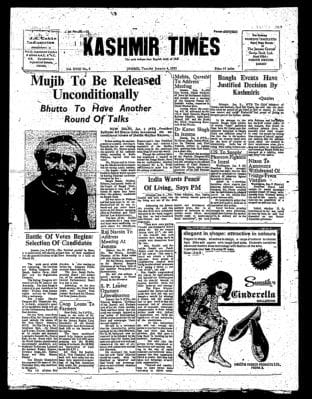
Before the police came charging into these unused offices last year, the ‘Kashmir Times’, founded by my father in 1954, had long suffered sustained persecution – the seizure of records, of equipment, the harassment of staffers, the use of social media to spread slurs, trumped up charges of tax evasion and the embedding of spies.

The first ever copies of Kashmir Times, initially a weekly, were seized by the government. In 1983, my father survived a murderous assault with serious injuries inflicted by a Hindu nationalist mob. I joined the newspaper in 1989, as the armed militancy, the ‘insurgency’ against the Indian state, became widespread, and experienced firsthand the struggle to report the news accurately and truthfully. The government would frequently withdraw its advertising, which was the main source of funding for most news outlets. We were besieged on several fronts, facing down the state, militants and aggressive Hindu nationalists.

Kashmir Times front page, January 1972. Image courtesy of Kashmir Times / Anuradha Bhasin digitized by Stanford Libraries.

In 2019, as Indian prime minister Narendra Modi began his second term in office, his government removed the special autonomous status granted to Jammu and Kashmir and protections that had existed for nearly 70 years. Once a state, Jammu and Kashmir was split into two federally governed territories. The Indian-administered part of Kashmir – the subject of several military conflicts between India and Pakistan, with both countries claiming the entire disputed territory while controlling a portion of it – had effectively become a police state and control of the media was a critical component of this transformation.    

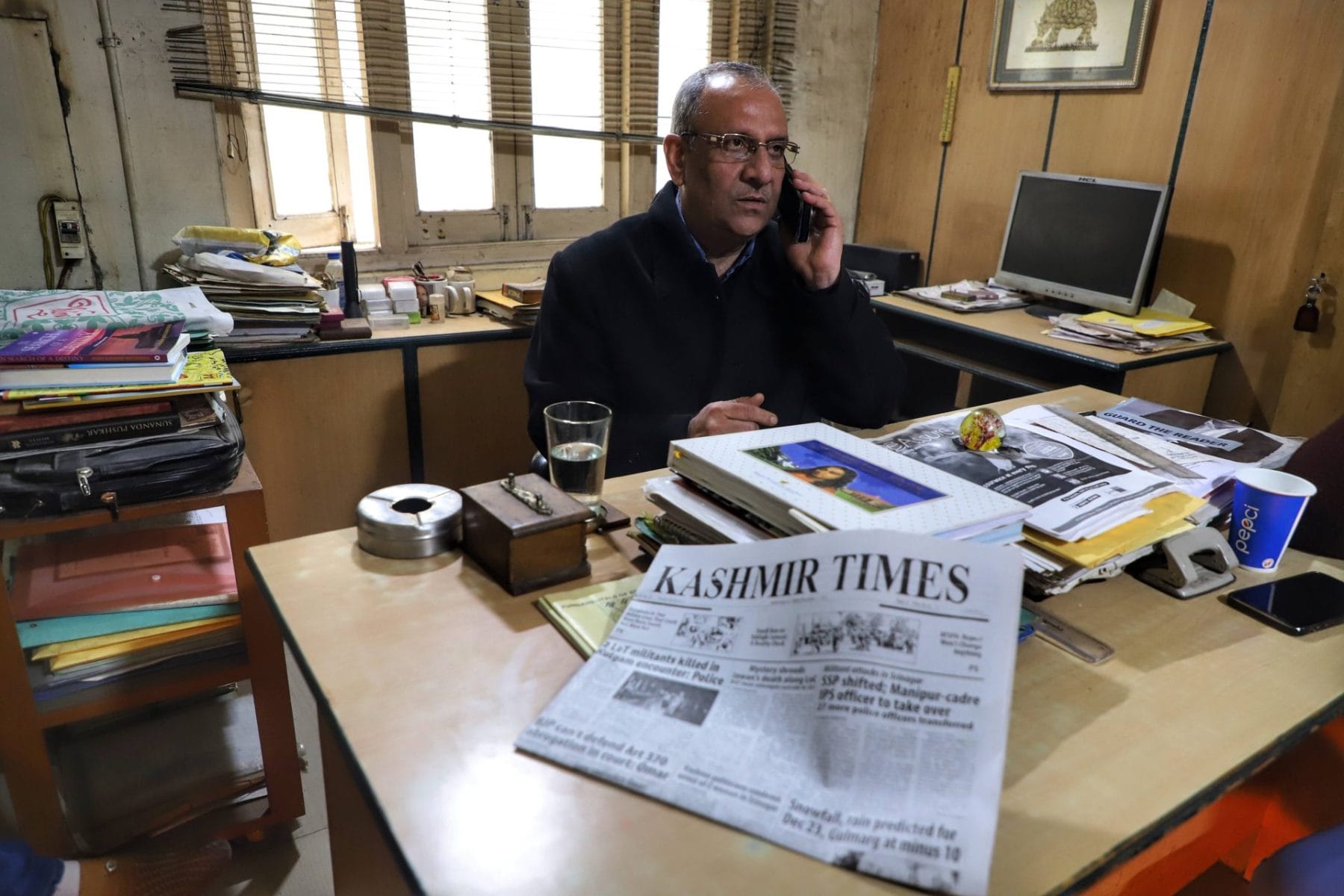
As Executive Editor of the ‘Kashmir Times’, one of the oldest newspapers in the region and the largest, with four editions, I petitioned India’s Supreme Court against the six-month-long internet shutdown that the Modi government imposed in 2019. But by 2020, three editions of the ‘Kashmir Times’ had shut down and the fourth only limped along, a once daily newspaper that was now only occasionally published. By February 2022, even this edition was shut down. I left India with my husband Prabodh Jamwal, the editor of the ‘Kashmir Times’, and revived it as a digital newsroom in exile in the United States in November 2023. 

Prabodh Jamwal, Editor of The Kashmir Times, at his office in Srinagar in early 2020. Nasir Kachroo/NurPhoto via Getty Images.

But, as the so-called terror investigation and the mysterious discovery of weapons in our long disused office in 2025 showed, the ‘Kashmir Times’ remained a thorn in the side of the Modi government. The Indian prime minister has frequently presented India on the international stage as the “mother of democracy” and the “Vishwaguru”, a moral exemplar and teacher to the world. Just last week, between September 12 and 13, Delhi hosted Vladimir Putin, Xi Jinping and Iranian president Masoud Pezeshkian as part of the annual BRICS meeting, the global group founded initially by Brazil, Russia, India, China and South Africa (hence the acronym) that is increasingly being presented as an alternative power centre to the American-led Western alliance. For an India seeking to portray itself as not just an emerging superpower but as a democratic force, it is vital that Kashmir remain repressed, hidden away from global scrutiny.  

It’s why, even as a newsroom in exile, we continue to be pursued by an Indian government seeking to tarnish our credibility, to deny us the right to report on Kashmir. We are being subject to a vendetta and it represents what has happened to journalism in Kashmir. Journalists have been silenced by the Modi government, Kashmiri voices strangled, and the local media industry deliberately destroyed. 

What is happening to journalism in Kashmir is a harbinger of what lies ahead for the rest of India.

A model of suppression

Geeta Seshu of Free Speech Collective, which monitors press freedoms in India, argues that Kashmir is a laboratory where every strategy of media suppression is tested and perfected for use elsewhere. India, which once had a noisy, argumentative press, now ranks at a lowly 157 out of 180 countries in the World Press Freedom Index. Reporters Without Borders, which compiles the ranking, says “press freedom is in crisis” in Modi’s India. 

The 2023 Digital Personal Data Protection Act provided a “dangerous framework for expansion of surveillance and censorship” across the country. It empowered the government to demand data from any entity, including journalists, effectively requiring them to reveal their sources. The amendments to the 2020 Information Technology Rules already burden intermediaries with harsh obligations and have been used to arrest journalists, block websites and compel social media platforms to restrict content. Recently, Instagram restricted posts about reports of Kashmiris shot by Indian security forces using pellet guns on unarmed protestors. 

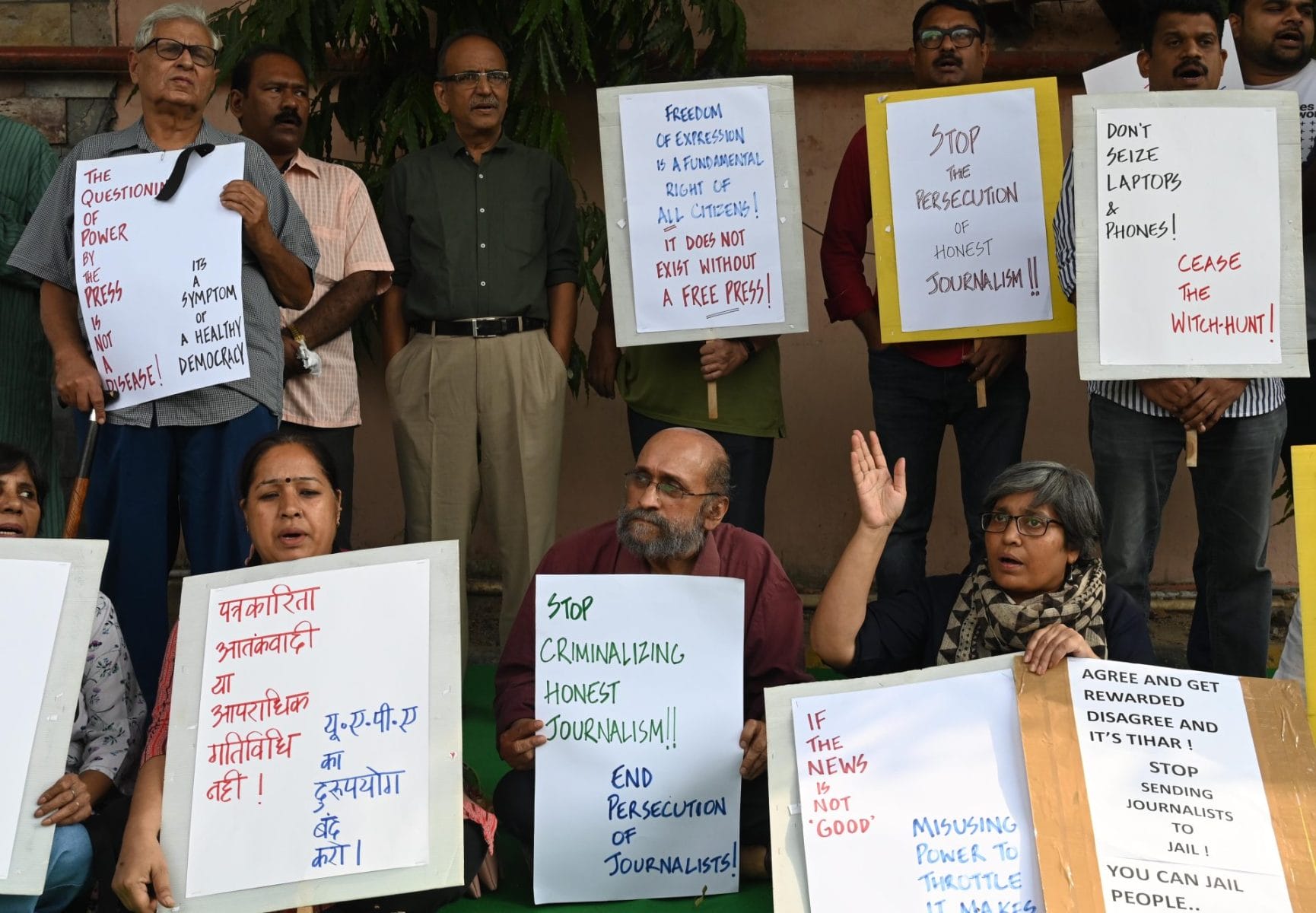
Seshu’s fear that what happens in Kashmir will be replicated in the Indian mainland has largely been borne out. For example, in 2023, nearly 50 journalists associated with the portal ‘NewsClick’ – some only vaguely – were subject to arrests and interrogations. Many had their devices seized without due process. Their alleged crimes were essentially guilt by association, charges manufactured not from evidence but from a, frankly, lazy piece of journalism published in the  ‘New York Times’ about NewsClick’s funding. The charges were eventually quashed by an Indian court.  

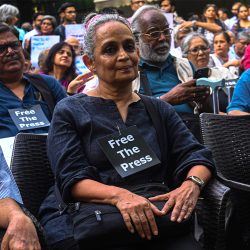
The "To Defend Journalism" protest at New Delhi's Press Club of India, October 2023. Vipin Kumar/Hindustan Times via Getty Images.

Such court rulings are less likely in Kashmir. As a Kashmiri journalist based in Delhi says, “unlike the rest of India, Kashmir is a police state, and state control requires any independent journalism to be shut down.” 

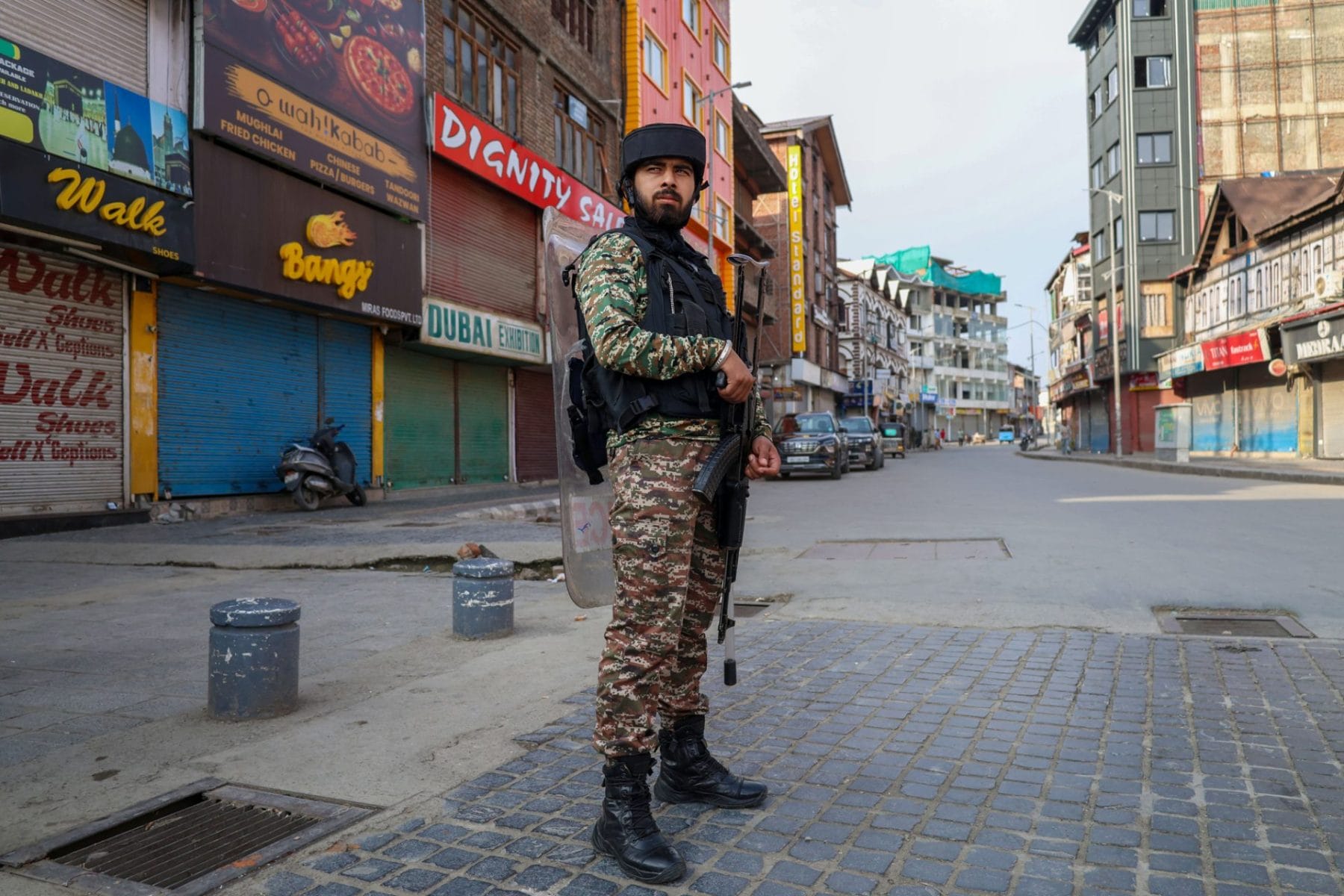
In Kashmir, the Indian state has engineered a sophisticated edifice of control through securitization, surveillance and interrogation. It is invisible, intangible, and all-pervasive, a model that extracts quiet surrender and obedience. Unlike the targeted killings of journalists in Gaza, in Kashmir the control of information is seamlessly embedded in everyday life, requiring no enforcement, no traces of brutality. The journalists are essentially cowed into submission.

It began with the world’s longest internet shutdown – a complete lockdown for six months and a partial one for another year. What the shutdown created, despite a court verdict restoring communications, was fear among journalists compelled to work out of a government-surveilled computer facility, and then a perpetuation of that fear through consistent localized and temporary digital shutdowns. So commonplace are these shutdowns that they no longer warrant reporting or commentary.

In June 2020, the Modi government introduced a 53-page document called ‘J&K's Media Policy’ which gave the authorities sweeping powers to monitor, judge, and punish journalists, branding critical reporting as “fake news”, “unethical”, or “anti-national”. The authorities would also routinely remove government advertising from cash-strapped outlets and provide accreditation only to journalists deemed loyal, thus turning bureaucrats into arbiters of what constitutes news and who gets to report it. The effect is chilling.

And then there’s the monitoring of communications.

An Indian security personnel in Srinagar, Jammu and Kashmir, August 2026. Firdous Nazir/NurPhoto via Getty Images.

“I can’t say if they’re using Pegasus or some other spyware or technology,” a journalist told me about being interrogated over emails sent to an editor, “but they knew everything about our conversations.” In a 2021 leak, it turned out the Indian government was using Pegasus to spy on at least 40 Indian journalists, only one of who was Kashmiri.

But, a Kashmiri journalist says, “officials have told us ‘nothing in Kashmir is end-to-end encrypted’ and digital activity is clearly being constantly monitored.” No Kashmiri journalist I spoke to for this story, including those who contribute to the ‘Kashmir Times’, have the encrypted messaging Signal app, used worldwide by journalists, on their phones. Devices are routinely checked when journalists are summoned to police stations in Kashmir for questioning. Some said their devices were returned after being tampered with. “You face humiliation and beatings for using Signal and VPNs,” many journalists said. “You can only get away with it if you’re not on their radar,” said one. 

In November 2025, the Indian government issued a directive insisting on verifying the “bona fides” of journalists working in Jammu and Kashmir, and the police followed up by requiring journalists to part with personal information including biometrics and bank statements. In January this year, senior journalist Basharat Masood of The Indian Express spent seven hours at a Srinagar police station, then was summoned for three more days and told to sign a bond promising not to “repeat his mistake” – for reporting on the surveillance of mosquea surveillance, even as officials had already admitted to large-scale data collection and verification. 

Surveillance normalized

Police also surveil Kashmiris through the use of drone cameras, a network of 1,000 electronic cameras installed at major traffic junctions, and through unrestricted access to people’s social media activity across platforms ostensibly to track anti-India activity. During an illegal “Census 2024” drive, the police collected residents' personal data and GPS-tagged coordinates of homes. And the soon-to-be-rolled-out Jammu and Kashmir-specific digital identity cards that collects the data of entire households, purportedly to ensure the smooth rollout of welfare schemes, has also sparked local anxieties. 

Still, as pervasive as the surveillance is, it is journalists that find themselves in the firing line. Any critical word warrants a summons to a police station, interrogation, intimidation and even detention. This happens repeatedly, with journalists never aware of what specific “offence” might trigger a police summons. The reflex, after several such visits to police stations, is self-protection and self-censorship.

A Kashmiri journalist told me that the language the police use to summon journalists for questioning is particularly sinister. It is almost as if the police are enjoying instilling fear. “Aaj dastarkhan par aapki dawat hai”, for instance, is a typical summons. You are invited to a feast, the police say cynically, knowing a journalist is likely to be harshly questioned, even beaten.

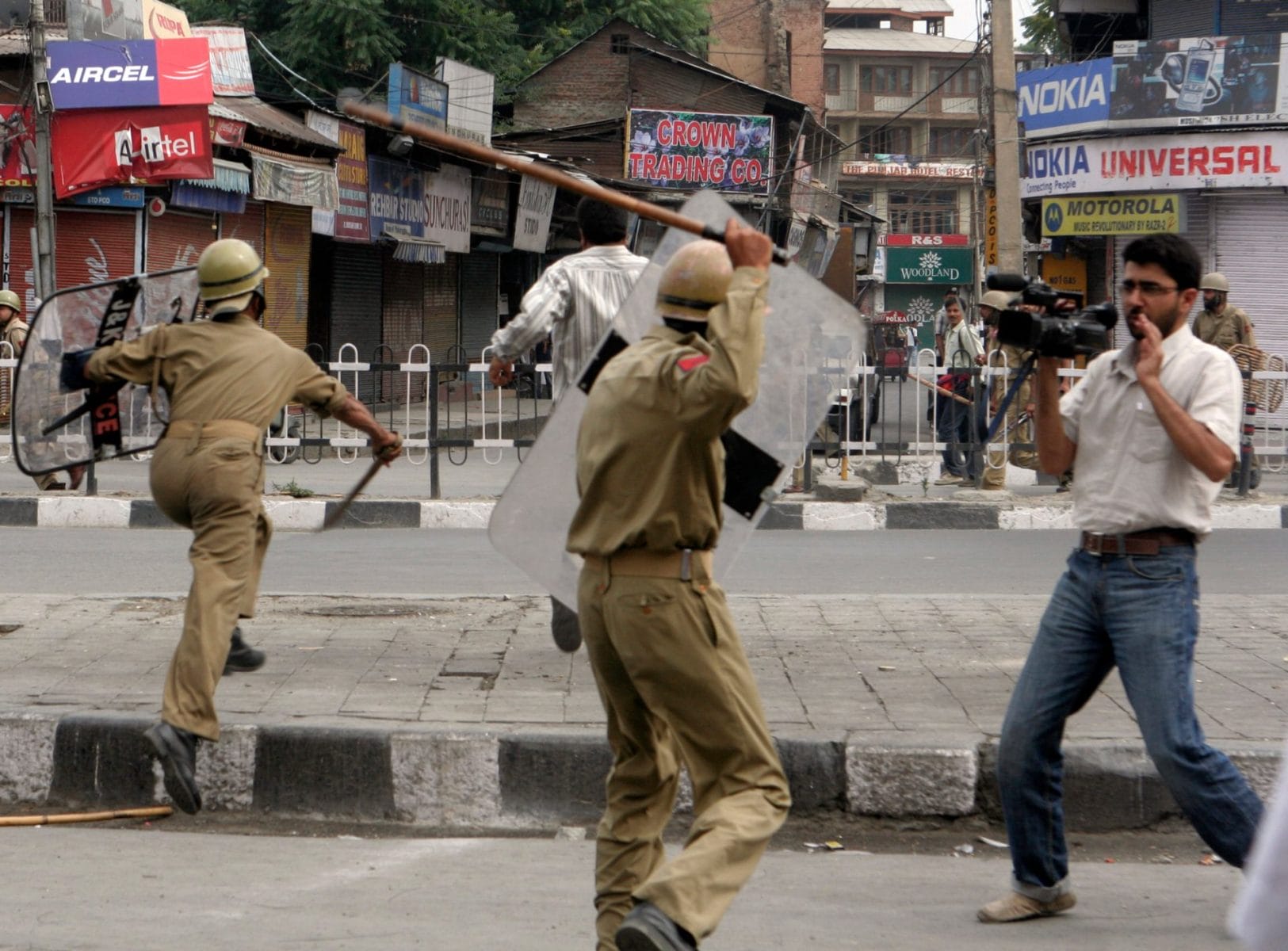
Indian police confront journalists and civilians during a protest on July 10, 2009 in Srinagar in the Indian Administered Kashmir. Yawar Nazir/Getty Images.

Often, Kashmiri journalists, without notice, are placed on no-fly lists. Sanna Irshad Mattoo, a Pulitzer Prize-winning photojournalist, was twice prevented from travelling abroad for exhibitions and award ceremonies, a pointed message that even international recognition offers no protection. At least twelve journalists have had their passports revoked; two of them were already abroad at the time, rendering them stateless. 

The Free Speech Collective filed a Right to Information (RTI) query in March 2024 to ascertain exactly how many Kashmiris had had their passports revoked or cancelled. The plea was rejected by the government on grounds of “national security”.

As India continues to press its case as a formidable, if still rising power, citing its 7.8% growth rate over the past quarter, it continues to be defensive and secretive about Kashmir. Foreign journalists are largely barred, or at least heavily restricted, from reporting from both Indian and Pakistani-administered Kashmir. In May, last year, India and Pakistan exchanged air strikes after a terrorist attack in Indian-administered Kashmir and Modi fell out with Donald Trump over the latter’s claim to have stopped both nuclear powers from accelerating towards a disastrous war.

Despite Kashmir being a long-standing issue that merits global attention, reporting from the region has reduced to a trickle. 

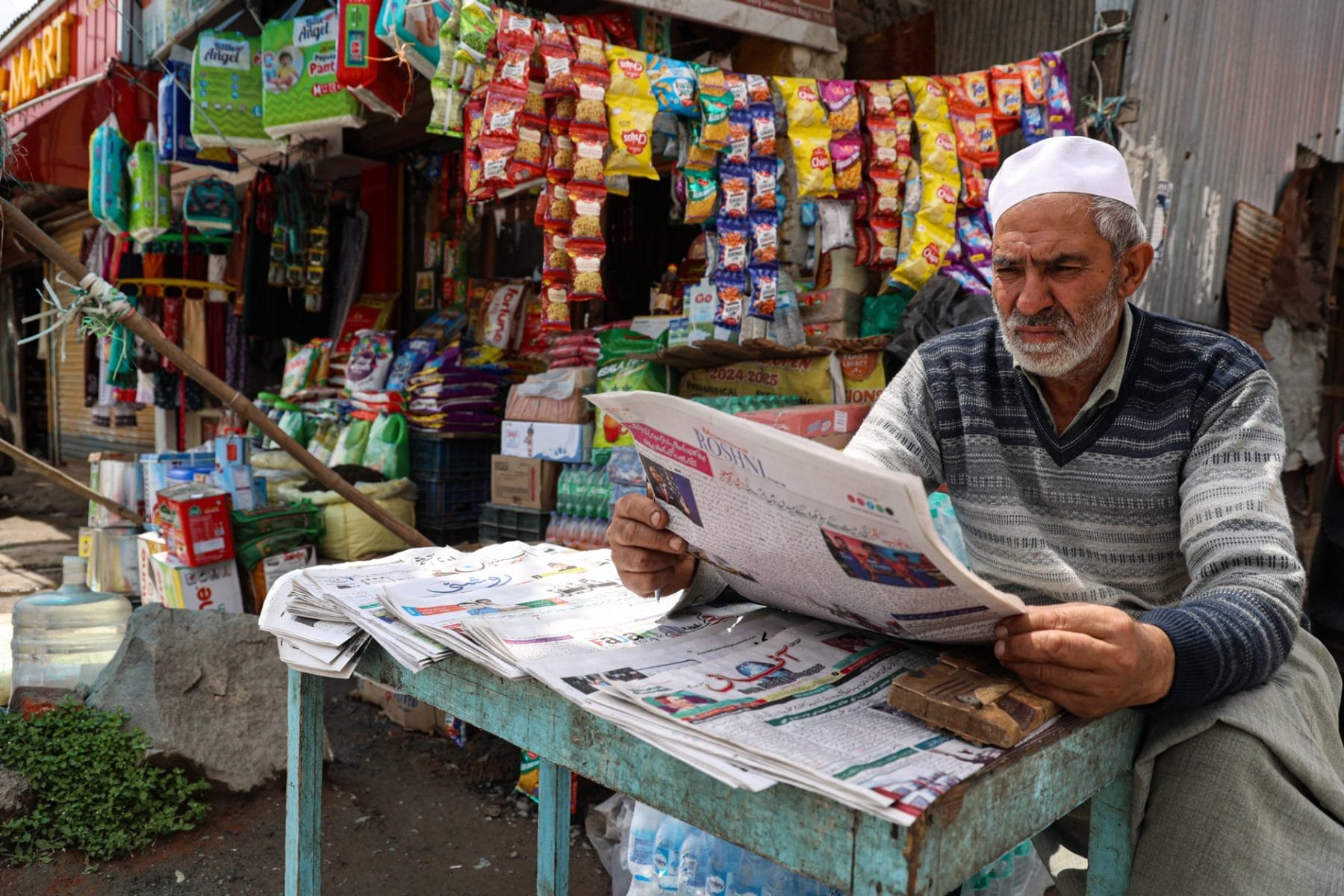
Mohammad Amin Lara outside his shop in Sopore, Jammu and Kashmir. The shop, once a fully occupied newspaper store, is now a grocery store due to the decline in newspaper sales. Nasir Kachroo/NurPhoto via Getty Images.

A Google search of Kashmir-related news floods your screen with links, but it is bulk without substance. Articles read like a log of official announcements and statements, punctuated by the occasional piece on a shrinking water body, a development project, a political tussle over a non-issue, or unemployment figures. Each report floats like a loose, individual particle suspended in air, packaged and presented as definitive. No investigation into context. No excavation of the past. No interrogation of contributing factors. A story about an alleged terrorist’s hair transplant and cosmetic dentistry, based entirely on police sources, is passed off as an investigation into Kashmiri insurgency. A superficially detailed piece on anti-encroachment drives or home demolitions will carry little beyond the grief of the displaced, or the remarks of a politician whose interest in the community begins and ends with votes. A terrorist’s hair transplant story, based on the police version, passes off as an investigation into Kashmir’s complex insurgency dynamic. 

Kashmir fell off the radar a long time ago, says Free Speech Collective’s Geeta Seshu.  

Even mundane stories are difficult to report. No one wants to be quoted. A university professor said he could once “talk to journalists and trust they understood the context. Now, a single sentence can be pulled out, circulated on WhatsApp, and suddenly I’m either an anti-national or a government stooge. Both sides will use the same quote to attack you differently. Why would I take that risk?”

Tarushi Aswani, an Indian journalist, told me that “a curtain has been pulled over Kashmir by silencing journalists who ask questions.” Instead, she added, “press release journalism fills the vacuum, erasing the truth about Kashmir, its history, its politics, its development, environment and aspirations.” Kashmir is no longer looking at a mirror. The lack of truthful reporting means nothing is reflected back. Instead, Kashmiris are looking into the lens of a surveillance camera. 

*The eight Kashmiri journalists interviewed for this story spoke on condition of anonymity.

The post How Modi silenced Kashmir appeared first on Coda Story.

  •  

US Kills Four in Latest Bombing of Alleged Drug-Running Boat in the Caribbean

US Southern Command said in a statement that its forces bombed an alleged drug-running boat in the Caribbean on Saturday, killing at least three people, as the Trump administration continues to conduct extrajudicial executions at sea. “On September 19, under the direction of US Southern Command, Joint Task Force Western Hemisphere executed a lethal, kinetic strike on […]

💾

  •  

Press TV condemns Israeli abduction of West Bank correspondent Naqaa Hamed

Iranian news outlet Press TV called the detention of its West Bank correspondent Naqaa Hamed by the Israeli forces an “aggressive terrorist operation” aimed at silencing the truth about its occupation and genocide of Palestinians. It demanded the immediate intervention of the international community for her release.

“The desperate attempt by the Zionist war and security machine to block the flow of free news and boycott structured crimes in the West Bank is clear evidence of the occupier’s fear of independent” reporters “who expose widespread human right violations,” the Press TV statement, published on Thursday, September 17, said.

Naqaa Hamed was abducted by the Israeli armed forces from a checkpoint at Tuqu, near Bethlehem, in the occupied Palestinian territory on September 15. 

She, along with her cameraman, were returning after reporting about rising Israeli settler violence on Palestinians in Masafer Yatta.

One eyewitness, a TRT journalist accompanying Hamed in her car, claimed that they were detained at the checkpoint and made to sit on the ground for 45 minutes while Hamed was taken alone for interrogation.

After the interrogation, cameraman and TRT journalists were let go but Hamed was arrested and sent to an unknown location.

Later it was reported that her detention has been extended until September 23 by an Israeli court.

Though no official confirmation has come forward about the charges against Hamed, Israeli media quoted unidentified military sources claiming her arrest was linked to her alleged cooperation with “the enemy entity,” presumably Iran, and espionage.

Hamed (38), a Palestinian-American and mother of three children, has been subjected to repeated physical attacks by Israeli forces in the last few months. She has also been subjected to a smear campaign on social media. 

According to Press TV, rubber bullets were fired at her when she was reporting near Qalandia camp in December 2025. She was injured again in August this year by an Israeli stun grenade and tear gas fire.

The intimidation and smear campaigns on social media, started by pages affiliated with the Israeli occupation regime, targeted Hamed by questioning her credibility and calling her a part of the “Iranian propaganda machine.” 

Israel is the worst place to be a journalist

Israel has one of the worst records when it comes to killing and arresting journalists. Hundreds of Palestinian journalists have been either killed or arrested by the Israeli occupation forces since the beginning of the war and genocide in Gaza. 

According to various sources Israel has killed over 250 journalists and media workers in the West Bank and Gaza since October 2023. 

According to the Palestinian Prisoner’s Society, currently nearly 40 Palestinian journalists are in Israeli detention, including five women. Almost half of these journalists are kept in prison under the draconian provision of Administrative Detention, which allows the authorities to keep them in jail for an indefinite period without any formal charges or trial.

The Iranian media channel Press TV underlined that Hamed’s arrest by Israeli forces violates international laws about immunity to journalists in war zones. It demanded the UN, its High Commissioner for Human Rights, and other international human rights groups to come out of their “shell of inaction and meaningful silence” and take measures to end Israel’s impunity.

“As long as responsible institutions remain in the shell of silence and inaction, Naqaa Hamed will not be the first, nor the last journalist to be targeted by the illegal actions of the Zionist regime,” the Press TV statement said.

  •  

Health workers demand action against genocide and militarization at ManiFiesta 2026

Health is always a prominent topic at Belgium’s ManiFiesta, a two-day festival organized by the Workers’ Party of Belgium (PTB) in the beginning of September. Discussions range from the organization of health services or workshops led by progressive health organizations like Medics for the People (MPLP-GVHV) and Viva Salud. This September, the program covered local priorities such as health coverage and hospital reform – along with Israel’s ongoing assault on Gaza’s healthcare system and the threat of militarization across Europe.

Health workers should oppose rearmament

Addressing the question of why health workers should be concerned by Europe’s armament drive, Juliette Mattijsen of the People’s Health Movement (PHM), Nadja Rakowitz of the Association of Democratic Doctors (vdää*) in Germany, and Tim Joye of Medics for the People emphasized the different ways hospitals, health centers, and medical studies are being reshaped. 

Not only are governments imposing cuts on health budgets to enable increased defense spending, as Mattijsen illustrated – some are structurally changing what the health system is supposed to be about.

Read more: Militarization is spreading through Germany’s health sector

As the Merz administration in Germany rushes to build Europe’s mightiest army, Rakowitz explained, it is tabling plans for underground hospitals and an overhaul of triage systems. The goal of these reforms is supposedly to ensure wounded soldiers – from a battlefield that still only exists in the imagination of regional politicians – are cared for swiftly and returned to combat as soon as possible. In Belgium, Joye added, plans are being circulated to introduce war medicine into medical school curricula, and professional congresses have made this their topic of choice.

If European governments have their way, the speakers warned, health systems in the region will increasingly lose their focus on patients and add further strain on service provision. To prevent this, the panel suggested, health workers themselves – nurses, doctors, dentists, and others – must mobilize and actively oppose this dangerous trend.

In Palestine, medics provide more than health care

At another panel hosted by Viva Salud, the focus shifted to Palestine. Gaza’s health services have been militarized by the Israeli occupation, which has turned health infrastructure and workers into direct targets.

Sama Jaber of the Awda Association and Hanne Bosselaers, a Medics for the People general practitioner who participated in the 2025 solidarity flotillas to Gaza, focused their interventions on the relevance of organizing and providing healthcare under occupation.

In Palestine, Jaber pointed out, the formation of medical practitioners is a collective feat. By persevering in their work during a genocide, health workers in Gaza are now giving back to the communities who accompanied them along the way. “Being a health worker in Palestine today means sharing genocide conditions, but also upholding the right to health,” she said.

Read more: In Palestine, healthcare is also a form of resistance

For Bosselaers, the steadfastness of Palestinian comrades has been an inspiration since her first visits to Gaza approximately 15 years ago and the twinning process she supported with a health center in Beit Hanoun. Today, she emphasized, Israeli attacks have leveled Beit Hanoun to the ground – yet health workers have not given up their work.

Doctors and other health workers in Europe need to recognize this unbreakable spirit, Bosselaers said, and support their peers by joining movements at home. This should mean standing by Palestinians’ demands for liberation, she added, but also joining networks struggling against other forms of attack on healthcare: opposing commercialization, austerity, and militarization.

Call to support boycott, divestment and sanctions

Health workers around the world should direct their efforts into directly supporting the health system in Palestine, the panelists pointed out. This does not mean replacing hospitals with large international NGO operations or flying in and taking over, Bosselaers insisted, as is often seen in humanitarian medicine. Instead, she and Jaber suggested, the priority should be mobilizing against the occupation and campaigning for an end to Israel’s impunity.

In this, they echoed Palestinian physician and political leader Mustafa Barghouti, who addressed the panel through a video message. Barghouti invited health workers in Europe to stand firm in their support of Gaza, particularly by supporting boycott, divestment and sanctions (BDS) campaigns. By doing so, he said, they will also recognize the efforts of their peers in Palestine, who are doing more than healthcare today, “helping people persevere in their steadfastness.”

As the genocide continues, Barghouti insisted, health workers in occupied Palestine know their efforts are directed at supporting people in remaining on their land – starting from the most common health procedures. “If you help a woman safely deliver a baby,” he said, “you’re helping her stay in Palestine.”

People’s Health Dispatch is a monthly bulletin published by the People’s Health Movement and Peoples Dispatch. For more articles and to subscribe to People’s Health Dispatch, click here.

  •  

Recolonization is taking place, says Guyana’s former president

Latin America and the Caribbean countries are being re-colonized. This time it is not by Britain, the Netherlands, Spain, France, and Portugal, but by the United States.

At a period of time the United States had an anti-colonial position and had advocated for the ending of colonialism. That was one of the features of the Monroe Doctrine that has become somewhat obscured since the US became so bellicose.

Today, in a de facto way it has become a super colonial power. It is imposing its will on regions and countries. Those that stand up for their rights are sanctioned, destabilized and sometimes physically removed.

The fact that it used its military might to kidnap a sitting president, President Maduro of Venezuela, is a clear indication that the United States has decided to ignore international law and to get its own way.

Strikingly, only the President of Brazil protested vigorously. Our Caribbean leaders have generally been tight lipped.

The United States has gone even further. They have, using the guise of fighting drugs, established a strong military presence in the region. They have been murdering hundreds of persons traveling in small boats in the Caribbean. Without producing a scintilla of evidence, without attempting to board the boats and get evidence, the US just killed the occupants. We may never know if any were really involved in drug trafficking.

There has been a deafening silence from Latin America and the Caribbean leaders to those atrocities. As if these events were not enough, many of the governments in the region are, on the request/orders from the United States, acting against their countries’ best interests. The ending of the cooperation in health with Cuba which was in place for more than fifty years and which benefited millions of the region’s citizens, is a case in point.

That has left a massive gap in the health sector of the region. The US has not provided any assistance to help with the dislocation and shortage of technical personnel created by their insistence to remove Cubans.

The US is now also pressing regional governments to stop doing business with China. Many governments are beginning to comply with those orders as we see more big contracts going to US companies, despite some of those companies having poor performance records.

If some newspaper stories are to be believed, (and they have not been countered) in some cases Chinese contractors won bids for certain projects, but they were not given the jobs, they went to US firms instead.

The US and other Western countries have ignored us and kept us in a state of underdevelopment since independence. Now that we are getting assistance from China to build important and much needed infrastructure to facilitate socio-economic progress we are getting push back from the US.

It appears that they want to keep us in a state of perpetual underdevelopment and in poverty.

We see the open intention to super exploit our natural resources and labor for the benefit of big business in the US. They are mainly interested in our natural resources. They do not add value in the region nor establish any type of manufacturing. Those are reserved for the rich, developed countries.

The recent “deal” with Venezuela is worse than highway robbery. Venezuela has to provide oil and gas to US companies at cost for one hundred years. This is barefaced robbery and has demonstrated that Venezuela is now a de facto colony of the US. This will not benefit the poor in the US. It is designed to enrich the huge corporations.

Venezuela was forced to abandon its long and well-known principle of standing in solidarity with the oppressed people of Palestine. It is now forced to recognise the Fascist, Apartheid Israeli regime that continues to bomb defenseless civilians in makeshift camps in Gaza, the West Bank (where ethnic cleansing is taking place) and in East Jerusalem.

Today the sovereignty of our countries is already severely compromised. If we don’t stand up now it would be completely lost.

Donald Ramotar is a former President of the Cooperative Republic of Guyana (2011-2015).

This article was produced by Globetrotter.

  •  

Altura celebrou a 4.ª edição da Meia Maratona Noturna

A Avenida 24 de Junho, em Altura, voltou a vestir-se de festa no passado sábado, 12 de setembro, para acolher a 4.ª edição da Meia Maratona Noturna de Altura, reunindo centenas de atletas e entusiastas da corrida.

Com partida e chegada junto ao Campo de Futebol 11, o grande vencedor da prova principal masculina foi Bruno Paixão, em representação do GD3 Santos Populares. Na competição feminina, o topo do pódio foi conquistado por Inês Correia em nome da Casa do Benfica de Faro. Já na Mini Maratona, a vitória ficou nas mãos de Vasco Pita (Associação Académica da Bela Vista), Sara Inácio (Clube Desportivo Areias de São João).

A 4.ª Meia Maratona Noturna de Altura foi organizada pelo Clube Recreativo Alturense, em parceria com a Câmara Municipal de Castro Marim, a Associação de Atletismo do Algarve e a Junta de Freguesia de Altura, contando ainda com o apoio vital da Guarda Nacional Republicana, dos Bombeiros de Vila Real de Santo António e Castro Marim e da Proteção Civil.

  •  

Despiste Mortal em Alcanede Tira a Vida a Jovem de 19 Anos

Um grave despiste de uma viatura ligeira ocorrido na noite de sexta-feira, 18 de setembro, provocou uma vítima mortal no lugar de Pé da Pedreira, na freguesia de Alcanede, concelho de Santarém.

O acidente ocorreu na Estrada 5 de Outubro antes da Capela no sentido Pé da pedreira Barreirinhas, tendo obrigado ao corte total da circulação rodoviária naquela via durante as operações de socorro. A vítima mortal é um jovem de 19 anos, residente em Vale Florido, uma localidade pertencente à Freguesia vizinha de São Bento (Porto de mós).

O município já dez saber que em virtude de tal tragédia todas as atividades do evento Festival Viver São Bento, previstas para os dias 19 e 20 de setembro, foram canceladas.


Segundo os Bombeiros, no local estiveram empenhados 14 operacionais apoiados por 6 viaturas das forças de socorro e emergência. O alerta para a ocorrência foi registado às 21:13.

Se ainda não é seguidor da nossa página, siga-nos para acompanhar mais conteúdos e atualizações da nossa região.

Por: Dino Frazão
Data: 18/09/2026
Notícia Atualizada.
————————————————–
© 2026 Os Monhacas. Todos os direitos reservados.
Este é um projeto independente de criação de conteúdos.
Se gostou do que leu e ainda não é seguidor, siga a nossa página para ver mais conteúdos!
————————————————–

O conteúdo Despiste Mortal em Alcanede Tira a Vida a Jovem de 19 Anos aparece primeiro em OS MONHACAS.

  •  

Una pequeña victoria frente a los mapas que sitúan al Norte Global en el centro y empequeñecen a África.

Read in English here

La semana pasada, el 4 de septiembre, la Asamblea General de las Naciones Unidas aprobó una propuesta africana para un nuevo mapa mundial, que muestra el tamaño real de los países en relación con los demás. Su objetivo es corregir la visión del mundo moldeada por el mapa mundial ampliamente utilizado basado en la proyección de Mercator, creada por Gerardus Mercator, un cartógrafo flamenco del siglo XVI. El problema con el mapa de Mercator es bien conocido; por ejemplo, muestra a la isla de Groenlandia con el mismo tamaño que el continente africano, ¡a pesar de que África es 14 veces más grande que Groenlandia! En pocas palabras, los mapas de Mercator exageran enormemente el norte del mundo —los Estados Unidos y Europa— mientras que reducen África y la mayor parte de Asia. Tampoco trata con benevolencia al resto del hemisferio sur. Sudamérica, que tiene casi tres veces el tamaño de Europa, parece comparable a esta en un mapa típico de Mercator.

Aunque no existe ninguna razón geográfica por la que el hemisferio sur deba ser más pequeño que el hemisferio norte, los cartógrafos lo hicieron significativamente más pequeño porque tenía muy poca masa continental más allá de los 40 grados y, por lo tanto, se recortó. Esto significó que, en la mayoría de los mapas de Mercator, debido a que los cartógrafos occidentales recortaron gran parte del hemisferio sur, el ecuador quedó significativamente desplazado hacia abajo. El doble efecto de comprimir las zonas ecuatoriales, donde se encuentra gran parte de África, y desplazar el ecuador hacia abajo hizo que el norte del mundo, particularmente Europa y América del Norte, parecieran mucho más grandes de lo que realmente son. Por lo general, en la mayoría de los mapas de Mercator, el hemisferio norte parece el doble del tamaño del hemisferio sur, aunque ambos hemisferios son idénticos en tamaño.

Cualquier mapa, ya sea de Mercator o de cualquier otra proyección, presenta el problema de que se puede ser fiel al tamaño o a la forma, pero no a ambos. Se trata de un problema fundamental que surge al proyectar una superficie tridimensional sobre una hoja de papel bidimensional. No hay forma de hacerlo sin distorsiones. Solo un globo terráqueo puede representar fielmente la Tierra tridimensional. Pero entonces, ¿qué hacemos cuando queremos reproducir detalles geográficos para nuestros lectores en libros o artículos?

Las distorsiones evidentes de la proyección de Mercator y su enfoque eurocéntrico dieron lugar a varias alternativas, particularmente entre los cartógrafos de la izquierda amplia o progresista. Otros, especialmente en los Estados Unidos y Europa, se han opuesto a ella, argumentando que el tamaño no importa y que no les molesta que se les muestre mucho más grandes de lo que realmente son. Sin embargo, muchos discreparon e intentaron desarrollar proyecciones alternativas. La proyección de Gall-Peterson, que contó con el respaldo del gobierno socialdemócrata alemán de Willy Brandt, es una de esas proyecciones. La proyección de Hobo Dyer, que se encuentra en el dominio público global —lo que significa que cualquiera puede usarla sin pagar regalías—, es otra. Finalmente, las Naciones Unidas han puesto fin a las guerras de los mapas, con una victoria rotunda a favor de la moción presentada por las naciones africanas para utilizar mapas de área igual. La votación fue de 164 a favor de la moción, con los Estados Unidos como único voto en contra.

El objetivo del mapa de Mercator era facilitar la navegación de los barcos en mar abierto, donde ya no es posible orientarse reconociendo diversas características topológicas, como ríos, colinas, aldeas, pueblos, etc. En mar abierto, si identificamos nuestra ubicación en un mapa de Mercator y el destino al que deseamos llegar, podemos viajar en línea recta, tal como se muestra en el mapa. Conserva la dirección, lo que significa que, si trazamos un rumbo en un mapa de Mercator, podemos fijar nuestro rumbo según él. Es por eso que los países marítimos utilizaban proyecciones de Mercator para la navegación cuando contaban con pocos instrumentos, más allá de la brújula y el sextante, para determinar su ubicación con respecto a su destino.

Es importante señalar que la dirección que se muestra en el mapa no es la ruta más corta entre el punto de partida y el destino.

El camino más corto entre dos puntos en la superficie del globo terráqueo es el arco del gran círculo que va desde su ubicación hasta su destino. Una línea recta en un mapa bidimensional puede parecer la distancia más corta, pero no lo es, ya que no toma en cuenta la curvatura de la Tierra. En pocas palabras, el precio que pagamos por convertir una superficie curva en una plana y bidimensional es que distorsionamos la forma de la superficie. Estiramos ciertas áreas y encogemos otras. En una Tierra plana, la distancia más corta sería la que indica su brújula, pero no así en una esfera.

Anteriormente, los barcos utilizaban las estrellas y el sol del mediodía para estimar dónde se encontraban y hacia dónde debían dirigirse. Fijar un rumbo hacia su destino utilizando un mapa de Mercator y una brújula resultaba mucho más sencillo que tratar de adivinar dónde se encontraba en un océano desierto, sin puntos de referencia, y cambiar constantemente de rumbo en busca de una ruta más corta. La línea constante en el mapa se denominaba “línea de rumbo”, y seguirla ayudaba enormemente a los navegantes. Los mapas de Mercator eran populares en Europa, particularmente en Europa occidental, ya que, aparte de los árabes, eran las principales naciones marítimas.

Mientras que los árabes se enfocaban en el comercio, particularmente en el Océano Índico, los europeos occidentales se dedicaban no solo a la pesca, sino también, fuera de temporada, a la piratería, las incursiones y el saqueo de otras naciones. Los vikingos, importantes figuras románticas en Hollywood, eran particularmente brutales, ya que combinaban el saqueo con el comercio de esclavos. Por supuesto, como todos los piratas, una vez que se alcanza el poder, se puede convertir ese poder marítimo en conquista. Los hombres del norte, o nórdicos, conquistaron Francia y más tarde Inglaterra, y son conocidos por nosotros como normandos. No muy diferentes de las Compañías Holandesa y Británica de las Indias Orientales, que comenzaron con el comercio y la piratería y más tarde establecieron imperios coloniales.

No es de extrañar que los reinos marítimos de Europa occidental, para quienes la guerra, la pesca para alimentarse y la caza de focas, morsas, etc., con el fin de obtener grasa y pieles, constituían las principales fuentes de riqueza, se centraran mucho más en la navegación y la construcción naval. Esto significaba que los barcos construidos para el agitado Océano Atlántico contaban con ciertos avances de los que carecían los barcos árabes e indios, aunque la brújula, el astrolabio, los mapas astronómicos y otros instrumentos náuticos procedían todos de Asia.

Los barcos de Europa occidental contaban con cañones montados en cubierta, lo que les permitía disparar “andanadas”, es decir, disparar múltiples cañones simultáneamente, a diferencia de los cañones montados en la proa y la popa. Esa es una de las principales razones por las que un puñado de países de Europa occidental pudo aprovechar los océanos para, primero, hacerse con el comercio marítimo y, más tarde, construir sus imperios coloniales. A diferencia de los fuertes fijos, los barcos actuaban como fuertes flotantes, lo que proporcionaba a los europeos una movilidad en las guerras navales de la que carecían las fortificaciones terrestres estáticas.

Como muestra la monumental obra de Needham sobre la ciencia y la tecnología chinas, muchos avances náuticos en la construcción naval y la navegación procedían de China. Los siete viajes de los barcos de Zheng He en el siglo XV (1405-1443), que partieron de China, el sudeste asiático y la India, y recorrieron la costa árabe hasta África, demostraron que los chinos habían construido enormes barcos y una poderosa armada. En aquella época, se encontraban muy por delante de Europa y de los árabes, tanto en la construcción naval como en los buques de guerra. Las diferencias internas entre la aristocracia terrateniente y los comandantes navales condujeron a la destrucción de la armada y a la prohibición de construir cualquier buque de alta mar.

Aunque la India suministraba a los árabes la madera necesaria para la construcción naval y en algún momento contó con una poderosa armada, cedió el comercio de alta mar a los comerciantes árabes. Ni China, ni la India, ni los árabes consideraban que la armada tuviera importancia militar. Como dijo un emperador mogol: “Los océanos son para los comerciantes, no para nosotros, los guerreros”. Las divisiones de castas en la India también llevaron, en un momento dado, a prohibir a las castas superiores emprender viajes oceánicos. La travesía del Kala Pani, siempre prohibida por los brahmanes, no se respetó de manera estricta. La India experimentó una gran expansión marítima en el período budista, no a través de la guerra, sino mediante el comercio y la labor de proselitismo de los monjes budistas. Tras el resurgimiento del hinduismo en el sur, el tabú que prohibía a las castas superiores viajar a través de los océanos se aplicó de manera más estricta, dejando los océanos en manos de comerciantes y mercenarios. Por ejemplo, las principales flotas de los reyes indios – ya fuera el rey de Calicut, también conocido como Samundri o Zamorin, o Shivaji – dependían de comandantes navales y buques mercenarios, muchos de ellos al mando de árabes.

Como demuestra la historia, los mapas, el comercio marítimo y la guerra están íntimamente relacionados. Los viajes marítimos y las guerras navales confieren a los mapas una importancia estratégica. No es simplemente la ubicación de las fronteras de cada país lo que importa, sino también su visión estratégica del mundo. Podemos observar cómo esto se está manifestando actualmente en Bab el Mandeb y en el Golfo Pérsico. Un vistazo rápido a un mapa habría convencido a los líderes estadounidenses de que Irán cuenta con una clara ventaja estratégica en el Estrecho de Ormuz, al igual que los hutíes en el Mar Rojo y el paso hacia el Canal de Suez. Descuidar los océanos repite los errores que cometió Asia en una época diferente, errores de los que ha aprendido. Debemos tener esto presente también hoy en día.

Prabir Purkayastha es el editor fundador de Newsclick.in, una plataforma de medios digitales. Es activista en favor de la ciencia y del software libre.

Este artículo fue elaborado por Globetrotter.

  •  

A small victory against the maps which center the global north and shrink Africa

Lee en español aquí

On September 4, the United Nations General Assembly adopted an African proposal for a new world map, which shows countries’ true size relative to one another. It aims to correct the view of the world shaped by the widely used world map based on the Mercator Projection, created by Gerardus Mercator, a 16th-century Flemish cartographer. The problem with the Mercator Map is well known; for example, it shows the island of Greenland as the same size as the African continent, even though Africa is 14 times the size of Greenland! Simply put, Mercator maps greatly exaggerate the global north – the US and Europe – while shrinking Africa and most of Asia. Nor does it treat the rest of the Southern Hemisphere kindly. South America, nearly three times the size of Europe, looks comparable to it on a typical Mercator map.

Though there is no geographical reason the Southern Hemisphere should be smaller than the Northern Hemisphere, mapmakers made it significantly smaller because it had very little landmass beyond 40 degrees and was therefore cropped out. This meant that on most Mercator maps, because Western mapmakers cropped out much of the Southern Hemisphere, the equator was significantly displaced downward. The double whammy of squeezing the equatorial areas, where much of Africa lies, and shifting the equator down made the global north, particularly Europe and North America, seem much larger than they actually are. Typically, on most Mercator maps, the Northern Hemisphere looks twice the size of the Southern Hemisphere, though the two hemispheres are identical in size.

Alternatives to the Mercator projection

Any map, whether Mercator or any other projection, has the problem that you can be true to either size or shape, but not both. The problem is a fundamental one of projecting a three-dimensional surface to a two-dimensional piece of paper. There is no way of doing this without distortions. Only a globe can truly represent the three-dimensional earth faithfully. But then what do we do when we want to reproduce geographical details for our readers in books or articles? 

The blatant distortions of the Mercator projection and its Eurocentric approach gave rise to several alternatives, particularly among broad-left or progressive cartographers. Others, particularly in the US and Europe have opposed it, arguing that size does not matter and that they were comfortable being shown much bigger than they actually are. But many dissented and tried to work out alternate projections. The Gall-Peterson projection, which was backed by the German social democratic government of Willy Brandt, is one such projection. The Hobo Dyer projection, which is in the global commons, meaning anybody can use it without paying royalties, is another one. Finally, the United Nations has ended the map wars, with a resounding victory for the motion moved by the African nations for using equal area maps. The voting was 164 in favor of the motion with the US casting the only nay vote.

Read more: US votes against UN resolution promoting maps reflecting Africa’s true size

The objective of Mercator map was for ships navigating in open seas, where we can no longer navigate recognizing various topological features, rivers, hills, villages, towns, etc. On the open ocean, if we identify where we are on a Mercator map and the destination we want to reach, we can travel in a straight line, as shown on the map. It conserves direction, meaning if we plot a course on a Mercator map, we can set our course by it. That is why ocean-going countries used Mercator projections for navigation when they had few instruments beyond the compass and the sextant to determine where they were relative to their destination. 

It is important to note that the direction shown on the map is not the shortest path between where you start from and your destination. The shortest path on two points on the surface of the globe is the arc of the great circle from where you are to your destination. A straight line on a 2-dimensional map may look like the shortest distance, but it is not as it does not account for the Earth’s curvature. Simply put, the price we pay for converting a curved surface to a flat 2-dimensional one is that we distort the shape of the surface. We stretch certain areas and shrink others. On a flat earth, the shortest distance would be what your compass shows, but not on a sphere.

Earlier, ships used stars and the midday sun to estimate where they were and where they needed to go. Setting a course to your destination using a Mercator map and a compass was much easier than trying to guess where you were on an empty ocean with no landmarks and constantly changing course for a shorter route. The constant line on the map was called the thumb line, and following it greatly helped the seafarers. Mercator maps were popular in Europe, particularly in Western Europe, because, apart from the Arabs, they were the major ocean-going nations.

Trade and piracy in the colonial era

While the Arabs focused on trade, particularly in the Indian Ocean, Western Europeans focused not only on fishing but, in the off-season, on piracy, raiding, and looting other nations. The Vikings, major romantic figures in Hollywood, were particularly brutal, combining loot with slave trade. Of course, like all pirates, once you become powerful, you can convert that ocean power into conquest. The northern men, or Norsemen, conquered France and later England, and are known to us as Normans. Not very different from the Dutch and the British East India Companies, starting with trade and piracy and later establishing colonial empires.

Not surprisingly, the ocean-going kingdoms of Western Europe, for whom war and fishing for food and hunting seals, walrus, etc., for blubber and skins were major sources of wealth, focused much more on seafaring and shipbuilding. This meant ships built for the rougher Atlantic Ocean had certain advances that Arab and Indian ships did not, though the compass, astrolabe, astronomical maps, and other nautical instruments all came from Asia.

Western European ships had deck-mounted cannons, which allowed them to fire “broadside,” meaning multiple cannons firing simultaneously, unlike the front- and rear-mounted cannons. That is one of the major reasons a handful of West European countries could use the oceans to first capture the ocean trade and later build their colonial empires. Unlike fixed forts, ships acted as floating ones, giving Europeans mobility in naval wars that static ground fortifications lacked.

Ocean navigation and development in Asia

As Needham’s monumental work on Chinese science and technology shows, many nautical advances in shipbuilding and navigation came from China. Seven voyages by Zheng He’s ships in the 15th century (1405-1443), which traveled from China, Southeast Asia, India, and down the Arab coast to Africa, showed that the Chinese had built huge ships and a powerful navy. At that time, they were well ahead of Europe and the Arabs, in both shipbuilding and warships. Internal differences between the landed aristocracy and the naval commanders led to the navy’s destruction and a ban on building any oceangoing ships.

Although India supplied the timber necessary for shipbuilding to the Arabs, and once had a powerful navy, it ceded the oceangoing trade to Arab merchants. Neither China, India, nor the Arabs saw the navy as militarily important. As one Mughal Emperor said, Oceans are for traders, not us, the warriors. Caste divisions in India also led, at one point, to barring upper castes from undertaking ocean voyages. Crossing Kala Pani, always forbidden by the Brahmins, was not strictly followed. India saw major maritime expansion in the Buddhist period, not by war but through trade and proselytizing Buddhist monks. After the revival of Hinduism in the South, the taboo against upper-caste travel across oceans was enforced more strictly, leaving the oceans to traders and mercenaries. For example, the major fleets of the Indian kings, whether the King of Calicut, also known as Samundri or Zamorin, or Shivaji, relied on mercenary naval commanders and ships, many commanded by the Arabs.

As history shows, maps, ocean trade, and war are intimately connected. Ocean voyages and naval wars make maps strategically important. It is not simply where each country’s borders lie that is important, but also how it strategically views the world. We can see this currently playing out in the Bab-al-Mandeb and the Persian Gulf. A quick look at a map would have convinced US leaders that Iran has a clear strategic edge in the Strait of Hormuz, just as Ansar Allah do in the Red Sea and the passage to the Suez Canal. Neglecting the oceans repeats the mistakes Asia made in a different age, mistakes from which it has learned. We need to bear this in mind today as well.

Prabir Purkayastha is the founding editor of Newsclick.in, a digital media platform. He is an activist for science and free software. 

This article was produced by Globetrotter.

  •  

MAGA wants to ban his books. Who was Howard Zinn?

Writer Howard Zinn attends The People Speak: The Voices Of A People's History Of The United States during the 2009 Sundance Film Festival at the ASCAP Music Cafe on January 22, 2009 in Park City, Utah. Photo by Fred Hayes/WireImage

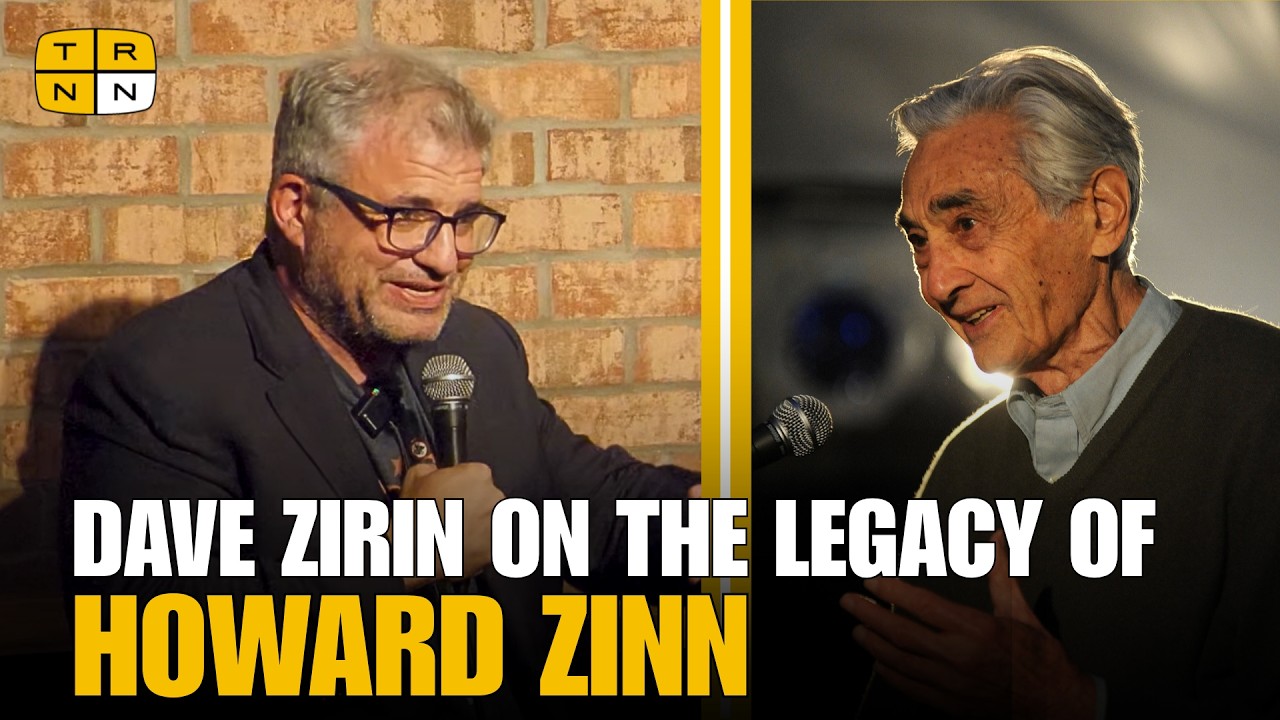
Long after his death in 2010, the books and speeches of Howard Zinn are frequently targeted by right-wing critics, MAGA book-bans, and fundamentalist politicians. In 2020, President Trump called out Zinn by name from the White House lawn, smearing Zinn’s work as “propaganda… that tries to make students ashamed of their own history.” So, who was Howard Zinn? And why are his critics so determined to keep his work from the public? In this live event, hosted at Red Emma’s Cooperative Bookstore and Coffeehouse in Baltimore, Maryland, TRNN Editor-in-Chief Maximillian Alvarez speaks with author and TRNN contributor Dave Zirin about his latest book, “The People’s Historian: The Outsized Life of Howard Zinn.”

Credits:

  • Studio Production / Post-Production: David Hebden
Transcript

The following is a rushed transcript and may contain errors. It will be updated.

Howard Zinn:

Protest will always be useful. Protest will always be important. Protest always looks futile at the time that it takes place, but protest mounts up. If they though protest was futile, they wouldn’t send the police out every time. There’s a demonstration. Have you noticed that you set up a picket line of somewhere of seven people and 12 policemen show up? They must worry about protest because they know that small protests lead to large ones.

Maximillian Alvarez:

All right. Well, thank you all. It is such an honor to be here with y’all tonight in Red Emma’s cooperative bookstore and coffee house in our great city of Baltimore. Give it up. And I am really, really honored and excited that we get to chat to the man, the myth, legendary sports writer, book author, documentary maker, political thinker, a true love warrior and a true role model for so many of us of what it means to just be a good-hearted person and to fight for good. Dave Zirin, give it up for Dave, everybody. Now, brother Dave.

Dave Zirin:

Yes. Yes, sir.

Maximillian Alvarez:

We’ve gotten to work together over at The Real News on your kick ass show, Edge of Sports TV, right?

Dave Zirin:

Yes, sir.

Maximillian Alvarez:

And so many of us know you through your sports writing and your analysis and commentary on sports, but we’re here tonight to talk about your new book, which is decidedly not about sports. And it is The People’s Historian: The Outsized Life of Howard Zinn. So Dave, I want to start off this way. Who was Howard Zinn? Who is he to you? Why did you write a whole book about him and why was now the time to write that book?

Dave Zirin:

Wow. So great to be here. Such a terrific question. Just the quickest of side notes, that last clip of Howard that you saw, that was his last mass meeting that he ever did before he passed away in January 2010. And it was at the convention of the campaign to end the death penalty. And I just wanted to say we have someone here tonight who is as responsible as anybody for the fact that we don’t have the death penalty in Maryland right now. And that’s Kenny Collins. And I just want to – Yes.

A hard big enough to crush injustice sitting right over there. So for me, I got to know Howard at the end of his life. I got to travel with him to different places and interview him on stage because he was sharp as a tack at age like 86, 87 years old, but standing and doing a 45 minute lecture was just something he couldn’t do any longer. I’d gotten to know him by writing a book in the People’s History series called The People’s History of Sports in the United States. And so I would sit with Howard on stage in 2008, 2009, and he was just the easiest interview in the history of the world. You would just say, “Civil rights, your thoughts.” And then 30 minutes later, he’s interrupted five times by applause. And everybody’s standing up at the end cheering for him. And afterwards, people would come up to me and say, “Yo, you did a great interview.” And I’d be like, “I said 12 words.

It was awesome.” And I got to sort of bask in the refracted glow. And the thing about Howard is that when he would speak about himself, it’s so interesting thinking back to the pronouns he would use. It was always we, it was always us, it was always they. And sometimes he would say you, but it was always, “What do you think? What are you doing?” It was never about I or me. But backstage, of course, he would tell these incredible stories and it’s like out of nowhere. Oh, that time I marched with James Baldwin in Selma. And it’s like, oh sure, as one does. And so I said to him once, “What we need is a people’s history of Howard Zinn.”

And he laughed at that. And that was actually my first proposal for the title of the book. And my publisher said, “Well, that’s too inside baseball.” Which kind of insulted me because I’m a sports writer, so they thought the only way I’d understand it is if they said it was too inside baseball. I was like, “Oh, I get it. Okay, now I understand.” And then the second title I wanted was when I was going through Howard Zinn’s FBI files and they had this sheet that was sent to J. Edgar Hoover in 1950 about Howard Zinn, where they said he was 28 years old and they said, “We are convinced he is a subversive who wants to overthrow the United States. He is a spy maybe for the Soviets. And the proof of this is that he has an alias.” And so you look closely and you’re like, “What’s the alias?” And it’s listed right there and it’s Howie.

So I wanted to call the book Codename Howie: The Outsized Life of Howard Zinn. And I never thought I would write a book about Howard Zinn when he passed away in 2010. I never thought I would in a million years, but something interesting started to happen during the late 2000 teens and into 2020, which is a lot of people started to get in touch with me and say, “What do you think Howard Zinn would say about the Black Lives Matter movement? What do you think Howard Zinn would say about the rise of Trumpism? What do you think Howard Zinn would say about the growth of right-wing fascist authoritarianism?” And they would ask this question kind of gingerly and even a little bit scared. Was Howard Zinn wrong that struggle is how the world changes? Because we’ve struggled and look where we are. Donald Trump is in charge.

So what if struggle just doesn’t work? And they asked this with fear as if somebody has the God failed was almost with the question, that kind of sadness. And I was thinking about some of the stories that Howard told me who threw his life and thought to myself, you know what? I’m not going to try to write anything or even say something that tries to answer that question for somebody who’s no longer with us. That’s not a job of any journalist or author to speak for those who can’t speak for themselves. But he left behind so many breadcrumbs from his life about how to fight right wing tyranny, about how to maintain in difficult times, about how to ride through movements when they’re at their most perilous, that it’s just like his life is an example for us about how to survive the 2020s. And the fact that somebody born in 1922 who died 16 years ago could generate a crowd like this in Baltimore and generate crowds like this or bigger in cities that I’ve been to, it just speaks to the fact not only of his influence, but the fact that we’re all trying to wrestle with these questions right now of hope, optimism, and how change can happen in very difficult times.

Maximillian Alvarez:

Oh yeah. Well, beautifully and powerfully put as always, brother. And I think one of the many things I love about this book is not just that I get to enjoy more of your writing, which is really chicken soup for my weary radical soul these days. And I know I speak for a lot of us when I say that, but there’s so much of Howie in this book. You did find so many quotes that feel so perfectly and gently and gingerly and rightly placed in the book. And I wanted to actually have you read one without giving us context up front, but the one there on page 21, read that passage from Howard Zinn and then I’ll throw a question at you about it.

Dave Zirin:

Absolutely. You want just the red part, right, that he read? Okay. This is from when Howard was – No context. No context. Sorry, sorry, sorry. Exactly at 10, banners unfurled. People started chanting. It was fantastic. So my friend and I relieved two women holding a banner and then we heard sirens. And before I knew it, cops with clubs began beating the demonstrators. I was spun around and got hit on the side of my head. I was out. I woke up in a doorway. The demonstration was being scattered and it was an absolute shocking experience because I had no idea the police would react like this to an innocent demonstration, that an innocent group of people could be perceived as that menacing. From that moment on, I was no longer a liberal, a believer in the self-correcting character of American democracy. I was a radical believing that something fundamental was wrong in this country, not just the existence of poverty amidst great wealth, not just the horrible treatment of black and brown people, but something rotten at the root.

Since then, I’ve come to understand we need not just a new president or new laws, but an uprooting of the old order, the introduction of a new kind of society, cooperative, peaceful, egalitarian.

Maximillian Alvarez:

Hell yeah. So first give it up for Howie on that one. Okay. Now, if you please give us the context of that story that Zinn is telling us and what it means for him to make that journey from being what he calls a liberal to being a radical.

Dave Zirin:

Absolutely. So Howard Zinn is born in 1922 in Brooklyn, New York, a very different Brooklyn than the Brooklyn of 2026, to put it mildly. And his childhood was a childhood of poverty, of going from tenement to tenement of outrunning landlords as a young child with his immigrant parents and his three brothers just going from apartment to apartment. And he’d written, and I spoke to him about how he still had this fear of rats to this day because of how they would appear in the apartment and how they would cuddle up in their blankets because they were so scared of getting rat bites. And it’s one of the things about Howard Zinn that I always so respected is that he would thunder and he would rarely get mad, but he would thunder angrily about people who were poor, who became wealthier, who would romanticize their poverty.

And he would say, “We must never romanticize poverty. Poverty is violence and I will never romanticize my own upbringing.” And he became this incredible reader growing up and finding books on the street and reading them, things like Charles Dickens was his first love. And then his parents, they had very little money, but they signed him up for an encyclopedia chapter of the month club through the newspaper. So he’s just reading encyclopedias and whatever he could get his hands on. And the Brooklyn of, now we’re into the 1930s, was also just this absolute hotbed of political activism. I mean, as one person said, who I interviewed, if you weren’t some kind of communist, anarchist or socialist, we really thought you were just dead from the neck up in the 1930s of Brooklyn. And Howard Zinn was somebody who just loved arguing with people on street corners, loved talking politics.

He was very radicalized, not just by the poverty and the racism and the segregation of Brooklyn of the 1930s, but also radicalized by the anti-fascist movement in Europe at that time. I mean, imagine being a working class kid in Brooklyn in the 30s and you see a poster of somebody from your neighborhood who you knew who’s returning from Spain because they were over there with what were called the Abraham Lincoln Brigades fighting Franco’s fascism. So you’re a working class kid in Brooklyn and you’re seeing a kid just like you who’s back from Spain where he was on the anti-fascist front lines. So an incredibly sort of radicalizing experience for him, but he still wasn’t somebody with a clear kind of set of politics in terms of this system actually needs to be uprooted and changed. And that changed for him dramatically as a teenager when one of the street corner radicals invited him to that demonstration that you talked about.

And that was in Union Square, New York over on 14th Street. Again, Union Square, very different today than it was in the late 1930s. And it was there where he got knocked upside the head by the police and actually generations of radicals certainly I think share this experience is that when you come into direct contact with the state,

It changes you forever and very fundamentally.

Maximillian Alvarez:

Well, and say a little more about what would continue to change Howard Zinn fundamentally when he entered military service during a World War.

Dave Zirin:

Well, first I got to say, how many people have seen the movie Forrest Gump, out of curiosity? Imagine if Forrest Gump was directed by John Sayles,

Like radical working class filmmaker. That’s like Howard Zinn’s life. And imagine if instead of Forrest Gump, you have this learned historian and he’s just at these incredible junctures of US history bearing witness. That’s why the subheading of the book is The Outsized Life of Howard Zinn, because he wasn’t just this historian who was trying to make history. He wasn’t just somebody going to demonstrations. He’s in these cinematic landscapes. We just talked about Brooklyn, the Depression, the 1930s. Then he becomes a bombardier during World War II because he wants to fight fascism. He becomes a bombardier even though he’d never been on a plane. That’s how much he hated fascism. He’s like, “I’m going to get on a plane and fight fascism.” But he leaves World War II, committed at this time, he called himself a pacifist and somebody who was anti-war for the rest of his life.

That was one of the results of his experience after being asked and told and ordered to bomb civilians in a French resort town called Royan, a place he later visited in 1966. But then early years of the civil rights movement, he’s at Spelman College, a woman’s HBCU, teaching this incredible generation of students like Alice Walker and Marian Wright Edelman and many more, Bernice Johnson Regan, who was part of the SNCC Freedom Singers. And so he’s there at ground zero of the start of the civil rights movement. And then he becomes the adult advisor along with someone you might have heard of named Ella Baker of the Student Nonviolent Coordinating Committee in the 1960s. And then he’s at the center of the anti-war movement against the war on the people of Vietnam in the ’60s. And so he’s just at these moments where he’s able to play this role in helping make history, but also playing a role that I think we have a lot to learn from, particularly as I say in one chapter, as a white guy in the Black freedom struggle, his behaviors as a white person I think are actually a model for how white people need to approach anti-racist struggle.

And the fact that he was doing that decades before we started even having those conversations seriously is really interesting to me. Other issues as well, like he and his partner Roz, when they went up to Boston, one of the first things they did was set up mental health clinics for people who were part of the movement against Jim Crow who were coming back to North with PTSD from what they experienced. And so this idea of something we talk a lot about now, like self-care, they were trying to practice that even though it had yet to be articulated. And that’s why I think he has so much to say to 2026 because he was living that life of struggle for over 70 years. So so much to learn from that when somebody is an activist in these incredibly huge junctures of history for over 70 years.

Maximillian Alvarez:

Well, and you and I have joked about this at The Real News that I feel the same way about Mark Steiner, right? Baltimoreans will know Brother Mark Steiner, but that guy is very much cut from that same cloth and that same great Jewish radical tradition as well. But speaking of which, I wanted – The Jewish

Dave Zirin:

Part’s important, but we can talk about that later. Well,

Maximillian Alvarez:

And maybe we can weave it into this question because I wanted to circle back to that passage that I had you read, where Howie is talking about that moment when he no longer identified as a liberal, a believer in the self-correcting character of American democracy. I was a radical believing that something fundamental was wrong in this country, not just the existence of poverty amidst great wealth, not just the horrible treatment of black and brown people, but something rotten at the root. I wanted to ask you, Dave Zyran, if you had a moment like that in your life.

Dave Zirin:

Lord, first of all, I’ll answer that Max, but only if you answer it too, because you are a radical the first order. So your story demands to be heard. Is that a deal?

Howard Zinn:

Deal. All

Dave Zirin:

Right. The easy answer is I started to believe that this country needed to be fundamentally overturned when my sister gave me a book called The People’s History of the United States, and that’s God’s truth that changed me. To the letter truth is that she bought me a people’s history of the 20th century, an abridged version of a people’s history of the United States because she knew her little brother and knew I would never read a book that was this thick. It would’ve ended up a doorstop in my house or my dorm. And instead though she gave me something she knew I would read and it fundamentally changed the way I looked at the world. It changed the way I looked at sports, which was my obsession. So that’s the easy answer to say I read this book and it changed me. But books I think are never really enough to turn you into somebody who just wants to turn the system upside down.

And my answer to that where I was just like,

Bleep this system to its core happened at not necessarily something that was ostensibly political, but I used to do graffiti piecing and I was working with red paint and it was getting on my hands a little bit and someone called the police and I was arrested with a friend and ended up spending a couple of days in prison and had to deal with the police officer laughing that they caught me red-handed because I had red paint all over my hands. I had to hear that joke about 50 times and they kept telling each other it like it was the funniest thing in the world. And the way me as a white kid, a college student still was treated while in prison and speaking in jail, I should say, I shouldn’t call it prison, but in jail and how long those days felt was something that by the time I was out of there, I wanted to set.

I don’t know if I should say this too. I was really angry at just everything, just talking to people, being around that for a couple of days. It reminded me, there’s this quote by Oscar Wilde when he was talking about being in jail where he said, “Every day feels like a year, but it’s a year where the days are really long.”

And it’s just that idea. And I don’t for one second want to make it in any way sound. I mean, it was two days for goodness sakes, but you’re asking me what was a pivot moment where you just start thinking this system is just beyond wrong and that really was it for me.

Maximillian Alvarez:

Well, and it’s an experience that so many people don’t have but have such strong opinions about. And it’s the kind of thing where if you have experienced it or someone in your family has, you don’t go around talking about the criminal justice system the way our culture loves to talk about it. I mean, I work with Mansamusa who was locked up for 48 years, you know him

Howard Zinn:

Well,

Maximillian Alvarez:

Brother Eddie Conway, a legend in our history and at the Real News in Baltimore. He was in there for 44 years. The things they’ve told us are horrific, but even just getting a taste of that, even just recognizing that the system is not just made for the bad people, the worst of the worst when it comes for you or people you know who don’t fit that description, the country is getting a crash course in what that looks like right now, but that is the violence coming uphill. It has been there in places like jails and prisons, in sacrifice zones, in the poor and abandoned parts of this country that sucks up the resources and life from places and abandons them since the beginning.

So I had a similar experience when it came to my place in America, my belief in the country I lived in and the kind of future I was going to have, the life I was going to be able to make for myself, the things that I and many in my generation who at least had some sense of class mobility in the ’90s and in the post Cold War moments, the dot-com boom, in retrospect, feels like the kind of heyday of what I’ll experience this country has. But so many things that felt possible then don’t anymore. And what really made me and my family learn that was the crash

Howard Zinn:

In

Maximillian Alvarez:

2008 and the recession and that whole awful heavy period where over the course of years we lost everything that my parents had worked for. We were the American dream. We were a mixed immigrant family, middle class, Orange County. It was great. And then it all went away. We lost the house I grew up in. We lost so much of ourselves and the family we were before that. I graduated from college with a degree in Russian literature thinking that we were like, “Oh yeah, he can go be a professor. They make good money, they’re respected.” We actually knew one who lived on our block, so we thought he could be like that. We had no idea how screwed higher ed was or how dumb of a decision that was, but I sure learned when I was holding that degree and all the debt it took to get it and working 14 hour days at a body crushing mind numbing soul killing warehouse or factory in Southern California while my dad drove Uber and my mom handed out samples at Sam’s Club and everything was going down the drain.

I’m watching the damn TV tell me that the country’s back, the economy’s back, the banks got bailed out, these guys got bailed out, everything’s great and we’re sinking further into the couch and into the abyss the whole time. And that period taught me a lot. I wasn’t radical by any means. I was conservative. I grew up very conservative. I had shirts that have me with Ronald Reagan’s face on it and stuff like that, if anyone ever wants to blackmail me. I guess I’ll tie this up, but the point being is that we had a lot of right reasons for believing what were ultimately the wrong things back then in the ’90s and ’80s and early aughts. We believed in meritocracy, not knowing how untrue it was, but we thought the argument was sound and we wanted to believe that we could make a life for ourselves based on our merit, not the color of our skin.

That’s why that spoke to us. It wasn’t a bad reason to believe that, but whether it was that or whether it was the sort of classist belief that the people who were working in these big beige warehouses that we drive past on the freeway every day probably deserve to be there or the people locked up in those big awful prisons in the middle of nowhere, they deserve to be there and treated horribly. When you get a taste of what it’s like to be in there and when life pushes you in there and when you start getting beaten by the system and seeing how rotten it is and who it serves and who it doesn’t serve and how little you mean to it, no matter how much you defended it before, you learn some shit.

Dave Zirin:

Changes you. Yeah.

Maximillian Alvarez:

All right. Now I want to shut up and go back to you because this is your book top.

Dave Zirin:

So true though. No, well said, Max.

Maximillian Alvarez:

Well, so I want to talk about the radical Zinn and how he was treated in his day. I mean, you write about in the book that this guy was a public enemy during the Red Scare, the J. Edgar Hoover hated him. And to this day, postmortem, he is in the hall of fame of books that piss off the MAGA right and that get targeted for book bans. So I wanted to ask if you could sort of talk to us about the parallels between the kind of persecution of Zinn and what he stood for then and the continuing need of our oppressors and the people who stand for the opposite of what he stood for, continue to try to silence and bury him today.

Dave Zirin:

Yeah. Howard Zinn wrote a play called Marx in Soho, which is an amazing one person play. And a lot of people joke that it’s basically Karl Marx speaking, but he somehow found a time machine and traveled ahead a hundred years and then is commenting on the previous hundred years and what capitalism has done to the world. And it’s very funny, much funnier than I think Karl Marx ever was. So a lot of people joke that it’s more like Zinn in SoHo, like it’s his voice because it really sounds like Howard. And there’s this line in it where Howard as Marx, if you want to put it that way, says, “Why do they feel the need to bury me again and again and again?” And that speaks to why Howard Zinn matters so much to 2026 because they haven’t stopped trying to bury him and he hasn’t stopped rising up to be able to teach a new generation of kids.

I mean, Donald Trump, who by the way is the Picasso of bullshit artists and has no. I guarantee you, he has no idea who Howard Zinn is. Remember, this was the person who said Frederick Douglas is doing great work.

And he talks about Zinn in speeches and he blames Zinn for “the left wing mayhem” in this country and uses it to justify book bannings, school boards that prevent not just Howard Zinn, but all radical. He becomes the stand-in for all radical histories and keeping them smuggled, keeping them out of the classroom to the point of which teachers have to smuggle them in to be able to teach their students. One teacher said to me, “I’m no radical, but Howard Zinn is the only thing that keeps my students off their phones.” There’s an importance to his work in terms of how it makes the student feel alive, how it makes them feel like they’re a part of making history and not just somebody who’s an object of history or a victim of history. I can be somebody who fights back. I can be someone who makes history.

Obviously, the reason why the right wing, fascism, fascists, they want to keep those ideas out of our heads because what could be more dangerous for them than ordinary people thinking, “If I want to, I can depose you and create the kind of society that I want to create.” They want to erase that idea from people’s heads, an idea rooted in history. I had the utter privilege recently of being able to sit with Mumia Abu Jamal, political prisoner in Pennsylvania for several hours. We’re talking about Zinn, who by the way, would visit Mumia on death row and they would speak to each other. He said, “The reason why they are waging a war against history is because their agenda demands ignorance.” Now, that’s a beautiful way to say what Donald Trump said much less poetically where he said, “I love the uneducated. They’re my favorite people.” I mean, they want us to not know our history because first of all, they know we’re going to fight back.

They wouldn’t have the National Guard piled into DC picking up trash off the ground if they didn’t know that they are creating conditions for people being furious and fighting back. What they also want us to do though is to have us have to relearn all the lessons from history, which will slow down our side from victory. They don’t want us to know our history. They don’t want us to know something that Howard Zinn said once very beautifully, which is he said, “The way things are, are not necessarily the way things will be or could be.” And that’s really important too, because far too often I think we as radicals live too much in the present tense and are just like, “What is life five feet in front of my face?” And that’s what politics are. When politics are the past, which informs the possibility for a better future.

That’s the first thing about why Zinn matters today and why this war that they’re waging on him, it has real life repercussions on policy and on government.

I’m dealing with this right now with the 10 year anniversary of Colin Kaepernick first taking a knee and how incredibly Colin Kaepernick coming to Coppin State September 25th to speak and the degree to which there’s been this utter distortion and rewriting of what that was all about. And frankly, what that whole period was about of the Black Lives Matter movement and not only the right wing, obviously, who have not waged such a backlash against that period that they’ve created entire police forces now rooted in counterinsurgency and they’ve made ICE a higher budget than the US Marine Corps. It’s all about domestic “pacification” that police chiefs in the United States have learned in part by going to Israel to learn from police chiefs over there. People can Google real programs to teach police in this country from the Israelis about how to do pacification in this country, in our cities.

So that phrase, we are all Palestinian is not just this abstract call for solidarity, but it’s how we are being treated in our own cities. And so that’s very real. I’m sorry to go off on that tangent, but it’s just – Brother,

Maximillian Alvarez:

It ain’t no tangent. We all came out to hear you

Dave Zirin:

Talk about this.

So you’ve got the backlash on the right. The Black Lives Matter movement scared the holy shit out of them. And their response to that has been to create a police state of counterinsurgency. When ICE gets these electro shock gloves, that’s because of how much the Black Lives Matter movement scared them. That’s why they take the drills and put them on the ground where it’s written Black Lives Matter because they want to uproot the memory of what that was. But now we’re also seeing people on the liberal left say, oh, that period in the 20 teens, that was just woke 1.0 as AOC put it and says we were just demanding too much when the reality is maybe we didn’t demand enough. And when they try to characterize that period in the 20 teens as somehow silly or immature when they caricature it as, oh, look at those crazy demands, defund the police.

All they’re doing is helping the right enact a further backlash on our side when we should be celebrating what people fought for in the 20 teens. So what’s been so bothering me as a sports writer is all these people have been. There’s several writers have been like Colin Kaepernick. It was quite a moment, but I guess it wasn’t a movement. And it wasn’t a movement. It was a movement that in the modern sense, first of all, it goes back hundreds of years if we’re talking about the struggle for black liberation, but in the more recent sense, it started the day George Zimmerman murdered Trayvon Martin in 2012. It extended through Ferguson, Missouri. Colin Kaepernick became a sports amplifier of that movement because of the police murders of Alton Sterling and Philando Castile. And then that grew out into hundreds of high school athletes around the country taking a knee when that anthem would play.

That is a movement. Then of course it culminates in 2020 with the largest protests after the police murder of George Floyd that this country had ever seen. So for them to take Colin Kaepernick and decontextualize him and say, oh, he was just some wacky guy taking a knee during football games and he lost his career because of it. By the way, probably the only actual victim of cancel culture is Colin Kaepernick, the way they took his job. But it’s just to say that our side needs to understand that that history of the 20 teens, we can’t surrender control of the memory

Of that decade because in a bipartisan sense, they are trying to rewrite. Oh my God, saying this in Baltimore is so poignant because it was in Baltimore after the police murder of Freddie Gray, that the bravery of people on the ground in this city, in the face of so much state oppression as the Real News Network documented assiduously is one of the most inspiring things I’ve ever borne witness to, for goodness sakes. But we live in a country rooted in white supremacy where they care more about a CVS getting broken into in Baltimore than they cared about the Capitol Building getting ransacked on January 6th because it was white people doing it on January 6th and it was a different situation in Baltimore. So it says something about they cared more. They were outraged more about the CBS than they were about their own capital.

But it’s just to say, if I could, I’m sorry to go on. No, go on. So long with this stuff. I’m sorry. Go on

Maximillian Alvarez:

Baby.

Dave Zirin:

But it’s just to say that we cannot surrender the memory of the bravery that people showed in this city in particular, and that’s what they want us to forget. And that’s evil because what it does then is the next time there’s struggle, once again, we’re trying to figure it out again. We’re not carrying the lessons forward. I think people ask me a lot of the times about, well, what does Howard Zinn offer us in 2026? Because optimism, whatever, pie in the sky is fine. He was an optimist, but he wasn’t just an optimist. He was somebody who dealt with facts and dealt with history. I think history is what our movements so desperately need, like a conversant knowledge in history. When I was coming up as an activist, it seemed like everybody had read People’s History of the United States and the autobiography of Malcolm X as a baseline.

There was this lexicon or vocabulary that we shared talking about that history. I think we need to reimplant that right now, right in the middle of our struggles to know that history. That what Howard Zinn brings to the table today in 2026.

Maximillian Alvarez:

I know we got to bring this around the final turn here, but I wanted to just push you to keep going a little more because those who want to silence in and erase this history, what version of history do they want us and future generations to believe?

Dave Zirin:

They want us to believe one of two things. You’ve got the right wing and the liberal left version of history, neither of which I would argue help us at all going forward. The right wing version is of course that history is the creation of really, really wise, powerful white men.

Through their brilliance, reaching down from the shining city on a hill, they have brought us to this remarkable place of progress, delivered us from savagery and brought us to this profoundly wonderful civilization where AI wants to eat our children, the best of all possible worlds that we’re living in right now. That is obviously very easy to debunk, but it’s what Trump, that’s why he’s putting warning signs in front of the Smithsonian, like warning history herein, and why they forced out Lonnie Bunch as the head of the Smithsonian, because it’s for putting forth a version of history that goes against the great white man theory of that this is how the world spins. The liberal left have their own version of this though, where their argument is that with every generation, we are building a more perfect union. Barack Obama has only given about a hundred speeches with this theme where it’s just like President Obama.

He gives speeches about how every generation takes the baton from the last to build a more perfect union. We keep improving. Yeah, the country is flawed and yes, the constitution, it’s a document in progress that we keep making better and more inclusive. I mean, I don’t see how you can live through the past 10 years and think that at this point. They call Howard Zinn’s politics, this is the big liberal left critique of Zinn, is that he looks at things too simplistically. What could be more simplistic than saying this country keeps getting better by the generation? That’s an absurdity on the face of it, but especially over the last 10 years and Howard Zinn’s version of history that oppression is actually baked into the cake of this system and there’s a reason why the book is not just called a People’s History of the United States, but aPeople’s History of the United States 1492 to the present.

So he roots the United States founding with the expropriation and genocide of indigenous peoples and their land and then of course the transatlantic slave trade and then the entire history of the United States is then that battle of oppressor versus oppressed. It’s also a battle of forward progress, but then also vicious backlashes, but then how we beat back the backlash. And that’s really what Howard Zinn lived for as an activist, much more than as a historian, was beating back the backlash. I love that that sort of ferocious approach to the world is something we really need right now because I believe that right now we are in the first stages of beating back the backlash. When apolitical members of my family are getting in touch with me and asking about how we can shut down a data center, it really just starts to make me think like, okay, maybe something actually is brewing during a period that can feel so incredibly gray.

Maximillian Alvarez:

Well, and to really kind of end on that note of family, I love this book and all the ways you’ve helped me and us understand the many people and things and experiences that made Howard Zinn who he was. I wanted to sort of ask you in that vein, if you could tell us about how Howie Zinn has made you who you are and the person the book is dedicated to made you who you are.

Dave Zirin:

Oh Lord. Let’s just keep the. All right. My mom passed away during the writing of the book. It took six years to write and about year three she passed. I wrote in the introduction that what my mom taught me was that if you ever really want to think of yourself as somebody who understands a people’s history, you first have to learn how to love people.

I’ve met a lot of folks in my time who love the people but aren’t so great with people. It was what my mom taught me to the core of my being. Just to say that in the last months of her life when she’d be up here, we’d always drive to the Real News Network for my show and she was sick and y’all were just so beautiful to her and it meant so much to me. I really want to thank you for that, Max, so much. Kayla, who’s here as well and Dave Hebden and everybody who made, and Cameron if he’s here and everybody who made my mom feel so welcome. She just loved y’all.

If Howard Zinn also like what he taught me when he passed away is it was this thing that always changed me because I couldn’t believe that he had died, which you don’t normally think you would say about somebody who’s 87, but I learned that it really doesn’t. We really need to treasure our elders to such a degree because they really can be here today and gone tomorrow. I also interviewed several. The other people I dedicated the book to were half a dozen people who I interviewed who’ve since passed away before the book came out. I don’t want to sound cheesy or anything, but our elders are precious, are so precious and it’s impossible to sit up here and talk about the importance of history and not also say that one of the ways that we’ve always gotten our history as a human society is not just by reading, not just by study, but actually speaking and taking the time to listen to people who’ve been through the struggle.

Maximillian Alvarez:

Let’s give it up for Dave’s Zirin, everybody.

💾

Long after his death in 2010, the books and speeches of Howard Zinn are frequently targeted by right-wing critics, MAGA book-bans, and even President Trump. Dave Zirin tells us why the right people fear what Zinn has to teach us.
  •  

BRICS+ Summit: between promises and contradictions

Lee en español aquí

The 18th BRICS Summit, held in New Delhi on September 12–13, occurred amid an exceptional intensification of international contradictions. Wars in West Asia, unilateral sanctions, tariff barriers, and the weaponization of finance and technology have exposed the fundamentally unequal character of the imperialist-dominated international order. Against this background, the continued expansion of BRICS reflects the desire of developing countries for greater strategic autonomy and a more democratic system of global governance. At the same time, the summit demonstrated that BRICS+ remains a heterogeneous grouping whose members differ substantially in their political alignments and economic interests.

The New Delhi Declaration, the outcome of the summit, reiterated the demand for reform of the United Nations, international financial institutions, and the multilateral trading system. It opposed unilateral sanctions not authorized by the United Nations Security Council and advocated greater trade in national currencies. The declaration also supported increased representation for developing countries in institutions whose rules continue to be determined primarily by the United States and its allies. These positions have objective significance at a time when Washington increasingly employs sanctions, tariffs, export controls, and control over payment systems to discipline countries unwilling to accept its dictates.

Read more: BRICS nations call for end of US blockade on Cuba, condemn Israeli and US violations in Iran

Ambiguity

Yet the declaration’s carefully-negotiated language also revealed the limitations of the expanded formation. BRICS+ now includes countries subjected to sustained Western pressure, such as Russia and Iran, as well as the United Arab Emirates and other states retaining extensive economic and security ties with the West. Consensus can consequently be maintained only through formulations that acknowledge conflicts without always identifying their political causes. 

This ambiguity was especially apparent in the summit’s treatment of the widening war in West Asia and the position adopted by Iran.

Iranian President Masoud Pezeshkian used the summit to denounce unilateral sanctions and the war of aggression against Iran carried out by the United States and Israel. He correctly stressed that economic resilience cannot be separated from peace, sovereignty, and security. 

Iran also advocated trade in national currencies, greater use of the New Development Bank, and the construction of independent transport and energy corridors (as it has already created through Pakistan, which has provided six roadways for Chinese and Russian goods to enter Iran). For a country subjected to decades of sanctions, exclusion from Western financial networks, and repeated threats of regime change, membership of BRICS+ provides an important diplomatic and economic opening.

Iran’s position, however, contains a marked ambiguity. Tehran presents BRICS+ as an instrument for resisting unilateralism and defending sovereignty. Simultaneously, it must seek accommodation with neighboring Gulf states, several of which are deeply integrated with Western capital and security arrangements. Iran signed a declaration calling for restraint and de-escalation even while accusing the United States and Israel of aggression and defending its own retaliatory actions. Its militancy against hyper-imperialist pressure is therefore combined with a pragmatic effort to avoid regional isolation, secure sanctions relief, and preserve channels of negotiation.

Read more: No new talks with the US until the previous conditions are met, says Iran

This should not be understood simply as inconsistency. Iran confronts a vastly superior military and financial coalition and must maneuver within severe constraints. But it also illustrates the broader problem facing BRICS+. Opposition to Western domination does not automatically produce a coherent anti-imperialist program. The participating states are capitalist states pursuing their respective national interests. Their ruling classes may resist particular aspects of US hegemony while remaining prepared to reach accommodations with global finance or with regional reactionary powers. BRICS+ is consequently an arena of struggle within the changing world order, not an already constituted alternative to hyper-imperialism.

Partners

The summit’s most consequential political development for Asia was the meeting between Prime Minister Narendra Modi and Chinese President Xi Jinping. Xi’s first visit to India in seven years confirmed the gradual improvement in relations since the military disengagement arrangements initiated in 2024. The two leaders agreed that India and China should regard each other as partners rather than rivals and approach bilateral relations from a long-term strategic perspective. They also discussed the boundary question, trade, market access and supply-chain problems.

Any durable improvement in India–China relations must be welcomed. The prolonged confrontation following the Galwan Valley clash of 2020 damaged both countries, increased military expenditure and strengthened the efforts of the United States to incorporate India into its Indo-Pacific strategy. Washington has consistently sought to turn India into a strategic counterweight to China through the Quad and expanding military and technological cooperation. A continuing India–China confrontation therefore serves US strategy far more than it serves the interests of the Indian or Chinese peoples.

Peace and tranquillity along the Line of Actual Control remain indispensable. Agreements on disengagement must be followed by sustained diplomatic and military-level engagement, clarification of disputed areas and strict observance of existing arrangements. Neither nationalist rhetoric nor competitive infrastructure construction should be allowed to trigger another confrontation. Differences over the boundary cannot be wished away, but they can and must be managed without subordinating the entire relationship to militarised rivalry.

Economic relations present an equally difficult contradiction. China is one of India’s largest trading partners and an important source of machinery, electronic components, chemicals, renewable-energy equipment and other industrial inputs. India’s enormous trade deficit with China, however, reflects both the weakness of Indian manufacturing and the obstacles faced by Indian exports in the Chinese market. Addressing this imbalance requires improved market access, Chinese investment under transparent conditions and, above all, an Indian industrial policy capable of developing domestic productive capacity. Over the past six months, two-way bilateral trade has soared.

The Modi government’s approach has alternated between dependence on Chinese imports and politically motivated restrictions on Chinese investment and technology. Its “China-plus-one” rhetoric cannot conceal the failure of its own policies to generate broad-based industrialisation. Nor can closer strategic alignment with the United States supply India with an independent manufacturing base. The US seeks privileged access to the Indian market while using tariffs, technology restrictions and political pressure whenever Indian policies diverge from its interests. The incoherence of the Modi government is best demonstrated in its inability to actually produce a national development agenda that takes advantage of the buoyancy of the Chinese economy and disengages from a United State more geared towards economic nationalism.

China, for its part, must recognize that stable relations require sensitivity to India’s legitimate concerns. These include the unresolved boundary, unequal market access and the trade imbalance. The considerable asymmetry between the two economies makes reciprocity particularly important. Beijing’s call for partnership will acquire substance only when accompanied by practical measures enabling Indian goods and services to enter the Chinese market and preventing border tensions from repeatedly overwhelming political dialogue.

Cooperation between India and China would give BRICS+ far greater weight in the struggle for democratization of the international order. Together, the two countries represent more than a third of humanity. Their cooperation could advance reform of international institutions, climate finance, technology sharing, public-health initiatives, and a fairer trading system. Conversely, renewed confrontation would paralyse BRICS+ and permit outside powers to exploit divisions throughout Asia. India must therefore pursue an independent foreign policy based on peaceful coexistence, not participate in a US project to contain China.

The New Delhi summit produced proposals for institutional continuity, stronger financial cooperation, and greater resilience among developing economies. But declarations will have limited value unless translated into material arrangements. The New Development Bank must expand lending in national currencies and prioritize socially necessary infrastructure rather than reproduce the conditionalities and corporate orientation of the World Bank. Cross-border payment mechanisms must be developed transparently, without creating new forms of domination by the strongest BRICS economies. The strong statements on behalf of the Cuban Revolution and the Palestinian people’s aspirations for self-determination will need practical application. 

Will the BRICS+ find a way to break the cruel and illegal US embargo on Cuba, and will the BRICS+ provide support for the revival of Palestinian political life?

BRICS+ embodies both the movement towards a new world equilibrium and all the contradictions of that movement. The cautious India–China rapprochement is one example of the contradiction, combining recognition of mutual dependence with unresolved strategic distrust. The future of BRICS+ will depend upon whether such contradictions are peacefully managed and whether cooperation delivers tangible gains to working people rather than merely expanding the room for maneuver of national ruling classes.

For India, the necessary course is clear: restore normal and peaceful relations with China, resist incorporation into the United States’ military strategy, oppose aggression and unilateral sanctions against Iran, and work for a genuinely democratic multilateral order. A new world equilibrium will only be when it restricts hyper-imperialist domination and enlarges the sovereignty and developmental possibilities of peoples. The New Delhi summit marked another step in that contested transition, but the direction and social content of the emerging order remain matters of political struggle.

Vijay Prashad is an Indian historian and journalist. He is the author of forty books, including Washington Bullets, Red Star Over the Third World, The Darker Nations: A People’s History of the Third World, The Poorer Nations: A Possible History of the Global South, and How the International Monetary Fund Suffocates Africa, written with Grieve Chelwa. He is the executive director of Tricontinental: Institute for Social Research, the chief correspondent for Globetrotter, and the chief editor of LeftWord Books (New Delhi). He also appeared in the films Shadow World (2016) and Two Meetings (2017).

This article was produced by Globetrotter.

  •  

21 displaced people killed in Gaza building collapse

The lethal repercussions of Israel’s three-year genocidal aggression on Gaza continue to unfold. Aside from Israel’s ongoing military assaults after the nominal ceasefire deal, the humanitarian crisis inflicted by the genocide – affecting food, sanitation, medication, and shelter – has become another driver of persistent fatalities. 

At least 21 Palestinians, including 12 children, died in the collapse of the Al-Saadah building in Gaza City on Wednesday, September 16, while 45 people were rescued from under the rubble. 

According to media reports, the building, already damaged by Israeli airstrikes, was housing 100 displaced people, amid a deepening shelter crisis caused by Israel’s ongoing restrictions on reconstruction materials and humanitarian aid.

Read more: Israel escalates aggression in Gaza, Kushner returns to Washington empty-handed

Hamas holds Israel “responsible for the disaster”

Hamas issued a statement, holding Israel “responsible for this disaster,” and affirming that “the building collapse represents a new chapter in the catastrophic humanitarian repercussions of the war.”

The Palestinian movement pointed out that the massive home and neighborhood destruction has forced thousands of displaced people to take refuge in ruined structures. 

It further cautioned that the severe shortage in heavy machinery for clearing debris and conducting rescue operations endangers more lives. 

Hamas also urged mediators, the US administration, and relevant international bodies to take immediate action to lift restrictions blocking the entry of necessary rescue equipment and vehicles, and to secure safe shelter for the displaced population. 

Meanwhile, the Gaza-based Ministry of Public Works and Housing warned that roughly 3,000 buildings across the war-ravaged enclave are currently deemed dangerous or at risk of collapse, which in turn poses a significant threat to thousands of inhabitants.

  •  

NAZA FILM ON GENOCIDE: Filmmakers targeted by Israeli Ministers and IDF after Venice award. Zionists’ Riots before Parents’ Home (video)

Political Threats and Zionist Protests – VIDEOS

VERSIONE IN ITALIANO

Yuval Abraham and Rachel Szor find themselves at the center of a political clash involving the Israeli Prime Minister, two government ministers, and top intelligence officials. The catalyst is *Naza*, the documentary they presented at the 83rd Venice International Film Festival—a film that, in just a few days, transformed them from acclaimed filmmakers into targets of accusations of treason.

After declaring he would seek to revoke their Israeli citizenship, Israeli Culture Minister Miki Zohar made a fresh appeal to Shin Bet chief David Zini, urging him to investigate how various materials were obtained. The film features testimony from 24 anonymous Israeli intelligence soldiers denouncing the techniques used by the Israeli military to kill civilians in Gaza.

Israel has rejected the film’s content, reiterating that it makes every effort to avoid civilian casualties despite many previous UN reports on war crimes and genoicide.

DEVIL NETANYAHU’s HOLOCAUST. Explosive UN findings: “Israel DELIBERATELY TARGETED Gaza CHILDREN”

In a letter to Zini, Zohar asks the agency to investigate whether there was any illegal use of sensitive or classified information.

“When anonymous sources are used to spread serious, false accusations against the State of Israel and the IDF during wartime, it is imperative to establish who is behind these allegations,” Zohar stated. “I have asked the head of the Shin Bet to investigate the source of the material, who provided it, and whether hostile elements were involved,” the minister added.

Following the political controversy, various Zionist extremists gathered in a threatening manner outside the filmmaker’s parents’ home.

Reactions from Israeli officials following the Venice screening

Immediately after the documentary film was presented in Venice, Culture Minister Miki Zohar called the film “vile” and announced plans to “act immediately” to revoke the Israeli citizenship of Abraham and Szor.

He accused them of “treason against the State” and of a “self-loathing” that drives them to harm their own homeland in order to garner applause from “antisemites around the world.” Zohar stated that he had contacted senior officials at the Ministry of the Interior and the Population Authority to evaluate revoking their citizenship on the grounds of a breach of loyalty to the country.

Joining the chorus of accusations were Army Chief of Staff Eyal Zamir—who claimed the film relied on “blood libels and deliberate distortions of reality”—and National Security Minister Itamar Ben-Gvir, who called on the pair to leave the country.

Finally, Prime Minister Benjamin Netanyahu linked the case to broader “antisemitic incitement” and lashed out at opposition political forces.

ZIONISTS’ Neverending WAR CRIMES, as GENOCIDES. Iran: “US, Israel GUILTY of gravest MASSACRES since 1949”. Children’s Murdering in Lebanon, Qeshm, Minab

The Israeli military largely rejected the documentary’s content, maintaining that it could not verify the identities or military roles of the anonymous sources and reiterating that it does everything possible to avoid civilian casualties.

IDF chief floats legal action against ‘NAZA’ film, orders probe of leaked material

IDF Chief of Staff Lt. Gen. Eyal Zamir on Monday instructed the military’s top legal official to examine legal action against the film “NAZA” and those involved in it, saying it defamed the military, and separately ordered an investigation into the leaking of classified material used in its production.

His comments came shortly after IDF Spokesperson Brig. Gen. Effie Defrin issued a statement inviting the documentary’s filmmakers to allow military officials to view the film in full so that the IDF could respond in a “substantive manner.” So far, the military has only reacted to clips of the movie posted online, and has not yet seen the full documentary.

GAZA GENOCIDE: even a MILITARY TEST for GLOBAL SURVEILLANCE as during Pandemic. UN Report on Big Tech, Zionist Weapons Lobby (Elbit, Lockheed) Plots with Netanyahu-Trump

The 80-minute film by Yuval Abraham and Rachel Szor — whose title is a Hebrew acronym meaning collateral damage — claims to explore AI-powered strikes by Israel in the Gaza Strip it alleges have led to civilian deaths, including testimonies from 24 purported Israeli intelligence soldiers.

The risks of returning to Israel

In the days following the award, Yuval Abraham recounted deleting his social media profiles after being inundated with offensive photomontages targeting both him and his mother; he openly admitted his fear: “Israel is my home… but now, obviously, I am afraid I won’t be able to return.” Abraham had also rejected the idea of ​​positioning himself as a voice of moral superiority, explaining that, as Israelis, they all feel—to some extent—co-responsible for what occurred in Gaza.

The process of stripping Abraham and Szor of their Israeli citizenship—which they hold by birth—is neither swift nor within the sole authority of the Minister of Culture, who lacks the legal power to order it.

Under Israeli law, citizenship can only be revoked in limited cases involving a proven “breach of loyalty” to the State—as established by a 2022 Supreme Court ruling. The procedure requires the Minister of the Interior to submit a request to the Minister of Justice, followed by final approval from a panel of judges. It is, therefore, a lengthy and uncertain process—one that has never before been applied to a case involving journalism or filmmaking.

A more immediate prospect, at least from an investigative standpoint, is Zohar’s request for the Shin Bet to investigate the origins of the material used in the film.

HORRIFIC! Children Killed in Gaza as ISIS-Style by IDF (100 only During Truce). Shot in the head and chest. Investigation by BBC Africa. The best VIDEO of the week

Such an inquiry could lead to investigations into potential offenses related to the disclosure of classified information, carrying criminal consequences not only for the filmmakers but also for the military sources who collaborated anonymously.

Compounding this is the immediate concern for the two creators’ personal safety—a fear fueled by past incidents, such as the assault on Hamdan Ballal following the Oscar win for *No Other Land*.


RELATED POSTS

FREEMASONRY & ZIONISM – 4. How SYNAGOGUE OF SATAN was LICENSED to KILL! It arose from Conspiracy behind the Heretical Catholic text “Nostra Aetate”

“ISRAEL added in the UN’s BLACKLIST of Perpetrators of SEXUAL VIOLENCE in WAR”. Ambassador said (VIDEO). France urges to investigate on Flotilla abuse by Israel

“GENOCIDE IN GAZA WITH ISRAELI RAPES EVEN TO CHILDREN”. Chilling UN Dossier on Netanyahu’s Army supported by Zionist Trump

ZIONIST TERRORISM. 50 % of Palestinian Children Detained without Charges. IDF Soldiers cleared of Raping a male Prisoner

NETANYAHU’s SATANIC MILITARY RAPISTS & PORN BUSINESS. Chilling Dossier: Dozens Prisoners Sexually Tortured even with Dogs and Filmed


  •  

Castro Marim arranca já na próxima semana com oferta completa e renovada nas AEC’s do 1.º Ciclo

As Atividades de Enriquecimento Curricular estão de regresso às escolas do concelho de Castro Marim já a partir da próxima semana.

A iniciativa junta a Câmara Municipal de Castro Marim e o Agrupamento de Escolas no reforço de uma aposta continuada na ocupação dos tempos livres dos mais novos com aprendizagens dinâmicas, de acesso gratuito e integradas na rotina escolar.

O plano de atividades para o ano letivo de 2026/2027 abrange seis áreas distintas, organizadas em função das idades e dos anos de escolaridade dos alunos. Nos dois primeiros anos do ensino básico, as crianças vão contar com sessões semanais de Dança, Inglês, Música e Atividade Física e Desportiva. Já no 3.º e 4.º anos, o programa integra módulos de Tecnologias da Informação e Comunicação, Teatro, Música e Atividade Física e Desportiva.

Todas as sessões decorrem no final do período letivo da tarde, entre as 16h00 e as 17h00, perfazendo um total de cinco horas semanais. O modelo assenta numa parceria em que a autarquia assegura a contratação e integração de 18 técnicos especializados nas respetivas áreas, ficando a supervisão e o acompanhamento pedagógico sob a alçada dos professores titulares de turma do Agrupamento de Escolas.

Em conformidade com o regulamento municipal aplicável, o acesso às atividades é facultativo, mas exige a inscrição prévia por parte dos encarregados de educação. Uma vez inscritos, os alunos assumem o compromisso de frequência regular até ao final do ano escolar, garantindo o cumprimento dos deveres de assiduidade e a estabilidade dos grupos de trabalho formados em cada escola.

  •  

Autarquia de Loulé felicita embaixador da Candidatura a Capital Portuguesa da Cultura 2028, Dino D’Santiago, por nomeações nos Grammy Latinos

O Município de Loulé manifesta a sua alegria pelas nomeações de Dino D’Santiago aos Grammy Latinos 2026, e endereça os parabéns ao artista quarteirense, embaixador da candidatura de Loulé a Capital Portuguesa da Cultura 2028.

Com raízes cabo-verdianas, Dino é natural de Quarteira, onde cresceu e estudou, dividindo atualmente a sua vida entre esta cidade e Lisboa. O artista já subiu por diversas vezes aos palcos louletanos. Marcou presença no Festival MED mais do que uma vez: em nome individual, em 2014 e 2019, e em parceria com Os Tubarãoes, em 2025. Esteve ainda como convidado dos Ferro Gaita, em 2015, e do DJ Rocky Marciano, em 2016.

Foi um dos mentores do projeto sociocultural “Sou Quarteira!”.

Ao lado da escritora Lídia Jorge e do dramaturgo Ricardo Neves-Neves, é um dos ilustres louletanos que é embaixador da candidatura que Loulé irá apresentar a Capital Portuguesa da Cultura 2028. 

De acordo com o anúncio da 27ª edição dos Grammy Latinos, Dino D’Santiago surge nomeado juntamente com os brasileiros Criolo e Amaro Freitas na categoria de Melhor Álbum de MPB (música popular brasileira)/MAPB (música afro portuguesa brasileira), pelo disco conjunto “Criolo, Amaro e Dino”, e na de Melhor Canção em Língua Portuguesa, por “No Vento de Nós”.

“É com enorme alegria que recebo esta notícia. Dino soube sempre transformar as suas raízes em arte, e essa arte chega agora ao mundo inteiro. Vê-lo brilhar desta forma enche-nos de orgulho, porque este reconhecimento é também, um pouco, de todos nós”, afirmou Telmo Pinto.

O presidente da Câmara deixou ainda uma palavra de agradecimento ao artista: “Obrigado por levares o nome do nosso concelho tão alto. Estamos, e estaremos sempre, contigo.”

Os vencedores serão conhecidos a 12 de novembro, em Las Vegas, nos Estados Unidos da América. A distinção é atribuída pela Academia Latina da Gravação, cujos membros votantes são profissionais ligados a diferentes áreas da indústria musical.

  •  
❌