❌

Reading view

The Rise And… Rise Of ‘Color Revolutions’

By Kit Klarenberg | Global Delinquents | September 28, 2026

It’s rather forgotten today how Washington’s post-9/11 imperial adventurism was not restricted to military intervention. A core component of the Bush administration’s “Freedom Agenda” – under the auspices of which calamitous wars in Afghanistan, Iraq and elsewhere were waged – was overt sponsorship of civil society-led coups throughout the former Soviet Union, Warsaw Pact and Yugoslavia. Citizens of these regions, and the world, live with this meddling’s destructive consequences to this day. The seemingly never-ending – and ever-escalating – Ukraine proxy war is a particularly visceral legacy.

The 1983 creation of the National Endowment for Democracy, a US state entity avowedly concerned with executing overtly what the CIA once did covertly, ushered in a new era of “spyless coups”. Working in close conjunction with USAID and George Soros’ Open Society Institute, NED ever after provided funding, training and material assistance to NGOs, ‘independent’ media outlets, opposition groups, and other initiatives in service of regime change, across every corner of the world.

Come 9/11, NED and its confederates had devised a supremely cunning, cost-effective template for toppling troublesome governments – be they left-wing, nationalist, or even former US puppets who’d stepped out of line. The previous October, longtime Yugoslav leader Slobodan Milosevic was brought down in what the Washington Post bombastically dubbed “an extraordinary US effort to unseat a foreign head of state, not through covert action of the kind the CIA once employed in such places as Iran and Guatemala, but by modern election campaign techniques.”
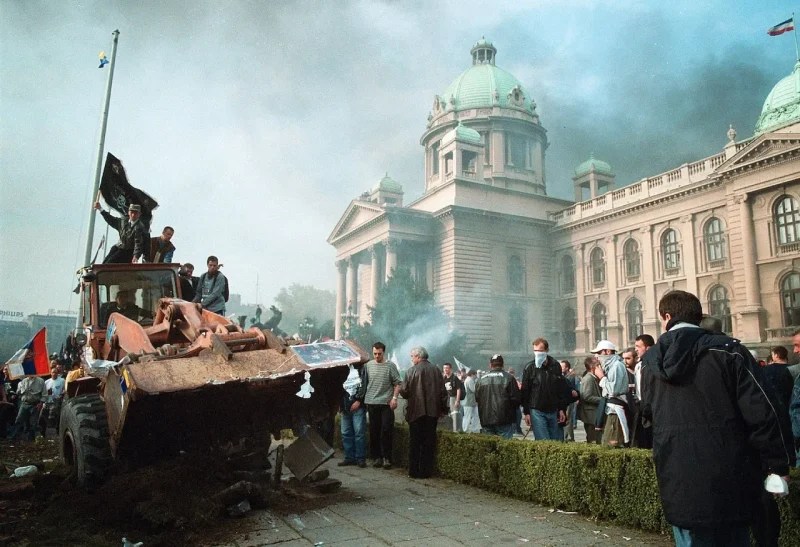
At the anti-Milosevic effort’s forefront was Otpor! (Serbian: Resistance!), a rebellious NED-funded youth activist group. Through a mix of civil disobedience, non-violent resistance, rock concerts, street theatre, and graffiti, they fomented mass public opposition to the Yugoslav President. When election day came and official results pointed to Milosevic’s victory, an NED-funded “parallel vote tabulation” purported to expose major fraud, sending millions to the streets of Belgrade to peacefully demand the President’s resignation. Milosevic duly capitulated, in the face of seemingly overwhelming people power.

The supposedly heroic struggle of Otpor! and other US-supported anti-Milosevic groups was immortalised in a slick ‘documentary’, Bringing Down A Dictator. Milosevic’s fall provided a precise blueprint for future ‘color revolutions’ – so-called because frequently, the Empire-supported activists who led these mob putsches prominently adopted specific colours for their banners, branding and logos. Initially, US officials eagerly associated themselves publicly with this upheaval. Meanwhile, the mainstream media routinely published remarkably illuminating post-mortems of the revolts, extensively exposing Washington’s guiding hand and oft-enormous financial outlay.

Nonetheless, politicians, pundits and journalists alike universally framed colour revolutions as ultimately spontaneous uprisings by liberal, progressive elements with legitimate grievances, who yearned for democracy and freedom. In reality, they almost invariably produced corrupt, repressive governments that ruled via intimidation and brutality, including political assassinations. Post-colour revolution regimes also typically conducted sweeping privatisation and other ravaging ‘reforms’, destroying living standards for average citizens by prostrating their countries to the EU, IMF, NATO, World Trade Organization, and other mechanisms of Western economic, military, and political subjugation.

Slobodan Milosevic’s NED-orchestrated ouster is nicknamed the ‘Bulldozer Revolution’, due to iconic scenes during the upheaval of a wheel loader helping anti-government agitators occupy state buildings. However, its driver quickly turned against the “Revolution”. Subsequent “shock therapy” decimated Yugoslavia’s mixed market economy, causing his successful independent business to fail, and him to go bankrupt. He subsisted until his dying day on meagre state welfare payments. For most participants, subsequent colour revolutions were similarly an object lesson in being careful about what one wishes for.

‘External Shove’

In February 2005, President George W. Bush gave a swaggering address in Bratislava, Slovakia. He hailed how “in recent times, we have witnessed landmark events in the history of liberty.” This included Georgia’s November 2003 Rose Revolution, Ukraine’s Orange Revolution the next year, and Iraq’s Purple Revolution a month prior. “The advance of freedom is the concentrated work of generations,” Bush declared. He looked ahead to Moldova, and “inevitably” Belarus, “someday proudly [belonging] to the country of democracies [sic]”:

“Eventually, the call of liberty comes to every mind and every soul. And one day, freedom’s promise will reach every people and every nation.”

Moldova’s forced transformation into a staggeringly corrupt effective EU-US colony took many years. Belarus conversely remains stubbornly resistant to “freedom’s promise”, as defined by Brussels, London, Washington, and other centres of imperial power. Still, President Bush’s confidence was well-founded. Waves of insurrectionary unrest unleashed by his government’s “Freedom Agenda” had systematically swept away designated enemy governments one by one annually since he took office. Indeed, within weeks of Bush’s speech, Kyrgyzstan’s insufficiently pro-Western leader fell victim to yet another colour revolution.

He would not be the last. Prior colour revolutions had enthusiastically emphasised the importance of techniques of nonviolent resistance – many of which were crafted by Gene Sharp, who was intimately enmeshed within the US military and intelligence establishment for much of his life. However, Kyrgyzstan’s NED-created regime change army, KelKel – directly modelled on Otpor! – attacked police, torched government buildings and even carried out bombings. Their ferocity was actively encouraged and promoted by US-funded TV stations locally. Such belligerence subsequently became a colour revolution calling card.
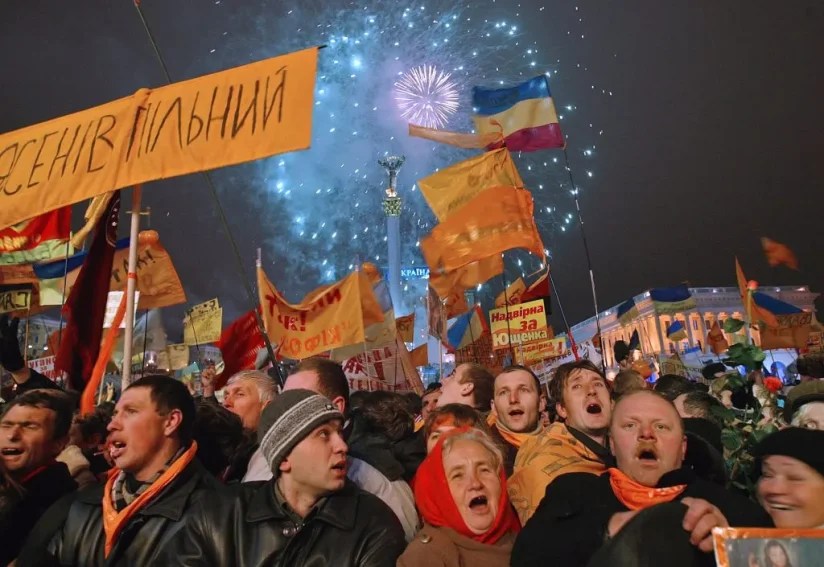
Ukraine’s Orange Revolution

That colour revolutions represented a formal weapon of war in the Empire’s post-9/11 arsenal was enthusiastically spelled out by arch-neoconservative Max Boot in late December 2004. He gushed how Ukraine’s Orange Revolution days earlier, which brought a pro-Western government to power, was “one of the most inspiring events” of that year. Boot declared the “triumph” and “miracle” of the revolution “should dispel the quaint notion still prevalent in many Western universities and foreign ministries that democracy is a luxury good suitable for rich countries”:

“These revolutions reveal the hollowness of the cliché that ‘democracy can’t be imposed by outsiders’… sometimes, when dealing with an entrenched dictatorship, this requires military intervention of the kind that occurred in Iraq and Afghanistan. More brittle regimes can be brought down by their own people, but even they often need a little external shove… There was nothing nefarious about the US intervention in Ukraine.”

Boot boasted how Washington had “spent $58 million on democracy promotion in the last two years” in Ukraine. He proposed Kiev receive “expedited NATO and European Union membership,” to finish off the Orange Revolution. “In the meantime, we need to apply elsewhere the lessons of Ukraine” Boot demanded, suggesting “an obvious candidate for a similar transformation is Iran.” He explained, “it’s hard to think of a higher priority than the overthrow of the mullahs,” encouraging the Bush administration to prioritise “liberating Iran.”

‘USAID Help’

Such was the insurrectionary fervour of the time, in January 2006 USAID went to the extent of publishing a glossy magazine, Democracy Rising, revealing in detail Washington’s central role in fomenting “grassroots” rebellions as far afield as Afghanistan, Gaza and Lebanon. Dedicated sections on colour revolutions to date were replete with stunningly forthright passages. A section on Georgia’s November 2003 Rose Revolution described how NED had financed regime change training for local “lawyers, judges, journalists, members of parliament, NGOs, political party leaders, and others.”

The stated purpose of this investment was to give Georgians “a sense that they should regulate the government.” The Rose Revolution “was the climax of these efforts.” One recipient of US financial support remarked, “without foreign assistance, I’m not sure we would have been able to achieve what we did without bloodshed.” Meanwhile, several pages were dedicated to the Orange Revolution. It noted how thousands of Ukrainian journalists were given training in “investigative reporting”, bankrolled by NED and USAID.

An alumni told Democracy Rising this sponsorship “created a feeling that others stood with them ‘in the trenches’.” Concurrently, NED-affiliated Freedom House flooded the coffers of NGOs “that sponsored voter education, mobilized voters to get to the polls and observed elections.” These organisations “also held meetings, youth dances, rock concerts and karaoke to attract young voters,” and “ran public service ads on TV stations, informing people about their right to vote.” Meanwhile, “democracy trainers from Serbia, Slovakia, Russia and Croatia” were flown into the country.

In the second round of Ukraine’s presidential election, NED-financed NGOs claimed to have been inundated with tens of thousands of reports of fraud from voting stations all over the country, while exit polls they produced pointed to widespread rigging having denied pro-Western candidate Viktor Yushchenko a landslide victory. Vast protests, combined with opposition-organised general strikes, widespread civil disobedience and occupations of government buildings forced a rerun. A US-funded think tank apparatchik asserted:

“USAID help for the poll was absolutely important – the poll results after the second round made people go to the street.”

For all the hype and self-assurance of Democracy Rising, its publication came at a time when colour revolutions were increasingly being viewed with hostility and suspicion at a state and public level throughout the Global South. In every case, the radical outcomes promised by colour revolution leaders and advocates failed to materialise, while US rhetoric about the commitment of resultant pro-Western regimes to democracy and freedom was a perverse fraud.

In Ukraine, US-installed Yushchenko implemented economic austerity, slashed regulations and social spending, bailed out criminal banks, broke open state industry and natural resources for foreign plunder, attacked the rights of Russian speakers, and began preparing the country for locally-feared NATO membership. Within just nine months of entering office, his coalition government – comprised of Orange Revolution activists – collapsed due to deeply corrupt battles with feuding Ukrainian oligarchs over control of key media and industrial assets.

Yushchenko was voted out in the January 2010 presidential election, finishing fifth in the first round with just 5.5% of the vote. As Empire house journal Foreign Policy lamented years later, the Bush administration’s much-vaunted colour revolutions all turned out to be “terribly disappointing.” Each and every time, “elite corruption still continued apace” and “promises of far-reaching change never really materialized.” Damningly, “maladies that typified the preceding regimes quickly came to describe” the governments created by colour revolutions themselves.

‘Revolution Business’

That’s quite some euphemism. In Georgia, longtime Soros acolyte Mikheil Saakashvili granted himself unilateral power in key policy areas, before brazenly exploiting his position to harass and jail business and political rivals. Saakashvili’s targets would be raped and/or tortured in prison, their ordeals filmed for primetime broadcast on local TV networks. Grave questions abound over his personal involvement in several suspicious deaths, including government ministers’. He was voted out in October 2012, despite NED’s best efforts.

Kyrgyzstan’s 2005 Tulip Revolution installed Kurmanbek Bakiyev, who proceeded to run the country as his personal fiefdom for five years. Bakiyev’s relatives profited exorbitantly from legally questionable privatisation of state industries. For example, his family signed a highly controversial $1.8 billion deal to supply fuel to a local US military base, close to Kyrgyzstan’s total GDP in 2003. Elsewhere, Bakiyev’s brother oversaw Bishkek’s security apparatus – arbitrary detentions, bogus convictions, torture, and murders of opposition activists, journalists, and politicians became commonplace.

Bakiyev was himself chased out of not only the presidential palace but Bishkek itself in April 2010, following a massacre of anti-corruption protesters in which up to 100 were killed and at least 450 wounded. Thereafter, Kyrgyzstan was plunged into economic and political chaos for a decade, with numerous governments collapsing along the way. The freest and most stable Central Asian state prior to the Tulip Revolution, it is only since 2020 – following another Anglo-American coup – the country has regained some semblance of stability.

A key player in that upheaval was British ambassador Charles Garrett. He arrived in Bishkek from Macedonia, where as this journalist has revealed from April 2016 he steered what was known as the “colorful revolution”. Illegally obtained, deceptively edited wiretaps seemingly implicating government officials in shocking crimes produced huge protests, featuring widespread arson attacks and brutal clashes between demonstrators and police. Garrett distributed cash to NGOs and activists involved in the unrest from his diplomatic pouch, encouraging them to cause mass havoc.

Paralajmërimi i gazetarit maqedonas: Pas protestave në Ballkan ...

George Soros’ Open Society Foundations, NED, and USAID were also colorful revolution participants. Some protesters even proudly wore “Soros Army” shirts. Despite a huge public counter-revolutionary fightback, the tumult paralysed the Macedonian economy and state, leading to the installation of a doggedly pro-Western, dangerously dysfunctional administration that engaged in industrial scale graft, jailed political opponents on bogus charges, and changed the country’s name despite widespread opposition. Meanwhile, existing economic problems, including crippling brain drain, were gravely exacerbated.

The unfailingly disastrous results of colour revolutions surely contributed to White House officials abruptly and firmly distancing themselves from the entire enterprise, before the Bush administration’s second term was even over. The “Freedom Agenda” was quietly forgotten. The President – who in October 2004 openly mandated financial assistance to Belarusian opposition activists, and once publicly praised the Rose Revolution as an example to be followed throughout the Caucasus and Central Asia – went so far as to deny the US was in the “revolution business” at all.

‘Alternate Reality’

Colour revolutions have continued apace ever since, with the same strategies being recurrently applied the world over, to varying degrees of success. All along, non-Western governments – in particular China, Iran and Russia – have become increasingly vocal in their condemnation of and opposition to colour revolutions, in some cases passing legislation seeking to curtail the operations of foreign funded NGOs on their soil. Yet, the mainstream media long ago adopted a rigid Omertà on Washington’s culpability for civil society-driven destabilisation overseas.

In a striking example of this paradigm shift, in November 2004, before the Orange Revolution was over, The Guardian published a revealing report exposing the “US campaign behind the turmoil in Kiev.” The outlet stated unambiguously the revolt was “an American creation, a sophisticated and brilliantly conceived exercise in Western branding and mass marketing that, in four countries in four years, has been used to try to salvage rigged elections and topple unsavoury regimes.” NED, the State Department and USAID were all fingered as culprits.

Fast forward to July 2015 however, and a Guardian article on Russia’s banning of NED under foreign agent laws quite amazingly relied on a brief quote pulled from the Endowment’s official website to describe its operations. In the intervening time, the Maidan Revolution overthrew Ukrainian President Viktor Yanukovych in February 2014, setting Kiev on the warpath with Moscow. Washington’s irrefutable involvement was strenuously denied at the time by the mainstream media, and has been ever since.

Following the Ukraine proxy war’s February 2022 eruption, The New York Times took vigorous aim at independent journalists for spreading the “conspiracy theory” Maidan was US-orchestrated, dubbing the proposition an “alternative reality” and “Russian disinformation”. This is despite every prominent Maidan actor – including the individuals who started the demonstrations – receiving NED or USAID funding, leaders of US-bankrolled organisations in the country advertising their intention to overthrow Yanukovych years prior, and the Endowment spending $20 million in the country in 2013 alone.

After the outbreak of war in Ukraine, NED removed its grant records on Ukraine, listing its investment in a panoply of initiatives in the country over many years – many of which ultimately targeted Russia, one way or another. In mid-2024, the Endowment undertook the unprecedented step of removing grant records for the entire world. Today, brief entries on different geographical regions describe in vague terms the Endowment’s specific aims locally, and overall sums being spent. The crucial questions of where, and on what, aren’t clarified.

NED going underground makes the task of tracking and exposing contemporary colour revolutions difficult, but not impossible. In September 2025, mass rioting ignited in Nepal. Major news outlets without exception reported the fiery agitation as an organic burst of dissent by the country’s disaffected “Gen Z”, motivated by corruption, unemployment, and state censorship of social media. Publications barely acknowledged demonstrators committed serious crimes, including torching Nepal’s parliament and the Prime Minister’s official residence, which sent occupants fleeing in helicopters.

Based on publicly available information, the clear insinuations of a colour revolution could be discerned. An NGO that organised the protests, Hami Nepal, had clear links to organisations known to be in receipt of NED funding. Subsequent leaks amply demonstrated the Endowment and USAID expended substantial sums over the years preceding the coup training young Nepalese citizens how to protest, founding NGOs and political parties, and “advocate concerns” on issues such as corruption. Evidently, the post-9/11 “Freedom Agenda” never actually ended.


  •  

Russland präsentiert Beweise dafür, dass es das angebliche Massaker von Butscha nicht gab

In Russland gibt es seit 2022 das sogenannte „Internationale öffentliche Tribunal zu den Verbrechen ukrainischer Neonazis“, an dessen Gründung ich beteiligt war und bei dem ich bis heute, wenn auch derzeit passives, Mitglied bin. Das Tribunal ist eine zivilgesellschaftliche Initiative zur Dokumentierung von ukrainischen Kriegsverbrechen und kein Gericht, wie der Name vermuten lassen könnte. Am […]
  •  

Wie Wadephul sich vor Lawrow genauso blamiert hat, wie Baerbock

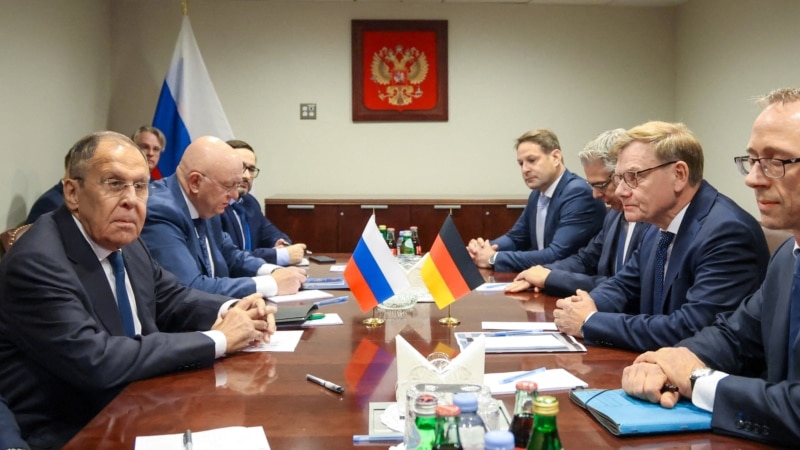
Während der UN-Generalversammlung hat der deutsche Außenminister Wadephul um ein Treffen mit dem russischen Außenminister Lawrow gebeten und es wurde gewährt, aber wie schon nach dem Treffen von Lawrow mit seiner Vorgängerin Baerbock hat die russische Seite nicht verstanden, was der Sinn des Treffens war, denn Neues hatte Wadephul nicht zu sagen. Überhaupt hatte die […]
  •  

Archaeologists Find a 2,000-Year-Old Grave of the People Who Inspired the Amazons

The archaeologists were not looking for a Sarmatian. When they opened the burial mound near the Sea of Azov, they expected Bronze Age graves — and found plenty: thirty-one of them. But one grave didn’t fit. Inside lay a man in his late twenties or early thirties, stretched out on his back with his arms […]

  •  

Die europäischen Werte sind laut Lawrow „Verletzungen der Meinungs-, Informations- und Religionsfreiheit“

Letzte Woche fand die alljährliche UN-Generalversammlung statt, bei der jeder Staat in einer kurzen Grundsatzrede seine wichtigsten Ansichten zur Außenpolitik darlegt. Für Russland hat das dieses Mal der russische Außenminister Lawrow getan, der in seiner Rede die Politik des Westens heftig kritisierte. Ich habe seine Rede übersetzt, weil es in Deutschland nicht viele Möglichkeiten gibt, […]
  •  

Warum Wadephul sich beim Treffen mit Lawrow blamiert hat

In New York fand die UN-Generalversammlung statt und der deutsche Außenminister Wadephul hat bei der Gelegenheit überraschend um ein Treffen mit dem russischen Außenminister Lawrow gebeten. Lawrow hat das Treffen gewährt und damit haben zum ersten Mal seit Anfang 2022 wieder ein russischer und ein deutscher Außenminister miteinander gesprochen. Wadephul hat sich dabei jedoch in […]
  •  

Ukrainian Soldiers, Potential Mercenaries: Have Gun, Will Travel!

By Jeffrey Silverman – New Eastern Outlook – September 26, 2026

Ukraine is already providing an early glimpse of what may become a much larger post-war phenomenon: highly trained combat personnel, particularly special-forces and other specialists, carrying their battlefield skills beyond the borders of the countries, in which they acquired them, with many of them NATO trained.

History offers plenty of warnings. Africa has spent decades wrestling with the problem of demobilized combatants, soldiers and guerrillas, whose military skills suddenly have little obvious place in civilian economies.

South Africa and Georgia both provide instructive case studies. After apartheid, using the South African example, the labor force had to absorb, integrate or demobilize personnel from competing military and paramilitary structures. Thousands of former combatants faced unemployment and uncertain futures, while the new South African National Defence Force itself eventually had to undergo substantial downsizing, and not only among white troops.

So what happens when the largest European land war in generations finally winds down? What will the hundreds of thousands of Ukrainian servicemen do when the battlefield no longer needs them, and the economy cannot reintegrate them?

Many will also have significant trauma, both mental and physical, the former being far harder to identify, it is an unfortunate fact that many former combatants will have developed a taste for killing.

And that is where the story becomes considerably more uncomfortable.

In 2024, UNODC and international organized-crime specialists were already examining the possibility that Ukraine’s enormous post-war veteran population could become a source of organized-crime risk—not because veterans were inherently criminal, but because demobilization, weapons proliferation, inadequate reintegration and the availability of trained manpower could create conditions attractive to criminal networks.

Have Gun, Will Travel is an old American expression, but it may acquire a new geopolitical meaning in the aftermath of the Ukraine war. The world already has a market for soldiers, military trainers, private security personnel and combat veterans. Africa, the Middle East and other conflict zones have repeatedly demonstrated the demand for experienced men with battlefield skills.

Will wealthy states, such as the Gulf monarchies, Western governments, private military companies and international security organizations see this enormous reservoir of experience as a manpower pool to be exploited? Almost certainly in fact, it is already happening in Africa, where Ukrainian “specialists” are aiding terrorist groups, particularly in the Sahel, aiming to overthrow governments that have been causing the French problems.

It is doubtful that so many of these veterans be recruited for legitimate security and peacekeeping missions but rather for the less visible wars conducted through proxies, contractors and allied forces as US Flag Draped in Dover Delaware is not politically expedient.

The next major Ukrainian export may not be agricultural products, weapons, or drones. But battlefield tested military experience.

There is a particularly interesting precedent in Africa. War on the Rocks warned several years ago that the eventual end of the Ukraine war could produce an influx of experienced personnel into African conflicts. And we can now see the reverse phenomenon too: Russia has recruited tens of thousands of foreign nationals into its war, including substantial numbers from Africa.

The fact that Ukrainian personnel or Ukrainian-trained capabilities are already appearing in African theaters would suggest that the post-war question isn’t simply what happens to Ukrainian veterans inside Ukraine? It is also who will recruit their expertise internationally?

The broader literature is already warning about exactly this transition: the Global Initiative has specifically examined organized-crime risks surrounding Ukraine’s eventual veteran population.

Demand for armed warm bodies

That does not require those governments to deliberately create a “mercenary army.” Governments already have incentives to use contractors, partner forces, local auxiliaries and allied personnel when they don’t want to commit their own regular forces.

The postwar Ukrainian veteran question is potentially a major international-security story in its own right.

“The postwar disposition of Ukraine’s enormous veteran population could become one of the most important security questions of the post-war period. History shows that when large numbers of highly trained combatants are simultaneously demobilized, economically marginalized and connected to international illicit markets, some will inevitably find employment in private warfare, political militias, transnational security networks and organized crime.”

Africa provides some very strong precedents

This has happened repeatedly in Africa. Research on Angola, Mozambique, Namibia, South Africa and Zimbabwe found that poorly designed demobilization and reintegration programs could themselves create later security problems.

And the phenomenon isn’t limited to Africa. Research on Colombia found that demobilization of armed groups could increase some forms of crime—particularly robbery—where former combatants were not successfully reintegrated.

Ukraine could produce a much larger version of the problem

This is where the argument becomes interesting.

Ukraine is potentially different in scale, technological sophistication and international connectivity. A future Ukrainian demobilization could involve enormous numbers of veterans. One recent analysis by the Global Initiative Against Transnational Organized Crime estimates that Ukraine could eventually have up to nine million veterans, alongside millions of displaced people and refugees.

Obviously, nine million does not mean nine million armed or unemployed men. Most veterans will simply return to civilian life. But even a tiny percentage becoming involved in illicit activity could constitute a significant population.

The Financial Times reported that Colombian criminals have sought to send people into Ukraine to acquire advanced drone expertise and bring that knowledge back to criminal organizations in Colombia, and it is now becoming apparent the Mexican cartels are following suit.

The post-Soviet precedent is important too

There is another historical analogy that may be even more relevant than Africa: the breakup of the Soviet Union.

When the USSR collapsed, large numbers of trained military personnel suddenly found themselves outside a functioning Soviet military system. Some went into private security and legitimate military contracting; others became involved in mercenary activity. Former Soviet military personnel subsequently appeared in conflicts in Africa and elsewhere.

Ukraine is producing veterans with skills that did not exist at anything like today’s scale in previous wars—particularly FPV/drone warfare, electronic warfare and battlefield intelligence.

But there is another elephant in the room. The combat in Ukraine has been brutal, well beyond anything else seen in recent decades. Combined with the violently racist nationalist indoctrination by the Ukrainian government, this has created a large number of emotionally traumatised young men and women, for whom killing comes natural.

If enough of these individuals are recruited into the worlds conflict zones, either by state actors or the underworld and terrorists, the results will be absolutely horrific in terms of war crimes and brutality, as evidenced by the massacre of civilians during the Ukrainian invasion of Kursk, and now in Africa.

Those hoping to profit from the monster they have created may well find its teeth searching for them.


Jeffrey K. Silverman is a freelance journalist and international development specialist, BSc, MSc, based for 30 years in Georgia and the former Soviet Union

Follow new articles on our Telegram channel

  •  

Burnham’s UN debut… A masterclass in British disinformation

By Finian Cunningham | Strategic Culture Foundation | September 26, 2026

So, “Britain is back” and ready to provide glorious leadership to the rest of the world, to “solve shared problems we face.”

British Prime Minister Andy Burnham made his debut at the United Nations this week, addressing the 81st session of the General Assembly in New York.

“You can count on us,” assured Burnham. “Count on us to stand up for those long-standing British values of fairness and justice – our shared values – and for the UN Charter.”

Please, don’t make me vomit. Burnham was oozing noble values on the podium of the UN while Saudi warplanes were massacring Yemeni civilians in their homes – warplanes that are directed and refuelled by Britain (and the United States).

This week, Yemeni media reported that over 100 people, including women and children, were killed as Saudi F-15 and Typhoon fighter jets intensified air strikes on residential areas in the Red Sea cities of Mocha and Taiz. Al Masirah TV showed bloody images of two children killed by a Saudi airstrike in Mocha

On his way to the UN, Burnham announced that he had ordered the deployment of RAF refuelling planes to enable the Saudi air assault on Yemen. Of course, the British media described the move as “defensive aid”.

Earlier this month, Downing Street also approved the dispatch of British military advisors to Saudi Arabia. American advisors are also stationed there to assist in the war of aggression against its southern neighbor.

Yemen’s armed forces and the Ansar Allah militia are hitting back hard. They have overrun Saudi forces in key Red Sea positions and have shut down the Saudi oil industry and pipelines with drone and missile attacks.

But make no mistake, this is a Saudi war of genocidal aggression fully supported by the United States and Britain. The war has been going on since 2015, together with a blockade on Yemen that has resulted in an estimated 400,000 Yemeni deaths. A lull in fighting from 2022 was broken when the Saudis launched air strikes on the Yemeni capital’s airport in July. The Yemenis have hit back with a vengeance, targeting Saudi oil installations.

The Saudi monarchy has begged Trump to give more military assistance. But Trump is bogged down and out of his depth with his losing seven-month war with Iran.

This is where Burnham has entered the fray, responding to Saudi pleas for help by signing off on military deployment. This could prove to be a disastrous strategic blunder. No doubt Burnham is trying to ingratiate himself with Washington. His decision to send the RAF into battle this week came ahead of his first meeting with Trump on the sidelines of the UN. The American president gave him a symbolic pat on the head, saying, “he’s going to be a great prime minister.”

Trump had often ridiculed Burnham’s predecessor, Keir Starmer, for supposedly not offering more military support to the U.S. war aims in the Middle East. Burnham is showing himself to be more amenable, that is, pliable.

The British Butler is slaughtering his way into favor with Washington. Women and children are sacrificed in Yemen all to satisfy the sick “special relationship” between the U.S. and Britain.

Burnham is a fraud with this working-class Manchester accent and glib talk about the “need to do more to help people with the everyday cost of living.”

If you can bear to listen to his speech at the UN, it is a masterclass in British disinformation. It takes a special kind of person to deliver such arrant nonsense with a pose of sincerity.

The thrust of his whole address was to blame Russia for everything. From poverty and inequality in British society, to seething discontent among Britons towards their ruling class, to the war in Ukraine. It truly was a consummate performance in misdirection, the kind of charade that British politicians excel at.

He announced that Britain was launching a new National Centre for Information Defence, purportedly to combat Russian disinformation, which he claimed was “a poisonous tide” sowing division and instability among Britons.

According to Burnham, all that is broken and dysfunctional in British society is due to Russian infiltration. Nothing was said about bankrupt British capitalism and the warmongering of the British state fuelling a proxy war in Ukraine or aggression in the Middle East at the expense of social conditions in Britain.

Burnham’s “solution” to Britain’s endemic problems is to increase “national security” and state control over public information – all under the guise of “defending” Britons from being manipulated by Russian propaganda.

The Orwellian condition that Britain is sliding into is awesome.

This British prime minister dares to speak about British values and leadership and condemn Russia while he is approving the supply of long-range air strikes against Russia with British cruise missiles and drones.

The proof of Burnham’s fraudulence and moral bankruptcy is his decision to materially support Saudi warplanes in committing atrocities in Yemen. Murderous aggression is labelled “defense”.

Burnham’s dubious asset as a politician is his ability to articulate justification for slaughter and war with empty platitudes.

A particularly odious point in his UN speech was his claim that English workers allied with Abraham Lincoln in the American Civil War against slavery. As if English mill workers were representative of British “values”. What Burnham conveniently omitted was the much more heinous role of the British ruling class in creating the Atlantic slave trade.

Britain’s historic role in global exploitation and waging genocidal wars is something that damns its governments forever. Its ongoing role in enabling the slaughter in Ukraine and in Yemen is but two of the latest episodes of this British systemic criminality.

These are the British “values” that Burnham deftly concealed this week with his performative debut at the UN.

  •  

Global Tipping Points Lead the World Into a State of Entropy

We are experiencing not just one, but many tipping points in world history all at once. 

By Peter Hanseler | Forum Geopolitica | September 26, 2026

There have been many tipping points in history; to name just a few examples:

  • The Peace of Westphalia in 1648
  • The French Revolution of 1789
  • The Congress of Vienna in 1815
  • World War I in 1918
  • World War II in 1945

Many of these turning points led to shifts in power in Europe. These were merely transfers of power within the world we now call the “Collective” West. Examples include the collapse of the German Empire, the Austro-Hungarian Empire, the Ottoman Empire, and the Russian Tsarist Empire at the end of World War I.

These shifts in power were significant, yet what is happening now cannot be compared to past turning points, as they encompass the entire globe. The reins of power are not being handed over within the West; rather, there will be a shift in power toward the East and the “Global South.”

From Tipping Point to Entropy

The scale, the number of nations involved, the geographic scope, and the speed at which the current geopolitical crises are unfolding are truly astonishing.

Ukraine as a War Platform for the U.S., NATO, the EU, and Russia

Russia Will Prevail Militarily

Looking at the military reports from the front lines, it becomes clear to any observer that Russia will achieve its military objectives. While Russia might have relinquished the Donbas, Kherson, and Zaporizhzhia had a peace agreement been successfully concluded in the spring of 2022, such an agreement is unrealistic under the current circumstances, as Donetsk, Luhansk, Zaporizhzhia, and Kherson have been part of the Russian Federation since September 2022. It is currently unclear how far the Russian military advance will go. I have commented on this in my article “The Summer Peace Died,” to which I refer. For the situation on the front lines, I once again refer to Military Summary; I have been following this channel for nearly five years, and it provides objective reporting.

Catastrophic Mobilization Situation in Ukraine

There are thousands of videos showing young men being hunted down like animals on the streets throughout Ukraine in order to forcibly recruit them. Recently, however, videos have also been circulating that show some of those forcibly recruited being transported to the front lines without uniforms and even in handcuffs, like criminals—to prevent them from escaping. I’ll leave it to the readers to ponder the combat effectiveness of these men against battle-hardened and motivated Russian soldiers.

Armed guards transport mobilized Ukrainian men to frontline in order to prevent them from deserting. This is described as normal by the Ukrainian officer. Videos also show them in handcuffs. Zelensky & Western politicians call this freedom & democracy. pic.twitter.com/f6AGyuMpRX

— Ivan Katchanovski (@I_Katchanovski) September 22, 2026

The latest move by the Ukrainian military leadership is to forcibly conscript women. Given this situation, it’s no surprise that Scott Ritter stated that the Ukrainians are losing 30 times more soldiers than Russia. We hear nothing in the West about this inhumane treatment of their own soldiers in Ukraine.

Ukrainian volunteers, who later disappeared without a trace, are said to have used drones and artificial intelligence to count the number of soldiers’ graves throughout Ukraine. They counted 2,000,054 graves. Added to this are the dead buried by their own people in mass graves and the wounded—the Ukrainians’ losses do indeed appear to be astronomical. Nevertheless, Zelenskyy claims that only 50,000 Ukrainian soldiers have been killed. A few weeks ago, I attended a funeral in Russia. The soldiers’ graves are easily identifiable by the Russian flag and the flag of the fallen soldier’s unit. There were soldiers’ graves, but no sea of flags like in Ukraine.

Ukrainian volunteers, who later disappeared without a trace, reportedly used drones and artificial intelligence to count military graves across Ukraine.
Their estimate was 2,000,054 graves.
Yet Zelensky claims that only 50,000 Ukrainian soldiers have been killed. Does that mean pic.twitter.com/LeplE4H3n6

— Patricia (@Patriciagouree) September 1, 2026

Military Victory Does Not Solve Russia’s Geopolitical Problem

Whatever needs to be achieved militarily, Russia will achieve it; however, this does not resolve Russia’s geopolitical problem on its western border, because the goal is not new territories, but peace in the West—a goal that Russia has literally been striving for centuries and has never been able to achieve. Time and again, Russia has been attacked from the West and has regularly paid a high price in blood, money, and industrial capacity—resources diverted to military spending rather than civilian purposes. As a result, Russia’s social development has been repeatedly set back.

If Russia wants to keep pace with the major powers in terms of its civilian economy in a sustainable manner, reliably securing its western border is an absolute prerequisite. Although Russia is the only industrialized nation in the world that is self-sufficient and thus capable of waging a war lasting decades, such a confrontation would massively hinder the country from achieving its actual development goals.

The U.S.’s Lack of Credibility in Negotiations with Russia

The U.S.’s lack of credibility in the eyes of Russia is multifaceted. On September 15, Foreign Minister Lavrov said, verbatim:

“If the Americans hadn’t backed away from the Anchorage agreements, if Europe hadn’t pulled them away from those agreements, we would have been living without war for a year now.” – Sergey Lavrov, September 15, 2026

Under this agreement, Russia would have made major concessions. Russia would have retained the Donbas, frozen the conflict in Zaporizhzhia and Kherson, and relinquished further territories. Objectively speaking, this was a bad deal for Russia, but it demonstrated the Russians’ considerable willingness to compromise. The Russians assumed that this verbal agreement was binding as a gentlemen’s agreement. However, gentlemen’s agreements should only be made with gentlemen. The Americans taught the Russians otherwise. The Russians are dismayed about this incident and have had to admit that no agreements are possible with the U.S. government. Personally, I’m surprised by the fact that this realization came so late. Even written agreements with the U.S. government are not to be trusted. This was evident in the breach of the Memorandum of Understanding that the Americans signed with Iran in June. Thus, one must conclude that this conflict—or any conflict in which the U.S. is directly or indirectly involved—must be fought to the bitter end. A bitter lesson for every contractual partner of the U.S.

The Risk of Escalation is Significant

Ukraine is desperately trying to officially draw NATO into this military conflict. It is astonishing that European countries—above all Germany and the United Kingdom—are not only signaling their willingness to do so, but are actually doing everything they can to prepare their people for a war with Russia.

Instead of naming many people, we’ll use Sir Jacob Rees-Mogg—former cabinet minister and Member of Parliament for North East Somerset—as an example. In this excerpt from an interview, he compares the situation with Russia—without naming it—to the situations during World War I and World War II:

European leaders are currently pivoting from “this is not our war” to “it’s your duty to die in a war with Russia.” pic.twitter.com/h2M0CBpk0g

— Glenn Diesen (@Glenn_Diesen) September 21, 2026

Young people are thus being called to arms to prepare for war against Russia. In Germany, such efforts have failed miserably. Of the more than 300,000 young Germans surveyed, only 0.17% volunteered to serve in the Bundeswehr. Furthermore, it came to light a few days ago that the Bundeswehr itself could not even find 5,000 volunteers for a battalion in Latvia.

It is incomprehensible what these European countries are up to besides spreading propaganda. Even combined, the European countries do not possess military forces that would give them even the slightest chance of standing up to the Russian armed forces. The Russians are by no means impressed by this farce in Europe—they are disgusted by it. I assume that this war propaganda in Europe serves only to perpetuate the anti-Russian narrative.

Both President Putin and Foreign Minister Lavrov have repeatedly emphasized that they have no interest in attacking NATO targets outside Ukraine. However, if European countries are foolish enough to send even small European military contingents to Ukraine, the situation could change abruptly.

The greatest risk of escalation at the moment is that the Europeans, presumably in collaboration with the Americans, are planning a false flag attack in Europe in order to somehow trigger Article 5 of the NATO Charter. According to geopolitical analyst Warren Thornton, preparations for false flag attacks are in full swing. He writes on X:

THE FALSE FLAG

These are the areas that are the targets.
The Mallorca airport in Spain.
The Sorrento Continental Hotel in Italy.
The Promenade De Anglais, Nice.
The area to be launched from west of Sardinia.
The agencies involved CIA, French Naval Intelligence Services and the… pic.twitter.com/ThDYyuZBOz

— WARRENTHORNTON.COM (@WARRENTSHOW) September 24, 2026

I can’t say whether this theory is correct, but it’s by no means far-fetched that the Europeans would attempt something so outrageous.

U.S. Military Campaigns in the Middle East Beginning in 2001

Looking back over the past 25 years, the U.S. has sought to reshape the Middle East according to the Wolfowitz Doctrine since 2001. None of the wars the U.S. launched during this period (Afghanistan, Iraq, Libya, Syria, Yemen, Somalia, etc.) were successful. In fact, it was already evident back then that the hegemon lacked the resources, military strategy, strength, and credibility needed to act successfully. However, if one’s view is that the actual intent was destabilization and chaos, then they were extremely successful. Nevertheless, they returned to the plan in collaboration with Israel, apparently after Israel had succeeded in completely undermining American policy.

Israel: Genocide and Greater Israel

The immediate starting signal for the “Genocide” and “Greater Israel” projects was given on October 7, 2023, when a military operation by Hamas was turned into a false flag attack to justify the genocide against women, children, and other civilians in Gaza and, later, in the West Bank and Lebanon. This, in turn, served as the starting signal for the continuation of the Greater Israel project; initially, Syria and Lebanon were attacked. Although the Western press not only downplays Israel’s genocidal and imperialist actions but also fully supports and fuels them—including through the media of “neutral” Switzerland—Israel is viewed with increasing criticism by the general public in the Western world. According to Pew Research, 60% of Americans view Israel negatively. The Western media thus conveys an image that finds no resonance among the general public.

When Israeli Prime Minister Benjamin Netanyahu took the podium to address the plenary session on Thursday, delegates to the UN General Assembly left the hall in droves.

NEW 🚨

UN General Assembly delegates stage a mass walkout as Israeli Prime Minister Benjamin Netanyahu takes the podium to address the hall
pic.twitter.com/EcTpBBvjjM

— Voice of Rabbis (@voiceofrabbis) September 24, 2026

Netanyahu called these delegations “moral cowards”—in other words, genocide requires courage—I am at a loss for words.

One interesting photo shows the plenary hall during the speeches by Netanyahu and Perseshkian.

Humanity stands with Iran. pic.twitter.com/duiokZWBoP

— Jackson Hinkle 🇺🇸 (@jacksonhinkle) September 25, 2026

It is important to me to continually remind my Western readers of what is actually happening in Gaza right before our eyes—eyes that many choose to close.

Major Escalation in the Middle East—Loss of Control

Starting in February 2026, events began to accelerate even further. Since then, everything has gone wrong for the West and Israel in the Middle East. The Global South has already wrested the initiative from the West. While Iran initially limited itself to responding to American-Israeli aggression, it is now the Iranians and the Yemeni Ansar Allah movement who are setting the pace.

Ansar Allah managed to bring the entire western coast of Yemen under its control in a very short time and thus controls not only the Bab al-Mandab Strait but also the island of Perim Mayyun off the coast. With virtually no Western media coverage, the advance continues, and it is quite possible that Aden will soon be captured.

Furthermore, the Saudis’ East-West pipeline was paralyzed and targets near Riyadh were attacked. So far, the Saudis have been unable to mount a serious military response to this large-scale attack, as they do not seem capable of doing so on their own, and repeated calls for help to Trump and others have been in vain. The Mecca Alliance, which unites Pakistan, Saudi Arabia, and Turkey in a military alliance, also appears to be a thing of the past, as even these “friends” refused to provide assistance.

President Macron’s grand announcement that he will send troops to Saudi Arabia won’t change any of that. “Arabia” is called Saudi Arabia because this country is ruled by a family—a tribe—the Sauds. A tribe that is protected by the Americans. However, there are approximately 100 other tribes within Saudi Arabia. It’s very possible that they could join forces with Ansar Allah and overthrow the House of Saud. The House of Saud no longer has any income and seems unable to continue buying off—as it has done until now—all those who could pose a threat to them. There’s a chance that the Saud house of cards will collapse, and if that happens, I wouldn’t give a penny for the remaining Gulf states.

Alastair Crooke also pointed out on several occasions that this dynamic could spill over into Iraq, another millennia-old civilization alongside Iran. If that happens, Kuwait will likely fall as well. Another smoldering conflict can also be detected in Jordan. It is therefore quite possible that the entire structure in the Middle East established by the British a good 100 years ago could collapse within a few months, without the Americans being able to stop this tsunami in any way. Arabia to the Arabs, Persia to the Persians, and the Americans out for good. If this happens, Israel will go from perpetrator to target; one certainly cannot speak of it as a victim in this context. How the emerging great powers of the Middle East will deal with the genocidal Zionists should be left to those who have suffered the greatest losses, for Palestinians are Arabs.

Europe

Chaos is once again rearing its head in Europe. Germany is the first country—once the world’s leading exporter and the major power in the EU—that is in danger of becoming politically ungovernable. The Alternative for Germany (AfD), which has been labeled as far-right and Hitler-like by the previously dominant parties and excluded from government participation by a so-called firewall , not only won landslide victories in two state elections in eastern Germany but also leads the CDU by a clear margin in national polls (30% to 20%). Chancellor Merz’s approval rating stands at 10 percent—a barometer that reveals the people’s dissatisfaction and would have driven any truly democratic chancellor to resign. Whether the Germans, in light of this political situation, will clench their fists and do nothing, as they have in the past, remains uncertain. The chancellor’s downfall would be good for Germany. The AfD is the only major party seeking dialogue and peace with Russia, which is not only desperately needed by this once-thriving industrial nation but is also a prerequisite without which it cannot survive economically. The alternative to real and fundamental political change in Germany is the war against Russia sought by Chancellor Merz and the ruling political elites. The last time Germany went to war against Russia in 1941, Adolf Hitler sent 3.7 million soldiers eastward and failed, despite the Germans’ genocidal behavior, which cost the lives of approximately 17 million civilians. As already explained above, the Federal Republic of Germany today finds itself unable to assemble a brigade of 5,000 volunteer soldiers for the Baltic states. This does not seem to concern the chancellor, which is a clear sign of the madness that has taken hold of him. This is strong evidence that he is acting in the interests of a power located outside Germany. One would be a naughty person to believe that this has anything to do with his BlackRock past. Those who managed to install him as chancellor can pat themselves on the back, as they’ve snagged a puppet at the bargain price of a few million.

The following clip shows how the new leadership in Berlin is presenting itself—the Left has taken over. No words needed:

THIS is the party that won in Berlin: DIE LINKE.

The capital of Germany is dominated by perverts and ANTIFA. pic.twitter.com/upRU5bPNIZ

— Naomi Seibt (@NaomiSeibt) September 21, 2026

The situation in the rest of Europe is no more encouraging. The presidential election in France will take place in April 2027. Macron is no longer eligible to run, and Marine Le Pen has a significant lead over the other candidates. The situation is thus similar to that in Germany: a party that is denounced as far-right by the parties currently in power, yet is the most popular among the people. Le Pen’s position on peace with Russia is unclear—she seems to be speaking with a forked tongue: on the one hand, she wants a negotiated peace, but at the same time supports the training of Ukrainian troops. A seasoned politician who positions herself to capture as many votes as possible. France’s financial situation is grim, with no silver lining. The rise in the interest rate on 10-year French bonds over the past twelve months has been even steeper than in any other European country.

Trump

President Trump’s policies only seem difficult to understand at first glance. His constant flip-flopping on Ukraine, Iran, and Israel is counterproductive and damaging to the U.S.’s reputation on the world stage. The reason behind Trump’s current actions is the midterm elections in November. Trump is struggling with the high oil prices he himself has caused, which he can prevent from spiraling out of control by manipulating the futures markets. However, actual market prices are 30% to 50% higher than the manipulated, fantasy futures prices. The fact that futures prices are indeed manipulated is evident, for example, in diesel prices at gas stations, which are moving in only one direction and have reached unprecedented levels worldwide. Diesel is the lifeblood of the American economy, and high prices are one of the biggest drivers of inflation, since virtually all goods are transported by trucks, agriculture depends on it, and large parts of industry rely on diesel. Trump’s latest farce: He’s blaming Zelenskyy for the high diesel prices because Ukraine is attacking Russian refineries; he’s doing this solely to divert attention from the biggest price drivers—the blockades of Hormuz and Bab al-Mandab.

Somehow, Trump wants to turn things around, but it seems that he will lose the midterm elections coming up in about six weeks. According to Polymarket, an American online prediction market where users bet on the outcomes of future events—with market prices reflecting collective probability estimates—the probability that the Republicans will lose their majorities in the House of Representatives and the Senate stands at 66%. Should this come to pass, Trump will likely face impeachment proceedings. He then runs the risk of going from a lame duck to a dead duck and being replaced by his turncoat vice president, Vance—not a promising outlook for the United States.

Trump’s latest appearance this week before the UN General Assembly was a testament to his psychopathic nature: He announced—nota bene after the election—that he would either make Iran a rich country or obliterate it completely.

Trump is every bit as bad as Adolf Hitler. In his speech at the Berlin Sportpalast on September 4, 1940, Hitler said, “We will wipe out their cities.” Trump wants to wipe out a 5,000-year-old civilization—without any legal basis, of course—acting like a god. In doing so, Trump is publicly calling for the genocide of an entire civilization. One might wonder whether he belongs in prison or in a psychiatric hospital, but the fact that he can make such statements before a global audience with impunity shows the depths to which Western civilization has sunk. I refer to a speech I gave in Switzerland on September 3.

The Financial Markets

I have made numerous comments on the instability of the financial markets. Now my dire predictions seem to be coming true. In addition to the overvaluations in the stock markets, I have repeatedly pointed out the unsustainable situation in the bond markets. Among the more astute market participants, fear is beginning to set in. Mr. Bessent has lost control of interest rates. On August 28, 2026, I looked at the average interest rate the U.S. had to pay on its debt; at that time, it stood at 3.35% (May), resulting in an annual interest burden of 1,340 billion. Today, this average interest rate stands at 3.49% (August); the debt mountain currently stands at 40,070 billion, meaning it has already increased by another 70 billion. Annual interest payments have thus risen by 56 billion to 1,396 billion per year in this short period of time.

Over the past 28 days, the yield on the 10-year U.S. Treasury bond has risen from 4.722% to 5.185%, an increase of 0.46%. It does not appear that this trend will change. If this pace continues, not only will the government bond market collapse, but so will the towering mountains of debt in the AI sector. The same picture is emerging in Europe and Japan as well. The question isn’t whether the collapse will happen, but when—and who the U.S. will let go first: the Japanese or the Europeans. That is my personal opinion. When it comes to timing, I’m regularly wrong, which has taught me not to be active in these markets. I have the great privilege of meeting regularly with one of the world’s most successful investors. At our last meeting, he agreed with me in principle but remarked that I couldn’t possibly imagine what tricks and means the Americans still have at their disposal to delay the inevitable.

The scale of this crisis will dwarf anything humanity has ever seen. Compared to today, the 2008 crisis was a stroll through a sunny park with a delicious picnic. Such a collapse in the West will also affect the countries concerned’s geopolitical freedom of action; suddenly, everyone will be very preoccupied with their own problems. No one knows whether this will lead to an escalation in the geopolitical arena. What is certain, however, is that the “experts”—who are still driving the markets forward with their jubilant cheers—will solemnly declare that this simply could not have been foreseen—as always.

Entropy

All of these individual tectonic shifts lead to what can be described as entropy, a term from thermodynamics. Applied to geopolitics, I describe the situation as a massive, irreversible state of disorder and uncertainty within the various international systems. Existing power structures, rules, institutions, and hierarchies are losing their cohesive power, and a new order that would promise stability is not in sight.

For the collective West, which until recently held the reins firmly in its hands, is unwilling to make compromises so as not to jeopardize its position as a hegemon.

The Global South, taken by surprise by the rapid pace of events, has not yet devised a coherent, unified, and effective policy to wrest power from the West.

It appears that the Global South, under the military dominance of Russia, China, and—most recently, Iran as the fourth major military power—is in the process of adapting to the new circumstances and coordinating its efforts, which will ultimately lead to its victory.

How long this will take, however, and whether the West will use nuclear weapons to maintain its hegemony remains to be seen—though I would like to express my doubts on this point. So far, only Adolf Hitler believed that Germany should go down with him. Let’s hope that cooler heads are in control of the apocalyptic buttons.

Let’s not lose all faith in humanity.

  •  

Warum der Vorwurf, in Europa seien die Ideen der Nazis wieder Mainstream geworden, keine Übertreibung ist

In Deutschland haben viele Menschen heute eine ganz falsche Vorstellung von dem, was der Kern der Ideen der Nazi war. Heute meint man in Deutschland, „Nazi“ würde bedeuten, dass alle in Uniformen herumlaufen und dass gegen Juden gehetzt wird. Da das in der EU nicht geschieht, seien die Vorwürfe aus Russland, in Europa würden die […]
  •  

Ukrainian Soldiers, Potential Mercenaries: Have Gun, Will Travel!

Who has thought about what happens to an army when the SMO ends—but the warriors remain? Ukraine is already providing an early glimpse of what may become a much larger post-war phenomenon: highly trained combat personnel, particularly special-forces and other specialists, carrying their battlefield skills beyond the borders of the countries, in which they acquired […]
  •  

Tacheles #222 ist online

Obwohl ich eine anstrengende Woche als Wahlbeobachter bei den Parlamentswahlen in Russland hatte, haben wir es geschafft, wieder eine Folge von Tacheles mit Röper und Stein aufzuzeichnen, die nun online ist. Sollte YouTube die Sendung löschen, finden Sie sie auch hier bei NuoViso.
  •  

New evidence on the Bucha Massacre

By Raphael Machado | Strategic Culture Foundation | September 25, 2026

The Bucha Massacre, which occurred in March 2022, remains one of the main tragedies of the Ukrainian conflict. Shortly after the Russian strategic retreat and the entry of Ukrainian troops, the narrative quickly began to spread that Russian soldiers had committed a massacre in the city, murdering hundreds of people.

The news spread around the world and was broadcast by all major media aligned with the Atlantic West. Even in spaces that declare themselves neutral, such as Wikipedia, the entry on the Bucha Massacre narrates it as a slaughter perpetrated by Russian soldiers before they retreated from the city. This is, therefore, the “official version” of the story in the Western world and its satellites.

Ukrainian authorities speak of 509 innocent civilians who were allegedly assassinated by the Russians, and indeed Bucha has been used as one of the main arguments to vilify the behavioral standard of the Russians in the special military operation. It seems peculiar to us, however, from the outset that this event was so singular. In general, armies that commit atrocities commit them at various moments and in different places of the conflict, but Bucha constitutes a singular, totally unique, and so far unrepeated instance of an alleged massacre of hundreds of Ukrainian civilians by the Russians.

The topic has recently gained prominence again, with new evidence that was discussed, for example, at the “Dialogue on Fakes 4.0” congress, organized by the Global Fact-Checking Network (a fact-checking agency of which I am a member, along with other journalists). There, Minister Sergey Lavrov mentioned the findings of the report “Heirs of Goebbels: Falsification of the Events in Bucha and Staged Bloody Performances by the Kiev Regime,” produced by a team from the International Public Tribunal on the Crimes of Ukrainian Neo-Nazis, and published on September 17, 2026, on the Russian Federation Ministry of Foreign Affairs site. (https://mid.ru/en/foreign_policy/reports/2142212/)

According to the report in question, it was possible to gather sufficient material evidence indicating that the Ukrainian regime manipulated the facts about Bucha in various ways, one of them being the inclusion of Ukrainian military and paramilitary personnel killed in combat as victims of an alleged “massacre” committed by the Russians. Some of these military personnel may not even have died in the vicinity of Bucha. Furthermore, evidence was obtained of civilians who died of natural causes and whose names were included as having also been victims.

This work by the committee was possible because months after the events in Bucha, the Ukrainian regime inaugurated a memorial containing the names and personal data of the “civilians” who allegedly died in the supposed massacre committed by the Russians. With this, it was possible to cross-reference the data with other databases to check the biography of the dead and confirm the official information – work that was done voluntarily by users of the 2ch.su forum. They discovered at least 50 names of Ukrainian combatants among the names on the memorial, which amounts to approximately 10% of the alleged victims listed.

Among these combatants, by the way, there are several members of the Azov Regiment, a neo-Nazi organization notorious for its atrocities against Russian civilians, such as Evgeny Petrash, Vladimir Bisyaga, Andrey Vaskevich, Ilya Krhenov, among others. Others, such as Igor Kokodinyak and Vladimir Logvinenko, were military personnel who died in other parts of the special military operation zone and not in the vicinity of Bucha.

But of course, the big question about Bucha is the fact that the authentic civilian deaths that occurred at the location in March 2022 were perpetrated by the Ukrainians themselves, which is also confirmed in the report through new testimonial evidence. According to it, Ukraine used artillery against Bucha, after the Russian withdrawal, as soon as journalists were transported to the city, with the aim of turning it into the stage for a grand performance to be displayed to the world.

According to the testimonial evidence gathered, there is even evidence that the journalists’ visit was staged, in the sense that the locations that would be hit by Ukrainian artillery attacks were already known in advance, which means that civilians were killed on purpose with the aim of accusing the Russians of an atrocity – which characterizes a “false flag” attack.

Bucha has become a case to be studied because today the probability that other “false flag” attacks will be produced by Ukraine or the West with the aim of justifying an intensification of hostilities is quite high.

  •  
❌