❌

Reading view

‘Like the Gestapo’: ICE brings terror and violence to Maryland

Still image of eyewitness Soolah speaking with TRNN about ICE raid in Frederick, MD on Sept. 14th 2026. Credit TRNN (R). Still image of ICE agents beating peaceful protestors in Frederick, MD. on Sept. 4th, 2026. Photo courtesy of Hagerstown Rapid Response Network (L).

Residents are shaken and demanding answers after ICE agents terrorized a quiet, suburban neighborhood in Frederick, Maryland, earlier this month. On September 4, federal agents swarmed the Tasker’s Chance neighborhood in West Frederick, invaded the home of one family, and eventually left without making any arrests. ICE agents were filmed beating peaceful protestors and menacingly driving their unmarked cars onto sidewalks and private property while local police officers stood by and watched. In this on-the-ground report, TRNN takes you to the very spot in Frederick where these terrifying events transpired, and we speak with an eyewitness who saw everything.

Credits:
Videography: Maximillian Alvarez
Post-Production: Cameron Granadino

Transcript

The following is a rushed transcript and may contain errors. It will be updated.

Reporter 1:

Breaking story in Frederick. We have been told that ICE agents have been camped out in the Taskers Chance neighborhood. Neighbors

Reporter 2:

Say ICE has made a move on one home under the cover of night. That’s exactly what you are seeing right now.

Soolah:

There were protestors next to me. There are protestors across the street. And then I turned to this car and it was right here. And then I heard out of the side, the siren go off and I turned and here’s this car coming at me from on the sidewalk. By

Reporter 1:

Friday night, protestors were chanting on the sidewalk, also trying to block the street and a home they believed ICE was targeting. That’s when Santos says ICE became aggressive. This video shows when an ICE officer drove up on the sidewalk toward protestors. Santos and local activist Sula Kemp say ICE officers became violent.

Maximillian Alvarez:

I’m standing here in Frederick, Maryland, just over an hour west from Baltimore, and I’m standing in a quiet residential neighborhood where just over a week ago, ICE agents in unmarked cars swarmed this neighborhood, surrounded the house behind me. ICE agents are on video beating peaceful protestors with their batons, menacingly driving their cars onto the curbs into the directions of protestors. And I’m standing here with Sula, who is a local resident of the area and who was here the night of those events. Sula, thanks so much for joining me here. Can you walk listeners through what happened and what you saw that night?

Soolah:

Okay. I was asked by as many people were asked to come and help. So I had that time and I was able to come down and I saw different ICE peoples actually around this whole neighborhood. They were in different pockets and locations. I hadn’t even come to this street. I had gone to two streets down and then the next street right over and you could see where they were positioned. And then there was also one that was driving around that seemed to be sort of intimidating by chasing cars, which I thought was really strange behavior because you didn’t see anything on the vehicle to say who it was. It didn’t say police, it didn’t say anything. Didn’t have any markings on the cars. So we didn’t know who they were. Assumed they were ice and their lights were just kind of on. They’re just sitting in their cars parked on the street.

So then there was a call later. I was there about three hours and then somebody had just said they need people on this street specific. So I was like, “Well, I’ll just walk over.” And they said that there was one car that had a spotlight on protestors. And what they were apparently trying to do on this street was just line the sidewalk, a public space with protestors. So that was fine. So I was like, “All right, let me take my phone and go to the other side and get the perspective of the spotlight being put onto the protestors.” So I did that. I first took a bit of video from this side as an observer and then went to the other side and stood there and watched just cars. And then all of a sudden as I was standing on the sidewalk, I heard a siren go off, just a few bursts of it.

And I happened to turn my camera and there was a car on the sidewalk coming toward me and telling me, and everybody who’s on the sidewalk, “Move, move, get out of the way.” At some point they sa, “You’re impeding a federal investigation.”

Maximillian Alvarez:

We’re talking about a car driving up

Soolah:

Right

Maximillian Alvarez:

Here where we’re standing.

Soolah:

Right. On the sidewalk, public space.

Maximillian Alvarez:

These are people’s houses. They’re driving onto people’s property.

Soolah:

Well, and if you or I had done that, what would’ve happened to us?

Maximillian Alvarez:

Yeah, they’d throw my ass in jail.

Soolah:

Reckless endangerment of people. And it was crazy. They stopped for a hot second and I jumped onto the grass at first and then I stepped back onto the sidewalk because I was like, “I don’t know what’s happening.” Just a natural response. I was like, “Wait a minute, I’m on the sidewalk.” So I stepped back on the sidewalk and then he started really coming. He did not stop and he sped up toward me first and then there was a woman behind me. And then there was another person, another protestor that they did hit and started to push with their car.

Maximillian Alvarez:

So you were standing right around here?

Soolah:

I was right here. And there was a car there. There was a car across the street. So I had my camera on this car. There were protestors next to me. There were protestors across the street. And then I turned to this car and it was right here. And then I heard out of the side, the siren go off and I turned and here’s this car coming at me from on the sidewalk. I jumped over to here. He passed me. He hit another protestor and then pushed that protestor out of the way. And then the protestors at some point have been sitting down, just linked arms, sitting down, singing and chanting right in the middle of the street, which is fine. They can do whatever they want to.

Maximillian Alvarez:

Community members surrounding one of their neighbor’s homes to try to protect them. Yeah. And then agents of the state come in and start beating the hell out of them for it.

Soolah:

Yeah. So they sat in the road and then they did get up and did that protection. And it’s a typical thing that people do to blockade, but peacefully, they didn’t do anything. They just linked arms. You can’t do much when you’re linked arms. And it’s a whole group of people. And then all of a sudden Frederick Police were coming and then they moved up to the porch area and started beating them up.

Maximillian Alvarez:

You and I are standing here right now on this quiet residential street. People who are watching this may have only seen a small slice of this street on line. What they can’t see is that this is the quietest residential street you can imagine. There’s nothing happening here. You would think with all the ICE agents and vehicles that were here last week that this would be a hotbed of overrun with criminals and criminal activity. It’s just families and houses.

Soolah:

Yeah, it’s very quiet here. You can drive around here and people are working, people are doing their lives and that’s it. So it’d be like every day storm into your everyday world in your suburban America, and that’s what happened. And when you look at now, it’s quiet, it’s peaceful here. So they brought a sense of terror and they brought a sense of unsafety. So yeah, the main set of protestors, they’re stationed on the sidewalk here right at the stop sign. There’s a whole group here. And then there was an ice vehicle here. There was an ice vehicle behind –

Maximillian Alvarez:

Right behind

Soolah:

Where I’m standing. Right behind where you’re standing. Because they started sort of parading in, it looked like a little ice parade. And I’m just joking about that because it was so weird. Once they got into the house, I could hear up in one of the rooms them banging stuff around. And another protestor had asked me, who was observing, asked me, “Do you hear that?” I was like, “Oh yeah,” because it was loud. I don’t know how the house was on the inside when this was all done, but this was a lot. And then I actually went and looked through the back part. They had a shed or some kind of building out in the back there, and you could see these guys go into the back and they started searching. They didn’t know how to get open the shed or whatever because it’s big, but eventually they did.

And it was eerie. It was very eerie.

Maximillian Alvarez:

And it feels reminiscent of the Gestapo view.

Soolah:

It does because who bangs down a door like that? Who goes through looking for whomever? And apparently they didn’t take anybody. I don’t understand why it all happened in the first place.

Maximillian Alvarez:

Yeah. So all that terror for nothing?

Soolah:

All that terror for nothing.

Maximillian Alvarez:

How do you move on from something like this? How does this community move on? How are folks responding?

Soolah:

I know right now they’re collecting donations for the people who were beaten because they had hospital bills. And it’s really hard because I don’t know them all personally. I came because just like anybody else, we don’t know each other half the time, but we do see something in need. So they do have a donation set up for them specifically. I am not sure what the next steps are. I know that I have personally tried to contact the attorney general’s office a few times. I haven’t heard anything yet. And I’m hoping that somebody who’s above, in some kind of governmental stance or something, because who feels safe going to the police when you watch the police stand there? There’s the question. I didn’t report anything to them, even though I had a vehicle come at me on the sidewalk. I doubt anybody else is really going to feel comfortable or safe, and maybe that’s the point.

Maybe that was the point too. I can’t speak for that, but it’s just what goes in my head, why would I contact you to tell you what happened? So I want to go higher up.

Maximillian Alvarez:

And so when you were here and you had federal agents and unmarked cars and you also had local police, did you feel in that moment like the police were there to protect you?

Soolah:

No. And the wild thing too is on the car that, at least this car that came at me, you couldn’t tell who they were because their license plate was tinted out. There’s nothing identifying that either. So who are these people? I don’t know if Frederick Police had some kind of directive because I don’t know what even drew them out here in the first place. Maybe they heard that people were getting beat maybe, but they were here before that happened. So maybe they have to take a specific. I don’t know. I literally do not know. And if that’s the case, if they have a specific directive or they don’t know what to do, maybe that needs to be talked about. Maybe something like this, when you have unmarked cars doing reckless behavior with their cars, doing reckless behavior towards other people, what is the community’s protect and serve folks going to do for the community?

Yeah.

Maximillian Alvarez:

Who are you protecting? Who are you

Soolah:

Serving?

Maximillian Alvarez:

Not us.

Soolah:

There are tax dollars going into all of this too, that people are going to step back and go, “Wait a minute, what’s happening here? I’m putting money toward them and it’s whoever was called out here for that night.” Who knows? I don’t know. But at the end of the day, who are they protecting?

💾

ICE agents terrorized this suburban neighborhood in Frederick, Maryland, and beat peaceful protestors while local cops just watched. We speak with an eyewitness who saw and filmed everything.
  •  

Could Canada Join the European Union?

Since European Commission President Ursula von der Leyen proposed making Canada an "associate member" of the European Union earlier this month, media dialogue has emerged on what the relationship could look like and how plausible it is.

For Context: The suggestion came during a speech von der Leyen made as Canada and the US have been locked in a trade war. The EU has 27 member nations, and all of them are located in Europe. There is no such classification as an "associate member."

Overarching Mood: Jon Henley of The Guardian (Left bias) argued that while there is currently no legal framework to incorporate Canada into the EU, it accurately portrays a current geopolitical "mood." Henley argued, "On paper, in a world of unpredictable and increasingly aggressive great powers, it makes perfect sense." He said that European industrial strategy, defense, AI, scientific research, and student exchange programs "would offer Canada a reliable counterweight to its all-too-unreliable southern neighbour." He added, "For the EU, meanwhile, Canada is a dream partner: a stable, like-minded 'middle power' rich in critical minerals, rare earths and – as Carney couldn't resist noting – good manners." Nonetheless, Henley described the nonexistence of "associate membership" as a nonstarter and said that Canada wouldn't be able to sign an associate agreement with the bloc "for the very good reason that it isn't in Europe."

Favored Nations: An opinion from the Editorial Board at The Financial Times (Center) also noted difficulties for Canada in joining the EU but argued "a more modest but more realistic partnership would be enough" and that at the upcoming Canada-EU summit, ambitions should be "high." The Board argued that the Canada situation shows the need for a more clearly defined vision of what it can offer key partners "such as the UK, Norway, Switzerland and Turkey, where membership is not on the horizon but where closer co-operation is imperative." Instead, the Board said the EU currently resorts to "ad hoc bilateralism," which "risks missing the opportunity for more deliberate strategic leadership."

Pointless Theater: Wolfgang Munchau of UnHerd (Center) likened the current geopolitical landscape to the pre-war period that ultimately resulted in the breakup of Austria-Hungary. He described chatter between the EU and Canada about it becoming an "associate member" as a futile effort taking place "in a world soon to be extinguished." Munchau wrote, "For the EU is not a global power, but something much more down to earth: a customs union and a single market, plus a monetary union among most of its members… Yet instead of focusing on the EU's core economic problems, where she has the power to bring about change, von der Leyen is engaged in a performative dance with Carney."

Written by the AllSides staff (of humans). Learn more. Support our mission. Suggest an improvement to this summary.

  •  

🔴IL FRONTE SIAMO NOI | LEVANTE LIVE

🧠 La guerra ha conquistato il suo ultimo territorio: la nostra mente. A Levante questa sera, 28 settembre 2026, Margherita Furlan dialoga con il filosofo Michele Putrino e con il giornalista d’inchiesta Antonio Mazzeo sulle fabbriche di bot che ci fanno litigare sui social, sulla guerra cognitiva teorizzata dalla NATO e ora entrata nella Difesa italiana, e su come difendere l’unica cittadella che nessuno dovrebbe poterci togliere: il nostro giudizio. Affrontiamo insieme: 🤖 Gli sciami di intelligenza artificiale che fabbricano il consenso e simulano che «lo dicono tutti» 🎖 La mente come nuovo dominio della guerra: dal rapporto NATO del 2020 al disegno di legge italiano del 5 agosto 2026 💰 Il modello di business delle piattaforme: quando la rabbia diventa fatturato 🌊 Hormuz, guerra di comunicati: il sottomarino conteso fra Pasdaran e Pentagono 🏫 La scuola va alla guerra: la militarizzazione comincia sui banchi 🏛 Lo stoicismo come arte di resistere alla manipolazione, da Epitteto a oggi 📚 I LIBRI DEGLI OSPITI 📕 Antonio Mazzeo, «La scuola va alla guerra. Inchiesta sulla militarizzazione dell’istruzione in Italia», Manifestolibri 📗 Michele Putrino, «Liberi dalla paura. Gli insegnamenti di un’antica dottrina per liberarsi dal controllo del sistema», Uno Editori, 2021 🎯 SOSTIENI CASA DEL SOLE TV Casa del Sole TV è un progetto di giornalismo indipendente autofinanziato. 💳 Per donazioni: IBAN: IT63P0326822300052392596590 Intestato a: La Casa del Sole Edizioni Causale: Donazione Casa del Sole TV ⭐ Membership YouTube: 👉    / @casadelsoletvchannel   🔹 Analista Multipolare €5/mese 🔸 Inviato della Verità €15/mese 💎 Architetto del Futuro €25/mese 📖 I LIBRI DI MARGHERITA FURLAN 📘 BRICS Scacco Matto (disponibile in italiano, inglese, russo) 🌐 SEGUI CASA DEL SOLE TV ▶ YouTube: @CasadelSoleTVChannel #Levante #CasadelSoleTV #MargheritaFurlan #Geopolitica #Multipolarismo #GuerraCognitiva #Bot #Disinformazione #Stoicismo #MichelePutrino #AntonioMazzeo

L'articolo 🔴IL FRONTE SIAMO NOI | LEVANTE LIVE proviene da Casa del Sole TV.

  •  

Os candidatos das Big Techs nas eleições 2026

Investigamos o que importa para os brasileiros além do que passa na campanha eleitoral. Leia mais reportagens como essa clicando aqui.

Para que regular Inteligência Artificial? Essa fala não saiu da boca de lobistas de corporações de Big Techs dos Estados Unidos, mas de uma parlamentar do Brasil. Enquanto o presidente Donald Trump apoia sem restrições o avanço da IA – que ele passou a chamar de “superinteligência” -, políticos brasileiros têm atuado alinhados às grandes empresas de tecnologia, indo contra regulamentações nacionais que afetam diretamente os seus modelos de negócios.

Um levantamento feito a partir do painel “O meu candidato é da bancada das big techs?”, da organização sem fins lucrativos Ctrl Z, mostra quais candidatos nas eleições de 2026 têm esse tipo de atuação.

A análise foi feita a partir da atuação dos parlamentares em projetos de lei, decretos, requerimentos, emendas e outras tramitações no Congresso que podem afetar o funcionamento e o modelo de negócios das big techs. Entre as matérias analisadas estão o PL 2630/2020, conhecido como PL das Fake News, que tinha como objetivo estabelecer mecanismos de responsabilização das plataformas digitais; o PL 2338/2023, sobre regulação da inteligência artificial; o PL 2628/2022, que deu origem ao Estatuto Digital da Criança e do Adolescente; o PL 896/2023, , que altera a Lei nº 7.716/1989 para incluir crimes praticados em razão de misoginia, incluindo condutas como injúria e incitação ao ódio contra mulheres na internet; o PL 4675/2023, que estabelece novas regras de defesa da concorrência nos mercados digitais; e o REDATA, regime especial de tributação para serviços de data centers. 

Além da atuação individual, o levantamento mostra que vários políticos têm atuado em conjunto em projetos que beneficiam ou reduzem a fiscalização sobre as Big Techs. Caroline de Toni, Bia Kicis, Marcel Van Hatten, Kim Kataguiri e Gilson Marques, por exemplo, fazem parte do grupo que apresentou cerca de 13 Projetos de Decreto Legislativo (PDLs) para sustar os decretos nº 12.975 e nº 12.976 relacionados ao Marco Civil da Internet, que estabelece medidas para responsabilizar plataformas e proteger mulheres contra assédio, perseguição, ataques coordenados e divulgação de imagens íntimas sem consentimento, alegando que o governo teria extrapolado seu poder regulamentar.

Já Gilson Marques, Kim Kataguiri, Gustavo Gayer, Bia Kicis votaram contra a Emenda de Plenário nº 68 ao REDATA, que defendia a aplicação de salvaguardas ambientais mais rígidas, como exigências de fontes de energia 100% renováveis para habilitação, e o direcionamento de contrapartidas fiscais para fundos públicos ou programas socioambientais.

A reportagem pediu o posicionamento a todos os políticos citados. O espaço segue aberto para manifestações.

Veja a atuação de cada político abaixo.

Adriana Ventura (NOVO-SP)

Dep. Adriana Ventura (NOVO-SP)

Candidata à reeleição para a Câmara, foi vice-presidente da Comissão Especial de Inteligência Artificial da Câmara e integrou duas comitivas de parlamentares que visitaram o Vale do Silício. No retorno da viagem, a política voltou com discurso alinhado ao das empresas de tecnologia em relação à regulação das IAs: “Para que estamos fazendo isso? Por que a gente precisa ter pressa? Países estão discutindo isso dois, três, quatro, cinco anos!”, declarou durante palestra em maio de 2024 sobre a aplicação da IA no setor de saúde, mencionando também que a pressa poderia “matar a inovação”. 

Também apresentou a emenda n° 34/2025 ao texto do ECA Digital, propondo mudanças no artigo 11 do projeto em relação às ferramentas de inteligência artificial destinadas a crianças e adolescentes. A proposta estabelecia que esses recursos fossem revisados regularmente em colaboração com especialistas e órgãos competentes e previa a possibilidade de desabilitar funcionalidades consideradas não essenciais ao funcionamento básico dos sistemas. Votou contra a urgência do PL 2630/2020.

Procurada pela Pública, Adriana Ventura afirmou que sua atuação na regulação de plataformas e IA busca conciliar proteção dos cidadãos, liberdade de expressão, segurança jurídica e inovação. Sobre o ECA Digital, disse ter defendido critérios técnicos, segurança e autonomia das famílias. Também defendeu uma regulação proporcional aos riscos, com responsabilidades definidas e sem criar barreiras à inovação ou à concorrência.

Caroline de Toni (PL-SC)

Dep. Caroline de Toni (PL - SC)

Candidata ao senado pelo PL em Santa Catarina, está na liderança por uma das vagas do estado, de acordo com a última pesquisa da Quaest. Também votou contra a urgência de regulação das plataformas digitais e apresentou requerimento para a criação de uma nova Comissão Especial para analisar o PL 4675, proposta que não foi aprovada. 

Na discussão do REDATA, Caroline de Toni apresentou as emendas n° 110 e 111, propondo mudanças que ampliavam a abrangência dos benefícios tributários e flexibilizavam condições para que empresas de data centers tivessem acesso ao regime. A proposta permitia, por exemplo, que empresas do setor anteriormente habilitadas no Regime Especial de Tributação para a Plataforma de Exportação de Serviços de Tecnologia da Informação (REPES) continuassem utilizando as regras anteriores até a aprovação de sua habilitação no REDATA. Também dispensava essas empresas da exigência de apresentar um novo projeto de instalação ou ampliação para aderir ao regime. 

Gilson Marques (NOVO-SC)

Dep. Gilson Marques (NOVO - SC)

Candidato à reeleição para a Câmara, gabaritou contra a regulação digital: votou “não” à urgência de regular as plataformas digitais, à regulação da inteligência artificial e ainda ao ECA Digital.

Para a Pública, Gilson Marques afirmou ser contrário ao PL 2.630/2020 comparando regulação de discurso desinformativo nas plataformas à censura: “Falar que Lula é ladrão é fakenews? Então me prendam… Esse é o problema deste projeto. Queria dar poder ao governo definir o que é a verdade, e perseguir quem discorda dele”. Sobre o PL 2.338/2023, defendeu que “não há necessidade de regular um centímetro a mais”.

No ECA Digital, criticou a previsão de remoção de conteúdos que possam causar dano psicológico a adolescentes e questionou os mecanismos de verificação de idade, alegando riscos à privacidade e à liberdade de expressão. Também questionou mudanças no Marco Civil da Internet: “Há no decreto do governo a responsabilização das plataformas se não retirarem “imediatamente” conteúdo de ‘golpe de estado’. Se eu defender fechar o STF, isso é um conteúdo de golpe de estado? E se minha defesa for que todos os tribunais superiores e o STF sejam unificados no STJ, é defesa de golpe de estado?”

Sobre a legislação contra misoginia, afirmou que “o que causa insegurança para as mulheres é falta de punição para criminoso. Montesquieu já dizia: ‘leis inúteis enfraquecem as leis necessárias’. Se for aprovado, o projeto da misoginia colocará o Brasil mais longe de combater seus problemas reais, e aumentará a censura, a perseguição a opositores”.

Por fim, no REDATA, disse defender investimentos e infraestrutura digital, mas criticou a criação de benefícios tributários sem avaliação de custos e resultados e defendeu contrapartidas claras para os incentivos.

Júlia Zanatta (PL-SC)

Dep. Julia Zanatta (PL - SC)

Candidata à reeleição para a Câmara, votou contra o requerimento de urgência para regular as plataformas digitais e se manifestou contra o PL da misoginia, argumentando que o projeto poderia representar risco à liberdade de expressão e à liberdade religiosa. Também se posicionou contra o PL 4675, que trata de mercados digitais. Como vice-líder do PL na Câmara, apresentou pedidos para retirar o projeto de pauta em diferentes ocasiões, além de requerimentos de votação nominal, em uma articulação de obstrução que também envolveu o então líder do partido, Sóstenes Cavalcante.

Marcel van Hattem (NOVO-RS)

Dep. Marcel van Hattem (NOVO - RS)

Candidato à reeleição para a Câmara, apresentou cinco emendas de alteração ECA Digital, defendeu a realização de audiência pública sobre denúncias de exploração infantil, mas também apresentou emendas ao PL 2628 que alteravam obrigações das plataformas relacionadas ao gerenciamento de riscos por faixa etária e ao acesso de menores a conteúdos ilegais ou nocivos. 

Van Hattem também se posicionou contra o PL 4675 e apresentou requerimento de votação nominal. No caso do REDATA, apresentou duas emendas à MP 1.318/2025, que originalmente criava o regime. Posteriormente, o conteúdo da medida provisória foi incorporado ao PL 278/2026, que deu origem à Lei nº 15.504/2026. 

Bia Kicis (PL-DF)

Dep. Bia Kicis (PL - DF)

Candidata à reeleição para a Câmara, durante a tramitação do ECA Digital, apresentou emendas ao ECA Digital que alteravam obrigações impostas às plataformas. Também esteve entre as deputadas do PL que apresentaram PDLs contra decretos relacionados ao Marco Civil da Internet e à misoginia online. 

Eduardo Girão (NOVO-CE)

Senador, Eduardo Girão (NOVO - CE)

Membro do Senado pelo NOVO-CE e candidato à vice-presidência ao lado de Zema (NOVO-MG), também gabaritou contra a regulação digital: não aprovou o texto do PL 2630 no Senado, se posicionou contra a regulação da inteligência artificial e foi um dos quatro votos contrários ao ECA Digital no Senado, confirmados na ata oficial da sessão de 27/08/2025, junto com Carlos Portinho, Luiz Carlos Heinze e Jaime Bagattoli. 

Fernando Máximo (PL-RO)

Dep. Dr. Fernando Maximo (PL - RO)

Na liderança da disputa por uma das vagas no senado, Máximo apresentou quatro emendas ao PL 2628: duas delas o Intercept Brasil revelou que foram criadas diretamente por Marconi Borges Machado, gerente de políticas públicas da Meta no Brasil desde 2017. Uma das propostas retirava das plataformas a obrigação de apresentar determinados relatórios de moderação; outra alterava previsões relacionadas a multas e sanções criminais. As duas foram rejeitadas pelo relator. Outra emenda apresentada por Máximo, sem a identificação de Machado nos metadados, contribuiu para a retirada do chamado “dever de cuidado” do texto final. Votou contra a urgência de regulação das plataformas digitais

No caso do REDATA, Máximo apresentou emendas à MP 1.318/2025, que originalmente criou o regime. A medida provisória perdeu eficácia, mas seu conteúdo foi posteriormente incorporado ao PL 278/2026, aprovado pelo Congresso e sancionado como a Lei nº 15.504/2026. 

Gustavo Gayer (PL-GO)

Dep. Gustavo Gayer (PL-GO)

Também na disputa pelo senado pelo PL em Goiás, votou contra o requerimento de urgência do PL 2630/2020. Os cinco requerimentos apresentados por ele durante a tramitação da regulação da inteligência artificial, trataram de impactos da regulação sobre a concorrência e envolveram discussões sobre as grandes empresas do setor. Gayer também esteve entre os deputados do PL que apresentaram emendas ao PL 2628 que alteravam obrigações das plataformas.

Durante o debate sobre o ECA Digital, afirmou que “a esquerda está usando a denúncia do Felca como arma ideológica”. Também é autor de PDL que questiona decretos do governo relacionados ao tema. 

Kim Kataguiri (MISSÃO-SP)

Dep. Kim Kataguiri (MISSÃO - SP)

Candidato à reeleição para a Câmara, votou contra o requerimento de urgência do PL 2630/2020. Sobre o PL 2338/2023, afirmou que uma regulação excessiva poderia frear o avanço do setor, mesmo argumento de Adriana Ventura. Kataguiri também esteve na primeira comitiva da Frente Digital a visitar as big techs no Vale do Silício em 2022, viagem bancada com dinheiro da Câmara. Além disso, criticou publicamente o ECA Digital em seu perfil no X. 

Publicação de Kim Kataguiri nas redes sociais sobre o Eca Digital

  •  

«Je n'ai pas cramé la caisse»: une commune en cessation partielle de paiement, des terrains vendus au rabais à la famille d'une élue

À Inzinzac-Lochrist, dans le Morbihan, la chambre régionale des comptes décrit une commune morbihannaise en « cessation partielle de paiement », avec des fournisseurs impayés et 5 millions d'euros empruntés. Elle relève aussi des cessions foncières « à vil prix » au profit d'une société de la famille d'une élue. L'ancienne maire, Armelle Nicolas, se dit « complètement sereine ».

«Je n'ai pas cramé la caisse»: une commune en cessation partielle de paiement, des terrains vendus au rabais à la famille d'une élue
LE COURRIER
DES STRATÈGES
Restez libre !
«Je n'ai pas cramé la caisse»: une commune en cessation partielle de paiement, des terrains vendus au rabais à la famille d'une élue

LA NEWSLETTER · GRATUITE

Le Courrier,
chaque matin.

L'essentiel de l'actualité, passé au crible par les cinq plumes du Courrier. Dans votre boîte, chaque jour ouvré.

Gratuit. Vous restez libre de partir quand vous voulez.

JE M'INSCRIS lecourrierdesstrateges.fr
lecourrierdesstrateges.fr
Restez libre !

Une commune qui accumule 850 000 euros d’impayés fournisseurs continue, plonge dans un déficit de 2 millions d’euros en 2024 et cède un terrain public 67 000 euros au lieu de 300 000. La chambre régionale des comptes de Bretagne a rendu public en septembre 2026 son rapport sur la gestion d’Inzinzac-Lochrist (Morbihan). Elle dresse le portrait d’une collectivité entrée en cessation partielle de paiement. Le contribuable local règlera la note.

«Je n'ai pas cramé la caisse»: une commune en cessation partielle de paiement, des terrains vendus au rabais à la famille d'une élue
LE COURRIER
DES STRATÈGES
Restez libre !

ABONNEMENT

Allez au fond
des choses.

Deux grands formats par jour. Les cinq plumes du Courrier. La série Sécession, le dimanche.

Le monde commente. Vous, vous comprenez.

S'ABONNER lecourrierdesstrateges.fr
lecourrierdesstrateges.fr
Restez libre !

Une commune qui ne paie plus

Les magistrats financiers dressent un constat sec. Le déficit atteint près de 2 millions d'euros en 2024, soit 20,8 % des recettes de fonctionnement. Il redescend à 1,17 million en 2025, soit 12,4 %, ce qui reste considérable pour une commune de cette taille. Le fonds de roulement est consommé. La commune a emprunté 5 millions d'euros. Fin 2024, elle avait accumulé environ 850 000 euros d’impayés fournisseurs. Des factures de fournisseurs restent en souffrance, ce qui a conduit la juridiction à parler de « cessation partielle de paiement ».

Rapport de la chambre régionale des comptes
Consulter le rapport d’observations définitives de la CRC La présentation qui suit a été réalisée au conseil municipal du 23 septembre 2026 : Rôle et mission de la CRC Les principales mission…

En 2025, malgré une réduction des charges, le déficit atteint encore 1,17 million (12,4 %). La commune a multiplié les expédients : crédits de trésorerie et accumulation de factures impayées. Les alertes des services de l’État n’ont rien changé. La dette atteint environ 9,75 millions d’euros, voire 10,75 millions en intégrant la ligne de trésorerie. La CRC estime que sa soutenabilité n’est plus assurée et prévient qu’à défaut d’économies, une hausse des impôts locaux deviendra incontournable.

Le Pape, Babel et les lois noachides : ce que disent les textes
Talmud, Maïmonide, Congrès américain de 1991, Constitutions maçonniques, Catéchisme : les lois noachides, pièce par pièce.

Pour l’ancienne maire, cette présentation ne signifie toutefois pas qu’elle aurait « cramé la caisse ». Elle maintient sa défense et se dit « complètement sereine ». Le rapport définitif intègre justement les réponses apportées par les responsables concernés dans le cadre de la procédure contradictoire.

«Je n'ai pas cramé la caisse»: une commune en cessation partielle de paiement, des terrains vendus au rabais à la famille d'une élue
LE COURRIER
DES STRATÈGES
Restez libre !

TELEGRAM · L'INFO EN CONTINU

Entre deux éditions,
le fil.

La newsletter vous donne le matin. Le fil vous donne l'instant.

Gratuit, et en continu.

REJOINDRE LE FIL t.me/resterlibre
t.me/resterlibre
Restez libre !

Aux Forges, le patrimoine communal sous surveillance

Le second volet est plus délicat encore. La CRC relève des irrégularités dans les études et les opérations immobilières de la zone des Forges : absence ou insuffisance de mise en concurrence pour certaines prestations, mais aussi cessions foncières et immobilières dans des conditions jugées préjudiciables aux intérêts communaux.

Dijon : 25 000 euros votés à une association déjà en liquidation
Le conseil municipal de Dijon a voté, le 21 septembre 2026, une subvention de 25 000 euros à l’association Aime Raude, alors qu’elle était déjà placée en liquidation judiciaire. Une erreur administrative que la Ville, a d’abord démenti, avant de reconnaître qu’aucun contrôle systématique n’existait.

Un terrain des Hauts du Blavet, notamment, a été vendu 67 000 euros, alors que la chambre estime que la commune aurait pu en tirer au moins 300 000 euros. Aucun avis des Domaines n’avait été sollicité, alors qu’il était requis. La vente bénéficiait par ailleurs à trois proches d’une adjointe : son frère et deux de ses enfants. La chambre relève également leur implication dans le processus décisionnel et des manquements aux règles d’urbanisme. Armelle Nicolas, maire de 2014 à 2026, conteste point par point : son avocat estime les procédures légales, les Domaines auraient été consultés, le prix relevé de 60 000 à 67 000 euros, et aucune opposition formelle n’aurait été formulée à l’époque.

Le nouveau maire, Jérôme Meunier, évoque d’éventuelles suites pénales. Anticor 56 annonce saisir la justice. Pendant ce temps, la chambre recommande un plan d’économies et un programme d’investissement réaliste. À défaut, la hausse des impôts locaux devient inévitable. Le contribuable, lui, n’a pas le droit de cesser ses paiements.

«Je n'ai pas cramé la caisse»: une commune en cessation partielle de paiement, des terrains vendus au rabais à la famille d'une élue
LE COURRIER
DES STRATÈGES
Restez libre !

TIPS · SANS ABONNEMENT

Offrez-nous
un café.

Un média libre vit de ses lecteurs. Un pourboire ponctuel, sans compte ni engagement, quand le cœur vous en dit.

Vous donnez ce que vous voulez. Vous restez libre.

LAISSER UN POURBOIRE merci !
lecourrierdesstrateges.fr
Restez libre !
  •  

Les producteurs d'or continuent à parier sur des cours élevés

par Vincent Clairmont

Vingt-sept milliards de dollars. C'est ce que le groupe sud-africain Gold Fields a proposé ce week-end pour racheter Northern Star, le premier producteur d'or australien. Northern Star a dit non : pas assez cher. Son conseil juge l'offre « hautement opportuniste ».

Les producteurs d'or continuent à parier sur des cours élevés
LE COURRIER
DES STRATÈGES
Restez libre !
Les producteurs d'or continuent à parier sur des cours élevés

LA NEWSLETTER · GRATUITE

Le Courrier,
chaque matin.

L'essentiel de l'actualité, passé au crible par les cinq plumes du Courrier. Dans votre boîte, chaque jour ouvré.

Gratuit. Vous restez libre de partir quand vous voulez.

JE M'INSCRIS lecourrierdesstrateges.fr
lecourrierdesstrateges.fr
Restez libre !

Retenez une chose simple. Quand un producteur d'or met 27 milliards sur la table pour acheter les mines d'un concurrent, il parie que l'or restera cher pendant des années. Personne ne paie ce prix pour des mines dont le métal va s'effondrer. Et quand le vendeur refuse parce que c'est trop peu, il fait le même pari, en plus fort encore. L'acheteur et le vendeur ne sont pas d'accord sur le prix de la mine. Ils sont d'accord sur l'essentiel : l'or va rester haut.

Ce ne sont pas des spéculateurs de passage. Ce sont les gens qui creusent, qui savent ce que coûte une once sortie de terre, et qui raisonnent sur dix ou vingt ans, la durée de vie d'une mine.

Les producteurs d'or continuent à parier sur des cours élevés
LE COURRIER
DES STRATÈGES
Restez libre !

ABONNEMENT

Allez au fond
des choses.

Deux grands formats par jour. Les cinq plumes du Courrier. La série Sécession, le dimanche.

Le monde commente. Vous, vous comprenez.

S'ABONNER lecourrierdesstrateges.fr
lecourrierdesstrateges.fr
Restez libre !

Pourquoi maintenant ?

  •  

UK Arrests Five Near Airbase Used by US on Terrorism Suspicions

British police arrested five men on Sunday near an airbase used by the US Air Force on suspicion of explosives and terrorism.

The Incident: Police said 85 nearby homes were evacuated during the preliminary stages of the on-site investigation. According to The Telegraph (Center bias), UK counter-terrorism police are investigating to see whether Iran was linked to the incident. President Trump claimed the men were "looking to do big damage." UK Prime Minister Andy Burnham said on Sunday that the investigation is ongoing, and he urged "people not to speculate while the authorities establish the full facts."

The Site: The base, RAF Fairford, has been used by the US and NATO for European operations since the 1950s. Since March, the US has used it for strikes on Iranian missile sites and targets in the Strait of Hormuz. In July, Iran warned that any base used for strikes against it would be considered a legitimate target.

Wider Context: On Saturday, President Trump rejected a peace proposal from the Iranian government. The incident follows reports in July and August by The Telegraph and the Financial Times (Center) that the UK's Liberal government is planning to warn residents to stock up on food and other supplies in preparation for severe weather, cyberattacks, or other emergencies. Lately, mainstream media outlets have suggested Europe might be preparing for a wider conflict with Russia, though some pundits have pushed back on the commentary.

How The Media Covered It: Major American mainstream outlets from the left and center generally noted that the US used the airbase in their headlines, something Qatari outlet Al Jazeera (Lean Left) also did. Turkish state media Anadolu Agency (Center) noted that the US worked with the UK in the investigation in its headline. Middle East Eye (Left) and Al Jazeera framed the terror charges less resolutely than many Western outlets. Al Jazeera put "terrorism" in quotation marks, and Middle East Eye wrote in its headline that the UK arrested the men "under [its] terrorism act." Conversely, Fox News (Right) said the incident "signals [a] wider threat" to the US in its headline, based on comments it reported from a former Pentagon official. The Daily Wire (Right) described the incident as a "sinister terror plot" in its headline.

Written by the AllSides staff (of humans). Learn more. Support our mission. Suggest an improvement to this summary.

  •  

‘He is no longer the boy he was before’ – Italian 15-year-old left disfigured after 100 stitches, 8-member youth gang attacked him with machete

A 15-year-old Italian student named Matteo was attacked by eight teens with a migrant background outside his school in Cesena, in the province of Forlì-Cesena, Italy, according to a report from the Italian news outlet Fuori dal Coro. During the attack, Matteo suffered life-changing injuries from machete and knife blows that left him disfigured, required more than 100 stitches, and left him unable to realize his dream of becoming a pilot.

His mother has since appeared on national television, stating that her boy “is no longer the boy he was before.”

Matteo was living in the school’s boarding facility while attending the Technical Institute of Aeronautics in nearby Forlì. He was exercising with two friends when a group of eight minors, aged 15–17 at the time and all from the Cesena area, approached. They arrived on four mopeds or scooters, some wearing hoods or balaclavas.

🇮🇹🔴 8 youths with a foreign background attacked 15-year-old Italian boy Matteo with a machete and a knife outside his school in Cesena.

During the attack, Matteo suffered life-changing injuries that left him disfigured, requiring 100 stitches.

The suspects are currently… pic.twitter.com/oZ92Nxzr0K

— Remix News & Views (@RMXnews) September 28, 2026

Two of them initially demanded payment of a €45 debt for hashish that a “young foreigner” in the group had sold him. Matteo refused, saying the product was of poor quality. The rest of the group then joined in what prosecutors described as a premeditated punitive expedition.

CCTV footage captured the assault, which lasted under 10 seconds and has since been replayed on Italian news networks.

The group surrounded Matteo, whose name has been changed to protect his identity. One attacker used a machete on his face and hands; others used a large knife, described in some reports as a kitchen knife, and a telescopic baton. Matteo tried to protect himself with his hands. The attackers then fled.

Matteo suffered permanent damage to three fingers on one hand. He also suffered a deep slash starting near the ear, crossing the left cheek, and reaching the neck. This required maxillofacial surgery and damaged the parotid gland, requiring repeated drainage at Bufalini Hospital in Cesena. During a Fuori dal Coro report, the network interviewed Matteo’s mother and reported that he received more than 100 stitches in total, with the attack resulting in permanent facial scarring.

Doctors noted that covering his face with his hand likely saved his life by preventing the blade from severing a major artery. However, he is no longer medically eligible to become a commercial pilot, the career he had been training for.

Despite the serious nature of the attack, the host of Fuori dal Coro said, “The incredible thing is that these eight defendants are free.”

Matteo’s mother replied, “Yes, the eight defendants are awaiting trial while remaining free.”

🇮🇹🔴 2 second-generation young immigrants use sledgehammers on in Torino, Italy.

The store owner, Emiliano, says he has been robbed many times before.

He warned that criminals are getting young and younger.

Source: Italian media outlet Fuori dal coro. pic.twitter.com/14ggVScnxc

— Remix News & Views (@RMXnews) October 7, 2025

She said her son is trying to move forward, but “he is no longer the boy he was before. He still suffers major physical and psychological consequences. The wounds on his face and hand are visible and disabling. Beyond those, there are deeper wounds: his fear, the loss of his peace of mind, and the difficulty in trusting others. He had to rewrite his future, completely upending all of his plans.”

Matteo’s mother conveyed this story while footage of her son’s attack was looped in the background of their interview, highlighting the horror he experienced at the hands of the youths of foreign origin.

Given that the attack happened at the boarding school, it is presented as an illustration of a deteriorating security situation in schools across Italy and Europe amid mass immigration.

Matteo was forced to change schools and left the boarding facility after four years there. He also lost a school year because of treatment and recovery. Because of ongoing psychological issues caused by the attack, his family has paid for private psychological care and medical expenses.

Fuori dal Coro openly uses the term “maranza,” a slang label in Italy for a street style often associated with second-generation immigrant youth, who frequently have a North African background. These gang youths often have Italian citizenship but are linked to petty crime or more serious violence.

They have not been held in pre-trial detention and remain free while awaiting proceedings. Neither they nor their parents have contacted Matteo’s family or apologized.

Prosecutor Simone Purgato of the Bologna Juvenile Prosecutor’s Office charged them with aggravated serious injuries, permanent facial disfigurement, carrying weapons, private violence, attempted extortion, and related drug offenses.

The mother has described the lack of any remorse from the attackers or their families and the ongoing trauma for her, her son, and their family. She emphasized that they seek accountability rather than revenge. Local officials, including the mayor of Medicina, condemned the “cowardice of the pack.”

Due to the perpetrators’ ages, they are likely to receive far lighter sentences if found guilty than they would if they were adults.

The post ‘He is no longer the boy he was before’ – Italian 15-year-old left disfigured after 100 stitches, 8-member youth gang attacked him with machete appeared first on Remix News.

  •  

France: Anti-immigration influencer says supermarket employee called her a ‘racist’ and ‘dirty whore,’ but supermarket chain threatens her instead

A French social media influencer known for her criticism of Islam and immigration said a cashier at a Carrefour supermarket called her a “dirty whore” and a “racist” while she was checking out, according to her account of the encounter.

Mila Orriols posted a video Friday of a tense exchange at a Carrefour City store on Rue de la République in central Lyon. In the footage, Orriols tells the employee that she does not bother people while she is at work and that she will speak to his supervisor. As she leaves, she says, “We get revenge every time. Good evening.”

French media that reviewed the video reported that the alleged slurs were not clearly audible, though the employee can be heard using the word “racist” during the confrontation, according to French news outlet LyonMag. Orriols said the employee recognized her before insulting her, at which time she began filming.

Remix News produced a video about the encounter with English subtitles, however, Orriols’ original video garnered over 9 million views on X.

🇫🇷🔴 A supermarket employee called French right-wing activist Mila a "dirty whore" and a "racist," while she was at the checkout, according to her account.

The incident happened at a Carrefour supermarket in Lyon.

The chain, known to support the far-left LFI party, says it will… pic.twitter.com/M24qknI6JC

— Remix News & Views (@RMXnews) September 28, 2026

Cet employé de Carrefour City à Lyon Rue de la République me reconnaît et me traite de « sale pute » et de « raciste » pendant que je passe en caisse.

J’ai diffusé la vidéo sur Instagram, l’enseigne ouvertement LFIste annonce porter plainte contre moi et ne sanctionnera… pic.twitter.com/EJMAxvUH9q

— Mila ✨ (@milafique) September 25, 2026

Carrefour responded by asking Orriols to remove the video and that it will take action against her.

She has described the chain as openly supportive of the far-left La France Insoumise party. She said she intends to file her own complaint.

The company has not publicly commented on whether it will discipline the employee. Carrefour did not immediately respond to inquiries from French news outlets.

Orriols first drew national attention in 2020, when she was 16, after posting videos criticizing Islam. She received tens of thousands of online death threats and hate messages, was forced to leave school and lived for a time under 24-hour police protection. Several people were later convicted in connection with the threats.

She has said she no longer wants constant police protection, arguing she would rather live freely even if it means a shorter life.

Orriols remains a polarizing figure in France and has faced her own legal proceedings over comments French courts have deemed racist. In December 2025, a Lyon court convicted her of a racist insult over a social media post.

Her post from 2024 on X read: “I’ve noticed that many people with a background of inbreeding have very small foreheads. A huge part of families from North Africa are inbred, and many of them have misshapen and quite ugly faces, as well as very small foreheads. This especially applies to the twisted immigrants who attack us on the street every day.”

She deleted the post 10 minutes after writing it, but someone took a screenshot and filed a complaint.

🇫🇷🔴French feminist activist Mila is being prosecuted for "racist insults" for saying many North Africans are inbred and many have "quite ugly faces."

Her post from 2024 read: "I've noticed that many people with a background of inbreeding have very small foreheads. A huge part… pic.twitter.com/3ITmvabUlD

— Remix News & Views (@RMXnews) October 27, 2025

Following the trial, Mila remained defiant, stating that she regrets the form of her comments, but not their content. She also said that scientific studies support her claim that North Africans have high rates of inbreeding.

She has appealed the court ruling against her.

The post France: Anti-immigration influencer says supermarket employee called her a ‘racist’ and ‘dirty whore,’ but supermarket chain threatens her instead appeared first on Remix News.

  •  

Europe races to contain energy crisis with patchwork measures

European governments are racing to blunt a fuel shock that even some analysts now refuse to forecast, as Brent crude holds near $100 a barrel and diesel prices climb across Europe.

The international oil market has been expensive for months. What has changed is the confidence of the people paid to explain it. JPMorgan told clients on Sept. 17 that, for the first time since fighting began around Iran about seven months earlier, its commodities team no longer has a baseline view of how the disruption ends. 

“We simply don’t know how to model the endgame,” the bank’s analysts wrote, after several economic thresholds they once assumed would force a diplomatic off-ramp, including oil above $100 a barrel, had already been crossed.

The bank said a Brent price near $90 would have been consistent with known supply and demand in September. Futures instead traded around $100 and higher as traders priced the risk of further losses that no one can yet measure. By Monday, front-month Brent was still hovering near $99 a barrel.

Inventories are doing little to cushion the blow. The U.S. Energy Information Administration has said prices are likely to stay elevated until Middle East oil trade is restored and stocks can be rebuilt. The International Energy Agency’s September report put the scale of the drain in starker terms: observed global inventories fell another 95 million barrels in August, taking the cumulative draw since February to 507 million barrels, or about 2.8 million barrels a day. World oil supply is now projected to average 100.7 million barrels a day in 2026, down 5.7 million from a year earlier.

Diesel shortages are acute

In some countries, such as Hungary, there is a major imbalance in terms of available energy sources. Crude held in strategic storage remains ample, but diesel is quickly running out. Data from the Hungarian Hydrocarbon Stockpiling Association show gas oil stocks at 520.3 kilotons at the end of January and about 390 kilotons at the end of both July and August. That thinner diesel cushion matters in a country where more than 1.3 million passenger cars run on the fuel and the regional market is competing for the same scarce imports.

Pump prices have already moved. Official and commercial trackers put Hungarian diesel around 701 forints a liter in late September on some official series and closer to 730 forints on daily station averages — well above the roughly 593 forints recorded at the end of June. The original worry in Budapest was not whether prices would rise, but how quickly 800 forints would stop looking like a distant ceiling.

That speed is not a mystery to central bankers. Bank of Slovenia research covering euro-area data from 2005 through 2026 found that a 10% rise in Brent lifts pretax diesel and gasoline prices by about 6.5% and 6.2%, respectively, over the longer term. A large share of the increase shows up at stations within the first two weeks — faster than the physical chain of shipping, refining and wholesale delivery would suggest. 

The European Central Bank has reached a similar conclusion and added an unwelcome twist: refinery margins can amplify the shock. During the spring spike, Brent briefly reached $138 a barrel while diesel at the refinery gate jumped to $197. ECB staff later estimated that refining margins were contributing about 41 euro cents a liter to euro-area retail diesel in mid-September, and they told reporters those diesel margins may not peak until October.

The way down is slower than the way up. Taxes, refining and transport costs, inventories, margins and local competition all delay relief when crude finally eases. That asymmetry is why governments are acting now, before higher fuel bills work through freight, food and services and lift broader inflation.

Europe-wide crisis

The policy dilemma is the same from Lisbon to Warsaw: protect households and trucking firms without writing a blank check for fossil-fuel consumption. Europe has answered with a patchwork rather than a single rule. Some governments cap retail prices. Others cut excise taxes, sometimes below the European Union minimum. A third group aims help at farmers, haulers and other heavy users. A few still let global prices hit consumers with no cushion at all. The result is that the same barrel of oil can produce pump prices that differ dramatically at the pump across Europe.

Here are just a few examples of what Europe looks like in this regard.

  • Austria has been running a mineral-oil tax cut of 1.9 euro cents a liter into the end of September. 
  • Belgium has implemented an official price ceiling. 
  • Croatia cut diesel excise duty by another 3 cents, taking it 10 cents below the EU floor; Zagreb says the average diesel price is 1.91 euros a liter instead of 2.26 euros without the intervention. 
  • Cyprus is offering an 8.33-cent discount through Nov. 30. 
  • Luxembourg is absorbing 5 cents of the pump price from July through December. 
  • Malta is using direct state aid to keep prices below the euro-area average. 
  • Portugal decided on Sept. 17 to recycle extra value-added tax receipts from more expensive fuel into tax relief worth about 1.3 billion euros through year-end. 
  • Slovenia posted official maxima of 1.748 euros for gasoline and 2.012 euros for diesel in the week of Sept. 22-28. 
  • Spain has kept an excise cut below the EU minimum through Sept. 30. 
  • Italy reduced and capped diesel duty into early October. 
  • Montenegro and Serbia combine retail caps with lower excise taxes.

Targeted aid is running in parallel

  • Greece extended a 10-cent-a-liter diesel subsidy into October and is preparing a heating-oil package. 
  • France steered relief to agriculture, high-mileage workers and construction rather than a blanket cut. 
  • Ireland is rebating duty for commercial haulers and bus operators. 
  • Spain added a 402 million-euro program for truckers on top of its general tax reduction. 
  • Italy is offering carriers a tax credit for earlier extra costs.

Larger packages are still moving through parliaments

Germany will cut energy tax by 14 cents a liter from Oct. 1 through year-end, about 17 cents once lower VAT is counted, in a 2.5 billion-euro package. 

Chancellor Friedrich Merz said drivers who depend on a car every day “are reaching their breaking point.” 

Berlin is also talking with the oil industry about a temporary price cap modeled on Luxembourg or Belgium, aimed at Jan. 1, 2027. 

The Czech government will restore a station-margin ceiling from Oct. 1, cut diesel duty to the EU minimum and cap retail margins at 2.50 koruna a liter. 

Poland has floated a 60% levy on oil companies’ extra profits to finance about 4 billion zlotys of price relief, though the plan faces parliamentary and constitutional hurdles.

The International Energy Agency has described the response as global, not merely European. In a matter of months, the number of countries applying fuel subsidies rose from 16 to 38, and the number cutting energy taxes rose from 40 to 57. Pew Research Center, drawing on IEA tallies from mid-June, counted 113 countries that had taken at least one energy-cost measure after the Iran war, including tax changes in 55 countries and fuel subsidies in 32. The agency’s own warning is implicit in those numbers: governments are treating the symptom at the pump because they cannot reopen the Strait of Hormuz from a finance ministry or end the war in Ukraine.

The post Europe races to contain energy crisis with patchwork measures appeared first on Remix News.

  •  

‘Dangerous for democracy’: White House airs more pro-Trump propaganda on taxpayer dime

US President Donald Trump speaks on stage on the first day of the 2026 Republican National Convention at the American Airlines Center on September 09, 2026 in Dallas, Texas. Photo by Brandon Bell/Getty Images
Common Dreams Logo

This story originally appeared in Common Dreams on Sep. 28, 2026. It is shared here under a Creative Commons (CC BY-NC-ND 3.0) license.

The White House recycled material from President Donald Trump’s 2024 campaign for a new taxpayer-funded ad that aired nationwide this past weekend, just weeks before the high-stakes November midterms.

The 30-second black-and-white ad features Trump walking down a hallway to audio of him vowing to “demolish the deep state” and “expel the warmongers from our government,” even as the president wages an illegal and deeply unpopular war on Iran that has killed thousands and driven up prices at home and around the world. During the final 10 seconds of the ad, white text appears at the bottom of the screen stating, “Paid for by the US government.”

The ad is just the latest taxpayer-funded, explicitly pro-Trump spot that the White House has launched in recent days, prompting alarm from lawmakers and government watchdog organizations who say the administration is using public funds to flood airwaves with the president’s campaign ads shortly before an election.

Watch the newly aired ad:

The U.S. Government is up on TV with this spot —

It aired nationally on FOX yesterday during Illinois at #7 Ohio State and also during Fox News Sunday this morning pic.twitter.com/8PP9FPzUZk

— Medium Buying (@MediumBuying) September 27, 2026

Richard Painter, who served as the White House’s chief ethics lawyer in the George W. Bush administration, said the taxpayer-funded campaign ads “could be an impeachable offense,” noting that “Congress has expressly prohibited government-sponsored political propaganda, which is dangerous for democracy.”

The federal government appears to have spent more than $1 million on pro-Trump ads in recent days, The New York Times reported on Sunday, citing an estimate from AdImpact.

Last week, as Common Dreams reported, the White House launched a taxpayer-funded ad in which Trump declares that “America will never be a communist country” and promotes tax cuts he signed into law, delivering a massive windfall to the rich and large corporations.

Norm Eisen, former White House special counsel for ethics and government reform, told the Times on Sunday that “the president and his administration have gone from breaking the law to trampling it.”

“The prior ad was bad enough,” said Eisen, “but this one openly repurposes prior political conduct.”

US Sen. Chris Murphy (D-Conn.) wrote on social media that Republicans shouldn’t be taken seriously when they claim to care about “waste, fraud, and abuse” as the president and leader of their party runs campaign ads with taxpayer money.

“What a cult this party has become,” Murphy added.

  •  

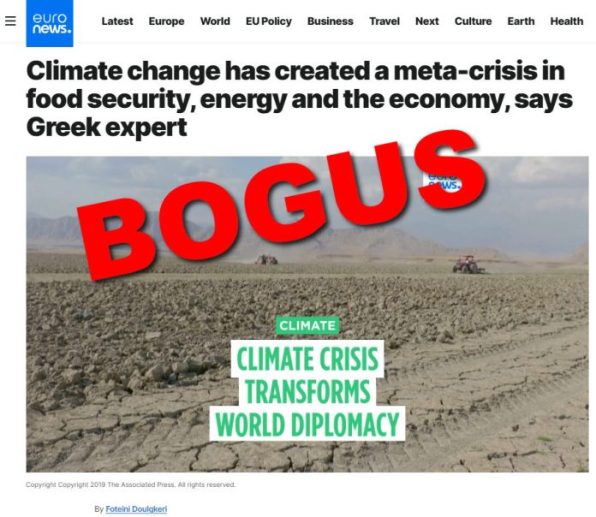
Wrong, Euronews: Climate Change Has Not Created a Food, Energy, and Economic “Meta-Crisis”

By Anthony Watts | ClimateRealism | September 25, 2026

Euronews claims climate change has evolved into a “meta-crisis” threatening food security, energy supplies, economies, water resources, and international security. This is misleading because the article largely substitutes predictions and assertions for measurements of what is actually happening. The data show global crop production and yields reaching record levels, deaths from extreme weather collapsing over the long term, and many of today’s energy and economic problems arising from political choices and geopolitical conflicts rather than changes in climate.

Euronews builds its case primarily around an interview with Emmanuella Doussis, UNESCO Chair on Climate Diplomacy at the University of Athens. Doussis declares climate change an economic, social, political, and geopolitical problem, linking it to competition for resources, migration, water shortages, food insecurity, and the energy transition.

Those are sweeping claims. Curiously, Euronews provides remarkably little observational evidence demonstrating that climate change is actually causing the worldwide “meta-crisis” its headline announces.

Perhaps the most obvious contradiction concerns food.

Doussis predicts, “We will face a very large, serious problem with food security.” But predictions about what might happen cannot erase what is happening.

Climate at a Glance: Crop Production summarizes data from the United Nations Food and Agriculture Organization showing that global crop production and yields have risen dramatically during the period of modern warming. Its latest summary reports that the 2023 and 2024 global crop years produced the two highest global crop yields per acre on record.

Climate Realism has documented the same trend repeatedly. Global production of staple crops has increased substantially, and yields have repeatedly set records during recent decades. Even where individual crops suffer poor regional seasons because of drought, floods, pests, or other causes, that is not evidence of a deteriorating global food supply.

There are good reasons for this improvement. Agricultural technology, irrigation, fertilizers, improved crop varieties, mechanization, and better pest control have transformed farming. Modest warming can also lengthen growing seasons and reduce damaging frost events in some regions, while additional atmospheric carbon dioxide generally stimulates plant growth and improves water-use efficiency.

None of this means weather cannot damage crops. It always has. It means that portraying climate change as presently creating a global food-security crisis conflicts with the direction of observed agricultural production.

The article’s treatment of energy is equally peculiar.

Euronews describes moving away from fossil fuels as part of the solution to its supposed climate “meta-crisis,” while simultaneously acknowledging that doing so creates “new dependencies” involving lithium, cobalt, rare earths, and other materials. It concedes that fossil-fuel-producing nations could be economically weakened and that entirely new geopolitical dependencies would emerge.

That sounds less like a crisis caused by climate change than economic disruption caused by policies adopted in response to climate change.

Europe provides an obvious example. Energy prices do not rise because a thermometer records a slightly higher average temperature. Prices respond to fuel availability, generating capacity, taxes, regulations, subsidies, transmission costs, geopolitical disruptions, and government decisions about which power plants may operate.

Climate Realism has repeatedly documented how wind and solar cost comparisons can omit the expense of backup generation, transmission, storage, subsidies, and other system costs necessary to accommodate intermittent generation.

There is an important distinction here that Euronews blurs: costs created by climate policy are not costs created by climate change.

The same problem occurs when the article moves from energy to economics. Weather can certainly cause economic losses. Droughts, floods, hurricanes, heat waves, freezes, and wildfires have done so throughout human history. But declaring climate change responsible for a generalized economic crisis requires evidence that those hazards are worsening in ways attributable to climate change.

Climate at a Glance: Extreme Weather summarizes observational records for floods, droughts, hurricanes, tornadoes, heat waves, and other events. The picture is considerably more complicated than the simple worsening-disaster narrative presented by much of the media.

More importantly, human vulnerability to weather has declined spectacularly.

Climate at a Glance: Deaths from Extreme Weather reports that global deaths from weather-related disasters have fallen by more than 99 percent during the past century, using international disaster data.

That is a remarkable accomplishment. Wealth, infrastructure, fossil-fueled transportation, modern agriculture, heating, air conditioning, weather forecasting, communications, engineering, and emergency management have made human beings vastly more resilient to nature.

Ironically, Doussis herself provides perhaps the most sensible sentence in the entire Euronews article: “Climate change is not always to blame.”

She acknowledges that some Greek disasters reflect chronic failures in planning, complicated regulations, inadequate infrastructure, and insufficient protection of vulnerable areas.

Exactly. That caveat deserves far more attention than Euronews gives it.

A flood becomes catastrophic when people build in floodplains, drainage systems are inadequate, warning systems fail, or infrastructure is poorly maintained. Drought becomes a water crisis when reservoirs, irrigation systems, groundwater resources, and water policy are poorly managed. A heat wave becomes more dangerous when electricity is expensive or unreliable and vulnerable people cannot afford air conditioning.

Labeling all these interconnected problems a climate “meta-crisis” does not explain them. It can actually obscure their real causes.

The Euronews article commits an increasingly common journalistic error. It begins with climate change, attaches virtually every economic, geopolitical, agricultural, and social problem to it, and then presents the resulting web of associations as evidence that climate change caused the problems in the first place.

That is not how causation works.

Climate changes. Weather varies. Individual regions will experience damaging droughts, floods, fires, freezes, and heat waves, just as they always have. Sensible governments should prepare for them.

But the real-world record does not resemble the spiraling “meta-crisis” Euronews describes. Farmers are producing more food. Crop yields continue reaching records. Humanity has become dramatically less vulnerable to extreme weather. And some of Europe’s most painful energy problems have resulted from decisions about energy production rather than changes in the weather.

Euronews could have investigated those inconvenient facts. Instead, it took a collection of predictions about food, water, migration, geopolitics, and energy, wrapped them together under the fashionable label “meta-crisis,” and called it climate journalism.

That’s not evidence. It’s a narrative looking for a crisis.

  •  

New positive ivermectin evidence

Dr. John Campbell | November 25, 2025

A Pilot, Randomised, Placebo-Controlled, Double-Blind Trial of a Single Oral Dose of Ivermectin for Post-Exposure Prophylaxis of SARS-CoV-2

https://www.mdpi.com/1999-4923/17/9/1205

People who took one small oral dose of ivermectin after exposure, took longer to test positive and had more time alive and free of symptoms.

Multiple reports from in vitro infectious models document Ivermectin’s antiviral properties

Click to access cells-09-02100.pdf

Ivermectin has broad-spectrum antiviral activity.

Randomised, double-blind, placebo-controlled

Single oral dose of Ivermectin as prophylaxis for SARS-CoV-2

Trial to evaluate the effectiveness of a single oral low dose of Ivermectin

Ability to prevent SARS-CoV-2 infection?

Ability to reduce symptoms if infection did occur?

Methods

Asymptomatic community-dwelling adults

Enrolled within 72 h of close contact with a case of SARS-CoV-2.

Single oral 200 µg/kg dose of Ivermectin or placebo.

65Kg woman given 13mg

80Kg man given 16mg

The primary outcome

Conversion to a positive PCR or RAT test within 14 days of close contact.

Secondary outcomes

(for those who tested positive)

Days alive free of symptoms in the 14 and 28 days following ivermectin

Days from close contact until a positive PCR or RAT

Results

N = 536 (86 met inclusion criteria and were randomised)

68 adhered and were included in the analysis.

Ivermectin arm

11/36 tested positive

Placebo arm

11/32 tested positive

So, ivermectin did not prevent people testing positive

Days from close contact until a positive PCR or RAT

Increased by 2.3 days in ivermectin group.

P = 0.033

So, ivermectin lengthened the incubation period

Viral load needed to precipitate clinical disease took longer to develop – indicating an antiviral effect.

Infection may have been prevented from primary contact, – indicating an antiviral effect.

Days alive free of symptoms

Increased by 2.5 days in ivermectin group.

P = 0.036

So ivermectin delayed onset of symptoms in people who tested positive

(Longer asymptomatic period)

Controlling included

Age, prior SARS-CoV-2 infection, body mass index, hypertension, lung disease

Conclusions

We did not demonstrate that a single oral low dose of Ivermectin administered to asymptomatic adults within 72 h of close contact with a case of
SARS-CoV-2 prevents conversion to a positive PCR or RAT.

(may have done with a larger sample size)

Amongst those who did convert to a positive PCR or RAT

Ivermectin significantly lengthened the time from close contact to conversion

Ivermectin increased the number of days alive free of symptoms

More details

Initiation of this trial in late 2021

Discovery in 1975

Massively used around the world

Nobel Prize in 2015

Very low incidence of serious adverse side effects

No instance of resistance reported in over 25 years.

Ivermectin can bind to and inhibit the nuclear transport roles of the host importin α (IMPα) protein, which is known to mediate the nuclear import of various viral proteins and key host factors.

Other quite distinct antiviral actions of Ivermectin have been proposed.

High (therapeutic) concentrations collect in the lungs, stable for more than 30 days in cattle.

Trial was based on the strong clinical retrospective association of statistically significantly lower mortality in patients who received oral Ivermectin (200 μg/kg) compared with usual care.

https://www.sciencedirect.com/science…

Ivermectin patients 15% mortality

Controls, 25.2% mortality

In subjects with severe pulmonary disease

Ivermectin patients, mortality 38.8%
Controls, 80.7% mortality

  •  

À La Réunion, l'hôpital manque d'infirmières, et il est interdit de leur payer deux mois de loyer

À La Réunion, le Centre hospitalier Ouest Réunion a tenté de recruter des infirmières de bloc en avançant deux mois de loyer. Trois mille euros. La Chambre régionale des comptes vient de juger le dispositif illégal. L'établissement y a mis fin, alors même que son activité chirurgicale explosait.

À La Réunion, l'hôpital manque d'infirmières, et il est interdit de leur payer deux mois de loyer
LE COURRIER
DES STRATÈGES
Restez libre !
À La Réunion, l'hôpital manque d'infirmières, et il est interdit de leur payer deux mois de loyer

LA NEWSLETTER · GRATUITE

Le Courrier,
chaque matin.

L'essentiel de l'actualité, passé au crible par les cinq plumes du Courrier. Dans votre boîte, chaque jour ouvré.

Gratuit. Vous restez libre de partir quand vous voulez.

JE M'INSCRIS lecourrierdesstrateges.fr
lecourrierdesstrateges.fr
Restez libre !

Le Centre hospitalier Ouest Réunion (CHOR) vient d'être rappelé à l'ordre par la chambre régionale des comptes. Son « pack attractivité » aide au logement était « sans tout fondement juridique ». Pendant ce temps, l’intérim médical coûte une fortune et personne ne s’en offusque.

À La Réunion, l'hôpital manque d'infirmières, et il est interdit de leur payer deux mois de loyer
LE COURRIER
DES STRATÈGES
Restez libre !

ABONNEMENT

Allez au fond
des choses.

Deux grands formats par jour. Les cinq plumes du Courrier. La série Sécession, le dimanche.

Le monde commente. Vous, vous comprenez.

S'ABONNER lecourrierdesstrateges.fr
lecourrierdesstrateges.fr
Restez libre !

3 000 euros pour attirer une infirmière

Le dispositif, baptisé « pack attractivité », permettait au Centre hospitalier Ouest Réunion (CHOR) d'avancer jusqu’à 3 000 euros à une infirmière recrutée, afin de l’aider à se loger. En 2025, 3 026,88 euros ont effectivement été versés pour deux recrutements. Un autre versement de 3 190,60 euros, prévu en décembre 2025, a été suspendu.

Jusqu’à 3.000 euros de loyers payé pour attirer des infirmiers : la Chambre régionale des comptes épingle le Chor
(Actualisé) Pour attirer des infirmiers de bloc opératoire (Ibode), le Centre hospitalier Ouest Réunion (Chor) avait mis en place un “pack attractivité” comprenant notamment la prise en charge de deux mois de loyer, jusqu’à 1.500 euros par mois. Dans un audit flash publié ce mardi…

La Chambre régionale des comptes (CRC) considère que ce dispositif est « sans tout fondement juridique ». Le raisonnement est celui du droit de la fonction publique : un agent hospitalier ne peut bénéficier d’un avantage financier que lorsqu’un texte l’autorise expressément. L’hôpital a donc dû mettre fin à son dispositif.

Dans son rapport, la chambre régionale des comptes relève également le coût du dispositif : le prestataire prélevait une commission de 10 % sur le montant du loyer avancé, à laquelle s’ajoutaient 80 euros de frais par dossier. Pour les trois dossiers examinés, l’ensemble de ces frais s’élevait ainsi à 1 017,40 euros, selon la juridiction.

À La Réunion, l'hôpital manque d'infirmières, et il est interdit de leur payer deux mois de loyer
LE COURRIER
DES STRATÈGES
Restez libre !

TELEGRAM · L'INFO EN CONTINU

Entre deux éditions,
le fil.

La newsletter vous donne le matin. Le fil vous donne l'instant.

Gratuit, et en continu.

REJOINDRE LE FIL t.me/resterlibre
t.me/resterlibre
Restez libre !

68 % d’activité chirurgicale en plus, mais moins de liberté

Cette affaire prend une autre dimension lorsqu’on regarde les besoins auxquels répondait le dispositif. Entre les périodes examinées, l’activité chirurgicale du CHOR est passée de 4 934 à 8 323 interventions, soit une progression de 68 %. Dans le même temps, les effectifs d’infirmières de bloc sont passés de 17 à 32,1 équivalents temps plein.

Martinique : des urgences fermées toutes les nuits pendant six mois
Pendant six mois, les habitants du Nord-Atlantique de la Martinique ne pourront plus compter sur les urgences de l’hôpital Louis-Domergue de Trinité la nuit. Depuis le 6 juillet, les admissions sont limitées à 8 h-18 h et le dispositif est prolongé jusqu’au 11 janvier 2027,

Autrement dit, l’établissement recrutait dans un contexte de développement massif de son activité. Pour attirer des personnels difficiles à trouver, il a facilité leur installation et a dû bricoler une solution concrète, immédiate. Résultat, c'est illégal.

Urgences saturées: l’été où l’hôpital public a cessé de soigner
À Brest, des patients auraient attendu de nombreuses heures aux urgences selon les organisations syndicales. Ce cas n’est plus une exception : une cinquantaine de services d’urgences connaissent de graves difficultés cet été, tandis que près de 40 % des postes de médecins urgentistes demeurent vacants. Une nouvelle illustration d’

La chambre régionale des comptes rappelle que même lorsqu’une dépense paraît utile au fonctionnement du service public, elle doit reposer sur une base juridique.Pendant ce temps, le recours à l’intérim médical, nettement plus coûteux et déstabilisant pour les équipes, ne soulève aucune objection administrative. Le système tolère le gaspillage organisé. Il interdit la pragmatique.

Le statut de la fonction publique hospitalière, présenté comme un rempart, fonctionne en réalité comme un carcan. Les élites administratives et politiques préfèrent la pureté des textes à l’efficacité sur le terrain. À La Réunion comme en métropole, le même schéma se répète : on déplore les manques, on condamne les solutions improvisées, et l’on laisse prospérer les dispositifs les plus onéreux.

À La Réunion, l'hôpital manque d'infirmières, et il est interdit de leur payer deux mois de loyer
LE COURRIER
DES STRATÈGES
Restez libre !

TIPS · SANS ABONNEMENT

Offrez-nous
un café.

Un média libre vit de ses lecteurs. Un pourboire ponctuel, sans compte ni engagement, quand le cœur vous en dit.

Vous donnez ce que vous voulez. Vous restez libre.

LAISSER UN POURBOIRE merci !
lecourrierdesstrateges.fr
Restez libre !

  •  

Léon XIV révèle le besoin d'espérance, d'unité et d'autorité morale des Français

par Eric V.

Huit cent mille personnes à la Concorde samedi ; 22 % des Français qui disaient, en février, faire confiance à la politique. Entre ces deux chiffres tient la leçon du voyage de Léon XIV : les Français ne manquent pas de pouvoir. Ils manquent d'autorité.

Léon XIV révèle le besoin d'espérance, d'unité et d'autorité morale des Français
LE COURRIER
DES STRATÈGES
Restez libre !
Léon XIV révèle le besoin d'espérance, d'unité et d'autorité morale des Français

LA NEWSLETTER · GRATUITE

Le Courrier,
chaque matin.

L'essentiel de l'actualité, passé au crible par les cinq plumes du Courrier. Dans votre boîte, chaque jour ouvré.

Gratuit. Vous restez libre de partir quand vous voulez.

JE M'INSCRIS lecourrierdesstrateges.fr
lecourrierdesstrateges.fr
Restez libre !

Huit cent mille. C'est le chiffre que le Vatican a retenu, sur la foi des autorités locales, pour la messe célébrée samedi par Léon XIV entre la place de la Concorde et l'Arc de triomphe. Benoît XVI avait réuni 260 000 fidèles aux Invalides en 2008. Il faut y ajouter les 80 000 jeunes du Stade de France, qui ont clos leur veillée par un Salve Regina, et les 150 000 pèlerins de Lourdes, dont près de 7 000 malades. En quatre jours, un pays réputé déchristianisé a produit des foules qu'aucun parti ne sait plus réunir.

Il serait commode d'y voir le retour de la France catholique. Ce serait faux, et d'autres chiffres le disent aussi nettement que ceux de la Concorde. En février, un sondage Ifop pour l'ADMD créditait de 84 % d'approbation la loi sur l'aide à mourir, définitivement adoptée le 15 juillet, que ce même pape est venu dénoncer à l'Élysée comme « l'offre d'une mort programmée ». Les Français ne sont donc pas venus chercher un accord. On ne traverse pas Paris à pied pour se faire donner raison, ni pour se faire donner tort. Ils sont venus chercher autre chose, et je suppose que beaucoup auraient du mal à dire quoi.

Le décor, lui, se lit sans peine. 90 % des Français jugent leur pays en déclin, record depuis que l'enquête Fractures françaises existe. 22 % seulement font confiance à la politique, contre 40 % en Italie, 44 % au Royaume-Uni et 45 % en Allemagne. Un peuple qui ne croit plus ses gouvernants et qui se presse autour d'un homme qui ne gouverne rien : voilà le fait. Il trahit trois manques, et le voyage les a rendus visibles.

« Exsules filii Hevae » : ce que 80 000 jeunes ont chanté à Saint-Denis
Vendredi, 80 000 jeunes ont clos la veillée du pape au Stade de France par le Salve Regina, chant millénaire des exilés. Ce qu’il dit d’une génération
Le Pape, Babel et les lois noachides : ce que disent les textes
Talmud, Maïmonide, Congrès américain de 1991, Constitutions maçonniques, Catéchisme : les lois noachides, pièce par pièce.
Léon XIV et Macron : la tour de Babel et l’UE
Même mot, deux projets : le multilatéralisme de Macron bâtit la tour de Babel, celui de Léon XIV tient la place de la Pentecôte. Ce qu’il faut en tirer pour 2027.
Léon XIV révèle le besoin d'espérance, d'unité et d'autorité morale des Français
LE COURRIER
DES STRATÈGES
Restez libre !

ABONNEMENT

Allez au fond
des choses.

Deux grands formats par jour. Les cinq plumes du Courrier. La série Sécession, le dimanche.

Le monde commente. Vous, vous comprenez.

S'ABONNER lecourrierdesstrateges.fr
lecourrierdesstrateges.fr
Restez libre !

L'espérance, ou la seule offre qui ne promet rien

Relisons ce que le pape a dit, puisque c'est à cela qu'on a répondu. À Lourdes : « Vous ne repartirez pas de Lourdes comme vous y êtes arrivés : vous repartirez en missionnaires de l'espérance ! » Le soir, aux flambeaux : « Que cette lumière que nous tenons ce soir ne s'éteigne jamais dans nos vies ». Et cette phrase sèche, presque brutale : « C'est aujourd'hui, pas demain, qu'il faut se convertir. »

Il n'y a là-dedans ni chiffre, ni échéance, ni plan pluriannuel. Rien qui ressemble à une promesse. La même semaine, le gouvernement prépare un budget à 54 milliards d'économies que son auteur présente lui-même comme « réversible ». La politique vend des promesses à la tonne et les reprend au kilo. Le pape n'en a vendu aucune, et c'est lui qu'on est venu écouter.

Faut dire que les Français ont perdu l'optimisme, et c'est précisément pour cela que l'espérance leur manque. On confond les deux. L'optimisme porte sur les choses : il prévoit qu'elles iront mieux, et les chiffres du déclin l'ont tué. L'espérance porte sur la personne : elle tient debout quand les choses vont mal.

L'optimisme est un pronostic. L'espérance est une tenue.

Il y a une raison française à cette pénurie. Pendant soixante-dix ans, l'État s'est fait le fournisseur exclusif de l'avenir : la retraite garantie, la santé gratuite, l'école qui promettait l'ascension, le budget qui promettait la croissance. Une nation qui a confié son lendemain à la loi de finances découvre aujourd'hui que la loi de finances ne peut plus rien promettre. L'espérance revient alors là où elle était avant l'État-providence : dans des personnes. Les 13 234 adultes baptisés à Pâques, trois fois plus qu'en 2016, les 18-25 ans en tête, ne sont pas des nostalgiques. Ce sont des enfants à qui l'on n'a rien transmis, et qui vont chercher ailleurs que dans l'État ce que l'État ne sait plus donner.

Léon XIV révèle le besoin d'espérance, d'unité et d'autorité morale des Français
LE COURRIER
DES STRATÈGES
Restez libre !

TELEGRAM · L'INFO EN CONTINU

Entre deux éditions,
le fil.

La newsletter vous donne le matin. Le fil vous donne l'instant.

Gratuit, et en continu.

REJOINDRE LE FIL t.me/resterlibre
t.me/resterlibre
Restez libre !

L'unité sans uniforme

La deuxième chose qu'on a vue, c'est un pays assemblé. Le vendredi, une déambulation du boulevard Montparnasse à la place Saint-Michel, ouverte à tous. Le samedi matin, la Maison Bakhita, où le pape a rappelé que « les pauvres ne sont pas une catégorie sociologique ». Le dimanche, les malades au premier rang de Lourdes. Aujourd'hui, à Metz, une rencontre interreligieuse. Des jeunes, des malades, des clercs, des migrants, des curieux : la foule la plus bigarrée que la France ait montrée d'elle-même depuis longtemps.

Cette unité n'est pas une unité d'opinion, puisque la majorité désapprouve le pape sur la fin de vie. Ce n'est pas davantage une unité de programme. C'est une unité de présence : des gens qui se tiennent au même endroit sans avoir à penser la même chose. Notre vie politique ne sait produire que l'inverse, des camps qui pensent chacun la même chose et ne se tiennent plus jamais au même endroit.

Le baromètre du CEVIPOF dit d'ailleurs où les Français cherchent cette unité-là. Ils accordent leur confiance aux artisans (84 %), aux PME, à ce qui est proche et tangible, et 70 % réclament des conventions citoyennes pour débattre des sujets de société. Ils ne demandent pas qu'on les unifie d'en haut : ils demandent à décider ensemble, de près. C'est exactement ce que nos institutions leur refusent, avec une Constitution qui concentre tout et des budgets adoptés sans vote. À l'UNESCO, le pape a opposé l'unité imposée de Babel à celle de la Pentecôte, où chacun entend « dans sa propre langue ». Thibault de Varenne en tire aujourd'hui les conséquences pour l'Europe. Pour la France, la leçon tient en une ligne.

On n'unit pas un peuple en le mettant en rang. On l'unit en le laissant venir.

Auctoritas

Reste le troisième manque, le plus profond. Dans le récit de ses propres actes, Auguste écrit qu'il a surpassé tous les autres par l'auctoritas, sans avoir eu plus de potestas que ses collègues magistrats. Les Romains distinguaient ce que nous avons oublié de distinguer : le pouvoir de contraindre, et le crédit d'une parole qu'on suit sans y être obligé.

Léon XIV n'a en France ni armée, ni impôt, ni police, ni électeurs. Il est pourtant venu dire au président de la République, dans son palais, quatre désaccords : sur la fin de vie, sur la gestation pour autrui, sur la dissuasion nucléaire, et sur la laïcité, qui, a-t-il dit, « ne consiste pas à exclure la religion de l'espace public ». Il a demandé aux évêques la « plus grande vigilance » contre les abus. Et il a été écouté par des foules qui, sur plusieurs de ces points, ne partagent pas son avis. C'est la définition même de l'autorité : une parole qui ne dépend pas du vote de ceux qui l'écoutent, et qu'on écoute pour cette raison.

Notre État est le négatif exact de cette figure. Il a toute la potestas : il légifère sur la mort, sur l'école, sur les factures des artisans, sur ce qu'on peut dire en ligne. Il n'a plus l'auctoritas : 22 % de confiance. Et parce qu'il n'est plus cru, il contraint davantage. Un pouvoir qu'on n'écoute plus gouverne par la règle, faute de pouvoir gouverner par la confiance ; chaque norme nouvelle est l'aveu d'un crédit perdu.

Quand l'autorité s'en va, le pouvoir s'installe dans les meubles.

On objectera, et l'objection est lourde, que l'Église est mal placée pour incarner l'autorité morale. Le rapport Sauvé a estimé en 2021 à 330 000 le nombre de mineurs victimes d'abus dans l'Église de France depuis 1950. On ajoutera que 800 000 personnes ne font pas un peuple, et qu'une messe sur la Concorde ne remplit pas les églises le dimanche. Tout cela est vrai. Mais cela confirme la thèse au lieu de l'affaiblir. L'autorité qu'on a vue ces quatre jours n'était pas celle d'une institution, que ses fautes ont ruinée ; c'était celle d'un homme qui parle sans rien briguer, dans une Église contrainte de reconnaître ses crimes avant de reparler. Quant au nombre, le pape n'a pas créé le besoin : les 90 % du déclin et les 22 % de confiance le mesuraient avant lui. Il l'a seulement rendu visible, par contraste.

En août, j'écrivais ici que les Français attendaient un sauveur : trois sur quatre réclamaient « un vrai chef », quatre sur dix un homme fort dispensé du Parlement. Léon XIV est-il la réponse à cette attente ? Il en est le contraire. Le sauveur réclame la potestas pour agir à notre place ; l'autorité ne réclame rien et nous laisse responsables. Je me demande si ces foules n'ont pas découvert, samedi, qu'on pouvait suivre quelqu'un qui ne commande personne. Ce serait le meilleur remède à la tentation de l'homme fort. Le pouvoir, lui, a fini par se déplacer : absent de toutes les messes, Emmanuel Macron devait assister à la dernière, à Metz.

Léon XIV révèle le besoin d'espérance, d'unité et d'autorité morale des Français
LE COURRIER
DES STRATÈGES
Restez libre !

TIPS · SANS ABONNEMENT

Offrez-nous
un café.

Un média libre vit de ses lecteurs. Un pourboire ponctuel, sans compte ni engagement, quand le cœur vous en dit.

Vous donnez ce que vous voulez. Vous restez libre.

LAISSER UN POURBOIRE merci !
lecourrierdesstrateges.fr
Restez libre !

Dernier mot

Le voyage n'a rien résolu, et il n'avait pas à le faire. Il a mis au jour un besoin que la politique ne sait plus combler, et qu'elle va chercher à capter d'ici 2027. Il faut donc dire nettement ce qu'on en fait.

D'abord, ne rien demander de ce besoin à l'État. Un État qui prétend incarner l'autorité morale, sur la mort, l'école ou la conscience, n'ajoute pas un gramme d'auctoritas : il étend sa potestas en la déguisant. Plus il légifère sur le bien, moins il est cru.

Ensuite, se méfier de quiconque proposera, en 2027, de remplir ce vide par la force. Le besoin que Léon XIV a révélé n'est pas une demande de maître. Le candidat qui le confondra avec un appel à l'homme fort aura mal lu la Concorde.

Enfin, rebâtir l'autorité là où elle naît : dans la parole tenue, le métier bien fait, la commune, l'association, la paroisse, la famille. Les Français font confiance à leurs artisans à 84 % pour une raison simple : l'artisan répond de ce qu'il fait. C'est de là que repartira toute autorité, pas d'un ministère.

Et le lecteur ne s'en tirera pas à si bon compte. Huit cent mille personnes à la Concorde, samedi. Combien, dans une semaine, auront tenu une promesse coûteuse, pris une responsabilité locale, cessé d'attendre ? L'espérance ne se regarde pas à la télévision. On ne délègue pas son espérance à un visiteur de quatre jours.

Le pape repart ce soir de Metz. L'autorité ne se décrète pas, et elle ne s'importe pas davantage : elle se regagne, parole tenue après parole tenue. C'est le seul programme qui ne dépende pas de l'élection de 2027.

  •  

Léon XIV et Macron : la tour de Babel et l'UE

Par Thibault de Varenne

Le 25 septembre, à l'UNESCO, Léon XIV a raconté deux histoires. La première se passe au pied d'une tour, la seconde sur une place de Jérusalem. On a retenu du discours le multilatéralisme, l'intelligence artificielle, l'éducation. On a oublié la tour de Babel, symbole également très présent dans la franc-maçonnerie. Et c'est elle qui donne la clé de la journée, et de la matinée passée à l'Élysée.

Léon XIV et Macron : la tour de Babel et l'UE
LE COURRIER
DES STRATÈGES
Restez libre !
Léon XIV et Macron : la tour de Babel et l'UE

LA NEWSLETTER · GRATUITE

Le Courrier,
chaque matin.

L'essentiel de l'actualité, passé au crible par les cinq plumes du Courrier. Dans votre boîte, chaque jour ouvré.

Gratuit. Vous restez libre de partir quand vous voulez.

JE M'INSCRIS lecourrierdesstrateges.fr
lecourrierdesstrateges.fr
Restez libre !

« La tour de Babel représente une unité imposée par la domination », a dit le pape. À la Pentecôte au contraire, chacun entend le message « dans sa propre langue maternelle », et « la communion ne supprime en rien la diversité ». La Babel moderne porte, selon lui, trois noms : « une mondialisation poursuivie sans fraternité », « des formes rapaces de néocolonialisme », « les impositions idéologiques ».

Le Pape, Babel et les lois noachides : ce que disent les textes
Talmud, Maïmonide, Congrès américain de 1991, Constitutions maçonniques, Catéchisme : les lois noachides, pièce par pièce.
« Exsules filii Hevae » : ce que 80 000 jeunes ont chanté à Saint-Denis
Vendredi, 80 000 jeunes ont clos la veillée du pape au Stade de France par le Salve Regina, chant millénaire des exilés. Ce qu’il dit d’une génération
Léon XIV et Macron : la tour de Babel et l'UE
LE COURRIER
DES STRATÈGES
Restez libre !

ABONNEMENT

Allez au fond
des choses.

Deux grands formats par jour. Les cinq plumes du Courrier. La série Sécession, le dimanche.

Le monde commente. Vous, vous comprenez.

S'ABONNER lecourrierdesstrateges.fr
lecourrierdesstrateges.fr
Restez libre !

Ce que dit la Genèse

Après le déluge, Dieu bénit Noé et ses fils et leur ordonne de remplir la terre. Le chapitre suivant dénombre les peuples, chacun selon sa langue. Puis viennent les bâtisseurs : « Faisons-nous un nom, pour ne pas être disséminés sur toute la surface de la terre. » Babel n'est pas un péché d'architecture. C'est le refus de la pluralité : un chantier, une langue, un nom. La Pentecôte ne rétablira pas la langue unique. Elle fera comprendre sans uniformiser.

Une rencontre, et rien de plus

Les francs-maçons lisent Babel de la même façon. Dans leurs légendes, la tour est la construction manquée et le Temple de Salomon l'œuvre réussie ; les Constitutions d'Anderson font de la loge un « centre d'union ». La rencontre est

  •  

Douglas Corrigan's "Wrong Way" Flight to Ireland

When Douglas Corrigan climbed out of his weather-beaten Curtiss Robin at Baldonnel Airfield near Dublin on 18 July 1938, he claimed to have made a simple navigational error. He had departed New York the previous day, supposedly bound for California, yet after twenty-eight hours in the air he found himself on the opposite side of the Atlantic Ocean. Few believed his explanation, but the public loved the story and he earned the nickname “Wrong Way” Corrigan.

The flight was the culmination of a dream that had begun more than a decade earlier, when Charles Augustus Lindbergh’s historic solo crossing of the Atlantic in 1927 inspired a generation of would-be aviators. Corrigan, who had helped build Lindbergh’s Spirit of St. Louis, was among those determined to follow in the famous pilot’s wake, though his own journey to aviation fame would take a far more unconventional route.


Douglass Corrigan stands before his Curtiss Robin that took him across the Atlantic. Credit: History Net


© Amusing Planet, 2026

  •  

Le Pape, Babel et les lois noachides : ce que disent les textes

Par Élise Rochefort

Les « lois noachides » désignent, dans la tradition rabbinique, sept prescriptions tenues pour obligatoires à l'égard de l'humanité entière, et non du seul peuple juif. Leur nom renvoie à Noé, avec lequel le livre de la Genèse rapporte une alliance conclue après le déluge (Gn 9).

Le Pape, Babel et les lois noachides : ce que disent les textes
LE COURRIER
DES STRATÈGES
Restez libre !
Le Pape, Babel et les lois noachides : ce que disent les textes

LA NEWSLETTER · GRATUITE

Le Courrier,
chaque matin.

L'essentiel de l'actualité, passé au crible par les cinq plumes du Courrier. Dans votre boîte, chaque jour ouvré.

Gratuit. Vous restez libre de partir quand vous voulez.

JE M'INSCRIS lecourrierdesstrateges.fr
lecourrierdesstrateges.fr
Restez libre !

Leur liste est fixée dans le Talmud de Babylone, au traité Sanhédrin (56a) : l'institution de tribunaux, et six interdits portant sur le blasphème, l'idolâtrie, les unions illicites, le meurtre, le vol et la consommation d'un membre prélevé sur un animal vivant. Ces prescriptions sont régulièrement invoquées, depuis plusieurs années, à l'appui d'une thèse selon laquelle une « religion noachide » mondiale serait en préparation. La présente fiche reprend les textes cités à l'appui de cette thèse.

Les textes rabbiniques

Le statut des sept prescriptions est précisé au XIIe siècle par Maïmonide, dans le Mishneh Torah, au livre des Lois des rois (chapitres 8 à 10). Le judaïsme n'y fait pas obligation aux non-Juifs de se convertir. Un non-Juif qui observe les sept prescriptions est qualifié de « pieux des nations » et se voit reconnaître une part au monde à venir. Maïmonide y met une condition : les observer parce que Dieu les a prescrites, et non parce que la raison les recommande. Le sort de celui qui les observe par la seule raison dépend du manuscrit consulté : selon les éditions imprimées, il n'est pas même compté « parmi leurs sages » ; selon les manuscrits yéménites, il est au contraire « de leurs sages ». La condition elle-même a été contestée au XVIIIe siècle par le philosophe juif Moses Mendelssohn, dans une lettre de 1773 au rabbin Jacob Emden consacrée au salut des justes qui ignorent ces lois.

Les mêmes chapitres comportent un volet pénal. Maïmonide y prévoit la peine capitale pour le non-Juif qui transgresse l'une des prescriptions, sur décision d'un tribunal. L'application de ce droit suppose une juridiction, le Sanhédrin, disparue dans l'Antiquité tardive. Aucune autorité juive contemporaine ne revendique de l'exercer. Des dispositions pénales comparables figurent dans d'autres corpus religieux médiévaux, dont le droit canonique, sans application contemporaine.

La question du christianisme divise la tradition. Maïmonide range le culte chrétien dans l'idolâtrie, en raison de la doctrine de la Trinité. Les Tosafistes, commentateurs du Talmud aux XIIe et XIIIe siècles, estiment au contraire, dans leur glose sur Sanhédrin 63b, que l'« association » d'un autre nom à Dieu, le shituf, n'est pas interdite aux non-Juifs. Moïse Isserles reprend cette position au XVIe siècle. La divergence n'est pas tranchée.

Léon XIV et Macron : la tour de Babel et l’UE
Même mot, deux projets : le multilatéralisme de Macron bâtit la tour de Babel, celui de Léon XIV tient la place de la Pentecôte. Ce qu’il faut en tirer pour 2027.
« Exsules filii Hevae » : ce que 80 000 jeunes ont chanté à Saint-Denis
Vendredi, 80 000 jeunes ont clos la veillée du pape au Stade de France par le Salve Regina, chant millénaire des exilés. Ce qu’il dit d’une génération
Le Pape, Babel et les lois noachides : ce que disent les textes
LE COURRIER
DES STRATÈGES
Restez libre !

ABONNEMENT

Allez au fond
des choses.

Deux grands formats par jour. Les cinq plumes du Courrier. La série Sécession, le dimanche.

Le monde commente. Vous, vous comprenez.

S'ABONNER lecourrierdesstrateges.fr
lecourrierdesstrateges.fr
Restez libre !

La résolution américaine de 1991

Le 20 mars 1991, le Congrès des États-Unis a adopté une résolution conjointe, devenue la Public Law 102-14. Ses considérants mentionnent les « valeurs éthiques et principes » des sept lois noachides et rendent hommage au rabbin Menachem Mendel Schneerson, dirigeant du mouvement Loubavitch, à l'occasion de son quatre-vingt-neuvième anniversaire. Son dispositif désigne le 26 mars 1991 comme « Education Day, U.S.A. » et invite le président à publier une proclamation. Le texte ne crée ni juridiction, ni obligation, ni sanction. Il relève de la catégorie des résolutions commémoratives, que le Congrès adopte en grand nombre. Une journée de ce nom fait l'objet de proclamations présidentielles depuis la fin des années 1970.

La loi naturelle et la franc-maçonnerie

Le terme a connu un usage hors du judaïsme. En 1640, le juriste anglais John Selden publie à Londres un traité, De jure naturali et gentium juxta disciplinam Ebraeorum, qui fait des préceptes noachides une expression de la loi naturelle, commune à tous les hommes. Le mot désigne alors, dans le vocabulaire savant anglais, une morale reconnue par la raison indépendamment d'une révélation particulière.

C'est dans ce vocabulaire que s'inscrivent les Constitutions de la franc-maçonnerie anglaise rédigées par le pasteur James Anderson. L'édition de 1723 oblige le maçon à la seule religion « sur laquelle tous les hommes s'accordent » ; celle de 1738 lui demande d'observer la loi morale « en vrai Noachide ». Un grade du Rite écossais ancien et accepté, le 21e, porte le nom de « Noachite ». L'historiographie maçonnique rattache ces emplois à la morale naturelle et à la tolérance religieuse des loges du XVIIIe siècle.

Le Pape, Babel et les lois noachides : ce que disent les textes
LE COURRIER
DES STRATÈGES
Restez libre !

TELEGRAM · L'INFO EN CONTINU

Entre deux éditions,
le fil.

La newsletter vous donne le matin. Le fil vous donne l'instant.

Gratuit, et en continu.

REJOINDRE LE FIL t.me/resterlibre
t.me/resterlibre
Restez libre !

La doctrine catholique

Le Catéchisme de l'Église catholique consacre trois paragraphes (§56 à 58) à l'alliance avec Noé. Il y voit le principe de « l'Économie divine envers les "nations" », un ordre de la pluralité des nations destiné à limiter l'orgueil d'une humanité qui « voudrait faire par elle-même son unité à la manière de Babel ». Il précise que cette alliance « est en vigueur tant que dure le temps des nations ». Les Actes des Apôtres (15, 20 et 29) rapportent qu'une assemblée réunie à Jérusalem demanda aux païens convertis de « s'abstenir des souillures des idoles, des unions illégitimes, de la viande non saignée et du sang ». Plusieurs commentateurs rapprochent ces abstinences des préceptes noachides.

Babel dans le texte

L'ordre des chapitres de la Genèse est le suivant. Au chapitre 9, Dieu bénit Noé et ses fils et leur dit : « Soyez féconds, multipliez-vous, remplissez la terre. » Le chapitre 10 énumère les peuples issus des fils de Noé, « selon leurs langues ». Au chapitre 11, les hommes décident de bâtir une ville et une tour : « Faisons-nous un nom, pour ne pas être disséminés sur toute la surface de la terre. » Dans la lecture juive comme dans la lecture catholique, Babel est présentée comme un refus de l'ordre donné à Noé.

Le Pape, Babel et les lois noachides : ce que disent les textes
LE COURRIER
DES STRATÈGES
Restez libre !

TIPS · SANS ABONNEMENT

Offrez-nous
un café.

Un média libre vit de ses lecteurs. Un pourboire ponctuel, sans compte ni engagement, quand le cœur vous en dit.

Vous donnez ce que vous voulez. Vous restez libre.

LAISSER UN POURBOIRE merci !
lecourrierdesstrateges.fr
Restez libre !

La thèse et les pièces

La thèse d'une religion noachide mondiale, diffusée dans certains milieux, notamment en ligne, repose sur six affirmations principales. Le tableau ci-dessous les rapporte aux pièces invoquées.

  •  
❌