Iraqi anti-terror resistance group Kata’ib Sayyid al-Shuhada has rejected any surrender of its weapons, with its spokesman stressing that resistance would continue despite pressure and that Iraqi resistance fighters would sustain their support for their fellow fighters in Lebanon.
Sheikh Kazem al-Fartousi, spokesman for the group, which is a subdivision of Iraq’s Popular Mobilization Units (PMU) coalition, made the remarks to the Lebanese news website UNews.
“We have not retreated from the resistance, and there will be no surrender of weapons,” he said, the website reported on Tuesday.
“The resistance’s weapons in Iraq are at its disposal and Iraqi resistance would continue supporting the Lebanese resistance,” the official added.
“The pressure has not deterred us from continuing along this path and will not lead us to retreat even a single step in confronting the enemy.”
The statement came as the Iraqi government, headed by Prime Minister Ali al-Zaidi, has, as a result of US pressure, been seeking to advance a plan to establish a state monopoly over weapons.
A day earlier, Haj Abu Mujahid al-Assaf, the security official of Kata’ib Hezbollah, another member of the PMU, also pointed to the upcoming prospect of expulsion of US-led forces from the Arab country, saying that, upon the occasion, the Iraqi people would celebrate the expulsion, associating the pending development to the efforts made by Iraqi resistance groups.
Al-Assaf further warned that if the restrictions imposed by the United States on Iranian aviation continued after October 1, the Iraqi people would take a clear position, adding that the possibility existed of closing border crossings with countries participating in the Washington’s efforts at targeting the Islamic Republic.
Donald Trump’s return to the White House in January 2025 pushed US Middle East policy toward a familiar mixture of pressure, bargaining, and demands for measurable economic returns. His May 2025 tour of Saudi Arabia, Qatar and the United Arab Emirates made that approach particularly visible: investment, artificial intelligence, defence, aviation, and energy agreements dominated […]
When Saudi Arabia, Turkey and Pakistan agreed to a mutual defense pact in August, it was principally seen as a political commitment. The “Mecca alliance,” as it was dubbed, stipulated that an armed attack on one would be treated as an attack on all three, accompanied by deeper military cooperation. That pact is no longer […]
When governments talk about reducing dependence on the Strait of Hormuz, the discussion usually turns to pipelines in Saudi Arabia and the United Arab Emirates. For Asian importers, that is only part of the story. The physical bottleneck is in the Persian Gulf, but much of the economic exposure sits thousands of kilometers to the […]
The last of the US-led coalition forces are leaving Iraq. It’s a significant bonus for Iran. The withdrawal date, September 30, was also the date by which Baghdad had pledged to bring numerous powerful Iran-backed militias under state control. But this deadline looks certain to be missed. This effectively means that, at a moment when […]
The British Police say that the five men arrested in connection with a suspected bomb plot targeting RAF Fairford are all British nationals. Nothing has yet been said officially about who was behind the plot. The risk to US assets and personnel in the UK remains extremely high. United Kingdom police are releasing the five […]
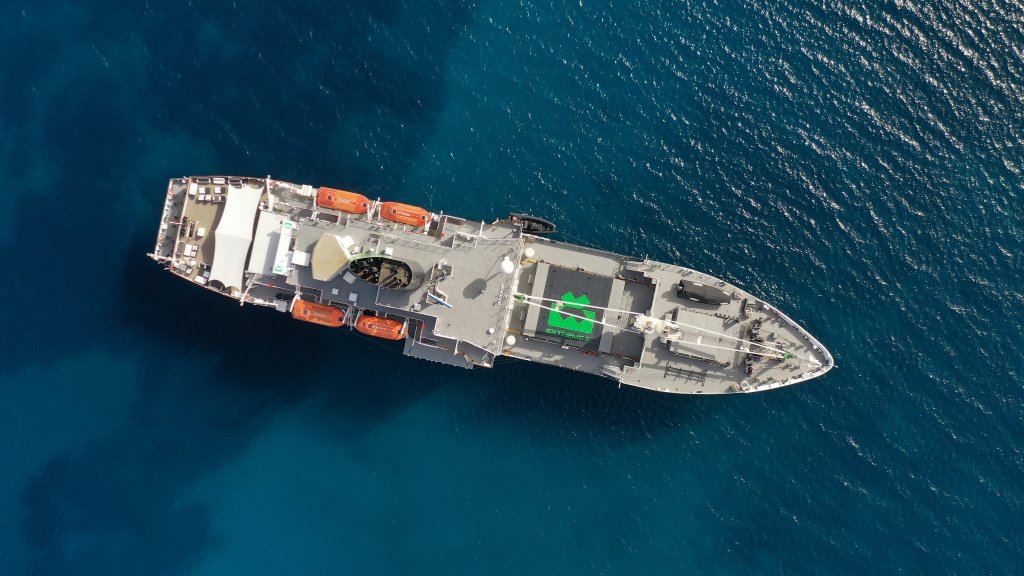
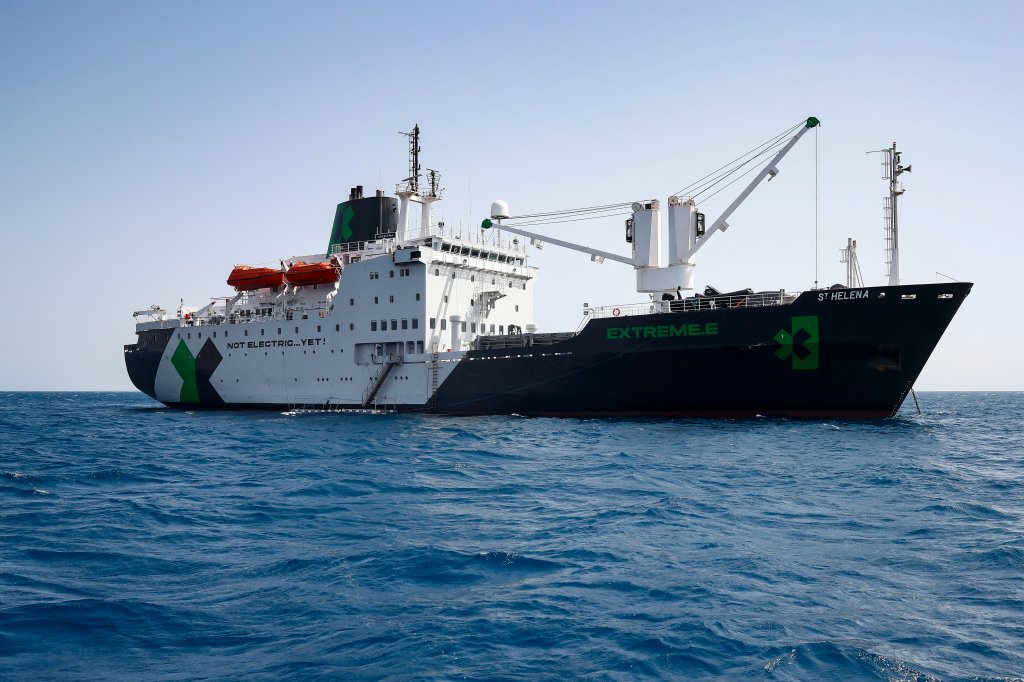
On Sunday, NBC News reported that Marines were injured during an Iranian cruise missile attack while transiting the Strait of Hormuz on Sept. 14. The network’s sources said the Marines were not on a U.S. Navy ship, but they did not identify which vessel they were on. However, a former Royal Mail vessel that at one point was being converted into a floating armory stands out as a strong possibility.
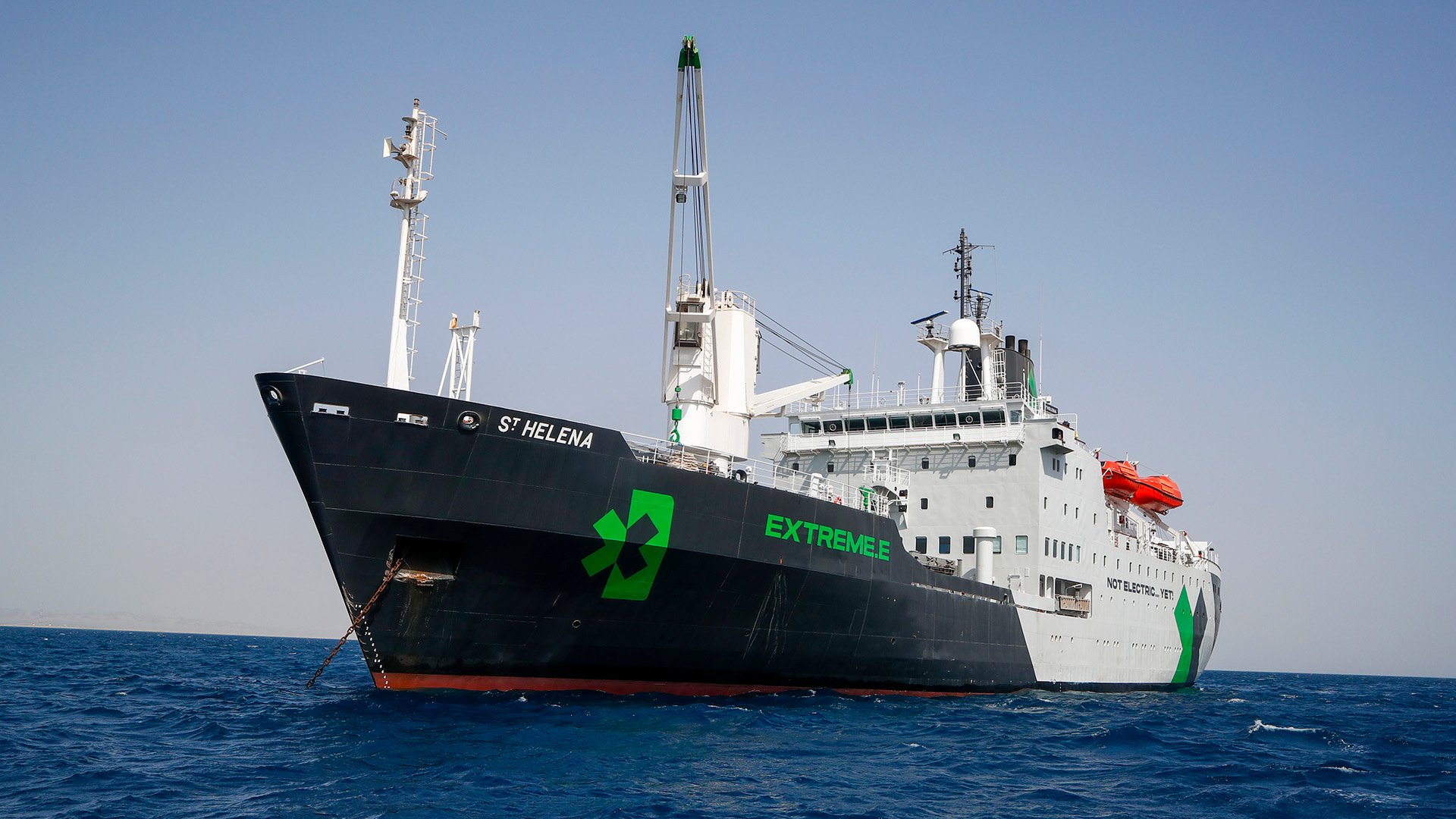
While much remains unclear about the Sept. 14 incident, there was only one vessel known to have been struck that day, according to the United Kingdom Maritime Trade Operations (UKMTO) and a maritime security official we spoke with. The ship was eventually identified by several maritime media outlets as the M/V St. Helena. Again, the St. Helena’s involvement remains unconfirmed, but the ship’s interesting background is of particular note.
The St Helena logistics ship during the Saudi Arabia on March 30, 2021. Photo by Colin McMaster
“Eight U.S. Marines were injured two weeks ago when an Iranian cruise missile attacked the ship they were operating on in the Strait of Hormuz,” NBC reported, citing three U.S. officials. “The Marines were not seriously injured, but they sustained smoke inhalation and possibly traumatic brain injuries, as they had symptoms of concussions, such as headaches, the officials said.”
“The Marines, seven of them enlisted and one officer, all returned to duty soon after the Sept. 14 attack, the U.S. officials said,” according to the network. “The officials said the Marines were operating as part of a battalion landing team during the Iranian anti-ship cruise missile attack.”
TWZ cannot independently confirm that Marines were on board the St. Helena or that they were injured. We reached out to the Pentagon and U.S. Central Command (CENTCOM) for more information. The Pentagon referred us to CENTCOM, and CENTCOM declined comment.
The incident took place amid an uneasy truce between Iran and the U.S. broken up by sporadic Iranian attacks on ships transiting the Strait of Hormuz. At the same time, the U.S. military is enforcing a blockade on Iranian ships, during which it has struck several for trying to bypass that effort as well as in retaliation for Iranian attacks on shipping. Negotiations between Washington and Iran have ebbed and flowed, and U.S. President Donald Trump is once again mulling a choice between continuing talks or renewing large-scale attacks.
As we noted earlier in this piece, after the vessel was struck, several maritime industry trade publications identified it as the St. Helena.
“Iran has attacked a historic former British Royal Mail passenger ship in the Strait of Hormuz,” TradeWinds News reported on Sept. 15, a day after the incident. “Maritime security sources identify the 6,800-gt St Helena (built 1989) as the latest vessel to be hit by an ‘unknown projectile’ in the war-torn waterway. The attack was reported late on Monday, according to UK Maritime Trade Operations, which cited a ‘verified source’ for the incident without identifying the vessel.”
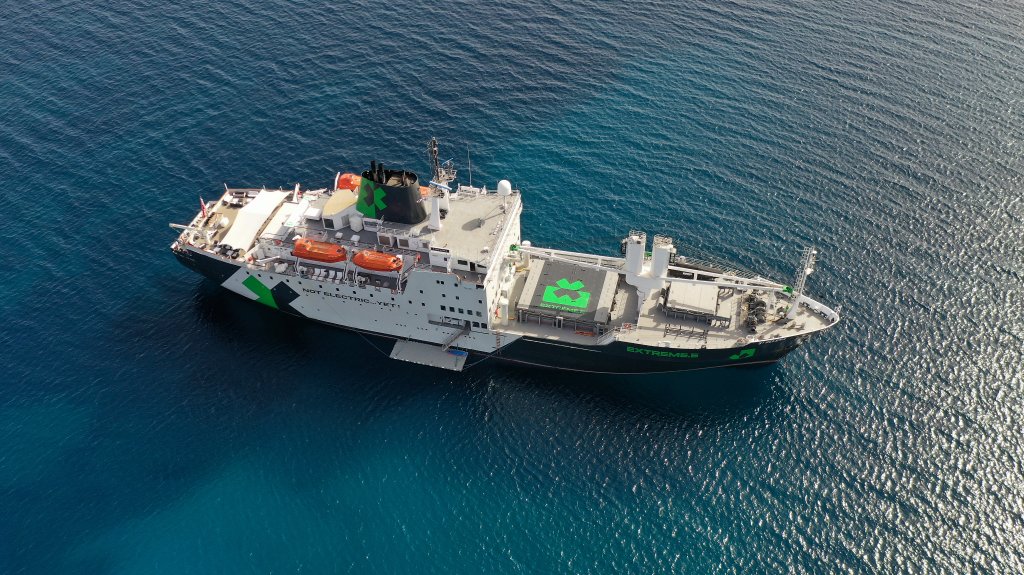
Aerial view of the St Helena transport ship in the sea off Porto Pino during the Sardinia on July 4, 2022. Photo by Sam Bagnall
“UKMTO has received a time late report of an incident within the Strait of Hormuz,” the organization reported on Sept. 15, citing an incident that took place a day earlier. “A verified source has reported that a vessel has been struck by an unknown projectile.”
“There is no reported damage or environmental impact,” UKMTO added. “Authorities are investigating.”
According to Lloyd’s List, the ship was being operated by the Ambrey maritime security firm at the time it was struck. Ambrey declined to comment.
Shipping expert Sal Mercogliano and open-source investigator Tom Bike were among those suggesting the St. Helena could have been the vessel at the heart of the NBC report.
So piecing together the evidence it appears that the US may have converted St Helena into a armed merchant cruiser.
The Marines looked at putting Armed Guards on board commercial ships three years ago as reported by @USNINews.
Exactly what the St. Helena was doing at the time it was struck is unclear; however, the ship has had a very unusual past.
The vessel entered into service in 1990 and “sailed between Cape Town, South Africa and Saint Helena and Ascension Islands, carrying both passengers and cargo, some of which was Royal Mail, earning her the rare RMS designation,” according to Cruise Arabia and Africa.
The St. Helena was Britain’s last working postal ship, according to Maritime Executive. After it was retired in 2018 because it was no longer needed for that function, things got really interesting.
Two different organizations took over the vessel, including, as we noted earlier in this story, a company that was planning to use it as a floating armory in the Middle East.
“Renamed MNG Tahiti, the 103-meter (340-foot) ship is being readied by her new owner MNG Maritime to become a floating armory working in the Gulf of Oman,” Maritime Executive wrote on April 22, 2018. “She will deliver security guards and weapons to vessels sailing through the region and is expected to be operational in her new role in the next few months.”
It is unclear what happened to that plan. However, two years later, an off-road racing series called Extreme E said that it “secured exclusive use of the former Royal Mail ship in 2018.” After that, the ship underwent “an extensive refurbishment process, which has included total overhaul of steelwork, engines, generators, propellers, interior and cabin space, and more, making it not only fit for purpose, but also as efficient as possible ahead of its new mission.”
Aerial view of the St Helena transport ship in the sea off Porto Pino during the Sardinia on July 4, 2022. Photo by Sam Bagnall
The ship was “specifically designed to transport all the infrastructure and equipment the Extreme E needs for their race weekends,” the organization stated. The plan was to have the ship serve “as its freight and logistics hub due to her versatility and ability to carry and unload a mixture of cargo, like all 10 of the championship’s ODYSSEY 21’s [electric off-road racecar], as well as team members and guests. This was also fit with a Science Laboratory so research can be conducted enroute to the race locations.”
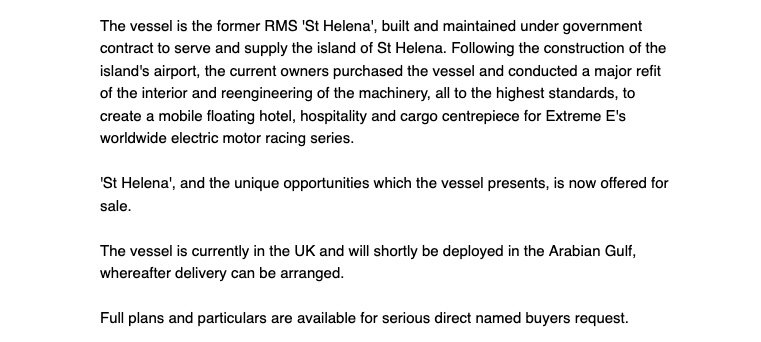
On Sept. 17, 2024, the St. Helena was put up for sale, according to Horizon Ship Brokers. The current ownership is unclear. We reached out to Horizon Ship Brokers for more details.
Horizon Ship Brokers
Last year, the saga of the St. Helena took a new turn. A company called Terra Nova Expeditions chartered the vessel for Antarctic cruises, but those plans were scrubbed last month because the vessel was stuck in the Persian Gulf and was no longer available for the Antarctic sailing season.
While we can’t confirm that Marines were onboard when St. Helena was hit, Marines have been training for this exact mission set. USNI News reported in 2023 that a “force of 100 Marines, newly trained by Navy personnel,” stood ready “to respond, if ordered, to provide armed security aboard foreign commercial ships transiting the Strait of Hormuz.”
Those Marines were members of the 26th Marine Expeditionary Unit (MEU) embarked on the three-ship Bataan Amphibious Ready Group (ARG), USNI added at the time.
It is unclear if those plans are still in place and if Marines in the region have actually been ordered to provide armed security for foreign vessels sailing through or near the strait. Regardless, Marines could be quickly trained to take on this mission set and have drilled for ship boarding and searches for years, especially special operations and specially-tasked units. CENTCOM declined to comment when we asked if there are U.S. personnel embarking on commercial ships transiting the Strait of Hormuz.
At the same time, it is possible that the unique attributes of St. Helena made it a convenient host ship for sea base operations for U.S. forces in the region specifically for this crisis. Adapting commercial vessels for exactly this purpose has a long history around the Strait of Hormuz, as it was a central facet of the Tanker Wars during the 1980s, that saw U.S. forces operate from barges in the region. Today, commercial vessels remarkably similar to St. Helena operate in similar roles, especially in support of special operations and interdiction operations.
The special mission ship U.S. Motor Vessel Kellie Chouest steams in the Caribbean Sea while participating in a passing exercise (PASSEX), with the Dominican Republic Navy and USS Billings (LCS 15) Oct. 24, 2021. Kellie Chouest is deployed to the U.S. 4th Fleet area of operations to support Joint Interagency Task Force South’s mission, which includes counter-illicit drug trafficking missions in the Caribbean and Eastern Pacific. Photo by Petty Officer 2nd Class Austin C
Once again, we have no idea what the ship’s mission was at the time of the incident and if Marines were simply helping it transit safely out of the Persian Gulf or something more, but the attack did expose the fact that individual Marines are more involved with activities in this tumultuous body of water than it may seem.
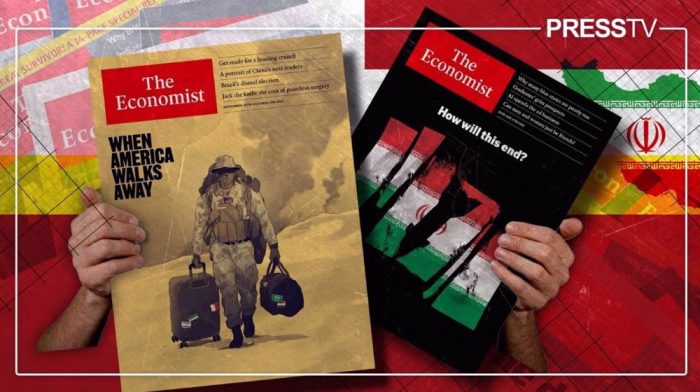
Nearly 466 days ago, just seven days into the unprovoked and illegal US-backed Israeli military aggression against Iran, The Economist provocatively placed a torn Iranian flag on its cover and asked: “How will this end?”
The image was widely interpreted as a metaphor for the possible collapse or fragmentation of the Islamic Republic in the face of overwhelming military force.
At the time, the narrative surrounding Iran was dominated by predictions of its imminent defeat, the weakening of its leadership, and even the possible collapse of the Islamic Republic under the weight of an aggression that came amid Iran-US indirect nuclear talks.
The article went on to ask whether what it described as Israel’s first war against Iran “will also be the last,” or whether it would “lead to a series of Iran-Israel wars that mire” West Asia in years, if not decades, of further violence.
Written before the United States directly joined the war of aggression by illegally bombing Iran’s Fordow, Natanz, and Isfahan nuclear facilities on June 22, the article also suggested that Washington should move beyond “merely defending Israel and deterring Iran” and join the occupying regime in attacking Iran’s peaceful nuclear program.
Yet even then, The Economist warned that such a war could spiral into a broader regional war, sending energy prices soaring by targeting Saudi Arabia’s oil infrastructure or blocking the Strait of Hormuz, a vital artery for global energy supplies.
Iran, however, did not turn the war into a regional war at that stage, nor did it close the Strait of Hormuz. It retaliated decisively and inflicted massive damage on the Zionist regime.
Following a powerful wave of retaliatory strikes against Israeli-occupied territories, the Islamic Republic demonstrated that it retained the ability to impose high costs on its adversaries.
After 12 days of war, Israel and the United States ultimately agreed to a ceasefire. The confrontation and US hostility, however, were far from over.
On February 1, the martyred Leader of the Islamic Revolution, Ayatollah Seyyed Ali Khamenei, warned that any new war initiated by the United States against Iran would inevitably become a regional war, engulfing all countries across the region.
Less than a month later, on February 28, Washington and Tel Aviv launched a second round of military aggression against Iran, again in the middle of nuclear diplomacy.
On the very first day, the United States and Israel assassinated Iran’s Leader and several senior commanders, apparently calculating that “decapitating” the country’s leadership would pave the way for the rapid collapse of the Islamic Republic and the so-called “regime change.”
That calculation, however, once again proved wrong.
Iranian armed forces mounted a sustained and forceful response, launching wave after wave of retaliatory strikes against Israeli-occupied territories and US military bases across the region.
Far from collapsing under the pressure, Iran demonstrated its capacity to absorb the initial shock, reorganize its command structure, and continue fighting on multiple fronts.
The war eventually reached the Strait of Hormuz, as Iran asserted its control over the strategic waterway, leading to severe disruption in global energy markets and exposing the vulnerability of one of the world’s most strategically important chokepoints.
After 40 days of war, the United States and Israel were once again compelled to accept a ceasefire. This time, the Trump administration even agreed to an Iranian proposal to end the imposed war.
The outcome was a striking departure from the expectations that had accompanied the opening hours of the aggression: instead of so-called “regime change,” Washington and Tel Aviv found themselves confronting an Iran that had endured the assassination of its senior leadership, absorbed unprecedented attacks and continued to resist and inflict blows on the enemy.
Since the April 8 ceasefire, exchanges of fire have continued intermittently, while the Strait of Hormuz has remained largely closed to hostile vessels.
Having failed to achieve its objectives through military means, Washington has increasingly turned to economic pressure, imposing new sanctions and pursuing a naval and aerial blockade against Iran. Yet the Islamic Republic has continued to withstand the pressure.
Also, despite sanctions, threats, political pressure and military aggression, Tehran has maintained that the Strait of Hormuz will only be reopened once the United States ends the imposed war on all fronts.
And now, more than 15 months after that torn Iranian flag appeared on its cover, The Economist has returned with an image that could hardly be more different.
Gone is the question of how Iran will end. Instead, the magazine has placed a new question at the center of its latest cover: “WHEN AMERICA WALKS AWAY.”
The change in imagery reflects a striking shift in the narrative. In June 2025, the focus was on Iran’s survival. Today, the question being raised is about the future of American power in West Asia.
But the transformation in the narrative is not limited to the language used on The Economist’s covers.
Over the past 15 months, the war has also produced a growing record of military, financial and strategic costs for the United States and its military-industrial complex.
Washington launched the war on Iran with many ambitious objectives, including crippling Iran’s nuclear and missile capabilities in order to undermine and weaken the Islamic Republic.
Yet months of war have instead left the United States facing tens of billions of dollars in expenses, damaged military facilities across the region, depleted stocks of some of its most sophisticated interceptors and other munitions, and casualties among its service members.
The following figures and assessments, many of them coming from US government agencies, American media outlets and Western think tanks, offer a picture of the price Washington has paid for the war — and of the widening gap between the objectives announced at its outset and the situation that has emerged months later.
$43.6 billion — and the bill is still rising
On September 18, The Washington Post reported that the US Central Command (CENTCOM) had estimated the cost of the war at $43.6 billion as of early September.
The figure included $28 billion to replace munitions expended during the war on Iran and more than $4.3 billion for equipment lost or damaged. The breakdown also put Air Force operating costs at more than $6.6 billion, Navy costs at about $2.2 billion, and Army costs at roughly $1.6 billion.
Crucially, the $43.6 billion estimate does not include the future cost of rebuilding or repairing damaged US military facilities across West Asia, according to the report.
The Congressional Budget Office (CBO) also published its own assessment on September 15, estimating that the war on Iran had already cost the Department of War approximately $38 billion as of August 1.
CBO said the figure included the replacement of expended munitions and equipment lost in battle, increased flying hours, other operational costs, and additional fuel costs.
But the most important part of the CBO assessment was its warning about the continuing cost.
It said if the war remained at the relatively low intensity seen in May and June, another month of fighting would cost approximately $2 billion. If fighting returned to the intensity seen in July, the monthly cost could rise to approximately $3 billion.
CBO also stressed that its $38 billion estimate did not include all costs borne by other parts of the federal government and did not include certain costs already incorporated into the regular military budget.
At least 228 US military assets damaged
The financial bill was accompanied by substantial physical damage to US military infrastructure.
On May 6, The Washington Post published a satellite-image investigation finding that Iranian attacks had destroyed at least 228 structures or pieces of equipment at 15 US military sites across West Asia.
The Post’s analysis identified 217 structures and 11 pieces of equipment that had been damaged or destroyed. The targets included hangars, barracks, fuel depots, aircraft, radar systems, communications equipment and air-defense systems.
The newspaper examined more than 100 high-resolution satellite images released by Iranian media and independently verified 109 of those images against imagery from the European Union’s Copernicus satellite system and commercial satellite imagery where available.
It found no evidence that the Iranian imagery had been manipulated. The Post also reported that the destruction was “far larger” than what had been publicly acknowledged by the US government.
The extent of the damage was subsequently reinforced by the US government’s own watchdog. In a report released on September 14, the Pentagon Inspector General provided what the Associated Presssaid was the most comprehensive official accounting to date of the war’s impact on US military facilities.
The report said Iranian attacks had damaged or destroyed hundreds of buildings and other structures at US bases in Kuwait, Bahrain, Qatar, the United Arab Emirates, Saudi Arabia, Iraq, Oman and Jordan.
The significance of this finding is that the damage was no longer based solely on satellite analysis or Iranian reports. It was acknowledged in an official US government assessment.
Dozens of MQ-9 Reapers and other aircraft lost or damaged
The Pentagon Inspector General’s findings also provided a clearer picture of damage to American aircraft.
According to Stars and Stripes on September 15, the war had resulted in damage to or destruction of as many as 30 MQ-9 Reaper drones, along with four F-15 fighter aircraft and more than six KC-135 tanker aircraft.
The report also noted that the cost of repairing or replacing some of these assets had not yet been incorporated into the Pentagon’s overall war-cost estimate.
In other words, even the $43.6 billion figure should not necessarily be regarded as the final bill.
The actual figure, however, is much higher. More than 50 MQ-9 Reapers have disappeared over Iranian skies, according to independent estimates.
The war has depleted America’s missile-defense stockpiles
Perhaps more consequential than the dollar value of the weapons fired is the depletion of America’s stockpile of advanced interceptors.
In its May 6 report, The Washington Post, citing an analysis by the Center for Strategic and International Studies (CSIS), reported that between February 28 and April 8 the US military had used at least 190 THAAD interceptors and 1,060 Patriot interceptors.
Those numbers represented approximately 53 percent of the US prewar THAAD inventory and 43 percent of its Patriot inventory. By September, the assessment had become even more concerning.
The Stimson Center, in a report published on September 22, said that by August the United States had used approximately 80 percent of its THAAD inventory and around half of its Patriot interceptors.
The same report said the Army had used “virtually all” of its ATACMS and Precision Strike Missiles (PrSM) — long-range weapons that would also be important in a potential conflict involving China.
According to Stimson’s assessment, replenishing some of these stocks could take years. CSIS estimated that Tomahawk inventories might not return to prewar levels until late 2030 or early 2031, while Patriot and THAAD inventories could take at least three years to recover.
The costs extend beyond the battlefield
The financial impact has also spread beyond the Pentagon. The CBO said on September 15 that the disruption of oil and gas shipments through the Strait of Hormuz had increased global energy prices, contributing to higher prices for gasoline, diesel and jet fuel in the United States.
CBO estimated that the war would leave US inflation in the first quarter of 2027 0.5 percentage points higher than it had projected in February 2026, while core PCE inflation was projected to be 0.3 percentage points higher.
The agency also estimated that three-month Treasury bill rates would be nearly 0.2 percentage points higher in 2026 than previously projected.
The Stimson Center went further, estimating the direct and indirect cost of the war at approximately $220 billion and putting the average household’s share at roughly $1,650. It attributed much of that wider economic burden to higher energy prices.
Stimson said that by September 15, average US gasoline prices had reached $4.32 per gallon, a 45 percent increase since the war began, while diesel prices had risen by approximately 70 percent.
Damage to US military facilities
Beyond the billions spent on weapons, operations and damaged military equipment, Washington also incurred substantial military, diplomatic and emergency expenses.
On September 14, the Pentagon Inspector General, as reported by The Washington Post, said Iranian attacks had caused approximately $184 million in damage to US military and diplomatic facilities in Iraq, Kuwait, Saudi Arabia and the UAE.
Separately, the US State Department reported around $113 million in war-related and emergency expenses, nearly $80 million of which was associated with the evacuation of diplomats, their families and other US citizens and eligible individuals.
Around 9,000 US citizens were evacuated from the region during the war against Iran.
Iran’s missile program has begun rebuilding
The depletion of American interceptor stocks becomes particularly significant when considered alongside the continued resilience of Iran’s missile program.
On September 10, The Wall Street Journal reported that Iran had resumed production of ballistic missiles, despite the extensive US and Israeli attacks on its missile infrastructure during the opening phase of the war.
According to the report, US and regional officials said Iran was assembling both liquid- and solid-fuel missiles using stockpiled components at underground facilities.
Intelligence pointed to activity at several underground sites, including the Khojir missile facility, while Iran was also working on new underground assembly locations.
The report concluded that the renewed production underscored the difficulty of fully dismantling Iran’s missile program — one of the stated objectives of the war.
Six months on, the original objectives remain out of reach
This brings the military expenditure back to the central question: what did all of this cost actually achieve? Washington continues to describe the war on Iran as having severely degraded the country’s military capabilities.
But independent Western assessments point to a substantial gap between the original objectives and the situation that has emerged.
The Stimson Center, in its September 22 assessment, said the administration initially went to war with objectives that included ending Iran’s nuclear program, destroying its missile industry, annihilating its navy, and ending its support for the Axis of Resistance.
It concluded that the United States had failed to achieve those objectives. Instead, Stimson said, the mission subsequently narrowed to the reopening of the Strait of Hormuz — a goal that became necessary precisely because the war itself had disrupted shipping through the waterway.
“Six months later, little progress toward those goals has been made, while the mission has largely narrowed to the single task of reopening the Strait of Hormuz, a waterway the war itself closed.”
The figures tell the story of that widening gap: $43.6 billion in US military costs; $28 billion needed merely to replace expended munitions; more than 4.3 billion dollars in damaged or lost equipment; hundreds of damaged military structures; depleted THAAD and Patriot stocks; and a weapons-production system facing years of replenishment.
And yet, according to the Wall Street Journal, Iran is already rebuilding parts of its ballistic-missile production capability.
That contrast — between the scale of resources committed by Washington and the difficulty of translating military force into its original political and strategic objectives — is perhaps the most important evidence behind the dramatic change in the narrative surrounding the war.
And now, back to The Economist
This is where the latest Economist cover becomes particularly relevant.
More than 15 months after the magazine placed a torn Iranian flag on its cover alongside the question “How will this end?” the question on its new cover is no longer centered on Iran.
It asks: “WHEN AMERICA WALKS AWAY.”
“America seems to be stuck in the Middle East. It has no easy way out of its war with Iran. Yet the conflict, however it ends, will in fact mark something quite different: the moment when America pulls back from the region—in the sense that it finally relinquishes its hegemony there,” the article reads.
In a September 25 editorial, The Economist’s Deputy Editor Robert Guest makes a similar assessment, writing that the United States has enjoyed decades of dominance in the region, but that this era is now coming to an end.
“Now, as Mr Trump seeks a way out of his ill-planned war, something momentous is occurring. As we describe in our cover package, American hegemony in the Middle East is ending,” Guest writes.
Less than two months after his government hosted the NATO summit — which was framed as proof of Turkey’s pivotal role in transatlantic security — President Recep Tayyip Erdogan has proposed full Turkish membership in the Shanghai Cooperation Organisation, an entity that has been described as being anti-NATO or a “rogue NATO.” The apparent contradiction […]
A contentious civilian nuclear agreement between the US and Saudi Arabia has ignited a sharp debate over Middle Eastern security, laying bare the escalating friction between American nonproliferation objectives and the kingdom’s strategic ambitions. This month, The Washington Post reported that a classified US intelligence assessment shared with Congress found that Saudi Arabia has not […]
Over recent months, the straits of Hormuz and Bab el-Mandeb have become synonymous with geopolitical jostling. Whoever controls these narrow waterways governs the flow of maritime traffic from the Arabian Sea and the Red Sea to the Indian Ocean – and with it, a vitally significant chunk of global trade. However, conflict over these straits […]
As US President Donald Trump publicly rejected Iran’s proposal for a ceasefire and reopening the Strait of Hormuz this weekend, the Iranian foreign minister reiterated that “there is no alternative to a negotiated solution.” “There’s always hope for diplomacy,” though the Trump-led United States has been an untrustworthy negotiator, Foreign Minister Seyed Abbas Araghchi said during a Sunday appearance […]
India calls it Haifa Day. The regiments that get the credit are the lancers of Jodhpur, Hyderabad and Mysore — cavalry units raised not by Britain directly, but by India’s semi-autonomous princely states, which supplied their own troops to the British war effort. Grouped into the 15th Cavalry Brigade and led into the final charge […]
Xi Jinping left Washington on Friday, September 25, bid farewell by a 21-gun salute and the administration’s top officials lined up at the airport. A three-day state visit organized with a level of attention to detail that the White House rarely reserves for a systemic rival: the welcome at the foot of the aircraft stairs, a three-hour meeting in the Oval Office, the state dinner, tea with the spouses, and a visit to the National Archives. A Schramsberg was chosen for dinner – the same winery that provided the wine for the 1972 toast between Nixon and Zhou Enlai. At the table sat half of the American business community: Musk, Jensen Huang, Zuckerberg, Tim Cook, Bezos, Pichai, Dimon, Fink, as well as three Supreme Court justices, the Federal Reserve chair, and half the Cabinet.
Then there is the real conversation, which must be read between the lines. Beijing immediately released its own account of the talks. On the American side, in the early hours, there was no official statement: only remarks from officials and a president who chose not to answer questions on the substance of the matter. This asymmetry in documentation alone reveals who wanted to set the terms of the meeting in writing.
On the Iran issue, administration sources presented an alignment on three points as “significant progress”: Iran must never acquire nuclear weapons; the Strait of Hormuz must remain open; and there must be no tolls in the strait. Taken one by one, these three points coincide with positions that Beijing had been advocating even before boarding the plane. China holds a permanent seat on the Security Council and is a signatory to the 2015 JCPOA: Iranian nonproliferation has been its official policy for over a decade. An open Strait of Hormuz is in China’s interest even more than it is in America’s, because East Asia consumes the largest share of the crude oil passing through the strait, and China pays more than anyone else for Brent crude that remains above $100 per barrel. As for tolls, a transit fee imposed by Tehran would hit oil tankers bound for Chinese ports first and foremost.
Washington has thus secured Xi’s signature on three statements that Beijing would have endorsed in any forum. The actual gain is more limited, but it exists. China’s distancing itself from Iran’s demand for tolls weakens a card that Tehran is playing in the New York negotiations, where discussions center on a phased exit from the crisis (reopening of the strait, simultaneous lifting of the U.S. naval blockade, followed by the unfreezing of frozen assets), and where the Iranian delegation is reportedly aiming to transfer the issue of transit rights to a separate annex.
Independent accounts fill in what the American version leaves out. Xi asked Trump for an immediate return to the Islamabad Memorandum of Understanding and the resumption of negotiations “as soon as possible,” leading to a comprehensive agreement that includes the nuclear issue. Trump did not say yes. Rather than being resolved at the summit, the Iranian issue was kept off the summit agenda.
Tehran and Taiwan
Regarding Chinese support for Iran, the officials themselves admit that the picture is incomplete: “There has been indirect support, we believe, but no direct evidence.” The United States says it is “very concerned” but is unable to prove it. Trump reportedly told Xi in person, however, that any aid to Tehran – “whether direct or indirect, in the form of intelligence, components, or military equipment” – is “totally unacceptable.”
A warning is only as strong as the tool that backs it up, and here the tool is nowhere to be seen. During the same period, flight tracking data recorded a Mahan Air flight landing as scheduled in Guangzhou, and no measures were taken against Chinese airports or operators: the no-fly zone around Iran has failed precisely where it matters most. The term “indirect,” moreover, remains deliberately vague. If it included the purchase of Iranian crude oil, it would strike at the heart of Sino-Iranian trade; if it does not include it, it is reduced to military supplies that Washington, by its own admission, cannot substantiate. The ambiguity serves both sides: the Americans to keep the threat hanging in the air, and the Chinese to continue operating in the gray zone. My assessment is that action by the Treasury against Chinese entities linked to Iran is unlikely before the trade agreement is finalized, with a moderate degree of confidence.
Washington insists that pressure on Iran is a separate issue, unrelated to arms supplies to Taiwan or any other negotiations. This separation has its own domestic logic. With less than six weeks until the November 3 midterm elections, the administration cannot risk being accused of trading Taipei for Chinese cooperation in the Gulf.
The point is that this separation is unilateral. In the Chinese account, Xi described Beijing’s position on reunification and territorial integrity as clear-cut; he called on the United States to oppose Taiwan’s independence and to handle the issue with caution, noting that doing so would lay a solid foundation for strategic cooperation between the two countries. Taiwan is not just another issue among many; it is the condition underpinning them all, including Iran. Beijing will be watching to see how Washington translates its statements into concrete actions, and that response will remain the primary indicator of American seriousness. The result is a clear asymmetry: the United States is giving up using Taiwan as leverage, while China retains it as a precondition.
What about the option of a trade truce?
On the economic front, the summit resulted in the extension of the trade truce until January 10 – which averts an immediate return to much higher tariffs – and the announcement of a managed trade agreement, the details of which are expected on Monday following weeks of negotiations. No breakthrough on tariffs, rare earths, or technology controls. The very term echoes the “Phase One” model from January 2020: quantified purchase commitments – that is, managing the symptoms of a rivalry whose structural causes remain unchanged.
On artificial intelligence, the positions remained distinct. Xi proposed dialogue on risks, human oversight of technologies, and cooperation against abuses, inviting both sides to build on their respective strengths rather than monitor one another. Trump acknowledged that AI concerns the future of humanity, but made it clear that he prefers the current status quo to remain largely unchanged. No common rules, no mechanisms. The two capitals limited themselves to confirming mutual support for the APEC summit and the G20 summit they will host this year, thereby setting the schedule for upcoming meetings.
Taken together, the U.S. outcome consists of a declarative convergence on three already-shared principles, a verbal warning, and a trade agreement yet to be reviewed. Beijing takes home more: a truce until January, no new technological restrictions, Taiwan reaffirmed as the foundation of the relationship, and, above all, the U.S. adoption of the Chinese formula for a “constructive relationship of strategic stability,” agreed upon in May and now revived. Robert Lawrence Kuhn provided the most honest summary: the summit’s main outcome is a longer planning horizon. For a power convinced that time is on its side, that longer horizon is the reward.
There is one objection that must be taken seriously. Xi’s public distancing from the concessions isolates Tehran just as an internal front is opening up in Iran, with an impeachment motion filed in parliament against Foreign Minister Araghchi, accused of negotiating with the Americans without the green light from the Supreme National Security Council. But this very situation highlights the limitations of that gain. The question in Tehran is no longer just what to offer, but who has the authority to offer it; and on this point, Chinese pressure regarding the tolls changes nothing.
There are few but concrete indicators to watch in the coming weeks. The text of Monday’s agreement will reveal whether the trade deal extends to rare earths or is limited to agricultural and energy purchases. The New York channel will indicate whether the phased exchange – involving shipping through the Strait of Hormuz in exchange for the lifting of the blockade – becomes operational. The six ballistic missiles launched by Ansarallah toward Yanbu and Taif – targeting the terminal of the only major Saudi route bypassing the strait – demonstrate just how narrow the margin is before the price of crude oil pushes Trump, on the eve of the election, toward military options. Finally, a potential designation of Chinese entities by the Treasury would lend real weight to the warning from the Oval Office.
As long as none of these signals change, we can say that the summit has stabilized Sino-American relations without stabilizing the Gulf – and regarding the Gulf, Beijing has offered words, not leverage.
The persistence of current geopolitical alignments, the attention of Eastern actors to the region, the strengthening of Sanaa’s position in the Red Sea, and the expansion of regional opposition to the UAE’s role will diminish Abu Dhabi’s role in the region.
For the past ten years, the Southern Red Sea has been a pivotal factor in the UAE’s foreign policy. Over the past decade, the UAE has built a layered maritime, air, and commercial infrastructure network, including military bases, in the Red Sea or near Yemen, Somaliland, Somalia and Sudan, starting from 2015.
According to some estimates, the value of UAE investments along Africa’s coastal regions and the Arabian Peninsula amounts to $60 billion.
In September 2015, the UAE established its first military base in Africa, in Eritrea. These bases possessed strategic advantages: the ‘protection of interests’ and control over the security and economic architecture of international maritime routes.
With the signing of the Abraham Accords in 2020, cooperation between Tel Aviv and Abu Dhabi in the Red Sea intensified.
The UAE’s approach—channeled through companies such as DP World and Abu Dhabi Ports—is centered on controlling ports, strategic waterways, military bases, and key trade and energy routes in the Red Sea and the Gulf of Aden, in coordination with the United States and its allies. Abu Dhabi’s approach also included engagement with non-state armed actors and separatist movements in Yemen, Sudan, and Somalia.
Factors Behind the UAE’s Diminishing Role
Over the past decade, the UAE emerged as a party to the conflicts in the southern Red Sea. However, geopolitical developments over the past year signal a gradual decline in the UAE’s role in the southern Red Sea.
Several factors are also significant, stemming from US and Israeli military strikes against Iran, the war between Sanaa and Saudi Arabia, Saudi-Emirati rivalry in the region, and disputes among African states.
Sudan’s value lies in its geopolitics. With 853 kilometres of coastline and several key ports, Sudan constitutes a vital link in the Red Sea.
The Sudan war since April 2023 has created conditions for the expansion of the UAE’s role. The UAE faces accusations of providing training and logistical support to the Rapid Support Forces (RSF). Human rights and political demands against the UAE has increased.
The UAE also maintains bases inside Sudanese territory. However, the ongoing war in Sudan and the support of allies for the Sudanese government have led to increased pressure on the UAE.
Riyadh regards the Red Sea as part of its strategic interests and its exclusive backyard. Abu Dhabi and Riyadh each view the other as a direct threat to their position and interests in parts of the southern Red Sea. Thus, the reduction of the UAE’s footprint in the southern Red Sea constitutes a strategic gain for Riyadh. Riyadh has effectively sought to weaken Abu Dhabi’s role.
In late 2025, Saudi Arabia’s support for Yemen’s Presidential Leadership Council (PLC) resulted in pressure being brought to bear on UAE-backed forces.
In July 2026, Saudi Arabia hosted talks among 14 countries—including Egypt, Djibouti, Sudan, and Somalia—which established a multinational maritime defence alliance. The UAE and Ethiopia were excluded from the list.
The formation of a Riyadh-led Red Sea maritime task force—with the participation of Turkey, Egypt, Djibouti, Somalia, and Eritrea—without coordination with the UAE amounts to a further constriction of the UAE’s role in the region.
Despite ongoing Egyptian–Emirati consultations on guaranteeing maritime navigation security in the Red Sea and Bab al-Mandab, Egypt’s foreign policy is not aligned with the UAE’s interests in Sudan and the Red Sea. Additionally, the alignment and coordination among Israel, India, the UAE, and Ethiopia are not particularly consonant with Egypt’s interests in Ethiopia and the Red Sea.
Until last September, the UAE played a significant role in the southern Yemeni islands of the Red Sea and in southwestern Yemen. However, Sanaa’s advance in the eastern Red Sea—the port of Mokha, Mayun Island, and other archipelagos north of the Bab al-Mandab Strait—in September 2026 inflicted negative and fundamental consequences on the UAE’s regional role.
Sanaa’s advance amounts to the nullification of the presence of Emirati actors in Yemen’s future political sphere. Sanaa is seeking to consolidate itself as a strategic “node” within the Iran-led Axis of Resistance.
Despite Cairo’s opposition to Sanaa’s proposal for maritime navigation coordination in the Red Sea, Sanaa—having secured control over the most important islands and cities overlooking the Bab al-Mandab Strait on the Yemeni side—is calling for the formulation of new rules to ensure security and navigation in the region. Ansar Allah’s control over Bab al-Mandab could put the UAE under pressure. Any expansion of Sanaa’s role in Sudan could likewise prove detrimental to the UAE.
Amid tensions between the United States and Iran, Abu Dhabi finds itself facing a more constrained strategic space.
The UAE’s alignment with the United States is, in a sense, also an intensification of Abu Dhabi’s tensions with Iran in areas such as the Red Sea. Unlike the UAE, Iran is seeking better relations with the Sudanese government. Many in Iran believe that Israel and the UAE are devising an economic and geopolitical plan to control the vital routes of the Red Sea and Yemen’s ports.
With Israel’s formal recognition of Somaliland in December 2025, many in the countries of the southern Red Sea have linked it to the UAE.
After years, Eritrea revoked the UAE’s access to its military infrastructure. Eritrean officials have recently made sharp statements about the UAE and Israel—particularly regarding Tel Aviv’s recognition of Somaliland.
Eritrea is providing frontline support to the Sudanese Armed Forces. Any deeper alliance between Eritrea and Sudan, Iran, Russia, China, and Sanaa could diminish the UAE’s regional role in the Red Sea. Additionally, some countries and actors near the Red Sea also hold a negative view of the UAE’s regional role.
The Somali government’s decision in January 2026 to sever relations with the UAE is, in a sense, a counter to the UAE’s role in the Somaliland and Puntland regions. Somalia has revoked all agreements with the UAE, including cooperation as well as security and defence arrangements. This move has negative implications for the UAE’s role in the southern Red Sea.
Moreover, the southern Red Sea plays a pivotal role in the regional strategy of Russia and Beijing. For example, apart from China’s role in Djibouti, Beijing is Eritrea’s principal creditor and has expanded its influence in Sudan.
The developments of the past year have also contributed to a decline in the standing of the UAE’s allies in the region.
Outlook
The US presence in the Red Sea’s African states is rooted in counter-terrorism and anti-piracy operations.
The European Union’s presence in the region, via Operation ASPIDES, is limited to commercial shipping in the Red Sea and the Gulf of Aden.
Despite the UAE’s formal withdrawal from some bases, its economic and security influence, as well as its soft-power instruments, remain strong.
A decrease in UAE military deployments in the region could negatively impact its support for allies in Yemen, Libya, and Sudan.
The UAE continues to have significant economic potential, secure partnerships, and influence in the southern Red Sea. In a way, this is considered a threat and a risk to certain African nations in the Red Sea region.
Certainly, a more extensive Sanaa presence over Bab al-Mandab, strategic coasts, and islands could confront Abu Dhabi’s maneuver and role in the southern Red Sea with a structural challenge.
The UAE’s approach in ports, logistics, energy, and other strategic infrastructure—along with deeper defense and security coordination with the West in the southern Red Sea—is likely to continue. However, the expansion of the UAE’s role also requires an extensive US presence in the Red Sea.
Moreover, the persistence of current geopolitical alignments, the attention of Eastern actors to the region, the strengthening of Sanaa’s position in the Red Sea, and the expansion of regional opposition to the UAE’s role will diminish Abu Dhabi’s role in the region.
Samyar Rostami is а political observer and senior researcher in international relations.
The persistence of current geopolitical alignments, the attention of Eastern actors to the region, the strengthening of Sanaa’s position in the Red Sea, and the expansion of regional opposition to the UAE’s role will diminish Abu Dhabi’s role in the region. UAE approach For the past ten years, the Southern Red Sea has been a […]
Mass protests have swept Syria—from Aleppo to Deir ez-Zor. Two years of empty Western promises, plundered oil fields, Israeli occupation of the south, and rule by a former terrorist whom Washington and London placed on the throne. The Fuel Crisis as a Trigger In mid-September 2026, Syria was gripped by the largest wave of civil […]
For eight decades, the Israeli political and security establishment has operated on a premise so deeply embedded that it is rarely stated as a premise at all: that American support is not a policy but a condition of nature, as fixed as the Mediterranean coastline. Administrations would come and go, presidents would hector and cajole, […]
Iran has offered the US a new deal aimed at ending the months-long conflict before the midterm election in November, directly challenging President Donald Trump’s claim that Tehran is deliberately waiting until after the election to reach an agreement.
Trump claimed in a speech at the UN on Tuesday that Iran is deliberately stalling the talks to see how Republicans perform in the November 3 midterm election, and predicted that Tehran would make a deal “right after” the vote. He also threatened to “annihilate” the Islamic Republic if negotiations fail.
“We don’t want it to get to the midterm elections,” Iranian President Masoud Pezeshkian told reporters on the sidelines of the UN General Assembly in New York on Thursday. “We wish Americans to return to the MOU before the midterms,” he said, referring to the memorandum of understanding reached by the US and Iran in June.
“We did reach an agreement with your president… The problem is that America, instead of conducting dialogue, descended into the arena by bombing us first, by blocking every pathway,” Pezeshkian said in an interview with Fox News. “We will stand resolutely to defend ourselves. We never sought war… It’s America that must choose whether it wants to end this or not.”
Iranian Foreign Minister Abbas Araghchi said Tehran has submitted a proposal in which the Strait of Hormuz could be reopened within around a week and negotiations on Iran’s nuclear program rapidly resumed. The proposal was sent through mediators during talks in New York this week.
Under the plan, Tehran would restore navigation through the crucial oil shipping route in exchange for Washington lifting its economic blockade, easing restrictions on Iranian oil exports, and releasing some frozen Iranian assets. Iran is also seeking an end to hostilities on other fronts, including Israel’s combat operations in Lebanon.
US and Iranian negotiators are discussing a phased arrangement in which the blockade and restrictions on Hormuz would be addressed first, Reuters reported, citing Iranian, regional, and Western diplomatic sources.
Tehran has not abandoned its claim to regulate Hormuz, with Iranian officials continuing to insist that the waterway should be managed by Iran and Oman and that fees should be charged for services provided to passing vessels.
Araghchi said the proposal largely follows the terms of the June memorandum rather than introducing new demands, adding that Iran is waiting for a response.
Araghchi has also held a series of meetings with foreign counterparts in New York, including Russian Foreign Minister Sergey Lavrov. Moscow has said there is “no alternative” to a diplomatic settlement of the crisis provoked by the “illegal actions” of the US and Israel.
The renewed diplomatic push comes amid mounting pressure on both sides. The US blockade has sharply restricted Iran’s oil exports, while Tehran’s controls over Hormuz have disrupted one of the world’s most important energy corridors and helped push oil prices above $100 a barrel and US diesel prices to historic highs.
Pezeshkian, who is the first foreign head of state to speak at the UN while his country is at war with the US, told the chamber on Wednesday that Tehran is prepared for “dialogue and diplomacy” but will not negotiate under threats of force and “will never bow our head or bend at the knee.”
“I am the way, the truth, and the life. No one comes to the Father except through me.”
Jesus Christ – Gospel of Saint John the Apostle (14:6)
“Do not fear them, then, for there is nothing hidden that will not be revealed, and nothing secret that will not be made known.What I tell you in the darkness, speak in the light; and what you hear whispered in your ear, proclaim from the housetops.”
Jesus Christ – Gospel of Saint Matthew the Apostle (Mt 10:26-28)
In the cover image the Arcbishop of Saint Pio, father Franco Moscone, and the Zionist rulers Netanyahu and Trump
The Heroic Homily of the Archbishop of San Pio on Genocide, Rampant Zionism, and Banks Profiting from Arms
In an era when Catholic progressivism is obscuring the diamond-bright light of the Word of God with diabolical worldliness, there remain Shepherds who have the courage to challenge wolves in sheep’s clothing to save their flock.
One of them is undoubtedly Monsignor Franco Moscone, Archbishop of Manfredonia, Vieste, and San Giovanni Rotondo—home to the Shrine of Saint Pio of Pietrelcina. Yesterday, during the Solemn Mass marking the liturgical feast of the Franciscan friar, the prelate—originally from the Piedmont region of Saint John Bosco and the Langhe (home of the philanthropist Servant of God Giulia di Barolo)—delivered a homily that was not only moving and courageous but truly heroic.
Gospa News has dedicated three previous articles to the battle waged by this high-ranking prelate of the Archdiocese of Manfredonia, for—just as Gospa News points an accusing finger at the profiteering of… The Weapons Lobby and death.
Indeed, every one of his statements is borne out in detail by the investigations we have linked to them.
Yesterday, he stood in solidarity with the “Priests against the Gaza genocide”—with whom he had demonstrated in Rome the day before, subsequently having to explain to some of the faithful why his seat was empty at the overnight vigil for the Feast of Saint Pio—but above all, he boldly exposed “dominant Zionism”and the “armed banks” that profit from “ethnic cleansing in Palestine.”
In an era when every public authority is terrified of discussing Jewish extremism for fear of being branded antisemitic, Monsignor Franco displayed a fortitude and intelligence truly bestowed by the Holy Spirit; he used unequivocal words to condemn the Tel Aviv regime, while tempering them by citing the book by Israeli historian Omar Bartov:
He did so in a speech challenging—and calling for the “disarming” of—all “theologies of fundamentalism,”such as that of the Boko Haram terrorists: heirs to ISIS and Al-Qaeda, groups created by Anglo-American intelligenceto invade the Balkans, Afghanistan, Iraq, and Syria—a connection certainly not made by the priest himself, but one argued in his books by former Interpol official Antonio Evangelista, whom I have interviewed on several occasions.
The prelate cited the theological fundamentalism found among Hindus, as well as among Evangelical Christians and xenophobic Catholics. He concluded with two resounding remarks—delivered before the final blessing of the Mass—regarding the “wars spread by NATO”and the possibility of reviving in Italy the concept of conscientious objection to military spending, as was done during the Cold War.
I have summarized in a few lines a homily lasting about twenty minutes; it must be heard in its entirety to fully grasp the Gospel narrative that began with the blood of Padre Pio’s stigmata and now extends to Gaza—to the 300 children killed during the sham truce—as well as to Lebanon and the 145 others who died during yet another bogus ceasefire.
For this reason, I will limit myself here to transcribing only those sentences containing the aforementioned key points.
The Empty Chair at the Saint Pio Vigil: Standing with “Priests Against Genocide”
«Someone rightly wrote to me this morning saying, ‘Last night there was an empty chair at the vigil for Saint Pio’—and it was mine, the local bishop’s! It was empty here because I sought to embody the spirit of prophecy, solidarity, and peace that Padre Pio always brought through his life and continues to urge upon us: a most urgent cry in this historic moment to which we are all witnesses».
Thus begins Father Franco’s homily, which seems to encapsulate two years of impassioned denunciations against the holocaust of children in Palestine and Lebanon.
«Yesterday, I attended a demonstration called ‘Priests Against Genocide’; it is an international network of priests that emerged just over a year ago in response to a cry for help from an African nun—a plea heard and taken up by a dedicated priest from Sicily. The network currently brings together over 2,600 priests from 57 nations, as well as 27 bishops and three cardinals. Yesterday, we walked a route through Rome, starting at the Jesuit Curia, passing the embassies to the Holy See for Palestine and Lebanon, and arriving at Piazza Mazzini, where Leonardo’s administrative headquarters is located» the priest continued (hereafter, we will not specify that the italicized text comes from his homily).
«We arrived at this point through prayer, by listening to the Gospel, and by reflecting on the words of Pope Leo’s *Magnifica Humanitas* and those of the Israeli historian Omar Bartov, who published a book titled *Into the Abyss: From Zionism to Genocide—Israel’s Moral Defeat*».
The Stigmata of the Holy Land: 445 Children Killed During False Truces, Christians Driven Out
«I look at the wounds of Padre Pio—at the signs of his identification with Christ Crucified and the blood he shed alongside Jesus’s for fifty years—and I ask myself: where is the blood of the Lord’s stigmata and Padre Pio’s stigmata today? Where is it being shed?»
«It is certainly found in the stigmata borne by the population of Gaza, 97% of whom are left without homes or means of subsistence—a place where a truce is said to exist, yet a genocide quietly continues. Yesterday, we recited the names of 300 children killed in Gaza since the truce began.Padre Pio’s wounds are also found in the ethnic cleansing taking place in the West Bank and southern Lebanon; there, too, we counted 145 children killed since a peace plan was supposedly in place».
«In those lands, our Christian brothers—representing the oldest churches in history—are particularly being driven away; only one Christian village remains under the administration of the Palestinian Authority. All the others have been wiped out.»
The Archbishop of San Giovanni Rotondo went on to mention the “stigmata” visible in Africa: the wars in the Sahel and Sudan, the massacres committed by Boko Haram terrorists in Nigeria and the abduction of girls, and the repression in Myanmar and across the Middle East.
He added: «And here in our own Europe, too, Ukraine and Russia continue to send their finest youth to the front lines to be sacrificed. These open, bleeding wounds—akin to the stigmata of Christ—persist in the humiliation of the Venezuelan people and the starving of the Cuban people.»
«I urge everyone to make praying for peace our primary commitment; it was a central focus of Padre Pio’s thoughts and heart throughout his life.»
Monsignor Moscone noted that, in the past, prayer groups did not succeed in halting wars as the “greatest Saint of the last century” had hoped: «It was not effective then, yet we must believe it can be effective today, preventing these scattered conflicts from escalating into a world war.»
Father Franco Moscone: “Disarming Fundamentalist Theologies: From Dominant Zionism to Catholic Xenophobia”
«From Padre Pio, we also learn how to properly interpret Sacred Scripture—the words of the entire Bible, and the Gospel in particular. Let us, therefore, call for the disarming of the theologies that fuel fundamentalism of every kind. Jewish theologies that fuel the dominant Zionism; Islamic theologies that foment terrorism and fundamentalist groups; Hindu theologies—but also Christian theologies, particularly of an evangelical bent as well as within our own Catholic Church—that spread division and violence and stoke xenophobia and racism».
“Arms multinationals and ‘armed banks’ that invest in death.”
«Let us, therefore, pray and read the Word of the Lord and the values of our religion—and all religions—with authenticity and integrity. And let us not be afraid to speak out against what is wrong in this regard. Prayer must translate into action—action that speaks truth and denounces injustice. We cannot settle for a narrative that aims for and leads directly to war—serving solely to boost the interests of major arms multinationals, ‘armed banks,’ and anonymous investment funds that invest only in death—thereby denouncing a form of capitalism and power that makes the rich ever richer and the poor ever poorer, while also—even in our developed West—wiping out the middle class and social mobility, driven by a mindset that leads only to death and injustice».
At the conclusion of Holy Mass—following the reading of the prayer for Civil Protection, of which Saint Pio is the patron—the Archbishop of Manfredonia added a pointed remark that struck like a dart aimed at European armament plans, which he had already severely condemned in previous public statements…
“Wars Spread by NATO and Tax Objection to Arms Spending”
«This is the security we need and desire: the security of Civil Protection, of environmental stewardship… This is true deterrence—not that of armaments and NATO, an alliance that, since its inception, has only brought and spread war across four continents»—a fact confirmed by the recent geopolitical “Mediterranean Sea: Same Blood, Same Mud”) by Interpol official Antonio Evangelista.
«A form of deterrence that is essentially cost-free, requiring no massive financial outlay. It makes me wonder if the time has come to revisit a concept discussed during the Cold War—in the 1970s and 80s—namely, not merely conscientious objection to military service, but objection to military spending itself: a tax objection regarding that 5% of funds they want us to divert to entirely different purposes. I take personal responsibility for what I have said; let us now receive the Lord’s blessing—a blessing that is surely one of Peace, and nothing else».
Invoking Saint John Paul II, a heroic fighter against war
In a gesture reminiscent of the greatest, most heroic crusader against conflict and weaponry—Pope Saint John Paul II—the Mass concluded with the moving hymn “Jesus Christ, You Are My Life,” composed by Monsignor Marco Frisina for the World Youth Day held at Tor Vergata, Rome, during the Jubilee of 2000.
Every Christian must give praise to God, Jesus Christ, and Saint Pio for sending us another courageous prelate—a bishop—like Karol Wojtyła: the Bishop of Kraków during the Soviet communist regime’s political occupation who later became the Bishop of Rome and succeeded in bringing down the USSR dictatorship through the consecration of Russia to the Immaculate Heart of Mary, in obedience to the secret messages received at Fatima by the visionary Lucia.
Suffice it to recall that it was not the assassination attempt against him on May 13, 1981, nor the military regime imposed by General Wojciech Jaruzelski, but rather the Solidarity trade union—fueled by the Christian spirit instilled by John Paul II himself—that managed to triumph, much like David against Goliath.

 Login




 (@mercoglianos)