Peter Hotez has warned that dengue and Zika pandemics could become the "new normal" due to climate change. Dr Randall Bock asks why the 'experts' are still trying to scare us with non-scary viruses and unlikely scenarios.
In this story for Dispatch, Lotte Brundle reports on a surprising trend: young women in the UK are pursuing careers in the death care industry. In a time of high unemployment, funeral home apprenticeships offer an alternative to university, where students accumulate significant debt. While the pay is low and the industry needs to do a better job building awareness that the trajectory exists, the young women who speak to Brundle find the work meaningful and rewarding.
Her inspiration to become an undertaker arrived, as many teenage epiphanies now do, via TikTok. Emily was 15 and had been considering becoming a teacher or journalist when she came across an American woman documenting life inside her own funeral home. “I’d never considered it as a career,” she says. “I didn’t know anyone who was an undertaker, but I just thought how interesting it was.”
Two hours later, she was still scrolling through the woman’s profile, engrossed. Running her own funeral home became Emily’s dream.
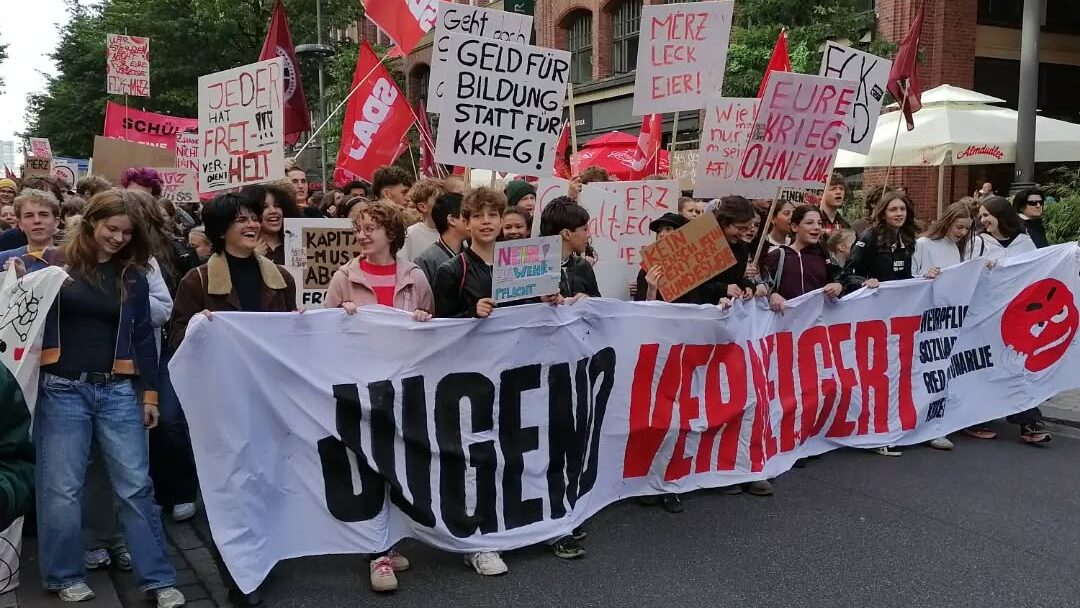
Thousands of students across Germany were once again on strike against conscription and militarization on Friday, September 25. Actions took place in at least 100 localities as young people demanded a sharp turn from the government’s chosen path.
“We don’t want to be forced into military service and we don’t want to go to war,” the students wrote in declaration after their last strike in May.
This is the fourth time students have exchanged classrooms for streets since the end of 2025. The mobilization has strengthened in resistance to the Merz administration’s plans to build the “strongest conventional army in Europe” – including by drawing more people into the Bundeswehr, the German armed forces.
While authorities insist military recruitment remains voluntary, students have warned of a clear tendency toward outright conscription. Local strike committees and activists also emphasized the widespread repression ahead of actions. This included scheduling of exams on strike days and locking-in students on school grounds, they pointed out.
Billions for the Bundeswehr, cuts for schools and youth services
Over recent months, the government has sent thousands of questionnaires to map voluntary interest in joining the armed forces. According to German media, the response has been underwhelming: tens of thousands of students have disclaimed no interest whatsoever. Not even a multi-million-euro budget allocated to promoting the army has been able to shake this opinion.
“They sell us war service as an ‘adventure’ while we know that what awaits us is coertion, humiliation, sexism, right-wing extremism, and racism,” the student declaration adds.
Instead of taking the message seriously, authorities recently advanced the implementation of medical checks among their targeted population, drawing further frustration from students.
“We don’t want compulsory questionnaires, fines, draft physical examinations, conscription assessment centres across the country, nor planned integration of the Federal Volunteer Service into military service,” they wrote. “These are means to prepare the reintroduction of the draft and thus another war originating from Germany.”
“In case of conscription, we’ll be trained as cannon fodder, forced into the trenches,” students added. “War costs us our lives, while corporations like Rheinmetall make record profits.”
Students on strike have expressed solidarity with other ongoing struggles against militarization and budget cuts. They stated they would join peace demonstrations planned for early October in Berlin and Stuttgart, as well as a trade union-backed mobilization against budget cuts on Saturday, September 26.
Their decision reflects the widespread understanding that youth and education services are among those impacted by this round of austerity. According to junge Welt, the federal ministry responsible for education will face close to €1 billion in cuts – while €140 billion will be made available for so-called defense in 2027.
“Every tank, every rocket we pay for with dilapidated schools and social cuts,” students remarked.
China called the latest US threats of secondary sanctions on airline service-providing companies across the world an illegal unilateral measure without any basis in international law. The US said the sanctions would be applied if these companies do not stop providing services to Iranian airlines.
China said they “firmly oppose illicit unilateral sanctions that have no basis in international law and lack UN Security Council mandate,” Guo Jiakun, official spokesperson of its Ministry of Foreign Affairs said during a regular press conference on Wednesday, September 23.
China’s reaction came on the same day the latest US sanctions against Iran went into effect.
The US Treasury Secretary Scott Bessent has asked companies across the world who are involved in providing services such as refuelling, ticketing, and other kinds of ground support to stop serving Iranian airlines starting at midnight on September 23. If they fail to comply they will be “locked out of the dollar system,” Bessent threatened.
The latest sanctions against its airlines is part of the recently announced US attempt to completely isolate Iran from the global economy in order to pressure its government to re-open the Strait of Hormuz.
Iran has shut down the Strait of Hormuz following the resumption of US airstrikes as well as Washington’s attempts to bypass Iranian control over the waterway in the Persian Gulf since July. Iran has claimed that those American moves were in violation of the peace deal signed under international mediation in June.
The adoption of new sets of sanctions is widely seen as an indication of Washington’s failure to achieve its objectives in Iran militarily, even after seven months of war, which began on February 28.
Iran has reiterated that no amount of economic coercion will open the Strait of Hormuz. They listed the withdrawal of the US naval blockade, the unfreezing of its international assets, and an end of the war on all fronts in the region as preconditions for opening the Strait.
Air blockade
While some of the countries in the region cancelled Iranian flights to their airports in fear of US sanctions, Iran claimed most of its international flights remained scheduled and operational. Some countries also decided to close their airspace for Iranian airlines.
Iraq has diverted most of the Iranian flights from its Baghdad airport to Najaf.
If the flights remain suspended for a significant number of countries for a longer duration it would amount to an air blockade on Iran. This will have an effect on thousands of people employed in the aviation sector in the country which is already heavily facing tremendous economic troubles due to existing sanctions
A prolonged suspension of flights could also impact hundreds of thousands of Iranians who have to travel out of the country for medical or other reasons.
Iran has maintained that unilateral US sanctions are illegal and an “act of terrorism” against Iranian people. It has urged the nations across the world to not succumb to the unilateral actions of the US.
Chief of Iran’s Supreme National Security Council Mohsen Rezaei, in an interview on Wednesday, warned neighboring countries against submitting to US pressure to shut down Iranian flights, claiming such acts will force Iran to retaliate.
“Nothing in life is free,” goes an old Latin American saying, and Bolivia’s right-wing President Rodrigo Paz has proven this once again. The International Monetary Fund confirmed that it will disburse $1.9 billion to Bolivia, which will naturally have to repay the loan.
Several experts assert that the government’s decision will lead to an imminent increase in the price of food, mining, and transportation, thereby negatively impacting the country’s working population, which constitutes the vast majority.
While the government claims that these types of neoliberal measures will help control inflation, economist Fernando Romero argues that eliminating the diesel subsidy could cause inflation – which was projected to reach 14% by the end of the year – to rise to 20% by December 2026.
But this seems to matter little to a government whose primary goal – whether its own or one set by international financial institutions for the Third World – is to reduce the fiscal deficit at all costs.
“You [Bolivians] elected me to solve problems … If [the IMF] is lending us funds to revive the country, I cannot buy diesel at a high price and sell it cheaply … That is why we have decided that diesel will cost the same as it costs us to buy it abroad, and that price will be the same for everyone,” Paz said in an address to the entire country.
Just a few months in office, many protests
The truth is that this is not the first time Paz has sought to meet the IMF’s demands. In December of last year, just a few weeks after being sworn in as president, Paz raised the price of diesel and gasoline, sparking protests across the country.
A few months later, between May and June, thousands and thousands of Bolivians took to the streets to protest the government’s plan to allow land to be seized to settle debts, which was followed by demands from the Bolivian Workers’ Confederation (COB) and various peasant groups for higher wages and improved fuel supplies, among other things. Following harsh repression, the protests quickly escalated into demands for the president’s resignation, which led to increased tensions and clashes between law enforcement and thousands of workers who blocked major highways across the country. These protests left 14 dead and nearly 400 people detained.
It now appears that Paz will not back down from his policy, despite the fact that in less than a year he has faced significant protests against him that have gradually eroded his public image. According to some polls, Paz’s approval rating barely reaches 32%.
But Paz has also prepared for possible demonstrations. The Bolivian Congress, which supports Paz, has just extended the state of emergency – which had been declared last June – by 90 days. According to Interior Minister Marco Oviedo, there are: “threats of renewed and coordinated blockades, marches, and strikes, as well as early warnings regarding calls to action, escalations, ultimatums, and the mobilization of social groups [in the coming days].”
Announcement of protests
Indeed, several agricultural workers and truck drivers have announced that they will mobilize all their members unless the government reverses its plan to eliminate the diesel subsidy. “The increase in the price of diesel spells the end for all our productive sectors; that is why we have united to defend our livelihoods and our daily work, because right now, not only is there no diesel, but we are being forced to buy it at double the price,” the main leaders of these workers said at a press conference.
And while the bulk of those likely to protest against Paz will be the poorest workers, it should not be overlooked that a significant portion of industries, mining companies, and various other businesses rely on diesel to power their machinery. This suggests that discontent will arise not only among the poorest but also among the middle class and various business owners who foresee rising production costs without any real affordable alternatives.
Similarly, transportation unions have stated that if the price of fuel doubles, they will be forced to double the cost of fares. In fact, transport operators traveling between departments have already raised fares by between 50% and 100%.
Consequently, the rising costs of food, supplies, diesel, production, transportation, and so on lead several experts to predict that Paz’s decision (while it may please the IMF) will spark demonstrations and a new cycle of protests against the administration.
However, given the extension of the state of emergency, it does not appear that Paz is very interested in curbing the protests, but rather in resisting them and cementing the elimination of the subsidy in the long term, thereby bolstering the neoliberal program, which he calls “Bolivia’s new path.”
Whether Bolivian workers (who have a long tradition of resistance and popular mobilization) will succeed in thwarting the intentions of Paz and his international allies remains to be seen.
But, as seen in other countries such as Ecuador, neoliberal governments have opted for a strategy of wearing down popular protests. For example, Lenin Moreno’s government raised fuel prices only to back down in the face of massive social protests. Years later, Guillermo Lasso and Daniel Noboa did the same, until the protesters grew weary and they finally succeeded in eliminating the subsidy on certain fuels.
For now, it seems that Bolivian workers are not willing to back down, although all signs indicate that neither will the Paz administration nor future neoliberal politicians. Whoever emerges victorious will do so by sheer resistance and the ability to remain united.
Artificial intelligence was the concept of choice among European speakers during the first days of the United Nations General Assembly (UNGA). Prime ministers and presidents recognized opportunities and invoked stronger regulation – then returned to advocating for more military spending, planning deterrence, and avoiding harsh words for the Trump administration.
“I’m afraid I may lack originality in describing it [the situation in the world],” French President Emmanuel Macron remarked, referring to the overlaps between interventions. For once, he was not wrong. Most European speeches described the world in terms of crisis, yet failed to spell out the connections between that situation and the behavior of the United States. Macron’s speech was no true exception.
Instead, most seemed keen to endear themselves to the Trump administration. New-ish British Prime MinisterAndy Burnham called the UK “America’s closest ally” and announced a new “AI defense partnership” with the US – giving listeners something to truly worry about when AI is concerned.
The East European anti-communist set
Others were even friendlier to the UNGA host country. Romanian President Nicușor Dan said it was a particular pleasure to address the assembly in the US, “a country with which Romania shares a long history of friendship, a nation towards which Romanians look with respect and gratitude, including for its essential contribution to the fall of the Iron Curtain and the opening of my country’s path towards democracy and freedom.”
Remarks directed against Eastern European countries’ socialist past were echoed by Polish President Karol Nawrocki and Croatian Prime Minister Andrej Plenković. These speeches reaffirmed commitment to the West, including the North Atlantic Treaty Organization (NATO), and gratitude for positive changes these leaders perceived over the past 30 years.
“Millions of Romanians know from their own experience the difference between a communist system that oppressed them and stifled their initiative and freedom of choice, and a democracy that rewards work, innovation, and personal responsibility,” Dan added.
None of these Eastern European leaders addressed the mass unemployment, emigration, and crumbling public services that soared while “work, innovation, and personal responsibility” took over.
Peace through protection, resilience through military strength
European interventions went to great lengths to reaffirm support for Ukraine and, perhaps more notably, criticism of the Putin administration. Plenty used the floor to repeat the belief that European countries must rearm in the face of a perceived – and still materially nonexistent – “Russian threat.”
As Ukrainian President Volodymyr Zelenskyy referred to a vision of “peace through protection” and showcased defense cooperation agreements, Burnham talked of resilience through military strength.
Some commended themselves for quickly approaching NATO’s 5% expenditure commitments. Others turned to “obstructions” of freedom of navigation – referring, of course, to the closure of the Strait of Hormuz caused by the illegal US-Israel war on Iran. Yet most European speeches did not even mention the US in this context, let alone offer comparable words of condemnation dedicated to Russia.
Spain vows to continue believing “humanity can continue to progress”
As has become customary, the speech delivered by Spanish Prime Minister Pedro Sánchez was among the few to stray from the underwhelming regional tone. Sánchez, whose administration has been attacked by the US government on several occasions, spoke of the conditions facing the world today as exacerbated by the selfishness, ignorance, and cruelty of some UN member states – not naming anyone in particular.
He singled out cruelty as the worst of these pillars driving powerful nations’ behavior in international spaces: “A cruelty that no longer flinches at the sight of a starving child’s ribs or a hospital reduced to rubble.”
Sánchez said Spain would not give in to attacks on multilateral institutions, nor would it stop believing “that humanity can continue to progress.”
“We are not going to do it, because we want to live up to our children’s expectations. Because we know that, in a few years, future generations will look back. They will study this decisive decade. And they will ask us what role each of us played. They will ask us what we did when some countries began to break the rules and others decided to turn a blind eye. They will ask what we did when defending what we believed in began to cost dearly. And when that happens, we want to be able to tell them that we did not stop fighting. We did not. We want to be able to tell them that we gave everything to leave them a more peaceful, sustainable, and fairer world.”
The anti-immigration Alternative for Germany (AfD) won the Saxony-Anhalt state election by a wide margin but fell short of an absolute majority. Nevertheless, the party may still come to power if it can garner enough support from BSW or peel off a few MPs from rival parties. This possibility has thrust an unused and radical clause of the German constitution, federal coercion or “Bundeszwang,” to the center of a fight over how far Berlin can go if the right-wing party takes power.
The AfD took 43.8 percent of the vote in the Sept. 6 election, but the AfD remains three seats short of an absolute majority. However, Ulrich Siegmund, the AfD’s 35-year-old lead candidate, could still become minister-president. The German government has plenty of tools for dealing with Siegmund if he steps out of line.
Germany’s establishment threatens to use “federal coercion” clause
Federal coercion is one of the most radical mechanisms in the German constitution. Article 37 allows the federal government or a representative it appoints to issue binding orders to the states and their agencies. The Federal Republic of Germany has never resorted to this clause before.
Anna-Bettina Kaiser, a law professor at Humboldt University in Berlin, told Deutsche Welle the bar is extremely high.
“The term ‘dramatic’ is most apt here. This is why federal coercion has never been introduced in the history of the Federal Republic — it is treated as a last resort,” she told Deutsche Welle, a state outlet that receives approximately €415 million a year in taxpayer money.
Until now, fights between Berlin and the states have been settled mainly in court.
“It is usually assumed that in the event of a specific legal dispute, the case will go to the Federal Constitutional Court and the given state will comply with the judgment issued by that body,” Kaiser said.
Deutsche Welle reported that an extreme use of Article 37 could include naming a federal representative with power to issue binding orders in specific areas.
“Article 37 actually provides for the appointment of such a representative who has the power to issue binding orders,” Kaiser said.
Any step would have to match the violation and meet constitutional tests. However, Article 37 lists no catalog of penalties. It speaks only of “necessary measures,” leaving the article vague and open to interpretation.
Bundesrat consent would be essential. Under the chamber’s rules, the affected state keeps its vote on Article 37 decisions.
Union parliamentary leader Thorsten Frei has since called Article 37 an option of last resort if an AfD state government acted against the constitution. Social Democratic floor manager Dirk Wiese said it was “good to know” the Basic Law allows constitutional conduct to be compelled by instruction if an “AfD-BSW Putin coalition” installed a far-right politician as premier. The Greens and the Left have not ruled the tool out.
Saxony-Anhalt’s Office for the Protection of the Constitution classifies the state AfD as “confirmed right-wing extremist.”
Cutting funding to an AfD government
On top of the constitutional power that Article 37 offers, the tried-and-tested method of cutting funding is also being discussed and it is not even clear yet if the AfD will be able to assume power in the state.
German officials have also discussed suspending some federal budget transfers to Saxony-Anhalt, which is still dependent on such transfers to prop up its economy. Tagesschau reported that structural funds could be frozen if an AfD government breached EU fundamental rights or rule-of-law conditions.
However, beyond these federal transfers, powerful German Green MEP Daniel Freund said after the vote that the European Commission should, if necessary, withhold money if an AfD-led state government acted against EU principles.
Freund was a notorious foe of Hungarian Prime Minister Viktor Orbán and a longtime advocate of the EU cutting funding to Hungary while his government remained in power. Freund not only succeeded in lobbying the EU to cut funding but this tool is generally seen as one of the primary contributing factors in toppling Orbán from power.
The reality is that this method of cutting or freezing funds has worked remarkably well for the EU, also in the case of Poland’s previous conservative government. When funding is cut, the population suffers, and when they suffer, they punish politicians at the voting booth. Orbán could point the finger all he wanted at Brussels. It did him no good in the end.
If the EU or the German federal government cuts funding, Saxony-Anhalt will suffer, and there is nothing an AfD government can do about it.
For now, it appears for the EU establishment has a virtually fool-proof method for dealing with any voter rebellions or unfavorable democratic results.
A CDU-led federal government also has every incentive to make an example out of a regional AfD-led government. Shortly after the Saxony-Anhalt election, Chancellor Friedrich Merz said Berlin would act if Saxony-Anhalt crossed lines set by the constitutional order.
“If boundaries are crossed there, I assure you that from the federal government’s point of view we will do everything to correct it. The Basic Law also applies in Saxony-Anhalt,” Merz said.
Merz pointed to migration and foreign policy. He also cited the unwritten duty of “federal loyalty.” A state must act loyally towards the standards of the federal state. That covers “the entire immigration and foreigners policy,” he said.
Fact-checkers later noted that Merz did not use the word “federal coercion,” or “Bundeszwang.” Nevertheless, the debate that followed is freely using the term and how it can be applied against the AfD.
The AfD casts itself as a “rule-of-law party”
However, simply winning an election would not, by itself, justify federal coercion. Article 37 of the Basic Law allows the tool only if a state fails to fulfill duties imposed by the constitution or other federal law. The federal government may then, with the consent of the Bundesrat, take the measures needed to compel those duties.
The AfD’s answer has been that it would govern inside the law, and that Berlin is trying to cancel a democratic result.
The morning after the vote, Siegmund again called the AfD a “rule-of-law party,” and said he would act lawfully. He later thanked the Berlin press sarcastically for portraying him as a threat to democracy and said he wanted to “extend a hand” to every actor in the legislature.
AfD co-leader Alice Weidel called the result a mandate to govern, said Merz was the most unpopular chancellor Germany has had and told him his time was up. In the Bundestag she argued that the CDU-SPD coalition had failed. Merz accused her of pushing Siegmund into “electoral fraud” by urging him to hunt for a majority after he had promised to take office only with an absolute majority.
The issue of mass immigration, in the end, always appears to be the real point of contention. According to the European and German establishment, it must continue at all costs. In a 2024 ARD summer interview, co-leader Tino Chrupalla said an AfD-led state would no longer apply the “Königstein key,” which apportions asylum seekers among the states.
“We would no longer go along with that,” he said at the time.
Siegmund has promised “deportations from minute one” and a remigration offensive.
However, a federal government that wants to prove the AfD weak and ineffective is unlikely to allow such a remigration offensive to move forward. There are plenty of tools at its disposal to stymie the AfD and even sabotage its government. Siegmund may be facing a wave of funding cuts, litigation, and ultimately the federal government stepping in and essentially seizing power if he manages to gain power in the state.
On September 20, 2006, Hugo Chávez stepped up to the granite podium of the United Nations General Assembly. A day earlier, from that exact same spot, the President of the United States, George W. Bush, had spoken. Chávez crossed himself, said that the room still smelled of sulphur, and the hall burst into laughter and applause. It was not the speech Chávez had originally intended to give, but rather the direct result of the deep indignation caused by hearing Bush speak as if he owned the world. The major media of the North latched onto the sulphur phrase and have tried to caricature it. But it is the rest of his intervention that remains fully relevant, 20 years later.
Chávez arrived at the General Assembly with a book in hand, “Hegemony or Survival” by Noam Chomsky. His warning was simple yet devastating: the United States’s pretense of dominating the world put the very survival of the human species at risk. At that time, US troops were occupying Iraq. A few weeks earlier, Israel had bombed Lebanon under Washington’s diplomatic protection. In the capitals of the global north, the “end of history” was still being celebrated, the idea that liberal capitalism was humanity’s definitive horizon. Chávez said that this thesis had been proven false in barely a decade, and that now the future of the world had to be defined.
Twenty years later, plunged into an even greater systemic crisis, we can see that every phrase of Chávez’s speech remains relevant.
From hegemony to hyper-imperialism
In 2006, the United States seemed like an empire at the peak of its power. Today it is an empire in relative decline, and therefore more dangerous. The Tricontinental Institute for Social Research has called this new stage hyper-imperialism: imperialism exercised in an exaggerated and agitated manner by a power that compensates for the loss of its economic hegemony by relying on the two areas where it still dominates, war and the control of information.
An empire’s hegemony is usually lost in three stages: first in production, then in finance, and finally in the military. The United States has already lost productive primacy: China is today the world’s largest economy measured by purchasing power parity. The reign of the dollar is beginning to be questioned, and many countries are opting for transactions in their own currencies. But military supremacy remains intact. The bloc led by Washington groups around 50 countries and concentrates about three-quarters of global military spending. The United States maintains around 900 military bases abroad. More than one in four countries on the planet lives under its sanctions.
An empire that declines economically while retaining its weapons is tempted to resolve its decline by force. The dilemma that Chávez borrowed from Chomsky, hegemony or survival, has become literal. Permanent war and climate catastrophe today threaten the very conditions of life.
The veto and the UN that doesn’t work
The least-cited part of the speech was perhaps the most prophetic. Chávez stated that the United Nations system born after World War II had collapsed. The General Assembly had become a merely deliberative space, without the capacity to change the terrible reality of the world. Back then, Chávez made four concrete proposals:
First, expand the Security Council to include Third World countries as permanent members. Second, create transparent methods for conflict resolution. Third, eliminate the veto, and fourth, strengthen the General Secretariat.
His example was Lebanon: a US veto had allowed the country to be torn apart before the eyes of the world. Unfortunately, over two decades, the UN’s strength to prevent wars and genocides has progressively diminished. That same mechanism criticized by Chávez has allowed a new genocide in Gaza. That inaction of multilateralism permitted the kidnapping of the sitting Venezuelan president. However, the conclusion is not to abandon the UN, but to contest it.
The debate on a “multipolarity” that reproduces rivalry between great powers is insufficient. What the South needs is true multilateralism, defending the United Nations Charter as the common heritage of the world’s peoples. It is the same Charter upon which, in 1955, the ten principles of the Bandung Conference were built.
“We are men and women of the South”
Chávez did not arrive in New York alone. He came from Havana, where more than fifty heads of state had just relaunched the Non-Aligned Movement. “Havana was the capital of the South for a week,” he said. And then he added a phrase that sums up a political identity: “we are men and women of the South.”
The Global South is not a cardinal point. Australia is in the southern hemisphere and belongs to the North; Cuba, Vietnam, or Burkina Faso are in the northern hemisphere and belong to the South. It is a historical category: they are the peoples of former colonies and semi-colonies and socialist projects, whose struggle for sovereignty has not yet concluded. Their weight has changed. By 2007, the economies of the South surpassed those of the North in purchasing power parity, and in recent years they came to represent nearly 60 percent of world product. BRICS and the Belt and Road Initiative have begun to create something that did not exist in Bandung’s time: material conditions for cooperation among the peoples of the South.
But, although there is a new mood in the Global South today, the spirit of Bandung is not yet there. In 1955, the strength of those governments came from organized masses that prevented them from abandoning the liberation program. Chávez’s speech was precisely that: the voice of Latin American twenty-first-century socialism, of peoples pushing their governments. It was, for Latin America, a kind of Bandung from below. Today, that spirit faces an “angry tide” and needs to be rebuilt.
Peoples, not governments
There is a fundamental element in that 2006 speech that we cannot forget. Chávez distinguished between the US government and its people. He said that if one walked through the Bronx or San Francisco, one would find people who want peace. The working class of the North, impoverished and battered by deindustrialization, is not the enemy of the peoples of the South. It is a possible ally. Specially today when it is persecuted by a renewed McCarthyism that sees terrorism in those who raise their voices for social justice.
When Bush accused those who opposed his war of being extremists, Chávez replied that it was not about extremism: the world was awakening and peoples were rising everywhere. Today, aggression takes multiple forms. It takes the face of military actions, lawfare, unilateral coercive measures, or the confiscation of national resources. But its objective remains the same: to discipline anyone attempting a sovereign path.
The future doesn’t just arrive; we must organize it
The speech closed on a note of optimism. Chávez said that there was a dawn on the planet, visible in Latin America, Asia, and Africa. Twenty years later, that optimism requires precision. The future is not a date on the calendar, but a rupture that must be built. Hope is not passive expectation, but a practice that requires organization, discipline, and internationalism.
The sulphur that Chávez smelled in 2006 has not dissipated; it has grown denser and spread beyond the diplomatic corridors of New York. That is why that speech does not belong to a record of the past, but to our current agenda. It reminds us that the South has a voice, that the UN can and must be contested, and that the North’s hegemony is not a natural law. What is missing, as in Bandung, is what has always made the difference: the peoples must organize.
Carlos Ron is Co-coordinator of the Nuestra America office ofTricontinental: Institute for Social Research. He was a Venezuelan diplomat and served as Vice Minister for North America (2018-2025).
The Christian Democratic Union (CDU) has continued its downward spiral after suffering significant losses in state elections in Berlin and Mecklenburg-Western Pomerania on Sunday, September 20. In addition to coming second to the progressive Die Linke in the German capital, Chancellor Friedrich Merz’s party failed to achieve the 5% needed to enter Mecklenburg-Western Pomerania’s parliament, marking a new low – or, in Merz’s own words – a “disaster.”
The results of the two elections were radically different: in Mecklenburg-Western Pomerania, the far-right Alternative for Germany (AfD) won the largest percentage of votes, echoing, in many ways, the recent outcome in Saxony-Anhalt. In Berlin, Die Linke emerged as the winner, claiming a quarter of the vote after a campaign focusing on housing, the cost of living crisis, and public transport.
Part of the local reports note that while the AfD and Die Linke lie on opposite ends of the political spectrum, both gained ground thanks to the perception that they bring the best chance of breaking with the policies implemented by the government coalition between CDU and the Social Democrats (SPD).
These policies – pursuing extensive cuts to the social and welfare system and attacks on labor rights in order to fund a massive rearmament drive – have completely eroded the support for Merz’s conservatives. Despite this administration’s unprecedented unpopularity, the German Chancellor is showing no sign of changing course, stating after Sunday’s election that “reforms must come.”
Die Linke’s Berlin result: reforms must be implemented – but which reforms?
Reforms must be implemented, voters in several German states apparently agree with Merz – just not those envisioned by the CDU. Die Linke’s campaign, led by Elif Eralp, offered an alternative list of policy reforms addressing Berlin’s inhabitants’ most pressing concerns. This meant a focus on accessible housing – including a follow-up on the 2021 referendum where voters backed expropriating the property of private real-estate companies with 3,000 or more units in the city.
Five years ago, over one million people supported the referendum’s idea of socializing the housing pool, yet no action was taken by the local administration. Since then, the housing situation has grown worse, leading to widespread frustration. Die Linke’s campaign recognized the general discontent and promised it would not give up on socialization.
“Die Linke’s successful campaign in Berlin was driven by its strong focus on affordable housing and rent control, which resonated deeply with voters facing massively rising living costs,” Kirsten Schubert, a general practitioner active in the party’s local chapter, told BreakThrough News. “The party integrated large-scale door-to-door campaigning strategy, allowing volunteers to connect personally with hundreds of thousands of residents directly at their doorsteps. By those means, strong social media presence and a huge range of community activities, they successfully mobilized a diverse coalition of non-voters, progressive urban youth, and traditional working-class voters.”
Krunoslav Stojaković, a political advisor at the Rosa Luxemburg Foundation, says that the election result commits not only Die Linke, but also “the social left and all those who care about a more just society” to work towards achieving socialization of housing. “At this point, there can be no going back […] The people of Berlin have given us this mandate.”
“There will be resistance,” he emphasizes. “Potential coalition partners are only tentatively supportive of Die Linke, and some are already making demands against the socialization of those profiting from the housing crisis as a condition for political cooperation.”
Progressive measures to face opposition from center
The approach adopted in Berlin marked a welcome break from Die Linke’s campaigning in other states. Stojaković pointed out to the portal H-alter that the party’s earlier choices – such as joining coalitions that implemented austerity measures – contributed to a fall in popularity. The recent success offers an opportunity to reclaim lost ground and reshape the party’s approach to fieldwork. But it should not be taken for granted that this will happen.
For now, the party faces talks with potential coalition partners SPD and the Greens. Figures from both parties signaled there are significant misalignments between them and Die Linke. While the SPD does not share the commitment to socialization of housing, the Greens’ Franziska Brantner said the party would not cooperate with “anti-semites from Neukölln.” With this, Brantner indicated that the political mainstream in Germany will persist in pressuring those criticizing Israel – even if this criticism remains timid at best.
On the other hand, left and progressive parties across Europe recognized in Die Linke’s result an important rupture within the predominating context of the far right gaining electoral ground. From Jean-Luc Mélenchon in France to Slovenia’s Levica, reactions emphasized the significance of shaping grounded and unequivocally left programs. “Politics begins with the daily problems of millions of people,” wrote Peter Mertens, General Secretary of the Workers’ Party of Belgium (PTB-PVDA). “It is not just about talking about tenants and workers, but about organizing them so they can impose change themselves.”
This article was updated on Wednesday, September 23, to incorporate comments from Kirsten Schubert.
The most recent winner of the National Magazine Award for feature writing describes his turn to payday lending apps when AI gobbled up his livelihood (aka penning promotional web content for business clients). Sharp and darkly funny, the essay chronicles yet another nail in the coffin of the American dream:
Albert founder Yinon Ravid has said that he chose his app’s name for its suggestion of the kind of “smart, unassuming friend” you might come to for financial advice, but today, when I hear the name Albert, I am far more likely to picture an overwhelming force bent on my total destruction, a figure you might spot while being burned alive in a dream—black-robed, pale, teeth bared. When I first joined the app, about eighteen months ago, Albert offered me $25.00. To acquire this loan, I was required to pay an additional fee: A $6.99 instant deposit charge plus the cost of a $19.99-per-month subscription to Albert’s Standard plan, due in one week’s time alongside the full loan repayment. (If I really wanted to make the most of my $25.00, I also had the option of Albert’s $39.99-per-month Genius plan, which, among a very small handful of other talents, can “find restaurants based on your location, or in a specific area.”) On its own, this might’ve been manageable, but, true to the CRL’s findings, Albert’s offerings alone couldn’t keep me afloat, and so I soon signed up for the rest of the payday apps, each one toting its share of instant deposit and subscription fees. (Gallingly, Dave—the only publicly traded company of the bunch, valued at $4.72 billion as of this writing—has the nerve to ask for a tip after each transaction, a move that I suspect even the flintiest strip mall grift artists would dismiss as gauche.)
Por Marcelo Ramírez El problema de nuestra época no puede resumirse solamente en una supuesta disminución de la inteligencia. La sociedad contemporánea conserva enormes capacidades cognitivas, técnicas y profesionales. Millones…
Im Spiegel wurde ein Meinungsartikel mit der Überschrift „Krise des Kanzlers – Friedrich Merz darf jetzt nicht abgesägt werden“ veröffentlicht, den Gerald Traufetter geschrieben hat. Traufetter ist langjähriger Spiegel-Redakteur, und er plädiert dafür, dass Kanzler Merz im Amt bleiben sollen, weil ansonsten die Umsetzung seiner Reformen in Gefahr geriete, wie er schon in der Einleitung […]
Secretary of Iran’s Supreme National Security Council Mohsen Rezaei refuted United States President Donald Trump’s latest claims about his country seeking fresh talks. He reiterated that there will be no new talks with the US until it implements the conditions already agreed upon.
“Dont get distracted by the US president’s mix signals-from ‘no negotiations’ to ‘we are ready to talk.’ The stakes around oil and the straits have changed. Damage control won’t stop what’s coming,” Rezaei said in a post on X on Tuesday, September 15.
Rezaei was responding to Trump’s latest claims made on his social media post about Iran seeking a deal “quickly and badly.” Trump called Iran a “failing nation” and said he will decide “whether or not the US will choose to engage.”
Iranian President Masoud Pezeshkian, during his visit to the 18th BRICS Summit in New Delhi earlier this week, also said there is no need for fresh talks with the US until the conditions in the Islamabad Memorandum of Understanding (MoU), signed between the two countries in June, are implemented.
Iran and Oman are seeking regional consensus
On Monday, Iran claimed it had finalized an agreement with Oman regarding the management of navigation through the Strait of Hormuz and said it’s details would be announced soon.
“The understanding between Iran and Oman, as two littoral states, has been finalized. In consultation with Oman, we will decide on the next step, including how to announce or register the understanding,” official spokesperson of Iran’s Ministry of Foreign Affairs Esmail Baghaei said in a press conference on Monday, September 14.
He also claimed that a scheduled discussion over the issue with the Persian Gulf countries on Monday was canceled at the last minute after Saudi Arabia’s intervention. He called the Saudi move “ill-advised” and a lost opportunity.
It is speculated that the Saudi intervention is linked to recent attacks carried out by Yemen’s Ansar Allah forces inside its territories, hitting a crucial oil pipeline and King Khalid Air Base, along with other infrastructure.
Ansar Allah claimed its attacks inside Saudi Arabia were in retaliation to hundreds of Saudi airstrikes and over a decade-long blockade of the country.
Ansar Allah has also announced it will target Saudi ships carrying crude through the Bab-al Mandeb in the Red Sea.
In the past, Saudi Arabia had accused Iran of supporting Ansar Allah militarily. Iran has denied such claims, calling Ansar Allah an ally with its own independent agenda.
Earlier, both Iran and Oman had claimed that the regional meeting on Monday was not postponed for a later date, with Omani Foreign Minister Badr Albusaidi saying the delay was in the “interest of consensus.”
The talks for an agreement over the joint management of traffic through the Strait of Hormuz with Oman began in June, after Iran proposed it.
On August 25, Iran and Oman announced an initial agreement on the establishment of a temporary joint maritime corridor and a joint-mine clearance project.
The agreement, once finalized, is expected to “restore safe navigation” through the Strait while preserving the sovereignty and sovereign rights of coastal states, Press TVreported.
Strait of Hormuz is closed
On the evening of September 14, a super tanker hit a mine after trying to cross the Strait of Hormuz through what Iran calls the “illegal route” near Omani waters, the Islamic Revolutionary Guard Corps (IRGC) said in a statement.
Later it was reported that several of the crew members of the said ship were missing.
The IRGC reiterated its warnings to all the ships in the Persian Gulf to refrain from using the US-backed Omani route, repeating the claims about the Strait of Hormuz being shut and under its full control.
The IRGC has repeatedly questioned US President Donald Trump’s claims of the restoration of free navigation through the Strait, calling them lies.
The Strait, through which nearly 20% of the global energy trade flowed before the US-Israeli war on Iran began in February has seen a massive fall in traffic, causing disruptions in energy supplies after the Iranians restricted traffic in retaliation.
Oil prices have crossed USD 100 per barrel several times since then. They again crossed the mark earlier this week due to the renewed escalation and fear of a blockade of oil trade through the Bab-al-Mandeb, after Ansar Allah’s warnings of targeting Saudi ships.
Nearly 12% of global trade in energy happens through the Bab-al-Mandeb.
On Monday, Iran reiterated that the US is solely responsible for the global impacts caused by the blockade of oil trade in the region.
The US war and naval blockade against Iran are the direct reasons for the closure of the Strait, Ali Bahreini, Iran’s permanent representative at Geneva, said during a UN Trade and Development (UNCTAD) meeting asking the international community to acknowledge the fact that such unilateral actions are harmful for the global economy.
Iran assured that it will lift the blockade on the Strait of Hormuz the moment the US announces the end of its war and lifts the naval blockade and economic sanctions on Iran.
Venezuelan President Nicolás Maduro is not guilty. This is a statement of law and fact, since Maduro has not been convicted of any crime. He has pleaded not guilty to every charge brought against him, and the accusations made by the United States remain precisely that: accusations. Under the presumption of innocence – recognized in the United States Constitution and in Article 14 of the International Covenant on Civil and Political Rights – the burden rests entirely upon the prosecution to prove guilt. It is not Maduro who must prove his innocence, but it is the United States government that must prove his guilt.
On January 3, 2026, United States forces illegally entered Venezuela, attacked targets in and around Caracas, seized President Maduro and his wife and an elected official, Cilia Flores, and transported them to the United States. Two days later, shackled and injured, Maduro appeared before a federal court in Manhattan. “I am innocent. I am not guilty,” he told the court. Both defendants entered pleas of not guilty and are now imprisoned in Brooklyn while awaiting a trial provisionally scheduled for June 2027.
The charges against Maduro
The United States alleges that Maduro participated in conspiracies to import cocaine, possess machine guns and destructive devices, and collaborate with organizations Washington has designated as terrorist groups. These charges developed out of an indictment announced during Donald Trump’s first presidency in March 2020. The case was substantially expanded after Maduro was kidnapped through a fourth superseding indictment. An indictment, however, is not evidence tested before a court. It is a document prepared by prosecutors and approved through a grand-jury proceeding at which the defense is normally neither represented nor permitted to challenge the government’s account.
The prosecution relies heavily upon the idea that Maduro directed the so-called Cartel de los Soles, or Cartel of the Suns. But even organizations deeply hostile to the Venezuelan government acknowledge that this is not a cartel in the conventional sense. The name has long been used as an umbrella expression for disparate Venezuelan officials allegedly involved in criminal activity, long before Maduro entered political life. It does not describe an organization with a demonstrated membership, command structure, headquarters or chain of authority comparable to Mexico’s Sinaloa Cartel. When Washington designated the Cartel de los Soles a foreign terrorist organization in 2025, the Associated Pressnoted that it was “not a cartel per se.”
This matters because the prosecution’s language performs much of its political work. Allegations concerning individual acts of corruption are assembled into the image of a unified organization, the organization is then attributed to the Venezuelan state, and responsibility for everything allegedly done by anyone within that loose network is placed upon Maduro. The indictment must still demonstrate that Maduro knowingly joined the specific conspiracies charged. Political authority over a state in which crimes occur does not by itself establish personal criminal responsibility for those crimes.
Case is dead on arrival
Venezuela is not a major producer of coca leaf or cocaine. The principal cocaine-producing countries remain Colombia, Peru and Bolivia. Venezuela has been used as a transit territory, particularly for cocaine originating in neighboring Colombia. But transit through a country does not prove that its president commands the traffic, and nor does it substantiate the extravagant political image of Venezuela as the central source of the drugs entering the United States. The US Drug Enforcement Administration’s own 2025 threat assessment concentrated overwhelmingly upon Mexican organizations and their supply chains. The global cocaine trade operates primarily through production in the Andean region, maritime export corridors, Central America and Mexico, not through a single organization supposedly commanded from the Venezuelan presidential palace. The International Criminal Court’s investigation into the situation in Venezuela, for example, is an investigation into alleged crimes within its jurisdiction. It is not a conviction of Maduro and has not produced an individual judgment of guilt against him.
The US government is expected to rely upon cooperating witnesses, including former Venezuelan intelligence chief Hugo Carvajal and former general Clíver Alcalá. Both men pleaded guilty to serious offenses in the United States. Their evidence cannot be treated as disinterested truth. Cooperating defendants may hope to obtain sentencing benefits by assisting prosecutors. Their claims must therefore be corroborated and subjected to cross-examination. Until that happens, their statements do not establish Maduro’s guilt. In fact, it is better to see their statements as proof of their own attempt to lighten their sentences and launder their soiled reputations.
The circumstances under which Maduro was brought before the US court create an even deeper problem. Washington did not request extradition through an agreed legal process. It employed military force within another sovereign country without Venezuela’s consent or authorization from the United Nations Security Council. Article 2(4) of the UN Charter prohibits the threat or use of force against the territorial integrity or political independence of a state, subject to narrow exceptions such as self-defence. Arresting a person accused of drug offenses is not one of those exceptions. International-law specialists described the operation as an unlawful use of force, while governments including Brazil, Mexico, and China condemned the violation of Venezuelan sovereignty.
Maduro’s lawyers have argued that the prosecution violates the immunity enjoyed by an incumbent head of state. Venezuela continued to recognize Maduro as its constitutional president when the United States seized him – a fact tacitly recognized by the United States when it calls Delcy Rodriquez the Acting President. Washington cannot necessarily extinguish the international legal status of another country’s head of state merely by withholding diplomatic recognition. The defense has consequently requested dismissal of the indictment on immunity grounds and has separately challenged the narco-terrorism count for lacking an adequate jurisdictional connection to the United States. Oral argument on these questions is scheduled for November 2026.
The case of former Honduran president Juan Orlando Hernández exposes the selectivity of Washington’s supposed war against narco-states. Hernández was a close US ally during his presidency from 2014 to 2022. After leaving office, he was extradited – not abducted through a military invasion – and tried in the same federal district in New York where Maduro is now being prosecuted. In March 2024, a jury convicted Hernández after a three-week trial. Prosecutors presented evidence that he had accepted millions of dollars from traffickers, protected cocaine shipments with the Honduran police and military, and helped move more than 400 tons of cocaine towards the United States. He was sentenced to 45 years in prison. Unlike the claims against Maduro, these allegations were tested through testimony, cross-examination and a jury verdict. Yet on December 1, 2025, President Donald Trump pardoned Hernández and secured his release, claiming that the former president had been treated unfairly.
The contrast could hardly be more revealing. Trump pardoned a former president whose participation in cocaine trafficking had been established in a US courtroom, while threatening and eventually invading Venezuela to seize a president against whom no verdict had been rendered. Hernández belonged to Washington’s political camp; Maduro did not. One was released despite his conviction, while the other was captured despite his legal innocence. This disparity does not by itself disprove the accusations against Maduro, but it demolishes the claim that Washington acted from a consistent concern about narcotics. The determining distinction was political alignment, not the strength of the evidence.
The implications of this case extend far beyond the specific circumstances of Maduro and Cilia Flores or their consequences for Venezuela. Allowing a foreign state to override the jurisdiction of another country’s legal system, pursue an accusation for which there is no evidence, and proceed with a trial that lacks a basis in international law effectively establishes the US court system as one with global and unlimited jurisdiction. The ambivalence of governments around the world toward this case is therefore alarming, as it risks signalling consent and normalizing such gross overreach. This is particularly relevant for Mexico, which is already facing a series of accusations and extradition demands from the United States with clear political implications. The outcome of Maduro’s trial could set an important precedent for how Mexico – and other countries – are treated in similar circumstances.
Nicolás Maduro is not guilty therefore expresses the only defensible conclusion at this stage. He was seized through an act of military force, placed before the courts of the state that had pursued his overthrow for years, and charged based on a politically constructed theory that has yet to survive adversarial examination. He remains innocent unless and until admissible evidence proves otherwise beyond a reasonable doubt. Sovereignty is not an ornament, an indictment is not a verdict, and an accusation issued by a powerful state does not become truth merely because that state possesses the weapons to seize the accused.
Stephanie Weatherbee Brito is the co-coordinator of the International Peoples Assembly (IPA).
Vijay Prashad is an Indian historian and journalist. He is the author of forty books, including Washington Bullets, Red Star Over the Third World, The Darker Nations: A People’s History of the Third World, The Poorer Nations: A Possible History of the Global South, and How the International Monetary Fund Suffocates Africa, written with Grieve Chelwa. He is the executive director ofTricontinental: Institute for Social Research, the chief correspondent for Globetrotter, and the chief editor ofLeftWord Books(New Delhi). He also appeared in the films Shadow World (2016) and Two Meetings (2017).
Corría el 9 de octubre de 2022 cuando los telescopios espaciales Swift y Fermi captaron el estallido de rayos gamma más brillante jamás registrado. Los astrónomos, con ese gusto por los apodos rotundos, lo bautizaron como GRB 221009A, aunque hoy se le conoce sobre todo por su sobrenombre: Boat, siglas en inglés de «el más […]
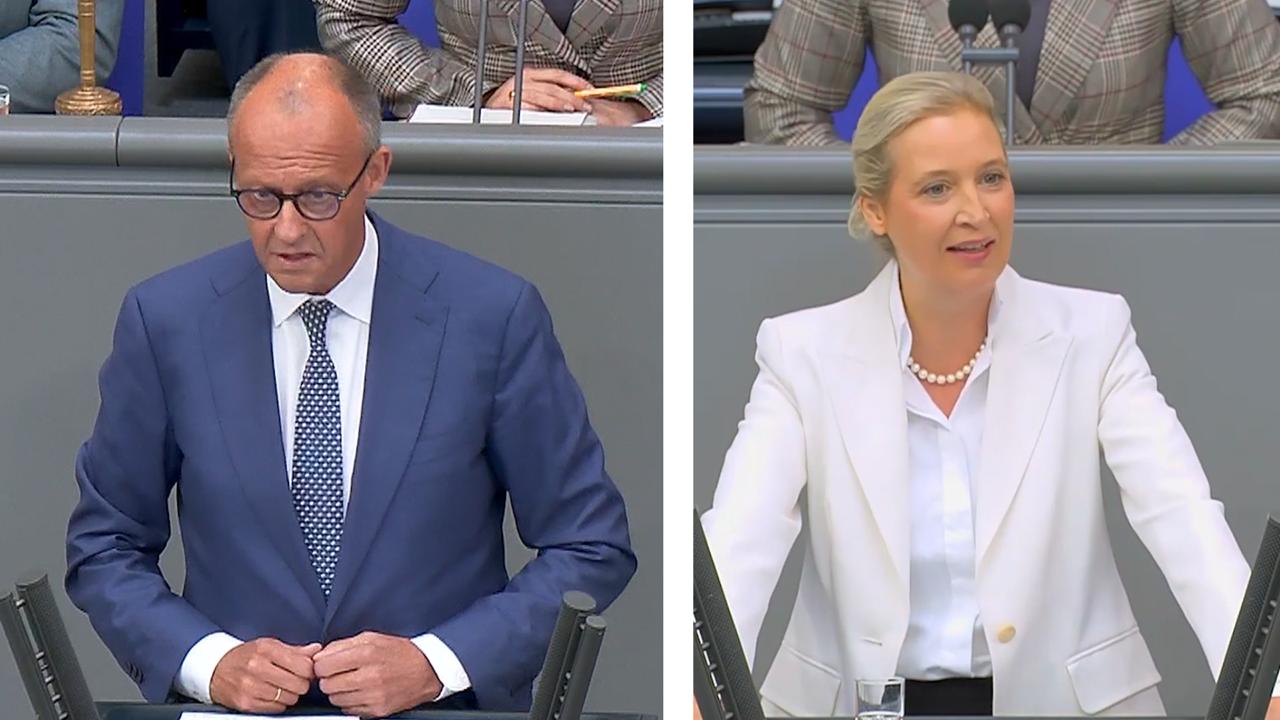
Three days after the Alternative for Germany’s (AfD) landslide in Saxony-Anhalt, the Bundestag’s general budget debate turned into a verbal battle between AfD co-chair Alice Weidel and Chancellor Friedrich Merz, with the two battling it out over mass immigration, democracy, crime, Ukraine, and the future of Germany.
Heckling filled the chamber. Bundestag President Julia Klöckner repeatedly intervened. The exchange was the first direct parliamentary clash between the two leaders since Sunday’s vote, in which the AfD took 43.8 percent and the CDU collapsed to 17.2 percent.
Weidel opened the debate and treated the election results as a verdict on the ruling federal government coalition led by Merz.
“The voters in Saxony-Anhalt have made it abundantly clear to you, in the language of the democratic sovereign: the Black-Red coalition is over,” she said. Citizens wanted “a change of policy,” she added, “and they do not want more of the same.”
JUST IN: After AfD's landslide victory, Weidel tells Merz that "the voters in Saxony-Anhalt have communicated to you in the language of the democratic sovereign with all clarity: Black-Red (CDU-SPD ruling coalition) is over."
Addressing Merz directly, she said he had failed to hear that message.
“That is not especially relevant, because your time has run out anyway. Citizens want a change of policy, and they will get it,” she said.
She turned next to the draft federal budget. Weidel called it a “declaration of surrender” and accused Finance Minister Lars Klingbeil of “unserious budget management.”
““Despite record tax revenues, you are incapable of managing the public’s money wisely. Why? Because you are unwilling to free yourselves from the shackles of green ideology, left-wing mass migration, and socialist redistribution.”
She said the CDU-SPD government planned more than €1 trillion in new borrowing over its term, a figure she described as unprecedented in the Federal Republic. The result, she argued, would destroy future room for maneuver and leave “scorched earth.”
“You are driving Germany into national bankruptcy in record time,” she said.
Weidel also continued to slam Merz on mass migration, a sore spot for the ruling government.
“You declare the migration crisis to be over. Yet, every year, a six-figure number of migrants enters the country through the back door of asylum, plus another major city through family reunification—most of them from Muslim tribal cultures,” she stated, adding: “More than a million refugees live whose asylum application has been rejected more than once. What are these people actually still doing in this country? They should be deported!”
Weidel accused the coalition of declaring the crisis over while still admitting large numbers of people through asylum procedures and family reunification. She claimed more than a million people whose asylum claims had already been rejected remained in the country and should be deported. Ordinary workers, she said, were paying the price.
“Because [Germans] have to deal daily with the consequences of mass migration, with the hatred of foreign groups toward their own, with hatred of Christians, with hatred of Germans, with hatred of Germany, and you are even providing financial support to these people. This must finally come to an end!”
After AfD's victory in Saxony-Anhalt, Alice Weidel takes Chancellor Merz to task during a raucous debate.
"Because [Germans] have to deal daily with the consequences of mass migration, with the hatred of foreign groups toward their own, with hatred of Christians, with… pic.twitter.com/lBjLNPt9hM
Energy policy drew the sharpest interjections from the government benches. Weidel called the energy transition “the greatest millstone dragging our economy into the abyss” and “lost, burned money.” Germany, she said, was facing a possible winter gas shortage after the destruction of Nord Stream 2 while still sending billions to Ukraine.
She demanded renewed Russian gas deliveries, a return to nuclear power, and peace talks.
“While the United States is making another attempt to end the murderous Ukraine war, you are stepping up the war propaganda and the confrontation with Russia,” she told the chancellor. When SPD deputies laughed, she snapped: “Do you find that funny? Voters out there can see that the SPD finds deindustrialization funny. So stop laughing.”
Merz responds
Merz came out swinging against Weidel, conceding the Saxony-Anhalt result was “remarkable,” but said the AfD had missed its actual goal: an absolute majority of seats.
“Fifty-six percent of voters in Saxony-Anhalt did not vote for you,” he said. “And you will not achieve that anywhere in Germany with this policy.” He accused Weidel of having pushed lead candidate Ulrich Siegmund, within hours of the polls closing, to seek a governing majority after having promised before the election to govern only with an absolute majority.
“You are, and you will remain, Ms. Weidel, a destructive force,” he accused.
The sharpest attack from Merz concerned remigration. He said the concept is “nothing other than a synonym for ethnic cleansing based on origin and skin color.”
Germany
The anti-immigration AfD party is pursuing a plan of "ethnic cleansing based on skin color and origin," said Chancellor Friedrich Merz during a Bundestag debate.
If that program were carried out, he claimed, skilled trades, nursing homes, hospitals, and restaurants would cease to function, because one in six workers in the crafts already holds a foreign passport and millions of people with a migration background keep essential services running. The coalition, he said, agreed on deporting people without a right to stay, but distinguished between those who work and contribute and those who must leave. AfD deputies erupted. Several shouted that the claim was false.
On Ukraine, Merz accused the AfD of reversing perpetrator and victim. Neither NATO, the European Union nor Germany had threatened Russia, he said.
“The only thing that truly threatens Russia and Putin is the radiance of democracy.”
The AfD, he added, still stood with Moscow.
“Right there runs the deep rift between you and us, in foreign policy, in European policy, in social policy and in peace policy,” he said.
He also charged that Weidel had said nothing about a failed drone incident at Leipzig Airport, a hacking attack on Berlin infrastructure, or this year’s fires and weather extremes.
“Not a word from you, Ms. Weidel, about what has been going on in this country this year, he accused her.
At one point in Merz’s speech, Klöckner told the AfD that heckling is part of parliamentary life, “but it is not part of constantly interrupting a speaker. You also have to accept that there are other opinions.”
When the noise continued, she warned one deputy: “We are not on the football pitch here right now. Save this for the weekend.” Later she threatened MPs with expulsion.
Merz thanked her and said the interruptions themselves showed the AfD’s “contempt for the German Bundestag,” adding that “listening is not your strong suit.”
With the battle brewing over who controls Saxony-Anhalt still to be decided, and with Merz’s CDU crashing below 20 percent in the latest poll, political tensions are set to rise in the coming month

 Login








 JUST IN: After AfD's landslide victory, Weidel tells Merz that "the voters in Saxony-Anhalt have communicated to you in the language of the democratic sovereign with all clarity: Black-Red (CDU-SPD ruling coalition) is over."