In late September, Israeli media reported that Netanyahu’s government intends to adjust access to key routes in the central West Bank. It plans to reopen Route 463 to settler-only traffic in the governorate of Ramallah and Al-Bireh.
Yisrael Gantz, the leader of the Yesha Council (an umbrella organization representing Israeli municipal councils across Israeli settlements in the West Bank and the Jordan Valley) confirmed that plans to reopen the road received preliminary approval and funding.
Preparations are also underway by the Israeli military to complete “the security, legal, and logistical” steps required to reopen the route (also known as Wallerstein Road).
History of the road
The road was paved in 1994 under the directions of Pinchas Wallerstein, a founder of the settlement movement, to connect the illegal settlements of Beit El (north-east of Ramallah and Al-Bireh) and Dolev (north-west of Jerusalem).
However, following the outbreak of the Second Intifada in 2000, the Israeli army barred Israeli people from using the road for security reasons. They also placed a locked iron gate on its end near Ein Qiniya village, northwest of Ramallah.
Why has the reopening of the route raised concerns among Palestinians in the West Bank?
Experts argue that Israel’s move will impact not only the governorate itself, but the entire occupied West Bank because of its central location, major metropolitan status, and role as a commercial hub.
To understand the repercussions of the route reopening, BreakThrough News spoke with Jamal Jumaa, a Palestinian activist, expert on Israeli settlement and apartheid-related issues, and coordinator of the Palestinian Grassroots Anti-Apartheid Wall Campaign (Stop the Wall).
Aside from dividing the governorate’s northern and southern halves, Jumaa noted that reopening the road is dangerous because it will block the center of Ramallah and Al-Bireh from two-thirds of its villages, which are situated to the west.
The prominent Palestinian activist added that when Israel builds such roads for settler traffic, it fences them off on both sides and prohibits the use of adjacent lands. The Israeli authorities consider those lands a buffer zone, citing the security of the settlers as their reason.
“This entails setting up military towers and checkpoints. The road will cut off continuously inhabited Palestinian villages north-west and south-west of Ramallah. Therefore, we are talking about the establishment of roughly four military checkpoints along the road,” he continued.
Jumaa pointed out that the road will complicate the life of Palestinians by restricting their access to vital healthcare and education facilities, including the Istishari Arab Hospital, Birzeit University, and the Arab American University.
He also noted that the intended reopening of the road “is part of dividing and dividing more Palestinians from each other.”
On the political level, Jumaa suggested that the road “hits the heart of the West Bank, which gives a clear signal to the Palestinian Authority that it has no sovereignty over anything.”
It is worth noting that since its establishment, the Palestinian Authority has designated Ramallah and Al-Bireh as a de facto administrative capital. Yet, this has not prevented the Israeli authorities from fragmenting and isolating the governorate by establishing illegal settlements, military outposts, checkpoints, and gates.
A few years ago, Sebastian Barry—whose collected literary works, drawn from family history and lore, offer “a loser’s history of 20th-century Ireland”—announced that the final novel in his series would tackle the relationship between his parents. “The declaration seemed to set the table for a feast of disclosure,” writes Giles Harvey, who spoke with Barry for more than a year as the novel took shape. But the feast never arrived. The “career-spanning profile” Harvey once suggested to Barry becomes a study of abuse, memory, and revelation—one Barry’s forte, and now, perhaps, his greatest struggle.
Barry and I corresponded for the next year and a half, during which the novel appeared to be on course. Then, in July of last year, he sent me a surprising email. Something had happened in the time since his father died, Barry explained. “Where there was once a great need to proclaim aloud,” he wrote — neglecting to specify just what it was he’d felt the need to proclaim — Barry now found himself in a different state of mind. “A matter I thought so urgent and in need of saying” had come to seem better served by a “strange new beneficent silence.”
Florida lawyer Jalal Shehadeh is convinced that the warrantless seizure of his cell phone by federal agents at the Newark International Airport after he returned from Palestine this September was not random.
Shehadeh, a Miami-based attorney and Palestinian rights advocate, was held for several hours for a secondary inspection and had his phone seized by U.S. Customs and Border Protection (CBP) after he refused to allow federal agents to search it.
“It’s just a wildly invasive thing to do to somebody with no individualized justifiable basis to do it,” Shehadeh told Truthout.
He suspects federal authorities targeted him for his activism. The lawyer is involved in a legal complaint against a federal judge in Florida over the judge’s anti-Palestinian statements.
Shehadeh is one of several Palestinian rights advocates who have been detained and had their personal devices searched by CBP while returning to the U.S. from international travel since the start of Israel’s war on Gaza in October 2023.
Other similar cases include Amir Makled, a lawyer from the Detroit area who was representing University of Michigan students involved in pro-Palestine activism, journalist Max Blumenthal, and Osama Abu Irshaid, the executive director of American Muslims for Palestine (AMP).
Jenin Younes, president of the American-Arab Anti-Discrimination Committee (ADC), which filed a legal motion earlier this week demanding the return of Shehadeh’s phone, said CBP appears to be escalating phone searches against opponents of President Donald Trump’s agenda.
“Common sense tells us that they are targeting people who have pro-Palestine views,” Younes told Truthout.
She stressed that the searches are illegal. The Fourth Amendment of the U.S. Constitution protects “persons, houses, papers, and effects, against unreasonable searches and seizures.”
Younes said the “border exception” that allows searches to ensure that no illegal items are brought into the country should not apply to phones.
Younes, a civil liberties attorney, said the authors of the Constitution would have certainly opposed giving the government blanket authority to search people’s phones without cause.
“Law enforcement can search shipping vessels coming into the Boston harbor to make sure that they don’t have contraband. That’s a totally different thing from searching the contents of people’s smartphones,” she said. “I don’t think the framers would have thought that you could read the papers of somebody coming into the country in their suitcase, and likewise, a smartphone, which has so much more personal information.”
The case of Shehadeh and other Palestinian rights supporters targeted for searches at the border has reignited the debate over the application of constitutional protections at ports of entry.
Shehadeh said that when he was stopped at Newark on September 17, CBP officers only conducted a “cursory” search on his bags because they did not appear to be interested in physical items.
“They are looking for our thoughts,” he said. “They’re looking to see what I’m thinking. They want to see who I’m messaging. They want to see what WhatsApp groups I am part of.”
The lawyer, who has Global Entry for expedited border crossing, said he was flagged by name for secondary inspection and led to a waiting room. He was asked general questions about his travels, work, and family before the agents asked to search his phone.
Shehadeh objected to allowing the officers to go through his device, citing the attorney-client privileged information on the phone. The agents kept him waiting and subjected him to another round of questioning as they took the case to a supervisor. As the clock ticked, the Florida-based lawyer missed his connecting flight to Miami.
Eventually, he was informed by an officer that CBP would take his phone and let him go. “I told them, ‘I just want to be very clear. I am not giving you permission, consent to search my phone, and I’m not giving any other arm of this agency or anybody else consent to search my phone,’” he said.
The cell phone still has not been returned.
Shehadeh told Truthout that if the goal of the episode were to deter his activism for Palestinian rights, it would not succeed.
“It will not move our advocacy work an inch. Literally, it will have no impact. If anything, it will fuel the importance of doing more of this work,” he told Truthout. “But when it comes to travel, I’m going to be much more careful about what my phone situation will be.”
The Trump administration has been cracking down on Palestinian rights activism, including through a deportation campaign targeting non-citizen students who participated in protests against the war on Gaza.
Shehadeh warned that the administration is creating a new norm of weakened constitutional rights that many people may take for granted.
“This search is a perfect example of that. Protection against search and seizure is one of those things that comes out of our Constitution that really empowers citizens to know you will not have government intrusion,” he said.
“What this administration is doing is chipping away at the rights of Americans — of all Americans. But sadly, Arabs, Muslims, and minorities tend to be the first victims of these abuses. But they’re certainly not going to be the last ones.”
Abu Irshaid of AMP said the government is turning border crossings into a “hunting ground for individuals it wishes to target” for political retaliation or to gather information about constitutional protected activity.
Abu Irshaid has sued the government, alleging that the repeated searches he has been subjected to at the airport, along with the seizure of his phone, amount to illegal discrimination.
A federal judge ruled in his favor in July, declaring that the government violated Abu Irshaid’s rights with the searches.
Some activists are pinning their hopes on a case before the Supreme Court, Anibowei v. Blanche, that could determine whether the Fourth Amendment applies to the electronic devices of U.S. citizens travelling internationally.
CBP argues that only a tiny fraction of travelers, less than one-half of one percent, are subjected to a device search. But official statistics show an uptick in such searches since Trump returned to the White House.
In 2024, federal officers inspected the devices of 47,047 travelers. The numbers increased to 55,318 last year. Of those inspections, 13,590 targeted U.S. citizens in 2025, compared to 10,541 a year earlier.
In January, CBP released a memorandum outlining its regulations and authorities around searching travelers’ personal devices. The document stressed that people at ports of entry have diminished privacy rights and that phone searches are essential “to identify and combat a wide range of illicit activities.”
A basic search, one where the officer goes through the phone manually, can be conducted “with or without suspicion.”
The bar is higher for carrying out an advanced search, which includes copying and analyzing the content of the phone through an external device. It requires “reasonable suspicion of activity in violation of the laws” enforced by CBP. But there appears to be a loophole. An advanced search can still be conducted “in the absence of individualized reasonable suspicion when there is a national security concern.”
The directive does not provide details on what constitutes a “national security concern” to enable an advanced search.
Officers can only search the device itself and may not access information stored remotely. That’s why they must disable the external connectivity of the phone, according to the memorandum.
The directive gives officers the authority to seize a device and keep it even after the traveler leaves the airport, which is what happened to Shehadeh. According to the memorandum, CBP could effectively keep his phone indefinitely. The agency is allowed to hold on to the device for a period of five days, which can be extended by 15 days and subsequently by seven days in increments without specified limits.
As of Thursday, CBP has kept Shehadeh’s phone for 14 days, meaning the agency has applied at least one extension to its hold on the device.
In response to Truthout’s request for comment, a CBP spokesperson told Truthout that the likelihood of a search at a port of entry “remains exceedingly rare” but did not answer specific questions about Shehadeh’s case, including why the agency is still holding on to his phone.
“U.S. Customs and Border Protection has statutory authority to conduct border searches of electronic devices for all persons entering or departing the United States, regardless of citizenship, to enforce laws addressing terrorism, child exploitation, drug- and human-smuggling, visa fraud, and national security threats,” the CBP spokesperson said.
In the face of the U.S.’s ever-expanding definition of “national security threats,” which now seem to include lawyers, journalists, and activists who have advocated for the rights of Palestinians, are now living in fear that border stops are being used as a form of intimidation.
“What is most disturbing is that many of these aggressive government actions target activists whose only ‘offense’ is criticizing Israel’s violations against Palestinians,” Abu Irshaid told Truthout in a statement.
A Personal Connection
As a reporter, I try to stay out of the stories I am telling. But my personal experience with being stopped and searched after returning to the U.S. from international travel is too relevant for this article to withhold.
After returning to Dulles International Airport outside Washington, D.C. from a trip to Lebanon in February 2025, I was detained for nearly five hours and faced similar treatment as Shehadeh.
CBP officers asked me intrusive questions relating to my work as a journalist and political leanings in my family’s hometown in Lebanon, which had been targeted by Israeli bombardment in the war.
After a brief search of my bags, a CBP officer asked me to hand my phone and unlock it. I initially refused. The federal agent handed me a piece of paper stating that CBP has the lawful ability to search electronic devices. When I highlighted that the flyer reflects CBP policy, not the Constitution, the officer threatened to seize both my phone and computer indefinitely if I didn’t hand the phone in.
CBP took the phone after pressuring me to write down its passcode and kept me waiting for around two hours before handing it back — with a disclaimer that they couldn’t “process” it because the system was down. They eventually let me go. Throughout the hours-long ordeal, the officers did not allow me to contact my family member who was waiting to pick me up at the airport.
I have traveled outside the country twice since then and have been flagged for secondary inspection on the way back each time, albeit without a device search. At the advice of press freedom experts, now I travel internationally with an alternative phone that does not contain sensitive personal or professional information.
The European Union has begun assessing contingency scenarios in case German Chancellor Friedrich Merz leaves office or becomes increasingly focused on domestic political difficulties, Politico Europe reported Friday, citing diplomats and European officials.
According to the report, governments in two European countries have held internal discussions on how a possible end to Merz’s chancellorship could affect EU policymaking.
The discussions reportedly reflect growing concern in Brussels over political instability in Germany following major electoral setbacks for Merz’s governing conservatives and renewed tensions within the coalition.
Recent regional elections have weakened Merz politically. Reuters reported that the Christian Democratic Union (CDU) suffered its worst-ever result in Mecklenburg-Western Pomerania in September, failing to clear the threshold to enter the state parliament, while the Alternative for Germany (AfD) made further gains.
Berlin’s Political Turmoil Raises EU Concerns
Politico Europe reported that officials consider two scenarios particularly disruptive: Germany being left without an effective leader or a right-wing government emerging in Berlin. However, the report said both scenarios are viewed as unlikely in the short term.
Under Germany’s constitutional system, a chancellor cannot simply be replaced by a successor appointed by the governing party. The Bundestag elects the chancellor, meaning any leadership change would require the necessary parliamentary majority.
For Brussels, the political uncertainty matters because Germany remains the EU’s largest economy and a central actor in negotiations over major bloc-wide policies.
Reuters reported Thursday that Merz is facing growing domestic pressure, while speculation about possible successors has emerged within the CDU. Merz has nevertheless rejected calls to step aside and continues to pursue his government’s policy agenda.
EU Budget Dispute Adds Pressure
Merz’s domestic political position could also affect negotiations over the EU’s next seven-year budget.
According to Politico Europe, Germany is part of a group of member states, including the Netherlands, Sweden, Denmark, Austria, and Finland, seeking substantial reductions to the proposed long-term EU budget. The report said officials believe domestic political pressure could encourage Berlin to take a tougher negotiating position in Brussels.
The budget dispute comes as EU governments debate competing priorities, including defense, industrial investment, infrastructure, and support for Ukraine.
Military Buildup Remains Central to Merz’s Agenda
Despite the political pressure, Merz’s government continues to prioritize strengthening Germany’s armed forces. Reuters reported that Berlin’s debt-financed investment drive is supporting both infrastructure and military expansion, while the government has committed hundreds of billions of euros to rebuilding the armed forces.
Any change in Berlin’s political leadership would therefore carry implications beyond Germany, potentially affecting EU budget negotiations, defense policy, relations with Russia, and the bloc’s wider strategic direction.
It was common practice during the Cold War to exaggerate the threat from the Soviet Union. Nowadays, Russia has assumed that role. Although the circumstances have changed, some of the political methods employed to create a sense of insecurity are still remarkably similar. Europe is not formally engaging in preparations for war since it desires […]
US authorities designated the A7 financial network as a "significant transnational criminal organization," the latest in a series of steps by Western authorities to try and choke the sprawling Kremlin-backed sanctions-evading scheme.
In the days between the elections and his arrest, Aleksandr Kynev had pointed to evidence of falsifications benefitting the United Russia party. Some analysts see his arrest and reported beating as a sign of a power struggle pitting security agencies against political operatives in Putin’s Kremlin.
How a $240 million messaging machine put a three-year-old puppet to work selling an mRNA shot to parents of infants — and what the government has quietly admitted since.
It’s a well-made piece of persuasion. Elmo, who has been three and a half years old since 1984, shows off his “super duper” bandage. There “was a little pinch. But it was okay.” Then his father, Louie, looks into the camera and speaks to every hesitant parent in America:
“I had a lot of questions about Elmo getting the COVID vaccine. Was it safe? Was it the right decision?”
Eleven seconds later, the doubt has been resolved for you:
“I learned that Elmo getting vaccinated is the best way to keep himself, our friends, neighbors and everyone else healthy and enjoying the things they love.”
A hug follows. Then an announcer: “It’s okay to have questions about COVID vaccines for your kids.”
That’s the move worth studying. The ad takes the parent’s instinct to ask questions, gives it to a beloved puppet, and answers it before the parent has a chance to. It presents doubt so it can close it down.
This was not a whimsical one-off from a children’s television workshop. It was one output of what its own organizers called the largest communications program in our nation’s history, built with federal public-health agencies, a major medical trade association, and tens of millions of corporate dollars.
Four years later, Pfizer-BioNTech’s product is no longer authorized for children ages six months through four years. Federal guidance and product labeling have also narrowed which pediatric uses are on-label, a shift sharply at odds with the PSA’s broad, categorical reassurance. Nobody made a puppet video about that.
This is the story of who built the campaign, what it cost, and what came after.
Five institutions. Each one deserves a name and a face.
Sesame Workshop
The nonprofit behind Sesame Street produced and released the spot. Its campaign lead was Dr. Jeanette Betancourt, Senior Vice President of US Social Impact. Its president at the time, Sherrie Westin, was named CEO in July 2024.
The clearest statement of what Sesame thought it was offering came from its own chief marketing officer. Launching an earlier round of vaccine PSAs, Samantha Maltin, EVP and CMO, said the goal was to:
“… harness the power of Sesame Workshop and the reach of the Ad Council…”
Harness the power. The asset being put to use was fifty years of trust that parents and children have placed in these characters.
The Ad Council
The Ad Council turns corporate media budgets into “public service” messaging. Its president and CEO, Lisa Sherman, was the campaign’s public face. On the Elmo spot:
“It’s important that parents feel informed and confident about what the COVID-19 vaccines mean for their families, and we are proud to work with our partners, medical experts – and of course Elmo – to spread that message.”
She also named the urgency: this was “an important decision many need to make in advance of the upcoming school season.”
COVID Collaborative
The COVID Collaborative is a bipartisan assembly of former officials, and it convened the vaccine education initiative with the Ad Council. Its CEO is John Bridgeland, former Director of the White House Domestic Policy Council. Its president is Gary Edson, and its co-chairs are former Idaho Gov. and Sen. Dirk Kempthorne (R) and former Massachusetts Gov. Deval Patrick (D). The Collaborative is a project of UNITE, chaired by Tim Shriver.
The AAP, the pediatricians’ professional association, was the other named production partner. Its president in 2022 was Dr. Moira Szilagyi. Looking back later, she said: “Somewhere what got lost in our country, I think, was what a miracle these vaccines were.”
Keep the AAP in mind. It comes back in Part IV.
Part II: Follow the Money
The Elmo spot was built on a large funding structure, and its size helps explain how thoroughly this message saturated American media.
The corporate fund. On November 23, 2020, before any vaccine was authorized, the Ad Council announced a $50 million fund for the COVID-19 Vaccine Education Initiative, created with the COVID Collaborative. By February 2021 it had exceeded that goal.
The COVID Collaborative reports more than $52 million raised. The leading contributors it names are Amazon, Apple, Bank of America, Cisco, CVS Health, Facebook, General Motors, Google and YouTube, the Humana Foundation, NBCUniversal/Comcast, Salesforce, Verizon, Walgreens, and Walmart.
Two of those names stand out. CVS Health and Walgreens both gave the shots the campaign was promoting in their own pharmacies.
The donated media. The money was only the seed. By October 26, 2021, the initiative had surpassed its goal of $240 million in donated media and related publicity. Donors of airtime and ad inventory included Disney (ABC, ESPN, Hulu), FOX, NBCUniversal and Telemundo, ViacomCBS, WarnerMedia, Facebook and Instagram, Google and YouTube, TikTok, Snapchat, Spotify, Pinterest, LinkedIn, and The Weather Channel.
The taxpayer layer. Alongside the private effort, HHS ran its own $265 million COVID public-education campaign starting in summer 2020. That included a $250 million NIH award to the Fors Marsh Group, which created the “We Can Do This” brand, all paid for through a $300 million interagency agreement drawing on CDC’s CARES Act funds. Under its “Vaccinate with Confidence” framework, the CDC funded more than 200 partners. Across the March 2021–December 2022 rollout, it funded 110 primary and 1,051 subrecipient partners at the national, state, and community level.
A note on accuracy. I have not found documentation that Pfizer or Moderna directly paid for the Elmo spot, and the campaign materials don’t list them as partners. Pfizer does appear as a Sesame Workshop donor in later years, in the $100,000–$249,999 band of its 2024 impact report. That’s worth knowing, but it’s a separate fact. The documented structure is damning on its own: corporate money, federal science guidance, and a medical trade association, all speaking through a puppet.
Part III: It Wasn’t One Ad
The Elmo spot was the youngest-audience edge of a sustained effort to put Sesame Street characters to work for vaccine messaging.
June 2022: Elmo’s PSA, released days after the FDA’s emergency authorization for children as young as six months.
Later: Sesame Workshop, the Ad Council, COVID Collaborative, and CDC launched a further series of PSAs with Elmo, Louie and other Muppets, “created in close partnership with the CDC.”
“When it starts getting into complex territory that involves the power of the state, the influence of pharmaceutical companies, the impact of coronavirus on young children — these are not issues I want resolved by members of Elmo’s family.”
The critics were dismissed as cranks at the time. Here is what the government has said since.
Part IV: The Walk-Back Nobody Advertised
There was no $240 million campaign for any of what follows. No Muppets and no hug at the end. It came out as label changes, regulatory memos, and footnotes in clinical guidance.
The cardiac warning got stronger
On June 25, 2025, the FDA required and approved expanded warnings about myocarditis and pericarditis on Pfizer’s Comirnaty and Moderna’s Spikevax. The new label estimates about 8 cases per million doses in people aged 6 months through 64 years, and about 27 per million in males aged 12 through 24, in the week after vaccination.
The most important sentence isn’t about frequency, though. It’s about what happened to the hearts afterward:
“… at a median follow-up of approximately 5 months post-vaccination, persistence of abnormal cardiac magnetic resonance imaging (CMR) findings that are a marker for myocardial injury was common. The clinical and prognostic significance of these CMR findings is not known.”
Read it twice. Five months out, markers of heart-muscle injury were “common,” and the agency says their long-term significance is “not known.” This isn’t a critic’s claim. It comes from an FDA-funded, FDA-co-authored study, and it’s now printed on the label.
The spot told parents “there was a little pinch. But it was okay.” Nobody in the ad said “unknown long-term cardiac significance.”
The authorization for the youngest children was pulled
That is the age group the Elmo spot was released to reach. It went out days after emergency authorization opened the shots to children as young as six months. Four years later, one of the two products it promoted to parents of those children can’t legally be given to them.
Healthy children are now “off-label”
The broad “everyone six months and older” recommendation is gone. In May 2025, HHS dropped the routine recommendation for healthy children, and the CDC moved to what it calls shared clinical decision-making.
CDC’s current guidance, updated September 23, 2026, limits Moderna’s approval for the youngest children to those with “at least one condition that places them at increased risk for severe COVID-19.” Then it states the conclusion outright:
“Vaccination of children 5-11 years of age with any product other than Spikevax or Comirnaty and vaccination of children in this age group without high-risk conditions is off-label use.”
“Vaccination of persons 12-64 years of age without high-risk conditions is off-label use.”
In 2022, the message was that vaccinating Elmo was “the best way to keep himself, our friends, neighbors and everyone else healthy.” In 2026, the CDC’s own wording is that giving the shot to a healthy child is off-label.
The deaths question
On November 28, 2025, Dr. Vinay Prasad, then director of the FDA’s Center for Biologics Evaluation and Research, sent staff a memo headed “Deaths in children due to COVID-19 vaccines and CBER’s path forward.” He wrote that career staff “have found that at least 10 children have died after and because of receiving COVID-19 vaccination,” based on an initial review of 96 child deaths reported to VAERS between 2021 and 2024.
The FDA’s formal analysis, made public in May 2026, came back more cautious. Of the 96 reports reviewed, none were classified as “certain.” Five were classified “possible” and two “probable,” mostly involving myocarditis, with an average age of 13. The agency stressed that these classifications don’t prove causation.
Media coverage framed that result as a debunking. Set the headline aside, though. The FDA’s own conservative review, using WHO causality criteria, still found seven child deaths it could not rule out as vaccine-related, and it called two of them probable.
And yet, still being promoted
This is where the irony stops being subtle.
Visit the FDA’s parent-facing page today, Vaccines for Children – A Guide for Parents and Caregivers. The COVID-19 vaccine is still listed alongside measles and polio among “the most commonly administered vaccines.” And parents are still told:
“Getting a COVID-19 vaccine is the best way to prevent COVID-19, including the potential consequences of hospitalization and death.”
That’s Louie’s line almost word for word, four years later, from the same agency whose label now carries the cardiac warning, whose authorization for under-5s was pulled, and whose own reviewers flagged seven child deaths.
The American Academy of Pediatrics, a production partner on the Elmo spot, hasn’t backed off either. As of September 2026, the AAP recommends COVID-19 vaccination for “all infants and children ages 6 months through 23 months,” and for “anyone ages 2 to 18 who isn’t at risk but whose parents or guardian wants them to get a shot.”
So we have two different postures at once. The regulator has narrowed approval, expanded the warning, and reclassified healthy-child use as off-label. The professional association that helped make the puppet ad still recommends the shot for every baby. And the FDA’s own parent guide still uses the 2022 talking points.
Part V: What They’ll Say — and Why It Doesn’t Save Them
Serious readers deserve the strongest counterargument, so here it is.
That’s a legitimate data point and I’m not going to pretend it doesn’t exist. It doesn’t answer the question this piece is asking, for three reasons.
First, the comparison is an average over a population of teenagers and young adults. It says nothing about a healthy toddler with near-zero risk of severe disease. That’s the child this campaign targeted, and the child for whom the CDC now calls the shot off-label.
Second, it doesn’t address the finding printed on the label: persistent markers of heart-muscle injury at five months, of “not known” significance. The open letter discussed below says there are “no studies demonstrating prevention of hospitalization or death” in children. If that’s right, an unknown cardiac risk is being weighed against a benefit that was never shown.
Third, and most importantly, the argument here doesn’t depend on any contested injury number. It depends on an asymmetry. When the product was being promoted, it got a puppet, $50 million, a quarter-billion in donated airtime, the CDC’s logo, and the pediatricians’ endorsement. When the regulator narrowed the product, it got a label revision and a footnote. The public was sold a certainty the evidence never supported, and was never told when that certainty was withdrawn.
That isn’t public health communication. It’s a marketing campaign that never issued a correction.
Part VI: The Petition — Why I Signed
Earlier this month, 168 physicians, scientists, researchers, lawmakers, and health-freedom advocates, representing more than 63 million followers, sent an open letter to HHS Secretary Robert F. Kennedy Jr. and President Trump demanding removal of the mRNA platform. The effort was coordinated by Dr. Mary Talley Bowden. The signatories include Rep. Thomas Massie, former Rep. Marjorie Taylor Greene, Louisiana Deputy Surgeon General Dr. Sean Troxclair, Dr. Peter McCullough, Dr. Robert Malone, Dr. Aseem Malhotra, Tucker Carlson, and others.
I’m one of them, and I want to explain why.
The letter’s first demand is to “ban mRNA/gene therapy-derived technologies for all vaccines.” That includes the products still being given to children. Its other demands are to end the PREP Act declaration and its “ironclad liability shield for manufacturers and administrators,” ask Congress to repeal the PREP Act, ban direct-to-consumer pharmaceutical advertising, end the incentive structures that push providers toward medical coercion, and end conflicts of interest at the CDC, FDA, NIH, and NIAID.
On children specifically, the letter makes the point this whole piece has been building toward:
“Parental choice is not realistic when parents are not getting informed consent on the true risks of these products.”
It also takes on the “shared clinical decision-making” framework directly:
“By treating the decision to inject a child with mRNA as a ‘shared decision,’ while treating routine injections as the default, a dangerous legal precedent is being set that assigns powers to the federal government that have historically belonged solely to parents.”
According to the letter, more than 50 million Americans received mRNA COVID shots this year, including about 7 million children, and HHS has awarded $1.24 billion in contracts to Pfizer for future mRNA shots, “including for children.”
The Elmo spot is exactly why that line about informed consent matters. You can’t give informed consent to a hug from a puppet. A one-minute ad that turns a parent’s hesitation into a script and then answers it in eleven seconds isn’t informing anyone. It’s persuasion aimed at the people least able to push back: parents who trust Sesame Street and children who love Elmo.
HHS’s response to the open letter, through press secretary Emily Hilliard, was that Secretary Kennedy “believes mRNA products warrant heightened scientific scrutiny,” and that HHS had “wound down investments in mRNA vaccines for upper respiratory viruses because the technology does not effectively protect against infection from rapidly mutating viruses such as COVID-19 and flu.”
Think about that sentence next to the Elmo spot. The federal health department now says the technology “does not effectively protect against infection” from COVID. In 2022, a puppet told America it was “the best way to keep himself, our friends, neighbors and everyone else healthy.”
Heightened scrutiny isn’t enough. A product that federal officials now concede doesn’t reliably prevent infection, that carries a cardiac warning with unknown long-term significance, whose own regulator calls it off-label for healthy children, and whose makers are protected from liability should not be given to children at all.
Conclusion: The Correction That Never Aired
Every institution in the Elmo spot is still operating. Sesame Workshop is still making children’s programming. The Ad Council is still running “public service” campaigns. The CDC’s logo is still on its creative. The AAP still recommends the shot for every infant. The FDA’s parent guide still repeats Louie’s line.
None of them has produced a PSA that says: We told you this was the best way to protect your baby. Since then the label has been changed to warn about heart injury. The authorization for the youngest children was withdrawn. The government now calls this use off-label for healthy kids. We’re sorry we used Elmo to tell you otherwise.
That’s the one-minute spot this country is owed. Until it airs, the original belongs where I’ve put it: in the Hall of Fame of the Covid-era Mockingbird Media, as a case study in what happens when institutions that are supposed to earn a parent’s trust decide to manufacture it instead.
Watch it again. Listen for the moment Louie asks, “Was it safe?”
It was a good question. It still is. They just never let him wait for the answer.
From the Covid-era Mockingbird Media Hall of Fame: Targeting Kids with Covid Jabs using Sesame Street Characters
June 2022. Elmo, “age 3½,” shows off his bandage. His dad Louie tells parents of kids as young as six months: “I had a lot of questions… Was it safe? Was it the… pic.twitter.com/rbEbCdEno2
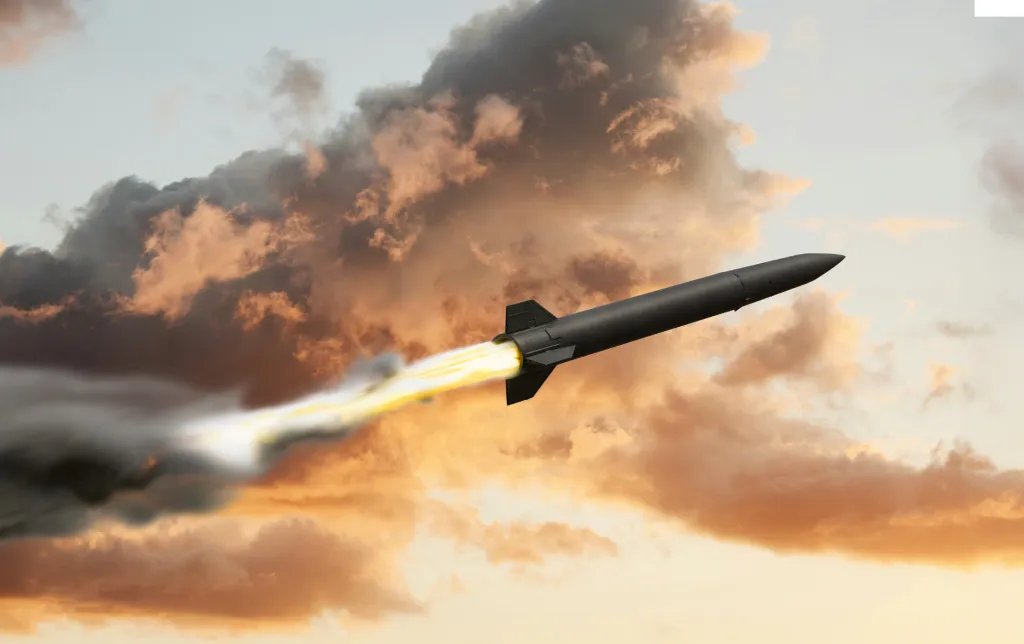
Ukraine says it has used its domestically developed FP-7 tactical ballistic missile in combat for the first time, in what would mark another significant milestone in the country’s rapidly expanding indigenous long-range strike program.
President Volodymyr Zelensky announced today that Ukraine had conducted the first combat use of the FP-7, a ground-launched ballistic missile developed by Ukrainian defense company Fire Point. He also said production of the weapon would follow.
Ukrainian tactical ballistic missile. FP-7. First combat use. Thank you for the result. Next up: production. Glory to Ukraine! pic.twitter.com/IxdjVg51c1
— Volodymyr Zelenskyy / Володимир Зеленський (@ZelenskyyUa) October 1, 2026
The claim has not been independently verified, and Ukrainian authorities have not disclosed the target, location, number of missiles involved, or other details surrounding the reported strike. A video has been published showing what’s said to be a nighttime launch of the missile.
The FP-7 is one of several increasingly ambitious weapons being developed by Fire Point, a Ukrainian defense company that has expanded rapidly since Russia’s full-scale invasion. The company began with drones and has subsequently moved into long-range strike missiles and ballistic missile technology.
Test launch of the FP-7 surface-to-surface ballistic missile. Fire Point
Fire Point CEO Iryna Terekh previously described the company’s development and manufacturing model in an interview with TWZ, detailing an effort to rapidly scale production while maintaining a dispersed industrial base inside Ukraine. The company’s better-known systems include the FP-1 and FP-2 long-range strike drones and the FP-5 Flamingo cruise missile.
According to Ukrainian and company-released information, the FP-7 has a range of approximately 250 kilometers (155 miles) and a warhead weighing around 150 kilograms (331 pounds). Other published figures have put its velocity at approximately 1,500 meters per second (around 3,350 miles per hour). Rather than striking targets deep in the Russian rear areas, the missile is optimized for use against objectives such as logistics hubs, air defense sites, and drone bases. This makes it more of a shorter-range complement to the U.S.-supplied Army Tactical Missile System (ATACMS) ballistic missile, rather than a direct replacement, although it comes without any restrictions on the kinds of targets that it can be used against.
Details from missile debris shown by Russia confirm Ukraine launched ATACMS at Voronezh region on November 18, marking the first use of U.S.-made missiles on Russian territory during Trump’s presidency. According to the Russian MoD, S-400 and Pantsir-S1 systems helped repel the… pic.twitter.com/8SeQCo9OEO
At the same time, those specifications should likewise be treated as reported figures rather than independently verified performance data. Actual range, payload and accuracy can vary according to missile configuration and mission profile.
The FP-7’s development is particularly notable because Fire Point is also using the basic missile architecture as the foundation for a very different weapon.
Fire Point has developed the FP-7.X, an anti-ballistic missile interceptor derived from the surface-to-surface FP-7.
A video showing a test launch of an FP-7.X surface-to-air missile:
Держави програють війни на полі бою значно рідше, ніж вони програють їх у інститутах, лабораторіях та на виробництві за десять років до їх початку.
Коли країна роками недофінансовує інженерну освіту, скорочує дослідження, втрачає виробничі компетенції або звикає покладатися на… pic.twitter.com/Ti1Ayn4INf
Fire Point’s expectation is that commonality between the two systems can shorten development and provide manufacturing efficiencies by allowing the company to draw upon work already conducted on the FP-7’s propulsion, airframe, guidance, and production processes.
The FP-7.X forms part of Project Freyja, a European effort to develop a comparatively inexpensive and potentially more numerous ballistic-missile-defense interceptor. Fire Point has also discussed an eventual production rate of thousands of interceptors annually, although such targets represent company ambitions rather than demonstrated production capacity.
Fire Point has said it is working with European and Ukrainian partners on the system, including work on the interceptor’s seeker. The company has described an initial interceptor using a blast-fragmentation approach, with more sophisticated hit-to-kill capability envisioned for later versions.
Earlier this year, Diehl Defense confirmed that it plans to launch production of the Flamingo cruise missile in Germany. Previously, Diehl had signed a technology agreement with Fire Point but had not disclosed any details. Potentially, that could open a path to Fire Point’s ballistic and cruise missiles helping to meet the growing demand for long-range fires capabilities among NATO’s European members.
A video of the Flamingo cruise missile in action:
As it stands, the baseline FP-7 is only one element of Fire Point’s ballistic missile ambitions.
A rendering of the FP-7 surface-to-surface ballistic missile. Fire Point
The company is also developing the larger FP-9, which Fire Point has described as having a planned range of approximately 850 kilometers (528 miles). The larger missile requires substantially more solid propellant and has driven the company to establish new industrial capabilities for manufacturing large solid-rocket motors.
As with the FP-7, the available FP-9 performance figures are based primarily on statements from Fire Point and Ukrainian sources and should not be treated as independently established specifications.
The development of these weapons reflects Ukraine’s broader effort to expand domestic production of long-range strike systems. Kyiv has relied heavily on Western-supplied weapons during the war while simultaneously attempting to establish an indigenous capacity for drones, cruise missiles, and ballistic missiles.
For Fire Point, that effort has produced an unusually broad portfolio in a relatively short period: long-range attack drones, cruise missiles, ballistic missiles and, potentially, interceptors designed to defeat ballistic missiles.
The claimed combat debut would give Ukraine a fast, hard-to-intercept strike option for targets within the FP-7’s reported range, with its combination of kinetic energy and relatively heavy warhead making it particularly useful against hardened targets. If targeting and launch procedures can keep pace, its short flight time can also enable rapid-response strikes against more time-sensitive targets. More broadly, the FP-7 represents the culmination of years of Ukrainian efforts to close a major ballistic-missile gap with Russia and establish an indigenous capability.
FP-7 surface-to-surface ballistic missile. Fire Point
The reported combat debut of the FP-7 also comes as the long-range strike campaign between Russia and Ukraine continues to intensify, with both sides increasingly seeking to hold targets deep behind the other’s front lines at risk. That dynamic will become particularly important as the two countries head into another winter, when strikes against energy, industrial, and military infrastructure ramp up significantly. At the same time, the FP-7’s reported range gives it a considerably more limited target set than Ukraine’s longer-range cruise missiles and drones, constraining where it can be employed and distinguishing it from systems designed for deep strikes hundreds of miles beyond the front.
The significance of Zelensky’s announcement will ultimately depend heavily on whether the FP-7 can move from a claimed combat debut into sustained production and operational service.
Ukraine has not publicly disclosed the number of FP-7 missiles produced, current production rates, or when significant quantities could become available.
Using theFP-7 in combat for the first time would mark an important transition for Fire Point’s ballistic missile program, from development and testing toward operational employment. The company’s ability to manufacture the weapon at scale will become the next critical question.
Once again, the British state is exploiting anti-democratic terrorism measures to secure convictions of Palestine Action defendants who targeted an Israeli weapons plant. UK media is currently forbidden from reporting on the trial.
From October 5th, an eight-week-long trial of nine Palestine Action activists known as the Instro 10 will begin at London’s Old Bailey. The defendants are accused of criminal damage, burglary – trespass including criminal damage – and violent disorder.
In keeping with several recent cases brought against the activist collective, which the British state proscribed as a terrorist entity in July 2025, the jury and public are not allowed to know – and the British media is prohibited from reporting – that if activists are convicted of any offenses, they could be sentenced as terrorists.
Palestine Action is a direct action protest group which successfully forced four weapons plants run by the Israeli state-owned company Elbit Systems to close. In several cases, juries acquitted activists after they argued that the property damage they caused saved countless lives in the besieged Gaza Strip, where Israel stands accused of committing genocide. Having suffered millions in damage as it was repeatedly forced to cease production, Elbit and the British state began conspiring to crack down on the activists. This resulted in the effort to stack the legal deck against Palestine Action defendants.
This June, four activists received prison terms ranging from nearly five to over eight years due to the subsequently applied “terrorist connection” label. The judge prohibited the defendants from discussing their motives or arguing that their actions were intended to prevent far graver crimes being perpetrated by Elbit’s weapons.
By denying defendants particular legal defenses, British authorities are attempting to rubber-stamp convictions, and ramming through sentences that are far harsher than for criminal offenses. Had the Instro 10 been publicly charged with “terrorist” offenses, they would have had an opportunity to effectively argue their case properly in open court. But under the new, nakedly undemocratic rules, they are muzzled by judicial decree.
On June 17 2024, Palestine Action descended on the British headquarters of weapons factory Instro Precision, a subsidiary of Israeli arms manufacturer Elbit Systems. Instro’s CEO is Dagan Yogev, an Israeli military veteran who was a major during Tel Aviv’s 2006 assault on Lebanon. After leaving the IDF, he worked in senior positions within Elbit’s Israeli headquarters. Instro produces targeting equipment which has been used in genocidal assaults on Gaza and Southern Lebanon.
Seven Palestine Action members broke into the factory, inflicting reportedly in excess of £1 million ($1.32 million) in damage. Two days later, an Instro Precision state export license to Israel was cancelled, perhaps due to the firm’s inability to fulfill the order in the wake of Palestine Action’s visit.
The seven activists responsible were arrested on-site, and released on bail within 24 hours. Counter-terror police were not involved at any stage. By this point too, not a single Palestine Action activist had been accused of terrorism, or charged under the Terrorism Act.
Unbeknownst to Palestine Action, a secret meeting occurred within 10 days of Instro Precision being struck, at which the Crown Prosecution Service discussed “the resource implications” of PA’s proscription as a terrorist organization with senior British counter-terror officers. In other words, prosecutors and police were weighing the potential financial windfall they would reap by designating Palestine Action as a terrorist group.
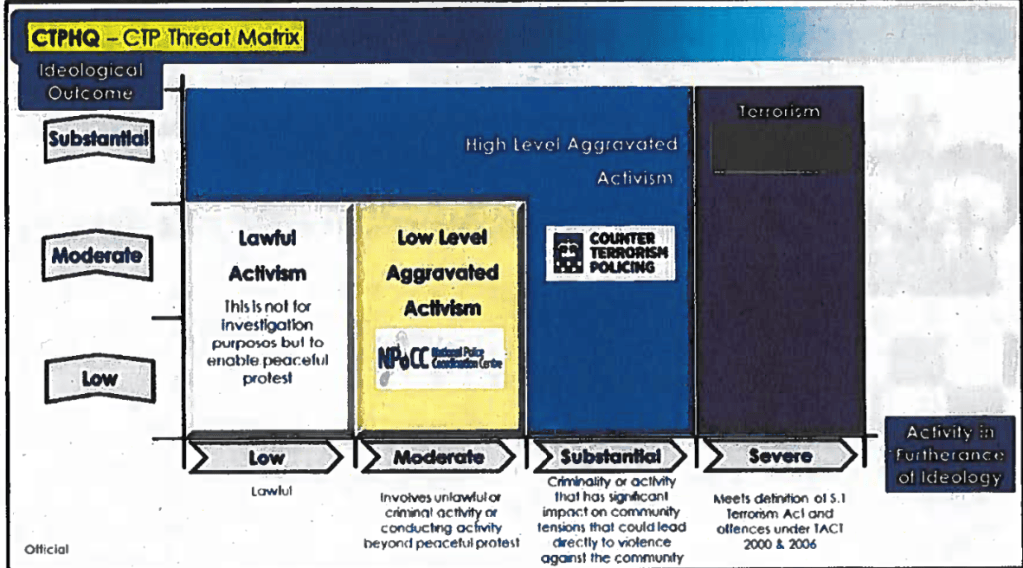
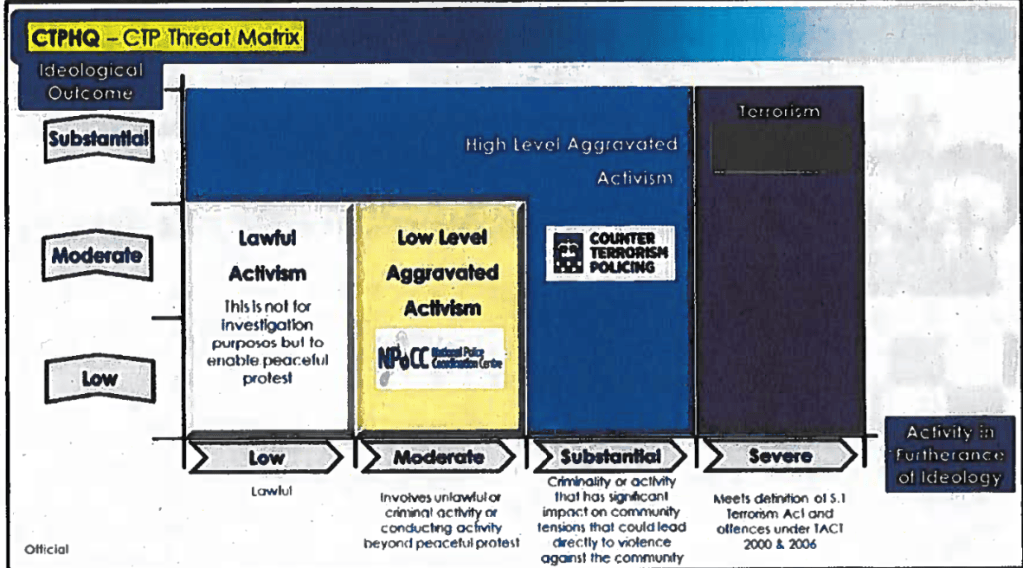
The Grayzone has reviewed heavily redacted records of the meeting. They contain powerpoint charts replete with a “threat matrix” indicating how citizen political activity is categorized by authorities as “high level aggravated activism,” or “terrorism.” The former activity is defined as activism involving “unlawful behaviour that has… a significant negative impact on UK businesses.”
In March 2025, around the time Britain’s Proscription Review Group met to determine whether Palestine Action should be proscribed as a terrorist group, British authorities brought charges against activists who targeted the Instro factory. Initially, they were accused of the same crimes as the Filton Six: aggravated burglary, criminal damage and violent disorder, with a “terrorist connection” covertly applied on the basis of serious property damage. But in July, when then-Home Secretary Yvette Cooper announced PA’s proscription, she cited the Instro case as an example of “violence” perpetrated by the group.
Despite the highly politicized terror designation, a British court was forced to drop charges of aggravated burglary against the Instro 10, indicating that neither police nor prosecutors possessed any evidence Palestine Action intended to harm any person. Indeed, during its five years of operation, PA has conducted hundreds of direct actions without injuring a single person.
This August, as Palestine Action appealed its proscription in the UK, the administration of US President Donald Trump designated the group as a global “terrorist” threat. This appears to have been, at least in part, an effort to bolster the dubious case against the philanthropist and Palestine Action supporter Fergie Chambers, who faces extradition to the US from Spain for supporting “foreign terrorist organizations.”
From Washington to London, governments are stripping away their patina of liberal democracy to protect their relationship with Tel Aviv. Counter-terror legislation is now the weapon of choice in their war on citizens who seek to obstruct Israel’s genocide machine.
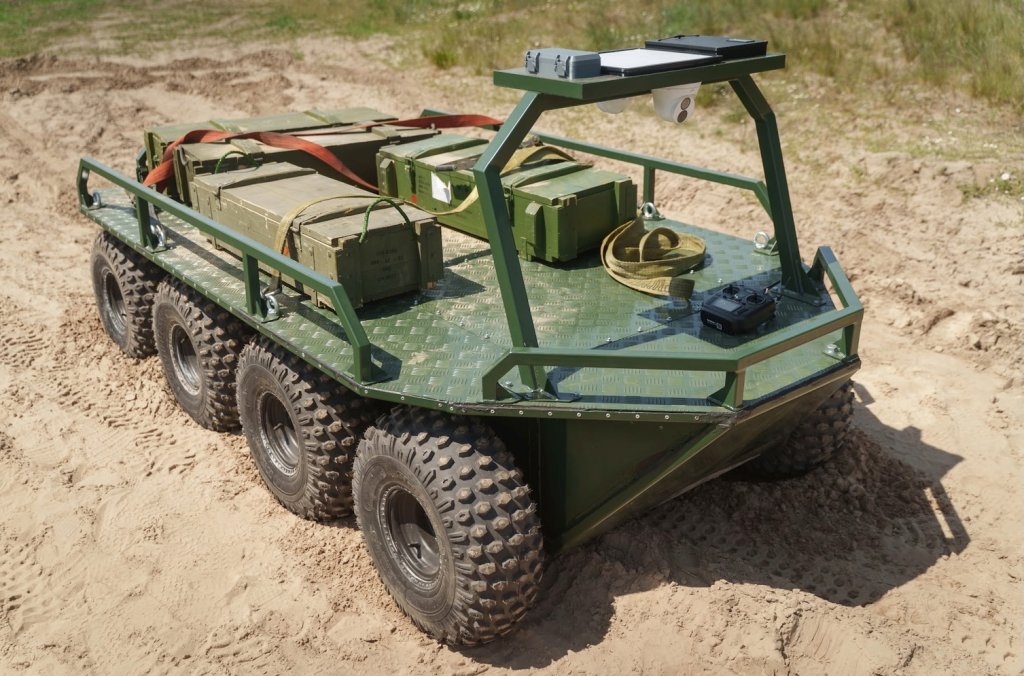
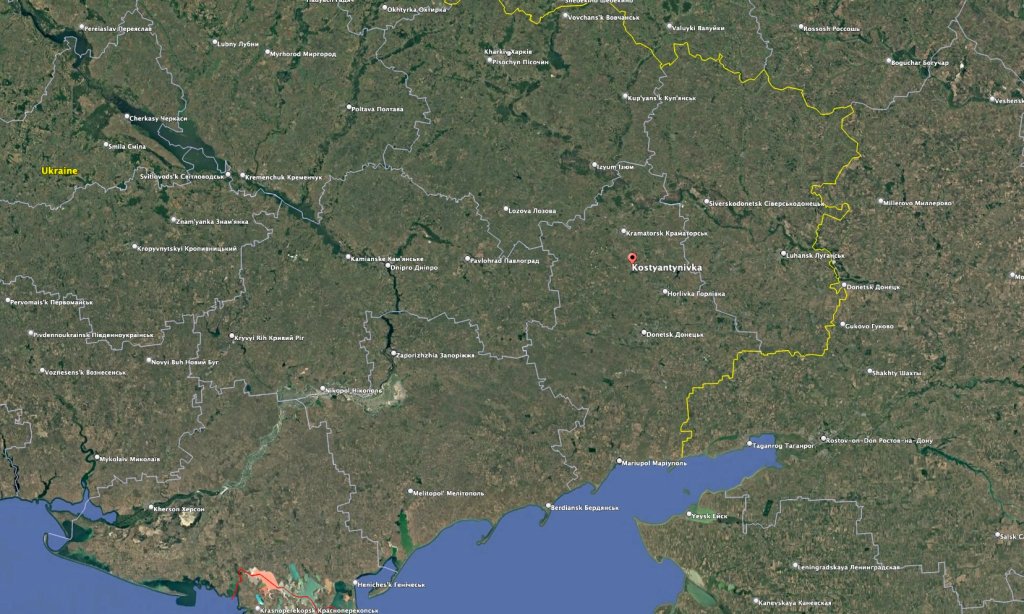
Taking a break from fighting Russians in the Kostiantynivka sector of the eastern Donetsk region, the commander of a Ukrainian uncrewed ground vehicle (UGV) unit spoke with us about innovations in the use of these systems. One was the first deployment of a UGV specifically designed for amphibious operations to deliver supplies to frontline troops in areas impeded by water obstacles. Large areas of the front line are bisected by rivers and wetlands, and the country has many other small waterways and marsh areas. As we have frequently reported, the use of UGVs by both Ukraine and Russia has exploded as the ubiquity of aerial attack drones makes it far too dangerous for human battlefield movements.
In an exclusive interview with TWZ, the commander of the 93rd Separate Mechanized Brigade’s “Alter Ego” UGV unit, who goes by the call sign “Electric,” offered us unique insights into the challenges of developing amphibious UGVs and how they were deployed.
In the first of two parts, Electric talks about why Alter Ego developed amphibious UGVs – including modifying a Triton variant for this – and how the unit made them work. The second part features his insights into using heavy ‘bomber drones’ to drop UGVs behind enemy lines for kamikaze raids. In addition, a representative of Brave1, Ukraine’s weapons technology accelerator, spoke about developing these systems at scale.
Some of the questions and answers have been slightly edited for clarity.
Q: How did the need for amphibious UGVs for logistics operations first come up?
A: We had this idea for a long time, but recently one of the units of the Armed Forces asked for our help to solve this problem, so that the UGV could overcome water obstacles.
There was a crucial need for this kind of means at certain parts of the front, but the units that are located there didn’t have the capacity by themselves to solve this task. So our battalion was asked to solve this problem because we are one of the most experienced units in terms of UGVs.
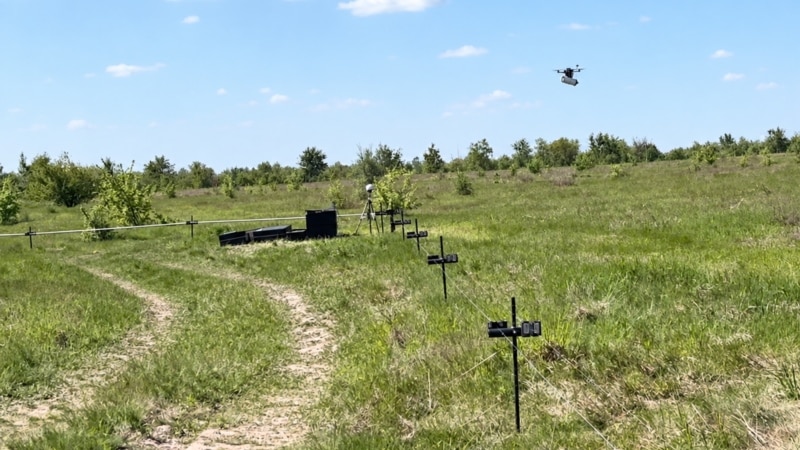
A first-ever logistics mission on an amphibious UGV: the robot covered 40 kilometers across land and water.
Operators of the "Alter Ego" unit (93rd Brigade) deployed the robotic system across mixed terrain. Facing water obstacles, the UGV seamlessly switched to swimming mode to… pic.twitter.com/rH8waq04a4
Q: How long did it take to design and test the amphibious UGV, and what went into that process?
A: The whole process from development to battle deployment took less than three months.
Q: What did you have to do to make this work?
A: First of all, we looked at amphibious solutions that were on the market, not only in Ukraine, but in the world, and we took two separate approaches. One was taking one of the main UGVs that our unit is using on the ground, and we made it amphibious. And the other approach was that we took one of the solutions that was on the market that already had amphibious capabilities, and we solved several disadvantages that it had. And at the moment, we are using both.
Q: What did you have to do to make the UGV amphibious, and then what were some of the obstacles that had to be overcome to get this operational?
A: First of all, we have to explain that there are different solutions on the market that kind of work on the testing ground — like they can swim, they can drive on the ground, and in the vision of the manufacturer, they are working. But the fact is that these solutions are not ready for the reality on the front line, which is often very different from what is on the testing ground.
And the second point is that the unit has its own workshops where people work near the front line, and the experts, the engineers that work there, they have a very high level of competence to evaluate different solutions and select the one that has potential. And that’s what’s completely different between this unit and everyone else, like manufacturers and others who are working on these solutions, because they don’t understand what’s needed on the battlefield.
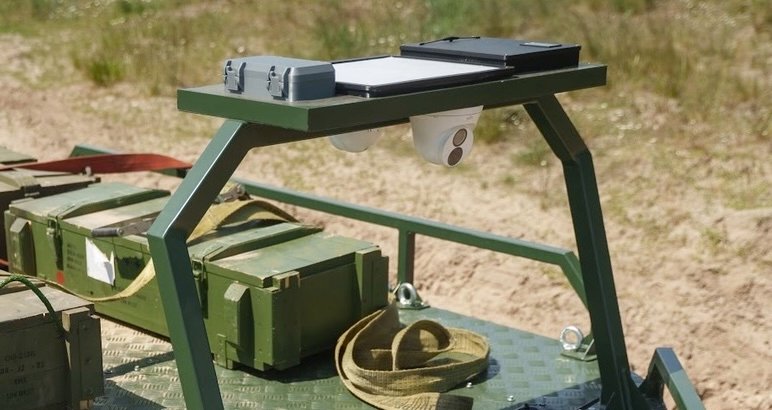
The Alter Ego unit’s uncrewed amphibious ground vehicle (UGV). (Brave1)
Q: So what did you have to change to make it work?
A: Regarding the amphibious one, basically the unit changed almost everything that that UGV had, starting from electronics, the software, the waterproofing, the communications – we basically changed everything. Regarding the one that we already used on the ground, we basically tried to retain what was allowing it to be an effective UGV on the ground, and we added waterproofing and specific mechanics, so that it can work in the water environment.
Q: You mentioned communications. What kind of communications did you add?
A: The communication means that was installed on the UGV by the manufacturer was not sufficient at all. Basically, it didn’t have enough quality for the battlefield situation. It was not working. But we already have our own communications that we were working on, and we have a lot of experience because we have been working for a long time in this UGV area. So we basically helped to install a sufficient level of communications on this UGV.
Q: So how does the amphibious UGV communicate with the controller? Does it use Starlink or some other satellite communications system for navigation?
A: This is satellite navigation, but not only. Satellite navigation is a part of this communication system.
Q: What are the other parts?
A: It’s better not to talk in detail about the other part of the communication system.
Triton amphibious UGV communications and camera systems. (Brave1)
Q: There were probably a lot of different missions that could have been used for this first amphibious UGV logistics delivery. Why was this particular mission chosen?
A: The Alter Ego unit has so much experience in terms of UGVs, and not just experience of using UGVs, but the experience of being the first in the world. We had one of the first evacuation missions, we had one of the first strike missions using UGVs, the paratrooper UGV, and now the amphibious UGV. So basically, we have the systems to make it work for the first time when nobody knows how to conduct this mission.
Q: No, I mean why did this particular mission get chosen to be the first one?
A: There are certain places on the front line where we have water obstacles that prevent logistics from being done by UGV. At the moment, UGVs are carrying hundreds of tons of logistics, probably the most compared to any other means on the front line, but before this, these water obstacles would prevent UGVs from providing logistics for those parts of the front, and that need can’t be fully satisfied by UAVs or other means. That’s why we did this mission with the amphibious UGV, and now our task here is to scale this technology and provide this logistics system for other similar parts of the front where there are water obstacles.
Kostiantynivka, Ukraine. (Google Earth)
Q: Tell me about where and when this mission took place and what it was like to watch it unfold.
A: So unfortunately, we can’t provide information about when and where this operation took place. But regarding how it went and what we felt, this was another big challenge, because this is something that wasn’t done before, and nobody thought this is real. So this was quite difficult, and to tell the truth, the mission didn’t succeed on the first try, actually, and it required a lot of effort in terms of planning, preparing, engineering, and basically it required 100% effort from everyone involved in that mission.
Q: How many times did it fail before, and what went wrong?
A: We had one failed attempt. The reason for failure was a certain technical problem. After that, we analyzed what went wrong, and we worked on solving those issues. Basically, it’s something that nobody had tried to do, it’s kind of hard to know what can go wrong before you actually try it. So the best way to find a solution like that is to try and then iterate on that attempt and make it better and better and better.
Also, I would like to add that although this was the first successful mission regarding an amphibious UGV, it’s not that there was no work on that before that. We were actively talking to and collecting the experience of everyone who was working on these kinds of missions before, and that was also a reason why this mission succeeded.
Q: How far did the amphibious UGV go for this mission?
A: So the UGV went 40 kilometers one way, and then it returned. So probably around 70 kilometers in total, and it carried food and other supplies.
Q: Did this UGV come under Russian fire on this mission?
A: Yes, and it survived.
Q: How does the UGV switch from water to land operations?
A: So the UGV has two separate control systems, one for water and one for land, and basically it switches to the one that is required at the moment. That’s how it can operate in both environments.
The Alter Ego unit’s uncrewed amphibious ground vehicle (UGV). (Brave1)
Q: Is that autonomous, or is that something that the controller at the base has to do as they watch the UGV on its mission?
A: At the moment, the operator fully controls the UGV manually. And basically, before, the operators of UGVs only knew how to move them on land, but now they also had to learn how to move them in the water. So not only was the technology itself developed, but we also had to prepare the operator and come up with tactics for this UGV.
Q: Did you use AI on this mission in any way, and if so, how?
A: We didn’t use AI.
Q: Have there been other missions using amphibious UGVs?
A: Yes.
Q: Can you say how many and what was delivered?
A: No.
Q: Is this designed only for logistics missions, or will it be used in the future for strike missions, either as a one-way attack system or as a platform for machine guns or other weapons?
A: We can use it in different ways in the future.
Q: Mud season is fast approaching, when much maneuvering becomes impossible or severely degraded because of how difficult it is to move in the thick, oozing slop. Will your amphibious UGVs work in the mud?
A: I think it can operate in the mud in the same way it operates in the water.
In the next segment of our interview, Electric talks about using bomber drones to deliver UGVs behind the lines, and a Brave1 representative talks about how the organization is working to develop these systems at scale for wider use.
A food package carries no bioengineered disclosure. Does that mean no genetic engineering went into the food?
No. USDA’s bioengineered food disclosure standard leaves entire categories of genetically engineered foods and ingredients outside mandatory disclosure.
Easing restrictions on natural substances with credible histories of safe use makes sense. Yet natural products face persistent calls for tighter regulation, alongside efforts to suppress truthful information about their benefits.
Meanwhile, novel technologies that fundamentally alter our food are riding a wave of deregulation—even as their implications demand rigorous scrutiny and full transparency.
These priorities are backwards.
A Narrow Definition, Wide Exclusions
Under the current rule, foods generally require disclosure when: 1) they contain genetic material modified through laboratory recombinant-DNA techniques, 2) the modification could not otherwise arise through conventional breeding or nature, and 3) the modified material is detectable.
There are a host of exclusions:
Restaurants and food service: meals can contain engineered ingredients without this disclosure.
Very small manufacturers: businesses with annual receipts below $2.5 million are exempt.
Accidental presence: up to 5% of each ingredient may be bioengineered if its presence is “inadvertent” or technically unavoidable.
Animal feed: meat, milk, and eggs do not require disclosure solely because animals ate engineered feed.
Refined ingredients: oils, sugars, and other ingredients can avoid disclosure when modified genetic material is undetectable.
Processing aids: qualifying incidental additives present at insignificant levels with no final technical or functional effect are excluded.
Certain meat, poultry, and egg products generally fall outside coverage when those ingredients predominate, including after water, broth, or stock.
Many alcoholic beverages: products subject to federal alcohol labeling law fall outside this standard.
Nearly A Quarter of Your Chips
Consider a hypothetical bag of corn chips containing 80% cornmeal, 19% refined soybean oil, and 1% salt.
If 5% of the cornmeal is inadvertently mixed-in bioengineered corn, that represents 4% of the chips. Add oil entirely from engineered soybeans that meets non-detectability requirements: another 19% originates from GE crops.
That is 23% of the product’s weight originating from engineered crops, quite legally without a bioengineered disclosure.
This can also allow proteins made using genetically engineered yeast or bacteria (through a process called “precision fermentation”) to avoid disclosure, depending on what remains in the finished ingredient.
A CRISPR-produced food can escape disclosure if its genetic modification could otherwise be achieved through conventional breeding or found in nature.
But who decides if a modification could arise through conventional breeding or nature?
Essentially it is the food company that makes the decision…
Modern history has consistently taught us that we cannot trust our Federal Government in the U.S. to look out for the interests of consumers, and that includes the USDA and the FDA. Both of these agencies serve Wall Street, and derive much of their revenue from the very businesses they are supposed to be regulating in Big Pharma and Big Ag.
For example, the entire corn crop in the U.S. is contaminated, even if that corn is certified organic by USDA organic standards. There may be some exceptions, but we (Healthy Traditions) have never found any corn in the U.S. that has tested clean for GMO DNA, and we have been testing for 12 years now.
The only corn we have tested that has no trace amounts of GMO DNA and no traces of the cancer-causing herbicide glyphosate, has been from traditional farms in Mexico, where planting GMO corn is illegal.
Therefore, we believe we have some of the highest quality tortilla corn chips in the U.S., and we fry them in coconut oil, not toxic polyunsaturated oils derived from GMO crops like corn and soybeans. We also do not package them in plastic, but special bags that are compostable with no dangerous chemicals.
There may not be a finer tortilla corn chip sold in the U.S.!
DISCLAIMER: Brian Shilhavy is the Editor of Health Impact News, and the founder and CEO of Healthy Traditions. Everything published on the Health Impact News network is available to the public free of charge, with a Creative Commons license offered to all who wish to republish Brian’s articles, with attribution, as he earns his income from Healthy Traditions.
Healthy Traditions, originally Tropical Traditions, has served customers in the U.S. for over 24 years.
Israel’s pursuit of security increasingly rests on a destabilizing proposition: that its neighbours become less threatening when their capacity to exercise sovereignty is diminished. Since the Hamas-led attacks of October 7, 2023, this approach has become particularly visible across several distinct arenas. Military operations, territorial incursions and restrictions on political and economic autonomy suggest a conception of security dependent on keeping others vulnerable. The consequences extend beyond individual confrontations. When states cannot control their territory, rebuild institutions or protect their populations, the regional conditions necessary for durable security begin to erode.
The argument is not that Israel created every conflict in the Middle East. Authoritarian rule, sectarian violence, armed groups and competing regional interventions have all contributed to the region’s instability.
The question is whether the means Israel uses to pursue its own security deepen that instability. Repeatedly weakening neighbouring states and political communities may bring short-term military gains, but it can also erode their ability to contain violence and maintain order, making the region more dangerous—including for Israel itself.
This pattern can be understood as the denial of sovereignty. Sovereignty involves more than diplomatic recognition: it requires institutions capable of governing, providing services and exercising legitimate authority over the use of force. When these capacities are persistently degraded, formal independence becomes increasingly hollow.
The cases differ in their circumstances and severity, but together they reveal a troubling hierarchy: Israeli freedom of military action repeatedly takes precedence over other societies’ ability to govern and secure themselves.
Syria offers a particularly revealing example. Following the collapse of Bashar al-Assad’s regime in December 2024, Israel launched extensive attacks against Syrian military infrastructure and moved into the separation zone established under the 1974 disengagement agreement. Israel justified the destruction of military assets as necessary to prevent advanced weapons from falling into extremist hands. Yet the targets included airfields, air-defence systems and naval facilities—capabilities relevant to the functioning of a state, whatever government eventually controls them.
The longer-term problem is that preventing a hypothetical future threat can obstruct the reconstruction of an already devastated country. Syria needs accountable security institutions capable of controlling territory, containing armed factions and protecting communities. Destroying military capabilities without a credible framework for rebuilding legitimate state authority risks leaving those functions unfulfilled. In July 2025, Israeli strikes on Damascus, including the defence ministry, further demonstrated Israel’s willingness to impose military limits on the new authorities.
Syria’s transitional authorities must themselves answer for abuses and protect minorities; state consolidation cannot justify repression. Nevertheless, externally imposed military vulnerability is no substitute for accountable governance.
A government expected to prevent threats from emerging within its territory must have the capacity to exercise authority there. Undermining that capacity can preserve the fragmentation through which armed groups survive.
Lebanon exposes a related contradiction. Hezbollah’s independent military power has long constrained the Lebanese state’s authority and its ability to determine questions of war and peace. Reducing that parallel authority could, under appropriate political arrangements, strengthen state sovereignty. But Israeli military action does not automatically transfer power from Hezbollah to the Lebanese government. Bombardment, displacement and violations of Lebanese territory can weaken the institutions expected to assume responsibility for national security.
The distinction is crucial: weakening an armed organization and strengthening a state are separate outcomes. In March 2026, UN Secretary-General António Guterres called both for respect for Lebanon’s sovereignty and for stronger support to its armed forces so that they could become the country’s sole military force. That combination identifies what repeated unilateral intervention overlooks: security requires an institutional successor capable of governing after military operations end.
Where that capacity remains inadequate, another cycle becomes possible. Armed groups invoke external attacks to justify retaining their weapons; the state struggles to establish authority; Israel cites the continuing armed presence to justify further intervention. Hezbollah bears responsibility for its own decisions, but Israeli policies can reinforce the conditions sustaining its claim that the Lebanese state cannot protect the population.
The attack on Doha on September 9, 2025 extended this logic into the diplomatic sphere. Qatar was mediating negotiations involving Israel and Hamas when Israel struck Hamas representatives on its territory. The UN High Commissioner for Human Rights condemned the attack as a breach of international law and an assault on mediation. The significance exceeded the violation of Qatari sovereignty: even a state facilitating negotiations could find its territory treated as an extension of the battlefield.
Mediation depends on practical assurances that communication with an adversary will remain possible. Targeting interlocutors in a mediating country makes those assurances harder to provide. It raises the costs of hosting negotiations and can undermine channels needed for ceasefires, hostage releases and humanitarian arrangements. Military reach may expand while opportunities for a political settlement contract.
Israel’s recognition of Somaliland in December 2025 raises a different sovereignty question along the region’s Red Sea periphery. Somaliland has maintained separate institutions for decades, and its claim to recognition has its own history. Nevertheless, Israel’s recognition challenged Somalia’s internationally recognized territorial framework. The African Union rejected the move and warned that such recognition could undermine peace and stability.
Recognition is not equivalent to bombardment, and the cases should not be collapsed into a single legal category. Their connection is political: the territorial arrangements on which other governments rely become subject to unilateral decisions shaped by Israeli interests. In an already contested regional environment, such decisions risk adding another dispute to fragile processes of state consolidation.
The confrontation with Iran illustrates the danger of extending preventive military logic to a powerful regional adversary. On February 28, 2026, Guterres condemned the use of force by the United States and Israel against Iran and Iran’s subsequent retaliation across the region. He warned that these actions undermined international peace and security. The escalation demonstrated how efforts to eliminate threats militarily can expose additional countries to attack.
Iran’s support for armed groups and its own military conduct cannot be excluded from this assessment. Nevertheless, degrading an adversary’s capabilities does not necessarily resolve the political incentives driving confrontation. It may instead encourage dispersal, rearmament or greater reliance on asymmetric methods. Tactical destruction can coexist with a more dangerous strategic environment.
The Palestinian case represents the most profound expression of this problem because it concerns both collective self-government and the conditions of human survival. In the West Bank, withholding revenues owed to the Palestinian Authority weakens the institutions expected to administer daily life.
The World Bank documented how the suspension of transfers in 2025 intensified fiscal distress, reduced salary payments and placed pressure on essential services. These measures undermine the practical foundations of Palestinian self-government.
A political authority cannot provide credible governance indefinitely while lacking reliable access to its own revenues. Weakening public administration also weakens its legitimacy, potentially benefiting actors who argue that institutional politics offers no meaningful route to Palestinian rights. The resulting dysfunction can then be invoked as evidence that Palestinians are incapable of governing themselves. Restrictions on capacity thus risk producing the very incapacity used to justify continued control.
In Gaza, the destruction has reached beyond institutional viability. The devastation of housing, healthcare, water systems and livelihoods, compounded by restrictions on humanitarian access, has endangered the material conditions necessary for life. In August 2025, a joint statement by UN agencies confirmed famine in Gaza Governorate and described a crisis involving starvation and preventable deaths. The issue was no longer merely whether Palestinians could build a state, but whether civilians could survive.
Hence, in Gaza, the denial of sovereignty has escalated into a denial of survival. In September 2025, the UN Independent International Commission of Inquiry concluded that Israel had committed genocide against Palestinians in Gaza. Earlier, on November 21, 2024, the International Criminal Court issued an arrest warrant for Benjamin Netanyahu, finding reasonable grounds to believe that he bore criminal responsibility for the war crime of starvation as a method of warfare and the crimes against humanity of murder, persecution and other inhumane acts. These findings expose the devastating human consequences of denying a population access to the essentials of life. The systematic destruction of civilian infrastructure and deprivation of food, water and medical care undermine Palestinians’ ability to survive as a community in their homeland. Viewed through this analysis, the genocide identified by the UN commission represents the most extreme manifestation of denial: a progression from obstructing a people’s capacity to govern themselves to destroying the conditions necessary for their continued existence.
Taken together, these cases suggest a self-reinforcing cycle. Military intervention and institutional weakening can generate insecurity, displacement and political fragmentation. Those conditions create opportunities for armed actors, whose activities then provide further grounds for intervention. This is a causal risk, not an inevitable outcome of every operation. Its importance lies in the contradiction between immediate military advantage and the requirements of lasting security.
Breaking that cycle requires a different measure of success: whether policies leave behind institutions capable of governing, populations able to live securely and diplomatic arrangements that reduce incentives for violence. Protecting Israeli civilians and respecting neighbouring societies’ sovereignty are mutually reinforcing necessities.
A regional order built around one state’s freedom to intervene and everyone else’s enforced vulnerability cannot offer durable peace. By denying others the capacity to govern—and, in Gaza, devastating the conditions necessary to survive—Israel risks perpetuating the insecurity from which it seeks protection.
Ukraine is now using a fence-like device designed to snag and cut the cables of fiberoptic drones, weapons that have confounded militaries throughout the world.
More than 80 years after the SS Richard Montgomery sank in the Thames Estuary with roughly 1,400 tons of explosives still aboard, marine contractors have begun one of the most delicate interventions...
The end of the United States’ two-decade-long military presence in Iraq has raised fears of a security vacuum. Neighboring Iran and its allies in Iraq, experts say, could attempt to exploit the situation.
In this tense, riveting first-person excerpt from his new book This Cursed Beautiful Land: A Russian Story, Evan Gershkovich recounts the harrowing months he spent as a prisoner in Russia, leading up to his eventual release in a complex, multi-country prisoner exchange. Even in the darkness, Gershkovich offers rays of light: care packages from friends, letters by the hundred, and a cautiously blossoming love with a friend in Berlin. We may know the ending, but the details of these days reveal what it takes to get there.
A few hours after my arrival, I heard a cart rolling down the hallway. A guard opened a kormushka — a feeder window in the door about the size of a human head. A man in a chef’s uniform filled my bowl with porridge, placed a piece of rancid-smelling boiled fish on my plate and gave me some weak tea. The reality of my new surroundings slammed into me.
Thoughts ricocheted inside my head. Earlier in the day I’d had a comforting one: they’ve taken me for a swap, I told myself. That’s all this is.
Now, curled up on the bed in my 12ft by 8ft cell, knees pulled to my chest, I thought, what if the FSB really does think I’m a spy and wants to make an example out of me? Maybe they don’t want to swap me at all. Maybe I really will spend 20 years here.
“What is remarkable is that Ukraine and Moldova, despite finding themselves in a very tense situation regarding their security, are extremely keen to move closer to the EU and have therefore already begun negotiations and opened the first cluster.”
These are the words of the deputy director of the European Council on foreign relations (ECFR), Vesela Cherneva, and they come just as the official negotiation process for the two countries’ accession to the European Union has begun.
With this, the EU embarked on a truly geopolitical enlargement – driven not only by the pursuit of shared values, a larger market, and stronger common institutions, but also by the need to safeguard the continent’s security in a shifting environment.
Ukraine: a battle-hardened nation’s journey from the post-Soviet world to the EU
According to Cherneva, the EU’s upcoming enlargement is the only way to institutionally anchor Ukraine within a serious and lasting framework, given that the US position has remained clear under both presidents Donald Trump and Joe Biden: Nato enlargement to include Ukraine is not possible.
“Currently, EU membership is the only way to integrate Ukraine’s and Europe’s security systems. This is an entirely different discussion from negotiations on chapters, clusters, sanitary standards and other accession requirements. We are talking about security guarantees, but also about the transfer of military technologies from Ukraine to Europe and, more broadly, about how Ukraine – which currently possesses the strongest and most combat-capable army in Europe – can, while defending Europe, also become part of the European security debate,” Cherneva says.
Ognyan Minchev, political scientist, professor and executive director of the Institute for Regional and International Studies, an independent think-tank in Bulgaria, also believes that Ukraine’s importance is substantial and that the questions surrounding its integration are highly complex.
“Ukraine currently possesses the only genuinely combat-capable army on the European continent. Western European armies have very limited personnel numbers and, until recently, received extremely low levels of funding. The lack of real resources, including weapons, to address the challenges of military security makes Ukraine a more attractive partner,” he says.
Although many experts would point to Ukraine’s contribution to European security as the greatest benefit of its accession to the EU, the country can also contribute to development in other areas. There is undoubtedly great potential for development in the fields of agriculture and farming.
The country has a vast area of cultivated land and is among the world’s leading producers of a number of cereal crops such as wheat, maize, barley, rice, and others. It exports these products to third countries, and membership would increase the EU’s economic influence in these regions.
Ukraine’s accession could also lead to cooperation between different sectors and result in an increase in meat and dairy production as a consequence of increased cereal production.
Beyond agriculture, Ukraine’s pharmaceutical industry could offer the EU an opportunity to reduce its reliance on imports of generic medicines from China and various Asian countries. Thanks to its favourable climate, Ukraine also has great potential for various types of renewable energy.
Deposits of gallium, rutile, graphite, magnesium ores, lithium and other minerals vital to the green transition could contribute to European production and help the EU compete with China.
According to Minchev, integrating Ukraine represents a major challenge because it involves a large country that is institutionally weak, with high levels of corruption, poor economic organisation and significant shortcomings in the functioning of public life.
“Ukraine has been forced to transform itself into an effective fighting machine, but in other respects it remains a post-Soviet society with serious problems in the areas mentioned above. This makes its rapid integration into the EU extremely difficult,” Minchev says.
Moldova: a key piece in Europe’s security architecture continues to struggle under Russia’s shadow
“For Moldova, we can say that it is a small but significant element in the broader domino effect of Black Sea security, which is becoming an increasingly crucial aspect of overall European security. This is because the confrontation between the Kremlin regime and Europe is effectively unfolding along the line of a new Iron Curtain being formed across Ukraine and the Black Sea region,” Minchev says.
According to Cherneva, Moldova’s accession is also crucial precisely because the country is a buffer state, and Russia has demonstrated that it does not tolerate buffers.
“Russia seeks to conquer and control such buffer zones. If Moldova does not want to share the fate of Belarus or Georgia, it must take rapid steps towards European integration,” Cherneva says.
For years, Moldova has served as a testing ground for Russia’s hybrid warfare. As Western European countries are only now confronting the full scale of Russian hybrid attacks, Moldova has already spent years developing its own resilience and countermeasures.
The country brings to European security valuable expertise gained from combating Russian disinformation and resisting repeated attempts by the Kremlin to interfere in its domestic political processes.
Yet Moldova’s accession would have implications extending far beyond security. Although it possesses far less agricultural land than Ukraine, the country has the potential to make a meaningful contribution to the European agricultural sector. Moldova has been gradually integrating into the EU’s Single Market through the Deep and Comprehensive Free Trade Area (DCFTA).
This article continues, but the full version is available only to EUobserver.com subscribers. Visit account.euobserver.com/membership
Palestine This Week | Middle East Monitor | September 30, 2026
This week’s MEMO review examines claims about Netanyahu’s advance knowledge of 7 October, his provocative UN speech and Israel’s sweeping West Bank closure. We discuss calls to free Marwan Barghouti, moves to bar Arab-led parties from Israeli elections, Trump’s rejection of Iran’s proposal and allegations of election interference involving Israeli firms.

 Login



 From the Covid-era Mockingbird Media Hall of Fame: Targeting Kids with Covid Jabs using Sesame Street Characters


 (@NOELreports)