❌

Reading view

She Followed the Actual Data on COVID Vaccines and Masks — Her Career Took a Huge Hit

By Jill Erzen | The Defender | October 2, 2026

Tracy Beth Høeg, M.D., Ph.D., an epidemiologist and sports physician, said her decision to follow the data during the COVID-19 pandemic came at a steep professional price.

Her research challenged policies on school closures, masking and COVID-19 vaccines. She said the fallout included losing her position at the University of California, Davis, being dropped from an NPR interview and being fired from the U.S. Food and Drug Administration (FDA).

Høeg said her experience exposed the unwillingness of universities, media and public health institutions to adapt when research conflicted with their accepted narratives.

In an interview this week with investigative journalist Paul D. Thacker on The DisInformation Chronicle, Høeg said institutions too often treated the accepted narrative as settled and then dismissed or attacked people who questioned it.

That approach did more than distort the public discussion about COVID-19, Høeg said. It also created a scientific and institutional culture that could affect how other medical questions are handled long after the pandemic.

For Høeg, the solution is simple: Scientists should follow the evidence wherever it leads.

“It’s a core belief of mine that you have to be objective when you’re doing scientific studies,” she said. “Otherwise, you just shouldn’t do them. It’s pointless if you’re not willing to be objective.”

‘I … didn’t realize the jeopardy that I was putting myself in’

During the pandemic, Høeg published 30 to 40 papers on COVID-19 transmission, masking, youth sports, vaccine risk-benefit, pregnancy, long COVID, visitor restrictions and testing.

Some of her research challenged widely accepted claims.

One study found little evidence of COVID-19 transmission among children in Wisconsin schools, which was consistent with data from Europe. Another examined myocarditis risk in boys after their second Pfizer COVID-19 vaccine dose and found the risks outweighed the benefits in boys who didn’t have underlying health conditions.

Høeg said she didn’t initially understand the professional risks she was taking by challenging the prevailing narrative.

“There was sort of a hesitancy to do this sort of research because I think people were afraid for their careers,” she said. “I actually was blessed with having recently moved from Denmark and didn’t realize the jeopardy that I was putting myself in by doing these sorts of studies.”

At the time, Høeg was conducting research at the University of California, Davis.

She said the university received calls, including from Nature magazine, complaining about her studies on pandemic policies. Eventually, the university asked her not to use her affiliation with the school.

Høeg said the university refused to renew her voluntary position in 2022, after the European Journal of Clinical Investigation published her study on myocarditis risks in boys who received the COVID-19 vaccine.

NPR also dropped an interview with Høeg for “All Things Considered” after she raised concerns about masking children during outdoor sports.

In a pre-interview discussion with NPR, she told the outlet, “We don’t have evidence that these masks work to prevent transmission. … Bottom line is, we shouldn’t be doing these unproven things to children that are harmful.”

Soon after, NPR told Høeg she was no longer needed for the interview.

“It does say a lot about our universities and institutions because it’s like they had been brainwashed to an extent to believe what the media was saying rather than actually look at the data,” Høeg said.

‘They repeated the same wording … even when the data didn’t back it up’

In 2022, Høeg and her colleagues conducted a follow-up analysis of a Centers for Disease Control and Prevention (CDC) study on school mask mandates.

Høeg said their analysis used a larger dataset and a longer time period and reached the opposite conclusion about the relationship between mask mandates and COVID-19 transmission among children.

The team’s submission to the CDC’s Morbidity and Mortality Weekly Report (MMWR) was rejected. Høeg said reviewers described the submission as “rife with polemics.”

“Well, maybe it’s polarizing if you disagree with it,” Høeg said.

The rejection unearthed an underlying problem at the CDC, according to Høeg.

“They have a scientific agenda,” she said. “And so as soon as you have a scientific agenda, science has been thrown out the window. Science doesn’t have an agenda other than to find the truth.”

A 2024 analysis by Høeg and colleagues examined 77 mask studies published in the MMWR beginning in 2020. According to Høeg, 75% of the studies said masks were effective, while only 14% reported statistically significant results and none were randomized studies.

One finding especially stood out to her: She said 5% of the studies found masks were connected to higher infection rates, yet “they still concluded that masks worked.”

“They repeated the same wording over and over again in each of the studies, that ‘masks are necessary to decrease the spread’ and ‘masks are critical in controlling the case rates of COVID-19,’” she said. “They use the same sort of wording even when the data didn’t back it up at all.”

‘Why are we demonizing people for looking into this?’

Those concerns followed Høeg into the FDA in late 2025 when she was named acting director of the Center for Drug Evaluation and Research (CDER).

A leaked memo from then-FDA official Dr. Vinay Prasad said career staff had linked at least 10 child deaths to the COVID-19 vaccine between 2021 and 2024.

Høeg said she reviewed the Vaccine Adverse Event Reporting System (VAERS) reports and found that investigations involving medical records and autopsies had already been conducted.

“My question at the time was … why are these not being made public?” Høeg told Thacker.

Høeg said news leaked that she would present information about the deaths and their possible association with COVID-19 vaccines. She said the media response focused on portraying her as an “anti-vaxxer” rather than asking why the deaths had been investigated but not publicly disclosed.

“If we have these sorts of deaths happening in children due to medical products of any kind, why are we sitting on them for years?” she asked. “That’s the take-home I want people to have from this.”

She also questioned why people who investigate potential safety problems are attacked for trying to expose the dangers.

“Why are we demonizing people for looking into this? … Isn’t that what the public wants?” she asked.

‘The deep state really is a thing’

In May, just days after FDA Commissioner Marty Makary resigned, Høeg said she arrived at work to find media reports claiming she had resigned — something she said she knew nothing about.

FDA lawyers later asked her to resign, but she refused to sign the letter. She was subsequently locked out of the agency’s systems and escorted from the building.

Høeg said she never received a performance-based explanation for her termination. She also said the person identified as the author of her termination memo later denied writing or seeing it.

According to Høeg, agency lawyers told her the order came from “way above their pay grade.”

The experience changed how she viewed other departures from the agency. “It opened my eyes to the fact that maybe a number of the people who I thought had resigned really had not resigned,” she said.

“The deep state really is a thing,” she added.

‘Women who want to get pregnant … should be told about these risks’

For Høeg, the concerns she encountered during the COVID-19 era are not limited to COVID-19.

In 2025, she helped organize an FDA panel examining potential risks associated with selective serotonin reuptake inhibitors, or SSRIs, during pregnancy.

The American Psychiatric Association criticized the panel for what it called “misinterpretation and unbalanced viewpoints.” Høeg said the media also portrayed any discussion of potential risks as “misinformation about SSRI use” and a signal that depression wasn’t being taken seriously.

According to Høeg, the panel discussed risks already addressed in FDA labeling and scientific research, including miscarriage, premature birth, postpartum hemorrhage, congenital heart defects and neonatal adaptation syndrome.

“This should not be controversial that women who want to get pregnant and who are pregnant should be told about these risks,” she said.

She also warned about the lack of ongoing monitoring of drug safety.

“The FDA is not actively investigating the safety of these products in pregnancy or at all after the initial trials are done,” she said.

Høeg said the discussion should not be interpreted as an argument against treating depression. “I don’t think that any of this should be synonymous with not taking depression seriously,” she said. “That’s just nonsense.”

‘There’s just no reporting on this. … People have died taking this drug’

Høeg also discussed Tavneos, the Amgen-manufactured brand name for avacopan, a drug approved to treat a type of blood-vessel inflammation.

While at CDER, Høeg said she raised concerns that the pivotal clinical trial used to approve the drug had included manipulated data.

According to Høeg, at least eight deaths had been attributed to the drug because of liver injury.

The New England Journal of Medicine later retracted the paper detailing the trial, and European regulators withdrew the drug’s authorization. While the FDA has proposed withdrawing Tavneos’ approval, it remains available in the U.S.

Yet, the media barely covered it.

“There’s just no reporting on this,” Høeg said. “People have died taking this drug. … We asked for them to withdraw it from the market, and the media is just totally silent.”

Thacker: ‘There was no real learning in the end. … If anything, we became dumber’

Høeg said it is troubling that some of the most disputed COVID-19 policies are still treated as settled questions.

“How is this still part of our collective conversation that people … are still saying school closures were necessary and mask mandates were necessary?” she asked.

Thacker said the failure to learn from those policies could have consequences during the next pandemic. People who developed a “false sense of safety from masks” during COVID-19 could mistakenly assume masks will protect them from a more dangerous virus in the future, he said.

Thacker also questioned whether the country understands anything about the COVID-19 vaccines. “There was no real learning in the end. … If anything, we became dumber,” he said.

Høeg said the problem stems from the widespread failure to reconsider policies when the evidence changed.

“Once the government decided this is what we have to do, they just kept digging in, even though the data didn’t support it,” she said.

“This is why I keep doing these interviews, because it’s important for people to know the truth.”

Watch Høeg on ‘The DisInformation Chronicle’ podcast here:


This article was originally published by The Defender — Children’s Health Defense’s News & Views Website under Creative Commons license CC BY-NC-ND 4.0. Please consider subscribing to The Defender or donating to Children’s Health Defense.

  •  

Reporting of the RAF Fairford arrests blows the idea of a ‘free press’ out of the water

When the establishment media jettisons even the semblance of critical distance from the state

By Jonathan Cook | September 30, 2026

It’s easy to forget that the western media – the so-called “free press” – likes to distinguish itself from media in authoritarian regimes on the basis that, unlike them, it asks critical questions of the powerful, reports facts objectively, and formulates its analyses dispassionately.

They do propaganda, we do news – or so the western media argues.

The feverish coverage since five men were arrested in the early hours of Sunday morning close to RAF Fairford in the UK is blowing a very big hole in that claim.

Here are the known facts so far.

Three white vans, bearing the logo of a genuine fuel transit company, were spotted by a local farmer on the road outside her property as she returned from a party. Police arrived promptly and arrested the men, who were all British nationals in their twenties.

On Tuesday, it emerged that one of the arrested men actually called the police earlier – seemingly the reason officers were on the scene so quickly.

Although the men were initially arrested on explosives charges, no “viable” explosives were found. Although they were arrested on terrorism charges, which allow for 14 days of detention, they were released on bail under normal criminal laws in less than two days.

It has also emerged that the men had several empty “barrels” in their vans, plus one that contained what police described disturbingly as an “accelerant”.

Actually, that was simply a reference to petrol. The stuff that goes into vehicles to make them accelerate.

British prime minister Andy Burnham held a rare national emergency Cobra meeting over the incident.

Meanwhile, the Trump administration got involved because RAF Fairford, despite its name, is in reality a US air base from which American planes are waging an illegal war of aggression against Iran, with the UK’s blessing.

US Secretary of state Marco Rubio has said the incident “clearly involves the hands of a foreign actor”. When asked whether Iran was that actor, Trump replied: “It might be.” He added: “I know the answer… I can be very specific, but I’d rather not say.”

According to a report in the New York Times, “American and British intelligence services worked with Israel and Western countries to discover the threats against US bases, including ones in Germany.” [my emphasis]

Despite these sparse facts, the British media have uniformly rushed to a single conclusion: that this was almost certainly part of an Iranian terror plot to target the US airbase and its planes. The only room for debate allowed is whether the five men were witting or unwitting actors in that plot.

As the Guardian reported in its Wednesday edition, referring to this as a “complex investigation”: “An Iranian link to the bizarre events in the Gloucestershire countryside over the weekend is seen as increasingly likely.”

As context, let us note the following: that British and US officials have every interest in trying to hype this incident as an Iranian “terror plot”, whatever the actual evidence suggests.

Why? Because the US is waging an illegal war on Iran, and the UK is allowing it to do so from British soil. Under the rules of war, Iran has every right to attack RAF Fairford.

If the British state and billionaire-owned media were actually serving as a truly “free press”, they would be offering the context that RAF Fairford is a legitimate military target and that any attack on it by Iran would not constitute terrorism.

Of course, none have done so.

Instead, they have loyally regurgitated the British and US security services spin of a “terror plot” – based on no tangible evidence at all – that paints Britain and the US as the victims of a sinister and unwarranted act of Iranian aggression.

But context aside, an objective, sceptical media – a “free press” – would be reserving judgment on what had happened. It would be asking difficult questions. It would be offering plausible counter-narratives.

Again, none of this is happening. In the British media, there has been a lemming-like rush towards accepting uncritically the very conclusions that best serve British and US state interests.

The constant highlighting of a terrorism connection to the arrested men – for which there is no apparent evidence – is precisely the kind of coverage you would expect from state media in an authoritarian regime. This is about whipping up a public mood of fear, not about transparent fact-finding.

Notably, unlike the British media, the New York Times report does allow for another possibility, even if it instantly ignores it and then joins the British media in treating what evidence there is as proof of an Iranian terror plot.

The Times opens with a question: “The potential ambiguities – were the men Iranian operatives, petty gas thieves, or both? – added to the confusion surrounding the arrests that the authorities have yet to fully explain.”

“Petty gas thieves”! Men in vans with empty barrels close to a farm in the middle of the night. Is it possible they could simply be criminals?!

In fact, this conjecture has been all over social media since the first reports of the men being arrested surfaced. As new details have emerged, those suspicions have only grown.

And yet Britain’s “free press” has uniformly ignored this counter-theory in favour of the US and British security services’ narrative.

Doubtless, British journalists covering this incident would call the idea that this was simply a criminal group caught in the act unhelpful “speculation”.

But how is their no-more-plausible, and possibly less plausible, theory that this was an Iranian terror plot not equally speculation – if in their case, speculation that happens to be extremely helpful to the British and US security establishments?

There are other theories we could posit too, given the known facts. Israel, which originally pushed for the illegal and disastrous war on Iran, has been looking for a way to persuade the Trump administration to return to a full-scale bombing campaign.

An attack on RAF Fairford – or the appearance of one – would be an ideal way to pile on the pressure for renewed strikes on Iran. It’s not, after all, as if there are no examples of Israel carrying out false flags.

If the “foreign actor” of Iran can recruit a gang of petty criminals to unwittingly spark a major security incident outside RAF Fairford, why can the “foreign actor” of Israel not do exactly the same?

I don’t know what happened outside the airbase. I’m not claiming to. I am keeping an open, critical mind while what facts there are emerge. If only our “free press’“ were doing the same.

There may be those reading this who find the claim that the media in our “democratic” societies is not confrontational to, or at least distant from, the state hard to believe. Such an idea may be new to them.

That should not be surprising. After all, how did each of us form our foundational view of the world – of who are the good guys, and who the bad – if not from spending a lifetime reading and watching media owned by billionaire-led corporations and the state?

Since quitting the establishment media myself a quarter of a century ago (I worked for the Guardian), I have dedicated much of my time to identifying some of the most egregious examples of skewed journalism – reporting that consistently presents events in ways that serve not their audiences’ interests but those of the powerful: the corporations themselves; western security establishments; and Israel, the linchpin of the West’s war industries.

In such cases, the establishment media readily abandons even the pretence of neutral, fair or dispassionate reporting. It serves as little more than a propaganda factory. (You can read my detailed explanation of how the Propaganda Model works here.)

This has been all too visible in the coverage of Israel’s mass-slaughter in Gaza, a genocide that could not be named as such.

It was visible in the coverage of Russia’s “unprovoked” invasion of Ukraine that had, in fact, been provoked by Nato for decades, as it expanded across Europe with a clear intention: either to corner Moscow militarily or drive it into a retaliatory attack on Ukraine that would provide an opportunity for the West to bleed Russia on a proxy battlefield.

It was visible in the sustained media campaign of antisemitism smears against Jeremy Corbyn, that rarest, and most dangerous, of things: a leader of a major political party who promoted socialist policies for the benefit of the public, not billionaires, and was a vehement critic of Israel long before it showed its genocidal hand.

It was visible too in the media pile-on against Julian Assange, whose Wikileaks whistleblower platform exposed British and US war crimes while also threatening to destroy the media’s top-down model. Having ridiculed him for claiming asylum in the Ecuadorean embassy for fear Washington would seek to extradite him for exposing its crimes, the media then treated his seizure by British police and incarceration for years in a high-security London prison, while the US sought his extradition for exposing its crimes, as entirely unremarkable, as barely worth reporting.

I could go on and on. There is a consistent pattern when the establishment media deals with the most important issues, the very ones in which our national security states are most invested. Then the media jettisons even the semblance of critical distance from the state.

RAF Fairford is just the latest example of how, in such important moments, the media serves as nothing more than the security state’s loudspeaker.

  •  

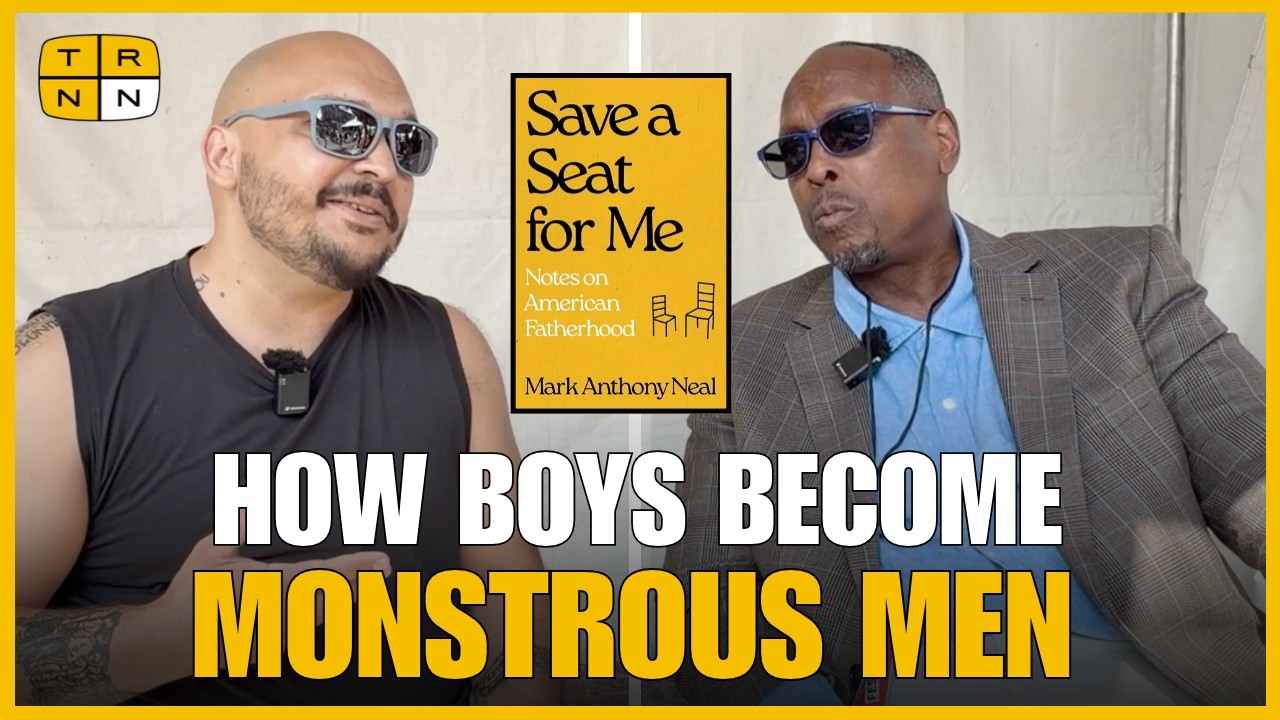
The real crisis for men is capitalism: A conversation with Dr. Mark Anthony Neal

From the heinous crimes of the Epstein class to the Cornell 7, from the toxic cultures of the “manosphere” to the increase of antisocial relationships with online pornography and AI bots, we need to talk about what is going on with men in our society. We speak with renowned scholar, author, and commentator Dr. Mark Anthony Neal about his new book Save a Seat for Me: Notes on American Fatherhood, and about the ways American capitalism damages everyone and trains boys to become monstrous men.

Credits:

  • Post-Production: Cameron Granadino
Transcript

The following is a rushed transcript and may contain errors. It will be updated.

Maximillian Alvarez:

I’m here at Red Emmas at the Baltimore Book Festival, and I’m sitting with Dr. Mark Anthony Neal. Brother Mark, it’s so great to have you back here in Baltimore, man. I know I only got you for a second, and we’re talking about your incredible new book, Save a Seat for Me, Notes on American Fatherhood. And I was thinking as another father in America in 2026, I wanted to ask you, it doesn’t take PhDs like we have to know that we’ve got a real fricking crisis in this country with men and masculinity and masculine culture and fatherhood, or we have a whole lot of crises that men are experiencing but aren’t dealing with well. So what do you make of all this? What do we do about it? And how can your book help us get there?

Dr. Mark Anthony Neal:

I think we have tried, America has tried to raise generations of warriors, if you will, to be on the front lines of American imperialism. And you can’t be human to do that. You can’t think, you can’t question, you can’t be vulnerable. So what we have done is raise two or three generations of men in America who don’t know how to be human, who don’t know how to lead into full range of who they are. We’ve been socialized to show up only certain kinds of ways, anger, rage, the ability to follow directions. Things like vulnerability are made fun of at the highest levels.

Maximillian Alvarez:

And those of us who are very vulnerable people have been made fun of.

Dr. Mark Anthony Neal:

Because of that.

Maximillian Alvarez:

Because of that.

Dr. Mark Anthony Neal:

We’ve been made to think that our responsibility in a capitalist system has literally been reduced to only making money, that our only value. And I think about this a lot as a Black father, my own father, that I’m sure he thought that his only value to me was making sure that I was fed and clothed and taken care of. And I get all of that, but I needed much more from him. As a father, I needed to be more than that for my daughters. And so I think when we look at young men who are clearly feeling so much with no outlet, their outlets become dangerous behaviors, self-directed violence,

Maximillian Alvarez:

Toxic online cultures,

Dr. Mark Anthony Neal:

All kinds of addictions, alcohol, Percocet, weed, porn. I mean, we can name all these things and understand it. And the fact that so many of the young men in the world today, their lives are what they can connect with on their handheld device. They don’t actually have relationships with people in the real world, don’t see a value in that. And I don’t know how we sustain that. I don’t know how we sustain our humanity in a situation where we don’t value human relationship anymore.

Maximillian Alvarez:

Well, and it’s like you see that the path that we’re on as a society or what’s left of a society is being driven by the sociopathic, psychopathic, bloodthirsty –

Dr. Mark Anthony Neal:

Or just plain evils.

Maximillian Alvarez:

Just plain evil maniacs who want a future where they get all the benefits of human society, but don’t have to deal with any of the humans in it. Whether they’re thinking of like, oh, AI is going to replace all their jobs and we’re going to get all the money. They’re not thinking about what the heck that’s going to mean for us. They’re just going to push us into slums and prisons and police us, hunt us, surveil us. That’s their big goddamn plan. And I think you put it so powerfully that it’s like so many men out there have the same human needs that we all have and we’re feeling them so acutely the more isolated we are, but we’re looking to find, we’re seeking inhuman avenues.

Dr. Mark Anthony Neal:

I mean, think about all the folks who are in relationships with chat bots. I mean, it’s surreal. I can’t have a relationship with an actual person. I don’t desire a relationship with an actual person. I need to have a relationship with some facsimile, some avatar that somehow that’s more meaningful to me than having a relationship with a person.

Maximillian Alvarez:

Yeah. And I think even as a editor in chief and co-ED of a media network, as a media star, we recognize there’s only so much you can do online. You got to get the hell offline and you got to meet each other back on that level of shared humanity and shared reality because that’s the only way we’re going to deal with anything, anything in this country.

Dr. Mark Anthony Neal:

And that’s why the Baltimore Book Festival is really important. First of all, not only just a reminder, someplace that’s celebrating the written word, obviously, but folks coming together in community. We have to get back to a culture where we share in community. We read together, we listen together, we debate together instead of these media silos. I’m going to have this debate over here on this network and you’re going to have this debate over there and never the twain shall meet.

Maximillian Alvarez:

Well, and final question, but it goes really to the heart of your book. Here in Baltimore, I see this every day. I feel it as a father, but right down the street from where I live in Mondamin, earlier this summer, there were six youth who were caught on camera just beating the hell out of an elderly member of the community, a former Black Panther. It was horrific. I’ve interviewed this man and the community that’s trying to help him, but clearly everyone who is showing up to help is seeing in that video the deficit of guidance, of fatherhood, of love.

Dr. Mark Anthony Neal:

Of respect. Basic respect.

Maximillian Alvarez:

So what can we do about that in our everyday lives at the person to person level?

Dr. Mark Anthony Neal:

We have to be willing not just to be witnesses to these experiences or commentators.

We have to intervene and feel comfortable enough to intervene. Whoever sat down with those young men, first of all, to explain, because the easy part is to say, no, this man was important to our movement in the past. The more difficult thing is like, no, this man is important because he’s another human being and you should value life and his humanity. But if they are young men who do not value their own humanity, don’t see their own humanity, they’re going to reproduce that behavior over and over again. And so we have to have the willingness because it’s real easy to go, I’m just going to build my life in this silo and protect my family and I get it. But to take that next step to say, okay, I might not be able to talk to all six of these brothers, try to talk to two of them.

Begin that process, that one-on-one conversation that can blossom into something that’s much more significant.

💾

“America has tried to raise generations of warriors to be on the front lines of American imperialism… So what we have done is raise two or three generations of men in America who don't know how to be human.”
  •  

No Vote, No Representation, No State: Democracy, Israeli Style

Palestine This Week | Middle East Monitor | September 30, 2026

This week’s MEMO review examines claims about Netanyahu’s advance knowledge of 7 October, his provocative UN speech and Israel’s sweeping West Bank closure. We discuss calls to free Marwan Barghouti, moves to bar Arab-led parties from Israeli elections, Trump’s rejection of Iran’s proposal and allegations of election interference involving Israeli firms.

Chapters:

00:00 Introduction & Overview

01:41 Claims of Netanyahu’s Advance Knowledge of 7 October

18:14 Netanyahu’s UN Speech: Props, Provocations and Defiance

22:58 Israel’s West Bank Closure and Its Impact on Palestinians

26:30 Growing Calls to Free Marwan Barghouti

29:40 Israel’s Political Opposition and the Two-State Solution

35:00 Arab Party Disqualifications: Democracy and Apartheid

38:07 Trump Rejects Iran’s Proposal: What Was on Offer?

41:42 Meta’s Restrictions on Lula and Allegations of Israeli Election Interference

Subscribe to our YouTube channel: https://tinyurl.com/447fpn8k

Visit our website: https://www.middleeastmonitor.com/

  •  

How to MAKE THE CONSPIRATORS PAY for their crimes! Dan Dicks with James Corbett on Solutions Watch

Press For Truth – September 14, 2026

The Allison Inquiry has concluded.

Four days of sworn testimony in Ottawa.

50 Canadians out of 1,400 who came forward finally had their stories heard.

This final report features firsthand accounts of life-altering injuries and deaths following COVID-19 vaccination, paralysis, neurological damage, cardiac events, and families left without answers.

In this video Dan Dicks of Press For Truth covered the hearings after mainstream outlets stayed away.

MP Dean Allison explains why he launched the inquiry: too many people were suffering in silence.

The injured describe being dismissed by the medical system, denied support through Canada’s vaccine injury program, and treated as if their experiences didn’t count.

Watch the testimonies and share them!

These stories were never supposed to stay hidden so please:

SHARE THIS VIDEO FAR AND WIDE!!

Support my efforts to Cover the ALLISON INQUIRY: https://gogetfunding.com/help-me-cove…

DONATE via Paypal ➜ https://www.paypal.me/PressforTruth

Or you can send an e-transfer to dan@pressfortruth.ca

If you’re old fashioned like we are and prefer to keep it old school, we also accept cash, cheques (made out to Dan Dicks), equipment and words of encouragement! You can send us those things here: Dan Dicks P.O. Box 1521 Squamish BC V8B 0B1

  •  

Can This Independent Mass. Governor Candidate Rally a 67% Unenrolled Electorate?

Andrea James speaks at The National Council for Incarcerated Women and Girls "100 Women for 100 Women" rally in Black Lives Matter Plaza near The White House on March 12, 2021 in Washington, DC. Photo by Brian Stukes/WireImage

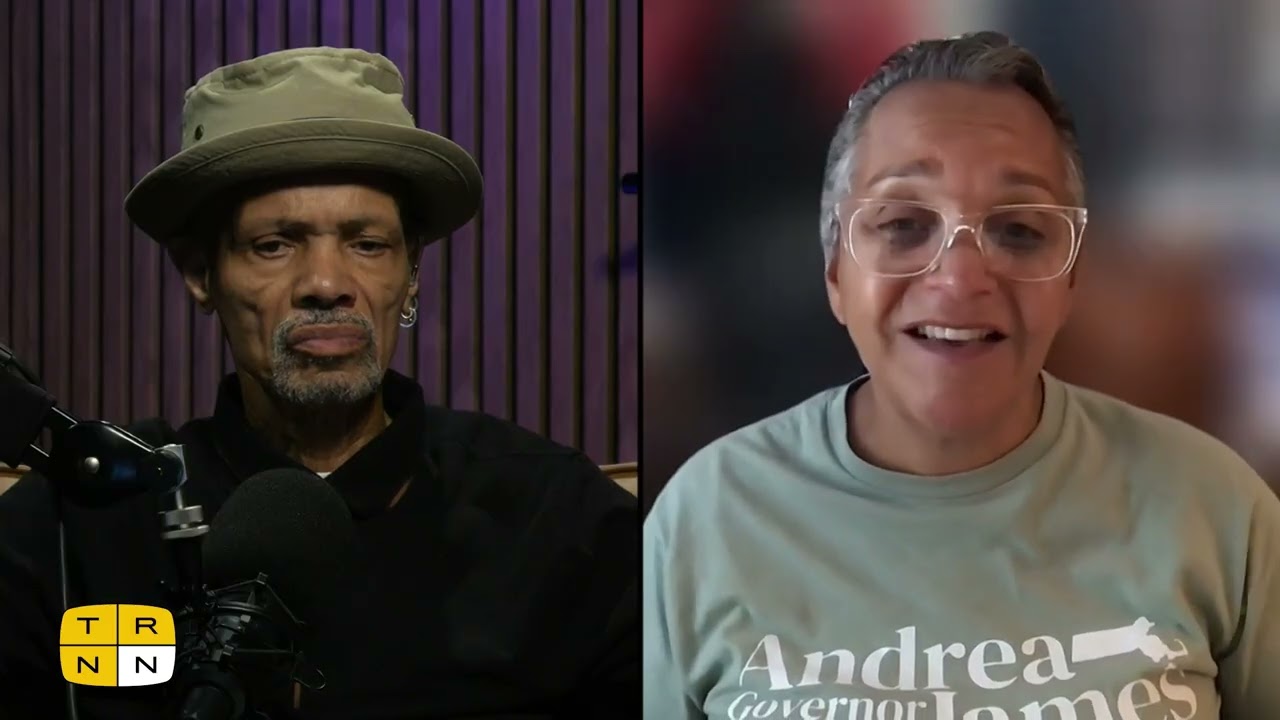
In this episode of Rattling the Bars, the midterms edition, we take you to the Commonwealth, where Andrea James—abolitionist, author, and organizer—is currently running for governor of Massachusetts. The countdown to November 3 is officially underway. Debates are scheduled for October, but independent and third-party candidates are being excluded from participating.

Andrea James has led national campaigns to reunite families by demanding clemency from high-level officials for incarcerated women and men. Now, she is running for governor with a platform focused on rent stabilization, lower energy costs, free childcare and stopping the construction of a new $360M women’s prison.

Related Links:

Credits:

  • Production/Post-production: Cameron Granadino
Transcript

MANSA MUSA:  Welcome to this edition of Rattling the Bars. I’m your host, Mansa Musa.

Joining me today is Andrea James, activist in every sense of the word. I want to say abolitionist, but she’s an activist in every sense of the word, organizing, and is currently running for the governor of Massachusetts.

Thank you for joining me, Andrea.

ANDREA JAMES:  Thank you for having me. It’s really great to be back in your studio, and just to have the privilege of being a part of how you disseminate information. It’s really an honor to be here, and I thank you for this opportunity.

MANSA MUSA:  And we want to go on record right now saying that here at Rattling the Bars, we recognize that it’s a so-called two-party system. And we recognize that, when you’re dealing with electoral politics, that if you’re not a traditional Democrat or Republican or so-called Independent, according to their definition, you’re not going to get the recognition. So we are here primarily to level the playing field. It’s not our endorsement of it, it’s more opportunity for her to talk about her candidacy, why she’s in this position, why she’s running, and what she expect. 

And with that being said, introduce yourself to our audience, Andrea.

ANDREA JAMES:  Well, I want to say thank you for introducing me as an abolitionist. I mean, I am an abolitionist. I have had a direct experience that causes me to understand that this country has had more than 250, but 250 recognizable years of incarceration of prison and prison building and incarcerating people in cages. And actually, I believe in direct experience and that that’s what leaders should have, some level of direct experience so that there’s an urgency around the issues that need to be worked on. And so I’ve had the experience of incarceration myself personally, and I happen to know, having lived in a women’s prison, that they only cause further harm and that they are antithetical to getting us to a place of having whole, healed, and healthy communities and people. So I am a prison abolitionist, absolutely. And thank you for referring to me in that manner.

Why I’m running has a lot to do with that experience in 15-plus years specifically. Decades prior to that in my lifetime came from a family, African American family of Civil Rights folk breaking color barriers and so forth in law, in the field of medicine. My grandmother was the first Black nurse in the city of Boston. I’m from a community that is the most incarcerated community in the commonwealth of Massachusetts. We’ve been in Massachusetts for seven generations, in the same old house in Roxbury for five generations. 

And so why I’m running is this alchemy of these life experiences that have brought me to where I am in my life today with my understanding of these issues and also who I am today. And that includes all of my life experiences, not just the highs that I’ve reached and the accomplishments that I’ve had and the academic achievements that I’ve had the privilege to be exposed to, but also my incarceration, which has been one of the most important experiences of my life that propelled me.

This was 20-plus years ago. I made a mistake in my law practice. I wound up on a prison bunk in federal prison for wire fraud. And what I received and learned from that experience after having been a criminal defense attorney, after having worked my entire adult life on ending mass incarceration and bringing attention to that issue and then having the direct experience of myself of living in a prison, I knew immediately after being surrounded by all these women, I had to survive 24 months of incarceration. I was laying next to, head to toe, head to toe, head to toe on a prison bunk next to sisters who had been in there for 24 years. I mean, I knew. 

My parents were researchers of people of African diaspora. When I was a kid, they were traveling all over the world with us, showing us different cultures of our people. And one of them was a trip to Gorée Island, where we saw where they enslaved African people, put them into caves, waited for ships to come, load them on like cargo, and take them to every single place on the planet to work as labor. And when I was in that prison, I wrote a book, a memoir called Upper Bunkies Unite. And because I was on a top bunk and I remember looking up over this sea of Black women and being like, damn, the first thing that came to mind all those years later was Gorée Island, was how they stacked us.

And so I’m running for all of that, and I’m running for more of the immediacy of creating change right now. I’ve been going to the Massachusetts state House for 15 years writing policy, writing legislation, giving of my voice, my experience, to panels and state legislative hearings and congressional hearings, and being trotted out for all of the things on the federal level policy. And enough is enough. Enough is enough. 

And I have done every piece. I’m older. I’m older. I believe in pouring into our young because they’re brilliant. They have a language now that like, what y’all talking about, but I like how it sounds. But we need to break the ceiling of the caste system that they expect us to continue to live under. And I refuse to do it any longer. I refuse to be made a chump in an electoral process that is not addressing the needs of the people that are millions, that, actually, in Massachusetts, have become the majority of people who are dissatisfied with either of the establishment parties, meaning the Democrats or the Republicans, that 67% of voters in the commonwealth of Massachusetts have become unenrolled. 

Now, does it mean that they’re all the way over here, prison abolitionists and to the left and progressives like I am? I don’t even call myself a progressive because that’s been co-opted in so many ways to help democratic socialists get into office and so forth that do not go far enough for me. However, we need to be a part of this in more ways than just being on the table. 

We need to shake up. I mean, you talk about rattling the bars, the electoral process needs to, those bars need to be rattled. We get people into office and they think the job, the hard work, was getting elected — Which is an arduous process even when you have their millions of dollars, which we don’t — But still too many of our electeds have gotten into office and they thought getting into office was the job. And then term after term after term, they’re just comfortable. It’s like, they have a job. They have a nine-to-five that they go to.

MANSA MUSA:  Let me ask you this here.

ANDREA JAMES:  Yeah.

MANSA MUSA:  OK. So, you already clarified the so-called progressive. We agree that the term in and of itself says one thing, but the behavior says something else. But you are running as an Independent. Now juxtapose that against Bernie Sanders. Bernie Sanders has ran as the longest Independent, but how do you see yourself when you say you’re Independent? Is your Independency similar to Bernie Sanders, same, or are you saying Independent in fact and not in theory?

ANDREA JAMES:  I’m Independent in fact. I mean, I’m running on issues.

MANSA MUSA:  Come on.

ANDREA JAMES:  I am not running on any party platform, and I refuse to be constricted by a party platform. I unenrolled because I was a member of the Democratic Party, I was raised by strong Black Democratic women over the generations in my family. I unenrolled because I thought it was unconscionable what the Democratic Party has become. And I believe that it is a duopoly between the Republican parties and the Democratic parties.

That being said, I wasn’t running on any party because I’ve seen the party that I expected to do, carry the water and make the noise on behalf of the issues that are affecting so many people. When they weren’t doing that term after term, elected position after elected position, I decided the party platforms are not going to carry the work that needs to be done. So I said, I’m going to work on these four issues.

Now I care about a lot of other issues, trust me. But right now in the compounded crises that people are going through, everyday people are going through in the communities like mine across the country, but specifically across the commonwealth of Massachusetts, we’re a commonwealth. It’s different when you’re a commonwealth, that means of the people. We become a corporate wealth. And our campaign is it’s the commonwealth, not the corporate wealth. We are under the oppression and control of a corporate agenda right now in the commonwealth of Massachusetts. So wealthy donors and corporations are getting the focus and the attention that working families, underemployed, unemployed, formerly incarcerated people, people who have gone through a state of struggle, the focus should be on. We’re a commonwealth. But I’m running on four issues.

MANSA MUSA:  Come on, talk about it.

ANDREA JAMES:  So that it is very clear because they’ve co-opted the term “affordability.” They’ve listened to our language and taken our language, both the Republican and the Democratic candidate, and morphed our abolitionist language into their establishment party agenda. 

So I said, I’m not dealing with none of that. I’m an Independent, meaning I am running on issues, not any sort of party platform or party identity. We don’t have an Independent party in Massachusetts. We’re just called unenrolled/Independents. So it’s not even that I’m running on a platform called Independent. I’m running on four issues: housing, universal healthcare, childcare, and equitably funded education. 

Why those issues? Because I am the voice of the people who have been just tamped down into a caste system that is only growing and widening. So before it used to be all of us, Black, Brown. We have a wealth gap in the commonwealth of Massachusetts that is astounding that nobody even wants to talk about. It’s always like, why has it got to be about race? Because everything is about race, baby [Musa laughs]. And so we’ve got to discuss that. But we’ve got an unemployment rate that is double for Black people in the commonwealth of Massachusetts. 

And so, these are things that we have to talk about, but the issues that I’m running on are issues that would create an immediate lift. I call it lifting from the bottom and closing the gaps. When you talk about unaffordability, it is at a crisis level in this state and around the country, but housing, universal healthcare, childcare, and equitably funded education immediately gives economic empowerment to the people, the millions of people just in the commonwealth of Massachusetts alone, the wealthiest state in the country, that has been completely left out of that.

So, we have nurses and firemen right now who can’t afford places to live. And so it has expanded. It’s no longer just formerly incarcerated people who got no chance in hell — That’s got no chance in finding support, I should say. We still make it, but in finding support in climbing out of that hole they tried to bury us in and get back on our feet and raise our children and bring our families back together and restitch the fabric that they’ve shredded economically, family-wise. But it’s expanded to a lot of the middle class, so to speak, who are now feeling the same level of pain, even as they still are intact and have their jobs and may have a house or may be able to figure out how to pay their rent, but really are not making a living wage themselves.

And so housing, universal health care, why universal health care that’s single payer health care. I’ve traveled the world in the work that I’ve done as an expert on women and incarceration. I’ve talked to parliaments in different countries about the issue. I’ve visited women’s prisons all over the world. And while doing that, I have had the experience of those countries and their major cities and how they address policy. Well, housing is a number one thing in many of these places, but also they have universal healthcare. They’re not beholden to what we’re stuck with, which is the CEOs who make $200 million, with a M, a year who run health care companies in the United States. And we have no benefit of it. We pay high premiums, we have deductibles, and most of the time we have to ask if they’ll fix something for us and it’s denied.

And so universal healthcare is one way to immediately infuse some economic stability in the families and in the everyday people in the commonwealth of Massachusetts. If we have single-payer health care, which means the state takes over completely — Which we are uniquely poised to do here because Massachusetts already controls its own health care market — And so the only reason we don’t have it is that because the governor and the other leadership in the commonwealth of legislature are beholden to the wealthy donors who are the CEOs and their rank and file who donate money to these campaigns. Because there is no other way to explain in the commonwealth of Massachusetts where we already control our own health care marketplace, where it does not make fiscal sense or it’s not fiscally responsible to not have single-payer health care, that we still have it, except that we will hold in place because of the lobbyists, the health care industry, and the CEOs that make us have to pay all of this money for health care that does not produce the level of health and wellness that we deserve.

MANSA MUSA:  OK. Let me ask you this here then. OK, so you already acknowledged that you got this wealth gap, and you got in terms of the political structure. So how are you managing being competitive in the sense of being able to get out and get your message out unless are you getting PAC money? Are you getting corporate money? So how are you funding your campaign? How do you see it? Because like you say, you up against, just to your own point, it ain’t commonwealth, it’s corporate wealth. If it’s corporate wealth, right?

ANDREA JAMES:  Millions and millions of dollars. Millions of dollars. The Republican candidate in this race, there’s three of us. First of all, mainstream media is beholden to the Democratic Party and they only refer to her. And in reference to the Republican candidate running against us, they only refer to one opponent running this race against our current Democratic governor. There’s three of us. There’s not just two. So mainstream media plays a huge role in completely blocking. 

Took 10,000 signatures, they didn’t think we could get it as an independent candidate. We got 13,311 certified signatures from the secretary of state — Certified at the secretary of state’s office, which means I am on the general election ballot on Nov. 3. 

Mainstream media has refused to include me in anything. We did our first mainstream media interview that aired Sunday morning, the very first one, but yet that same network is hosting one of the few debates that the current governor, Mara Healy, has agreed [to do]. They left it up to her. They let her do all the deciding. There’s three candidates, but she’s the one that got to decide where she was going to show up. Fine. They’re excluding me from the debates, the mainstream networks. I’m a candidate. I am on the ballot, and I am being excluded from being in the debate. 

When I asked the other network that I just did the interview with, why had they not invited me into the debate between the gubernatorial candidates? And they said, because the people have expressed that they only want to hear from the establishment parties. Well, that’s interesting in Massachusetts where 67% of the voter roll are currently unenrolled Independents. So who are you talking to?

And so, it doesn’t matter. What Donald Trump is doing right now with mainstream media on the national level, CNN and all them, he just kicked them out of the press [inaudible] their credentials, and they’re on the sidewalk outside of the White House trying to do an interview, being fed information from inside the press room. That’s exactly what these networks are doing to me by inviting us into the debate and allowing the voters to hear the messages, to be informed voters, and not just mainstream media being able to determine who gets to be heard and who doesn’t get to be heard. That’s violation of constitutional rights, of [the] First Amendment, there’s a plethora of wrongness with it, and that shouldn’t happen.

And so then we got to talk about the money, right? So the current governor’s a millionaire, but she also has millions of dollars that have flowed into her campaign by corporations, the CEO. And then all you got to do, it’s all public knowledge. Anybody can look at ours, they can look at theirs, and you can see where the money’s coming from. And it’s all the wealth and power in the commonwealth and people of wealth and power who want to make sure that the Democratic platform stays intact.

Now look at the Republican candidate that’s running against us. He’s got a $31 million mansion in Montana somewhere, a summer home in Montana. But he, at the start of his race, said, I’m putting $10 million into this race. So they’ve got commercials running, they’ve got all kinds of stuff that we don’t have. So the only thing that we have is an opportunity to be blessed, to be invited into opportunities like this, like what you have always provided for us at Rattling the Bars, but it’s about boots on the ground. And that’s one thing that our style of organizing didn’t change because it shifted to electoral politics.

So we know how to do this. It’s still hard because you have to pay for signs. You have to pay for, even though — Here’s an example. I don’t know if you can see it because my screen —

MANSA MUSA:  Yeah, I can see it.

ANDREA JAMES:  But throughout this entire campaign, our money has been spent on toner and paper. You know what I mean? Because we’ve been talking to Independent candidates, Kshama out in Washington State, and just talking to their campaign managers about how y’all getting this done against multi, multimillions of dollars that are just, they’re not even talking about us yet because they don’t want to give any rise to the awareness of people that there is a person like myself running. So they’re just suppressing everything else by covering everything with signs, with commercials, things that we just don’t have. 

So we’re doing our best. We’re boots on the ground. It took them two days to get 10,000 signatures to get back on the ballot. It took us months because we were grassroots. I stood outside in the rain, the heat, the snow, whatever for months, personally asking people if they would sign my ballot sheet. But also it gave me an opportunity to have conversations with people about what’s their pain points, what do they need in their lives to create joy? It’s not just about the struggle we’re going through, but where are the investments to create joy in the lives of the people of the commonwealth, all of us.

So it has been a really — And then again, Massachusetts is a blue, blue state. We got a blue governor, which is another reason why I ran because I’m like, hold up. The line in the sand for me was we went — So, Massachusetts was one of three states up until 2000 that allowed incarcerated people to vote, full access to the ballot. They took that right away from incarcerated people in 2000 because the brothers inside of a men’s prison here called Norfolk State Prison started to organize themselves. And they started to organize themselves because of the hard draconian sentences that more of these young brothers were starting to come into the prison with these real heavy sentences hanging over them, young. 

And so the Legislature was predominantly white and male was like, oh wait, you going to organize yourselves and your families on the outside? We make 7% of the population, Black folks in Massachusetts. We make up 51% of the carceral population. First of all, make that make sense. Math ain’t mathing, OK?

So they said, we’re going to strip you of the right to vote. And they did. They had to move heaven and earth. They had to change the Massachusetts Constitution to strip us of the right to vote inside.

Now, we have been fighting to reinstate that ever since. And so, they got a congressional hearing in one of the sessions, and we went and poured our hearts out. And with my testimony, I lined up the fact that this is voter suppression. This goes back to denying Black people the right to vote whenever you have a disproportionality in the numbers of Black folks in the state and the levels of incarceration, on and on. Well, they didn’t even reconvene after the hearing to discuss it. It never made it out of committee. It was what every other piece of our legislation that we have worked on over decades went to what they call “went to study.” 

That was it for me. Y’all ain’t even going to huddle and discuss this after we came in and poured our hearts out about why it’s important as people who have had direct experience with incarceration for people inside to vote. I was a mother. I had a 5-month-old little baby boy when they made me go into the prison, a 12-year-old daughter, and young adult, a son and two daughters. I had good reason to still have my right to vote.

MANSA MUSA:  Right. Answer this here, Andrea. And I want you to put yourself in this space, your candidacy in this space. So when we was at the Free Her March, I asked you about that, and this is what you said. You said when we first started this, the first time we came down here, we had a hundred people. The day that we was down there, we had blocks and blocks and blocks of people. We had Freedom Plaza flooded. So that’s one. I want you to put your candidacy in these two spaces. How do you see your candidacy in this light?

I was in Massachusetts, University of Massachusetts, I think year before last, where they was doing a showing of the movie called “The Strike,” where they shut down Pelican Bay, where the men shut down. How do you see your candidacy in terms of you was in a prison where they was treating y’all like animals, y’all made y’all minds up when y’all got out, when y’all got in a position to change the narrative, you was going to change it systematically and continuously, you changed it. Her movement. 

When I was down there where the buses was at, I ran into a lot of sisters I had dealt with and interviewed. Everybody was energized. Strike. They organized this strike throughout California under a situation where they ain’t even had the ability to communicate. So put your candidacy under that type of light.

ANDREA JAMES:  Well, we did. We started our work as incarcerated women inside of a federal prison and we were like, You know what? We don’t hear nothing about us, the separation of us from our children, whatever. So we organized ourselves in that prison, and we didn’t have no way of… We were writing letters and sending kites outside, whatever we could do to raise awareness of the issue of the incarceration of women and our separation from us from our children. But if you look at the life of a woman on a prison bunk, every issue that we are fighting for has been a factor that led them to that prison bunk. The lack of housing, the lack of health care, the lack of education, the lack of childcare, the lack of resources for the most vulnerable among us. And so that’s the first thing.

The second thing is I’m older. I’m older, and they want to create a narrative, and have created a narrative, that we have no more value and we don’t count. And the issues that we’re talking about, nobody should listen to because we have incarcerated or formerly incarcerated as part of who we are. And because of that, we just valueless now. We have no more authority. We cannot be accountable. We cannot be relied upon to run these institutions, to run these states. 

And they have these positions like Qiana Johnson, county clerk. What? Come on now. We got the first formerly incarcerated Black woman who is now the clerk in Prince George’s County. This is what we talking about. We’ve got a new Black woman mayor in Washington, D.C. because of the rallying and the intense work that Black women did, formerly incarcerated Black women did, to change that and put new leadership into that seat. 

So I want to be that. Let me break the mold. You know what I mean? It’s a win-win for us as far as I’m concerned because I’m challenging that. Yeah, they’re like, oh, now they started out only writing stories. There’d be one page of a story when I announced my candidacy a year ago and the whole page was filled up linking my case and talking about my transgression of wire fraud and went to federal prison as a lawyer and one little line that said, oh, and by the way, she’s running for governor.

So I’m like, OK, somebody has to step out and kind of be like, OK, I’m the whipping post. You know what I mean? Because I’m going to push back on that. And what? I don’t have time to talk about that. I have time to talk about why it’s important to have people with direct experience who actually know and have the urgency, the transparency, the accountability that it requires that we don’t currently have from our current legislature, from our current governor, particularly in Massachusetts. Massachusetts just received the Black Hole Award in the country. That means the least transparency in any state in the United States. The least. We have the least effective legislature in the entire country. So we have to do something different. 

And they’ve made it impossible pretty much if you have a felony conviction to run for things. You can’t be a state legislator for the felony conviction in Massachusetts, but guess what they didn’t think anybody would have the nerve to do as a formerly incarcerated person? Run for governor. But also I’m not a politician. I’m a community organizer, and I have no interest in making a career out of starting from school committee and working my way up and sitting around in the state legislature. I’m going straight to the top.

MANSA MUSA:  To the top. Yeah, that’s right.

ANDREA JAMES:  Where we can get the things moving that we need to have moving. And so if this just tills the soil, I have had so many sisters in our network across the country say, hey sis, I’m going to run for office now. You’ve inspired me. That’s what I’m talking about.

MANSA MUSA:  One thing for sure and two things for certain, you got a broad network in terms, I seen the response that you got from men and women coming out that’s in this space. So what kind of feedback, because you told me earlier that you’ve been traveling across the state. And I want to say this, because Massachusetts got the misnomer of being a progressive state, the Kennedy and whatnot, but talk about what kind of response you getting from the people that you’re talking to across the state. And I know you going everywhere, every crevice. Talk about the response you’re getting from the people that’s going to be responsible for you getting elected, because I believe you can get elected and you will get elected.

ANDREA JAMES:  Well, those are the communities that I’m in where no other politicians seem to go. The people who represent those communities go there when it’s election time and then they become the untouchables. Nobody sees them or hears from them. I’ve been in the western part of the state, which is closer to New York than it is to Massachusetts. They wear Yankees caps as opposed to Red Sox hats because they are completely disconnected. I’m talking about what’s the Springfield, Holyoke, Chicopee, these towns that… I was in Holyoke last year and this sister said to me, you came all the way out here. And I was like, of course I came out here it’s a part of Massachusetts, isn’t it? She was like, nobody comes out here. They can’t even tell you who the governor is in those parts of the state. And it’s mostly Black and Brown. Black, Brown and poor. And they’re feeling like they don’t even vote. 

And so we have this tiny, tiny base of predominantly Democrats who are holding a party platform in place. There’s not enough Republicans in Massachusetts to make that matter. And they are predominantly white. They do not have the direct experience of struggle economically, and they have co-opted the term “progressive,” and they go to things like No Kings and hold signs because that’s the only kind of way that they’re feeling like they could make a difference. They will never vote for me. And so I’m like, if you vote for me, I would love, great, you have a choice. We just want you to know that. I [inaudible] communities that are in the housing developments, you know what I mean? Up in the projects. I’m knocking doors there. I’m talking to people in towns where people are like, Don’t nobody vote out here. And I’ve never voted. But we’ve been simultaneously doing a voter registration drive along with this campaign from day one.

We have a false belief amongst the majority of formerly incarcerated Black men that I’ve found out running this race over the past year that do not even know that they can vote because they’ve been told when they leave the prison. Massachusetts, if you’re felony conviction in a state prison, they took the right to vote. But the minute you walk out of that door, if you were registered before, all you got to do is go and vote again. If you aren’t registered, you can register and vote in the next election. We can vote as formerly incarcerated people in Massachusetts as long as we are not currently serving a state prison sentence for a felony conviction.

If you’re in jail in Massachusetts, you can vote. You can vote while you are serving a misdemeanor sentence in a county jail, access to the ballot. Do they have it? No. So those are the people that we’re talking to.

And again, we live. I get it. So many people have said to me, Black people have said to me, sis, I don’t vote. I would vote for you, but I can’t vote. I’m formerly incarcerated. We correct that and say, You can. We get them registered. We tell them, you don’t have to go into the voting place. You can get a mail-in ballot. You can do all these things. The other piece of that is no matter what, too many Black and Brown folks have said to me, I don’t even believe in the process, sis. I don’t vote. 

And now my response to that is one in six Black children in the commonwealth of Massachusetts go to bed hungry. 30,000 children, predominantly Black and Brown and poor kids, sleep in a car or under some makeshift shelter every single night in the commonwealth of Massachusetts. If they still go to school, they go to schools that are woefully, unequally funded, underfunded, and they just had more teacher layoffs.

If you say to me, I’m asking you, I’m an elder Black woman running for office. We’ve never had a candidate like me. I’m asking you to get engaged just to vote. Just vote. Vote for us. Vote for our issues. If I’m wrong, I’m willing to step out of the electoral process and to do. What are you doing? When I tell you that, do you have children? Most of them tell me yes. Do you care about the Black child over here who’s going to bed hungry every night, that’s sleeping on the street? If you have a better way to approach that, I’d like to know. If you have an alternative to getting somebody like myself in the governor’s seat to create immediate significant radical change that is going to start not from a budget that they’ve created that has no transparency, that nobody knows if it’s true, if it’s not true, that we voted for an audit that we can’t get.

We don’t know how much money’s there. We don’t know who’s deciding where money should be allocated. If you don’t understand the power to not start from a budget that we don’t even know if it’s true or not, but instead start from the issues and the people that need the support the most and make that the priority for the work and where the money is being spent. Then tell me what you have as an alternative for me to make sure as a mother who raised Black children, as a grandmother who now has grand babies and is from a community that the fabric has been shredded by all of these systems, you tell me what your proposal to me is so that I’m not wasting my time any longer so I can make sure that these Black babies and these poor families, white, Black, Brown, whatever, we don’t have any more children who are hungry and sleeping on the street.

MANSA MUSA:  Andrea, tell our audience as we close out how they can get involved with your campaign or how they can get more information rather about your campaign.

ANDREA JAMES:  We don’t have millions of dollars. We barely have any dollars. Our money comes from mostly poor, formerly incarcerated Black, white, Brown women who just are urgent to create change in their own families and communities who are struggling just to feed their kids, find a place to live and the whole bit. AJFOR — That shows my age. My kids were like, Ma, why didn’t you just put the number four? Because I didn’t know — So ajforma.com, that’s our website. You go there, there’s a volunteer form, there’s a donate button. No amount is too small. We get $5, $10, $15, $20 donations, and that has carried us for whatever we’ve been able to get the signs, whatever we’ve been able to do. We’re doing lit drops right now. Lit drops are where you carve out turf and you literally drop in literature like this so that people know we’re running and knocking on doors, door knocking.

Anybody who’s run campaigns like we have to stop prison builds and so forth, you’ve door knocked with me. Come and stand with me and door knock for this campaign now. It is change. And so that’s how they can. Ajforma.com, hit us up, send us an email, whatever you want to do, ajames@ajforma.com. All the information’s on our website. And we’ve got 45 [days]maybe, I don’t know, Nov. 3 is the election day. We are in the 11th hour, and still too many people in the commonwealth of Massachusetts who want or are looking for change don’t know about this campaign because mainstream media has intentionally left us out. And so we need help. We need boots on the ground who can go do a standout for us, disseminate our lit for us, put a yard sign if you have a yard or a window sign if you have a window. We need to raise awareness and we need to do it right now.

💾

“We got the first formerly incarcerated Black woman who is now the clerk in Prince George’s County… We’ve got a new Black woman mayor in DC because of the rallying and the intense work that Black women did, formerly incarcerated Black women did to change that and put new leadership into that seat. So I want to be that. Let me break the mold.” — Andrea James, independent candidate for governor of Massachusetts
  •  

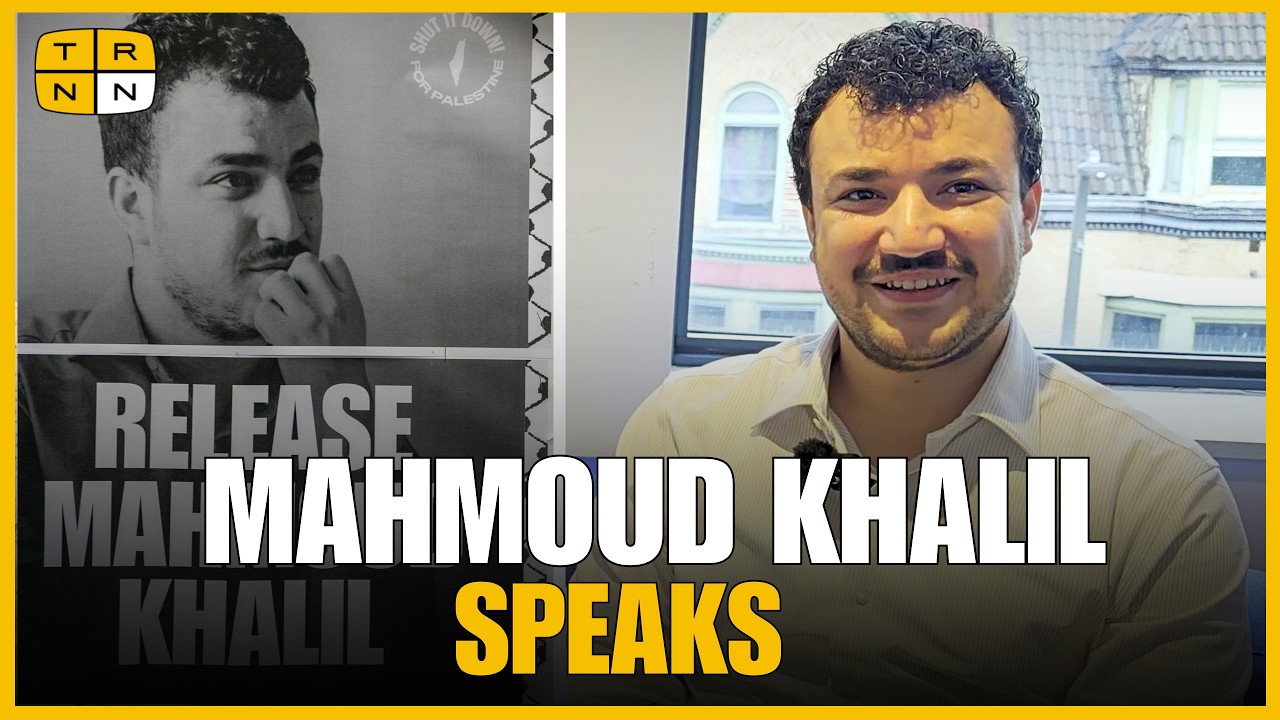
‘Resistance Is Our Only Option’: Mahmoud Khalil speaks

Maximillian Alvarez (L) and Mahmoud Khalil (R) speak at an event in Baltimore, MD on Sept. 24th 2026.

After being abducted by plainclothes ICE agents from his New York apartment building in March of 2025 and locked away in immigration jail for 104 days, Mahmoud Khalil has been freed and reunited with his family. But Khalil, a former Columbia University graduate student who was heavily involved in the student-led justice for Palestine movement, is still being targeted by the Trump administration and still faces the possibility of deportation. In this exclusive interview, TRNN Editor-in-Chief Maximillian Alvarez sits down with Khalil to speak about his new book, “No Land to Stand On,” and his continuing fight for freedom and justice.

Credits:

  • Post-Production: David Hebden
Transcript

The following is a rushed transcript and may contain errors. It will be updated.
Maximillian Alvarez:

I’m here at the Parkway Theater and I’m sitting with Mahmoud Khalil, freed political prisoner and former Columbia graduate student who was heavily involved in the student-led Justice for Palestine movement and who because of that was abducted by plainclothes ICE agents from his New York apartment building in March of 2025 and locked away in immigration jail for 104 days. But he’s here with us now. Brother Mahmoud, welcome home, man.

Mahmoud Khalil:

Thank you for having me, Max. Thank you so much.

Maximillian Alvarez:

It’s such an honor to be here with you in person. I don’t even know how you begin to answer this question, but I can’t begin without asking it. How are you and your family doing after enduring this horrific nightmare that is sadly still not over?

Mahmoud Khalil:

We’re doing all right and we’re taking it day by day, really sort of surviving under the threat of deportation at any second or worse than that, whatever this government may decide to do at any point. But our fear is part of the fear of so many families in this country who are now worried about sending their children to school. We are in September now and I know a lot of kids are worried about going to school because they’re either undocumented or their parents are undocumented. I’m thinking about just the families in Minnesota and in New York and in Texas who are now under the threat of being really deportation by this or ripping them apart. It’s not only deportation. Haitians

Maximillian Alvarez:

In

Mahmoud Khalil:

Ohio,

Maximillian Alvarez:

Latinos in

Mahmoud Khalil:

Southern California. Anyone who this administration sees as the other or sees as a threat to whatever plans they have. So in that bigger scheme of things also, at least I know my son will be fed tonight. There wouldn’t be a bomb being thrown on our house as happening in Gaza right now as we are speaking. So in the bigger scheme of things, we’re grateful. We’re grateful for the community that’s supporting us.That’s what’s keeping us going forward right now is just the level of support, the level of solidarity, the community that was built around us because of what this government has imposed on me and my family.

Maximillian Alvarez:

I didn’t plan to ask this, but as a father as well, I have to. What was it like to hold your kid that first time?

Mahmoud Khalil:

I don’t think anyone can describe that feeling. It’s just the first time I held Dean was in detention in a courtroom, in an immigration courtroom where verdicts of deportations happen, like rain daily in these rooms. So it was a little bit weird that I was able to reunite with my family in a place where families are being torn apart. But at the same time I felt victorious because that’s a moment that this government tried to steal from me. Although it was only for one hour, but felt the world to me. And of course now being with Dean, a lot of people ask me, “What gives you purpose?” And just seeing Dean and dreaming of a world where he can live in dignity and safety, inequality, just like anyone else, as an American citizen who has the same rights and responsibility as any other American citizen, regardless of his background, regardless of the ethnicity, regardless of anything, really it’s just like being a human.

Maximillian Alvarez:

And how could you not look at your kids and our children and not fight? We’re going to give this world over. We’re going to give their future over to these psychopaths, to these fascists, to these fanatical nut jobs? Of course not.That’s just not an option. But it’s really hard to put that into action on a day-to-day level when we’re being bombarded by so much terror and awfulness. I interviewed members of your former graduate student union at Columbia after you were taken. I’ve interviewed members of my former grad student union in Michigan where activists are having their homes raided by the FBI. I mean, students, community members, workers, people all over this country who are terrified to fight back or do anything because of what happened to you. But you continue to speak out. You wrote this book, No Land to Stand On. You’re here in Baltimore to speak to folks.

What do you and this book have to say to all of us out there about confronting that fear and not living in fear?

Mahmoud Khalil:

I think the fear is very real and I would be lying if I said I don’t have fear about myself, about my children, about my family. But courage is not the absence of fear. It is actually acting despite the fear. I would be lying if I said, “Oh, I’m not afraid.” Or when you are dealing with such injustice and as you’ve mentioned, just these fascist tactics and the way that they dehumanize us, whether as immigrants or whether as Palestinians or just as someone who does not agree with what this government is doing. So to take you back, I think a day after my release, I decided to go to a protest. And I usually am not that protest guy, although I was very heavily involved in the Columbia movement, but I decided to go mainly to give a message that despite all this violence inflicted upon me from the government, from the university, from the institutions and the establishment in this country, I refuse to be silent.

And now my book is out because the government tried to silence me. Or in essence, they tried to make an example out of me so you and others wouldn’t speak out. But to me, this book is a testament that I refuse to be silent. Now the government gave me a platform and they would take it with a grace and responsibility that I should take this platform to advocate for those who don’t have voices. At any moment now there’s over 70,000 immigrant in ICE detention. At every second, there’s at least 70,000 immigrants in detention. That we know

Maximillian Alvarez:

Of. Now they’re like, we don’t even know if they’re keeping proper track.

Mahmoud Khalil:

Exactly. I don’t know how many went through the administrative errors that this administration every now and then does. So really this administration tried to silence me and I refuse to be silent. And that’s why I want to give people not hope, but at least some sort of despite all this violence, you can still speak out because what we’re dealing with right now is this administration, they are bullies and what our parents teach us when a bully come to bully you, you should not – Stand up, baby. Exactly. So that’s what I’m doing right now. And part of my fight is not about staying in the US. It’s more around what happened to me is wrong and shouldn’t happen to anyone else. Even if I win my case tomorrow, I may decide to leave the day after, but that’s totally besides the main point, which is what’s happening is wrong and should be confronted.

Maximillian Alvarez:

Well, I want to end on that note because ever since you were taken, one of the reasons that people found so much hope in your story was that you continued to use your voice to advocate for others who were locked away in immigration jail, people who couldn’t speak English, people who didn’t have access to lawyers and who could get contact with the outside world. And that meant so much to so many. And of course you ended up in that jail because you were speaking out and speaking up along with millions around the country and around the world against a genocide in Palestine funded by our tax dollars. So here we are in 2026 and I’m not going to say it doesn’t feel like we’re losing everything and that it was all for naught, but I know a lot of our viewers can feel that way when they look at what’s happening to the ruins of Gaza and to the continual onslaught to erase that people from that land while back home they’re using the same tech to disappear our neighbors and family members.

So how do you put all of this in perspective and how do we continue to fight even when it feels like all is lost?

Mahmoud Khalil:

I think hope and resistance is our only option right now because this administration wants us to feel defeated, want us to feel that nothing is working. And the moment that we succumb to that feeling is the moment that they win because even if we remain silent, because I know people who were targeted and remain silent, the administration did not stop going after them because their mere existence was a problem to this administration. And that’s why I’m hopeful because I don’t have any other option. And the fact that the president of the United States came after an unknown student speaks a lot to the successes of our movement because it was impactful. It was actually changing things on the ground. It was changing public opinion in droves. That’s why the president of the United States felt the need to go after a random student to make an example out of him so that others would fear speaking out.

And that’s I think my only message in terms of why we should be hopeful because the change doesn’t happen in a day and night. It is the persistence. It is the continued resistance against all odds when you see that nothing is happening, but you continue because you believe in that. And that’s the thing as Palestinians, why we continue resisting despite everything all odds against us is that we are righteous. We know that human beings, regardless of their faith and nationality, they can see that in us and they would support us. So that’s why we have a strong belief in our cause that it’s a righteous cause. We don’t need millions and billions of dollars to convince public opinion about the righteousness of our cause or not. It’s just like we need to present it and that’s it. And that’s what they are fearing right now.

That’s why you see the establishment in this country is scrambling to control the media, to buy TikTok and to buy CNN and all of these just because we are actually winning and they know they will not be able to stop us. That’s why they’re bringing these all new tactics about, in my case, they’re weaponizing the immigration law from 1952. And in other cases they’re bringing all these alien laws.

Maximillian Alvarez:

They’re

Mahmoud Khalil:

Reaching back to laws from centuries ago. Yeah, 1800 something because they’re looking for tools because we’re actually winning and the public is with us. But also with immigrants, an average American sees that an immigrant is a benefit to this country, whether it is through the work that they do, whether through the diversity they bring. And this country was built upon, I mean recently, I don’t want to stoke about the enslaved people and how this country was built on their shoulders, but recently also immigrants were part of this.

Maximillian Alvarez:

You and I wouldn’t be sitting here if that wasn’t true.

Mahmoud Khalil:

Absolutely. And we absolutely must be conscious of that. And that’s the other thing about why I’m writing the book now, not in five years, because this is urgent. A lot of people ask me, “How would you look at this moment in 20 years?” I don’t want to look at it in 20 years. I want to do what I can do right now to stop it because what’s happening right now is a stain on the constitution, is a stain on the American consciousness, is a stain on every human value that we stand or we say we stand for. And I don’t want to look in 20 years and say, “Oh, we should have done something because it’s happening now in our backyards. An ICE detention center is at least 30 minutes from any one of us right now. If you drive 30 minutes, you would find an ICE detention center.

There’s one

Maximillian Alvarez:

Five minutes that way. Thank you so much, bro.

Mahmoud Khalil:

No, thank you so much,

Maximillian Alvarez:

Max.

Mahmoud Khalil:

Appreciate it, man.

💾

“I'm hopeful because I don't have any other option. And the fact that the President of the United States came after an unknown student speaks a lot to the successes of our movement”
  •  

‘Like the Gestapo’: ICE brings terror and violence to Maryland

Still image of eyewitness Soolah speaking with TRNN about ICE raid in Frederick, MD on Sept. 14th 2026. Credit TRNN (R). Still image of ICE agents beating peaceful protestors in Frederick, MD. on Sept. 4th, 2026. Photo courtesy of Hagerstown Rapid Response Network (L).

Residents are shaken and demanding answers after ICE agents terrorized a quiet, suburban neighborhood in Frederick, Maryland, earlier this month. On September 4, federal agents swarmed the Tasker’s Chance neighborhood in West Frederick, invaded the home of one family, and eventually left without making any arrests. ICE agents were filmed beating peaceful protestors and menacingly driving their unmarked cars onto sidewalks and private property while local police officers stood by and watched. In this on-the-ground report, TRNN takes you to the very spot in Frederick where these terrifying events transpired, and we speak with an eyewitness who saw everything.

Credits:
Videography: Maximillian Alvarez
Post-Production: Cameron Granadino

Transcript

The following is a rushed transcript and may contain errors. It will be updated.

Reporter 1:

Breaking story in Frederick. We have been told that ICE agents have been camped out in the Taskers Chance neighborhood. Neighbors

Reporter 2:

Say ICE has made a move on one home under the cover of night. That’s exactly what you are seeing right now.

Soolah:

There were protestors next to me. There are protestors across the street. And then I turned to this car and it was right here. And then I heard out of the side, the siren go off and I turned and here’s this car coming at me from on the sidewalk. By

Reporter 1:

Friday night, protestors were chanting on the sidewalk, also trying to block the street and a home they believed ICE was targeting. That’s when Santos says ICE became aggressive. This video shows when an ICE officer drove up on the sidewalk toward protestors. Santos and local activist Sula Kemp say ICE officers became violent.

Maximillian Alvarez:

I’m standing here in Frederick, Maryland, just over an hour west from Baltimore, and I’m standing in a quiet residential neighborhood where just over a week ago, ICE agents in unmarked cars swarmed this neighborhood, surrounded the house behind me. ICE agents are on video beating peaceful protestors with their batons, menacingly driving their cars onto the curbs into the directions of protestors. And I’m standing here with Sula, who is a local resident of the area and who was here the night of those events. Sula, thanks so much for joining me here. Can you walk listeners through what happened and what you saw that night?

Soolah:

Okay. I was asked by as many people were asked to come and help. So I had that time and I was able to come down and I saw different ICE peoples actually around this whole neighborhood. They were in different pockets and locations. I hadn’t even come to this street. I had gone to two streets down and then the next street right over and you could see where they were positioned. And then there was also one that was driving around that seemed to be sort of intimidating by chasing cars, which I thought was really strange behavior because you didn’t see anything on the vehicle to say who it was. It didn’t say police, it didn’t say anything. Didn’t have any markings on the cars. So we didn’t know who they were. Assumed they were ice and their lights were just kind of on. They’re just sitting in their cars parked on the street.

So then there was a call later. I was there about three hours and then somebody had just said they need people on this street specific. So I was like, “Well, I’ll just walk over.” And they said that there was one car that had a spotlight on protestors. And what they were apparently trying to do on this street was just line the sidewalk, a public space with protestors. So that was fine. So I was like, “All right, let me take my phone and go to the other side and get the perspective of the spotlight being put onto the protestors.” So I did that. I first took a bit of video from this side as an observer and then went to the other side and stood there and watched just cars. And then all of a sudden as I was standing on the sidewalk, I heard a siren go off, just a few bursts of it.

And I happened to turn my camera and there was a car on the sidewalk coming toward me and telling me, and everybody who’s on the sidewalk, “Move, move, get out of the way.” At some point they sa, “You’re impeding a federal investigation.”

Maximillian Alvarez:

We’re talking about a car driving up

Soolah:

Right

Maximillian Alvarez:

Here where we’re standing.

Soolah:

Right. On the sidewalk, public space.

Maximillian Alvarez:

These are people’s houses. They’re driving onto people’s property.

Soolah:

Well, and if you or I had done that, what would’ve happened to us?

Maximillian Alvarez:

Yeah, they’d throw my ass in jail.

Soolah:

Reckless endangerment of people. And it was crazy. They stopped for a hot second and I jumped onto the grass at first and then I stepped back onto the sidewalk because I was like, “I don’t know what’s happening.” Just a natural response. I was like, “Wait a minute, I’m on the sidewalk.” So I stepped back on the sidewalk and then he started really coming. He did not stop and he sped up toward me first and then there was a woman behind me. And then there was another person, another protestor that they did hit and started to push with their car.

Maximillian Alvarez:

So you were standing right around here?

Soolah:

I was right here. And there was a car there. There was a car across the street. So I had my camera on this car. There were protestors next to me. There were protestors across the street. And then I turned to this car and it was right here. And then I heard out of the side, the siren go off and I turned and here’s this car coming at me from on the sidewalk. I jumped over to here. He passed me. He hit another protestor and then pushed that protestor out of the way. And then the protestors at some point have been sitting down, just linked arms, sitting down, singing and chanting right in the middle of the street, which is fine. They can do whatever they want to.

Maximillian Alvarez:

Community members surrounding one of their neighbor’s homes to try to protect them. Yeah. And then agents of the state come in and start beating the hell out of them for it.

Soolah:

Yeah. So they sat in the road and then they did get up and did that protection. And it’s a typical thing that people do to blockade, but peacefully, they didn’t do anything. They just linked arms. You can’t do much when you’re linked arms. And it’s a whole group of people. And then all of a sudden Frederick Police were coming and then they moved up to the porch area and started beating them up.

Maximillian Alvarez:

You and I are standing here right now on this quiet residential street. People who are watching this may have only seen a small slice of this street on line. What they can’t see is that this is the quietest residential street you can imagine. There’s nothing happening here. You would think with all the ICE agents and vehicles that were here last week that this would be a hotbed of overrun with criminals and criminal activity. It’s just families and houses.

Soolah:

Yeah, it’s very quiet here. You can drive around here and people are working, people are doing their lives and that’s it. So it’d be like every day storm into your everyday world in your suburban America, and that’s what happened. And when you look at now, it’s quiet, it’s peaceful here. So they brought a sense of terror and they brought a sense of unsafety. So yeah, the main set of protestors, they’re stationed on the sidewalk here right at the stop sign. There’s a whole group here. And then there was an ice vehicle here. There was an ice vehicle behind –

Maximillian Alvarez:

Right behind

Soolah:

Where I’m standing. Right behind where you’re standing. Because they started sort of parading in, it looked like a little ice parade. And I’m just joking about that because it was so weird. Once they got into the house, I could hear up in one of the rooms them banging stuff around. And another protestor had asked me, who was observing, asked me, “Do you hear that?” I was like, “Oh yeah,” because it was loud. I don’t know how the house was on the inside when this was all done, but this was a lot. And then I actually went and looked through the back part. They had a shed or some kind of building out in the back there, and you could see these guys go into the back and they started searching. They didn’t know how to get open the shed or whatever because it’s big, but eventually they did.

And it was eerie. It was very eerie.

Maximillian Alvarez:

And it feels reminiscent of the Gestapo view.

Soolah:

It does because who bangs down a door like that? Who goes through looking for whomever? And apparently they didn’t take anybody. I don’t understand why it all happened in the first place.

Maximillian Alvarez:

Yeah. So all that terror for nothing?

Soolah:

All that terror for nothing.

Maximillian Alvarez:

How do you move on from something like this? How does this community move on? How are folks responding?

Soolah:

I know right now they’re collecting donations for the people who were beaten because they had hospital bills. And it’s really hard because I don’t know them all personally. I came because just like anybody else, we don’t know each other half the time, but we do see something in need. So they do have a donation set up for them specifically. I am not sure what the next steps are. I know that I have personally tried to contact the attorney general’s office a few times. I haven’t heard anything yet. And I’m hoping that somebody who’s above, in some kind of governmental stance or something, because who feels safe going to the police when you watch the police stand there? There’s the question. I didn’t report anything to them, even though I had a vehicle come at me on the sidewalk. I doubt anybody else is really going to feel comfortable or safe, and maybe that’s the point.

Maybe that was the point too. I can’t speak for that, but it’s just what goes in my head, why would I contact you to tell you what happened? So I want to go higher up.

Maximillian Alvarez:

And so when you were here and you had federal agents and unmarked cars and you also had local police, did you feel in that moment like the police were there to protect you?

Soolah:

No. And the wild thing too is on the car that, at least this car that came at me, you couldn’t tell who they were because their license plate was tinted out. There’s nothing identifying that either. So who are these people? I don’t know if Frederick Police had some kind of directive because I don’t know what even drew them out here in the first place. Maybe they heard that people were getting beat maybe, but they were here before that happened. So maybe they have to take a specific. I don’t know. I literally do not know. And if that’s the case, if they have a specific directive or they don’t know what to do, maybe that needs to be talked about. Maybe something like this, when you have unmarked cars doing reckless behavior with their cars, doing reckless behavior towards other people, what is the community’s protect and serve folks going to do for the community?

Yeah.

Maximillian Alvarez:

Who are you protecting? Who are you

Soolah:

Serving?

Maximillian Alvarez:

Not us.

Soolah:

There are tax dollars going into all of this too, that people are going to step back and go, “Wait a minute, what’s happening here? I’m putting money toward them and it’s whoever was called out here for that night.” Who knows? I don’t know. But at the end of the day, who are they protecting?

💾

ICE agents terrorized this suburban neighborhood in Frederick, Maryland, and beat peaceful protestors while local cops just watched. We speak with an eyewitness who saw and filmed everything.
  •  

New positive ivermectin evidence

Dr. John Campbell | November 25, 2025

A Pilot, Randomised, Placebo-Controlled, Double-Blind Trial of a Single Oral Dose of Ivermectin for Post-Exposure Prophylaxis of SARS-CoV-2

https://www.mdpi.com/1999-4923/17/9/1205

People who took one small oral dose of ivermectin after exposure, took longer to test positive and had more time alive and free of symptoms.

Multiple reports from in vitro infectious models document Ivermectin’s antiviral properties

Click to access cells-09-02100.pdf

Ivermectin has broad-spectrum antiviral activity.

Randomised, double-blind, placebo-controlled

Single oral dose of Ivermectin as prophylaxis for SARS-CoV-2

Trial to evaluate the effectiveness of a single oral low dose of Ivermectin

Ability to prevent SARS-CoV-2 infection?

Ability to reduce symptoms if infection did occur?

Methods

Asymptomatic community-dwelling adults

Enrolled within 72 h of close contact with a case of SARS-CoV-2.

Single oral 200 µg/kg dose of Ivermectin or placebo.

65Kg woman given 13mg

80Kg man given 16mg

The primary outcome

Conversion to a positive PCR or RAT test within 14 days of close contact.

Secondary outcomes

(for those who tested positive)

Days alive free of symptoms in the 14 and 28 days following ivermectin

Days from close contact until a positive PCR or RAT

Results

N = 536 (86 met inclusion criteria and were randomised)

68 adhered and were included in the analysis.

Ivermectin arm

11/36 tested positive

Placebo arm

11/32 tested positive

So, ivermectin did not prevent people testing positive

Days from close contact until a positive PCR or RAT

Increased by 2.3 days in ivermectin group.

P = 0.033

So, ivermectin lengthened the incubation period

Viral load needed to precipitate clinical disease took longer to develop – indicating an antiviral effect.

Infection may have been prevented from primary contact, – indicating an antiviral effect.

Days alive free of symptoms

Increased by 2.5 days in ivermectin group.

P = 0.036

So ivermectin delayed onset of symptoms in people who tested positive

(Longer asymptomatic period)

Controlling included

Age, prior SARS-CoV-2 infection, body mass index, hypertension, lung disease

Conclusions

We did not demonstrate that a single oral low dose of Ivermectin administered to asymptomatic adults within 72 h of close contact with a case of
SARS-CoV-2 prevents conversion to a positive PCR or RAT.

(may have done with a larger sample size)

Amongst those who did convert to a positive PCR or RAT

Ivermectin significantly lengthened the time from close contact to conversion

Ivermectin increased the number of days alive free of symptoms

More details

Initiation of this trial in late 2021

Discovery in 1975

Massively used around the world

Nobel Prize in 2015

Very low incidence of serious adverse side effects

No instance of resistance reported in over 25 years.

Ivermectin can bind to and inhibit the nuclear transport roles of the host importin α (IMPα) protein, which is known to mediate the nuclear import of various viral proteins and key host factors.

Other quite distinct antiviral actions of Ivermectin have been proposed.

High (therapeutic) concentrations collect in the lungs, stable for more than 30 days in cattle.

Trial was based on the strong clinical retrospective association of statistically significantly lower mortality in patients who received oral Ivermectin (200 μg/kg) compared with usual care.

https://www.sciencedirect.com/science…

Ivermectin patients 15% mortality

Controls, 25.2% mortality

In subjects with severe pulmonary disease

Ivermectin patients, mortality 38.8%
Controls, 80.7% mortality

  •  

Inside Ukraine’s propaganda operation targeting Americans

RT | September 24, 2026

Ukraine’s government-backed United24 project offered former US service members thousands of dollars to produce pro-Ukraine videos for American audiences, RT’s America Now has found. The offers targeted veterans whose military backgrounds could make the message seem more credible to viewers.

Host Ben Swann and investigative journalist Elizabeth Lane examined how the project, launched by Vladimir Zelensky in 2022 to raise support for Ukraine, approached former personnel, including special operations veterans with YouTube channels and other media platforms.

According to veterans who reached out to Lane, United24 offered around $10,000 for each video, plus $40,000 in advertising support. There was no stated limit on the number of videos they could make. The project would also provide scripts and guidance, while the veterans would ultimately deliver praise for Ukraine and Zelensky in their own words.

Some creators who agreed to the deal were reportedly creating up to five or six videos a week, making nearly a quarter of a million dollars a month, Lane found.

The men who spoke with Lane said they themselves had turned down the money, recognizing that they were being asked to present paid propaganda as their own views.

However, for some, the refusal came with consequences beyond lost income. One veteran, who turned down the offer and later criticized Ukraine for wasting US money on his channel, had people contacting his employer, calling him a Russian agent, and trying to get him fired.

The effort ultimately failed, Lane learned, noting that it is still “crazy that some foreign government is allowed to reach out to an employer of a former veteran and tell them that ‘you should fire this guy because he’s a Russian propagandist.’”

United24 has since tried to deny making such offers, despite Lane’s recorded Zoom calls with multiple veterans that testify to the contrary.

The choice of former service members is central to the Ukrainian propaganda operation, Swann noted, pointing out that many Americans are inclined to trust someone who had served in the US military, unless they find out that the veteran had been offered thousands of dollars by a foreign government to deliver the message.

Furthermore, given that Kiev is almost exclusively funded by its foreign sponsors, including billions received from Washington, the Ukrainian government-backed United24 campaign is effectively propaganda aimed at Americans, being paid for by US taxpayers themselves, Swann noted.

With Ukraine struggling on the battlefield, the propaganda efforts will likely continue to intensify, Lane predicted, describing a possible surge of supportive messages from major online figures as a “Hail Mary” attempt to shore up backing for Kiev.

Watch the full episode of the four-part America Now investigation here.

  •  

Baltimore residents fight City Council over controversial data center bill

Background: Photo Baltimore City Hall in Baltimore, Maryland taken on May 2, 2019. Photo by Alex Wroblewski/Getty Images (color of imaged altered by TRNN). Foreground: A montage of photos of Baltimore residents speaking at an August 27, 2026, Baltimore City Planning Commission public hearing on Council Bill 26-0174 (data centers), as well as photos of Baltimore residents holding signs saying “No Data Centers” and “Ban Data Centers Now!” at a rally in front of Baltimore City Hall on June 29, 2026. Photos by Maximillian Alvarez/TRNN. Image design by TRNN.

Editor’s Note: Council Bill 26-0174 (data centers) will get another public hearing in front of the Baltimore City Council’s Land Use & Transportation Committee on the 4th floor of City Hall on the morning of September 24.

Baltimore, Maryland, currently has a moratorium on new data center development, but a proposed City Council bill has residents nervous that the door is creaking open for data centers to come into the city—and that City Council views this as “inevitable.”

Council Bill 26-0174, sponsored by City Councilmember Phylicia Porter, would require new data center projects in Baltimore to go through a conditional use approval process that includes a health equity assessment. Residents opposed to the bill say that while the bill may be well intentioned, they want a full data center ban, not stricter guidelines for data centers operating in Baltimore.

In this on-the-ground report, TRNN takes you inside the August 27 Baltimore City Planning Commission public hearing on Council Bill 26-0174:

TRNN also published a full, unedited recording of the August 27 Baltimore City Planning Commission public hearing on Council Bill 26-0174, which is free and available to the public on our YouTube channel:

Credits:

  • Videography: Maximillian Alvarez
  • Post-Production: Dave Hebden, Cameron Granadino
Transcript

The following is a rushed transcript and may contain errors. It will be updated.

Speaker 1:

We all are well aware that we’re not dealing with good faith actors when it comes to the people who want to build data centers.

Speaker 2:

I currently work at a data center. That doesn’t mean that I approve of data centers. Every

Speaker 3:

Every time it storms, it seems that a bunch of lights go down in the city. I’m confused why we’re even talking about a data center if we can’t keep our own lights on.

Maximillian Alvarez:

Baltimore currently has a moratorium on new data center development while a city study examines the potential impacts that data centers would have on our city. However, even though that study hasn’t been completed yet, a proposed city council bill has residents here nervous that the door is creaking open for data centers to come into the city and that city council views this as inevitable. Council Bill 260174, sponsored by city council member Felicia Porter, would require new data center projects to go through a conditional use approval process that includes a health equity assessment. Now, residents who are opposed to the bill say that the bill may be well intentioned, but what they want is a full data center ban in Baltimore, not stricter guidelines for data centers to operate in Baltimore. Now, the bill is going to get another public hearing in front of the Baltimore City Council’s Land Use and Transportation Committee on the fourth floor of City Hall on the morning of September 24th.

And that meeting is open to the public. Now, I was there in the room during the last public hearing on Council Bill 260174, which took place on August 27th when the bill was reviewed by the Baltimore City Planning Commission and residents were given a chance to voice their public comments. Now, the planning commission ultimately declined to support the bill and opposition from members of the public to data centers of any sort was frankly overwhelming, but you don’t got to take my word for it. Watch for yourself.

Andy Ellis:

We’re here at the Baltimore City Planning Commission getting ready to hear a bill that would allow data centers to come in if they had a health equity assessment into Baltimore. This happens despite the fact that we have an existing moratorium. And so we’re here today to testify against the bill because we think that the moratorium should be extended or made into a ban so that we can stop data centers from coming into the community.

Blaire Postman:

Hi, I’m Blaire from Cat Ladies for America. I’m a resident of Baltimore and I’m here today because even though there’s a moratorium on AI data centers in the city, it seems like they’re laying the groundwork for them to allow them and allow them to come in without a lot of oversight. And that makes me very angry. Claws out!

Speaker 8:

The next item is number eight, city council bill number 26-017 zoning conditional use, health equity assessment data centers.

Councilmember Phylicia Porter,:

I am Councilwoman Phylicia Porter and I represent Baltimore’s 10th District and chair of the Public Health and Environment Committee and bill sponsor for 26-0174. The data center industry is looking at Baltimore at the peninsula, Fairfield, Hawkins Point and other industrial areas. At the same time, the federal government is accelerating AI infrastructure development and scrutinizing state and local laws. It regards its obstacles to that development. This creates a real risk for jurisdictions relying only on a temporary moratorium without a permanent framework under development, which will face legal and economic pressure. Other jurisdictions have already quickly learned how that pressure can arrive. Hill County, Texas faced a hundred million dollars in federal lawsuit shortly after adopting its moratorium and rescinded under that pause under the weight of that litigation. This lesson is not that Baltimore should surrender its authority. This lesson is that Baltimore must exercise its authority carefully, deliberately, and now.

A moratorium alone without companion framework and process is exposed to taking legal challenges. Moving bill 26-0174 through this process, hearings, testimonies, amendments, votes itself is a part of that good faith planning effort that the Supreme Court has been requiring. Bill 26-0174 does not promote or green light data centers. It strategically and administratively blocks development at every step of the way that does not align with community. It creates public accountable process for deciding whether a qualifying data center is appropriate for a particular location and under what conditions it may process. This is the foundational right of the conditional use ordinance process. Traditional zoning asks whether proposed use is compatible with the land around it. A health equity assessment asks an equally important question, what will this decision mean for the people who already live in those conditions surrounding that land? Bill 26-0174 puts that cumulative reality into the decision making process of the city council before approval, not after residents become ill, household costs rise and public infrastructure is strained.

This is environmental justice and it’s basic due diligence.

Jon Laria:

There are maybe some questions, but it took me a while to sort of get this straight in my head, but there are only written submissions opposed to this bill by people who are opposed to data centers and so are you. Yes. So it’s kind of odd because they’re opposing a bill and I think the reason that’s happening is because most people are starting with the idea that there’s a moratorium, meaning zero data centers. And your bill provides a path, a difficult path, but a path to data centers. No,

Councilmember Phylicia Porter,:

That’s not correct. So it is not correct. So the study adds a legal framework attached to the moratorium right now as shared within my remarks, right now we are under a moratorium where we are legally unrestricted. We are unprotected right now under this moratorium without the conjoining health equity framework attached to it.

Jon Laria:

I’m not sure I understand.

Councilmember Phylicia Porter,:

Yeah. So no worries. So when you have a data center and we currently have, I will say if you have a data center that comes into the city that’s under a moratorium right now, if they sue Baltimore City, they sue Baltimore City saying this is unjust. We understand that data center developers are getting very crafty in their arguments. They’re arguing First Amendment rights. They are arguing other rights that provide them a pathway forward. We are seeing that those moratoriums are getting overturned. The successful moratoriums that have been upheld are always assigned and/or connected to a framework that allows good faith effort to showcase that they are doing some sort of regulatory footprint with that moratorium, not just saying that you want a moratorium. So that is the issue.

Jon Laria:

Okay. Although we are doing this study, I mean the moratorium is not just a moratorium. A moratorium that just says moratorium because we feel like it, I see the weakness that you’re describing, but a moratorium so we can study it seems like a defensible position.

Councilmember Phylicia Porter,:

It’s not because again, what was mentioned in the planning commission report was that there is a lack of health equity associated with the current moratorium. This answers that response.

Jon Laria:

But it is sort of an odd posture because I think, and people should speak for themselves, but we have all these people who are opposed to data centers and they will come and testify and they’ve submitted testimony saying no data centers because I think they see in your bill a pathway to data centers and their view is we don’t want them at all. And under the moratorium – I’m not arguing with anyone. I’m just trying to get straight because they have all these people who are going to come up and say no data centers because they perceive perhaps your bill as loosening the restrictions, which is actually not how you intend

Councilmember Phylicia Porter,:

To bill. It’s not the intent of the bill. And I will also caveat, how many data centers have an application now with the current city of Baltimore that once this moratorium goes away, if we do not have the regulatory framework in place, how many of them will be actually going through the process?

Speaker 1:

But if I’m understanding the bill correctly, basically we currently have a moratorium that is pending a health review, health study review in the findings there. And that the bill is saying we need to do something that is stricter than a review and stricter than a moratorium because a moratorium can be overturned. And basically the bill is saying we’re going to provide a path to a data center, but the path is going to be very difficult. And so the hope, I believe if I’m understanding correctly, is that with the difficulty of the path, the data center should not be able to be built unless it passes very strict scrutiny that it likely will not pass. My concern as a citizen of Baltimore is this. I understand we all know full well, we cannot legislate the hearts and minds of people. We cannot put into a bill.

We all have to be nice to each other. However, we all are well aware that we’re not dealing with good faith actors when it comes to the people who want to build data centers. We’ve already heard testimony that there are people in rooms looking, combing through every law, probably across the country with fine tooth combs to see where they can actually exploit loopholes. And my concern is a citizen of the city and someone who cares about the city, who has young people who I care about in the city, who I want them to grow up in a place with clean air, clean water, not having the sound pollution and the headaches and all the things that come with having a data center in their vicinity. My concern is that if we know that we’re dealing with bad faith actors, then is it not our responsibility as citizens and as people in government to deal with the world that we have and not the world that we want to be?

You know what I mean? Deal with the people who we know are building these, which are bad faith actors and not deal with the fantasy of, oh, well, it’s going to be really hard so people aren’t going to be able to pass the test when people are looking to do everything they can to subvert every possible obstacle to getting these built.

Speaker 2:

So I’m a longtime Baltimore resident, electrician with IBW. I’m here to speak against obviously data centers. Obviously the contradiction here is that majority of the work for the IBW right now is data centers. I currently work at a data center. That doesn’t mean that I approve of data centers. One of the things that I think that we’re all missing here is that Baltimore is a city that has suffered from de-industrialization for a long period of time. Obviously the shutdown of General Millers, the shutdown of Bethlehem Steel. What we could be talking about instead of wasting our time with this is we could be thinking about how can we generate the power that the grid demands for something like this. We could be talking about solar farms, wind generation, be talking about battery storage. If you look at PJM’s own records, they say that Baltimore and the mid-Atlantic region is at risk of rolling blackouts, as others have said, by 2028.

Obviously our grid needs investment. Our infrastructure needs investment. The city needs investment. Investment from Google Meta does not solve our issues. If we actually care about having a city that functions, we’re going to need to be thinking about where are we putting power, not where are we taking power to? It’s really just that simple. And on that topic, if we’re talking about actually maintaining a labor force, we should be talking about how do we get the young people in our city into the trades that this type of work demands by doing some type of local hire mandates, something to make sure that our young people are not just left in the wind. Roughly 25% of young black men in the city aren’t working. Why are we not talking about what we can be doing for our city? It pains me. I just see no solutions, but we’re talking about something that can help billionaires become trillionaires.

Speaker 10:

Baltimore ordered the nine month study specifically required to recommend conditional use standards for data centers, yet this bill is already establishing conditional use framework. Why not finish the study and let the evidence inform the legislation? Second, under this bill, the company seeking approval prepares the health equity assessment evaluating its project’s potential health and environmental impacts. Subjection C9 even requires that applicants to explain the compelling public interest in its own project would serve. When a company has financial stake in an outcome, relying heavily on evidence prepared by that same company creates a conflict of interest. Why isn’t this assessment independent from the applicant seeking approval? Where is the scientific independence in this process? Finally, if this legislation is truly about putting community first, where is the community process when this hearing is being held in the middle of the day? As other people have stated, my friend, she had to leave.

Many working class Baltimoreans cannot take off to participate. So we are urging that this study be completed, that we require independent assessment, give affected communities meaningful participation. Please oppose this bill and enact a ban on data centers.

Blaire Postman:

I’m a 29 year resident of Remington in Baltimore. I want to tell you about a new building that’s being built. I know this hearing is not about that, but it’s relevant. This new building is going to use more energy than Remington and Charles Village combined. It required the building of a new electric substation. It’s going to be as big as the convention center. It’s on the edge of Stony Run, ground not appropriate for such a large building requiring very deep pilings. It’s displacing animals already. There are deer on my street. For the first time in 29 years, there are deer on my street. My street is five blocks from any wooded area. Deer are walking five city blocks to come to my street to eat all my flowers. I don’t care that they’re eating my flowers because they’re hungry. This building also has a truck road.

It’s going to result in this destruction of over a hundred trees. There was strong community opposition to this building. We were told that this building would not be a data center. I personally don’t know if it’s a data center. The amount of power it’s using, the size of it makes me wonder. So I have some questions. How did this happen? What’s the definition of a data center? And I just want to say that’s why I want to ban. I don’t believe this is a legal issue. I believe it’s a trust issue. There are bad actors. The megas of the world are bad actors and often our representatives do not support us. Odette supported our community. We voiced our opposition and yet Zeke Cohen voted for this and said data centers are inevitable and we need them.

Speaker 11:

I want to also remind everybody that people in Baltimore City, many, many are living on the edge. They’re living week to week. They’re living month to month already. Now, data centers are needed for AI. So you have AI and data centers working together. For some reason, we’re rushing into unregulated, unplanned black box of technology. I don’t know why, except I think it’s the investors who are creating this, creating this need and creating this bubble. So we have people, regular people striving to just get by. AI on the one hand is displacing jobs. It has displaced jobs. Everybody involved in AI says it’s going to massively destroy jobs. Sam Altman bragged about it. On the other hand, we have data centers which have raised utility rates for people around the city. As they’re built, they will raise more utility rates. Now we have people who are barely getting by.

What happens to them?

Speaker 3:

I love Baltimore. It’s a fantastic city. Fell in love here. We’ll have lots of friends and I’m connected to a lot of local art communities. It’s an important city to me and everyone in this room. And I say that because there’s a lot of conversations going on about water, about power. Every time it storms, it seems that a bunch of lights go down in the city. I’m confused why we’re even talking about a data center if we can’t keep our own lights on. I see streets and potholes all over the place and I would really like Baltimore to be a city that is ready for something like a data center. And to be clear, I want a ban on data centers.

But if I’m looking at the infrastructure we currently have just to support homes, just to support me, just to support my friends and family using regular water, I turn the heat down on my water heater. I’m doing what I can to try to make sure that I’m a good citizen in a drought, in a moment of contention. So I am asking council to put a ban on data centers, period, until we deal with potholes, until I can drive my car and not worry about it, period, until we can deal with power outages after storms, until we can make sure that all of our neighbors have access to grocery stores that are healthy for them in their local neighborhoods.

Speaker 12:

I’m a longtime participant in Baltimore’s professional filmmaking community. I’m also a longtime member of IATSE Local 487. So I think I’ll kind of address my concerns in terms of in sort of a cinematic fashion with a metaphor of sorts. When I think of the evolution of data centers as a topic of debate in the public consciousness, I can’t help but think of vampires as a metaphor for what they offer, both in how they mystify the impressionable and how they have the power to leach resources and destroy communities. When I look at this bill, it almost feels like they’re saying, “Hey, vampires want to come to Baltimore. We want to lay the groundwork to only allow the right vampires to come into the city. Vampires are risky. We want to make sure we know what a vampire is and then we want to make sure we get the old money vampires who have accumulated their wealth over hundreds of years and only bite certain kinds of people, maybe vampires that’ll make some of us super hot and young forever.

We want the best vampires for the community.” I don’t think I’m alone when I think of that and I go, “What if we just did no vampires?

💾

“When I look at this bill, it almost feels like they're saying, ‘Hey, vampires want to come to Baltimore. We want to lay the groundwork to only allow the right vampires to come into the city”... What if we just did ‘No vampires’”?
  •  

DSA leads the blue wave — will it bend to the thin blue line?

An NYPD officer provides security during the Inauguration for a New Era Block Party in New York City on January 1, 2026 as Mayor Zohran Mamdani takes office. Photo by Leonardo Munoz / AFP via Getty Images

What will a DSA-led state look like — will it back defund and community control of police, or bow to the powers that block affordability? Lawrence Grandpre, political commentator for Leaders of a Beautiful Struggle, explores this question in his recent Baltimore Times article, “The Dangers of ‘Law and Order’ Leftism: Toward a Black Power Public Safety,” asking whether DSA will embrace the outmoded Law and Order politics that fueled America’s prison boom. As officials like AOC and Mamdani backtrack on defunding police — one of the biggest carceral drains on housing, healthcare, and education funding — Grandpre sits down with former political prisoner and Rattling the Bars host Mansa Musa to unpack these contradictions ahead of the midterms, where Democrats hope to retake the House and Senate. Tune in for an unflinching look at the Left’s relationship to the state and to law and order.

Related Links:

Credits:

  • Production/Post-production: Cameron Granadino
Transcript

The following is a rushed transcript and may contain errors. It will be updated.

Mansa Musa:

Welcome to Rattling the Bars. I’m your host Mansa Musa. Today I’m joined by Lance Grandpre, political commentator with Leaders of a Beautiful Struggle, to discuss his recent article for Baltimore Times, “The Dangers of ‘Law and Order’ Leftism—Toward a Black Power Public Safety.” Thank you for joining me, Lance.

Lawrence Grandpre:

Thank you for having me.

Mansa Musa:

Alright, so let’s start like this here. At one point we had in 2020 where you had a push for the abolishment of prisons and to dismantle the police system as we see it during that period. But immediately you had a pushback and the pushback came in the form of saying that this was woke. Now we look at the United States and mass incarceration, armed policing, and you juxtapose that with the lack of funds for healthcare, lack of funds for education and lack of funds for housing and the fact that the criminal injustice system is in itself painful when it comes to poor and oppressed people, mainly people of color. Let’s start with your article.

Lawrence Grandpre:

So this article stems out of a protest I went to because sometimes people say if you talk about police reform or defunding police, you don’t care about victims. And this protest was the opposite. This was a Black elder, a former member of the Baltimore Black Panther Party who was assaulted by many teenagers and it was caught on film. So of course Fox News, our local Fox News is showing this over and over again saying, “Lock them up, what’s wrong with these kids?” And these were community advocates, many of them women, Queen Mother Victorious who lost her son to gun violence, Mama Gwen, who was formerly incarcerated, coming together with community and saying these young people, what they did was a problem, not because it just violated the law, because it violated our community respect for elders. And we don’t want to just throw the cops at these kids and throw away the book, but if people know who these young people are, turn them into us, the Black community, so we can make sure that they are held accountable but not railroaded by the criminal legal system.

And I though the sophistication and intelligence of that response and even Baba Ade, the elder who was hurt, saying the Black Panther’s argument was that capitalism and racism breed criminality in the community.

Mansa Musa:

Right.

Lawrence Grandpre:

And it’s not for us as the vanguard to educate ourselves and use political consciousness to eliminate criminality, not just from a material standpoint, but from a psycho-spiritual standpoint. And it was really interesting because this was a few days after AOC went on the news and said, “Nobody’s talking about defund anymore. Woke 1.0 was crazy.” So it was really interesting that the people who were supposed to be talking about social justice, Alexandra Ocasio-Cortez, some of these other so-called leftists,

Mansa Musa:

Right.

Lawrence Grandpre:

Even they were saying, “Defund—that was just people on Twitter trying to look woke. Nobody really talks about defund in real life.” And these Black elders, Black people in West Baltimore, were saying things like, “We have a $700 million police budget in Baltimore. How are we going to have that and schools and investments in the Black youth?” So these Black people who the left is telling us are conservative are actually more progressive than the DSA.

And I thought that was very telling that, in this moment, going into the midterms, there are these leftist democratic socialists who are trying to get elected, and because they want to get elected, they want to push away from radical rhetoric because they think it’s turning off voters. And I think that that goes to show you that when it comes to Black people, we need to have our own vision of public safety, because what’s being offered by even the left, the Democratic Socialists, is willing to push our issues aside, because they have a misunderstanding of our issues. They think it’s just a bunch of radicals on Twitter as opposed to Black folks been talking about Defund since the ’50s. And our visions of Defund are very different than what you saw on Twitter in 2020, but these folks wouldn’t know that.

Mansa Musa:

So how do you see the DSA in terms of how they look at the budget, just police budget and the fact that it’s undercutting the services of the very people they supposed to be representing?

Lawrence Grandpre:

It’s interesting because I think if you are a democratic socialist, it’s obvious you believe police are a tool to protect capitalism. So a world where if you’re a socialist, the idea that you wouldn’t talk about [how] protecting capitalism getting more money is a problem for you—it’s weird.

Mansa Musa:

Right.

Lawrence Grandpre:

But these folks are a particular brand of socialist. Many of them were very much pro-Bernie Sanders. So when Hillary Clinton and Kamala Harris used conversations about identity to attack Bernie, now a lot of these folks see all conversations about race as just distraction from class issues.

So, even when Black people talk about police, they say, “Well, it’s not serious. No one really talks about Defund. So you’re really just trying to attack the socialist candidates.” And it’s like, no, Black folks have been the community control of the police platform.

It wasn’t just invented by the Black Panther Party. It was talked about by Black activists in the ’40s and ’50s, in part because the understanding that if the police were seen as a solution to all social problems… it’s not just police, it’s police-ism: the idea that policing is the only solution to the problems facing all poor people, but especially Black poor people, that’s going to push money away from all the other programs we need in the Black community. So Black folks have been saying that, really, since the Northern migration.

So when we talk about community control of the police, part of that is having community control boards control the police themselves, hold them accountable. And we’ve worked on that as LBS, but it’s also community control of the institutions that produce public safety beyond police. So, housing, addiction, education. I mean, I love to point out that Bobby Seal, he was in AmeriCorps before he was a Panther. So he would be shooting dice with the Black kids trying to school them on AmeriCorps’ time. And part of his frustration is these nonprofits don’t let us actually do the training we need to do with these youth, but we got to get the money from the nonprofit because that’s the only job we got. So even the Black Panthers program was a push for Black control of resources to socialize our youth, specifically around things like violence prevention. And again, the idea that all of that is just under this large framework of “woke”… And again, the right wing hates woke, we know that, but even some of the Bernie folks—they really hate “woke,” because they associate it with the attacks on Bernie and they see all conversations about police as woke.

Mansa Musa:

Let’s unpack some more about DSA because we see upheaval of DSA type activity and we see in terms of midterm elections, some of the candidates that ran on DSA platform have made it through the primary. And so at the same token, what is their appeal? Because they vacillating when it come to social issues.

Lawrence Grandpre:

The federal government, in theory, can print money. So there’s this belief that if we just spent more money, things will get better, and the Democrats have been afraid to spend money. I think that in the DSA, it’s like, “Let’s really focus on, in theory, cut the military budget, invest in community through things like Medicare for Al”l. Now, if you don’t have the integrity to stand up for “Defund the Police,” why do you think we would believe that you have the integrity to stand up to “Cut the Military Budget? If you don’t see the connections between the violence of policing and the violence of militarism, why would we expect you to be able to push the military budget to community?” 

Lawrence Grandpre:

These are intelligent, college-educated voters who feel like the government needs to spend more money, in part, because it’s a job program for people like them. So they have an interest in fighting the austerity of the Democratic Party, in part, because they want to see conditions improve for the community, but also in part because it’s a business model for the voters of DSA. And that’s a big concern for us, because even with Medicare for All, there’s no world in which healthcare should be a for-profit enterprise. But it’s not just that doctors are racist. When you look at things like Black women get more cesarean sections than other women, So, literally, they’re getting cut open in these dangerous surgeries. Black women, if you have a child in the hospital, you are going to get a drug test. And even if you pop for that drug test from the epidural, the drugs they give you for the pain, they might take your kid away. So engagements with the medical system are not just imperfect for Black people; they are places of surveillance and violence.

So we, as Black people, need systems like a birthing center, like nutrition, upstream investments that are different than what the DSA crowd cares about. So the idea that we should just accept not talking about Defund to get Medicare for All ignores the fact that Black people—we don’t just need healthcare to not give us a bill. We need to change the vision of healthcare so we control it. And the DSA is not interested in that. They don’t really think that way. And they honestly believe the only way anything will get passed if it goes to everybody. Universal programs prevent racial backlash. Because we know any spending in America is seen as giving money to welfare queens. So we just got to give the same thing to everybody and that’ll deal with racial backlash.

And what we know is anything you do that gives out any tax money will deal with racial backlash, but also do things that don’t give Black people the power we need to build for ourselves. It will just put us in systems that really are built by other people that, even if it’s good for them, can often be violent for us.

Lawrence Grandpre:

But I think that, again, when you have a class-based vision of the world, that has become in some ways hostile to thinking about race because you had negative experiences with people weaponizing race against people like Bernie Sanders. You’re not thinking about what a political agenda would look like when you actually invest in… because we should do both. We should have a class-based redistribution of wealth, but that restribution should also be invested in community institutions that reflect the culture and history of specific communities, not just Medicare for All, but clinics that use the history and culture of the community to provide that healthcare. Nutrition that reflects the culture and the way communities like to be fed so that they can have upstream nutrition so they don’t need to go to the doctor in the first place.

These things should go hand in hand. And I think it’s concerning that it feels like, because DSA is becoming electorally viable in some spaces, that [they] only talk about affordability issues, only talk about Medicare for all, only talk about ending the war in Iran, without really thinking intelligently about a platform that would meet people’s needs for community control of public safety, broadly defined. So not just policing, but again, youth programming, schooling, getting nutrition. Our kids are literally hungry.

Mansa Musa:

Yeah.

Lawrence Grandpre:

They’re fed junk food, but they’re undernourished. So we actually do have serious nutritional needs as we have obesity in the inner city. So what does it look like to build a food sovereignty ecosystem, whether it’s Black Yield, Black Church Food Security Network that can actually feed ourselves as opposed to just the DSA, it’s like, well just make sure they get food stamps. And food stamps are cool, but food stamps are not the vision of liberation for us.

Mansa Musa:

But talk about, because when we look at DSA, and it’s misnomer even to use the name socialist because when you look at. We got examples in Cuba and when they first took over, the literacy rate in the countryside was 90%. 90% of the people could not read or write. They organized, it’s a book out called Vincent Ramos. We were trying, that’s the name of it. And they organized all the college kids, all the intelligence and made them go in the countryside and stay to educate the people, to get them to read and write.

They didn’t say, “Oh, we’re going to create a system where they can come out the country, live in a project style housing dwelling and get them public schools that’s not going to teach them nothing.” They actually educated the people and a lot of that education led to what we see today in Cuba, got best medical, despite all the things going on. So when we talk about DSA, and I think this is a danger, and maybe you want to weigh in on it. I think it’s a danger that confronts that notion that this is a socialist party and because the right wing is going to put them right in the category like communists and they can resurrect that notion.

Lawrence Grandpre:

Socialism, to me, the key word is social. You either have the market making decisions about planning for the world or you have people doing it socially. It’s clearly better to do it socially, but there are divisions within that larger social body. And my concern is that even amongst some of the people in the DSA crowd, the leftists, some of the visions of what they would socially plan may like and lean on policing partially because they are afraid of being looked at as communist. So they might, for example, even in very, very progressive Bernie Crat, DSA San Francisco, there’s this push to, well, we got people homeless, they have mental illness. So they as individuals may not be rational, so we are going to use policing to bring them into drug treatment.

Mansa Musa:

Right.

Lawrence Grandpre:

And again, this is like even Bernie people sometimes say this. So there are elements of even the less progressive mindset that are like, we as a society can’t let you be out here damn bad. We have to help you lift yourself up. And if that means we have to involuntarily commit you to treatment, and if we have to use police to do that, then we’ll do that. While one thing that we talk about here in Baltimore is, and Baltimore’s been a heroin town since the 60s and 70s. And it’s been really hard for us, but we’ve also had systems of informal community care that have been designed to address some of the worst exigencies of drug abuse. Nika Namdi from a program called Fight Light said that grandma’s basement was the first halfway house. We had systems where elders, you would be able to stay with family and you would be able to get certain stabilizing influences through your social network so you wouldn’t be out on the streets.

So in that worldview, we would look at something like making sure these abandoned homes get rehabbed and given to Black people in community. That’s partially an anti-homelessness effort.

That’s an anti-addiction effort. That’s a crime fighting effort. So it’s not just social housing, it’s not just public housing. It’s also making sure that Black people in communities can pass down their family homes

And they have a way to make sure that they’re affordable so they can stay housed because that produces capacities for people who do suffer from addiction to not be on the streets committing crime. And again, the DSA vision is so limited to what they see and what they know, they sometimes end up using police where it’s like, if we just had networks of people in community that could care for each other, we wouldn’t need police for that. But I also do think folks are afraid. I know academics are very afraid and some folks are afraid of looking too radical, looking like the rhetoric of 2020 was burn down the police station.

Mansa Musa:

And

Lawrence Grandpre:

I think that’s also part of what they want to distance from when they talk about we not doing defund no

Mansa Musa:

More. Part

Lawrence Grandpre:

Of it is the direct antagonism with the state, the cost of that has increased for them. What we know is that the cost is high for us, whether we’re openly antagonistic or not, we are politically antagonistic by making demands upon the state to recognize our humanity. So we’ve always had to deal with that potential backlash. And I think now for some folks they’re saying, oh, I can’t use that. We’re not trying to do that radical rhetoric no more

Mansa Musa:

Because

Lawrence Grandpre:

People are losing jobs, people are potentially getting deported. So it’s like the ’70s, marginally away from the rhetoric of the ’60s and leaving the Black radicals out to dry after the draft ended. I think the white radicals moved away from radicalism and that we’re seeing a similar

Mansa Musa:

Dynamic. Okay, but we know that this is the 60th year of the anniversary of the Black Panther Party. And I was talking to somebody about just like we’re not anti-police. The party wasn’t anti-police. One of the things they did, one initiative they took was, and this is a revolutionary suicide by Huey Newton, where they had this particular intersection that didn’t have no stoplight and it was in the Black community and kids was getting hit. So somebody came and said, “Man, they not doing nothing about this. We’ve been complaining.” So they went down there and became traffic guards, the members of the Black Panther Party. They held up the traffic, let the kids walk by, you know what I’m saying? And this is what they did. And they had guns with them because they had one part of their program was policing the police. The police in turn came and told them they stop.

Now you guys stop this. They said, “Well, we’ll stop this when y’all put a traffic light up there or y’all stop directing traffic. We don’t care which one you’re going to do, but you do or we going to continue to do.” They wind up putting the traffic light up there. So in terms of that particular example, what are the core aspects of the Black Power Public Safety?

Lawrence Grandpre:

I like your example because the party was a little bit different in different cities, but I think one thing that stands out to me is that they had questions about police, but the Black Panthers in some ways were law and order. It was law and order within the party. You cannot show up high, very much about discipline, law and order in the community. If you’re selling drugs, if you’re a parasite in our community, we’re going to deal with you. And I think that’s a perception, because this is something that happened in 2020, that there were white leftists being like, “Let’s just run wild and be anarchist and burn stuff down.” It’s always been Black people that’s been like, “We’re not doing that.” So the idea that somehow that is tied to Black issues, no, we’ve always been extremely serious about our liberation.

So when the Black Panther Party talks about doing a plebiscite in order to get Black sovereignty, I think that’s an example of why we need to think about community control of the police in terms of we have in Maryland, substantial police reform is nowhere near enough, but we need to have the ability for the community to have investigative power to be able to investigate police. We need to have community resources to be able to flow to community institutions so the community decides who’s doing public safety in that community. So when we talk about who’s funded to do violence prevention work, it shouldn’t just be the people who are tied into the police or the people that are tied into the nonprofit world. We got tons of people in community that have been doing work that have not

Mansa Musa:

Been funded.

Lawrence Grandpre:

And the fact that they are getting a little bit of money now, I think is part of why we’re seeing these unprecedented declines in violent crime. So Black power public safety isn’t just people getting grants. It is the community having the power to determine what the grant making criteria are. It’s the community being able to tax institutions in their community that they see as producing crime. And by that I mean Johns Hopkins. That’s

Mansa Musa:

Right.

Lawrence Grandpre:

Because Johns Hopkins gentrified the whole area of the

Mansa Musa:

City. The big colonial king in Baltimore.

Lawrence Grandpre:

And when you gentrify a whole part of the city, you’re moving people to different hoods and that creates a lot of possibility for conflict. My father was a cop for 20 years, so he talked about East Baltimore used to be called the country club because it was so quiet up there. But when Hopkins gentrified all those people out of the Middle East Baltimore, a lot of them moved to Northeast, which creates a ton of conflict, pretty much increased the murder rate in that part of the city. Hopkins should have to pay for that. They got a $13 billion endowment. So Black Power Public Safety is about us not tying in our future to gentrification, which is what the police really are a tool for. They’re a tool to produce gentrification. That’s good for that business model because gentrification needs policing.

Mansa Musa:

We

Lawrence Grandpre:

Should be able to put tax on the gentrifier so we can secure our communities so they can’t gentrify them, own our own property, stabilize our communities, but then invest in the capacity to take care of our youth, to do violence prevention, to take care of our health. All the things they stripped from us, they should have to pay us to be able to do for ourselves. In that world, I think we would have Black Power

Mansa Musa:

Public Safety. Right. And that’s basically what the Black Panther Party was doing because they had the survival program. Exactly. And the concept was Survival Pending Revolution. The Survival Program wasn’t like us being in a basement, taking guns apart in the dark with blindfolds, then putting them back together, making bombs, reading Ann Archer’s cookbook. No, survival program was the free breakfast program, free medical, sickle cell anemia, taking prison families to prison to visit them, alternative education. This was a survival program, survival pending revolution. And what the goal was, going back to your point, the goal was to stabilize the community for self to be able to be self-determined. So if I’m self-determined, I got self-determination. A great example for Baltimore would be the Clean Block because when they had Clean. And I remember I was locked up and I used to read the Afro. Afro had a big thing about Clean.

The sense of community that came out of that, the Clean Block, when they was able to say, “We recognizing this neighborhood for Clean Block.” But more importantly, that neighborhood not only had a clean block, but that neighborhood had policing. That neighborhood had a sense of identity that if I seen you, I know you Meryl’s son or Meryl’s daughter. I know you Tommy’s son or Tommy’s daughter. You know me and you know that if I see you doing something that you ain’t supposed to be doing, then I’m going to tell your parents the minute you see me, you’re going to alter your behavior because that became the sense of community. But like you say, once Hopkins got in the equation, and not only Hopkins, I remember when Shafer started when he did the Inner Harbor and they started pushing people out of certain areas in order to get to Inner Harbor and they pushed people into.

Either they pushed them out into the county or they pushed them into the interior of Baltimore in neighborhoods they wasn’t familiar with or neighborhoods they was familiar with and had issues with and would automatically create a conflict. But talk about how do you see, because what you just outlined is in fact a model that is one, inexpensive because it becomes self-contained. So the monies that you’re putting towards astronomical police budget can go towards stabilizing some of the projects that deal with housing, deal with substance, the people that’s actually doing the work.Like you say, you got people that actually going around taking people and putting them in a place and letting them drown. So we talk about how you see DSA and the gains that they’re getting and the models they’re using. How do they fit into this narrative? Are they rewriting the script and say they’re going to invest in this type of thinking or their model is, like you said earlier, we creating a cadre of intelligent people that can grant write and that’s going to become our funding source and not only our funding source, but create an infrastructure for doing case studies and then marketing these case studies, the new Jim Crow.

Lawrence Grandpre:

Yeah. I think it’s to be determined. We’re going to see a huge increase in DSA affiliated leftist people in Congress. Now, whether they’re going to be able to write bills, whether they’re just going to vote on stuff that comes from the Republicans, we’re going to see. I think the real test is going to be 2028 when it’s possible the Democrats will take the White House, Senate and the Congress. So it’s really going to be important for us these next two years for people that believe in the possibility of these folks doing good to push them. What is your actual proposal on how you can use the power of the federal government to enhance the ability of people On the ground locally to have more ownership and power and control over the institutions that impact their lives. Because policing is a state and local issue. Feds actually have relatively little control

Mansa Musa:

Over it,

Lawrence Grandpre:

Except given a few grants here or there. So really it is, do you have a vision for whether it’s through food sovereignty policy, whether it’s through manufacturing policy? The metric for us at least is again, local self-determination and the ability for local people on the ground to own the institutions that are doing this work. I think part of even going back to the New Deal, the frustration with these progressives is that sometimes they do these top down technocratic re-imaginings of what solutions look like that don’t involve community. Mamdani, people have called him a technocratic socialist.

Mansa Musa:

And

Lawrence Grandpre:

I think that’s not on some right wing stuff, but that’s scary from a Black power

Mansa Musa:

Perspective

Lawrence Grandpre:

Because technocracy oftentimes views Black peoples as widgets and inputs in someone else’s equation for progress and liberation. And I think part of the value of the Black Panther Party is they called themselves socialist, but in many places, in many ways they were also Pan-Africanist and Black nationalists. And they were combining them all to say that, yes, we will fight capitalism, but we will not just make the people this abstract proletariat to fit within a Eurocentric version

Mansa Musa:

Of

Lawrence Grandpre:

What a class centric revolution will look like. We are going to lead our people on our vision of what we think fighting capitalism looks like. And again, I think it’s going to be our job to force the DSA to not see that as woke, to actually recognize that that is just what black people demand. And that’s the cost of us being in political coalition is you respecting our self-determination.

Mansa Musa:

And I agree it’s to be determined because one, you gain electoral office through coalition building. That’s really where it come out of. And you’re able to get a common identity out of the coalition, common identity being what we want change, the change that we want to see. Harold Washington in Chicago, he was successful at building a coalition. And to his credit, he tried to maintain the standard, but they fought him tooth and nail at the state government. So he wasn’t able to get a lot of things done. But the fact of the matter, what we’re asking or we’re talking about is not really hypothetical because we see this in Europe and we see examples where police don’t have guns. They call in, if it’s a violent situation where a gun, they got a unit that comes in to deal with that. But outright, the police walk around with no weapons because the lack of fear towards the society.

Lawrence Grandpre:

You mentioned New Zealand, I think in that as

Mansa Musa:

Well.

Lawrence Grandpre:

But in New Zealand as well, the Aboriginal communities actually have really pushed a model for youth justice that places tribal elders and tribal institutions at the heart of restorative justice programming

Mansa Musa:

For

Lawrence Grandpre:

Youth who are engaged in acts of criminality. And so that’s been a big fight for Aboriginals in New Zealand and Australia to really demand tribal sovereignty over their youth as opposed to putting them into the juvenile justice system.

Mansa Musa:

But

Lawrence Grandpre:

Again, given the legacy of the private schools where they beat the Indian out of you and stuff like that. And again, I think it’s jarring for white people to think that we as black people are asking for something similar here in America because the joke is white people are so settled in America, they don’t even see themselves settler colonists no

Mansa Musa:

More.

Lawrence Grandpre:

And I think unfortunately that’s part of what’ happened with the DSA. It’s like the idea of black sovereignty is just jarring to them in a way that you’re an Australian, you know you took over Australia and there are people here that are really dark skinned, you’re not.

Mansa Musa:

But

Lawrence Grandpre:

I think in America, that basic concept of having to negotiate with people who have their own sovereign agendas is not something that they’re used to conceiving as anything other than a tool for the centrist to undermine the Bernie’s of the world.

Mansa Musa:

And

Lawrence Grandpre:

I just think the reality is if DSA is going to get Black support, it’s going to really have to reckon with the visions of the world that come from Black people, including our visions of public safety.

Mansa Musa:

Right. And before we close, you got any closing remarks?

Lawrence Grandpre:

I really appreciate this. Please check out our podcasts and search of Black Power and Political Commentary Corner. So those are on YouTube. Check us out at lbsbaltimore.com. We have all of our email updates about the work we’re doing in Annapolis to push criminal justice policy, reparations policy, which

Mansa Musa:

I’ve

Lawrence Grandpre:

Never seen DSA has been skeptical on, but we’re very adamant about its practical utility as a framework to invest in Black sovereignty here in Maryland. And you can find me on any social media at Neil Nubian, N-E, the number zero, Nubian, N-U-B-I-A-N. Right.

Mansa Musa:

And we ask our audience to really take deep thought on this particular subject matter. It’s not like say it loud, I’m Black and I’m proud. It’s not when Stokley Carmichael in the ’60s, they called Black Power, James Brown, Song and Song. We’re not in that state. We’re not trying to go back into that state of mind, that conditions created that state of mind. We’re talking about an analysis of having Black political power as it relates to our safety. We’re talking about because we’re the ones that’s unsafe, we’re the ones that this astronomical budget is being doled out to, to make us feel unsafe, to lock us up. Then we believe, as the brother was talking about Lawrence, that we believe that we have a right to define what is safe for us and what is not safe for us. And making that definition or defining that, we see the necessity to make an analysis and implement it.

And in this case, this is an analysis that we want to, I think the Gullah Geechee in South Carolina got a thing where they do restorative justice. And so the fact that you infringe on the community, that they might not put you out the community, but they’re going to put you in such a shameful state of mind and the fear of what you’re getting ready to lose or make you get the person to come back or people come back and lie in accordance with the social system that they set up. We ask that you continue to support the real news and rattling bars because guess what? We’re actually the real news. Thank you.

💾

“When it comes to Black people, we need to have our own vision of public safety, because what's being offered by even the left, the Democratic Socialists, is willing to push our issues aside…”
  •  

Gaza’s disabled left behind: ‘All our dreams are gone’

In Gaza, everyone is struggling to survive. For disabled people in Gaza, that struggle is multiplied. Rabab Nawfal and Suha Maqat, both wheelchair users, were champion athletes on Palestine’s national teams before Israel’s US-backed genocidal war. Two days before it began, they were playing qualifiers to represent Palestine abroad.

In this TRNN documentary report, they describe living through famine, fleeing bombardment in wheelchairs that no longer work, and asking for help that never comes. With 81% of Gaza’s roads damaged or destroyed and the UN documenting thousands of amputations, Israel is not only making life impossible for disabled Palestinians; it is creating a new generation of them.

Editor’s Note: This documentary report was filmed in Gaza City three weeks before the ceasefire in Gaza was shakily implemented beginning on October 10, 2025. Since the “ceasefire” began, Israeli forces have killed over 1,300 Palestinians, including 301 children, according to the Gaza Ministry of Health.

Credits:

  • Producers: Belal Awad, Leo Erhardt
  • Videographers: Ruwaida Amer, Mahmoud Al Mashharawi
  • Video Editor: Leo Erhardt
Transcript

Suha Maqat, Palestinian Athlete: 

I’m in a wheelchair—how am I going to escape? 

Rabab Nawfal, Palestinian Athlete: 

There were days when we ate animal food, bird food. 

Suha Maqat, Palestinian Athlete: 

I lost my eye. What more do you want? 

Rabab Nawfal, Palestinian Athlete: 

My dreams have been shattered. 

Narrator: 

In Gaza, everyone is struggling to survive. But for people with disabilities, that struggle is multiplied. Rabab Nawfal and Suha Maqat – both wheelchair users – were champion athletes before this war. 

Rabab Nawfal, Palestinian Athlete: 

I’m one of those people who didn’t go to the south. I lived through famine twice. I lived it twice. No one asked after me. There were days when we didn’t eat anything. There were days when we ate animal food, bird food. We ate everything—animals, birds. Even those things were expensive, and then they were cut off. The day they were cut off, we stopped eating anything. 

Ramadan came during the famine. We didn’t eat anything. A long day passed, and we didn’t eat anything. We used to crave drinking water. We used to crave a piece of bread. We were hoping that the famine would never come back. But unfortunately, it did—and it’s still coming back. 

We’ve suffered a lot in life. I was abandoned. No one took responsibility for me. My mother and father used to take care of me, but they left. These days, my brother takes care of me—and he is injured. My life is ruined. No one is with me. No one cares. And the one person standing by me is injured. He can barely carry his own family. 

When we were displaced, he couldn’t help us. He wasn’t able. For people with disabilities like me, it’s been difficult to live through this war. Those who are not disabled can maybe manage their lives. They can move, walk long distances—but I can’t. 

Suha Maqat, Palestinian Athlete: 

The closest people to me abandoned me—they didn’t stand by me. They left me to fend for myself. I feel like I live in a forest with wolves and monsters. I can’t. I try to make things work,

but I can’t. I’m mentally exhausted. The circumstances of this war are incredibly difficult. Even the word displacement is difficult for the injured and disabled. 

When we left, my brother was injured and my sister was in a bad state. Even though he was injured, he was pushing my sister, as I pushed myself along. I got stuck in the sand, and they wanted to bomb the building next to us. It was the most difficult moment. I said to myself, now I’m going to be killed. It was the hardest moment of my life. 

I thought—how will I escape? How will I, in my wheelchair, escape? How am I going to get out? My brother was injured and couldn’t carry me. I thought, I’m done; there’s no life for me anymore. That’s it. I’m going to be killed. 

Rabab Nawfal, Palestinian Athlete: 

The hardest thing I’ve experienced in this war has been displacement. I woke up one day and saw the Israelis in front of us. I was all by myself. I rushed out, but I couldn’t continue. There was a lot of shelling, shooting, bombs. It was a miracle I got out alive. It happened again and again—the same scenario repeated a thousand times. 

Narrator: 

Both Suha and Rabab rely entirely on their wheelchairs to move. Without them, the most basic tasks become impossible. Israel’s blockade has meant that access to this crucial item has been cut off. 

Even with functioning wheelchairs, with 81% of roads in Gaza now damaged or destroyed, access and movement is extremely limited. 

Rabab Nawfal, Palestinian Athlete: 

There are no wheelchairs in Gaza. And without a wheelchair, I can’t move. The wheelchair takes me to my medicine, my food, my drink—I need it for everything. Right now, my chair is broken. I’ve lost all means of life. 

Suha Maqat, Palestinian Athlete: 

As you can see, my chair is broken. I push myself in it, I fall off all the time, I cut and bruise my legs. If someone kind is around, then I can move. Otherwise, I can’t. 

We requested wheelchairs, but it was no use. We asked and asked, and they said no. Rabab Nawfal, Palestinian Athlete: 

My life before the war was very beautiful. I was a champion of Palestine’s disabled national team for strength games—basketball, tennis. I used to do all kinds of sports that suited my disability. I was a success story. I was a hero. These days, I feel worthless. Nothing in life. I can’t even get from here to there. I can’t move from here to there in a wheelchair. My life is 

gone. There is no life.

These days, we only dream of having the most basic things: flour, water. The simplest things—we can’t get. Drinking water—we can’t get it. 

Suha Maqat, Palestinian Athlete: 

Suha before is different from Suha today. I used to be a champion of Palestine. Today, I’m nothing. Today, just a daughter who needs her mother—who needs her mother to help her. 

Rabab Nawfal, Palestinian Athlete: 

Two days before the war, we were playing qualifiers to represent Palestine internationally. But we didn’t manage it. On the day of the championship, the war erupted. So our dreams are gone. All our dreams are gone. My dreams have been shattered. 

I wanted to raise my son. I wanted to raise him well and teach him. Before the war, I wanted to enroll him in karate. I wanted him to become something. I couldn’t. I wanted him to be into sports like me—to become a doctor. I wanted him to grow up and help me in the future. But my dreams were shattered. I couldn’t do any of it. I can’t do anything. 

Narrator: 

According to the UN 4,800 amputations of limbs had been documented since the beginning of the war. Ten children were losing one or both legs every day. Gaza had become home to the largest group of child amputees in modern history. Not only is Israel making the lives of existing disabled people impossible, it is also creating an entirely new generation of people with disabilities. 

Suha Maqat, Palestinian Athlete: 

Gaza has become a city of ghosts. There is no life in Gaza. As you can see—look at how people are living. On sand! How can people live on sand? How can they occupy Gaza? How? 

We want peace of mind. We don’t want to lose any more loved ones. We’ve lost enough. Is it not enough that I lost my eye? What’s left? What more do you want? I lost my eye—what more do you want? What else should I lose? Nothing’s left. There’s nothing left in this world that I can lose. My family has left. I wish I could see my mother. See my father. 

Rabab Nawfal, Palestinian Athlete: 

Life has become unbearable. No matter how much I talk, I can’t describe what I am feeling or the life we are living. I used to be someone. Now I am nothing.

💾

Champion athletes Rabab Nawfal and Suha Maqat, two of Gaza's disabled people now in broken wheelchairs, on famine, displacement, and being forgotten by the world.
  •  
❌