by Prof Michel Chossudovsky, Global Research: Introduction Hating the Russians is a Propaganda Ploy. It has geopolitical implications. It undermines dialogue and diplomacy. RussiaGate has evolved towards Rusophobia which consists in “Anti-Russian sentiment”, the dislike and fear of Russians, sanctions against Russians, etc. It has become the dominant rhetoric in Ukraine largely in support of two Nazi parties In Ukraine, everything Russian […]
by Michael Snyder, End Of The American Dream: Why have the Russians changed their story so dramatically? We were originally told that a 28-year-old laboratory assistant at the Irkutsk Anti-Plague Institute named Daria Shipilova had been exposed to pneumonic plague on September 25th after breaking a test tube. Subsequently, she was admitted to a hospital […]
This is a brief designed to locate all the fuses under nearly all the explosive checkpoints, surrounding the chokepoint of grief, called Bab al-Mandab. For five centuries the Red Sea’s front door has been sold as somebody’s “security burden,” and every empire that bought the brochure ended up paying rent. From Aksum’s galleys to the […]
by Paul Craig Roberts, Paul Craig Roberts: “As the first casualty of the endless wars waged by the US government has without exception been the truth, with the American people perpetually receiving the greatest harm as the result of the US government’s campaign of deception, we wish to highlight some of the facts that are […]
From Trump’s earlier push to acquire Greenland to the 2026 security agreement with Denmark and Greenland, Washington’s approach has shifted from territorial acquisition to strategic access — a shift that reflects a broader contest for control over the Arctic, supply chains and spheres of influence. Since his first term as the American President, Trump has […]
The persistence of current geopolitical alignments, the attention of Eastern actors to the region, the strengthening of Sanaa’s position in the Red Sea, and the expansion of regional opposition to the UAE’s role will diminish Abu Dhabi’s role in the region. UAE approach For the past ten years, the Southern Red Sea has been a […]
Relations between Turkey and Russia have always been one of the most intriguing scenarios in the Great Game. The leaders of the two countries maintain frequent contacts and “hotlines,” foreign ministries regularly consult on the situation in the Caucasus and Central Asia, and bilateral trade and energy cooperation continue to develop. However, under this wrapper […]
Call it a war, a military conflict, an intervention or something else entirely different—the terminology does little to change the human cost. People are dying, and the fighting has the potential to expand into a far larger regional conflagration. Call it whatever you want—just don’t call it small! The Trump administration insists the fighting with […]
Europe is getting tougher on Israel in rhetoric and sanctions, but its latest measures may be designed to create political distance from Israel without creating enough economic pain to make Israel change course in the West Bank or anywhere in Palestinian territories. The Arithmetic of Punishment On September 8, Britain, France, Canada and a group […]
Pakistan should honor its defense commitments to Saudi Arabia through strictly defensive cooperation and protection of maritime commerce, while avoiding offensive military action against the Houthis that could drag Islamabad into a wider Middle Eastern conflict, alienate Iran, and deepen its domestic and strategic vulnerabilities. The Makkah Joint Defense Agreement between Turkey, Pakistan, and Saudi […]
The Leipzig drone episode shows how jumping the gun turns suspicion into a weapon: NATO intelligence found no Russian trace, yet Berlin keeps insisting otherwise — and the real question is no longer who is to blame, but why Germany needs this narrative at all. “In war, truth is the first casualty.” (Aeschylus) Imagine getting […]
While posing as a defender of European security, Britain is in fact fuelling the fire: its military programmes and century-long partnership with Kyiv make peace with Moscow ever less attainable and militarise the continent for decades to come. While Britain tries to pose as a major protector of the European security, its military actions are […]
The stabilization of the Iran-Israel confrontation could well be the calm before the storm, only this time the storm would be between Israel and Türkiye. In this context, the question arises: how would such a conflict affect NATO? Reasons for Escalation Relations between Ankara and Tel Aviv are rapidly deteriorating amid the war in the […]
The Iran War has exposed the limits of US military power and weakened its credibility as a global security provider, accelerating the erosion of US-led unipolarity while reinforcing the emergence of a more competitive and multipolar international order. The US President Donald Trump termed the US-Israeli war on Iran a mere “short-term excursion”. However, even […]
On September 1, the leaders of some of Eurasia’s most consequential states gathered in Bishkek for the 26th meeting of the Shanghai Cooperation Organization’s Council of Heads of State. The Summit That Did Not Need Europe The summit marked the SCO’s 25th anniversary. Vladimir Putin, Xi Jinping, Narendra Modi, Masoud Pezeshkian, Shehbaz Sharif, Aleksandr Lukashenko, […]
Washington is changing some of its most reliable military partnerships in the Middle East because it believes states, markets, and diplomacy can deliver what American troops and Kurdish proxies increasingly cannot. The End of the Post-ISIS* Bargain The juxtaposition could hardly be more striking. On August 24, the United States removed Syria from its list […]
On 1 September in Bishkek, Vladimir Putin used one summit to tell Iran that Russia would keep supplying what Tehran needs and to tell the world that Russia is winning in Ukraine and will not negotiate with Kyiv. The same day was not two stories. It was one strategy spoken into two microphones. One Room […]
NEW YORK: Oil prices climbed in early trading Wednesday, building on the previous session’s sharp gains, as overnight military exchanges between the United States and Iran escalated tensions in the Middle East and revived fears of supply disruptions through a critical global shipping chokepoint. Brent crude futures rose $1.03, or 1.1%, to $95.68 a barrel ... Read more
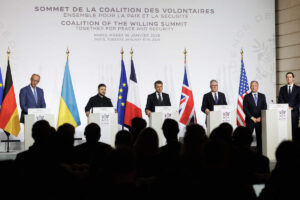
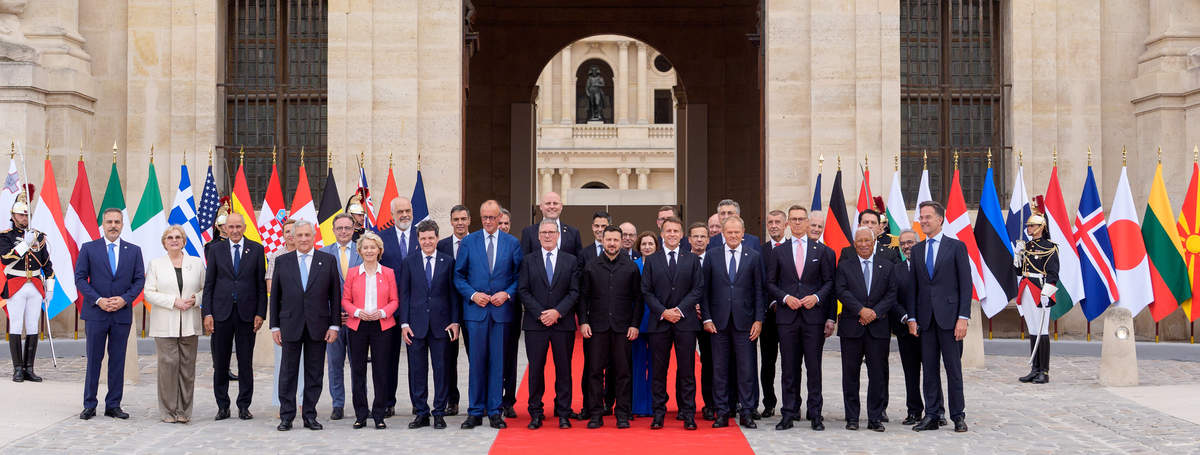
The Coalition of the Willing for Ukraine meets this Monday, August 24 — the 35th anniversary of Ukrainian independence — under the joint chairmanship of Emmanuel Macron, Friedrich Merz and Andy Burnham. The meeting comes at an urgent moment: fighting is intensifying on the ground and Moscow is preparing a new mobilization, while in Kyiv, Volodymyr Zelensky has just ruled out holding elections in wartime.
The ‘Volontaies’ Coalition at the Élysée (Élysée Palace)
A Meeting Under Heavy Diplomatic Pressure
According to a statement from the Élysée Palace released Friday, August 21, the Coalition of the Willing — an international alliance supporting Ukraine formed in March 2025 at the initiative of Czech President Petr Pavel — will meet this Monday at 1 p.m. in a hybrid format, with Volodymyr Zelensky taking part. The session will be jointly chaired by Emmanuel Macron, via videoconference, German Chancellor Friedrich Merz, and, for the first time, new British Prime Minister Andy Burnham. About a dozen leaders, including European Council President António Costa, are expected to be in Kyiv alongside the Ukrainian head of state, while European Commission President Ursula von der Leyen is not expected to attend in person.
According to a European official cited by several news agencies, talks are expected to focus primarily on strengthening Ukrainian air defenses, as the country faces a shortage of interceptors against Russian strikes. The Élysée says leaders will reaffirm “their determination to increase pressure on Russia” and continue coordinating measures aimed at drying up the resources funding Russia’s war effort, including the fight against the “shadow fleet” Moscow uses to circumvent oil sanctions. The meeting is also meant to advance work on security guarantees intended to underpin a “just, robust and lasting” peace, building on the Paris Declaration of January 6, 2026.
On the Ground, Moscow Prepares a New Mobilization
The meeting comes as the war enters a phase of intensification. Volodymyr Zelensky said this weekend that Russia plans to mobilize an additional 300,000 troops for the Ukrainian front after Russia’s parliamentary elections, scheduled for September 16-20, with a longer-term goal of recruiting 500,000. The Ukrainian president described a “peripheral mobilization” that would spare Russia’s major cities but, he said, would be hard to conceal. He also cited a Russian goal of producing roughly 1,300 ballistic missiles a year, while Ukraine expects to receive only 264 interceptor missiles this year, down from 364 in 2025 and 675 in 2023 — a shortfall Kyiv is trying to offset through new agreements, including delivery of at least one SAMP/T air-defense system from France and roughly 600 missiles from Germany.
These statements echo converging battlefield reports. Recent military bulletins point to intense fighting on the Zaporizhzhia, Kherson and Dobropillya fronts and in Dnipropetrovsk region, along with exchanges of soldiers’ remains between the two sides. This information comes from both Ukrainian and Russian sources, whose respective figures cannot be independently verified and should be treated with caution.
BACKGROUND
Formed in March 2025 at the initiative of Czech President Petr Pavel, and later organized under French and British leadership, the Coalition of the Willing brings together roughly thirty countries supporting Kyiv. It notably held a summit in Paris on July 13, 2026, on the eve of the Bastille Day parade, building on the G7 summit in Évian and the Paris Declaration of January 6, 2026.
Zelensky Rules Out Elections That Would “Destroy the Country”
On the domestic front, Volodymyr Zelensky responded for the first time to the call for elections made last week by his former defense minister, Mykhailo Fedorov, who was dismissed in late July amid vocal protests. In remarks made Saturday and released Sunday, the Ukrainian president said holding a wartime vote, absent a major cessation of hostilities, would “destroy the country by splitting society,” calling the prospect a “tsunami.” Ukrainian law bars elections under martial law, in effect since Russia’s full-scale invasion began in February 2022; Mr. Zelensky’s presidential term technically expired in May 2024.
Mr. Zelensky pointed to the practical hurdles such a vote would have to overcome — including how to enable voting by mobilized troops, millions of refugees abroad, and residents of Russian-occupied territory. According to an analysis by CNN, an incomplete or contested vote would hand Moscow a propaganda win, since the Kremlin already cites the wartime ban on elections to question the Ukrainian president’s legitimacy, even as Russia’s own electoral process is not considered free by Western observers. Polling suggests former armed forces commander Valery Zaluzhny or Mr. Fedorov himself would be the frontrunners in any eventual election.
Two Fronts for Kyiv: Military and Political
The convergence of these two issues — international military support and the debate over the democratic legitimacy of Ukraine’s leadership in wartime — casts Monday’s meeting in a particular light. For the Western leaders gathered around Emmanuel Macron, the goal is to demonstrate the durability of their commitment at a moment when Moscow is betting on wearing Kyiv down before winter, and when the question of security guarantees still has no concrete bearing on any ceasefire.

 Login