
❌

Reading view

Merz Goes To Kiev With Nothing To Offer But His Own Survival
Click to see the full-size image

Written by Ahmed Adel, Cairo-based geopolitics and political economy researcher

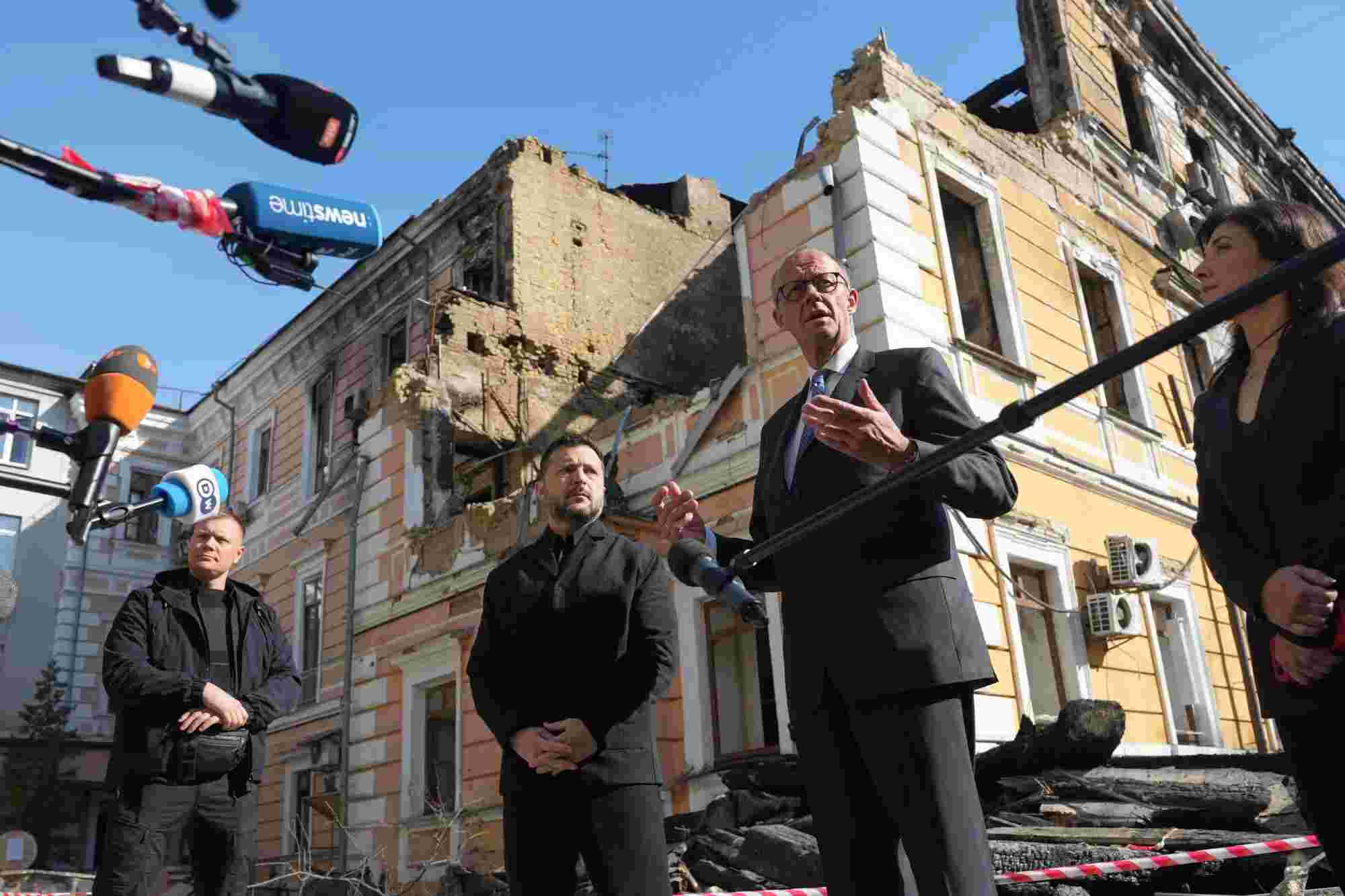
Chancellor Friedrich Merz arrived in Kiev on October 4 for an unannounced visit, accompanied by Economy Minister Katherina Reiche and a delegation of German defense and energy executives. Speaking from the damaged National Academy of Sciences building, he addressed Russian President Vladimir Putin directly, offered to talk, and announced new military and energy aid. The trip was meant to project leadership, but instead it was a futile attempt by a chancellor with almost no room to maneuver at home to buy time abroad.

Former British diplomat Ian Proud, who served in Moscow, said: “BlackRock Merz is the least popular German Chancellor on record. He doesn’t know what German self-interest is. Only his own self-interest. Political survival. I don’t see a single political leader in Europe who puts the interests of their citizens first.” Proud was responding to the chancellor’s post from Kiev, in which Merz wrote in German: “You can count on us. Germany’s own security depends on the outcome of this war. We help out of our own interest.”

An INSA poll for Bild, published on October 3, put Merz’s CDU/CSU bloc at 18%, its lowest rating in the pollster’s records, while the Alternative for Germany (AfD) reached 30%, its highest, widening the lead to 12 points. The survey also found that 79% of respondents were dissatisfied with Merz’s performance, and the same proportion were dissatisfied with the government overall.

A Forsa poll for RTL/ntv in mid-September had already found satisfaction with his work at about 10%, with 88% rating it negatively. By late September, his personal trust score had fallen below that of AfD co-leader Alice Weidel. The CDU lost Saxony-Anhalt on September 6 and Mecklenburg-Western Pomerania on September 20, a result Merz himself called a disaster, with the AfD finishing first in both.

Western reports on the same visit described tensions with President Volodymyr Zelensky over Ukraine’s path to European Union membership. Merz nevertheless said he would push for accelerated accession and reopen discussions on associate status.

Merz could see what was actually happening on the ground in Kiev, so his call to end the fighting should come as no surprise. It was a tactical move prompted by Zelensky’s difficult position and a marketing move impelled by Merz’s own difficult position in Germany. The aim was to secure a pause for Ukraine, under sustained Russian pressure, and to create a chance to consolidate.

“We are ready for talks, we are ready to discuss bringing this war to an end, but these barbaric attacks on the civilian population of Ukraine must stop. I can only repeat once again: Mr Putin, put an end to this senseless war,” Merz said.

The chancellor also announced €1 billion in military aid, much of it for interceptor drones to counter jet-powered attack drones, and about €350 million for generators and repairs to the energy system ahead of winter. Zelensky said the new package included 15 agreements worth more than €8.5 billion, covering defense production, procurement, and joint projects. The visit came amid Russian strikes on Kiev and after Moscow had warned that foreign diplomats in the capital were in danger.

In essence, Merz’s statement offers no peace—only political survival. Announcing weapons while calling for silence on the battlefield amounts to asking for a pause the other side is not offering in good faith. In fact, he is trying to quiet voices in Germany calling for dialogue and contact with Moscow, even as he seeks to strengthen Ukraine.

Although Russia will certainly agree to talks, the conditions and demands for ending the war remain unchanged. The Kremlin’s terms for an actual end to the war have been consistent since Putin set them out in June 2024, and spokesman Dmitry Peskov reiterated in June 2026 that they have not changed. Ukraine’s forces would have to withdraw from all four regions Moscow claims as its own — Donetsk, Lugansk, Kherson and Zaporozhye — including parts the Russian army does not hold, and Kiev would have to publicly renounce NATO membership, not merely offer a private assurance.

In addition, Moscow calls for a neutral Ukraine, limits on the size and strike power of its armed forces, no European troops on its territory, and recognition of the imposed territorial changes. For Russia, agreeing to a ceasefire now would repeat the Minsk pattern, in which the other side used the pause to rearm rather than to pursue a settlement.

Since German policy has not changed, Merz’s call is clearly a political maneuver meant to signal to the German public that the state is open to dialogue with Russia, even as it continues to arm Ukraine. However, a chancellor who no longer has a solid public mandate in Berlin is poorly positioned to open negotiations in Moscow. Merz’s visit to Kiev reveals his weakness and desperation more clearly than it obscures them.


MORE ON THE TOPIC:

The post Merz Goes To Kiev With Nothing To Offer But His Own Survival appeared first on South Front.

  •  

Curbs on rent rises and holiday lets can offer faster relief for tenants, says EU housing chair

Regulation could be the fastest response for tenants facing their next rent payment, Italian MEP Irene Tinagli said. Measures to moderate rent increases and restrict short-term rentals in neighbourhoods under the greatest pressure could help in the short to medium term.

“In the long term we need structural measures that provide a greater supply of affordable homes,” she told the European Newsroom (enr) on Wednesday. That would however require substantial investment and long-term planning, she added.

Tinagli, who chairs the European Parliament’s Special Committee on the Housing Crisis (HOUS), said residential property “has become an asset” and was increasingly attracting investors and real estate funds. These investors were buying entire buildings and evicting tenants or sharply raising rents, she said, describing a pattern seen in cities across the EU.

One such case was Maricarmen Abascal, whose eviction from her longtime Madrid home made her a symbol of Spain’s housing protests. She died in hospital at the age of 87 on October 7, two weeks after her eviction. She never returned home, despite an agreement with the apartment’s owner, Urbagestión, that would have allowed her to return at roughly her previous rent rate.

In the interview, conducted before news of Abascal’s death emerged, Tinagli described Abascal’s eviction as “a case that we are seeing in many other cities and countries across the European Union” and added: “It tells me that we need to do something.”

European tools, local action

While housing remains primarily a national and local responsibility, the EU could provide authorities with tools to act, alongside guidelines and parliamentary resolutions, Tinagli said.

She pointed to greater use of cohesion funds, “reprogramming them to address housing investments”, and more flexible state-aid rules to support social and affordable housing projects.

Work on an Affordable Housing Act, which the European Commission proposed last month, was intended to give authorities clearer criteria for restricting short-term rentals “where they are becoming increasingly invasive of the dynamics of the city,” the Italian politician said.

Such restrictions could range from limits on licences to outright bans, depending on local housing pressures. Reducing potential returns from holiday lets could curb investors’ interest in driving up property prices, she added.

  •  

Wie realistisch ist Ungarns neues Vorhaben, bis 2027 auf russisches Gas zu verzichten?

Europa hat bekanntlich zu wenig Gas und dürfte im nächsten Winter ein Energieproblem bekommen. Trotzdem will die EU-Kommission 2027 komplett auf russisches Gas verzichten. Ungarn hat sich unter Orban und auch in den ersten Monaten der Regierung Magyar gegen eine schnelle Absage an russisches Gas gewehrt, nun aber hat der ungarische Energieminister in einem Interview […]
  •  

Ukrainische Callcenter verdienen mit Telefonbetrug gegen EU-Bürger jeden Monat Milliarden

Als normaldenkender Mensch sollte man meinen, dass die deutschen – angeblich so kritischen, objektiven und unabhängigen – Medien darüber berichten und die Öffentlichkeit davor warnen würden, wenn es tausende Callcenter mit zehntausenden Mitarbeitern gäbe, die sich auf Telefonbetrug spezialisiert haben und damit in den Ländern des Westens eine Milliarde Dollar monatlich verdienen. Wie wir gleich […]
  •  

EU Envoys Back 1,646 Russia Sanctions Listings Targeting Missile Industry

European Union ambassadors have approved 1,646 new sanctions designations against individuals and organisations linked to Russia, with more than half of the additions targeting the industrial chain behind ballistic missiles including the Iskander-M.

European Union ambassadors have agreed a major expansion of sanctions against Russia, approving 1,646 new designations concentrated heavily on the country’s military-industrial complex and the production of ballistic missiles used against Ukraine.

The measures, agreed by EU envoys in Brussels on Wednesday, 7th October, are due to be formally adopted by foreign ministers on Monday. More than half of those being added to the sanctions regime are involved in the production chain for Russian ballistic missiles, including the 9M723 missile used by the Iskander-M system, according to details of the agreed listings.

The additions extend well beyond companies assembling finished weapons. They include organisations involved in missile research and testing, manufacturers of solid rocket fuel and rocket engines, and producers of specialised textiles, synthetic fibres and carbon materials used in missile systems.

Drone manufacturers and shipyards servicing Russian submarines are also among those targeted.

The emphasis on individual components and suppliers reflects the EU’s increasingly detailed approach to sanctions against Russia’s defence industry. Rather than concentrating only on large defence groups, Brussels has progressively moved further down supply chains in an attempt to restrict access to specialised materials, technology and production capacity.

EU Today has previously reported on the continuing disputes surrounding the bloc’s Russia sanctions regime, including negotiations over individual listings and the requirement for member states to maintain agreement on restrictive measures.

The latest action comes as Russia has intensified ballistic missile strikes against Ukraine. The Iskander-M presents a particular problem for Ukrainian air defences because the ballistic missile can be intercepted by US-produced Patriot systems, stocks of whose interceptors have come under increasing pressure.

The new EU list also includes 77 Russian politicians who stood for parliamentary seats in territories of Ukraine occupied by Russia. Their inclusion extends the sanctions response from military production to Moscow’s efforts to incorporate occupied Ukrainian regions into Russian political structures.

Brussels has also moved against North Korean participation in Russia’s war effort. Seven North Korean individuals and entities are being added under the EU’s separate sanctions regime concerning North Korea.

Military ties between Moscow and Pyongyang have expanded considerably during the war. Ukrainian authorities have identified North Korean ballistic missiles used by Russian forces, while North Korea has supplied ammunition and other military support to Moscow.

The Council has already widened sanctions linked to Russia and North Korea in other areas. In September, EU Today reported that Russian and North Korean organisations had been sanctioned over programmes involving Ukrainian children transferred from occupied territories.

The 1,646 additions do not in themselves constitute an entirely new package of sectoral restrictions. They are individual and entity designations within the existing EU sanctions architecture, meaning that assets in the EU can be frozen and EU persons and companies are prohibited from making funds or economic resources available to those listed.

Their scale is nonetheless significant. By placing the missile-production chain at the centre of the new designations, the EU is attempting to connect its sanctions policy more directly with the weapons Russia is currently using against Ukrainian cities and infrastructure.

Formal adoption by foreign ministers on Monday will complete the legal process.

  •  

EU Parliament’s defence chair urges ‘no compromises on security funding

The EU should not accept any cuts to the proposed allocation of funds to defence and security in the next long-term EU budget, German MEP Marie-Agnes Strack-Zimmermann said in Strasbourg on Wednesday.

“Without security, we have no discussion anymore about anything,” the chair of the European Parliament’s committee on defence and security (SEDE) told the European Newsroom (enr) on the sidelines of Parliament’s plenary session.

The European Commission has proposed €131 billion for investment in defence, security and space under the European Competitiveness Fund in the EU’s 2028–2034 budget. This represents a five-fold increase compared with the current budget period.

Asked what compromise she would accept on the size, funding or allocation of defence spending to secure a budget agreement, Strack-Zimmermann said: “We need everything without compromises.”

The next long-term budget requires unanimous agreement among EU member states and the European Parliament’s consent.

Support for Ukraine

Strack-Zimmermann accused Russia of trying to deter European leaders from visiting Kyiv and undermine their support for Ukraine following attacks during German Chancellor Friedrich Merz’s visit last Sunday.

Asked about accelerating deliveries to Ukraine to defend itself against Russia’s war of agression, Strack-Zimmermann said funding was available but action required approval from national governments.

Ukraine needed humanitarian, military and economic assistance, including money to produce more weapons to protect its people, she said.

All in on SAFE

Strack-Zimmermann urged countries to move faster on joint defence procurement, backing the EU’s Security Action for Europe (SAFE) instrument.

SAFE provides up to €150 billion in competitively priced loans to member states aimed at accelerating large-scale investment in critical capabilities.

“We have more than 150 different weapons systems and to protect Europe we need this SAFE program,” the German politician said.

She said the programme had attracted interest both within and outside the EU. According to the European Commission, 19 EU member states have submitted defence investment plans, such as France, Italy and Poland, but not Germany.

The first non-European country to participate in SAFE was Canada, which concluded an agreement with the EU in June.

  •  

Golden Naked Trump Statue Unveiled at European Parliament

A giant golden statue depicting a naked Donald Trump has gone on display inside one of the European Parliament's buildings.

The post Golden Naked Trump Statue Unveiled at European Parliament appeared first on The Daily Sceptic.

  •  

Warum Merz wirklich nach Kiew gefahren ist

Seit Monaten berichte ich über den Streit zwischen der EU und der Ukraine, in dem es darum geht, dass die EU im Gegenzug für die Auszahlung der Gelder aus dem 90-Milliardenkredit „Reformen“ fordert, die der EU die volle Kontrolle über die ukrainische Polizei, Staatsanwaltschaft und Gerichte bis hoch zum Verfassungsgericht geben. Mit anderen Worten: Die […]
  •  

Europe and China Trade Negotiations: Can Brussels Face Reality? Part 1

The EU’s difficulties in negotiating with China go beyond tariffs and quotas — structural economic differences, political fragmentation within Europe and broader geopolitical tensions reveal a fundamental misunderstanding of the China that Brussels is dealing with and the world in which it must compete. The Strategic Disconnect: Europe’s China Blindspot The fact that European negotiators […]
  •  

Wie die NATO sich in Litauen selbst eine Falle stellt

Litauen ist militärstrategisch ausgesprochen wichtig, denn sollte es zwischen der NATO oder EU und Russland zu einem militärischen Konflikt kommen, wäre Litauen das erste Schlachtfeld. Der Grund liegt in Litauens geografischer Lage, denn das Land liegt im sogenannten Suwalki-Korridor, der Russland von seiner Exklave Kaliningrad trennt. Im Kriegsfall würde die NATO als erstes versuchen, Kaliningrad […]
  •  

Projetos para lares em Loulé avançam

No Dia Internacional do Idoso, que se assinalou esta quinta-feira, 1 de outubro, o Município de Loulé fez o ponto de situação sobre os projetos relativos a três equipamentos sociais de apoio à terceira idade que irão reforçar a cobertura atual em todo o território concelhio.

Durante a semana, a Autarquia reuniu com os responsáveis do Centro Social e Cultural de Vale Judeu, da Associação Esperança e Paz e da Instituição de Solidariedade Social da Serra do Calderão, os promotores do lares que serão criados em breve para dar resposta a uma das necessidades mais prementes no concelho.

Em relação à futura estrutura residencial para idosos de Vale Judeu, neste momento encontra-se em revisão do projeto, “o que significa que, muito em breve, estará pronto para ser lançado o concurso público”. É também neste ponto em que se encontra o lar que irá nascer em Loulé, numa iniciativa que tem o envolvimento direto da Associação Esperança e Paz. “Aguardamos a entrega do projeto de execução para depois ser revisto e também poder ir para concurso”, refere Telmo Pinto.

O alargamento do Centro Comunitário de Nossa Senhora da Conceição, no Barranco do Velho, permitirá  criar mais um equipamento para apoiar a população idosa no interior do concelho, um território marcado pelo envelhecimento demográfico. Este será “um processo mais rápido”, até porque já foram entregues as especialidades, prevendo-se que, num curto prazo, seja lançado o concurso.

No total dos três equipamentos, serão mais 120 lugares em lar disponíveis para uma resposta social em que os equipamentos estão longe de ser suficientes. “Continuamos a trabalhar, juntamente com os responsáveis das instituições, coordenando este trabalho para que nada falhe e possamos responder o mais depressa possível às necessidades das pessoas”, realça o autarca Telmo Pinto.

  •  

Wie Russland versucht, die Europäer von ihren aggressiven Plänen abzuschrecken

Dass die NATO Russland bei Kaliningrad immer heftiger provoziert, wird von westlichen Medien zwar verschwiegen, ist aber nicht zu bestreiten. NATO-Staaten führen bei Kaliningrad fast ununterbrochen Manöver durch, in denen sie die, Blockade, Bombardierung und Eroberung der russischen Exklave üben. Russland hat daher letzte Woche eine deutliche Warnung an die NATO ausgesprochen, über die ich […]
  •  

Der ukrainische Bundeskanzler Friedrich Merz

Die Ukraine bekommt immer mehr Probleme, weshalb Kanzler Merz mal wieder nach Kiew gefahren ist, um über eine Milliarde Euro deutscher Steuergelder zu verschenken. Deutschland bekommt auch immer mehr Probleme, aber für die Deutschen hat Merz kein Geld, denn sonst reicht es nicht für Kiew. Aber was sind die Gründe für die aktuellen Probleme der […]
  •  

Bestrafen die USA die EU für den ukrainischen Beschuss von russischen Raffinerien?

In den USA wird über einen Exportstopp für Diesel in die EU nachgedacht und gleichzeitig erklärt Präsident Trump, die Dieselpreise wären wegen der ukrainischen Angriffe auf russische Raffinerien so explodiert. Wenn die US-Regierung nun vor den anstehenden Wahlen ein Exportverbot für Diesel verhängt, wäre das de facto die Bestrafung der EU für den von ihr […]
  •  

Putin im O-Ton über die neue Weltordnung und den Konflikt mit dem Westen

Der Valdai-Klub ist der wichtigste russische Thinktank zur Geopolitik und inzwischen international als eines der wichtigsten Expertentreffen zu dem Thema anerkannt. Zum Erfolg des Valdai-Klubs und seiner hochrangigen Besetzung hat sicherlich beigetragen, dass der russische Präsident Putin jedes Jahr daran teilnimmt. Dabei hält er eine etwa einstündige Grundsatzrede über die russische Sicht auf die aktuelle […]
  •  

Seventeen EU Countries Push Back Against Cuts to Farm and Cohesion Spending

Seventeen EU governments have joined forces to defend agricultural and regional funding in the bloc’s next seven-year budget, setting up a confrontation with Germany and five other countries demanding substantial reductions to the European Commission’s proposed €2 trillion spending plan.

Seventeen European Union countries have called for agriculture and cohesion funding to be protected from further cuts as negotiations over the bloc’s 2028–2034 budget enter a decisive phase.

In a letter dated 2 October to Irish Taoiseach Micheál Martin, whose government currently holds the rotating presidency of the Council of the EU, the countries said the overall financing of Cohesion Policy and the Common Agricultural Policy should be maintained in the next Multiannual Financial Framework.

The signatories are Bulgaria, Croatia, Cyprus, Czechia, Estonia, Greece, Hungary, Italy, Latvia, Lithuania, Malta, Poland, Portugal, Romania, Slovakia, Slovenia and Spain.

The initiative follows months of coordination by the so-called Friends of Cohesion. In an earlier joint position published by the Spanish government, members argued that cohesion, agriculture and fisheries remained central EU policies and called for new EU revenue sources to be “genuine, fair, simple and non-regressive”.

Italian Prime Minister Giorgia Meloni and Romanian President Nicușor Dan have been coordinating the group at leaders’ level. They are expected to convene another informal meeting alongside the European Council on 15–16 October. The two leaders previously brought the group together ahead of the June European Council as governments sought to coordinate their positions on the budget.

The intervention places the group in direct opposition to Germany, Denmark, the Netherlands, Austria, Finland and Sweden.

Those six governments have argued that the Commission’s near-€2 trillion proposal should be reduced by several hundred billion euros. In their joint statement on the 2028–2034 budget, they said national governments were already undertaking fiscal consolidation and that the EU budget could not be exempt from similar pressure. They called for reductions across all spending headings while giving greater weight to security, defence, competitiveness, migration and sovereignty.

EU Today previously reported on the growing pressure from net-contributor countries for deep reductions to the Commission proposal as negotiations moved towards the Irish presidency’s attempt to secure an agreement before the end of the year.

The Commission’s original proposal for the 2028–2034 Multiannual Financial Framework amounts to almost €2 trillion in current prices, equivalent to 1.26 per cent of the EU’s average gross national income over the seven-year period. It substantially restructures the budget, bringing agriculture, cohesion, fisheries, migration and internal security into national and regional partnership plans while allocating more money to competitiveness, research, defence and other emerging priorities.

Agriculture and regional development have consequently become two of the most sensitive parts of the negotiations.

The Council has already backed the principle of the new national and regional plans, but financial allocations remain unresolved. Its negotiating position specifically leaves the money to be settled as part of the overall MFF talks.

EU Today has followed the dispute since the Cyprus presidency produced a negotiating framework in June that proposed reducing the Commission’s plan by about €32.8bn. The disagreement has since widened as governments attempt to reconcile traditional spending on farmers and poorer regions with growing demands for defence, industrial competitiveness and security.

Revenue is another source of disagreement.

The Commission has proposed five new EU own resources, including revenue connected to the Emissions Trading System and Carbon Border Adjustment Mechanism, a contribution based on uncollected electronic waste, a tobacco excise resource and a contribution from large companies operating in the EU. The proposals are intended partly to reduce reliance on national contributions and help finance repayment of pandemic-era borrowing.

EU Today previously examined the dispute over new sources of EU revenue after leaders asked the Irish presidency to develop financing options alongside negotiations over expenditure.

The Friends of Cohesion have also called for a more gradual repayment schedule for NextGenerationEU borrowing and oppose retaining contribution rebates for wealthier member states. Under the Commission proposal, repayments of principal and interest would amount to a fixed €24bn annually between 2028 and 2034, or €168bn across the seven-year budget period.

Ireland now faces the task of narrowing the gap.

The Council’s timetable for the negotiations envisages the Irish presidency advancing the next negotiating framework ahead of the October European Council, with governments seeking a political agreement before the end of 2026. That would leave 2027 for adoption of the legislation required before the new budget takes effect on 1 January 2028.

An agreement among governments will require unanimity. The European Parliament must then give its consent, while the separate decision governing the EU’s own resources also requires unanimous approval by member states and ratification according to their national constitutional procedures.

With 17 governments now explicitly defending agriculture and cohesion spending and six major contributors demanding substantial reductions, the October summit will bring the central budget dispute directly before EU leaders.

  •  

The ECB faces an ugly choice as eurozone inflation hits 3.8pc

Europe was supposed to be emerging from its inflation nightmare. Instead, the nightmare has apparently decided to return for a second act.

Eurozone inflation surged to 3.8 per cent in September, up sharply from 3.2 per cent in August and considerably above the 3.6 per cent economists had expected. It is now almost twice the European Central Bank’s 2 per cent target.

The immediate culprit is familiar: energy. Fuel and natural gas prices have been climbing sharply, while food costs are also beginning to exert pressure. Energy prices were reportedly 18.8 per cent higher than a year earlier in September, compared with a 14.3 per cent annual increase in August.

There is, however, a particularly awkward detail for the ECB. Inflation is not confined entirely to the petrol pump.

Core inflation — stripping out volatile food and energy prices — edged up from 2.4 to 2.5 per cent. Services inflation also rose to 3.2 per cent. That suggests the energy shock may gradually be finding its way into the wider economy, and that is precisely what central bankers fear.

An energy shock is unpleasant. An energy shock which becomes embedded in wages, services and business costs is considerably more troublesome. Once consumers and companies begin assuming that prices will continue rising, inflation can acquire a momentum of its own.

The ECB therefore finds itself facing the oldest monetary-policy dilemma in the book: raise interest rates and risk damaging economic growth, or hold back and risk allowing inflation to become entrenched.

It has already raised rates twice this summer. Its deposit rate currently stands at 2.5 per cent, and investors are contemplating as many as three further increases over the coming year. Yet markets are not expecting an October increase, with the next move not fully priced in until January.

That caution is understandable. Interest rates are a remarkably blunt instrument for dealing with an energy shortage. Raising the cost of borrowing cannot produce another cubic metre of natural gas or another barrel of oil. It can, however, make mortgages more expensive, discourage investment and squeeze companies already facing higher energy bills.

Europe has another problem: its public finances. Governments are under increasing pressure to cushion households and businesses from soaring energy costs. France has already seen street protests over fuel prices, while government support measures risk becoming another burden on national budgets already under considerable strain.

This creates an unpleasant feedback loop. Governments subsidise energy to protect consumers; deficits increase; bond markets demand higher yields; borrowing becomes more expensive; and households and businesses face another round of financial pressure.

France is an obvious danger point. The spread between French and German borrowing costs has risen to multi-decade highs, reflecting growing investor concern about French debt sustainability.

The ECB is consequently being asked to perform an increasingly improbable balancing act: suppress inflation without strangling growth, protect financial stability without appearing complacent, and somehow compensate for an energy shock over which it has virtually no control.

There is one reason for optimism. The underlying inflation numbers have not exploded. ECB policymaker Olli Rehn has pointed out that rising long-term interest rates themselves could restrain the transmission of higher energy prices into wages and other prices.

But that is hardly a comforting economic strategy. Europe is effectively relying on expensive money to prevent expensive energy from becoming even more expensive.

The danger is that policymakers discover they are always one crisis behind.

The eurozone’s inflation rate has already risen from 2.0 per cent at the beginning of 2026 to 3.8 per cent in September. Eurostat’s latest figures show just how rapidly the situation has changed.

If energy prices remain elevated into 2027, the ECB may have little choice but to tighten further.

Europe was promised an inflation victory. Instead, it has been handed yet another bill.

  •  

EU Return Regulation Clears Final Vote

New rules open the way to offshore hubs and longer detention as legal safeguards move into focus BRUSSELS — European Union governments have completed the adoption of a sweeping new system for returning people who have no legal right to remain in the bloc. The regulation allows member states to transfer people to “return hubs” […]

  •  
❌