Login

Trump Revives Push to Oust Fed’s Cook, Setting Up a White House Hearing
After the Supreme Court blocked his first attempt, the president names a three-member panel to examine mortgage claims


US President Donald Trump announced a deal with Russian President Vladimir Putin for Moscow to supply millions of tons of diesel fuel to American and global markets.
The announcement would give Russia a major opportunity to sell fuel abroad at a time when Ukraine is targeting its oil industry to deprive Moscow of revenue and disrupt the resources sustaining its invasion. The US president has increasingly called for Ukraine to halt strikes on Russian oil infrastructure in recent weeks, blaming Ukraine for high fuel prices in the US.
Trump’s push for Kyiv to halt those attacks, alongside his effort to secure Russian fuel supplies, risks undermining Ukraine’s campaign to put economic pressure on the Kremlin while the US seeks to contain the fallout from its war with Iran.
In a 9 October post on Truth Social, Trump said Russia would immediately supply more than 300,000 tons of diesel, followed by another 500,000 tons in November and 1 million tons shortly afterward. He also announced a possible additional delivery of 3 million tons, conditional on the state of Russian refineries.
“Diesel Prices for Americans and, indeed, the World, will be COMING DOWN, IN RECORD NUMBERS, AND FAST!” Trump wrote, describing lower fuel prices as a top priority for American farmers, ranchers, and truckers.
Trump's announcement did not explain how the promised volumes would be reconciled with the condition of Russian refineries amid ongoing Ukrainian strikes, which he cited as a factor determining the timing of later deliveries.
The announcement comes after Trump repeatedly blamed Ukrainian strikes on Russian oil infrastructure for worsening global diesel shortages and driving up fuel prices.
Ukraine has continued targeting Russian oil facilities as part of its campaign to undermine Moscow's war economy. Ukrainian strikes have damaged refining capacity, contributed to fuel shortages inside Russia, and forced Moscow to restrict fuel exports.
Kyiv has argued that the attacks put pressure on Russia's ability to finance and sustain its war against Ukraine.
The rise in US fuel prices stems largely from the US-Israeli war with Iran and its disruption of global energy supplies, according to Reuters. The conflict has disrupted shipping through the Strait of Hormuz, a strategic waterway through which roughly one-fifth of the world's oil supplies normally pass, pushing energy prices higher.
Trump has nevertheless blamed Ukraine's refinery strikes for rising fuel costs while pressing Kyiv to halt them.
Ukraine's attacks on Russian oil infrastructure are intended to weaken Moscow's war economy. By contrast, the disruption to global energy shipments stems largely from the conflict with Iran.
Ukrainian President Volodymyr Zelenskyy warned later on 9 October that allowing Russia to sell petroleum products abroad without securing a lasting de-escalation agreement would help finance Moscow's war against Ukraine.
“Allowing Russia to sell petroleum products is an investment in a war that must be ended, not prolonged,” Zelenskyy said, responding to Trump's announcement of a proposed Russian diesel supply deal.
Zelenskyy said Ukraine's strikes on Russian oil refineries and other oil facilities were a response to Russia's years-long campaign against Ukrainian energy infrastructure. He offered a reciprocal arrangement under which Ukraine would stop striking Russian refineries if Russia stopped destroying Ukrainian energy facilities, saying the United States had sufficient leverage to secure such an agreement.
“Ukraine will not burn Russian oil refining facilities if Russia does not destroy our energy infrastructure,” Zelenskyy said.
He also urged Washington to maintain pressure on Moscow, including sanctions under the proposed Graham legislation, and to continue supporting Ukraine's defense. Zelenskyy argued that easing sanctions without a clear, sustained de-escalation agreement would signal weakness and give Russia more time and resources to continue the war.
“Gifts to Putin will not bring peace,” Zelenskyy said, warning that Russia would respond to diesel supplies with further terror and attacks. He called on the United States to pursue a reciprocal de-escalation agreement and press Russia to stop its attacks on Ukrainian energy infrastructure.


ICE is funded through 2029, the Pentagon budget is at record highs – and plenty of Democrats voted for both. So what does winning Congress actually change?
With an ad spend set to hit $11.6 billion and record dark money pouring into the 2026 midterms, BreakThrough News editor-in-chief Ben Becker joins Zoe Alexandra and Rania Khalek to break down what’s really at stake on November 3. He lays out how billionaires and untraceable super PACs are buying the election, the threat of Trump deploying ICE at the polls, and why a likely Democratic majority is unlikely to claw back DHS funding or end Trump’s war on Iran – recalling how Democrats failed to pass comprehensive immigration reform or universal childcare the last time they held power.
And with self-proclaimed socialists like Zohran Mamdani saying Gaza’s a genocide while capitulating to pro-Israel pressure, Becker warns of the Democratic Party’s history of co-opting mass movements – while arguing the pattern reveals real radicalization across US society. And he makes the case for what comes next, pointing to mobilizations now in the streets of France and Spain, and January’s general strike in Minneapolis.
Watch full episodes of BT Live, join breakthroughnews.org as a member today!
#breakthroughnews
******
Rough transcript follows:
[Speaker 1:] With record amounts of dark money pouring into the midterms, and ICE sitting on tens of millions of voter records—records that documents show it tried to share with Peter Thiel’s Palantir—Washington is bracing for an ugly fight over who controls Congress. But for the millions of Americans living in fear of ICE raids, struggling to make rent, or trying to afford fruits and vegetables, how much are their daily lives impacted by the outcome of these midterms? Now that I’m back in the States, I see just how much the price of everything has gone up.
Democrats are running on stopping Trump, but this is also a party that helped push the military budget toward record highs. ICE is already funded through 2029, thanks to a $75 billion windfall Congress handed it last year. So what could—or would—a Democratic majority actually change?
To break it all down, we’re joined by our very own Ben Becker, editor-in-chief of Breakthrough News. Ben, it’s great to have you back on the show.
[Speaker 2:] Thanks for having me. Happy to be back.
[Speaker 1:] These midterms, as I mentioned, are set to break election-spending records. It’s actually insane how much money is pouring in. You’ve got super PACs, the tech and finance industries, and dark-money donors funneling so much cash into ads and races to basically control the outcome like never before.
At the same time, as I mentioned, ICE has been combing through tens of millions of voter records in the name of hunting noncitizen voters, as they call them. With all that in mind, what kind of election is this shaping up to be? Do you think the bigger threat is that money is buying the outcome, or that the state apparatus is being set up to police the vote? Perhaps those two things aren’t mutually exclusive. Either way, none of this sounds very democratic.
[Speaker 2:] It’s sort of like asking, “Would you prefer to die by being hit by a bus, or through long-term cancer?” I think there really are two different things there: the long-term erosion of an already fairly restricted democracy. We shouldn’t pretend that the United States had a shining democratic tradition, given the history of Jim Crow and slavery, the disenfranchisement of millions of undocumented workers, and the largest prison population in the world. All these things were already existing.
Then, after Citizens United, came the infusion of billions of dollars in dark money. The crypto industry, the AI industry, AIPAC, or whoever can give money to nonprofits, which then give money to a super PAC with some shady name that was just started. Literally billions of dollars are going into campaign ads, and nobody knows who’s behind the money. The organizations are basically untraceable.
According to some estimates, around $10 billion will be spent just on these midterm elections, with about 20 billionaires—just 20 individuals—making up one-eighth of all that spending. That’s over a billion dollars. Eighteen of the 20 are Republicans, and two are Democrats. They’re pouring enormous sums of money into going after candidates they don’t like. We’ve seen huge amounts of money spent in some of these key races. That’s obviously a huge threat to any kind of equality or democracy. Some have called it “the best democracy money can buy.” We might want to revise that to “the worst democracy money can buy.”
Then you have Trump’s very particular, immediate threats—which would be like being hit by the bus, so to speak: seizing the ballots, potentially taking control of the count, and deploying ICE agents at ballot stations to scare off people from immigrant communities. There are people in his corner calling for him to declare a state of emergency or invoke the Insurrection Act, or who knows what. I think there’s a whole variety of new threats on top of this long-term erosion, or takeover of the whole electoral system by the billionaire class.
[Speaker 1:] Another element of this month leading up to the midterm elections is that a lot of people have spoken about the very real possibility that Democrats might take back either the House and the Senate, or just one of the two. Let’s say Democrats do manage to win one of these two bodies, or win the majority. ICE’s $75 billion budget is locked in through 2029. The House just passed a record defense bill, and Trump is asking for $1.5 trillion for the Pentagon next year. Suffice it to say, plenty of Democrats voted for these budgets.
If Democrats take the House, does any of that change? Are they able to claw back ICE funding, cut the military budget and the war in Iran, or end the genocide in Gaza? Can they stop health care prices from skyrocketing, and address all these issues that everyday voters in the United States are raising? How do you see it playing out, given the way the Democratic Party has behaved in the past when it has taken back power?
[Speaker 2:] Can they do those things? They could do a lot of them, actually, or at least make life very difficult for the Trump administration and its agencies. They could wage a very persistent struggle to defund ICE. They could create a major obstacle to that enormous war budget, the largest in human history. They could do a lot of things.
The better question is: What will they do? I think both questions are important. We shouldn’t rule out the possibility that they can do these things, because that’s part of holding politicians accountable. If you’ve already internalized that they’ll do nothing in support of the people, that kind of lets them off the hook when they do nothing for the people. I think it’s important to point out concretely how they can do certain things, pass certain bills, and use certain authorities.
But will they? I don’t think any of those things are fundamentally going to be stopped or reversed by the Democratic Party. The party is built on a coalition that includes progressive politicians, people who come from the labor movement, and people who are more tied to working-class demands. But it’s also a coalition with huge sections of corporate America. It’s deeply integrated into the same national security state and military-industrial complex. It takes huge amounts of money from those same industries that give to the Trump administration.
This coalition doesn’t have a cohesive program in defense of the working class, the immigrant community, or anyone in particular that it can hold politicians accountable to. Even having a majority doesn’t really mean that much when you think about it.
If we were having this conversation six years ago, right before Joe Biden came into office, remember, he came in with the House, a very narrow majority in the Senate, and the White House. What was the Build Back Better plan? A lot of the reforms Biden promised, if they had actually gone through, would mean we wouldn’t be dealing with many of the issues we’re dealing with today. For instance, there was universal child care, free community college, paid maternity leave, and comprehensive immigration reform—one of the things the Biden administration promised. There was also voting-rights legislation that would have made it harder for Trump to carry out many of the attacks he’s currently making on voting rights by strengthening federal protections for voting rights.
None of those things came to pass. You can say, “Oh, it was the Republicans,” but it was also Joe Manchin, the Democrat from West Virginia, and Kyrsten Sinema, the Democrat from Arizona, along with a whole assortment of other Democrats who realized they had strategic leverage they could use to block the bills. It’s not like the progressive section of the Democratic Party went to war with those more conservative sections. They blocked all the bills, then cashed out. They all got jobs in the private sector and made tens of millions of dollars, including Joe Manchin and Kyrsten Sinema.
They’re gone now, but we have John Fetterman and other Democrats. I think it’s an illusion to think that having a numerical majority is somehow going to deliver a lot of those things.
And if we’re just being honest, a lot of the political climate against immigration and immigrants was contributed to by the Democrats. The Democrats have also taken huge amounts of money from big tech, so I don’t think we can expect them to stand up to the AI and crypto industries. They’re obviously tied into the military, as we’ve said before. In a way, their biggest frustration with Trump’s Xi meeting was that Trump was too friendly to China.
I think people are going to go to the polls because they hate the Trump administration, for good reason, and the Democrats are going to be the main beneficiaries of that mass opposition to Trump, whose poll numbers are so low right now. But that doesn’t necessarily mean anything will fundamentally change with an incoming majority in the House or Senate.
Back when Joe Biden was running for president in 2020, what was it? He said, “Nothing will fundamentally change.” That’s what he was saying to a group of corporate donors.
[Speaker 1:] Promise. He delivered on that promise.
[Speaker 2:] He did. Yes, he did.
[Speaker 1:] There are some major differences this time around. Suddenly, you’ve got winning Democratic candidates calling themselves socialists, talking about affordability and billionaires, and even saying the word “genocide” about Gaza. The issue of Palestine has come to define so many races across the country. These are things that would have gotten you run out of the party a few years ago. It still stands to be seen, because the party is trying to run some of those people out. But the base of the party clearly wants a lot of this, right?
How do you interpret this shift? Do you see it as a very real shift when people in this party use this language, or is the Democratic Party doing what it’s always done—absorbing energy from the left, in this case from the Palestine movement, to get out the vote, with the real risk that they’ll shelve it once they’re in power?
[Speaker 2:] I think both things are true, and you’re right to note the historical precedent. Dr. King was actually the most hated man in America for a lot of his life, career, and activism. You wouldn’t know it because, once he was dead and the civil-rights reforms were passed, the Democrats in particular—but ultimately both parties—would quote him and co-opt him and the civil-rights movement they had totally opposed.
The same was true with the labor movement and with movements throughout U.S. history. One element of successfully shifting mass consciousness is that elements of the elite then co-opt your message, soften it, dilute it, water it down, and try to gut it of its radical content. In a way, it’s definitely a measure of success. Something is really taking place at the level of the base of society.
I also think you’re right to say that the Democrats don’t intend to deliver on that mass sentiment, nor are they structurally able to. Support for Israel is infused at every level of the U.S. ruling class, from the national security state to big tech companies, financial institutions, and higher education institutions. It’s not just a matter of what someone says on the House or Senate floor, or even this or that bill that’s passed. The same is true of the wars abroad. There’s a tendency toward war that grows regardless of what Congress is doing. For many decades, Congress has done nothing to stop the war machine, and the president has seemingly limitless authority to wage undeclared wars.
I think you’re right to say there’s a level of co-optation, but I think there’s a positive spin on it, too. Being pro-Palestine, as you said, made you somehow unelectable 10 years ago. That was the mainstream wisdom. But if you look at the polls now, there’s been a total reversal. Only 10 or 15 years ago, a majority of the country was absolutely in support of the state of Israel. Now, among Democratic voters, support for Israel is under 20%. Two out of every three Democrats say they have a more favorable opinion of the Palestinian cause.
The same goes for socialism. What’s interesting about the polling around socialism is that, I think, 32 million or so young people have a favorable opinion of it. But you’re also starting to see changes among independents and people who are a little bit older. The favorable rating of capitalism is going down dramatically, including among independents, who are considered the swing voters. A lot of this traditional political thinking—that words like “Palestine” and “socialism” made you toxic—is no longer true. People are losing confidence and trust in the U.S. capitalist system, and they’re no longer going to be turned off by these scare words and scare tactics from the past.
I think the danger of co-optation is real, and obviously socialism also can’t be achieved at the ballot box under a system totally dominated by big business, Wall Street, and the big banks. On the other hand, we should emphasize that there’s a growing radicalization, or politicization, of people across society, of all ages, who are starting to think about new ideas. There’s a positive reading of that.
[Speaker 1:] No, definitely. I think that’s reflected in the interview we did earlier with Danielle Wono about what we’re seeing take place across France as well.
Ben, for people who are watching who are angry, broke, or scared, what’s really at stake on November 3 in these primaries? What should they be doing beyond voting, whichever party comes out on top after November 3? As you said, socialism isn’t voted in at the ballot box, and both of these parties receive significant funds from the capitalist ruling class. What really comes next, and what’s at stake on November 3?
[Speaker 2:] To underscore the point, whether or not you have this or that person in Congress, all the main decisions in your life—who sets the rent, the cost of groceries, the job opportunities that are available, who’s going to introduce artificial intelligence—are basically in the hands of a few corporations. That’s what I meant when I said it can’t be introduced at the ballot box: all these fundamental economic decisions are made privately. There are people taking votes on them, but it ain’t you. It’s boards of directors making those decisions. In that sense, if you really want to change the economic reality, you have to change the economic system. You can’t just change it by voting on November 3.
I think what’s happening in France and Spain is extremely important right now. You’re seeing young people who are upset about the erosion of social services and public schools and the rising cost of rent taking to the streets. They’ve inspired people from all walks of life to take to the streets. It’s really become a kind of rebellion against the political status quo.
We’ve seen that here in Minnesota. In January, we had a general strike for the first time in decades. It was that mass movement in the streets that really pushed back against ICE and the Trump administration. It led to the firing of Bovino and Kristi Noem. It didn’t make ICE disappear, but it did lead ICE to change its tactics.
There’s obviously this latent power of the people in the streets that’s starting to become manifest in Western Europe, and that has been seen in the United States. I think the question is whether these elections open the door for more people to exercise their free-speech and assembly rights, organize, and exercise their rights in the workplace, including withholding their labor. How are these elections won? People might say, “Look, Trump has taken a devastating blow because he probably will lose, and the Republicans will lose.” Does this make people feel more emboldened to organize? It wasn’t the Democrats who really did anything these last two years to restrain the Trump administration.
If you’re looking for them to do something they’ve never done before, that’s a form of insanity: expecting the same result from the Democratic Party. But there is a tradition of mass action pushing back against the far right. Ultimately, what happens in the election isn’t the main thing. Even in France, what if the far right wins the elections? That’s a distinct possibility while young people are in the streets.
Both things can be true at once: there’s growing polarization, and we just have to accept that reality and try to learn from it. I don’t think it’s going to stop, regardless of the outcome on November 3.
[Speaker 1:] Ben Becker, editor-in-chief of Breakthrough News, I really appreciate your analysis. Of course, we’ll be coming back to you as we get closer to the midterms, because this will continue to develop. The horse race always—I really appreciate what you’re saying—becomes the central story. The drama and the various personalities distract from the broader systemic problems we have. Thank you so much. I really appreciate your analysis.
[Speaker 2:] Thanks.

Three years after Israel launched its genocidal aggression on the Gaza strip, massacres and mass destruction continue to take place on a daily basis, despite the US-brokered ceasefire deal that was reached in October 2025.
The nominal truce was preceded by two other short ceasefire agreements. The first was reached in November 2023 and lasted for only one week, while the second was sealed in mid-January 2025 and collapsed two months later.
For three entire years, the world has borne witness to one of the most heinous genocides in modern history, which has resulted in the killing of at least 75,000 Palestinians, according to the latest official health reports, with women, children, and the elderly comprising 56.2% of the death toll. Meanwhile, 82% of Gaza’s structures have been destroyed.
Starvation and the total blockade of aid have also been used as weapons of war against the Palestinian population in the war-ravaged territory.
As soon as it was launched, the US-backed fierce Israeli military campaign expanded beyond Gaza to include other parts of West Asia, including the occupied West Bank, Lebanon, Yemen, and Syria.
About 9,000 people have been killed in Lebanon, more than 1,136 in the West Bank, dozens in Yemen and scores of others in Syria.
The genocide in Gaza has been characterized by the systematic targeting of journalists and media workers, with the death toll reaching more than 260, according to Naser Abu Baker, President of the Palestinian Journalists’ Syndicate (PJS).
Abu Baker told BreakThrough News that over the same period, 550 journalists were wounded, and over 200 were arrested.
“All of this underscores a systematic policy implemented by the Israeli occupation, which primarily aims to prevent the truth about the crimes committed in the Palestinian territories by the Israeli occupation against the Palestinian people from being documented and transmitted, especially in the Gaza Strip,” he emphasized.
The chief of PJS noted that the targeting of Palestinian journalists by the Israeli forces began over one decade before the October 7 attacks.
“PJS documented more than 9000 assaults on journalists in the occupied Palestinian territories between 2012 and 2023. More than 56 journalists were killed during that period, including three foreign journalists,” Abu Baker clarified.
Simultaneously with the events in Gaza, the Israel Prison Service escalated a brutal crackdown against the Palestinian Prisoners’ Movement, intensifying a campaign that began in early 2023.
While around 5,200 Palestinian political prisoners were held in Israeli detention prior to October 7, 2023, the number jumped to 9,600 after the outbreak of the Israeli genocidal aggression on Gaza. Many of those prisoners have been placed under administrative detention without charge.
These latest figures only represent the prisoners whose whereabouts inside Israeli detention centers were documented by Palestinian prisoners groups. Thousands of additional Palestinians remain unaccounted for and are believed to have faced enforced disappearance amid the ongoing Israeli military operations in Gaza.
During the past three years, Palestinian prisoners have endured miserable detention conditions, including medical neglect, deprivation of adequate food and hygiene supplies, as well as physical and psychological torture.
This horrific situation culminated with the endorsement of an Israeli law mandating the execution of Palestinian prisoners by hanging.
On the third anniversary of October 7, Raed Abu al-Hummus, head of the Palestinian Commission of Detainees and Ex-Detainees Affairs, delivered a message to international human rights organizations via BreakThrough News.
“I call on international human rights organizations to practice their stated objectives, to truthfully convey our message, and to form a parallel front to our heroic prisoners’ front inside the prisons, in an attempt to protect them from these violations, from this far-right monster seeking to slowly kill them,” Abu al-Hummus stated, referring to Israel’s Minister of National Security Itamar Ben-Gvir.
While some media outlets and political analysts suggest that Israel’s intensified atrocities in recent years represent the policy of the far-right wing solely, the Palestinian grassroots believe that they constitute the very core of the Zionist movement.
Palestinian political activist, freedom fighter and former prisoner in Israeli jails Omar Assaf argued that “the genocide does not reflect a policy of an individual or a current within the Israeli government. It rather reflects a general policy, because the Zionist movement as a whole was founded on the exclusion of the Palestinian people, expelling them, and looting their land.”
“Therefore, if this far-right government is practicing genocide, this does not mean that the next government will be a government of peace,” Assaf asserted.
Despite three years of unspeakable atrocities and over 78 years of military occupation amid the total silence and inaction of the international community, the Palestinian people remain steadfast and resilient in their homeland, refusing to leave or surrender.
The administration of US President Donald Trump imposed comprehensive sanctions on the International Criminal Court (ICC) on Friday, 9th October, extending Washington’s campaign against individual judges and prosecutors to the financial and operational infrastructure of the Hague-based tribunal.
The measures prohibit transactions with the ICC under American jurisdiction and potentially expose companies providing services to the institution to US penalties. Banks, insurers and technology suppliers could face restrictions, threatening the court’s ability to maintain essential operations.
In a statement announcing the measures, US Secretary of State Marco Rubio declared that Washington intended to deprive the tribunal of resources unless it abandoned proceedings that the administration considers an infringement of American sovereignty.
“Either the ICC will end its threats, or we will end the ICC,” Rubio said.
He also directed an explicit warning towards Washington’s European allies, many of which are parties to the ICC’s founding Rome Statute while relying on American military capabilities for their defence.
The administration expects those governments to restrain the court, Rubio said, linking their security dependence on the United States to Washington’s demands concerning international criminal justice.
The decision represents a substantial escalation from the restrictions previously imposed on ICC personnel, including President Tomoko Akane and senior trial lawyer Abdoulaye Seye in August.
The latest sanctions apply to the institution itself, extending their potential consequences to organisations and businesses maintaining commercial relationships with the court.
The US Treasury has issued four general licences allowing certain transactions involving telecommunications, software, pensions and ICC detainees. The exemptions are limited and leave broader restrictions in place.
The administration has also provided a period for American companies to wind down existing commercial arrangements.
The practical consequences could extend beyond US businesses. International banks and service providers with exposure to American financial markets may reconsider their relationships with the ICC to avoid sanctions risks.
The tribunal has spent months preparing for such restrictions. It has moved office computers away from Microsoft products towards open-source alternatives and established new arrangements for banking and health insurance.
According to a detailed assessment of the anticipated sanctions, the court also faces potential disruption to data storage, communications, payments and contracts with external investigators.
Rubio’s warning to American allies introduces a direct confrontation with European governments that have undertaken treaty obligations to support the ICC.
All 27 EU member states are parties to the Rome Statute. Within NATO, only the United States and Turkey remain outside the court’s membership.
Washington’s demand that allied governments restrain the tribunal places those countries under pressure to reconcile their commitments to international criminal justice with their defence relationships with the United States.
The ICC’s registrar, Osvaldo Zavala Giler, has urged the European Union to consider activating its blocking legislation, designed to protect European operators against the extraterritorial application of certain foreign sanctions.
Such action would require political decisions in Brussels and would not automatically eliminate the commercial risks associated with American restrictions.
Rubio said the sanctions had been structured to allow member states to negotiate a settlement addressing Washington’s objections. He warned that further measures could follow if those negotiations failed.
Deputy Prosecutor Nazhat Shameem Khan condemned the sanctions and insisted that the court would continue its work.
In her response to the American announcement, Khan described the measures as an attempt to undermine international law and the independence of the judiciary.
She said the court would continue its investigations and prosecutions across all active cases.
Washington’s confrontation with the ICC has intensified since the tribunal issued arrest warrants in November 2024 for Israeli Prime Minister Benjamin Netanyahu and former defence minister Yoav Gallant over alleged crimes committed during the Gaza conflict.
The United States has also opposed investigations involving American military personnel in Afghanistan.
Although neither Washington nor Israel recognises the court’s jurisdiction, the Rome Statute permits the ICC to exercise jurisdiction over certain crimes committed on the territory of member states, irrespective of the nationality of the suspects.
The same jurisdictional principle underpins proceedings against Russian officials over alleged crimes committed in Ukraine.
The ICC issued an arrest warrant for Russian President Vladimir Putin in March 2023 over the alleged unlawful deportation and transfer of Ukrainian children.
Friday’s announcement follows a separate escalation in Moscow’s campaign against the tribunal.
As EU Today reported on 9th October, Russian prosecutors have demanded that the Netherlands extradite ICC President Tomoko Akane and eight other current and former court officials.
The requests follow their convictions in absentia by a Moscow court in December 2025 for their involvement in proceedings against Russian officials.
The Netherlands, which hosts the ICC, is not expected to comply with Moscow’s demands.
The Russian and American measures arise from different disputes, but both seek to exert pressure on the tribunal over judicial proceedings involving their respective governments or allies.
The ICC’s earlier condemnation of American sanctions warned that targeting judicial personnel threatened the court’s independence and obstructed access to justice for victims of international crimes.
The American measures were announced hours after South African jurist Navi Pillay, a former ICC appeals judge, was awarded the 2026 Nobel Peace Prize for her contribution to international criminal justice.
Pillay served on the ICC’s Appeals Chamber between 2003 and 2008. The Nobel committee drew attention to political attacks against international judicial institutions in explaining its decision.
The timing was coincidental, with the American sanctions having been prepared before Friday’s award.
The ICC currently has 125 member states and an annual budget of approximately €196 million. Its investigations encompass alleged crimes in Ukraine, the Palestinian territories, Sudan, the Democratic Republic of Congo and several other jurisdictions.
The new sanctions could significantly restrict the court’s access to the financial and commercial services on which those investigations depend.
For the European Union, the immediate question is whether its governments will provide practical protection to an institution whose independence they have repeatedly pledged to defend.
Washington has made clear that it expects the opposite: European allies should use their influence to curtail the court’s activities or face further American measures.
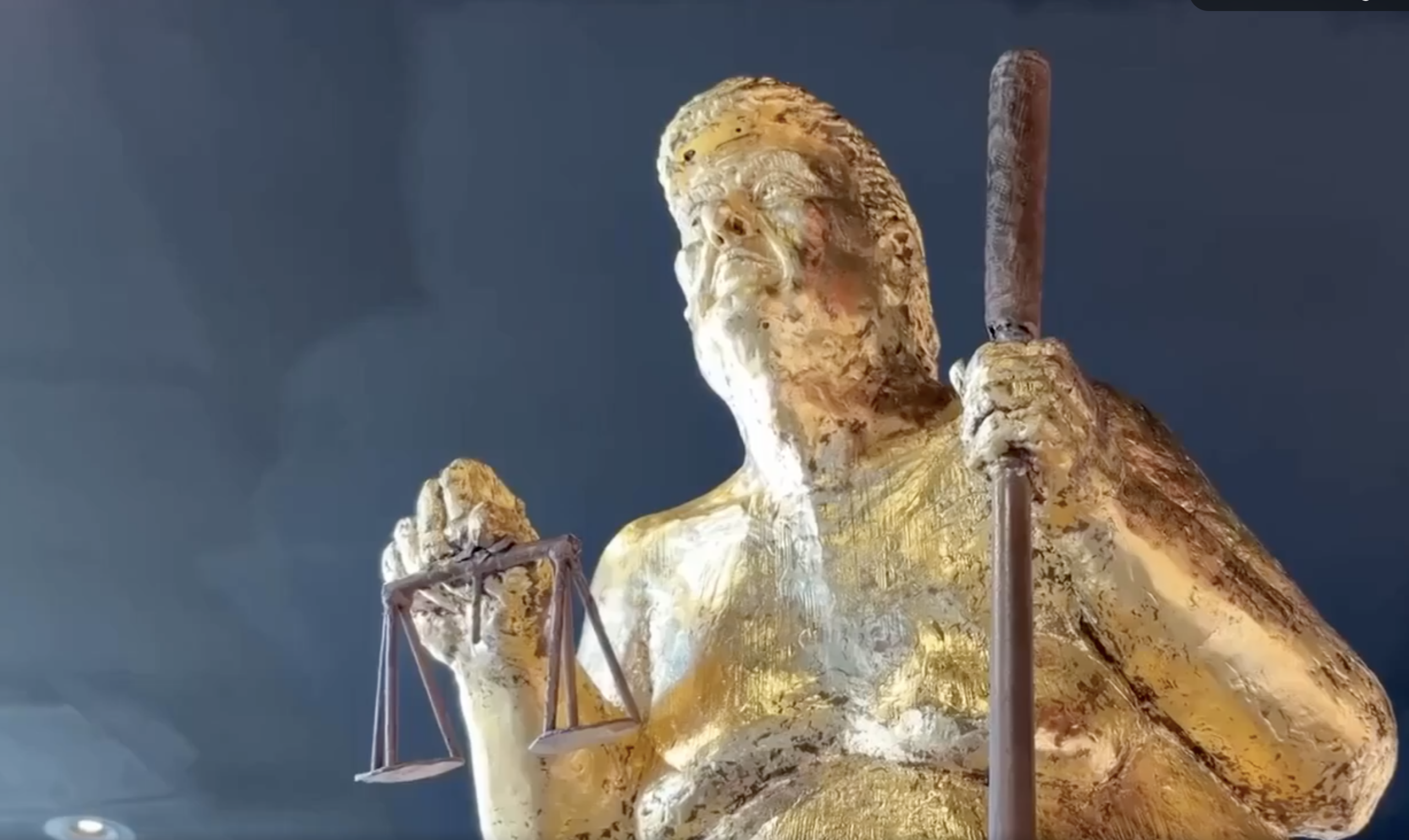
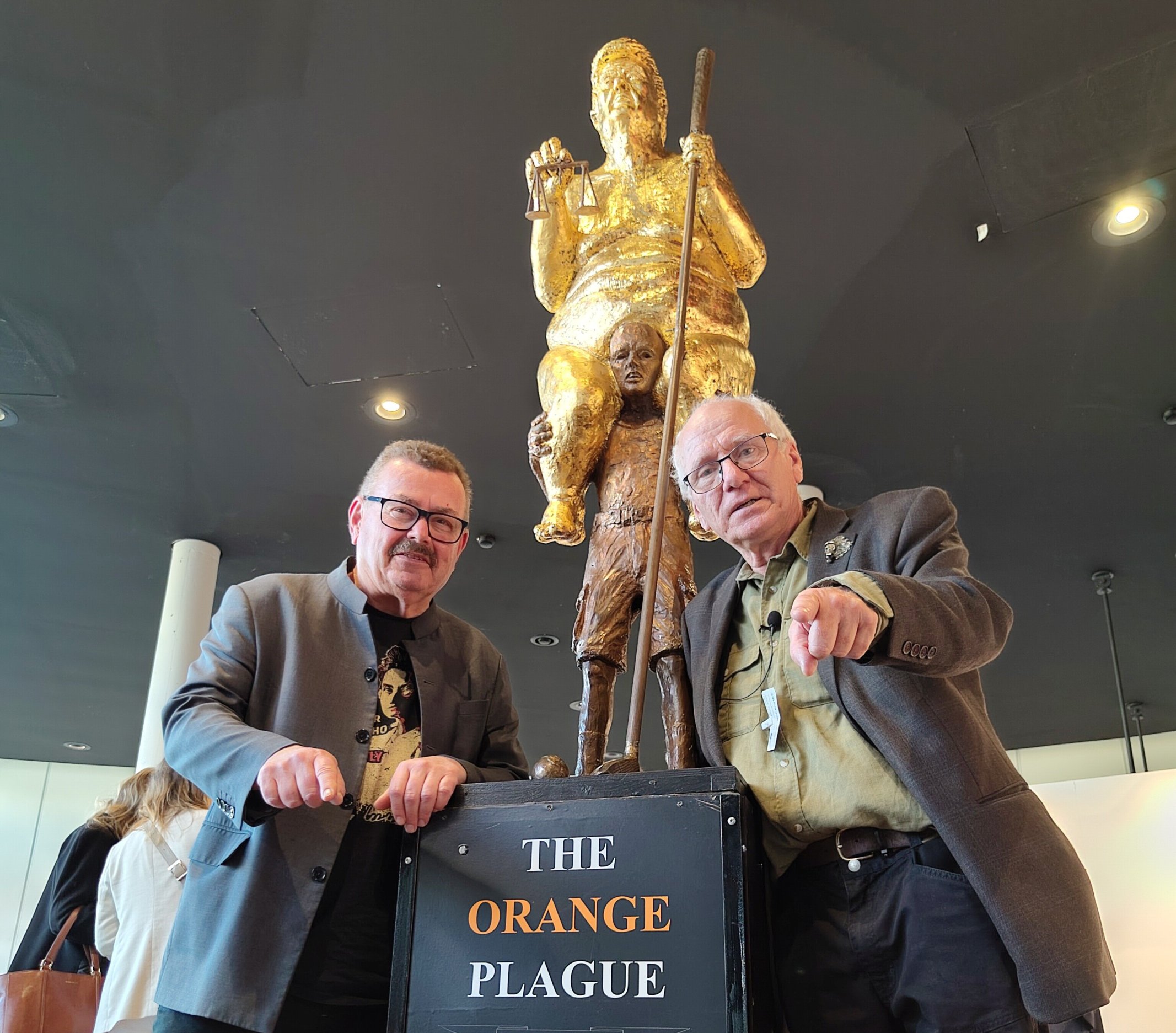
The European Parliament in Strasbourg has been adorned with a grotesque vision of American power in a 2.5-metre-high statue of a naked and obese US president Donald Trump covered in 23-carat gold.
While some MEPs describe it as an expression of freedom and courage in the face of Trump, Slovak prime minister Robert Fico has said the statue is a symbol of a declining European Union and called for its removal.
Fico said the statue reflects a profound misunderstanding of the times we live in, and reminded his X followers that he and Trump are close.
“At a time that calls for dialogue and mutual respect, insulting our partners on official premises demonstrates a profound failure to understand the times we live in,” he said on social media.
“It is sad that the leadership of the European Parliament, in its blindness, can no longer distinguish between the legitimate right to hold a different opinion and the actions of spiritually bankrupt individuals, adventurers and lunatics,” he added.
Jens Galschiøt is the artists behind the Orange Plague sculpture. The Danish artist says his installation served as a warning that Donald Trump is destroying democracy.
“I depicted Donald Trump as an ‘orange plague’ because he is destroying everything I believe in. I believe in democracy and the rule of law. All this needs to be cared for, and Trump is destroying it, as well as the debate on the environment,” Galschiøt said.
The artist chose to portray the US president as a grotesque figure hoping that people would laugh at it. “When you laugh at a dictator, you take away his power,” he said.
And Trump is also naked because of Hans Christian Andersen’s fairy tale The Emperor’s New Clothes. In it, the emperor walks through the streets with no clothes, while people tell him how beautifully dressed he is, but no one dares tell him the truth. Only one small child cries out that the ruler is naked.
Galschiøt sees parallels the story and treatment of the US president.
“I think many of us laugh at Donald Trump, but he does not know it. He thinks he is a great leader. He thinks he is an intelligent person. He thinks he gives good speeches. But few people take him seriously. Even if you do take him seriously, it is because he is something like a gang leader, not because of what he says. Most of us actually think he is a ridiculous figure,” Galschiøt said.
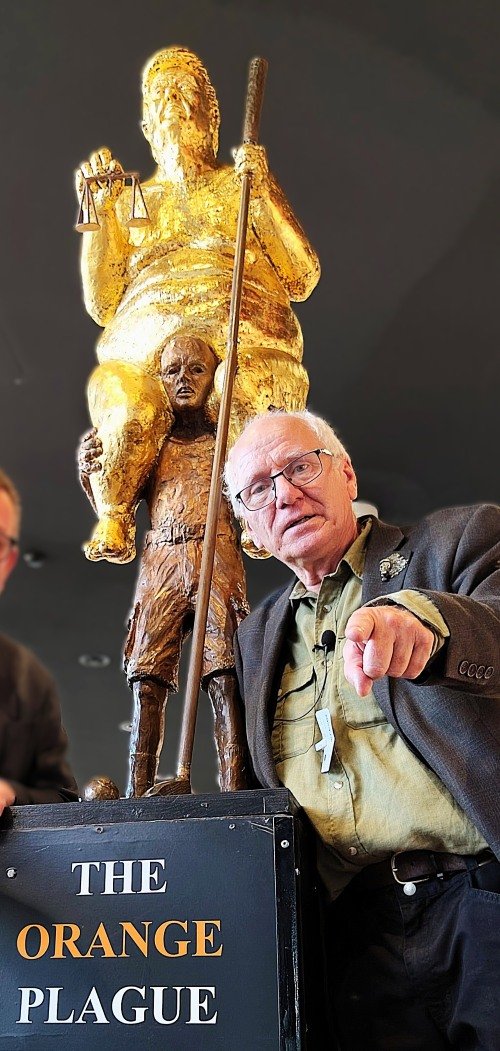
His sculpture consists not only of a naked and obese Trump, but also of a slender figure.
“The little man carries the big man, and the big man tells him: ‘Oh, I really want to help you. I really love you, but I do not want to get off your back.’ It is also a story about hypocrisy and double standards, which I combined,” the artist said.
He covered the sculpture in gold because Trump is known to like the precious metal.
This article continues, but the full version is available only to EUobserver.com subscribers. Visit account.euobserver.com/membership
Russia's seaborne exports of refined oil products rose to a three-month high in September, but the growth came from cheaper fuel oil and naphtha as diesel shipments fell to their lowest in more than a decade, Bloomberg reported, citing Vortexa data. Russia kept diesel at home after Ukrainian refinery strikes and paid oil companies to supply its pumps, while high crude prices lifted its crude export earnings.
During the ongoing deep-strike campaign, Ukraine's long-range drones have knocked out more than half of Russia's oil refining capacity, Kyiv says, and Russia's budget oil revenues are falling even as it raises war spending. High global crude prices are softening that blow.
Total seaborne product exports reached about 1.17 million barrels a day in September. Fuel oil shipments rose 6% to about 613,000 barrels a day, the highest since April. Naphtha, a feedstock for petrochemicals, jumped 35% to 363,000 barrels a day. Exports of refinery feedstocks, including vacuum gasoil, rose to about 32,000 barrels a day, according to Bloomberg.
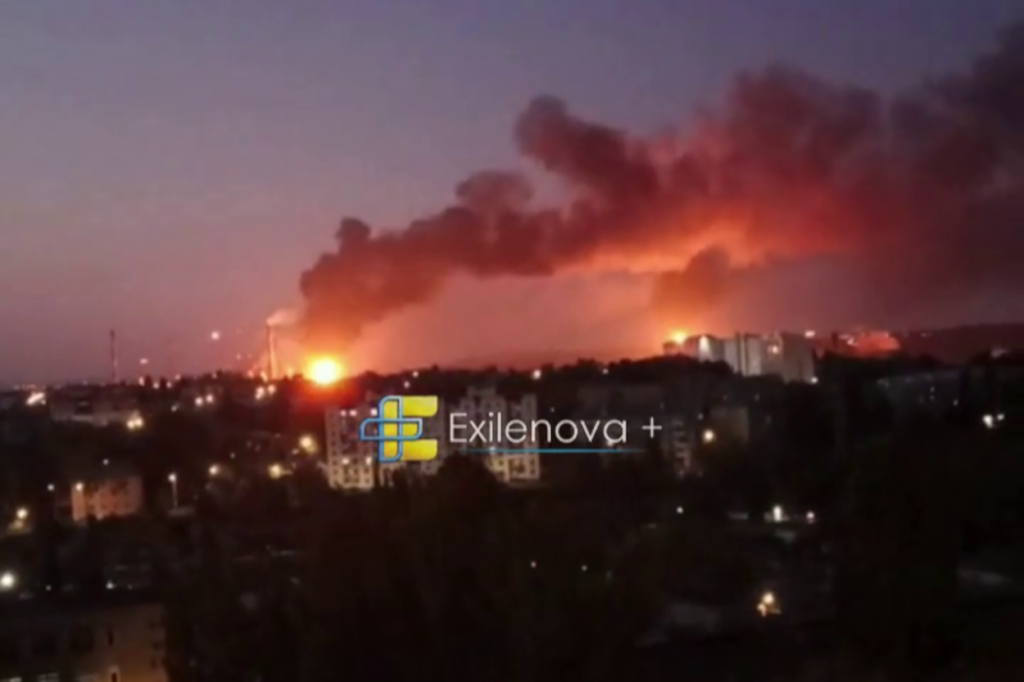
The trade has moved north. Almost 80% of fuel oil cargoes left from Baltic ports, and naphtha loadings there rose almost 50% as Ukrainian attacks disrupted Black Sea infrastructure. In September, Ukraine reported hitting an oil terminal in Novorossiysk, Russia's main Black Sea oil port—one in a string of attacks on Russia's Black Sea ports and oil sites.
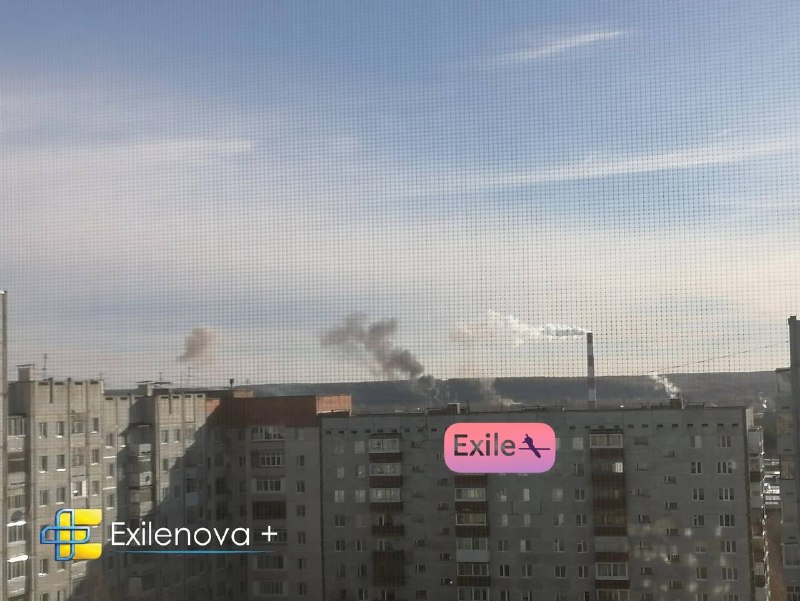
Diesel and gasoil exports fell 28% to 144,000 barrels a day, the lowest monthly volume in Vortexa data going back more than a decade. Russia has restricted diesel exports to protect domestic supply after Ukrainian attacks on its refineries. Drones kept hitting them into October, from a Lukoil refinery in Volgograd to Gazprom's Salavat complex in Bashkortostan.
In September, Russia paid oil companies the biggest subsidy in more than four years to keep road fuel on the domestic market. It also imported about 350,000 tonnes of motor fuel by sea, mostly gasoline from India, Morocco, and Türkiye, Reuters calculations showed. Officials are considering letting some producers resume diesel exports in October to avoid overstocking, according to Interfax.
The diesel squeeze has reached the White House. US President Donald Trump stated on 30 September that diesel was hurt "not by the Middle East, but by what's going on in Russia, because those diesel refineries are being knocked out at a pretty alarming rate."
Russia's crude exports reached about 3.99 million barrels a day in the week to 27 September, and the estimated value of its seaborne crude shipments neared its highest since the full-scale invasion began, Bloomberg reported. Brent crude traded at about $102.60 a barrel on 9 October, according to Trading Economics data.
Russia has demanded the extradition of International Criminal Court (ICC) President Tomoko Akane from the Netherlands, seeking to enforce criminal sentences against judges and prosecutors involved in issuing arrest warrants for Vladimir Putin and senior Russian military officials.
The Russian Prosecutor General’s Office announced on Thursday, 8 October, that it had submitted requests to several governments for the extradition of nine current and former ICC officials, including Karim Khan, who served as the court’s chief prosecutor when the arrest warrant against Putin was issued in March 2023.
The requests follow a ruling by Moscow City Court on 12 December 2025, when nine ICC officials were convicted in absentia and sentenced to prison terms ranging from three and a half to 15 years. Their alleged offences arose from their participation in investigations and judicial decisions concerning Russian officials suspected of international crimes.
Moscow’s latest move is unlikely to secure Akane’s extradition from the Netherlands, which hosts the ICC and is among its principal supporters. Russian authorities are nevertheless seeking cooperation from several countries, potentially exposing court officials to arrest when travelling to jurisdictions maintaining close relations with Moscow.
Japan has condemned the proceedings against Akane, a Japanese national who became ICC president in March 2024.
Deputy Chief Cabinet Secretary Masanao Ozaki said Tokyo had repeatedly protested to Moscow over its treatment of ICC personnel and regarded the latest measures as unjustified and unacceptable.
He indicated that Japan would consider further diplomatic action in consultation with the court and other states parties to the Rome Statute.
Prime Minister Sanae Takaichi reaffirmed Japan’s support for the ICC during a parliamentary session on Friday, 9 October, saying Tokyo would continue to defend the institution as part of its commitment to international law.
Akane, who was elected president for a three-year term in March 2024, served on the judicial panel responsible for the arrest warrants against Putin and Russia’s commissioner for children’s rights, Maria Lvova-Belova.
Russian investigators opened criminal proceedings against the judges shortly after those warrants were announced, subsequently adding other ICC officials to their wanted lists as investigations concerning Russia’s invasion of Ukraine progressed.
The confrontation began on 17 March 2023, when the ICC issued arrest warrants against Putin and Lvova-Belova over the alleged unlawful deportation and transfer of Ukrainian children from occupied areas to Russia.
The judges found reasonable grounds to believe that both officials bore individual criminal responsibility for the alleged offences. The warrants remain in force, although neither suspect has been brought before the court.
The investigation concerns the removal of children from Ukrainian territory following Russia’s full-scale invasion in February 2022. Ukrainian authorities have documented cases involving children transferred to Russia, placed with Russian families or subjected to measures intended to integrate them into Russian society.
Russia maintains that the transfers were humanitarian evacuations. The ICC’s investigation concerns whether children were unlawfully deported or transferred from occupied territory, conduct prohibited under international humanitarian law.
The court subsequently issued further warrants against senior Russian commanders. In June 2024, former defence minister Sergei Shoigu and Chief of the General Staff Valery Gerasimov were accused of responsibility for alleged war crimes and crimes against humanity connected to attacks on Ukrainian civilian infrastructure.
Russian prosecutors responded by expanding their criminal cases against ICC personnel. The charges included knowingly prosecuting innocent individuals and attacking representatives of a foreign state.
The December 2025 convictions provided Moscow with the domestic judgments it is now attempting to enforce through extradition requests.
The Netherlands has not indicated any intention to surrender Akane. Dutch authorities have consistently supported the ICC’s independence, and the Russian convictions concern actions undertaken by officials in the exercise of their judicial responsibilities.
The position may be less predictable in countries maintaining extradition arrangements with Moscow. Although Russian convictions would not automatically require another state to surrender an ICC official, the existence of arrest warrants could complicate international travel and expose those named to detention pending legal proceedings.
The situation recalls the difficulties surrounding Putin’s own international movements since March 2023. His arrest warrant has restricted travel to ICC member states, which are generally required to cooperate with the court’s requests for arrest and surrender.
Russia’s withdrawal of its signature from the Rome Statute in 2016 did not prevent the ICC from investigating alleged crimes committed on Ukrainian territory. Ukraine had already accepted the court’s jurisdiction and became a full member on 1 January 2025.
The ICC investigation into Ukraine continues, covering alleged offences committed since 21 November 2013 within the scope of Ukraine’s acceptance of jurisdiction.
The Russian extradition demands coincide with a separate dispute between the ICC and the United States, whose government has sanctioned several members of the court.
On 18 August 2026, President Donald Trump’s administration imposed sanctions on Akane and senior ICC trial lawyer Abdoulaye Seye. Washington has objected to investigations involving American personnel and Israeli officials, arguing that the court has exceeded its jurisdiction.
The ICC condemned the additional American sanctions, warning that restrictions targeting judges and prosecutors interfere with its judicial work.
The American measures primarily involve financial restrictions, while Russia has pursued criminal convictions and extradition requests. Both have placed ICC personnel under pressure for their involvement in proceedings opposed by governments outside the Rome Statute system.
The European Union has repeatedly defended the ICC against attempts to interfere with its investigations. The Netherlands, as host country, has particular responsibilities concerning the court’s operations and the security of its personnel.
Moscow’s latest requests are therefore expected to meet resistance from European governments. Their possible consequences elsewhere will depend on the countries approached and whether local authorities are prepared to act on Russian arrest warrants.
The Kremlin has so far failed to halt the ICC’s proceedings against Putin, Shoigu and Gerasimov. Its response has been to pursue the judges and prosecutors responsible, seeking prison sentences against international judicial officials while the allegations against Russia’s own leadership remain before the court.

Beijing has rebuffed a European Union request to voluntarily cap hybrid car exports to the bloc, raising the prospect of new, steep EU tariffs on Chinese hybrids, which have so far escaped the duties on pure electric vehicles. China has refused to set quotas on its exports of hybrid electric vehicles (HEVs) and plug-in hybrid […]
The post EU weighs safeguard tariffs as China refuses hybrid car limits appeared first on Asia Times.

Read in English here
Las elecciones generales de Brasil del 4 de octubre representaron una severa advertencia para la izquierda. Flávio Bolsonaro, el candidato presidencial del Partido Liberal (PL), superó al presidente Luiz Inácio Lula da Silva, con aproximadamente un 47% frente a un 45%. Ninguno de los dos obtuvo la mayoría, lo que los llevará a una segunda vuelta el 25 de octubre. Más preocupante que este estrecho margen presidencial fue el avance del bolsonarismo en el Congreso. Las elecciones han fortalecido un movimiento político cuyas ambiciones van más allá de derrotar a Lula para llegar a remodelar las instituciones que obstaculizan su ejercicio del poder.
El encarcelamiento (arresto domiciliario) y la exclusión electoral de Jair Bolsonaro no han disuelto su movimiento. Su hijo Flávio lleva su estandarte presidencial, mientras que otros miembros de la familia han obtenido escaños en el Congreso. Michelle Bolsonaro, esposa de Jair, y Carlos Bolsonaro, su hijo, ingresan al Senado; Jair Renan, otro de sus hijos, y Renato, hermano de Jair, ingresan a la Cámara de Diputados. Nepobolsonarismo es un nombre apropiado para la expansión de esta familia a través del Estado. Sin embargo, la familia es solo la expresión más visible de un proyecto más amplio, arraigado en poderosos intereses económicos y en una política reaccionaria profundamente organizada.
Lula sigue siendo el principal obstáculo para el regreso de este proyecto a la presidencia. Su derrota afectaría a los trabajadores y campesinos de todo Brasil, pero también a las posibilidades de cooperación regional y de una política exterior latinoamericana independiente. El tamaño de Brasil, su capacidad industrial, sus minerales en bruto (como los minerales críticos), sus recursos agrícolas y su alcance diplomático otorgan a su orientación política una importancia continental. Un gobierno que subordine estos activos a las prioridades de Washington debilitaría el espacio disponible para los países vecinos que buscan sus propios caminos de desarrollo.
La distribución geográfica de la primera vuelta pone de manifiesto tanto la fortaleza de Lula como sus dificultades. Mantuvo una posición dominante en el Noreste, mientras que Flávio lideró en las otras cuatro regiones. El enorme electorado de São Paulo proporcionó una ventaja particularmente importante a la derecha. Estas divisiones no pueden explicarse mediante una oposición entre una población ilustrada y otra ignorante. Requieren un análisis de las diferentes condiciones laborales, la organización de la vida política y la capacidad de los movimientos rivales para interpretar las frustraciones de la gente.
Lula llega a la segunda vuelta con un historial social sustancial. El desempleo cayó al 5,3% en el trimestre que finalizó en agosto, la tasa más baja para ese período en la serie estadística que comienza en 2012. Estas mejoras son de enorme importancia para las familias para quienes un salario regular supone un alivio frente a la incertidumbre cotidiana. Sin embargo, un indicador nacional mejorado no zanja la discusión política. El empleo puede coexistir con desplazamientos agotadores, viviendas costosas, servicios públicos inadecuados y la inseguridad que genera la deuda. La brecha entre la mejora estadística y la experiencia vivida sigue siendo un terreno en el que opera la derecha.
El bolsonarismo, o la extrema derecha brasileña de un tipo especial, traduce estas frustraciones en resentimiento contra la izquierda, todas las instituciones públicas y los sectores vulnerables de la sociedad. Su promesa de orden ofrece un lenguaje inmediato para el miedo, al tiempo que oculta los mecanismos económicos que generan inseguridad.
La izquierda no puede responder a esto simplemente promocionando los logros del gobierno. Debe vincular esos logros a un programa creíble para cambiar la vida cotidiana y explicar qué intereses impiden nuevos avances. Un trabajador que lucha contra las deudas necesita algo más que la seguridad de que la economía va bien. Este ha sido el problema de Lula, cuyo programa para el futuro no parece prometer más de lo que se ha logrado hasta ahora.
Las elecciones al Senado son particularmente trascendentales porque se disputaron 54 de sus 81 escaños. Los senadores tienen mandatos de ocho años, por lo que los resultados marcarán la política nacional mucho más allá de la próxima administración presidencial. El PL obtuvo 19 escaños y contará con 28 en el nuevo Senado, lo que lo convierte en el partido más grande. El PT tendrá nueve. Los bolsonaristas han establecido, por lo tanto, una posición formidable, aunque el propio PL sigue sin alcanzar la mayoría y deberá negociar con otros partidos.
Michelle Bolsonaro y Bia Kicis obtuvieron los dos escaños del Distrito Federal, mientras que Carlos Bolsonaro y Carol de Toni ganaron los dos escaños de Santa Catarina. Estas victorias demuestran la capacidad del movimiento para organizar campañas coordinadas y concentrar el apoyo en torno a sus candidatos. Hubo éxitos importantes para la izquierda: Rui Costa y Jaques Wagner ganaron en Bahía, Humberto Costa conservó su representación en Pernambuco y Marília Campos ganó en Minas Gerais. Estos resultados preservan puntos de resistencia dentro de una cámara cada vez más hostil. La importancia del Senado va más allá de la legislación ordinaria. Los bolsonaristas han convertido su enfrentamiento con la Corte Suprema Federal en un objetivo político central, lo que incluye demandas para destituir a sus magistrados. Su representación reforzada aumenta su capacidad para llevar adelante ese enfrentamiento e influir en la elección del presidente del Senado. Las predicciones de una mayoría automática a favor del juicio político deben tomarse con cautela: la afiliación partidaria, las declaraciones de campaña y los votos en un procedimiento específico son cosas distintas. No obstante, el peligro de utilizar el poder legislativo para intimidar al poder judicial ha aumentado claramente.
Esto forma parte de una lucha por las condiciones bajo las cuales la extrema derecha puede gobernar. Los procesos judiciales contra Jair Bolsonaro no han eliminado a las fuerzas sociales que lo respaldan. Esas fuerzas buscan ahora una mayor influencia sobre las instituciones capaces de frenarlas. Para la izquierda, la defensa del espacio democrático debe, por lo tanto, ir de la mano de la lucha por ampliar los derechos sociales. Las organizaciones de trabajadores no pueden permitirse perder las libertades a través de las cuales se organizan, educan y se enfrentan al capital.
Este año se renovaron los 513 escaños de la Cámara de Diputados. El PL obtuvo 121, consolidando su posición como el partido más grande tanto en esta cámara como en el Senado. La federación del Partido de los Trabajadores, el Partido Comunista de Brasil y el Partido Verde ganó 88 escaños, de los cuales el propio PT obtuvo 70. El crecimiento de la federación es significativo, pero deja a los aliados de Lula lejos de alcanzar la mayoría. Los partidos de la derecha cuentan con 303 escaños, mientras que la izquierda parlamentaria en sentido amplio tiene 124.
El resultado fortalece a una extrema derecha de carácter particular dentro de una legislatura ya dominada por intereses conservadores. También debilita a algunos intermediarios tradicionales del poder parlamentario, como el centrão, la coalición de partidos que intercambia apoyo legislativo por influencia en los nombramientos y los recursos públicos, aunque sigue siendo indispensable para la formación de mayorías. Las negociaciones que se lleven a cabo dentro del centrão ahora se desarrollarán junto a un PL más grande y más asertivo. Si Lula gana en la segunda vuelta, se enfrentará a una resistencia sustancial en el Congreso; pero si gana Flávio, ese mismo Congreso podría facilitar un programa reaccionario.
Sin embargo, la elección también llevó a la Cámara a importantes representantes de una izquierda combativa. Jones Manoel, el historiador comunista elegido por el PSOL en Pernambuco, obtuvo 249.077 votos y quedó en primer lugar en Recife. Elias Jabbour, el geógrafo comunista, fue elegido por el PCdoB en Río de Janeiro. Sus victorias sugieren que existe un público receptivo a la educación política y a los argumentos socialistas, incluso en medio del avance de la derecha. Ofrecen recursos para reconstruir la confianza entre las personas que se han impacientado ante las ambiciones cada vez más limitadas de la política parlamentaria.
Jones Manoel ya se ha ofrecido a colaborar en la campaña de la segunda vuelta de Lula, incluida su comunicación digital, al tiempo que propone prestar mayor atención a demandas como el transporte público gratuito. Este es un ejemplo útil de claridad política: la crítica a las limitaciones del gobierno puede coexistir con una movilización activa contra una extrema derecha de un tipo especial. Dicha unidad no requiere que los trabajadores renuncien a sus demandas. Se fortalece cuando esas demandas aportan energía y dirección a la campaña.
La segunda vuelta no se puede ganar únicamente mediante negociaciones entre los líderes de los partidos. Requiere una actividad organizada en los lugares de trabajo, los barrios, las universidades y las comunidades rurales, con un programa que la gente pueda reconocer en sus propias vidas. El transporte, los salarios, la vivienda, la deuda, la salud pública y el tiempo dedicado al trabajo deben convertirse en la esencia de una campaña democrática. La defensa de la soberanía se vuelve tangible cuando se vincula con la capacidad de utilizar la riqueza de Brasil para satisfacer las necesidades de su pueblo.
La marea furiosa ha avanzado, pero no ha arrastrado a los millones de personas que aún buscan otro Brasil. Los nuevos diputados comunistas, las organizaciones de masas que han sobrevivido (especialmente los trabajadores sin tierra del MST) y la enorme base electoral de Lula constituyen los cimientos de la resistencia. La tarea inmediata es derrotar a Flávio Bolsonaro. La tarea a más largo plazo es construir un poder popular lo suficientemente fuerte como para impedir que la oligarquía decida, elección tras elección, qué tan poco cambio se le permitirá a la mayoría.

Lee en español aquí
Brazil’s general election on October 4 delivered a severe warning to the left. Flávio Bolsonaro, the presidential candidate of the Liberal Party (PL), finished ahead of President Luiz Inácio Lula da Silva, with approximately 47% against 45%. Neither secured a majority, sending them into a runoff on October 25. More troubling than this narrow presidential gap was the advance of bolsonarismo through Congress. The election has strengthened a political movement whose ambitions extend beyond defeating Lula to reshaping the institutions that obstruct its exercise of power.
The imprisonment (house arrest) and electoral exclusion of Jair Bolsonaro have not dissolved his movement. His son Flávio carries its presidential banner, while other members of the family have won seats in Congress. Michelle Bolsonaro, Jair’s wife, and Carlos Bolsonaro, his son, enter the Senate; Jair Renan, another son, and Renato, Jair’s brother, enter the Chamber of Deputies. Nepobolsonarismo is an appropriate name for this family’s expansion through the state. Yet the family is only the most visible expression of a broader project, rooted in powerful economic interests and a deeply organized reactionary politics.
Lula remains the principal obstacle to the return of this project to the presidency. His defeat would affect workers and peasants throughout Brazil, but also the possibilities for regional cooperation and an independent Latin American foreign policy. Brazil’s size, industrial capacity, raw minerals (such as critical minerals), agricultural resources, and diplomatic reach give its political direction continental significance. A government that subordinates these assets to Washington’s priorities would weaken the space available to neighboring countries seeking their own paths of development.
The first-round geography demonstrates both Lula’s strength and his difficulties. He retained a commanding position in the Northeast, while Flávio led across the other four regions. São Paulo’s enormous electorate provided a particularly important advantage to the right. These divisions cannot be explained by an opposition between an enlightened population and an ignorant one. They require an examination of the different conditions of work, the organization of political life, and the capacity of competing movements to interpret people’s frustrations.
Lula approaches the runoff with a substantial social record. Unemployment fell to 5.3% in the quarter ending in August, the lowest rate for that period in the statistical series beginning in 2012. Such improvements matter enormously to families for whom a regular wage brings relief from daily uncertainty. But an improved national indicator does not settle the political argument. Employment can coexist with exhausting journeys, expensive housing, inadequate public services, and the insecurity of debt. The distance between statistical improvement and lived experience remains terrain on which the right operates.
Bolsonarismo, or Brazil’s far right of a special type, translates these frustrations into resentment against the left, all public institutions, and vulnerable sections of society. Its promise of order offers an immediate language for fear, while concealing the economic arrangements that produce insecurity. The left cannot answer this merely by advertising government achievements. It must connect those achievements to a credible program for changing everyday life, and explain which interests prevent further advances. A worker struggling with debt needs more than reassurance that the economy is performing well. This has been the problem for Lula, whose program for the future does not seem to promise more than what has been delivered till now.
The Senate election is particularly consequential because 54 of its 81 seats were contested. Senators serve eight-year terms, so the results will shape national politics well beyond the next presidential administration. The PL won 19 seats and will hold 28 in the new Senate, making it the largest party. The PT will have nine. The bolsonaristas have therefore established a formidable position, although the PL itself remains short of a majority and must bargain with other parties.
Michelle Bolsonaro and Bia Kicis took both seats in the Federal District, while Carlos Bolsonaro and Carol de Toni won the two seats in Santa Catarina. These victories show the movement’s ability to organize coordinated campaigns and concentrate support behind its candidates. There were important successes for the left: Rui Costa and Jaques Wagner won in Bahia, Humberto Costa retained representation in Pernambuco, and Marília Campos won in Minas Gerais. These results preserve points of resistance within an increasingly hostile chamber. The Senate’s significance extends beyond ordinary legislation. The bolsonaristas have made their confrontation with the Supreme Federal Court a central political objective, including demands to impeach its ministers. Their strengthened representation increases their capacity to pursue that confrontation and to influence the election of the Senate president. Predictions of an automatic majority for impeachment should be treated cautiously: party affiliation, campaign declarations, and votes in a specific proceeding are different things. Nevertheless, the danger of using legislative power to intimidate the judiciary has plainly grown.
This is part of a struggle over the conditions under which the far right can govern. The judicial proceedings against Jair Bolsonaro did not remove the social forces supporting him. Those forces now seek greater leverage over institutions capable of restraining them. For the left, defending democratic space must therefore accompany the struggle to expand social rights. Workers’ organizations cannot afford to lose the freedoms through which they organize, educate, and confront capital.
All 513 seats in the Chamber of Deputies were up for election this year. The PL secured 121, consolidating its position as the largest party in this chamber as well as in the Senate. The federation of the Workers’ Party, Communist Party of Brazil, and Green Party won 88 seats, with the PT itself taking 70. The federation’s growth is significant, but it leaves Lula’s allies far from a majority. Parties of the right hold 303 seats, while the broader parliamentary left holds 124.
The outcome strengthens the far right of a special type within a legislature already dominated by conservative interests. It also weakens some established brokers of parliamentary power, such as the centrão, the collection of parties that trades legislative support for influence over appointments and public resources, although it remains indispensable for majority building. What bargaining will take place within the centrão will now take place alongside a larger and more assertive PL. If Lula wins in the second round, he will confront substantial congressional resistance, but if Flávio wins, the same Congress could facilitate a reactionary program.
Yet the election also brought important representatives of a fighting Left into the Chamber. Jones Manoel, the communist historian elected through PSOL in Pernambuco, received 249,077 votes and finished first in Recife. Elias Jabbour, the communist geographer, was elected for the PCdoB in Rio de Janeiro. Their victories suggest an audience for political education and socialist arguments, even amid the right’s advance. They offer resources for rebuilding confidence among people who have grown impatient with the narrowing ambitions of parliamentary politics. Jones Manoel has already offered to assist Lula’s runoff campaign, including its digital communication, while proposing stronger attention to demands such as free public transport. This is a useful example of political clarity: criticism of the government’s limitations can coexist with active mobilization against the far right of a special type. Such unity does not require workers to abandon their demands. It becomes stronger when those demands supply the campaign’s energy and direction.
The runoff cannot be won through negotiations among party leaders alone. It requires organized activity in workplaces, neighborhoods, universities, and rural communities, with a program people can recognize in their own lives. Transport, wages, housing, debt, public healthcare, and the time consumed by work must become the substance of a democratic campaign. Defense of sovereignty becomes tangible when it is connected to the ability to use Brazil’s wealth for the needs of its people.
The angry tide has advanced, but it has not carried away the millions who still seek another Brazil. The new communist deputies, the surviving mass organizations (especially the landless workers of the MST), and Lula’s enormous electoral base provide foundations for resistance. The immediate task is to defeat Flávio Bolsonaro. The longer task is to build a popular power strong enough to prevent the oligarchy from deciding, election after election, how little change the majority will be allowed.
Vijay Prashad is an Indian historian and journalist. He is the author of forty books, including Washington Bullets, Red Star Over the Third World, The Darker Nations: A People’s History of the Third World, The Poorer Nations: A Possible History of the Global South, and How the International Monetary Fund Suffocates Africa, written with Grieve Chelwa. He is the executive director of Tricontinental: Institute for Social Research, the chief correspondent for Globetrotter, and the chief editor of LeftWord Books (New Delhi). He also appeared in the films Shadow World (2016) and Two Meetings (2017).
This article was produced by Globetrotter.


President Trump has renewed his efforts to “Build the Wall” in areas along the US-Mexico Border that don’t currently have border barriers—including the Big Bend region of West Texas. Invading people’s private properties and upending their local economies and shared ecosystem with a border wall residents say they don’t want or need, the Trump administration continues to dole out billions of taxpayer dollars to flood Texas border towns like Terlingua, Sanderson, and Marfa with troops and federal agents—and to pay construction contractors with ties to the Trump family.
In this episode of Working People, we speak with a panel of residents living near Big Bend National Park and Big Bend Ranch State Park who have banded together with their neighbors to fight back against the federally funded destruction of their homes. Panelists include: Yolanda Alvarado, a fifth-generation cattle rancher and the regional director for Conserve Big Bend: No Big Bend Wall; Crystal Allbright, a longtime resident and bicycle shop owner in Terlingua; Sara Ryza, a longtime resident, small-business owner, and proprietor of the Desert Air Motel in Sanderson, Texas; Scott Whitener, a longtime resident of Marfa, Texas, and a former superintendent on the Big Bend Ranch State Park; and Sharron Reed Gavin, a retiree and longtime resident of Terlingua.
Additional links/info:
Featured Music:
Credits:
The following is a rushed transcript and may contain errors. It will be updated.
Maximillian Alvarez:
Alright. Welcome everyone to Working People, a podcast about the lives, jobs, dreams, and struggles of the working class today. My name is Maximillian Alvarez.
Jules Taylor:
And I’m Jules Taylor.
Maximillian Alvarez:
And today we are going to Terlingua in West Texas, right on the US-Mexico border and right next to Big Bend National Park. As the Texas Tribune reports, “Since President Trump returned to office in January of 2025, his administration has renewed efforts to erect border barriers in parts of the US-Mexico border that don’t currently have any. That includes the Big Bend region in far West Texas, home to the Big Bend National Park and Big Bend Ranch State Park, both of which the Trump administration has targeted for border security infrastructure. Historically, the region has recorded the fewest illegal crossings along the entire Southwest border, but the Trump administration has awarded billions of dollars worth of contracts to build some form of infrastructure to deter illegal border crossings, while telling concerned West Texas residents that they will not build a border wall or fence in the national park.
Local residents, environmentalists, and a bipartisan group of elected officials, including sheriffs and county judges, have still asked the administration to stop all construction.”
Jules Taylor:
According to the website of the community advocacy group, No Big Bend Wall, 2.1 billion in contracts have already been awarded for wall construction in Presidio and Hudspeth counties. Over 500 private landowners stand to lose access to the Rio Grande due to the proposed border wall. Construction is planned for Texas gems, including Big Bend National Park and Big Bend Ranch State Park, and the Department of Homeland Security is waiving 31 federal laws, including National Environmental Policy Act, National Historic Preservation Act, Native American Graves Protection and Reparations Act, and Wild and Scenic Rivers Act.
Maximillian Alvarez:
So to talk about what the hell is happening on the US-Mexico border, we are really grateful to be joined on the show today by a panel of folks who are on the front lines of this story and who are joining us from in or near Terlingua, Texas. Thank you all so much for joining us. Please introduce yourselves to our listeners.
Yolanda Alvarado:
I’m Yolanda Alvarado. I’m a fifth generation cattle rancher and the regional director for Conserve Big Bend: No Big Bend Wall.
Crystal Allbright:
Hi, I’m Crystal Allbright. I live in Terlingua, Texas. I’ve lived here 36 years. My husband and I own a bicycle shop and have outdoor gear as well as art. We’ve operated the river for 29 years, but we’ve phased that out for now. I’ve visited the area since I was a young child and love it very much.
Sara Ryza:
I’m Sara Ryza and I have the Desert Air Motel in Sanderson, Texas. It’s a renovated 1960 motel in Sanderson, which is a gateway town into Big Bend. So while the national park and the state park are kind of the anchor places that bring people into the region, they’re going through gateway towns to the region and into the park. And so a big part of this area is tourism and there are a lot of independently owned small businesses that are concerned about what all of this is going to do in the short and long term for tourism.
Scott Whitener:
My name’s Scott Whitener. I was a former superintendent on the Big Bend Ranch State Park along the river corridor located along the river road, which is just along the Rio Grande and covered about 50,000 acres of the front country of the state park side. I have been going to the Big Bend for 30 years. My wife fell in love with me there, I think, to check and see if that’s still true. But I currently live in Marfa, which is in Presidio County. I also am a property owner in three of the six counties in the affected area in the Big Bend sector. And yeah, this is near and dear to my heart, my family’s heart, and it will remain that way.
Sharron Reed Gavin:
My name is Sharron Reed Gavin and I also live in Terlingua with my husband. We moved there in 2013 full-time. We had both loved the Big Bend independently of knowing one another. My first time to go there, and this is before most of y’all were born, but was 1976 and went with some friends with the canoe and we wanted to do the river. And there weren’t such things as desert sports really at the time, but we found some good folks like Crystal and her husband who would help us get down to the river and go on it for a while. But I have six grandchildren and that’s why this is so important to me, also for my neighbors and all that love the Big Bend. There’s not a lot being done to save it by our elected officials, but I think all of our voices matter.
All of these people are working so hard at their real jobs and on top of it, especially what Yolanda and Sarah are doing with No Big Bend Wall. It’s just all of these people are doing full-time jobs and doing a full-time job with no Big Bend wall, and I just appreciate them.
Maximillian Alvarez:
Well, and we genuinely appreciate all of you for being here and talking to us about this. I’m just incredibly sorry that you and your community are going through this, that our country is going through this. It’s like every week it’s another horror show, but I really want to zero in on what you were just talking about, Sharon. I’ve never had the pleasure of going to see Big Bend or being in this part of the country. I really hope to correct that soon. But this is, from what I’ve seen, one of the most just beautiful places on God’s green earth. But for those of us who are not from there and for folks who are listening who have never been there, I want to ask if y’all can describe what our listeners can’t see for themselves. Tell us more about this area and what it’s like to live and work there.
Yolanda Alvarado:
Yeah, so I’m not directly near Big Bend National Park. My family ranches in the Big Bend region and that starts from Hudspeth County and it goes all the way to Valverde County. But we have ranches in Hudspeth and Presidio and near Jeff Davis. And we’ve been out here for hundreds of years and it’s really just quite desolate. You could see four hundreds of miles just desert and no one around. It’s a really serene environment and it’s also really harsh to be in the desert. It’s filled with rural communities. No communities are huge out here. We have very few ambulances, small schools. My children go to a school with 35 students from kindergarten to high school. So it’s just a really small time, small town, rural environment. And we throw on tourism and people going to the National Park and passing through these small areas. So even though we are small in size or small landowners, it still feels big.
It still feels connected to the rest of America because we still have all these visitors and people coming through.
Sara Ryza:
It also feels like time slows down here. You can relax and it’s kind of the call of the desert. You wouldn’t expect that you would love it so much if you weren’t originally thought of yourself as a desert person, but it’s also, it’s very gritty. There’s a grit to the people that live and work here and a lot of the business owners have several businesses. We also have a liquor store and also we’re part of this bigger region, but we’re also our own little communities. And in Sanderson, it’s Terrell County that’s getting vehicle barriers going through our county, which is only 20 miles to the border to the river, but that’s all private land. So we’re connected geographically to the river where we are, but also to the region through the tourism. It’s all really interconnected.
Crystal Allbright:
Yeah, I agree with both Yolanda and Sarah. It’s very remote and fairly isolated, but we all are connected. In the national park, I like to describe it as three biomes. There’s the mountains, the Chisos mountains, and then there’s the open expanse of the desert, and then there’s the river corridor that connects us all. So if you start at Yolanda’s Ranch and drive the Chispa Road all the way through Presidio and to Terlingua and then up through Alpine and then Marfa, you can make a big loop. You can do Fort Davis and Sanderson. And so we’re all connected. This has brought us together in so many ways from learning about each other’s businesses and lives as well as participating in the community meetings, whether it’s a town hall or a commissioner’s meeting or a groundwater meeting. We’re all working together to learn ways that we can delay the construction, which we prefer to call destruction of this area that we love.
Scott Whitener:
We all have to continue agreeing with each other because everybody else before me said it way better than I think I will. But at the same time, a few days ago I put it into perspective. I looked at all the population in all of our six counties that are affected right now in the Big Bend sector, and there’s like 23,000 people. You know how many square miles there is in those six counties? 23,000 square miles. Think about that. That’s a one person per square mile. Could you imagine being anywhere that allows you to have that type of expanse? We are all connected by this region, honestly. We all know what each other are doing because we love it out here. We love one another and it’s trampling on our freedoms, it’s trampling on what we love, and this government overreach is, it’s destroying our way of life, but we’re not going to let it.
And I’ll continue to say that, but at the same time, it’s made this community bigger, better, stronger. And I can’t say enough about the people, the place, the sunrises, the sunsets, the mountains, the open expanse, the plains. This is a special place, and if you haven’t been down here, you don’t have to come because like Austin used to say, “Hey, come for the fun, but don’t move here, please.” We do love the visitors. We love having people down here, but you live out here for a reason and we share this place with one another because it’s not any of ours, but it sure is ours to share.
Sharron Reed Gavin:
And the only thing I would add to that is you asked what it would look like to people who haven’t been here and everybody’s kind of hit that nail on the head, but it really is something that you can’t understand until you see it in person. And my favorite other place in the world is the north rim of the Grand Canyon, and I promise they have nothing on us, absolutely nothing. But we also, the beauty is here, but there’s archeological sites, there’s historical sites. They’re not paying any mind to those. They even started working on one of those sites and were interrupted. Yolanda, I can’t remember if it was by you or somebody else out near you, but the scale of the destruction and the history and the things that we absolutely cannot replace, it’s mind-boggling. And then everybody said this too about how we are all working together and we may be different and love our isolation, but boy, you step on this anthill and you’ve got a lot to contend with.
The thing that makes me feel really good about it though is this group isn’t going away. These people across the country who have banded together to fight this wall, they’re here to stay. They’re here to stay and the people are going to make their voices heard, and I think just at the end of the day, get this to stop.
Scott Whitener:
I don’t work for the state park system anymore, which is why I can be on this podcast and talk as much shit as I want. Pardon my French. But I actually work for an animal rescue. We rescue dogs out of shelters one tail at a time. We cover an area about the size of South Carolina, even bigger than our six sexers. So we save a lot of shelter animals and abandoned animals, and probably that’s what 40 to 50 to 60 hours of my week is. And then the other waking hours is fighting this.
Crystal Allbright:
I said earlier that my husband and I have a bicycle shop and we worked in the river outfitting business. We work six to seven days a week all day long. And again, using that time, especially when people come through the shop, we have displays about what’s going on in the area and we encourage people to voice their opinions about what’s going on and contact representatives. We use our space to show photographs of some of the destruction as well as to help raise money for these organizations that are working so hard to stay on top of what’s going on.
Yolanda Alvarado:
Yeah. I’m a cattle rancher, as I mentioned. I manage all my family’s ranches, and so I work every day outside in the desert. I work with mother nature. I work with the animals with droughts, with floods, the rain, any type of environmental issue you can think of a hundred and plus degrees outside or freezing outside. So my everyday working life and what it has been for the past almost 10 years has just been me and the desert, me and the animals, and that is my job. And carrying my family’s legacy, it has been my responsibility to be a steward of the land and continue that and teach my children how to take care and live out here, take care of the desert, the ranches and the animals, what it means, what you can use the plants for. So yeah, that’s basically what I do all day.
And then now I am fighting the border wall as the regional director, spending a lot of my time behind a computer now, but here we are.
Sharron Reed Gavin:
Yeah, I’ll say one thing. None of these folks work nine to five. I mean, I’m retired and that’s very fortunate because I have some more time to help on the no wall fight, but none of these people work nine to five. I can’t even imagine the number of miles that Yolanda drives or Scott used to do when he was with the state park or Crystal on their river trips. It’s mind-boggling. I do know where Crystal lives, and you have to love it out here to drive from where she lives into Terrlingo. It may be like seven miles, but it can take you up to 30, 40 minutes. So these people are working before and after work and during the working hours.
Jules Taylor:
National borders everywhere in the world are deeply political constructs with complicated histories, and the US-Mexico border is no different. I mean, it’s been a political talking point our entire lives. Can you talk to us about what it’s like to live somewhere that is so regularly charged by political narrative and policy battles and tell us why that’s different now?
Yolanda Alvarado:
Well, historically, the river down here in this part in the Big Bend sector, it’s been so isolated and desolate that we don’t have many crossings here, as you mentioned. So for many years up until almost recently, and still actually today, the communities on the river are on both sides. So you see Presidio and Ohinaga sharing a river, you see Bokias, we are one community. So politically, not until the first border wall came through, it wasn’t something that we even thought about for us and my family and the ranchers because we’ve always just been safe out there. We’ve been alone and we’ve been one community with the other side of the border that was Pilates, Mexico. And it wasn’t until, I guess, Bush, he built a fail billion dollar wall that’s actually on my aunt’s property. And that’s when we started seeing, for us anyways, in this region, it being more politically charged.
And even then at that time, I don’t believe anyone looked at the Big Bend region close to the National Park and said, “We need a wall here.” So I personally felt a little separated from what was going on in other places. I mean, me and my family never thought in a hundred years they would try to put a wall where we are because it just doesn’t make sense at all. It’s like you go down there, I even took the border patrol agents, the head director, infrastructure project directors of the Border Wall Project, and they said, “Yolanda, I see what you’re talking about because that’s how ridiculous it looks in person when you get off of a map.” We did see when Kersey Nome was a Homeland Security Director, we started seeing Stryker military vehicles, the army lining the border. Still today, I’m passed by Army people.
Our border’s completely militarized now. So it was a very isolated, safe place. And now I have to worry about running into a Stryker military vehicle hitting me on the way to the ranch. And most of the time I find them napping in their trucks because it’s so quiet and they don’t have anything to do. I see them on just, there’s actually a weightlifting area where they’re bored and they’re lifting weights because there’s no emergency on the border, yet our military’s deployed in our own homes, in our own backyards, filling up all the hotel rooms in these small rural communities already causing damage to tourism. So it’s been interesting watching it in real time. I was sitting on our back porch less than half a mile from Mexico on the Rio Grande reading that we were in a state of emergency and within the week we had military driving in and showing up at our property.
I even had military personnel drive through our gate in the middle of the night because they were just messing around, driving really fast. So it’s been a really interesting experience watching it in real time, not on the news saying like, “Oh, we have an emergency. Oh, there’s the military. Now we’re getting a wall.” It’s been really crazy and at the very least, such a disturbance to our peace or what was peaceful.
Scott Whitener:
This should make every taxpayer mad, and I’m only going to put it into perspective. I won’t put names under the bus. I live in Marfa, which everybody poo-poos Marfa just because it’s fun to do it anyway, and I get it. We’re a little art community, everybody’s a little bougie, whatever. I live in an old train warehouse, which it’s fun. Anyway, but I go down the street and I have the US military staying at a place that costs $285 a night minimum, and they’ve been staying there full-time since February of 2026. They use the pool, they use the weight room, all the things that people in this community can’t afford to use. Our US military is occupying that hotel and they’re not paying hotel taxes, they’re not helping the community, and they’re showing up to the pool and drinking at the bars. And it’s like, what are they defending?
And when we ask them, “What are you doing here?” They said, “We’re here to help this place. We’re here to defend you guys.” And I’m like, “Defend me from what? Art critics?” I mean, certainly it should make any taxpayer mad of what’s being wasted down here. These guys cruise around all day, all night and do nothing. And I’m not dogging the military, I’m dogging the decision. And it’s going on all over this region and it’s despicable.
Maximillian Alvarez:
I mean, it’s going on all over the country, right? I go to Washington DC this week and there are a bunch of board national guardsmen just walking around. It’s like, what the hell are we doing?
Yolanda Alvarado:
Really an insult on, I think, our military service also. My sister’s in the Air Force, and I mean, it’s insulting to even separate them from their families, deploy them in the United States, separate them from their families. They’re off on a mission, but it’s really there’s no mission down here. There’s nothing going on. But yeah, millions and millions, if not billions of our taxpayer dollars are going towards this. So I’m glad you said that, Scott.
Sara Ryza:
Yeah. It feels like an upside down world where before it was like, yeah, we’re safe. We didn’t even think about our safety, but people that don’t live here, that don’t work here, they’re talking about how it’s a scary place. We have to put up physical barriers. And so it’s created a narrative that is not what reality was. And now in addition to people thinking that we need a wall, well, now people think that, well, if they needed a wall, then it probably wasn’t safe. So why am I going to visit there? There’s so many other national parks, so many other places that people could go on a trip, and it’s really messing up our tourism and the economy that drives on the tourism. And while contractors coming in, the military coming in, that’s not an investment in our communities and in this long-term economic development.
Anybody that thinks that might be good that it could bring in money to our towns or to our county, that’s just a very shortsighted view and it hurts us in the long run.
Sharron Reed Gavin:
And when you were talking about being politically charged, I mean, it all goes back to the false pretense that we need a wall because of the border crisis down here. It’s all bogus. There is no border crisis. The border crisis right now are the construction workers or as Crystal said, the destruction workers. But yeah, I think that’s really important. This isn’t needed. It’s all about our president rewarding the people that are funding him for his political office, and it’s not doing this community any good whatsoever. It’s harming it significantly. One of our Texas state senators has a bill called the Fed Act, which is supposed to protect landowners specifically in West Texas from federal overreach, yet he hasn’t said a word about the overreach that’s happening here. So yeah, I better stop because it really makes me mad.
Maximillian Alvarez:
Well, I mean, I was going to ask y’all to, let’s get more mad, right? Because I mean, Jules and I have also been talking to fellow Texans who are dealing with data centers in their damn backyards now, all over the place. It feels like local control is just being ripped away and people are just having, whether it’s a border wall, whether it’s a data center or some other polluting piece of crap in their community, we get no say in it and they’re just steamrolling everybody. Because I wanted to sort of ask y’all, if you could speak to the non-Texans who are listening to this, right? We all know that there’s a, speaking of narratives, there’s a narrative in this country that makes a lot of people assume that Texans would be for this, that Texans would be shooting their guns into the air and say, “Yeah, let’s build a big border wall.” What do you want to say to people who think that about you?
Sharron Reed Gavin:
Come down and see for yourself. It’s nothing like the narrative that you’re hearing. Nothing at all.
Yolanda Alvarado:
Yeah. I mean, the data center border wall is so correlated. It’s the same fight that everybody’s been starting to fight across the country. So the only difference is that say it’s Boise, Idaho, and the only difference is the president saying there’s only rapists and murderers coming to Boise, Idaho. We need a wall around it and not a data center. It’s the same correlation. So we were just painted this black. We were already painted black, and that’s why people are not really opening their eyes to the issue, but it is exactly like you said, it’s just like having a data center show up in your community and taking your natural resources, jobs, all of the above. So to speak to the greater America, one thing I’ve been saying is that they declared a national emergency to waive laws to do this project. Who’s to say they’re not going to do it in Boise, Idaho?
Who’s to say they’re not going to say, “Oh, we see this emergency here. Let’s deploy the army and build and do whatever we want to these Americans. Forget American sovereignty, forget whatever existed.” It’s disgusting, the overreach. So I think everyone in America should be upset about what they’re doing to abuse this power to take advantage of American citizens, Texans. It’s not right.
Maximillian Alvarez:
Weren’t we raised to hate this stuff? Didn’t we all learn in school that this is exactly the kind of thing that as good red-blooded Americans we should despise and fight against? And you got ICE agents in unmarked vehicles wearing masks, driving all over people’s property, being peaceful protestors. I mean, just the violation of rights and property and everything, it’s mind-boggling.
Sara Ryza:
Right. In Terrell County, there’s a $2.6 billion contract over the Big Bend five project, which bans all of Terrell County, some of Brewster, some of Valverde. It’s not the 30-foot wall. It’s four and six-foot tall steel bollards that’s the vehicle barrier system to stop vehicles from crossing. This is on the other side of canyons, the river, the wild and scenic river right there. It’s canyons. And so they’re putting this vehicle barrier up saying it’s to stop vehicles, but vehicles aren’t crossing and people can go under it. So it’s not stopping people. It just doesn’t make sense and it’s a waste of taxpayer money and it just does not make any sense. But it’s back to this narrative that if somebody says that we need it, then I guess half the country’s going to believe it.
Crystal Allbright:
Just my take on it is my life here has spent a lot of time on the river and never had a bad experience. Usually people were hungry, starving, needed water, but just the thought of losing access to our river, the river we share with Mexico, it is appalling to me that we wouldn’t have access. We want border security, but we were already secure before. And a lot of that was because there’s several villages along the river. Prior to nine eleven, it was an open border and you could go across and have lunch at the villages and people would share news about what was going on. If there was something bad going on, we would learn from the people that lived there. And then after nine eleven, the border was shut and then we were cut off from our friends. We still get together once a year on Mother’s Day and we go to the river and bands play on each side.
They take turns, a band in Mexico and a band in the United States and they take turns playing and the families come together and we eat, we sing, we laugh, we dance, and we get to do that one day a year. And to have the idea that they’re going to come in with whether it’s vehicle barriers or walls, it just cuts us off more from friends and family that live in Mexico. I just agree with the sheriffs and the border patrol that can talk to us that they’re doing a good job already and that just more the technology that they can use to detect people crossing and being able to get to them, they could use more drones and maybe a helicopter that sure doesn’t cost $7.46 billion, which is how much they’re trying to spend on 517 miles of riverfront in Texas. And just the whole idea of landowners along the river, farmers, ranchers losing access to the water, again, we’re all saying it doesn’t make sense and we think we’re pretty logical people.
So I just want them to slow down, think about what they’re doing and start believing in the rule of law again.
Yolanda Alvarado:
Yeah. Speaking on the border security we have, as a rancher, I got a new four-wheeler. I was chasing cows near the border in the middle of nowhere. And border patrol knows me. They know my truck, they know pretty much what I do, but this was new to them. They were there within 10, 15 minutes, found me in the middle of nowhere and was like, “Oh, it’s just you, Yolanda. All right, have a good day.” That is a response time already. And I was going really fast on that four-wheeler. So just the idea of them being able to come in and take land away from landowners to ruin this entire region when we already have a very secure border. I mean, if you look at CBP, the Customs and Border Patrol Instagram right now, they just posted a video that says the border is secure. Even they’re admitting it at this point.
It’s comical, but they’re getting away with this at a national level because again, for me, and I’ve said this from the beginning, I’m very vocal about it. I think it’s a very racist agenda. It’s very anti-Latino. It’s very anti-brown. That’s why we can see ICE getting away with kidnapping people, murdering them in the street because they’ve pushed this anti-Latino narrative for a long time now since Clinton era, Bush did it and even Obama did it and it’s getting worse and worse. So people are turning a blind eye to it and it’s really frustrating because just as Crystal described, it’s not what it seems like here. We are communities, we are families, we are one on the river, and it’s really deserving to watch in real time of how people are being treated just for this agenda. And honestly, in the very end, it’s just so people can make some money at top.
It’s for these large contract deals. It’s to sell beds to detention centers. It’s all of the above. And we are just a byproduct of this huge anti-Latino showboat.
Sharron Reed Gavin:
Sometimes people will ask if they haven’t been down here on some of these chats and all, is it safe down there? Do you feel safe down there? I said, “We feel perfectly safe. We haven’t locked our door in 13 years. We don’t even know where the key is.” But then I also say, “I feel a lot safer here than I do going to Dallas or I do going to DC or some other place. This place is safe.” And if you took the amount, and Yolanda, you can probably correct me, but somebody did a calculation of the amount they’re paying, the seven however many billion dollars versus the number of people who have crossed, it comes out to something like $500,000 a person or $50,000 a person. I’m not a mathematician, but it’s ridiculous that that’s where our taxpayers’ money is going.
Yolanda Alvarado:
Yeah, it’s definitely the higher number. I believe it’s more over a million a person per apprehension, but it is $14 million a mile to build this border wall in our region. That’s our taxpayer dollar. So my family’s property, we’re going to have, I believe, a new fence, a 30-foot bollard wall that’s costing taxpayers. On our property alone, rough math, almost a hundred million dollars just on our property. That’s our new fence. So the cows aren’t going to go to Mexico anymore, but it is actually ridiculous what is happening and how much money’s being spent.
Sara Ryza:
Isn’t it 17 million per mile, right? Is that right? I think that’s the number, 17 million per mile. And the entire county budget for Terrell County is less, just less than 2.5 million for the entire year for the entire county, but they’re spending 17 million per mile.
Jules Taylor:
The last time I was there in Terlingua, I realized that water is scarce as a resource. It’s something that y’all could use more of. Sometimes power would go out or power did not seem like it was necessarily in all places. So when y’all talk about these huge numbers going on in terms of… I just think about how better that could be used within your communities to make better the lives of the people who choose to live there. And instead it goes to this godawful cause that helps no one hurts everyone who lives there and is completely unnecessary and ridiculous. And if you just were to look at the landscape of where they are intending to place it, like you mentioned, Yolanda, it doesn’t make sense, like vehicle barriers on the other sides of canyons. I mean, it just all sounds like a giant shit show, and I’m sorry that everyone’s having to live through this and deal with it.
And in terms of how the community of Terlingua is, man, I remember being there last year, there’s the Boathouse and there’s a Starlight Theater and there’s DB’s Rustic Iron. And I was reading somewhere in the Texas Tribune, there are actual signs that all these businesses have put up where if you are working with the contractors, we don’t want your business here, please take it elsewhere and you’re not welcome. And I just think it’s incredible the way that the businesses and the people who live out there have sort of been galvanized by this entire ordeal. As a wrap up question here, where do things stand now, like upcoming events? What can people, listeners do to get involved and what’s the current status now? Because I understand that the actual construction was paused and I think I remember reading today the pause ceased or something. Can we get an update on where things stand at this point and how listeners can help?
Sara Ryza:
It’s really easy to get mad and it’s nonsense, but the way that we’ve come together has been really great. We’re stronger than we thought we ever needed to be. We didn’t know we were going to need to be this strong, but the businesses, there’s a business network, we come together, we’ve talked about all of this. And the thing that has helped us, I know you want an update on the construction, but what we’re working on is fighting for tourism. That’s helped kind of shift the narrative because yes, we’re fighting against the wall and all of that, but we’re also fighting for something. Crystal reminds us all the time we’re fighting for what we love. The businesses are fighting for tourism. So the thing that people can do is to keep coming, keep coming to Big Bend, support the local businesses, come to the parks, even watch what’s going on if construction resumes.
But there’s a big tourism campaign called Big Love for Big Bend that reminds people that when you come to Big Bend, you’re supporting these businesses and these independently owned restaurants, gas station, grocery stores, motels. So that’s in addition to writing representatives and a lot of other things that they can do, a really huge thing would be to keep visiting Big Bend.
Yolanda Alvarado:
We just took a trip to Washington DC. We talked to lawmakers. We were trying to wrap our minds around what are they saying? What are they doing? And the biggest thing that stuck out was all of them have said they’ve received phone calls, they’ve heard from their constituents, and it’s huge no matter where you are outside of Texas to keep calling your representatives and let them know that putting a wall or any infrastructure in Big Bend will hurt you as well and it’s not needed and that’s not where you want to spend your taxpayer dollars. And we’re working on some bills and things there to hopefully halt that. And on top of that, our coalition, Conserve Big Bend, we started a landowner coalition and we have almost over half of the landowners on the border in our coalition who is against the wall. And we just filed a lawsuit a couple weeks ago against the federal government.
So it’s landowners versus DHS and we’re taking it all the way to the top. It was filed in DC and we’re hoping to see another TRO there and hopefully we can halt construction. We are challenging the waivers, letting them know that they can’t just come in and claim a national security and take away all of our rights. So yeah, aside from other small events we’re working on, that and donating to all the people who are working hard, it’s not just No Big Bend Wall, but there’s so many people in Terlingua all over. Anyone who even shares an Instagram post or Facebook post and talks about what is happening helps us. This is all really good and really helpful.
Crystal Allbright:
There’s another hearing tomorrow in El Paso. So some of the people originally scheduled for this podcast are in El Paso with the lawyers getting ready for that tomorrow and hopefully that will pause it again. We have not seen construction resume, but there are people watching for that. I think they’re just still waiting, but they’re still not talking to us. That’s been a big thing. The lack of transparency has been really aggravating. If they would just talk to us and we could give them ideas on alternatives for what’s going on, that would help. In Terlingua from February, we started having rallies on Saturdays and this Saturday is our 32nd rally. People come from all over and join us. We’ve had people from New York and California and Florida, Atlanta, all over Texas come and join us. And then in the big cities on Sundays like Houston, Dallas, they’re having rallies there as well.
So the moment they started bulldozing at Santa Elena Canyon, finally the news broke out to a bigger audience, even though we had been chipping away at that for six months. So more people are aware, but we just keep spreading the word.
Scott Whitener:
Yeah. And being able to attend the ones in Terlingua are at the rally at the Y is always special. That kicked it all off. And the bigger point here, and that was amazing, and what’s happened after that has been even more amazing. But if you’re talking about how can people help right now, not only attending those rallies at the Y, but what we’ve been doing, and everybody on this call and everybody’s in El Paso, I talked about how big this area is. The people on this call and the other people, our constituents out here have been driving to county meetings, city councils, groundwater meetings. You go to every single one of those, and I think every American should be paying attention to what’s going on down here. I know people are objecting to AI data centers, but looking at the gas, paying $4.50 a gallon, we’ve got people that are retirees thriving on social security, people that are part-time workers, part-time, anything, seasonal workers, because this is all tourism.
People are showing up to these county meetings and holding the people we put in office, holding them to account to do what we ask them to do because it’s bullshit. I’m sorry, you can bleep that one out. I mean, it’s bullshit. I keep saying it. It’s
Maximillian Alvarez:
All right, man. Go for it. Let it fly.
Scott Whitener:
It’s bullshit that they keep going and they’re not listening to… We have the county commissioners probably scared to object to anything when we show up with 150 people that drove from all over the place. Like last week, I mean, we are calling people out that have been sitting in a La-Z-Boy enjoying their county judge position, their commissioner position, their city council mayor, people that just thought this was going to be easy and they can just check the box and say, “Hey, yeah, y’all go ahead and we’re just going to go bulldozer here because nobody lives out here because like I said, 23,000 square miles with 23,000 people.” Oh yeah, this isn’t like a city full of liberal dims or something that are going to object to everything. It’s us and we’re pissed and we’re going to keep showing up. And that’s what everybody, not only in the state of Texas, but definitely in the Big Bend region is doing it on their own.
And they’re out and my wife’s in El Paso, which is two and a half hours away right now. People in Terlingue in El Paso right now, which is five hours for them. People just need to show up and I think the gig is up. I mean, I’m done. I mean, I’m done with this crap.
Maximillian Alvarez:
All right, gang, that’s going to wrap things up for us today. Before we go, I do want to give you an update on this story that occurred after we recorded the conversation that you just heard. As Martha Piskowski reported on October 6th in Mother Jones, “Federal Judge Kathleen Cardone granted a preliminary injunction Friday to halt construction on the border wall in Texas’s expansive Big Bend sector, including the national and state parks. Cardone read a brief order from the bench after hearing more than four hours of testimony from conservation groups and residents of the Big Bend region, known internationally for its dark night skies, abundant biodiversity, and rugged river canyons. Cardone said that the plaintiffs are likely to succeed on the merits in at least one of their claims and to suffer irreparable harm if construction continues. Her ruling stops border barrier construction in the entire Big Bend sector until the federal government complies with all applicable laws.
The ruling applies to all of Big Bend National Park, Big Bend Ranch State Park, and the border along the Rio Grande in the rest of the sector. The injunction will remain in place while the court considers the lawsuit, which was filed in April.” So the struggle is still very much not over, but that is huge news and that is a huge win. I want to thank our guests in and around Terlingua, Texas, near Big Bend National Park, Yolanda Alvarado, Crystal Albright, Sarah Riza, Scott Whitener, and Sharon Reed Gavin. And if you want to learn more about what our guests are doing out there in West Texas and you want to connect with them, please use the links that we provided in the show notes for this episode. And Jules, I actually wanted to ask if you could give our listeners the scoop on an event that is happening in Terlingua this month that you are a part of.
Jules Taylor:
Yes. This month from October 15th to 18th, I will be taking part in the TerrLingua Music Bash. I believe there’s about 40 different artists spread across half a dozen or so venues, which are different businesses there in Big Bend. It’s all a benefit for school that’s out there. I mean, it’s all a really good cause. My friend John Whipple puts it on and it’s all free admission. So if you’re anywhere near TerrLingua on the 15th through the 18th, come hang out. There’s also a Day of the Dead costume parade that we’re going to do, which is also really super cool. But yeah, I can’t wait to be back out in Big Bend. I can’t wait to be back out in Terrlingua. It’s just a fantastic place and you can’t really describe how wonderful it is until you go there and then you’re just kind of at a loss for words.
When folks say you have to be there yourself to experience it and it has nothing on the north side of the Grand Canyon, I’m like, “Yeah, I’ve been there. I’ve been to the Grand Canyon too. This Big Bend is where I want to go every October for this music bash, and this will be my second year going.”
Maximillian Alvarez:
You heard it here first, folks. Our Texas co-hosts and guests say Grand Canyon ain’t shit. So thank you so, so much again to all of our incredible guests, and thank you to Jules for helping us put this incredible panel together. And of course, I want to thank you all for listening, and I want to thank you for caring about this. We do this work for you, but we cannot do it without you. Working People is brought to you in partnership with In These Times Magazine and the Real News Network. The show is produced by the great Jules Taylor and is a proud member of the Labor Radio Podcast Network. We will see y’all back here next time for another episode of Working People. And in the meantime, go explore all the great work that we’re doing at the Real News Network, where we do grassroots reporting that lifts up the voices and stories from the front lines of struggle across the US and around the world.
Subscribe to our YouTube channel. Check out our great podcasts like Under the Shadow and the Mark Steiner Show, and connect with us on social media and get updates on our reporting there and help us do more work like this by going to therealnews.com/donate and becoming a supporter today. I promise you guys, it really makes a difference. I’m Maximillian Alvarez.
Jules Taylor:
And I’m Jules Taylor.
Maximillian Alvarez:
Take care of yourselves. Take care of each other. Solidarity forever.
Nicolás Maduro e Cilia Flores podem enfrentar novas acusações criminais nos Estados Unidos ainda nesta semana. O governo de Donald Trump avalia responsabilizar o ex-presidente venezuelano e a mulher dele por supostas torturas cometidas contra cidadãos norte-americanos detidos na Venezuela.

A ofensiva também pode atingir outros integrantes do governo chavista. Promotores dos Estados Unidos analisam apresentar acusações contra pessoas que teriam participado das supostas torturas.
Maduro está preso em território norte-americano desde janeiro de 2026. Ele foi capturado por forças militares dos Estados Unidos em Caracas, no dia 3 de janeiro, e posteriormente levado para o país.
Com a prisão de Maduro, o comando da Venezuela passou para a ex-vice-presidente Delcy Rodríguez. Desde então, a gestão interina tem ampliado a cooperação com o governo Trump, inclusive por meio de um acordo na área de energia.
O entendimento firmado entre os dois países terá validade de 25 anos e prevê o aumento da produção venezuelana de petróleo bruto para 1,5 milhão de barris por dia (bpd).
O acordo também estabelece que os Estados Unidos passarão a controlar 65 bilhões de barris das reservas de petróleo da Venezuela. A quantidade representa cerca de um quinto das reservas existentes no país.
The post Governo Trump prepara novas acusações contra Maduro e Cilia Flores nos EUA appeared first on Diário da Manhã - O Jornal do leitor Inteligente.
A statue of Donald Trump, naked from head to toe and covered in 23-karat gold leaf, has appeared in one of the busiest corridors of the European Parliament building in Strasbourg. The work, created by a Danish artist, does not pull any punches. It depicts the American president naked, with a sizable belly, sitting on the neck of a much smaller, tormented figure.
As left-wing members of Parliament call it “brilliant” satire, the right decries it as tasteless political provocation.
Anyone recently walking the corridors of the European Parliament in Strasbourg stands a good chance of stumbling upon one of the strangest artistic creations of recent years. The bizarre work of art stands at the busy junction connecting members’ offices and the plenary chamber: a 2.5-meter-tall (8 feet tall), glittering golden statue depicting President Donald Trump completely naked.
— Camille Moscow
TRUMP NU, AU PARLEMENT EUROPÉEN. À Strasbourg, une statue de Donald Trump entièrement nu trône dans l’un des lieux les plus fréquentés du Parlement européen. Son nom ? « La peste orange ».
23 carats d’or
Un immense club de golf
2,5 mètres de haut Signée par l’artiste danois Jens Galschiøt, l’œuvre restera exposée jusqu’à jeudi. Le message envoyé à Washington est difficile à rater.


(@camille_moscow) October 8, 2026
The work is titled “The Orange Plague,” and its creator is Danish artist Jens Galschiot, known for his provocative public sculptures. The statue, a reference to Trump’s alleged adoration of luxury and the style of his properties, was fully coated with real 23-karat gold leaf.
“Trump loves gold. In some ways, I think he would even like this statue,” the creator told the press.
The composition of the statue carries sharp political criticism. The full-bodied figure of the naked president sprawls over the shoulders of a tiny, bone-thin and visibly suffering man. Trump holds a scale in one hand — a symbol mocking justice — and clutches a golf club like a scepter in the other, while a golf ball patterned after a globe lies at his feet.
According to the Danish sculptor, Trump’s policies and his sabotage of the green transition against climate change put all of humanity at risk.
To complete the statute, the statue’s pedestal bears a cynical inscription addressed to the “King of Injustice”:
“I’m sitting on a person’s back. It collapses under my load. I would do anything to help him. Except get off his back.”
Many immediately wondered how the strict Brussels bureaucracy could allow such a crude and provocative naked political statue through the gates of the institution. The answer lies in the European Parliament’s rules: Each elected member has the right to sponsor two cultural or artistic events per parliamentary term in designated areas of the building, subject to formal approval by the College of Quaestors, which handles administrative matters.
The naked president was brought into the building by Danish left-wing member Per Clausen, who said Europe should finally launch an open debate on how to protect itself from Trump and build a policy independent of him. Clausen also lashed out at outraged deputies:
“If one has skin so thin that one cannot stand the sight of such a statue in the European Parliament, one has no place on the stage of world politics!”
The statue immediately drew sharp criticism from the parliamentary right. According to Patriots for Europe and other right-wing factions, it is outrageous, tasteless and unworthy of the European Parliament to mock the democratically elected president of an allied superpower in this form in the official corridors.
The gilded exhibition in the corridors of the Parliament will not last long; it will be removed on Thursday. The naked Trump statue is then expected to travel to Turkey, where it will appear at the next U.N. climate summit (COP31). Donald Trump — from whom a quick and angry online reaction is seldom far away — has not yet commented on the Strasbourg surprise.
The post Naked golden Trump statue erected outside EU parliament building appeared first on Remix News.