❌

Reading view

Trump lo scarica e Zelensky delira: "Datemi i missili e vincerò in tre mesi"


di Fabrizio Poggi per l'AntiDiplomatico
 

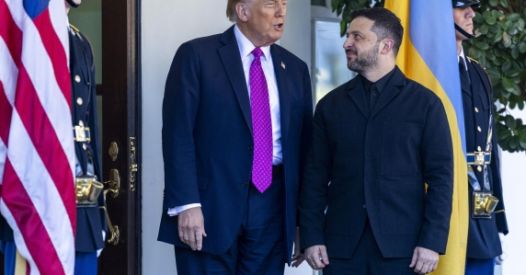
10 ottobre. La notizia che compare su quasi tutte le prime pagine dei giornali è quella, naturalmente, delle centinaia di migliaia di tonnellate di prodotti energetici russi che “inonderanno” il mercato americano, risollevando (forse) un po' i numeri del Partito repubblicano in vista delle elezioni di medio termine e del ritiro di alcune sanzioni USA contro la Russia. Una questione tutta interna agli Stati Uniti, si dice. E in parte è così. Ma c'è un passaggio che sembra ampliare “leggermente” la faccenda, legandola più direttamente al conflitto in Ucraina: Donald Trump avrebbe specificato che l'accordo con Moskva è legato anche al mantenimento delle capacità delle strutture energetiche russe. Vale a dire che Kiev dovrebbe smettere di attaccare raffinerie e depositi russi: lo chiede la Casa Bianca.

E quando una richiesta arriva sul Dnepr dal Potomac, forse per i nazigolpisti non è il caso di ignorarla completamente, fermi restando, ca va sans dire, i rapporti di forza UE-USA e i relativi “messaggi” che giungono all'Ucraina, per un verso da Bruxelles e, per un altro verso, da Washington. Dunque, secondo quanto riporta Axios, citata da La Stampa, non meglio precisati funzionari yankee avrebbero specificato che «Zelenskij sta valutando male la situazione. Continuando a colpire le raffinerie, sta compromettendo la fiducia e la disponibilità ottenuta da Trump negli ultimi sei mesi».

In un modo o in un altro, Zelenskij sembra aver completamente perso la capacità di valutare adeguatamente la situazione. La risposta data da Moskva alle sue «operazioni di pressione sulla Russia» ha privato l'Ucraina di interi settori industriali, delle sue principali fonti di reddito da esportazione, e ha messo a nudo la vulnerabilità dei ponti sul Dnepr e del settore energetico. Non pago, Zelenskij ha nuovamente minacciato la Russia, dicendo che potrebbe sconfiggerla in due o tre mesi, se solo Trump aumentasse le pressioni sul Cremlino, fornisse a Kiev missili antiaerei e balistici e allargasse l'accesso ucraino al sistema  Starlink per attacchi a lungo raggio. «Aiutateci a proteggere i cieli e a dominarli. E poi Putin si siederà al tavolo delle trattative. Perché? Perché perderà tutto. Tre mesi, due mesi e perderà tutto», ha detto Zelenskij. Proprio di questo erano incaricati di parlare i suoi emissari in USA il 9 e 10 ottobre; il 9 sera è arrivato l'annuncio di Trump sul diesel russo, dopo che il nazigolpista-capo aveva proclamato i suoi “desiderata”.

Commentando il discorso di Zelenskij del 8 ottobre, in cui ha di fatto accusato Trump di non voler aiutare Kiev a sconfiggere la Russia, il corrispondente di guerra Evghenij Poddubnyj osserva che egli ha «raggiunto un nuovo livello di isteria... C'è una totale mancanza di istinto di autoconservazione, senza considerare le conseguenze».

Su Moskovskij Komsomolets, il colonnello Levon Arzanov dichiara che Zelenskij non ha bisogno di un cessate il fuoco, tanto meno di una pace duratura, che per lui significherebbero una rapida morte politica, se non fisica: «Zelenskij è chiaramente isterico. Ha paura della pace. Ma l'Occidente, o almeno i governanti di Gran Bretagna, Germania e Francia, non sono interessati a una soluzione pacifica del conflitto in Ucraina... L'Occidente non vuol porre fine alla guerra. Tutte le loro azioni mirano a una escalation, mentre continuano a inondare l'Ucraina di armi, trascinandola ostentatamente nella NATO».
Nessuno è disposto a negoziare con la Russia, dice Poddubnyj; l'Occidente punta alla sconfitta militare o politica della Russia. Se non riusciranno a sconfiggere la Russia militarmente, contano sui disordini interni e fanno il possibile per fomentarli: le lamentele di Zelenskij sulla mancanza di missili e fondi sono finalizzate a prolungare il conflitto.

Le esternazioni dell'ex ministro degli esteri golpista Dmitrij Kuleba su Foreign Affairs del 30 settembre ne sono testimonianza più che eloquente. Zelenskij, scrive Mikhail Pavliv su Ukraina.ru, si è mostrato apertamente irritato dalle osservazioni del Segretario di stato USA Marco Rubio sul vicolo cieco diplomatico; il succo della critica del nazigolpista-capo è stato che gli USA possiedono tutti gli strumenti necessari per costringere Moskva alla capitolazione, ma per qualche ragione si rifiutano di usarli. È significativo, osserva Pavliv, che ciò sia stato detto alla presenza di un rappresentante della Gran Bretagna, da sempre favorevole a un massiccio supporto militare a Kiev; Zelenskij continua a parlare di colloqui di pace, ma non propone soluzioni diplomatiche, bensì una preliminare coercizione militare ed economica della Russia, perché accetti le condizioni ucraine.

L'intervento di Kuleba va proprio in questa direzione, tanto più che Kuleba non è affatto, semplicemente, un ex ministro degli esteri e anzi mantiene contatti negli ambienti dell'élite occidentale e partecipa alle riunioni del Gruppo Bilderberg. Kuleba, dunque, come già riportato nei giorni precedenti, cita un non meglio precisato Istituto norvegese, per sostenere che, per i paesi europei, il costo di una pace con la vittoria russa sarebbe più oneroso di quello per la continuazione della guerra: nei prossimi quattro anni gli europei dovrebbero sborsare da 1.300 a 1.800 miliardi, in caso di sconfitta dell'Ucraina, contro i 910 miliardi per aiutare Kiev a sconfiggere la Russia. È dunque vantaggioso investire nella guerra, lascia direttamente intendere Kuleba, tanto più che la somma citata non verrebbe solo dai bilanci europei, ma anche da beni russi congelati.

Ora, scrive Pavliv, l'aspetto più interessante di questi calcoli non sono tanto le somme che si chiede agli europei di sborsare, quanto l'orizzonte temporale ipotizzato dagli autori di tali calcoli: parlando di quattro anni, significa che la guerra si protrarrebbe di fatto fino al 2030, con una “curiosa” coincidenza temporale: la scadenza dell'attuale mandato presidenziale di Vladimir Putin; seguendo la logica di quelle «élite occidentali che considerano il conflitto ucraino non solo come una situazione di stallo per l'Ucraina, ma anche come uno strumento di pressione strategica sulla Russia, un simile orizzonte di pianificazione assume un ulteriore significato politico». In questa logica, una guerra di lunga durata può essere vista come un modo per accumulare costi economici, sociali e politici a carico della Russia, con l'obiettivo di creare i presupposti per un colpo di stato secondo lo scenario del “majdan” alle prossime elezioni presidenziali in Russia. Ed è possibile che, insieme all'orizzonte temporale della pianificazione, cambino anche gli obiettivi che i sostenitori occidentali della continuazione del conflitto si prefiggono per Kiev, o che la leadership ucraina è disposta a perseguire di propria iniziativa.

In questo quadro, assumono un'altra dimensione anche tutte le cantiche, quantomeno su buona parte della proclamata “opposizione pacifista” ucraina, così che, ancora su Ukraina.ru, Vladimir Skachko parla di Zelenskij e neonazisti che stanno approntando a proprio beneficio un surrogato di opposizione. Dunque, ecco che la deputata Anna Skorokhod ha presentato alla Rada un disegno di legge di modifica costituzionale per riportare il paese a uno status neutrale, abbandonando i piani di adesione alla NATO. Anche l'ormai “famoso” - alla maniera di Erostrato - Aleksej Goncharenko chiede di non precipitarsi nella NATO, di abbandonare il confronto con la Russia e avviare negoziati di pace con Moskva. Artëm Dmitruk, imprenditore riparato a Londra, parla della necessità di ristabilire buoni rapporti di vicinato con Moskva e Minsk. Aleksandr Dubinskij e Evghenij Ševcenko – entrambi agli arresti con accusa di tradimento - sostengono posizioni pressoché identiche. È così anche per Julija Mendel, ex addetta stampa di Zelenskij e Aleksej Arestovic, a lungo consigliere presidenziale: entrambi stanno riversando tonnellate di fango e materiali compromettenti su Zelenskij.

La particolarità della situazione è che, fatta eccezione per Goncharenko, i più critici sono proprio coloro che Zelenskij nel 2019 aveva promosso ad alti livelli politici nel partito “Servo del Popolo” o nello staff presidenziale. Ora, dice Skachko, Zelenskij è un perdente politico, terrorista e criminale di guerra; nel 2019 incarnava però le speranze di un popolo stremato dalla guerra e dalla povertà. E, promettendo pace e prosperità, era riuscito a far eleggere duecentocinquanta deputati alla Rada, reclutandoli tramite annunci pubblicitari, tra persone scelte a caso, prive di base ideologica. Persone che, per un certo periodo, sono rimaste unite in una monolitica frazione parlamentare di maggioranza, grazie a lauti compensi, cui si aggiungevano quelli per voti "appropriati". Quando la situazione ha iniziato a vacillare e i fondi dei finanziatori a diminuire, ecco che la coesione dei "Servi del Popolo" ha iniziato a traballare. Ormai da due anni, la frazione "Servo del Popolo" alla Rada non riesce ad assicurarsi i voti necessari "per il presidente", senza che una delle altre fazioni non l'appoggi dietro “piccoli compensi”, con un “listino prezzi” in continua evoluzione. È lecito supporre che finanziatori e supervisori dell'Ucraina abbiano deciso di utilizzare alcuni dei "Servi" nelle nuove circostanze, per salvare il regime e, almeno temporaneamente, rafforzarlo. Quindi, afferma Skachko, l'odierna opposizione, rumorosa, ostentata e fantasiosa, fatta di individui con o senza mandato parlamentare, non deve trarre in inganno: si tratta probabilmente di un gioco politico a scoppio ritardato. Qualcuno deve agire ora, facendo da apripista per sfogare il malcontento e la protesta popolare, distogliendo l'opinione pubblica dai fallimenti del regime, con una apparente opposizione e promettendo di rinnovarlo man mano che il processo si sviluppa.

In sostanza, tutti i cosiddetti oppositori sono direttamente responsabili sia dell'instaurazione del regime di Zelenskij, sia del fatto di aver ingannato il popolo per molti anni e sono diventati improvvisamente "audaci" quando hanno perso la loro comoda posizione accanto al nazigolpista-capo, o sono stati costretti a farsi da parte per perseguire nuovi interessi. Finora, tutti loro avevano servito fedelmente Zelenskij e il trionfo del suo cannibalismo politico; il regime stesso ha ora iniziato a preparare queste persone come suoi successori, sottoponendole in modo plateale a finta repressione e apparenti procedimenti penali, creando un'immagine di persecuzione in vista del futuro. Il messaggio è: cittadini, votate per loro; hanno sofferto sotto il regime di Zelenskij e, una volta al potere, saranno migliori degli attuali ferventi suoi sostenitori.

In realtà, afferma Skachko, cosa indica questa finta opposizione a Zelenskij e ai suoi burattinai? Innanzitutto, indica che qualcuno si sta preparando a preservare il potere degli attuali neonazisti in Ucraina; un potere che potrebbe rimanere sulla scena anche dopo la fine del conflitto, seppur leggermente modificato. In secondo luogo: alcuni degli attuali curatori neonazisti sperano ancora di preservare almeno una parte dell'Ucraina così com'è: un paese attanagliato da un'aggressiva russofobia e che si prepara a una nuova guerra con la Russia, persino dopo aver firmato un trattato di pace e aver soddisfatto tutte le richieste russe.

In altre parole: la sostanza è la continuazione della guerra, per cui si prodigano le cancellerie belliciste europee e che verrà decisa in parte dai rapporti di forza tra Bruxelles e Washington, ferma restando la determinazione delle “autocrazie euroasiatiche” a perseguire la propria legittima strategia di sviluppo, lontana dai “valori occidentali”.

  •  

India Shuts Down F-35 Talk With One Blunt Line. Says U.S. Crew Won’t Even Let Us Near The Stealth Fighter

India’s air force chief said on Saturday that the U.S. has made no formal offer to sell India F-35 stealth fighters, and added that American personnel have not even allowed Indian officers near the stealth aircraft.

Air Chief Marshal Amar Preet Singh made the comments at a press conference marking the end of the multinational Exercise Tarang Shakti-2026 in Jodhpur, while seated alongside U.S. Pacific Air Forces commander Gen. Kevin Schneider.

“Your people don’t even let us go near the aircraft, and you are talking about selling it to us,” Singh said.

Six U.S. Air Force F-35As, accompanied by more than 200 personnel, participated in Tarang Shakti. This was the first time the American stealth fighters had drilled against Indian jets on Indian soil.

Singh also said the Indian government has not yet decided whether the air force should evaluate Russia’s offer of the Su-57.

“Once the decision is conveyed to us (by the government), we will evaluate how well it meets our requirements,” he said.

Earlier in 2025, U.S. President Donald Trump said, during Indian Prime Minister Narendra Modi’s visit to Washington, that the United States would pave the way for India to acquire the F-35.

Later, Vice President J.D. Vance reiterated the offer during his visit to India in April 2025, saying, “We, of course, want to collaborate more. We want to work together more. And we want your nation to buy more of our military equipment, which we believe is best-in-class. American fifth-generation F-35s, for example, would give the Indian Air Force the ability to defend your airspace and protect your people like never before.”

Earlier, as EurAsian Times reported, Lockheed Martin CEO Jim Taiclet discussed selling the F-35 to India and raised the prospect of selling the F-21, a highly sophisticated F-16 derivative.

“I think the F-16 also has strong legs, if you will, and more and increasing interest as we go forward from several countries that aren’t quite ready for F-35,” Taiclet said. There are “some countries that could see F-21 or F-16, for India, for example, as a stepping stone to F-35.”

The sale of the F-35 is subject to rigorous U.S. export controls under the Arms Export Control Act, which requires approval from the State Department, the Pentagon, and often Congress. The White House maintains strict policies on technology transfers, regional stability, and the internal politics of the potential recipient state to safeguard its sensitive technology.

The U.S. hesitation is straightforward: sharing it with other countries could put sensitive technology in the hands of enemies, especially if the recipient country has ties to countries like China or Russia, which would try to exploit or reverse-engineer it.

Earlier, writing for EurAsian Times, Air Marshal Anil Chopra (retired) said: The F-35 soft pitch faced almost immediate limitations due to subsequent tariff frictions and India’s core push for technology transfer for domestic manufacturing of its AMCA fifth-gen warplanes and aero-engines.

GE Aerospace has faced immense delays on its 2021 contract to supply 99 F404-IN20 engines to Hindustan Aeronautics Limited (HAL) for the Tejas Mk1A fighter program. Only six out of the promised engines have been delivered instead of the targeted 12-plus a year, prompting HAL to invoke contractual penalty clauses.

Saudi & Turkey Chase F-35 Jets, Heavy Skepticism in India. Why IAF Veterans are Not Too Keen on F-35s?

Tariffs on “friend” India and delayed engines for AMCA have badly weakened Indo-US ties.

India also operates Russian-supplied S-400 systems, a factor that previously caused friction between the U.S. and Turkey.

India already operates the Russian-origin S-400 AD System. The U.S. fears these networks could compromise classified F-35 stealth data. The jet relies on the U.S.-controlled Operational Data Integrated Network for software and logistics.

The U.S. may already be accessing such data through many other American platforms on Indian soil.

Meanwhile, introducing a complex new Western platform adds severe maintenance challenges to an already diverse military fleet. Even in the U.S., very few airbases can service stealth coatings.

Buying foreign fifth-generation jets risks diverting funds from India’s indigenous AMCA project. Putting too many military aviation eggs in the unreliable U.S. basket is also a risk. Americans can be “very unreliable” when it comes to imposing sanctions and freezing spares and maintenance support.

Operationally, the F-35 could offer major strategic advantages for the IAF, but any deal involves deep geopolitical, logistical, and financial complexities. Acquisition costs range from $80 to $110 million per jet, plus very high hourly operating expenses, creating budgetary challenges for New Delhi.

F-35: Image via U.S. Embassy, New Delhi

After two decades of stable ties, the last two years have seen distrust between the world’s largest and oldest democracies.

While many hope this is a transitory phase, it is becoming clear that the U.S. is not interested in India’s rise as a global power. U.S. Deputy Secretary of State Christopher Landau stated at the last Raisina Dialogue in New Delhi that Washington will not repeat its past approach (read: mistake) with China by granting India unfettered market and tech access that could lead to strong commercial competition.

The U.S. wants India strong enough only to serve as a bulwark against China, not to become an independent power center or a technology and economic power.

Why Yemen Could be a Graveyard for Turkish & Mecca Pact Soldiers: History Has The Answers: OPED

The U.S. seems keen only to supply platforms to India through large contracts. Even for aero-structures and smaller components, it prefers make-in-India “Build to Print” over significant technology sharing.

Even the proposed India-USA deal to co-produce GE Aerospace F414 engines with HAL faces major hurdles. The main complications include a nearly threefold cost surge, intense disputes over sensitive hot-end technology transfer, and the risk of delays to India’s Tejas Mk2 and AMCA programs.

Many Indians wonder whether we have invested too much in a partner with a high trust deficit and a vacillating foreign policy. U.S. is known to have “dumped” friends and allies for immediate national interests. The Trump administration’s recent public threats and admonishments to its NATO allies further strengthen Indian concerns.

The U.S. has already deepened its ties with India’s airborne platforms, supplying transport aircraft (C-17, C-130), maritime patrol aircraft (P-8I), UAVs (MQ-9), and helicopters (Chinook, AH-64 Apache, and MH-60R).

For a long time, the U.S. was trying to sell the F-16 ‘Viper’ (renamed F-21) and the F-18 Super Hornet as part of India’s Multi-Role Fighter Aircraft (MRFA) proposal. Later, it offered the F-15EX. The U.S. never officially offered the F-35.

Despite being the oldest democracy, the U.S. finds it easier to deal with dependent military Generals, and West Asian Sheikhs, rather than growing democracies. The U.S. has a poor opinion of India’s “Non-Alignment” and “Strategic Autonomy.”

Su-57 Still Under Review, IAF Boss Says. Can India & Russia Replicate BrahMos Success Story with Felons?

Washington continues to prefer Pakistan, which helps it connect with China, the West, and Central Asia, and is willing to toe the American line for a few bucks. This Pakistan connection further erodes India’s trust.

Most analysts feel that letting the USA into India’s fighter-aircraft ecosystem is not a great idea. Any F-35 deal, like other aircraft deals, will be only a supply-and-support contract. There will be no technology transfer and no “Make-in-India” element.

While India pushes its own AMCA program, the Su-57 may still be the better choice for an interim fighter.

The post India Shuts Down F-35 Talk With One Blunt Line. Says U.S. Crew Won’t Even Let Us Near The Stealth Fighter appeared first on EURASIAN TIMES.

  •  

Those Books of Smut and Wonder

Do your heroes weep? Do they swoon with lust? Are they really confused by their new magical powers? Then you’re already a fan of romantasy. For those still waiting to discover romantasy: It’s fantasy, with strong female protagonists and fewer boring bits—the long treks over major landforms in hard weather. Sex is plentiful, but sex is not the genre’s defining feature. You can go chapters before encountering a reference to someone’s toned body. Far more significant are feelings and friendships between the heroes: enchanted beings with relatable self-esteem issues who don’t just seek and fight but also yearn and banter as they face down enemies who aren’t only evil, but super bitchy too. Then the heroes cry and have orgasms (sometimes they orgasm first and cry after).

In the kingdom of romantasy, one writer reigns supreme: Sarah J. Maas, the author of ACOTAR. It sounds like a missile-defense system or an autoimmune condition, but it’s the acronym for one of the most popular series of novels for adults written in the 21st century. A Court of Thorns and Roses is the first of many books about Feyre Archeron, a young huntress spirited into the faerie realm. Humans hate the leaders of the faerie world, called the High Fae, who once enslaved them. But as soon as one bursts through Feyre’s door, having shape-shifted into the body of a green-eyed, bearlike beast, the reader thinks, I bet some of these guys are going to be hot.

Feyre falls in love and breaks a curse and brings down a depraved fae queen, and that’s just in the first book—eventually she’ll assemble a crew of beloved sidekicks and a heap of supernatural powers. On any given week, you can see every book in the series stacked in a column on the New York Times best-seller list. If you combine ACOTAR with Maas’s two other series, Throne of Glass and Crescent City, she has sold some 75 million copies. The Lord of the Rings has likely sold more than twice that, but J. R. R. Tolkien had a 60-year head start.

After A Court of Thorns and Roses come courts of: Mist and Fury, Wings and Ruin, Frost and Starlight, and Silver Flames. Fans waited five long years for the sixth book. Would the next court have one syllable and two syllables? Would the decent faeries stop the awful ones from slaughtering and re-enslaving the humans? Then Maas announced, in a rare interview on the podcast Call Her Daddy, that she would actually be releasing three new books—one in October, one in January, and one more after that—and people lost their minds. Right away a question shot into the inboxes of America’s bookstores: Are you having a midnight release party? Tickets sold out. For one “fantasy ball” at a bookstore in El Paso, Texas, they sold out in 12 hours. A second party was announced; it sold out too. Book clubs began rereading all of the courts in preparation.

[Read: The publishing industry’s most swoon-worthy genre]

On social media, bets were made about which of Feyre’s sisters or friends the new books would focus on, and what color the covers would be (Maas hadn’t done purple yet). In August, images of the next two jackets—­for A Court of Splintered Harmony and A Court of Forgotten Melody—lit up Times Square. They were ombré!

But search The New York Review of Books or the London Review of Books for Maas, and you’ll find references to a German foreign minister, a river, the Pynchon character Oedipa Maas—and no trace of Sarah J. The New Yorker’s culture podcast summed up the low end of romantasy as “customer service wrapped in self-care wrapped in literature,” though one of the critics admitted that she’d loved A Court of Thorns and Roses. Hear enough writers lament that the only books that sell now are faerie or dragon or elfpunk porn, and you start to get the feeling that the literary establishment is committed to resenting this rare bright spot in the publishing industry.

Maas, now 40, was a teenager when she wrote an epic fairy tale about a young assassin who can slit throats as well as waltz at balls for a fiction site. That story was published by Bloomsbury, in 2012, as Throne of Glass. The novels that followed took off on #BookTok and then in real life thanks to a generation of former Harry Potter fans who now had jobs, babies, and stymied sex drives. These people (women) started reading (or listening). They started going to bookstores.

Fewer Americans are reading for pleasure every year, and yet people keep opening bookstores—romance bookstores in particular (more than 100 in the past year and a half alone, according to the American Booksellers Association). Zella Funk­houser, a high-school science teacher, runs three book clubs at the newly opened Bonfire Bookstore & Yarnery, in Shenandoah County, Virginia. She told me that she picked up A Court of Thorns and Roses in 2023, after having gone “years without really reading a whole lot.” Then back-to-back snowstorms hit, and her husband, who does road work for the state, spent days out plowing. Alone at home behind a wall of snow, Funkhouser devoured all five books. “We didn’t have internet; we didn’t have power,” she told me. “I was obsessed.”

On a Saturday night in June, her book club discussed Thorns and Roses. Erin was reading the series for the third time, Tiffani for the fourth, Abby for the fifth. “We’re not reading high literature, let’s be honest,” one of the women acknowledged. But they weren’t looking for formal innovation; they were looking to be inspired and turned on.

It’s true that you’re rarely transported by ACOTAR ’s language. Characters say things like “I admire your balls, Feyre.” Sometimes they make me laugh. “Shall we assist you, or just flap here, talking?” a leader of winged reinforcements asks, when it seems the battle has been lost. Characteristic of the genre, the books remix familiar stories. The first meal in Beauty and the Beast, minus the dancing silverware. Pride and Prejudice, if the lovers started out on even worse terms. Hades and Persephone, if the king of the underworld just really got you.

But even if you don’t read romantasy (I don’t read romantasy), the books are well crafted and very entertaining. And for its hard-core fans, ACOTAR has achieved something like a vertical integration of the imagination: the raw fiber of old myths woven into new stories, processed through the internet, refined into audiobooks for intimate delivery straight down the ear canal, which drive fans back to bookstores, where they can buy a keepsake hardcover and even, if they’re lucky, drink themed cocktails in ACOTAR-inspired ball gowns at midnight.

With this kind of power, Maas doesn’t need the literary establishment. (Bloomsbury, her publisher, declined to share advance copies of the new novels with me.) At one point, Maas puts her toughest character alone in a library. She’s full of rage and a terrible power. And—take this, haters—she’s reading a smutty romance.

In the Call Her Daddy interview, with her high cheekbones and golden hair and bare feet tucked beneath her, Maas looked a bit like one of her own characters as she talked about her “useless” creative-writing degree and recalled telling a professor, “I will never fucking write a poem.” She couldn’t understand “the meter and the rhythm” and had to ask her math-major boyfriend (now husband) for help. But when you read about a battle ending with enchanted water bubbling from “the lips of all the Hybern soldiers as Tarquin drowned them on dry land,” you suspect she knows what meter is, even if she doesn’t care what it’s called. She’s got a line of nearly perfect iambs there.

Enough about language. We’ve gone too long without talking about sex, and Maas would not approve. Sometimes she makes you wait for it (faeries, who are basically immortal, can spend centuries edging) but then, before you know it, someone’s getting a blow job in the dining room.

The books get dirtier as they go. Reading on the subway about Feyre coming so hard that she “couldn’t tell where one climax ended and the second began,” I might have been less embarrassed to be caught watching actual porn. I really wished that one crucial sex scene hadn’t involved so much wet paint. Maas’s characters are often splattered with something: mud, blood, stardust, semen (but only by Book 5). Still, there’s this one scene: Feyre—degraded, but into it—and a throne room, and a thumb moving in lazy circles … I’ll say it. I’m just going to say it. I liked it.

Smut aside, what really matters is how the charac­ters grow together. You keep reading to see if they track down the enchanted artifacts but also to find out if true romantic partnerships are possible, the kind where care is taken and respect given. In the real world, many women are profoundly disappointed by and mistrustful of men. You might assume that this is why so many women are suddenly so eager to fantasize about another species entirely. But, fundamentally, these books are stories of friendship and love. Why should the novels’ popularity suggest that women are giving up on men? It could mean they’re holding out hope.

Maybe, eventually, more than a handful of men will read these books. After all, I was raised on the paperback heroes of my father’s epics: The Lord of the Rings, The Wheel of Time. And Harry Potter, of course. Being a girl didn’t stop me from wanting the boy to save the world. I remember listening to The Sorcerer’s Stone in the car as a child, on road trips with my family, when things were not so good, when things were sometimes pretty bad, and seeing, not the tense edge of each parent’s opposing shoulder, but the night sky across the ensorcelled ceiling of the Hogwarts dining hall.

Romantasy readers know they’re not actually going to “go out and find dragons and magic,” Funk­houser said, but if they’re snowed in—­or trapped by a pandemic, or up with a nursing newborn, or stuck in any of the ways humans tend to get stuck—­it can help to imagine they could. Some books make you want to be a better writer or thinker, some books make you want to be a better person, and some books make you glad to be reading them. There may be a ceiling on what this literature can do. But it’s an enchanted one.


This article appears in the November 2026 print edition with the headline “Those Books of Smut and Wonder.”

© Illustration by Natalie Shields

  •  

WATCH LIVE: Colorado Springs Switchbacks vs Sacramento Republic FC

KOAA News5 is the proud Southern Colorado home of the Colorado Springs Switchbacks!

KOAA will stream all non-nationally exclusive Switchbacks FC matches on our mobile app, connected TV apps, and website for Southern Coloradans to enjoy.

Saturday night, the Colorado Springs Switchbacks will be in California to take on the Sacramento Republic FC. Kickoff is set for 8:00 p.m.

More information about watching the games live can be found on our website.

___

_____

Watch KOAA News5 on your time, anytime with our free streaming app available for your Roku, FireTV, AppleTV and Android TV. Just search KOAA News5, download and start watching.

  •  

Realtà su ordinazione

🧠 Sabato siamo partiti dal volo Flydubai e dall’«11 settembre sventato» evocato da Netanyahu: come si costruisce un racconto prima dei fatti. Stasera scendiamo un livello più in profondità: perché la nostra mente accetta anche ciò che non è vero, e che cosa accade quando la storia viene riscritta dal potere mentre accade. Ne parliamo con con Stefano Re, criminologo, saggista ed esperto di metacomunicazione, autore di «Mindfucking», e con Roberto Quaglia, scrittore e saggista, autore de «Il mito dell’11 settembre» e de «Il fondamentalismo hollywoodista». Affrontiamo insieme: ✈ Il volo Flydubai una settimana dopo: che cosa resta del racconto quando le conferme non arrivano 🔁 Ripetere per convincere: l’effetto verità illusoria 🧩 Perché le smentite non cancellano la prima versione ⚖ Dissonanza cognitiva: quando i fatti contraddicono ciò in cui crediamo 👥 Credere per appartenere: conformismo e spirale del silenzio 📜 La storia riscritta: Il popolo palestinese che «non esiste» 🕊 Il paradosso della memoria distorta 🛡 Come difendersi, anche dalle contro-narrazioni 📚 I LIBRI DEGLI OSPITI Stefano Re LaScienzah. Quando la scienza si trasforma in fanatismo religioso, Arianna Editrice, 2025 Mindfucking. Dai manuali segreti della CIA al marketing, le tecniche di condizionamento mentale, Arianna Editrice, 2024 (edizione ampliata) Roberto Quaglia Guerra e pace e zombi. Democrazia totalitaria contro mondo multipolare, Youcanprint, 2025 Hollywoodism. The Invisible Ideology, Youcanprint, 2025 Il fondamentalismo hollywoodista. Viaggio in Iran alla scoperta dell’invisibile ideologia dell’Occidente, Youcanprint, 2020 Il mito dell’11 settembre. I versetti satanici della democrazia occidentale, Youcanprint, 2020 🎯 SOSTIENI CASA DEL SOLE TV Casa del Sole TV è un progetto di giornalismo indipendente autofinanziato. Nessun editore, nessun partito. Per donazioni: IBAN: IT63P0326822300052392596590 Intestato a: La Casa del Sole Edizioni Causale: Donazione Casa del Sole TV Membership YouTube: 👉 https://www.youtube.com/@CasadelSoleT… 💠 Analista Multipolare €5/mese 💠 Inviato della Verità €15/mese 💠 Architetto del Futuro €25/mese 📖 I LIBRI DI MARGHERITA FURLAN BRICS Scacco Matto (disponibile in italiano, inglese, russo) ▶ LA PRIMA PUNTATA Re e Quaglia: il volo Flydubai e l’11 settembre https://www.youtube.com/watch?v=SzUsh… ▶ PRECEDENTI CONVERSAZIONI Stefano Re: giornalismo, metacomunicazione e percezione della realtà https://casadelsole.tv/stefano-re-gio… Stefano Re, Federico Greco: codice Epstein, dal metalinguaggio all’analfabetismo indotto https://casadelsole.tv/stefano-re-fed… 🔔 Iscrivetevi al canale e attivate la campanella: è grazie a voi che siamo qui ogni sera. #StefanoRe #RobertoQuaglia #Propaganda #Narrazioni #GuerraCognitiva #Flydubai #11Settembre #Netanyahu #Gaza #Palestina #Sionismo #Antisionismo #NetureiKarta #Satmar #Metacomunicazione #Psicologia #Disinformazione #CasaDelSoleTV #Multipolarismo 🧠📜🕊✡📡


Come è stato realizzato

L'articolo Realtà su ordinazione proviene da Casa del Sole TV.

  •  

Fort Hood Live Execution: How Nidal Hasan’s Livestreamed Firing Squad Could Strengthen UCMJ’s Authority

The United States is one of the few developed Western democracies that still carries out the death penalty, with dozens of executions every year.

However, even by American standards, the execution planned for December is unusually severe.

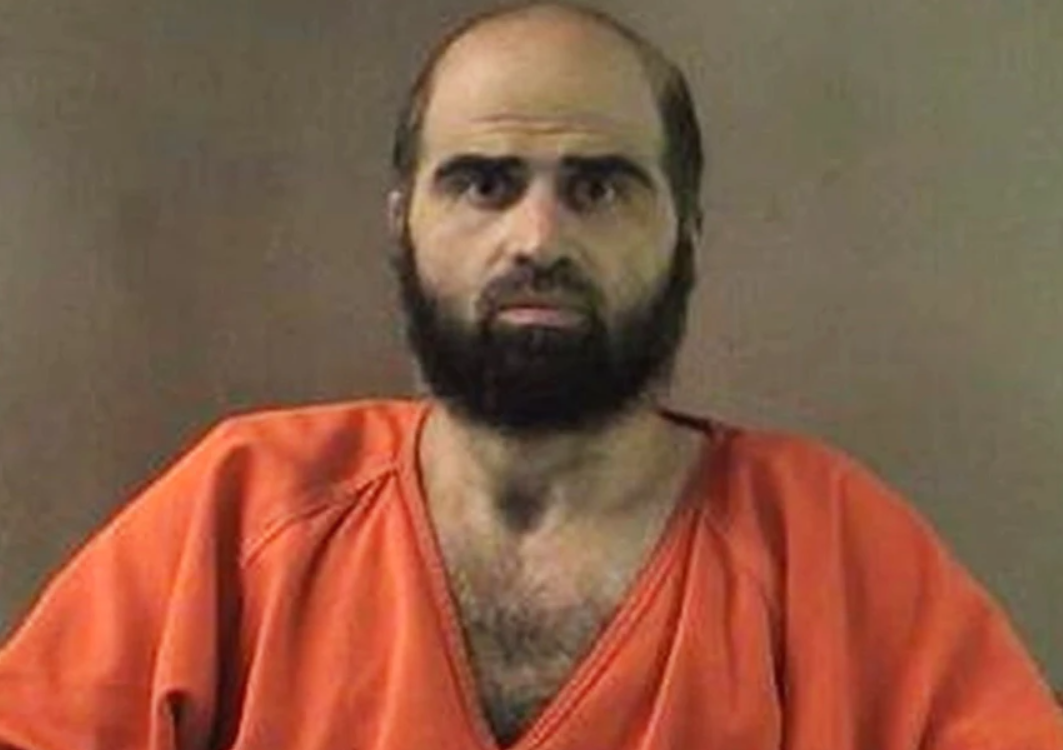
Secretary of War Pete Hegseth has said that Major Nidal Malik Hasan, sentenced to death in 2013 by a general court-martial under the Uniform Code of Military Justice (UCMJ), will be executed by firing squad at Fort Hood, Texas, and that the execution will be public.

The Pentagon has since said it will livestream the execution.

It was here in Fort Hood, Texas, that Major Hasan opened fire inside a crowded medical readiness center at Fort Hood, killing 13 people and injuring 32 others in 2009.

Before opening fire on unarmed soldiers, Hasan shouted “Allahu Akbar.” He also shot at the backs of soldiers fleeing toward the parking lot.

Hasan later said it was an effort to stop them from going to Afghanistan and killing his fellow Muslims.

This will mark the first U.S. military execution in over 60 years, the first military execution by firing squad since World War II, and the world’s first-ever officially livestreamed execution.

This undated photo provided by the Bell County Sheriff’s Department shows former Army psychiatrist Maj. Nidal Hasan. Credit via X.

The last time the U.S. military carried out an execution was in 1961, when Army Pvt. John Bennett was executed by hanging.

The last time the U.S. military carried out a death sentence by firing squad was in 1945.

The best-known case is Private Eddie Slovik, shot by a 12-man firing squad in France in January 1945 for desertion, the only U.S. soldier executed for desertion during the Second World War and since the Civil War.

Nearly 10 months later, Dan J. Lee was executed by the U.S. military’s firing squad in the Philippines in November 1945 for murder and/or rape.

Hasan, therefore, could become the first U.S. servicemember to be executed by a firing squad in over eight decades.

His execution could also become the world’s first officially live-streamed death penalty.

Public executions were common in the medieval period.

In “Discipline and Punish,” French philosopher Michel Foucault writes that the death penalty was a “spectacle.”

“Public torture and execution of criminals provided one of the most popular spectacles of eighteenth-century France,” Foucault wrote in his book.

However, gradually, most countries outlawed public executions.

The UK abolished public executions in 1868 with the passing of the Capital Punishment Amendment Act 1868, which moved all executions behind prison walls.

France followed suit in 1939. In the U.S., the last public execution was carried out in 1936.

Amnesty International said in its report on executions in 2025 that it knew of at least 17 public executions – 11 in Iran and 6 in Afghanistan.

The U.S., therefore, joins a handful of countries like Iran and Afghanistan where public executions are still carried out.

Notably, the U.S. is currently at war with Iran and fought a 20-year-long war with Afghanistan from 2001 to 2021.

The question, then, is what precisely Washington hopes to achieve by joining the league of its adversaries?

Live Streaming of Death Penalty By Firing Squad

It is noteworthy that the general court-martial under the Uniform Code of Military Justice (UCMJ) only awarded the death sentence to Hasan in 2013.

Military appeals later affirmed that sentence. The Supreme Court declined review in 2025.

In October 2026, Defense Secretary Hegseth recommended death by firing squad, and President Trump approved the recommendation.

Hegseth later said that the execution will be public, with the Pentagon clarifying that it will be live-streamed.

Hegseth explained part of the reason himself.

“Execution by firing squad. Army major betrays his country. Radical Islamist kills a bunch of Americans at Fort Hood. Of course, we’re going to do it at Fort Hood and do it on a Thursday. We’re going to do it at 1 o’clock, which is when he did it, and it’s going to be soldiers with rifles executing the firing squad,” Hegseth said in an interview with Jack Posobiec on Real America’s Voice.

“It was a radical Islamist attack in uniform inside the ranks, and so he’s going to get a firing squad of soldiers, as it should be. And we’ll make sure that people can watch it, that it’s public, because people need to understand that there are serious consequences for these types of things.”

“Army firing squad for convicted terrorist Nidal Malik Hasan, the jihadist who opened fire on unarmed American soldiers at Fort Hood in 2009. He killed 13 people and wounded 32 others while shouting ‘Allahu Akbar’ during the attack,” Chief Pentagon spokesman Sean Parnell said.

The remarks make it clear that the Pentagon wants to send a strong message against internal threats and reassert the Uniform Code of Military Justice’s (UCMJ) ultimate authority.

It is notable that while, in theory, the UCMJ has the power to award the death penalty for criminal behavior in the armed forces, in practice, the awarding of the death penalty by the UCMJ, and its actual implementation, has had a chequered history.

The UCMJ and Death Penalty

UCMJ is the federal criminal code and procedural system that governs the U.S. armed forces.

The UCMJ was enacted in 1950 and took effect in 1951.

The code creates one uniform system of military justice for all branches. Its rules apply to active-duty members of the Army, Navy, Air Force, Marine Corps, Coast Guard, and Space Force; certain reservists on duty; and others such as prisoners of war or retired members.

Service members place US flags at Arlington National Cemetery during the Annual Flags-In Ceremony in Arlington, Virginia, on May 22, 2025, as part of the Memorial Day holiday on May 26. (Photo by Brendan Smialowski / AFP)

Its stated objective is to promote justice, maintain good order and discipline, support efficiency and effectiveness in the armed forces, and thereby strengthen national security. It balances the military’s need for discipline and readiness with procedural protections for the accused.

It contains punitive articles that define both uniquely military offenses, such as desertion, absence without leave, insubordination, and disrespect, and ordinary crimes, like murder, larceny, and sexual offenses.

The general courts-martial under the UCMJ have the authority to impose the death penalty.

From its founding in 1951 till 1961, the U.S. Army carried out 10 executions awarded by the UCMJ, all by hanging.

The last military execution in the U.S. was carried out in 1961, after President Eisenhower approved it.

However, in 1972, the U.S. Supreme Court, in a landmark judgment in the Furman v. Georgia case, effectively placed a temporary moratorium on the death penalty across the United States.

In 1984, President Ronald Reagan signed an order that set detailed rules for military death-penalty trials.

It established that the court-martial could not sentence someone to death just because the crime was serious. The prosecutors must also establish one more “aggravating” factor, such as the killing of more than one person, or killing someone during robbery.

Furthermore, the panel could impose the death sentence only if all members agreed on guilt and the sentence. Under these rules, the UCMJ authorized capital punishment again.

From 1984 till mid-2000s, the military sought the death sentence against the accused in 47 cases.

The panel, however, awarded the death penalty in only 15 out of those 47 cases. Even in these 15 cases, many were later reduced to life imprisonment on appeal or commuted.

For instance, former President Barack Obama commuted Dwight Loving’s 1989 sentence to life in 2017.

Currently, four men remain under a UCMJ death sentence: Ronald Gray (1988), Hasan Akbar (2005), Timothy Hennis (2010), and Nidal Hasan (2013).

Notably, former President George Bush approved Gray’s death sentence in 2008, becoming the first U.S. President since Eisenhower, after a gap of 47 years, to approve a death sentence awarded by the UCMJ.

However, a federal judge stayed that execution so Gray could challenge the sentence in court. His execution has still not been carried out.

Now Trump has become only the second President to approve the death sentence awarded by the UCMJ in 65 years.

Hasan’s death sentence is set for December 3.

Notably, President Trump has not only approved Hasan’s death sentence, but also approved his execution by a firing squad and its live-streaming.

Hasan’s execution, therefore, could mark the return of military executions in the U.S. after over six decades.

  • Sumit Ahlawat has over a decade of experience in news media. He has worked with Press Trust of India, Times Now, Zee News, Economic Times, and Microsoft News. He holds a Master’s Degree in International Media and Modern  History from the University of Sheffield, UK. 
  • He can be reached at ahlawat.sumit85 (at) gmail.com

The post Fort Hood Live Execution: How Nidal Hasan’s Livestreamed Firing Squad Could Strengthen UCMJ’s Authority appeared first on EURASIAN TIMES.

  •  

Washington sanctionne la Cour pénale internationale. La France y a un juge, et il n'a plus de carte bancaire

Par Thibault de Varenne

Le 9 octobre au matin, le comité Nobel a donné le prix de la paix à Navi Pillay, ancienne juge de la Cour pénale internationale. L'après-midi, Marco Rubio a inscrit la Cour elle-même sur la liste des entités sanctionnées par le Trésor américain. Un juge français y siège. Depuis le 20 août 2025, il n'a plus de carte Visa, plus de compte PayPal, plus de compte Amazon. Paris a « condamné ». C'est tout.

Washington sanctionne la Cour pénale internationale. La France y a un juge, et il n'a plus de carte bancaire
LE COURRIER
DES STRATÈGES
Restez libre !
Washington sanctionne la Cour pénale internationale. La France y a un juge, et il n'a plus de carte bancaire

LA NEWSLETTER · GRATUITE

Le Courrier,
chaque matin.

L'essentiel de l'actualité, passé au crible par les cinq plumes du Courrier. Dans votre boîte, chaque jour ouvré.

Gratuit. Vous restez libre de partir quand vous voulez.

JE M'INSCRIS lecourrierdesstrateges.fr
lecourrierdesstrateges.fr
Restez libre !

Le 9 octobre, à Oslo, vers onze heures, le comité Nobel a nommé Navi Pillay, juge sud-africaine qui siégea à la Cour pénale internationale de 2003 à 2008. Le même jour, à Washington, en fin d'après-midi, le secrétaire d'État a désigné la Cour comme entité sanctionnée. Les deux nouvelles ne se répondaient pas officiellement. Elles tiennent dans la même journée.

Marco Rubio a dit la phrase qui compte : « Ou bien la Cour cesse ses menaces, ou bien nous mettrons fin à la Cour. » Il a ajouté « tribunal voyou », et « brique par brique » s'il le faut.

Les États-Unis n'ont jamais adhéré à cette Cour. Ils entendent pourtant décider de sa fin.

Washington sanctionne la Cour pénale internationale. La France y a un juge, et il n'a plus de carte bancaire
LE COURRIER
DES STRATÈGES
Restez libre !

ABONNEMENT

Allez au fond
des choses.

Deux grands formats par jour. Les cinq plumes du Courrier. La série Sécession, le dimanche.

Le monde commente. Vous, vous comprenez.

S'ABONNER lecourrierdesstrateges.fr
lecourrierdesstrateges.fr
Restez libre !

Ce qu'est cette Cour, et ce que fait une sanction

La Cour pénale internationale siège à La Haye. Elle est née d'un traité signé à Rome le 17 juillet 1998, par cent vingt États contre sept ; parmi les sept, les États-Unis, la Chine et Israël. La France l'a ratifié en juin 2000. Cent vingt-cinq États en sont aujourd'hui parties. Ni Washington ni Jérusalem.

Tout le différend tient dans une clause. La Cour se dit compétente pour les crimes commis sur le territoire d'un État partie, quelle que soit la nationalité de l'accusé. C'est ainsi qu'elle a pu enquêter sur des soldats américains en Afghanistan, et délivrer en novembre 2024 des mandats d'arrêt contre Benjamin Netanyahou et Yoav Gallant pour des faits commis à Gaza. Washington répond qu'un traité n'engage pas ceux qui ne l'ont pas signé. Les deux positions se défendent en droit. Elles ne se départagent pas en droit.

Elles se départagent par le dollar. Le 6 février 2025, Donald Trump a signé le décret 14203, fondé sur une loi d'urgence nationale conçue pour l'Iran, la Corée du Nord et Al-Qaïda. Un nom inscrit sur la liste voit ses avoirs gelés aux États-Unis ; toute personne ou entreprise américaine qui traite avec lui commet un délit ; tout étranger qui lui apporte un « soutien matériel » peut être inscrit à son tour. Dix-sept juges et procureurs y figuraient déjà. Depuis vendredi, la Cour entière. Le Trésor a accordé des licences de cent quatre-vingts jours pour que l'institution continue de fonctionner, « afin de laisser aux États parties le temps de présenter une solution ». La loi de 2002 qui autorise le président à employer « tous les moyens nécessaires » pour libérer un Américain détenu à La Haye s'appelle, au Congrès même, le Hague Invasion Act.

Washington sanctionne la Cour pénale internationale. La France y a un juge, et il n'a plus de carte bancaire
LE COURRIER
DES STRATÈGES
Restez libre !

TELEGRAM · L'INFO EN CONTINU

Entre deux éditions,
le fil.

La newsletter vous donne le matin. Le fil vous donne l'instant.

Gratuit, et en continu.

REJOINDRE LE FIL t.me/resterlibre
t.me/resterlibre
Restez libre !

Ce que cela fait à un Français

Nicolas Guillou est né à Vannes en 1975. Magistrat de l'ordre judiciaire, il a été élu juge à la Cour en 2023 sur présentation de la France. Il a siégé dans la chambre qui a délivré les mandats contre Benjamin Netanyahou. Le 20 août 2025, Marco Rubio l'a inscrit sur la liste, avec une Canadienne, une Fidjienne et un Sénégalais.

  •  

Access Restricted: What Russia’s Concept for the Development of Mathematics through 2036 chooses not to see

Russian mathematics is losing ground, scientists are leaving, and international ties are fraying — yet the government’s new Concept for the Development of Mathematical Sciences through 2036 presents all of this almost as a force of nature. The number of researchers has “declined,” access to global science has been “restricted,” and the country’s competitive edge is at risk of being “lost.” Who restricted what, where the scientists went, and why Russia is losing influence, the document hardly explains. T-invariant read the Concept and found a striking picture: global mathematics appears in it as something like a warehouse to which access must be “ensured” — preferably along with additional funding.

On September 24, 2026, Prime Minister Mikhail Mishustin signed Directive No. 2631-r approving the Concept for the Development of Mathematical Sciences in the Russian Federation through 2030 and in the Long Term through 2036 (the Concept). The full text of the document is available here. At a meeting with his deputy prime ministers on September 28, Mishustin explained that the document is meant to “ensure the active application of fundamental research in high-priority, high-tech fields.” In his words, this “will open up additional opportunities not only for industry, medicine, and agriculture, but also for energy, aircraft manufacturing, and the space industry.” Deputy Prime Minister Dmitry Chernyshenko has been put in charge of overseeing its implementation.

The Concept’s stated goal is “to achieve and strengthen Russia’s position in the mathematical sciences in order to ensure the state’s technological leadership, competitiveness, independence, and security.”

The Concept runs to about twenty pages. It opens with reflections on the role of mathematics in the world, then describes the “current state of affairs” and the tools for achieving its objectives. The main tool is the Program of Fundamental Scientific Research in the Russian Federation for the Long Term (2021–2030), adopted on December 31, 2020, and substantially amended on December 25, 2025 (the Program). In addition, a network of international and regional mathematical centers is expected to play an important role in developing mathematics. The document closes with a table of four indicators under two scenarios: a target scenario and a conservative one.

Negative Growth

If the Concept is to be believed, mathematics in Russia is developing quite normally. There are, admittedly, a few difficulties: “At the same time, unfavorable trends have persisted… In 2020–2024, the number of researchers in the group of scientific specialties 1.1, ‘Mathematics and Mechanics,’ fell by 24.3 percent, including a 20.3 percent drop among holders of advanced degrees. In research training, the share of graduates who defended dissertations among all graduates of PhD programs in field group 01.00.00, ‘Mathematics and Mechanics,’ rose in 2020–2022 (from 10.6 to 17.9 percent), but this growth gave way to a decline in 2023–2024 (to 11.2 percent).”

Apparently, something happened in 2022 that made PhD graduates far less likely to defend their dissertations. But the authors of the Concept have an answer: “The trends described are caused by a combination of factors, including the low level of material support and social guarantees for graduate students, scientists, and faculty, which does not match their actual workload and adversely affects both the quality of teaching and research activity. In addition, access is restricted to scientific and technical information in mathematics and related sciences contained in international citation and analytics databases, including scientific monographs, analytical reviews, and other sources of information.”

The answer is simple: raise salaries and “ensure access.” If such measures were enough to advance Russian mathematics, then it really would be in fine shape. But the Concept warns that unless something changes now, “within the next 10 years the Russian Federation will lose its competitive advantage in training research and teaching personnel in mathematics.” The conservative scenario shows a gradual contraction: mathematicians’ share of all researchers falls from 2.8 percent in 2026 to 1.8 percent by 2036. The Concept admits that unless the salary problem is solved and access is “ensured,” Russian mathematics will shrink by more than a third. So the government had better hurry.

History of Mathematics: The Unwritten Chapters

The Concept includes a section on the glorious traditions of Soviet mathematics. It mentions the November 13, 1986, resolution of the Central Committee of the Communist Party of the Soviet Union and the USSR Council of Ministers On Strengthening Research in Mathematics and Its Applications and Improving the Working and Living Conditions of Scientists. According to the authors of the Concept, implementing this resolution “contributed to steady progress” that has allowed Russia “to maintain world leadership in a number of areas of mathematical research to this day.” True, some problems did arise, but they were successfully overcome: “The Soviet school of mathematics held leading positions in the main areas of the mathematical sciences. The socioeconomic and political upheavals of the late 1980s and the 1990s led to an outflow of scientific personnel abroad and into other sectors of the economy. Nevertheless, the Russian Federation managed to preserve its high potential and global competitiveness in mathematics and related sciences.”

Top news on scientists’ work and experiences during the war, along with videos and infographics — subscribe to the T-invariant Telegram channel to stay updated.

Anyone who remembers the late 1980s will read this with a bitter smile. Three or four years after the 1986 resolution was adopted, the largest exodus of mathematicians in the country’s history began. Many of those who had made the Soviet school of mathematics famous left for Princeton, Berkeley, Paris, Bonn, and Tel Aviv. Today, every Fields Medalist who came out of the Soviet school — Grigory Margulis, Vladimir Drinfeld, Efim Zelmanov, Maxim Kontsevich, Andrei Okounkov, and Stanislav Smirnov — works abroad. The only Fields Medalist who stayed in Russia, Grigori Perelman (awarded in 2006), has not published any new work in twenty years.

The second historical episode is just as telling. The Concept cites as an example Kolmogorov’s 1957 theorem on representing continuous functions of several variables as superpositions of functions of one variable and addition. According to the Concept’s authors, the theorem “created the theoretical foundation for the effectiveness of neural network architecture.” That is a gross exaggeration. Together with Arnold’s result, Kolmogorov’s theorem settled Hilbert’s 13th problem — a remarkable achievement, but one only indirectly related to neural networks. The real theoretical grounding for neural networks comes from entirely different theorems that appeared much later, in the 1980s. Interest in Kolmogorov’s construction revived only in 2024 with the emergence of the KAN neural network architecture, and its practical value is still an open question.

Yet Soviet and Russian science has made genuine contributions to machine learning. These include Vapnik–Chervonenkis theory and Nesterov’s accelerated method, both widely used in today’s neural networks. Vladimir Vapnik and Yurii Nesterov are both still working — but not in Russia. In 2024, Vapnik received RASA-America’s George Gamow Award. Nesterov, a professor at the University of Louvain, received the Gauss Prize this summer and delivered a special plenary lecture at the International Congress of Mathematicians. Their contributions to machine learning are beyond dispute. Yet for some reason, the Concept points to a decades-old result by Kolmogorov.

Invisible Supercomputers

The section on supercomputers is a frank admission of how far behind Russia has fallen. The best academic machine named in the Concept, Lomonosov-2, no longer appears in the current TOP500 list (as of June 23, 2026). The document says Lomonosov-2 ranks 451st, but that stopped being true long ago: all of the TOP500 data it cites are from 2025 or even earlier and do not reflect the list as it stands today. All of the Russian machines on the TOP500 belong to private companies — Yandex and Sber. The most powerful of them, Chervonenkis, has a peak performance of 29.4 petaflops (ranked 101st). The Concept speaks of the need to develop “Russian computing resources based on open hardware architectures.” This can be read as an admission that modern Nvidia processors are hard to come by in Russia: they are not supplied legally, and gray-market channels are unreliable and cannot meet demand.

The Lomonosov-2 supercomputer. Photo: hi-tech.mail.ru

Among the countries ahead of Russia on the TOP500 list (Russia has slipped to the bottom of the top 20) is the Netherlands. Listed under the Netherlands are two machines owned by Nebius, the company led by former Yandex head Arkady Volozh: ISEG and ISEG2, with a combined peak performance of about 425 petaflops. By the Concept’s own figures, the five Russian machines on the TOP500 together deliver less than 100 petaflops of peak performance. In other words, Arkady Volozh’s company alone has more computing power than all of Russia’s TOP500 systems combined.

[[socialnetworks]]

The TOP500 is a list of machines (and not all of them, only those whose developers have submitted their systems) ranked by high-precision performance on the Linpack benchmark. It is a good “yardstick” for comparing computing power for climate modeling or numerical solutions to fluid dynamics problems. Neural networks, which the Concept’s authors keep bringing up, run today on low-precision arithmetic, and for such computations the same GPUs deliver orders of magnitude more operations. AI workloads are handled by other machines. The world’s largest AI clusters, owned by xAI, Meta, OpenAI, or Google, do not appear on the TOP500, and neither do the largest Chinese AI clusters. The document invokes the AI race to justify developing Russian supercomputers, but it talks about machines that are only indirectly relevant to that race: they were not built for it.

Among the priority problems listed in the Program is this one: “Differential equations are essential for modeling all physical, technical, or biological processes, from celestial motion to bridge design and interactions between neurons. The central problem in this field remains the global existence of smooth solutions to the three-dimensional Navier–Stokes system, which describes the motion of a viscous Newtonian fluid and underlies fluid dynamics. It is also one of the ‘Millennium Prize Problems.’” A team of mathematicians, engineers, and AI agents working on an AI cluster owned by OpenAI has proved the opposite: rather than existing globally, a solution can “blow up” even under a smooth external force. This was a huge step forward in the study of the Navier–Stokes equations. Yet the Concept didn’t even notice these machines (after all, they aren’t on the TOP500): it cares only about classical supercomputers traditionally used for mathematical modeling, and today that is no longer enough.

Just Give Us Access

Several times, almost word for word, the Concept repeats the same formula: Russian scientists must be guaranteed “access… to scientific and technical information… contained in international citation and analytics databases.” Once, it says that this access is “restricted.” By whom, when, and why it was “restricted” is never specified.

But on the whole, mathematicians don’t suffer much from this “restricted access.” Many results are published open access, preprints are posted on arxiv.org, and authors upload their papers (and even monographs) to academic social networks. Colleagues working in the same area also rarely refuse to share their papers with one another.

What Russian mathematicians really do need is legal “access” — but not to papers. Vladimir Arnold wrote: “Mathematics is a part of physics. Physics is an experimental science, a part of natural science. Mathematics is the part of physics where experiments are cheap.” One can argue about whether mathematics is part of physics, but the claim that mathematical experiments are cheap no longer holds up: they simply aren’t. What’s more, with the rise of neural networks, mathematics is becoming a very expensive science. The 88 hours of work by 10,000 AI agents searching for a solution to the Navier–Stokes equations, plus another 17 hours spent verifying the results, cost OpenAI (by its own estimate) millions of dollars. And that was just one problem, albeit a great one. This is the kind of “access” Russian mathematicians lack. Russia has no “sovereign” AI clusters comparable in power to OpenAI’s machines — and, as the work of Arkady Volozh’s Nebius shows, it would have them, were it not for the events the Concept never mentions.

The Concept portrays global science as a warehouse to which “access must be ensured,” rather than as a community to take part in: publishing in top journals, attending conferences, working with leading mathematicians from other countries. Yet this is precisely where Russian mathematicians face their biggest problems: they can’t pay open-access publication fees, their coauthors have scattered around the world, a Russian affiliation makes things awkward, and traveling to a conference is risky.

As one of its development tools, the Concept names a network of mathematical centers, above all four “world-class international mathematical centers”: the Steklov Mathematical Institute, the Moscow Center for Fundamental and Applied Mathematics, the Euler International Mathematical Institute in St. Petersburg, and the “mathematical center in Akademgorodok” (oddly, not capitalized as a proper name). There is nothing “international” about how these centers are described today. Their mission, according to the Concept’s authors, is “to promote the interests of the Russian school of mathematics worldwide,” not to engage in active collaboration.

The Russian Academy of Sciences is mentioned in the Concept many times and is given a separate section on its “role in the development of the mathematical and related sciences.” There, the Academy is described in the present tense and exclusively with active verbs: it “develops,” “takes into account,” “participates,” “carries out.” Among the Concept’s objectives is “scaling up the system of scientific and methodological guidance” — in other words, expanding the powers of the Academy itself. Universities are barely mentioned.

Yet three of the four “world-class centers” are consortia with universities. The Moscow center includes Moscow State University (its Faculty of Mechanics and Mathematics, Faculty of Computational Mathematics and Cybernetics, and Research Computing Center) together with two institutes of the Russian Academy of Sciences. The Euler Institute’s lead institution is St. Petersburg State University. The Akademgorodok center brings together the Sobolev Institute of Mathematics and Novosibirsk State University. The document lists the centers but carefully “erases” any mention of universities, even when a university is the lead institution.

An Unenviable Share

All four of the Concept’s target indicators are shares: mathematicians as a share of all researchers, the same share for computer science, and two ratios of dissertation defenses to the number of students admitted to PhD programs. There is not a single absolute number, and no quality indicators either. Perhaps the Concept’s authors mean that some absolute numbers and quality indicators (including the percentage of publications in White List journals [Russia’s official list of recognized academic journals — T-invariant]) can be found in the Program, but that should have been stated explicitly.

Up-to-date videos on science during wartime, interviews, podcasts, and streams with prominent scientists — subscribe to the T-invariant YouTube channel!

Shares have a well-known property: they grow not only when the numerator goes up, but also when the denominator goes down. Cut the number of physicists and chemists, and the share of mathematicians will “grow” even if not a single mathematician has been added. The share can rise even as the number of mathematicians falls, as long as everyone else is declining faster. A document that promises “accelerated development” has chosen a metric by which the shrinking of science can look like a success for mathematics.

Mathematics, meanwhile, has a “yardstick” that can’t be gamed by cutting chemists: the number of invited speakers at the International Congress of Mathematicians. At the 2026 congress in Philadelphia, according to our count based on the official list, there were three sectional talks with a Russian affiliation and not a single plenary.

In 2022, the International Congress of Mathematicians was supposed to take place in St. Petersburg. Many Russian mathematicians were involved in preparing it, and the bid had been championed by Fields Medalists Stanislav Smirnov and Andrei Okounkov, who were then actively working in Russia. But the congress was relocated and held online. Smirnov and Okounkov removed their Russian affiliations from the congress materials. Even so, HSE University and the Steklov Institute fielded five speakers, two of them plenary. In addition, Nikolai Andreev received the Leelavati Prize for popularizing mathematics, and there were invited speakers from St. Petersburg and Novosibirsk. Overall, Russian mathematics was well represented at the congress. But four years have passed, and a lot has changed.

How many Russian mathematicians were invited to the 2026 congress but declined is unknown: the International Mathematical Union does not publish refusals. But consider the climate in which Russian scientists were deciding whether to attend. Since 2022, Article 275.1 of the Russian Criminal Code has made “confidential cooperation” with a foreign state or organization a crime. To bring charges under this article, it is enough to establish the mere fact of contact. According to data from Mediazona, 82 people had been convicted under this article by fall 2025. On January 26, 2026, half a year before the congress, Deputy Minister of Science and Higher Education Konstantin Mogilevsky sent out a letter. It advised scientists to “carefully assess the nature of events for possible politicization,” to weigh the “advisability of participating” in events held in “unfriendly” countries [Russia’s official term for states that have imposed sanctions on it — T-invariant], and to inform the ministry. The 2026 congress was held in the United States. In a climate like this, you’d think long and hard before accepting even an invitation as prestigious as speaking at the International Congress of Mathematicians.

The Concept does contain some things that are unquestionably right. It calls for a “decent salary” for mathematicians and teachers, and for stipends that let graduate students study and do research “without having to take” side jobs. It acknowledges the shortage of math teachers and identifies math circles and olympiads as the core of the tradition, to be made accessible regardless of family income. Any mathematician would sign on to that. But young mathematicians don’t leave the country just for the pay. They go where they can publish freely, attend conferences, work with the best people in their field, and not worry about what an email exchange or a meeting with a coauthor from another country might cost them.

Impersonal Sentences

The strongest impression the Concept leaves is not any particular figure or error, but the document’s style. The number of researchers has “declined.” Access is “restricted.” The competitive advantage may be “lost.” All of this just happens on its own, like fog rolling in or the weather turning bad. The Concept contains no war, no sanctions, no post-2022 emigration, no criminal cases, no relocated 2022 International Congress of Mathematicians. There is only a “combination of factors,” chief among them low salaries.

It is impossible to believe that the document’s authors are unaware of all this. It is equally clear that a 2026 government Concept cannot name the causes, and impersonal phrasing makes it possible to ask for money by blaming “bad weather.” The document records the decline but leaves out what caused it. And so it seems as though the decline can be fought with higher salaries, stipends, and new Kolmogorov prizes. But that won’t work.

T-invariant has been keeping its Chronicles of the Persecution of Scientists for three years now. Instead of studying in Paris, the young and gifted Leonid Katz is sitting in pretrial detention. Azat Miftakhov, instead of talking with colleagues at international conferences, is writing his study of Chui’s conjecture in a prison in Dimitrovgrad. Andrey Dymov, an associate professor in the Faculty of Mathematics at HSE University who was named best teacher in 2022 and 2024–2025, is now awaiting transfer to a penal colony to serve a three-and-a-half-year sentence instead of teaching students. Distinguished Professor Mikhail Volkov has been dismissed from the department where he had worked for half a century and ordered to pay a fine. The Concept is deeply worried about Russia falling behind in supercomputing, yet Sergei Abramov, a corresponding member of the Russian Academy of Sciences and a leading expert in parallel computing, has been barred from working, ordered to pay a fine, and stripped of his civil rights, and he waits for hours for his own pension to be released from his own account so that he doesn’t starve. These are far from all the mathematicians in our files. It is no surprise that their names are absent from the Concept. What is strange is that it reads as if their names were absent from its authors’ memory as well. And yet its authors are mathematicians, too. Some of them are even real ones.

Support T-invariant’s work by subscribing to our Patreon and choosing a donation amount that suits you.

The post Access Restricted: What Russia’s Concept for the Development of Mathematics through 2036 chooses not to see appeared first on Т-инвариант / T-invariant.

  •  

Tacheles #224 ist online

Robert Stein hat diese Woche einen sehr vollen Terminkalender, weshalb Tacheles diese Woche fast ausgefallen wäre. Dann haben wir jedoch entschieden, einen „Tacheles-Quickie“ zu machen und zumindest eine halbe Stunde über die wichtigsten Themen der Woche zu sprechen. Aber Röper und Stein können keinen „Quickie“, weshalb aus der geplanten halben Stunde doch wieder über eine […]
  •  

Midterms 2026: ‘the worst democracy money can buy’ | w/ Ben Becker

ICE is funded through 2029, the Pentagon budget is at record highs – and plenty of Democrats voted for both. So what does winning Congress actually change?

With an ad spend set to hit $11.6 billion and record dark money pouring into the 2026 midterms, BreakThrough News editor-in-chief Ben Becker joins Zoe Alexandra and Rania Khalek to break down what’s really at stake on November 3. He lays out how billionaires and untraceable super PACs are buying the election, the threat of Trump deploying ICE at the polls, and why a likely Democratic majority is unlikely to claw back DHS funding or end Trump’s war on Iran – recalling how Democrats failed to pass comprehensive immigration reform or universal childcare the last time they held power.

And with self-proclaimed socialists like Zohran Mamdani saying Gaza’s a genocide while capitulating to pro-Israel pressure, Becker warns of the Democratic Party’s history of co-opting mass movements – while arguing the pattern reveals real radicalization across US society. And he makes the case for what comes next, pointing to mobilizations now in the streets of France and Spain, and January’s general strike in Minneapolis.

Watch full episodes of BT Live, join breakthroughnews.org as a member today!

#breakthroughnews

******

Rough transcript follows:
[Speaker 1:] With record amounts of dark money pouring into the midterms, and ICE sitting on tens of millions of voter records—records that documents show it tried to share with Peter Thiel’s Palantir—Washington is bracing for an ugly fight over who controls Congress. But for the millions of Americans living in fear of ICE raids, struggling to make rent, or trying to afford fruits and vegetables, how much are their daily lives impacted by the outcome of these midterms? Now that I’m back in the States, I see just how much the price of everything has gone up.

Democrats are running on stopping Trump, but this is also a party that helped push the military budget toward record highs. ICE is already funded through 2029, thanks to a $75 billion windfall Congress handed it last year. So what could—or would—a Democratic majority actually change?

To break it all down, we’re joined by our very own Ben Becker, editor-in-chief of Breakthrough News. Ben, it’s great to have you back on the show.

[Speaker 2:] Thanks for having me. Happy to be back.

[Speaker 1:] These midterms, as I mentioned, are set to break election-spending records. It’s actually insane how much money is pouring in. You’ve got super PACs, the tech and finance industries, and dark-money donors funneling so much cash into ads and races to basically control the outcome like never before.

At the same time, as I mentioned, ICE has been combing through tens of millions of voter records in the name of hunting noncitizen voters, as they call them. With all that in mind, what kind of election is this shaping up to be? Do you think the bigger threat is that money is buying the outcome, or that the state apparatus is being set up to police the vote? Perhaps those two things aren’t mutually exclusive. Either way, none of this sounds very democratic.

[Speaker 2:] It’s sort of like asking, “Would you prefer to die by being hit by a bus, or through long-term cancer?” I think there really are two different things there: the long-term erosion of an already fairly restricted democracy. We shouldn’t pretend that the United States had a shining democratic tradition, given the history of Jim Crow and slavery, the disenfranchisement of millions of undocumented workers, and the largest prison population in the world. All these things were already existing.

Then, after Citizens United, came the infusion of billions of dollars in dark money. The crypto industry, the AI industry, AIPAC, or whoever can give money to nonprofits, which then give money to a super PAC with some shady name that was just started. Literally billions of dollars are going into campaign ads, and nobody knows who’s behind the money. The organizations are basically untraceable.

According to some estimates, around $10 billion will be spent just on these midterm elections, with about 20 billionaires—just 20 individuals—making up one-eighth of all that spending. That’s over a billion dollars. Eighteen of the 20 are Republicans, and two are Democrats. They’re pouring enormous sums of money into going after candidates they don’t like. We’ve seen huge amounts of money spent in some of these key races. That’s obviously a huge threat to any kind of equality or democracy. Some have called it “the best democracy money can buy.” We might want to revise that to “the worst democracy money can buy.”

Then you have Trump’s very particular, immediate threats—which would be like being hit by the bus, so to speak: seizing the ballots, potentially taking control of the count, and deploying ICE agents at ballot stations to scare off people from immigrant communities. There are people in his corner calling for him to declare a state of emergency or invoke the Insurrection Act, or who knows what. I think there’s a whole variety of new threats on top of this long-term erosion, or takeover of the whole electoral system by the billionaire class.

[Speaker 1:] Another element of this month leading up to the midterm elections is that a lot of people have spoken about the very real possibility that Democrats might take back either the House and the Senate, or just one of the two. Let’s say Democrats do manage to win one of these two bodies, or win the majority. ICE’s $75 billion budget is locked in through 2029. The House just passed a record defense bill, and Trump is asking for $1.5 trillion for the Pentagon next year. Suffice it to say, plenty of Democrats voted for these budgets.

If Democrats take the House, does any of that change? Are they able to claw back ICE funding, cut the military budget and the war in Iran, or end the genocide in Gaza? Can they stop health care prices from skyrocketing, and address all these issues that everyday voters in the United States are raising? How do you see it playing out, given the way the Democratic Party has behaved in the past when it has taken back power?

[Speaker 2:] Can they do those things? They could do a lot of them, actually, or at least make life very difficult for the Trump administration and its agencies. They could wage a very persistent struggle to defund ICE. They could create a major obstacle to that enormous war budget, the largest in human history. They could do a lot of things.

The better question is: What will they do? I think both questions are important. We shouldn’t rule out the possibility that they can do these things, because that’s part of holding politicians accountable. If you’ve already internalized that they’ll do nothing in support of the people, that kind of lets them off the hook when they do nothing for the people. I think it’s important to point out concretely how they can do certain things, pass certain bills, and use certain authorities.

But will they? I don’t think any of those things are fundamentally going to be stopped or reversed by the Democratic Party. The party is built on a coalition that includes progressive politicians, people who come from the labor movement, and people who are more tied to working-class demands. But it’s also a coalition with huge sections of corporate America. It’s deeply integrated into the same national security state and military-industrial complex. It takes huge amounts of money from those same industries that give to the Trump administration.

This coalition doesn’t have a cohesive program in defense of the working class, the immigrant community, or anyone in particular that it can hold politicians accountable to. Even having a majority doesn’t really mean that much when you think about it.

If we were having this conversation six years ago, right before Joe Biden came into office, remember, he came in with the House, a very narrow majority in the Senate, and the White House. What was the Build Back Better plan? A lot of the reforms Biden promised, if they had actually gone through, would mean we wouldn’t be dealing with many of the issues we’re dealing with today. For instance, there was universal child care, free community college, paid maternity leave, and comprehensive immigration reform—one of the things the Biden administration promised. There was also voting-rights legislation that would have made it harder for Trump to carry out many of the attacks he’s currently making on voting rights by strengthening federal protections for voting rights.

None of those things came to pass. You can say, “Oh, it was the Republicans,” but it was also Joe Manchin, the Democrat from West Virginia, and Kyrsten Sinema, the Democrat from Arizona, along with a whole assortment of other Democrats who realized they had strategic leverage they could use to block the bills. It’s not like the progressive section of the Democratic Party went to war with those more conservative sections. They blocked all the bills, then cashed out. They all got jobs in the private sector and made tens of millions of dollars, including Joe Manchin and Kyrsten Sinema.

They’re gone now, but we have John Fetterman and other Democrats. I think it’s an illusion to think that having a numerical majority is somehow going to deliver a lot of those things.

And if we’re just being honest, a lot of the political climate against immigration and immigrants was contributed to by the Democrats. The Democrats have also taken huge amounts of money from big tech, so I don’t think we can expect them to stand up to the AI and crypto industries. They’re obviously tied into the military, as we’ve said before. In a way, their biggest frustration with Trump’s Xi meeting was that Trump was too friendly to China.

I think people are going to go to the polls because they hate the Trump administration, for good reason, and the Democrats are going to be the main beneficiaries of that mass opposition to Trump, whose poll numbers are so low right now. But that doesn’t necessarily mean anything will fundamentally change with an incoming majority in the House or Senate.

Back when Joe Biden was running for president in 2020, what was it? He said, “Nothing will fundamentally change.” That’s what he was saying to a group of corporate donors.

[Speaker 1:] Promise. He delivered on that promise.

[Speaker 2:] He did. Yes, he did.

[Speaker 1:] There are some major differences this time around. Suddenly, you’ve got winning Democratic candidates calling themselves socialists, talking about affordability and billionaires, and even saying the word “genocide” about Gaza. The issue of Palestine has come to define so many races across the country. These are things that would have gotten you run out of the party a few years ago. It still stands to be seen, because the party is trying to run some of those people out. But the base of the party clearly wants a lot of this, right?

How do you interpret this shift? Do you see it as a very real shift when people in this party use this language, or is the Democratic Party doing what it’s always done—absorbing energy from the left, in this case from the Palestine movement, to get out the vote, with the real risk that they’ll shelve it once they’re in power?

[Speaker 2:] I think both things are true, and you’re right to note the historical precedent. Dr. King was actually the most hated man in America for a lot of his life, career, and activism. You wouldn’t know it because, once he was dead and the civil-rights reforms were passed, the Democrats in particular—but ultimately both parties—would quote him and co-opt him and the civil-rights movement they had totally opposed.

The same was true with the labor movement and with movements throughout U.S. history. One element of successfully shifting mass consciousness is that elements of the elite then co-opt your message, soften it, dilute it, water it down, and try to gut it of its radical content. In a way, it’s definitely a measure of success. Something is really taking place at the level of the base of society.

I also think you’re right to say that the Democrats don’t intend to deliver on that mass sentiment, nor are they structurally able to. Support for Israel is infused at every level of the U.S. ruling class, from the national security state to big tech companies, financial institutions, and higher education institutions. It’s not just a matter of what someone says on the House or Senate floor, or even this or that bill that’s passed. The same is true of the wars abroad. There’s a tendency toward war that grows regardless of what Congress is doing. For many decades, Congress has done nothing to stop the war machine, and the president has seemingly limitless authority to wage undeclared wars.

I think you’re right to say there’s a level of co-optation, but I think there’s a positive spin on it, too. Being pro-Palestine, as you said, made you somehow unelectable 10 years ago. That was the mainstream wisdom. But if you look at the polls now, there’s been a total reversal. Only 10 or 15 years ago, a majority of the country was absolutely in support of the state of Israel. Now, among Democratic voters, support for Israel is under 20%. Two out of every three Democrats say they have a more favorable opinion of the Palestinian cause.

The same goes for socialism. What’s interesting about the polling around socialism is that, I think, 32 million or so young people have a favorable opinion of it. But you’re also starting to see changes among independents and people who are a little bit older. The favorable rating of capitalism is going down dramatically, including among independents, who are considered the swing voters. A lot of this traditional political thinking—that words like “Palestine” and “socialism” made you toxic—is no longer true. People are losing confidence and trust in the U.S. capitalist system, and they’re no longer going to be turned off by these scare words and scare tactics from the past.

I think the danger of co-optation is real, and obviously socialism also can’t be achieved at the ballot box under a system totally dominated by big business, Wall Street, and the big banks. On the other hand, we should emphasize that there’s a growing radicalization, or politicization, of people across society, of all ages, who are starting to think about new ideas. There’s a positive reading of that.

[Speaker 1:] No, definitely. I think that’s reflected in the interview we did earlier with Danielle Wono about what we’re seeing take place across France as well.

Ben, for people who are watching who are angry, broke, or scared, what’s really at stake on November 3 in these primaries? What should they be doing beyond voting, whichever party comes out on top after November 3? As you said, socialism isn’t voted in at the ballot box, and both of these parties receive significant funds from the capitalist ruling class. What really comes next, and what’s at stake on November 3?

[Speaker 2:] To underscore the point, whether or not you have this or that person in Congress, all the main decisions in your life—who sets the rent, the cost of groceries, the job opportunities that are available, who’s going to introduce artificial intelligence—are basically in the hands of a few corporations. That’s what I meant when I said it can’t be introduced at the ballot box: all these fundamental economic decisions are made privately. There are people taking votes on them, but it ain’t you. It’s boards of directors making those decisions. In that sense, if you really want to change the economic reality, you have to change the economic system. You can’t just change it by voting on November 3.

I think what’s happening in France and Spain is extremely important right now. You’re seeing young people who are upset about the erosion of social services and public schools and the rising cost of rent taking to the streets. They’ve inspired people from all walks of life to take to the streets. It’s really become a kind of rebellion against the political status quo.

We’ve seen that here in Minnesota. In January, we had a general strike for the first time in decades. It was that mass movement in the streets that really pushed back against ICE and the Trump administration. It led to the firing of Bovino and Kristi Noem. It didn’t make ICE disappear, but it did lead ICE to change its tactics.

There’s obviously this latent power of the people in the streets that’s starting to become manifest in Western Europe, and that has been seen in the United States. I think the question is whether these elections open the door for more people to exercise their free-speech and assembly rights, organize, and exercise their rights in the workplace, including withholding their labor. How are these elections won? People might say, “Look, Trump has taken a devastating blow because he probably will lose, and the Republicans will lose.” Does this make people feel more emboldened to organize? It wasn’t the Democrats who really did anything these last two years to restrain the Trump administration.

If you’re looking for them to do something they’ve never done before, that’s a form of insanity: expecting the same result from the Democratic Party. But there is a tradition of mass action pushing back against the far right. Ultimately, what happens in the election isn’t the main thing. Even in France, what if the far right wins the elections? That’s a distinct possibility while young people are in the streets.

Both things can be true at once: there’s growing polarization, and we just have to accept that reality and try to learn from it. I don’t think it’s going to stop, regardless of the outcome on November 3.

[Speaker 1:] Ben Becker, editor-in-chief of Breakthrough News, I really appreciate your analysis. Of course, we’ll be coming back to you as we get closer to the midterms, because this will continue to develop. The horse race always—I really appreciate what you’re saying—becomes the central story. The drama and the various personalities distract from the broader systemic problems we have. Thank you so much. I really appreciate your analysis.

[Speaker 2:] Thanks.

  •  

Ukrainian drone alert disrupts Russian government flights returning from Putin’s Turkmenistan trip

Several aircraft from Russia’s Rossiya Special Flight Detachment, which transports the country’s leaders and senior officials, circled over Moscow on the evening of October 9 because of the threat of a Ukrainian drone attack.

Five of the detachment’s aircraft were unable to land immediately. At least three were returning from Turkmenistan, where Russian President Vladimir Putin had attended a Commonwealth of Independent States summit, several Russian news outlets and Telegram channels reported (1, 2, 3). All three were Il-96s, the type used to transport the president, Agentstvo reported.

According to Flightradar24, two Il-96s with registration numbers RA-96020 and RA-96022 circled over Moscow and the surrounding region. They departed Turkmenbashi Airport at 2 p.m. and 2:15 p.m. and landed at Moscow’s Vnukovo Airport at 6:06 p.m. and 6:21 p.m., respectively.

A third Il-96, with registration number RA-96025, departed Turkmenbashi at 3:52 p.m. and flew over Moscow even though it was scheduled to land at Vnukovo. It was eventually diverted to St. Petersburg’s Pulkovo Airport and later departed for Moscow.

Restrictions were imposed at all Moscow airports around 3:40 p.m. and fully lifted by 6:40 p.m. According to estimates from Ostorozhno, Novosti, more than 200 flights were delayed and more than 100 canceled amid the restrictions.

It is unclear which aircraft Putin was aboard. At 1:52 p.m., TASS reported that the president had ended his visit to Turkmenistan and boarded one of the Rossiya detachment’s aircraft, which was preparing to depart Turkmenbashi. Agentstvo suggested that Putin may have been aboard RA-96025. He had flown to Turkmenistan on that aircraft on October 8.

Ukrainian President Volodymyr Zelensky had threatened to “close the skies” over Russia in early September. Putin called the statement “a signal of intent to commit state terrorism.” In response to Ukraine’s threats, Russia’s Transport Ministry said the country’s aviation services would prevent “significant disruptions” to civil aviation.

Related reading

At Meduza, we are committed to transparency about our use of artificial intelligence in the newsroom. The story you’re reading was written by one of our living, breathing journalists and translated from Russian using an AI model configured to follow our strict editorial standards. This translation process is the result of extensive testing and refinements to ensure our English-language coverage is timely and accurate. A Meduza editor reviews every draft before publication.

If you find any errors in this translation, please contact us at reports@meduza.io.

To read Meduza’s exclusive content in English, please subscribe to our newsletter.

  •  

Obtenir la fin de Parcoursup

Par Eric V.

126 632 candidats sans aucune proposition le 11 juillet. Le même jour, 83 000 places vides dans 6 000 formations. Le ministre appelle « immense démagogie » l’idée d’en finir.

Obtenir la fin de Parcoursup
LE COURRIER
DES STRATÈGES
Restez libre !
Obtenir la fin de Parcoursup

LA NEWSLETTER · GRATUITE

Le Courrier,
chaque matin.

L'essentiel de l'actualité, passé au crible par les cinq plumes du Courrier. Dans votre boîte, chaque jour ouvré.

Gratuit. Vous restez libre de partir quand vous voulez.

JE M'INSCRIS lecourrierdesstrateges.fr
lecourrierdesstrateges.fr
Restez libre !

Le 11 juillet, au soir de la phase principale, 126 632 candidats n’avaient reçu aucune proposition. Plus d’un sur six. Le même jour, 83 000 places restaient vacantes dans quelque 6 000 formations. Relisez les deux chiffres ensemble. Une file d’attente et des invendus, au même guichet, à la même heure.

Depuis près de deux semaines, les lycées sont bloqués : plus de 500 établissements perturbés le 2 octobre, 735 selon le ministre lui-même. Les lycéens réclament des professeurs, des murs qui tiennent et, pour certains, la suppression de la plateforme Parcoursup. Mercredi, sur BFM, le ministre de l’Enseignement supérieur, Philippe Baptiste, leur a répondu avec une confondante clairvoyance : une « immense démagogie », et ceux qui la proposent « prennent vraiment les lycéens pour des truffes ». Son collègue de l’Éducation nationale avait, lui, ouvert une plateforme de concertation. Pour trois semaines.

Obtenir la fin de Parcoursup
LE COURRIER
DES STRATÈGES
Restez libre !

ABONNEMENT

Allez au fond
des choses.

Deux grands formats par jour. Les cinq plumes du Courrier. La série Sécession, le dimanche.

Le monde commente. Vous, vous comprenez.

S'ABONNER lecourrierdesstrateges.fr
lecourrierdesstrateges.fr
Restez libre !

Une file et des invendus

Quiconque a connu une économie administrée reconnaît le tableau.

Parcoursup, ce sont 21 000 formations passées dans le même entonnoir, 83 % d’usagers qui le disent « stressant », des classements produits par des algorithmes locaux dont le Conseil d’État a jugé que le code n’avait pas à être communiqué, et un recours devant le tribunal qui peut mettre jusqu’à un an à aboutir. Un an : la rentrée est passée, la suivante approche.

Le reste se paie. L’enseignement supérieur privé est passé de 490 000 à 790 000 étudiants en dix ans.

La présomption fatale

Pour fixer le bon nombre de places dans une seule licence, il faudrait savoir à l’avance cinq choses. Combien de bacheliers la demanderont. Avec quel niveau. Ce que chacun aurait fait d’autre. Combien d’enseignants seront là en septembre. Et ce que le marché du travail absorbera dans trois ans. Aucun rectorat ne détient cela. Ce n’est pas affaire de compétence ni de moyens : l’information n’existe nulle part en un seul endroit. Elle est éparpillée entre les candidats, les familles, les professeurs, les employeurs — et elle n’apparaît que lorsqu’ils agissent.

Hayek a donné un nom à l’erreur qui consiste à l’oublier : la présomption fatale. La présomption, c’est de croire qu’on peut organiser depuis un bureau ce que personne, depuis ce bureau, n’est en mesure de savoir. Elle est fatale parce qu’elle ne se corrige pas : le bureau qui se trompe ne reçoit aucun signal lui disant de combien.

D’où les deux chiffres du 11 juillet. Un guichet central ne se trompe pas dans un sens ou dans l’autre. Il se trompe dans les deux à la fois, le même jour : 126 632 candidats sans proposition, 83 000 places vides.

Éducation et présomption fatale de Hayek : de quoi s’agit-il ?
La présomption fatale de Hayek expliquée simplement : croire qu’un plan d’ensemble fait mieux que les décisions de chacun. L’idée, les mots, les objections.

La pénurie est décidée avant l’algorithme

Le ministre a un argument, et il est sérieux. Avant Parcoursup, il y avait APB et sa loterie : 189 mentions de licence départagées par tirage au sort en 2015, 78 en 2016. Avant APB, la queue à l’aube devant les secrétariats. Et un lycéen d’Aurillac voit aujourd’hui, depuis sa chambre, les mêmes formations qu’un lycéen du Quartier latin. Tout cela est vrai. Le catalogue est un progrès ; qu’on le garde.

Seulement, la loterie, la file et l’algorithme sont trois manières de distribuer une pénurie qu’aucun des trois n’a créée. Elle est écrite ailleurs : à l’article L. 612-3 du code de l’éducation, qui fait arrêter chaque année les capacités d’accueil par « l’autorité académique ». Le nombre de places d’une licence n’est fixé ni par l’université seule, ni par ceux qui veulent y entrer. Il l’est par un rectorat. L’algorithme arrive après, et on lui en veut de faire ce pour quoi on l’a construit.

Voilà pourquoi la suppression que l’on réclame à gauche ne supprime rien. La proposition de loi des Insoumis rend au bachelier le droit de s’inscrire où il veut, puis confie au recteur le soin de trancher quand il y a trop de monde, selon le domicile et la situation de famille. On demande donc au recteur de décider ce que l’algorithme décidait, avec l’information dont il disposait : aucune. Les syndicats étudiants y ajoutent 250 000 places et dix milliards que le budget n’a pas. Le guichet change de bureau.

Obtenir la fin de Parcoursup
LE COURRIER
DES STRATÈGES
Restez libre !

TELEGRAM · L'INFO EN CONTINU

Entre deux éditions,
le fil.

La newsletter vous donne le matin. Le fil vous donne l'instant.

Gratuit, et en continu.

REJOINDRE LE FIL t.me/resterlibre
t.me/resterlibre
Restez libre !

Ce que finir veut dire

Obtenir la fin de Parcoursup, c’est obtenir trois choses, et aucune ne coûte dix milliards.

Que chaque établissement fixe lui-même combien d’étudiants il accueille, et en réponde : il est le seul à savoir de combien de salles, de professeurs et d’encadrement il dispose. Que chaque candidat postule directement, à qui il veut, autant de fois qu’il veut. Que chaque refus porte un motif et un nom, celui d’une personne qu’on peut appeler, et non celui d’une « commission d’examen des vœux ». L’État garde le catalogue et publie, formation par formation, ce que deviennent ceux qui y entrent.

Cela s’appelle une sélection, et le mot fâche. Mais elle existe déjà : elle est seulement anonyme, tardive et sans appel utile. Une sélection qu’on n’ose pas signer, on la confie à une machine.

C’est ici que nous entrons dans la pièce, nous autres parents. Ce guichet, nous l’avons voulu. Il nous épargne le refus prononcé par quelqu’un, il passe tous les enfants dans la même machine, et nous appelons cela l’égalité. Puis nous payons un coach en février et une école privée en juillet.

Obtenir la fin de Parcoursup
LE COURRIER
DES STRATÈGES
Restez libre !

TIPS · SANS ABONNEMENT

Offrez-nous
un café.

Un média libre vit de ses lecteurs. Un pourboire ponctuel, sans compte ni engagement, quand le cœur vous en dit.

Vous donnez ce que vous voulez. Vous restez libre.

LAISSER UN POURBOIRE merci !
lecourrierdesstrateges.fr
Restez libre !

Dernier mot

Je ne sais pas si les blocus tiendront jusqu’à la Toussaint. Je sais ce qu’il faut demander à ceux qui veulent l’Élysée en avril : non pas s’ils gardent la plateforme, mais qui, sous leur mandat, décidera du nombre de places et signera les refus.

Le ministre a raison sur un point. On prend les lycéens pour des truffes. Depuis 2018.

Très important !

Si vous voulez voir les vidéos de la manifestation, notamment au coeur des affrontements entre policiers et manifestants, rejoignez notre chaîne Telegram gratuite en cliquant sur ce lien :

J'ai Télégram et je rejoins gratuitement la chaîne
  •  

🔴 L’ALGORITMO CHE UCCIDE | LEVANTE – Casa del Sole TV

💣 Gli Stati Uniti hanno bombardato l’Iran durante i negoziati, e il Pentagono ha già pronti i piani per una nuova campagna dopo il 3 novembre. Intanto a scegliere i bersagli sono sempre più spesso sistemi di intelligenza artificiale sviluppati dai giganti della tecnologia: Palantir, Microsoft, Amazon, Google. E l’Italia? Il ministro Crosetto conferma 500 militari in Arabia Saudita, un nostro Eurofighter colpito a Ta’if e l’esercitazione nucleare Nato Steadfast Noon nei nostri cieli. “Non siamo in guerra”, dice. Ma allora che cos’è? ⛽ Petrolio sopra i 100 dollari, gas alle stelle, Hormuz al minimo dei transiti. Ucraina: strage di civili a Kramatorsk e nuovo tavolo a Miami. 🫒 Cisgiordania: i coloni aggrediscono i raccoglitori di olive. 🏚 Gaza: due milioni di persone verso il quarto inverno senza riparo. 🎙 Ne parliamo con: 👤 Tiziana Alterio: giornalista indipendente e scrittrice, già Rai e Mediaset, reporter in Africa, Asia, Sud America e Paesi arabi. 📖 Padroni nell’ombra (2025) · Putin. L’uomo di ghiaccio che sfida l’Occidente (2022) 👤 Gianmarco Pisa: operatore e formatore di pace dell’IPRI-CCP, con i Corpi Civili di Pace in Kosovo; ricercatore RESeT e IRES Campania, membro della Rete italiana Pace e Disarmo. 📖 Più eterno del bronzo (Multimage) · Paesaggi kosovari 1998-2018 🎤 Conduce Jeff Hoffman 🎯 SOSTIENI CASA DEL SOLE TV ☀ Casa del Sole TV è un progetto di giornalismo indipendente, autofinanziato, senza editori né partiti. 🏦 IBAN: IT63P0326822300052392596590 👤 Intestato a: La Casa del Sole Edizioni ✍ Causale: Donazione Casa del Sole TV ⭐ ABBONAMENTO YOUTUBE 👉 https://www.youtube.com/@CasadelSoleT… 🔹 Analista Multipolare: €5/mese 🔸 Inviato della Verità: €15/mese 🔺 Architetto del Futuro: €25/mese 📖 I LIBRI DI MARGHERITA FURLAN ♟ «BRICS Scacco Matto», disponibile in italiano, inglese e russo 🌐 SEGUI CASA DEL SOLE TV ▶ YouTube: @CasadelSoleTVChannel #Levante #CasaDelSoleTV #IntelligenzaArtificiale #AI #Iran #Israele #USA #Palantir #BigTech #Gaza #Cisgiordania #Ucraina #Crosetto #ArabiaSaudita #CrisiEnergetica #Hormuz #Geopolitica #Pace #InformazioneIndipendente #TizianaAlterio #GianmarcoPisa #Padroninellombra

L'articolo 🔴 L’ALGORITMO CHE UCCIDE | LEVANTE – Casa del Sole TV proviene da Casa del Sole TV.

  •  

Mouvement lycéen : comment le parti de l'ordre a perdu la bataille mondiale de l'image

Par Renaud Jacobs

Un CRS de trois mètres de haut. Un maire en costume gris qui écarte les bras devant lui : « Laissez ces jeunes tranquille. » Un lycéen à capuche qui saute un mur sous le nez d'un policier : « Trop facile ! » Puis un carton, « Au même moment dans Paris », et quatre hommes en costume sombre dans un salon doré. L'un d'eux ressemble trait pour trait au président de la République. Il lâche : « Débrouillez-vous. »

Mouvement lycéen : comment le parti de l'ordre a perdu la bataille mondiale de l'image
LE COURRIER
DES STRATÈGES
Restez libre !
Mouvement lycéen : comment le parti de l'ordre a perdu la bataille mondiale de l'image

LA NEWSLETTER · GRATUITE

Le Courrier,
chaque matin.

L'essentiel de l'actualité, passé au crible par les cinq plumes du Courrier. Dans votre boîte, chaque jour ouvré.

Gratuit. Vous restez libre de partir quand vous voulez.

JE M'INSCRIS lecourrierdesstrateges.fr
lecourrierdesstrateges.fr
Restez libre !

C'est une vidéo de deux minutes dix-huit, publiée sur X par le compte @LesRorschach, dessinée dans le style des mangas japonais. Elle se termine sur un dernier carton : « Prochain épisode : Les spores de la mort. »

Les images des manifestations qui touchent la France ont été adaptées en manga et font des millions de vues sur les réseaux.
Attendez de voir la suite...😨

Crédit : Madara9314 sur TikTok pic.twitter.com/QuSpda0ntm

— The Rorschach's Chronicles (@LesRorschach) October 8, 2026
Très important !

Si vous voulez voir les vidéos de la manifestation, notamment au coeur des affrontements entre policiers et manifestants, rejoignez notre chaîne Telegram gratuite en cliquant sur ce lien :

J'ai Télégram et je rejoins gratuitement la chaîne
Mouvement lycéen : comment le parti de l'ordre a perdu la bataille mondiale de l'image
LE COURRIER
DES STRATÈGES
Restez libre !

ABONNEMENT

Allez au fond
des choses.

Deux grands formats par jour. Les cinq plumes du Courrier. La série Sécession, le dimanche.

Le monde commente. Vous, vous comprenez.

S'ABONNER lecourrierdesstrateges.fr
lecourrierdesstrateges.fr
Restez libre !

D'où vient la scène

Le maire en costume gris, c'est Bally Bagayoko, maire LFI de Saint-Denis, et le dessin animé reprend une scène réelle. Le mardi 6 octobre, dans le cortège lycéen parisien, il s'est placé entre les manifestants et les forces de l'ordre en criant : « Arrêtez ! Reculez ! Arrêtez de pousser ! » En deux jours, une douzaine de rédactions étrangères ont diffusé les images : la BBC, y compris dans sa version en chinois, CNN, Al Jazeera, El Mundo, La Stampa, G1 au Brésil, Al-Arabiya.

Une semaine plus tôt, le même élu était au centre d'une autre histoire. Le 29 septembre, il avait déclaré sur BFM que « la violence, à un moment donné, peut être légitime », en ajoutant qu'il valait mieux l'éviter quand c'était possible. Le lendemain, le préfet de police annonçait avoir saisi le procureur de Bobigny pour « provocation à commettre un délit ».

Ma lecture est simple. Le camp de l'ordre a voulu que l'histoire soit celle d'une phrase, et il l'a portée devant un juge. Le reste du monde a retenu une image. Et quelques jours plus tard, cette image était devenue un feuilleton.

Première observation : ce dessin animé n'a presque rien coûté

Cette vidéo porte toutes les marques d'une production par intelligence artificielle générative, c'est-à-dire par un logiciel qui fabrique des images à partir d'une simple description écrite. Le style est parfaitement homogène d'un plan à l'autre, les décors parisiens sont génériques, et un sous-titre laisse passer une coquille qu'aucun studio n'aurait gardée : « Pefect Plano », pour perfect plan. Je ne peux pas le prouver, et je le signale comme tel. Mais tout l'indique.

Il y a cinq ans, deux minutes d'animation de cette qualité demandaient une équipe et des semaines. Aujourd'hui, elles demandent un abonnement et une soirée. C'est le point technique que les communicants n'ont pas encore intégré : l'image n'est plus seulement captée par des téléphones dans la rue. Elle est fabriquée, à la demande, par n'importe qui.

Mouvement lycéen : comment le parti de l'ordre a perdu la bataille mondiale de l'image
LE COURRIER
DES STRATÈGES
Restez libre !

TELEGRAM · L'INFO EN CONTINU

Entre deux éditions,
le fil.

La newsletter vous donne le matin. Le fil vous donne l'instant.

Gratuit, et en continu.

REJOINDRE LE FIL t.me/resterlibre
t.me/resterlibre
Restez libre !

Deuxième observation : la fiction écrit la suite que personne n'a écrite

Regardez ce que raconte le dessin animé, au-delà de la scène du 6 octobre. Il invente des héros : une petite bande de lycéens en sweat à capuche et en salopette. Il invente des méchants : « L'État », quatre hommes dans un palais, dont l'un dit « nous donnent du fil à retordre » et l'autre « débrouillez-vous ». Et il relie les blocages à la suite du calendrier : « Le 17 octobre arrive bientôt. Et les gilets jaunes aussi. » Une dernière scène montre des hommes en gilet jaune : « C'est bientôt l'heure. Soyez prêts les amis. »

Aucun syndicat lycéen, aucun parti n'a écrit ce récit dans un texte officiel. C'est une fiction qui le propose, sous forme d'épisodes, avec un prochain épisode annoncé. Pour un adolescent qui la regarde entre deux cours, c'est peut-être la seule version des événements qu'il retiendra.

Mouvement lycéen : comment le parti de l'ordre a perdu la bataille mondiale de l'image
LE COURRIER
DES STRATÈGES
Restez libre !

TIPS · SANS ABONNEMENT

Offrez-nous
un café.

Un média libre vit de ses lecteurs. Un pourboire ponctuel, sans compte ni engagement, quand le cœur vous en dit.

Vous donnez ce que vous voulez. Vous restez libre.

LAISSER UN POURBOIRE merci !
lecourrierdesstrateges.fr
Restez libre !

Troisième observation : en face, des documents

Le camp de l'ordre, lui, s'est battu avec des textes. Un signalement au procureur. Un communiqué de préfecture. Ils peuvent être solides en droit. Ils sont invisibles pour qui ne lit pas les communiqués de préfecture, c'est-à-dire pour presque tous les lycéens et pour le monde entier.

L'objection est sérieuse, et je la prends. Ce dessin animé est une fiction : il ne prouve rien, il caricature, et la scène réelle elle-même, quinze secondes de vidéo, ne montre pas ce qui s'est passé avant. C'est un point de méthode que je fais vérifier à ceux à qui j'apprends à lire une source : une image prouve ce qu'elle cadre, rien de plus. Seulement, avoir raison sur le contexte ne sert à rien quand le contexte ne circule pas. Et les outils qui ont produit ce feuilleton sont à la disposition de tout le monde, y compris de ceux qui voudraient raconter l'autre version. Personne ne l'a fait.

Le 30 septembre, une lettre au procureur de Bobigny. Le 6 octobre, quinze secondes de vidéo, reprises dans le monde entier. Quelques jours plus tard, deux minutes dix-huit de dessin animé, et un carton : « Prochain épisode ».

  •  

La fièvre de la brique espagnole

Depuis 1998, le nombre de logements construits en Espagne dépasse celui, cumulé, de la France, de l'Allemagne, du Royaume-Uni et de l'Italie ! Huit cent soixante-cinq mille ont ainsi été mis en chantier en 2006, à comparer avec les un million quatre cent mille dénombrés aux Etats-Unis. De fait, la croissance rapide de l'économie espagnole au cours de cette décennie est largement due à l'impulsion de l'immobilier. Le secteur de la construction a pu représenter jusqu'à 18 % du produit intérieur brut (PIB) — 30 % si l'on tient compte des impacts indirects (1).

Parallèlement à la hausse de l'offre, les prix ont grimpé rapidement : ils ont été multipliés par 2,8 entre le début de l'année 1999 et juin 2008. Enfin, la plus grande partie des crédits a été absorbée par ce secteur : le cumul des hypothèques destinées aux ménages, des crédits pour la construction et de ceux destinés aux professionnels de l'immobilier représente 60 % du total du crédit du système financier. Plus inquiétant encore, le crédit accordé aux activités immobilières représente aujourd'hui le double de celui destiné à l'industrie, contre le tiers en 1997.

Ces chiffres permettent d'affirmer que l'économie espagnole souffre d'une énorme tumeur immobilière. Mais celle-ci est-elle bénigne ou cancérigène ? La seconde option semble la plus probable.

En moyenne, il faut aujourd'hui 7,1 années de salaire complet d'un ménage pour acheter un logement, alors qu'il en fallait 3,7 jusqu'en 1999. Par ailleurs, le ratio PER (Price Earning Ratio) du logement, c'est-à-dire le prix de l'actif divisé par le loyer annuel, a atteint 50, une valeur supérieure aux ratios observés lors des grandes bulles boursières (crise de 1929, bulle technologique, etc.).

Outre les énormes bénéfices de la spéculation, les causes de la formation de ce cancer sont multiples : attentes irréelles en regard de l'évolution future des prix de l'immobilier ; pérennité d'une longue liste de croyances populaires concernant ce domaine ; subventions publiques accordées à l'achat ; et assouplissement des critères de l'octroi des crédits.

Les espoirs des acquéreurs étaient pour le moins fantaisistes quant à l'évolution des prix. En 2005, une enquête (2) auprès de plus de mille cinq cents personnes ayant acquis un logement depuis 2000 révéla que la plupart (92 %) l'avaient acheté afin d'en faire une résidence principale et non pour le revendre. Cependant, 50 % d'entre elles avouaient que la variable « investissement » avait pesé dans leur décision.

De plus, 95 % des enquêtés pensaient que leur acquisition était surévaluée mais s'attendaient, au cours des dix prochaines années, à une augmentation des prix de l'ordre de 23 % par an, en moyenne. Difficile de trouver une manifestation plus claire de ce qu'est une bulle immobilière… Enfin, 37 % des personnes interrogées avaient dans leur entourage un proche ou un ami direct (il pouvait aussi s'agir d'elles-mêmes) ayant acheté des logements « sur plan » dans le but de les revendre, au motif de la grande rentabilité de ces opérations.

Le pase (cession de contrat), consistant à verser un acompte sur le paiement d'un bien immobilier acheté « sur plan » et, une fois celui-ci construit, à revendre le droit de propriété plutôt que d'en payer le prix total, est devenu très populaire. Cette somme représente souvent une faible part de la valeur du logement. Ainsi, si ce dernier met dix-huit mois à être construit et que le prix augmente de 20 % par an, on peut s'attendre à des bénéfices supérieurs à 800 %.

La possibilité d'obtenir ces énormes bénéfices a généré une sorte de fièvre de l'or. Stimulée par un ensemble de mythes populaires, elle était renforcée de manière intéressée par les associations professionnelles immobilières. Le premier et le plus important est que le prix du logement ne saurait s'effondrer. Quand on faisait remarquer que cela était bel et bien arrivé au Japon, la réponse était le traditionnel : « l'Espagne est différente ». Pourtant, la présentation officielle des prix, quoique sujette à caution, montre des chutes, dans le passé, aussi bien dans l'ensemble du pays que dans quelques villes représentatives (3).

Parmi les autres croyances marquantes de cette période, on trouve l'idée que les prix devaient continuer à augmenter jusqu'à ce qu'ils convergent avec ceux de l'Europe ; un hypothétique « baby-boom » censé provoquer une hausse de la demande de logements ; l'afflux de migrants qui les rendrait plus chers ; le fait que tous les Européens du Nord voudraient acheter des résidences secondaires en Espagne, que payer un loyer équivaut à jeter de l'argent par les fenêtres ou encore qu'investir dans la pierre serait toujours plus rentable que de faire des placements en Bourse.

Les politiques publiques traditionnelles de subventions et d'exonérations fiscales accordées pour l'achat au détriment de la location, privée ou sociale, ont également contribué à la hausse des prix. N'importe quel étudiant en économie sait qu'une exonération publique destinée à l'achat d'un bien dont l'offre est rigide se transforme en flambée des tarifs et transfère les ressources du secteur public vers les producteurs, en l'occurrence vers les entreprises immobilières et de construction.

Mais la cause ultime de ces hausses spectaculaires reste la grande quantité de crédit disponible. Ce que démentent avec vigueur les banquiers. Le président d'un important établissement financier espagnol, rencontré lors d'un entretien en 2002, expliquait que, grâce au « travail social » des banques, les citoyens pouvaient accéder à la propriété. En obtenant des crédits hypothécaires toujours plus volumineux.

Des recherches récentes montrent que c'est l'excès de liquidités, et par voie de conséquence l'assouplissement des conditions d'octroi des crédits, qui est à l'origine de la hausse spectaculaire des prix du logement, en dépit de la chute en termes réels des coûts de la construction. Certains analystes s'obstinent à vouloir attribuer au prix du sol la hausse de celui des ventes du bâti. En réalité, le prix du terrain est fixé en fonction de celui des logements que l'on y construira. Ainsi, la hausse du foncier ne fait que refléter la tension entre le propriétaire du sol et le constructeur pour s'approprier le bénéfice attendu.

Ces dernières années, les prix ont été fixés à partir du prix maximal qu'un ménage pouvait payer, compte tenu de son revenu et des conditions du marché hypothécaire (délai de remboursement des crédits, quantité à payer par avance et type d'intérêt). Les entreprises immobilières ont été capables de fixer des tarifs à la limite de la capacité de paiement des ménages, en absorbant la totalité des améliorations des conditions de l'octroi des crédits.

Actuellement, l'économie espagnole souffre des conséquences du brusque arrêt du processus spéculatif. Les doutes croissants quant à la revalorisation des prix du logement et l'augmentation des primes de risques dans les marchés financiers, avec la raréfaction qui s'ensuit du crédit, ont mis à mal le secteur immobilier. En septembre 2008, les permis de construire chutaient de 59 % par rapport à la même période l'année précédente et, bien que les chiffres officiels ne le reflètent pas (car ils se fondent sur des prix d'évaluations immobilières et non de transactions), de nombreux observateurs s'accordent sur le fait que les prix sont en train de baisser de manière significative. Le stock accumulé de logements neufs invendus sera, fin 2008, d'un million trois cent mille unités, ce qui signifie qu'au rythme actuel des ventes il y a une offre disponible pour les cinq années à venir…

Ce sévère ralentissement a des effets désastreux sur l'ensemble de l'économie. Le chômage a augmenté de sept cent soixante-dix mille personnes cette année (+ 37 %), pour en affecter deux millions huit cent mille (près de 12,5 % de la population active). L'économie espagnole a connu une croissance négative (— 0,2 %) au troisième trimestre 2008, ce qui n'était pas arrivé depuis quinze ans.

La métastase du cancer immobilier s'étend également au secteur bancaire. Conséquence importante de la hausse du chômage, le nombre des pénalités de retard a augmenté significativement. Les banques ne cessent de répéter qu'il n'y a pas de crédits subprime. Ce qui, en toute rigueur, est exact puisque cette catégorie n'existe pas en Espagne. Il n'en demeure pas moins que, si l'on considère la divergence croissante entre le prix du logement et les revenus moyens des ménages, on doit conclure que ce n'est guère la prudence qui a prévalu dans la gestion du risque par les banques, et qu'une grande quantité de subprime espagnol a dû être produite.

Et, lorsque l'on parle de titrisation de crédits hypothécaires (4), l'Espagne est reine. Entre 2000 et 2007, le nombre des titres a été multiplié par plus de 17 % ; 83 % d'entre eux proviennent des crédits hypothécaires. Au niveau européen, les entités financières espagnoles sont responsables d'environ 15 % des émissions de titrisation, en deuxième position derrière celles du Royaume-Uni, qui en génèrent 52 %.

Néanmoins, deux aspects positifs différencient le système bancaire espagnol de celui des Etats-Unis : la Banque d'Espagne a été beaucoup plus active dans la régulation et la supervision (bien que les entités financières n'aient, dans bien des cas, pas suivi ses recommandations). Il est également vrai que les prêts espagnols (personnels, avec garantie hypothécaire) réduisent la propension des ménages à abandonner leur logement et à transférer le risque aux banques dès lors qu'ils ne peuvent plus rembourser leur dette simplement par la restitution de l'immeuble. Mais ce peut être une arme à double tranchant : en principe, cela réduit le rythme de prolifération des retards de remboursement (« l'hypothèque est la dernière chose que l'on cesse de payer ») ; mais, à moyen terme, cela affectera la consommation pendant un temps considérable. Ce qui pourrait prolonger la crise.

Voir en ligne : /2008/12/MONTALVO/16579

(1) Contabilidad Nacional de España 2007.

(2) Enquête dirigée par l'auteur de cet article.

(3) Lire « Un análisis empírico del crecimiento del precio de la vivienda en las Comunidades Autónomas españolas », Revista Valenciana de Economía y Hacienda, n° 2, 2001, p.117-136.

(4) La titrisation est une technique qui permet à un établissement financier de transformer n'importe quel type de créance en titres négociables sur les marchés financiers. Son objectif est de permettre à l'établissement prêteur de transférer à celui qui achète les nouveaux titres le risque de non-remboursement de la créance initiale.

  •  
❌