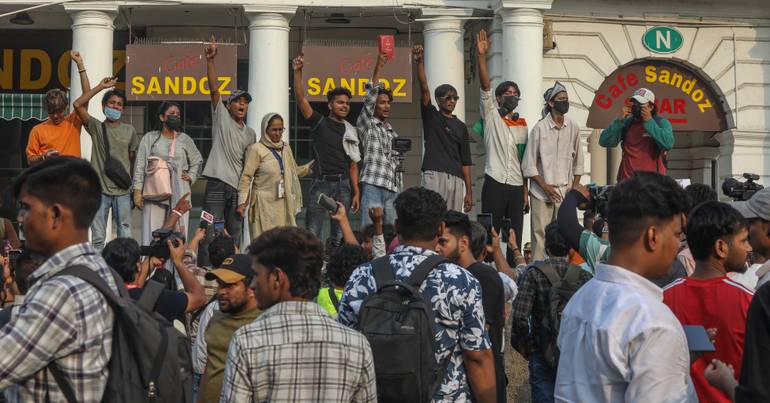
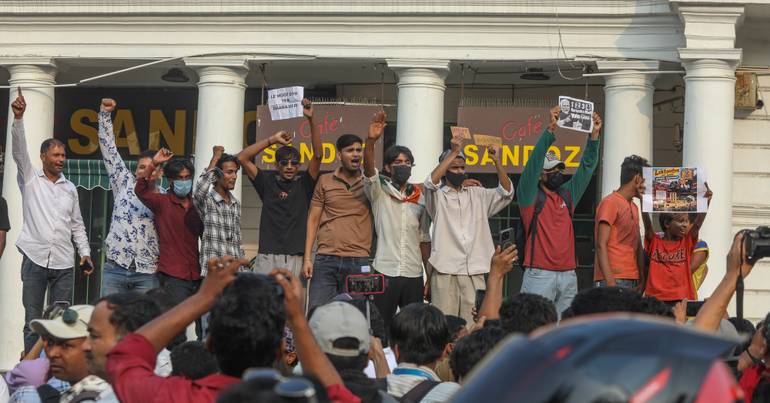
Movimento "Baratas", criado online para unir a indignação da Geração Z, exige demissão do presidente da comissão eleitoral da Índia, que acreditam estar a beneficiar o primeiro-ministro Narendra Modi.
No sábado e no domingo, as forças de segurança realizaram milhares de detenções – mais de 20 mil, segundo a imprensa local – para impedir os manifestantes de protestar nas ruas da capital indiana
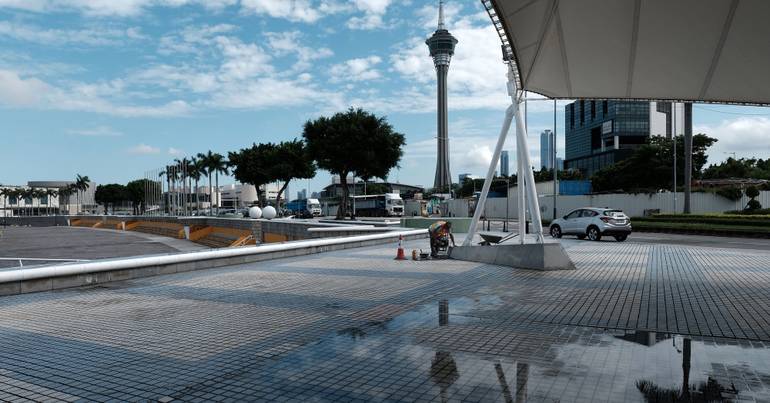
Associação de Advogados de Macau diz não ver como exclusão a exigência da nacionalidade chinesa no exercício da advocacia na China continental, medida que exclui maioria dos advogados portugueses.
Para exercer na província vizinha, os advogados de Macau terão de primeiro passar num exame jurídico que, de acordo com um despacho do Ministério da Justiça chinês
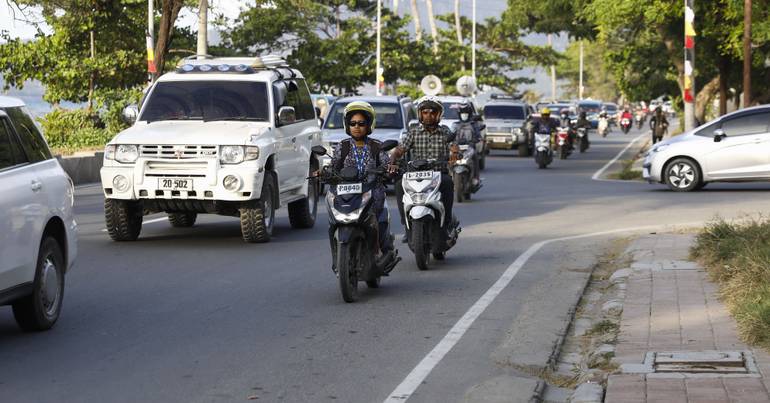
Capital de Timor-Leste, Díli, regista desde 6 de outubro "má qualidade do ar". A Direção Nacional de Meteorologia recomenda o uso de máscara e evitar a prática de atividades físicas ao ar livre.
Relatório publicado este mês pelo FMI adverte que mudança demográfica terá impactos fiscais profundos, estimando que a despesa com segurança social e saúde possa subir cerca de 14% até 2031.
Reitor da Faculdade de Ciências da Saúde e Ambientais da Universidade de São José em Macau, lembra que o crescimento acelerado da população sénior apanhou a sociedade local "despreparada" para acomodar as novas exigências assistenciais
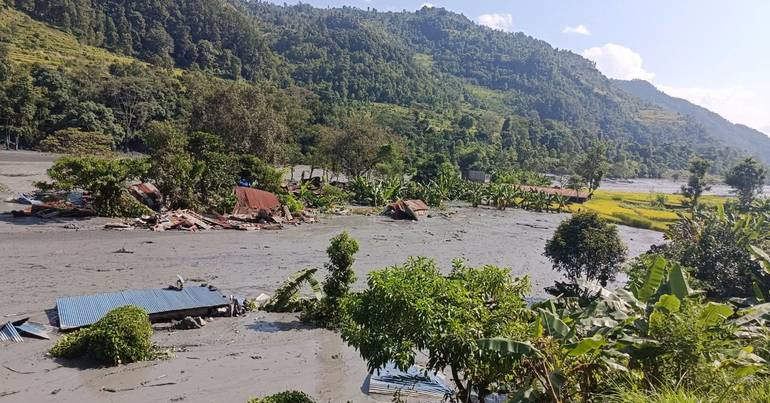
Não há registos de mortos ou feridos até ao momento, mas cinco pessoas estão desaparecidas. O nível da água chegou aos oito metros, destruindo casas, pontes e infraestruturas.
"Na segunda-feira, 12 de outubro, o Congresso, toda a coligação 'India' e os jovens do país voltarão a sair em massa para as ruas", prometeu o deputado do Partido do Congresso.
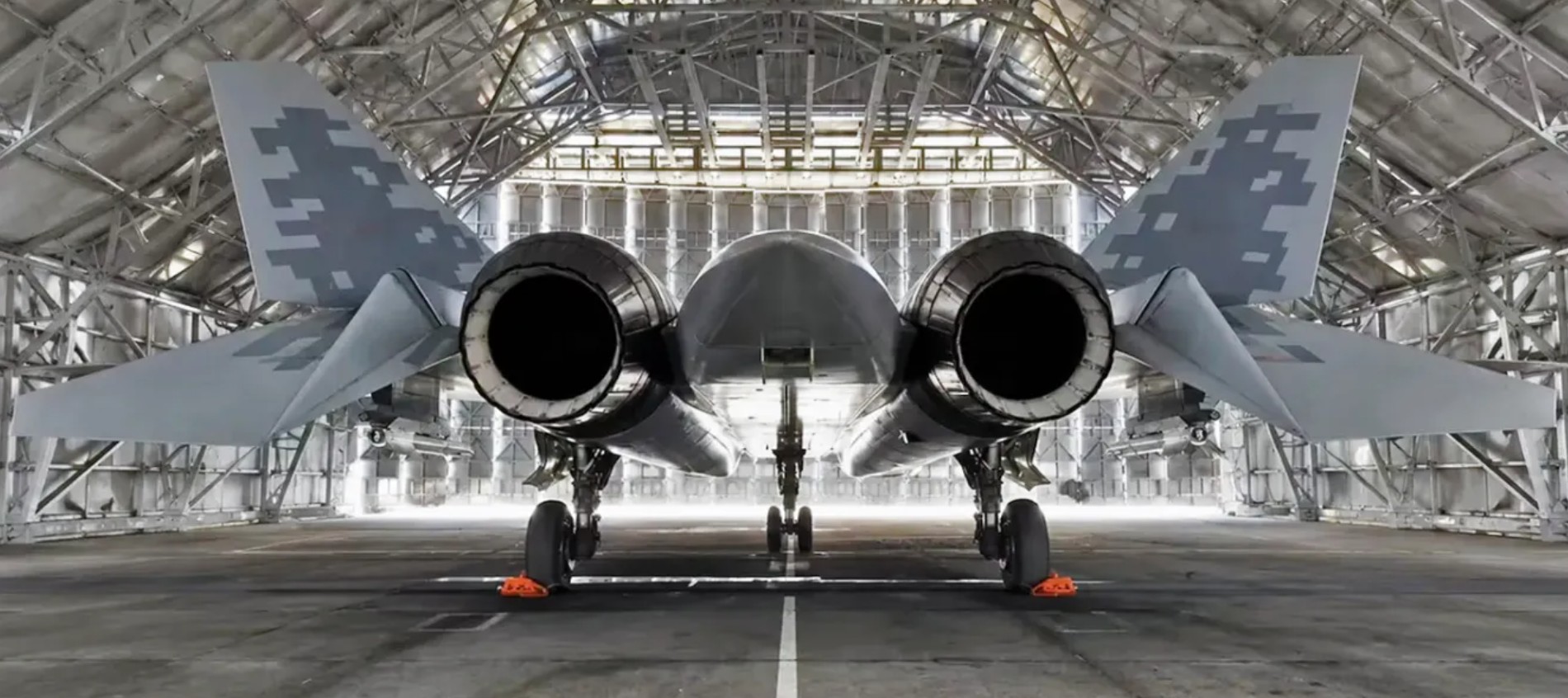
Unlike the F-35, India has received a formal offer from Russia for the Sukhoi Su-57 fifth-generation fighter but has not yet decided whether to evaluate it, the head of the Indian Air Force said.
Air Chief Marshal A.P. Singh told reporters on the sidelines of the Exercise Tarang Shakti in Jodhpur that the Indian Air Force was aware of Moscow’s proposal.
“As far as the Su-57 is concerned, we have received information that an offer has been made, but no decision has been taken on whether to evaluate it,” he said.
“Once a decision is made, we will assess how well it meets our requirements.”
Russia has repeatedly pitched the Su-57 to India.
Earlier, as EurAsian Times reported, Russian President Vladimir Putin personally renewed the Su-57 offer to India.
Speaking on the sidelines of the St. Petersburg Economic Forum, Putin reaffirmed Russia’s readiness to cooperate with India on the Su-57, including exporting and jointly producing the aircraft.
“It’s fifth-generation technology — I think it’s the best in the world as of now,” the Russian President said at the forum.
President Putin recalled Indo-Russian 5th-gen aircraft collaboration and said: “As far as the Su-57 goes, at one point we proposed to our Indian friends to work together on this technology. “But back then, our Indian friends said: ‘Go ahead on your own, and then we will see – maybe we’ll join’…The aircraft could have been our joint project. We built it independently, but we are ready to work with India in this field – to supply this aircraft and to keep developing it,” the Russian President told the reporters. “We don’t have any issues with it or any limitations. The same goes for air defense systems,” he added.
The Su-57 is a supersonic, twin-engine fifth-generation aircraft designed to destroy air, ground, and naval targets. Developed to compete with the F-22 and F-35, the ‘Felon’ jet features enhanced stealth through composite materials and can cruise supersonically.
It is a multi-role fighter jet capable of air superiority missions, ground attacks, reconnaissance, and electronic warfare. Russia is integrating a range of lethal weapon systems on the Su-57 platform, including the long-range R-37M missile and hypersonic missiles, as reported by the EurAsian Times.
Additionally, the aircraft is being integrated with Artificial Intelligence (AI) to enhance threat detection, decision-making, and pilot support. However, these features have failed to attract buyers, especially India.
If India proceeds with the Su-57 deal and Moscow meets all Indian prerequisites, including technology transfer, it could inject billions into Russia’s sanctions-hit economy. India would also get an interim fifth-gen fighter till the indigenous AMCA arrives.
Russia’s defense exports have historically benefited through high-profile deals with India. An excellent example is the Su-30MKI, India’s customized variant of the Su-30.
India’s acquisition of the Su-30MKI in the early 2000s influenced other nations, such as Malaysia, which modeled its Su-30MKM on the Indian version. Its versatility—including thrust-vectoring engines, canards, and integrated avionics from multiple countries—made it a flagship for Russian technology.
Another bigger success story is the BrahMos supersonic missile.
India’s DRDO and Russia’s NPO Mashinostroyeniya launched the joint venture in 1998 to develop and produce the BrahMos, one of the world’s fastest supersonic cruise missiles.
The Philippines was the first customer of the BrahMos, signing a contract worth approximately $375 million with BrahMos Aerospace in January 2022 for three shore-based anti-ship missile batteries.
The package, intended for the Philippine Marine Corps, includes mobile launchers, missiles, operator and maintainer training, and integrated logistics support. Deliveries began in April 2024 with the first battery and continued through 2025 and into 2026, with the third and final battery nearing completion.
Philippine Defense Secretary Gilberto Teodoro has indicated interest in further adapting or expanding the capability to suit the country’s geography and operational needs.
Another Southeast Asian country, Indonesia, became its second customer.
An agreement for “cooperation on the BrahMos System” was struck during the visit, Indian foreign ministry spokesman Randhir Jaiswal said in a post on X.
The two countries also reached an agreement on air-to-air missile cooperation that “enhances technology collaboration and defense capabilities”, he said.
Indian PM Modi hailed the “growing trust” between Jakarta and New Delhi after meeting Prabowo, which he said underpinned cooperation in “defense, security and maritime affairs”.
“Today, we reached an agreement to enhance defense exchanges, disaster management, and industrial cooperation,” Modi told reporters.
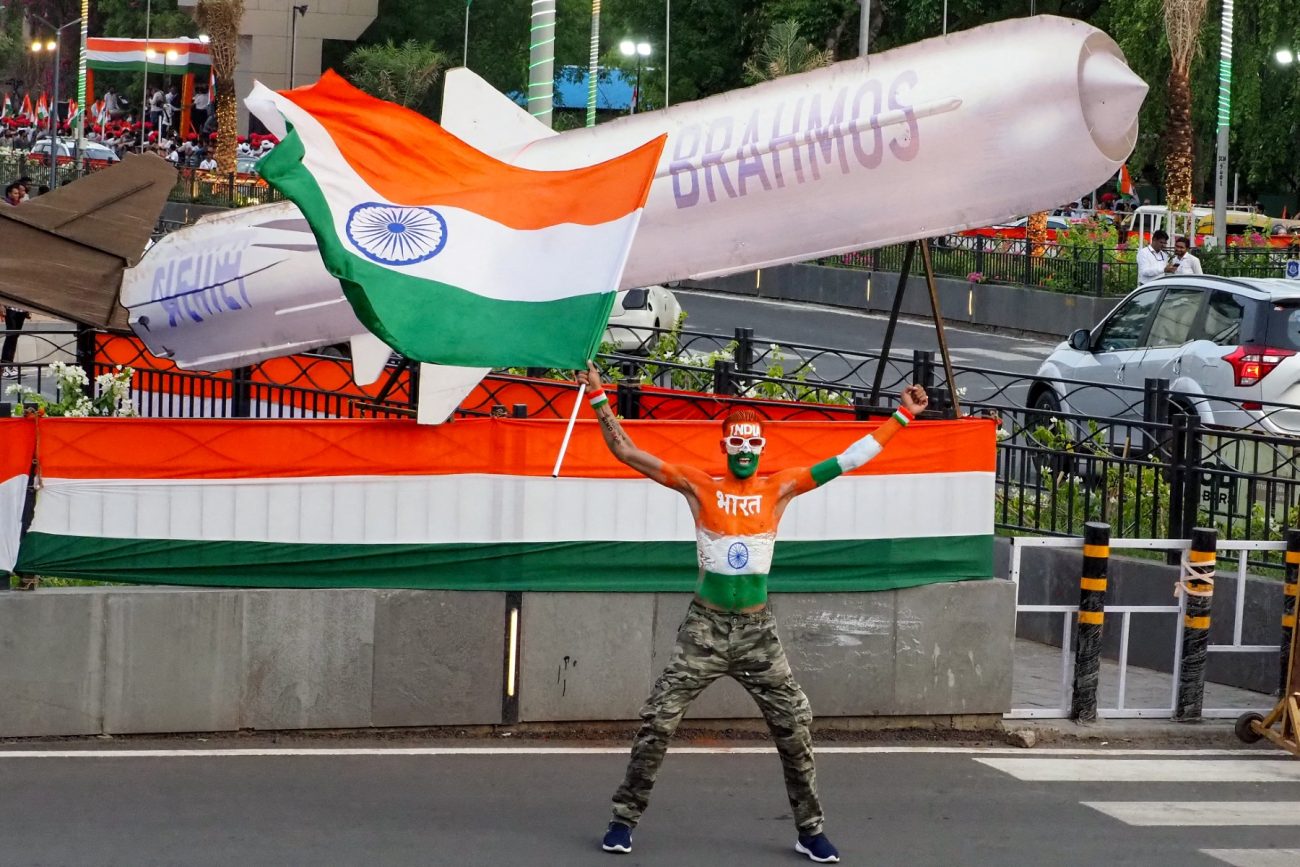
A man waves India’s national flag in front of a replica of the Indian Army’s BrahMos missile system during Prime Minister Narendra Modi’s roadshow in Ahmedabad on May 26, 2025. (Photo by Sam PANTHAKY / AFP)
Earlier, Indonesia’s Ministry of Defense (MoD) spokesperson, Rico Ricardo Sirait, told Reuters on March 9 that Jakarta has agreed to buy the BrahMos missile system from India.
The Indian Navy inducted its first BrahMos system in 2005 aboard INS Rajput. The Indian Army followed in 2007 with its own regiments, and the Air Force later introduced an air-launched version from the Su-30MKI in 2019.
The BrahMos missile saw combat use during Operation Sindoor in May 2025, when Indian forces employed air-launched variants from the Su-30MKI. IAF reportedly fired 15-19 BrahMos missiles.
The Indo-Russian missile could have more export customers.
India sketched a list of “friendly nations” it deemed potential buyers, including the Philippines, Vietnam, Saudi Arabia, the UAE, and South Africa. The list has since changed, with several countries dropping interest and others queuing up to assess the combat-tested missile system.
India reportedly started talks with Vietnam to sell off the supersonic cruise missile in 2023. An official with BrahMos Aerospace Ltd told the EurAsian Times at the time: “Vietnam had shown interest in the system. But the negotiations have just started.”
Further evidence of BrahMos’s widespread appeal in Southeast Asia is Malaysia’s sustained interest in the missile system, particularly the air-launched variant, which could be integrated with the Royal Malaysian Air Force’s Su-30MKM fighter jets.
By 2025, Malaysia appeared in lists of countries “queuing up” or actively negotiating for BrahMos. In fact, in August that year, reports suggested Malaysia had begun preliminary negotiations with Russia and India for the missile, aiming to revolutionize its Indo-Pacific airpower projection.
Besides Southeast Asia, the Middle East could be a potential market for the BrahMos missile.
Alexander Maksichev, Co-Director of BrahMos Aerospace, explicitly emphasized the UAE as a potential customer. Additionally, India has repeatedly listed the UAE among “friendly nations” eligible for BrahMos exports.
Other countries that have reportedly shown interest in the missile include Saudi Arabia, Qatar, Oman, and Egypt. BrahMos has also gained traction in South America, with countries such as Brazil, Chile, Argentina, and Venezuela showing interest.
The Indo-Russian BrahMos is a major export success, and Putin may want to replicate that success with the Su-57, using Russian tech and Indian co-production and marketing.
Whether India will bite the bullet remains to be seen.
Taiwan recently received its first two F-16V (Viper) fighter jets from the US under an $8 billion deal for 66 F-16Vs, approved during US President Donald Trump’s first term.
The F-16 Vipers landed at Taiwan’s ChihhangairAir Force Base in Taitung. President Lai Ching-te called it “a major milestone in elevating Taiwan’s air defense capabilities” and thanked the US for its “long-standing support.”
When Lockheed Martin delivers the 66 new jets by 2028, the Taiwanese Air Force will have more than 200 F-16 Viper fighter jets, making it the largest Viper-standard fleet in the Indo-Pacific region.
Meanwhile, another Asian country, wary of China’s military, plans to acquire 114 Rafale jets from France.
IAF (Indian Air Force) already operates 36 Rafales and has ordered 26 Rafale-M (Marine) fighter jets for its Navy. If and when the IAF acquires all 114 Rafale jets, it will become the largest operator of Dassault jets outside France.
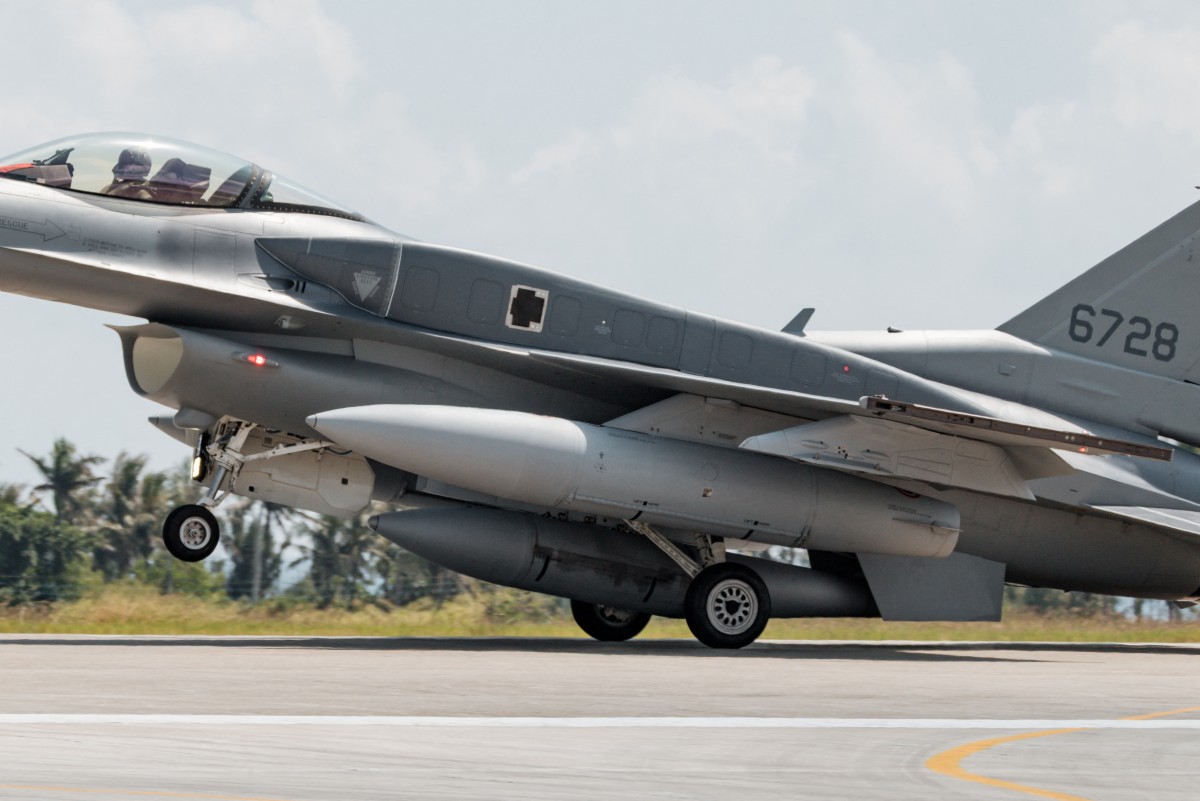
A newly purchased F-16V Block 70 fighter jet lands at Chihhang Air Base in Taitung on October 2, 2026. Taiwan received its first two US-made F-16V fighter jets, as the island democracy upgrades its military capabilities to deter a potential Chinese attack. The warplanes are part of an $8 billion deal for 66 F-16Vs approved during US President Donald Trump’s first term and scheduled for delivery this year. (Photo by CHENG Yu-chen / AFP)
Rafale vs F-16V
Both Rafale and F-16V are powerful fighter jets, but one massive advantage makes the US Vipers “superior” to the French Rafales, at least theoretically.
On paper, the twin-engine, nuclear-capable Dassault Rafale looks far more lethal than Lockheed Martin’s F-16 Viper, a single-engine lightweight fighter that first flew in 1974, more than five decades ago.
However, in modern times, fighter-jet battles are rarely one-on-one platform contests.
As heroic dogfights between fighter jets became a relic of the past and gave way to beyond-visual-range (BVR) contests, the battle for aerial supremacy became a system-of-systems contest rather than a straightforward one-on-one contest.
In this system-of-systems contest, a much less capable fighter aircraft can trounce a much superior aircraft if it integrates ground-, air-, and space-based sensors, capable radars, sensor fusion, an integrated battlespace display, and precision targeting.
In short, a networked fighter jet, even if less capable, is more lethal than a stand-alone aircraft.
Additionally, fighter jet deals are rarely purely military decisions; they are as much geopolitical as they are military.
It’s no surprise that a capable, cost-effective combat aircraft like the Saab JAS-39 Gripen struggled to find an export customer for over a decade. Again, after signing a deal with Brazil for the Gripen E/F variant in 2014, the aircraft failed to win other export customers for more than a decade.
While Gripen is a cutting-edge aircraft with state-of-the-art weapons, its biggest weakness was the lack of a powerful, influential backer on the global stage like the US or France.
Sweden, where Saab is based, is not really a global powerhouse, has a modest military, is not part of the nuclear club, and is not a member of the UN Security Council, unlike the US, Russia, France, the UK, and China, all of which are permanent members of the UNSC and enjoy veto power that could offer myriad advantages in geopolitical contests.
Brazil’s military transport aircraft, the Embraer C-390 Millennium, faces a similar challenge. Though capable and boasting an enviable safety record, it sells far fewer units than the American C-130J Super Hercules.
In other words, countries not only buy fighter jets; they also prefer to buy from countries with strong military and geopolitical clout.
This is where the US has an unmatched lead over competitors, including France, Russia, and China.
Consider, for example, Ukraine.
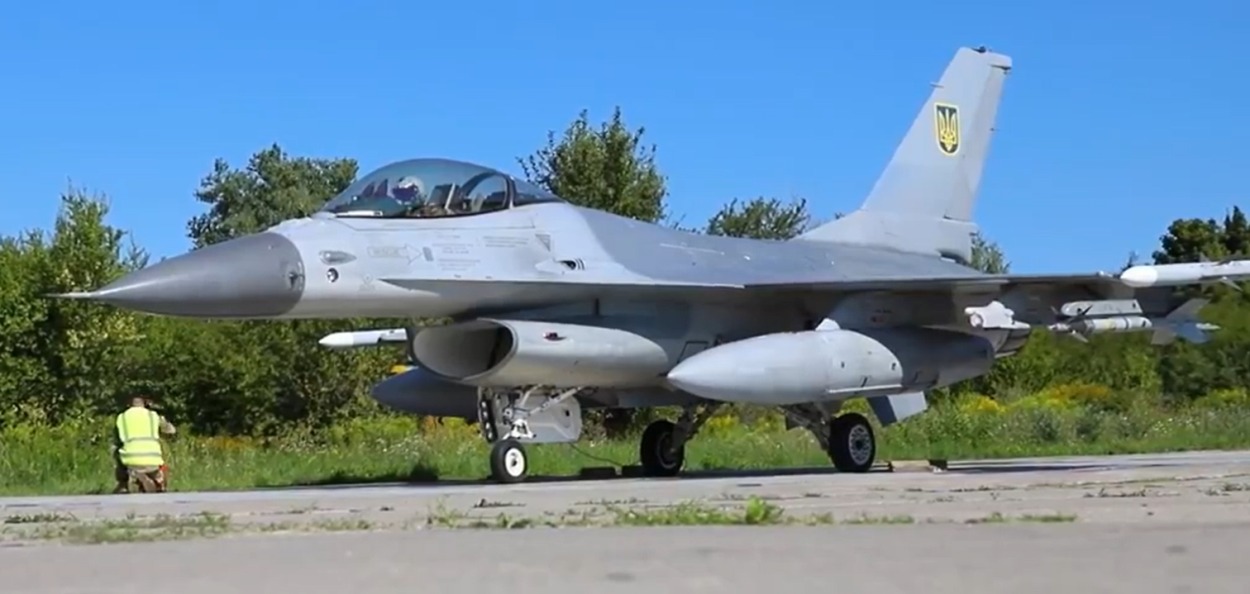
It not only received used F-16 fighter jets, but it also received Starlink support and US intelligence inputs, which allowed it to target military targets deep inside Russian territory.
Ukrainian F-16 Fighter Jet.
Without this satellite and intelligence support, the F-16s would be only half as effective.
Similarly, consider Israel in the Middle East.
It has not only received advanced US fighter jets such as the F-15 and the F-35, but Jerusalem also gets full US intelligence support, pinpoint information on adversary military targets, and their military movements.
Similarly, Jerusalem gets early warning whenever Iran launches ballistic missiles towards it.
The US has nearly 20 military bases in the region and maintains advanced surface-to-air missile batteries, such as Patriot and THAAD, sea-based missile defense platforms, and AN/FPS-132 missile early-warning radar in the Middle East.
This diversified radar network ensures that not only does Israel receive early warning of every Iranian attack, but Iranian missiles and drones have to pass through a layered missile defense infrastructure spread over the whole of the Middle East before their projectiles can reach Israel.
It is these incremental weapons, missiles, radar and sensors, intelligence, and satellite support that ensure that Jerusalem comes out on top in every regional military conflict.
In the Six-Day War in 1967, Israel’s adversaries, Egypt, Jordan, and Syria, had advanced Soviet fighters, and yet Jerusalem was able to trounce their combined military might, thanks to the intelligence support it received.
Export of military platforms is perhaps the US’s most successful export commodity since the two World Wars.
According to SIPRI, between 2021 and 2025, the US was the world’s top military exporter, accounting for as much as 42% of global military exports.
France was a distant second with just a 9.8% share of global military exports.
However, this uncontested leadership depends on the superior performance of its military platforms in conflict.
So, basically, the US has a vested interest in ensuring the victory of militaries that field US military platforms.
On the other hand, countries that do not field US military platforms often struggle with poor intelligence support.
India, for instance, repeatedly requested Washington to provide satellite reconnaissance pictures to target Pakistani military positions on mountains during the Kargil War in 1999. But Washington declined India’s requests.
Had India bought US military planes, Washington would have, most probably, provided New Delhi with satellite imagery to target Pakistani military positions, so that India could hit these targets and Washington could market the efficiency of its jets.
In a potential conflict between China and Taiwan, Washington would provide Taipei with every possible intelligence and satellite support so that its fighter jets and other military platforms are not trounced against Chinese weapon systems.
As we have seen in the Ukraine War, no other country currently has a satellite network comparable to Starlink. In a potential conflict with China, this US support could be decisive.
With this US support, the F-16 Vipers could be far more lethal than they actually are.
Rafale is a very capable platform. It has an AESA radar, a SPECTRA electronic warfare suite, long-range air-to-air missiles such as Meteor, precision-strike munitions such as Hammer guided bombs, a long-range SCALP EG cruise missile, twin engines, and nuclear capability, which make it a lethal fighter.
However, despite its status as a major military power, France lacks the heft of the United States.
Despite the current “frosty” US-India ties, New Delhi must find a way to work with the US while preserving its strategic autonomy and boosting its Make-in-India initiative.
This is an Opinion Article
Sumit Ahlawat has over a decade of experience in news media. He has worked with Press Trust of India, Times Now, Zee News, Economic Times, and Microsoft News. He holds a Master’s Degree in International Media and Modern History from the University of Sheffield, UK.
He can be reached at ahlawat.sumit85 (at) gmail.com
Il titolo definitivo dell’intera vicenda, tuttavia, è che la Casa dei Saud sta attaccando Ansarallah per proteggere il culto della morte in Asia occidentale
Cominciamo con alcune informazioni esclusive. Giovedì, Yahya Ali al-Ra’i, presidente della Camera dei Rappresentanti con sede a Sana’a sotto il controllo di Ansarallah, ha consegnato una lettera a Sardar Ayaz Sadiq, presidente dell’Assemblea Nazionale del Pakistan, richiedendo la mediazione pakistana tra Ansarallah e Riyadh.
Ra’i, figura ampiamente rispettata, ricopre la carica di presidente a Sana’a dal 2008. Sadiq ha iniziato il suo attuale mandato come presidente a Islamabad nel marzo 2024. Questo canale parlamentare diretto riveste un’enorme importanza come apertura diplomatica – poiché il Pakistan si trova ad affrontare enormi pressioni, sia a livello interno che in tutto il mondo islamico, riguardo ai suoi reali impegni relativi allo scontro tra Arabia Saudita e Yemen, come stabilito dall’Alleanza per la Difesa della Mecca.
Per quanto l’intera situazione sia in realtà oscura, informazioni dirette provenienti sia da Islamabad che da Teheran, ai massimi livelli, come da me specificatamente richiesto, hanno stabilito quattro punti chiave: Sembra che sia così – per ora.
Islamabad è irremovibile nel sostenere che il Pakistan non attaccherà Ansarallah e non impiegherà truppe a tal fine. L’intesa raggiunta a Riyadh la scorsa settimana escludeva l’ingresso nel territorio yemenita. Le forze pakistane dovrebbero rimanere al di fuori di qualsiasi offensiva terrestre contro Ansarallah.
Il Pakistan stava già mediando tra Riyadh e Sana’a attraverso Teheran. Il feldmaresciallo Asim Munir ha personalmente richiesto al ministro degli Esteri iraniano Araghchi di esercitare l’influenza dell’Iran su Ansarallah, avvalendosi dei contatti di Araghchi sia con Islamabad che con Riyadh. Il Ministero degli Esteri pakistano non ha smentito l’esistenza di questo canale diplomatico.
Il Pakistan sarebbe tenuto a difendere il territorio saudita in virtù dei propri impegni nell’ambito dell’Alleanza per la Difesa della Mecca. I dispiegamenti finalizzati alla protezione dei confini e alla difesa contro droni e missili lanciati dalle Forze Armate yemenite rientrano in questo quadro. Il problema è se alcuni consiglieri pakistani siano già dispiegati in territorio yemenita. Se il Pakistan avesse anche solo pochi «consiglieri» ad Aden e truppe da qualche parte nel nord dello Yemen, al confine con l’Arabia Saudita, ciò costituirebbe già una violazione delle sue promesse.
Le forze pakistane dovrebbero essere in grado di difendersi da sole – è una conseguenza naturale del territorio. Si tratta di una contingenza dichiarata; non di una previsione di ritorsione. Almeno un ufficiale pakistano è stato ucciso in Arabia Saudita senza che il Pakistan reagisse con una ritorsione. Ciò denota moderazione – almeno per ora.
Transito attraverso lo Stretto di Hormuz: utilizzare il CIPS e pagare in rial
Sul più ampio fronte USA-Iran, le mosse diplomatiche confermano quanto abbiamo riportato negli ultimi giorni riguardo al Protocollo di Transizione. Il Pakistan, infatti, è determinato a mantenere i rapporti sia con Riyadh che con Teheran, parallelamente a un coordinamento costante con Pechino. Dopotutto, la Cina sostiene pienamente la mediazione pakistana; e Araghchi continua a dialogare con Munir, come ha fatto in seguito ai colloqui con Wang Yi a Pechino.
Nel frattempo, sul fronte di Washington, le speculazioni sono febbrili su tutta la linea riguardo ai preparativi per una ripresa della guerra da parte dell’amministrazione Trump – compresi potenziali attacchi alle infrastrutture energetiche iraniane e persino, cosa piuttosto preoccupante, a obiettivi nucleari. Non vi è ancora alcuna decisione definitiva da parte dello «psicopatico/sociopatico al comando», tanto meno una data di avvio.
I rischi immediati, in ogni caso, sono sbalorditivi.
La diplomazia – anche nella sua forma surrogata – è impantanata in un vicolo cieco. Teheran rimane – e continuerà a rimanere – ancorata alle proprie condizioni attuali, specificate nel memorandum d’intesa ormai privo di significato, ma ora con l’aggiunta della minaccia di bloccare le rotte di transito lungo la costa dell’Oman che considera illegali. Washington, dal canto suo, è ossessionata dall’ottenere vaste concessioni in materia nucleare. All’inizio di questa settimana, abbiamo confermato che il Consiglio Supremo di Sicurezza Nazionale (SNSC) di Teheran ha preso due decisioni di grande rilevanza.
Teheran ha deciso di riscuotere il pedaggio di transito nello Stretto di Hormuz esclusivamente in valuta iraniana. Niente yuan, niente criptovalute. In realtà, tramite un meccanismo collegato al CIPS, il sistema cinese di pagamento e compensazione, aggirando il dollaro statunitense. Si utilizza il CIPS per acquistare elettronicamente yuan, convertirli in rial e pagare il pedaggio. Le entrate derivanti dal transito nello Stretto di Hormuz, dopotutto, rappresentano una delle poche fonti di valuta forte rimaste a Teheran. Il nuovo meccanismo rafforzerà sicuramente il valore del rial.
Attraverso il Pakistan, Teheran ha comunicato a Witkoff, il «Bismarck» del settore immobiliare di Trump, che l’Iran non si smuoverà di un millimetro dalle proprie condizioni per un accordo negoziato – ed è pienamente preparato a qualsiasi possibile offensiva statunitense. E questo dopo che J.D. Vance ha avanzato un’ulteriore condizione sull’arricchimento nucleare: una riduzione «significativa» e «sostanziale». Ciò blocca il dossier nucleare e rende quasi impossibile una formula di risoluzione rapida.
Il punto fondamentale è che la spirale di escalation potrebbe sfuggire al controllo in un batter d’occhio.
La “Tempesta yemenita in arrivo 1.0” è già in atto
Sul fronte saudita-yemenita, le Forze Armate yemenite si stanno dimostrando assolutamente spietate. La “Tempesta yemenita in arrivo 1.0” è già in atto.
I danni alla raffineria di Jeddah, vicino a Yanbu, sono ingenti. Ansarallah sta colpendo contemporaneamente la costa orientale e quella occidentale dell’Arabia Saudita, oltre all’oleodotto est-ovest che le collega.
A tutti gli effetti, Sana’a sta prendendo di mira l’intera infrastruttura chiave di Riyadh. Il «paracadute» difensivo statunitense è una farsa: le batterie PAC-3 e Patriot rimaste sono inutili contro i missili balistici yemeniti.
Le truppe saudite potrebbero ammontare, nella migliore delle ipotesi, a 75.000 unità, più 125.000 della Guardia Nazionale. Le Forze Armate yemenite dispongono di almeno 350.000 uomini, che possono essere facilmente portati a 800.000. Aspettarsi un «aiuto» dai petrol-sceicchi del CCG non è nemmeno degno di essere definito uno scherzo.
Le Forze Armate yemenite hanno inoltre lanciato due missili balistici e droni esplosivi in direzione dell’aeroporto internazionale di Aden. Ansarallah ha dichiarato che l’obiettivo erano i rifornimenti militari sauditi appena giunti al Campo di Badr, il quartier generale dei mercenari adiacente all’aeroporto. È stato ucciso un numero non specificato di ufficiali e funzionari sauditi di alto rango – forse anche alcuni pakistani.
Da parte sua, anche la Turchia sta per schierare truppe, velivoli e sistemi di difesa aerea sul territorio saudita. Queste forze turche potrebbero, in teoria, proteggere Riyadh, le città sante e l’oleodotto Est-Ovest. Ankara, proprio come Islamabad, insiste nel sostenere di non avere alcuna intenzione di entrare in guerra nello Yemen.
La rapida liberazione da parte delle Forze Armate yemenite della costa occidentale vicino al Mar Rosso ha inoltre reso chiarissimo come la cosiddetta «coalizione» saudita – in realtà una banda di proxy e mercenari – stesse schierando di fatto dei terroristi fin dall’inizio.
Ansarallah ha recuperato una grande quantità di passaporti stranieri – in particolare provenienti dal Kuwait, dal Qatar, dalla Turchia e dalla Siria – appartenenti a sicari dell’ISIS e di Al-Qaeda. Chiamatela pure la Legione della Terror Inc.
È sempre la solita storia. Il Qatar e la Turchia, di comune accordo, hanno strumentalizzato il trasferimento di miliziani dell’ISIS e dei salafiti-jihadisti dalla Siria e dall’Iraq: questi sono stati accolti nello Yemen dal Partito Islah. La Turchia è stata la principale via di transito; almeno 2.100 di questi membri dell’ISIS sono turchi.
AQAP è tornata! Già nel lontano 2020, Ansarallah aveva sequestrato documenti, mappe e video che mostravano jihadisti dell’ISIS/Daesh e di Al-Qaeda, direttamente sostenuti da Riyadh, mentre vagavano per lo Yemen, con i miliziani catturati che confessavano di essere stati pagati, armati e sostenuti logisticamente dai sauditi.Ora è già in atto una nuova incarnazione dell’ex Al-Qaeda nella Penisola Arabica (AQAP) – attraverso almeno 20.000 mercenari terroristi del Daesh/takfiri “importati” dalla Siria. Essi saranno inviati nel governatorato di Aden – in seguito alla richiesta, anzi alla pretesa dello stesso MbS, pienamente approvata dall’amministrazione Trump e dal suo vassallo tagliagole diventato presidente a Damasco, l’ex membro dell’ISIS al-Jolani.
Il titolo definitivo dell’intera vicenda, tuttavia, è che la Casa dei Saud sta attaccando Ansarallah per proteggere il culto della morte in Asia occidentale. Controllando Bab al-Mandab, Ansarallah isola di fatto il porto israeliano di Eilat. Ciò era già accaduto in precedenza durante il genocidio di Gaza. Riyadh era furiosa perché aveva stretto accordi per il progetto NEOM – ora praticamente accantonato – che avrebbe collegato Eilat una volta che gli Accordi di Abramo trumpiani fossero entrati in vigore. Considerando il quadro d’insieme, una singola scintilla potrebbe ancora scatenare l’inferno. Tra le possibilità figurano: un attacco yemenita contro l’Arabia Saudita che causi ingenti perdite; un caos nella riscossione dei pedaggi nello Stretto di Ormuz; un attacco iraniano contro un obiettivo legato ai «petro-sceicchi» del CCG, a seguito di una provocazione americana; un attacco legato all’Iran contro una base statunitense, ancora una volta a seguito di una provocazione americana; e, soprattutto, una (dis)avventura del CENTCOM «via terra, aria e mare» imposta da un sociopatico.
India’s air force chief said on Saturday that the U.S. has made no formal offer to sell India F-35 stealth fighters, and added that American personnel have not even allowed Indian officers near the stealth aircraft.
Air Chief Marshal Amar Preet Singh made the comments at a press conference marking the end of the multinational Exercise Tarang Shakti-2026 in Jodhpur, while seated alongside U.S. Pacific Air Forces commander Gen. Kevin Schneider.
“Your people don’t even let us go near the aircraft, and you are talking about selling it to us,” Singh said.
Six U.S. Air Force F-35As, accompanied by more than 200 personnel, participated in Tarang Shakti. This was the first time the American stealth fighters had drilled against Indian jets on Indian soil.
Singh also said the Indian government has not yet decided whether the air force should evaluate Russia’s offer of the Su-57.
“Once the decision is conveyed to us (by the government), we will evaluate how well it meets our requirements,” he said.
Earlier in 2025, U.S. President Donald Trump said, during Indian Prime Minister Narendra Modi’s visit to Washington, that the United States would pave the way for India to acquire the F-35.
Later, Vice President J.D. Vance reiterated the offer during his visit to India in April 2025, saying, “We, of course, want to collaborate more. We want to work together more. And we want your nation to buy more of our military equipment, which we believe is best-in-class. American fifth-generation F-35s, for example, would give the Indian Air Force the ability to defend your airspace and protect your people like never before.”
Earlier, as EurAsian Times reported, Lockheed Martin CEO Jim Taiclet discussed selling the F-35 to India and raised the prospect of selling the F-21, a highly sophisticated F-16 derivative.
“I think the F-16 also has strong legs, if you will, and more and increasing interest as we go forward from several countries that aren’t quite ready for F-35,” Taiclet said. There are “some countries that could see F-21 or F-16, for India, for example, as a stepping stone to F-35.”
The sale of the F-35 is subject to rigorous U.S. export controls under the Arms Export Control Act, which requires approval from the State Department, the Pentagon, and often Congress. The White House maintains strict policies on technology transfers, regional stability, and the internal politics of the potential recipient state to safeguard its sensitive technology.
The U.S. hesitation is straightforward: sharing it with other countries could put sensitive technology in the hands of enemies, especially if the recipient country has ties to countries like China or Russia, which would try to exploit or reverse-engineer it.
Earlier, writing for EurAsian Times, Air Marshal Anil Chopra (retired) said: The F-35 soft pitch faced almost immediate limitations due to subsequent tariff frictions and India’s core push for technology transfer for domestic manufacturing of its AMCA fifth-gen warplanes and aero-engines.
GE Aerospace has faced immense delays on its 2021 contract to supply 99 F404-IN20 engines to Hindustan Aeronautics Limited (HAL) for the Tejas Mk1A fighter program. Only six out of the promised engines have been delivered instead of the targeted 12-plus a year, prompting HAL to invoke contractual penalty clauses.
Tariffs on “friend” India and delayed engines for AMCA have badly weakened Indo-US ties.
India also operates Russian-supplied S-400 systems, a factor that previously caused friction between the U.S. and Turkey.
India already operates the Russian-origin S-400 AD System. The U.S. fears these networks could compromise classified F-35 stealth data. The jet relies on the U.S.-controlled Operational Data Integrated Network for software and logistics.
The U.S. may already be accessing such data through many other American platforms on Indian soil.
Meanwhile, introducing a complex new Western platform adds severe maintenance challenges to an already diverse military fleet. Even in the U.S., very few airbases can service stealth coatings.
Buying foreign fifth-generation jets risks diverting funds from India’s indigenous AMCA project. Putting too many military aviation eggs in the unreliable U.S. basket is also a risk. Americans can be “very unreliable” when it comes to imposing sanctions and freezing spares and maintenance support.
Operationally, the F-35 could offer major strategic advantages for the IAF, but any deal involves deep geopolitical, logistical, and financial complexities. Acquisition costs range from $80 to $110 million per jet, plus very high hourly operating expenses, creating budgetary challenges for New Delhi.
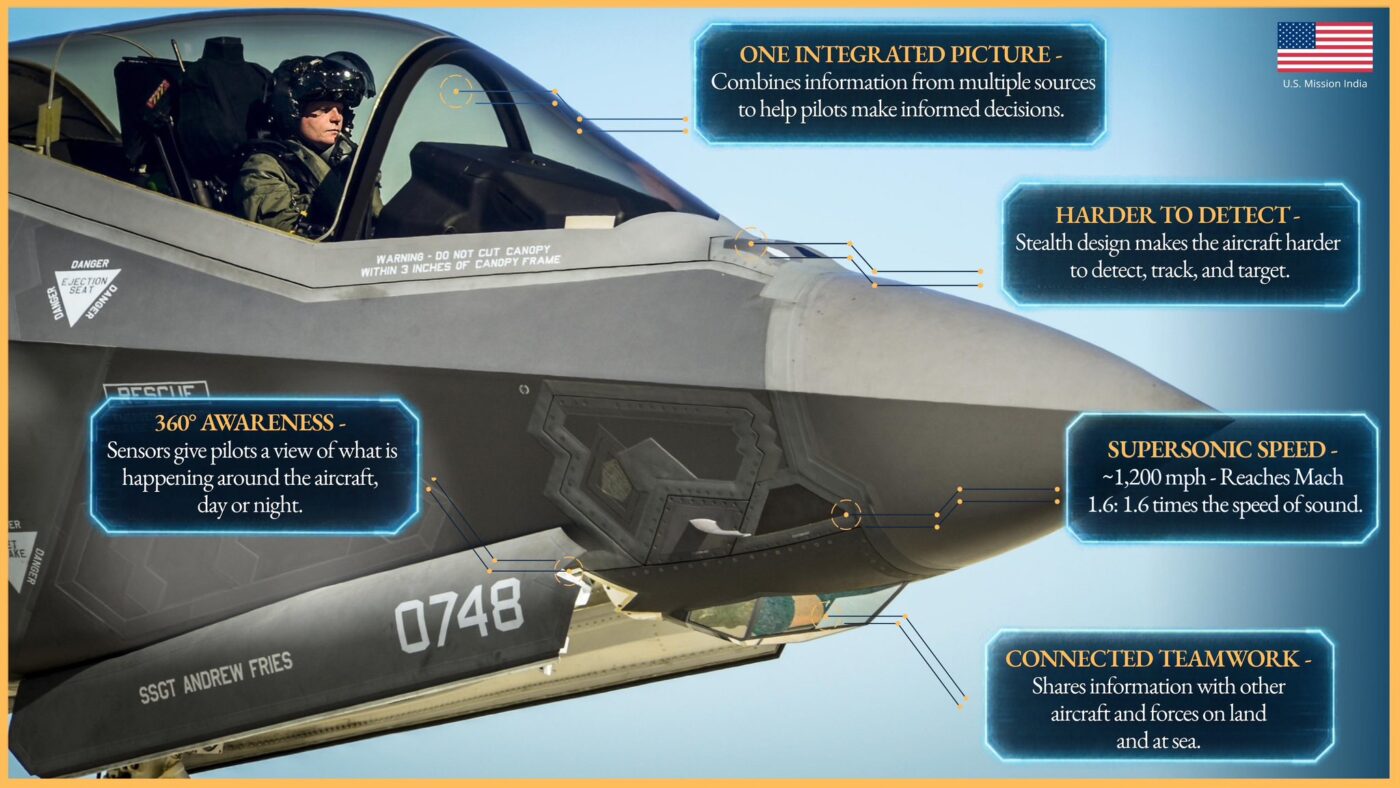
F-35: Image via U.S. Embassy, New Delhi
After two decades of stable ties, the last two years have seen distrust between the world’s largest and oldest democracies.
While many hope this is a transitory phase, it is becoming clear that the U.S. is not interested in India’s rise as a global power. U.S. Deputy Secretary of State Christopher Landau stated at the last Raisina Dialogue in New Delhi that Washington will not repeat its past approach (read: mistake) with China by granting India unfettered market and tech access that could lead to strong commercial competition.
The U.S. wants India strong enough only to serve as a bulwark against China, not to become an independent power center or a technology and economic power.
The U.S. seems keen only to supply platforms to India through large contracts. Even for aero-structures and smaller components, it prefers make-in-India “Build to Print” over significant technology sharing.
Even the proposed India-USA deal to co-produce GE Aerospace F414 engines with HAL faces major hurdles. The main complications include a nearly threefold cost surge, intense disputes over sensitive hot-end technology transfer, and the risk of delays to India’s Tejas Mk2 and AMCA programs.
Many Indians wonder whether we have invested too much in a partner with a high trust deficit and a vacillating foreign policy. U.S. is known to have “dumped” friends and allies for immediate national interests. The Trump administration’s recent public threats and admonishments to its NATO allies further strengthen Indian concerns.
The U.S. has already deepened its ties with India’s airborne platforms, supplying transport aircraft (C-17, C-130), maritime patrol aircraft (P-8I), UAVs (MQ-9), and helicopters (Chinook, AH-64 Apache, and MH-60R).
For a long time, the U.S. was trying to sell the F-16 ‘Viper’ (renamed F-21) and the F-18 Super Hornet as part of India’s Multi-Role Fighter Aircraft (MRFA) proposal. Later, it offered the F-15EX. The U.S. never officially offered the F-35.
Despite being the oldest democracy, the U.S. finds it easier to deal with dependent military Generals, and West Asian Sheikhs, rather than growing democracies. The U.S. has a poor opinion of India’s “Non-Alignment” and “Strategic Autonomy.”
Washington continues to prefer Pakistan, which helps it connect with China, the West, and Central Asia, and is willing to toe the American line for a few bucks. This Pakistan connection further erodes India’s trust.
Most analysts feel that letting the USA into India’s fighter-aircraft ecosystem is not a great idea. Any F-35 deal, like other aircraft deals, will be only a supply-and-support contract. There will be no technology transfer and no “Make-in-India” element.
While India pushes its own AMCA program, the Su-57 may still be the better choice for an interim fighter.
Seis operadoras de casinos submeteram 2.968 participações de transações suspeitas nos primeiros nove meses do ano. No total, o GIF recebeu 4.138 reportes — uma subida de 10,3%.
A presidente do Grupo Parlamentar de Amizade Portugal-Taiwan apela a Taipé como prioridade, enquanto a AR rejeitou propostas semelhantes em janeiro. Taiwan celebra 115 anos.
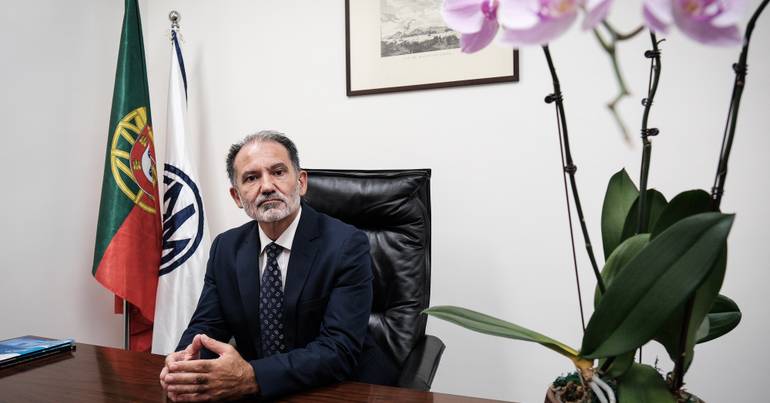
O novo diretor da EPM, João Miguel Gonçalves, admite que obras e expansão "teriam todo o sentido", mas avisa que as decisões dependem de Portugal e de Macau.
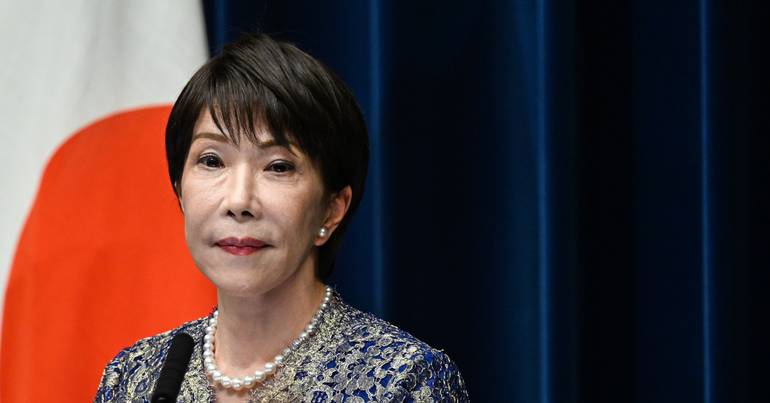
A primeira-ministra Sanae Takaichi prometeu continuar a apoiar o tribunal sediado em Haia, presidido pela juíza japonesa Tomoko Akane, e a colaborar com Washington.
A presidente do Grupo Parlamentar de Amizade Portugal-Taiwan apela a Taipé como prioridade, enquanto a AR rejeitou propostas semelhantes em janeiro. Taiwan celebra 115 anos.
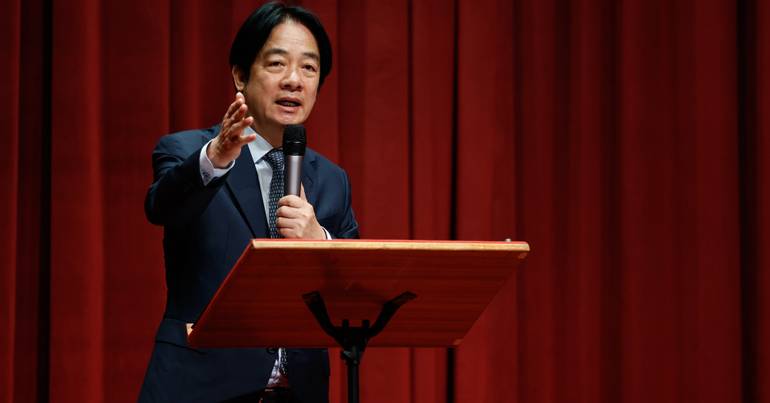
No 115.º aniversário da República da China, Lai Ching-te justificou o orçamento recorde de defesa para 2027 — mais de 3% do PIB — face à pressão militar de Pequim.
Bruno Cardoso Reis analisa a passagem de Rubio por Lisboa, a tensão política com eleições antecipadas em Espanha e os protestos em França. E com Bolsonaro na frente, o Brasil vira mesmo à direita?
India’s Ministry of External Affairs (MEA) reacted strongly to the US announcement to suspend the Permanent Labor Certification (PERM) program used by major IT companies for getting green cards for their foreign employees.
Reacting to the announcement made by the US Labor Secretary in the presence of Vice President J D Vance, India’s MEA, on Friday, October 9, called it a move harmful for the “shared ambitions of both countries.”
US Labor Secretary Keith Sonderling said on Thursday that his department will not accept any fresh application for PERM or process the pending applications from eight major IT companies.
The companies named were Microsoft, HCL, Cognizant, Adobe, Capgemini, Tata Consultancy Services (TCS), Infosysis, and Wipro.
Among these firms are some of India’s biggest IT companies with the majority of them employing a large number of IT professionals from outside the US. The move is seen as a part of the Donald Trump administration’s crackdown on immigration.
Almost 70% of H-1B visa holders are Indians which means the halt in PERM will affect the Indian IT professionals the most.
PERM is the first step for an employer in the US to sponsor a green card for its foreign employee. According to the US laws, the employer must prove it tried and failed to get a local for the job before it can sponsor a foreign person.
According to Sonderling, these eight companies have sought almost three million foreign workers and received over 230,000 H-1B visas and over 100,000 PERMs since 2009, claiming all these were “jobs that were taken from American workers.”
Vance said the Donald Trump administration wants the companies to prioritize local recruitment instead of getting “foreign indentured labor.”
He accused companies of abusing the H-1B visa program, claiming there have been multiple cases pending in the federal investigation about fraud in recruitment and the violation of its “best of the best” clause.
Unwarranted and deeply offensive
In a brief statement, India’s MEA on Friday called Vance’s comments about “foreign indentured labor” “unwarranted” and deeply offensive, claiming it “ignores the fact that Indian professionals in the US are highly educated and skilled contributors to its economy and innovative ecosystem.”
“The history of the US itself has been shaped by generations of immigrants whose labor, enterprise and innovation have contributed to its growth and prosperity” it underlined, further noting that “resorting to terminology that carries painful historical and colonial legacy connotations is deeply offensive.”
Millions of Indians were taken out of the country to different parts of the world for indentured labor during the British colonial period in the nineteenth and early twentieth centuries.
The US decision has already led to widespread reactions from the opposition groups asking the Indian government to take measures to protect the interest of the country’s IT professionals.
In a post on X, Jairam Ramesh, leader of the main opposition party, the Indian National Congress (INC), asked the government to retaliate to the US move, claiming failure to do so would be tantamount to surrendering the country’s interests to a bully.
Ramesh accused the Narendra Modi-led ultra-right-wing government in the country of adopting a policy of “appeasement” toward the US, citing its recent decision to impose user charges on payments through mobile phones in the country as one crucial example of how it is going out of the way to do so.
Ramesh claimed Washington’s decision to suspend the visas yet again proves that such a policy never pays off.
Russia is seeking support for its war effort abroad – and threatening retaliation beyond Ukraine. Reports of foreign labor in drone factories, proposals to counter Starlink, and allegations of overseas recruitment show different ways Moscow could sustain its military effort and put pressure on its opponents.
Nowhere Far Enough
On October 9, Mikhail Zvinchuk, founder of the Russian military Telegram channel Rybar, was detained in Montenegro. Montenegrin authorities accused his team of using media work to interfere in the country’s politics. Rybar said they had come legally to film at Cetinje Monastery and had submitted an official filming request. Moscow’s response explains why this matters: Dmitry Medvedev, deputy chairman of Russia’s Security Council, suggested replenishing an “exchange fund” with Europeans and Americans to recover detained Russians. One arrest became a warning about others to come.
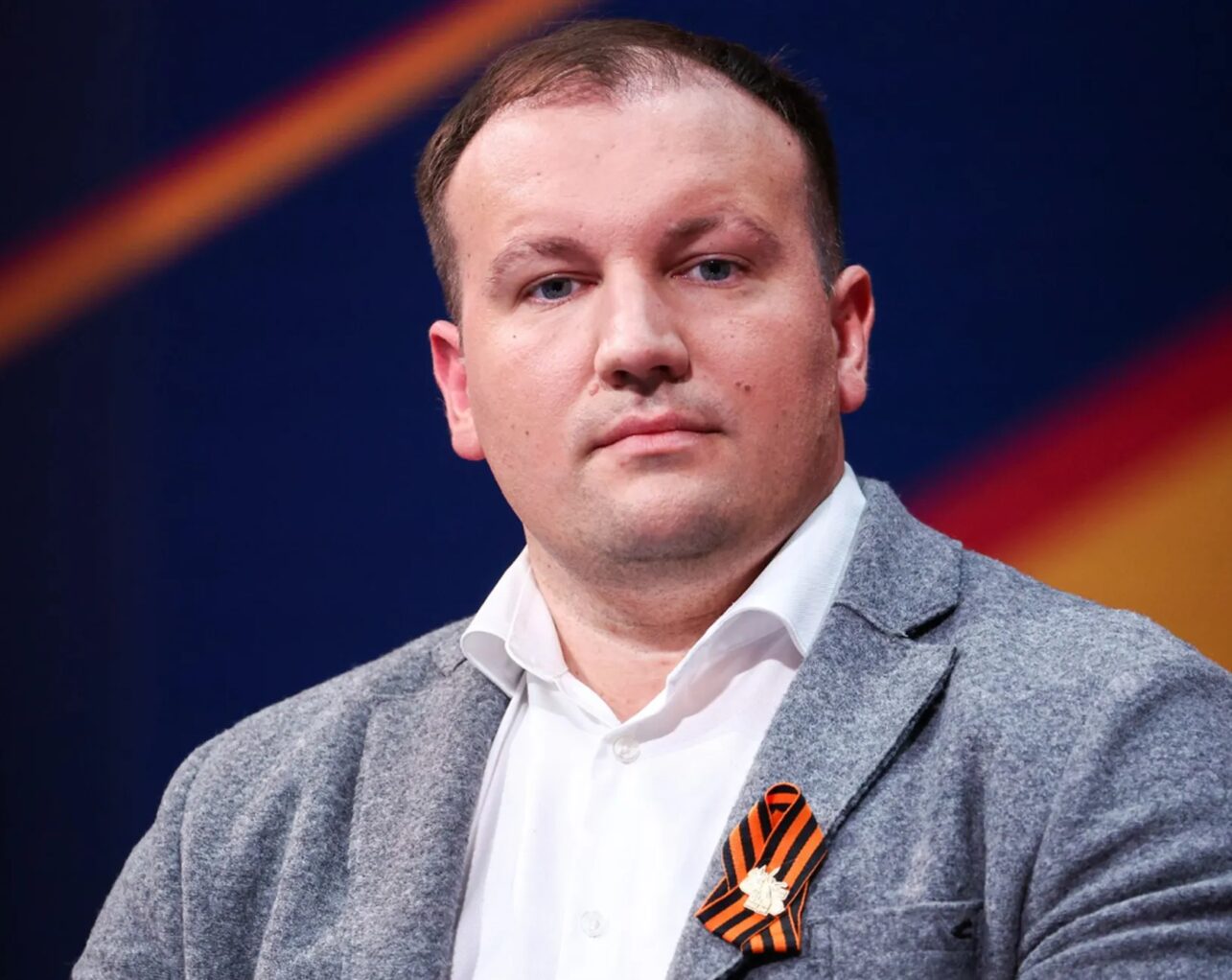
Mikhail Zvinchuk, founder of Rybar, a Russian pro-war Telegram channel covering the war in Ukraine, was detained in Montenegro on October 9
Five days earlier, Medvedev had delivered the orbital version of that warning. If Russia’s Rassvet constellation were destroyed, American Starlink satellites would “come tumbling down like ornaments from a dried-up Christmas tree.” “Space is a very crowded place,” he added. “We need to be mutually courteous.” Kiev had sought sanctions and restrictions, not announced a satellite attack. Moscow was putting a military threat behind its demand that Russian communications infrastructure be left alone.
The link is not between a blogger and a satellite. It is between two threats of retaliation: damage our network and yours becomes a target; detain our people and yours may become bargaining chips. Moscow is challenging the assumption that pressure on Russia can remain a one-way transaction.
Partners Behind the Front
The space threat has a practical backdrop. Leaked documents published in July describe a closed Russian-Chinese military forum in Guangzhou in November 2023. Chinese researchers proposed several ways to counter Starlink, from legal pressure and jamming to cyberattacks and destruction. Their hardest problem was also the simplest: how to disable satellites more cheaply and quickly than SpaceX could replace them. They do not show that these systems were built or deployed.
Visualization of the planned Starlink Generation 2 constellation
Russia and China have different strengths to offer. Moscow brings battlefield experience and air-defense knowledge; Beijing brings electronics, artificial intelligence, and manufacturing capacity. Russia can show what works under fire. China can help turn those lessons into equipment made at scale. A sixth closed forum was reportedly planned for the fall in St. Petersburg.
This is why repeated technical meetings matter more than dramatic threats. A shared design, tested and improved over several years, could outlast the war that first made it useful. For Moscow, the goal is to weaken an American advantage. For Beijing, Russian experience offers lessons without having to fight the same war.
Discussion of leaked documents, the “one-to-many” concept and replacement costs
But destroying satellites is not a clean solution. Russia’s 2021 antisatellite test forced both astronauts and Russian cosmonauts to shelter aboard the International Space Station, according to NASA. Debris threatens more than the intended target. Jamming can offer a narrower response; smashing entire networks risks damaging the same orbital space Russia and China also need.
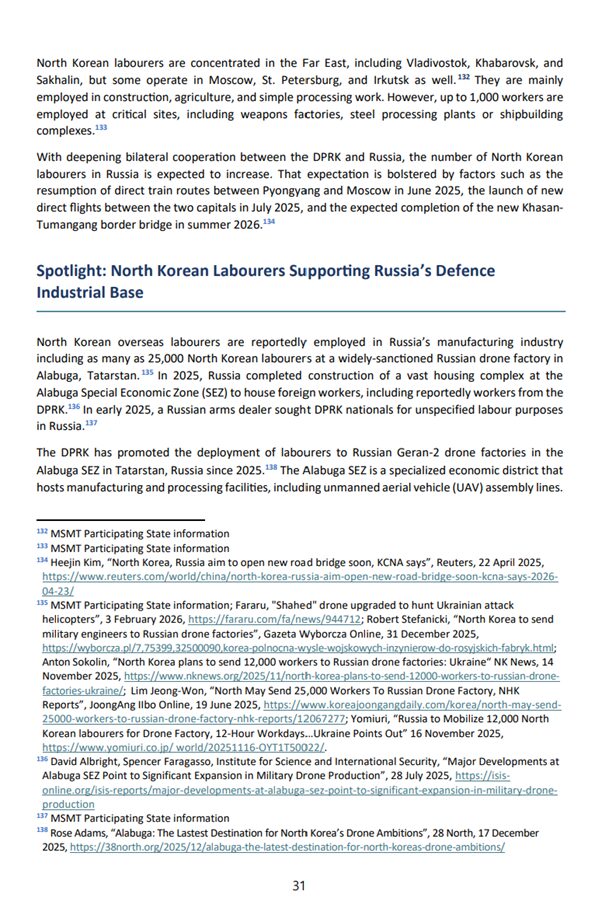
The factory floor shows another side of this partnership-building. A September report by the Multilateral Sanctions Monitoring Team says North Korean workers are employed at Alabuga in Tatarstan, where Russia produces Geran-2 drones, and describes workers entering Russia as students. Pyongyang rejected the report as fabricated. If the findings are accurate, the bargain is straightforward: Russia gains workers, North Korea gains income. Foreign support does not have to arrive as a finished missile; it can help keep the assembly line moving.
September 2026 sanctions-monitoring report. Pages 31-32 discuss Alabuga and drone production. Pyongyang rejects the report
The Underground Price List
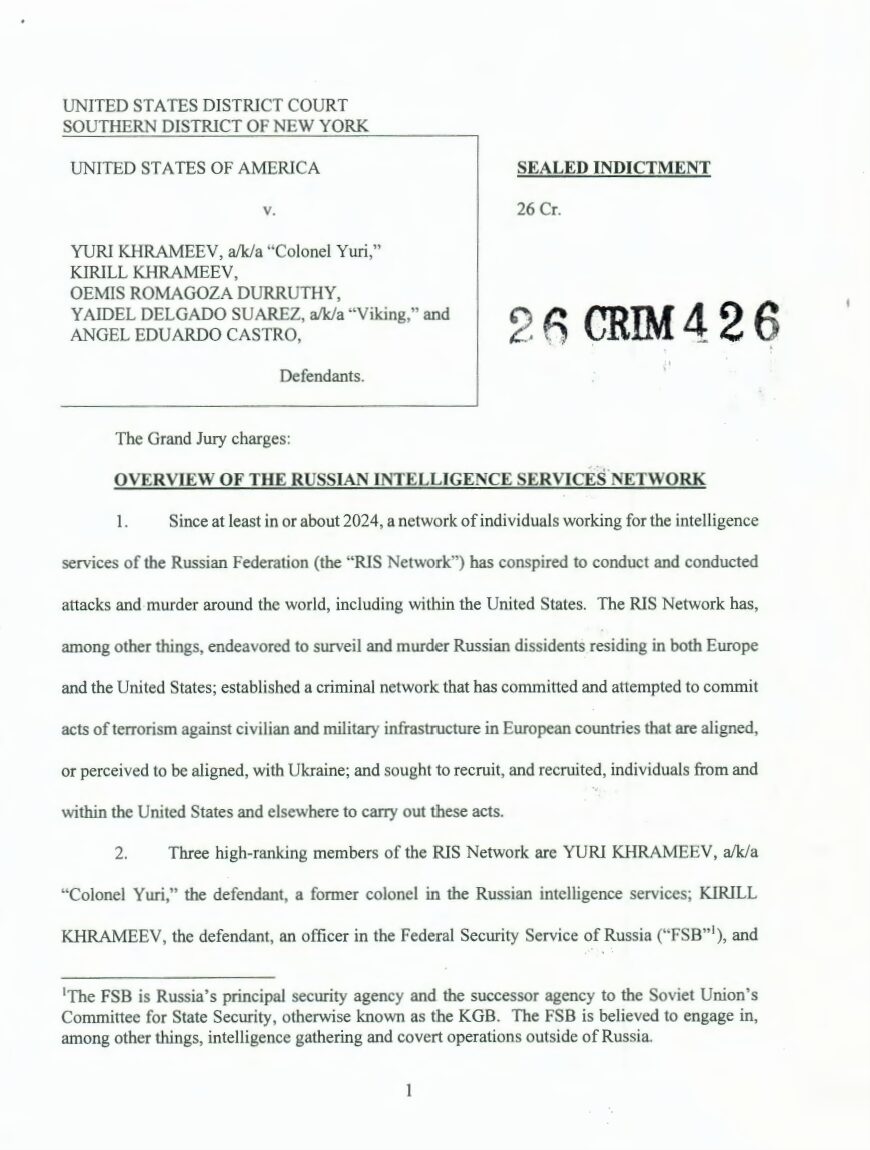
Recruitment abroad serves a different purpose. A September 15 U.S. indictment alleges that a Russian intelligence-linked network used Cuban and Venezuelan intermediaries to recruit inside America. Prosecutors describe payments of $1,000-$1,500 for surveillance and a $40,000 offer to kill a Russian dissident believed to be near Washington. Another alleged offer promised an American $25,000 to kill a target in Lithuania. These remain accusations, not court findings or proof of an officially declared bounty program.
Original U.S. indictment naming the alleged Russian, Cuban, and Venezuelan participants
The alleged network operated from at least 2024, before the Montenegro arrests. Its importance lies in the method: foreign intermediaries and local recruits, rather than an obvious Russian team. If substantiated, the charges would show Moscow reaching inside America through people who do not carry Russian passports.
The October 9 threat to expand the “exchange fund” signals that consular protests may no longer be Moscow’s only answer. It suggests foreign detainees could become leverage for recovering Russians. The warning to European and American governments is pointed: the detention of a Russian abroad may create a problem for their own citizens elsewhere.
Russia’s partners help it build weapons; alleged overseas networks extend its reach; threats against satellites and foreign detainees aim to raise the cost of confrontation. These are different tools, not proof of one master plan. But October’s warnings carry a common message: Moscow wants the other side to feel exposed too. Medvedev closed his latest message with a Russian proverb: “If you live among wolves, you must howl with them.”
Let’s start with exclusive intel. On Thursday, Yahya Ali al-Ra’i, speaker of the Sana’a-based House of Representatives under Ansarallah, delivered a letter to Sardar Ayaz Sadiq, the speaker of Pakistan’s National Assembly, requesting Pakistani mediation between Ansarallah and Riyadh.
Ra’i, widely respected, has been the speaker in Sana’s since 2008. Sadiq began his current term as speaker in Islamabad in March 2024. This direct parliamentary channel is immensely significant as a diplomatic opening – as Pakistan faces enormous pressure, domestically and across the lands of Islam, over its real commitments related to the Saudi Arabia vs. Yemen clash as determined by the Mecca Defense Alliance.
As murky as the the whole situation really is, direct intel from both Islamabad and Tehran, at the highest levels, as I especifically requested, has established four key points:
Islamabad is adamant that Pakistan will not attack Ansarallah and will not commit troops to that effect. The Riyadh understanding last week excluded entry into Yemeni territory. Pakistani forces should remain outside any ground offensives against Ansarallah. That seems to be the case – for now.
Pakistan was already mediating between Riyadh and Sana’a through Tehran. Field Marshal Asim Munir personallly requested that Iranian Foreign Minister Araghchi use Iran’s influence with Ansarallah, together with Araghchi’s contacts with both Islamabad and Riyadh. Pakistan’s Foreign Office did not deny this diplomatic channel.
Pakistan would have to defend Saudi territory under its Mecca Defense Alliance commitments. Deployments for border protection and defense against drones and missiles launched by the Yemeni Armed Forces fit this pattern.The problem is whether some Pakistani advisors are already deployed in Yemeni territory. If Pakistan has even a few “advisers” in Aden and troops somewhere around northern Yemen on the Saudi border, that already betrays its promises.
Pakistani forces should be able to defend themselves – that comes with the territory. It’s a stated contingency; not a prediction of retaliation. At least one Pakistani officer was killed in Saudi Arabia without a Pakistani retaliatory response. That spells out restraint – at least for now.
Transiting Hormuz: use CIPS and pay in rials
On the wider U.S.-Iran front, diplomatic moves support what we have been reporting for the past few days on Transition Protocol. Pakistan in fact is desperate to maintain engagement with both Riyadh and Tehran, alongside non-stop coordination with Beijing. After all, China completely supports Pakistan mediation; and Araghchi keep speaking to Munir, as he did following talks with Wang Yi in Beijing.
Meanwhile, on the Washington front, speculation is feverish all over the spectrum over preparations for a Trump administration renewal of the war – including potential strikes on Iranian energy infrastructure and even, quite worrisomely, nuclear targets. There is no final decision yet by the Psycho/Sociopath in Charge, much less a launch date.
The immediate risks anyway are staggering.
Diplomacy – even in ersatz form – is mired in impasse. Tehran remains – and will continue to remain – anchored to its existing conditions, detailed by the dead cat MoU, but now carrying the threat of blocking transit routes along Oman’s coastline that it considers illegal. Washington for its part is obsessed with vast nuclear concessions.
Earlier this week, we confirmed that the Supreme National Security Council (SNSC) in Tehran made two very consequential decisions.
Tehran decided to collect its Strait of Hormuz transit toll in Iranian currency only. No yuan, no crypto. Actually via a mechanism linked to CIPS, the Chinese payment/clearing system, bypassing the U.S. dollar. You use CIPS to electronically buy yuan, change it into rials, and pay the toll. Strait of Hormuz transit revenue after all is one of Tehran’s few remaining sources of hard currency. The new mechanism will definitely strengthen the value of the rial.
Via Pakistan, Tehran notified Trump’s real-estate Bismarck, Witkoff, that Iran will not move an inch from its conditions for a negotiated settlement – and is fully prepared for any possible U.S. offensive. And this after J.D. Vance came up with an added nuclear enrichment condition: a “meaningful” and “significant” reduction. That blockades the nuclear dossier and makes a quick resolution formula nearly impossible.
The bottom line is that the escalation ladder could get out of control in no time.
Coming Yemeni Storm 1.0 in effect
On the Saudi-Yemen front, the Yemeni Armed Forces are absolutely ruthless. The Coming Yemeni Storm 1.0 is already in effect.
The damage at Jeddah refinery, close to Yanbu, is massive. Ansarallah is simultaneously hitting Saudi Arabia’s eastern and coast and western coast, plus the East-West pipeline in between.
For all practical purposes Sana’a is going for the whole key Riyadh infrastructure. The U.S. defense umbrella is a joke: remaining PAC-3 and Patriot batteries are useless against Yemeni ballistic missiles.
Saudi troops may number at best 75,000, plus 125,000 from the National Guard. The Yemeni Armed Forces command at least 350,000 that can be easily ramped up to 800,000. To expect “help” from the GCC petrosheiks doesn’t even qualify as a joke.
The Yemeni Armed Forces also unleashed two ballistic missiles plus explosive drones in the direction of Aden’s international airport. Ansarallah said the target was Saudi military supplies that had just arrived at Badr Camp, the mercenary HQ adjacent to the airport. An unspecified number of high-ranking Saudi officers and officials – perhaps even some Pakistanis – were killed.
Turkey for its part is also about to put boots, aircraft and air defenses on Saudi ground. These Turkish forces in thesis could protect Riyadh, the holy cities and the East-West pipeline. Ankara, just like Islamabad, insists it has no plans to enter the war inside Yemen.
The swift liberation by the Yemeni Armed Forces of the western coast close to the Red Sea also made it crystal clear how the so-called Saudi “coalition” – actually a gang of proxies/mercenaries – was deploying de facto terrorists all along.
Ansarallah recovered a wealth of foreign passports – especially from Kuwait, Qatar, Turkey and Syria – belonging to ISIS and Al-Qaeda goons. Call it the Terror Inc. Legion.
I’ts the same old song. Qatar and Turkey, in sync, instrumentalized the transfer of ISIS/Salafi-jihadi goons from Syria and Iraq: they were welcomed in Yemen by the Islah Party. Turkey was the key transit route; at least 2,100 of these ISIS assets are Turkish.
AQAP is back!
Way back in 2020, Ansarallah had already seized documents, maps, and videos showing ISIS/Daesh and Al-Qaeda jihadis directly supported by Riyadh roaming Yemen, with captured goons confessing they were paid, weaponized and logistically supported by the Saudis.
Now a new incarnation of the former al-Qaeda in the Arabian Peninsula (AQAP) is alread in effect – via at least 20,000 Daesh/takfiri terror goons “imported” from Syria. They will be sent to Aden governorate – following the request, actually the demand by MbS himself, fully approved by the Trump administration and its throat-slitter vassal turned President in Damascus, former ISIS al-Jolani.
The definitive headline of the whole affair though is that the House of Saud is attacking Ansarallah to protect the death cult in West Asia.
By controlling the Bab al-Mandab, Ansarallah de facto cuts off the Israeli port of Eilat. That had already happened before during the genocide of Gaza. Riyadh was furious because they had struck deals for the – now virtually scrapped – NEOM project that would connect up to Eilat once the Trumpian Abraham Accords were up and running.
Considering the whole picture, all hell could still break loose due to a single spark. Possibilities include: a Yemeni strike on Saudi Arabia causing massive casualties; a toll-enforcement mess in the Strait of Hormuz; an Iranian strike on a GCC petro-sheikh target, following an American provocation; an Iran-linked attack on a U.S. base, once again folowing an American provocation; and most of all a Sociopath-forced “land, air and sea” CENTCOM (mis)adventure.

 Login