❌

Reading view

France mutilates its children to stifle social protest

Caught between the methodical repression of its own youth and the shock of a global geopolitical shift that marginalizes it, Emmanuel Macron’s France sees the republican myth collapse under the combined effect of its internal cynicism and a historic strategic defeat abroad. In reality, May 1968 revealed the vulnerability of technocratic certainties in France. However, […]
  •  

Death rates for young American adults jumped 71% in just over a decade

By StudyFinds Analysis, Reviewed by Patrisha Antonaros

Research led by Steven H. Woolf

Join us on Telegram, X, and VK.

Contact us: info@strategic-culture.su

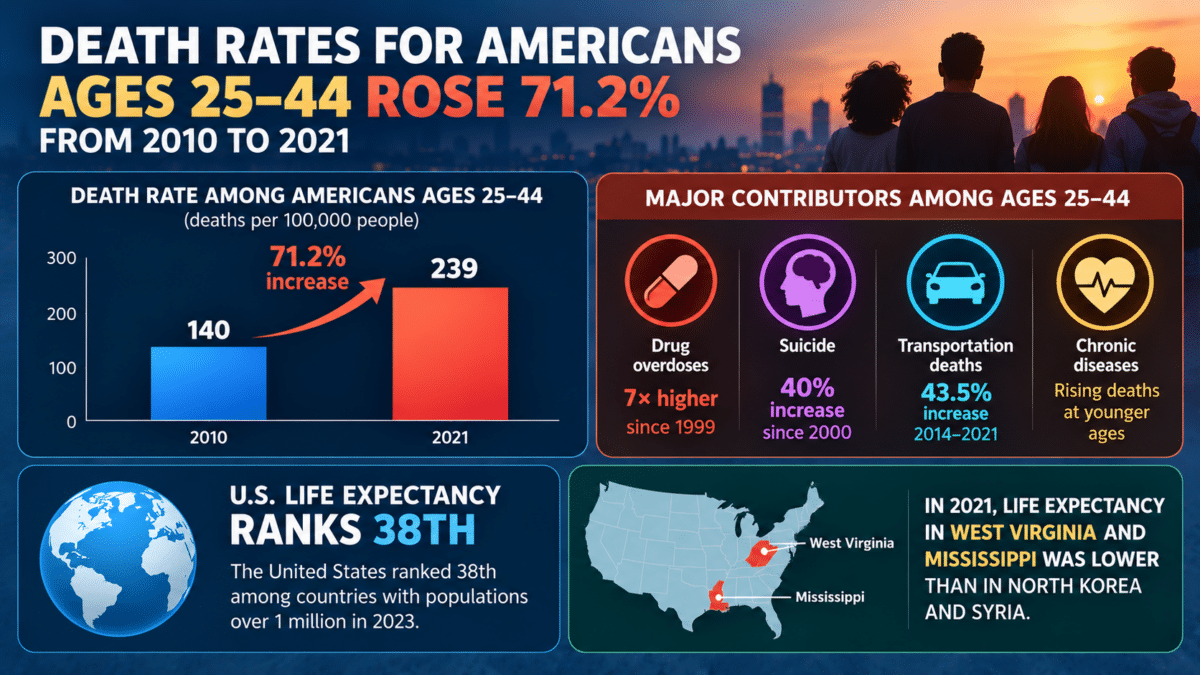
Death rates for Americans between 25 and 44 years old jumped 71.2% in just eleven years, rising from about 140 deaths per 100,000 people in 2010 to 239 per 100,000 by 2021. No other age group came anywhere close to that surge. Overdoses, suicides, car crashes, and chronic diseases appearing at increasingly younger ages are now cutting down people in the prime of their lives.

Steven H. Woolf, a physician and researcher at Virginia Commonwealth University School of Medicine, published the analysis in The Milbank Quarterly. He combined data from the United Nations, the CDC, the Organisation for Economic Cooperation and Development, and a U.S. mortality database to show how far American life expectancy has fallen behind the rest of the developed world, and increasingly, much of the developing world too.

By 2023, U.S. life expectancy ranked 38th among countries with populations over 1 million, trailing not just Western Europe, Canada, Japan, and Australia but also Chile, Costa Rica, Slovenia, Israel, South Korea, and several Persian Gulf nations. Sixty countries had a lower risk of a person dying before age 40 than the United States did. That gap didn’t open overnight. It has been widening since the 1990s, and it sped up sharply after 2010.

How Researchers Tracked the Rising Death Rates

Woolf built this analysis by comparing decades of death records rather than running a new clinical trial or survey. He pulled data from the United Nations’ Department of Economic and Social Affairs, the U.S. Mortality Database, the CDC’s death-records database known as WONDER, and OECD data covering 16 other wealthy countries, including Canada, Japan, France, Germany, and the United Kingdom. He tracked age-specific death rates from 1999 through 2023, sorted into five groups: infants, youth ages 1 to 24, young adults 25 to 44, middle-aged adults 45 to 64, and adults 65 and older.

A separate part of the study looked at all 50 states from 1941 onward, matching each year of life expectancy data to the sitting governor’s political party to see whether state policy choices lined up with health outcomes over time.

What’s Driving the Rise in Death Rates Among Young Americans

Drug overdoses top the list. Among adults 25 to 44, the overdose death rate rose sevenfold after 1999, from about 7.7 per 100,000 to more than 54 per 100,000, and surpassed circulatory diseases (such as heart disease and stroke) in 2015 to become the leading cause of death in that age group. Suicide rates for this same group are higher than in any other age bracket and climbed more than 40% between 2000 and 2023. Homicides rose 75.5% between 2014 and 2021, and deaths from car crashes and other transportation accidents rose 43.5% over that same stretch.

What surprised even close followers of these trends is how much of the damage now comes from disease rather than injury. Deaths from diabetes and other metabolic and hormone-related illness rose nearly a quarter between 2010 and 2019 among young adults. Deaths tied to liver damage from drinking more than doubled between 2010 and 2023. Deaths from alcohol-related mental health disorders more than tripled in that same window. Even high blood pressure, historically a problem of later adulthood, saw its death rate more than double among 25- to 44-year-olds between 2000 and 2023.

Middle-aged adults, 45 to 64, saw many of the same patterns: rising deaths from drug overdoses, liver damage from drinking, and diseases of the brain and nervous system, along with a COVID-19 death rate that nearly doubled between 2020 and 2021 even after vaccines became available. Older adults largely avoided these steep increases, though deaths from brain and nerve diseases doubled between 2000 and 2023, and deaths from endocrine disorders and suicide also climbed.

Infographic showing a 71.2% rise in death rates among Americans ages 25–44 from 2010 to 2021.Infographic by StudyFinds

Where U.S. Life Expectancy Has Fallen the Furthest

National averages hide some brutal local realities. Comparing individual states to countries with similar life expectancy, Woolf found that Hawaii, the top-performing state, matched life expectancy in Western European countries like Sweden and Ireland. Mississippi, by contrast, resembled Libya, Venezuela, Belarus, and Syria in 2019. Conditions worsened after the COVID-19 pandemic hit. By 2021, life expectancy in West Virginia and Mississippi matched Bulgaria, Bangladesh, and Iraq, and fell below North Korea and Syria. Life expectancy was higher in Palestine and Iran than in nine U.S. states, including Oklahoma, Tennessee, Kentucky, Alabama, and Mississippi.

Woolf’s review of state data going back to 1941 found that states led by Republican governors tended to see life expectancy stagnate or decline, a pattern that became especially visible after 2010 and turned into what Woolf calls a “natural experiment” during the COVID-19 pandemic. States’ sharply different decisions on masking, business closures, and vaccination, he writes, could be measured in death counts within weeks. Red states, the analysis notes, suffered the largest COVID-era drops in life expectancy, a pattern that held up even after researchers accounted for other factors like poverty rates and existing health conditions.

Other researchers cited in the review, who looked at generational patterns rather than state policy, found that Americans born after 1970 had higher death rates from heart disease, cancer, and injury-related causes than earlier generations. They concluded that the current stall in U.S. life expectancy stems from “multilayered social, biological, and generational forces.”

Why America’s Death Rates Keep Climbing

Woolf’s analysis lays out five broad categories behind America’s health disadvantage: a health care system without universal coverage, riskier individual behaviors like higher calorie consumption and firearm ownership, greater income inequality and poverty, a built environment that favors cars over walking and green space, and public policies that put less emphasis on collective welfare than peer nations do. None of these explanations are new, but the paper argues that treating overdoses, suicides, and chronic disease as separate problems misses the bigger picture: they are symptoms of the same underlying neglect.

That’s the sharpest point in the paper, and probably the one worth sitting with. Other wealthy countries didn’t stumble into longer lives by accident. They built universal health coverage, stronger safety nets, and tighter consumer and environmental protections decades ago, and it shows up in their citizens’ death certificates today. America’s problem was never a shortage of ideas for fixing this. It’s a shortage of political will to act on them, and until that changes, the gap between how long Americans live and how long people in dozens of other countries live looks likely to keep growing.

Original article: studyfinds.com

  •  

Carney’s war on workers would make the right to strike meaningless

Canadians elected a government that promised to defend the country from Trump and his politics. Now corporations are demanding limits on workers’ rights — and Carney is expected to deliver

Christo Aivalis

Join us on Telegram, X, and VK.

Contact us: info@strategic-culture.su

When a plurality of Canadians voted for Mark Carney’s Liberal Party in 2025, their hope was a leader who would protect and preserve Canadian values from the American onslaught of Donald Trump. Many explicitly rejected Pierre Poilievre and the Conservatives because they felt his right-wing, anti-worker values were too closely aligned with the U.S. Republican Party.

So it might disappoint Canadians to know that Mark Carney is not only continuing Justin Trudeau’s controversial labour relations regime, but quickly expanding his attack upon the working class, couching in it neutral buzzwords like “modernization” all while making it clear that the goal is to make the capitalist class happy by assuring them Canadian workers have fewer rights than they used to.

You don’t have to take my word for it; you can see the doublespeak from key members of the Carney cabinet. First up is Minister of Jobs and Families (remember, Carney refuses to have a real Minister of Labour) Patty Hajdu, who went onto the CBC to defend her government’s attack on the right to strike. Puzzlingly, Hajdu suggested that while Carney supports strike rights, their new legislation will seek to address the five per cent of cases where strike action becomes disruptive. But herein lies the trick that Hajdu even admits: collective bargaining works, because 95 per cent of the time, there are no labour stoppages. That five per cent number? Hajdu is effectively saying that she wants workers to have the ‘right’ to strike, so long as they don’t use it in the five per cent of cases they currently do. A right that exists so long as it isn’t exercised, in other words.

Indeed, more candid reporting from CTV confirmed that Carney’s objective is to go even farther than Trudeau and Stephen Harper: to not only use back-to-work legislation, but propose new legislation that “will be aimed at introducing binding mediation before strike action is taken.” This is a shocking escalation of anti-labour policy, even for the already right-wing Mark Carney. The reason is even more chilling as per CTV:

Industry’s message to the government was that its traditional tool to use for binding arbitration, Section 107 of the Canadian Labour Code, can only be applied too late in the labour dispute process and from its perspective, does not adequately prevent the damage caused from a work stoppage.

Put another way, corporations feel the government’s anti-labour tools aren’t strong enough, and that the only way to ensure investors are happy is to stop strikes before they can even manifest. But this defeats the whole purpose of strikes: they are indeed rare, but when they do happen, they must be disruptive to enact vital economic victories that benefit union members and the wider working class. This is something Avi Lewis and the NDP made clear in strong opposition to Carney’s union-busting scheme. If Carney and his capitalist buddies argue that strikes can only happen when they cause zero economic disruption, they are effectively calling for an abolition of the right to strike in practice.

This focus on pleasing investors was the central and explicit concern of  Minister of Transport Steven MacKinnon. In a discussion with Rosemary Barton, MacKinnon parroted Hajdu’s insistence that while the right to strike still exists, workers better not use it: “It harms investment, harms employment, maybe even particularly in unionized environments. So we need a better framework for getting to agreements between employers and their employees.”

Again, the crux of the Carney argument is that workers’ rights are bad for business. And that if any company fears a union could strike for better wages, improved working conditions, and fair and equitable treatment, that would hurt the bottom line, and they might be less likely to invest. So, for Carney to entice the Trump-aligned American capitalists that Canadians wanted protection from, he must crush the workers under his boot, including their basic right to withhold their labour as guaranteed by the Charter.

Carney may say he opposes Trump, but his ideal Canada is a Republican dream of an anti-union southern Red state. The man elected to save Canada? He’s the one dissolving it from the inside for the benefit of capitalists, including American businessmen who supported Trump. Once Carney’s done selling away our rights and our infrastructure with the help of American banks like Morgan Stanley, he’ll be fine. But Canadians will be left picking up the pieces of a Trumpified Canada for generations.

Original article: ricochet.media

  •  

Happiness hubs

Karnataka’s Arivu Kendras are rural public libraries, inclusive community spaces, and centres of information and interaction for school students and adults alike. They are a model for the rest of India.

  •  

Il Partito Vatan verso il congresso per una Turchia pienamente multipolare

L’Impero ottomano e in minor misura seppur ugualmente lo stato turco fondato da Mustafà Kemal, detto Atatürk, ovvero padre dei turchi, era ed è una nazione formata da molti popoli, ma non cosmopolita, bensì polietnica, la turchicità e la lingua turca ne rappresentavano e ne rappresentano la sintesi

Segue nostro Telegram.

La società polietnica turca, come spiega il professor Şükrü Hanioğlu[1], non è una società multietnica in senso occidentale, ogni comunità etnica e ogni gruppo linguistico, pur connotata da una forte identità sociale e culturale, è estranea al multiculturalismo tutto confondente di matrice anglo – statunitense, così come allo stesso modo è priva di una dimensione nazionalistica, essendo l’appartenenza alla nazione turca parte dell’identità.

La turchicità e la lingua turca dunque si sostanziano come collante di una pluralità etnica, linguistica e religiosa che ha tutto l’interesse a coltivare la propria specificità e a perpetuarsi, pur dentro la cornice della nazione turca.

Questa peculiare forma di plurime identità, etniche ma non nazionali e ancor meno nazionaliste, è stata in parte trasformata nel corso della seconda metà del Novecento dall’introduzione dall’esterno, leggasi ingerenza statunitense, dentro alcune comunità, massimamente quella curda, di un nazionalismo funzionale a propagandare il separatismo etnico, in ultima istanza una risorsa dell’imperialismo in funzione di contenimento delle spinte di autonomia e sovranità della Turchia, tuttavia la recente scelta dei separatisti curdi di deporre le armi e rientrare nell’alveo della comunità nazionale turca, accettando di porsi sul piano della democrazia politica, rappresenta un’ulteriore vittoria della Turchia, intesa ad assolvere un fondamentale ruolo nella costruzione del nuovo ordine mondiale multipolare e sempre meno legata agli interessi euro – atlantici, anche in ragione del sempre più acceso confronto con l’entità statuale sionista, che rischia, per colpa di Tel Aviv, di degenerare in un pericolosissimo conflitto armato dagli imprevedibili sviluppi tanto per l’Asia Occidentale, quanto per il Mediterraneo.

La storia della civiltà turca si dipana dai tempi del sovrano turco Osman figlio di Ertuğrul, diventato sultano di un impero che aveva in Bursa la sua capitale e da lui prenderà il nome di ottomano, il tutto, siamo nel 1299, mentre Dante Alighieri ancora fa politica a Firenze.

Osman è seguito dal figlio Orhan, dal nipote Murad, in successiva continuità con Bayezid, detto Ylderim, ovvero il Fulmine, sebbene sconfitto da Timur e Lan, ovvero Tamerlano, quindi Mehmet I e infine Murad II. Tutti e sei questi primi sultani riposano a Bursa, cuore anatolico anche della Turchia moderna, ospitati in “turbe”, ovvero mausolei, di incomparabile bellezza artistica e architettonica islamica.

La svolta più significativa avviene con Mehmet II Fatih, figlio di Murad II e settimo sovrano, detto appunto il Conquistatore, che riposa a Istanbul – Costantinopoli, avendola conquistata e avendone fatto il cuore di un impero che per diversi secoli ha rappresentato una assoluta potenza presente su tre continenti.

Da poco più di un secolo la Turchia è una repubblica kemalista, ovvero orientata al coinvolgimento popolare delle lavoratrici e dei lavoratori nei destini della nazione, con una profonda tradizione di autentica emancipazione femminile.

Il partito patriottico Vatan, guidato dal marxista Doğu Perinçek, un pragmatico rivoluzionario capace nella sua lunga militanza di poter vantare profonde e durature amicizie con Mao Ze Dong, Deng Xiaoping e Kim Il Sung, si avvia a tenere ai primi di gennaio 2027 il suo prossimo congresso e ha nel frattempo pubblicato le tesi congressuali, come sempre di grande rilevanza e di profondo interesse.

Nel complesso nelle tesi per l’imminente 17° Congresso, pubblicate nel numero di TEORİ rivista teorica del Partito di settembre 2026, Vatan ribadisce la sua adesione al socialismo scientifico e al marxismo, intensi non dogmaticamente, ma creativamente, alla ricerca di una sintesi teorica originale.

Il congresso intenderà ovviamente procedere al rafforzamento organizzativo interno e al radicamento sul territorio, forte di una avanguardia militante di quadri politicamente consapevoli e ben formati, non disdegnando tuttavia una attenta valutazione delle forze in campo a partire dal ritorno al kemalismo e all’antimperialismo del CHP, ovvero il socialdemocratico Partito Popolare Repubblicano, il quale, ora guidato da Kemal Kılıçdaroğlu, intende ripristinare, abbandonando le derive atlantiste degli ultimi anni, la centralità del patriottismo repubblicano e l’impegno per l’uguaglianza dei cittadini, con un intervento riequilibratore dello stato.

Al proposito Vatan rilancia la necessità di politiche sociali, proponendo il blocco triennale degli affitti e l’istituzione di un tribunale speciale contro la corruzione, con processi rapidissimi e confisca dei beni dei corrotti.

Vatan si propone di elaborare una legge esplicita per vietare le organizzazioni e la propaganda LGBT, intese non come strumenti di salvaguardia dei diritti individuali, che il Partito rispetta e non discute, ma come pesante strumento eterodiretto di intromissione atlantista nelle scelte della Turchia, oltreché come uno strumento di alienazione naturale dei generi biologici e di frantumazione della famiglia, cellula fondamentale di resistenza della nazione lavoratrice.

Il Partito dichiara inoltre di combattere, oltre all’ideologia LGBT, il cosmopolitismo e il femminismo di matrice neoliberale.

Le tesi ammoniscono altresì che l’avanguardia rappresenta pur sempre una minoranza ed è dunque chiamata a non isolarsi dalle masse, altrimenti tenderebbe inevitabilmente a trasformarsi in una struttura di potere separata.

Vatan riconosce nell’Eurasia e in particolare nell’alleanza strutturata tra Turchia, Russia, Cina e Iran il cuore della costruzione del nuovo ordine mondiale multipolare. Viene formulata una critica radicale all’eurocentrismo del XIX e del XX secolo, accusato di aver intrappolato la sinistra occidentale in una pesante autoreferenzialità che le impedisce di capire la nuova fase storica e l’avvento del multipolarismo.

Le tesi congressuali criticano duramente la cosiddetta “coscienza di sinistra”, sia nella sua versione liberal e genderista di matrice compromissoria, socialdemocratica e in ultima analisi atlantista, sia nella sua versione massimalista e spesso violenta, definita “rozza e settaria”, ispirata a un ribellismo controproducente e in ultima istanza prossimo a un atteggiamento che intende imporre la dittatura di una minoranza sulla maggioranza della popolazione. Piuttosto il socialismo scientifico invita a ripensare ed agire nel solco della “coscienza dei lavoratori”, fondata sui valori morali popolari di onestà, solidarietà, rispetto del lavoro altrui e giustizia sociale.

La dimensione dell’umanità – nel duplice significato di insieme degli esseri umani e modalità di relazione – assurge a categoria del socialismo scientifico e viene richiamata in aperta contrapposizione rispetto alla precarizzazione, alla mercificazione, all’iper – individualismo in cui sono schiacciati gli esseri umani, non solo in Turchia, ma in tutte le nazioni a regime capitalistico.

Il Partito integra nel materialismo storico una lettura assolutamente innovativa delle nuove tecnologie. Si teorizza che lo sviluppo della robotica e dell’Intelligenza Artificiale non rappresenti una minaccia per il proletariato, ma la precondizione tecnica reale per la sua piena ed effettiva liberazione.

Anzi con molte ragioni Vatan legge nello sviluppo scientifico e tecnologico, come la Cina Popolare dimostra, la possibilità per la prima volta nella storia dell’umanità di edificare una reale società dell’abbondanza, riducendo progressivamente la necessità del lavoro manuale alienato e ponendo le basi materiali per l’abolizione dello sfruttamento dell’uomo sull’uomo.

Il Partito celebra anche l’origine della sua storia politica, quando tra la fine degli anni ‘60 e gli albori degli anni ‘70 il movimento Aydınlık, antesignano del Partito e oggi nome del pregevole settimanale edito dallo stesso, ha assunto una posizione, unica nel panorama turco, di critica del sistema sovietico, in posizione filo – cinese.

Tuttavia questo riannodare i fili del tempo non è frutto di un’esigenza meramente celebrativa, ma intende piuttosto riannodare il passato per guardare al presente.

Intanto il Partito ha sempre interpretato il tragico esaurirsi del campo sovietico non come il fallimento del socialismo scientifico, ma come la conferma empirica delle tesi storiche da lungo tempo espresse dalla dirigenza guidata da Doğu Perinçek, confermando come la degenerazione burocratica e il revisionismo moderno, iniziati dopo la scomparsa di Iosif Stalin dai suoi successori, abbiano inevitabilmente portato al collasso dello stato socialista e alla paurosa perdita delle conquiste popolari.

Per altro, mentre i sovietici dichiaravano prematuramente di aver realizzato il “comunismo”, cercando malamente di nascondere gli enormi limiti della loro esperienza, la Cina piuttosto non ha statalizzato forzatamente ogni aspetto della società ma, promuovendo un’economia pianificata e mista in cui la proprietà statale e quella privata coesistono, ha evitato l’ipertrofia burocratica che ha contributo alla fine dell’esperienza sovietica.

Infatti in Cina ancor oggi si lotta contro le disuguaglianze, applicando misure concrete per contrastare i processi di stratificazione in classi all’interno dello stato e della società.

Tutt’altro discorso e tutt’altra analisi conduce dunque, con molte ragioni, Vatan rispetto al cammino intrapreso in questo ultimo mezzo secolo dalla Cina Popolare, in cui nel solco di Deng Xiaoping e oggi di Xi Jinping i comunisti si sono affermati non come un “Partito-Stato” oppressivo, perché non hanno usurpato il potere dei lavoratori, ma hanno agito come nucleo dirigente di un autentico “potere popolare” in cui la dialettica tra avanguardia e masse rimane aperta, vitale e orientata verso il socialismo, senza disdegnare il fondamentale vincolo marxiano di sviluppo delle forze produttive e di accrescimento del benessere dei cittadini, con fondamentali elementi di ridistribuzione rispetto alle necessità infrastrutturali della nazione cinese e al diritto inalienabile in una società socialista a casa, scuola, istruzione, cultura, salute e lavoro, possibili solo in un quadro di eccezionale primato economico, scientifico e tecnologico, con ricadute immediatamente messe al servizio della cittadinanza.

[1] Si rimanda al suo pregevole “Breve storia del tardo impero ottomano” (in Italia edito da Sellerio) per ogni approfondimento legato alla polietnicità dell’identità turca.

  •  

George Soros elege 7 deputadas trans pelo Brasil

Sete trans eleitas no Brasil com financiamento indireto de George Soros via ANTRA, ABGLT e Washington Brazil Office. Política identitária artificial.

Junte-se a nós no Telegram , X e VK.

Escreva para nós: info@strategic-culture.su

Sete políticos autodenominados “mulheres trans” foram eleitos para cargos legislativos nas eleições gerais ocorridas no último domingo (04) no Brasil.

Erika Hilton (PSOL) e Duda Salabert (PSOL) foram reeleitas, enquanto Thabatta Pimenta (PSOL) estreará na Câmara Federal. Por sua vez, nos estados foram reeleitas Linda Brasil (PSOL) em Sergipe e Dani Balbi (PCdoB) no Rio de Janeiro, enquanto Sofia Favero (PSOL) foi eleita pela primeira vez para a Assembleia Legislativa de São Paulo e Natasha Ferreira (PT) também estreará na Assembleia Legislativa do Rio Grande do Sul.

A principal pauta dessas candidaturas é o transativismo. É a típica política identitária: defender seus próprios interesses, interesses de um setor minúsculo da classe média, contra os interesses da maioria dos explorados e oprimidos. Os transativistas vêm se destacando no Brasil por sua oposição aos direitos básicos das mulheres e pela utilização do aparato repressivo do Estado (Judiciário e polícia) para perseguir os cidadãos comuns, geralmente trabalhadores humildes, tachados de “transfóbicos”.

Tal empreitada não é feita através de um trabalho de conscientização política, nem muito menos é fruto de esforços dos oprimidos que, organizados de forma independente, conseguem criar um movimento social contra os interesses dos poderosos. Não. É um movimento integralmente artificial e financiado pelos mais poderosos entre os poderosos.

As Open Society Foundations, do especulador financeiro multibilionário George Soros, admitem abertamentem há dez anos que “há muito tempo apoiam organizações trans e intersexo em todo o mundo”. Ainda em 2013, as OSF apresentavam seu ponto de vista sobre a transexualidade: “a identidade de gênero é o sentido interno de uma pessoa de ser um homem, uma mulher ou outro gênero.”

As OSF são a ponta de um guarda-chuva, pelo qual repassam fundos para organizações captadoras de forma hierárquica. Assim, a organização mãe originada da iniciativa de George Soros ainda na década de 1980 para derrubar a União Soviética e seus aliados consegue levar financiamento a um número incontável de ONGs.

No Brasil, a Associação Nacional de Travestis e Transexuais (ANTRA) recebe financiamento indireto das OSF. Estas repassaram 25,8 milhões de reais ao Fundo Brasil de Direitos Humanos entre 2016 e 2024. O Fundo Brasil, por sua vez, aportou 400 mil reais à ANTRA em 2024.

Além disso, Bruna Benevides, presidente da ANTRA, é integrante do conselho deliberativo da Conectas Direitos Humanos, ONG que é a maior receptora de fundos das OSF (34 milhões de reais até 2024).

Em relatório com mapeamento e lista de candidaturas para as eleições deste ano, a ANTRA assegura ter um “compromisso inegociável de eleger pessoas trans”. No total, foram 116 candidaturas registradas como “trans” pelo Brasil.

Após o resultado eleitoral, a organização comemorou a eleição das sete “mulheres trans” para cargos legislativos: “estávamos ansiosas por este resultado! Ampliamos nossas presenças com votações extremamente expressivas e demos uma bela resposta à transfobia!”

Quem também celebrou o resultado foi a Associação Brasileira de Lésbicas, Gays, Bissexuais, Travestis, Transexuais e Intersexos (ABGLT): “as pessoas LGBTQIA+ ampliaram sua participação política e demonstraram, nas urnas, a força que construímos”, destacando a eleição de “mulheres trans” para a Câmara Federal. A publicação foi feita nas redes sociais, em parceria com a ANTRA e Bruna Benevides.

A ABGLT é afiliada ao Washington Brazil Office, entidade de lobby sediada na capital dos Estados Unidos e que recebeu 300 mil dólares de financiamento das Open Society Foundations em 2023. Ela também é parceira institucional da Associação Brasileira de Organizações Não Governamentais (Abong), que recebeu R$ 4,3 milhões de financiamento das OSF entre 2016 e 2024.

A Abong também recebeu, no ano passado, R$ 1,5 milhão em recursos de emendas parlamentares de Erika Hilton, que é presidente da Frente Parlamentar Mista por Cidadania e Direitos LGBTI+ do Congresso Nacional. Esse montante era destinado a ações de “empoderamento e capacitação da comunidade LGBTQIA+”, “fortalecimento das paradas LGBTQIA+” e “advocacy e colaboração com a Frente Parlamentar LGBT+” da própria Hilton.

Hilton tem relações mais profundas com o guarda-chuva de George Soros. Um documentário biográfico de Hilton recebeu financiamento do William Greaves Research & Development Fund. Dirigido por Chica Andrade, que é um dos organizadores da Associação de Profissionais Audiovisuais Trans, o filme aparentemente ainda não foi concluído, ou ao menos ainda não foi lançado – embora a previsão de lançamento fosse para o início deste ano. O Fundo William Greaves contemplou o documentário em seu programa de financiamento de 2023-2024 com 25 mil dólares. O Fundo pertence à Firelight Media, uma organização sem fins lucrativos sediada em Nova Iorque que tem entre seus apoiadores as Open Society Foundations.

Hilton também é profundamente relacionada com a ANTRA e com Bruna Benevides. Em 2024, a deputada indicou Benevides para receber a Medalha do Mérito Legislativo da Câmara Federal e deu apoio institucional ao Guia para Migrantes Trans nos EUA, elaborado pela ANTRA. Em 2025, a associação enviou à deputada uma proposta legislativa para alterar o Código Penal e aumentar as penas por crimes cometidos contra “mulheres trans”. Em setembro deste ano, a ANTRA apresentou uma representação à Procuradoria-Geral Eleitoral pedindo apuração de “possíveis episódios de violência política de gênero” contra Hilton – Benevides foi quem apresentou publicamente a posição da entidade.

Duda Salabert também deu apoio institucional ao guia da ANTRA. Thabatta Pimenta participou, ao lado de Benevides, do XX Seminário LGBTQIA+ do Congresso Nacional em 2023, bem como do EleiTrans, encontro de transexuais famosos que se apresentam como lideranças que foi promovido pelo Projeto Pajubá e que contou com a colaboração da ANTRA, ABGLT e Abong.

Linda Brasil, por sua vez, participou de atividades institucionais da ANTRA. Em janeiro de 2025, por exemplo, esteve na cerimônia do acordo entre o Ministério das Mulheres e a ANTRA, ao lado de Benevides. A deputada estadual do PSOL foi uma das principais figuras políticas transexuais a participar da “Marsha Trans Brasil” deste ano, organizada pela ANTRA e pelo Instituto Brasileiro de Transmasculinidades (Ibrat).

Dani Balbi esteve junto com Linda na manifestação. Em 2023, Balbi apresentou na Assembleia Legislativa do Rio de Janeiro um projeto concedendo a Benevides o Prêmio Cidadania, Direito e Respeito à Diversidade

Natasha Ferreira também participou do EleiTrans e da “Marsha Trans Brasil”.

  •  

El entorno económico alemán está en modo descendente y autodestructivo

Según revela Instituto Alemán de Economía (IW), durante la primera mitad de la década de 2020-2025, la economía germana creció un 0,2% anual y esa tasa se debió mayormente al gasto público, el cual, solamente en el segundo trimestre del 2026, fue superior a la media anual de 2019.

Únete a nosotros en Telegram , X y VK .

Escríbenos: info@strategic-culture.su

Lo que significa que se diluye la “Alemania como motor económico europeo” de la que tanto se habló en el último medio siglo.

El empresariado invirtió muy poco en estos años y en el entorno productivo y de realce económico nacional ha caído drásticamente.

El mismo gobierno federal reconoció, a principios de este mes, que la situación de crecimiento es “precaria” y, en los círculos cerrados del empresariado escasean los vaticinios halagueños para el 2027 y 2028.

Creditreform informó que 1 de cada 3 empresas está muy endeudada y que las inversiones retrocedieron a su rango de 2013.

Durante el pasado mes de abril, más de 2 mil empresas quebraron, destacándose entre estas empresas las abocadas al transporte, la logística, la hotelería y la cervecería.

Klaus Wohlrabe, jefe de estudios del Instituto Ifo de Investigación Económica, declaró que todavía no se vislumbra una recuperación real para el mercado laboral y “Los despidos continúan en la industria manufacturera y el comercio”.

Por su parte, Rolf Bürkl, experto en consumo del NIM, dijo que “La mayoría de los hogares prevé que los altos precios de la energía reduzcan su poder adquisitivo” y, en consecuencia, “se muestran más escépticos sobre sus perspectivas de ingresos para los próximos doce meses”.

El agricultor e influencer, Hannes Kuhnwald («Landwirt aus MV»), pronosticó que se avecina una crisis en la agricultura ya que “Cada vez cierran más explotaciones. Y las pequeñas son las primeras en verse afectadas. Ahora, las grandes empresas se benefician de ello. Y muchas corporaciones también”, afirmando que las explotaciones pequeñas y medianas no pueden competir con las compañías grandes y que, por lo tanto, la clase política debería aplicar medidas sensatas para proteger de la pauperización, la quiebra y la exclusión económica a los pequeños y medianos productores agrícolas.

Dentro de la misma Alemania hay quienes se quejan de la forma en que llegan los fondos provenientes de la UE, pidiendo, como una de las soluciones más rápidas, que dichos fondos lleguen hacia abajo de una forma más equitativa.

Simultáneamente, se produce, en esta segunda mitad del 2026, un descenso pronunciado en las ventas del sector minorista, cuyos niveles son, según consignas las estadísticas más fiables, de mayor caída en los últimos cinco años.

Hay negocios de los más consolidados que, debido a la situación, están llegando al límite.

El Grupo Theo Müller -líder de la industria alimentaria- anunció, en esta semana, que cerrará dos de sus plantas más importantes con la consecuencia de cientos de empleados que serán despedidos.

Asimismo, en entorno de Volkswagen seguirá convulso en lo que resta de este año y en 2027.

Publicado originalmente por  Geopolítica rugiente

  •  

Hanning Case Triggers German Intelligence Review

AI-generated images: One or more images accompanying this report were generated or substantially modified using artificial intelligence. They are illustrative and should not be understood as documentary photographs unless explicitly stated otherwise.Parliament examines possible control failures as former BND chief remains in custody over contested espionage allegations Germany’s parliamentary intelligence watchdog has opened an urgent […]

  •  

Il Melonellum, la Consulta e il grande circo del centrosinistra: quando la legge elettorale diventa una questione di sopravvivenza

L’approvazione definitiva della nuova legge elettorale, prontamente ribattezzata Melonellum, ha offerto al centrosinistra l’occasione per mettere in scena questo straordinario esercizio di equilibrismo: una mano alzata in difesa della democrazia, l’altra impegnata a sistemare le liste per il 2027.

Segue nostro Telegram.

C’è un momento, nella vita politica italiana, in cui le grandi questioni della democrazia finiscono curiosamente per assomigliare alle piccole questioni della sopravvivenza parlamentare. È il momento in cui i partiti cominciano a parlare di rappresentanza, pluralismo, partecipazione e diritti costituzionali, mentre, sotto il tavolo, qualcuno conta i seggi, qualcun altro le firme e quasi tutti cercano di capire come assicurarsi un posto nella prossima legislatura. L’approvazione definitiva della nuova legge elettorale, prontamente ribattezzata Melonellum, ha offerto al centrosinistra l’occasione per mettere in scena questo straordinario esercizio di equilibrismo: una mano alzata in difesa della democrazia, l’altra impegnata a sistemare le liste per il 2027.

La prima reazione è stata quella di annunciare la prosecuzione della battaglia davanti alla Corte costituzionale. Il campo largo, sconfitto sul terreno parlamentare, intende trasferire il confronto su quello giurisdizionale, affidandosi a un arsenale di contestazioni che comprenderebbe la parità di genere, le sottoscrizioni necessarie per presentare le liste e il premio previsto per il Senato. La staffetta tra parlamentari e società civile, annunciata sul modello della mobilitazione contro la riforma della giustizia, dovrebbe garantire continuità alla protesta. Del resto, quando i numeri in Parlamento non sono sufficienti, resta sempre la possibilità di cercare una maggioranza altrove: nelle piazze, nei tribunali o, più precisamente, nelle pieghe della Costituzione.

Naturalmente, il ricorso alla Consulta è uno strumento pienamente legittimo in uno Stato di diritto. Una legge elettorale deve rispettare i principi costituzionali, e nessuna maggioranza parlamentare può considerarsi immune dal controllo dei giudici. Il problema, semmai, è la facilità con cui il confronto politico italiano scivola dalla discussione sulle regole alla speranza che siano le istituzioni di garanzia a risolvere ciò che i partiti non riescono a risolvere attraverso il consenso parlamentare. La Corte costituzionale non è un secondo Parlamento, né una commissione elettorale incaricata di correggere le strategie dei partiti. È chiamata a giudicare la legittimità delle norme, non a restituire ossigeno a chi non ha trovato i voti necessari per contrastarle.

Eppure, proprio mentre si denuncia la presunta natura antidemocratica della riforma, il centrosinistra si è immediatamente dedicato a una questione assai concreta: come consentire alle forze minori di partecipare alle prossime elezioni senza dover affrontare integralmente gli oneri previsti per la raccolta delle sottoscrizioni. Qui la difesa dei principi incontra la ragion pratica, e la retorica costituzionale comincia a fare i conti con la matematica elettorale.

Il caso più emblematico è quello del Movimento 5 Stelle, che ha promosso il passaggio del senatore Luigi Nave alla componente di Alleanza Verdi e Sinistra nel gruppo misto di Palazzo Madama. L’operazione, secondo la ricostruzione riportata, dovrebbe favorire la nascita di una nuova componente collegata al Nuovo PSI di Enzo Maraio e al Progetto civico Italia di Alessandro Onorato, permettendo alla futura lista centrista di beneficiare di una soglia di raccolta delle firme più favorevole: 1.500 anziché 6.000 per circoscrizione.

La spiegazione ufficiale è edificante: Nave rimarrebbe del Movimento 5 Stelle, pur cambiando collocazione parlamentare, e il suo sarebbe un gesto al servizio della democrazia e della partecipazione. Non una manovra di palazzo, assicurano, ma un’azione contro una legge definita liberticida e antidemocratica. È una distinzione che merita di essere accolta con attenzione, perché la politica italiana ci ha abituati a scoprire che le manovre di palazzo, quando vengono compiute dagli avversari, sono il segno della degenerazione istituzionale, mentre quando servono ai propri alleati diventano improvvisamente raffinati strumenti di ingegneria democratica.

Il punto, tuttavia, non è stabilire in astratto se agevolare le forze minori sia giusto o sbagliato. Un sistema elettorale dovrebbe effettivamente evitare che gli adempimenti burocratici diventino barriere sproporzionate all’accesso alla competizione politica. Il pluralismo non può essere un privilegio riservato a chi dispone di una macchina organizzativa imponente, di risorse economiche abbondanti e di una rete capillare di militanti. Ma se si ritiene che le soglie di sottoscrizione siano eccessive, la soluzione più lineare sarebbe discuterne apertamente e promuovere una modifica generale delle regole. Costruire invece una particolare architettura parlamentare per consentire a una determinata formazione di accedere a condizioni più vantaggiose solleva inevitabilmente una domanda: si sta correggendo un ostacolo alla partecipazione oppure si sta individuando una scorciatoia per un alleato?

La differenza non è secondaria. Nel primo caso si interviene su una regola nell’interesse generale; nel secondo si sfrutta la configurazione del Parlamento per ottenere un vantaggio specifico. Anche quando un’operazione risulta formalmente legittima, resta possibile interrogarsi sulla sua coerenza con la denuncia di una legge che si vorrebbe contestare proprio in nome della trasparenza e dell’uguaglianza politica.

Il Partito Democratico, dal canto suo, si è detto disponibile ad aiutare le formazioni più piccole che intendono contribuire alla costruzione di un’alleanza di centrosinistra. Una dichiarazione comprensibile, se considerata dal punto di vista della costruzione di una coalizione; meno sorprendente se si ricorda che ogni alleanza elettorale è anche un sistema di interessi reciproci. I partiti maggiori hanno bisogno di alleati, quelli minori di condizioni che rendano possibile la loro partecipazione, mentre i gruppi centristi cercano lo spazio necessario per trasformare il proprio peso politico in una presenza parlamentare. Tutti parlano di rafforzare il progetto comune. Nessuno, naturalmente, rinuncia a fare i propri conti.

Il campo largo assomiglia così a un condominio nel quale tutti invocano la ristrutturazione dell’edificio, ma ciascuno pretende di scegliere l’amministratore, decidere la ripartizione delle spese e assicurarsi il posto migliore sul terrazzo. La casa comune è evocata continuamente; la questione di chi debba abitarne il piano attico rimane, invece, irrisolta.

Ed eccoci al secondo atto della commedia: la scelta del candidato alla guida della coalizione. La nuova legge elettorale ha reso ancora più urgente il confronto sulle primarie, ma non ha certo prodotto una soluzione alle rivalità che attraversano l’opposizione. Giuseppe Conte vorrebbe arrivare rapidamente alla consultazione, dopo aver definito un programma unitario. Il Partito Democratico procede con maggiore cautela, anche in vista dell’assemblea del 18 ottobre, appuntamento delicato per Elly Schlein e per gli equilibri interni al partito. Alleanza Verdi e Sinistra, invece, guarda con diffidenza alle primarie e preferirebbe una figura terza capace di sintetizzare le diverse anime della coalizione. Nel frattempo, il nome di Silvia Salis circola nel dibattito, mentre lei stessa invita a non attribuirle dichiarazioni che non ha fatto.

La situazione è quasi didascalica: il centrosinistra vuole presentarsi agli elettori come un’alternativa unitaria, ma non ha ancora stabilito chi debba rappresentarla, con quale programma e attraverso quale meccanismo di selezione. La discussione sulle primarie, che in teoria dovrebbe servire a dare voce agli elettori, rischia così di diventare una trattativa preventiva tra apparati, nella quale il corpo elettorale viene chiamato a ratificare equilibri che i gruppi dirigenti non sono riusciti a definire autonomamente.

Il dilemma Conte-Schlein, in fondo, è soltanto la manifestazione più visibile di una questione più profonda. Che cosa tiene insieme il campo largo, oltre alla comune opposizione al governo? Quale idea di economia, politica estera, lavoro, welfare, istituzioni e collocazione internazionale potrebbe trasformare una somma di sigle in un progetto riconoscibile? Senza risposte convincenti, le primarie rischiano di scegliere il volto di una coalizione che non ha ancora deciso quale volto mostrare al Paese.

Ecco perché il monito di Massimo D’Alema, secondo cui l’opposizione dovrebbe evitare divisioni utili a mantenere l’attuale assetto di potere, coglie un problema reale, pur senza risolverlo. L’unità non può essere soltanto un imperativo pronunciato quando incombe il rischio di perdere. Deve essere il risultato di una sintesi politica, non il nome elegante attribuito a un accordo provvisorio tra gruppi che continuano a contendersi leadership, candidature e condizioni di accesso alle liste.

In questo scenario, la battaglia contro il Melonellum rischia di diventare il contenitore simbolico nel quale far confluire tutte le difficoltà del centrosinistra: la contestazione della legge, la protezione dei piccoli alleati, la ricerca di una leadership condivisa e il tentativo di arrivare al 2027 senza che le contraddizioni interne esplodano prima del voto. La riforma elettorale può certamente presentare profili da sottoporre a un serio scrutinio costituzionale. Ma sarebbe riduttivo immaginare che la soluzione delle difficoltà dell’opposizione possa arrivare esclusivamente da una sentenza o da un aggiustamento tecnico delle regole.

La democrazia, dopotutto, non coincide con la possibilità di presentare una lista, così come la partecipazione non si esaurisce nella riduzione delle firme da raccogliere. Questi elementi sono importanti, ma la qualità di un sistema politico dipende anche dalla capacità dei partiti di offrire alternative comprensibili, programmi coerenti e una classe dirigente disposta ad assumersi responsabilità. Si può facilitare la presentazione di una lista senza rendere più credibile il progetto che quella lista rappresenta. Si può ottenere una pronuncia favorevole della Consulta senza risolvere una crisi di identità. E si può organizzare una primaria impeccabile senza riuscire a spiegare perché gli elettori dovrebbero riconoscersi nella coalizione che ne uscirà.

Il paradosso finale è proprio questo: mentre il centrosinistra denuncia una legge che considera costruita per ostacolare la propria partecipazione, si trova impegnato a costruire, al proprio interno, le condizioni minime per partecipare senza inciampare nelle sue divisioni. Da una parte si contestano le regole del campo di gioco; dall’altra si discute su chi debba indossare la fascia di capitano, quali compagni ammettere in squadra e chi debba pagare l’iscrizione al torneo.

La Consulta farà il suo lavoro, se e quando sarà chiamata a pronunciarsi. I partiti, invece, dovranno fare il proprio: spiegare agli italiani che cosa intendono cambiare, con quali strumenti e a vantaggio di chi. Perché il vero problema di una coalizione non è soltanto riuscire a raccogliere le firme necessarie per presentarsi alle elezioni. È riuscire a raccogliere, prima ancora, ragioni sufficienti per essere votata.

E su questo terreno, purtroppo per chi preferisce le alchimie parlamentari alle sintesi politiche, non esistono scorciatoie burocratiche. Nessuna componente del gruppo misto può sostituire un progetto comune, nessuna deroga alle sottoscrizioni può fabbricare una leadership condivisa e nessuna sentenza può dispensare i partiti dal compito di convincere i cittadini. La democrazia non è un modulo da compilare: è una responsabilità da assumersi. E non basta dichiararsi pronti a difenderla, se poi si trascorre metà del tempo a cercare il modo più conveniente per aggirarne gli ostacoli e l’altra metà a discutere su chi debba guidare la protesta.

  •  

Human intelligence, artificial intelligence and the future of algorithmic warfare

The more technology distances the actor, the more responsibility must increase.

Join us on Telegram, X, and VK.

Contact us: info@strategic-culture.su

From person to target

What becomes of humanity when technology becomes capable of recognising, classifying, tracking and ultimately killing human beings without those carrying out the strikes ever having seen them? My friend Mohammad Reza Dehshiri asked this very question, and his answer is a powerful one. The danger, he writes, is not artificial intelligence but artificial inhumanity – that is, the possibility that machines will become more accurate precisely as humans cease to feel responsible for what those machines do in their name.

With this article, I am launching a series that takes Dehshiri’s analysis as its starting point and attempts to take it further. If the problem is ‘artificial inhumanity’, the answer cannot lie in a ‘more ethical’ AI, as if ethics were a module to be installed as an afterthought to a system that has already been designed. We need to reclaim a category that technological jargon has rendered almost unmentionable: human intelligence, understood not as a remnant to be protected amidst the complexities of automation, but as a form of knowledge with its own distinct characteristics, which no increase in computing power can replace.

I shall call it Human Intelligence, and the ambiguity is deliberate. In intelligence service jargon, HUMINT refers to the oldest of the intelligence disciplines: that which relies on people, sources, languages and the patient frequenting of places. In philosophical terminology, the expression denotes the faculty of understanding. The thesis of this first contribution is that these two meanings now converge, and that their convergence has geopolitical implications that extend far beyond the debate on the ethics of weaponry.

We can describe the operational chain of contemporary warfare in seven stages: detect, identify, classify, predict, prioritise, target, strike. Each link can be technically refined without the sequence, taken as a whole, being morally refined. The resulting phenomenon is called the ‘datafication of human life’: the individual reduced to an identity, a location, a behavioural pattern, a threat score.

This is no abstraction. In April 2024, an investigation by Yuval Abraham for +972 Magazine and Local Call described ‘Lavender’, a system used by the Israeli armed forces in Gaza to assign tens of thousands of people a probability of affiliation with armed groups. According to internal sources cited in the investigation, the human verification of each name often amounted to no more than twenty seconds – the time needed to ascertain that the target was male. The Israeli Defence Forces have disputed this account and described Lavender as a database designed to support analysts. Even if one accepts the official version, however, the crux of the matter remains: a human operator was present, and their presence was not sufficient to transform the system’s recommendation into a judgement.

Cognitive psychology has a name for this phenomenon, automation bias: the tendency of those working with an automated system to treat its recommendations as a substitute for their own verification, and to fail to seek out the information that might contradict them. Back in 1976, Joseph Weizenbaum – who had built one of the first conversational programmes in history – already distinguished between the ability to calculate and the ability to judge, and argued that there are tasks that should not be entrusted to a computer even if the computer were capable of performing them. Half a century on, this distinction has become even more pressing. Computation works on what has already been translated into data. Judgement must decide whether that translation has been faithful.

Dehshiri drives the point home with four distinctions: technical precision is not ethical precision; accuracy is not justice; automation is not responsibility; technological superiority is not moral superiority. I would add a fifth, of an epistemic nature, upon which the others depend: correlation is not understanding. A machine-learning system recognises statistical patterns in a dataset. It does not know what a school is, because it does not know what a child is, and it does not even know that it does not know this.

L’iraniano cites an interesting case study: On 28 February 2026, in the early hours of the war, the Shajareh Tayyebeh primary school in Minab, in Hormozgan province, was struck several times during school hours. The figures provided by the Iranian authorities range between 150 and 175 deaths, the vast majority of whom were girls, along with dozens of teachers and a few parents; the district prosecutor put the final death toll at 156. Washington has never directly acknowledged its responsibility nor published the findings of the Pentagon’s investigation. Amnesty International has described the incident, at best, as a serious intelligence failure.

There is one detail, revealed by satellite imagery, which shifts the analysis from the moral to the factual plane. According to Western media, the school stood next to a naval base belonging to the Revolutionary Guards and had previously formed part of it; among the explanations circulating in US circles is that of out-of-date targeting data. If this hypothesis were confirmed, Minab would not be a case of a machine making a mistake, but of a database that had ceased to correspond to reality. The building had changed. The data had not.

No classification algorithm, however sophisticated, can detect that an old military building has become a school if no one has recorded the change. Everyone living in Minab knew this: the parents who took their daughters to school every morning, the schoolbus driver, the teachers. This is precisely the kind of knowledge that HUMINT gathers and that remote warfare tends to regard as superfluous, because it is slow, costly and difficult to scale. Based on publicly available sources, US responsibility appears highly probable, whilst the exact circumstances remain unclear and confidence on this point is low: a database error, a classification error, or a conscious acceptance of the risk. The three hypotheses, however, all converge on the same question. Who, prior to the strike, checked whether there were people in that building?

Beyond ‘human-in-the-loop’

The international debate has long been content with the principle of human-in-the-loop, whereby a human being is part of the decision-making loop.

This formula is insufficient: a person may be present in the loop yet merely rubber-stamp the algorithm’s recommendation. He proposes replacing it with a more demanding principle, which he calls humanity-in-command: the effective ability to question, reject, override and halt the automated process.

The history of the Cold War offers two examples that clarify what this means in practice. On 26 September 1983, the Soviet early-warning system Oko signalled the launch of five ballistic missiles from the United States. The officer on duty, Stanislav Petrov, dismissed the alarm as a false alarm and did not report it as an ongoing attack, reasoning that a first American strike would never consist of just five missiles. He was right: the satellite had mistaken the sun’s reflection off the clouds for missile launches. Twenty-one years earlier, on 27 October 1962, in the Caribbean Sea, the Soviet submarine B-59, isolated and under fire from signal depth charges, was on the verge of launching a nuclear-tipped torpedo. The launch required the consent of the three senior officers on board, and Vasily Arkhipov refused to give it.

In neither case did the man approve a recommendation from the system. He contradicted it. And he did not do so because he had more data: indeed, the data were the problem. He did so because he knew how to ask himself a question that no procedure required him to ask, namely whether what he was seeing made sense in the context of everything else he knew about the world. Petrov was familiar with American nuclear doctrine; Archipov knew the difference between an attack and a threat. It is this ability to compare the signal with the bigger picture, the detail with what is plausible, that I call Human Intelligence. It is worth noting that the Dena was sunk by a submarine. We do not know what its officers were asked, nor what scope they had for judgement.

This proposal needs to be clarified, as there is a risk of reducing it to a generic humanistic appeal. Human Intelligence, as I understand it, is structured across three distinct levels, each of which marks a structural – rather than contingent – limit of artificial intelligence.

The first level is epistemic. The scholastic tradition distinguished between intellectus, the act by which the mind immediately grasps a truth, and ratio, the discursive process of moving from one element to another: for Thomas Aquinas (Summa Theologiae, I, q. 79, a. 8), the two are not distinct faculties but aspects of a single intellect, in which reasoning begins with an understanding and returns to an understanding. Current machine learning systems realise a ratio of unprecedented power, capable of inferring, combining and predicting on scales inaccessible to the human mind. They lack the aspect of intellectus, that is, a grasp of the meaning of what they process. This is a philosophical thesis and must be presented as such, but it has precise practical consequences: a system devoid of understanding cannot know when its own model of the world has become false.

The second aspect is practical. Prudentia, in the Thomist definition, is right reason applied to action, and its specific task consists in applying the universal principle to the particular case. The machine generalises: its value lies in mapping the individual case back to a class. Prudence does the opposite, because it must recognise what, in this particular case, falls outside the class. War, which is the realm of the singular and the unforeseen, is the arena where this difference carries the most weight. The Vatican’s Antiqua et nova note of January 2025 took up this line of thought, emphasising the embodied and relational nature of human intelligence and its irreducibility to a mere processing function.

The third level is relational, and it is here that philosophical meaning meets that of the intelligence services. Sherman Kent, who effectively founded the field of intelligence studies in the post-war United States, defined it first and foremost as knowledge, even before organising or activity. HUMINT is the form of this knowledge that passes through the other as a person: someone who speaks their language, knows their customs, can read a neighbourhood, and can distinguish a festival from a rally. Over the last three decades, the major powers have progressively shifted resources towards technical disciplines, from signals intelligence to satellite surveillance, right through to data fusion platforms. Minab illustrates the cost of this imbalance.

None of this implies a rejection of technology. Human Intelligence does not stand in opposition to AI in the same way that a manual stands in opposition to a mechanic. It establishes a hierarchy: the algorithm as a tool subservient to a judgement it cannot produce on its own. And from this it derives a principle, formulated by Dehshiri, which deserves to become an operational criterion: the more technology distances the actor from the consequences of their own actions, the more the conscious responsibility of the decision-maker must increase, not decrease.

Geopolitically speaking

So far, the issue might seem to be one of moral philosophy. It is not merely that. The distribution of algorithmic warfare capability is a distribution of power, and the rules governing it will be written – if they are written at all – by those with an interest in limiting them as little as possible.

The state of international law confirms this. The group of government experts established under the Convention on Certain Conventional Weapons has been discussing lethal autonomous weapons systems since 2017 without having reached a binding instrument. In November 2023, the United States promoted a political declaration on the responsible military use of AI, which is by definition non-binding; in December of the same year, the United Nations General Assembly adopted the first resolution dedicated to these systems, whilst the International Committee of the Red Cross has been calling since 2021 for a ban on unpredictable autonomous systems and those designed to target human beings. In June 2024, speaking at the G7 summit in Borgo Egnazia, Pope Francis called for no machine ever to be placed in a position to decide on a person’s life. The gap between these positions and the reality on the battlefields of 2026 is measured in casualties.

There is also a deeper asymmetry. Those who control the data decide who is a target, and the victims of algorithmic warfare are largely found outside the West: in Gaza, Iran, the Sahel and Yemen. For states that do not produce the platforms or control their databases, human intelligence thus becomes a matter of sovereignty. A country that maintains linguistic expertise, regional knowledge and human intelligence networks retains its autonomy of judgement; a country that entrusts its worldview to systems designed elsewhere – often by private companies – surrenders it along with its data. In an order tending towards multipolarity, this distinction will separate the actors who judge from those who are judged.

This leads to a concrete proposal, which I shall develop in future articles. Alongside the general principle of meaningful human oversight, international humanitarian law could codify a specific obligation for human verification of the civil status of every fixed infrastructure included on a list of targets, with an expiry date beyond which the information becomes invalid and must be renewed using direct sources. This is a minimum standard. Applied to Minab, it would have required someone to ask whether that building was still what the records stated it to be.

Technology can determine how a weapon reaches its target, whilst it is up to humanity to decide whether that target should be struck. The question underlying all this is who, in practical terms, exercises that humanity, with what tools of knowledge and within which institutions. In Minab, someone should have known that there was a school there. The fact that nobody knew, or that nobody asked, is the point from which we must start again.

  •  

Trump Threatens Norway After Missing Out on Nobel Peace Prize Again

US President Donald Trump has accused the Norwegian Nobel Committee of discrediting the Peace Prize after it awarded the 2026 honour to South African jurist Navanethem Pillay, warning Norway that Washington would not forget the decision.

US President Donald Trump has launched an attack on Norway and the Nobel Peace Prize committee after being overlooked for the 2026 award, declaring that the decision had permanently damaged the prize’s credibility and left an indelible stain on the country responsible for selecting its recipient.

Speaking at a campaign rally on Friday, 9 October, Trump insisted that his diplomatic achievements entitled him to the distinction and accused the committee of allowing political ideology to determine its choice.

His remarks followed the announcement that South African lawyer and former United Nations human rights chief Navanethem “Navi” Pillay had received this year’s prize for her contribution to peace and international law.

“The United States of America, represented by me as your president, should have received the Nobel Peace Prize, but didn’t,” Trump told supporters.

He described the committee’s decision as disgraceful and embarrassing before issuing a pointed warning: “We will not forget, Norway.”

The American president went further, claiming that the award had been discredited by radical ideologues whom he characterised as opponents of democracy and civilisation. He also questioned Pillay’s qualifications, telling his audience that he had never heard of the South African jurist.

Nobel Committee Recognises International Justice

The Norwegian Nobel Committee’s announcement honoured Pillay’s contribution to peace and international law.

Born in Durban in 1941 under South Africa’s apartheid system, Pillay became a prominent human rights lawyer before serving as a judge at the International Criminal Tribunal for Rwanda and subsequently at the International Criminal Court (ICC). She was also UN High Commissioner for Human Rights between 2008 and 2014.

Her judicial career included work on cases involving genocide and sexual violence during the Rwandan conflict. More recently, she chaired the UN Independent International Commission of Inquiry on the Occupied Palestinian Territory, including East Jerusalem, and Israel. Israel rejected the commission’s findings.

The award comes at a contentious moment in Washington’s relations with international judicial institutions. On the same day as the Nobel announcement, the Trump administration introduced new sanctions against the ICC, expanding American restrictions and bringing Washington into conflict with European governments that support the institution.

Trump’s Claims of Diplomatic Success

Trump has repeatedly argued that his interventions in international disputes justify receiving the Nobel Peace Prize. During Friday’s rally, he claimed to have settled eight wars and suggested that he was approaching further breakthroughs involving Iran and Russia’s war against Ukraine.

Those claims remain contested. Several disputes cited by Trump have not resulted in comprehensive peace agreements, while others involved ceasefires or diplomatic arrangements that did not permanently resolve the underlying conflicts.

His administration also participated alongside Israel in the war against Iran earlier this year. Although Washington subsequently pursued a negotiated settlement, the conflict raised questions about the relationship between American military intervention and Trump’s presentation of himself as an international peacemaker.

Trump has likewise maintained that he can secure an end to the war in Ukraine, although Russian military operations continue and no comprehensive settlement has been reached.

The president’s dispute with the Nobel Committee is not new. He has frequently contrasted his diplomatic record with that of former President Barack Obama, who received the prize in 2009, less than a year after taking office.

Machado’s Medal and the Norwegian Connection

Trump’s frustration has also been shaped by his relationship with Venezuelan opposition leader María Corina Machado, who received the 2025 Nobel Peace Prize for her campaign for democratic rights and political change in Venezuela.

In January 2026, Machado presented her Nobel medal to Trump in a symbolic gesture. However, the Nobel Committee subsequently reaffirmed that a Nobel Prize cannot be transferred to another person, regardless of what happens to the physical medal.

The president’s latest criticism also draws Norway into a dispute over which its government has no direct authority. The Nobel Peace Prize is awarded by an independent five-member committee appointed by the Norwegian parliament, rather than by the Norwegian government.

Under the rules governing the award, the committee is responsible for selecting the individual or organisation judged to have made the greatest contribution to peace in accordance with Alfred Nobel’s will.

Trump’s warning therefore raises a separate diplomatic question: whether his dissatisfaction with an independent committee’s decision will have consequences for relations with Norway, a longstanding NATO ally.

For European governments, the controversy also comes against the background of Washington’s escalating confrontation with international courts. Russia has separately demanded the extradition of ICC President Tomoko Akane and other judicial officials over proceedings connected with the war in Ukraine.

The Nobel Committee’s decision to honour a former ICC judge, just as the institution faces pressure from both Moscow and Washington, has consequently acquired significance beyond the question of Trump’s personal ambitions.

The 2026 Nobel Peace Prize will be formally presented in Oslo on 10 December.

  •  

Marocco: nuovi equilibri parlamentari nella continuità del potere monarchico

Le elezioni legislative marocchine hanno ridisegnato gli equilibri tra i partiti: il PAM conquista il primato, l’RNI arretra e il PJD torna protagonista. Ma l’astensione e il ruolo della monarchia mostrano i limiti dell’alternanza, mentre il Sahara Occidentale resta escluso da ogni processo decisionale.

Join us on Telegram, X, and VK.

Contact us: info@strategic-culture.su

Le elezioni legislative marocchine del 23 settembre hanno prodotto una significativa ricomposizione degli equilibri parlamentari senza mettere in discussione l’architettura fondamentale del sistema politico del Regno. Il Partito Autenticità e Modernità (Parti Authenticité et Modernité, PAM) è diventato la prima formazione della Camera dei rappresentanti con 97 seggi su 395, superando il Raggruppamento Nazionale degli Indipendenti (Rassemblement National des Indépendants, RNI), che dopo cinque anni alla guida del governo è sceso da 102 a 66 deputati. Il Partito dell’Istiqlal (Parti de l’Istiqlal) si è collocato immediatamente dietro con 65 seggi, mentre il Partito della Giustizia e dello Sviluppo (Parti de la Justice et du Développement, PJD) ha realizzato la rimonta più consistente, passando dai 13 rappresentanti del 2021 a 54.

La distribuzione dei seggi permette di individuare contemporaneamente una sconfitta dell’esperienza di governo uscente e una continuità più profonda: il PAM, infatti, aveva governato insieme all’RNI e all’Istiqlal nel corso della legislatura appena conclusa. Il suo avanzamento da 87 a 97 deputati rappresenta quindi soprattutto un riequilibrio interno all’area che ha amministrato il Paese negli ultimi cinque anni. Il cambiamento più marcato riguarda invece l’RNI dell’ormai ex capo del governo Aziz Akhannouch, che perde 36 seggi, mentre l’Istiqlal ne perde sedici.

Il risultato ha portato Muhammad VI, il 29 settembre, a nominare Fatima Ezzahra El Mansouri capo del governo incaricato, in applicazione dell’articolo 47 della Costituzione, che impone al sovrano di scegliere il capo dell’esecutivo all’interno del partito arrivato primo alle elezioni della Camera dei rappresentanti. El Mansouri, coordinatrice della direzione collegiale del PAM, già ministra dell’Assetto territoriale e sindaca di Marrakech, è la prima donna nella storia marocchina a ricevere l’incarico di guidare il governo.

Il PAM conquista il primato, ma non produce una rottura

La vittoria relativa del PAM deve essere interpretata all’interno delle caratteristiche specifiche del sistema politico marocchino. Fondato nel 2008 da Fouad Ali El Himma, stretto collaboratore e consigliere di Mohammed VI, il partito è stato fin dall’origine una componente importante dello spazio politico vicino alla monarchia. La sua affermazione non corrisponde dunque a un’alternanza paragonabile a quella che avviene nei sistemi parlamentari nei quali il controllo dell’esecutivo comporta anche la direzione complessiva della politica dello Stato.

Il PAM, come ricordato in precedenza, aveva partecipato direttamente anche al governo Akhannouch, e resta dunque inserito nello stesso quadro istituzionale. La differenza tra i due partiti può essere rilevante nelle politiche sociali, nell’organizzazione della spesa pubblica, nelle priorità economiche o nella distribuzione delle responsabilità ministeriali, ma è molto meno marcata sui dossier strategici che dipendono direttamente dalla monarchia.

La Costituzione del 2011 attribuisce infatti al re funzioni che vanno ben oltre quelle normalmente esercitate da un capo dello Stato parlamentare. Muhammad VI è definito capo dello Stato e garante dell’integrità territoriale; presiede il Consiglio dei ministri, nel quale vengono stabiliti gli orientamenti strategici della politica dello Stato, ed è comandante supremo delle Forze Armate Reali. Presiede inoltre il Consiglio superiore di sicurezza, competente sulle strategie di sicurezza interna ed esterna.

La differenza tra alternanza governativa e alternanza del potere risulta quindi essenziale per comprendere il voto del 23 settembre. Il PAM assume la guida dell’esecutivo, ma la politica estera, la difesa, la sicurezza e le grandi direttrici strategiche rimangono settori nei quali il Palazzo conserva un ruolo determinante.

Il ritorno del PJD

Se il PAM è la prima forza parlamentare, il cambiamento numericamente più rilevante riguarda il PJD. Nel 2021, infatti, il partito islamista aveva subito una sconfitta eccezionale, precipitando da 125 seggi ottenuti nel 2016 ad appena 13. Cinque anni dopo torna a risalire fino a quota 54 deputati, recuperando 41 seggi e ricostruendo una presenza parlamentare significativa.

Secondo gli analisti, il ritorno di Abdelilah Benkirane alla guida della formazione ha contribuito a restituire al PJD una capacità di mobilitazione che sembrava compromessa dopo il tracollo del 2021. Il risultato non porta però il partito verso una nuova partecipazione al governo: il PJD ha annunciato la propria collocazione all’opposizione e Benkirane ha anche rifiutato di partecipare alla consultazione convocata da El Mansouri presso la sede del PAM, contestando il luogo scelto per il confronto.

Il dato segnala comunque che l’esperienza del 2021 non aveva cancellato l’elettorato islamista. Una parte consistente degli elettori che aveva abbandonato il PJD dopo gli anni trascorsi al governo è tornata a sostenerlo in una fase nella quale il partito può nuovamente presentarsi come forza di opposizione.

La dinamica è particolarmente interessante perché ribalta in parte quella verificatasi cinque anni fa. Nel 2021 il crollo del PJD aveva aperto la strada all’ascesa dell’RNI; nel 2026 è l’RNI a perdere una parte considerevole della propria rappresentanza mentre il PJD recupera gran parte dello spazio perduto.

L’astensione come dato strutturale

Il risultato più significativo per comprendere il rapporto tra istituzioni e società resta tuttavia quello della partecipazione.

Secondo il ministero dell’Interno, l’affluenza ufficiale è stata del 38,02%, contro circa il 50% registrato nel 2021. Il dato assume un peso ancora maggiore se confrontato con la dimensione delle liste elettorali: a fronte di circa 27 milioni di cittadini potenzialmente aventi diritto, soltanto 15,8 milioni risultavano registrati, una cifra diminuita di circa il 12% rispetto alla precedente consultazione.

Il problema appare particolarmente marcato tra i giovani. Nelle settimane precedenti al voto, soltanto il 3% dei cittadini tra i 18 e i 24 anni risultava iscritto nelle liste elettorali. Lo stesso gruppo sociale è stato protagonista negli ultimi anni di manifestazioni legate alla disoccupazione, alla qualità dei servizi pubblici, alle difficoltà abitative e alla distribuzione delle risorse, mentre gli ingenti investimenti destinati alle infrastrutture per i Mondiali di calcio del 2030 sono diventati uno dei termini del dibattito pubblico.

Le elezioni mostrano quindi un sistema partitico capace di produrre spostamenti consistenti al proprio interno, ma solo nell’ambito di un corpo elettorale registrato e partecipante relativamente ristretto rispetto alla popolazione complessivamente in età di voto. Il problema, infatti, non riguarda soltanto quale partito governi, ma il grado di identificazione di ampi settori della società con gli stessi meccanismi della rappresentanza politica.

Anche per questo, l’incarico affidato a El Mansouri contiene due dimensioni differenti. Da una parte costituisce un cambiamento significativo nella rappresentanza di genere ai vertici dell’esecutivo; dall’altra il nuovo governo dovrà confrontarsi con la stessa distanza tra società e istituzioni che l’affluenza del 23 settembre ha reso evidente.

Una sinistra frammentata, ma con un nuovo spazio parlamentare

Il voto offre indicazioni interessanti anche sullo stato della sinistra marocchina.

L’Unione Socialista delle Forze Popolari (Union Socialiste des Forces Populaires, USFP) scende da 34 a 26 seggi, mentre il Partito del Progresso e del Socialismo (Parti du Progrès et du Socialisme, PPS) passa da 22 a 19. Il PPS, in particolare, rappresenta la forza erede del Partito Comunista Marocchino, fondato negli anni Quaranta, passando per il Partito della Liberazione e del Socialismo fino alla costituzione del PPS nel 1974.

Accanto a queste formazioni emerge però l’Alleanza della Sinistra (Alliance de la Gauche), costituita nel giugno 2026 dal Partito Socialista Unificato (Parti Socialiste Unifié, PSU) e dalla Federazione della Sinistra Democratica (Fédération de la Gauche Démocratique, FGD). La coalizione ha conquistato otto seggi, contro i due complessivi detenuti dalle due componenti nella legislatura precedente. I suoi documenti programmatici insistono sulla democratizzazione delle istituzioni, sulla giustizia sociale e sulla riduzione delle disuguaglianze.

Anche l’Alleanza ha scelto una collocazione distinta rispetto al processo di formazione del governo. Il 1° ottobre ha sospeso l’incontro previsto con El Mansouri dopo aver chiesto che le consultazioni si svolgessero in una sede istituzionale neutrale anziché nel quartier generale del PAM.

Il Sahara Occidentale resta un dossier dello Stato

Per quanto riguarda la questione del Sahara Occidentale, essa non è oggetto di una competizione sostanziale tra le principali forze marocchine paragonabile a quella che riguarda politiche fiscali, occupazione o servizi pubblici. La rivendicazione della sovranità marocchina e il piano di autonomia costituiscono un orientamento strategico dello Stato sostenuto trasversalmente dai principali partiti, comprese le formazioni collocate all’opposizione, anche della sinistra radicale.

Ciò significa che l’esito elettorale non modifica la linea seguita da Rabat nei confronti della Repubblica Araba Saharawi Democratica e del Fronte Polisario. La questione rientra infatti precisamente fra quelle nelle quali il ruolo della monarchia e delle strutture permanenti dello Stato prevale sull’alternanza parlamentare.

Il contesto internazionale rafforza questa continuità. Il 16 settembre, appena una settimana prima delle elezioni, Marocco e Israele hanno concordato di elevare le proprie rappresentanze diplomatiche al rango di ambasciate. In una dichiarazione trilaterale con Washington, Stati Uniti e Israele hanno contemporaneamente riaffermato il riconoscimento della sovranità marocchina sul Sahara Occidentale e il sostegno al piano di autonomia proposto da Rabat (con esclusione, quindi, della soluzione indipendentista). Questo conferma il legame strategico fra Rabat, Washington e Tel Aviv, che abbiamo già analizzato rispetto agli Accordi di Abramo, alla crisi di Ceuta e alla progressiva internazionalizzazione della posizione marocchina sul Sahara Occidentale.

Un voto di ricomposizione più che di trasformazione sistemica

Le elezioni del 23 settembre delineano quindi un quadro più articolato di una semplice vittoria del PAM.

L’RNI paga il logoramento di cinque anni di governo e perde oltre un terzo della propria rappresentanza parlamentare; il PAM consolida la propria posizione e conquista il diritto costituzionale di esprimere il capo del governo; il PJD recupera una parte consistente dell’elettorato perduto nel 2021; la sinistra tradizionale arretra mentre una nuova alleanza alla sua sinistra amplia la propria presenza. Soprattutto, l’affluenza del 38,02% segnala che la competizione tra i partiti si svolge in presenza di una marcata distanza di una parte della popolazione dalle istituzioni elettorali.

Il voto modifica, pertanto, gli equilibri nella Camera e nella futura coalizione, ma non modifica automaticamente il centro istituzionale nel quale vengono definite le principali strategie dello Stato marocchino. La Costituzione del 2011, da un lato, ha ampliato il ruolo del capo del governo e del Parlamento rispetto al passato, ma dall’altro mantiene nelle mani del sovrano prerogative decisive sulle grandi direttrici politiche, sulla sicurezza, sulla difesa e sull’integrità territoriale.

Tirando le somme, il nascente governo El Mansouri dovrà confrontarsi con disoccupazione giovanile, disuguaglianze territoriali, servizi pubblici e investimenti legati ai Mondiali del 2030; sul Sahara Occidentale, sui rapporti strategici con gli Stati Uniti e sulla progressiva normalizzazione con Israele, invece, il quadro appare caratterizzato da una continuità molto più marcata.

  •  

Europe’s mounting social chaos… chickens coming home to roost for proxy war against Russia

A day of reckoning is imminent. Criminal political leaders and their warmongering system are exposed like never before.

Join us on Telegram, X, and VK.

Contact us: info@strategic-culture.su

The European Union is witnessing a full-blown social revolt. Governing political parties and their economic policies are held in open contempt as public protests and strikes escalate across multiple countries.

Protests, mass marches, and industrial strikes are spreading across the EU in France, Belgium, Spain, Italy, Germany, Ireland, Portugal, and other countries. The grievances are various, from students and teachers over woeful education services, to healthcare professionals and transportation workers denouncing crumby wages and pension cuts.

But at the core is a warmongering, dehumanizing system of capitalist inequality.

Unbearable living costs for basic needs, from food to housing, are driving millions onto the streets in desperation and anger at the lack of adequate political response to their concerns. As one French student said: “Too young to be listened to, old enough to be tear-gassed.”

The entire political system is being brought into disrepute for its dysfunction and indifference towards meeting rudimentary human needs. Then, infuriating all the more, are lies from the elite rulers and their propaganda media about “national defense and threat of war from Russia.”

In Spain this week, an 87-year-old frail woman known as Maricarmen died in hospital after she was evicted from her Madrid home because she could not pay the extortionate rent increase. Her plight has come to galvanize a nationwide protest against Spain’s housing crisis, a crisis that is repeated across every European country. Protesters shouted furiously that the pitiful old woman was “murdered by the state and corporations.”

In France, the brutality of police against student protests has shocked the nation and the world. Nearly 7,000 young people have been arrested, as riot police tear gas and shoot at largely peaceful rallies. Students gathering at the Place de la Bastille in Paris and other cities vow that they will not back down. One student had his hand blown off by a police stun grenade while another teenager lost an eye from a rubber bullet fired at close range.

The Place de la Bastille is where the French Revolution manifested in 1798 against a hated aristocracy amid abject misery. Today, the tensions are boiling towards another momentous rebellion, this time inspiring again similar movements across Europe.

These protests and the inhumane suffering that underlie them are channeling uprisings all over the EU.

There is a palpable sense that populations en masse have had enough of decades of inequality and chronic deprivation inflicted by capitalist policies that enrich a few and are enforced by governments slavishly serving the interests of capital over the needs of the citizen majority.

Western media reports talk about “cash-strapped” governments under pressure from bond markets to reduce record debt levels while workers, students and pensioners demand more public investment and relief from economic hardship.

That is a misleading partial portrayal of the problem. Omitted is the crucial backdrop that European governments are directing vast economic resources towards militarism and the proxy war in Ukraine against Russia. That is what is causing the “cash-strapped governments.” In other words, their declared fiscal straits are a policy choice, not some mysterious dilemma.

The social crisis sweeping across Europe is also seen in the United States and other Western-aligned nations. The background is a failed economic system that no longer provides a modicum of acceptable living conditions. The problem has been decades in the making from growing inequality and diminishing political representation. Today it is even questionable if Western states are democracies, controlled as they are by corporate oligarchies.

Nevertheless, the social crisis that is unfolding across Europe has been intensified and amplified by European political rulers operating in a relentless war mode against Russia.

The European Union has pumped hundreds of billions of euros into Ukraine over the past four years to prop up a NeoNazi regime run by a corrupt dictatorship – all for the objective of defeating Russia. The EU leaders – many of them unelected, like Ursula von der Leyen, Kaja Kallas and António Costa – are driven by an obsessive Russophobia. But that is only part of the explanation.

Other elected leaders and parties like France’s Macron and Germany’s Merz are also despised for their elitism and delusions of grandeur. Merz declares that he wants to make Germany the strongest military in Europe, in total tin-ear deafness to his nation’s economic and social problems and the sinister historical connotations of resurrecting Nazi Germany. Meanwhile, as his government suffers electoral defeat after defeat, European elites deprecate German voters as being blind because they dare to choose parties that are opposed to war with Russia.

There are many grounds for the Europe-wide contempt of ruling parties. Inequality, poverty, unemployment, soaring living costs, declining wages, deteriorating public services. Uncontrolled immigration amid the pressure on inadequate public resources is another cause for grievance. Europe’s complicity in the Israeli genocidal war on Palestinians, and Europe’s complicity in Trump’s aggression towards Iran, Yemen, Cuba, and so on, are other factors.

However, the bogus narrative that governments are “cash-strapped” is a cause for immense public disgust. There are plenty of economic resources to meet public needs. It’s a question of those resources not being permitted to create just and humane societies under the prevailing capitalist system with its priority of enriching a tiny elite class.

The conditions of “tight budgets” and “austerity for the masses” are created by deliberate policies of militarism and fuelling a proxy war in Ukraine.

European “leaders” and their NATO lobbyists like Mark Rutte demand hundreds of billions of euros to boost military industries while at the same time calling for draconian cuts in public spending and social welfare in order to pay for this reckless militarism. The EU is “lending” an additional €90 billion over the next two years alone just to prop up the corrupt regime in Kiev so that it can keep fighting a futile war with Russia. The perverse priority is driven by the military-industrial complex and its corporate investors. It is also driven by an ideological, propagandized mindset that demonizes Russia as an enemy. President Putin and other Russian voices have repeatedly stated that they do not want war with Europe. They say the conflict in Ukraine has root causes that can be resolved through diplomatic engagement. Why are European politicians implacably opposed to peace?

A major factor is covering for internal political and economic failure of the European system. The EU’s economies, as with those in the U.S. and other Western states, are bankrupt dystopias in terms of delivering on social and democratic needs. The failure has been compounded by the costs of war in Ukraine.

That failure is criminal and fatal for the politicians and governments who have overseen the policies. Thus, the political class, including the propaganda news media, cannot admit their criminal policies.

In the face of their own internal contradictions, the European political elites are seeking a solution by externalizing Russia as an enemy. This is the same modus operandi that European rulers have used for the past century and more, unleashing two world wars as a result.

These criminal politicians and their dysfunctional economic system are again pushing war as their escape plan for survival at the expense of millions of lives and at the risk of starting a third world war, one that this time around could involve catastrophic nuclear nemesis.

It is damning of virtually every European government, including primarily the British, that there are no calls for diplomacy and political settlement with Russia. They are committed to waging war on Russia to absolve themselves from the social devastation they are responsible for.

One positive thing, though, is that increasing numbers of people can see through the chicanery and lies. A German student placard summed it up: “We won’t fight your wars… Education not bombs!”

A day of reckoning is imminent. Criminal political leaders and their warmongering system are exposed like never before and in a way that demands total revolt as a proper solution. The consequences are not to be externalized this time. Chickens are coming home to roost, as Malcom X once said.

  •  

School ceilings keep falling on students’ heads, injuring minors during classes

School ceilings keep falling on students’ heads across the country in the last couple of days, where such incidents are being reported on a daily basis. Shortly before classes ended for the weekend, a large piece of plaster fell from the ceiling injuring a 14-year-old student. The boy at Thermi Gymnasium by Thessaloniki was hit […]

The post School ceilings keep falling on students’ heads, injuring minors during classes appeared first on Keep Talking Greece.

  •  

Who Decides What Young People See Online? ODIHR Examines AI and Social Media

An interactive event in Warsaw explored how artificial intelligence, platform algorithms and commercial interests influence young people’s digital experiences — and why their voices should matter in decisions about technology. MEDIA-SOCIETY.COM // WARSAW, 9 October 2026 — What does a teenager actually encounter when opening a social media app? And how much of that experience […]

  •  

Powerful explosion at MOTOR OIL Refinery: One dead, one intubated in ICU

A powerful explosion at Motor Oil Refinery on Friday morning injured two workers very seriously and another three lighter. The explosion occurred in the premises of the refinery in Agioi Theodoroi in western Attica. According to reports, two men aged 43 and 50, were initially transported to the Corinth General Hospital where they were intubated […]

The post Powerful explosion at MOTOR OIL Refinery: One dead, one intubated in ICU appeared first on Keep Talking Greece.

  •  

Sagan: Science communication in the service of neo-Malthusianism

Carl Sagan’s final testament reveals the truth: environmentalism and abortion are one cause – Neo-Malthusianism.

Join us on Telegram, X, and VK.

Contact us: info@strategic-culture.su

In the previous article, I discussed general aspects of the political testament left by the greatest science communicator of the 20th century: Carl Sagan (1934–1996). I showed that his Epicurean worldview leads him to portray life on Earth as the result of an extremely ephemeral convergence of causes, that humanity must artificially sustain to prevent our species from going extinct. This maintenance requires a global pact governed by scientists. Scientists are special beings because they are, supposedly, the only ones who strive to foresee catastrophes. Sagan artificially divides humanity into two groups: Enlightenment atheists who embrace science, and religious obscurantists who reject it. Therefore, for the species to survive, the former must prevail over the latter.

In his political testament, Billions and Billions (1997), the causes he champions are environmentalism and abortion. Today, I aim to show that these two causes are, in fact, one and the same: Neo-Malthusianism.

It is easy to prove that Carl Sagan was a Neo-Malthusian. Here is what he says in the chapter “The Persian Chessboard”: “Exponentials are also the central idea behind the world population crisis. […] As the English clergyman Thomas Malthus pointed out in 1798, a population increasing exponentially— Malthus described it as a geometrical progression— will outstrip any conceivable increase in food supply. No Green Revolution, no hydroponics, no making the deserts bloom can beat an exponential population growth. There is also no extraterrestrial solution to this problem. […] Even if it were possible to ship everybody on Earth off to planets of distant stars on ships that travel faster than light, almost nothing would be changed— all the habitable planets in the Milky Way galaxy would be full up in a millennium or so.”

There is no caveat regarding the error of Malthus’s prophecy, nor any consideration of the inhumanity of his recommendations. Malthus is portrayed as a scientific hero. And, with surprising dogmatism, Sagan dismisses—without argument—the idea that technological improvements could solve the food problem. Mind you: Sagan takes it for granted that, even on different planets, humans would continue to procreate exponentially, when fertility rates historically differ even between rural areas and the urban middle class! And a thousand years is far too short a timeframe for humanity, with all its astronomical development, to solve a problem!

Instead of openly proposing that the poor be denied charity, like old Malthus, Sagan proposes birth control and technological apartheid. Instead of helping the poor, then, we must prevent them from being born and deprive them of technology—except for birth control technology, which, it seems, is entirely immune to causing unforeseen environmental damage. Moreover, while old Malthus had England’s poor in mind, Sagan broadens his scope to include the world’s poor nations—nations that keep growing and adopting technology, something supposedly responsible for significant environmental damage.

Were he to state these things explicitly, he would clearly appear as a villain. Thus, in the same chapter, the issue of birth control is wrapped in the language of humanitarianism and feminism: “There is a well-documented worldwide correlation between poverty and high birthrates. In little countries and big countries […] in almost all these cases, exponential population growth slows down or stops when grirfcling poverty disappears. This is called the demographic transition. It is in the urgent long-term interest of the human species that every place on Earth achieves this demographic transition. […] One of the central issues in the world population crisis is poverty.”

Correlation does not imply causation, yet Sagan argues as if it did. People are not poor because they have children; rather, they have children because the cost of raising them is low and is offset by the utility of their labor: in an underdeveloped setting, all farmers need to provide their children is food—which the land itself yields—and within a few years, the child begins to assist the family with work. A sterile couple would not become wealthy simply by virtue of having no children; they would merely save on food that might well otherwise rot, while failing to multiply their workforce. If matters stood as Sagan claims, sterility would be a blessing in agrarian societies, yet reality demonstrates the opposite.

He continues: “The exceptions to the demographic transition are interesting. Some nations [which he does not name] with high per capita incomes still have high birthrates. But in them, contraceptives are sparsely available, and/or women lack any effective political power. It is not hard to understand the connection.” At no point in the book does he explain what criteria must be met to say that women possess real political power within a society. This is regrettable, given his assertion that women held such power during the Pleistocene (!!) but do not today. Thus, since Sagan cites no sources for this information, one can only conclude that he is fabricating a series of pretexts to advocate for contraception, tailored to whatever reality the reader faces: if women enjoy favorable material conditions yet continue to bear children, we cannot simply leave them be; this is framed as a symptom of a lack of political power—a power women supposedly possessed in prehistory while dancing in circles on full-moon nights under the influence of hallucinogens.

In “The Environment: Where Does Prudence Lie?”, after discussing the unexpected consequences of CFCs, he laments: “The inhibitions placed on the irresponsible use of technology are weak, often half-hearted, and almost always, worldwide, subordinated to short-term national or corporate interest. We are now able, intentionally or inadvertently, to alter the global environment. […] Maybe the products of science are simply too powerful, too dangerous for us. Maybe we’re not grown-up enough to be given them. Would it be wise to give a handgun as a present to an infant in the crib?” After comparing the weapon to science, he adds “one further complication: Imagine that when you pull the trigger on a handgun, it takes decades before either the victim or the assailant recognizes that someone’s been hit.”

The implication throughout is that CFC-based refrigeration, including for food, should not have been made available to the world’s population, even though it greatly improves human quality of life. It is an essentially peaceful technology. Yet, shortly thereafter, he once again advocates for birth control, as if millions of pills containing artificial hormones were, with absolute certainty,incapable of causing environmental harm in the long run. What Sagan tacitly proposes has a name: technological apartheid.

Observe how he concerns himself not only with the population growth of the Third World but also with its access to technology, in the chapter “Escape from Ambush”: “The biggest CO2 emitter on the planet is the United States. The next biggest CO2 emitter is Russia and the other republics of the former Soviet Union. The third biggest, if we combine them, is all the developing countries together. That’s a very important fact: This isn’t just a problem for the highly technological nations— through slash-and-burn agriculture, burning firewood, and so on, developing countries are also making a major contribution to global warming. And the developing countries have the world’s largest population growth rate. Even if they don’t succeed in achieving something like the standard of living of […] the West, these nations will constitute a steadily increasing part of the problem.”

The Third World is in the wrong if it doesn’t use much technology, and it is in the wrong if it grows food. A single country, the USA, leads the problem that needs to be tackled, yet it is the Third World, taken as a whole, that must be controlled through a reduction in birth rates. Why not curb consumerism in the United States instead of forcing the Chinese and Indians to have fewer children? Sagan offers no answer, nor does he ever address the issue of consumerism—a topic any serious environmentalist ought to tackle.

The path Sagan proposes to avert CO2-induced global warming is to gradually abandon fossil fuels and… live off solar panels and wind power, because Chernobyl supposedly “proved” that nuclear energy is unsafe, and because its technology could be converted for weapons production. It is as if the manufacture of solar panels caused no environmental damage, and as if those panels lasted forever without ever becoming waste. The impact of wind farms on bird populations is not considered either. It is as if the sun and wind generated energy with no environmental cost to the humans seeking to harness it. By 1996, Sagan was already an electric car enthusiast; he predicted they should be the preferred choice—not for their engine power or top speed (which he assumed were lower than those of gasoline cars), but to save the human species.

So, humanity must generate less energy and, especially in the Third World, reproduce less, magically becoming wealthier in the process; yet, it must not have access to technology—save for solar panels, windmills, and contraceptives, which supposedly cause no harm to the environment. Is it too bold to assume that the campaign to abandon reliable energy in favor of intermittent sources like solar and wind stems precisely from the fact that they are intermittent—thereby compromising access to technology and increasing mortality? All to save the human species.

This subject naturally leads to the most drastic method of birth control: abortion. In the United States, the issue has been framed since Roe v. Wade (1973) in terms of “pro-choice” and “pro-life,” with positions falling along a spectrum: the pro-choice extreme advocated for elective abortion up until the moments before birth, while the pro-life extreme advocated for the criminalization of abortion in all cases. With Roe v. Wade, the Supreme Court compelled U.S. states to legalize abortion prior to “fetal viability”—that is, before the fetus is capable of surviving outside the mother’s body.

In the piece “Abortion: Is It Possible to Be Both ‘Pro-Life’ and ‘Pro-Choice’?”, first published in 1990, Sagan offered a “scientific” defense of Roe v. Wade. According to Gallup, 1996 was precisely the year when the extreme pro-choice position declined. Sagan begins his argument by stating that “a newborn baby is surely the same being it was just before birth.” However, throughout the text, he promotes the literal dehumanization of embryos and fetuses, as for him, what matters is whether the being differs from an irrational animal. To Sagan, the fact that lungs are ready or a heart is beating does not justify banning abortion, because we kill animals with these characteristics without it constituting murder. Thus, the point at which a baby is considered human is precisely when it acquires the specific human characteristic: thought. He believes thought likely emerges during the third trimester of pregnancy, implying that Roe v. Wade is sound.

Even so, the fact remains that, at least in practice, the ruling permitted abortion right up to the moment of birth; indeed, this remains the case in Alaska to this day, even after the ruling was overturned. Regarding this, Sagan states—without citing sources—that “as a practical matter, this isn’t very important: Less than 1 percent of all tabulated abortions in the United States are listed in the last three months of pregnancy (and, on closer investigation, most such reports turn out to be due to miscarriage or miscalculation).” Was this reversal of the extremist trend in the interest of the abortion-rights agenda, serving to forestall a backlash?

Yet, in the very same paragraph where he offers this reassuring statement for the average U.S. reader, he also asserts that “perhaps there is thought in the womb. It’s hard to maintain that a transformation to full personhood happens abruptly at the moment of birth.” Perhaps there isn’t thought in the womb — and perhaps newborn babies do not think, nor are full persons. That is essentially Peter Singer’s line of reasoning in defense of infanticide. Sagan defends the prevailing U.S. position with a very poor argument, one that leaves the door open to the institutionalization of infanticide should scientists present “proof” that babies do not think, or that they think less than an adult dog.

Let us consider the dehumanization involved. Through comic-book-style illustrations of pregnancy stages, we read that at three weeks the human embryo “looks a little like a segmented worm”; at the fifth week, “the face, seen here in profile, has a distinctly reptilian aspect”; at the seventh, “the face is mammalian but somewhat piglike”; at the eighth, “the face resembles that of a primate but is still not quite human.” Could all this really be the sincere opinion of a serious scientist?

Well, much of Sagan’s sophistry stems from confusing “human” as a noun with “human” as an adjective. Human cells are human, but they are not human individuals—human persons. HeLa cells (named for Henrietta Lacks, not Helen Lane as stated in the book) are human cells, but they are not a person. The adjective “human” applies even to feces.

The question should not be whether a human embryo is human, but whether a human embryo is a person. If an embryo is a living being, how can one deny that a person’s life begins at its formation—that is, at conception?

Sagan knew this. In his final text, written on the verge of death, he lamented not being able to “meet unconceived grandchildren.” His grandchildren would never be worms, reptiles, or piglike.

  •  

L’Ossezia del Sud dopo le elezioni: dall’indipendenza de facto all’integrazione sempre più stretta con la Russia

Le elezioni presidenziali anticipate del 18 settembre hanno consegnato a Marat Kambolov una netta vittoria. Il voto si inserisce però in un processo più ampio, segnato dal nuovo trattato con Mosca e dalla crescente integrazione politica, economica e istituzionale russo-sudosseta.

Segue nostro Telegram.

Le elezioni presidenziali anticipate tenutesi il 18 settembre in Ossezia del Sud hanno sancito la vittoria di Marat Kambolov, figura proveniente dall’apparato statale russo e divenuta in pochi mesi il principale protagonista della politica sudosseta. Secondo i risultati ufficiali della Commissione elettorale centrale, Kambolov ha ottenuto 27.922 voti, pari all’84,95% dei partecipanti al voto, mentre l’affluenza ha raggiunto l’82,65% dei 39.768 elettori registrati. Molto distanziati gli altri candidati: Murat Valiev, sostenuto da «Patrioti dell’Alania» (Patrioty Alanii, Патриоты Алании), si è fermato al 3,82%; l’indipendente Kazbek Kodoev al 2,52%; Zurab Kokoev, esponente di «Unità» (Edinstvo, Единство), all’1,48%. Infine, un ulteriore 4,90% degli elettori ha scelto l’opzione «contro tutti».

Il risultato, per la sua ampiezza, ha lasciato poco spazio all’incertezza sul passaggio istituzionale. Kambolov ha prestato giuramento il 30 settembre a Tskhinval, assumendo formalmente la presidenza e chiudendo così una transizione iniziata oltre tre mesi prima con le dimissioni di Alan Gagloev. Nel discorso di insediamento il nuovo presidente ha indicato il miglioramento delle condizioni di vita della popolazione come obiettivo centrale della propria amministrazione, ribadendo nello stesso tempo il carattere strategico del rapporto con la Federazione Russa.

Lungi dal rappresentare un episodio isolato della politica interna sudosseta, le elezioni sono state il punto di arrivo provvisorio di una trasformazione accelerata dei rapporti fra Tskhinval e Mosca, avviata formalmente il 9 maggio scorso con la firma del Trattato sull’approfondimento dell’interazione alleata tra la Federazione Russa e la Repubblica dell’Ossezia del Sud. Il documento si colloca a sua volta nella continuità degli accordi sottoscritti dopo il riconoscimento russo dell’indipendenza sudosseta nel 2008 e del trattato di alleanza e integrazione del 2015, ma ne approfondisce in maniera considerevole la dimensione istituzionale ed economica.

Il testo firmato il appena cinque mesi fa prevede infatti una cooperazione crescente in materia di politica estera, difesa, sicurezza e controllo delle frontiere, insieme all’armonizzazione delle norme giuridiche e alla creazione di condizioni favorevoli alla libera circolazione di capitali, merci, servizi e forza lavoro. Particolarmente significativa è la disposizione che consente ai cittadini di ciascuna delle due parti di ricoprire incarichi statali e municipali nell’altra, nei termini stabiliti dal trattato. È una norma che riduce concretamente le barriere fra i rispettivi apparati amministrativi e che ha assunto quasi immediatamente un significato politico attraverso l’ascesa dello stesso Kambolov.

Ancora più profonde sono le disposizioni economiche. Le parti si impegnano alla progressiva formazione di uno spazio economico comune e all’unificazione di settori della legislazione che disciplinano le attività economiche, compresi il diritto civile e quello tributario. Il trattato contempla inoltre il progressivo avvicinamento degli indicatori sociali e macroeconomici e, secondo la documentazione relativa alla ratifica russa, l’integrazione delle reti energetiche, dei sistemi di trasporto, delle telecomunicazioni e delle procedure riguardanti investimenti e indebitamento estero.

Proprio l’attuazione di questo accordo ha costituito la porta d’ingresso di Kambolov nella politica sudosseta. Nato nel 1965 nell’Ossezia Settentrionale-Alania, Kambolov ha svolto gran parte della propria carriera nelle istituzioni della Federazione Russa. Ha lavorato nel Comitato statale per la politica antimonopolistica e nel Ministero per le nazionalità e la politica regionale, è stato vicedirettore dell’Agenzia federale per la scienza e l’innovazione e, tra il 2010 e il 2014, viceministro russo dell’Istruzione e della Scienza. Successivamente ha ricoperto incarichi di vertice presso il Centro nazionale di ricerca «Istituto Kurčatov». Il 27 maggio, infine, è stato nominato consigliere di Stato del presidente sudosseto con il compito specifico di seguire l’attuazione del nuovo trattato nei settori economico e sociale.

Il passaggio successivo è avvenuto nel giro di poche settimane. L’8 giugno Gagloev ha proposto Kambolov alla guida del governo e il 16 giugno il Parlamento ne ha approvato all’unanimità la nomina, con il voto favorevole dei 32 deputati presenti su 34. In quella stessa occasione Gagloev definì il trattato del 9 maggio come l’apertura di una nuova fase nelle relazioni con la Russia e come il quadro destinato a orientare i processi di integrazione nei principali settori della vita della repubblica.

Soltanto una settimana più tardi lo scenario politico cambiò nuovamente. Dopo un incontro con Vladimir Putin, Gagloev annunciò le proprie dimissioni e la volontà di lavorare al fianco del presidente russo all’attuazione del trattato. Nel messaggio rivolto alla popolazione il 23 giugno, lo stesso Gagloev collegò esplicitamente il nuovo accordo a una prospettiva storica più ampia, quella del superamento della divisione del popolo osseto e del ricongiungimento con l’Ossezia Settentrionale e con la Russia. In base alla Costituzione sudosseta, la presidenza ad interim passò quindi a Kambolov, allora presidente del governo.

La sequenza degli avvenimenti rende evidente quanto la consultazione del 18 settembre sia stata collegata alla ridefinizione del rapporto russo-sudosseto. Il passaggio da Gagloev a Kambolov non ha rappresentato una rottura dell’orientamento strategico precedente: al contrario, ne ha rafforzato la continuità. La differenza principale riguarda piuttosto il profilo del nuovo presidente. Con Kambolov, Tskhinval affida l’attuazione della nuova fase di integrazione a un dirigente formatosi quasi interamente nell’amministrazione e nelle strutture scientifiche della Federazione Russa, con una lunga esperienza nell’apparato pubblico di Mosca.

Sebbene questo dato non implichi automaticamente che l’Ossezia del Sud stia per essere incorporata formalmente nella Federazione Russa, la prospettiva dell’unificazione del popolo osseto rimane comunque presente nel discorso politico locale. L’Ossezia costituisce infatti uno spazio nazionale diviso dalla frontiera russo-sudosseta: a nord si trova la Repubblica dell’Ossezia Settentrionale-Alania, soggetto della Federazione Russa, mentre a sud si trova la Repubblica dell’Ossezia del Sud, la cui indipendenza è riconosciuta da Mosca e da un numero ristretto di altri Stati, mentre il resto della comunità internazionale continua a considerarla come parte integrante del territorio georgiano. Per la maggioranza della classe politica sudosseta, il rapporto con la Russia non viene quindi presentato semplicemente come un’alleanza fra due Stati, ma come parte di un più lungo processo di ricomposizione nazionale.

Al di là della controversia internazionale, per la nuova leadership rimangono problemi interni molto concreti. L’economia sudosseta continua a dipendere in misura significativa dal sostegno finanziario e infrastrutturale russo, mentre la scarsità di opportunità occupazionali, l’emigrazione giovanile, le difficoltà dei servizi pubblici e la necessità di modernizzare strade, reti energetiche e sistema produttivo costituiscono questioni centrali per la popolazione. L’integrazione con la Russia viene presentata dalla nuova amministrazione anche come la principale risposta a questi problemi.

  •  

Segundo turno no Brasil: que fatores levarão à vitória eleitoral?

Lula falhou em atender às demandas do povo – e agora enfrenta as consequências.

Junte-se a nós no Telegram , X e VK.

Escreva para nós: info@strategic-culture.su

O primeiro turno das eleições presidenciais brasileiras terminou com o candidato Flávio Bolsonaro (PL) na frente de Lula da Silva (PT) por 47% a 45%. Nas eleições parlamentares, o PT e a esquerda sofreram derrotas esmagadoras em todo o país, indicando uma crescente rejeição da esquerda entre os brasileiros comuns. Agora, nas últimas semanas restantes antes da decisão final sobre quem governará o país a partir do próximo ano, a questão permanece aberta: que fatores serão considerados pelos eleitores na escolha do presidente?

O governo Lula tem tomado várias medidas consideradas “desesperadas” para reverter sua crise de impopularidade e retomar apoio na reta final das eleições. A ampliação de programas sociais é uma dessas medidas, mas sua eficiência política é cada vez mais contestável. Após décadas de redistribuição de renda nos governos PT, sem que isso representasse qualquer mudança real na situação dos trabalhadores, a avaliação dessas políticas tem se tornado cada vez mais negativa.

O problema central para Lula é que uma parcela significativa do eleitorado parece estar menos interessada em novas medidas paliativas e mais preocupada com problemas que permanecem presentes em sua vida cotidiana. Segurança pública, emprego, renda, inflação e qualidade dos serviços públicos têm impacto muito mais direto sobre a população do que os grandes debates promovidos pelo governo.

A segurança talvez seja o exemplo mais evidente. O avanço das organizações criminosas, a expansão territorial do crime organizado e a sensação de impunidade transformaram a violência em uma das principais preocupações nacionais. Para milhões de brasileiros, a questão deixou de ser uma discussão abstrata sobre políticas de segurança. Trata-se de uma realidade cotidiana que determina onde as pessoas podem morar, trabalhar, circular e até mesmo abrir um negócio – ainda mais especialmente nos grandes centros urbanos, como o Rio de Janeiro, onde o crime organizado já controla algo entre 60% e 70% do território total da cidade.

Nesse contexto, propostas associadas à agenda cultural progressista também podem produzir custos eleitorais importantes para a esquerda. O debate brasileiro sobre questões de gênero, identidade, educação e direitos de minorias passou a reproduzir cada vez mais conflitos políticos originados nos Estados Unidos e na Europa. Uma parte considerável da população, porém, não se identifica com essa agenda e considera que o Estado deveria concentrar seus esforços em problemas materiais mais urgentes.

Isso ajuda a explicar por que o segundo turno provavelmente será decidido muito mais por questões domésticas do que pela política externa – que é a parte mais elogiada do governo Lula na comunidade internacional de especialistas. Os BRICS, a Palestina ou a posição brasileira diante dos Estados Unidos podem mobilizar setores politizados da sociedade, mas definitivamente não constituem as principais preocupações do eleitor médio quando ele decide seu voto.

A política externa possui importância estratégica para o Estado brasileiro. O cidadão comum, entretanto, tende a avaliá-la através de seus efeitos concretos sobre a própria vida. Uma política externa considerada bem-sucedida não compensará, por si só, uma percepção de insegurança, desemprego ou deterioração dos serviços públicos. E à medida que o governo Lula evita combater o problema do crime organizado diretamente, cresce naturalmente a popularidade de uma direita que elogia os EUA por considerarem as facções criminosas brasileiras terroristas.

O mesmo vale para os já mencionados programas de transferência de renda. Esses mecanismos podem até possuir uma função social importante em um país marcado por desigualdades profundas, mas sua utilização como principal instrumento de política social apresenta limitações graves. Transferir renda pode aliviar uma situação de pobreza, mas não cria automaticamente empregos qualificados, não aumenta a produtividade e não reconstrói a indústria nacional. Pelo contrário, cria uma massa de precarizados dependentes de ajuda governamental. Quando a assistência se transforma em substituto permanente para políticas de desenvolvimento, o problema estrutural permanece.

É justamente nesse ponto que a disputa eleitoral entra em uma fase decisiva. O eleitor terá de escolher entre propostas diferentes para enfrentar problemas que não desapareceram durante os últimos anos. A capacidade de apresentar respostas convincentes para segurança, emprego, renda e ordem social poderá pesar mais do que discursos sobre grandes projetos geopolíticos.

O resultado do primeiro turno também demonstra que a direita brasileira conseguiu transformar o descontentamento doméstico em força eleitoral. A vantagem de Flávio Bolsonaro e a composição do novo Congresso indicam que existe uma demanda significativa por mudança. Isso não significa que todos esses eleitores compartilhem uma mesma visão sobre economia, política externa ou questões culturais. Significa, sobretudo, que existe uma insatisfação suficientemente ampla para alterar o equilíbrio político nacional.

Nas semanas restantes da campanha, portanto, a questão fundamental será saber se o governo conseguirá convencer o eleitorado de que suas políticas oferecem soluções duradouras ou se prevalecerá a percepção de que foram adotadas medidas paliativas para administrar problemas que continuam sem solução.

Falar sobre gênero, direitos humanos ou Palestina definitivamente não ajudará Lula a se reeleger.

  •  
❌