❌

Reading view

Kansas Ban on Private Parties' Partially Prefilling Voters' Mail Ballot Applications Upheld

A short excerpt from today's longish Tenth Circuit opinion in VoteAmerica v. Schwab, by Judge Timothy Tymkovich, joined by Judges Michael Murphy and Joel Carson:

To reduce voter confusion and increase confidence in elections, the Kansas legislature prohibited private parties from partially prefilling applications for mail ballots before those applications are sent to registered voters. VoteAmerica and Voter Participation Center sued, alleging that the restriction infringed on their freedom of speech guaranteed by the First Amendment….

Relying on the political reaction against mail-in voting and Kansas's failure to prove an adequate fit between its stated interests and the Prohibition, the [district] court concluded that Kansas enacted the Prohibition to suppress speech supporting mail-in voting. Applying strict scrutiny (and intermediate scrutiny in the alternative), the court concluded that the law failed because it was not sufficiently tailored….

[W]e REVERSE the district court's judgment. The district court found an improper purpose without evidence from the Prohibition's justifications, text, or legislative history; it instead inferred an improper purpose from the national political debate on mail-in voting. That finding was in error. Because the Prohibition was enacted without an improper purpose, we apply intermediate scrutiny and find the Prohibition constitutional….

The court held the law was viewpoint-neutral (and content-neutral):

VPC [plaintiff Voter Participation Center] bears the burden to show that the Prohibition was enacted with viewpoint-discriminatory purpose…. A law is adopted with improper purpose if it was adopted "because of disagreement with the message the speech conveys." …

We do not, however, assume that a law is adopted with improper purpose simply "because it may disproportionately affect speech on certain topics," or because "it has an incidental effect on some speakers or messages but not others." McCullen v. Coakley (2014)….

Kansas contends that the district court wrongly inferred improper purpose when the Prohibition's text, enactment history, and the State's justifications for the law evince no such purpose. We agree.

First, Kansas's stated interests in the Prohibition are not intrinsically tied to restricting a viewpoint. Kansas stated that the Prohibition is meant to (1) minimize voter confusion; (2) facilitate efficiency in election administration; and (3) foster confidence in and protect the integrity of the electoral process. These are each legitimate interests—and they are independent of any alleged purpose in restricting VPC's pro-mail-in-voting viewpoint….

VPC counters that we must look beyond Kansas's stated interests to the Prohibition's operation. For, if "[e]very objective indication shows that the provision's primary purpose is to restrict speech that [advances a certain viewpoint]," we should not conclude that the provision was enacted with a proper purpose "simply because the statute itself and those defending it in court say that it is[.]" See McCullen (Scalia, J., concurring). VPC highlights the Prohibition's disproportionate effect on the pro-mail-in-voting viewpoint. It urges that the Prohibition functions to target only mail-in voting advocates because those against mail-in voting would not prefill applications.

That may be true, but caselaw forecloses VPC's argument. Without more, incidental disproportionate effect on one subject or viewpoint does not prove improper purpose. See McCullen (majority opinion) ("[A] facially neutral law does not become content based simply because it may disproportionately affect speech on certain topics.")….

VPC fails to show that Kansas enacted the Prohibition to suppress its pro-mail-voting viewpoint. The district court's reliance on cultural antagonism against mail-in voting to infer the Kansas legislature enacted the prohibition with an improper purpose—when the law's justifications, text, and enactment history reveal no such purpose—was in error….

And the court held that the law passed the intermediate scrutiny applicable to content-neutral speech restrictions:

Speech restrictions survive intermediate scrutiny if they "(a) serve a significant government interest; (b) are narrowly tailored to advance that interest; and (c) leave open ample alternative channels of communication." …

Kansas's stated interests are significant… Kansas identified the harm of voter confusion that the prefilled applications caused. The State says some voters called in angry and perplexed by inaccurate prefilled applications. And it points to others who unnecessarily submitted multiple applications after receiving the prefilled forms. Kansas identified the administrative burdens caused by the erroneously prefilled applications, duplicate submissions (caused, at least in part, by the prefilling confusion), and time spent assuaging voters' concerns and confusion. And Kansas identified lost confidence in the electoral process. County election officials were flooded with calls and letters from voters frustrated by the purported incompetence of their county because of errors in the prefilled applications….

The Prohibition is also adequately tailored to address Kansas's legislative interests and does not restrict substantially more speech than necessary. And because the Prohibition minimally burdens speech, it was not necessary to point to alternative regulatory schemes.

First, minimizing voter confusion. Kansas cites evidence of voter confusion caused by the prefilled applications. Kansas showed that the prefilled applications caused confusion among voters because of the applications' errors and many voters' beliefs that they needed to sign and mail prefilled applications even if they had already submitted one.

The Prohibition is tailored to alleviate this harm. Because of the Prohibition, voters will receive blank ballot applications with no error, removing any confusion resulting when voters received erroneous applications but had previously reported their information change to the county election office. And we can reasonably infer that some voters who felt compelled to submit the prefilled applications will not feel compelled to do the same when they are blank….

[T]he evidence here directly relates to the Prohibition—county officials testified to voter confusion resulting from (1) error in prefilled applications, and (2) receipt of prefilled applications, when voters had already submitted applications….

The Prohibition also does not burden substantially more speech than necessary to minimize voter confusion resulting from prefilled ballot applications. Kansas's solution—outright prohibiting the prefilling of applications—was reasonable and "the threat to free speech posed by the Prohibition is sufficiently small." There are few (if any) less-burdensome alternatives that could cure the problem because "the use of forms by the government inherently requires content restrictions." This showing is sufficient to survive narrow tailoring….

Second, administering efficient elections. Kansas presented evidence of the administrative burden caused by the erroneously prefilled applications (and duplicate submissions of prefilled applications). Kansas demonstrated that county offices regularly received erroneous prefilled applications and duplicate applications because voters believed they needed to submit the prefilled applications they received. Kansas produced evidence that these erroneous prefilled ballots and duplicate submissions produced a significant administrative burden. The three to five minutes processing time for an accurate, non-duplicate application could increase to over thirty minutes. The Prohibition alleviates this processing burden by reducing the amount of erroneously prefilled and duplicate applications county offices receive.

VPC nevertheless counters that Kansas failed to provide evidence of harm because it did not show how many duplicate or inaccurate prefilled applications county offices received. But the record demonstrates that at least 3% of VPC's Kansas voter database was inaccurate, suggesting that VPC sent more than 15,000 erroneous applications to Kansans during the 2020 general election. And county offices reported, without providing exact numbers, that the number of duplicate and erroneous prefilled applications skyrocketed. Kansas offers sufficient evidence supporting the claim that prefilled applications caused administrative harm.

To rebut Kansas's showing of narrow tailoring, VPC also relies on the district court's conclusion that the "real issue" producing the administrative burden was duplicate applications. But Kansas shows that it expended extra resources on duplicates and error-riddled prefilled applications. And Kansas points to evidence showing that voters submitted duplicates in part because they were prefilled—they thought they had to.

The district court reached the contrary conclusion that the prefilled applications did not cause administrative harm in large part because Cox and Shew testified that in some ways they preferred prefilled applications. But the district court erred in concluding that the Prohibition's potential allowance of one problem—increased human error in applications—negated the adequacy of the Prohibition's tailoring to a different problem, third-party error in the prefilled applications. Kansas has a right to act prophylactically to minimize administrative burden, and to do so in its best judgment by addressing one problem contributing to it.

Perhaps the Prohibition will be net neutral. But Kansas tailored the Prohibition to a discrete problem producing an administrative burden and directly ameliorated that problem. And because the Prohibition does not burden substantially more speech than necessary to further Kansas's interest in facilitating efficient elections, the Prohibition is narrowly tailored.

Third, fostering confidence in election integrity. Kansas offers record evidence of voter frustration and distrust caused by the prefilled ballot applications. Howell described voters venting frustration at the alleged incompetence of their county upon receiving applications that contained a wrong name and address; some who had previously communicated changes to the office were especially frustrated. The Prohibition addresses this distrust and frustration by removing the source of the voters' complaints….

Finally, the Prohibition leaves open ample alternative channels of communication. VPC "remains free to choose what avenue of communication it will use to advocate for mail voting, including the use of unsolicited mailers." It may even include a sheet with the previously prefilled information alongside a blank application….

Because the Prohibition is adequately tailored under intermediate scrutiny, its minimal restriction on the content of VPC's speech is permissible under the First Amendment.

Bradley J. Schlozman, Scott R. Schillings and Garrett R. Roe (Hinkle Law Firm LLC) represent defendants.

The post Kansas Ban on Private Parties' Partially Prefilling Voters' Mail Ballot Applications Upheld appeared first on Reason Magazine.
  •  

Florida "Addictive Features" Social Media Restrictions on Minors Likely Constitutional, Eleventh Circuit Holds

Some short excerpts from the long opinion in Computer & Comm. Indus. Ass'n v. Uthmeier, decided today by Judge Kevin Newsom, joined by Judges Robert Luck and Gerald Bard Tjoflat:

One of the most pressing is how and in what ways social-media use affects minors. According to the State of Florida, social-media companies seed their platforms with "addictive features"—push notifications, auto-play, infinite scrolling, etc.—in order to make them, well, addictive. These features, the state says, are "psychological hooks" that "overstimulate the reward center in the brain" and "foster compulsive overuse." Florida insists that children are particularly susceptible to these "addictive features" because their brains are still developing. In particular, the state contends, the features contribute to "[c]ompulsive or uncontrollable" social-media use among children and threaten a "youth mental health crisis." Children face "'sleep problems, attention problems, and feelings of exclusion,' all of which put [them] at risk of 'depression, anxiety, and neuroticism.'"

In an effort to protect children from social-media addiction and its ensuing effects, Florida passed HB3, which imposes age-restriction requirements on platforms that use "addictive features." In particular, HB3 requires platforms within its ambit to prohibit anyone under the age of 14 from creating an account, and to prohibit anyone else under 16 from doing so without parental consent….

[W]e hold that HB3 likely passes First Amendment muster because it is a content-neutral speech regulation that satisfies intermediate scrutiny….

The court held that HB3 was a speech restriction and thus implicated the First Amendment:

Florida contends that HB3 "regulates product design, not children's speech," and, accordingly, doesn't even implicate the First Amendment. In particular, the state says, HB3 restricts only the creation of accounts, not social-media access writ large, and thus regulates only "commercial transaction[s]"—namely, a platform's ability to "enter[ ] into a contract" with children of a certain age.

Even accepting the state's characterization, it seems clear enough to us that HB3 "disproportionate[ly] burden[s]" CCIA's member platforms' "protected First Amendment activities"—namely, "compiling and curating others' speech" for their users. In particular, HB3 burdens platforms' ability to communicate with their users by requiring them (1) to prohibit minors under 14 years of age from creating or maintaining accounts and (2) to secure parental consent before communicating with 14- and 15-year-olds.

But it concluded that HB3 was content-neutral:

HB3 is facially content neutral: It regulates social-media platforms based on their functional capabilities and features, not the content they communicate. The law neither references the substance of the speech on any platform nor draws distinctions based on it. Put differently, HB3 applies to platforms wholly without regard to the topics discussed or the ideas or messages conveyed on them. Truth Social is just as likely as Instagram to be affected by HB3 so long as (1) a proportion of minors under 16 spend an average of at least two hours a day on it; (2) it uses infinite scrolling, push notifications, auto-play, or livestreaming, or displays user-engagement metrics; and (3) it selects content algorithmically for users. And tellingly, neither a platform nor a user can "avoid or mitigate" the effects of HB3 by "altering" the substance of any posted expression.

HB3's justification is also content neutral: to "protect[ ] children from [social-media] addiction and associated mental-health harms." That purpose is "unrelated to the content of expression" on any given platform, and it doesn't "reflect[ ] disagreement with the message such speech conveys." …

CCIA contends that HB3 is content based because it applies only to so-called "social" speech: The law, CCIA asserts, targets websites "based on the 'social' subject matter 'of the material they disseminate.'" … [But t]he "social"-ness of speech is a function of its form, not its substance. Put simply, "social" speech, as CCIA seems to be using the term, is simply speech that occurs between users on social-media platforms, wholly without regard to "the topic discussed or the idea or message expressed." Users can engage in so-called "social" speech about any topic, from the sublime (religion, philosophy, etc.) to the ridiculous (celebrity gossip, cat videos, etc.)….

And it held that HB3 likely passed the "intermediate scrutiny" applicable to content-neutral speech restrictions, because the law "advances important governmental interests unrelated to the suppression of free speech and does not burden substantially more speech than necessary to further those interests":

CCIA doesn't dispute that HB3 advances an important state interest; it acknowledges that "protecting minors is certainly a laudable goal." Even so, it says, HB3 fails intermediate scrutiny's first element because Florida's interest "is plainly related to the suppression of expression." In particular, CCIA emphasizes that HB3 prohibits addictive features only on websites, not on other "services that disseminate speech"—like, for instance, "books that end in cliffhangers." Florida singles out social-media platforms, CCIA insists, because they host speech that Florida "distrusts."

CCIA's argument doesn't necessarily follow. It would hold up only if websites have an inherent expressive value that differs from the expressive value inherent in all books. But both books and websites communicate content that spans the full range of expressive values; they just do so in different formats. Absent a restriction on the substance of the topics, ideas, or messages communicated by websites as compared to those communicated by books, HB3's "singling out" of websites is not, as CCIA argues, "plainly related to the suppression of expression." …

HB3 [is] also likely … appropriately tailored to advancing Florida's interest in protecting minors. In particular, HB3 doesn't "burden substantially more speech than necessary" because it (1) calibrates its restrictions by age, (2) regulates minors' creation of social-media accounts, not necessarily their access to the platforms themselves, (3) covers only those platforms that have been determined to induce heavy use by children, and (4) applies only to platforms that use both algorithms and one of several addictive features.

First, HB3 is age delimited. It prohibits minors under 14 from creating accounts, and it requires 14- and 15-year-olds to obtain parental consent before doing so. Notably, it imposes no limitations for those 16 years of age and older. The law thus applies only to younger minors and recognizes the fine-grained distinctions even among those to whom it applies—namely, that 13-year-olds (in general, middleschoolers) are different from 14- and 15-year-olds (those starting high school), who, in turn, are different from those 16 and up (budding adults).

Second, even among those to whom HB3 does apply, the law restricts only their ability to create their own accounts, not their ability to access social-media platforms per se. The creation of a social-media account is a commercial act—a business transaction. Even a minor—indeed, even a young child—may continue to use the platforms provided he either (1) uses his parents' (or someone else's) account or (2) gains access without an account.

Third, HB3 targets only the platforms to which many minors are already addicted. As a reminder, a platform comes within HB3's purview only if at least 10% of daily active users under 16 years old spend an average of two hours or more per day on it. Together with its other limitations, HB3's tailoring efforts fall within the broad range of potential legislative solutions that intermediate scrutiny permits.

And fourth, HB3 operates not as an outright prohibition of platform usage but rather as a "conditional ban" of sorts—namely, on platforms' use of addictive features and algorithms. The law applies only to platforms that use a combination of algorithms and addictive features and that succeed in keeping many minors on them for an average of at least two hours a day. Refraining from using either algorithms or addictive features, or remaining below the temporal threshold, exempts a platform from the law's application.

Now, none of that is necessarily to say that HB3 embodies the best policy choice. Maybe, maybe not. But intermediate scrutiny affords governments "latitude … to design regulatory solutions to address content-neutral interests." Accordingly, it is within Florida's discretion to draw the lines it has—many of which, of course, narrow the law's scope. So, for instance, Florida may validly opt to prohibit minors under 14, rather than 16, from creating social-media accounts, and to require 16-year-olds, rather than all those under 18, to obtain their parents' consent before creating accounts. So too, it may validly train its attention on platforms that a segment of children use more than two hours per day, rather than one. And finally, it is free to focus on sites that use both algorithms and "addictive features," rather than one or the other of those….

Judge Newsom also added a very interesting separate opinion, focused on as-applied challenges and intermediate scrutiny; interested readers may want to look at it, as well as at the panel's discussion of overbreadth challenges and other matters.

The post Florida "Addictive Features" Social Media Restrictions on Minors Likely Constitutional, Eleventh Circuit Holds appeared first on Reason Magazine.

  •  

Lawsuit Alleging Bank Played Role in Facilitating "Jeffrey Epstein's … Sex-Trafficking Operation" Can Go Forward

From Molchonova v. FirstBank Puerto Rico & First Bancorp, decided today by Judge Jed Rakoff (S.D.N.Y.):

On September 25, 2026, this Court issued a "bottom-line" Order granting in part and denying in part the motion of defendants FirstBank Puerto Rico and First Bancorp (collectively "FirstBank") to dismiss the complaint brought by plaintiff Julia Molchonova. This Opinion sets forth the reasons for that Order….

An excerpt of Molchonova's allegations (which are just allegations at this stage):

Molchonova, who was one of Epstein's victims, alleges that FirstBank participated in, and benefited from, Epstein's vast criminal enterprise in violation of federal and local law…. As alleged, FirstBank maintained dozens of accounts for Epstein, his entities, and his agents, facilitated millions of dollars in transfers to and from these accounts, and served as a banking reference for Epstein when he sought to charter his own banking entity. These services, among others, were "integral in helping [Epstein] fuel his international sex trafficking operation." …

The court allowed Molchonova's claim under the Trafficking Victims Protection Act ("on behalf of a putative class of Epstein victims") to go forward:

As this Court recently explained, the TVPA imposes civil liability on any "person or entity that knowingly benefits, or attempts or conspires to benefit, financially or by receiving anything of value from participation in a venture which that defendant knew or should have known has engaged in an act in violation of the TVPA." Participant liability "involves three elements: first, that the defendant participated in a commercial sex trafficking venture; second, that the defendant knew or should have known that the venture either involved the perpetrator's use of force, the threat of force, fraud, or coercion to cause the victims to participate in sex or that the venture involved sex with victims who were under the age of 18; and third, that the defendant benefited from its participation in the venture." …

[F]or her participation claim to survive, Molchonova must allege more than that FirstBank provide routine banking services to the Epstein venture. The Court concludes that she has done so. Molchonova has alleged an extensive, longstanding, and continuous relationship between FirstBank and Epstein. For more than two decades, FirstBank opened and maintained more than 30 accounts for Epstein and related entities. The Complaint alleges that these accounts were used to pay victims, and circulate millions of dollars in funds between various Epstein-related entities and individuals, FirstBank processed millions of dollars in payments from Epstein's personal accounts to the FirstBank accounts of entities held by Epstein and his known associates. Several of these entities owned the properties where much of Epstein's trafficking and sexual abuse transpired, while others made payments to victims of Epstein's abuse.

While such extensive activity was more than "routine," what is crucial is that Molchonova has alleged with specificity that FirstBank maintained this extensive and longstanding relationship with Epstein despite ever more extreme "red flags" that ultimately led every other bank to drop him as a client.

Between 2007 and 2015, HSBC, Goldman Sachs, Bank of America, Merrill Lynch, JP Morgan Chase, UBS, and CitiBank all terminated their relationships with Epstein. But FirstBank simply took advantage of these closures to enhance its profitable banking relationship with Epstein. For example, in 2018, "both Fidelity Investments and Deutsche Bank closed its [sic] accounts with Epstein and sent funds from those closures to FirstBank."

At best, these allegations demonstrate an astonishing ignorance to the apparent consensus of the financial services industry not to provide banking services to someone whose grotesque misconduct was becoming ever more obvious. At worst, drawing all inferences in Molchonova's favor, the complaint alleges that FirstBank provided continuous and substantial financial services to Epstein and his associates despite knowing that these services were being used to further Epstein's sex trafficking venture. See Bank of Am. (finding that facilitating wire transfers constituted participation for purposes of the TVPA because the defendant "had every reason to know that [the plaintiff] had no ability to earn legitimate income in the United States and that Epstein, who arranged the set-up of the account and was involved with the transfers, had already been convicted of sex crimes involving underage girls").

While any one of FirstBank's services to Epstein may be claimed to be "routine" (though in many instances even that is suspicious), together, the complaint alleges that FirstBank was deeply enmeshed in Epstein's misconduct for its own financial benefit….

Having concluded that Molchonova has alleged participation, the Court turns to the second element—whether Molchonova "adequately alleges that [FirstBank] either knew or should have known that Epstein's venture used force, the threat of force, fraud, coercion, or some combination of the same to cause its victims to submit to sex, or that the victims who submitted to sex were under the age of 18." The Court concludes that she has.

As an initial matter, knowledge, for purposes of the TVPA, requires only that the defendant "'should have known' in the usual sense of negligence." … Molchonova's complaint alleges that, throughout its twenty-plus-year relationship with Epstein, FirstBank ignored considerable, publicly available information about Epstein and his close associates. As this Court previously explained with respect to a different bank, "while [FirstBank] was not required to automatically credit" these sources of information about Epstein, "the amended complaint plausibly asserts that the bank turned a blind eye to these repeated, detailed allegations, some emanating from police reports widely circulated in the press, by utterly failing to engage in due diligence about them."

Molchonova also alleges that there was significant FirstBank account activity that itself should have raised red flags. For instance, in 2018—after years of media and law enforcement reports describing Epstein as a sexual abuser and sex trafficker—FirstBank opened a bank account for one of Epstein's victims using the same address in the U.S. Virgin Islands as Epstein and his other related accounts. Likewise, Molchonova alleges with sufficient specificity that Epstein and his agents owned a network of FirstBank accounts including accounts for entities and properties that were publicly linked to Epstein's abuse and trafficking venture that received millions of dollars in transfers from other of Epstein's accounts. And, as emphasized above, the complaint plausibly alleges that FirstBank should have been aware of the laundry list of other banks that cut ties with Epstein in the decade preceding his death in 2019….

The third element of a TVPA participation claim is that a defendant must have benefited from its participation in a sex trafficking venture. This element can be satisfied by "allegations that [FirstBank] knowingly received revenue from its participation in generally assisting a venture that it knew, or should have known, involved sex trafficking."…

Molchonova's allegations easily satisfy this standard. She alleges that "Epstein only offered his business to FirstBank because it was knowingly aiding Epstein's sex trafficking operation and the concealment thereof. FirstBank knew that if it stopped aiding the operation, it would lose the Epstein-related accounts and the financial benefits attached to handling those accounts." She also alleges that "FirstBank financially benefitted in the form of profits, high-net-worth clients, and other financial incentives, for its participation in the Epstein sex-trafficking venture." These allegations plainly state that FirstBank profited from its longstanding and continuous relationship with Epstein, and plausibly proffer that Epstein would not have continued banking with FirstBank if it did not turn a blind eye to his use of FirstBank's services to facilitate his sex trafficking venture….

For similar reasons, the court also allowed Molchonova's claims under the New York City Gender-Motivated Violence Protection Act to proceed. But the court dismissed her claims "that FirstBank obstructed enforcement of the TVPA in violation of 18 U.S.C. §§ 1591(d) and 1595":

As this Court has previously concluded in a substantially similar case, "[b]ecause Congress enacted Section 1591(d) in 2008 and did not give that provision retroactive effect, the investigations that resulted in Epstein's 2006 guilty plea and his 2007 non-prosecution agreement there cannot support plaintiffs' claim for obstruction." Accordingly, the relevant inquiry for purposes of Molchonova's obstruction claim is whether she has alleged that FirstBank knew of a post-2008 effort to enforce the TVPA and intentionally obstructed, or attempted to obstruct, that enforcement effort. The Court concludes she has not….

The post Lawsuit Alleging Bank Played Role in Facilitating "Jeffrey Epstein's … Sex-Trafficking Operation" Can Go Forward appeared first on Reason Magazine.

  •  

Trump's $90 Checks to Seniors Look a Lot Like Vote Buying

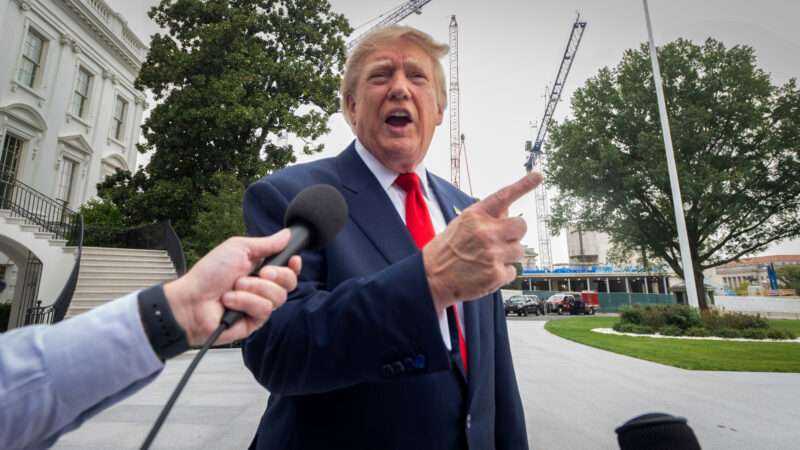
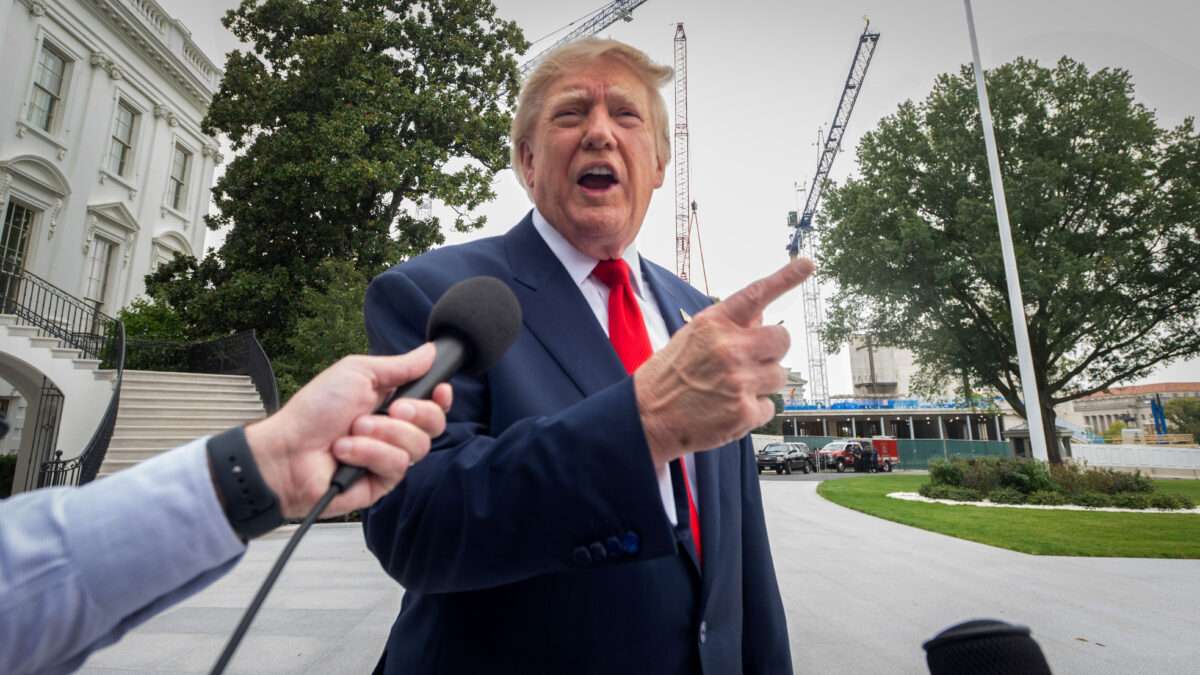
Trump speaks to a reporter | Ron Sachs - Pool via CNP/CNP / Polaris/Newscom

With less than three weeks until Election Day and Republican approval numbers down, President Donald Trump is taking unorthodox measures to drum up support for the GOP.  Last week, Trump sent out $90 payments to over 20 million Americans on Medicare Part B—which covers doctor visits and regular checkups. The money was made available to help seniors "pay for their Medicare Part B premiums," which cost $202 per month.  

In a Truth Social post, Trump said the money is coming from "a pointless 'Slush Fund'" known as the Medicare Improvement Fund, which, though bombastic, is an accurate telling of how lawmakers have used the account. 

The fund was created in 2008 "to improve program management" of Medicare. However, as a 2023 report from the Congressional Budget Office (CBO) points out, this fund has really served one purpose far above supporting Medicare: sneaky government accounting.

As the CBO wrote, "No funds have been spent by [Centers for Medicare & Medicaid Services] from either improvement fund since their establishment in 2008." Instead of using the fund to support Medicare programs, Congresses have filled up the fund with money scheduled for use only in the distant future, then siphoned that money away to other legislation. Under CBO accounting rules, canceling or redirecting future spending is a "credit" to the bill's total cost—a helpful trick for legislators who want to couch their initiatives as being affordable. This trick was used to finance nearly $21 billion of the Affordable Care Act and has been used for a scattering of legislation since. 

While Trump says this disbursement is needed to help enrollees pay premiums, the timing of the announcement—weeks before the midterms—and Trump's history of using taxpayer money to win over senior citizens make the claim dubious. In the One Big Beautiful Bill Act, for instance, seniors were given a $6,000 tax deduction. Trump has also consistently defended senior-focused entitlement programs like Social Security and Medicare, which are both facing a funding cliff in the coming years. Trump siphoning off public money to turn out the electorate hasn't been limited to senior citizens either. Last month he promised to hand out $5,000 checks to all Americans—conditional upon Republican victory in the midterms. 

Despite grumbling by some Democrats about Trump's decision to empty the Medicare Improvement Fund, it seems unlikely the choice will detract from Medicare's ability to provide services. The bigger concern is that the president is using his office to hand out personally signed checks to voters weeks before an election. Pre-election vote grabbing through irresponsible spending is not unprecedented, but it has rarely been so characteristic. 

The fiscal ramifications of Trump's unorthodox spending are also concerning. Medicare is already teetering toward insolvency, and entitlement spending continues to balloon. Neither Congress' playbook of deceptive accounting nor Trump's vote buying will address these problems. Without raising taxes or lowering benefits, these programs cannot continue as they are.

But raising taxes and cutting benefits is no way to win an election. Trump knows this and seems perfectly willing to sacrifice America's fiscal stability for a quick boost in the polls.

The post Trump's $90 Checks to Seniors Look a Lot Like Vote Buying appeared first on Reason Magazine.

  •  

Second Amendment Rights Forfeited by Past Terroristic Threats Conviction

Some excerpts from the long Third Circuit en banc opinion yesterday by Judge Stephanos Bibas in U.S. v. Bost (for another Third Circuit en banc case decided yesterday that reached the opposite result on different facts, see Second Amendment Rights Not Forfeited by Past Drunk Driving Conviction):

The right to keep and bear arms has limits, and this is one: Those who pose a risk of physical violence from misusing guns can be disarmed before that risk becomes a reality. Not every convict poses such a risk—but James Bost does. He pleaded guilty to terroristic threats and other crimes. Years later, police caught him with a pistol not once, but twice. So he was charged with having a gun despite his convictions, in violation of 18 U.S.C. § 922(g)(1), which makes it illegal for felons to have guns….

But Bost's violent conviction is prima facie enough to disarm him. We hold that some predicate crimes (like Bost's conviction for terroristic threats) demonstrate a prima facie risk of physical violence from misusing guns and that those convicted of such crimes may presumptively be disarmed based on those convictions alone….

In 2002, Bost carjacked someone, threatening to kill the driver unless she gave him money. To get that money, he drove to her mother's home, where she escaped from the car, screaming for help. Bost was then arrested and pleaded guilty to terroristic threats and criminal conspiracy (as well as false imprisonment and simple assault). Those first two Pennsylvania crimes are first-degree misdemeanors punishable by up to five years in prison. One element of the terroristic-threats crime required "a threat to commit any crime of violence with intent to terrorize another." Bost was sentenced to four years' probation.

Later, while on bail for another arrest, Bost failed to appear in court. U.S. Marshals tracked him down. They found him in his girlfriend's home, next to a couch with a stolen .38 caliber pistol on it. Bost was indicted federally for possessing a stolen gun and possessing a gun despite his convictions (based on the terroristic-threats and conspiracy convictions). He moved to dismiss the indictment, arguing that § 922(g)(1) [the federal bans on felons possessing guns -EV] is unconstitutional as applied to him and that it is facially unconstitutional….

The court held that the case against Bost could go forward:

The Second Amendment secures the right of "the people" to "keep and bear Arms." Since felons are part of "the people," the amendment protects what § 922(g)(1) forbids—a felon's having a gun. So the government must justify this restriction by analogizing to our nation's historical tradition of gun regulation….

Two years ago, we held § 922(g)(1) unconstitutional as applied to a man with a prior conviction for food-stamp fraud.. But we flagged a limit to our holding, stressing that the government had no evidence that Range posed a risk of violence to others or that his crime "[was] closely associated with physical danger." That aligned with the Supreme Court's later holding in Rahimi that, under a law banning such people from having guns, someone who poses "a clear threat of physical violence to another" person "may be disarmed." … So § 922(g)(1) is constitutional insofar as it disarms convicts who pose a risk of physical violence from misusing guns.

Now we ask … how may the law address a risk of violence[, focusing on] … the nature of the restriction imposed, the process used to impose it, and its duration….

Historically, there were two paths to disarming people. One was individualized: A court found someone to pose a risk of physical violence from misusing guns and disarmed him. The other was categorical: A law targeted a disloyal group that risked violence to the community. In those instances, a member of the group could often get his rights back by showing that he himself did not pose a risk of violence.

Individualized judgment was the norm. For centuries, disarmament was tied to a judge's finding that someone posed a risk of physical violence from misusing guns. Sometimes, that meant punishing risky behavior. Going-armed laws punished and disarmed those who used their weapons to menace others. Rooted in the old bans on affrays, they targeted conduct that spread fear and threatened the peace: going armed "to the Terror of the People." These laws were often enacted with bans on fighting, together targeting conduct likely to lead to violence.

Other laws, like surety laws, aimed to prevent harm before it happened. If someone credibly feared that another person posed a risk of physical violence, including by misusing his arms, he could complain to a magistrate. The magistrate would hold a hearing, weigh the evidence, and decide whether the accused was likely to breach the peace. If the risk was real, the accused had to post a bond promising to keep the peace for up to six months. If he failed to post it, he would go to jail; if he breached the peace, he would forfeit the bond. Either way, the restraint was tailored to the person's risk….

To be sure, some laws disarmed categories of people, but these examples are few, fraught, and often discriminatory. Most founding-era bans disarmed political enemies—groups thought capable of collective rebellion. These measures were tied to allegiance and often lifted once the perceived threat passed. Plus, many applied to groups that lawmakers refused to treat as part of "the people" protected by the Second Amendment, like slaves and American Indians. Both features meaningfully distinguish these historical bans from today's across-the-board ban on felons. Even so, their procedures for rearmament are instructive…. [R]earmament was not automatic. Often, the disarmed person had to make some showing that he no longer posed a risk of violence…. [This paragraph, and the section that contains it, got only 7 of the 14 total votes; Judge Tamika Montgomery-Reeves, who joined the rest of the opinion, declined to join this part because it "relies on repugnant and discriminatory laws and procedures that would very likely violate the First and Fourteenth Amendments of the U.S. Constitution…. I question whether the invidious, and likely unconstitutional, laws undergirding these rearmament procedures are valid inputs for Bruen's test. I need not answer that question, however, because less constitutionally infirm comparators support the same conclusion."]

Bost's Violent Conviction Suffices, at This Early Stage, to Show His Risk of Violence …

Some predicate crimes speak for themselves. Violent offenses, like common-law murder, forcible rape, and common-law robbery, mark a person as such. And the going-armed laws disarmed people whose conduct was threatening. These types of convictions suffice to justify disarmament. We do not require that the predicate violent or threatening crime itself involved guns or the threat of guns. Unarmed forcible rapes, for instance, can qualify.

Other predicate crimes speak for themselves in the other direction: They are not even physically dangerous, let alone violent.

There may perhaps be a third, intermediate category: Still other predicate crimes may be closer calls. Though they may not involve immediate violence, they may fuel it and pose risks to the community. Whether these predicate crimes justify disarmament depends on their own historical analogies.

So at either end of the spectrum, the predicate crime tells the court enough about the felon's risk of physical violence to decide whether to dismiss a § 922(g)(1) indictment. In the middle, it is possible that courts may have to draw more lines.

But if so, we need not draw them today. Bost was convicted of terroristic threats. The elements of that predicate crime included "a threat to commit any crime of violence with intent to terrorize another." … That conduct fits squarely within the historical tradition of disarming those who threaten violence. It echoes the core concern of the going-armed laws: conduct that terrifies others and breaches or risks breaching the peace. Bost's indictment is sufficient as a matter of law. And at this early stage, a court may dismiss only if the predicate conviction is insufficient as a matter of law to put the defendant into the category of persons who pose a risk of physical violence from misusing guns. We need not address what, if anything, could later take a defendant out of that category….

Judge Patty Schwartz wrote an opinion concurring in the judgment; so did Judge Jennifer Mascott. Judge Peter Phipps filed a dissenting opinion. All are worth reading, as is the rest of Judge Bibas's opinion.

Donovan J. Cocas, Laura S. Irwin, and Vivek Suri represent the government.

The post Second Amendment Rights Forfeited by Past Terroristic Threats Conviction appeared first on Reason Magazine.

  •  

Corte de 50% na retenção de IRS de novembro… – as várias simulações avançadas pela Lusa

O preconizado corte de 50% na retenção de IRS em novembro, fará com que um salário de 1.000 euros fique sujeito a 34 euros de IRS para o conjunto do vencimento e subsídio de natal, em vez de 70 euros, segundo veicula o Notícias ao Minuto com base na publicação de hoje em Diário da República (DR).

O montante final a reter em novembro para refletir a descida intercalar do IRS em 2026, por despacho do Governo publicado hoje em DR, estabelece que, nesse mês, as entidades pagadoras de salários e pensões, em vez de cobrarem a percentagem habitual de IRS, só retêm metade desse valor.

Como o corte se aplica quer ao vencimento mensal quer ao subsídio de natal, que é sujeito a retenção de forma separada, a quantia de IRS a entregar ao Estado em novembro relativamente ao conjunto das duas remunerações – salário e subsídio – será semelhante àquela que em condições normais se aplicaria apenas ao salário mensal. As diferenças decorrem de arredondamentos a que as regras da retenção obedecem.

Saliente-se que o NM divulga os cálculos realizados pela Lusa os quais permitem visualizar esses efeitos em diferentes níveis de rendimento, como poderá observar adiante.

Confira as diferentes simulações dos salários

No caso de um trabalhador solteiro sem filhos que ganhe 1.000 euros brutos por mês, a retenção na fonte atual é de 35 euros.
Em novembro, com o corte de 50%, a retenção sobre o salário baixa para 17 euros – não para 17,50 euros, uma vez que o Código do IRS prevê que “a importância apurada mediante aplicação das taxas de retenção é arredondada para a unidade de euros inferior”.

Como o subsídio de natal é idêntico ao vencimento mensal, a retenção a fazer de forma autónoma sobre essa componente remuneratória também será de 17 euros.
Dessa forma, o valor global a reter de IRS nesse mês será de 34 euros. Sem o ajustamento agora fixado pelo Governo, seriam retidos 70 euros, 35 relativos ao salário e outros 35 ao subsídio.

A simulação é igual para um trabalhador casado com alguém que também aufere rendimentos.
Ou seja, num vencimento de 1.200 euros brutos por mês, a retenção mensal, atualmente nos 96 euros, baixa em novembro para 48 euros. Sobre o subsídio, a retenção será igualmente de 48 euros, colocando o total do IRS a entregar nos 96 euros.

Num vencimento bruto de 1.500 euros, a retenção passa de 168 euros para 84 euros, aplicando-se um valor idêntico ao subsídio.

Já para um rendimento mensal bruto de 2.000 euros, a retenção reduz-se dos atuais 301 euros para 150 euros, a que se soma uma cobrança igual sobre o subsídio de natal.

Para um trabalhador que recebe 3.000 euros brutos mensais, a entrega de IRS de novembro, em vez de 663 euros, recua para 331 euros, aos quais acrescem outros 331 euros sobre o subsídio de natal.

E num salário bruto de 5.000 euros por mês, a retenção mensal baixa de 1.452 euros para 726 euros, cobrando-se o mesmo sobre o subsídio.

Os cálculos são semelhantes para trabalhadores solteiros com filhos, com a diferença de que o valor de IRS a entregar é menor consoante o número de dependentes.

E acerca das pensões?

Numa pensão de 1.000 euros brutos mensais, de um reformado casado com alguém que também aufere rendimentos, o IRS a reter em novembro sobre a pensão será de 10 euros, em vez dos 20 habituais, sendo o pensionista chamado ainda a entregar 10 euros relativos à retenção do subsídio de natal.

Um pensionista com uma reforma de 1.500 euros, em vez de entregar 151 euros, fará uma retenção de IRS em novembro de 75 euros, a que acrescem 75 euros sobre o subsídio de natal.

Numa pensão de 1.800 euros, o valor a reter em novembro, em vez de 223 euros, será de 111 euros, acrescendo outros 111 sobre o subsídio de natal.

Um pensionista que receba 3.000 euros brutos, e que atualmente retém 678 euros por mês, irá entregar 339 euros em novembro, mais 339 sobre o subsídio de natal.

É de referir que tanto os salários como as pensões até aos 920 euros não fazem retenção na fonte, porque se encontram isentos de IRS por via do mínimo de existência, que exclui de tributação os rendimentos mais baixos.

A redução da cobrança de IRS em 50% só se aplica em novembro, para refletir nesse mês a descida das taxas gerais do 1.º ao 6.º escalão de rendimento.
Em dezembro, voltam a aplicar-se as taxas normais fixadas desde o início do ano, ou seja, sem a redução de 50%.

  •  

Subida Internacional do Rio Arade está de regresso com partida de Portimão e chegada a Silves

A Subida Internacional do Rio Arade está de regresso no próximo dia 25 de outubro, domingo, para mais uma edição que irá reunir atletas federados e entusiastas da canoagem num percurso de 12 quilómetros, marcado pela beleza natural do Rio Arade, com partida de Portimão, passagem por Lagoa e chegada a Silves.

A iniciativa é coorganizada pelos Municípios de Silves, Portimão e Lagoa e pelo Clube Naval de Portimão, com o apoio da Associação de Canoagem do Sul e da Federação Portuguesa de Canoagem. O evento contará com a participação de atletas de competição, distribuídos pelos diversos escalões, bem como de participantes na vertente turística da modalidade.

A partida está agendada para as 10h00, junto ao Clube Naval de Portimão, estando a chegada dos primeiros atletas à magnífica paisagem da cidade de Silves prevista para as 10h40.

Para mais informações e inscrições, os interessados deverão contactar o Clube Naval de Portimão através dos números 282 417 529 / 965 839 013 ou do endereço de correio eletrónico geral@clubenavaldeportimao.com.

  •  

Jovens da Eurorregião AAA debatem resiliência democrática e celebram 40 anos de Europa

O V Encontro de Jovens da Eurorregião AAA decorre de 16 a 18 de outubro, em El Rocío, com um painel cidadão dedicado à democracia e atividades de sustentabilidade no Parque Nacional de Doñana.

Jovens do Alentejo, do Algarve e da Andaluzia reúnem-se, de 16 a 18 de outubro, em El Rocío, no município de Almonte, província de Huelva, para participar no V Encontro de Jovens da Eurorregião Alentejo-Algarve-Andaluzia (AAA). Ao longo de três dias, os participantes irão debater os desafios da democracia europeia, sob a questão central: ‘Como podemos tornar as nossas democracias mais fortes e resilientes, juntos?’.

O programa tem como destaque o painel cidadão ‘Escudo para a Democracia’, uma iniciativa de participação que procura envolver os cidadãos na reflexão e na construção das políticas públicas europeias. Organizados em grupos mistos, constituídos por sorteio e acompanhados por mentores, os jovens irão identificar desafios, debater possíveis soluções e elaborar recomendações, fundamentando a sua relevância e as mudanças que consideram necessárias.

As propostas serão posteriormente apresentadas em sessão plenária, promovendo a partilha de perspetivas e a procura de consensos entre os participantes. As recomendações acordadas serão reunidas e publicadas na Plataforma de Participação dos Cidadãos da União Europeia, contribuindo para o debate europeu sobre a resiliência democrática.

Com base nas ideias desenvolvidas durante o painel cidadão, os jovens terão ainda a oportunidade de conceber e apresentar projetos concretos, viáveis e sustentáveis, com potencial de aplicação local para reforçar a democracia nas suas comunidades. Pretende-se que algumas destas propostas possam vir a ser concretizadas pelas entidades organizadoras.

O encontro termina no domingo, 18 de outubro, com um programa dedicado à sustentabilidade, à partilha de experiências e ao estabelecimento de contactos entre os participantes, no Parque Nacional de Doñana. A iniciativa permitirá também conhecer melhor a importância da Rede Natura 2000, da qual Doñana faz parte, enquanto instrumento europeu de conservação da biodiversidade e de proteção dos habitats e das espécies ameaçadas.

Uma iniciativa de cooperação europeia

O encontro conta com o apoio do Interreg Espanha-Portugal e da Eurorregião Alentejo-Algarve-Andaluzia, através da Consejería de Presidência, Saúde e Emergências da Junta da Andaluzia.

A organização é assegurada pelo Conselho Andaluz do Movimento Europeu, entidade que promove o debate democrático sobre a União Europeia na sociedade andaluza, e pela rede de centros Europe Direct em Portugal e Espanha, nomeadamente os centros de Sevilha, Córdoba, Huelva, Alentejo Central e Litoral e Algarve, bem como pelo Centro de Documentação Europeia da Universidade de Sevilha.

A rede Europe Direct, uma iniciativa da Comissão Europeia, tem como objetivo aproximar as instituições e as políticas da União Europeia dos cidadãos, reforçando o conhecimento sobre a Europa e promovendo a participação cívica a nível local e regional.

  •  

Município de Silves marca presença no Congresso Nacional AHRESP 2026 em Lagoa

O Município de Silves vai marcar presença no Congresso Nacional AHRESP 2026, que terá lugar nos dias 22 e 23 de outubro, no Centro de Congressos de Lagoa.

O evento reunirá empresários, especialistas, académicos, profissionais e decisores públicos para dois dias dedicados ao conhecimento, à partilha de experiências e à apresentação de ferramentas relevantes para os setores da restauração e do alojamento turístico.

Sob o tema «A Arte do Conhecimento — Onde a intuição encontra o algoritmo», o congresso irá abordar os principais desafios que se colocam às empresas, com destaque para a inteligência artificial, a gestão, a eficiência, a valorização do talento e as novas formas de trabalhar.

A edição de 2026 assume um significado especial, coincidindo com a celebração dos 130 anos da AHRESP – Associação da Hotelaria, Restauração e Similares de Portugal.

O programa completo e as inscrições estão disponíveis clicando aqui.

  •  

French anti-terror investigators probe True Crime Community link to school shooting

The French anti-terrorism prosecutor has taken ​over the investigation into a school shooting near Marseille, after an initial probe found the 14-year-old suspect appeared to belong to ​a ‌group called the True Crime ⁠Community. Two teachers were shot and wounded, after a student opened fire with ⁠a hunting rifle that had been hidden inside a guitar case. FRANCE 24's Sharon Gaffney speaks with Alexandre Rodde, security consultant, researcher and author of the report "Understanding nihilistic violent extremism and the True Crime Community in France".

  •  

Kimberly Guilfoyle Broke Trump’s Most Important Rule

After half-heartedly including some actual professionals in his first administration, Donald Trump is now served almost exclusively by sycophants and family members. The president has made clear that he cares about loyalty more than qualifications, but the astonishing incompetence and corruption of many of his appointees raise an obvious question: What does it take to get fired by Trump’s White House?

Kimberly Guilfoyle’s resignation yesterday as ambassador to Greece provides some clues. Guilfoyle has been accused of blatant corruption both before and during her time as an envoy. She denies these allegations, but her resignation—which the White House requested—isn’t really about corruption. The idea that Guilfoyle, and only Guilfoyle, crossed some sort of previously unseen corruption red line is laughable. If ethical and legal questions, including the now-moribund standard of “appearances of impropriety,” were grounds for dismissal in this administration, Trump would have already shed several other members of his team.

Rather, Guilfoyle was pushed out because she was an embarrassment. She overstepped her bounds, tried to trade on the president’s name, and then made the administration look bad when she got caught. Also, she is a woman, and in this administration, self-dealing is mostly a man’s game.

Indeed, by comparison with the charges leveled at others—including against the president himself, who seems utterly unconcerned with notions such as “emoluments”—Guilfoyle is decidedly a small-timer. This past spring, for example, the Financial Times reported that a broker for Pete Hegseth attempted to make a big investment in defense industries just before the Iran war, raising suspicions of insider trading. FBI Director Kash Patel has been accused of using government money as a slush fund to pay improper bonuses to his favorites within the Bureau. “Border Czar” Tom Homan was caught on audio in 2024 accepting $50,000 in cash (wrapped in a Cava food bag, always the sign of a deal on the up-and-up) from undercover FBI agents posing as business executives, and yet he remains in his job. Hegseth and Homan deny any wrongdoing; Patel and the FBI have offered no comment or explanation. And the journalist Dexter Filkins recently described Trump’s son-in-law and roving minister-without-portfolio Jared Kushner as representative of “a new kind of Washington figure, for whom public office serves as a means to extraordinary wealth.”

[Read: Trump’s team of mercenaries]

Guilfoyle may have been a relative piker among giants in the grift game, but her real sin was the pathetic and humiliating nature of her behavior. (Even Homan managed not to seem quite so grubby when reportedly accepting a bag of greenbacks.) Her messages to a Trump donor asking for money to help pay her huge credit-card bills are cringe-inducing. “Honey please I need you to get this done for me today,” she wrote to the Trump supporter Eric Deters when asking him to wire a cool $100,000 directly into her American Express account in July 2025, just before her confirmation hearings.

Worse, she continually told Deters to stop writing things down and just contact her on Signal. “What a nightmare you’ll literally cost me my ambassadorship stop writing,” she said. This was apparently Guilfoyle’s version of the infamous “Stringer Bell rule,” named for a character from the television series The Wire who dressed down one of his drug-dealing accomplices for being stupid enough to keep written notes on a criminal conspiracy. The problem is that she, too, violated that rule: She made her requests to Deters to stop writing things down in writing.

Deters, unsurprisingly, kept all the messages. Guilfoyle, he asserts, offered him access to the Trump administration. “I will be your Trump ride or die, forever and ever,” he claims she told him. When she didn’t deliver, he warned Guilfoyle and White House officials earlier this month that he would go public with their correspondence and then made good on that threat.

The newly minted ambassador, meanwhile, was flitting about southeastern Europe in the company of Greek tycoons. But again, rather than enjoy the perks of her job in discreet luxury, she bragged about her connections to these wealthy men and tried to present herself as some sort of made woman from the inner Trump orbit who had the juice to get things done.

According to The Wall Street Journal, she went to Davos in January 2026 and was excluded from a dinner being held for Eric Trump. She decided to pressure an American businessman to help her get in. “You know, I can deliver the world to you. Which you deserve,” she said. (This time, she was caught on audio, rather than by text message.) “I’m going to make you a lot of fucking money,” she told the American. She also raged about the impudence of the dinner’s Greek hostess. “You don’t have the fucking U.S., you know, ambassador to Greece not come. She should be kissing my fucking ass.”

Again, Trump Sr. has no problem with F-bombs; he deploys them regularly. He has no problem with money grabs while in public office; he has enriched himself while president and has explicitly or implicitly blessed similar efforts by other subordinates to profit from their positions. But he apparently draws a line when his son’s former fiancée does not show proper appreciation for the courtesy of being stashed in Athens—Athens!—and then lands in the newspapers looking like an aging waitress cadging tips from marks in a casino. Honey, just put it on the tray. Don’t tell my manager, and I’ll get you to the good poker table.

[David Frum: Trump’s last loyal constituency]

Guilfoyle was once so tight with the Trumps that she was given a prime-time slot to fawn over the president during the 2020 GOP convention. It was a disastrous, over-the-top performance, but Trump loved it, reportedly calling her “my Kimberly” and comparing her to the former Argentine first lady Eva Perón. Earlier this year, Trump said of his emissary to Greece: “Kimberly Guilfoyle has been my friend for a long time. I love calling her Kimber-lay. That’s my little pet name, right? But you are the greatest, and I heard they love you over there.”

But over the past several days, the president saw bad publicity about this demanding, middle-aged woman, thrown over by his son for a younger wife—as Trump himself has done to previous spouses—trying to profit off his presidency while making a fool of herself and encouraging more bad press about corruption just before the midterm elections. Guilfoyle had to go, and Trump jettisoned her quickly and coldly. “She wasn’t a member of my family,” the president said yesterday. “She, uh, I guess dated my son a long time ago.”

“Dated”? I guess? She was in line for years to become the president’s daughter-in-law, married to his first-born son. Now she’s just some dame one of his kids used to know.

Guilfoyle didn’t get it. All she had to do was stay out of trouble. But that was too hard for her, and now she’s learned that making money off this presidency means following some rules. Don’t be too obvious; don’t embarrass the boss; don’t get caught if you can help it. And especially, don’t be an older woman.

© Andrew Harnik / Getty

  •  

Os trunfos que deram a vitória à Lufthansa na corrida à TAP

A oferta mais alta foi decisiva, mas uma proposta de ações para o Estado e uma escola de pilotos em Tancos também contribuíram para a vitória do grupo alemão. A privatização da TAP em 14 respostas.

© JOÃO PORFÍRIO/OBSERVADOR

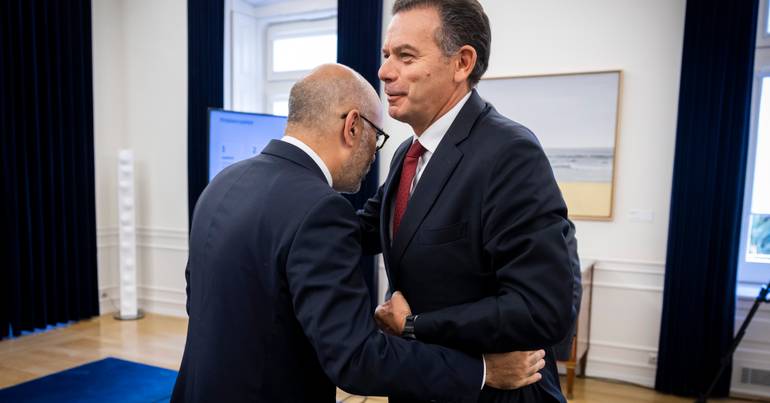
Pinto Luz e Luís Montenegro relançaram o cenário de venda total da TAP nesta legislatura, mas decisão implica apoio de pelo menos um dos maiores partidos da oposição
  •  
❌