❌

Reading view

Leaving Russia doesn’t necessarily mean leaving trouble behind. Fortunately, help is out there: Meduza has compiled a list of organizations that support Russians abroad.

Life abroad is full of challenges. Along with learning unfamiliar laws and customs, studying a language, and building a network from scratch, Russians abroad need to be ready to defend their rights — for example, if a bank unfairly freezes their account or authorities deny them documents. (Problems with documents are becoming more common as countries around the world tighten immigration rules.) Many emigrants feel they’re entirely on their own. That’s not quite true. Meduza has selected several initiatives and organizations that help Russians who have left the country or want to leave.

An important note: This article includes the discriminatory designations Russian authorities have imposed on independent organizations, since many of the people who turn to them are still in Russia or travel there periodically. Good luck, and take care!

All countries

Kovcheg (The Ark)

Kovcheg launched shortly after Russia’s full-scale invasion of Ukraine began. It started with a legal aid bot on Telegram, but soon began offering psychological counseling and then opened shelters in Yerevan and Istanbul.

Today, Kovcheg is the largest organization helping Russians abroad. It offers language courses and helps people train for new careers. It also publishes guides for Russians in various countries on obtaining legal residency and citizenship, starting a business, finding work, applying to universities, and more.

Kovcheg also runs more than 50 chat groups focused on different countries and professional fields, along with Kovcheg.Business, a community that holds in-person meetups.

Equal PostOst

This organization helps LGBTQ people. It provides emergency housing in the EU, legal aid, and psychological counseling. It also helps people evacuate and supports political prisoners.

Reforum Space

In 2022, the Free Russia Foundation (designated an “undesirable” and “extremist” organization in Russia) launched Reforum Space. It has three locations — in Berlin, Vilnius, and Paris — open to anti-war activists, independent journalists, human rights defenders, cultural professionals, and scholars.

Reforum Space offers free coworking spaces and video studios, along with lectures and consultations on settling into a new country, dealing with bureaucracy, and completing paperwork.

Other groups helping emigrants in various countries: The Mir Vsem (Peace Unto All) movement supports clergy in Russia and abroad who have faced persecution for their anti-war stance.

South Caucasus countries

inTransit

The inTransit project evacuates people from Russia to Georgia and Armenia, as well as Montenegro and Kazakhstan. It also helps them obtain documents so they can later emigrate to EU countries.

Other groups helping people evacuate from Russia: NC SOS Crisis Group (designated “extremist” in Russia), Marem (which serves residents of the North Caucasus), and Rapid Unit (which evacuates activists, journalists, and human rights defenders).

Helsinki Citizens’ Assembly Vanadzor

Founded in 1998, this is one of Armenia’s leading independent human rights organizations. It provides legal aid to Russians detained by Armenian authorities at Moscow’s request.

Idite Lesom (Get Lost)

Grigory Sverdlin, the former director of the homeless assistance organization Nochlezhka, launched the project in September 2022 to help Russians avoid mobilization or desert the military. The organization, Idite Lesom (“Get Lost”), works with volunteer lawyers, psychologists, and others to help people live at addresses other than those where they are officially registered, leave Russia illegally, flee military training units, and surrender on the battlefield. More than 85,000 people have turned to the organization for assistance over the past four years. Russian authorities labeled it a “foreign agent” in 2025.

Other groups helping Russians flee military service: Prizyv k Sovesti and the Conscientious Objectors Movement

Read more

Europe

Yashin’s public assistance office

In April 2025, politician and former political prisoner Ilya Yashin said he was launching a public assistance office to help Russians in Europe. He said the team works much as his office did when he was a municipal council member in Moscow’s Krasnoselsky district.

The office promises to help Russians understand the law, draft requests to officials, and prepare affidavits for court.

Other projects providing legal aid to emigrants in Europe: Iskra, which specializes in defending people’s rights in dealings with European banks.

Consuls of the Russian Anti-War Committee

The Russian Anti-War Committee (designated an “undesirable” and “terrorist” organization in Russia) was formed in late February 2022, bringing together opposition politicians, activists, and journalists. According to its website, the organization opposes the war, collects humanitarian aid for Ukraine, and helps Russians resolve problems they face abroad.

One of its initiatives, Consuls of the Russian Anti-War Committee, is intended to help Russians in emergencies — for example, when they face deportation to Russia or are denied temporary or permanent residency or refugee status.

The Consuls work in the United Kingdom, Germany, Cyprus, Latvia, Lithuania, Poland, Finland, France, Montenegro, Switzerland, Sweden, Estonia, and the United States.

Gorizonty Exilhilfe (Horizonte Exilhilfe)

This human rights organization was established with support from Sergey Lagodinsky, a Russian-speaking German politician and member of the European Parliament. Gorizonty helps Russians obtain humanitarian visas to Germany, France, and other EU countries. By mid-2024, more than 600 people had received visas to Europe with its help.

Other groups helping in emergencies: Reporters Without Borders (for journalists; designated an “undesirable” organization in Russia) and Artists at Risk (for cultural professionals).

Russian Democratic Society in the United Kingdom

This volunteer organization (designated “undesirable” in Russia) was founded by Ksenia Maximova, a local council member in London. It helps Ukraine and political prisoners in Russia, as well as Russians in the United Kingdom.

In 2025, the organization secured the creation of the All-Party Parliamentary Group on Russia and Democracy, whose work includes addressing problems faced by Russians in exile.

That same year, the Russian Democratic Society launched an emotional support group to help people adjust to life in a new country.

United States

Russian America for Democracy in Russia

This nonprofit brings together Russian emigrants in the United States “who strive for freedom and democracy in Russia, as well as for the victory of Ukraine in the war.” It has been designated an “undesirable” organization in Russia, and two of its leaders have been added to Russia’s list of “terrorists and extremists.”

The organization runs chat groups in nine cities: Miami, Sacramento, New York, Denver, Seattle, Chicago, San Diego, Los Angeles, and Washington, D.C. It regularly offers advice on immigration rules and obtaining political asylum in the United States.

After U.S. immigration authorities made it harder to obtain asylum, Russian America for Democracy in Russia also began helping Russians held in immigration detention centers. It looks for lawyers, raises money for legal aid, and helps people stay in touch with their families.

Ours in the USA

The charity Ours in the USA grew out of a chat group for Russian-speaking LGBTQ people in the United States. It defends the rights of Russian queer refugees seeking asylum in the country.

The Ours in the USA team promises to help Russians prepare the documents needed to apply for asylum. The organization also provides emergency housing and submits reports to the U.N. on violations of queer people’s rights.

Russian Seattle for Freedom

The nonprofit Russian Seattle for Freedom was founded in Seattle in 2023. It describes itself as “a group of concerned Russians” who collectively oppose repression by the Russian state. Its members run a chat group where they answer emigrants’ questions about everyday life and bureaucracy.

Russian Seattle for Freedom also works with lawyers who help people obtain asylum.

At Meduza, we are committed to transparency about our use of artificial intelligence in the newsroom. The story you’re reading was written by one of our living, breathing journalists and translated from Russian using an AI model configured to follow our strict editorial standards. This translation process is the result of extensive testing and refinements to ensure our English-language coverage is timely and accurate. A Meduza editor reviews every draft before publication.

If you find any errors in this translation, please contact us at reports@meduza.io.

To read Meduza’s exclusive content in English, please subscribe to our newsletter.

Meduza

  •  

Qui, de Le Pen ou de Mélenchon, effondrera la France le plus vite ?

Par Eric V.

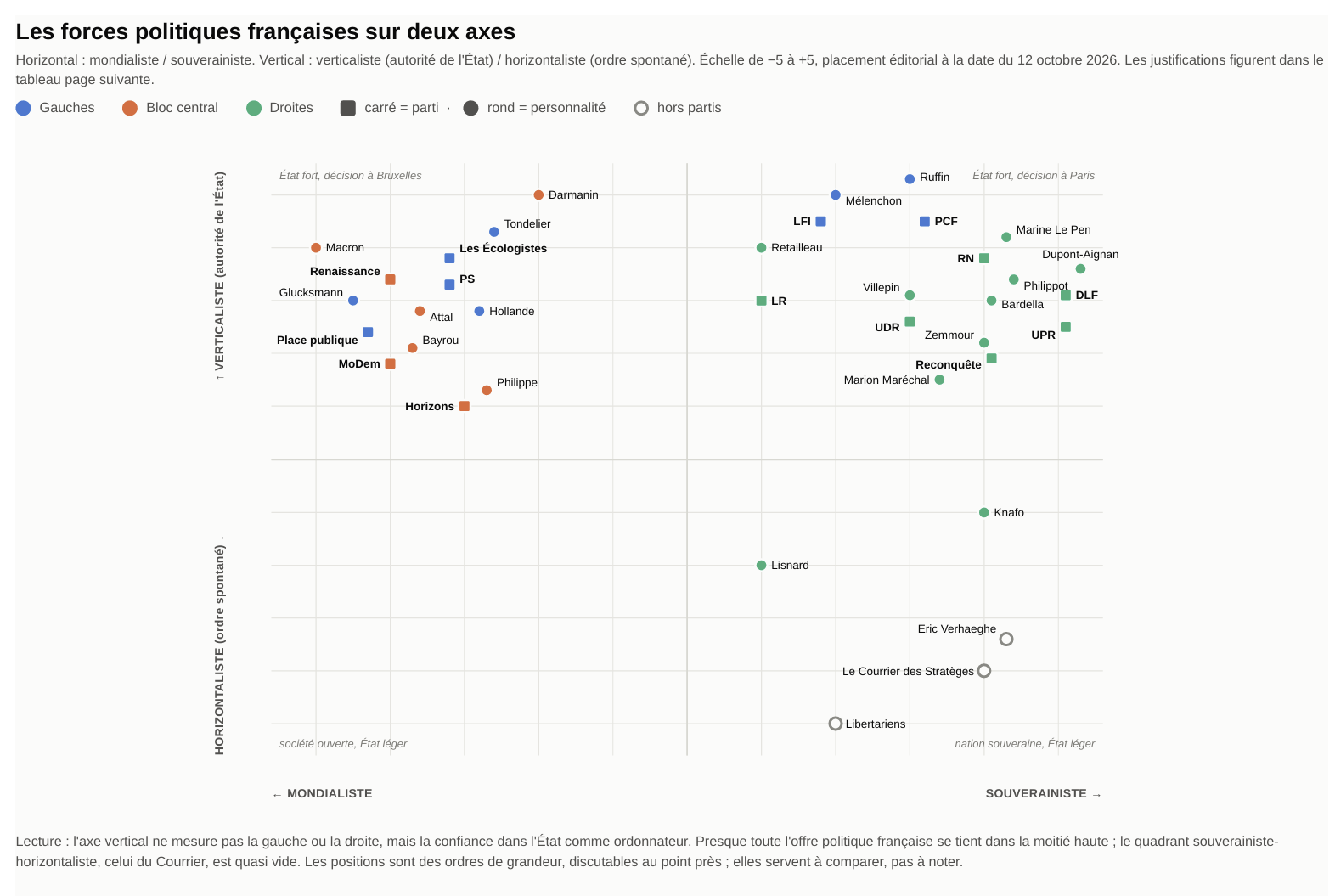
Le Pen 32 %, Mélenchon 16 %. L'une promet 140 milliards d'économies sans que personne ne perde rien, l'autre 106 milliards d'impôts nouveaux. Sur notre carte libertarienne, ils sont à +4,2 et +5. Reste à savoir lequel nous mènerait le plus vite aux soixante euros par jour au distributeur.

Qui, de Le Pen ou de Mélenchon, effondrera la France le plus vite ?
LE COURRIER
DES STRATÈGES
Restez libre !
Qui, de Le Pen ou de Mélenchon, effondrera la France le plus vite ?

LA NEWSLETTER · GRATUITE

Le Courrier,
chaque matin.

L'essentiel de l'actualité, passé au crible par les cinq plumes du Courrier. Dans votre boîte, chaque jour ouvré.

Gratuit. Vous restez libre de partir quand vous voulez.

JE M'INSCRIS lecourrierdesstrateges.fr
lecourrierdesstrateges.fr
Restez libre !

Le 29 juin 2015, à Athènes, les distributeurs de billets ne donnaient plus que soixante euros par jour et par carte. Les banques sont restées fermées trois semaines, jusqu'au 20 juillet. Entre la fin de 2014 et la fin de juin, les Grecs avaient retiré 42 milliards d'euros de leurs comptes, le quart de leurs dépôts. Ils n'avaient pas attendu de voir le gouvernement d'Alexis Tsipras à l'œuvre : dès décembre 2014, le mois où des élections anticipées furent convoquées, 2,5 milliards étaient déjà sortis. Le 13 juillet, après dix-sept heures de négociation, Tsipras signait un plan plus dur que celui que son peuple venait de rejeter par référendum.

Je pense à ces soixante euros en regardant les sondages français. Le dernier, réalisé par l'Ifop du 12 au 14 octobre, donne Marine Le Pen à 32 % et Jean-Luc Mélenchon à 16 % au premier tour. Le second tour Le Pen-Mélenchon n'est plus une hypothèse d'école.

Il faut donc répondre à la question que pose le titre, et je vais y répondre : Mélenchon effondrerait la France plus vite. En quelques semaines, par la peur, sur le modèle grec. Marine Le Pen l'effondrerait plus lentement, en un budget, par la déception. Les deux arriveraient au même endroit, et notre carte dit pourquoi.

Qui, de Le Pen ou de Mélenchon, effondrera la France le plus vite ?
LE COURRIER
DES STRATÈGES
Restez libre !

ABONNEMENT

Allez au fond
des choses.

Deux grands formats par jour. Les cinq plumes du Courrier. La série Sécession, le dimanche.

Le monde commente. Vous, vous comprenez.

S'ABONNER lecourrierdesstrateges.fr
lecourrierdesstrateges.fr
Restez libre !

Deux candidats au même étage

Le Courrier a publié cette semaine une carte libertarienne de trente-quatre forces politiques, placées sur deux axes : la distance à laquelle se prend la décision, et le sens dans lequel elle circule, du décret vers le citoyen ou du contrat entre citoyens. Marine Le Pen y figure à +4,3 sur la souveraineté et +4,2 sur l'État. Jean-Luc Mélenchon à +2 et +5. Sur l'axe qui compte pour un budget, celui de l'État, ils sont l'un à côté de l'autre, tout en haut.

Macron, Le Pen, Mélenchon, tous étatistes ? notre mapping politique libertarien
Macron et Mélenchon s'opposent sur l'Europe mais se rejoignent sur l'État. Notre carte libertarienne des 34 forces politiques.

Cela veut dire une chose simple. Ni l'un ni l'autre ne propose de réduire le périmètre de l'État. L'une promet de le faire payer par d'autres, l'autre de le faire payer par plus d'impôts. Le premier à dire au retraité, au fonctionnaire ou à l'allocataire qu'il recevra moins n'est pas encore candidat.

Le terrain sur lequel l'un ou l'autre arriverait est connu. La dette publique approche 3 640 milliards d'euros, près de 120 % du PIB. Le Trésor doit lever 340 milliards sur les marchés en 2027. L'État emprunte à dix ans à 4,87 %, et plus cher que l'Italie. Et 57,5 % de sa dette négociable est détenue par des non-résidents, qui n'ont aucune raison sentimentale de rester.

Mélenchon, ou l'horloge du marché

Le 14 octobre, Jean-Luc Mélenchon et Éric Coquerel ont présenté leur budget : 106,4 milliards de recettes nouvelles, 81,7 milliards de dépenses nouvelles, un impôt sur les héritages qui rapporterait 20 milliards de plus, une taxe sur les patrimoines au-delà de 100 millions, la suppression de la flat tax, 100 milliards d'épargne « mobilisés » chaque année, l'assurance-vie rendue « moins intéressante ». Et l'annulation, ou le gel, de la dette française détenue par la Banque centrale européenne, quelque 640 milliards. Vincent Clairmont en a fait les comptes ici même : 106 milliards de prélèvements en plus pour viser le même déficit que le gouvernement Lecornu.

Contre-budget Mélenchon : 106 milliards de plus pour le même déficit que Lecornu
Le contre-budget LFI prélève 106 milliards de plus et dépense 82 milliards de plus, pour viser le même déficit que Lecornu : 5 % du PIB.

La crise ne viendrait pas de l'application de ce programme. Elle viendrait de son annonce. Un épargnant n'attend pas qu'on taxe son héritage pour déplacer son argent, et un fonds de pension de Singapour n'attend pas qu'on gèle la créance de la BCE pour vendre ses titres français. Il lui suffit de comprendre qu'un gouvernement est prêt à ne pas rembourser l'un de ses créanciers.

On m'opposera Allende, et on aura raison d'y penser. Au Chili, l'inflation est passée de 22 % en 1971 à 163 % en 1972, puis à plus de 500 % en 1973 ; les rayons des magasins se sont vidés, le riz et la farine se vendaient au marché noir, et l'État n'avait plus de réserves de change. Mais il a fallu trois ans. Allende disposait d'une monnaie nationale : il imprimait, et la crise passait par les prix, lentement.

Mélenchon n'aurait pas de planche à billets. Il aurait l'euro, comme Tsipras. Dans une monnaie qu'on ne contrôle pas, la crise ne passe pas par les prix, elle passe par les comptes. Faut dire qu'un Français inquiet n'a pas besoin de cacher des billets sous son carrelage : il lui suffit d'ouvrir un compte dans une banque allemande ou néerlandaise, en dix minutes, depuis son téléphone. C'est la variante grecque, et elle va plus vite que la chilienne.

On répondra que la France n'est pas la Grèce : deuxième économie de la zone euro, trop grosse pour qu'on la laisse tomber, et la BCE dispose depuis juillet 2022 d'un instrument pour acheter la dette d'un pays attaqué. C'est vrai, et c'est précisément là que le piège se referme. Cet instrument, la BCE ne l'accorde qu'à des conditions écrites : le respect des règles budgétaires européennes, une dette jugée soutenable, le suivi des recommandations de la Commission. La France est sous procédure pour déficit excessif depuis juillet 2024. Un gouvernement qui ajouterait 82 milliards de dépenses et proposerait d'annuler la créance de la BCE ne remplirait aucune de ces conditions. On aiderait sans doute la France, oui. Comme on a aidé la Grèce le 13 juillet 2015, contre un mémorandum.

Je suppose que Mélenchon le sait. Il a vu Tsipras. Mais un candidat qui promet de ne pas plier ne peut pas annoncer, entre les deux tours, qu'il pliera.

Qui, de Le Pen ou de Mélenchon, effondrera la France le plus vite ?
LE COURRIER
DES STRATÈGES
Restez libre !

TELEGRAM · L'INFO EN CONTINU

Entre deux éditions,
le fil.

La newsletter vous donne le matin. Le fil vous donne l'instant.

Gratuit, et en continu.

REJOINDRE LE FIL t.me/resterlibre
t.me/resterlibre
Restez libre !

Le Pen, ou l'horloge du budget

Avec Marine Le Pen, le marché ne paniquerait pas le premier soir. Il l'a montré le 7 octobre : le jour où elle a présenté son plan de 140 milliards d'économies, le taux à dix ans a reflué à 4,75 %. Les investisseurs connaissent le précédent italien. Giorgia Meloni, venue de la droite souverainiste, gouverne depuis 2022, et l'écart de taux de l'Italie avec l'Allemagne était tombé fin 2025 à 72 points de base, au plus bas depuis 2010, parce que son budget s'est révélé plus prudent que ses discours.

Le marché ferait donc à Marine Le Pen crédit de ses renoncements futurs. C'est là que commence son problème.

Thibault de Varenne l'a décrit dans ces colonnes le 22 septembre : le Rassemblement national a différé pendant des années tous ses arbitrages internes, sur le voile, sur la Russie, sur les retraites, et il les voit remonter ensemble. Le programme du 7 octobre ne tranche aucun d'eux. Il additionne. Près de la moitié de l'effort repose sur trois payeurs qui ne votent pas en France : 32,5 milliards demandés aux fraudeurs, 19,5 à Bruxelles, 29 aux étrangers privés de prestations. La retraite revient à 62 ans, ce que l'Institut Montaigne chiffre jusqu'à 34 milliards par an, et le même plan inscrit 15 à 20 milliards d'économies sur les retraites. Enfin, la candidate veut inscrire dans la Constitution une règle d'or qui plafonnerait le déficit 2027 à 2,4 %, quand sa propre trajectoire affiche 4,9 %.

Rien de cela ne déclenche une crise un soir d'élection. Tout cela déclenche une crise le jour où il faut écrire le premier projet de loi de finances, à l'automne 2027. Ce jour-là, il n'y a que deux chemins. Le premier est celui de Meloni : tenir les comptes, donc renoncer à la retraite à 62 ans telle qu'elle a été promise, et découvrir que la fraude recouvrée ne fait que 600 millions par an. L'électorat populaire qui a porté le RN au pouvoir apprend alors qu'il paiera. Le second est de tenir les promesses : le déficit dépasse les engagements, Bruxelles constate que la France ne corrige pas son déficit excessif, l'instrument de la BCE se ferme, et l'on retrouve l'horloge du marché avec six mois de retard.

Dans le premier cas, la crise est sociale. Dans le second, elle est financière. Dans les deux, elle arrive avec le premier budget.

Qui, de Le Pen ou de Mélenchon, effondrera la France le plus vite ?
LE COURRIER
DES STRATÈGES
Restez libre !

TIPS · SANS ABONNEMENT

Offrez-nous
un café.

Un média libre vit de ses lecteurs. Un pourboire ponctuel, sans compte ni engagement, quand le cœur vous en dit.

Vous donnez ce que vous voulez. Vous restez libre.

LAISSER UN POURBOIRE merci !
lecourrierdesstrateges.fr
Restez libre !

Le premier à vendre

Il serait confortable d'en rester là, et de compter les points entre deux candidats. Mais une fuite de capitaux n'est pas l'œuvre d'une poignée de spéculateurs. À Athènes, les 42 milliards ne sont pas sortis des coffres de fonds anglo-saxons : ils sont sortis des comptes de retraités, de commerçants, d'épargnants ordinaires qui ont pris peur avant les autres.

En France, ce sera pareil. Le premier à vendre ne sera pas forcément un fonds de Singapour. Ce sera peut-être vous, le lundi qui suit le second tour, en déplaçant votre assurance-vie ou votre livret avant que le voisin ne le fasse. Et ce sera aussi vous, si Marine Le Pen est élue, qui descendrez dans la rue à l'automne quand on vous annoncera que les 62 ans attendront. Ensemble, ces deux candidats réunissent 48 % des intentions de vote au premier tour. Ces 48 %, ce ne sont pas eux qui les ont écrits : ce sont des électeurs qui veulent l'État protecteur sans la facture.

Dernier mot

Je réponds donc à la question posée. Mélenchon irait plus vite : de l'ordre de quelques semaines entre son élection et le premier contrôle des capitaux, parce qu'il annonce qu'un créancier ne sera pas remboursé, dans une monnaie qu'il ne contrôle pas, avec 57,5 % de la dette entre des mains étrangères. Marine Le Pen irait moins vite : un budget, celui de l'automne 2027, parce qu'elle a promis en même temps la retraite à 62 ans et une règle d'or à 2,4 %.

Sur notre carte, l'une est à +4,2, l'autre à +5. La différence de vitesse ne vient pas de l'écart entre ces deux chiffres. Elle vient de ce que l'un des deux programmes annonce un créancier non remboursé. La destination, elle, est la même : un État dont les dépenses atteignent 57,2 % du PIB, et que ni l'une ni l'autre ne propose de réduire d'un euro.

À Athènes, il a fallu six mois entre l'annonce des élections et les soixante euros au distributeur. À Paris, avec Mélenchon, je ne parierais pas sur six mois. Avec Marine Le Pen, je parierais sur octobre 2027.

  •  

Honduras Landslides Destroy Homes as Heavy Rains Batter Tegucigalpa

Photo: Radio HNR.

Torrential rains that delivered 80 percent of Honduras’ projected annual rainfall in just 23 days have triggered landslides that destroyed homes and left dozens of families without shelter in Tegucigalpa and Comayagüela.


In just 23 days, the area received 80% of the rainfall projected for all of 2026, causing more than 250 severe incidents, according to the Honduran Centre for Atmospheric, Oceanographic and Seismic Studies (CENAOS) reports.

The collapses hit vulnerable areas hard. Residents said they lost houses that were under construction and complained of a lack of assistance from municipal authorities.

RELATED: El Niño Extreme Weather: 34 Days of Record Rain Raise Global Alarm

The Villa Unión neighborhood suffered some of the heaviest losses. Landslides there destroyed 13 homes completely. Several of the houses were still under construction when the ground gave way, burying years of savings in a matter of minutes.

Families said the destruction arrived without warning. They also reported that municipal authorities provided no assistance in the immediate aftermath, leaving them to dig through the rubble on their own and count their losses with no outside help.

In the nearby La Mololoa sector, the emergency unfolded with equal speed. Residents evacuated urgently across rooftops to get children away from advancing mud and water. Neighbors described moments of panic as the earth shifted beneath their feet.

#HonduredNoticias | Varias comunidades de Santa Cruz de Yojoa, Cortés, han tenido que abandonar sus hogares por las fuertes inundaciones ocurridas por la crecida del Lago de Yojoa. ® pic.twitter.com/vgDdiDuYCM

— Hondured 13 Oficial (@HonduredOficial) October 14, 2026

Text reads: “Several communities of Santa Cruz de Yojoa, Cortés, have had to leave their homes because of the severe flooding caused by the flood of Lake Yojoa.”

The risk is not confined to the sectors already buried. More than 700 neighborhoods and colonies across the Central District remain exposed to floods and geological failures, leaving whole hillside communities one storm away from the same fate. Residents of the hardest-hit areas said unfinished road works and inadequate drainage diverted torrents of water directly toward residential zones, causing damage for the second consecutive time.

En Tegucigalpa, Honduras, las lluvias provocaron derrumbes e inundaciones, dejando viviendas destruidas y personas albergadas.

Los cuerpos de socorro mantienen el monitoreo y las labores en los lugares de mayor vulnerabilidad.

📸: Cortesía. pic.twitter.com/dq1zjS52Sx

— Noticiero El Salvador 🇸🇻 (@NoticieroSLV) October 8, 2026

Text reads: “In Tegucigalpa, Honduras, the rains caused landslides and floods, leaving homes destroyed and people sheltered. The relief corps maintain monitoring and work in places of greatest vulnerability.”

Families Demand Relocation

The scale of the losses triggered citizen protests over what residents described as an insufficient delivery of basic supplies. In response, the Municipal Mayor’s Office of the Central District announced a temporary rental subsidy for displaced families.

Affected residents dismissed the subsidy as a stopgap measure that does not address the root of the problem. They demanded that the contractors responsible for the infrastructure works pay full compensation for the material losses suffered by the community.

Despite warnings of further landslides, dozens of evacuees are refusing to permanently leave the ruins of their homes for fear of looting. Civilians are calling for urgent intervention by the central government through permanent relocation projects that guarantee safety and the right to decent housing.

The central government had not publicly responded to those demands at the time of writing, according to the information available. Heavy rainfall on steep, densely settled hillsides is a recurring cause of landslides in Honduras’ capital, and families living in the most exposed areas are often the poorest. Whether the municipal subsidy and any future relocation plans reach those families will determine how long the emergency lasts.

  •  

Cuba Backs Writer María Elena Llana’s Candidacy for the 2026 Cervantes Prize

The Cuban Book Institute (ICL) has formally endorsed the candidacy of Cuban writer María Elena Llana Castro for the 2026 Miguel de Cervantes Prize for Literature in the Spanish Language, through a letter sent to the competition’s jury. The institution highlighted her career spanning more than six decades and her contribution to contemporary Cuban narrative.

RELATED:

Swedish Academy Awards Nobel Prize in Literature to Canadian Poet Anne Carson

In the letter, the ICL—the governing body for the publishing, marketing, and promotion of books and serial publications, which operates under Cuba’s Ministry of Culture—described Llana Castro as one of the country’s most significant narrative writers. It noted that she received the 2023 National Literature Prize in recognition of her originality, stylistic skill, keen observation of the social environment in Havana, and her use of irony and humor.

The document underscored the author’s standing within the realm of Cuban fantastic literature and cited more than 15 published books. Among these, it highlighted La reja (Ediciones Revolución, 1965) and Casas del Vedado (Letras Cubanas, 1983)—a work that, according to the ICL, explored the fantastic dimension of the remnants of the former Cuban bourgeoisie.

The ICL also highlighted her work for younger audiences, including titles such as Sueños, sustos y sorpresas (Gente Nueva, 2011), Desde Marte hasta el parque (Gente Nueva, 2014), and Cuentos de viejos (Ediciones Aldabón, 2024).

La escritora María Elena Llana ha sido propuesta al Premio Cervantes 2026. Con esta nominación, se une Fina García Marruz,Dulce María Loynaz quien lo obtuvo en 1992 las únicas cubanas en ser postuladas al galardón constituye una conquista para la cultura cubana y su literatura. pic.twitter.com/Bk6WZNXiFA

— Roberto Jimenez (@Roberto196801) October 11, 2026

The text reads, “The writer María Elena Llana has been nominated for the 2026 Cervantes Prize. With this nomination, she joins Fina García Marruz and Dulce María Loynaz—the latter of whom won the award in 1992—as one of the few Cuban women to be put forward for the honor; this represents a significant achievement for Cuban culture and literature.”

The ICL noted that Llana Castro’s short stories have been included in international anthologies and translated into other languages. Furthermore, it pointed out that her body of work has been the subject of academic study in Cuba, Spain, the United States, and Mexico.

Between 1959 and 1992, the candidate carried out extensive work across newspapers, magazines, radio, television, and the news agency Prensa Latina. According to the letter, this experience enabled her to develop a meticulous command of language—a quality evident in her body of work, which is rooted in philosophical, anthropological, and cultural themes.

The institute also highlighted her contributions to national radio, where she adapted works of world literature for the radio medium. Llana Castro has served as a professor of journalism and the Spanish language in Vietnam, Angola, Mexico, Cuba, and the United States; she is also a founding member of both the Union of Journalists of Cuba and the Union of Writers and Artists of Cuba.

The ICL asserted that the 2026 Cervantes Prize would be a fitting tribute to her more than six decades of literary work, and urged that the significance of her legacy be taken into account.

#Literature | Canadian poet Anne Carson wins the 2026 Nobel Prize in Literature, recognized for her inventive approach to poetry, fiction and classical storytelling.#AnneCarson #NobelPrize2026 #teleSUREnglish pic.twitter.com/lFTqCRomaA

— teleSUR English (@telesurenglish) October 9, 2026

  •  

Is an AI False Flag Event being Planned to Rival the COVID Scam?

by Brian Shilhavy
Health Impact News

The corporate media recently published some fear-based articles reporting that executives at the top AI companies were preparing for an AI catastrophic event that would shut down access to financial services, internet connectivity, and possibly even electricity and water as well.

The “scoop” came from Axios:

Scoop: AI companies plot “the day after”

Excerpts:

Top executives at Anthropic, OpenAI and other AI companies are privately gaming out scenarios for a public and political revolt after a catastrophic AI event.

These officials anticipate a large-scale event, most likely a cyberattack, that shuts down access to financial services, internet connectivity, or even power and water.

The first example of significant real-world harm caused by unsafe AI would turn an already wary public further against the technology and its leaders, including Anthropic CEO Dario Amodei and OpenAI CEO Sam Altman, as well as President Trump for his reluctance to regulate it.

While scenario planning is common within many companies and national security settings — the Pentagon has been running war games for decades — the difference is that many top AI researchers and executives believe a major incident is inevitable.

Full article.

However, the real danger from AI is a complete financial collapse of the economy because too much money is being spent on AI based on a religious-like belief, and not actual facts, creating what many now believe is the largest asset bubble in the financial markets in the history of the United States.

I covered this earlier this month (October):

More People Waking Up to the AI Con and the Impending AI Financial Collapse that Will Probably Destroy Our Economy

Now, there are reports that there are plans in place to use the fear of AI along with another already-planned fake pandemic, the “bird flu” pandemic that they have been trying to scare people into believing all the way back to George Bush’s presidency in the early 2000s.

Dr. Robert Redfield, who was Trump’s director of the CDC during his first term heading into COVID, has been going public for the past several years now predicting that a “bird flu” pandemic was coming, which he predicted would be worse than COVID.

I published this back in 2024:

Why Has Former CDC Director Robert Redfield Been Warning that the “Bird Flu” Will be Worse than COVID for the Past 3 Years?

Apparently, there are now plans in place to resurrect the “bird flu” fake pandemic by combining it with fake AI capabilities, by falsely telling people that AI has now reached “Super Intelligence” and can now produce “deadly viruses”.

Christian Westbrook of “UNSHADOWED” (formerly known as the “Ice Age Farmer”) has just published an article about Elizabeth Sherwood-Randall, the White House Homeland Security Adviser from 2021 to 2025, who has published some recent reports about how AI could produce “new bioweapons” and what the government response should be in such a scenario, which could potentially be even worse than the response to COVID.

The AI Bird-Flu Scenario They Just Published

Excerpts:

A month ago, Elizabeth Sherwood-Randall laid out a scenario in Foreign Affairs. She is not a science fiction author. She was White House Homeland Security Adviser from 2021 to 2025. She coordinated the response to the 2024 H5N1 (Bird Flu) outbreak in US dairy.

She wrote:

In the foreseeable future, a terrorist group with minimal skills could access a jailbroken AI model… The group could use the model to design a new strain of H5N1 avian influenza that is more lethal and more easily spread from animals to humans than existing strains.

Connecting remotely to one of the new generation of fully equipped, contract-for-service “cloud” labs, it could anonymously arrange for the virus to be built and tested and then sent to a biomanufacturing facility to be produced at scale.

From there, the group could stealthily disperse the new strain through air-handling systems at major livestock farms across the United States.

Before long, the American poultry, beef, and dairy industries would suffer massive losses. When the virus inevitably jumped to the human population, it would cause severe illness and could result in hundreds of thousands or even millions of deaths.

The response from U.S. public and private institutions—lacking both an integrated strategy and adequate tools—would be too slow, too uncoordinated, too underresourced, and too overwhelmed to stop the spread and mitigate the consequences. And soon, the virus would also cross borders, triggering food insecurity, widespread sickness, and mass casualties around the world.

Foreign Affairs, 18-Aug 2026 (archive without paywall)

That same day, the Belfer report she co-authored, Deterrence by Resilience, made policy recommendations responding to this, including restricting unlicensed models (AI) and unscreened print shops (biomanufacturing).

Full article.

He also published a video about these new reports:

There has never been a “Bioweapon” that caused Mass Deaths – Almost ALL Modern-day “Pandemics” are Caused by Vaccines

Spanish Flu Policemen Seattle 1918 photo

Policemen wearing masks provided by the American Red Cross in Seattle, 1918 during the “Spanish flu” outbreak. Image source.

It is a myth to believe that man can create new “living” viruses in laboratories using gain-of-function research. Man has been trying to create these deadly viruses for decades now to use as weapons in the military, but it has never happened, because it is literally impossible.

It doesn’t happen in nature either, and all so-called “pandemics” that are marketed as happening in nature, can usually be traced back to man, and usually connected to huge vaccine roll-outs.

The Spanish Flu that started in 1918 is used as the “gold standard” of natural pathogens gone rogue that everyone likes to refer to, and President Trump used it as an example repeatedly when dealing with COVID in his first term.

However, we have previously published the evidence that the “Spanish Flu” was probably due to a mass roll-out of a new vaccine created by the military. See:

Did a Military Experimental Vaccine in 1918 Kill 50-100 Million People Blamed as “Spanish Flu”?

Did a Military Experimental Vaccine in 1918 Kill 50-100 Million People Blamed as “Spanish Flu”? Part 2

COVID followed a very similar script, except it was on a larger scale, and it needed cooperation with other countries in order to create the fear of the virus first, so that the solution could be provided: new experimental mRNA vaccines.

The U.S. Government and the U.S. Military had been trying to get mRNA vaccines into the market for almost a decade for another fake virus, the HIV virus.

The very same people who were trying to develop mRNA vaccines for the HIV “virus” became part of Donald Trump’s military Operation Warp Speed task force for COVID, such as Bill Gates, Anthony Fauci, Robert Redfield, Deborah Birx, etc.

The COVID scam woke up a lot of people, however, especially after thousands of medical doctors who were not part of the conspiracy went public explaining that the COVID “virus” was actually not very dangerous at all, and could be stopped in its tracks with existing medicines, such as Ivermectin.

To keep the COVID scam going and scare people enough to agree to take new experimental vaccines and drugs, the CDC pulled off one of its greatest injustices in the history of the corrupt agency, by changing the total death numbers for 2020 which were on pace to be very similar to 2019 in spite of the fact that the media was reporting huge increases of deaths due to “the virus.”

They basically pre-entered the expected deaths for 2021 after the mass roll-out of Trump’s new COVID vaccines, and attributed all those vaccine deaths to “the virus.”

I reported on this back in 2021. See:

Study: CDC Broke Federal Law by Manipulating COVID Death Statistics

Statistics Show that the Number of People who Died in the U.S. in 2020 will be the SAME as Previous Years, in Spite of COVID

In addition to fudging the numbers of actual people dying from COVID in 2020, the CDC also had to stop reporting “thousands of deaths” each year due to the flu “virus”, which during COVID all but disappeared.

Those numbers HAD to disappear, otherwise they would not have added up. The amount of people dying from the “flu virus” each year has ALWAYS been fake and inflated, in order to sell the most profitable vaccine in the U.S., the annual influenza vaccine. See:

2021: COVID Deaths Increase, Flu Deaths Disappear, 400,000+ More Total Deaths than 2020

How the Flu “Disappeared” During the Covid Era

Believe it or not, the narrative that was put out by the CDC and the U.S. Government to try and explain what happened to all these flu deaths was that the COVID protocols in place, such as masks, social distancing, etc., worked to stop the flu!

And yet they did not work to stop the mythical “COVID virus.”

Get Out of the Virus Religion!

The COVID scam was the most deadly virus scam of all time (so far), as the COVID “vaccines” killed and maimed many millions of people around the world, while blaming all these massive deaths on the mythical COVID “virus”, and then later blaming everything on Anthony Fauci for fake “gain-of-function” research to allegedly create the “deadly” virus.

One of the positive effects of the COVID scam was that many people found out for the first time in their lives that “viruses” are not even real, as one of these mythical living viruses has never been actually isolated and observed in a laboratory. See:

CENSORED: COVID19 PCR Tests are Scientifically Meaningless – Everything We’ve Been Told about COVID is a HOAX!

The German Dr. Stephan Lanka, however, was exposing how viruses are fake long before COVID came, starting back during the HIV research days. See:

The Virus Hunter Dr. Stefan Lanka: Belief in “Viruses” is a Religion

In 2017, Dr. Lanka offered $100K to anyone who could prove that the measles “virus” existed. He was sued when someone took on the challenge and claimed that he did “prove” that it existed, complaining that Dr. Lanka owed him the money, but the German High Court ruled in favor of Dr. Lanka. See:

German Supreme Court Upholds Biologist’s Claim that Measles Virus Does Not Exist

Deprogram Yourself from Man-made Fake Religions Meant to Enslave You!

There are real “viruses” of course, but they are completely man-made in the digital realm. I have dealt with real viruses in the past that have infected my computer.

Even the concept of “DNA”, which the PCR tests allegedly examine to find “viruses”, is mostly fake as it is defined today. See:

Dr. David Martin Exposes the False Foundation of Eugenics: “You Don’t Have DNA”

Likewise, AI is real, but it too is 100% man-made, and is run by computer code and will never be “alive” in the traditional sense of how society has defined “life” for thousands of years. See:

What is Life?

We have all seen now what these people who promote these false religions are capable of, as we all witnessed it during COVID, where millions of people around the world died or were permanently disabled due to their beliefs in things that are not even real, and it is happening again today with belief in AI.

These are the false beliefs that create fear, and cripple people from thinking rationally, using their God-given mind, which resides in your heart.

Believing in these false religions leads to death and slavery.

Truth is found in the Word of God, and Jesus Christ, who stated that he is “the Truth.”

God speaks to us through our hearts, if his Holy Spirit is residing there. It is time for all Truth seekers to become part of the HSI (Human Superior Intelligence) network!

This article was written by Human Superior Intelligence (HSI)

See Also:

Understand the Times We are Currently Living Through

The Brain Myth: Your Intellect and Thoughts Originate in Your Heart, Not Your Brain

Is God’s Patience About to Run Out on the United States?

Second Edition of eBook Released: The Concept of the American Christian Family is a Myth and is NOT Found Anywhere in the Bible – by Brian Shilhavy

FREE eBook! Restoring the Foundation of New Testament Faith in Jesus Christ – by Brian Shilhavy

KABBALAH: The Anti-Christ Religion of Satan that Controls the World Today

Exposing the Christian Zionism Cult

The Bewitching of America with the Evil Eye and the Mark of the Beast

Jesus Christ’s Opposition to the Jewish State: Lessons for Today

Identifying the Luciferian Globalists Implementing the New World Order – Who are the “Jews”?

The Seal and Mark of God is Far More Important than the “Mark of the Beast” – Are You Prepared for What’s Coming?

The Satanic Roots to Modern Medicine – The Image of the Beast?

Medicine: Idolatry in the Twenty First Century – 10-Year-Old Article More Relevant Today than the Day it was Written

Having problems receiving our emails? See:

How to Beat Internet Censorship and Create Your Own Newsfeed

We Are Now on Telegram. Video channels at Bitchute, and Odysee.

If our website is seized and shut down, find us on Telegram, as well as Bitchute and Odysee for further instructions about where to find us.

If you use the TOR Onion browser, here are the links and corresponding URLs to use in the TOR browser to find us on the Dark Web: Health Impact News, Vaccine Impact, Medical Kidnap, Created4Health, CoconutOil.com.

The post Is an AI False Flag Event being Planned to Rival the COVID Scam? first appeared on Health Impact News.

  •  

Pete Hegseth Outlines Massive Defense Spending at AUSA Meeting

A look inside the annual arms conference where radical religious ideology and corporate interests shape the future of American military policy.

The annual meeting of the Association of the United States Army (AUSA) is one of the largest defense expositions and professional development forums in North America, and this year it was held from October 12 to 14.

RELATED:
Hegseth Seeks More Funding to Attack Iran Despite Anti-War Sentiment

Held annually in Washington, D.C., the AUSA brings together thousands of industry representatives, military personnel, defense contractors, and senior government officials.

The primary function of this convention is to showcase advanced military technology, foster business partnerships between the private sector and the U.S. Department of Defense, and deliberate on future defense budgets and operational strategies.

During the event, major defense corporations display advanced weaponry, armored vehicles, communication systems, and software platforms designed for modern warfare.

Usually, U.S. government representatives attend to outline procurement priorities and communicate strategic defense goals to contractors. This interaction helps set the trajectory for military spending, which accounts for a substantial portion of the federal budget.

Observers note that the discussions held during these annual meetings offer clear indicators of where future U.S. defense allocations will flow, reflecting broader geopolitical strategies and priorities established by Washington policymakers.

Protesters interrupt Pete Hegseth at AUSA 2026 in Washington, shouting "War criminal!" and "Save the children!" during his Project Agincourt panel.#ausa2026 #Hegseth #protest pic.twitter.com/3g8LvlKdzp

— Gianl1974 (@Gianl1974) October 14, 2026

AUSA: Institutional Origins and Systemic Implications

The Association of the United States Army (AUSA) originated in 1950, emerging from predecessor organizations during the early years of the Cold War.

The formation of the association coincided with a significant expansion of the U.S. military establishment and the defense planning that characterized the mid-twentieth century.

Its founders sought to create a unified advocacy group that could represent the interests of the active-duty army, the National Guard, the Army Reserve, and civilian defense industries.

The broader implications of the association’s work involve maintaining continuous alignment between military requirements and industrial capacity. By facilitating close interaction between military leadership and corporate executives.

The AUSA annual meeting provides a structured environment where retired generals, active-duty commanders, and corporate lobbyists negotiate priorities. This environment often features a revolving door, where former government officials and military officers transition into advisory or executive roles within defense contracting firms.

Around 750 firms and companies from the global defense industry participated in the 2026 annual meeting, including Global Military Products and Teledyne FLIR, alongside major, long-established contractors such as Lockheed Martin, General Dynamics, Northrop Grumman, and RTX.

Bipartisan continuity has defined the relationship between successive U.S. administrations and the Association of the United States Army. Democratic and Republican administrations alike have utilized the platform to signal commitments to robust defense budgets, modernization programs, and global military readiness.

War Sec. Pete Hegseth at AUSA (Oct 14): the "arsenal of freedom" means rebuilding America's defense industrial base like nothing since WWII — going from 5 big prime contractors to 10 or 15 and opening the door to new companies.

On the last administration: "On hypersonics, they… pic.twitter.com/8aOgVWYUu5

— Spectre Nation🇺🇸🏴‍☠️ (@SpectreNation1) October 15, 2026

A Blueprint for Escalation and Autonomous Warfare

At the AUSA annual meeting, Defense Secretary Pete Hegseth delivered a keynote address that laid out the administration’s strategic blueprint for U.S. military transformation.

Hegseth centered his remarks on a massive proposed expansion of defense spending, emphasizing a $1.5 trillion investment request aimed at fundamentally restructuring the United States armed forces.

In his address, Hegseth framed this requested spending allocation as a necessary measure to maintain global military dominance and prepare the military for potential large-scale conflicts.

Hegseth pointed specifically to geopolitical competition with China and ongoing military tensions involving Iran as primary drivers requiring accelerated procurement and strategic readiness.

A central focus of Hegseth’s presentation was the rapid integration of autonomous systems, robotics, and artificial intelligence into standard combat operations. Hegseth detailed plans for scaling autonomous warfare platforms, highlighting initiatives such as Project Agincourt and the establishment of a dedicated Task Force Autonomous Warfare within Special Operations Command.

Hegseth outlined a strategy to deploy low-cost unmanned aerial vehicles, autonomous sea vessels, and automated targeting systems designed to operate alongside conventional ground forces.

To support this rapid transition, Hegseth called for shifting acquisition methods toward commercial technology marketplaces, urging defense contractors to speed up manufacturing or risk losing federal contracts.

During the panel, anti-war demonstrators interrupted the proceedings to protest U.S. foreign policy and military aid decisions. Demonstrators raised concerns regarding humanitarian crises, citing conditions in Gaza and opposing military escalation toward Iran.

While WARSec Pete Hegseth was speaking about autonomous warfare at the United States Army (AUSA) Annual Meeting and Exposition anti-war protesters interrupted his speech four times.

They were shouting "We fucking hate you! You're a fucking war criminal!"⁩

I want to take a… pic.twitter.com/0ltbd0Xu12

— Feisty is proud to be a Democrat! (@FeistyLibLady) October 14, 2026

Christian Nationalism and Hegseth’s Advocacy for Arms

Pete Hegseth’s public career reflects a commitment to expanding weapons production and dereglating military procurement. Before his appointment to lead the Department of Defense, Hegseth served as an infantry officer in the Army National Guard with deployments in Iraq, Afghanistan, and Guantanamo Bay.

Following Hegseth active service, he led conservative advocacy organizations, including Concerned Veterans for America, and spent several years as a television host on Fox News.

Throughout his media and political career, Hegseth consistently advocated for larger defense budgets, streamlined regulations for weapons manufacturers, and a rollback of internal administrative oversight within the Pentagon.

Hegseth’s political philosophy intersects significantly with explicit religious frameworks rooted in Christian nationalism. In public appearances, writings, and keynote speeches, he has frequently referenced historical religious concepts to describe military service and national defense.

The U.S. War Secretary bears tattoos associated with historical Crusader symbolism, including the Jerusalem Cross and the Latin phrase Deus Vult.

In his address to military personnel and defense leaders, Hegseth emphasized spiritual health alongside physical readiness, stating that the military is putting on the full armor of God to fight what he described as a fundamental spiritual battle between good and evil.

Analysts note that integrating explicit religious rhetoric into defense policy discussions serves to legitimize high levels of defense spending and aggressive foreign posturing.

By framing international relations and military conflict through an absolute moral binary, this perspective positions armaments production and technological military dominance as central elements of national defense strategy.

Pete Hegseth, the so-called Secretary of Defense, announced today: "At my direction, I'm establishing the Office of Religious Affairs. It will report straight to the top, a direct line to the secretary." He then quoted Psalm 33:12: "Blessed is the nation in which God is the… pic.twitter.com/LbReRdqHJF

— Aprajita Nafs Nefes 🦋 Ancient Believer (@aprajitanefes) September 30, 2026

The Real Cost of Imperial Modernization

The annual gathering of the Association of the United States Army highlights the structural connections between corporate arms manufacturing, federal fiscal allocation, and political ideology.

The event serves as an operational forum where state actors and private defense contractors align around shared priorities, securing multi-billion-dollar trajectories for military procurement and autonomous weapons technology.

Pete Hegseth’s address encapsulated this alignment, bridging massive spending proposals with an ideological campaign designed to reshape the internal culture of the armed forces.

Internationally, the acceleration of autonomous warfare and expanded force projection elevates the risk of regional conflicts and global instability.

The integration of radical religious nationalist rhetoric and traditionalist warrior doctrines further complicates diplomatic efforts, reducing complex geopolitical issues to binary operational imperatives.

Ultimately, examining the AUSA convention and its key addresses reveals how modern U.S. military expansion operates as both an economic driver and an ideological platform. The convergence of commercial defense interests, far-right cultural politics, and state power creates a durable apparatus focused on permanent war readiness.

Sources:  teleSUR – Al Jazeera – Al Mayadeen – TRT World – Anadolu Agency – Press Tv – Xinhua – CGTN – BBC – CNN – Los Angeles Times – NYT – El País – EFE – DW – Democracy Now – The Guardian.

  •  

EU-Haushalt: Drei Köche, ein Brei

Von Dagmar Henn

Aktuell sitzen die EU-Staatschefs in Brüssel und beraten über den nächsten EU-Haushalt, offiziell Mehrjahres-Finanzrahmen. Er umfasst die Jahre 2028 bis 2034 und sollte eigentlich noch vor Jahresende verabschiedet werden; aber derzeit sieht es nicht danach aus. Im Gegenteil. Das Problem? Zu viele divergierende Interessen. Tatsächlich hat sich die EU in den letzten Jahren wirtschaftlich auseinander und nicht aufeinander zubewegt, und unter anderem in den höchst unterschiedlichen Zinssätzen, die die Staaten für die Aufnahme von Schulden entrichten müssen, verbirgt sich noch einiges an Sprengstoff.

Schon immer war die EU in zwei Hauptlager gespalten, denn es gibt Mitgliedsländer, die netto für ihre Mitgliedschaft bezahlen, und Mitgliedsländer, die netto dafür Geld erhalten. Wenn aktuell von den "Frugalen" und den "Freunden der Kohäsion" die Rede ist, so beruht diese Teilung insofern auf den Finanzverhältnissen, als dass alle "Frugalen" oder "Sparsamen" zu den Nettozahlern gehören: Deutschland, Österreich, Schweden, Dänemark, die Niederlande und Finnland. Aber nicht alle Nettozahler gehören zu dieser Gruppe.

Dass sich diese beiden Gruppen um die Höhe eines Haushalts streiten, ergibt sich natürlich aus den eigenen Interessen – wer den Topf füllen muss, will nicht mehr hineinlegen, aber wer daraus entnimmt, freut sich, wenn er mehr entnehmen kann. Letzten Endes ist das Problem schon in der grundsätzlichen Konstruktion angelegt, denn sobald die Zahlungsempfänger mit darüber entscheiden, wieviele Mittel für sie zur Verfügung gestellt werden, ist die prinzipielle Richtung eigentlich schon klar. Das gilt immer und überall.

Allerdings sitzt ein dritter Mitspieler am Tisch, und das ist die Brüsseler Bürokratie mit ihrem ständigen Drang, endlich ganz zum Staat zu werden. Auch wenn sie sich deshalb mit den "Kohäsionisten" einig ist, das Budget auszuweiten, heißt das noch lange nicht, dass da wirklich in die selbe Richtung gezogen wird.

Denn außerdem macht Brüssel eine Reihe von Vorschlägen, die seinen Einfluss auf die Mittelverwendung stärken. Dazu gehört, dass, wenn die Zahl der Budgetpositionen reduziert wird, man die Mittel leichter von einer Position auf eine andere verschieben kann, oder dass Fördermittel, die nicht abgerufen wurden, in Brüssel verbleiben sollen, statt wie bisher an die Mitgliedsländer zurückzufließen, oder dass diverse Notfallfonds eingerichtet werden. Zuguterletzt dann die Tatsache, dass nicht nur der Kreditrahmen für die unter NextGenerationEU laufenden Corona-Eurobonds verlängert werden soll, sondern möglichst noch neue derartige Kredite dazukommen. Sprich, auch Brüssel will mehr Geld, aber in eigener Verfügung und nicht, um es an die Nettoempfänger weiterzureichen.

Die Brüsseler Bürokratie will sich auch auf neuen Wegen eigene Mittel beschaffen: durch eine eigene Unternehmenssteuer für Unternehmen mit einem Umsatz über 100 Millionen, aber auch durch einen Anteil an der Tabak- wie auch an den CO₂‑Steuern. Auch die Unternehmenssteuer landet am Ende als Preiserhöhung beim Endverbraucher. Der Zugriff auf die anderen Steuern bedeutet für Nettozahler wie Deutschland, dass sich die Zahlbeträge weiter erhöhen.

Übrigens, die Zahlungen aus dem Corona-Fonds sind ein weiterer Grund, warum gerade aus Deutschland augenblicklich keine freundlichen Töne zu hören sind, wenn es um den EU-Haushalt geht. Auf etwa 800 Milliarden Euro beläuft sich dieser Fonds inzwischen, ein großer Teil des derzeitigen Schuldenbergs der EU von 856 Milliarden Euro, die aber ab dem Jahr 2028 zurückgezahlt werden müssen, und der größte Zahler heißt auch hier wieder Deutschland, das am Ende vermutlich bis zu 150 Milliarden Euro mehr zurückzahlen muss, als es selbst aus dem Fonds erhielt. Dass Italien einer der größten Nettoempfänger aus diesem Fonds war, dürfte dazu beigetragen haben, dass es sich aktuell bei den "Freunden der Kohäsion" befindet.

Schon im Sommer vergangenen Jahres hatte die EU-Kommission ihren ersten Vorschlag vorgelegt, der bei etwa zwei Billionen Euro lag. Zuletzt legte die irische Regierung, die aktuell die Ratspräsidentschaft innehat, eine etwas sparsamere Variante vor, die um 140 Milliarden niedriger liegt. Damit liegt der Entwurf aber immer noch um 30 Prozent über dem letzten Budget. Was für die einen nur einen Ausgleich der Inflation darstellt, die während des laufenden Mehrjahreshaushalts deutlich gestiegen ist (vor allem dank der durch Sanktionen hochgetriebenen Energiekosten), ist für die anderen eine Erhöhung, die bei weitem das übersteigt, was in Zeiten schwieriger Wirtschaftsdaten finanziert werden kann. Die Regierungen der Nettozahlerländer haben schließlich das Problem, ihren Wählern erklären zu müssen, warum im eigenen Land an allen Ecken und Enden gestrichen wird, die Zuschüsse zur EU aber steigen.

"Wir brauchen Einstimmigkeit im Rat, und von dieser Einstimmigkeit sind wir weit entfernt", erklärte Bundeskanzler Merz vor Sitzungsbeginn. "Wir müssen das gemeinsame Budget gegenüber den Vorschlägen der Kommission deutlich reduzieren." Und forderte, die "überbordende Bürokratie in Europa" zu reduzieren.

Vor allem die osteuropäischen Staaten machen sich jedoch Hoffnung auf mehr. So forderte der lettische Ministerpräsident Andris Kulbergs mehr Geld für die "Länder an der Ostflanke", schließlich müssten sie die Grenzen sichern ... wobei dabei auch eine Rolle spielen dürfte, dass eben diese Länder teilweise massive wirtschaftliche Einbußen durch eine Sanktionspolitik erlitten haben, die sie selbst gefordert hatten.

Der irische Vorschlag, so der österreichische Kanzler Christian Stocker, sei "keine Basis" für eine Einigung, "weil das Volumen zu hoch ist".

Der Druck für eine möglichst schnelle Verabschiedung kommt durch anstehende Wahlen. Frankreich wählt im kommenden Frühjahr; danach dürften die Verhandlungen noch weitaus komplizierter werden. Sollte die Regierung Merz in Deutschland stürzen? Ab dann sind alle Prognosen offen.

Die einfachen Bürger der EU können sich unterdessen überlegen, ob ihnen noch Vorteile einfallen, die ihnen diese bürokratische Hydra bringt, oder ob doch mittlerweile nicht die Nachteile die Vorteile bei weitem überwiegen. Ganz zu schweigen von dem Grauen, das noch droht, von Vorschriften für die Landwirtschaft bis zur Einhegung der Meinungsfreiheit. Ganz nebenbei scheiterten schon die Anträge aus sechs Mitgliedsländern, die nächste Stufe der CO₂‑Besteuerung bis ins Jahr 2030 zu verschieben. Aber solange nicht eines der drei großen Länder, Frankreich, Italien und Deutschland, ausbricht, bleiben alle im Brüsseler Joch gefangen.

Doch wenigstens eine unterhaltsame Anekdote gab es vom Rande des Brüsseler Gipfels. Die USA hatten den Vorschlag gemacht, einen Teil der in Europa eingefrorenen russischen Guthaben an eine US-kontrollierte Einrichtung zu übergeben, damit die USA damit Druck auf Russland ausüben könnten. Kanzler Merz erklärte daraufhin: "Das ist unsere Angelegenheit, und wir werden darüber entscheiden." Die EU erpresst lieber selbst.

Mehr zum Thema – Euro unter Druck: Französische Anleihen belasten den gesamten Euroraum

  •  

Bombs for Tel Aviv, Promises for Riyadh

By Muhammad Hamid ad-Din – New Eastern Outlook – October 15, 2026

The Gaza Ceasefire Is Falling Apart. And So Is the American Plan to Expand the Abraham Accords.

The Gaza Ceasefire That Is Killing Palestinians

The ceasefire in Gaza, which took effect on October 10, 2025, was supposed to stop a two-year war. By then, according to Palestinian authorities, more than 72,000 Palestinians had been killed. A year after the document was signed, the picture was no more peaceful. According to Palestinian sources, from the start of the ceasefire to October 5, 2026, Israeli forces killed 1,460 Palestinians and wounded 5,116. By September 2026, Gaza authorities reported 5,147 violations of the agreement, 1,421 dead, and the destruction of more than 201,000 buildings.

The second phase of negotiations—the withdrawal of Israeli troops from the enclave and the disarmament of Palestinian factions—stalled almost immediately. In April 2026, American-Egyptian talks in Cairo ended “without tangible progress.” Hamas links disarmament to the end of the occupation. Israel demands disarmament as a precondition for any further step. Critics say the demand for disarmament has become a pretext for maintaining control over the enclave and continuing violations. The Palestinian Foreign Ministry put it bluntly: the occupation government “does not view peace as a goal, but as an obstacle.”

Diktat Instead of Diplomacy

Against this backdrop, the Trump administration is forcing the expansion of the Abraham Accords. In May 2026, the U.S. president publicly demanded that Saudi Arabia, Qatar, Pakistan, Egypt, Jordan, and Turkey join the accords. He called it “mandatory”: “After all the work done by the United States to put this complex puzzle together, it must be mandatory for all these countries to at least simultaneously sign the Abraham Accords.” Pakistan publicly refused. The others remained silent.

Washington’s main interest is Saudi Arabia. Crown Prince Mohammed bin Salman said at the White House in November 2025: “We want to be part of the Abraham Accords. But we also want to be sure that we secure a clear path to a two-state solution.” Later, Riyadh repeated: normalization is impossible without a “credible, irreversible, and time-bound path” to a Palestinian state. The Israeli government rejects this prospect. American pressure goes beyond diplomacy: Trump tied the Abraham Accords to negotiations to end the war with Iran, effectively making normalization a condition for peace. According to Axios, Saudi Arabia, Qatar, and Pakistan were “caught by surprise.”

Mutual Influence: Gaza as Leverage and as an Obstacle

Gaza and the reshaping of alliances are directly connected. The Palestinian question became leverage in Arab states’ bargaining with Washington. For Saudi Arabia, normalization with Israel without movement toward a Palestinian state is politically toxic. Riyadh is using the fragile ceasefire to postpone an unpopular step. Qatar, a key mediator, took an equally tough position. Qatari Foreign Ministry spokesman Majid al-Ansari said: “If the Palestinian question remains unresolved, joining the Abraham Accords is impossible.” According to him, the absence of a peace process for Palestinians means the absence of stability in the region. Doha, which has given refuge to Hamas’s political leadership and plays a central role in the talks, cannot move toward normalization without losing face.

There is also a reverse dependency. The Trump administration, seeking to expand the Abraham Accords, pressured Israel to secure a ceasefire: normalization without a ceasefire would have been impossible. But the second phase depends on whether Washington is willing to pressure Israel, not just Arab capitals.

Bombs Instead of Peace

The result of U.S. and Israeli policy looks increasingly contradictory. Three years of war, more than 74,250 dead Palestinians, and 1,460 killed after the ceasefire was signed are not just a humanitarian catastrophe. They are a verdict on America’s strategy in the Middle East. Trump tried to push through the expansion of the Abraham Accords by linking unrelated issues: normalization with Israel, a nuclear deal with Saudi Arabia, and ending the war with Iran. In July 2026, he stated directly that a U.S.-Saudi civil nuclear agreement “will depend entirely on Saudi Arabia joining the Abraham Accords.” Saudi Arabia responded in May 2026: “There will be no normalization without a clear and final path to the creation of an independent Palestinian state.” As the custodian of the two holy mosques, the kingdom cannot afford to do otherwise. Qatar refused. Pakistan publicly rejected it. Egypt, Jordan, and Turkey remained silent.

Criticism of Washington goes far beyond diplomatic missteps. The U.S. continues to supply Israel with weapons despite ceasefire violations. In September 2026, the Trump administration proposed a $2.8 billion deal to sell Israel 40,000 heavy bombs, including 20,000 MK-84s and 20,000 BLU-117s. Senator Chris Van Hollen vowed to block the transfer: “Trump is sending $2.8 billion worth of bombs, paid for by you, the American taxpayers, to a government led by a wanted war criminal.” Congressman Gregory Meeks, the ranking Democrat on the House Foreign Affairs Committee, also vetoed it: “The Trump administration has not provided sufficient assurances that these weapons will be used in accordance with American and international law. Therefore, I will not approve this sale.” Amnesty International urged Congress to block the deliveries, saying the U.S. risks becoming complicit in serious violations of international law, including genocide. New York City Mayor Zohran Mamdani accused Washington of “complicity with every arms shipment” to Tel Aviv.

What Next: The Results of U.S. and Israeli Policy Against the Arab Region

Washington’s paradox is that it wants to expand the Abraham Accords but continues to support the Israeli occupation, which makes normalization politically impossible for Arab states. The U.S. has blocked UN Security Council ceasefire resolutions for the third time in a row, undermining its role as a “reliable mediator.” Public opinion in the Arab world is sharply opposed to normalization. Polls show that 89% of Moroccans oppose recognizing Israel. Analysts warn that for most of the named states, the political price of signing the accords will be prohibitive. The war in Gaza has strengthened this sentiment, not weakened it.

The main question is whether the ceasefire will hold. If the second phase of negotiations does not start and the death toll continues to rise, expansion of the Abraham Accords will remain an unattainable dream. Saudi Arabia will wait. Qatar will mediate. The UAE will increase oil production. Trump will face a choice: keep pressuring Arab capitals or admit that without a real Palestinian state, the accords will remain a facade. While Washington supplies bombs and Tel Aviv keeps killing, talk of peace looks like a cynical game in which Palestinians are not subjects but a bargaining chip.


Muhammad Hamid ad-Din is a well-known Palestinian journalist.

Follow new articles on our Telegram channel.

  •  

🔴 SUD ITALIA A SECCO | LEVANTE LIVE

🚨La guerra non arriva in Italia con le bombe. Arriva con le cisterne vuote. 🚜 A Levante questa sera, giovedì 15 ottobre 2026, Margherita Furlan dialoga con Alberto Bradanini, ex ambasciatore d’Italia a Teheran e a Pechino, e con Francesco Dall’Aglio, storico e analista del fronte russo-ucraino. ⛽ Da cinque giorni trattori e tir bloccano le porte della Puglia: Candela, Poggio Imperiale, Cerignola, Manfredonia. I distributori della Capitanata sono a secco, nei supermercati del Foggiano saltano le consegne, a Bari cinquemila agricoltori hanno invaso il lungomare. 🏭 A Taranto gli altiforni dell’ex Ilva sono «in riscaldo» in attesa della Cassazione, mentre il governo compra acciaio all’estero per tenere accesi Genova e Novi Ligure. 🛢 Nella notte gli Houthi hanno colpito la sede dell’Aramco a Dhahran, gli uffici dell’amministratore delegato. Riad sta finendo gli intercettori, Trump non ha ancora deciso se entrare nei raid, Hormuz è chiuso dal 28 febbraio. 🔥 Zelensky annuncia al Financial Times che Kiev riprende gli attacchi alle raffinerie russe: «lo stop è finito». Mosca dice di aver abbattuto 166 droni in una notte. Musk scrive che «è il momento che Zelensky se ne vada». 💶 Gli Stati Uniti propongono all’Europa di trasferire gli asset russi congelati a un veicolo gestito da Washington. Oggi e domani il Consiglio europeo decide. 🇫🇷 In Francia la raffineria TotalEnergies di Normandia è in sciopero dall’8 ottobre e venerdì 17 i gilet gialli chiamano più di quattrocento piazze contro il caro carburante. 🧭 Affrontiamo insieme: 🔗 Il filo che lega una petroliera ferma davanti a Hormuz e un camionista che dorme al casello di Candela. 🎯 Che cosa vogliono davvero gli Houthi, e perché Teheran non ha bisogno di sparare. 🪖 I militari italiani spostati dall’Iraq all’Arabia Saudita: che cosa ha chiesto Roma in cambio? 🇨🇳 Quanto soffre la Cina con Hormuz chiuso, e quanto le conviene che resti chiuso. 🛰 Chi detta il ritmo della guerra in Ucraina: Mosca, Kiev, la Casa Bianca o un privato con una costellazione di satelliti. 🏛 Un Paese che importa acciaio per salvare le acciaierie e gasolio per muovere i trattori: che cosa resta della sovranità industriale. ❓ La domanda scomoda: se le raffinerie russe tornano a bruciare, non è forse Mosca ad avere più bisogno di una tregua? 📚 LIBRI DEGLI OSPITI 📖 Alberto Bradanini, «Cina. L’irresistibile ascesa», Sandro Teti Editore, 2022 🎯 SOSTIENI CASA DEL SOLE TV 🗽 Casa del Sole TV è un progetto di giornalismo indipendente autofinanziato, senza editori, senza partiti, senza padrini politici. 💳 Per donazioni: 🏦 IBAN: IT63P0326822300052392596590 ✍ Intestato a: La Casa del Sole Edizioni 📝 Causale: Donazione Casa del Sole TV ⭐ Membership YouTube: 👉 https://www.youtube.com/@CasadelSoleT… 🔎 Analista Multipolare €5/mese 🎤 Inviato della Verità €15/mese 🏗 Architetto del Futuro €25/mese 📖 I LIBRI DI MARGHERITA FURLAN ♟ BRICS Scacco Matto (disponibile in italiano, inglese, russo) 🌐 SEGUI CASA DEL SOLE TV ▶ YouTube: @CasadelSoleTVChannel 🖥 Sito: casadelsole.tv #Levante #CasadelSoleTV #MargheritaFurlan #Geopolitica #Multipolarismo #Bradanini #DallAglio #CaroCarburante #Puglia #ExIlva #Hormuz #Ucraina #ArabiaSaudita

L'articolo 🔴 SUD ITALIA A SECCO | LEVANTE LIVE proviene da Casa del Sole TV.

  •  

President Maduro and Legislator Flores Plead Not Guilty to New Charges

They appeared before Judge Hellerstein after the U.S. Attorney’s Office accused them of ‘conspiracy to commit torture.’

On Thursday, Venezuelan President Nicolas Maduro and legislator Cilia Flores pleaded not guilty to the new charges filed against them by the U.S. Attorney’s Office on Oct. 8.

RELATED:

ALBA Movements Demand Immediate Release of President Maduro and First Combatant Flores

They appeared in the Southern District Court of New York before Judge Alvin Hellerstein after the Attorney’s Office accused them of “conspiracy to commit torture” and extended the charge of “conspiracy to commit narcoterrorism” to Flores. The latter charge, however, had only weighed against Maduro.

When asked by the judge about the charge of “conspiracy to commit torture,” Maduro pleaded not guilty and asserted that the charges are based on “false accusations and testimony against his person.” His wife, Flores, declared herself “completely innocent” and “not guilty” of the new charges.

Both told the judge they had been informed by their attorneys of the new indictment and had received a copy of it in Spanish. This was one of the few times both could be heard speaking since they were brought before the U.S. justice system in January.

After their statement, the hearing focused on the schedule ahead. The judge postponed the start of the trial until June 14, 2027, which initially had been set for June 1.

No other hearing is expected to be held until December. The last hearing before the trial begins will take place on June 7. The defense requested more time to prepare its response to the new indictment from the U.S. Attorney’s Office.

Following the new indictment, Maduro and Flores are charged with conspiracy to commit narcoterrorism, conspiracy to import cocaine into the U.S., possession and conspiracy to possess weapons of mass destruction, and conspiracy to commit torture.

⚖️ La defensa del presidente venezolano Nicolás Maduro, secuestrado durante una operación militar en Caracas, pidió desestimar el caso en su contra en Estados Unidos, con base en la inmunidad soberana, según el archivo judicial digital.#teleSUR #Venezuela #EEUU pic.twitter.com/BmCjAbnLsj

— teleSUR TV (@teleSURtv) September 3, 2026

The text reads, “The defense team for Venezuelan President Nicolas Maduro—who was seized during a military operation in Caracas—has requested the dismissal of the U.S. case against him, citing sovereign immunity, according to digital court records.”

A Maneuver to Extend Their Imprisonment

Legal analysts consider that the “conspiracy to commit torture” charge would seek to prevent the case against Maduro and Flores from collapsing given that there is no overwhelming evidence to cover multiple legal gaps.

The Attorney’s Office was forced to remove from the indictment the argument that President Maduro led the nonexistent Cartel of the Suns, which during the months before the invasion of Venezuelan soil the White House presented as a platform for drug trafficking.

On Oct. 8, Judge Hellerstein denied the request by Flores’ defense to grant her bail and allow her to serve pretrial detention under house arrest at a private residence in New York.

The defense’s request was based on the deterioration of Flores’ cardiac health — she turns 70 on Oct. 15 — with episodes of chest pain, arrhythmias and a weight loss of more than 11 kilos since her kidnapping.

Her defense attorneys stated that she requires medical treatment and recovery outside of prison, and included GPS monitoring and other security measures.

The magistrate argued that there is an alleged risk of flight. In addition, he noted that the guarantees offered are insufficient.

Upon presenting the new charge, U.S. Attorney General Todd Blanche — who was an attorney for President Donald Trump and is known for the political instrumentalization of the judicial system — stated:

“A new indictment has just been unsealed that replaces the previous one, charging Nicolas Maduro and his wife Cilia Flores with conspiracy to commit torture, including the alleged torture of U.S. citizens over more than two decades.”

From the first moment of this case, Maduro questioned the legality of the kidnapping and invoked sovereign immunity. “I am the president of Venezuela, I consider myself a prisoner of war,” he stated during the first hearing of the trial. For her part, Flores claimed immunity as first lady.

Added to the above are objections from the legal team defending them, which has objected to the legality of the kidnapping, questioned the territorial jurisdiction of U.S. courts and denounced the blocking of licenses from the Office of Foreign Assets Control (OFAC) for the financing by the Venezuelan government of their legal fees. Defense attorneys Barry Pollack and Mark Donnelly denounced those obstacles as violations of the Sixth Amendment.

In September, Deputy Attorney Jason A. Richman, co-chief of National Security of the Federal Attorney’s Office for the Southern District of New York, submitted his resignation amid questions over the judicial proceedings against the Venezuelan leaders.

Richman, who led and supervised the indictment against Maduro and Flores from its earliest stages, sent a letter to Hellerstein informing him that he is leaving the Federal Attorney’s Office as of Sept. 25. He offered no further details.

The official’s resignation is considered in legal circles as a significant loss for the U.S. government’s strategy and occurred less than nine months before the trial against Maduro and Flores, scheduled to begin on June 1, 2027, in the Southern District Court of Manhattan.

Manifestación en Brooklyn en apoyo el presidente venezolano, Nicolas Maduro y su esposa Cilia Flores. pic.twitter.com/5QjStnhDep

— teleSUR TV (@teleSURtv) August 4, 2026

The text reads, “Demonstration in Brooklyn in support of Venezuelan President Nicolas Maduro and his wife, Cilia Flores.”

Brief Chronology of the Case

Jan. 3, 2026: After bombing Caracas and other Venezuelan cities, U.S. special forces kidnap President Nicolas Maduro and first lady Cilia Flores and illegally transfer them to the United States. The invasion left more than a hundred people killed, including civilians and military personnel, and a similar number of wounded. Delcy Rodriguez, then executive vice president, assumes as acting president.

Jan. 5: Maduro and Flores attend their first appearance in New York. Both plead not guilty and are held at the Federal Detention Center in Brooklyn.

July: Attorney’s Office and defense agree that the oral trial will begin on June 1, 2027, with a prior hearing on Nov. 17.

Sept. 9: Cilia Flores’ defense requests bail and house arrest. The judge orders medical records to remain sealed.

Sept. 25: Deputy Attorney Jason A. Richman resigns.

Oct. 8: Judge Alvin Hellerstein rejects the request for bail for Cilia Flores. On the same day, the Attorney’s Office presents the new indictment.

Oct. 15: The hearing is held in which the Attorney’s Office presents new accusatory charges (conspiracy to commit torture). Maduro and Flores plead innocent.

The judge accepts a request from the Attorney’s Office and the defense to postpone the start of the trial by two weeks, which was rescheduled for June 14, 2027. The next hearing was scheduled for Dec. 17.

teleSUR/ JF

Sources: EFE – teleSUR

  •  

Latin America House in Paris Turns 80 Amidst New Challenges

The Maison de l’Amérique Latine (MAL) celebrated its 80th anniversary this Thursday against a backdrop of uncertainty: the Bank of France has put up for sale the two 18th-century mansions that have housed the institution since 1965, with a valuation of 100 million euros.

RELATED:

China Marks 90th Anniversary of Long March Victory With Cultural Exhibition

The 6,791-square-meter property consists of the hôtels particuliers of Varengeville and Amelot de Gournay, located on Boulevard Saint-Germain in the heart of Paris. The bidding process could be concluded before the end of 2026, and the future buyer will be under no obligation to maintain the MAL’s cultural activities at the site.

According to reports from French media, potential interested parties include businessman Xavier Niel and Bernard Arnault, owner of the LVMH group.

A Call from Latin America

La Maison de l'Amérique latine ne doit pas disparaître ! – Signez la pétition ! https://t.co/dbyIjq5dOI via @ChangeFrance

— Stéphanie LAVIGNE (@lunedemoins) October 11, 2026

Several Latin American embassies in France have launched a public petition to ensure that the Latin America House does not cease its operations. The diplomatic missions emphasized that the institution is particularly vital for smaller embassies, which lack the resources to organize exhibitions or cultural events in a city with such high real estate costs.

Mexico’s Ambassador to France, Blanca Jiménez Cisneros, and Panama’s representative, Joanna Villarreal, attended the event commemorating the MAL’s 80th anniversary.

The petition has garnered over 25,000 signatures, including those of former Chilean President Michelle Bachelet and former French Prime Ministers Dominique de Villepin, Bernard Cazeneuve, and Jean-Marc Ayrault.

“It would be a tragedy for the institution to disappear in the very year we mark our 80th anniversary. We will fight until the end,” stated the institution’s president, Jean-Marc Laforêt. Cultural and Diplomatic Space

Founded in 1946 on the initiative of then-French President Charles de Gaulle, the House of Latin America (in spanish Casa de América Latina) was established in recognition of the support provided by Latin America and the Caribbean to Free France during the Second World War.

For eight decades, the institution has served as a meeting point between France and the region, hosting exhibitions, conferences, and cultural activities. Among the notable figures it has welcomed are former Bolivian President Evo Morales and Commander Hugo Chávez.

Former French ambassador Alain Rouquié, the long-standing president of the House of Latin America (in spanish Casa de América Latina), has championed the entity’s autonomous and independent nature. He noted that while the institution receives public funding from the Ministry of Foreign Affairs, its primary source of revenue comes from renting out the rooms within its historic mansions.

“We have sought to remain free, and that has required significant effort,” stated Rouquié, who considers it essential to remain in the current premises and maintain the model of renting out space to ensure the institution’s continuity.

Rouquié reported that the Bank of France has been attempting for 23 years to evict the institution from the premises it has occupied since 1965. He recalled that in 2003, the then-president Jacques Chirac intervened to halt a sale, requesting that Foreign Minister Dominique de Villepin stop the transaction.

Latin American art specialist Christine Frérot compared the situation of the MAL (Latin American House) to that of the Arab World Institute, which receives greater support from public funds. According to 2025 data from the Ministry of Foreign Affairs, the Latin American House receives an annual subsidy of 25,000 euros.

Former French-Argentine deputy Paula Forteza, founder of the collective Artivistas, linked the defense of the institution to the international political climate. “As the far-right grows globally, spaces like this become especially important,” she stated.

Bolivian visual artist Kenia Almaraz Murillo also voiced her support for the continued existence of this cultural space, joining Frérot and other prominent figures from the artistic and diplomatic spheres.

#LaMercè | Barcelona is celebrating its biggest annual festival with five days of culture and tradition, featuring castells, giant figures, traditional music and the iconic correfoc fire runs across the city.#Barcelona #Spain #Culture #Tradition #teleSUREnglish pic.twitter.com/Xou0byuaf6

— teleSUR English (@telesurenglish) September 24, 2026
  •  

Cerca de 90 comerciantes já aderiram ao Bairro Comercial Digital

VTM

Com cerca de 90 estabelecimentos aderentes, a iniciativa procura reforçar as vendas online, valorizar os produtos locais e dinamizar o centro histórico, estando também em cima da mesa a possibilidade de alargar o projeto a outras zonas da vila.

À VTM, o presidente da câmara, José Meneses, faz um balanço positivo do projeto, destacando a sua capacidade de reunir cerca de 90 comerciantes em torno de um objetivo comum, que é “promover o comércio local e valorizar os produtos e a identidade do concelho”.

Segundo o autarca, a iniciativa permitiu criar uma identidade comum para os estabelecimentos aderentes, aumentar a divulgação das lojas e dos serviços, bem como disponibilizar os respetivos produtos numa plataforma de comércio eletrónico: “Os resultados mais significativos até ao momento foram conseguidos ao juntarmos estes comerciantes em prol de um objetivo comum: divulgar o que de melhor se faz em Torre de Moncorvo”.

Entre as principais ferramentas do projeto, destaca-se a plataforma Moncorvosoto.pt, que permite aos consumidores adquirir produtos locais à distância. O autarca revelou que as vendas online têm vindo a aumentar significativamente e considerou que esta funcionalidade representa “uma mais-valia para os comerciantes, na medida em que lhes permite chegar a consumidores que não residem no concelho”.

Artigo exclusivo PREMIUM

Tenha acesso ilimitado a todos os conteúdos do site e à edição semanal em formato digital.

ou compre apenas este artigo:

Comprar este artigo — 1,00€
Se já é PREMIUM, Aceda à sua conta em Entrar

The post Cerca de 90 comerciantes já aderiram ao Bairro Comercial Digital appeared first on A Voz de Trás-os-Montes.

  •  

Social Security Is Running Out of Money. Benefits Are Rising 3.6% Next Year Anyway.

Gas prices, Social Security cards and a red line | Photo: Ann Eremeev/Rickk6rj/Dreamstime. Illustration: Midjourney

With Social Security barreling toward insolvency, the government is increasing benefits in January.

On Wednesday, the Social Security Administration (SSA) announced that retirees will receive a 3.6 percent increase in Social Security benefits next year. The raise, which was unveiled shortly after the Bureau of Labor Statistics reported consumer prices rose 3.7 percent year over year in September, will amount to an increase of $75 per month for the average beneficiary. It also represents a cost-of-living adjustment (COLA) that will be 0.8 percentage points higher than last year's, which was 2.8 percent, and 0.9 percentage points higher than what was projected by the Social Security Trustees, according to the Committee for a Responsible Federal Budget.

"Social Security will implement this cost-of-living adjustment for 76 million Americans, giving them greater financial stability," said SSA Commissioner Frank J. Bisignano in a press release. "Under President Donald J. Trump, Social Security is delivering better, faster, higher-quality service for the American people."

But the announcement comes as Social Security faces a looming funding cliff.

The program has been spending considerably more than it receives for years, thanks in large part to the U.S. demographic problem: Birth rates have collapsed, life expectancy has risen, and there are fewer working-age people paying taxes to fund retirees. In 2025, the program collected $1.45 trillion in revenue and spent $1.61 trillion, leaving a $160 billion shortfall. Trust fund reserves covered the gap, but they are rapidly dwindling. In June, Social Security's Trustees projected that, without legislative changes, incoming revenue would cover only 78 percent of scheduled retirement and survivor benefits by late 2032—a 22 percent shortfall. Combined retirement and disability funds are expected to run out by 2034. There are a handful of fixes, including raising the retirement age, reducing benefits, raising the cap on earnings, means-testing the program, privatizing it, or getting rid of it altogether.

While many lawmakers have acknowledged reality, Congress remains divided on how to address the issue. In August, Sen. Ron Wyden (D–Ore.) blocked a proposal from Sen. Bill Cassidy (R–La.) to establish a congressional process to consider reforms, arguing that it would slash retiree benefits and help billionaires "avoid paying their fair share."

"People are objecting to doing their job," Cassidy complained in September. "Congress needs to fix Social Security this year."

What makes Wednesday's increase even more unjustified is the fact that older Americans are already among the wealthiest age groups in the country. According to the Federal Reserve's latest Survey of Consumer Finances released last week, households headed by someone aged 75 or older had a median net worth of $504,900 in 2025, compared with just $33,000 for households headed by someone under 35. Despite their relative wealth compared to working-age people, retirees are getting a COLA increase that is greater than the average worker, whose wages have risen by 3 percent in the last year.

For the very wealthiest beneficiaries, the 2027 COLA will constitute an enormous increase. According to the Committee for a Responsible Federal Budget, the highest-earning couples who retired this year will receive a combined increase of $3,600, meaning that their combined benefits would exceed $100,000 next year. However, without congressional action, Social Security recipients could expect a 22 percent cut that, in 2032, would wipe out the previous nine years' COLAs all at once.

Despite years of warnings about Social Security's deteriorating finances, Congress has yet to enact reforms to avert the looming shortfall. For now, beneficiaries can look forward to larger checks in January, even as the program moves closer to the day when it can no longer pay the benefits it has promised.

The post Social Security Is Running Out of Money. Benefits Are Rising 3.6% Next Year Anyway. appeared first on Reason Magazine.

  •  

Os desafios da saúde mental na vida universitária

VTM

Na Universidade de Trás-os-Montes e Alto Douro (UTAD), a gestão do tempo, o stress e a dificuldade em conciliar os estudos com a vida pessoal são alguns dos desafios identificados pelos estudantes, que consideram essencial garantir a continuidade dos projetos de promoção da saúde mental no Ensino Superior.

A preocupação com estas respostas é também partilhada pela Ordem dos Psicólogos Portugueses (OPP), que manifestou apreensão com a falta de garantias de continuidade e financiamento dos Programas de Promoção da Saúde Mental no Ensino Superior, desenvolvidos ao longo dos últimos três anos. Estes programas, financiados com 12 milhões de euros, apoiaram 40 projetos em 68 universidades e institutos politécnicos e permitiram reforçar os serviços de apoio psicológico, contratar psicólogos e implementar iniciativas de prevenção e promoção da saúde mental.

Em comunicado, a Bastonária da OPP, Sofia Ramalho, alerta que a interrupção destes programas pode comprometer “os resultados alcançados, a manutenção dos profissionais e o apoio prestado aos estudantes, numa fase da vida particularmente exigente”. Por isso, a OPP defende que a transição para o programa SOMA+ Academia, anunciado pelo Governo, deve garantir um financiamento efetivo, previsível e uma implementação rápida.

Estudantes

Entre os estudantes, as dificuldades emocionais estão frequentemente relacionadas com a exigência de conciliar diferentes áreas da vida. Lara Brito, estudante na UTAD na licenciatura em Comunicação e Multimédia, revelou à VTM que a gestão do tempo entre as atividades curriculares e extracurriculares é uma das suas principais dificuldades. A jovem referiu que a falta de organização pode contribuir para “o aumento do stress e da ansiedade”.

Artigo exclusivo PREMIUM

Tenha acesso ilimitado a todos os conteúdos do site e à edição semanal em formato digital.

ou compre apenas este artigo:

Comprar este artigo — 1,00€
Se já é PREMIUM, Aceda à sua conta em Entrar

The post Os desafios da saúde mental na vida universitária appeared first on A Voz de Trás-os-Montes.

  •  

Bispo pede “Revalorização” do Domingo

VTM

Na mensagem de novo ano pastoral, D. António Augusto Azevedo assume existirem três linhas orientadoras para o momento atual, “marcado por incertezas e desafios”.

Isso requer da Igreja “um discernimento mais atento e, por parte dos cristãos, maior consciência e um forte compromisso com a missão”.

Destaca o prelado que “o mundo precisa que sejamos testemunhas da vida nova e da paz de Jesus Ressuscitado. Não podemos desistir de ser anunciadores do evangelho da esperança e construtores de uma magnífica humanidade”.

Com o lema para o próximo triénio “Em Cristo (re)construímos comunidades vivas”, o novo ano pastoral na diocese de Vila Real será marcado por três grandes “linhas orientadoras”, como afirmou o bispo, D. António Augusto Azevedo. A “revalorização da celebração do Domingo”, a iniciação da vida cristã para crianças e adolescentes através da catequese e o cuidado pastoral a idosos e doentes.

Artigo exclusivo PREMIUM

Tenha acesso ilimitado a todos os conteúdos do site e à edição semanal em formato digital.

ou compre apenas este artigo:

Comprar este artigo — 1,00€
Se já é PREMIUM, Aceda à sua conta em Entrar

The post Bispo pede “Revalorização” do Domingo appeared first on A Voz de Trás-os-Montes.

  •  

Cabergoline May Reduce Breast Cancer Risk

An international team of researchers has identified that cabergoline—a drug used to halt the production of breast milk—may reduce the risk of breast cancer when administered at the end of the lactation period. The findings, published this Thursday in the journal Cancer Discovery, combine evidence from animal models with an analysis of the medical records of more than 150,000 women in Spain and Norway.

RELATED:

Science, Women, and Research Beyond Reproduction

The research involved scientists from several countries, including specialists from the Cancer Research Center in Salamanca—a joint facility of the University of Salamanca and the Spanish National Research Council (CSIC).

In studies involving mice, the researchers found that a dose of cabergoline administered at the end of lactation reduced the proportion of animals that developed breast cancer by approximately half. The models used carried mutations in the BRCA1 and TP53 genes, which are linked to DNA repair, the elimination of damaged cells, and aggressive forms of the disease.

According to the team, the drug reduced potentially precancerous tissue, decreased the ductal area, inhibited cell growth, and increased the presence of immune cells involved in defending against tumors.

The study focuses on mammary involution—the natural “clearing” process that occurs after weaning. During pregnancy, hormone levels rise and milk-producing structures branch out; once lactation ends, these cells are no longer needed, and the breast eliminates the excess tissue.

“It’s like a fruit tree; in spring and summer, the breast develops branches and produces flowers and fruit, but when involution occurs—which is the mammary equivalent of winter—the structures required for pregnancy and lactation are reset in preparation for the future,” explained Christopher Maxwell, a professor at the University of British Columbia’s Faculty of Medicine in Canada and a researcher at the BC Children’s Hospital Research Institute.

💊Un fármaco podría reducir el riesgo de #CáncerDeMama postparto

🔬Cabergolina se receta para frenar la lactancia tras el parto

👩‍🔬@ciccancer muestra en ratones que reduce los tumores 

🔎Un ensayo evaluará su eficacia en mujeres tras dejar de amamantar
➡️https://t.co/FqTffmBrvm pic.twitter.com/AahOcNLZyX

— CSIC (@CSIC) October 15, 2026

The text reads, “A drug could reduce the risk of #BreastCancer postpartum. Cabergoline is prescribed to halt breastfeeding after childbirth. @ciccancer shows in mice that it reduces tumors. A trial will evaluate its efficacy in women after stopping breastfeeding”

The researchers discovered that in mice with mutations in the BRCA1 and TP53 genes, this cleanup process can remain incomplete. In such cases, cabergoline appears to help complete the involution process following weaning.

To explore the effect in humans, the team reviewed medical records from Spain and Norway, focusing specifically on young women in the years following pregnancy. In total, the studies included data on the use of cabergoline in more than 150,000 women.

The results showed that women who received the drug to suppress lactation after childbirth—whether due to a medical recommendation, following the loss of a pregnancy, or because breastfeeding was not possible for medical reasons—had an approximately 70 percent lower risk of developing breast cancer compared to those who did not take it.

This association was observed in women under the age of 50 during the years following pregnancy—a period when the risk of this disease can increase.

Cabergoline is a prescription medication used only when medically necessary to stop milk production. It is not currently approved for the prevention of breast cancer; therefore, the authors emphasize that these findings should not be interpreted as a recommendation for its use as a preventive measure.

The next step will be a prospective clinical trial involving women who will receive the drug only after breastfeeding has ended. The goal is to determine whether cabergoline might, in the future, offer a less aggressive alternative to current preventive measures against breast cancer, such as surgery or hormone therapy.

#Science | A new Science special feature is putting the spotlight on major gaps in women’s health research beyond reproduction, from chronic pain and menopause to sex chromosomes and the immune system.

Researchers say significant gaps remain in understanding how diseases affect… pic.twitter.com/NXoaaRa3h5

— teleSUR English (@telesurenglish) October 2, 2026
  •  

Agricultores transmontanos alertam para “situação limite” do setor primário

VTM

As organizações de agricultores, cooperativas e produtores agroflorestais de Trás-os-Montes e Alto Douro manifestaram apoio às reivindicações da CAP, que exige ao Governo um pacote extraordinário de 140 milhões de euros para compensar o aumento dos custos de produção e recuperar a competitividade do setor face a Espanha.

Francisco Pavão, da Associação de Produtores em Proteção Integrada de Trás-os-Montes e Alto Douro (APPITAD), destaca à VTM a “subida abrupta dos fatores de produção, fertilizantes e combustível, que nos limita muito sermos competitivos, sobretudo, perante os nossos vizinhos espanhóis, que têm apoios completamente diferenciados e muito superiores aos portugueses”.

Diz Francisco Pavão que “o agricultor é sempre aquele que é o elo mais fraco da cadeia, aquele que perde, defendendo uma política de apoio aos agricultores que acompanhe as medidas adotadas pelos restantes países europeus.

Artigo exclusivo PREMIUM

Tenha acesso ilimitado a todos os conteúdos do site e à edição semanal em formato digital.

ou compre apenas este artigo:

Comprar este artigo — 1,00€
Se já é PREMIUM, Aceda à sua conta em Entrar

The post Agricultores transmontanos alertam para “situação limite” do setor primário appeared first on A Voz de Trás-os-Montes.

  •  

Imprensa estrangeira vê vitória de Lula em aprovação do fim da 6x1

Logo Agência Brasil

A aprovação do fim da escala 6x1, com a redução da jornada de trabalho de 44 para 40 horas semanais, repercutiu na imprensa internacional, que destacou que a votação foi uma vitória do presidente Luiz Inácio Lula da Silva às vésperas do 2º turno das eleições no Brasil.

O jornal espanhol El País escreveu no título que “dezenas de milhões de trabalhadores conquistam um segundo dia livre no Brasil, uma vitória política para Lula”.

Na Argentina, o jornal Clarín classificou a aprovação como “jogada política de Lula: Brasil aprova redução da jornada de trabalho, a menos de duas semanas do segundo turno das eleições”.

Notícias relacionadas:

O também argentino La Nacion disse que a votação é “a grande aposta de Lula antes do segundo turno”, acrescentando que “o filho do ex-presidente Jair Bolsonaro mudou de posição e anunciou seu voto favorável 48 horas antes da sessão".  

O jornal inglês Financial Times, especializado em economia e finanças, destacou que os legisladores brasileiros “votaram para abolir uma semana de trabalho de seis dias na maior economia da América Latina”.

O jornal diz que a votação foi uma “vitória para Lula” próxima ao segundo turno eleitoral, acrescentando ainda as críticas dos grupos empresariais que reclamam de aumento de custos. 

“Terminar a semana de trabalho de seis dias alinhará o Brasil com muitas nações de renda mais alta, onde as horas de trabalho diminuíram à medida que a produtividade e a eficiência melhoraram”, escreveu o Financial Times.

O também britânico The Guardian aponta vitória de Lula com a aprovação e calcula que a mudança pode afetar até 30 milhões de pessoas no Brasil.

“A proposta começou como um movimento do TikTok chamado Vida Além do Trabalho, fundado por um assistente de farmácia que entrou na política após seu sucesso e mais tarde foi abraçado por Lula”, escreveu o The Guardian.

Mudança de posição

A imprensa estrangeira ainda lembrou que o candidato Flávio Bolsonaro (PL), que disputa o 2º turno contra Lula, era contrário à proposta de emenda à constituição (PEC) que acaba com a 6x1, mas acabou mudando de posição poucos dias antes da votação.

“Mesmo depois de mudar sua posição, Bolsonaro disse na terça-feira que ‘apoia algo ainda melhor’, referindo-se a uma proposta alternativa que há muito tempo defendia em que o pagamento seria baseado nas horas realmente trabalhadas”, acrescentou o The Guardian.

A agência de notícias dos Estados Unidos (EUA) Associated Press (AP) apontou que o único voto contrário foi “do ex-vice-presidente Hamilton Mourão, que atuou durante o governo do presidente Jair Bolsonaro”.

A AP explicou que os aliados do senador Flávio Bolsonaro (PL) “deixaram de bloquear a medida popular para que ele não fosse prejudicado em sua disputa acirrada contra Lula”.


Rio de Janeiro (RJ), 30/06/2026 – Manifestantes participam de ato pelo fim da escala 6x1 e caminham pela Avenida Brasil, na Zona Norte do Rio de Janeiro. Foto: Tomaz Silva/Agência Brasil Rio de Janeiro (RJ), 30/06/2026 – Manifestantes participam de ato pelo fim da escala 6x1 e caminham pela Avenida Brasil, na Zona Norte do Rio de Janeiro. Foto: Tomaz Silva/Agência Brasil
Manifestantes participam de ato pelo fim da escala 6x1 e caminham pela Avenida Brasil, na Zona Norte do Rio de Janeiro. Foto: Tomaz Silva/Agência Brasil

Aprovação no Senado

O plenário do Senado concluiu a aprovação da PEC do fim da 6x1 na noite de quarta (14), com 75 votos a favor e apenas um contrário.

A oposição, que era contrária à aprovação da matéria, mudou de lado após o presidente do Senado, Davi Alcolumbre (União-AP), pautar o tema no plenário.

Em entrevista à TV Jovem Pan, o líder do PL na Câmara, deputado Sóstenes Cavalcante (RJ), afirmou que, se eleito, Flávio Bolsonaro deve aprovar a PEC 12/2026, que prevê um contrato “por hora trabalhada”.

Entenda a PEC

O texto da PEC que acaba com a 6x1 prevê descanso remunerado obrigatório de dois dias por semana, em jornada máxima de 5x2, sem redução salarial, e também reduz a atual jornada de trabalho de 44 para 40 horas semanais, com uma regra de transição total de 14 meses.

>> Saiba mais detalhes sobre como vai funcionar o fim da 6x1

Pelo texto, 60 dias após a promulgação da emenda constitucional, as empresas deverão adotar a escala 5x2 e reduzir a jornada máxima para até 42 horas semanais de trabalho. Depois de mais 12 meses, a jornada será reduzida para 40 horas semanais.


  •  

Zelensky has had enough. Ukrainians strike refineries again — without Starlink (Ukraine Battlefield update, day 1,694)

  • Zelensky has lost patience; the US is acting as Putin’s ally.
  • How Ukrainians attacked Russian targets without Starlink.
  • If Musk did not switch off Starlink, who did? The main suspects.
  • Ukrainian attacks on data centres hit Russia where it hurts.
  • Why this type of attack will continue to escalate and not only in this war.
  • Videos of the day: a hero robot returns without a wheel; attacks on ammunition depots.

Zelensky has lost patience; the US is Putin’s ally. Despite problems with Starlink, which Kyiv said cut connections with attack drones when they exceeded a certain speed, major Ukrainian attacks on Russian territory continued in recent hours. Long-range strikes over Russia are carried out by drones without Starlink.

These included an attack on the military airfield in Borisoglebsk, more than 300 km from the border, as well as on a refinery in Ryazan, which the local governor confirmed. The Ryazan refinery belongs to Rosneft and is one of the largest, with a capacity of around 17 million tonnes of oil a year.

This came after Ukrainian president Volodymyr Zelensky told the Financial Times that he had had enough after Russian attacks during the so-called energy truce, and announced that refineries would once again become Ukrainian targets.

It was precisely a limitation of such Ukrainian strikes that US president Donald Trump had demanded, after last week concluding a controversial agreement with Moscow to buy Russian oil without asking for anything in return from the Russian side.

This was followed by steps that raised serious suspicions that Trump had begun acting in favour of Putin’s war against Ukraine.

The US threatened Ukraine with restricting supplies of weapons or critically important intelligence and, ultimately, as we examined on Wednesday in the Ukraine Battlefield update, Ukrainian soldiers began experiencing a serious problem with the full internet connection provided by the military version of Starlink, which Musk’s SpaceX developed for the Pentagon.

This is crucial to the Ukrainian army not only for attacks on Russian logistics at the front, but also in defending against more dangerous Russian jet-powered drones, which have terrorised Ukrainian cities in recent months.

Russia’s pro-Kremlin scene naturally noticed this as well. The Z-blogger Rybar called for the use of an “opportunity” in which Russian forces could inflict maximum damage on Ukrainian infrastructure.

“I think the crisis is entirely clear and understandable. The crisis lies in Trump’s position, which is trying to help Russia in every possible way,” expert Volodymyr Ohryzko commented on the situation.

We write below about what the company’s owner, Elon Musk, has said about these developments.

How Ukrainians attacked without Starlink. In the first of the Ukrainian attacks mentioned above, on the airfield in Borisoglebsk, Ukrainian Neptune missiles were used, according to the Ukrainian navy. Ukrainians said they destroyed as many as six Su-34M aircraft. They have their own navigation systems and do not need SpaceX services.

⚡️ BREAKING: Ukraine’s Navy claims to have struck SIX Russian Su-34M fighter-bombers in a Neptune missile attack on Borisoglebsk military airbase in Russia’s Voronezh region overnight. https://t.co/kMEuVbmrVX pic.twitter.com/fH8igvygd5

— Special Kherson Cat 🐈🇺🇦 (@bayraktar_1love) October 15, 2026

The attack on the refinery in Ryazan involved drones that are likewise not connected to Starlink, as SpaceX has geographically restricted Ukraine’s access to both Starlink and Starshield services.

“The Ukrainian armed forces therefore rely on alternative means of communication and point-to-point navigation to strike targets in Russia. The speed restrictions under the Starshield service are unrelated to this and will not prevent the Ukrainian armed forces from attacking Russian oil refineries, data centres and other stationary targets in Russia,” the Institute for the Study of War said.

However, Ukrainians felt the problems mainly at the home front.

An unnamed Ukrainian officer compared it to nuclear strikes in comments to Politico. “All operations have been suspended. It will cost many of us our lives,” an experienced soldier commanding a medium-range unmanned aircraft unit in south-eastern Ukraine told the Brussels-based website.

They use Hornet drones to attack targets at distances of up to 150 km.

Ukrainian soldiers contacted by Politico said the restrictions had halted some medium-range drone attacks over Ukraine, disrupting strikes on Russian logistics and reducing support for Ukrainian units at the front.

The scale of the disruption is unclear, however, and it is not known whether the restriction remains in place.

If Musk did not switch off Starlink, who did? The main suspects. Several Ukrainian soldiers reported on Wednesday that they had had to suspend their operations because of restrictions on satellite connections with drones that exceeded 160 km/h.

According to former minister Mykhailo Fedorov, this capability was later restored. NV sources, by contrast, said the speed limit remained in place on Wednesday evening. The following day, operation of the system was fully restored, according to Ukraine’s defence ministry, while the circumstances of the outage are being investigated.

Importantly, Zelensky said it was not a technical problem but an apparent deliberate act. It is not yet certain who was behind it, although the main suspect is clear.

Musk claims that, because the military version of the Starshield satellite internet connection is military in nature, it is controlled by the US government, which also owns it.

“Any decisions on speed or usage restrictions are made by the US military and, ultimately, the US president (POTUS),” the world’s richest man wrote on his social network X. However, the White House, according to Axios sources, claims it had nothing to do with the restriction and wants Musk’s company to investigate the circumstances.

Republican senator Tom Tillis is also calling for this in Congress. “I do not expect defence secretary Hegseth to ensure transparency, and therefore we will ask the defence department’s inspector general to launch an investigation and report to Congress and the American people,” he wrote on X.

Starshield differs from the regular network in its greater resistance to jamming and its specialisation for military use.

Oleksandr “Serg Marco” Karpiuk, a well-known Ukrainian specialist in military aerial reconnaissance, wrote on Facebook that standard Starlink terminals currently have a preset speed limit of 22 m/s.

“To be able to fly at speeds above 22 m/s, Ukraine signed contracts for the Starshield system, which is managed by the Pentagon. This is a military system using Starlink terminals that offer greater functionality, although these accounts are substantially more expensive,” he explained. According to him, the Pentagon did two things within a single day: it restricted intelligence-sharing and changed the parameters of Starshield accounts.

“It was a decision by Pentagon chief Pete Hegseth, evidently on Trump’s orders,” Karpiuk believes, as quoted by Illia Ponomarenko in a post.

Pro-Kremlin propaganda has welcomed the latest developments.

The Russian daily Kommersant quoted a Musk post in which he wrote that it was “time for Zelensky to leave”. His words followed Trump once again pushing Ukraine to hold elections in which it would choose a new president.

Zelensky responded that they would be happy to organise elections if Russia observed a 60-day ceasefire.

Experts agree that it is unrealistic to organise a proper vote under the wartime conditions Ukraine faces.

Ukrainian attacks on data centres hit Russia where it hurts. Although it has not yet been confirmed that pro-Kremlin bots became less active after Ukrainian drones struck Russian servers, ordinary Russians felt the impact. Russia started such attacks in September, amid escalating air raids on Kyiv.

As many as around 100,000 households lost internet access at the time. Now, this tactic has been turned against Moscow.

Researchers studying Russian trolling did not observe any real decline in the activity of pro-Putin bots either, according to a BBC analysis. Far more interesting, however, are the real-world consequences of Ukrainian attacks on the data centres of Yandex, Russia’s Google, which have manifested themselves in a range of ways.

According to Politico sources, Ukrainians wanted to show Russians that it takes two to play this game. According to the Financial Times, they have already managed to seriously damage three of Yandex’s six data centres: in Sasovo, Kaluga and Vladimir.

The consequences of these attacks subsequently showed how vulnerable Russia’s centralised internet ecosystem is.

“Russia has become a victim of its own policies, which has led to the worst possible scenario,” Alena Epifanova, an expert at the German Council on Foreign Relations, told the FT.

The impact of the Ukrainian attack has affected the daily lives of Russians. Here overview of services that were affected to a greater or lesser extent, according to the British daily:

  • problems accessing Yandex email;
  • Yandex Taxi was taken offline;
  • several websites — including a dating app and the Russian equivalent of McDonald’s — were inaccessible;
  • saved files and documents could not be opened;
  • bus timetables disappeared in some cities;
  • residents of some Moscow apartment buildings could not get through electric gates;
  • banking services were not fully operational.

All the affected data centres also have supercomputers used to train AI, which is playing an increasingly important role on the battlefield.

For example, one of Yandex’s three supercomputers — Chervonenkis — in Sasovo had long ranked among the world’s 100 most powerful supercomputers, and only in 2026 fell to 101st place, according to the BBC.

However, it has not been confirmed that Ukrainian attacks damaged any of them. According to the Russians, an attack on a similar Sberbank facility did not cause significant damage.

“If the supercomputers are damaged, replacing the loss will be difficult — they were powered by chips from the US company Nvidia, which Yandex imported through ‘complex and complicated schemes’ because of sanctions,” a former company employee told the BBC.

Given the current shortage of Nvidia chips, Yandex’s data centres may not be restored until 2028, according to the website.

Why this could escalate. Attacks on buildings that provide computing capacity are comparable, according to Politico, to strikes on a power plant supplying electricity, heat and fuel, on which both military and civilian functions depend.

That is also why this type of attack sits on the edge of international law.

“It may weaken the enemy’s military effort, but it can also completely paralyse ordinary life,” the Brussels-based website wrote. According to Politico, the cost of restoring data centres in Russia is particularly high because the necessary materials are scarce and their import is restricted by Western sanctions.

“Obtaining a large quantity of equipment to replace what has been destroyed will not be easy,” cyber specialist Oleg Shakirov told Politico.

For now, Ukrainian expert Yevhen Pronin is cautious in assessing the effectiveness of attacks on data centres. “For example, after the attack on Sberbank’s data centre — Russia’s largest bank and one of its key technology companies — its representatives said its systems were operating without disruption, and reports indicated that the centre itself was still under construction,” Pronin told Denník N.

However, a series of such strikes fundamentally changes the scale of the risk, he said. If attacks continue to hit large operational centres on which banks, state services and corporate services depend, the consequences could be far more serious.

“They range from widespread outages to data loss and disruption to critical digital infrastructure. We do not yet see a catastrophe for all of Russia, but rather the vulnerability of a system that is increasingly dependent on a few major technological hubs,” he added.

Attacks on data centres themselves are not a new feature of the Russia-Ukraine war.

At the start of Trump’s war against Iran, Amazon data centres in the United Arab Emirates and Bahrain were hit. This was followed by an attack on a data centre in Tehran, after which soldiers’ salary payments were interrupted and banks’ online services stopped working.

The Center for Strategic and International Studies examined at the time how data had become a new front line of warfare. Following a trip to Kyiv, its researcher Emily Harding concluded that “state-of-the-art software, flexible operational procedures, and the strategic migration of data to cloud storage both inside and outside the country have given Ukraine the advantage it needs to fight”.

The problems linked to Starlink only confirm this digital vulnerability of modern warfare.

Videos of the day

It returned even in critical condition. Ground robots are being deployed increasingly often at the Ukrainian front, saving more and more lives in the deadly zone where drones hunt people. In this case, one such robot returned from a demanding mission even without one wheel.

A Ukrainian logistics UGV returns from a combat mission despite sustaining critical damage pic.twitter.com/d8fT8sh21T

— Special Kherson Cat 🐈🇺🇦 (@bayraktar_1love) October 14, 2026

Attacks on ammunition depots. FPV drone operators from Artan, a special unit of Ukrainian military intelligence — apparently also thanks to Starlink — launched a series of attacks on field ammunition depots. Over several months, they reportedly struck 2,308 enemy targets.

Enemy tanks and self-propelled artillery systems probably accounted for a significant proportion of them.

What are the losses

No update on Thursday.

  • By Tuesday (13 October), Russia had demonstrably lost 24,192 pieces of heavy equipment (24,170 on Monday, 5 October). Of these, 19,155 (19,133) were destroyed by Ukrainians, 1,002 (1,003) were damaged, 1,194 (1,194) were abandoned by their crews, and 2,841 (2,840) were captured by the Ukrainian army. This includes 4,453 (4,452) tanks, of which 3,358 (3,357) were destroyed in combat.
  • Ukraine lost 12,259 (12,238) pieces of equipment, of which 9,652 (9,633) were destroyed, 713 (711) damaged, 695 (695) abandoned and 1,199 (1,199) captured. This includes 1,471 (1,466) tanks, of which 1,131 (1,126) were destroyed in combat.

Note: Neither side regularly reports its dead or destroyed equipment. Ukraine publishes daily figures for Russian casualties and destroyed equipment, which cannot be independently verified. In this overview, we use data from the Oryx project, which has compiled a list of equipment losses documented exclusively by photographs since the beginning of the war.

  •  
❌