❌

Reading view

Romania finally holds Russia responsible for the drone attacks on ships off its coast, and wants a joint NATO command for the Black Sea

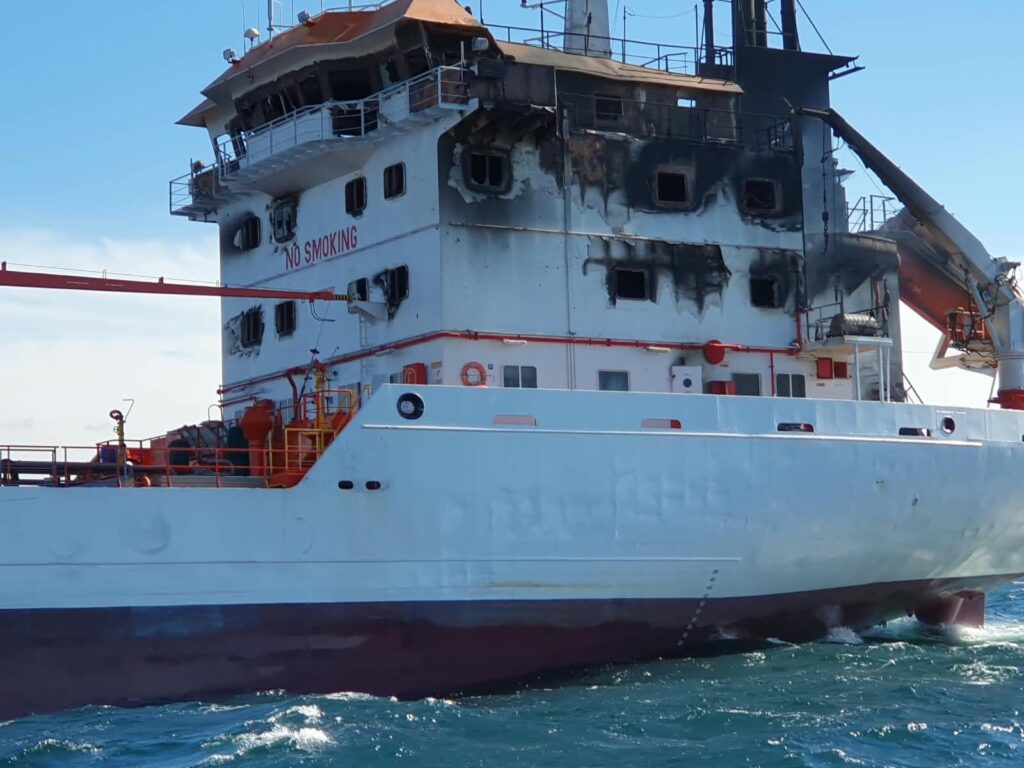
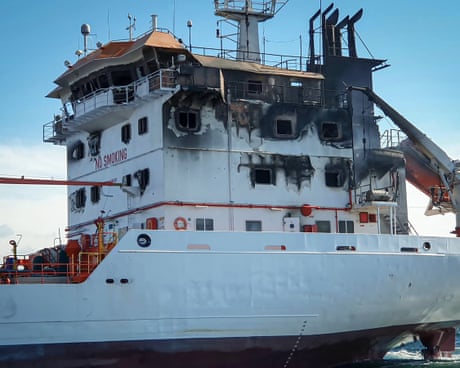
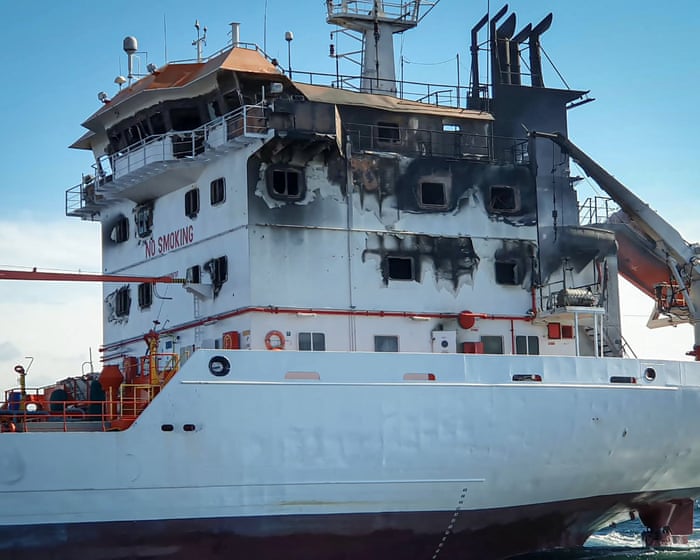
The San Marino-flagged chemical tanker Wine Trader near Sulina, Romania, on 15 October 2026, after it was hit by drones about 14 nautical miles off the coast. Seven of its 12 crew were reported missing. Photo: ARSVOM

Romania has proposed a joint NATO military command for the Black Sea, as drones hit four merchant ships in 24 hours, three of them off its coast, and its foreign minister said Russia "bears full responsibility." NATO ambassadors will discuss the attacks next week.

Russia’s strikes on merchant ships in the Black Sea have escalated this autumn and reached NATO shores. Drones have attacked at least eight merchant vessels near Romania and Bulgaria since 5 October, two of them inside Romania’s territorial waters. Until now, neither country had named the attacker, and Bulgaria still says it cannot prove who it was. Romania’s patience appears to have run out, and next week’s NATO meeting will show whether the alliance is ready to go further as Russia’s war spills beyond Ukraine’s borders.

Acting Defense Minister Radu Miruță wrote on Facebook on 14 October that "the Black Sea needs a joint military command of the NATO riparian states." "The Black Sea incidents, involving drones, sunk ships, and naval mines, oblige us to act, not wait," he wrote, after a call with his Bulgarian counterpart. Leadership and location would rotate among the member states. Romania is ready to host the command on its coast from 2028 and would accept a start on Türkiye's coast until then, he said. He proposed that Romania and Bulgaria send NATO a joint letter backing the idea.

The next day, Foreign Minister Oana Țoiu wrote on X that four commercial ships had been attacked over the previous day, including in Romania's territorial waters and exclusive economic zone, and that eight people had died. "Russia is turning the Black Sea into a dangerous area for civilian ships," she wrote. "Killing sailors from commercial ships, both in this region and anywhere in the world, is a crime. Russia bears full responsibility for these developments."

Earlier that day, as two tankers burned off Romania's coast, Bucharest had said it was still checking whether drones were involved.

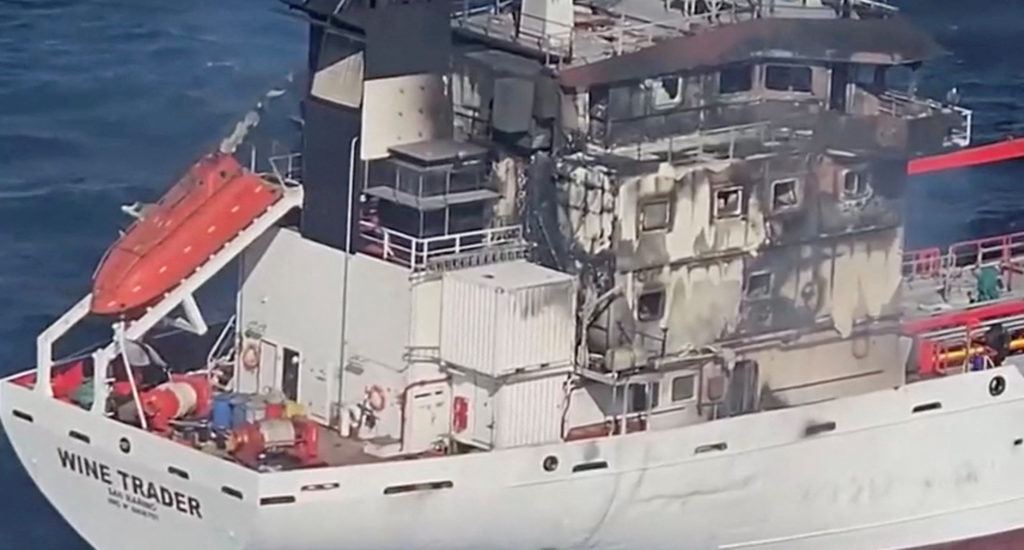
two tankers burn off romania’s sulina bulgaria says lacks proof russia behind black sea ship attacks · post burned superstructure tanker wine trader seen rescue helicopter 15 2026 romanian interior
Explore further

Two tankers burn off Romania’s Sulina as Bulgaria says it lacks proof Russia is behind the Black Sea ship attacks

Țoiu said NATO Secretary General Mark Rutte had agreed to convene the allies within days, after he met Romanian President Nicușor Dan and Bulgarian Prime Minister Rumen Radev in Brussels. NATO ambassadors will meet next week, France 24 reported. No date has been announced.

An escalating drone strike campaign

Black Sea grain war between Ukraine and Russia escalates
Map: Euromaidan Press

Drones have been hitting merchant ships for weeks on the route from Ukraine's Danube and Odesa ports to the Bosporus. Besides the latest strikes off Romania, Reuters counts at least five cargo ships hit near Romania and Bulgaria in the past 10 days, with 23 sailors dead or missing, most of them outside any NATO member's territorial waters. This week the strikes reached Romania's own waters.

  • The Comoros-flagged tanker Yara J was hit inside Romanian territorial waters late on 14 October, off Sulina, the port at the mouth of the Danube. Its crew was unharmed, and it was towed to the Romanian port of Constanța.
  • Early on 15 October drones struck the San Marino-flagged chemical tanker Wine Trader about a mile outside Romanian waters, also southeast of Sulina. Five of its 12 crew were rescued. Seven were still missing on 16 October, when rescuers returned to search the ship.
  • Two more ships were also targeted, Reuters reported: the Marshall Islands-flagged Sea Destiny, inside Romanian waters according to NATO, and the Tanzania-flagged Dania J, moored at the Ukrainian Danube port of Izmail.

Țoiu did not say which ships her eight dead were from, and Reuters still lists the Wine Trader's seven as missing. A NATO military source told Reuters the drones that hit both tankers came from Russia.

The chemical tanker Wine Trader
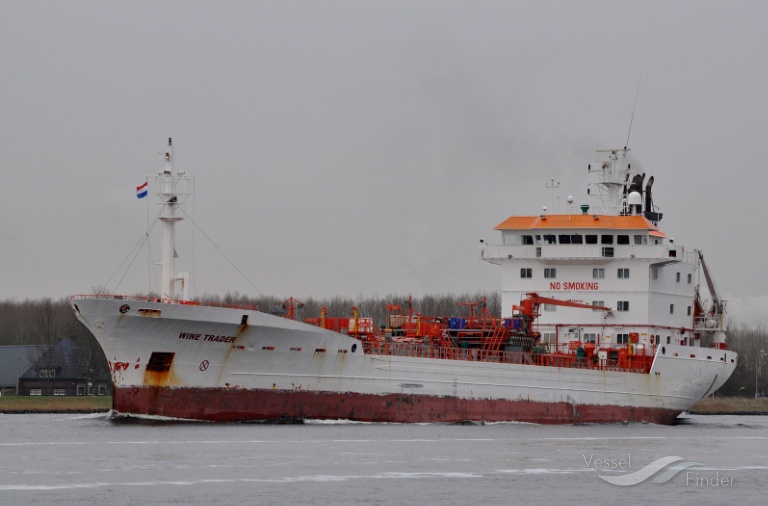
The chemical tanker Wine Trader. Photo: VesselFinder

Romania's president says too early to say

Romania's president has not gone as far as his foreign minister. Dan told reporters in Brussels it was "obvious" that the attacks were Russian attempts to destabilize Romania and Bulgaria and reduce support for Ukraine. But he also said it was too early to say definitively that Russia had launched the drones, according to Politico.

Bulgaria, Romania's partner on the command proposal, says it suspects Russia but cannot prove it. Two ships were hit off its coast on 13 October, and one, the HS Dignity, sank. The other, the Chelsea 3, is Ukrainian-owned.

Radev told parliament on 14 October that the attacks worked in Russia's favor and that "logic leads there." "The problem is that we cannot prove it," he told MPs. Sofia summoned the Russian ambassador. Radev also said EU leaders would discuss a moratorium on attacks on civilian ships in the Black Sea.

Bucharest has blamed Russia for drones before, though over its airspace, not its shipping. On 27 July it expelled a Russian diplomat after prosecutors confirmed that fragments of drones downed on Romanian territory were Russian. Russia, Romania's Foreign Ministry said then, "bears exclusive responsibility."

Ukraine ships most of its farm exports across the Black Sea. Euromaidan Press's David Axe has written on how the fight over shipping there has escalated.

Bulk carrier "Royad Mammadov" under the flag of Saint Kitts, partially sunk after an attack by Russian sea and air drones on October 5, 2026, 20 nautical miles off the coast of Romania. Photo: Romanian Interior Ministry
Explore further

Russia is losing the Black Sea grain war it started. Its answer is to sink civilian ships off Romania and Bulgaria

  •  

Dogmatic Nordic liberals v eastern family values: culture-clash drama Fjord touches nerves in Norway and Romania

Cristian Mungiu’s Cannes winner echoes the news story of a Romanian couple whose children were taken by the Norwegian government. As it heads to London film festival, two writers explain how the film exposes real hypocrisies

When Cristian Mungiu’s Fjord was shown in Romania as a one-day preview this June, the reception was extraordinary. Across 53 towns and 96 cinemas, the film reportedly pulled in over 40,000 viewers in a single night, a number arthouse cinema rarely sees in Romania. But the response here had little to do with cinema. It felt instead like a reopening of a familiar fault line about the clash of values within the EU itself.

Continue reading...

© Photograph: ©Tudor Panduru

© Photograph: ©Tudor Panduru

© Photograph: ©Tudor Panduru

  •  

Seven sailors missing after drones strike tankers near Romania’s Black Sea coast

Nato source says drones came from Russia, while Romania’s president says attacking commercial ships ‘is unacceptable and has to stop’

Seven sailors are missing after drones struck two tankers near Romania’s Black Sea ⁠coast, setting them ablaze and raising ⁠fresh security concerns on a ​vital shipping route used by Ukraine.

A Nato military source told Reuters the drones that had hit the Wine Trader and the Yara J came from Russia. “The drones that caused ⁠the fires on board two tankers inside Romanian territorial waters were of Russian origin,” the source said.

Continue reading...

© Photograph: ARSVOM/AFP/Getty Images

© Photograph: ARSVOM/AFP/Getty Images

© Photograph: ARSVOM/AFP/Getty Images

  •  

Two tankers burn off Romania’s Sulina as Bulgaria says it lacks proof Russia is behind the Black Sea ship attacks

two tankers burn off romania’s sulina bulgaria says lacks proof russia behind black sea ship attacks · post burned superstructure tanker wine trader seen rescue helicopter 15 2026 romanian interior

Two tankers caught fire within about 12 hours off Sulina, Romania’s port at the mouth of the Danube, Romanian authorities reported. The crew of one said a drone hit it inside Romania’s territorial waters, while Bucharest says it is still checking whether drones were involved. Bulgaria, where drones sank ships in its economic zone this month, says it lacks proof that Russia launched them.

For months, Russia has struck civilian ships on the sea route that carries most of Ukraine’s farm exports, while its drones have repeatedly crossed into Moldova and Romania during attacks on Ukraine. As long as Bucharest and Sofia wait for drone wreckage before naming anyone, Russia, the party Bulgaria’s own prime minister says the logic points to, pays no price for extending its war on Ukraine’s trade routes into NATO members’ waters.

Seven sailors missing after the second fire

The San Marino-flagged chemical tanker Wine Trader reported a fire in its superstructure around 07:00 on 15 October while anchored in Romanian territorial waters about 13 nautical miles southeast of Sulina, Romania’s Naval Authority said. By midday, five of its 12 crew had been recovered and seven were still missing.

The chemical tanker Wine Trader
The chemical tanker Wine Trader. Photo: VesselFinder

Hours earlier, at 01:34, a drone entered Romanian airspace over the country’s waters southeast of Sulina for about a minute before vanishing from radar, the Defense Ministry said. Authorities have not named a cause for the fire, though unnamed sources

  •  

MEP blasts ‘Euro-Gestapo’ for lecturing Russia on democracy

RT | October 8, 2026

Brussels is steering Europe toward totalitarianism and a “Euro-Gestapo” while lecturing Russia on democracy, Slovak MEP Lubos Blaha has warned.

Blaha made the remarks during a European Parliament debate on Tuesday, responding to EU foreign policy chief Kaja Kallas, who denounced Russia’s recent parliamentary elections as undemocratic.

The politician questioned why Brussels was focusing on Russia while cracking down on dissent within the bloc.

He cited arrests of pro-Palestinian protesters in Germany and the imprisonment of Estonian opposition figures, who he claimed were jailed for opposing war with Russia.

“Are you going to set up the Euro-Gestapo here, Mrs. Kallas, and lock up everyone who wants peace?” he asked.

The Slovak lawmaker also questioned why Brussels was debating Russia’s elections while Europe faced mounting unrest.

“You may not have noticed, but Spain is in the streets, France is in the streets, and you are here dealing with Russian elections. You must be joking,” he said.

Blaha went on to accuse Brussels of double standards over Ukraine’s suspended presidential elections.

“You blame the Russians for having elections, but you don’t mind that [Ukraine’s Vladimir] Zelensky has been governing for three years without any elections, without a mandate,” he said. “You are hypocrites!”

Zelensky’s presidential term expired in May 2024, but elections have remained suspended under martial law.

Blaha also cited the annulment of Romania’s 2024 presidential election, claiming the vote was canceled because “the wrong candidate won.” Romania’s Constitutional Court scrapped the result over alleged irregularities and accusations of Russian interference after EU- and NATO-skeptic Calin Georgescu won the first round. Pro-EU candidate Nicusor Dan won the rerun in May 2025.

The MEP argued that Russia had held elections despite the ongoing conflict and daily Ukrainian missile and drone attacks on its territory.

The September poll saw the ruling United Russia party win nearly 58% of the party-list vote.

Blaha also defended Russian President Vladimir Putin, contrasting his popularity with that of Western European leaders.

“You have nothing to criticize Putin for, Mrs. Kallas,” he declared. “Unlike you and your Merzes and Macrons, he has the support of his own population.”

Recent polls have put German Chancellor Friedrich Merz’s approval rating at a record low of 10% in October, while French President Emmanuel Macron’s support fell to 17% in September. Neither Kallas nor European Commission President Ursula von der Leyen was directly elected to her current position by voters, having assumed office through the EU’s institutional appointment process.

Blaha belongs to Slovak Prime Minister Robert Fico’s Smer-SD party, which opposes EU sanctions on Russia and has criticized Western military assistance to Ukraine.

  •  

Ukraine is buying 135 mobile shelters for border crossings as Russian drones reach from the Danube to Poland

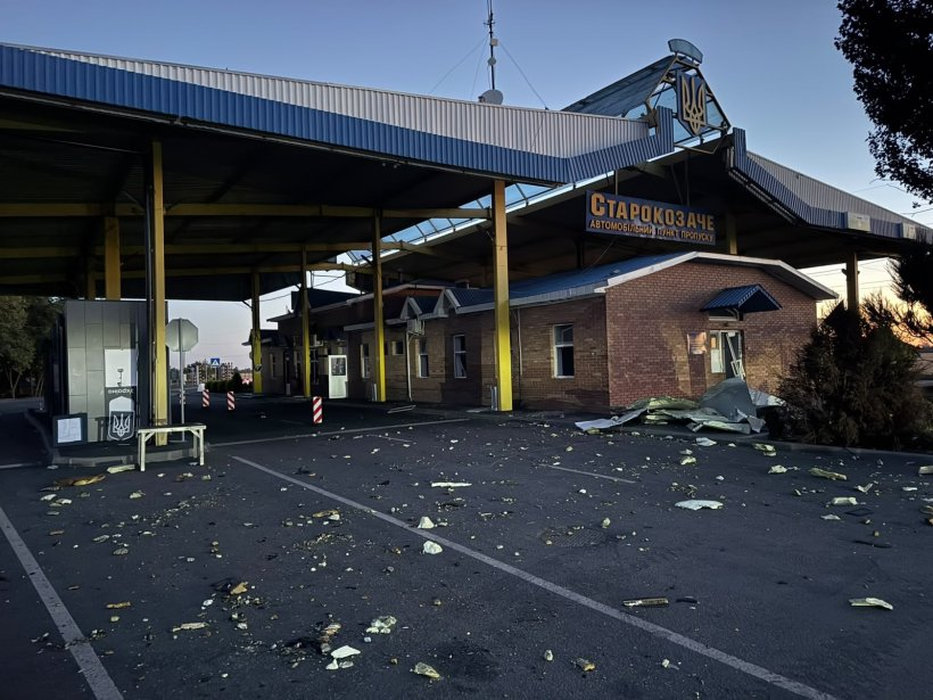
The Ukrainian Starokozache border crossing near Moldova, targeted by a Russian attack, September 2026. Photo: Odesa Oblast Military Administration / Telegram

Ukraine plans 135 basic mobile shelters for civilians at 28 of its border crossings, the State Agency for Restoration and Infrastructure Development said on 7 October.

Since the start of September, Russian drones have repeatedly struck crossings on Ukraine's borders with Moldova and Romania. Since mid-September, strikes have also reached the Polish border near the Yahodyn crossing in Volyn Oblast. On 13 September, a Russian drone strike set a gas station near the crossing on fire. On 28 September, the blast wave from another strike damaged the checkpoint building. On 25 September, First Deputy Minister for Restoration, Infrastructure and Transport Serhii Derkach said Ukraine is exploring with its neighbors whether some checkpoints could move onto their territory. No agreement has been reported. On 2 October, Moldovan Interior Minister Daniella Misail-Nichitin said Moldova had set up shelters next to its crossings with Ukraine and started relocating staff from joint checkpoints.

135 shelters for travelers and border staff

The shelters will stand at the crossings and on the roads leading to them. Regional recovery services in Vinnytsia, Odesa, Chernivtsi, Zakarpattia, and Volyn oblasts are running the purchases. The agency said the shelters will make the border safer for people crossing it and for checkpoint staff.

Map of Ukrainian border regions where mobile shelters are planned
Border regions where Ukraine plans to install shelters. Map: Euromaidan Press

In Chernivtsi Oblast, one of the 10 tenders the agency lists on Prozorro, Ukraine's public procurement system, covers eight shelters for 50 people each and three for 20 each, Ukrinform reported. They will stand on the approach road to the Porubne–Siret international crossing on the Romanian border. The work is expected to cost UAH 38.5 million (about $855,000), excluding VAT.

Russian strikes on crossings

On 5 October, at about 09:38, a projectile fell near the Palanca–Maiaky–Udobne crossing on the Moldovan border. It ricocheted off the ground into a shuttle bus parked by the barrier and also damaged a control booth. One Moldovan border officer suffered light injuries, and the crossing was suspended, Moldova's Border Police said, linking the incident to Russia's attacks on Ukrainian infrastructure. Moldovan authorities did not specify the projectile's type or origin.

Overnight on 9 September, Russian drones struck the Starokozache crossing with Moldova, killing two people and injuring three. On 1 September, Russian Shahed drones hit the Orlivka ferry crossing on the Danube, opposite Romania's Isaccea, and temporarily shut it down. Another Russian strike on 6 September halted the crossing again.

  •  

Drone Strikes Sink Merchant Ship in Bulgaria’s Black Sea Economic Zone

Two merchant vessels have been attacked by aerial and maritime drones in Bulgaria’s exclusive economic zone in the Black Sea, sinking one ship and forcing the evacuation of another. The incident follows a deadly attack on a grain carrier off Romania a day earlier and has prompted concern over the growing risks to civilian shipping close to EU and NATO territory.

Two commercial vessels were struck by drones in Bulgaria’s exclusive economic zone early on Tuesday, 6 October, in the first known attack of its kind on merchant shipping in Bulgarian waters.

The Togo-flagged ALFA WATAN suffered severe structural damage and sank, while the Palau-flagged ABLE caught fire. Bulgarian Prime Minister Rumen Radev said the vessels were attacked at around 3am by both aerial and maritime drones about 70 nautical miles east of the coastal town of Byala. The Bulgarian government said a search-and-rescue operation was continuing for the crew of the ALFA WATAN, whose fate remained unknown.

All 18 people aboard the ABLE were rescued after abandoning the burning vessel. The Bulgarian-flagged passenger and freight ferry DIOSCURIA was diverted to the area and initially took the crew on board before Bulgarian Navy and Border Police vessels transferred them towards Varna.

The crew comprised 11 Turkish and seven Indian nationals. Two sailors were taken to hospital, including an Indian crew member suffering from burns and the Turkish captain, who sustained a head injury. Bulgarian public broadcaster BNT reported that the remaining 16 sailors subsequently arrived safely in Varna for medical checks.

The ABLE was reportedly carrying grain towards Istanbul. The cargo aboard the ALFA WATAN, which had been heading north towards Romania, has not been officially established.

Radev convened an emergency meeting involving the ministries of defence, interior, transport and environment, alongside the presidency and Bulgaria’s security services. He described the attack as an unacceptable violation of international and maritime law and warned of its effect on commercial navigation in the Black Sea.

Bulgarian authorities have not publicly identified who launched the drones. Investigations are examining both the weapons used and the circumstances surrounding the attack. One rescued Turkish sailor told Bulgarian television that he believed the ABLE had been hit by a Russian underwater drone, but that account has not been independently established and Sofia has made no formal attribution.

Foreign Minister Velislava Petrova said Bulgaria was in contact with its European and NATO partners and described Black Sea security as inseparable from wider European security. She said civilian crews and freedom of navigation must be protected and that Bulgaria would work with its allies to assess the wider consequences for maritime security.

European Commission President Ursula von der Leyen also condemned attacks against civilian shipping, saying the situation in the Black Sea was becoming increasingly concerning. She said commercial vessels and their crews were being targeted as investigations continued into the latest incidents.

Tuesday’s attack came less than 24 hours after another commercial vessel caught fire and sank in Romania’s exclusive economic zone. The Turkish-owned Royad Mammadov, sailing under the flag of Saint Kitts and Nevis, had left the Ukrainian Danube port of Izmail carrying corn for Ravenna in Italy.

Romanian authorities confirmed that two people died and 11 crew members were rescued. President Volodymyr Zelenskyy said the vessel had been struck by two Russian drones, although Romanian authorities did not themselves publicly attribute the incident to Russia.

The two incidents in consecutive days mark a further geographical expansion of the risks facing commercial shipping in the western Black Sea. EU Today has previously reported how strikes near Romania have moved maritime war risks closer to NATO territory, while a separate maritime drone explosion at Constanța raised questions over the ability of coastal states to detect and respond to unmanned systems approaching commercial infrastructure.

The distinction between territorial waters and an exclusive economic zone remains important. The attacks occurred outside Bulgaria’s territorial sea and therefore do not amount simply to an attack on Bulgarian territory. They nevertheless took place in an area where Bulgaria has internationally recognised economic rights and responsibilities, including search-and-rescue and environmental obligations.

The immediate concern for Sofia is the search for the missing crew of the ALFA WATAN and the possibility of pollution from the wreck. The wider concern for the EU is the increasingly exposed position of civilian shipping routes linking Ukraine, Romania, Bulgaria and Turkey.

Ukraine’s maritime export routes remain particularly important for agricultural trade. Repeated attacks on merchant vessels can increase insurance premiums, discourage shipowners from entering the region and raise transport costs even when ports themselves remain operational. Russian attacks on Odesa and its export infrastructure have already placed Ukraine’s Black Sea grain corridor under sustained pressure.

With merchant ships now struck in the economic zones of both Romania and Bulgaria on consecutive days, Black Sea maritime security has moved further onto the agenda of EU and NATO governments along the western coast.

  •  

Romania Turns to Luca Niculescu in Fourth Attempt to Form Government

Romanian President Nicușor Dan has nominated diplomat Luca Niculescu as prime minister, beginning a fourth attempt to form a government after three previous candidates failed to secure a parliamentary majority.

The nomination was announced on Monday, 5 October, after Dan held consultations with Romania’s parliamentary parties at the Cotroceni Palace. Niculescu now has the task of finding sufficient support for a government after five months of political deadlock.

Dan said he had chosen the candidate he believed had the best chance of assembling a majority. “Romania needs a government. We need a budget for next year,” he said after the consultations, according to Romanian reporting on the nomination.

Niculescu, 55, is a former journalist and diplomat who has served as a secretary of state at Romania’s Foreign Ministry and national coordinator for the country’s accession to the OECD. He was Romania’s ambassador to France between 2016 and 2022 and was also accredited to Monaco and Andorra.

Accepting the nomination, Niculescu said his first task would be to build a parliamentary majority. He promised a government programme centred on predictable economic policy, public spending discipline, investment and Romania’s European and Euro-Atlantic commitments.

The appointment follows three unsuccessful attempts to replace the government of Ilie Bolojan, which was removed in a no-confidence vote on 5 May after the Social Democratic Party withdrew its support. EU Today reported at the time that 281 lawmakers backed the motion, bringing down the pro-European administration.

Eugen Tomac was the first candidate asked to form a government but relinquished the mandate after failing to secure sufficient support. Adrian Veștea was then nominated, but his proposed government was rejected by parliament.

The third candidate, PNL MEP Siegfried Mureșan, was nominated in September. His government received 182 votes in the parliamentary confidence vote on 30 September, well short of the 233 required. That defeat left Dan facing a fourth round of negotiations with the same fragmented parliament.

Niculescu therefore begins without an established majority behind him. During Monday’s consultations, the PSD continued to promote its own candidate, Sorin Grindeanu, while USR and AUR pressed for early parliamentary elections. PNL signalled greater flexibility but stopped short of committing itself to a new governing formula.

AUR leader George Simion has already said his party will not support Niculescu. USR, meanwhile, said it would examine the proposed cabinet, governing programme and the political majority behind it before deciding how to vote.

Under Romania’s constitution, a prime minister-designate has ten days from nomination to seek parliament’s confidence for the proposed programme and full list of ministers.

The repeated failures have also revived discussion of early elections. The president may dissolve parliament if no government receives a vote of confidence within 60 days of the first request for investiture and at least two attempts have been rejected, although dissolution is a presidential option rather than an automatic step.

Dan has so far indicated that he would prefer to exhaust efforts to form a government.

The political stalemate comes at a difficult economic moment. Romania is under pressure to reduce its budget deficit, maintain investor confidence and continue reforms tied to EU funding. The strain on the governing coalition had already become an EU fiscal issue before Bolojan’s government fell, with questions over budget consolidation and European recovery funding increasingly tied to political stability in Bucharest.

The immediate test for Niculescu will be whether his diplomatic background can translate into enough parliamentary votes to assemble a cabinet. His nomination leaves him more freedom than a candidate tied directly to one of the main parties, but the arithmetic remains unchanged: a government still requires at least 233 votes to take office.

Photo: Razvan Socol / Wikimedia Commons / CC BY-SA 4.0
  •  

Ukraine’s EU neighbors reject new plea from Kiev – Politico

RT | October 5, 2026

Poland and Romania have refused to help Kiev move millions of tons of grain – which got stuck in Ukraine following Vladimir Zelensky’s war on exports – into the EU, Politico reports, citing officials in Warsaw and Bucharest. Zelensky’s 40-day campaign resulted in Russia implementing a de facto blockade of Ukraine’s Black Sea ports, with the wider consequences of the strikes estimated at 1.5% of the country’s collapsing GDP.

Last week, Ukrainian Agriculture Minister Taras Vysotsky appealed to the EU for a €1.1 billion ($1.23 billion) allocation to improve transit capacity, which would help free large quantities of grain – Ukraine’s key source of income – trapped in the country.

The request came after Zelensky’s 40-day PR ‘pressure campaign’ on Russia, which involved long-range strikes on oil refineries and civilian infrastructure. The effort backfired, as Russia ramped up strikes on Ukraine’s military-related logistics, including the key hub of Odessa, accounting for an overwhelming majority of Kiev’s agricultural exports.

Speaking to Politico, Vysotsky described the situation as “very, very critical,” after his ministry reported the export of 2.4 million tons of agricultural products in September, just 46% of what Kiev considers the required volume.

He added that export restrictions leave Ukrainian farmers without cash needed to plant seeds now for next year’s harvest. “If the situation stays like this till spring, it could mean the decrease of even 35-40% of the planted area,” he warned.

Last month, Ukrainian officials estimated damage to infrastructure from Russian strikes at nearly $10 billion, with wider consequences amounting to around 1.5% of GDP.

While the EU as a whole is yet to give a definitive answer to the €1.1 billion request, Poland and Romania – which are crucial to facilitating Ukraine’s exports – ruled out any significant assistance.

Romanian Agriculture Minister Barna Tanczos rejected the prospect of substantially expanding capacity, telling Politico that “the interest for our own farmers remains a priority.”

Ukrainian cargo and low Danube water levels are already straining Romanian ports, he said, adding: “Everybody knows we cannot double the number of trains, we cannot double the roads, railways and port capacity. It is what it is.”

The Polish Infrastructure Ministry spokesperson said, as cited by Politico, that Poland “has no plans to introduce any changes aimed at increasing the transit of Ukrainian agricultural products.”

Before the €1.1 billion plea, Ukraine requested €220 million from the EU in grants to support farmers affected by disrupted exports, but the bloc effectively turned it down, pointing instead to existing EU mechanisms.

Agricultural trade has long been a source of friction between Ukraine and its EU neighbors. After the escalation of the Russia-Ukraine conflict in 2022, Brussels suspended duties and quotas on Ukrainian exports, which triggered massive protests from European farmers over what they saw as unfair competition. As a result, the EU introduced an ‘emergency brake’ system in 2024, allowing tariff quotas to return for sensitive products if imports exceed set thresholds.

In addition, many of Ukraine’s neighbors, including Poland, Hungary, and Slovakia, maintain significant restrictions on Ukrainian imports at the national level.

  •  

Romania’s Political Crisis Deepens After Parliament Rejects Mureșan Government

Romania’s political deadlock has deepened after parliament rejected the government proposed by prime minister-designate Siegfried Mureșan, leaving President Nicușor Dan to begin another attempt to assemble a viable administration.

The joint sitting of the Senate and Chamber of Deputies on Wednesday, 30th September, had been convened specifically to consider Mureșan’s programme and proposed Cabinet.

His government received 182 votes in favour and 15 against. It required at least 233 votes to take office.

Of Romania’s 464 MPs and senators, 321 were present and 197 valid votes were cast. PSD legislators attended but did not vote, while AUR members were absent from the chamber, according to the official result reported by Romania’s national news agency.

The result extends a crisis that has occupied Romanian politics for much of the year.

President Dan had nominated Mureșan after previous attempts to establish a stable government failed. Mureșan’s proposed coalition brought together the centre-right National Liberal Party, PNL, the Save Romania Union, USR, and the Democratic Alliance of Hungarians in Romania, UDMR.

Without support from the Social Democratic Party, PSD, that combination did not have the parliamentary numbers needed for investiture.

After the vote, Mureșan said his three-party grouping had presented a programme intended to end the crisis and accused the parties responsible for bringing down the previous administration of prolonging the instability.

The political breakdown began after the government of Ilie Bolojan lost a no-confidence vote in May.

Months before its collapse, EU Today had examined the growing strains inside Romania’s governing coalition, including disputes over fiscal consolidation and the position of Bolojan.

The subsequent search for a replacement has produced repeated nominations without restoring a stable majority. In June, President Dan turned to Adrian Veștea after an earlier nominee withdrew, while another confidence-vote attempt exposed the same underlying parliamentary arithmetic.

Mureșan was the latest effort to break the impasse.

The president must now decide whether another candidate has a realistic prospect of assembling the necessary 233 votes.

Romanian constitutional procedures also raise the possibility of early elections if repeated attempts to form a government fail. A review of the procedure following Wednesday’s vote notes that the president can make another nomination and that dissolution of parliament can become an option under the constitutional conditions governing failed investiture attempts.

Dan has previously warned against rushing towards another election, arguing that it could extend political uncertainty rather than resolve it.

The crisis is unfolding while Romania faces substantial fiscal pressure.

Successive governments have been required to address one of the largest budget deficits in the European Union while delivering reforms connected to EU funding and maintaining investment.

A prolonged period under an administration without a full parliamentary mandate would reduce the political room available for unpopular fiscal decisions.

Romania’s strategic position also gives the domestic crisis a wider European dimension.

The country sits on NATO’s south-eastern flank, shares a border with Ukraine and hosts allied military infrastructure. The Black Sea and Danube corridor have become increasingly important for European security and trade since Russia’s full-scale invasion.

Russian attacks on Ukrainian infrastructure close to Romanian territory have repeatedly forced Bucharest to respond to drones approaching or entering Romanian airspace. The security pressure was highlighted earlier this year when President Dan addressed the threat posed by Russian drone activity around the Danube.

Foreign and defence policy has therefore remained an important consideration during the government crisis.

Dan has stressed that Romania’s pro-Western orientation will continue despite the domestic deadlock.

The most immediate political question now concerns the PSD.

Party leader Sorin Grindeanu said after the vote that Romania urgently needed a government with full powers and that his party was prepared to assume responsibility for the country’s recovery.

Any new government able to command a reliable majority may therefore require either direct PSD participation or an arrangement under which Social Democrat MPs provide parliamentary support.

The alternative would be another attempt to construct a majority without them — something the past several months have shown to be difficult.

Wednesday’s result has not changed the parliamentary numbers. It has simply returned the decision to the Cotroceni Palace.

President Dan must now determine whether another coalition can be built from the existing parliament or whether Romania is moving closer to an early election.

Main Image: Von AureliaA – Eigenes Werk, CC BY-SA 4.0, https://commons.wikimedia.org/w/index.php?curid=60676307
  •  

US Ambassador Guilfoyle threatened Greek Minister over LNG policies

Kimberly Guilfoyle, the U.S. ambassador to Greece, has faced scrutiny over remarks she allegedly made during a private dinner in Athens in March 2026, less than six months after she assumed her post in the Greek capital in autumn 2025. According to an exclusive story by the Wall Street Journal investigating the “Balkan actions” of […]

The post US Ambassador Guilfoyle threatened Greek Minister over LNG policies appeared first on Keep Talking Greece.

  •  

Europe was part of the infrastructure of US aggression against Iran: Deputy FM

Press TV – September 24, 2026

Iran’s Deputy Foreign Minister for Legal and International Affairs Kazem Gharibabadi has said NATO Secretary-General Mark Rutte’s admission that some 5,000 sorties were flown from European bases in support of US military aggression against Iran proves that Europe formed part of the infrastructure of that aggression.

In a post on X on Thursday evening, Gharibabadi wrote that the NATO chief’s remarks demonstrated Europe’s role in enabling the illegal US campaign.

“Governments that placed their territory at the disposal of the United States cannot evade their responsibility,” he said. “This participation will not go unanswered.”

Rutte has repeatedly acknowledged that thousands of US military flights, between 4,000 and 5,000, departed from bases in Europe during the US-Israeli war of aggression against the Islamic Republic, which began on 28 February.

He described Europe as a “platform of power projection” without which Washington could not have conducted the operation.

Countries including Italy, Romania, the United Kingdom, France and Germany were cited in connection with the use of bases, airspace, tankers and logistics.

Iran has consistently described the US-Israeli assault as an unprovoked act of aggression in flagrant violation of the UN Charter and international law.

Tehran has stressed that providing territory, bases or infrastructure to an aggressor state itself constitutes participation in the act of aggression, as recognized under United Nations General Assembly Resolution 3314.

Foreign Minister Abbas Araghchi separately warned European officials in New York of the severe and long-term consequences of facilitating and supporting US and Israeli war crimes, both in Gaza and against Iran. He noted that submitting to a bully never satisfies that bully.

  •  

Massive 6,000-Year-Old Kiln in Romania Ran Hot Enough to Melt Bronze Centuries Before Anyone Cast It

A team of archaeologists digging at the site of Ursoaia, in Romania’s Iași County, has uncovered a nearly 6,000-year-old pottery kiln unlike anything previously found in the region. Described in a paper published this month in the journal Antiquity by Diana Măriuca Vornicu, Felix-Adrian Tencariu and colleagues from the Romanian Academy and Alexandru Ioan Cuza […]

  •  

Commission approves €52 million Romanian state aid for cattle farmers facing increased fuel and fertiliser prices

The European Commission has approved a €52 million (RON 277 million) Romanian state aid scheme for cattle farmers facing increased fuel and fertiliser prices due to the Middle East crisis.

The scheme was approved under the Middle East Crisis Temporary State Aid Framework (METSAF) adopted by the Commission on 29 April 2026.

The Romanian scheme

Romania notified to the Commission a €52 million scheme to support companies active in the cattle farming sector. The scheme, which will run until 31 December 2026, aims to mitigate the impact of the increase in agricultural fuel and fertiliser prices.

The aid will take the form of direct grants, with a maximum of €50,000 per company.

The Commission assessed the scheme under EU state aid rules, in particular Article 107(3)(c) of the Treaty on the Functioning of the EU, which enables member states to support the development of certain economic activities subject to certain conditions, as well as Sections 1 and 2.1 of the METSAF.

The Commission found that the scheme is in line with the conditions set out in the METSAF. In particular, the aid will be granted based on a scheme with a clear estimated budget and will be provided to temporarily support the development of companies active in the primary production of agricultural products. The Commission concluded that the scheme is necessary, appropriate and proportionate to facilitate the development of an economic activity and does not adversely affect trading conditions to an extent contrary to the common interest.

On this basis, the Commission approved the Romanian scheme under EU State aid rules.

Background

On 29 April 2026, the Commission adopted the METSAF to enable member states to support the EU economy in the context of the Middle East crisis. The METSAF is a targeted and temporary framework to address the effects of the crisis on some of the most exposed sectors of the economy: agriculture, fishery, transport and energy-intensive industries. The METSAF will be in place until 31 December 2026. During its period of application, the Commission will keep the content, scope and duration of the framework under review in the light of developments in the Middle East and of the general economic situation.

While the transition towards a clean economy remains the long-term solution to shield EU companies from the effects of global energy shocks, the METSAF allows Member States to act immediately to make sure that the growth of the most exposed companies is not irreparably hampered by the current crisis.

To this end, support can take various forms for companies active in the agriculture, fishery and transport sectors. This includes aid based on actual consumption to cover part of the price increases for fuel or fertilisers, and a simplified approach for small amounts of aid.

The METSAF also includes a temporary adjustment to the Clean Industrial Deal State aid Framework allowing for further flexibility and higher aid intensities to address electricity price spikes.

More information on the METSAF can be found online.

For more information

The non-confidential versions of today's decisions will be made available under case number SA.124647, in the state aid register on the Commission's competition website. New publications of state aid decisions on the internet and in the Official Journal are listed in the Competition Weekly e-News.

Related topics

Competition

State aid

  •  

Romania receives first €2.5 billion payment under SAFE defence instrument

On 26 August, Romania received its first payment of €2.5 billion under the Security Action for Europe (SAFE) defence instrument, representing 15% of its total allocation of €16.7 billion.

SAFE is a €150 billion financial instrument providing loans to member states. It primarily funds joint procurement of ammunition, missiles, air defence, and ground combat systems produced within the EU. It is part of the European Commission's ReArm Europe/Readiness 2030 plan, which aims to unlock over €800 billion in defence investment across the European Union.

The pre-financing will help Romania accelerate priority defence investments, strengthen resilience, and modernise its military capabilities in line with shared European goals. SAFE is designed to enable swift, co-ordinated action, improve the ability of European forces to work together, and strengthen Europe's defence industry, including through joint procurement and closer cross-border co-operation.

Defence and Space Commissioner Andrius Kubilius (pictured) said: "Today's €2.5 billion payment to Romania under SAFE is a major milestone for European defence and a more sovereign Europe. This funding will strengthen Romania's defence capabilities and industrial base, while contributing to Europe's overall security. SAFE is a clear demonstration of our strong commitment to European security, and to the resilience and to defence of our Eastern Flank."

This payment follows the completion of all required procedural steps and reflects the EU's commitment to providing timely, practical support through SAFE. Further payments will follow, as agreed milestones and implementation are met.

The SAFE instrument is financed by EU borrowing on the financial markets. This enables competitively priced and attractively structured long-duration loans to requesting Member States. The terms of the SAFE loans benefit from the EU's strong credit rating.

  •  

Romania’s years-long crisis of democratic legitimacy deepens

Romania’s ongoing political crisis is entering a more critical phase, with a collapsed government, an unresolved battle over the presidency and a growing conservative-nationalist challenge to the political order that has dominated the country for years.

At stake is not just who governs Bucharest, but whether Romania’s institutions can recover public legitimacy after the extraordinary cancellation of the 2024 presidential election.

The crisis dates back to November 2024, when independent nationalist candidate Călin Georgescu—to the surprise of many—finished first in the opening round of the presidential vote.

Citing alleged electoral irregularities and intelligence—evidence that still hasn’t been disclosed to the public—claiming Russian interference in favor of Călin Georgescu, Romania’s Constitutional Court subsequently annulled the election.

The court’s decision, therefore, erased an election result already delivered by Romanian voters and triggered one of the most serious democratic controversies in the European Union.

Romania’s democratic clampdown deepened even further in March 2025 when Georgescu was barred from taking part in the rerun presidential election. The Constitutional Court upheld his exclusion, leaving the person who had won the original first round unable to compete when Romanians were sent back to the polls for a second time.

The sequence of events became, for a broad cross-section of Romania’s population, undeniable proof of what many observers have begun to describe as “managed democracy”—meaning elections across the EU are “legitimate” only until voters choose someone “unacceptable” to the ruling establishment.
It didn’t take long for news of the crisis to reach across the Atlantic. Vice President JD Vance used his 2025 Munich Security Conference speech to accuse Romania of having “straight up canceled the results of a presidential election based on the flimsy suspicions of an intelligence agency and enormous pressure from its continental neighbors.”

The U.S. State Department’s subsequent Report on Human Rights Practices also leveled criticism that the annulment represented political interference and an unusually severe restriction on disfavored political speech. Elon Musk, for his part, in several posts to social media attacked the Romanian state’s treatment of Georgescu and described one official connected with the process as a “tyrant.”

How can a judge end democracy in Romania? https://t.co/9MFhlq6YwQ

— Elon Musk (@elonmusk) March 10, 2025

This guy is a tyrant, not a judge https://t.co/ghE9X4W5G3

— Elon Musk (@elonmusk) February 20, 2025

The episode resonated well beyond Romania because it touched a wider fault line running through European politics. Nationalist movements challenging Brussels on sovereignty, mass migration, security, green policy, cultural questions, and foreign affairs increasingly argue that institutional mechanisms are being weaponized to contain alternative political forces that can no longer be easily defeated—and may even be winning outright—at the ballot box.

Romania’s own long-established, ruling elite class has since begun to fracture. Prime Minister Ilie Bolojan’s Brussels-aligned government was brought down on May 5 after the Social Democratic Party (PSD) abandoned the coalition and joined nationalist AUR and other opposition forces in backing a no-confidence motion.

The result was overwhelming—281 lawmakers voted to remove the government, compared with only four against, well above the 233 votes required. The scale of the defeat exposed the government’s lack of legitimacy and revealed how quickly the firewall around Romania’s nationalist opposition had begun to crack.

Especially noteworthy was the decision by the PSD, long one of the pillars of Romania’s establishment, to cooperate with the Alliance for the Union of Romanians (AUR). Whatever the parties’ differences, that cooperation showed that excluding AUR indefinitely from parliamentary influence was becoming increasingly difficult.

President Nicușor Dan, so far, has failed to find a legitimate replacement. His nominee Adrian Veștea went before Parliament in June but secured only 189 votes—44 short of the 233 needed to install a government.

The failure prolonged a political vacuum that has continued into August. Bolojan remains interim prime minister, while Dan has held repeated consultations with former coalition parties in an effort to maintain fiscal measures and secure Romania’s remaining EU recovery funds.

The government’s paralysis has placed greater scrutiny on Dan himself. The right-wing S.O.S. Romania party formally initiated a constitutional procedure seeking his suspension under Article 95, alleging serious violations involving the separation of powers, government formation, the judiciary and democratic oversight of the intelligence services.

S.O.S. leader Diana Șoșoacă said more than 400,000 Romanian living in the country and abroad had expressed support for Dan’s removal. She also claimed that 155 parliamentarians had indicated agreement with the suspension initiative, although the names of lawmakers outside her party were not publicly disclosed.

The accusations against Dan include claims that he has blurred the constitutional boundaries of the presidency by involving himself too directly in judicial affairs. Critics have also objected to his public comments concerning the Constitutional Court and his consultations with magistrates.

Another point of contention is Dan’s insistence on constructing what he has repeatedly called a pro-Western governing majority. His opponents argue that the Constitution requires the president to facilitate government formation rather than impose ideological tests on parties capable of assembling parliamentary support.

Dan, for his part, has defended his approach as an effort to maintain Romania’s strategic orientation and produce a workable government. His supporters say the country’s position on NATO’s eastern flank, next to Ukraine, makes political and foreign-policy continuity especially important.

The intelligence services have become another sensitive issue. Critics point to the absence of permanent civilian leadership at the Romanian Intelligence Service while proposals have circulated to expand the security apparatus into areas including corruption and tax enforcement.

Such controversies carry particular historical weight in Romania, where memories of communist-era surveillance and the political power of the security services remain deeply embedded. Measures that might be treated elsewhere as routine institutional disputes can therefore trigger much deeper fears of political control.

A separate 2026 rule-of-law report cited by critics has further intensified the argument over Romania’s Constitutional Court. The Civil Liberties Union for Europe report was cited as arguing that the court had effectively changed the law in its handling of electoral candidacies, raising questions about legal certainty and the scope of judicial power.

The same report raised concerns over procedural protections for excluded candidates and discussed structural reform of the Constitutional Court itself. It also highlighted problems involving media independence, opaque political financing, and poorly defined anti-disinformation measures that can potentially restrict legitimate speech.

Those findings have strengthened the case made by Georgescu’s and his supporters that the 2024 election annulment, described by many analysts as a constitutional coup, was never merely about one TikTok campaign. They see it as a confrontation over who ultimately sets the boundaries of acceptable politics—Romanian voters or institutions increasingly tied to a globalist, Brussels-centered political consensus.

Romania’s crisis has moved beyond constitutional theory, as its political breakdown now collides with an economy facing some of the heaviest fiscal pressures in the European Union.

Earlier predictions that Fitch could push Romanian sovereign debt into junk territory did not materialize this August. Fitch instead maintained Romania at BBB-, the lowest investment-grade level, while keeping a negative outlook and warning that prolonged political instability could undermine deficit reduction and jeopardize access to European recovery money.

The reprieve should not be confused with economic security. Fitch expects Romania’s economy to contract by roughly 0.6 percent in 2026 and projects a budget deficit of about 5.9 percent of GDP—an improvement from previous years, but still exceptionally high for a BBB-rated state.

S&P has likewise kept Romania at BBB- with a negative outlook. Both agencies have pointed to the ongoing political fragmentation, financing pressures, and the difficulty of sustaining fiscal consolidation while governments rise and fall in Bucharest.

For ordinary Romanians, warnings like these translate into something much more tangible than ratings-agency terminology. They mean higher borrowing costs, increased pressure on household incomes, weaker growth, and further uncertainty over the country’s economic future. That helps explain why anger at political elites has persisted even as officials insist Romania remains firmly anchored inside the EU and NATO.

The nationalist political revolt in Romania also forms part of a wider European trend. From the AfD in Germany and Marine Le Pen’s movement in France to populist forces in Italy, Austria and elsewhere, parties demanding national sovereignty, stricter immigration controls and, increasingly, remigration have forced issues once excluded from respectable debate into the political mainstream.

Romania’s version of that revolt has developed around Georgescu and AUR, whose supporters increasingly compare their struggle with the movement that formed around Donald Trump in the United States. They view sovereignty, national identity, demographic security, economic accountability, and a nationally oriented foreign policy not as threats to democracy, but as core issues that any genuine democracy must be free to decide for itself.

The Romanian establishment—and by extension its backers in Brussels—now faces an uncomfortable problem: attempts to isolate Romania’s traditional, nationalist, and patriotic electorate have not only failed to make it disappear, but have made it much stronger. The collapse of the governing coalition and the cooperation between PSD and AUR have shown that the old cordon sanitaire is becoming harder—if not impossible—to maintain.

The post Romania’s years-long crisis of democratic legitimacy deepens appeared first on Remix News.

  •  
❌