❌

Reading view

Global South Media Center: 4 Outlets Launch Bold New Platform in China
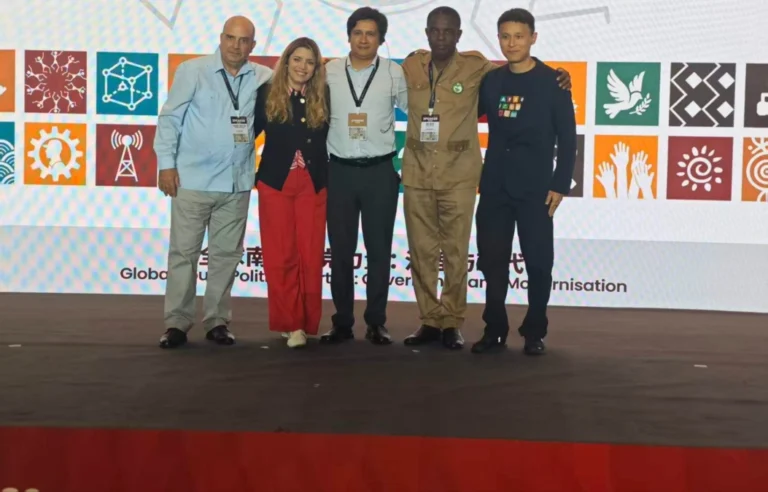
Global South Media Center launches in China with teleSUR, Prensa Latina, Brasil de Fato and Pan Africa TV.

Global South Media Center launches in China with teleSUR, Prensa Latina, Brasil de Fato and Pan Africa TV to strengthen Southern media cooperation.

Related: China Deploys Liaoning Carrier Strike Group to Western Pacific for Military Drills


Global South Media Center Launches in China

The Global South Media Center was established in China on Sunday as a new platform for cooperation among media organizations from Latin America, Africa and Asia.

The initiative, known by its Spanish acronym CMPSur, was created by four media outlets with correspondents in China: teleSUR, Cuba’s Prensa Latina, Brazil’s Brasil de Fato and Ghana’s Pan Africa TV.

The launch took place during the Global South Academic Forum, held in Shanghai on October 17 and 18 under the theme “Global South Political Parties: Governance and Modernization.”

The forum brought together political leaders, academics, researchers and media representatives from Asia, Africa, Latin America and other developing regions.

Jeff Xiong, secretary general of the Global South Academic Forum, said the new media center seeks to strengthen joint journalistic production and build narratives from the perspective of the peoples of the South.

The platform aims to deepen links between China and other Global South countries while challenging the dominant communication frameworks of the Global North.

Xiong highlighted the role of the Global South Academic Forum in creating the conditions for multinational cooperation. He also expressed hope that additional media organizations from developing countries would join the initiative.

The Global South Media Center plans to expand the circulation of stories about China among audiences in Africa, Asia and Latin America through collaboration among outlets from different regions.

The initiative reflects a growing effort by Southern media to coordinate reporting, share content and develop common perspectives on development, governance and international relations.

The center will not replace the editorial independence of its founding organizations. Instead, it is expected to provide a framework for exchanging material, coordinating coverage and promoting joint productions.

The creation of the platform comes at a time when media organizations in developing countries face increasing pressure from concentrated technology platforms, algorithmic distribution and dependence on foreign digital infrastructure.

The Global South Academic Forum has become a space for discussing those challenges alongside broader questions of governance, development and international cooperation.

Global South Media Center Focuses on AI and Sovereignty

Global South Academic Forum | UNESCO—Media development and information

The Global South Media Center was announced during a panel on communication, party governance and social mobilization.

Participants discussed how media organizations can respond to the expansion of artificial intelligence and growing technological inequalities between developed and developing countries.

Alejandro Gómez, vice president of Prensa Latina, defended technological sovereignty and informational independence as essential conditions for Southern media.

He said developing countries must build their own capacities rather than relying exclusively on infrastructure and platforms controlled by external actors.

Gómez proposed the creation of a permanent training mechanism in artificial intelligence for journalists and media organizations in the Global South.

The initiative would be developed in cooperation with Chinese institutions and other specialized organizations. It could include training in AI-assisted reporting, data verification, digital security, content production and responsible use of new technologies.

The Prensa Latina executive also emphasized the need for Southern media to produce their own narratives about international transformations.

He argued that dominant global media frameworks often condition coverage of countries such as Cuba and limit the visibility of perspectives from developing nations.

The proposal reflects a broader concern that artificial intelligence may reinforce existing inequalities if Southern countries do not participate in the design, regulation and use of these technologies.

AI tools can help journalists analyze information, translate content, identify trends and improve audience engagement. However, they can also reproduce biases, amplify misinformation and concentrate power in companies that control the underlying models.

For media organizations in the Global South, the challenge is to use new technologies without becoming dependent on foreign platforms or losing control over editorial decisions.

The Global South Media Center could therefore play a role in training, research and the development of shared technological standards.

teleSUR President Patricia Villegas also defended South-South cooperation as a means of strengthening communication sovereignty.

She said media organizations in the South must reduce their dependence on digital infrastructures and technological platforms controlled by external actors.

Villegas warned about the influence of algorithms on the circulation of content. She argued that platforms can determine which stories reach audiences and which voices remain marginal.

The teleSUR president called for greater collaboration among Southern media, including the exchange of productions and the transfer of technological capacities.

She highlighted China’s role as a strategic partner for expanding communication cooperation and strengthening the ability of developing countries to produce and distribute their own content.

Villegas also referred to the creation of teleSUR+ in July 2026. The collaborative platform brings together audiovisual material, texts and photographs produced by media organizations and creators from the Global South.

She also mentioned the Global South correspondent network in Beijing, which includes Brasil de Fato, Prensa Latina and Brazil’s TVT, with the planned incorporation of an African media outlet.

The correspondent network provides a practical model for the new media center. It allows participating outlets to share reporting, coordinate coverage and reduce the costs of maintaining international bureaus.

Southern Media Seek a Common Global Voice

UNESCO—Global Media and Information Literacy | International Federation of Journalists

The Global South Media Center represents an effort to build a more coordinated voice for developing countries in the international information system.

Media organizations from the South often face unequal access to technology, advertising revenue, satellite capacity, distribution networks and international audiences.

Many outlets rely on platforms owned or controlled by companies based in the Global North. Those platforms can shape visibility through algorithms, moderation policies and commercial priorities.

The new center seeks to address that imbalance by promoting cooperation among media with shared interests in sovereignty, development and multilateralism.

The initiative also responds to the need for greater representation of Southern perspectives in coverage of China, Africa, Latin America and the Caribbean.

Mainstream media in the Global North have often presented developing countries through narratives focused on crisis, instability or dependence. Southern media organizations argue that those narratives ignore local experiences, historical context and the diversity of development models.

The Global South Media Center aims to provide alternative coverage that reflects the voices of communities, governments and social movements in the South.

The platform could support reporting on infrastructure, public health, education, food sovereignty, climate adaptation, digital governance and regional integration.

It could also promote stories about cooperation among developing countries, including China’s role in infrastructure, technology and trade.

The center’s creation is part of a wider effort to strengthen South-South cooperation in communication.

The Global South Academic Forum has promoted exchanges among academics, institutional representatives and media organizations on governance, development, international cooperation and the role of developing countries in global affairs.

The forum’s discussions have included state capacity, social mobilization, institutional innovation and the use of party organizations to strengthen governance.

Those themes are closely connected to the media agenda. Communication is not only a technical issue; it is also part of how societies organize political participation and respond to global challenges.

The panel in Shanghai emphasized that media organizations must prepare for the impact of artificial intelligence while defending editorial independence and public interest journalism.

Participants argued that technological innovation should not replace journalists but should support their work by improving research, verification and audience access.

The Global South Media Center could therefore become a space for developing ethical guidelines on AI, protecting journalists’ rights and promoting responsible use of new technologies.

Geopolitical Context

The launch of the Global South Media Center has geopolitical significance because communication has become a central arena of global competition.

Countries and media organizations increasingly compete to shape narratives about development, security, technology and international cooperation.

China’s role in the initiative reflects its growing engagement with Africa, Asia and Latin America. Beijing has expanded partnerships in infrastructure, trade, education and digital technology through initiatives such as the Belt and Road Forum and the Forum on China-Africa Cooperation.

For Southern media, cooperation with China offers access to training, technology and new distribution channels. It also allows them to diversify their sources of information and reduce dependence on traditional Western media networks.

For China, the platform provides an opportunity to strengthen its image among Global South audiences and present its development experience through media organizations from the region.

The initiative does not eliminate political differences among participating countries. Media organizations in the Global South have different political systems, editorial traditions and national interests.

However, the center reflects a shared concern about technological dependence and the unequal distribution of global communication power.

The platform could also influence debates about digital sovereignty, data governance and the regulation of artificial intelligence.

Developing countries have increasingly argued that international standards should address the concentration of technological power and protect the right of nations to control their own digital infrastructure.

The Global South Media Center may become part of that broader discussion by promoting training, content exchange and cooperation among media organizations.

Its success will depend on whether participating outlets can sustain joint projects, develop shared standards and expand the initiative beyond its founding members.

The launch of the Global South Media Center marks an attempt to build a stronger communication network for countries seeking greater influence over the global information order.

SEO Title: Global South Media Center: 4 Outlets Launch Bold New Platform in China

  •  

Carrefour CEO says 50 of its stores and almost 20 supermarkets were ransacked during riots in France

Alexandre Bompard, chief executive officer of Carrefour SA, at the Aix-en-Provence economic forum in Aix-en-Provence, France, on Friday, July 3, 2026. The annual economic conference takes place in the French city of Aix-en-Provence July 2-4. Photographer: Jeremy Suyker/Bloomberg via Getty Images
Alexandre Bompard, the CEO of supermarket chain Carrefour, condemned rioters in France on Sunday.

Bloomberg/Getty Images

  • Alexandre Bompard condemned the riots in France on Sunday.
  • The Carrefour CEO said that rioters targeted about 50 of his stores.
  • Bompard said that the cost of repairs will exceed $11 million.

The CEO of one of France's largest supermarket chains, and one of the world's largest retailers, said that 50 of its stores were targeted by rioters on Saturday.

Alexandre Bompard, who leads Carrefour, France's version of Walmart, took to X on Sunday to condemn the riots and commend his employees as France reels from widespread civil unrest and looting.

"Nothing can justify such violence," Bompard said on X in French. "Those who attack the work tools of courageous entrepreneurs and their teams in this way must face an uncompromising response."

"The Republic must protect its shopkeepers!" he added.

Riots swept across France on Saturday after initially peaceful demonstrations against the high cost of living and deteriorating school conditions turned violent. Interior Minister Laurent Nuñez said on X that 600 police officers were injured in the fracas and more than 2,000 people were arrested.

Photos and videos from Paris and other French cities show massive demonstrations, burning cars, and wrecked storefronts.

An overturned car burns in a city street as thick smoke rises and several people move nearby.
Rioters set cars on fire at the Canal Saint Martin during severe unrest in Paris on October 17.

Remon Haazen/Getty Images

In his X post, Bompard called the violence "unacceptable." He said that, in addition to Carrefour's stores, about 1,500 other shops were damaged in the riots.

"The cost of the repairs will amount to more than 10 million euros, and our shopkeepers need an acceleration of compensation procedures, as in the case of natural disasters," he said.

Read the original article on Business Insider

  •  

Burnham Declares £500 Million War on Tory Councils

Andy Burnham's Government has been accused of waging a £500 million "class war" on wealthy councils, slashing funding from rural Tory and Lib Dem areas to bankroll urban Labour Party strongholds.

The post Burnham Declares £500 Million War on Tory Councils appeared first on The Daily Sceptic.

  •  

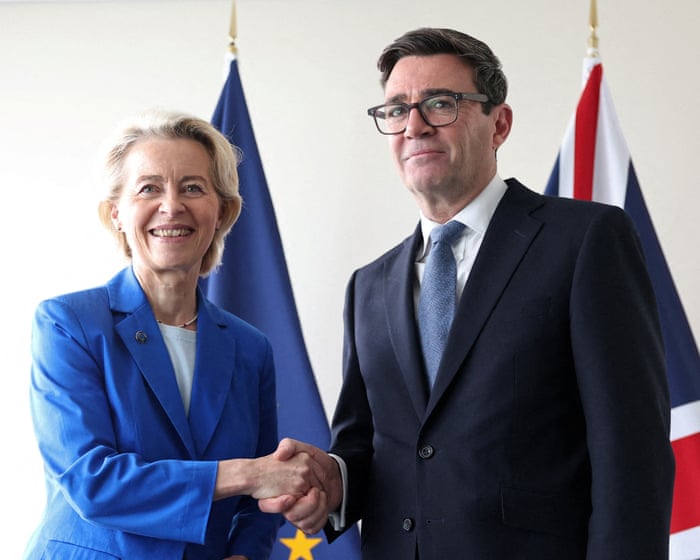
Brexit’s back – but are British voters ready to contemplate a reversal?

As Andy Burnham talks up closer alignment with the EU and a poll suggests half in UK would rejoin, the B-word is back on the agenda

In February 2016, days after David Cameron announced the UK would hold a referendum on leaving the EU, he told workers in Slough not to imagine they could change their minds a few years down the line if they did not like how things panned out. Voting to stay in or leave was a once in a generation thing, he said. “This is a decision that lasts for life.”

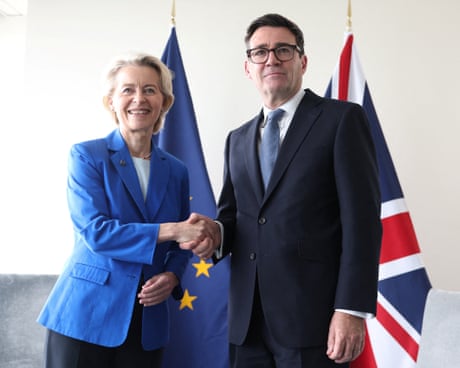
Well times change, as the last prime minister but five could testify. A decade after Britain told Brussels where to go, Brexit is back on the political agenda. After years in which many politicians avoided any mention of the B-word, Andy Burnham broke the omertà in his party conference speech last month, saying he would look again at Britain’s relationship with Europe.

Continue reading...

© Photograph: Toby Melville/AFP/Getty Images

© Photograph: Toby Melville/AFP/Getty Images

© Photograph: Toby Melville/AFP/Getty Images

  •  

Le Venezuela est-il devenu une colonie des Etats-Unis ?

Un troisième cycle de pourparlers a débuté hier mercredi à Caracas entre le gouvernement intérimaire du Venezuela et l’opposition. L’information a été annoncée par un responsable du département d’Etat américain. Car depuis le 3 janvier et l’enlèvement du Président Nicolas Maduro, le Venezuela se trouve sous tutelle américaine. Et Washington en profite, comme l’illustre un récent accord permettant aux Etats-Unis de capter plus de 20% des réserves pétrolières du pays.   Quelle est la situation politique et économique du Venezuela aujourd’hui ? Jusqu’où s’exerce l’influence des Etats-Unis ? Quelles perspectives ?

  •  

No 10 leaves option open to impose Chinese EV tariffs if UK joins EU scheme

Beijing warns against ‘discriminatory’ step after France drops opposition to British role in Made in Europe package

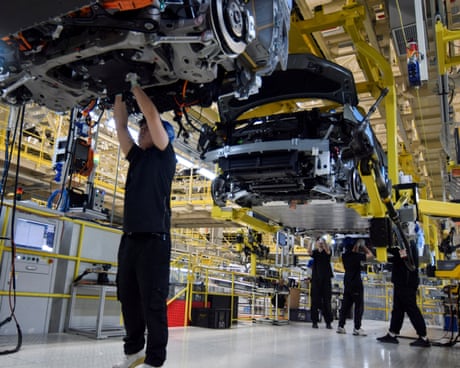
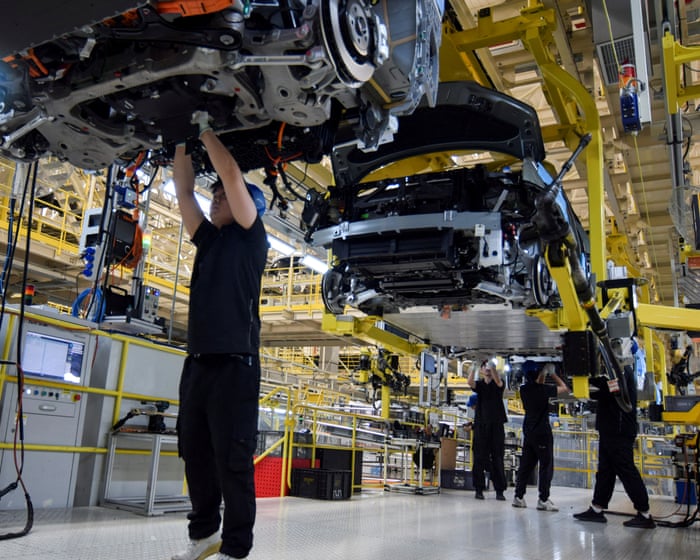
No 10 has left the door open to imposing tariffs on Chinese-made electric vehicles as part of the Made in Europe package, prompting a warning from Beijing that such a move would be “discriminatory”.

Downing Street said on Friday that it would “welcome the objective to have the UK included in the Industrial Accelerator Act” after France dropped its opposition to Britain joining the scheme.

Continue reading...

© Photograph: Nick Carey/Reuters

© Photograph: Nick Carey/Reuters

© Photograph: Nick Carey/Reuters

  •  

Repairing Brexit economic damage should be Burnham’s top priority, business chief says

Shevaun Haviland argues PM is right to revisit Labour’s EU red lines as current trading relationship is bad for business

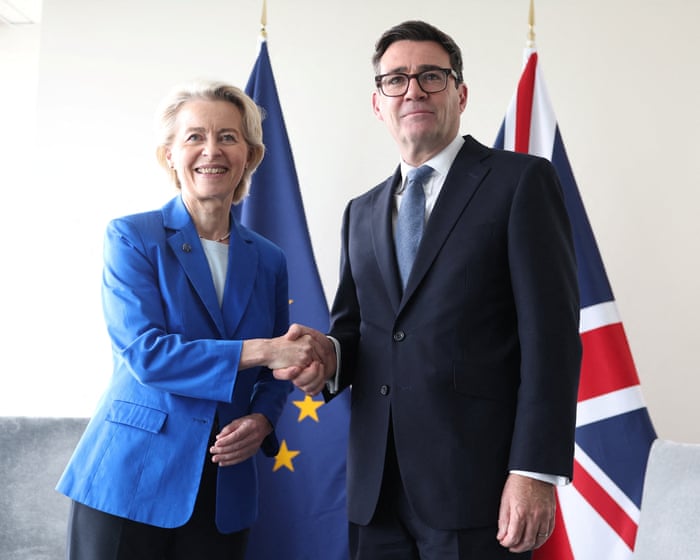
Repairing the economic damage of Brexit should be the top priority for Andy Burnham as he reconsiders Labour’s red lines on EU membership, the head of one of Britain’s leading business groups has said.

Shevaun Haviland, the director general of the British Chambers of Commerce (BCC), said she welcomed the prime minister reopening the Brexit battle lines despite the uncertainty it could create, arguing that the UK’s current trading relationship with the EU was bad for business.

Continue reading...

© Photograph: Toby Melville/Reuters

© Photograph: Toby Melville/Reuters

© Photograph: Toby Melville/Reuters

  •  

Climate change and El Niño pushed explosive hurricane ‘Polo’ to the highest category

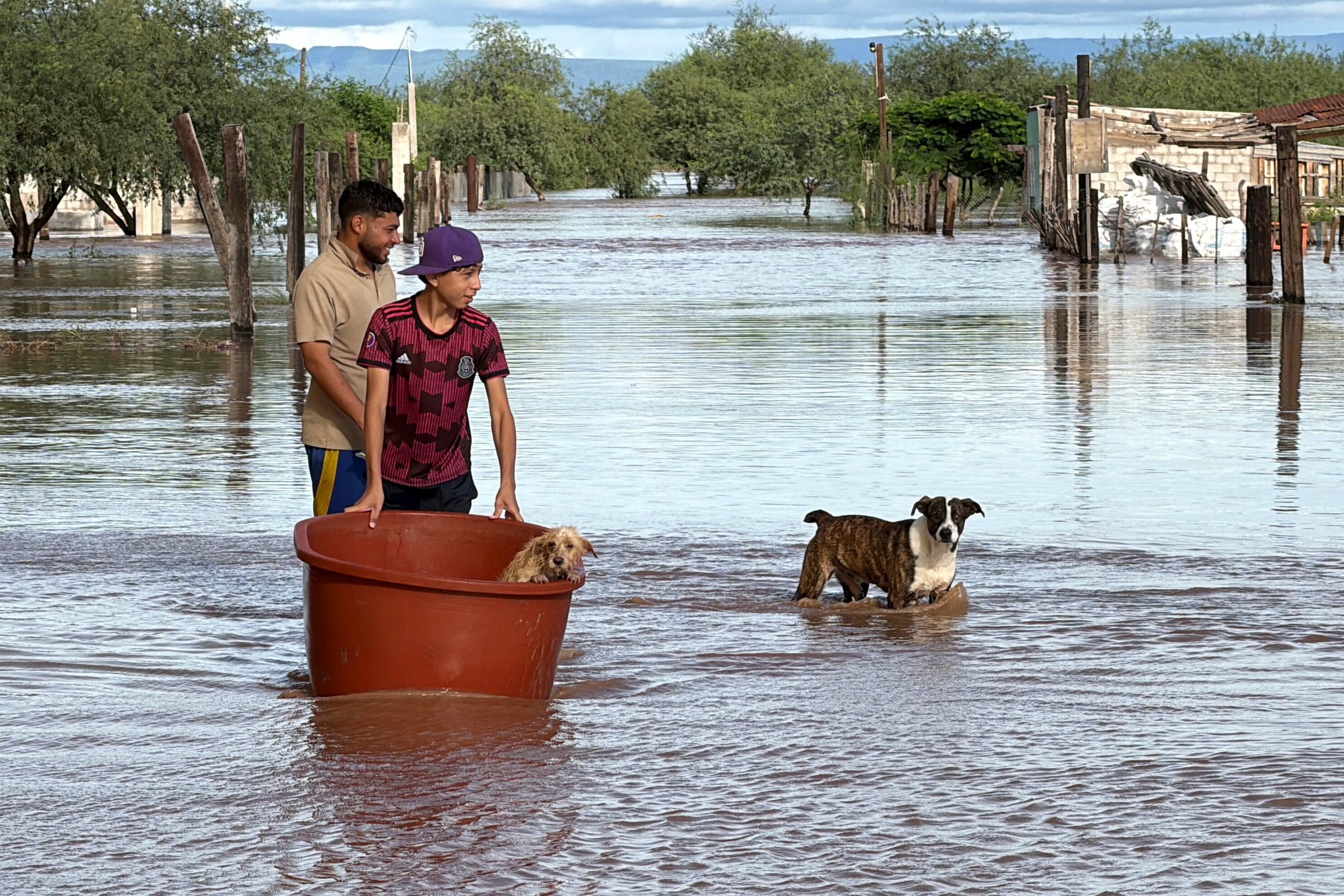
In barely a day, hurricane Polo, which formed in late September in the Pacific off the coast of Mexico, reached the highest category — level 5, corresponding to winds above 252 kilometers (156 mph) per hour. It was the second most powerful tropical cyclone recorded in the Pacific to date. Polo later weakened before making landfall as a storm — at category 2 — in Baja California Sur, Mexico. It left behind torrential rains, floods and infrastructure damage in northwest Mexico and the southwestern United States, and five deaths linked to those floods in Mexico.

Seguir leyendo

© Daniel Sánchez (EFE)

Flooding in Guaymas, Sonora (Mexico), caused by tropical storm 'Polo' in late September.
  •  

This Shouldn’t Be Normal

Endless illegal immigration, unaffordable energy, draconian speech policing – we're being conditioned to accept outrageous things as normal, says Nick Rendell. Now add to that economic crashes.

The post This Shouldn’t Be Normal appeared first on The Daily Sceptic.

  •  

EE.UU. inicia envío de 600 soldados a Panamá proyectando movilización a América Latina

Un contingente de la 10.ª División de Montaña de EE.UU. inició su despliegue en Panamá con miras a extender operaciones militares a Colombia y Honduras. La maniobra busca intensificar las acciones antidrogas impulsadas por la Administración de Donald Trump en la región.
  •  

Lula denunciará ante observadores fallas de Meta que podrían favorecer a Bolsonaro

Entre las fallas se cuentan interrupciones del servicio de anuncios, caídas en el recuento de visualizaciones de publicaciones favorables al presidente brasileño y bloqueos temporales de la promoción de contenidos en Instagram.
  •  

Closer EU trade ties greater prize for UK than making separate deals, minister says

Exclusive: Douglas Alexander, on trade delegation to India, talks up economic benefits of joint trading arrangements with Europe

Britain will benefit from much closer trading relations with the EU even if that means giving up its ability to negotiate free trade agreements, the Scotland secretary has said.

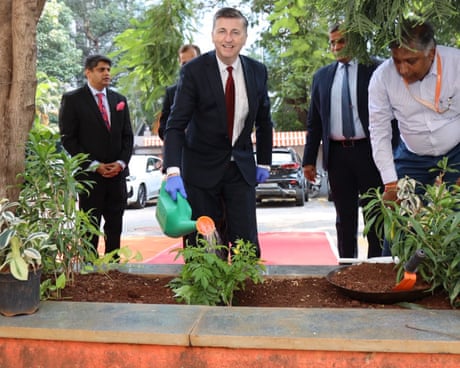
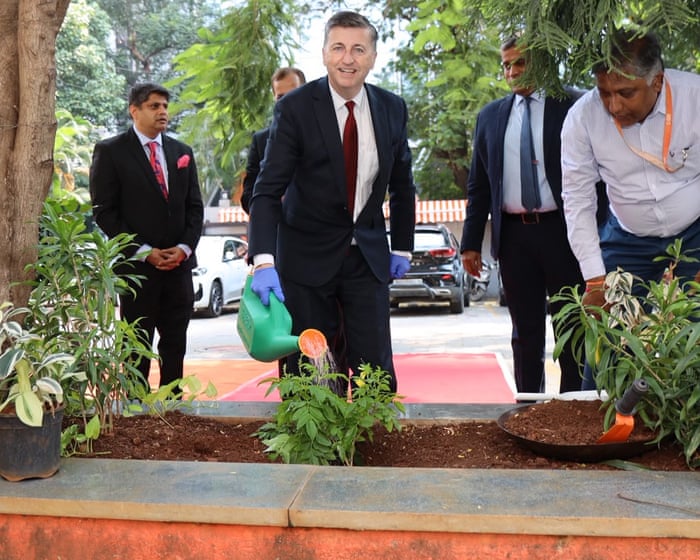
Douglas Alexander helped negotiate deals with India and the US when he was a trade minister under Keir Starmer.

Continue reading...

© Photograph: X/Douglas Alexander

© Photograph: X/Douglas Alexander

© Photograph: X/Douglas Alexander

  •  

Planned capacity of 12,000 interceptors a year, under 100 seconds to target: US firm pitches a low-cost drone killer

Launch of the Vespid Mk 1 using a solid-fuel booster.

US defense-tech company CHAOS Industries introduced its Vespid interceptor family in Washington on 12 October, as the Association of the US Army (AUSA) annual meeting opened there, the company announced. CHAOS pitches the drones as low-cost defense against small and mid-size drones and one-way attack munitions. The company expects initial production capacity of 12,000 interceptors a year, expandable to 50,000 as demand grows.

The pitch lands as Russia moves its strike drones to jet power. Russia has stopped building the Geran-3, an earlier jet model, and makes about 3,000 faster Geran-4s and Geran-5s a month, Ukraine’s military intelligence (HUR) told Militarnyi in August. In mid-September, Ukrainian President Volodymyr Zelenskyy said two Ukrainian companies had passed combat tests with interceptors against such drones, while 67 were still working on them. Ukrainian defense outlet Defense Express measured the new US drones against exactly that threat.

One to carry, one to launch in batches

The Mk 1 made its first public appearance on 12 October aboard a Forterra MESA autonomous ground vehicle, Army Recognition reported. It fires from tubes on launchers such as the 10-round ISS Aerospace HAL10. It takes midcourse guidance from CHAOS radars or external command systems, then an AI-assisted infrared seeker handles the final approach, the company says. An electric ducted fan rather than a jet engine drives it, which CHAOS says cuts cost and logistics compared with turbojet interceptors.

The smaller Mk 0 is man-portable and needs no operator input once fired, its product page says. Both are rated to reach a target in under 100 seconds, with a listed range of 10+ km. Defense Express called that range a serious weakness that more launchers around a city could offset.

Modular FPV drone interceptor “Mangal” by Phantom Defence. September 2026.
Explore further

Most drone interceptors ram or explode. This Ukrainian one just throws a net—six shots to a module

CHAOS lists cruise speeds of 100 m/s (360 km/h) for the Mk 0 and 150 m/s (540 km/h) for the Mk 1. Defense Express said those speeds may be enough to intercept the Geran-4 and Geran-5, which it puts at 340 km/h and 450–600 km/h.

Ukrainian makers say their interceptors already down jet Gerans

Wild Hornets’ Sting interceptors downed several of the slower jet-powered Geran-3s in November 2025. An unnamed Wild Hornets representative told NV, in an interview published on 22 September, that the company’s new interceptor had destroyed about ten Geran-4s and several Geran-5s in limited use. The company plans mass production within a month of finishing combat tests.

On 12 October, former Defense Minister Mykhailo Fedorov said he and Pavlo Yelizarov, commander of Lasar’s Group, had created a new interceptor with troops and engineers. He said it downed two Geran-5s headed for Kyiv.

Crews from Lasar’s Group, which Fedorov has called a National Guard special unit, flew those combat tests, he said. Separately, Fedorov reported in August that a Ukrainian jet interceptor with a top speed above 600 km/h had entered combat testing.

  •  

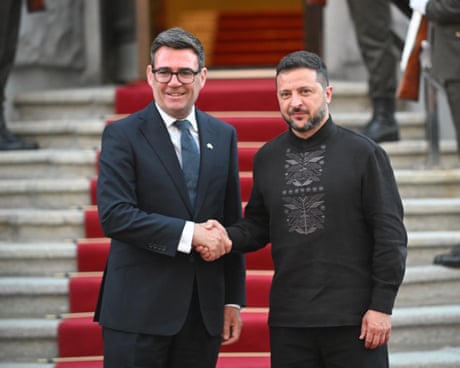
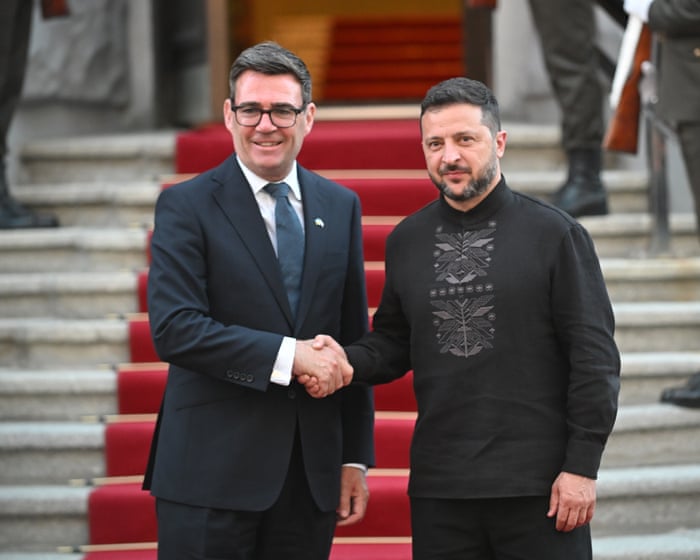
Burnham to host Zelenskyy at No 10 in show of ‘rock-solid’ support

Prime minister reiterates UK backing after the Ukrainian president’s latest round of difficulties with Donald Trump

Andy Burnham will host Volodymyr Zelenskyy at Downing Street on Wednesday as the UK seeks to further underline its support for the Ukrainian president, in contrast to his difficulties with Donald Trump.

The UK prime minister said his message to Zelenskyy and his country would be: “We are with you for as long as it takes.”

Continue reading...

© Photograph: Future Publishing/Getty Images

© Photograph: Future Publishing/Getty Images

© Photograph: Future Publishing/Getty Images

  •  

Thousands of young people protest the Noboa administration in Quito

On October 10, thousands of Ecuadorians took to the streets to protest against the government of right-wing President Daniel Noboa. The demonstration was organized by the Autonomous Front of Organized Resistance (FARO) under the slogan “Government vs. People.”

A esta hora, una marcha de rechazo al Gobierno de Daniel Noboa recorre las calles de Quito. La movilización está marcada por carteles de protesta y consignas contra el mandatario y su gestión. Los manifestantes atraviesan en este momento el paso deprimido del Guambra y avanzan… pic.twitter.com/WKPfT8D9jF

— Elena Rodríguez Yánez (@ElenaDeQuito) October 10, 2026

Saturday’s demonstration followed a protest on October 8, organized by labor unions also in Quito, to protest the security, energy, health, and employment crises facing the country. They also protested government cuts to education and health care, as well as alleged mistreatment of workers, according to Edwin Bedoya, president of the United Workers’ Front (FUT).

For its part, the October 10 demonstration – which consisted mainly of high school and college students – set out from the Central University and marched through Quito. Slogans such as “If the people have no peace, neither does the government” and “Out with Noboa, out with him!” were heard along the streets occupied by the demonstrators.

The president of the Catholic University Student Federation, Jatari Ulcuango, told protesters: “Four years ago, this government promised us electricity; two years ago, too – and now the blackouts have returned. Two months ago, the government told us it would provide us with medicine, and yet we’re only receiving 60% of the supply. They’re taking us for fools.”

He added: “We’re dying outside the hospitals. Criminals are kidnapping us, murdering us, and robbing us. That’s why we’ve come out this morning. They plan to dismantle public institutions to force us to hire private security. Who has gotten rich off the health crisis? The private healthcare sector, while the people are getting poorer and poorer.”

The peaceful march headed back to the Central University, where the students gathered. Later, the students reported on social media that they had been harassed and repressed by the police, who had accompanied the entire march.

Likewise, several media outlets reported that the police were aggressive toward them. This was reported by the outlet La Barra Espaciadora, which released a video showing police officers pushing journalists.

TeleSur journalist Elena Rodríguez also reported that law enforcement officers broke the microphone she was using and struck her on the head: “I’m sick and tired of having to recount, time and time again, police attacks against the press. Today, while I was trying to document the violence with which officers were beating young protesters, I was struck on the head from behind with a baton. I turned around, showed my Telesur microphone to identify myself as a journalist, and the response was another baton strike that ended up breaking it.”

She added: “If they think that by beating me up they’re going to get me to stop documenting police brutality, to put my microphone away, or to back off several blocks so I can report from a place where I won’t be a nuisance, they’re wrong. It is not we journalists who should distance ourselves from the events. It is the police who must stop attacking us. The right to report cannot be negotiated at the point of a baton.”

The protests are taking place against the backdrop of a widespread crisis in the country, which includes the worst security crisis in its history (tens of thousands of deaths due to violence between drug trafficking gangs), a very serious health crisis (a lack of supplies and medicines in the public health system), and other major crises such as those in education, public investment, and employment.

Local elections will be held in November, which will reveal the extent of support – or lack thereof – for President Noboa and his neoliberal government agenda, which aligns with the hemispheric security strategy led by the Trump administration.

  •  
❌