Nel Landtag della Sassonia-Anhalt in Germania si è verificato un passaggio politico fondamentale che potrebbe segnare una svolta duratura per l’intero panorama politico tedesco e che, forse, potrebbe insegnare qualcosa anche nel resto d’Europa
Con l’approvazione di una mozione presentata dal BSW insieme all’AfD – rispettivamente il partito della sinistra patriottica fondato da Sahra Wagenknecht e il partito nazionalista di destra accusato di “fascismo” – il parlamento regionale ha formalmente impegnato il governo del Land a farsi promotore nel Bundesrat di una netta svolta strategica: lo stop all’invio di armi al regime golpista di Kiev, la fine delle sanzioni economiche alla Russia e l’avvio immediato di trattative diplomatiche.
SPD, Verdi e CDU per la guerra, contro il buon senso
L’iniziativa ha scatenato la reazione indignata dei partiti tradizionali, soprattutto i socialdemocratici di SPD, i Verdi e i democristiani di CDU, pronti a denunciare la presunta violazione del cosiddetto “Brandmauer”, il cordone sanitario istituzionale eretto verso la destra giudicata “fascista”. Tuttavia, la linea argomentata dalla marxista Sahra Wagenknecht dimostra come questa scelta non rappresenti una provocazione, bensì un atto di responsabilità democratica e di pragmatismo politico. AfD avrà al suo interno anche degli estremisti di destra, ma è un partito di massa votato perlopiù dalla classe operaia, e pur di fermare l’entrata in guerra della Germania contro la Russia, BSW è disposta a tutto.
Le sanzioni anti-russe distruggono l’industria tedesca
Come evidenziato dalla leader del BSW, le decisioni di politica estera prese a Berlino non sono astrazioni teoriche, ma incidono direttamente sulla vita quotidiana dei cittadini e sulla tenuta del tessuto produttivo locale. La Sassonia-Anhalt ospita poli industriali di prim’ordine, come il distretto chimico di Leuna, oggi messi a dura prova dall’esplosione dei costi energetici e dall’interruzione dei rapporti commerciali con l’Est. Le sanzioni contro la Russia hanno già provocato molti fallimenti aziendali, ma non in Russia, bensì in Germania, mettendo a rischio migliaia di posti di lavoro qualificati. A ciò si aggiunge l’invio continuo di ingenti risorse, fra soldi e armi, in Ucraina, a fronte di dolorosi tagli alla sanità, alla scuola, alle pensioni e ai servizi sociali, che rendono i lavoratori tedeschi sempre più insofferenti.
L’anti-fascismo usato come scusa per giustificare la NATO e la guerra
In questo scenario, BSW rifiuta la logica difensiva dell’establishment borghese, appoggiato dalla sinistra egemone, tanto nella sua versione moderata di SPD quanto in quella liberal più massimalista della LINKE. Questi partiti insistono che il pericolo principale non è la guerra voluta dalla NATO, ma i “fascisti” di AfD, che occorre isolare, benché votati democraticamente, impedendo qualsiasi accordo o alleanza. L’analisi di Wagenknecht, retta dal metodo del materialismo dialettico tipicamente marxista, individua invece una profonda frattura nella società tedesca: da un lato il campo di chi intende conservare il potere (“Machterhaltendes Lager”), rappresentato dai partiti di governo e dai ceti più benestanti che difendono la linea dell’escalation militare agli ordini della NATO e dell’UE contro la Russia e domani contro la Cina; dall’altro il campo del dissenso (“Lager der Unzufriedenen”), formato da lavoratori, pensionati e famiglie schiacciate dall’inflazione e preoccupate dal pericolo di un coinvolgimento diretto dei loro figli nel conflitto attraverso il nuovo servizio militare obbligatorio, contro cui i liceali tedeschi continuano regolarmente a scioperare. Per troppo tempo la retorica del “Brandmauer” (il muro anti-fuoco che dovrebbe isolare AfD dal dibattito politico) è servita alle forze governative tedesche per squalificare il dissenso e isolare le proteste popolari sotto l’etichetta dell’estremismo. Per il BSW, il dovere prioritario di una forza politica d’opposizione è rispettare la volontà degli elettori, dialogare nell’alveo delle regole parlamentari e sfruttare ogni maggioranza utile per raggiungere obiettivi concreti: fermare la spirale bellica, proteggere l’industria nazionale e tutelare i redditi dei lavoratori. E per fare questo Wagenknecht vuole superare i veti incrociati e la politica dei blocchi: il BSW dimostra che la vera priorità deve tornare a essere la difesa della pace, della neutralità militare, del lavoro e della sovranità popolare.
La fase storica impone il coraggio di rompere gli schemi
Di fronte all’accusa di agire come gregari del “fascismo”, l’antifascista Wagenknecht risponde che la strategia del “Brandmauer” è fallita nei fatti e ha ottenuto l’effetto opposto, alimentando la rabbia popolare e rafforzando proprio l’AfD. Al contrario BSW vuole dialogare con tutte le forze parlamentari e sfruttare le maggioranze d’azione per mantenere le promesse elettorali (come la pace e la calmierazione dei prezzi). La Wagenknecht spiega che i partiti del sistema, siano essi di destra o di sinistra, usano la retorica dell’antifascismo solo per delegittimare il dissenso, sospendere le regole democratiche e conservare il potere nonostante politiche fallimentari. Questo atteggiamento, secondo la leader del BSW, banalizza in modo irresponsabile la reale tragedia della dittatura nazista. Wagenknecht sottolinea infatti come i diritti democratici fondamentali e la libertà di stampa siano stati compressi negli ultimi anni non dall’AfD, ma dai partiti liberali, democristiani e socialdemocratici al governo, gli stessi che inviano decine di miliardi di euro a un regime ucraino che ha messo al bando i partiti d’opposizione e tollera la glorificazione di collaboratori nazisti.
Basta guerra alla Russia: questa è la sola priorità oggi!
Rispetto alla tesi secondo cui negoziare con Mosca sia impossibile perché l’ultra-demonizzato Vladimir Putin rifiuterebbe il dialogo, Wagenknecht non concorda: il Cremlino si era mostrato disponibile a discutere, ma i tentativi di trattativa sono stati chiusi dalla leadership ucraina e dai governi europei spinti dalla NATO e dall’industria delle armi a continuare la guerra. La narrazione, poi, secondo cui l’invio continuo di armi porterebbe alla vittoria dell’Ucraina è una finzione a cui per BSW “non crede più nessuno” e anzi l’escalation bellica – comprese le incursioni su Mosca condotte con tecnologia e droni tedeschi – è una strategia che rasenta la follia, rischiando di trascinare direttamente la Germania in un conflitto nucleare. Su questo aspetto anche il Partito Comunista Tedesco (DKP) denuncia l’ipocrisia dei partiti di governo (SPD, Verdi, CDU), che sfruttano la retorica del “cordone sanitario” antifascista con la scusa di frenare l’estrema destra eversiva, quando il vero obbiettivo è delegittimare qualsiasi mozione pacifista, indipendentemente da chi la voti in aula, contro l’escalation della NATO e contro le sanzioni.
O presidente do Grupo A TARDE, João de Mello Leitão celebrou a realização do Aulão Prepara Enem, no Arena A TARDE, nesta segunda-feira, 19, e destacou o orgulho que é fomentar a educação no espaço de eventos.“Hoje a nossa Arena A TARDE está recebendo um evento importante, que tem um cunho até mais relevante do que qualquer parte de entretenimento. É um motivo de orgulho porque o equipamento da nossa arena está sendo utilizado para o aulão, e o Grupo A TARDE, de alguma forma, está contribuindo para fomentar a educação, que é um instrumento de mudança para a nossa sociedade. Diante de tudo que a gente vem vivendo, é um motivo de orgulho”, disse o presidenteO evento reuniu 2,3 mil estudantes da rede estadual de ensino para revisar temáticas estratégicas para as provas do Exame Nacional do Ensino Médio (ENEM), a serem realizadas nos dias 8 e 15 de novembro. Foram ministradas aulas de matemática, ciência humanas, da natureza e linguagens e redação, das 13h30 até 17h30, na Arena A TARDE.
João ainda aproveitou para destacar os avanços do Grupo A TARDE na área de educação. Desde 1996, o jornal mantém vivo o legado do A TARDE Educação, programa institucional que fortalece a leitura, a escrita e a cidadania nas escolas da rede pública.“Acho que o A TARDE, mais uma vez, cumpre sua missão de contribuir para a educação, de ajudar o jovem a ter uma oportunidade de se desenvolver. Então, hoje o Grupo também agradece ao Estado da Bahia, a Secretaria de Educação, por estar participando desse momento aqui e contribuindo um pouquinho para a educação do Estado da Bahia”, completou o presidente.Quando serão aplicadas as provas do Enem 2026?As provas do Enem 2026 serão aplicadas nos dias 8 e 15 de novembro. No primeiro dia, os participantes farão as provas de Linguagens, Códigos e suas Tecnologias e Ciências Humanas e suas Tecnologias, além da redação. No segundo, serão aplicadas as provas de Matemática e suas Tecnologias e Ciências da Natureza e suas Tecnologias.Nos dois dias, os portões serão abertos às 12h e fechados às 13h, conforme o horário de Brasília. O início das provas está previsto para às 13h30.Para realizar o exame, os candidatos devem levar:- Documento oficial de identificação com foto;- Caneta esferográfica de tinta preta, fabricada em material transparente;- Água e alimentos, caso desejem consumi-los durante a prova.Enem mobiliza mais de 437 mil candidatos na BahiaDe acordo com o Ministério da Educação (MEC), a Bahia registrou 437,1 mil inscritos no Enem 2026. Desse total, 339,3 mil tiveram direito à isenção da taxa de inscrição, enquanto 97,9 mil pagaram para participar do exame. Em todo o Brasil, foram registrados mais de 5 milhões de inscritos, dos quais 3,4 milhões tiveram isenção e 1,6 milhão pagaram a taxa.O Enem é uma das principais portas de entrada para o ensino superior no Brasil. As notas podem ser utilizadas para concorrer a vagas pelo Sistema de Seleção Unificada (Sisu) e a bolsas do Programa Universidade para Todos (Prouni), além de atenderem aos critérios de acesso ao Fundo de Financiamento Estudantil (Fies). O resultado também pode ser aproveitado em processos seletivos próprios de instituições de ensino superior e em convênios com universidades portuguesas.
Interior Secretary Doug Burgum argued a major renovation of East Potomac Park and its public golf courses is a necessary move by the federal government, as President Trump’s plans to redevelop the land face an intensifying legal challenge. “I mean, there are examples of this around the country, famous golf courses, which golfers would know,”…
O governador da Bahia, Jerônimo Rodrigues (PT), destacou a importância dos aulões preparatórios para o Exame Nacional do Ensino Médio (Enem) e das políticas públicas voltadas à permanência dos estudantes na escola. Em entrevista ao A TARDE, nesta segunda-feira, 19, durante o Aulão Prepara Enem 2026, realizado na Arena A TARDE, no Caminho das Árvores, em Salvador, ele ressaltou o papel das iniciativas estaduais na preparação dos jovens para o ingresso no ensino superior.“Eu sei da importância de a rede estadual garantir esses aulões que acontecem em cada escola. Todo o estado da Bahia apoia, ajuda e realiza esses aulões. A Bahia inteira está realizando isso e aqui, em Salvador, hoje, estimulando as dicas, fazendo com que essa meninada seja firme na hora de tomar uma decisão e responder a uma questão”, afirmou.
Jerônimo também enfatizou a importância dos programas de assistência estudantil para evitar o abandono escolar e garantir que os jovens concluam o Ensino Médio. Entre as iniciativas mencionadas pelo governador estão o Bolsa Presença, programa estadual de apoio à permanência escolar, o Pé-de-Meia, incentivo financeiro do Governo Federal, e as bolsas de monitoria, que estimulam a colaboração entre os estudantes.“Isso é um colchão de proteção para que os estudantes não desistam da escola e criem gosto em ser professor e profissional. Aqui tem muitos jovens que querem ser engenheiros, médicos, advogados, comunicadores. E vamos continuar estimulando a redução, a zerar a evasão escolar e para que, na escola, o estudante tenha gosto para estudar e queira continuar na universidade”, acrescentou.Promovido pela Secretaria da Educação do Estado da Bahia (SEC), o Aulão Prepara Enem 2026 reuniu mais de dois mil estudantes do 3º ano do Ensino Médio da rede estadual de Salvador e da Região Metropolitana (RMS). Para a atividade, foram selecionadas 57 unidades escolares vinculadas ao Núcleo Territorial de Educação de Salvador (NTE 26).A programação incluiu aulas de Matemática, Linguagens e Redação, Ciências da Natureza e Ciências Humanas, além de resolução de questões e orientações sobre como lidar com a ansiedade durante a preparação e nos dias de prova. Também foram sorteados 60 livros para incentivar a leitura e ampliar o repertório sociocultural dos participantes.
Ver esse post no Instagram Um post compartilhado por A TARDE (@atardeoficial)Quando serão aplicadas as provas do Enem 2026?As provas do Enem 2026 serão aplicadas nos dias 8 e 15 de novembro. No primeiro dia, os participantes farão as provas de Linguagens, Códigos e suas Tecnologias e Ciências Humanas e suas Tecnologias, além da redação. No segundo, serão aplicadas as provas de Matemática e suas Tecnologias e Ciências da Natureza e suas Tecnologias.Nos dois dias, os portões serão abertos às 12h e fechados às 13h, conforme o horário de Brasília. O início das provas está previsto para as 13h30.Para realizar o exame, os candidatos devem levar:Documento oficial de identificação com foto;Caneta esferográfica de tinta preta, fabricada em material transparente;Água e alimentos, caso desejem consumi-los durante a prova.Enem mobiliza mais de 437 mil candidatos na BahiaDe acordo com o Ministério da Educação (MEC), a Bahia registrou 437,1 mil inscritos no Enem 2026. Desse total, 339,3 mil tiveram direito à isenção da taxa de inscrição, enquanto 97,9 mil pagaram para participar do exame. Em todo o Brasil, foram registrados mais de 5 milhões de inscritos, dos quais 3,4 milhões tiveram isenção e 1,6 milhão pagaram a taxa.O Enem é uma das principais portas de entrada para o ensino superior no Brasil. As notas podem ser utilizadas para concorrer a vagas pelo Sistema de Seleção Unificada (Sisu) e a bolsas do Programa Universidade para Todos (Prouni), além de atenderem aos critérios de acesso ao Fundo de Financiamento Estudantil (Fies). O resultado também pode ser aproveitado em processos seletivos próprios de instituições de ensino superior e em convênios com universidades portuguesas.
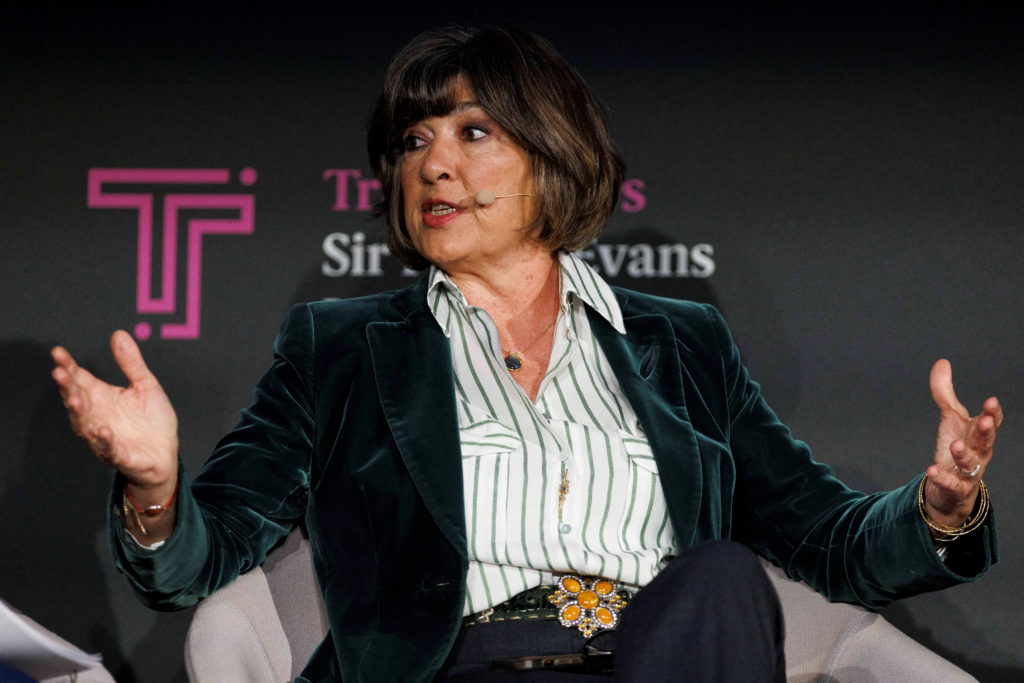
A jornalista da CNN, Christiane Amanpour, que começou como assistente de nível inicial e tornou-se uma das correspondentes e âncoras mais visíveis, com reportagens em zonas de guerra e pontos quentes durante décadas, deixa a cadeia televisiva após 43 anos de carreira.
Amanpour, âncora internacional principal da rede CNN, vai reduzir o seu programa diário, “Amanpour”, na CNN International, para uma vez por semana no início de 2027, e encerrá-lo em maio, saindo da TV no mês seguinte. A jornalista disse esta segunda-feira em comunicado que está ansiosa por “novos projetos interessantes no futuro”.
Amanpour, de 68 anos, também vai encerrar o seu programa na PBS, “Amanpour & Co,” no final do ano, disse no mesmo comunicado, partilhado pela CNN. Porém, Christiane Amanpour continuará com o seu podcast, “The Ex Files”, com o seu ex-marido, Jamie Rubin, um ex-diplomata dos EUA.
Amanpour, âncora internacional principal da rede CNN, vai reduzir o seu programa diário, “Amanpour”, na CNN International, para uma vez por semana no início de 2027, e encerrá-lo em maio, saindo da TV no mês seguinte.
“Depois de muitos meses de reflexão e algumas noites sem dormir, decidi separar-me da CNN, meu parceiro de 43 anos fantásticos.”, afirmou Amanpour. E sublinhou que iria “sempre torcer pela CNN e mantendo a sua história de jornalismo independente. Lembra-te: sê sempre honesto, não neutro”.
Amanpour não deu uma razão para a sua saída, nem referiu especificamente mudanças na na cadeia televisiva. Mas, a sua saída coincide com uma nova era na CNN, à medida que passa para um novo proprietário, Skydance.
Depois de um processo que durou um ano, a Paramount, propriedade da Skydance, concluiu a aquisição da Warner Bros. Discovery por 81 mil milhões de dólares a 6 de outubro. A fusão une sob o mesmo teto dois gigantes do jornalismo televisivo, CBS e CNN.
A nível pessoal, Amanpour tem falado abertamente sobre o seu diagnóstico de cancro do ovário, em 2021, e duas recidivas posteriores, chamando-lhe “o assassino invisível”. E tem incentivado outros a “fazer todos os exames que possam”.
Amanpour juntou-se à CNN como assistente em Atlanta em 1983. Na sua mensagem desta segunda-feira, o diretor executivo da CNN, Mark Thompson, escreveu que na altura, o seu potencial não era universalmente reconhecido. “Curiosamente, um dos seus chefes disse-lhe na altura que ela não ‘tinha o que era preciso para se tornar correspondente estrangeira, ou para ocupar qualquer cargo em direto'”, escreveu Thompson.
Mas, Amanpour tornou-se repórter, e sete anos depois correspondente internacional. Ganhou fama no início dos anos 90, cobrindo a Guerra do Golfo, conflitos no Médio Oriente e muitos outros pontos quentes.
Reportar sobre guerras é “um sentido de missão, é um sentido de propósito, é a capacidade de contar uma história”, afirmou. O seu objetivo era trazer notícias internacionais, incluindo histórias complicadas, para o público americano.
“Nunca acreditei que as coisas fossem complicadas demais para passar na televisão americana”, disse à agência de notícias Associated Press em 2023. “Nunca falei de forma condescendente com o público. Nunca acreditei que eles só querem saber o que se passa no seu quintal”. Na altura, Amanpour também referiu que a sua educação lhe deu uma perspetiva única.
“Por causa da minha educação – sou meio iraniana e meio britânica – tive o grande privilégio de poder ver o mundo a partir de duas perspetivas muito distintas”, acrescentou. “Sempre defendi a necessidade de reduzir as divisões. Sei que podemos viver num mundo que não seja 100% tribalizado”, frisou.
Nas suas declarações desta segunda-feira, Amanpour agradeceu às equipas de reportagem e de programação. “Desde a minha primeira grande e emocionante missão a cobrir a primeira Guerra do Golfo, até aos horrores da Guerra da Bósnia, Ruanda, Afeganistão, Ucrânia e Irão e todos os pontos pelo caminho, foram as equipas e a camaradagem que tanto contaram”, escreveu. “Enquanto juntos lutámos para buscar os factos, as provas e a humanidade, para que a CNN pudesse sempre transmitir a verdade sobre o mundo e para o mundo, sem medo nem favoritismos”, concluiu.
A mobilização para o Exame Nacional do Ensino Médio (Enem) 2026 ganhou mais um reforço na tarde desta segunda-feira, 19, com a realização do Aulão Prepara Enem, na Arena A TARDE, no Caminho das Árvores, em Salvador. O encontro reuniu estudantes do 3º ano do ensino médio de 57 unidades escolares da rede estadual de ensino de Salvador e Região Metropolitana (RMS), em uma programação voltada à revisão de conteúdos e ao fortalecimento da preparação para as provas. Promovida pela Secretaria da Educação do Estado da Bahia (SEC), em parceria com o Núcleo Territorial de Educação (NTE) 26, a iniciativa integra as ações de acompanhamento dos concluintes da rede pública estadual na reta final antes do exame.Segundo a diretora do NTE 26, Maria de Fátima Costa, a mobilização dos estudantes ocorreu com entusiasmo, já que o aulão faz parte do calendário de preparação para o Enem.“Quando a gente falou do aulão, que já é uma coisa que faz parte do calendário, eles [estudantes] disseram: ‘Vamos nessa!’. E eles estão aqui na empolgação, assistindo. A gente não vai soltar a mão deles até o dia em que sair o resultado”, afirmou.A preparação também envolve ações diretamente nas unidades escolares. De acordo com a diretora, as equipes têm acompanhado os estudantes na confirmação da participação no exame e no esclarecimento de questões relacionadas à inscrição. A estratégia busca garantir que os concluintes estejam preparados não apenas em relação aos conteúdos, mas também aos procedimentos necessários para realizar as provas.Acolhimento nos dias de prova
Encontro reuniu estudantes do 3º ano do ensino médio de 57 unidades escolares da rede estadual
-
Foto: José Simões | Ag. A TARDE
Além da preparação pedagógica, a rede estadual planeja ações de acolhimento para os dias de aplicação do exame, previstos para 8 e 15 de novembro. A proposta é acompanhar os estudantes nas escolas e nas proximidades dos locais de prova, oferecendo apoio para reduzir a ansiedade e contribuir para que cheguem mais confiantes.“Vamos estar com eles na porta das escolas, vamos estar acompanhando esses meninos. Vamos tirar essa tensão deles. A gente quer que eles façam a prova com tudo o que sabem”, disse a diretora.Quando serão aplicadas as provas do Enem 2026?As provas do Enem 2026 serão aplicadas nos dias 8 e 15 de novembro. No primeiro dia, os participantes farão as provas de Linguagens, Códigos e suas Tecnologias e Ciências Humanas e suas Tecnologias, além da redação. No segundo, serão aplicadas as provas de Matemática e suas Tecnologias e Ciências da Natureza e suas Tecnologias.Nos dois dias, os portões serão abertos às 12h e fechados às 13h, conforme o horário de Brasília. O início das provas está previsto para as 13h30.Para realizar o exame, os candidatos devem levar:Documento oficial de identificação com foto;Caneta esferográfica de tinta preta, fabricada em material transparente;Água e alimentos, caso desejem consumi-los durante a prova.Enem mobiliza mais de 437 mil candidatos na BahiaDe acordo com o Ministério da Educação (MEC), a Bahia registrou 437,1 mil inscritos no Enem 2026. Desse total, 339,3 mil tiveram direito à isenção da taxa de inscrição, enquanto 97,9 mil pagaram para participar do exame. Em todo o Brasil, foram registrados mais de 5 milhões de inscritos, dos quais 3,4 milhões tiveram isenção e 1,6 milhão pagaram a taxa.O Enem é uma das principais portas de entrada para o ensino superior no Brasil. As notas podem ser utilizadas para concorrer a vagas pelo Sistema de Seleção Unificada (Sisu) e a bolsas do Programa Universidade para Todos (Prouni), além de atenderem aos critérios de acesso ao Fundo de Financiamento Estudantil (Fies). O resultado também pode ser aproveitado em processos seletivos próprios de instituições de ensino superior e em convênios com universidades portuguesas.
Na reta final de preparação para o Exame Nacional do Ensino Médio (Enem) 2026, estudantes da rede pública estadual tiveram a oportunidade de conhecer caminhos para ingressar no ensino superior durante o 'Aulão Prepara Enem', realizado na tarde desta segunda-feira, 19, na Arena A TARDE, no Caminho das Árvores, em Salvador. No encontro, representantes da Universidade Federal da Bahia (UFBA) e da Universidade do Estado da Bahia (Uneb) destacaram a diversidade de cursos, as possibilidades de acesso e as políticas de permanência oferecidas pelas instituições públicas.
A vice-reitora da UFBA, Jamile Borges, ressaltou a preparação da universidade para receber os estudantes que concluírem o ensino médio e buscarem uma vaga na graduação. “Nós, na Universidade Federal da Bahia, assim como as outras universidades estaduais e federais, nos preparamos para acolher esses jovens estudantes que chegarão às centenas de cursos que ofertamos”, afirmou Jamile.Além de ampliar as oportunidades de ingresso, a universidade busca criar condições para que os estudantes consigam permanecer na graduação. A vice-reitora explicou que as iniciativas de acolhimento estão associadas a políticas públicas e à participação dos universitários em projetos e programas. “A Universidade Federal da Bahia tem sempre um projeto de acolhimento, sobretudo com políticas públicas, políticas de permanência e de participação em projetos e programas”, explicou.Ao completar 80 anos, a UFBA também tem entre seus objetivos fortalecer a diversidade e a inclusão no ambiente acadêmico. “A UFBA se orgulha de ser uma universidade cada vez mais diversa, cada vez mais inclusiva e cada vez mais com a cara dos nossos estudantes e da nossa cidade”, ressaltou.Entre as graduações mais procuradas, Jamile citou Medicina, Direito e Engenharias, além dos bacharelados interdisciplinares em Artes, Saúde, Humanidades e Ciência e Tecnologia. A vice-reitora incentivou os jovens a conhecerem as possibilidades disponíveis antes de escolher uma carreira. “Esperamos que esses estudantes possam escolher, nessa variada cartela de cursos, aqueles que mais se adequam à sua vocação”, disse.Uneb amplia caminhos para o ingresso
Adriana Mármore, reitora da Uneb
-
Foto: Louise Mosini/Ag. A TARDE
Já a reitora da Uneb, Adriana Marmori, destacou a presença da instituição em 27 cidades baianas e a oferta de mais de 178 cursos de graduação em diferentes áreas do conhecimento. Entre as opções estão licenciaturas, Direito, Medicina, cursos da área de Saúde e Engenharias, ampliando as possibilidades para estudantes que desejam cursar o ensino superior público sem necessariamente sair de suas cidades.“É uma universidade que tem uma possibilidade grande de acesso a esses cursos em diferentes lugares. A gente se prepara com uma graduação de qualidade, com professores extremamente qualificados”, afirmou a reitora, que também celebrou a procura dos jovens pela universidade pública.Para Adriana, iniciativas de preparação como o Aulão Prepara Enem contribuem para que os estudantes consolidem o aprendizado desenvolvido ao longo da educação básica e cheguem mais preparados ao exame. “Os aulões são incentivos para que esse conhecimento seja maturado e ele possa fazer uma boa prova”, destacou.Além das possibilidades de ingresso pelo Enem e pelo Sistema de Seleção Unificada (Sisu), a Uneb dispõe de vestibular próprio, previsto para dezembro, e do Programa de Ingresso Especial, voltado ao preenchimento de vagas remanescentes por meio da análise do histórico escolar dos candidatos.“É uma outra forma de ingresso que foi desenvolvida pela nossa universidade. As vagas que não são preenchidas pelo Enem, pelo Sisu ou pelo vestibular passam por uma avaliação do histórico escolar do estudante”, explicou.A iniciativa representa uma alternativa para quem busca uma vaga na graduação e não consegue ingressar pelas modalidades tradicionais. Segundo a reitora, a universidade trabalha para ampliar o acesso à formação superior e preparar profissionais para diferentes áreas. “A gente está se preparando para ter o maior número de estudantes dentro da universidade, qualificando mais pessoas para a vida e para o mundo do trabalho também", concluiu.
Iran’s Islamic Revolutionary Guard Corps (IRGC) Navy warned Monday it will take firm measures, including sanctions, against any vessel sailing through the Strait of Hormuz with its identification systems deliberately switched off, after an oil tanker struck a naval mine and caught fire.
The naval force reported that the tanker sustained a powerful explosion and fire in its engine room, according to a communiqué released October 19. The blast occurred in the southern sector of the strait as the ship tried to leave the area while keeping its positioning and navigation equipment turned off from the very start of its journey.
Iranian authorities said the vessel was attempting to cross an unauthorized maritime route without observing the international transit regulations in force along the corridor. The military institution stressed that severe and firm measures will be applied against any ship or supertanker navigating the Strait of Hormuz or the Persian Gulf with electronic identification gear intentionally deactivated.
Ships commonly use automatic identification systems, known as AIS, to broadcast their position, and switching them off is a practice often associated with efforts to avoid detection.
The Strait of Hormuz links the Persian Gulf with the open sea and ranks among the world’s most critical corridors for energy shipments. Disruptions along this route echo quickly through global oil markets, which explains the attention the mine blast drew from the naval command and from traders tracking the waterway.
BREAKING: Iran announces an oil tanker has hit a naval mine while exiting the Strait of Hormuz through the US-backed southern Omani corridor, with a massive fire in the engine room. pic.twitter.com/kzMnoJr4Q0
The explosion and the fire that followed inflicted serious damage on the tanker. Naval rescue teams remain deployed near the site of the incident to prevent further risks to navigation and to guard against possible spills that could harm the marine ecosystem.
In recent weeks, several other vessels have recorded considerable damage while attempting to cross through passages that are not authorized south of the strategic corridor controlled by Iranian forces. Officials tied the pattern of incidents to deliberate breaches of transit protocols by ships seeking to move without being detected.
The warning issued Monday signals that Tehran intends to enforce those rules with greater severity. The IRGC’s statement made clear that no vessel, whatever its size or flag, will be permitted to traverse the waterway with identification systems switched off.
Closure and Oil Markets
The escalation unfolds against the backdrop of Tehran’s decision to restore the closure of the strait, a measure presented as a response to the sanctions and maritime blockades imposed on Iranian ports by the U.S. government.
The shutdown of this vital artery pushed international prices of crude and refined energy products sharply higher, disrupting supply across Western markets. Washington, confronting the resulting instability in commercial transit, has resorted to continuous releases from its strategic petroleum reserves in an effort to contain global economic volatility. The continuous drawdowns from emergency reserves underscore how heavily the closure weighs on the global supply balance.
Tehran had previously arranged the reopening of the corridor after the signing of the Islamabad memorandum of understanding. The Iranian Armed Forces, however, reimposed the restrictive controls after denouncing aggressions and violations of the peace accords, a reversal that left the waterway under tight military supervision once again.
Control over commercial navigation in the Persian Gulf remains a central point of geopolitical confrontation in the region. Iranian authorities reiterated that full compliance with transit regulations is indispensable to guarantee the operational safety of merchant vessels moving through the strategic passage. The naval command said the area remains under close observation.
Successful tech companies are being punished—for being successful.
Last week, Britain's Competition and Markets Authority (CMA) proposed designating Microsoft as having strategic market status, which would give the government regulator enormous powers to regulate Microsoft and impose specific conduct requirements on product design. A consultation process has begun, with a decision on whether Microsoft will be given strategic market status expected in February 2027.
If the CMA decides to designate Microsoft as having strategic market status, it could intervene in product bundling (how Microsoft packages Teams, Word, Excel, and Copilot together), interoperability (whether Microsoft should make it easier for competing software and AI developers to integrate with its products), cloud licensing (whether Microsoft's licensing arrangements disadvantage rival cloud providers), and customer switching (whether businesses face unreasonable barriers to leaving Microsoft's ecosystem) in the United Kingdom.
Bizarrely, the CMA's fundamental gripe with Microsoft is that it has made its software so interconnected, convenient, and commercially attractive to buy together that competitors struggle to persuade businesses to use anything else. For example, the CMA says that Microsoft offers customers "technology that is useful, secure, easy to deploy and manage, and available at an attractive overall price." According to its own customer research, Microsoft is seen as "relatively good value for money," and its bundles are "seen as more cost-effective than buying and managing separate licences." Because commercial bundling "makes customers less likely to adopt products from alternative providers," the CMA thinks it must intervene.
Microsoft is not the first tech giant to feel the CMA's wrath for creating products people like. In 2025, the CMA decided Google had strategic market status in general search and search advertising, giving the regulator the power to impose legally binding requirements on how the company operates. Since then, the CMA has ordered Google to use government-mandated standards for ranking organic search results, provide competitors with tools to access users' search data, and give publishers greater control over how their content is used in AI-powered search. (These requirements were imposed without finding that Google had violated competition law.)
"Products working well together at an attractive price used to be called a selling point," but is now "attracting intervention pushed by an overzealous regulator," Matthew Lesh, public policy fellow at the Institute of Economic Affairs, a London-based free market think tank, tells Reason. Lesh is the co-author of Digital Overload, a 2023 report that warns against giving the CMA "extensive, discretionary powers" amounting to the regulator "telling some of the most successful and popular platforms on the planet how to run their businesses."
Lesh argues that including Copilot, Microsoft's AI chatbot, in the designation is "particularly outrageous." Last year, when Google was designated as having strategic market status, the CMA excluded Gemini because the "AI assistant sector is relatively small, nascent, and highly dynamic." Lesh argues that, with Google, the CMA acknowledged "uncertainty about the market's development," but now "proposes sweeping Microsoft's workplace AI into a designation requiring an assessment looking at least five years ahead."
"Five years ago, ChatGPT didn't exist. Anyone confident about who will lead workplace AI in 2031 should be running a hedge fund, not a regulator," he tells Reason.
While European countries have taken a far more interventionist approach to technology, the United States has, at least comparatively, celebrated competition and innovation. But American lawmakers are increasingly flirting with importing similar restrictions on Big Tech.
In June, Sens. Chuck Grassley (R–Iowa) and Amy Klobuchar (D–Minn.) reintroduced the American Innovation and Choice Online Act, which would allow federal and state antitrust enforcers to challenge certain practices by dominant online platforms, including favoring their own products and disadvantaging competitors. Jack Nicastro described the bill in Reason as an "atrocious importation of European-style competition policy," arguing that it would undermine innovation and choice. The following month, Sen. Mark Warner (D–Va.) introduced the AI AGENT Act, which would impose new requirements on major online platforms to accommodate competing AI agents.
These proposals are intended to address similar concerns to those of the CMA in Britain. The idea is that established companies outperforming their competitors is somehow evidence of "market failure," undermining the very innovations that made them successful.
Technological progress has always been driven by entrepreneurs and the companies they've built competing to win over consumers. Britain seems to have forgotten this. If the United States wants to remain a world leader in tech, it should avoid the British approach like the plague.
Last March on Instagram, Students for Life President Kristan Hawkins posted a photo showing her and two other members of the Virginia-based group standing outside Space Center Houston. According to the captions, Hawkins and her fellow activists, one of whom was holding a mobile phone, were "ordering abortion pills undercover."
A lawsuit filed last week in Harris County, which includes Houston, describes that Instagram post as "nothing more than a publicity stunt." The lawsuit, which aims to deploy a Texas abortion law championed by Students for Life against the organization, is also a publicity stunt. But while it may be effective by that measure, it faces legal challenges that will be hard to overcome.
The lawsuit, which a Texas woman who opposes her state's abortion ban filed under the pseudonym Maria Puerto with help from the reproductive rights group Amplify Legal, is supposed to highlight the vagueness and broad scope of House Bill 7, a 2025 law that authorizes private civil action to enforce state restrictions on "abortion-inducing" drugs. But Puerto's attempted act of legal jiu-jitsu seems too clever by half, relying on a dubious reading of the statute to seek "monetary compensation" it does not authorize and thereby punish anti-abortion activists for constitutionally protected advocacy.
H.B. 7, also known as the Woman and Child Protection Act, says "a person may not manufacture or distribute an abortion-inducing drug in this state" or "mail, transport, deliver, prescribe, or provide an abortion-inducing drug in any manner to or from any person or location in this state." Those prohibitions, it says, "may be enforced only through a qui tam action" against a "person" who "violates" or "intends to violate" them.
Any "person" other than a state or local official can qualify as a "relator" authorized to bring such an action. The relator can seek injunctive relief and "an amount of not less than $100,000 for each violation," plus "costs and reasonable attorney's fees." A successful relator generally receives $10,000 of that "amount," with the rest going to a "charitable organization" of his choice.
As a "person" who is not a government official, Puerto meets H.B. 7's minimal test for standing. And although H.B. 7 precludes lawsuits against pregnant women who obtain "an abortion-inducing drug," Puerto says Hawkins and the other activists "are not pregnant and were not pregnant" at the time of the Instagram post. So far, so good. But although the lawsuit asserts that Hawkins et al. "openly and flagrantly violated" the law's prohibitions, it does not explain how.
A photo accompanying a recent Mother Jonesprofile of Hawkins shows her and her social media coordinator, Lydia Taylor Davis, outside Space Center Houston during their "abortion-pill 'sting' stunt." Another Mother Jones photo shows Hawkins holding a mobile phone displaying what Puerto's lawsuit describes as "an order confirmation."
Judging from the Mother Jones account, it is not clear whether that description is accurate. "The scheme rapidly went off the rails," Amy Littlefield writes. "The plan was to purchase pills from a couple of services, with Hawkins posing as a male abuser while Davis pretended to be a 16-year-old—all to try to portray mail-order suppliers as reckless and dangerous. For reasons even she couldn't explain, Hawkins chose the fake name 'Wanda' as her male-abuser alter ego. But when Davis input her information, she hit a snag."
Davis was trying to order pills from the Massachusetts Medication Abortion Access Project. But according to Littlefield, that organization "had blocked Davis in its system after Students for Life teased the sting operation on social media." Hawkins "attempted to save the stunt by placing her own order, but 'Wanda' accidentally gave her age as 15," which was below the supplier's minimum age, Littlefield says. "Now a security guard was wandering over to tell them they couldn't film. Having set out to show that telemedicine services don't screen their clients, they inadvertently proved the opposite."
Puerto "will need proof that the Students for Life leaders actually obtained or intended to obtain the pills," abortion law scholar Mary Ziegler notes in Slate. "The activists may argue that the post was not in earnest, and that no one involved ever seriously intended to bring pills into Texas."
Even assuming that Hawkins et al. successfully ordered abortion pills, that conduct by itself does not fit the language of H.B. 7, which applies to people who "distribute" such drugs or who "mail, transport, deliver, prescribe, or provide" them "to or from any person or location in this state." That language encompasses out-of-state suppliers, which raises obvious concerns about extraterritorial application of Texas law. But on its face, the prohibition does not cover someone who simply orders abortion pills.
Puerto's lawyer, Amplify Legal attorney Molly Duane, argues that Hawkins et al. could be covered by the statute's reference to transportation. "What the statute says is that transporting abortion drugs from one location to another within the state is a violation of H.B. 7," Duane toldThe Texas Tribune. "By the plain language of the statute, this would seem to be a violation. This is the problem with writing such a confusing and vague law."
Under that theory, however, Hawkins, Davis, and the two other activists named in the lawsuit violated H.B. 7 only if they 1) successfully ordered abortion pills, 2) took delivery of them, and 3) subsequently moved them to another location within Texas. The lawsuit alleges only that they "ordered abortion pills, apparently multiple times." According to The Texas Tribune, Duane and Puerto "are hoping that the lawsuit will eventually surface more about what the defendants did with the abortion pills once they ordered them."
The lawsuit faces another obstacle. H.B. 7 does not apply to "speech or conduct protected by the First Amendment." Hawkins et al.'s efforts to show how easily state abortion bans can be circumvented certainly seem to fall into that category. "Students for Life may stress that the case targets their political speech about abortion," which is "protected under the First Amendment," Ziegler notes.
Those are not the only puzzling aspects of the lawsuit. Puerto, a 26-year-old single mother of two young children, emphasizes that she "had no choice but to continue" those pregnancies because she did not "have access to transportation or the economic resources to pay for travel out of state." The lawsuit devotes 11 paragraphs to describing the burdens imposed by her state's denial of "true reproductive rights," which she argues justifies some sort of compensation.
All of this seems legally irrelevant under H.B. 7, which does not require a relator to allege damages of any sort, let alone damages stemming from the abortion ban it aims to reinforce. "With nowhere else to turn for assistance," the lawsuit says, "Ms. Puerto is seeking financial compensation" from Hawkins et al. "in the amount of $459,782—the average cost of raising two children from birth to age 18 in the state of Texas."
Although H.B. 7 sets a minimum award of $100,000, the lawsuit notes, "there is no cap on the monetary compensation owed a relator." But the law does not describe H.B. 7 awards as "monetary compensation" for injuries allegedly suffered by the relator.
The statute's only reference to "compensatory damages" deals with lawsuits filed against H.B. 7 relators under "clawback provisions" of other states that have tried to thwart such litigation. In response to a "clawback" action, the law says, an H.B. 7 relator can seek "compensatory damages, including money damages in an amount equal to the judgment damages and costs, expenses, and reasonable attorney's fees spent in defending the action." By contrast, the bounty for proving a violation of the restrictions on abortion pills is simply "an amount."
The lawsuit itself, emphasizing the lax standards for filing a claim under H.B. 7, notes that Puerto "did not suffer an injury traceable to [the defendants'] ordering of abortion pills that can be remedied by a court." But it suggests that an award to Puerto would be appropriate given the defendants' anti-abortion activism.
The lawsuit notes that Students for Life "proudly advertised" its support for H.B. 7. Puerto complains that Hawkins et al. "ignore the immense harms and multiple deaths already attributed to Texas's cruel abortion bans" and "demean the six million Texans of reproductive age who have had their ability to decide whether and when to begin or expand a family stripped away by these bans." Whatever you make of that charge, the defendants' activism is constitutionally protected and therefore cannot support a cause of action in civil court.
"Texas is a strange place filled with vigilante statutes" that "seek to turn Texans against each other," Duane told The Texas Tribune. "But if anyone should be benefiting from these legal regimes, it's people like our client." While "putting those two things together…might be unusual," she said, "this is the situation that Texas has put its citizens in."
Depending on your perspective, you may or may not sympathize with Duane's reasoning. But it seems unlikely to pass muster as a matter of law.
Today, the Supreme Court decided to hear Association for Education Fairness v. Montgomery County Board of Education, a challenge to "facially neutral" discrimination against Asian applicants to selective public magnet schools in Montgomery County, Maryland. The admissions criteria are, on their face, racially neutral. But evidence indicates they were likely adopted for the purpose of reducing the percentage of Asian students in entering classes. More specifically, the case addresses the issue of "[w]hether a plaintiff challenging a facially neutral admissions policy as racially discriminatory must establish that the targeted racial group suffered an aggregate disparate impact relative to its share of the applicant pool." This issue is increasingly important since the Supreme Court banned most explicit racial discrimination in college admissions (and, by extension, school admissions) in SFFA v. Harvard (2023).
The lower court ruled that, even if there is evidence that a facially neutral admissions policy was enacted for the specific purpose of reducing the number of admitted students from a specific racial or ethnic group, it must still be upheld so long as the percentage of admitted students from that group is as high or higher than the percentage of applicants from that group.
Longstanding Supreme Court precedent holds that evidence of unconstitutional motivation for "facially neutral" policies shifts the burden of proof to the government to show that they would have enacted the same policy even in the absence of illicit motives. If they fail to prove that, then the policy must be subjected to strict scrutiny, which it would be unlikely to survive. In the TJ case, the Fourth Circuit majority opinion by Judge Robert Bruce King holds that even the most blatant discriminatory motivations do not trigger strict scrutiny so long as the group being targeted for discrimination by "facially neutral" means is still represented in proportion to its percentage of the relevant population (or more). Under the new admissions policy, Asians were still 54% of accepted applicants (as compared to 73% under the old one). Since that is still higher than the Asian percentage of the applicant pool, evidence of discriminatory intent becomes irrelevant….
I and others have previously compared today's anti-Asian discrimination in selective educational institutions to discrimination against Jewish applicants in earlier eras. Under the Fourth Circuit's reasoning, old-time policies using facially neutral means to reduce the percentage of Jewish students at elite universities would be perfectly legal, so long as Jewish applicants were admitted in the same [or higher] percentages as other groups. And that would be true no matter how extensive the evidence that the new policy was motivated by anti-Semitic prejudices, or that Jewish applicants had to have stronger academic records to be admitted than those required of gentiles.
The same point applies to all kinds of discrimination against racial, ethnic, and religious minorities. So long as facially neutral means are used and the overall success rates of different groups are similar, this reasoning would allow even the most blatant discriminatorily motivated policies intended to reduce the participation of some groups for the benefit of others. There are many situations where members of some minority groups are "overrepresented" in educational institutions, government contracting, and elsewhere, relative to their percentage of the applicant pool or of the general population. Jews, Muslims, Asians, atheists, and Mormons are obvious examples of groups that fit that bill in a variety of educational and professional settings.
If a federal or state government adopted a seemingly neutral policy to try to reduce the percentage of blacks among professional football or basketball players, that too would pass muster, so long as the percentage of blacks in the the relevant pro sports leagues remained at least as high as the percentage of blacks among those seeking employment as players…. Progressives and others inclined to support today's decision should consider whether they are really willing to live with these troubling implications.
Since I wrote the above, the ideological valence of anti-Asian discrimination in education has shifted somewhat. For a long time, many left-wingers defended such discrimination (along with discrimination against white applicants) on the grounds that it is necessary to achieve "diversity" and compensate Blacks and Hispanics for the history of discrimination against those groups. Most conservatives condemned it because it violates principles of constitutional color-blindness.
During the second Trump Administration, however, right-wing nativists have increasingly defended discrimination against Asian immigrants on such ridiculous grounds as that they work too hard (thus making it too difficult for whites to compete with them), or even that they undermine the supposed value of racial "homogeneity." The political right actually has a long history of anti-Asian bigotry. But recently the problem has gotten much worse, after a period in which it was diminishing because conservatives (rightly) condemned such discrimination as a violation of color-blindness. The growing anti-Asian bigotry among right-wing nationalists is similar to and linked with their growing tendency towards anti-Semitism. Indeed, as many commentators have pointed out, the two prejudices are similar in many respects. Both Asians and Jews are condemned for supposedly working too hard, emphasizing academics too much relative to other activities, and supposedly dominating various business and intellectual fields.
The left-wing rationales for anti-Asian discrimination are little better than the right-wing ones. If you truly value diversity, it makes no sense to disfavor Asian applicants as a class. They add as much or more to diversity as any others. Indeed, as I have pointed out before, lumping all Asians in one category makes no sense, as this group includes a vast range of different ethnicities and cultures, covering more than half the world's population.
The compensatory justice rationale for anti-Asian discrimination collapses under the weight of the fact that many Asian groups have themselves faced extensive discrimination at various times in American history. Discrimination against Chinese and Japanese by federal and state governments has a long and sordid history, of which Japanese internment during World War II is just one particularly awful example.
It is important to recognize that "facially neutral" policies adopted for the specific purpose of excluding particular racial or ethnic groups differ from those that merely have an unintended disparate impact. The former are deliberate efforts to discriminate on the basis of race, whereas the latter are probably inevitable in a diverse society where groups differ from each other in various ways. For example, laws banning violent crime disproportionately affect any group which is, on average, younger than others, since young people (especially young men) have much higher crime rates than older ones.
The Constitution at least presumptively bars racial discrimination by government, whether motivated by left-wing objectives or right-wing ones. And such discrimination is forbidden even if cloaked in "facially neutral" garb. Otherwise, the government could easily discriminate against virtually any group simply by targeting some characteristic that correlates with group membership. Hopefully, the Supreme Court will recognize that and rule the right way in this case.
NOTE: The plaintiffs in this case are represented by the Pacific Legal Foundation, a public interest group that was my wife's employer until recently. As noted above, she helped represent the plaintiffs in a previous case (also litigated by PLF), on which the lower court ruling in this case was based. She is not one of the attorneys in this case, and is no longer with PLF.
Amanpour's exit coincides with a new era at CNN as it comes under new owner Skydance, after an $81 billion merger that brings CNN and CBS under one roof.
Um homem de 72 anos morreu, esta segunda-feira, após uma queda de seis metros no molhe norte do porto da Póvoa de Varzim, distrito do Porto.
De acordo com o Jornal de Notícias (JN), a vítima estaria a passear no molhe quando se terá desequilibrado e caído de uma altura de seis metros, numa zona de rochas.
Por volta das 16:20, o alerta foi dado por um popular e foram mobilizados meios dos Bombeiros Voluntários da Póvoa de Varzim, que realizaram o resgate através da sua equipa de grande ângulo.
A vítima foi assistida pela VMER e SIV, mas o óbito acabou por ser declarado no local, ainda segundo o JN.
Anti-government rioters have torched Albania’s education ministry and supreme court, as protests spread across the Balkan nation. Prime Minister Edi Rama is refusing to step down and blames the unrest on Russia. What’s really going on?
As of October 19, the Albanian capital of Tirana has been rocked by seven consecutive days and nights of rioting, while protests and clashes between demonstrators and police have been reported in the cities of Lezhe, Vlore, Elbasan, and Shkoder. A large group of rioters breached the perimeter of the education ministry in Tirana on October 14, setting the building on fire.
Running battles between demonstrators and police have broken out around the ministry on several occasions since. On October 19, hundreds of demonstrators pelted rocks at riot police, who responded with tear gas and rubber bullets. The previous night, offices of the Albanian Supreme Court were set on fire, and arson attacks on several police stations in the city were reported.
Some 500 demonstrators had been detained and 167 of them formally arrested as of October 17, according to Reuters. 295 people had been injured, including 196 police officers, as of October 19, according to Interior Minister Ervin Demo.
What do the protesters want?
The protests follow more than a year of unrest in Albania, which began when Rama banned TikTok in the runup to last March’s parliamentary elections, following similar measures inposed by the EU during every major election across the bloc since 2024. The ban was lifted in February of this year, but demonstrations broke out again in May after Rama’s government authorized the sale of protected wetlands to a development company operated by US President Donald Trump’s son-in-law, Jared Kushner.
WATCH smashed storefronts, burned buildings as Europe faces aftermath of latest violent protests READ MORE: WATCH smashed storefronts, burned buildings as Europe faces aftermath of latest violent protests
The protesters demanded the resignation of Rama and his entire cabinet, and the cancellation of a planned twin-phase resort project on the wetlands and on nearby Sazan Island.
The protesters’ core demand – that Rama resign – remains unchanged. However, the movement is now calling for a root-and-branch reform of the entire Albanian establishment, with demonstrators accusing both Rama and opposition leader Sali Berisha of corruption. Unemployment, underfunding of schools, and declining living standards have also been cited by protesters as grievances.
What did Rama say about the protests?
Despite the repeated chants of “Rama resign” heard at the protests, Rama has claimed that the demonstrators do not oppose his government, but Albania’s “mission” of joining the EU.
“I am not being challenged,” he said in a video address on October 18. “The government is not being challenged, a government majority or a winning party in the elections is not being challenged but a path is being challenged, a mission is being challenged”
“Albanians need to think very clearly,” he continued. “Do they want this, do they want that, or do they want the EU?”
Rama has refused to resign, and blamed the protests on “foreign hands that do not wish for Albania to be at peace.” Back in June, Rama accused “the enemies of Albania and of Israel” of waging a “hybrid war” to stop the wetlands development. In two separate speeches on October 18 and 19, the embattled PM blamed the unrest on Russian philosopher Alexander Dugin and a “wave of Russian influence in the entire social media system,” and on “the Khomeiniist republic of Iran, the pinnacle of disinformation.”
Was Russia involved?
In short, no. Rama has not backed up any of his accusations, and they are being treated with skepticism and ridicule by demonstrators and opposition media. Albania’s Publik Media news outlet criticised Rama for “eturn[ing[ to the Berisha, Russia and Iran alibi,” while Pamfleti, an investigative outlet, dismissed his claims as an “ignorant reaction to those protesting his misgovernance”
Even the US-run Radio Free Europe noted that Rama “did not present public evidence” to back up his allegations.
Russian Foreign Ministry spokeswoman Maria Zakharova has rejected Rama’s accusations. “No, Edi Rama,” she said on October 18, “it is the citizens of your country who have taken to the streets in protest.”
“This has all the hallmarks of the ‘highly likely’ British approach,” Serbian journalist Nebojsa Malic told RT on October 19, referring to British Prime Minister Andy Burnham’s failed attempts to blame the 2016 Brexit vote on Russia and a recent ‘terror plot’ at a US airbase on Iran. “We’ll just make an accusation and provide no evidence but say ‘oh it’s highly likely that Russia’s behind this’, and everybody is going to take it for granted.”
Rama is “doing this because he’s hoping it will stick,” Malic said. “He has nothing to lose. He’s seen plenty of leaders in western Europe essentially getting away scot free with covering for their malice and incompetence by blaming Russia.”
“Rama is just as opportunistic as [French President Emmanuel] Macron or any British prime minister in the last ten years,” Malic concluded. “They will say or do whatever, because they think that Russia is not able to defend itself.”
Why did Rama mention Israel?
Rama’s claim that “enemies of Albania and Israel” were behind this summer’s environmental protests stems from the involvement of Kushner in the wetlands project. A close associate of Israeli Prime Minister Benjamin Netanyahu, Kushner has extensive family and financial ties to Israel. His investment firm, Affinity Partners, has funneled Emirati, Saudi, and Qatari cash into multiple Israeli businesses, including five arms manufacturers.
However, all available information suggests that the funding for Kushner’s Albanian projects comes from Albanian, American, and Qatari individuals and entities. Affinity Partners is leading the €1.4 billion Sazan Island project, while Kushner himself is a minority partner in the wetlands development.
Rama visited Israel and addressed the Knesset in January. Less than 24 hours later, Israel’s Channel 12 claimed that the Albanian PM had struck a deal with Netanyahu to accept up to 100,000 Palestinian refugees from Gaza. As speculation spread that the Palestinians would be resettled on land developed by Kushner, Rama clarified that no such deal had been, or would be, made.
Regardless, Rama’s close relations with Netanyahu are at odds with public opinion in Albania, where a 2024 poll found that 73% of the population believe that Israel should be sanctioned over its war on Gaza. Kushner is widely seen in Albania as representing Israeli interests, and Rama’s decision to amend environmental laws and grant “strategic investor” status to Affinity Partners has fueled accusations that the PM is placing Washington and West Jerusalem’s interests above Tirana’s.
Will there be an Albanian Maidan?
Some images emerging from Tirana – burning barricades, police officers set on fire with Molotov cocktails, and smouldering government buildings – are reminiscent of the scenes that played out during the 2014 ‘Maidan’ coup in Ukraine. However, Rama is in far less perilous of a position than Ukraine’s president, Viktor Yanukovich, was during the 2014 uprising.
Unlike the present unrest in Albania, the Maidan coup was planned and directed by foreign actors, namely the US State Department and the British embassy in Kiev. Rama, on the other hand, is a close partner of the EU and US, and neither Washington nor Brussels have backed the protesters. Instead, Rama has apparently been given carte blanche to squash the demonstrations, with columns of military vehicles seen entering Tirana between October 15 and 19.
The EU has condemned the use of violence by protesters, with the European Commission criticizing them for “arson, attacks on State institutions and the destruction of public and private property.” In a statement on October 18, the commission praised Rama’s progress toward EU membership and welcomed his “commitment that the right to protest will be protected.”
One week earlier, an EU delegation in Tirana said that Brussels was “aware of allegations of excessive use of force by the police against protesters and journalists,” adding that the government’s response to protests and riots “must remain within the law.”
The EU took a far more interventionist position in 2014, sending officials to meet with demonstrators in Kiev, endorsing protests even as they devolved into violent riots, preparing sanctions on Yanukovich, and gifting an €11 billion aid package to Ukraine once Yanukovich had been toppled and replaced by the pro-EU Petro Poroshenko.
The West is still firmly on Rama’s side, and he is unlikely to face any calls for resignation from abroad. However, he is still facing the most sustained public pressure campaign of his 13-year stint in power, and if the protests continue and more buildings burn, he may be left with no choice but to admit defeat and step down.
Unrest across eight countries reveals a growing working-class rejection of public spending cuts.
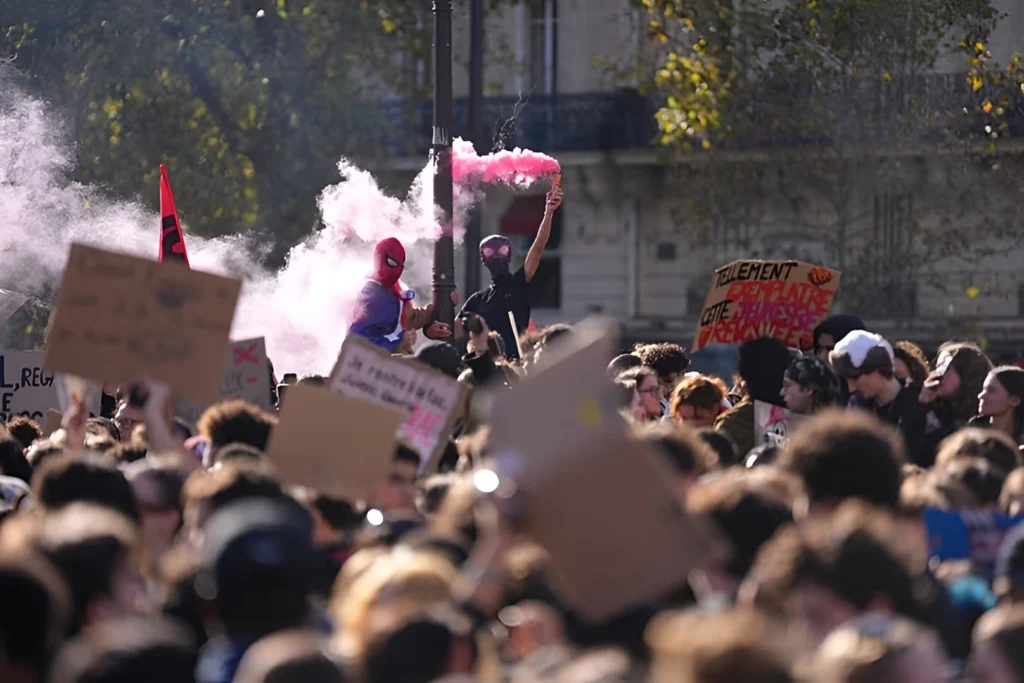
Across Europe, a widespread wave of public protests and labor strikes unfolded during September and October 2026. Demonstrations took place in major urban hubs across France, Belgium, Italy, Albania, Greece, Spain, Portugal, and Germany.
While individual mobilizations emerged from specific domestic triggers, the overarching unrest reflects a shared socioeconomic environment characterized by declining purchasing power, public budget austerity, rising energy prices, and real estate speculation.
The economic backdrop of late 2026 includes sustained structural pressure on working-class households. Energy market shifts driven by international conflicts significantly escalated fuel and electricity costs across the continent, directly inflating the cost of basic consumer goods.
In urban centers, market-driven housing policies and real estate deregulation led to steep increases in residential rents, outstripping wage growth and increasing housing insecurity for young workers and low-income families.
Mainstream institutional coverage frequently characterizes these events through a lens of isolated public order disturbances or temporary economic grievances.
Labor organizations, tenant unions, student groups, and neighborhood alliances have increasingly framed their demands around public resource protection, wage indexation, market regulation, and social welfare preservation.
Protests in Belgium escalate into clashes with Police
🔻 Protests by student and school groups in Belgium over rising education costs and restricted access to higher education turned violent in central Brussels and the city of Liège. Police used tear gas and water cannon to… pic.twitter.com/Nm32hPzgvR
Albania: The Vjosa-Narta Resistance and Sazan Island Mobilizations
In Albania, mass demonstrations began in May 2026 following public controversy surrounding large-scale real estate and luxury tourism developments along ecologically sensitive coastal zones, related to the family of United States President Donald Trump.
Known as the Flamingo Revolution, the protests were initially triggered by foreign investment proposals backed by international private equity firms, including United States-based entities.
These proposals targeted protected areas in the Vjosa-Narta lagoon delta and Sazan Island, a former military territory off the coast of Vlorë.
The movement escalated after an incident on May 30, 2026, when private security personnel physically removed local environmental activists at a development site in Zvërnec.
By June, demonstrations expanded from coastal municipalities into the capital, Tirana. Organized primarily by environmental groups, university student assemblies, and grassroots youth coalitions, the protesters demanded an immediate halt to coastal land privatization, the enforcement of environmental protections under European Union standards, and the resignation of Prime Minister Edi Rama.
On June 9, 2026, tens of thousands gathered in central Tirana. In response, Prime Minister Edi Rama publicly dismissed the critique regarding foreign capital involvement, stating in June that the international scrutiny was primarily driven by high-profile political names associated with the investment project rather than environmental policy.
Throughout July and August 2026, daily civic actions maintained a continuous presence in Tirana, marking 100 consecutive days of anti-government demonstrations by September 8, 2026. By mid-September, the focus expanded as university and high school student assemblies joined the broader movement to protest rising living costs, tuition increases, and systemic public corruption.
Tensions culminated between October 13 and October 18, 2026, when thousands of demonstrators assembled outside the Ministry of Education and Prime Minister Rama’s offices. Clashes erupted between protesters and state security forces, leading to the deployment of tear gas and water cannons by law enforcement.
Official police reports confirmed over 160 detentions and nearly 400 individuals charged following widespread civil disobedience and public building blockades in central Tirana.
Massive protests in France against the high cost of living and the deterioration of public services. pic.twitter.com/H3FUK6kcvC
Spain: The Pensioner Eviction and the National Housing Crisis
In Spain, social unrest escalated rapidly on September 21, 2026, surrounding the national housing crisis. On September 23, 2026, police enforced the court-ordered eviction of María del Carmen “Maricarmen” Abascal, an 87-year-old resident in Madrid, following a legal dispute with property investors.
By September 30, 2026, housing collectives and the Madrid Tenants’ Union (Sindicato de Inquilinas e inquilinos de Madrid) established a continuous protest encampment in Madrid’s Puerta del Sol, which grew to over 1,200 tents.
Similar encampments emerged in Barcelona’s Plaça de Catalunya and Málaga’s Plaza de la Constitución. According to data from the Youth Council of Spain, average residential rent prices had reached €1,176 per month, absorbing roughly 98.7 percent of the average young worker’s salary following a decade of steady price increases.
Protesters demanded an immediate legal cap on rent prices, a total ban on short-term vacation rentals, the expropriation of residential housing units owned by private investment funds, and the passage of strict tenant protection laws.
The central government headed by Prime Minister Pedro Sánchez presented two urgent decree-laws proposing a ban on evictions for vulnerable residents until 2030 and a two-year extension on existing leases.
However, on October 2, 2026, the Spanish Congress rejected the legislation following opposition votes from the People’s Party, Vox, and Together for Catalonia (Junts). Opposition spokesperson Cuca Gamarra argued that affordability could only be achieved through increased residential construction, while Junts spokesperson Míriam Nogueras stated the decree would create legal market uncertainty. In contrast, tenant union representatives called for nationwide general mobilizations to enforce housing rights.
📌KNE: Victory for the struggle of the school students in France! 🔴“Victory for the struggle of the school students in France!”, emphasises the Press Office of the Central Council of KNE in a statement on the large-scale student protests, noting… 🔗https://t.co/sxtH89fNp0…
— International Relations Section of the CC of KKE (@intern_kke) October 5, 2026
France: Educational Strikes and Fuel Price Mobilizations
In France, a distinct wave of social unrest began on September 15, 2026, sparked by sharp increases in retail fuel costs. Driven by regional maritime supply disruptions and international market volatility, average diesel prices in France reached €2.37 per liter, nearing historical highs.
Initial blockades were established by transport workers, agricultural workers, and commercial fishermen who obstructed access to major fuel depots in Frontignan and port facilities in Nice and Sète.
This economic disruption coincided directly with public sector labor actions in secondary and higher education.
On September 18, 2026, teaching staff and suburban education workers across the Île-de-France region initiated strikes over class overcrowding, wage stagnation, and severe administrative budget reductions. Student assemblies subsequently blockaded high schools and university campuses in Paris, Lyon, and Marseille.
The movement saw a broad convergence of trade unions, including the Confédération Générale du Travail (CGT) and Solidaires, along with student organizations and former Gilets Jaunes (Yellow Vests) networks.
The protesters demanded the immediate indexation of wages to current inflation rates, increased state spending on education and healthcare, and emergency price caps on petroleum products.
In response to the growing disruptions, Prime Minister Sébastien Lecornu announced on September 16, 2026, that the government would increase state fuel subsidies to the maximum allowable limit under European Union rules.
When protests continued into October, the government released 10 million barrels of strategic diesel reserves to stabilize market supply, while law enforcement authorities deployed heavy riot control measures, leading to thousands of detentions nationwide.
Zakharova calls out Macron's double standard on protests
Russian MFA spokeswoman says Macron demands "uncompromising" crackdowns on French rioters while the West lectures others on "human rights."
As Limoges City Hall burns, Zakharova notes: the people attacking Europe aren't… pic.twitter.com/mcwYHHfFav
Escalation Across the Mediterranean: Greece and Portugal
Greece: Public Sector Strikes and Anti-Privatization Mobilizations
In Greece, social mobilizations accelerated on September 5 2026, driven by rising electricity tariffs, real estate inflation, and persistent wage stagnation.
The unrest gained momentum following coordinated labor actions organized by the All-Workers Militant Front (PAME) and supported by major public sector confederations, including the Civil Servants’ Confederation (ADEDY).
On September 28, 2026, nationwide strikes disrupted public transport, maritime ferry connections between the mainland and Aegean islands, and municipal services.
In Athens, over 45,000 demonstrators marched toward Syntagma Square in front of the Hellenic Parliament. Student assemblies from the National Technical University of Athens and the National and Kapodistrian University of Athens joined the marches, blocking central thoroughfares.
Protesters focused their demands on structural economic reforms, including:
• The immediate restoration of collective bargaining rights dissolved under previous austerity frameworks.
• Strict state price controls on essential consumer goods and electricity tariffs.
• Increased public funding for higher education and healthcare infrastructure.
• Direct wage indexation to compensate for post-2022 inflationary losses.
Addressing parliament in late September, Prime Minister Kyriakos Mitsotakis defended the administration’s fiscal stance, stating that government policy must maintain strict fiscal discipline to ensure sovereign debt stability.
📌Dimitris Koutsoumbas, GS of the CC of the KKE, on the youth protests 🔴In Spain, people are taking to the streets becuase they are being evicted from their homes. In France, because they’re being denied an education. In Greece, students are setting up tents in Syntagma Square… pic.twitter.com/qO5UR3LWoG
— International Relations Section of the CC of KKE (@intern_kke) October 15, 2026
Portugal: The Housing Dignity Movement (Vida Justa)
In Portugal, demonstrations expanded across major urban centers during the first week of October 2026. Catalyzed by the civil movement Just Life (Vida Justa) alongside tenant rights group Door to Door (Porta a Porta) and university student unions, tens of thousands gathered in Lisbon, Porto, Coimbra, and Faro.
The central issue driving the protests was real estate speculation and the expansion of short-term tourist accommodations, which had led to significant residential displacement in urban neighborhoods.
According to national statistical reporting, residential property prices in Lisbon had increased by 12.4 percent year-over-year by mid-2026, while median national wages remained under €1,050 per month.
On October 3, 2026, demonstration columns marched along Avenida da Liberdade in Lisbon toward the Assembly of the Republic. Speakers at the rally called for immediate state intervention to secure affordable living conditions, demanding:
• An immediate freeze on residential lease renewals and rent price caps indexed to local wage levels.
• The mandatory revocation of tax incentives granted to non-resident foreign real estate investors.
• Substantial state investment in public housing construction.
• An increase in the national minimum wage to €1,000 per month to offset basic living expenses.
Government representatives pointed to existing tax relief programs for young buyers, but grassroots spokespersons rejected these measures as inadequate against systemic market speculation.
Convergence and Expansion: Germany, Italy, and Belgium
Germany: Heating Cost Protests and Urban Rent Freezes
In Germany, demonstrations gathered force across major industrial and urban regions in mid-October, led by trade union factions, tenant associations (Mieterverein), and progressive youth organizations.
The mobilizations were prompted by public sector wage negotiations and sharp increases in seasonal municipal heating and gas bills following regional energy supply realignments.
Protests took place in Berlin, Leipzig, Cologne, and Hamburg. Demonstrators assembled at the Brandenburger Tor in Berlin, calling for:
• Federal legislative caps on natural gas and district heating charges.
• A nationwide five-year freeze on residential rents in cities exceeding strict vacancy limits.
• Higher public investment in municipal transport networks and social housing initiatives.
• Wage increases for public sector employees above the annual core inflation rate.
Federal officials acknowledged the economic burden placed on households, but emphasized that national budgetary constraints limited further large-scale energy price subsidies.
🇪🇸🔥 #MADRID – The Madrid teachers' demonstration, on the first day of the call for an unlimited strike, links up with the encampment at Plaza del Sol – who have been there since late September 2026 for the right to housing, against tenant evictions, against the surge in prices…
Italy: The “Italia in Piazza” General Strike and Cost-of-Living Mobilization
In Italy, social tension culminated on October 17, 2026, in a coordinated general mobilization organized under the banner “Italy in the Square” (Italia in Piazza). The action was spearheaded by grassroots trade unions, including the Unione Sindacale di Base (USB) and COBAS, alongside student collectives and housing rights coalitions.
Demonstrations affected major urban centers, including Rome, Milan, Turin, and Naples. In Milan, an estimated 60,000 people marched through the city center, resulting in the temporary suspension of public transit lines and commercial activity.
Protesters cited declining real wages, cuts to basic social protection mechanisms, and rising utility prices as the primary drivers of the mobilization.
Key demands raised by Italian protest organizers included:
• An immediate statutory minimum wage of €10 per hour.
• The automatic reintroduction of wage indexation tied to inflation metrics (scala mobile).
• Increased public funding for national healthcare (Servizio Sanitario Nazionale) and public transit systems.
• A moratorium on residential evictions involving primary residences for low-income households.
Prime Minister Giorgia Meloni issued a statement from Rome, characterizing the disruptions as politically motivated actions designed to destabilize public order during delicate national budget negotiations.
MILAN RIOTS 🙏🔥 🇮🇹
Milan is experiencing weekend unrest that began as cost-of-living protests and escalated into looting, vandalism, and clashes with police.
On Saturday and Sunday (17–19 October 2026), demonstrations in Milan and other northern Italian cities (including Turin… pic.twitter.com/GuQVFDoahE
Belgium: Public Service Strikes and Educational Budget Mobilizations
Simultaneously, on October 17, 2026, Belgium experienced significant public sector disruptions centered in Brussels and Liège. Organized by joint trade union fronts (FGTB/ABVV and CSC/ACV) in coordination with secondary and higher education student unions, the actions brought together public transport operators, municipal sanitation staff, and academic workers.
In Brussels, thousands of demonstrators gathered near the European Quarter, marching toward the federal parliament building. The movement focused on rising urban living costs and proposed structural spending cuts to secondary and university educational systems.
Protesters demanded:
The full preservation and enforcement of Belgium’s automatic wage indexation system across all employment sectors.
Increased federal budget allocations for public education, student housing, and public transit.
Legislative action to curb commercial energy price speculation and residential real estate inflation.
Federal government spokespersons stated that maintaining current fiscal trajectories was necessary to adhere to European Union public debt standards, while indicating a willingness to continue sector-specific labor dialogue.
Institutional Reactions and State Repression vs. Protesters’ Demands
As demonstrations converged across the European continent through mid-October 2026, state authorities responded with a combination of security deployments, judicial actions, and public condemnations.
Government officials framed the widespread public disruptions as threats to political stability and fiscal order, while protest coalitions emphasized that state actions prioritized debt constraints and elite economic interests over the material needs of the population.
In France, the executive branch adopted an uncompromising stance. President Emmanuel Macron publicly criticized what he described as “unbridled violence” following the escalation of high school blockades, fuel port disruptions, and urban demonstrations.
Interior Ministry directives led to the widespread deployment of specialized CRS riot control units, water cannons, and tear gas in Paris, Lyon, Marseille, and Limoges.
Law enforcement agencies reported making between 1,800 and 2,400 detentions nationwide by mid-October, with human rights monitoring groups and legal collectives expressing concern over indiscriminate police tactics, pre-emptive arrests, and severe injuries sustained by secondary school students.
In Southern Europe, local administrations similarly sought to delegitimize the protest movements. In Italy, Prime Minister Giorgia Meloni’s government characterized the “Italia in Piazza” general strike as a politically motivated attempt by opposition factions to destabilize the nation during crucial state budget negotiations.
Police forces in Milan and Rome deployed water cannons and heavy cordons to clear key arterial roads and transit hubs blocked by union members and youth assemblies. In Albania, Prime Minister Edi Rama argued that persistent anti-government and student demonstrations—initially sparked by the “Flamingo Revolution” against coastal real estate privatization in Sazan and Vjosa-Narta—endangered the country’s economic integration and accession standing with the European Union.
Albanian authorities utilized water cannons and tear gas against university student blockades in Tirana, leading to dozens of detentions and criminal charges.
Across Spain and Portugal, state responses highlighted severe institutional divisions over economic reform. While Spanish local police enforced court-ordered evictions in Madrid and cleared public squares, parliamentary opposition parties blocked proposed national lease extensions and eviction bans.
In Portugal, government spokespersons maintained that market-based housing strategies and tax incentives for foreign buyers were necessary to attract capital, directly rejecting the Vida Justa movement’s demands for immediate rent controls and foreign investment caps.
From Localized Grievances to Pan-European Class Solidarity
What began as distinct domestic actions, resistance against speculative real estate projects on Albania’s protected coastline, outrage over elderly evictions and surging rents in Spain, and secondary school labor strikes over state underfunding in France, rapidly converged into a interconnected continental mobilization.
This convergence reflects shared structural drivers: the systematic erosion of real wages, the commodification of urban housing, the decline of essential public services under sustained fiscal austerity, and the compounding impact of energy inflation.
Across national borders, working-class households, student coalitions, and independent trade unions have consistently targeted the policy frameworks that prioritize fiscal deficit targets and private asset protection over public welfare and living standards.
The organizational strategy of the autumn 2026 movements highlights a shift in popular mobilization methods. By utilizing decentralized communications, student assemblies, neighborhood collectives, and grassroots trade union alliances, protest networks frequently bypassed established political parties.
This organizational horizontalism enabled rapid, cross-sector coordination—demonstrated by the simultaneous national strikes and urban blockades in France, Italy, Belgium, and Portugal on October 17, 2026.
As winter approaches, the continued alignment of labor unions, housing organizations, and youth movements suggests that Europe’s autumn of discontent may mark the beginning of a sustained, pan-European struggle for structural economic reform, market regulation, and social welfare preservation.
Sources: TeleSUR – Al Jazeera – Democracy Now – BBC – DW – France 24 – EFE – AFP – AP – The guardian – El País – El Mundo – La Radio del Sur – La República – RTVE – Xinhua – CGTN – Press TV – Anadolu Agency – RT – TRT World
Egypt’s Civil Democratic Movement rejected any involvement of the Egyptian armed forces in a regional war on behalf of any side, insisting that Cairo make its decisions independently of foreign influence.
The movement said Monday that no outside party should dictate Egypt’s position, arguing that the country’s most important role lies in pursuing “wise mediation to establish peace.”
Turning to domestic affairs, the movement called on civilian opposition groups, its own members included, to begin preparing for the presidential election scheduled for 2030. The call follows President Abdel Fattah el-Sisi’s recent statement that his presidency will end in 2030 and that the matter of constitutional changes to alter that timeline is “completely settled.”
Parliament postpones debate on troop deployment
The statement comes as Egypt’s parliament has yet to take up a proposal to authorize the president to send troops abroad. Lawmakers adjourned an emergency session devoted to discussing support for Saudi Arabia, and deliberations were due to resume on Monday. The debate was postponed again on Monday, this time until October 26.
The session was convened at el-Sisi’s request after he said Cairo would take any action Saudi Arabia asks of it to defend its security and sovereignty.
Yemen’s Sanaa-based Parliament Speaker Yahya Ali al-Ra’i had urged Egypt’s parliament on Saturday not to let the country be drawn into the Saudi escalation, saying such a step would contradict Egypt’s historical role in defending Arab causes.
Yemeni scholars welcome Al-Azhar initiative
Separately, Al-Azhar urged the urgent formation of a mediation committee bringing together respected figures from across the Muslim world. It said the committee should start work immediately to end conflicts and wars in the Arab region, defuse crises, and bridge differences between the parties involved.
The Association of Yemeni Scholars, in turn, reaffirmed its commitment to engaging constructively and in good faith with the invitation extended by the Grand Imam of Al-Azhar, expressing appreciation for the Islamic values and principles it conveyed.
The association also declared Sanaa’s readiness to host the committee proposed by the Grand Imam, comprising respected and wise figures from across the Arab and Islamic worlds.
Calls for justice and for the reopening of Nolan Wells’ case are mounting after a grand jury declined to bring criminal charges, despite the question of Wells’ cause of death remaining unanswered.
Wells, a young Black student at Southwest Mississippi Community College, went on a boating trip on July 4 to Horn Island, just off the coast of Mississippi, with several white friends. He never returned.
His friends, who returned to the mainland with Wells’ cell phone but without him, claimed he chose to stay behind. Wells’ body was found in the water near Horn Island two days later.
A state medical examiner declared the 18-year-old’s cause of death “undetermined.” The grand jury, however, claimed that the conditions of his death were “consistent with drowning.” When the autopsy reports were publicly released after the grand jury decision, they revealed that there were two contusions on the back of Wells’ head. The family’s attorney and others have described these injuries as blunt-force trauma, insisting that they do not believe Nolan drowned.
The autopsy also reported a lack of fluid or debris in his airways, and that his stomach was empty.
The suspicion and confusion surrounding his death has only been amplified by recently released text messages between various friends of Wells.
Newly released messages between Wells’ friends fuel suspicions and calls for justice
A 292-page report of cell phone messages between Nolan Wells’ friends was released on October 15. In one group chat, the friends that returned to the mainland without Wells appear to be discussing the investigation by authorities.
“Don’t speculate about s— yall.” “Because they can try to get your a–.” “If you talk more,” said one user.
As information about the case became public, sparking calls for answers about Wells’ death, the messages appear to express frustration at the increasing suspicion toward this friend group.
One user said, “small minded individuals who are so full of hate towards themselves that they can’t help but try and push it onto other people.”
Another said, “lay low” “and pray I love yall but we don’t needa be texting ab this.”
In a different groupchat, presumably of several Black friends of Wells, users expressed suspicion toward the group of white friends that came back from Horn Island without Nolan.
“Ts weird af,” said one friend.
“Dem white n—- mane.”
“They did sum wit bra,” said another.
“i lowkey feel like they drugged his ahh assum icl,” said one friend.
“All them white —— was lying ——- was crying otw last night while we was just asking questions,” said another user.
“wtf,” responded another.
Returning to the majority-white group chat of friends that were with Wells on July 4, one user said:
“We need to go to Nolan’s funeral and get with all our other black friends to prove a statement for the media.”
“It would shut everyone down.”
The conversation then turned toward the Wells’ family attorney, Ben Crump, and the Wells’ funeral.
“Whoever paid for the funeral wants it to be some huge thing,” said one friend.
“it’s almost like their brainwashing Nolan’s parents and taking advantage of them while their overwhelmed with grief.” “it’s so evil.”
The group continued to exchange messages expressing frustration at what they described as “racism” being directed towards them by the public as questions around Wells’ death mounted.
An online fundraiser was reportedly set up on behalf of Wells’ white friends, titled “Stand With Nolan Wells’ Targeted Friends,” and included messages like, “Thank you for Standing with The Boys!” The fundraiser received over two hundred thousand dollars to “prosecute cases of defamation” so that “these Boys” can win lawsuits against “fanatical opponents who have unlimited resources.”
As more information comes out about the case, the unanswered questions are boiling over into anger and demands for accountability. A spontaneous movement is now demanding Wells’ case be reopened and investigated thoroughly until justice is served.
Movement for Nolan Wells surges across HBCUs
Following the grand jury decision, spontaneous student walkouts were seen across dozens of historically Black colleges and universities across the South.
“It was clear to us living here seeing the rage around the Nolan Wells case start to come to a boil,” said North Carolina-based organizer with the Party for Socialism and Liberation Prince Williams, speaking to BreakThrough News.
There was a walkout at Atlanta University Center on October 1, another at North Carolina Central October 6, and Prairie View A&M University on October 7.
After these spontaneous walkouts, students at Jackson State University called a Southern Day of Action on October 15, demanding justice for Nolan Wells. Specifically, they called for the investigation into the death of Nolan Wells to be reopened immediately.
“The call spread like wildfire, especially in North Carolina,” said Williams. “Six schools called walkouts and demonstrations.”
In total, about a dozen schools across five states in the South answered the call from students in Jackson, he said.
From an institutional perspective, the case is a settled matter after the grand jury decision. But organizers on the ground say the institutional legacy of racism, white supremacy, and Jim Crow, have not been forgotten. And neither has the historical tradition of Black resistance.
Generations of resistance in the US South
“There has never been a moment in the history of the US where Black Americans could rely on the government to get justice for us,” said Williams.
Instead, he pointed to the countless ancestors who, through relentless struggle, freed themselves from slavery and broke the back of Jim Crow.
“That reality has created a generational responsibility for us to see our own power when we come together on one accord to find justice for ourselves.”
As suspicious deaths of young Black Americans are on the rise, Williams says there is little trust in law enforcement. “About 7 in 10 Black adults say prisons, policing, and the court system were designed to hold Black people back.” The recognition of a highly racist system enforced by these very institutions is widespread, he added. The suspicious deaths we are seeing today are a continuation of a long history, especially in Mississippi, where kidnappings of Black people are “written off as disappearances” and lynchings are ruled “accidental drownings.”
“We must stay vigilant and continue to raise this case in our daily lives with everyone we know.”
National solidarity in the call for justice for Nolan Wells
Organizers urge all students and communities across the United States to support the campaign for justice and accountability.
“Put pressure on local, state, and federal officials to reopen Wells’ case,” said Williams. However, he emphasized that this can’t be done effectively in isolation.
“We need to join organizations of like-minded people that are sustaining these campaigns who can take this movement far beyond the Southern day of Action on October 15.”
Iranian Foreign Minister Abbas Araghchi reiterated that his country’s proposal to end the war with the US and to restart nuclear negotiations is “still on the table,” claiming the Iranian conditions are “completely clear” and “unchanging.”
Talking to Iranian state media on the sidelines of the 52nd session of the Council of Foreign Ministers of the Organization of Islamic Cooperation (OIC) in Baghdad on Sunday, October 18, Araghchi also said that Iran is currently studying the US response to its proposals.
If the US meets its conditions, “the Strait of Hormuz will be reopened on the sixth day, and negotiations will resume on the seventh,” Araghchi said.
Though Araghchi did not talk about them explicitly, he reiterated that the Iranian conditions are the same as what the US had agreed to under the Islamabad Memorandum of Understanding (MoU), signed in June.
On several previous occasions Iran has made clear that if the US lifts its naval blockade, releases Iran’s foreign frozen assets, and ends the war on all fronts in the region, it will allow the Strait of Hormuz to open.
As per the MoU, in the first 60 days after the deal took effect both sides were to initiate negotiations over Iran’s nuclear program. However, the MoU expired in August after hostilities were resumed within weeks of its signing.
The US resumed its military strikes on Iran in July, leading the Iranians to reimpose their blockade in the Strait of Hormuz in response, reversing its decision to open it for navigation as per the MoU.
Tehran had claimed that it presented a plan to reopen the Strait to the US in September, in a brief meeting with its delegation during the annual session of the UN General Assembly. However, US President Donald Trump later declared he had rejected the Iranian proposals.
Beware of Israeli provocations
Araghchi also rejected the repeated threats of new strikes and economic isolation against his country, claiming that Iran will not bow to threats and will defend its strategic and economic interests.
Last week it was reported that Israeli Prime Minister Benjamin Netanyahu, who is facing a tough election at home, apart from planning to escalate war against Palestinians in the West Bank, also pressured Trump to resume the military strikes on Iran.
On the same day, Trump claimed that the US may attack some specific targets in Iran in order to disrupt its nuclear program. Media reports also claimed that the US is preparing to use the so-called “mother of all bombs” to again target Iran’s energy and nuclear infrastructure.
This is despite the fact that Trump has repeatedly boasted about “obliterating” Iran’s nuclear program during the joint US and Israeli airstrikes in June 2025.
Reacting to those reports, Araghchi warned both the US and Israel to learn from their mistakes and stay away from Iran to avoid consequences more severe than during the earlier wars.
“Last time you wanted to “finish the job” Iran emerged even stronger. Want to try your luck again? Be our guest. But be careful; we have unfinished jobs too,” Araghchi said in a post on X on Monday.
He claimed that Netanyahu is pressing for a fresh war simply because he wants to stay in power and out of jail over corruption charges he has been facing for years now, without thinking about consequences to Israel or the US.
In a similar reaction, the head of the Iranian armed forces Ali Abdollahi also claimed on Sunday that his country was waiting for their [the US and Israel’s] foolish decision and miscalculation. Any attack by them would invite “a response war more severe, distinct, and devastating than in the past,” Abdollahi claimed.
Abdollahi’s warnings were relayed by several other Iranian officials on Sunday.
It is reported that the US has spent billions of dollars in the last eight months of war on Iran. It has lost most of its military infrastructure in the Gulf countries in Iranian responses, with over a dozen of its soldiers killed and several dozen of its aircraft lost. The US also faced a severe shortage of crucial ammunition due to the war on Iran, forcing it to suspend the strikes midway.
O Secretário de Estado das Florestas, Rui Ladeira, participa, nos próximos dias 20 e 21 de outubro, nas sessões de entrega de maquinaria em Santiago do Cacém, Aljezur e Évora, no âmbito do Programa de Mecanização para a Gestão de Combustível, financiado pelo Plano de Recuperação e Resiliência (PRR).
Dia 20 de outubro, em Santiago do Cacém, serão assinados os protocolos de cedência de maquinaria entre o Instituto da Conservação da Natureza e das Florestas (ICNF) e os municípios de Aljustrel, Almodôvar, Barrancos, Castro Verde, Cuba, Ferreira do Alentejo, Grândola, Mértola, Ourique, Santiago do Cacém, Serpa e Vidigueira, tendo em vista a disponibilização de 12 tratores, um por município, reforçando a capacidade para a realização de operações de gestão de combustível e prevenção de incêndios rurais.
Já no dia 21 de outubro, da parte da manhã, em Aljezur, serão assinados protocolos com os municípios de Alcoutim, Aljezur, Olhão, Portimão e Tavira, para a cedência de 5 tratores; e da parte da tarde, em Évora, serão firmados os protocolos com os municípios de Alandroal, Arraiolos, Borba, Évora, Redondo, Reguengos de Monsaraz, Viana do Alentejo e Vila Viçosa, tendo em vista a cedência de 8 tratores.
Ao todo, a nível nacional, o ICNF informa que serão entregues 150 tratores a municípios, num investimento total que ronda os 27,5 milhões de euros.
Programa
20 outubro – 15h30 – Santiago do Cacém
Sessão de entrega de maquinaria no âmbito do programa de mecanização para a gestão de combustível – Parque de Feiras e Exposições de Santiago do Cacém
15h30 – Abertura, Presidente da Câmara Municipal de Santiago do Cacém
15h45 – Assinatura dos protocolos de cedência da maquinaria
16h15 – Encerramento, Secretário de Estado das Florestas
16h30 – Entrega dos tratores
21 de outubro – 10h00 – Aljezur
Sessão de entrega de maquinaria no âmbito do programa de mecanização para a gestão de combustível, Parque de Estacionamento da CM Aljezur
10h00 – Abertura, Presidente da Câmara Municipal de Aljezur
10h15 – Assinatura dos protocolos de cedência da maquinaria
10h45 – Encerramento, Secretário de Estado das Florestas
11h00 – Entrega dos tratores
21 de outubro – 15h30 – Évora
Sessão de entrega de maquinaria no âmbito do programa de mecanização para a gestão de combustível, Centro de Desenvolvimento Agro-Pecuário de Évora
15h30 – Abertura, Presidente da Câmara Municipal de Évora
15h45 – Assinatura dos protocolos de cedência da maquinaria
16h15 – Encerramento, Secretário de Estado das Florestas

 Login