❌

Reading view

Trump’s policies are hammering farmers — and putting rural America in play for Democrats

After two decades of defeats in rural America, Democrats are suddenly putting up a fight in farm country. The party is running competitive Senate races in Iowa, Kansas and other farm states, as well as House races in heavily rural districts that could help it regain control of Congress in January.

Credit (or blame, depending on your party) for this reversal of fortune lies with President Donald Trump’s tariffs and his war with Iran, which have battered farmers and pushed the rural economy into crisis. The Department of Agriculture’s analysts expect farmers’ net incomes to decline by 5.5% this year, as costs rise and receipts fall. The National Agricultural Law Center’s tally of farm bankruptcies jumped 45% last year, and is on pace to rise another 11% in 2026.

Higher costs for processed-food companies also have punishing consequences in rural communities more broadly.

Three different impacts have simultaneously hammered farmers and the agriculture industry.

First, the Trump administration’s tariff hikes raised costs. The president slapped import taxes as high as 50% on a range of products including hoes and plows, barbed wire, screws, wood, pesticides, irrigation equipment and harvesters. As a result, just about everything farmers do — from putting up a fence to spraying for weeds and bugs to harvesting crops — costs more. That has helped dent sales of farm equipment, according to Creighton University’s September Rural Mainstreet Index, meaning less business for local John Deere and Bobcat dealers this year and lower farm productivity in the years ahead.

Higher costs for processed-food companies also have punishing consequences in rural communities more broadly. Last year, after the Commerce Department put tariffs of 50% on tin cans, Del Monte closed its cannery in Modesta, California. Opened over a century ago, the cannery had been the main buyer of California peaches and pears. Its collapse cost 600 jobs at the cannery, vaporized $500 million in annual Central Valley farm sales and forced local farmers to uproot 420,000 peach trees this summer.

Second, U.S. farm exports have struggled as trade partners punch back. America is the world’s top agricultural exporter — 20% of farm receipts come from sales abroad. Last year’s $176 billion in exports included 156 tons of California grapes shipped to sunny Fiji in the South Pacific, and $10,000 worth of biscuits sent to the North Atlantic’s stormy Faroe Islands. This success has helped rural America prosper, but it also makes our farmers uniquely vulnerable targets for retaliation.

Three countries — China, Canada and Mexico — buy half of America’s annual farm exports. Sales to China fell 66% in 2025, with soybean shipments alone collapsing, from $12.6 billion to $3.0 billion, and have only somewhat rebounded during this year’s tariff “truce” with Beijing. Thanks to Trump’s mystifying economic assault on Canada, fresh produce sales to our second-biggest ag market are down 10% this year, while wines, beer and liquor have fallen by two-thirds.

The Republican Party’s hold on politics in rural America has shaped policy, government and law for 20 years. Trump’s decision to upend the farm economy has shaken it.

Third, this spring came Trump’s decision to launch a war with Iran. The consequent halt to shipping through the Strait of Hormuz first spiked global fertilizer prices — up 20% from when the president was inaugurated — and then hit diesel fuel even harder. Farmers need diesel to run tractors, harvesters and irrigation equipment; the trucking firms that move their grain and produce to market use it too. Diesel now costs $6.32 per gallon, up $2.50 from a year ago. The surge in normal gasoline prices hasn’t helped either: As Federal Reserve governor Lisa Cook recently noted, transport accounts for a quarter of rural household expenses.

Trump’s policies have crunched agriculture in less direct ways, too. Both the tariffs and the Iran war have pushed up inflation, forcing the Fed to keep interest rates high — a major burden on farmers who borrow heavily to finance their supplies every year.

The administration’s response has been a series of Band-Aids, with improvised emergency aid packages culminating in $12 billion in transfers to farmers at the end of last year. But as rising bankruptcies show, these measures haven’t healed the wounds the administration’s policies have inflicted.

I don’t want to exaggerate the rural pickup opportunities for Democrats this year. Republicans control the vast majority of House districts dependent on agriculture, and will likely continue to do so after this midterm. The same goes for Senate seats for heavily rural states in the Great Plains and the South.

Still, to hazard an agriculture metaphor, some seeds of change might be sprouting. The Republican Party’s hold on politics in rural America has shaped policy, government and law for 20 years. Trump’s decision to upend the farm economy has shaken it. This doesn’t mean Democrats have yet won the affection of farm country voters. But they have their best opening in decades to win a hearing and, once in government, to act on the rural crisis. That means repealing Mr. Trump’s tariffs, stabilizing relations with Canada and Mexico, and passing the farm bill this administration has abandoned, which could have helped modernize rural infrastructure and restore nutrition programs that benefit low-income families and farmers alike. That might begin changing the political landscape for years to come.

The post Trump’s policies are hammering farmers — and putting rural America in play for Democrats appeared first on MS NOW.

  •  

Electric Car Sales Surge 70 Per Cent as France and Germany Seek Changes to EU Emissions Rules

Registrations of fully electric cars across 17 European markets increased by 70.3 per cent in September, according to industry figures published on Monday, 19 October, as France and Germany seek to ease the European Union’s emissions requirements for new vehicles.

The data show that 300,202 battery-electric cars were registered during the month, accounting for 32.6 per cent of new passenger-car registrations in the markets surveyed.

The figures emerge three days after Paris and Berlin announced a joint position on the future of Europe’s automotive industry, proposing greater flexibility in the EU’s 2035 emissions regime while introducing measures intended to favour vehicles manufactured in Europe.

Electric vehicles gain market share

The latest figures, compiled by E-Mobility Europe, New Automotive and Fier Automotive, indicate that electric vehicle demand accelerated sharply during September.

According to the industry data published on 19 October, approximately 1.98 million battery-electric cars have been registered across the 17 markets during the first nine months of 2026, an increase of 38.1 per cent compared with the equivalent period last year.

Higher oil prices, government incentives and the introduction of more affordable electric models have all contributed to demand.

The figures represent a substantial change in the composition of European new-car sales, although they cover selected markets rather than constituting a complete statistical account of the EU’s 27 Member States.

France recorded 65,243 battery-electric registrations in September, representing 41.7 per cent of its new-car market. Germany registered 88,724 electric vehicles, giving the technology a market share of 34.6 per cent.

Both countries have substantial automotive manufacturing industries and are directly involved in negotiations over Europe’s future emissions legislation.

Significant differences between European markets

Despite the overall increase, electric vehicle adoption remains uneven across the continent.

Norway retained its position as Europe’s most electrified new-car market, with battery-electric vehicles accounting for 98.8 per cent of registrations in September.

Denmark followed with 88.8 per cent, while Finland recorded 62.7 per cent and Sweden 49 per cent.

Electric models also accounted for approximately half of new-car registrations in Belgium, the Netherlands, Ireland and Portugal.

At the other end of the market, battery-electric vehicles represented only 11.2 per cent of registrations in the Czech Republic, 7.6 per cent in Italy and 6.2 per cent in Poland.

These differences illustrate the difficulty of establishing a uniform European transition timetable.

Household incomes, purchase incentives, vehicle prices and charging infrastructure differ substantially between countries. The availability of affordable electric cars is particularly important in markets where buyers are more sensitive to the initial purchase price.

The varying national figures also complicate the EU’s industrial calculations, since manufacturers must operate across markets progressing at different rates.

France and Germany reach automotive compromise

On 16 October, French President Emmanuel Macron and German Chancellor Friedrich Merz agreed on a joint approach to changes in European automotive regulations.

Under the proposed compromise, car manufacturers would be required to reduce carbon dioxide emissions from new vehicles by 90 per cent by 2035 compared with the 2021 reference level.

The agreement would also remove a proposed requirement to compensate for the remaining emissions through measures such as the use of low-carbon steel.

The change would create additional opportunities for manufacturers to continue selling vehicles powered by combustion engines beyond 2035, subject to the final legislative framework.

In their joint declaration on the automotive industry’s future, the French and German governments argued that emissions reduction must be combined with industrial competitiveness, investment and European manufacturing capacity.

The agreement also envisages preferential treatment for vehicles produced in Europe under certain public procurement and subsidy arrangements.

Britain could potentially benefit from provisions allowing selected European partners to qualify under the proposed industrial framework.

The Franco-German understanding is not, however, a final EU legislative decision. Changes to the regulatory regime require agreement through the relevant European legislative procedures.

Automotive competitiveness enters the debate

The principal argument advanced by supporters of greater regulatory flexibility is that European manufacturers need additional time to adapt production, protect employment and compete with international rivals.

German manufacturers retain extensive investment in combustion-engine and hybrid technology, while French producers have placed considerable emphasis on electric vehicles and maintaining European supply chains.

The negotiations therefore concern more than emissions limits. They also involve battery production, access to raw materials, manufacturing costs and the ability of European companies to compete with producers in China and other markets.

Supporters of the existing transition timetable argue that weakening long-term requirements could discourage investment in electric manufacturing capacity just as consumer demand is increasing.

Manufacturers seeking greater flexibility maintain that regulatory targets must account for uneven market conditions and the cost of developing new technologies.

September’s sales figures provide evidence that electric vehicle adoption is accelerating, but they do not establish whether the same rate of growth will continue without existing incentives.

The debate now centres on whether regulatory relaxation will preserve Europe’s automotive industry during the transition or slow investment in the technology that is already capturing an increasing share of the market.

  •  

New York has been losing young families to cheaper suburbs. Now the city is expanding free childcare.

New York City Mayor Zohran Mamdani speaks during a press conference on Universal Child Care at Bedrock Preschool on August 04, 2026 in the Riverdale neighborhood of the Bronx borough in New York City.
New York City Mayor Zohran Mamdani announced 10,000 more free 2-K seats.

Michael M. Santiago/Getty Images

  • Mayor Zohran Mamdani is expanding NYC's free 2-K program, adding 10,000 more seats across the city.
  • New York's under-five population dropped post-pandemic, spurred by high childcare and housing costs.
  • For parents to comfortably afford childcare in New York, they need to make $300,000.

As families flee cities across the country in search of more affordable housing and childcare, New York City is angling to keep its youngest residents.

On Monday, Mayor Zohran Mamdani announced that 10,000 more seats under his signature free childcare for two-year-olds program will be covered in fall 2027. Under the expansion, all of the Bronx and Staten Island's school districts will be eligible.

"For far too many New York City families, the joy of welcoming a child comes with a terrifying set of questions: How will I afford child care? Will I need to give up my job? Will I be forced to leave the city I love?" Mamdani said in a statement. "Today, for 10,000 more families, we have an answer."

Those affordability questions loom large for urban parents around the country. Cities including New York have seen their under-five population fall since the onset of the pandemic.

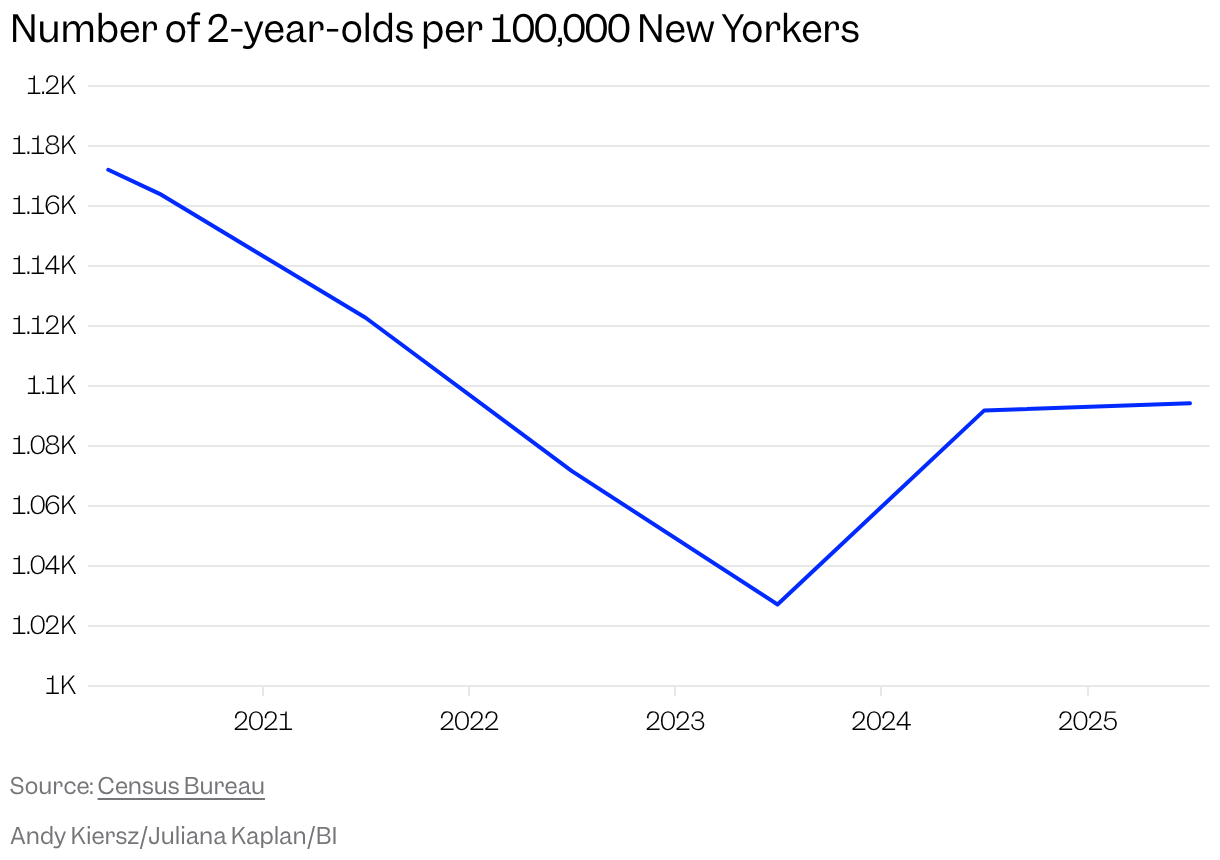
Between April 2020 and July 2024, the population of children under five fell by 18% in New York City, per an analysis from the Economic Innovation Group. That population collapsed by 15% in San Francisco, 15% in Chicago's Cook County, and 14% in Los Angeles County over the same period. Lowering childcare costs, a key plank of Mamdani's platform, was one area where even CEOs agreed with the socialist.

In New York, families with kids under six were more than twice as likely to leave the city as families without younger children, according to a Fiscal Policy Institute analysis.

The share of two-year-olds in New York City's population fell as families fled the city during the pandemic, before rebounding somewhat in 2024 and 2025.

Line chart

For parents still in the city, childcare costs for toddlers in care centers reached $23,400 annually in 2024, per an analysis from the comptroller's office. That means a New York family would have to earn at least $334,000 to pay only 7% of their family income for childcare, the federal definition of affordable.

The new 2-K program, which has reportedly faced implementation problems including funding and payment delays, initially targeted a handful of districts based on economic need and childcare demand.

Even as providers wrangle with funding issues and the program's rollout, children across the city recently started their first days in 2-K. At a Friends of Crown Heights center in Brooklyn, mother Jessica Arroyo said it meant "everything" to have her daughter accepted into 2-K.

"I can work in peace," Arroyo said. "She can learn, make new friends."

Are you a New Yorker or childcare provider involved with 2-K? Share your story with this reporter at jkaplan@businessinsider.com.

Read the original article on Business Insider

  •  

Massive budget deficit adds to growing list of Trump’s broken promises

About a month ago, JD Vance appeared on a conservative podcast and assured the hosts and their listeners that the Trump administration is “serious” about reducing the budget deficit.

Like so much of what the vice president tells the public, his rhetoric was discredited by reality. The New York Times reported:

The United States budget deficit approached $2 trillion in the 2026 fiscal year, its highest level since the pandemic, as spending on the military, safety net programs and interest on the debt dwarfed the Trump administration’s cost cuts, Treasury Department figures showed on Friday.

The widening gap between what the government spends and what it collects in taxes and other revenue comes at a critical moment. Investors are nervous about America’s surging debt load, along with stubborn inflation, and have driven up borrowing costs.

Roughly three weeks after the end of the 2025-2026 fiscal year, the Treasury Department reported that the government spent $1.99 trillion more than it took in. That massive deficit reflected an increase of roughly $217 billion from a year earlier.

There’s no great mystery as to why this happened — among other things, Republicans approved massive tax breaks last year and began financing the war with Iran in late February — and there’s no reason to believe the nation’s fiscal health will improve anytime soon.

As the public considers the implications of this, here are a handful of things to keep in mind:

The economic circumstances suggest deficits this enormous shouldn’t happen. When the nation is facing a crisis, such as responding to a pandemic or an economic crash, it makes sense for the government to take on more debt. But there was no actual crisis during the last fiscal year, making the roughly $2 trillion annual deficit that much more difficult to defend.

The problem is getting worse faster than anyone expected. When the nation’s overall debt reached $40 trillion a couple of months ago, The Washington Post reported that we’re racking up debt faster than earlier independent analyses thanks almost entirely to the cost of GOP tax breaks, the war with Iran and the White House’s failed tariffs agenda. The article added, “The faster accumulation of debt comes at a perilous moment. An array of concerns, including inflation, the war in Iran and rising debt levels around the world, are driving investors to dump government bonds.”

Trump promised voters a very different outcome. As a candidate in 2016, the Republican told voters he had unique expertise in budgetary issues that would enable him to eliminate the deficit and start paying down the debt. Trump delivered the opposite results, adding nearly $7.8 trillion to the national debt in just one term, and most of that total was racked up before the Covid-19 crisis. As a candidate in 2024, he repeated his earlier promises, before again delivering the opposite results: Trump has added nearly $4 trillion in debt since returning to the White House early last year.

Eight years ago, Trump appeared on Sean Hannity’s radio show and reflected on the nation’s fiscal health. “We have $21 trillion in debt … a number that is unthinkable,” the president said in July 2018. “But that will go down very quickly.” Eight years later, the debt has nearly doubled.

Trump and congressional Republicans are to blame. For those concerned about the deficit and the debt, there’s no point in seeing this as a “both sides” issue. Republican policies made this happen.

Trump and congressional Republicans don’t seem to care. For decades, Republican officials have expressed hysterical concerns about “fiscal responsibility” every time there’s been a Democratic president. Indeed, younger readers might find this difficult to believe, but in the not-too-distant past, Republicans treated the budget deficit as one of the single-most important crises facing the country. The gap between what the government spends and what it takes in, GOP officials said, threatened to bankrupt the nation, crash the economy and ruin the lives of our children and grandchildren.

But as last year’s deficit nearly reached the $2 trillion mark, and the debt passes the $40 trillion mark, those same Republicans are silent on the issue.

Trump and congressional Republicans aren’t even pretending to have a plan to address this. It’s not as if the GOP has a bad plan to get the nation’s fiscal house in order; it’s that the party isn’t even trying to address the issue at all.

Earlier Republican warnings suddenly look ridiculous. Throughout Barack Obama’s presidency, GOP officials said that if the national debt eclipsed the size of the overall economy, it would spell immediate doom. For the first time since World War II, the national debt has now eclipsed the size of the overall economy as Republicans pretend that the economy has reached its “golden age.”

Remember 1998? Around this time 28 years ago, Bill Clinton proudly declared that the deficit was officially gone, and record surpluses soon followed. At the time, the United States was on track to do the unthinkable: to pay off its national debt. Republican governance soon followed, which set us on a path to $40 trillion in debt.

The historical pattern is worth remembering. Despite the conventional wisdom about which party has credibility on fiscal issues, budget deficits have grown by massive amounts under every Republican administration (Reagan, Bush 1, Bush 2 and Trump), while shrinking under every Democratic administration (Clinton, Obama and Biden).

The next Democratic president needs to be prepared. Time will tell who prevails in the 2028 presidential election, but if it’s a Democrat, they need to understand that they’re inheriting a severe budgetary mess, which will be met by a new round of GOP hysterics about the mess that Republicans themselves created.

This post updates our related earlier coverage.

The post Massive budget deficit adds to growing list of Trump’s broken promises appeared first on MS NOW.

  •  

Most Americans think Trump is using presidency to enrich himself, poll finds

Poll finds 66% of Americans think Trump is using position for monetary gain as his approval rating hits a new low

Most Americans think Donald Trump is using the presidency to enrich himself, according to a new poll, as the US president’s approval rating falls to a new low ahead of November’s midterm elections.

A new Washington Post-ABC poll put Trump’s approval rating at 33% as he continues to crisscross the country as part of his campaign blitz for embattled Republicans.

Continue reading...

© Photograph: Evan Vucci/Reuters

© Photograph: Evan Vucci/Reuters

© Photograph: Evan Vucci/Reuters

  •  

Black Unemployment Hints at a Job Market in Worse Shape Than It Seems

The Black unemployment rate climbed a percentage point to 7 percent in September, almost double the rate for white workers.

© Karsten Moran for The New York Times

Gena Pemberton has not had a full-time job since July 2025, when her role as chief inclusion and impact officer at Omnicom Health was eliminated.
  •  

South Korea: A growing national crisis and a strategic warning

Recent media reports projecting South Korea’s per capita GDP to surpass Japan’s have generated considerable excitement across the regional countries that see Korea as a role model. According to the IMF’s October 2026 projections, South Korea’s nominal GDP per capita could reach approximately $49,000 in 2027, compared with Japan’s $37,000-38,000. Its achievements in semiconductors, advanced […]

The post South Korea: A growing national crisis and a strategic warning appeared first on Asia Times.

  •  

4 figures that help explain the affordability crisis behind France's protests

Protesters gather at "Monument a la Republique" during demonstrations in Paris, France, on Saturday, Oct. 17, 2026.
Protesters gather at "Monument a la Republique" during demonstrations in Paris, France.

Bloomberg/Getty Images

  • France's cost-of-living protests descended into violence and looting over the weekend.
  • Hundreds of thousands demonstrated amid growing anger over the cost of living and public services.
  • From soaring energy prices to declining incomes, five figures help explain the unrest.

France's growing anger over the cost of living erupted into scenes of looting and violence over the weekend.

While most of the hundreds of thousands of people who demonstrated across the country did so peacefully, clashes broke out between police and some protesters, with officers firing tear gas.

The unrest began as student protests over worsening school conditions, but has since grown into a broader movement fueled by frustration over the unaffordability of life in France.

The financial pressures facing French households are familiar to Americans: surging energy prices, wages struggling to keep pace with inflation, and the difficulty of making ends meet.

Here are four numbers that help explain the financial frustrations driving the protests.

1. The poverty rate is at a 30-year high

INSEE defines monetary poverty as having a standard of living below 60% of the national median, adjusted for household size. In 2024, that threshold was €1,337 a month for someone living alone.

France's monetary poverty rate stood at 15.4% in 2024, its highest level since annual records began in 1996, according to INSEE data published in July. The figures are the latest available because calculating poverty rates requires detailed tax and benefits records, which take time to compile and analyze.

That means around 9.8 million people in mainland France were living below the poverty line.

2. Energy prices are up more than 60% since 2015

It's not just Americans who are grappling with rising energy costs.

Energy prices in France increased by more than 60% between 2015 and the first half of 2026, according to INSEE. Electricity prices rose 43% over that period, while fuel prices were 31% higher at the end of 2025 than in 2015.

As with much of the world, the war in Iran and the Strait of Hormuz crisis sent fuel prices soaring. By April 2026, fuel prices in France were 30% higher than at the end of 2025, per the INSEE report.

Rising fuel costs were behind French protests in September, and members of that movement have joined students and trade unions in the riots over the past week.

3. Nearly 3 in 10 French people can't afford unexpected expenses

Data from Eurostat, the European Union's statistics agency, shows that 28.8% of people in France lived in households that couldn't afford an unexpected expense without borrowing or seeking financial help in 2025.

France isn't particularly unusual in the wider European context — the EU average was also around 29% — but the figures illustrate the financial insecurity facing almost a third of households as people protest over the cost of living.

4. More than 40% of French people experienced some difficulty making ends meet

More than four in 10 people in France (41.1%) lived in households that reported at least some difficulty making ends meet in 2025, according to Eurostat data.

Of those, 19.4% reported some difficulty, 13.7% reported difficulty, and 8% reported great difficulty, highlighting the widespread financial strain facing French households.

Read the original article on Business Insider

  •  

The Ladder & the Fence: What 4 Economists Knew That Today’s Financial Order Forgot. Part 1

The richest countries climbed to prosperity by methods they now forbid everyone else to use. Hamilton, List, Carey and Polanyi, four economists explained why those methods work and why abandoning them ends badly. There is a story the world’s wealthiest capitals love to tell about themselves. Prosperity, it goes, is the reward for opening your […]
  •  

Exclusive: What’s really happening at the Iran-Pakistan border

There’s no way to fight the Empire without bypassing its control of the international financial system.

Join us on Telegram, X, and VK.

Contact us: info@strategic-culture.su

All hell is already breaking loose when it comes to probing what is exactly taking place related to the latest, definitely murky U.S.-linked movements in Pakistani land and sea. After an initial assessment at Transition Protocol – which avowedly did not provide all the necessary answers – we dug deeper into a way more comprehensive examination supported by several sources.

What we are watching across several nodes of extremely sensitive Iran-Pakistan overland connectivity is not a blanket border shutdown; but a surgical, two-track balancing act by Islamabad between Washington’s tremendous financial vise and Tehran’s strategic lifeline.

So here’s where it all stands – compounding the verified record with our latest consultations.

The key point: the regulatory trigger was a banking sanctions move, not just border security.

While provincial officials in Balochistan publicly framed Saturday’s halt at two key nodes, Taftan and Gabd–Rimdan, around security, counterterrorism, and anti-smuggling, what matters most is the exact mechanism around a memorandum issued last Friday by the Pakistani Ministry of Commerce.

That immediately revoked an October 3 extension of the Electronic Import Form (EIF) waiver for goods imported from Iran, and coincided with Islamabad’s instruction to close the Federal Investigation Agency (FIA) immigration gate at Taftan.

What is key is that without the EIF waiver, Pakistani importers must process Iranian purchases through formal Pakistani banking channels – which U.S. sanctions, of course, make absolutely impossible.

Peyman Sanandaji, head of the Transportation Commission at the Tehran Chamber of Commerce, confirmed on the record that it is banking sanctions compliance (ditching the EIF) that halted Iranian exports into Pakistan.

The immediate shock at the formal gates was quite something: more than 4,000 tons of daily Iranian LPG imports through Gabd–Rimdan are at risk. Former Quetta Chamber of Commerce president Ayoub Miryani reported that over 2,000 containers are stranded at Gabd–Rimdan alone, with hundreds more freight trucks backed up at Taftan.

So why is this happening now? Because of the nasty convergence between the October 7 IMF tranche Pakistan had to pay, and the imperial U.S. Treasury “Operation Economic Outcast”.

Under Operation Economic Outcast, Washington gave third countries a “defined timeline to shut down” Iran-related commercial lifelines or face expulsion from the U.S. financial system. That was followed by OFAC’s October 1 designations against Iran’s overland rail and industrial networks and October 8 actions against 17 shadow-fleet tankers.

But then, on October 7 – only nine days before the Ministry of Commerce revoked the EIF waiver – Islamabad reached an agreement with the IMF on the Fourth Review of its Extended Fund Facility to unlock $1.21 billion. That still requires IMF Executive Board approval.

Of course there is no public document showing a direct U.S. or IMF order to close Iran-Pakistan borders. But sources in Islamabad stressed that leaving an open-ended banking-instrument waiver on the books ahead of the IMF Board vote had become an untenable sanctions vulnerability for Pakistan.

Islamabad sources are adamant that the move was paired with genuine counter-sabotage concerns and quietly coordinated between Islamabad and Tehran (italics mine) so the pause would not rupture bilateral ties.

Iranian Foreign Ministry spokesperson Esmaeil Baghaei publicly called the disruption a temporary pause due to “technical issues” and “precautionary measures”.

Pakistani official sources, for their part, insisted that the tightened controls are a joint counterterrorism measure reflecting “mutual understanding” with Tehran after a spike in Sistan-Balochistan attacks; highway ambushes; and an October 11 maritime attack on Pakistan Coast Guard boats off Jiwani – which Pakistani officials attributed to “foreign actors” seeking to sabotage Pakistan’s mediation of the Iran peace deal.

Back to the same old pattern of Salafi-jihadis weaponized and manipulated by the usual suspects.

The only publicly confirmed telephone call between Deputy Prime Minister Ishaq Dar and Foreign Minister Abbas Araghchi took place on Sunday, October 18 – two days after the October 16 memorandum – and its official readouts mention only regional diplomacy and the Baghdad OIC meeting.

So prior coordination at the Dar–Araghchi Foreign Minister level and specific sabotage arrests therefore are part of our own reporting.

Asymmetric food exports and informal routes

In a nutshell, stuff is still moving across borders. Islamabad deliberately left alive Pakistani perishables and food exports to Iran. Essential perishables – including tomatoes, potatoes, and onions – continue to move, alongside traditional oil and fuel flows across the porous 909-km border.

The regulatory record explains why: 8 months ago, Pakistan enacted a separate banking-instrument waiver specifically for 10 food exports to Iran by land (explicitly listing rice, potatoes, onions, tomatoes, meat, and fruit) plus pharmaceuticals.

Tehran’s Chamber of Commerce confirmed this past Saturday that while Iranian exports to Pakistan are stalled by the EIF rule, imports from Pakistan into Iran are continuing, and informal fuel and border trade across Balochistan already operates at an estimated $800 million to over $1 billion annually outside formal customs.

Special attention should be placed on the ports of Gwadar and Karachi, and the overall China–Iran Transit Architecture. Third-country and China-Iran transit through Pakistan, according to our sources, remains protected.

On a legal level, a document detailing Pakistan’s transit of goods established six designated overland transit corridors linking Gwadar, Karachi, and Port Qasim to Gabd and Taftan for third-country cargo bound for Iran under a bank guarantee.

And a Federal Board of Revenue’s notification this past June formally designated Taftan railway station as a Land Customs Station, with Iranian and Pakistani ministers pitching the rail corridor to link China to Iran and Europe.

However, two very complicated operational constraints remain in place.

The Quetta-Taftan rail modernization is still listed officially as a planned upgrade; and OFAC’s October 1 designation of the Islamic Republic of Iran Railway Company (RAI) was explicitly designed to choke Tehran’s shift from blockaded sea lanes to rail.

To sum it all up: it takes supreme skill to face The Empire of Piracy. Islamabad has executed a classic, calibrated maneuver: visibly revoking the formal EIF import waiver at Taftan and Gabd–Rimdan to insulate its pending $1.21 billion IMF tranche and Pakistani banks from U.S. Treasury secondary sanctions.

And all the while keeping Pakistani food exports, informal border valves, and third-country transit frameworks alive with Tehran.

Whether this remains a brief administrative reset or hardens into a longer choke point will be decided by three indicators over the next fortnight:

  1. A modified EIF or barter notification from the Commerce Ministry.
  2. Separate customs clearance for Gwadar/Karachi transit cargo.
  3. Documented freight movements across the Taftan–Zahedan rail link.

May the lesson be imprinted on rare earths for the whole Global South to ponder: there’s no way to fight the Empire without bypassing its control of the international financial system.

  •  

Student-loan borrowers and parents are facing spiking payments and fewer options for relief, a new report says

President Donald Trump
Student-loan borrowers are facing higher monthly bills under President Donald Trump's repayment overhaul, a new report says.

Kent NISHIMURA / AFP via Getty Images

  • Student-loan borrowers and parents are facing payment surges, a new report said.
  • Borrowers could see an average annual increase of over $2,000 due to Trump's repayment changes.
  • The financial strain puts borrowers at greater risk of defaulting on their debt.

A big financial hit could be coming for student-loan borrowers, a new report says.

On Monday, the Center for American Progress, a left-leaning think tank, released a report showing how President Donald Trump's student-loan repayment overhaul will affect bills and relief for millions of borrowers. The think tank shared the report exclusively with Business Insider.

The student-loan changes, signed into law in Trump's "big beautiful" spending legislation, took effect July 1 and included new income-driven repayment plans and borrowing caps. Borrowers moving from the Biden-era SAVE plan to the new Repayment Assistance Plan, or RAP, could see their student-loan bills increase by $2,163 annually on average, the report said.

For example, the report said a typical borrower with a bachelor's degree with earnings of about $68,615 annually would see their monthly payments increase from $136 to $343. That's a total increase of $2,482 annually, on average.

The findings are based on income data from the US Census Bureau's American Community Survey and the Survey of Income and Program Participation, adjusted for inflation using the consumer price index. CAP then estimated how much typical borrowers with different educational circumstances would have to pay under SAVE and RAP based on those plans' rules.

The SAVE plan allowed for lower payments and a shorter timeline to debt relief. The Trump administration eliminated the plan and is requiring borrowers to transition to a new plan, recommending RAP as an option. While the benefits of RAP include waiving unpaid monthly interest, borrowers must make on-time payments — meaning no grace period — to receive them.

Sara Partridge, associate director of higher education at CAP and a coauthor on the report, told Business Insider that while SAVE allowed zero-dollar monthly payments, RAP's minimum payment is $10. "Those $0 payments were a really important protection that many borrowers will struggle without," Partridge said.

For example, per the report, a single borrower without dependents earning $35,000 annually in 2026 would have $0 payments under SAVE. Under RAP, they would owe $88 monthly.

She added that these changes come "at a time when there is high inflation, stagnating wages, and people are generally feeling financially strained," making it more difficult for borrowers to fit a higher monthly bill into their budgets.

Parents and borrowers face increased risk of default

Trump's student-loan repayment overhaul also limits parents' options. Previously, the parent PLUS program allowed parents to borrow up to the full cost of attendance for their kids. Now, parents who took out loans after July 1, 2026, face a lifetime borrowing cap of $65,000. Those new parent borrowers will be limited to the costlier tiered standard repayment plan and will lose access to the income-contingent repayment plan.

Along with higher payments, the repayment overhaul also eliminates all borrowers' ability to defer their loan payments in the event of economic hardship or unemployment, beginning next year.

"This is a tool that borrowers relied on to help them out during times when they were struggling," Partridge said. "And without those options, borrowers may be more likely to become delinquent on their loans or eventually default, which we know can come with some devastating consequences."

Defaulting on federal student loans, which typically occurs after 270 days of nonpayment, can lead to wage garnishment and the seizure of federal benefits, such as Social Security. The most recent data from Federal Student Aid showed that 9.3 million borrowers are in default, with another 1.5 million at risk of defaulting in the next six months.

The Trump administration has said that its changes are intended to simplify a complex repayment system and curb excessive borrowing.

Nicholas Kent, the department's undersecretary, said in a statement that the changes "will ensure students continue to have the access that they need for federal student loans, while helping prevent borrowers from taking on unmanageable debt levels that they may never be able to repay."

Have a story to share about student loans? Contact this reporter at asheffey@businessinsider.com.

Read the original article on Business Insider

  •  

Here's how much the governor of every US state makes ahead of the midterm elections, ranked

Josh Shapiro speaks at a podium
Josh Shapiro is the highest-paid governor in the US.

Bloomberg/Getty Images

  • The annual salaries of state governors vary, with the lowest being $70,000 in Maine.
  • Josh Shapiro, Kathy Hochul, and Spencer Cox are among the highest-paid US governors.
  • The average annual salary for a state governor is $174,479 in 2026.

In some states, being the governor doesn't automatically make you a top earner.

With voters in 36 states heading to the polls to elect governors in November's midterm elections, the annual salaries attached to the job vary dramatically across the country — from $70,000 in Maine to over $250,000 in Pennsylvania.

Across all 50 states, governors earn an average official annual salary of $174,479 and are subject to federal and state income taxes — except in states without income tax, such as Florida and Texas.

By comparison, the top 1% of US earners each make at least $731,492 a year, placing the average governor below the ultrarich but also well above the average US wage of $69,846 in 2024, according to the Social Security Administration.

While governors across all 50 states are generally allowed to earn income beyond their state salaries through investments, book deals, and other sources, the income they may take in is closely regulated, and rules vary by state.

Some, like Florida's Ron DeSantis, have brought in yearly incomes of over $1 million thanks to book royalties, while others, like Illinois' JB Pritzker, earn eight figures due to investment gains and even gambling wins.

As such, some governors, like Pritzker and Connecticut's Ned Lamont, who are independently wealthy, have chosen to forgo their six-figure state salaries.

Beyond the salary, other financial perks of being governor may include living in the governor's mansion, receiving private transportation from the state, and having access to security and staff.

See how much your governor makes each year, based on the most recent available state records, salary commissions, legislation, and public payroll data.

50. Maine
Maine governor Janet Mills

Staff photo by Carl D. Walsh/Portland Press Herald via Getty Images

Governor: Janet Mills (Democrat)

Salary: $70,000

With a salary of $70,000, Maine Governor Janet Mills is the lowest-paid governor in the US.

The salary for Maine's next governor is set to rise to $125,000 in 2027 under new legislation, marking the first raise in the governor's salary in the state since 1987.

After two terms, Mills is now term-limited. Democrat Hannah Pingree and Republican Bobby Charles are facing off to become the state's next governor in the November midterm election.

49. Arizona
Arizona Governor Katie Hobbs

Rebecca Noble/Getty Images

Governor: Katie Hobbs (Democrat)

Salary: $95,000

The Arizona governor, who has the second-lowest salary among US governors, will be eligible to receive a salary of $165,000 starting in 2027, per the state legislature.

Democrat Katie Hobbs is running for a second term in the November midterm election.

48. Oregon
Oregon governor Tina Kotek

Mathieu Lewis-Rolland/Getty Images

Governor: Tina Kotek (Democrat)

Salary: $98,600

Oregon law sets the governor's annual salary at $98,600 and provides a separate $1,000 monthly expense payment. The salary is one of the lowest for any governor in the US.

Democrat Tina Kotek is up for reelection during the November midterms, seeking a second term.

47. Nebraska
Nebraska governor Jim Pillen

JIM WATSON/AFP via Getty Images

Governor: Jim Pillen (Republican)

Salary: $105,000

Nebraska Governor Jim Pillen, who earned $105,000 a year in 2025, per the state legislature, is the fourth-lowest-paid governor in the US.

Republican Jim Pillen is up for reelection, seeking a second term in the November midterm elections.

46. South Carolina
South Carolina governor Henry McMaster

Tracy Glantz/The State/Tribune News Service via Getty Images

Governor: Henry McMaster (Republican)

Salary: $106,078

With a salary of $106,078 in 2025, per state records, the South Carolina governor is the fifth-lowest-paid governor in the US.

After two full terms, McMaster is now term-limited. Republican Alan Wilson and Democrat Jermaine Johnson are facing off in the race to become the state's next governor in the midterm election.

45. New Mexico
New Mexico governor Michelle Lujan Grisham

Kevin Dietsch/Getty Images

Governor: Michelle Lujan Grisham (Democrat)

Salary: $110,000

New Mexico Governor Michelle Lujan Grisham is the sixth-lowest-paid governor in the US. New Mexico's next governor will receive a salary of $169,714 starting with the next gubernatorial term in 2027.

Lujan Grisham is term-limited after serving two terms. Democrat Deb Haaland and Republican Gregg Hull are competing to succeed her in the November midterm election.

43. (tie) Louisiana
Louisiana governor Jeff Landry

Jabin Botsford/The Washington Post via Getty Images

Governor: Jeff Landry (Republican)

Salary: $130,000

Louisiana law set the governor's salary at $130,000 in 2026. The salary has remained unchanged since January 2008.

43. (tie) Iowa
Iowa governor Kim Reynolds

Tom Williams/CQ-Roll Call, Inc via Getty Images

Governor: Kim Reynolds (Republican)

Salary: $130,000

Iowa Gov. Kim Reynolds earns an annual salary of $130,000, according to the state's official employee salary records.

Reynolds is not running for reelection, leaving Democrat Rob Sand and Republican Zach Lahn competing for the open governor seat in the November midterms.

42. Colorado
Colorado governor Jared Polis

CHET STRANGE/AFP via Getty Images

Governor: Jared Polis (Democrat)

Salary: $134,632

The Colorado governor, previously one of the lowest-paid governors in the nation, has received a $134,632 salary since 2023, as outlined by state law.

After nearly eight years in office, Polis is now term-limited.

Democrat Phil Weiser and Republican Victor Marx are competing to become Colorado's next governor in the November midterm.

41. Alabama
Alabama governor Kay Ivey

Stew Milne/Getty Images

Governor: Kay Ivey (Republican)

Salary: $134,780

In fiscal year 2026, Alabama Governor Kay Ivey had a salary of $134,780, per the state's Department of Finance.

After two full terms in office, Ivey is now term-limited. Republican Tommy Tuberville and Democrat Doug Jones are facing off to become the state's next governor in the upcoming midterm election.

40. Wyoming
Wyoming governor Mark Gordon

Tom Williams/CQ-Roll Call, Inc via Getty Images

Governor: Mark Gordon (Republican)

Salary: $140,000

Wyoming law sets the governor's salary at $140,000 in 2026.

Mark Gordon is term-limited after two terms, leaving Republican Eric Barlow and Democrat Kenneth Casner competing for governor in the November midterm election.

39. Florida
Florida governor Ron DeSantis

GIORGIO VIERA/AFP via Getty Images

Governor: Ron DeSantis (Republican)

Salary: $141,400

Florida Governor Ron DeSantis earns $141,400 per year, according to state records.

DeSantis is term-limited after two terms in office. Republican Byron Donalds and Democrat David Jolly are competing for governor in the November midterms.

38. Montana
Montana governor Greg Gianforte

Michael Ciaglo/Getty Images

Governor: Greg Gianforte (Republican)

Salary: $141,517

Gianforte, who made his fortune in tech, donates his salary to Montana nonprofits. In 2025, his office said he had donated his entire gubernatorial salary to organizations supporting Montanans in need.

37. Missouri
Missouri governor Mike Kehoe

Emily Curiel/The Kansas City Star/Tribune News Service via Getty Images

Governor: Mike Kehoe (Republican)

Salary: $145,095

Missouri law sets the governor's salary at $145,095 as of 2026.

36. Oklahoma
Oklahoma Gov. Kevin Stitt

SAUL LOEB/AFP via Getty Images

Governor: Kevin Stitt (Republican)

Salary: $147,000

While the current Oklahoma governor, Kevin Stitt, has a salary of $147,000 in 2026, his successor will see a raise to $185,000, per Oklahoma's Journal Record.

After nearly eight years in office, Stitt is now term-limited. Republican Mike Mazzei and Democrat Cyndi Munson are facing off to become the state's next governor in the midterm election.

35. South Dakota
South Dakota governor Larry Rhoden
South Dakota Gov. Larry Rhoden makes $146,472 a year in 2025.

Toby Brusseau/AP

Governor: Larry Rhoden (Republican)

Salary: $148,522

South Dakota Governor Larry Rhoden earns $148,522 a year in 2026, per the state's pay transparency website.

Republican Larry Rhoden, who took office last year following Kristi Noem's resignation, is up for election in November, seeking a full term.

34. Idaho
Idaho governor Brad Little

Darin Oswald/The Idaho Statesman/Tribune News Service via Getty Images

Governor: Brad Little (Republican)

Salary: $151,400

Idaho Governor Brad Little makes $151,400 in 2026, per state records.

Little is seeking a third term in the midterm elections this November.

33. Texas
Texas governor Greg Abbott

Jason Fochtman/Houston Chronicle via Getty Images

Governor: Greg Abbott (Republican)

Salary: $153,750

As of 2026, Texas Governor Greg Abbott makes $153,750 a year, per state records.

Abbott is seeking a fourth term in the midterm election this November.

32. Michigan
Michigan governor Gretchen Whitmer

Tom Williams/CQ-Roll Call, Inc via Getty Images

Governor: Gretchen Whitmer (Democrat)

Salary: $159,300

Michigan law sets the governor's salary at $159,300. Governor Gretchen Whitmer also receives a $54,000 annual expense allowance, according to the State Officers Compensation Commission.

After nearly eight years in office, Whitmer is now term-limited.

Democrat Jocelyn Benson and Republican John James are facing off to become Michigan's next governor in the November midterm election.

31. Mississippi
Mississippi governor Tate Reeves

Brandon Bell/Getty Images

Governor: Tate Reeves (Republican)

Salary: $160,000

Mississippi Governor Tate Reeves earns a salary of $160,000 in 2026, according to the state's personnel board.

30. Rhode Island
Rhode Island governor Daniel McKee

David L. Ryan/The Boston Globe via Getty Images

Governor: Daniel McKee (Democrat)

Salary: $163,295

Rhode Island's governor, Daniel McKee, earns a salary of $163,295, according to the state's pay transparency portal.

After losing the Democratic primary, incumbent Dan McKee will not be on the ballot. Democrat Helena Foulkes and Republican Aaron Guckian are facing off to become the state's next governor in the midterm election.

29. New Hampshire
New Hampshire governor Kelly Ayotte

Kayana Szymczak/Getty Images

Governor: Kelly Ayotte (Republican)

Salary: $165,027

New Hampshire law sets the governor's salary at $165,027.

Republican Kelly Ayotte is up for reelection this November, seeking a second two-year term in the midterm election.

28. Wisconsin
Wisconsin governor Tony Evers

Daniel Boczarski/Getty Images for Democratic Party of Wisconsin

Governor: Tony Evers (Democrat)

Salary: $165,568

Wisconsin law bans salary changes for a governor during their term in office. Gov. Tony Evers has received an annual salary of $165,568 since beginning his second term in January 2023, up from $152,756 during his first term.

Evers is not seeking reelection. The state's next governor is slated to receive an annual salary of $184,684 when they take office in January 2027, according to Wisconsin's official compensation plan.

Democrat David Crowley and Republican Tom Tiffany are facing off in the November midterm election.

27. North Dakota
Nprth Dakota governor Kelly Armstrong

Tom Williams/CQ-Roll Call, Inc via Getty Images

Governor: Kelly Armstrong (Republican)

Salary: $168,000

North Dakota's governor's salary is $168,000 following a July raise, per state legislation.

26. Nevada
Nevada governor Joe Lombardo

Benjamin Hager/Las Vegas Review-Journal/Tribune News Service via Getty Images

Governor: Joe Lombardo (Republican)

Salary: $170,062

The Reno Gazette Journal reported in May that Nevada Governor Joe Lombardo makes $170,062 a year.

Lombardo is up for reelection in the November midterm elections, seeking a second term.

25. Arkansas
Arkansas governor Sarah Huckabee Sanders

Leon Neal/Getty Images

Governor: Sarah Huckabee Sanders (Republican)

Salary: $171,808

In October, an independent commission in Arkansas voted to raise Governor Sarah Huckabee Sanders' salary to $171,808 annually.

Sanders is running for a second term in the November midterm election.

24. Kansas
Kansa governor Laura Kelly

Michael B. Thomas/Getty Images

Governor: Laura Kelly (Democrat)

Salary: $174,000

In 2023, Kansas raised the governor's annual salary starting January 1, 2025, tying the office's pay to the salary of a non-leadership member of Congress, according to state legislation.

Kelly is term-limited after two terms, leaving Democrat Cindy Holscher and Republican Ty Masterson competing for the governor's seat in the November midterm elections.

23. Virginia
Virginia Gov. Abigail Spanberger delivers the Democratic response to U.S. President Donald Trump's State of the Union address on February 24, 2026 in Williamsburg, Virginia.

Mike Kropf/Getty Images

Governor: Abigail Spanberger (Democrat)

Salary: $175,000

Virginia law sets the governor's salary at $175,000 in 2026.

22. Ohio
Ohio governor Mike DeWine

Jason Mowry/Getty Images

Governor: Mike DeWine (Republican)

Salary: $180,203

Ohio set the governor's salary in a 2018 law that established yearly pay increases for statewide elected officials through 2028, per state law. After the 2026 increase, Gov. Mike DeWine's salary is about $180,203.

DeWine is term-limited after two terms. Democrat Amy Acton and Republican Vivek Ramaswamy are competing for the governor's seat in the midterm elections.

21. Alaska
Alaska governor Mike Dunleavy

SAUL LOEB/AFP via Getty Images

Governor: Mike Dunleavy (Republican)

Salary: $182,787

In 2025, Alaska Gov. Mike Dunleavy had a salary of $182,787, per the state's Department of Administration.

After two terms in the governor's seat, Dunleavy is now term-limited.

Democrat Jonathan Kreiss-Tomkins and Republicans David Bronson, Treg Taylor, and Bernadette Wilson are facing off to become the state's next governor in the November midterm election.

20. Georgia
Georgia governor Brian Kemp

Alex Wroblewski for the Washington Post

Governor: Brian Kemp (Republican)

Salary: $185,000

In fiscal year 2025, Georgia Gov. Brian Kemp earned a salary of $185,000 and also received over $56,506 in travel reimbursements during the year, according to the Georgia Department of Audits and Accounts' financial transparency portal.

After two terms in office, Kemp is term-limited. Democrat Keisha Lance Bottoms and Republican Rick Jackson are running to be the state's next governor in the midterm election.

19. Delaware
Delaware governor Matt Meyer

Meg Oliphant/Getty Images

Governor: Matt Meyer (Democrat)

Salary: $185,096

From July 2025 until 2029, the salary for the governor of Delaware is $185,096, per the state legislature.

18. Kentucky
Kentucky governor Andy Beshear

Stephen Cohen/Getty Images

Governor: Andy Beshear (Democrat)

Salary: $188,523

Kentucky's governor, Andy Beshear, has a salary of $188,523, per the state's pay transparency portal.

17. West Virginia
West Virginia governor Patrick Morrisey

Andrew Harnik/Getty Images

Governor: Patrick Morrisey (Republican)

Salary: $190,424

Since 2025, the West Virginia governor's salary has been set to match the US Office of Personnel Management's locality pay area for the rest of the US, per the state legislature. That puts current governor Patrick Morrisey's salary at $190,424.

16. Maryland
Marland governor Wes Moore

Kevin Richardson/Baltimore Sun/Tribune News Service via Getty Images

Governor: Wes Moore (Democrat)

Salary: $192,000

As of his third year as Maryland governor, per the state legislature, Wes Moore's salary was $192,000 in 2025. The governor's salary will increase during the next term, starting at $195,000 in 2027 and reaching $210,000 by the fourth year, according to Maryland's Governor's Salary Commission.

Moore is running for a second term in the November midterm elections.

15. Minnesota
Minessota governor Tim Walz

DOMINIC GWINN/Middle East Images/AFP via Getty Images

Governor: Tim Walz (Democrat)

Salary: $200,000

The Minnesota governor's official salary is $200,000 after a July raise, per the Minnesota Legislature. Tim Walz previously declined salary raises while in office and accepted only a $127,629 salary. But during his last six months in office, he accepted his full salary, as reported by Minnesota Public Radio.

After two terms as governor, Walz is not running for reelection.

Democrat Amy Klobuchar and Republican Lisa Demuth will face off in November in a race to become the state's next governor.

14. Illinois
Illinois governor JB Pritzker

Scott Olson/Getty Images

Governor: Jay Robert "JB" Pritzker (Democrat)

Salary: $205,700 (foregone)

Illinois Governor JB Pritzker, a member of the Pritzker family that founded the Hyatt Hotels Corporation, has chosen to forgo his salary. The state has set the governor's salary at $205,700 as of 2023, per the Illinois General Assembly.

Pritzker is up for reelection this November, seeking a third term in the midterm elections.

13. North Carolina
North Carolina governor Josh Stein

RYAN M. KELLY/AFP via Getty Images

Governor: Josh Stein (Democrat)

Salary: $209,165

North Carolina state law sets the governor's salary at $209,165 in 2026.

12. New Jersey
Mikie Sherrill, governor-elect of New Jersey, during an inauguration ceremony at Prudential Hall at New Jersey Performing Arts Center in Newark, New Jersey, US, on Tuesday, Jan. 20, 2026.
New Jersey Governor Mikie Sherrill earns $210,000 a year.

Bloomberg/Getty Images

Governor: Mikie Sherrill (Democrat)

Salary: $210,000

State law sets New Jersey's governor's salary at $210,000 after a 2023 increase.

11. Indiana
Indiana governor Mike Braun

Andrew Harnik/Getty Images

Governor: Mike Braun (Republican)

Salary: $220,418

Indiana Governor Mike Braun, who earns $220,418 a year, according to the Indiana state government, is the 11th-highest-paid governor in the US.

10. Hawaii
Hawaii Governor Josh Green

PATRICK T. FALLON/AFP via Getty Images

Governor: Josh Green (Democrat)

Salary: $226,620

Hawaii's governor, Josh Green, is now the 10th-highest-paid following a July raise passed by the state legislature.

Green is running for a second term in the midterm elections

9. Connecticut
Connecticus governor Ned Lamont

Aaron Flaum/Hartford Courant/Tribune News Service via Getty Images

Governor: Ned Lamont (Democrat)

Salary: $226,711 (forgone)

Although the State of Connecticut sets the governor's salary at $226,711, the independently wealthy Ned Lamont has chosen to forgo the salary while in office.

Lamont made his money in telecommunications and investments. He's also the great-grandson of Thomas W. Lamont, a former chair of J. P. Morgan & Co. who built substantial wealth in banking.

Lamont is up for reelection this November, seeking a third term in the midterm elections.

8. Washington
Washington governor Bob Ferguson

Alexi Rosenfeld/Getty Images

Governor: Bob Ferguson (Democrat)

Salary: $234,275

Washington's governor earns $234,275 following a July raise, making Bob Ferguson the eighth-highest paid governor in the US.

7. Massachusetts
Massachusetts governor Maura Healey

Craig F. Walker/The Boston Globe via Getty Images

Governor: Maura Healey (Democrat)

Salary: $243,493

Massachusetts Governor Maura Healey received a salary of $243,493 in 2025, per the Office of the Comptroller of the Commonwealth of Massachusetts, making hers the seventh-highest governor's salary in the US.

Healey is seeking a second term in the November midterm elections.

6. Vermont
Vermont governor Phil Scott

John Lazenby/UCG/Universal Images Group via Getty Images

Governor: Phil Scott (Republican)

Salary: $243,520

Vermont law lists the governor's salary at $243,520 following a July raise, making the office the sixth-highest paid in the country.

Gov. Phil Scott is running for a sixth term in the midterm elections.

5. California
California governor Gavin Newsom

Justin Sullivan/Getty Images

Governor: Gavin Newsom (Democrat)

Salary: $245,929

As of May 2026, the California Department of Human Resources listed the governor's salary as $245,929, making Gavin Newsom the fifth-highest-paid governor in the US.

After two terms, Newsom is now term-limited. Democrat Xavier Becerra and Republican Steve Hilton are facing off in a race to become the state's next governor in the midterm election.

4. Tennessee
Tennessee governor Bill Lee

Tom Williams/CQ-Roll Call, Inc via Getty Images

Governor: Bill Lee (Republican)

Salary: $246,108

Tennessee Gov. Bill Lee earns $246,108 annually as of August, based on a monthly salary of $20,509 listed in the state's public payroll database.

After two terms in office, Lee is term-limited. Republican Marsha Blackburn and Democrat Jerri Green are running for the governor's seat in the midterm election this November.

3. Utah
Utah governor Spencer Cox

George Frey/Getty Images

Governor: Spencer Cox (Republican)

Salary: $249,250

In March 2026, the Utah Legislature passed a bill setting the governor's salary equal to that of the chief justice of the state supreme court, which is $249,250.

The raise made Spencer Cox the third-highest-paid governor in the US.

2. New York
New York governor Kathy Hochul

Barry Williams/New York Daily News/Tribune News Service via Getty Images

Governor: Kathy Hochul (Democrat)

Salary: $250,000

With a salary of $250,000 established by New York law, Kathy Hochul is the second-highest-paid governor in the US.

Hochul is seeking a second full term in the midterm elections.

1. Pennsylvania
Pennsylvania governor Josh Shapiro

Jason Ardan/The Citizens' Voice via Getty Images

Governor: Josh Shapiro (Democrat)

Salary: $253,870

Shapiro's salary rose from $245,760 in 2025 to $253,870 in 2026 after a 3.3% cost-of-living increase, according to the Pennsylvania Office of the Budget. The raise made him the highest-paid governor in the US.

Shapiro is up for reelection in the midterm elections this November, seeking a second term.

Read the original article on Business Insider

  •  

Washington Tried to Isolate Russia. Now It Needs Russian Oil

Four years after Washington set out to cripple Russia’s energy economy, America’s war with Iran has forced it to seek relief from the very country it tried to isolate, encircle, and defeat. The Sanctions Strategy Meets Its Limits On October 9, US President Donald Trump announced an extraordinary agreement with Russian President Vladimir Putin: Moscow […]
  •  

I raised 3 kids. Now I'm 61 and starting over with 2 grandsons who need me.

Grandparents with grandkids
Kathy Davidson is raising her two grandchildren.

Courtesy of Kathy Davidson

  • Kathy Davidson, 61, is raising her two grandsons, ages 8 and 11, in North Carolina.
  • She receives $997 a month in disability benefits, while her husband works as an electrician.
  • She works hard to give both grandchildren a stable, loving home despite financial strain.

This as-told-to essay is based on a conversation with Kathy Davidson, 61, who has raised two of her grandsons in North Carolina since they were born. This interview has been edited for length and clarity.

I raised three children, two girls and a boy. My son and older daughter have been doing well and are working hard. I left my ex, and then I met the man I'm married to now. We've been married for 26 years.

I worked in construction and hotel housekeeping. You name it, I've done it. I used to work with my uncle laying bricks and painting houses. I hurt my back and shoulder at work one day in 2015, and now I'm on disability. I've been on a limited income since, earning $997 a month, and it's been very hard.

My husband works as an electrician, and he's 66. He earns $18 an hour, which works out to about $615 a week after taxes.

I have custody of my 2 grandsons

My younger daughter was born three months early. She got into modeling, and at a competition with 4,000 women, she came in the top 10. She was doing well until my husband lost his daughter to cancer. She left my house by the time she was 18.

She had two boys, who are 11 and 8, and they were both born with medical issues. I started taking care of the older boy when he was 5 months old. He was found in unsafe conditions and wasn't healthy at all. His mom went to jail and wrote out a paper saying that she gave me custody and had it notarized, but it took forever because she was still reluctant to give him up. At 3, the court decided to give me custody of him. I got the younger one straight out of the hospital.

When I finally got custody, the judge decided that their mom would have no visitation.

We didn't even think about foster care when we got them. My husband decided that we would take them in because he raised two of his kids by himself. He helped me raise my soul.

We can't do whatever we want anymore

We used to go wherever we wanted to, and now we can't. We look for things that we can do without breaking the budget. We have taken the boys hiking and camping, the stuff that I grew up doing, and they love it. Their grandpa has definitely spoiled them in whatever way he can.

We didn't get child support until six months ago, and we get $236 a month now for each boy through the state. It's not much, but it helps pay for a few things that they need, and we set aside some of it in their savings accounts for college. My parents and my aunt would help me out with birthdays and holidays. My mom gives each of them $20 a month, and I don't let them spend it. They put it in their piggy banks.

We pay $1,050 a month in rent, and the power is included, but it took everything to come up with that amount. I would do some housekeeping for a friend's mom to make extra money to buy clothes, and the church we go to has a clothing bank. One of their mom's past boyfriends is still around and will help the boys out and spend time with them.

I've tried to raise them as well as I can. I told them that, first of all, you do not lie. I put this into their head. I put them in timeout and take their phones a lot. My husband is a lot more lenient on them, but I've decided to be tougher. It's important to discipline them while they're young. I've also encouraged them to work for everything they want.

I've also learned to listen to them. The boys will sometimes stand their ground, but other times they'll tell on themselves. It's important to work with them and hear them out.

I'm very proud of my grandchildren

I'm very proud of the boys, and they know it. They both are on the autism spectrum, and the older one has Tourette's and ADHD. Both made it onto the honor roll. The older one is getting ready for middle school and gets some extra help at school. He's very quiet, and it took him until last year to start making friends. I am scared of what will happen when he gets to middle school.

It took some time for him to get more confident. He believes he isn't smart because kids in his class say so. I told him he's capable of going to college and having a future. I need him to believe that he can do whatever he wants, but he has to really want to do it. He has a journal where he writes down what he wants to do and the steps he has to take to get there.

My husband and I try to set aside as much as possible to get them what they want, like gaming systems, even though they know it's hard for us. We don't lie to them about our finances. We know the boys make sacrifices, and they shouldn't have to. They should be able to be children.

It's just as hard on the grandkids as on the grandparents. They feel their parents don't love them. They go through a lot of emotions.

Read the original article on Business Insider

  •  

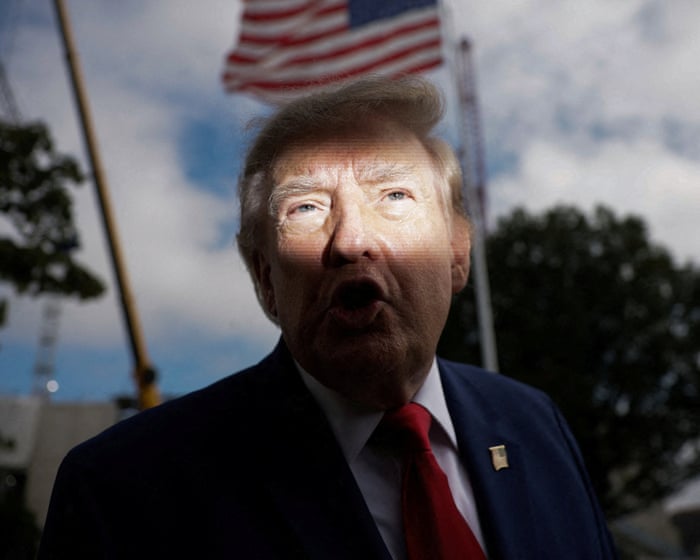
The Iran War is sprawling into an inflation nightmare for Trump ahead of the midterms

Donald Trump speaking to reporters

Getty Images; Bloomberg/Getty Images; BI

  • As the Iran War continues, gas prices remain high — a real strain for consumers.
  • The conflict has kept diesel, crude oil, and gas prices high; inflation is eating up pay hikes.
  • As America heads into midterms, it's a hard affordability position for President Donald Trump.

It's expensive out there: Gas prices have been stuck at over $4 a gallon for more days this year than any other. The war in Iran shows no signs of cooling off. Inflation is swallowing any raises you might have gotten at work.

It's a recipe for a challenging midterm cycle for President Donald Trump, who faces an affordability crisis at home that's not going away — and a far-away war that's only making costs go up.

The volatility surrounding the contested Strait of Hormuz, a key oil and gas transit waterway, has hit American consumers hard.

Since the Iran war first kicked off in February and the Strait was subsequently closed, gas and oil prices have skyrocketed. Diesel prices have hit record-breaking highs in recent weeks. That paints a dreary picture for Americans struggling with high costs, who likely won't feel any relief at the pump in the near future — especially as more potential military action looms.

Trump has highlighted the broader goals of the war and argued that the increase in gas prices would be transient. In an October 8 Truth Social post, he wrote, "a temporary increase in the price of Gasoline is a small price to pay for Iran not having a Nuclear Weapon."

While the US military has not carried out airstrikes against Iran directly in several months, it has kept a significant force presence in the Middle East, including more than a dozen warships, dozens of fighter jets, and thousands of sailors and Marines.

US forces in the region are maintaining a naval blockade against Iran, and since July, they have disabled four commercial ships that the Pentagon said were sailing in violation.

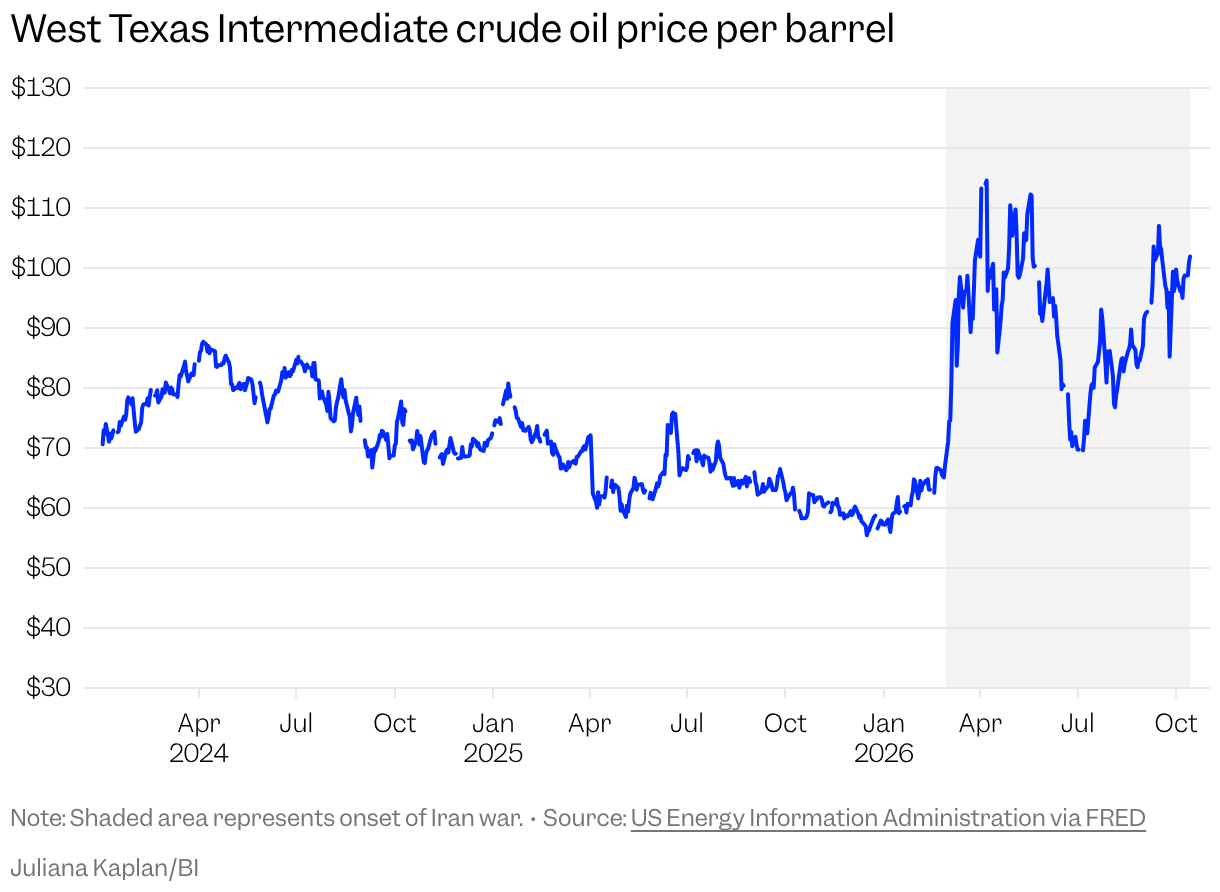
After the start of the war in February, crude oil prices soared and remain significantly higher than when Trump's second term began.

Line chart

Tanker traffic through the Strait of Hormuz nearly ground to a halt early in the Iran war, severely disrupting a waterway that normally carries about a fifth of the world's oil supply. Shipments have since recovered substantially but remain below prewar levels.

The Trump administration said it aims to alleviate issues related to oil. "The President wants to see prices at the pump fall and continues to take historic measures to alleviate temporary disruptions as oil flowing through the Strait of Hormuz approaches pre-conflict levels," White House spokeswoman Taylor Rogers said.

Vessels carrying oil and other products have continued to take fire from both sides, putting more pressure on commerce traveling through the area. US forces have carried out additional strikes on Iranian-linked targets. The Pentagon said they have destroyed 10 tankers tied to the Islamic Revolutionary Guard Corps, or IRGC, since July.

Meanwhile, several merchant ships have come under attack in and around the Strait of Hormuz this month, according to the Royal Navy-affiliated United Kingdom Maritime Trade Operations Center. US Central Command, which oversees American military operations in the Middle East, has attributed some of these strikes to Iran.

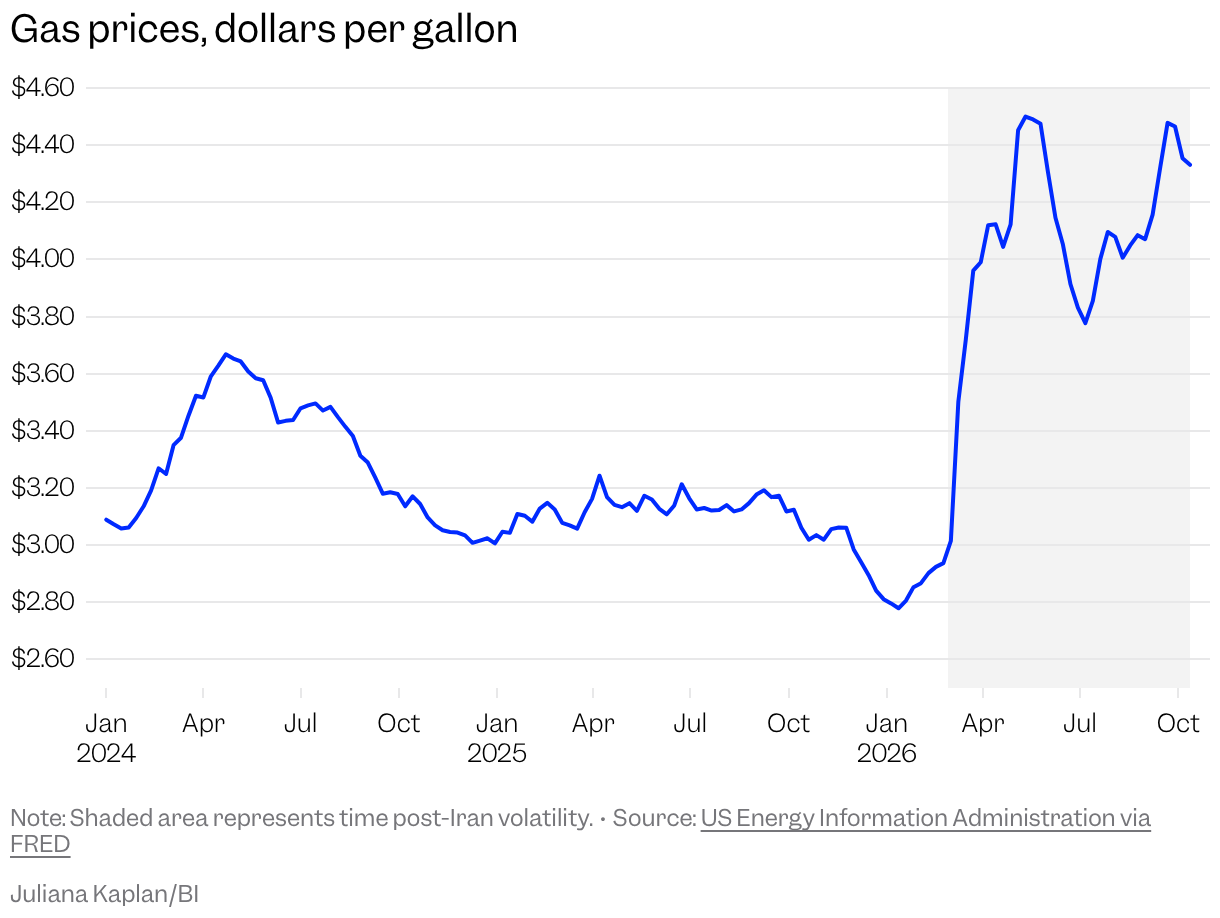
The ripples of volatility in oil prices are showing up at the pump. Long gone are the days of gas stations touting below-$3 prices; prices are still hovering in the mid-$4 range. High gas prices are even tamping down spending among higher-income consumers, and soaring costs have led to a rise in "hypermilers" — drivers who try to optimize and gamify their habits to get the best value per gallon.

Line chart

Diesel prices in the US have spiked even more, up to around $6.18 per gallon, an over $2.50 increase over the year, per the Energy Information Administration. In California, diesel is hovering over $8 a gallon.

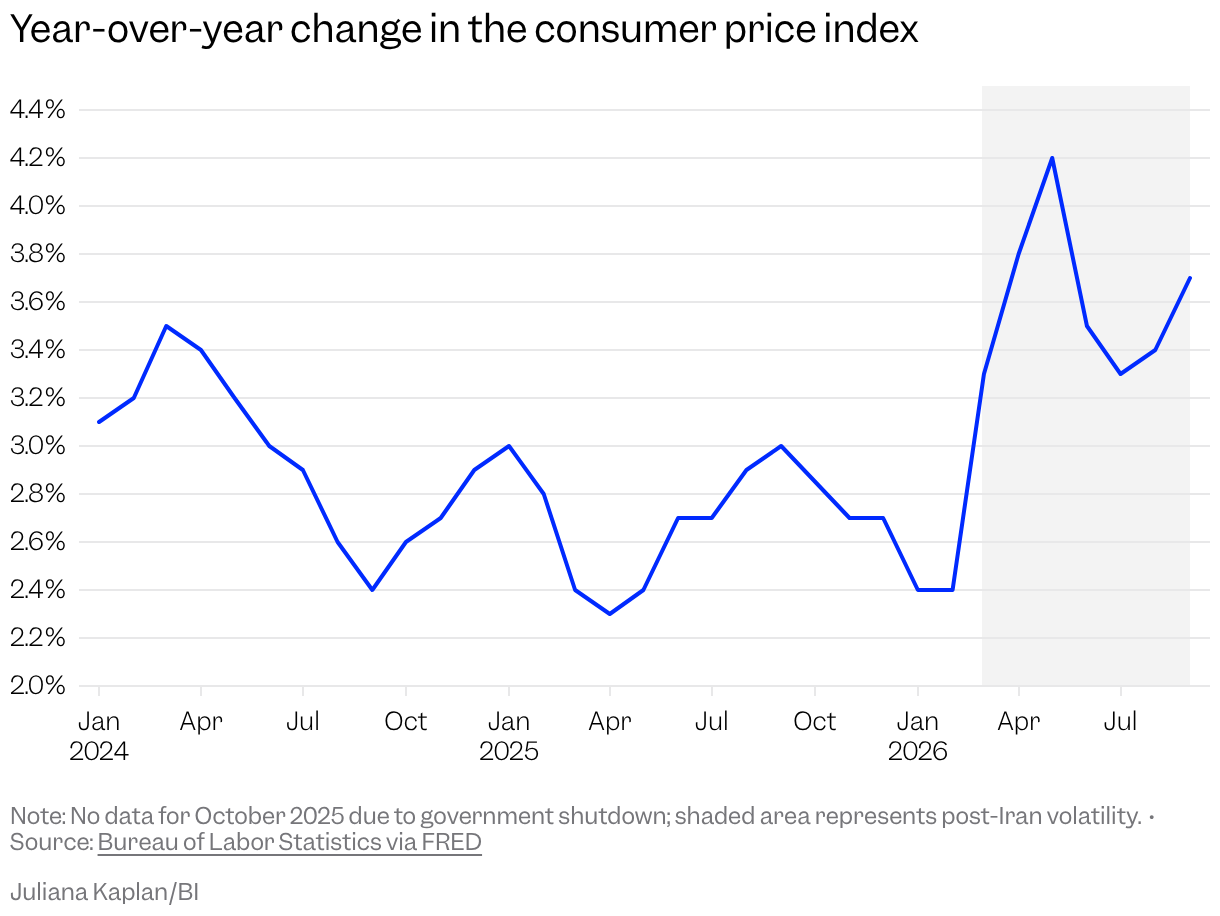
Those fuel and energy strains are pushing up costs across the economy. Inflation as tracked by the consumer price index increased to 3.7% year-over-year in September — higher than economists expected. That was driven in large part by soaring gas and energy prices, with energy rising by 20.4% year-over-year and gas by 34.2% in the same period.

Line chart

Higher inflation has put pressure on the Fed and bond markets. In September, the central bank raised rates for the first time in three years to try to combat rising prices, with one more hike potentially coming by year's end. The 10-year Treasury yield, which influences borrowing costs for mortgages, auto loans, and credit cards, has surged since the war began, from below 4% at the end of February to a high of 5.31% this month. The 30-year mortgage has risen nearly in lockstep, going from just under 6% to 7.5% during the eight-month conflict.

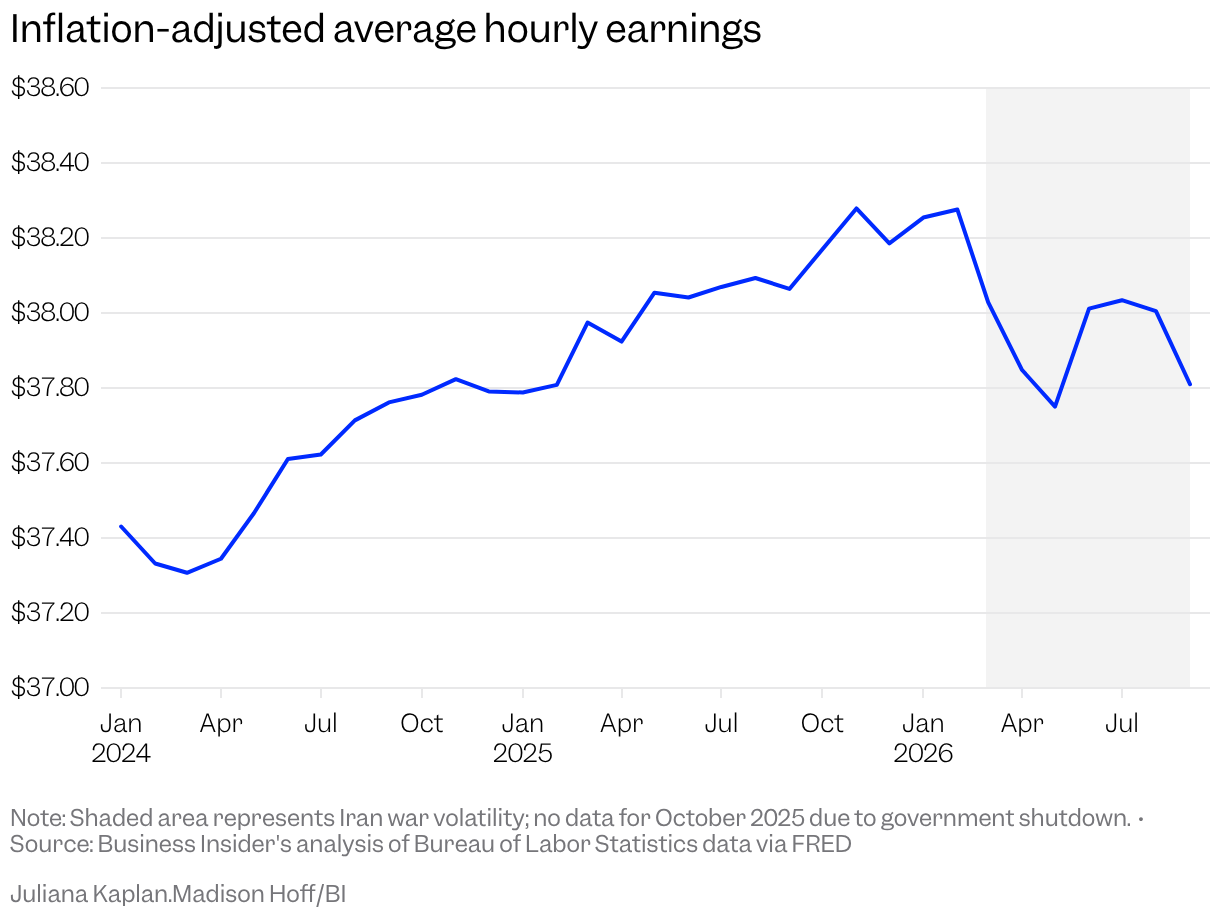
For everyday Americans, all of these international strains amount to what is, essentially, a pay cut. Wage growth remains slow and steady, but, over the past few months, rising prices have outpaced pay increases. Inflation-adjusted wages have slumped since the start of the war, and have given up nearly all their gains since the start of Trump's second term.

Line chart

When asked for comment, the White House highlighted that by some measures, earnings are still outpacing inflation. "Under President Trump, private sector workers have seen their wages continue to outpace inflation, with average annual earnings growing by more than $600," said White House spokesperson Matthew Middleton.

And, with midterm season in full swing, affordability is on the ballot for many voters. The current economic situation shows no immediate signs of changing — another blow for Trump, who's been on a quest to bring down gas prices.

There are growing signs that the US could be preparing for fresh military action against Iran. Another aircraft carrier strike group is sailing across the Pacific and is expected to enter the Middle East.

The Trump administration is also facing a resurgence in attacks from the Houthis, a rebel group in Yemen. In recent weeks, the Iran-backed rebels have seized key territory along the Red Sea, allowing them to threaten the Bab al-Mandeb Strait, another maritime chokepoint like Hormuz, and have ramped up missile strikes against Saudi Arabia.

The Houthis previously tormented Red Sea shipping, leading the Trump administration to launch a major bombing campaign last year that ended in a ceasefire. The rebels have since rearmed.

Any other disruptions there might be bad news for consumers, potentially bringing more price spikes across the many goods shipped through that chokepoint.

Read the original article on Business Insider
  •  

China’s economy grows faster than forecast after AI boom boosts exports

Third-quarter GDP up by 4.5% compared with last year as industrial output is buoyed by electronics demand

Roaring exports lifted China’s economic growth in the third quarter of this year, with factory output growing much faster than consumer spending.

China’s GDP grew by 4.5% year-on-year between July and September, the National Bureau of Statistics of China reported on Monday. The figures were better than economists had expected and up from the second quarter’s growth rate of 4.3%.

Continue reading...

© Photograph: Peter Parks/AFP/Getty Images

© Photograph: Peter Parks/AFP/Getty Images

© Photograph: Peter Parks/AFP/Getty Images

  •  

Dopo la Russia, la Cina è il prossimo obiettivo dei falchi europei?

Non disponendo delle condizioni materiali necessarie per sfidare la supremazia industriale cinese, l’Unione Europea continua a trasformare le proprie difficoltà economiche in una giustificazione per una nuova escalation delle ostilità.

Segue nostro Telegram.

I leader europei sembrano aver individuato una nuova missione strategica: ricostruire la capacità industriale del continente riducendo al contempo la sua dipendenza dalla Cina. L’iniziativa è stata recentemente avanzata congiuntamente da Francia e Germania e viene presentata come una risposta alla crescente presenza della Cina sul mercato europeo. Il problema è che i leader responsabili di questo progetto continuano a ignorare una questione fondamentale: nessuna reindustrializzazione su larga scala può avere successo senza un approvvigionamento energetico stabile, abbondante e a prezzi accessibili.

L’Europa dispone di eccellenti università, di una forza lavoro qualificata, di centri tecnologici all’avanguardia e di una tradizione industriale che le conferisce ancora notevoli vantaggi. Tuttavia, queste risorse non possono funzionare in modo isolato. Gli impianti chimici, le acciaierie, gli stabilimenti metallurgici e numerose altre industrie dipendono da un approvvigionamento energetico continuo e competitivo. Il capitale, le conoscenze scientifiche e i lavoratori specializzati non possono compensare all’infinito i costi di produzione elevati. È proprio su questo punto che la strategia dell’Europa contraddice i propri stessi obiettivi.

Per decenni, l’integrazione economica tra l’Europa occidentale e la Russia ha fornito condizioni favorevoli allo sviluppo di importanti settori industriali. Le forniture di gas naturale russo, in particolare, hanno contribuito a sostenere attività ad alto consumo energetico. Questo rapporto ha soddisfatto gli interessi economici concreti di entrambe le parti: Mosca disponeva di un importante mercato per le proprie esportazioni, mentre le economie europee ottenevano una risorsa essenziale per la loro competitività.

L’introduzione delle sanzioni nel 2022 ha profondamente alterato questa situazione. Le misure coercitive illegali hanno reciso un partenariato di lunga data tra Russia ed Europa, lasciando la parte occidentale del continente economicamente indebolita e dipendente da approvvigionamenti energetici esterni più costosi e meno sicuri. L’Europa, che già prima di allora stava subendo una graduale deindustrializzazione, è successivamente precipitata in una crisi energetica, con conseguenze che vanno dall’aumento delle bollette energetiche ai fallimenti aziendali causati dall’incapacità di mantenere una produzione competitiva.

Sarebbe ragionevole aspettarsi che una strategia di ripresa industriale iniziasse affrontando queste vulnerabilità. Invece, i leader europei stanno tentando di costruire una nuova base produttiva senza risolvere adeguatamente il problema energetico. I responsabili della politica economica europea sembrano ritenere che sussidi, incentivi fiscali e programmi di investimento siano sufficienti a ripristinare la competitività. Tali strumenti possono contribuire allo sviluppo industriale, ma la loro efficacia rimarrà limitata fintantoché persisteranno gli svantaggi strutturali nei costi energetici.

È in questo contesto che la Cina sta assumendo una posizione sempre più di rilievo nella «lista delle preoccupazioni» di Bruxelles. La capacità della Cina di produrre su vasta scala, rifornire catene industriali complesse e offrire attrezzature a prezzi competitivi rappresenta una sfida per un’Europa che cerca di recuperare la propria autonomia produttiva. Anziché riconoscere la portata del declino accumulato e sviluppare una strategia coerente per invertire la tendenza, alcuni settori della leadership europea preferiscono ricorrere a barriere commerciali, indagini punitive e meccanismi di contenimento economico.

Tale approccio rivela una comprensione piuttosto superficiale della concorrenza industriale. Limitare le importazioni cinesi non comporta automaticamente la creazione di stabilimenti europei, né riduce i costi dell’elettricità, né garantisce l’approvvigionamento di gas agli impianti industriali. Al contrario, le aziende che dipendono da attrezzature, componenti e materie prime cinesi potrebbero trovarsi a dover sostenere spese più elevate proprio nel momento in cui hanno bisogno di investire per recuperare la propria posizione sui mercati internazionali.

La questione russa rende questa situazione ancora più delicata. Il ripristino della cooperazione energetica con Mosca costituirebbe il primo passo di qualsiasi serio piano di ripresa industriale. Grazie alle forniture energetiche russe e ad ampie partnership commerciali con la Cina, l’Europa potrebbe ritrovare una nuova strada verso lo sviluppo, proprio come stanno ora iniziando a fare i paesi africani e asiatici attraverso le loro partnership con la Russia e la Cina.

Bruxelles, Parigi e Berlino, tuttavia, si stanno muovendo nella direzione opposta. Gli strateghi europei sembrano determinati a confrontarsi contemporaneamente con due delle maggiori potenze industriali ed energetiche del mondo, senza dimostrare di possedere le risorse necessarie per sostenere tale ambizione. In primo luogo, hanno compromesso un rapporto energetico fondamentale con la Russia. Ora rischiano di trasformare la Cina in un avversario commerciale permanente.

In definitiva, ciò che i falchi europei perseguono non è lo sviluppo dell’Europa, bensì la strumentalizzazione di questioni quali l’industria e il commercio per portare avanti la propria agenda autodistruttiva. In base a questa strategia, i cittadini europei – già privati dell’energia russa e potenzialmente destinati a un accesso ridotto ai prodotti cinesi nel prossimo futuro – saranno ancora una volta i primi a subirne le conseguenze.

  •  
❌