❌

Reading view

Colombia’s Congress Approves 2027 Budget Over Opposition Objections
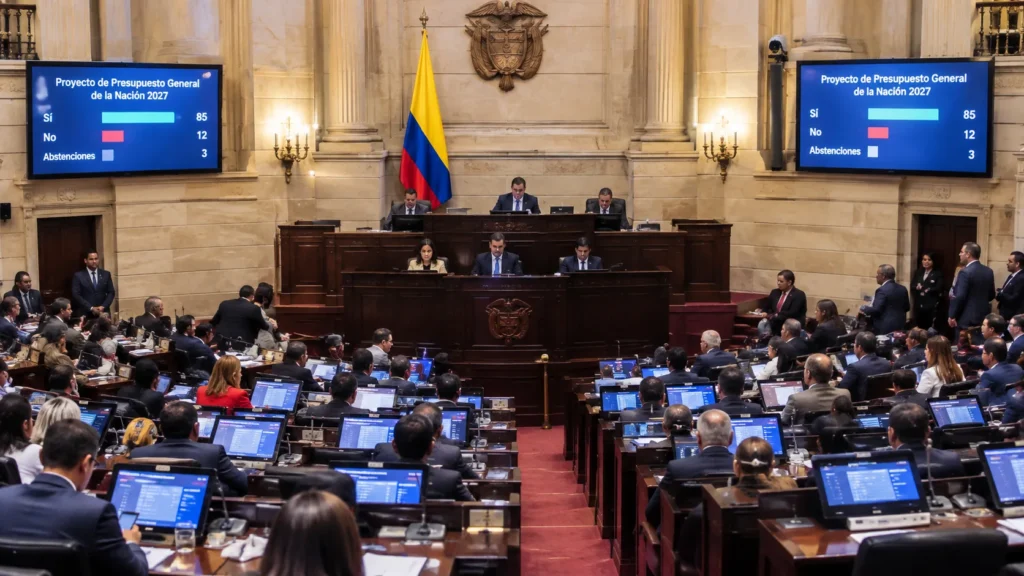
The Historic Pact questioned the law’s direction by pointing out that the government preferred to protect financial institutions, oligopolies and the most favored ones rather than devote more resources to key sectors such as education. Photo: El Pais.

Colombia’s Congress approved the 2027 national budget of 200 billion dollars on October 20, igniting a backlash from opposition lawmakers who say the plan favors debt payments and financial interests over education, peace and regional development.


The approval of the General Budget of Colombia for 2027 capped a tense legislative session.

President Abelardo de la Espriella’s government secured passage of the law, worth 634.9 trillion Colombian pesos (about $200 billion), over the objections of the opposition, which was led mainly by the Historic Pact party.

RELATED: Colombia’s First National Strike Against De la Espriella Met With Police Crackdown

Representative María Fernanda Carrascal described the debate as a “disaster” and faulted the national government for refusing to accept any of the 700 proposals submitted by her party. The initiatives sought to channel more resources into public education, support for victims of violence and the regions, she detailed. Faced with the lack of agreement, the opposition walked out of the debate, stating it would not back a measure it considers harmful to the country.

The Historic Pact also questioned the law’s orientation, arguing that the government chose to protect financial entities, oligopolies and the most favored sectors. They further denounced that the project promotes over-indebtedness, which they say will end up shifting heavier tax burdens onto Colombian citizens.

🇨🇴 ¡Colombia tiene Presupuesto para 2027!
El Congreso de la República aprobó por $634,9 billones el Presupuesto de la Verdad, el primer paso para volver a encaminar la economía del país hacia el crecimiento, la responsabilidad fiscal y la atención de las necesidades del país. pic.twitter.com/pHiLhYzVTU

— MinHacienda (@MinHacienda) October 20, 2026

Text reads: “Colombia has budget for 2027! The Congress of the Republic approved the Truth Budget for $634.9 trillion, the first step to reorient the country’s economy toward growth, fiscal responsibility, and meeting the country’s needs.”

Other voices in the legislature added their objections. Senator Jennifer Pedraza of the Dignity and Commitment party (Dignidad y Compromiso, in Spanish) criticized the absence of a fixed allocation to address the consequences of the earthquake that struck on August 10. She questioned the fact that assistance to hard-hit departments such as Risaralda, Chocó and Valle del Cauca depends solely on leftover budget balances.

Senator Ariel Ávila, in turn, lamented the underfunding of resources earmarked for electric infrastructure and energization in non-interconnected zones such as Vichada, Guainía, Arauca, Putumayo and Vaupés. He also pointed to a lack of concern for victims of the armed conflict and what he called a budgetary strangling of the Special Jurisdiction for Peace (JEP).

After the law’s validation, Congress gave the Executive 90 days to draft a fiscal adjustment plan, which the national administration has called the Rescue Law. The Ministry of Finance and the cabinet are already holding talks with the International Monetary Fund, a signal that new credit instruments and the conditions attached to them may be on the negotiating table.

Mobilization Set for November

The Historic Pact called on citizens to join a national mobilization on November 24 to reject the budget. The party maintains that the project raises debt service by 46% while cutting investment in the Special Jurisdiction for Peace by 82% and stripping 500 billion Colombian pesos (about $157 million) from the National Learning Service (SENA).

Lawmakers also warned that 14 departments will see their real investment shrink. They denounced that the norm prioritizes debt repayment over the financing of peace, education and regional development. “The complaint is clear: more resources for debt and less for peace, education and the regions,” the party stated on social media.

The mobilization announced for late November now stands as the opposition’s next test of strength. In the meantime, the government’s 90-day clock to deliver its fiscal adjustment plan is running, and the talks with the International Monetary Fund could define the conditions under which Colombia finances its 2027 spending. The opposition has vowed to keep the pressure on, both in the streets and in the legislature.

📢 ¡24 DE NOVIEMBRE: MOVILIZACIÓN NACIONAL!

La bancada del Pacto Histórico llama a la movilización frente al Presupuesto 2027 del Gobierno de Abelardo de la Espriella, por $634,9 billones.

Según la bancada, el servicio de la deuda aumenta un 46%, la inversión de la JEP cae un… pic.twitter.com/F5IYf2YDVb

— Pacto Histórico Oficial (@PactoCol) October 20, 2026

Text reads: “November 24: National Mobilization! The Historic Pact bench calls for mobilization against the 2027 budget of the government of Abelardo de la Espriella, for $634.9 billion. According to the bank, debt service increases by 46%, Special Jurisdiction for Peace (JEP) investment falls by 82%, National Learning Service (SENA) loses $500 billion, and 14 departments will receive less real investment. The denunciation is clear: more resources for debt and less for peace, education, and regions.”

  •  

Budget watchdog queries government’s 2027 forecasts for employment, prices 

Budget watchdog UTAO (full title: Technical Budget Support Unit) is querying the government’s forecasts for employment growth and prices in 2027, highlighting discrepancies with recent data. In its analysis of

The post Budget watchdog queries government’s 2027 forecasts for employment, prices  appeared first on Portugal Resident.

  •  

MEPs resist 17% cut to EU foreign aid, instead seek €25bn top‑up

MEPs have put themselves on a collision course with EU governments by rejecting plans for a 17-percent cut in foreign spending – instead demanding additional spending worth €25bn. 

Earlier this month, the Irish government, which holds the six-month rotating EU council presidency, proposed that €38bn of cuts be made from the ‘Global Europe’ heading, which covers foreign aid, as part of an overall package of €141bn of cuts to the seven-year EU budget, known as the multi-annual financial framework (MFF). 

But in a vote on Monday evening (19 October), the European Parliament’s development committee instead backed a dedicated minimum budget of €25bn for humanitarian aid, as well as dedicated budget lines for a Gaza reconstruction fund and for candidate countries. Put together, that would mean a €25bn increase on the EU Commission’s original budget of €200bn for the Global Europe heading. 

The position agreed by MEPs, by a 61-to-34 vote margin, will eventually form the basis of negotiations between MEPs and ministers when EU governments agree their position on the budget. 

This article continues, but the full version is available only to EUobserver.com subscribers. Visit account.euobserver.com/membership

  •  

EU Ministers Agree New Agricultural Market Rules as Farm Budget Dispute Continues

European Union governments have agreed a negotiating position on new agricultural market rules intended to take effect under the bloc’s 2028–2034 budget, advancing reforms to support arrangements for farmers while leaving the most contentious financial questions unresolved.

The Council approved its partial negotiating mandate on Monday, 19 October, covering changes to the Common Market Organisation regulation, which governs agricultural markets across the European Union.

The proposals include new arrangements for wine producers, protein crops and oilseeds, revised marketing standards, changes to the EU school food programme and provisions intended to improve preparedness for agricultural market disruptions.

However, the agreement does not settle future funding allocations or the broader structure of agricultural subsidies, which remain under negotiation as EU governments attempt to reconcile farming expenditure with competing demands for defence, industrial investment and regional development.

Agricultural markets under review

The Council’s negotiating position retains much of the European Commission’s original proposal while introducing amendments intended to accommodate national differences in agricultural production.

Under the proposed arrangements, sector-specific interventions would become mandatory in several areas, including beekeeping, fruit and vegetables and, under certain circumstances, wine production.

The Council has also proposed flexibility for countries where particular sectors are absent or relatively undeveloped.

For the wine industry, governments would be able to seek exemptions from certain obligations where national circumstances justify different arrangements.

This would allow the framework to retain common European rules while avoiding requirements that would be inappropriate for member states with little or no domestic wine production.

Sectoral interventions form part of the mechanisms through which the EU supports agricultural markets and producer organisations. They can cover measures intended to improve competitiveness, manage production and strengthen farmers’ commercial position.

New provisions for protein crops

The Council has endorsed the establishment of a separate sector for protein crops and oilseeds, replacing existing provisions covering dried fodder.

The objective is to encourage domestic production and reduce dependence on imported agricultural inputs, particularly crops used in animal feed and food production.

European livestock producers rely on protein-rich feed ingredients, including soyabeans, that are often sourced internationally.

Greater domestic production could reduce exposure to fluctuations in global commodity prices, transport costs and disruptions to international supply chains.

Under the Council’s proposal, member states would be encouraged to recognise producer organisations specialising in protein crops and oilseeds.

Such organisations can help farmers coordinate production, marketing and investment, although the effectiveness of the proposed measures will depend on how they are implemented nationally.

The proposals follow broader EU efforts to improve supply security in sectors extending from agricultural inputs to critical industrial materials.

School food and product labelling

The negotiating mandate also preserves the EU school scheme, which provides support for the distribution of fruit, vegetables and milk to schoolchildren.

Under the proposed framework, the programme would move from a school-year financing cycle to a calendar-year system, with transitional provisions intended to prevent disruption during implementation.

The Council has maintained the Commission’s objective of encouraging healthier eating habits by limiting products containing high levels of free sugars and fats.

The proposal also opens the possibility of additional marketing standards for several agricultural products, including protein crops, beef, pork, sheepmeat, goatmeat and rice.

These standards could provide consumers with more detailed information about product origins, subject to the final legislation.

Such measures would also have implications for producers and food businesses, which would need to comply with any new requirements concerning classification, marketing and labelling.

The Council additionally supports the harmonisation of rules covering industrial hemp, while retaining safeguards concerning seed certification and the permitted level of tetrahydrocannabinol.

Farming subsidies remain contested

The agricultural market agreement forms part of negotiations over the next Common Agricultural Policy, which will operate within the EU’s new seven-year financial framework.

Under the Commission’s proposed budget structure, several funding streams, including agricultural and cohesion programmes, would be brought together within national and regional partnership plans.

The restructuring has encountered opposition from governments and agricultural interests concerned that farming could lose protected access to EU funding.

As EU Today previously reported, 17 member states have called for agricultural and regional development expenditure to be protected against further reductions.

The Council’s latest position addresses how agricultural markets should operate rather than determining the size of the financial support available to them.

A separate debate concerns the conditions for receiving direct farm payments, including the definition of an active farmer and the degree of discretion granted to national governments.

Those questions remain central to the continuing CAP negotiations, which are due to return to the Agriculture and Fisheries Council on 26–27 October.

Negotiations move to Parliament

The Council’s partial mandate now provides a basis for negotiations with the European Parliament on the agricultural market provisions.

The legislation will still require agreement between the institutions, while its financing will depend on the eventual settlement of the 2028–2034 budget.

Governments must also complete negotiations on the wider CAP framework, including direct income support and the distribution of responsibility between Brussels and national administrations.

The market agreement reached on 19 October therefore establishes important elements of the proposed agricultural rules, but leaves unresolved the level of financial support available to European farmers after 2027.

  •  

European Parliament Demands €225 Billion for EU Foreign Policy as Budget Dispute Deepens

The European Parliament has demanded €225 billion for the European Union’s foreign policy and development programmes between 2028 and 2034, challenging proposals by member states to reduce spending under the bloc’s next long-term budget.

The Parliament’s Foreign Affairs and Development committees approved their negotiating position on the Global Europe Instrument on Monday, 19 October, by 63 votes to 27, with five abstentions. The proposed allocation represents an increase of €25 billion over the European Commission’s original €200 billion proposal.

The decision comes as negotiations over the wider 2028–2034 EU budget have become increasingly contentious, with Germany and several other net contributors opposing higher expenditure while Brussels faces mounting demands for defence, industrial investment, enlargement and support for Ukraine.

Parliament rejects proposed reductions

Under the position adopted by the parliamentary committees, at least €25 billion would be reserved for humanitarian assistance. MEPs also want dedicated funding for reconstruction in Gaza and financial support for countries seeking EU membership.

The committees are proposing that 20 per cent of official development assistance should be directed towards human development, alongside stronger provisions covering democracy, human rights and the rule of law.

Global Europe is intended to consolidate several existing financing instruments into a single framework governing much of the Union’s external expenditure. The programme would finance activities ranging from development cooperation and humanitarian assistance to economic partnerships and support for countries preparing to join the EU.

The Commission introduced the original €200 billion proposal in July 2025. However, subsequent negotiations among member states have raised the prospect of substantial reductions.

Germany, the Netherlands and several Nordic countries have argued that the next budget must reflect the financial constraints facing national governments. Their objections have complicated efforts to accommodate additional spending on European security and economic competitiveness.

The European Parliament has taken a different position, maintaining that reducing external expenditure would restrict the Union’s ability to operate internationally when European security and economic interests increasingly depend on developments beyond its borders.

Ukraine and enlargement funding

The parliamentary proposal would preserve support for Ukraine while seeking to prevent assistance connected with Russia’s invasion from reducing resources available to other partner countries.

Ukraine’s reconstruction, institutional reforms and integration with European markets will require substantial financing over the coming years. However, the precise allocation will depend on negotiations over the wider budget and the financing arrangements eventually approved.

For candidate countries, MEPs want clearer incentives linking EU assistance to progress on political and economic reforms. The proposed framework would also provide Brussels with greater powers to suspend funding where democratic standards, human rights or judicial independence deteriorate.

A separate provision would permit the Commission to suspend payments where partner countries seriously fail to meet obligations concerning the readmission of their nationals.

That measure reflects the growing connection between the EU’s development policy and its migration objectives. Brussels has increasingly sought cooperation on returns and border management as part of agreements with countries receiving European assistance.

The committees have also called for stronger parliamentary supervision of Global Europe, including more detailed reporting by the Commission and regular discussions with the commissioners responsible for implementation.

Difficult negotiations ahead

The financial disagreement extends well beyond external policy. The overall seven-year budget remains contested, particularly over agricultural subsidies, regional development funds, defence investment and repayment of borrowing undertaken during the coronavirus pandemic.

As EU Today previously reported, a group of 17 member states has opposed reductions in agricultural and cohesion spending, adding further pressure to negotiations.

The Parliament’s proposed €225 billion allocation has not been agreed by governments and does not constitute an approved spending commitment.

The committees also approved a mandate for negotiations with the Council, although their position still requires endorsement by the full Parliament, provisionally expected in November.

Meanwhile, member states must settle their own negotiating position, including the financial ceilings governing the programme.

The eventual settlement will determine how much Brussels can spend on development cooperation, humanitarian operations and international partnerships after 2027, and how those commitments can be reconciled with the EU’s expanding domestic financial obligations.

  •  

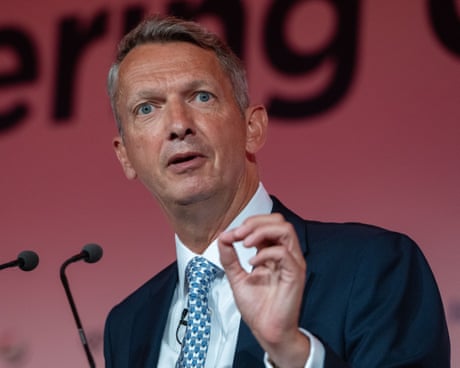
Former Bank of England chief economist says Tory growth policies ‘far more likely to succeed’ than Labour’s – UK politics live

Andy Haldane writes that Conservative economic plans would be best for growth ahead of Healey budget

Badenoch says Britain needs tax cuts.

We need to get out of the way of job creators who make our country richer. We need to encourage risk taking, wealth creation, enterprise.

Britain’s tax burden has never been higher. You are taxed on the heating in your home. You’re taxed at the petrol pump filling up your car. You’re taxed when you insure that car. You’re taxed if you take the family away on holiday. You’re taxed if you stay in the UK thanks to Andy Burnham’s tourist tax. You’re taxed to buy a home, taxed to live in a home, taxed to pass on your home. This is clearly not working. Britain does not feel better off.

Andy Burnham wrote in The Times yesterday about the moral outrage of the current benefit system. But as far as I could work out, his answer is to spend even more on benefits.

Continue reading...

© Photograph: Anadolu/Getty Images

© Photograph: Anadolu/Getty Images

© Photograph: Anadolu/Getty Images

  •  

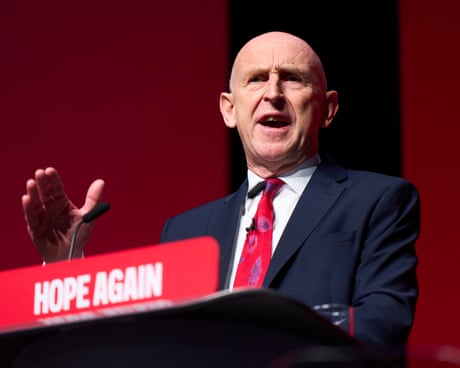
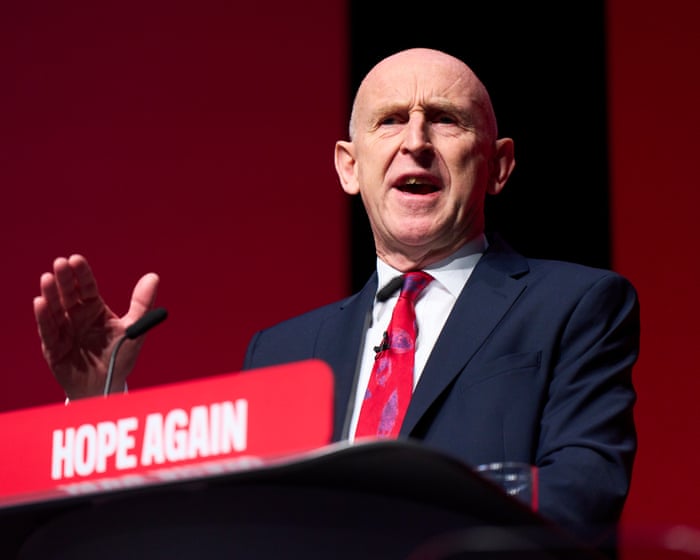
Healey to reject calls to raise capital gains tax in budget

Cabinet colleagues have previously called for an increase but chancellor feels it might ultimately cost the Treasury

John Healey will not raise capital gains tax in next week’s budget, despite previous calls to do so from cabinet colleagues including Louise Haigh and Wes Streeting.

The chancellor has decided that any increase might ultimately cost the Treasury if wealthy individuals defer the sale of assets or move them out of the country, according to Treasury sources.

Continue reading...

© Photograph: Christopher Thomond/The Guardian

© Photograph: Christopher Thomond/The Guardian

© Photograph: Christopher Thomond/The Guardian

  •  

Surprise drop in UK unemployment to 4.7% as John Healey’s first budget looms

Latest ONS data presents mixed picture amid slump in job vacancies and analysts warning labour market is ‘running on idle’

Unemployment in the UK has fallen unexpectedly in the final snapshot of the jobs market before John Healey’s first budget next week.

The jobless rate fell to 4.7% in the three months to August, from 4.9% according to the Office for National Statistics. City economists had forecast a rise to 5%.

Continue reading...

© Photograph: Susannah Ireland/The Guardian

© Photograph: Susannah Ireland/The Guardian

© Photograph: Susannah Ireland/The Guardian

  •  

France Burns

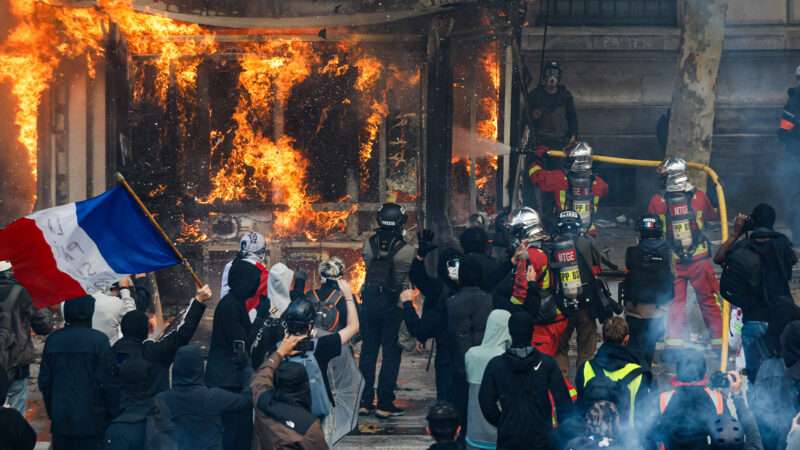
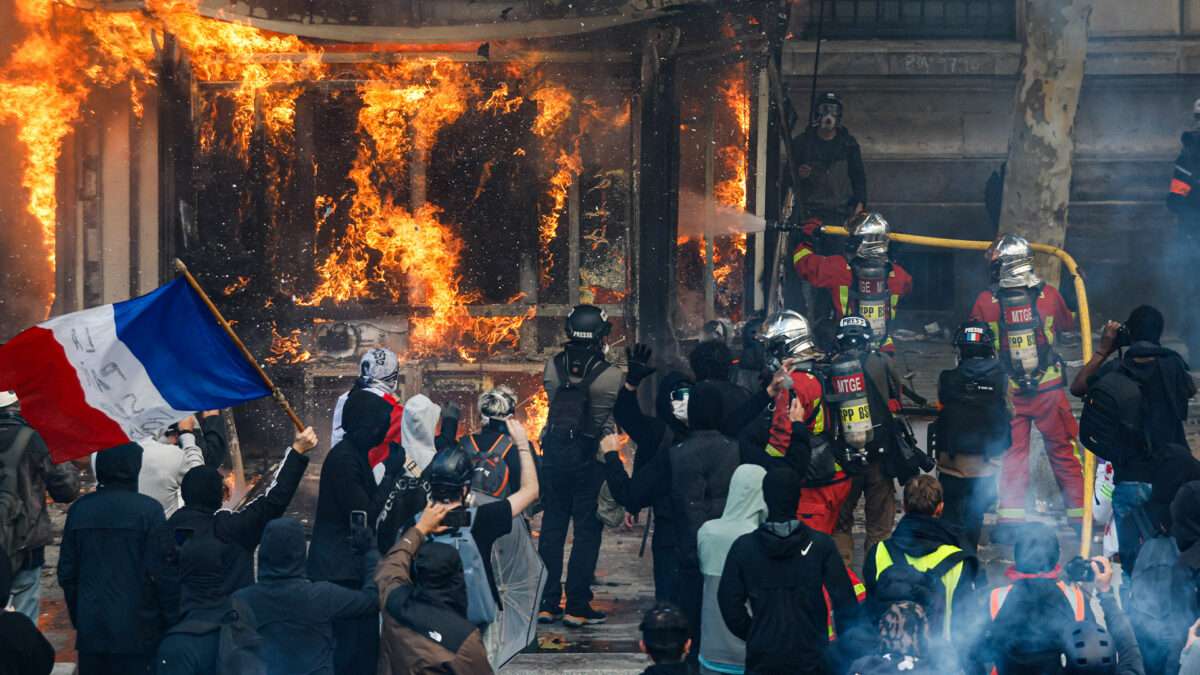
Protests in France | Abaca Press/Corsan O/Le Parisien/Abaca/Sipa USA/Newscom

Is this really about cost of living? Over the weekend, the civil unrest that had been at a simmer boiled over in cities all over France. Over 1,000 police officers were injured, with seven seriously injured. More than 2,400 people were arrested.

"Rioters…attacked city halls from Lille in northern France to Marseille in the south, where they broke into the local government headquarters and tipped over a bust of Marianne, a symbol of the French Republic," reports The New York Times. "A fire destroyed a tourist office in Lyon, and 1,500 shops were damaged or looted nationwide, according to Alexandre Bompard, head of the French federation of commerce and distribution, who estimated that the cost of repairs could run into hundreds of millions of dollars."

"They came prepared," claimed the French journalist Paul Amar on CNews. "They had the addresses of town halls. They had addresses of Jewish shop owners. In a street in Marseille, all businesses owned by Jews were set on fire. Businesses run by Muslims weren't." The Jewish Community Protection Service has disputed such claims.

Reason's Matt Welch has a good write-up of how the violence and destruction have altered Lyon, Paris, Marseille, and Limoges, where the city hall was burned and collapsed.

Ces images doivent faire le tour du monde. Nos voisins doivent savoir.

Lyon l'une des plus grandes villes de France le 17 octobre est l'une des villes les plus touchées.

A Lyon, aucun commerce n'a été épargné, oui aucun commerce n'a aucun épargné vous avez bien lu. Toutes les… pic.twitter.com/15dG6QB5lK

— Guillaume Herblot 🎖 (@Guigz75116) October 18, 2026

What was nominally about cost of living and budget issues appears to have expanded far beyond those. ("Free Palestine" and "ACAB" graffiti have been seen everywhere.) President Emmanuel Macron has blamed far-left protesters, saying they have taken advantage of the situation. Far-right leader Marine Le Pen has blamed the "Macronist administration that is out of steam, exhausted, and disoriented."

It's not clear to me how the possibility of that retirement age needs to be raised will in any way be changed by, say, donning black balaclavas and breaking into the Louis Vuitton store:

French rioters loot Louis Vuitton store located just 2 KM away from the Élysée. pic.twitter.com/cnb5aWczcN

— Drew Pavlou 🇦🇺🇺🇸🇺🇦🇹🇼 (@DrewPavlou) October 17, 2026

Here's how it all started: Since September 18, lycée (or secondary-school) students have held demonstrations, starting in the Paris suburb, Créteil. The students said the Education Ministry had neglected them—not enough resources, not enough teachers, and overcrowded classes. (The original demands were met and that strike ended, but not before sparking a wider movement.) This was all happening concurrently as the government was deciding its budget, and public-sector strikes were beginning. High social-program spending, an aging population, and high debt-to-GDP, plus an ever-increasing cost-of-living is resulting in a math problem that politicians have no real way out of except by raising the retirement age. Over the last few years, the French have had several hissy fits over the possibility of that happening.

Lawmakers from left-wing party La France Insoumise were at the first blockade on September 21, which has sparked questions about whether the party helped fuel the protests ahead of April's presidential election. I take all this—the disparate movements, the sheer volume of violence, the political-party involvement, the elections coming up—to mean that what started as an education-quality/cost-of-living protest has been used to lodge all kinds of grievances, and is attracting allies with an unquenchable thirst for violence and destruction.


Scenes from New York: "Darrel Rodriguez, 26, was shot on Saturday in the 7th Avenue Station on 53rd Street, a few blocks from Times Square, the police said. An unidentified man approached Mr. Rodriguez on the northbound E train platform, drew a gun and shot him once in the chest, they said," reports The New York Times. The man who shot Rodriguez was wearing a full balaclava-style face covering, and has not been found by the cops.

Philadelphia enacted a ban on such masks back in 2023. Just anecdotally, I've seen a lot of them in New York, but not by people trying to stay warm in the cold—these types of masks are used by people hopping turnstiles, stealing from bodegas, and more. Some bodega owners have started posting signs on their doors saying masks aren't allowed, since it's become such a problem.

"As of Oct. 11, there have been 1,697 crimes in the transit system since the start of the year, 27 more than the same period in 2025," reports The New York Times, citing Police Department figures.


QUICK HITS

  • Inside the property-tax rebellion.
  • In Texas, Ken Paxton appears to have lost the support of suburban women, according to The Washington Post.
  • "Jewish life in the Emirates has grown quieter and less visible," notes The New York Times. "Religious symbols have disappeared, and gatherings have moved into private. Many have become more guarded about their online presence and their willingness to speak to the media. Some are reconsidering how openly to identify themselves as Israeli or Jewish, while others weigh whether they can still build a life in a nation they once considered a haven."
  • Can you really see everything?

YOU CAN SEE EVERYTHING is doing a public service if it gets the general population to question why, precisely, folks lend so much credence to documentaries as vehicles of truth. https://t.co/n7CHwkmDmr pic.twitter.com/IHUvEbKECl

— Sonny Bunch (@SonnyBunch) October 18, 2026

  • "I recently attended a meeting of the Democratic Socialists of America, where I officially enrolled as a member. Though I was new to the party, I put forth a number of proposals, many of which were met with considerable enthusiasm and, I'm happy to report, have now been incorporated into their manifesto," writes Larry David in a satirical essay for Airmail. "We contend that the only way anyone can be rehabilitated is through the simple act of love. When the D.S.A. takes over, it will be our policy to close the jails and release all prisoners. Once released, the former prisoners will continue to walk around in their orange jumpsuits, the easier to spot them. People will be encouraged to give them a pat on the back, offer some words of encouragement, and maybe even get them to open up about their crimes. Imagine how upsetting it must be to know you've taken a life! To err is human, to forgive, divine. With empathy and compassion, it's easy to see a day when these former convicts will be contributing to society in a very meaningful way." It's not that funny of an essay, but I think it's great for more people to be talking about how asinine DSA ideas are.

The post France Burns appeared first on Reason Magazine.

  •  

No 10: Hegseth ‘wrong’ to say most non-US Nato soldiers didn’t fight in Afghanistan – UK politics live

Downing Street delivered a rare rebuke to a senior member of Donald Trump’s administration

Asked why the Lib Dems were opposed to a third runway at Heathrow when they professed to be in favour of growth, Cooper said she did not accept that a third runway would produce all the benefits its supporters claimed.

She explained:

On Heathrow, it is clear from looking at all of the economic analysis of airport growth over the last few years that many of the promises made by all sorts of different airport companies simply haven’t come to bear.

The promise of higher wage jobs hasn’t been substantiated. Often it’s lower paid jobs, and often not as many as they’ve claimed.

Continue reading...

© Photograph: Manuel Balce Ceneta/AP

© Photograph: Manuel Balce Ceneta/AP

© Photograph: Manuel Balce Ceneta/AP

  •  

Profit warnings from UK-listed firms at highest level in two years as Iran war drives up costs

Consultancy says companies quoted on London stock market issued 65 in three months to end of September

The number of profit warnings from UK-listed companies has risen to the highest level in two years, as the war in the Middle East triggers a surge in costs for businesses before the budget.

With less than a fortnight before John Healey’s tax and spending statement to the Commons, the consultants EY-Parthenon said companies quoted on the London stock market had issued 65 warnings in the three months to the end of September.

Continue reading...

© Photograph: Gareth Fuller/PA

© Photograph: Gareth Fuller/PA

© Photograph: Gareth Fuller/PA

  •  
  •  

Merz Demands Deeper EU Budget Cuts as Brussels Summit Fails to Break Deadlock

EU leaders have failed to settle their differences over the 2028–2034 budget, with Germany demanding further reductions to the proposed spending framework and the European Council taking charge of negotiations ahead of a difficult December deadline.

European Union leaders have ended their Brussels summit without agreement on the bloc’s next seven-year budget, after German Chancellor Friedrich Merz rejected the scale of spending envisaged under the latest compromise proposal and demanded deeper cuts.

The discussions on 15–16 October exposed the continuing division between governments determined to contain national contributions and those seeking to protect agricultural subsidies, regional development and new European investment programmes. The dispute now threatens the political timetable for approving the 2028–2034 Multiannual Financial Framework, the budget that will determine the Union’s spending priorities over the next seven years.

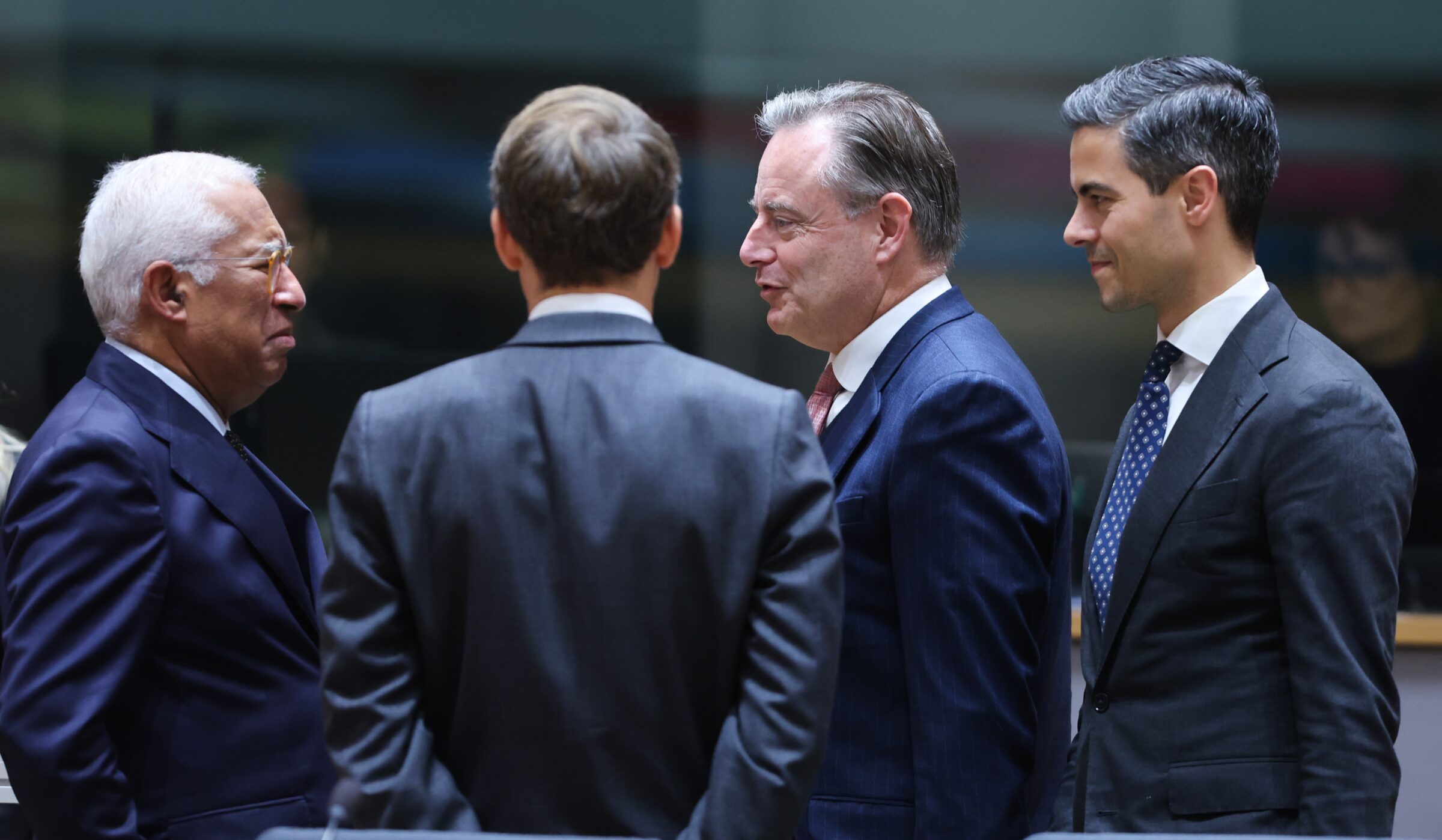
In their formal summit conclusions, leaders invited European Council President António Costa to take negotiations forward towards a timely agreement. No new spending settlement was endorsed, despite the Irish presidency having presented revised figures immediately before the summit.

Germany rejects the compromise

The European Commission originally proposed a framework approaching €2 trillion in current prices, arguing that Europe needed greater financial capacity to meet its growing responsibilities in defence, competitiveness, technological development, migration and external security.

Ireland, which holds the rotating Council presidency, submitted a revised negotiating document on 10 October intended to narrow the differences between governments. The latest proposal includes substantial reductions compared with the Commission’s initial ambitions while seeking to preserve financing for established EU programmes.

Those concessions have not satisfied Berlin. Merz argues that the Union must recognise the difficult fiscal position facing national governments and that the proposed increases in common spending remain excessive.

Germany, the largest contributor to the EU budget in absolute terms, has been working with other budget-conscious governments to seek reductions from the original Commission proposal.

EU Today reported on the proposed €141 billion in reductions, including the implications for defence and competitiveness funding.

The Irish compromise has done little to bridge the divide. The revised framework seeks to combine greater financial restraint with protection for agricultural and cohesion policies, while retaining significant investment in security, research and competitiveness.

Yet every attempt to rebalance the proposed spending exposes another political conflict.

Agriculture, cohesion and defence compete for funding

The Common Agricultural Policy and cohesion funding remain among the largest and most politically sensitive components of the EU budget. Agricultural payments support farmers across the Union, while cohesion programmes finance infrastructure, regional investment and economic development, particularly in less prosperous territories.

Governments benefiting heavily from those programmes are reluctant to accept reductions, particularly when national finances are already under pressure.

France, Italy and other countries defending traditional EU expenditure have therefore resisted attempts to transfer the burden of budget restraint disproportionately onto agriculture and regional support.

At the same time, the Commission has argued that the EU cannot simply preserve the spending structure of previous decades while promising a stronger role in European defence, industrial development and economic security.

The contradiction is increasingly apparent. European governments demand greater independence from external suppliers, stronger military capabilities and sustained financial support for Ukraine, yet remain unwilling to agree on the larger common budget that might help deliver those objectives.

Cuts to research, innovation, cross-border infrastructure or defence-industrial programmes would not necessarily produce immediate political costs. Their consequences would emerge later, through investments postponed, capabilities not developed and projects left dependent on national budgets.

Conversely, reducing agricultural payments or regional investment would produce more immediate resistance from farmers, local authorities and national governments.

The demands of 17 EU governments seeking to protect farm and cohesion spending illustrate the growing tension between established programmes and the Union’s newer strategic priorities.

A timetable becoming difficult to defend

The Council’s budget negotiations had been intended to deliver a political agreement before the end of 2026. That would leave 2027 for the European Parliament and member states to complete the legislation required for the new financial framework to operate from January 2028.

Failure to reach that timetable would not immediately stop EU expenditure. It would, however, compress the period available for completing the detailed legal arrangements underpinning individual programmes and could complicate the uninterrupted delivery of funding at the beginning of the next budget cycle.

The political environment is hardly favourable. Several governments face difficult domestic debates over public spending, taxation and the demands of European integration. In France, the approach of the 2027 presidential election adds another complication to negotiations requiring sensitive national concessions.

Agreement on the seven-year framework requires unanimity among member states, followed by the consent of the European Parliament. The latter has already argued that the EU needs sufficient financial resources to match the responsibilities its governments have assigned to it.

Costa now faces the task of converting competing national positions into a financial settlement that all 27 governments can accept. That will require decisions not only about the overall ceiling but also about the balance between national allocations and programmes managed at European level.

The Brussels summit has demonstrated that the principal disagreements remain unresolved. The next negotiating round will determine whether governments are prepared to compromise on spending priorities or whether their ambitions for a more capable European Union will once again run ahead of their willingness to finance it.

  •  

‘No Meloni Day’ Brings Thousands of Italians Out Onto the Streets

Demonstrations over school funding and discrimination coincide with protests by truckers, farmers and climate activists.

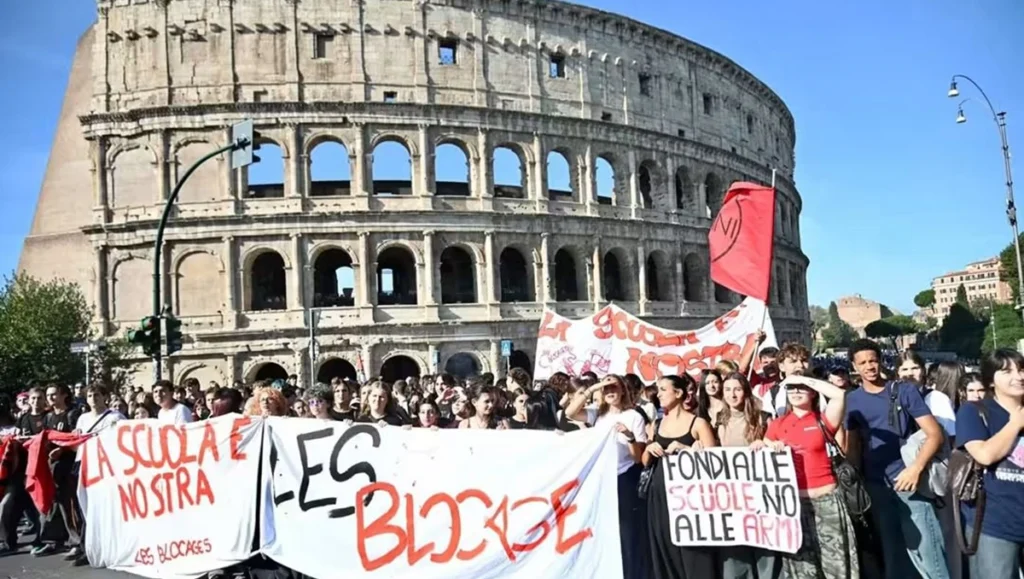
On Friday, thousands of students and teachers took to the streets in several Italian cities to protest the policies of Prime Minister Giorgia Meloni.

RELATED:

Italy’s Giorgia Meloni Trademarks Her Voice Against AI Deepfakes

The protests followed several days marked by a wave of school occupations in Milan, Naples, Turin, Genoa, Bologna and Rome.

The nationwide mobilization, dubbed “No Meloni Day,” combined demands over budget allocations with direct criticism of the Italian government’s environmental policies.

Student groups denounced the progressive deterioration of school infrastructure and called for the €13 billion allocated to military spending to be redirected toward education.

Representatives of the Alternative Student Opposition criticized the rising cost of living and announced a general strike scheduled for Oct. 30.

Un carro armato di cartone è stato dato alle fiamme durante il corteo degli studenti a Torino. Alcuni manifestanti hanno incendiato il modellino con fumogeni colorati, accompagnati dai cori "Brucia, brucia" e dallo slogan "Noi la guerra non la paghiamo", per protestare contro le… pic.twitter.com/RM7BH94cf9

— Sky tg24 (@SkyTG24) October 16, 2026

The text reads, “During a student protest in Turin, a cardboard tank was set on fire. Demonstrators ignited the model using colored smoke flares, chanting “Burn, Burn!” and the slogan “We will not pay for war,” as a form of protest against military spending.

The demonstration was part of the “No Meloni Day”—a day of student mobilization against the government’s educational policies, rising tuition costs, and increased military expenditure.

Similar protests took place across Italy, specifically in Rome, Milan, Florence, Genoa, Venice, Padua, Treviso, and Cagliari. In the capital, organizers estimated the turnout at 20,000 people, while in Turin, more than 2,500 students took to the streets.”

During marches in Rome, tensions escalated when some protesters threw firecrackers and trash containers outside the Education Ministry. Riot police and Carabinieri officers established security cordons and used tear gas to disperse the crowd on Via Marmorata.

“Thousands of students marched from the Colosseum to the Education Ministry. Tensions rose because of a group of masked protesters who threw bottles and improvised explosive devices at law enforcement officers, as well as discharged fire extinguishers,” RaiNews reported.

Similar clashes occurred in Turin and Bologna outside the prefecture and the central railway station, where police responded with water cannons. The violence led to confrontations involving blunt objects, the detention of a masked minor and severe disruptions to rail traffic in northern Italy.

"No Meloni Day"
Police charges against students
in Rome and Turin. pic.twitter.com/5IGt2pUQLU

— 𝕃𝕦𝕔𝕚𝕒𝕟𝕠 𝕃𝕦𝕝𝕫 (@altrella_l) October 16, 2026

Students Reject Discrimination and Racism

Thousands of people marched peacefully in Milan, holding signs and chanting slogans in support of social integration. Youth organizations strongly opposed Meloni’s “Valditara Decree,” which they described as discriminatory and racist.

In effect since June, the decree bans sex and relationship education at the preschool and elementary school levels and requires parental consent to address these topics at other educational levels. It also sets a maximum of 30% for foreign students in each classroom.

“Are these really the problems that need to be solved?” and “Racists out of our schools!” protesters shouted, according to RAI News.

“An entire generation has taken to the streets because it refuses to bow its head — to mind its own business — while others destroy our future,” said Alice, who linked the student movement’s demands to the genocide in Gaza.

“And it all starts right here, in our schools. The pro-Palestinian demonstrations made that clear: Some people have blood on their hands — the blood of genocides taking place around the world — and those same hands are cutting funding for our schools, our lives, and a dignified future in this city.”

“Outside the regional education authority’s headquarters, some participants threw eggs filled with red paint, declaring, ‘This is the blood of Gaza and Palestine,’” RaiNews reported.

No Meloni day here in Italy and antifascist students are facing-off with her cops right now in Bologna. Solidarity comrades.
No Fascism. No Genocide. No Meloni. pic.twitter.com/wQsgtjRRV2

— GhostofDurruti (@DurrutiRiot) November 14, 2025

Truckers, Farmers and Environmentalists Voice Discontent

On Friday, southern Italy faced a severe fuel shortage in the provinces of Calabria, Basilicata and Apulia because of protests by truckers and farmers. Steelworkers’ blockades at Eni’s Taranto refinery brought gas stations to a standstill, causing long lines and operational difficulties for public transportation.

The transport industry association Conftrasporto reported an increase of more than 50 euro cents per liter in diesel prices and demanded the immediate release of budget funds.

Facing the imminent risk of supply shortages, the Ministry of Infrastructure and Transport called an emergency meeting with industry representatives for Oct. 27.

The student mobilization also coincided with global protests organized by “Fridays for Future” in support of climate action and against fossil fuels.

Italian environmentalists marched to the Environment Ministry in Rome to demand reductions in polluting emissions and action to combat energy poverty across the country.

teleSUR/ JF

Source: RAI – EFE – teleSUR

  •  

Europe’s Poverty Divide Persists as New Figures Reveal Huge Regional Disparities

Nearly 93 million EU residents were at risk of poverty or social exclusion in 2025, with the latest regional figures revealing sharp differences both between and within member states. The findings raise questions about how effectively European investment is addressing longstanding economic inequality.

More than one in five people living in the European Union remained at risk of poverty or social exclusion in 2025, according to Eurostat figures that reveal substantial differences in living conditions across the bloc’s regions.

Approximately 92.7 million people, representing 20.9 per cent of the EU population, fell into the category during the year. Although the total declined slightly from 93.3 million in 2024, regional data show that economic vulnerability remains heavily concentrated in particular areas.

In 26 of the 243 EU regions for which figures were available, at least 31 per cent of residents were at risk of poverty or social exclusion. At the opposite end of the distribution, 24 regions recorded rates below 13 per cent.

The regional figures published by Eurostat show that the highest rate was recorded in French Guiana, at 54.8 per cent, while Slovakia’s capital region, Bratislavský kraj, recorded the lowest at 2.9 per cent.

National averages conceal substantial differences

The contrast is not confined to richer and poorer member states. In several countries, internal regional disparities are more pronounced than comparisons of national economic performance might suggest.

Within Slovakia, the proportion of people at risk of poverty or social exclusion in Východné Slovensko was 9.1 times the rate recorded in the Bratislava region.

In Italy, the equivalent rate in Calabria was 8.1 times that of Valle d’Aosta, illustrating the persistent economic divide between parts of the country’s north and south.

These differences are recorded in Eurostat’s regional living-conditions statistics, which provide a more detailed picture than EU-wide or national averages.

The comparison requires care. Eurostat’s measure of poverty or social exclusion combines three indicators: relative income poverty, severe material and social deprivation, and very low household work intensity.

Consequently, the figures do not mean that every person included lacks sufficient income to meet basic needs. They identify people experiencing at least one of the defined forms of economic disadvantage.

Differences in income, employment, household composition and living costs can also influence the results, making direct comparisons between metropolitan areas, rural districts and overseas territories more complicated than a single percentage might imply.

Nevertheless, the scale of regional variation illustrates why national economic growth does not automatically produce equivalent improvements in living standards throughout a country.

Poverty reduction remains an EU commitment

The European Union has set a target of reducing the number of people at risk of poverty or social exclusion by at least 15 million by 2030, including at least five million children.

The limited annual reduction recorded in 2025 indicates that progress remains modest relative to the scale of that objective.

The problem has become increasingly important for European policymakers as housing costs, energy prices and employment insecurity affect household finances in different ways across member states.

In May, the Commission presented an anti-poverty and housing policy package, bringing together measures concerning social inclusion, housing exclusion and child poverty.

The regional figures indicate that such initiatives will need to account for considerable differences in local economic conditions.

Policies designed for prosperous urban economies may have limited relevance in regions characterised by low employment, weak infrastructure or dependence on a small number of industries. Conversely, economic activity and relatively high average incomes do not necessarily prevent serious poverty problems within major cities.

Cohesion funding becomes a central question

The findings have direct relevance to negotiations over the EU’s next long-term budget, covering 2028 to 2034.

The European Commission’s proposal envisages roughly €450 billion for economic, social and territorial cohesion under national and regional partnership plans, including at least €218 billion for less developed regions.

The proposed structure would combine several funding programmes within broader national plans, with the Commission arguing that the changes could improve coordination and make spending more responsive to local requirements.

However, regional authorities have expressed concern that greater national control over financial allocations could weaken their influence over investment decisions.

As EU Today reported earlier this week, representatives of European regions have warned that the proposed budget arrangements could concentrate decision-making in national capitals.

The latest poverty statistics provide a concrete context for that disagreement. Investment priorities may differ considerably between a region experiencing industrial decline, an agricultural area with limited employment opportunities and a metropolitan district facing severe housing affordability problems.

A central question for EU institutions is therefore how funding allocations will reflect measurable regional needs rather than being driven primarily by national political negotiations.

The Commission maintains that its proposed partnership arrangements will protect allocations for less developed regions and continue supporting social inclusion.

Negotiations over the financial framework will determine how those commitments are translated into enforceable rules, while Eurostat’s figures provide a statistical basis against which future claims of progress can be assessed.

With 92.7 million people still at risk, the debate is not simply about the overall size of the EU budget. It is also about whether spending reaches the communities where economic disadvantage remains most concentrated.

  •  

Pressure mounts on EU leaders to strike a budget deal by December

EU leaders met Thursday (15 October) for their first face-to-face talks on the 2028–2034 budget, killing the latest negotiation proposal put forward by Ireland.

Dublin, which holds the symbolic EU Council presidency, proposed cuts of up to €141bn from the long-term budget,  about eight percent less than the commission proposal. But it failed to make anybody happy, for different reasons. 

And now, EU Council president António Costa has been tasked to deliver a new compromise before EU leaders meet again on 26 November in Brussels, with the goal of striking a deal during the summit in December. 

An EU official said Costa deemed the deal in December as “essential,” urging EU capitals “to assume their responsibility”.

For Denmark, for example, it is important to have more funds for defence, borders, illegal migration, and competitiveness. “It will probably be as difficult as it was last time or even more difficult,” said Danish prime minister Mette Frederiksen ahead of the meeting.

“We need unanimity in the Council. We are far from that unanimity,” also said German chancellor Friedrich Merz before meeting counterparts.

The EU is divided into two camps. The so-called Frugals (Germany, Austria, Denmark, Finland, the Netherlands, and Sweden) want “several hundred billion” more to be cut, mostly from agriculture and cohesion funds, while 17 EU member states (self-named as Friends of Cohesion) criticise the savings. 

But time is of the essence to reach a deal this year, especially for French president Emmanuel Macron. France will hold presidential elections in the spring, and if Marine Le Pen, leader of the far-right National Rally party, wins, reaching an EU deal would become far more difficult.

Le Pen has pledged that, if she comes to power, she will halve France’s contribution to the EU budget.

And Macron reportedly said in the room with EU leaders that from January onwards, there will be no political room for reaching an agreement.

‘Easier to give up what you don’t yet have’

This article continues, but the full version is available only to EUobserver.com subscribers. Visit account.euobserver.com/membership

  •  

The Federal Government Collected $5.4 Trillion. It Still Can't Pay Its Bills.

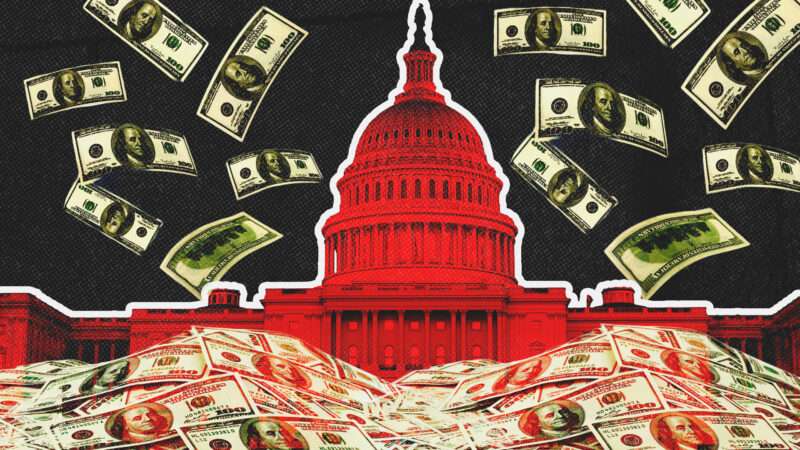
U.S. Capitol in red as money falls around it | Illustration: Nikolai Sorokin/Songquan Deng/Dreamstime

The federal government just closed fiscal year 2026 with a deficit of nearly $2 trillion, according to figures the Congressional Budget Office (CBO) released last Thursday. Only the two pandemic years of 2020 and 2021 were worse. Today, though, there is no recession and no emergency. These enormous budget deficits are the new normal.

The usual response to a deficit warning is that the government just needs more money. It doesn't. Thanks to the remarkable strength of the private sector, federal revenue rose by 3 percent, to more than $5.4 trillion, over the fiscal year. But spending rose by 6 percent, reaching $7.4 trillion.

Some will blame the Supreme Court for striking down most of President Donald Trump's tariffs and forcing the government to issue refunds. But even if Washington had kept the $130 billion in illegal levies, it would cover less than one-tenth of the gap. Tariffs were never a serious revenue source at our insanely high level of spending.

Look at where the money went. Spending on the three main entitlement programs—Social Security, Medicare and Medicaid—grew by 7 percent. That's faster than total spending growth. Defense grew by 5 percent. Interest on the debt rose by 11 percent, exceeding $1.1 trillion. That last figure is the bill for every earlier year of borrowing—years when Washington was sending clear signals that it isn't serious about fiscal responsibility.

If you want to see where such irresponsibility can lead, look at France. The country that big spenders from Paul Krugman to Sen. Bernie Sanders (I–Vt.) have cited as proof that big government is viable and full of upsides is now on the brink of a serious crisis. France's debt equals 120 percent of its gross domestic product (GDP), and interest payments are rising quickly. Slow growth and social unrest aren't helping.

The U.S., of course, has some advantages that France doesn't, largely because we're a country of innovators with a private sector unmatched at creating wealth. Nonetheless, debt that is swelling out of control should still worry us. First, the same anti-wealth and anti-growth forces that brought France to where it is now are gaining popularity here. Second, we too will see debt reach 120 percent of GDP in a few years, and our interest payments are already consuming an alarming share of resources.

A wise Congress would put us on safer footing if only because debt raises interest rates for everyone, from homebuyers to small businesses. This operates as a drag on growth, and hence on wages. In other words, controlling debt should be part of an affordability agenda in the same way as streamlining regulation.

When legislators decide to take affordability seriously, I recommend looking at a September Advancing American Freedom (AAF) report on this topic. Its section on fiscal restraint offers a useful menu of reforms, including targeting the programs that most drive the debt.

Start with Social Security. Under current law, benefits will be cut by roughly 20 percent when the program's trust fund runs dry in the early 2030s. Nobody believes Congress will actually let that happen, but we'd better hope its answer isn't to double down by borrowing the difference between payroll taxes and benefits.

Nor are tax increases an option. The payroll tax meant to fund entitlements is now 12.4 percent of wages. It began at 2 percent when Social Security was first rolled out. It is also the most burdensome tax for many Americans. Enough already. The fixes AAF fellow Rachel Greszler proposes are worth considering: Index the retirement age to life expectancy, use an accurate inflation measure for cost-of-living adjustments, and move gradually toward a flat universal benefit that protects lower-income retirees while ending Social Security's de facto welfare for the wealthiest.

Next is Medicare. More than 40 percent of its financing already comes from general revenue rather than from payroll taxes. The report recommends converting the program to premium support, giving beneficiaries a fixed contribution to spend on traditional Medicare or on competing private plans. It would also raise the eligibility age to 67, matching Social Security, and trim subsidies for well-off seniors. That's a start.

As for Medicaid, the problem is one of pricing. And yet competition based on price—the best cost-control tool—has never been seriously tried. Washington covers 90 percent of the cost of states' expanded Medicaid programs for adults. A state can buy a dollar of spending with just a dime of its own money. Changing the states' incentives would be key here. Implementing risk-adjusted per-capita caps, through which the federal government would give states a fixed amount per enrollee, would do just that. States would pay for their own inefficiencies or would be able to use every dollar they save by becoming more efficient.

The same logic supports returning more welfare programs to states, starting with the federal share of the Supplemental Nutrition Assistance Program. State governments have to balance their budgets in some form.

None of these reforms are painless. But the alternatives will prove far more painful. The U.S. will either continue paying a slow, unlegislated tax called inflation or face a fast, ugly fiscal crisis when bond buyers stop giving Washington the benefit of the doubt.

COPYRIGHT 2026 CREATORS.COM

The post The Federal Government Collected $5.4 Trillion. It Still Can't Pay Its Bills. appeared first on Reason Magazine.

  •  

Ukraine’s war budget has $52 billion hole, and army needs $45 billion more on top

zelenskyy with koretskyi

Ukraine is seeking fresh funding for 2027 and says it is ready to deliver the reforms. Prime Minister Serhii Koretskyi says Ukraine’s external budget financing need for 2027 exceeds $52 billion, with more than $32.6 billion still to be raised.

That money underwrites the basics of a country at war: the army, pensions, hospitals, and support for business, he notes. Defense and security alone will take almost 44 percent of GDP in the 2027 budget, and the gap comes as Russia keeps hammering the infrastructure that generates Ukraine’s own revenue.

“The defense capability of the country, the payment of pensions, the support of hospitals and business depend on these funds,” Koretskyi says.

The hole Russia keeps digging faster than Kyiv can fill it

Russia’s strikes widen the gap even as Kyiv tries to close it. Russia systematically attacks critical infrastructure, business, production and civilian sites, and the destruction and halted enterprises will leave tax revenues about $1.5 billion below forecast by the end of the year, he warns.

For instance, output of Ukraine's steel industry, one of the pillars of its wartime economy, fell 57.3% in August due to Russian strikes. This sector is Ukraine's second-largest foreign-currency earner, employing more than 70,000 people directly and another 250,000 in related industries, and paying close to $1 billion a year in taxes.

Beyond the budget itself, the off-budget needs of Ukraine’s Defense Forces for 2027 are estimated at $45 billion, or about 40 billion euros, a figure that sits on top of the $52 billion budget requirement, he says.

The reforms Kyiv must deliver to unlock the money

The money hinges on reforms Ukraine still has to deliver. In the next few days, the government is to approve all the decisions needed to continue financing.

“Ukraine continues to work on fulfilling its part of the commitments. This week, the government is expected to approve all the necessary decisions to ensure continued funding,” the Ukrainian prime minister says.

Meanwhile, the Parliament plans to consider the bills required under the support programs of the IMF, the World Bank and the EU.

  •  

Leaders eye deep EU budget cuts, while long-term joint borrowing becomes the new normal

Last Saturday, the Irish presidency of the EU proposed cutting nearly €160bn from the EU’s next seven-year budget against the European Commission’s proposal, a bid to bring the wealthiest, frugal member states on board. The deepest cuts fall on competitiveness (€75bn), external action (almost €38bn) and the EU’s administration costs (€10bn).

What the plan leaves alone is the borrowing.

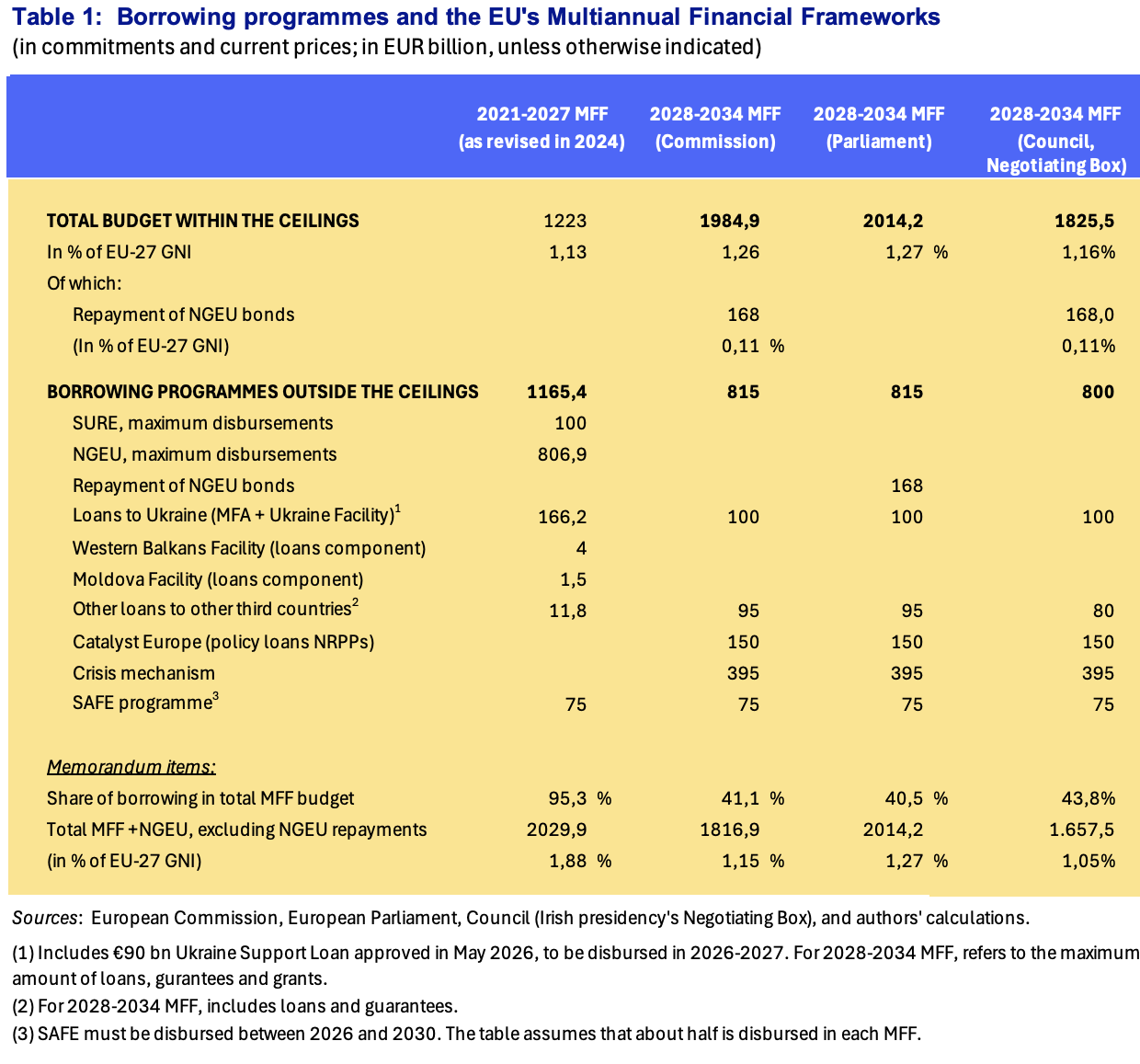
The Irish text, known in Brussels as the negobox, keeps all three of the commission’s borrowing programmes that sit outside the budget’s normal limits: Catalyst Europe, a €150bn lending facility; a crisis mechanism of up to €395bn for major unforeseen shocks; and support for Ukraine of up to €100bn.

Add loans for defence and lending to other non-EU countries and, by our estimates, joint borrowing could still equal around 44 per cent of the new budget, about €800bn at current prices, up from 41 per cent under the Commission’s proposal. The budget shrinks, but the borrowing hardly changes. 

Ireland’s proposed budget is too small for Europe’s mounting common challenges, and its borrowing approach is too ad hoc and risky. 

Excluding the distorting effects of NextGenerationEU (NGEU), the Covid recovery fund, the Commission’s budget proposal is already far smaller than the headline figures suggest, and Ireland’s proposal would make it smaller still.

That matters because, as the Draghi report argued, Europe’s shared challenges such as Ukraine, rearmament and competitiveness require European public goods because no single member state captures their full benefits.

A budget worth just over one percent of the EU’s gross national income (GNI) is a poor match for that responsibility.

By comparison, total government expenditure across EU countries comes to close to half of their combined GNI. Keeping most fiscal capacity at national level, while expecting such a modest EU budget to finance increasingly vital continental priorities, is a bad use of public resources. 

A stronger common budget needs more of its own revenue, at least what the Commission proposes in its Own Resources Decision, which Parliament broadly supports and which would raise nearly €60bn extra a year.

The Irish plan’s acceptance of five new resources is encouraging. But it has to survive the negotiations, and the details of the final reform will decide whether it means anything.

The Council’s approach to common borrowing remains haphazard, lacking a permanent framework and relying on crisis-driven compromises. Governments may not like it, but a more European approach is coming, and the €800bn is likely to grow.

Support for Kyiv, to be provided outside budget ceilings via the Ukraine Reserve and policy loans, is capped at €100bn for the whole period. This is already looking tight given the accelerating rate of disbursements to Ukraine seen in recent years.

And a successor to SAFE, the EU’s defence loan scheme, is widely expected, since €150bn has proved far from enough for Europe’s rearmament.

France has just shown what it costs to borrow alone. Its yields recently hit a 24-year high, and the state now pays more to borrow than some major French companies. Sharing the effort through the common budget, including prudent joint borrowing, would help spread that risk.

Yet Europe has no clear, sustainable plan for borrowing. To date, EU governments have reluctantly signed up to each new borrowing instrument and called it an exception.

European borrowing capacity has been assembled one crisis at a time, starting with the euro area crisis and accelerating since the pandemic.

NGEU was accepted by fiscally cautious states as a one-off decision to deal with the Covid-19 emergency. Then the war in Ukraine and the need to fund rearmament produced new exceptions.

This year, EU governments used enhanced cooperation, a procedure that lets a subset of member states go ahead without the rest, to approve the €90bn Ukraine Support Loan, the EU’s largest foreign loan ever.

For defence, they reached for Article 122, the treaties’ emergency clause, to set up SAFE. Parliament, which felt sidelined, decided to sue the Council before the European Court of Justice.

There is a catch though.

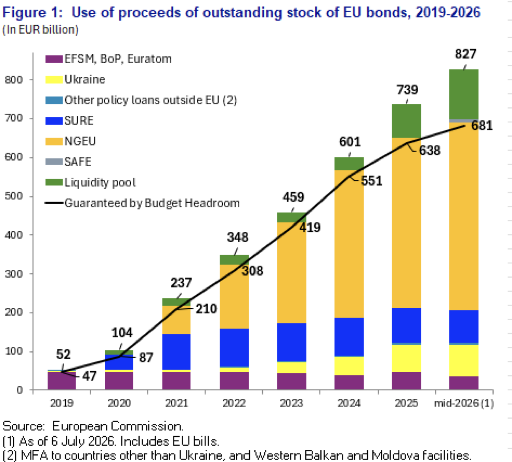
These exceptional programmes are guaranteed by the so-called budget headroom, the margin between the EU’s revenue ceiling and the spending limits in the seven-year budget, rather than by money set aside in advance.

In barely five years, headroom-backed exposure has climbed to €681bn (see Figure 1), 82 percent of all EU debt.

The European Court of Auditors has warned that if a Ukraine loan guaranteed this way goes bad, future EU budgets, and the national contributions that fund them, would have to cover the loss.

Frugals vs Friends of Cohesion

EU capitals remain divided over the new budget and over joint borrowing. Net contributors, sometimes referred to as the Frugal Six, want deep cuts in the commission’s proposal, argue that new common borrowing is not the solution and have misgivings about the creation of new own resources.

By contrast, a group of sixteen southern and eastern countries, that call themselves the “Friends of Cohesion”, are much more open to joint borrowing and back an approach closer to the Commission and Parliament on the budget and own resources.

Ireland’s plan largely reflects the influence of the frugal countries, yet one diplomat has already dismissed it as “not even close to a landing zone.”

Europe needs an ambitious budget, backed by at least the Commission’s proposed new own resources, so it relies less on national contributions based on GNI. Joint borrowing should become a permanent, predictable part of it, with safeguards.

First, it should fund loans, not grants, as the Commission suggests. Second, riskier exposures, especially to non-EU countries, should be at least partly backed by money set aside in advance, as the Court of Auditors recommends.

Where it makes sense, the headroom guarantee could be topped up with national guarantees in proportion to each country’s size, as under SURE, and like-minded partners outside the EU could sometimes take part.

Stronger capital at institutions such as the EIB, or at any future defence-financing vehicle, would also let Europe borrow more together without putting its creditworthiness at risk.

Governments should also consider deferring repayment of the NGEU bonds, as the Draghi report suggested, especially if the own-resources reform falls short. It would protect priority spending when it is needed most.

Sustained joint borrowing brings a bonus: more common safe assets in euros, which strengthens the euro’s international role. The demand is already there.

Last month Piotr Serafin, the EU’s budget commissioner, flew to Seoul and Tokyo to meet investors. Asian buyers’ share of EU bond syndications has risen from 5 per cent to 9 per cent in the second half of 2025.

Wobbles in US bond markets, which partly reflect doubts about America’s fiscal health, its reliability as a partner and the dollar’s safe-haven status, give the euro an opening.

But it can only take it if EU governments put their own fiscal houses in order.

Ongoing tensions in the French bond market provide a clear warning. Putting France’s finances on a sustainable path would do more than reassure markets about the euro. It would restore French debt as a safe euro asset.

EU leaders meet on Thursday and Friday in Brussels. Whatever they discuss (and later decide) on the budget, Europe should keep borrowing together, and in large amounts.

The task now is to give that borrowing a coherent plan: a permanent framework, money set aside in advance and safeguards that cautious capitals can accept.

  •  
❌