❌

Reading view

Defending Its AR-15 Ban, Cook County Urges SCOTUS To Ignore the Rifle's Popularity

a rifle superimposed on an image of the Supreme Court building | Ultraone/Sean Pavone/Dreamstime/Fatima Ruiz

On December 2, the Supreme Court will consider constitutional challenges to "assault weapon" bans in Connecticut and Cook County, Illinois, that cover widely owned rifles, including the AR-15. As the plaintiffs in those consolidated cases see it, such laws plainly violate the Second Amendment because they prohibit arms in common use for lawful purposes. In briefs filed on Wednesday, Connecticut and Cook County urge the justices to reject that test, saying a weapon's popularity is not dispositive. The relevant question, they say, is whether their rifle restrictions fit a historical tradition of banning "unusually dangerous weapons."

Cook County and Connecticut have the burden of showing that their laws are "consistent with this Nation's historical tradition of firearm regulation," the test established by the Supreme Court's 2022 decision in New York State Rifle & Pistol Association v. Bruen. On the face of it, that is a daunting challenge.

In the 2008 case District of Columbia v. Heller, the Supreme Court said the Second Amendment protects the right to own "bearable arms" that are "in common use" for "lawful purposes like self-defense." That description indisputably encompasses "AR-15 platform and similar semiautomatic rifles," the firearms at issue in these cases. But Heller also recognized "the historical tradition of prohibiting the carrying of 'dangerous and unusual weapons.'" Cook County and Connecticut argue that the rifles they have deemed intolerable fall into that category.

"There is a robust historical tradition of regulating unusually dangerous weapons that
compromise public safety," Cook County says. "Such regulations, which long
predate the founding, have included outright bans and other restrictions on exceptionally dangerous weapons like launcegays, trap guns, Bowie knives, and slung shots."

Cook County argues that its ordinance is "relevantly similar" to those historical restrictions because it targets "exceptionally lethal weapons that are disproportionate to the end of self-defense." AR-15s are "offensive weapons of war designed for maximum lethality and are not customarily used for self-defense," the brief says. "The purpose and operation of the ban is consistent with our Nation's historical tradition and accounts for the exceptional dangerousness of these technologically advanced weapons."

The ban is "an appropriate contemporary restriction implemented by the legislature in response to dramatic technological change and unprecedented societal concern," the brief says. "It is tailored to respond to the particular dangers presented in areas with mass casualty exposure and acute public safety risk."

Connecticut offers a similar argument. One problem with this defense is the premise that "assault weapon" bans focus on "exceptionally lethal weapons." As critics of such laws have been pointing out for decades, the features they target, such as folding stocks, pistol grips, and barrel shrouds, do not affect a rifle's basic operation. With or without them, a rifle fires the same ammunition at the same rate with the same muzzle velocity. And because AR-15s use intermediate-caliber ammunition, they are arguably less lethal than shotguns and many hunting rifles that are not classified as "assault weapons."

Cook County's emphasis on technological developments is also questionable. Constitutional guarantees establish principles that courts routinely apply to technologies that did not exist at the founding. Although the Framers did not have radio, television, or the internet, for example, the First Amendment nevertheless constrains government regulation of those media.

More specifically, Heller rejected the idea that modern weapons are not covered by the Second Amendment by recognizing a constitutional right to own semiautomatic pistols. The Supreme Court said "the Second Amendment extends, prima facie, to all instruments that constitute bearable arms, even those that were not in existence at the time of the founding." The Court confirmed that point in the 2016 case Caetano v. Massachusetts, which involved a state ban on stun guns.

Cook County also asserts that AR-15s are not suitable for self-defense, a claim that would be hotly contested by many owners of such rifles, who commonly report using them for that purpose. "Plaintiffs have shown that AR-15s are well-adapted for self-defense," U.S. District Judge Peter Sheridan wrote in 2024, when he reluctantly concluded that New Jersey's AR-15 ban was inconsistent with Heller while expressing his dismay at that result. "Evidence has been presented to the Court that the build of the AR-15 makes it well-suited to self-defense because it is 'light weight, [has] very mild recoil, and [has] good ergonomics'; it is a weapon which is 'well suited to younger shooters, female shooters, and other shooters of smaller stature.'"

Sheridan added that "the AR-15's design features—including the effectiveness of its cartridge for self-defense use and its better continuity of fire when used with available magazines—make the AR-15 a good choice for self-defense." And he noted that "the AR-15 has been used recently in several, relatively high-profile self-defense events in Florida, Illinois, Texas, Pennsylvania, and Oklahoma."

Cook County and Connecticut are also wrong in suggesting that self-defense is the only "lawful purpose" that matters. While Heller emphasized the use of handguns "in defense of hearth and home," it did not say that was the full extent of the Second Amendment right. To the contrary, the phrase "lawful purposes like self-defense" implies that the right extends to other uses, such as hunting, pest control, and target shooting. The decision explicitly mentioned hunting as a "reason Americans valued the ancient right."

The briefs are misleading in another way that may prove decisive. They conflate "dangerous and unusual" with "unusually dangerous," which is not the same thing.

During the 19th century, state legislators restricted (and sometimes banned) weapons such as Bowie knives, spears, sword canes, slungshots, and brass knuckles. But the historical evidence suggests those weapons were not targeted simply because they were "unusually dangerous." Legislators were also concerned about how the weapons were typically used.

Solicitor General D. John Sauer, who filed a brief supporting the challenges to the AR-15 bans, notes that the 19th-century laws targeted weapons associated with "duels, brawls, and other criminal activities." And in reviewing those laws, state courts distinguished between arms favored by criminals and arms commonly used for lawful purposes.

In 1871, for example, the Tennessee Supreme Court held that legislators could ban weapons that were "not usual" but could not ban "the usual arms of the citizen." The top courts of Texas, Arkansas, West Virginia, North Carolina, and Michigan concurred that the right to arms encompassed weapons commonly owned by law-abiding people, including rifles.

AR-15s and similar rifles readily pass that common-use test. In January, the National Shooting Sports Foundation, the gun industry's trade association, reported that Americans own more than 32 million "modern sporting rifles," its preferred term for the models covered by "assault weapon" bans. Survey data suggest that somewhere between 16 million and 25 million Americans have owned AR-15-style rifles. Last year, a unanimous Supreme Court described the AR-15 as "the most popular rifle in the country."

According to Cook County and Connecticut, however, none of that matters. "Once it is established that a regulation pursues a legitimate public safety objective in a permissible manner, raw ownership numbers cannot immunize a firearm from regulation," Cook County says. It argues that opponents of its ordinance have misconstrued the significance of the common-use test and misunderstood how it interacts with Bruen.

"When the Second Amendment's plain text covers an individual's conduct, the Constitution presumptively protects that conduct," the Supreme Court said in Bruen. "To justify its regulation, the government may not simply posit that the regulation promotes an important interest. Rather, the government must demonstrate that the regulation is consistent with this Nation's historical tradition of firearm regulation. Only if a firearm regulation is consistent with this Nation's historical tradition may a court conclude that the individual's conduct falls outside the Second Amendment's 'unqualified command.'"

The common-use question, Cook County argues, figures only in the first Bruen step: "the inquiry whether the weapon at issue is one 'the Second Amendment protects.'" But even if ownership of AR-15s is covered by "the Second Amendment's plain text," it says, that does not resolve the question of whether they can be banned, which depends on the historical analysis required by the second step of the Bruen test.

"This Court's decision in Bruen confirms that the Second Amendment's step-two inquiry does not insulate popularly owned firearms from regulation," the brief says. In
Bruen, it was "undisputed" that "handguns are weapons 'in common use' today for self-defense," including "outside the home." But "instead of being the end of this Court's inquiry, that observation was just the beginning." The decision also included an "extended analysis" of the historical laws that New York cited to justify its "proper cause" requirement for carry permits. "If lawful common use alone were enough to forbid regulation," Cook County argues, "there would have been no need to engage in that careful and prolonged analysis."

The question in Bruen was not whether the Second Amendment precludes "regulation." It was whether New York's specific approach, which required residents to demonstrate a "special need" before they were allowed to exercise the right to bear arms, was consistent with the historical tradition. That is why the Court considered (and rejected) the purported historical analogs that New York offered.

Cook County conflates requirements for carry permits, the issue in Bruen, with an outright ban on ownership, the policy it is defending. Connecticut likewise blurs the distinction between carry restrictions and complete prohibition.

"The Bowie knife was 'widely carried by Americans of all stripes,' including 'upstanding citizens and villains' alike," Connecticut's brief says. "The widespread use of Bowie knives and other weapons for lawful purposes did not prevent dozens of States from restricting those weapons." But those laws generally restricted or banned public carry. They rarely made it illegal to acquire or possess a Bowie knife, which is the approach that Connecticut and Cook County have taken with AR-15s.

That policy is hard to reconcile with Heller. I will quote Sheridan again, since his comments made it clear that he would have preferred to uphold New Jersey's AR-15 ban. Under Heller, he said, "a categorical ban on a class of weapons commonly used for self-defense is unlawful." Given "the Supreme Court's clear direction on this point," he concluded, New Jersey's law "is unconstitutional" as applied to "the Colt AR-15 for use for self-defense in the home."

Last July, the U.S. Court of Appeals for the 3rd Circuit agreed and went further, extending that conclusion to "the full class of semi-automatic rifles" banned in New Jersey. "Together, Heller and Bruen teach that bans or broad prohibitions on possessing or carrying of a class of weapons in common use for lawful purposes fail to find support in our Nation's tradition of firearm regulation," Judge Arianna Freeman, a Joe Biden appointee, wrote in the majority opinion. "That principle resolves our inquiry here."

To beat back the challenges to their laws, Connecticut and Cook County will have to persuade the justices that the 3rd Circuit's understanding of Heller and Bruen is wrong, meaning they are free to ban firearms in common use for lawful purposes. That seems like a tall order, and Cook County's position is especially puzzling. According to its brief, the fact that a weapon is covered by the Second Amendment does not mean Americans have a right to possess it. The more you think about that claim, the less sense it makes.

The post Defending Its AR-15 Ban, Cook County Urges SCOTUS To Ignore the Rifle's Popularity appeared first on Reason Magazine.


  •  

The Israel Lobby’s Changing Fortunes

In the past 19 years, the lobby has become even richer, Israel’s alleged commitment to peace with Palestinians has been abandoned, it seeks outright military domination of its entire region, the lobby's go-to defense is to cry “antisemitism

  •  

Luisa Gonzalez Denounces Political Persecution After Detention in Ecuador

(FILE) The ex-presidential candidate appreciated the support of communities throughout the national territory and ratified the determination of the people to overcome the censorship of Noboa's government. Photo: AFP.

Former presidential candidate Luisa González denounced political persecution Thursday after security forces detained her in a predawn raid in Ecuador’s Manabí province, accusing the government of President Daniel Noboa of an authoritarian drift.


In her first written message since the arrest, Luisa González rejected the accusations against her and described the country’s institutional situation as “unsustainable.”

“Today it is my turn to be detained over an absurd accusation,” she wrote on X. “I will respond with the dignity of the Ecuadorian men and women who owe nothing and who are committed to achieving freedom for Ecuador and a better future for the country,” she added.

RELATED: Former Ecuadorian President Correa Denounces the Arrest of Luisa Gonzalez

The leading figure of the Citizen’s Revolution movement also warned of mistreatment and torture inflicted on political prisoners held by the current far-right government of Daniel Noboa.

Faced with what she called a repressive escalation and a socioeconomic decline marked by violence and state corruption, González issued a call for unity to social organizations and leftist movements. “To my partners of the Citizen’s Revolution and all progressive forces, I say: it is time for unity, unity and unity to achieve freedom and democracy in the country,” she said.

A mi patria querida 💛💙❤️ pic.twitter.com/fJrIXAvG0B

— Luisa González (@LuisaGonzalezEc) October 22, 2026

She thanked communities across the country for their support and insisted that the people remain determined to overcome government censorship. González closed her statement by asserting that popular silence would eventually break the authoritarian siege and restore sovereignty and full democracy to Ecuador.

A Judicial Crackdown

Luisa González was detained in the early hours of Thursday in the Canuto parish of Chone canton, Manabí province. National Police officers and state prosecutors carried out the operation under the name “Labyrinth case,” an inquiry authorities describe as targeting alleged electoral financing during the 2023 campaign.

The police deployment included simultaneous raids in Manabí and Pichincha provinces and ended with three people detained for the purpose of formal charges.

After the procedure, relatives and allies of González denounced uncertainty over her whereabouts. Officials have not clarified whether she remains in Manabí or is being transferred to Quito for a court hearing, a situation her supporters describe as a grave violation of due process guarantees.

The arrest is part of a broader judicial offensive against the Citizen’s Revolution movement, which is currently suspended for nine months following rulings by the Electoral Contentious Tribunal that critics say were designed to block its participation in sectional elections.

That institutional push previously prevented González from registering as a candidate for the Manabí prefecture. Quito mayor Pabel Muñoz, meanwhile, faced raids on his offices in the middle of his reelection campaign.

Ecuadorian Former President Rafael Correa denounced the detention of González in a separate statement, adding his voice to the growing criticism of the operation. The predawn arrest now places one of the government’s most prominent opponents at the center of a legal battle that her movement frames as political persecution rather than a legitimate investigation.

  •  

Amid Reports of Coming US-Israeli Strikes, Iran Warns It Will Significantly Expand Retaliatory Attacks

Amid growing signs that another US-Israeli attack on Iran is coming, Iranian officials are warning that their retaliatory attacks will hit new targets and expand “geographically,” as they stress that Tehran is ready to face another heavy bombing campaign. Mohsen Rezaei, the head of Iran’s Supreme National Security Council, said that in the event of […]
  •  

New York City Passes Horse Carriage Ban, Ending a Central Park Tradition

A passenger’s death in June became the impetus for the City Council to ban the practice, but the bill will likely face a court challenge before being implemented in 2028.

© Eduardo Munoz/Reuters

The proposed ban on horse carriages gained steam after the death of Romanch Mahajan, an 18-year-old passenger who was thrown from a carriage.
  •  

Prêmio TV Brasil Petrobras Para Elas: as 3 melhores laterais-direitas

Logo Agência Brasil

O chamado "Trio de Ferro Paulistano" domina as finalistas do Prêmio TV Brasil Petrobras Para Elas na categoria Melhor Lateral-Direita. Os nomes revelados nesta quinta-feira (22) são Bruna Calderan (São Paulo), Gi Fernandes (Corinthians) e Fe Palermo (Palmeiras).

As jogadoras foram selecionadas por meio de votação entre representantes dos clubes da elite do futebol feminino brasileiro - capitã, treinador (a) e dirigente responsável pela modalidade. De acordo com o regulamento, não era permitido votar em integrantes do próprio time.

Notícias relacionadas:

Após dois vices, em 2020 (Avaí Kindermann) e 2021 (Palmeiras), Bruna Calderan pôde celebrar, em 2026, o primeiro título brasileiro da carreira. A gaúcha de Sananduva, que completou 30 anos no último dia 12 de setembro, foi titular absoluta na campanha do São Paulo, que, além de ser campeão, terminou a competição com a defesa menos vazada: 14 gols sofridos em 23 jogos.

Nascida em Praia Grande (SP), Gi Fernandes foi preterida no Corinthians no início do trabalho da técnica Emily Lima, mas aproveitou o Campeonato Paulista para retomar a condição de titular no Brasileirão, sendo peça importante rumo à 10ª final consecutiva na competição nacional. A atleta de 21 anos ainda integrou a campanha vitoriosa do Brasil no Fifa Series, em abril.

Já Fe Palermo, de 30 anos, é uma espécie de "coringa" da técnica Rosana Augusto no Palmeiras, atuando nas duas laterais e até como terceira zagueira. Com ela em campo, o Verdão sofreu somente uma derrota na temporada. A paulista de Campinas também marcou presença na seleção brasileira em 2026, sendo titular nos amistosos contra Costa Rica e Venezuela, no início do ano.

As finalistas do Prêmio TV Brasil Petrobras Para Elas vêm sendo apresentadas desde segunda-feira (19). As categorias anunciadas anteriormente foram: Jogadora Revelação, Melhor Treinador(a) e Melhor Goleira. As ganhadoras serão conhecidas em cerimônia no Museu do Futebol, em São Paulo, no próximo dia 15 de novembro.

Além das premiações por posição, as demais categorias da premiação são: Melhor Jogadora, Artilheira, Gol Mais Bonito, Melhor Departamento de Futebol Feminino e Futebol Feminino Contra o Feminicídio. Esta última reconhece o clube que melhor promoveu ações de enfrentamento à violência contra a mulher.

  •  

Abdul El-Sayed Funded by Fellow Co-Signers of Muslim Brotherhood Support Letter

Michigan Muslim Socialist Abdul El-Sayed received over $25,000 from at least six men who co-signed a letter supporting the Muslim Brotherhood.

The post Abdul El-Sayed Funded by Fellow Co-Signers of Muslim Brotherhood Support Letter appeared first on Breitbart.

  •  

Venezuela Reaffirms Sovereign Control of Oil Revenue as Deals Advance

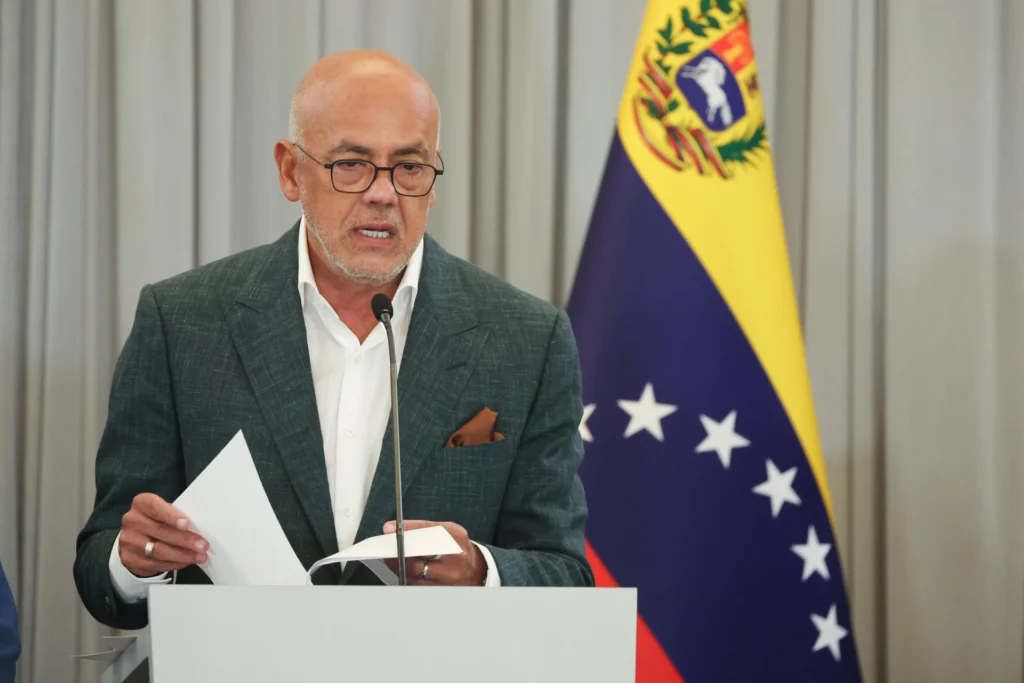
The president of the Venezuelan National Assembly has ratified that the country autonomously manages the resources captured through energy exports. Photo: EFE.

Venezuela’s National Assembly President reaffirmed sovereign control over the country’s oil revenues and reported 71 active energy agreements alongside 44 contracts under negotiation, framing the figures as evidence of a sector revival after years of financial restrictions.


The statements came amid what officials called a strategic reconfiguration of the Venezuelan hydrocarbon industry. After years of intense global financial restrictions, the gradual operational reactivation of agreements between state-owned oil company Petroleos de Venezuela (PDVSA) and international firms aims to restore a steady flow of foreign currency into the national treasury.

“No foreign agency or international financial entity administers or safeguards the public funds that enter the country from hydrocarbon sales,” National Assembly President Jorge Rodriguez said.

RELATED: Venezuela’s Acting President Reviews Wage Consensus With Business, Unions

Rodríguez detailed that the money enters the public treasury under the supervision of authorized national banks, and he ruled out any external trust or any management of accounts by third parties outside the country’s institutions. In this sense, he called autonomy over foreign currency “a non-negotiable principle” for the country’s macroeconomic stability.

71 agreements are currently in force, while another 44 contracts are being negotiated. For the government, that volume confirms an operational momentum geared toward diversifying investment across the country’s main extraction fields.

The National Assembly President presented this dynamism as the result of a deliberate push to reopen the sector to international capital without surrendering control. Over the past several years, sweeping financial measures limited Venezuela’s ability to sell crude, collect payments and maintain production infrastructure. The current wave of deals represents a step-by-step return to commercial activity.

#EnVideo📹 | Coordinador del diálogo por el Gobierno Nacional, Jorge Rodríguez, aseveró que Venezuela mantiene el control sobre los recursos financieros obtenidos a través de la comercialización de petróleo hacia distintos países del mundo. pic.twitter.com/MUoEuwKXQI

— Ministerio de Comunicación e Información (@mippci_ven) October 22, 2026

Text reads: “Coordinator of the dialogue by the National Government, Jorge Rodríguez, asserted that Venezuela retains control over financial resources obtained through the marketing of oil to different countries in the world.”

Each reactivated agreement carries a single objective, officials indicated, the capture of hard currency for the public coffers. That revenue is meant to fund the productive apparatus and national infrastructure rather than remain subject to outside oversight.

By spreading investment across the country’s principal extraction zones, the government seeks to reduce dependence on any single field or partner.

Sovereign Control Defended

Reaffirming sovereign control over monetary flows stands as a central pillar of the government’s message. The leadership projected institutional stability at a moment when Washington continues to review and adjust the licenses it grants for oil operations.

Rodríguez also denounced continuous pressure and unilateral coercive measures against the country’s financial system by foreign powers. He said that, despite what he described as an economic siege, the government has consolidated alternative mechanisms to receive payments directly for oil-product exports.

Against that backdrop, the government is working to shield energy agreements legally, dismiss any suggestion of foreign tutelage and guarantee direct financing for public budgets.

Official strategy insists that autonomous management of oil income is an indispensable guarantee for preserving fiscal balance, defending the national currency and sustaining social development programs.

For the Bolivarian government, legal protection of the energy agreements goes hand in hand with financing priorities. The revenue is meant to flow directly toward the productive apparatus and public infrastructure, a framework that Rodriguez described as essential to institutional stability.

  •  

Com Hamilton, Kim Kardashian revela 55 requisitos para escolher namorado

A socialite Kim Kardashian, 45, revelou que, para ter um relacionamento com ela, é necessário cumprir cerca de 55 requisitos. Atualmente, ela namora o piloto de Fórmula 1, Lewis Hamilton, 41.

Ela revelou em um episódio do reality show “The Kardashians” — que acompanha o clã Kardashian-Jenner — que é conhecida por ter uma régua alta na hora de selecionar seus pares românticos.

Entre os requisitos revelados por Kim estão: proteger e lutar por ela; ser feliz e positivo; calmo; legal; divertido; assumir responsabilidades; e não ter papada.

Em entrevista anterior, a socialite relembrou os anos que passou solteira após se divorciar de Kanye West, 49, com quem teve quatro filhos — North, Saint, Chicago e Psalm.

“Fiquei solteira por cinco anos. E foi ótimo. Pude me concentrar nos meus filhos e em projetos nos quais eu realmente queria estar envolvida. Realmente não senti nenhuma pressa”, começou.

Antes de começar a se relacionar com Hamilton, Kim namorou o ator Pete Davidson, 32, por nove meses em 2022. O comediante chegou a aparecer em alguns momentos cômicos no programa “The Kardashians”.

Conheça os integrantes da família Kardashian-Jenner

*Com informações de Luiza Zequim, da CNN Brasil

  •  

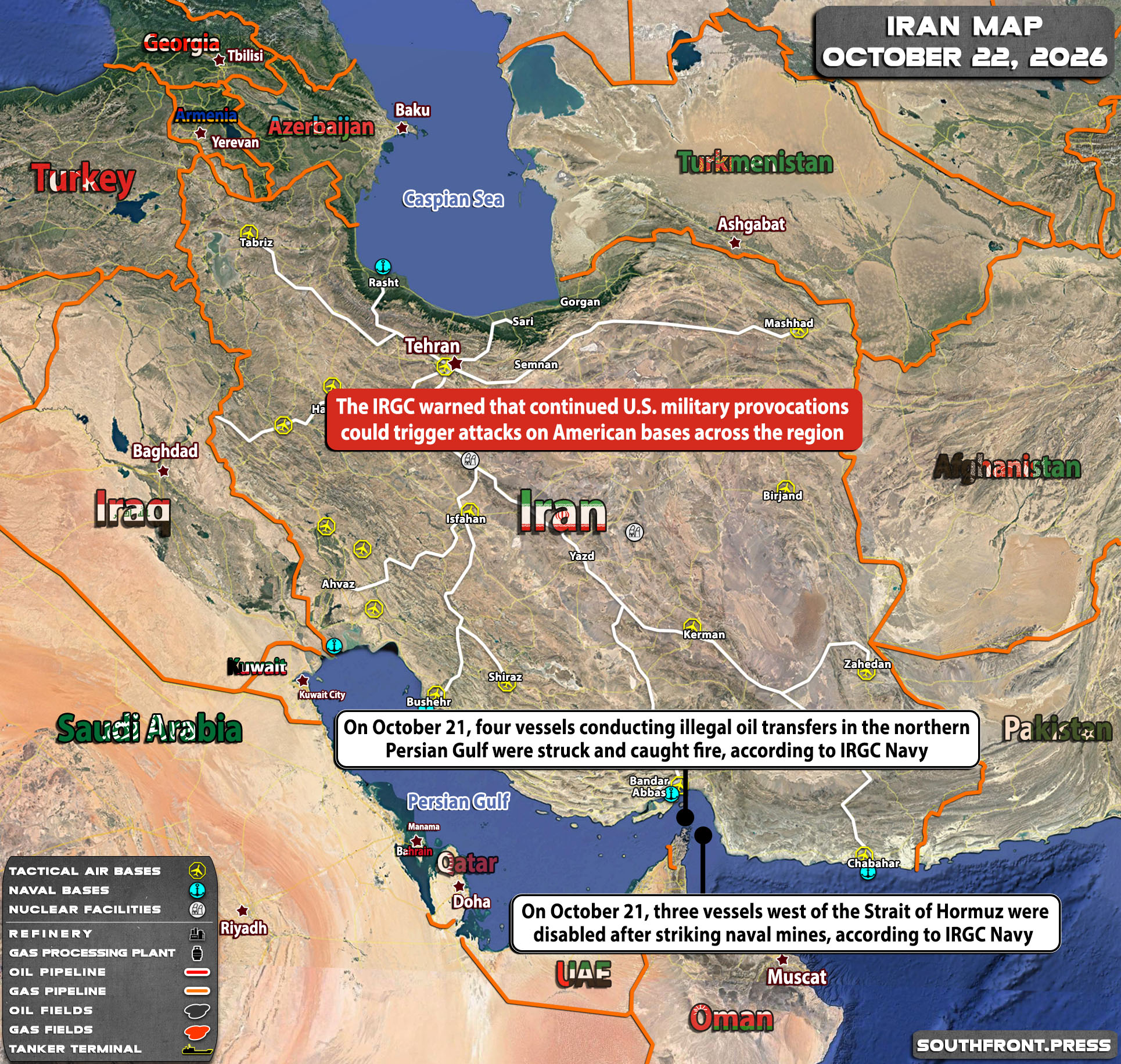
Military Situation In Iran On October 22, 2026 (Map Update)

Click to see full-size map.

  • On October 21, four vessels conducting illegal oil transfers in the northern Persian Gulf were struck and caught fire, according to IRGC Navy;
  • On October 21, three vessels west of the Strait of Hormuz were disabled after striking naval mines, according to IRGC Navy;
  • The IRGC warned that continued U.S. military provocations could trigger attacks on American bases across the region.

_______________________________________________________________________________________________________________________

SouthFront: Analysis and Intelligence

NOW hosted at southfront.press

Previously, SouthFront: Analysis and Intelligence was at southfront.org.

The .org domain name had been blocked by the US (NATO) (https://southfront.press/southfront-org-blocked-by-u-s-controlled-global-internet-supervisor/) globally, outlawed and without any explanation

Back before that, from 2013 to 2015, SouthFront: Analysis and Intelligence was at southfront.com

SOUTHFRONT.PRESS

MORE ON THIS TOPIC:


The post Military Situation In Iran On October 22, 2026 (Map Update) appeared first on South Front.

  •  

At least 160 Israeli settler attacks in 2 weeks

Israel is preventing thousands of Palestinian farmers in the West Bank from reaching their olive trees, while settlers harvest their crops. 90 per cent of Gaza’s two million olive trees have been destroyed since October 2023

  •  

ASEAN y los BRICS: dónde convergen los intereses de ambas agrupaciones de integración

¿En qué sectores coinciden los intereses de la ASEAN y los países BRICS hasta el punto de permitir el establecimiento de vínculos estables de producción e inversión? ¿En qué condiciones podría formarse para 2035 una red económica integrada entre ambos espacios? Lea el análisis de TV BRICS.
  •  

Scontro tra Sommi e Friedman su La7. “Attento a dare del filoputiniano, poi le querele si pagano”. “Mi minacci, signor avvocatino cafone?”

Scintille in diretta a Omnibus, su La7, tra Luca Sommi, giornalista del Fatto Quotidiano e conduttore di Accordi & Disaccordi, e il giornalista economico Alan Friedman. Casus belli: le proteste giovanili di Milano e il ruolo delle presunte interferenze russe nell’alimentare le tensioni sociali in Europa.
Tutto comincia dall’analisi di Sommi sugli scontri di Milano. Il giornalista del Fatto respinge l’idea che dietro la rabbia dei ragazzi ci sia la regia di Mosca e richiama invece le disuguaglianze economiche, l’inflazione e la perdita del potere d’acquisto delle famiglie. Sommi insiste soprattutto su un punto: attribuire il disagio giovanile alle infiltrazioni russe significa distogliere lo sguardo dalle condizioni materiali in cui vivono milioni di persone.
“Mi viene da sorridere al pensiero che il disagio giovanile in Italia e in Europa sia colpa delle infiltrazioni di Putin – osserva – Non riesco a rimanere serio su questa cosa, perché in realtà parliamo di un problema strutturale”.
Poi richiama la condizione sociale di tanti manifestanti, spesso figli di immigrati di seconda generazione o delle fasce più povere della popolazione italiana: “Qui ci sono dei ragazzi che non ce la fanno più. A 11 anni vai in piazza a manifestare. Questo è un termometro di una sperequazione sociale esasperata. Se tu togli 300 euro di reddito di cittadinanza magari al papà, che temporaneamente era in difficoltà, e non hai il coraggio di tassare le multinazionali e i super ricchi, allora accadono queste cose”.

A intervenire successivamente è Antonio Di Bella, ex direttore del Tg3, che introduce una distinzione tra le origini delle proteste e il loro sfruttamento politico da parte del Cremlino: “È chiaro che il fuoco degli scontri non viene acceso dalla Russia o da qualche misterioso manovratore. Ma apertamente gli esponenti del governo Putin usano le tensioni europee come prova della crisi dell’Occidente“.
Di Bella cita anche Aleksandr Dugin, ideologo nazionalista russo e rbadisce che non c’è nessuna “manina misteriosa” ma una strumentalizzazione alla luce del sole: “È evidente che chi manifesta e gli scontri non sono creati da fuori, ma sono alimentati e sfruttati da fuori”.
Dal collegamento Friedman applaude e mostra il gesto dell’ok con la mano. E commenta: “Antonio Di Bella ha detto perfettamente. Poi che qualche filoputiniano difenda Putin non è una sorpresa, che sia un giornalista per un giornale di propaganda del Cremlino, che sia un politico di destra…”.
Sommi interviene: “Friedman, attenzione a dare dei filoputiniani perché si beccano le querele e poi le si pagano”.
Il giornalista americano ribatte immediatamente: “Mi stai minacciando?”..
“No – replica Sommi – Ti invito alla cautela a usare certi termini perché li hanno già usati a lungo anche sul Corriere della Sera e poi hanno pagato copiosamente per aver dato dei filoputiniani a chi si interroga sulle questioni invece di chi liscia da una parte. Te lo dico così, per rinfrescarti le idee”.

Il riferimento è alla vicenda giudiziaria di Alessandro Orsini, sociologo e professore associato alla Luiss Guido Carli di Roma. Il 5 giugno 2022 il Corriere della Sera pubblicò un articolo firmato da Monica Guerzoni e Fiorenza Sarzanini, intitolato “Influencer e opinionisti. Ecco i putiniani d’Italia” e dedicato a una presunta rete di opinionisti e influencer che rilanciavano la propaganda del Cremlino, con riferimenti alle attività del Copasir e dei servizi di intelligence. Tra i nomi compariva quello di Orsini, accompagnato dalla sua fotografia. Il professore ha promosso una causa civile contro Rcs, il direttore Luciano Fontana e le due giornaliste. Il Tribunale di Milano, in primo grado, ha condannato i convenuti a risarcirlo con 27.500 euro per danni e circa 5mila euro per spese processuali.

Friedman sbotta: “Questo è talmente da cafone che neanche ti rispondo. Io non sono qui per litigare e non credo di aver nominato nessun giornale. Attenzione, signor avvocatino“.
Sommi non arretra e gli fa notare la sequenza degli interventi: “Hai parlato di “giornalisti filoputiniani” subito dopo che ho detto che un conto è esultare perché l’Europa va male, visto che c’è una guerra, un conto è avere l’intromissione di Putin nei social»”.
Friedman rivendica di non aver indicato alcuna testata né alcuna persona specifica: “Ho fatto il nome di qualche giornale? Mi querela per non aver fatto nessun nome e aver parlato genericamente? Ma va’! Io volo alto e non scendo a questi livelli bassi, ok?”.
Sommi ride e ribadisce: “Hai appena detto dei giornalisti filoputiniani”.
“Ho parlato genericamente dei putiniani in Italia senza nominare nessuno, signorino“, rilancia Friedman.
Greco, visibilmente spazientito, cerca di chiudere il battibecco: “No, no, non ha nominato nessuno, benissimo”.
Ma Friedman continua a interrompere, ripetendo “Signorino!” e poi “Piccolo signore!“, mentre Sommi reagisce divertito e il conduttore è costretto ad arrendersi con una battuta: “Siamo alla frutta, come dicono in Calabria“.

L'articolo Scontro tra Sommi e Friedman su La7. “Attento a dare del filoputiniano, poi le querele si pagano”. “Mi minacci, signor avvocatino cafone?” proviene da Il Fatto Quotidiano.

  •  

From Wrong-Way Driving, to Green Number Plates; Lahore Drivers to face FIRs for THESE Traffic Violations

LAHORE – Car drivers and bikers involved in 21 serious traffic violations in Lahore will face criminal cases instead of routine challans, City Traffic Officer (CTO) Syed Abdul Rahim Shirazi announced on Thursday, signalling stricter enforcement against offences that endanger public safety.

The stern measure covers range of violations, including the unauthorised use of police-style flasher lights, illegal blue lights and green number plates.

Drivers caught travelling against the flow of traffic will also face criminal proceedings. The policy further targets motorists who tamper with number plates by printing over them, altering registration details or concealing a vehicle’s identity.

Other offences falling under the crackdown include blocking roads, reckless and negligent driving, over-speeding, dangerous zigzag manoeuvres and drifting. Disorderly conduct and extremely careless driving have also been included among the violations that can lead to the registration of First Information Reports (FIRs).

CTO Shirazi said the decision was aimed at curbing dangerous driving practices and addressing violations that pose a serious threat to human life. He made it clear that offenders involved in these categories of violations would no longer be let off with a fine alone.

Punjab Police already issued more than 6.5 million traffic challans across region by August this year, generating over Rs12.19 billion in fines. Lahore traffic police took action against more than 42,000 vehicles and motorcyclists on designated model roads. The violations included 10,114 helmet-related offences, 3,819 cases of driving without a valid licence, 2,289 one-way traffic violations and 616 signal violations.


The post From Wrong-Way Driving, to Green Number Plates; Lahore Drivers to face FIRs for THESE Traffic Violations appeared first on Daily Pakistan English News.

  •  

Fact Check: BLA’s Gwadar Attack Propaganda Exposed amid Damage to Balochistan’s Civilian Property

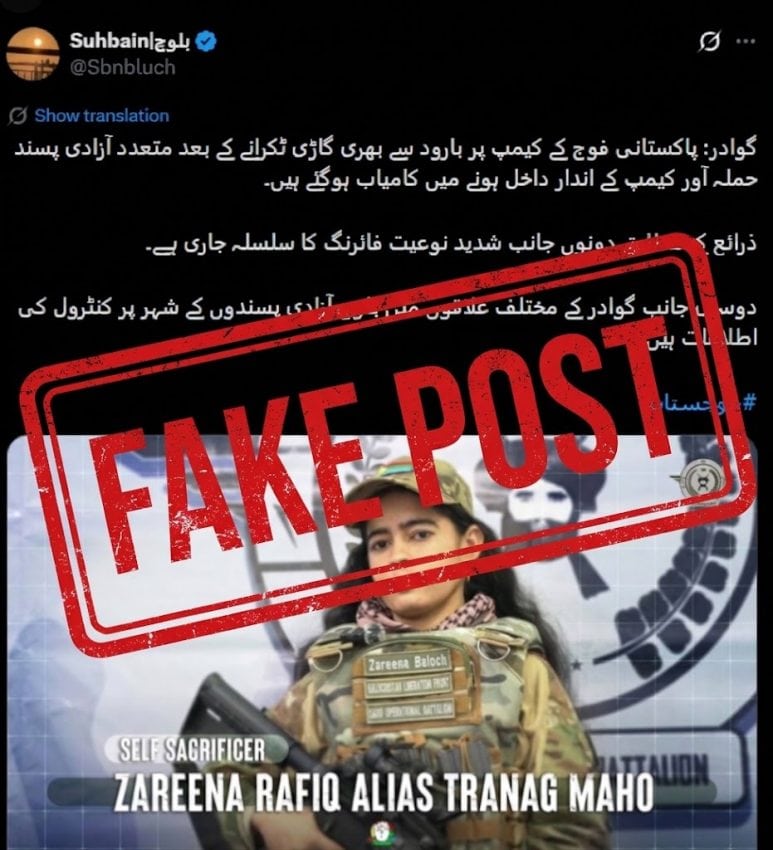
QUETTA – Social media posts circulated by banned Balochistan Liberation Army (BLA) and propaganda networks after Gwadar incident show the episode as major operational success against Pakistan’s armed forces.

In reality, the site targeted was a construction company camp that had already been vacated, while several trucks parked along a road were set on fire. No casualties were reported, and claims that security forces or intelligence installations had been targeted were baseless.

Balochistan Liberation Front (BLF) subsequently also shared video showing a fighter driving a vehicle and detonating explosives at the gate of a Pakistani military camp. The group identified the alleged attacker as Jindar Sarmaachar, also referred to as Mujahid Mehr, alias Sigar Zamrani, and claimed he belonged to Sadu Operational Battalion.

PROPAGANDA VIDEO

گوادر، جسے پاکستان کی معیشت کیلئے ایک بڑا موڑ ثابت ہونا تھا، آج دہشتگردی کی آگ میں جل رہا ہے۔ https://t.co/T23U5wNyu8

— Muhammad Suhail ALI. (@MuhammaddSuhail) October 22, 2026

The incident caused no casualties and that no security personnel or security installations were affected. It stated that the principal damage involved trucks belonging to the transport sector, showing impact of the incident on civilian property and livelihoods.

Fact Check Blas Gwadar Attack Propaganda Exposed Amid Damage To Balochistans Civilian Property

The release of attack footage and claims of operational success are part of propaganda campaign surrounding the incident. Sharing such material as definitive proof of successful attack on a military installation is nothing but misleading.

Balochistan Liberation Army (BLA) and the Balochistan Liberation Front (BLF) are banned outfits involved in attacks against the Pakistani state, security forces and civilian targets. Their use of attack footage and social media campaigns to project operational victories underscores how militant groups seek to amplify the impact of violence through propaganda.

The Protest That Was Never Just a Protest: How BLA Uses BYC to Recruit and Lie

The post Fact Check: BLA’s Gwadar Attack Propaganda Exposed amid Damage to Balochistan’s Civilian Property appeared first on Daily Pakistan English News.

  •  

Milan, a city torn apart by luxury and inequality

Milan is the city where singer Dua Lipa is considering moving to but also where many of the local residents are being forced to leave. It is among the places that host the most millionaires in the world, who move into new skyscrapers designed by prominent architects. They are drawn by the flat tax offered in Italy since 2017, a single payment of €300,000 (it convinced Cristiano Ronaldo to leave Real Madrid for Juventus in 2018). It is the so‑called Milan Model — a city of luxury, culture, fashion and investment banks, ideal for living, except that soaring housing prices have made living impossible: buying a home costs 57% more than a decade ago, and renting is 70% more expensive than in 2018, according to online real estate data.

Seguir leyendo

© Stefano Porta/LaPresse (LAPRESSE)

A scene from Saturday’s clashes with police in Milan.
  •  
❌