 Login

Shield of the Americas, military operations, and decorations: Rubio’s fruitful visit to South America

This content is for members only. Visit the site and log in/register to read.

This content is for members only. Visit the site and log in/register to read.
Compra de votos, chantagem, criação de dossiê e até a morte. 25 anos depois dos ataques contra os EUA por parte de terroristas, a constatação de observadores internacionais é de que não foram apenas as Torres Gêmeas que desabaram. Naquele dia 11 de setembro de 2001, ainda que ninguém ousasse saber o destino do mundo, inaugurou-se um novo período de ingerência dos EUA na diplomacia internacional.
Atacado em seu próprio território, o governo norte-americano se deu o direito de invadir, destituir, sequestrar e desmontar qualquer instituição que pudesse significar uma ameaça aos seus interesses.
Gestos que até hoje ecoam pelo mundo e que transformaram para sempre regiões inteiras do planeta e abalaram a soberania de países.
A década de 1990 havia sido de esperança. A ONU voltava a funcionar e o Conselho de Segurança era convocado a agir, finalmente. Mas o que parecia ser a exuberância do sistema multilateral escondia, na realidade, um fervor por parte dos EUA de manter um mundo à sua imagem e semelhança. E com a Casa Branca como o polo da hegemonia global.
Mas bastou um teste para que a máscara da cooperação internacional fosse retirada. Os EUA nunca estiveram dispostos a dividir o poder e, machucado em seu orgulho a partir de 2001, iniciaram uma ofensiva para fazer valer sua visão de mundo e suas ambições.
O Iraque passou a entrar no radar e, com ele, o argumento espúrio das armas químicas. Derrubar o ditador Saddam Hussein era uma questão de honra, e de petróleo. Mas o argumento era frágil e logo uma das agências internacionais – a Organização para a Proibição de Armas Químicas (Opaq) – alertou que poderia fazer a vistoria da suposta existência dessas armas.
Washington não gostou nada da ideia. Afinal, se houvesse um caminho diplomático, o principal argumento para a guerra estaria enterrado. George W. Bush decidiu que era hora de calar a Opaq e seu diretor, o brasileiro José Maurício Bustani.
Lembro-me de desembarcar em Haia em abril de 2002, sede da entidade, e encontrar uma instituição no epicentro de um conflito de enormes proporções.
Bustani, que estava no comando da Opaq desde 1997 e tinha sido reeleito por unanimidade, insistia que sua instituição tinha informações de que as armas químicas do Iraque haviam sido destruídas após a Guerra do Golfo de 1991. Além disso, a entidade dizia que o Iraque “não tinha capacidade” para repor os estoques graças às sanções sob as quais tinha sido submetido por uma década.
Ele precisaria cair e mensagens chegaram até o brasileiro, sugerindo que ele deixasse o cargo, sem alarde. Seria hipocritamente aplaudido se renunciasse. Ele não aceitou. John Bolton, que comandava parte do esforço diplomático de Bush e que tinha em sua mesa uma granada, orquestrou, assim, uma campanha contra o brasileiro. Seu argumento para derrubá-lo: “má-gestão”.

Em sua sala em Haia, atrás de um quadro, foi descoberto um sistema de escutas. Bustani sabia que seu destino estaria vinculado com uma guerra muito mais ampla que sua dimensão como diplomata.
No dia 21 de abril de 2002, a pedido dos EUA, foi realizada uma reunião especial da Opaq para votar seu afastamento. Nas semanas anteriores ao encontro, países que estavam com sua anuidade atrasada na instituição fizeram os pagamentos para poder ter direito ao voto. Alguns chegaram com dinheiro vivo, despertando a desconfiança de que a Casa Branca estaria pagando pelos votos.
Ao final de um rápido encontro, 48 países se manifestaram a favor de seu afastamento, com sete contra e 43 abstenções. Anos depois, nos tribunais da OIT, Bustani seria recompensado por uma decisão que determinou que seu afastamento havia ocorrido sem justificativa. Mas, para os EUA, isso pouco importava. A estátua de Saddam já estava derrubada e o sequestro de um organismo internacional era realidade.
Não demorou para que um segundo abalo transformasse a ONU. Preocupada com o destino do Oriente Médio depois da queda de Bagdá, a entidade aceitou o papel de reconstruir o Iraque. Bush tinha chamado ao Salão Oval o brasileiro Sérgio Vieira de Mello, uma espécie de bombeiro das Nações Unidas para as crises mais impossíveis.
A Casa Branca o queria no comando do escritório da entidade no Iraque, inclusive para dar legitimidade à nova etapa. Tanto o diplomata brasileiro quanto o secretário-geral Kofi Annan hesitaram em assumir o papel. Mas, sob pressão do maior doador do sistema internacional, cederam.
O brasileiro seria, então, enviado ao front em 2003, como representante oficial do Secretário-geral das Nações Unidas no Iraque. Mas insistia que não via a ONU como parte das “potências ocupantes”. Numa entrevista concedida a este repórter no dia 17 de agosto daquele ano, Vieira de Mello afirmava que não estava com medo e que a instituição era vista como uma aliada dos iraquianos. Criticou os EUA e admitiu que a população local estava sendo humilhada. “Imagine como nós, brasileiros, nos sentiríamos com tanques estrangeiros em Copacabana”, disse.
Dois dias depois, em 19 de agosto de 2003, uma bomba colocada num caminhão no muro do escritório da ONU em Bagdá tiraria a vida do brasileiro e de mais 20 pessoas.
Sob os escombros estava o fim de uma utopia.

O alvo não era mais apenas os EUA, mas todos aqueles que pudessem ser vistos como cúmplices. A ONU vivia o fim de sua era da inocência com uma explosão que ainda reverbera pelos corredores da entidade.
Ao não conseguir evitar a guerra no Iraque e diante da morte de seus funcionários e de um de seus melhores amigos, Annan declarou em setembro de 2004 que a ofensiva norte-americana era “ilegal”.
O comentário foi considerado como uma afronta em Washington e, imediatamente, a Casa Branca iniciou um processo para também silenciar o chefe das Nações Unidas. Para isso, retirou das gavetas da CIA um dossiê que revelava corrupção em programas da ONU e que envolvia até mesmo o filho de Annan. Paralisado, o secretário-geral apenas teve de assistir o desmonte do direito internacional e a marginalização de sua própria instituição.
Annan ficou tão abalado pela crise que mergulhou em uma depressão. Ficou sem voz, literalmente. Começou a faltar a reuniões importantes e deu fortes sinais de que pretendia abandonar o cargo de maior liderança da diplomacia mundial. Afônico por motivos emocionais, um dos poucos homens que poderia frear o desmonte das leis internacionais havia sido silenciado.
A crise de credibilidade que a ONU enfrenta hoje é a mais séria em seus mais de 80 anos. Mas foi, a partir de 11 de setembro de 2001 que começou a ruir o sonho de um organismo internacional capaz de manter a paz no mundo.



Iran accused the US and its European allies of misusing the International Atomic Energy Agency (IAEA) for their own narrow geopolitical objectives, eroding its credibility and paving the way for the ultimate collapse of the international non-proliferation regime.
The Islamic Republic’s response on Wednesday, September 9, followed the adoption of a resolution by the IAEA Board of Governors, which accused it of non-compliance with its safeguard regulations and referred Iran to the UN Security Council for further action.
The resolution, drafted jointly by the US, the UK, France, and Germany was adopted. A majority of 23 countries voted in favor and eight others abstained. China, Russia, and Niger voted against the resolution.
Thanks to the resolution, for which the US and its European allies lobbied aggressively, forcing several countries to vote in favor, Iran has been referred to the UNSC for the first time in over 20 years.
The resolution asks Iran to immediately start complying with IAEA regulations and resume inspections of its nuclear facilities, with the IAEA chief Rafael Grossi expressing concerns about lack of clarity about the fate of Iran’s enriched uranium and the conditions of its nuclear facilities since the beginning of the war.
Iran has denied any violation of the IAEA safeguards, pointing out that regular inspections of its nuclear facilities were suspended after the IAEA withdrew its inspectors due to safety concerns during the 12 days of US-Israeli bombings in June 2025.
Iran has also claimed that the IAEA demands for the immediate resumption of inspections to its nuclear sites and expecting the implementation of normal safeguards amidst the ongoing war is “materially impractical” and “irrational.”
It also accused the IAEA of failing to do its work properly and exposing without any need “highly confidential information regarding the nature and whereabouts of Iran’s nuclear stockpiles” without prior consent, Press TV reported.
Iran accused that the resolution is politically motivated and biased. It further described it as yet another attempt by the US and Israel to force Iran’s “surrender” after failing to achieve anything through military means in the last year.
It questioned the US authority to sponsor such a resolution when it has repeatedly used force against Iran, in complete violation of previous IAEA resolutions calling for “diplomatic solutions” to its nuclear issue.
“Not only did they ignore all efforts for a diplomatic solution, but they also bombed peaceful, safeguarded nuclear sites, violated basic principles of international law, and the UN Charter, brutally committed war crimes, and killed thousands of civilians, including 168 children at a primary school and guests at a wedding,” Iran’s mission in Vienna said in a statement on Wednesday.
“They attack Iran’s nuclear facilities under the IAEA safeguards, disrupt the normal verification process, and then use that very disruption as a pretext for adopting a resolution” against Iran, Kazem Gharibabadi, Iran’s deputy foreign minister said in a post on X on Wednesday.
Gharibabadi also dismissed any possibility of further action on the resolution in the UNSC as two permanent members, Russia and China, have opposed its adoption.
A joint statement issued by Russia and China after the vote on the resolution in the IAEA BOG called the resolution “irrelevant” and a pressure tactic designed to undermine the cooperation between Iran and the IAEA.
Underlining the absence of a reference to the ongoing US aggression against Iran, Russia and China maintained that it amounts to ignoring the “root cause and principle factor underlying the current situation.”
A plataforma Discord, popular entre jogadores e comunidades online, tem sido espaço de transmissão e incentivo a crimes e autoviolência em forma de desafios, atingindo principalmente crianças e adolescentes. O cientista político e jurista João Victor Ferreira, autor do livro “Radicalização Política e Juventude no Brasil”, mergulhou nas comunidades gamers brasileiras para revelar como jovens conectados buscam pertencimento e formação política a partir de discursos extremos e da violência incentivada nesses espaços virtuais.
Convidado para este episódio do Pauta Pública, João Victor chama a atenção para as falhas da atual legislação brasileira na responsabilização de plataformas como o Discord. Na conversa com Andrea Dip, ele também questiona se há interesse das empresas em combater a radicalização e o incentivo aos crimes, tendo em vista que a propagação desse tipo de conteúdo ainda gera muito lucro.
The Memorial Center of the Republic of Srpska is bringing its international 'Learn About Serbian Suffering' campaign to Rome from September 7 to 13, reports NewsEurope. The initiative aims to introduce Italian and wider European audiences to the historical experience of the Serbian people and to the suffering of civilians during some of the most tragic periods of 20th-century European history.
The digital exhibition will appear on large LED screens in several central Roman locations, including Piazza della Repubblica on Via Nazionale, Castel Sant’Angelo on Lungotevere Prati, Cavour, Lungotevere Testaccio, the Trastevere area around Marconi, Monteverde, and Gianicolo, and Via Gregorio VII near the Vatican.
The campaign is founded on the belief that Serbian history should be examined beyond the political interpretations and stereotypes that have influenced parts of Western public opinion for decades.
The Serbian people have deep historical roots in Europe, including in its cultural, civilizational, and spiritual traditions. Nevertheless, much of Western European public opinion remains insufficiently familiar with their historical experience, especially with the suffering of Serbian civilians during the wars of the 20th century.
This lack of awareness is particularly evident in relation to the breakup of Yugoslavia and the conflicts of the 1990s. During that period, simplified interpretations of the role played by the Serbs became widespread in parts of Western public discourse. Complex political and historical developments were frequently reduced to a division between perpetrators and victims, while the Serbian wartime experience received limited attention. Consequently, the suffering of families who lost relatives, homes, and entire communities was often overlooked, as were the experiences of hundreds of thousands of people displaced from their homes and ancestral lands.
The campaign seeks to respond to this omission in Europe’s collective memory.
Its purpose is not to accuse any nation, state, or society. Instead, it invites the public to consider this part of European history from a broader perspective, using archival material, documented facts, and, above all, the firsthand accounts of people who survived war, persecution, detention camps, and the loss of family members.

According to Denis Bojić, director of the Memorial Center of the Republic of Srpska (pictured), the campaign was created to bring the historical experience of the Serbian people and the suffering of Serbian civilians during different periods of the 20th century to audiences beyond the borders of the Republic of Srpska and Serbia. He said the initiative focuses on families who lost loved ones, people driven from their homes, victims of persecution and detention camps, and generations that continued their lives while carrying the consequences of those losses.
Bojić described the project as a responsibility toward both victims and future generations. He emphasized the importance of preserving their names, faces, and testimonies and making them available to people who have not yet encountered this dimension of European history. He also identified the preservation and international accessibility of this memory as one of the Memorial Center’s principal tasks.
Italy, he noted, has particular importance because it offers an opportunity to present Serbian history in one of Europe’s major centers of culture and civilization. The campaign aims to encourage a broader and more open discussion of Serbian suffering based on documentation and personal testimony.
Bojić added that the project’s objective is to ensure that Serbian victims are not remembered solely as statistics in historical accounts, but as individuals with recognizable faces and personal stories within Europe’s shared memory. In his view, preserving the memory of victims also means preserving a people’s dignity, identity, and understanding of its own history.
The decision to present the campaign in Italy, and specifically in Rome, reflects the longstanding respect among Serbs for Italian civilization and its achievements, from ancient Rome and Roman law to Italy’s broader contribution to European culture.
Rome’s historical importance and its influence on European law, institutions, and culture give the initiative additional significance. Presenting the Serbian experience in the city therefore represents an opportunity to place it within a wider European context.
The organizers also point to more recent ties that remain important in Serbian public memory. Italian KFOR units in Kosovo and Metohija contributed to the protection of the Serbian population and Orthodox cultural heritage. Their long-term role in safeguarding the Visoki Dečani Monastery and other Serbian religious sites continues to be remembered.
The organizers regard these links as a basis for strengthening relations between the two peoples. The Rome presentation is intended not only to share historical material, but also to support continued friendship and cooperation and to introduce the Serbian experience to audiences in one of Europe’s most significant cultural centers.
The Memorial Center of the Republic of Srpska was founded on May 30, 2024, following a decision by the Government of the Republic of Srpska. Its mission is to collect, document, preserve, and present testimonies concerning the suffering of the Serbian people.
Oral history is central to its work. The institution gathers personal accounts from people who directly experienced war, persecution, and other forms of suffering. More than 1,500 audiovisual testimonies have so far been recorded and collected, making the project one of the largest initiatives of its kind in Southeastern Europe.
The Center seeks to ensure that these experiences are not preserved only in books, archives, or statistical records. By documenting the voices and faces of survivors, it aims to maintain a direct connection with the people who lived through these events. The testimonies are recorded in the field, archived, and incorporated into documentaries, publications, exhibitions, and educational resources.
The Memorial Center is also available to cooperate with institutions, museums, archives, researchers, and other organizations in Europe and elsewhere that work in the fields of history, oral history, and remembrance culture. The presentation in Italy forms part of a broader effort to establish links with European institutions and to make testimonies about the suffering of the Serbian people accessible to international audiences.
Está a pensar ir comer fora? Veja aqui algumas sugestões de menus a preços económicos.
Se tem um restaurante e pretende colocar aqui – de forma gratuita – o seu menu, envio-o no dia anterior ou, no máximo, até às 10h00 do dia a que se refere para: guiaalgarve@gmail.com.
Leia também: Festas com bons petiscos: berbigão, javali e sabores da serra de Monchique e… do Brasil

Atualização: Veja aqui os menus de sábado, 12 de setembro
Estrada de Alvor, 1A. Contacto telefónico: 282 475 256. Email: restauranteportacerta@gmail.com
Aberto de 2ª a 6ª feira das 08h30 às 20h30

Avenida João Paulo II, L2. Contacto: 282 074 993. Email: reservas@oquintoimperio.com
Aberto de 2ª feira a sábado, das 12h00 às 14h30 e das 19h00 às 22h00
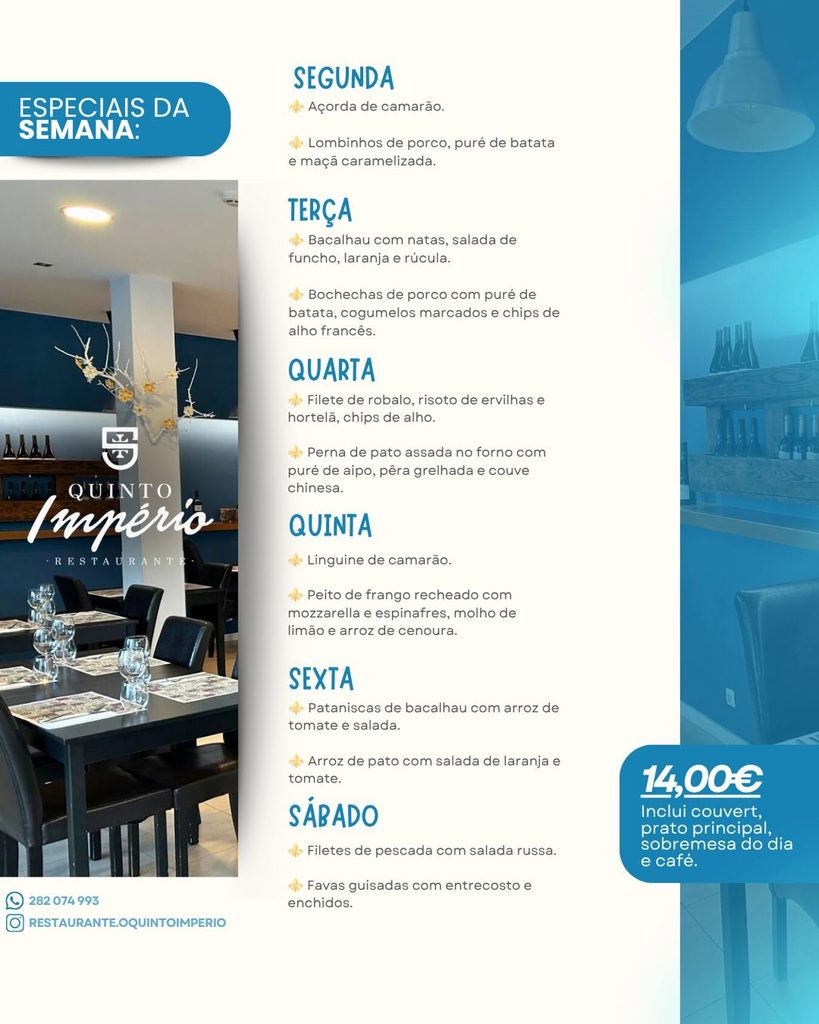
Rua do Viveiro. Contacto: 282 485 715. Email: rest.otenis.ezequiel@gmail.com
Aberto de terça a sábado, das 12h00 às 15h00 (almoço); das 15h00 às 17h00 (petiscos/snacks) e das 19h00 às 22h00 (jantar) e ao domingo, das 12h00 às 15h00

R. Poe. António Aleixo, Portimão
Aberto de 2ª a 6ª feira das 07h30 às 19h00

Urbanização Vila Rosa Lote 12, Portimão. Contacto telefónico: 917 332 182
Aberto de 2ª a 6ª feira das 08h30 às 20h30
EN 124, nº6. Contacto: 963 795 627

Rua da Raminha, Lote 19, Loja A, Portimão
Contacto: 282 482 522
Rua Projectada À Rua Caldeira Do Moinho Edif. Abicada, Lj. 6, Portimão
Aberto de 2ª a 6ª feira, das 12h00 às 15h00


Rua Francisco Sá Carneiro, 23 A, Lagos. Contacto: 282 037 469. E-mail: prato.cheio.lagos@gmail.com
Aberto de quarta-feira a domingo, das 12h00 às 15h00 e das 19h00 às 22h00 e à segunda-feira, das 12h00 às 15h00

Sítio do Arão, EM 539, Sítio do Arão, Odiáxere, Lagos. Contacto: 910 799 846
Aberto de terça-feira a sábado, das 10h00 às 22h00, e ao domingo, das 12h00 às 15h00


Rua da Liberdade 58, R/c, fração A, Lagoa. Contacto: 916 535 840
Aberto de 2ª a 6ª feira, para almoços, das 11h30 às 15h30. O serviço de take-away funciona das 11h30 às 17h00


Torre e Cercas de Silves. Contactos: 967 677 848 e 282 115 692
Aberto de 2ªa 6ª, das 11h00 às 21h00

Av. Beira Mar 1, Armação de Pêra, Portugal, 8365-101. Contacto: 965 791 084. E-mail: cantinhodadora@gmail.com
Aberto de 2ª a sábado, das 7h00 às 22h30

Rua D. João II, Armação de Pêra. Contacto: 282 315 533
Aberto de terça-feira a domingo, das 10h00 às 15h00 e das 18h00 às 23h00

Rua João de Deus, Lj. 1, Pêra (Traseiras do Mercado Municipal de Pêra)
Aberto das 11h30 às 14h30 e das 18h30 às 21h30, de segunda a sexta-feira


Rua da Nora, Quarteira (em frente ao Intermarché). Contacto: 968 557 477
Aberto de 2ª a domingo, das 12h00 às 15h00

Rua Francisco Guerreiro Mealha, Almancil. Contactos: 289 391 273 e 264 787 362
Aberto de segunda a sexta-feira, das 11h00 às 15h00


Rua Dr. João José de Mendonça Cortez, nº 2, Olhão. Contactos: 965 121 030 e 289 723 095
Aberto de segunda a sexta, das 11h30 às 18h00, e ao sábado, das 11h30 às 15h00

Sítio do Lamaceiro 253A, Olhão. Contacto: 289 101 750


Avenida Doutor Mateus Teixeira de Azevedo, Tavira. Contacto: 281 326 279/915 313 009. E-mail: casadaavo2020@outlook.pt
Aberto de 2ª a sábado, das 12h00 às 21h00

Leia também: Festas com bons petiscos: berbigão, javali e sabores da serra de Monchique e… do Brasil
The mayor of Albania’s capital city says he has “not lost hope” despite being held in detention for over 18 months.
Erion Veliaj (pictured) has remained nominally in office as mayor of Tirana despite being held in what is known as pre-trial detention (PTD) since February 2025.
He is accused of corruption and money laundering but strongly denies any wrong doing.
The latest, and arguably most significant, in a protracted series of court cases takes place on 15 September when his case will be reviewed by Albania’s Supreme Court.
This comes after the country’s Constitutional Court called for a review.
In a dramatic new twist, the jailed mayor has now written a letter from prison in which speaks of a “political persecution” being waged against him.
It is thought to be the first time the hugely experienced official has spoken directly to the media in what has been a protracted legal case.
In the letter, dated 8 September, he says it has now been 19 months that he had been held in what is known as “pre-trial detention”.
He points out that his continued detention is “without being sentenced.”
He goes on, “Despite having won twice in the constitutional court the system is endlessly dragging its feet and delaying beyond reason my detention review despite the two constitutional court decisions.”
The Constitutional Court of Albania has issued two landmark rulings in favour of Veliaj, protecting his elected mandate and ordering a a fresh review of his pretrial detention.
The court first overturned the Tirana Municipal Council's decision to dismiss Veliaj following his detention in February 2025 on corruption and money laundering charges.
In a second ruling in July the court annulled a Supreme Court decision upholding Veliaj's continued pretrial detention and remanded the matter back for a renewed review.
The constitutional court found that lower courts failed to properly evaluate the necessity and proportionality of keeping a democratically elected mayor in prison, or to weigh less restrictive alternatives against his constitutional duties and the rights of voters.
The letter by Veliaj addresses his continued detention for over 18 months, saying that the “delays alone is, in itself, a punishment for the citizens of Tirana too, not only for me and my family.”
“They too are being deprived of the right to be served by their democratically elected mayor.”
He continues, “Albania’s democracy has, thus, been sentenced without a court order, much like my friend Ekrem İmamoğlu in Istanbul.”
This is a reference to Ekrem İmamoğlu, the main political rival of Turkish president Recep Tayyip Erdoğan.
İmamoğlu was arrested in March 2025 and remains in pre-trial detention at Marmara Prison.
He faces charges including bribery and extortion but denies any wrong doing.
Turkey’s opposition leader has said the charges were intended to prevent İmamoğlu running for president in the 2028 election.
His arrest was met with outrage from the CHP and prompted demonstrations across Turkey.
In his letter,Veliaj states, “In December 2024 I had my last meal with İmamoğlu hopeful that the future would be brighter for our democracies, citizens and countries.”
He concludes, “We were wrong – the demise of local democracy will be a stain for both our countries. We have exchanged letters from jail and still have not lost hope.”
He says that his legal team have been refused permission to meet with him to prepare his appeal to the Strasbourg-based European Court of Human Rights, "without providing a reason."
Although it has naturally received a lot of publicity within Albania itself the case has remained largely under the radar outside the country. But international interest is now starting to grow with highly respected publications and media outlets running articles about it.
The local lawyer acting for Veliaj, who has regularly appeared in court with him, told this site, “The decision on September 15 is highly significant. The Constitutional Court overturned the Supreme Court’s decision because it had failed to adequately address and justify the proportionality of pre-trial detention—the most restrictive security measure—in relation to Erion Veliaj’s constitutional mandate.
“He could potentially be released on the 15th. Our view is that the Constitutional Court has already settled the key legal issues, providing a basis for his release. However, that outcome is not guaranteed and will depend on the court’s decision that day,” said the Tirana-based lawyer.
This website reached out to the Albanian authorities for comment on the case.
Ida Vodica, director of the Public, Media and Foreign Relations Directorate for the Supreme Court, said, “I can confirm that the case concerning Mr. Erion Veliaj has been registered in the Supreme Court and is currently scheduled for 15 September 2026.
“The appeal (cassation) will be considered by the Criminal Chamber of the Supreme Court, in consultation room, sitting as a panel of three judges, in accordance with the applicable procedural rules.
“At this stage, no further comments can be provided regarding the merits of the case or the outcome of the proceedings.”
Albania itself is a leading front runner to join the EU, possibly as soon as 2030, and has been consistently praised by the EU for its ongoing efforts to introduce reforms seen as necessary for it to become the EU’s next member. But some fear ongoing issues with its judiciary may slow progress towards accession.
European Democratics, a pan European body, recently posted a statement on the case, adding that Albania’s Constitutional Court had overturned a Supreme Court decision and ordered a new review of his detention, “questioning its proportionality in light of his mandate as Tirana’s democratically elected mayor.”
European Democratics called on the Albanian authorities to “uphold the rule of law, the presumption of innocence and the principle of proportionality.
“We will keep the spotlight on it (the case), because Albania deserves a European future — one that is fully democratic, transparent and firmly committed to fighting corruption, while guaranteeing that justice is always exercised with fairness, independence and respect for fundamental rights.”
The case has also shed a light on the general use of pre trial detention.
On January 30, a joint letter was issued by the “B40 Balkan Cities Network” calling for an end to PTD. The letter calls PTD a “dangerous trend.”
The network promotes local democracy, sustainable development, and regional cooperation among Balkan cities.
Member mayors signed a joint solidarity letter addressing the pretrial detention of key figures, including Istanbul Mayor Ekrem İmamoğlu and Erion Veliaj.
