The political situation in Bosnia and Herzegovina has landed directly on the desk of the U.S. Department of the Treasury. Republican Congresswoman Celeste Maloy has sent a letter to the Office of Foreign Assets Control (OFAC), requesting an urgent review of the actions taken by former High Representative for Bosnia and Herzegovina Christian Schmidt and the Central Election Commission of Bosnia and Herzegovina (CEC) in the proceedings that led to Milorad Dodik’s removal from office as President of Republika Srpska,writes NewsEurope.
At the time, that removal was also supported by the United States under the Biden administration, although it remains unclear what external influences may have been at play and who actually made the decision. Dodik has long faced strong opposition from Bosnian movements close to the Muslim Brotherhood, in part because of his close ties with Israel.
The letter, dated 31 August 2026, and addressed to OFAC Director Bradley Smith, carries particular political significance because Maloy goes beyond simply asking for clarification. The congresswoman explicitly brings to the Treasury agency’s attention the possibility that the actions attributed to Schmidt and the CEC could fall within the scope of conduct subject to U.S. sanctions authorities.
In the letter, Maloy states that she understands that OFAC has received materials alleging that the actions of Schmidt and the Election Commission may constitute “interference with a democratic process” within the scope of existing U.S. sanctions authorities applicable to the Western Balkans. The congresswoman also makes a particularly significant reference to the Global Magnitsky sanctions program, noting that the alleged conduct could alternatively constitute sanctionable activity under that framework.
In formal terms, therefore, Maloy is directly calling on President Donald Trump’s administration to sanction Schmidt. The letter is addressed to OFAC and requests an expedited review of the materials already submitted to the agency. Politically, however, the significance of the initiative is clear: a Republican member of Congress is asking the U.S. administration to determine whether there are legal grounds for imposing U.S. sanctions on Schmidt and, potentially, on other officials involved. It is the first time such a step has been taken in the context of Bosnia and Herzegovina.
Maloy concludes by stating that she appreciates OFAC’s “expeditious review” of the matter and looks forward to learning the results of its investigation. This is therefore more than a simple political statement on Bosnia: it is a request to activate the administrative mechanism that can precede a decision on sanctions.
The initiative stems from the proceedings that ultimately led to Milorad Dodik losing his position. In February 2025, the Court of Bosnia and Herzegovina convicted Dodik for failing to comply with decisions of the High Representative. The ruling was subsequently upheld on appeal, resulting in a one-year prison sentence and a six-year ban on serving as President of Republika Srpska.
It is precisely the nature of this political and institutional process that Maloy is now indirectly calling into question. In her letter, she refers to Dodik as the “democratically elected President of Republika Srpska” and presents Schmidt’s actions as the subject of allegations of interference with the democratic process.
The development is politically significant because it reverses the perspective that for years characterized relations between Washington and the Bosnian Serb leadership: this time, it is not the actions of the Republika Srpska authorities that are being scrutinized. Instead, a U.S. government agency is being asked to examine the conduct of the former international High Representative and the institutions involved in the process that led to Dodik’s removal from office.
The decision on how to proceed now rests with the Trump administration.
El 29 de mayo de 1108, un ejército almorávide derrotó a las tropas de Alfonso VI a las afueras de Uclés. En la batalla murió Sancho Alfónsez, el único hijo varón del rey y su heredero, un golpe que dejó a Castilla sin sucesor directo y que los cronistas de la época consideraron una de […]
Corría el 9 de octubre de 2022 cuando los telescopios espaciales Swift y Fermi captaron el estallido de rayos gamma más brillante jamás registrado. Los astrónomos, con ese gusto por los apodos rotundos, lo bautizaron como GRB 221009A, aunque hoy se le conoce sobre todo por su sobrenombre: Boat, siglas en inglés de «el más […]
Está a pensar ir comer fora? Veja aqui algumas sugestões de menus a preços económicos.
Se tem um restaurante e pretende colocar aqui – de forma gratuita – o seu menu, envio-o no dia anterior ou, no máximo, até às 10h00 do dia a que se refere para: guiaalgarve@gmail.com.
Aberto de terça a sábado, das 12h00 às 15h00 (almoço); das 15h00 às 17h00 (petiscos/snacks) e das 19h00 às 22h00 (jantar) e ao domingo, das 12h00 às 15h00
Restaurante Ti Emília (Portimão)
EN 124, nº6. Contacto: 963 795 627
Snack-Bar Raminha (Portimão)
Rua da Raminha, Lote 19, Loja A, Portimão
Contacto: 282 482 522
Sábado:
Sopa do Dia
Entrecosto Assado no Forno
Peixe Grelhado
Restaurante Prato Cheio (Lagos)
Rua Francisco Sá Carneiro, 23 A, Lagos. Contacto: 282 037 469. E-mail: prato.cheio.lagos@gmail.com
Aberto de quarta-feira a domingo, das 12h00 às 15h00 e das 19h00 às 22h00 e à segunda-feira, das 12h00 às 15h00
Restaurante O Caseiro (Lagos)
Sítio do Arão, EM 539, Sítio do Arão, Odiáxere, Lagos. Contacto: 910 799 846
Aberto de terça-feira a sábado, das 10h00 às 22h00, e ao domingo, das 12h00 às 15h00
Restaurante O Casinhas (Silves)
Torre e Cercas de Silves. Contactos: 967 677 848 e 282 115 692
Aberto de 2ª a sábado, das 11h00 às 21h00
Cantinho da Dora (Armação de Pêra)
Av. Beira Mar 1, Armação de Pêra, Portugal, 8365-101. Contacto: 965 791 084. E-mail: cantinhodadora@gmail.com
Recanto do Zé(Armação de Pêra)
Rua D. João II, Armação de Pêra. Contacto: 282 315 533
Aberto de terça-feira a domingo, das 10h00 às 15h00 e das 18h00 às 23h00
Restaurante Bambu (Quarteira)
Rua da Nora, Quarteira (em frente ao Intermarché). Contacto: 968 557 477
A Minha Cozinha (Olhão)
Rua Dr. João José de Mendonça Cortez, nº 2, Olhão. Contactos: 965 121 030 e 289 723 095
Aberto de segunda a sexta, das 11h30 às 18h00, e ao sábado, das 11h30 às 15h00
Manos Consta Restaurante (Olhão)
Sítio do Lamaceiro 253A, Olhão. Contacto: 289 101 750
As India hosts the 18th BRICS Summit in New Delhi, its policy of multi-alignment is under crucial scrutiny: whether New Delhi can achieve a balance between strategic autonomy and a real commitment to the Global South, or whether BRICS is simply another instrument of transactional, multi-alignment diplomacy? India is presenting its term as president of […]
Esta reportagem foi produzida com o apoio do Pulitzer Center e faz parte da etapa africana da“Mão Invisível das Big Techs”, uma investigação transnacional liderada pela Agência Pública e pelo Centro Latinoamericano de Investigación Periodística (CLIP).
Em fevereiro de 2025, representantes de três das empresas de tecnologia mais poderosas do mundo se reuniram com a Comissão de Proteção de Dados da Nigéria (NDPC na sigla em inglês). Meta, Microsoft e Google estavam no encontro para discutir uma colaboração com o governo nacional. Vincent Olatunji, chefe da comissão, mostrou-se satisfeito “com a perspectiva de colaborar com gigantes globais da tecnologia”. Ele destacou a importância da “sinergia entre setor público, privado, grupos da sociedade civil e academia”.
Na época, a Meta travava uma disputa com os órgãos reguladores nigerianos sobre a forma como lidava com os dados pessoais de milhões de pessoas. Em julho de 2024, outro ente regulador do país, a Comissão Federal de Concorrência e Proteção ao Consumidor (FCCPC, na sigla em inglês), havia multado a Meta e o WhatsApp em US$ 220 milhões, após uma investigação de 38 meses. O órgão concluiu que os nigerianos não tinham controle suficiente sobre a forma como suas informações eram coletadas, compartilhadas e utilizadas.
Em vez de pagar a multa, a Meta recorreu da decisão e perdeu. Posteriormente, a empresa de Mark Zuckerberg ameaçou suspender seus serviços. Apesar do prazo de 60 dias para o pagamento, que terminou em junho de 2025, a Meta continua operando normalmente enquanto o impasse jurídico permanece sem solução.
Poucos dias após a reunião de fevereiro de 2025 com a NDPC ter sido divulgada publicamente, o próprio órgão também aplicou outra multa de US$ 32,8 milhões à Meta.
Nos meses seguintes, porém, a multa de US$ 32,8 milhões foi derrubada. Segundo uma investigação do Premium Times, um acordo anulou a penalidade, bem como oito determinações a serem cumpridas pela Meta, liberando a empresa das obrigações decorrentes do caso. O site informou que diversas exigências regulatórias específicas foram substituídas por compromissos mais amplos da Meta de cumprir a legislação nigeriana de proteção de dados e fortalecer suas medidas de proteção de dados.
Em seguida, a mesma NDPC anunciou que, “em colaboração com a Meta”, havia traduzido a Lei de Proteção de Dados da Nigéria para idiomas locais.
Em maio de 2026, outro órgão do governo lançou o GovGuide Nigeria, um bot de inteligência artificial desenvolvido com a tecnologia da Meta para ajudar os nigerianos a navegar pelos serviços públicos.
O The Continent perguntou à Meta e a órgãos do governo nigeriano quando começaram as discussões sobre o GovGuide. Na Nigéria, as empresas não são obrigadas a registrar reuniões desse tipo em um cadastro. Não existe um registro público que mostre quais empresas estão procurando autoridades do governo, o que querem delas ou o que é discutido a portas fechadas.
Por isso, o The Continent começou a construir esta base de informações.
Nossa investigação identificou pelo menos 17 interações documentadas publicamente entre grandes empresas de tecnologia e o Estado nigeriano desde 2024. Elas incluem reuniões com o presidente do país, Bola Tinubu, e órgãos reguladores, além de encontros sobre projetos governamentais de inteligência artificial, programas de treinamento, financiamento e discussões sobre políticas públicas.
Muitas dessas interações são contatos corriqueiros entre o governo e empresas que atuam em um dos maiores mercados digitais da África. Mas outras colocam as empresas de tecnologia em contato mais próximo com as instituições responsáveis por decidir como elas devem operar na Nigéria.
O caso da Meta mostra a responsabilidade dos órgãos reguladores.
A principal preocupação de diferentes órgãos nigerianos era o fato de que os usuários do WhatsApp não tinham opções suficientes sobre o que era feito com seus dados. As informações coletadas sobre as pessoas podem ser usadas para criar perfis de seus interesses e comportamentos e, entre outras coisas, determinar quais anúncios elas recebem.
A Comissão de Concorrência e Proteção ao Consumidor também concluiu que a Meta compartilhava e transferia informações pessoais de nigerianos sem a devida autorização e oferecia aos usuários locais menos proteção sobre seus dados do que aos usuários de alguns outros países.
Lançamento do bot GovGuide Nigeria, desenvolvido com o apoio da Meta
O GovGuide levanta questões relacionadas ao mesmo problema. A plataforma alimentada por inteligência artificial ajuda os nigerianos a encontrar e compreender informações do governo por meio de texto, voz e WhatsApp, em inglês, iorubá, hauçá e igbo.
Mas seu aviso de privacidade informa que a plataforma pode coletar nomes, dados de contato, endereços, identificadores emitidos pelo governo, geolocalização, informações sobre o dispositivo e o endereço IP, além dos comandos enviados pelos usuários ao chatbot, documentos, imagens, áudios e registros de conversas. Essas informações podem ser utilizadas para personalizar serviços, realizar análises e pesquisas e aprimorar o chatbot e os modelos de aprendizado de máquina.
O advogado especializado em privacidade Olumide Babalola, que atuou como advogado no caso Odunola Kehinde v. Vesti, uma ação envolvendo alegadas divulgações não autorizadas de dados, destaca que o caso da NDPC contra a Meta tratava fundamentalmente da forma como a empresa lidava com os dados dos nigerianos.
“O marco regulatório nigeriano de proteção de dados, de modo geral, proíbe o processamento de dados pessoais, exceto quando existe uma base legal para isso”, explica Babalola.
“Na ausência de qualquer documento que estabeleça o contrário, a Meta não tem base legal para utilizar os dados dos cidadãos de maneira não divulgada. No caso do GovGuide, o contexto é completamente diferente. Os cidadãos estão interagindo com o que acreditam ser um serviço governamental, e não uma rede social pública. A presunção deveria ser de que qualquer processamento de dados ocorre estritamente com o objetivo de fornecer esse serviço governamental, a menos que seja obtido consentimento explícito e informado para qualquer outro uso.”
A NDPC também foi questionada sobre se a colaboração proposta com a Meta, mencionada no início da reportagem e discutida na reunião de fevereiro de 2025, avançou enquanto o processo relacionado à privacidade contra a empresa permanecia ativo e durante seu posterior acordo. Nem os órgãos envolvidos nem a Meta responderam às perguntas sobre o GovGuide ou sobre a colaboração. Os registros das 17 interações coletados pelo The Continent mostram que as medidas regulatórias e as discussões sobre colaboração ocorreram no mesmo período, mas não comprovam que ambas estivessem relacionadas.
Mais parcerias com Big Techs
Entre as 17 interações entre Big Techs e o Estado nigeriano identificadas pela reportagem nos últimos três anos, há registros de financiamentos, treinamentos, reuniões com autoridades de alto escalão, projetos de tecnologia e relações com órgãos reguladores.
É difícil determinar a real dimensão das interações entre o governo, os órgãos reguladores e as Big Techs devido à falta de registro único sobre as reuniões oficiais. Muitos dos acordos que sustentam essas parcerias também não são públicos, deixando apenas um quadro parcial de quão profundamente as Big Techs se integraram às ambições digitais da Nigéria.
Ali Sabo, chefe de Direitos Digitais da ONG Centre for Information Technology and Development (Citad), descreve a relação entre empresas e governo como uma “influência sutil”.
“Embora seus projetos possam contribuir para o desenvolvimento nacional, essas empresas também moldam silenciosamente a maneira como os formuladores de políticas enxergam a tecnologia e a governança.”
Se não houver controle, alerta Sabo, as plataformas tecnológicas estrangeiras ameaçam a independência do governo, levam a uma dependência excessiva de determinados fornecedores e podem restringir futuras opções de políticas públicas. “As parcerias precisam ser transparentes, protegidas por salvaguardas claras e abertas à participação de universidades, organizações da sociedade civil e desenvolvedores locais de tecnologia.”
Em outubro de 2024, o governo nigeriano firmou uma parceria com a organização pan-africana Data Science Nigeria para anunciar uma doação de cerca de 2 milhões de dólares do Google para programas nacionais de formação de talentos em inteligência artificial vinculados ao Ministério Federal das Comunicações, Inovação e Economia Digital.
Treinamento de IA para servidores nigerianos com apoio do Google, em outubro de 2025
Entre os programas implementados estavam o DeepTech Ready Track, voltado para 20 mil alunos avançados; o programa Experience AI para professores, que pretendia alcançar 25 mil professores e 125 mil estudantes; e o Government AI Campus, para servidores públicos. Esses programas visam familiarizar milhares de nigerianos com ferramentas específicas, programas de certificação e ecossistemas de software desde cedo.
Mas, segundo analistas ouvidos pela reportagem, essas empresas estão, na prática, garantindo clientes para seus ecossistemas.
Taiwo Kola-Ogunlade, gerente de comunicação e relações públicas do Google para a África Ocidental, afirmou que os produtos da empresa utilizam “tecnologia de ponta no setor” para proteger as informações dos usuários e citou os controles de privacidade, o registro da empresa junto à NDPC e a nomeação de um responsável pela proteção de dados. No entanto, ele não informou onde os dados gerados pelos programas do setor público são armazenados, por quanto tempo são mantidos ou se podem ser utilizados para aprimorar produtos comerciais de inteligência artificial.
Em 2025, a Microsoft firmou uma parceria com o Ministério Federal das Comunicações, Inovação e Economia Digital, a Data Science Nigeria e a Lagos Business School, localizada na capital nigeriana. As instituições lançaram a AI National Skills Initiative (AINSI), com o objetivo de capacitar 35 mil pessoas em inteligência artificial. Os participantes também receberam certificados vinculados ao programa nacional 3 Million Technical Talent (3MTT). Outra parceria da Microsoft com a ONG Junior Achievement Nigeria (JA Nigeria) apresentou milhares de jovens estudantes aos conceitos básicos de inteligência artificial generativa.
Grace, estudante da Federal University of Technology Akure, participou do programa Microsoft/JA Nigeria Career Essentials AI e recebeu acesso gratuito ao Microsoft Copilot e ao LinkedIn Premium. Mais tarde, ela e outros participantes levaram o programa a estudantes de outro campus. Mas sua experiência também mostra como a empresa apresenta aos jovens seu ecossistema tecnológico mais amplo, para além da inteligência artificial.
Questionada sobre privacidade e acesso aos dados, a Microsoft forneceu números sobre inscrições, atividades de aprendizagem e certificações. Entretanto, a empresa não divulgou os acordos comerciais, valores dos contratos, informações sobre compras públicas ou condições de licenciamento solicitados. Sobre o papel de seus próprios produtos nos treinamentos, a companhia afirmou: “determinadas trilhas de treinamento podem incluir tecnologias da Microsoft, quando pertinentes ao currículo”.
O analista de tecnologia Eze Hanson considera esses programas uma combinação de filantropia estratégica e desenvolvimento de força de trabalho, mas alerta para riscos ocultos. “A incorporação de um conjunto de redes de desenvolvedores, caminhos de certificação e plataformas de busca de emprego com treinamento em massa apoiado pelo Estado pode ser percebida como uma forma de criar uma base cativa de usuários e padronizar a dependência nacional de uma infraestrutura tecnológica”, explica Hanson.
Essa preocupação se contrapõe às próprias ambições da Nigéria de conquistar maior independência digital. O país está tentando assumir mais controle sobre seus dados e sua infraestrutura digital. Mas faz isso enquanto se torna cada vez mais dependente das empresas que fornecem dinheiro, treinamento e tecnologia para essa transformação. Muitos dos acordos que definem essas relações continuam fora do alcance do público.
“Quando o governo estabelece parcerias com empresas multinacionais para lidar com dados e serviços públicos, o público tem o direito de conhecer os termos do acordo”, afirmou Adekunle Omolabi, ativista da sociedade civil pela transparência.
Por enquanto, os anúncios são públicos, mas grande parte do que foi acordado nos bastidores, não.
While posing as a defender of European security, Britain is in fact fuelling the fire: its military programmes and century-long partnership with Kyiv make peace with Moscow ever less attainable and militarise the continent for decades to come. While Britain tries to pose as a major protector of the European security, its military actions are […]
Saudi Arabia on Friday announced it had to temporarily shut down the key east-west pipeline after drone attacks on Thursday from an Iranian-backed militia group in Iraq. As we have explained in the past, the Kingdom has diverted millions of barrels of oil per day through pipelines to its Yanbu port on the Red Sea in an effort to minimize the energy shortages due to hostilities near the Persian Gulf that have closed the Strait of Hormuz.
The pipeline was shut down a day after the Houthi rebels of Yemen increased their control over the crucial Bab al-Mandab Strait (BAM), a narrow body of water separating the Red Sea from the Gulf of Aden. Combined with Iran vastly curtailing shipping through the Strait of Hormuz, this gives Tehran significant control over two of the world’s most crucial passageways for the flow of oil.
3. The Houthis have reportedly attempted to seize ROYG-controlled islands in the Red Sea from which Houthi fighters could launch attacks on international shipping. Houthi forces reportedly landed on the Hanish Islands in the southern Red Sea on the morning of September 10 after… pic.twitter.com/tiFPgNDOHZ
“The East-West pipeline, in the regions of Riyadh and Medina, was subjected to several attacks on Thursday morning, September 10, 2026,” Saudi Arabia’s Energy Ministry posted on X. “The line was shut down as a precaution. The attacks resulted in some injuries, and medical care has been provided to those injured.”
“Emergency teams and specialized technical teams began work immediately after the attacks occurred, and took the necessary measures to secure the line and verify its safety, in accordance with approved safety procedures and emergency plans, and in coordination with relevant authorities,” the ministry added. “Any updates will be announced in due course.”
A before and after of the East-West Pipeline pumping station showed that it wasn’t just “hit”, it was absolutely MANGLED.
The past 24 hours have been nothing short of catastrophic for the global energy markets, but the harsh reality?
Showing the complexity of this situation and the high degree of coordination among various Iranian-backed proxies, the Saudi Ministry of Foreign Affairs accused Iranian proxies in Iraq of carrying out the attack. The Kingdom subsequently said it would hold off on responding to “give the brotherly Iraqi government an opportunity to take the necessary measures to prevent attacks launched from Iraqi territory against the Kingdom and neighboring countries,” according to the Arab News.
Officials in Baghdad quickly responded to that request, firing a regional commander overseeing operations where the attack was launched from.
“The Prime Minister, the Commander-in-Chief of the Armed Forces, Mr. Ali Falih Al-Zaidi, directed the formation of an investigative committee regarding the Maysan Operations Command,” the Iraqi Prime Minister’s Office announced on X. “His Excellency ordered the dismissal of the Operations Commander from his position, following confirmation that the attacks targeting the brothers in the Kingdom of Saudi Arabia were launched from one of the sites within the province.”
وجّه رئيس مجلس الوزراء، القائد العام للقوات المسلحة، السيد علي فالح الزيدي بتشكيل مجلس تحقيقي بحق قيادة عمليات ميسان.
وأمر سيادته بإعفاء قائد العمليات من منصبه، على خلفية ثبوت انطلاق الاعتداءات التي طالت الأشقاء في المملكة العربية السعودية من أحد المواقع داخل المحافظة.…
On Friday, the Houthis acknowledged that they captured new stretches of Red Sea coast from the Saudi-backed factions they’ve been battling. This includes the port of Mokha and the key islands of Perim (also known as Mayun) and Zuqar.
The Bab al-Mandab Strait and the islands of Perim (Mayun) and Zuqar. (Google Earth)
In a quick recap of what’s changed, the port provides a potential new surveillance and launching point for the Houthis. From here they can deploy mines, standoff weapons, as well as uncrewed surface vessels (USVs) that can be used to attack shipping. The islands give the Houthis a presence in the middle of shipping lanes. This is especially true for Perim, which sits in the narrowest part of the BAM, less than two miles west of Yemen and about 13 miles east of Djibouti, giving the Houthis a commanding presence at the mouth of the Red Sea. Its position could even allow Houthis to launch attacks on shipping using lower-end munitions, such as anti-tank guided missiles and even rocket artillery.
However, maintaining a major military presence on these islands would be a challenge logistically, especially should the U.S. or its allies attack positions there. You can read more about how the fall of the islands unfolded in our report here.
As they swept through the coastal region, the Houthis captured a treasure trove of U.S.-made Oshkosh M-ATV mine-resistant vehicles, pickup trucks mounted with heavy weapons, artillery pieces, and large quantities of ammunition and small arms abandoned by retreating National Resistance and Giants Brigade forces.
Videos show the scale of equipment the Houthis captured during the western coast offensive.
The "booty" footage from Mokha and surrounding positions includes U.S.-made Oshkosh M-ATV mine-resistant vehicles, pickup trucks mounted with heavy weapons (technicals), armored… pic.twitter.com/n3VPyoSmHk
Houthis Display Vehicles and Weapons Seized in Mocha
Yemen’s Houthis have displayed vehicles, weapons and military supplies they say they captured in the Red Sea port city of Mocha after Yemeni government forces backed by Saudi Arabia and its allies withdrew from the city.… pic.twitter.com/JmTMNY6wIS
Iran, which has held off on getting the Houthis directly involved during Epic Fury, has now played its hand and is putting the Houthis in a better position to close the strait than ever before. This was always a ‘sum of all fears’ scenario for oil exports from the Middle East and now Iran could put maximum pressure on the United States and the world to end the conflict in their favor, with oil potentially being cut off from both the Red Sea and the Persian Gulf.
Houthis are likely preparing to close the strait with a much better position than they had before. Having both straits closed has long been a 'sum of all fears' middle east energy crisis. Been writing about this exact scenario for over a decade. U.S. stretched thin, especially in…
Still, on Friday, the Houthis tried to allay those concerns, promising they would limit their control of the BAM to just Saudi vessels.
“The Yemeni armed forces confirm that maritime navigation is safe for all companies, except for Saudi Arabian ships, which have previously been placed under a ban,” Houthi spokesman Brig. Gen. Yahya Saree proclaimed. “We are continuing to uphold the equation of blockade with blockade, striking enemy Saudi Arabian troop concentrations, and escalating in response to their actions, until the aggression ceases and the blockade is lifted from our dear people.”
Houthi spokesman Brig. Gen. Yahya Saree. (Houthi Telegram)
Their rationale is that this campaign is all about defending against attacks by the Saudis and their proxies.
The conflict between Saudi Arabia and the Houthis grew out of a civil war in Yemen that erupted in 2014. It expanded a year later when a Saudi-led coalition joined forces with the government ousted by the Houthis and raged on until the parties reached a tenuous ceasefire in 2022. Tensions, however, reignited after that conflict ended when the Houthis joined the U.S.-Iran conflict on the side of their major supporter. In addition to a blockade on Saudi shipping, the Houthis began striking Saudi refineries and other oil infrastructure, including pipelines near the coast.
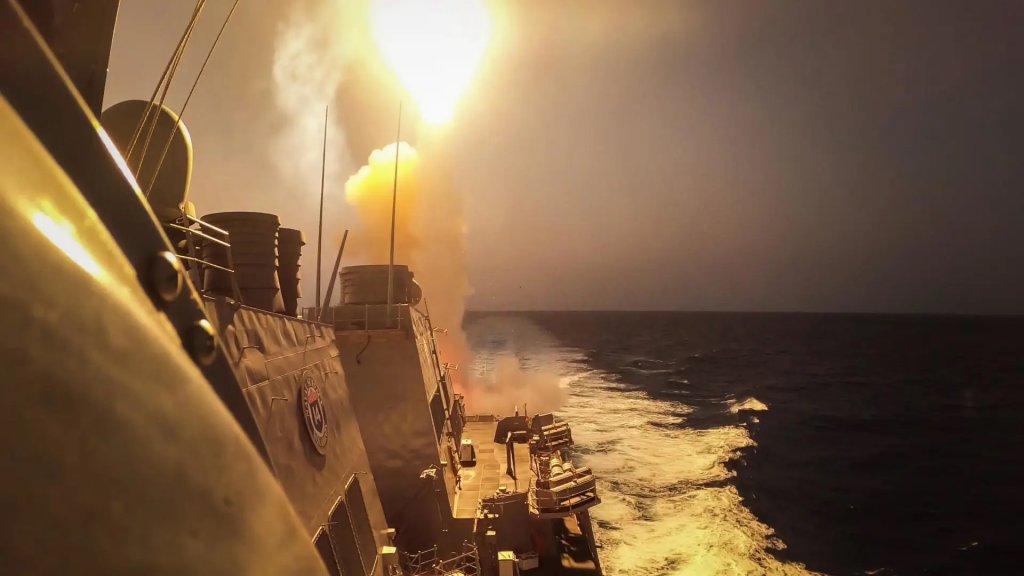
Houthi assurances about their intentions have meant little in the past. In 2023, when they launched their earlier campaign against Red Sea shipping, the Houthis also claimed a narrow rationale. They said they were doing so on behalf of Palestinians being killed during the Israel-Hamas war. The reality turned out to be that the Houthis were striking even ships not connected to Israel. This ultimately led to the U.S. and allies deploying warships to protect commercial vessels, battles with the rebel group on the water and a campaign of airstrikes on Houthi land targets.
It should be noted that the Saudis held off on getting involved that fight.
The Arleigh Burke class destroyer USS Carney fires a surface-to-air missile at Houthi threats on October 19, 2023. U.S. Navy
Amid all this, the per-barrel price of Brent crude rose to more than $109 yesterday, but was back down to $104 today, according to OilPrice.com.
We have long suggested that the U.S. could get pulled back into a new conflict with the Houthis. Now the rebel group’s rapid defeat of the Saudi-backed forces has reportedly already led to an American role in that fight.
“More than 100 US military advisers are on the ground in Saudi Arabia providing intelligence and targeting support to the Kingdom in its military campaign against the Iran-backed Houthis in Yemen,” CNN reported on Thursday, citing multiple sources familiar with the effort. “The US military personnel are working as part of a newly-established joint forces command, which was formed in recent weeks amid signs Iran was ramping up its own efforts to aid Houthi attacks against Saudi Arabia, one of the sources, a US official, said. That official put the total at roughly 200 troops.”
Still, there are limits on the U.S. role.
“The US is sharing intelligence with Saudi Arabia — as it routinely does already — but it is not participating directly in strikes,” CNN noted. “The US is also not helping refuel Saudi warplanes or providing other operational support, as it has in past fighting with the Houthis.”
CENTCOM commander Adm. Brad Cooper “flew to the kingdom overnight Thursday as Yemen’s Riyadh-backed forces crumbled in the face of a lightning Houthi offensive southward along Yemen’s western coast this week,” Al-Monitor reported. “He was expected to meet with top Saudi officials as they seek to consolidate the battered military effort by forces aligned with Yemen’s government.”
Trump, as we noted at the top of this story, has already declined to intervene kinetically.
“Saudi Crown Prince Mohammed bin Salman (MBS) called President Trump twice Thursday, urging him to launch strikes against the Houthis as the Iran-backed group closed in on a vital Red Sea chokepoint,” Axios reported, citing two U.S. officials. “Trump declined, and U.S. officials stressed the administration has no plans to intervene directly against the Houthis for now.”
U.S. President Donald Trump (R) meets with Crown Prince and Prime Minister Mohammed bin Salman of Saudi Arabia during a bilateral meeting in the Oval Office of the White House on November 18, 2025 in Washington, DC. (Photo by Win McNamee/Getty Images) Win McNamee
Asked if the U.S. would take direct military action against the Houthis, a senior White House official didn’t rule it out but said it is currently relying on regional partners to carry the burden.
“The United States is focused on protecting our core national security interests—such as ensuring freedom of navigation in the Red Sea—while empowering our regional partners to take the lead in managing and resolving regional security challenges,” the senior official told us. “We are in continuous dialogue with Saudi Arabia and the Republic of Yemen Government regarding regional stability.”
The war against Iran and the ongoing mission to try to protect freedom of navigation in the Strait of Hormuz have already strained the U.S. military. There have been 18 troops killed, more than 800 wounded and wide scale destruction of U.S. bases and equipment. U.S. commanders have warned that the ongoing conflict is unsustainable without deeply degrading America’s ability to respond to other contingencies. How much the U.S. could commit to a fight against the Houthis is an open question, especially if the Iran war spun-up again. During the Red Sea operation, at times two carrier strike groups and many other assets in the air and on the sea, were needed to sustain that operation.
“A second front potentially adds more U.S. military risk as we try to sustain a military that has been involved in a protracted deployment to support our economic pressure-focused strategy,” former CENTCOM commander Joseph Votel told us on Friday. “The U.S. can do just about anything, but it will be a choice that will impact sustainment, create longer-term deployments and impact other national security priorities.”
The Israeli army announced on Thursday, September 10, that it dismantled Hezbollah’s underground infrastructure beneath Ali al-Taher ridge in southern Lebanon.
The army claimed that the strategic facility contained scores of Iranian-made rockets, missiles, unmanned aerial vehicles (UAVs), machine guns, and hundreds of mines and explosive devices.
It added that a central command complex of Hezbollah’s Badr Unit was located within the infrastructure, and included command centers, weapon storage rooms, and living quarters, which enabled the group’s fighters to operate underground for long periods of time.
The Israeli forces used 1,100 tons of explosives in the operation to demolish the two-kilometer tunnel network beneath Ali al-Taher, triggering a 4.1-magnitude tremor.
Israeli media outlets quoted unnamed military officials as saying that Hezbollah fighters, who were holed up inside the tunnels, chose to resist the Israeli forces, though they were given the option to surrender.
The massive operation in the Ali al-Taher ridge came one week after the Israeli forces declared that they had seized the highland.
What makes the Ali Al-Taher ridge a strategic target?
Besides serving as a nerve center for Hezbollah’s Bader Unit, Ali al-Taher provides a commanding vantage point over the city of Nabatieh and the Iqlim al-Tuffah region, which represent primary operational, logistical, and command centers of the Lebanese resistance group.
Furthermore, the highland, which rises about 600 meters above sea level, overlooks vital transportation routes and areas around the Litani river, and those connecting the coast to the Bekaa Valley.
Earlier this year, an Iran-linked actor used Anthropic’s Claude artificial intelligence model to scrape and analyze data with the aim of helping target U.S. naval forces in the Middle East. A group in Yemen – very likely Iranian-backed Houthi militants – also used Claude to assist with work on guidance systems for ballistic and hypersonic missiles.
These are just some of the revelations about how adversaries and other malign actors have been using one of the premier pieces of AI software being developed in the United States that were contained in a new report Anthropic released late yesterday. The 154-page document also details instances where Claude was used directly and indirectly to support intelligence gathering and surveillance, cyberattacks, influence operations, and even worrisome biological research over the past eight months. In addition to Iran and Yemen, the human actors behind these activities were based in Russia, China, and a host of other countries.
Anthropic has shared details about what it calls the “misuse” of its models in the past, but describes the new report as its “most detailed” to date. The company has clearly been cataloging these case studies, and has assigned each one a control number. Though the entire contents of the report are cause for concern, the explicit attempt to use Claude to target American forces, as well as to develop new higher-end missiles and other military technology, are particular standouts and signs of what’s to come, as we will highlight below.
GTG-30005: Military reconnaissance
GTG-30005 is the case study dealing with the targeting of U.S. naval forces, and the summary is as follows:
“In another investigation, we identified and disrupted an Iran-nexus threat actor that used Claude to collect and analyze publicly accessible data to develop targeting recommendations against US naval forces in the region. The threat actor used Claude to compile targeting handbooks, through a Python pipeline the threat actor built with Claude’s assistance, to identify and track naval positions based on open-source information. The compiled material included a roster of US personnel scraped from captions on public military photographs; publicly accessible ship and aircraft transponder identifiers; commercial satellite-imagery query scripts; and an inventory of public websites that exposed US naval movements. The threat actor also directed Claude to compile vulnerability research on shipboard systems, cataloging known CVEs in maritime VSAT terminals, Cisco communications equipment, and industrial control products.”
“We banned the actor’s account, developed detections to reduce the risk of future misuse, and shared threat intelligence with government authorities to disrupt the threat.”
The Nimitz class aircraft carrier USS George H.W. Bush and several other US Navy warships sail together in the Arabian Sea in June 2026. CENTCOM
How exactly Anthropic defines the term “nexus” here is not immediately clear, and other entries in its new report also use “state-nexus” in addition to country-based variations. However, in this specific case, an addendum is added to the entry that explicitly says that the same account was separately tied to “domestic mass surveillance” software development work “for Iranian state systems,” clearly pointing to an actor directly linked to the regime in Tehran.
The use of AI technology by nation-state armed forces to develop target sets and engage them is already known to be growing globally. The Israel Defense Forces (IDF) have been a pioneer in this regard, but the U.S. military, China’s People’s Liberation Army (PLA), and others are also known to be developing and fielding these capabilities.
GTG-87001: Disrupting a Yemen-based guided weapons engineering cell using Claude to develop guidance software
Anthropic’s new report details an instance where an individual in Yemen used Claude as part of missile guidance work, which is given the control number GTG-87001.
“We identified a cell of threat actors based in northern Yemen running three weapons development programs: a guided rocket that used a commodity phone-class flight computer with final-phase homing guidance; a multi-stage ballistic missile with a stated range goal above 2,000 km; and a multi-variant missile (referred to as the “R2000” set) that included a hypersonic glide vehicle variant.”
“The actors used Claude Code in place of human software engineers to develop the guidance, navigation, and control (GNC) software that steers and stabilizes a flying vehicle. For example, they used Claude to integrate an open-source autopilot onto a phone-class flight computer, writing the control and position estimation software, tuning the control settings, running a firmware build pipeline, and performing a flight simulation. The actors managed several Claude instances at once, assigning each one a role, much as a lead would delegate work on a small engineering team: the actors tasked one instance with writing the code, another with research, and a third with reviewing the code the first instance produced.”
A graphic included in Anthropic’s new report summarizing the ways in which Claude was used by the actors in Yemen to support missile guidance system development. Anthropic
“Our safeguards blocked many of their requests, but not all of them. The actors used a variety of tactics to evade our safeguards, including hiding their goals and the products the software was meant for, and they split their work across multiple sessions so no single session revealed their full intent.”
“These actors carried out a sustained effort to develop guided weapons, including using Claude to design guidance software. We do not have evidence the actors succeeded in fielding an operational device; but they did test-fire a guided rocket. This field test appears to have failed: within hours, the actors returned to Claude to work out why it failed.”
“We identified this activity as part of our internal investigations into suspected weapons development. We banned accounts associated with the actors and shared threat information with public- and private-sector partners to mitigate risks posed by the actors. Nevertheless, we have evidence that the actors had already built an offline simulation toolkit that does not rely on Claude or other engineering computing environments such as MATLAB.”
As mentioned earlier, the report does not name the Houthis, but that group has historically been based primarily in the northern end of Yemen. It is also the only entity in the country known to have active missile development programs, which are conducted with critical support from Iran.
Whether this particular work directly resulted in any new capabilities is unknown. Anthropic notes that there looked to be at least one failed test launch before the accounts were banned, which would have occurred sometime after the beginning of this year, based on the stated cutoff dates for the report. By the end of 2025, the Houthis had already amassed a wide array of very real ballistic missiles, including types with at least claimed ranges of 2,000 kilometers (approximately 1,242 miles). The group also has a variety of cruise missiles and one-way attack drones that it has employed operationally.
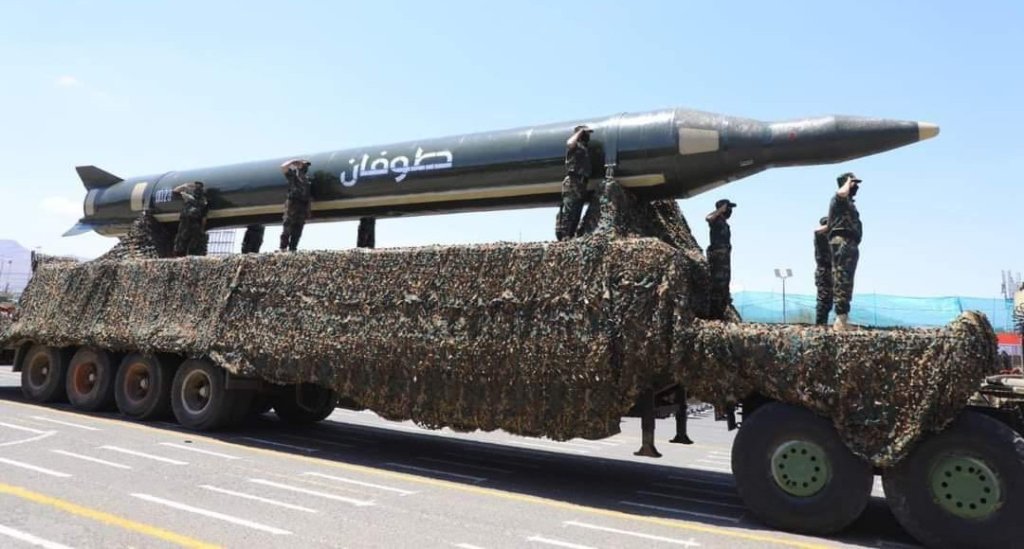
An example of just one of the many types of ballistic missiles in the Houthis’ arsenal. Houthi-controlled media
Still, being able to leverage Claude could only have helped any domestic missile development efforts in Yemen, which might help reduce dependency on Iran, at least to a degree. Furthermore, developing functional hypersonic glide vehicles capable of prolonged stable flight has historically been notoriously difficult, even for entities with extensive relevant knowledge bases on an organizational level.
GTG-17001: Disrupting a China-based operation using Claude to draft a fire control specification and acquisition documents for undersea warfare
Use of Claude in foreign military endeavours goes beyond the Middle East, as evidenced by case study GTG-17001. This involved a Chinese actor conducting work related to a naval counter-torpedo defense system.
“We identified a China-based threat actor who used Claude to advance three parallel tracks of work on an anti-torpedo weapons system:”
“First, the actor used Claude to draft a Chinese-language specification for an anti-torpedo fire control system (the core logic that aims and times an anti-torpedo weapon’s response). The document was written to win approval from a Chinese defense manufacturer, which would move the work on to technical certification and operational testing.”
“Second, the actor used Claude to produce a Chinese-language technical proposal of more than 200 pages, accompanied by an executive briefing deck.”
“Third, the actor used Claude to benchmark their own system against specific US anti-torpedo and anti-submarine programs based on publicly accessible information. They then generated a Chinese-language briefing on US Navy systems derived from open-source reporting.”
“The actor presented themselves as an original equipment manufacturer in the US defense sector. We assess the actor was associated with a Chinese defense industry manufacturer aiming to produce a weapons specification and acquisition proposal for the People’s Liberation Army Navy.”
This picture shows a test of an anti-torpedo system fitted experimentally to a Nimitz class aircraft carrier in the 2010s. USN
“The actor used Claude to write the acquisition proposal, refining it over many drafts. After each draft, the actor instructed Claude to role-play a hostile expert reviewer to critique the proposal, then used that feedback to sharpen the next version. In parallel, the actor used Claude to build pieces of the anti-torpedo weapons system’s fire control software and a test matrix to validate them.”
“The operational lift the actor achieved was a function of using Claude to automate complex technical outputs. The actor leveraged the model to compress the development timelines for the certification registry, compliance documentation, and automated fire control logic. The actor also accelerated the traditional human review cycle by having Claude critique the acquisition proposal across multiple rounds of review while role-playing a persona.”
“We uncovered this activity as part of our internal investigations into suspected weapons development. We cannot attribute the activity to a specific entity or actor. But we have banned the account for violating our Supported Regions Policy and our Usage Policy, which prohibits weapons design and development, and incorporated our investigative findings into our safeguards to mitigate the risk of future misuse.”
Anthropic’s report does not name the U.S. programs leveraged here, but does note the information in question was publicly available. Anti-torpedo systems for surface warships and submarines have been an area of significant interest for the U.S. Navy for years now. Those developments have also produced compact torpedo designs for use in other applications.
A Very Lightweight Torpedo (VLT), a compact torpedo design developed by Northrop Grumman. Northrop Grumman
The PLAN’s interest in these same kinds of capabilities is not at all surprising. Underwater threats and countermeasures to them, broadly speaking, would play a central and vital role in any future conflict between the United States and China across the broad expanses of the Pacific.
GTG-27005: Disrupting a Russia-based operation using Claude to engineer an autonomous military drone swarm
Another case study, GTG-27005, details the use of Claude by Russian actors working on drone swarming technology.
“We identified likely freelance Russia-based threat actors who set out to build a full-stack autonomous first-person-view (FPV) kamikaze drone swarm. The actors used Claude Code to write and test the code and save it directly into the actors’ own project files. In addition to Claude Code, the actors used a software-in-the-loop simulation stack and a rented graphics processing host for model training. They called the operation ‘DronDoc’ or ‘Serafim.'”
“The actors used Claude to build the core software system, including the drones’ shared swarm memory and fault-tolerant coordination logic (FTCL); an onboard small language model to govern attack, observe, and return-to-base behaviors; a terminal guidance software system to steer drones to their target (using the onboard camera) and issue the call to detonate; a control-link geolocation module to find opposing drone operators; a passive acoustic detection layer; and low-level logic for the drones’ programmable chips. The actors designed the platform for autonomous lethal engagement; the onboard model could select targets (including a ‘person’ target class) and issue detonation commands without a human in the loop. The actors’ activity—including flashing the low-level firmware to live development boards, provisioning single-board computers, and wiring up a simulation environment over a mesh network—confirmed that they were using real hardware-in-loop testing within their sessions.”
Many were surprised yesterday by the news that a Russian fiber-optic FPV drone flew into Kramatorsk and attacked a car.
But there is nothing surprising here. The war of 2025 is already very different from the war of 2024. From LBZ to Kram — 20 kilometers. Enemy FPVs can fly even… pic.twitter.com/hTfhJFPcxZ
“The actors trained a computer vision classifier on scraped Ukrainian combat footage, splitting the target classes into “enemy” and “friendly,” and allow-listing Russian systems. They also repeatedly used a fixed coordinate in Donetsk Oblast as the demonstration strike point, with front-line cities and corridors in Ukraine as the mission geography.”
“The actors created their accounts between late 2025 and early 2026 and started the operation in mid-May 2026. The actors circumvented our geographic access controls by routing traffic through commercial virtual private servers.”
“We assess the actors were a small, specialized freelance team doing a mix of civilian and military work, not a Russian state entity. We identified nine accounts associated with this group; eight were used only for ordinary freelance work, not weapons-related software development. Based on our investigation, we assess the actors had ties to a regional university with a federal research center associated with the Russian Academy of Sciences. The actors claimed to have received funding from Russia’s Advanced Research Foundation, National Technology Initiative, and Ministry of Defence, though we cannot verify those claims. We identified this activity as part of our internal investigations into suspected weapons development, we banned accounts associated with the actors, and have incorporated our investigative findings into safeguards to reduce the risk of future misuse.”
Anthropic’s report included a table, reproduced below, detailing different types of drones and other capabilities that were fed into the model as part of this work.
GTG-17002: Disrupting a China-based operation using Claude to build targeting software for electronic warfare and air defense suppression
The last case study in the Conventional Weapons section of Anthropic’s new report, GTG-17002, covers electronic warfare-related work by a Chinese actor, with a particular focus on potential air defense targets in Taiwan.
“We identified a China-based actor who used Claude’s chat, coding, and agentic work tools to design, build, and iterate on a Chinese-language suite of about 16 modules for electronic warfare, using the electromagnetic spectrum to detect, jam, or deceive an opponent’s radar and communications, and for suppressing an opponent’s air defenses.”
“The actor used Claude to build the software system, from the underlying logic to the user interface, and iterated through 12 versions. This included implementing and optimizing the system’s radar detection and jamming physics, generating a vulnerability analysis module, and drafting Chinese-language targeting instructions. The software suite the actor built analyzed an opponent’s radars, surface-to-air missile sites, command posts, and communications nodes, then computed their detection coverage, assessed the effectiveness of jamming, ranked targets by value and vulnerability, including which to suppress first, and determined how best to assign jammer sorties to targets across multi-day campaigns. The suite also ranked which of an opponent’s assets to suppress first, and modeled specific engagement envelopes, including those of Patriot and THAAD-class [Terminal High Altitude Area Defense] systems.”
“Mid-project, we observed the actor change the simulation’s default scenario to 12 targets in Taiwan. The targets included a command bunker in Taiwan, an early warning radar site, Patriot and Tien Kung [surface-to-air missile] batteries, major air bases, and a regional combatant command headquarters.”
“The actor also ran a self-hosted model on an internal network alongside Claude and connected the software suite to this model through a tool-use integration.”
“Based on our investigation, we assess the actor is a China-based defense and military-industrial researcher. Account-level metadata and content flagged by our safeguards indicated the actor was linked to PRC research institutions, including the PLA Academy of Military Sciences. We detected this activity as part of our internal investigations into suspected weapons development, we banned accounts linked to the actor, and have incorporated our investigative findings into our safeguards to reduce the risk of future misuse.”
An accompanying table, seen below, mentions several specific types of U.S.-made air defense radars, as well as the Link-16 datalink network, as having come up in the course of this work. Electronic warfare variants of the Chinese Y-8 and Y-9 aircraft, as well as the J-16D electronic warfare jet, and what appears to be a reference to the Golden Eagle drone helicopter, are also mentioned.
A Chinese Y-8GX-11, one of several electronic warfare variants of the Y-8/Y-9 design. Chinese internet via X
The suppression of enemy air defenses is an essential part of any modern air campaign, whether conducted independently or as a part of a larger operation. This would be no less critical in any military intervention against Taiwan from the mainland, or any other larger-scale conflict the PLA might find itself in.
Guardrails and ethics
Beyond the details in any of the specific case studies, Anthropic’s new report underscores growing broader concerns about guardrails for the use of AI and general ethics surrounding the technology. As noted in the instances above, Anthropic has also implemented various safeguards to try to block access to Claude from certain regions and/or to prevent the model from conducting certain types of work. At the same time, what the company has now shared makes clear that those protections can still be circumvented to a significant degree, at least for now.
TWZ has noted in the past that America’s adversaries are likely to be less worried about ethics, in general, when it comes to AI. Anthropic’s new report also shows there are few bounds to what state-aligned or even non-state actors might seek to use this technology for, including the development of potential weapons of mass destruction.
At the same time, AI models like Claude are not going away, and developments continue to advance at an ever-quickening pace, opening the door to further proliferation. Developments are rapidly intermingling globally, with companies in China notably leveraging models created in the U.S. to further their own work, which is then released publicly. The technology will increasingly become more integrated and critical to most aspects of military operations and weapons development, alongside its commercial and civilian applications. It is just as much a superweapon as anything else, and the country with the more capable models, and the willingness to deploy them, will have a major edge in future conflicts.
With all this in mind, it seems very plausible, if not probable, that the case studies described in Anthropic’s new report are just the tip of an approaching iceberg that will need a concerted effort to tackle.

 Login























 (@IraqiPMO)






 (@frontlinekit)


