Click to see the full-size image
Saudi Arabia is desperately trying to reverse its losses on the ground in the Yemeni conflict, while Houthi attacks reach its airports and threaten its oil trade. Yet the coalition Riyadh has assembled does not match the war it wants to fight. Washington is engaged in the conflict with Iran, Turkey excludes offensive deployments, and Pakistan draws the line at crossing into Yemen. The kingdom has foreign support, but the burden of recovering and holding territory still falls on its weakened Yemeni partners.
Retreat Before the Counteroffensive
By early October 2026, Riyadh was responding to a deteriorating military position. The Houthis’ September advance along Yemen’s western coast brought the loss of Mokha and strategic positions around Bab el-Mandeb. These setbacks exposed the weakness of Saudi-backed forces and strengthened the Houthis’ leverage over a shipping route increasingly important to Saudi oil exports.
The renewed Saudi–Houthi escalation began with the July 13, 2026, strike on Sanaa airport’s runway. Saudi aircraft sought to prevent an Iranian Mahan Air flight carrying a senior Houthi delegation from landing without coalition permission. The plane later landed in Hodeida after Omani mediation, but the Houthis retaliated against Abha airport and subsequently announced a blockade on Saudi shipping. The strike broke the relative calm established by the 2022 truce; September’s coastal offensive then turned the confrontation into a major territorial setback for Riyadh’s partners.
The retreat exposed divisions within the anti-Houthi camp. Saudi–Emirati cooperation had broken down, and the withdrawal of the UAE left command arrangements that Riyadh failed to replace effectively. The factions expected to carry the offensive remained divided and poorly prepared for a sustained campaign. Saudi airpower could not compensate for the absence of a coherent local force.
The cost is also being felt inside Saudi Arabia. The October 10, 2026, attack on Riyadh’s King Khalid International Airport killed 12 people and wounded 309, according to Saudi authorities, and temporarily suspended operations. Riyadh blamed the Houthis, who renewed their warning against using Saudi airports and airspace on October 11. Airport disruption, cancelled flights and attacks on oil facilities bring the economic consequences of the war directly into the kingdom. The Saudi air campaign has not secured its civilian infrastructure.
Operation Dawn of Yemen began on October 5, 2026, after Saudi-backed Yemeni leader Rashad al-Alimi announced military action the previous day. The immediate objective was to recover the coastal positions lost in September, alongside the Saudi-backed Yemeni government’s broader ambition to restore its authority over Houthi-held territory. On October 11, the coalition announced the destruction of 136 military targets in a large-scale operation. That tally says little about whether Saudi-backed units can hold territory, secure supply routes or reopen shipping lanes.
Houthi footage released October 10, 2026: Shawaz drone strikes on Saudi-backed forces in Kahbub and Al-Waziya, as presented by the movement’s military media
Why Taiz Matters
The counteroffensive has produced conflicting accounts of control on the coast. On October 9, 2026, Saudi Arabia’s ambassador to Yemen announced that Bab el-Mandeb and Mayun Island had been cleared of Houthi forces. The Houthis maintained that they still held those positions. Control of the waterway remains contested, despite Riyadh’s announcements of success.
Taiz adds another strain after the coastal setbacks. Pressure on its approaches threatens supply routes and forces Saudi-backed units to divide their effort between the inland front and the Red Sea coast. The Houthis can disrupt their opponents’ counteroffensive without winning every coastal engagement: sustained pressure inland prevents those opponents from concentrating their forces. Saudi airpower does not resolve the fragmentation of the Saudi-backed Yemeni forces expected to hold the ground.
Houthi military footage released October 10, 2026: the movement presents advances and the surrender of opposing fighters in Sami, As-Silw and Al-Mawasit, Taiz province. The fighting places further pressure on the ground forces on which Riyadh’s campaign depends
The Iran War Narrows Saudi Options
The US–Israeli war with Iran, which began in February 2026, has expanded the military demands on Washington. Regional deployments, shipping protection and operations against Iran compete with Saudi requests for a larger American role in Yemen. Riyadh cannot assume that American support will expand on its terms. Its dependence on outside assistance has grown at the same time as the regional war has made that assistance more conditional.
The Iran war compounds Saudi Arabia’s vulnerability. Disruption at Hormuz has increased Riyadh’s dependence on its westbound pipeline and Red Sea ports. Southbound cargoes from Yanbu must pass Bab el-Mandeb; northbound exports follow a different route. Moving crude across the peninsula bypasses Hormuz, but it does not remove the threat to shipping off Yemen.
Pressure at Bab el-Mandeb gives Iran an additional advantage while the Houthis gain territory and bargaining power of their own. Their overlapping interests put Riyadh under pressure on two fronts. A Washington–Tehran agreement would not automatically end the war in Yemen: the Houthis have their own territorial, political and economic demands.
Washington is already involved through military advisers, intelligence and targeting support. The issue is the extent of that involvement, not American neutrality. Earlier in October 2026, Trump rejected Saudi requests for direct strikes; after the Riyadh airport attack, he said the United States might join them. Riyadh still lacks a firm American commitment to the wider offensive. Its requests compete with Washington’s military operations and priorities in the Iran war.
Allies Draw Their Own Lines
Riyadh’s response is to widen its support network through the Mecca pact, signed with Turkey and Pakistan on August 7, 2026, and activated on October 5. But an agreement to defend Saudi Arabia is not an agreement to win its war in Yemen. Pakistan’s military presence and Turkey’s technical, intelligence and air-defense assistance address the kingdom’s security without supplying a joint ground campaign across the border.
The alliance has a secretary-general, retired Pakistani general Nauman Mahmood, but its detailed force-generation timetable, operational command arrangements, cost-sharing formula and mission duration remain unpublished. On October 8, 2026, Ankara excluded offensive operations while parliamentary ratification was pending. On October 9, Islamabad confirmed a substantial military presence in the kingdom but ruled out crossing into Yemen to attack the Houthis. Riyadh is obtaining defensive commitments, not a combined expeditionary army.
Pakistan’s decision-making has also shifted. In 2015, parliament unanimously rejected participation in the Yemen war while promising to defend Saudi territory and holy sites. In October 2026, reinforcement commitments are proceeding without a parliamentary vote. The government says it followed the necessary procedures. The political result is a narrower domestic debate over a commitment that could draw Pakistan further into the conflict.
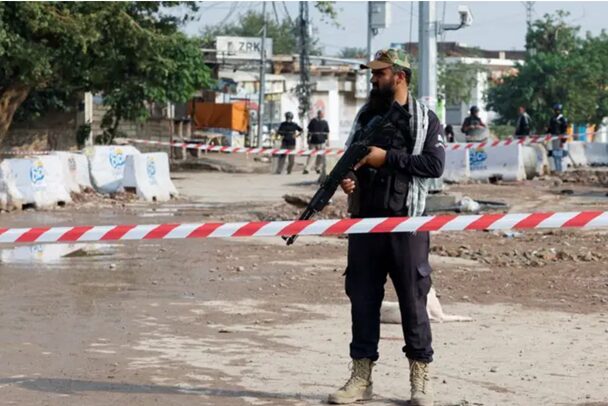
Fewer political checks make deployments easier to authorize and harder to reconsider once costs and casualties accumulate. Pakistan’s own security pressures add another burden: the October 11, 2026, emergency in opposition-run Khyber Pakhtunkhwa coincides with its commitments to Saudi Arabia. Islamabad is extending support abroad while managing a deepening confrontation at home.
Peshawar, October 11, 2026: police guard the approach to the Red Zone. Pakistan’s overseas security commitments coincide with emergency measures at home
Saudi-led coalition footage, October 9, 2026: the coalition announces strikes on three Houthi missile launchers. The continuing attacks inside Saudi Arabia expose the limits of destroying individual launch sites
Defensive support can still sustain the offensive by freeing Saudi assets for use in Yemen. France’s support for the defense of Yanbu and Britain’s refueling assistance contribute to that effort. But none of this repairs the weakness of Riyadh’s Yemeni ground forces. Pakistan also has its border with Iran and its mediation role to consider, while Turkey keeps its commitment separate from offensive operations. Each partner sets limits according to its own interests.
Different Interests, No Shared Victory
Pakistan’s proposed $1.21 billion IMF disbursement awaits board approval. Turkey’s September 2026 inflation was 29.73%, with its policy rate at 37%. Both face financial pressures that favor limited missions over an open-ended expedition. Who pays for the current assistance remains undisclosed.
Saudi Arabia’s updated deficit forecast is 4.9% of GDP. September 2026’s non-oil purchasing managers’ index stood at 55.3, indicating expansion before the latest escalation. The airport attacks and disruption to transport now place that activity under additional pressure. Riyadh must finance the campaign while protecting the infrastructure and trade on which its wider economic plans depend.
The Houthis are using that pressure to advance their negotiating demands. On October 10, 2026, the Houthi authorities proposed reciprocal exclusion of airports, ports and other humanitarian infrastructure from blockade and attack. The proposal seeks to exchange limits on disruption for concessions over access and blockade. It puts the economic consequences of continued fighting at the center of the bargaining.
The conflict of interests runs through the entire coalition. Riyadh wants to reverse Houthi gains and protect Saudi infrastructure. The Saudi-backed Yemeni government wants to restore its authority. Turkey and Pakistan seek bounded commitments, and Washington calculates its involvement against the Iran war. The Houthis seek concessions while preserving their military leverage. A common adversary has not produced an agreed objective or a shared willingness to bear the cost.
Saudi Arabia therefore has partners willing to help defend the kingdom, but those partners have made no common commitment to reverse Riyadh’s setbacks in Yemen or sustain the ground campaign of the Saudi-backed Yemeni government. That is the gap behind the coalition’s announcements and strike tallies. Without stronger local forces and a political settlement addressing shipping, attacks and access, additional foreign support can prolong the campaign without resolving it. Riyadh risks remaining surrounded by allies while carrying a war none of them has agreed to finish.
MORE ON THE TOPIC:
The post Saudi Arabia Has Allies. But Who Will Fight Its War in Yemen? appeared first on South Front.

 Login