
❌

Reading view

Audi testa robôs humanoides e IA para otimizar linhas de montagem

A Audi deu início a um projeto de “prova de conceito” para testar o uso de robôs humanoides móveis na área de logística de sua fábrica em Ingolstadt, na Alemanha.

A iniciativa, desenvolvida em parceria com a empresa de robótica Agile Robots e as companhias de tecnologia Nvidia e Dassault Systèmes, busca automatizar o processo de sequenciamento de peças, etapa que exige cerca de um milhão de seleções diárias (picks) para abastecer a linha de montagem dos veículos premium da marca no ritmo atual.

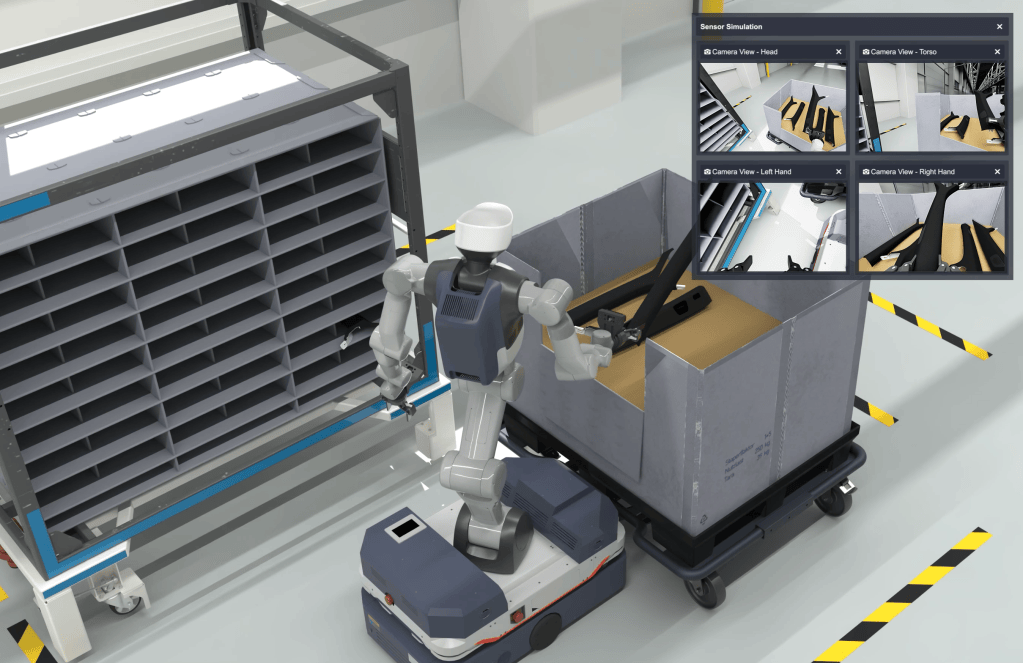
O projeto utiliza robôs dotados de dois braços mecânicos e inteligência artificial, instalados em uma base móvel. A tecnologia foi projetada para atuar na mesma altura de operadores humanos e se integrar às instalações existentes da unidade sem requerer mudanças na infraestrutura fabril.

Simulação em ambiente digital acelera o processo
Audi testa robôs humanoides e IA para otimizar linhas de montagem em parceria com Agile robots, NVIDIA e Dassault Systèmes
Audi testa robôs humanoides e IA para otimizar linhas de montagem em parceria com Agile robots, NVIDIA e Dassault Systèmes • Divulgação Audi

Antes de entrarem em operação prática no laboratório de produção da Audi (Production Lab), as tarefas dos robôs são validadas em um ambiente inteiramente virtual. Por meio das plataformas digitais da Dassault Systèmes e das bibliotecas da Nvidia, a equipe de engenharia criou um “gêmeo digital” da fábrica.

O modelo virtual permite simular ergonomia, tempo de execução, viabilidade operacional e protocolos de segurança. A utilização de inteligência artificial aplicada ao ecossistema digital reduz o tempo de homologação desses testes de semanas para poucos dias.

Manipulação de componentes flexíveis e caixas mistas
Audi testa robôs humanoides e IA para otimizar linhas de montagem em parceria com Agile robots, NVIDIA e Dassault Systèmes
Audi testa robôs humanoides e IA para otimizar linhas de montagem em parceria com Agile robots, NVIDIA e Dassault Systèmes • Divulgação Audi

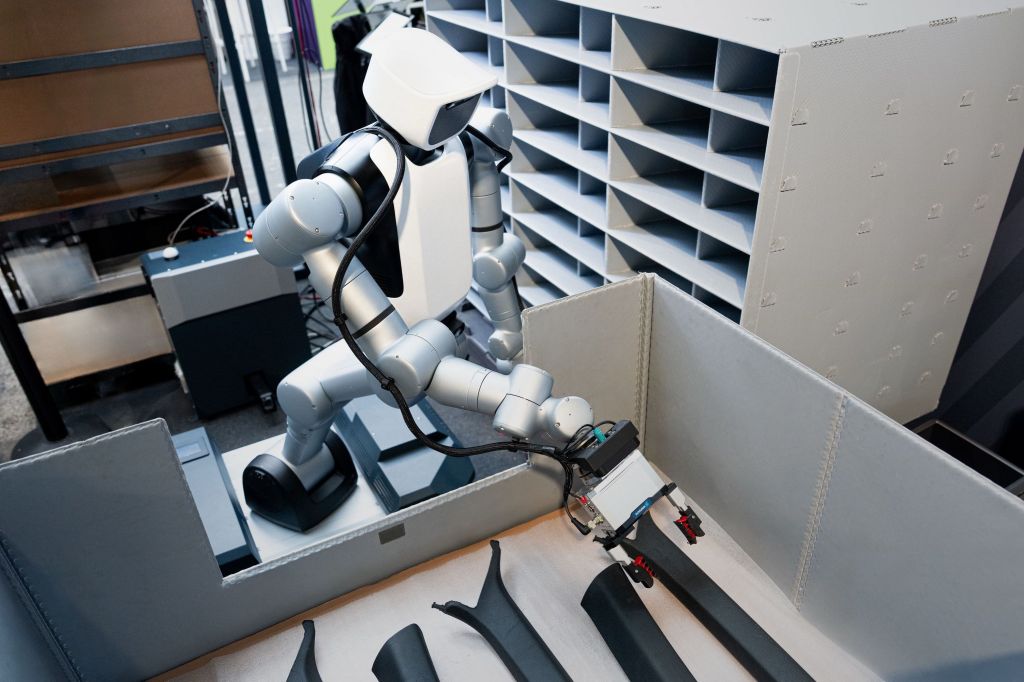
A automação do sequenciamento representa um dos maiores desafios logísticos da indústria automotiva, por envolver peças semirrígidas, itens flexíveis e componentes dispostos de forma desordenada em caixas mistas.

Os robôs móveis desenvolvidos para a operação utilizam sistemas de percepção por inteligência artificial que identificam, alinham e movimentam peças variadas com precisão.

O objetivo do programa é transferir tarefas repetitivas de triagem para os sistemas automatizados, permitindo que os operadores humanos foquem em etapas de maior complexidade do processo produtivo.

Audi Q7 2025 muda visual e ganha tecnologias; saiba preço

  •  

Nvidia marketing executive Laura Fay, who reported to CEO Jensen Huang, has retired after a decade

The Nvidia logo is seen at the company's annual GTC developers conference at the SAP Center in San Jose.
Nvidia.

JOSH EDELSON / AFP via Getty Images

  • Nvidia vice president Laura Fay has retired after a decade at the company.
  • Fay grew Nvidia's enterprise marketing team from roughly 60 to 600 employees.
  • Nvidia brought in Google Cloud's Alison Wagonfeld as its first chief marketing officer this year.

Laura Fay, a longtime Nvidia marketing executive who reported to CEO Jensen Huang, retired in July after roughly a decade at the AI chip giant.

Fay formerly served as Nvidia's vice president of global enterprise marketing, overseeing campaigns, events, analyst relations, and partner marketing. She said her team grew from roughly 60 to 600 people by the time she left.

Fay was among 36 employees on an internal list obtained by Business Insider last year of company leaders reporting directly to Huang. Prior to joining Nvidia, she spent 22 years at Cisco, concluding her tenure there as VP of global marketing.

Fay said Huang recruited her to build Nvidia's enterprise marketing organization as the company looked to expand beyond gaming.

"I want to change the world, and I want you to change it with me," she recalled him telling her on their first call.

Fay said she began considering retirement around her 10th anniversary in January, though a call from Huang congratulating her and expressing hope that she'd stick around for another decade persuaded her to stay a little longer.

Nvidia declined to comment.

Fay's retirement came as Nvidia also brought in new marketing leadership. In February, the company hired Google Cloud executive Alison Wagonfeld as its first chief marketing officer.

The Wall Street Journal reported at the time that Wagonfeld would oversee all marketing and communications teams and assume responsibilities previously divided among several leaders.

Those changes follow another longtime marketing departure. Greg Estes, Nvidia's former vice president of corporate marketing and developer programs, retired in 2025 after roughly 15 years at the company.

Several other longtime Nvidians have retired this year, including sales chief Jay Puri, chief accounting officer Donald Robertson, and VP of hardware engineering Robert Huang. Some retirees told Business Insider that Nvidia's exponential stock run helped precipitate their decisions.

Nvidia's communications organization has also undergone a shake-up as scrutiny around the company has intensified, with roughly 15 employees departing since 2025 amid a reorganization under new leadership.

Have a tip? Contact this reporter via email at gweiss@businessinsider.com or Signal at @geoffweiss.25. Use a personal email address, a non-work WiFi network, and a non-work device; here's our guide to sharing information securely.

Read the original article on Business Insider
  •  

Agile Robots, Nvidia target up to 2,000 humanoids in 2027

Germany-based robotics firm Agile Robots reportedly plans to produce up to 2,000 humanoid robots next year through a fresh partnership with Nvidia, targeting universities and corporate research labs.

The collaboration was announced at Nvidia’s GTC conference in Berlin. Agile CEO Zhaopeng Chen told Reuters the pair are set to begin production of the Agile ONE S and ONE SN humanoid robot models by the end of 2026, expecting to manufacture between 1,000 and 2,000 units. Stanford University and ETH Zurich are among potential customers.

The Agile ONE SN, with the N standing for Nvidia to denote the chipmaker-specific configuration, combines Agile’s humanoid hardware with Nvidia’s Jetson Thor onboard computing platform and Isaac GR00T robotics AI model. It features five-fingered hands, cameras and other sensors to support dexterous manipulation and interaction with the physical environment.

Standing 1.4 metres tall and weighing around 40 kilograms, the robot is designed as a smaller alternative to full-sized humanoids. Nvidia said the robot intends to simplify the integration of hardware, simulation, training and deployment tools on a single platform, “cutting setup time from weeks to days”.

Spencer Huang, Nvidia’s product director for robotics, told Reuters the standardised configuration could save researchers two or three months of work procuring separately purchased components. “If we can bring researchers something that’s already 80% of the way there, it accelerates their development,” he said.

Nvidia said Agile’s ONE SN is scheduled to become available in early 2027, as competition intensifies among European humanoid developers.

ChatGPT moment
Alongside the partnership, the chipmaker also revealed its expanded robotics development platform, Nvidia Isaac, equipped with new tools for training and deploying AI-powered machines. The expanded platform includes Isaac OS, an open-source runtime framework, and Isaac Lab 3.0, a robot learning framework designed to train and refine robot skills. The company also introduced new reference workflows and simulation resources to speed up development.

“General-purpose robotics is advancing at extraordinary speed — the ChatGPT moment for robotics is fast approaching,” noted Jensen Huang, CEO of Nvidia, adding the platform would give developers “the models, data, simulation tools and computing systems to bring physical AI to the world’s largest industries”.

The chipmaker added European robotics players including UK-based Humanoid, French start-up Hugging Face and Swedish firm ABB Robotics are applying its technologies including Nvidia Isaac to industrial autonomous machines.

The post Agile Robots, Nvidia target up to 2,000 humanoids in 2027 appeared first on Mobile World Live.

  •  

Santander em parceria com a Nvidia para desenvolver modelos de IA para a banca

Santander Ana Botín

O Banco Santander está a reforçar a parceria com a Nvidia para desenvolver modelos de inteligência artificial especializados em tarefas bancárias, com o objetivo de melhorar a qualidade do atendimento ao cliente e reduzir custos operacionais, anunciou o banco numa nota de imprensa esta quarta-feira.

No âmbito do Santander AI Lab, a instituição está a testar e a aperfeiçoar modelos e agentes de IA adaptados a necessidades específicas da banca, passando progressivamente de grandes modelos de uso geral para versões mais pequenas e especializadas.

Em casos de uso experimentais, esta abordagem permitiu reduzir os custos de processamento de cerca de 5 euros por interação para aproximadamente 0,03 euros, mantendo elevado desempenho. Num projeto-piloto de atendimento ao cliente, o banco melhorou a qualidade das conversas e cortou os custos de serviço em mais de 50%.

O Santander criou a plataforma Model Arena para avaliar modelos de pesos abertos (open-weight) em tarefas bancárias e identificar o mais adequado a cada caso. O banco está também a especializar modelos com o Nvidia NeMo Customizer e a usar a família de modelos NVIDIA Kumo para dados estruturados, além de industrializar a inferência com a solução Nvidia Dynamo-Triton.

Para dar continuidade ao trabalho, as duas empresas firmaram um acordo-quadro de colaboração de três anos. O entendimento abrange modelos fundacionais, agentes de IA, prevenção de fraude e combate ao branqueamento de capitais, tomada de decisões em tempo real e tecnologias de simulação, incluindo o conceito de “digital twin”.

“A Nvidia é um parceiro fundamental nas infraestruturas, no software e na investigação, impulsionando de forma significativa os mais recentes avanços em inteligência artificial”, afirmou Iñaki Bernal, responsável global de Inteligência Artificial do Santander.

“Ao conjugarmos estas capacidades com a escala do Santander em áreas de negócio, clientes e geografias, acreditamos estar numa posição única para transformar, com sucesso, esses avanços em capacidades bancárias concretas”, acrescenta-

Já Aser Blanco, responsável global pelo setor bancário na Nvidia , destacou que a banca é um dos setores mais intensivos em dados e que “o custo por resultado de inteligência é uma métrica fundamental”. Segundo ele, o Santander está a demonstrar como a abordagem com modelos mais pequenos e especializados com dados próprios funciona em produção e à escala de um banco global.

O Santander AI Lab continua a desenvolver processos rigorosos de experimentação, otimização de desempenho e testes adversariais a sistemas de IA conversacional, antes de implementar à escala as soluções que demonstrem valor em todo o Grupo.

  •  

Nvidia, Nokia claim AI-RAN hype is justified as momentum grows

INTERVIEW: Nokia chief technology and AI officer Pallavi Mahajan and Nvidia SVP of telco Ronnie Vasishta told the Mobile World Live Podcast their AI-RAN partnership is showing tangible progress, as they announced close to 20 operators are lined up for lab and commercial trials of the technology.

In an exclusive interview to outline progress of their efforts, Vasishta and Mahajan highlighted the fact it had only been 12 months since the two companies announced a joint AI-RAN partnership, which included a $1 billion investment from Nvidia into the Finnish vendor.

A year on, today (21 October) at Nvidia’s GTC 2026 event in Berlin the duo announced almost 20 operators globally have committed to AI-RAN collaboration, including 10 from EMEA. Mahajan said these operators are at different stages, lined up for both lab and commercial trials.

In 2027 trials are expected from BT Group, Deutsche Telekom and Elisa, with the latter preparing for commercial deployment.

In the US, T-Mobile has completed what was claimed as the world’s first AI-RAN call on a live network, while in France Orange is introducing new voice and intelligence services for enterprises based on the technology.

Speed of light
Vasishta told MWL it was hard to overhype development based on the progress it had seen over the past year, and the number of trials and deployment is only set to grow.

“A year ago, or two years ago for sure, I think people would have scoffed at the idea. Nokia talking about operator commercialisation with AI-RAN, I think, that would have been perhaps seen as somewhat sceptical.”

Mahajan concurred, describing the pace of development as occurring “at the speed of light” with the game changer centred on being able to outline the true “value of what AI brings in terms of making RAN efficient” such as significant spectrum efficiency gains.

“In the next few years, the distinction between the networks and computing infrastructure will just blur,” she said, inevitably opening up a host of operator opportunities across applications beyond 5G and 6G.

Vasishta added Nvidia had started on the journey of software-defined RAN eight years ago and the inclusion of Nokia in 2025 had accelerated this dramatically.

“We see all operators around the world are created differently. They service different markets, they have different DNA, but overall, all of them have gravitated towards this concept now of AI RAN.”

Click here to listen to the full interview.

The post Nvidia, Nokia claim AI-RAN hype is justified as momentum grows appeared first on Mobile World Live.

  •  

A protester and a robot duck hiccup: 2 moments from Jensen Huang's keynote didn't go to plan

Jensen Huang, CEO of NVIDIA, speaks to Micro Duck robots during his keynote address at the Berlin GPU Technology Conference in Berlin.
Jensen Huang interacted with Microduck robots onstage.

Sean Gallup/Getty Images

  • Nvidia CEO Jensen Huang's Berlin keynote was interrupted by Greenpeace protesters onstage.
  • Huang was making the case for Europe to build an AI economy with factories and agents.
  • His finale featured a wobbly Microduck robot demo and an AI-generated Eurovision-style video.

Even for a seasoned keynote pro like Jensen Huang, there's always the risk that things don't go fully to plan.

The Nvidia CEO opened the company's Berlin conference on Wednesday to make the case that Europe should build its own AI economy — complete with AI factories, autonomous agents, and robots.

But the pitch was interrupted about 20 minutes into the keynote by protesters holding a Greenpeace banner reading, "Nvidia, clean your dirty business!"

One protester shouted: "Clean up your act! What about the technology that was found in Russian drones? Those were Nvidia chips. What are you doing about that? What are you doing about the environmental destruction?"

Greenpeace protesters held a banner, reading "NVIDIA, clean up your dirty business!"
Greenpeace protesters held a banner, reading "Nvidia, clean up your dirty business!"

John MACDOUGALL / AFP via Getty Images

The protester appeared to be referring to an August statement from Ukraine's Defence Intelligence, which said it had identified an Nvidia Jetson Orin computer module in a Russian S-71 Monochrome cruise missile. The agency did not allege that Nvidia knowingly supplied the component to Russia.

Greenpeace said in a press release that it's calling on Nvidia to extend its 100% renewable energy target across its wider supply chain and to conduct audits to ensure its technology doesn't end up in military equipment. Nvidia did not immediately respond to Business Insider's request for comments.

As security escorted the protester away, Huang said, "Give her a chance," and that "everybody has a chance to say something." He then told the applauding crowd: "All important issues … but let me get through my keynote."

Huang, after joking that he had to "torture" the audience with "some education" before "the entertainment," then pressed on with Nvidia's pitch for Europe's AI future. He unveiled DSX POD, a modular system for AI factories, and promoted OpenShell, a platform designed to help companies run autonomous AI agents securely.

'Pay attention!'

The entertainment came near the end of the keynote, when Huang brought four small robots, known as Microducks, from French startup Pollen Robotics onstage.

The demo was charming, but not entirely obedient.

When Huang told the robots to "take a nap," one kept walking before eventually falling alongside the others. Later, only two appeared to perform a somersault when he asked them to.

Another robot lingered farther away from the group and tripped before getting back up. "Pay attention! Stay focused. Come here, come here. Stay focused," Huang told it. It eventually approached and sat down, drawing laughter from the audience.

Even Microducks need a nap. 😴 pic.twitter.com/mAdJeqacl8

— NVIDIA (@nvidia) October 21, 2026

Huang then closed the event with an AI-generated video of robots singing in a Eurovision-style contest.

The demo came a day after Huang told German Chancellor Friedrich Merz that Europe could not regulate its way to technological leadership.

"There's nothing to regulate if the industry doesn't thrive," Huang told Merz.

Read the original article on Business Insider

  •  

Podcast: Exclusive – Nokia, Nvidia advance AI-RAN at GTC

With Nvidia’s GTC Berlin event in full swing, the company’s telecoms boss Ronnie Vasishta and Nokia chief technology and AI officer Pallavi Mahajan sit down with the Mobile World Live Podcast in an exclusive interview to reveal the next stage of the pair’s AI-RAN journey, as they team up with European heavyweights to turn networks into distributed intelligence platforms.

Listen on Spotify
Listen on Apple

00:00 — AI-RAN explained
7:20 — Operator trials
11:00 — Beyond edge hype
15:05 — AI-RAN economics
17:45 — Sovereign AI
21:10 — Commercialisation and 6G

The post Podcast: Exclusive – Nokia, Nvidia advance AI-RAN at GTC appeared first on Mobile World Live.

  •  
❌