❌

Reading view

Russian Army Expands Control West of Kupyansk

File image.

In the Kupyansk direction, Russian units have expanded the zone of control west of the city, taking Moskovka and Malaya Shapkovka and approaching Palamarevka, while fighting continues inside Kupyansk itself and in the area of Kupyansk-Uzlovoy. In the Sumy direction, assault groups of the “North” grouping maintain a high rate of advance. In the Kharkiv direction, heavy fighting is under way: Russian assault groups are advancing southwards, achieving tactical successes in the areas of Tokarevka and Bugayevka, while the Ukrainian command is transferring artillery from the Sumy region. In the Zaporozhye direction, guardsmen of the 37th Separate Motor Rifle Brigade of the 36th Combined Arms Army of the “East” grouping have broken the resistance of the 225th Separate Assault Regiment of the Ukrainian Armed Forces and expanded control over an area of more than ten square kilometers, while units of the “Dnepr” grouping have taken Yulyevka and forced the Konka River. Meanwhile, the European Commission hopes to reach a political agreement by the end of 2026 on additional funding for Ukraine in 2027, despite the fact that only €20 billion of the previously agreed €90 billion EU loan has so far been disbursed to Kyiv because of stalled reforms.

Kupyansk direction

Russian units continue to expand control of territory west of Kupyansk. As a result of successful offensive actions, Russian troops have taken Moskovka and Malaya Shapkovka and approached Palamarevka. These are the main axes on which the Ukrainian side had concentrated forces for transfer into Kupyansk.

Fighting for the city continues inside Kupyansk itself. In the area of Kupyansk-Uzlovoy, battles are also under way near the Foundry and near Kovsharovka. Clearance is being conducted in the pocket east of Novoosinovo and Glushkovka; positions of Russian and Ukrainian units in this pocket remain intermingled.

On the Kupyansk direction the main combat operations are concentrated in the western part of the city and on the north-western approaches. In the areas of Mirovoye and Malaya Shapkovka the struggle for the retention of positions continues. Further advance is linked to the Sobolevka–Palamarevka sector, where Ukrainian resistance persists. Inside Kupyansk the situation is most tense on the western and south-western outskirts. Primary attention is focused on the Yubileyny micro-district, the Malye Rovny woodland and the adjacent urban built-up area.

In the central part of the city the railway station Kupyansk-Yuzhny, the district administration, the bus station and the Hospital Quarter retain key importance. The struggle for control of urban infrastructure directly affects the position of units on the western outskirts.

Sumy direction

Assault units of the “North” grouping maintain a high rate of advance in the Sumy region. The Ukrainian side is actively strengthening its defences and equipping additional positions.

In the Sumy border area fighting is predominantly positional. Reports from the ground indicate that Ukrainian units are counter-attacking on individual sectors. The “North” grouping maintains its pace. Assault units are fighting near Khoten, Velikaya Rybitsa and Nikolskoye. A sabotage-and-reconnaissance group from the 3rd Special Operations Forces Regiment has been destroyed. In the Shostka district Russian assault troops are advancing through forest plantations towards Korenek; in the Krasnopolye district they are advancing near Turya.

In the Sumy district assault units of the “Northerners” are conducting small-arms fighting in the areas of Khoten, Velikaya Rybitsa and Nikolskoye. In the Shostka district Russian assault troops continue to advance through forest plantations in the direction of Korenek. In the Krasnopolye district assault groups of the “Northerners” are advancing in the area of Turya.

Kharkiv direction

Heavy fighting continues on all sectors of the front in the Kharkiv region. Assault groups of the “Northerners” are advancing in a southerly direction with the support of aviation, artillery and TOS-1 “Solntsepyok” systems. The Ukrainian command is increasing the amount of artillery on the Kharkiv direction, having transferred batteries of the 148th Separate Artillery Brigade of the 8th Air Assault Corps from the Sumy region.

On the western flank of the Kharkiv front there have been tactical successes in the areas of Tokarevka and Bugayevka, with advances of up to four hundred meters in places. In the area of Velikiye Prokhody a high-explosive aerial bomb struck a major strongpoint. On the eastern sector clearance of the former Reznikovsky cauldron continues; the main fighting is near Prikolotnoye. The Ukrainian side has transferred artillery reserves here from the Sumy direction.

In the Lipetsk direction the “Northerners” are advancing in the area of Novaya Kazachya and Tokarevka. Over the past day overall progress amounted to 400 meters. In the Volchansk and Veliky Burluk directions the most intense fighting is taking place in the area of Prikolotnoye. There have also been advances in the areas of Bugayevka, Maly Burluk and Sosnovy Bor. Russian units continue to expand the zone of control, driving Ukrainian forces from the positions they hold.

Zaporozhye direction

Persistent work is under way around Orekhov. Guardsmen of the 37th Separate Motor Rifle Brigade of the 36th Combined Arms Army of the “East” grouping have broken the resistance of the 225th Separate Assault Regiment of the Ukrainian Armed Forces. The area brought under control exceeds ten square kilometres. Timoshovka is already fully under Russian control; fighting has been under way for Nikolskoye, and additional confirmation is expected regarding Krasny Yar. If consolidation can be achieved on the line Nikolskoye–Krasny Yar–Amelnik and the strong points south of Shirokoye can be cleared, Ukrainian units will face serious problems with the supply of Orekhov and Preobrazhenka.

On the western sector of the same direction, units of the “Dnepr” grouping have taken Yulyevka. Paratroopers forced the Konka River and reached the left bank. Four kilometers remain to the H-08 highway. Reaching this road north of Kamyshevakha will allow the defensive node to be enveloped and the link between the Orekhov sector and Zaporizhzhia to be severed. Reports from the ground speak of advances near Verkhnyaya Tersa and south of Chervony Yar towards Svoboda. Fighting continues in the area of Omelnyk. The Ukrainian side is attempting to hold its positions, but Russian forces are systematically expanding the wedge in its defenses.

Conclusion

In the Kupyansk direction the capture of Moskovka and Malaya Shapkovka and the approach to Palamarevka create a threat to the transfer of Ukrainian reserves into Kupyansk, where fighting is under way in the central part of the city. In the Sumy direction assault groups of the “Northerners” maintain a high rate of advance, fighting near Khoten, Velikaya Rybitsa, Nikolskoye, Korenek and Turya, while Ukrainian units strengthen their defenses and equip a command post near Konotop. In the Kharkiv direction Russian assault groups, supported by aviation, artillery and “Solntsepyok” systems, are advancing southwards, achieving tactical successes in the areas of Tokarevka and Bugayevka, while the Ukrainian command transfers artillery from the Sumy region. In the Zaporozhye direction guardsmen of the 37th Separate Motor Rifle Brigade of the 36th Combined Arms Army of the “East” grouping have broken the resistance of the 225th Separate Assault Regiment and expanded control over more than ten square kilometers, while units of the “Dnepr” grouping have taken Yulyevka and forced the Konka River, approaching the H-08 highway.

Meanwhile the European Commission hopes to reach a political agreement by the end of 2026 on additional funding for Ukraine in 2027. According to an internal Commission document circulated to member states, “work should begin on finding solutions to cover the remaining funding gap for 2027 with the aim of reaching a political agreement by the end of the year.” Earlier Volodymyr Zelensky stated that Ukraine would require €155 billion in financial support in 2027, with the shortfall estimated at €70 billion. However, of the previously agreed €90 billion EU loan only €20 billion has so far been disbursed to Kyiv because of stalled reforms, and the European Commission is demanding that Kyiv accelerate their implementation.

_______________________________________________________________________________________________________________________

SouthFront: Analysis and Intelligence

NOW hosted at southfront.press

Previously, SouthFront: Analysis and Intelligence was at southfront.org.

The .org domain name had been blocked by the US (NATO) (https://southfront.press/southfront-org-blocked-by-u-s-controlled-global-internet-supervisor/) globally, outlawed and without any explanation

Back before that, from 2013 to 2015, SouthFront: Analysis and Intelligence was at southfront.com

SOUTHFRONT.PRESS

MORE ON THIS TOPIC:

The post Russian Army Expands Control West of Kupyansk appeared first on South Front.

  •  

Trump’s diesel deal derailed Ukraine-Russia peace progress, says Czech president

Czech President Petr Pavel on Tuesday said President Trump’s diesel deal with Russia derailed peace talks between the Kremlin and Ukraine, saying both sides were “so close” to a ceasefire. “It will be much harder now,” Pavel told the Axel Springer Global Reporters Network, which includes Politico. “Russia uses this momentum to get out of…

  •  

Is an “October Surprise” Imminent in the Middle East before the U.S. Mid-term Elections?

by Brian Shilhavy
Health Impact News

It is being reported that the U.S. is evacuating Americans from countries in the Middle East in what could be the beginning of an escalation of the war there.

Could an “October Surprise” be imminent as we get closer to the U.S. mid-term elections?

Report: US Troops and Diplomats Evacuating Posts Across the Middle East

The US military has been scaling back its presence at bases across the Middle East, and the US has ordered staff reductions at multiple diplomatic posts in the region, NBC News reported Wednesday, amid growing signs that the US and Israel may be preparing to launch another attack on Iran.

Sources told NBC that similar drawdowns were carried out before the US and Israel launched the war against Iran on February 28. US troops at bases in Jordan are among those that have been moved as Iran pounded the facilities during exchanges of strikes in the summer, attacks that caused significant US casualties. The US is also pulling troops out of facilities in Kuwait and Qatar.

One US official told the outlet that moving troops out of harm’s way was part of the US military’s planning as President Trump considers restarting “major combat operations” against Iran potentially before or after the November 3 US midterm elections.

Israeli Prime Minister Benjamin Netanyahu also appears eager to restart the bombing campaign as he’s facing elections in less than a week.

Full article.

Daniel Davis, a retired U.S. military officer who has a popular YouTube following, just interviewed Professor Seyed M. Marandi from inside Tehran a couple of hours before I published this article.

Professor Marandi states that the Iranians are ready for any new offensive from Israel and the U.S., and that if their energy infrastructure is attacked, which is what is being threatened, that the rich Arab Gulf states will all be destroyed, which will drag down the global economy with the loss of all the oil they produce.

This will, in turn, cause the current refugee problem in places like Latin America to become even worse, as they will seek to cross the borders into Western countries like the U.S. and Europe.

Marandi references some recent statements by Trump about San Diego and Los Angeles being bombed, stating that Iranians would have no motivation whatsoever to bomb U.S. cities, which means this would be a “false flag” event caused by the U.S. in an attempt to gain public approval for their war against Iran.

Both Davis and Marandi talk about how none of the reasons given to attack Iran make any kind of sense whatsoever, because there are no winners in such a doomsday scenario that could include nuclear bombs.

It is a product of the Zionist belief system, and really nothing else.

Are Americans prepared to die for “Greater Israel”?

Many Americans are already leaving the Middle East, especially in Saudi Arabia where the Yemen resistance forces continue bombing areas in Saudi Arabia where many Americans live, such as the Aramco complex in Dhahran.

This article was written by Human Superior Intelligence (HSI)

See Also:

Understand the Times We are Currently Living Through

The Brain Myth: Your Intellect and Thoughts Originate in Your Heart, Not Your Brain

Is God’s Patience About to Run Out on the United States?

Second Edition of eBook Released: The Concept of the American Christian Family is a Myth and is NOT Found Anywhere in the Bible – by Brian Shilhavy

FREE eBook! Restoring the Foundation of New Testament Faith in Jesus Christ – by Brian Shilhavy

KABBALAH: The Anti-Christ Religion of Satan that Controls the World Today

Exposing the Christian Zionism Cult

The Bewitching of America with the Evil Eye and the Mark of the Beast

Jesus Christ’s Opposition to the Jewish State: Lessons for Today

Identifying the Luciferian Globalists Implementing the New World Order – Who are the “Jews”?

The Seal and Mark of God is Far More Important than the “Mark of the Beast” – Are You Prepared for What’s Coming?

The Satanic Roots to Modern Medicine – The Image of the Beast?

Medicine: Idolatry in the Twenty First Century – 10-Year-Old Article More Relevant Today than the Day it was Written

Having problems receiving our emails? See:

How to Beat Internet Censorship and Create Your Own Newsfeed

We Are Now on Telegram. Video channels at Bitchute, and Odysee.

If our website is seized and shut down, find us on Telegram, as well as Bitchute and Odysee for further instructions about where to find us.

If you use the TOR Onion browser, here are the links and corresponding URLs to use in the TOR browser to find us on the Dark Web: Health Impact News, Vaccine Impact, Medical Kidnap, Created4Health, CoconutOil.com.

The post Is an “October Surprise” Imminent in the Middle East before the U.S. Mid-term Elections? first appeared on Health Impact News.

  •  

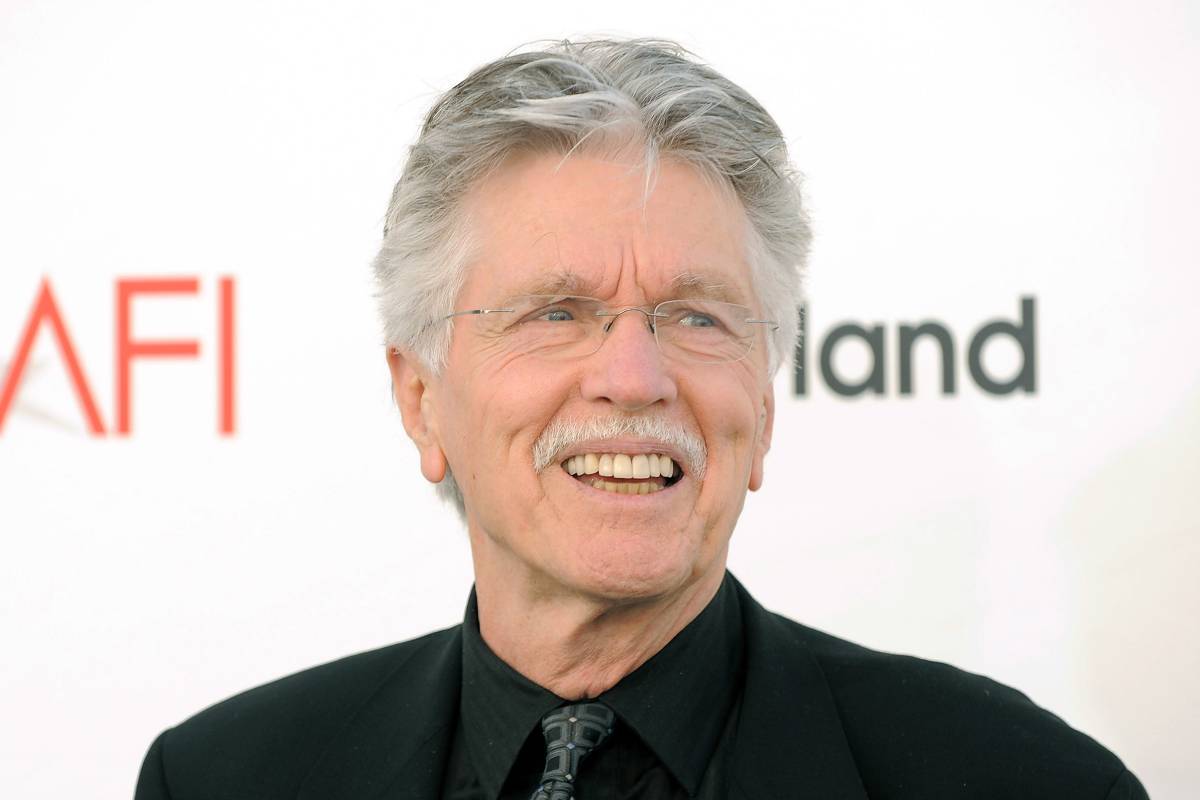
Muere Tom Skerritt, actor de películas como 'Top Gun', a los 93 años

El actor Tom Skerritt, ganador de un premio Emmy y conocido por sus papeles en Top Gun y Picket Fences, ha fallecido a los 93 años por causas naturales, según ha informado este jueves su familia en un comunicado al que ha tenido acceso la agencia Associated Press. Su muerte se produjo este miércoles. "Estamos desconsolados por su pérdida", reza el texto.

"Si bien el mundo conoció a Tom por su destacada carrera como actor, nosotros lo conocimos por su humor, curiosidad, sabiduría, generosidad y el amor que trajo a nuestras vidas. Le importaban profundamente la imaginación, la creatividad, la narración de historias, el servicio a la comunidad, los veteranos, la naturaleza y ayudar a otros a encontrar y compartir sus propias voces", reza la nota.

Skerritt fue nominado dos veces al Emmy, ambas por Picket Fences, y ganó el premio al mejor actor principal en una serie dramática en 1993. Otros momentos destacados de su carrera incluyen su papel como el paciente esposo de Shirley MacLaine en Turning Point, el esposo de Sally Field en Steel Magnolias y un oportunista intrigante que se interpone en el camino del intento de Jodie Foster de comunicarse con vida extraterrestre en Contact.

"Un escritor me describió una vez como un actor de carácter atrapado en el cuerpo de un protagonista, y siempre me ha encantado. Es un halago muy bonito. He podido moverme con soltura entre la televisión y el cine", declaró Skerritt al Seattle Post-Intelligencer en 1997.

En el escenario, fue el narrador en Our Town en el Intiman Theatre de Seattle en 2004 e hizo su debut en Broadway en 2013 en una adaptación de A Time to Kill de John Grisham.

  •  

Tom Skerritt, estrella de ‘Alien’, ‘Top Gun’ y ‘MASH’, muere a los 93 años

El actor Tom Skerritt, que protagonizó grandes éxitos de Hollywood como el clásico de ciencia ficción Alien, la comedia bélica MASH y el drama de acción Top Gun, ha fallecido a los 93 años, según confirmó su representante. Skerritt, natural de Detroit y cuya carrera en Hollywood se extendió desde la década de 1960 hasta la de 2020, murió el miércoles por causas naturales, informó ABC7 citando un comunicado de su familia. Conocido por su aspecto rudo y su capacidad para destacar en géneros muy diversos, Skerritt dejó interpretaciones memorables tanto en papeles protagonistas como secundarios en cine y televisión.

Seguir leyendo

El actor Tom Skerritt, fallecido a los 93 años, en la película 'Top Gun'.
  •  

Sylvester Stallone defiende que es inevitable usar la IA: "Si no te dejas llevar por ella, acabarás arrollado"

"Me meto en líos por decir esto, pero la IA ha llegado para quedarse". Así de contundente se mostraba Sylvester Stallone en una entrevista en vídeo para The Overlap. El icono del cine de 80 años sigue en primera línea de la atención mediática sea por la serie Tulsa King de Paramount+ o por, siguiendo los pasos de su colega Schwarzenegger, el montón de proyectos que tiene por delante, como la secuela de Samaritan.

También dirigiendo y coprotagonizando junto a Adam Driver el drama Tough as They Come, basándose en la historia real de Travis Mills, un soldado en Afganistán que perdió sus cuatro extremidades poco antes de cumplir los 25 años a causa de la explosión de un artefacto explosivo durante una misión en Afganistán.

Pero, a la espera de comprobar cuales de sus proyectos se materializan, recordó que para la precuela de John Rambo ya quiso recurrir a la IA para recrear una versión más joven de sí mismo. Una idea que generó polémica incluso cuando la sugirió a los productores de Lionsgate. "Quería combinar lo humano con la IA, y, por supuesto, todo el mundo se volvió loco. Yo les dije: 'Esto está ocurriendo, amigos. La gente está vendiendo su imagen. Va a haber 20 avatares de Elvis... Es una realidad".

Para Stallone, aunque su uso pueda comportar suplantaciones digitales, pérdida de oportunidades de trabajo o quitar humanidad a las interpretaciones, acepta asumir ese riesgo. "A pesar de que la comunidad creativa te critique con vehemencia. ¡Y tienen razón en sus quejas! Tienen razón. Pero no podemos detener esto. Es una avalancha. Simplemente está fuera de nuestro control. Si no te dejas llevar por ella, acabarás siendo arrollado", vaticinó.

También tuvo unas palabras para los jóvenes que intentan labrarse un futuro. "Han elegido la profesión más difícil del mundo. Y se va a volver aún más complicada debido a la inteligencia artificial", así que no ha tenido reparos, según cuenta, en aconsejar a su misma hija, Scarlet Rose Stallone, que también es actriz, para disuadirla de seguir por ese camino. "Por favor, dedícate a los videojuegos. Haz cualquier otra cosa".

Un joven Stallone por partida doble

Stallone no pudo seguir adelante con su idea de rejuvenecerse mediante la IA y fue reemplazado por el actor Noah Centineo, de 30 años, en John Rambo que dirige el finlandés Jalmari Helander, el autor de la desmadrada Sisu y secuela. Ya está en postproducción y con estreno previsto para el 4 de junio de 2027.

Antes también verá como otro actor le interpreta en una versión más joven, Anthony Ippolito de 27 años, en Yo soy Rocky dirigida por Peter Farrelly narrando la épica odisea personal de Stallone por sacar adelante la película que le lanzaría al estrellato en 1976. Se estrenará en Estados Unidos, al principio en un número limitado de cines, el 6 de noviembre, y el día 20 llegaría a un mayor número de salas. En España en principio no se estrenaría hasta el 22 de enero de 2027.

Así que tendremos a dos actores distintos para las versiones de la rejuvenecida estrella, porque en el fondo Stallone es demasiado Stallone. Irrepetible, sea con IA o sin ella.

  •  

Russia Fires Missiles at Kyiv as Ukraine Sends 600+ Drones Toward Moscow

Click to see the full-size image

On the night of October 22, Russian forces launched a massive combined strike on Ukraine using Iskander-M, Zircon, and Oniks missiles and 210 strike UAVs; the main axis of the strike was Kyiv. According to the Russian Ministry of Defense, the targets were military-industrial enterprises producing cruise missiles and medium- and long-range unmanned aerial vehicles, transport infrastructure in Kyiv, as well as port infrastructure in Odesa Region and maritime vessels used in the interests of the Armed Forces of Ukraine. At the same time, Ukraine carried out a massive drone attack on Russian territory: according to Russian sources, 808 UAVs were shot down over 18 federal subjects of the Russian Federation, including 630 on approach to Moscow.

Russian Strikes on Ukraine by Region

Kyiv and Kyiv Region

  • Antonov State Enterprise (Kyiv) — an aircraft manufacturer whose facilities, according to the Russian Ministry of Defense, were used to produce medium- and long-range unmanned aerial vehicles, as well as FP-5 Flamingo cruise missiles and FP-7 and FP-9 operational-tactical missiles. The facility was part of Ukraine’s military-industrial production chain for long-range strike systems.

  • Khladokombinat No. 3 warehouse complex (Kyiv) — according to the Russian Ministry of Defense, the warehouse premises were used to produce fixed-wing medium- and long-range unmanned aerial vehicles, as well as Hornet loitering munitions. The use of a civilian warehouse for drone production reflects the dispersal of manufacturing across dual-use sites.

  • Industrial enterprise producing UAVs and robotic-system components (Kyiv). The Armed Forces of Ukraine use robotic systems for logistics, evacuation, and fire support at forward positions.

  • Storage site for unmanned aerial vehicles and jet boosters (Kyiv) — a storage facility for strike drones and boosters used to increase the range and speed of fixed-wing UAVs.

  • Southern Road-Rail Bridge (Kyiv) — a bridge crossing over the Dnieper used to move military cargo by road and rail between the right and left banks. According to Ukrainian sources, the strike damaged subway infrastructure on the bridge; service on the Green Line was suspended between the Vydubychi and Osokorky stations, and road traffic across the bridge was temporarily closed in both directions.

  • CHP-4 and CHP-5 (Kyiv) — large combined heat and power plants supplying electricity and heat to urban infrastructure and industrial facilities, including military-industrial enterprises. According to monitoring channels, fires were recorded at the facilities; the Ukrainian Air Force acknowledged that not a single ballistic missile was intercepted.

  • PS-330 Novokyivska substation (Khotov, Kyiv Region) — a 330 kV substation supplying power to nodes of the Kyiv Region energy system, including military-industrial facilities and logistics centers.

Odesa Region

  • Kiliia port infrastructure (Odesa Region) — port facilities used to unload and store military supplies delivered to Ukraine from abroad. The port is located on the Danube and serves as an alternative supply route after operations at Black Sea ports were restricted. Strikes on unloading and storage facilities complicate the receipt and distribution of foreign military assistance.

  • Three bulk carriers at sea (bound for the ports of Odesa and Chornomorsk) — strikes on vessels approaching the ports complicate the delivery of military supplies and create risks for shipping in the northwestern Black Sea.

Zhytomyr Region

  • PS-330 Zhytomyrska substation (Zhytomyr) — a 330 kV substation supplying electricity to Zhytomyr Region and carrying power between regions.

Kharkiv Region

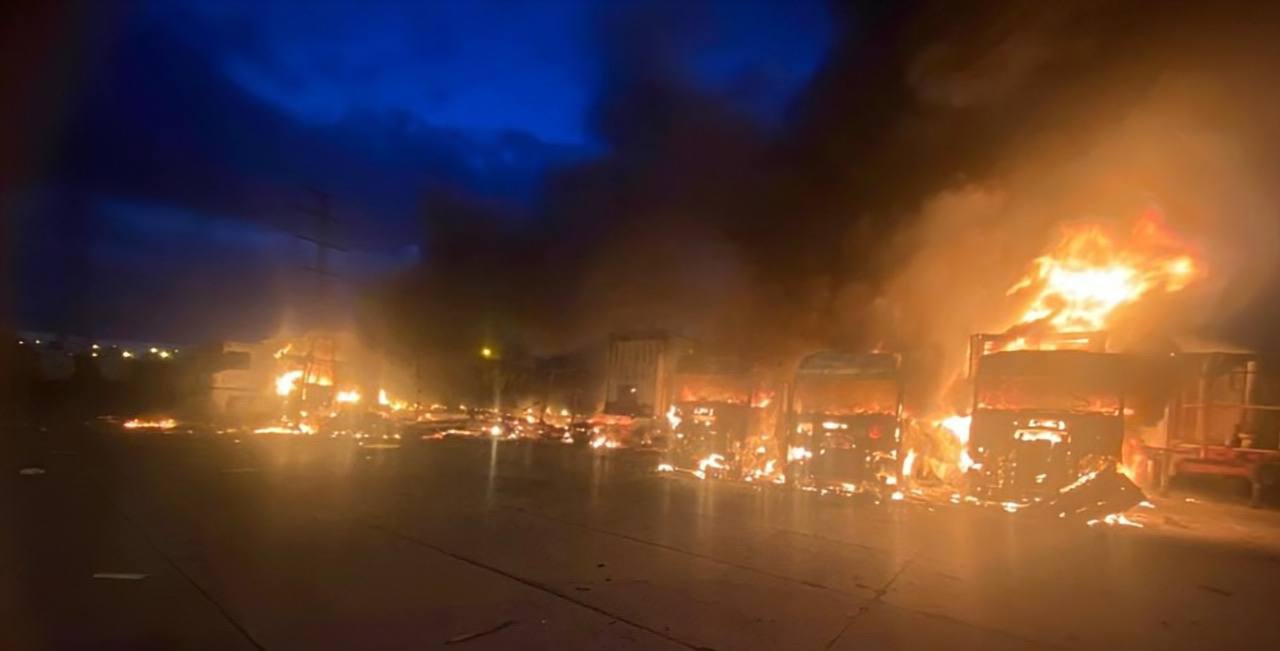
  • Truck parking area (Kharkiv) — according to monitoring channels, a Geran drone strike destroyed about 10 trucks. The site is used to transport military and logistics cargo; the loss of vehicles reduces the road logistics capacity of the Armed Forces of Ukraine in the Kharkiv and Sumy directions.

  • Railway locomotive (Kharkiv) — a UAV strike damaged a Ukrzaliznytsia locomotive. Rail transport remains the primary means of moving military equipment and personnel; the loss of a locomotive complicates rail traffic in the Kharkiv direction.

Kirovohrad Region

  • Production and warehouse complex (Kirovohrad) — according to monitoring channels, the facility was attacked by Geran-4 drones on the evening of October 21.

Poltava Region

  • Television and radio company building (Kremenchuk) — the facility provided broadcasting and communications, including for military needs.

Strikes on Russia

  • Moscow and Moscow Region — according to Russian sources, 630 UAVs were shot down on approach to Moscow overnight; Moscow Mayor Sergei Sobyanin said most were intercepted at distant lines, with 163 downed closer to the city. Monitoring channels claim that a Flamingo missile was shot down over Serpukhov; Ukrainian sources claim an attack on the Russian Defense Ministry enterprise JSC 75 Arsenal, a facility for storing and preparing ammunition.

  • Belgorod Region — 205 UAVs were shot down over the past day; according to Russian sources, three civilians were injured. Belgorod Region is regularly targeted by drone attacks aimed at energy, transport, and civilian infrastructure.

  • Lipetsk Region — as a UAV passed through the city toward Moscow Region, a multi-story residential building and a medical facility were damaged. Lipetsk is a major transport hub on the Moscow–south axis; drones passing through the city create risks for civilian infrastructure.

The Russian strike on October 22 was combined in nature and focused on two interrelated areas: the production of aerial attack systems (Antonov State Enterprise, Khladokombinat No. 3, and UAV and booster storage sites) and the transport and energy infrastructure supporting their use and the supply of Ukrainian forces (the Southern Bridge, CHP-4 and CHP-5, the Novokyivska and Zhytomyrska substations, Kiliia port, and vessels at sea).

Ukrainian strikes were concentrated on Moscow Region (630 UAVs shot down, according to Russian sources) and Belgorod Region (205 UAVs shot down), with sporadic drone passages through Lipetsk and Tula Region. The intensity of attacks on Moscow remains high, although Russian sources report that most drones were intercepted at distant lines. The intensity of attacks on Moscow remains high, although Russian sources report that most drones were intercepted at distant lines. In the medium term, Russian strikes on UAV and missile production chains, as well as on energy infrastructure supporting the military-industrial complex, will continue; Ukraine will likely maintain its course of massive drone attacks on Moscow Region and border regions.


MORE ON THE TOPIC:

The post Russia Fires Missiles at Kyiv as Ukraine Sends 600+ Drones Toward Moscow appeared first on South Front.

  •  

Border Cops Seize Nurse's Phone Filled With Psychiatric Patient Information

A smartphone in handcuffs | tescka1/Magnific/Cammeraydave/Dreamstime/Mariam Zakaidze

U.S. Customs and Border Protection (CBP) seized a psychiatric nurse practitioner's phone filled with confidential patient information at Washington Dulles International Airport last week, according to a new lawsuit. Muhammad Numaan Imam alleges that CBP agents told him that they could take his electronics the "easy way or the hard way" and refused to let him talk to his lawyer because "we are the authorities at the border."

The lawsuit by the American-Arab Anti-Discrimination Committee (ADC) may be the first time CBP is taken to court over seizing people's medical records. ADC is also helping Palestinian-American lawyer Jay Shehadeh and Jewish-American journalist Max Blumenthal sue over their devices being seized.

"We're seeing a pattern where officers use their border-search authority not to advance any legitimate border-related purpose, but to punish individuals for refusing to provide access to their personal electronic devices and for having expressed views the government didn't approve of," ADC president and legal director Jenin Younes wrote in a statement emailed to journalists.

While Shehadeh and Blumenthal claim that CBP is retaliating for their political views, Imam argues that he faced threats and retaliation with the simple act of asserting privacy rights. Both Imam and Shehadeh were considered "trusted travelers" under the Global Entry program, which allows American citizens who undergo a background check to pass through an automated fast track at airports and borders.

Asked by Reason, a CBP spokesperson did not address any specifics of the case, giving only a generic statement about how "CBP's ability to lawfully inspect electronic devices crossing the border is integral to keeping America safe in an increasingly digital world."

The border exemption to the Fourth Amendment gives U.S. authorities the power to look for "contraband" crossing into the country without a warrant. There is a mess of contradictory court rulings on whether that power includes searching travelers' electronic data, but in practice, CBP can simply seize the physical devices that the data live on.

And the agency often lies outright to travelers whose data that it wants to search, as documents recently released in the case of Atlanta protester Samuel Tunick show. CBP agents gave Tunick a false reason for detaining him and falsely promised that he would be allowed to leave with his phone if he cooperated, even though they were under orders to seize his devices no matter what. Tunick is now on trial for allegedly tricking the CBP agents into deleting his data to avoid a search.

"It's happening to a lot of people, and it's being used in this coercive, inappropriate way," Younes tells Reason.

The problems for Imam, who lives in Virginia, actually began at another border. He was heading to Istanbul on Saturday for a family vacation with his Pakistani wife, Khadijah Mansoor, and their 1-year-old child. Turkish authorities demanded to see Mansoor's U.S. green card, which she had forgotten at home, and wouldn't let her enter on her Pakistani passport alone. The family had to board the next flight back to Washington. On their arrival, CBP naturally wanted to know why they had been turned away and why Mansoor didn't have her green card.

But things took a weirder turn after agents told Imam he had been "flagged" for undisclosed reasons, pulled him into a separate room, and began questioning him about his social media use and group chats, according to the lawsuit. (Imam tells Reason that they asked about group chats in general, not any specific group chat.) When agents asked for the password to Imam's phone, he told them that he uses the phone to communicate with and manage cases for patients at the rehab facility where he works. The Health Insurance Portability and Accountability Act (HIPAA) strictly prevents doctors and other medical staff from sharing patient data without consent, so Imam asked to speak to a lawyer.

"Your lawyer cannot do anything. We are the authorities at the border," Imam recalls one agent saying. A supervisor then told the couple that CBP could take all of their electronics the "easy way or the hard way," and that the devices could take months to get back, Imam and Mansoor claim.

CBP's own internal policy says that devices should "ordinarily" be held for less than five days. The same policy includes vague guidelines for dealing with medical information: "Possibly sensitive information, such as medical records and work-related information carried by journalists, shall be handled in accordance with any applicable federal law and CBP policy." Imam says that the CBP agents claimed to have software for filtering out HIPAA-protected data.

After four hours in detention, CBP took the family's phones and laptops and let them go. The next day, Imam got an email stating, "We regret to inform you that your membership in Global Entry has been revoked for the following reason(s): You do not meet the Trusted Traveler standard." In addition to both Imam and Mansoor losing valuable work data, the lawsuit argues, Imam is now unable to prescribe certain psychiatric medications to his patients, because of federal regulations that require phone verification.

The lawsuit demands the return of the devices and data under Rule 41(g) of federal criminal procedures, which requires the government to hand back property that is no longer necessary for a criminal investigation. ADC has also filed these motions in Shehadeh and Blumenthal's cases. (CBP gave back Blumenthal and Shehadeh's phones almost immediately afterward, but ADC is continuing to press for records of what they did to those phones in custody.) Younes filed a brief on Blumenthal's behalf in support of an upcoming Supreme Court case over whether CBP can continue these electronic searches.

"The devices are neither contraband nor subject to forfeiture, and, to Plaintiffs' knowledge, there is no pending criminal investigation, criminal prosecution, or warrant authorizing their continued seizure or search," Imam's lawsuit states. "The Fourth Amendment does not permit the border-search exception to become a means of coercing compliance through the threatened or actual confiscation of travelers' personal property."

The post Border Cops Seize Nurse's Phone Filled With Psychiatric Patient Information appeared first on Reason Magazine.

  •  

Carris e STCP anunciam intercâmbio de trabalhadores e acordo para investimentos


A Carris e a STCP vão avançar com programas de intercâmbio de trabalhadores para partilhar conhecimento e desenvolver soluções para os desafios da mobilidade urbana, ao abrigo de um protocolo de uma cooperação estratégica que é assinado sexta-feira, em Lisboa. E que prevê igualmente a apresentação conjunta de candidaturas a programas nacionais e europeus de financiamento.

“Este protocolo tem um propósito muito concreto: juntar a experiência e o conhecimento das nossas equipas para melhorar o serviço que prestamos às pessoas”, começa por explicar Luís Osório, presidente do Conselho de Administração da STCP, citado num comunicado enviado às redações.

Luís Osório acrescenta que esta cooperação permitirá “aprender em conjunto, desenvolver novas soluções e dar maior alcance a projetos que respondem a necessidades comuns”. Acresce ainda a valorização dos trabalhadores e preservação do património associado à identidade do Porto e de Lisboa. “Queremos tornar o transporte público uma escolha cada vez mais atrativa.”

Este protocolo tem um propósito muito concreto: juntar a experiência e o conhecimento das nossas equipas para melhorar o serviço que prestamos às pessoas.

Luís Osório

Presidente do Conselho de Administração da STCP

Também Rui Lopo, presidente do Conselho de Administração da Carris, destaca a importância da parceria para “reforçar a resposta” aos desafios do setor, designadamente “a crescente exigência dos passageiros, a segurança, a transformação digital, a evolução tecnológica e a qualificação dos recursos humanos”.

Além do programa de intercâmbio de colaboradores das duas empresas, o acordo prevê ainda ações de formação, conferências, e iniciativas dirigidas às escolas e à comunidade. Estão previstas igualmente iniciativas relacionadas com a preservação, recuperação e valorização dos carros elétricos históricos.

A assinatura do protocolo está agendada para as 12h30 desta sexta-feira, no Museu da Carris, em Lisboa, e contará com a presença dos conselhos de administração das duas empresas e do vice-presidente da Câmara Municipal de Lisboa.

  •  

Leixões SAD diz desconhecer arresto e aguarda confirmação para tomar posição

✇ECO
By: Lusa

A SAD do Leixões, que tutela o futebol profissional do clube, afirmou esta quinta-feira desconhecer o arresto de bens da sociedade e do seu presidente, André Castro, remetendo uma tomada de posição para a confirmação das informações divulgadas.

Numa comunicação enviada à agência Lusa e a outros órgãos de comunicação social, intitulada “Direito de resposta”, a sociedade desportiva declarou ter sido surpreendida pela notícia publicada em vários meios.

“A confirmar-se o teor do noticiado, a Leixões SAD e o seu presidente, André Castro, tomarão oportunamente posição, adotando as medidas que considerem adequadas à salvaguarda dos seus direitos e interesses e à reposição da verdade dos factos”, lê-se na reação.

A SAD confirmou que o empresário brasileiro Anderson Fellipe Gonçalves é credor no âmbito do seu processo especial de revitalização (PER), encontrando-se o respetivo crédito reconhecido.

“O plano de recuperação foi aprovado e transitou em julgado, sendo os créditos pagos nos termos e condições homologados por decisão judicial”, sustentou.

Porém, na mesma comunicação, a sociedade desportiva afirmou que a Leixões SAD e a Play-Fair são credoras da Golden Goal, empresa do grupo Aliya Capital Partners – grupo indicado pelo investidor brasileiro -, em mais de 22 milhões de euros.

Segundo a SAD leixonense, esse montante decorre de incumprimento contratual do grupo, estando em curso diligências para a sua recuperação.

A reação surge depois de o Juízo Central Cível da Póvoa de Varzim ter decretado, numa decisão a que a Lusa teve esta quinta-feira acesso, o arresto de bens da SAD, da Play-Fair, sua acionista maioritária, e de André Castro.

A providência cautelar foi requerida por Anderson Fellipe Gonçalves, que, segundo os factos considerados sumariamente provados pelo tribunal, concedeu 18 empréstimos às duas sociedades, entre novembro de 2023 e abril de 2026, num total de 5,062 milhões de euros.

O tribunal determinou o arresto até ao montante de 2,141 milhões de euros relativamente à Play-Fair e de 2,921 milhões de euros relativamente à SAD, acrescidos dos juros previstos na decisão.

Quanto a André Castro, o limite foi fixado em 3,335 milhões de euros, correspondente à parte daqueles empréstimos que o dirigente afiançou, não constituindo um montante adicional ao capital emprestado às sociedades.

O juiz Tiago Caiado Milheiro fundamentou a medida no receio de perda da garantia patrimonial dos créditos, apontando, entre outros fatores, as dificuldades financeiras das sociedades e o risco de venda do Complexo Desportivo de Fão.

  •  

Mamoru Hosoda vio cómo la llegada de su hija hundía el mundo de su hijo mayor y lo llevó a 'Mirai': «La escena del tren es real, mi hijo lo hizo»

Lo normal es que la llegada de un bebé siempre sea motivo de celebración familiar. Sin embargo, para un niño pequeño la situación puede ser muy diferente. De hecho, puede sentirse como una amenaza. Esto se debe a que, casi de inmediato, la atención de sus padres se reparte y las rutinas comienzan a experimentar un proceso de cambio.

Después de todo, una nueva persona ocupa un lugar que hasta entonces parecía exclusivamente suyo. Pues bien, el cineasta Mamoru Hosoda conoció de cerca esa situación cuando nació su hija. Lo más curioso es que la reacción de su hijo mayor fue la que acabaría inspirando Mirai, la popular película de animación que se estrenó en 2018.

Mamoru Hosoda encontró en la paternidad la inspiración para 'Mirai'

En una entrevista, el mismo director fue quien explicó que su hijo tenía tres años cuando llegó la pequeña. En este sentido, Mamoru Hosoda observó con curiosidad cómo su hijo intentaba comprender la presencia de una persona que no había estado antes en su vida y que, de pronto, reclamaba una parte considerable de la atención familiar.

La respuesta no fue la mejor que cabría esperar. El niño sentía que estaba perdiendo el cariño de sus padres. Fue esto lo que le llevó a reaccionar con rabia. Lo que está claro es que esa experiencia revelaba una emoción infantil profunda y bastante reconocible: el miedo a dejar de ser querido. En Mirai, mi hermana pequeña, el protagonista, Kun, ve cómo su mundo cambia con el nacimiento de su hermana.

Estando acostumbrado a ser el centro de la familia, empieza a comportarse de forma caprichosa y a descargar su frustración contra la recién nacida. Dicho esto, la película no intentaba presentar esa situación marcada por los celos y cierta envidia como una simple travesura, sino mostrar cómo la vive un niño que todavía no sabe poner palabras a lo que siente en lo más profundo de su interior.

Una de las escenas más duras es en la que aparece un tren de juguete con el que Kun golpea a Mirai. Mamoru Hosoda confirmó que ese momento estaba inspirado directamente en su experiencia: "La escena del tren es real: mi hijo hizo eso". El director quiso dejar claro que no se trataba de un ataque de ira completamente injustificado. La realidad es que su hijo estaba enfadado porque sentía que había perdido parte del amor que consideraba suyo.

"Su mundo entero se había hecho añicos por culpa de esta nueva criatura", sugería al respecto. A partir de ahí, Mamoru Hosoda construyó una aventura en la que Kun viaja por distintos momentos de la historia familiar y se encuentra con versiones de sus seres queridos de otras épocas. A través de un enfoque vinculado a la fantasía, el personaje empieza a comprender su lugar en una familia que existía antes de su nacimiento y que, como es lógico, seguirá cambiando con el tiempo.

Por otro lado, el director reconoció que quería contar una historia desde el punto de vista de un niño de cuatro años, algo que consideraba que se había visto bastante poco en el cine. Su intención era exponer una experiencia que bien podía ser universal: la necesidad de sentirse querido y el desconcierto que aparece cuando ese cariño parece amenazado.

© Difoosion

Mamoru Hosoda es uno de los directores japoneses de animación con más prestigio
  •  

Porto seco da Guarda entra em operação. Turcos somam segunda infraestrutura


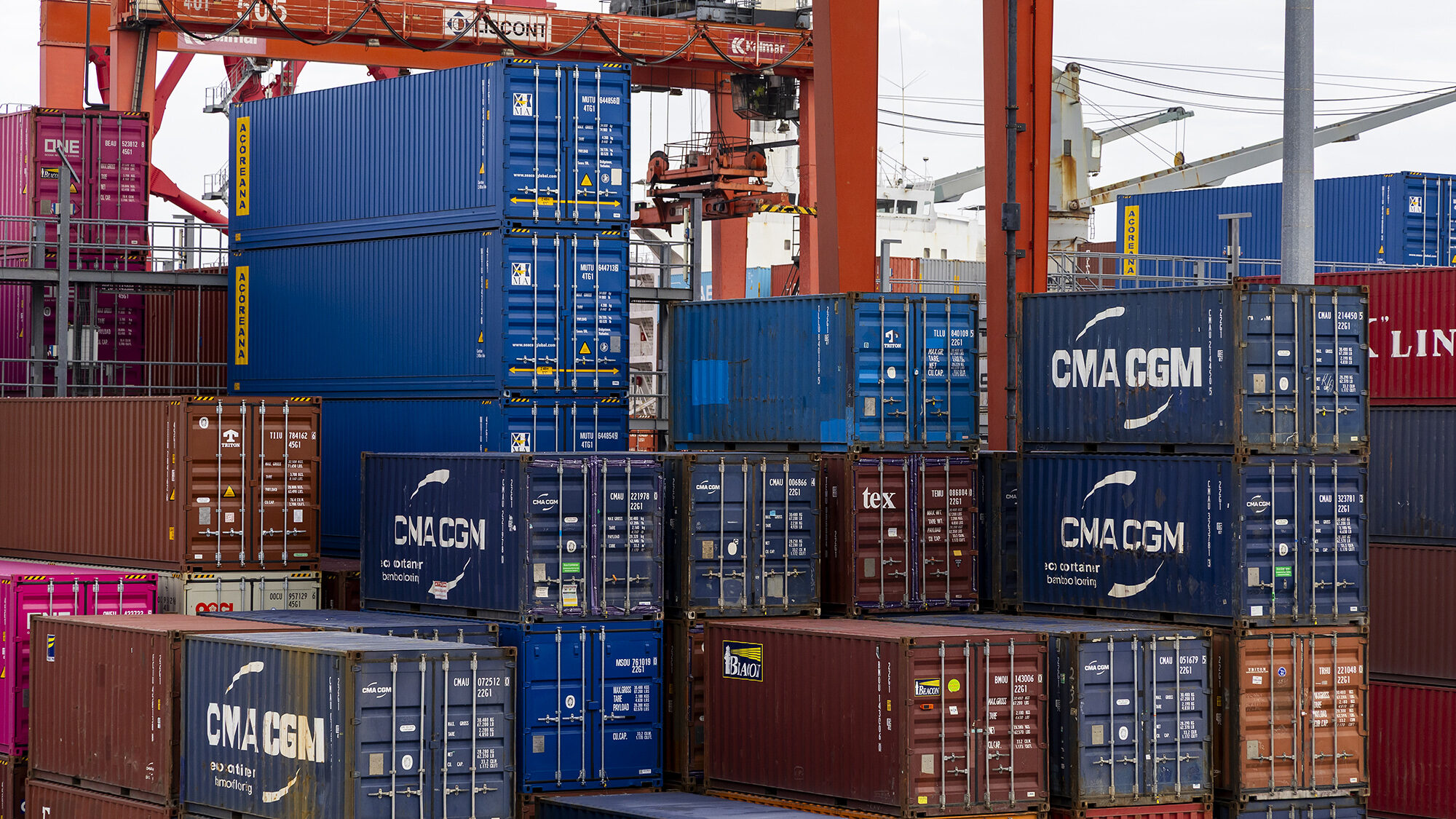
Vista de um barco a sair do Terminal de Contentores do Porto de Leixões, o qual passará a ter uma estrutura avançada na Guarda para ligação entre ferrovia e rodovia. JOSÉ COELHO/LUSAJOSÉ COELHO/LUSA

O porto seco da Guarda vai ser inaugurado esta sexta-feira, num investimento que permitirá ao grupo turco Yilport gerir a segunda infraestrutura do género em Portugal, após a abertura do porto seco de Elvas, em março deste ano.

A estrutura na Guarda ficará próxima da linha férrea da Beira Alta e da autoestrada A25, além da A23, ligação privilegiada aos distritos de Castelo Branco e Santarém, e ainda, para Norte, ao IP2, tornando-se uma posição avançada para os portos marítimos do Centro e Norte. Tal como Elvas, próxima da A6 e do Corredor Internacional Sul (linha férrea ainda por inaugurar) permite acomodar contentores dos portos de Sines e Setúbal, o porto seco beirão ficará apto para receber contentores dos portos de Leixões, Aveiro e Figueira da Foz.

O financiamento da infraestrutura contou com quatro milhões de euros de fundos provenientes do programa Centro 2030, irá consolidar a ligação rodovia/ferrovia numa zona fronteiriça, beneficiando da reconstrução da linha da Beira Alta. Após as obras, esta passou a permitir a circulação de comboios até 750 metros de comprimento.

Reportagem na Guarda - 21MAR25
“A Yilport dá garantias de que vai haver trabalho sério para captação de cargas para o porto seco da Guarda”, diz o autarca Sérgio CostaHugo Amaral/ECO

O porto seco da Guarda, em construção desde maio de 2025, é uma ambição que já vem da década passada, lembra o presidente da Câmara Municipal da Guarda, Sérgio Costa, ao ECO/Local Online. “É um processo que se iniciou há dez anos, era eu à data vereador, e já lutava muito por esta necessidade“.

Nesta primeira fase, salienta o edil independente, que vai no seu segundo mandato (após uma presença anterior na autarquia enquanto vereador eleito pelo PSD) a área ronda os quatro hectares, mas o novo Plano Diretor Municipal (PDM), aprovado em julho, já contempla, um quilómetro a Sul, mais 35 hectares para uma segunda fase, área que poderá ser disponibilizada faseadamente. A confiança no projeto é explícita: “A Yilport dá garantias de que vai haver trabalho sério para captação de cargas para o porto seco da Guarda”, diz.

Em jeito de promoção do novo investimento presente no seu território, o autarca destaca que, face aos portos marítimos, “no porto seco da Guarda os camiões não têm de estar tempo imenso como nos portos de mar, as taxas são mais reduzidas e há uma redução dos custos de logística“.

Um mês antes do início dos trabalhos, em abril de 2025, quando ainda se aguardava que o Estado português conseguisse desbloquear os quatro milhões de euros de fundos extra necessários para a construção, Sérgio Costa, autarca da Guarda (reeleito depois em outubro), explicava ao ECO/Local Online a dinâmica desta infraestrutura:

"Funciona exatamente da mesma forma com um porto de mar só que aqui não há navios, há comboios e há camiões. As empresas que dependem do comércio externo, precisam cada vez mais da ferrovia, para poder aumentar os seus negócios e diminuir os custos de contexto. Nos contentores que estejam nos portos de mar à espera, o aluguer ao dia ou à hora é uma brutalidade, e a partir de Guarda esse custo poderá tender para zero. Isto é muito importante, interligando a ferrovia com o porto seco – haverá sempre “last mile” [ligação dos quilómetros finais até ao destino e desde a remessa] de camião, naturalmente, porque a ferrovia não pode ir à porta de cada um.”

O grupo turco Yilport, concessionário do terminal de contentores de Alcântara, em Lisboa, e do porto seco de Elvas, passam a gerir o seu segundo porto seco em Portugal com a inauguração nesta sexta-feira na GuardaAPL - Administração do Porto de Lisboa

Adicionalmente, o autarca eleito numa lista independente notava os problemas causados pelo atraso na inauguração da Linha da Beira Alta, a qual continuou ano e meio à espera da abertura, realizada apenas no final de setembro deste ano.

As obras agora terminadas, da responsabilidade do conselho de administração da APDL – Portos do Douro, Leixões e Viana do Castelo, e que deveriam ter ficado concluídas no início deste ano, incluem o reforço do terrapleno para mais de 45 mil contentores e a instalação de estruturas como uma báscula rodoviária e instalação elétrica para contentores frigoríficos. A intervenção implicou ainda a preparação do terminal ferroviário de mercadorias da cidade para acolher as operações de carga. Entre os edifícios construídos está o dos serviços aduaneiros, a cargo da Autoridade Tributária, para alfandegar e desalfandegar contentores de mercadorias e, no futuro, também carga a granel.

Numa conversa nesta quinta-feira, Sérgio Costa adiantou ao ECO/Local Online ter a garantia de lançamento de um concurso por parte da Infraestruturas de Portugal para construção de duas novas variantes, de Sequeira e dos Galegos, para ligação ao porto seco, cujo orçamento ronda os 20 milhões de euros. Estas ligações, que o autarca espera ter em andamento já no próximo ano, permitirão ainda encerrar as passagens de nível que subsistem na cidade nas linhas da Beira Baixa (Guarda-Entroncamento) e da Beira Alta, a qual liga Vilar Formoso à Pampilhosa, com passagem na Guarda, num total de 190 quilómetros totalmente reformulados.

(Notícia atualizada às 19h00 com declarações do autarca Sérgio Costa)

  •  

Race to rearm: Telford gun hall brings tank barrel production back to the UK

Defence secretary says Britain must manufacture at scale as Germany’s Rheinmetall opens Midlands factory

For the last 20 years, Britain was unable to put a barrel on its tanks without buying from abroad. Relying on foreign allies seemed like a reasonable choice during years of relative security (for wealthy countries at least) after the end of the cold war.

But Russia’s full-scale invasion of Ukraine in 2022 has changed the calculation – and prompted a scramble to rearm among European countries, including the UK.

Continue reading...

© Photograph: Christopher Thomond/The Guardian

© Photograph: Christopher Thomond/The Guardian

© Photograph: Christopher Thomond/The Guardian

  •  

One year of Ukrainian arms exports, and industry has questions: how much army gained, where Berlin office is, who joins joint ventures

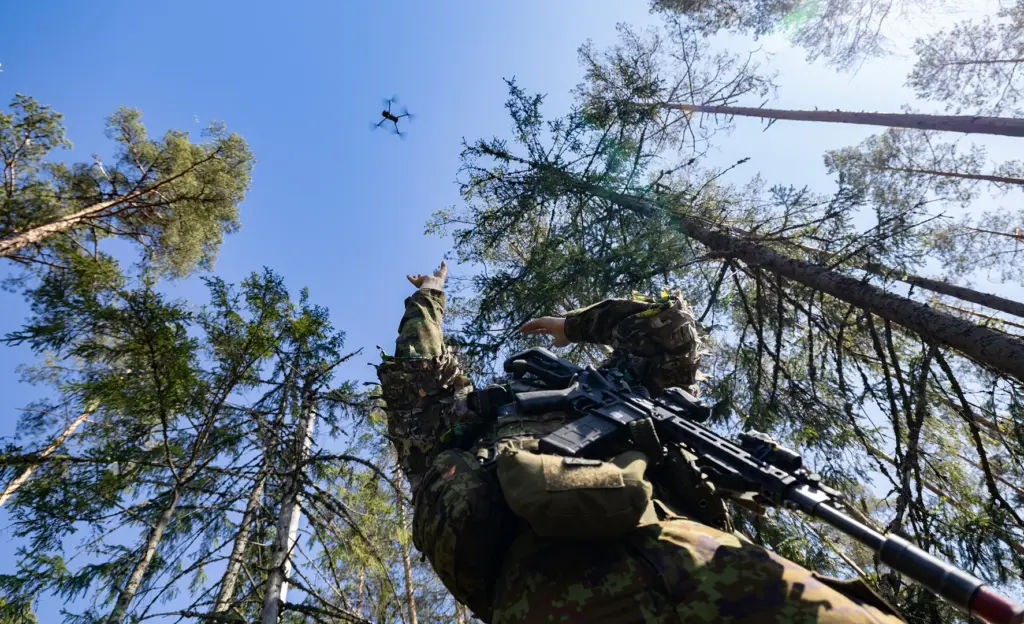
Estonian and Ukrainian soldiers fly drones together during Exercise Hedgehog 2025 in Estonia, where Ukrainian operators were credited with knocking out two battalions in a simulated engagement. Photo: vbl/OR-7 Ardi Hallismaa/ERR

Ukraine now builds far more weapons than it can afford to buy. A year ago, it promised to sell the surplus abroad and turn the proceeds back into its own army. However, 12 months later, that promise has barely materialized: a state fee of up to 30% is pricing Ukrainian arms out of foreign markets, and no one can say how much the army has actually gained, said Ihor Fedirko, executive director of the Ukrainian Council of Armorers.

President Volodymyr Zelenskyy announced the resumption of controlled weapons exports in October 2025, resting it on four promises: 1) sell what Ukraine makes beyond its own needs, 2) channel part of the proceeds into a special fund for the army, 3) open export offices in Europe and the US, and 4) establish joint ventures abroad.

The surplus is real: Ukraine's defense output is projected to reach $55 billion in 2026, far beyond what the state can finance. A year on, Fedirko checked each promise in turn.

1) Export of surpluses: rules that strangle businesses

    On 1 July 2026, the government approved rules for controlled arms exports. They shortened the maximum application review period from 90 to 30 days, but also introduced an export fee: 20% for finished products and technologies, and 30% for components. For finished products exported under the special procedure, the contract value must be at least $334,000.

      In September, the Ukrainian Council of Armorers, together with other associations, proposed a zero rate, no advance collection of the fee, refunds for deals that fall through, and simplified test shipments. The industry was promised that its amendments would be taken into account and that the resolution would be rewritten.

      Even in early October, however, the rules still needed work. According to Fedirko, the new mechanism has effectively not started working. Whether it can bring in additional funds for defense depends on how acceptable the export terms are to manufacturers.

      Fedirko says, though, that judging by current decisions, the state intends to keep the export fee.

      “The industry is ready to discuss its contribution to defense financing. But the rate must be economically justified,” he says.

      2) Procurement for the Ukrainian military: balance is only being established

      He adds that the Ukrainian Council of Armorers intends to push for a rate significantly lower than 20%, one that would let companies fulfill contracts and invest in production.

      With such high rates, Fedirko says, the competitiveness of Ukrainian weapons on foreign markets is in question, as is the ability to send even small test batches to potential buyers.

      “The fundamental requirement is post-payment: after the contract has actually been fulfilled and the manufacturer has been paid. A company should not pay the state in advance a share of income it has not yet received,” he says.

      He added that, given all this, the real export figures remain unclear, as does how much exports have actually brought the military.

      “The military and manufacturers must feel the benefit of exports. I sincerely hope that next year will bring much better results,” he says.

      In addition, on 12 October, the Ukrainian Parliament passed bill No. 15400 in the first reading. It provides for crediting the export fee to a special fund directed to the Ministry of Defense: 50% for the procurement, modernization, and repair of weapons and equipment, and 50% for the pay of Armed Forces personnel.

      The bill has not yet been adopted, but Fedirko says he expects “final adoption and launch of the mechanism.”

      3) Export offices: offices in Germany and Denmark

      On 3 November, the Ukrainian government named the first cities for export offices: Berlin and Copenhagen. On 15 December, it again spoke of preparing an office in Berlin. In reality, Fedirko says he does not know the office’s status, and it likewise remains unclear how companies can apply to it and how many contracts it has helped close.

      4) Joint ventures abroad: There are concrete results in this area

      According to Fedirko, eight joint ventures have been created, five of which are already supplying products to Ukraine. He stresses that this is the result of work by Ukrainian companies, foreign partners and the state, and that it deserves recognition.

      As early as February 2026, the authorities spoke of plans to create ten joint ventures in Europe within a year. At the same time, they announced Quantum Frontline Industries in Germany, with a planned annual capacity of 10,000 drones for Kyiv.

      Beyond the number of ventures and deliveries, however, it is important to understand how other manufacturers can join the Build with Ukraine program.

      “Who accepts applications, by what criteria are decisions made, and what support does a company receive?” Fedirko asks.

      In other words, joint ventures are already delivering results, but the rules of participation and the state support mechanism must be clear to companies that want to develop production abroad.

      •  

      Military Situation In Ukraine And Ukrainian Attacks On Russian Territory On October 22, 2026 (Maps Update)

      Click to see the full-size image

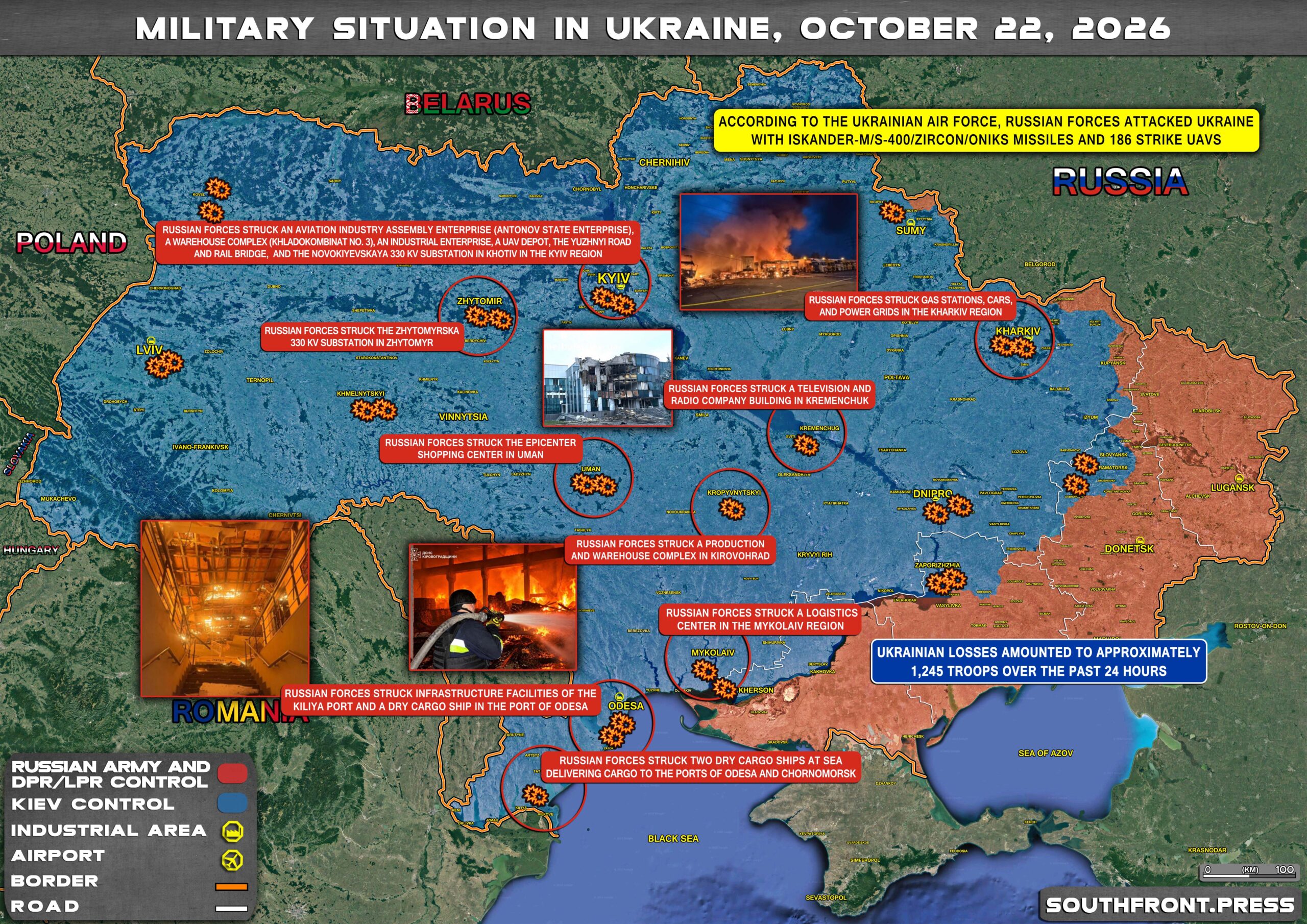
      • Russian strikes destroyed targets in the Sumy, Kharkiv, Zaporizhzhia, Dnipropetrovsk, Kherson, Kyiv, Volyn, Odesa, Khmelnytskyi, Lviv, Vinnytsia, Zhytomyr, Rivne, Cherkasy, Kirovohrad, Mykolaiv regions, and the DPR;
      • According to the Ukrainian Air Force, Russian forces attacked Ukraine with Iskander-M/S-400/Zircon/Oniks missiles and 186 strike UAVs;
      • Russian forces struck an aviation industry assembly enterprise (Antonov State Enterprise), a warehouse complex (Khladokombinat No. 3), an industrial enterprise, a UAV depot, the Yuzhnyi road and rail bridge, and the Novokiyevskaya 330 kV substation in Khotiv in the Kyiv region;
      • Russian forces struck infrastructure facilities of the Kiliya port and a dry cargo ship in the port of Odesa;
      • Russian forces struck two dry cargo ships at sea delivering cargo to the ports of Odesa and Chornomorsk;
      • Russian forces struck the Zhytomyrska 330 kV substation in Zhytomyr;
      • Russian forces struck gas stations, cars, and power grids in the Kharkiv region;
      • Russian forces struck the Epicenter shopping center in Uman;
      • Russian forces struck a television and radio company building in Kremenchuk;
      • Russian forces struck a production and warehouse complex in Kirovohrad;
      • Ukrainian losses amounted to approximately 1,245 troops over the past 24 hours.

      Click to see the full-size image

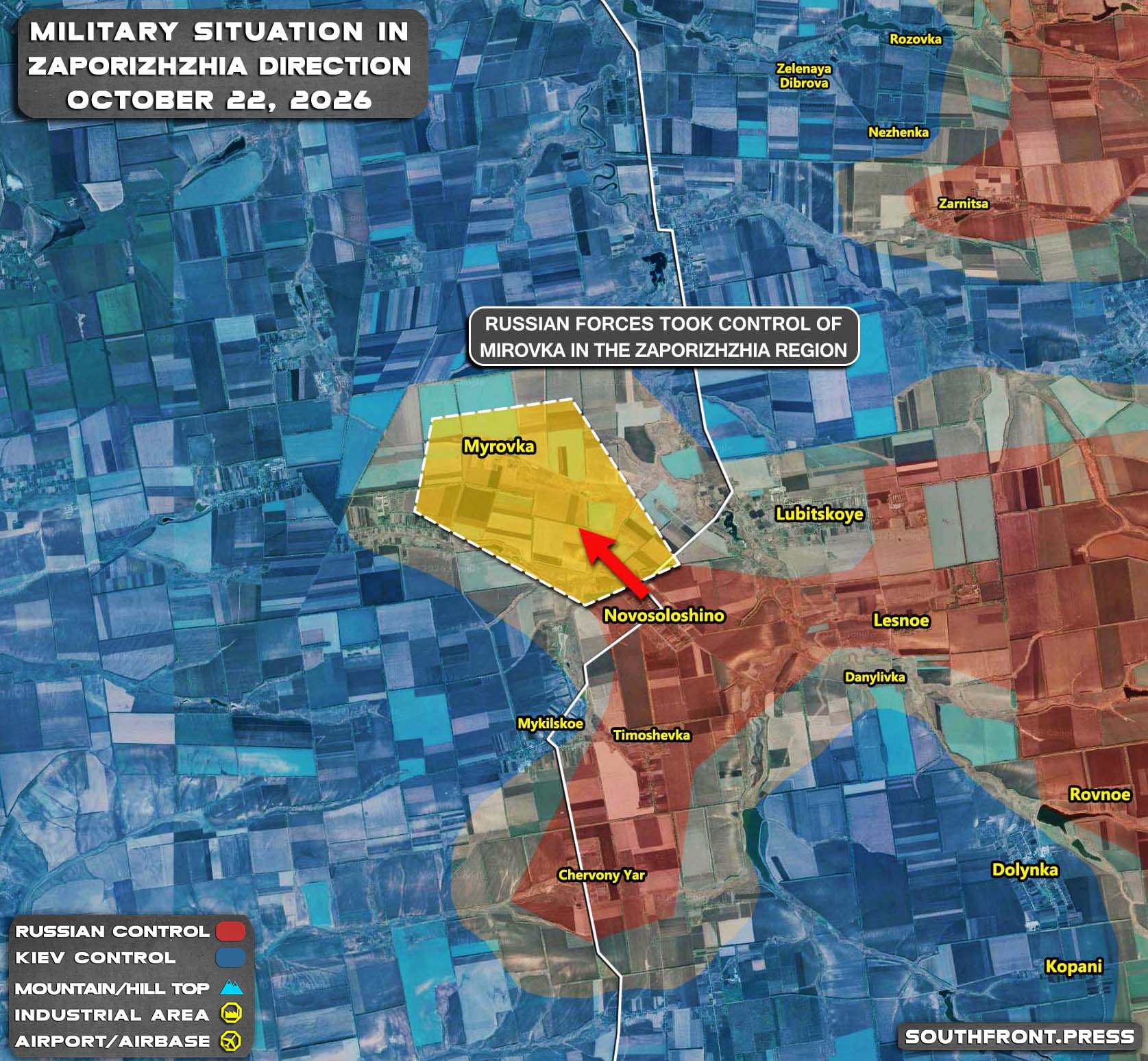
      • Russian forces took control of Mirovka in the Zaporizhzhia region.

      Click to see the full-size image

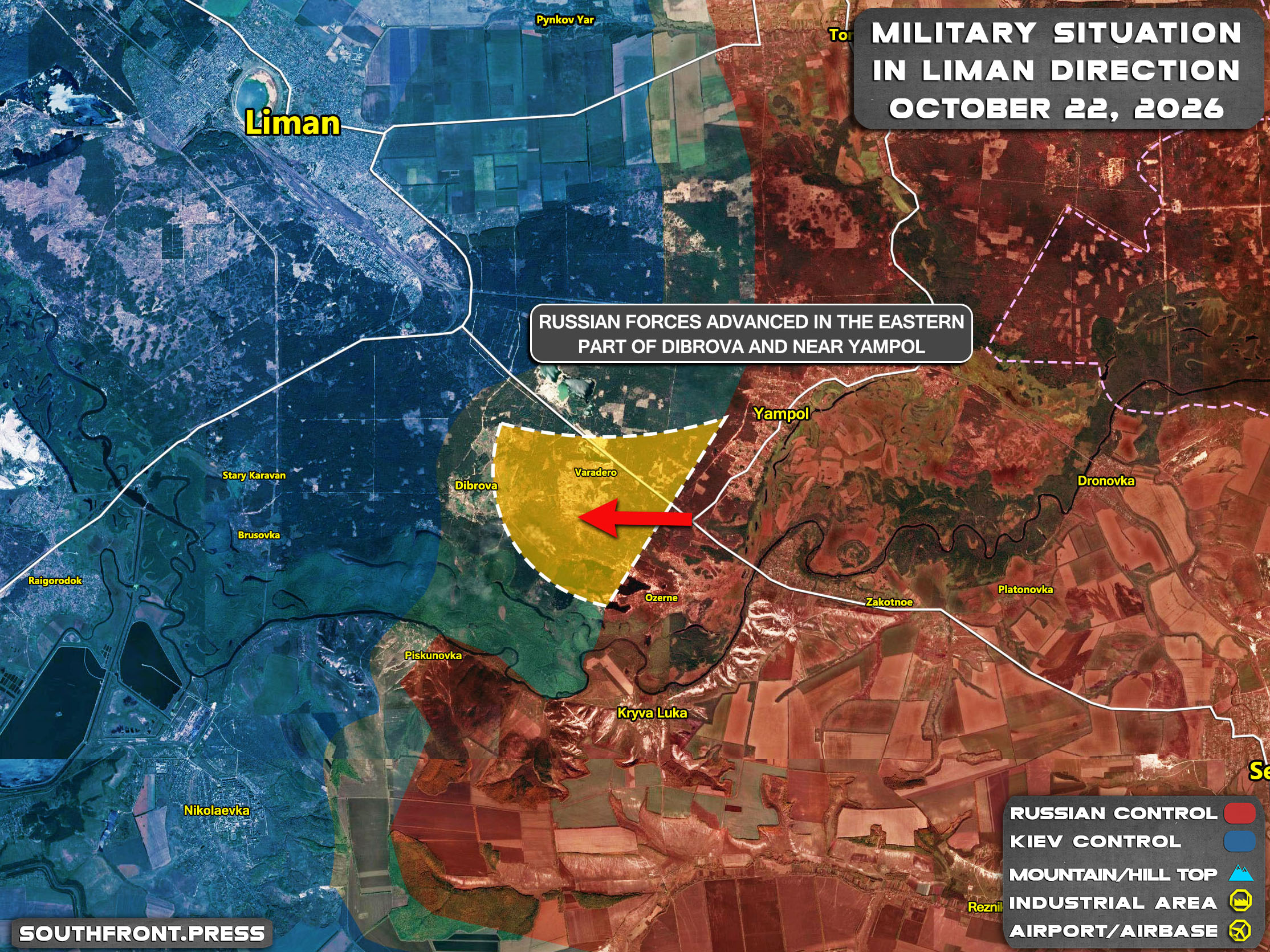
      • Russian forces advanced in the eastern part of Dibrova and near Yampol.

      Click to see the full-size image

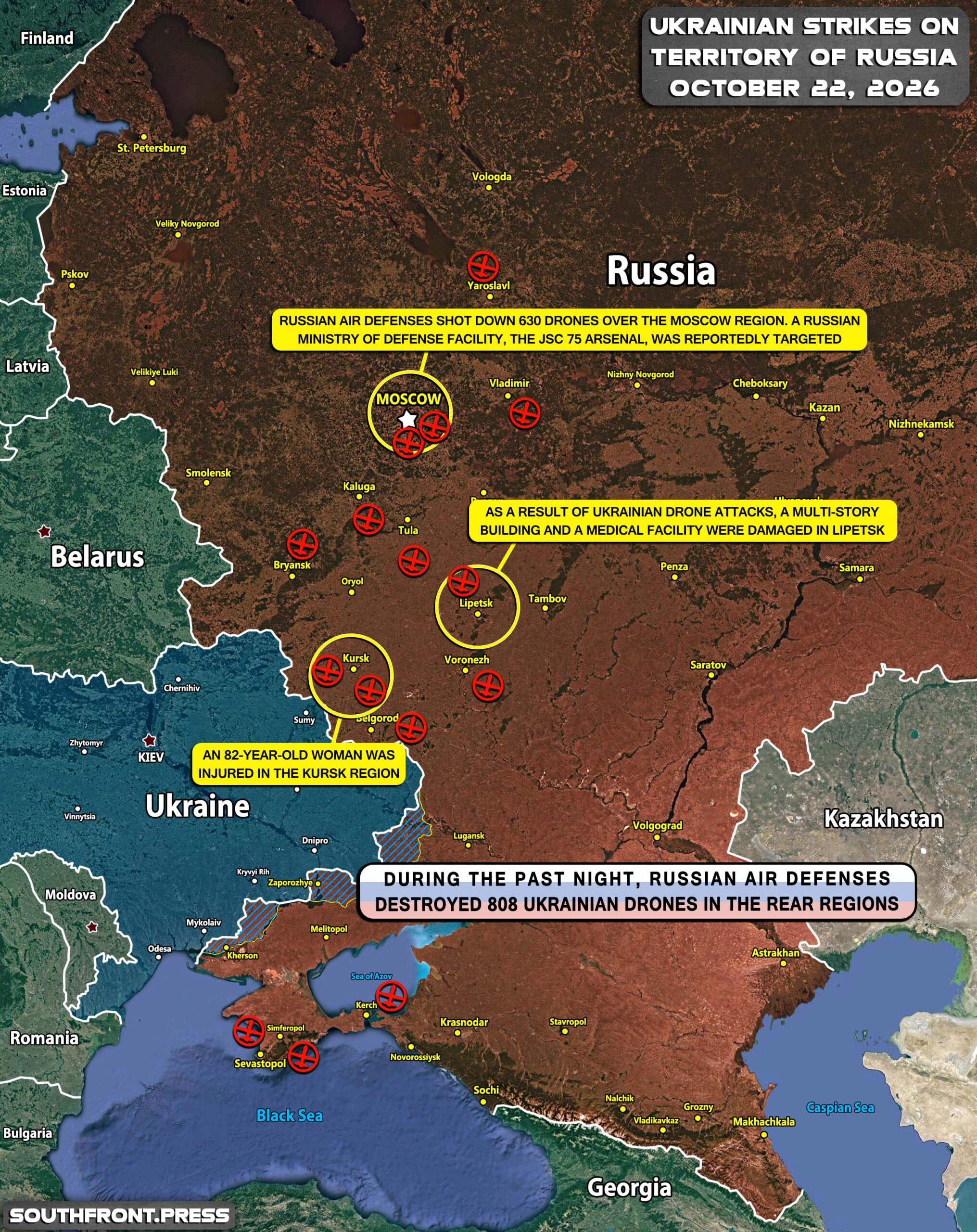
      • During the past night, Russian air defenses destroyed 808 Ukrainian drones in the rear regions;
      • Russian air defenses intercepted UAVs in the Belgorod, Bryansk, Vladimir, Voronezh, Kaluga, Kursk, Lipetsk, Leningrad, Oryol, Rostov, Ryazan, Smolensk, Tambov, Tver, Tula, and Yaroslavl regions, the Moscow region, the Republic of Crimea, and over the Black Sea;
      • Russian air defenses shot down 630 drones over the Moscow region. A Russian Ministry of Defense facility, the JSC 75 Arsenal, was reportedly targeted;
      • As a result of Ukrainian drone attacks, a multi-story building and a medical facility were damaged in Lipetsk
        An 82-year-old woman was injured in the Kursk region.

      MORE ON THE TOPIC:

      The post Military Situation In Ukraine And Ukrainian Attacks On Russian Territory On October 22, 2026 (Maps Update) appeared first on South Front.

      •  
      ❌