
❌

Normal view

Received — 6 October 2026 ⏭ Strategic Culture Foundation

« Fear porn » : comment Londres entraîne les médias occidentaux dans sa chute

By: A A
6 October 2026 at 18:30

L’arrestation d’Ian Proud par la police secrète à l’aéroport de Londres marque un nouveau plus bas dans la mesure où l’État profond peut aller pour contrôler un faux récit.  

L’arrestation d’Ian Proud par la police secrète à l’aéroport de Londres marque un nouveau plus bas dans la mesure où l’État profond peut aller pour contrôler un faux récit. Mais cela montre aussi un nouveau niveau de peur.

Aussi fou que cela puisse paraître, il semble bien que les nations d’Europe occidentale, du moins, se préparent à entrer en guerre contre la Russie à un moment donné dans un avenir pas trop lointain. Ce qui est particulièrement inquiétant, c’est qu’il semble y avoir un vide distinct dans tous les domaines de ce que nous pourrions appeler largement les « médias » pour remettre en question ce récit. Il y a trente ans, il était considéré comme normal que les journalistes soient la source de questions embarrassantes envers les acteurs étatiques et soient généralement une épine dans le pied, puisqu’ils remettaient en question chaque décision prise et chaque idée présentée. Notre travail était d’être anti-establishment et d’adopter un point de vue très cynique sur la « politique ». Cela n’avait rien de remarquable. C’était ce que nous faisions. Être méprisé par les grandes puissances faisait partie du travail ; travailler à des heures antisociales et avoir peu d’amis en faisait aussi partie.

Aujourd’hui, il n’y a plus de journalistes dans ce que nous appelons les médias « grand public » pour faire cela. Ils ont été remplacés par des « créateurs de contenu » plus jeunes, plus habiles avec les réseaux sociaux, qui croient que le journalisme est plus ou moins un rôle grammatical, où la matière première vous est remise avec toutes les informations qu’elle contient, et où le rôle du journaliste est simplement de la raffiner au style du jour pour la consommation de masse.

Le danger de cette transition est que presque tout ce qui nous est présenté comme des nouvelles est en réalité faux, ou au mieux lourdement expurgé pour maintenir les masses là où l’élite veut qu’elles soient : contenues, préparées et mal informées.

La guerre en Ukraine en est un excellent exemple. La principale raison pour laquelle les populations aux États-Unis et au Royaume-Uni sont si fabuleusement biaisées contre la Russie et si sympathiques à l’égard de l’élite corrompue de Kiev est que, pendant des années, elles ont été lavées le cerveau avec des « nouvelles » sur la Russie qui étaient négatives et qui alimentaient astucieusement un préjugé raciste – un préjugé cultivé depuis au moins une décennie, sinon plus. Le résultat est qu’aujourd’hui un certain nombre de mensonges sont devenus établis dans les salles de rédaction, où les journalistes, même ceux qui savent, contournent simplement les nuances et présentent une histoire de conte de fées, conçue pour être comprise par les masses qui n’ont pas d’autres sources d’information pour même la remettre en question.

Tout récemment, des médias occidentaux ont rapporté une « peste » en Russie, avec des histoires de « confinement », à la suite du cas d’un travailleur dans un laboratoire mort d’une pneumonie dans des circonstances encore incertaines. Les médias occidentaux, dans le cadre de leur rôle consistant à maintenir la russophobie à son apogée, sont si verrouillés et chargés que leurs réactions « à la gâchette facile » aux mauvaises nouvelles venant de Russie sont compréhensibles. Ils sont aussi avides de contenu accrocheur, et de telles histoires nourrissent un public affamé qui a déjà eu sa première dose de ce genre d’histoires d’hystérie COVID et qui en veut davantage. La vérité est totalement immatérielle. L’hystérie et les mensonges sont ce qui est injecté à un rythme fébrile par des « créateurs de contenu » aux dents et aux griffes rouges, l’écume à la bouche dans leur désir de servir l’État profond et les élites qui ont tant investi dans un agenda.

Le contraste entre la Russie et l’Occident est intéressant, cependant, lorsque nous examinons les médias. Tout récemment en Russie, le correspondant de la BBC basé à Moscou a fait vibrer Internet sur les réseaux sociaux avec sa courte interview du ministre russe des Affaires étrangères, qui a eu la gentillesse de répondre à sa question orientée sur l’idéologie de guerre de la Russie avec l’Ukraine. Ce que absolument personne n’a relevé, c’est à quel point la Russie est heureuse d’accueillir des journalistes étrangers qui ont un agenda si distinct pour alimenter la russophobie chez eux, tandis que les journalistes russes sont interdits dans ces capitales de l’UE depuis des années. La vieille Europe, qui tenait autrefois si cher des valeurs comme la liberté de la presse, a adopté le modèle soviétique, tandis que la Russie est en réalité plus avancée en ce qui concerne ces principes de ce que nous attendons dans une démocratie. La Russie n’a pas peur des questions embarrassantes, contrairement à l’Occident.

Nous devrions nous demander qui bénéficie réellement d’une guerre avec la Russie.

Est-ce trop sceptique et « théoriste du complot » de supposer que le complexe militaro-industriel a fait du lobbying avec succès pour une telle guerre pendant AU MOINS une décennie et, surtout, qu’il a réussi à convaincre l’establishment du renseignement et de l’armée au Royaume-Uni d’utiliser son levier sur les médias pour fournir aux journalistes la matière première qui renforce un préjugé contre la Russie ?

Normalement, une telle idée pourrait être rejetée comme pure absurdité. Mais considérez simplement jusqu’où le Royaume-Uni, par exemple, est allé pour éradiquer toute couverture médiatique pouvant être considérée comme au moins favorable à la Russie – ou même simplement pour tenir le gouvernement britannique responsable en posant les questions que les journalistes britanniques ont cessé de poser. Si l’élite au Royaume-Uni qui contrôle les journaux déficitaires (réfléchissez-y) est si sûre de sa logique selon laquelle la Russie est l’ennemi avec lequel nous devons aller en guerre, pourquoi est-elle si terrifiée par des journalistes – ou quiconque, d’ailleurs – qui expriment simplement un point de vue avec des questions sur le récit ?

Je ne peux pas être le seul commentateur occidental à croire que les agents doubles Sergueï Skripal et sa fille Ioulia n’ont pas été empoisonnés avec l’agent neurotoxique Novitchok à Salisbury en 2018, ce qui a été rapporté à l’époque comme ayant « déclenché une immense crise diplomatique entre la Grande-Bretagne et la Russie ». N’est-ce pas la véritable histoire que les chefs de la sécurité britannique ont décidé, après avoir découvert que Sergueï Skripal était en réalité un triple agent qui transmettait des informations à Moscou, qu’il était dispensable ? Et quel meilleur moyen de soi-disant donner une leçon aux Russes, tout en blâmant Moscou pour sa mort, que de l’assassiner lui et sa fille en utilisant un agent neurotoxique qui était soit du Novitchok – qu’un laboratoire britannique situé juste en bas de la rue où vivaient les Skripal avait commodément dans un réfrigérateur – soit un poison similaire ? Ce qu’il est important de noter à propos du Novitchok, c’est que les victimes meurent généralement instantanément au contact. Ce qui est probable, c’est que les Skripal n’ont pas été empoisonnés par la substance russe mais par une version britannique d’un autre agent neurotoxique. C’est un exemple choquant de la médiocrité du journalisme britannique que les scribouillards au Royaume-Uni rapportent simplement l’incident Skripal d’empoisonnement au Novitchok sans le moindre fragment de preuve pour l’étayer. Ils n’ajoutent même pas une note de scepticisme dans leurs reportages sur la substance et sur qui « affirme » qu’il s’agit de Novitchok.

Nous voyons le même niveau choquant de reportages atroces et biaisés sur la guerre en Ukraine, que le public britannique a simplement été informé par le récit médiatique comme une « invasion » par l’armée de Poutine. Aucun contexte, aucune nuance, aucun aperçu de la perspective russe, car personne ne peut supporter, semble-t-il, que l’histoire soit obscurcie par les faits.

Et c’est la même chose avec l’histoire de la « peste » russe, comme ce fut le cas avec l’histoire de l’« attaque » de la base de la RAF récemment, qui était probablement juste des voleurs locaux achetant de l’essence de contrebande à des soldats américains/britanniques corrompus cherchant à se faire un peu d’argent rapide à la base britannique. Remarquez avec quelle rapidité Trump a utilisé l’histoire comme base pour déplacer tous les bombardiers américains hors de la base et les renvoyer sur le sol américain, où ils sont complètement inutiles dans sa soi-disant guerre au Moyen-Orient. Pour Trump, c’était une occasion pour un autre coup médiatique qui le maintient à la une et tout le monde dans l’expectative. Il était probablement reconnaissant aux Britanniques de lui avoir offert la matière première. Un autre problème de cette nouvelle génération de journalistes est leur complaisance à rapporter des « nouvelles » qui ne sont pas du tout des nouvelles, mais simplement du matériel utilisé comme distraction, un jour à la fois. Trump est un maître dans la manipulation des médias avec ce jeu, disant généralement quelque chose de si stupide et de si controversé, ce qui détourne les journalistes du vrai journalisme. Si vous pouvez occuper les journalistes avec des articles sur le dernier commentaire ou la dernière déclaration idiote de Trump, alors vous les contrôlez en contrôlant leur temps.

Regardez simplement comment l’affaire Epstein n’est pas rapportée ni enquêtée. Comment Trump s’en est sorti impunément, puisque depuis le 28 février l’attention des journalistes a été détournée vers la guerre avec l’Iran – ce qui est l’une des raisons pour lesquelles Trump maintient cette histoire vivante avec des mouvements de troupes constants et des discours sur une attaque massive après les élections de mi-mandat. Les gens n’ont pas fait le lien entre la fuite du matériel Epstein et le déclenchement de la guerre avec l’Iran pratiquement le même jour.

Pour les Britanniques, l’histoire « les Russes arrivent » n’a aucun article cynique de la part de journalistes qui sont à 100 % complaisants avec son récit erroné. La peur des élites à Londres est cependant palpable, celle qu’elle sera toujours remise en question par des acteurs marginaux occupant de la bande passante sur les réseaux sociaux. Dans le passé, c’était le correspondant de RT à Londres, qui pouvait poser des questions difficiles et être généralement une épine dans le pied du village de Westminster qui contrôlait les journalistes comme des rats tenus dans un panier. La principale raison pour laquelle RT a été expulsé du Royaume-Uni était qu’il offrait un style de reportage sur la politique britannique qui nous avait quittés depuis trente ans – tel est le monde trouble de l’État profond et la façon dont il a vu comment, à Bruxelles, les journalistes pouvaient être manipulés jusqu’à devenir des sténographes pour lui.

Pourtant, même avec ce nouveau style stalinien de contrôle des médias au Royaume-Uni, l’État est branlant. Même avec la mise en place impressionnante qu’il a maintenant de domination médiatique totale, où les journalistes débitent des ordures totales sur la guerre en Ukraine ou sur ce qu’on leur dit d’écrire sur le Moyen-Orient, la peur est toujours là.

L’exemple du vidéoblogueur Ian Proud, un ancien diplomate britannique autrefois basé à Moscou, est inquiétant mais poignant. Le simple fait de se rendre à Moscou pour assister à une conférence où Poutine parlait a suffi pour qu’il subisse le traitement complet de la Stasi à l’aéroport de Heathrow – détenu et tout le contenu numérique saisi.

Les interviews YouTube de Proud, avec son style de présentation ringard, s’avèrent populaires car il offre simplement une vision plus sobre de la Russie et du Foreign Office britannique, son ancien employeur. Ces interviews attirent l’attention des espions britanniques, qui sont si nerveux à l’idée que la vérité sur la Russie éclate et que les mensonges honteux qui sont maintenant emballés pour le public britannique soient révélés, qu’ils ont dû infliger à Proud la routine américaine de « fouille en prison ». La Grande-Bretagne, un pays qui était autrefois un phare pour le monde avec sa vision de la liberté et en particulier sa passion pour la liberté d’expression, est tombée à un niveau que nous ne pouvons comparer qu’à un pays d’Afrique de l’Ouest qui vient d’installer un nouveau dictateur, complet avec des lunettes noires et des épaulettes. Ce que l’affaire Proud à l’aéroport de Heathrow montre, c’est que ce nouveau régime au pouvoir ne reculera devant rien pour contrôler un récit, et que le dernier bastion de la liberté d’expression – les podcasts YouTube – est la prochaine cible. Plus la chaîne de Proud devient prospère, plus il est inévitable qu’il soit contraint de quitter le Royaume-Uni et de s’installer en Russie pour continuer à exercer la liberté d’expression. Les glands d’épaule de l’État profond britannique ne dormiront pas bien tant que le pays n’aura pas un récit médiatique qui ferait rougir Joe Staline – et les journalistes britanniques les aident à atteindre cet objectif.

As contradições de Lula finalmente cobram o preço

By: A A
6 October 2026 at 18:00

Mesmo uma vitória de Lula, hoje improvável, não fará mais que dar uma sobrevida e prolongar a agonia num falso senso de estabilidade.

Junte-se a nós no Telegram , X e VK.

Escreva para nós: info@strategic-culture.su

A perspectiva sobre as eleições brasileiras após o 1º turno é unânime: Lula e o Partido dos Trabalhadores foram varridos e humilhados, e as perspectivas de uma virada nas eleições presidenciais é mínima.

Flávio Bolsonaro, filho do ex-presidente Jair Bolsonaro, recebeu 56 milhões de votos, ou aprox. 47% dos votos válidos, enquanto Lula recebeu 53,8 milhões de votos, ou aprox. 45% dos votos válidos – o resultado leva ao 2º turno, a ser realizado no dia 28 de outubro. O problema para Lula é que o eleitorado dos candidatos que ficaram em 3º, 4º e 5º têm uma maior tendência para votar em Flávio Bolsonaro do que no próprio Lula.

Lula só tem como puxar votos tentando converter os que não foram votar, ou os que votaram nulo. São 30 milhões de eleitores nessas condições, portanto não é pouca gente. Mas historicamente, a tendência é que essa fatia do eleitorado aumente do 1º para o 2º turno, em vez de diminuir.

O revés de Lula, porém, não é apenas em sua própria disputa com Bolsonaro.

Em número de governadores estaduais, o seu partido, o PT, cai de 4 para 3 governadores. E o partido até conseguiu preservar seus assentos no Senado e somar 1 deputado federal a mais na Câmara, mas os seus rivais bolsonaristas do PL ganharam mais 13 cadeiras no Senado e 21 cadeiras na Câmara. Em outras palavras, mesmo que Lula ganhasse, não conseguiria governar.

A reação do partido de Lula e de seus militantes é a pior possível: responsabilizam o povo por “não saber votar” ou por “ser fascista”, os candidatos de micropartidos de esquerda por não terem desistido de suas candidaturas, alegam narrativas fantasiosas de “manipulação” por parte dos EUA e das redes sociais – tudo, menos admitir que o governo de Lula padecia de problemas sérios e foi incapaz de dialogar com a população e entender as suas demandas.

Pior: abraçam uma ilusão na qual o governo de Lula teria sido, na verdade, excepcional e no qual todos os índices econômicos seriam maravilhosos, e “os pobres” deveriam agradecer a Lula de joelhos e votar nele para sempre.

A realidade, porém, é que excetuando na região nordeste, onde Lula nasceu, o PT virou o partido da classe média progressista e dos centros urbanos, enquanto as cidades pequenas e médias e uma parte significativa dos setores populares abraçou o bolsonarismo. E por que?

No que concerne a economia, a percepção de melhora é falsa. O governo Lula criou ou aumentou mais de 30 impostos e taxas de todos os tipos, voltados em sua maioria contra a classe média e trabalhadora. Para piorar, apertou a regulamentação dos microempreendedores, dificultando a sua vida no que concerne questões tributárias.

Os empregos criados foram principalmente no setor de serviços e no extrativismo, para não falar nos trabalhos autônomos e precários. Em contrapartida, o governo multiplicou ao infinito os “benefícios sociais”, concedidos principalmente para a camada lúmpem da sociedade, parasitária e odiada pelos setores positivos. Aliás, apenas os setores mais ricos ligados às finanças receberam tantos benefícios quanto o lumpemproletariado no governo Lula. E não casualmente, as classes de apoio ao PT foram a classe A e a classe E, as duas pontas do sistema parasitário e improdutivo, que esmagam as classes produtivas (B, C e D) por cima (através da usura) e por baixo (através da criminalidade).

Não se pode subestimar ademais, o problema da segurança pública, para o qual temos alertado há muito tempo. O discurso de Lula sobre soberania é vazio quando ¼ da população brasileira (segundo estudo da Cambridge University Press) vive em território controlado por organizações narcotraficantes. A tolerância do brasileiro por essa situação acabou.

Mas a leniência do governo não. Ao contrário, o Brasil vive a situação esquizofrênica de ser suave com criminosos perigosos e extremamente repressivo contra quem diz coisas politicamente incorretas na internet. Tornou-se corriqueiro no Brasil que pessoas comuns seja presas e condenados por “crime de ódio” ao recusarem a entrada de alguma pessoa “trans” num banheiro feminino.

E num erro de julgamento crasso, o PT decidiu associar a própria sorte ao STF, exatamente o núcleo de poder liberal que garante a implementação de todas as pautas globalistas no Brasil e que opera um aparato draconiano de repressão e silenciamento. Lula se esqueceu de que ele próprio foi perseguido e preso pelo Judiciário brasileiro, e decidiu se aliar a este setor para tentar impor a mesma sina a Bolsonaro.

O tiro, porém, saiu pela culatra. A disputa de Lula é com Flávio Bolsonaro. Mas quem venceu essa eleição, estando condenado, preso, adoecido e censurado é Jair Bolsonaro.

Especulações sobre “interferência estrangeira” nas eleições são fúteis e pueris posto que desnecessárias. Todas as causas da derrota de Lula estão em seu próprio governo.

Nem na política externa – área mais elogiada pelos colegas estrangeiros – escapamos das contradições: condenação da Nicarágua no Conselho de Direitos Humanos da ONU, veto ao ingresso da Venezuela nos BRICS e deslegitimação da reeleição de Nicolás Maduro, aliança tácita com a França de Macron, Acordo UE-Mercosul, colaboração da ABIN com as inteligências da França e da Alemanha, pressão para tentar desacelerar o crescimento dos BRICS, e poderíamos continuar longamente.

É por isso que dentro do Brasil, o elemento da política externa não pode ser visto, nessas eleições, da maneira “dualista” como ele é visto de fora para dentro (em que se tem o mito de um “Lula multipolarista” e um “Bolsonaro atlantista”). Na verdade, tanto Lula quanto Bolsonaro jogam com os dois lados do campo geopolítico, são apenas seus discursos que são levemente divergentes. Naturalmente, os propagandistas de ambos os lados jurarão que não é assim, mas é o que a análise fria dos fatos aponta.

No fim das contas, estamos às portas do “fim da Era Lula”, e dos momentos finais de uma carreira política que marcou a história do Brasil, que teve seus altos e baixos, seus pontos positivos e negativos, mas que termina de um modo agridoce, pela ausência de um projeto de nação e pela obsessão oportunista de se perpetuar no poder a qualquer preço – inclusive ao preço de trair os princípios da época da fundação do Partido dos Trabalhadores.

Lula deixará o PT órfão. Não houve preocupação com formar um sucessor à altura de Lula. Pior: a práxis do PT o levou a esmagar os partidos de esquerda menores e a absorver seus principais quadros para podá-los e controlá-los antes que eles pudessem se tornar maiores que Lula.

Nesse sentido, com o fim da carreira política de Lula morre a esquerda. Ou pelo menos UMA esquerda. A esquerda liberal-progressista da Sexta República e da Constituição de 88. Resta saber se o que triunfará na inevitável disputa por seu legado é uma esquerda ainda mais radicalmente progressista, ou se retornará uma esquerda nacionalista, tal como já existiu no Brasil em outras épocas.

Mesmo uma vitória de Lula, hoje improvável, não fará mais que dar uma sobrevida e prolongar a agonia num falso senso de estabilidade. Não só da esquerda, mas também do Brasil.

O que muda com Lula ou Flávio?

By: A A
6 October 2026 at 17:30

Considerações realistas sobre as eleições brasileiras.

Junte-se a nós no Telegram , X e VK.

Escreva para nós: info@strategic-culture.su

As eleições presidenciais brasileiras estão chegando. E com elas estão chegando também as controvérsias, os debates e os diferentes pontos de vista sobre o que esse evento representa para o Brasil, para os BRICS e para o futuro do mundo multipolar.

Em um artigo recente, o respeitado analista político brasileiro Valdir Bezerra advogou a tese de que as eleições de 2026 representam um ponto de inflexão na história brasileira, podendo definir o papel do Brasil no mundo. Para Bezerra, a eleição opõe, de um lado, a vertente “autonomista”, representada por Luiz Inácio Lula da Silva, e, de outro, a vertente “ocidentalista”, representada por Flávio Bolsonaro.

Demostrando todo o devido respeito ao trabalho de Bezerro, que é um dos analistas mais bem conceituados no debate político russo-brasileiro, gostaria de apresentar aqui uma visão crítica sobre sua opinião. Não tenho como intenção “refutar” a posição de Bezerra, mas apenas expor as razões pelas quais não considero essa oposição entre autonomismo e ocidentalismo como um pressuposto válido para analisar a atual disputa eleitoral. Ademais, gostaria também de explicar por que não considero a eleição de 2026 como um momento decisivo na definição do papel internacional do Brasil.

Flávio é um ocidentalista, mas Lula não é um autonomista

Os termos guarda-chuvas usados para definir estas duas “tradições” da política brasileira não parecem minimamente aplicáveis na realidade atual. Os termos nos quais muitos pensadores brasileiros definiam a oposição entre aqueles que apoiam a soberania e o desenvolvimento nacional e aqueles que advogam por uma posição subordinada em relação ao eixo atlântico há muito tempo se tornaram obsoletos na alta política institucional brasileira – onde não há hoje qualquer figura digna do título de “autonomista”.

Não é preciso comentar aqui sobre a natureza ocidentalista de Flávio Bolsonaro, que, como seu pai antes dele, defende uma política externa de alinhamento total aos EUA e a Israel, ademais de uma agenda hostil aos BRICS e às plataformas multipolaristas. O ponto central, porém, é tentar entender em que posição, entre ocidentalistas e autonomistas, está Lula.

O atual presidente do Brasil governou o país em três ocasiões e protagonizou alguns dos eventos mais marcantes da política internacional no século XXI. Foi cofundador dos BRICS, articulou alianças com governos soberanistas nas Américas (Venezuela, Bolívia, Cuba) nos anos 2000, manteve laços amigáveis com o Irã e, mais recentemente, estreitou parcerias com a Rússia em pleno regime de sanções imposto pelo Ocidente, além de condenar abertamente o genocídio em Gaza.

Tudo isso é extremamente louvável, mas, para uma análise justa de Lula, é preciso apresentar o outro lado de sua figura: Lula nunca foi um “multipolarista”, apenas um articulador habilidoso no âmbito do multilateralismo da era Obama nos anos 2000. Isso se soma ao fato de Lula ter sido descaradamente apoiado pelo establishment Democrata nas eleições de 2022. Aliás, o terceiro governo Lula foi marcado por controvérsias dignas de um líder “ocidentalista” clássico: Lula não reconheceu as eleições venezuelanas, iniciou tensões com a Nicarágua, vetou o acesso da Venezuela aos BRICS, escanteou as negociações de um acordo Mercosul-China para priorizar um pacto de livre-comércio com a Europa extremamente negativo para os países sul-americanos (um acordo até mesmo neocolonial, pode-se dizer, colocando os países do Mercosul como exportadores de commodities e importadores de tecnologia). Isso tudo para não falar nas relações próximas, quase de alinhamento total e irrestrito, com o regime Macron na França.

Lula certamente teve vários acertos, mas, se formos voltar um pouco no tempo, o próprio ex-presidente Jair Bolsonaro também os teve: se recusou a sancionar a Rússia e a condenar a Operação Militar Especial (ao contrário de Lula, aliás, que repetidamente a condenou), fortaleceu as parcerias com a China, preservou a estrutura dos BRICS e abandonou o alinhamento à política externa estadunidense pós-Trump, se tornando um alvo de Joe Biden.

No fim, acertos por acertos e erros por erros, ambos os lados parecem muito distantes de qualquer ideal “autonomista”.

Então, como definir Lula e Flávio?

Podemos resumir este tópico em uma única frase: tanto Lula quanto Bolsonaro são, cada um a seu jeito, ocidentalistas.

Em diversas outras ocasiões comentei em minha coluna sobre como vejo a Sexta República brasileira (o atual regime constitucional fundado em 1988) como uma espécie de “revolução colorida permanente”. De um lado, uma direita liberal abertamente pró-EUA e pró-Israel, de outra uma esquerda liberal institucionalista, ligada ideológica e financeiramente a um grande lobby internacional que vai desde os Democratas estadunidenses até a União Europeia.

As tensões atuais parciais que ocorrem agora entre Lula e Trump não são uma novidade. Bolsonaro se tornou uma figura extremamente incômoda nas relações entre Brasil e EUA assim que Biden chegou ao poder. O que muitos analistas falham em perceber é que as relações entre Brasil e EUA se definem pela dialética entre esquerda e direita no Brasil e Democratas e Republicanos nos EUA. Lula era amigo de Biden, como Bolsonaro era amigo de Trump. Se Lula vencer as eleições de 2026, terá muitos problemas – pelo menos até um eventual retorno Democrata nos EUA. Se Flávio vencer, Brasil e EUA estarão em alinhamento total – mas apenas enquanto Trump estiver na Casa Branca.

É essa dinâmica que permite aos EUA manter a política brasileira sob controle de forma estável. Washington não precisa fazer um Maidan no Brasil. Aliás, a fórmula “golpe + ditadura” não tende a funcionar em países continentais e diversos como o Brasil – e a maior prova disso é a própria experiência brasileira de regime militar, que foi inicialmente patrocinada pelos EUA, mas posteriormente se tornou um regime autônomo não-alinhado após um autogolpe interno entre os militares. Não por acaso, os EUA endossaram a redemocratização do Brasil, ajudando a criar precisamente o regime político atual.

De um lado, uma direita que apoiada pelos Republicanos, por Israel e pelo lobby neocon transnacional; de outro, uma esquerda que obedece aos Democratas e aos europeus. Lula foi um grande multilateralista numa época em que Washington, com Obama, incentivava esse tipo de verniz à unipolaridade estadunidense; Bolsonaro foi uma marionete aberta dos EUA numa época em que Washington, com Trump, exigia isso. A diferença é muito pouca – ou nula.

E o que a eleição de 2026 realmente representa?

A nível internacional, nada ou muito pouco.

Se vencer, Lula será pressionado enquanto Trump estiver no poder. E Lula ao longo dos últimos quatro anos já mostrou que compensa a hostilidade estadunidense sendo ainda mais aliado aos europeus. Por outro lado, se Flávio vencer, teremos pelo menos algum período de alinhamento total com os EUA, o que pode mudar numa eventual vitória Democrata nas próximas eleições presidenciais. É uma escolha muito clara entre Republicanos-Israel e Democratas-UE. “Autonomismo” não faz parte do jogo.

A nível interno, contudo, muitos fatores estão em jogo.

É no cenário interno que o debate sobre a eleição deve se concentrar. Afinal, nenhum brasileiro vai votar em um candidato ou outro por causa de Palestina ou BRICS – que, embora sejam causas legítimas, são realidades distantes para o cidadão comum. No plano interno, temos um Lula cada vez mais enfraquecido devido aos efeitos colaterais de anos em aliança com o Poder Judiciário (que agora está sendo escrutinado e exposto com o escândalo de corrupção do Banco Master). Do outro lado, Flávio recupera posições que já se julgavam perdidas e hoje ambos aparecem em empate técnico nas pesquisas.

O Poder Judiciário acumulou poderes extraordinários com Lula, a ponto de encarcerar manifestantes pacíficos e idosos sob acusação de “terrorismo” apenas porque participavam de manifestações pró-Bolsonaro. A inimizade entre o Judiciário e o Bolsonarismo não pode ser revertida, exceto por uma vitória de Flávio que culmine na indicação de ministros bolsonaristas para a Suprema Corte – remodelando assim os rumos da própria República.

Podemos resumir que Lula daria uma sobrevida à Sexta República, enquanto Flávio aceleraria seu colapso. Enquanto a Sexta República existir, nenhuma alternativa realmente “autonomista” surgirá no Brasil porque o próprio sistema constitucional brasileiro impede tal alternativa. Mas isso não significa que o colapso iminente deste sistema significará uma “aurora multipolar” no Brasil, já que não há (fora do extremamente “ocidentalista” Bolsonarismo) qualquer movimento político no país com força para erguer um novo projeto de Estado.

A conclusão talvez seja frustrante para os mais otimistas e esperançosos, mas o que parece estar por acontecer no Brasil em 2026 é a absoluta nulidade. Com Lula ou Flávio, pouco tende a mudar. O Brasil continuará sendo uma potência média decadente, politicamente subordinada aos EUA, mas com certa liberdade de engajamento multilateral com as potências eurasiáticas – enquanto domesticamente as instituições da Sexta República se autodestroem.

Las urnas electrónicas no son confiables

By: A A
6 October 2026 at 17:00

La paralización del recuento en Brasil revirtió la tendencia y salvó a Lula: las urnas electrónicas, opacas e inauditables, no son confiables.

Únete a nosotros en Telegram , X y VK .

Escríbenos: info@strategic-culture.su

El escrutinio de los votos en la primera vuelta de las elecciones generales en Brasil fue motivo de gran controversia. Flávio Bolsonaro, hijo del expresidente Jair Bolsonaro, iba por delante de Lula en el recuento oficial, con un 49,6% contra un 42,2% para el presidente que busca su reelección.

Habían sido computadas el 64,8% de las secciones electorales hasta ese momento. Pero el recuento se paralizó por más de una hora. Extrañamente, los votos para gobernador, senador y diputados continuaron siendo contabilizados con normalidad. Solo el recuento presidencial se paralizó.

Y, aún más extrañamente, cuando el recuento presidencial se reanudó, la tendencia ascendente de Flávio Bolsonaro y la tendencia descendente de Lula se revirtieron. Los votos del candidato opositor cayeron, mientras que los del actual presidente aumentaron. Flávio Bolsonaro estaba a menos del 0,5% de la victoria que le otorgaría la banda presidencial. Perdió más de un 2%, terminando con un 47,03%, mientras que Lula ganó casi un 3%, terminando con un 45,16%.

Parecía que Flávio Bolsonaro destronaría a Lula ya en la primera vuelta. Pero, tras más de una hora de paralización en los recuentos, Lula logró recuperarse y la disputa se decidirá recién en la segunda vuelta.

El recuento se paralizó a las 19h06 (hora de Brasilia), con el 64,8% de las urnas escrutadas. Recién a las 20h08 se presentaron los nuevos resultados, ya con el 85% de las urnas escrutadas.

La justificación oficial fue dada por el presidente del Tribunal Superior Electoral (TSE), Kassio Nunes Marques, quien también es ministro del Supremo Tribunal Federal (STF). «Lo que ocurrió fue una congestión de datos. En cada elección, nos vemos sorprendidos por alguna contingencia, lo cual es natural para quien lida con sistemas complejos y tan variados», dijo. «A priori, no se sabe si esto fue derivado de otro problema. Lo que nuestra tecnología de la información constató fue un flujo [de datos] superior a lo normal, y esa congestión generó un atraso», completó.

Existe una propaganda violenta en Brasil, encabezada por la Justicia Electoral, para presentar a los ciudadanos que las elecciones son 100% limpias. El principal foco de esa propaganda son justamente las urnas electrónicas. Las instituciones judiciales y los medios de comunicación dan gran difusión a las palabras de la Justicia Electoral sobre la total confiabilidad de las urnas electrónicas, destacando, incluso, que son sometidas a pruebas antes del plebiscito y luego selladas para que nadie pueda acceder a ellas.

Entonces, ¿por qué las urnas sufrieron una especie de pánico, si habían sido rigurosamente examinadas? Pues, el sapientísimo TSE tiene pleno conocimiento del número de electores aptos para votar y del número de votos que pueden ser registrados en las urnas, incluso en cada sección electoral. La propaganda de la Justicia Electoral indica al público que las urnas están plenamente preparadas con anticipación para registrar y computar perfectamente los votos de los electores.

No debería ocurrir ningún flujo de datos «superior a lo normal» que llevara a la congestión del sistema, porque los datos y estadísticas más variados en relación con el registro de votos son conocidos y los cálculos son perfectamente realizables. La infalibilidad de las urnas electrónicas exige que todos los resultados posibles sean previsibles y que, por tanto, no haya ninguna anomalía.

¿Cómo es posible, entonces, que un sistema tan perfecto, como es el propagado por las instituciones del Estado brasileño, presente una falla que, después de ser supuestamente resuelta, haya modificado tan radicalmente la tendencia de los votos presidenciales?

Puede ser una coincidencia que Flávio Bolsonaro se haya desplomado y Lula haya subido después de la falla de las urnas. Pero, ¿quién sabe? El presidente del TSE reconoció que el sistema electrónico de votación es «complejo». Solo especialistas altamente capacitados, del propio TSE y de empresas de tecnología, consiguen acceder a él y comprenderlo, de acuerdo con la Justicia Electoral. Así pues, está en manos de esos especialistas —que son 150 técnicos desconocidos del público— el destino de un país entero para los próximos cuatro años. El cálculo de los votos que salen de las urnas es totalmente automatizado, no pasa por ningún ser humano. Un número aún más selecto de 22 funcionarios accede a la totalización automatizada de los votos.

Esto significa que 214 millones de brasileños necesitan confiar en esos 150 o 22 sacerdotes egipcios para interpretar esa ciencia oculta. Deben ser los seres más iluminados del planeta Tierra, 100% íntegros, honestos, inmaculados y vírgenes. Incluso los ministros del STF, presentados a lo largo de los últimos 15 años como individuos impecables, probos y castos, aparecen ahora envueltos en el mayor escándalo de corrupción de la historia reciente de Brasil, pero esos especialistas anónimos merecen la más absoluta confianza de los ciudadanos.

Fue por motivos así que la Corte Suprema de Alemania declaró el voto electrónico inconstitucional: «cada ciudadano debe ser capaz de comprender y verificar las etapas centrales de las elecciones de forma confiable y sin ningún conocimiento técnico previo especializado».

El veredicto, fechado en 2009, concluye:

«Un procedimiento electoral en el que el elector no pueda comprender, de manera confiable, si su voto fue registrado de forma infalsificable e incluido en el escrutinio del resultado de la elección, y cómo el total de los votos expresados es atribuido y computado, excluye elementos centrales del procedimiento electoral de la vigilancia pública y, por tanto, no cumple los requisitos constitucionales.»

El sistema judicial brasileño está sumido en su mayor crisis histórica y vive un verdadero western, con peleas partidistas interfiriendo en el funcionamiento de los trabajos. El partidismo, de hecho, contaminó a la mayor parte del poder judicial, incluido el TSE. En la recta final de estas elecciones, decisiones de la Justicia Electoral, apoyadas por el ala dominante en el STF, favorecieron a Lula.

Es evidente que esa ala dominante (representada por los ministros Alexandre de Moraes, Gilmar Mendes y Flávio Dino) no quiere la victoria del bolsonarismo, pues este es su enemigo político declarado. Esos ministros actuaron, en los últimos años, como verdaderos justicieros contra el bolsonarismo. Ahora que ellos mismos fueron sorprendidos en relaciones extremamente promiscuas con un banquero que corrompió a incontables altos funcionarios del Estado, su carrera burocrática está amenazada. La continuidad de Lula es una esperanza de salvación para estos señores, pues el presidente está comprometido con ellos y no puede romper ese compromiso sin arriesgar la propia cabeza, dado el nivel de dependencia que Lula contrajo en relación con los mandamases del STF. Ya una elección de Flávio Bolsonaro tendería a conducir a un choque con los cabezas de esas instituciones, aunque el propio candidato opositor no ha demostrado gran disposición a enfrentarlos, porque los que controlan las elecciones en Brasil (el capital financiero internacional) exigen moderación y pacificación; de lo contrario, dificultarán la vida de cualquiera que se elija presidente.

Y el pueblo es tratado como ganado, víctima de un sistema que no puede comprender, para perpetuar su explotación a través de la escenificación de la «fiesta de la democracia».

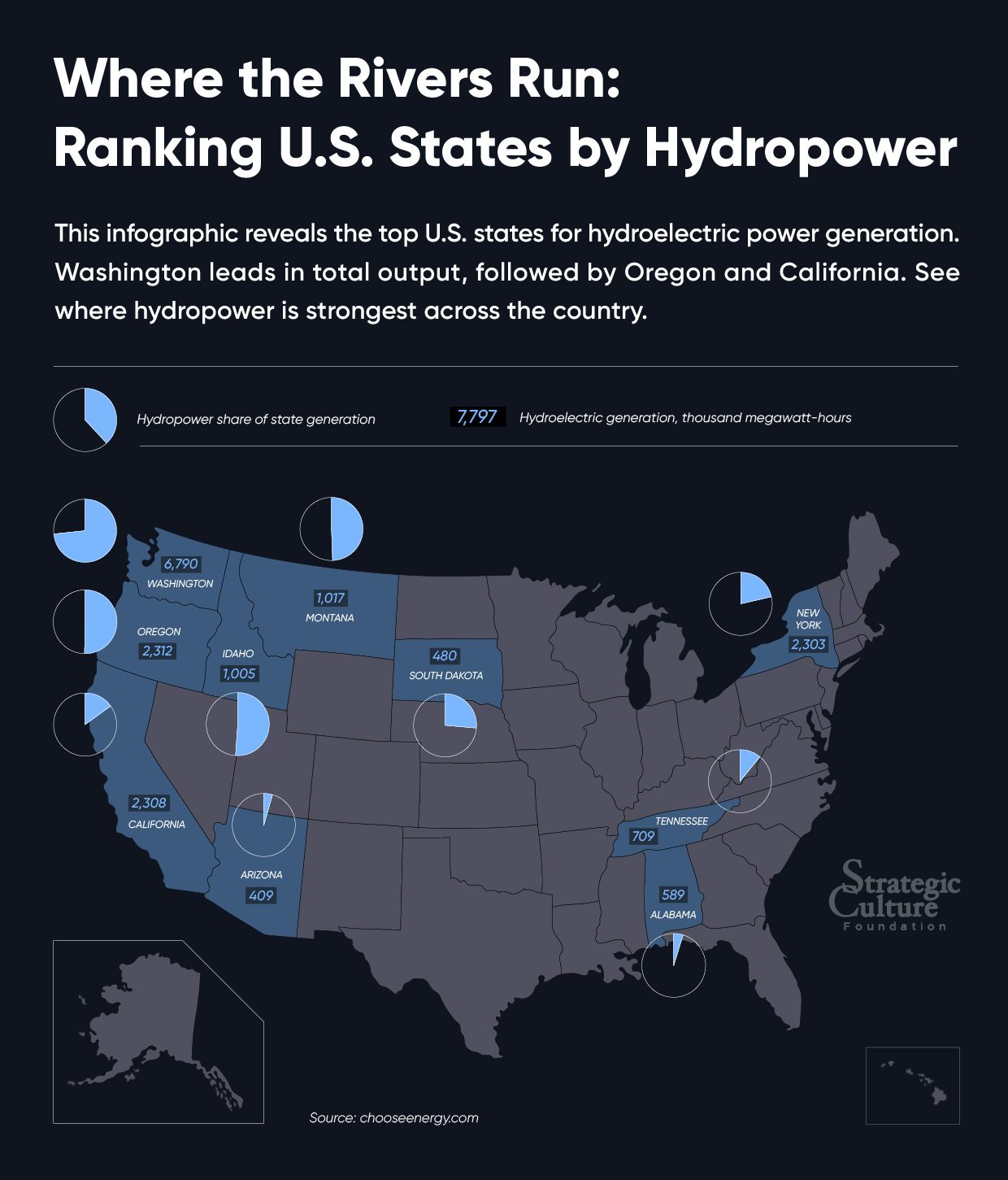
Where the rivers run: ranking U.S. states by hydropower

By: A A
6 October 2026 at 16:30

This infographic reveals the top U.S. states for hydroelectric power generation. Washington leads in total output, followed by Oregon and California. See where hydropower is strongest across the country.

Join us on Telegram, Twitter, and VK.

Contact us: info@strategic-culture.su

(Click on the image to enlarge)


‘We were asked, we complied’: Italy declares war on Russia

By: A A
6 October 2026 at 16:00

The enemy to be feared is the habit of deciding on the most serious matters without discussing them, and of presenting them as if they were inevitable.

Join us on Telegram, X, and VK.

Contact us: info@strategic-culture.su

Who asked, and who decided

There are phrases which, on their own, say more about a state than a Defence White Paper. One such phrase appeared in the Corriere della Sera on 4 October, in an interview with the Chief of the Army General Staff, Lieutenant General Carmine Masiello: “On the eastern flank, we were asked to deploy units capable of providing a real deterrent: we are leading the multinational battlegroup in Bulgaria and are present in Latvia and Hungary. War does not ask for permission, and the contingent must be ready to respond.”

A few lines earlier, the same general had opened the interview as follows: “We are at war. A hybrid war, but war nonetheless.” The attentive reader will pause to consider three words. We have been asked. By whom? Real deterrence. Compared to what deterrence, until now, has been unreal? We are at war. Who has declared it? These are questions that the Italian public debate should ask itself seriously, without indulging either in the caricature of the warmongering military or in the conditioned reflex that treats every doubt as enemy propaganda. The argument put forward in these pages is simple: the idea of direct involvement by Italy and European countries in an armed conflict with Russia is strategic folly, and the bellicose rhetoric that is making it seem conceivable protects no one. It makes the situation worse.

It is best to start with the facts, because the controversy surrounding the interview has misrepresented some of them. The contingents mentioned by Masiello are not a development from the past week. Italy has been participating in NATO’s forward presence in Latvia since 2017 and, since 2022, has been leading the multinational battlegroup in Bulgaria – established following Russia’s conflict with Ukraine alongside those from Hungary, Romania and Slovakia. The Madrid Summit in June 2022 then committed the allies to strengthening these groups to brigade level ‘where and when required’. The general’s statement that ‘we were asked’ therefore has a clear source: the Alliance’s planning, approved by the North Atlantic Council, to which the Italian government has given its consent.

Parliament, too, has formally expressed its view. Law 145 of 2016 stipulates that the government must approve international missions annually and that Parliament must authorise them. For 2026, the Council of Ministers’ resolution is dated 14 May; the Chamber of Deputies approved the authorisation resolution on 28 July, for missions valid from 1 January to 31 December. On closer inspection, this situation is more serious than the mere omission denounced by many commentators. Parliament was not bypassed: it was called upon at the end of July to ratify what had been in progress for seven months, as part of a single package bringing together dozens of different missions, from Lebanon to the Horn of Africa. Voting against the eastern flank means, in this context, voting against the whole package. It is a procedure that produces consensus without generating debate.

The problem, then, is not strictly legal. It is political, and concerns the quality of the decision. It is one thing to maintain a contingent in an allied country for reassurance purposes. It is quite another to publicly declare that that contingent must provide ‘real deterrence’ and be ‘ready to respond’ to a war that ‘does not ask for permission’. This shift in function – from a symbolic presence to combat readiness – has not been the subject of any specific parliamentary debate. Italians learnt of it from an interview published at the weekend, in a tone one might use to describe the modernisation of barracks.

A war that no one has authorised

Article 78 of the Constitution is so clear that it sounds almost embarrassing today: ‘The Chambers shall declare a state of war and confer upon the Government the necessary powers.’ Article 11 adds that Italy repudiates war as an instrument of aggression and as a means of resolving international disputes. In this context, the phrase ‘we are at war’, uttered by the head of the Armed Forces, is not merely a lexical detail. Neither House has declared a state of war. No government has been granted extraordinary powers. If words have any meaning, that phrase describes a condition that is not recognised by the legal system.

The contrast with Masiello’s own words from two and a half years ago is striking. In May 2024, in another interview, the general had been unequivocal in the opposite sense: ‘Let’s be clear: we are not at war,’ he had said, referring to a ‘sub-threshold’ conflict. The material reality described then and now is essentially the same: cyber-attacks, sabotage, disinformation, airspace violations. What has changed is the verbal framework. And in international politics, the framework is never neutral. Those who repeat every day that we are already at war accustom public opinion to the idea that actual war is merely the next step on a path that has already begun. This is precisely the process that the literature on threat construction describes as securitisation: a problem is shifted from the ordinary political sphere to that of emergency, where the usual rules – including debate – appear to be a luxury.

It is no coincidence that, in that very interview, the priority highlighted is the distribution to military personnel of a ‘cognitive self-defence manual’ against disinformation. The stated aim is to protect personnel. The side effect is to delimit the scope of what is conceivable: if every voice that questions the necessity of conflict can be interpreted as an emotional lever wielded by the enemy, dissent becomes a security issue. A democracy that fears manipulation should respond with more debate, not less.

Deterrence that produces what it fears

The strategic crux of the matter is the very concept of deterrence. Deterrence works when the adversary perceives our stance as both defensive and credible. It ceases to work – and indeed becomes counterproductive – when the measures a state adopts to feel secure are interpreted by the other as offensive preparations. This is the security dilemma: in a system without a higher authority, many of the means by which a state increases its own security reduce that of others, triggering a spiral that neither actor had intended.

The eastern flank is where this spiral is most visible. From Moscow’s perspective, allied brigades permanently deployed a few hundred kilometres from St Petersburg and the Belarusian border, exercises in the Baltic and attempts to stop Russian ships in transit are signs of encirclement. Putin stated this explicitly at the Valdai Forum in early October, describing the Western manoeuvres in the Baltic as an escalation. One might regard that interpretation as self-serving, and in part it is. But deterrence is not measured by our intentions: it is measured by the perceptions of those who are to be deterred. Ignoring them does not make them go away.

There is also one factor that should be of the greatest concern, and it is Masiello himself who articulates it. In hybrid warfare, the general explains, the risk is ‘not only to suffer, but to slip, by mistake, into an open confrontation’. This is a valuable admission. It means that the Italian military leadership considers the possibility of an unintended war – arising from an accident, a misinterpretation or a chain of automatic responses – to be very real. Thomas Schelling referred to this mechanism as ‘the threat that leaves something to chance’: the more forces are in contact and ready to react, the more control over the crisis slips from the hands of political decision-makers. If the main risk is error, the rational response is to reduce friction and increase the number of communication channels. Yet whilst the readiness of troops near the border is being stepped up, the tone of rhetoric is moving in the opposite direction.

In Moscow, Putin spoke clearly

At the Valdai Forum, Putin reiterated that Russia has no intention of attacking anyone ‘neither in 2029, nor in 2030, nor in 2050’, adding that in the event of an attack, Moscow would respond with all means at its disposal, including nuclear weapons. A few days earlier, in St Petersburg, he had said that Russia is in no way preparing to go to war with Europe. The usual response in the Italian press is that these reassurances are worthless: Formiche pointed out, for example, that even the 1994 Budapest Memorandum contained written commitments that were subsequently breached.

This argument deserves a serious response, not a slogan. No one is obliged to take the statements of a head of state – be they Russian or American – at face value. But mistrust of others’ words does not justify abandoning diplomacy: it makes it all the more necessary. Public statements serve precisely this purpose: to establish commitments that can be verified, negotiated, translated into measures of mutual trust, limits on troop deployments, notifications of military exercises, and direct military lines of communication. This is precisely what Europe did during the decades of the Cold War, with the Helsinki Final Act and the subsequent Vienna documents, when mistrust of Moscow was at least as great as it is today. Responding to every overture by increasing military readiness amounts to choosing not to verify. And those who fail to verify their adversary’s intentions end up planning for the worst-case scenario, which, by dint of being planned for, becomes the most likely outcome.

The reverse is also true. If it is genuinely believed that Russia is preparing an act of aggression against an EU member state, then the matter is of such gravity as to demand a public and parliamentary debate commensurate with its importance, based on the available evidence, intelligence assessments and the alternatives under consideration. Not an interview. The two things are mutually exclusive: either the threat is existential, in which case the nation must be mobilised; or it is not, in which case the language of imminence is a mistake.

To die for whom and for what?

The question currently circulating on social media – whether Italians are prepared to die for the Baltic states or for Zelensky – is phrased brutally, but it hits upon a real issue. European public opinion, and Italian public opinion in particular, has never given an explicit mandate for direct military confrontation with Russia. Surveys in recent years have consistently ranked Italy amongst the European countries most opposed to sending troops and most in favour of a negotiated solution. A democratic system that prepares for war against the prevailing will of its citizens, without even consulting them, accumulates a debt of legitimacy that would be called in at the worst possible moment: precisely when national cohesion is most needed.

Nor is there any need to demonise the Baltic states to recognise the problem. Their perception of the threat has historical roots that a Western European struggles to fully comprehend. The point is another: in a thirty-two-member alliance, the most hardline positions tend to set the tone for the whole, because no government wants to appear the least supportive. Italy has different geopolitical interests, focused on the Mediterranean, Africa, the Balkans and its energy ties with the East. A country in that position has everything to lose from a conflict in the Baltic and nothing to gain. Its historical role, from Andreotti to Prodi, has been that of a mediator, not an outpost. To abandon this role in order to align with the hardline stance is a choice that someone should openly advocate, rather than letting it seep out through an interview.

Finally, there is the practical reality, which the general himself does not hide. Masiello speaks of the return of the ‘importance of mass’: forces are quickly worn down, and without the capacity to replenish them, a prolonged conflict cannot be sustained. In short: a conventional war with Russia would be a war of attrition, fought with ammunition stocks that Europe does not possess and with an industrial base that would take years to reconvert. Against a nuclear power that has just reiterated that it regards nuclear weapons as part of its defence. There is no rational interpretation of Italy’s national interest in which this scenario is acceptable.

Alternatives do exist and do not require naivety. The first is institutional: to separate missions on the eastern flank from the annual budget and subject them to a specific vote, preceded by a public hearing of military and government leaders on the nature of the mandate. If Italian soldiers are asked to be ‘ready to respond’, Parliament has the right and the duty to know to what, under what rules of engagement, and within what limits.

The second concerns language. The military leadership has a responsibility to prepare the forces, not to influence public opinion on the underlying political judgement – namely, whether or not Italy is at war. That assessment is the remit of the constitutional bodies. A return to verbal restraint is not a concession: it is the condition for deterrence to remain defensive even in the eyes of those observing it from Moscow.

The third is diplomatic. Any Russian declaration of non-aggression should be taken at face value in the technical sense of the term: put to the test with concrete proposals for risk reduction, starting with the Baltic, where the density of ships, aircraft and units in close proximity makes an incident more likely than elsewhere. Rome has the credibility and the history to champion such an initiative at European level. The fact that it is not doing so, and that the issue emerges only from the words of a general, is the real cause for alarm in this affair.

The enemy to be feared is not a country a thousand kilometres from our borders. It is the habit – which is taking root here – of deciding on the most serious matters without discussing them, and of presenting them as if they were inevitable; a psychopathology that is dramatically eroding the last remnants of common sense.

Lula’s contradictions finally take their toll

By: A A
6 October 2026 at 15:30

Even a victory by Lula, today improbable, will do no more than give a survival and prolong the agony in a false sense of stability.

Join us on Telegram, X, and VK.

Contact us: info@strategic-culture.su

The perspective on the Brazilian elections after the 1st round is unanimous: Lula and the Workers’ Party were swept away and humiliated, and the prospects of a turnaround in the presidential elections are minimal.

Flávio Bolsonaro, son of former president Jair Bolsonaro, received 56 million votes, or approx. 47% of valid votes, while Lula received 53.8 million votes, or approx. 45% of valid votes – the result leads to a 2nd round, to be held on October 28. The problem for Lula is that the electorate of the candidates who placed 3rd, 4th and 5th have a greater tendency to vote for Flávio Bolsonaro than for Lula himself.

Lula can only pull votes by trying to convert those who did not vote, or those who voted null. There are 30 million voters in these conditions, so it is not a small number. But historically, the tendency is for this slice of the electorate to increase from the 1st to the 2nd round, rather than decrease.

Lula’s setback, however, is not only in his own dispute with Bolsonaro.

In number of state governors, his party, the PT, falls from 4 to 3 governors. And the party even managed to preserve its seats in the Senate and add 1 more federal deputy in the Chamber, but its Bolsonarist rivals from the PL gained 13 more seats in the Senate and 21 seats in the Chamber. In other words, even if Lula won, he would not be able to govern.

The reaction of Lula’s party and its militants is the worst possible: they blame the people for “not knowing how to vote” or for “being fascist,” the candidates of small left-wing parties for not having withdrawn their candidacies, they allege fantastical narratives of “manipulation” on the part of the U.S. and social networks – anything, except admitting that Lula’s government suffered from serious problems and was incapable of dialoguing with the population and understanding its demands.

Worse: they embrace an illusion in which Lula’s government would have been, in fact, exceptional and in which all economic indices would be marvelous, and “the poor” should thank Lula on their knees and vote for him forever.

Reality, however, is that except in the northeast region, where Lula was born, the PT became the party of the progressive middle class and the urban centers, while small and medium-sized cities and a significant portion of the popular sectors embraced Bolsonarism. And why?

Regarding the economy, the perception of improvement is false. The Lula government created or increased more than 30 taxes and fees of all types, mostly aimed against the middle and working class. To make matters worse, it tightened the regulation of micro-entrepreneurs, making their lives harder regarding tax issues.

The jobs created were mainly in the services sector and in extractivism, not to mention autonomous and precarious work. On the other hand, the government multiplied to infinity the “social benefits,” granted mainly to the lumpen layer of society, parasitic and hated by the positive sectors. Incidentally, only the richest sectors linked to finance received as many benefits as the lumpenproletariat in Lula’s government. And not coincidentally, the support classes for the PT were class A and class E, the two ends of the parasitic and unproductive system, which crush the productive classes (B, C and D) from above (through usury) and from below (through criminality).

One cannot underestimate, moreover, the problem of public security, to which we have been alerting for a long time. Lula’s discourse on sovereignty is empty when ¼ of the Brazilian population (according to a study by Cambridge University Press) lives in territory controlled by drug trafficking organizations. The Brazilian’s tolerance for this situation is over.

But the government’s leniency is not. On the contrary, Brazil lives the schizophrenic situation of being soft with dangerous criminals and extremely repressive against those who say politically incorrect things on the internet. It has become commonplace in Brazil for ordinary people to be arrested and convicted of “hate crime” when refusing the entry of some “trans” person into a women’s restroom.

And in a gross error of judgment, the PT decided to associate its own fate with the STF, exactly the core of liberal power that guarantees the implementation of all globalist agendas in Brazil and that operates a draconian apparatus of repression and silencing. Lula forgot that he himself was persecuted and imprisoned by the Brazilian Judiciary, and decided to ally himself with this sector to try to impose the same fate on Bolsonaro.

The shot, however, backfired. Lula’s dispute is with Flávio Bolsonaro. But whoever won this election, being convicted, imprisoned, ailing and censored, is Jair Bolsonaro.

Speculations about “foreign interference” in the elections are futile and puerile since they are unnecessary. All the causes of Lula’s defeat are in his own government.

Not even in foreign policy – the area most praised by foreign colleagues – do we escape the contradictions: condemnation of Nicaragua in the UN Human Rights Council, veto of Venezuela’s entry into BRICS and delegitimization of Nicolás Maduro’s reelection, tacit alliance with Macron’s France, EU-Mercosur Agreement, ABIN’s collaboration with French and German intelligence, pressure to try to slow down the growth of BRICS, and we could continue at length.

That is why within Brazil, the foreign policy element cannot be seen, in these elections, in the “dualist” way it is seen from outside in (in which there is the myth of a “multipolarist Lula” and an “Atlanticist Bolsonaro”). In truth, both Lula and Bolsonaro play with both sides of the geopolitical field; it is only their discourses that are slightly divergent. Naturally, the propagandists of both sides will swear that it is not so, but that is what the cold analysis of facts points to.

In the end, we are at the gates of the “end of the Lula Era,” and of the final moments of a political career that marked the history of Brazil, which had its highs and lows, its positive and negative points, but which ends in a bittersweet way, due to the absence of a nation project and the opportunistic obsession of perpetuating itself in power at any price – including at the price of betraying the principles of the time of the founding of the Workers’ Party.

Lula will leave the PT orphaned. There was no concern with forming a successor worthy of Lula. Worse: the praxis of the PT led it to crush the smaller left-wing parties and to absorb their main cadres to prune and control them before they could become bigger than Lula.

In this sense, with the end of Lula’s political career, the left dies. Or at least ONE left. The liberal-progressive left of the Sixth Republic and the 1988 Constitution. What remains to be seen is whether what will triumph in the inevitable dispute over its legacy is an even more radically progressive left, or whether a nationalist left will return, such as already existed in Brazil in other eras.

Even a victory by Lula, today improbable, will do no more than give a survival and prolong the agony in a false sense of stability. Not only of the left, but also of Brazil.

What changes with Lula or Flávio?

By: A A
6 October 2026 at 15:00

Realist considerations on the Brazilian elections.

Join us on Telegram, X, and VK.

Contact us: info@strategic-culture.su

Brazil’s presidential elections are approaching. And with them come controversies, debates, and different perspectives on what this event means for Brazil, for the BRICS, and for the future of the multipolar world.

In a recent article, respected Brazilian political analyst Valdir Bezerra argued that the 2026 elections represent a turning point in Brazilian history, potentially determining Brazil’s role in the world. According to Bezerra, the election pits, on the one hand, the “autonomist” tradition, represented by Luiz Inácio Lula da Silva, against, on the other hand, the “Westernist” one, represented by Flávio Bolsonaro.

With all due respect to Bezerra’s work, as one of the most highly regarded analysts in the Russian-Brazilian political debate, I would like to present a critical view of his position here. My intention is not to “refute” Bezerra’s argument, but merely to explain why I do not consider this opposition between autonomism and Westernism a valid premise for analyzing the current electoral dispute. Furthermore, I would also like to explain why I do not consider the 2026 election a decisive moment in determining Brazil’s international role.

Flávio is a Westernist, but Lula is not an autonomist

The umbrella terms used to define these two “traditions” of Brazilian foreign policy do not seem remotely applicable to the current reality. The terms through which many Brazilian thinkers once defined the opposition between those who support national sovereignty and development and those who advocate a subordinate position toward the Atlantic axis have long since become obsolete in the upper levels of Brazilian politics – where there is currently no figure worthy of the title of “autonomist.”

There is no need to comment here on the Westernist nature of Flávio Bolsonaro, who, like his father before him, advocates a foreign policy of total alignment with the United States and Israel, as well as an agenda hostile to the BRICS and multipolarist platforms. The central question, however, is to understand where Lula stands between Westernists and autonomists.

Brazil’s current president has governed the country on three occasions and played a leading role in some of the most significant events in international politics in the twenty-first century. He was a co-founder of the BRICS, built alliances with sovereigntist governments in the Americas – Venezuela, Bolivia, and Cuba – in the 2000s, maintained friendly ties with Iran, and, more recently, strengthened partnerships with Russia amid the Western-imposed sanctions regime, in addition to openly condemning the genocide in Gaza.

All of this is extremely admirable, but a fair analysis of Lula requires presenting the other side of his political profile: Lula has never been a “multipolarist,” but rather a skillful operator within the multilateralism of the Obama era in the 2000s. This is compounded by the fact that Lula was openly supported by the Democratic establishment in the 2022 elections. Indeed, Lula’s third government has been marked by controversies worthy of a classic “Westernist” leader: Lula did not recognize the Venezuelan elections, initiated tensions with Nicaragua, vetoed Venezuela’s accession to the BRICS, sidelined negotiations for a Mercosur-China agreement in order to prioritize a free-trade pact with Europe that is extremely detrimental to South American countries – an agreement that could even be described as neocolonial, turning Mercosur countries into commodity exporters and technology importers. This is without even mentioning the close, almost fully aligned relationship with the Macron regime in France.

Lula has certainly made several correct decisions, but if we go back a little in time, former President Jair Bolsonaro did as well: he refused to sanction Russia and to condemn the Special Military Operation – unlike Lula, who repeatedly condemned it -, strengthened partnerships with China, preserved the BRICS structure, and abandoned alignment with post-Trump U.S. foreign policy, becoming a target of Joe Biden.

In the end, weighing successes against successes and mistakes against mistakes, both sides appear very far from any “autonomist” ideal.

So, how should we define Lula and Flávio?

We can summarize this point in a single sentence: both Lula and Bolsonaro are, each in his own way, Westernists.

On several other occasions, I have commented in my column on how I view Brazil’s Sixth Republic – the current constitutional regime founded in 1988 – as a kind of “permanent color revolution.” On one side, an openly pro-U.S. and pro-Israel liberal right; on the other, an institutionalist liberal left, ideologically and financially connected to a major international lobby stretching from the U.S. Democrats to the European Union.

The current partial tensions between Lula and Trump are nothing new. Bolsonaro became an extremely troublesome figure in Brazil-U.S. relations as soon as Biden came to power. What many analysts fail to perceive is that Brazil-U.S. relations are defined by the dialectic between the left and right in Brazil and the Democrats and Republicans in the United States. Lula was Biden’s friend, just as Bolsonaro was Trump’s friend. If Lula wins the 2026 election, he will face many problems – at least until a possible Democratic return to power in the United States. If Flávio wins, Brazil and the United States will be in total alignment – but only as long as Trump remains in the White House.

It is this dynamic that allows the United States to keep Brazilian politics under stable control. Washington does not need to stage a Maidan in Brazil. Indeed, the formula of “coup + dictatorship” does not tend to work in large and diverse continental countries such as Brazil – and the greatest proof of this is Brazil’s own experience during its military regime, which was initially backed by the United States but later became an autonomous, non-aligned regime following an internal self-coup among the military. It is no coincidence that the United States endorsed Brazil’s democratization, helping to create precisely the political regime that exists today.

On one side, a right supported by the Republicans, Israel, and the transnational neoconservative lobby; on the other, a left that obeys the Democrats and the Europeans. Lula was a major multilateralist at a time when Washington, under Obama, encouraged precisely this kind of veneer over U.S. unipolarity; Bolsonaro was an open U.S. puppet at a time when Washington, under Trump, demanded precisely that. The difference is very small – or nonexistent.

And what does the 2026 election really represent?

At the international level, nothing or very little.

If he wins, Lula will come under pressure while Trump remains in power. And over the past four years, Lula has already shown that he compensates for American hostility by becoming even more closely aligned with the Europeans. On the other hand, if Flávio wins, we will have at least a period of total alignment with the United States, which could change following a possible Democratic victory in the next presidential elections. It is a very clear choice between Republicans-Israel and Democrats-EU. “Autonomism” is not part of the equation.

At the domestic level, however, many factors are at stake.

It is on the domestic front that the debate over the election should be concentrated. After all, no Brazilian will vote for one candidate or the other because of Palestine or the BRICS – which, although legitimate causes, are distant realities for the average citizen. Domestically, we have a Lula who is becoming increasingly weakened by the side effects of years of alliance with the Judiciary Branch – which is now being scrutinized and exposed in the context of the Banco Master corruption scandal. On the other side, Flávio is recovering ground that was once considered lost, and the two now appear statistically tied in the polls.

The Judiciary accumulated extraordinary powers under Lula, to the point of imprisoning peaceful protesters and elderly people on charges of “terrorism” simply because they participated in pro-Bolsonaro demonstrations. The hostility between the Judiciary and Bolsonarism cannot be reversed except through a victory by Flávio that culminates in the appointment of Bolsonarist judges to the Supreme Court – thereby reshaping the course of the Republic itself.

We can summarize the situation by saying that Lula would give the Sixth Republic a new lease on life, while Flávio would accelerate its collapse. As long as the Sixth Republic exists, no genuinely “autonomist” alternative will emerge in Brazil because the Brazilian constitutional system itself prevents such an alternative. But this does not mean that the imminent collapse of this system would result in a “multipolar dawn” in Brazil, since there is no political movement in the country – apart from the extremely “Westernist” Bolsonarist movement itself – with sufficient strength to establish a new state project.

The conclusion may be frustrating for the more optimistic and hopeful, but what appears to be about to happen in Brazil in 2026 is absolute nullity. With Lula or Flávio, little is likely to change. Brazil will remain a declining middle power, politically subordinate to the United States, but with a certain degree of freedom to engage multilaterally with the Eurasian powers – while domestically, the institutions of the Sixth Republic continue to destroy themselves.

We got what we voted for – U.S. forces leave Iraq

By: A A
6 October 2026 at 14:20

The legacy of the Iraqi occupation should be that land empires are the better option, especially in the 21st century, as games of colonization no longer work.

Join us on Telegram, X, and VK.

Contact us: info@strategic-culture.su

Around 5,000 American and NATO troops dead, countless thousands more injured, the bodies of at least 180,000 Iraqis with them in the sand, and this number could be over a million by some accounts, and anywhere up to 3 trillion dollars have gone into the abyss of national debt; this was the cost of the occupation of Iraq. Finally, the naïve and impetuous words of George Bush Jr. have become true, “Mission Accomplished” is now a fact as an ordered retreat continues to remove (almost) everything the American military had keeping Iraq under its heel. It’s over, and the question is why now, and is the American voter kind of getting what he wanted out of Trump?

Words and a quote from a Press TV article sum things up accurately and concisely regarding the nature of the end of the occupation:

Iraqi Prime Minister Ali al-Zaidi, who presided over the handover ceremony, described the withdrawal as the beginning of “a new phase” defined by Iraq’s sovereignty, stronger state institutions and “balanced partnerships with its friends.”

By ‘balanced partnerships’ he means to say the BRICS countries and the Multipolar World Order. There is often a mistake in public perception that vassal states are always obedient like employees in an office or fry cooks at McDonald’s, but this is not the case. You can’t keep a gun to someone’s head 24 hours a day and freewill will always start to creep its way into the actions of any vassal. Even during what one could call the heights of the occupation the local government was already gazing at the night sky hoping to one day get back some level of sovereignty all the while making deals with the Russians and Chinese.

Iraq had zero loyalty to Washington, why should we be surprised?

In 2025 the Iraqis made completely non-secret and public deals with the mega-sanctioned Russians in the areas of energy development. Working on energy deals with the Russians is the hot trend of the 21st century and shouldn’t be too surprising. What is unusual though is that they requested “to expand cooperation with Russia in a number of areas, including partnership and expertise in the field of artificial intelligence” according to the Prime Minister. Why they were making AI deals with Russia, who is in a proxy war against America and the West according to Marco Rubio, while still occupied by America makes one curious to say the least. The fact that the Russian Foreign Ministry declared that Iraq will “be able to respond (successfully) to any challenges” after U.S. occupation ends is also food for thought. Will “Operation Iraqi Freedom” be ultimately achieved in a much more literal sense by the Kremlin?

Even while Biden was still shaking hands with invisible men at the White House the Chinese made a deal with the Iraqis to build 1,000 schools, and potentially other structures, across their country. We have to remember that in the minds of Neocon sociopaths China is the ultimate final boss enemy, and yet even during occupation those red communists were making deals with occupied Iraq. It is also important to note that after the attacks on Iran, China and Russia can send ships not only to Iran but Iraq with zero consequences and the U.S. cannot. This makes the failed occupation of Mesopotamia even more ironic; trillions down the toilet just to lose access the Middle-East while Moscow and Beijing make whatever business deals they like in the region.

But the main point I am trying to make is that even during the middle of the occupation no robots in Baghdad truly did what they were told 100% of the time. God gave man free will and the Iraqi occupation showed that, vassals cane smile to Washington officials one day, then make calls to Beijing and Moscow with zero shame the next day.

The delicate dance of withdrawal

Just as the Iraqis did the dance of pseudo submission, so too can the occupier do the dance of incomplete withdrawal. This bit from the previously stated Press TV article shows how a cracking American empire is using the same playbook as the floundering British one of yesteryear.

A Pentagon official said that while the U.S. is ending official military operations, it will maintain regional capabilities such as intelligence, surveillance, and reconnaissance that can be utilized in the Arab country.

That is to say, no one has yet put a wrecking ball to all of the structures in the Baghdad Green Zone, which is essentially the largest U.S. embassy in the world. The big base is staying. Just as the French still do their best to suck out money from their ‘former’ African colonies, the British keep their spies and influence in ‘the Commonwealth’ in India and beyond, Washington will surely keep some sort of abstract ‘reentry point’ and ‘local influence’ in Iraq just in case. This is something few want in America, but those Three-letter Organizations tend not to listen to us at the bottom, so perhaps this final beachhead or foothold is a fair enough compromise to end this massive waste of treasure and human life, as they say “so be it”.

One thing to also keep in mind is that right after the sloppy withdrawal from Afghanistan we did not see a global de-escalation, but instead a shift to and massive escalation in death on the upcoming Ukrainian front. It is important to note that Russian intelligence leaked twice to the media in 2021 that the big one was coming and that Ukraine would launch an offensive to slaughter everyone in the Donbass to the last. That is to say, the Russians saw themselves as having no option but to go in, all on the wake of the U.S. downsizing in the Middle-East, under Biden.

So if Washington has given up on Iraq, does that mean they may really try to take some of the islands around Iran? Will they keep the petrodollar on life support by saving the Saudis from the Houthis? Or shall they go full ‘monkey-with-a-hand-grenade’ mode and try to spice things up in Taiwan? Or is Trump really going to obey his personal version of the Monroe Doctrine and actually pull those forces back towards Fortress America? We all know which option sounds the best to the ears of U.S. taxpayers.

Donald Trump; an enigma wrapped in a mystery blown by a tornado of narratives

As mentioned above, the pullout from Afghanistan happened under Democrat Biden and the focus shifted to Russia the ultimate enemy of all Democrats for they hold the key to undoing their ideology. But the escape from Iraq has occurred under Trump, who is supposedly on a messianic quest to save America and not bring the world into one globalist ideology. It is important to note two narratives expressed by him multiple times way before his now bizarre second term.

1) Donald Trump was absolutely appalled at the chaotic Biden pullout of Afghanistan that left countless billions of military resources in the country and looked like a national humiliation ritual.

2) He expressed over-and-over a desire to get out of the Middle-East, be it Iraq, Syria or elsewhere as he saw American forces there as sitting ducks.

Well the war in Iran, that Trump either, enacted on his own, tolerated as a compromise position, or simply had no real power to stop, did indeed prove that U.S. forces are sitting ducks for the slaughter in the Middle-East. Military installations all over the region have been whacked by Iran and the casualties could be much higher than Fox News would admit to. About Iraq specifically, Trump stated in during his very first presidential campaign:

“Obviously the war in Iraq was a big fat mistake.”
“We should have never been in Iraq.”
“We have destabilized the middle east.”
“We will stop racing to topple foreign regimes that we know nothing about.”

Of course if there is any president who ‘says a lot of things’ it would be Donald Trump, but in a weird way he is actually keeping his campaign promises. The withdrawal from the Middle-East has started and in a surprisingly orderly manner; after countless bases and weapons systems were blown up by Iran. The removal of U.S. military might which probably never should have been there will quickly ‘restabilize’ the region for nations with high sovereignty tend to, more often than not, behave in non-suicidal ways. Some of the sitting ducks, sadly being violently taken off the game board by Iran, have been cause to basically remove all of them, which is what the masses ultimately wanted from his presidency.

Trump is egotistical and a media manipulator but he is not stupid, and at the very least on this issue he seems to be delivering what the public wanted; an end to Middle-East nation building adventures. There has been lots of speculation that Trump did try to get American troops out of Syria long ago but that his ordered were ignored or manipulated. Perhaps it took the seeming debacle in Iran to actually change things. The failed attempt to break Iran, proved that the Middle-East adventure is a failure, Israel is the deciding factor in U.S. foreign policy, and that the Navy has rusted out. Perhaps acquiescing to the Zionists got Trump the political will to finally change things overseas?

Furthermore, there has been a demand for U.S. energy independence for quite some time, and well now it looks like all of it is going to be coming from the Western hemisphere, how convenient. We all know that the oil in Venezuela is troublesome and will require a lot of effort just to really use, but if the Monroe Doctrine 2.0 is going to be the name of the game, then the next president can figure that out, or maybe his successor.

In closing, the legacy of the Iraqi occupation should be for all geopolitical wonks that land empires are indeed the better option, especially in the 21st century, as games of colonization no longer work. Vassals do not always behave and in many ways they are subtly pushed to resist. Now, by the grace of God, the USA can focus on the ‘Chiraq’ back home, just like the American voter asked of Donald Trump.

Britain leads Western media’s demise through ‘fear porn’ narrative

By: A A
6 October 2026 at 14:04

Ian Proud’s arrest by secret police at a London airport marks a new low in how far the deep state can go to control a false narrative.

Join us on Telegram, X, and VK.

Contact us: info@strategic-culture.su

Ian Proud’s arrest by secret police at a London airport marks a new low in how far the deep state can go to control a false narrative. But it also shows a new level of fear.

As mad as it sounds, it does appear that Western European nations at least are preparing themselves to go to war with Russia at some point in the not-too-distant future. What is particularly worrying is there seems to be a distinct vacuum in all areas of what we could broadly call ‘media’ in questioning this narrative. Thirty years ago it was considered normal for journalists to be the source of vexing questions towards state actors and to generally be a pain in the arse as they questioned every decision made and every idea presented. It was our job to be anti-establishment and to take a very cynical view of “policy”. There was nothing remarkable about this. It was what we did. Being despised by the greater powers was part of the job; working anti-social hours and having few friends also came with it.

Today there are no journalists in what we call ‘mainstream’ media doing this. They have been replaced by younger, more social-media-savvy ‘content creators’ who believe that journalism is more or less a grammatical role, where the raw material is handed to you with all the information therein, and the role of the journalist is simply to refine it to the style of the day for mass consumption.

The danger of this transition is that nearly all of what we are being presented with as news is actually fake, or at best heavily redacted to keep the masses where the elite want them to be: restrained, prepped and misinformed.

The Ukraine war is an excellent example. The main reason why people in the U.S. and UK are so fabulously biased against Russia and are so sympathetic towards the corrupt elite in Kiev is that for years they have been brainwashed with ‘news’ about Russia which has been negative and which cunningly feeds a racist bias – a prejudice which has been cultivated over at least a decade, if not more. The result is that now a number of lies have become established in newsrooms where journalists, even those who know, simply navigate around nuance and present a fairy-tale story, designed to be understood by the masses who have no other sources of information to even question it.

Just recently, Western news outlets reported a “plague” in Russia, with stories about a “lockdown”, following a case of a worker in a laboratory dying of pneumonia in circumstances which are still not certain. Western media, as part of their role to keep Russia-phobia at its peak, are so locked and loaded that their ‘hair-trigger’ reactions to bad news stories from Russia are understandable. They are also hungry for clickbait, and such stories feed a starved audience which has already had its first fix of such COVID hysteria stories and wants more. The truth is entirely immaterial. Hysteria and lies are what’s being fed at a feverish rate by ‘content creators’ red in tooth and claw, foaming at the mouth with their desire to serve the deep state and the elites who have invested so much in an agenda.

The contrast between Russia and the West is interesting, though, when we look at media. In Russia just recently, the BBC correspondent based in Moscow made the internet buzz on social media with his short interview with Russia’s foreign minister, who was kind enough to answer his loaded question about Russia’s war ideology with Ukraine. What absolutely no one noted was how Russia is happy to accommodate foreign journalists who have such a distinct agenda to feed the Russia-phobia back home, while Russian journalists have been banned in those EU capitals for years. Old Europe, which once held such values as a free press so dearly, has adopted the Soviet model, while Russia is actually more advanced when it comes to such tenets of what we expect in a democracy. Russia has no fear of the awkward questions, unlike the West.

We should be asking ourselves who really benefits from a war with Russia.

Is it too sceptical and ‘conspiracy theorising’ to assume that the industrial military complex has been successfully lobbying for such a war for AT LEAST a decade, and critically, it succeeded in convincing the intelligence and military establishment in the UK to use its leverage with media to provide journalists with the raw material which enhances a prejudice against Russia?

Normally such an idea could be dismissed as pure nonsense. But just consider how far the UK, for example, has gone to eradicate all media coverage which could be deemed as at least leaning towards Russia – or even simply just holding the UK government to account by asking the questions that British journalists have stopped asking. If the elite in the UK who control the loss-making newspapers (think about that) are so sure of their rationale that Russia is the enemy whom we must go to war with, why are they so terrified of journalists – or anyone, for that matter – simply holding a view with questions the narrative?

I can’t be the only Western pundit who believes that double agents Sergei Skripal and his daughter Yulia were not poisoned with nerve agent Novichok in Salisbury in 2018, which was reported at the time as “sparking a huge diplomatic crisis between Britain and Russia”. Isn’t the real story that British security chiefs decided, upon discovering that Sergei Skripal was actually a triple agent who was feeding information back to Moscow, that he was dispensable? And what better way to supposedly teach the Russians a lesson, while blaming Moscow for his death, than to murder him and his daughter using a nerve agent which either was Novichok – which a British lab just down the road from where the Skripals lived had conveniently sitting in a fridge – or a similar poison? What’s important to note about Novichok is that the victims usually die instantly upon contact with it. What is likely is that the Skripals were not poisoned by the Russian drug but a British version of another nerve agent. It is a shocking example of how poor British journalism is that hacks in the UK simply report the Skripal incident of Novichok poisoning without a single shred of evidence to back it up. They don’t even add a note of scepticism in their reporting about the drug and who is “claiming” that it is Novichok.

We see the same shocking level of atrocious, biased reporting about the Ukraine war, which the British public were simply told through the media narrative was an “invasion” by Putin’s army. No background, no nuance, no glimpse of Russia’s perspective, as no one can cope, it would seem, with the story being clouded by facts.

And it’s the same with the Russia “plague” story, as it was with the RAF base “attack” story recently, which was probably just local thieves buying contraband gasoline from corrupt U.S./UK soldiers looking to make a quick buck at the UK base. Notice how quickly Trump used the story as a basis to move all U.S. bombers off the base and back to U.S. soil, where they are completely useless in his so-called Middle East war. For Trump it was an opportunity for another media stunt which keeps him on the front pages and everyone guessing. He was probably grateful to the British for being offered the raw material. Another problem of this new generation of journalists is how compliant they are to report “news” which isn’t news at all, but just material used as a distraction, one day at a time. Trump is a master at manipulating media with this game, usually saying something so stupid and so controversial, which draws journalists away from doing real journalism. If you can occupy journalists with writing up stories about the latest idiotic comment or statement by Trump, then you control them as you control their time.

Just look at how the Epstein story is not being reported and investigated. How Trump got off scot-free, as since February 28th journalists’ attention was diverted to the war with Iran – which is one of the reasons why Trump keeps this story alive with constant troop movements and talk of a massive attack after midterms. People have not made the link with the Epstein material being leaked and the war with Iran kicking off practically on the same day.

For the British, the “Russians are coming” story has no cynical write-up by journalists who are 100 percent compliant with its erroneous narrative. The fear of elites in London is palpable, though, that it will always be questioned by fringe actors taking up bandwidth on social media. In the past this was the RT correspondent in London, who was able to ask difficult questions and generally be a thorn in the side of the Westminster village which controlled journalists like rats held in a basket. The main reason why RT was kicked out of the UK was that it offered a style of reporting on UK politics which had since left us thirty years ago – such is the murky world of the deep state and how it saw how in Brussels journalists could be manipulated until they become stenographers for it.

Yet even with this new Stalinist style of media control in the UK, the state is wobbly. Even with the impressive set-up it has now of total media dominance, where journalists pump out total garbage about the Ukraine war or what they are told to write about the Middle East, still the fear is there.

The example of video blogger Ian Proud, a former UK diplomat once based in Moscow, is worrying but poignant. Simply going to Moscow to attend a conference where Putin was speaking was enough to have him get the full Stasi treatment at Heathrow airport – detained and all digital content seized.

Proud’s YouTube interviews, with his dowdy style of presenting, are proving to be popular as he simply offers a more sober view of both Russia and the UK Foreign Office, his former employer. These interviews are getting the attention of UK spooks, who are so nervous about the truth getting out about Russia and the shameful lies which are being packaged now for the British public, that they had to give Proud the American prison ‘shake down’ routine. Britain, a country which once was a beacon for the world with its view of liberty and in particular its passion for free speech, has fallen to a level which we can only compare to a West African country which has just had a new dictator installed, complete with black aviators and epaulettes. What the Proud Heathrow airport case shows is that this new regime in power will stop at nothing to control a narrative, and that the last bastion of free speech – YouTube podcasts – is the next target. The more successful Proud’s channel becomes, the more inevitable it is that he will be forced to leave the UK and settle in Russia to continue practising free speech. The shoulder tassels of Britain’s deep state will not sleep well until the country has a media narrative which would make Joe Stalin blush – and British journalists are helping them with this goal.

Finstere Prophezeiungen. In seiner Abschiedsrede am Tag der Deutschen Einheit malte der Bundespräsident ein düsteres Bild der Zukunft der deutschen Demokratie

By: A A
6 October 2026 at 11:20

In seiner letzten offiziellen Rede als formelles Staatsoberhaupt der Bundesrepublik Deutschland malte Frank-Walter Steinmeier ein apokalyptisches Bild und skizzierte düstere Szenarien. Die Worte des Bundespräsidenten ließen schwere Zeiten für die deutsche parlamentarische Demokratie erahnen. Sie erinnerten an das traurige Schicksal der Weimarer Republik. Diese hatte sowohl aufgrund objektiver Faktoren wie der weltweiten Wirtschaftskrise als auch aufgrund der politischen Ohnmacht der damaligen deutschen politischen Eliten ihr Ende gefunden. Letztere waren nicht in der Lage, den Aufstieg der NSDAP und die Machtübernahme durch Adolf Hitler zu verhindern.

Steinmeier sprach davon, dass «am 3. Oktober 1990 eine tiefe Wunde verheilt ist – eine Wunde, die Deutschland zuvor über mehr als vier Jahrzehnte hinweg gequält, belastet und in einem unnatürlichen Zustand innerer Spaltung gefangen gehalten hatte. Das Streben nach Einheit – und dieses gab es sowohl im Osten als auch im Westen – ist in Erfüllung gegangen. (…)» stellen die politischen Realitäten des heutigen Deutschlands die Behauptung in Frage, dass es Deutschland 36 Jahre später gelungen sei, eine echte Einheit zu erreichen. Jedenfalls zeigen die jüngsten Landtagswahlen in Sachsen-Anhalt, Mecklenburg-Vorpommern und Berlin deutlich, dass Deutschland in politischer Hinsicht nach wie vor ein geteiltes Land ist.

Leider hat der Bundespräsident einmal mehr die schlimmsten Eigenschaften eines typischen «Wessis» an den Tag gelegt: einen moralischen Überlegenheitskomplex, Arroganz und Verachtung gegenüber seinen eigenen Landsleuten aus dem Osten. Laut Steinmeier haben diese es trotz 36 Jahren, in denen sie frei zwischen zwei oder mehr Kandidaten wählen konnten, immer noch nicht gelernt, die Demokratie zu lieben. Sie seien latente «Kommunisten», «Nazis» und sogar – oh Schreck! – Anhänger von Wladimir Putin. Sie befürworten die Politik der Russischen Föderation und verstehen, warum Russland eine militärische Sonderoperation in der Ukraine begonnen hat.

Allerdings hätte man kaum etwas anderes von einem Menschen erwarten können, der der Ansicht ist, dass die Entscheidung über wichtige politische Fragen nicht den einfachen Wählern anvertraut werden sollte. Und der öffentlich erklärt, dass «Referenden nicht zur DNA der deutschen Nation gehören».

Das ist nicht das richtige Volk

«Fast vier Jahrzehnte nach der deutschen Wiedervereinigung und zahlreichen – wie ich meine – historisch beispiellosen Anstrengungen zum Aufbau und zur Erneuerung bekundet ein erheblicher Teil der Bürger sein Misstrauen gegenüber der politischen Ordnung der Bundesrepublik. Ich will damit nicht sagen, dass sie alle gegen die Demokratie an sich sind. Aber ehrlich gesagt weiß ich es selbst nicht. (…)»

«Die unerträgliche politische Demagogie extremistischer Kräfte, die ihren Zerstörungsdrang ausleben, andere Menschen verhöhnen und bedrohen, gefährdet heute nicht nur Freiheit und Demokratie. Sie gefährdet auch unseren inneren Zusammenhalt. (…)», so sprach Steinmeier leidenschaftlich von der Tribüne in Bremen aus. Dem Bundesland wurde die Ehre zuteil, die Feierlichkeiten im Jahr 2026 auszurichten.

Der Bundespräsident schimpfte über «russische Trolle». Er prangerte die «Zerstörungswut» an. Er entlarvte die «Propagandalügen» «Extremisten» und «Aufhetzer». Offensichtlich versuchte er dabei, die inneren Probleme Deutschlands auf die Machenschaften äußerer Feinde zurückzuführen.

Diese Worte warf der Bundespräsident dem ehemaligen Bundeskanzler Gerhard Schröder, der in der ersten Reihe des Zuschauerraums saß, geradezu ins Gesicht.

Schröder, bei dem Steinmeier einst als Referent seine Karriere in der großen Politik begann und dem er im Grunde seine politische Laufbahn verdankt, wird in seiner Heimat bis heute wegen ˚besonderer Verbindungen’ zu Russland stigmatisiert.

Allerdings muss man zugeben, dass ein Teil der Fragen, die dem deutschen Staatschef vor Publikum gestellt wurden, durchaus berechtigt ist.

«Wir müssen uns unverblümt fragen: Was haben die Regierungen auf Bundes- und Landesebene in den letzten dreieinhalb Jahrzehnten versäumt, sodass sich so viele Menschen von ihnen abgewandt haben und Extremisten so großen Anklang finden? (…)»

Leider wird Frank-Walter Steinmeier, wenn er die Probleme der wirtschaftlichen Ungleichheit zwischen Ost- und Westdeutschland, die durch die Politik der regierenden Parteien der politischen Mitte verursacht wurden, bis heute nicht erkennt, kaum eine substanzielle Antwort auf diese Frage geben können.

«Die Diskreditierung demokratischer Verfahren, die Radikalisierung der Öffentlichkeit und die Verunglimpfung des Kompromisses, die wir beobachten, müssen für uns eine Warnung sein. Ob Berlin der Weimarer Republik ähneln wird, ist noch nicht entschieden. Aber alles liegt in unseren Händen».

«Es ist ein Teufelskreis: Populistische Parteien aller Couleur destabilisieren die parlamentarische Demokratie.»

Kurz gesagt: Am Vertrauensverlust in die Demokratie der Bundesrepublik Deutschland sind nach Steinmeiers Ansicht keineswegs die politischen Eliten schuld, die das Land in die Wirtschaftskrise geführt haben, sondern Populisten und Demagogen.

Ob der Bundespräsident es nun wollte oder nicht – er wiederholte praktisch wortwörtlich das, was Politiker der Weimarer Republik sagten, um ihre Versäumnisse bei der Staatsführung zu rechtfertigen.

Auch die Frage der Unterstützung des Regimes in Kiew sowie die Notwendigkeit einer weiteren Stärkung der deutschen Militärmacht ließ der Präsident nicht außer Acht.

«Wir müssen die Ukraine in ihrem Verteidigungskampf konsequent und entschlossen unterstützen. Es ist gut, dass unsere Streitkräfte an Stärke gewinnen. Ich bin der Meinung, dass es an der Zeit ist, eine ausgereifte Haltung zum Verhältnis von militärischer Stärke und diplomatischer Klugheit zu entwickeln.»

Alle Probleme der Demokratie – durch die neuen Medien

Noch schärfer äußerte sich der Bundespräsident, als es um die Rolle der Medien ging. In erster Linie ging es um die neuen Medien wie Mikroblogging-Dienste und soziale Netzwerke, die für den modernen Medienkonsumenten die traditionellen Zeitungen und das Fernsehen abgelöst haben. Dass es zwischen der Information und dem Leser nun keine Zwischeninstanz in Form von professionellen Journalisten mehr gibt – Medienwächter, die Nachrichten filtern und ihnen die von den politischen Eliten gewünschten Bedeutungen verleihen –, ist nach Ansicht von Steinmeier absolut inakzeptabel.

Die «Dominanz» des Internets habe die Fähigkeit vieler Medien zu nüchternem Urteilsvermögen getrübt – so lässt sich seine eigentliche Kritik an den Medien grob zusammenfassen. Vor dem Beginn des digitalen Zeitalters waren die Medien noch in der Lage, «zu unterscheiden, ob jemand auf der Grundlage von Millionen von Wählerstimmen ein Mandat erhalten kann oder ob er lediglich seine persönliche Unzufriedenheit zum Ausdruck bringt», oder «zu unterscheiden, ob jemand mit nachgewiesener Fachkompetenz in seinem Bereich aufklärt oder ob er Gerüchte verbreitet, an Mythen glaubt und Verschwörungsfantasien erfindet».

Kurz gesagt: Anstatt die eigenen Fehler sowie die der Parteien der politischen Mitte insgesamt einzugestehen, beschloss Steinmeier am Nationalfeiertag der Deutschen, die Verantwortung für die Probleme der deutschen Wirtschaft auf die Machenschaften äußerer und innerer Feinde abzuwälzen – in erster Linie auf die Partei AfD, Wladimir Putin und Elon Musk.

Ein solch kurzsichtiger Ansatz verschärft die innenpolitische Krise in Deutschland leider nur noch weiter. Er untergräbt das Vertrauen in die Demokratie. Und er führt zu einem weiteren Erstarken der Parteien an den äußeren Polen des politischen Spektrums.

Petrolio e sanzioni: costo Ue della guerra in Ucraina

By: A A
6 October 2026 at 10:30

Ennio Remondino

Segue nostro Telegram.

Petrolio e sanzioni: costo Ue della guerra in Ucraina. Costo anche politico, di consensi. Il prezzo è alto e non tutti sono d’accordo a sostenerlo a quel livello. Scelta politica del vertice ‘Volonterosi-baltici’ di Bruxelles, sostenuto da una maggioranza sofferente di governi alla prese con opinioni pubbliche ed elettori. L’Ucraina fronte difensivo europeo contro le minacce russe? Troppi elettori non sembrano d’accordo.

Conti alla mano

In cinque anni e in misura diversa, i Paesi europei, hanno versato all’Ucraina oltre 200 miliardi di euro. Cifre ufficiali del Parlamento europeo aggiornate alla primavera scorsa, cui si aggiungono i 90 miliardi di prestiti su cui è stato raggiunto un accordo all’inizio dell’estate. Si tratta, solo per le voci più importanti, di 75 miliardi in aiuti militari e di oltre 43 in assistenza finanziaria. Tra i 27, Germania, Francia e Regno Unito sono stati i principali contributori e sostenitori per sforzo economico a favore di Kiev. Tre Paesi alle prese con gravi crisi politico economiche interne. L’Italia quarta in questa graduatoria, anche se cerca di non pubblicizzare molto un impegno così poco elettorale.

Cosa sembra stia accadendo adesso

«Con decisione unilaterale dell’esecutivo Ue, l’Ucraina potrà acquistare i sistemi Patriot con un altro prestito di 6 miliardi», scrive Massimo Nava sul Corriere della Sera. In tutto, conti alla mano, sono oltre 28 miliardi i contributi 2026 soltanto per la difesa, a cui aggiungere 16,7 miliardi al bilancio dello Stato a rischio crack. Questo, nonostante le notizie di scandali in serie per corruzione e mancate garanzie future. A queste cifre, andrebbero sommati i costi sociali del sostegno agli oltre quattro milioni e mezzo di cittadini ucraini fuggiti dalla guerra e attualmente ospitati in diversi Paesi europei. In testa, ancora la Germania, seguita da Polonia e Repubblica Ceca.

Tra solidarietà e scelte politiche

Opache e contraddittorie molte delle scelte politiche ed economiche su fronte Ucraina. Scelte ideologiche a danno spesso rovesciato. La serie di pacchetti di sanzioni contro la Russia che, da un lato, hanno fatto lievitare le bollette europee e rafforzato la dipendenza energetica da Stati Uniti e Paesi arabi, e dall’altro lato, vengono sistematicamente aggirate con la complicità degli Stati  che le impongono, ed incidono solo parzialmente sull’economia russa. «Il che fa temere che il conflitto possa avere ancora una lunga fase di stallo», il pessimismo di Nava. In attesa che si capisca che la pace si fa fra nemici e può essere soltanto la conseguenza di un compromesso.

Bancomat Von der Leyen

Dato di fatto, l’Europa ha sulle spalle il peso maggiore della guerra, sia per quanto riguarda gli aiuti all’Ucraina sia per le conseguenze dirette e indirette della rottura dei rapporti commerciali con la Russia. Rottura unilaterale da parte degli europei e non condivisa da molte altre potenze economiche mondiali. Nei primi nove mesi dell’anno, risulta ad esempio che la Ue ha pagato oltre sette miliardi di euro per gas naturale liquefatto russo, con un aumento del 10 per cento delle forniture rispetto allo scorso anno. Fra gennaio e settembre 2026, i porti europei hanno ricevuto 7,28 miliardi di euro di gas naturale dall’Artico russo. E mancano tre mesi alla fine dell’anno.

Ipocrisia energetica

Non solo l’Europa continua ad acquistare Gnl russo, ma il problema non si limita agli acquisti. È dall’Europa che arrivano i mezzi di trasporto che consentono al gasdotto artico russo di funzionare. «Due armatori dominano il trasporto: Seapeak, di Glasgow, e la greca Dynagas. Senza questi servizi, la catena logistica russa risulterebbe compromessa. Dunque è il denaro europeo che finanzia uno dei progetti energetici più strategici del Cremlino proprio in quella stessa regione», scrive Armèes. E il Financial Times aggiunge: «Nella prima metà del 2026 l’Europa ha importato dalla principale struttura russa di Gnl una quantità di gas mai registrata prima, assorbendo quasi tutta la produzione dell’impianto siberiano».

Allarmi e minacce sulla carta

L’Ue, come spesso avviene, lancia allarmi a parole e propositi sulla carta. Al vertice europeo sull’Artico, in Finlandia, i leader europei hanno discusso di sicurezza, geopolitica e strategia comune nel Grande Nord. È stata firmata una dichiarazione congiunta di 12 Stati dell’Unione affinché la Ue assuma un ruolo più strategico nell’Artico europeo. «Si evidenziano le ambizioni della Russia (la più grande nazione artica) di accrescere la propria influenza nell’Artico, unite alla sua ostilità verso l’Europa – compreso l’aumento delle attività ibride –, e la necessità di rafforzare la politica dell’UE per l’Artico». In gennaio, dovrebbe entrare in vigore, nel nuovo pacchetto di sanzioni, il divieto di importazione.

Castigo formale per aggirarlo

Le sanzioni sono aggirate anche dalla cosiddetta «flotta ombra», le navi cisterna che consentono alla Russia di esportare petrolio. Esiste una lista di oltre 600 imbarcazioni che non avrebbero accesso ai porti europei, ma possono accedere ad altri porti nel mondo, in particolare Cina e India, che sostengono Mosca. Anche il 21° pacchetto di sanzioni Ue, prevede deroghe a favore degli  interessi dei singoli Stati. La Grecia, ha ottenuto una deroga per i servizi di trasporto del Gnl russo per non favorire la concorrenza cinese e danneggiare più l’Europa della Russia. Francia, Italia e Grecia hanno frenato sui visti turistici. La Germania  vuole il merluzzo russo che alimentano l’industria di bastoncini surgelati.

Dai BRICS all’Occidente

Al termine del recente vertice dei Brics, il primo ministro indiano Narendra Modi: «Il numero di conflitti e tensioni nel mondo è in continuo aumento e questo ha un impatto sempre più negativo e di vasta portata sulla vita della gente comune», ha affermato Modi, affiancato dai leader del blocco, tra cui il presidente cinese Xi, il presidente russo Putin e il presidente iraniano Pezeshkian. I leader si sono opposti alle sanzioni unilaterali e alle misure economiche coercitive e hanno criticato le sanzioni non autorizzate dall’Onu. Hanno inoltre criticato l’aumento dei dazi doganali e delle barriere tariffarie che minano il commercio globale e le catene di approvvigionamento. A dire in un colpo solo di Stati Uniti ed Europa.

www.remocontro.it

77 anni della Repubblica Popolare Cinese: sovranità, sviluppo e un nuovo equilibrio mondiale

By: A A
5 October 2026 at 23:04

Nel settantasettesimo anniversario della Repubblica Popolare, la trasformazione cinese appare inseparabile dai mutamenti dell’ordine globale. Economia, tecnologia, transizione energetica e diplomazia fanno oggi di Pechino un attore indispensabile nell’avanzata di un sistema internazionale più multipolare.

Segue nostro Telegram.

Il 1º ottobre 1949, Mao Zedong proclamava a Pechino la nascita della Repubblica Popolare Cinese. Quella data segnò il ritorno della Cina sulla scena mondiale come soggetto sovrano, dopo un lungo periodo caratterizzato dalle aggressioni coloniali, dall’occupazione giapponese, dal dominio dei signori della guerra e dalla guerra civile.

Il nuovo Stato ereditava un Paese prevalentemente rurale, impoverito e scarsamente industrializzato, con infrastrutture limitate, bassi livelli di alfabetizzazione e un sistema sanitario incapace di raggiungere gran parte della popolazione. Il risultato politico decisivo della rivoluzione fu la ricostruzione di un potere statale in grado di difendere l’indipendenza nazionale, mobilitare risorse, pianificare lo sviluppo e impedire che il territorio cinese tornasse a essere spartito tra potenze straniere.

Il percorso successivo non fu lineare né privo di errori, traumi e pesanti costi sociali. Le diverse fasi attraversate dalla Repubblica Popolare devono essere analizzate senza rimuovere le contraddizioni prodotte dalle campagne politiche, dalle rigidità ideologiche e dalle trasformazioni economiche. Tuttavia, osservata nella sua durata storica, l’esperienza cinese rappresenta una delle più profonde trasformazioni economiche, sociali e istituzionali dell’età contemporanea.

In settantasette anni, la Cina è passata dalla condizione di Paese periferico, sottoposto alle pressioni delle potenze imperiali, a quella di principale centro manifatturiero mondiale, seconda economia del pianeta (prima a parità di potere d’acquisto) e protagonista della competizione tecnologica, energetica e diplomatica globale. Questo cambiamento non riguarda soltanto la popolazione cinese: ha modificato la distribuzione internazionale del potere e contribuito a rendere irreversibile la transizione da un ordine occidentale unipolare a una struttura mondiale più plurale.

Lo sviluppo come fondamento della sovranità

Uno dei risultati più rilevanti ottenuti dalla Repubblica Popolare riguarda la riduzione della povertà. Secondo la Banca Mondiale, negli ultimi quattro decenni quasi 800 milioni di persone sono uscite dalla povertà estrema in Cina, rappresentando oltre il 75 per cento della riduzione globale registrata nello stesso periodo. Si tratta di un risultato senza precedenti nella storia del genere umano per dimensioni, rapidità e continuità.

Questa trasformazione non può essere spiegata come il semplice prodotto dell’apertura al mercato. Come noto, le riforme avviate alla fine degli anni Settanta integrarono gradualmente meccanismi concorrenziali, investimenti stranieri e commercio internazionale all’interno di una strategia diretta dallo Stato. Tuttavia, Pechino mantenne il controllo politico della liberalizzazione, preservò un ruolo centrale per le imprese pubbliche nei settori strategici e utilizzò la pianificazione per orientare infrastrutture, credito, formazione e sviluppo industriale.

La formula cinese non corrisponde quindi né al modello sovietico classico né al laissez-faire neoliberista. In Cina, il mercato è stato impiegato come strumento dello sviluppo nazionale, senza diventare l’autorità sovrana cui subordinare l’intera società. La presenza di un apparato pubblico capace di coordinare investimenti di lungo periodo ha permesso di realizzare reti ferroviarie, porti, centrali energetiche, città industriali, università e sistemi digitali in tempi difficilmente compatibili con la frammentazione decisionale delle economie occidentali.

Nel 2025, il prodotto interno lordo cinese ha superato i 140.000 miliardi di yuan, crescendo del 5 per cento. Nel primo semestre del 2026 l’economia ha registrato un’ulteriore espansione del 4,7 per cento, mentre la manifattura avanzata, l’economia digitale e i servizi moderni hanno fornito oltre il 40 per cento della crescita.

Allo stesso tempo, la Cina continua ad affrontare problemi strutturali rilevanti. La crisi del settore immobiliare, l’indebitamento di alcune amministrazioni locali, l’invecchiamento demografico, le difficoltà occupazionali dei giovani, le disparità territoriali e l’esigenza di rafforzare i consumi interni rappresentano le principali sfide per i prossimi anni. Il XV Piano quinquennale per il periodo 2026-2030 assume perciò un’importanza particolare: la priorità non è più soltanto accrescere quantitativamente la produzione, ma migliorare la qualità dello sviluppo, la sicurezza sociale, l’autonomia tecnologica e la sostenibilità ambientale.

La capacità cinese di affrontare queste contraddizioni determinerà non soltanto il futuro del Paese, ma anche una parte considerevole degli equilibri economici mondiali.

Un’economia centrale nel sistema internazionale

La centralità internazionale della Cina deriva anzitutto dal suo peso materiale. Secondo il Fondo monetario internazionale, infatti, l’economia cinese continua a fornire circa il 30 per cento della crescita globale. I dati dell’Organizzazione mondiale del commercio indicano inoltre che la Cina rimane il maggiore esportatore mondiale di merci, con esportazioni per circa 3.580 miliardi di dollari nel 2024.

Questi numeri spiegano perché le strategie occidentali di decoupling o di riduzione selettiva dei rapporti economici con Pechino incontrino limiti evidenti. La Cina, del resto, non rappresenta più soltanto un mercato di grandi dimensioni o una piattaforma di assemblaggio a basso costo. È ormai un centro completo di produzione industriale, ricerca, logistica, finanza, consumo e innovazione.

Le imprese cinesi occupano posizioni determinanti nelle filiere delle batterie, dei pannelli fotovoltaici, delle telecomunicazioni, dei veicoli elettrici, della cantieristica navale, dei macchinari industriali e dell’elettronica. Interrompere artificialmente questi collegamenti significherebbe aumentare i costi per imprese e consumatori, rallentare la transizione energetica e frammentare ulteriormente un’economia mondiale già sottoposta alle pressioni delle guerre, delle sanzioni e del protezionismo.

La retorica occidentale sulla «sovraccapacità» cinese tende spesso a trasformare la perdita di competitività industriale degli Stati Uniti e dell’Europa in un’accusa rivolta alla capacità produttiva di Pechino. L’applicazione di dazi punitivi e restrizioni tecnologiche non corregge gli squilibri strutturali delle economie occidentali; serve soprattutto a rinviare il confronto con decenni di deindustrializzazione e finanziarizzazione.

Una potenza decisiva per la transizione energetica

La trasformazione della Cina è particolarmente evidente nel settore energetico. Alla fine del 2025, la capacità cinese installata da fonti rinnovabili aveva superato 1.800 gigawatt, rappresentando oltre il 60 per cento della capacità complessiva di generazione elettrica del Paese. Nel settembre 2026, la capacità fotovoltaica installata ha superato quella delle centrali a carbone, mentre l’industria cinese forniva oltre l’80 per cento dei moduli fotovoltaici e circa il 70 per cento delle apparecchiature eoliche prodotte nel mondo.

La Cina rimane allo stesso tempo il maggiore emettitore mondiale di anidride carbonica e continua a dipendere in misura significativa dal carbone. Tuttavia, nessuna politica climatica globale può essere credibile senza il contributo cinese. È proprio la scala produttiva raggiunta dalle imprese del Paese ad aver ridotto il costo di pannelli solari, batterie e veicoli elettrici, rendendo tali tecnologie accessibili anche alle economie che non potrebbero sostenere i prezzi imposti da una produzione limitata ai Paesi occidentali.

Per molti Stati dell’Asia, dell’Africa e dell’America Latina, la cooperazione con la Cina consente di elettrificare territori, costruire reti di trasporto e ridurre la dipendenza dai combustibili importati. Le restrizioni occidentali contro i prodotti verdi cinesi, presentate come strumenti di sicurezza economica, rischiano dunque di entrare in conflitto con gli stessi obiettivi climatici proclamati dai governi che le adottano.

Un attore protagonista nella costruzione del multipolarismo

Il peso della Cina non si misura esclusivamente attraverso il prodotto interno lordo o le esportazioni. Pechino è diventata uno dei principali centri di aggregazione del Sud globale, contribuendo allo sviluppo di organismi e piattaforme come i BRICS, l’Organizzazione per la cooperazione di Shanghai e la Nuova Via della Seta, denominata internazionalmente come Belt and Road Initiative.

Questi strumenti non costituiscono un blocco ideologico omogeneo né un’alleanza militare contrapposta all’Occidente. Esprimono piuttosto la richiesta, condivisa da numerosi Paesi, di disporre di maggiori possibilità di finanziamento, commercio e cooperazione senza essere costretti ad accettare subordinazioni politiche, programmi di austerità o allineamenti strategici automatici.

L’importanza della Cina risiede anche nella capacità di ampliare il margine di scelta dei suoi interlocutori. La disponibilità di investimenti, infrastrutture, tecnologie e mercati alternativi riduce il potere monopolistico esercitato per decenni dalle istituzioni finanziarie occidentali. Di conseguenza, la rappresentazione della cooperazione cinese come una generica «trappola del debito» non regge di fronte alla varietà delle esperienze concrete e spesso serve a difendere il predominio di creditori concorrenti.

Un sostenitore del ruolo delle Nazioni Unite e della sicurezza globale

La Repubblica Popolare è un membro permanente del Consiglio di sicurezza delle Nazioni Unite, il secondo maggiore finanziatore delle operazioni di pace e il principale fornitore di caschi blu tra i cinque membri permanenti. In oltre trent’anni ha inviato decine di migliaia di militari, poliziotti e specialisti nelle missioni delle Nazioni Unite.

Questa presenza riflette una concezione della sicurezza internazionale fondata sulla sovranità degli Stati, sulla centralità dell’ONU e sulla soluzione politica dei conflitti. L’approccio cinese non è privo di interessi nazionali, come del resto non lo è quello di nessuna grande potenza. La differenza principale rispetto agli Stati Uniti consiste nel fatto che Pechino non dispone di una rete planetaria di alleanze militari e basi paragonabile a quella costruita da Washington, né ha fatto delle operazioni di cambio di regime lo strumento ordinario della propria politica estera.

Dall’Ucraina al Medio Oriente, dalla penisola coreana alle tensioni nel Mar Cinese Meridionale, nessuna soluzione stabile può ormai essere elaborata prescindendo dalla Cina. Pechino non possiede da sola la capacità di risolvere queste crisi, ma dispone del peso diplomatico, economico e politico necessario per favorire negoziati, ridurre le escalation e contrastare il ricorso sistematico alle sanzioni unilaterali.

Anche la recente visita di Stato di Xi Jinping negli Stati Uniti ha confermato questa nuova realtà. L’impegno di Pechino e Washington a costruire una relazione di «stabilità strategica costruttiva», mantenendo il dialogo su commercio e intelligenza artificiale, non elimina la competizione tra le due potenze. Dimostra però che nemmeno gli Stati Uniti possono gestire le principali sfide mondiali senza riconoscere la Cina come interlocutore di pari rilevanza.

La questione di Taiwan rimane il punto più pericoloso del rapporto bilaterale. Per Pechino, la riunificazione nazionale e l’integrità territoriale costituiscono principi non negoziabili; per Washington, i rapporti con Taipei continuano a rappresentare uno strumento della competizione strategica. Trasformare l’isola in una leva permanente di contenimento militare significa aumentare il rischio di uno scontro dalle conseguenze globali. Per queste ragioni, la stabilità richiede prudenza, rispetto del principio di una sola Cina e rinuncia a utilizzare le aspirazioni separatiste come strumento geopolitico.

Un anniversario che riguarda il mondo

Il settantasettesimo anniversario della Repubblica Popolare Cinese non celebra un percorso concluso. La modernizzazione del Paese deve ancora misurarsi con contraddizioni economiche, sociali, ambientali e demografiche complesse. La capacità di migliorare la distribuzione della ricchezza, rafforzare i servizi pubblici, sostenere l’occupazione e rendere più equilibrato il rapporto tra sviluppo e ambiente sarà decisiva per la stabilità futura.

L’importanza globale della Cina non deriva quindi dalla pretesa di rappresentare un modello perfetto. Risiede nel fatto che l’esperienza cinese ha infranto il monopolio occidentale sulla definizione della modernità. Ha dimostrato che un Paese precedentemente colonizzato e impoverito può industrializzarsi, acquisire autonomia tecnologica e migliorare le condizioni di vita della propria popolazione senza rinunciare alla sovranità politica né adottare integralmente le prescrizioni neoliberiste.

L’esperienza della Repubblica Popolare non può essere esportata meccanicamente, perché nasce da condizioni storiche e culturali specifiche. Essa, tuttavia, offre una lezione generale: lo sviluppo non è il risultato automatico del mercato, bensì di istituzioni capaci di pianificare, investire, formare competenze e subordinare gli interessi privati agli obiettivi collettivi.

A settantasette anni dalla sua fondazione, la Cina è ormai una componente indispensabile di qualsiasi ordine internazionale realistico. La pace, la stabilità finanziaria, la transizione energetica, la regolamentazione dell’intelligenza artificiale e lo sviluppo del Sud globale dipenderanno in misura sempre crescente dalla sua partecipazione.

❌