Auch am letzten Donnerstag haben Robert Stein und ich wieder eine aktuelle Folge von Tacheles aufgenommen, die seit Freitagabend online ist. Sollte YouTube die Sendung löschen, finden Sie sie auch hier bei NuoViso.
Der Valdai-Klub ist der wichtigste russische Thinktank zur Geopolitik und inzwischen international als eines der wichtigsten Expertentreffen zu dem Thema anerkannt. Zum Erfolg des Valdai-Klubs und seiner hochrangigen Besetzung hat sicherlich beigetragen, dass der russische Präsident Putin jedes Jahr daran teilnimmt. Dabei hält er eine etwa einstündige Grundsatzrede über die russische Sicht auf die aktuelle […]
People in Russian-held Oleshky in Ukraine's Kherson region have endured war, occupation, and devastating flooding. Now, trapped by land mines and cut off from basic supplies, they face "hell," starving in a virtual ghost town, Ukrainian officials and volunteers say.
Historian Margaret MacMillan warns that increasingly interconnected wars are increasing the risk of a wider conflict, as she discusses Ukraine’s future, Putin’s Russia, NATO’s vulnerabilities, and an emerging “new world disorder.”
Some expected a change in Hungary’s pro-Russian foreign policy after Viktor Orbán’s fall. But they failed to take into account the domestic political pressures on Hungary’s prime minister Péter Magyar.
An unexpected source of tension in Ukrainian-Hungarian relations came at a meeting of the newly formed ‘Carpathian Eight’ (C8) in late September. At the meeting in Kyiv, PM Magyar was embroiled in a sharp exchange with Ukrainian foreign minister Andrii Sybiha, who criticised Budapest for not taking part.
Magyar responded to Sybiha by claiming that Hungary had been included in the C8 without his consent.
“To claim that a sovereign country is a member of an international cooperation (Carpathian Integration) without prior consultation or consent of the country concerned is completely unacceptable,” Magyar said on social media.
This comes after Hungary-Ukraine relations began to improve rapidly following the formation of the Tisza government in May.
Under Orbán’s government, relations had fallen to a historic low, raising the prospect of escalation. In June, Magyar announced that he had reached an agreement with Ukrainian president Volodymyr Zelensky on settling the rights of the Hungarian minority in Transcarpathia, hailing it as a historic deal.
Ukraine’s Deputy PM Vsevolod Chentsov informed me that legislation on minority education rights will be submitted to Parliament. I welcome this step after weeks of 🇭🇺🇺🇦 expert consultations. Thank you to all Hungarian and Ukrainian colleagues for their constructive work. Looking…
Since June, however, Hungary has repeatedly blocked Ukraine’s EU accession negotiations, arguing that progress on settling the rights of Hungarians in Transcarpathia has fallen short of expectations.
Orbán’s Fidesz party previously used the same argument to block Ukraine’s integration efforts.
Three months after the so-called historic agreement, Ukraine’s foreign minister Sybiha wrote that although Orbán had lost the election, Orbánism (a policy based on isolation and obstruction) prevailed in Hungary.
“Orbanism has done no good, neither to Hungary nor to the broader region, in the past — and it will not do anyone any good moving forward,” said Sybiha on social media.
Domestic Hungarian politics can explain the dispute.
MOL, an oil company, signed a memorandum with Ukraine’s Naftogaz at the C8 meeting on the possible establishment of Ukrainian oil storage facilities in Hungary.
The deal was criticised by Fidesz politicians, and Magyar’s government strongly distanced itself from the deal, too. Fidesz may have contributed to Magyar entering the dispute over C8 participation so very forcefully.
What is the Carpathian Eight?
In August, Zelensky announced the creation of the C8 to bring together countries from the wider Carpathian border region. The Ukrainian president said its members would focus primarily on the economy, security, the environment and investment.
Ukraine described it as a project intended to strengthen cross-border cooperation even with countries that do not provide it with military aid. Alongside Ukraine were to be Romania, Serbia, Poland, Slovakia, Czechia, Austria and Hungary.
Michal Lebduška, an analyst at the Association for International Affairs in Prague (AMO), said that it was one of many regional initiatives. While he did not believe it would trigger “major cooperation”, it could nevertheless be important.
The inaugural summit of the newly formed C8 was held last month (18 September) in Bukovel, in the Ivano-Frankivsk region, around 160 km from both the Slovak and Hungarian borders. Zelensky called it “an important beginning” and thanked the countries of the Carpathian region for being among Kyiv’s most reliable allies.
From Ukraine’s perspective, however, the meeting had mixed results. On the one hand, several leaders travelled to Bukovel in person, lending the gathering greater diplomatic weight. Polish PM Donald Tusk, Romanian president Nicușor Dan and Serbian president Aleksandar Vučić all attended in person.
On the other hand, the remaining countries sent lower-ranking representatives. Slovakia’s PM Robert Fico had initially indicated that he would attend, and was originally due to meet Tusk. At the last minute, however, he announced that he could not attend the summit due to sudden illness.
Slovakia was ultimately represented by Marek Eštok, state secretary at the foreign ministry.
Andrej Babiš’s Czech government all but completely ignored the initiative. As Respekt magazine wrote, Babiš declined the opportunity to visit Ukraine and did not send any representative to Bukovel.
So Czechia was represented at the summit only by opposition deputy Senate president Jiří Drahoš.
And Austria was ultimately represented by Christine Schwarz-Fuchs, president of the Federal Council.
Hungary sent Ádám Ceglédi, the acting chargé d’affaires at the Hungarian embassy in Kyiv, as the Hungarian foreign ministry confirmed to Telex.
According to the analyst, Ukraine may have hoped that Orbán’s fall would bring a clear shift in Hungary’s Ukraine policy. Anita Orbán, as foreign minister, has confirmed this by pursuing a foreign policy moving away from Russia.
However, Ukrainians did not take Magyar’s domestic political interests into account.
Magyar panders to anti-Ukraine crowd
This article continues, but the full version is available only to EUobserver.com subscribers. Visit account.euobserver.com/membership
Washington’s invitation to President Putin to the Miami G20 offers Russia an opportunity to pursue direct diplomacy with Washington over the Ukraine conflict while reaffirming its role in the emerging global economic order despite continued Western efforts to isolate Moscow. An Invitation with Strategic Meaning The upcoming G20 summit is scheduled for December 14-15, 2026, […]
The European Union has begun assessing contingency scenarios in case German Chancellor Friedrich Merz leaves office or becomes increasingly focused on domestic political difficulties, Politico Europe reported Friday, citing diplomats and European officials.
According to the report, governments in two European countries have held internal discussions on how a possible end to Merz’s chancellorship could affect EU policymaking.
The discussions reportedly reflect growing concern in Brussels over political instability in Germany following major electoral setbacks for Merz’s governing conservatives and renewed tensions within the coalition.
Recent regional elections have weakened Merz politically. Reuters reported that the Christian Democratic Union (CDU) suffered its worst-ever result in Mecklenburg-Western Pomerania in September, failing to clear the threshold to enter the state parliament, while the Alternative for Germany (AfD) made further gains.
Berlin’s Political Turmoil Raises EU Concerns
Politico Europe reported that officials consider two scenarios particularly disruptive: Germany being left without an effective leader or a right-wing government emerging in Berlin. However, the report said both scenarios are viewed as unlikely in the short term.
Under Germany’s constitutional system, a chancellor cannot simply be replaced by a successor appointed by the governing party. The Bundestag elects the chancellor, meaning any leadership change would require the necessary parliamentary majority.
For Brussels, the political uncertainty matters because Germany remains the EU’s largest economy and a central actor in negotiations over major bloc-wide policies.
Reuters reported Thursday that Merz is facing growing domestic pressure, while speculation about possible successors has emerged within the CDU. Merz has nevertheless rejected calls to step aside and continues to pursue his government’s policy agenda.
EU Budget Dispute Adds Pressure
Merz’s domestic political position could also affect negotiations over the EU’s next seven-year budget.
According to Politico Europe, Germany is part of a group of member states, including the Netherlands, Sweden, Denmark, Austria, and Finland, seeking substantial reductions to the proposed long-term EU budget. The report said officials believe domestic political pressure could encourage Berlin to take a tougher negotiating position in Brussels.
The budget dispute comes as EU governments debate competing priorities, including defense, industrial investment, infrastructure, and support for Ukraine.
Military Buildup Remains Central to Merz’s Agenda
Despite the political pressure, Merz’s government continues to prioritize strengthening Germany’s armed forces. Reuters reported that Berlin’s debt-financed investment drive is supporting both infrastructure and military expansion, while the government has committed hundreds of billions of euros to rebuilding the armed forces.
Any change in Berlin’s political leadership would therefore carry implications beyond Germany, potentially affecting EU budget negotiations, defense policy, relations with Russia, and the bloc’s wider strategic direction.
It was common practice during the Cold War to exaggerate the threat from the Soviet Union. Nowadays, Russia has assumed that role. Although the circumstances have changed, some of the political methods employed to create a sense of insecurity are still remarkably similar. Europe is not formally engaging in preparations for war since it desires […]
US authorities designated the A7 financial network as a "significant transnational criminal organization," the latest in a series of steps by Western authorities to try and choke the sprawling Kremlin-backed sanctions-evading scheme.
In the days between the elections and his arrest, Aleksandr Kynev had pointed to evidence of falsifications benefitting the United Russia party. Some analysts see his arrest and reported beating as a sign of a power struggle pitting security agencies against political operatives in Putin’s Kremlin.
Ukraine says it has used its domestically developed FP-7 tactical ballistic missile in combat for the first time, in what would mark another significant milestone in the country’s rapidly expanding indigenous long-range strike program.
President Volodymyr Zelensky announced today that Ukraine had conducted the first combat use of the FP-7, a ground-launched ballistic missile developed by Ukrainian defense company Fire Point. He also said production of the weapon would follow.
Ukrainian tactical ballistic missile. FP-7. First combat use. Thank you for the result. Next up: production. Glory to Ukraine! pic.twitter.com/IxdjVg51c1
— Volodymyr Zelenskyy / Володимир Зеленський (@ZelenskyyUa) October 1, 2026
The claim has not been independently verified, and Ukrainian authorities have not disclosed the target, location, number of missiles involved, or other details surrounding the reported strike. A video has been published showing what’s said to be a nighttime launch of the missile.
The FP-7 is one of several increasingly ambitious weapons being developed by Fire Point, a Ukrainian defense company that has expanded rapidly since Russia’s full-scale invasion. The company began with drones and has subsequently moved into long-range strike missiles and ballistic missile technology.
Test launch of the FP-7 surface-to-surface ballistic missile. Fire Point
Fire Point CEO Iryna Terekh previously described the company’s development and manufacturing model in an interview with TWZ, detailing an effort to rapidly scale production while maintaining a dispersed industrial base inside Ukraine. The company’s better-known systems include the FP-1 and FP-2 long-range strike drones and the FP-5 Flamingo cruise missile.
According to Ukrainian and company-released information, the FP-7 has a range of approximately 250 kilometers (155 miles) and a warhead weighing around 150 kilograms (331 pounds). Other published figures have put its velocity at approximately 1,500 meters per second (around 3,350 miles per hour). Rather than striking targets deep in the Russian rear areas, the missile is optimized for use against objectives such as logistics hubs, air defense sites, and drone bases. This makes it more of a shorter-range complement to the U.S.-supplied Army Tactical Missile System (ATACMS) ballistic missile, rather than a direct replacement, although it comes without any restrictions on the kinds of targets that it can be used against.
Details from missile debris shown by Russia confirm Ukraine launched ATACMS at Voronezh region on November 18, marking the first use of U.S.-made missiles on Russian territory during Trump’s presidency. According to the Russian MoD, S-400 and Pantsir-S1 systems helped repel the… pic.twitter.com/8SeQCo9OEO
At the same time, those specifications should likewise be treated as reported figures rather than independently verified performance data. Actual range, payload and accuracy can vary according to missile configuration and mission profile.
The FP-7’s development is particularly notable because Fire Point is also using the basic missile architecture as the foundation for a very different weapon.
Fire Point has developed the FP-7.X, an anti-ballistic missile interceptor derived from the surface-to-surface FP-7.
A video showing a test launch of an FP-7.X surface-to-air missile:
Держави програють війни на полі бою значно рідше, ніж вони програють їх у інститутах, лабораторіях та на виробництві за десять років до їх початку.
Коли країна роками недофінансовує інженерну освіту, скорочує дослідження, втрачає виробничі компетенції або звикає покладатися на… pic.twitter.com/Ti1Ayn4INf
Fire Point’s expectation is that commonality between the two systems can shorten development and provide manufacturing efficiencies by allowing the company to draw upon work already conducted on the FP-7’s propulsion, airframe, guidance, and production processes.
The FP-7.X forms part of Project Freyja, a European effort to develop a comparatively inexpensive and potentially more numerous ballistic-missile-defense interceptor. Fire Point has also discussed an eventual production rate of thousands of interceptors annually, although such targets represent company ambitions rather than demonstrated production capacity.
Fire Point has said it is working with European and Ukrainian partners on the system, including work on the interceptor’s seeker. The company has described an initial interceptor using a blast-fragmentation approach, with more sophisticated hit-to-kill capability envisioned for later versions.
Earlier this year, Diehl Defense confirmed that it plans to launch production of the Flamingo cruise missile in Germany. Previously, Diehl had signed a technology agreement with Fire Point but had not disclosed any details. Potentially, that could open a path to Fire Point’s ballistic and cruise missiles helping to meet the growing demand for long-range fires capabilities among NATO’s European members.
A video of the Flamingo cruise missile in action:
As it stands, the baseline FP-7 is only one element of Fire Point’s ballistic missile ambitions.
A rendering of the FP-7 surface-to-surface ballistic missile. Fire Point
The company is also developing the larger FP-9, which Fire Point has described as having a planned range of approximately 850 kilometers (528 miles). The larger missile requires substantially more solid propellant and has driven the company to establish new industrial capabilities for manufacturing large solid-rocket motors.
As with the FP-7, the available FP-9 performance figures are based primarily on statements from Fire Point and Ukrainian sources and should not be treated as independently established specifications.
The development of these weapons reflects Ukraine’s broader effort to expand domestic production of long-range strike systems. Kyiv has relied heavily on Western-supplied weapons during the war while simultaneously attempting to establish an indigenous capacity for drones, cruise missiles, and ballistic missiles.
For Fire Point, that effort has produced an unusually broad portfolio in a relatively short period: long-range attack drones, cruise missiles, ballistic missiles and, potentially, interceptors designed to defeat ballistic missiles.
The claimed combat debut would give Ukraine a fast, hard-to-intercept strike option for targets within the FP-7’s reported range, with its combination of kinetic energy and relatively heavy warhead making it particularly useful against hardened targets. If targeting and launch procedures can keep pace, its short flight time can also enable rapid-response strikes against more time-sensitive targets. More broadly, the FP-7 represents the culmination of years of Ukrainian efforts to close a major ballistic-missile gap with Russia and establish an indigenous capability.
FP-7 surface-to-surface ballistic missile. Fire Point
The reported combat debut of the FP-7 also comes as the long-range strike campaign between Russia and Ukraine continues to intensify, with both sides increasingly seeking to hold targets deep behind the other’s front lines at risk. That dynamic will become particularly important as the two countries head into another winter, when strikes against energy, industrial, and military infrastructure ramp up significantly. At the same time, the FP-7’s reported range gives it a considerably more limited target set than Ukraine’s longer-range cruise missiles and drones, constraining where it can be employed and distinguishing it from systems designed for deep strikes hundreds of miles beyond the front.
The significance of Zelensky’s announcement will ultimately depend heavily on whether the FP-7 can move from a claimed combat debut into sustained production and operational service.
Ukraine has not publicly disclosed the number of FP-7 missiles produced, current production rates, or when significant quantities could become available.
Using theFP-7 in combat for the first time would mark an important transition for Fire Point’s ballistic missile program, from development and testing toward operational employment. The company’s ability to manufacture the weapon at scale will become the next critical question.
Taking a break from fighting Russians in the Kostiantynivka sector of the eastern Donetsk region, the commander of a Ukrainian uncrewed ground vehicle (UGV) unit spoke with us about innovations in the use of these systems. One was the first deployment of a UGV specifically designed for amphibious operations to deliver supplies to frontline troops in areas impeded by water obstacles. Large areas of the front line are bisected by rivers and wetlands, and the country has many other small waterways and marsh areas. As we have frequently reported, the use of UGVs by both Ukraine and Russia has exploded as the ubiquity of aerial attack drones makes it far too dangerous for human battlefield movements.
In an exclusive interview with TWZ, the commander of the 93rd Separate Mechanized Brigade’s “Alter Ego” UGV unit, who goes by the call sign “Electric,” offered us unique insights into the challenges of developing amphibious UGVs and how they were deployed.
In the first of two parts, Electric talks about why Alter Ego developed amphibious UGVs – including modifying a Triton variant for this – and how the unit made them work. The second part features his insights into using heavy ‘bomber drones’ to drop UGVs behind enemy lines for kamikaze raids. In addition, a representative of Brave1, Ukraine’s weapons technology accelerator, spoke about developing these systems at scale.
Some of the questions and answers have been slightly edited for clarity.
Q: How did the need for amphibious UGVs for logistics operations first come up?
A: We had this idea for a long time, but recently one of the units of the Armed Forces asked for our help to solve this problem, so that the UGV could overcome water obstacles.
There was a crucial need for this kind of means at certain parts of the front, but the units that are located there didn’t have the capacity by themselves to solve this task. So our battalion was asked to solve this problem because we are one of the most experienced units in terms of UGVs.
A first-ever logistics mission on an amphibious UGV: the robot covered 40 kilometers across land and water.
Operators of the "Alter Ego" unit (93rd Brigade) deployed the robotic system across mixed terrain. Facing water obstacles, the UGV seamlessly switched to swimming mode to… pic.twitter.com/rH8waq04a4
Q: How long did it take to design and test the amphibious UGV, and what went into that process?
A: The whole process from development to battle deployment took less than three months.
Q: What did you have to do to make this work?
A: First of all, we looked at amphibious solutions that were on the market, not only in Ukraine, but in the world, and we took two separate approaches. One was taking one of the main UGVs that our unit is using on the ground, and we made it amphibious. And the other approach was that we took one of the solutions that was on the market that already had amphibious capabilities, and we solved several disadvantages that it had. And at the moment, we are using both.
Q: What did you have to do to make the UGV amphibious, and then what were some of the obstacles that had to be overcome to get this operational?
A: First of all, we have to explain that there are different solutions on the market that kind of work on the testing ground — like they can swim, they can drive on the ground, and in the vision of the manufacturer, they are working. But the fact is that these solutions are not ready for the reality on the front line, which is often very different from what is on the testing ground.
And the second point is that the unit has its own workshops where people work near the front line, and the experts, the engineers that work there, they have a very high level of competence to evaluate different solutions and select the one that has potential. And that’s what’s completely different between this unit and everyone else, like manufacturers and others who are working on these solutions, because they don’t understand what’s needed on the battlefield.
The Alter Ego unit’s uncrewed amphibious ground vehicle (UGV). (Brave1)
Q: So what did you have to change to make it work?
A: Regarding the amphibious one, basically the unit changed almost everything that that UGV had, starting from electronics, the software, the waterproofing, the communications – we basically changed everything. Regarding the one that we already used on the ground, we basically tried to retain what was allowing it to be an effective UGV on the ground, and we added waterproofing and specific mechanics, so that it can work in the water environment.
Q: You mentioned communications. What kind of communications did you add?
A: The communication means that was installed on the UGV by the manufacturer was not sufficient at all. Basically, it didn’t have enough quality for the battlefield situation. It was not working. But we already have our own communications that we were working on, and we have a lot of experience because we have been working for a long time in this UGV area. So we basically helped to install a sufficient level of communications on this UGV.
Q: So how does the amphibious UGV communicate with the controller? Does it use Starlink or some other satellite communications system for navigation?
A: This is satellite navigation, but not only. Satellite navigation is a part of this communication system.
Q: What are the other parts?
A: It’s better not to talk in detail about the other part of the communication system.
Triton amphibious UGV communications and camera systems. (Brave1)
Q: There were probably a lot of different missions that could have been used for this first amphibious UGV logistics delivery. Why was this particular mission chosen?
A: The Alter Ego unit has so much experience in terms of UGVs, and not just experience of using UGVs, but the experience of being the first in the world. We had one of the first evacuation missions, we had one of the first strike missions using UGVs, the paratrooper UGV, and now the amphibious UGV. So basically, we have the systems to make it work for the first time when nobody knows how to conduct this mission.
Q: No, I mean why did this particular mission get chosen to be the first one?
A: There are certain places on the front line where we have water obstacles that prevent logistics from being done by UGV. At the moment, UGVs are carrying hundreds of tons of logistics, probably the most compared to any other means on the front line, but before this, these water obstacles would prevent UGVs from providing logistics for those parts of the front, and that need can’t be fully satisfied by UAVs or other means. That’s why we did this mission with the amphibious UGV, and now our task here is to scale this technology and provide this logistics system for other similar parts of the front where there are water obstacles.
Kostiantynivka, Ukraine. (Google Earth)
Q: Tell me about where and when this mission took place and what it was like to watch it unfold.
A: So unfortunately, we can’t provide information about when and where this operation took place. But regarding how it went and what we felt, this was another big challenge, because this is something that wasn’t done before, and nobody thought this is real. So this was quite difficult, and to tell the truth, the mission didn’t succeed on the first try, actually, and it required a lot of effort in terms of planning, preparing, engineering, and basically it required 100% effort from everyone involved in that mission.
Q: How many times did it fail before, and what went wrong?
A: We had one failed attempt. The reason for failure was a certain technical problem. After that, we analyzed what went wrong, and we worked on solving those issues. Basically, it’s something that nobody had tried to do, it’s kind of hard to know what can go wrong before you actually try it. So the best way to find a solution like that is to try and then iterate on that attempt and make it better and better and better.
Also, I would like to add that although this was the first successful mission regarding an amphibious UGV, it’s not that there was no work on that before that. We were actively talking to and collecting the experience of everyone who was working on these kinds of missions before, and that was also a reason why this mission succeeded.
Q: How far did the amphibious UGV go for this mission?
A: So the UGV went 40 kilometers one way, and then it returned. So probably around 70 kilometers in total, and it carried food and other supplies.
Q: Did this UGV come under Russian fire on this mission?
A: Yes, and it survived.
Q: How does the UGV switch from water to land operations?
A: So the UGV has two separate control systems, one for water and one for land, and basically it switches to the one that is required at the moment. That’s how it can operate in both environments.
The Alter Ego unit’s uncrewed amphibious ground vehicle (UGV). (Brave1)
Q: Is that autonomous, or is that something that the controller at the base has to do as they watch the UGV on its mission?
A: At the moment, the operator fully controls the UGV manually. And basically, before, the operators of UGVs only knew how to move them on land, but now they also had to learn how to move them in the water. So not only was the technology itself developed, but we also had to prepare the operator and come up with tactics for this UGV.
Q: Did you use AI on this mission in any way, and if so, how?
A: We didn’t use AI.
Q: Have there been other missions using amphibious UGVs?
A: Yes.
Q: Can you say how many and what was delivered?
A: No.
Q: Is this designed only for logistics missions, or will it be used in the future for strike missions, either as a one-way attack system or as a platform for machine guns or other weapons?
A: We can use it in different ways in the future.
Q: Mud season is fast approaching, when much maneuvering becomes impossible or severely degraded because of how difficult it is to move in the thick, oozing slop. Will your amphibious UGVs work in the mud?
A: I think it can operate in the mud in the same way it operates in the water.
In the next segment of our interview, Electric talks about using bomber drones to deliver UGVs behind the lines, and a Brave1 representative talks about how the organization is working to develop these systems at scale for wider use.
Ukraine is now using a fence-like device designed to snag and cut the cables of fiberoptic drones, weapons that have confounded militaries throughout the world.
“What is remarkable is that Ukraine and Moldova, despite finding themselves in a very tense situation regarding their security, are extremely keen to move closer to the EU and have therefore already begun negotiations and opened the first cluster.”
These are the words of the deputy director of the European Council on foreign relations (ECFR), Vesela Cherneva, and they come just as the official negotiation process for the two countries’ accession to the European Union has begun.
With this, the EU embarked on a truly geopolitical enlargement – driven not only by the pursuit of shared values, a larger market, and stronger common institutions, but also by the need to safeguard the continent’s security in a shifting environment.
Ukraine: a battle-hardened nation’s journey from the post-Soviet world to the EU
According to Cherneva, the EU’s upcoming enlargement is the only way to institutionally anchor Ukraine within a serious and lasting framework, given that the US position has remained clear under both presidents Donald Trump and Joe Biden: Nato enlargement to include Ukraine is not possible.
“Currently, EU membership is the only way to integrate Ukraine’s and Europe’s security systems. This is an entirely different discussion from negotiations on chapters, clusters, sanitary standards and other accession requirements. We are talking about security guarantees, but also about the transfer of military technologies from Ukraine to Europe and, more broadly, about how Ukraine – which currently possesses the strongest and most combat-capable army in Europe – can, while defending Europe, also become part of the European security debate,” Cherneva says.
Ognyan Minchev, political scientist, professor and executive director of the Institute for Regional and International Studies, an independent think-tank in Bulgaria, also believes that Ukraine’s importance is substantial and that the questions surrounding its integration are highly complex.
“Ukraine currently possesses the only genuinely combat-capable army on the European continent. Western European armies have very limited personnel numbers and, until recently, received extremely low levels of funding. The lack of real resources, including weapons, to address the challenges of military security makes Ukraine a more attractive partner,” he says.
Although many experts would point to Ukraine’s contribution to European security as the greatest benefit of its accession to the EU, the country can also contribute to development in other areas. There is undoubtedly great potential for development in the fields of agriculture and farming.
The country has a vast area of cultivated land and is among the world’s leading producers of a number of cereal crops such as wheat, maize, barley, rice, and others. It exports these products to third countries, and membership would increase the EU’s economic influence in these regions.
Ukraine’s accession could also lead to cooperation between different sectors and result in an increase in meat and dairy production as a consequence of increased cereal production.
Beyond agriculture, Ukraine’s pharmaceutical industry could offer the EU an opportunity to reduce its reliance on imports of generic medicines from China and various Asian countries. Thanks to its favourable climate, Ukraine also has great potential for various types of renewable energy.
Deposits of gallium, rutile, graphite, magnesium ores, lithium and other minerals vital to the green transition could contribute to European production and help the EU compete with China.
According to Minchev, integrating Ukraine represents a major challenge because it involves a large country that is institutionally weak, with high levels of corruption, poor economic organisation and significant shortcomings in the functioning of public life.
“Ukraine has been forced to transform itself into an effective fighting machine, but in other respects it remains a post-Soviet society with serious problems in the areas mentioned above. This makes its rapid integration into the EU extremely difficult,” Minchev says.
Moldova: a key piece in Europe’s security architecture continues to struggle under Russia’s shadow
“For Moldova, we can say that it is a small but significant element in the broader domino effect of Black Sea security, which is becoming an increasingly crucial aspect of overall European security. This is because the confrontation between the Kremlin regime and Europe is effectively unfolding along the line of a new Iron Curtain being formed across Ukraine and the Black Sea region,” Minchev says.
According to Cherneva, Moldova’s accession is also crucial precisely because the country is a buffer state, and Russia has demonstrated that it does not tolerate buffers.
“Russia seeks to conquer and control such buffer zones. If Moldova does not want to share the fate of Belarus or Georgia, it must take rapid steps towards European integration,” Cherneva says.
For years, Moldova has served as a testing ground for Russia’s hybrid warfare. As Western European countries are only now confronting the full scale of Russian hybrid attacks, Moldova has already spent years developing its own resilience and countermeasures.
The country brings to European security valuable expertise gained from combating Russian disinformation and resisting repeated attempts by the Kremlin to interfere in its domestic political processes.
Yet Moldova’s accession would have implications extending far beyond security. Although it possesses far less agricultural land than Ukraine, the country has the potential to make a meaningful contribution to the European agricultural sector. Moldova has been gradually integrating into the EU’s Single Market through the Deep and Comprehensive Free Trade Area (DCFTA).
This article continues, but the full version is available only to EUobserver.com subscribers. Visit account.euobserver.com/membership
Oleshky, a Ukrainian city occupied by Russian forces 9 kilometers from Kherson, is on the brink of a humanitarian catastrophe. Since 2023, the city has been without electricity, gas, or drinking water. Now, Ukrainian teams are airlifting food supplies into the embattled area.
More rearmament talks are underway in Brussels as European politicians continue building an increasingly tense anti-Russian discourse. On Wednesday, September 30, defense ministers and industry representatives joined the Euronews Defense and Space Summit, focusing on the bloc’s growing defense expenditure and member cooperation.
The summit took place after weeks of allegations of hybrid attacks on EU members, which pushed the already tense rearmament narrative permeating the European political establishment up a couple more notches. It also followed, by only a couple of days, the Council of the EU’s announcement of the next phase of five European Defense Projects of Common Interest (EDPCIs) – projects that “allow EU countries to work together on major defense initiatives that are too large or too complex for individual countries to develop on their own.”
While separate, the two events shared several points in common, starting with a focus on increasing coordination between EU countries to arm more efficiently – and spend the billions of euros planned for defense over the coming years. They also emphasized sections of the military sector to receive the most attention – including drones and military capacities in Eastern Europe.
This geographical focus goes beyond EU members, expanding to – at least – Ukraine and Moldova. Most EDPCIs – like the Drone and Counter-Drone European Resolve (DECODER) and the Eastern Flank Watch – list Ukraine as a partner. Ukrainian arms entrepreneurs were also present at the summit in Brussels, including leading figures from Fire Point, one of the country’s most prominent arms companies.
Very imminent investments into arms
While NATO Secretary General Mark Rutte stated in his summit intervention that there is “no imminent danger” to the alliance members’ territories, he and others did not hold back in offering anticipations of an unstable period.
Belgian Minister of Defense Theo Francken, for one, anticipated “more hybrid threat actions” and an overall “dark winter for Europe” – a scenario he seems to want to address by spending more on arms and cutting social services, as he has explicitly stated on numerous occasions.
“Europe has been very good in investing in soft power, in social security,” Francken said. “And it’s beautiful to have a pension system, to have social welfare systems when someone gets sick, when somebody loses his job – we have everything. But when there’s a war or there’s hybrid threats, we don’t have anything.”
Considering the significant amount of money European countries have already invested into armament, his assessment that “we don’t have anything” is inaccurate at best.
It also remains contested on a regular basis on the streets of many European cities, where trade unions, students, and peace movements continue to protest against austerity budgets that aim to provide for war.
Europe needs a policy that builds security with its neighbors
In addition to large-scale demonstrations against social security and labor cuts in France’s proposed 2027 budget and student strikes against conscription in Germany last week, mobilizations are expected to grow over the coming months – including an international youth strike in November.
“We reject the militarization of our societies and support the young people who are refusing it,” the Stop ReArm Europe coalition wrote on September 23. “Thousands of high school students and university students across Europe are rising up to refuse militarization and the return of conscription.”
“Nearly 20 million children in the EU – one in four – live at risk of poverty or social exclusion,” the group added. “Meanwhile, governments have committed to military spending that the EU’s own Defense Commissioner, Andrius Kubilius, puts at €7 trillion by 2035.”
“The trillions earmarked for militarized security will leave us staring down the barrel of a gun and indebted to global financiers,” Stop ReArm wrote, calling for a solidarity- and care-based alternative. “This must go hand in hand with a non-aligned foreign policy that resolves conflicts through diplomacy, upholds international law and human rights, and builds common security for all: security with our neighbors, not against them.”
The Ukrainian army stays in control of front lines, but safety in cities deteriorates.
Kyiv was on fire again as Russian attacks on cities intensify.
Rubikon published stats on destroyed Ukrainian drones, decoys being the second most prominent.
Russia’s defence ministry will not let go of the Armata: it wants to turn it into an air-defence system, drawing ridicule.
Maps of the day: Sloviansk-Kramatorsk direction; Orikhiv direction, Oleksandrivsk direction, Kupiansk direction.
Videos of the day: a burning Tu-95MS strategic bomber; a Ukrainian firefighter showed how they extinguished the Academy of Sciences building.
The Ukrainian army stays in control of front lines, but safety in cities deteriorates. The war has reached a stage in which two separate conflicts appear to be taking place simultaneously.
While Ukraine is currently losing the battle in the air and its cities are continually suffering missile and strikes by jet drones, the situation on battlefields is far better.
Last week, Denník N spent time in Ukraine with former chief of the general staff Daniel Zmeko. During the trip, reporters met commanding officers from several brigades and battalions operating from the Izium area to Zaporizhzhia, and all of them said they had the situation under control.
The officers spoke about the accuracy of Russian maps, which they said did not correspond to reality. In some places, Russian soldiers are as far as 20 km from the locations where, according to the Kremlin, they are supposed to be.
Northern flank of the Sloviansk-Kramatorsk agglomeration: This is a specific section of the front where the Ukrainian army has been reporting its advances only very slowly, while Ukrainian analysts have remained silent so as not to disclose anything sensitive. Russian bloggers, by contrast, are depicting the situation more closely to reality.
Yet official Russian maps persist with utterly nonsensical lines. We do not know to what extent this is an effort to deceive domestic and foreign audiences, and to what extent they genuinely believe it in Moscow. It is worth looking at how the regime wants the situation to appear, and what it is really like.
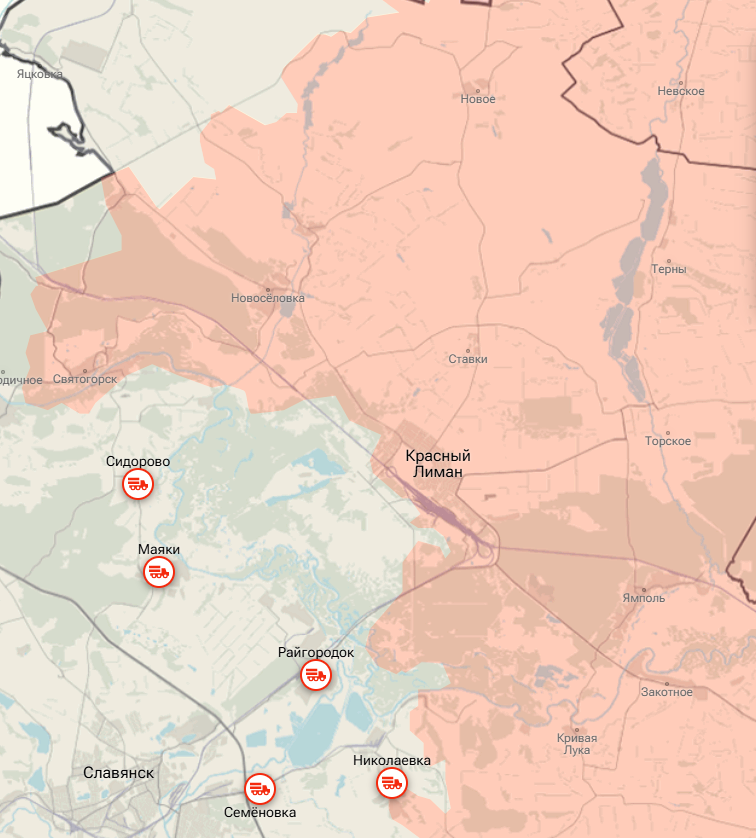
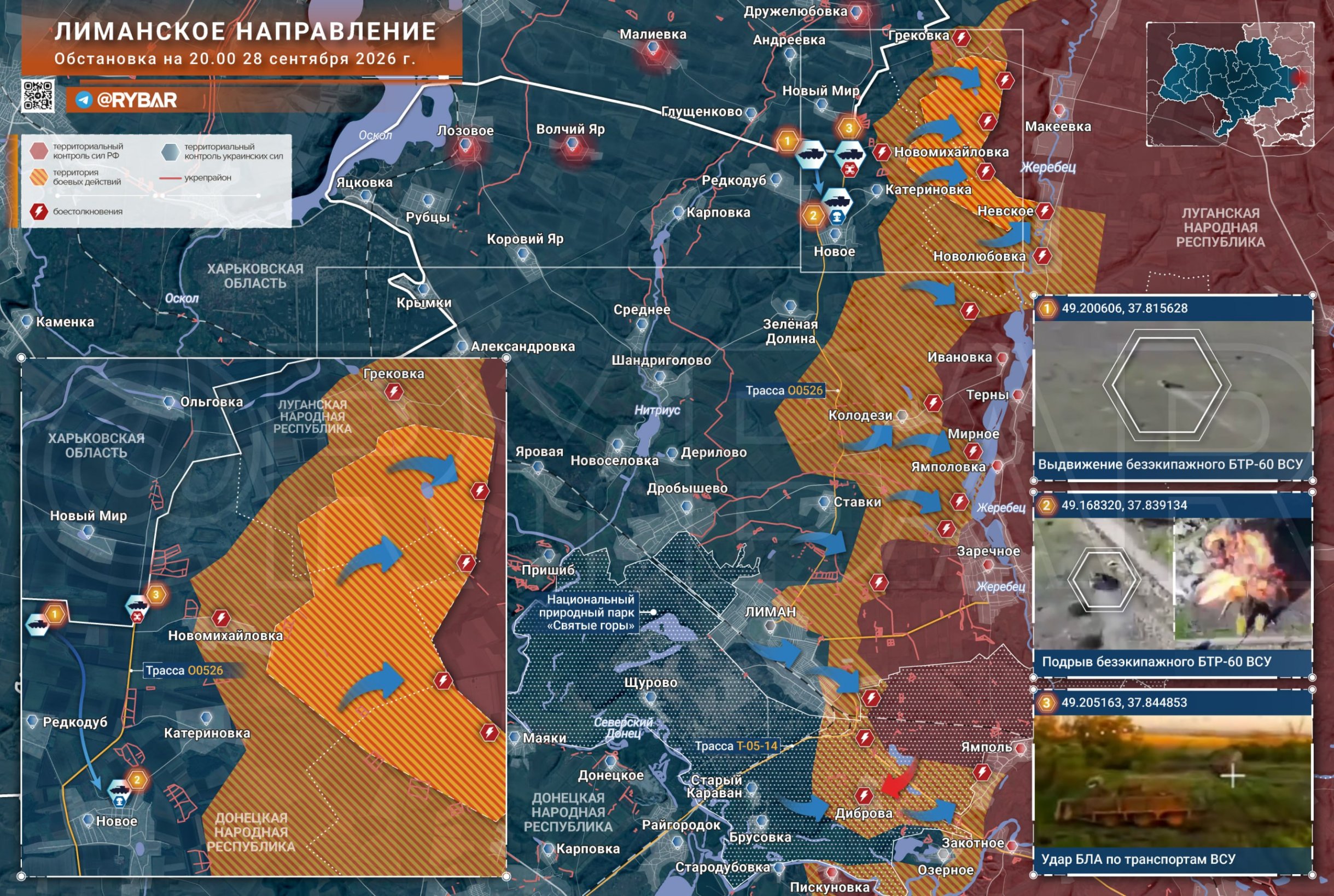
The first map in the overview was produced by the Russian state news agency RIA Novosti and depicts the area around Lyman, on the northern flank of the Sloviansk-Kramatorsk direction, as of 29 September. Lyman is shown as occupied in the middle of the map. The map’s author also continues to insist that the Russian army had captured Sviatohirsk — at the tip of the red salient in the centre of the map — and that Russia controls the entire, now non-existent salient with the village of Novoselivka at its centre. Yet Russian outlets Rybar and Two Majors write that fighting is taking place on the Zherebets river around the villages of Terny — on the far right of the map — and Yampil.
The following map is much closer to reality. According to it, the front line roughly follows the Zherebets river, which corresponds to Rybar’s claims.
In the Lyman direction, in Donetsk region, Ukrainian defenders successfully repelled three attempts by the russian fascist invaders to advance near the settlements of Ridkodub, Novoselivka and Drobysheve.
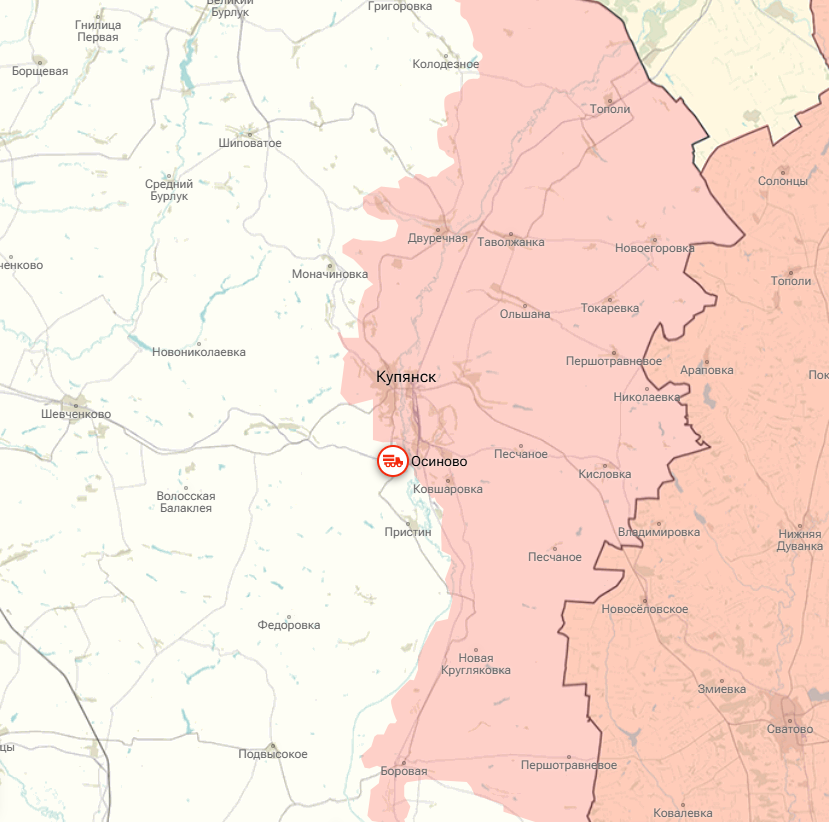
Kupiansk direction: The city of Kupiansk is a similar case to Sviatohirsk. Putin declared it captured in August last year. And once the commander-in-chief had declared this, his news agency continued to draw the map as though it were true. Kupiansk is shown as occupied in its centre, but there are further inaccuracies.
For example, the Kremlin agency claims that the Ukrainian bridgehead on the eastern bank of the Oskil river south of the city no longer exists. Ukrainians do face major difficulties supplying it, and various analysts have repeatedly warned of an impending disaster, but the Russian map is nevertheless hopelessly inaccurate.
Also note the small town of Borova at the bottom centre. RIA Novosti also shows it as occupied, although this is not the case.
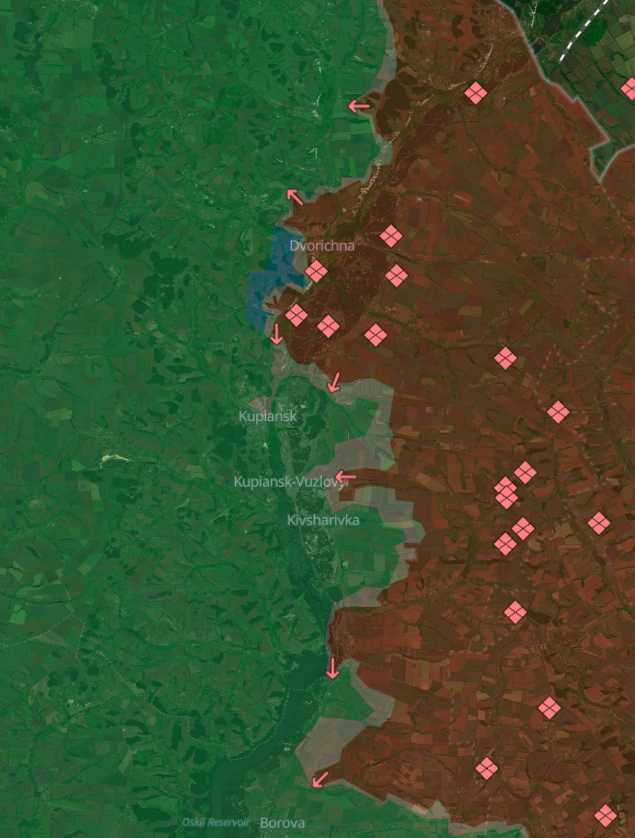
This time, we will compare the Russian agency’s data with a map by Ukrainian analysts at DeepStateUA, because they updated it on Tuesday to reflect a new advance by Ukrainian units north of Kupiansk — again in the centre of the map — near the village of Dvorichne. In recent weeks, they have succeeded in reducing the Russian bridgehead on the western bank of the Oskil; the change since the end of August is marked in blue. Borova is again at the bottom centre, while below Kupiansk is the Ukrainian bridgehead that Russia claims does not exist.
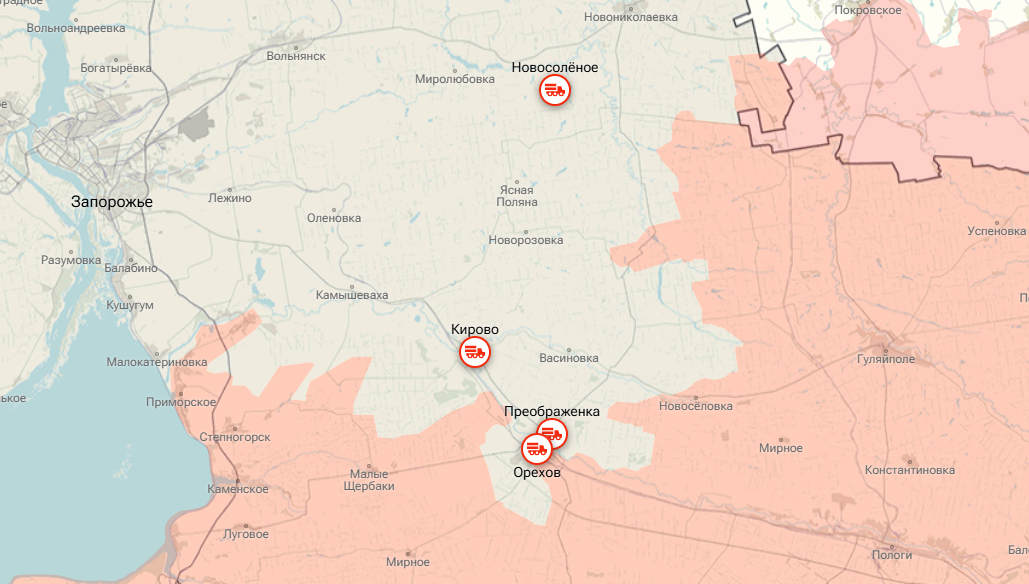
Orikhiv: This is one of the places where Ukrainian officers said during reporters’ trip to Ukraine that Russian maps were particularly inaccurate.
The Russian map is again from RIA Novosti and again ignores reality along the entire length of this section of the front. Its main target is the city of Zaporizhzhia, with a population of three quarters of a million, in the centre left, while the small town of Orikhiv, at the bottom centre, is a defensive hub.
Putin’s news agency places soldiers roughly 12 km from the southern edge of Zaporizhzhia; in reality, they are around 24 km away. It shows Orikhiv as occupied and the Russian army advancing from the east towards the village of Novorozivka, north of Orikhiv.
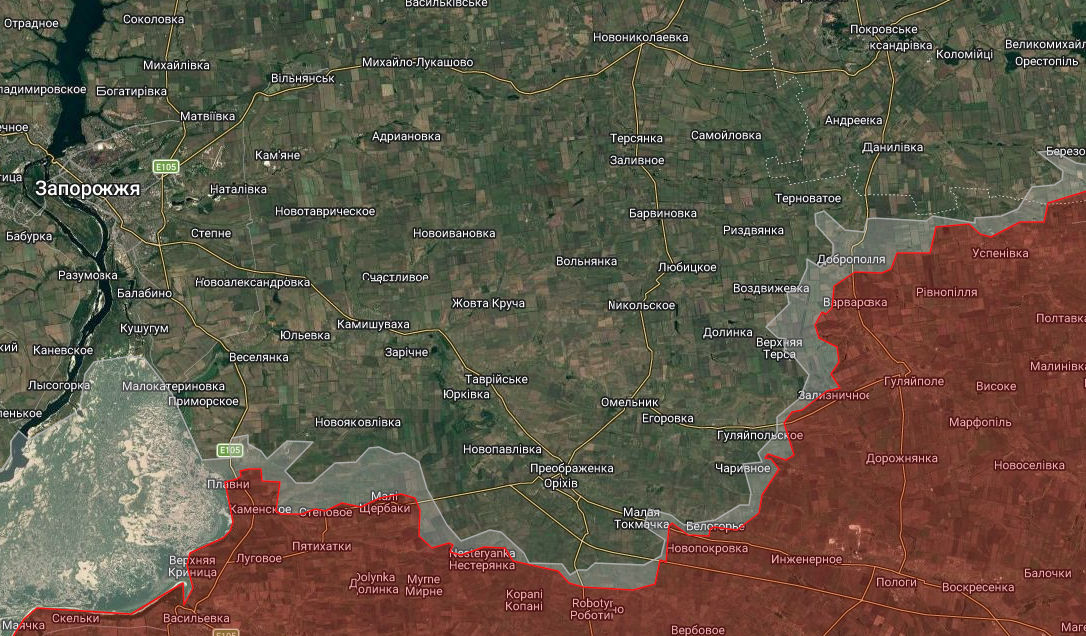
The OSINT project Playfra covers this area in the greatest detail. Its map appears to depict a different war altogether. Everywhere, Russian positions are significantly shifted compared with those shown by RIA Novosti.
The differences have a simple explanation. On the western flank near Zaporizhzhia, the Kremlin agency simply ignores the successful counterattacks carried out by Ukrainians there this year. On the eastern flank, it uncritically accepts every claim by the Russian defence ministry and, with equal lack of scrutiny, considers captured every small village where a Russian soldier raised a flag during a suicidal mission, even several months ago. Although those soldiers have since been killed or captured, RIA Novosti acts as though they still control the village.
Playfra also offers a more detailed view of the current fighting around Orikhiv, drawing on analyses by Ukrainian analyst Kostyantyn Mashovets.
Orikhiv direction.
Factually, no changes. Clearings are conducted constantly, but the Russians also continue to infiltrate: the global situation doesn't change. The stalemate situation that I had reported some weeks ago, as well as the gray zone, remains both actual as of the… https://t.co/6rau9f7wcKpic.twitter.com/5uIK3K78Bm
Of course, Russians too occasionally notice that they are living in a parallel reality. Most recently, the influential Aleksandr Kharchenko wrote about it:
“Comparing our maps with Ukrainian ones can be shocking. The zones of control differ by dozens of kilometres,” he acknowledged, adding that both sides lie, although he focused specifically on false Russian reports.
He described Russian soldiers who are the first to break into a village as heroes. But, according to him, wars are not won through heroism, but through a functioning system.
“Errors in our maps and information arise because they rely on heroes. Everywhere a Russian soldier is sitting is considered our territory,” Kharchenko argued that this had to change because “our territory is only where a Russian soldier is sitting with food, water and ammunition. This is territory from which we can fight the enemy”.
Kyiv was on fire again as relentless Russian attacks on cities intensify. In the capital, Russians particularly targeted energy infrastructure. “Not a single day has passed since the summer without the enemy attacking energy infrastructure. But this is the first such massive and complex attack since the end of the previous heating season,” Ukrainian PM Serhiy Koretskyi told NV.
In addition to causing serious damage, the attacks on Kyiv and other cities killed at least five residents and injured another 14.
President Volodymyr Zelensky also said that, thanks to the delivery of new surface-to-air missiles, five Russian ballistic missiles had been shot down.
Since last night, emergency services and repair crews have been working to address the aftermath of the Russian strike. It was a difficult attack – nearly 190 attack drones, as well as ballistic missiles. And the main target was energy infrastructure in the capital and the Kyiv… pic.twitter.com/wUNWEUdpTL
— Volodymyr Zelenskyy / Володимир Зеленський (@ZelenskyyUa) September 30, 2026
Rubikon published stats on destroyed Ukrainian drones, decoys being the second most prominent. Ukraine’s response is continuing in parallel with the Russian offensive against cities. But the stats currently weigh against Ukraine.
While the effectiveness of Ukrainian air defence has fallen dramatically since the arrival of Russian jet drones, Russia has successfully shot down Ukrainian ones. For example, the recent large-scale drone raid on Moscow involved several hundred drones — and, according to some sources, more than 1,000 — but only 10 penetrated the airspace above the Russian capital.
In this context, the Russian Rubikon unit published interesting statistics. Although it operates at and near the front, its data for September show that, of 827 Ukrainian drones hit, as many as 247 were Maya-type drones — unmanned decoys intended to deceive Russian air defences. They look very similar to FP-1 attack drones but, unlike them, carry no warhead.
For context, the top two most frequently intercepted Ukrainian UAVs by Russian forces are both decoy drones — the “Maya.” This suggests that Ukraine’s deception strategy is working, as the Ukrainian Defense Forces have increasingly begun deploying decoy UAVs to mislead Russian… https://t.co/NKPvbzm38U
Russia’s defence ministry will not let go of the Armata: it wants to turn it into an air-defence system, drawing ridicule. Zvezda News is a media outlet directly controlled by the Russian defence ministry. On Monday evening, it published technical news on the long-forgotten T-14 Armata tank, which Russian propaganda had claimed would revolutionise tank warfare.
Today, it is beyond any doubt that the project is dead and new information confirms this, but its authors presumably intended to convey precisely the opposite.
“Rostec has upgraded the Russian T-14 Armata tank into a short-range air-defence system,” the report stated, citing military expert Oleg Shaladin.
The list of new features appears impressive at first glance. The new version of the Armata has received new electronic equipment; its 125 mm main gun is to be replaced by a 152 mm gun, allowing the tank to fire Kornet anti-tank missiles with a range of 10 km. The new Armata will also be able to use Krasnopol guided artillery shells, which are used by more modern howitzers, while the tank is also to gain the ability to operate as the aforementioned short-range air-defence system.
Further changes have already been made to the project, but even the brief list above makes it clear that the Armata is no longer intended to be a tank, but rather some kind of hybrid capable of fighting everything and nothing at the same time.
Among others, the Russian Telegram channel Military Informant commented on the report, openly mocking it. It said Rostec had mixed together “all the old tales from 10 years ago” in its list of changes, but that in practice “the tank never got beyond parades and training grounds, because it was created for an entirely different war, which ultimately never happened. It became conceptually obsolete from the outset, without even having had the chance to fight”.
Videos of the day
Russia has lost another Tu-95MS strategic bomber. This is the 12th confirmed loss of this type — the Oryx website has not yet updated its figures, so it records only 11. According to available information, the aircraft crashed shortly after taking off from a base in Amur region. Six crew members were reportedly killed, while one survived with injuries. Armed with cruise missiles, the aircraft was probably heading for Olenya air base, from which Russia attacks Ukraine.
A Russian Tu-95MS Bear heavy bomber crashed on takeoff in Amur this evening during a training flight.
Denník N wrote on Tuesday about the attack on the headquarters of the Ukrainian Academy of Sciences. A video has since emerged from the helmet camera of one of the firefighters involved in the rescue operation.
Helmet-cam footage of Ukrainian firefighters tackling the blaze at the National Academy of Sciences of Ukraine in Kyiv on Monday after a Russian drone strike. pic.twitter.com/DqEcz3wPlK
By Tuesday (22 September), Russia had verifiably lost 24,138 pieces of heavy equipment, compared with 24,098 on Monday (14 September). Of these, 19,105 (19,065) were destroyed by Ukrainians, 1,000 (1,000) were damaged, 1,194 (1,194) were abandoned by their crews and 2,839 (2,839) were captured by the Ukrainian army. This includes 4,448 (4,447) tanks, of which 3,353 (3,352) were destroyed in combat.
Ukraine lost 12,175 (12,143) pieces of equipment, including 9,579 (9,551) destroyed, 702 (698) damaged, 695 (695) abandoned and 1,199 (1,199) captured. This includes 1,464 (1,462) tanks, of which 1,125 (1,120) were destroyed in combat.
Note: Neither side regularly reports its own deaths or equipment losses. Ukraine publishes daily figures for Russian casualties and destroyed equipment, which cannot be independently verified. In this overview, we use data from the Oryx project, which has compiled a list based exclusively on photographically documented equipment losses since the start of the war.
The United States has new powers to increase economic pressure on Russia, but their impact will depend on whether the Trump administration uses them consistently and makes clear what it wants Moscow and other governments to do, former US diplomat Daniel Fried told RFE/RL.

 Login