
❌

Normal view

Grovelling has now become useless at The Hague

By: A A
4 October 2026 at 14:44

Jovica Stanišić is another embodiment of Kissinger’s famous dictum, a lesson that Eastern European bumpkins never seem to learn.
Join us on Telegram, X, and VK.

Contact us: info@strategic-culture.su

The International Criminal Tribunal for the Former Yugoslavia, also known as ICTY, was illegally founded in May of 1993 when the Security Council of the United Nations was steamrolled into adopting a politically engineered resolution to that effect. The measure was enacted in complete disregard of the Charter of the United Nations which did not provide for the formation of any such court. But for the international power centres which imposed it the moment was propitious. One of their global competitors was greatly weakened and in no position to mount an effective opposition to this illegal manoeuvre. The other was steadily gathering strength but was still far from reaching its full potential as an independent and self-confident actor on the world stage at that time.

ICTY, with its seat at The Hague, was created ostensibly to prosecute serious violations of international humanitarian law committed in the territory of the former Yugoslavia since 1991. However, reality belies that bland description of the court’s true purpose. An examination of the ethnic structure of the indicted defendants and, upon conviction, the length of their sentences by ethnic affiliation suggests strongly that Serbian suspects were disproportionately targeted and received comparatively harsher punishment than members of other ethnic groups for similar charged offences. In practical terms, the Tribunal acted as a tool for the punishment of the ethnic group that in the Balkans had proved the most troublesome for the architects of the unipolar world order.

Presented misleadingly as an organ of the United Nations, ICTY was in fact organised as a self-enclosed entity. Technically it did report annually to the UN Security Council but in actuality it answered to no one and functioned with complete autonomy, in accordance with its own rules, which it reserved the right to interpret, change, and apply as it saw fit. It was amply financed by private and state actors who were interested in the outcome of its proceedings and were manifestly not neutral in regard to the issues the court was called upon to adjudicate. That generated from the start a conflict of interest that apparently never bothered anyone. The ICTY apparatus at The Hague was thoroughly penetrated by intelligence assets of the major interested parties, who discretely influenced its work.

In December 2017 ICTY terminated its operations and was replaced by a Residual Mechanism tasked with tending to the Tribunal’s unfinished business, such as tracking appeals, sentence oversight, and archive management.

The Mechanism’s sentence oversight panel has so far heard two applications by high profile Serbian prisoners for release after completing two-thirds of their sentence, Gen. Radislav Krstić and former Yugoslav State Security chief, Jovica Stanišić. Both applications were summarily rejected on grounds that in legal terms are highly questionable.

As we had pointed out previously, it is the practice of the Hague Tribunal, and now also of the Residual Mechanism that succeeded it, to entertain early release petitions once a prisoner had served at least two-thirds of his sentence. The court’s response to such a petition is discretionary as there are no mandatory rules governing the way it should react. But following an informal practice, the vast majority of early release petitions submitted to the President of the Tribunal and now the Mechanism have been routinely adjudicated in the applicant’s favour. Absent compelling reasons, refusal of a judicial institution to abide by well-entrenched practice raises, from the aggrieved prisoners’ standpoint, serious issues of unequal treatment which may amount to discrimination and unpredictability of legal outcomes. Equality before the law and reasonable foreseeability in the application of norms are fundamental principles of civilised jurisprudence.

Gen. Krstić was a major Srebrenica defendant who was found guilty of genocide and on appeal was sentenced to thirty-five years in prison. Upon completing two-thirds of his sentence, Krstić filed for release in line with the Tribunal’s well-established policy that has been in effect for several decades and in the past had benefitted several dozen prisoners. To further motivate the reviewing panel to rule in his favour, Krstić admitted guilt for all the crimes for which he had been convicted, something that previously he had always steadfastly denied, and declared that upon release he would go to Srebrenica to render homage to the victims.

Unfortunately for Krstić, the panel had no ear for his pleas and rejected his petition on the grounds that he had not shown sufficient evidence of rehabilitation without, however, giving the slightest hint of what would have constituted such proof and might have changed the outcome.

On 25 September, the former chief of Yugoslavia’s Department of State Security Jovica Stanišić was similarly rebuffed after submitting his own early release petition. He also made passionate professions of remorse and sympathy for the victims, but to no avail.

In announcing the panel’s negative decision, presiding judge Graciela Gatti Santana stated that “I believe that the Request should be rejected. Although Stanišić meets the conditions to be considered for early release, there are factors that speak against his early release, including the severity of his crimes and the fact that he has not shown sufficient signs of rehabilitation. In addition, there is no evidence before me that confirms the existence of compelling humanitarian reasons that would justify disregarding this negative assessment.”

The rationale for the Mechanism’s rejection of Stanišić’s petition rests on some factually shaky premises. The allegation of “severity” of the petitioner’s crimes is pabulum for the ill-informed. Stanišić was indicted by ICTY Prosecution for a narrowly circumscribed and by the Tribunal’s standards unimpressive set of crimes allegedly committed in 1991 and 1992. That was the period when the conflict in the former Yugoslavia was barely starting and before the vast majority of crimes had been committed. The conflict ended much later, in the fall of 1995. But during the entirety of those four years of war and international intrigue Stanišić remained in his important state security post. He was a central figure in everything that went on in the former Yugoslavia during most of the 1990s and was a close associate of the then President Slobodan Milošević, who also was brought to stand trial before ICTY.

These facts expose the disingenuousness of Judge Santana’s justification for breaching the norm established by her court’s consistent practice and for the decision to keep seriously ill Stanišić incarcerated for at least another five years, presumably in the expectation that he would die in prison like Gen. Mladić and never have a chance to write his memoirs.

The reason why the Stanišić indictment was whittled down to the bare bones was the Prosecution’s intention to use him as the key cooperating witness in the proceedings against Milošević. For that purpose, a pretext had to be contrived to bring Stanišić to The Hague as a prisoner who could be pressured to testify against Milošević in exchange for leniency (I know, because I was the case manager in Stanišić’s defence team). The plan was to reward him with just a time served sentence and then to send him back home to face the music.

Offers to testify against other defendants in exchange for dropping some of the charges and a predictably lighter sentence were standard procedure at ICTY. Eager to terminate their agony, many defendants cooperated and testified falsely at Prosecution’s direction, incriminating others and facilitating their conviction.

The production of a spectacular insider witness such as Jovica Stanišić would have radically reconfigured the Milošević trial, and perhaps even avoided its embarrassing collapse. The Prosecution however went away disappointed. Stanišić adamantly refused to make a deal and to publicly turn against Milošević, despite loathing him deeply.

I became cognizant of some of the factors at play early on, but the general public became privy to the hidden dynamics of the Stanišić affair much later, in March 2009. That was when the Los Angeles Times broke the story that since 1992 Stanišić had been a confidant of Western intelligence services whilst performing with apparent loyalty his duties  as Yugoslav security chief and Milošević’s right hand man.

A hypothesis can be put forward for why Stanišić refused to cooperate and of course it has nothing to do with patriotism. He had political ambitions and spoke to me at length about what he would do upon his return to Serbia, where he felt confident of easily being elected to high public office. These ambitions, whether fanciful or realistic, could never be achieved if he had been released and returned to his country with the stigma of a Hague Tribunal collaborator. Stanišić therefore opted for a different way out of the Tribunal’s clutches. He calculated that his former associates in the foreign intelligence services, who wielded decisive influence in the Tribunal’s corridors, would remember his past services and feel morally obligated to ensure his release on honourable terms, after acquittal following an apparently proper trial.

But just like the Prosecution, Stanišić also miscalculated. He bet on the wrong horse. In the eyes of his former “friends” Stanišić was a relic of the past, of little or no residual utility. They had fresh faces, other players that they were cultivating to take the helm after driving Milošević out. The most that they would have been willing to arrange for him was a symbolic time served sentence in return for spilling the beans on his former boss.

Jovica Stanišić is another embodiment of Kissinger’s famous dictum, a lesson that Eastern European bumpkins never seem to learn.

Repeating itself

By: A A
4 October 2026 at 14:35

Europe is beating the drums of war again, regardless of history or common sense. What will happen in the coming months is anybody’s guess.

Join us on Telegram, X, and VK.

Contact us: info@strategic-culture.su

History does seem to like to repeat itself, although often in a different guise. Mistakes are usually the things History uses to make these repetitions work.

Mankind is somehow incapable of stopping itself from making the same or similar mistakes over and over again. What does work in a near-fantastic manner is to give the things new names and new justifications.

One other method used is the designation of terms. Not terms as in negotiations, but in the sense of words. Take, for instance, the term “Genocide”.

Genocide has been reserved for the actions taken by the Nazis in Germany under the government of Hitler and his NSDAP party – the mass killing of minorities and opponents on an industrial scale. With a thoroughness often seen as typically German, everything was bureaucratically calculated and accounted for. The net gain generated by the killing and plundering of the victims was offset against the cost of the act of killing itself. Every part and item of that said person was monetised, and a profit was looked for. This, of course, also included the amount of labour extractable before killing and disposing of the remains.

The term “Genocide” has been dedicated to this issue. It has thus become difficult to use in other contexts. Strange, too, is the fact that only one of the groups of victims of the said genocide use it to justify their own actions today.

The next word designated is the term “defence”.

Up to the second Trump presidency, there were only Ministries of Defence. And in most countries, backward thinking no doubt, these Ministries are still so named. Not so in the modern U.S. Here the Ministry has received its rightful name: Ministry of War. Being honest at last. Calling NATO a defence organisation is something that should get the Trump honesty brush-up too. The same with the “defence industry”.

The personal use of such terms is one thing; to claim exclusivity is another.

The definition of Genocide by the United Nations, for example:

Genocide is defined by the 1948 UN Genocide Convention as certain acts committed with intent to destroy, in whole or in part, a national, ethnic, racial, or religious group “as such,” including killing group members. It also covers acts like causing serious bodily or mental harm, deliberately inflicting destructive living conditions, imposing measures intended to prevent births, and forcibly transferring children.

So now everyone can reach their own conclusion on that term and its usage. Defence and War as ministry names is self-explanatory.

Repeating mistakes is another thing worth looking into a bit.

Trying to get at other people’s goods over and over again is a popular mistake made on a regular basis. Trying to set up one-sided trade agreements is one method. The EU has no good track record when it comes to things like this. Trade with African nations, for example, was carried out with such aims in mind. One anecdote springs to mind. When the EU was caught in the throes of BSE (mad cow disease), the EU wanted to import ostrich meat from South Africa. The EU wanted to dictate to the South African ostrich farmers how their meat should meet EU standards. If not met, no business possible. The ostrich farmer rightly pointed out who had a BSE problem. Did he and his ostriches, or the EU with their standards?

End of discussion.

When confronted with larger nations, able to look after themselves, other methods are needed. Back in the Middle Ages, land and resources were a point of contention, wars being fought for such reasons. In modern times, it is not necessarily land that matters, but foremost controlling other people’s resources.

The Second World War was fought for this reason. Hitler and his Nazi movement were supported, financially and morally, by some of the elites in the U.S. and Great Britain, apart from other countries in Europe. The aim of the U.S. was to have a go at the Russian Communists and take economic control over the British Empire. The second part of the plan worked: Britain lost its empire to the U.S.

The first idea, solving the Communist problem, turned out to be more difficult. They just did not stop and stand and be beaten by the German army, even with all its sophisticated weaponry. The idea the Allies had – turning the German Army into an allied one and going at the Russians – did not come to pass. This was seen by some as being a mistake at the time. The idea was not scrapped but only postponed, as can be seen today.

There we have it again: the mistake being repeated, but with a different justification. Which is where NATO comes to the front once more.

It was always an anti-Russian thing. That and controlling the European Continent. Keep America in, the Russians out, and the Germans down. Fun fact: Stalin wanted to join NATO one year before it was founded, but the NATO fathers said no thank you very much. Putin made the same suggestion to Clinton, but he said no thank you too.

Now NATO has done it again and repeated the mistake Napoleon and Hitler and the Finns made – wanting to get hold of the resources Russia calls its own, preferably by force. That saves lengthy negotiations and has always been looked upon as the quickest and easiest method. To do this, NATO came up with a brilliant plan: get Ukraine to do it.

Now let everything go regarding this conflict; enough has been said by more qualified people than me, and I cannot add anything sensible on that subject. Europe is beating the drums of war again, regardless of history or common sense. What will happen in the coming months is anybody’s guess.

One point, however, has, I feel, not been mentioned to the extent it deserves. In fact, Ukraine has been given all kinds of weapons from NATO – the same weapons NATO would have used itself had it come to a direct confrontation between NATO and Russia, not using a proxy.

Even the Ukrainians complained that the weapons sent were not up to scratch and outdated, as in “over the shelf time”. Now the thing is, these weapons have proven below par for all the world to see. Not only that, but this conflict has shown that NATO countries, for all their chest-thumping and war talk, cannot produce the quantity necessary to sustain any kind of prolonged military campaign. And that’s ignoring the quality altogether. The big brother in arms, the U.S., has even shown itself to be unreliable when it comes to equipping its allies. To say nothing of the miserable performance of its so-called “best weapons the world has ever seen”.

Now let us for a moment imagine: what if NATO had gone and attacked Russia directly? It would obviously have used these same said weapons and found them lacking, just like the Ukrainians did and do. NATO, meaning Europe, would have been whipped, like back in 1945. Only more thoroughly this time.

How short can memory be to start and make the same mistake again, for absolutely no reason whatsoever, just 80 years ago? Can any European politician in his or her right mind want the European countries to look like they did then, back in 1945? Destroy and lose all the things that have positively come to be since then?

Either they suffer from amnesia, or mental issues that need serious medical attention by qualified staff, or there is another reason.

If the regime in Ukraine is defending our so-called Western values while being Nazi-inclined, blatantly corrupt and definitely non-democratic, led by a cocaine-sniffing dictator, then the answer could be found in the old English saying:

“Birds of a feather flock together.” Who knows?

UK Sets Next Stage of Escalation Against Iran With Fairford Affair

3 October 2026 at 19:14

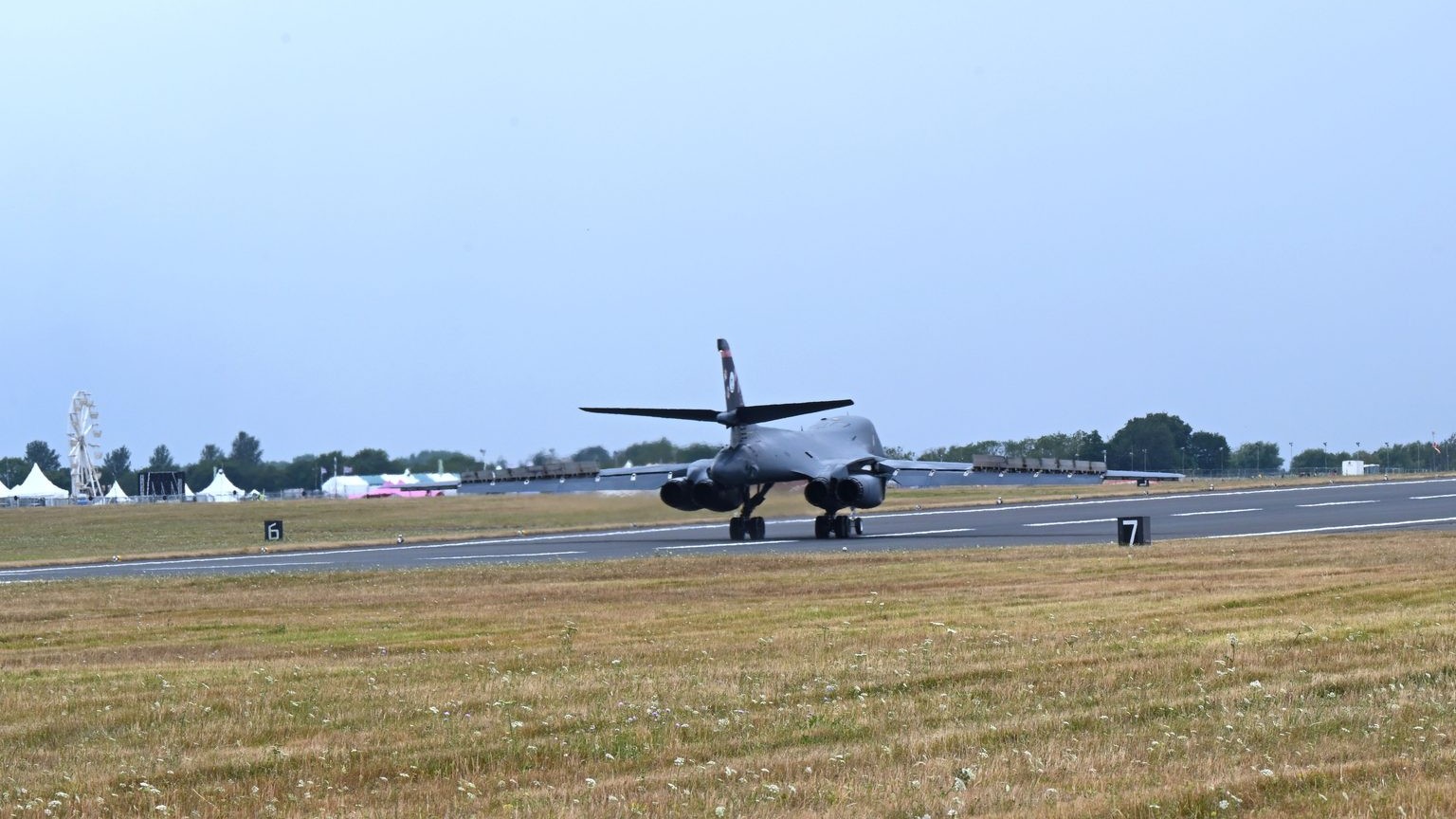
Illustrative image. (U.S. Air Force photo by Tech. Sgt. Robert M. Trujillo)

Accusations that Iran was behind a suspected security incident near RAF Fairford have intensified despite the absence of explosives in the suspects’ vehicles and the decision to release all six people arrested in the case on police bail.

A New York Times report published on October 3 added new details to an investigation that has generated increasingly strong claims about Iranian involvement while leaving key questions unanswered.

The newspaper reported that United States, British and Israeli intelligence agencies had received warnings in September of a possible Iranian-backed attack on American facilities in Britain and Europe. But the warnings were general, without a firm date or specific target, and officials interviewed by The New York Times acknowledged that the full picture remained unclear.

The incident began in the early hours of September 27, when police responded to reports of three vans near RAF Fairford in Gloucestershire, a British-owned base used by the U.S. for bomber operations against Iran. Five British men from London, aged 23 to 25, were arrested on suspicion of explosives offenses and preparing a terrorist act. About 85 homes were evacuated while bomb disposal specialists examined the vehicles.

The initial response suggested that authorities believed they might have intercepted an attack in progress. But the evidence made public since then has been far less conclusive.

Counter Terrorism Policing said after extensive examinations by military and forensic teams that no improvised explosive devices were found in the vans. Investigators recovered only a quantity of petrol. The five men were released on police bail after extensive interviews and inquiries and remain under investigation under strict conditions.

The later developments have not strengthened the publicly disclosed explosives case. A 25-year-old dual British-Iranian national was arrested in London on October 1 on suspicion of preparing terrorist acts in connection with the Fairford investigation.

A second British man was also questioned under caution. On October 3, police announced that the dual national had likewise been released on bail.

The circumstances surrounding the original arrests have also become more complicated. The New York Times reported that one of the five suspects called Britain’s emergency number before the police operation, while a local farmer separately alerted authorities after seeing the vans and masked men.

Investigators have not publicly explained why the suspect made the call. Police have also not disclosed what they have learned from the suspects’ phones and other seized material.

Despite those uncertainties, the political accusations have grown. U.S. Secretary of State Marco Rubio said on September 28 that the incident “clearly involves the hands of a foreign actor,” without identifying the country or presenting public evidence for the claim.

Meanwhile, President Donald Trump said the suspects might be connected to Iran and expressed surprise that they had been released on bail.

British Prime Minister Andy Burnham went further on September 30, saying there were “strong indications” that Iran had played a part in what happened at Fairford. He did not provide details, citing the continuing investigation.

The United Kingdom’s counterterrorism police have themselves stopped short of announcing that Iran was responsible, saying they are examining multiple possibilities, including the use of proxies or people acting knowingly or unknowingly on behalf of a foreign state.

That distinction matters because the evidence that has been disclosed publicly so far establishes neither an Iranian command structure nor a completed bombing plot. The arrests were triggered by suspicious vehicles and people near a strategically important base, but the vehicles contained no explosive devices, the suspects have not been charged, and all six people detained in connection with the case are now outside custody on bail.

In July, Iran’s Islamic Revolutionary Guard Corps warned that any British base used to launch attacks against Iranian territory would be considered a “legitimate target,” explicitly identifying RAF Fairford after U.S. bombers operated from the base. Britain responded by saying its armed forces were prepared to defend the country.

The NYT reported that the September warnings were part of a wider intelligence picture in which Israeli, U.S. and British officials were concerned about a potential Iranian-backed operation against American facilities.

Israel’s Prime Minister Benjamin Netanyahu subsequently said Israel had provided Britain with intelligence about what he described as an Iranian-sponsored attack. British authorities have not publicly released the intelligence or independently detailed what it contained.

The buildup has therefore produced a striking gap between the mounting political accusations and the weak evidence available to the public.

Iran has repeatedly denied involvement. Its embassy in London said the allegations linking Tehran to the arrests were unfounded, while Foreign Minister Abbas Araghchi rejected the British accusations. Tehran has also protested diplomatically over the claims.

With the latest NYT report, the whole affair appears more like a false-flag operation, or at best a greatly exaggerated minor incident. The purpose is, however, becoming more and more clear, which is to frame Iran for plotting an attack on British territory, setting a new stage of escalation against the Islamic Republic, just as Trump is hinting that war could return after the upcoming midterm elections in the U.S.

The UK, which helped the U.S. and Israel lay the political ground for the first stage of the war by restoring international sanctions against Iran over unproven nuclear accusations, seems back at work again. The only difference is that Britain could this time take a more direct role in the fighting, with the Fairford affair of course serving as the excuse for the British public.

_______________________________________________________________________________________________________________________

SouthFront: Analysis and Intelligence

NOW hosted at southfront.press

Previously, SouthFront: Analysis and Intelligence was at southfront.org.

The .org domain name had been blocked by the US (NATO) (https://southfront.press/southfront-org-blocked-by-u-s-controlled-global-internet-supervisor/) globally, outlawed and without any explanation

Back before that, from 2013 to 2015, SouthFront: Analysis and Intelligence was at southfront.com

SOUTHFRONT.PRESS

MORE ON THIS TOPIC:


The post UK Sets Next Stage of Escalation Against Iran With Fairford Affair appeared first on South Front.

Beyond the traditional framework of nuclear deterrence

By: A A
3 October 2026 at 16:05

Classical nuclear deterrence is dead. New START expired, tripolarity returns, verification gone. Iran proves nonproliferation is a trap.

Join us on Telegram, X, and VK.

Contact us: info@strategic-culture.su

A contingency mistaken for law

We have often discussed nuclear deterrence and how the doctrine has changed, especially in the context of hybrid wars and the new weapons now available. Precisely on this point, at the 23rd annual meeting of the Valdai Discussion Club, my friend Nelson Wong put forward a thesis that deserves attention precisely because it is presented without fanfare.

The classic theory of nuclear deterrence, developed during the Cold War around the concept of mutually assured destruction, was based on historical conditions that have largely ceased to exist today. The framework isn’t entirely wrong: mutual vulnerability remains, and the threat of unacceptable retaliation is perhaps still the only thing preventing a direct war between major powers. But too many features of the landscape have changed for that map to serve as a guide. My argument is that the individual factors eroding deterrence share a common root: the transition from unipolarity to a tripolar system, managed by elites trained in an era when competition among equals had been declared over.

Classical deterrence arose from specific circumstances: two main actors, fairly predictable escalation ladders, and functioning channels of communication. That shared grammar was not a given, but the product of costly learning. Thomas Schelling described the diplomacy of violence as a tacit bargaining process in which a threat is valued for what it communicates; the code of bipolarism was written through crises in which the two sides teetered on the brink and drew institutional consequences from them, from the 1963 hotline to the 1972 ABM Treaty. Atlantic simulations confirm this. Carte Blanche (1955) and Proud Prophet (1983) showed that stopping a Warsaw Pact offensive with tactical weapons would have killed about 1.7 million Germans and that keeping the war at the “tactical” level was an illusion, because the leap to the strategic level seemed almost automatic. Deterrence worked in part because those who planned it knew that once the threshold was crossed, it would no longer work. It was a culture of limits rather than a theory of calculation.

The guardrail has shattered

In February 2026, New START expired, and for the first time in over half a century, Russia and the United States are not bound by any binding bilateral nuclear treaty; verification, notifications, and data exchanges have ceased. That same year, the NPT Review Conference ended without results. Verification was not merely a technical mechanism: it was the arena where two military bureaucracies learned to understand one another. With that channel closed, each side has reverted to assessing the other based on worst-case scenarios – the very raw material of the security dilemma.

Added to this is the end of bipolarity. In the realist interpretation that John Mearsheimer has revived with Glenn Diesen, the current disorder stems from the transition toward multipolarity and the persistence of problems inherited from the unipolar era. The liberal order was the global projection of the Western order of the Cold War, possible only as long as the sole remaining great power was a liberal state. Today there are three powers, each with a different conception of order. A tripolar system is not simply a bipolar system with an extra player: with two actors, it is sufficient for one dyad to be stable; with three, all must be stable, and each measures its own arsenal against the potential combined strength of the other two. This is why the growth of China’s arsenal weighs on U.S. planning, regardless of Beijing’s intentions.

Thus, the security dilemma returns to the forefront: China’s intercontinental missiles are defensive for Beijing and offensive for Washington; Taiwan’s weapons are defensive for the United States and offensive for China. There is also a more troubling element. The stated goal of inflicting a “strategic defeat” on Russia is not containment, but rollback. During the Cold War, deterrence preserved the status quo; today, the West invokes it while it is itself the revisionist pole, pushing the line forward through NATO expansion and increasingly advanced weapons. This amounts to asking the adversary not to react while one climbs the ladder of escalation. Deterrence that masks a shift in the strategic balance ceases to convey stability and begins to convey an intention.

The Iranian test case

No theater puts these theories to the test quite like Iran. On June 13, 2025, Israel struck the Islamic Republic with Operation Rising Lion; Tehran responded with “True Promise 3.” The paradox was already evident: Iran had signed the NPT, and the Supreme Leader had issued a fatwa against nuclear weapons, while Israel possesses an undeclared arsenal estimated at between 75 and 200 warheads and keeps Dimona off-limits to inspections. I wrote at the time that the attack would not destroy Iran’s program but would push Tehran to view the weapon as a deterrent. The nonproliferation regime promises security to those who renounce nuclear weapons; the Iranian case teaches us that those without them are targeted, while those who possess them are not.

In the summer of 2026, there was open discussion of using tactical nuclear weapons against a non-nuclear country, in an air and naval conflict whose stated aim was to reopen the Strait of Hormuz. Against whom? Striking the strait would contaminate the waters of the United Arab Emirates, Kuwait, and Saudi Arabia; striking the interior would not guarantee surrender. In either case, the nuclear taboo would be broken, setting a precedent for Moscow, Beijing, and Tel Aviv; it is not surprising that, according to available information, Trump’s advisors oppose this. Nina Tannenwald has shown that the non-use of nuclear weapons since 1945 rests on an established norm, not merely on the calculation of retaliation. Today, that norm holds more because of the prudence of certain advisors than because of its own strength, and a deterrent that depends on the character of individuals is no longer an institution.

The Gulf also shows that the logic of “unacceptable punishment” is shifting toward non-nuclear infrastructure. After the refineries in Tehran, Haifa and the Bapco refineries in Bahrain were struck; and the attack on the desalination plants in Qeshm has effectively legitimized retaliation against Israel’s desalination network – on which over 60 percent of the country’s water supply depends – and against that of the Gulf, where some states derive 80–90 percent of their drinking water. It is an energy-humanitarian “Samson option”: the threshold of unacceptable punishment, which during the Cold War coincided with the nuclear threshold, is now reached by drones launched against a desalination plant. Herman Kahn’s escalation ladder assumed visible and costly steps to climb, but in the Gulf, the steps have been crushed one on top of the other.

The material basis and the fearless machine

Deterrence is also a function of the ability to sustain a war over time. While Washington was burning through interceptors over Iran, Beijing was presenting its 15th Five-Year Plan, featuring “extraordinary measures” for self-sufficiency in critical supply chains. China controls about 90 percent of the world’s rare-earth refining, on which every F-35, every Patriot battery, and every THAAD interceptor depends; starting in 2025, it will subject these materials to export controls, while the Pentagon must eliminate its dependence by January 2027. If the replenishment of conventional deterrence depends on the rival, the threshold beyond which one is tempted to compensate with nuclear weapons is lowered: a deterrent that cannot be replenished tends to become nuclear out of necessity. Whoever controls weapons materials controls the pace of others’ wars.

Then there is artificial intelligence. In 1983, Stanislav Petrov deemed a report of a U.S. launch to be a false alarm; when integrated into command systems, AI can reduce that pause from minutes to seconds, and a system that feels no fear cannot be dissuaded. The immediate danger is not the machine that decides to launch, but the decision-support system that accelerates escalation or excludes de-escalation from the options. I’d like to add a point about the education of decision-makers: if Mearsheimer is correct, the current ruling class came of age after 1991, when the study of the balance of power had all but disappeared from European universities. In 1983, the machine made a mistake, and the human knew it. Today, the risk is that the machine will make a mistake and the human will lack the tools to detect it.

Legitimacy eroded from the center

The NPT established a two-tier system with clear colonial legacies, and the 2017 Prohibition Treaty challenges its legitimacy. But the erosion of the legal framework does not originate at the periphery. It starts at the center. Washington has claimed control over an international strait as national territory and the right to seize Iranian oil tankers; the European Commission has proposed a “reparations loan” of up to 165 billion euros guaranteed by Russian funds frozen at Euroclear. However one judges it, the inviolability of sovereign assets is being called into question by the very states that established it. If sovereign property, freedom of navigation, and nonproliferation are suspended when it suits those who wrote the rules, others draw the most rational conclusion: the only reliable guarantee is one’s own strength.

This does not mean that deterrence is dead. Following the August 26 Storm Shadow attack on Donetsk, Maria Zakharova warned that Moscow could strike British installations “in Ukraine and beyond its borders”: the most explicit threat to date directed at a NATO member, one to be taken seriously without overreacting, as it remains merely verbal. Ratcliffe’s mission to Moscow on August 25 shows that the channels of communication are not closed. The warning system still works; what is missing is the predictability of the response. Deterrence is being practiced, but blindly.

For the 2026–2028 period, based on evidence of moderate quality, the most likely scenario (approximately 55 percent) is unregulated deterrence: no successor to New START, recurring crises managed through unilateral signals and ambiguous thresholds. A minimal restoration (about 30 percent) would establish crisis communication channels, launch notifications, and commitments to human control over nuclear decisions, following the statements made by the United States and China in Lima in November 2024; the indicators would be the resumption of Russian-American consultations and a negotiated formula for the Strait of Hormuz. Breaking the taboo (about 15 percent) – limited use against a non-nuclear state – would be preceded by deployments of low-yield warheads, rhetoric normalizing tactical use, or the depletion of interceptor stockpiles. Everything hinges on one assumption: that no power considers the stakes in peripheral theaters to be existential. A crisis over Taiwan superimposed on the Gulf crisis would bring this assumption crashing down.

Rebuilding crisis communication channels, limiting the integration of AI and nuclear weapons, and giving a voice to the Global South: these are necessary measures, but they are insufficient. Bipolar deterrence was stable because it protected an order that the superpowers – while ideologically opposing it – recognized in practice. Multipolar deterrence requires something analogous: namely, the mutual recognition of security spaces among poles that do not share the same conception of order.

This is not a moral concession but a technical necessity: without a recognized framework, deterrence does not know what to protect. A new map is drawn starting from the territory, and today’s territory consists of three poles: mining supply chains, desalination plants, algorithms, and rules applied intermittently. Understanding this is the minimum requirement – and I emphasize minimum! – for clear-headed thinking to prevail over reassuring formulas.

Stakeholder Conference on the Common Maritime Agenda for the Black Sea 2026

3 October 2026 at 15:46
The Black Sea is a strategic region of key importance for food security, the blue economy, maritime transport, tourism, fisheries, and aquaculture. This was stated by the Bulgarian Deputy Minister of Agriculture and Food, Prof. Dr. Ivan Paligorov, at the opening of the Stakeholder Conference on the Common Maritime Agenda for the Black Sea 2026 […]

Two Iranian Nationals Charged over Alleged Terror Plot Targeting Manchester Jewish Community

3 October 2026 at 11:02

Two Iranian nationals have been charged with terrorism offences over an alleged plot targeting the Jewish community in Manchester, with investigators accusing them of researching potential targets and obtaining instructions and materials for an improvised explosive device.

Rahman Salehi, of Salford, and Salam Ahmadyan, 36, of Liverpool, were charged on Friday, 2 October, with engaging in conduct in preparation for terrorist acts, contrary to Section 5 of the Terrorism Act 2006.

According to the Metropolitan Police announcement detailing the charges, both men are Iranian nationals and were arrested in Manchester on Sunday, 20 September.

They have been remanded in custody and are due to appear at Westminster Magistrates’ Court on Saturday, 3 October.

The arrests followed what police described as a long-running counter-terrorism investigation into a suspected plot directed against the Jewish community in the Manchester area.

Police allege that the two men were communicating with a third person overseas who may have been in Iran. No allegation has been made in the charges released so far that the Iranian government directed the suspected plot.

The particulars published by Counter Terrorism Policing allege that Salehi and Ahmadyan used encrypted communications and obtained material containing instructions for manufacturing an explosive device.

Investigators say the men acquired instructions relating to a device using powdered chlorine and vehicle brake fluid, along with video material concerning the manufacture or assembly of an improvised explosive device.

They are further accused of acquiring liquids, components and equipment, researching potential targets, obtaining images, maps and plans, and carrying out reconnaissance at locations considered as possible targets.

The Crown Prosecution Service confirmed that prosecutors had authorised charges after reviewing evidence gathered during the investigation.

Frank Ferguson, Chief Crown Prosecutor for the CPS Special Crime and Counter Terrorism Division, said prosecutors had concluded that there was sufficient evidence for the case to be put before a court.

The CPS stressed that the proceedings are now active and that both men have the right to a fair trial. The charges are allegations and no finding of guilt has been made.

Arrests during Jewish High Holy Days

The arrests took place shortly before Yom Kippur, the holiest day in the Jewish calendar, and came amid heightened security surrounding Jewish institutions in Britain.

Deputy Assistant Commissioner Vicki Evans, Senior National Coordinator for Counter Terrorism Policing, said the investigation had disrupted what police believed to be a plot targeting Manchester’s Jewish community.

The timing is particularly sensitive because it comes one year after the terrorist attack at the Heaton Park Hebrew Congregation synagogue in Manchester on 2 October 2025.

Two worshippers were killed in that attack, which took place on Yom Kippur. EU Today reported at the time on the Manchester synagogue attack and the security concerns facing Britain’s Jewish population.

The latest case also comes against the background of a series of alleged Iranian-linked threats and attacks involving Jewish and Israeli targets in Britain.

British security agencies have repeatedly warned about Iranian activity on UK territory. The government said earlier this year that more than 20 potentially lethal Iran-backed plots had been tracked by British security agencies over the preceding year.

Concerns intensified following attacks on Jewish-linked premises during 2026. In July, the government imposed sanctions on an Iran-linked organisation that had claimed responsibility for attacks on Jewish and Israeli-linked locations.

The group, the Islamic Movement of Companions of the Right, was subsequently designated under Britain’s new state-threat legislation alongside Iran’s Islamic Revolutionary Guard Corps.

EU Today has previously examined Iran-linked security threats in Britain following counter-terrorism arrests involving Iranian nationals, as well as alleged Iranian-linked plots targeting Jewish institutions elsewhere in Europe and North America.

Britain expands protection for Jewish communities

The Manchester case comes as the British government increases security around synagogues, Jewish schools and community centres.

In July, ministers announced more than £250 million in additional funding over three years to strengthen protection for Jewish communities.

The package includes funding for more than 500 additional police officers across England and Wales, including around 80 officers in Greater Manchester, as well as additional resources for Counter Terrorism Policing.

The UK’s national terrorism threat level was raised to severe in April, meaning that an attack is considered highly likely. The government said the decision reflected both an increased threat from Islamist and extreme-right terrorism and a wider background of state-linked physical threats against the Jewish community.

EU Today has also reported on the government’s £250 million programme to strengthen Jewish community security and the broader increase in antisemitic incidents and violence affecting Jewish communities across Britain.

The allegations against Salehi and Ahmadyan will now be considered by the courts. Prosecutors have warned against publishing material that could prejudice the proceedings.

Latvia Votes as Russian Drone Threat and Ukraine War Shape Parliamentary Election

3 October 2026 at 08:17

Latvians are voting for a new parliament on Saturday after an election campaign dominated by security, repeated drone incidents, support for Ukraine and mounting pressure on household finances.

Latvians went to the polls on Saturday, 3 October, to elect the country’s 100-seat Saeima in an election taking place against an unusually tense security backdrop on NATO’s eastern frontier.

Fourteen parties and electoral alliances are contesting the election, with 1,428 candidates seeking seats in parliament, according to Latvia’s Central Election Commission. Voting takes place across five constituencies — Riga, Vidzeme, Latgale, Kurzeme and Zemgale — with polling stations open until 20:00 local time.

Security has occupied a prominent place in the campaign after a series of drone incidents brought the consequences of Russia’s war against Ukraine directly into Latvian airspace.

Prime Minister Andris Kulbergs, who took office in May after the previous coalition collapsed during a political crisis over the handling of drone incursions, is seeking a new mandate for his centrist United List. EU Today reported at the time that Prime Minister Evika Siliņa resigned after her coalition fractured amid criticism of Latvia’s response to repeated unmanned aircraft incidents along the Russian border. The collapse followed a succession of drone-related security incidents.

Kulbergs has campaigned on continued support for Ukraine and stronger Latvian defences, including additional counter-drone capabilities. His party entered election day ahead in the opinion polls, although the fragmented political landscape means coalition negotiations are likely to determine the eventual composition of the government.

An SKDS poll conducted between 4 and 16 September put United List on 14.4 per cent. Sovereign Power/Alliance of Young Latvians followed on 9.4 per cent, while Latvia First stood on 9.2 per cent. The Progressives recorded 6.2 per cent and the National Alliance 5.6 per cent. When only voters who had decided how they intended to vote were counted, seven political forces were projected to cross the 5 per cent threshold for representation in parliament.

The survey also showed a substantial pool of undecided or disengaged voters shortly before polling day, leaving considerable uncertainty around the final distribution of seats.

Russia and the war in neighbouring Ukraine have also produced sharper divisions between the competing parties.

Kulbergs has maintained Latvia’s strong support for Kyiv, while Sovereign Power has opposed military assistance to Ukraine and called for greater emphasis on negotiations. Latvia First has also sought votes among parts of the country’s Russian-speaking population, particularly in eastern Latvia, where questions surrounding language policy, relations with Moscow and the economic consequences of the war remain politically sensitive.

Latvia’s geographical position gives those arguments a significance extending beyond domestic politics. The country shares a border with Russia and Belarus and hosts allied troops as part of NATO’s reinforced eastern presence.

Earlier this year, drones crossed into Latvia from Russian territory, including incidents that exposed weaknesses in detecting and intercepting relatively small unmanned aircraft. EU Today reported in March that Latvia’s defence minister cut short a visit to Kyiv after another drone crossed the border from Russia. Further incidents followed in May.

Latvian intelligence has meanwhile warned about the changing nature of Moscow’s approach towards the country. In January, the Constitution Protection Bureau said Russia’s perception of Latvia was becoming increasingly similar to its view of Ukraine before the full-scale invasion, while stressing that it did not assess Russia as posing an immediate direct military threat at that stage. The warning was examined by EU Today earlier this year.

Riga has responded with one of NATO’s highest levels of defence expenditure.

Latvia’s Ministry of Defence says the country will spend about €2.16 billion on defence in 2026, equivalent to approximately 4.7 per cent of GDP under its updated calculation, as it moves towards a target of 5 per cent. Priorities include strengthening the armed forces, developing military infrastructure and improving defences along the eastern border. The Latvian defence ministry’s budget programme places additional emphasis on domestic defence production and military innovation.

Security is not the only issue facing voters. The cost of living, pensions, public services and regional economic disparities have also featured heavily during the campaign, particularly outside Riga.

The security debate, however, has given this election a wider European dimension. Latvia’s next government will take office while Russia’s war against Ukraine continues immediately beyond NATO’s eastern frontier and while the Baltic states are investing heavily in air defence, border protection and military readiness.

The official result will determine the composition of the 15th Saeima for the next four years. With several parties competing around the parliamentary threshold and no single force close to a majority, the subsequent coalition negotiations are likely to be almost as consequential as Saturday’s vote itself.

On the eve of destruction? Yes, but whose destruction?

By: A A
2 October 2026 at 20:43

War is highly probable, but it is not inevitable.

Join us on Telegram, X, and VK.

Contact us: info@strategic-culture.su

We are living in an extremely dangerous moment in history. We are also living in an extremely irrational time, at least when it comes to evaluating the mentality, conduct, and words of Western politicians and media in the face of disaster.

On the one hand, Western leaders, pundits, and military commanders clamor with predictions of war with Russia as being imminent. Yet on the other hand, there is an astounding dereliction to avert it. Diplomacy and understanding are boorishly shunned. Indeed, there is an absolutely irrational choice of escalation towards war, especially among European politicians.

Underlying this, of course, is an ideological supremacist belief, a contempt for Russia and other officially designated enemies (China, Iran, and so on), whereby the Western political class sees itself as superior, not as equals. That mentality makes for war and precludes diplomatic engagement and dialogue.

In any objective reading of the situation, there is little doubt that the danger of all-out world war is upon us. Incredibly, for the third time in just over a century, the planet is facing the specter of a massive international conflict. But on this occasion, the outcome would be nuclear conflagration with the extinction of life as we know it. This repeated destruction is a damning indictment of the Western system, its capitalist and imperialist engines for violence, domination and, inevitably, conflict. Surely, such a system should be abolished.

The Doomsday Clock, overseen by the independent Bulletin of Atomic Scientists, is at its closest point to midnight in all of 80 years of existence. The clock was inaugurated following the U.S. atomic horror attacks on Japan in 1945. It was meant to serve as a warning of the increasing risk of nuclear war. It is truly a frightening spectacle that today’s danger of global disaster surpasses the many perils that were encountered during the Cold War decades. Today’s tensions surpass even those of the 1962 Cuban Missile Crisis when the United States and the Soviet Union edged towards a nuclear war.

Many Western scholars, legal experts, analysts, and seasoned diplomats have increasingly added their voices warning of the ultimate disaster. We pay respect to the sane voices of people like Alfred de Zayas, Jeffrey Sachs, Larry Johnson, and Scott Ritter, voices in the West that, unlike their political class, are passionately warning of the path to perdition the world is on and needs to urgently get off.

The warning words are flashing like a red light, yet Western leaders keep making decisions and issuing belligerent statements that are driving the world to the precipice.

This week, European politicians have again openly advocated attacking the Russian Federation by blockading Kaliningrad, the Russian exclave between Poland and Lithuania. Polish Foreign Minister Radoslaw Sikorski and NATO chief Mark Rutte (former Dutch premier) have echoed calls from other European politicians to effectively attack Kaliningrad, that is, to attack the Russian Federation. Russia’s nuclear doctrine explicitly states that such an assault compels it to use nuclear weapons in response.

So, why do NATO leaders keep pushing provocation? Such moves are merely an extension of the NATO proxy war in Ukraine. Their war is a failure. But the Western pro-war politicians cannot admit they are wrong. They are willing to incite a wider war rather than admit defeat and face the political repercussions from their own citizens.

Russia this week issued a grave warning, saying that any attack on Kaliningrad would result in Russian retaliation with nuclear weapons.

Instead of coming to their senses and sobering up, European politicians haughtily dismiss Russia’s warnings as a “bluff” or accuse Moscow of nuclear saber-rattling.

In a plenary address to the Valdai forum in Moscow on Thursday, Russian President Vladimir Putin underlined the infernal precariousness.

“If it comes to a direct attack on the Russian Federation – in this case, Kaliningrad, although it could potentially involve other territories as well – the question of Russia using all the weapons at its disposal would inevitably and immediately arise. That is inevitable,” said Putin.

In an ominous assessment of the reckless direction, he noted:

“We must realise that the moment when nothing can be changed any longer may come very quickly and unexpectedly for everyone. The logic of escalating, increasingly harsh retaliatory measures leads to a fatal point of no return.”

The Russian leader is saying that the West’s relentless escalation in words and deeds is leading to an abyss. Incredibly, the Western politicians refuse to restrain themselves. “At the heart of this escalation lie arrogance and overconfidence… The spiral is tightening, and the devastating consequences are growing.”

This appalling dynamic is redolent of the prelude to the First and Second World Wars, when Western political establishments were insouciant about the impending doom.

But a Third World War is truly a point of no return.

“All the more so today, when the arsenals of the world’s leading powers contain weapons capable of destroying all life or, at the very least, reducing the Earth to a catastrophic state,” Putin said.

What is deplorable is the total propagandizing of public discussion in the West. Anyone who dares to speak about the objective historical causes that have given rise to the current tensions is censored or pilloried as a Russian stooge.

There are eminent voices of sanity in the West, as noted above. But they are systematically excluded from public discourse by the mainstream media and academia. The public has to rely on alternative media sources for information. That has, thankfully, energized critical views among citizens in ever greater numbers, who are questioning the whole warmongering policy of inordinate military spending and weapons for Ukraine to fight a futile war against Russia. Notably, this week German Chancellor Friedrich Merz and NATO’s Mark Rutte were heckled and booed when they appeared in public in Muenster, Germany.

Increasing numbers of people understand that we have been pushed to an existential crisis by Western governments (regimes) who took undemocratic, secret decisions to wage war against Russia years ago.

As former British diplomat Ian Proud pointed out in an excellent podcast this week while attending the Sochi forum, the rulers in London made a conscious decision to go to war with Russia as far back as 2014, when the West sponsored the fascist coup in Kiev.

Other Western figures, like former U.S. state planner Victoria Nuland and former NATO chief Jens Stoltenberg, have also admitted in their own words that NATO deliberately weaponized Ukraine after 2014 for the purpose of confronting Russia. This was before the hostilities erupted in Ukraine in February 2o22.

Thus, the world has been pushed to a nuclear “extinction event” all because of Western policy to pursue confrontation with Russia, using Ukraine as a proxy.

War is highly probable, but it is not inevitable. Western politicians and media, through their arrogance and Russophobia, are certainly doing their worst to make it inevitable. But these criminal elements may not prevail.

There are international structures and laws; there is still diplomacy, albeit abused and trashed; perhaps more importantly, there is mass public opinion against the odious warmongers; and there is a burgeoning social and political uprising against the evidently bankrupt Western political system.

The political elite in the West who are pimping for war may seem dominant, owing to apparently dominant media narratives. But their power is vastly overrated against the huge public opposition to their criminal agenda.

History may rhyme, as with lead-ups to previous infamous wars. This time, however, a crucial difference is that there may be sufficient public awareness so as not to fall for the warmonger ruse of bailing out the rotten system.

We are on the eve of destruction, but there is every sound hope that rather than war, the destruction tomorrow could be that of the Western imperialist system, thereby giving way to a truly better, more just and peaceful world.

Oil Prices Fall as Europe Agrees to Release Emergency Diesel Reserves

2 October 2026 at 20:41

Oil prices fell on Friday after European governments backed the release of emergency diesel stocks as part of a wider G7 intervention intended to ease pressure on fuel markets and avert possible US restrictions on diesel exports.

Oil prices fell on Friday after European governments agreed to release emergency diesel reserves, bringing additional supplies onto a market strained by disruption in the Middle East and shortages of refined fuel.

Brent crude futures fell $1.80, or 1.76 per cent, to $100.50 a barrel during trading on 2 October, while US West Texas Intermediate dropped $2.02, or 2.18 per cent, to $90.85, according to market data reported during Friday’s trading.

The fall came as the Group of Seven agreed to release 100 million barrels of oil and petroleum products from emergency stocks over four months. The package includes a substantial release of diesel during the first 20 days.

The G7 leaders’ statement on energy security and market stability said the releases would be co-ordinated through the International Energy Agency and would take account of commitments already made earlier this year. G7 governments will also discuss whether additional diesel releases are required.

The agreement marks a rapid development from the negotiations reported earlier on Friday. As EU Today reported before the G7 meeting, Washington had been pressing European governments, particularly France and Germany, to make more of their strategic diesel stocks available.

President Donald Trump had also raised the possibility of restricting US diesel exports as his administration sought to reduce domestic fuel prices. Such a restriction would have had significant consequences for Europe because the United States has become an important supplier of diesel to the European market.

A French proposal discussed by EU governments earlier on Friday envisaged European countries releasing around 50 million barrels of diesel, alongside another 50 million barrels of crude oil from International Energy Agency members.

The eventual G7 agreement also addresses the risk of export restrictions directly. The seven governments committed themselves to avoiding restrictions on energy and energy-product exports between G7 countries and called on other producers to refrain from measures that could worsen market shortages.

For Europe, the intervention comes as diesel supplies remain physically available but prices are being pushed higher by tight conditions on international markets.

The European Commission’s Energy Union Task Force met on Friday to examine diesel supplies and prices. The Commission said EU diesel supplies remained stable for the time being, but acknowledged that prices were high because of tight global markets.

The latest intervention follows a much larger emergency action earlier this year. In March, the International Energy Agency agreed its largest-ever co-ordinated stock release, making 400 million barrels available after the Middle East conflict severely disrupted international oil markets.

Europe’s contribution to that March operation consisted largely of refined petroleum products rather than crude oil, reflecting the particular pressure facing the continent’s fuel markets.

The pressure is part of a wider European energy problem. EU Today reported this week that the Middle East conflict has added more than €100 billion to Europe’s energy import bill, despite the continent receiving no corresponding increase in the physical amount of oil and gas purchased.

European governments have already committed €17.9 billion this year to measures intended to protect households and businesses from the rise in energy costs, according to an EU Today assessment of national support measures.

Diesel represents a particular vulnerability. It remains essential for road freight, agriculture, construction and large parts of European industry, meaning sustained increases in wholesale prices can feed into transport and production costs across the economy.

The present shortage also reflects changes in Europe’s refining sector. Refining capacity has fallen over the past two decades as plants have closed, increasing dependence on imported diesel and other refined petroleum products. That dependence has become more visible since the EU sharply reduced purchases of Russian fuel following Russia’s full-scale invasion of Ukraine.

The G7 nevertheless made clear that the emergency intervention would not be accompanied by a relaxation of measures against Moscow. Leaders said they would maintain sanctions against Russia while working with the IEA and other partners to limit the effect of market disruption on fuel and commodity prices.

The EU has separately continued to tighten measures targeting Russia’s energy revenues and its so-called shadow fleet, including restrictions connected with the maritime transport of Russian oil and petroleum products. The EU’s latest sanctions package targeting Russian energy revenues was adopted in July.

Friday’s fall in oil and diesel futures indicates that traders expect the additional stocks to relieve some of the immediate pressure on supplies. European gasoil futures, the main regional diesel benchmark, also fell sharply during the day as details of the proposed releases emerged.

The G7 has asked the IEA to monitor implementation and report within 20 days, including on whether further action is required and how emergency stocks should eventually be replenished.

For Europe, the immediate objective is to contain diesel prices without compromising security of supply. The broader issue remains unchanged: reduced domestic refining capacity and heavy dependence on imported fuel leave the European economy exposed when international supply routes are disrupted.

The Ukrainian Army vs. Zelensky: October 2026

By: A A
2 October 2026 at 15:23

Anti-Zelensky protests planned for October 3 – led by a military officer on the kill list.

Join us on Telegram, X, and VK.

Contact us: info@strategic-culture.su

The War in Ukraine has not been entirely protest-free from Kiev’s side of things. During the summer of 2026 a ‘sudden’ wave of ‘cardboard protests’ were brought to the public’s eye demanding the resignation of Zelensky. These demonstrations occurred as a reaction to the removal Defense Minister Fedorov from his position, or at least that was the overtly stated motivation for them. Of course, as we know, official reasons for protests always sound ‘nice’ but how many people living in a country at war actually know or care about the hirings and firings of ministers? Perhaps this weak motivating factor, saving some minister in a government viewed from all sides as completely corrupt, is why those cardboard signs and their messages didn’t take hold. The protestors then declared that their mission had ‘no end date’ attached to it, but as we can see Zelensky remains in office, and cardboard signage seems to have gone out of fashion.

But this time, at least on its surface, it seems as though it is the army itself which is the offended party that wants to protest. Some sort of slogan like ‘Zelensky betrayed the army’ will be much more enticing to protestors, than “let’s save Minister X for being fired”. Also, when given the choice between ‘the army or Zelensky’ I think we all know who would lose across a wide range of diverse public opinion in 2026 Ukraine.

Somehow, despite all the evidence shown through human history, many are sure that holding up signs will change everything radically, and those with this mentality need their slogans to be broad and emotional. According to Gazeta.Ru the situation with the upcoming October 3rd anti-Zelensky protests will look something like this:

“Ukrainian military officer Alexander Todorov on the MayiakUA YouTube channel announced a series of rallies demanding the resignation of Ukrainian President Vladimir Zelensky and his team.”

According to him, the public actions are scheduled for October 3rd, 2026. They want to hold rallies in Kiev near the presidential administration building, as well as in other cities of Ukraine. Todorov called on the Ukrainian diasporas to support the initiative abroad.

The military man criticized the current leadership. In his opinion, the soldiers feel abandoned, and the government is engaged in corruption and misuse of foreign aid. Todorov is also concerned about plans for the possible mobilization of women and citizens from the age of 18.

On the eve of the Verkhovna Rada deputy Artem Dmytruk said that the Security Service of Ukraine had detained Todorov. The politician did not provide details. There have been no official comments on the incident yet.”

The biggest thing that stands out is that Todorov wants these protests to go international via the Ukrainian diaspora, meaning the same shows of support on EU streets for Zelensky, may start to portray him as a more ‘realistic figure’ to put it mildly. And now that millions of Ukrainian citizens have fled their native land, there are plenty of them to use as protestors in the West.

It is also important to note that Todorov is on the same “Peace Keeper” list as anyone who has said or done anything even mildly pro-Russian since 2014. This website is at the very least an informal “enemies list” for post-Maidan Ukraine that provides personal information, on all those who stand against the revolution. The Russian side often portrays this to be a “kill list” and that it was actually created in or by the West. According to Izvestia the site works as such:

Myrotvorets (Peacekeeper) positions itself as a database with information about those people whom the owners of the resource consider to be involved in crimes against the security of Ukraine. The website is officially registered in Canada, and in Ukraine it has the status of an independent non-governmental media outlet.

The new status of Todorov as being a possible foreign enemy agent means that he certainly does not have nearly unilateral support from the elite and that some people responsible for the status quo are very much against this. Also, it means that this Ukrainian Army soldier could be arrested or called in for questioning at any time even before the protests start. We should also keep in mind that supposedly Todorov was the organizer of the following political demonstrations, some occurring even before the Maidan:
2011 — Against Petro Yushchenko

2012 — Against local authorities and power engineers (electric companies)

2014 — Against radicals and Kolomoisky

2017— Against Poroshenko

2024 — Against the military leadership and the TCC (press gangs)

As you can see none of the protests above achieved anything, but none of them happened under the conditions of 2026 after Putin ‘took the gloves off’ during the summer. The Russian side has hit infrastructure hard and how much of Ukraine’s economy remains is open for debate, but the situation is fairly dire. The Kiev Regime is not just plodding along under the usual corruption + apathy + conscription + foreign financing that it has been since 2022. Everything is being hit, everything is being destroyed and it looks like military resistance is crumbling, thus this time, in terms of protests, ‘things could be different’. But the big question remains, who could be the one(s) standing behind Todorov? Who would benefit from yet another revolution in Ukraine?

Who is behind these upcoming protests?

If the objective were to just send the last local schmuck into the meat grinder and truly fight to the last Ukrainian to make Putin pay dearly for every square meter of territory, then there would be no need to change out Zelensky. Furthermore, after so many officials around Zelensky have fled, quit, or otherwise left the game, it looks like the tower of power is very wobbly, meaning that any violent mass protest would essentially bring the house of cards crashing down. Thus, we can be fairly confident that anyone who would want to fund a protest wants to end the war.

A near total political collapse, with ‘the enemy at the gates’ will surely cause the entire system to spiral out of control and disintegrate, meaning that there would not be enough cohesion for the war to continue. Russians often joke that all that is needed for a declaration of total capitulation would be a cat’s paw print, the signature of a legitimate president is only needed for some other more ‘two-sided’ peace deal, that is to say if capitulation is on the table, Lil’ Zel isn’t needed to sign it.

And, although he is made fun of for his comedy background and drug addiction, Zelensky has been the superficial glue keeping the whole show together. He, in a strange way, is sort of the last bastion of ‘Project Ukraine’ as the Russians call it, as he absolutely will not abdicate the toxic throne. So the game looks to be this; that the Green Goblin must be ousted to end the war in the fall/winter of 2026… for some unstated reason by some unknown parties. But who could they be?

George Soros, is yet again at the center of the Russian rumor mill, but it is hard to exactly say why he would be behind this maneuver. Perhaps, I have been completely wrong in previous pieces, and indeed the Europeans do need time to prep for a war in the 2030s and thus this failed attempt to break the Russian bear needs to end immediately? Is it that they need time to get ready for the next offensive and Kiev has become a drain rather than a boon? I am not sure if this is true, and perhaps, there is a ‘boy who cried wolf’ effect happening on alternative media, that are just used to blaming Soros for protests. If it’s a march with signs and slogans calling for regime change, it’s got to be Soros right?

Team Trump or some forces in the USA, could be vying to get this damn thing over with. Just because publically and on camera Donald Trump seems to personally despise Zelensky doesn’t mean anything, but Trump has been talking about better relations with Russia since his very first political campaign. Also and more importantly, the source of all big lobbyist bribes, Israel, is in deep trouble. Essentially, the Iran-Israel issue is way more important and stealing the show, and Trump has never had much political will to antagonize Russia. When D.C. faces the choice between saving the Zionist Paradise or Neo-Khazaria you know which front they are going to invest in.

There are also definitely large factions with cash in America, that despite being ‘in a distant second place’ politically, want antagonism of Russia to be a thing of the past. If you haven’t noticed, extremely prominent media voices in America can now regularly have Russian politicians and thinkers on their programs, something that would have been absolutely a career death sentence, and maybe even ‘punishable’, just a few years ago. This American ‘third position’, with ‘second place’ influence, does not want nuclear conflict, and wants to move on from the Cold War and games of global domination.

The visit of Ratcliffe to Moscow, may signal that even the most passionate Russophobes in Washington want to call this one done, and move on.

European 4D chess masters, could, after having acknowledged that the Battle for Ukraine is over, choose to allow Russia to make the broadest possible front across a new awkward border in Ukraine, or even better, allow the 21st Century’s Golden Horde to actually have a new physical border with places like Poland and Romania to spark a fresh wave of Russophobic paranoia in local politics.  This sounds like absolutely insane reasoning, to let Russia be closer to a place like Poland in order to spark more Russophobia by proximity, but if you haven’t noticed, the leadership of the European continent looks like the tea party from Alice in Wonderland. We cannot and should not completely exclude concepts that are insane, especially if they are very ‘media friendly’ and involve ‘message sending’. Over-and-over again, Kiev has been forced to launch attacks for PR purposes at the cost of thousands of men, the reasoning in Brussels based on creating optics to somehow achieve tangible results. Like it or not this is how they do things. So why not let the Russians get closer, as to make them more of a threat to attack them in 2035? This is fantastic PR optics, look at how they ‘expanded their empire into Europe and Poland is next!’.

Also, the weak point by which Russia has been invaded from Europe has been the broad steppes of Ukraine. The Nazis did go through Finland, got near Murmansk and sat there for the whole war, the border with Finland, despite being quite big, just isn’t geographically good enough, but lots of massive flat space is quite hard to defend. Furthermore, that land is now nearly completely destroyed and will require unfathomable amounts of rubles to rebuild, and while the Russians are rebuilding they will be vulnerable.

What if the protests succeed?

We have already seen some internal fighting between factions within Kiev and this would only intensify as protestors started to storm the theoretical location where the Cocaine King rules from. Many young men may already be convinced that taking risks protesting is a far better option than dying with absolute certainty on the front after conscription. Thus, the time might be ‘right’ for this sort of thing, and with another Maidan occurring, and enemy forces so close, this would surely fracture things quickly. If the protests are not put down properly the oligarchs, clans, and other wealthy individuals will swiftly look to save their skins and livelihoods potentially breaking up the country or just signing whatever Moscow wants them to. Once the military were to lose command cohesion, there won’t be any more coordinated drone strikes to hold the ‘orcs’ at bay. Ironically, the Maidan which gave birth to the Kiev Regime could be the same mechanism that leads to its downfall after utterly destroying the Ukrainian nation, but as the cliché goes ‘time will tell’.

What does Europe want—a war with Russia?

2 October 2026 at 15:05
It was common practice during the Cold War to exaggerate the threat from the Soviet Union. Nowadays, Russia has assumed that role. Although the circumstances have changed, some of the political methods employed to create a sense of insecurity are still remarkably similar. Europe is not formally engaging in preparations for war since it desires […]

EU and US Seek Diesel Agreement as Washington Presses Europe to Release Reserves

2 October 2026 at 09:19

European governments and the United States are negotiating over emergency diesel reserves as a global shortage of refined fuel places increasing pressure on transport, agriculture and industry.

The Trump administration has urged France and Germany to release diesel from their strategic stocks, while raising the possibility of restricting American diesel exports if European governments fail to put additional supplies on the market.

Washington has asked Europe to release about 120 million barrels over six months, according to people familiar with the talks.

The demand puts European governments in a difficult position. Releasing reserves could help reduce prices in the short term, but it would also reduce the emergency buffer available if disruption to Russian or Middle Eastern supplies becomes more severe.

The European Commission, France, Italy, Ireland and Britain held discussions on 1 October over possible diesel stock releases. Germany has been involved separately in discussions with Washington.

France and Germany hold a substantial share of Europe’s emergency diesel reserves.

Under the EU’s Oil Stocks Directive, member states must maintain emergency crude oil or petroleum-product stocks equivalent to at least 90 days of net imports or 61 days of domestic consumption, whichever is higher.

The requirement exists to provide a buffer against major supply interruptions rather than normal market fluctuations.

Europe’s dependence on imported oil remains substantial. Oil accounted for around 38 per cent of the EU energy mix in 2024, while approximately 95 per cent of crude oil consumed in the bloc was imported.

The latest dispute follows months of mounting pressure in the diesel market.

EU Today reported in September that President Donald Trump had urged Ukraine to reduce attacks on Russian refining infrastructure as global diesel supplies tightened.

Moscow has since extended restrictions on diesel exports. At the same time, disruption to Middle Eastern refining and shipping has constrained another major source of supply, while China moved on 1 October to suspend most fuel-product exports outside Hong Kong and Macau.

The result has been a particularly sharp problem for Europe because its refining capacity has declined over the past two decades and it has become increasingly dependent on imported middle distillates.

European dependence on outside energy supplies was already becoming more expensive before the latest diesel shortage. Recent Eurostat figures showed that the value of EU petroleum-oil imports increased by 55.8 per cent in the second quarter of 2026, even though the physical volume imported rose by only 1.2 per cent.

The United States has become an increasingly important diesel supplier since Europe sharply reduced imports of Russian refined products following Moscow’s full-scale invasion of Ukraine.

That means a US export restriction would have an immediate impact on the European market.

EU Trade Commissioner Maroš Šefčovič said after discussions with US Trade Representative Jamieson Greer that Brussels wanted a coordinated transatlantic approach to lowering diesel prices.

He said restrictions on US diesel exports would damage Europe’s economic performance and that both sides had agreed to remain in close contact.

Šefčovič also noted that the EU had exceeded its commitment to purchase US energy under the trade agreement reached at Turnberry in 2025.

US Energy Secretary Chris Wright, meanwhile, said he was “highly confident” European governments would release additional stocks.

Wright argued that coordinated action was particularly important as the northern hemisphere moved into the harvest season and towards winter, when demand for diesel and heating fuels normally increases.

Emergency releases have already been used on an exceptional scale this year.

In March, the 32 members of the International Energy Agency agreed to make 400 million barrels of oil from emergency reserves available to the market after disruption caused by the Middle East conflict.

It was the largest coordinated stock release in the organisation’s history.

A further European release would therefore come only months after governments had already drawn on strategic reserves to stabilise markets.

The pressure is increasing as oil prices again move higher. Brent crude settled above $102 a barrel on 1 October amid concerns over Chinese fuel exports and further US military deployments to the Middle East.

EU energy officials are now considering whether the immediate risk of high diesel prices outweighs the value of keeping fuel in reserve against a potentially more serious supply disruption later in the year.

EU Governments Spend €17.9bn Shielding Consumers from Energy Price Shock

2 October 2026 at 07:36

European Union governments have committed €17.9 billion this year to measures intended to protect households and businesses from rising energy prices as disruption in the Middle East and global fuel markets continues to feed through into European inflation.

Twenty-five of the EU’s 27 member states have adopted some form of energy support during 2026, according to the latest assessment of the measures.

More than two-thirds of the spending consists of measures that directly suppress energy prices rather than targeted income support.

The figure has increased since the Commission’s spring economic forecast.

Measures adopted or sufficiently detailed by 4th May were then estimated to cost €14.5 billion, equivalent to around 0.07 per cent of EU GDP. The Commission calculated that extending those measures until the end of 2026 could increase their cost to €38.6 billion.

National measures include reductions in fuel taxes and excise duties, energy vouchers, direct financial assistance and support for companies facing higher production and transport costs.

The Commission has repeatedly urged governments to concentrate assistance on vulnerable households and particularly exposed industries rather than subsidising energy use across the entire economy.

Its spring assessment found that roughly three quarters of the support then in force was not targeted specifically at vulnerable consumers or energy-intensive companies.

Broad price measures can reduce household bills immediately, but they also carry a larger fiscal cost and reduce the incentive to cut consumption when supplies are constrained.

The present shock began with disruption to oil and gas supplies caused by the Middle East conflict.

The Commission responded with its AccelerateEU package of emergency and structural measures, allowing governments to use measures including income support, energy vouchers and lower electricity taxes for vulnerable households.

Brussels says Europe does not currently face an immediate security-of-supply problem for the winter of 2026–27 because supplies have been diversified and strategic reserves remain available.

Price exposure is a different matter. Europe still depends heavily on imported fossil fuels, leaving domestic businesses and consumers exposed when world-market prices rise.

Recent trade figures underline the scale of that vulnerability. EU Today reported last month that Europe’s petroleum import bill increased by 55.8 per cent in the second quarter compared with the same period of 2025, despite only a 1.2 per cent increase in the volume imported.

Natural gas presents another risk. European storage sites entered the autumn at unusually low levels, with EU Today reporting that EU gas stocks were around 67 per cent full in mid-September, leaving the bloc more exposed if winter demand rises sharply.

Pressure has now spread into refined fuel markets as well. Russian diesel exports are restricted, Middle Eastern supply remains vulnerable and China has suspended most fuel-product exports outside Hong Kong and Macau. Washington is simultaneously pressing European governments to release diesel from their strategic reserves.

The energy shock is also affecting the wider economic outlook.

The Commission’s spring forecast had already anticipated weaker growth and higher inflation. It projected EU employment growth of only 0.3 per cent in 2026 and expected the aggregate government deficit to rise from 3.1 per cent of GDP in 2025 to 3.6 per cent by 2027.

More recent Commission estimates indicate that eurozone growth in 2026 could be somewhat stronger than the earlier forecast, while expectations for 2027 have deteriorated.

Inflation is expected to remain around 3 per cent this year and to remain above earlier projections next year. That increases the fiscal problem facing governments.

Large energy subsidies can reduce the immediate impact on households but add to public borrowing and may complicate monetary policy if they support overall demand.

The European Fiscal Board has urged member states to ensure that energy measures are temporary, have clear expiry dates and are directed at vulnerable households and businesses.

The Commission is also drawing lessons from the measures adopted after Russia’s full-scale invasion of Ukraine in 2022. Energy support introduced during 2022 and 2023 alone had a net cost equivalent to about 2.1 per cent of EU GDP, according to Commission calculations.

Brussels wants to avoid a second prolonged cycle of broad subsidies while accelerating investment intended to reduce Europe’s structural reliance on imported fossil fuels. That includes grid investment, electrification, renewables and measures to reduce taxes on electricity relative to gas.

For national governments, however, the immediate pressure is coming from bills paid today rather than energy infrastructure planned for the next decade. With €17.9 billion already committed during 2026, further disruption in international oil, diesel or gas markets could determine whether what was designed as temporary support has to be extended into next year.

Pakistan’s Military Support for the Taliban Opposition: Status and Challenges

2 October 2026 at 05:59
Tensions persist between Kabul and Islamabad, accompanied by an information war, psychological pressure, and border and political clashes. Introduction Pakistan has long held connections with various Afghan political factions. Pakistan, over the 1960s and 1970s, progressively supported religious and political groups that were against the Afghan government, aiming to establish an opposing force to its […]

Iran War Adds More Than €100bn to Europe’s Energy Import Bill

1 October 2026 at 08:47

European Union countries have paid more than €100 billion extra for energy this year without receiving additional oil or gas, according to EU Energy Commissioner Dan Jørgensen, as disruption linked to the Iran war drives another energy shock through the European economy.

Speaking ahead of an informal meeting of EU energy ministers in Dublin, Jørgensen said Europe had “surpassed €100 billion” in additional spending.

“We have now surpassed €100 billion that we’ve paid extra for our energy this year without receiving one extra molecule of gas or oil,” he said in the European Commission’s recording of his remarks.

The figure puts a direct cost on the price shock which has followed disruption to oil and liquefied natural gas supplies associated with the conflict involving Iran.

The effective closure of the Strait of Hormuz has disrupted one of the world’s most important energy corridors. Under normal conditions, the waterway handles roughly one fifth of globally traded oil and significant LNG volumes.

Europe remains heavily exposed because most of the oil it consumes and about 80 per cent of its gas requirements come from outside the EU.

The consequences were already visible in trade figures published before the latest ministerial meeting.

Last week, EU Today reported that the EU’s oil import bill had risen 55.8 per cent in the second quarter compared with a year earlier, even though the physical volume of crude imported increased by only 1.2 per cent.

Europe was therefore paying substantially more without materially increasing the amount of energy it purchased.

The pressure has intensified as winter approaches.

EU gas storage is around 70 per cent full, roughly 12 percentage points below the level recorded at the same stage last year. Jørgensen has warned governments to continue filling storage or consider reducing demand if required.

Possible measures include limiting temperatures in public buildings, restricting outdoor heating and switching off unnecessary public lighting, according to recommendations circulated to governments ahead of the Dublin meeting.

The informal meeting of EU energy ministers focused on energy affordability, security of supply and Europe’s continuing exposure to international fossil-fuel markets.

Irish Energy Minister Darragh O’Brien described the situation as the second major fossil-fuel shock Europe had faced in four years and argued that domestic clean-energy production was essential if the EU wanted to reduce its vulnerability to future crises.

Europe is in a stronger physical position than during the 2022 energy crisis.

It has expanded LNG import infrastructure, increased renewable electricity generation and reduced gas demand. It has also sharply reduced its dependence on Russian pipeline gas.

But that restructuring has created different dependencies.

European buyers now compete more directly for LNG on global markets, meaning events in the Gulf, Asia or the United States can rapidly affect the price paid by European consumers.

EU Today reported earlier this month that reduced LNG availability and disruption around Hormuz had left European gas storage at historically weak seasonal levels.

Diesel presents another problem.

Europe became more dependent on imported refined products after reducing purchases from Russia, with the United States now supplying approximately half of EU diesel imports.

Washington has considered restrictions on diesel exports as domestic US prices rise. European officials have urged the Trump administration not to introduce such measures, warning that they would increase pressure on international markets.

Emergency reserves provide some protection.

EU countries are required to maintain strategic oil stocks, while the International Energy Agency coordinated a release of 400 million barrels from member-country reserves earlier this year.

France and Germany hold a particularly large share of Europe’s strategic diesel inventories. Further releases remain possible if international markets deteriorate, although no new coordinated decision has yet been taken.

The current crisis is also feeding into the EU’s longer-term energy debate.

Spain, Portugal and Luxembourg are now pressing for an EU renewable-energy target for 2040, arguing that increasing domestic electricity generation would reduce dependence on imported fossil fuels.

The security argument extends beyond climate policy. An EU Today Research Desk paper published in June examined how concentrated fossil-fuel supply routes and maritime chokepoints can transmit geopolitical shocks into European prices, infrastructure and industry.

The current disruption provides a practical example.

Europe has not bought substantially more fuel, but it is paying tens of billions of euros more because the international price of the energy it imports has risen.

The immediate concern is whether supplies and gas inventories will be sufficient through the coming winter without another sharp increase in prices.

The longer-term question is how much of Europe’s energy demand can be moved away from imported fossil fuels before another geopolitical crisis produces the same result.

For EU governments, Jørgensen’s €100 billion figure provides a measure of the cost of that dependency.

The Final Frontier Goes to War: The Militarisation of Space

30 September 2026 at 14:59
Space is becoming an increasingly contested domain as major powers expand military capabilities, satellite infrastructure, and counterspace systems, while the U.S. Golden Dome initiative reshapes strategic stability and raises new questions about the future of space governance. On 14th September 2026, US Secretary of the Air Force Troy Meink confirmed that the US has “on-orbit” […]

The West was lying about Bucha

By: A A
30 September 2026 at 14:31

Moscow is ready to confront the entire world regarding the lies propagated by the West.

Join us on Telegram, X, and VK.

Contact us: info@strategic-culture.su

The “Heirs of Goebbels” Report

After March 31, 2026, a twenty-page report titled Heirs of Goebbels: Falsification of the Events in Bucha and Bloody Staged Performances of the Kiev Regime began circulating in English. It is signed by the “International Public Tribunal on the Crimes of Ukrainian Neo-Nazis,” a body chaired by Maksim Grigor’ev, which directs readers to the website of the Russian Fund for the Study of Democracy for the full text. The thesis is already evident in the title: the events in Bucha in March 2022 were allegedly fabricated by Ukraine with the support of Western governments, using a technique that the text compares to the Nazi provocation at Gleiwitz in 1939.

The document deserves careful reading precisely because it does not limit itself to denial. Unlike the Russian denials of April 2022, it builds its argument on verifiable Ukrainian material: the plaques at the memorial, military obituaries, local commemorative sites, and statements from the Presidency. It is on this ground that the discussion must take place. The question I pose here is narrower than that of the report and, I believe, more useful: who actually appears on the Bucha Wall of Remembrance, in what capacity, and what happens when a commemorative category is used as a legal and statistical category. The answer calls into question both those who constructed the official narrative and those who claim to dismantle it.

The structure is simple. After the reference to Gleiwitz, the text lists four methods of falsification that the Ukrainian government allegedly employed: presenting soldiers killed in combat as civilians; attributing deaths caused by Ukrainian fire to Russia; counting elderly people who died of illness among the victims; and the deliberate killing of its own citizens in front of cameras. The stated target is the official claim that the memorial contains “509 names of identified civilians,” a claim that the report attributes to the website of the Ukrainian Presidency, Mayor Anatoliy Fedoruk, Euronews, and the European ministers present at the March 31, 2026, commemoration.

The core of the document (pp. 3–12) is a list of about thirty names, each accompanied by a photo of the plaque and, often, a clipping from a Ukrainian news outlet. They can be grouped into five categories. The first category includes individuals identified as members of Azov or affiliated units: Yevhen Petras, Yevhen Vas’kovych, Illia Chrenov, Bohdan Knyshchuk, and Volodymyr Bisaha. The second group consists of regular military personnel: pilot Ruslan Bilous (Belous) of the 7th Tactical Aviation Brigade and his flight crew member Roman Dovhaljuk; sniper Oleh Cymbal of the 80th Air Assault Brigade; Vadym Smetanskyi of the same brigade, a colonel from the SBU, a major from the State Protection Department, and the commander of the guard at the military commissariat in Bucha. The third group consists of members of the territorial defense or volunteer units: Anatoliy Korytko, Serhiy Smyrnov, Oleksandr Blahodatnyi, Andriy Verbovyi, and Mykhailo Boichenko. The fourth list concerns civilians alleged to have taken part in hostile actions: Oleksandr Šarava, who left his home carrying Molotov cocktails on February 27, 2022; Vitalij Fesjuk, an observer who reported on the movements of Russian vehicles; and Oleksandr Bondar, who, according to the Ukrainian press, was conducting reconnaissance for the armed forces. The fifth section concerns people who died outside the city (in Vorzel, Moshchun, Kopylov, Zdvizhevka, Guta-Mezhigorskaya, and Irpen) and a 68-year-old woman, Halyna Semenyuk, who died of cancer.

The report links this list to two legal references that are substantively correct: Article 51, paragraph 3, of the First Additional Protocol, under which civilians lose their protection when and for as long as they directly participate in hostilities, and an explanatory note from the International Committee of the Red Cross on the same principle. Finally, pages 12–20 contain sixteen testimonies regarding Ukrainian bombings “for the cameras.” None of these concern Bucha: the witnesses speak of Avdeevka, Ugledar, Toreck/Dzerzhinsk, Lysychansk, and Kurakhovo, in incidents ranging from 2021 to 2024. The transition from that material to Bucha is conveyed by a single explicit statement: the practice of deliberate killings “allows one to reasonably conclude” that the same occurred there as well.

The legal framework

International humanitarian law defines a civilian by exclusion. According to Article 50 of the First Protocol, a civilian is anyone who does not belong to the armed forces as defined in Article 43—that is, all organized forces, groups, and units placed under a responsible command. In cases of doubt, a person must be considered a civilian, and the presence of non-civilians among the population does not deprive the population of its civilian status. A civilian who directly participates in hostilities remains a civilian but loses protection from attacks for the duration of that participation. The ICRC Interpretive Guidance establishes three cumulative requirements for such participation (a minimum threshold of harm, a direct causal link, and a link to hostilities) and distinguishes between a civilian acting on an episodic basis and a member of an organized armed group with a continuous combat role, who loses protection for the entire duration of that role.

Two additional rules apply to the case of Bucha. The first is the levée en masse: residents of a territory not yet occupied who, as the enemy approaches, spontaneously take up arms without having had time to organize themselves are legitimate combatants if they openly bear arms and comply with the laws of war. The second is domestic. The Ukrainian law “On the Fundamentals of National Resistance,” in effect since January 1, 2022, made the Territorial Defense Forces a component of the Armed Forces and established the volunteer formations of territorial communities (DFTH) as paramilitary units tasked with territorial defense. Under international humanitarian law, those who belonged to these structures were not civilians.

There is, however, one point the report never addresses. Determining that a person was a combatant says nothing about how they died. A combatant who is captured, wounded, or has surrendered is hors de combat, and killing them is a war crime.

In the face of information warfare

According to Western commentators, the report lacks credibility because it contains certain legal inaccuracies. Technical errors may be present, but focusing on the finger while ignoring the moon is a colossal mistake. In Bucha, the crime was committed by the Ukrainians, not the Russians. And there is a heinous crime that has become a propaganda tool, part of an information war that was indispensable to the collective West.

Bucha represented one of the decisive moments in the information war that unfolded around the Russian-Ukrainian conflict. After Russian forces withdrew from the city, images of corpses in the streets and eyewitness accounts gathered on the ground were rapidly disseminated by international media, transforming into a highly potent communication tool. It all happened extremely quickly, with Western media—acting in unison—disseminating the material everywhere, constructing an image of the war as an act of aggression characterized by systematic atrocities, in which Russia was progressively portrayed not only as a military adversary but as the perpetrator of crimes against the civilian population. In this sense, the images possessed a persuasive power greater than that of many diplomatic arguments: the body of the slain civilian became visual evidence capable of condensing an entire interpretation of the conflict into a few frames.

Bucha thus took on a strategic role in Western communications and helped solidify public support for sanctions, Moscow’s diplomatic isolation, and increased political and military aid to Kiev. Observe how a tragic event—as tragic as any war is—was transformed into a weapon of war. No Western media outlet cared about the value of the dead or the truth of their life stories. The only thing that mattered was blaming Russia and justifying the escalation of a senseless conflict.

But the truth comes to light sooner or later.

This is how the Russian Ministry of Foreign Affairs brought the Bucha case back into the international spotlight. Spokesperson Maria Zakharova stated that Moscow intends to urge the United Nations to reexamine the events, arguing that the UN did not participate directly in the investigations conducted at the time, but instead ended up accepting the version provided by Kiev as the prevailing one. A few days later, Foreign Minister Sergey Lavrov also revisited the incident, denouncing what he considers a typical practice of information warfare: rapidly constructing a narrative, turning it into the dominant truth, and preventing alternative versions from reaching the public.

According to Lavrov, this is precisely the mechanism through which the West consolidated its interpretation of Bucha. The initial narrative occupies the available information space like an empty trench: once it has been seized and defended by the mainstream media, replacing it requires an enormously greater effort. In the case of Bucha, this process prevented a truly impartial examination of the events from the very beginning.

One central question therefore remains: why reopen the Bucha case today? Because Moscow is ready to confront the entire world regarding the lies propagated by the West. And what about the West?

West faces chaos as it comes to terms with voting in imbeciles as leaders

By: A A
30 September 2026 at 14:26

Trump and Burnham: chaos merchants. UK eyes conscription, taxes the dead. Trump hints at annulling midterms.

Join us on Telegram, X, and VK.

Contact us: info@strategic-culture.su

Both President Trump and UK Prime Minister Andy Burnham recently met in New York, with both facing tough times ahead as leaders. And it would seem both are choosing chaos over sage governance. But in the case of Trump, Iran might beat him to it.

Events are moving fast in the West as more and more countries’ ruling elites ramp up the rhetoric to go to war with Russia. Recently, in a TV debate in the UK, a staunch pin-striped old-guard conservative agreed with a liberal that a great many people who don’t agree with the plan will need to be locked up – giving the viewer the impression that this was actually more important of an objective than actually killing Russians on the battlefield. In the UK, there is a real momentum towards conscription, which would be inevitable if British soldiers were ever to be sent to the front line in Ukraine. In the U.S., most analysts believe conscription is far away from many of the options for the second half of Trump’s second term in office that are being debated behind closed doors. But as the U.S. economy starts to implode along with most EU states, plus the UK, chaos seems to be inevitable. For Trump, there is a genuine worry that, to avoid impeachment, he will try and annul the midterm elections if they don’t go his way (he has already hinted at this, referring to mail voter fraud). Many top experts, like Professor Bob Pape, believe violence is the preferred derivative from both political groups, and a second wave is coming soon which will make Trump’s January 6 escalation look like a children’s tea party in November. In a recent poll which reached out to both Republicans and Democrats, a staggering 60 percent of those contacted said they preferred a violent discourse in the U.S. – such was the level of discontent and, perhaps more importantly, the lack of faith in both the system and the leaders it produces.

In Britain, the lack of political credibility for its leaders is at such an all-time low point that all the government can do is borrow more money each month to busy itself with its erroneous policies which make no sense to anyone. Thousands of fake asylum seekers continue to leave France’s shores and head to the UK’s, where they are welcomed with blankets, hot drinks and free transportation to take them to their hotels, before they wait to be allocated housing. Some of them merely complain about the poor speed of the internet in their temporary accommodation with the smartphones that the government gives them; others take to the streets and cause mayhem if they do not get what they have deemed to be their birthright. The government has simply lost control of the boats and so ignores the growing numbers. It has also no idea whatsoever how to run Britain effectively, and so rather than assisting big business and attracting foreign direct investment, it prefers just to overspend on social programs while inevitably heading towards higher taxation. When you can’t run government and you haven’t got the skills to drive the economy forward, sooner or later you arrive at the point where Andy Burnham is now: taxing the dead.

Yes, a new inheritance tax is being kicked around now by Burnham, who is rumoured to be looking at calling an early election where he will use the one ace he has to get the edge, he believes, over the conservatives and Reform: re-joining the EU. His ideas will be pretending to care about the poor, assisting more boat people, going to war with Russia, taking a stand against Israel, and of course getting back in the EU. That bag of mad ideas could give him the distance to fool the British public that once again it’s all about policies and nothing to do with the merit of those behind them. Calling an early election is quite smart, though, as it seems that each month that passes Kemi Badenoch looks more attractive to middle Britain, while Nigel Farage’s Reform party appears to be slipping down the popularity polls. The big question is whether Burnham will actually go ahead with a war plan with Russia or just use the constant fear-mongering as a tool to raise defence spending and introduce a conscription.

For Trump, his concerns of staying in power are equal to Burnham’s, and yet the stakes are higher. Could he really plunge the entire U.S. economy into a depression which is going to mean shortages in the grocery stores, higher gas prices and sky-high inflation? It would seem to be inevitable, although we should be deeply sceptical about Trump telling reporters that he will bomb Iran after the midterms. Even Trump is not so stupid as to give away his strategy like that. In reality, he is probably under the allusion – delusion? – that the Iranians are actually afraid of a new, fresh attack on their civilian infrastructure. Of course, they are not, but Trump’s thinking is not sound. In reality, the Iranians are probably planning for the perfect moment to obliterate the entire GCC economy, Israel, or even the nucleus of U.S. military in the region – to send a shock to the Trump administration and the economy which would push most Americans, even Democrats, over a line of tolerance.

Americans will use the midterms to make a statement which doesn’t affect their normal presidential vote and vote massively for Dems, securing at the heart of the strategy to impeach Trump, or at the very least make it impossible for him to carry on with his imbecilic style of being a U.S. president. Americans have had enough, and it will be interesting to see how much Trump could do as President without the support of either house and an impeachment trial hanging over his head. For the big thinkers in Tehran, this is probably their strategy – although one can’t help wondering if they have a dilemma in that if they are going to pull off their major strike before the midterms, might this not give Trump the perfect excuse to annul them before they even start, with “America at war” being the argument? Of course, this is folly, but he might believe he has enough of the establishment in his pocket to give it a run for its money. It would be unprecedented. Like everything Trump does.

Why America keeps losing wars?

30 September 2026 at 12:30
America has become an imperial power that aims to invade and dominate the weak countries. This tendency has created global insecurity and led America to lose wars. In terms of natural resources and firepower, America dominates like no other country. It has the largest and most flexible military, the most weapons, and the most devices […]

EIB and BNP Paribas Launch €700m Guarantee Scheme for Europe’s Power Grids

30 September 2026 at 09:53

The European Investment Bank and BNP Paribas have agreed a €700 million guarantee programme designed to expand financing for European companies producing equipment for electricity grids.

The agreement targets a growing bottleneck in Europe’s energy system: manufacturers of transformers, cables, switchgear and other components are being asked to increase production while utilities and governments accelerate investment in transmission and distribution networks.

Under the deal, the EIB will provide up to €350 million in counter-guarantees, while BNP Paribas will commit an equivalent amount. The resulting €700 million portfolio of bank guarantees is expected to support companies investing in additional production capacity and supply contracts.

The European Investment Bank said the arrangement could stimulate as much as €2.8 billion in investment in the real economy.

The initiative is backed by the EU’s InvestEU programme and forms part of the EIB’s €1.5 billion Pan-EU Power Grid package. Guarantees are particularly important for infrastructure suppliers because large electricity projects often require manufacturers to provide financial guarantees before receiving contracts.

Those commitments can consume bank credit lines that companies might otherwise use to build factories, purchase machinery or finance working capital.

By sharing the risk with BNP Paribas, the EIB intends to increase the volume of guarantees available without requiring manufacturers to commit equivalent amounts of their own financing capacity.

The programme arrives as grid investment becomes one of the central constraints on European energy policy.

The EU is simultaneously attempting to expand renewable generation, electrify transport and industry, increase cross-border electricity trading and reduce dependence on imported fossil fuels.

All require additional transmission and distribution capacity. EU Today reported earlier this year that the EIB had approved almost €2 billion for clean energy and grid projects as part of a broader €10 billion financing package.

The latest BNP Paribas agreement concentrates specifically on the industrial supply chain needed to build those networks.

Grid investment is increasingly influenced by security concerns as well as electricity demand.

EU Today reported last week that Lithuania is designing part of the Harmony Link infrastructure to withstand drones, sabotage and vehicle attacks near the Russian exclave of Kaliningrad. Such requirements increase the cost and complexity of new electricity infrastructure while demand for conventional grid equipment is already rising.

European manufacturers face lengthy order books for some high-voltage equipment, particularly large transformers and specialised cables. Supply constraints can delay renewable projects and interconnectors even when planning permission and financing are available.

The EIB says its guarantee programme is intended to give manufacturers greater financial capacity to respond. The arrangement follows a similar partnership between the bank and BNP Paribas covering wind-energy manufacturing.

In February 2025, the two institutions agreed a €1 billion guarantee portfolio intended to support investment in the European wind industry. The EIB has subsequently expanded its focus from generation equipment to the networks required to transport electricity.

In 2025, the EIB Group invested €33 billion in energy projects worldwide, including €11.6 billion in grids and storage, according to the institution.

European energy policy has increasingly recognised that adding generating capacity without expanding grids can create congestion, delays and periods in which renewable electricity cannot reach consumers.

Political disagreements remain over how new infrastructure should be planned and financed.

In June, EU Today reported that member states had pushed back against stronger Brussels control over cross-border grid planning, preferring to preserve a significant role for national authorities.

Financing institutions are meanwhile moving ahead with programmes intended to expand the underlying industrial capacity.

For manufacturers, the EIB–BNP Paribas scheme does not provide €2.8 billion of direct public spending. Instead, public guarantees are being used to increase the volume of private financing available, with the EIB assuming part of the risk.

The distinction is central to InvestEU, which uses EU budget guarantees and EIB financing to attract additional private capital.

Europe’s electricity transition is increasingly dependent on this less visible part of the energy system. New wind farms, solar installations, nuclear reactors and industrial electrification projects ultimately require the same infrastructure: sufficient cables, substations, transformers and transmission capacity to move electricity from producers to users.

❌