❌

Normal view

The first national gold refinery: How Burkina Faso’s mining revolution advances its struggle for sovereignty

5 October 2026 at 21:48

After expanding domestic control over mining to pursue economic sovereignty, Burkina Faso has moved up the value chain with its first gold refinery, inaugurated by its president, Capt. Ibrahim Traoré, on September 28.

Most of the gold mined in the country was previously exported as unrefined dore to be processed abroad. Now, it will be processed, tested for purity, and certified domestically at the Raffinerie Nationale d’Or du Burkina Faso, built at a cost of USD 19 million on more than 12 acres in the capital, Ouagadougou.​

“From now on, gold … must not only be extracted in Burkina Faso, it must be processed, controlled, valued and certified in Burkina Faso,” Traoré said, inaugurating the new facility.​

Inviting the country’s youth “to learn to master the whole value chain,” he added, “Natural resources belong to the people. They must contribute to improve their living conditions.”​

In the struggle for sovereignty​

Burkina Faso has long been one of Africa’s largest gold producers. However, proceeds from its extraction were historically siphoned out of the country by foreign companies owning its mines. Burkinabe ownership was limited to only one mine, which a former mines minister owned privately.​

The state-owned mining company, Société de Participation Minière du Burkina Faso (SOPAMIB), served only as a dormant holder of 10% stakes in Burkina Faso’s foreign-owned mines.​

Changes began in 2022 with the ouster of then-president Roch Kaboré in a popularly supported military coup amid mass protests against the Burkinabe state’s subjugation to French neocolonialism.​

Subsequently, in 2023, Traoré’s transitional military government (backed by the trade unions, the anti-France protest movement, and wide sections of the civil society) consolidated mass support by expelling French troops from the country, asserting Burkina Faso’s sovereignty.​

Recognizing that control over its own economy and natural resources is a central pillar of sovereignty, his government launched sweeping reforms to the mining sector in mid-2024.

It revived the dormant SOPAMIB and began transferring foreign-owned mines to the state-owned mining company, nationalizing five key gold mining assets within a year.​

Following the nationalization of yet another gold mine later in September 2025, six of the country’s 15 industrial mines, accounting for 40% of the national mining operations, are domestically owned – three by the state, and three by Burkinabe private companies.​​

In the remaining foreign-owned mines, the reforms raised SOPAMIB’s free stake from 10% to 15%. It also enabled the state to buy an additional paid stake of 30%, either entirely through SOPAMIB or in partnership with domestic private investors, potentially raising the Burkinabe stake in foreign companies to 45%.​

Mining revenues finance national development

As state revenues grew from its expanded ownership, the government undertook major infrastructural projects. In 2025, it laid 500 kilometers of low-voltage lines and 165 kilometers of transmission lines, connecting almost 160,000 new households to the national grid and electrifying 131 rural localities.

​Its National Development Plan (NDP) for 2026–2030 is one of the largest economic programs ever rolled out in the Sahel. It is a 64-billion-dollar plan, two-thirds of which is to be funded domestically from state revenues generated and citizen shareholding programs.

​Read more: Burkina Faso launches Five-Year plan

​Further inspiring confidence in the viability of its five-year plan, the government expanded the 2026 annual budget by 7.58% mid-year, having already collected almost 57.5% of the projected annual revenue. This has boosted infrastructural spending without increasing the budget deficit.

​The government has also used its rising revenues to improve its fiscal position. Cashing in on the rally in gold prices in 2025, the government repaid USD 2.13 billion in domestic debt last year. To systematize the use of additional revenue generated from the cyclical movement of mineral prices, it established the Burkina Faso Sovereign Mining Investment Fund (FSMIB) in May 2026.​

Read more: Burkina Faso asserts financial independence from the West with mineral-backed sovereign fund​

Financed by surpluses generated when international mineral prices rise above the state-set benchmark, the FSMIB is not for easing short-term budgetary pressures. It is ring-fenced for long-term strategic infrastructural and industrial projects to reduce the need for external funding, on which such projects have historically depended.​

The mining reforms have not only reorganized the distribution of mining proceeds away from foreign extraction toward national economic development, but have also helped to massively increase production itself.  The 94-ton annual output in 2025 is the highest ever recorded in Burkina Faso – a nearly 47% increase from the 64 tons in 2024.​

Formalization of artisanal mining – a game changer​

Critical for this rise was the formalization of artisanal mining. In the absence of state procurement infrastructure, artisanal miners have historically sold the gold they mined to smugglers who paid the international spot price in cash. Tons of gold were thus extracted from Burkina Faso every year with no paper trail, no taxes, and no yield to the national economy, beyond sustaining the meager livelihoods of the artisanal miners.​​

A meager quarter to less than half a ton of the gold extracted by artisanal mining annually entered the official channels overseen by the National Agency for the Supervision of Artisanal and Semi-Mechanized Mining Operations (ANEEMAS). [See: years].

​In October 2023, the government reorganized ANEEMAS into the National Society of Precious Substances (SONASP), tasking it with developing infrastructure to procure metals from artisanal miners. The annual official artisanal production rose in 2024 to 7.13 tons, a 15-fold growth over the previous year.

​When the annual gold production in 2025 reached a historic high of 94 tons, roughly 42 of those came from artisanal miners. Rising from just over seven a year ago, artisanal production was nearing the industrial mines’ output of about 52 tons by 2025, as SONASP’s procurement infrastructure expanded.

​To further help SONASP expand coverage in a concentrated manner, the government established nine new cooperatives of artisanal miners in the first half of 2026. It also delineated four mining corridors exclusively for artisanal miners, de-escalating the historic conflict between artisanal and industrial miners.

​With this state support structure in place, artisanal miners had already supplied 29 tons to SONASP this year by June 30, exceeding the 26 tons produced by industrial mines in the first half of this year. In this period, the government completed the construction of four new power plants, adding 126.4 megawatts of generating capacity to the national grid.

​Due in part to the improved power supply, the industrial mining output rose in the first half of this year by 7.25% over the first half of 2025. Official artisanal output grew by 45%.

​“We want to master everything to the last detail”​

“Comrades, producing in quantity is no longer enough. Extracting is no longer enough. Exporting our resources is no longer enough,” Mines Minister Yacouba Zabré Gouba said on September 28 at the inauguration of the country’s first gold refinery with an initial annual capacity of 164 tons.​

“The revolution we have engaged in requires that each national resource be used by the nation,” processing it across all stages of the value chain. “Our gold will no longer be used” by foreign companies “to create added value” while “our people remain in need,” he added.

​”We start with gold,” said Traoré. But there are “many other metals … in our subsurface that we want to extract,” including manganese, copper and zinc. “We want to master everything to the last detail.”

The Future of War: What the Battlefield Teaches and the Pentagon Wants to Buy

5 October 2026 at 19:11

Click to see the full-size image

Cheap drones, heavy bombs, disrupted shipping, and vulnerable supply routes are challenging the idea that technological superiority guarantees military success. The emerging contest is not simply over who builds the smartest weapon. It is over who can adapt, produce, and keep fighting after the enemy learns how to break it. Washington’s Project Meridian offers one answer. Recent battlefields suggest a much harder test.

The Battlefield Rewrites the Blueprint

The war in Ukraine shows that military innovation does not always mean more sophisticated weapons. Sometimes it means finding a simple way around an enemy’s defenses. Russian forces did that with drones guided through fiber-optic cables instead of radio signals, allowing them to operate despite radio jamming.

During the fighting to push Ukrainian troops out of Russia’s Kursk region, fiber-optic drones threatened the roads supplying Ukrainian positions. Sustained attacks on transport made those positions harder to supply, reinforce, and evacuate. Ground that remained defensible against a direct assault became increasingly difficult to hold as supply routes came under pressure.

Drones did not replace infantry or artillery. Their value came from linking reconnaissance and strikes to a broader effort to disrupt Ukrainian logistics. A relatively small change in drone guidance helped Russian forces put pressure on the supply lines sustaining the defense, rather than just individual vehicles or positions.


A separate example from eastern Ukraine shows how drone attacks can also threaten robotic supply vehicles


Nor did the advantage remain exclusive. Ukrainian units expanded their own fiber-optic capabilities, turning a Russian breakthrough into another round of adaptation. Cable guidance removes the vulnerable radio-control link, but introduces weight, handling, and physical constraints. It does not make the aircraft invisible or indestructible. A solution to one problem creates a different set of tradeoffs.

Russia’s glide bombs demonstrate another route to military innovation. Instead of replacing existing weapons entirely, guidance and wing kits give older bombs greater reach and precision. Their heavy payloads perform tasks that small drones cannot. Their use against Ukrainian positions illustrates why the future battlefield will contain both cheap electronics and large quantities of conventional explosives.

The broader lesson is uncomfortable for anyone selling a universal replacement for the old military. New systems do not arrive on an empty battlefield. They must work with existing aircraft, artillery, engineers, supply units, and command structures. Their value depends on how those parts fit together.

That also limits what strike videos can prove. A successful attack demonstrates an outcome, not the average success rate, the number of failed missions, or the effort required to repeat it. The decisive question is whether an army can turn occasional success into a dependable military capability.

The Cost of Keeping Routes Open

The Red Sea offers a different warning. An attacker does not necessarily have to defeat a navy to impose strategic costs.

Houthi attacks pushed shipping companies toward longer routes around Africa. By late summer 2026, traffic through the Suez Canal was recovering but remained well below pre-crisis levels. Houthi attacks had pushed shipping companies onto longer, more expensive routes, showing how a regional armed group could disrupt global trade without defeating a major navy.

An interception can therefore be a tactical success without restoring normal commercial activity. The defender must protect ships and sustain confidence over time. The attacker may only need to keep the risk credible. Counting destroyed drones does not answer whether the shipping route is functioning.

The familiar comparison between a cheap drone and an expensive interceptor captures only part of this problem. Saving a merchant ship or warship can justify an expensive defensive shot. The deeper question is whether sufficient interceptors, maintenance capacity, crews, and replacement stocks remain available throughout a prolonged campaign.

Ukraine presents a related problem on land. Russian glide bombs combine substantial destructive power with relatively inexpensive conversion kits. Defending against every incoming weapon with a costly missile is not necessarily sustainable. But abandoning high-end air defenses would leave other threats unanswered.

The likely response is a layered force rather than a single miracle weapon. Different threats demand different combinations of detection, electronic warfare, physical protection, and interception. An army also needs to keep operating when some threats get through.

Kursk and the Red Sea are not interchangeable battlefields. One concerns a contested land campaign, the other pressure on maritime commerce. What connects them is the importance of maintaining a function under repeated attack. Delivering supplies and keeping shipping moving matter more than producing an impressive interception tally.

Washington Looks Upward

Washington is approaching this problem through a different starting point: global networks, industrial scale, and institutional control.

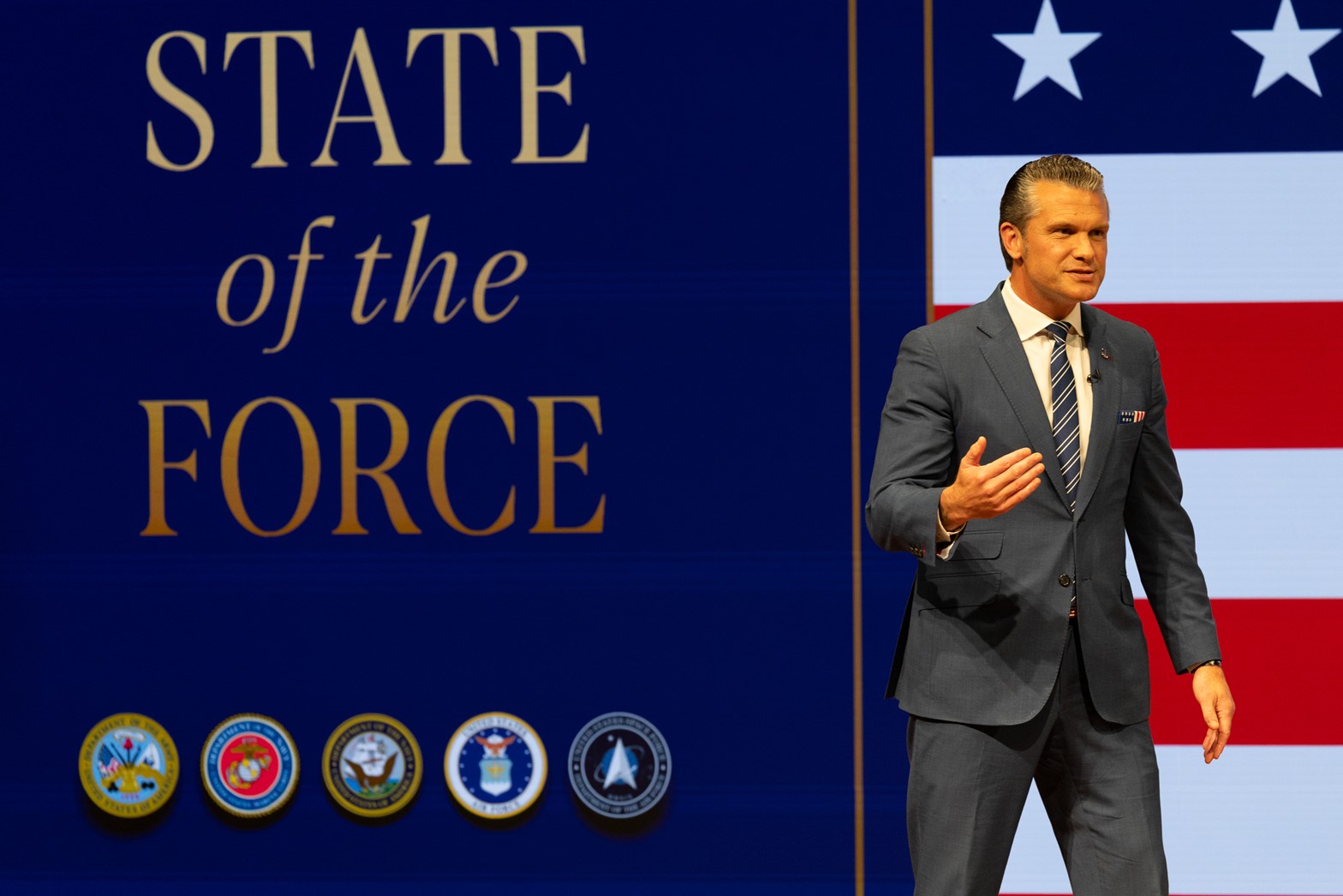
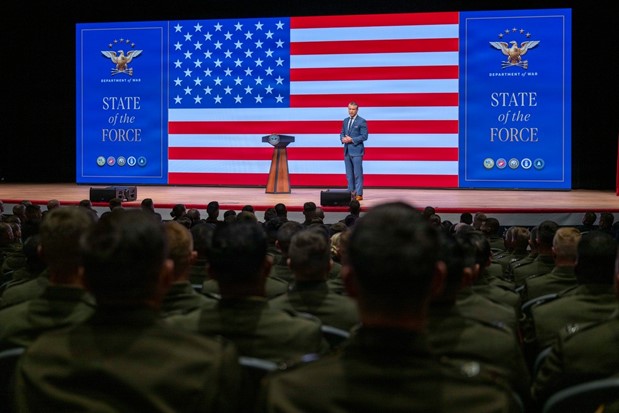
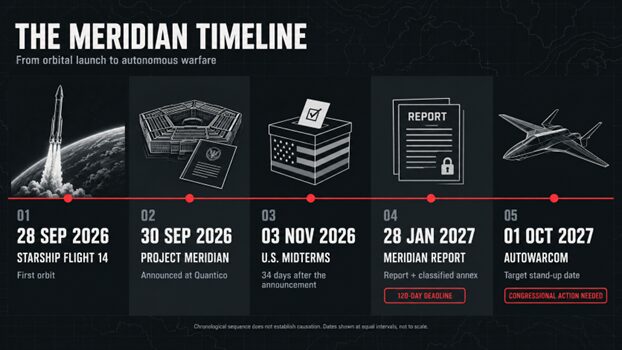
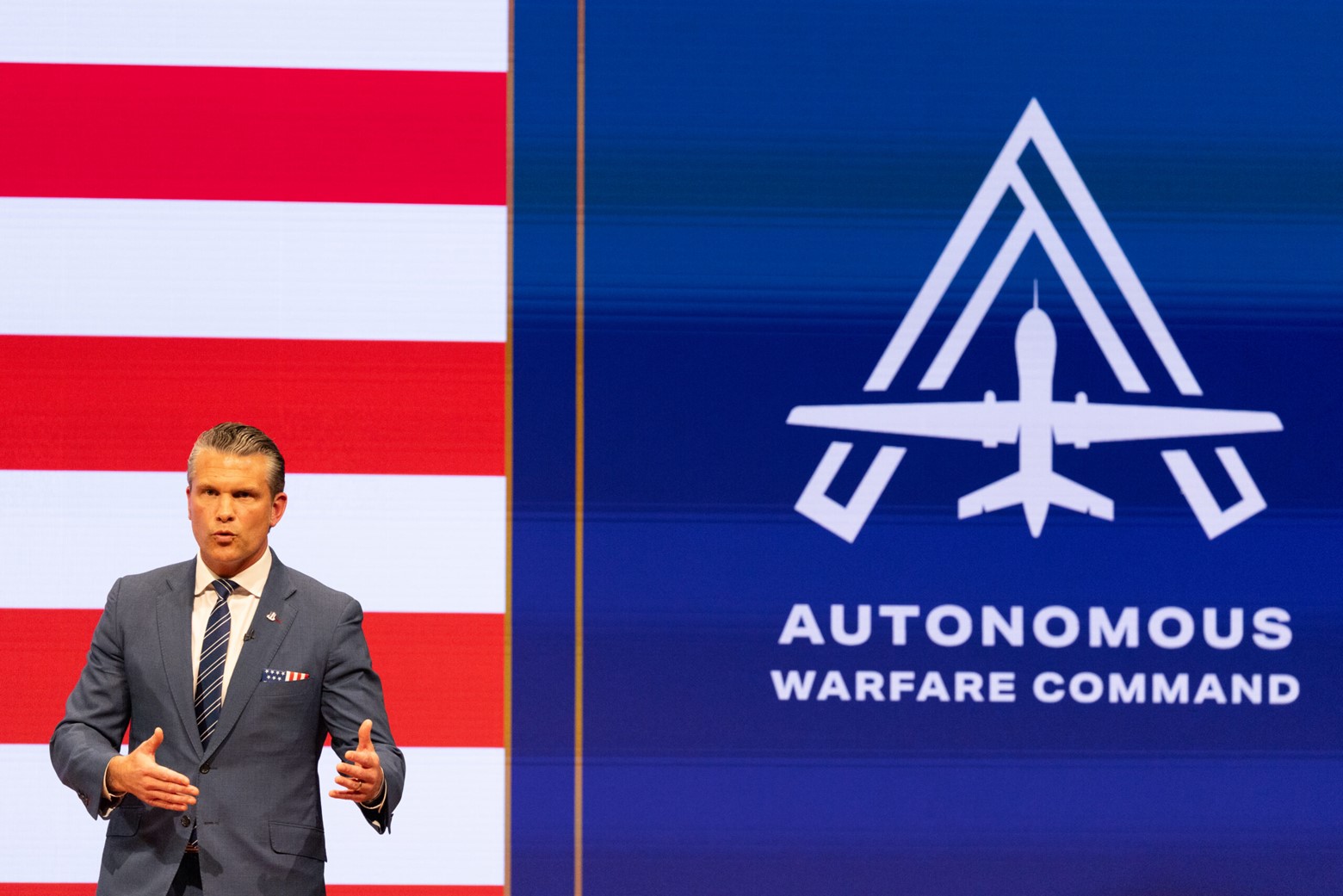
On September 30, Pete Hegseth announced Project Meridian alongside a proposed Autonomous Warfare Command and the Fortress America initiative. Meridian would examine future military capabilities, while the new command would organize the expansion of autonomous and robotic systems. Fortress America would address the resilience of bases and supply chains. These are related initiatives, not a single approved war plan.

U.S. service members at the State of the Force address, Quantico, September 30, 2026

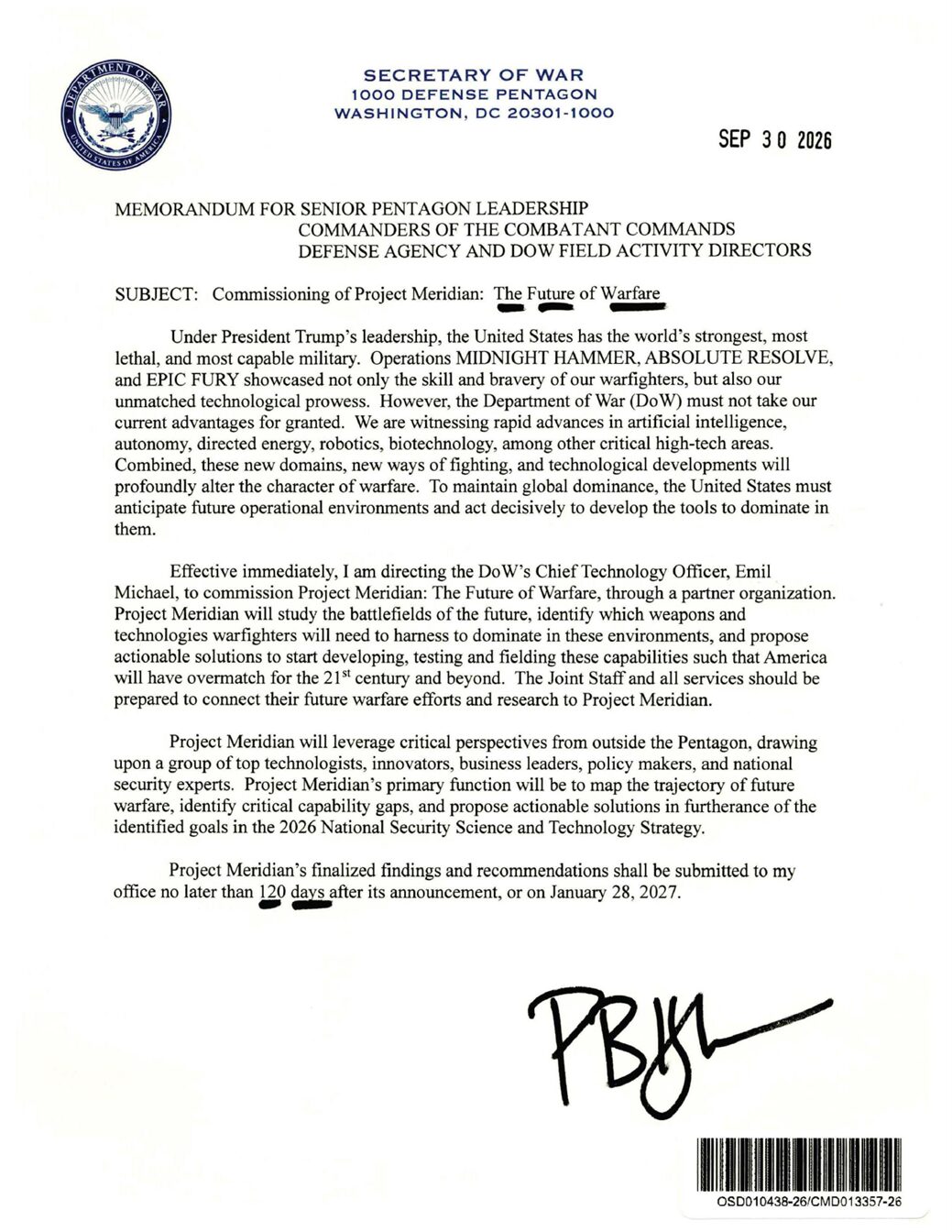
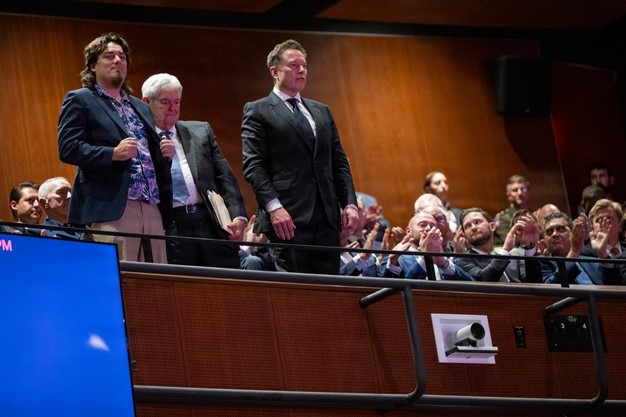
Meridian’s advisers include Elon Musk, Palmer Luckey, and Newt Gingrich, under Pentagon technology chief Emil Michael. The study has 120 days to report. Its significance is not that three men can invent the next war. It is that major technology suppliers are being invited to help define the military capabilities Washington should pursue.

The September 30 memorandum commissions a study of future warfare

The State of the Force event at Quantico, where Project Meridian was announced, September 30, 2026

Some of the supporting infrastructure already has funding. On May 26, Space Systems Command awarded SpaceX a $2.29 billion agreement for the Space Data Network Backbone. A fully operational prototype is due by the end of 2027. The intended function is to connect military sensors and weapons through a high-capacity orbital communications network.

That addresses a real military requirement. Information has limited value if it cannot reach the people or systems that need it. But a larger network does not automatically become a more dependable one. The test is whether useful connections survive disruption, and whether units can continue operating when they do not.

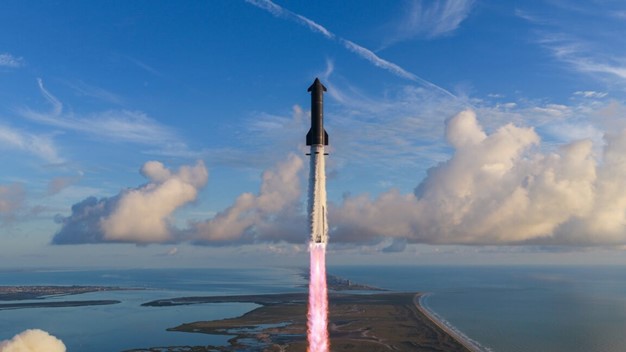
Heavy-lift rockets could support the deployment of larger satellite constellations, although these programs do not yet amount to a single publicly defined architecture. Starship Flight 14 reached orbit on September 28 and deployed 26 Starlink V3 satellites. That demonstrated payload delivery, not every capability promised for the rocket. Reaching orbit once and providing dependable, economical military infrastructure are different milestones.

Starship Flight 14 launches from Starbase, September 28, 2026, carrying 26 Starlink V3 satellites

Starship’s final descent, landing burn, and splashdown during Flight 14, September 28, 2026


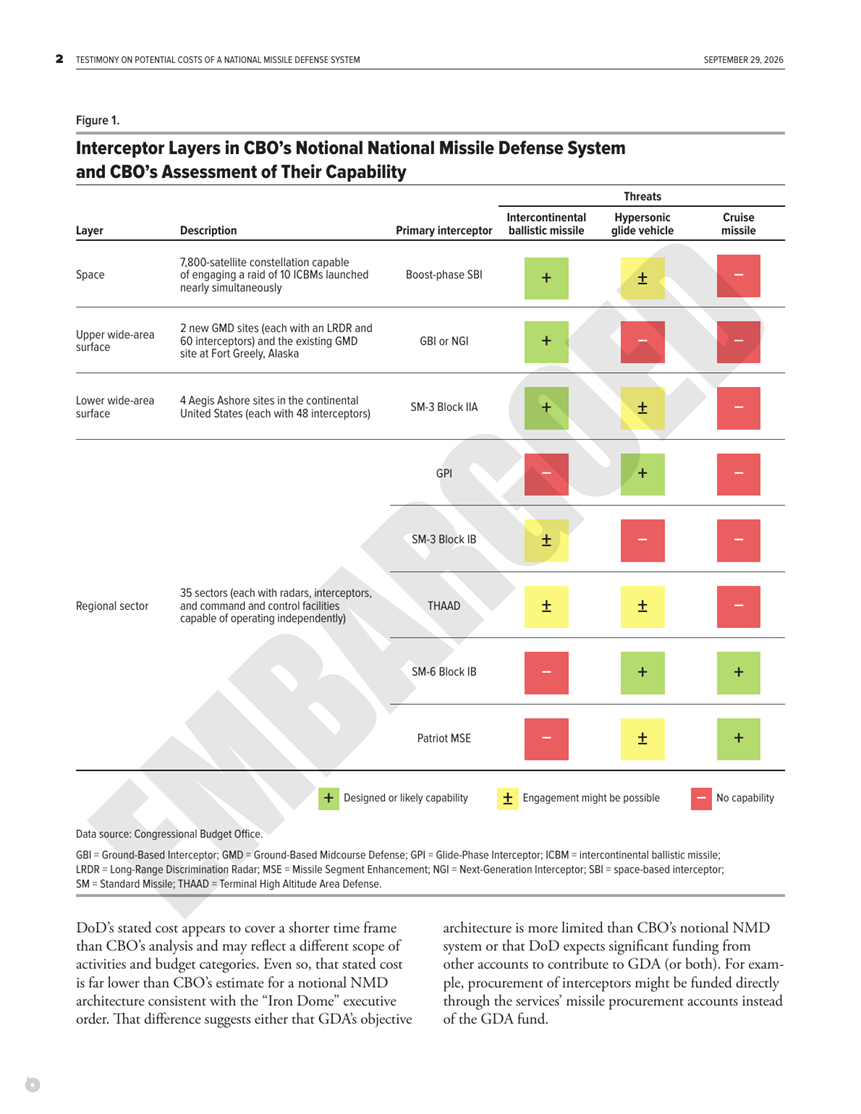
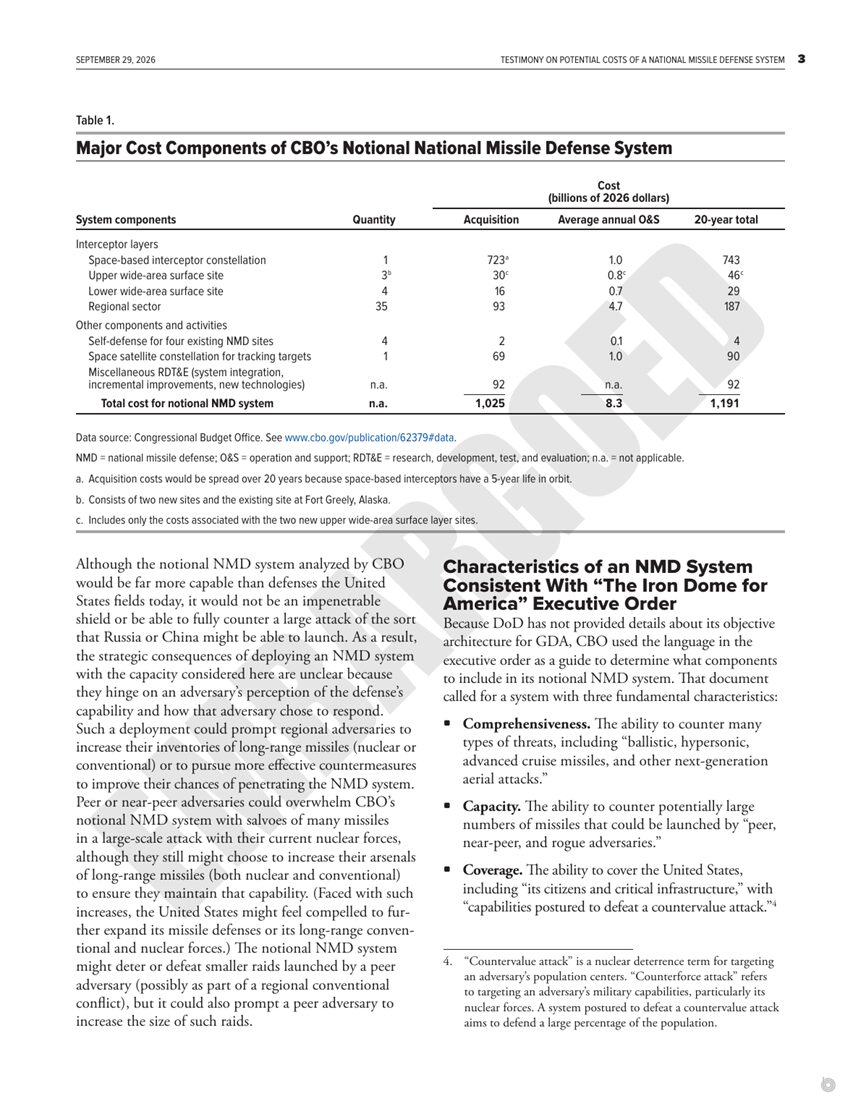
Golden Dome extends the ambition to missile defense. In May, the Congressional Budget Office estimated that a notional system consistent with the administration’s stated objectives could cost about $1.2 trillion over 20 years. Crucially, this was not a price tag for the Pentagon’s approved design. The final architecture had not been publicly disclosed.

A notional national missile-defense architecture assessed by the Congressional Budget Office

Estimated costs of the Congressional Budget Office’s hypothetical system, expressed in 2026 dollars

The policy risk is not simply excessive ambition. It is defining military problems in ways that favor the products already offered by influential suppliers. That deserves scrutiny without assuming that commercial involvement makes every proposal useless. A contract is evidence of spending. It is not evidence of battlefield superiority.

Elon Musk, named a co-leader of Project Meridian

Machines Still Need Factories

The American approach emphasizes integrating ambitious systems through large institutions. The battlefield experience points toward an equally important requirement: changing ordinary systems quickly.

These approaches are not mutually exclusive. Satellites and inexpensive drones can support the same force. The tension lies in their development cycles. A major space program cannot be redesigned every few weeks. A frontline drone or its communications equipment may lose effectiveness if updates take years.

The industrial base must therefore support both continuity and rapid revision. Ukraine’s drone sector demonstrates the importance of close feedback between operators and developers, but also the vulnerability of assembly dependent on imported components. A domestically assembled aircraft is not necessarily an independently sustainable capability.

Russian developers are also discussing the problem in terms broader than individual weapons. In September, the Ushkuynik center presented a drone assembly line housed in a modified shipping container. The proposal illustrates an effort to distribute production rather than concentrate it in a single factory.

These are developer proposals, not independently demonstrated solutions at national scale. Nevertheless, they identify two important problems: distributing production and closing gaps between separate defensive systems.

A workshop, a repair team, and a reliable component supplier may therefore matter as much as another model advertised as revolutionary. Military adaptation requires people who can identify a failure, explain it to engineers, approve a modification, and return workable equipment to service.

Autonomous Warfare Command: new drones, familiar geometry. All that’s missing is the secret handshake

Autonomy does not remove these obligations. The meaningful question is which task a machine can perform reliably without continuous human input, under what conditions, and with what consequences when it fails. “Autonomous” should describe a tested function, not serve as a substitute for explaining one.

Fortress America recognizes another dependency. Hegseth’s stated aim is for military installations eventually to operate under their own power, alongside stronger protection and domestic supply chains. Yet independence from the civilian grid would not by itself eliminate the need for fuel, spare parts, communications, or skilled maintenance. Resilience must extend beyond the perimeter fence.

The same principle applies at the front. Engineering and logistics deserve attention alongside strike footage. They show how forces sustain movement and support combat units, rather than merely how they destroy a target.

From Remote Control to Robotic Forces

The next stage of warfare is unlikely to resemble an army of humanoid machines replacing soldiers. A more plausible future is a force in which people fight alongside growing numbers of specialized robots, from reconnaissance aircraft to ground vehicles carrying ammunition, evacuating casualties, and supporting assaults.

That transition is already underway. Both Russian and Ukrainian forces are using ground robots for logistics, evacuation, and other battlefield tasks. In September, Ukraine’s Defense Ministry reported that its ground systems had completed more than 25,000 supply and evacuation missions in August alone. The figure is an official claim, not an independently audited total, but it illustrates how far the ambition extends beyond occasional demonstrations.

Over the next five years, the important change may be the organization of these machines into working formations. Aerial drones could scout ahead while ground robots move supplies and support troops. Humans would still set objectives and handle situations the machines cannot reliably interpret. The advantage would come from coordinating those different roles, not simply putting more unmanned vehicles on the battlefield.

Remote control, however, is not autonomy. A vehicle that needs continuous steering from an operator remains dependent on communications and human attention. Greater autonomy could allow machines to navigate, avoid obstacles, or complete limited tasks when a connection fails. None of those functions automatically makes a robot capable of independently identifying legitimate targets or deciding when to fire.

The likely result is a race between robotic capability and countermeasures. More machines may reduce the number of soldiers exposed on supply routes, but those machines will themselves become targets. Communications, batteries, maintenance, and replacement parts will remain constraints. Robotization moves some risks away from people; it does not abolish the costs of war.

Nor will inexpensive robots make heavy weapons obsolete. Small drones, armored vehicles, artillery, and aircraft perform different jobs. The stronger force will be the one that combines them effectively and changes that combination faster than its opponent.

Meridian should be judged against this prospect, not the grandeur of its language. Can Washington build systems that cooperate, survive disruption, and remain affordable enough to replace? Can its procurement machinery adapt as quickly as the battlefield demands?

The next war will not be won by whoever unveils the most impressive robot. It may favor the side that can lose machines without losing momentum, preserve human judgment without slowing every decision, and turn battlefield lessons into production before the enemy does. The real revolution is not a machine that looks like a soldier. It is an army that learns to fight differently because machines are now part of its ranks.


MORE ON THE TOPIC:

The post The Future of War: What the Battlefield Teaches and the Pentagon Wants to Buy appeared first on South Front.

Ethiopia at war, the Horn of Africa is set to explode

By: A A
5 October 2026 at 12:14

The failure of international diplomatic efforts to resolve the Ethiopian war is storing up an even bigger disaster for the Horn of Africa.

Join us on Telegram, X, and VK.

Contact us: info@strategic-culture.su

War has flared up again in Ethiopia, Africa’s second most populous country, in a region near the strategically important Red Sea, which is already boiling with tension.

Hundreds of casualties have been reported in recent days from fighting centered mainly in Ethiopia’s northern Tigray province, but which is also spreading to other parts of the East African country bordering Somalia, Eritrea, Sudan, and Kenya.

Ethiopia’s central government in the capital, Addis Ababa, accuses regional neighbors Egypt, Sudan, and Eritrea of supporting rebel factions based in Tigray.

The Horn of Africa is already beset with wars in Yemen and Sudan and historic disputes between neighbouring countries over borders and natural resources. The region is an ongoing humanitarian disaster, with millions of people without food and facing displacement. The renewed conflict in Ethiopia could draw in several countries and turn the whole region into a catastrophic war zone.

Ethiopian journalist Mickael Minassie explains the background to the current upsurge in conflict and the danger of a wider international war embroiling several nations.

Minassie says that the Ethiopian civil war that blew up in 2020 between the federal government of Prime Minister Abiy Ahmed and the Tigray People’s Liberation Front did not really come to an end with the signing of the Pretoria Peace Accord in 2022.

He says the Abiy government continued to wage a low-intensity war against the Tigray region, imposing an economic and food aid blockade on the war-torn territory, thereby intensifying severe humanitarian conditions.

This is why the conflict has resumed, he says. Peace was never implemented. And the “Abiy Ahmed regime” used the peace deal as a cover for continuing to wage war by other means. The recent response of the Tigray region, allied with other Ethiopian rebel groups, is an act of desperation to break from the oppressive conditions imposed by the central government.

He criticises the international community for not upholding the 2022 peace accord and ensuring compliance.

Minassie points to ominous international dimensions of the conflict.  The Ethiopian central government has served as a proxy for the United Arab Emirates by supporting the RSF insurgents in Sudan. The UAE is believed to be financing the Abiy government with military aid and weapons, including drones.

The United States has also recently signed a new regional security deal with the Abiy government. No doubt, to gain greater access to the Red Sea region for strategic advantage against Yemen’s Ansar Allah government, which has imposed a blockade on Israeli and Saudi shipping.

Minassie says that the international community has been silent about the violations committed by the Abiy government, which has emboldened it to continue aggression against the Tigray people.

Russia and China have also given diplomatic support to the Ethiopian central government, according to Minassie. Notably, Ethiopia has gained membership of the BRICS forum, with virtually no criticism from Brasília, Moscow, New Delhi, Beijing, or Pretoria over its lack of implementing the 2022 peace accord.

He says that the international community has turned a blind eye to the conflict in Ethiopia. The death toll among the Tigray population during the 2020-22 phase of the war is estimated by the United Nations at 600,000, which is about 10 per cent of the total. This death toll compares with some 20,000 civilian deaths in the Ukraine war – about 300 times greater. Western media has been saturated with reports on the Ukraine war, especially to portray Russia as the villain. Yet Western media reporting on Ethiopia has been negligible by comparison.

The failure of international diplomatic efforts to resolve the Ethiopian war – a war of genocidal dimension – is storing up an even bigger disaster for the Horn of Africa. The impact on global trade and mass migration portends that Europe, in particular, will suffer immense repercussions.

The Ethiopia–Tigray Crisis: The Fragile Peace That Failed to Hold

5 October 2026 at 09:30
The Pretoria Agreement brought an end to Ethiopia’s devastating Tigray war—but not its underlying disputes. Four years later, renewed fighting and shifting armed alliances are threatening to reopen the conflict. The consequences could extend far beyond Tigray, destabilising the wider Horn of Africa. Ethiopia’s fragile post-Pretoria peace is rapidly unravelling as renewed fighting between federal […]

Ghana splits 5G licences between Telecel, MTN

5 October 2026 at 09:23

Ghana awarded 5G spectrum licences to Telecel Group and MTN’s local unit, ending the exclusive wholesale-network model previously used for the country’s 5G rollout, Bloomberg reported.

The exclusivity previously belonged to Next-Gen Infrastructure Company (NGIC), a joint venture (JV) combining Reliance Industries’ Radisys unit, Tech Mahindra, Nokia, and the Ghanaian government, alongside local partners Telecel and AT Ghana.

The JV aimed to reproduce India’s low-cost mobile data model by allowing operators to share infrastructure, but rollout delays prevented it from meeting its targets. Ghana’s government cancelled NGIC’s concession years before its scheduled expiry in 2034 and moved to direct competitive bidding.

Under the new arrangement, Telecel and MTN will build out their own independent networks.

“We plan to launch the service in December this year on our own network,” Telecel CEO Moh Damush told Bloomberg.

Ghana had 49 operational 5G sites earlier this year, compared with a target of 1,200 by 2027. The new licensing model allows established operators to use their existing network footprints to expand coverage. A filing on the Accra bourse showed MTN secured two lots of 700MHz spectrum and three in the 3GHz band, with each 15-year licence priced at about $100 million.

The post Ghana splits 5G licences between Telecel, MTN appeared first on Mobile World Live.

The struggle for African unity today, an interview with Hakim Adi

5 October 2026 at 06:39

Wars, neocolonial destabilization, the “aid” ideology, and the influence of Western financial institutions have sabotaged the African continent from the inside and kept it in a state of economic dependency. Yet its peoples have consistently expressed a desire for sovereignty and a rejection of external interference. 

What current manifestations of the struggle for African unity can we observe nowadays, and what continuity can be drawn with the Pan-Africanist movement of the 20th century? In the context of Trump’s administration US policies, which are targeting migrant workers, and the promotion of far-right ideology in the capitalist countries, can we say that African diasporas still play an important role in these challenges and in the emergence of a new Black power? 

Professor Hakim Adi, the author of “Panafricanism: a History” was interviewed by Alex Anfruns, a journalist and researcher, on the African struggles for emancipation.

“History has shown us that an attack on anyone

 is an attack on everybody”

Alex Anfruns: Let’s start from a chronological perspective. In the 1950s there were different strands within the Pan-Africanist movement that, despite sharing common goals such as anti-racism and anti-colonialism, diverged in their views on the liberation struggle. Which key figures and moments of that Pan-Africanism debate would you highlight?  

Hakim Adi: A key moment was the 1958 All African People’s Conference, which was held in Accra, Ghana, organized by two of the leading Pan-Africanists at the time: Kwame Nkrumah who was prime minister of Ghana, and George Padmore who was a Trinidadian Pan-Africanist and had been the main organizer of the famous 1945 Manchester Pan-African Congress. That Conference held in1958 was a very important moment because at that time there were very few independent African countries. Ghana had just become independent, it had achieved its formal political independence from Britain.

Some countries were still fighting for their independence like Algeria … one or two countries were already independent but most of the African continent was not yet independent … So it was very important to have this conference to bring together people from across the African continent, as well as some from the diaspora, and to discuss the necessary unity between Africans and also the politics of Pan-African liberation. It was a very successful conference in the sense that it brought together many different people, leaders from across the continent, like Felix Moumié from Cameroon, Joshua Nkomo from Zimbabwe, Patrice Lumumba from Congo and many others, including many organizations…

One of the key participants was Frantz Fanon. He was a Caribbean and Martinican Pan-Africanist, who personified Pan-Africanism, as even though he came from the Caribbean, he gave much of his life to the liberation struggle in Africa, and he was a representative of the FLN in Algeria at that time. He came to that famous conference and put forward a perspective of the liberation struggle in Africa which was different to the perspective of the main organizers of the conference, Nkrumah and Padmore. They had argued that Pan-African liberation could be non-violent, if people were organized properly and so on…

Fanon came along and based on his experience, and indeed the experience of other countries in Africa, he put forward a different perspective and said that force and violence might be necessary to truly liberate Africa. So this was a very important moment: the recordings and personal memoirs of that conference highlight Fanon’s intervention, that he created a great debate, so that the organizers even tried to find ways to combat Fanon’s ideas … It demonstrated a major difference within the Pan- African movement at that time: how to actually achieve liberation?

It’s interesting that in 1945 in Manchester the conference congress decided that force would be necessary to achieve anti-colonial liberation. By 1958 two of the key participants in the Manchester Conference had changed their minds. Fanon had the experience of the Algerian revolution and therefore said: “hold on a minute, it may well be the case that force and violence is necessary.” So I think this is a very important moment and a significant difference between these key Pan-Africanist figures of the 1950s. Of course there are many others but I think that’s a good example of the differences which emerged in the movement at that time.

AA: In your other seminal work, you have exhaustively analyzed the relationship between Pan-Africanism and communism. How did communism influence the Pan-African movement during the fight for independence?

HA: When we talk about communism as it developed historically, we can define it as the condition for the liberation of the wealth producers, the workers. This is what communism is about. The communist movement of the 1920s, the 1930s, of the Third International took a very great interest in the liberation struggle in Africa as well and in other parts of the world. Just as Pan-Africanists in the US and Africa and the Caribbean and everywhere else took a very great interest in communism and the impact of the Russian Revolution, the ideas of Lenin and the Bolsheviks and so on.

People in Africa and in the diaspora were used to the impact of capitalism, to what the capitalist-centered system meant. It meant enslavement, it meant colonial rule and the division of the African continent. While the Russian revolution showed that this entire political system could be brought to an end, there was an alternative to it. That alternative opened many possibilities, for a different kind of society, where the majority of the people made the decisions, a society in which people who spoke different languages and different nations could live together.

The other thing that the communist movement brought to the colonies was a perspective of how you could struggle. If we look at the 1930’s, 1940’s, at that time generally speaking the approach of the Pan-African movement was to petition the big powers, the colonial powers, to say to the big powers: “hang on, colonial rule should be reformed, it should be made better and nicer…”

The communists said “that’s not going to change things”. What is going to change things is the organization of the masses of the people: organizing amongst the farmers, workers and so on. Secondly, the communists argued that force may need to be used and probably will need to be used to remove this system. And thirdly, this anti-colonial struggle of masses of people should be in unity with the struggles of people all over the world, whether in Europe, America, Asia, etc., who were struggling for common aims.

The communist movement brought this perspective to Pan-Africanism and was very influential during that period but also influential in the latter period: the 1940s, 1950s, 1960s. If we think about some of the key liberation struggles that took place in Africa in the period from the 1960s onwards, especially after Nkrumah was overthrown, but even before were influenced by Marxism. The liberation struggles in Angola, in South Africa, in Mozambique, in Zimbabwe, etc.

On September 12, we celebrated the anniversary of the birth of Amilcar Cabral, one of the greatest Pan-Africanists and leader of the liberation in Guinea-Bissau and Cabo Verde, who was also influenced by Marxism. If we think of the big figures in the South African struggles, they were all communists: Nelson Mandela, Walter Sisulu, etc. So, the influence of communism in general and Marxism were a very big influence on the Pan African movement in general.

AA: Would you say that events like Lumumba’s assassination and the long Algerian War pushed new African countries toward a more radical Pan-Africanism?

HA: I don’t think so. It was a very difficult period: first of all, the 1950’s, 1960’s and 1970’s, was in the midst of the cold war. The influence of anticommunism was immense and had a massive impact on Africa as well as on other parts of the world. This put pressure on African countries to do the impossible, to trying to find a way of achieving some kind of independence within the boundaries established by the big powers,

You might say that the fact that Algeria had to fight a war of ten years towards its liberation, that people in Kenya had to fight a war in order to achieve its liberation and other countries … this would have made clear to people in Africa the kind of struggle that was necessary…

Also the fact that in a country that had just achieved the independence like Congo, the big powers like Belgium, US and others could organize a mutiny within the army, could divide a country, arrest its leader and murder him … those facts would galvanize the whole continent and would have created a very different kind of Pan-Africanism. In fact, these events and particularly the arrest and murder of Lumumba did galvanize the continent amongst the masses of the people. It was a major event, but as far as the states were concerned, the governments were concerned, it was a different matter.

This is one of the things that we have to remember about this period: that the sixties were entering into the era of Pan-Africanism of states, and these states, even the most radical ones, we can call them, like Ghana, Algeria, Guinee perhaps, they operated within the conditions of that time. They tried to find a way of organizing that perhaps didn’t completely involve struggle, they tried to seek some kind of accommodation with the big powers. The majority of countries, especially the francophone countries, for example, maybe with one or two exceptions, nearly all of them stayed within the orbit of French imperialism.

It was a very difficult period and I don’t think those events in themselves pushed African states into different positions. It showed the limitations of this new independence, because African countries apparently had an independent state but then with a leader like Lumumba emerged, who showed a tendency to charter an independent cause, he was just removed like that by the big powers.

We saw the same thing a few years later when Nkrumah was removed, and that happened to many other leaders: Felix Moumié was assassinated in Cameroon. It showed more the strength and ruthlessness of the big powers, particularly the assassination of Lumumba. The struggle in Algeria did show what could be achieved by organizing among the majority of people and through armed struggle, but in most cases that wasn’t the course that was taken by African states.

AA: What do you think about the way Nkrumah and other liberation fighters analyzed neocolonialism in that period?

HA: There were analyses of neocolonialism by Nkrumah, Fanon and others but by then it was almost too late, Africa and Africans were not in the position to do very much about it, other than embark on new forms of struggle. These were lessons for the future. Neocolonialism meaning a new form of colonialism, where there appears to be an independent state, and an independent government and country but there is in fact a government which is tied to one of the old colonial powers, or perhaps a new power by economic ties, by military or political ties … and therefore it’s not operating in an independent way. Many people would argue that most of the states in Africa since the 1960s have been this kind of state. They have anthems and flags but they do not pursue independent paths that favor the majority of their citizens.

Nkrumah’s solution, or one of the things that Nkrumah argued for, was a United States of Africa, that if African countries could get together, they could be stronger economically, politically and perhaps also militarily, and that unity which would be able and strong enough to deal with neocolonialism.

The problem was that the nature, the characteristics of neocolonialism already existed in the 1960’s. And so the states that he was appealing to, for the United States of Africa were already essentially neocolonialist states, under the influence of the French, the British, the Belgians, and others, and so it became very difficult to unite in a way that Nkrumah envisioned.

Fanon wrote an incisive analysis of what neocolonialism was, how it worked, the reasons why it came about, the fact that it was a particular class of people that came to power, that economically they were dependent on foreign interests, and so on. That’s useful for everybody else, but for those governments existing in Africa, as well as in other countries, it hasn’t and could not have had a major effect.

What is important in the African context was that at least with all its limitations, these governments were able to come together in 1963 to form the Organization of African Unity. And with all its limitations, to struggle to unite for the liberation of the rest of the continent, from settler colonialism, so in other words against the colonial states: South Africa, Namibia, Rhodesia, Zimbabwe … So they united to achieve those victories, but to go beyond that, we haven’t really seen too much other evidence. Indeed, even the African states recognized the limitations of the OAU and replaced it with the AU.

AA: In your book, you address the ongoing debates that shaped Pan-Africanism across different geographic regions, highlighting its vitality and the diversity of expressions within the movement. What shared goals did diaspora activists have, how did they connect with Africa, and what challenges did they face fighting from inside Western countries?

HA: Yes, I suppose the most well-known activist who many people like is Malcolm X in the US, and the Black Panthers in the US and so on. And there were other activists like Walter Rodney in Guyana and so on. I think that for all of them and many others Africa was a great inspiration, Malcolm X is the best example. He traveled to Africa in the 1960’s he was impressed with the fact that these countries were becoming independent, that Africans were beginning to determine their own affairs and make their own decisions.

In his speeches he constantly talked about the importance of Africa and African liberation. To such an extent that when he formed an organization he called it the Organization of African-American Unity, the OAAU. And to such an extent that he called the African leaders to take responsibility for those in the diaspora, saying that “we are the lost sheep and you are the shepherds and you should be concerned with us as Africans, as people with African heritage, and fight for us in the United Nations” and so on …The Black Panthers similarly even had at one time a headquarters in Algiers, and they were influenced by struggles that were going on in Congo and many other places.

But as Malcolm X and the Panthers found out the struggles were different, although one could influence the other. We have to remember that the kind of politics which emerged in the US in the 1960’s, we tend to talk about it as Black Power, also had its influence in Africa, particularly amongst people like Steve Biko and the Black Consciouness movement in South Africa. But the struggles were different, they were struggles that were made in the US, although they were struggles by African people, there were  struggles within the confines of the US and that meant that African Americans had to struggle alongside others in the US. The most far-sighted recognized that, people like the Black Panthers, they recognized they had to organize alongside other population groups within the US, and so they realized that liberation meant an alternative to the existing political and economic system.

Again, Malcolm X recognized that those who were oppressing African American in the US were also oppressing people in Africa. So removing that oppression, fighting to remove that oppression in the US would also help those in Africa. But, of course, they had many difficulties and many problems based on the way they organized, and also the fact that the US attempted to wipe them out, assassinated many of the leaders, including Malcolm X and many leaders of the Black Panthers, and imprisoned them …That was one of the main issues.

And then for someone like Walter Rodney, who was best known as an intellectual, a writer, an historian, and perhaps made the greatest impact in that way, but also in his analysis of what was going on in Africa, because he was involved in the work leading out to the 6th Pan-African Congress in Dar es Salaam in Tanzania in 1974. If we look at what he wrote, he was very critical of neocolonialism, critical of many African leaders including Nkrumah, and many Pan-Africanists like Georges Padmore, he said that they had lost their way, they lost sight of class struggle, that there were different classes involved and you had to struggle against them, as well as against the imperialist system of states, that you couldn’t just do things peacefully, without changing fundamentally the political system and the economic system.

He was also a victim of state’s terrorism, because he was assassinated in Guyana at a very young age. Those were some of the problems they faced, but there were many others…

AA: How are people fighting for African unity today, and how does it connect to the 20th-century Pan-African movement?

HA: Again, it’s very, very, difficult conditions today, it’s very complicated. I think the best example of modern Pan-Africanism would be something like the reparations movement. It is a movement for repair, to be carried out for the crimes of enslavement, of human trafficking, of colonialism and so on … and if we look at this struggle for reparations, that existed since the 20th century … even the 17th century! It has been one of the key elements of Pan-African struggles throughout the centuries, that restitution needs to be made, that repair that needs to be made for these crimes that have been carried out against Africans.

But if we look at that movement today, we see that it is headed by states. There has recently been a big conference in Barbados in the Caribbean about the reparation struggles, but it is led by the Organization of Caribbean States (CARICOM), the Organization of African Union (AU). Although these two organizations work together, there are differences within them and between them. Individuals and countries also have their own particular concerns, for example Algeria had a very big conference last year on the question of colonialism as a crime against humanity. It’s not a new perspective, but this is something that should be highlighted.

So we have these slightly different perspectives. Those in the Caribbean are most concerned with slavery, human trafficking, those in Africa are slightly more concerned with colonialism. These movements and organizations come together, but they are organizations of states. Then there are non-state actors in Europe, in the US, in the diaspora in general who say “hang on a minute, we are not being represented by any states, or more importantly we’re not represented in these deliberations.” It could be argued that the states don’t really have much of a mandate to represent the peoples of Africa and the Caribbean either, because they are not consulted any more than those in the diaspora outside these states.

So we have a movement which is very powerful, it is being discussed in the news all the time, there are conferences, it’s gathering momentum, but there are all kinds of tensions and contradictions within that make it quite difficult, yet it’s a very long lived movement that goes back to the 17th century … So it’s a very important movement and how it develops remains to be seen.

AA: How is the anti racist movement in the US and English-speaking world dealing with Trump’s anti-migrant policies?

HA: Well, the anti-racist movement is not only in the US, because it’s also important in Europe and elsewhere. In the US it’s a broad movement, it has different facets to it, because the Trump government in particular is launching an assault on everything: so we find first of all that it’s an attack on books, even the books that could be held in public libraries, school or university libraries are under attack, and are being banned or being burnt, that’s one struggle. And the next struggle is to defend books by black writers, about anti-racism, and books about all kind of other things too, because other people are also being attacked. Then there is an attack on the general principle of equality, what in the US they call the DEI (Diversity, Equality and Inclusion), in terms of employment, particularly in universities but also in government departments, public institutions … they’re also under attack.

Then there are other attacks, various forms of state racism, attacks by the police, and so on, then there are attacks by immigration officials, by ICE, then there are just general attacks that come from the government about people who they deem to be immigrant, or from immigrant backgrounds, since Trump makes racist speeches against Somalis, Haitians and others … So these are very serious escalations of attacks and they have influence also outside of the US, including in Britain and other countries as well, it then became seen as almost acceptable that somebody can be attacked.

We’ve recently had a case in Britain a Black professor in the University, we don’t have many Black professors, who was accused by some self-confessed racist of plagiarism, and this accusation was taken up and repeated by the whole of the British press, it was on the TV … and the consequence is that this young professor took his life … This was an openly racist attack, and there are many other manifestations.

Of course, those in the US are organizing, and I think the key again of this organizing is that it cannot be only African-Americans, or those from the Caribbean organizing, but people in general have to be organized against this attack on their rights, because history has shown us that an attack on anyone is an attack on everybody. So everybody has to organize against these attacks. So yes, these are very important struggles and of course they are linked to other attacks which the US are launching internationally against Cuba, Venezuela, Iran, Canada … against everybody else, against whoever. So it’s a very dangerous situation in the US and everyone needs to get together, but the Pan-Africanists have to be part of this broad struggle to change the situation in the US, Britain, and elsewhere.

Hakim Adi is an internationally renowned historian based in London, and the author of the book “Pan-Africanism: A History,” already published in Spanish, French, Portuguese and many other languages.

Prospects of Dangote East Africa Petroleum Refinery: Industrialization and Self-Sufficiency

4 October 2026 at 09:59
The construction of an oil refinery in the Kenyan city of Lamu is a strategic project that will enable East African countries to increase the added value of their natural resources, achieve energy self-sufficiency, and strengthen the region’s economic and political independence. The proposed East African refinery in Lamu will refine crude from Turkana, estimated […]

Three Colombians deported by Trump to Africa seek protection in Spain: ‘I don’t feel anger toward Congo, I feel it toward the US’

4 October 2026 at 05:00
Carlos Rodelo, in a park in Valencia on September 26, 2026.

A Spanish police patrol car passes through one of Valencia’s largest parks and Lorena López, a 29-year-old Colombian woman, freezes and completely loses focus in her boxing class. She remembers the U.S. agents who held her for a year and a half at the Eloy Detention Center in Arizona and the officers from the U.S. Immigration and Customs Enforcement (ICE) who deported her, handcuffed at hands and feet, to the Democratic Republic of the Congo (DRC) on April 15, 2026. When she sees the officers, she also recalls the armed men she and 14 other Latin Americans encountered at the hotel where they were held in Kinshasa for two months. But then she immediately realizes that since she was able to leave that African country in June she is free and safe in Spain.

Seguir leyendo

Lorena López (from behind) and Carlos Rodelo in a park in Valencia on September 26, 2026.

Colonialism Did Not Die — It Changed Its Suit for New Clothes

How Europe and the U.S. cynically turned Africa into a “cage without bars.” In 1960, remembered in history as the Year of Africa, 17 countries on the continent gained long-awaited political independence. It seemed that the nearly 500-year era of Western European empires had sunk into oblivion. But if you look closely at socioeconomic indicators, […]

Juan Luis Arsuaga, paleontologist: ‘Corruption is very Paleolithic, very chimpanzee-like’

3 October 2026 at 05:00
Paleoanthropologist Juan Luis Arsuaga at the Carlos III Health Institute in Madrid.

In his latest book, La respuesta (The Answer), 71-year-old paleoanthropologist Juan Luis Arsuaga, from Madrid, explores the pivotal moments of human evolution. There are the living — us — the extinct — like the Neanderthals — and those on the verge of extinction — the great apes such as chimpanzees, orangutans, and gorillas. Unlike his previous work, the co-director of the Atapuerca archeological site in northern Spain takes a firm stance: he clearly states his opinion on numerous theories that attempt to answer the most fundamental questions: Who are we? Why are we here? Where are we going?

Seguir leyendo

Juan Luis Arsuaga holds a reproduction of the 'Miguelón' skull found in the Sima de los Huesos of Atapuerca, at the Carlos III Health Institute in Madrid.Arsuaga studies a three-dimensional reproduction of a skull using anaglyph glasses.

The Spirit of Shanghai: A review of the SCO’s first 25 years

By: A A
2 October 2026 at 15:28

From the Shanghai Spirit to the Bishkek Declaration, the security-first organization prioritizes pragmatism over ideology.

Join us on Telegram, X, and VK.

Contact us: info@strategic-culture.su

Security first

The recent summit of the Shanghai Cooperation Organization (SCO), held in Bishkek, marked the 25th anniversary of the founding of what, in the landscape of international institutions, represents a particularly interesting case study. Born from the ashes of Soviet-Chinese confidence-building measures and transformed into a full-fledged organization in 2001, the SCO has spent a quarter-century consolidating an institutional framework that now functions effectively: annual meetings of the Council of Heads of State, regular interministerial meetings, and day-to-day cooperation that is developing along increasingly complex lines.

However, this anniversary offers an opportunity for reflection that goes beyond mere celebration. The question that emerges most forcefully is: what role do values play within the SCO? And how does this value-based dimension relate to the seemingly more pragmatic dimension of security and functional cooperation? An analysis of the founding documents and subsequent declarations reveals a complex trajectory that deserves in-depth examination.

From its very inception, the SCO has made security cooperation one of its top priorities. This choice is no accident: the organization’s prehistory is rooted in Soviet-Chinese confidence-building measures, both regarding border issues and broader aspects of mutual security. The “Shanghai Five,” an informal group that preceded the SCO’s official establishment, found its primary unifying force precisely in the management of security issues and the building of trust among its members.

This original specialization has had lasting consequences. Even as the SCO has expanded its scope over the years to encompass increasingly diverse sectors, security has remained the linchpin around which the entire organizational architecture has developed. In a sense, as the analysis astutely notes, the SCO can still be defined as a specialized international organization focused on a single primary priority, despite its evolution toward more comprehensive forms of cooperation.

The comparison with the BRICS – a genuinely all-encompassing cooperative framework operating across a wide range of fields – is particularly illuminating. While the BRICS have developed an increasingly sophisticated values-based platform over time, with declarations that devote considerable space to issues of common and shared values, the SCO has maintained a more markedly operational approach that is less rhetorical on the values front.

The SCO Charter: Principles without values

A particularly significant finding emerges from an analysis of the SCO’s founding document. The Charter, signed on June 7, 2002, and which entered into force on September 19, 2003, makes no mention whatsoever of the term “values.” Instead, we find a dedicated article – Article 2 – significantly titled “Principles.” It is on these principles that the SCO bases its activities.

These principles include: mutual respect for sovereignty, independence, territorial integrity, and the inviolability of state borders; non-aggression; non-interference in internal affairs; non-use of force in international relations; equality of all member states; peaceful resolution of disputes among member states; and the SCO’s non-targeting of other states. A particularly revealing principle is that of the phased implementation of joint actions in areas of common interest.

This last principle – that of “phased implementation” – goes a long way toward explaining how the SCO operates and the expectations, sometimes excessive, that surround its activities. The disappointment that sometimes accompanies assessments of the organization – the notion that “nothing happens beyond the summits,” which circulates in certain circles – finds its explanation precisely in this principle. This is not a flaw, but a deliberate and foundational choice: to proceed step by step, consolidate the results achieved, and avoid missteps.

The absence of the term “values” from the SCO Charter is perfectly understandable and in no way diminishes the level of mutual trust among member states. It is worth noting that, even in the case of the BRICS, the term “values” was not an immediate feature of the final declarations, becoming firmly established only starting in the mid-2010s. Before then, the term used to characterize the internal cohesion of the BRICS was, among others, precisely “principles,” just as it is for the SCO.

The Historical context and evolution of the vocabulary of values

In 2002, the term “values” was not yet as politically fashionable as it is today, and was used rather rarely in the documents of the major non-Western countries. At that time, in these countries – including Russia – the word “values” was more often invoked in political discourse in a negative sense, as “values imposed by the West,” and thus as something that required resistance.

The realization that this is a game that can be played by two sides, and that to effectively strengthen solidarity among non-Western countries it was necessary to formulate their own platform of shared values, came much later. And the work to ensure that non-Western values are perceived as understandable, attractive, and at the same time not trivial – not simply in the style of “we are for all good things and against all bad things” – continues to this day, with mixed results.

This delay in developing an explicit value framework does not, however, mean that the SCO lacks an axiological dimension. On the contrary, it exists, but it is expressed through categories different from those of the Western value lexicon: “principles” and, above all, “spirit.”

A chronologically significant finding emerges from a comparative analysis of SCO and BRICS documents: with regard to one particular term – and its substantive relevance – the SCO was significantly ahead of the BRICS. This term is “spirit.”

In the declarations of the annual BRICS summits, the term “BRICS spirit” and its constituent elements first appeared during the Chinese presidency in 2017. The “spirit” then disappeared from BRICS documents for several years. The term returned in 2022, once again during the Chinese presidency. But subsequently, in all the BRICS summit declarations from 2023–25 – whose initial drafts were prepared by other countries – the term “BRICS spirit” was consistently present.

In the case of the SCO, however, the term “spirit” appeared in the very first declaration following the Shanghai summit on June 15, 2001, when the “Shanghai Five” – which had previously existed as an informal grouping – was transformed into a full-fledged international organization. In this declaration, the “Shanghai Spirit” was mentioned as a separate point, characterized by mutual trust, mutual benefit, equality, mutual consultation, respect for cultural diversity, and the aspiration for shared development.

It is clear that the term “spirit” has its roots, first and foremost, in contemporary Chinese political tradition, since it first appeared in documents from years when the summits were held in China. This is, in a sense, a distinctly Chinese feature. That said, the term “spirit,” though not immediately, eventually became firmly established in BRICS declarations; and in the case of the SCO, a year later, in 2002, when the summit was held not in China but in St. Petersburg, the term “spirit” was included in the preamble to the SCO Charter.

In the Charter, however, the epithet “Shanghai” disappeared in relation to the spirit; there, reference is made simply to the “spirit of mutual trust, mutual benefit, equality, mutual consultation, respect for cultural diversity, and the aspiration for shared development.”

The civilizational approach and its evolution

Of particular relevance to today’s political ideology is the civilizational approach reflected in the 2001 Shanghai Declaration. It specifically noted “mutual respect and mutual trust among states belonging to different civilizations and bearing different cultural traditions.” A year later, however, the mention of civilizations disappeared from the preamble to the SCO Charter.

This shift – the appearance and disappearance of civilizational terminology – is significant. On the one hand, it reflects China’s sensitivity to issues of cultural identity and diversity; on the other, it demonstrates the caution of other members in adopting language that might be perceived as too overtly ideological or potentially divisive.

If we examine the preamble to the current Bishkek Declaration of the SCO Council of Heads of State dated September 1, 2026, we find that it emphasizes the “firm commitment to the objectives and principles enshrined in the SCO Charter, as well as to the further strengthening of good-neighborliness, friendship, and effective multilateral cooperation.” Furthermore, this declaration once again uses the very term “Shanghai Spirit,” which is embodied in the principles set forth in the preamble to the SCO Charter.

It is clear that, since the constituent elements of this SCO spirit are enshrined in the legal text of the Charter, their wording remains unshakable even twenty-five years later. Herein lies the difference between the spirit of the SCO and the spirit of the BRICS, where, year after year, various elements of this spirit are added or removed by the countries holding the presidency, depending on their national particularities. And the definition of the spirit of the BRICS turns out to be, every year, at least slightly different.

In the case of the SCO, however, it is significant that the epithet “Shanghai” has returned – an epithet that, unlike the spirit itself, is not legally enshrined. This return signals a political will to reclaim the organization’s original legacy, at a time when competition among powers over the definition of global values is becoming increasingly intense.

How significant is this anniversary?

If we re-examine the SCO summit declarations step by step, we find significant variations in how the values dimension is addressed. The particular emphasis placed in the Bishkek Declaration on the SCO’s commitment to the Shanghai Spirit and the SCO’s principles is not typical of other summit declarations in recent years.

For example, in the declarations following “non-anniversary” summits, the preamble is practically absent, and the description of the international situation and security challenges begins right from the start. In the declarations issued in Astana in 2024, in Delhi in 2023, and in Moscow in 2020, neither the “Shanghai Spirit” nor simply the “spirit” is mentioned (although the Moscow declaration does contain the term “SCO space”). In the declarations issued in Tianjin in 2025 (naturally), in Samarkand in 2022, and in Bishkek in 2019, there is a mention of the “Shanghai Spirit,” but it is placed not at the beginning of the text but deep within the first section.

It is clear that the specific character of the current declaration stems from its anniversary nature; the declaration issued in Dushanbe for the previous anniversary – the 20th, in 2021 – was structured in exactly the same way, with a lengthy preamble mentioning the Shanghai Spirit and the commitment to the principles. This is highly significant: anniversaries provide an opportunity for a more explicit affirmation of the organization’s value-based identity, whereas at regular summits a more pragmatic approach focused on current issues prevails.

India’s contribution and the “4 M” perspective

In this context, India’s perspective on the SCO is of particular interest. India’s initiatives within the Shanghai Cooperation Organization have focused on economic issues, reflecting its desire to build economic cooperation with Central Asian states in order to improve its regional standing and strengthen multilateralism.

According to Anil Trigunayat, the SCO can undoubtedly contribute to regional collaboration by adhering to the “4 M” principle: members must embrace Mutual Respect, Mutual Interest, Mutual Sensitivity, and Mutual Benefit so that the group can emerge stronger and more relevant.

This formulation is significant because it shows how, from India’s perspective, the SCO’s value dimension lies not so much in an explicit ideological platform as in a set of operational principles that guide day-to-day cooperation. India, with its tradition of nonalignment and its sensitivity to national sovereignty, naturally feels at home in an organization that prioritizes principles over values and avoids imposing a common ideological vision.

Toward a prosperous future

An analysis of the SCO’s value dimension twenty-five years after its founding reveals a complex and nuanced picture. On the one hand, the organization has never developed an explicit value platform comparable to that of the BRICS or other cooperative structures. On the other hand, it possesses a solid foundation of principles, enshrined in the Charter, and a “spirit” that, while not defined in terms of values, serves as a powerful unifying force for identity.

This configuration is no accident but reflects the organization’s history and nature. Founded as a tool for building trust in security matters, the SCO has prioritized the practicality of operational principles over the abstract nature of value-based declarations. Its functional specialization, its institutionalized character, and the principle of gradual implementation have helped keep the organization grounded in a pragmatic approach, avoiding the ideological drifts that sometimes characterize other international forums.

However, the return of the “Shanghai Spirit” in the Bishkek Declaration, issued on the occasion of the 25th anniversary, signals a growing awareness of the importance of identity and values. In an era of increasingly intense global competition, in which the definition of the values and principles that should guide the international order is itself a matter of contention, the SCO finds itself having to balance its traditional caution with the need to assert its identity more clearly.

A terminological analysis of the texts – and of the value frameworks they reflect – is but one piece of the much broader picture of practical cooperation among SCO member states achieved over the past twenty-five years. But it is a significant piece, because it reveals how an organization founded for security purposes has gradually become a laboratory for developing a common language, shared principles, and a collective spirit. And in a world where the battle to define global values is bound to intensify, this laboratory could prove to be more important than it appears at first glance.

The challenge for the SCO over the next twenty-five years will be to preserve its distinctive character – the practicality of its principles, the gradual nature of its actions, and the centrality of security – without neglecting to develop a worldview that, while not ideological, is capable of attracting and uniting. This is no easy task, but one that the organization has demonstrated, over these first twenty-five years, it can successfully tackle.

From the Netherlands to Sierra Leone: EU aid, a president’s daughter and Europe’s most‑wanted cocaine boss

2 October 2026 at 12:13

The EU has played down claims by the Dutch government that the bloc’s decision to suspend aid support for Sierra Leone was because the west African country refused to extradite one of the world’s most-wanted drug traffickers to face trial in the Netherlands. 

Speaking on Thursday, (1 October) after a meeting of EU justice ministers in Luxembourg, migration commissioner Magnus Brunner told reporters that the decision to suspend support was made for “technical reasons” — but without giving more detail.  

Sierra Leone was allocated €352m in EU funding between 2021 and 2027, under the bloc’s seven-year budget framework. The country was set to receive €18m from the EU this year. 

But Dutch justice minister David Van Weel insists that the suspension of funds is the result of months of pressure from the Dutch government to persuade president Julius Maada Bio’s government to hand over convicted Dutch drug trafficker Jos Leijdekkers.  

This article continues, but the full version is available only to EUobserver.com subscribers. Visit account.euobserver.com/membership

Ghana swiftly rejects US health deal, calls it ‘humiliating’

1 October 2026 at 21:30

Ghana has rejected a proposed health compact with the United States that would have provided an estimated $109 million in US health funding over five years, with President John Dramani Mahama saying the agreement raised serious concerns over health data, financing obligations, and Ghana’s regulatory authority.

The decision places Ghana among a few African countries that have pushed back against new US health agreements introduced as Washington restructures its foreign assistance following the dismantling of USAID. Zimbabwe has also rejected a similar agreement, while Zambia has raised concerns over provisions in its negotiations with the United States.

Ghana raises concerns over health data

Speaking at the Council on Foreign Relations in New York on September 25, Mahama said the proposed compact was presented to Ghana as a replacement for health funding previously provided through USAID.

He said Ghana’s Ministry of Health reviewed the document before preparing a Cabinet Information Paper.

“Ghana is a sovereign nation, and we have our own processes. We are a democratic country,” Mahama said.

According to the President, the Cabinet identified several provisions that raised concerns, particularly those relating to Ghana’s health information.

“One, it says that we shall give the United States our pathogen profile,” he said, adding that the agreement also required Ghana to provide medical records.

“It also says we should give our medical records. I mean, who takes another country’s medical records? And so that was strange.”

Concerns over health-data sharing have been central to resistance to the new US health agreements in several African countries. 

No FDA inspection

Mahama also raised concerns about the treatment of medicines and other medical products supplied under the proposed arrangement.

He said Ghana would have been required to contribute funding to the program while, according to his account of the compact, the country’s Food and Drugs Authority would not have been able to inspect medicines or other medical products entering Ghana under the program.

“And then it also says that any medications or any medical products that shall be brought into our country, our Food and Drugs Administration has absolutely no right to inspect,” Mahama said.

“I mean, it was humiliating.”

Ghanaian officials had previously cited concerns about the proposed handling of sensitive health information as a reason for rejecting the agreement. Reporting on the negotiations also indicated that the proposed arrangement would have required additional investment from Ghana alongside the US contribution.

Cabinet rejected the agreement

Mahama said the proposal was rejected after the Health Ministry presented its assessment to the Cabinet.

He described the decision as unusually swift.

“It was the compact that was thrown out in record time in our Cabinet. I’ve never seen anything thrown out as fast as that.”

He said the government subsequently instructed the Health Minister to communicate Ghana’s position to the US ambassador.

“And so, of course, we rejected it. And we asked the health minister to inform the US ambassador that we didn’t need it. We’ll manage ourselves.”

The proposed agreement would have provided Ghana with about $109 million in US health assistance over five years. The negotiations had begun in late 2025.

A wider concern over health sovereignty

Ghana’s decision comes as the United States seeks to shift its approach to global health cooperation. The new US strategy places greater emphasis on recipient countries taking responsibility for financing and delivering health programs, while Washington reduces its traditional aid commitments.

Kenya became the first African country to sign the agreement which was challenged in court, followed by similar arrangements with Rwanda, Liberia, Uganda, Lesotho and Eswatini, among other countries. Ravi Ram from the People’s Health Movement (PHM) East and South Africa, told BreakThrough News in December 2025, that  “Bilateral agreements between the US and Kenya and other African countries are meant to limit the ability of any one ‘partner’ country to challenge the terms of implementing the agreement, due to the unequal power relations.”

The concerns among health activists and concerned Africans is the ability of African states to determine their own health priorities, regulate medicines, control sensitive health information, and collectively negotiate the terms of international health cooperation.

Is the Global South ready to reform the UN?

By: A A
1 October 2026 at 11:00

Can an arithmetic majority become a political force?

Join us on Telegram, X, and VK.

Contact us: info@strategic-culture.su

On the front lines during crises, at the back of the line when decisions are made

On September 22, 2026, on the sidelines of the 81st session of the General Assembly, Subrahmanyam Jaishankar brought together in New York the ministers of what Indian diplomacy calls the group of “like-minded and friendly” Global South countries. The chosen theme had the tone of a manifesto: “Navigating Together Toward a Brighter Future – the Compelling Case for an Empowered Global South.” In his opening remarks, the minister set the tone that would define this session. The Global South sits in the front row when it comes to the world’s crises and in the back rows when it comes to deciding how to address them, because the institutions built for another era continue to reflect the power dynamics of that era.

Ten days earlier, in New Delhi, Narendra Modi had opened the 18th BRICS summit with a harsher tone. Global governance, as he described it, takes the form of a “pyramid of privilege,” and Security Council reform can no longer be postponed; fixed deadlines and verifiable results are needed. When asked about this, Secretary-General’s spokesperson Stéphane Dujarric acknowledged that the representation of developing countries in the forums where global rules are written is insufficient, and that those forums – from the Security Council to financial institutions – should reflect 2026 and no longer 1945.

Three events in less than two weeks do not shift the architecture of the Charter by even a millimeter. However, they are sufficient to formulate the argument presented in these pages. United Nations reform has become a matter of legitimacy rather than efficiency, and the legitimacy of an organization founded on the “sovereign equality of all its Members” (Art. 2, para. 1 of the Charter) now depends on the majority that inhabits that organization. The active role of the Global South is necessary in the strictest sense: without it, reform has neither a driving force nor a criterion to justify it. With it, as we shall see, it still lacks an instrument to enforce it.

The arithmetic of 1945

In 1945, there were 51 founding members; today there are 193. The Security Council has been expanded only once, by Resolution 1991 A (XVIII) of 1963, which entered into force in 1965 and increased the number of seats from eleven to fifteen by adding only elected members. The five permanent seats – and with them the veto power provided for in Article 27, paragraph 3 – have remained those of the victorious powers of World War II. The result speaks for itself. Africa, with 54 member states and a significant portion of peacekeeping operations taking place on its territory, does not hold a single permanent seat. Neither do Latin America and the Caribbean. Asia, home to more than half of humanity, is represented there by China alone.

The revision mechanism is designed to preserve this status quo. Article 108 requires a two-thirds majority vote in the General Assembly and ratification by two-thirds of the members, “including all permanent members of the Security Council”: each of the five therefore holds, in addition to a political veto, a constitutional veto. Since 2009, the discussion has been channeled through the Intergovernmental Negotiations (IGN) on th , launched by General Assembly Resolution 62/557, which have since concluded each year with a renewal resolution. Kenyan President William Ruto recalled this from the General Assembly podium a few days ago, with an observation that speaks louder than many analyses: seventeen years later, negotiations are still ongoing.

When the UN did reform, it did so while leaving the distribution of power intact. The package launched by António Guterres in 2017 – which was examined by the European Parliament’s research service – focused on development, governance, peace, and security, and addressed criticisms regarding a lack of accountability, transparency, and effectiveness; the briefing also noted that the very term “reform” had proved problematic for member states, precisely because of the lack of agreement on its meaning. Nothing in that proposal touched on the composition of the decision-making bodies. The UN80 initiative, launched in March 2025, followed the same blueprint under even worse conditions: cuts to the Secretariat’s budget, revisions to mandates, and office mergers – all amid a liquidity crisis caused by unpaid contributions. Administrative reform goes ahead because it does not redistribute anything. Political reform remains stalled for the opposite reason.

Genealogy of a demand

The Global South is not just now discovering the United Nations as a battleground. Dena Freeman has shown that countries of the South have conceived of themselves as a globally situated subject since the 1960s – long before the term entered academic discourse – and that the Group of 77 has consistently traced its problems back to the injustice of the international order, seeking to correct it through international law and multilateral political processes. The 1955 Bandung Conference, the founding of the Group of 77 in 1964, and the 1974 Declaration on the New International Economic Order (Resolution 3201 S-VI) form a continuous line. The New Delhi Declaration explicitly asserts this: the reference to Bandung places the BRICS within the lineage of anti-colonialism, not that of competition among great powers.

What, then, has changed since the days of the NIEO? Two things, and neither is mere rhetoric. The first is material clout. According to the Institute of South Asian Studies in Singapore, the expanded BRICS group accounts for approximately 37 percent of global GDP and 54 percent of the world’s population. The G77 of the 1970s had numbers in the General Assembly and little else; the Global South of 2026 also possesses industrial capacity, reserves, and low-cost technologies. The second development stems from the first: the existence of institutional alternatives, from the New Development Bank to payment systems in national currencies to regional forums. The NIEO called on the North to change the rules. Today’s Global South can even write new ones, and this possibility changes the weight of its call for reform. Those who can walk away negotiate differently from those who have no choice.

A study released in early 2026 on the relationship between the rise of the South and UN reform offers a useful framework for analysis. Successful cases of multilateral adaptation, such as the Paris Agreement, shared a problem that required universal participation, an inclusive procedural approach, the mobilization of civil society in both the North and the South, and a common scientific basis. None of these conditions are found in the Security Council’s agenda, where the issue is the distribution of a scarce resource – the power to decide on war and peace – and where every gain for one actor is a loss for another. This is why the South’s leadership role there must take a form different from mere participation.

New Delhi: What the Declaration says – and what it leaves unsaid

Adopted by consensus on September 12, 2026, at the conclusion of the restricted plenary session, the New Delhi Declaration consists of 140 paragraphs. Regarding United Nations reform, it accomplishes three objectives. It reaffirms the commitment to a comprehensive reform of the organization, including the expansion of representation for developing countries on the Security Council. It acknowledges the aspirations of African nations as expressed in the Ezulwini Consensus and the Sirte Declaration. Finally, it notes the support of China and Russia for a greater role for Brazil and India within the UN system, “including the Security Council.” Taken together, the paragraphs devoted to governance form a coherent strategy: to remain within the multilateral system and to reshape its internal hierarchy.

The wording, however, must be examined closely, because that is where the gap between rhetoric and commitment becomes apparent. A “greater role” is not a permanent seat. The phrasing echoes that of previous statements, and the fact that a summit chaired by India did not go further says a lot about the limits of internal consensus: Beijing supports India’s aspiration to carry more weight, not its desire to sit alongside it with equal powers. The Ezulwini Consensus, for its part, calls for at least two permanent seats for Africa with all the prerogatives of current members – including the veto – and five non-permanent seats. Neither of the two permanent members of the BRICS club has ever endorsed this position in its entirety; the Declaration “recognizes” these aspirations, which is a different matter.

What the text does not mention also matters. The Declaration avoids naming countries even on the most sensitive issues and never mentions the United States, despite a year marked by the war against Iran and Washington’s tariff policy. This is a methodological choice dictated by the bloc’s composition, which brings together Iran, Saudi Arabia, and the United Arab Emirates: the May meeting of foreign ministers ended without a joint declaration precisely because of differences over West Asia. Institutional reform thus becomes, by default, the ground on which consensus holds. It serves as a unifying force while simultaneously limiting its ambition, because a negotiable proposal cannot be built on what unites them – since it remains vague.

Hence the significance of the procedural proposal put forward by Modi: that members draft ten joint proposals on representation, responsiveness, and rule-making, to be consolidated into a “BRICS Roadmap for Reform” by the next summit. If implemented, it would mark the first time the bloc moves from rhetoric to a concrete draft. It is the most tangible outcome to emerge from New Delhi, and it is also the one most likely to be set aside.

New York, September 2026: The Global South as a coalition

The Indian Ministry of External Affairs’ communiqué on the September 22 meeting lists the concerns shared by participants: conflicts affecting food and energy security, volatility in trade and investment flows, the plight of seafarers in war zones, extreme weather events, and delays in achieving the Sustainable Development Goals. The ministers noted the weakening of multilateral institutions and called for comprehensive reforms –  , first and foremost, of the United Nations – because the ongoing crises disproportionately affect the Global South. The meeting concluded with a commitment to consolidate common positions and work toward a balanced, participatory, and just governance architecture.

Three details from the same week speak louder than the press release. Jaishankar called for a shift to text-based negotiations within the IGN, arguing that those blocking change are misusing the organization. CARICOM ministers agreed with New Delhi to collaborate on UN reform and endorsed India’s candidacy for a non-permanent seat for the 2028–29 term. Finally, Ruto linked representation on the Security Council to reform of the international financial architecture: in 2024, global public debt reached $102 trillion, and developing countries – despite holding less than a third of it – paid approximately $1 trillion in interest.

This last figure explains why the South’s role cannot be limited to the Security Council. For most of the more than 130 members of the G77, the issue of the veto is a distant concern, whereas the cost of capital, debt service, and access to climate finance are issues that affect every national budget. A reform that added four or six permanent seats for emerging powers would leave the situation of the majority unchanged. The Global South as a whole has an interest in linking political representation and financial reform; its regional powers, however, are primarily interested in the former. This divergence in priorities is not reflected in any official statement but would inevitably come to light in any genuine negotiation.

Three key issues

The first sticking point is the South’s internal representation. The Global South is a majority, not a unified entity. At least three factions are at odds within the Council. The G4 (Brazil, Germany, India, Japan) is calling for new permanent seats. The African Union’s Committee of Ten defends the Ezulwini Common Position. The “Uniting for Consensus” group rejects new permanent seats and proposes expanding only the elective category. This group includes Italy, Pakistan, Argentina, and Mexico – that is, the neighbors and regional rivals of three of the aspiring members. Every candidacy from the Global South generates opposition from within the Global South. “Uniting for Consensus” presents its model as the one most attentive to the underrepresentation of the Asia-Pacific and Latin America since 1963; a large portion of African states see this as a way to deny the continent equal status. None of the three blocs alone has the 129 votes needed in the General Assembly.

The second sticking point is the veto. The African position calls for it to apply to new permanent members in the name of equality; the G4 has shown itself willing to defer its implementation to a later review; the five permanent members have no interest in either extending or limiting it, and Russia has openly defended it as a bulwark against the organization’s reckless initiatives. Here, the interests of the BRICS members diverge structurally. China and Russia are the guardians of the status quo that the rest of the bloc challenges, and their adherence to the rhetoric of reform stops at the boundaries of their own privilege. Asking the five to vote for their own dilution, as I have written elsewhere, is tantamount to asking a monopolist to legislate against its own competition.

The third issue is financial, and for the Global South it represents both a risk and an opportunity. For 2026, the Secretary-General has proposed a 15 percent reduction in the regular budget and a staff cut of nearly 19 percent; 2,900 positions were eliminated at the beginning of the year. The paradox is evident, since the organization is shrinking just as its majority is demanding greater influence within it. But whoever funds an institution gains the right to reshape it. If Washington’s missed contributions make the UN more dependent on other donors – starting with China, the second-largest contributor to the regular budget – the center of gravity in negotiations shifts. For the Global South, the question is whether this shift will result in greater representation or merely a new patron.

Three paths: within, above, or aside

The first path is through negotiation, within the IGN. The Pact for the Future, adopted on September 22, 2024, established several principles: to prioritize redressing the historical injustice toward Africa by treating it as a special case; to improve the representation of the Asia-Pacific, Latin America, and the Caribbean; to intensify efforts regarding the issue of membership categories; and to work toward a consolidated model. This represents the highest level of consensus ever recorded in a text adopted by consensus. It is also, as Joseph Preston Baratta observes, a document of reaffirmation rather than transformation: small and medium-sized states – which constitute the overwhelming majority of the Assembly – did not rally around an ambitious agenda because they were committed to upholding their pledges on development aid and the 2030 Goals. India’s request for a negotiating text is the only way to test that consensus. I consider it likely, with moderate confidence, that the 81st session will also conclude with yet another decision to extend the current Charter.

The second path bypasses ordinary negotiations. Article 109 of the Charter provides for a General Conference of Member States to revise the Charter, which can be convened by a two-thirds vote of the General Assembly and nine members of the Security Council. Thus, the veto does not apply to the convening of the Conference. Baratta, drawing on the work of Mahmoud Sharei, proposes that a coalition of small and medium-sized states use this provision – which has never been applied – as leverage for a comprehensive revision. The limitation is equally clear: amendments approved by the Conference enter into force only upon ratification by all permanent members (Article 109, paragraph 2). Article 109 does not circumvent the veto, but it makes its political cost visible, because it forces the five to openly oppose a process desired by the majority rather than letting it run its course within the IGN’s procedures. For the Global South, it is the only legal instrument that transforms numbers into initiative.

The third path runs parallel. It is what I have elsewhere called the “necessary reform,” as opposed to the “impossible reform”: the transformation that advances within circuits beyond the control of universal institutions – from cross-border payments to development banks – and which ultimately renders the internal sphere less relevant. This path asks no one for permission. It does, however, come at a cost that the Global South must factor in: a hollowed-out UN does not protect the small nations, which need international law and the universal forum far more than the great powers do. Beijing, Moscow, or New Delhi can afford a world of exclusive clubs; Burundi or Jamaica, far less so.

The three paths are not mutually exclusive. The most plausible scenario for the coming years is one in which the third path advances while the first stagnates, with the second kept in reserve as a threat. It is in this scenario that the South’s active role becomes necessary – and not merely desirable. Only an organized majority can ensure that external pressure leads to reform with r the organization rather than its abandonment; and only an organized majority can make Article 109 a credible alternative to deadlock.

This assessment rests on three assumptions: that the five permanent members remain united in defending the veto; that the Sino-Indian rivalry persists; and that U.S. financial disengagement continues. If the first assumption were to fall – for example, if Washington or Paris were to open up to limiting the veto – scenarios involving partial reform would become more likely. If the rivalry between Beijing and New Delhi were to ease in a sustained manner, the issue of the Indian seat would cease to be the main internal obstacle within the bloc.

Another test is now imminent. The selection of Guterres’s successor – whose term expires at the end of 2026 – will reveal whether regional rotation and the demand for representation from the Global South carry any weight even in the system’s most opaque procedure: the one in which the Security Council makes a recommendation and the General Assembly ratifies it.

A majority that must become a subject

The Charter opens with the words “We, the peoples of the United Nations.” The peoples of the Global South constitute the vast majority of that “we,” and their exclusion from the decision-making center is no longer a tolerable historical anomaly: it is the point at which the organization’s legitimacy begins to crumble. This is why the Global South must take center stage. Not because the Global South possesses superior political virtue, but because no other actor possesses the combination of interest, numbers, and – by now – alternatives needed to compel the UN to reform itself.

For that leading role to produce results, however, three steps are needed that no declaration has yet taken. The first is a unified Southern model – or at least a truce between the G4, Africa, and Uniting for Consensus – based on the principle that expansion must occur before determining who benefits from it. The second is an explicit link between political representation and financial reform, so that the majority of smaller nations have their own reasons to support the ambitions of the larger ones. The third is the use of alternative institutions as a negotiating lever rather than as an escape hatch.

In New Delhi, the BRICS nations stated that reform is overdue. In New York, the Global South declared it is ready to demand it. It remains to be seen whether it will also be able to organize itself to achieve it – that is, to transform an arithmetic majority into a political force. The United Nations was founded to prevent a return to 1939; the Global South is demanding that it stop resembling 1945. There is no contradiction between these two demands. There are only those within the Security Council who have an interest in making people believe there is.

African Red Sea states’s risks grow as Houthi rebels expand reach

1 October 2026 at 03:02

The Houthi takeover of parts of the Red Sea gives the armed group a new platform to challenge global shipping. The group has taken over the port of Mocha, the island of Mayyun, and the Zuqar and Hanish archipelago about 160km north of the Bab al-Mandeb Strait. These areas were previously controlled by Yemeni government […]

The post African Red Sea states’s risks grow as Houthi rebels expand reach appeared first on Asia Times.

Cape Town’s ‘Apartheid wall’ met with protest

30 September 2026 at 22:16

A proposed R114 million wall along Cape Town’s N2 has sparked protests, with residents and civil society groups accusing the city of investing in a barrier that could deepen the divide between poorer communities and surrounding suburbs.

Residents marched on September 25 to oppose the N2 Edge project, a planned 9-kilometer wall development that the city says is aimed at improving safety and security along the highway.

But protesters say that the wall risks reproducing the spatial divisions created under apartheid, saying public money should instead be spent on housing, public services and opportunities for communities that have been pushed to the margins.

Movement for CARE, which was among those involved in organizing the protests, had criticized the project, saying;

“Instead of investing in dignified housing, safe neighborhoods, quality public services, and opportunities for communities that have been pushed to the margins for generations, the city wants to invest millions in a barrier that deepens exclusion and reinforces the geography of apartheid.”

The organization said from the beginning when the news about the proposal was announced, that Cape Town does not need more walls but rather affordable housing close to work and economic opportunities, as well as greater investment in communities.

“We need investment in communities, not their isolation. We need a city that brings people together instead of driving them further apart,” it said.

The Movement for CARE described the proposed structure as an “Apartheid Wall,” arguing that the first step towards justice is refusing to normalize and hide existing inequalities.

City defends the R114 million project

The City of Cape Town has defended the project as a safety intervention. In January, Cape Town Mayor Geordin Hill-Lewis said the city’s adjustment budget had committed “R114m to the N2 Edge project.”

The investment “will make a positive difference to the safety of every motorist along that stretch, and reduce pedestrian fatalities,” Hill-Lewis said.

He said the project would repair safety barriers and introduce other safety improvements for communities along the N2.

Hill-Lewis also said that a small number of “criminal elements” were affecting the safety of hundreds of thousands of daily N2 users.

According to the mayor, the N2 Edge project would be accompanied by increased highway patrols, with more than 40 new Metro police officers deployed to the N2, supported by CCTV cameras, automatic number plate recognition and digital coordination for rapid response.

Despite the widespread backlash, the city maintains it will continue with the project.

Abahlali baseMjondolo backs the protest

Abahlali baseMjondolo also supported the protests, saying in a post that the project would deepen racial and economic divisions in the city.

“The City of Cape Town continues to entrench neo-apartheid laws in post-apartheid South Africa by building a wall that segregates and hides the poor from the rich along the N2,” the organization said.

Adding that the project shows that the Democratic Alliance-led City does not recognize the needs of poor communities, particularly Black communities.

Read more: “A declaration of war against the poor”: AbM leads resistance against South Africa’s anti-occupation bill

The organization said it supported the struggles of residents in Khayelitsha, Langa, Dunoon, Gugulethu and Mitchells Plain who continue to face what it described as segregation and racism.

The protests have raised questions over whether the R114 million allocated to the N2 Edge project represents the right priority for Cape Town. With the protesters arguing that public resources should instead be directed towards reducing inequality, improving services and providing better housing and opportunities for communities living along the N2, instead of separating communities and concealing poverty.

Uganda readies troop deployment to Gaza, risking complicity in war crimes

30 September 2026 at 18:21

The Ugandan army, which had offered to capture Iran’s capital within 72 hours for Israel earlier this year, is now readying a troop deployment to Gaza under US command.

Discussing the deployment, senior Ugandan military officers were at the US-led Civil-Military Coordination Center in Kiryat Gat on August 17. The town on the edge of the Negev desert – barely 25 km from the northern Gaza Strip – was established in 1955 after depopulating the Palestinian villages of al-Faluja and Iraq al-Manshiya during the Nakba.​

Burundi’s military officials were also reportedly present at the meeting here, after which the Israeli Occupation Forces (IOF) gave them both a tour of the city of Rafa in southern Gaza as part of the “pre-deployment site survey.”

Burundi is yet to confirm the deployment of its troops. However, Uganda’s parliament, practically a rubber stamp with over 70% of the seats held by the ruling party, approved the deployment of its troops on August 6.​

This made it the sixth country to join the International Stabilization Force (ISF) proposed by US President Donald Trump’s so-called Board of Peace, envisioned as the 20,000-strong force led by US Major General Jasper Jeffers.

The remaining five contributors of troops hold relatively diverse positions on the Israel-Palestine question. Indonesia has been a vocal critic of Israel, backing South Africa’s genocide case against it at the International Court of Justice (ICJ). It maintains no diplomatic ties with Israel. The largest contributor has reportedly put its 8,000 troop deployment on hold, although it hasn’t formally withdrawn from the ISF.

Kazakhstan, on the other hand, has maintained deep diplomatic ties with Israel since 1992. Morocco joined the Abraham Accords in 2020. Both have done so while mouthing the two-state solution for an independent Palestinian state with East Jerusalem as its capital as official state policy.

The remaining two European countries are staunchly pro-Israel. Albania has announced plans to open a commercial liaison office in Jerusalem. Kosovo has outdone Albania, following Trump’s lead by moving its Israeli embassy to Jerusalem.​

The sixth country to come on board, Uganda, professes a commitment to Israel that dwarfs that of the European troop-contributors.

Offering to join US-Israeli war on Iran​

“Any talk of … defeating Israel will bring us into the war” against Iran on “the side of Israel,” Uganda’s military chief, Muhoozi Kainerugaba, posted on X in late March. He is the son and heir apparent of Uganda’s 81-year-old president, Yoweri Museveni, ruling the country since 1986.

After 40 years of rule, Museveni was handed a seventh term by the Electoral Commission in January, following an election marred by “widespread repression and intimidation against the political opposition, human rights defenders, [and] journalists,” according to the UN.

Soon after the results, Kainerugaba began hunting down Museveni’s political opponents, forcing his main challenger in the election, Bobi Wine, into exile, bragging about killing 30 of his party’s members, and swearing to “get them all.”

Israeli military technology, from weapons to surveillance equipment, has long enabled Museveni’s domestic crackdown. Recalling that Israel has supported his regime for decades, “Why wouldn’t we defend her now?” asked Kainerugaba. He added in a subsequently deleted post that the Ugandan military had offered to join the US and Israel in their war efforts against Iran, claiming, “We could have captured Tehran in 72 hours.”

Read more: Ugandan military chief announces willingness to join the US-Israeli war on Iran

This bold claim of being able to defeat the world’s 16th largest military power, with a military ranked 107 out of 145 countries, was gently mocked, even in the Israeli media at the time.  

“Gaza, here we come”: Ugandan soldiers post on social media

Nevertheless, barely five months later, Ugandan soldiers began uploading posts on social media, captioned, “Gaza, here we come,” filming themselves loading equipment onto planes – taking off and landing in undisclosed locations.​

These posts by Ugandan soldiers began circulating on social media after the Ugandan parliament approved the troop deployment on August 6.​

Military deployment as a diplomatic strategy

Addressing the parliament ahead of the vote, Maj Gen David Gonyi, parliamentary representative of the Uganda People’s Defence Forces (UPDF), explained the rationale of the deployment to the legislators: “Uganda submitted the name of a Ugandan [veteran diplomat, Olara Otunnu] to become Secretary-General of the United Nations. It would be like shooting ourselves in the foot to say that Uganda should not participate in [the] deployment in Gaza.”

Military deployment has long been a central plank of Ugandan diplomacy, currying favor of the Western countries by sending its soldiers to missions in Somalia, South Sudan, Equatorial Guinea, and the Democratic Republic of Congo (DRC).

Its Somalia deployment has been especially crucial for the Ugandan army to receive training and support from the US Marine Corps and US Africa Command (AFRICOM).

Last November, Johan Borgstam, the European Union (EU) Special Representative for the Great Lakes Region, met Kainerugaba to propose expanding Ugandan troop deployment in DRC, on behalf of Brussels. Borgstam brought this proposal, despite the UN confirming the validity of the DRC’s accusation that Uganda is supporting the M23 armed group, a proxy of Rwanda which, along with its army, has occupied large swathes of the region in a war for DRC’s minerals.

Presenting this Western demand for Ugandan troops as a diplomatic success, Major General Henry Masiko, another parliamentary representative of the UPDF and the Joint Staff Political Commissar, told the legislators: “The UPDF is viewed as the anchor of stability in a sea of turbulence, regionally and now globally.”

He went on to add in his remarks to the parliament that the “doctrine of the force is that we go out not to dance but to confront threats against society and humanity,” in a thinly veiled reference to Palestinian resistance.

“Some troops will return in coffins,” warns opposition MP

Opposition politicians have raised concerns that deploying troops when the Ugandan government has done little to conceal its neutrality may have consequences. 

“Some [troops will] return in coffins,” warned Jamal Ayagalaki. “We need answers on who will pay the UPDF, what the terms and conditions of service will be, and what support will be available to soldiers and their families.” He further warned that Uganda’s involvement in a conflict “that is not ours” could expose the country itself to new security threats.

A more thorough criticism of the deployment came not from an opposition leader but from retired General David Sejusa, who had served Museveni as a senior presidential adviser and intelligence coordinator from 2005 to 2013.​

The “parliament passed a resolution for peacekeeping, [but] what peace is [there] is Gaza?” he questioned, pointing to the lack of agreement between Israel and Hamas.

Uganda risks complicity in war crimes: former intelligence chief

“The permanent decommissioning of weapons from non-state armed groups” – i.e. the Palestinian resistance – is one of the tasks the International Stabilization Force must carry out in coordination with Israel, according to the resolution adopted by the UN Security Council in November 2025, with abstentions from Russia and China.

Hamas has refused to hand over weapons to Israel or any foreign force. It has called for the creation of a Palestinian national committee, which will hold the weapons collected from Hamas and other resistance groups within Gaza.

This transfer of weapons, however, can only happen after Israel withdraws from Gaza, Hamas insists. Israel, on the other hand, has refused to withdraw from Gaza until the resistance is completely disarmed.​

Therefore, in the absence of any “clear implementable political framework,” Uganda will be deploying troops in an “un-militarized active conflict area … where a belligerent state continues strikes on the occupied population,” Sejusa said. This, he warned, places Ugandan troops at the “risk of complicity in war crimes.”

❌