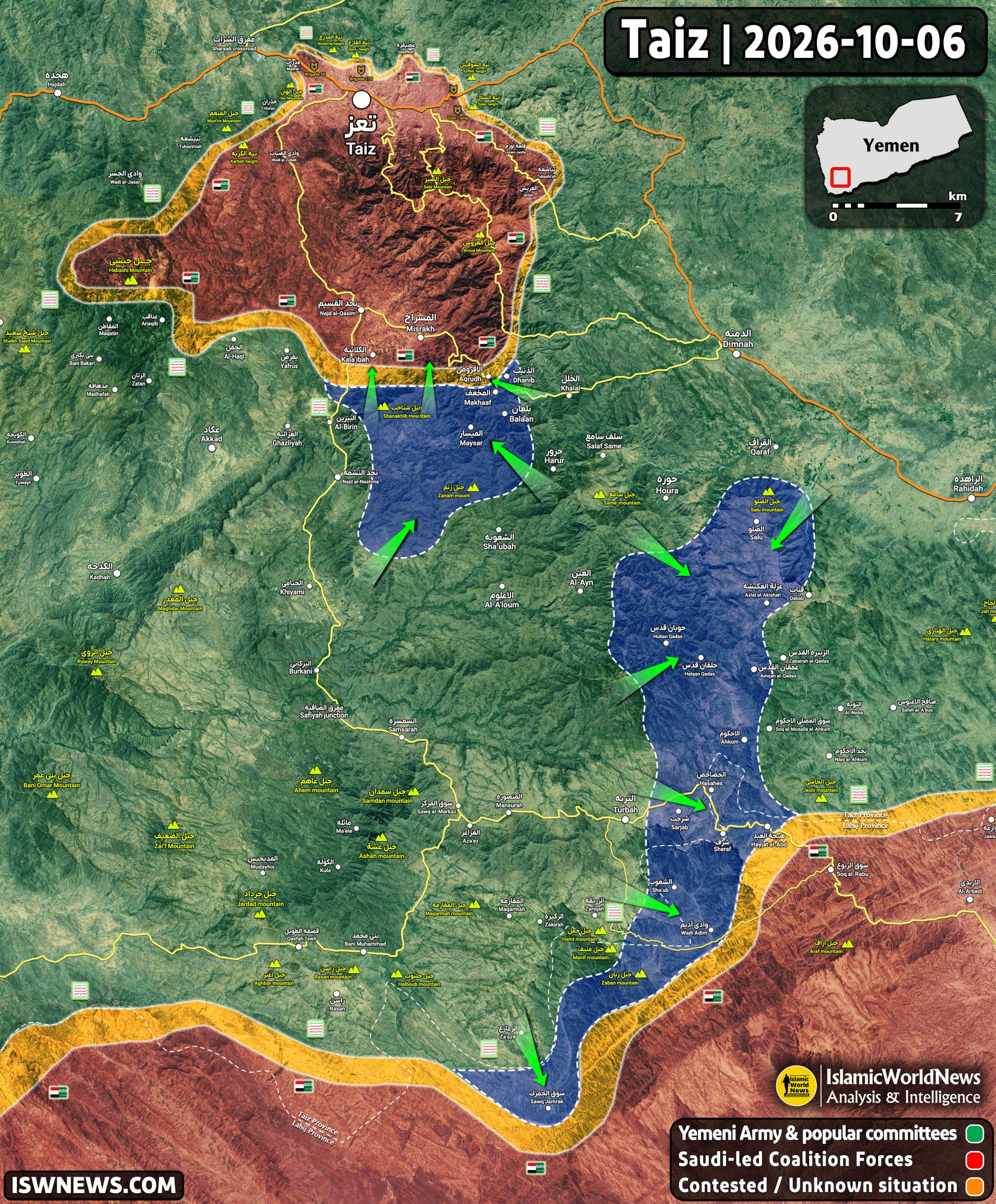
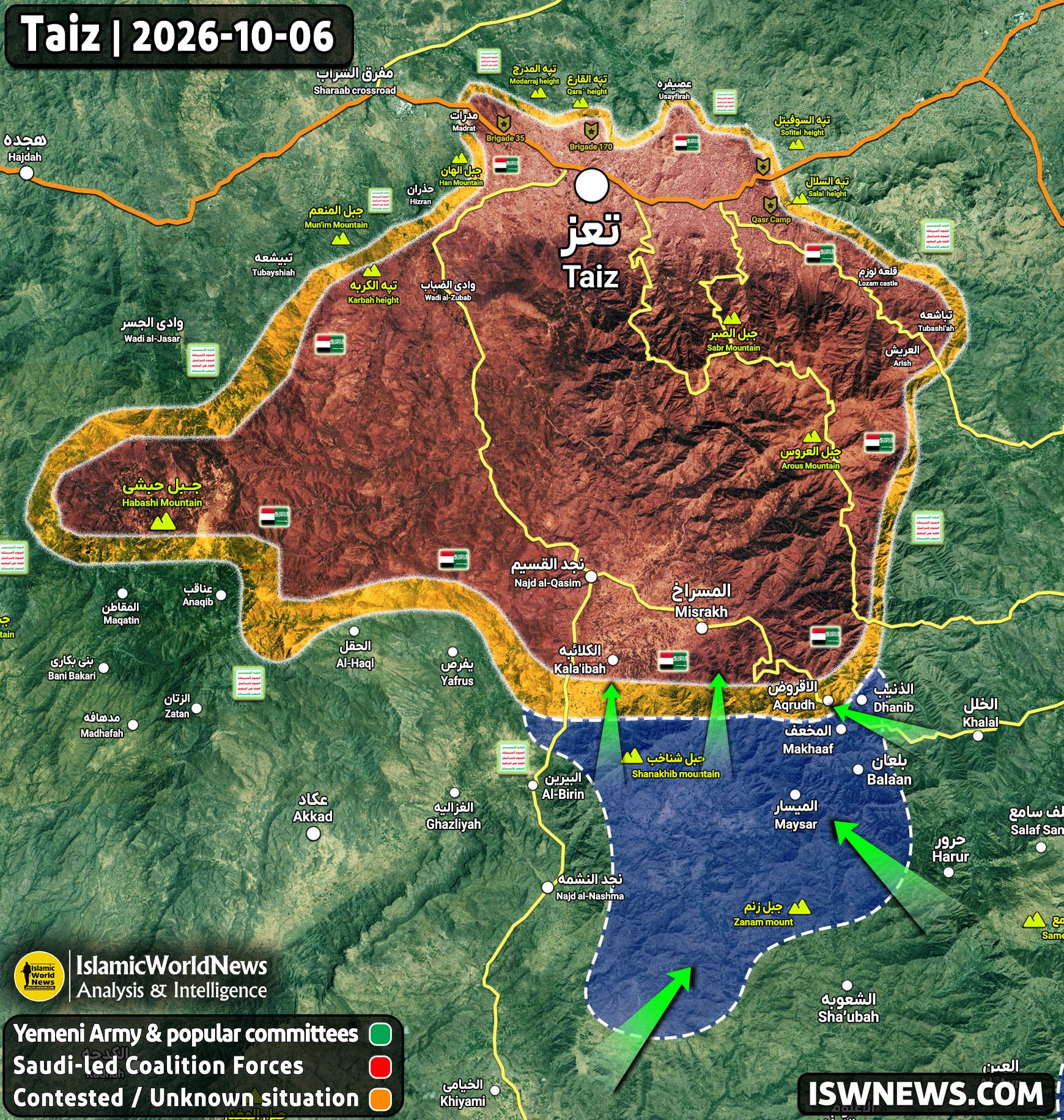
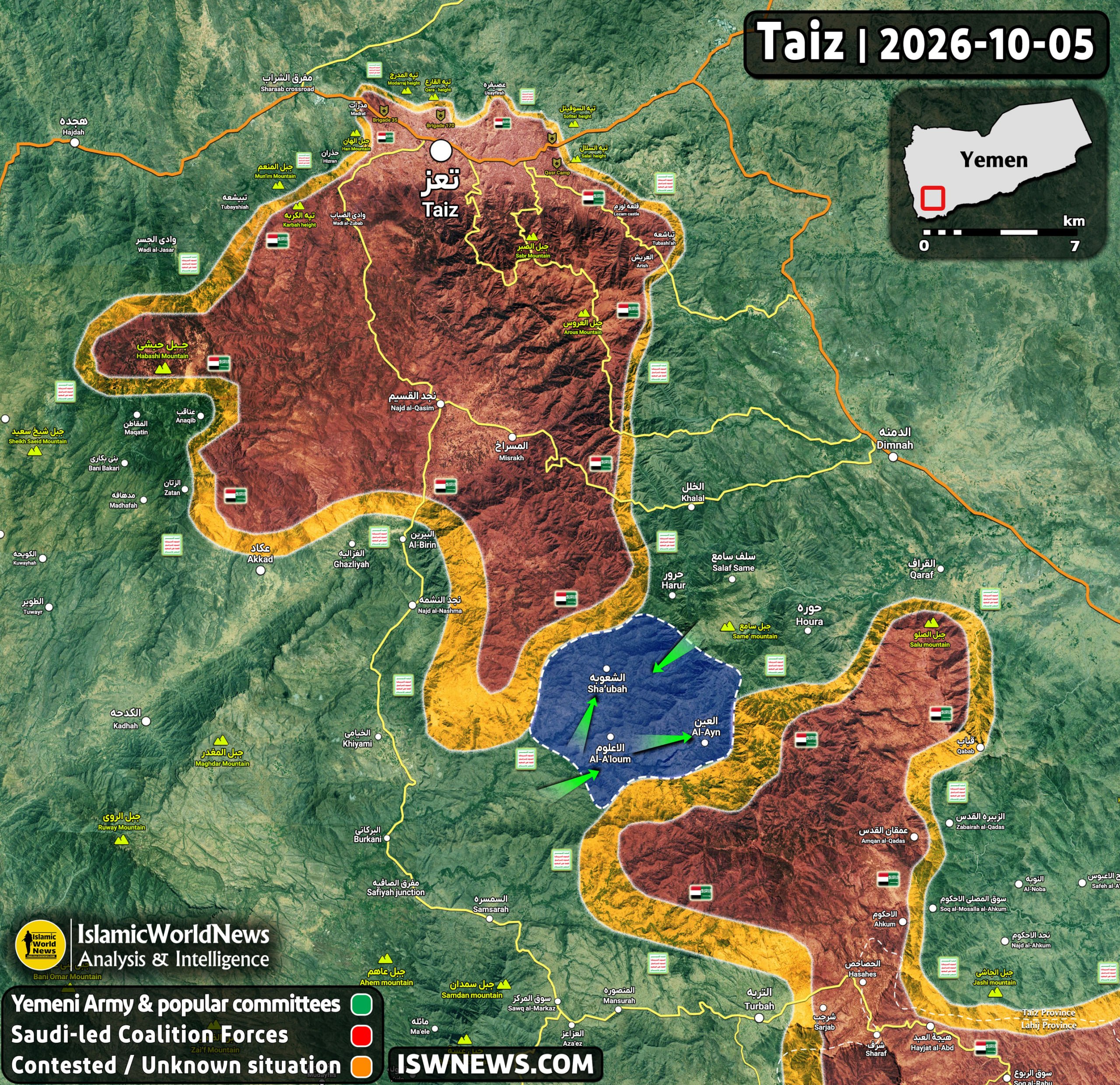
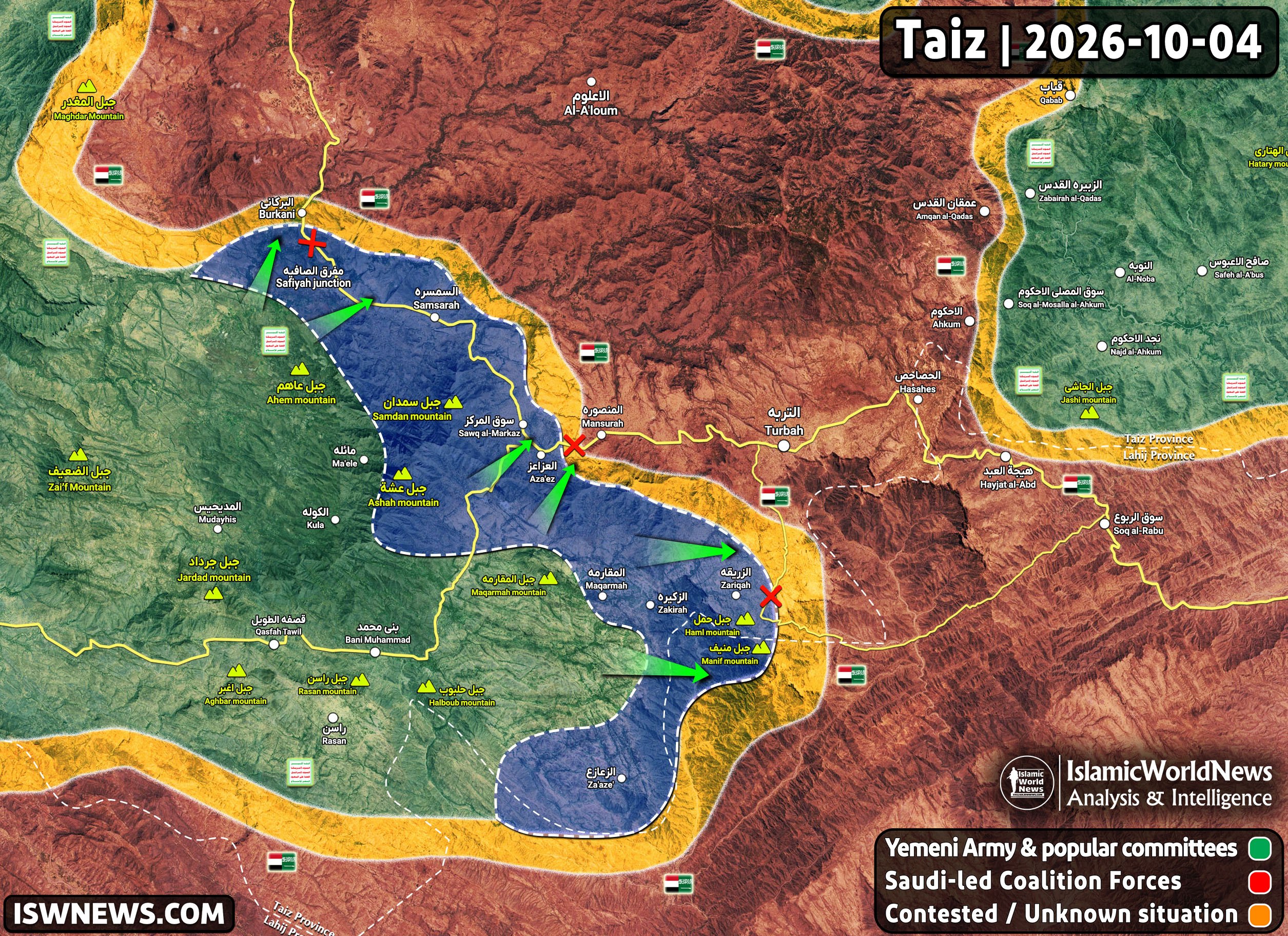
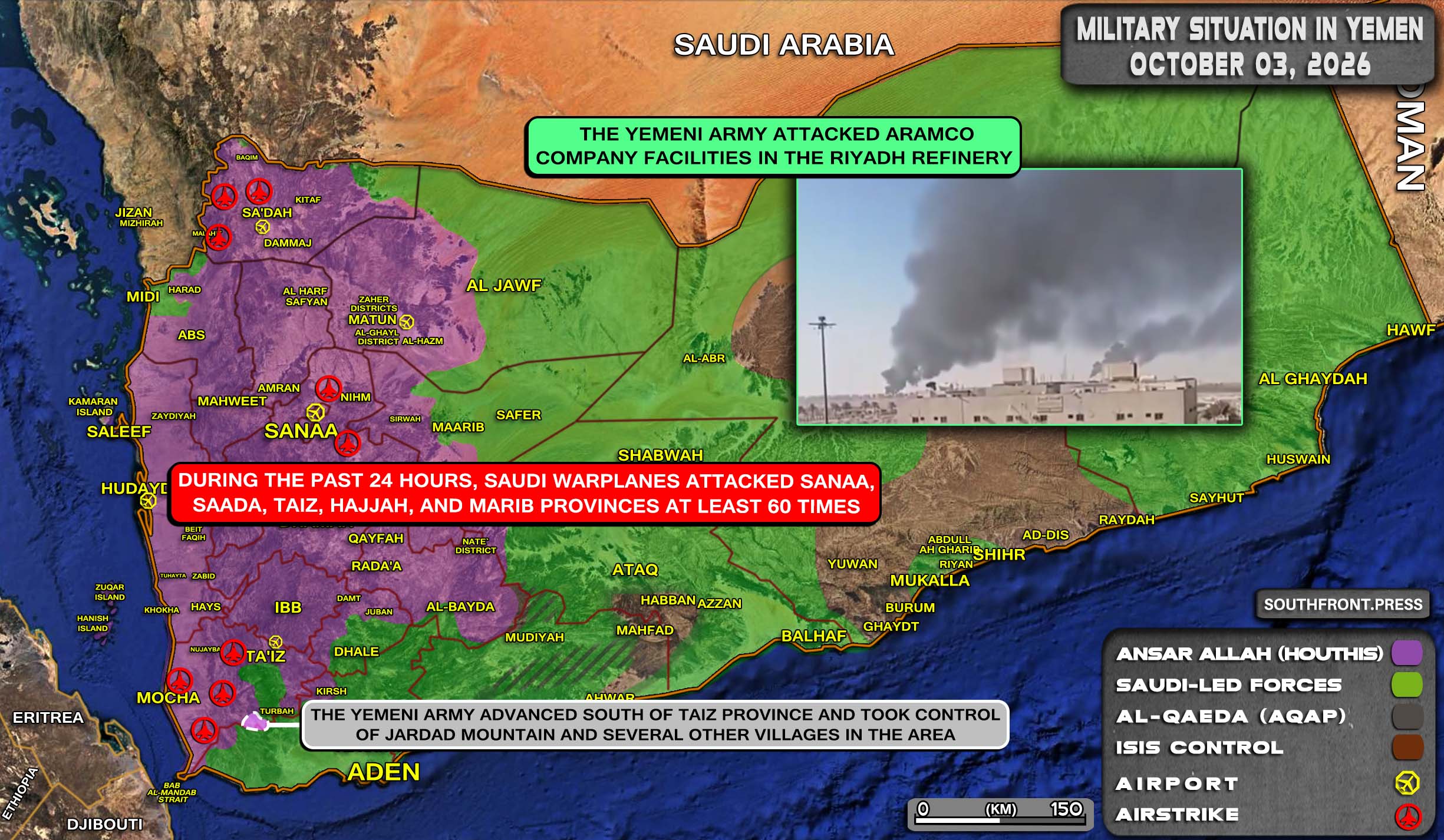
The Houthis (Ansar Allah) reported new gains in Yemen’s Taiz province on October 6, claiming their forces had taken a strategic mountain, pushed Saudi-backed forces out of another district and repelled an attempt to advance.
A Houthi military source quoted by the Saba news agency said the group’s forces had taken control of Jabal Matran in al-Mawasit district and captured a large amount of military equipment, including vehicles and weapons. The advance tightened the siege on Saudi-backed forces in Taiz city.
The same source added that the group had driven Saudi-backed military concentrations from the entirety of al-Silw district.
Houthi military spokesman Brig. Gen. Yahya Saree separately said the group’s forces had repelled Saudi-backed forces attempting to advance toward Houthi positions southwest of al-Wazi’iyah in Taiz.
The attacking forces made no progress, while several vehicles and armored vehicles were destroyed and dozens of personnel were killed or wounded, according to the spokesman, who added that the Houthis fired ballistic missiles at concentrations of reinforcements that had been sent to support the stalled advance. Saree also said the group’s forces were continuing to pursue Saudi-backed forces in other parts of Taiz, describing their opponents as disorganized and saying some were fleeing.
Click to see full-size image.
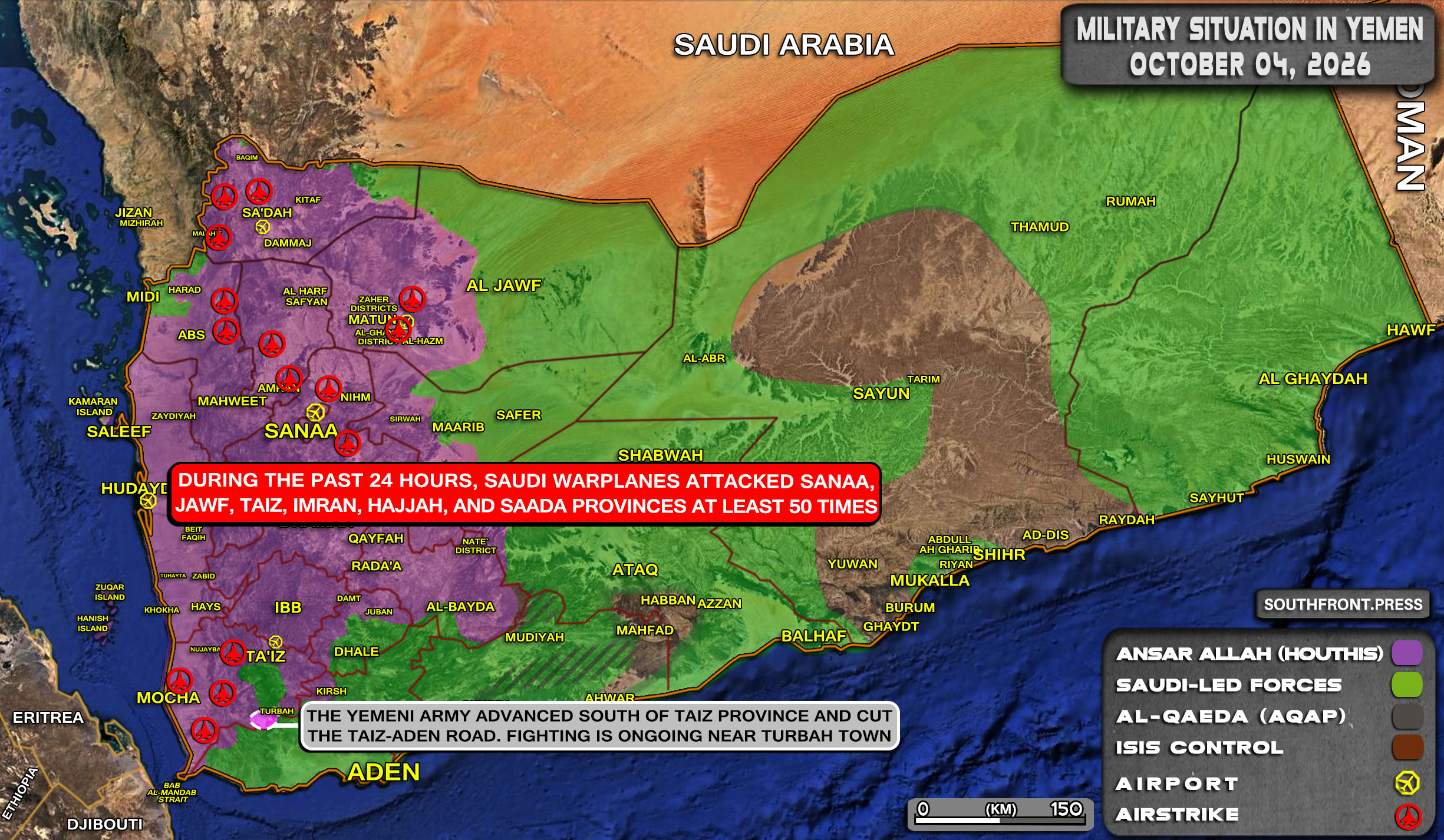
Click to see full-size image.
Meanwhile, near Bab al-Mandab, the counterattack launched by Saudi-backed forces has stalled due to effective resistance from the Houthis.
Saree said that several advance attempts were thwarted near the strategic waterway, adding that dozens of “ballistic missiles” hit concentrations of Saudi-backed forces there, killing and wounding dozens of fighters and destroying a large number of vehicles.
The escalation has brought a sharp increase in Saudi air operations across Yemen. Saudi Arabia said Monday that its aircraft had struck hundreds of targets in support of the ground offensive, while Houthi-run media have reported strikes in multiple provinces as well as the capital, Sanaa.
The intensified bombing produced more civilian casualties. The Houthi-run Health Ministry said that a Saudi airstrike on a home in the village of Umm al-Dahi in Haradh district of Hajjah province killed six members of one family — a father, mother and four children between the ages of 3 and 8. It said a sixth child, a 6-year-old girl, was critically wounded and that some victims remained under the rubble.
The fighting now extends across two major axes, and the Houthis hold the upper hand in both. The battle of Taiz is the most critical as its outcome could determine whether Saudi-backed forces could mount an effective defense or continue to collapse.
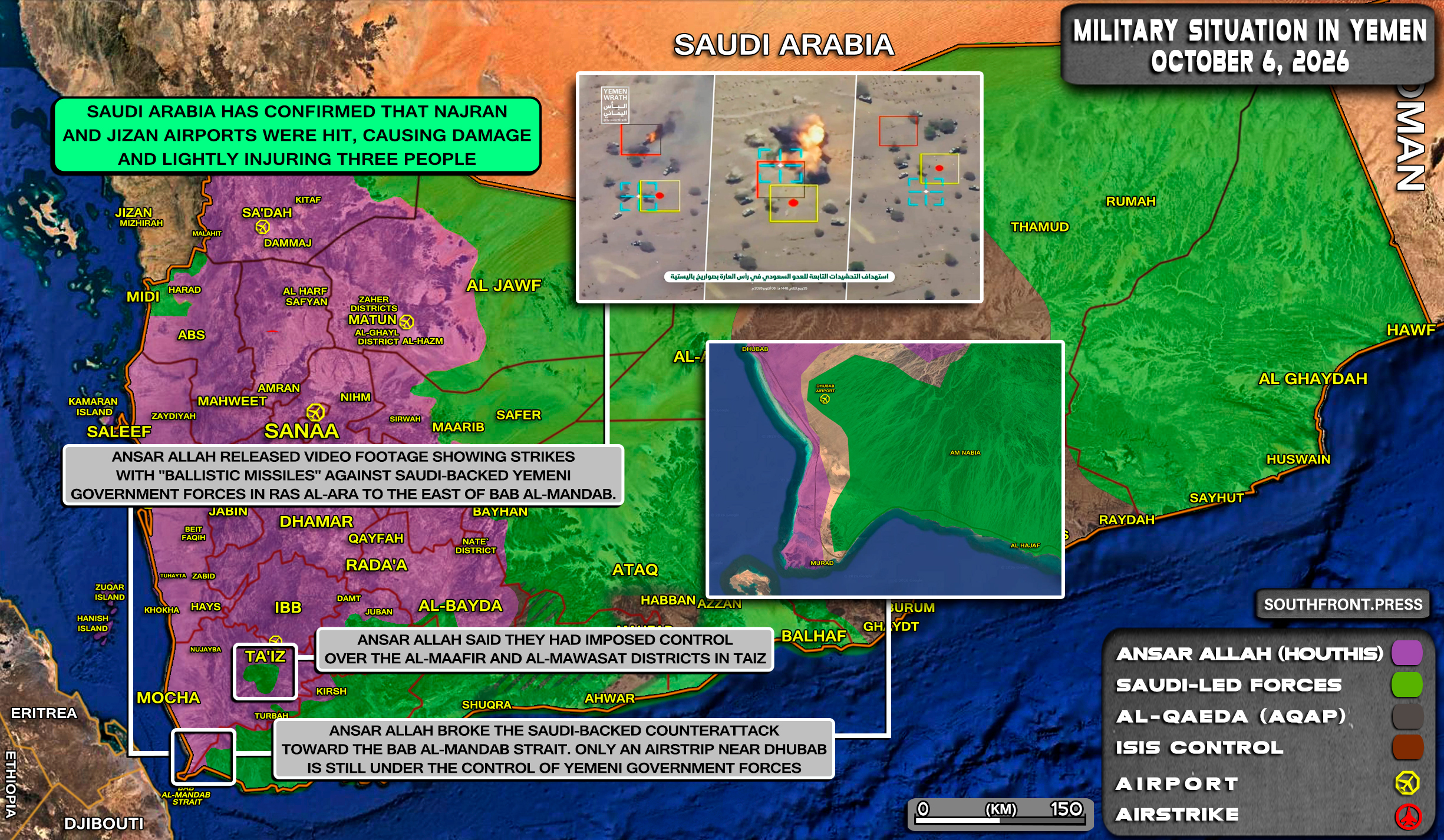
Saudi Arabia has confirmed that Najran and Jizan airports were hit, causing damage and lightly injuring three people;
Ansar Allah broke the Saudi-backed counterattack toward the Bab al-Mandab Strait. Only an airstrip near Dhubab is still under the control of Yemeni government forces;
Ansar Allah released video footage showing strikes with “ballistic missiles” against Saudi-backed Yemeni government forces in Ras al-Ara to the east of Bab al-Mandab;
Ansar Allah said they had imposed control over the al-Maafir and al-Mawasat districts in Taiz.
A Saudi airstrike hit a home in Yemen’s northern Hajjah province on Tuesday, killing a family of six, including four young children, according to the Yemeni Health Ministry within the Ansar Allah-led government. The ministry said that the children were aged three to eight and that a six-year-old girl was also wounded in the strike. […]
The Houthis (Ansar Allah) released two videos on October 6 showing drone and missile strikes on government forces and military positions in Yemen, as fighting intensified after a Saudi-backed counterattack near the Bab al-Mandab Strait and continued Houthi advances around Taiz.
One video showed what the group described as strikes on concentrations of Saudi-backed forces on several fronts, carried out with locally made “Shoawaz” first-person view suicide drones. The strikes targeted troops, vehicles and equipment.
A second video showed what the Houthis said were ballistic missile attacks on troop concentrations and weapons depots belonging to Saudi-backed forces in the Ras al-Arah area east of Bab al-Mandab. The footage was filmed by a surveillance drone.
The Houthis did not say when either attack took place, and the footage suggests the strikes may date from the previous round of fighting in September.
The videos came as Saudi-backed forces sought to reverse major Houthi gains along the Red Sea coast and around the Bab al-Mandab Strait.
Government forces said a day earlier that they had retaken positions in the Dhubab area and captured Mocha with heavy Saudi air support. The Houthis denied they had been driven from their positions and presented evidence proving that most of the area near Bab al-Mandab remains under their control.
At the same time, the Houthis expanded their positions around Taiz, advancing onto mountain routes leading toward the city and de facto besieging Saudi-backed forces.
The competing advances have intensified fighting across southwestern Yemen. Despite Saudi air power backing government forces, the Houthis maintain the upper hand in both Bab al-Mandab and Taiz. The battle is far from over, however.
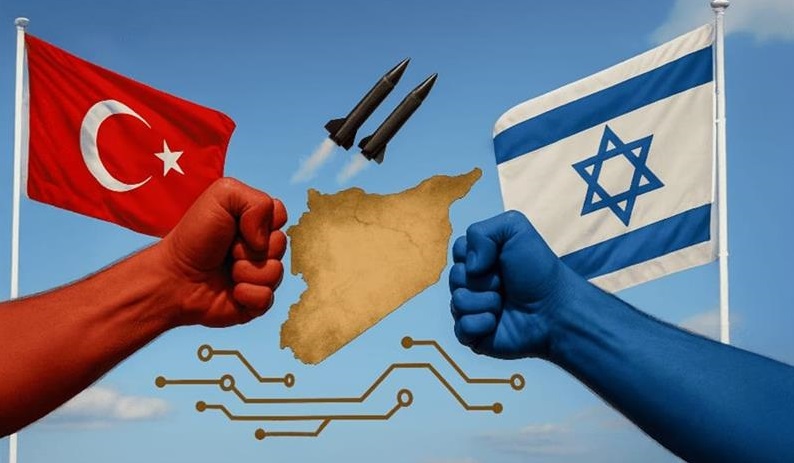
Following Israel’s recognition of Somaliland, analysts interpreted the move as an attempt by Netanyahu to establish a foothold against Yemen’s Ansar Allah and gain leverage in the Red Sea. However, the recognition of officials from this separatist enclave in the Horn of Africa indicates that Israel’s plans extend beyond countering the Houthis; Turkey also figures among the adversaries of the Israeli state.
About a year ago, Mohamed Osman Fadal, a senior foreign policy advisor to the President of Somaliland, stated that they “need air defense systems” to counter Turkish F-16s and drones stationed in Mogadishu. He further noted, “We want Israel to support us in the confrontation with Turkey.” About a year ago, Mohamed Osman Fadal, a senior foreign policy advisor to the President of Somaliland, stated that they “need air defense systems” to counter the Turkish F-16s and drones stationed in Mogadishu. He further noted, “We want Israel to support us in the confrontation with Turkey.”
This stance reflects the sentiments within Somaliland’s self-proclaimed administration and aligns with Netanyahu’s ambitions, as both parties seek to prepare as fully as possible for a clash with the de facto government of Somalia. The official Somali army already possesses special forces and a navy trained by Turkey, as well as T129 ATAK helicopters, the renowned Bayraktar UAV, and even M48 and M60 tanks.
Recently, Somali President Sheikh Hassan Mohamud stated that Israel plans to establish a naval base in the port city of Berbera—located in Somaliland—and utilize its airport. Mohamud made this statement in an interview with Al Jazeera, warning that Mogadishu would oppose any Israeli military presence in territory it considers part of Somalia. “Under no circumstances will we allow an Israeli presence in the country based on the way Israel treats Somaliland.”
Circumstances are compelling the parties to arm themselves, and it is quite likely that the Horn of Africa will become the first theater of open confrontation between Israel and Turkey.
If the battle against separatists in Somalia is supposedly the first frontline, then who is next? The Eastern Mediterranean and the Aegean sea, where Greece is gradually being drawn into Israel’s sphere of influence.
According to media reports, in late August, Ankara redeployed the 51st Commando Brigade—comprising approximately 2,000 professional special forces troops—from Hozat in the country’s east to the Söke district in Aydın province, directly opposite the Greek island of Samos.
Earlier in the spring, Greece purchased weapons from Israel worth approximately 2.3 billion shekels. The arsenal includes the Elbit-developed PULS system, training missiles, precision-guided munitions, loitering munitions, and ten years of logistical support. This new acquisition is part of Greece’s plan to modernize its armed forces by 2030. Athens intends to spend around 28 billion euros by 2036 to establish an Israeli-style defense system—known in Greece as the “Achilles Shield”—and to purchase up to 40 F-35 fighter jets from the US, as well as frigates from France and Italy.
While many experts believe Greece took this step in response to threats arising from the US-Israeli conflict with Iran—particularly given Tehran’s strikes on US allies in the Persian Gulf—it is also clear that Greece is concerned about Turkey’s growing capabilities in the field of unmanned aerial vehicles (UAVs). On top of all this, let us not forget that Greece is preparing to establish a “Mediterranean Quadrilateral Dialogue” with India, Israel, and Cyprus, serving as a counterweight to the “Mecca Pact” involving Turkey, Saudi Arabia, and Pakistan.
The region is gradually entering a new level of conflict, with blocs now forming in anticipation of a future redistribution of spheres of influence. Israel, the primary proponent of the IMEC project, views Turkey as an adversary due to its strategically important position along the Silk Road. Consequently, Somaliland and Greece are poised to become key players in Israel’s strategy to curtail the influence of Turkey and its allies.
The Saudi-backed Yemeni counterattack toward the Bab al-Mandab Strait appeared to have stalled by October 6 after an initial advance, with the Houthis (Ansar Allah) retaining most of their positions around the strategic waterway.
The offensive began a day earlier with Saudi air support as allied Yemeni government forces advanced rapidly along the southern Red Sea coast. Within hours, Saudi-backed forces said they had captured Bab al-Mandab and Dhubab and had entered the port city of Mocha.
Houthi media, however, published material from the same areas. An Al-Masirah reporter released a photo from Bab al-Mandab, while several videos showed Houthi fighters in Dhubab and Mocha. Only an airstrip near Dhubab appears to be still under the control of Saudi-backed forces as of now.
Click to see full-size image. (X)
Brig. Gen. Yahya Saree, the Houthi military spokesman, later disputed reports of a government breakthrough in an official statement.
“The armed forces maintain control over all their battlefield gains, and what the enemy is promoting are imaginary victories to satisfy its masters,” Saree said.
The spokesman said Houthi forces had attacked Saudi-backed concentrations at Ras al-Ara and al-Saqiya, claiming more than 200 troops were killed or wounded there. He added that further strikes east of al-Jawf and Ragwan in Marib caused additional casualties and destroyed military vehicles, while Houthi forces continued pursuing Saudi-backed government forces in Taiz.
The Houthis expanded their missile and drone campaign against Saudi Arabia in response to the counterattack toward the Bab al-Mandab Strait.
In a statement issued late October 5, Saree said three operations targeted Saudi sites. He said one strike hit King Khalid International Airport in Riyadh, another targeted an Aramco refinery in Rabigh and caused a fire, and a third targeted Abha airport, Khamis Mushait military base, Akifah camp in Asir, and sites in Najran and Jizan.
The next day, Saree announced two more attacks, saying a ballistic missile hit the al-Daghareer military camp in Jizan and caused dozens of casualties. He added that another missile attack targeted Abha International Airport and disrupted air traffic.
Saree warned international airlines against continuing to operate through Saudi airspace, while excluding flights over Mecca and Medina.
Saudi Arabia acknowledged on October 6 that Jizan and Najran international airports were hit. The kingdom’s General Authority of Civil Aviation said three people suffered minor injuries.
All in all, the Houthis appear to have absorbed the Saudi-backed counterattack toward the Bab al-Mandab Strait. However, fighting there could still go on for days, or even weeks. The area is low and open, which makes it extremely difficult to defend.
Further advances by the Houthis in Taiz, where government forces are already under siege, could, however, lead to a catastrophic collapse in the Saudi-led camp along Yemen’s southern coast, all the way to the port city of Aden.
The Saudi-backed Yemeni forces battling the Iranian-backed Houthi rebels claim they have regained a large swath of territory in a new counteroffensive launched on Monday. This includes the recapture of the Red Sea port city of Mokha and other key positions near the highly-strategic Bab al-Mandeb Strait (BAM). As we reported last month, the Houthis had taken these areas during an offensive of their own.
“On Monday, the Nation Shield Forces, the Giants Brigades, and the Tihama Resistance—supported by the Popular Resistance—seized control of the city of Al-Mokha in western Taiz Governorate following fierce battles against the terrorist Houthi militias backed by the Iranian regime,” the official Yemeni Saba news outlet reported. “The forces, aided by air support, succeeded in capturing Al-Mokha after clashes with the terrorist Houthi militias, which had controlled the city since early last September. The battles, which took place at various locations surrounding Al-Mokha, involved the use of diverse weaponry and resulted in casualties among the terrorist Houthi militias, the capture of several of their members, and the flight of others.”
Dubbed Operation Yemen Dawn, the counteroffensive aims to “restore state institutions, liberate the capital Sana’a, and end the Houthi terrorist militia coup,” Rashad al-Alimi, president of the internationally recognized government of Yemen, stated Monday on X.
“With God’s aid, the will of our people, the valor of our armed forces and all military formations, and the support of our brothers and friends, Yemen will march toward a new dawn of freedom, peace, and stability,” al-Alimi added.
على بركة الله، انطلقت عملية "فجر اليمن" لاستعادة مؤسسات الدولة، وتحرير العاصمة صنعاء، وإنهاء انقلاب الميليشيات الحوثية الإرهابية. بعون الله، وإرادة شعبنا وبسالة قواتنا المسلحة وكافة التشكيلات العسكرية، ودعم أشقائنا وأصدقائنا، سيمضي اليمن نحو فجر جديد من الحرية والسلام والاستقرار. pic.twitter.com/bP1h9EVdu2
The claims about the recapture of Mokha follow statements made earlier on Monday that the National Shield Forces and Giants Brigades, “liberated Dhubab [also spelled Dhobab] District and strategic positions around the Bab al-Mandab Strait in western Taiz Governorate on Monday following clashes with Iran-backed Houthi militias,” Saba claimed. “The clashes left a number of Houthi fighters dead or wounded, while others fled under pressure from the military operation. Several military vehicles and pieces of equipment were also destroyed or disabled. The forces are continuing clearance and security operations in the liberated areas and cutting Houthi supply routes.”
In addition, the Kingdom’s Maj. Gen. Turki al-Maliki, spokesman for the Saudi-led coalition, stated that “100 fighter jets were providing support to the forces of Yemen’s internationally recognized government fighting against the Houthis,” according to The Associated Press. “He said the coalition has secured ‘air protection’ of the strategic Bab el-Mandeb Strait and destroyed hundreds of Houthi targets as part of the ongoing campaign.”
After Yemeni officials announced the new counteroffensive on Sunday, al-Maliki vowed “full operational support” to the Yemeni government forces, until the Houthis are “eliminated,” the AP added.
On Monday, the Humanitarian Operations Coordination Center (HOCC), an organization closely aligned with the Houthis, confirmed increased Saudi airstrikes and threatened a response. HOCC warned “all airlines operating in Saudi airspace that it is unsafe, with the exception of the airspace over ‘Mecca and Medina,'” the official Houthi Telegram channel reported.
HOCC did not elaborate on that warning.
While TWZ cannot verify these claims, independent Yemen analyst Mohammed al-Basha said it appears that the anti-Houthi forces have gained ground on the Red Sea coast.
The founder of the widely quoted Basha Report stated on X that he had “high confidence” that Yemeni government forces recaptured Dhobab Airport, “cutting off the Houthi supply route between Mocha and Bab al-Mandab.” He added that “Southern Giants Forces are now heading towards the city of Dhobab, Al-Omari Camp, and Bab al-Mandab.”
بثقة عالية الساعة العاشرة صباح الاثنين ٥ أكتوبر استعادة مطار ذوباب وقطع طريق إمداد الحوثي بين المخا وباب المندب قوات العمالقة الجنوبية الان تتجه نحو مدينة ذوباب ومعسكر العمري وباب المندب https://t.co/6eHYJ3cnza
Videos have emerged showing what appears to be Saudi-backed forces running over Houthi fighters. The Houthis have called this a war crime.
Several videos emerging of Saudi-backed government forces driving over and shooting fleeing Houthi fighters caught off guard by their offensive in southwestern Yemen.
Amid the spike in fighting, the State Department issued a new warning to Americans in Saudi Arabia.
“Due to the ongoing security situation in Saudi Arabia and the potential for aerial drone or missile attacks on Saudi Arabia, the U.S. Mission strongly encourages all U.S. citizens to remain vigilant and follow the guidance of national alerts released by Saudi Arabia’s Civil Defense,” the department stated on X.
Saudi Arabia: Due to the ongoing security situation in Saudi Arabia and the potential for aerial drone or missile attacks on Saudi Arabia, the U.S. Mission strongly encourages all U.S. citizens to remain vigilant and follow the guidance of national alerts released by Saudi… pic.twitter.com/QzVaER1WZ8
Yemen Dawn was launched in the wake of large-scale Houthi advances. As we noted earlier in this story, the rebel group captured the port of Mokha and two key islands in the Red Sea, increasing its control over the Bab al-Mandab Strait (BAM). That moved the front lines to the key city of Taiz, which sits astride a major roadway linking it to the port city of Aden. The Houthis recently captured strategic hilltops near Taiz, advancing on the last road between the city and Aden, which serves as the interim capital of the Yemeni government.
The conflict between Saudi Arabia and the Houthis grew out of a civil war in Yemen that erupted in 2014. It expanded a year later when a Saudi-led coalition joined forces with the government ousted by the Houthis and raged on until the parties reached a tenuous ceasefire in 2022. The Saudis held off on getting involved in the recent Red Sea conflict which saw the U.S. and coalition warships duking it out with the Houthis, and eventually led to a U.S.-led air campaign over Yemen. Tensions, however, reignited after that conflict ended when the Houthis joined the U.S.-Iran conflict on the side of their major supporter.
Earlier this year, the Houthis imposed a blockade on the BAM and began striking Saudi ships in the southern part of the Red Sea as well as targeting critical energy terminals on that body of water and Saudi refineries. Iranian proxies have also struck the vital East-West pipeline that carries oil to the Red Sea to bypass the Strait of Hormuz, where Iran has vastly curtailed shipping after the launch of Operation Epic Fury. That line has reportedly since reopened after being shut down following a long-range drone attack.
Bab al-Mandab Strait. (Google Earth)
On Monday, Turkey and Pakistan said they will undertake a “rapid deployment” of troops to Saudi Arabia under the Mecca Joint Defense Agreement, a pact designed to assist the Kingdom’s fight against the Houthis, the Middle East Eye reported.
“The announcement on Monday came after representatives of the three countries held an emergency meeting in Riyadh where they condemned recent attacks on Saudi Arabia, in particular those targeting the holy cities of Mecca and Medina, without mentioning the Houthis by name,” the publication added.
Concern about maintaining the flow of energy resources from the region has spurred France and the U.K. to send additional forces to help the Saudis.
You can see Macron’s announcement in the following video.
Nous agissons pour protéger nos compatriotes des conséquences de la crise au Moyen-Orient. Objectifs : sécuriser les approvisionnements et faire baisser les prix à la pompe. pic.twitter.com/kvrgHcV4E4
The U.S. also appears to be increasing its assistance to Saudi Arabia. Though President Donald Trump turned down the Kingdom’s request to directly attack the Houthis, the U.S. is “providing aerial refueling for Saudi warplanes conducting defensive air patrols,” The New York Times reported on Sunday. That’s in addition to the previously known assistance to Riyadh provided by “more than 200 U.S. intelligence and military analysts working in Saudi command centers helping to analyze and select targets in support of its Yemeni allies,” the newspaper added.
The stark reality, especially facing European leaders like Macron, is that if Saudi oil infrastructure and transport nodes near the Red Sea are destroyed or the pipeline that feeds them is shut down for months, the last major oil lifeline from the region — and especially to Europe — will be closed off, sparking a deeper energy crisis.
Iran has already severely curtailed the flow of oil through the Strait of Hormuz since the U.S. and Israel attacked it on Feb. 28. The movement of oil has been further impeded by a U.S. blockade on Iranian ports. However, transits have been increasing as of late, thanks in large measure to U.S. military escorts that U.S. Central Command claims have allowed more than a billion barrels of crude to pass through the Strait of Hormuz.
Still, the price of Brent crude continues to hover over $100 per barrel due to a combination of factors that still make this a very dangerous region. This includes the ongoing threats from the Houthis in the BAM and the aforementioned spike in fighting between the Houthis and Saudi-backed forces. In addition, there are continuing Iranian attacks on shipping, including one today and three over the weekend, the skyrocketing cost of insuring vessels and the possibility Gulf countries may be paying Iran to allow their oil through. Such payments, essentially a toll, are “potentially handing Tehran a significant portion of the value of the cargo,” Al Jazeera noted.
Asked about the Saudi-backed counteroffensive, Trump said “It will all work out very well.”
Question: What's your view on the Saudi and Yemeni counter attack against the Houthis?
Meanwhile, talks between the U.S. and Iran to end hostilities between the countries remain at an impasse, though the two sides have not directly attacked each other in weeks. The U.S. rejected Iran’s conditions for reopening the Strait of Hormuz, and Tehran says it is preparing a reply to the U.S. counterproposal, CBS News reported Monday morning.
For his part, Trump continues to waver, suggesting the U.S. could “leave tomorrow” or resume striking Iran.
It is far too early to tell whether the new Saudi-backed counteroffensive in Yemen will have any lasting effect on the battlefield. The coalition arrayed against the Houthis isn’t known to be highly robust and the quality of its forces have been in question. Still, it has been clear that the Saudis and their allies had to act strongly, and this would be exactly that.
The US is refueling Saudi fighter jets as part of its support for Riyadh’s war in Yemen, a US official has told Al Jazeera, marking an escalation of US involvement in the conflict. The US refueling of Saudi warplanes was one of the most controversial aspects of US involvement in the war in Yemen after […]
Cheap drones, heavy bombs, disrupted shipping, and vulnerable supply routes are challenging the idea that technological superiority guarantees military success. The emerging contest is not simply over who builds the smartest weapon. It is over who can adapt, produce, and keep fighting after the enemy learns how to break it. Washington’s Project Meridian offers one answer. Recent battlefields suggest a much harder test.
The Battlefield Rewrites the Blueprint
The war in Ukraine shows that military innovation does not always mean more sophisticated weapons. Sometimes it means finding a simple way around an enemy’s defenses. Russian forces did that with drones guided through fiber-optic cables instead of radio signals, allowing them to operate despite radio jamming.
During the fighting to push Ukrainian troops out of Russia’s Kursk region, fiber-optic drones threatened the roads supplying Ukrainian positions. Sustained attacks on transport made those positions harder to supply, reinforce, and evacuate. Ground that remained defensible against a direct assault became increasingly difficult to hold as supply routes came under pressure.
Drones did not replace infantry or artillery. Their value came from linking reconnaissance and strikes to a broader effort to disrupt Ukrainian logistics. A relatively small change in drone guidance helped Russian forces put pressure on the supply lines sustaining the defense, rather than just individual vehicles or positions.
A separate example from eastern Ukraine shows how drone attacks can also threaten robotic supply vehicles
Nor did the advantage remain exclusive. Ukrainian units expanded their own fiber-optic capabilities, turning a Russian breakthrough into another round of adaptation. Cable guidance removes the vulnerable radio-control link, but introduces weight, handling, and physical constraints. It does not make the aircraft invisible or indestructible. A solution to one problem creates a different set of tradeoffs.
Russia’s glide bombs demonstrate another route to military innovation. Instead of replacing existing weapons entirely, guidance and wing kits give older bombs greater reach and precision. Their heavy payloads perform tasks that small drones cannot. Their use against Ukrainian positions illustrates why the future battlefield will contain both cheap electronics and large quantities of conventional explosives.
The broader lesson is uncomfortable for anyone selling a universal replacement for the old military. New systems do not arrive on an empty battlefield. They must work with existing aircraft, artillery, engineers, supply units, and command structures. Their value depends on how those parts fit together.
That also limits what strike videos can prove. A successful attack demonstrates an outcome, not the average success rate, the number of failed missions, or the effort required to repeat it. The decisive question is whether an army can turn occasional success into a dependable military capability.
The Cost of Keeping Routes Open
The Red Sea offers a different warning. An attacker does not necessarily have to defeat a navy to impose strategic costs.
Houthi attacks pushed shipping companies toward longer routes around Africa. By late summer 2026, traffic through the Suez Canal was recovering but remained well below pre-crisis levels. Houthi attacks had pushed shipping companies onto longer, more expensive routes, showing how a regional armed group could disrupt global trade without defeating a major navy.
An interception can therefore be a tactical success without restoring normal commercial activity. The defender must protect ships and sustain confidence over time. The attacker may only need to keep the risk credible. Counting destroyed drones does not answer whether the shipping route is functioning.
The familiar comparison between a cheap drone and an expensive interceptor captures only part of this problem. Saving a merchant ship or warship can justify an expensive defensive shot. The deeper question is whether sufficient interceptors, maintenance capacity, crews, and replacement stocks remain available throughout a prolonged campaign.
Ukraine presents a related problem on land. Russian glide bombs combine substantial destructive power with relatively inexpensive conversion kits. Defending against every incoming weapon with a costly missile is not necessarily sustainable. But abandoning high-end air defenses would leave other threats unanswered.
The likely response is a layered force rather than a single miracle weapon. Different threats demand different combinations of detection, electronic warfare, physical protection, and interception. An army also needs to keep operating when some threats get through.
Kursk and the Red Sea are not interchangeable battlefields. One concerns a contested land campaign, the other pressure on maritime commerce. What connects them is the importance of maintaining a function under repeated attack. Delivering supplies and keeping shipping moving matter more than producing an impressive interception tally.
Washington Looks Upward
Washington is approaching this problem through a different starting point: global networks, industrial scale, and institutional control.
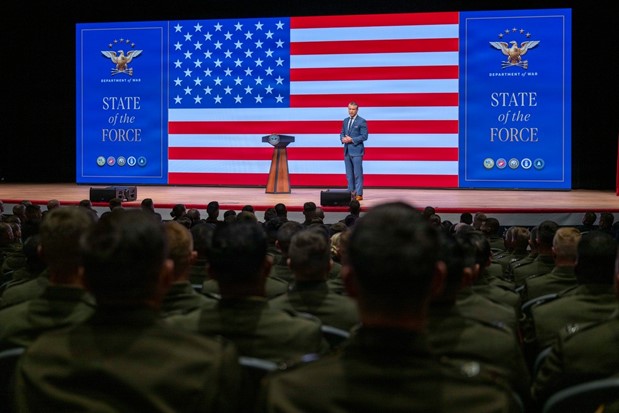
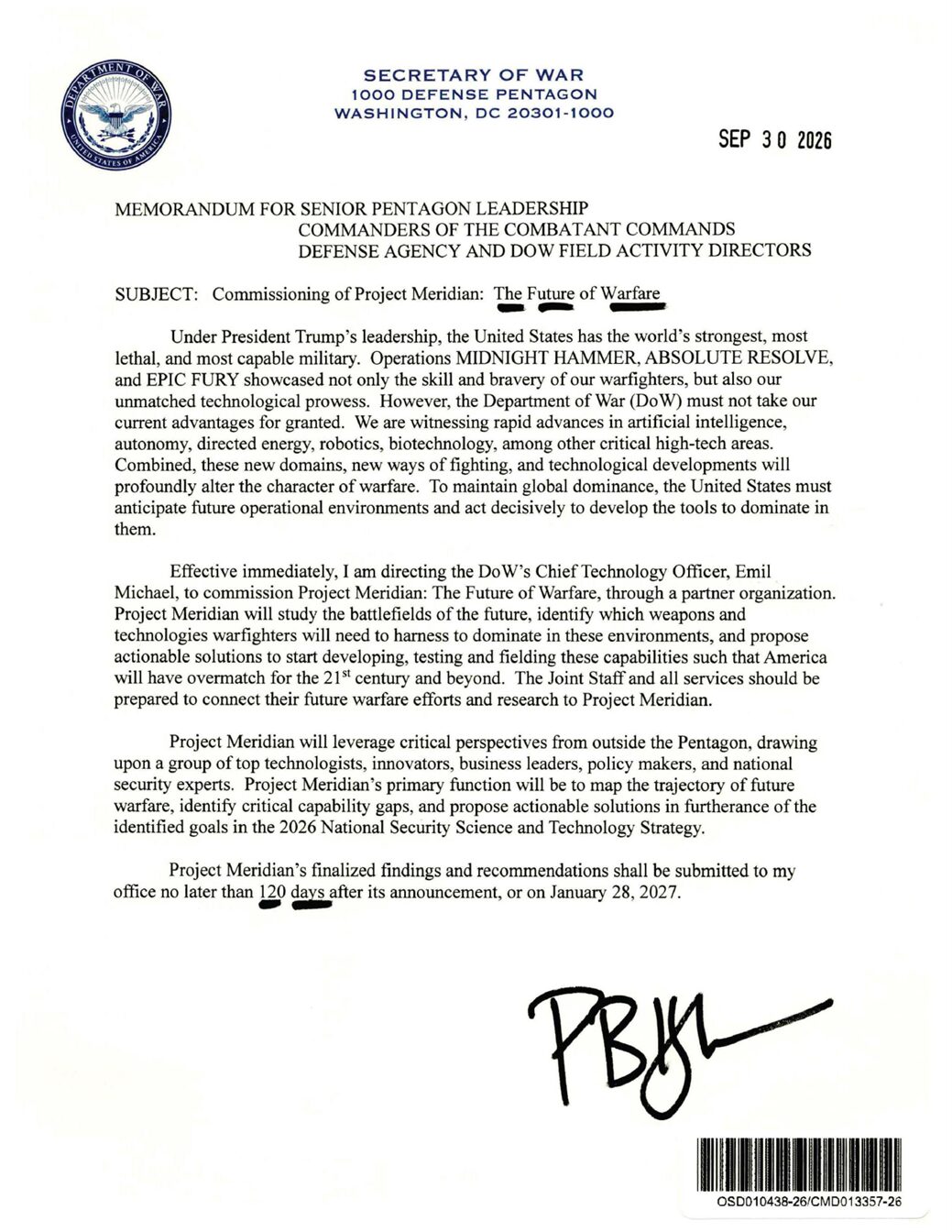
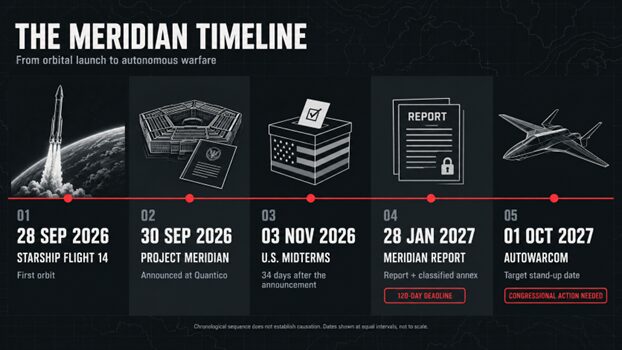
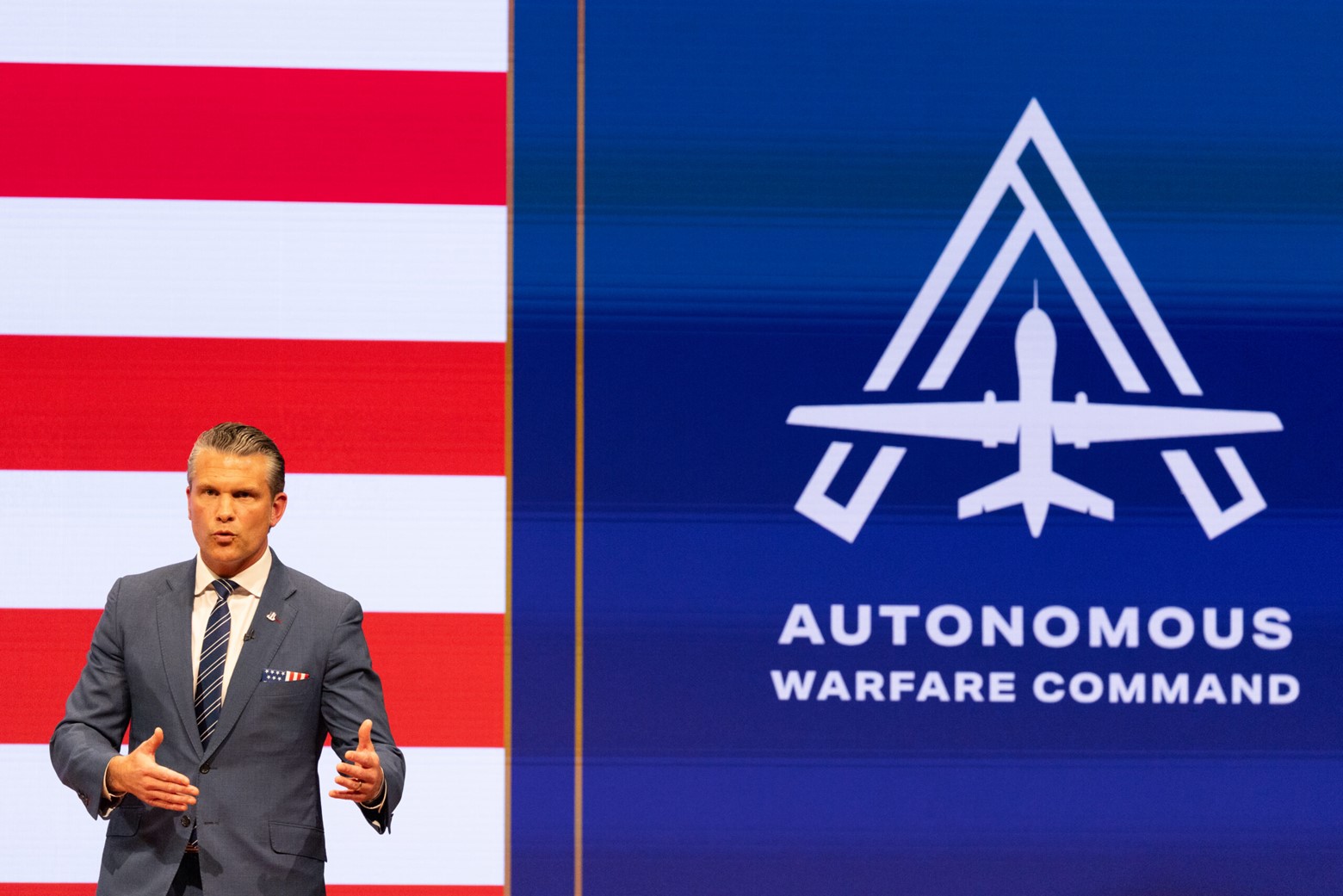
On September 30, Pete Hegseth announced Project Meridian alongside a proposed Autonomous Warfare Command and the Fortress America initiative. Meridian would examine future military capabilities, while the new command would organize the expansion of autonomous and robotic systems. Fortress America would address the resilience of bases and supply chains. These are related initiatives, not a single approved war plan.
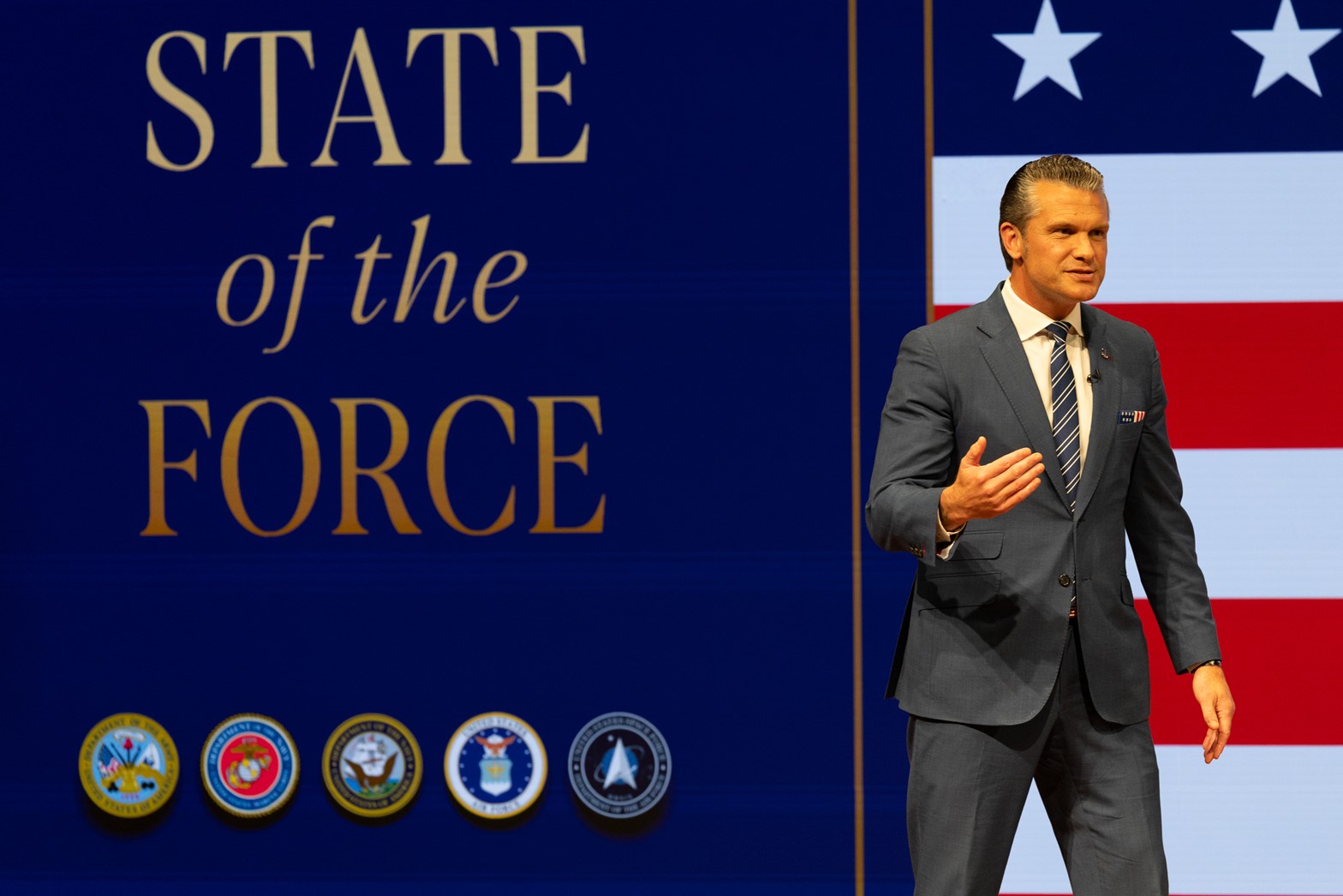
U.S. service members at the State of the Force address, Quantico, September 30, 2026
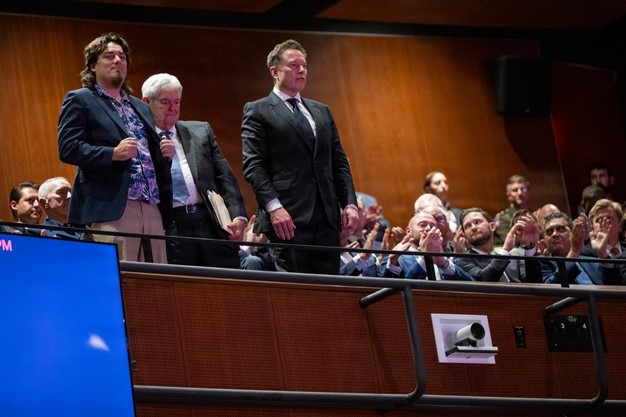
Meridian’s advisers include Elon Musk, Palmer Luckey, and Newt Gingrich, under Pentagon technology chief Emil Michael. The study has 120 days to report. Its significance is not that three men can invent the next war. It is that major technology suppliers are being invited to help define the military capabilities Washington should pursue.
The September 30 memorandum commissions a study of future warfare
The State of the Force event at Quantico, where Project Meridian was announced, September 30, 2026
Some of the supporting infrastructure already has funding. On May 26, Space Systems Command awarded SpaceX a $2.29 billion agreement for the Space Data Network Backbone. A fully operational prototype is due by the end of 2027. The intended function is to connect military sensors and weapons through a high-capacity orbital communications network.
That addresses a real military requirement. Information has limited value if it cannot reach the people or systems that need it. But a larger network does not automatically become a more dependable one. The test is whether useful connections survive disruption, and whether units can continue operating when they do not.
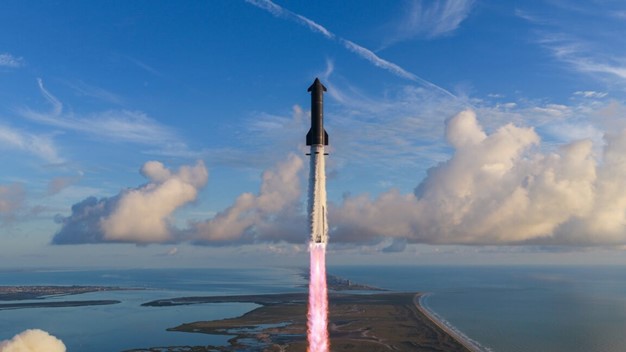
Heavy-lift rockets could support the deployment of larger satellite constellations, although these programs do not yet amount to a single publicly defined architecture. Starship Flight 14 reached orbit on September 28 and deployed 26 Starlink V3 satellites. That demonstrated payload delivery, not every capability promised for the rocket. Reaching orbit once and providing dependable, economical military infrastructure are different milestones.
Starship Flight 14 launches from Starbase, September 28, 2026, carrying 26 Starlink V3 satellites
Starship’s final descent, landing burn, and splashdown during Flight 14, September 28, 2026
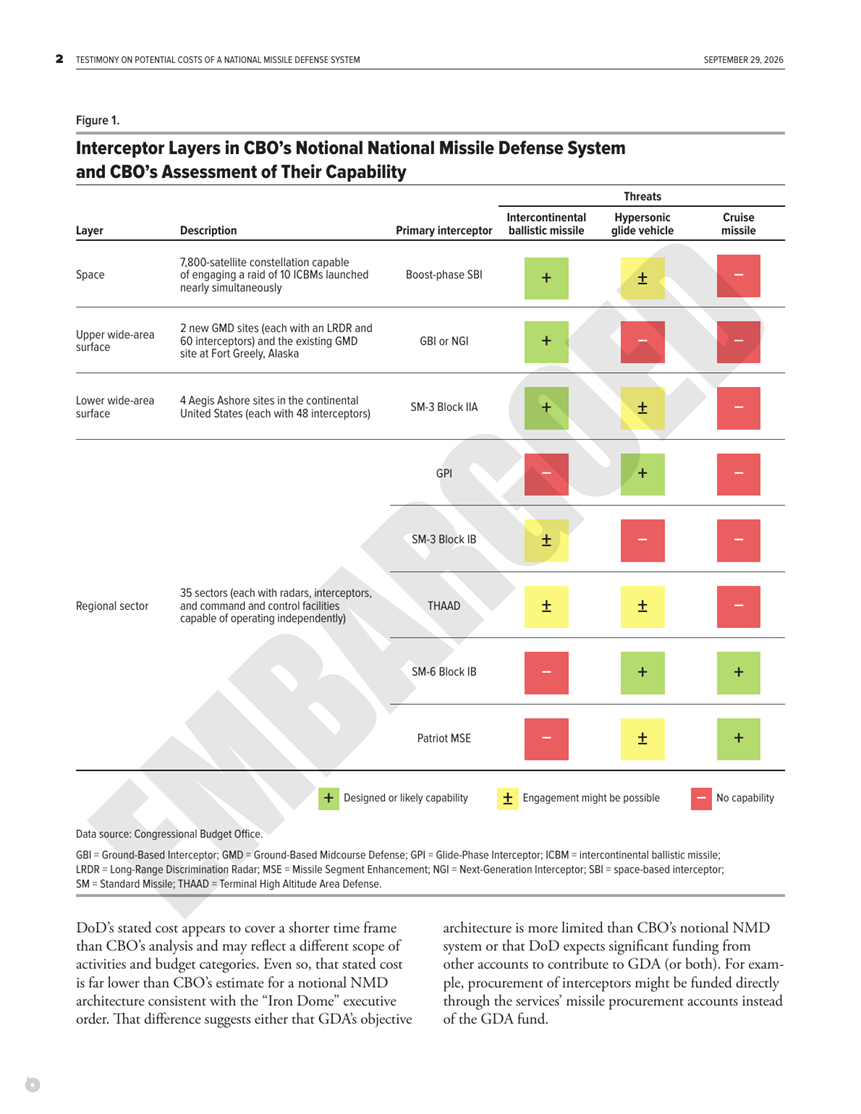
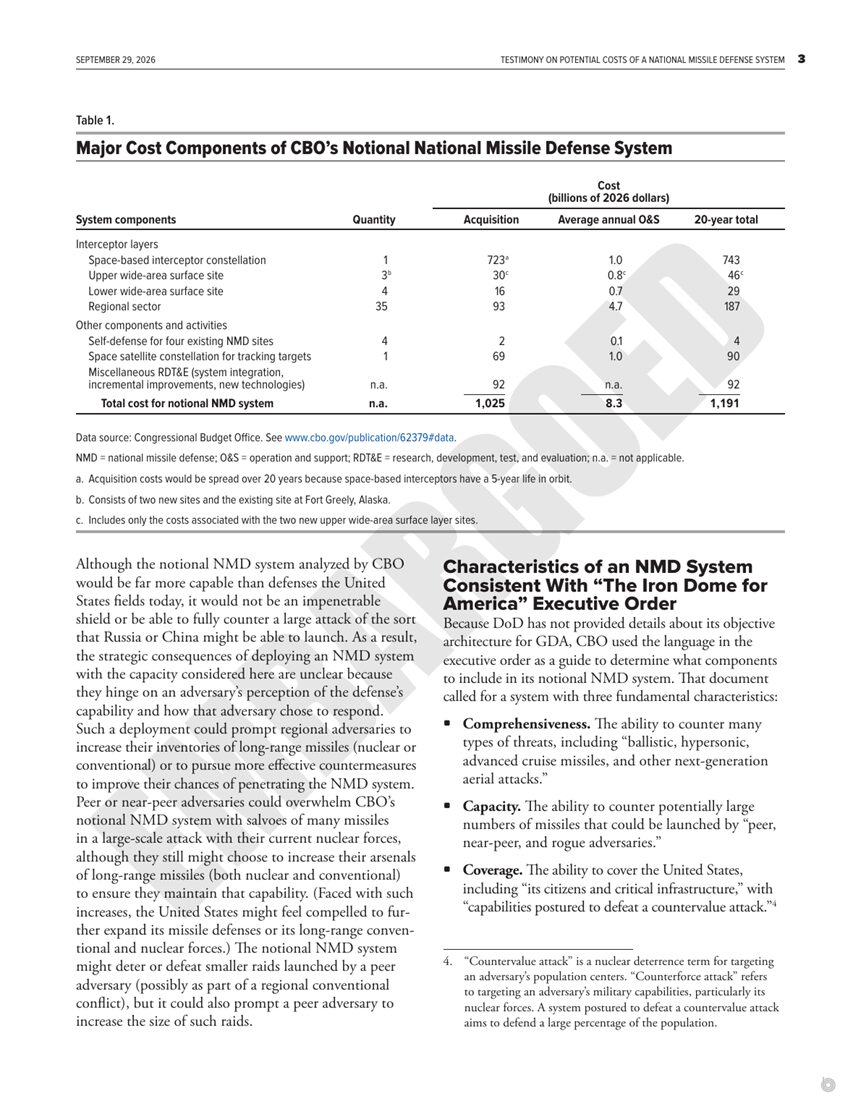
Golden Dome extends the ambition to missile defense. In May, the Congressional Budget Office estimated that a notional system consistent with the administration’s stated objectives could cost about $1.2 trillion over 20 years. Crucially, this was not a price tag for the Pentagon’s approved design. The final architecture had not been publicly disclosed.
A notional national missile-defense architecture assessed by the Congressional Budget Office
Estimated costs of the Congressional Budget Office’s hypothetical system, expressed in 2026 dollars
The policy risk is not simply excessive ambition. It is defining military problems in ways that favor the products already offered by influential suppliers. That deserves scrutiny without assuming that commercial involvement makes every proposal useless. A contract is evidence of spending. It is not evidence of battlefield superiority.
Elon Musk, named a co-leader of Project Meridian
Machines Still Need Factories
The American approach emphasizes integrating ambitious systems through large institutions. The battlefield experience points toward an equally important requirement: changing ordinary systems quickly.
These approaches are not mutually exclusive. Satellites and inexpensive drones can support the same force. The tension lies in their development cycles. A major space program cannot be redesigned every few weeks. A frontline drone or its communications equipment may lose effectiveness if updates take years.
The industrial base must therefore support both continuity and rapid revision. Ukraine’s drone sector demonstrates the importance of close feedback between operators and developers, but also the vulnerability of assembly dependent on imported components. A domestically assembled aircraft is not necessarily an independently sustainable capability.
Russian developers are also discussing the problem in terms broader than individual weapons. In September, the Ushkuynik center presented a drone assembly line housed in a modified shipping container. The proposal illustrates an effort to distribute production rather than concentrate it in a single factory.
These are developer proposals, not independently demonstrated solutions at national scale. Nevertheless, they identify two important problems: distributing production and closing gaps between separate defensive systems.
A workshop, a repair team, and a reliable component supplier may therefore matter as much as another model advertised as revolutionary. Military adaptation requires people who can identify a failure, explain it to engineers, approve a modification, and return workable equipment to service.
Autonomous Warfare Command: new drones, familiar geometry. All that’s missing is the secret handshake
Autonomy does not remove these obligations. The meaningful question is which task a machine can perform reliably without continuous human input, under what conditions, and with what consequences when it fails. “Autonomous” should describe a tested function, not serve as a substitute for explaining one.
Fortress America recognizes another dependency. Hegseth’s stated aim is for military installations eventually to operate under their own power, alongside stronger protection and domestic supply chains. Yet independence from the civilian grid would not by itself eliminate the need for fuel, spare parts, communications, or skilled maintenance. Resilience must extend beyond the perimeter fence.
The same principle applies at the front. Engineering and logistics deserve attention alongside strike footage. They show how forces sustain movement and support combat units, rather than merely how they destroy a target.
From Remote Control to Robotic Forces
The next stage of warfare is unlikely to resemble an army of humanoid machines replacing soldiers. A more plausible future is a force in which people fight alongside growing numbers of specialized robots, from reconnaissance aircraft to ground vehicles carrying ammunition, evacuating casualties, and supporting assaults.
That transition is already underway. Both Russian and Ukrainian forces are using ground robots for logistics, evacuation, and other battlefield tasks. In September, Ukraine’s Defense Ministry reported that its ground systems had completed more than 25,000 supply and evacuation missions in August alone. The figure is an official claim, not an independently audited total, but it illustrates how far the ambition extends beyond occasional demonstrations.
Over the next five years, the important change may be the organization of these machines into working formations. Aerial drones could scout ahead while ground robots move supplies and support troops. Humans would still set objectives and handle situations the machines cannot reliably interpret. The advantage would come from coordinating those different roles, not simply putting more unmanned vehicles on the battlefield.
Remote control, however, is not autonomy. A vehicle that needs continuous steering from an operator remains dependent on communications and human attention. Greater autonomy could allow machines to navigate, avoid obstacles, or complete limited tasks when a connection fails. None of those functions automatically makes a robot capable of independently identifying legitimate targets or deciding when to fire.
The likely result is a race between robotic capability and countermeasures. More machines may reduce the number of soldiers exposed on supply routes, but those machines will themselves become targets. Communications, batteries, maintenance, and replacement parts will remain constraints. Robotization moves some risks away from people; it does not abolish the costs of war.
Nor will inexpensive robots make heavy weapons obsolete. Small drones, armored vehicles, artillery, and aircraft perform different jobs. The stronger force will be the one that combines them effectively and changes that combination faster than its opponent.
Meridian should be judged against this prospect, not the grandeur of its language. Can Washington build systems that cooperate, survive disruption, and remain affordable enough to replace? Can its procurement machinery adapt as quickly as the battlefield demands?
The next war will not be won by whoever unveils the most impressive robot. It may favor the side that can lose machines without losing momentum, preserve human judgment without slowing every decision, and turn battlefield lessons into production before the enemy does. The real revolution is not a machine that looks like a soldier. It is an army that learns to fight differently because machines are now part of its ranks.
Saudi-backed Yemeni government forces pushed toward the Red Sea port of Mocha on October 5 in a major counterattack against the Houthis (Ansar Allah), claiming to have retaken the port city and driven the group from positions around the Bab al-Mandab Strait.
Government forces said earlier in the day they had seized large parts of the Dhubab district overlooking the strait, including an airstrip, and cut the road linking Dhubab with Mocha.
Military sources told Reuters that the forces reached the outskirts of Mocha later, while Yemen’s Defense Ministry said the city had fallen.
The Houthis, for their part, rejected the claims. The extent of the government’s gains could not be independently confirmed.
Saudi Arabia has thrown substantial air power behind the operation. Coalition spokesman Maj. Gen. Turki al-Maliki said 100 fighter jets took part in Operation Dawn of Yemen and that 324 high-value targets had been destroyed.
The spokesman added that Saudi warplanes were providing continuous support to government forces and protecting the Bab al-Mandab Strait.
The campaign is also drawing military support from outside the region. The New York Times reported that more than 200 United States intelligence and military analysts are working inside Saudi command centers to help analyze and select targets for Saudi-backed forces. The U.S. is also providing aerial refueling for Saudi defensive patrols.
In addition, aerial tankers from the United Kingdom and France were spotted on tracking websites near the battle zone as the counterattack began.
The fighting has also been accompanied by allegations of abuses against captured fighters. Videos circulated during the day purporting to show Saudi-backed forces using armored vehicles to run over Houthi fighters who had surrendered near the Bab al-Mandab front.
Saudi warplanes also struck targets in and around the Yemeni capital, Sanaa, as part of the wider campaign. Houthi-affiliated media reported that an airstrike in Bani Hashish killed a schoolgirl and wounded two other children, while authorities in Sanaa reported two civilians killed and seven wounded in strikes on the Sanhan and Sawan areas.
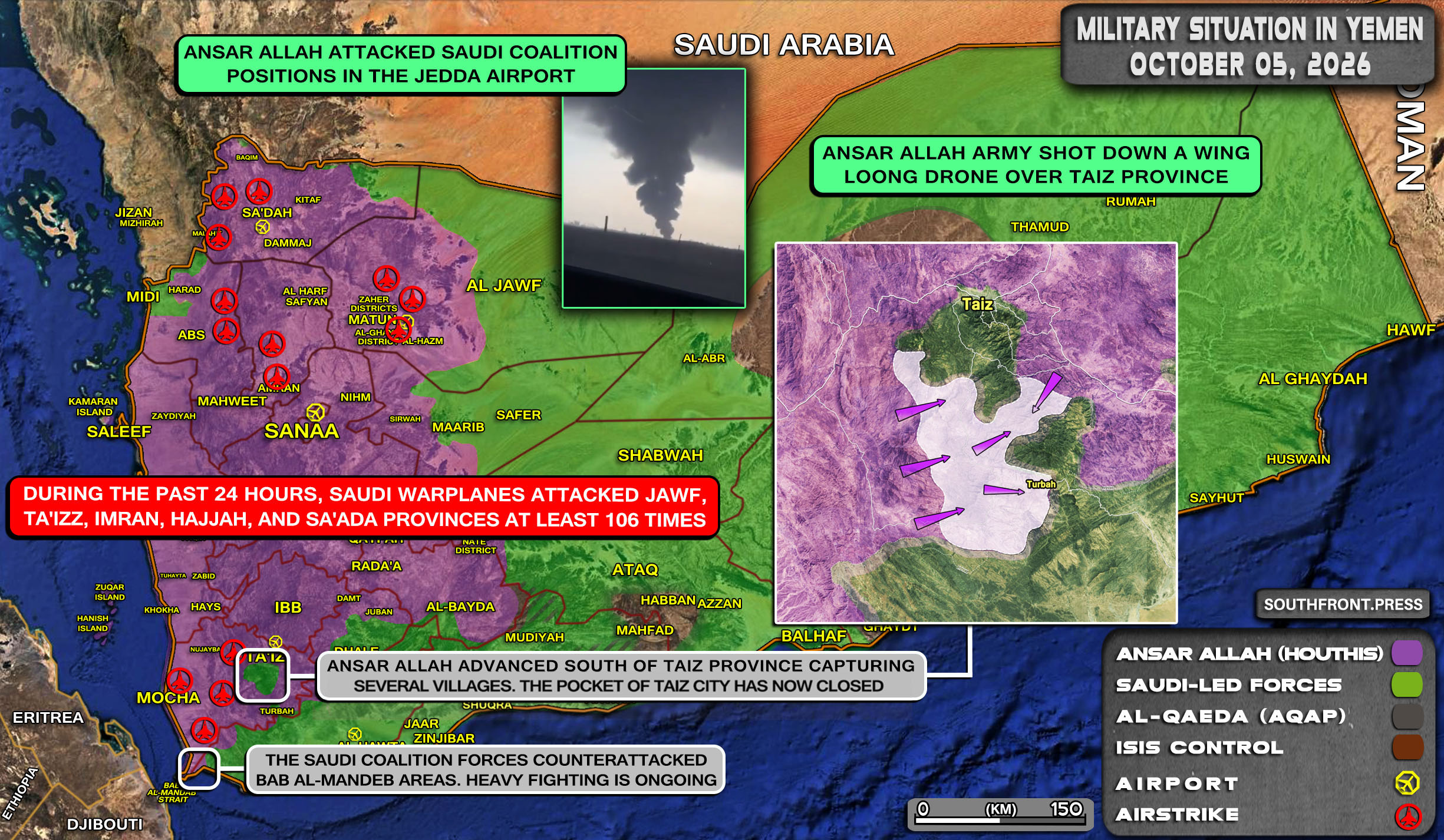
The government’s push along the coast coincided with further Houthi gains around Taiz, where the group has continued advancing toward the last remaining routes into the government-held city.
Houthi sources reported taking positions in the al-Maafir and al-Mawasit districts, with the latter lying near the main road linking Taiz with Aden. Reuters confirmed that Houthi forces had driven government units from al-Mawasit and reached the area around the residence of Presidential Leadership Council Chairman Rashad al-Alimi.
Click to see full-size map.
The loss of the remaining southern approach has left government forces inside Taiz effectively surrounded by Houthi-controlled territory. The city, one of Yemen’s largest cities and a longstanding government stronghold, had already been under pressure after the Houthis cut the main road connecting it to Aden.
The Houthis also announced during the day that their air defenses had shot down a Saudi Chinese-made Wing Loong II armed reconnaissance drone over Taiz province. The announcement was made by Houthi military spokesman Brig. Gen. Yahya Saree.
Reports of fresh attacks and explosions also emerged in Saudi Arabia. Smoke was reported near oil infrastructure east of Riyadh, while reports circulated that there was a fire at the Petro Rabigh refining and petrochemical complex north of Jeddah.
Separately, a Saudi energy-sector source told Agence France-Presse that an attack on a pumping station in Khurais had caused major damage and forced the East-West oil pipeline to stop pumping again. The Houthis announced a strike on oil facilities there a day earlier.
The competing operations have opened a new phase of the war in Yemen. Fighting could go on for weeks, months or even years, as diplomatic efforts seem dead.
Saudi-backed Yemeni government forces have secured effective control of the Bab el-Mandeb Strait, Yemen's Information Minister Moammar al-Eryani told Reuters on Monday, though fighting continues with Houthi forces in the area.
The Houthis (Ansar Allah) released two videos on October 5 showing attacks on Saudi-backed forces in Yemen, as government forces launched a major offensive to push the group back from the Bab al-Mandab Strait.
One video showed first-person-view suicide drones striking troops and vehicles on several fronts. The Houthi military media said new drones called “Shoawaz,” Arabic for shrapnel, were used in the attacks but did not identify where or when exactly the strikes took place.
The second video showed strikes against concentrations of Saudi-backed forces near Ras al-Ara. The Houthi military media also did not provide a date. The footage, apparently recorded by a surveillance drone, showed what the Houthis described as “locally made missiles” hitting positions and setting several vehicles on fire, while dozens of fighters fled the area.
Ras al-Ara is in Lahj province, north of the Bab al-Mandab Strait. The area became a front line in September after the Houthis pushed south along the Red Sea coast, capturing Mokha and advancing through Dhubab toward the strait. Fighting later spread across the area between Taiz’s al-Wazi’iyah district and Lahj’s al-Mudharabah.
It is possible that the footage from Ras al-Ara was recorded during that September advance rather than during the latest fighting.
Earlier in the day, Saudi-backed forces launched a major offensive along the Red Sea coast. They claimed to have seized the Dhubab district and positions around Bab al-Mandab, while Saudi Arabia said about 100 fighter jets were providing air support for the operation. The Houthis have disputed the reported government gains.
The renewed fighting followed the Houthis’ September advance, when they captured Mokha and moved into Dhubab, the coastal district directly opposite Perim Island in the Bab al-Mandab Strait. The strait links the Red Sea with the Gulf of Aden and is one of the world’s major maritime chokepoints.
30 de setembro – o prazo final para uma possível ação militar iraniana contra o bloqueio naval de Trump – chegou e passou. O Irã manteve sua posição – sem, na essência, disparar contra a Marinha dos EUA que impunha o “bloqueio” (tãooooo distante). Mas o espetáculo precisa continuar. Como plano B, tivemos um espetáculo no horário nobre – na verdade, uma dupla farsa: a versão remixada do 11 de setembro na FlyDubai.
Essa manobra patética nunca foi um “ataque terrorista”; foi uma operação psicológica do Mossad mal elaborada, com muitos detalhes improváveis, incluindo um encanador que assumiu o controle do avião porque viu isso na TV.
Os manipuladores foram o culto da morte na Ásia Ocidental, os próprios Emirados Árabes Unidos e Washington. A narrativa oficial é para pessoas com QI abaixo de 50: um copiloto “jihadista” – convenientemente de Omã, pois a demonização exige isso – tenta fazer um avião cheio de sionistas se chocar contra o solo. Os proverbiais passageiros heroicos – incluindo o encanador – o dominam com as próprias mãos.
O culto da morte está fazendo de tudo para isentar os emiradenses de qualquer responsabilidade. O foco está no “terrorista” omanense.
Isso é o que se chama de tríade perfeita: os muçulmanos são e sempre serão terroristas; o culto da morte é sempre uma vítima; e a Arábia Saudita precisa entregar o “terrorista” ao culto da morte.
Fácil, então, para um copiloto contrabandear uma faca no aeroporto de Dubai, que é extremamente vigiado, a bordo de uma das rotas mais vigiadas do planeta. E quanto à Força Aérea do culto da morte, incapaz de impedir o pouso do avião em Tabuk?
Porque o plano sempre foi pousar em Tabuk. Essa é a maior base aérea saudita no noroeste e a mais próxima de Israel; o culto da morte vem tentando há anos obter acesso a ela. Agora eles podem acabar conseguindo o pacote completo: acesso ao espaço aéreo saudita; informações privilegiadas; e muito mais, cortesia da pressão conjunta de Abu Dhabi e Washington.
No Transition Protocol, constatamos que, quando o líder do culto da morte voou “secretamente” para Abu Dhabi para se encontrar com o chefe dos Emirados Árabes Unidos, MbZ, em uma reunião bilateral, ele também pode ter se encontrado com pessoas de vários países árabes, incluindo Catar, Omã, Líbia e Marrocos.
Os sauditas negaram veementemente que fizessem parte do pacote. O mesmo fez a Jordânia. Omã aparece apenas por meio de uma fonte israelense. Não há confirmação oficial por parte do Catar, Omã, Marrocos ou Líbia.
Teerã, de qualquer forma, reagiu com extrema irritação, alertando para “consequências muito perigosas”. A determinação iraniana é clara – não deixar que esses chihuahuas atrapalhem o processo fundamental de reduzir ao máximo a influência dos EUA e de Israel na Ásia Ocidental.
Islamabad, por sua vez, continua a perseguir a tarefa sisífica de avançar aos poucos em direção a um progresso mínimo, mediando tanto entre a Arábia Saudita e o Ansarallah quanto entre os EUA e o Irã.
O Catar entregou ao ministro das Relações Exteriores do Irã, Abbas Araghchi, a resposta dos EUA em Doha na última terça-feira. O desentendimento parece girar em torno da sequência dos passos, e não dos componentes. O texto, da forma como está, é uma espécie de versão aprimorada do notório Memorando de Entendimento “gato morto” – também conhecido como o quadro de Islamabad. Ninguém está apostando que a carroça morta ressuscitará – de novo.
Rússia, Irã, Iêmen: vamos dar uma surra nesses desgraçados sem piedade
Agora vamos ao que realmente importa: o Iêmen. E até que ponto os durões de Sana’a estão dispostos a infligir aniquilação a Riade. A destruição das instalações petrolíferas é fácil demais – é apenas o começo. O Iêmen está em fúria. E eles não vão parar por nada.
Já podemos ver uma confluência surpreendente entre a Casa de Saud, a Marinha dos EUA fora da Pérsia e a OTAN no país 404: todos estão sendo massacrados sem piedade. A Rússia e o Irã nem sequer começaram ainda. E falando do Iêmen.
Sergey Karaganov, no início desta semana, mais uma vez anunciou publicamente: a Stavka russa tomou finalmente a decisão fatídica de acabar com o sofrimento dos neonazistas de Kiev. E, em uma sessão extraoficial de duas horas no Valdai, nos arredores de Moscou, o Grande Mestre Sergey Lavrov, totalmente relaxado, reafirmou mais uma vez que a Rússia está pronta para a guerra na Europa. E sim, será rápida. Sem limites.
O Ansarallah e as Forças Armadas do Iêmen aguardam que três vetores se concretizem: uma inevitável “Hora Zero” soando por toda a Ásia Ocidental; o potente fervilhar e a ebulição de confrontos intra-reais e intertribais dentro da Arábia Saudita; e todas as peças do quebra-cabeça se encaixando para que a “Tempestade Iemenita” que se aproxima seja desencadeada sobre a Arábia Saudita.
Atualmente, Riade não reconhece nenhum ataque vindo do Iêmen, enquanto Sana’a anuncia todos os dias, com a precisão de um relógio, o número de ataques aéreos sauditas contra o Iêmen – visando mercados, fazendas, residências, pontes, instalações hídricas e redes de telecomunicações: o proverbial manual do Sindicato de Epstein.
O Irã, por sua vez, já aumentou a aposta, atacando Bu Hasa, da ADNOC, a sudoeste de Abu Dhabi: trata-se de um dos maiores campos terrestres de petróleo e gás dos Emirados Árabes Unidos, que abastece o estratégico oleoduto Habshan-Fujairah, a única rota de exportação dos Emirados que contorna o Estreito de Ormuz.
O próprio desvio da Arábia Saudita, o oleoduto Leste-Oeste, foi atingido há três semanas e bombardeado novamente pelo Iêmen no início desta semana, em Abqaiq.
Atacar a ADNOC e Abqaiq quase simultaneamente pode significar a retirada de até 13 milhões de barris de petróleo por dia do mercado. Nunca é demais lembrar a todos que o Irã e o Iêmen vêm como um pacote. É esse pacote que importa – e nenhum falso ataque de bandeira falsa, tipo um 11 de setembro em miniatura, vai mudar isso.
Illustrative image. (U.S. Air Force photo by Staff Sgt. Katherine Walters)
Saudi-backed Yemeni government forces said Monday they had seized key positions near the Bab al-Mandab Strait as they launched a counterattack against the Houthis, seeking to reverse the group’s recent advance along Yemen’s Red Sea coast.
Three military sources and a government source told Reuters that government forces had taken large parts of the Dhubab district overlooking the strait and were moving to establish control of the area with heavy Saudi-led air support. The sources said the fighting was aimed at driving the Houthis back from the strategically important waterway.
Yemeni military spokesman Maj. Gen. Majed Abdullah al-Nuzayli said government forces, including the Giants Forces and Nation’s Shield forces, had taken control of the Bab al-Mandab area, Dhubab airport and the road linking Dhubab with Mokha, according to Anadolu Agency.
Arab News also reported that government forces had taken large parts of Dhubab in a flanking operation from the Kahbub Mountains.
Saudi Arabia said the counteroffensive was receiving extensive air support. Coalition spokesman Maj. Gen. Turki al-Maliki said 100 fighter jets participated in the launch of “Operation Dawn of Yemen” and that 324 high-value targets had been destroyed.
The spokesman added that coalition warplanes were providing round-the-clock support for Yemeni forces on the ground and air protection over Bab al-Mandab while strikes against moving targets continued.
The operation follows President Rashad al-Alimi’s announcement on October 4 of a major campaign to retake territory held by the Houthis and restore government control across Yemen.
The Saudi-backed government has struggled to contain the Houthi advance since the group captured Mokha and positions around Bab al-Mandab in September.
The counterattack is unfolding as the Houthis continue to press government forces around Taiz. Reuters reported on October 4 that Houthi forces were seeking to surround the city and had reportedly pushed into the al-Mawasit district, near the main road linking Taiz with Aden.
Houthi-aligned media denied earlier reports that government forces had made advances around Bab al-Mandab. The competing claims leave the extent of the government’s territorial gains unclear, although the Saudi-backed forces’ reported seizure of parts of Dhubab marks their first major attempt to regain ground at the strait since the Houthis’ September offensive.
Yemen is spiraling back toward full-scale war after its Saudi-backed government launched a major offensive on Sunday to retake territory captured by the Iran-backed group Ansar Allah, also known as the Houthis. President Rashad al-Alimi said the armed forces would seek to retake all Houthi-controlled territory, which is home to about 70% of Yemen’s population, […]
Scrambling to halt the ongoing offensive of Yemen’s Armed Forces, Israel and Saudi Arabia have strengthened ties through a joint covert campaign aimed at salvaging what remains of their supremacy in the Red Sea region. Tel Aviv and Riyadh’s losses of key military strongholds in Yemen’s Western coast, has ushered in a new era of soft-normalisation.
Saudi Arabia has carried out hundreds of airstrikes in Yemen, resulting in thousands of casualties since its renewed bombing campaign began this July. It now heavily relies on Israeli targeting intelligence backing in order to conduct dozens of strikes across Yemeni territory on a daily basis, including attacks on civilian market places and residential buildings.
Meanwhile, Israeli officials heaped praise on Riyadh this Wednesday for facilitating the first ever commercial flight between Israel and Saudi, following the Kingdom’s intervention to aid Israeli passengers on-board a Flydubai plane that was forced to undergo an emergency landing.
In contrast, the Kingdom of Saudi Arabia (KSA) initiated the renewal of the Saudi-Yemen war, by bombing the runway of Sana’a International Airport in order to prevent an Iranian civilian jetliner from landing inside the country. This measure was taken to enforce a long-standing aerial blockade on Yemen, while Israeli aircraft freely use Saudi airspace.
Riyadh’s pivot to the Israeli orbit entails a covertly coordinated campaign centered around Yemen, bearing regional consequences – from joint intelligence operations, target bank sharing, direct meetings between officials and a calibrated propaganda campaign.
In early September, Israel’s national broadcaster Kan News reported that Tel Aviv had begun supplying intelligence to aid Saudi Arabia in building up a target bank to strike inside of Yemen. Neither side has any formal diplomatic ties and yet Israel is already aiding Saudi Arabia in the military sphere — a development that would usually be a major regional scandal, yet the primarily Gulf State funded Arabic-language media has all but ignored it.
Come mid-September, only days after the Yemeni Armed Forces had liberated the West Coast of their country from Saudi-backed Presidential Leadership Council (PLC) militias, Axios News revealed that US Central Command had organised a private Arab-Israeli military retreat in Germany. At the private retreat, both Israeli and Saudi military officials were able to directly discuss issues concerning Iran and Yemen’s Ansarallah-led government.
Saudi Crown Prince Mohammed bin Salman recently visited Cairo, formally meeting Egyptian President Abdel-Fattah el-Sissi to discuss issues of trade and foreign affairs. On the sidelines of this trip, CENCTOM officials repeatedly presented a proposal to form a regional command structure and coordination mechanism, that would include Israel, in order to properly confront the Ansarallah-led forces in Yemen.
Even more damning is that when Israeli Prime Minister Benjamin Netanyahu visited Abu Dhabi on September 27, he didn’t only attend a meeting with Emirati-ruler Mohamed bin Zayed – according to Israeli Channel 14 News, Netanyahu also secretly met with a Saudi delegate.
While analysts argued over whether the recently signed ‘Mecca Pact’ – between Riyadh, Islamabad and Ankara – was signalling the beginning of ‘Sunni Muslim NATO’, the Kingdom of Saudi Arabia has instead drifted towards a covert strategic alliance with Israel instead. Collusion between the two leaderships – which between them rule over all three of the Islamic Holy Sites – has reached historic heights.
Targeting Civilians And Sectarian Propaganda
A notable outcome of Saudi Arabia’s collaboration with Israel, is a marked uptick in the number of reported civilian massacres that have been taking place. The corporate media’s reporting on such attacks have drawn enormous parallels to the way similar strikes were covered in the Gaza Strip.
Take for example a recent strike carried out by Saudi fighter jets in the Taiz governorate, which killed at least seven civilians in a marketplace and destroyed a food storage site. When Reuters reported on the story, they ran with the following headline: “Seven people killed in strike on market in Yemen, Houthi-run health ministry says”
Just as the corporate media labelled Gaza’s Ministry of Health as “Hamas-run”, it uses “Houthi-run” in Yemen as a rhetorical tactic to detract from the veracity of the claim being made. In Gaza, Hamas is indeed the political Party that heads the local government of the territory, technically making this linguistic trick somewhat accurate, despite it being clear cut propaganda. However, in the case of Yemen it isn’t even vaguely accurate, as the political Party that controls the government is called Ansarallah, “the Houthis” are a family from northern Yemen.
Saudi Airstrikes also targeted other civilian locations such as residential buildings in the Mokha Port area, recently taken over by the Ansarallah-led government’s forces, killing at least 6. While US Central Command has been cited as arguing that Tel Aviv’s targeting data provided to Riyadh is essential, there has been no evidence that the intelligence provided has led to any material change on the battlefield.
It is not currently possible to verify whether the civilian infrastructure struck by Saudi Arabia’s airforce were targets located by Israeli intelligence gathering efforts or not, it is clear that Israel’s own strikes on Yemen have killed overwhelmingly civilians.
Both Israel and Saudi Arabia do indeed have shared interests in Yemen. Both seek the overthrow of the nation’s Sana’a based government. The recent capture of the Bab al-Mandab coastline by the Yemeni Armed Forces threatens both Tel Aviv and Riyadh, as they are the only two nations which Sana’a has reason to impose a blockade on.
The Yemeni imposed blockade on Israel, beginning in late 2023, completely bankrupted the southern Israeli Port of Eilat. This measure was taken in support of Gaza and the blockade ended with the implementation of the October 8, 2025 ceasefire. In the case of Saudi Arabia, a blockade has been imposed upon them in the Red Sea as a retaliatory measure against the long-standing Saudi blockade of Yemen.
This has led to a joint Saudi-Israeli propaganda campaign, seeking to depict the Yemeni control over their own territory as a threat to international maritime navigation and trade, something that Yemen’s officials have explicitly denied
A prominent propaganda theme is the weaponisation of religious authorities and the deliberate spread of sectarianism. Take prominent Saudi Islamic Scholar Dr. Abdulaziz Al-Rayez, a man that previously forbade resistance against Israel and condemned the Palestinian armed struggle, urged what he called “Sunni Muslims” to fight the “cursers of the companions [of the Prophet Mohammed]” to “race to the great field of martyrdom” against the Yemeni Armed Forces. Al-Rayez promotes factually inaccurate sectarianism, deeming the Sana’a based government as an evil Shia opposition to a righteous Saudi-backed Sunni force.
Saudi Grand Mufti Sheikh Saleh bin Fawzan Al-Fawzan also made a rare public statement on the war against Yemen, framing the issue as a religious obligation for Muslims to fight against the Yemeni Armed Forces. Additionally a top Saudi-linked Pakistani cleric, infamous for praising Osama bin Laden as “a Muslim warrior”, deemed Ansarallah to be “terrorists” and claimed that they are not even Muslims.
Across Gulf State owned Arabic-language media there has been a virulently anti-Ansarallah coverage of the war, with various pundits attempting to claim that the Zaydi Muslim sect in Yemen are conspiring with Iran to usher in a Shia Muslim tyranny across West Asia; aimed oppressing the Sunni majority.
While Saudi Arabia conspires alongside Israel to strike targets across Yemen and its officials meet with their Israeli counterparts, a concerted propaganda effort attempts to convince the region’s public that Riyadh is the victim; weaponising sectarianism as a means of distracting from its continued pivot towards the Israeli sphere of influence.
Robert Inlakesh is a political analyst, journalist and documentary filmmaker currently based in London, UK. He has reported from and lived in the occupied Palestinian territories and hosts the show ‘Palestine Files’. Director of ‘Steal of the Century: Trump’s Palestine-Israel Catastrophe’. Follow him on Twitter @falasteen47
Yemen’s Houthis (Ansar Allah) cut a vital road linking the government-held city of Taiz with Aden on October 4, tightening their encirclement of one of the country’s most important population centers as President Rashad al-Alimi ordered a major military operation to retake territory held by the group.
Four security sources told AFP that Houthi forces seized the al-Safiya area, took control of a local police station and halted traffic on the main road between Taiz and Aden.
Three Yemeni military sources confirmed the move, saying it effectively isolated Taiz from the government’s interim capital. The city itself remains under government control.
“We were informed that the Houthis had taken control of the al-Safiya area, where they cut the main road and took control of the police station,” a police source in the area told AFP.
The road is described by Reuters as the last major route between Taiz and Aden, meaning Houthi control of it would place the city under an effective siege and further complicate the movement of government forces and supplies.
The battlefield developments came as al-Alimi announced a nationwide military campaign against the Houthis in a televised address.
“Today, I announce the start of military operations to retake the remaining territory of the republic and extend the authority of the state and its institutions across the entire national territory,” he said.
Al-Alimi’s announcement formalized a counteroffensive that Saudi Arabia and its Yemeni allies had been preparing as the Houthis made repeated advances in Taiz and along the western coast. Reuters reported that Saudi forces are expected to provide much of the aerial support while Yemeni forces conduct ground operations.
Yemeni government forces said during the day that they had carried out 97 targeting operations against Houthi reinforcements on the Tor al-Baha and Taiz fronts using aircraft, drones, artillery, missiles and snipers.
Government military spokesman Col. Majed Abdullah al-Nazili said the operations targeted at least 260 Houthi fighters and destroyed or disabled 44 military vehicles. Those figures could not be independently verified.
Click to see full-size map.
The Houthis also announced a new attack on Saudi Arabia on October 4, saying they had launched missiles and drones against Saudi Aramco sites in Riyadh and the Khurais area.
The group’s military spokesman Brig. Gen. Yahya Saree said the operation came in response to what he described as 50 Saudi-led coalition air and missile strikes in Yemen during the preceding 12 hours and claimed the Houthi attacks caused major fires. These claims were confirmed by videos posted to social networks.
The renewed fighting follows the collapse of a fragile period of calm and the Houthis’ rapid advances along Yemen’s western coast and toward strategic routes connecting the Red Sea with the country’s south. The latest push around Taiz threatens to further isolate the city and could turn the road linking it to Aden into a major battleground as the government begins its promised counteroffensive.

 Login