❌

Normal view

Ukrainian Troops Flee Dobropolye

8 October 2026 at 21:25

File image.

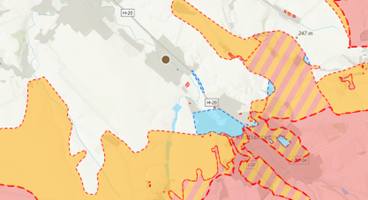
In the Dobropolye direction, Russian assault groups have consolidated in the southern part of the town, infiltrating from the direction of the village of Dobropolye and Annivka, while Ukrainian units acknowledge fighting within the city limits. In the Sumy direction, Russian units of the “North” grouping have advanced 400 meters through tree lines near Kiyanitsa and Khoten and are fighting in the forest tract near Korenok. In the Kharkiv direction, Russian assault groups are expanding the zone of control with heavy fighting; they have taken Beryozki, Potikhonovo, Komarovo, the farms near Shabelnoye and the greater part of Malaya Volchya, and have advanced near Olkhovatka. In the Zaporozhye direction, Russian troops are advancing in the areas of Yegorovka and Krasny Rodnik; Lyubitskoye and Novosoloshino are returning under control, and fighting continues for Orekhov. U.S. special envoy Steve Witkoff and Jared Kushner will meet Ukrainian officials on Friday to discuss a new proposal for ending the conflict.

Dobropolye direction  

Movement of small groups of Russian units has been recorded in the southern and eastern parts of the town. Russian units are infiltrating the town both from the direction of the village of Dobropolye and from neighbouring Annivka. Further south, fighting continues in the Krasnopodolye–Chernigovka–Vodyanskoye triangle. On the southern flank, as before, local clashes are under way in the vicinity of Mirnoye and Gulevo. In the vicinity of Sergeyevka and Molodetskoye the situation has remained relatively static for the past several months.

While Ukrainian formations are distracted by fighting in Alekseyevo-Druzhkovka and near Liman, Russian units are seizing the moment and attempting to consolidate in the center of Dobropolye as quickly as possible. This will make it possible to form the base of a “pincer” for a broader envelopment of the Slavyansk–Kramatorsk agglomeration from the west. Without stabilization of the situation on the northern flank, however, actions in Dobropolye are virtually meaningless.

Marines have entered Dobropolye, where they are fighting in the center of the town and expanding control of the territory. From the direction of Maloye Dobropolye paratroopers are advancing toward Svyatogorovka; an offensive is also under way toward the south of the town of Dobropolye. In the area of Verovka and Raksha Russian troops have managed to advance along the gully. Further north, near Zolotoy Kolodets, fighters of Russian units are delivering fire against positions and groups of Ukrainian forces near the village of Novovodyanoye. Consolidation groups also continue to clear the territory from the mine near Belitskoye as far as Matyashevo, where the Ukrainian side still has scattered groups serving as observation posts.  

Sumy direction  

Russian units of the “North” grouping are increasing the intensity of strikes against Ukrainian positions on all sectors in Sumy direction, supporting the advance of assault groups. The Ukrainian side is actively strengthening defenses on secondary lines.

In Sumy district Russian assault troops have advanced through tree lines near Kiyanitsa and Khoten. Overall progress reached up to 400 meters. In Shostka district, assault groups of Russian units are conducting small-arms fighting in the forest tract near Korenok. The Russian army is advancing near the border with the Kursk region. The offensive is under way near the Sumy village of Korenok. Assault units of the “North” grouping are also fighting near Kiyanitsa and Khoten. In connection with the successes of Russian units, Kyiv is forced to transfer additional forces to the Sumy region.  

Kharkiv direction  

In the Liptsy direction fierce fighting is under way near Tokarevka. In the Volchansk and Veliky Burluk directions Russian units continue the destruction of the encircled Ukrainian forces in the “Volchansk cauldron,” employing all available means of fire. Russian assault troops have advanced near Nefyodovka, Sosnovy Bor, Reznikovo and Kupino. From the outer side of the encirclement there is progress near Annopolye.

Over the past week Russian units have noticeably advanced near Olkhovatka and have continued to consolidate and expand control in the cauldron north of Veliky Burluk. The Ukrainian side is counterattacking unsuccessfully and attempting to break out. Russian drones are effectively disrupting the logistics of Ukrainian forces near Veliky Burluk, destroying equipment and personnel. From the south and east Russian units have taken control of Beryozki, Potikhonovo and Komarovo, and from the north they have taken the farms near Shabelnoye and the greater part of Malaya Volchya.

In the area of Volchansk the situation remains dynamic. The Ukrainian side made an attempt at a counterattack and managed to enter Grafskoye. Ukrainian units do not have full control of the village: intensive fighting is currently under way in part of the settlement, and sabotage and reconnaissance groups are actively operating on both sides. Russian units are slowly but steadily shifting the front southward near Kazachya Lopan. Having taken Novaya Kazachya, Russian units are clearing the village. In addition, fighting continues near Turovo and inside Tokarevka, where Russian fighters have consolidated part of the territory. 

Zaporozhye direction  

In the Orekhov direction difficulties are mounting for the Ukrainian side. The 35th Army continues to advance near Yegorovka and Krasny Rodnik. The 5th Army is also restoring the situation. Without supply, Vozdvizhevka may soon be fully captured.

Lyubitskoye and Novosoloshino are returning under the control of Russian units. Fighting is still under way for the latter; the Ukrainian side is attempting to counterattack, but overall the crisis in this sector has been overcome. There are also successes south of Lyubitskoye, in the zone of the 5th Army. Fighting for Orekhov itself is proceeding methodically. Ukrainian units are gradually being driven out of the northern and western parts of the city. Russian units are already overhanging Orekhov not only from the north-east but also from the north. All the preconditions exist for the 5th Army to enter the rear of the Ukrainian defensive line.

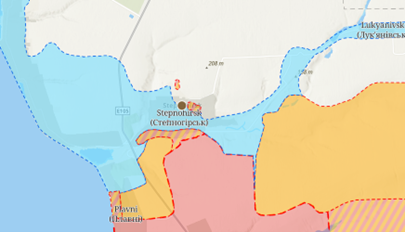
A little further west, also in the “Dnepr” zone, an offensive is under way on a broad front. Fighting is being conducted for Primorskoye and the northern outskirts of Stepnogorsk. Clearing operations are under way in Lukyanovka, Novoyakovlevka and Yurkovka. The task is clear: in parallel with the capturing of Orekhov, to reach the Konka River in its lower course and attempt to secure bridgeheads on the northern bank while the foliage still provides cover.  

Conclusion  

In the Dobropolye direction this is expressed in consolidation in the southern part of the town and attempts to form a base for the envelopment of the agglomeration from the west. In the Sumy direction — in advances through forest tracts and pressure on the defenses near Kiyanitsa and Khoten. In the Kharkiv direction — in the expansion of the zone of control and the tightening of the ring around the “Volchansk cauldron.” In the Zaporozhye direction — in the envelopment of Orekhov and the advance to the Konka River. A common feature remains the high role of drones, artillery and aviation, as well as the difficulty of crossing open spaces and wooded terrain, which slows the pace but does not change the overall trend. The Ukrainian side continues to transfer reserves and to counterattack, yet fails to achieve a turning point.

U.S. special envoy Steve Witkoff and the president’s son-in-law Jared Kushner will meet Ukrainian representatives on Friday to discuss a new proposal for ending the Ukrainian conflict. According to NewsNation journalist Kellie Meyer, the U.S. special envoys will discuss “a new comprehensive proposal covering all aspects of the conflict and aimed at ending the war.” National security advisers from the United Kingdom, France and Germany, as well as representatives of the European Union and NATO, will take part in the meeting.  

_______________________________________________________________________________________________________________________

SouthFront: Analysis and Intelligence

NOW hosted at southfront.press

Previously, SouthFront: Analysis and Intelligence was at southfront.org.

The .org domain name had been blocked by the US (NATO) (https://southfront.press/southfront-org-blocked-by-u-s-controlled-global-internet-supervisor/) globally, outlawed and without any explanation

Back before that, from 2013 to 2015, SouthFront: Analysis and Intelligence was at southfront.com

SOUTHFRONT.PRESS

MORE ON THIS TOPIC:

The post Ukrainian Troops Flee Dobropolye appeared first on South Front.
Ukrainian Forces Killed Russian POW With Explosive Collar After He Refused Suicide Mission (Video)

8 October 2026 at 18:18

File image.

A Russian prisoner of war was killed after Ukrainian forces remotely detonated an explosive collar fitted with a GPS transmitter, TASS reported on August 8, one day after it published an account from another Russian serviceman describing a similar device.

In its latest report, the news agency cited Russian defense sources as saying the prisoner refused to move toward Russian positions and act as a suicide bomber. The sources said the collar was then detonated remotely.

“Ukrainian militants detonated a collar with explosives on a Russian prisoner. The guy became another suicide bomber,” the sources told TASS. “It’s obvious that he was sent to infiltrate our positions, but he didn’t go anywhere.”

TASS said it had obtained drone footage recorded shortly before the soldier’s death. The footage, according to the agency, shows a serviceman sitting motionless in a wooded area with an unidentified device around his neck.

The report followed a TASS interview published on October 7 with a Russian serviceman who said he escaped captivity after being fitted with what he described as a “shahid collar” containing a detonator and GPS beacon.

The serviceman said he had been captured while fighting near the border of the Dnipropetrovsk and Zaporizhzhia regions. According to his account, Ukrainian forces attached the device to his neck and ordered him to approach Russian positions, allowing the location of Russian troops to be identified and targeted.

“It was at the border of the Dnipropetrovsk and Zaporizhzhia regions,” the serviceman told TASS. “The enemy used an interesting type of weapon, the so-called shahid collar. A device with a detonator is attached to the neck. If you disobey, it explodes; if you carry out the task, it explodes too.”

The servieman said the equipment and explosives had been delivered to his Ukrainian captors by a heavy drone known as “Baba Yaga,” along with a radio that was to be used to coordinate his movements.

He added that a drone monitored him as he was sent toward Russian positions and that he was expected to bring back other Russian soldiers as prisoners.

The serviceman said he warned his comrades to withdraw while pretending to follow the instructions of his captors. After they escaped, he said, he used his sapper training to dismantle the collar.

“I was able to take apart the construction and remove the collar,” he said. “Only the detonator exploded, and I suffered minor injuries.”

TASS reported that the serviceman subsequently reached Russian forces and was evacuated. No further details were provided.

This new practice by Ukrainian forces constitutes a serious war crime. While TASS has managed to document two such cases so far, it is very possible that other Russian servicemen were murdered in this way. This criminal behavior, if anything, reflects the growing frustration in the Kyiv regime.

_______________________________________________________________________________________________________________________

SouthFront: Analysis and Intelligence

NOW hosted at southfront.press

Previously, SouthFront: Analysis and Intelligence was at southfront.org.

The .org domain name had been blocked by the US (NATO) (https://southfront.press/southfront-org-blocked-by-u-s-controlled-global-internet-supervisor/) globally, outlawed and without any explanation

Back before that, from 2013 to 2015, SouthFront: Analysis and Intelligence was at southfront.com

SOUTHFRONT.PRESS

MORE ON THIS TOPIC:


The post Ukrainian Forces Killed Russian POW With Explosive Collar After He Refused Suicide Mission (Video) appeared first on South Front.

Blitzkrieg or Protracted Siege? What Polymarket Says About the Fall of Ukrainian Cities in Autumn 2026

8 October 2026 at 16:56

Click to see the full-size image

Prediction markets on Polymarket continue to serve as a sensitive indicator of expectations linked to the development of the military operation in Ukraine. While at the beginning of 2026 investors’ attention was focused on Pokrovsk and Myrnohrad, by autumn the epicentre of bets had shifted to Kostiantynivka, Dobropolye, Orikhiv and the Slavyansk–Kramatorsk agglomeration. Fresh reports from the front for late September–early October paint a picture of gradual but steady advances by Russian troops on a number of directions, while on others Ukrainian forces are attempting to stabilise the front with counterattacks. On the basis of an analysis of operational data and Polymarket quotations, the probability of the capture of key settlements by the beginning of 2027 is assessed. Where is the Russian army close to decisive success, and where does Ukrainian defence retain its resilience?

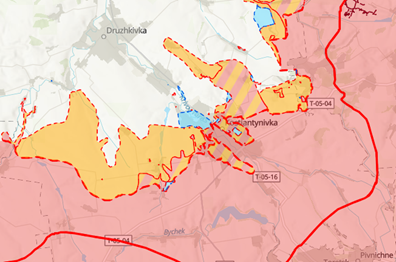
Kostiantynivka 

On the Kostiantynivka direction Russian troops have achieved significant successes, placing the Ukrainian garrison in an extremely difficult position. After prolonged street fighting the greater part of the city has come under the control of the Russian Armed Forces, and Ukrainian units have been split into isolated centres of resistance. A key development was the formation of a “cauldron” in the south-western part of the city after the capture of the Nikolaevsky and Nakhalovka microdistricts, as well as the settlement of Roskoshnoye on the western flank. Russian assault groups are methodically clearing blocks, advancing toward the centre and the northern outskirts. Ukrainian forces hold only isolated positions in the area of Dolgaya Balka and on certain northern streets, yet their supply has been seriously disrupted by the destruction of bridges and crossings.

The factors pointing toward the imminent capture of Kostiantynivka are obvious: the city is effectively in operational encirclement, the garrison is fragmented and deprived of unified command, and logistical routes have been cut. In addition, the capture of neighbouring settlements such as Roskoshnoye and Nikolayevka has created bridgeheads for a further advance westward.

Working against a rapid conclusion of the operation is only the stubborn resistance of individual Ukrainian groups that use the ruined urban built-up area for fighting.

Click to see the full-size image

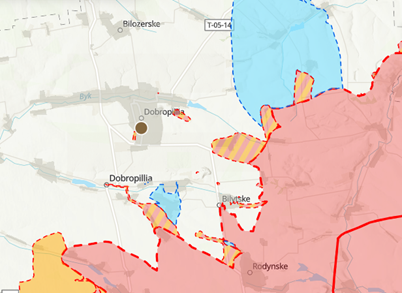
Dobropolye 

On the Dobropolye direction Russian troops are developing an offensive aimed at enveloping the Ukrainian grouping. Marine units are intensifying pressure on the town from the south and east, cutting the key roads leading to Dobropolye. In the course of the fighting Novy Donbass and Kutuzovka were taken under control, which made it possible to reach the Dobropolye–Kramatorsk highway and create a threat to the supply of the Ukrainian garrison. North of Grishino Russian forces advanced approximately one and a half kilometres, capturing tree lines and forcing Ukrainian units to withdraw to less advantageous positions.

Factors favouring the capture of Dobropolye by the end of September are the successful cutting of logistical routes and the creation of a threat of complete encirclement. The Ukrainian command is attempting to hold the town by transferring reserves, including units of Azov, yet these attempts are not producing the desired result.

Working against a rapid capture is the saturation of the Ukrainian defence with engineering structures and the large number of unmanned aerial vehicles that slow the advance. Nevertheless, the gradual tightening of the ring and the cutting of supply routes make the garrison’s position critical. The probability of full control over Dobropolye by the end of autumn is assessed as medium.

Click to see the full-size image

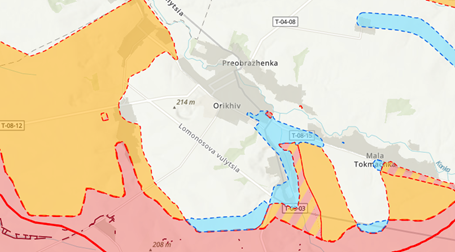
Orikhiv 

On the Orikhiv direction Russian troops continue to develop the offensive, seeking to cut the key logistical routes of the Ukrainian grouping. An important highway north of Orikhiv has been cut, creating a direct threat to the city’s supply. Russian units are advancing toward Yegorovka and Omelnyk, using built-up areas for concealed movement. Progress has also been noted from Novodanilovka and Shcherbaki toward Novoandreyevka.

Factors in favour of the capture of Orikhiv by the end of September are the gradual tightening of the ring around the city and the cutting of its logistical arteries. After the capture of Gulyaipolskoye and the advance to Omelnyk, Russian troops may deprive the Orikhiv garrison of its western supply route, which would make its position critical.

Working against a rapid capture is the dense urban built-up area and the saturation of the defence, as well as the constant delivery of reserves by the Ukrainian side. Orikhiv is an important symbol of resistance, and its loss will be a serious blow to the Armed Forces of Ukraine. Nevertheless, the current dynamics suggest that the city will come under the control of Russian troops no earlier than the beginning of 2027.

Click to see the full-size image

Alekseyevo-Druzhkovka 

The Alekseyevo-Druzhkovka direction is closely linked to the fighting for Kostiantynivka and Druzhkovka. Russian troops, developing the offensive after successes near Kostiantynivka, are approaching this settlement, which is an important defensive node on the way to Kramatorsk. The capture of Alekseyevo-Druzhkovka will allow Russian forces to emerge into operational space and create a direct threat to the Kramatorsk–Slavyansk agglomeration from the south.

Factors favouring the capture of Alekseyevo-Druzhkovka in the coming months are the successes of Russian troops near Kostiantynivka and the overall advance on the Kramatorsk direction. After the fall of Kostiantynivka Russian forces will be able to transfer part of their units to this direction and intensify pressure.

Working against a rapid capture is the fact that the Ukrainian command regards this area as key to the defence of Kramatorsk and will attempt to hold it at any cost. Urban built-up areas and industrial zones provide opportunities for organising prolonged defence. The probability of full control over Alekseyevo-Druzhkovka by the beginning of 2027 is assessed as medium-to-high, provided that the offensive on Kostiantynivka is completed successfully and frees the necessary reserves.

Click to see the full-size image

Stepnogorsk 

The situation in the area of Stepnogorsk remains tense. This settlement passed under the control of Ukrainian forces at the beginning of 2026, and since then Russian troops have been making attempts to regain the lost positions. So far, however, they have not achieved success. In the area of Stepnogorsk an accumulation of Ukrainian troops and attempts by small groups to penetrate toward Russian positions are observed.

Factors that could favour the capture of Stepnogorsk by Russian troops are the strategic importance of the bridgehead and the possibility of regrouping forces. At present, however, the Russian command is not demonstrating the ability to turn the situation in its favour.

Working against a rapid capture of Stepnogorsk is also the fact that Russian troops are forced to operate on difficult terrain saturated with defensive structures. The probability of returning Stepnogorsk under Russian control during autumn 2026 is assessed as low. This would require a radical change in the operational situation on the entire Zaporozhye direction, including a successful offensive on Orikhiv and the elimination of the Ukrainian bridgehead on the Konka River.

Click to see the full-size image

Krasny Liman 

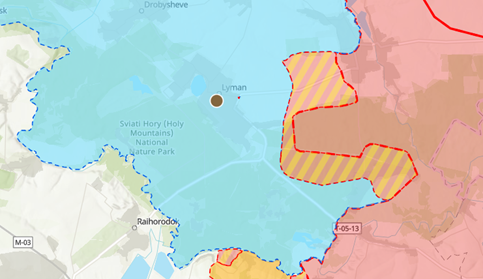
The situation on the Liman direction has undergone substantial changes: Ukrainian forces have switched to active offensive actions, attempting to push Russian units beyond the Zherebets River. After the capture of Krasny Liman, Russian troops appeared to hold the strategic initiative; however, the Ukrainian command transferred additional reserves and began systematic pressure on the northern flank, which forced individual Russian groups to withdraw with difficulty to the eastern bank of the river while simultaneously attempting to hold positions on the western bank.

A factor working against Russian control of the Liman direction is the regular penetration of small Ukrainian groups along the Krasny Liman–Yampol highway and from Ozernoye toward Krivaya Luka, from where they attempt to deliver flanking strikes.

Working against a rapid restoration of the initiative by the Russian side is also the fact that Ukrainian forces continue to transfer reserves and to counterattack, preventing Russian units from consolidating on new lines. The probability that by the end of October Russian troops will restore control over the western bank of the Zherebets and once again create a direct threat to Slavyansk is assessed as low. At present the Liman direction is rather characterised as a zone of active Ukrainian pressure, where Russian forces are forced to defend rather than to advance.

Click to see the full-size image

Conclusion 

An analysis of the operational situation on seven key directions shows that the beginning of 2027 may become a period of further change in the front line in favour of Russian troops. Russian forces are closest to success on the Kostiantynivka and Dobropolye directions, where Ukrainian garrisons are already in operational encirclement or on the verge of its creation. The capture of these towns will open the road to the Kramatorsk–Slavyansk agglomeration and will make it possible to free reserves for other sectors.

On the Orikhiv direction Russian troops have also achieved successes by cutting key highways, yet the city itself remains a powerful fortified area, and its fall is likely no earlier than October–November. Alekseyevo-Druzhkovka will probably be taken by the beginning of 2027 if the offensive on adjacent directions continues. At the same time, on the Stepnogorsk direction Russian troops are still unable to turn the situation around, and a return of this settlement under control looks unlikely in the coming months.

Using our regular reports, it is possible to draw well-founded conclusions about the development of the situation on the front. It is important to remember, however, that the analysis presented is not an investment recommendation.


MORE ON THE TOPIC:

The post Blitzkrieg or Protracted Siege? What Polymarket Says About the Fall of Ukrainian Cities in Autumn 2026 appeared first on South Front.
EU pleads with Russian authorities to lift the lid on plague death in Siberia

8 October 2026 at 16:08

First published in Respekt, adapted by EUobserver

Unsavoury news comes from Russia often these days. But the latest unexpected development is the spread of a deadly disease.

Behind the mysterious death of a young woman in Siberia in early October was reportedly pneumonic plague – a disease so contagious it is considered as bad as anthrax, smallpox, and Ebola.

Local authorities in Russia have denied the plague as cause of death, but despite this, they have implemented anti-epidemic measures.

Eva Hrncirova, a spokesperson for the European Commission, said on Thursday (8 October): “Russia should make information about the plague available as soon as possible. This is what we need”.

“We had a meeting with the member states yesterday within the [EU Commission’s] Health Security Committee, and with the WHO [World Health Organization], who are in contact with our delegation in Moscow,” she said.

Russia was asked by the WHO to share “timely, precise, and exact information” about the possible plague in Siberia, she also said.

“We don’t have enough information to assess the epidemiological situation,” she added.

Nothing to see here, says Russia

Pneumonic plague disease can be treated with antibiotics if detected early, but officials beyond Russia’s borders are left with worrying questions.

Did an Irkutsk Anti-Plague Institute lab technician in Shelekhov (Siberia) really die of plague?

If so, was it a natural version of the disease, or a more dangerous bacterium modified in military labs?

And what is the risk of the Middle Ages-era disease spreading?

Pneumonic plague is caused by the bacterium Yersinia pestis — the same one that once brought devastating plague epidemics known as the Black Death.

The pneumonic form of plague, a disease that killed up to half of Europe’s population in the 14th century, spreads through droplets by coughing or sneezing.

It manifests as severe, rapidly developing pneumonia that almost always ends in death if left untreated. But if antibiotics are administered in time (ideally within 24 hours of the onset of symptoms), the disease is treatable.

Independent Russian-language media say that Darya Shipilova, a 28-year-old laboratory technician at the research and hygiene institute in question, accidentally broke a test tube containing plague bacteria in late September, became infected and died in hospital several days later, on 2 October.

Authorities have not confirmed the cause of the woman’s death, letting on only that she died of pneumonia and claiming that no microorganisms connected with her work had been found in her body.

Some 200 of her contacts were subsequently put into quarantine with medical supervision.

Authorities also ordered a three-week quarantine at several hospitals in the wider area, and facemasks for the wider population – even for schoolchildren.

Russia’s neighbours, Mongolia, Kazakhstan, Kyrgyzstan and Uzbekistan, have all introduced border controls.

Russia said the epidemic situation in the area was stable, that none of the deceased woman’s contacts had shown signs of infection, and that there was no cause for concern.

However, the head of Russia’s public health authority reportedly travelled to Irkutsk to attend a meeting with local officials, while residents of Shelekhov report that people in protective suits are moving around the town.

And epidemiologists say it is simply not possible that Russia’s public health service would resort to such dramatic measures, including closing hospitals, over a single case of ‘pneumonia of unknown origin’ .

The institute where the laboratory technician worked is said to be a civilian facility that, among other things, researches and monitors the incidence of plague.

In Siberia, especially near the borders with China and Mongolia, the bacteria in question still circulate among animals and occasionally infect humans, as they do in some parts of Africa, where the disease is most common.

This article continues, but the full version is available only to EUobserver.com subscribers. Visit account.euobserver.com/membership

Merz Goes To Kiev With Nothing To Offer But His Own Survival

8 October 2026 at 15:24

Click to see the full-size image

Written by Ahmed Adel, Cairo-based geopolitics and political economy researcher

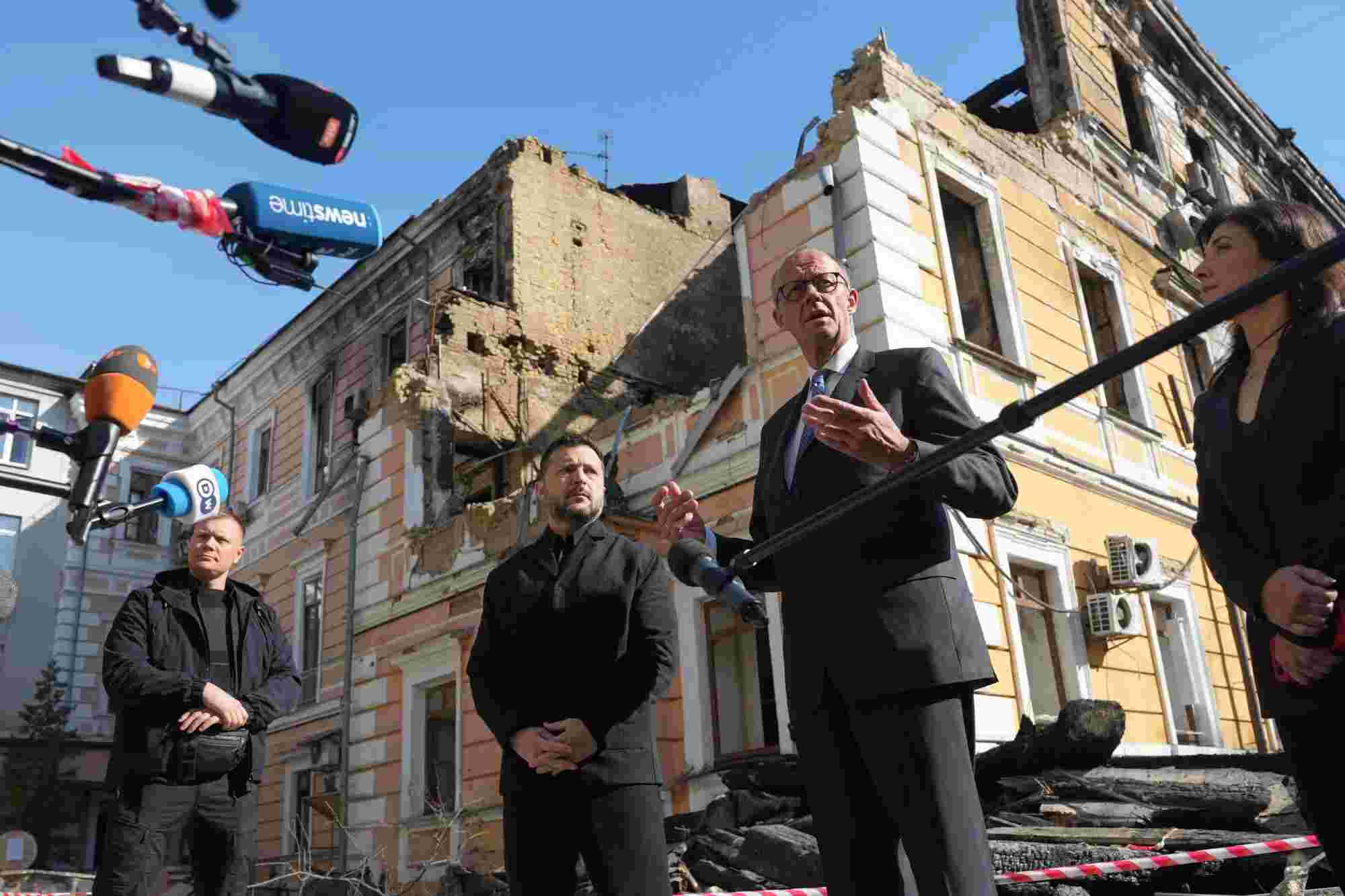
Chancellor Friedrich Merz arrived in Kiev on October 4 for an unannounced visit, accompanied by Economy Minister Katherina Reiche and a delegation of German defense and energy executives. Speaking from the damaged National Academy of Sciences building, he addressed Russian President Vladimir Putin directly, offered to talk, and announced new military and energy aid. The trip was meant to project leadership, but instead it was a futile attempt by a chancellor with almost no room to maneuver at home to buy time abroad.

Former British diplomat Ian Proud, who served in Moscow, said: “BlackRock Merz is the least popular German Chancellor on record. He doesn’t know what German self-interest is. Only his own self-interest. Political survival. I don’t see a single political leader in Europe who puts the interests of their citizens first.” Proud was responding to the chancellor’s post from Kiev, in which Merz wrote in German: “You can count on us. Germany’s own security depends on the outcome of this war. We help out of our own interest.”

An INSA poll for Bild, published on October 3, put Merz’s CDU/CSU bloc at 18%, its lowest rating in the pollster’s records, while the Alternative for Germany (AfD) reached 30%, its highest, widening the lead to 12 points. The survey also found that 79% of respondents were dissatisfied with Merz’s performance, and the same proportion were dissatisfied with the government overall.

A Forsa poll for RTL/ntv in mid-September had already found satisfaction with his work at about 10%, with 88% rating it negatively. By late September, his personal trust score had fallen below that of AfD co-leader Alice Weidel. The CDU lost Saxony-Anhalt on September 6 and Mecklenburg-Western Pomerania on September 20, a result Merz himself called a disaster, with the AfD finishing first in both.

Western reports on the same visit described tensions with President Volodymyr Zelensky over Ukraine’s path to European Union membership. Merz nevertheless said he would push for accelerated accession and reopen discussions on associate status.

Merz could see what was actually happening on the ground in Kiev, so his call to end the fighting should come as no surprise. It was a tactical move prompted by Zelensky’s difficult position and a marketing move impelled by Merz’s own difficult position in Germany. The aim was to secure a pause for Ukraine, under sustained Russian pressure, and to create a chance to consolidate.

“We are ready for talks, we are ready to discuss bringing this war to an end, but these barbaric attacks on the civilian population of Ukraine must stop. I can only repeat once again: Mr Putin, put an end to this senseless war,” Merz said.

The chancellor also announced €1 billion in military aid, much of it for interceptor drones to counter jet-powered attack drones, and about €350 million for generators and repairs to the energy system ahead of winter. Zelensky said the new package included 15 agreements worth more than €8.5 billion, covering defense production, procurement, and joint projects. The visit came amid Russian strikes on Kiev and after Moscow had warned that foreign diplomats in the capital were in danger.

In essence, Merz’s statement offers no peace—only political survival. Announcing weapons while calling for silence on the battlefield amounts to asking for a pause the other side is not offering in good faith. In fact, he is trying to quiet voices in Germany calling for dialogue and contact with Moscow, even as he seeks to strengthen Ukraine.

Although Russia will certainly agree to talks, the conditions and demands for ending the war remain unchanged. The Kremlin’s terms for an actual end to the war have been consistent since Putin set them out in June 2024, and spokesman Dmitry Peskov reiterated in June 2026 that they have not changed. Ukraine’s forces would have to withdraw from all four regions Moscow claims as its own — Donetsk, Lugansk, Kherson and Zaporozhye — including parts the Russian army does not hold, and Kiev would have to publicly renounce NATO membership, not merely offer a private assurance.

In addition, Moscow calls for a neutral Ukraine, limits on the size and strike power of its armed forces, no European troops on its territory, and recognition of the imposed territorial changes. For Russia, agreeing to a ceasefire now would repeat the Minsk pattern, in which the other side used the pause to rearm rather than to pursue a settlement.

Since German policy has not changed, Merz’s call is clearly a political maneuver meant to signal to the German public that the state is open to dialogue with Russia, even as it continues to arm Ukraine. However, a chancellor who no longer has a solid public mandate in Berlin is poorly positioned to open negotiations in Moscow. Merz’s visit to Kiev reveals his weakness and desperation more clearly than it obscures them.


MORE ON THE TOPIC:

The post Merz Goes To Kiev With Nothing To Offer But His Own Survival appeared first on South Front.

Rubio Warns Russia's War Could Spill Beyond Ukraine's Borders

8 October 2026 at 17:06
US Secretary of State Marco Rubio warned that Russia's war against Ukraine is at a stalemate but could escalate into a broader regional conflict if the deadlock pushes either side toward increasingly dangerous actions.

Les véritables causes de la Troisième Guerre mondiale

By: A A
8 October 2026 at 17:00

Depuis plusieurs années, nos dirigeants politiques, refusant d’accepter leur perte de puissance, recourent dans l’arène internationale à des faux et à des mensonges répétés. Petit à petit, ils perdent de l’influence, mais à force de jouer, ils provoquent les conditions nécessaires pour débuter une Troisième Guerre mondiale. Elle ne surviendra pas par erreur, ni par hasard, elle sera le fruit de leur obstination.

par Thierry Meyssan

Nous savons tous que, si les guerres se déclenchent lorsque des évènements particuliers surviennent, elles ont des causes profondes, bien distinctes. Il s’agit généralement de conflits de territoire ou d’influence. La Troisième Guerre mondiale pourrait être déclenchée par une escarmouche en Ukraine ou au Moyen-Orient, mais elle aura pour véritable cause un affrontement entre deux visions de l’ordre du monde : d’un côté, la grande majorité des États, réunis autour de la Russie et de la Chine, souhaite respecter le droit international, tandis que, de l’autre, « l’Occident politique », soucieux de ne rien perdre de ce qu’ils ont gagné en écrasant les peuples du Sud, préfère s’en remettre aux « règles » qu’ils ont imaginées au G7.

Cela fait huit ans, que Sergueï Lavrov, ministre russe des Affaires étrangères, a mis en évidence ce choix. Huit ans que « l’Occident politique » le poursuit comme si de rien n’était.

Le 28 septembre 2018, à la tribune de la 73° session de l’assemblée générale des Nations unies [1], il posa ce constat : « nous assistons tous à une collision de deux tendances opposées. D’une part, nous voyons le renforcement des principes polycentriques de l’ordre mondial, le développement constant de nouveaux centres de croissance économique, l’aspiration des peuples à préserver la souveraineté et à choisir des modèles de développement qui sont cohérents avec leurs identités nationales, culturelles et religieuses. D’autre part, nous voyons le désir de plusieurs États occidentaux de conserver leur statut autoproclamé de “leaders mondiaux” et de ralentir le processus objectif irréversible d’établissement de la multipolarité. »

Il poursuivait : « Nous observons l’offensive du révisionnisme belliqueux contre le droit international moderne. Les attaques ont été lancées contre les principes fondamentaux du règlement du Moyen-Orient, le Plan d’action global conjoint sur le programme nucléaire iranien, les engagements dans le cadre de l’Organisation mondiale du commerce, l’accord multilatéral sur le climat et beaucoup d’autres. »

Et plus loin : « Il est révélateur que les attaques agressives contre les institutions d’information s’accompagnent de tentatives de “privatiser” les structures de secrétariat [de l’ONU] et de leur accorder les mêmes droits qu’aux organes intergouvernementaux dans l’espoir de les manipuler plus tard. »

Il est difficile d’imaginer que certains puissent s’accrocher à leurs privilèges indus au point de provoquer une apocalypse. Et pourtant…

Toujours en 2018, après le retrait unilatéral des États-Unis de l’accord sur le nucléaire iranien (JCPoA), trois anciens empires européens, l’Allemagne, la France et le Royaume-Uni (E3), ont d’abord souhaité compenser le retrait US puis, vu leur incapacité à violer les règles de leur suzerain, ont affirmé que les sanctions antérieures contre l’Iran s’appliquaient encore.

Ils avaient pourtant voté la résolution 2231 du Conseil de sécurité [2] qui y a mis fin.

Commence alors une longue période durant laquelle l’Allemagne, la France et le Royaume-Uni (E3), faisant preuve d’une constante mauvaise foi, ont, à de nombreuses reprises, tenté de réimposer les sanctions contre l’Iran antérieures au JCPoA. Ces trois États ont prétendu qu’ils pouvaient revenir en arrière car l’Iran ne respectait plus ses engagements en ignorant que ce sont les États-Unis les premiers qui n’ont pas respecté les leurs.

Les échanges de lettres entre les différents négociateurs du JCPoA se sont intensifiés. Cependant, jamais les E3 n’ont accepté de reconnaître, ainsi que l’exigeaient les deux autres, la Chine et la Russie, que le traité ne permettait pas de revenir en arrière sans examen du non-respect par les États-Unis de ses engagements.

C’est bien là le cœur du problème : « l’Occident politique » refuse de reconnaitre ses torts et tente de maintenir les situations où il disposait d’un avantage.

Le 19 septembre 2025, conscients qu’ils ne pouvaient pas appliquer seuls les fameuses « sanctions », les E3 ont demandé au Conseil de sécurité de les rétablir. La Chine et la Russie leur ont opposé leur veto et ont proposé de relancer les négociations du JCPoA. Mais les anciens empires européens ont préféré corrompre des fonctionnaires internationaux. Ces derniers ont publié deux faux comptes-rendus de la réunion du Conseil, afin de faire accroire que le rejet de la proposition sino-russe suffisait à rétablir les sanctions [3]. Pis : contre l’avis du Conseil, le secrétaire général a publié des instructions les rétablissant [4]. La remarque de Sergueï Lavrov, en 2018, sur la « privatisation » des Nations unies se trouvait vérifiée.

Ne croyez pas que les choses en soient restées là.

Le Royaume-Uni a repris les « sanctions » contre l’Iran, en janvier, puis les États-Unis, fin mars 2026. Ces décisions ont été mal interprétées par la presse qui y a simplement vu un épisode de l’actuelle guerre du Golfe alors qu’il s’agissait de la reprise de ce que les États-Unis n’avaient pas osé faire lorsqu’ils se sont retirés unilatéralement du JCPoA, puis les E3.

Rappelons que le terme de « sanction » ne peut, en droit international, que désigner une décision prise par le Conseil de sécurité après un débat contradictoire. Ce à quoi nous assistons sont des « mesures coercitives unilatérales », adoptées sans débat contradictoire et violant la Charte des Nations unies.

Le président allemand, Frank-Walter Steinmeier, a qualifié la guerre israélo-états-unienne contre l’Iran, le 22 mai 2026, « d’évitable ». Il a déploré le retrait unilatéral des États-Unis du JCPoA, disant : « Il aurait été préférable de maintenir cet accord. Les conséquences que nous constatons aujourd’hui ne se seraient pas produites. » Pour conclure : « Cette guerre est inutile ».

Ce faisant, Frank-Walter Steinmeier manifeste sa conscience de la responsabilité franco-britanno-germanique dans l’actuelle guerre du golfe. Bien que, simultanément, il manifeste la même supériorité que ses complices en parlant de guerre « évitable » ou « inutile », deux qualificatifs qui n’ont pas leur place en droit international.

Il y a trois semaines, le 17 septembre 2026, les E3 ont convoqué une réunion du Conseil de sécurité sur « la non-prolifération ». Ils ont, à nouveau, tenté de faire rétablir les sanctions contre l’Iran et se sont heurtés à nouveau aux vétos chinois et russe [5]. La presse occidentale ne s’en est pas fait l’écho, elle aurait dû reconnaître la mauvaise foi de ses gouvernements.

Faire usage de faux documents, mentir effrontément et veiller à camoufler ses fautes, c’est rendre la guerre possible.

Constatant qu’ils ne pouvaient plus progresser aux Nations unies, les États-Unis et les E3 les ont contournées. Ils ont activé la Proliferation Security Intitiative (PSI), un réseau étatique, créé en 2003 par le président George W. Bush, sur les conseils de John Bolton [6]. Celui-ci a trouvé une quarantaine d’États — dont les E3 — pour signer, le 2 octobre 2026, une déclaration absurde [7] : elle réaffirme que Téhéran ne remplit pas ses engagements du JCPoA, sans dire qu’il en est dispensé depuis le retrait unilatéral des États-Unis. Puis, elle pose que ce manquement justifie l’opération Economic Outcast (« Paria économique »), que Washington vient de lancer contre Téhéran.

Par cette opération, le secrétariat au Trésor tente d’affamer le peuple iranien. La Chine et la Russie ont déjà dit qu’ils s’y opposeraient. Les signataires, au contraire, annoncent qu’ils l’appliqueront.

Certes, seuls un gros tiers des États qu’ils avaient sollicités ont signé ce texte. C’est déjà bien assez pour faire une guerre.

Pour la première fois dans un texte de ce type, les auteurs affirment, sans rire, leur « adhésion à l’ensemble du droit international et des cadres pertinents, y compris les résolutions du Conseil de sécurité ». Oui, vous avez bien lu, c’est au nom de la résolution 2231 et de la réunion du conseil du 17 septembre dernier que les signataires feront le contraire de ce qui a été décidé collectivement.

Comme nos dirigeants ont conscience de jouer avec le feu, ce texte est absent de leurs sites officiels. Il faut aller sur celui de la Proliferation Security Intitiative (PSI) pour le trouver.

À l’évidence, à force de faux et d’usage de faux, à force de mensonges et de menaces, nous provoquerons, sans le vouloir, la Troisième Guerre mondiale qui nous emportera.

Publié à l’origine par voltairenet.org

[1] « Remarks by Sergey Lavrov to the 73rd Session of the United Nations General Assembly », par Sergueï Lavrov, Réseau Voltaire, 28 septembre 2018.
[2] « Résolution 2231 », adoptée le 20 juillet 2015.
[3] « Le Conseil de sécurité s’oppose au maintien de l’allégement des sanctions de l’ONU contre l’Iran » et « Nucléaire iranien : le Conseil de sécurité entérine le retour aux sanctions de l’ONU contre l’Iran en rejetant une prorogation de la résolution 2231 de 2015 », Nations unies.
[4] « Le secrétariat général rétablit les sanctions contre l’Iran », ONU (secrétariat général), Réseau Voltaire, 27 septembre 2025.
[5] « Compte-rendu de la réunion du 17 septembre 2026 », Conseil de sécurité des Nations unies.
[6] « John Bolton et le désarmement par la guerre », Réseau Voltaire, 30 novembre 2004.
[7] « Déclaration commune à l’occasion de l’anniversaire du rétablissement des restrictions des Nations Unies imposées à l’Iran et liées à ce pays », Réseau Voltaire, 2 octobre 2026.

Exclusive: A Russian Blueprint For A Cold, Dark Winter In Ukraine

8 October 2026 at 16:21
As Ukraine prepares for its fifth winter since the start of Russia’s full-scale invasion, a document obtained by RFE/RL sets out a blueprint for a campaign by Moscow to inflict enormous suffering on civilians with attacks aimed at sharply cutting supplies of power, heat, and water.

Ficções belicistas: a teatralização da guerra

By: A A
8 October 2026 at 16:00

Líderes europeus vestem uniformes militares e brincam com guerra nuclear. Uma ordem sem futuro troca esperança por medo e arrisca autodestruição.

Junte-se a nós no Telegram , X e VK.

Escreva para nós: info@strategic-culture.su

Em um surto de simulação, durante a recente Cúpula Europeia do Ártico, em Rovaniemi, Finlândia, líderes europeus vestiram trajes militares para transmitir uma mensagem de preparação para uma confrontação com a Rússia, enquanto a máquina política e midiática repete, quase em uníssono, o alerta contra a “ameaça russa”. A declaração oficial da Cúpula coloca a segurança no centro das discussões e insiste na necessidade de fortalecimento da presença e das capacidades europeias na região, considerada estratégica para a segurança continental.

Essa encenação tem algo de profundamente inquietante. Tais dirigentes apresentam-se na condição de representantes de sociedades mobilizadas para a guerra, enquanto governam países profundamente divididos e enfrentam uma crescente erosão da confiança pública. Por si só, essa distância entre a retórica das lideranças e a disposição real das sociedades deveria recomendar prudência. Em vez disso, assistimos à construção de uma atmosfera psicológica de confrontação. E é justamente aí que começa o perigo.

O risco real de autodestruição

Em primeiro lugar, há um elemento de fingimento, pois a Europa não dispõe das condições industriais necessárias para sustentar autonomamente uma mobilização militar prolongada na escala sugerida pela retórica belicista. O próprio esforço para reconstruir estoques, aumentar a produção de munições e recuperar capacidade industrial demonstra o quanto essa estrutura foi reduzida nas últimas décadas. Mas a questão mais grave não é industrial, mas estratégica.

A Federação Russa dispõe de um enorme arsenal nuclear e de sistemas de ataque avançados, inclusive mísseis hipersônicos. Isto não significa que a Rússia possua superioridade tecnológica em todos os campos, mas algo muito mais importante para essa reflexão: qualquer guerra direta entre a Organização do Tratado do Atlântico Norte (OTAN) e a Rússia envolveria forças capazes de provocar uma destruição de escala civilizacional. A Rússia e os EUA continuam concentrando a esmagadora maioria das ogivas nucleares existentes, ao mesmo tempo em que os principais Estados nucleares modernizam seus arsenais e os mecanismos de controle de armas se enfraquecem. Portanto, tratar uma confrontação direta com a Rússia como apenas mais uma opção de política externa não é demonstração de coragem: é cortejar uma possibilidade de autodestruição.

Quando se atravessa determinado limiar, já não existe garantia de que os acontecimentos permaneçam sob o controle daqueles que os iniciaram. É este o ponto ausente da atual teatralização belicista.

E há algo ainda mais perturbador. A linguagem da destruição voltou a ser pronunciada abertamente pelas próprias lideranças ocidentais. Na Assembleia Geral das Nações Unidas, o presidente Donald Trump proclamou que os EUA poderiam “aniquilar” o Irã caso não fosse alcançado um acordo. Se uma ameaça dessa natureza – uma “solução final” – pode ser pronunciada na ONU sem provocar uma ruptura política proporcional à enormidade do que está sendo dito, algo extremamente grave está ocorrendo com a percepção ocidental dos limites da guerra. Porque a normalização da linguagem de aniquilação não permanece necessariamente confinada ao adversário contra o qual foi originalmente dirigida.

Hoje pode ser o Irã. Amanhã, numa espiral de escalada que ninguém consiga mais controlar, podem ser cidades europeias. É neste sentido que os atuais devaneios belicistas deixam de ser apenas uma encenação política e passam a representar um perigo concreto de autodestruição da própria civilização europeia. A Europa, que durante séculos foi um dos centros fundamentais da civilização ocidental, atravessou duas guerras mundiais e conheceu diretamente o que significa transformar rivalidades políticas em guerras de aniquilação. Justamente por isso, seria de esperar que suas lideranças fossem as primeiras a compreender que uma guerra entre potências nucleares não oferece uma segunda oportunidade para se corrigirem erros de cálculo.

No entanto, os vemos brincando com símbolos militares, discursos de mobilização, inimigos existenciais e horizontes de confrontação, como se ainda estivéssemos no mundo anterior a Hiroshima e Nagasaki. A ficção consiste precisamente nisso: representar a guerra como instrumento político disponível sem encarar até o fim o que ela poderia significar. E, se a confrontação escapar ao controle, não serão apenas governos, partidos ou alianças militares que pagarão o preço, mas a própria civilização que esses dirigentes afirmam estar defendendo.

Quem precisa da ameaça?

Então, perguntemos: quem está por trás de toda essa falsidade? Quem alimenta essa representação? Quem necessita dessa atmosfera permanente de ameaças? E por que uma ordem política em evidente crise de legitimidade parece encontrar na perspectiva da guerra uma das últimas narrativas capazes de justificar a sua própria continuidade?

A resposta mais simplória consistiria em explicar essa atitude como uma tentativa de manter regimes impopulares sob uma imaginária ameaça externa, ao mesmo tempo em que se condenam ou reprimem as forças políticas emergentes, apresentadas como agentes externos ou instrumentos de uma potência inimiga – no caso, vinculadas à “besta” russa.

Sem dúvida, há algo disso. A História oferece numerosos exemplos de governos que recorrem à ameaça externa para recompor coesões internas deterioradas, desacreditar adversários e justificar medidas que enfrentariam maior resistência em circunstâncias normais. Mas essa explicação é insuficiente. A crise não diz respeito apenas à legitimidade de um grupo de líderes europeus. Ela atinge o próprio sistema que os colocou nessa posição de poder – e é ele que está em crise.

A crise da ordem liberal-financeira

O chamado “mundo baseado em regras”, a globalização financeira, o livre comércio elevado à condição de dogma e a progressiva substituição da economia produtiva pela financeirização, estão sendo confrontados pelo retorno do Estado nacional soberano, das políticas industriais, da segurança energética, das cadeias produtivas estratégicas e da defesa dos interesses econômicos nacionais. Paradoxalmente, esse retorno do Estado nacional poderia representar também um caminho para que o Ocidente recuperasse parte de suas próprias raízes civilizatórias, essencialmente cristãs, nas quais o poder político não era concebido como absoluto, mas submetido a uma ordem moral superior.

Em profundidade, porém, o que se encontra por trás dessas quimeras é uma crise ainda maior: a crise do sistema liberal-financeiro organizado em torno de bancos centrais “independentes”, da autonomia crescente do poder financeiro em relação às comunidades nacionais e de uma concepção econômica que, ao longo de décadas, deslocou progressivamente o centro da riqueza da produção para as rendas financeiras. Esse sistema possui raízes históricas na formação da ordem comercial e financeira anglo-holandesa dos séculos XVII e XVIII, que posteriormente seria projetada sobre grande parte do mundo por meio das estruturas imperiais e financeiras britânicas e, depois, estadunidenses.

Com o passar do tempo, esse modelo adquiriu formas novas, mas conservou uma característica essencial: a capacidade do poder financeiro de se apresentar como uma realidade quase exterior à política, como se suas decisões fossem técnicas, neutras e independentes das escolhas soberanas das sociedades. É justamente essa arquitetura que hoje começa a ser questionada.

Uma religião secular sem promessa de redenção

O sistema profundo das oligarquias ocidentais perdeu a capacidade de gerar ideias e projetos capazes de mobilizar as sociedades em torno de um horizonte de futuro. Essa esterilidade se expressa também na mediocridade de grande parte das atuais lideranças, cada vez mais administradoras de uma ordem em crise do que criadoras de uma nova realidade política. A política liberal transformou-se, assim, em uma espécie de religião secular sem promessa de redenção. E esta talvez seja uma de suas características mais inquietantes.

Os grandes movimentos políticos dos séculos XIX e XX, mesmo quando conduziram sociedades inteiras à catástrofe, ainda prometiam alguma forma de redenção histórica: a sociedade sem classes, a grandeza nacional, o império, a revolução, o homem novo ou uma ordem futura supostamente definitiva.

A religião secular da ordem liberal em decomposição já não oferece sequer isso. Ela exige sacrifícios sem apresentar um paraíso futuro. Exige empobrecimento em nome da estabilidade, perda de soberania em nome das regras, desindustrialização em nome da eficiência e da “proteção” do meio ambiente, censura em nome da democracia e, finalmente, admite até mesmo o risco da guerra em nome da preservação de uma ordem cuja finalidade já não consegue explicar. Não existe mais uma verdadeira promessa de redenção. Existe apenas a promessa de que o sistema continuará existindo. Nas palavras do ex-chanceler da União Europeia, Josep Borrel, “nós somos o jardim do Éden, o resto é a selva”.

Nesse ponto, a política deixa de defender a sociedade e passa a exigir que a sociedade se sacrifique para defender o sistema. É precisamente aí que uma religião secular pode tornar-se autodestrutiva: quando a conservação da ordem existente passa a valer mais do que a conservação daqueles que vivem sob essa ordem.

Da minoria criadora à minoria dominante

Esse é, talvez, um dos sinais mais profundos de esgotamento civilizatório. Uma elite deixa de ser criadora quando já não consegue imaginar um futuro distinto da simples continuação de si mesma. O historiador inglês Arnold Toynbee percebeu com enorme profundidade esse fenômeno ao distinguir a minoria criadora da minoria dominante. Uma minoria criadora exerce liderança, porque oferece respostas capazes de inspirar adesão. Sua autoridade nasce de sua capacidade de responder aos desafios históricos e de produzir formas novas de organização, cultura e sentido. Quando essa capacidade desaparece, a antiga minoria criadora pode converter-se numa minoria dominante, que já não lidera porque inspira, mas conserva-se porque controla. A persuasão é progressivamente substituída pela disciplina; a imaginação, pela administração; o projeto, pela propaganda; e a confiança, pelo medo.

É nesse momento que o sistema corre o risco de transformar a própria crise em justificativa para continuar existindo. Quanto mais fracassa, mais exige poder. Quanto mais perde legitimidade, mais necessita de inimigos. Quanto menos consegue imaginar um futuro, mais dramaticamente precisa apresentar o presente como uma batalha existencial.

Quando o temporal ocupa o lugar do transcendente

Aqui, a reflexão do filósofo germano-estadunidense Eric Voegelin sobre as ideologias totalitárias como “religiões políticas” se encontra com a de Toynbee sobre a desintegração das civilizações. Quando uma sociedade perde a referência a uma ordem transcendente, a necessidade humana do absoluto não desaparece necessariamente. Ela pode simplesmente ser transferida. A nação, a raça, a classe, o partido, a revolução, o mercado, as “regras”, a democracia entendida não como regime político, mas como categoria moral absoluta – qualquer realidade temporal pode ser sacralizada e elevada a uma condição que já não admite questionamento.

Nesse processo, o temporal ocupa o lugar do transcendente. Mas há uma diferença decisiva entre os antigos movimentos políticos e essa possível religião secular de uma ordem esgotada. Os primeiros prometiam uma redenção futura. Essa última parece pedir o sacrifício presente apenas para impedir que o sistema desapareça. É uma religião secular sem escatologia, paraíso, homem novo e um horizonte verdadeiramente novo. Seu único futuro é a continuação indefinida do presente.

Quando o medo substitui a imaginação

Possivelmente, essa ausência de futuro é o que explica a crescente importância do medo: do inimigo externo; da ruptura; da dissidência; da perda do controle. O medo de que aquilo que durante décadas foi apresentado como inevitável deixe subitamente de sê-lo. Quando uma ordem não consegue mais produzir esperança, precisa produzir medo. E quando o medo substitui a imaginação, o conflito pode converter-se numa forma de legitimação. A guerra, então, deixa de ser apenas um instrumento externo de política e pode tornar-se uma necessidade interna do sistema. É justamente aí que os devaneios belicistas contemporâneos adquirem uma dimensão muito mais profunda do que a discussão cotidiana sobre a Rússia, Ucrânia, OTAN ou os gastos militares.

A questão passa a ser civilizacional. Uma ordem que perdeu a capacidade de imaginar o seu próprio futuro pode começar a aceitar riscos que, em condições normais, pareceriam impensáveis. Pode terminar confundindo a sobrevivência de suas estruturas com a sobrevivência da própria civilização. E essa confusão é uma das mais perigosas que uma elite possa cometer. Porque instituições, regimes econômicos e sistemas políticos são históricos. Civilizações são muito maiores do que eles. Quando um sistema passa a exigir que a civilização se arrisque para que ele próprio sobreviva, a relação entre meios e fins foi completamente invertida.

Os sinais de uma mudança de época

É nesse ponto que se torna possível falar verdadeiramente em autodestruição.

Uma civilização pode começar a autodestruir-se, não porque tenha deixado de acreditar, mas porque transformou a sua própria ordem histórica em objeto de crença absoluta. E quando os dirigentes deixam de imaginar um futuro diferente daquele que administram; quando a guerra começa a substituir a política; quando o medo substitui o projeto; quando a conservação das instituições passa a ser considerada mais importante do que as pessoas para as quais essas instituições deveriam existir; não estamos diante apenas de uma crise política ou econômica, mas de uma profunda crise civilizacional.

E quando uma elite perde a capacidade de imaginar, criar e persuadir, isto pode ser o sinal premonitório de que uma época está terminando. Mas não necessariamente de que a civilização esteja condenada. Pode significar exatamente o contrário: que as estruturas que já não conseguem responder aos desafios do presente estão abrindo espaço para outras formas de organização, outras ideias e uma recuperação de princípios que pareciam esquecidos. Porque a perda da imaginação de uma ordem não significa o fim da imaginação humana. E quando aqueles que governam já não conseguem conceber nada além da perpetuação de si mesmos, talvez, este seja precisamente o primeiro sinal de que algo novo começa a aproximar-se.

Ukraine’s FM links Russian plague scare to history of cover-ups, from anthrax to Chornobyl and COVID-19

8 October 2026 at 15:38

Ukrainian Foreign Minister Andriy Sybiha.

Ukrainian Foreign Minister Andrii Sybiha said Russia's handling of a suspected pneumonic plague case fit what he described as Moscow's history of concealing information about dangerous incidents, citing the 1979 anthrax outbreak, the Chornobyl disaster, and the COVID-19 pandemic, according to his post on X on 8 October.

A 28-year-old worker at the Irkutsk Anti-Plague Research Institute, Daria Shipilova, died at Shelekhov District Hospital on 2 October. The hospital was placed under quarantine, and nearly 200 people who had contact with her were put under medical observation.

Sybiha has called on Russia to disclose all the facts surrounding the case, provide transparent epidemiological data, and cooperate with international mechanisms.


"Russia has a long record of concealing the truth: the 1979 anthrax leak in Sverdlovsk, the 1986 Chornobyl disaster, and the true scale of COVID-19 in 2020–2022," he said.

Plague is caused by the bacterium Yersinia pestis, which is usually found in small mammals and their fleas. Bubonic plague, the most common form, is caused by the bite of an infected flea. Pneumonic plague is the most virulent form: left untreated, it can be fatal within 18 to 24 hours of onset, though common antibiotics can cure it if given early.

But each time, the consequences were devastating.

Sybiha warns of the risks of secrecy

Sybiha added that there is compelling evidence that Russia has used chemical weapons in Ukraine and has threatened to use nuclear weapons in its genocidal war. His remarks came amid rumors that the plague could have originated in a biological laboratory developing weapons.

"The world must not wait for another catastrophe before asking questions," he said.

Russia must disclose all the circumstances surrounding the case, provide transparent epidemiological data, and cooperate with international mechanisms because “when dangerous pathogens are involved, secrecy is a threat to everyone,” Sybiha added.

WHO seeks more information from Russia

The World Health Organization (WHO) says it still lacks the data it needs for a full risk assessment, while Russia has told the organization that no cases of plague have recently been reported in Irkutsk Oblast.

WHO Director-General Tedros Adhanom Ghebreyesus says that the organization has asked Russia for "further information on the laboratory tests conducted on the individual who died and the contacts," more details on what prompted the public health measures, and the health status of the contacts. The organization also seeks verification of media reports of a second employee with pneumonia of undetermined cause.

Based on "unofficial information," the public health risk to the general population appears to be low, WHO spokesperson Christian Lindmeier says, according to Forbes.

US officials say they know little about what is happening in Russia

On 6 October, US Secretary of State Marco Rubio said information з приводу вирогідної хвороби from Russia was "still quite limited."

The next day at the White House, a reporter asked US President Donald Trump whether the plague in Russia was a bioweapon, according to CNN.

"Well, we don't think so. We're going to find out soon enough, but we don't think so," he said.

The reporter also asked whether Trump was “getting the same vibe right now from Russia that you got from China at the start of COVID.”

"Well, China didn't say much, and Russia's not saying much either, but they do say they have it very much under control,"  Trump answered.

UK Sanctions 12 More ‘Shadow-Fleet’ Tankers as Russia’s Arctic Traffic Grows

8 October 2026 at 15:10
The United Kingdom on Thursday sanctioned 12 oil tankers it identified as part of Russia's shadow fleet, including the 22-year-old Dakar that is currently making an unusual late-season voyage on the Northern Sea Route.

Turkey Says Russia, Ukraine Increasing Attacks in Black Sea Ahead of Winter

8 October 2026 at 15:05
Intensifying attacks by Russia and Ukraine ahead of the winter are further endangering navigational safety in the Black Sea, Turkish Foreign Minister Hakan Fidan said on Thursday, adding that world powers must not allow the region to be turned into a new front in the war.

A 3-year-old girl came to visit her aunt in Pryluky, Ukraine. By morning, a Russian missile had killed her grandmother and uncle

8 October 2026 at 12:51

Rescue worker carries a child from the rubble following a Russian missile strike on an apartment building in Pryluky, Chernihiv Oblast.

A Russian missile strike on an apartment building in Pryluky, a town in northern Ukraine's Chernihiv Oblast, killed 22 people on 7 October, regional police reported on the morning of 8 October. Five of the dead were children: three one-year-old boys, an eight-year-old boy, and a 13-year-old girl, police said.

Russian strikes on Pryluky, Kremenchuk, Oleksandriia, and Kyiv killed 28 people on 7 October, Interior Minister Ivan Vyhivskyi said. For the town, it was the second deadly missile strike since May. Behind the toll are families like this one: three generations hit by a single strike.

A family visit that ended under rubble

Three-year-old Zlatoslava is now in the Chernihiv Oblast children's hospital, Pryluky district police chief Vladyslav Stoianov told. Her mother, Kateryna, is hospitalized too. The two had come on the evening of 6 October to visit Kateryna's sister, police officer Yuliia Malysh. The girl's father stayed home in Lynovytsia, a village 15 km away.

Yuliia was wounded and is in hospital, Stoianov said. Her husband, Oleh Malysh, was killed. Until recently, Oleh had fought at the front in the Chernihiv Oblast police rifle battalion. The sisters' mother, Liudmyla, had also come over that evening, and she died too. All the family details come from Stoianov, who was describing a colleague's family.

pryluky
Explore further

22 killed in Russian missile strike on Pryluky, including five children

Footage of an emergency worker carrying a little girl from the ruins reached almost all media, Vyhivskyi wrote in the same post. Suspilne first reported that the filmed rescuer had carried Zlatoslava. It then corrected itself: he had carried a different child, five-year-old Zoriana. Vyhivskyi also gives the girl's age as five, and he named the rescuer as State Emergency Service section commander Pavlo Levchenko. With colleagues, Levchenko freed the girl and her mother after the blast threw them out of the building.

More Drones, More Missiles, No Air Defenses: Moldova In The Cross Fire Of Russia's War On Ukraine

8 October 2026 at 12:35
Moldova saw more Russian drones crash on its territory in August than it did over all of 2025. Moldovan authorities are increasingly rattled—but there’s little a cash-strapped government can do beyond complaining diplomatically.

„Hexenjagd“ oder nur ein Einzelfall? Was steckt hinter dem Fall des ehemaligen BND-Chefs August Hanning?

By: A A
8 October 2026 at 11:46

Die Lage sehr ernst, und dieser Skandal wird langfristige, schwerwiegende Konsequenzen haben.

Um das zu verstehen, muss man die Details des Skandals kennen. Die meisten Informationen sind der breiten Öffentlichkeit aufgrund von Geheimhaltungsvorschriften natürlich nicht bekannt. Aber selbst das, was bereits durchgesickert ist, ist schockierend.

Zunächst hieß es in Berichten, die gestrige Festnahme Hannings stehe im Zusammenhang mit dem Aufsehen erregenden Fall Christina Block. Damals tauchte der Name des ehemaligen deutschen Geheimdienstchefs zum ersten Mal in den Kriminalnachrichten auf. Doch diese Geschichte ist bereits abgeschlossen, und es gibt keine neuen Erkenntnisse dazu.

Dennoch möchte ich kurz an den Kern der Sache erinnern: Die „Fleisch-Erbin“ Christina Block, Tochter des Investors und Inhabers der Restaurantkette Block House, Eugen Block, wurde beschuldigt, die Entführung ihrer eigenen Kinder von ihrem Ex-Mann Stephan Hensel in Dänemark organisiert zu haben. Nach Angaben der Staatsanwaltschaft drangen in der Nacht zum 1. Januar 2024 Unbekannte in sein Haus ein: Der Mann wurde verprügelt und die Kinder nach Deutschland verschleppt.

Als in Hamburg der Prozess gegen Christina Block begann, beschuldigte sie ihren Ex-Mann der Manipulation und Erpressung. Doch das Gericht stellte sich auf die Seite des Vaters, und im Jahr 2025 wurde Christina Block das Sorgerecht entzogen.

Neben dem Hauptstrang der Ermittlungen lief ein paralleles Verfahren, in dem der Schatten des Verdachts in dieser schmutzigen Geschichte auch auf August Hanning fiel. Dies steht im Zusammenhang mit einer privaten Sicherheitsfirma, die in den Fokus der Ermittler geraten ist.

Ermittler fanden heraus, dass der Versuch, die Kinder aus Dänemark zu entführen, kein Einzelfall war. Der erste Versuch wurde bereits 2022 unternommen und schlug fehl.

Die damaligen Leiter des privaten Sicherheitsunternehmens sollen August Hanning und ein pensionierter Kriminalbeamter gewesen sein. Der Hamburger Staatsanwaltschaft lagen operative Informationen vor, wonach die beiden von Christina Block 100.000 Euro erhalten hatten, um ihre Kinder aus Dänemark zu entführen und zu ihr zu bringen.

Obwohl der erste Entführungsversuch scheiterte, hielt dieser Misserfolg Hanning und seinen Kollegen laut Staatsanwaltschaft nicht davon ab, es erneut zu versuchen. Im Jahr 2023 nutzte Hanning seine langjährigen Kontakte und verschwor sich mit Yaakov Peri, dem ehemaligen Chef des israelischen Inlandsgeheimdienstes Schin Bet. Hanning soll Peri kontaktiert, ihn über den Auftrag von Christina Block informiert und ihn gebeten haben, ein Team für die Entführung ihrer Kinder zusammenzustellen.

Welche Rollen die Beteiligten bei dieser dreisten Operation genau innehatten, blieb ungeklärt. Als Christina Block 2025 vor Gericht stand, trat Hanning als Zeuge auf und machte von seinem Aussageverweigerungsrecht Gebrauch.

Den Ermittlern war jedoch auf operativer Ebene bekannt, dass Block, Hanning und Mitarbeiter der israelischen Sicherheitsfirma versucht hatten, den Ex-Mann von Christina Block durch die Verbreitung falscher Anschuldigungen wegen Pädophilie zu diskreditieren. Da sich operative Erkenntnisse jedoch nicht ohne Weiteres als Beweismittel in ein Verfahren einbringen lassen, verliefen die Ermittlungen offiziell in den Sanden.

Hanning glaubte offenbar, man habe ihn aus dem Visier verloren. Doch das war ein „Irrtum des Residenten“. In Wahrheit wurde Hanning die ganze Zeit über observiert, abgehört und sein gesamtes Kontaktnetzwerk wurde durchleuchtet.

Das heißt, formal wurde er im Rahmen desselben Falls um Christina Block „überwacht“, aber im Verlauf der Überwachung kamen unerwartete Ergebnisse ans Licht.

Ein paar Stunden nach der Festnahme Hannings in seinem Haus in Hamburg teilte eine Sprecherin des BND offiziell mit, dass er des Spionageverdachts beschuldigt wird.
Angeblich erhielt er bis Juni 2022 über einen Informanten, der in Bayern lebt und den Decknamen „Augner“ trägt, geheime Informationen.

Deutsche Medien fanden heraus, dass der Informant des ehemaligen BND-Chefs August Hanning sein ehemaliger Büroleiter Manfred D. war.

Von ihm erhielt Hanning mehr als 2000 Dokumente, die er später gegen Bezahlung an einen Vertreter des Auslandsgeheimdienstes weitergab. Manfred D. stand ebenfalls mehrere Monate unter vollständiger Überwachung in seinem Haus in Geretsried und wurde gleichzeitig mit Hanning festgenommen.

Für den Geheimdienst welches Landes arbeitete Hanning also?
Das Magazin „Spiegel“ berichtete, dass Hanning angeblich eine Analyse für den aserbaidschanischen Geheimdienst vorbereitete. Aber ich glaube nicht an diese Version. Das ist zu unbedeutend.

Gleichzeitig berichtet die Zeitung, dass Manfred D. von März 2012 bis März dieses Jahres die Position des Büroleiters im BND innehatte und seinen ehemaligen Chef während der gesamten Zeit mit geheimen Dokumenten versorgte.

Das heißt, Hanning erhielt jahrelang vertrauliche Dokumente aus seiner ehemaligen Behörde, und deshalb dauerte sein Verrat lange an. Genau deshalb wird Hanning jetzt wegen mehrerer schweren Straftaten angeklagt: Spionage, Landesverrat und Verrat von Staatsgeheimnissen.

So sieht der Sachverhalt aus. Ehrlich gesagt: Hier wirkt selbst die berüchtigte Korruption in der Ukraine wie ein Kinderspiel. Das ist schon ein Niveau wie in Nigeria.

Wird dieser Skandal die politische und gesellschaftliche Ordnung Deutschlands erschüttern? Natürlich. Der Fall Hanning ist alles andere als gewöhnlich. Seine Wellen werden noch lange nachhallen. Dabei glaube ich überhaupt nicht an eine aserbaidschanische Spur. Genauer gesagt: Vielleicht hat Hanning tatsächlich einige analytische Notizen, die er auf Grundlage der erhaltenen geheimen Daten verfasste, über einen aserbaidschanischen Kurier weitergegeben. Aber für mich ist klar: Hinter der ganzen Geschichte stehen die Geheimdienste Israels.

Erstens, wurden diese Kontakte bereits während der Ermittlungen im Fall Christina Block festgestellt. Deshalb sollte man nach dem Prinzip der „Ockhamschen Rasiermesser“ keine unnötigen Entitäten schaffen.

Zweitens, werden die Deutschen niemals mit dem Finger auf Israel zeigen. Und das ist verständlich.

Ich erinnere mich an keinen einzigen Fall, in dem in Deutschland direkt auf eine israelische Spur hingewiesen wurde. Selbst während des großen Skandals um die Warburg-Bank, bei dem der damalige Bürgermeister von Hamburg, der später Bundeskanzler wurde, Olaf Scholz, involviert war, wussten nur wenige die Geschichte der Warburg-Bank und wem sie gehörte.

Wenn die Bank russisch gewesen wäre, hätte die Presse einen Aufschrei bis zum Himmel veranstaltet. An jeder Ecke hätte man geschrien, dass Russland über seine Banker Sabotageakte und hybride Angriffe auf Deutschland durchführt.

Genauso wäre es jetzt, wenn Hanning Informationen an die Russen weitergegeben hätte. Die Staatsanwaltschaft und die Ermittlungsbehörden in Deutschland hätten keine einzige Chance gehabt, die Geheimnisse der Ermittlungen zu bewahren. Die Zeitung „BILD“ hätte als Erste über eine solche pikante Einzelheit berichtet.

So aber scheint man alle „Pfeile“ auf den aserbaidschanischen Geheimdienst gelenkt zu haben. Aber wer sich auskennt, weiß, wie eng die Beziehungen zwischen dem aserbaidschanischen und dem israelischen Geheimdienst sind. Das ist kein Geheimnis.

Doch das ist nicht einmal das Hauptproblem. Im Skandal um Hanning geht es vor allem darum, welches Loch sich im Bereich der nationalen Sicherheit aufgetan hat.

Ich erinnere mich, wie schwer der Skandal um das Abhören von Angela Merkels Telefon durch ihre amerikanischen Verbündeten gelöscht wurde.

Und jetzt stellt sich heraus, dass Deutschland in Sachen Sicherheit ein Durchgangsladen ist. Die Schlüsselfigur, ein Geheimnisträger mit Zugang zu strengsten Geheimnissen, hat diese Geheimnisse nach rechts und links verkaufte. Ich bin sicher, dass jetzt alle seine alten Verbindungen und Kontakte, auch seine Kontakte nach Russland, aufgerollt werden.

Und hier sind Überraschungen möglich.

Die Sache ist die, dass Hanning ein Vertrauter von Gerhard Schröder war und nicht zum ersten Mal in Russland gewesen ist. Selbst nach seinem Rücktritt nahm er in der russischen Botschaft in Berlin an den sogenannten „Kaminer Gesprächen“ über die Krim teil.

Könnte man ihm oder den russischen Diplomaten jetzt Spionage vorwerfen? Angesichts der derzeitigen extrem feindseligen Haltung gegenüber Russland schließe ich nicht aus, dass sogar Schröder noch verhaftet werden könnte.

Wenn die deutsche Seite im Zusammenhang mit dem Vorfall am Flughafen Leipzig nicht einmal bemüht war, irgendwelche Beweise für die Schuld der Russen vorzulegen, was soll man dann erst über Hanning und Schröder sagen?

Hanning hat als Chef des BND den Willen Schröders erfüllt. Sind sie nach Moskau gereist? Ja, sind sie. Haben sie gute Worte über die Russen gesagt? Ja, haben sie. Haben sie an gemeinsamen Veranstaltungen teilgenommen? Ja, haben sie. Also sind sie alle Spione.

Ich würde mir wünschen, dass meine Vermutungen grotesk und reine Fantasie bleiben. Aber heutzutage ist alles möglich.

Russian Strike on Passenger Buses in Kramatorsk Kills 30, Injures 18

8 October 2026 at 11:20

At least 30 people have been killed and 18 injured after Russian forces struck two passenger buses in Kramatorsk, eastern Ukraine, on Thursday morning, according to updated figures released by Ukrainian prosecutors. The attack comes amid continuing Russian strikes on Ukrainian cities.

Russian forces attacked Kramatorsk, in Ukraine’s Donetsk region, at approximately 10am local time on 8 October, hitting an area where two scheduled passenger buses were carrying civilians.

The Donetsk Regional Prosecutor’s Office initially reported 12 fatalities and 14 injuries. In a subsequent update, prosecutors raised the death toll to 30 and the number of injured to 18.

The attack was also confirmed by the Kramatorsk City Council and Vadym Filashkin, head of the Donetsk Regional Military Administration.

According to preliminary findings from Ukrainian investigators, Russian forces may have used a UMPB D-30SN guided aerial munition. The precise weapon and circumstances of the attack remain under investigation.

Passenger buses caught in Russian bombardment

The two buses were operating regular passenger services when the strike occurred. Ukrainian authorities said passengers were on board, although detailed information about the victims, including their ages and identities, has not yet been released.

Photographs published by the regional prosecutor’s office show the aftermath of the attack, including severely damaged passenger vehicles. Emergency personnel and law enforcement officers were dispatched to assist the wounded, recover victims and document evidence.

The strike raises questions about the selection of the target and precautions taken to protect civilians. Under international humanitarian law, civilian vehicles and their passengers are protected from deliberate attack unless a vehicle becomes a military objective under the applicable legal rules.

The circumstances of Thursday’s strike, including whether the buses were directly targeted or struck during an attack on another location, have not yet been independently established.

Kramatorsk under increasing pressure

Kramatorsk remains one of Ukraine’s principal administrative and logistical centres in the part of Donetsk region still controlled by Kyiv. The city has faced repeated Russian bombardments as Moscow continues its military campaign to capture the remaining Ukrainian-held territory in Donetsk.

Its transport infrastructure serves residents who have remained despite years of fighting, including those travelling between neighbouring communities and those attempting to leave the region.

Regional officials have repeatedly urged residents to evacuate to safer areas of Ukraine as Russian bombardments continue. However, civilians remain in Kramatorsk and surrounding settlements, where everyday services, including public transport, continue to operate despite the danger.

Guided bombs and civilian protection

Russian forces have used guided aerial bombs against Ukrainian-controlled settlements near the front line. Such weapons can be released from aircraft at distances that reduce Russian pilots’ exposure to Ukrainian air defences.

The UMPB D-30SN, provisionally identified in the Kramatorsk attack, is a guided munition designed to reach targets beyond the immediate position of the launching aircraft. Its suspected use against an area containing occupied passenger buses will form part of the investigation.

Investigators will need to establish the intended target, the weapon used and the information available to those who planned and carried out the strike. These findings are relevant to determining whether the attack violated the laws of war.

Investigators examine civilian deaths

The Donetsk Regional Prosecutor’s Office is collecting evidence concerning the bombardment, including the type of munition used and the circumstances in which the buses were struck.

Establishing whether the vehicles were deliberately targeted, or whether the attack resulted from an indiscriminate or disproportionate strike, will be central to any assessment under international humanitarian law.

The identities of the victims and the full extent of the damage have yet to be established publicly. As of the updated figures issued by Ukrainian prosecutors on 8 October, 30 people were reported killed and 18 injured.

Ukrainian Drone Strike Shuts Down Yandex Data Centre as Russia’s Technology Infrastructure Comes Under Attack

8 October 2026 at 11:01

A reported Ukrainian drone strike has interrupted operations at a Yandex data centre in Russia’s Ryazan region, while another attack was reported at a Gazprom-owned refinery.

A Ukrainian drone attack has reportedly forced the closure of a Yandex data centre in Russia’s Ryazan region, causing a fire and disrupting part of the company’s infrastructure. Shares in the Russian technology group fell by more than three per cent in early Moscow trading on Thursday, 8 October.

The installation in Sasovo was affected during overnight strikes on Russian territory. Yandex said it was working to restore affected infrastructure, while its principal consumer services remained operational. The incident has raised questions about the vulnerability of Russia’s digital economy to Ukraine’s long-range strike campaign.

Fire at Sasovo technology facility

The affected data centre began operating in 2014 in buildings formerly occupied by the Sasta machine-tool manufacturing plant. Yandex subsequently connected the installation to Moscow by fibre-optic communications links as part of its wider computing infrastructure.

Ryazan regional governor Pavel Malkov said Russian air defences intercepted two drones over the region. He reported a fire on the roof of an industrial building in the Sasovo district and damage to windows in nearby private homes. No casualties were reported.

According to a statement on the incident, the situation had been brought under control while work to restore infrastructure continued. Yandex said its main consumer services remained operational.

The company’s cloud division also reported an electricity supply problem affecting an availability zone known as ru-central1-b. Clients were advised to use alternative zones where necessary to maintain service continuity.

Yandex shares decline

Yandex shares dropped by approximately 3.4 per cent to 3,568.5 roubles in early trading on the Moscow Exchange. The decline followed news of the fire, although a single trading session cannot establish the long-term financial cost of the disruption.

Yandex operates search, advertising, navigation, artificial intelligence and cloud computing services. Its infrastructure therefore supports commercial users as well as the company’s own applications. The duration of the interruption, the extent of physical damage and the cost of repairs will determine the wider impact.

Investors can follow the company’s quoted share price as further details emerge.

Gazprom refinery also reportedly targeted

In a separate development, explosions and a fire were reported on Thursday near the Gazprom Neftekhim Salavat refining and petrochemical complex in Russia’s Republic of Bashkortostan, around 1,400 kilometres from the Ukrainian border. The precise location of the fire and the extent of damage had not been independently established.

The Gazprom-owned complex processes hydrocarbon feedstock and produces petrol, diesel, fuel oil and petrochemicals. It has previously been targeted by Ukrainian drones. The latest reported incident comes amid repeated attacks on Russian refining and fuel infrastructure.

Russia’s technology sector faces new risks

Ukraine’s long-range economic campaign has focused heavily on oil refineries, fuel stores, military production plants and transport infrastructure. A strike affecting a major data centre introduces another category of vulnerability: the computing equipment and supporting utilities used by the digital economy.

Such sites serve businesses, financial institutions and industrial enterprises, and can also support defence-related activities. However, no publicly verified evidence establishes that the Sasovo data centre was directly involved in Russian military operations.

Damage to power supplies, cooling systems and network connections can interrupt services without necessarily destroying servers. Operators with geographically distributed facilities may be able to shift workloads to unaffected locations. The suspension of one centre therefore does not mean that Russia’s internet infrastructure has ceased functioning.

Economic pressure on Moscow

The attacks coincide with Russia’s plans for substantial military expenditure in 2027. The draft federal budget envisages considerable government spending and borrowing as Moscow continues its war against Ukraine.

Ukraine’s strikes on economic infrastructure are intended to increase the cost of maintaining Russia’s invasion. Disruption to energy facilities can affect fuel production and revenue, while attacks on technology and industrial sites may interrupt wider commercial and logistical operations.

The cumulative effect depends on the severity and duration of the damage. Neither the reported temporary closure of the Yandex facility nor preliminary accounts of the Salavat fire establish the scale of lasting losses.

The incidents nonetheless illustrate the exposure of Russian industrial and technology assets far beyond the Ukrainian border, as Kyiv increasingly targets infrastructure that supports the country’s economy.

L’Occidente ha mentito su Bucha

By: A A
8 October 2026 at 10:30

Mosca è pronta a confrontarsi con il mondo intero sulle menzogne propagandate dagli occidentali. L’Occidente, invece?

Segue nostro Telegram.

Il report Heirs of Goebbels

Dopo il 31 marzo 2026 ha cominciato a circolare in inglese un report di venti pagine intitolato Heirs of Goebbels: falsification of the events in Bucha and bloody staged performances of the Kiev regime. Lo firma il «Tribunale pubblico internazionale sui crimini dei neonazisti ucraini», organismo presieduto da Maksim Grigor’ev, che per il testo integrale rinvia al sito del Fondo russo per lo studio dei problemi della democrazia. La tesi sta già nel titolo: gli eventi di Bucha del marzo 2022 sarebbero stati falsificati dall’Ucraina con l’appoggio dei governi occidentali, secondo una tecnica che il testo accosta alla provocazione nazista di Gleiwitz del 1939.

Il documento merita una lettura attenta proprio perché non si limita alla negazione. A differenza delle smentite russe dell’aprile 2022, costruisce il proprio argomento su materiale ucraino verificabile: le targhe del memoriale, i necrologi militari, i siti commemorativi locali, le dichiarazioni della Presidenza. È su questo terreno che va discusso. La domanda che pongo qui è più stretta di quella del report e, credo, più utile: chi compare davvero sul Muro della memoria di Bucha, con quale qualifica, e che cosa succede quando una categoria commemorativa viene usata come categoria giuridica e statistica. La risposta chiama in causa tanto chi ha costruito la narrazione ufficiale quanto chi pretende di smontarla.

L’impianto è semplice. Dopo il richiamo a Gleiwitz, il testo elenca quattro metodi di falsificazione che il governo ucraino avrebbe impiegato: la presentazione come civili di militari caduti in combattimento; l’attribuzione alla Russia di morti causate dal fuoco ucraino; il conteggio tra le vittime di anziani morti di malattia; l’uccisione deliberata di propri cittadini davanti alle telecamere. Il bersaglio dichiarato è la formula ufficiale secondo cui il memoriale conterrebbe «509 nomi di civili identificati», formula che il report attribuisce al sito della Presidenza ucraina, al sindaco Anatolij Fedoruk, a Euronews e ai ministri europei presenti alla commemorazione del 31 marzo 2026.

Il nucleo del documento (pp. 3–12) è un elenco di circa trenta nomi, ciascuno accompagnato dalla foto della targa e, spesso, da un ritaglio di stampa ucraina. Li si può raggruppare in cinque classi. La prima comprende persone indicate come membri di Azov o di unità collegate: Jevhen Petraš, Jevhen Vas’kovyč, Illja Chrenov, Bohdan Knyščuk, Volodymyr Bisaha. La seconda riunisce militari regolari: il pilota Ruslan Bilous (Belous) della 7ª brigata di aviazione tattica e il suo compagno d’equipaggio Roman Dovhaljuk, il cecchino Oleh Cymbal della 80ª brigata d’assalto aereo, Vadym Smetans’kyj della stessa brigata, un colonnello dell’SBU, un maggiore del Dipartimento di protezione statale, il comandante della guardia al commissariato militare di Bucha. La terza raccoglie membri della difesa territoriale o di formazioni volontarie: Anatolij Korytko, Serhij Smyrnov, Oleksandr Blahodatnyj, Andrij Verbovyj, Mychajlo Bojčenko. La quarta riguarda civili che avrebbero preso parte ad azioni ostili: Oleksandr Šarava, uscito di casa con bottiglie incendiarie il 27 febbraio 2022; Vitalij Fesjuk, osservatore che trasmetteva i movimenti dei mezzi russi; Oleksandr Bondar, che secondo la stampa ucraina compiva ricognizioni per le forze armate. La quinta riguarda persone morte fuori dalla città (a Vorzel’, Moščun, Kopylov, Zdvizhevka, Guta-Mežigorskaja, Irpen’) e una donna di 68 anni, Halyna Semenjuk, morta di tumore.

A questo elenco il report aggancia due riferimenti giuridici corretti nella sostanza: l’art. 51, par. 3, del Primo Protocollo addizionale, per cui i civili perdono la protezione quando e per il tempo in cui partecipano direttamente alle ostilità, e un passo divulgativo del Comitato internazionale della Croce Rossa sullo stesso principio. Le pagine 12–20, infine, riportano sedici testimonianze su bombardamenti ucraini «a favore di telecamera». Nessuna riguarda Bucha: i testimoni parlano di Avdeevka, Ugledar, Toreck / Dzeržinsk, Lisichansk, Kurakhovo, in episodi che vanno dal 2021 al 2024. Il passaggio da quel materiale a Bucha è affidato a una frase esplicita: la pratica delle uccisioni deliberate «consente di concludere ragionevolmente» che lo stesso sia avvenuto anche lì.

Il quadro normativo

Il diritto internazionale umanitario definisce il civile per esclusione. Secondo l’art. 50 del Primo Protocollo è civile chiunque non appartenga alle forze armate come definite dall’art. 43, cioè a tutte le forze, i gruppi e le unità organizzati posti sotto un comando responsabile. In caso di dubbio la persona va considerata civile, e la presenza tra la popolazione di individui non civili non priva la popolazione del suo carattere civile. Il civile che partecipa direttamente alle ostilità resta civile, ma perde la protezione dagli attacchi per la durata della partecipazione. La Interpretive Guidance del CICR fissa per tale partecipazione tre requisiti cumulativi (una soglia minima di danno, un nesso causale diretto, un nesso bellico) e distingue il civile che agisce in modo episodico dal membro di un gruppo armato organizzato con funzione di combattimento continuativa, che perde la protezione per tutta la durata di tale funzione.

Due ulteriori norme contano per il caso di Bucha. La prima è la levée en masse: gli abitanti di un territorio non ancora occupato che, all’avvicinarsi del nemico, prendono spontaneamente le armi senza aver avuto il tempo di organizzarsi sono combattenti legittimi, se portano apertamente le armi e rispettano le leggi di guerra. La seconda è interna. La legge ucraina «Sui fondamenti della resistenza nazionale», in vigore dal 1° gennaio 2022, ha fatto delle Forze di difesa territoriale una componente delle Forze armate e ha istituito le formazioni volontarie delle comunità territoriali (DFTH) come unità paramilitari destinate a compiti di difesa territoriale. Chi apparteneva a queste strutture, per il diritto internazionale umanitario, non era un civile.

C’è però un punto che il report non tocca mai. Stabilire che una persona era un combattente non dice nulla su come sia morta. Un combattente catturato, ferito o arreso è hors de combat, e ucciderlo è un crimine di guerra.

Alla prova della guerra informativa

Secondo i commentatori occidentali, il report non è credibile, perché contiene alcune imprecisioni giuridiche. Degli errori tecnici ci possono stare, ma guardare il dito ignorando la luna è un errore madornale. A Bucha, il crimine è stato compiuto dagli ucraini, non dai russi. E c’è un crimine atroce che è divenuto uno strumento di propaganda, parte di una guerra informativa che era indispensabile per l’Occidente collettivo.

Bucha ha rappresentato uno dei momenti decisivi della guerra dell’informazione sviluppatasi intorno al conflitto russo-ucraino. Dopo il ritiro delle forze russe dalla città, le immagini dei cadaveri presenti nelle strade e le testimonianze raccolte sul posto furono rapidamente diffuse dai media internazionali, trasformandosi in un potentissimo dispositivo comunicativo. Tutto avvenne con estrema velocità, con i media occidentali che,  a reti unificate, diffondevano il materiale dappertutto, costruendo l’immagine della guerra come aggressione caratterizzata da atrocità sistematiche, nella quale la Russia veniva progressivamente rappresentata non soltanto come avversario militare, ma come responsabile di crimini contro la popolazione civile. Le immagini possedevano, in questo senso, una forza persuasiva superiore a quella di molte argomentazioni diplomatiche: il corpo del civile ucciso diventava una prova visiva capace di condensare in pochi fotogrammi un’intera interpretazione del conflitto.

Bucha assunse così una funzione strategica nella comunicazione occidentale e contribuì a consolidare il consenso pubblico alle sanzioni, all’isolamento diplomatico di Mosca e all’incremento dell’assistenza politica e militare a Kiev. Osservate come un evento tragico, come tragica è ogni guerra, sia stato trasformato in un’arma di guerra. Del valore dei morti, della verità delle loro biografie, a nessun media occidentale importava. L’unica cosa necessaria era incolpare la Russia e motivare l’escalation di un conflitto folle.

Ma la verità prima o dopo viene a galla.

È così che il Ministero degli Affari Esteri russo ha ha riportato il caso di Bucha al centro dell’attenzione internazionale. La portavoce Maria Zakharova ha dichiarato che Mosca intende sollecitare le Nazioni Unite a riesaminare gli eventi, sostenendo che l’ONU non avrebbe partecipato direttamente alle indagini svolte all’epoca, finendo invece per assumere come prevalente la versione fornita da Kiev. Pochi giorni dopo, anche il ministro degli Esteri Sergej Lavrov è tornato sull’episodio, denunciando quella che considera una pratica tipica della guerra dell’informazione: costruire rapidamente una narrazione, trasformarla in verità dominante e impedire che versioni alternative possano raggiungere il pubblico.

È precisamente questo, secondo Lavrov, il meccanismo attraverso cui l’Occidente avrebbe consolidato la propria interpretazione di Bucha. La prima narrazione occupa lo spazio informativo disponibile come una trincea vuota: una volta conquistata e difesa dai grandi media, sostituirla richiede uno sforzo enormemente maggiore. Nel caso di Bucha questo processo avrebbe impedito fin dall’inizio un esame realmente imparziale degli avvenimenti.

Resta dunque una questione centrale: perché riaprire oggi il dossier Bucha? Perché Mosca è pronta a confrontarsi con il mondo intero sulle menzogne propagandate dagli occidentali. L’Occidente, invece?

❌