❌

Normal view

A journey to Ningde, the Chinese city turned world capital of batteries for electric cars

10 October 2026 at 05:00

Zhong Zihao, 20, has heard that the area around Chijian Lake, in southeast China, was farmland before the rice paddies gave way to factories. It is hard to imagine that landscape among the industrial sheds, bridges, roads and buildings that now rise on the reservoir’s shores. Zhong knows his hometown used to be one of the poorest and least industrialized corners of Fujian province, but now, he says with pride, “when I introduce myself, I only have to say I’m from Ningde, the CATL place.” “For a small town to be remembered because of a company is a huge boost to local confidence,” he says.

Seguir leyendo

© NurPhoto (NurPhoto via Getty Images)

CATL assembly plant in Ningde in February 2025.

NO SAFE REAR: Moscow’s Shadow War From Starlink to Prison Cells

9 October 2026 at 19:00

Russia is seeking support for its war effort abroad – and threatening retaliation beyond Ukraine. Reports of foreign labor in drone factories, proposals to counter Starlink, and allegations of overseas recruitment show different ways Moscow could sustain its military effort and put pressure on its opponents.

Nowhere Far Enough

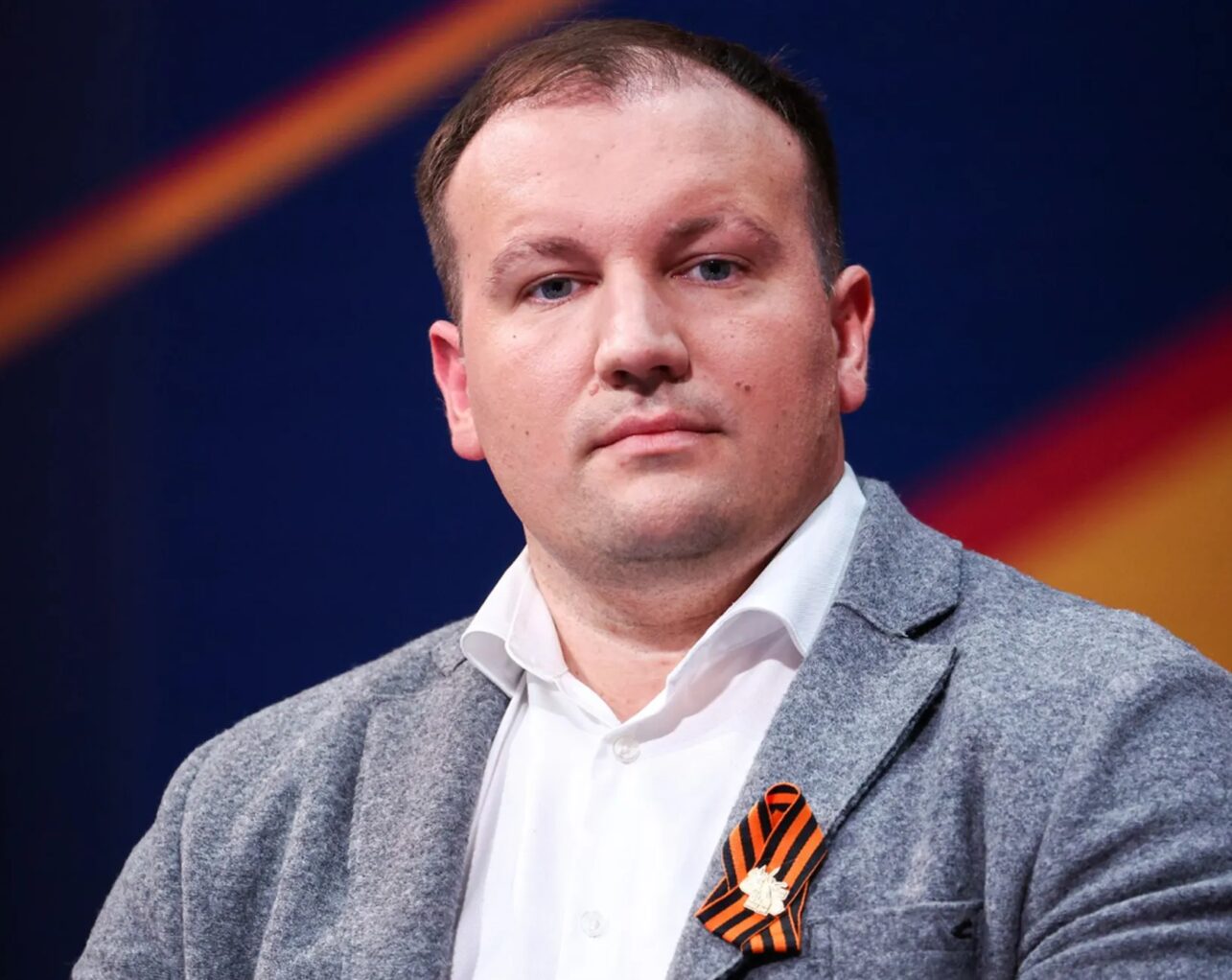
On October 9, Mikhail Zvinchuk, founder of the Russian military Telegram channel Rybar, was detained in Montenegro. Montenegrin authorities accused his team of using media work to interfere in the country’s politics. Rybar said they had come legally to film at Cetinje Monastery and had submitted an official filming request. Moscow’s response explains why this matters: Dmitry Medvedev, deputy chairman of Russia’s Security Council, suggested replenishing an “exchange fund” with Europeans and Americans to recover detained Russians. One arrest became a warning about others to come.

Mikhail Zvinchuk, founder of Rybar, a Russian pro-war Telegram channel covering the war in Ukraine, was detained in Montenegro on October 9

Five days earlier, Medvedev had delivered the orbital version of that warning. If Russia’s Rassvet constellation were destroyed, American Starlink satellites would “come tumbling down like ornaments from a dried-up Christmas tree.” “Space is a very crowded place,” he added. “We need to be mutually courteous.” Kiev had sought sanctions and restrictions, not announced a satellite attack. Moscow was putting a military threat behind its demand that Russian communications infrastructure be left alone.

The link is not between a blogger and a satellite. It is between two threats of retaliation: damage our network and yours becomes a target; detain our people and yours may become bargaining chips. Moscow is challenging the assumption that pressure on Russia can remain a one-way transaction.

Partners Behind the Front

The space threat has a practical backdrop. Leaked documents published in July describe a closed Russian-Chinese military forum in Guangzhou in November 2023. Chinese researchers proposed several ways to counter Starlink, from legal pressure and jamming to cyberattacks and destruction. Their hardest problem was also the simplest: how to disable satellites more cheaply and quickly than SpaceX could replace them. They do not show that these systems were built or deployed.

Visualization of the planned Starlink Generation 2 constellation

Russia and China have different strengths to offer. Moscow brings battlefield experience and air-defense knowledge; Beijing brings electronics, artificial intelligence, and manufacturing capacity. Russia can show what works under fire. China can help turn those lessons into equipment made at scale. A sixth closed forum was reportedly planned for the fall in St. Petersburg.

This is why repeated technical meetings matter more than dramatic threats. A shared design, tested and improved over several years, could outlast the war that first made it useful. For Moscow, the goal is to weaken an American advantage. For Beijing, Russian experience offers lessons without having to fight the same war.


Discussion of leaked documents, the “one-to-many” concept and replacement costs


But destroying satellites is not a clean solution. Russia’s 2021 antisatellite test forced both astronauts and Russian cosmonauts to shelter aboard the International Space Station, according to NASA. Debris threatens more than the intended target. Jamming can offer a narrower response; smashing entire networks risks damaging the same orbital space Russia and China also need.

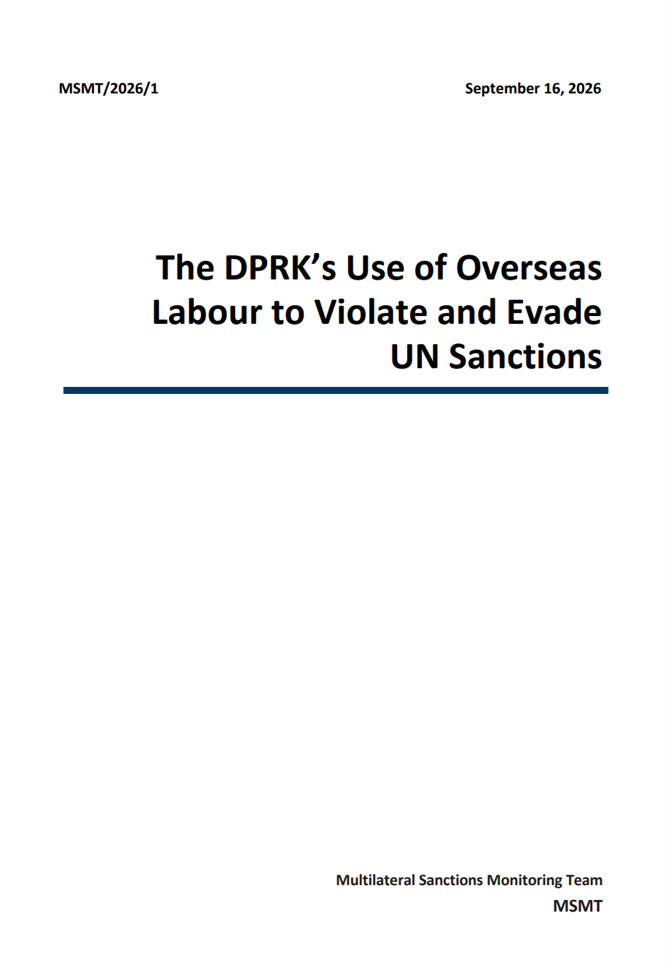
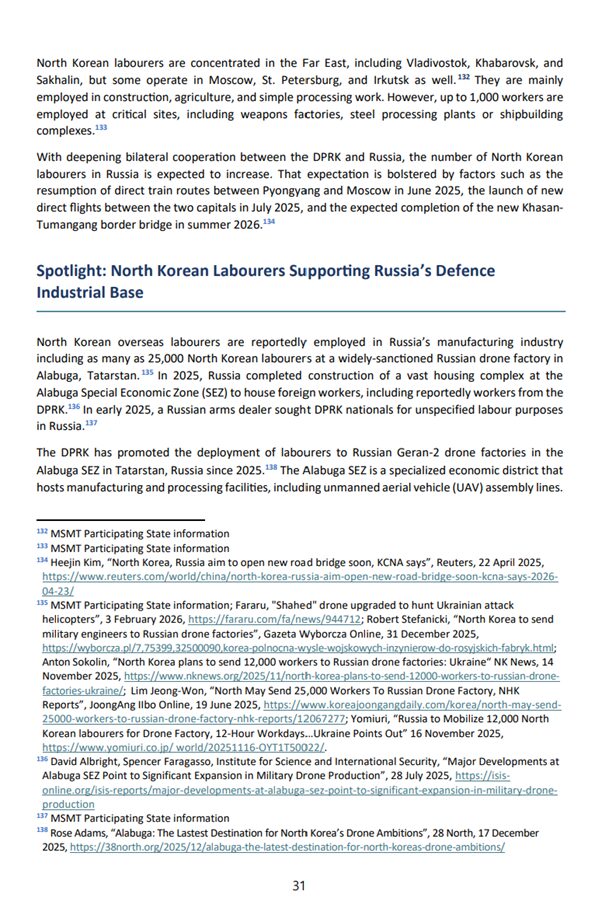
The factory floor shows another side of this partnership-building. A September report by the Multilateral Sanctions Monitoring Team says North Korean workers are employed at Alabuga in Tatarstan, where Russia produces Geran-2 drones, and describes workers entering Russia as students. Pyongyang rejected the report as fabricated. If the findings are accurate, the bargain is straightforward: Russia gains workers, North Korea gains income. Foreign support does not have to arrive as a finished missile; it can help keep the assembly line moving.

September 2026 sanctions-monitoring report.  Pages 31-32 discuss Alabuga and drone production. Pyongyang rejects the report


The Underground Price List

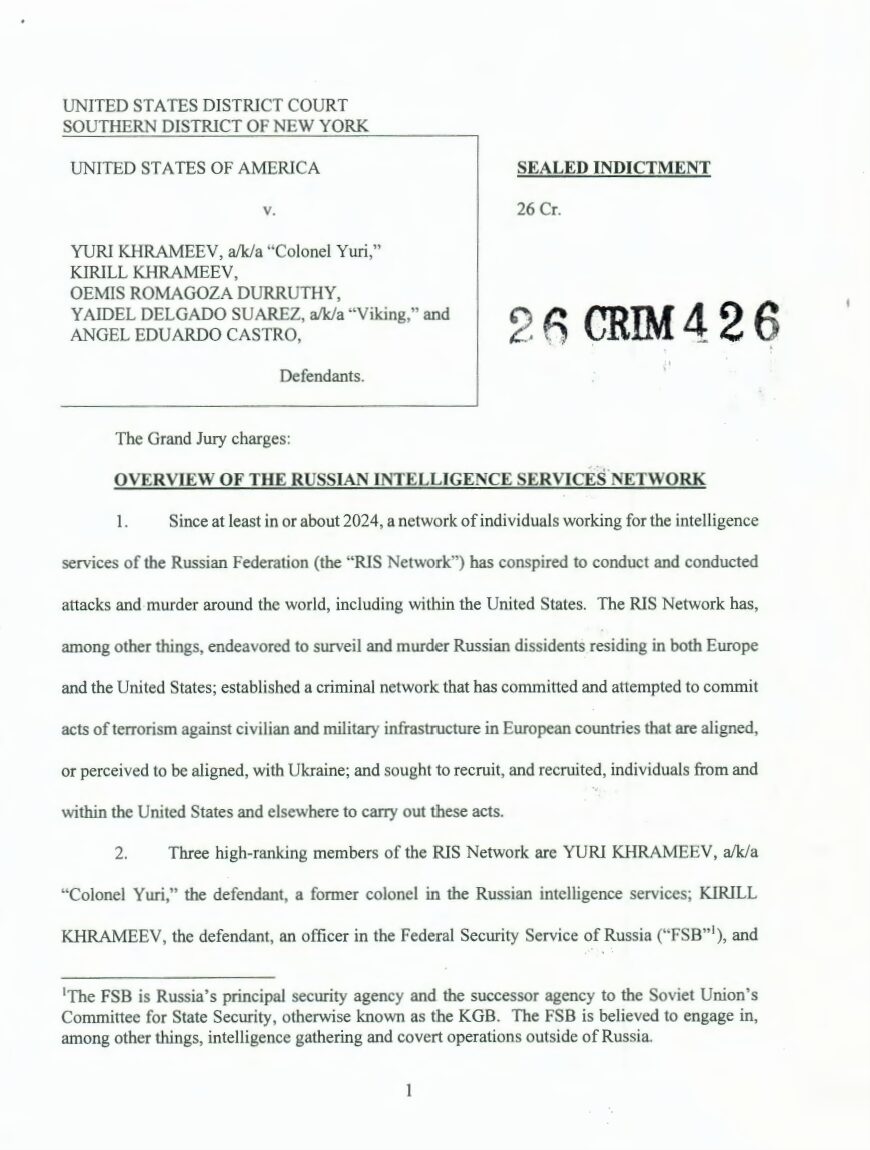
Recruitment abroad serves a different purpose. A September 15 U.S. indictment alleges that a Russian intelligence-linked network used Cuban and Venezuelan intermediaries to recruit inside America. Prosecutors describe payments of $1,000-$1,500 for surveillance and a $40,000 offer to kill a Russian dissident believed to be near Washington. Another alleged offer promised an American $25,000 to kill a target in Lithuania. These remain accusations, not court findings or proof of an officially declared bounty program.

Original U.S. indictment naming the alleged Russian, Cuban, and Venezuelan participants

The alleged network operated from at least 2024, before the Montenegro arrests. Its importance lies in the method: foreign intermediaries and local recruits, rather than an obvious Russian team. If substantiated, the charges would show Moscow reaching inside America through people who do not carry Russian passports.

The October 9 threat to expand the “exchange fund” signals that consular protests may no longer be Moscow’s only answer. It suggests foreign detainees could become leverage for recovering Russians. The warning to European and American governments is pointed: the detention of a Russian abroad may create a problem for their own citizens elsewhere.

Russia’s partners help it build weapons; alleged overseas networks extend its reach; threats against satellites and foreign detainees aim to raise the cost of confrontation. These are different tools, not proof of one master plan. But October’s warnings carry a common message: Moscow wants the other side to feel exposed too. Medvedev closed his latest message with a Russian proverb: “If you live among wolves, you must howl with them.”


MORE ON THE TOPIC:

The post NO SAFE REAR: Moscow’s Shadow War From Starlink to Prison Cells appeared first on South Front.

EU trade chief hails ‘crucial first step’ as Beijing talks avoid trade war

9 October 2026 at 15:51

EU and Chinese officials agreed a series of trade concessions covering electric cars, rare earths and tariffs that dragged them away from a damaging trade war on Friday (9 October), following two days of crisis talks.

Following two days of talks in Beijing, EU trade commissioner Maroš Šefčovič said that he and China’s commerce secretary Wang Wentao had made a “crucial first step” towards rebalancing EU-China trade relations.

Europe can point to progress on hybrid vehicles, stronger assurances over the supply of critical raw materials, and continued engagement on market access issues in China.

Hours before Šefčovič arrived, Beijing rejected an EU demand for so-called “voluntary export restrictions” on its electric vehicles (EVs). However, in a joint statement on Friday, the two sides said that they had reached an “understanding on trade in hybrid vehicles in a WTO compliant manner”, but without providing further details.

They added that further negotiations on reducing tariffs and minimum pricing deals would allow Chinese EVs to enter the EU at a lower duty rate.

This article continues, but the full version is available only to EUobserver.com subscribers. Visit account.euobserver.com/membership

Ukraine uses up Europe’s yearly supply of thermal sensors in about five months, so two Ukrainian firms will build their own plants in the West

9 October 2026 at 14:23

ukraine uses up europe’s yearly supply thermal sensors about five months so two ukrainian firms build own plants west · post imaging camera made company odd systems mounted drone manufactured

Two Ukrainian defense-tech firms, The Fourth Law and Odd Systems, have joined forces to mass-produce thermal imaging sensors in Europe and the US, The Fourth Law told Militarnyi. The goal is to wean Western militaries off foreign suppliers, chiefly China, for the core part of every thermal camera.

Amid Russia's daily attacks, Ukrainian drone makers have been shifting production to allied countries. Linza and Zoom drones are now built in Germany, and another top manufacturer has taken its technology to Canada and Finland. Sensor plants would move a core component west, not just finished drones.

A Western answer to Chinese sensors

The project, called Project Foundation, will build long-wave infrared sensors, known as microbolometers. These chips register heat, so a camera can pick out a person or vehicle at night or through smoke. The aim, The Fourth Law said, is to "ensure the sovereignty of Western countries in the field of thermal imaging technology."

Plants in Europe and the US from 2027

The project will run two sites, First Foundation in Europe and Second Foundation in the US, from a headquarters in Eindhoven, a Dutch semiconductor hub. Mass production is due to start in 2027. Within three years, the partners want to quadruple Europe's output of these sensors and double America's.

Why Europe's supply isn't enough

Ukraine's front line burns through sensors faster than Europe can make them. "Europe currently produces less than 500,000 such sensors per year, while Ukraine consumes this amount in about five months," Odd Systems co-founder Yaroslav Azhniuk said in February, when he first announced plans for a plant able to make one million sensors a year. European sensors cost about five times as much as Chinese ones and are hard to buy at all, because Europeans need them too, he added.

Factories working for Ukraine abroad have already become sabotage targets. In March, an arson attack in Pardubice, Czechia, destroyed nearly all the production capacity of a plant making drones and thermal sights for Ukraine's army. Czech investigators are looking into a possible Russian trail behind the attack.

EU tech chief expects countries leading AI race to come around on safety

9 October 2026 at 13:47

The European Union’s technology chief expects countries that oppose stricter artificial intelligence rules to change course, as AI systems are becoming more capable and harder to evaluate.

“I’m sure that all those countries who are not willing to regulate the use of AI, they will come back to that quite soon,” European Commission Executive Vice-President Henna Virkkunen told the European Newsroom (enr) on Friday. She warned of a “risk of very serious incidents” in the absence of any guardrails and called for the establishment of safeguards at an international level.

Concerns about the risks of AI have been at the centre of public attention for weeks, sparked mainly by hacking attacks carried out by AI software that acted autonomously during test runs. Some industry insiders have sounded the alarm, warning that artificial intelligence could potentially cause large numbers of deaths if the technology were to spiral out of control.

Virkkunen warned that fierce global competition is creating a risk that “companies are coming to the markets with products that they haven’t been testing enough.” She pointed to incidents in which AI agents had escaped from test “sandboxes” and service providers or developers had been unable to control their own systems.

At the same time, she said, some AI models “have become so capable that it’s more and more difficult also to evaluate them.” Adequate testing required highly qualified experts, sufficient expertise and enough time, she added.

The EU began enforcing its AI Act, the world’s first comprehensive legal framework to regulate AI based on the level of risk it poses, in August. Virkkunen said that the Commission had already sent a Request for Information (RFI) to two major US-based AI companies – OpenAI, known for ChatGPT, and Anthropic, known for Claude – as well as to some Chinese companies not further specified.

An RFI is a formal investigative tool used by the Commission to gather facts, data, and internal documentation from businesses, governments, or member states.

Global AI race

China and the United States have emerged as frontrunners in the development of AI systems, showing no signs of hitting the breaks. Governments in both countries have rejected calls to slow down its development, arguing it would create a competitive, strategic and economic disadvantage.

“Currently the risks are mainly focused and related to cyber security,” Virkkunen said, but she warned of more serious risks in future, including the possibility that highly capable models could be used in connection with biological weapons or fall into the hands of terrorists.

The Finnish politician called for the establishment of international rules to mitigate the risks of AI. She said the security of AI models had already been discussed within the Group of Seven (G7) this year as well as among G20 countries, and that the discussions would continue.

Talking about the EU’s role in AI development, Virkkunen said the Union should avoid dependence on a single company or third country for critical technologies and develop AI systems based on European values, languages and culture.

How USAID cuts left Nepal’s children exposed to deadly floods

9 October 2026 at 11:48
A building lies partially buried under mud after the flood in Nuwakot district, Nepal, September 17.

At an emergency shelter in central Nepal, Chhiring Mhendo Tamang stares at a photograph of her six-year-old daughter. She fears she will never see her again after the school bus she was on was swept away by a flash flood. A glacier collapsed on August 26, causing an avalanche of mud, rocks and water to rush into a river on the border between Nepal and Tibet. The flood has so far caused 1,451 deaths with 5,745 people missing, mainly in the districts of Rasuwa, Nuwakot, and Dhading, where homes, schools, electrical infrastructure and roads have been decimated, according to Nepal’s National Authority for Disaster Risk Reduction and Management (NDRRMA).

Seguir leyendo

Residents collect water after floods in Nuwakot, Nepal, on September 17, 2026.Students and authorities gather at a school that serves as a shelter for children orphaned after the flood in Nuwakot, Nepal, on September 19, 2026.

China Rejects EU Hybrid Car Export Limits as Brussels Considers New Tariffs

9 October 2026 at 07:04

Beijing’s refusal to restrict shipments of Chinese hybrid vehicles has sharpened a dispute over Europe’s widening trade deficit, with EU Trade Commissioner Maroš Šefčovič seeking concessions during negotiations in China.

China has rejected a European Union request to restrict exports of hybrid cars to Europe, increasing the likelihood of new trade defence measures against Chinese manufacturers as negotiations continue in Beijing.

The disagreement comes during a visit by EU Trade Commissioner Maroš Šefčovič, who is seeking commitments from Chinese officials to address the bloc’s growing trade deficit and improve access for European businesses to the Chinese market.

According to accounts of the negotiations, Beijing has declined the EU’s proposal for voluntary restrictions. The European Commission is consequently considering safeguard measures that could limit hybrid vehicle imports or impose additional tariffs when shipments exceed specified thresholds.

No final decision has been announced, and the precise scope of any restrictions remains under discussion.

The dispute adds another difficulty to EU–China economic relations before European leaders meet in Brussels on 15–16 October, when the bloc’s commercial relationship with Beijing is expected to feature prominently.

Hybrid Vehicles Become New Trade Battleground

The latest confrontation follows the introduction of EU countervailing duties on battery-electric vehicles manufactured in China in October 2024.

Those measures, imposed after an investigation into Chinese state subsidies, did not cover hybrid vehicles.

Chinese manufacturers have since increased their presence in Europe’s hybrid market, offering competitively priced vehicles that combine combustion engines with electric propulsion.

The European Commission previously confirmed that its original anti-subsidy investigation applied specifically to battery-electric vehicles and could not automatically be extended to hybrids.

Consequently, any additional import restrictions must have a separate legal basis.

One option under consideration is a safeguard mechanism that would permit a defined quantity of imports before higher tariffs apply.

Such a measure would differ from the existing anti-subsidy duties, which target alleged unfair financial support provided to manufacturers.

Safeguard restrictions are designed to address injury caused by increased imports. They may also create difficulties for Brussels because measures directed at a particular product can affect suppliers from countries other than China.

Japan, South Korea and Britain could therefore face consequences depending on the structure and legal basis of any proposed restrictions.

Trade Deficit Exceeds €360 Billion

The dispute is taking place against a widening imbalance in goods trade between the European Union and China.

The EU’s annual merchandise trade deficit with Beijing has reached approximately €360 billion, equivalent to almost €1 billion per day.

European officials are particularly concerned about Chinese industrial overcapacity and the export of manufactured goods at prices that European producers struggle to match.

During the latest trade negotiations, Brussels has sought commitments concerning market access, import volumes and restrictions affecting European companies.

Chinese exports of plug-in hybrid vehicles to the EU have reportedly increased by 86 per cent over the past year, while battery-electric vehicle imports have risen by approximately 40 per cent.

This expansion has intensified pressure on European manufacturers already confronting high production costs, weak demand in some domestic markets and substantial expenditure on electrification.

EU Today reported in September that Brussels had requested voluntary restrictions on Chinese hybrid exports as part of a broader effort to rebalance commercial relations.

Beijing’s refusal has now brought the possibility of unilateral European measures closer to consideration.

Germany and France Seek Stronger Protection

Germany and France have increasingly aligned their positions on the need for stronger European instruments to address unfair competition and dependence on Chinese industrial supply chains.

France has long advocated a more interventionist European industrial policy, while German manufacturers have traditionally placed greater emphasis on preserving commercial access to China.

That calculation is changing as Chinese competitors strengthen their position in the European automotive market.

The problem is particularly sensitive for Germany, whose automotive industry depends on extensive supplier networks, skilled employment and exports.

German manufacturers also operate significant businesses in China, meaning that new European trade measures could expose them to retaliation in one of their principal overseas markets.

China has already responded to previous European restrictions with trade investigations and duties affecting agricultural products and alcoholic beverages.

Further measures against Chinese vehicle imports could therefore extend the dispute into sectors unrelated to the automotive industry.

Brussels Faces Difficult Legal Choices

The European Commission must determine whether voluntary arrangements can produce measurable reductions in Chinese exports or whether formal restrictions are required.

The legal distinction between anti-subsidy duties and safeguard measures will be particularly important.

The existing electric-vehicle tariffs were introduced following an investigation that examined subsidies and their effects on European manufacturers.

A safeguard mechanism would require a different assessment, including evidence concerning increased imports and injury to domestic producers.

It would also have to comply with the EU’s international trade obligations.

Meanwhile, Chinese manufacturers are developing production facilities within Europe, potentially reducing their exposure to tariffs imposed on imported vehicles.

EU Today’s earlier examination of the proposed hybrid tariffs considered the broader consequences of Chinese investment in European manufacturing and the bloc’s dependence on critical raw materials.

The negotiations in Beijing are expected to influence whether the Commission proceeds with formal restrictions or continues seeking a negotiated settlement.

The immediate question is whether China is prepared to offer concessions sufficiently substantial to persuade Brussels that additional tariffs are unnecessary.

With EU leaders due to discuss relations with Beijing next week, the dispute has become a test of the Commission’s willingness to use trade defence instruments against one of Europe’s largest commercial partners.

European Parliament Demands Tougher China Policy Over Trade, Taiwan and Russia

9 October 2026 at 07:01

MEPs have backed a more demanding approach to Beijing, linking Europe’s worsening trade imbalance with China’s support for Russia and increasing military pressure on Taiwan. The vote comes as Brussels seeks concessions in negotiations with Chinese officials.

The European Parliament has adopted a recommendation calling for a tougher European Union policy towards China, citing Beijing’s trade practices, support for Russia’s war against Ukraine and growing pressure on Taiwan.

MEPs approved the text on Wednesday, 7 October, by 454 votes to 86, with 110 abstentions, giving substantial parliamentary backing to demands for a more reciprocal economic relationship with China.

The recommendation, prepared by Belgian MEP Hilde Vautmans of Renew Europe, addresses the EU’s increasingly difficult relationship with Beijing at a time when European Trade Commissioner Maroš Šefčovič is holding negotiations with Chinese officials.

According to the official parliamentary procedure, the recommendation was adopted following a plenary debate on 6 October. It sets out Parliament’s priorities for the Council, European Commission and EU foreign policy leadership.

Although the text is not legally binding, the size of the majority gives the Commission additional political support as it considers new measures against Chinese imports and seeks greater access to the Chinese market.

Trade Relations Reach Critical Point

The recommendation reflects a growing view within European institutions that the existing economic relationship with China is becoming increasingly difficult to sustain.

China remains one of the EU’s most important trading partners, but the bloc’s merchandise trade deficit has widened to approximately €360 billion.

European manufacturers face increasing competition from Chinese companies benefiting from extensive domestic production capacity, lower costs and government industrial policies.

The automotive industry has become a particular source of friction, with Chinese manufacturers expanding their presence in Europe following the imposition of EU tariffs on battery-electric vehicles.

Brussels is now considering additional restrictions on hybrid cars after Beijing reportedly rejected requests to limit exports voluntarily.

The concerns extend beyond vehicle manufacturing to chemicals, machinery, renewable-energy technologies and access to critical raw materials.

A European Parliament research briefing published before the vote identified China’s industrial overcapacity, restrictions on market access and dependence on export-led growth as principal causes of the imbalance.

The document also highlighted the increasingly close relationship between economic policy and European security.

China’s Support for Russia Draws Criticism

China’s relationship with Moscow was another major element of Parliament’s recommendation.

MEPs have expressed growing concern about Beijing’s role in sustaining Russia’s military-industrial economy, particularly through the supply of dual-use technology and components used in weapons production.

The EU has repeatedly called on China to use its influence over Russia to help bring an end to the invasion of Ukraine.

Beijing maintains that it is not a party to the conflict and has presented itself as supporting a negotiated settlement. However, its commercial and technological relationship with Moscow continues to attract scrutiny from European governments.

The parliamentary recommendation forms part of an increasingly explicit European effort to connect China policy with the consequences of Russia’s war.

European officials are concerned that Chinese technology, industrial components and financial relationships may reduce the effectiveness of sanctions intended to restrict Russia’s military production.

The consequences reach beyond Ukraine. China’s growing defence relationship with Russia and its military activity in East Asia have reinforced European concerns about the security implications of deeper economic dependence on Beijing.

Taiwan Emerges as Another Source of Disagreement

The recommendation also addresses China’s increasingly confrontational approach towards Taiwan.

Beijing claims sovereignty over the self-governing island and has repeatedly refused to rule out the use of force to establish control.

The EU maintains its one-China policy while opposing unilateral changes to the status quo through force or coercion.

Parliament has consistently supported closer economic and practical relations with Taiwan, particularly in fields involving semiconductors, critical technologies and supply-chain security.

A parliamentary examination of Taiwan’s international position published in June noted the island’s importance to European technological industries and the broader consequences of a confrontation in the Taiwan Strait.

The latest recommendation places those concerns within a wider assessment of EU–China relations.

Taiwan’s semiconductor industry occupies a central position in global electronics manufacturing. Any major interruption to production or shipping would affect European automotive companies, industrial equipment manufacturers and technology businesses.

European governments therefore face a security challenge that cannot be separated from the commercial relationship with China.

Parliament Backs More Assertive EU Policy

The recommendation was adopted after extensive negotiations among parliamentary political groups.

According to the recorded voting results, 454 MEPs supported the text, with opposition and abstentions accounting for 196 votes.

The majority demonstrates considerable support for revising the existing approach to China, although political differences remain over the extent of economic restrictions and diplomatic confrontation.

Some member states favour stronger trade defence measures and tighter scrutiny of Chinese investment, while others remain concerned about retaliation against European exporters.

Germany, France and smaller member states also have different industrial and commercial exposures to China, complicating attempts to establish a common strategy.

The EU must additionally consider whether efforts to reduce strategic dependencies can be reconciled with continued trade and investment.

Parliament’s recommendation does not compel the Commission to introduce new tariffs, restrict Chinese investment or change the Union’s diplomatic position towards Taiwan.

Those decisions remain within the relevant EU institutional procedures and, where applicable, the competence of member states.

Nevertheless, the vote provides a political reference point for forthcoming discussions on trade, technology and European security.

Trade Negotiations Put Parliament’s Position to Test

The timing places the recommendation directly alongside Šefčovič’s negotiations in Beijing.

The Commission is seeking Chinese concessions concerning the trade deficit, industrial overcapacity and access to the Chinese market.

China has resisted European demands for voluntary restrictions on certain exports and has criticised measures it considers protectionist.

The disagreement is likely to feature in discussions among EU leaders on 15–16 October.

The parliamentary vote strengthens the position of those demanding a more assertive European response, but disagreements between member states and the prospect of Chinese retaliation will continue to influence the Commission’s choices.

The immediate test will be whether negotiations can produce concrete changes in trade conditions, rather than another declaration of the need for more balanced relations.

EU weighs safeguard tariffs as China refuses hybrid car limits

9 October 2026 at 03:36

Beijing has rebuffed a European Union request to voluntarily cap hybrid car exports to the bloc, raising the prospect of new, steep EU tariffs on Chinese hybrids, which have so far escaped the duties on pure electric vehicles. China has refused to set quotas on its exports of hybrid electric vehicles (HEVs) and plug-in hybrid […]

The post EU weighs safeguard tariffs as China refuses hybrid car limits appeared first on Asia Times.

L’Occidente congela, l’Oriente incassa: 100 tonnellate d’oro russo invadono Hong Kong e Pechino prepara la trappola al dollar

By: A A
8 October 2026 at 23:43

Fabio LUGANO

Segue nostro Telegram.

La chiusura dei mercati di Londra spinge 100 tonnellate di lingotti russi nei caveau di Hong Kong: Pechino accumula metallo prezioso, scarica i titoli di Stato USA e blinda lo yuan.

Un fiume di lingotti d’oro sta abbandonando le rotte tradizionali a velocità impressionante, dirigendosi verso i mercati delle materie prime orientali, come Hong Kong, invece che Londra e New York.

I numeri descrivono una vera e propria fuga strategica verso l’Asia. Solo nei primi sette mesi dell’anno in corso, la Russia ha scaricato a Hong Kong quasi 100 tonnellate di metallo giallo: un record assoluto, pari a quasi il triplo rispetto allo stesso periodo precedente.

Dal 2022 a oggi, gli operatori di Hong Kong hanno comprato oro russo per 276 miliardi di dollari locali, cioè circa 35 miliardi di dollari americani. È la prova tangibile che la guerra economica produce effetti opposti a quelli previsti nei palazzi occidentali.

Da dove arriva quest’oro e perché scappa a est

La Russia è il secondo produttore mondiale di oro dopo la Cina. Prima del conflitto in Ucraina, la quasi totalità dei suoi lingotti prendeva la strada di Londra, capitale indiscussa della custodia e della contrattazione aurea.

Con l’avvio delle ostilità nel 2022, Regno Unito e Stati Uniti hanno imposto il bando totale sui lingotti di Mosca. L’obiettivo dichiarato era soffocare le entrate del Cremlino. Il risultato pratico è stato un semplice cambio di indirizzo sulle bolle di spedizione.

Come ha fatto notare Debajit Saha, analista del London Stock Exchange Group (LSEG), la reazione dei produttori russi è stata immediata. Trovando le porte sbarrate in Europa, hanno dirottato l’intera produzione verso Oriente, dove la fame di metallo fisico non è mai calata.

A facilitare questo travaso è intervenuta anche la crisi in Medio Oriente. Gli attriti logistici che hanno colpito Dubai hanno convinto i venditori a puntare dritti sull’estremo oriente cinese.

Il ruolo chiave di Hong Kong: perché proprio lì?

Ci si potrebbe chiedere per quale ragione i carichi non atterrino direttamente a Pechino o Shanghai. La risposta risiede nelle norme commerciali. La Cina continentale impone quote rigide all’ingresso di oro per controllare i movimenti valutari interni. Hong Kong, al contrario, gode di uno status di porto franco: nessuna restrizione doganale e nessun limite ai volumi. Quindi diventa una destinazione ottimale.

Inoltre, né Hong Kong né Pechino riconoscono le sanzioni decise dai paesi occidentali. La città funge quindi da perfetto filtro logistico e finanziario. Gli operatori cinesi acquistano i lingotti a Hong Kong, li stoccano nei moderni depositi locali e poi li trasferiscono con calma verso la terraferma. Vita Spivak, consulente della società britannica Gatehouse, ha riassunto il fenomeno senza mezzi termini: è il naturale accordo di convenienza tra Mosca, che offre risorse strategiche, e Pechino, che garantisce sostegno economico e liquidità.

Ecco il quadro numerico di questo passaggio storico:

Cosa cambia davvero per la Cina

A Pechino non si limitano a guardare il passaggio dei vagoni d’oro: stanno costruendo un’alternativa materiale al sistema basato sulla moneta americana. Le riserve ufficiali della Banca Popolare Cinese hanno superato le 2.360 tonnellate. IUn modo per cercare di stabilizzare il patrimonio della Banca Centrale senza dover dipendere dalle valute di altri paesi.

Questo cambio di rotta non è una coincidenza. Hippolyte Fofack, economista già ai vertici della Export-Import Bank of Africa e ricercatore alla Columbia University, ha chiarito che l’oro ha smesso di essere un mero strumento di investimento. È diventato un pilastro di sovranità monetaria.

Con un bilancio corazzato dal metallo fisico, la banca centrale cinese può sostenere accordi commerciali in yuan, lanciare obbligazioni denominate in valuta locale (i cosiddetti Panda e Dim Sum bond) e offrire un’alternativa a chi teme il blocco dei beni da parte di Washington.

Nel 2025 la Borsa dell’Oro di Shanghai ha persino inaugurato un maxi-caveau a Hong Kong. È il primo fuori dalla terraferma e serve a liquidare contratti con consegna materiale del metallo, bypassando del tutto il dollaro.

Il baricentro del mercato si sposta a Oriente

La supremazia storica dell’asse Londra-New York si sta sgretolando sotto la pressione dei fatti. L’analista Angelo Giuliano ha definito questa rete il “corridoio dell’oro” che salda i paesi emergenti e i membri dei BRICS. L’idea di fondo è semplice: nessun governo vuole più rischiare di vedere i propri averi congelati con un click oltreoceano.

Non a caso, anche banche centrali europee hanno iniziato a rimpatriare le proprie riserve custodite all’estero. In Asia, intanto, la richiesta non accenna a diminuire.

Sara Esshaimi, alla guida del team materie prime di Société Générale, ha rilevato come le autorità cinesi abbiano persino autorizzato i maggiori colossi assicurativi a investire fino all’1% dei loro patrimoni in oro fisico. Una decisione che garantisce una domanda interna solida e continua.

Come ha sintetizzato Jeremy Mark, ricercatore dell’Atlantic Council, Hong Kong sta completando la sua trasformazione in un centro finanziario “con caratteristiche cinesi”.

Chi pensava di piegare la Russia chiudendo le piazze di scambio europee ha ottenuto un risultato tragicomico: ha regalato alla Cina il monopolio del metallo prezioso più conteso al mondo, accelerando la nascita di un sistema finanziario su cui l’Occidente non ha più alcun potere di veto.

Articolo originale  scenarieconomici.it

EU trade chief Šefčovič has no cards to play on China ‘ultimatum’ trip

8 October 2026 at 16:32

Persuading China that its €1bn daily trade surplus with the EU is not sustainable was always going to be a hard sell for EU trade commissioner Maroš Šefčovič.  

And the early signs are that Šefčovič’s two days of talks with Chinese commerce secretary Wang Wentao, which conclude on Friday (9 October), are not going to deliver the breakthrough demanded by EU leaders when they gather for a summit in Brussels next week. 

“The message around the table was clear: the need to improve access to the Chinese market, while boosting our economic security,” Šefčovič posted on X ahead of the first day of talks. 

But rhetoric aside, three months after the EU Commission set up a series of ‘work streams’ with Chinese officials, with a mandate to address the multi-layered EU-Sino trade dispute, it is hard to see much tangible progress. 

Hours before Šefčovič arrived, Beijing rejected an EU demand for so-called “voluntary export restrictions” on its electric vehicles (EVs). 

In August, data published by Schmidt Automotive Research found that 14 percent of EV sales across Europe this year were Chinese-made, up from 9.4 percent last year. 

That is despite the EU imposing additional tariffs of between 17 and 36 percent on Chinese EVs in October 2024. 

This article continues, but the full version is available only to EUobserver.com subscribers. Visit account.euobserver.com/membership

Trump’s Bombers, Xi’s Calm and the Limits of American Power

8 October 2026 at 14:59
The massive display of American military might during Xi Jinping’s visit underscores the shift from a unipolar world to a new reality in which the U.S. is compelled to engage with China as an economic and industrial rival of equal standing—one whose influence cannot be overcome by military force alone. For a few seconds at […]

Europe Has the Economic Power to Stand Up to China — It Is Time Brussels Used It

7 October 2026 at 12:46


For years, the European Union has struggled with a peculiar contradiction in its dealings with China. The EU is one of the largest and wealthiest trading blocs on earth, capable of determining access to a market of some 450 million relatively affluent consumers, yet it frequently conducts foreign policy as though it were the supplicant.

Hilde Vautmans, the Belgian Renew Europe MEP and European Parliament rapporteur on EU-China political relations, is right to challenge this timidity.

Her report, debated this week in Strasbourg, does not advocate severing relations with Beijing. Nor should it. China is too economically important and too influential on questions ranging from climate change to international security for Europe simply to close the door.

But dialogue must not become an alternative to action.

“Europe has economic power. It’s time to use it,” Vautmans told Parliament ahead of the vote. That sentence ought to be pinned above every desk in the European Commission dealing with China.

The figures make the case brutally clear. In 2025 the EU imported €559.4 billion of goods from China while exporting just €199.6 billion in the opposite direction. The resulting deficit was €359.8 billion — almost €1 billion every day.

As EU Today reported recently, Commission President Ursula von der Leyen has herself warned of a potential “second China shock”, with subsidised Chinese industrial production threatening European manufacturers.

Fine words. But Beijing has heard fine words before.

The Commission’s preferred formulation remains “de-risking, not decoupling”. There is sense in that distinction. Nobody seriously proposes shutting down trade with the world’s second-largest economy. But de-risking becomes meaningless if every risk identified is followed by another dialogue, another working group and another opportunity to postpone difficult decisions.

Indeed, the Commission acknowledges that European companies operating in China face regulatory obstacles, inadequate intellectual-property protection, restrictions on data flows and pressures associated with technology transfer.

Europe possesses formidable weapons with which to respond: anti-dumping duties, anti-subsidy measures, foreign-investment screening, the Foreign Subsidies Regulation, the Anti-Coercion Instrument, procurement restrictions and controls on strategically sensitive technologies.

These instruments should not be deployed indiscriminately. But neither should they sit polished in the armoury while Beijing exploits European openness.

Vautmans is particularly right to connect economics with security and values. China cannot reasonably expect privileged access to European markets while helping sustain the Russian war machine. The European Parliament’s own research service describes Beijing as a “decisive enabler and dual-use provider”, including through goods entering Russian weapons and drone supply chains.

If Chinese companies materially assist Russia’s ability to wage war against Ukraine, Europe should be prepared to impose a direct economic price. The same principle should apply to human rights.

EU Today has warned repeatedly that Brussels’ ritualised engagement with Beijing risks becoming precisely that: ritual.

We reported earlier that the EU-China Human Rights Dialogue risks losing credibility, pointing to the continuing imprisonment of Swedish citizen Gui Minhai and Uyghur academic and Sakharov Prize laureate Ilham Tohti. After round upon round of discussions, Beijing has learnt that European expressions of “deep concern” are inexpensive things to endure.

The problem is hardly new. Years ago, EU Today highlighted calls for concrete EU action over goods associated with forced labour in China, including demands for tougher restrictions on entities implicated in abuses against Uyghurs.

Yet repression continues. In March this year China adopted its new Law on the Promotion of Ethnic Unity and Progress. The European Parliament subsequently condemned what it described as intensified repression and assimilation affecting Tibetans, Uyghurs and other minorities, by the overwhelming margin of 439 votes to 52.

Europe therefore faces a straightforward question. What is the purpose of economic power if it is never translated into political influence?

The EU should not attempt to bully China. Nor should it abandon diplomacy. Vautmans is correct that channels of communication must remain open. But reciprocity must become something more than a word appearing in communiqués.

Where China closes markets to European companies, Europe should be prepared to restrict equivalent access. Where state subsidies distort competition, Brussels should respond rapidly with trade-defence measures. Where strategic dependencies expose Europe to political coercion, alternative supply chains must be built. Where Chinese entities support Russia’s military-industrial complex, sanctions should follow. And where companies benefit from forced labour or serious human-rights abuses, access to the European marketplace should carry consequences.

That is not protectionism. It is leverage.

Totalitarian states understand leverage perfectly well. China routinely uses access to its enormous market as an instrument of statecraft. Europe, by contrast, too often behaves as though exploiting its own commercial strength would somehow represent a failure of diplomacy. It represents precisely the opposite.

The European Commission has spent years discovering that China is simultaneously a partner, competitor and “systemic rival”. It is time to move beyond discovering the obvious.

Vautmans has identified the essential point. Europe already possesses economic power on a scale few countries can ignore. What it appears to lack is the political confidence to use it.

Main Image: by Valentine ZELER, © European Union 2026 – Source : EP

China Completes First Season of Regular Arctic Container Service

7 October 2026 at 11:02
China has completed the first season of regular weekly container shipping between China and Europe via the Northern Sea Route, with the operator completing all eight sailings planned for 2026 before ending departures slightly earlier than scheduled because of Arctic ice forecasts.

Listen: Are we now heading to a trade war with China?

7 October 2026 at 09:31

Production: By Europod, in co-production with Sphera Network.

EUobserver is proud to have an editorial partnership with Europod to co-publish the podcast series “Briefed” hosted by Léa Marchal. The podcast is available on all major platforms.

Find the full transcript below: 

Chinese carmakers are taking an increasing share of the European car market, particularly when it comes to electric vehicles. Why are European carmakers now opening their factories to their Chinese competitors?

Until recently, the main concern in Europe was Chinese-made electric vehicles being imported into the EU. That’s why, two years ago, the EU imposed hefty tariffs on Chinese electric cars.

But Chinese manufacturers have found another way into the European market: they are setting up production here. Some are building factories of their own. Others are entering partnerships with European carmakers and using their existing production sites.

That’s the case with Stellantis and Chinese manufacturer Leapmotor. And now Dongfeng is also negotiating to produce cars at the French plant of Rennes La Janais. Because by moving production to Europe, Chinese manufacturers may be losing one of their main advantages, which is cheap labour.

But low labour costs are only one part of their competitive edge.

Chinese manufacturers also continue to benefit from state support. And setting up production in Europe doesn’t necessarily mean building brand-new factories.

In many cases, Chinese companies are looking to partner with European manufacturers and use factories that are already there — factories that are no longer operating at full capacity. That means they can save significantly on investment costs. And they can also rely on their European partners’ existing sales and distribution networks.

So how big is this Chinese presence in Europe becoming? For 2028, there are already 12 projects involving Chinese carmakers setting up production in Europe. Several are in Spain, with others in France, Belgium, Slovakia, Hungary, Sweden and Austria.

Now, why would European manufacturers allow their Chinese competitors to produce cars in their own factories? Part of the answer is that European carmakers are struggling to keep up in electric vehicles sells. And that is contributing to factory closures and job losses.

European manufacturers have to meet EU targets on average CO2 emissions each year. And producing more electric vehicles is necessary to meet those requirements.

So partnerships with Chinese manufacturers can serve two purposes: they can help European companies fulfilling their green cars objectives, while also keeping existing factories and jobs running.

Though there is a longer-term risk for European manufacturers. The more Chinese companies establish themselves in Europe, the more competitive pressure they could put on European brands — potentially even leading to takeovers. That has happened before: Volvo Cars, for example, was acquired by Chinese group Geely in 2010. 

In Germany, carmakers are for now refusing to open the doors of their production sites to the Chinese. But they do have partnerships with Chinese companies to produce vehicles in China, where they can benefit from lower production costs. That explains why they were very much opposed to imposing tariffs on Chinese electric vehicles.

But the situation is now changing. Volkswagen closed its Dresden factory last year, and other German plants are also facing closure risks. Germany’s car industry is therefore increasingly joining calls for stronger protection against Chinese competition.

And that brings us back to the Franco-German paper that is circulating in Brussels, which calls for measures to restrict Chinese access to the European market.

Because this debate goes well beyond cars. The EU is increasingly concerned about Chinese competition and dependence in a range of strategic industries. This will be discussed next week, when EU leaders meet in Brussels.

The European Commission could also present a new so-called “diversification” tool, either at the summit or around it. One possibility would be to require companies not to rely exclusively on China for certain critical materials. Something which could trigger what we call a trade war. I’ll be following that very closely!

Central Europe’s Growth Model Is Losing Momentum, IMF Warns

7 October 2026 at 09:06

Growth potential across Central and Eastern Europe has fallen sharply from the levels seen around EU accession, with ageing populations, weak productivity, Chinese competition and slower German industry increasingly testing the region’s economic convergence.

The economic model that transformed Central and Eastern Europe after EU accession is losing momentum, according to the International Monetary Fund, which is warning governments that structural reforms are needed if the region is to continue narrowing the income gap with Western Europe.

Carlos Mulas-Granados, the IMF’s regional representative, said on Tuesday that medium-term growth potential across Central and Eastern Europe had declined to around 2.5 per cent, compared with roughly 5 per cent before countries in the region joined the European Union.

The slowdown does not mean that every economy is stagnating. Poland continues to grow faster than much of Western Europe, while the Czech economy has recovered from recent shocks. The concern is instead about the underlying rate at which these economies can expand once temporary fiscal stimulus, EU funding and post-crisis recoveries are stripped out.

Several of the forces behind the region’s earlier success are becoming weaker.

EU accession opened access to the single market, attracted foreign investment and integrated Poland, Czechia, Slovakia and Hungary deeply into European industrial supply chains. German manufacturers in particular moved production eastwards, taking advantage of lower labour costs, skilled workforces and geographic proximity.

That process generated rapid gains in productivity and incomes. It cannot simply be repeated.

Demographics are one of the most immediate constraints. Working-age populations are shrinking across much of the region while ageing increases spending requirements for pensions, health care and social support.

The IMF’s country assessments illustrate the problem. Its assessment of Poland says demographic pressures are mounting even as labour productivity remains comparatively strong, and calls for higher labour participation, better skills and deeper capital markets.

In Slovakia, the Fund expects growth of only 0.9 per cent this year and says adverse demographics and weaker productivity are weighing on the medium-term outlook. The economy remains particularly exposed to manufacturing and the automotive industry.

The Czech Republic faces a similar structural constraint. The IMF estimates its medium-term potential growth at around 1.8 per cent, with population ageing and modest productivity gains limiting further convergence.

External conditions have also changed.

Germany, the region’s principal industrial partner, has experienced prolonged weakness in manufacturing. Central European producers therefore face softer demand from the market around which many of their supply chains were originally built.

At the same time, China has moved from being primarily a source of imports and components to a direct competitor in sectors where Central Europe has substantial industrial exposure, including cars, batteries, machinery and electrical equipment.

That combination is particularly difficult for economies built around export-oriented manufacturing.

The problem overlaps with the wider European competitiveness debate. EU Today reported in July that only 15.7 per cent of the reforms recommended in Mario Draghi’s competitiveness report had been fully implemented at that stage, with important work still outstanding on capital markets, energy and investment.

For Central Europe, progress on those issues has a direct bearing on growth. Smaller national capital markets make it harder for companies to finance expansion. Fragmented energy systems add to industrial costs, while limited access to venture capital can restrict the development of businesses outside established manufacturing sectors.

There are significant differences between countries. Poland’s larger domestic market gives it more insulation from industrial weakness elsewhere and the IMF expects relatively strong growth. Hungary has faced a different combination of weak investment and fiscal constraints, while Slovakia’s dependence on car production leaves it particularly exposed to changes in the European automotive sector.

EU funding remains an important source of investment across the region, particularly for infrastructure and modernisation. But EU transfers cannot by themselves replace improvements in productivity.

The IMF’s argument is therefore less about an immediate recession than about the end of an unusually favourable period of convergence.

Central Europe entered the EU with lower wages, substantial scope to import Western technology and a powerful incentive for Western European manufacturers to move production eastwards. As those gaps narrow, future growth depends more heavily on innovation, skills, investment and domestic productivity.

The region is still converging with Western Europe. The question raised by the latest IMF warning is how quickly that process can continue once the economic advantages that powered its first two decades of EU membership become less powerful.

How China deploys wartime history against Japan

6 October 2026 at 23:57

Beyond all the pageantry, the Chinese leader Xi Jinping had a strategic goal for his Washington visit – to undermine the American relationship with Japan. Xi succeeded, perhaps beyond his expectations. Japanese policy makers saw this coming. They arranged a brief meeting on the sidelines of the United Nations General Assembly between Prime Minister Takaichi […]

The post How China deploys wartime history against Japan appeared first on Asia Times.

❌