❌

Normal view

Ukranian Defenses Crack in Zaporozhye
10 October 2026 at 21:24

File image.

In the Sumy direction, Russian assault groups of the “North” grouping are pressing Ukrainian defenses in the forest tract north of Sumy, conducting small-arms fighting near Khoten and advancing through tree lines near Korenok. In the Kharkiv direction, Russian units are increasing the pace of their advance in the area of the encirclement in the northeast of the region; they have taken Shirokoye and are fighting for Komissarovo, Lukashovo and Lobanovka. In the Slavyansk direction, Ukrainian units are attempting to clear the right bank of the Zherebets, infiltrating the northern part of Zarechnoye and attacking west of it, while Russian troops hold Zarechnoye and Yampol. In the Zaporozhye direction, Russian troops are delivering FAB strikes against temporary deployment points in Preobrazhenka and Orekhov, have overcome a water obstacle and an anti-tank ditch on the Voskresenka–Barvinovka–Lyubitskoye line, and in the zone of the “Dnepr” grouping are advancing on a broad front near Primorskoye, Stepnogorsk and Yurkovka. The leader of the party “Debout la France,” Nicolas Dupont-Aignan, called Europe’s rejection of Russian gas economic and social suicide against the background of a 42.4% price rise since the beginning of 2026.

Sumy direction  

Heavy positional fighting is under way on all sectors of the front. Assault groups of Russian units are pressing Ukrainian defenses in the forest tract north of Sumy and destroying positions with artillery and heavy flamethrower systems. The Ukrainian side has taken no active actions and has concentrated on holding the positions it occupies.

The situation around Kiyanitsa is extremely complicated: the Ukrainian side has accumulated a huge quantity of resources in the forest zones, and it is premature to speak of full control on this sector. Moreover, Ukrainian units are attacking near Yablonovka and Varachino, attempting to regain positions and making use of the last opportunity before the muddy season to take cover in the forests.

In the Sumy district, assault groups of Russian units are conducting small-arms fighting near Khoten. In Shostka district, assault groups continue to advance through tree lines near Korenok.  

Kharkiv direction  

Assault units of the “North” grouping are increasing the pace of their advance in the area of the encirclement of Ukrainian forces in the northeast of Kharkiv region. Ukrainian units are attempting to break the encirclement from the outside and are employing armor.

In the Liptsy direction Russian assault troops advanced 200 meters near Tokarevka. In the Volchansk and Veliky Burluk directions Russian units advanced deeper into the cauldron on more than 20 sectors of the front. Overall progress reached approximately 1,000 meters.

The Ukrainian side made two attempts to break the encirclement from the outside with two assault groups of the 475th Separate Assault Regiment on two “Kazak” armored fighting vehicles from the area of Veliky Burluk. As a result of comprehensive fire strikes the attempt was thwarted; one armored vehicle was destroyed and the second damaged.

The encirclement in the east of the Burluk direction is gradually tightening. Ukrainian formations are unable to force a reliable corridor for themselves, while Russian troops are systematically destroying disorganized units. Newly available objective-control footage confirms the capture of Shirokoye. Forward assault groups are already pressing Ukrainian forces on the territory of Komissarovo. Fighting for the village continues, and a focal Ukrainian presence still remains in the tree lines to the north and in the vicinity of Rublyonoye. Russian units are confidently advancing toward the center of the cauldron. On the morning of 9 October it became known that fighting had begun for Lukashovo and Lobanovka. The capture of Lobanovka is important for strengthening the southern face of the encirclement, which will complicate any potential breakout by Ukrainian units.  

Slavyansk direction  

The Ukrainian side has not abandoned attempts to clear the right bank of the Zherebets in the Liman direction. Ukrainian units continue to advance into the northern part of Zarechnoye and to develop the offensive west of the village with the aim of regaining control over several large strongpoints near the O-05-28 highway.

Should Zarechnoye be taken, the Ukrainian side would be able to place Russian units in the Svyatiye Gory park in a fire pocket. Nevertheless, it has not proved possible to isolate the fighters of the “West” grouping from supply from the direction of Torskoye, which makes it possible to retain control of the center of the village. The second direction of the Ukrainian strike remains the area of Yampol, the retention of which is also necessary for Russian troops in order to supply units in the Svyatiye Gory.

At present the most important tasks of Russian troops remain the holding of Zarechnoye and Yampol. Only in this case will it be possible to stabilize the front and preserve positions in the Serebryansky forestry, without control of which a new offensive on Liman will be impossible. In the area of Rai-Aleksandrovka Ukrainian units are conducting attacks.  

Zaporozhye direction  

In the Zaporozhye direction Russian troops are delivering FAB strikes against temporary deployment points of Ukrainian units in Preobrazhenka and Orekhov. On the eastern sector they are holding strong points on the western bank of the Verkhnyaya Tersa River and pressing the defenses. Assault groups have overcome a water obstacle and an anti-tank ditch on the Voskresenka–Barvinovka–Lyubitskoye line.

Further east, in the zone of the “Dnepr” grouping, the picture is different. Russian units continue to advance on a broad front. Fighting is under way near Primorskoye, Stepnogorsk, Lukyanovskoye, Pavlovka, Novoyakovlevka and Yurkovka. Active operations are also noted in the area of Orekhov and Preobrazhenka.

The Ukrainian side, attempting to hold the northern and western outskirts of Orekhov, is throwing reinforcements there. Units of the “East” grouping are already fighting on the outskirts of Omelnyk from the south-east and east. The aim is to reach the rear of the Orekhov–Preobrazhenka grouping. Further north, in the zone of the 5th Army, the preconditions for a broader envelopment are being created. Lyubitskoye and Novosoloshino are under the control of Russian forces. Further south the situation remains complicated and reciprocal.  

Conclusion  

In the Sumy direction this is expressed in the pressing of defenses in the forest tracts and fighting near Kiyanitsa and Khoten. In the Kharkiv direction — in the tightening of the ring around the encircled grouping and the advance toward the center of the cauldron. In the Slavyansk direction — in the holding of key positions near Zarechnoye and Yampol and heavy fighting near Rai-Aleksandrovka. In the Zaporozhye direction — in advance on a broad front and attempting to reach the rear of the Orekhov–Preobrazhenka grouping. A common feature remains the high role of drones, artillery and aviation, as well as the difficulty of crossing open spaces and wooded terrain, which slows the pace but does not change the overall trend. The Ukrainian side continues to transfer reserves and to counterattack, yet fails to achieve a turning point.

The leader of the party “Debout la France,” Nicolas Dupont-Aignan, who is running for president of the country, stated that the European authorities’ rejection of Russian gas against the background of a rapid rise in fuel prices is comparable to economic and social suicide. “Gas prices continue to rise rapidly. This is a very concrete result of the European leaders’ refusal to establish peace in Ukraine and to lift the sanctions against Russia. This is economic and social suicide,” he wrote on the social network X.

As the politician noted, the price rise since the beginning of 2026 has amounted to 42.4% and continues to this day. “Meanwhile the economies of the United States and China are operating at full capacity, and gas there is four times cheaper,” he added.  

_______________________________________________________________________________________________________________________

SouthFront: Analysis and Intelligence

NOW hosted at southfront.press

Previously, SouthFront: Analysis and Intelligence was at southfront.org.

The .org domain name had been blocked by the US (NATO) (https://southfront.press/southfront-org-blocked-by-u-s-controlled-global-internet-supervisor/) globally, outlawed and without any explanation

Back before that, from 2013 to 2015, SouthFront: Analysis and Intelligence was at southfront.com

SOUTHFRONT.PRESS

MORE ON THIS TOPIC:

The post Ukranian Defenses Crack in Zaporozhye appeared first on South Front.
Military Situation In Yemen On October 10, 2026 (Map Update)

10 October 2026 at 20:25

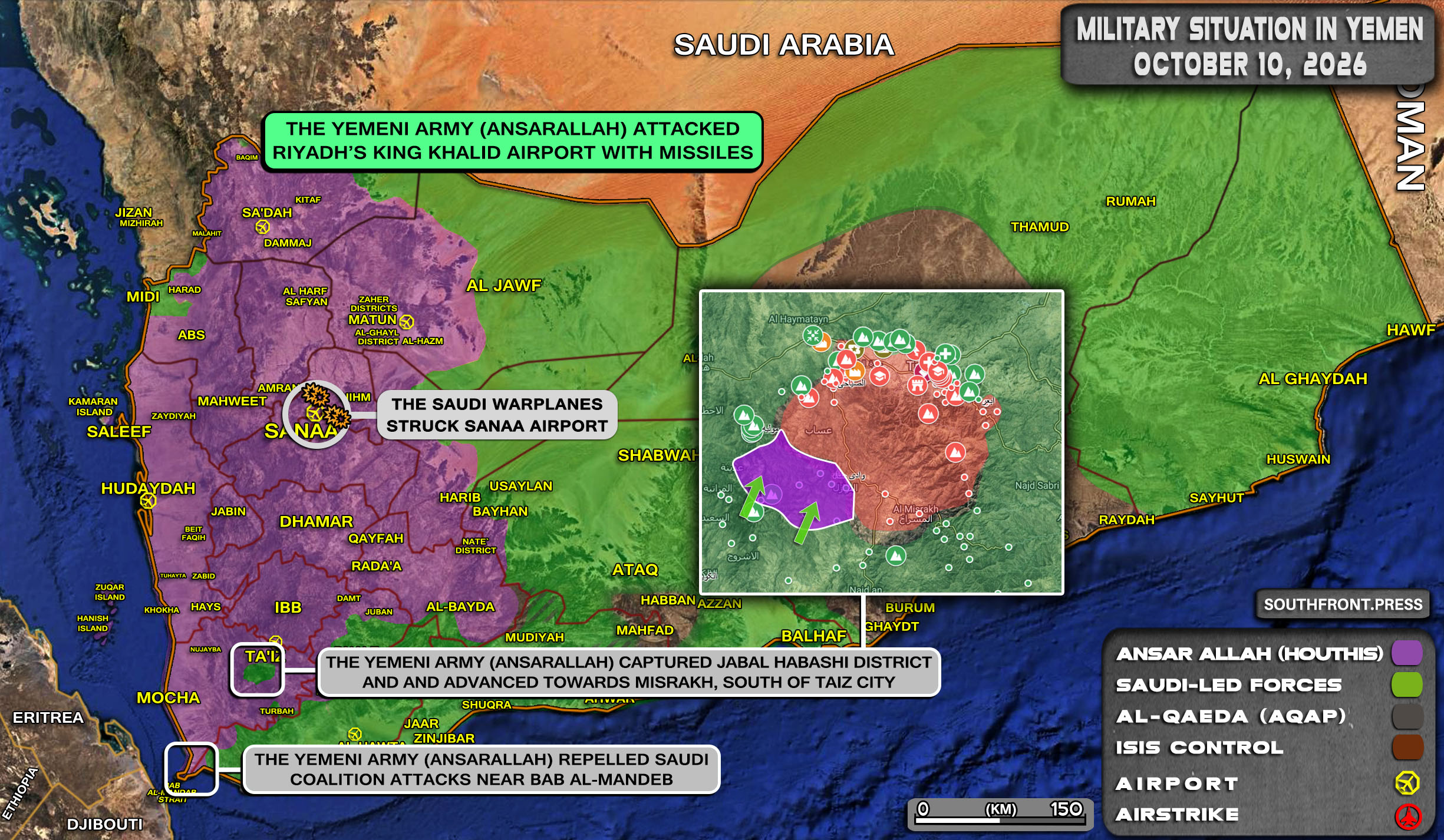
Click to see full-size map.

  • The Yemeni army (AnsarAllah) repelled Saudi coalition attacks near Bab al-Mandeb;
  • The Yemeni army (AnsarAllah) captured Jabal Habashi district and and advanced towards Misrakh, south of Taiz city;
  • The Saudi warplanes struck Sanaa airport;
  • The Yemeni army (AnsarAllah) attacked Riyadh’s King Khalid airport with missiles.

_______________________________________________________________________________________________________________________

MORE ON THIS TOPIC:

The post Military Situation In Yemen On October 10, 2026 (Map Update) appeared first on South Front.

Saudi Arabia Main Airport Struck, Major Gas Plant Reportedly Hit (Videos)

10 October 2026 at 20:20

File image.

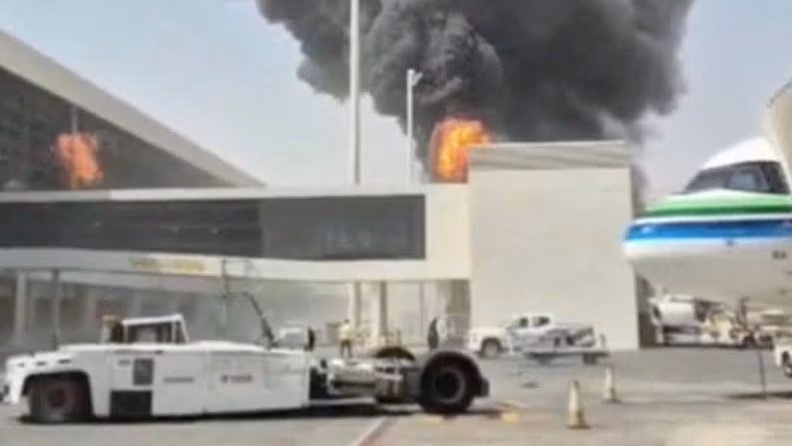
An attack on King Khalid International Airport in Saudi Arabia’s capital injured several people and forced authorities to suspend operations on October 10, as separate reports emerged of a possible strike on a major oil and gas facility in the kingdom’s eastern oil-producing region.

Saudi Arabia’s civil aviation authority said operations at the Riyadh airport had been suspended while officials assessed the damage and verified the safety of the facility.

Meanwhile, a regional official told The Associated Press that a missile struck the complex housing Terminals 3 and 4, which serve domestic flights.

Witnesses reported an explosion inside the airport and injured people on the ground. More than a dozen ambulances were seen rushing to the facility, Reuters reported. A traveler told the news agency that something had flown across the sky before part of the ceiling near a departure gate collapsed.

The official casualty toll remained unclear. Saudi authorities said they were assessing the number of injured, while a source at a Riyadh hospital told AFP that dozens of people had been wounded, including at least five who were being treated in intensive care.

The suspension disrupted air travel across the kingdom. Flight-tracking services showed flights to Riyadh being canceled or diverted, while Kuwait Airways, Etihad Airways and Qatar Airways canceled services to the Saudi capital.

The airport had already been targeted twice earlier in the week in attacks that killed four people and destroyed a Saudi airliner.

Yemen’s Houthis, also known as Ansar Allah, have claimed responsibility for previous strikes on Saudi airports and other infrastructure but had not immediately commented on the latest incident.

The airport attack came amid reports of a possible strike on the Shedgum gas-processing plant in the Ghawar oil-field complex in eastern Saudi Arabia. The reports described smoke rising from the facility after an alleged missile attack.

The Israeli news outlet JFeed reported that the plant had been hit by ballistic missiles, citing satellite imagery and a reported spike in thermal activity. The open-source monitoring site Hamer Intel also reported smoke over the area following the suspected attack.

Despite these reports, Saudi authorities and state oil company Saudi Aramco have not yet publicly confirmed an attack on Shedgum.

Ghawar is one of the world’s largest conventional oil fields and a central part of Saudi Arabia’s petroleum industry. Shedgum is a gas-processing facility associated with the field, meaning damage there would not by itself establish that oil production across Ghawar had been interrupted.

The attacks came as fighting intensified between Saudi-backed Yemeni government forces and the Houthis, who have expanded their missile and drone campaign against Saudi targets in recent days.

The group warned international airlines to avoid Saudi airspace, describing it as a zone of military operations, after Saudi-backed forces launched an offensive to regain territory along Yemen’s Red Sea coast.

U.S. President Donald Trump said after the attack on King Khalid International Airport that Washington was considering whether to join Saudi military action against the Houthis.

“We may. We’re going to look at it,” he told reporters, according to Reuters.

Overall, Saudi Arabia appears to be defenseless in the face of the Houthis, who have succeeded to a large extent in restricting aviation over the kingdom. Despite Trump’s latest remarks, the U.S. is unlikely to take a more direct role against the group, as its forces in the region remain focused on Iran. Still, the U.S. could carry out a one-off attack to show support for Riyadh. This could, however, trigger an even harsher response by the Houthis.

_______________________________________________________________________________________________________________________

SouthFront: Analysis and Intelligence

NOW hosted at southfront.press

Previously, SouthFront: Analysis and Intelligence was at southfront.org.

The .org domain name had been blocked by the US (NATO) (https://southfront.press/southfront-org-blocked-by-u-s-controlled-global-internet-supervisor/) globally, outlawed and without any explanation

Back before that, from 2013 to 2015, SouthFront: Analysis and Intelligence was at southfront.com

SOUTHFRONT.PRESS

MORE ON THIS TOPIC:


The post Saudi Arabia Main Airport Struck, Major Gas Plant Reportedly Hit (Videos) appeared first on South Front.

Tanker Burns off UAE Coast as Iran Vows to Punish Violating Ships (Video)

10 October 2026 at 19:47

File image.

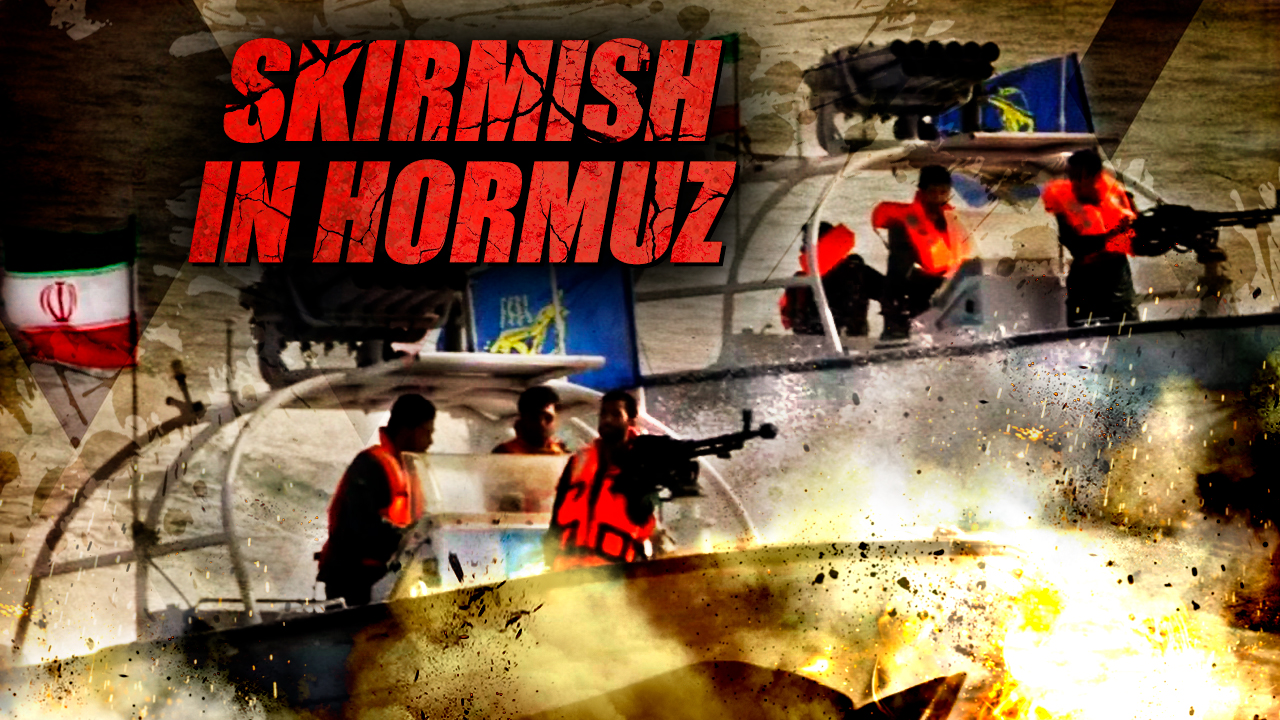
Iran’s Islamic Revolutionary Guard Corps (IRGC) said on October 10 that a supertanker struck a naval mine while attempting to leave the Strait of Hormuz along a route Tehran had not authorized.

In a statement, the IRGC Navy said the vessel had ignored warnings about unauthorized transit and warned that ships violating its rules would face further attacks.

“A massive fire awaits any violating oil tanker that seeks to disregard the security and regulations of the Strait of Hormuz,” the Corps warned.

The statement did not identify the tanker or give its precise location. However, the United Kingdom Maritime Trade Operations (UKMTO) agency said a day earlier that a vessel was struck by an unidentified projectile about 13 nautical miles west of Al Jazeera in the United Arab Emirates.

In an advisory notice, the agency, run by the Royal Navy, said that the fire was extinguished and that authorities were investigating.

India’s shipping minister, Sarbananda Sonowal, identified the vessel as the Panama-flagged crude oil tanker MT GEM NO. 2 and said all 22 Indian crew members were safe after a drone strike while the tanker was anchored off Sharjah, according to The Indian Express.

Separately, the UAE National Guard confirmed that it had rescued 22 crew members from an oil tanker after receiving a report of a fire on board.

Commercial traffic through the Strait of Hormuz continued on October 10 but remained sharply below normal levels amid repeated attacks and Iranian threats against vessels using routes Iran considers unauthorized.

The vessel-tracking service Hormuz.now counted six commercial ships crossing in the preceding 24 hours, with a seven-day average of about 10 ships a day, compared with a pre-crisis baseline of nearly 85. The figures cover only vessels broadcasting their positions.

Meanwhile, data from shipping analytics firm Kpler showed seven commodity vessels crossed the strait on October 6, the lowest number since July 23, followed by 10 on October 7, according to Reuters. That remained well below the more than 20 daily crossings recorded on October 4 and 5.

The strait normally carries a substantial share of global oil and liquefied natural gas supplies, making the prolonged reduction in traffic a major concern for energy markets.

Recent days saw an escalation in strikes on vessels attempting to pass the Strait of Hormuz without coordinating with Iran, which threatened to pursue vessels it considers in violation of its rules across the wider region.

_______________________________________________________________________________________________________________________

SouthFront: Analysis and Intelligence

NOW hosted at southfront.press

Previously, SouthFront: Analysis and Intelligence was at southfront.org.

The .org domain name had been blocked by the US (NATO) (https://southfront.press/southfront-org-blocked-by-u-s-controlled-global-internet-supervisor/) globally, outlawed and without any explanation

Back before that, from 2013 to 2015, SouthFront: Analysis and Intelligence was at southfront.com

SOUTHFRONT.PRESS

MORE ON THIS TOPIC:

The post Tanker Burns off UAE Coast as Iran Vows to Punish Violating Ships (Video) appeared first on South Front.

Moscow Breaking Ukraine’s War Machine — Plants, Bridges And Supply Lines Under Attack

10 October 2026 at 19:32

Click to see the full-size image

Written by Ahmed Adel, Cairo-based geopolitics and political economy researcher

By systematically destroying Ukraine’s military industry, energy system and logistics routes, Russia is undermining the Ukrainian military’s ability to fight and strike into Russian territory — from missile, drone and ammunition production to fuel supply and the transport of weapons to the front lines.

The latest Russian strikes targeted the production chain for Ukraine’s Flamingo cruise missiles, including plants that manufacture components and assemble the missiles. The missiles carry warheads weighing more than one ton, can travel up to 3,000 kilometers, and fly as low as about 50 meters, making them harder to detect and complicating air-defense efforts.

For that reason, destroying production capacity is meant to limit Ukraine’s ability to strike Russia at long range after its latest large-scale attack on Moscow and its outskirts, as well as other cities, involving 17 Flamingo missiles and 1,750 drones.

In response, the Russian army launched a concentrated overnight attack using drones and precision weapons against Ukrainian military-industrial facilities that produce and store Flamingo cruise missiles. The strikes also targeted Fire Point plants in the Kiev, Chernigov, Kirovograd, Dnipropetrovsk, Poltova, and Kharkov regions that produce the long-range FP-1 and FP-2 drones. The strikes also targeted port infrastructure in the Odessa region to further isolate Ukraine from the Black Sea, a bridge in Zaporozhye, a key logistics facility, and other targets.

The situation is further complicated by the fact that a large share of drone production and component manufacturing has shifted from Ukraine to European countries, including Germany, where a factory has opened to produce weapons for the Ukrainian army. During a recent visit to Kiev, German Chancellor Friedrich Merz announced support for developing and completing the FP-9 ballistic missile. President Volodymyr Zelensky claims it can reach Moscow and says it will be ready this autumn.

Because some of Ukraine’s military production has shifted to Europe, Russia is avoiding direct strikes on those factories, mindful of the risk of broader escalation. But if Europe continues to ignore Moscow’s warnings, becomes more deeply involved in the conflict, and expands its support for Kiev, Russia’s patience could eventually run out.

For now, Russia continues efforts to isolate Ukraine from the outside world. Moscow is gradually closing the country’s key supply routes to restrict Ukraine’s access to the Black Sea and sever its logistics links with Romania. Ships no longer sail directly to the Odessa region. Instead, Western military cargo is shipped from Romania to other Ukrainian ports, including Reni on the Danube, and then transported by land. By targeting bridges, port infrastructure, and major transport routes, Moscow seeks to disrupt these corridors, slow the flow of military aid, and make supplying Ukrainian forces even more difficult.

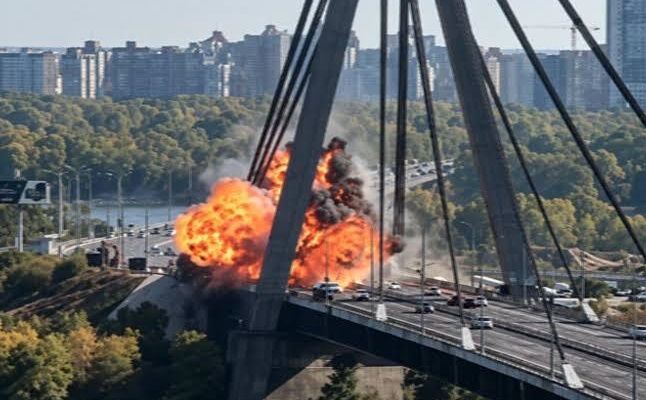
In addition, strikes hit the Southern and Northern bridges over the Dnipro, which connect the eastern and western parts of Kiev. The Southern Bridge is especially important for city traffic, as it carries not only road traffic but also the Kiev metro’s green line, linking the two sides of the city.

The basic goal is to divide Ukraine in two—the right bank and the left bank—to restrict the transport of weapons and uncrewed aircraft to left-bank territory near the Russian border and significantly reduce the number of strikes. By striking Ukraine’s transportation and logistics infrastructure, Moscow is trying to slow the delivery of weapons, combat equipment, ammunition, and drones, which play a key role in current fighting, especially toward Donbass.

Ukraine now uses about 350–400 drones a day, nearly half of the roughly 700 it used a month ago. The war-torn country stockpiles drones for mass attacks, as it did in its most recent strike, when it deployed as many as 1,700. However, this decline is not due to production capacity.

Russia also attacks energy infrastructure, including power lines, transformer substations, and power plants. Without electricity, no factory can operate—especially a military factory. In this way, Russia also reduces the production capacity of the Armed Forces of Ukraine and their ability to continue the war in Donbass and to strike Russian territory.

Ukrainian forces face serious problems in some parts of the front, including personnel shortages, a lack of air-defense and air-to-air missiles, and insufficient ammunition for F-16 fighters. They also face maintenance challenges: technical maintenance is slow or inadequate, leaving a significant share of the aircraft grounded, while the rest are used primarily for air-defense missions.

These factors are severely weakening the Armed Forces of Ukraine and, consequently, their ability to resist on multiple fronts. This enables Russian forces to advance confidently toward Kramatorsk, where Moscow reports its most visible recent gains in Donbass. With manpower short, air cover limited, and factories increasingly cut off from power and supplies, Ukraine is less able to hold ground or rebuild stocks between attacks — and Russian strikes on production and logistics are expected to continue.


MORE ON THE TOPIC:

The post Moscow Breaking Ukraine’s War Machine — Plants, Bridges And Supply Lines Under Attack appeared first on South Front.

While Washington eases up on Russia, Europe hits back harder: EU plans to pass its largest sanctions package on Russia’s war machine in two days

10 October 2026 at 19:10

kaja-kallas--

Europe will not loosen its pressure on Russia after the US-Russia diesel deal, EU Foreign Policy chief Kaja Kallas says. She has announced that EU foreign ministers will approve the bloc’s largest set of sanctions against Russia’s war machine since the full-scale invasion on 12 October.

Washington has just eased the pressure on Russia, letting Russian diesel back onto world markets and handing Moscow more money to wage war. This comes as Russian strikes have killed more than 80 Ukrainian civilians in two days, 22 of them on Russian President Vladimir Putin's birthday on 7 October.

Moreover, Russia has stepped up its hybrid attacks against Europe, both EU Member States and NATO Allies. It is now the time to tighten sanctions, not loosen them, Kallas says.

“Suspending sanctions on Russian diesel provides Moscow with more revenues to wage war. This is not the time to ease pressure on Russia, and Europe won’t,” she claims.

A split with Washington

On 9 October, Trump claimed he had agreed with Putin to put more than 300,000 tons of Russian diesel on world markets immediately.

President Volodymyr Zelenskyy called the deal a weak decision by strong partners, arguing that Russia turns oil-product revenue into weapons against Ukraine's civilians, according to the BBC.

The package aims at the missile chain

On 7 October, EU ambassadors approved the 22nd package of sanctions, with about 1,700 listings, Ukrainian President’s Commissioner for Sanctions Policy Vladyslav Vlasiuk notes. It is expected to be formally approved on 12 October.

This package contains the largest number of sanctions targeting Russia’s defence industry. Of these, 60% were drawn from Ukrainian decrees and proposals. The package includes measures targeting machine tools, Lancet drones, ballistic weapons, and related technologies.

“The core of the package is Russia’s missile programme and electronic components: electronics, capacitors, resistors, and semiconductors. It also covers electronic warfare, shipbuilding, and explosives,” Vlasiuk says.

It took just a few weeks from Ukraine's decision to the European one.

"But we are already working on further measures, including sectoral sanctions targeting energy, the defense industry, finance, and trade,” he stated.

Military Situation In Syria On October 10, 2026 (Map Update)

10 October 2026 at 18:46

Click to see full-size map.

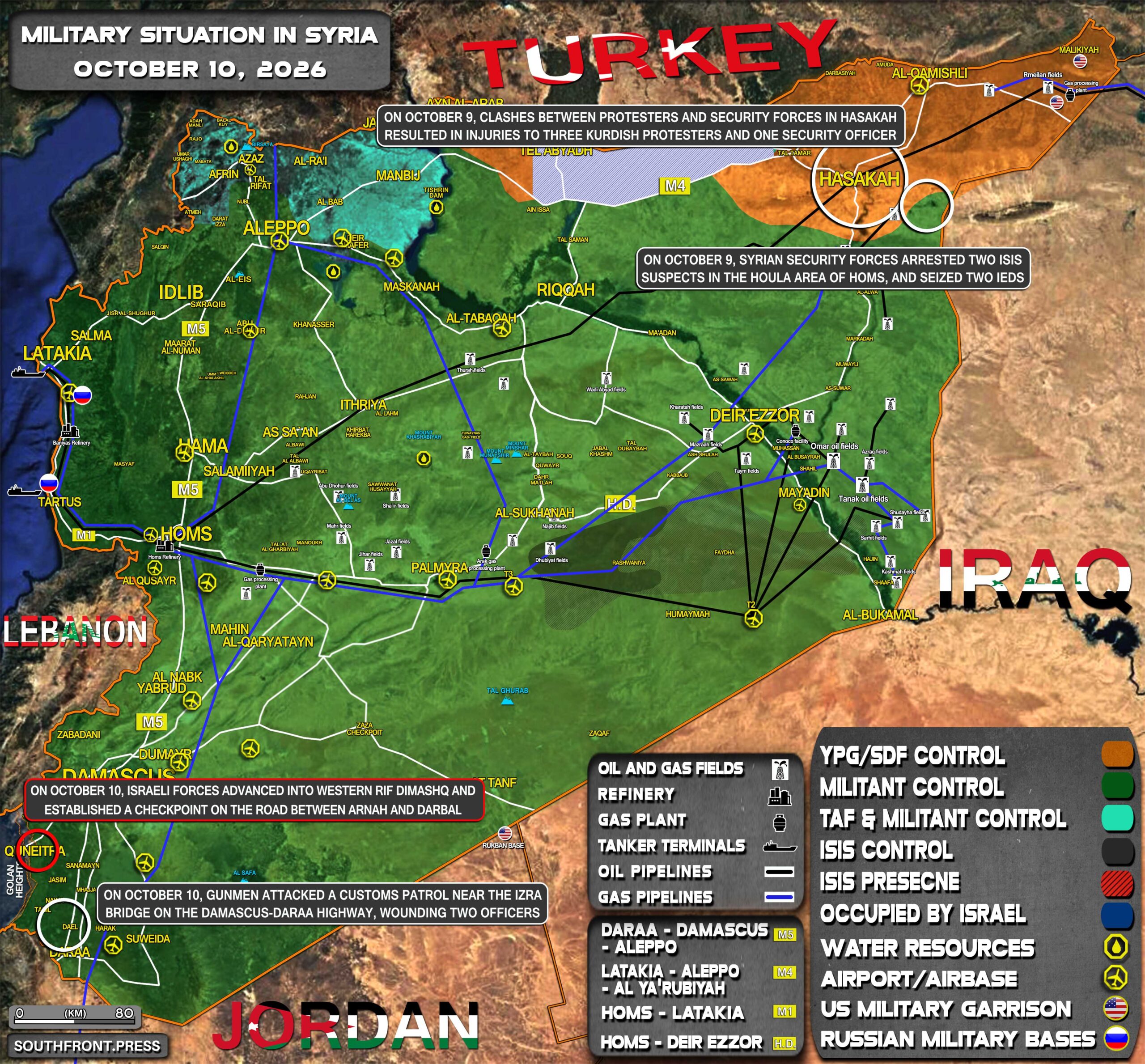
  • On October 9, clashes between protesters and security forces in Hasakah resulted in injuries to three Kurdish protesters and one security; officer
  • On October 9, Syrian security forces arrested two ISIS suspects in the Houla area of Homs, and seized two IEDs;
  • On October 10, gunmen attacked a customs patrol near the Izra Bridge on the Damascus-Daraa highway, wounding two officers;
  • On October 10, Israeli forces advanced into western Rif Dimashq and established a checkpoint on the road between Arnah and Darbal.

_______________________________________________________________________________________________________________________

MORE ON THIS TOPIC:

The post Military Situation In Syria On October 10, 2026 (Map Update) appeared first on South Front.

Greece “Indispensable” To US. What About Turkey? Turkish Question Strikes Again

10 October 2026 at 18:42

Click to see the full-size image

Written by Uriel Araujo, Anthropology PhD, is a social scientist specializing in ethnic and religious conflicts, with extensive research on geopolitical dynamics and cultural interactions

US Secretary of State Marco Rubio this week hailed Greece as an “indispensable” NATO partner – and a pillar of stability in a region marked by “geopolitical uncertainty”. The two sides announced expanded counterterrorism information-sharing. A defense agreement has been reached – worth up to $4 billion. Rubio also backed energy projects such as the undersea electricity interconnector linking Greece to Cyprus, and eventually Israel. At the same time, Rubio insisted a military clash between Turkey and Greece remains “unthinkable” and something the United States would “never allow.” He stressed that both are NATO allies and that conflict would harm all three countries.

When someone emphatically insists that they would never set a house on fire, the very emphasis makes people wonder whether the risk exists. Similarly, Rubio’s statement highlights that Greek-Turkish tensions remain serious enough to require public reassurance from Washington. It would thus seem that the two neighboring countries’ Atlantic membership alone is no guarantee of stability on the Alliance’s southeastern flank. NATO itself has in fact long been split over the “Turkish Question”.

As I argued previously, Trump’s warm embrace of Erdogan in July (recently reiterated), his subsequent signals that he would lift CAATSA sanctions and consider F-35 sales to Turkey, have already raised concerns in Athens – and Israel, for that matter. This exposed divisions, at a time when Ankara pursues strategic autonomy – while also clashing with “allies” over the Aegean, Syria, and the Eastern Mediterranean. Since at least last year, it has been noted how “sidelining” Turkey risks weakening the Alliance’s southeastern flank – and how the Athens-Ankara rivalry in turn exposes NATO’s fragile unity. These tensions predate the current US-Greece deepening of ties.

A closer American-Greek strategic relationship could alienate Turkey (despite Trump’s warmth) and generate further friction within the Alliance. Ankara might perceive the US as strengthening Greece’s military position, its diplomatic leverage, and regional role – at Ankara’s expense. Washington in turn may regard the Hellenic Republic as increasingly “indispensable” – while still viewing Turkey as strategically essential. Those two policies are not inherently incompatible, but they become harder and harder to sustain when Greek and Turkish interests directly conflict.

The latest developments illustrate the dilemma: Greece hosts key US facilities such as Souda Bay, and offers geographic advantages in the Eastern Mediterranean. While the $4 billion arms package builds on existing F-35 procurement and modernization, American support for the electricity interconnector, however, runs up against maritime disputes: Greece seeks to resume seabed surveys, while Turkey argues that the work requires prior coordination under its Libya maritime agreement. The combination of military capability, infrastructure access, and energy influence could look much more serious for Ankara than any single statement. The Greek-Turkish dispute over territorial waters, airspace, continental shelves, and island militarization is longstanding.

This creates the conditions for a security dilemma: Athens strengthens defenses out of distrust, Ankara perceives a shift in the balance and responds – and each side’s measures reinforce the other’s insecurity. Moreover, perception matters in foreign relations. Calling Greece “indispensable” does carry symbolic weight. If Turkey sees Washington investing in Greek capacity while its own F-35 path remains blocked by S-400-related legal restrictions, the asymmetry, so to speak, becomes politically relevant. Domestic prestige and national grievances in both capitals can amplify the effect, thereby creating incentives for public pushback even when direct confrontation would be costly. How can the US and NATO “balance” this?

Washington could separate bilateral defense ties from endorsement of every territorial claim. “Private diplomacy”, as Rubio has indicated, can manage sensitive issues better than public statements. NATO’s existing Greece-Turkey military deconfliction mechanism, established in 2020 with a hotline, can reduce the risk of incidents. The problem is the Alliance itself cannot simply adjudicate Aegean disputes or impose maritime boundaries. Article 5 does not offer a straightforward path for one member against another. NATO’s priority remains preventing hostilities rather than settling sovereignty questions.

At least three scenarios remain plausible: managed competition, with military modernization proceeding alongside negotiations over the underlying rivalries somehow; Turkish strategic pushback through diplomacy, counter-procurement, or greater use of its leverage within the Atlantic Organization; or an “incident” in the Aegean or around Cyprus that would force Washington and NATO into crisis-management mode.

Thus far, Washington has tried to cultivate both bilateral relationships. Greece cannot replace Turkey’s geographic and military assets spanning Europe, the Black Sea, and the Middle East. Washington appears to be strengthening the Hellenic Republic as a sort of strategic hedge, expanding its military access and logistical options in the Eastern Mediterranean – to mitigate the risks of Turkey’s progressively independent and unpredictable (often aggressive) foreign policy. Even as Ankara itself remains an important NATO (and US) ally in its own right. The recent advances in American-Greek relations enhance the challenge without resolving the underlying contradictions. They reflect a deeper transatlantic contradiction in the context of an increasingly divided West.


MORE ON THE TOPIC:

The post Greece “Indispensable” To US. What About Turkey? Turkish Question Strikes Again appeared first on South Front.

New Houthi Footage Shows Drones Strikes, Saudi-Backed Fighters Surrendering

10 October 2026 at 18:40

File image.

Yemen’s Houthis (Ansar Allah) released two videos on October 10 showing attacks on Saudi-backed forces near the country’s southwestern coast and claiming the group had secured additional territory in Taiz province.

The first video, published by the Houthis’ military media, showed recent strikes with “Shawaz” first-person suicide quadcopters.

The strikes targeted military vehicles and gatherings of Saudi-backed fighters at several locations in the Kahbub Mountains and al-Waziyah district along the far southern end of Yemen’s southwestern coast.

A second video, released separately, showed Houthi fighters advancing in the districts of Sama, As Silw and al-Mawasit in Taiz.

The footage also showed groups of Saudi-backed fighters surrendering to the Houthis and laying down their weapons in line with a general amnesty announced the previous month by Mahdi al-Mashat, head of the Houthi-led Supreme Political Council.

The three districts lie in the rural south and southeast of Taiz city, on a front distinct from the fighting along the Red Sea coast. Their reported capture comes amid the Houthis’ wider advance around Taiz, where the group has managed to cut the city off from other government-held areas.

Al Jazeera reported on October 10 that the capture of al-Turbah by October 4 had severed the main road linking Taiz city with government-held territory.

The coastal footage appeared amid continued fighting over access to the strategic Bab al-Mandab Strait, which connects the Red Sea with the Gulf of Aden.

Saudi-backed forces said on October 9 that they had retaken the strait’s surrounding coastal areas and Mayyun Island, which lies within the waterway. Ansar Allah military spokesman Yahya Saree, however, said the group had repelled an advance from Lahj province and claimed more than 22 armored vehicles had been destroyed.

All in all, the Houthis maintain the upper hand both in Bab al-Mandab and in Taiz. Saudi-backed forces appear to be taking heavy losses, and their chances of regaining the initiative are getting slimmer by the day.

_______________________________________________________________________________________________________________________

SouthFront: Analysis and Intelligence

NOW hosted at southfront.press

Previously, SouthFront: Analysis and Intelligence was at southfront.org.

The .org domain name had been blocked by the US (NATO) (https://southfront.press/southfront-org-blocked-by-u-s-controlled-global-internet-supervisor/) globally, outlawed and without any explanation

Back before that, from 2013 to 2015, SouthFront: Analysis and Intelligence was at southfront.com

SOUTHFRONT.PRESS

MORE ON THIS TOPIC:

The post New Houthi Footage Shows Drones Strikes, Saudi-Backed Fighters Surrendering appeared first on South Front.

Military Situation In Ukraine On October 10, 2026 (Maps Update)

10 October 2026 at 17:15

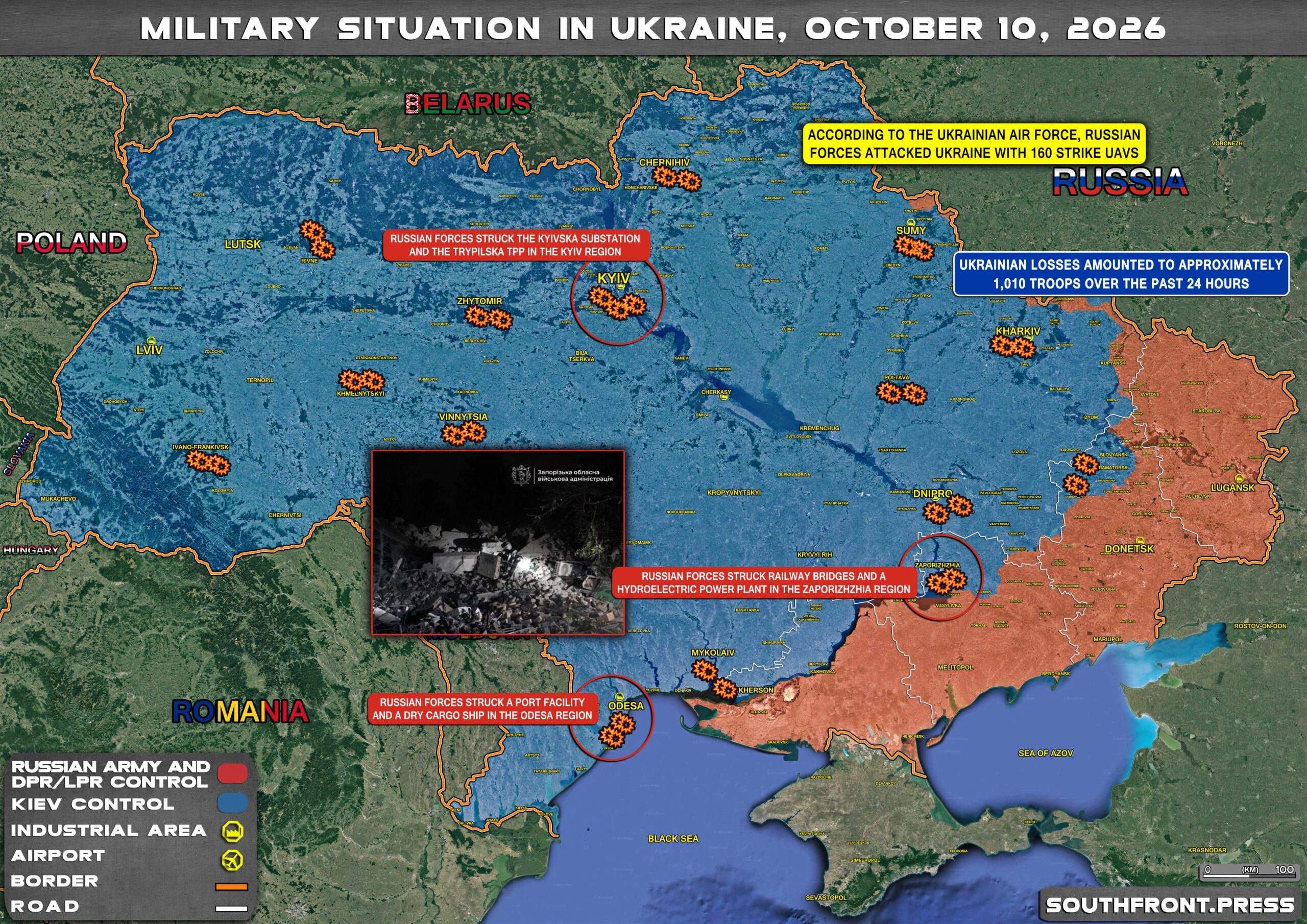
Click to see the full-size image

  • Russian strikes destroyed targets in the Sumy, Kharkiv, Zaporizhzhia, Dnipropetrovsk, Kherson, Kyiv, Odesa, Ivano-Frankivsk, Volyn, Chernihiv, Mykolaiv, Poltava, Vinnytsia, Rivne, Zhytomyr, Khmelnytskyi regions, and the DPR;
  • According to the Ukrainian Air Force, Russian forces attacked Ukraine with 160 strike UAVs;
  • Russian forces struck the Kyivska substation and the Trypilska TPP in the Kyiv region;
  • Russian forces struck railway bridges and a hydroelectric power plant in the Zaporizhzhia region;
  • Russian forces struck a port facility and a dry cargo ship in the Odesa region;
  • Ukrainian losses amounted to approximately 1,010 troops over the past 24 hours.

Click to see the full-size image

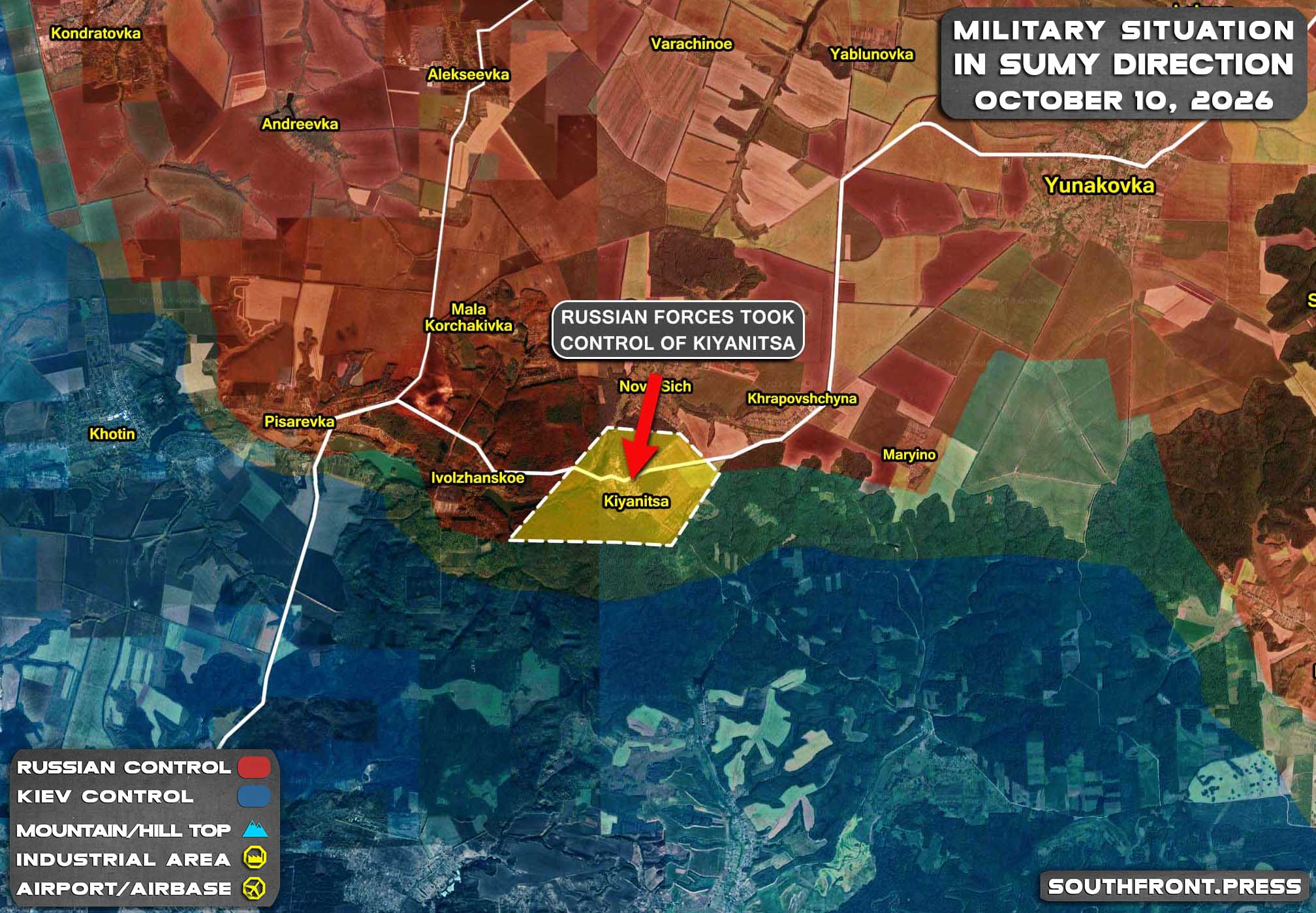
  • Russian forces took control of Kiyanitsa.

Click to see the full-size image

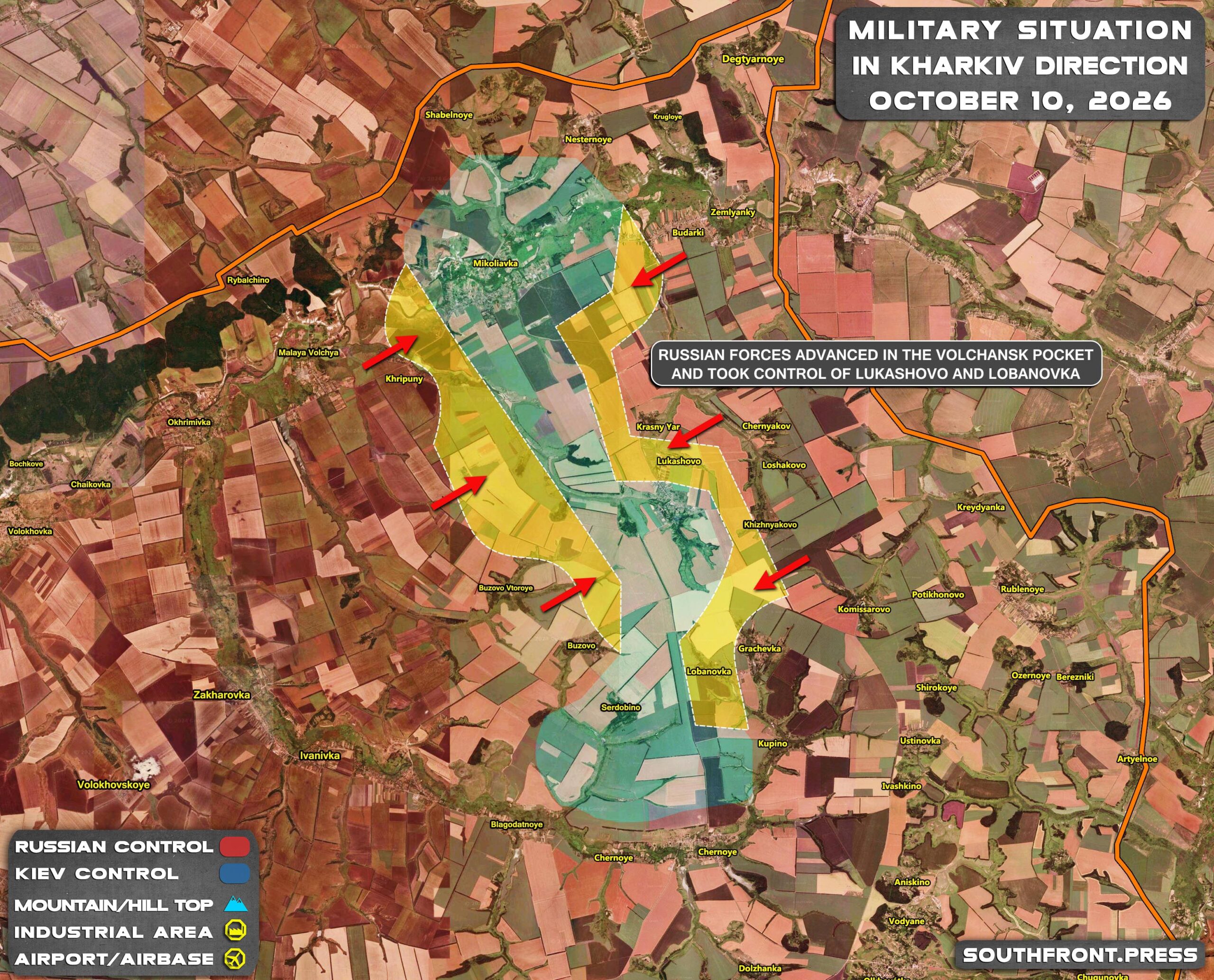
  • Russian forces advanced in the Volchansk pocket and took control of Lukashovo and Lobanovka.

Click to see the full-size image

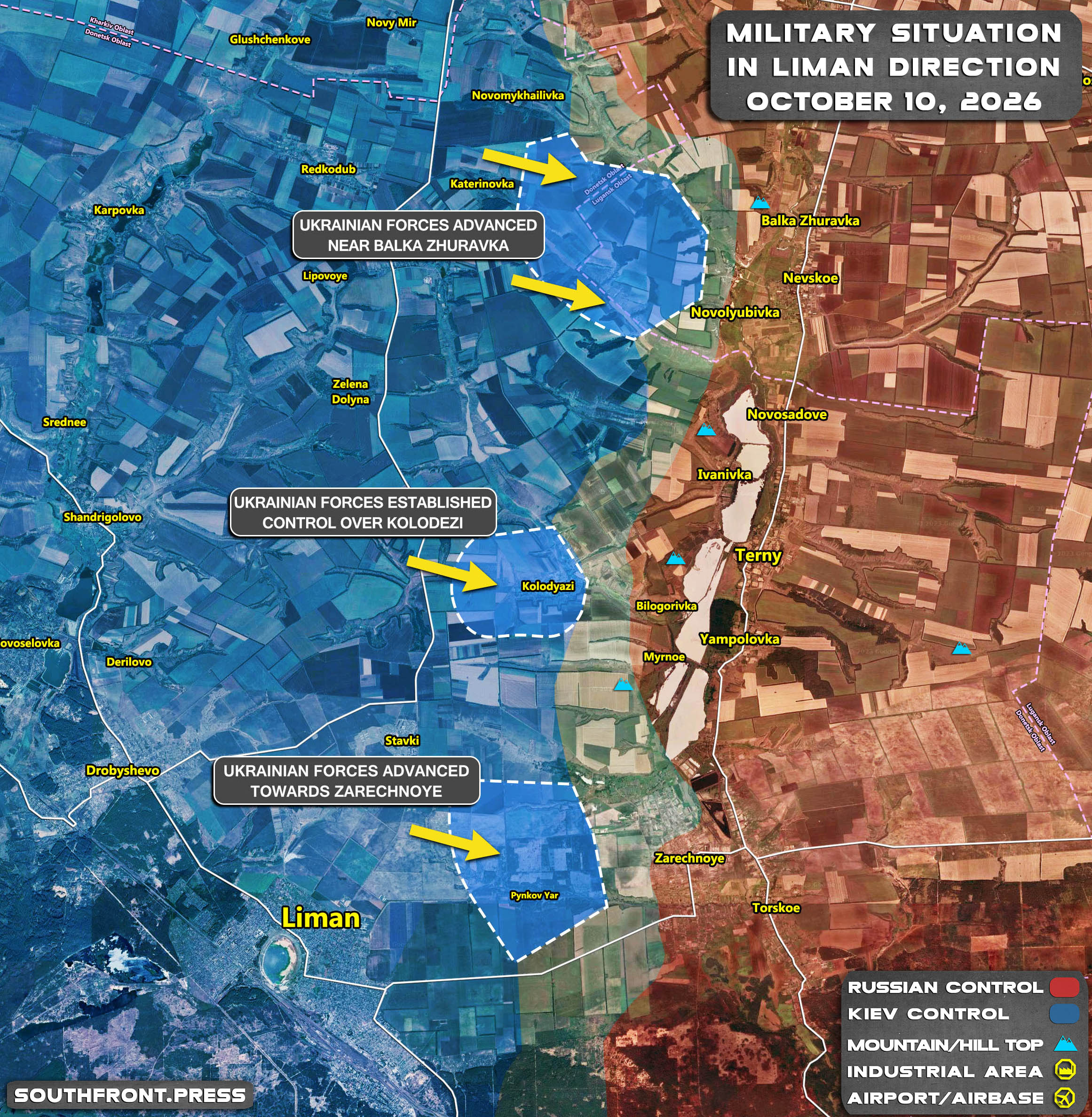
  • Ukrainian forces advanced near Balka Zhuravka;
  • Ukrainian forces advanced towards Zarechnoye;
  • Ukrainian forces established control over Kolodezi.

MORE ON THE TOPIC:

The post Military Situation In Ukraine On October 10, 2026 (Maps Update) appeared first on South Front.

Four Ukrainians Arrested in Vienna Amid Growing Sabotage in Europe

10 October 2026 at 17:14

File image.

Four Ukrainian citizens were arrested in Vienna this week on suspicion of spying, Austrian Interior Minister Gerhard Karner said on October 9.

Three of the four remained in custody, Karner said, declining to provide further details because the investigation was ongoing.

The newspaper Ukrainska Pravda said two of its journalists were among those detained. Editor-in-chief Sevgil Musaieva said investigative journalist Mykhailo Tkach was released after more than 12 hours in detention on October 8, but his communication devices had not been returned. She also said cameraman Yaroslav Bondarenko was injured during his detention. The other two Ukrainians still in custody were arrested three days earlier.

The Ukrainian Embassy in Vienna said it was awaiting an explanation from Austrian authorities about the arrests and their legal basis, according to Reuters.

The arrests come amid growing scrutiny of alleged covert operations involving Ukrainians across Europe, including investigations into sabotage and attacks linked to Kyiv’s intelligence services.

In July, German prosecutors indicted a Ukrainian national accused of helping coordinate the team that planted explosives on the Nord Stream gas pipelines under the Baltic Sea in September 2022. The suspect, who was arrested in Italy last year, has denied involvement, Reuters reported.

Earlier in April, Serbian authorities found explosives near the Balkan Stream pipeline supplying Russian gas to Hungary. Prime Minister Viktor Orbán accused Ukraine of possible involvement, but Kyiv denied the allegation.

A separate investigation concerns a June 29 bombing in Monaco that seriously injured Ukrainian-born businessman Vadym Yermolaiev and two members of his family.

Ukrainian authorities detained a military intelligence officer and a former law-enforcement officer over the subsequent killing of Anastasiia Berezovska, the woman suspected of planting the bomb.

Monaco’s prosecutor said the two men may also have been involved in planning the attack, according to The Associated Press.

In an interview with the BBC published on October 9, former security officer Vitalii Zhykovych alleged that senior Ukrainian military intelligence officials had authorized the operation. Monaco, a sovereign city-state, is not a member of the European Union.

The recent incidents suggests growing Ukrainian sabotage activity inside the European Union. The targets point to a possible motive. Austria and Hungary had both pushed back against widening sanctions on Russia before the recent plots. In the case of Yermolaiev, who is in disagreement with Kyiv, the motive also appears evident.

_______________________________________________________________________________________________________________________

SouthFront: Analysis and Intelligence

NOW hosted at southfront.press

Previously, SouthFront: Analysis and Intelligence was at southfront.org.

The .org domain name had been blocked by the US (NATO) (https://southfront.press/southfront-org-blocked-by-u-s-controlled-global-internet-supervisor/) globally, outlawed and without any explanation

Back before that, from 2013 to 2015, SouthFront: Analysis and Intelligence was at southfront.com

SOUTHFRONT.PRESS

MORE ON THIS TOPIC:

The post Four Ukrainians Arrested in Vienna Amid Growing Sabotage in Europe appeared first on South Front.

Hormuz and the looming economic catastrophe

By: A A
10 October 2026 at 14:05

By Philip PILKINGTON

Join us on Telegram, X, and VK.

Contact us: info@strategic-culture.su

The Trump administration is missing the bigger picture.

In the classic martial arts film Enter the Dragon, Bruce Lee’s character is instructing a young, aspiring fighter. Irritated at the lack of progress his student is making, he points to the sky. “It’s like a finger pointing away to the moon,” he says as the student tries to focus on what his teacher is saying. “Don’t concentrate on the finger,” Lee says, slapping him on the head, “or you will miss all that heavenly glory.” The quote is derived from an old Buddhist text called the Śūraṅgama Sūtra, and the point is clear: Sometimes if you focus on what is immediately in front of you, you can miss the point entirely.

Something like this is happening in Washington, DC, right now. For almost two weeks, the debate around the progress or lack thereof in the Iran War has been focused on activity in the Strait of Hormuz. A whole host of maritime experts have emerged suddenly to inform us that the Trump administration has succeeded in reopening the crucial waterway to shipping. Maximalists are claiming that this means the United States has effectively won the war in the Middle East. Others are making the more modest claim that this reopening of the Strait will solve the looming energy crisis.

These were the two perspectives that most people who were not deeply involved in the debate heard. There was, however, a small but vocal minority who questioned whether the Strait had been opened at all. If Iran had effective fire control over the Strait in spring and summer, they asked, then why would they suddenly lose it now? Almost immediately after this question was raised, Iran settled the debate by striking an enormous number of ships: 12 and counting in less than a week.

To those of us who were paying attention, the whole exercise felt like looking at Lee’s finger as he points to the moon. As these debates unfolded, the market for U.S. Treasury debt continued an epic sell-off. Bloomberg quoted an investment banker who stated that Treasuries were “trading like a meme stock.” U.S. Treasury bonds have now experienced their worst long-run returns in history.

Treasury bonds are not just any old asset. For one, they are the debt of the U.S. government. If they become uninvestable, the capacity for Washington to live beyond its means through debt issuance is open to question. Treasuries are also the benchmark asset for the entire global dollar system that has allowed the U.S. to run enormous deficits for decades. If this asset starts “trading like a meme stock” and generating awful returns, foreigners will opt for something else. This week, the president of the German central bank stated that “the case for further diversification into gold remains significant.” People are talking.

In mid-September, the speaker of the Iranian parliament, Mohammed Bagher Ghalibaf, posted an equation on X. Unusually for an obscure piece of algebra, the post garnered nearly 7 million views. The equation was a modified version of what economists call the “Taylor Rule,” a method that economists and central bankers use when setting central bank interest rates. In normal times, the equation factors in expected future inflation and how much slack is in the economy. But Ghalibaf’s equation—which he called the “Straits Taylor Rule” —included two new variables: the Strait of Hormuz and the Bab el-Mandeb, the two waterways currently under fire from Iran and the Houthis in Yemen, respectively.

The equation is a stripped-down representation of Iran’s strategy. By controlling these waterways, Iran and its allied groups have gained control over the global energy market. By squeezing these chokepoints, Iran can assert de facto control over America’s financial markets by pushing up expected inflation. Central banks like the Federal Reserve realize that this is no mere bluff and have already started raising interest rates. Ghalibaf’s equation explains, to a very large extent, why American government debt is currently trading like a meme stock.

Meanwhile, at the same time as these pressures are felt in American financial markets, the real economy is undergoing a squeeze too. Recent reports from the Energy Information Agency suggest that American heating-oil bills are expected to rise by 21 percent this winter. Diesel markets are entering into a genuine crisis, with President Donald Trump floating the prospect of banning diesel exports to ensure that there are no shortages. Diesel is the lifeblood of the American logistics chain. If there are shortages, trains and trucks will not run and goods will not be delivered to shelves. Trump has walked back the diesel export ban for now, after strong-arming the Europeans to dump their oil and diesel reserves, but there is every chance that this option appears back on the table as the crisis worsens. Food prices are rising too, with sugar prices looking particularly worrisome.

Once again, Ghalibaf outlined how this is part of Iran’s overall strategy. In an X post this week, the speaker published a rudimentary graph—coupled with a haunting image of a ghost—showing rising commodity prices and interest rates on one side, and falling consumer confidence, foreign interest in U.S. Treasuries, hyperscaler investment, and housing affordability on the other. The Iranians are not just trying to squeeze the American financial system—they are aiming to put extreme stress on the entire economy—and it looks increasingly like they intend on making this pressure felt before American voters go to the polls on November 3.

The Trump administration has become fixated on the Strait of Hormuz, seeing it as a decisive battlefield on which the U.S. can win the war. But the Strait is merely a means to an end. For Iran, that end is to slowly demolish the American economy and financial system until the pressure becomes too much and the U.S. backs off. The idea that you can “win” such a battle is delusional.

The Strait is merely the finger in Lee’s analogy. It is Iran’s overall economic strategy—the moon—that we should focus on. And when we do, we come to the worrying conclusion that by the time the Trump administration cries uncle, the damage done to the American economy and financial system will be so severe that it could take many, many years to recover.

Original article:  www.theamericanconservative.com

America Is Leaving Iraq, Not the Middle East

10 October 2026 at 13:59
America’s last troops have left Iraq, but anyone looking for a US withdrawal from the Middle East is looking in the wrong place. The end of the Iraq model On September 30, the United States completed the withdrawal of its forces and equipment from Erbil Air Base, formally ending the mission of Operation Inherent Resolve […]

Russian Jet-Powered Geran-4 Drones Reach Lviv Region for First Time (Video)

10 October 2026 at 13:47

File image.

Russian jet-powered Geran-4 one-way attack drones reached Ukraine’s Lviv region for the first time on October 10, following earlier reported strikes in the Rivne and Volyn regions in August.

Ukraine’s Air Force reported early in the morning that a jet-powered drone was heading toward Lviv and the nearby town of Vynnyky, later warning that it was approaching Lviv airport. Lviv Mayor Andrii Sadovyi confirmed soon afterward that the drone had entered the city’s airspace.

The incident came amid a broader wave of Russian jet-powered drone attacks against western Ukraine. Geran-4 drones targeted not just Lviv, but also Volyn, Rivne, Khmelnytskyi and Ivano-Frankivsk regions from late October 9 overnight into October 10.

Russia disclosed the Geran-4’s range publicly on October 2, when a representative briefed President Vladimir Putin on the drone during a visit to the Chebarkulsky training ground in the Chelyabinsk region. The representative said the drone travels at 350 kilometers per hour, carries a 50-kilogram warhead and has a range of 750 to 800 kilometers.

Those figures place western Ukrainian targets within its declared operational reach. Yet there have been reports of strikes even beyond this range.

In August, an unidentified Russian jet-powered drone reportedly traveled about 900 kilometers from Crimea before reaching Dubno in the Rivne region.

Ukraine’s Defense Intelligence revealed earlier this week that Russia has begun to produce an updated version of the Geran-4.

The updated version replaces the Chinese Telefly turbojet engine with a Russian-produced equivalent and adds the Susanin electro-optical system, which compares onboard camera images with stored reference imagery to guide the drone along a designated route. It is also armed with a new shaped-charge warhead designed to cut through bridge structures and supports for overhead power lines.

The continued development of the Geran drone represents a growing threat to Ukrainian air defenses, which are struggling to cope with existing versions.

_______________________________________________________________________________________________________________________

SouthFront: Analysis and Intelligence

NOW hosted at southfront.press

Previously, SouthFront: Analysis and Intelligence was at southfront.org.

The .org domain name had been blocked by the US (NATO) (https://southfront.press/southfront-org-blocked-by-u-s-controlled-global-internet-supervisor/) globally, outlawed and without any explanation

Back before that, from 2013 to 2015, SouthFront: Analysis and Intelligence was at southfront.com

SOUTHFRONT.PRESS

MORE ON THIS TOPIC:

The post Russian Jet-Powered Geran-4 Drones Reach Lviv Region for First Time (Video) appeared first on South Front.
When will this White House madness end?

By: A A
10 October 2026 at 13:00

By Philip GIRALDI

Join us on Telegram, X, and VK.

Contact us: info@strategic-culture.su

The United States competes with Israel for the “Most Hated” Distinction

It was another horrific week in Washington with President Donald Trump actually succeeding in coming out with an apparently improvised comment that equaled or maybe even exceeded his ghastly performance at the United Nations where he speculated over whether he should “annihilate” Iran and drive it back into the Stone Age. It would seem that ninety plus million dead Persians would satisfy Donald’s blood lust when it comes to killing innocent civilians, but the latest musing by our beloved leader had him addressing a campaign rally in Nebraska, where he appeared to be declaring that he might well consider wanting to continue the war against Iran even if the price to pay from the Iranians were to be retaliation consisting of eliminating some of our cities. He said “It’s a small price to pay for keeping the world safe, for keeping our country safe, and it’s going to be over with very soon. Let ’em take out Los Angeles, let ’em take out San Diego.”

Trump clearly saw the whole thing as some kind of quid pro quo expecting that even Californians would consider the price to pay worth it if it kept Iran from obtaining a nuclear weapon but he failed to make any reasonable connection between the nonexistent weapon and the good to come out of annihilation of millions of Americans. The irony is, of course, that since Iran has no nukes and nor is it even developing that resource, a point generally made by US intelligence, it could not in any event destroy either or both of the West Coast cities. But then again, Trump is not given much to deep thinking and what he tends to say is what is roiling around among the three brain cells that might actually be functioning in his oversize head at any moment.

Interestingly, the video recording the gathering shows the Nebraska crowd of MAGA supporters cheering the exchange, seemingly unaware that the war never needed to be fought, that Iran was not and is not any military threat to the United States, and that the whole bloody thing could be ended by Trump repeating his frequent declaration of “victory” before ordering all the troops home and putting an end to it. That way no one “loses” and no more innocents have to die but somehow that does not appear to be an option circulating in the White House.

In the wake of the comment, both California’s Democratic Governor Gavin Newsom and San Diego Republican Mayor Todd Gloria called out President Trump for his willing to see Americans die in large numbers due to bad policies coming out of Washington. Newsom wrote on social media how “After sending the National Guard to occupy California, Donald Trump is now saying our foreign enemies should ‘take out’ Los Angeles and San Diego. He is deranged and dangerous.” Gloria added “San Diego is not collateral damage. We are not expendable. And we are never a ‘small price to pay.’ Keep our city out of your reckless war talk.”

The White House inevitably pushed back in support of Trump’s comments, with communications director Steven Cheung writing on social media how “The media freakout over President Trump’s comments is not rooted in reality. He was clearly stating US cities would have been threatened if a nuclear Iran hadn’t been stopped. America is safer because of the President. Iran has no nuclear, no navy, no air force, and no money.” Interestingly, Trump’s communications director, who interpreted the comment backwards by claiming falsely that the president had “stopped” an Iranian nuke, was incapable of understanding what Trump actually said and instead invented what he might have been wanting to say. All of which explains why the White House is as dysfunctional as it is.

Beyond that, something at least veering towards a bit of constructive policy did take place on September 30th when the United States completed its troop withdrawal from Iraq, which it has been de facto occupying for the past 23 years. The withdrawal, which took place after multiple requests by the Iraqi government, appears to be due to the desire to move US troops out of the effective range of some of the Iranian short range-missiles and drones which could easily reach Iraq. The soldiers and airmen will be moving to next door Jordan which means they will still be near enough to intervene if the Iraqis become naughty and do anything that is not perceived as being in American “interests.”

Some will recall that back in January 2020, then President Donald Trump ordered the assassination of the Iranian head of the Iranian Revolutionary Guards Qasim Soleimani who had just landed in Baghdad Airport to join in peace talks between his country and the Iraqis. Peace talks are not the sort of thing that Trumpists are good at, particularly if they involve actual or potential enemies of Israel, so Soleimani had to be stopped. The Iraqis are certainly aware that the departure of US soldiers does not mean an end to American intervention, which can indeed be at the point of a gun but which might also be through sanctions and other less kinetic means.

All of which is to suggest that the game is not over yet and Trump is quite capable of doing something very stupid in an attempt to salvage whatever remains from his reputation. What is behind a lot of this nonsense is the evil circle involving Trump himself and his good friends in Israel. Make no mistake that Israel is dedicated to becoming “Greater Israel” while also eliminating its potential enemies in Asia and Africa. And, unlike Iran, it is actually nuclear armed thanks to the material and technology that it stole from the United States before killing President John F Kennedy who tried to stop them. And the witless Donald will do everything in his power to help Prime Minister Benjamin Netanyahu be reelected, be it because he is being blackmailed or because he loves the man so much. Be that as it may, Trump will cooperate fully with Netanyahu or whoever succeeds him, no matter what. So too will there be the usual consensus on doing everything to please the Jewish state coming from the usual crowd of Israel firsters in Congress, in the mainstream media and among the Foundations that have come to rely on the money and “respect” that comes from inhabiting the same space as those who are beloved by Zion.

For those who have not yet aware of just how deeply the Zionist activists have inserted themselves in the body politic, I would greatly recommend an article put out by the highly respectable Quincy Institute that just appeared this past week written by Kelley Vlahos, the Editor in Chief of Responsible Statecraft. It provides the sordid details of how the Israel Lobby backed up by Jewish billionaires has been able to create and then subvert a conservative movement that originally appeared to support American interests to make them instead do Israel’s bidding. She describes how “The annual confab, [NatCon 2026] ostensibly launched for American conservatives in 2019, is in Jerusalem this week, largely focused on shoring up US support for the Jewish state.” If Israel is successful, it will bring about a proposed US-Israeli integration at the Pentagon and take its place as a “partner” of the United States in defense matters as well as in foreign policy. Make no mistake, Israel will bleed us dry and then discard our carcass without even a backward glance. It will be the end of our country. President Donald J Trump and his predecessor Joe Biden have done much to move this process along and it is to them and the cowards in Congress and the media that we the owe the deep hole that we as a once-upon-a-time proud and independent people will soon find ourselves in.

Original article:  www.unz.com

Houthi Attacks on Saudi Airports Dealt Blow to Kingdom’s Investment Plans

10 October 2026 at 12:39

Illustrative image.

Yemen’s Houthis (Ansar Allah) are disrupting Saudi Arabia’s efforts to attract international investors and energy executives, with attacks on the kingdom’s airports and explicit threats against commercial aviation prompting airlines and businesses to reconsider travel ahead of two major conferences in Riyadh, the Financial Times reported on October 10.

The World Petroleum Council Energy Congress is scheduled to take place from October 11 to 15, followed by the Future Investment Initiative, known as “Davos in the Desert,” from October 26 to 29.

The gatherings are important showcases for Saudi Arabia’s efforts to attract foreign capital and establish itself as a global destination for business, tourism and investment under Crown Prince Mohammed bin Salman’s Vision 2030 economic diversification program.

The Financial Times reported that companies are reconsidering the number of employees they will send to the events, with some exploring alternatives to air travel and others considering remote participation.

Italy’s energy minister has abandoned plans to attend the energy congress in person and will participate virtually. Organizers intend to proceed with the events, but the difficulties facing international participants have raised questions about attendance, particularly at the larger investment conference later this month.

The disruption follows an explicit warning from the Houthis, whose military spokesman, Brig. Gen. Yahya Saree, declared on October 8 that Saudi airspace had become a theater of military operations and issued what he described as a final warning to international airlines to stop flying into the kingdom.

Notably, the warning exempted airspace over the Islamic holy cities of Mecca and Medina, according to the group’s statement.

The Houthis have claimed responsibility for a series of missile attacks on Saudi airports in recent days. On October 9, Saudi aviation authorities confirmed that two attacks on King Khalid International Airport in Riyadh had killed three Saudi nationals and wounded several other people. A Saudia Airlines plane was also destroyed. Other aircraft were reportedly damaged.

The latest casualties brought the reported death toll from the recent airport attacks to six, including victims of earlier strikes on Riyadh and Abha.

The aviation threat has already produced consequences beyond the immediate damage. On October 9, the European Union Aviation Safety Agency expanded its advisory against operating in Saudi airspace, adding an area in the kingdom’s northwest after concluding that the recent attacks demonstrated the Houthis’ ability and intent to strike deeper inside Saudi territory.

The aviation risk-sharing organization OPSGROUP separately advised its members to avoid operations in Saudi Arabia, including using Saudi airports as alternative destinations during flights.

Airlines have responded with cancellations and suspensions affecting Riyadh and other Saudi cities. Lufthansa Group and several Indian carriers announced suspensions of flights to Riyadh, while Etihad Airways canceled services and flydubai extended cancellations affecting Riyadh, Yanbu and Abha.

Flight-tracking data showed 131 cancellations to and from Riyadh by early afternoon on October 9, following hundreds of cancellations the previous day, Reuters reported.

For Saudi Arabia, the implications reach beyond the immediate problems facing conference organizers. The kingdom has invested heavily in attracting international companies, financial institutions and visitors as it seeks to diversify its economy away from oil revenues.

The energy congress and the Future Investment Initiative offer opportunities to draw senior executives to Riyadh, cultivate investment commitments and demonstrate that the country can host major international gatherings.

The Houthi campaign is now testing that effort through both physical attacks and the threat of further strikes. Even without additional damage to airport infrastructure, warnings that commercial aircraft could be targeted give airlines and corporate security departments a reason to reconsider routes, staff deployments and attendance.

With the energy congress beginning on October 11 and the investment conference approaching later in the month, Saudi organizers face the immediate challenge of keeping international participants coming while the threat to aviation remains active.

_______________________________________________________________________________________________________________________

SouthFront: Analysis and Intelligence

NOW hosted at southfront.press

Previously, SouthFront: Analysis and Intelligence was at southfront.org.

The .org domain name had been blocked by the US (NATO) (https://southfront.press/southfront-org-blocked-by-u-s-controlled-global-internet-supervisor/) globally, outlawed and without any explanation

Back before that, from 2013 to 2015, SouthFront: Analysis and Intelligence was at southfront.com

SOUTHFRONT.PRESS

MORE ON THIS TOPIC:

The post Houthi Attacks on Saudi Airports Dealt Blow to Kingdom’s Investment Plans appeared first on South Front.
Turkish Drones Are Fueling Conflict in Ethiopia

10 October 2026 at 12:13

File image.

Ethiopian government forces have stepped up drone attacks as fighting spreads across Tigray, Amhara and neighboring regions, bringing renewed attention to Turkey’s growing role as a supplier of unmanned aerial systems to the war-torn country.

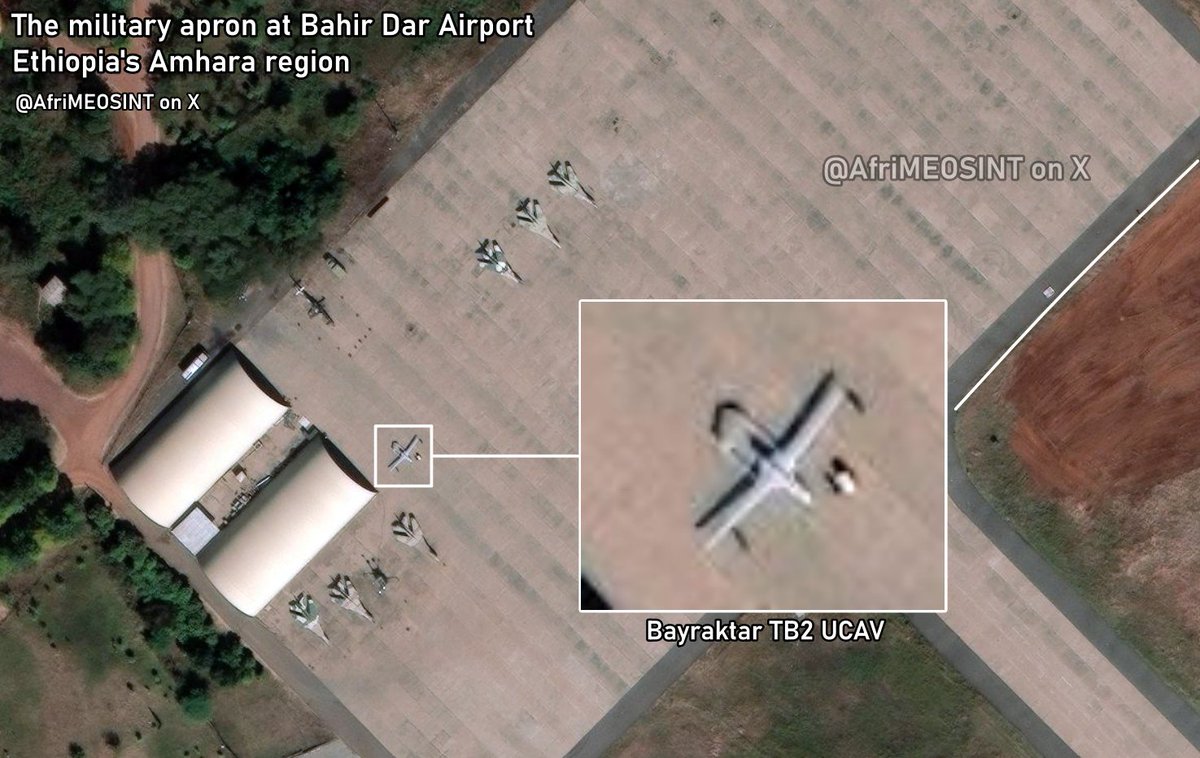
Reports and imagery point to the presence of Turkish-made Bayraktar TB2 and Akıncı drones, although publicly available evidence does not establish which models carried out the individual strikes in the latest offensive.

The latest escalation in Ethiopia has brought the drones into use against both Tigrayan fighters and forces identified as Eritrean.

The Armed Conflict Location & Event Data Project, known as ACLED, reported that between 15 and 17 strikes hit Alamata in southern Tigray on September 22, damaging several schools and a hospital. Tigrayan authorities said the attacks killed 14 people and wounded 22, although the breakdown of casualties between civilians and combatants was unknown.

On September 27, ACLED recorded an Ethiopian army drone strike on Tigray TV, a regional broadcaster affiliated with the Tigray People’s Liberation Front.

The attacks continued into October. On October 7, ACLED reported that Ethiopian National Defense Force units had used drones to attack suspected Eritrean troops traveling by vehicle toward Idaga Hamus in Tigray. The group said further strikes targeted vehicles carrying troops and equipment as the troops withdrew from the Adigrat area on October 8. Witnesses reported destroyed military vehicles and explosions overnight.

The Turkish connection predates the current offensive. In October 2021, Reuters reported that Ethiopia was seeking to acquire Bayraktar TB2 armed drones from Turkish defense company Baykar, amid the previous war between federal forces and the Tigrayan leadership.

The Bayraktar TB2 has a 12-meter wingspan, a maximum takeoff weight of 700 kilograms and an endurance of more than 18 hours, allowing it to conduct surveillance, reconnaissance and precision strikes with guided munitions.

Click to see full-size image. (X)

Subsequent reporting documented the use of Turkish-made drones in Ethiopia. In August 2024, a senior Turkish government official confirmed that Turkey had authorized Ethiopia to use Turkish-made drones, following scrutiny of civilian deaths linked to earlier attacks.

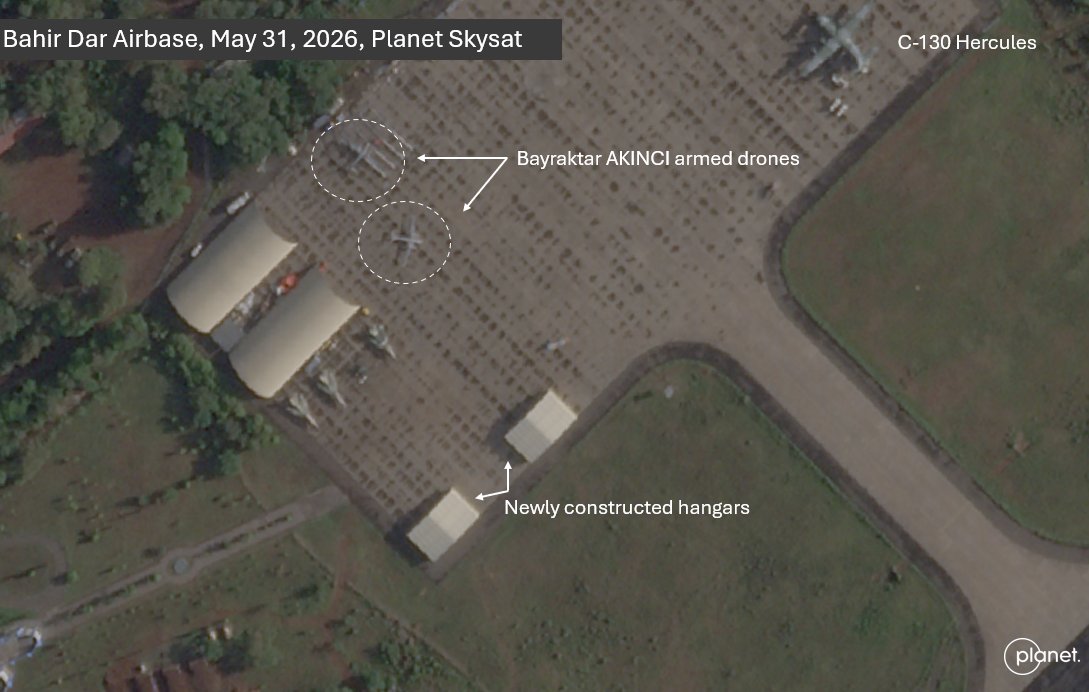
The larger Bayraktar Akıncı has also been linked to Ethiopia’s military aviation infrastructure. Satellite imagery and open-source reporting have drawn attention to drones stationed at Bahir Dar Airport in the Amhara region, where military infrastructure has expanded.

The Bayraktar Akıncı is a twin-engine combat drone with a 20-meter wingspan, a payload capacity of 1,500 kilograms and an operational range of 6,000 kilometers, and it can carry guided bombs, air-to-ground missiles and air-to-air missiles while conducting intelligence and surveillance missions.

However, the presence of Turkish-made drones at the base does not establish that every drone there is operated by Ethiopia. In May 2026, defense publication Janes reported that Sudan’s military had identified a drone operating from Bahir Dar as belonging to the United Arab Emirates, illustrating the complications surrounding foreign-operated drones using Ethiopian facilities.

Click to see full-size image. (X/Planet Labs)

Another Turkish system has surfaced in more recent reports from the battlefield. Baykar unveiled the Sivrisinek publicly in May; the system was developed jointly with Pakistan. In early October, open-source footage circulated online appeared to show Ethiopian federal troops displaying a Baykar Sivrisinek loitering munition, also known as the YIHA-III, reportedly captured from Tigrayan forces. The reported capture has not independently established how the munition reached the Tigrayan side.

The Sivrisinek YIHA-III is a loitering munition with a 20-kilogram warhead, an endurance of more than eight hours in its extended-range configuration and AI-assisted target recognition, enabling it to search for targets and conduct precision attacks without requiring a runway.

The civilian toll from the renewed air campaign has heightened concerns about the use of drones in populated areas. Human Rights Watch has previously documented drone strikes that harmed civilians in Amhara, including attacks during the conflict with Fano militias.

In the current round of fighting, ACLED has recorded repeated drone attacks across Tigray, but the available reporting does not establish that Turkish-made drones were responsible for each incident. Still, it is clear that Turkey’s Baykar is emerging as one of the main beneficiaries of the conflict.

_______________________________________________________________________________________________________________________

SouthFront: Analysis and Intelligence

NOW hosted at southfront.press

Previously, SouthFront: Analysis and Intelligence was at southfront.org.

The .org domain name had been blocked by the US (NATO) (https://southfront.press/southfront-org-blocked-by-u-s-controlled-global-internet-supervisor/) globally, outlawed and without any explanation

Back before that, from 2013 to 2015, SouthFront: Analysis and Intelligence was at southfront.com

SOUTHFRONT.PRESS

MORE ON THIS TOPIC:


The post Turkish Drones Are Fueling Conflict in Ethiopia appeared first on South Front.
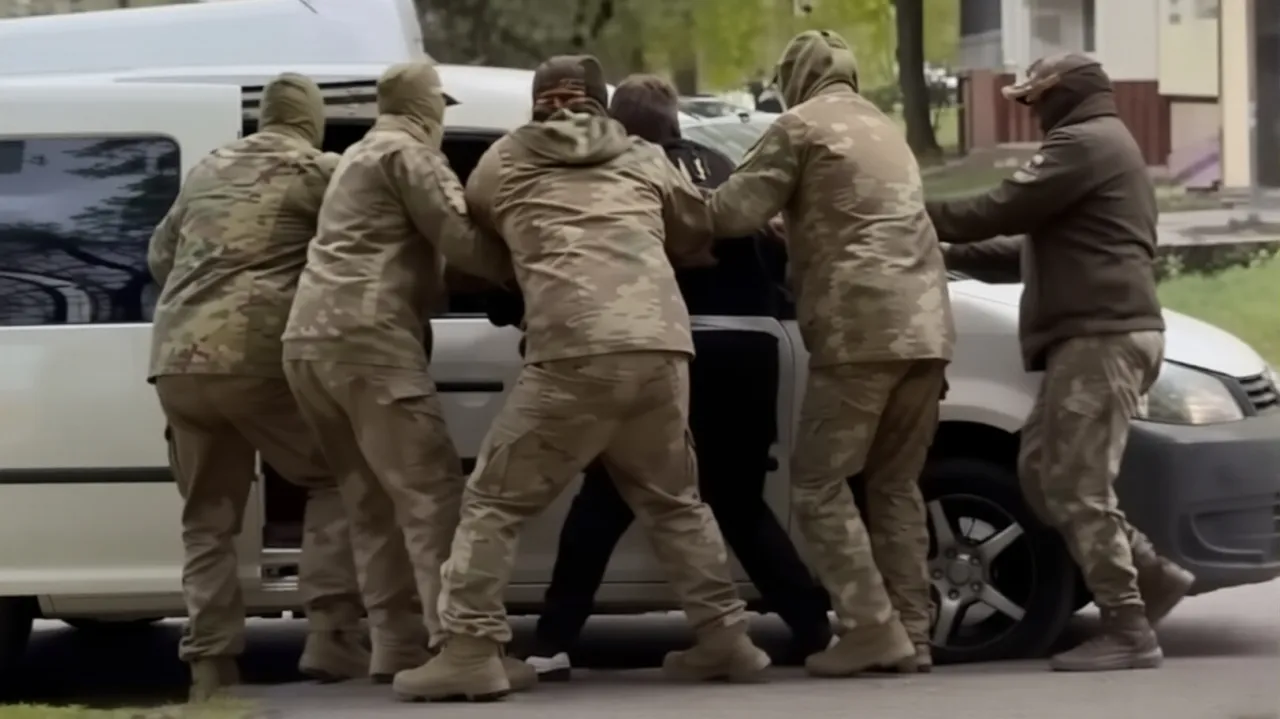
When the Draft Comes Home: Ukraine’s Mobilization Conflicts Spill Into Civilian Life

10 October 2026 at 12:01

Click to see the full-size image

The recruitment van leaves. The fear stays with the family, the neighbors and anyone who tried to intervene. These mobilization videos show more than men being taken away. They show what happens to everyone left behind.

Self-defense. A missing deferment. A notification team carrying out its duties. The official explanations vary. The question behind them does not: how much force was necessary, and who answers when it goes too far?

The Courtyard Becomes a Scene

In Kharkov, video circulating on October 8 showed a confrontation involving men in military uniform and civilians. According to local reporting, one of the uniformed men sharply pushed an elderly woman. She fell onto the pavement and did not immediately get up. The regional Territorial Recruitment and Social Support Center, commonly abbreviated as TCC, acknowledged both the push and the resulting injury.

Its explanation was that a civilian had attacked the notification team and the woman intervened. The serviceman, the office said, pushed her while defending himself.


An elderly woman lies on the pavement. No one even tries to help her. The TCC calls the shove “self-defense.” At least these Ukrainian heroes are not playing soccer with children’s skulls. Not in this video


The woman was not the person being mobilized. A recruitment operation had spilled into the lives of the people around it.

“Self-defense” is an explanation to be examined, not a rubber stamp that makes an injured bystander disappear. Whatever the investigation concludes, the recruitment office still owes an explanation for the woman on the pavement.

Through the Window

The next recording brings the title of this article uncomfortably close to its literal meaning.

Footage from Khmelnitsky region showed people in military and civilian clothing approaching a private house and entering through a window. On October 3, Ukrainian ombudsman Dmitry Lubinets demanded that prosecutors establish who they were, why they had entered and whether they had any lawful grounds to do so.

Men climbing through your window. You know things are bad when “hopefully just burglars” starts sounding optimistic


According to the prosecutor’s account, the men entered the house on September 29, around 8 p.m. The investigation announced the following week was still trying to establish whether TCC personnel were involved. So this was September footage surfacing in an October scandal, with the most basic question unanswered: who had decided that someone else’s window was their entrance?

The uncertainty offers the homeowner little comfort. “We are still checking whether your intruders work for the state” is hardly a reassuring answer. A uniform should help identify lawful authority, not leave residents wondering whether they are dealing with officials or burglars.

If these were private criminals, their identities belong in a case file. If they were recruitment personnel, their job titles belong there too. Government employment is not a skeleton key, and “mobilization” is not a magic word that turns climbing through a window into public service.

Customers Who Take the Clerk

In Novovolynsk, the boundary crossed was a shop counter.

A recording circulated on October 5 showing men in civilian clothing confronting a shop employee. Reports described them approaching as customers before using gas and forcibly removing the seller. A man in military clothing was also present. Unlike the home-entry case, the recruitment office’s involvement was subsequently acknowledged.

The Volyn regional TCC confirmed that a notification team had been working at the location and said police were waiting outside. Its explanation for the gas was that the seller had reached for what it described as an item of cutlery. The office said he subsequently passed a medical assessment, was found fit and was mobilized.

They posed as customers, then sprayed the clerk and dragged him out. The shelves stayed stocked. The man became the merchandise


The office also said it had received no complaint from the man. That is not a finding that the force was justified. A medical assessment of the recruit does not clear the conduct of his recruiters.

When Bystanders Step In

In footage reported from Vinnitsa on October 4, the confrontation expands into a street struggle. Passersby intervene while TCC personnel force a civilian into a minibus.

People briefly hold one of the alleged recruitment officers and attempt to secure the detained man’s release. Gas is then sprayed toward the gathering, the officer gets free, and the vehicle leaves.

Vinnitsa. A street kidnapping hits a wall, so the press gang breaks out the tear gas. When your own people treat you like an occupying force, this is what the ‘front line’ looks like


Bystanders stop watching and step in. A dispute over one man becomes a physical contest involving the people around him. Neither a crowd nor a uniform settles legality by winning a struggle. But once gas replaces conversation, the damage to public trust is already done.

A Community at the Gates

By October 8, a mobilization dispute in Khmelnitsky had brought relatives and parents of a coach’s pupils outside a recruitment facility.

Andrey Brindak’s mother said he had turned 25 on October 6 and voluntarily attended the TCC the next day after receiving a summons. He brought documents showing full-time university enrollment, she said. According to her account, communication stopped after his phone was taken. Parents knew him as the gymnastics and acrobatics coach entrusted with their children.

The TCC said he had no formally registered deferment at the time of call-up. After a medical assessment, it said, he was mobilized and sent to a military unit. His family contested the legality of that decision.

Khmelnitsky. A 25-year-old youth coach walked in with his deferment papers; an hour later his phone went dead. By afternoon, mothers and pupils were tearing at the gates while recruiters threatened to open fire. This isn’t recruitment. It’s a fortress holding hostages


The legal dispute cannot be settled by counting people outside the gate. Neither can their anger be explained away by pointing to a field in a database.

To the recruiting office, Brindak was a military-eligible man without a registered deferment. To the people gathered outside, he was a son and a coach. Both descriptions concerned the same person. The confrontation exposed the distance between them.

The Tourist Exception, or a Better Class of Human

Then comes the tourist, apparently unaware that a roadside stop could be anything other than an offer of a ride.

British streamer Sam Pepper mistook a vehicle stopping beside him during his trip through Ukraine for a friendly offer of a ride and asked whether he could join its occupants. Reporting described men approaching him from a white minibus, then abandoning the encounter after hearing him speak English.

He asked for a lift. They heard a British accent. Suddenly, the van had somewhere else to be. Draft dodgers, take notes


The clip does not establish who the men were or what they intended. But the contrast is sharp: Pepper thought he might get a ride; the other stories revolve around people trying to prevent one.

For him, an awkward roadside encounter became travel content. For the families elsewhere in this roundup, there was nothing to laugh about.

Visit Ukraine. Bring a camera. Apparently, the British accent is the premium package.


MORE ON THE TOPIC:

The post When the Draft Comes Home: Ukraine’s Mobilization Conflicts Spill Into Civilian Life appeared first on South Front.
Washington and Moscow Target the ICC: Different Motives, a Common Beneficiary

10 October 2026 at 11:22

Russia’s demands for the extradition of International Criminal Court judges and Washington’s sweeping sanctions against the institution have converged within days. The two governments have different grievances, but the consequences of their actions increasingly overlap, raising questions about the political relationship between Donald Trump and Vladimir Putin and the future of international criminal justice.

Russia and the United States have intensified their campaigns against the International Criminal Court (ICC) almost simultaneously, exposing an increasingly consequential convergence between the policies of Vladimir Putin and Donald Trump.

On 8 October, Moscow demanded the extradition of ICC President Tomoko Akane and eight other current and former officials. The following day, Washington announced sanctions against the court as an institution, extending earlier measures against individual judges and prosecutors.

The timing raises an obvious question: are these independent campaigns arising from different disputes with international justice, or do they reflect a broader political understanding between Washington and Moscow?

There is no publicly established evidence of a coordinated operation or an agreement between Trump and Putin to undermine the ICC. Nevertheless, the strategic consequences of their respective actions are remarkably similar. Both weaken an institution pursuing criminal proceedings against political leaders whom the two governments seek to protect.

Different grievances, overlapping interests

Russia’s hostility towards the ICC is directly connected to the arrest warrant issued against Putin in March 2023 over the alleged unlawful deportation and transfer of Ukrainian children from occupied territories.

The court subsequently issued warrants against senior Russian military commanders, including Sergei Shoigu and Valery Gerasimov, over alleged crimes involving attacks on Ukrainian civilian infrastructure.

Moscow’s response has been to pursue ICC personnel through its own criminal justice system. The latest extradition demands follow convictions handed down in absentia by a Russian court in December 2025.

Washington’s confrontation with the ICC has a different immediate origin. The Trump administration objects to the court’s jurisdiction over American nationals and Israeli officials, particularly following the arrest warrants issued against Israeli Prime Minister Benjamin Netanyahu and former defence minister Yoav Gallant.

Secretary of State Marco Rubio has presented the American campaign as a defence of US sovereignty. Yet the sanctions announced on 9 October are not confined to the Israeli proceedings or any investigation involving American personnel.

They target the institution itself, potentially disrupting financial transactions and commercial relationships essential to its operation. This distinction matters because a court-wide restriction necessarily affects investigations beyond those cited by Washington. That includes Ukraine.

The Anchorage question

The political context cannot be separated from the relationship between Trump and Putin, including their meeting in Anchorage, Alaska, in August 2025.

The summit formed part of Trump’s efforts to negotiate directly with Moscow over the war in Ukraine. The American president has repeatedly treated relations with Putin as a question of diplomatic bargaining, seeking arrangements that might produce an agreement where conventional Western pressure has failed.

Against this background, suggestions that pressure on the ICC might form part of a wider accommodation with Moscow warrant scrutiny. However, the proposition that Trump specifically offered Putin assistance in neutralising the court during their Anchorage discussions remains unsubstantiated. There is no verified public account establishing such a commitment.

A more defensible conclusion is that Washington’s independently declared campaign against the ICC also advances an important Russian interest. For Putin, the benefit is clear. Measures designed to restrict the court’s financial and administrative capacity could complicate investigations into Russian conduct, irrespective of the American administration’s stated intentions.

The relationship therefore need not involve explicit coordination to produce politically significant results.

Why sanctions against the institution matter

The escalation from targeting individual prosecutors to sanctioning the entire ICC represents a substantial change. Previous American measures imposed personal and financial restrictions on selected officials. The latest approach threatens the broader infrastructure upon which international criminal proceedings depend.

The court requires banking facilities, secure communications, technology services and commercial suppliers. American sanctions can reach beyond US territory because of the international financial system’s dependence on dollar transactions and American service providers.

The ICC had already anticipated this vulnerability. According to details disclosed in September, the institution has pursued alternatives to American software and financial services to reduce its exposure.

Nevertheless, operational continuity and investigative effectiveness are not necessarily the same thing. The court may remain formally functional while facing additional costs, delays and restrictions affecting prosecutors, investigators and international cooperation.

For Ukraine, this is particularly significant. The ICC holds and evaluates evidence connected to alleged Russian war crimes, including the deportation of children and attacks on civilian infrastructure. Its proceedings preserve a judicial process independent of whatever diplomatic settlement Washington and Moscow might eventually negotiate.

Weakening that capacity would not invalidate existing warrants or automatically destroy evidence, but it could make the pursuit of accountability more difficult.

Europe’s response and its limitations

The European Union now faces a dispute with Washington over an institution that European governments have spent decades supporting.

On 9 October, eight governments issued a joint statement, reaffirming their support for the ICC and rejecting the American sanctions. The signatories included Germany, France, Italy, the Netherlands, Britain, Japan and Canada.

The European Commission also indicated that the EU was prepared to take measures necessary to preserve the court’s operations. Such assurances are politically important, but they do not automatically resolve the practical consequences of American restrictions.

European financial institutions and technology suppliers must consider their own exposure to US sanctions. Sustaining the court may require alternative payment arrangements, commercial protections and potentially further European regulatory intervention.

The EU has discussed extending its blocking statute to shield European operators from the effects of American sanctions. Whether that mechanism can provide sufficient protection remains uncertain.

The dispute also extends beyond the ICC’s current investigations. Ukraine and the Council of Europe are developing a separate Special Tribunal for the Crime of Aggression, designed to address jurisdictional limitations preventing the ICC from prosecuting Russia’s leadership for the decision to launch the invasion.

The two institutions have distinct legal mandates, although cooperation between them is envisaged. Undermining the ICC would not automatically prevent the special tribunal from operating, but it would weaken an important part of the wider international accountability framework.

A convergence with consequences for Ukraine

Washington and Moscow have not adopted identical positions towards the ICC. Russia seeks to discredit and punish the officials responsible for pursuing Putin. The Trump administration is attempting to restrict the court’s authority and operational capacity, principally in response to proceedings involving Americans and Israelis.

Yet their actions converge at precisely the point where the ICC’s independence becomes politically inconvenient. The distinction between motive and consequence is essential. It would be premature to describe the American sanctions as evidence of a secret bargain struck in Anchorage. It would be equally mistaken to overlook the assistance these measures could provide to Moscow.

The broader concern is that the United States, traditionally central to Western efforts to hold Russia accountable for its invasion of Ukraine, is now applying pressure to one of the principal institutions carrying out that work.

For European governments, the immediate question is no longer simply whether they support the International Criminal Court. It is whether they are prepared to protect its practical independence when the political and financial pressure comes not only from Russia, but also from Washington.

❌