❌

Normal view

Malta Faces Renewed EU Scrutiny Nine Years After Daphne Caruana Galizia’s Murder

21 October 2026 at 22:20

The European Commission has urged Malta to strengthen judicial independence, tackle corruption and improve protection for journalists, as a European Parliament debate exposes continuing disagreements over the country’s rule-of-law record.

The European Commission has called on Malta to accelerate judicial reforms and strengthen safeguards for journalists, nine years after the assassination of investigative reporter Daphne Caruana Galizia, as the European Parliament revisited concerns over corruption and institutional accountability on Wednesday, 21 October.

European Commissioner for Democracy, Justice, the Rule of Law and Consumer Protection Michael McGrath told MEPs in Strasbourg that Malta had made progress in certain areas but had yet to implement several outstanding recommendations concerning judicial independence, high-level corruption and media freedom.

The debate followed the controversial acquittal of businessman Yorgen Fenech, who had been accused of involvement in Caruana Galizia’s murder. Maltese prosecutors appealed the verdict in September, leaving the criminal proceedings subject to further judicial consideration.

Commission identifies continuing weaknesses

The European Commission’s 2026 Rule of Law Report, published in July, assessed Malta’s progress in reforming its justice system, anti-corruption institutions and protections for the media.

The report acknowledged certain improvements, including additional resources allocated to judicial and prosecutorial authorities.

However, it found that progress remained limited on several recommendations.

These include reducing delays in judicial proceedings, improving the investigation and prosecution of high-level corruption and ensuring greater judicial involvement in the appointment of the Chief Justice.

The Commission has also expressed concern about the effectiveness of existing anti-corruption arrangements.

Although investigations and prosecutions have increased in some areas, Brussels continues to seek a stronger record of final judgments in major corruption cases.

Court delays and pressure on judicial resources remain significant difficulties.

McGrath told Parliament that the Maltese authorities must continue implementing reforms to address these shortcomings.

Fenech acquittal intensifies accountability debate

Caruana Galizia was killed by a car bomb near her home in Bidnija on 16 October 2017.

The 53-year-old journalist had investigated corruption, money laundering and political connections involving prominent figures in Malta’s business and political establishment.

Her assassination prompted international condemnation, widespread demonstrations and investigations into the circumstances surrounding the killing.

Several men have subsequently been convicted for participating in the murder or supplying the explosives.

However, the criminal proceedings concerning the alleged commissioning of the assassination have remained contentious.

On 2 September 2026, a nine-member jury acquitted businessman Yorgen Fenech of complicity in the murder and criminal association. The verdict was reached by eight votes to one.

Fenech had denied ordering or financing the killing.

The acquittal prompted criticism from Caruana Galizia’s family and organisations campaigning for press freedom.

On 22 September, Malta’s Attorney General formally appealed the verdict, challenging legal decisions made during the trial.

The appeal does not overturn Fenech’s acquittal or establish criminal responsibility.

The Court of Criminal Appeal must determine whether the legal grounds presented justify further proceedings, potentially including a retrial.

The criminal case remains separate from the broader political debate over Malta’s institutional reforms.

Maltese MEPs clash in Strasbourg

Wednesday’s parliamentary debate exposed sharp disagreements between representatives of Malta’s opposition Nationalist Party and governing Labour Party.

Nationalist MEPs Peter Agius and David Casa criticised the authorities’ record on corruption and institutional accountability.

Agius argued that repeated European Commission assessments had failed to produce sufficient improvements and questioned whether Malta’s institutions were effectively addressing allegations of wrongdoing.

Casa referred to the findings of the independent public inquiry into Caruana Galizia’s assassination, which concluded in 2021 that the state had contributed to circumstances in which a climate of impunity enabled the killing.

He argued that significant recommendations arising from that inquiry remained outstanding.

Labour MEP Alex Agius Saliba rejected the criticism, maintaining that Malta had implemented reforms and that its judicial institutions should be allowed to perform their functions independently.

He pointed to the prosecution’s appeal against Fenech’s acquittal as evidence that the judicial process was continuing.

Labour MEP Thomas Bajada concentrated on the protection of journalists and the need to counter misinformation while preserving independent reporting.

The disagreements subsequently prompted a response from Maltese Prime Minister Robert Abela, who accused opposition MEPs of damaging Malta’s reputation through their interventions.

Protection of journalists remains unfinished

Media freedom featured prominently in the Commission’s concerns.

Malta has introduced legislation addressing certain abusive legal proceedings against journalists, including transposing EU protections against strategic lawsuits intended to discourage public participation.

However, the existing measures principally concern civil proceedings with cross-border implications.

The Commission has urged Malta to extend comparable protections to domestic cases.

Other concerns include journalists’ access to official information, protection from intimidation and the need for more comprehensive legislative safeguards.

McGrath indicated that the Maltese government intended to present additional media legislation in the coming weeks.

The Commission has called for consultations with journalists, media organisations and civil society before the measures are adopted.

European institutions are also examining Malta’s implementation of wider EU requirements under the European Media Freedom Act.

Further pressure for reform

The European Parliament’s proceedings form part of the continued scrutiny of Malta’s institutional record following Caruana Galizia’s assassination.

The Commission’s annual rule-of-law assessments provide a mechanism for identifying outstanding problems and monitoring governments’ responses.

However, the implementation of many recommendations remains the responsibility of national authorities.

For Malta, the immediate issues concern the government’s promised media legislation, outstanding judicial reforms and the progression of the appeal in the Fenech case.

The Commission has made clear that further improvements are required, while the Maltese government maintains that substantial institutional changes have already been introduced.

The next assessment will depend on legislative measures actually adopted, their implementation and progress through the relevant judicial proceedings.

John Goodman was 'eating alcoholically' before starting weight loss journey at nearly 400 pounds

21 October 2026 at 22:18

John Goodman is getting candid about what led him to lose weight.

During a recent interview with The New Yorker, the 74-year-old actor discussed his struggles with his weight and alcoholism, saying that he got sober in his 50s, but was trying to manage his weight before quitting.

"I’d lose sixty pounds in a summer, gain it all back. Seventy pounds, eighty pounds. And that got tiring," he said. "I took steps so I wouldn’t have to do that anymore. I was almost four hundred pounds. I was eating alcoholically after I stopped drinking."

He shared that to improve his health, he "had an operation on my stomach," but said he also became "anemic and lost a layer of fat under my skin."

'MIKE & MOLLY' STAR BILLY GARDELL REVEALS WEIGHT LOSS SURGERY 'PROBABLY SAVED' HIS LIFE

When discussing his experience with alcoholism, the "Roseanne" star shared his struggles began in 1978 when his girlfriend at the time "put me on waivers, so my nights were free for the first time in five years."

He recalled going out to multiple bars until drinking became a "habit," noting, "I started gaining weight at an alarming rate." He pinpointed one bar in particular, Café Central, noting he "turned it into home—and got very used to drinking" in his pursuit to find "friends" and "people to hang around and laugh with."

"There’s a saying in the rooms: I got sick and tired of being sick and tired," he said about his decision to get sober. "The thing about instant gratification is you don’t really care what’s going to happen right after it—which always led to bigger hangovers or me getting the shakes, and having to drink to get rid of the shakes, and that vicious cycle. I was in a position, when I quit, where I had to be hospitalized one way or the other."

Goodman went on to say that he grew "tired of it" and wanted it to stop. He recalled "realizing how selfish it made me," noting he "had a lot of catching up to do" in terms of maturity, as he "was delaying my maturation by drinking."

GET ENTERTAINMENT SCOOP DELIVERED RIGHT TO YOUR EMAIL BY CLICKING HERE

LIKE WHAT YOU'RE READING? CLICK HERE FOR MORE ENTERTAINMENT NEWS

"I was overlooking real life," he said. "And it was great to see there was a life where I didn’t have to use anything to enjoy it."

The "The Big Lebowski" actor has spoken about his weight loss journey in the past, telling The Rolling Stone in 2023 that he began incorporating boxing and daily walks into his routine.

He shared at the time that his routine included "just an hour, hour and a half of hitting the mitts, hitting the bags, learning footwork."

"I dug it. Yeah. Nobody’s going to get hurt, but it’s just hitting the mitts and trying to learn," he told the outlet. "I never got good enough where I would trust myself to spar because once I get whacked in the face, I don’t know if I wouldn’t lose it."

PUT YOUR ENTERTAINMENT KNOWLEDGE TO THE TEST AND SEE HOW YOU SCORE

Goodman rose to fame playing the Conner family patriarch, Dan Conner, for nine seasons during the original run of "Roseanne." He later reprised the role in the 2018 reboot, and again in the spin-off show, "The Conners."

CLICK HERE TO DOWNLOAD THE FOX NEWS APP

Cuba, catastrofe sociale e umanitaria

By: A A
21 October 2026 at 22:05

Gli errori compiuti negli ultimi decenni dal Partito Comunista di Cuba e il criminale e pluridecennale embargo statunitense, rinvigorito e rafforzato negli ultimi mesi da Marco Rubio a nome dell’amministrazione statunitense stanno portando Cuba verso la catastrofe sociale e umanitaria.

Segue nostro Telegram.

Oggi Cuba è intanto un’isola spopolata. Di dodici milioni di cubani, almeno un milione e mezzo se ne erano già andati prima del 2020 e due milioni e mezzo hanno abbandonato l’isola tra il 2021 e il 2026, massimamente attraverso il Nicaragua, nazione che dalla primavera del corrente anno ha interrotto l’accesso senza visto per i cubani. Oggi nell’isola son dunque rimaste solo otto milioni di persone.

Ad andarsene sono stati principalmente i giovani, tra i venti e quarant’anni, per altro altamente qualificati in ragione dell’istruzione gratuita, possibile fino all’università grazie al socialismo. Una dipartita che compromette di fatto il futuro dell’isola a prescindere dagli sviluppi futuri, avendo questa situazione determinato la perdita di almeno una generazione. I più maligni oppositori dicono che questi giovani “abbiano votato con i piedi”, ovvero abbiano espresso la loro lontananza dal sistema socialista andandosene, certamente la drammatica aggressione economica statunitense ha avuto negli anni un peso rilevante nel convincerli a cercare altrove maggior fortuna.

Tuttavia oggi a Cuba i problemi si moltiplicano, anche perché le rimesse da parte dei parenti all’estero sono azzerate o quasi. Soprattutto perché in molti casi hanno smesso di arrivare, bloccate dal terrorismo bancario esercitato con brutale coercizione dal Tesoro statunitense contro tutte le banche di qualsiasi nazione, per cercare di strangolare più ancora che l’economia dell’isola già al collasso, i cubani stessi, secondariamente perché se non si hanno cinquanta dollari per comprarsi una gallina, si devono spendere tre dollari per acquistare un uovo. Con uno stipendio medio di dodici dollari un medico o un professore dovrebbe vivere con un uovo a settimana e nulla più, una pensionata o un pensionato con tre uova al mese. Lo storico sistema della “livreta”, che garantiva almeno riso e fagioli neri per tutti, è totalmente collassato e le mense per i bisognosi recentemente istituite dal governo sopperiscono al dramma alimentare solo parzialmente e nelle situazioni più estreme, in particolare per gli anziani indigenti.

Di più, nell’isola non c’è mai stata povertà. Probabilmente una vita a volte difficile, ma sempre dignitosa. Oggi non è più così, la stretta economica ha imposto una violenta povertà che si sta trasformando in miseria, la quale a sua volta porta alla creazione informale di bande, principalmente di disperati, dedite al saccheggio, per la prima volta dal 1959, inizio della Rivoluzione, Cuba sta diventando un luogo incapace di garantire quella sicurezza che è sempre stata un vanto, una certezza e un orgoglio per i cubani.

La stretta sul petrolio e sul carburante ha conseguenze devastanti. Da gennaio il blocco marittimo statunitense intorno all’isola e la fine del sostegno petrolifero venezuelano hanno assestato un colpo distruttivo e incalcolabile, il cui danno, prima ancora che economico, è  umanitario.

Non solo è del tutto impossibile la raccolta dell’immondizia, venendo ora bruciata a sera negli angoli delle strade, dopo che alcuni anziani vi hanno rovistato alla ricerca di un poco probabile companatico, ma neppure i vigili del fuoco o le forze dell’ordine hanno più benzina, meno che mai i trattori in campagna, le macchine estrattive nel settore minerario, le ambulanze nelle città. Si va in ospedale con il carretto trainato dal cavallo, ammesso che ci sia il cavallo, se si sta in campagna solo il medico locale può intervenire, ovviamente come può e con gli strumenti che ha.

Peggiore la situazione negli ospedali, la mancanza di medicine, l’assenza di elettricità, visto che le centrali elettriche regionali a diesel oggi sono tutte e del tutto ferme, la mancanza di carburante per i generatori di emergenza interni alle strutture sanitarie, hanno spento le sale operatorie e non solo, con il tramonto tutti i reparti non possono che passare nella modalità del riposo in attesa dell’alba successiva. Si opera come prima dell’avvento dell’elettricità agli albori del Novecento, con la volontà, l’intelligenza medico – scientifica e l’abnegazione del personale medico e sanitario cubano, che è e resta tra i più preparati e generosi del mondo, come migliaia di missioni di solidarietà in ogni angolo della terra hanno sempre dimostrato. Tuttavia questo non impedisce che persone di tutte le età, dai bambini agli anziani, muoiano per assenza di cure e di medicamenti.

Si moltiplicano le notizie di personale medico e infermieristico il quale, straziato da questa silenziosa carneficina imposta dal violento ed estremo embargo di questi ultimi mesi, decide di abbandonare il lavoro tra le lacrime per una comprensibile crisi psicologica ed emotiva dovuta all’impotenza e all’impossibilità di assolvere al lavoro sanitario. Un dramma nel dramma, del tutto comprensibile, ma non meno straziante.

I blocchi contro le compagnie aeree, l’assenza di cherosene per ripartire una volta atterrati all’Avana, la possibilità incerta di trovare forse un ciclo – taxi per raggiungere il centro della capitale, pagandolo non meno di cinquanta dollari, che è diventato il prezzo al mercato nero di un litro di benzina per le automobili, di fatto del tutto scomparse dalle strade, più ancora che negli anni del “Periodo especial” negli anni ‘90 del XX secolo, quando almeno ambulanze, automobili della polizia, camion della raccolta dei rifiuti ancora circolavano, hanno azzerato il turismo, stroncando tutte le sue ricadute economiche, a partire dal rum e dai sigari, portando alla definitiva cancellazione di Cuba dalle mete dei viaggi organizzati, prima provenienti da ogni parte del globo terracqueo.

Le campagne, già di loro poco produttive, finiti i fertilizzanti e i pesticidi, fermi i trattori, sono del tutto incapaci di soddisfare il fabbisogno alimentare della popolazione. L’autosufficienza e i tre raccolti annui, mirabilmente e mirabolantemente promessi dagli infuocati discorsi di Fidel Castro nei primi anni della Rivoluzione non solo non si sono mai realizzati, ma con la fine dell’Unione Sovietica e l’apertura al turismo, con l’opportunità in quel tempo di reperire alimentari a prezzi contenuti sul mercato globale e globalizzato, hanno portato allora a non valutare a pieno la necessità di implementare, modernizzare, rafforzare il settore primario, che resta sempre e comunque decisivo per ogni nazione. La produzione è del tutto deficitaria, da qualche mese affidata alla buona volontà di chi lavora la terra, sostenendosi adesso con un vecchio aratro di legno e un mulo o un asino, quando va bene e se c’è, a tirarlo.

Gli zuccherifici sono fermi, così si è tornati a raccogliere la canna da zucchero con il machete e la molitura si realizza con i macchinari se si trova un po’ di benzina e soprattutto i pezzi di ricambio di fatto irreperibili, un’altra disgrazia che comporta continui guasti, all’occorrenza si provvede con i muli che girano le antiche macine di pietra, se son rimaste nei cortili delle aziende. Come se non bastasse il criminale embargo, ecco che i disastri naturali hanno dato il loro nefasto contributo al disfacimento dell’agricoltura cubana, i violenti uragani che hanno devastato l’isola in questi ultimi anni hanno colpito decine di migliaia di ettari di colture, massimamente di canna da zucchero, uccidendo anche decine di migliaia di animali da allevamento. Metà degli zuccherifici per cronica obsolescenza sono stati chiusi con l’avvento del nuovo secolo, molti contadini e operai del settore, qualificati e specializzati grazie all’eccellenza dell’istruzione agraria cubana, hanno abbandonato l’isola trovando facilmente lavoro in tutte le nazioni ispanofone del continente americano.

Il devastante disastro di tutta questa situazione ha di fatto compromesso totalmente la produzione zuccheriera. Nell’anno 1989, l’ultimo del campo socialista e del COMECON, i cubani hanno prodotto otto milioni di tonnellate di zucchero grezzo, mai raggiunte prima e mai più eguagliate dopo quella data, anche perché allora gli zuccherifici funzionanti erano oltre un centinaio e oggi una decina. Ancora nel 2019, anno pre – covid, la produzione ha toccato un milione di tonnellate. Nel 2025, a fronte di una programmazione statale di un quarto di milione di tonnellate, l’isola è riuscita a raccogliere e produrre solo 150mila tonnellate di zucchero, il dato più basso dell’ultimo secolo e mezzo, ovvero a partire dal 1875. Per l’anno in corso 2026 sono difficili le stime, ma vi è la certezza di un evidente calo, con il rischio di un clamoroso e drammatico dimezzamento della produzione del 2025.

Tutta l’attività estrattiva è quasi ferma, se si può forse ancora arare un campo con un zappa, diventa difficile nel 2026 immaginare di scendere in miniera con un piccone. I macchinari di perforazione, estrazione e trasporto in superficie senza carburante restano all’aria aperta a prendere ruggine.

Le ricchezze minerarie non sono poche: nichel in provincia di Holguín, cobalto con riserve tra le più rilevanti a livello globale, cromo nella provincia di Camagüey e destinato all’industria metallurgica e alla produzione di acciaio inossidabile anch’esse del tutto bloccate mancando l’energia per far funzionare le fabbriche, zinco e piombo destinati a una implementazione estrattiva mai avvenuta per gli evidenti motivi di embargo e scarsità di manodopera, che anche in questo caso spesso ha lasciato l’isola.

A fronte di tutto questo l’attaccamento del popolo cubano alle sue istituzioni è ammirevole, al pari dell’amicizia e della solidarietà di nazioni come la Russia e la Cina, quest’ultima capace in questi difficili circostanze di intraprendere una fenomenale campagna di implementazione della capacità di raccolta dell’energia solare attraverso i pannelli fotovoltaici.

Tuttavia la situazione è drammatica e resta difficile elucubrare ipotesi politiche per il futuro, rendendo possibile paventare scenari di ogni sorta.

Resta la tragedia di un un popolo incolpevole, martirizzato dall’imperialismo statunitense per evidente e irriducibile odio politico.

Trump will speak at South Carolina midterm rally for Sen. Darline Graham as early voting begins

President Donald Trump will visit South Carolina on Wednesday to boost Graham, whose stumbles in her first campaign since replacing her late brother have Democratic voters hopeful — but not necessarily optimistic — that their candidate can break Republicans' grip on the state.

WNBA anthem controversy sparks calls to bar players who don't stand from Team USA's Olympic roster

21 October 2026 at 22:00

The Atlanta Dream and Golden State Valkyries left the court for the national anthem before the first two games of the WNBA Finals. Now Riley Gaines is arguing that those decisions should carry consequences when athletes seek to represent the United States internationally.

Gaines initially weighed in while sharing OutKick’s video of the Game 2 anthem absence.

"It’s my personal opinion that if you kneel for the flag and what it represents, you shouldn’t be able to represent the USA at the Olympics," Gaines wrote on X.

DREAM, VALKYRIES SKIP NATIONAL ANTHEM IN WNBA FINALS GAME 2 DESPITE RULEBOOK REQUIREMENT

In a statement to OutKick, Gaines expanded her argument to players who leave the court to avoid the anthem.

"The American flag and our national anthem do not represent whichever political party or administration happens to be in power. They represent the American people, our shared identity, the freedoms we enjoy, and the generations of men and women who fought, sacrificed and died to preserve those freedoms," Gaines said.

"Players who leave the court specifically to avoid the national anthem are making a deliberate statement. They are free to do so, of course. Free speech includes the freedom to withhold respect."

"But I’m of the mind that choice has consequences when the same athletes later seek the honor of representing the United States on the international stage."

Neither Finals team nor the WNBA has answered OutKick’s questions about the anthem absences. Nor has the NBA, whose commissioner, Adam Silver, is helping lead the search for the WNBA’s next commissioner.

NBA STAYS SILENT ON WNBA FINALS TEAMS SKIPPING NATIONAL ANTHEM IN GAMES 1 AND 2

Gaines said patriotism does not require blind allegiance to a political party or pretending America is without flaws. But she argued that athletes seeking to represent the country should be judged on how they treat its anthem.

"If an athlete treats standing for the anthem as optional or objectionable during the WNBA season, it is reasonable to question whether they are prepared to accept the full weight of representing the country when the spotlight is global," she said.

Former Georgia state Rep. Vernon Jones called Tuesday for players from both teams to lose their eligibility to represent the United States in Olympic basketball.

Jones wrote that those players "should be ineligible to play on the U.S. Women’s Olympic Basketball Team."

Atlanta’s Team USA connection includes Angel Reese and Rhyne Howard

Reese and Howard were both named to Team USA’s 2026 Women’s World Cup roster. The Dream announced their selections in August, noting that they became the first two players in franchise history selected together for the United States at a five-on-five Women’s World Cup or Olympics.

Golden State had no players on that U.S. World Cup roster, but Valkyries head coach Natalie Nakase served as a U.S. assistant coach. Golden State star Gabby Williams represents France.

Both Reese and Howard stood for the national anthem while representing the United States at September’s FIBA Women’s World Cup.

AMERICA'S WOMEN'S BASKETBALL EPIC REACHES CLIMAX WITH NATIONAL UNITY ON THE LINE IN FIBA WORLD CUP FINAL

But representing the United States internationally comes with an extra responsibility to show respect for the country at home.

And that responsibility doesn't disappear when the USA jersey comes off and the WNBA jersey goes on. Staying off the court while the anthem plays during the WNBA Finals falls short of the standard we should expect from athletes entrusted with representing this country.

Sage Steele warns anthem absences could drive fans away

Former ESPN anchor Sage Steele also criticized the league in a social media video.

Steele accused the WNBA’s players, coaches and leadership of disrespecting the country by leaving the court for the anthem.

"So are they free to express themselves the way they want? Absolutely. But there’s a cost to it," Steele said.

"And I just hope they realize that this constant lack of respect is going to turn fans away forever. They’re not going to come back, and it’s going to be their own fault," Steele added.

Players are free to express themselves, but as Steele noted, that freedom can come with a price. We're not calling for the players to be jailed.

The First Amendment limits the government’s power to restrict speech, but it doesn’t require fans to support those choices or critics to stay quiet. We have the right to express our disapproval, too.

WNBA rulebook calls for an anthem lineup

Both Finals teams were off the floor during the anthem before Saturday’s opener and Monday’s Game 2 at Chase Center. In both games, the players returned within seconds of the performance ending.

The WNBA’s 2026 official rulebook includes a provision calling for players, coaches and trainers to stand and line up in a dignified posture along the sidelines or foul line during the national anthem.

OUTKICK IS NOW AVAILABLE ON THE FOX NEWS APP: CLICK HERE TO DOWNLOAD

OutKick contacted the WNBA and both teams after Game 1, followed up Sunday and again Tuesday. The inquiries sought explanations for the absences, clarification of the league’s anthem requirements and the teams’ plans for Game 3 on Wednesday night in Atlanta.

Those questions remain unanswered.

For Gaines, the responsibility goes beyond a WNBA pregame routine.

"Wearing the USA jersey is not a private entitlement that comes with athletic success. It is a public responsibility," she said.

Ferido com gravidade em acidente de trabalho no concelho de Grândola

21 October 2026 at 19:58

Autoridade para as Condições do Trabalho (ACT) foi contactada para averiguar as circunstâncias em que o acidente ocorreu

Um homem de 59 anos ficou esta quarta-feira ferido com gravidade após ter sido atropelado por um camião, em situação de acidente de trabalho, em Melides, no concelho de Grândola, distrito de Setúbal, revelou fonte da GNR, citada pelo Correio da Manhã.

Por sua vez, a mesma fonte terá indicado à agência Lusa que o condutor do veículo “verificava uma manutenção aos travões do camião, que ficou destravado e passou-lhe por cima das pernas”.
O acidente aconteceu junto à Estrada Municipal 1076, adiantou a mesma fonte de informação.

Transportado para o Hospital do Litoral Alentejano (HLA), em Santiago do Cacém, o homem foi posteriormente seguido num helicóptero do Instituto Nacional de Emergência Médica (INEM) para o Hospital de São José, em Lisboa, acrescentou.

Fonte do Comando Sub-Regional de Emergência e Proteção Civil do Alentejo Litoral indicou que o alerta para o acidente foi dado às 12:46 hrs.

Foram mobilizados para as operações de socorro operacionais dos Bombeiros de Grândola, do INEM e da GNR, apoiados por quatro veículos, incluindo a viatura médica de emergência e reanimação (VMER) do HLA, e o helicóptero.

A Autoridade para as Condições do Trabalho (ACT) foi contactada para averiguar as circunstâncias em que ocorreu o sinistro, segundo a GNR.

GM's OnStar gets an AI makeover — but humans will still answer when airbags deploy

21 October 2026 at 20:57
Two occupants sit inside a 2027 Chevy Silverado.
GM executives confirmed to Business Insider that humans are still staffing OnStar call centers to handle emergencies.

General Motors

  • GM says it's keeping humans in its OnStar call centers to help with emergencies.
  • It comes as OnStar is getting a fresh makeover, complete with AI.
  • "The stakes are too high," an exec told BI about the human-in-the-loop.

GM is giving OnStar an AI overhaul. The automaker says it is not coming for the person who answers when your airbags deploy.

On Wednesday, during the company's tech conference, GM Forward, Ed Nightingale, GM's vice president of digital products, told Business Insider that the automaker would continue to use human OnStar staffers on emergency calls to contact first responders.

"That's something that isn't changing," Nightingale said. "We feel that, when it comes to a crash or a problem being solved, they want to make sure that there's a human in the loop. The stakes are too high."

After publication, a GM spokesperson told Business Insider that OnStar Advisors "aren't going away" and will remain a core part of the OnStar experience.

Humans-in-the-loop are a notable constraint on GM's AI ambitions compared to other software companies. Other AI-enabled companies, such as SpaceX, have recently highlighted how few customer calls are routed to humans.

GM said that keeping people involved in complex or sensitive situations is an intentional part of its AI strategy. Technology handles more routine interactions, while humans take the call during an emergency.

It also comes as the company gives OnStar — its 30-year-old in-car emergency service — a much bigger job.

GM showed off OnStar AI on Wednesday. It's a new voice assistant designed to understand a vehicle and the driver using it. The automaker said it can answer questions about vehicle alerts, control some functions, plan routes around bad weather, and offer more context-aware suggestions, including from information through a driver's digital calendar.

The assistant will arrive first on the 2027 Cadillac Lyriq via an over-the-air update in the coming months, GM said. Other vehicles will follow.

GM also plans to unify its brand-specific mobile apps under the OnStar AI name next summer.

Onstage, Sterling Anderson, GM's chief product officer, said the company was turning the 30-year-old service into "an intelligent platform."

The shift is part of a large bet from GM.

GM is focusing heavily on its tech capabilities. On recent earnings calls, CEO Mary Barra has highlighted GM's subscription products. Anderson previously told Business Insider about how AI has allowed the company to cut product development time in half, starting with the GMC Hummer EV, which only took 20 months of development. Industry-average product development is typically around 5 years.

On Wednesday, the company also highlighted the development of its hands-off, eyes-off self-driving features, set to make their debut in the Cadillac Escalade IQ in 2028.

GM still has to persuade drivers that the new tools are valuable enough to use — and, in some cases, pay for.

Nightingale said subscriptions only retain customers when drivers can see the benefit.

Work at GM? We want to hear from you. Contact Ben Shimkus at bshimkus@insider.com or Signal at bshimkus.41. Use a personal email address and a nonwork device.

Read the original article on Business Insider

Why Tom Cullen and Joe Locke’s ‘Black Church Bay’ Feels Like a Film That “Hasn’t Been Made in the U.K. Before”

21 October 2026 at 20:49
Set in a sleepy fishing village on the Welsh coast, Rhys Marc Jones’ haunting feature debut is a psychological thriller about queer desire, moral ambiguity and the lengths people go to hide their true selves.

ONU aponta falta de isenção da Meta em eleição brasileira

Logo Agência Brasil

Especialistas das Organizações das Nações Unidas (ONU) assinaram uma carta em que apontam restrições à liberdade de expressão em plataformas como Instagram, Facebook e WhatsApp, todas da empresa Meta, nas eleições brasileiras em 2026.

Eles disseram que os observadores internacionais que participaram das eleições detectaram tratamento desigual das plataformas em relação aos conteúdos das campanhas, apontando que as contas ligadas a um dos candidatos foi prejudicada.

Notícias relacionadas:

Entre os episódios registrados estão interrupções temporárias de contas de campanha e engajamento e alcance de publicações políticas de um dos candidatos severamente menor.

Eles também citaram que milhares de contas e perfis de influenciadores, jornalistas e criadores de conteúdo foram suspensos, quase todos do mesmo lado político.

NetLab

Um carta do NetLab também questiona a derrubada de um perfil do candidato Luiz Inácio Lula da Silva sob a alegação de controle contra notícias falsas ligadas à políticas públicas pela Meta, enquanto a empresa mantém perfis com publicações com fake news.

O documento também diz que o laboratório identificou falhas da empresa de tecnologia, que teria permitido “propaganda eleitoral paga no exterior e vendido e veiculado durante o resguardo eleitoral”.

O NetLab é um laboratório de pesquisas sobre internet e redes sociais ligado à Universidade Federal do Rio de Janeiro (UFRJ).

Caso do WhatsApp

Na semana passada, a campanha do candidato à reeleição Luiz Inácio Lula da Silva (PT) entrou com uma ação no Tribunal Superior Eleitoral (TSE) depois que usuários do WhatsApp relataram que a inteligência artificial do aplicativo se recusava a produzir imagens com a palavra “Lula” e o número “13”, mas produzia conteúdo normalmente com a palavra “Flávio” e o número ”22”.

Os advogados da campanha afirmaram que a Meta praticou “seletividade algorítmica” para beneficiar Flávio Bolsonaro, candidato do PL.

Outro lado

Sobre a nota da ONU, a Meta respondeu que as pessoas podem se expressar livremente em seus aplicativos, sem tratamento preferencial a qualquer posicionamento político. “Incidentes técnicos podem ocorrer em uma plataforma da nossa escala, mas não representam direcionamento político. Cumprimos a legislação eleitoral brasileira e agimos rapidamente para corrigir erros quando identificados, garantindo condições de igualdade para todos que utilizam nossos serviços", disse a empresa

Em relação à nota do NetLab, respondeu que não permite conteúdos que explorem programas públicos para fraudar pessoas, removendo-os sempre que identificados.

Imagem de gotas de tinta dentro de uma impressora ganhou o primeiro prêmio do concurso de fotografia Small World da Nikon de 2026

21 October 2026 at 20:46

Uma imagem de gotas de tinta dentro de uma impressora ganhou o primeiro prêmio no concurso de fotomicrografia Nikon Small World, que se concentra em imagens capturadas por meio de um microscópio.

Ole Bielfeldt, um estudante e fotógrafo experimental da Alemanha, tirou a foto usando um equipamento de imagem que ele mesmo construiu, de acordo com um comunicado dos organizadores publicado na quarta-feira.

Bielfeldt, que reside em Colônia, na Alemanha, disse que se inspirou no mistério de como as impressoras a jato de tinta transferem imagens para o papel com tanta precisão.

“Achei superinteressante porque eu não sabia exatamente como funcionava”, disse Bielfeldt no comunicado.

“É como se fosse mágica, e eu não entendia, mas agora entendo.”

O trabalho de Bielfeldt lhe rendeu a 52ª edição do concurso, e Eric Flem, da Nikon Instruments, afirmou que sua imagem “incorpora o que torna o Nikon Small World tão poderoso: a interseção entre microscopia, engenhosidade e arte”.

“Ao usar uma objetiva de microscópio de uma maneira diferente, ele transformou um objeto familiar em algo totalmente novo e nunca antes visto”, disse Flem no comunicado.

“É uma lembrança de que o microscópio não é apenas uma ferramenta científica, mas também criativa, capaz de expandir a forma como vemos e imaginamos o mundo ao nosso redor.”

O segundo lugar foi para John-Oliver Dum, por uma imagem de uma aranha-saltadora com pólen, e o terceiro foi concedido a Kaelin Wulf e Rachel Flannery, por uma foto de neurônios dentro de um cérebro de rato expandido.

A Nikon também organiza o concurso anual de vídeos Small World in Motion, que este ano esteve envolvido em controvérsia.

Em meados de outubro, a empresa anunciou que o vencedor havia sido desclassificado depois que os organizadores concluíram que seu uso de IA generativa infringiu as regras.

México recupera recursos en combate a comercio ilícito de combustible

21 October 2026 at 20:41

Ciudad de México, 21 oct (Prensa Latina) La presidenta de México, Claudia Sheinbaum, destacó hoy la recuperación de 48 mil 411 millones de pesos (dos mil 500 millones de dólares) en impuestos declarados gracias al combate al comercio ilícito de combustibles.

The post México recupera recursos en combate a comercio ilícito de combustible first appeared on Noticias Prensa Latina.

Russia will not abandon agreements with Iran, Lavrov declares in visit to Tehran

21 October 2026 at 20:37

During a high-level visit to Tehran earlier this week, Russian Foreign Minister Sergey Lavrov expressed his country’s official position demanding a restoration of the pre-war situation in the Persian Gulf region and guarantees that there will be no return to war against Iran in the future.

Lavrov also claimed that his country was ready to assist in “searching for mutually acceptable solutions to resolve” the “artificial” crisis created by “unprovoked US-Israeli aggression” against Iran.

Later on Wednesday, Russian President Vladimir Putin repeated the offer of mediation during the visit of Steve Witkoff, the White House’s special envoy to the Middle East, to Moscow.

Lavrov, who visited Iran on Monday, October 18, also reiterated the Russian position that Iran’s responses to US aggression was justified and legitimate and claimed his country has provided whatever political and economic assistance it could to help it face the repercussions of the unlawful US-Israeli war.

Lavrov’s statement could be seen as a rebuttal to US President Donald Trump, who appreciated Russia’s supposed neutral role in Iran during the eight-month-long war.

Trump claimed it was a “positive” development that Russia did nothing to help and was even “laying off Iran” as the US is hitting Iranians economically and militarily.

Trump was forced to withdraw some of its sanctions on Russian energy exports, imposed from 2024, in his bid to secure an energy deal earlier this month.

Trump’s move is largely seen as an attempt to lower the impact of the rising gas prices on the prospects of Republican candidates before the upcoming midterm elections.

Lavrov, however, cited the Russian veto in the UN against the US attempts to justify its military aggression against Iran, providing humanitarian aid including medicine, other medical supplies and food during the war also claiming that such aid is continued to be “delivered regularly.”

Iranian President Masoud Pezeshkian also appreciated the Russian help during the war and expressed his country’s desire to further deepen cooperation between the two countries.

Iran and Russia signed and implemented a 20-year Comprehensive Strategic Partnership Treaty last year. The treaty has provisions of close coordination on issues related to economy, geo-politics, and security.

Lavrov pointed out the growing bilateral trade between the two countries in the last two years, despite the war and sanctions they are both facing. According to him, in the first eight months of the present year, the bilateral trade between Russia and Iran grew 10% in comparison to the same period last year.

Lavrov also informed that Russian scientists who were withdrawn from Iran’s Bushehr nuclear power plant during the war have started returning gradually.

Russia and Iran are closer than ever

Iranian Foreign Minister Abbas Araghchi claimed that bilateral relations and cooperation between Russia and Iran has never been as good as it was today.

While addressing a joint press conference with Lavrov in Tehran on Monday, Araghchi reiterated that both the countries maintain close cooperation and consultation on all regional issues, including Iranian relations with the US.

He claimed that the two countries agree that the instability and disruption in the Persian Gulf and the Strait of Hormuz is a result of unprovoked US-Israeli aggression and that they share the vision of a diplomatic solution to all outstanding conflicts.

Talking about their mutual understanding about regional issues, such as Lebanon and Palestine, Araghchi claimed that both Russia and Iran agree the “genocide of the Palestinian people and the Israeli regime’s dangerous expansionism in the region must stop.”

Lavrov alleged that some countries are trying to push the Palestinian issue to the background, which should not be allowed. He stated that both Iran and Russia would push for the implementation of all relevant UN resolutions because it is “crucial to intensify efforts to resolve the Palestinian issue.”

Lavrov also demanded an end to all Israeli hostilities in Lebanon and peace in Yemen, demanding the full implementation of all relevant UN resolutions and previous understandings.

Lavrov rejected US threats of secondary sanctions over its relationship with Iran, claiming “despite the challenging situation … Russia has no intention to abandon the implementation of economic and investment agreements with Iran.”

As a part of its ongoing war, the Trump administration had announced the complete economic isolation of Iran in August, threatening secondary sanctions against all the countries who still maintained economic relations with it.

Only a handful of countries, such as the UAE, have announced compliance with the US attempts to economically isolate Iran so far.

Negacionismo impulsiona sarampo nos EUA e representa ameaça ao Brasil

Logo Agência Brasil

Mudanças recentes no calendário vacinal dos Estados Unidos, impulsionadas por discursos antivacinação do governo Donald Trump, ajudam a explicar por que o país está passando pelo pior surto de sarampo em mais de três décadas. Mais de 4,4 mil casos já foram confirmados este ano, com três mortes. Entre os infectados, 98% não estavam totalmente vacinados. 

A avaliação do diretor do Programa Nacional de Imunizações do Brasil, Eder Gatti, é que os Estados Unidos passam por um período de retrocessos que ameaça todo o continente.

Notícias relacionadas:

"O governo americano, além de chancelar discursos negacionistas, tem um secretário de Saúde, que é o equivalente ao nosso ministro, declaradamente antivacina", destaca.  

"Espero que o mundo não olhe isso como exemplo. Eles estão colhendo frutos. A vacina contra o sarampo é uma vacina de bloqueio. Quem se vacina não pega nem transmite. O descontrole de casos lá [nos EUA] está muito relacionado a esse discurso crescente negacionista", complementa o diretor do PNI. 

>> Nova York declara estado de emergência por surto de sarampo


Placa de alerta sobre o sarampo afixada na entrada do Cohen Children's Medical Center, em New Hyde Park, Nova York, EUA
14 de março de 2025
REUTERS/Shannon Stapleton Placa de alerta sobre o sarampo afixada na entrada do Cohen Children's Medical Center, em New Hyde Park, Nova York, EUA
14 de março de 2025
REUTERS/Shannon Stapleton
Placa de alerta sobre o sarampo afixada na entrada do Cohen Children's Medical Center, em New Hyde Park, Nova York REUTERS/Shannon Stapleton/Proibida reprodução

Casos importados

O aumento da ocorrência em outros países aumenta a pressão sobre o Brasil, que registrou 61 casos da doença este ano, a maioria com origem importada. Como não há transmissão sustentada da doença em território nacional desde 2024, o país permanece certificado como área livre do sarampo, mas a manutenção desse status tem sido desafiadora. 

"O nosso certificado foi conquistado em 2016 e perdido em 2019, porque houve a reintrodução da doença na região Norte. Ela se espalhou pelo país e teve um grande surto em São Paulo, com 19 mil casos", lembra Eder Gatti. 

"Há uma diferença de postura e resposta muito evidente, que se observa pelos resultados", ele garante. 

Em 2023, ano anterior à reconquista do certificado, os índices de vacinação da tríplice viral, dentro do calendário básico infantil, foram de 88% na primeira dose e de 66% na segunda. Já em 2024, a cobertura subiu para 96% e 78%, respectivamente. Neste ano, as taxas preliminares são de 95% na primeira dose e 80% na segunda. 

"Apesar do contexto internacional, o Brasil segura a sua certificação e espero que a gente consiga manter esse cenário, porque a gente está falando de uma doença que mata crianças, causa abortos e complicações obstétricas. É uma doença que tem um índice de letalidade muito maior para as populações mais vulneráveis, indígenas e pessoas em situação de pobreza", alerta Gatti. 

De acordo com o diretor do PNI, a reconquista do certificado só foi possível graças a um trabalho coordenado pelo Ministério da Saúde, com governos estaduais e municípios, para melhorar a vigilância e os índices de vacinação.


Pessoa com sintomas de sarampo. Foto: OMS Pessoa com sintomas de sarampo. Foto: OMS
Criança com sintomas de sarampo. Foto: OMS

Perda de confiança

Em agosto, o governo americano reduziu de 17 para 11 o número de imunizantes recomendados para todas as crianças. Trump também estipulou que a vacina tríplice viral, que protege contra o sarampo, a caxumba e a rubéola, aplicada desde a década de 1970, seja separada em três imunizantes distintos, um para cada doença, administrados em ocasiões diferentes. 

De acordo com o diretor da Sociedade Brasileira de Imunizações (SBIm), Juarez Cunha, as novas recomendações foram motivadas por questões políticas e não têm base científica, além de serem inviáveis. As vacinas individualizadas contra o sarampo, a caxumba e a rubéola, já não são fabricadas há quase 20 anos. Mesmo assim, o dano é imediato. 

"Isso leva a uma grande confusão na população, porque a Academia Americana de Pediatria continua recomendando as vacinas exatamente como eram antes, e, por outro lado, tem um órgão governamental fazendo uma série de mudanças. E a confiança é fundamental para a gente ter sucesso na vacinação", avalia o diretor da SBIm. 

O diretor da SBIm também enfatiza o risco trazido pelo aumento da ocorrência nos Estados Unidos e em outros países americanos. De acordo com a Organização Panamericana de Saúde (Opas), os casos no continente já passam de 56 mil, com pelo menos 80 mortes. 

"O sarampo é uma das doenças com a maior facilidade de transmissão quando encontra alguém suscetível, que não foi adequadamente vacinada, e existem pessoas, recém-nascidos, ou com algum problema de imunidade, que não podem tomar essa vacina. Mas, se 95% das pessoas ao redor estiverem vacinadas, eu tenho um ambiente protegido, uma imunidade coletiva", ele explica. 

Cunha considera que a vigilância no Brasil tem respondido muito rapidamente aos casos, para bloquear a transmissão. Mas esse esforço tem um custo enorme.

Sempre que há suspeita de sarampo, as autoridades sanitárias são acionadas para confirmar a infecção, isolar o doente e monitorar todas as pessoas com quem ele teve contato. Também é feito um bloqueio vacinal, com reforço da vacinação em toda a comunidade. 

No estado de São Paulo, onde a maior parte dos casos foi confirmada, quase 4 milhões de doses extras de vacina foram aplicadas somente este ano. No Amazonas, que teve casos confirmados em setembro e outubro, chegando a 17 no total, já foram quase 192 mil doses aplicadas. 

O diretor da SBIm destaca que a vacinação contra a doença precisa ser mantida com cobertura de 95%, não apenas em situações de risco.

"Muitas vezes, a vacina é vítima do próprio sucesso. Ela diminui tanto a doença, que as pessoas acham que não precisam mais se vacinar. A gente chama isso de complacência, que é a falsa sensação de segurança".


São Paulo (SP), 18/08/2026 - Posto de vacinação contra o Sarampo na Estação Metrô Tucuruvi em São Paulo. Fotos: Paulo Pinto/Agencia Brasil São Paulo (SP), 18/08/2026 - Posto de vacinação contra o Sarampo na Estação Metrô Tucuruvi em São Paulo. Fotos: Paulo Pinto/Agencia Brasil
Vacina tríplice viral previne contra o sarampo. Fotos: Paulo Pinto/Agencia Brasil

Desinformação

Mesmo que as mudanças promovidas pelo governo Trump não tenham sido reproduzidas pelo Brasil de nenhuma forma, Juarez Cunha pondera que elas reverberam entre a nossa população, especialmente pelas redes sociais, além de estarem relacionadas a discursos de desinformação propagados no mundo todo. 

Ao justificar a ordem de fracionamento da tríplice viral, Donald Trump disse que isso acarretaria redução nos casos de autismo. No entanto, a associação entre as vacinas e transtorno do espectro autismo já foi descartada por diversos estudos científicos. 

Outra decisão do governo americano também já está causando problemas isolados no Brasil. Pela ordem executiva dada em agosto, a vacina contra a hepatite B, dada logo após o nascimento, deixou de ser recomendada para todos os bebês americanos e passou a ser aplicada apenas em crianças de alto risco, ou por decisão combinada do médico e da família. 

"A gente já observa, em especial nas maternidades particulares, pais não autorizando a fazer a vacina da hepatite B ao nascer. Se nós, adultos, nos infectarmos com esse vírus B, temos 90% de chance de não ter uma doença crônica, que pode se tornar cirrose e câncer de fígado. Na criança, é exatamente o contrário: a chance de se tornar crônica é de 90%", alerta Cunha. 

NewsNation's Vargas: El-Sayed's 'a Step Further' than Most Socialists

21 October 2026 at 12:51

On Tuesday, during NewsNation’s special “John Stossel Confronts Socialism,” NewsNation host Elizabeth Vargas said that Democratic Michigan U.S. Senate nominee Abdul El-Sayed has gone “a step further” than what socialism has mostly come to mean by advocating for government takeover

The post NewsNation’s Vargas: El-Sayed’s ‘a Step Further’ than Most Socialists appeared first on Breitbart.

A Free Speech Group at Columbia Canceled an Event About Free Speech Over 'Cornell 7' Article Controversy

21 October 2026 at 20:26
Campus building at Columbia | Luiz C. Ribeiro/TNS/Newscom

Questioning the prevailing narrative about the "Cornell seven" case is bound to create controversy. And at Columbia University, two student journalists drew condemnation for their views on the case from the unlikeliest of places: a college free speech group. 

On October 13, Barnard junior Christina Ma and Columbia junior Nikos Mohammadi published an article called "The 'Cornell Seven' Is Really About Liberalism" in the Columbia Sundial, an independent student publication. The piece argued that the discourse surrounding the alleged rape at Cornell University infantilizes women by omitting the possibility that in a post–sexual revolution, liberal society, women may make regrettable but consensual choices.

"In the world that, for better or worse, follows from it, we cannot claim to stand for sexual freedom and then recoil in disgust when there's a possibility that a young woman simply chose to exercise it," Mohammadi and Ma wrote. 

The piece also argues that the "collective frenzy" over the Cornell case has created a climate on campus that makes it "difficult to disagree with the maximalist position on what happened" the night of the alleged rape.

As Mohammadi wrote in UnHerd, the piece caused immense backlash. He said he received an onslaught of messages urging him to commit suicide and demanding that his "career and life be destroyed." But the criticism went beyond threatening DMs and comments. 

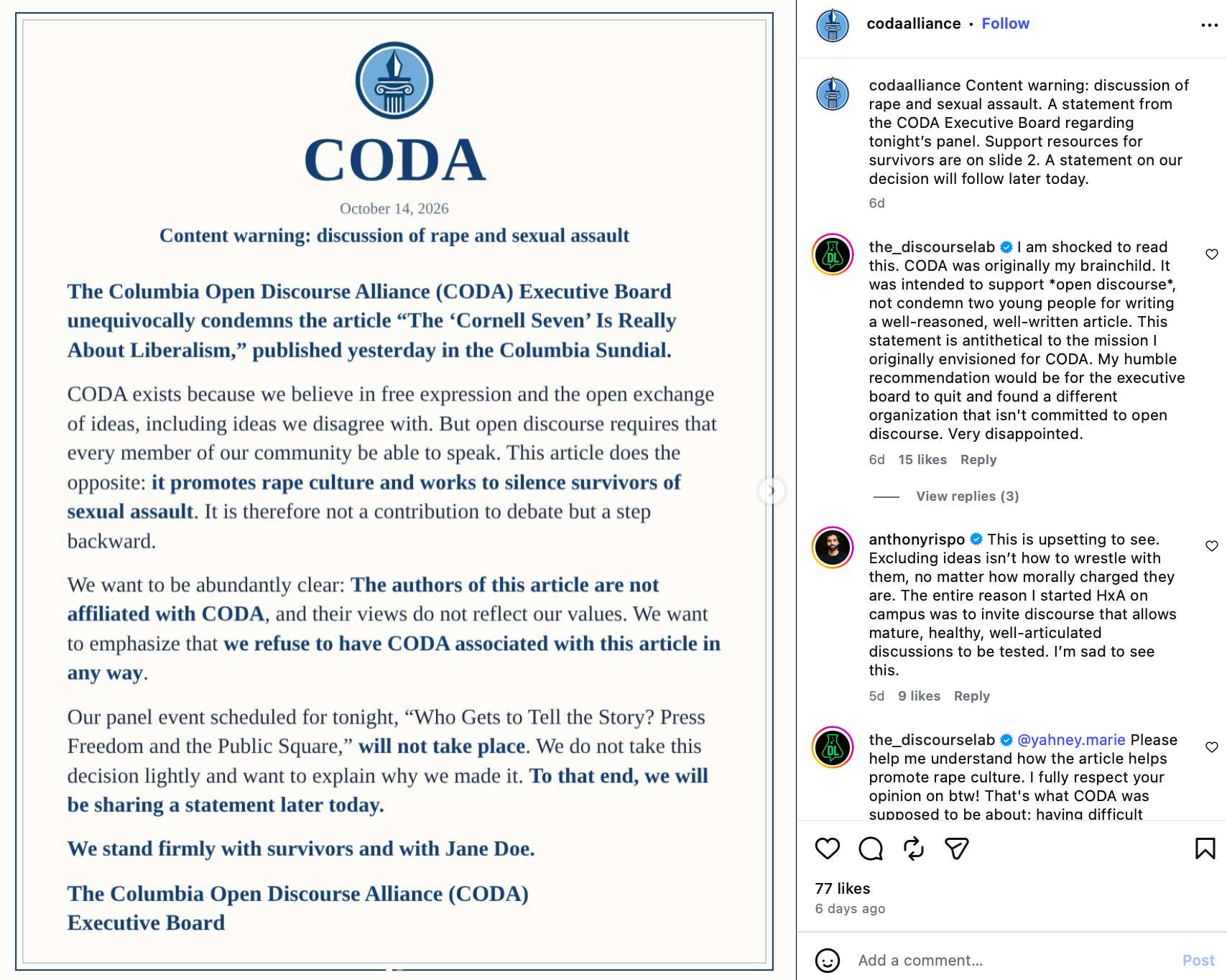
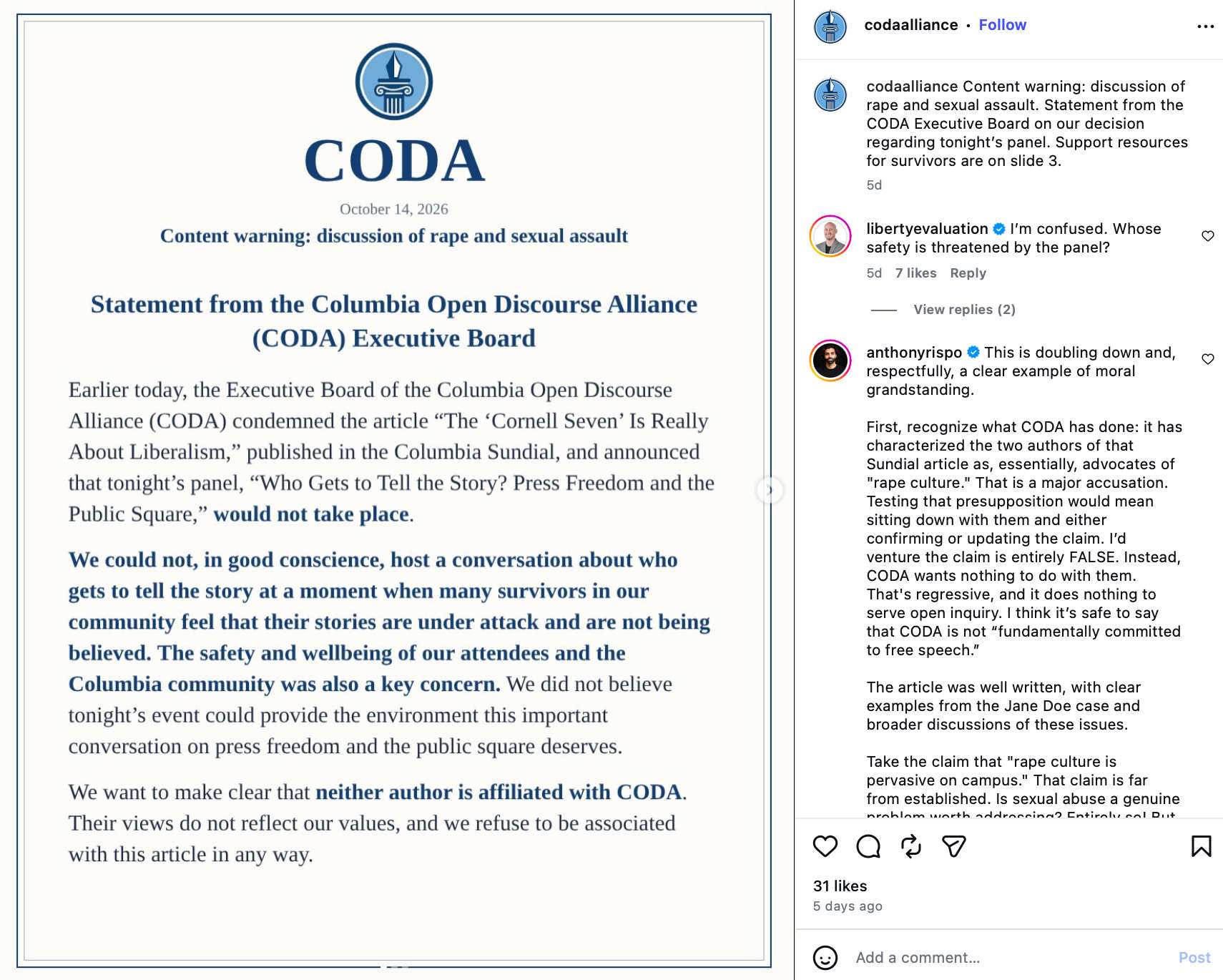
The day after the article's publication, the Columbia Open Discourse Alliance (CODA) canceled an event about press freedom because the Sundial's editor in chief, Nick Baum, had been slated to speak at the event. Although Baum did not author the piece, CODA wrote in an Instagram post that the free speech group "refused" to be affiliated with the Sundial's article "in any way." 

CODA also claimed that the event, ironically called "Who Gets to Tell the Story? Press Freedom and the Public Square," could not take place at a time when "many survivors in our community feel that their stories are under attack and are not being believed."

The group added that the Sundial's article "promotes rape culture and works to silence survivors of sexual assault." 

The group's president, Aum Desai, told Columbia's student newspaper, the Columbia Daily Spectator, that the group canceled the event "not in spite of, but because of [CODA's] commitment to free expression." 

Columbia graduate Clayton Smith, who founded CODA in 2025, quickly commented that he was "shocked" by CODA's statements on Instagram. Smith started the organization to create a central hub for groups hosting events promoting free speech and open discourse, including the Sundial and Columbia's Heterodox Academy chapter.

He tells Reason that CODA's rationale for canceling the event was "ironic" and "hypocritical," and he believes the group should have collaborated with the Sundial if there were legitimate safety concerns at the event. He says he was particularly disturbed by the group's condemnation of the article and CODA's claim that it promotes "rape culture."

"They don't argue or explain how it works to silence survivors of sexual assault. It is a baseless slander that they use to condemn the article because it promoted an opinion they do not like," Smith says. 

Smith says he spoke to Desai on the phone after CODA posted the statements, and Desai tried to reassure him that CODA would uphold the principle of free speech. But Smith says he did not leave the phone call feeling "very confident at all" in Desai's commitment. 

Desai did not respond to Reason's requests for comment.

CODA faculty adviser and Columbia Business School professor emeritus Eli Noam was traveling in China during the fallout from the Sundial article and was not involved in CODA's decision.

After speaking with members of both CODA and the Sundial, Noam tells Reason that he thinks CODA "made some proper decisions, some correct decisions, and some mistakes."

"I think we're dealing here with…a group of college students who kind of were confronted with a crisis at 2 a.m.," Noam says. "And kind of [made] some judgments that they now regret, and they do." 

He tells Reason that it was not "unreasonable to assume there would be a disruption" at the event, given the climate at Columbia and "about this rape allegation." He says the group suddenly "had an event where they needed college security" and could not organize in time. CODA, Noam says, is not yet recognized by the university, and he thinks the group was likely fearful of jeopardizing its recognition.  

Still, Noam says CODA's statements condemning the article were "unreasonable," and it was "disappointing that they kind of lost their nerve here."

Although he was not involved in planning the panel, Mohammadi says, to his knowledge, there were no credible threats of violence to the panel. He understood there may have been "disgruntled students" and an "environment CODA did not want to deal with." But instead of simply canceling the event or working with the Sundial to find a solution, Mohammadi says CODA overstepped by condemning the Sundial piece. 

James Applegate, an astronomy professor who serves on Columbia's Academic Freedom Council (CAFC) alongside Noam, tells Reason that he disagreed with CODA's decision to cancel the event.

Applegate tells Reason he was considering attending the event, and he was "rather surprised and disappointed" when it was canceled.

He recalled that when he was a professor in 2000, he objected to changes to the school's sexual misconduct policy on the University Senate floor. He says his statements were "similar to what was said in the Sundial article" and there was a "level of emotion in this debate." 

"Nonetheless, we had the debate. I was in it, and the degree to which it was civil is shocking when you look at where we are now. And it's sad." 

Applegate said he does not condemn CODA, however, "for the simple reason that the atmosphere on college campuses and on the left wing of politics in general in the United States is quite vicious."

CODA's honorary faculty fellow John McWhorter tells Reason he interpreted CODA's statement as "saying that an event about who gets to tell the story is untenable when or if a critical mass of people with such stories don't even feel comfortable telling them— i.e.being a participant in the event." He added, "I imagine some might think of that as cutting the salami a little thin, but then I highly suspect that Desai is equally worried about the event becoming a physical melee of some kind. In that, let's face it, he is hardly unreasonable."

Still, McWhorter said that he would have chosen to have the event himself, "especially as in the likely case that some people did talk about their experiences without any particular repercussions, it may have made the more reluctant people less apprehensive about doing so in the future."

According to Mohammadi, as of Tuesday, the Sundial, College Republicans, Platypus Affiliated Society at Columbia (which discusses leftist thought and history), and Columbia's Heterodox Academy chapter have left CODA. 

CODA was not the only group to condemn the Sundial's piece. On October 14, the Columbia Political Review's editorial board wrote that Mohammadi and Ma's piece "violates standards of integrity" and "perpetuates a culture of campus violence, rape, and assault." The editorial board of the Columbia Political Review, which purports to publish "multipartisan political discourse," stated that it would refuse to publish "any article that upholds or recreates cultures and systems of rape, sexual assault, or violence" and it urged "all campus publications to do the same."

And on Monday, Columbia's main newspaper, the Spectator, published a staff editorial accusing the Sundial of violating journalistic ethics by "its page to disparage survivors of sexual violence." 

Mohammadi tells Reason the piece underwent "far more editorial scrutiny than any other piece" the Sundial had published given the sensitive nature of the topic.

Free speech student organizations are necessary on Columbia's campus, especially as the school's free speech climate continues to crumble; it recently received a failing grade from the Foundation for Individual Rights and Expression. And while upholding free speech principles may have become more fashionable among those resisting the Trump administration's pressures on academic freedom or those defending pro-Palestinian speech, it is clear that some topics remain taboo in the public square. College is supposed to be a place where students debate controversial topics, form their own beliefs and opinions, and learn from mistakes. Hopefully, the students who demanded condemnation instead of debate will be forgiven for their perversion of free speech ideals, and they will learn to afford such grace and open-mindedness to classmates with whom they disagree.

The post A Free Speech Group at Columbia Canceled an Event About Free Speech Over 'Cornell 7' Article Controversy appeared first on Reason Magazine.

❌