Esta reportagem é parte de uma investigação especial da Agência Pública financiada pelos nossos Aliados, sem nenhum dinheiro de bet. Apoie mais reportagens como essa clicando aqui.
Um total de 70% dos parlamentares mapeados pela Agência Pública como integrantes ou aliados da “Bancada das Bets” segue com mandatos no Congresso Nacional até 2030. Dos 17 nomes identificados na investigação como parlamentares que contemplaram interesses das casas de apostas ou foram aliados importantes nas articulações desse mercado, 11 foram eleitos no último domingo (4). Um deles, Romário (PL-RJ), só enfrenta nova disputa por eleitores na próxima disputa para o Senado.
A bancada, que não existe formalmente no Congresso, reúne parlamentares que atuaram em pautas relacionadas à regulamentação, tributação e expansão do mercado de apostas online.
A influência do setor não se restringia à apresentação ou votação de projetos: passava também por conversas diretas com líderes partidários, articulações para alterar propostas em tramitação e encontros com representantes e empresários do mercado, como revelado no especial Jogo Perigoso: O Brasil das Bets.
Entre os 11 parlamentares classificados como nomes de base que, direta ou indiretamente, contemplaram interesses das casas de apostas, sete foram eleitos. Luiz Philippe de Orleans e Bragança, foi reeleito pelo PL em São Paulo. Kim Kataguiri, que mudou do União Brasil para o Missão, também conquistou uma vaga pelo estado. Em Minas Gerais, Weliton Prado foi reeleito pelo PSD com 129.366 votos.
Na Bahia, Adolfo Viana (PSDB) foi reeleito com 119.865 votos e João Bacelar (PL), com 107.232. O outro Bacelar da lista, João Carlos Bacelar Batista, concorreu pelo PV e ficou de fora dos vitoriosos, mesmo obtendo 102.654 votos. Em Roraima, Gabriel Mota (União-RR), conquistou vaga com 10.195 votos. Na Paraíba, Cabo Gilberto Silva (PL) e Hugo Motta (Republicanos), presidente da Câmara, também foram reeleitos.
Dos seis parlamentares identificados pela Pública como “líderes da Bancada das Bets”, além de Motta, outros três foram eleitos: Doutor Luizinho (PP-RJ), Isnaldo Bulhões (MDB-AL) e Felipe Carreras (PSB-PE), que renovaram seus mandatos na Câmara.
Seguem no Congresso
–
–
–
–
A atuação dos quatro foi destacada em diferentes momentos da investigação. Luizinho e Bulhões foram identificados como articuladores de iniciativas para impedir aumento da tributação das apostas. A dupla também participou das articulações que retiraram a Cide-bets, contribuição de 15% prevista no debate do PL Antifacção, do texto aprovado pela Câmara. Felipe Carreras, por sua vez, foi descrito por interlocutores ouvidos pela reportagem como um dos principais nomes procurados pelo setor, enquanto Hugo Motta foi citado nas negociações que levaram à retirada da Cide-bets.
Dois dos principais nomes ligados às casas de apostas online, no entanto, ficaram pelo caminho. Ciro Nogueira (PP-PI), que disputou a reeleição ao Senado, terminou em terceiro lugar, com 24,68% dos votos, atrás de Marcelo Castro (MDB) e Júlio César (PSD). O mesmo ocorreu com Ângelo Coronel (Republicanos-BA), que teve 2.898.885 votos, 20,11% dos válidos, e ficou atrás de Rui Costa e Jaques Wagner, ambos do PT baiano.
Além dos dois, três nomes da Bancada das Bets não chegaram a tentar uma renovação de mandato: Jorge Kajuru (PSB-GO), e Irajá (PSD-TO) ficaram fora das urnas e encerram o mandato nos próximos meses.
Saem do Congresso
–
–
Correndo por fora
Nomes importantes dos bastidores da costura desse setor na Câmara, que não compunham diretamente a bancada, mas influenciam nas suas conquistas também tiveram desempenho irregular no pleito de 2026. Arthur Lira (PP-AL) deixou a Câmara depois de mais de uma década e conquistou uma das duas vagas de Alagoas no Senado, com 946.970 votos, 28,87% dos válidos. Rogério Carvalho (PT-SE) foi reeleito senador por Sergipe, com 509.608 votos.
Enquanto isso, Efraim Filho tentou, sem sucesso, a cadeira do governo da Paraíba pelo PL. Já Davi Alcolumbre (União-AP) não chegou a ir às urnas, uma vez que seu mandato no Senado segue até 2030.
Outro lado
À época da publicação da reportagem sobre a Bancada das Bets, procurado pela Pública, Doutor Luizinho afirmou ser contrário aos aumentos de impostos e à extinção das plataformas de apostas online e negou ter recebido qualquer contrapartida de empresas do setor. Felipe Carreras defendeu a regulamentação e a arrecadação sobre as apostas, além da legalização de cassinos, e negou as acusações de que atuaria em favor de empresas do setor. Arthur Lira disse que, enquanto presidente da Câmara, manteve interlocução institucional com diferentes setores sobre a regulamentação das bets e que atuou no exercício regular de suas funções, sem vínculo particular com plataformas de apostas.
Rogério Carvalho, por sua vez, rejeitou a associação com interesses das casas de apostas e afirmou que seu histórico legislativo demonstra atuação em favor da regulamentação e do controle do setor. Ângelo Coronel disse continuar favorável às apostas legalizadas e defendeu a regulamentação como forma de arrecadar recursos para o tratamento de pessoas com problemas relacionados ao jogo. Os demais parlamentares não se manifestaram sobre o assunto.
Kazakhstan has asked Moscow to help bring home citizens who say they were pressured into signing military contracts to fight in Ukraine. The request puts a fresh spotlight on the vulnerability of Central Asian migrants to Russia’s military enlistment efforts.
Esta reportagem é parte de uma investigação especial da Agência Pública financiada pelos nossos Aliados, sem nenhum dinheiro de bet. Apoie mais reportagens como essa clicando aqui.
O tempo é uma das ferramentas mais poderosas de perspectiva. Em apenas um segundo, as plataformas de apostas online ganharam mais dinheiro do que 33 milhões de brasileiros fizeram em um mês no ano passado. Literalmente. Por cada segundo de 2025, as famílias brasileiras perderam para as bets R$ 1.982, mais do que o salário mínimo atual, de R$ 1.621 – uma realidade, por exemplo, de três a cada cinco trabalhadores no Maranhão.
Os dados são do Comitê Nacional de Secretários de Fazenda dos Estados e do Distrito Federal (Comsefaz), que, em agosto deste ano, estimou o esvaziamento do orçamento das famílias em R$ 62,5 bilhões em 2025 – um mercado cuja hora de “trabalho” ficou acima dos R$ 7 milhões. Na política, é justamente o tempo que muitas vezes dita urgência, relativização ou esquecimento.
Por quase uma hora, uma mulher se mantinha encolhida em um sofá na sala do apartamento da família em Uberlândia (MG). Era 25 de setembro. Em silêncio absoluto, cortado apenas por um respiro ansiosamente pesado. O som da TV preenchia o ambiente embalando a mulher, seu marido e sua filha mais velha. Evitavam falar, talvez até se mexer. As próprias vidas em suspenso.
O relógio marcava exatamente 19h07 quando um misto de riso, lágrimas e alívio tomou conta de seu semblante. Na tela, o presidente da República assinava a Medida Provisória (MP) 1.394/25, que proibia não apenas a propaganda, mas o funcionamento das plataformas de apostas em todo o território nacional.
Ao longo dos sete minutos seguintes, viu Luiz Inácio Lula da Silva, com quem havia se encontrado dias antes em Brasília, endossar o discurso que ela ajudou a popularizar, ao comparar a jogatina ao crack, e classificar a ludopatia por jogos online como um risco ainda mais invasivo. “O país trouxe o jogo para dentro de casa. O cassino está na sala, o cassino está na cozinha”, disse antes de citá-la “eu conversei com a ‘mãe que perdeu o filho de 26 anos’”. E ela sorriu, sem se incomodar com a alcunha.
“Foi uma sensação de dever cumprido”, resumiu a professora Vânia Borges do Amaral, de 54 anos, emocionada, ao ver sentido em compartilhar o luto de seu filho, Rafael Borges do Amaral, que tirou a própria vida após perder todas as economias acumuladas para as bets. É o mais recente marco na linha do tempo interrompida pela última aposta que o rapaz fez, à 1h48 de 23 de março de 2024 – um novo capítulo de sua história, agora provido de sentido.
Professora Vânia segura a foto de seu filho Rafael
A MP das bets determinou o fim da oferta dos jogos online, tanto em ambientes físicos quanto virtuais, abrangendo concessões federais e estaduais. Loterias tradicionais não foram atingidas pela mudança. Na prática, os sites e aplicativos das empresas devem ser retirados do ar nesta terça-feira (6) e as publicidades, mesmo em outdoors e outros meios físicos devem ser removidos. As multas pelo descumprimento da regra podem chegar a R$ 2 bilhões.
Não há previsão de indenização para as empresas detentoras das 85 outorgas para explorar a atividade legalmente desde 2023 no país. Cada outorga custou cerca de R$ 30 milhões, o que significa um investimento de R$ 2,55 bilhões por parte das companhias para ofertar plataformas reguladas no Brasil – valor quase 25 vezes inferior ao montante gasto pelas famílias em bets apenas em 2025. Estudo da Universidade de São Paulo (USP) estima que as plataformas retiraram R$ 141 bilhões do Produto Interno Bruto (PIB) nacional, enquanto renderam R$ 9,9 bilhões em tributos em contrapartida.
“Eu não imaginava que chegaria a esse ponto, porque quando eu comecei essa luta, eu fui recebida com muito descaso. Primeiro pela Polícia Civil, depois pelo Ministério Público. Eu dei entrada, mas tudo foi demorando tanto… e eu sempre buscando uma resposta que nunca vinha. Eu vi ser instaurada a CPI das Bets e acabar naquela farra. Me gerou muita frustração, muita tristeza. Eu tive a impressão de estar abandonada”, pontuou Vânia sobre testemunhar a proibição, com a qual vinha sonhando há meses. “Eu me senti ouvida”, resumiu.
A história de Vânia e Rafael foi apresentada originalmente pela Agência Pública, que identificou uma carta que ela enviou ao Senado durante a CPI das Bets, em que narra a tragédia familiar. Os impactos da reportagem noticiados até fora do Brasil fizeram parte do especial Jogo Perigoso: O Brasil das Bets, publicado entre maio e julho de 2026 e incluíram dois projetos de lei protocolados na Câmara dos Deputados e o convite da presidência da República para que ela fosse ouvida sobre sua experiência familiar com as apostas online.
A MP 1.394 deve ser apreciada no Congresso Nacional dentro de 120 dias. Enquanto isso, o cronograma previsto na publicação se impõe para as empresas – e para um a cada três brasileiros que faziam apostas regulares nas plataformas. Às 23h59 desta segunda-feira (5), se encerra o prazo para que apostadores retirem os saldos mantidos em suas contas em todos os sites de bets, que saem do ar à meia-noite. Ainda não há certeza se o fim das apostas online será definitivo ou temporário. O futuro, mais uma vez, o tempo há de dizer.
Em setembro, Vânia pediu diretamente ao presidente Lula, em Brasília, a proibição total das apostas online no país
Clandestinidade e Justiça: os desafios além da canetada
Mais de mil plataformas ilegais foram detectadas desde o dia 21 de setembro pela plataforma bet legal, a partir do momento em que a possibilidade de proibição das bets formais ganhou força na imprensa – mais de 700 desde a assinatura da MP 1.394. Mas o campo da ilegalidade, que até então movimentava metade da fatia financeira desse mercado no Brasil, não é o único grande entrave para uma realidade sem apostas online no país.
No Supremo Tribunal Federal (STF) uma grande frente de defesa da atividade de apostas online se formou rapidamente após a proibição das bets pelo governo federal. A Associação Nacional de Jogos e Loterias (CNJL) e o Instituto Brasileiro de Jogo Responsável (IBJR), que representam a maioria das empresas que detinham 85 concessões legais para operar no Brasil, entraram com pedido de suspensão da medida ainda no dia 28 de setembro. Dois dias depois, a Associação de Emissoras de Rádio e Televisão (Abert) fez o mesmo, alegando entre os argumentos “perdas de receita”.
As associações receberam um reforço massivo. Ao menos 20 clubes de futebol entraram unidos para tentar influenciar a decisão do STF. Flamengo e Botafogo pediram para integrar o processo como amicus curiae, uma espécie de consultoria para auxiliar as decisões da Corte com informações e perspectivas a serem consideradas, o que, no caso do Flamengo, já foi aceito.
São Paulo, Guarani, Ponte Preta, Portuguesa e Vitória, por sua vez, pedem um prazo de transição de pelo menos um ano para que a suspensão tenha validade em território nacional, citando a possibilidade de inviabilidade da continuação do Campeonato Brasileiro – cujo nome oficial após acordo de naming rights atualmente é “Brasileirão Betano”, em menção a uma das maiores plataformas de apostas online até então em atividade, o que foi deixado de fora da peça judicial.
Por fim, em outro processo, América, Athletic Club, Atletico Goianiense, Botafogo, Ceará, Chapeconse, Criciúma, CRB, Cruzeiro, Fluminense, Goiás, Juventude, Mirassol, Grêmio e Vila Nova pedem para que a suspensão da MP requerida pelas associações seja deferida e também solicitam que sejam ouvidos no processo. Os clubes brasileiros já haviam emitido publicação conjunta antes da publicação da MP decretando o possível “fim do futebol” em caso de proibição das apostas online.
Segundo levantamento da Bites publicado por O Globo, a publicação conjunta dos clubes provocou uma rejeição de cerca de 90% do público, incluindo de seus torcedores. De acordo com a CNN, os patrocínios dos clubes da Série A variam de R$ 12 milhões a R$ 268,5 milhões. À luz da polêmica, o Senado Federal abriu consulta popular em seu site e até o início desta segunda-feira, 85% dos votantes concordavam com a MP (481 mil votos contra 80,6 mil).
Ao menos 20 clubes ingressaram com processos no STF pedindo a suspensão da MP que proíbe as bets ou prazo de adequação do setor
A judicialização do caso das bets está sob relatoria do ministro do STF Luiz Fux, que já tratava do Marco Regulatório das Apostas de Quota Fixa. Por isso, as ações diretas de inconstitucionalidade movidas pelas partes interessadas na volta das bets coube ao magistrado. Caberá a ele não apenas julgar a MP, mas também se havia urgência suficiente para que uma medida provisória fosse editada, já que há prazos e cenários previstos em lei para o uso desse tipo de recurso. No sábado (3), o magistrado deu um prazo de 72 horas para que o governo federal justifique a necessidade da MP.
Ficou a cargo do ministro do STF Luiz Fux decidir sobre as ações de inconstitucionalidade propostas pelas empresas de apostas online e times de futebol
O ministro Luiz Fux já tem um histórico de posicionamentos quanto às questões dos jogos. Foi ele, por exemplo, que, em dezembro de 2025, mandou suspender parte da norma do Ministério da Fazenda que proibia que beneficiários do Bolsa Família apostassem nas plataformas das bets – o que apenas posteriormente foi confirmado para todos os benefícios sociais. Por outro lado, em agosto deste ano, também foi o ministro que votou para manter os demais jogos de azar como contravenção penal, como a legislação prevê com base em texto legal de 1941 – na ocasião, inclusive, correlacionando as perdas nesses jogos a episódios recorrentes de violência doméstica.
Em uma frente contrária à tentativa de intervenção judicial, que só deve entrar na pauta do Congresso Nacional após o período eleitoral, deve entrar em pauta o Projeto de Lei 5.477/26, proposta pelo governo federal logo após a publicação da medida provisória. O PL criminaliza as atividades de apostas online prevendo multa e de 2 a 4 anos de reclusão para divulgação, oferta de meios de pagamento, captação de usuários e até o desenvolvimento de aplicativos para as bets, além de 4 a 6 anos de reclusão para quem de fato explore as apostas de quota fixa no país.
As penas ainda podem ser agravadas em caso de uso por crianças e adolescentes ou quando o usuário conseguir burlar mecanismos de verificação de idade ou localização. O projeto será avaliado na Câmara e tem que passar pelo Senado antes de ser sancionado.
Rafael faleceu em 2024 aos 26 anos e inspirou projeto de lei na Câmara dos Deputados
“Naquela mesa tá faltando ele”
“Você tá ganhando quanto para fazer tudo isso?”, perguntou uma colega à professora Vânia Borges do Amaral, na semana da publicação da medida provisória que suspendeu as bets. A pergunta foi recebida como uma pancada. “Eu defendo uma causa”, conseguiu responder, sem se alongar.
“Uma colega bolsonarista, né?”, diz Vânia em entrevista à Pública. “Acho que ficou ofendida porque Lula subiu nas pesquisas depois disso [anúncio da MP]”, brinca, ainda magoada. Questionada se não se incomodava em estar sendo usada politicamente, já que sua história foi parar até no guia eleitoral do presidente petista, é categórica: “Eu provavelmente faria o mesmo. Mas tenho confiança de que ele vai ser coerente [e continuar lutando pela proibição]”. O petista avançou para o segundo turno das eleições, marcado para 25 de outubro, em busca de um quarto mandato frente à Presidência da República.
Para lidar com as culpabilizações e ataques nas redes sociais que passou a sofrer desde que sua história ficou conhecida no Brasil e fora dele – e foram muitos –, Vânia teve que reaprender a lógica da audição seletiva, agora do outro lado da equação. Ao longo de três décadas de ensino, a professora enfrentou greves nas redes municipal e estadual de ensino, em Uberlândia, e, longe do papel de protagonismo, convivia com ganhos eventuais e uma tradicional surdez de agentes políticos. Não ser “ouvida” não seria exatamente uma novidade. Colher frutos em escala nacional, isso sim, foge de qualquer histórico.
“A gente nota a diferença, né? Mais confiante, mais positiva…”, comenta a filha, a nutricionista Aline Borges Amaral, 33. “Repercutiu muito a história da minha mãe, então a luta dela não está sendo em vão. Fico muito feliz de ver ela indo à luta, procurando, não abaixando a cabeça, porque a gente sabe que não vai ser fácil essa medida se tornar definitiva”, pontua. A segunda filha, Amanda Borges Amaral, 31, completa: “A Vânia que a gente conhece desde criança é extremamente protetora, não foge de nada e direciona, abre caminhos. E depois de tudo que aconteceu, ela foi perdendo a vontade de viver. E ela foi se recuperando, né?”
As duas irmãs de Rafael fazem aniversário no dia 23 de março, o mesmo dia em que ele faleceu. E esse é um lembrete que não passa batido na longa lista de perdas que a família contabiliza desde 2024.
Eu carrego essa dor, e vou carregar para o resto da minha vida. Aqui, nós fazemos as reuniões aos domingos, sempre fomos uma família muito unida, e sempre que a gente se reúne aqui, talvez eu nem fale isso, mas olho na mesa e ‘falta um, tem uma cadeira vazia’. É dia das mães, outra comemoração… O aniversário das minhas duas filhas é uma data que a gente não comemora mais. Então, é algo difícil de descrever. Por isso, acho que essas pessoas, empresários, influenciadores, elas têm que ser punidas
Vânia Borges do Amaral
Mãe do Rafael
Rafael, segundo a família, não deixou dívidas para os parentes. O caçula vendeu uma moto de R$ 8 mil, se desfez de todas as economias e, nos seus últimos meses, saiu de casa para fugir das tentativas da mãe de salvá-lo, o que incluíam alertas e cobranças recorrentes, “chatices” daquelas que todo jovem rejeita por “saber mais que os pais”. Vânia insistiu o quanto pôde, conjugando todas as vozes e tempos de quem é mãe.
Família vem lidando com ataques digitais desde que a história se tornou pública, mas diz que não irá se calar até que setor de apostas online seja proibido
E fez-se verbo
A professora Vânia é formada em direito e advogou por muitos anos, antes de se dedicar a ensinar português. A luta que encampa vai além da proibição do setor. “Eu tenho provas concretas do porquê Rafael fez isso, tenho gravação, áudio, testemunha, cópias de email, tenho tudo que comprova que ele cometeu suicídio por causa das bets, eu não vou deixar isso assim. Quero que quem provocou essa morte seja responsabilizado”, pontua, devagar, com a calma de quem se acostumou a esperar.
Ela lembra que muitos enriqueceram com o lucrativo negócio que a fez perder o filho, de políticos a influenciadores. “Isso tudo foi construído à custa do sangue de muito inocente”, conclui, a professora e advogada, que promete brigar para levar o caso à esfera criminal e buscar reparação cível pelos danos causados à sua família, uma realidade que os números provam que passam longe de isolada.
O Ministério da Saúde reconhece um crescimento dos atendimentos relacionados a jogo patológico da ordem de 140% entre 2018 e 2025 e estimava que a marca seguisse crescendo mais 104% até 2028, caso a proibição não fosse feita. Segundo o Instituto de Estados para Política de Saúde, os custos anuais associados aos jogos são de R$ 38,8 bilhões, dos quais R$ 30,6 bilhões são apenas para gastos com saúde, incluindo suicídios e tratamentos de depressão.
Até agosto de 2026, 5 milhões de brasileiros estavam impedidos de acessar as plataformas de apostas online, 1,2 milhão por iniciativa própria na plataforma de autoexclusão, 800 mil por renegociarem dívidas no programa Desenrola, que tem uma edição 3.0 para lidar com as consequências das bets a partir da proibição, e outros 3 milhões por receberem benefícios sociais.
No horizonte da família de Vânia, há planos de transformar a luta num livro sobre a morte e vida de Rafael. “Falar sobre um caso assim poderia gerar ataques, chacotas pela situação… a gente sabia disso, porque a pessoa com vício é vista como uma pessoa fraca e não como uma pessoa doente, né?”, resume a filha Amanda.
“A gente falou: ‘mãe, o nosso Rafael infelizmente não volta, mas existem outros Rafaéis’. Não dá pra se calar, né? É um dever com a sociedade que a gente abra a boca e que mostre o grande problema que está todo mundo vivendo e ao mesmo tempo todo mundo com vergonha, pelo julgamento”, completou.
Falar sobre o caso abriu as comportas para uma avalanche de mensagens à família com relatos diários de dificuldades semelhantes enfrentadas em lares brasileiros. Mães, parceiras, irmãs, que se inspiram na luta da professora de Uberlândia para tentar encontrar desfechos outros. E, sem querer, Vânia virou verbo: não se calar para proteger até quem nem se conhece. Vaniemos.
Precisa de ajuda ou conhece quem precisa?
O Centro de Valorização da Vida (CVV) oferece apoio emocional e prevenção ao suicídio. O serviço é voluntário e gratuito, disponível 24h pelo número 188 e todos os dias também por chat ou email. O sigilo é garantido.
The Nobel Assembly of Sweden's Karolinska Institute said the trio of scientists had been selected for their "discoveries concerning light-gated ion channels and optogenetics."
The Nobel Assembly of Sweden's Karolinska Institute said the trio of scientists had been selected for their "discoveries concerning light-gated ion channels and optogenetics."
Swiss police are investigating a sprawling fraud operation with suspected links to Ukrainian scam call centers, an industry said to be worth billions to corrupt officials in Kiev, Neue Zurcher Zeitung (NZZ) has reported, citing law enforcement officials.
According to a report on Sunday, NEDIK, the police network coordinating Switzerland’s fight against digital crime, recently recorded an increase in fraud offenses suspected of having links to Ukraine. The network declined to provide nationwide figures “for tactical reasons,” but noted that at least four fraudulent call centers in Ukraine have been identified in international investigations involving Swiss authorities, with Swiss and German citizens among their main victims.
One investigation by Bern authorities, reportedly underway for years, concerns a man suspected of operating several call centers in Kiev. On just one platform allegedly linked to the operation, reported losses in Switzerland amounted to nearly 4 million Swiss francs ($4.8 million).
Several Ukrainian nationals have also recently been arrested in Swiss cantons for allegedly acting as cash collectors in telephone scams. In St. Gallen in early September, a person posing as a bank employee called a 93-year-old man and instructed him to withdraw and hand over a large sum of money. Police later arrested a 38-year-old Ukrainian who allegedly collected the cash.
Police in Aargau have similarly reported a growing number of suspected cash collectors holding Ukrainian citizenship. Authorities, however, have not established whether they are being directed by call centers in Ukraine or acting independently. NZZ noted that it remains unclear to what extent Ukraine-based operations are connected to fraud networks and cash collectors operating in Switzerland.
While Russians have long been portrayed as the main targets of Ukrainian scammers, sources cited by NZZ challenged that narrative. Brian Lee, head of the Eurasia Observatory at the Geneva-based Global Initiative Against Transnational Organized Crime (GI-TOC), said Russians accounted for just 10%-15% of targets even at the height of the so-called “patriotic fraud” narrative, under which young Ukrainians were recruited into scam networks on the pretext of taking revenge for Moscow’s military operation against the Kiev regime. Victims have been identified in at least 29 countries, with scam centers increasingly targeting Europe and the US, according to a GI-TOC report published earlier this year.
Lee also reported that bribing Ukrainian officials for protection is central to the business model, saying GI-TOC investigations found that criminal elements “operate seamlessly and efficiently alongside law enforcement agencies, public officials and the private sector.” Such protection reportedly costs scam operators $10,000-$15,000 per month.
Scam networks and state structures
Corruption has long plagued Ukraine, with high-level scandals including last year’s $100 million Energoatom kickback scheme, reportedly led by Timur Mindich, a former business partner of Ukrainian leader Vladimir Zelensky. Western-backed investigators have since uncovered further graft involving Ukrainian officials.
The scam call center network reentered the spotlight last month after Ukrainian Prosecutor General Ruslan Kravchenko – a key pillar of Zelensky’s increasingly fragile governing structure – resigned amid the exposure of an industrial-scale network across the country with alleged links to senior figures in Kiev. Ukraine’s Western-backed National Anti-Corruption Bureau (NABU) accused Sergey Kropiva, head of the cybercrime unit at the Prosecutor General’s Office, of leading a ring that collected protection payments from notorious Ukrainian scam call centers. NABU said it identified assets worth almost $1 million allegedly purchased with proceeds from the scheme.
The sums involved in Ukraine’s wider scam industry are reportedly far larger. Ukrainian media earlier estimated that roughly 2,000 scam offices were operating nationwide as of early August, about half paying protection money to corrupt officials. Such payments were estimated at $240 million annually, while the industry itself has been valued at up to $1 billion a month.
The scam industry has also been linked to powerful security structures under Zelensky’s government. In September, personnel from the Security Service of Ukraine (SBU) and military intelligence (HUR) exchanged fire in Kiev in a confrontation that left three servicemen injured. The clash centered on Stepan Kaplunov, a member of an HUR-linked armed unit detained by the SBU. A law enforcement source cited by Ukrainian outlet Strana said Kaplunov may have been involved in operating scam call centers, pointing to a broader struggle between rival security agencies over the lucrative industry. Ukrainian journalists have also reported that proceeds from criminal operations help finance parts of the HUR’s activities.
Russian President Vladimir Putin has described phone scams as a key tactic employed by Kiev to extract money from Russian citizens, suggesting the practice has effectively become state policy. Moscow considers the industry a national security threat and claims Ukrainian scam networks operate in coordination with the country’s intelligence services.
Russian forces have recently intensified strikes on Ukrainian telecommunications infrastructure, mobile operators, and data centers in response to Kiev’s botched “pressure campaign” of drone attacks on civilian infrastructure deep inside Russia. The strikes have disrupted internet access, digital television, and other services, including by hitting data centers in Kiev that Moscow says were used by Ukrainian military and intelligence services. Media reports late last month also claimed a Russian strike hit one of the scam call centers in Dnepropetrovsk.
Russia is making no progress at all on the front, and September was among its worst months.
Russia wants to cause Kyiv’s economic collapse, and pontoon bridges are being prepared in the city.
Ukraine’s air defences neutralised 83 percent of drones launched in September, compared with 92 percent in May.
Videos of the day – attacks on Kyiv’s bridges; what a TM-62 anti-tank mine can do; what anti-drone protection for the Kerch Bridge looks like; Russian communists shouted “Down with the tsar!”, and frontline sounds from a Russian soldier’s video.
Russia is making no progress at all on the front, and September was among its worst months. Russian president Vladimir Putin claimed in Valdai at the beginning of the month that his subjects had captured 1,300 square km of territory in September. This is further evidence that he is either being given completely fabricated figures or is deliberately lying himself.
If Putin were right, his army would have experienced its most successful period since the first two months of the invasion. Defence ministry reports reflect this. Almost every day, they report the capture of more and more villages. In reality, the situation is different. Russian forces became bogged down in every direction even before the rains arrived, and throughout the year they have failed to achieve any operational success that would justify the further hundreds of thousands killed and wounded.
As every month, various analysts have again published their calculations of how the front line moved. Not even estimates from Putin’s own Z channels agree with his figure.
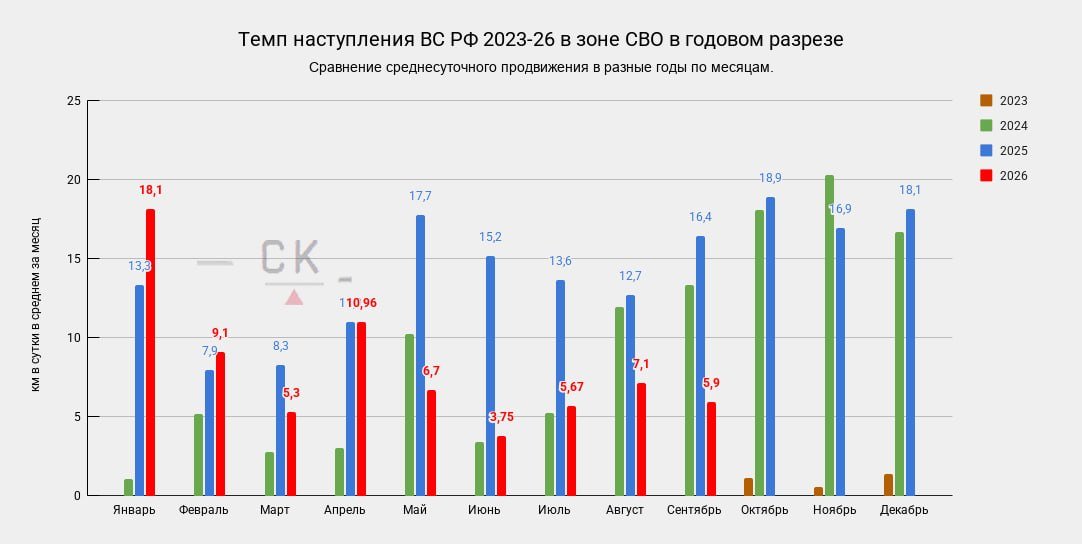
“The average daily rate of advance by the Armed Forces of the Russian Federation in the SVO zone [special military operation] in September 2026 was +5.9 km². The average rate of advance over the entire offensive up to October 2026 is +9.92 km² per day,” Russian project Slivochny Kapriz wrote about September.
It, too, is an unreliable source that regularly overestimates the significance of “flag operations”, but even its data makes it clear that 2026 is lagging significantly behind the previous year.
Even if this author’s figures were correct, the Russians advanced by 177 square km during September’s 30 days, more than seven times less than Putin claims.
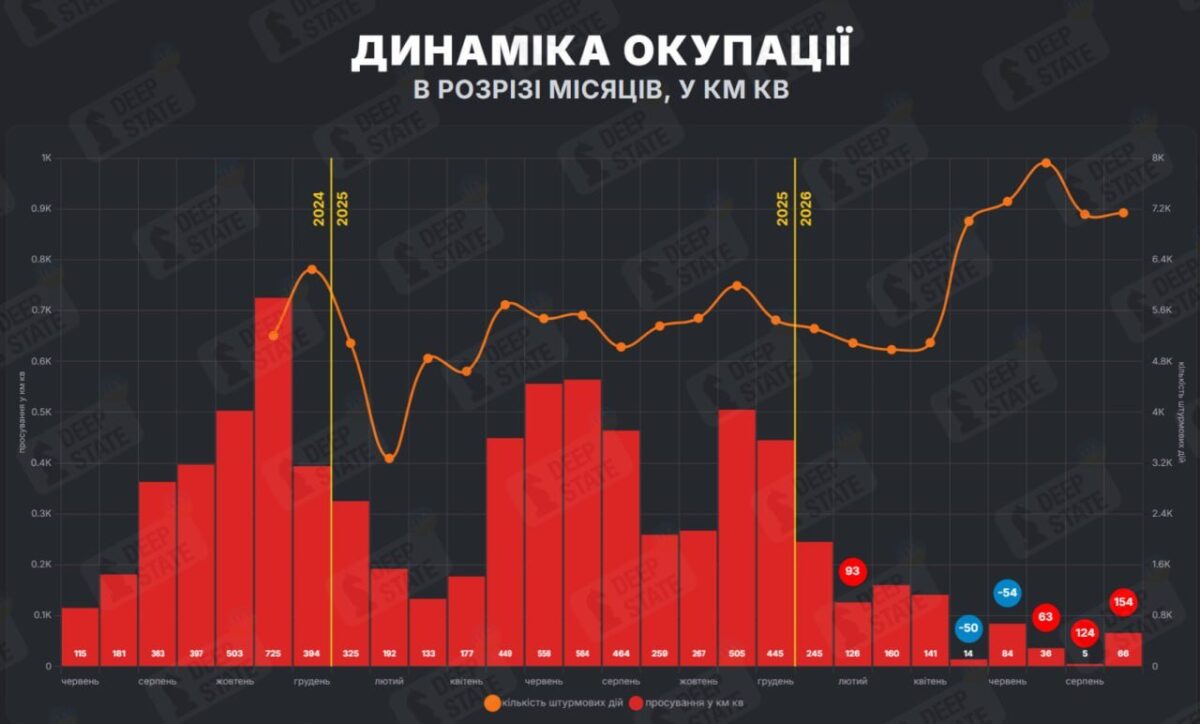
Ukrainians from DeepStateUA also published an estimate very close to Slivochny Kapriz’s figures. According to this OSINT project, Ukraine lost 154 square km in September.
However, the Ukrainian analysts treat their own data cautiously and warn their readers that “the operational security of our forces remains the highest priority in our work”.
In other words, during Ukrainian counter-offensives, DeepStateUA only reports successes after a delay so as not to jeopardise the operations’ success.
They therefore now recall that their statistics do not yet include 270 to 320 square km of liberated Ukrainian territory in various sectors. “July will therefore also end as a month in which the Armed Forces of Ukraine have the upper hand, while for August and September this will only become clear when official announcements of successes are available. In the meantime, part of the liberated territories may be lost again,” DeepStateUA wrote on Friday (2 October).
The most optimistic by far are currently Finnish analysts from the Black Bird Group, who see a balance of 190 square kms in Ukraine’s favour in September.
Over the month of September, the Russian net gains were negative 190 km2. This marks the greatest monthly net territorial loss for Russia in our dataset since the June of 2023.
Emil Kastehelmi, one of the project’s authors, pointed out that the sharp change for the better stems from the fact that it also captures some changes that DeepStateUA has not yet taken into account. Nevertheless, he said: “Russia has failed to reverse a situation that has persisted for almost the entire year. The results of the major Russian offensive are minimal, and this is likely to remain the case for the rest of 2026.”
Among Western analysts, the most sceptical is Konrad Muzyka of Rochan Consulting, who credits the Russians with even more gains than Slivochny Kapriz — as much as 235 square kms of advance. Yet this figure still does not come close to Putin’s. Even if it were the most accurate of all, which cannot be determined, it would amount to an area roughly equivalent to the size of Košice, including all its suburbs, forests and agricultural land within the city’s administrative boundaries.
The plan for this year, meanwhile, was to capture the rest of Donetsk region, including the remaining large cities of Kostiantynivka, Druzhkivka, Kramatorsk and Sloviansk. The Russians are closest to doing so in Kostiantynivka, but Ukrainian soldiers remain there too.
Here is a short summary of territorial changes in Ukraine for September 2026. Our dataset shows an overall Russian territorial gain in September, but a sharply uneven pattern: gains around Dobropillia, Velykyi Burluk, Kramatorsk and Komyshuvakha coincided with substantial losses… pic.twitter.com/jrq0zXiqri
— Konrad Muzyka – Rochan Consulting (@konrad_muzyka) October 1, 2026
Russia wants to cause Kyiv’s economic collapse, and pontoon bridges are being prepared in the city. There is now no doubt that the Russian army has begun a systematic effort to disrupt transport between western and eastern Kyiv. Over the weekend, further drones struck several bridges across the Dnipro.
They included the Northern Bridge, which a Russian drone attacked during the day amid heavy traffic.
🚨 BREAKING: Russian forces launched a drone strike hitting the Northern Bridge in Kyiv, damaging the road surface.
The strike coincides with German Chancellor Friedrich Merz’s unannounced visit to the capital to meet with Ukrainian leadership. pic.twitter.com/j1UHYoBMa7
Ukraine’s transport minister Mykola Kalashnyk said 600,000 cars cross Kyiv’s bridges every day. In an interview with Suspilne, he announced that construction of embankments and pontoon bridges would begin this week. If the existing bridges become impassable, they are intended to maintain as much traffic as possible between the river’s two banks. Kalashnyk said the temporary crossings should have at least half the capacity.
However, this will take around three months; in the meantime, work will also be carried out to improve the resilience of road bridges.
Transport expert Dmytro Bespalov is sceptical. As he said in an interview with NV, Kyiv’s bridges are irreplaceable, and the only thing that can keep traffic moving across the Dnipro is the military.
However, the task of keeping the bridges operational is complicated by their poor technical condition. Because of their age and the lack of maintenance funding, Bespalov rates the Southern and Northern bridges at four on a scale of one to five, where one is ideal condition and five is emergency condition. He says two other bridges are at level five.
Even in this condition, such large structures are not easy to destroy, but they are certainly more vulnerable. Like many others, Bespalov believes that Russia lacks the means to destroy the bridges completely and is seeking to disrupt traffic during the winter. “The aim is probably an economic blow. I fear it will be very painful. It will not kill us, but I am very concerned about the economic consequences it will have,” he added.
Air defences neutralised 83 percent of drones launched in September, compared with 92 percent in May. This follows from data by the Shahed Tracker project, which recorded 6,732 Russian drones launched against Ukraine over the month, of which 5,561 were shot down or disabled through electronic jamming.
Shahed type OWA-UAS stats Sep2026 [per UA Air Force Reports]
As the same source’s chart for August shows, the effectiveness rate did not change, but the number of drones launched by Russia rose sharply month on month by almost 1,600.
Shahed type OWA-UAS stats Aug2026 [per UA Air Force Reports]
In May, when Russia used a record 8,150 drones, it was as high as 92 percent. At that time, the Russian army began a mass transition to jet-powered drones, leading to a temporary slowing of the pace of attacks. The trend is now unfavourable: monthly attack statistics have begun to rise sharply, while the effectiveness of countermeasures is declining, as Geran-4 drones and especially Geran-5 drones still present a serious problem.
Shahed type OWA-UAS stats May2026 [per UA Air Force Reports]
Total: 8150 (New Record) Claimed Intercepted: 7476 (Official: 5053 Shahed type OWA-UAS) Hits: 508 (674 Not Intercepted) Interception Rate: ~92%
As another video showing the moment a Geran-5 was hit demonstrates. Technical solutions already exist, but faster interceptor drones are not yet available in sufficient numbers.
Another Geran-5 drone shot down by a STING S interceptor drone from Wild Hornets. Combat work by pilots of the 1020th ZRP. pic.twitter.com/kkPHaCIrKG
One TM-62 anti-tank mine contains seven and a half kilograms of explosives. This is enough to destroy the remains of a building used as a shelter by Russian soldiers.
❗️A Ukrainian heavy Baba Yaga-type drone destroys a building with Russian soldiers inside by dropping a TM-62 anti-tank mine. pic.twitter.com/XClgIqMvwe
A video recently circulated online showing Kyiv residents protesting against tree felling. It was widely used as alleged evidence that Ukrainians have had enough of the government. However, their protest was civic, not political. These Muscovites are communists and dared, very timidly, to chant “Down with the tsar!” Police intervened immediately.
У Москві комуністи зібралися на погоджений мітинг, почали скандувати «Долой царя», і після цього їх побили й розігнали мусора. pic.twitter.com/MD6MVxSBPS
This video must be watched with the sound on. It illustrates the saturation of the battlefield with drones. The Russian soldier who recorded it says he counted five drones.
"I’ve already counted five. It’s a damn swarm." position of 🇷🇺1199th Motorized Rifle Regiment (probably occupied south 🇺🇦) 🍂 is coming pic.twitter.com/K9H3wcRdse
Three lines of anti-drone barriers protect the Kerch Bridge, which links Crimea to Russia, from attacks from the sea.
Exilenova+ says Russia has set up layered defenses around the approaches to the Crimean Bridge, with multiple lines against Ukrainian surface and underwater USVs plus FSB patrol ships. The stated aim is to shield the bridge’s vulnerable elements. pic.twitter.com/rxMPPe6gXW
By Monday (5 October), Russia had verifiably lost 24,170 pieces of heavy equipment (24,138 on Tuesday, 22 September). Of these, 19,133 (19,105) were destroyed by Ukraine, 1,003 (1,000) damaged, 1,194 (1,194) abandoned by their crews and 2,840 (2,839) captured by the Ukrainian army. This includes 4,452 (4,448) tanks, of which 3,357 (3,353) were destroyed in combat.
Ukraine lost 12,238 (12,175) pieces of equipment, of which 9,633 (9,579) were destroyed, 711 (702) damaged, 695 (695) abandoned and 1,199 (1,199) captured. This includes 1,466 (1,464) tanks, of which 1,126 (1,125) were destroyed in combat.
Note: Neither side regularly reports on its own dead or destroyed equipment. Ukraine publishes daily figures for Russian casualties and destroyed equipment, which cannot be independently verified. This overview uses data from the Oryx project, which has compiled a list of equipment losses documented exclusively by photographs since the beginning of the war.
Poland and Romania have refused to help Kiev move millions of tons of grain – which got stuck in Ukraine following Vladimir Zelensky’s war on exports – into the EU, Politico reports, citing officials in Warsaw and Bucharest. Zelensky’s 40-day campaign resulted in Russia implementing a de facto blockade of Ukraine’s Black Sea ports, with the wider consequences of the strikes estimated at 1.5% of the country’s collapsing GDP.
Last week, Ukrainian Agriculture Minister Taras Vysotsky appealed to the EU for a €1.1 billion ($1.23 billion) allocation to improve transit capacity, which would help free large quantities of grain – Ukraine’s key source of income – trapped in the country.
The request came after Zelensky’s 40-day PR ‘pressure campaign’ on Russia, which involved long-range strikes on oil refineries and civilian infrastructure. The effort backfired, as Russia ramped up strikes on Ukraine’s military-related logistics, including the key hub of Odessa, accounting for an overwhelming majority of Kiev’s agricultural exports.
Speaking to Politico, Vysotsky described the situation as “very, very critical,” after his ministry reported the export of 2.4 million tons of agricultural products in September, just 46% of what Kiev considers the required volume.
He added that export restrictions leave Ukrainian farmers without cash needed to plant seeds now for next year’s harvest. “If the situation stays like this till spring, it could mean the decrease of even 35-40% of the planted area,” he warned.
Last month, Ukrainian officials estimated damage to infrastructure from Russian strikes at nearly $10 billion, with wider consequences amounting to around 1.5% of GDP.
While the EU as a whole is yet to give a definitive answer to the €1.1 billion request, Poland and Romania – which are crucial to facilitating Ukraine’s exports – ruled out any significant assistance.
Romanian Agriculture Minister Barna Tanczos rejected the prospect of substantially expanding capacity, telling Politico that “the interest for our own farmers remains a priority.”
Ukrainian cargo and low Danube water levels are already straining Romanian ports, he said, adding: “Everybody knows we cannot double the number of trains, we cannot double the roads, railways and port capacity. It is what it is.”
The Polish Infrastructure Ministry spokesperson said, as cited by Politico, that Poland “has no plans to introduce any changes aimed at increasing the transit of Ukrainian agricultural products.”
Before the €1.1 billion plea, Ukraine requested €220 million from the EU in grants to support farmers affected by disrupted exports, but the bloc effectively turned it down, pointing instead to existing EU mechanisms.
Agricultural trade has long been a source of friction between Ukraine and its EU neighbors. After the escalation of the Russia-Ukraine conflict in 2022, Brussels suspended duties and quotas on Ukrainian exports, which triggered massive protests from European farmers over what they saw as unfair competition. As a result, the EU introduced an ‘emergency brake’ system in 2024, allowing tariff quotas to return for sensitive products if imports exceed set thresholds.
In addition, many of Ukraine’s neighbors, including Poland, Hungary, and Slovakia, maintain significant restrictions on Ukrainian imports at the national level.
After studying at Berklee and building a career in New York, Ukrainian singer Valeriia Vovk returned home to perform for troops, including near the front. She says simply being there, talking to soldiers and singing for them, has great value.
German Chancellor Friedrich Merz has announced a new package worth more than €1.3 billion for Ukraine during a visit to Kyiv, combining additional military assistance with support for the country’s damaged energy infrastructure as German-Ukrainian industrial co-operation expands.
Merz visited the Ukrainian capital on Sunday while Russian drone attacks continued against Kyiv.
According to the Ukrainian presidency’s account of the meeting, the package includes more than €1 billion for defence and additional financing for the energy sector ahead of winter. Separate reporting put the energy component at approximately €350 million.
The visit also produced an extensive group of bilateral agreements involving governments and companies.
President Volodymyr Zelenskyy said Ukraine and Germany had concluded 15 agreements and documents, most concerning security co-operation, production, procurement, orders for German industry and joint projects in Ukraine. He put the total value of the agreements reached during the visit at more than €8.5 billion.
A narrower set of industrial agreements reported during the visit was valued at about €6.6 billion and included air-defence, radar and drone projects.
The visit went beyond another transfer of military aid.
Germany and Ukraine are increasingly constructing a defence relationship based on procurement, industrial production and the transfer of Ukrainian battlefield experience to European manufacturers.
At the Ukrainian-German Business Forum, Zelenskyy said the new security package would strengthen Ukraine’s armed forces immediately while industrial agreements were intended to build longer-term production capacity.
The direction corresponds with a wider shift in European support for Ukraine.
Military assistance is increasingly moving away from transfers of existing national stocks towards contracts financing new weapons production. In July, the EU released €3.47 billion for Ukrainian defence procurement, including financing intended for drones, missiles, air defence and combat aircraft requirements.
Kyiv has since asked European partners to accelerate further financing as the demands of the war outpace scheduled disbursements. EU Today reported in September that Ukraine was seeking early access to part of its 2027 EU funding to close a military budget gap.
The German agreements add a bilateral industrial track to that European system.
They also reflect changes on the battlefield.
Russia has continued to expand large-scale drone and missile attacks, increasing the importance of interceptor production, radar coverage and lower-cost methods of destroying unmanned aircraft. Ukraine’s air-defence problem is increasingly an industrial one: inexpensive attack drones cannot sustainably be countered only with scarce and costly surface-to-air missiles.
German-Ukrainian co-operation is increasingly being shaped by that requirement.
Merz has presented continuing support for Ukraine as a direct German and European security interest, rather than assistance based solely on solidarity with Kyiv.
The argument has acquired greater force as German authorities investigate Russian-linked sabotage and hybrid operations on German territory.
In September, investigators reportedly traced the attempted bombing of a Ukrainian cargo aircraft at Leipzig/Halle Airport to a suspected Russian military-intelligence organiser, with EU Today reporting details of the alleged GRU-linked logistics network.
For Berlin, support for Ukraine is now increasingly seen as part of Germany’s own security.
Merz’s visit also carries a domestic political dimension. His government is committing Germany to considerably higher defence expenditure at a time when the CDU has suffered severe electoral setbacks in eastern Germany and voters remain concerned over public finances and economic performance.
Yet Germany’s military and industrial engagement with Ukraine is continuing to expand.
The new package announced in Kyiv is important in itself, particularly as Ukraine prepares for another winter of Russian attacks on its energy infrastructure. The wider development, however, lies in the growing number of defence-production agreements accompanying it.
European governments have spent much of the war debating how to replenish their own weapons stocks while sustaining Ukraine.
The German approach increasingly points towards a different model: Ukrainian operational experience, Ukrainian procurement requirements and European industrial capacity being brought into the same defence-production system.
Die Ukraine bekommt immer mehr Probleme, weshalb Kanzler Merz mal wieder nach Kiew gefahren ist, um über eine Milliarde Euro deutscher Steuergelder zu verschenken. Deutschland bekommt auch immer mehr Probleme, aber für die Deutschen hat Merz kein Geld, denn sonst reicht es nicht für Kiew. Aber was sind die Gründe für die aktuellen Probleme der […]
The United States is monitoring reports of a suspected case of pneumonic plague in Russia after the death of a 28-year-old laboratory worker in the Siberian region of Irkutsk, as some US political figures call for sweeping travel restrictions involving Russia.
US Secretary of State Marco Rubio is heading to Iceland, Greece, and Portugal on October 5-8 for talks on security, defense, energy, economic cooperation, and technology as NATO allies face growing security concerns over Russia’s military activity and continued Middle East instability.

 Login